GREEN GUIDE
WHAT LIES BENEATH




Discover how Nantucket gardens can support biodiversity, reduce water use and strengthen coastal resilience.
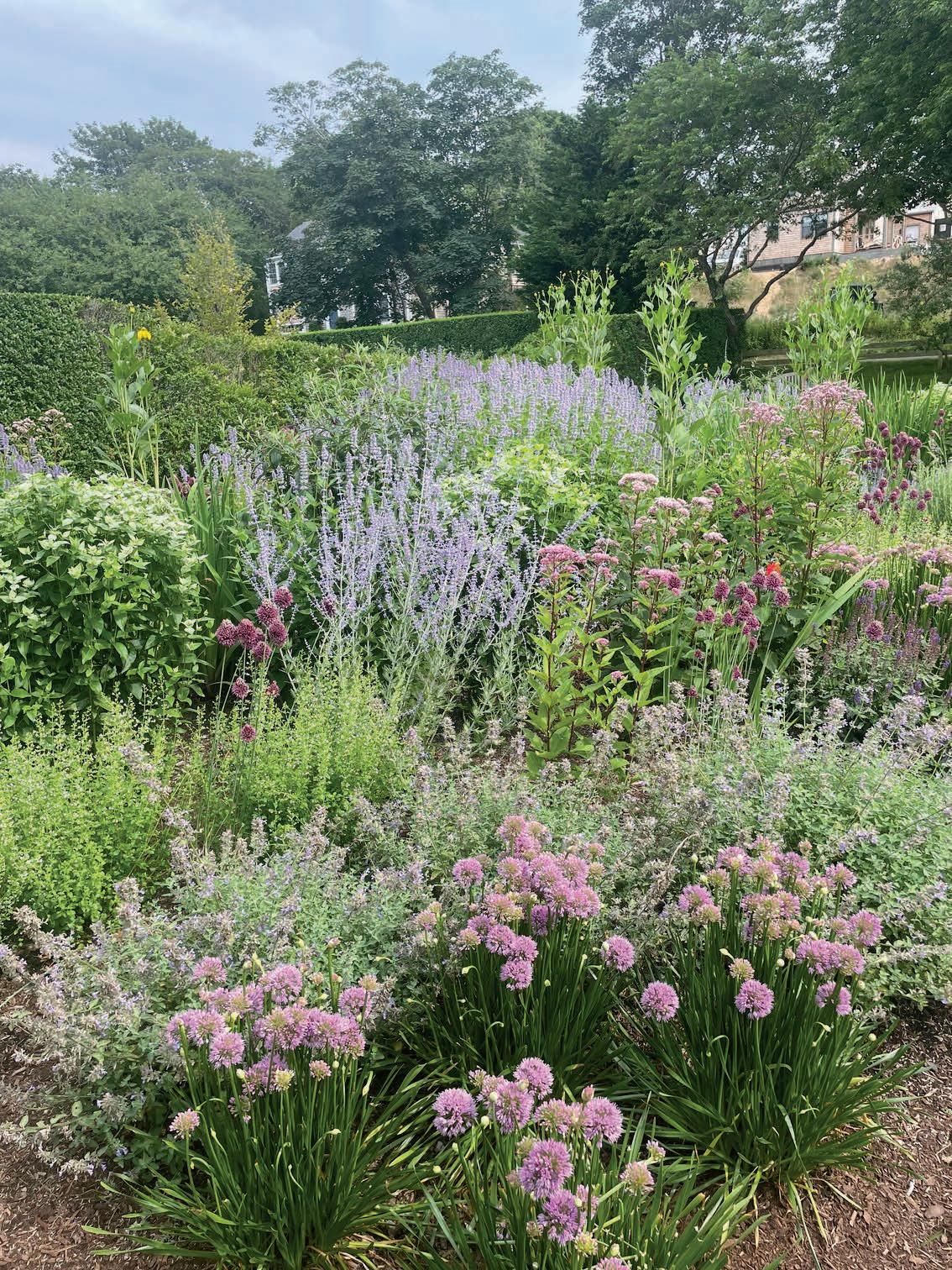
Remain’s Virtual Garden Tour series highlights local landscapes designed with sustainability in mind, from native plant gardens to pollinator habitats and lowmaintenance alternatives to traditional lawns. Watch each tour
PRE SERVATION TRUST
Because the greenest building is the one that’s already built. www.nantucketpreservation.org
GREEN GUIDE NANTUCKET
2026/27
Founder and Publisher Victoria Riskin
CEO Raymond Pearce
Director of Publications Jamie Kageleiry
Editor Britt Bowker britt.bowker@bluedotliving.com
Head of Audience Kirsten Carroll
Chief Financial Officer David Smith
Associate Editors Lucas Thors, Julia Cooper
Osceola Felows Robert Graves, Dylan Marks, Anna Popnikolova
Copyeditor Laura Roosevelt
Creative Director Tara Kenny
Art Director/Production Manager Whitney Multari
Ad Production Gabby Gobaton
Web Producer Grace Hughes
Contributing Editors Leslie Garrett, Will Kinsella
Contributors Bill Hoenk, Will Kinsella, Sam Moore
Ad Sales Josh Katz, adsales@bluedotliving.com
Social Media Emily Lamoureux, emily.lamoureux@bluedotliving.com
Bluedot and Bluedot Living logos and wordmarks are trademarks of Bluedot, Inc.
Copyright © 2026. All rights reserved.
Bluedot Living: At Home on Earth is printed on recycled material, using soy-based ink, in the U.S.
The Nantucket Bluedot Living Green Guide is published annually and is available at newsstands, select retail locations, inns, hotels, and bookstores, free of charge. Please write us if you’d like to stock Bluedot Living at your business.
Editor@bluedotliving.com
Sign up for the Nantucket Bluedot Living newsletter, along with any of our others: The BuyBetter Marketplace, our national The Weekly newsletter, and Bluedot Living Kitchen: bit.ly/BDL-newsletters

Read stories from this magazine and more at bluedotliving.com/nantucket
Find Bluedot Living on Twitter, Instagram, Facebook, and YouTube @bluedotliving
Put Your Money Where Your Beach Is
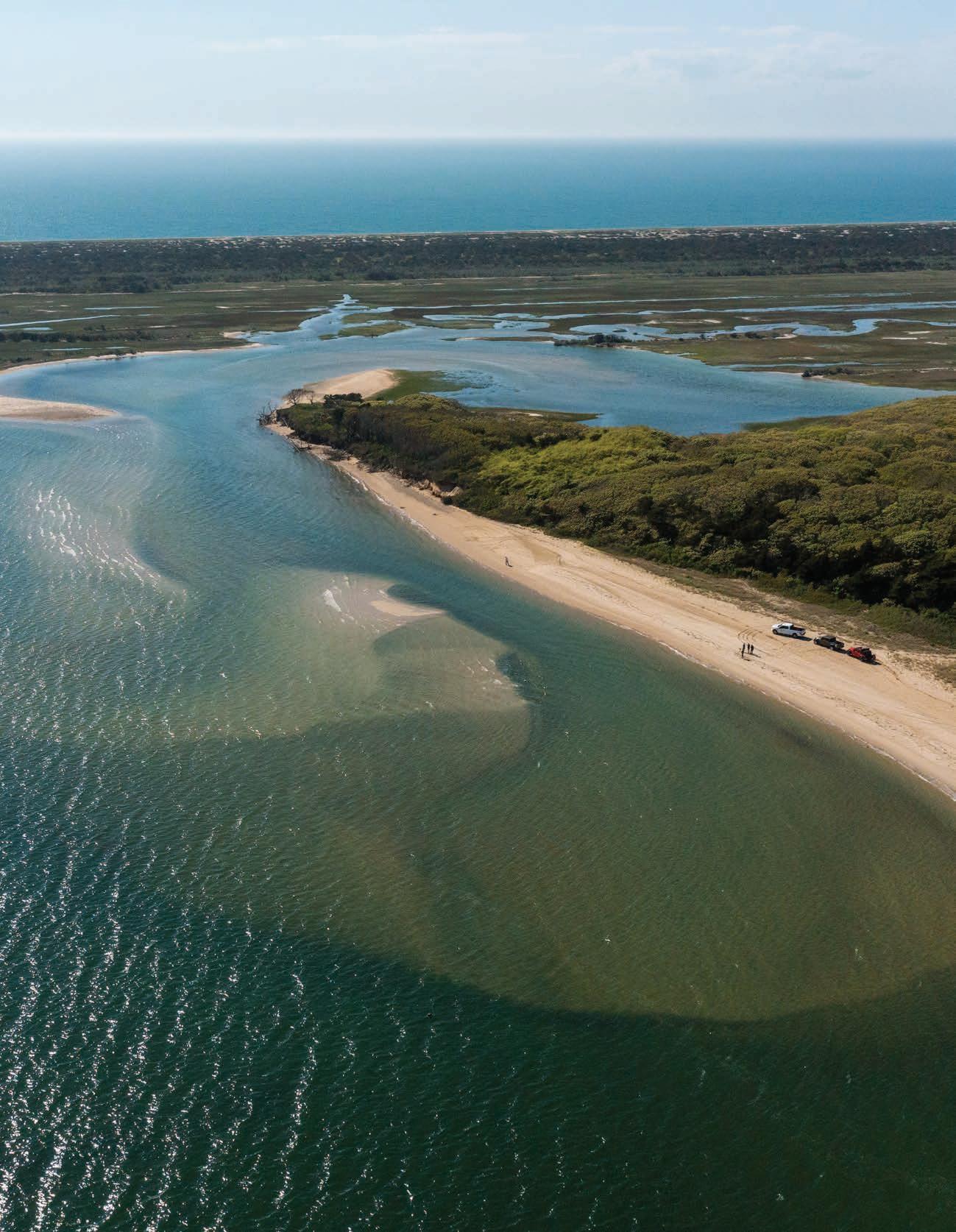
Our resilience work on Coskata-Coatue Wildlife Refuge has begun and is gaining momentum, and we need your support to protect this special place for everyone, forever.
PHOTO
We launched Bluedot Living five years ago on Martha’s Vineyard, in May of 2021. We’re still so proud to be publishing the stories of people meeting the challenges of climate change — the stewards and the gardeners, the plant pollinators and the benthic divers. I find that when I’m feeling, well, blue, about vexations we face with some of our policymakers, I feel less blue and mostly positively hopeful when I look at how much we get done in our own backyards. By the way, we have several national newsletters: Bluedot Living Kitchen, the Daily Dot, the BuyBetter Marketplace, and the Weekly. You can sign up for any of those newsletters
NANTUCKETERS!
Nantucket Lights, and Remain. Will Kinsella not only writes us beautiful essays of interesting things he actually tries at home (this year, it’s mowing his meadow with a scythe — yes, that’s what the grim reaper carries), but also helps to support junior reporters with funding from the Osceola Foundation. Over the next two years, you’ll see stories and photos from Nantucketers Robert Graves (at the high school), UMaine student Dylan Marks, and Harvard student Anna Popnikolova.
A year goes by too fast, so we’re going to publish another magazine midway through. We are partnering with Remain to publish Bluedot Kitchen: Nantucket Food, in which we will feature the makers, cooks,
A Thriving Nantucket Depends on ALL of Us

For more than 20 years, the Community Foundation for Nantucket has partnered with community leaders to address our island’s most critical needs.
Through generous donations to The Nantucket Fund, we award grants annually to fund critical programs and initiatives, support community convening, and promote informed philanthropy.
Our grant making helps provide access to affordable childcare, after school programs, behavioral and physical health services, shelter and food for those in need, and enrichment for our island’s seniors.

From left: Deb DuBois, The Warming Place; Rachel Mandle, Sherburne Commons; Jamie Foster, Nantucket Boys & Girls Club; Sunny Daily, CFN; Jennifer Frazee, A Safe Place.
Photographer: Kit Noble
FIELDNote
To: Bluedot Living
From: Remain
Subject: Our Virtual Garden Tour Series
Originally developed as part of Nantucket Footprints, a program focused on highlighting sustainability efforts and strengthening shared environmental understanding, Remain’s Virtual Garden Tour series reflects a clear and grounded idea: individual choices shape the health of our island. What began as a digital resource has grown into a more interactive, accessible platform, designed to meet people where they are — on their phones, online, and in the flow of everyday life.
The series was created to address a familiar disconnect on Nantucket: We see beautiful landscapes every day, but often don’t understand the systems behind them. These gardens are not simply aesthetically beautiful. They are working landscapes, designed to support pollinators, reduce water use, mitigate erosion and strengthen biodiversity over time. The challenge was how to open those spaces up, moving beyond
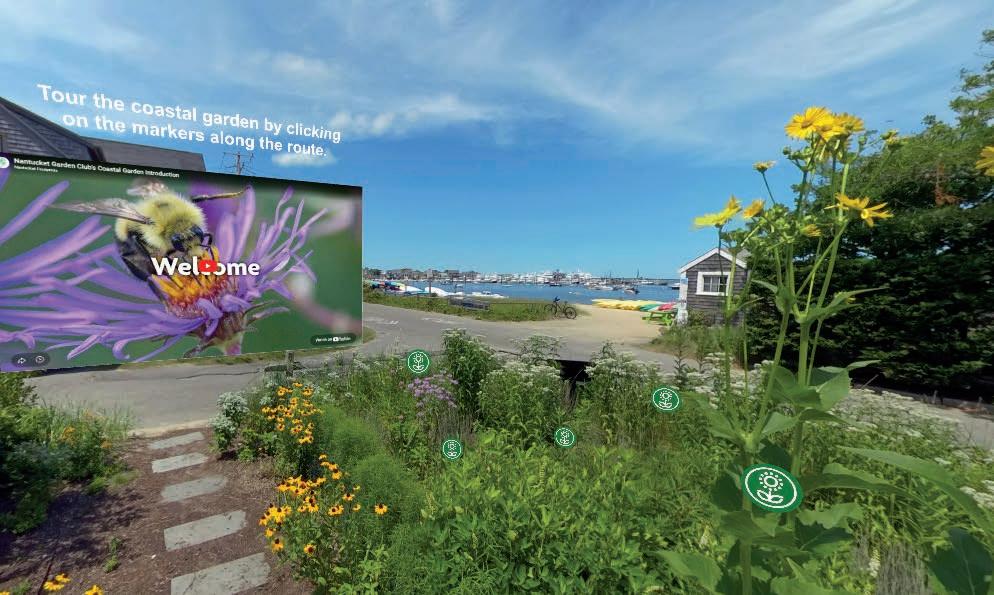
physical boundaries and creating ways for more people to engage with and learn from them.
The solution was to bring the gardens into a shared, digital space.
Launched in fall 2023, the Virtual Garden Tour series offers an interactive experience that allows users to move through each landscape at their own pace. Visitors can follow pathways, pause at specific plantings, and engage with layered educational content throughout. Each tour begins with a short video introduction from the land stewards who care for the space, grounding the experience in real knowledge and
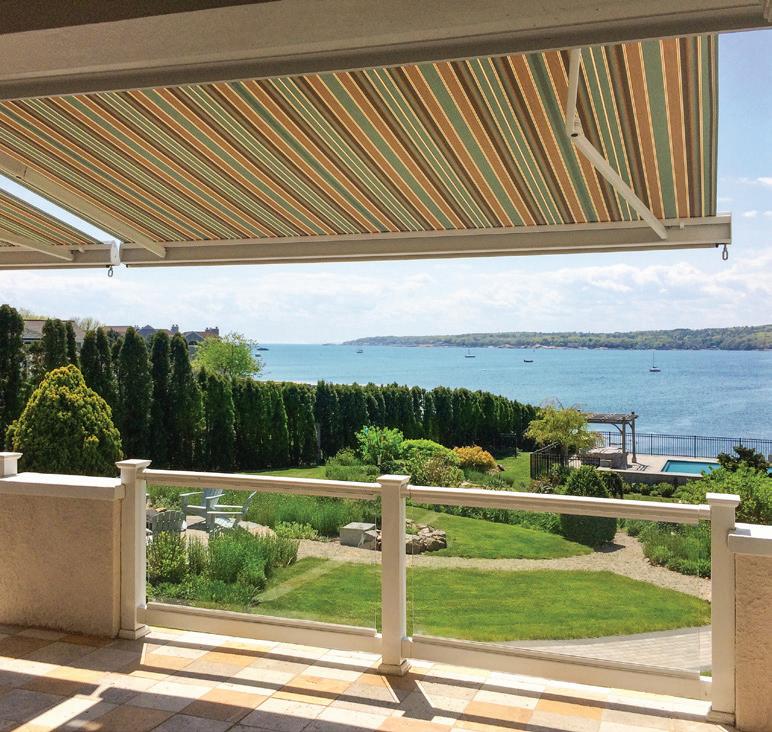









(bit.ly/Remain-Garden-BioDiv), was developed in collaboration with the Nantucket Conservation Foundation. It highlights the role of native plant diversity in supporting wildlife while reducing the need for irrigation and chemical additives; demonstrating that ecological and practical solutions can go hand in hand.
The series expanded through partnerships with the Nantucket Land Bank (bit.ly/RemainGardenLandBank) and the Nantucket Garden Club (bit.ly/RemainGardenGardenclub), each contributing a distinct approach to land stewardship. The Land Bank’s pollinator garden shows how even a small footprint can support broader ecosystem health, while the Garden Club’s coastal resilient garden at the Saltmarsh Center offers a model for planting in sensitive, changing environments.
These collaborations are central to the work. Stewardship on Nantucket is shared, and no single organization holds all the knowledge or responsibility. The Virtual Garden Tour series reflects that reality by bringing together different perspectives to create something more useful, more accessible and more connected.
Accessibility is a core priority. The tours are available online through Remain’s website, where users can explore each garden, watch companion videos and download plant guides to reference in their own spaces. The intent is not just
to inspire, but to provide practical tools; resources that can be applied at any scale, whether that’s a backyard garden or a larger landscape.
Because that’s where impact begins.
Across the United States, more than 40 million acres of land are maintained as lawn. Even small shifts toward native planting can have a measurable effect on biodiversity, water use and long-term landscape resilience. On Nantucket, where land is limited and environmental pressures are real, those shifts carry even more weight. A single reimagined garden can support pollinators, improve soil health and reduce maintenance demands, while contributing to the broader resilience of the island.
The Virtual Garden Tour series makes that kind of change feel achievable. It lowers barriers, whether geographic, educational, or logistical, and offers a clear entry point into more sustainable practices.
In that sense, the project is about more than gardens. It’s about how we understand and interact with the landscape around us. It’s about making informed decisions that reflect both place and purpose.
And ultimately, it’s a reminder that meaningful change doesn’t have to be large-scale to matter. It starts with individual choices, made thoughtfully, shared openly and rooted in the place we call home.

NANTUCKET OSPREY WATCH

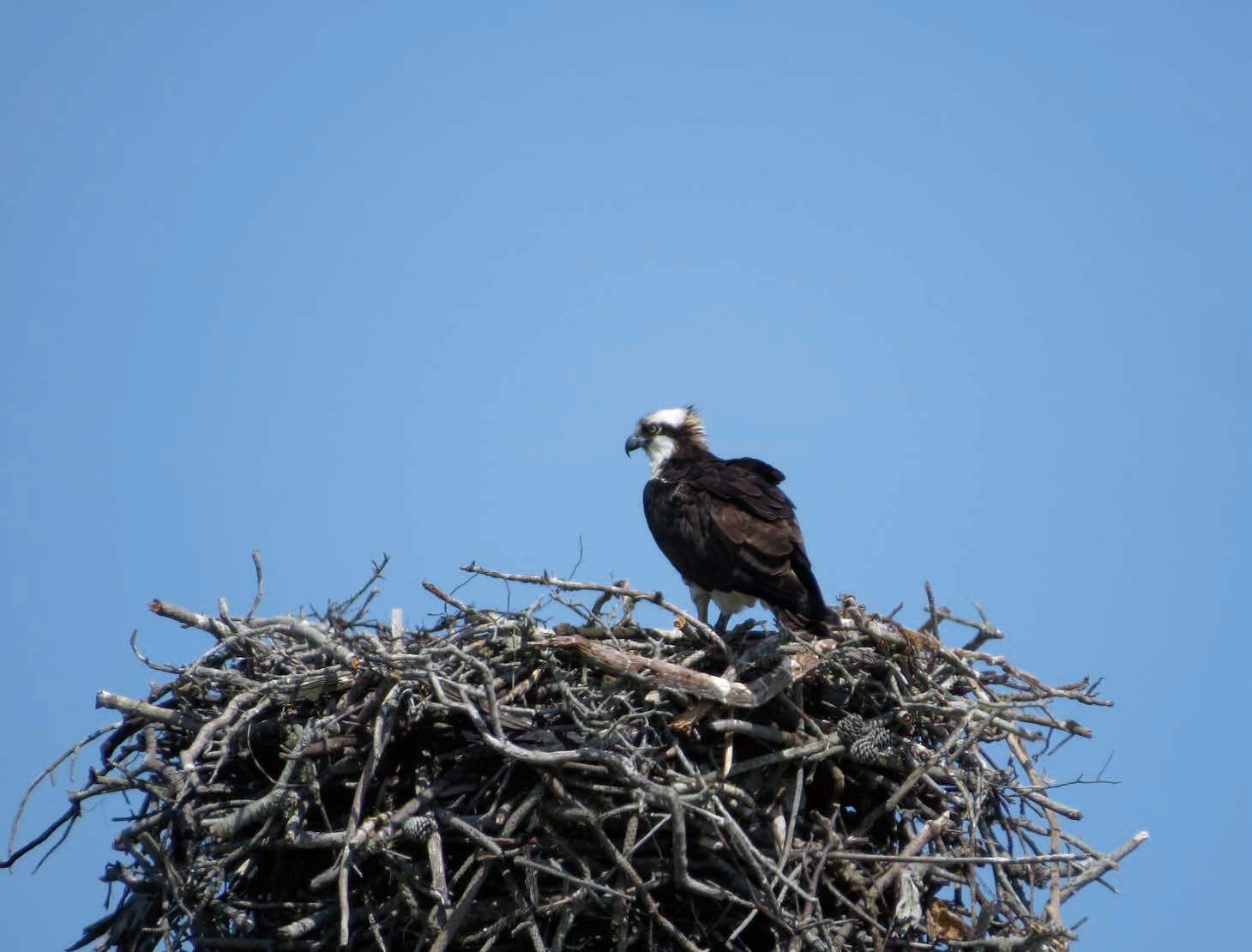
NEST MAP
Sandbar Sharks Around Nantucket
UMass Boston
Ph.D. candidate
Caroline Collatos shares dissertation research about sandbar shark residency along Nantucket’s shoreline.
By Britt Bowker
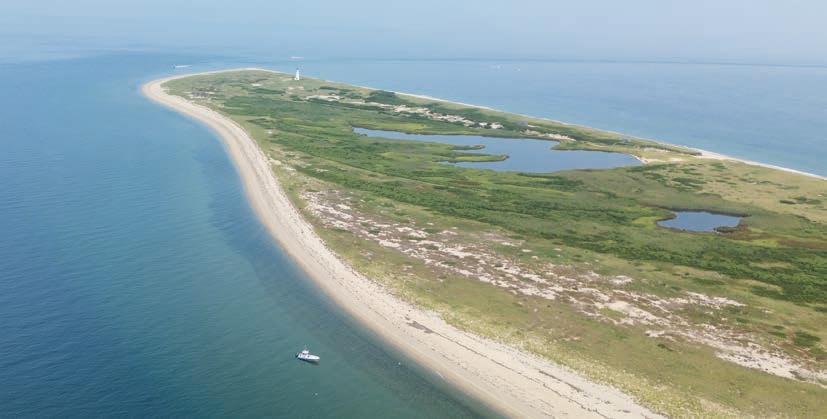
Great Point’s west side, a summer habitat for returning sandbar sharks.
Every summer, sandbar sharks return to Nantucket to take advantage of the island’s ideal conditions: water temperature, depth, and tidal currents — particularly off Great Point. Though they’re predators, sandbar sharks are nonaggressive and have not been affiliated with unprovoked attacks on humans.
“Individuals are coming back to the island pretty much at the same time every year, pretty similar to the summer crowd,” said Caroline Collatos, a Ph.D. candidate at UMass Boston working


with the New England Aquarium. Over the past five years, she has studied and tagged sandbar sharks as part of her dissertation on their residency along Nantucket’s shoreline. She recently shared her findings through the Linda Loring Nature Foundation’s Science Pub Webinar Series and hopes to complete her dissertation in December. Collatos, who grew up spending summers on Nantucket, now lives here most of the year.
Massachusetts marks the northernmost region of the sandbar
THE WEEKLY EXPLORE OUR


YOUR DAILY DOT
Questions and answers for everyday sustainable living.
Get curated news, tips, and recipes that help you live a greener life.
BUYBETTER MARKETPLACE
Better-for-the-planet products and solutions for everyday living.
BLUEDOT LIVING KITCHEN
Planet-friendly recipes and waste-saving kitchen ideas.

shark’s coastal migration. Along the East Coast, the species ranges from Florida to Massachusetts, spending summers in the north and winters down south. They mature slowly — reaching sexual maturity around age 15 — and produce relatively small litters, averaging nine pups.
Once heavily targeted by commercial fisheries, sandbar sharks experienced steep population declines, with reductions estimated near 80 percent before protections were enacted in 2008. Since then, the population has begun to recover. While still classified as “overfished,” overfishing is no longer occurring. In Massachusetts, anglers may catch sandbar sharks but must release them.
Despite their history, local research on the species has been limited. Early work by Greg Skomal in the 1990s and early 2000s focused largely on Martha’s Vineyard, leaving gaps in understanding how sandbar sharks use the Nantucket Sound.
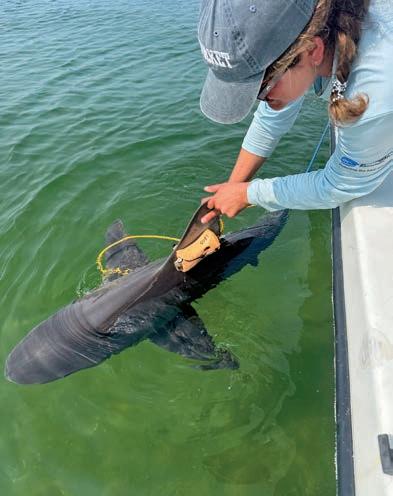
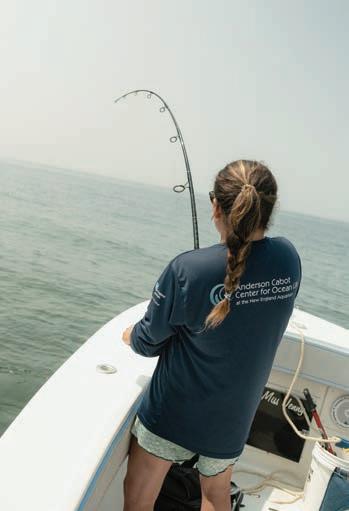
Collatos’ research helps fill that gap. Since 2021, she has caught and tagged
sharks off Cape Cod and Nantucket using acoustic telemetry devices — which she compares to an EZ-Pass system. Implanted tags transmit signals to a network of 43 receiver stations placed throughout Nantucket Sound each summer. These stations are part of a larger tracking system that spans the East Coast, allowing scientists to monitor shark movements without interfering with their natural behavior.
Her work also examined how sharks fare after catch-and-release fishing. The results are encouraging: sandbar sharks appear “pretty hardy,” she said, and generally survive after release.
Collatos and her team have caught 276 sandbar sharks, most of them juveniles and adults. The average shark measured about 150 centimeters (roughly 4 feet, 9 inches), and significantly more females than males were observed — a pattern that may relate to differences in migration after maturity.
Between 2021 and 2025, the team tagged 76 sharks in Massachusetts, with

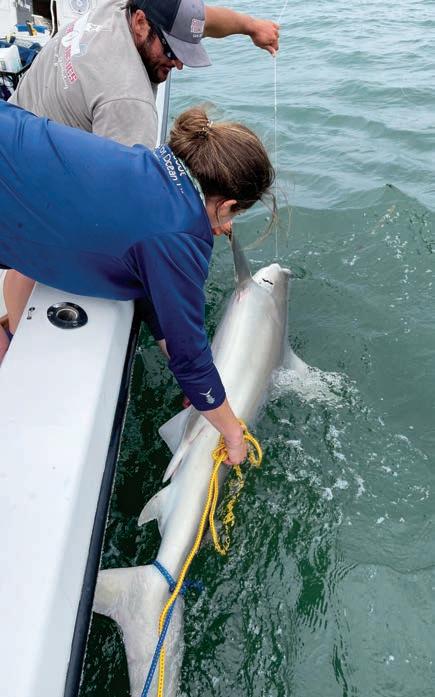
Catching and tagging sandbar sharks off Nantucket.
an additional eight tagged earlier in New Jersey. Of those 84 sharks, 83 have been detected by receiver stations. “I’d like to say that’s amazing,” Collatos said.
On average, sandbar sharks remain around Nantucket for about 28 days, though some stay as long as three months between June and November. Their movements aren’t random. Data show a strong concentration around Great Point, especially along its western shore.
“Sandbar sharks like this Great Point area,” Collatos said. “July, August, mid September, you’ll likely see sandbar sharks cruising the coastline.”
Several factors make this area attractive. Because sandbar sharks must swim continuously to breathe, calmer waters with weaker tidal currents allow them to conserve energy. “It’s like choosing to walk on a flat area rather than a hilly area,” she explained.
Depth also plays a role. A narrow band of shallow water offers some
protection from predators, while nearby deeper waters provide access to feeding grounds. Larger sharks, including white sharks, are known predators of sandbar sharks, making this balance between refuge and foraging habitat especially important.

Collatos describes Great Point as a “perfect storm” of favorable conditions: energy efficiency, thermoregulation, predator avoidance, prey availability, and safety in numbers. In contrast, areas with stronger tidal currents appear to discourage sharks from lingering.
Looking ahead, warming ocean temperatures may further shape these patterns. Southern species such as spinner and blacktip sharks could expand northward, and sandbar
A tag is attached to a shark's dorsal fin.
COURTESY OF CAROLINE COLLATOS
What You Can Do
While sandbar sharks pose little risk to humans, awareness remains important. Understanding when and where sharks are most likely to be present can help swimmers, surfers, and anglers make informed decisions. “Knowledge is very important,” Collatos said. “These are wild animals, and I can’t control what they do, but if people know the patterns, they can decide how and where to safely enjoy the water.”
Those interested can also support ongoing research efforts through contributions to the New England Aquarium’s Anderson Cabot Center for Ocean Life or the Nantucket Land and Water Council, which can be directed specifically to Collatos’s sandbar shark research.







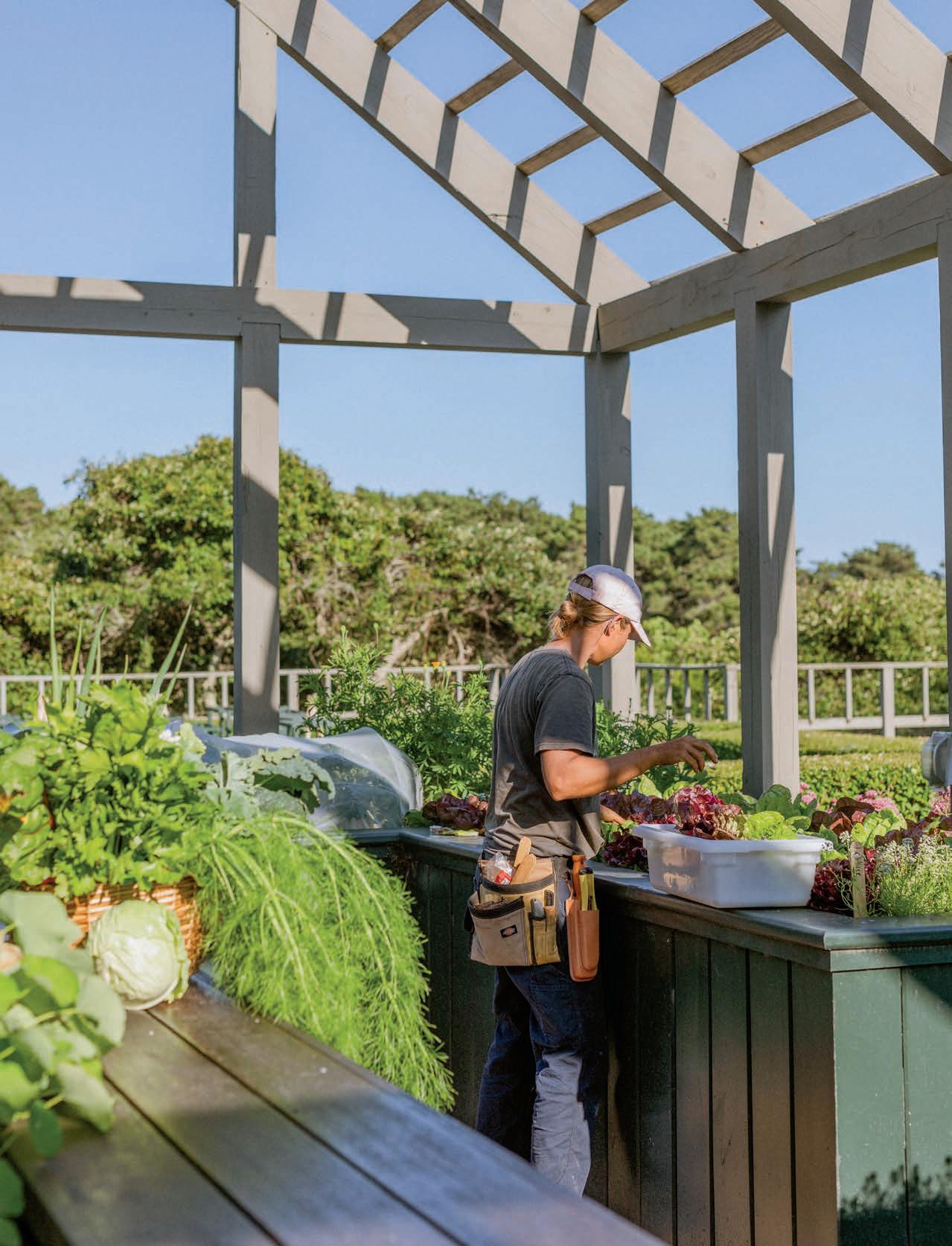
“Pretty much any veggie you can think of, we grow. Nantucket is pretty cool that way — it's a temperate climate. It stays a little cooler in the summer and a little warmer in the winter, so we have a long enough season to do most everything.”
–Luci Imbach
Luci Imbach, founder of Island Harvest Vegetable Gardens — the island’s only dedicated foodscape service.
Consider a Foodscape
Island Harvest Vegetable Gardens creates beautiful, bountiful edible gardens for Nantucket homes and businesses.
Story by Britt Bowker Photos by Holly Estrow
When Luci Imbach moved to Nantucket in 2018, she brought with her a love for food, agriculture, and the systems that connect them. After studying environmental studies and food systems at the University of Vermont, she went on to work at an island farm, where she learned how to grow food. At the same time, she was helping a friend with landscaping and quickly realized how big that industry was on Nantucket. That’s when the idea clicked: What if she merged the two — food and landscaping — and started her own business?
“I saw the opportunity there,” she says. “I knew there was no one doing foodscaping on the island, and I figured, why shouldn’t I do that?”
Luci launched Island Harvest Vegetable Gardens in 2020, combining her skills and studies with a desire to demystify growing food at home — “making it simple, and just helping people see the beauty of growing their own food,” she says.
She started with about 10 clients, and six years into business she has well over 40. It’s a small team — just her and two others — and they offer a full range of services, from garden design and construction to maintenance at every stage of the growing season.
Each spring, Luci and her team send clients a Google Sheet listing everything they grow. “And that’s really mostly every veggie,” she says. “Nantucket is pretty cool that way — it’s a temperate climate. It stays a little cooler in the summer and a little warmer in the winter, so we have a long enough season to do most everything.”
Clients fill out the sheet, and then Luci’s team creates a crop plan, which is a two-dimensional view of the garden, mapping out what’s going to be planted and when. “And we just execute that based on what the client wants to grow,” she says. Lettuce, tomatoes, and cucumbers are among their mostrequested crops, and they do corn for many clients, too. “Pretty much any veggie you can think of, we grow,” Luci says. “And we also do a little bit of perennial stuff, like berries, cane fruit, blueberries, and fruit trees.”
Island Harvest’s clientele is as varied as the services they offer. Nantucket being Nantucket, many clients have the resources to simply enjoy having a thriving vegetable garden without tending it themselves. Others are more hands-on — people who love gardening but don’t always have the time or confidence to manage it. Luci’s team handles the maintenance while some clients harvest on their own. Then there are a handful of local clients who prefer to do as much as possible
themselves, working with Island Harvest for a season or two before taking over the gardens entirely.
“It’s everywhere from people who just want a little bit of help and want to get their foot in the door of growing food and feel that confidence, to people who just like seeing their garden out their kitchen window and want it to be taken care of,” Luci says.
W hile most of Island Harvest’s work is residential, the company also partners with local businesses, though those partnerships are still few. Last winter, they built a vegetable garden for Something Natural, the popular sandwich shop on the island. Luci says she’d love to collaborate with more local businesses in the future.
The work follows a steady seasonal rhythm. The planting season starts in early May and goes into June. “Gardens are full of plants and ready to go. With some clients, our services will just stop there,” Luci says. Some opt for a midseason visit in August for a quick cleanup and fall planting. For full-maintenance clients, the team tends gardens weekly or biweekly through early October. By November, it’s time for fall cleanup. “We clean all the annual plants up and we put a layer of compost onto all of the beds,” Luci says. “We test the soil and make sure it doesn’t need anything, and that compost kind of insulates the soil for the winter and keeps it healthy.”
D uring the winter, Island Harvest builds garden beds and other structures. “I usually take some time off in January or
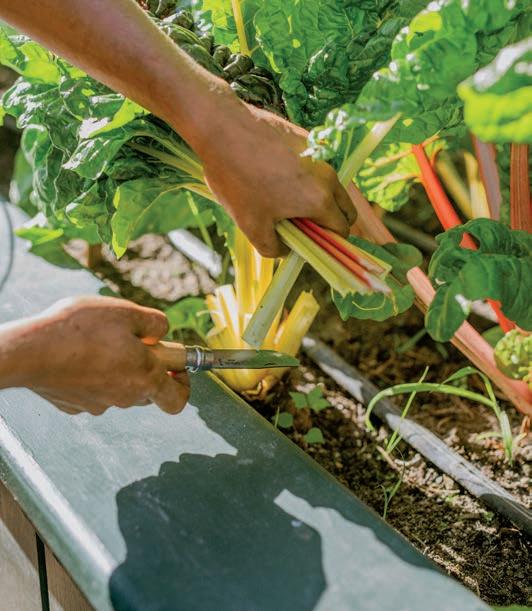
Luci creates gardens that provide abundant harvest.
February,” Luci says. “And then by March, we’re doing a few builds and starting up in the greenhouse.” She grows most of her starts in a hoop house on the property where she and her husband live. “I’m able to grow pretty much all of our starts out of here,” she says. “I rely on local nurseries for herbs and flowers and perennial plants, but mostly all of the annual veggies are coming out of [the greenhouse.]”
W hen it comes to easy versus difficult plants, Luci says it depends on the time of year. Fruit cane and blueberries are “pretty easy to grow. The only challenge with them is figuring out a place to put them because they do take up space, and with our deer population and bunnies, everything needs to be fenced and protected, from birds too.” Lettuce and tomatoes are most requested: “Lettuce is really easy for most of the year, except for the heat of summer … Tomatoes are more labor intensive, a lot of pruning, a lot of fertilizing, and they get disease easily. Nantucket is a maritime climate, so it gets really humid and foggy and kind of wet here, and that causes fungal issues.”
Luci started Island Harvest at the right time: during Covid, when people were thinking more about having food close to home. Six years in, the excitement continues.
“I think that’s kind of one of the cooler things about this job — seeing all different kinds of people, all different kinds of socioeconomic backgrounds. No matter who you are, whether you’re a master gardener or you’ve never planted anything before, anyone who sees food being grown and picks a tomato off a plant and eats it is just psyched about it. I think it tickles something in our human brain. People gravitate toward growing food,” Luci says.
But successful gardening takes experience and trial and error. “I studied this in college, but they didn’t really teach us how to grow a tomato or a cucumber. There’s just so much information

out there, on the internet, on YouTube, and not all of it is good information,” Luci says. “So being able to talk to someone and help them kind of filter through the bad information and learn the good science-backed information to grow in their garden — that’s very satisfying for me.”
One common mistake novice gardeners might make is planting too much of one crop at once. Succession planting, planting continuously throughout the season, prevents that. “You have to keep in mind the crop you’re planting and how long it takes to mature,” Luci says. “If we have a four-by-eight raised bed for lettuce and plant it all at once, that’s going to be more heads of lettuce than anyone knows what to do with.”
Succession planting spreads it out so the garden space isn’t wasted, and neither are the crops. “That’s a big one we practice a lot, and I think is important in a home garden where it’s such a small space — when you’re trying to get as much as you can out of it,” Luci says.
Looking ahead, Luci hopes Island Harvest can help with food insecurity. “We’re trying to figure out how to get more food that’s extra to people who need it on the island,” she says. Donations to the Nantucket Food Pantry could be one option. “There are clients with really large gardens that sometimes can’t use all the food. Or they go away for vacation and they don’t want it to go to waste. How do we make it easy and worth it for us to conveniently give food to people who need it? There’s a big food insecurity issue on Nantucket that a lot of people don’t think about.”
Luci sees “huge value” in giving back to the community, an area where there could be opportunity to do more. But through every foodscape she creates, she brings people one step closer to the land, to broader environmental stewardship, and to a deeper connection with the meals we share.
LUCI’S TIPS FOR NOVICE GARDENERS
• Don’t get caught up in the “rules” of companion planting. Most aren’t backed by science and can leave gardeners feeling overwhelmed. Instead, group plants by growth form — tall, medium, and short — so they all have good access to sun. And try to include as many flowers in your garden as possible.
• Try to source high-quality compost. Make sure your supplier tests their product and specializes in making compost. Home composting is also a great option, though you may not produce enough to amend your entire garden. Aim to add about 1 inch of compost to your soil each fall.
• Keep a small tool belt that can hold a few essential tools: highquality pruners, a Hori Hori digging knife for weeding and planting, a small spray bottle of alcohol for sanitizing pruners between plants, and some plant ties to keep everything neatly trellised.
• As for gardening playlists, Luci prefers podcasts. Encyclopedia Botanica, the No Till Growers Podcast, the Foodscaper Podcast, and, she adds, “any good true crime podcast.”
To learn more about Island Harvest Vegetable Gardens, visit ackislandharvest.com.
On the Cutting Edge
Using a scythe to maintain our meadow was a revelation!
By Will Kinsella
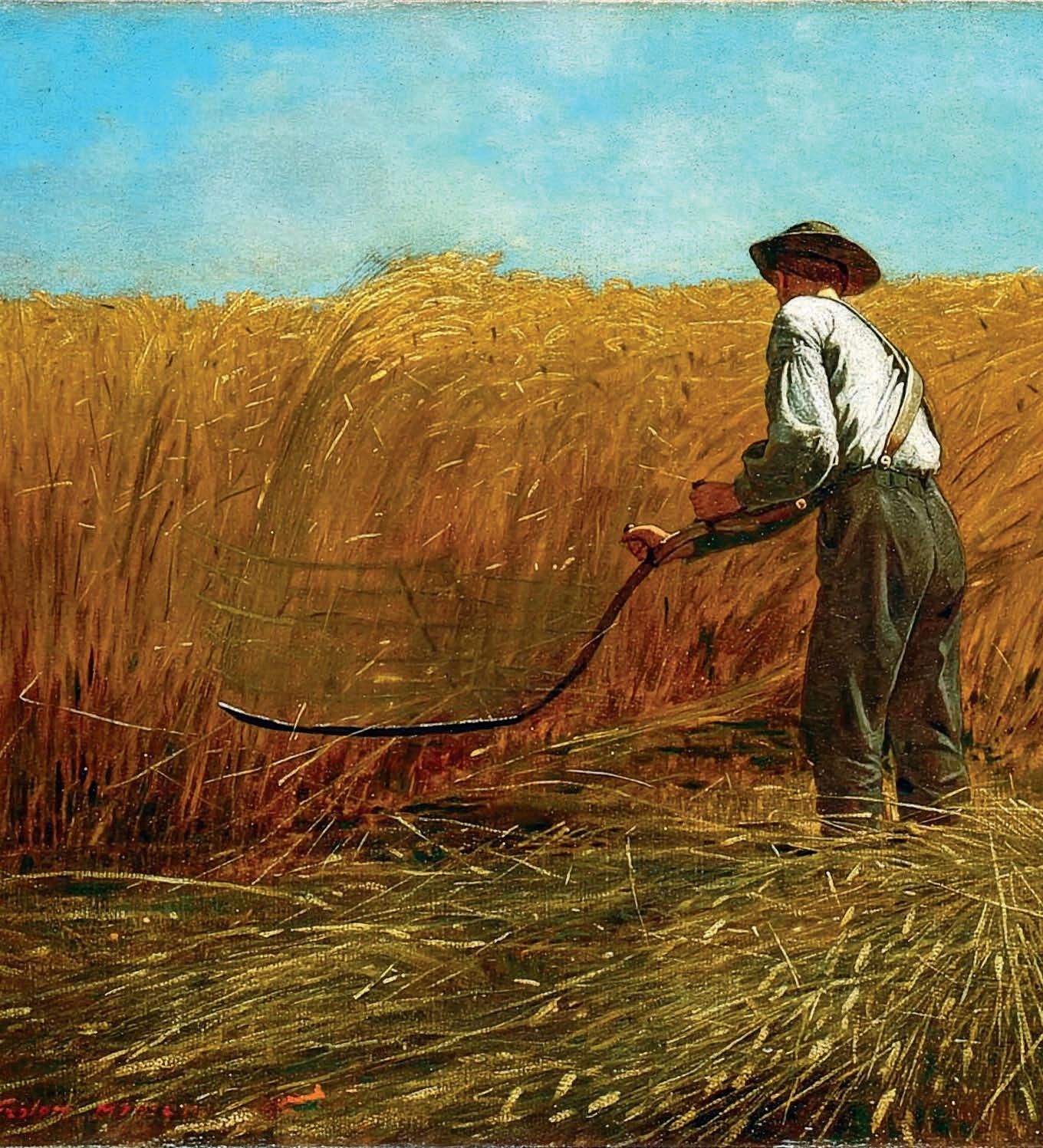
For centuries, people have used scythes to mow fields and meadows.
By Robert Frost Mowing
There was never a sound beside the wood but one, And that was my long scythe whispering to the ground. What was it it whispered? I knew not well myself; Perhaps it was something about the heat of the sun, Something, perhaps, about the lack of sound— And that was why it whispered and did not speak. It was no dream of the gift of idle hours, Or easy gold at the hand of fay or elf: Anything more than the truth would have seemed too weak
To the earnest love that laid the swale in rows, Not without feeble-pointed spikes of flowers (Pale orchises), and scared a bright green snake. The fact is the sweetest dream that labor knows. My long scythe whispered and left the hay to make.
(From his book, A Boy's Will, 1913)
It was March 2024 when Rita Higgins, who was leading a Nantucket Land and Water Council-sponsored native meadow workshop at Bartlett's Farm, mentioned a scythe workshop on the British Isles. At the time, our former dairy pasture had been allowed to grow for two years as the first step of a meadow restoration (guided by Rita) and was supporting a beautiful mosaic of native fescues, sedges, grasses, and forbs — but also woody groundsel, bayberry, and juniper, and invasive thistle, miscanthus, and privet that would soon need to be cut to prevent it from shading out the native meadow plants we were hoping to foster.
For meadow restorations, it's not enough to just let the grasses grow. Invasive and woody species need to be actively managed to prevent succession to another ecosystem, while grasses need to be occasionally trimmed to keep their growth in check and allow space for wildflowers to grow. Doing both typically requires annual mowing, burning, manual removal, and/or regular grazing.
I had been feeling challenged by the contradictions between fostering a native plant meadow that sequesters carbon, filters water, provides habitat, and supports biodiversity, and the loud, energy-intensive, carbon-spewing, soil-compacting, habitat-disrupting power tools used to maintain it. However, it had never occurred to me to use a scythe until Rita mentioned it, nor had I ever seen one used. The change in our goals for this meadow also required a change in management strategy, and for that, a scythe fit the bill: a quiet, non-polluting, cheap, multi-use tool that was easy to assemble, maintain, and repair.
People have used scythes for mowing since the Roman Empire, and sickles for gathering seed heads and cutting grass or reeds (for matting, bedding, and roofing materials) since well before the Agricultural Revolution — but to me, they just evoked the Grim Reaper and Soviet Communism. Farmers replaced these tools so long ago with lawn mowers and combine harvesters that the notion of reincorporating their use took a leap of imagination (and a fair amount of courage when considering handling a sharp, three-foot blade). But while many of us have been conditioned to believe that we need machines to handle labor-intensive chores, it doesn't take a Luddite to advocate the use of a rake and broom when faced with the racket of a leaf blower and the clouds of feces, dust, and mold that they stir up.
Inspired by Rita, I purchased a 170cm Schröckenfux adjustable wooden snath (the scythe’s long, wooden handle) with an attachable 70cm "Gartensense" blade. I watched more than a few
THE VETERAN IN A NEW FIELD, WINSLOW HOMER
instructional videos and practiced swinging the blade over our dirt driveway, getting into a rhythmic sway, shifting my weight from foot to foot while twisting my upper body and keeping the blade against the ground. The slow and deliberate movements are very similar to tai chi and other meditations in motion: a gentle series of posturecorrecting circular maneuvers — back straight, shoulders down — engaging the core muscles while one shifts balance from side to side to the rhythm of one's breath. It's great exercise for people of most ages and abilities and can be as relaxing as a two-step or as demanding as ballet. I've heard about children as young as four learning this procedure and older adults putting aside their canes to scythe, and there are competitions in which scythe mowers race against not only each other, but also against people using strimmers (weed whackers) and lawnmowers.
I first took to the fields with my new scythe on a glorious April morning. Reminding myself of the adage that "the scythe must dance," I fell into a slow but rhythmic shuffle so that my shifting weight, rather than my arms, pushed the scythe through the grasses. I felt peaceful, mesmerized as the scythe blade whispered "swoosh" through the tall grass stems, followed by gentle rustling as swaths of grasses fell together into neat piles at the end of each stroke. Inching my feet forward
during the return swing, I repeated the process, over and over again. Although the movements themselves were repetitive, the process was gratifying, every inch of progress providing a moment of complete engagement with the landscape.
The old adage "Give me six hours to chop down a tree and I will spend four sharpening the axe" proved prescient. When it got tough to swing the blade, it was time to resharpen. I stopped every few minutes to hone the blade with a whetstone, stroking diagonally downwards across the top of the blade and across its bottom to remove any metal burrs. During one of the many resharpening stops that first day, I took a moment to look around and admire my handiwork and noticed a gaggle of geese grazing 15 to 20 feet behind me. Normally, they'd honk emphatic protestations if I were walking so close to them, but now, as I mowed with the scythe, it felt as though we were grazing in quiet communion together, and they understood that I posed no threat or bother to them. In addition to the geese, bees, bugs, and other birds normally scared away by the noise or speed of conventional mowing seemed completely at ease while I mowed with the scythe. The entire scything process felt like a serene, blissful engagement with nature, a moment to listen, observe closely, and admire.
It doesn't take someone from 'Sconset to tell you
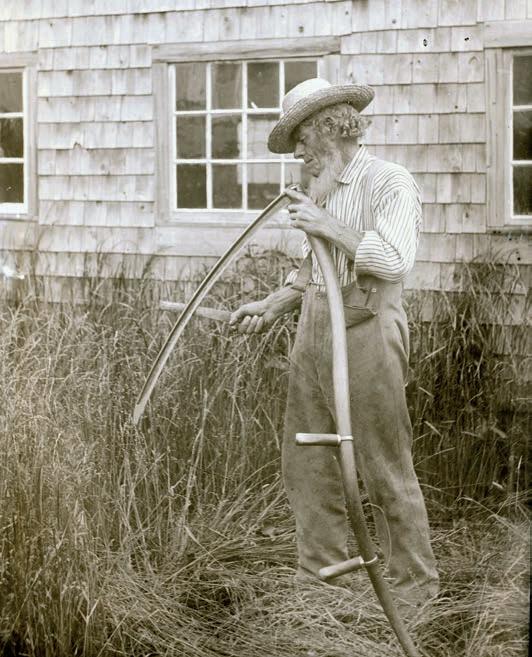
Moses Ellis on Nantucket, circa 1880s.
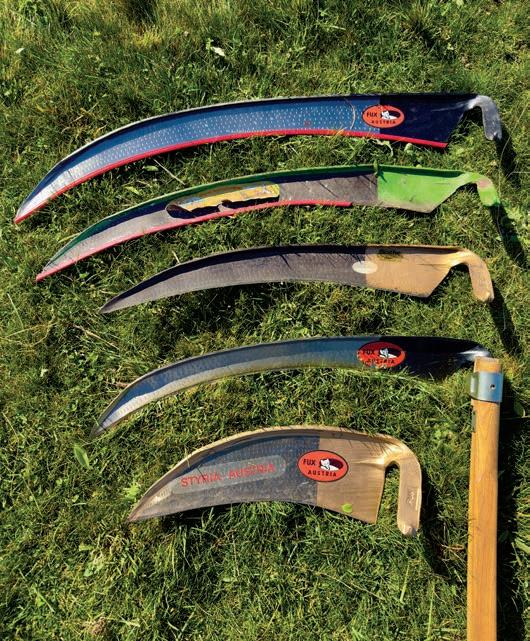
Scythe blades come in a range of lengths and profiles, each suited to different grasses and terrain.
HISTORICAL ASSOCIATION WILL KINSELLA
how disturbing the cacophony of noise from power landscaping equipment can be. [A stricter noise bylaw proposal limiting construction and landscaping activities during certain hours has been submitted by the Sconset Civic Association and is expected to be considered at the spring 2026 Nantucket Town Meeting.] Nationwide, noise may be the most widespread and most underacknowledged pollutant. Birds and insects, like humans, are stressed by noisy environments, and chronic stress can lead to smaller body sizes, delayed development, and increased mortality. Artificial sounds can also induce birds, bats, and insects to change feeding, nesting, mating, hunting, and predator avoidance habits — all of which can lead to declines in population, health, and biodiversity. While the sound intensity produced by a gas-powered push or riding mower is comparable to that of a motorcycle, the scythe makes about as much noise as grasses rustling in the breeze.
The time and effort required to mow with a scythe are similar to what it would take using a strimmer, but the whole process is quieter, lighter, and more efficient — and the results are just as good. Experienced scythers using long blades can actually mow much faster than strimmers and achieve a more consistent height of cut. For short grasses where the soil has been smoothed, it's relatively easy to cut down to one to two inches tall, as in a typical mowed lawn. For larger meadow grasses like cord and switch grass, which have dense crowns and hollow stems, it's easy to float the blade to a higher cut level that provides crucial insect habitat and visual interest.
Additionally, you can use a scythe to knick out individual plants, even shrubs, while leaving neighboring plants untouched, whereas the strimmer’s string line cuts a wider radius and won't cut through woody materials. In fact, the scythe is an excellent tool for woody plant removal and pruning that would damage the blade of most lawnmowers. Using a heavier, shorter, and thicker "bush blade," I can easily cut through saplings with a diameter of up to 3/4" at ground level without any of the back bending that using loppers entails (though I still use loppers and/or a saw for anything wider than 3/4"). Also, I can prune bushes and branches taller than myself. For prickly invasives like bull thistle, the scythe makes it easy to cut and move the plant without touching it, which can prove painful with even the best gloves.
For speed alone, the scythe doesn't compete against a large mower or a tractor with a brush hog. Larger cleared areas, such as those owned and maintained by the Nantucket Conservation Foundation, would require teams of scythe mowers to replace a piece of heavy machinery. While a tractor with a brush hog can mow in an hour as much as an experienced scythe mower can do in a day, there’s a lot that these machines don't allow for: selective single plant removal, for example, or on-the-go height variation. Nor can they mow in small or steep areas. The scythe is a user-guided precision instrument that remains the most versatile mowing and pruning tool out there.
For most household properties and situations, the scythe remains the ideal land management tool. It’s an appropriate technology that's versatile, environmentally sustainable, energyefficient, and affordable, and it causes little disruption to our neighbors and environment. Holistic individual climate and environmental action requires us to reconsider how we cut our lawns — as much as whether we should have lawns in the first place — along with how we travel, heat, build, buy, and eat. Consider the scythe a fitting complement to recycling, passive solar, bicycles, composting, and low- or no-meat diets — strategies that may require initial effort but are imperative for living sustainably.
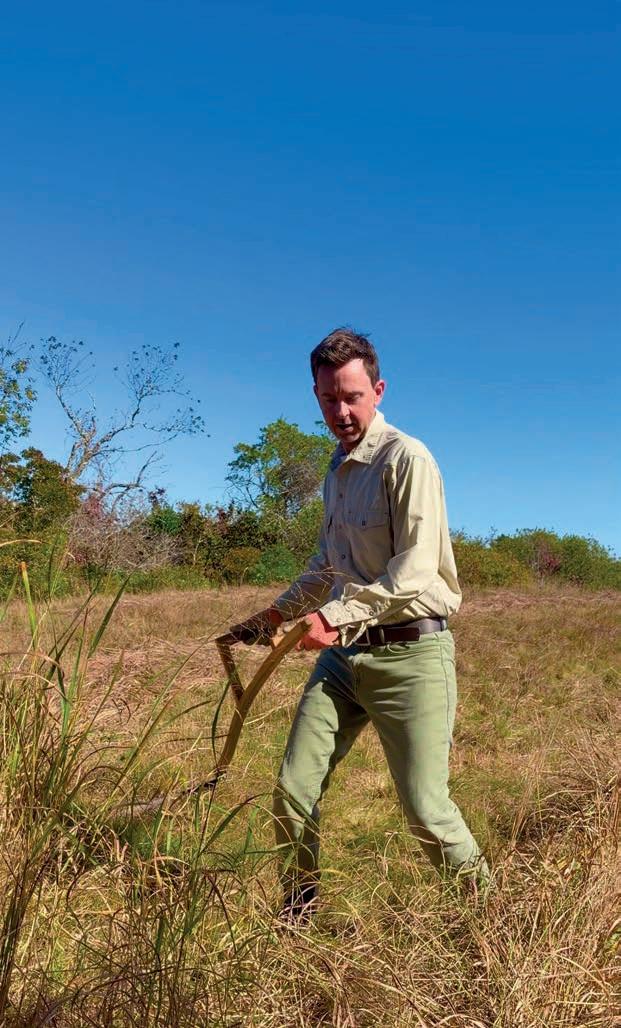
What You Can Do: Want to Scythe?
• I get my scythe equipment through Scythe Supply: scythesupply.com
• Also check out One Scythe Revolution: onescytherevolution.com
• For online tutorials, Janne Wester is the best! bit.ly/ScytheLessons
• Find out more about UK scythe workshops: somersetscytheschool.com
WILL KINSELLA
FIELDNote
To: Bluedot Living
From: Gail Walker, Founder and President of Nantucket Lights
Subject: The Glow Below: How Light Pollution Disrupts Marine Life
Most people think of light pollution as a land-based problem — light shining into bedroom windows, spoiling the view of the stars, causing unsafe glare, and disrupting the natural rhythms of animals that live on land. But artificial light doesn’t stop at the water’s edge, nor does its harm.
Recent studies have found that the manmade light that spills into our oceans and harbors is also affecting the marine ecosystem. From bay scallops and oysters to the whales and striped bass that patrol our coasts, marine life depends on natural darkness in ways we are only beginning to understand.
KEEP NANTUCKET WATERS DARK
Principles for Responsible Outdoor Lighting
The artificial light at night that affects the marine life near Nantucket comes from a variety of sources, both on land and on water, most notably building lights, lighthouses, streetlights, marinas and docks, the many boats that are lit up at night, and infrastructure in the ocean, such as the wind turbines. To be sure, some of this light is required for safety, but there are some easy ways to minimize the harm.
• Use light only if there is a clear purpose for it.
• Direct the light so it falls only where it is needed.
• Use the lowest level of light required.
• Use light only when it is needed.
• Use warmer color lights where possible to minimize the amount of blue light.
• If you own property on land, at a minimum please comply with the outdoor lighting bylaw that was adopted in 2023. Free guidance is available at nantucketlights.org.
• If you’re a boat owner, please be especially mindful of lights shining directly into the water, as that is the most harmful of all to marine life. Most importantly, turn them off when not needed.

THE THREAT TO MARINE LIFE
Stated simply, light pollution refers to the unnatural brightening of the night with artificial light. For years, scientists have documented how this disrupts the growth cycles, behavior, and physiology of plants, insects, and animals on land. Now, growing evidence suggests that marine life — from the tiniest zooplankton to the mightiest of whales — can be compromised as well, in large part because the blue and green wavelengths in the LED lights commonly used today penetrate deeper into the ocean than traditional incandescent and halogen lights.
A FEW EXAMPLES:
• Artificial light has been found to disrupt spawning behavior of fish and interfere with how they feed and mate. It also makes them more visible to predators, and thus more vulnerable, and causes them to become more — or less — active at night, which can change hunting patterns and interactions among different species.
• Zooplankton, perhaps one of the most important ocean creatures, are also affected. These microscopic organisms, vital to aquatic food chains, normally rise to the surface at night to feed and descend during the day to avoid predators. Artificial light interferes with this rhythm, causing many to stay in deeper, darker water at night. This in turn affects their feeding cycles and could potentially lead to a collapse of fish populations that feed on them.
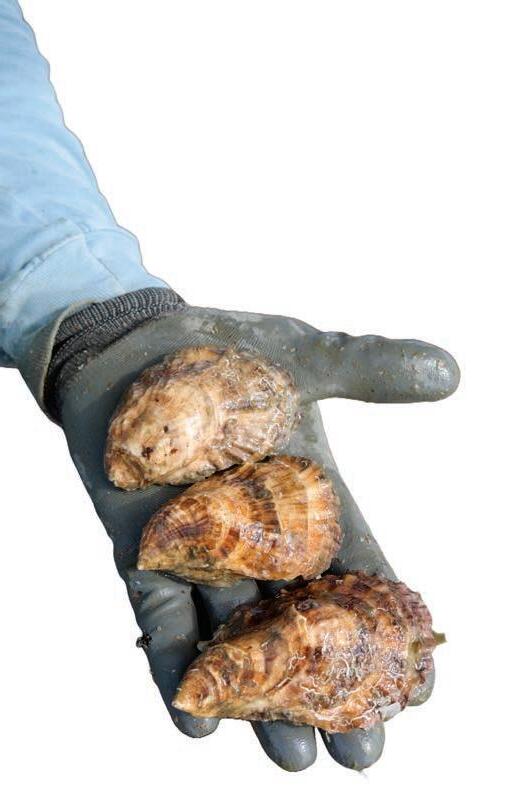
• It was recently discovered that artificial light at night disrupts oyster behavior and alters the activity of the genes that keep their internal clocks ticking. Even low levels of light were enough to throw off the oysters’ circadian rhythm. While more research into the consequences of this is needed, the worry is that this could make them more susceptible to disease.
In short, there is reason to be concerned about the pervasive artificial light at night near our ocean and harbors.
Nantucket Lights is an all-volunteer 501(c)(3) nonprofit exclusively dedicated to preserving Nantucket’s nighttime environment and heritage of dark skies by raising awareness about light pollution on the island and advocating for environmentally responsible outdoor lighting.
BILL HOENK
Nantucket Harbor at night.
FIELDNote
To: Bluedot Living
From: Libby Buck, Conservation Science and Land Steward with Linda Loring Nature Foundation
Subject:
Nantucket Osprey Watch: A Community-Powered Project
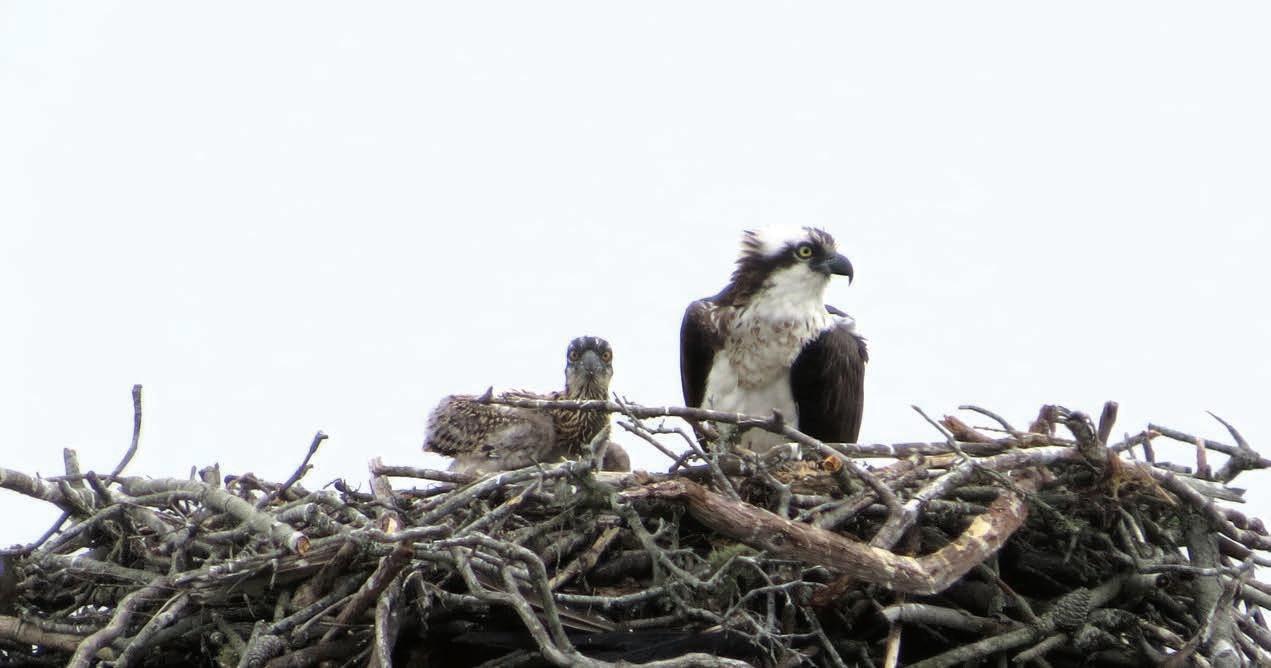
One of Nantucket’s favorite signs of spring is looking up and seeing ospreys overhead, circling above the marshes and harbors, their sharp whistling calls carrying through the air. Each year, they return to the same nests across Nantucket, picking up right where they left off.
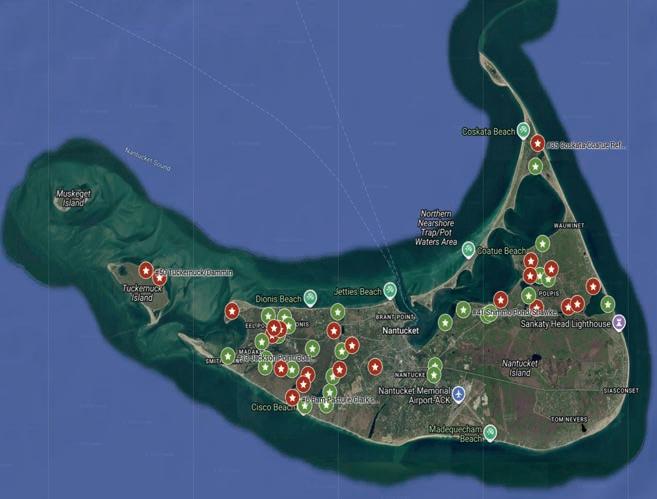
In 2025, the Linda Loring Nature Foundation launched the Nantucket Osprey Watch, a community science program designed to better understand how ospreys are doing across the island. While ospreys are one of the most visible birds on Nantucket, there has never been a consistent island-wide effort to track where they nest and how successful they are year to year. The Nantucket Osprey Watch was created to bring those observations together into one shared dataset powered by the community.
The program is simple by design. Volunteers monitor nests and submit short observations, called nest checks, throughout the breeding season. These nest checks might include whether a nest is active, if the adults are present, signs of incubation, or whether the chicks have hatched and eventually fledged. Each observation, on its own, is a small piece of data, but together they build a clearer story of osprey activity across the island.
In its first season, the response exceeded expectations. With the help of volunteers, we documented 50 nest sites across the island. Of those, 40 were active, and together they produced 40 fledglings. In total, the program logged over 240 hours of observation time. These numbers represent an incredible contribution from the community and provide an important baseline that we can build on year after year.
What we are already seeing is encouraging. Ospreys on Nantucket appear to be doing well and nest success is closely tied to the availability of safe nesting sites. Some nests are on
human-made platforms, and others are still tucked into dead trees across the island. Food availability is also a big piece of the picture. Nantucket offers a wide variety of fish in its ponds, harbors, and coastal waters, giving ospreys consistent foraging opportunities throughout the season.
At the same time, this is only the beginning. Longterm monitoring will allow us to track trends, understand challenges, and identify changes in nesting success over time. Questions about food availability, weather impacts, and nest site competition will become clearer as the dataset grows.
One of the most important aspects of the Nantucket Osprey Watch is that it is open to everyone. You don’t need to have a background in science or birding to participate. Volunteers can choose to monitor a specific nest with a brief weekly check, or contribute more casually by reporting observations whenever they come across an osprey nest. Both approaches are valuable, and every observation adds to the bigger picture.
There is also something uniquely rewarding about following a nest over time. Watching the progression from courtship to incubation to chicks peeking over the edge creates a connection that goes beyond a single sighting. You begin to notice patterns, behaviors, and individual differences, and in doing so, you become part of research itself.
As the program continues to grow, we are always looking for more volunteers to help. More participation means better coverage, stronger data, and a deeper understanding of how ospreys are using our island.
All it takes is looking up and taking note of what you see. On Nantucket, the story of the ospreys is unfolding every year, and it’s something that anyone can be a part of. To participate, visit llnf.org/nantucket-osprey-watch.
LIBBY BUCK
Ospreys on Nantucket








Well, Well, Well: All About Nantucket’s Only Water Supply
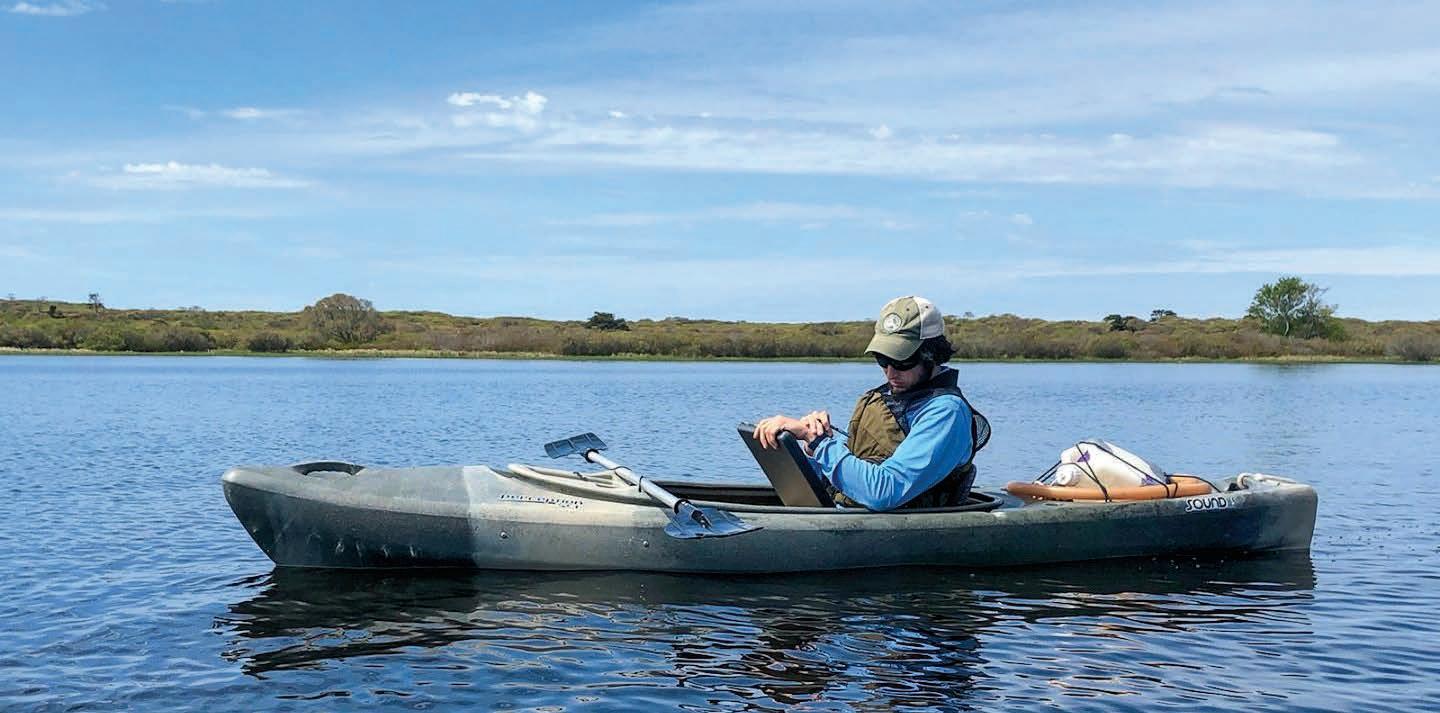
With everyone on Nantucket sipping from the same aquifer, what happens during a drought?
Each spring, as the weather warms and the bustle of summer can be heard in the distance, people begin to arrive on Nantucket. All winter, the island has been preparing for them, and not just the hardy year-round residents, bracing themselves for the onrush of another fifty thousand people; the land itself has been preparing, hydrologically. In its bones, in its sand, silt, clay and gravel, the island has been recharging its aquifer. As rain and snow soak the island, the water table rises. If you know what to look for, you can watch it happen.
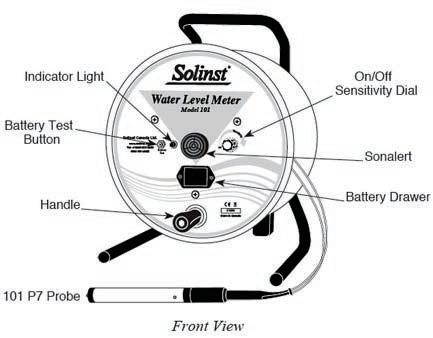
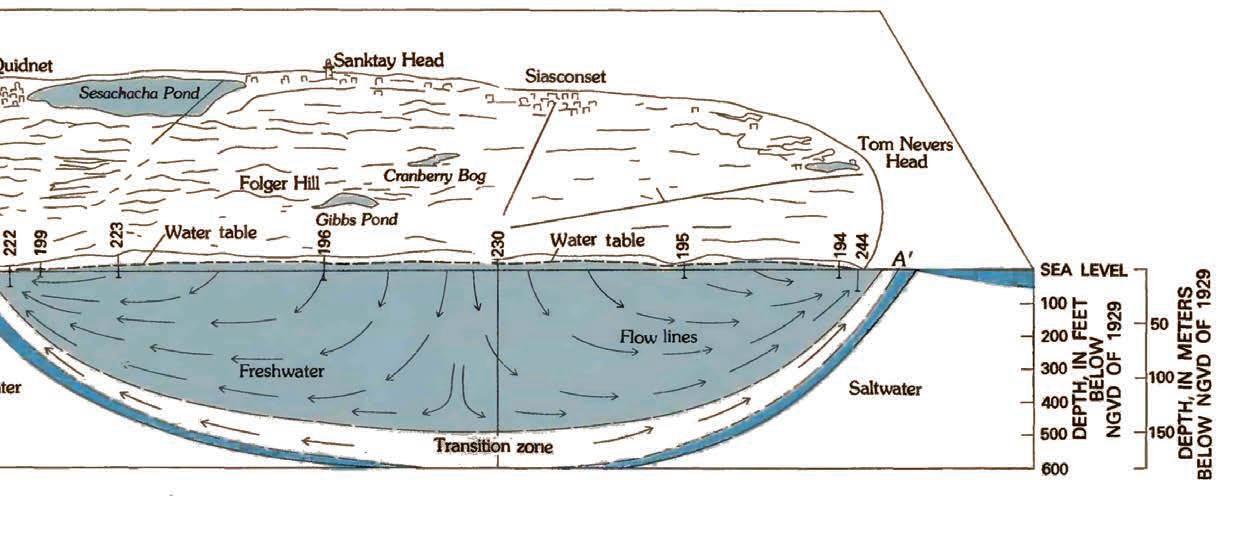
“Every month, I go around and measure wells for the U.S. Geological Survey,” says RJ Turcotte, Nantucket’s Waterkeeper and a staff member at the Nantucket Land & Water Council. The aquifer, the island’s sole source of freshwater, is a lens (or layer) of saturated sediment whose upper boundary is typically a few feet beneath the surface (see illustration, next page), and Turcotte uses a special tool to find out exactly where. “It's basically a tape measure with a probe on the end. You lower it down a pipe into the ground, and when it buzzes you know you’ve hit groundwater.”
The surface of the island is pierced by hundreds of wells, and their levels, month-by-month, tell a story. “When everybody gets here in the spring, we start drawing up millions of gallons more water, and you can see the aquifer
drop,” Turcotte says. “And then Labor Day, everyone starts to leave, and we start to get precipitation that isn't being immediately taken up. You start to see the aquifer rebound.”
Some of the water drawn up from the ground is used for drinking and bathing, but much of it goes to the splashy trappings of summer life on Nantucket — for watering lawns, gardens, and golf courses; filling swimming pools; hosing off salty, sandy cars and boats. As more people arrive, these activities accelerate. When dry conditions combine with high water usage by island residents, the water table sinks further below the surface, and Nantucket officially enters a drought. As the drought becomes more severe, it triggers mandatory water restrictions.
The past few years have seen a ratcheting intensity of drought on Nantucket, along with widespread flaunting of water restrictions. Last summer, as a mild drought in June became a critical drought by October, the town voted to impose fines for violators — up to $500 dollars on the third offense. But for many people on the island, that’s a small price to pay, so the town’s public utility, the Wannacomet Water Company, threatened to cut off water completely for serial offenders.
“It’s really hard, because everyone’s on vacation in the summertime,” says Turcotte, who also sits on the Conservation Commission. “People’s mentality is: I deal with problems all
RJ Turcotte, Nantucket's Waterkeeper, spends a lot of time on and around water on the island.
Story by Sam Moore Photos courtesy of RJ Turcotte

day long back home when I’m at work. I don’t want to hear about how I need to use less water. For the most part, people aren’t here very long, and it's really hard to educate when [they’re] just ripping through for a bachelorette party.”
Even the concept of water scarcity can feel counterintuitive in New England, because we have lots of water, especially compared to the arid landscapes in the western United States. Even in the dog days of summer, we can experience intense, drenching rainstorms. So what does a drought really mean for a place like Nantucket, which is sitting atop on tens of billions of gallons of fresh water? And if the aquifer’s not going to run completely dry, why should anyone care if it drops a couple feet?
WHAT LIES BENEATH
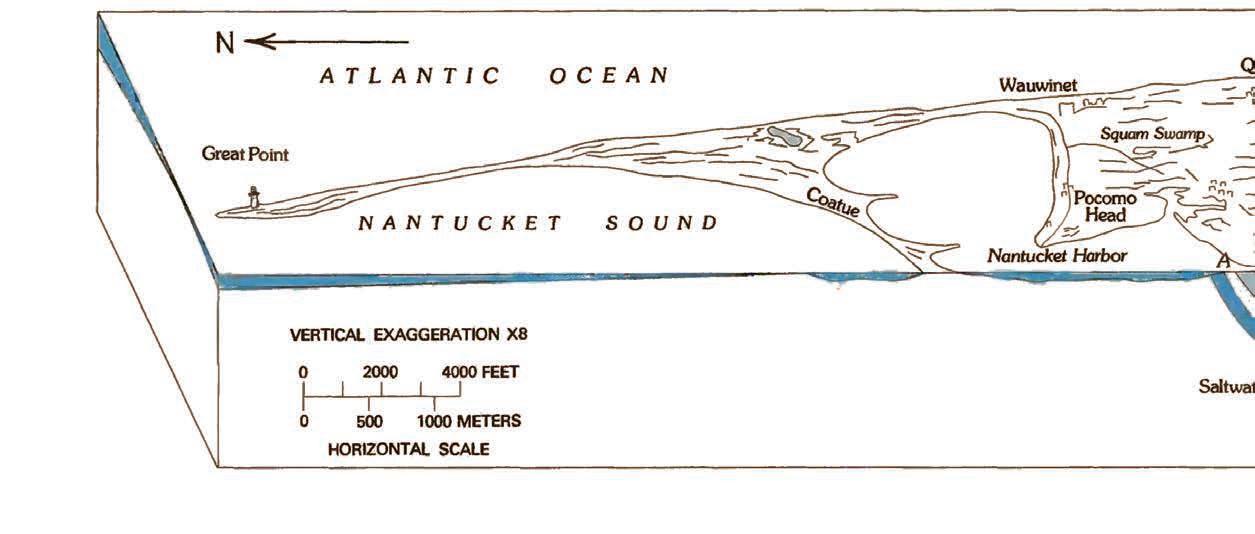
the edges of the island where denser, heavier seawater presses in. Unlike places with abundant surface water — streams, lakes, and reservoirs like the Quabbin — this freshwater lens is the sole water supply on Nantucket.
“I think a lot of people have the notion that, like, there's some Journey-to-the-Center-of -the-Earth-style caves below the island, full of water,” says Turcotte. I’m not a geology guy, and I confess to harboring exactly that notion, so I turned to Tim McCobb, a hydrologist at the USGS New England Water Science Center, to set me straight.
“ What's unique about the islands, obviously, is they're surrounded by saltwater,” McCobb says. “You have this lens of freshwater sitting on top of that saltwater inside this matrix of sands and gravels.”
By lens, he really does mean the shape. The aquifer sits beneath the island more or less like a contact lens balanced on your finger, deepest in the center and curving up near

“And its only source is precipitation,” says McCobb. Keeping the aquifer topped off takes tens of billions of gallons of precipitation per year. “Usually, less than 50 to 60% of that makes it as recharge to the water table. The whole system has to get saturated at the surface before anything trickles down.”
It’s a slow process, and it happens most efficiently in the winter, when plants take up less water at the surface. “We get most of our recharge in the late fall through the spring,” McCobb says.
As rain and snow fall
on the island, any fresh water that doesn’t get absorbed by plants, evaporate, or roll off the edges of the island trickles down through the ground, and over decades and centuries it piles up, pushing down on the denser salt water below and giving the aquifer its shape and thickness.
And the aquifer is thick — Turcotte pointed me to some evidence of this near the center of the island. “At the intersection of Milestone Road and Russells Way, if you bushwhack a little bit in the woods there, you'll find this steel pipe sticking out of the ground,” he says. “It's about the diameter of a five-gallon bucket.”
This pipe is what remains of a Stratigraphic Test Well from the 1970s. “Way back when the USGS came out to quantify the aquifer, they took a drill rig truck on the ferry, and they used it to go down and find the bottom of the fresh water,” Turcotte says.
EUGENE H. WALKER/USGS 1980
Turcotte uses this tool to find groundwater.
Nantucket's freshwater aquifer sits in a "lens" within a pool of saltwater.
Imagine you were a being that could swim in the fresh water beneath Nantucket. Looking up, these ponds would be your windows to the sky, shimmering portals between aquifer and atmosphere.
The drill descended more than 1,600 feet, making its way back in time as it went. It pulled up small marine fossils, shrimp-like crustaceans and molluscs from the Pleistocene period giving way to plankton from the Eocene epoch and plant pollen from the Cretaceous, finally coming to a stop against the dense, ancient basalt of the oceanic crust. At this well, freshwater began about twenty feet down, and continued for another five hundred feet before becoming salty, as seawater infiltrated laterally from the edges of the island. (For more on ancient aquifers, see Britt Bowker’s story on page 30.)
If you don’t have a drill rig, there are few other ways to look at Nantucket’s aquifer. In most places it’s several feet down, but at low spots or near the coast it can intersect the surface, trickling out of seeps and springs at the beach or filling shallow depressions like the Doughnut, Wigwam, and the Pout Ponds. Setting aside sediments for a moment, imagine you were a being that could swim in the fresh water beneath Nantucket. Looking up, these ponds would be your windows to the sky, shimmering portals between aquifer and atmosphere. Some hydrologists even refer to these ponds as “outcrops” of the aquifer, as though it’s a mountain of water we can only glimpse when it’s not covered by land.
The ponds are sentinels. During a drought, as the water table drops, they dry up. “Reed Pond was dry over the summer, and the Pout Ponds out in the Moors,” Turcotte says. “Some of these smaller wetland systems are like the canaries in the coal mine, and if the drought stayed severe and kept going, you’d start to see it in areas that aren’t quite as small and isolated.”
Drought can also have an outsized impact near the
coast, where groundwater is thin and close to the surface, wells tend to be shallow, and saltwater is lurking just below. If too much fresh water is pumped out, saltwater can intrude, turning your drinking water to brine.
In some cases, neighbors blame each other when ponds dry up or wells start pulling in salt, and it’s true that as new houses pop up and water usage increases, the water table can drop locally. But it’s more complicated than that. “It’s so hard, because the neighbors reach out and they're all fired up because they're like, ‘they’re running their sprinklers again,’” Turcotte says. “It’s probably not helping, but forensically, scientifically, it's really hard to point the finger. You have to deal with the porosity of the soil, and which way the groundwater is flowing, and it gets really complicated.”
“ You need a three dimensional model to really understand how groundwater flow works,” McCobb says. There isn’t yet a public model for Nantucket, but he’s spent the past few years working on one for Martha’s Vineyard, which has a pretty similar water table setup. A model is helpful because the island isn’t uniform; different parts of it have different groundwater levels, and get recharged by rain and snow at different rates. “That's where geology comes into play,” he says.
McCobb points to a USGS well in the eastern part of the island, off Milestone Road near Tom Nevers swamp. “Like this one here, it’s out in the outwash plain, it's in sand and gravel, it's pretty shallow, and it responds quickly to each precipitation event,” he says.
Like lots of things on the Cape and Islands, we have the Ice Age to thank for the way groundwater moves on
Nantucket. The hills that stretch east-west across the island were bulldozed there by a glacier, and the low-lying sand and gravel south of that moraine was deposited by streams flowing off the melting ice. Today, water flows more easily though the outwash plain than it does through the moraine.
“ The moraines occur on this northern part of the island as a mix of silts, unsorted sands, and clays in little layers,” says McCobb. “And those clays can keep water from percolating down to the water table, or slow it down. As you move into these wells in the center of the island, they’re less responsive to precipitation.”
I found myself thinking of the island kind of like a pourover coffee, maybe a Chemex. Water percolates down through the coffee grounds to reach the mug — the aquifer; but because whoever ground the beans did a haphazard job of it, some grounds are very fine and some very coarse, and water drips through them at different rates.
This all leads to some bated breath as the island enters and then climbs out of each drought. “There’s a lag, ” says McCobb. Even in periods when precipitation goes up, the water table can continue to drop while the system resaturates, which can make for a frustrating experience if you’re waiting for a drought to be over. McCobb’s advice: “Be patient, it’ll eventually get there.”
More materially, “you can actually look at that lag and figure out what it is,” McCobb says. All you have to do is chart how far above or below normal the precipitation is, do the same for the groundwater level, and compare. On Nantucket, he says, there seems to be a four- to five-month lag. “If you have really normal precipitation in October, November, December, you're not going to see that start to come back until the early spring.”
So — the aquifer is big, complicated, and can be slow to recover from prolonged drought. But there’s still a huge amount of water in it, and most wells are pretty deep, so what is there to be worried about? Why not give the Land Rover another rinse?
For one thing, a small drop in the water table can still have consequences, not just for beloved local ponds. According to the Massachusetts Well Driller Database, there are dozens of private wells on Nantucket that have only a few feet of wiggle room before they go dry or risk saltwater intrusion.
In the long term, repeatedly overpumping during times of drought could end up making the whole aquifer thinner, a problem exacerbated by climate change. “There’s the concern that as the sea level comes up, the whole freshwater lens is going to rise,” McCobb says. “As it comes up, the freshwater zone is going to get thinner as it sheds off the top, to the coast. So you're losing freshwater thickness, which is important.”
Thanks to an old hydrologic principle, any loss in water at the top of the aquifer means that seawater can push upward a correspondingly larger amount, rising about 40 feet at the bottom of the aquifer for every foot lost at the top as a ballpark rule of thumb.
“If you’re over-pumping during a drought and you don’t really pay attention to it, it's going to get thinner,” McCobb says. “And once that system gets thinner from below, it's really
hard to get it to go back. You have these changes that are seasonal at the top — the things that change the shape of the aquifer, like overpumping. A really long term decrease in the thickness, that's what you have to be concerned about in my view. You’ve got to protect the geometry of that freshwater lens.”
It’s a long-term, worst-case scenario threat, on the scale of decades, but it’s worth keeping an eye on, McCobb says.
Turcotte agrees. “We're not out of water, we're just trying to be wise with what we have, and be conservative,” he says. “You never know what the weather is going to do. You don't want to get stuck in the wrong feedback loop.”
BALANCING THE WATER BUDGET
In absolute numbers, Nantucket is pumping more groundwater than it ever has. In 1975, the Wannacomet Water Company pumped around 30 million gallons of water per month at its summer peak; today it pumps around that much in a summer week. If you turned the entire Nantucket Airport into a swimming pool 10 feet deep, that would be about how much water Nantucket uses in a day.
The aquifer is putting up with it right now, but the island population continues to grow, and by the summer of 2030, when day visitors are projected to reach 100,000 in peak periods, a sustained drought could become harder to manage.
One person charged with anticipating this kind of thing is Vandana Rao, Director of Water Policy at the Massachusetts Executive Office of Energy and Environmental
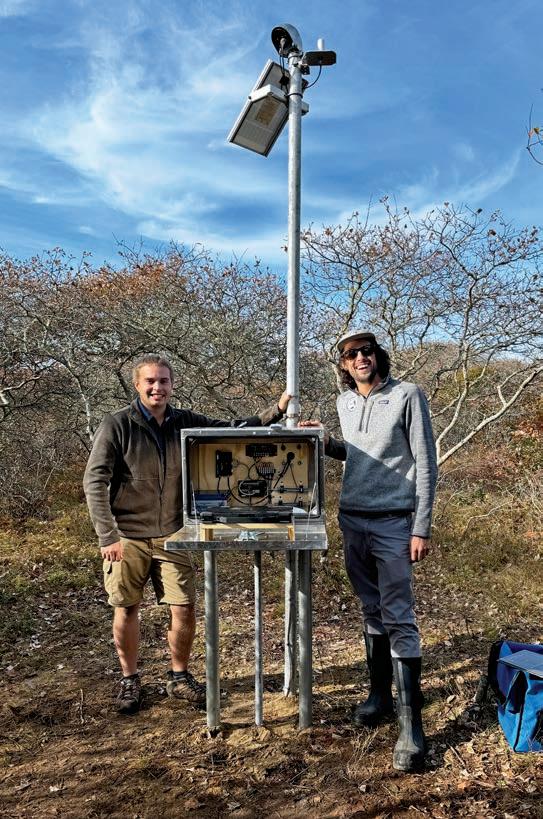
RJ Turcotte, right, with Sam Banas, and a newly installed, solarpowered sheltered groundwater gauge.
Affairs. “Drought seems to be occurring fairly often in the northeast region of the country,” she says. “Since 2016, we've been in a drought almost every year.”
Climate change might make New England warmer and wetter, but not necessarily in ways that help the aquifer. “We're getting a lot more of these hyper-short-intensity precipitation events,” Rao says. These aren’t effective at recharging groundwater, since most of what falls in a deluge ends up as runoff, in Nantucket’s case going directly into the ocean. “And on the other side, we're also seeing extremes in drought.”
Rao is also co-chair of the state’s Drought Management Task Force, which advises the state on when and where to declare one. “We are continuously monitoring the data,” Rao says. “Once we start seeing a prolonged period of no to low precipitation, then we really start to say, ‘okay, how's the streamflow doing, how's the groundwater doing?’ When we start to see those indices tripping, that's when we call the Drought Task Force together. There’s a lot that happens behind the scenes.”
Once the drought is official, there’s a lot to do: statewide, there are implications from agriculture to firefighting, and water conservation becomes critical. “We want to make sure we have supplies that last through the drought and don't impact our essential uses,” Rao says.
This means not using water outside, and keeping indoor usage efficient. “It just makes sense for us to be careful to use water as efficiently as possible, and to think a little bit more about our everyday use of water, particularly in the summer months,” Rao says.
For example, given the ancient, glacial purity of Nantucket’s aquifer, using it for your garden is basically like watering your plants with San Pellegrino. Rao says a rainwater barrel is a better choice. “Try to avoid using your well water for outdoor water use, really make sure that your good, quality water is used for your indoor essential uses,” she says. “Wash your clothes in a washing machine and your dishes in a dishwasher as opposed to by hand, and make sure there are only full loads.”
These measures aren’t always popular, and in places like Nantucket, where many people are on private wells,
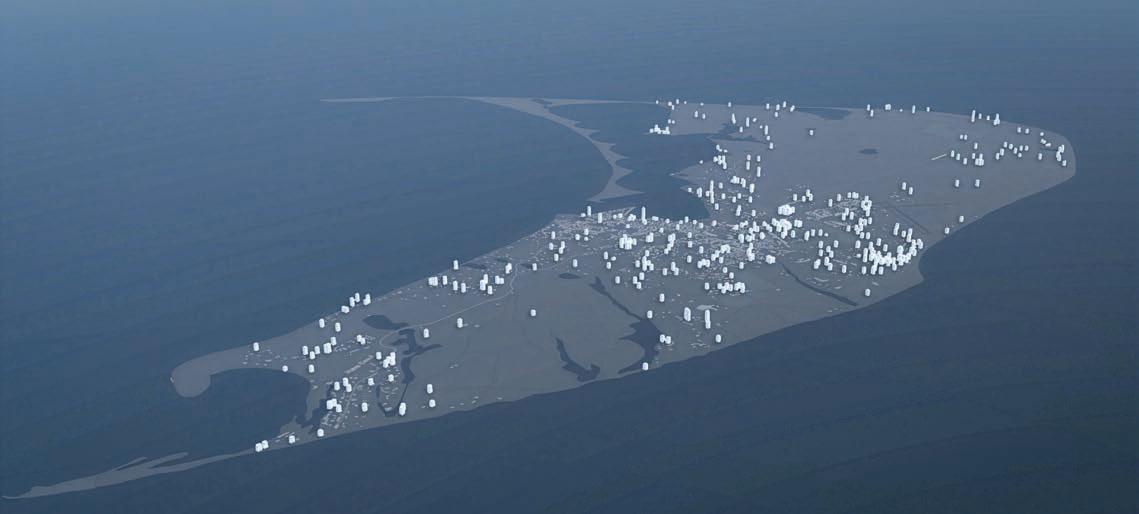
A general overview of wells drilled on Nantucket, according to data from the Massachusetts Well Driller program. RJ Turcotte says that at the wells they measure, the depth to groundwater varies between 7 and 50 feet; wetlands are areas where the groundwater is just below or at the surface.
water restrictions are only mandatory for people on the public supply. “But the source of water from those wells, for those end users, is the same,” says Rao. “It's coming from the same aquifer, the same groundwater system.”
After working on this issue up close, sometimes with neighbors who are at odds, RJ Turcotte puts it a little more bluntly. “Have you seen There Will Be Blood?” he asks. “I joke with everybody that it’s literally that.” Daniel DayLewis’s famous speech, about what happens when you have two straws in the same milkshake, applies to water as well as the oil that was the subject of the movie.
Huge efficiencies in water usage have been achieved before. In the late 1950s, Nantucket cut its water usage from pumped wells in half, simply by installing its first-ever water meters. And in recent years, all sorts of appliances and machinery have become more efficient. “We are already using less. We are one of the most water efficient states per capita,” Rao says.
“All of this is cyclical,” she adds. “It’s about making slight changes in our way of life during those periods when there is a deficit.”
There are bigger picture things Nantucket can do, too, like convincing major water-users like golf courses and agricultural operations to become more efficient, and ensuring that as much land as possible is free of development and available to absorb precipitation.
“ We want to make sure that when we get rain water, we allow that water to soak into the ground, to replenish our systems, and not just wash [away] off hard surfaces like roads and other impervious cover,” Rao says.
In fact, by protecting permeable landscapes that absorb rainwater, the island can actually increase how much water it can legally withdraw. In April, the Nantucket Land Bank voted to devote a parcel of Milestone road for drinking water mitigation, a status that will add another several hundred thousand gallons per day to the town’s water withdrawal permit from the state.
“ You can conserve a lot of water very easily,” Turcotte says. “This isn't even as hard as recycling.” (See page 33 for what you can do to conserve water).
GIS MAP BY SAM MOORE, DRAWN FROM DATA FROM THE MASS. WELL DRILLER PROGRAM
Fresh Water, Offshore
A vast aquifer beneath the ocean floor could reshape how we think about water — on Nantucket and beyond.
By Britt Bowker
In several spots roughly 20 to 40 miles south of Nantucket, beneath the same stretch of ocean now dotted with wind turbines, scientists drilled into the seafloor last summer in search of something unexpected: fresh groundwater.
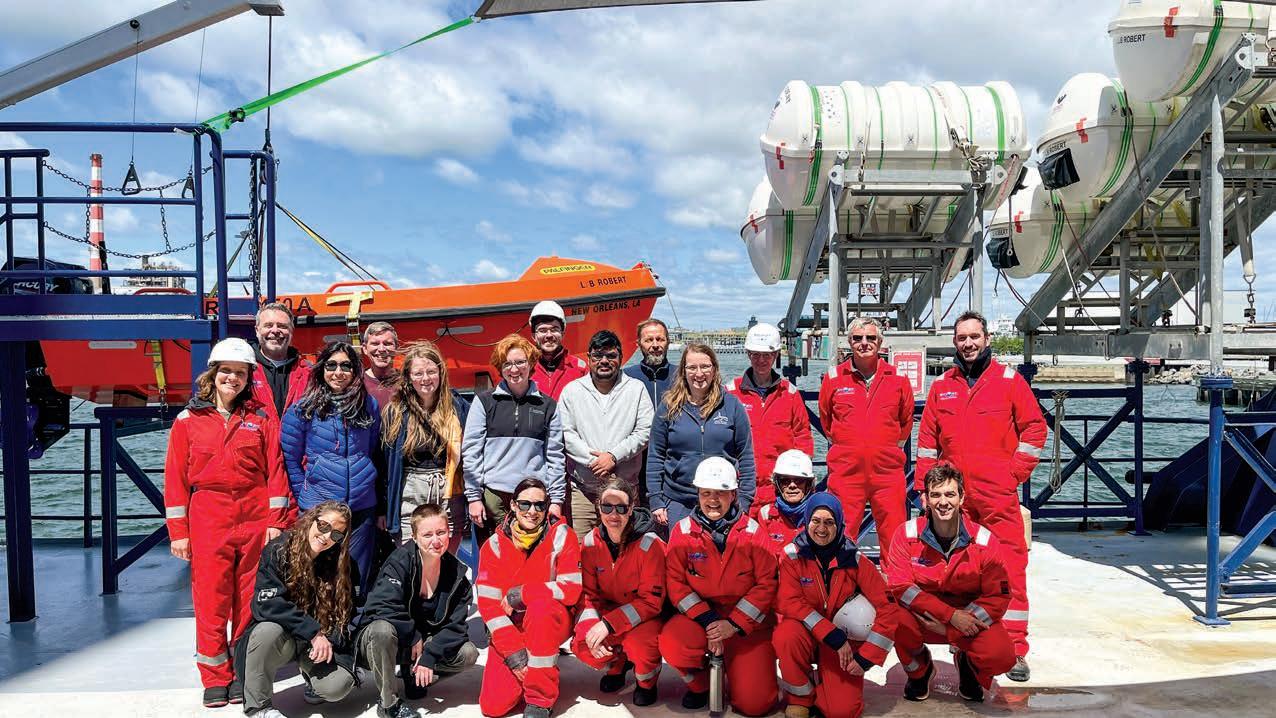
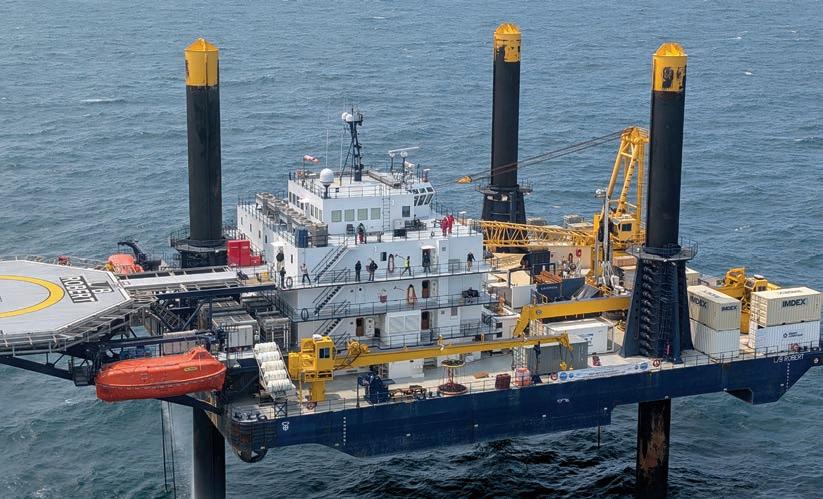
L eading the expedition was Brandon Dugan, a geophysicist and hydrologist at the Colorado School of Mines and co-chief scientist of the International Ocean Drilling Programme. For about 74 days, he and his team worked aboard a massive offshore rig as part of a $25 million international collaboration involving 41 scientists from 16 countries and funded in part by the U.S. National Science Foundation, extracting sediment cores from deep beneath the ocean floor. They were testing a hypothesis: that vast reserves of freshwater are trapped in offshore sediments.
D ugan is not new to Nantucket; he previously worked with researchers at the U.S. Geological Survey and with the local water department to study the island’s groundwater
system — research and models that helped inform questions about what might lie offshore.
W hat they found matched the team’s predictions: significant volumes of freshened groundwater are stored within sand and gravel beneath the seafloor some 20 to 40 miles off our shores. Scientists refer to this kind of water-bearing formation as an aquifer, essentially a layer of sediments that holds and transmits water. The team also confirmed the offshore aquifer stretches from New Jersey to Maine.
D ugan and his team also wanted to understand the sediments themselves: which layers would allow water to flow freely, which might trap it, and how the chemistry of the water in those sediments might vary. To do that, they collected nearly 50,000 liters of water for analysis.
“ Think about going to the beach and digging a hole and it fills with water,” Dugan told me in an interview over Zoom earlier this year. “What does that water look like that was in those pores between those sediments?”
The International Ocean Drilling Programme and National Science Foundation research team.
“Think about going to the beach and digging a hole and it fills with water. What does that water look like that was in those pores between those sediments?”
–Brandon Dugan, co-chief scientist of the International Ocean Drilling Programme
His team focused on two key measurements: how much salt the water contained, and how long it had been trapped in the sediments. This aquifer is one of many hidden pockets of “secret fresh water” beneath shallow oceans around the world, Dugan said — a resource that could one day help meet growing global water demand.
The choice to study this stretch of ocean didn’t come out of nowhere. Early drilling along the Atlantic margin in the 1960s and ‘70s had already documented freshwater offshore, but those studies were mostly descriptive, noting the water’s presence without quantifying it. Dugan and his team wanted a closer look: how much water was there, how old was it, how did it move, and could it be replenished over time?
“Most of us think of water as sort of an infinite resource,” Dugan said, “but in this case, likely because we’re surrounded and encapsulated by an ocean, it’s somewhat of a finite resource.” Understanding the origins and dynamics of this offshore aquifer will not only satisfy local curiosity and provide a potential future water source; it could also help scientists model similar systems elsewhere, from South Africa to New Zealand and Australia.
D ugan and his team drilled three sites, moving gradually farther from Nantucket’s coast to map the offshore aquifer. At the site closest to land, the water in the first sediments they reached looked much like the ocean above — salty, with about 32 practical salinity units (PSU), which is considered sea water salinity. But then they dug deeper, and some 80 meters (262 feet) below the seafloor, they hit a big “seal,” or low-permeability clay area, and the water flipped to just 1 PSU — fresh by drinking water standards. “It still needs to be treated for pathogens and things like that, but it meets general clean water standards, and we saw about 200
meters (656 feet) of that,” Dugan said. They observed freshened water in both clay seals and sandy aquifers. “So whatever put that water in there had enough energy to go through the easily flowing units, but also the units that it was hard to move water through, so [it] had to have a lot of energy.”
The pattern held farther offshore. At the second site, roughly 40 kilometers (24 miles) offshore, water in the sediments remained seawater for roughly 80 meters before dropping to about 4 PSU. “So a little saltier than the other water, but significantly less salty than seawater,” Dugan said. Again, the team saw roughly 200 meters of these lower-salinity layers.
At the farthest site, about 70 kilometers offshore, the trend repeated. The water was about half the salinity of seawater, much saltier than the freshened layers closer to shore, but still below normal ocean levels. “And that’s what we predicted from our original hypothesis. But now we have an idea of how quickly it goes from very fresh to mostly salty to all-the-way salty,” Dugan said.
Understanding this offshore aquifer isn’t just a matter of scientific curiosity; it has real implications for water management and climate resilience. Preliminary analyses suggest that much of the freshened water could be tens of thousands of years old, likely deposited when glaciers retreated from New England. That means it may not be getting replenished by rainfall today, making it a finite resource — though some portions could still be slowly recharging. At the same time, mapping the aquifer’s volume and chemistry gives scientists a baseline: if people or ecosystems ever need to tap into it, they’ll know what’s there, how it flows, and how to manage it sustainably. “We’re just trying to understand the science of how the water got there, and then we can put it in models and try to predict how it’s going to evolve in New England over the next 10 years, 50 years, 10,000 years,” Dugan said.
Before any of that water could theoretically be extracted,
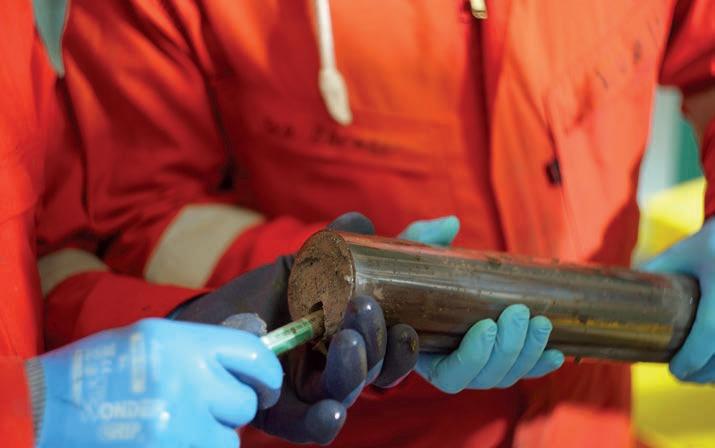
Sediment and water samples from freshly drilled cores.
extensive political, management, and environmental discussions would have to take place. Dugan and his team wouldn’t be involved in that, but he said they would provide guidance based on their research.
So how much water are we talking about? While teams are still analyzing data and can’t quantify it precisely, preliminary calculations even before Dugan’s team drilled suggested that if you added up all the water between Long Island and Nantucket, there would be enough to supply New York City for 800 years.
Liftboat Robert, the offshore rig used in the expedition.
“ We’re not saying New York City gets it, but just to put it in a frame of context, that’s how much water we’re talking about — not a small volume,” Dugan said. “And our initial results indicate that [we’re] probably not too far off.”
MOWAT@ECORD_IODP3_NSF
The big question, he says, is whether all the water was deposited 30,000 years ago, making it a finite resource, or if it’s still being recharged today — whether “the rainfall that happens in the next nor’easter is seeping into the ground and making its way offshore.”
D ugan says that preliminary research suggests that the water is likely tens of thousands of years old. “If you think about the geology for Cape Cod, Martha’s Vineyard, Nantucket, Long Island — ten to twenty thousand years ago, it was a heavily glaciated margin, so those large glaciers were probably a very significant contributor to how all this water got into the ground,” Dugan said.
AND HOW MIGHT THIS WATER BE EXTRACTED?
The process, Dugan says, would look quite a bit different from the vertical drilling his team used to collect samples. Accessing the aquifer would likely require directional or horizontal drilling from land or offshore platforms, similar to techniques used in oil and gas development.
M oreover, just because something is technically possible doesn’t mean it’s simple or advisable. To begin with, pumping water from beneath the seafloor could alter pressure in the sediments, potentially changing how freshwater and saltwater interact.
There would also be significant environmental, regulatory, and energy considerations, including questions about impacts to marine ecosystems and complex permitting processes involving state and federal agencies. And drilling, pumping, transporting, and treating the water would all require infrastructure, money, and power.
D ugan notes that New England’s offshore wind farms
represent a potential energy source if extraction were ever considered. “But before any of that could happen, we’d have to figure out who’s going to manage this water, who owns this water, and who has the rights to distribute it. And we don’t know the answers to those things yet.”
But first, he says, scientists need to understand the system. Only then could policymakers, management firms, and government agencies begin thinking seriously about whether and how to use it.
“I think 10 years is not an unreasonable horizon where someone is probably going to be working with management firms and lawyers and government agencies to try and actually produce some of this water,” Dugan said, whether for immediate use or as a future emergency supply.
Even the scientific drilling required extensive oversight. The team worked with the Department of State and federal agencies including NOAA Marine Fisheries and the EPA to evaluate noise, discharge, and potential environmental impacts.
D ugan also met with communities on Nantucket and Martha’s Vineyard before the expedition. Some residents raised concerns, particularly in the wake of the 2024 wind turbine blade collapse that sent debris onto local beaches. Dugan emphasized that the drilling operation would leave no infrastructure behind. The only discharge would be recirculated, non-toxic drilling mud — material composed of naturally occurring substances.
The team also consulted with Tribal Nations, acknowledging longstanding cultural ties to water and the region’s submerged landscapes from when sea levels were lower. They established contingencies in case artifacts were discovered and agreed to halt operations if protected wildlife, including right whales, were observed.
“I love my science,” Dugan said, “but I don’t get to do it if people don’t let me work in their backyard.”
Mark Willett, director of Nantucket’s water department, said
he’d been hearing about the offshore aquifer for years before the drill rig finally arrived.
“It was a long time in the making,” he told me. “COVID happened and slowed everything up, and then the group of scientists was finally able to get the rig and come over. It was really good science and really good results.”
For Willett, the findings are exciting. First, the idea that vast stores of freshwater may sit just offshore has global implications.
“ The model they used to figure out this location is going to lead to multiple places around the world where they’ll be able to find the same type of situation,” he said. “There could be countries in desperate need of water, and this may be a solution.”
W hat’s more, Nantucket’s own water supply — drawn entirely from a sole-source aquifer beneath the island — is already under pressure.
After several dry years, the island recently reached a Level 3 drought before improving slightly to Level 2 (see our story on Nantucket’s aquifer and the drought situation on page 25.)
“Last summer, I don’t think it rained for two and a half, three months,” Willett said. Nantucket typically receives about 40 inches of rain annually, but in recent years that number has fallen by nearly a half.
Even so, Willett emphasized that the island isn’t in immediate danger of running out of water. “The drought condition isn’t so much that we’re going to run out,” he said. “It’s how to manage the resource to make sure the aquifer stays healthy long enough to get out of the drought.”
That balance depends on recharge, and not all precipitation makes it back underground. Roughly half of rainfall is lost to
evaporation and plant use before it can seep into the aquifer, Willett said. And snow contributes less than people might expect.
Still, Nantucket’s aquifer remains relatively stable. “We keep an eye on it. We have a pretty good supply of water,” he said. “But it wouldn’t break my heart if we had access to all that water offshore.”
That being said, he acknowledges that “The expense to get it from 35 or 40 miles offshore to here — that’s not cheap. You’d need pumps and pipelines, or tankers to bring it in … It would be pretty costly.” And then there are the unresolved questions about ownership. “It’s like any other resource in international waters,” Willett said. “I don’t know the legality of trying to claim that water source.” He worries that, without clear regulation, private companies could attempt to extract and commercialize it. “People are paying six or seven bucks for Fiji water — what do you pay for ancient glacial water that’s 25,000 years old?”
There’s also the possibility, still under investigation, that the offshore aquifer could be connected to the island’s own (and potentially Martha’s Vineyard’s) groundwater system. Scientists are analyzing chemical signatures and isotope ratios to determine whether the sources are linked.
If they are, Willett noted, the water could fall under state jurisdiction. “The Commonwealth of Massachusetts owns the water resource,” he said. “We don’t own it — we just use it. And the Commonwealth tells us how we can use it.”
For now, like Dugan, Willett is waiting on the data. “I’m just excited to hear back from the team,” he said. “To find out what they found and what it is.”
WHAT YOU CAN DO: WATER CONSERVATION TIPS
With Nantucket experiencing Level 2 drought after several unusually dry years, water conservation is top of mind for local officials. While the island’s aquifer remains stable, managing demand is critical, especially heading into the summer season.
“If everybody just helps a little bit,” said Mark Willett, director of Nantucket’s water department, “it’ll get us through this drought situation.”
FOCUS ON OUTDOOR WATER USE
“Irrigation is going to be a big one,” Willett said. Limiting lawn watering, or skipping it all together, can significantly reduce overall demand. Get a rain barrel and use that water for outdoor uses.
BE MINDFUL INDOORS
Shorter showers, running full loads of laundry and dishes (better to do them in the dishwasher than by hand), and turning off the tap while brushing your teeth all add up. “Even if people just cut back a little bit … that makes a huge difference,” Willett said.
UNDERSTAND WHERE WATER COMES FROM
“All the water you’re using is coming from the aquifer,” Willett said. “Just be mindful when you turn the tap on.”
And remember that only about half of rainfall actually makes it down to recharge the aquifer; the rest is lost to evaporation and plant use. Snow contributes less than it appears to. “When you get 10 inches of snow, that’s really only about one inch of rain — so it’s really only half an inch that makes it down to the aquifer.”
FIELDNote
To: Bluedot Living
From: The Nantucket Conservation Foundation
Subject: Plant Native: Good For Your Garden, Great for Nantucket
In the fall, Nantucket Conservation Foundation Native Plant Propagation Manager Stacey Cooper heads out across Nantucket's open land with a paper bag and a practiced eye, collecting seeds from more than 100 native plant species across 9,000 acres of conservation land. Back at the workshop, she cleans and catalogs each batch, storing them over winter. Come spring, those seeds become seedlings that will eventually find their way into trail restoration, wetland recovery, and coastal resilience work across the island.
Plant Research Ecologist and Botanist Kelly Omand shapes the Native Plant Program's direction, drawing on 15 years of expertise in Nantucket's plant communities. Field to greenhouse, seed to plant: it's a quiet process, and an essential part of the work at the Nantucket Conservation Foundation.
Native plants are the foundation of everything that makes Nantucket's natural world function. They stabilize sandy soils that would otherwise erode and filter the water that flows to our ponds and harbors. They support the insects that pollinate our flowers and feed our birds. Every native plant helps connect habitat across the island, supporting the natural landscapes that define this place.
The good news: you don't need 9,000 acres to make a difference. Your yard is a start.
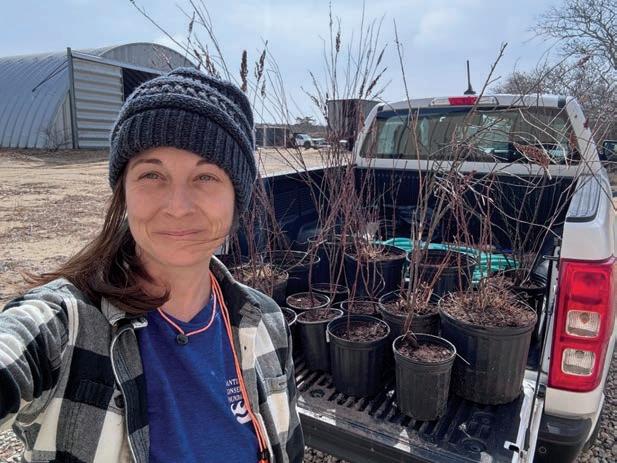
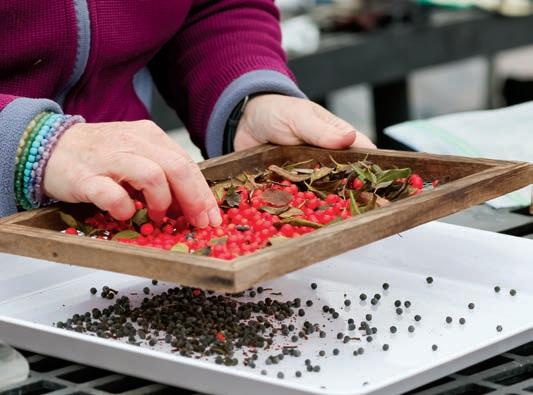
WHY NATIVE PLANTS MAKE SENSE
They belong to this soil. Native plants evolved over thousands of years in Nantucket's sandy, wind-exposed, salt-sprayed terrain. They're well-adapted, thriving without the fertilizers, irrigation, and pesticide treatments that nonnative ornamentals often require.
They can save you money. Less maintenance means lower costs over time. Less mowing, mulching, trimming, watering, and fertilizing all adds up. And because native plants are less palatable to deer, they're a naturally lowermaintenance choice for Nantucket gardeners.
They support local wildlife. Native plants co-evolved with local wildlife, making them the ideal food source for native insects and the birds that feed on them. More than 20% of native bees rely on specific native plants to complete their lifecycle. At NCF's own native wildflower meadow at our Cliff Road office, staff have observed a surge in butterflies, bees, dragonflies, and birds.
They protect water quality. Deep-rooted native plants filter stormwater runoff and help keep excess nutrients out of our ponds and coastal waters. Fewer fertilizers and pesticides in our landscapes means cleaner water for everyone, including our pets who are vulnerable to harmful algal blooms.
They're part of what makes Nantucket, Nantucket. The sandplain grasslands, coastal heathlands, and native meadows that define this island all start with native plants. Every native planting in a private yard is a small extension of that landscape.
SMALL CHANGES, BIG IMPACT
Every native plant you add makes a difference, and it doesn't have to happen all at once. Start with one bed, one corner, one patch of lawn — or even a porch planter filled with native blooms. Add more each season as you find what works. When you're ready for a bigger change, try a swap: remove an invasive or non-native shrub and replace it with
In the winter, Stacey and her crew sort seeds.
Native Plant Propagation Manager Stacey Cooper.
a native alternative. It's one of the most impactful changes a Nantucket gardener can make.
Pesticides linger longer than most people realize and hit pollinators and birds hardest. Reducing their use makes a real difference. And don't overlook trees and shrubs for the shelter, perches, and structure that make a yard truly hospitable to pollinators and birds. Nature responds quickly when you give it what it needs.
PLANTS WITH A PURPOSE
For gorgeous blooms: Orange milkweed (also a monarch magnet), seaside goldenrod, swamp rose mallow with its dramatic dinner-plate flowers, and the brilliant woodland sunflower all deliver stunning color from summer through late fall while supporting our native pollinators.
For privacy and screening: Bayberry, arrowwood viburnum, sweet pepperbush, and inkberry are all native shrubs that work well as hedges and borders, without the maintenance burden of boxwood or privet. American holly provides yearround evergreen structure and bright winter berries.
For ground cover: Let the plants do the work, no mulch required. Low-growing natives like bearberry, lowbush blueberry, self-heal, and sickle-leaved golden aster hold sandy soil in place and provide critical habitat for ground-nesting bees.
For something unexpected: Native grasses offer four seasons of interest with almost no maintenance. Try little bluestem for its showy seed heads and red-tinged fall color, switchgrass for its tall architectural presence through winter, or yellow feather grass for its delicate waving tufts in late summer.
Every native plant is a small act of restoration. NCF's native plant program has been growing since 2006 and so has the demand for regionally native plants across the island. To expand that capacity, NCF's Milestone Center will serve as a new home for research, education, and conservation work, with a larger greenhouse, plant nursery, climate-controlled seed storage, and a dedicated herbarium for botanical research and specimen storage. For Kelly and Stacey, it means the ability to better meet the native plant needs of our wildlands and gardens.
In the meantime, visit NCF's native wildflower meadow and garden at our 118 Cliff Road office, open to the public year-round. From July through September, we offer a monthly Native Plant Landscaping Tour, and Plant Propagation Workshops in May and June give participants a behind the scenes look at what it takes to support a native plant nursery. Native plants also feature throughout our ecology excursions in our seasonal events calendar. To learn more, find native landscaping resources, or sign up for a program, visit nantucketconservation.org.
Native plant seedlings in the NCF greenhouse.
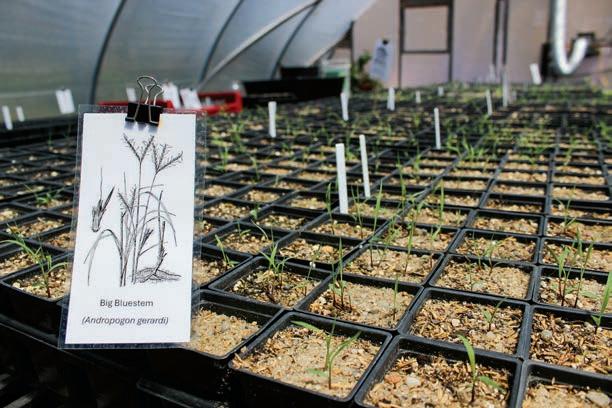
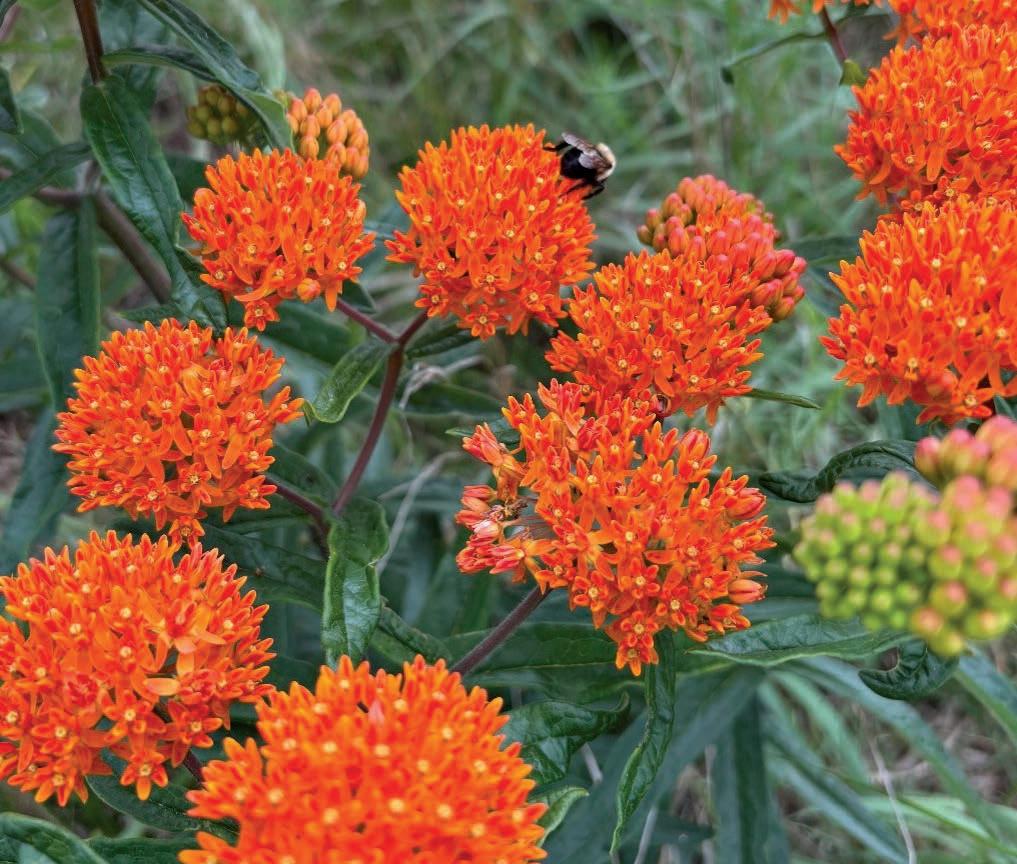
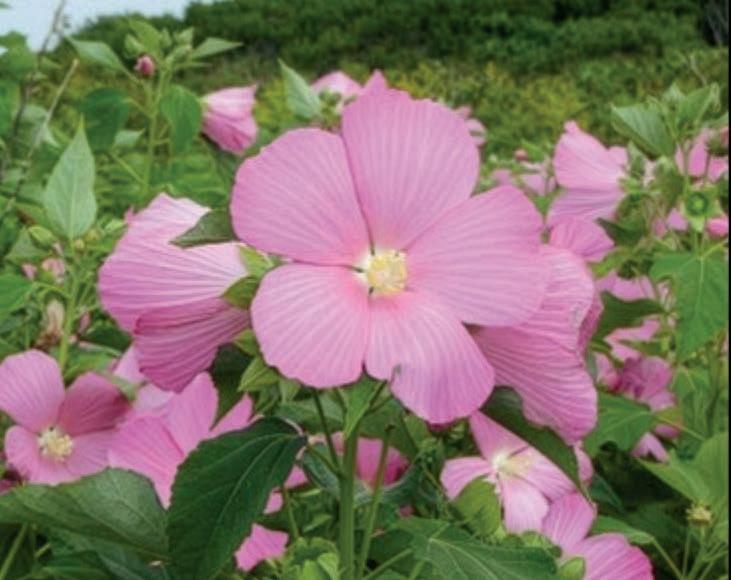
Swamp rose mallow (Hibiscus moscheutos).
Butterfly weed (Asclepias tuberosa).
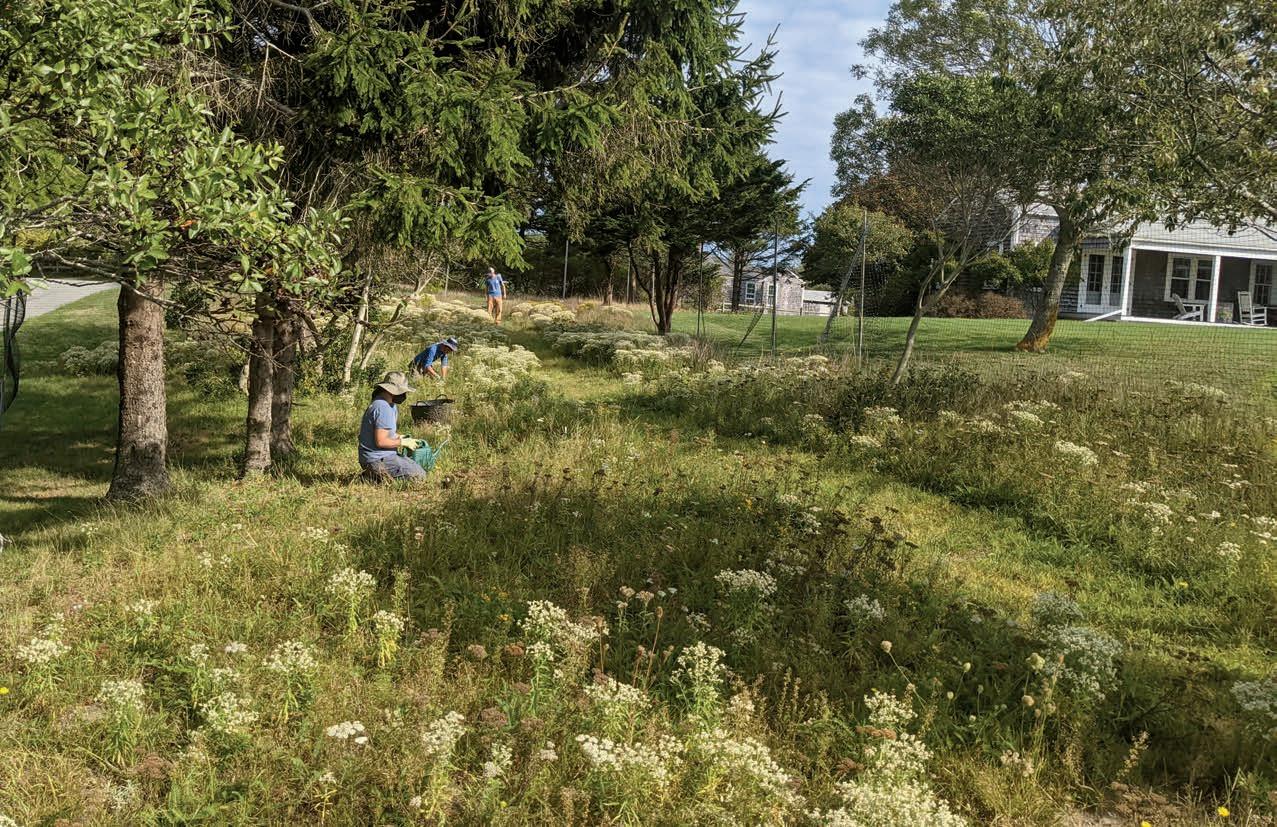
Plant This, Not That
5 Invasive Species and their Nantucket-Native Alternatives Swap out invasive ornamentals for island-native species that support local wildlife.
5 Invasive Species and their Nantucket-Native Alternatives species that support local wildlife.
By Robyn Graygor
By
Native plant garden at the NCF office at 118 Cliff Road.
If you want to help maintain Nantucket’s iconic native plant communities, consider planting island-native species in place of their invasive knock-offs.
Common problem plants and their native alternatives:
Miscanthus
Grasses in the Miscanthus genus have become popular ornamental plantings across the eastern United States. Specifically, Miscanthus sinensis has risen the ranks in the nursery trade, leading to many properties and public
landscapes being stamped with their signature dramatic appearance.
Billowing grassy tendrils with a silver vein form satisfying plumes that complement textures in traditional gardens. Cultivars like zebra grass have made their way into many landscape designers' hearts; striking foliage with
sharp yellow bands wins over even the most grass-hating gardeners.
This perennial bunchgrass can succeed in a variety of conditions. It is found in edge habitats, gardens, grasslands, coastal zones, and anthropogenic areas like roadsides and ditches. It can thrive in full sun to part shade, and it spreads readily by both seed and rhizomes.
Large tufts can grow up
to 10 feet tall, overshadowing and crowding out the Island's iconic native bunchgrasses. Widespread infestations threaten to monopolize meadows and leave habitats more susceptible to the stresses of climate change. Chinese silvergrass (Miscanthus sinensis), for instance, is highly flammable and increases the risk of wildfires as its dense stands dry out.
Robyn Graygor is the Biodiversity Technician for BiodiversityWorks’ Natural Neighbors program on Martha’s Vineyard. This article originally appeared in our Martha’s Vineyard magazine and has been edited and adapted for a Nantucket audience, thanks to Stacey Cooper and Kelly Omand of the Nantucket Conservation Foundation.
Native alternatives
Nantucket is home to several native bunchgrasses that decorate meadows, provide food for birds, and host native butterflies like the Crossline Skipper. A great source of protective cover and nesting material, these grasses will fill space elegantly while helping to maintain the globally rare ecosystems found on the Islands. Switchgrass (Panicum virgatum) is the most similar to Chinese silvergrass, with its tall tufts and dramatic seed heads. But nutritious switchgrass seeds will be eaten by birds in the fall and winter, whereas Chinese silvergrass seedheads are often left unused. Consider planting the following grasses in place of invasive grasses in the Miscanthus genus:
1 Switchgrass (Panicum virgatum)
2 Indian grass (Sorghastrum nutans)
3 Big bluestem (Andropogon gerardii)
Privet
Privets (Ligustrum spp.) are found in all shapes and sizes. Most commonly, border privet (Ligustrum obtusifolium) decorates property lines as sculpted hedges. These prized privacy barriers were introduced to North America in the 1800s. Fast growing and resistant to rust (a type of leaf spotting), their simple semi-evergreen leaves offer dense coverage throughout the seasons.
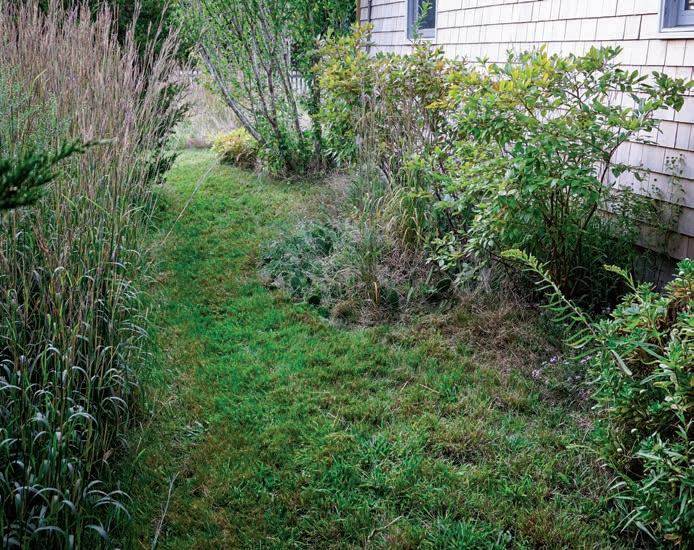
and suckering. Toxic compounds in the leaves deter deer browsing and some leaffeeding insects. Privet is able to outcompete native shrubs and hinder the development of surrounding vegetation with its dense stands. The resulting shady conditions can interfere with forest regeneration while favoring the growth of more privets.
various growing conditions, making most any vegetative community susceptible to infestation.
Native alternatives
The same characteristics that have made this shrub so sought after have also allowed it to become a successful invasive offender. Mature shrubs produce hundreds of seeds that are dispersed by birds and wildlife well into the winter. New plants can also arise through root sprouts
This plant’s readily available fruits are junk food for birds, passing through their digestive tracts quickly while providing mainly sugar and water. Specialist insects that have developed intricate relationships with specific plants are threatened when this aggressive spreader takes root in native ecosystems. Privets can be found in all regions of Massachusetts, under
Several island-native shrubs work well in a hedgerow or in other manicured shapes. These species can bring a tinge of intentionality to a landscape while also servicing native birds, insects, and wildlife. Inkberry (Ilex glabra) is an evergreen shrub in the holly family that provides dense screening. It looks similar to a boxwood, and can be sculpted
with pruning. Similarly, a mix of arrowwood (Viburnum dentatum) and sweet pepperbush (Clethra alnifolia) grow happily in a mosaic hedge formation. If you are looking to replace your privet with a native shrub, consider planting one of the following:
1 Inkberry (Ilex glabra)
2 Sweet pepperbush (Clethra alnifolia)
3 Bayberry (Morella caroliniensis)
4 Arrowwood viburnum (Viburnum dentatum)
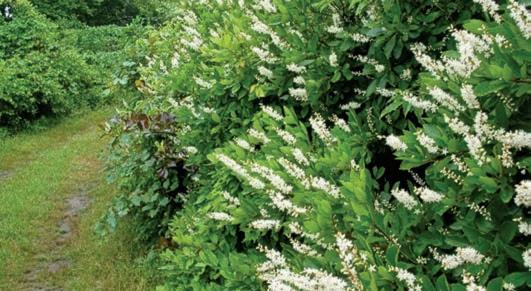
Big bluestem and other native plants.
Sweet pepperbush
Chinese & Japanese Wisteria
Both Chinese wisteria (Wisteria sinensis) and Japanese wisteria (Wisteria floribunda) decorate trellises, gazebos, and gardens with clusters of light purple flowers. Some people even create dedicated wisteria gardens to show off the vine’s unique beauty. However, introducing wisteria to a property can become a lifelong commitment: this commercially available woody vine is a long-lived perennial, surviving for 50 years or more.
Chinese wisteria was introduced to the United States in 1860 as an ornamental planting, and Japanese wisteria was introduced in 1830. Both thrive in deep, loamy, well-drained soils but can successfully grow in a variety of conditions.
Wisteria easily escapes from yards and infests wild areas from the forest floor to the canopy. The trailing vines twine clockwise and can climb up tree trunks over 60 feet tall, so it can become an unwelcome guest rather quickly in
your yard. The trunks of mature plants grow to be over 15 inches in diameter, eventually girdling and killing their hosts. New vines arise from the nodes of trailing stems that stretch great distances. Under the right conditions, the plants also produce seeds, which explode from their pods and can be dispersed by water flow. As new plants sprout from seeds or vegetatively, they open broad compound leaves that shade surrounding areas like a carpet across the forest floor.
Managing a wisteria infestation can be a long, grueling process. Although wisteria is not officially recognized as an invasive species by the state of Massachusetts, it is in Connecticut.
Native alternatives
The island harbors several native vines that are hardy additions to a trellis or other suitable surfaces. Grape vines (Vitis spp.) are fast-growing and full coverage options that will dangle bunches of fragrant, dark purple grapes in the fall. Consider planting one of our islandnative vines as both an aesthetic addition to your property and a resource for local wildlife.
1 Summer grape (Vitis aestivalis)
2 Fox grape (Vitis labrusca)
3 V irginia creeper (Parthenocissus quinquefolia)
Summer grape
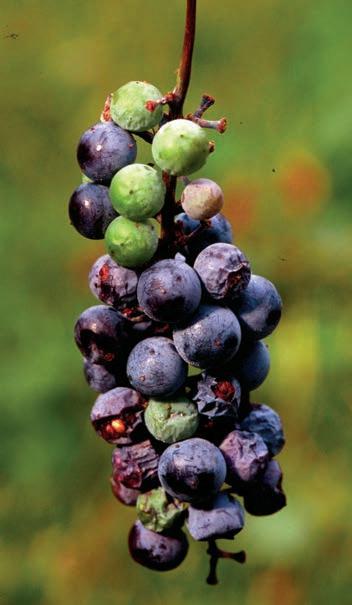
Planting native species in place of these invasive plants can help maintain the unique natural beauty of the place we call home.
Sycamore Maple
Sycamore maples (Acer pseudoplatanus) grow into large majestic shade trees that are tolerant of Nantucket’s harsh coastal conditions.
Once established, their seed spreads readily and helps them to form dense thickets that outcompete native plant species.
Native alternatives
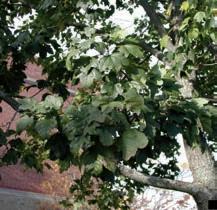
Often seen as a street tree in downtown areas, the flaky bark and large leaves provide the essence of a typical New England maple tree without providing the ecological benefits of our native maples.
Finding a native replacement for Sycamore maple is simple: plant red maple (Acer rubrum) instead! This tree is easy to grow in a variety of conditions and displays dazzling fall color. Its early bloom welcomes a myriad of native bees in search of nectar, as well as birds who frequently nest and search for food nearby. Various native moths and butterflies use this tree as a host plant, including the iconic rosy maple moth (Dryocampa rubicunda).
1 Red maple (Acer rubrum)
2 Black gum (Nyssa sylvatica)
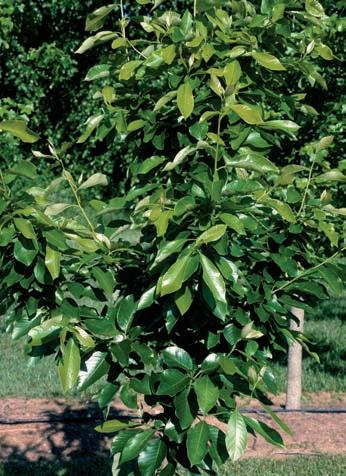
Black gum
Japanese Black Pine
These pine trees (Pinus thunbergii) were introduced to the island to provide a fast growing evergreen species to block wind and provide screening. Coming from another island environment, Japan, it was assumed they would do well in Nantucket’s harsh coastal climate. The trees quickly established as they produce thousands of seeds and thrive in our sandy soils. Unfortunately, they form dense groves and outcompete our native trees and shrub species as well as encroach on our rare open sandplain grassland communities. The trees have proved to be susceptible to native insect pressure and therefore short lived on the island, creating fire hazards with stands of trees dying off, but with dense thickets of saplings beneath.
Native alternatives
The stand out alternative for our island environment is the native pitch pine. This species was once extirpated from our island and reintroduced in the 1800’s, however it is in sync with many of our native insects and provides much needed habitat for endangered bat species. While the Japanese black pine declines with age, our native Pitch pines can live for over a hundred years, providing a significant component of our forest canopy on the island. Pitch pines are susceptible to southern pine beetle damage when found in dense stands, but remain healthier in scattered plantings.
1 Pitch pine (Pinus rigida)
2 Red cedar ( Juniperus virginiana)
3 American holly (Ilex opaca)
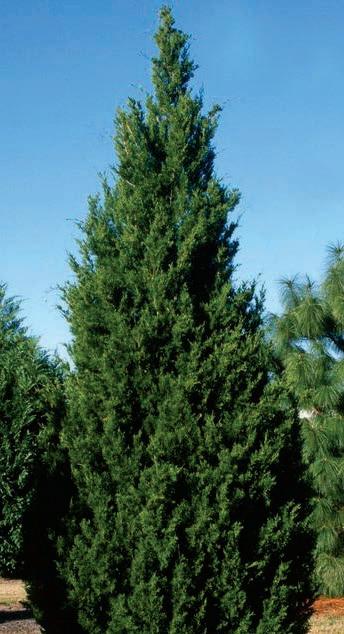
Resources
While there is a growing interest in sourcing native plants, it can be difficult to find seed and nursery stock native to specific environments.When shopping for native plants prioritize wildtype plants native to Nantucket, Cape Cod, or coastal ecoregion 84 when possible. The genetics of these plants will be best adapted to our coastal conditions and in sync with our native wildlife. You can order native seeds online from the Wild Seed Project website or Ernst Seeds. Island growers such as Surfing Hydrangea, In Situ Native Plant Nursery, and Nantucket Conservation Foundation are all expanding their offerings of native plants.
The Native Plant Trust has a database called Go
NBotany (gobotany.nativeplanttrust.org) that can be used to determine which species are island-native and which are not. If you need assistance identifying the plant life that exists on your property, iNaturalist (inaturalist.org) can be a helpful tool. Upload images to iNaturalist and receive several computer generated recommendations on what the species might be. Then, wait for seasoned naturalists to review your post and either verify your identification or suggest otherwise.
The Native Plants for Nantucket pamphlet, list species native to the island along with the conditions in which they prefer to grow. This was developed by Nantucket Biodiversity Initiative and is available in hard copy at NLWC and at NCF, as well as online. This is the link: bit.ly/native-plants-ack.
Takeaways
ative plants form intricate relationships with local wildlife, birds, and insects that have evolved alongside them. A healthy ecosystem requires balance and biodiversity to remain beneficial. Invasive vegetation is like a misfit cog in the machine, a part that doesn’t benefit the function of the landscape. Without natural predators
or equivalent competition, invasive plants cause tremendous damage to ecosystems and the insect and animal communities that rely on them.
Planting native species in place of these invasive plants can help maintain the unique natural beauty of the place we call home. It’s time we start rooting for the home team!

Red cedar
JAPANESE BLACK PINE, RED CEDAR, JOHN RUTER





(508) 257-1354
nantucket @ oh-DEE R .co m oh-DEE R. co m/nantucket SCAN TO LEARN MORE
Through Bluedot’s Nantucket newsletter (sign up at bit.ly/newsletter-bluedot), I asked readers for nominations for our recurring “Climate Champs” feature — where we highlight individuals who are doing inspiring work or “walking the talk” when it comes to ecoconscious and sustainable living in their communities.
One name rose to the top: Rachael Freeman.
Rachael has been executive director of the Nantucket Land Bank for almost two years, but she’s worked with the organization in various capacities for more than a decade before stepping into the leadership role. She’s spent her whole life on Nantucket (did you know she’s a Starbuck?), and in many ways has been part of stewarding the island for as long as she can remember. From working with the Nantucket Conservation Foundation, to running her own environmental consulting business, to her long career with the Land Bank, her work has consistently centered around the land and how people interact with it.
That connection doesn’t stop at her job. At home, Rachael and her family live many of the same practices she helps advance professionally — from solar panels and an electric vehicle to composting systems, a clothesline, and access to local food through the family farm next door.
I got to chat with Rachael this spring about how those everyday choices connect to her larger work, the projects she’s most proud of, and what it looks like to think about sustainability on a small island where land, water, and community are all deeply intertwined.
This interview has been edited and condensed for clarity.
Britt Bowker: I learned through your nomination that you have solar panels and drive an electric vehicle. When did you make those switches, and how has it been going?
Rachael Freeman: We’ve probably been in our house close to 10 years, and we’ve had our solar panels for at least six. The house we live in is substantially bigger than the house that we used to live in, and we have two sets of year-round tenants, so our electricity use is basically three households’ worth. We decided that we really wanted to offset some costs, and we put in solar panels at that time. After that, gradually moving toward as much off the grid as we could be, I purchased an electric car — a Subaru Solterra. I’ve had that for probably three, four years now. And I love it. So I love the solar panels and I love my electric car.
BB: Did anything about having these two energy efficient technologies surprise you?
RF: What has surprised me is that the maintenance has been virtually none. I think that is huge. Really the upfront cost is where you see the cost, and then it just truly does pay back over time. And similarly, in my car, I don’t need oil changes. Right
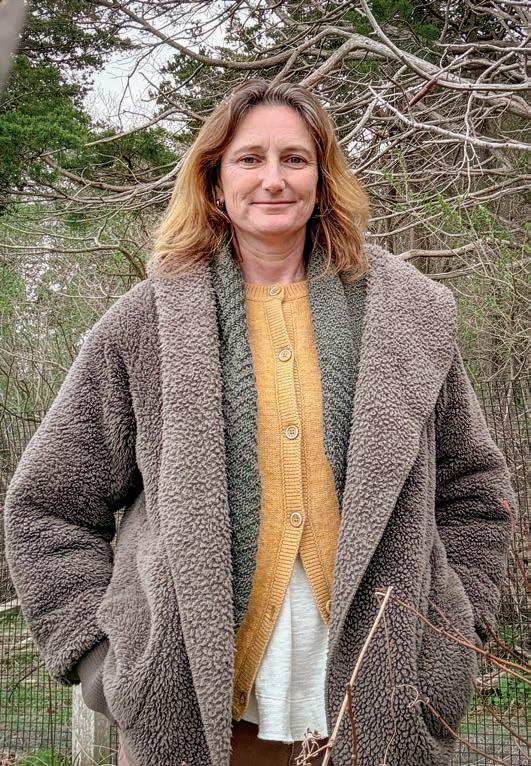
CLIMATE CHAMP
From everyday choices to RACHAEL FREEMAN
From everyday choices to island-wide impact.
Interview by Britt Bowker
now there’s a maintenance light on and we called Subaru and said, “We live on Nantucket, there’s a maintenance light on.” And they said, “All we’re going to do is rotate your tires. So I wouldn’t bring it over.” I’ve done virtually nothing to my car for three or four years now, which is pretty amazing.
BB: Do you have a charger at home?
RF: We do. We installed a charger, and that was similarly that upfront cost that then becomes very, very worthwhile in the long run. It makes it incredibly easy. I charge my car once a week. Nantucket is a perfect place to have an electric vehicle — I don’t drive incredibly far, and I can charge it one night a week and I’m good to go.
BB: Do you have any other sustainable daily practices at home that you're particularly into?
RF: It’s funny, because some of these I’m going to have to attribute to my husband. He really firmly believes in reusing, recycling, not throwing out. So there’s a number of things that he does that I’ve adopted.
We have a clothesline, so whenever possible we are not using a dryer. His family owns Moors End Farm, and we live next door, so we have access to local food, which is incredible. We have a huge composting operation in our house, which includes worm compost and goes into our backyard garden. And depending on the day, some food waste goes to pigs or chickens at the farm.
So composting is something that we take pretty
seriously. I think a lot of the things that some people take to the dump, we just are actually not, because they’re going either into our garden compost or to a farm animal.
BB: I’m also curious — what brought you to Nantucket?
RF: My family’s actually from Nantucket. So little known fact, my middle name is Starbuck — and not after the coffee company. I’m related to the Starbucks, not directly founding families, but first edition. So my family’s been here forever. I grew up coming here to see my grandmother quite a bit.
I have always really, really loved the outdoors. That’s something that feels almost genetic. And it became apparent pretty early on that I needed to be doing work that allowed me to be part of nature. That’s really one of the ways I ended up here. I took a job with the Conservation Foundation, and that brought me here year-round.
BB: Where else was home growing up?
RF: I grew up right outside of Boston, in Newton. I was born in Cambridge. I’m sort of a misfit city slicker — I never quite fit in there.
As a kid, my dream was to own a farm. And while I don’t own the farm and don’t claim to have any major impact on it, I do love that my in-laws run an amazing farm on the island. It kind of fulfills that desire that I had.
BB: So you started at the Conservation Foundation, and now you’re with the Land Bank. Did you have any jobs in between?
RF: I had my own environmental consulting company, which focused on rare species permitting for different projects. I worked as a subcontractor on things like the Nantucket airport, bike paths, and the disc golf course — larger permitting projects. All the while, I was doing contract work for the Land Bank. I actually started parttime with them when my 13-year-old was one.
BB: You’ve been executive director for almost two years now. How has that been?
RF: It's been fantastic. It’s not without its challenges, but I really enjoy it. I love the creativity, and I love the staff that I work with. I'm incredibly grateful for the leadership of the commission. I do think what the Land Bank does as an organization is amazing. So all in all, I love it.
BB: Can you talk me through some projects you’re particularly proud of?
RF: It's going to be hard to choose. I actually love everything that we're working on.
The ones that have been most publicized lately are collaborative projects, where we’re working with the community
to figure out how we can partner with local organizations and meet a need while staying within the Land Bank Act.
One example is the venison processing at the Community Food Hub, which was jointly purchased between Nourish Nantucket and the Land Bank. It brought together agricultural, recreation, and conservation components. Hunters donate deer, the Land Bank processes it, Nourish coordinates everything, and most of the venison goes directly to the food pantry.
To see that type of very collaborative system — where all the pieces come together — has been incredibly fun to be a part of. It really demonstrated what it looks like when we all work together.
BB: Are there other projects that reflect these kinds of problem-solving collaborations?
RF: We purchased 41 Jefferson Avenue, which is now a public beach. We’re in the process of moving these unbelievably beautiful buildings off the property and repurposing them as year-round housing. Some are going to the Affordable Housing Trust, and some will become employee housing for Land Bank or municipal staff. That reuse component is really neat, and again it’s about collaboration — working with organizations that focus on housing to create a broader community benefit.
We’re also doing a small deconstruction project with Remain at 19 East Creek. Instead of moving the house, we’re deconstructing it and reusing the materials. Not every house can be moved, so what are the other opportunities to think
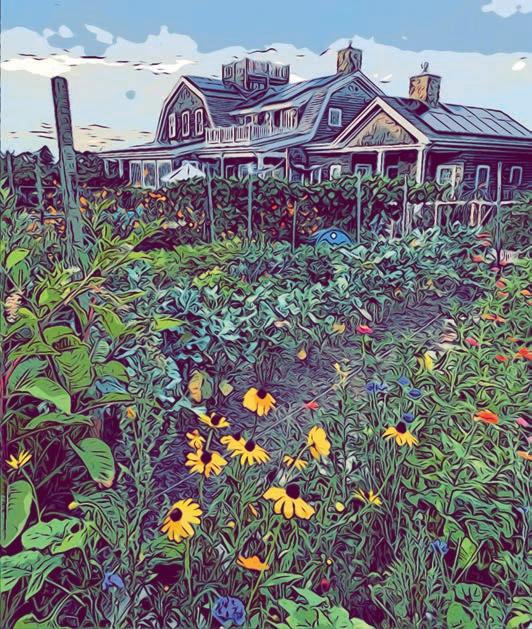
Rachael’s home in summer. Photo by year-round tenant Angus McLeod. Gardens of mostly native plants were designed with friend and landscaper Julie Jordin.

sustainably and not have things go into the landfill? We’re starting at a small scale, but it’s something I’m really intrigued by. There’s even talk of creating pre-packaged sheds from salvaged materials, which I think is genius. Our job right now is to get the environmental permitting done, which we’re trying really hard to finish in order to make it so that this can happen.
BB: Are there other places on the island where you’re thinking about reuse in a similar way?
RF: There’s a couple other locations on the island where we have buildings that aren’t really an ideal spot. [19 East Creek] is a very waterfront property which is hugely at risk for sea level rise. The house is actually gutted, and when we purchased it, it was already gutted, so it doesn’t make sense as a dwelling, and it doesn’t make sense to put money into it because of the location.
There are other properties like that where maybe it’s not the best place for a house, but what can we do with those materials instead of just sending them to waste options and shipping them off-island? Small scale, I’ll totally admit that. And maybe it’s not something that makes sense on a large scale, but who knows. Let’s try it and see if it works.
BB: Are there any other upcoming projects you’re especially excited about?
RF: We have a project on Lily Pond, which we’re going to be starting in the fall. It’s been in planning for at least five years. It’s a hugely complicated area — I like to call it the stormwater management facility for all of downtown Nantucket, which isn’t entirely true. But Lily Pond is a basin, so it’s low. I think seven different watersheds drain into this area, and there’s also a ton of stormwater from surrounding impervious areas. It’s in downtown, which is piped into this wetland, and then it all goes underground and goes to Children’s Beach and into the harbor.
So the Land Bank has been working with the town of Nantucket’s sewer and stormwater departments to think through how we can restore this area and make best use of the wetland function — potentially putting in more stormwater swales on the edges to treat the stormwater that’s coming into this park, so that before it goes to the harbor, it’s as clean as possible. And this is also an amazing public park. We’re doing this really through green and nature-based
solutions, coming up with ways that we can restore the park and increase the benefits to stormwater runoff in that we’re definitely going to be improving the water quality that’s entering the harbor. So that’s a really fun project. It’s all within the context of a public park, which is one of our main focuses, the interaction between people and nature.
BB: What are some easy, sustainable switches you’d recommend?
RF: Being mindful of waste is a big one. Are you taking the effort to recycle? Or do you — I’m guilty of this too — just want to get it out of your vehicles or out of your possession and so you go to the nearest trash can and throw it out? So really thinking through where you’re putting things.
And transportation — Nantucket is a great place to walk or bike. I walked home the other night — it took 45 minutes, but sometimes in the summer it takes that long to drive and park. There’s a piece of slowing down in all of that, which is hard for all of us. But taking that extra second can make a difference.
BB: Do you see an overlap between how you live your life and how you run the Land Bank?
RF: Of course, but I also want to reiterate that the Land Bank isn’t shaped by one person. The staff, the commission, and the community all play a role.
Everyone here cares deeply about public access and the environment, and that’s what shapes the work.
A FIRST-OF-ITS-KIND MODEL
Fun fact: The Nantucket Land Bank was the first land bank of its kind in the United States.
Established in 1983 through a special act of the Massachusetts Legislature, and approved by Nantucket voters in a 466-to-1 Town Meeting vote, the Land Bank is funded by a 2% real estate transfer fee. Rather than relying on tax revenue, this dedicated funding stream allows the organization to acquire and steward land for public benefit.
The Land Bank prioritizes the preservation of open space, agriculture, and recreation, particularly in areas facing development pressure. Since its founding, it has protected thousands of acres, expanded public access to beaches and trails, and supported local agriculture and conservation efforts.
Nantucket’s model has since inspired similar programs across the country, including on Martha’s Vineyard, Block Island, and in Washington State’s San Juan County.
Save the date: The Land Bank’s annual Cross-Island Hike returns Saturday, Sept. 19 at 8 a.m. — a fast-paced, roughly eight-hour trek across trails, beaches, and roads that showcases the island’s diverse landscapes.
Learn more at nantucketlandbank.org.
Rachael's Subaru Solterra.
Recycle, compost, volunteer, write your rep, buy secondhand.
The ‘ KEEP-THIS ’ Simple, Smart, Sustainable Handbook
See this online at bit.ly/ack-handbook
COMMUNITY RESOURCES
ELECTRIC VEHICLE CHARGING
Public EV chargers are available across Nantucket, including at the airport, downtown, Jetties and Surfside beaches, and town facilities.
Find a full map, availability, and fees: bit.ly/ACK-EV-Charging.
CLIMATE RESILIENCE + COASTAL ADAPTATION
Nantucket is on the frontlines of sea level rise. These resources help homeowners and the community prepare. Resilience Toolkit: bit.ly/Nantucket-Resilience-Toolkit
Flooding Adaptation and Building Elevation Guidelines: bit.ly/ACK-Building-Guidelines
SHELL RECYCLING
Oyster and clam shells are collected from restaurants, raw bars, and the community, then cured and reused for habitat restoration projects. Learn more: bit.ly/ACK-Shell-Recycling
WATER REFILL STATIONS + REDUCING SINGLE-USE PLASTICS
Nantucket banned single-use plastics in 2020 and encourages a BYOB (Bring Your Own Bottle) culture. Filtered water refill stations are available across the island, including at the Atheneum (1 India Street), Town Hall (16 Broad Street), and Jetties Beach.
For a full map of water stations, visit bit.ly/ACK-Water-Stations.
To learn more about the Single-Use Plastics Ban, visit bit.ly/ACK-Without-Plastics.
The Stop the Straw Campaign also encourages restaurants and businesses to eliminate plastic straws: bit.ly/ ACK-Stop-The-Straw
LOW-CARBON TRANSPORTATION
Nantucket makes it easy to get around without a car. Walk, bike, or take public transit to reduce emissions and ease summer congestion. Learn more: MoreNantucket.com
WALKING + TRAILS
Explore miles of conservation land and public trails across the island. The Nantucket Conservation Foundation maintains an extensive trail network, including a 26.4-mile coast-to-coast route.
Maps + resources: bit.ly/NCF-trails | bit.ly/ACK-coast-to-coast
The ACK Trails app (acktrails.com) offers routes for walking, running, and hiking.
BIKING
With more than 35 miles of bike paths and relatively flat terrain, biking is one of the easiest ways to get around. Bike path map: bit.ly/ACK-bike-paths Bike rentals + shops: bit.ly/car-free-ack
PUBLIC TRANSIT
The NRTA’s Wave bus is free and runs island-wide. Routes + schedules: nrtawave.com.
HUNTING + FISHING
PERMITS
All Massachusetts hunting, fishing, and trapping permits are available at massfishhunt.mass.gov (Nantucket is Zone 14). These include freshwater and saltwater fishing, lobster permits, hunting, and antlerless deer permits.
Season dates and regulations: bit.ly/hunt-fish-2026
WHERE YOU CAN HUNT
Much of Nantucket’s hunting land is managed by the Nantucket Conservation Foundation and the Nantucket Land Bank. Property access varies by site, including areas open, closed, or open by permission.
Maps + updates: nantucketconservation.org/properties/hunting nantucketlandbank.org/properties/hunting-guidelines
Additional Massachusetts Wildlife Management Areas: bit.ly/MA-WMAs
In 2026, Massachusetts extended deer season on Nantucket and Martha’s Vineyard, adding early fall (Sept. 21–Oct. 1) and winter (Jan. 1–Feb. 13) archery and primitive firearms seasons. The change reflects ongoing efforts to manage the island’s growing deer population.
HUNTERS SHARE THE HARVEST
MassWildlife’s program allows hunters to donate venison to residents in need while supporting deer population management. Venison is distributed locally through food access programs and pantries.
Learn more: bit.ly/hunters-share-the-harvest
The Nantucket Land Bank’s Agricultural Processing Center at 19 Boynton Lane also accepts whole deer donations for this program, supporting local food distribution through the Nantucket Food Pantry and Nourish Nantucket.
Shellfishing Permits
Apply online at bit.ly/ACK-shellfishing-permit or in person at the Public Safety Facility (4 Fairgrounds Road). Fees vary by residency status and permit duration.
LIBRARIES
LITTLE FREE LIBRARIES
Little Free Library is a nonprofit that supports reading through free, community-managed neighborhood book exchanges. There are several Little Free Libraries on Nantucket. Find one near you: bit.ly/ACK-Little-Free-Libraries
NANTUCKET ATHENEUM
1 India Street | nantucketatheneum.org
LIBRARY OF THINGS
Atheneum patrons can borrow a range of items, including children’s activity kits, board games, telescopes, acupressure mats, Chromebooks, and WiFi hotspots. Full list: bit.ly/ACKLibrary-of-Things
VOLUNTEER + COMMUNITY OPPORTUNITIES
Support island organizations working in food systems, conservation, housing, education, and community care.
FOOD + HUNGER RELIEF
Food Rescue Nantucket A Nantucket Unitarian Meeting House and Food Pantry of Nantucket collaboration to reduce food waste and support food access programs. bit.ly/food-rescue-ack
Nantucket Food Fuel Rental Assistance (NFFRA) Support for food, fuel, and housing needs. assistnantucket.org/volunteer
Nourish Nantucket Volunteers help prepare meals, with events, and program support. nourishnantucket.org/volunteer
Sustainable Nantucket Volunteer opportunities include support for the Mentor Farmer program, the Farm to School program, weekly farmers market, and Nantucket grown events. sustainable-nantucket.org/volunteer
ENVIRONMENT + CONSERVATION
Nantucket Conservation Foundation Volunteer land stewardship and conservation work across protected properties. bit.ly/ACKConservation
Linda Loring Nature Foundation Volunteers gain experience in environmental education, research, and habitat stewardship. llnf.org/join-our-team
Maria Mitchell Association Volunteers help with science education, research, and nature-based programming. mariamitchell.org/volunteers
Nantucket Clean Team Volunteers help keep Nantucket’s beaches, dunes, roadsides and sidepaths free of litter. bit.ly/ACKCleanTeam
COMMUNITY + YOUTH
Nantucket Boys & Girls Club Volunteers help educate, mentor, and advise young people in the community. nantucketboysandgirlsclub.org/get-involved
Our House Youth mentorship and community programming for high school students. ourhousenantucket.org/get-involved
HOUSING + COMMUNITY SUPPORT
Habitat for Humanity Nantucket Helps build and support year-round housing on the island. habitatnantucket.org/contact-volunteer
The Warming Place Provides shelter and meals for individuals in need. thewarmingplace.org/volunteer
ANIMALS
NISHA (Nantucket Island Safe Harbor for Animals) Animal shelter and foster care programs. nishanimals.org/volunteer
Marine Mammal Alliance Nantucket Help protect and conserve Nantucket’s marine mammals. nantucketmman.org/how-to-help
HISTORY + CULTURE
Nantucket Historical Association Preservation and public education around island history. nha.org/administration/volunteer
Nantucket Preservation Trust Volunteer opportunities include docent work, research, and administrative support. nantucketpreservation.org/support/volunteer
THRIFTING + REUSE
Hospital Thrift Shop Pick up volunteer shifts or donate clothing. hospitalthriftshop.org/volunteer
SALTIE Museum Help support salvage and reuse efforts across the island. saltiemuseum.org/take-action
NATIVE PLANTS
Choosing native plants helps support local biodiversity, pollinators, and resilient landscapes adapted to coastal conditions. Whenever possible, prioritize plants native to Nantucket, Cape Cod, or similar coastal ecoregions. Native plants are available from local nurseries including Arrowhead Nursery, Surfing Hydrangea Nursery, and Nantucket Wildscapes via Leah Mojer’s In Situ Native Plant Nursery, which focuses on seed-grown local ecotypes and native Massachusetts species at Mt. Vernon Farm.
For additional sourcing, Wild Seed Project and Ernst Seeds offer native seed online.
To identify native species, use Go Botany (gobotany. nativeplanttrust.org), and for plant identification help in the field, iNaturalist (inaturalist.org) can provide community verification.
For a local reference guide, see the “Native Plants for Nantucket” pamphlet by the Nantucket Biodiversity Initiative, available in hard copy at NLWC and NCF: bit.ly/native-plants-ack
SECONDHAND SHOPPING
Buying and donating secondhand items helps extend the life of clothing, furniture, and household goods while keeping materials out of the waste stream.
Commonwealth Consignment shop featuring contemporary and designer clothing, with additional online storefront.
16 Federal Street; commonwealthnantucket.com
Hospital Thrift Shop A nonprofit thrift shop benefiting the Nantucket Cottage Hospital.
17 India Street; hospitalthriftshop.org
Island Treasures Consignment & Thrift A consignment shop offering clothing, decor, books, jewelry, and more.
128 Old South Road; facebook.com/IslandTreasuresNantucket
Nantucket Creative Reuse An online marketplace for repurposing leftover craft and art supplies. nantucketcreativereuse.com
The Rainbow Fleet Year-round consignment shop specializing in women’s clothing.
167 Orange Street; therainbowfleetnantucket.com
Seconds Shop Thrift and consignment shop supporting Fairwinds, Nantucket’s Counseling Center. Offers clothing, housewares, furniture, books, and more.
32 Sparks Avenue; secondsshop.org
Take-It-or-Leave-It A community reuse space where residents can drop off and pick up usable household items.
186 Madaket Road; bit.ly/Take-It-Or-Leave-It
Nantucket Salvage, SA+C An online store featuring salvaged materials. saandc.com/salvage-1
RECYCLING
Residents can drop off waste and recyclables at the Solid Waste Facility at 188 Madaket Road. For hours and details, visit nantucket-ma.gov/2862/Solid-Waste-Recycling.
Use the Waste Wizard digital tool (bit.ly/waste-wizard-ack) for item-specific guidance on how to recycle or dispose of materials correctly.
HOW TO SORT YOUR RECYCLING:
• Glass: Empty, rinse, and keep separate from other materials
• Plastic: Empty and rinse all food residue. Hard plastic containers are accepted (if it has a plastic identification number, it can be recycled)
• Aluminum/tin: Empty and rinse
• Cardboard: Flatten boxes and keep clean and dry
Note: Pizza boxes are not recyclable. Cardboard/boxboard pizza boxes are compostable; frozen pizza boxes are NonRecyclable Non-Compostable.
COMPOSTING
Compostable waste should be separated and brought to the Solid Waste Facility, where it is processed in an industrial composter.
WHAT YOU CAN COMPOST
• All food waste, including meat, dairy products, and bones
• Cooking oil (see Waste Wizard for disposal guidance)
• Paper cups
• Coffee filters and tea bags made from a paper or natural materials
• Natural corks
• Non-corrugated cardboard
• Cut flowers and seeds
Download the Solid Waste Map and Guide: bit.ly/solid-wastemap. For more info: bit.ly/compost-ack
BUILDING SALVAGE AND LAWN WASTE
Reduce waste by reusing building materials and properly disposing of yard debris.
Toscana Corporation Accepts lawn waste from homeowners and landscapers, which is processed into compost and soil products for reuse. Learn more: toscanacorp.com
Nantucket Salvage by SA+C Inc. A waste-diversion and circular economy initiative that partners with the community to deconstruct, salvage, and repurpose materials for reuse in local projects.
Learn more: saandc.com/salvage
The SALTIE Museum A nonprofit exploring sustainability in architecture and everyday living through exhibits, education, and community programming. Learn more: saltiemuseum.org
Nantucket Reuse Fair
Sept. 19, 11am–4pm, at the VFW (22 New South Road)
Hosted by Nantucket Salvage and Remain, this community event brings together local organizations focused on reuse, repair, and sustainability.
See Bluedot’s guide on How To Get Rid of (Almost)
Anything: bit.ly/GetRid-ack
FOOD DONATIONS
The Nantucket Food Pantry Accepts donations year-round, including non-perishable items. Located at 19 Boynton Lane, open Tuesday–Thursday, 3–6pm. Donations can also be dropped off at Stop & Shop (31 Sparks Avenue).
Learn more: assistnantucket.org
LOCAL FARMS
Support local agriculture by buying directly from Nantucket farms — reducing food miles and strengthening the island’s food system.
Bartlett’s Farm 33 Bartlett Farm Road
A year’round market offering seasonal produce, prepared foods, and pantry staples. bartlettsfarm.com
Cisco’s Secret Farm 5 Bartlett Farm Road. Fresh produce and flowers grown on-Island. ciscossecretfarm.square.site
Harvest Garden 163 Hummock Pond Road
A biodynamic garden offering specialty plants, flowers, and produce, plus workshops and events. harvestgardennantucket.com
Moors End Farm 40 Polpis Road. Family-run farm growing a wide variety of fruits, vegetables, herbs, and flowers. moorsendfarm.com
My Grandfather’s Farm 101 Hummock Pond Road
Seasonal vegetables and eggs, sold directly from the farmstand. Instagram: @mygrandfathersfarmack
Pumpkin Pond Farm 25 Millbrook Road
Organic produce and a CSA program with a range of share options. pumpkinpondfarms.com
Sustainable Nantucket Farmstand 168 Hummock Pond Road
A collaborative farmstand featuring products from Fog Town Farm, Washashore Farm, Eat Fire Farm, In Situ Native Plants, and Sea Legs Farm. sustainable-nantucket.org/farmstand
Sustainable Nantucket Farmers & Artisans Market
Cambridge St. & North Union St., downtown Saturdays (in season), 8:30am–12:30pm
Season: May 23–Oct. 31 (weather permitting)
A weekly market featuring local produce, prepared foods, and handmade goods. sustainable-nantucket.org/market
FIELDNote
To: Bluedot Living
From: Town of Nantucket: Natural Resources Department
Subject: How Long-Term Benthic Dive Surveys Keep Us Informed
The sun has just risen; the tide has finally gone slack; anticipation builds among the crew. Divers check their air and ensure their dive weights, compass, transect tapes, rebar, quadrats, underwater clipboards, measuring tapes, bonus pencils, and collection bags are securely fastened to their wetsuit-cladded bodies. The pair of divers do a final runthrough of the survey methods before they roll off the gunnel with their slew of gear into the frigid fall waters of Nantucket Harbor.
It is dive survey season for the hatchery team at the Town of Nantucket’s Natural Resources Department (NRD) and they are about to begin one of the most important surveys for Nantucket’s marine ecosystem.
Nantucket Island has changed rapidly over the last few decades. When the bay scallop industry began to collapse in the late 1980’s, there was no monitoring occurring underwater; the only information came from what was coming out of the water in the form of harvests. And from 1930 to 1990, most people assumed that a majority of Nantucket’s eelgrass was lost from “wasting disease.” However, since the first attempt at eelgrass mapping was not even done until 1995 (and it was just an aerial survey), there was no true quantitative evidence about how much eelgrass the island used to have, and how much could have been lost.
If a long-term benthic dive survey had existed, degradation could have been observed, and intervention could have been put in place sooner for both bay scallops and eelgrass.
So, What Is a Benthic Dive?
Divers go down to gather data on benthic habitat structure (benthic refers to the seabed) such as eelgrass and macroalgae coverage, as well as bay scallop, knobbed whelk, and channeled whelk size and distribution.
Long-term monitoring and documentation of environmental shifts, and subsequent understanding of what is causing these shifts, provide crucial information to stakeholders (scientists, fishermen, concerned citizens) that can be used to make meaningful decisions regarding temporary site closures, fishery extensions, harvest increases, stock enhancement, future habitat restoration initiatives, and Town management plans, such as the Eelgrass Management Plan (2025). The Town, through years of monitoring data, can now evaluate the effectiveness of past plan action items, like those in the Shellfish Management Plan (2012). Ultimately, the long-term annual survey that takes place on Nantucket has allowed stakeholders to be aware of
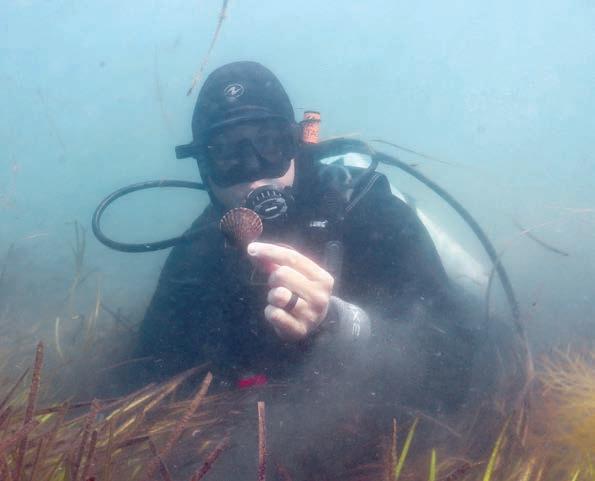
the volatility of key marine resources in an ecosystem that experiences increasing pressure from a variety of factors. They can make informed decisions as they observe real-time changes in local marine resources and implement action items capable of protecting, restoring, and improving resiliency for future generations to be able to enjoy.
So, Whose Idea Was This?
Between 2006 and 2014, Dr. Peter Boyce and Dr. Robert Kennedy of the Maria Mitchell Association did benthic dive surveys (with the help of Dr. Valerie Hall and Forest Kennedy) that form a foundation for the Town of Nantucket’s current dive surveys.
In 2019, Dr. Stephen Heck (a former NRD intern and diver for the original surveys) came back to the island to help revamp the surveys in a pilot program funded by the Great Harbor Yacht Club Foundation, with guidance and assistance from NRD divers and resource managers. Dr. Bradley Peterson and Dr. Stephen Tettlebach provided advisory and diving help. After 39 dives and massive success, the Town took over funding for the surveys in 2020. Dr. Heck continues to dive at every site with an NRD diver and processes all the data, generating a detailed report that compiles highlights of major ecosystem shifts and trends over the years; his participation has helped standardize surveys and furnish reliable long-term data.
As of 2024, the Town survey series expanded to encompass Madaket Harbor and Tuckernuck Island. This will provide information in two regions that have not been surveyed before, which will help us understand habitat and resource differences throughout municipal waters. Also in the last two years, the town has done a spring dive series with a subset of Nantucket Harbor site locations. This series focuses purely on bay scallop size, class, and distribution. This will provide important fishery and resource management data and insights into over-winter mortality as well as how the scallop population moves between survey intervals.
To learn more about the detailed results and methodology of the benthic dive surveys, see the 2024 ecological monitoring report here: bit.ly/BenthicDives.
COURTESY OF THE TOWN OF NANTUCKET
Steve Heck with a scallop.

Plant native
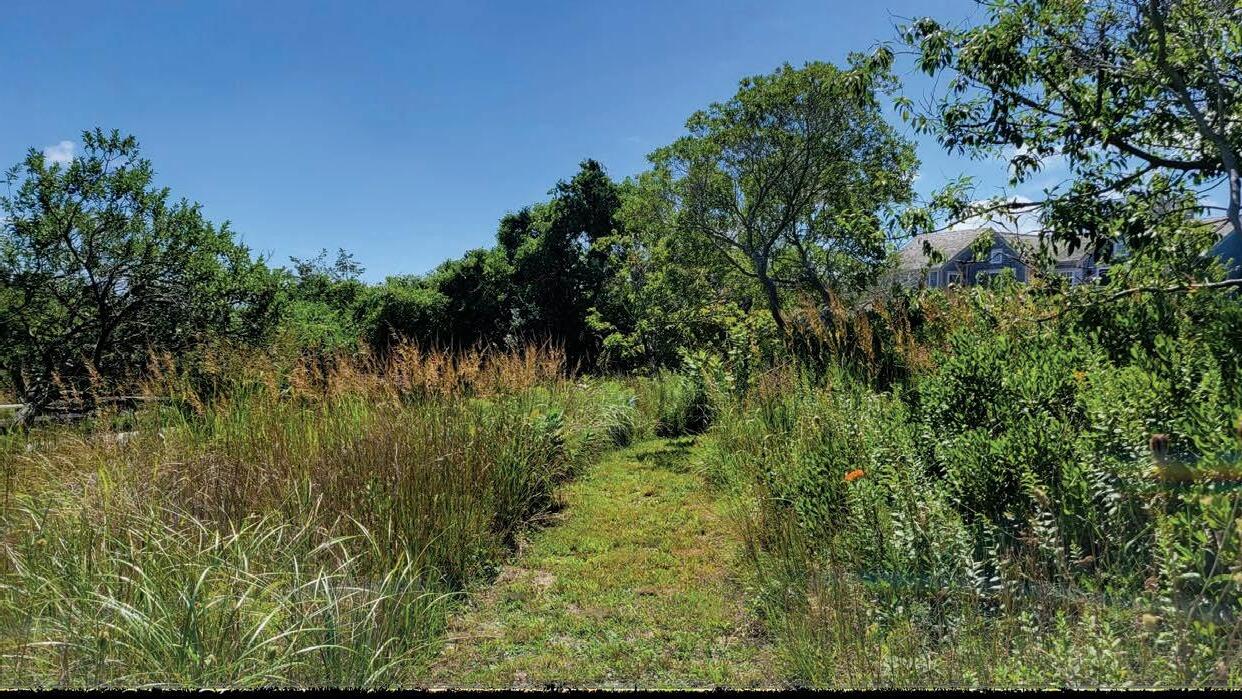
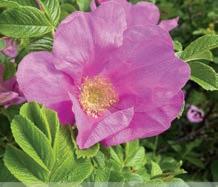
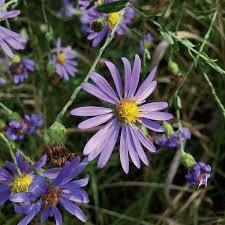
On Nantucket, what we plant shapes the health of our water, wildlife, and community.
Native plants are adapted to Nantucket’s environment. They require less water and minimize the need for fertilizers and pesticides, while providing essential habitat for pollinators and wildlife. These landscapes feel naturally at home on Nantucket and thrive with fewer inputs.
Beautiful landscapes can do more!

Experience more of what makes Nantucket special. Leave the car behind and explore the island with convenient transportation options that let you soak in every moment.
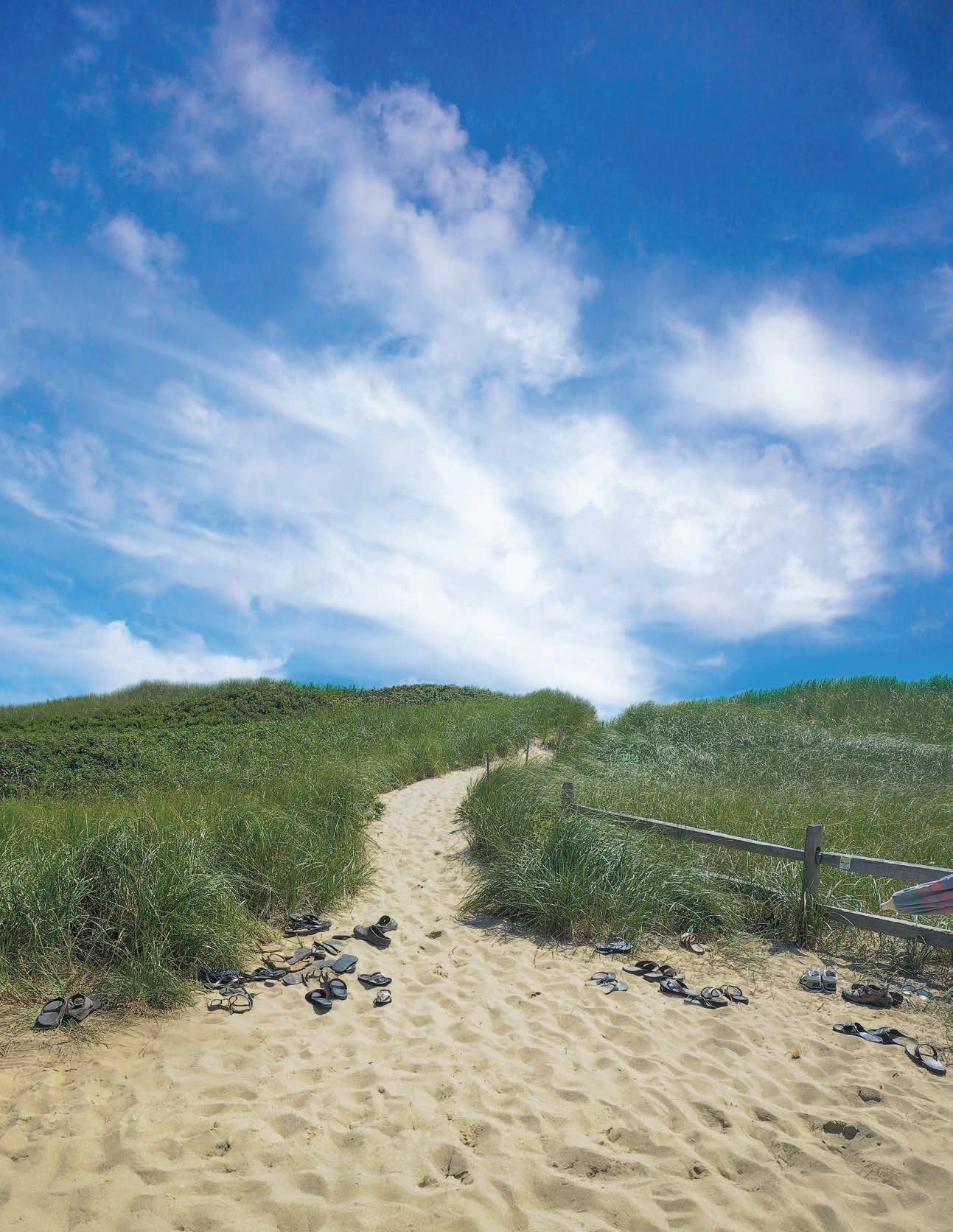
There’s a reason Nantucket boasts a high Walk Score® - the island is best explored on foot. Stroll through historic streets, immerse yourself in the Cultural District and uncover world-class shops and restaurants
See Nantucket up close and at your own pace. You’ll discover more than 35 miles of dedicated bike paths, flat terrain perfect for riding and plenty of bike rental options -- including e-bikes for longer journeys.
Leave the driving to us and enjoy a relaxing ride. Hop on the free WAVE bus, with routes covering the island from end to end and departures at every half hour. Or, choose a courtesy shuttle or an educational tour.
Ready to explore Nantucket car-free? Visit MoreNantucket.com for free apps, helpful tips, and resources to make getting around easy and enjoyable.