M A R T H A’ S V I N E YA R D / L AT E S U M M E R 2 0 2 6
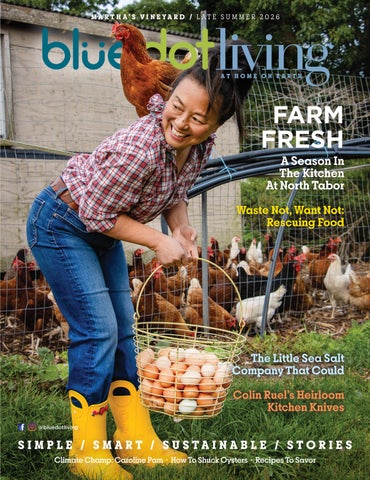
FARM FRESH
A Season In The Kitchen At North Tabor
Waste Not, Want Not: Rescuing Food
The Little Sea Salt Company That Could Colin Ruel’s Heirloom Kitchen Knives @bluedotliving
S I M P L E / S M A RT / S U STA I N A B L E / STOR I E S Climate Champ: Caroline Pam · How To Shuck Oysters · Recipes To Savor
DUCTLESS SYSTEMS
Sleek enough to blend in, smart enough to stand out.
Martha Vineyard’s only Quilt Certified Installer
508-524-4126
.com/marthas-vineyard
1
BDL • OUR TEAM
“
Look again at that dot. That’s here. That’s home. On it everyone you love .” –Carl Sagan
Founder and Publisher Victoria Riskin CEO Raymond Pearce Executive Editor Jamie Kageleiry Head of Audience Kirsten Carroll Editor Brittany Bowker, britt.bowker@bluedotliving.com Senior Writer Leslie Garrett Copyeditor Laura Roosevelt Chief Financial Officer David Smith Creative Director/Systems Manager Tara Kenny Art Director Whitney Multari Design and Production Vesna M. Nepomuceno Web Manager Grace Hughes Project Manager Alison Mead Ad Sales Josh Katz, adsales@bluedotliving.com Social Media Emily Lamoureux Contributors this Issue Randi Baird, Julia Blanter, Lis Bluford, Sadie Dix, Jeremy Driesen, Jocelyn Filley, Sheny Leon, Lucas Thors, Irene Wong ••••• Bluedot and Bluedot Living logos and wordmarks are trademarks of Bluedot, Inc. Copyright © 2026. All rights reserved. Bluedot Living: At Home on Earth is printed on recycled material, using soy-based ink, in the U.S.
For all your banking needs, Cape Cod 5 is here to help. Personal & Business Banking Wealth Management • Financing
Bluedot Living magazine is published quarterly and is available at newsstands, select retail locations, inns, hotels, and bookstores, free of charge. Please write us if you’d like to stock Bluedot Living at your business. Editor@bluedotliving.com Sign up for the Martha’s Vineyard Bluedot Living newsletter, along with any of our others: the BuyBetter Marketplace, Your Daily Dot, Bluedot Living Kitchen, and The Weekly: bluedotliving.com/sign-up-for-our-newsletters/ Subscribe! Get Bluedot Living Martha’s Vineyard and our annual Bluedot GreenGuide mailed to your address. It’s $29.95 a year for all four issues plus the Green Guide, and as a bonus, we’ll email you a collection of Bluedot Kitchen recipes. bluedotliving.com/magazine-subscriptions/
412 State Road • Vineyard Haven capecodfive.com • 888-225-4636 Member FDIC
NMLS# 401717
2
M A R T H A’ S V I N E YA R D / L AT E S U M M E R 2 0 2 6
Read stories from this magazine and more at bluedotliving.com/marthas-vineyard/ Find Bluedot Living on Threads, Instagram, Facebook, and YouTube @bluedotliving
EDITOR'S LETTER
Dear Readers,
O
ur August issue is always especially exciting to put together. We all love the theme — food — and food happens to be very photogenic. So you’ll see gorgeous photography from Sadie Dix (that’s her shot on the cover), Randi Baird, Jocelyn Filley, Sheny Leon, and Jeremy Driesen. It’s a treat to watch these images come in — you can almost taste the flavors and feel the textures. It’s another thing entirely to watch Bluedot’s talented designers, Whitney Multari and Tara Kenny, bring those Martha’s Roysters, images to life across these pages. harvested from Katama Bay. Food is so much more than what RANDI BAIRD ends up on our plates. It often has a beautiful story behind it, too. From system: knowing where our food comes farmers market hauls to the school from, supporting the people who grow lunches Island kids will soon be eating, and make it, and finding ways to waste this is a community where you can often less along the way. trace food back to its origins — and Which brings me to the people where you’ll find a hardworking person behind the food. In these pages, you’ll putting a lot of care into growing, making, meet Irene Wong, the NYC native who or preparing it. Those connections are makes those decadent, handmade heartat the heart of a more sustainable food shaped biscuits you find at the farmers
market. You’ll learn about Betsy Carnie and her team at the Martha’s Vineyard Public Charter School, where creativity and a “no waste” philosophy shape each cafeteria meal. You’ll discover Colin Ruel’s fascinating venture into making kitchen knives, and learn about Heidi Feldman’s solar evaporated sea salt and the storm that nearly washed away her business. And you’ll meet Island Grown Initiative co-executive director Caroline Pam, who brings decades of experience to the work of building stronger regional food networks. I was lucky to write many of the stories in this issue, and I’m especially thankful to the Islanders who let us into their lives and shared their craft, recipes, and ways of thinking. We live in a place surrounded by so much talent, from chefs and farmers to artists, photographers, and storytellers. I hope you enjoy getting to know some of them a little better. Happy eating! – Britt Bowker
484 STATE ROAD WEST TISBURY 508.693.8511 www.vineyardgardens.net
.com/marthas-vineyard
3
CONTENTS Upfront
Connecting the dots from all around the Bluedot universe.
10 Two Islands at a Crossroads 12 Five Martha’s Vineyard Cookbooks For Your Shelf 14 Tick Check: Our Deer Population 16 The Ag Society, Year-Round
Features
20 Waste Not, Want Not: Rescuing Food
Departments
18 Dear Dot: How Safe is My Tap Water? 38 How-To: Shuck Oysters 45 Climate Champ: Caroline Pam at IGI
Recipes
23 Apple Peel Snacks
24 French Toast 25 Any-Fruit Compote 36 Salted Caramel Pots de Crème
By Julia Blanter At the MV Charter School, rescued ingredients become joyful meals.
40 Cucumber Basil Mignonette
26 Holding History
48 47 Tomato Passata (Tomato Purée)
44 Herby Spring Onion Egg Salad
By Britt Bowker Colin Ruel makes heirloom kitchen knives from reclaimed materials, local wood, and pieces of Island history.
32 The Little Sea Salt Company That Could
By Julia Blanter At MV Sea Salt, Heidi Feldman turns local seawater into small-batch salt.
41 From Farm to Deli Container
By Britt Bowker Meet Irene Wong, North Tabor Farm’s chef-in-residence.
Newsletters to sign up for Martha's Vineyard Bluedot Living:
bit.ly/bluedot-mv-newsletter
The Bluedot Kitchen, The BuyBetter Marketplace, Your Daily Dot: Sign up here: bit.ly/BDL-newsletters 4
M A R T H A’ S V I N E YA R D / L AT E S U M M E R 2 0 2 6
COVER IMAGE: IRENE WONG AND THE CHICKENS AT NORTH TABOR FARM. PHOTO BY SADIE DIX THIS PAGE: CUCUMBERS FROM IGI. BY JEREMY DRIESEN
2 Our Team 3 Editor’s Letter 6 Stories From All Over
.com/marthas-vineyard
5
UPFRONT • CONNECTING THE (BLUE)DOTS
CONNECTING THE (BLUE)DOTS
Big Ideas from Other Places A Santa Barbara County–based nonprofit, White Buffalo Land Trust, is restoring the local ecosystem and supplying demand for this native perennial berry. In 2023, we broke ground on The Elderberry Project, a multiyear project focused on the native western blue elderberry. Because of their immune support properties, elderberries are experiencing a surge in market demand. But this native perennial found along waterways worldwide also offers a unique solution for restoring our watersheds, too. The elderberry actively contributes to climate resilience by sequestering carbon, enhancing soil health, improving water quality, mitigating floods, and preserving wildlife habitats, presenting a climateappropriate crop that could create a substantial market for small to mid-sized farmers in our region and beyond. We are working with local farmers, ranchers, and other producers to grow elderberries with the implementation of climate-smart agricultural practices, such as cover cropping. Once the berries are harvested, we employ a unique gentle
Elderberries offer immune support among other health benefits.
COURTESY OF WHITE BUFFALO LAND TRUST
Elderberry Bolsters Watershed Resilience
drying process to maintain the crop’s nutritional value at a regional processing facility in nearby Santa Maria. Over the next five years, our partners will be working to connect brands with this new supply chain, bridging the gap from production to the marketplace. – White Buffalo Land Trust Read the full story: bit.ly/elderberry-watersheds
Missing out on backyard time?
Porch Enclosure Systems 6
M A R T H A’ S V I N E YA R D / L AT E S U M M E R 2 0 2 6
Awnings-Screens-Shutters 7 -ÊUÊ, /, / Ê- , -ÊUÊ 1,, - 1// ,-ÊUÊ-" ,Ê- -ÊUÊ "/", < Ê- , -
Pergola Retractable Screens
Motorized Screens
Retractable Awnings
Louvered Pergola
CONNECTING THE (BLUE)DOTS • UPFRONT
This Pig’s Bacon Was Delicious. But She’s Alive and Well.
Mission Barns is cultivating pork fat in bioreactors and turning it into meatballs and other products. I’m eating Dawn the Dawn the Yorkshire pig and Yorkshire pig she’s quite tasty. But don’t worry. She’s doing perfectly fine, traipsing around a sanctuary in upstate New York. (Word is that she appreciates belly rubs and sunshine.) I’m COURTESY OF MISSION BARNS VIA GRIST in San Francisco, at an Italian joint just south of Golden Gate Park, enjoying meatballs and bacon not made of meat in the traditional sense, but of plants mixed with “cultivated” pork fat. Dawn, you see, donated a small sample of fat, which a company called Mission Barns got to proliferate in devices called bioreactors by providing nutrients like carbohydrates, amino acids, and vitamins — essentially replicating the conditions in her body. Because so much of the flavor of pork and other meats comes from the animal’s fat, Mission Barns can create products like sausages and salami with plants but make them taste darn near like sausages and salami.
Unique Nursery with Specimen Plants Unique Nursery Specimen Plants Botanical Shopwith ∙ Fresh Cut Flowers Beautiful Planters Fountains Botanical Shop ∙ Fresh&Cut Flowers Beautiful Planters & Fountains
Middletown Nursery 680 State Rd, West Tisbury, MA 02575 Middletown Nursery (508) 696-7600 680 State Rd, West Tisbury, MA 02575 middletownnursery@gmail.com (508) 696-7600 middletownnurserymv.com middletownnursery@gmail.com middletownnurserymv.com
Cultivated pork is the newest entrant in the effort to rethink meat. For years, plant-based offerings have been mimicking burgers, chicken, and fish with ever-more convincing blends of proteins and fats. Mission Barns is one of a handful of startups taking the next step: growing real animal fat outside the animal, then marrying it with plants to create hybrids that look, cook, and taste more like what consumers have always eaten, easing the environmental and ethical costs of industrial livestock. Of course, in this new frontier of food, the big question is: Who exactly is this for? Would a vegetarian or vegan eat cultured pork fat if it’s divorced from the cruelty of factory farming? Would meat-eaters be willing to give up the real thing for a facsimile? Regardless of the trajectory of cultivated fat products, Dawn will continue mingling with llamas, soaking up the sunshine, and getting belly rubs in upstate New York — even as she makes plants taste more like pork. – Matt Simon This is edited from a story originally published by Grist that is part of The 89 Percent Project, an initiative of the global journalism collaboration Covering Climate Now. Read the full story: bit.ly/mission-barns.
Landscape Maintenance & Construction Hardscape LandscapeOrnamental Maintenance Construction && Native PlantingHardscape Custom&Woodwork Ornamental Native Planting Stone Walls, PatiosWoodwork & Boulder Placement Custom Stone Walls, Patios & Boulder Placement
Lamplighter Corner (Located @ Middletown Nursery) Lamplighter Corner (508) 696-9394 (Located @ Middletown Nursery) lamplightercorner.com (508) 696-9394 Maker of the Edgartown Street Lamp since 1967 lamplightercorner.com Maker of the Edgartown Street Lamp since 1967
Oakleaf Landscape 70 Indian Hill Rd, West Tisbury, MA 02575 Oakleaf Landscape (508) 696-8869 70 Indian Hill Rd, West Tisbury, MA 02575 oakleafmv@gmail.com (508) 696-8869 oakleaflandscapemv.com oakleafmv@gmail.com oakleaflandscapemv.com
.com/marthas-vineyard
7
UPFRONT • CONNECTING THE (BLUE)DOTS
From the Other Island Not every local food business begins with its own restaurant or storefront. At The Hive, a shared commercial kitchen and food business incubator, dozens of Nantucket entrepreneurs are building their businesses under one roof, supported by local nonprofit Remain, which provides grants and programming to strengthen the island’s sustainability. The facility houses six commercial kitchens used by caterers, bakers, specialty food producers, and chefs on rotating schedules. Businesses like Noemi’s Dumplings, Siam To Go, Faraway Chocolate, Eat Fire Farm, ACK Pastry Shack, and others prepare everything from frozen dumplings and handcrafted chocolates to prepared meals and locally harvested seafood. Beyond kitchen space, The Hive helps food entrepreneurs navigate the business side of the industry by offering guidance on licensing, bookkeeping, wholesale production, and marketing. The goal is to help small businesses grow from side projects into sustainable companies that eventually outgrow the shared kitchen. The Hive also reflects Nantucket’s growing commitment to
8
M A R T H A’ S V I N E YA R D / L AT E S U M M E R 2 0 2 6
COURTESY OF REMAIN
All in One Place: Food Makers and The Hive
In addition to kitchen space, The Hive also hosts chef dinners.
sustainability. Most of its kitchens operate with energy-efficient induction equipment, compostable food packaging is available for members, and collaborations with local farms continue to strengthen connections between growers and food makers. Visitors are welcome to stop by during business hours to browse refrigerators stocked with prepared grab-and-go foods from island chefs, use pickup lockers for online orders, or attend The Hive’s seasonal makers markets and farm-to-table dinners, which bring together local farmers, chefs, and food producers to celebrate Nantucket’s thriving food community. – Britt Bowker Read the full story: bit.ly/the-hive-ack
CONNECTING THE (BLUE)DOTS • UPFRONT
Pip and Anchor: Community Café Did you know you can take an inter-island ferry from MV to Nantucket? Here’s a must on your route if you go.
ENJOY MORE TIME OUTSIDE!
Mayumi Hattori and Chris Sleeper, co-owners of Pip & Anchor.
Pip & Anchor is more than a café. Part market, part community gathering space, and part local food hub, the business was founded by chef Mayumi Hattori and Chris Sleeper to connect Nantucket residents and visitors with ethically sourced food from the island and across New England. The café serves seasonal sandwiches, salads, baked goods, and excellent coffee, while shelves are stocked with carefully curated pantry staples, wines, cheeses, and local produce. Through its “Send It” program, Pip & Anchor also purchases surplus crops from island farms at full price and redistributes them to food-insecure families, helping support both local growers and the community. If you’re looking for a taste of Nantucket’s collaborative food culture, this is one of the island’s essential stops. – Britt Bowker Read the full story: bit.ly/pip-anchor
DEER, TICK & MOSQUITO CONTROL! (508)627-2928 | MV@oh-DEER.com oh-DEER.com
•SAFE FOR YOU, YOUR FAMILY & PETS! •KILLS TICKS & MOSQUITOES ON CONTACT. •AN EFFECTIVE ‘GREEN’ ALTERNATIVE TO
SAM MOORE (2)
PESTICIDES & CHEMICALS
ohDEER offers two all-natural pest control solutions for seasonal or year-round protection. Our deer control solution is an egg-based spray with garlic, white peppers, mint oil, and water that directly targets the plants deer love to feed on. Our tick and mosquito spray is a blend of powerful essential oils, including cedarwood oil, lemongrass oil, castor oil, and water. Our team provides customized, thorough coverage for your property, ensuring long-lasting protection.
.com/marthas-vineyard
9
UPFRONT • TWO ISLANDS RECAP
Two Islands at a
Crossroads
Martha’s Vineyard and Nantucket conservation leaders come together at VCS annual meeting. Story by Lucas Thors Photo by Anthony Fusaro Aerial Photography
M
artha’s Vineyard and Nantucket, known to many as two of the most sought-after destinations in the country, are facing a defining moment. The natural beauty of these two islands draws year-round residents, seasonal homeowners, and day-trippers. But the accelerating pace of development, environmental change, and population growth is forcing conservation leaders, local officials, and community members to grapple with difficult questions about how to preserve the qualities that make these places so special. The Vineyard Conservation Society (VCS) held its annual meeting on June 30, celebrating 61 years of stewardship, education, and advocacy. A highlight of the evening was a conversation between VCS Executive Director Samantha Look and Nantucket Land & Water Council Executive Director Emily Molden, moderated by WCAI’s The Point host Mindy Todd. Their discussion explored affordable housing, carrying capacity, regional planning, and the role conservation organizations play in shaping the future of their island communities. According to Ewell Hopkins, president of the VCS Board of Directors, partnerships like the one between VCS and the Nantucket Land & Water Council will become increasingly important as environmental and economic pressures intensify. He pointed to a recent Martha’s Vineyard Commission hearing on the proposed Katama Meadows development, at which leaders from BiodiversityWorks, the Great Pond Foundation, and VCS stood together in opposition to the project on environmental grounds. “VCS is the environmental advocate of the Island, but we can’t do it alone — we absolutely must work with others who share a similar mission and vision,” Hopkins said. This concept of collaboration framed the evening’s discussion. As Look explained, Martha’s Vineyard and Nantucket have a rare opportunity to learn from one another before development pressures permanently reshape their futures. “There are a lot of choices to be made. We are at such a critical moment,” Look said, “having time as islands to think 10
M A R T H A’ S V I N E YA R D / L AT E S U M M E R 2 0 2 6
about the paths we might take and what the future might look like — and make a conscious decision instead of defaulting into a certain position.” Look noted that while roughly 43% of Martha’s Vineyard is permanently conserved, the Island’s future remains far from settled. Approximately 13,500 acres — about one-quarter of the Vineyard — remain either developable or potentially developable. Based on historical buildout trends, she said, that land could ultimately accommodate roughly 11,000 additional homes, nearly doubling the Island’s current housing stock. “If you think for a minute as you drive, hike, swim, and experience the Island,” Look said, “imagine a quarter of our land being developed.” For Molden, the conversation highlighted challenges Nantucket has also been confronting. Although nearly half of the island is permanently protected, she said, development pressures have shifted toward redevelopment, larger homes, and increasing residential density. While the remaining undeveloped land is limited compared to the Vineyard, questions regarding infrastructure, carrying capacity, and water quality are just as urgent. The concept of carrying capacity surfaced repeatedly throughout the evening. Beyond simply asking how much growth an island can accommodate, both speakers urged residents to consider what kind of community they ultimately want to build. Molden suggested that both islands would benefit from studying multiple development scenarios in detail and presenting them to the public. She said that outlining specific trajectories and what their different outcomes would mean for quality of life and long-term sustainability would give people an understanding of just how important responsible planning is in the here-and-now. She noted that community leaders need to look at “how those different paths will impact different resources and different parts of our infrastructure, [and] then present those different scenarios to the community and say, ‘If we go this far, what will the impact
TWO ISLANDS RECAP • UPFRONT be? Where do you all want to live? What scenario do you want to live under?’” Look agreed, recalling earlier discussions about urging the MVC to conduct a carrying capacity study for Martha’s Vineyard. While such a study would require difficult conversations about assumptions and priorities, she said that it could also provide residents with a clearer picture of the choices before them. “If we input these criteria,” Look said, “will we have fourlane roads? Will we have two-lane rotaries? Do we have six more rotaries? That [kind of information] would allow informed decision-making.” The discussion also explored the role conservation organizations play beyond protecting land. Education, advocacy, and policy, both leaders argued, are most effective when they work in concert. Look noted that while regulations can be contentious and sometimes difficult to enforce, the public debate surrounding them often becomes an opportunity to engage residents and highlight issues that might otherwise receive little attention. Molden pointed to housing as one example where collaboration and engaging the public in dialogue is essential. “We can talk quite a bit about the challenges in our communities with environmental protection and the need for housing,” she said. “The more we can address both issues as really important community goals alongside each other, [the more] I think it will move things in the right direction.” The conversation returned several times to the importance of partnership — not only between organizations, but also across
the broader community. Both conservation leaders stressed that protecting island ecosystems will require scientists, nonprofit organizations, elected officials, and residents working toward shared goals rather than in isolation. As the evening came to a close, the discussion shifted from policy to people. “It is easy when you are constantly focused on problems and fighting back against them to feel like a teeny little minnow facing a torrent,” Look said. “All of you are my optimism.” Molden echoed that sentiment, noting the encouragement she receives from Nantucket residents who support her organization, and the value of working alongside collaborators like VCS. “Alone, we have a small voice, but together we have a roar,” she said. “We rely on our communities to make our work that much stronger.” Wrapping up the evening, Look reflected on the organization’s six decades of conservation work while reminding attendees that VCS’s greatest strength has always been the community behind it. “All of us in this room are VCS,” she said. “This community of members gives us momentum. You give weight to our voice.” As Martha’s Vineyard and Nantucket continue to wrestle with growth, housing, climate resilience, and the preservation of the landscapes that define them, the conversation served as a reminder that the future of both islands will not be determined by circumstance alone. It will be shaped by the choices both communities make — and by the willingness of people to come together in defense of the places they call home.
EXPLORE OUR EARTH-CONSCIOUS NEWSLETTERS
YOUR DAILY DOT
Questions and answers for everyday sustainable living.
THE WEEKLY
Get curated news, tips, and recipes that help you live a greener life.
BUYBETTER MARKETPLACE
Better-for-the-planet products and solutions for everyday living.
BLUEDOT LIVING KITCHEN
Planet-friendly recipes and waste-saving kitchen ideas.
SIGN UP TODAY! bluedotliving.com/newsletters .com/marthas-vineyard 11
UPFRONT • COOKBOOKS
Martha’s Vineyard Cookbooks For Your Cookbook Shelf
A few of our favorite Island cookbooks, filled with local flavors, stories, and plenty of inspiration for your own kitchen.
W
By Julia Blanter
e thought we’d round up some of the best Island cookbooks from the last couple years, highlighting the Island’s unique ingredients, people, and history with agriculture and aquaculture. Take these as inspiration next time when shopping locally, or gifting the Vineyard lover in your life (even if that’s you).
1
BRAIDED HERITAGE Jessica B. Harris Clarkson Potter, 2025
Culinary historian and summer resident Dr. Jessica B. Harris’s latest work weaves together the Indigenous, European, and African influences that make up the braid of American cuisine and so much of what we eat today. Orange Peel Bakery’s Juli Vanderhoop contributed several unique dishes, such as the dairy-free Clear Broth Clam Chowder, ideal to make after a morning clamming, as well as her Mustard-Aioli Roasted Bluefish, which converts even the weariest bluefish eater. A worthy recipient of last year’s Readable Feast Cookbook of the Year.
12
THE OYSTER BOOK
THE SEA TABLE
Dan Martino Agate, 2024
The Martha’s Vineyard Fishermen’s Preservation Trust with Catherine Walthers
Few people know the oyster as well as Cottage City Oyster’s Dan Martino. His tome covers the history of this beloved bivalve before addressing the challenges of oyster farming today, and how oysters should be part of the conversation on climate change as a sustainable food source. Dan’s wonderful writing keeps the subject fascinating and not overwhelming, and is guaranteed to get you eating more oysters (especially as the Vineyard is blessed with so many local farms).
This is a cookbook to keep on your nightstand. Combining profiles of local fishermen with mouthwatering recipes from Catherine and local cooks, and stunning photography from Randi Baird and Brooke Bartletta, you’ll have a newfound appreciation for the hard work and dedication of our fishing community and be inspired to try recipes for the bounty of our local species, from weeknight Fish Cakes to a showstopping Paella.
M A R T H A’ S V I N E YA R D / L AT E S U M M E R 2 0 2 6
COOKBOOKS • UPFRONT
THE MARTHA’S VINEYARD COOKBOOK Julia Blanter Rizzoli, 2025
My own cookbook is a love letter to Martha’s Vineyard and its culinary community, with 100 recipes from chefs, farmers, fishermen, and food artisans, and a welcoming foreword from Juli Vanderhoop and colorful photography by Jocelyn Filley (who also photographed Salad Vibes, below). You’ll find local favorites such as ArtCliff Diner’s Blueberry Buttermilk Scones and Katama General Store’s Brown Butter Lobster Rolls, along with the diverse flavors that make up our Island home in recipes like Vineyard Caribbeans’s Jamaican Fried Chicken and Brazilian Flan from Vineyard Grocer.
COMING SOON: SALAD VIBES Katie Leaird, Agate, May, 2027
West Tisbury Farmers Market gem Katie Leaird (of Martha’s Vineyard Pasta) has a new book out next spring that is a choose-your-own-adventure of all things salad. The book of 60 creative recipes is organized by vibe instead of ingredient or course to fit every craving (how fun!), and I’m personally counting down to the Melty Brie and Asparagus Salad with Runny Eggs and the Spiced Chickpea Labneh Salad (which I’ll make with Catboat Coffee’s silky smooth labneh).
Wastewater Treatment Technologies
INDIGO FARM
Landscape Design, Build & Maintenance 508.696.6114
info@indigofarm.com
Saving Our Waters One Flush At A Time
Landscape Design • Lawn & Garden Maintenance Native Plants • Perennial & Vegetable Gardens Flower & Herb Pots • Organic Methods • Brush Cutting Pruning • Pools • Stonework • Bobcat Services
CONTACT US TODAY! info@kleantu.com | 800-303-4787 www.kleantu.com
www.indigofarm.com
Landscapes inspired by the spirit of the Vineyard
.com/marthas-vineyard 13
UPFRONT • TICK CHECK
The Island Reckoning:
Our Deer Population By Victoria Riskin
T
he Island is facing a public health crisis. Positive alpha-gal tests at Martha's Vineyard Hospital climbed from two in 2020 to 740 last year, with 416 more by June this year. The Island carries the highest rate of tick-borne disease in Massachusetts. Tick Free MV, the non-profit founded last year, conducted a drone survey of the Island’s deer this winter, finding 4,681 deer, a density of roughly 49 per square mile, nearly three times what MassWildlife biologists consider healthy. They say the Island can sustain 1,500 deer, requiring a cull of close to 70%. Tick Free MV's Executive Director, Virginia Barbatti, is candid that even a 70% reduction won't solve the tick problem outright. "But once we reduce the herd,” she says, “other interventions will finally have a chance of working." One option is the Centers for Disease Control and Prevention's 4-Poster Bait Station, which lures deer with corn and brushes tick-killing chemicals onto their necks and heads. Controlled burns can also suppress ticks. On Chappaquiddick, the New England Center of Excellence in Vector-borne Diseases (NEWVEC), a coalition of Northeast researchers, is developing a project to test medications that could make deer resistant to ticks, similar to medications available for pets. This fall, NEWVEC will test the drugs on a captive herd at UMass Amherst before potentially deploying them on Chappy in spring 2027. These strategies complement herd reduction, but none is practical while the population stays this large. Meanwhile, Tick Free MV and the Agricultural Society are working on more cold-storage and processing infrastructure and support the MassWildlife Hunters Share the Harvest program. MassWildlife pays the processing fee, while Tick Free MV offers hunters 14
$100 per buck and $150 per doe. Island Grown Initiative will distribute donated venison through its food pantry. The size of our deer population has consequences beyond human health. Luanne Johnson and Matt Pelikan of BiodiversityWorks say the Island has let the deer population go unmanaged for decades, severely damaging the ecosystem. A forest can look tidy, but that tidiness reflects the damage. A healthy forest needs a mid-story of young trees and shrubs, which deer strip bare, creating a "regeneration debt." Without a midstory, a forest can no longer restore itself. Many ground-nesting birds have lost their brush cover and disappeared. Even the deer aren't thriving: with insufficient food, their condition declines, and fawns enter hard winters undersized. While white-footed mice are a primary source of ticks' Lyme infection, Pelikan notes that deer are "the preferred host for the tick's final blood meal,” meaning both play critical roles in the spreading of tick-borne illness. “It's genuinely a multi-host problem,” Pelikan says. What about Lawn-Spraying? Does It Help, and Is It Environmentally Safe? More Islanders are hiring companies to spray their lawns against ticks, but nobody entirely agrees on whether it works or what it costs the ecosystem. Pyrethroid-based products like bifenthrin or lambda-cyhalothrin are the industry standard. They kill ticks on contact and keep working for weeks. But they also kill other things: pyrethroids act on a nervous-system pathway shared broadly across insects and arachnids, leaving bees, butterflies, and other pollinators vulnerable.
M A R T H A’ S V I N E YA R D / L AT E S U M M E R 2 0 2 6
Tick Free MV used drones to survey the Island's deer this winter.
The organic option, usually a cocktail of cedarwood, lemongrass, geraniol, and other essential oils, is marketed as safer and is gentler on wildlife: it breaks down faster and doesn't linger like synthetic pyrethroids. But its effectiveness against ticks is contested. A University of Rhode Island study found only a 0–24% knockdown from cedar oil and similar products, though findings were inconsistent. Local applicators, by contrast, report 70–80% effectiveness, with monthly reapplication and pressurized systems making an important difference. Pelikan worries about the effect of spraying on arthropods, especially spiders. “Spiders are vital predators — remove them and you unleash flies, beetles, wasps, etc. They’re crucial for balance. So people must weigh reduced tick risk against ecological impact. For some, a 30% spider loss is acceptable to protect grandchildren; others may opt out. Both responses are valid.” Johnson is concerned that “spraying — even organic — can kill pollinators. Soapy water can glue bees’ wings … And spraying isn’t foolproof. A deer or turkey can drop a fresh tick between sprays, creating new infestations.” BiodiversityWorks has launched a two-year New Tudor Foundation-funded study of organic versus chemical treatment. There is no single fix for the tick crisis, but people are working on a multi-pronged approach. One silver bullet won’t solve the problem. The deer harvest will not, by itself, end the tick problem on Martha's Vineyard, but state and local wildlife experts believe it will make an important and urgently-needed impact.
PHOTOS COURTESY OF ASTRID TILTON, TICK FREE MARTHA’S VINEYARD
The Island's exploding deer population is fueling concerns about public health and forest health — but reducing the herd is only one piece of a much larger fight against ticks.
ARTICLE HEAD • FEATURE
The Crown Jewel of Martha’s Vineyard
This image features the Skyhouse Suite.
Harbor View Hotel embodies the charm and elegance of the Great American Summer. Guests enjoy breathtaking ocean views, a heated outdoor pool, and top-tier dining—all within a short stroll to the heart of historic Edgartown on the beautiful island of Martha’s Vineyard. 3 Top-Tier Restaurants
harborviewhotel.com | (844) 872-3402 | 131 N. Water St. | Edgartown, MA
.com/marthas-vineyard 15
UPFRONT • AG SOCIETY
A Year in the Life of the
Agricultural Society Meeting the needs of farmers, backyard gardeners, and the Island’s broader food community.
E
By Lis Bluford
ach August, the Martha’s Vineyard Agricultural Society — founded in 1859 to connect Island farmers, share practical knowledge, and strengthen local agriculture — is transformed by the Fair, filling its grounds with animal barns, blue ribbons, carnival rides, fried food and a familiar feeling of Island-wide celebration. But the Ag Society’s calendar stretches well beyond the Fair. It now includes gardening workshops, farm tours, farmer education, 4-H clubs, grant programs, farm maps, local food events, and behind-the-scenes support. It is a home for the people who grow, raise, harvest, and steward food on Martha’s Vineyard. “Community and education have always been the heart of what we do,” says Lauren Lynch, president of the Ag Society. “The number and depth of programs we provide for farmers and community members alike has drastically increased in the past five years.” Lucy Grinnan, the Ag Society’s program and outreach manager, adds that “On the ground, this means we’re committed to supporting agriculture at different scales and for different segments of our community, including farmers, gardeners, consumers, and families.” FALL AND WINTER: Youth, Grants, Infrastructure, and Community So what happens after the rides come down and the ribbons are packed away? The work shifts into a quieter season of education, planning, youth programming, and community gatherings. “What we do is educate people about agriculture and gardening, but how we do it is through community-building,” Grinnan says. “Whether we’re offering garden tours, facilitating clubs, or hosting events, what we’re trying to do is build relationships and a sense of connection through agriculture and food production.” Youth programming is another major part of the off-season rhythm. Through 4-H Clubs, children and teens can take part in hands-on learning connected to animals, agriculture, STEM, crafts, healthy living, and civic engagement. Other programs address a range of Island needs. The Island Deer Cooler supports deer management and venison donation. The Emergency Shelter for Farm Animals gives livestock owners a place to turn during storms or dangerous cold. The Paul Jackson House addresses one of the Island’s most pressing agricultural needs: housing and land access for farmworkers and farmers. 16
M A R T H A’ S V I N E YA R D / L AT E S U M M E R 2 0 2 6
At an Ag Society tomato-pruning workshop led by Lydia Fischer. WHITNEY MULTARI
The Martha’s Vineyard Farm Bureau gives local farmers another channel for advocacy. Jo Douglas, who operates Fork to Pork and Leaf to Beef, has attended Ag Society workshops on grant applications and land leases and taken advantage of farm visits and site-specific recommendations from agricultural professionals. “I really appreciate how much the Ag Society supports farmers,” she says. “I have made some changes in one of my pastures based on two different farm visits by experts.” Farmer and Backyard Grower Grants are another form of support, allowing farms to invest in equipment and households to produce more food. The scholarships the Society offers support Island students pursuing agriculture, horticulture, environmental studies, veterinary medicine, culinary arts, and other related fields. The Society also organizes community events to welcome locals of all ages to enjoy and socialize in the Hall. Events like Harvest Festival, Barn Raisers Ball, Meat Ball, and Farmers Social show another side of the organization. SPRING AND EARLY SUMMER: Learning to Grow In the spring, the Society’s work is practical and hands-on. This is the season of pruning, planting, planning, questions, and experiments. Recent offerings included a fruit tree pruning class, an edible garden tour, a meeting of the Homegrown Club, and a workshop on pollinators. Programs often develop around the kinds of questions people are already asking in their own yards. Rosemary Confalone, who teaches Ag Society classes on composting, greens, herbs, edible flowers, and winter garden prep, says she has been struck by “how much hunger there is on the Island for vegetable gardening knowledge.” Some participants come with years of gardening experience, while others come because they inherited a fruit tree, planted their first tomato, or want to understand the land around their home a little better.
AG SOCIETY • UPFRONT Grinnan sees the public programs, which are often small and in person, as “building community through agriculture.” She adds, “There’s so much empowerment in self-sufficiency: people often just need a little confidence boost to get started, and a feeling that they aren’t alone.” SUMMER: Getting People Onto Farms As summer builds, programming evolves to include making connections and expanding awareness. The recent first annual Farm Day gave residents and visitors a chance to tour farms across the Island, learn directly from farmers, and get a rare look behind the farm stand. The farm passport has become one of the Ag Society’s surprise successes. Grinnan says the idea began three years ago, and last year 56 people completed the whole passport, visiting 18 Island farms. This year, they’ve distributed close to 3,000 passports. The farm map and passport create a path between the public and the people producing food, flowers, meat, oysters, honey, and other Island-grown products. “Seeing people appreciate our farms and farmers is really gratifying,” Grinnan says, “and farmers really enjoy being a part of it.” And work to support the farmers themselves runs through the year, changing with the season through technical workshops, farm tours, soil health conversations, cover crop discussions, flower farming programs, and shared meals for farmers and farmworkers.
“Throughout the year, [the Society] really helps by providing us with the tools, resources, education, and grants to support our work,” Douglas says. “I felt confident I could farm here because of their unwavering support.” “To have another generation of farmers on the Island, we really need to make sure farmers can grow into owning their own operations and investing in their businesses,” Grinnan says. On an Island where land and housing costs make access to farmland difficult, the Ag Society has also moved into deeper business support, including matching farmers with agricultural business consultants. Back to the Fair The Society’s work has grown because the Island’s needs have grown. Farmers need support. Backyard growers need guidance. Children need places to learn by doing. Families need points of connection. The local food system needs advocates, infrastructure, and shared spaces. Lynch describes the Fair as the Ag Society’s largest program and fundraiser, drawing roughly 30,000 people over four days. But its reach extends beyond those four days, since the money it raises helps support the year-round work the organization does for Island farmers. Beyond the Fair, the Ag Society’s mission carries on in classrooms, barns, gardens, farm fields, meeting rooms, and backyards, helping the Island grow together long after the rides come down.
SHOP THE
Low-Waste
KITCHEN COLLECTION Find smart swaps that look beautiful and help reduce your impact over time.
Your Property Deserves the Best Our expert arborists take tree care to new heights. • Tree Care • Landscape Construction • Landscape Maintenance • Fine Gardening
• Plant Health Care • Integrated Pest Management • Tick & Mosquito Control • Irrigation Installation & Maintenance
Call our experts today for a complimentary consultation 508-645-2877 beetlebungtreecare.com
SHOP NOW bluedotliving.com/collections/ low-waste-kitchen
.com/marthas-vineyard 17
DEAR DOT • HOW SAFE IS MY TAP WATER?
Dear Dot: How Safe is My Tap Water? Dear Dot,
Is spring water safer than tap water? – Julie
Dear Dot,
Is using Brita water filters really environmentally friendly? – Anneka
The short answer:
Drink your tap water. Test it if you’re on a well. And if you want it filtered, that’s a reasonable choice — just don’t mistake it for a safety upgrade.
Dear Julie and Anneka,
dot DEAR
In the 1970s, when Dot was a Younger Dot, I would line up, along with other thirsty kids, and drink from our elementary school water fountain, which sometimes featured a piece of chewed up gum. Gross? Yes. Unsafe? No. The water coming out of those spouts was — and remains — very safe. Those fountains have largely vanished, replaced by vending machines selling bottled water, or by large water coolers with a sleeve of small paper cups hugging their side. It’s a shame, really. Because not only was water free and plentiful — it also wasn’t packaged in a bottle made from oil. Which brings me, Julie and Anneka, to both of your questions, which I’m responding to simultaneously as each asks essentially the same thing: Is my tap water safe? Dot is delighted to deliver a simple, unequivocal ’yes’ from no less an authority than James Salzman, distinguished professor of environmental law at UC Santa Barbara’s Bren School of Environmental Science & Management and author of Drinking Water: A History (available on ThriftBooks and Amazon). His opening line to me, essentially: he’s a tap water man, and always has been, despite the fact that bottled water companies have spent decades running what amounts to a quiet smear campaign against the stuff that comes out of your faucet. Here’s why he’s unbothered. Tap water is regulated by the EPA. Bottled water falls to the FDA, and, Salzman says, the FDA is so underfunded that most in-state bottled water gets essentially no federal oversight at all; only water that crosses state lines even triggers a federal check. His bottom line: "If you’re drinking bottled water instead of tap water for health, unless you have some reason to suspect your tap water is bad, I think you’re wasting your money." And here’s the part that might genuinely surprise you: a lot 18
M A R T H A’ S V I N E YA R D / L AT E S U M M E R 2 0 2 6
ILLUSTRATION ELISSA TURNBULL
of bottled water is tap water. Salzman explains that most bottled water starts as filtered municipal tap water, then gets a dash of what he calls “pixie dust” — minerals added back in, because fully distilled water tastes flat. Further, he adds, while the label shows a snow-capped mountain range, the bottling plant sits, in his words, some 2,000 miles from the nearest peak. It’s branding, not geography. But let’s not pretend that very real tap water failures never happen. Salzman points to Flint, Michigan, as the obvious example. Canadian readers will remember Walkerton, Ontario, where contaminated municipal water led to several deaths after officials failed to test properly. What’s more, there’s an ongoing exception in many First Nations communities, some of which have lived under boil-water advisories for decades — a genuine failure, but not a reflection of the system overall. These cases are outliers, and they underscore why oversight matters. Bottled water, by contrast, relies largely on companies policing themselves to protect their own brand, with far less government oversight in the U.S. What about microplastics? This one’s on a lot of people’s minds lately, understandably. Salzman was careful here: there’s no peer-reviewed data showing that microplastics in drinking water are any more of a concern than microplastics in food generally. It’s a reasonable assumption that plastic bottles — especially when left in heat — shed more microplastics than tap water does, but no study has actually confirmed it yet. His broader point: what we eat likely affects our health far more than what we drink. Now, about spring water, Julie: it turns out “spring water” is a legal, regulatory label, not a health claim. To use the term, companies have to source water from an underground aquifer — and often that just means a company sinks a pipe into
HOW SAFE IS MY TAP WATER? • DEAR DOT the aquifer rather than water actually bubbling up out of the ground on its own. Some spring water is also filtered or treated afterward, and some may not be spring water at all: Poland Spring is currently defending itself against a lawsuit that says that its spring dried up ages ago, and now what the company sells as spring water actually comes from ponds. Salzman’s verdict on the health case for spring water over tap: “It’s still water.” It sells an illusion of purity and nature, not safety. In Canada, responsibility for safe drinking water is shared across federal, provincial, territorial, and municipal governments. Health Canada notes that “Quality standards for bottled water and tap water are similar. Both bottled water and municipally distributed tap water that meet or exceed their required health and safety standards are considered to be safe.” So spring water isn’t unsafe — it’s just not safer. It is, however, more expensive. And produces mountains of plastic waste. Private wells are a different story. Municipal safe-water regulations don’t apply to wells, so if you’re on one, get it tested regularly. Salzman noted that the right filter to have depends on local geology; wells in parts of the Southwest, for instance, often carry naturally occurring arsenic, so a basic Brita may not cut it, and reverse osmosis may be worth considering depending on where you live. (As a note, Dot’s copyeditor Laura noted that, when a blood test revealed high levels of copper, she began using a Berkey water filter. After a year, her blood levels were normal. Dot encourages Readers to make the best choice for their
FARE FREE
all season long!
personal circumstances.) Now, Anneka, to your Brita question: If a Brita replaces individual plastic water bottles, that’s a clear environmental win — filtered tap water in a glass or stainless-steel bottle is about as ecofriendly as drinking water gets. My research suggests that Brita filters do a solid job on standard contaminants but a mediocre one on microplastics, and the filters themselves are made of plastic, so they’re not footprint-free. Still, if using one keeps you off bottled water, you’re solidly in the “better than” category. Professor Salzman left me with this, and it feels like a crystal-clear conclusion: safe drinking water may be the greatest public health success story in human history, trailing only antibiotics — it’s the reason cholera, typhoid, and polio, once routine killers, are now rare across much of the world. We have the extraordinary privilege of turning on a tap and trusting what comes out. Most of the world can’t say the same. And yet we still reach for the bottle. Stay thirsty for knowledge, Readers. But not for bottled water. – Flowingly, Dot Please send your questions to deardot@bluedotliving.com Find more Dear Dots here: bit.ly/Dear-Dot-Hub
Less Traffic Means Getting to Explore More of the Island when YOU ride with the VTA
Get schedules and route maps at www.vineyardtransit.com
Enjoy less hassle and a greener Martha’s Vineyard when YOU hop on the Vineyard Transit Authority bus. Calling all residents, visitors, commuters, and kids, too! No need to get stuck in traffic, search for parking, or ask for rides from parents or friends. We’ve got you covered. .com/marthas-vineyard 19
FEATURE • SCHOOL LUNCH
Betsy Carnie, food services director at the MV Charter School.
Waste Not, Want Not: Rescuing Food — What Could It Be? Betsy Carnie and her kitchen team at the Martha’s Vineyard Public Charter School turn rescued ingredients into joyful meals — and a lesson in seeing food differently.
A
few summers ago, I spent a magical afternoon in Menemsha with Betsy Carnie and Ann Khoan and her husband, Timothy Laursen, shooting a recipe for my cookbook, The Martha’s Vineyard Cookbook. Fried silversides, or “French fries with eyes,” was their genius recipe, netting tiny fish in the shallows before tossing them in potato starch
By Julia Blanter Photos by Jocelyn Filley and cornflour and flash frying. Crispy and utterly addicting, they showed us that you don’t need a boat, or even a rod — just a net and a little patience — to scoop up fish that are plentiful in our waters and create something truly delicious with very little. It was that creative and intentional mindset that drew me back to Betsy. This time, I visited her at the Martha’s Vineyard Public Charter School, where
20 M A R T H A ’ S V I N E Y A R D / L A T E S U M M E R 2 0 2 6
she is the food services director, as the school was wrapping up for the year. I wanted to learn more from Betsy and her brilliant kitchen team of Ann Khoan and Jenik Munafo Khelalfa about how they approach food waste with a view to the school year ahead. It was a Friday — “Breakfast for Lunch” day at the school — and the team was transforming rescued food into the day’s offerings. Cronigs, Slough
SCHOOL LUNCH • FEATURE Farm, North Tabor Farm, Island Grown Initiative, caterers, and others donate food, which inspires their weekly menus. “We have these gifts from Cronigs and other partners,” says Betsy. “We take whatever they offer so that we’re not adding more work for them.” A batch of fruit compote made from bruised blackberries was simmering on the stove. There were rescued sausages, sliced in
thirds and roasted, and fragrant black locust flowers, foraged on Tashmoo overlook, to flourish over French toast made from stale Pain d’Avignon baguette. Other garnishes come from the school’s food forest, a stone’s throw from the kitchen. “Presentation is important,” says Betsy, as Ann offers a bowl of speckled, soft-boiled quail eggs, gifted from a student’s family farm, as a snack.
“We don’t have to go along with the way things have always been done. We should think creatively: what could it be?” – Betsy Carnie
“We want to prioritize joy and inspire curiosity,” Betsy affirms. “We don’t see rescuing food as deprivation; we see it as opportunity, creativity, abundance.” Indeed, sharing that abundance is what drives this kitchen team. “We post an intentionally ambiguous menu at the start of the week,” explains Betsy. “This gives us the freedom to be flexible with ingredients that are shared with us and make it up as we choose.” According to the USDA, up to 40% of food in the United States is wasted, which is shocking considering the rising cost of groceries, the pressures on farming and fishing, and the challenges climate change poses to our food systems. Date labels on food are a big part of the problem. “Best By” dates reflect not safety, but rather when manufacturers think food is at its best, and the FDA requires the use of expiration dates on only one kind of product — infant formula. Generally, if food looks and smells fine, it’s good to eat. But even so, customers tend to connect
Jenik Munafo Khelalfa (pictured) and Ann Khoan (above).
.com/marthas-vineyard 21
FEATURE • SCHOOL LUNCH The ingredients shape the menu, "not the other way around," Betsy says.
and upcycling is just one part of how we intentionally do things,” Betsy says. “We explain where the ingredients come from, their seasonality, their traditions. We teach respect for plants, animals, and the planet. We ask: ‘Were the land and workers cared for?’” Use a spiral apple peeler for crispy apple peel snacks.
“We want to prioritize joy and inspire curiosity,” Betsy affirms. “We don’t see rescuing food as deprivation; we see it as opportunity, creativity, abundance.” dates with food safety, leading retailers to throw away or offload food that is close to those dates, resulting in billions of pounds (and dollars) of waste. The FDA is encouraging the standardization of
labeling, asking manufacturers to change the messaging to "Best if Used By" — again, referring to quality and flavor, not safety. “We are stewards of Mother Earth,
22 M A R T H A ’ S V I N E Y A R D / L A T E S U M M E R 2 0 2 6
“We don’t have to go along with the way things have always been done. We should think creatively: what could it be?” Jenik is making another snack: bean dip with leftover pinto beans from Tuesday’s lunch. Every week, they cook nutritious, cost-efficient dried bulk beans and serve them with rice and fixings. The leftover bean dip is popular; recently, a student slipped the kitchen a note: “This bean dip is fire!” In my own kitchen, I pressure-cook dried beans on Sunday nights, making an instant side dish to have on hand for serving with proteins or rice and vegetables throughout the week. Inspired by their resourcefulness, I can’t wait to make my own leftover bean dip. The trio seeks buy-in from students and teachers and draws inspiration from their different backgrounds and
APPLE PEEL SNACKS • RECIPE
experiences. Betsy was born and raised in New England; Ann hails from multicultural Queens, New York; and Jenik has traveled across South America, Mexico, Spain, France, and Algeria Jenik loves making fermented foods like kimchi with rescued ingredients. “The ingredients shape our menu, not the other way around,” she says with a smile. Earlier this winter, Betsy partnered with Stillpoint in West Tisbury to host community suppers, upcycling rescued food into delicious meals shared at communal tables. Betsy’s “use everything” philosophy extends beyond the food she cooks. “We’re proud to use chipped plates and jelly jars with labels on them for glasses as a visual reminder that we’re protecting Mother Earth instead of prioritizing matchy-matchy. We ask the diner to join us in celebrating these upcycled wins, and not feel like you are making do. It’s important to take risks. We can do these things. We can build a better world.” Now that we’re heading into back-toschool mode, Betsy is sharing some of the kitchen’s favorite upcycled recipes that are a hit with kids and grown-ups.
APPLE PEEL SNACKS Recipes by Betsy Carnie, Ann Khoan, and Jenik Munafo Khelalfa Photos by Jocelyn Filley Betsy discovered a spiral apple peeler at the Dumptique, and these crispy fruit snacks were born. Once you start, you can’t stop snacking on them.
INGREDIENTS Apples, Sugar, Cinnamon
1. Use a spiral apple peeler or spiralizer to peel the apples. Don’t have a peeler? No problem! You can use a vegetable peeler, then slice the peel into thin strips. 2. Toss the apple peels in a little sugar and cinnamon.
3. Spread the peels out in a single layer on a large baking sheet. Place in the oven overnight with the pilot light on for the peel to dry out and turn crispy. You can also use a dehydrator, or bake in a 225°F degree oven for about 2 1/2 hours until dry. Store leftovers in an airtight container so they stay crisp.
.com/marthas-vineyard 23
RECIPE • FRENCH TOAST
FRENCH TOAST Almost any leftover bread can be turned into French toast. Baguette goes stale quickly, so an overnight soak helps create the perfect combination of golden on the outside, soft and custardy on the inside. Plus, it gives you more time in the morning! Betsy adds a secret ingredient to her French toast to give it a homemade donut flavor — freshly grated nutmeg. Serve with Any-Fruit Compote (see next page), syrup, or your favorite toppings.
Serves 3–5
INGREDIENTS 1 leftover, stale baguette 3 eggs 1 cup half-and-half Fresh nutmeg Butter to coat the pan
INSTRUCTIONS
1. Slice your stale bread into slices, about 1- to 1 1/2-inches thick. 2. Mix together the eggs, half-and-half, and a good grating of fresh nutmeg. Soak the bread slices in the custard overnight in the refrigerator. 3 Heat a large pan over medium heat. Melt a small amount of butter just to coat the pan. Cook as many slices as you can fit into the pan without overcrowding, about 3 minutes on each side until golden brown. Adjust the heat to medium-low if needed so the bread doesn’t burn. 4. Leftover French toast can be revived in the microwave for 20 to 30 seconds. 24 M A R T H A ’ S V I N E Y A R D / L A T E S U M M E R 2 0 2 6
ANY-FRUIT COMPOTE • RECIPE
The Charter School kitchen team regularly makes compote with rescued fruit to serve over yogurt or French toast. It’s a fantastic way to use up fruit that has seen better days.
ANY-FRUIT COMPOTE
INGREDIENTS Fruit Water Lemon juice
INSTRUCTIONS
1. Place the fruit in a small pan or pot over medium heat with a few splashes of water. (Small fruit like berries can go in whole, but if the fruit is larger, like peaches, chop into bite-size pieces.) Cook, stirring, for about 10 minutes until the fruit softens. 2. Use a masher or fork to break the fruit down and help it cook faster. You can keep the compote chunky or keep mashing for a smoother consistency. Add a squeeze of lemon for a pop of acidity and to balance the sweetness. Store covered in the refrigerator.
NOTES In my Ukrainian family, we made a refreshing summer drink called kompot by steeping fruit in water with sugar or honey — another wonderful example of using up surplus fruit to make something that is more than the sum of its parts.
.com/marthas-vineyard 25
FEATURE • COLIN RUEL'S KNIVES
HOLDING HISTORY Colin Ruel makes heirloom kitchen knives from reclaimed materials, local wood, and pieces of the Island’s past.
A
By Britt Bowker Photos by Sheny Leon
good kitchen knife is meant to be used. It should be picked up every day, sharpened when it gets dull, and, if it’s made well, kept for decades. For Chilmark artist and knife maker Colin Ruel, that longevity is part of the appeal. So is the history that can be held in the handle. Colin makes oyster knives, paring knives, chef ’s knives, cheese knives, and other tools for the kitchen or home, selling them through his gallery in Menemsha. Many incorporate materials that have already had a life of their own: West Tisbury elm, Chilmark maple, quahog shells he finds on the beach, and wood scraps from a friend who makes bowls. One chef ’s knife features an inlay of ebony recovered from a shipwreck off Cuttyhunk, a piece of brick salvaged from the Gay Head Lighthouse during renovations, and a quahog shell Colin found on one of his walks. “I like when you hold an old wooden thing or an artifact or a piece of history,” Colin says. “I just imagine how much the things surrounding it affected it, and sort of almost imbued it with something. It feels like you’re kind of holding history.” That idea — that materials carry their own stories — fits naturally with the objects Colin chooses to make. A knife 26 M A R T H A ’ S V I N E Y A R D / L A T E S U M M E R 2 0 2 6
is a tool meant to be used, sharpened, and maintained over time, and, if it’s made well, it can be passed down to future generations. The materials that make up its handle may have their own histories, and the finished knife can go on to become part of someone else’s. “Once in a while I’ll shape up the tip again, or I’ll polish it up,” he says. “They’re definitely like heirloom knives.” Colin has been making knives for seven or eight years, though his interest in blacksmithing goes back much further. Growing up, he loved watching blacksmiths work at Mystic Seaport and Sturbridge Village. Later, after seeing an oyster knife someone had made, he had the idea to try making his own for the gallery. At the time, he had already begun collecting interesting pieces of historic wood. He wondered if he could incorporate them into the knife handles. “I just kind of did a deep dive into the knifemaking and the blacksmithing,” he says. The result is a craft that brings together two of Colin’s interests: making useful objects and finding new ways to work with materials that might otherwise be overlooked. The ebony in his collection, for example, comes from a diver
COLIN RUEL'S KNIVES • FEATURE
Colin in his workshop.
friend who explores shipwrecks around Cuttyhunk. According to Colin, ships believed to have been carrying ebony logs to a New Bedford piano factory sank in the area in the late 1800s, and pieces of the dense hardwood have washed ashore on Cuttyhunk over the years. One of the wrecks, the Willie and Ida, went down in 1888. Colin has also used purpleheart (a dense, exotic hardwood native to Central and South America) salvaged from an old New York City park bench, and he’s used old wrought iron from the Beetlebung Farm barn to make knives for workers there. For local wood, he sometimes turns to his friend Zach Pinerio of Chappaquiddick Wood Company, who gives him scraps left over from making bowls and other objects. Colin also keeps his own collection of wood drying in his workshop, often waiting years for it to be ready to use. "If I had a log, they say an inch in diameter is about a year," he says. "If you have a log that's an eight-inch diameter, that's eight years." Kiln-drying scraps can speed up the process, but when Colin finds an interesting piece of wood, he’s willing to put it aside and wait. “I’ve got wood that I set aside when I first started making handles that I’m like, ‘Oh, that’s probably ready now,’” he says. Even the quahog shells that appear in some of his knife handles are collected locally. Colin picks them up while walking around the ponds, then carefully cuts and
Oyster knives. A chef's knife. The handle is made from West Tisbury elm with an ebony shipwreck inlay and quohog shell.
.com/marthas-vineyard 27
FEATURE • COLIN RUEL'S KNIVES
Making sure his knives are sharp and durable.
28 M A R T H A ’ S V I N E Y A R D / L A T E S U M M E R 2 0 2 6
COLIN RUEL'S KNIVES • FEATURE
shapes them for use as inlay. The process is challenging — the shells can crack unexpectedly, and working with them produces dust that requires water, a mask, and other safety precautions — but he likes the way they look when finished.
Collections of knives on display alongside Colin's paintings in the Ruel Gallery in Menemsha.
“It keeps me going,” he says. “And then I can pivot back to painting, just as long as I never stop working.” –Colin Ruel
The blades require their own kind of patience. Colin starts with steel, which he cuts and hammers into shape, repeatedly heating and straightening the metal. The process changes the structure of the steel, eventually producing a blade that is both hard enough to hold an edge and durable enough to withstand years of use. After he shapes and treats the blade, Colin grinds it and sharpens it, finishing the edge by hand on whetstones. Colin operates out of a makeshift workshop at his Chilmark home — a roof with plastic sides that he describes as part indoor, part outdoor. The work is hot, loud, and physically demanding,
.com/marthas-vineyard 29
FEATURE • COLIN RUEL'S KNIVES
There’s something satisfying about making an object that will become part of someone’s everyday routine, he says — something that might be used to chop vegetables, fillet a fish, shuck oysters, or prepare a meal. involving a lot of hammering, grinding, and protective gear. But knifemaking offers a different kind of creative outlet from his primary practice as a painter. When he’s been painting for months, he says, making knives allows him to shift to a different part of his brain without stopping work altogether. “It keeps me going,” he says. “And then I can pivot back to painting, just as long as I never stop working.” Colin says he likes to make things that people use a lot, and that’s especially true of his cooking knives. He enjoys talking with chefs who visit the gallery, asking about the knives they use and the shapes they prefer. Some have become repeat customers, returning for a paring knife after buying an oyster knife, or eventually building an entire set. “I love paring knives, cheese knives, oyster knives, and then just small camping knives and knives that you might use to work around the house,” Colin says. There’s something satisfying about making an object that will become part of someone’s everyday routine, he says — something that might be used to chop vegetables, fillet a fish, shuck oysters, or prepare a meal. It’s a contrast to the disposable culture that surrounds so many of the objects in our kitchens. The knife itself is a relatively simple tool, but making 30 M A R T H A ’ S V I N E Y A R D / L A T E S U M M E R 2 0 2 6
Colin's home workshop.
one that lasts requires time, skill, and an understanding of how materials behave. Colin is drawn to that process. He likes working with fire, hammering hot metal, and watching a piece of steel transform. “It’s so interesting to me that that’s just happening inside the metal,” he says. “It doesn’t look any different on the surface.” Colin grew up in Menemsha, where his grandfather, Jimmy Morgan, was a fisherman who also spent time in his workshop making weather vanes, paintings, drawings, carvings, and ship models. His grandmother, Roberta Morgan, ran the Harbor Craft Shop — where she sold things she sewed, along with her beach plum jelly and her husband’s work. Colin later took over the shop and turned it into the Ruel Gallery. That influence, he says, was less about any particular craft than the idea of always making something — a tradition he’s now carrying forward in his own way. To find Colin’s knives, visit Ruel Gallery at 31 Basin Rd. in Menemsha, or browse the collection at ruelgallery.com/knives. Colin's paintings were recently on display in an exhibit at the MV Museum, "Colin Ruel: The Light Is Returning," which explored his family's generational connection to a small fishing village, through August 16.
SPECIAL SAVINGS WHEN YOU
SUBSCRIBE NOW
Get one year - 6 issues - for only $19.95 $9.95! K IT CH EN
HE
Win
AL
t e rI nt o
KIT
TH
-Sp
Y F
ring
OO
Rec ip
CH
D ·
es, B
HE
ack
AL
yard
L AT
E W
INT
ER
EN
TH
Win
Y P
LA
HE
e, U sefu
/EA
NE
A
l Ute
R LY
T
LT H
nsils
Y F OO D · HE AL TH Y P LA NE T
AV
Ea s
ERM
ON
TF AR
yB
in Q a ked u ic k E er M nch i l MA a olé PLE Sau da s SYR ce UP &
MS TAY ·
CLIM
ATE
· CH
EAT : TO
FU
FO
RE
GG
S
You’ll find simple, planet-friendly recipes, inspiring stories, and smart tips to reduce food waste and shop sustainably. With our digital magazine, you’ll get: An interactive experience on any device with one-click access (no login!)
Enhanced audio feature to listen to articles and step-by-step instructions
Links to ingredients and green products to make shopping easier
A bonus 32-page Recipe Collection plus access to previous issues!
SUBSCRIBE TODAY! bluedotliving.com/kitchenmag50
SPR
ING
20
25
FEATURE • MV SEA SALT
THE LITTLE SEA SALT COMPANY THAT COULD At MV Sea Salt, Heidi Feldman turns local seawater into small-batch salt — and weathered a devastating storm with help from her community. By Julia Blanter Photos by Jocelyn Filley
Heidi and her solar evaporated sea salt. 32 M A R T H A ’ S V I N E Y A R D / L A T E S U M M E R 2 0 2 6
MV SEA SALT • FEATURE
Collecting water from State Beach — the first step in crafting sustainable, small-batch sea salt.
A
s photographer Jocelyn Filley and I pull up to Little Bridge at State Beach in early June to document the process of making Martha’s Vineyard Sea Salt, owner Heidi Feldman is pushing a minivan stranded in the sand. Two bewildered Islander seniors sit inside, looking embarrassed. Well, that’s typical Heidi, I think, helping others despite having a thousand things to do herself. Because many people know this about Heidi, it’s not surprising that, when a ferocious storm destroyed part of her farm, along with months of sea salt, savings, and potential revenue, the community showed up for her and her husband, Curtis, to help get them back on their feet. Vineyard karma at its best. But back to State Beach. It’s one of those pinch-me-I-live-here afternoons, cerulean skies and sparkling water. Still too cold to swim, even if the spring temperatures are a welcome respite after an extra long winter. Heidi is joined by friend Mike Lyons of Carroll’s and D & D Hauling, and they’re on a
tight schedule. When collecting ocean water, Heidi has to wait for the stars (well, the moon phase, tides, current, and the weather) to align, for their 8 to 12 collections a year. Heidi and Curtis were granted permission by the Commonwealth of Massachusetts Department of Public Health to collect
water from State Beach, the first step in crafting their sustainable, smallbatch sea salt. Mike backs his truck, loaded with four USDA food-grade tanks, onto the jetty and pumps 9,000 pounds of ocean water into the tanks. Twenty minutes later, the tanks are filled, and then it’s time to head to Heidi and Curtis’ Down Island Farm in Vineyard Haven. Tucked away off Stoney Hill Road, the Farm is home to a pride of peacocks — Ginger, The Professor, and friends run amok with a dozen or so chickens while their 13-year-old dog Ranger snoozes on the porch. Huge free-standing solar panels installed in 2018 welcome you to Evap 1 and the newer, larger Evap 2 hoop house (perhaps Heidi needs to give them names as creative as the peacocks’?). The panels power the entire farm, and excess energy is fed back to the local grid. Heidi and Mike offload the water from the tanks into Evap 2 via a high-density filter, which removes organic material, aquatic life, and microplastics. Now it’s time for solar evaporation and gentle seasonal winds to
.com/marthas-vineyard 33
FEATURE • MV SEA SALT work their magic, with sunlight shining through the tunnel’s covers creating steam, eventually leaving only pure salt crystals on the potable water liners. Again (as with their water collection schedule), they’re at Mother Nature’s mercy; evaporation can take three to four weeks in the summer or three to four months in the late fall to spring, depending on temperature, relative humidity, wind, and sun position. It was 90 degrees in Evap 2 in early June, but summertime temperatures in the hoop house regularly exceed 140 degrees, so you can imagine the intensity of salt farming in high summer. “It’s cardio and a spa session in one!” jokes Heidi. “We harvest salt at dusk before the dew settles, or early in the morning, all to avoid heatstroke.” It’s bittersweet standing by Evap 2, thinking how much has happened to this farm in just a couple of years. Heidi and Curtis launched the Island’s only sea salt company in 2013. Designed and built by Curtis, Evap 1 afforded limited production, and the addition of Evap 2 was motivated by demand and the fact that drying cycles are more unpredictable now due to climate change. Evap 2 was erected by a close associate just in time for the 2024 West Tisbury Farmers Market season. But disaster struck in the late evening of December 11, 2024, when torrential rain and hurricane-force winds caused the heavy steel infrastructure to shift dramatically and the cover to be ripped off, exposing Evap 2 to the elements, and destroying 250 pounds of harvestable sea salt. Eighteen months of work and savings, gone in one night. The potential for a successful holiday gifting season, shattered. The community was heartbroken. Heidi felt defeated at first, but then she got busy. While they waited for parts to arrive and for New England spring weather to temper, Evap 1 came to the rescue, providing 100 pounds of salt to softly kickstart the season. A GoFundMe campaign, initially dismissed by Heidi but encouraged by other small business owners, helped to raise much-needed
Offloading seawater from the tanks.
Heidi scoops up the dried flakes of pure salt crystals.
funds. Customers purchased special items specifically for the rebuild. Then, in a deeply heartening move, two fellow artisans offered a loan to jumpstart the purchasing of parts. “I never wanted to ask for money, but we hit our goal,” said Heidi. Throughout the late spring of 2025, more than 40 volunteers lent their building know-how, equipment, and good spirits to resurrect and fortify Evap 2 to make it
34 M A R T H A ’ S V I N E Y A R D / L A T E S U M M E R 2 0 2 6
a more weather-resilient building. Fueled by the love for this dynamic duo (and homemade food from Quitsa Kitchen), everyone worked together to get Evap 2 back online before the first 2025 farmers market. “Builder Hocine Khelalfa, Curt’s co-workers from South Mountain, our neighbors and their kids, and many small business owners blew me away,” gushed Heidi. “Friends and friends of friends gave up their weekends to climb ladders, schlep supplies, and share their skills with us. I can be pretty salty, but to say we appreciate it all is an understatement.” “Standing orders from customers who said: 'fulfill when you can!' flabbergasted me,” says Heidi. “The investment in relationship building since 2013 paid off in the emotional and financial support displayed during our downtime. To me, this means we are fulfilling our mission to become part and parcel of not only the Island community, who we treasure, but also the greater small business community we serve.” That’s the thing about the Vineyard. The community shows up. In the off-
MV SEA SALT • FEATURE season, Heidi sells at the holiday market at Gayle Gardens. She catches up on the administrative side of running a business, but that, she says, is isolating, so she assists fellow makers with their winter projects and volunteers for several nonprofits, including Habitat for Humanity, the Agricultural Fair, the Chamber of Commerce, and the Massachusetts Cultural Society. It’s affirming to see that love reciprocated. Just weeks after the 2025 rebuild was complete, Heidi and Mike were back at State Beach to collect water, and by July, farmers market regulars and visitors alike were lining up for a fresh batch of newly-harvested salt. To celebrate, Heidi commissioned Ed Bates of EK Resin Creations from the Cape to hand-dip their glass hostess jars in a beautiful blue color reminiscent of a dip in the ocean, each one unique and reusable. I’ve turned mine into mini snack jars, and gifted jars to friends who use them to store everything from spare change to Q-tips. “It’s really a one-person operation,” Heidi says. “Curtis is a full-time department lead and master carpenter at South Mountain. I do it all — collecting, harvesting, coming up with flavors, designing packaging with About Signs’ Melissa Patterson, labeling, delivering, fulfillment, customer service, everything!” And those who know Heidi, know she does it with a big smile and even bigger heart. Heidi goes to great lengths to upcycle and rehome shipping materials, recycle business supplies, and keep the farm’s energy footprint small, all calculated into her cost of goods sold. “I believe every business can do better to reduce waste and reduce the toll it takes on the planet,” says Heidi. I couldn’t wait to get in the kitchen with Heidi to talk flavors. After the steam is convected off the water, she scoops up the dried flakes and takes them into her workshop. She carefully combines the flakes with organic herbs and spices to make their nine varieties. Lemon Verbena and Dill is a top seller, an ideal finishing salt for potluck-friendly deviled eggs, while Farm-Smoked Oak is a hit with grillers. Inspiration is hyper local, leaning
on her experience collaborating with Vineyard chefs such as Kevin Crowell of Detente and Mauricio Librado of the Atlantic Fish and Chop House. My favorite is the Blueberry & Honey, which melts into a beautiful purple tie-dye pattern on food, also a favorite of James Beard Lifetime Award Recipient Dr. Heidi carefully blends the salt with organic herbs and spices.
Jessica B. Harris. “Try a pinch on ice cream,” Heidi suggests, for a homemade version of her salted caramel vanilla collaboration with Mad Martha’s. Or, sprinkle it over salted caramel pots de
crème (see next page), a recipe created by pastry chef Marnely Murray for my cookbook, The Martha’s Vineyard Cookbook (Rizzoli, 2025). You’ll also find MV Sea Salt Premium in several of Enchanted Chocolates' confections, as well as in Yommi’s frozen pops (both neighbors at the Farmers Market). Looking ahead, Heidi knows growing the business will continue to take a village. She is in the early stages of partnering with Seven Hills Foundation, welcoming adults with disabilities to label lids. Curtis just completed a dedicated workspace — a five-year project — and the efficiencies of having all the physical elements of the business (save for evaporation) in one place is “just astounding,” says Heidi. Ever the entrepreneur, Heidi launched oneounce “Whimsies” at the Farmers Market this summer to test new blends, such as Maple Miso, inspired by Karen Page and Andrew Dornenburg’s The Flavor Bible (Hachette, 2018). As I write this, I’ve just made a batch of aromatic chive blossom salt by drying a few chive blossoms and nestling the purple petals in my upcycled jar of MV Sea Salt Premium. Now I’ll add a few blue borage flowers for a confetti of color and wonder what new and delectable flavors inspired by her community Heidi will dream up next.
SALT 101
With so many salts available, how do you know which one to use? Table Salt: Heavily processed, table salt is usually the cheapest salt available. It typically contains anti-caking agents, iodine, and bleach. Table salt is often boiled, resulting in nutrients being washed away. It has a slightly metallic taste. Sea Salt: Harvested from evaporated ocean water, sea salt is available in fine, coarse, or flaky crystals. Sea salt is minimally processed, has a pure taste, and is prized by chefs and home cooks as a finishing salt, providing texture and crunch. Kosher Salt: This flaky white salt with larger crystals than table salt is a favorite for cooking. It is usually free of additives like iodine and anti-caking agents, resulting in a clean taste suited for salting water and seasoning. Pickling Salt: Pure, fine salt without additives, ideal for brining, pickling, and fermentation.
.com/marthas-vineyard 35
RECIPE • MV SEA SALT
SALTED CARAMEL POTS DE CRÈME Recipe by Chef Marnely Murray for The Martha’s Vineyard Cookbook Photo by Jocelyn Filley It doesn’t get much more local than this dessert from pastry chef Marnely Murray, made with Island milk, honey, and (of course) sea salt. It’s deceptively simple yet impressive, and can be made ahead, a gift to entertainers and potluckers.
Makes 6
INGREDIENTS The custard 1 cup heavy cream 1 cup whole milk 2/3 cup local honey, such as that made by Island Bee Company 1/4 tsp sea salt, such as MV Sea Salt, plus more for finishing 2 large eggs 1 egg yolk 1 tsp vanilla extract
The salted caramel sauce 1/2 cup sugar 1/2 cup local honey 1/4 cup water 1 cup heavy cream 1 tsp vanilla extract 1 1/2 tsps sea salt
INSTRUCTIONS 1. Preheat the oven to 325°F. Place six 6- to 8-ounce ramekins in a baking dish and set aside. 2. For the custard, simmer the heavy cream, milk, honey, and salt in a medium saucepan over medium-low heat. Meanwhile, whisk the eggs, yolk, and vanilla in a large bowl.
3. Once the cream mixture comes to a simmer, add it to the egg mixture in a thin stream, whisking constantly. Strain the mixture through a sieve into a large measuring cup. (Don’t skip this step! Straining ensures a smooth custard.) Pour evenly among the ramekins. 4. Cover each ramekin tightly with foil. Fill the baking dish halfway up the sides of the ramekins with boiling water. Bake the custards for 30 minutes. They should jiggle slightly in the center. If the custards are too loose, return them to the oven and check every 5 minutes. The custards will continue to cook once they’re removed from the oven. Allow them to cool completely in the pan, then remove the ramekins and refrigerate for at least 2 hours, and preferably overnight. 5. For the sauce, combine the sugar, honey, and water in a deep, medium stainless steel pot. Brush the sides of the pan with a wet brush. Turn the heat to high, and cook until golden brown, about 8 minutes (every stove is different, so watch for the color
36 M A R T H A ’ S V I N E Y A R D / L A T E S U M M E R 2 0 2 6
more than the time). Don’t step away as the caramel can quickly burn. 6. Carefully pour in the cream and whisk — the mixture will bubble up. Whisk in the vanilla and salt and cook for 2 additional minutes. Transfer to an airtight container, cover, and cool. 7. To serve, spoon sauce over each pot and finish with sea salt.
EXTRA EGG WHITES OR YOLKS?
There’s no need to pitch an egg white when a recipe calls only for yolk. Add it to egg dishes (like a frittata), swirl it into a soup, or fry it into leftover rice. You can also use it as a binder in homemade granola or use it to add a foamy, frothy head to a cocktail. If you have a few left over whites, consider making meringue (here's a fancy dessert recipe: bit.ly/dacquoises — or you can just do the meringue part and bake them into cookies!).
Support Journalism That Inspires Real Change Join a community creating real change, one everyday action at a time. Bluedot Living equips readers with practical resources, inspiring stories, and solutions that work — 98% say we have helped them make planet-positive changes. Become a member for as little as $5/month to support hopeful climate journalism and enjoy exclusive member benefits.
SCAN THE CODE TO JOIN FOR $5/MONTH
bluedotliving.com/jointoday
HOW TO • OYSTER SHUCKING
How to
Shuck
O
ysters are a true taste of place, shaped by the waters where they grow. Here on Martha’s Vineyard, our oysters reflect the crisp, briny character of the Northeast and the flavor of our Island waters. Choose local oysters whenever possible to enjoy the unique flavors of your own coastline. And in true Island fashion, you might just know a local oyster farmer who will share a few of their oysters with you. These simple steps will help you safely shuck oysters at home.
an
OYSTER A step-by-step guide to safely shucking fresh oysters at home, plus a bright cucumber basil mignonette to serve alongside. Story and recipe by Whitney Multari Photos by Randi Baird
38 M A R T H A ’ S V I N E Y A R D / L A T E S U M M E R 2 0 2 6
TOOLS YOU'LL NEED: • Oyster knife • Thick kitchen towel or cut resistant glove • Cutting board or tray to catch any oyster liquor
OYSTER SHUCKING • HOW TO
HOW TO SHUCK AN OYSTER:
1
Position the oyster: Place the oyster cup-side down with the hinge facing you. Hold it firmly in a folded towel, leaving the hinge exposed.
2
Insert the knife: Place the tip of the oyster knife into the hinge. Wiggle it gently while applying steady pressure until the knife slips into the shell.
3
Safety tip: Wear a cut resistant glove or use a thick towel to protect your hand in case the knife slips.
Twist to pop the shell: Twist the knife as if you're turning a key to pop the hinge open. Avoid forcing the knife straight into the shell.
4
Separate the top shell: Slide the knife along the inside of the top shell to cut the adductor muscle. Lift off the top shell and discard it.
5
Free the oyster: Run the knife underneath the oyster to detach it from the bottom shell, taking care not to spill the flavorful oyster liquor.
6
Inspect and serve: Check for any shell fragments and remove them if needed. Serve immediately over crushed ice with your favorite accompaniments, such as mignonette, fresh lemon wedges, cocktail sauce, or a dash of hot sauce.
Tip: Keep oysters chilled until you're ready to shuck, and discard any oysters with cracked shells. Fresh oysters should smell clean and briny, like the ocean. Try it with our Cucumber Basil Mignonette! (See next page.) .com/marthas-vineyard 39
RECIPE • CUCUMBER BASIL MIGNONETTE
CUCUMBER BASIL MIGNONETTE A fresh, bright mignonette that pairs beautifully with freshly shucked oysters. The cucumber and basil add a light summer flavor while allowing the natural brininess of the oysters to shine.
Makes about 1/2 cup, enough for 24 oysters
INGREDIENTS 1/4 cup unseasoned rice vinegar 1–2 tsps fresh lemon juice 1 small shallot, finely minced (~ 1 1/2 Tbsps) 2 Tbsps cucumber, peeled, seeded, and finely minced 1 Tbsp fresh basil, finely minced Kosher salt Freshly ground black pepper
INSTRUCTIONS
1. Combine the rice vinegar and lemon juice in a small bowl. Stir in the shallot, cucumber, and basil, and season with salt and pepper. 2. Let the mixture rest in the refrigerator for at least 20 to 30 minutes to allow the flavors to meld. 3. Spoon about 1 teaspoon of mignonette over each freshly shucked oyster just before serving.
NOTES • Mince the shallot very finely so
the flavor is evenly distributed and does not overpower the oysters.
• Removing the cucumber
seeds prevents the mixture from becoming watery.
SERVING SUGGESTIONS
Serve with a selection of classic toppings that let guests customize each oyster.
• Classic mignonette • Cucumber basil mignonette • Fresh lemon wedges • Cocktail sauce, horseradish and hot sauce
40 M A R T H A ’ S V I N E Y A R D / L A T E S U M M E R 2 0 2 6
FEATURED OYSTERS The oysters pictured throughout this guide are Martha’s Roysters (instagram. com/roystersoystersmv), harvested from Katama Bay in Edgartown. Founded by Roy Scheffer in the late 1990s, this family-owned and operated farm was born from Roy’s passion for the waters around Martha’s Vineyard. The “Royster” name serves as a lasting tribute to his legacy. Find them at Larsen’s Fish Market and Edgartown Seafood.
SADIE DIX
T
he bell rings at 9 a.m. at the West Tisbury Farmers Market, and a trickle of people begin to make their way toward North Tabor Farm’s table. Some of them aren’t there just for the tomatoes or eggs. They’re also there for the biscuits. Irene Wong makes about 100 biscuits for each Saturday market, and they sell out fast. Heart-shaped and handmade, the laminated biscuits take roughly six hours to prep on Friday, and she starts baking them at 6:30 Saturday morning so they have time to cool, be packaged, and make it to the market by nine. The biscuits have become one of the visible signs of Irene’s first season as chef in residence at North Tabor. But they are only one part of a much larger experiment unfolding inside the farm’s small kitchen trailer. For Irene, this season is an opportunity to do something she hasn’t done before: run a kitchen of her own. For more than 25 years, the New York City native worked in television food production, telling stories about chefs, home cooks, restaurants, and food traditions. She worked on cooking and travel shows and produced a 26-part documentary series, My Country, My Kitchen, roaming the world to profile people whose lives were shaped by food. But her relationship with cooking began
From Farm to
Deli Container Story by Britt Bowker Photos by Irene Wong
After 25 years telling other people’s food stories on TV, Irene Wong is spending the season at North Tabor Farm, where she’s finding new ways to cook, create, and figure out what’s next. Irene's homemade, heart-shaped buttermilk biscuits with strawberry butter.
.com/marthas-vineyard 41
FEATURE • IRENE WONG AT NORTH TABOR FARM
long before her television career: she recipes. And then there’s the farm itself. grew up in her grandparents' ChineseFor years, Irene lived on the Upper American restaurant, surrounded by food West Side, where a farmers market and the rhythms of restaurant life. Later, happens every Sunday just outside her she learned to cook by watching chefs building. She became friendly with the work on camera and by cooking at home. She learned to organize a kitchen the way she organized a set for a television show: Know what you need, know when you need it, and don’t waste time. But the television industry that had shaped her career changed. Production slowed down during the pandemic and never fully recovered. The kinds of food and travel programs she had spent decades making became less common, and Irene found herself confronting a question that many people ask at some point in their careers: What now? Then she saw a posting for lead cook at North Tabor. She had visited the farm three years earlier, during a weeklong trip to the Vineyard, and remembered it vividly. She recalled meeting the family and chef Gina Citarella. She remembered that the farm’s pig, Crouton, was about to have piglets. So when the position came up, she reached out to Gina. “I don’t know, maybe I do want to take a six-month sabbatical and relocate and just do something different,” Irene remembers thinking. Spring pesto with burratina, garnished with So she did. She moved into edible flowers. the farm and, in many ways, into the kitchen. She spends roughly 12 hours farmers and made a ritual of visiting, a day on her feet, moving between the even when she didn’t need anything. kitchen trailer, a walk-in refrigerator in She learned to anticipate the seasons, the barn next door, freezers in another knowing who would have ramps, who building, and pantry supplies stored would have coriander flowers, who elsewhere on the property. She cooks in would have the best heirloom tomatoes. bulk, cleans, reorganizes, and starts again. “Who would have guessed that The kitchen itself is small: a six-burner would really inform my knowledge about stove, a large oven, a convection oven, two products at North Tabor?” Irene says. lowboy refrigerators, and a few counters At the farm, she walks among the that quickly disappear beneath bowls, tomato vines whenever she wants. She trays, ingredients, and Irene’s laptop, can pick herbs when she decides a dish where she’s constantly writing and scaling needs chive blossoms. She sees the
farm at sunrise and sunset, in mist and dew, with birds overhead and tractors moving through the property. Then she figures out what to do with it all. “Okay, what am I going to do with all this zucchini?” she asks herself. “What am I going to do with all these tomatoes?” We hear so much about “farm to table,” she says, but if she had one headline for 2026 it would be this: farm to deli container. Most of the food she cooks is sold in eight-ounce takeout containers: egg salad, pesto, granola, onion dip, and other prepared foods designed to be carried home and eaten later. The food may be packaged in a tub, but Irene treats each container as a small canvas. “I’m not plating food in a restaurant,” she says. “I’m plating food in a take-out container.” Still, she wants her food to be creative and surprise people. She also has to think: “How am I going to make something that is delicious, portable, and has a good shelf life?” Her egg salad, for instance, is not your run-of-the-mill egg salad (see recipe, page 44). She removes the seeds from the cucumber pickles to keep the salad from becoming watery, adds spring onions from the farm, cayenne, smoked paprika, and white vinegar for a sharp burst of acidity. When basil isn’t yet available, she turns the green tops of spring onions into pesto, blanching and shocking them in an ice bath before blending them with pistachios, almonds, lemon juice, and olive oil. She serves it over stracciatella in a takeout container, covered with edible flowers. The dishes are inventive, but also practical. Irene knows exactly how many eggs and spring onions she needs. Trimmings and scraps go to the chickens or into the compost. Her goal is to use everything she can, in one way or another. Beyond cooking, which is her first priority, Irene also creates content. In
“We always talk about farm to table. Well, if I had to give a headline for 2026, it’s farm to deli container.”
42 M A R T H A ’ S V I N E Y A R D / L A T E S U M M E R 2 0 2 6
IRENE WONG AT NORTH TABOR FARM • FEATURE
fact, her social media page is how a lot of people, including me, run into her in the first place. Her background in television transfers to Instagram seamlessly. Her videos are beautifully shot, with engaging, detailed voiceovers and close-ups of food that show texture and color. “To create the content I want takes six to eight hours to edit one reel,” Irene says. “That’s how I was trained to shoot.” She says she won’t use an editing app because she wants complete control of the creative flow of how her story is told. “Whether that gets the number of likes, whether the algorithm picks it up and promotes it to non-followers, well, there’s nothing I can do about that,” she says. “But at least at the end of the day, when I scroll my feed, I’m proud of the videos I’ve done because they’re true to who I’ve been my entire career.” “I spent my whole life putting other people in front of the camera,” Irene says. She taught people how to tell stories on television, how to make eye contact with a camera, and how to talk about food with enough detail and emotion that viewers could almost taste it. Now, she is doing the same thing with her own food. She describes her biscuits as flaky and laminated, a recreation of the canned biscuits she loved as a child, when she would peel apart the layers. She thinks about what people will feel when they open one of her deli containers. She wants the food to be beautiful, thoughtful, and a little surprising. And she wants people to know the story behind it. These days, though, there’s less time to tell that story online. The kitchen comes first. “I can’t do social media as much as I used to,” Irene says. “I can’t shoot as much content. I can’t edit, because I just really need to be in the kitchen.” The work has been physically demanding and, at times, isolating. Irene is in the kitchen for much of the day, and as a native New Yorker who never got a driver's license, she rarely leaves the farm. But
Farm-fresh carrots, two ways: raw shredded and roasted sliced.
In the North Tabor Farm kitchen.
the experience has also given her something she didn’t expect: a growing confidence in a skill she spent years practicing. Friends and family, she says, will always tell you they like your cooking. Strangers don’t have to. When people line up for her biscuits, seek out her food at the farmers market, or tell her what they liked about something she made, there’s a particular kind of validation. “I don’t know you, and you actually liked what I fed you,” she says. “It’s like, ‘Oh, I do know how to cook.’” She also knows that what comes next is far from certain. She’ll return to New York in November. She
.com/marthas-vineyard 43
RECIPE • HERBY SPRING ONION EGG SALAD
loves television production, but the decision to greenlight a show isn’t hers. Starting a food business in New York is a daunting prospect that comes with high rents, competition, and the need for investors. Maybe she’ll return to the Vineyard next year. Maybe she’ll write a cookbook — a longtime dream of hers. Maybe she’ll find another way to build a career around food and storytelling. For now, she’s leaving the future open. “I enjoy doing it,” she says. “Everything I do isn’t because it’s a gimmick or I’m trying to manipulate
something to get something out of it. It’s because it authentically brings me joy, and that can bring others joy.” Irene describes this period of her life as starting from scratch; and she doesn’t know exactly what she’s making yet. “I have no idea what’s on the other side of it,” she says. “I’m just going to keep going.” Follow Irene Wong’s season at North Tabor and see more of her food videos on Instagram @irenewongi. The North Tabor Farm farmstand on 4 North Tabor Road is open from dawn until dusk, daily.
Irene's pistachio almond olive oil cake with rose icing — it's gluten-free!
HERBY SPRING ONION EGG SALAD Serves 4
Recipe and photo by Irene Wong
INGREDIENTS
3. In a small to medium-sized bowl, whisk together the mayonnaise, Dijon mustard, smoked paprika, cayenne pepper, salt, and white vinegar until well combined. Set aside in the refrigerator.
12 large eggs 1/2 cup mayonnaise 1 heaping Tbsp Dijon mustard 1/2 tsp smoked paprika 1/2 tsp cayenne pepper
4. Working with one egg at a time, tap on a hard surface to crack the shell all over. Peel each egg over the ice bath, dunking the egg into the water as needed to help remove all the shells. Place the peeled eggs into the bowl of a food processor and give them short pulses until you get the desired consistency for your salad, about 10 to 12 pulses for roughly chopped eggs.
Kosher salt to taste 2 tsps white vinegar 1/2 cup finely chopped spring onions, white bulb only 1/2 cup finely chopped dill pickle, seeded and drained 2 Tbsp finely chopped fresh dill, tarragon, or chives
INSTRUCTIONS
1. Using the back of a spoon, tap each egg at the wider base and on one side to create hairline fractures. This technique helps detach the membrane from the shell, which will make peeling easier. Place all the slightly cracked eggs into a pot and cover with cold water. Bring to a boil over high heat. Reduce heat to medium and cook for 12 minutes.
2. Using a slotted spoon, transfer the eggs to an ice bath. Use as much ice as possible. Leave the eggs in the ice bath for 15 minutes before peeling. The shock in temperature will also help the shells come off more easily.
44 M A R T H A ’ S V I N E Y A R D / L A T E S U M M E R 2 0 2 6
5. Transfer the chopped eggs to a large mixing bowl. If there are any large pieces, use your fingers to break them up. Add the spring onions, dill pickles, and herbs, and toss gently with your hands until evenly combined. Gently fold in the mayonnaise mixture, being careful not to mush up the chopped eggs. Taste and adjust seasonings as desired. Allow to chill in the refrigerator for at least 30 minutes before serving.
CAROLINE PAM • CLIMATE CHAMP
CLIMATE CHAMP CAROLINE PAM
Caroline Pam in the greenhouse at IGI.
IGI’s co-executive director wants Martha’s Vineyard to buy local — and think bigger. Interview by Britt Bowker Photos by Jeremy Driesen
C
aroline Pam joined Island Grown Initiative as coexecutive director in March 2025, bringing with her nearly two decades of experience building Kitchen Garden Farm in western Massachusetts — a one-acre startup that grew into a 70-acre certified organic operation. She and her husband recently sold the farm to two longtime employees after creating a year-round business known for its vegetables and value-added products, including sriracha hot sauce and salsa sold in stores throughout the U.S. and Canada. We spoke with Caroline about what it takes to make farming sustainable — for both the land and the people doing the work — and how she hopes to strengthen Martha's Vineyard's food system through her work at IGI. This interview has been edited and condensed for clarity. Britt Bowker: You spent nearly 20 years building Kitchen Garden Farm in Sunderland, Massachusetts, before coming to Martha’s Vineyard. Tell me a little about that experience and what it taught you.
Caroline Pam: My husband and I started our farm in 2006 on one rented acre. I had gone to culinary school and worked as a journalist, and we were just really interested in food and growing things we weren't seeing at markets. We wanted to share our enthusiasm for cooking with locally grown food. It was just a shot in the dark, but it grew into a 70-acre certified organic farm, and we sold it in the spring of 2024 to two of our longtime employees. We were growing a lot of vegetables in Sunderland and Whately, Massachusetts. We were at 12 different fields on two sides of the Connecticut River, and we also built a commercial kitchen. We were making value-added products from ingredients we grew on the farm. We built a year-round operation to keep our core crew busy and support people with a career in farming — a longterm, year-toyear opportunity. That was sort of our life’s work: building and developing the vision, reinventing ourselves year after year, and training and mentoring people to take it on. BB: Tell me more about your value-added products. Why were they such an important part of your business model?
.com/marthas-vineyard 45
CLIMATE CHAMP • CAROLINE PAM CP: Adding the value-added products part of the business was part of a concerted desire, number one, to produce something in a kitchen to share, using our ingredients. But it was also to make the business year-round. And the whole business model was: we grow all the ingredients, we sell a lot of fresh produce during the season, and then preserve a lot in the offseason in many different ways. For the hot sauce, it was fermented peppers. For the jardiniera, it was pickled vegetables. For the salsas, we could freeze the tomato and tomatillo puree and all of the roasted ingredients, and we would dehydrate chilies for chili powders and herbs — making all of these ingredients in a preserved state so that we could spend the winter keeping our staff employed and generating revenue by doing the manufacturing and sales. BB: It sounds like you were thinking about sustainability in a broader sense. Not just environmentally, but economically. CP: I strongly believe that communities and our society rely on farms, and for farms to continue — to not have the land just continuously lost and sold to development — farms need to be viable. I was just really driven to find a model that was sustainable, business-wise, for the humans doing the work — and to build a community at our farm where people make enough money to continue farming. I had this strong feeling that people had this expectation that nobody goes into farming to make money — and that’s true — but farmers do have to make money in order to continue farming. You can’t expect people to come and take a job and do the work if it’s not a good job. So we made it our personal mission to build a community and a workplace that was sustainable for people to return to year after year, or to stay in continuously.
Island’s Climate Action Plan sets a goal of sourcing 50% of food regionally by 2040. What are your thoughts about that goal? CP: I’m really excited about starting to work in that direction. In addition to being a producer and vegetable grower during Covid, we launched a food hub called Sunderland Farm Collective and brought together a network of eventually 60 farms to do home deliveries to customers all around the Pioneer Valley. It was such an eye-opening experience to see what the demand can be when people change their purchasing habits — when people stopped getting everything they needed from the supermarkets and started looking to smaller, more local farmstands for their weekly shopping. At that moment, I was like, “Wow, we need so many more farms. We actually don’t have nearly enough capacity to meet demand if people were actually looking to us to feed them.” Then, of course, when the world reopened and restaurants reopened and people started traveling again, everyone went back to their same old shopping at supermarkets. All of the farms in this network had scaled up to meet the new demand, and then suddenly, they were left without the customers showing up. So there’s a real opportunity here on the Island to address that problem.
BB: It sounds like a lot of what you built in western Mass. is similar to the kind of work IGI does here on Martha’s Vineyard. CP: There’s definitely a lot of overlap, and that’s a lot of the reason why I was drawn to working with Island Grown. The Vineyard was one of the places where we would take a week’s vacation with our family, and we had been coming here for about 17 years. We had friends who introduced us and who had a place here, and we just really loved the strong agricultural community. As a food lover, it’s an incredible place — to have all this access to farm-grown produce and meats and a working fishery, to be able to go out and harvest your own clams and oysters. It just really spoke to us. I had always been aware of the work of Island Grown and admired how ambitious they had been in tackling really big problems. To be able to really make such a deep impact, with the mobile poultry processing unit and the composting pilot, the farm to school work — being in every school — it’s just really incredible. BB: You mentioned that one of the things that drew you to IGI was its willingness to tackle really big problems. One of those challenges here is building a more resilient food system. The 46 M A R T H A ’ S V I N E Y A R D / L A T E S U M M E R 2 0 2 6
IGI Co-Executive Director Caroline Pam (center) with Gleaning and Distribution Assistant Jen Novick (left) and Distribution Manager Ali Gerry (right).
BB: How did that experience shape the way you’re approaching your work at IGI? CP: At Island Grown, we’re distributing food, we’re growing it at the farm, but we’re also buying food for the pantry and for the kitchen. So that’s where I want to start. If our goal is to strengthen the food system, let’s do it here first. We want to build up the supply chain so we know everything that's being grown on the Island, choose local food as our first option beyond what we’re producing ourselves, and then identify the gaps and source those products from regional suppliers in Massachusetts and New England. I have a lot of relationships with local distributors, so I feel like we’re poised and ready to just connect the dots.
CAROLINE PAM • CLIMATE CHAMP to evaluate what we have, what our resources currently are, and to invite stakeholders from across the food system to participate — people experiencing food insecurity and people working in the hospital and people working in government. Everybody is at the table for these conversations to understand, what do we have? Where are our strengths? What are the gaps? And what do we need to focus on to get there? BB: Since Martha's Vineyard and Nantucket share many of the same challenges, do you see opportunities for the two islands to collaborate more on regional sourcing?
New soil beds in IGI's renovated greenhouse.
BB: What does “connecting the dots” actually look like? CP: We have a lot of trucks coming to the Island on the boat every day from the mainstream distributors that are not carrying a lot of local products. But there are local food hubs and distributors that are focused on buying from small farms. We just need to connect a few dots to get those products onto the Island to fill the gaps in what we’re not producing here. As we’re purchasing for IGI’s programs, we’ll be able to identify what’s in demand and share that information with growers to see who wants to grow those crops locally and reduce our reliance on outside suppliers. So that’s really the concept. BB: Do you think the goal of sourcing half of the Island’s food regionally by 2040 is realistic? CP: One of the challenges is that we don’t actually know where we’re starting. We're embarking on a food assessment with partners across the Cape, Martha’s Vineyard, and Nantucket to look at everything from production capacity to infrastructure and community health. One tricky part is simply figuring out where the food is coming from. If you look at a Sysco invoice, for example, it doesn’t tell you where those products originated. Understanding our baseline is really the first step. BB: That's part of the CARAT assessment [Community & Agriculture Resilience Audit Tool] the Island is participating in. What exactly is that process trying to accomplish? CP: The Southeastern Massachusetts Food Security Network has been doing these CARAT assessments every five years through the Marion Institute, and this is the first year that Martha’s Vineyard, Nantucket, and the Cape are included. So we’re all looking at the different areas of the food system, such as natural resources and community health and productive capability and infrastructure. And we’re using the same metrics
CP: I know that Mayumi [Hattori] at Pip & Anchor has been doing local sourcing for the food access program boxes they put together. And Posie [Constable] from Sustainable Nantucket is also on the CARAT Community of Practice. We’ve been meeting monthly to launch our food system assessment. There’s definitely a lot of opportunity to collaborate, to see if we can use our shared demands to bring more food to a Cape location that can then serve both of us, and coordinate on those logistics. I also had a conversation with another partner from the CARAT, who’s based on the Cape in Barnstable with the Cape Cod Cooperative Extension, and we were talking about where they might invest in a cold storage facility that could serve as sort of a spoke in the food hub network. There’s definitely an opportunity to look at this regionally. BB: What are some of your bigger-picture goals as co-executive director of IGI? CP: One of my overarching goals is making sure our food access programs are set up to support the farms on the Island — that local food is part of our food supply plan. From my experience at my farm, I also see a real opportunity to utilize the kitchen that we run. We produce almost 70,000 prepared meals each year for distribution through the pantry and other food access partners across the Island, and I'd love to use more local food in those meals and preserve ingredients during the growing season so we can use them year-round. We have that capability. BB: Outside of work, are there any sustainability practices you personally prioritize or simply enjoy? CP: We recently got a flock of laying hens again. I've done it in the past, but not for many years, so now we have 18 backyard chickens. I love feeding them our food scraps. I love composting too, but they get so excited when we toss them radicchio or stale bread. Really, though, we do a lot of preserving. We grow a lot of our own food and preserve it, and that's one of the joys of life for me. Last night we cooked radicchio from the garden with polenta that we grew and processed ourselves. We made ravioli with our own eggs, North Tabor Farm spinach, and tomato sauce that we'd preserved. That's kind of how we roll.
.com/marthas-vineyard 47
RECIPE • TOMATO PASSATA
TOMATO PASSATA (TOMATO PURÉE)
Island Grown Initiative co-executive director Caroline Pam shares this recipe for tomato passata — perfect for August. Makes 9 pints
INGREDIENTS 20 lbs tomatoes, washed and roughly chopped (with the core) ~1 Tbsp salt ~1 Tbsp lemon juice
INSTRUCTIONS 1. Heat a large heavy bottomed stock pot over medium-high heat. Add the tomatoes little by little. It’s helpful to add a small amount of water at the beginning to prevent sticking and burning. 2. Stir the tomatoes frequently as they heat up and release their liquid. Once you’ve added all the tomatoes to the pot, allow them to reach 195°F to 200°F. 3. Turn off the heat and use a handheld sieve to scoop out the tomato pulp, letting
the liquid drain off. Transfer the pulp to a large bowl or other vessel, and drain off additional liquid as the pulp settles. The more liquid removed at this stage, the thicker the consistency of the finished product. Reserve the liquid for another use (use it in veggie stock, make rice with it, drink it, etc). 4. Run the pulp through a food mill. Collect the purée in another pot and return to the stove. Heat to 200°F to 205°F.
COURTESY OF CAROLINE PAM
7. Wipe the rims of each jar clean, then seal them. (Do not over tighten the lids.)
5. Add the salt and lemon juice. Taste for seasoning and correct if necessary.
8. Invert or lay jars on their sides for 5 minutes to allow the hot liquid to fully sterilize the neck of the jar and the lid. Return the jars upright to cool. Within 1 hour, their safety seals should pop down.
6. Ladle the hot passata into clean jars using a canning funnel. The contents of the jars should be at least 195°F.
9. Once fully cool, wipe any splatter off the outside of the jars and store them in a cool, dry place out of direct sunlight.
Shop Our
PLASTIC-FREE KITCHEN
Favorites
Find smart swaps that work hard, look beautiful, and help reduce waste over time in the Bluedot Living Collection.
SHOP NOW bluedotliving.com/collections/ low-waste-kitchen
48 M A R T H A ’ S V I N E Y A R D / L A T E S U M M E R 2 0 2 6
08.65.228 Chilmark
508.696.9999 West Tisbury
17 Acres on Cencelle, Chilmark This private estate with ocean views, is tucked away in the rolling hills and farmlands of Chilmark, offers a rare sense of seclusion and serenity. The striking modern style home has walls of glass and high windows that flood the interior with natural light and frame panoramic views of pastures, stone walls, woodlands, and the Atlantic. An abutting 4-acre building parcel is available separately. Exclusively offered at $5,295,000.
Specializing in Choice Properties Since 1967 Abby Rabinovitz • Leslie Pearlson • Jill Hobby Napior • Michelle Foster Kelly • Meg Bodnar • Robert Kenney Heidi Vanderhoop • Elle Lash • Alexis Holden • Heather Dyas-Fried • Kyle Neyer • Jessica Bradlee • Selena Roman
w w w.tealaneassociates.com