
Blue Cabin business plan 2026 - 2028

Page 1


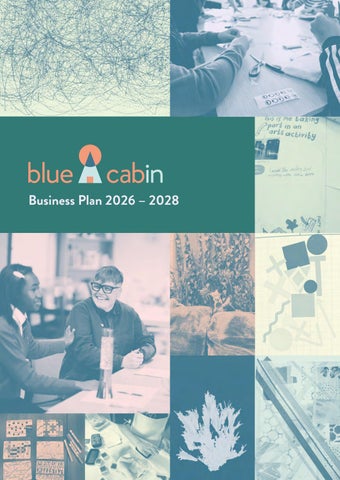
Business Plan 2026 – 2028

Artwork by a Creative Aid participant

Since 2016, Blue Cabin has been developing and strengthening relationships between care-experienced people and those around them through creative, trauma-informed projects.

We are the only creative organisation in England wholly focused on the creative lives of care-experienced individuals.

This business plan outlines our roadmap for three years (2026–2028), grounded in our values of care, kindness, creativity, honesty, and openness. It demonstrates how we will build on our proven track record to:

• Strengthen our organisational capacity and resilience

• Diversify and grow our income streams

• Expand our reach regionally and nationally through strong partnerships and sharing learning and impact

• Deepen our impact through improved evaluation, learning, and co-production

• Embed equity, diversity, and inclusion across all aspects of our work

With the highest number of care-experienced children and young people in the UK, the North East of England remains our priority region. Our trauma-informed creative practice, developed with and for care-experienced communities, has already supported over 1,500 individuals.

We are committed to sector support, systems change and long-term impact. Through this plan, we aim to ensure Blue Cabin continues to be a safe, sustainable, and ambitious space for care-experienced voices to be heard, valued, and celebrated.

Artwork by a Creative Aid participant

About Blue Cabin

Blue Cabin develops and strengthens relationships between care-experienced people and the people in their lives through trauma-informed creative activities.

‘People’ include trusted adults such as foster carers, family members, social workers, key workers and artists. ‘Organisations’ include Local Authorities, schools, and charities.

We support care-experienced people to develop positive relationships, understand their past and express their hopes for the future.

We do this through online and face to face opportunities including stand-alone creative days, early years work, accreditation opportunities and long-term interventions.

Our cross-art form Associate Artists facilitate projects which support care-experienced people to express themselves, develop confidence and agency, build trust in others, and increase their skills and knowledge.

Mission

We develop and strengthen relationships between care-experienced individuals, and the people in their lives through creative activities. Creativity is at the heart of all that we do.

Values

We believe in:

• Care and kindness at the heart of everything we do, and we achieve this through valuing and supporting stakeholders.

• Creativity is central to our work with people and has the power to connect individuals, develop relationships and change lives for the better.

• Healthy, creative, transparent partnership working. We are open to learning, and working with people and organisations, through listening and being open to new ideas.

• Honesty. We reflect this by being truthful, fair and genuine with everyone we work with.

• Asking questions, listening and learning alongside everyone we work with. We are comfortable to be challenged and challenge others.

• The value of investing in our team, through our approach to training, supervision, reflection, support and fair pay.

Who we support

By ‘care-experienced’ we mean a child or young person who is being cared for by their Local Authority, sometimes known as a ‘looked-after child’.

For us, this means we support:

• Children and young people at risk of being taken into care

• Children and young people in care

• Young people leaving care

• Children and young people who have been adopted

• Care experienced adults

• Children and young people living with kinship carers

• Care experienced children and young people in SEND schools

We engage babies, children, young people and adults from ages 0-25, with many activities taking place alongside their foster carers, adoptive parents, kinship carers and social workers – supporting the development of attachment and trust.

We also provide training for Local Authority partners, foster carers and parents who have adopted, to support them in continuing and embedding creativity in the home and into the daily lives of children in their care.

We see the creative potential in every care-experienced person.

Young people taking part in a creative activity

The need for our work

Blue Cabin has a strong understanding of the need for our work through our knowledge of stories, data and evidence and relevant policy areas.

We are unable to meet our charitable objectives effectively unless we have a good knowledge of what is going on for the people we support: What are their strengths, and what challenges do they have? How are we best placed to help them?

Beyond this knowledge of the individuals we support, an understanding of the policy context is crucial. National and local government shape the “marketplace” or context we work in. They fund services, make choices about who gets help and support, and regulate our activity. They also have a particular power to shape public debate and affect public attitudes1.

In 2022/23, there were about 107,000 children in care across the UK. In England, 83,840 children were in care in 2023. The number of children going into care has gone up every year since 2008.

The North East of England has the highest rate of children in care in the country. Around 1.4% of children in the region are in care, which is double the England average of 0.7%2. For the past six years, the North East has also consistently had a much higher rate of children starting to be looked after than the national average.

Every care-experienced person experiences one or more Adverse Childhood Experiences (ACEs). ACEs describe a traumatic experience occurring before 18 that is a shocking, scary, or dangerous experience; one which continues to affect someone emotionally and physically into adulthood.

In 2023 in England, 65% of care-experienced children and young people came into care due to abuse and/or neglect, 13% because of ‘family misfunction’ and 7% due to ‘family in acute stress’, each one reflecting one or

1 The Esmee Fairbairn Foundation

2 NSPCC Learning: Children in Care: Statistics briefing: November 2024

multiple ACEs (NSPCC Learning: Children in Care: Statistics briefing: January 2024).

Care-experienced people experience large inequalities throughout their lives which can affect their mental health, relationships and even life expectancy. Data shows that care-experienced people are more likely to have no qualifications, live a shorter life and spend time in prison (care-experienced people represent 24% of the UK adult prison population, despite representing just 2% of the UK adult population).

People in care and leaving care experience barriers in relation to:

• Confidence and trust in adults

• Education attainment

• Emotional wellbeing – they are four times more likely to have a mental health need than children living in their birth families (NSPCC, 2015)

• Agency – they can feel as though their own wishes and feelings are not considered

• Attachment – feelings of rejection at the loss of their birth family can be compounded when placements come to an end, or social workers move jobs.

Our impact

Blue Cabin’s key achievements since 2016 include:

• Engaging 1,500 care-experienced people in our innovative, creative activities and programmes, alongside 1,008 of their trusted adults.

• Training 300 artists in areas such as trauma, attachment, recovery and social pedagogy.

• Training 1,500 Local Authority staff and foster carers in areas such as creative approaches to participation, trauma, recovery and attachment.

• Directly influencing changes to policy in three North East England Local Authorities. We are now working with five Local Authorities and a regional adoption agency.

• Over 80% of our work takes place in previously Levelling Up places in the North East of England.

• Multiple year funders include The Leathersellers’ Foundation, The Rayne Foundation, Esmée Fairbairn Foundation, The Segelman Trust and Garfield Weston Foundation.

The Blue Cabin impact framework3, developed with tialt4, shows how we work across multiple strands to achieve systems change for care-experienced people and to support them to develop and strengthen relationships. The impact framework helps us understand the range of outcomes that result for the participants we work with:

Impacts for participants:

• Development of creative self-concept, increasing confidence in creative abilities and broadening creative skills

• Building important social connections, expanding networks and broadening sources of support

• Improved wellbeing

For those working in the sector:

• A deeper understanding and appreciation of the impact of creative activities

• Improved connections and access to sources of support to enhance their work

• Developing essential knowledge about trauma and creative practical skills

Our impact cycle includes:

• Developing bespoke impact frameworks for each strand of work with clear outcomes

• Gathering feedback routinely and in a creative, trauma-informed way

• Reflecting with partners and staff to draw out learning and insights

• Analysing what outcomes are being experienced and understanding why they are being supported

• Sharing learning throughout the team, with partners and publicly

3 https://www.wearebluecabin.com/our-impact/blue-cabins-impact-framework/

4 https://www.tialt.org/

Evaluation data collected over 2024/25 continues to show deep and meaningful impacts for the people Blue Cabin works with, including:

• Developing new creative relationships between artists and participants

• Strengthening relationships between:

• foster carers and young children

• arts organisations

• virtual schools

The key impacts identified this year include:

For participants:

• Development of stronger creative identities, increasing confidence in creative abilities and broadening creative skills.

• Building important social connections, expanding networks and broadening sources of support

• Improved wellbeing

For those working in the sector:

• A deeper understanding and appreciation of the impact of creative activities

• Improved connections and access to sources of support to enhance their work

• Developing essential knowledge about trauma and practical skills in the Creative Life Story Work method

Still from a film by Northumberland Virtual School

Our people

At the heart of everything we do is our team of employees, freelancers, and volunteers.

We are committed to creating an environment where everyone feels valued, supported, and empowered. We intentionally work remotely to offer flexibility that supports a healthy work-life balance, while fostering an inclusive and sustainable environment. This flexibility reflects our values of care and kindness, ensuring that everyone can thrive.

Investing in our team’s growth is central to our approach. Through comprehensive training, supportive supervision, and reflective practices, we ensure that our team has the tools they need to be resilient in their roles. Fair pay is key to recognising the value they bring to our work.

We foster a culture of care, kindness and respect, empowering our team to contribute fully, collaborate effectively, and respond to challenges with resilience. We value the diversity of our team’s skills and perspectives, recognising it as a strength that enhances our work and drives innovation. By prioritising trust, open communication, and collective wellbeing, we create an inclusive environment where creativity and growth flourish.

We currently have eight trustees, two of whom are care-experienced, who meet a minimum of four times per year, with an additional two away-days per annum. We’re female founded and led. The trustees of Blue Cabin include:

• Mark: an HR Director for the NHS national Business Services.

• Sedil: A care-experienced young trustee and a transport modeller with a background in civil engineering.

• Catherine: Independent creative and cultural consultant; former BBC News Executive, arts CEO, and educator; governance roles with Together for Children, Changing Lives, and Culture Bridge.

• Adam: Director of Creative Learning and Engagement at Bristol Beacon, previously at The Lowry and Sage Gateshead.

• Wendy: Head of Widening Access and Participation at the University of Sunderland.

• Alexandria: a senior academic and researcher at Leeds Beckett University.

• Adele: a Virtual School headteacher.

• Rohima: A care leaver working in the creative sector as a performer.

We have four Care-Experienced Consultants - employees who help improve, challenge, shape and strengthen the work we do. Our Care-Experienced Consultants are:

• Emon: an experienced strategy consultant with a track record of driving growth and delivering change.

• Jane: a certified practitioner in Therapeutic Life Story Work with a passion for grassroots youth work.

• Lucinda: a Sunderland University graduate and a qualified teacher, with a passion for creativity.

• Lumi: a medical student at King’s College London and a creative multi-hyphenate.

We operate task and finish groups focusing on safeguarding, fundraising, trauma-informed working, finance and risk. We also have independent advice from an HR consultant and Ribchesters accountancy firm.

Equity, diversity and inclusion (EDI)

Our commitment: Equity, diversity and inclusion (EDI) are central to our values and our practice.

We recognise the impact of systemic inequalities and are committed to co-creating inclusive spaces where all individuals – especially those with lived experience of care – can thrive.

Where we are now

• 25% of our trustees are care-experienced

• Our freelance and staff team reflects a growing diversity of background and lived experience

• We regularly gather feedback from participants, partners and artists to reflect on access and representation

• We have appointed four Care-Experienced Consultants as part of our employee team, influencing and advising on our projects, policies and strategies

Our approach

• Trauma-informed and relationship-based

• Centring lived experience in programme design, delivery, and governance

• Ongoing reflection and learning at all levels

Priorities (2025–2028)

• Develop and implement an organisational EDI framework with measurable goals

• Diversify recruitment pathways, especially into leadership, facilitation and creative roles

• Ensure our communications and creative outputs are inclusive and representative

• Provide regular training and reflective learning for staff, artists and trustees

• Create feedback loops with our Care-Experienced Consultants to shape decision-making

Accountability

• Regular reviews will be carried out by the Trauma Informed, Safeguarding and People Working Groups

• EDI updates embedded in staff meetings and trustee reporting cycles

• We will share learning annually via our impact report

Artwork by a Creative Aid participant

Projects

Our projects are trauma-informed and rooted in social pedagogy.

Our work includes:

Projects with young adult care leavers

Creative consultation projects

Partnership projects with Virtual Schools

Early years projects with babies and toddlers

Our projects are designed to develop and strengthen relationships between care-experienced people and the people in their lives. Examples of our current projects include:

Care Leavers

• Creative Aid: We have just finished year three of Creative Aid which, in partnership with Nepacs, supports care-experienced young men in HMP Deerbolt to be recognised as artists. Artists’ books and online exhibitions showcase their work, created with visiting artists in residence, and participants have the opportunity to achieve an Arts Award qualification.

• Creative facilitation training: A nine-month training programme which gives young adults skills that can support them in future employment, training and community settings. Delivered in partnership with Durham University for Medical Humanities and Greater Manchester Youth Network, and funded by the Esmee Fairbairn Foundation and the Hedley Foundation.

Creative Consultation

• Adopt Bats: A group of young people from Tees Valley made a short film about adoption, sharing their own experiences of being adopted and examples of the questions they get asked along the way. Naming themselves ‘Adopt Bats’, the group worked with Blue Cabin’s Associate Artists for six months before premiering their film to an audience of family, friends, social care professionals and council staff.

Care Leavers
Creative Consultation
Virtual Schools
Early Years

Virtual Schools

• Our work with Virtual Schools: In Darlington, Gateshead and Northumberland children and young people have taken part in Cool Things days – unique, creative experiences which help careexperienced children and young people build relationships, learn new skills and be seen, heard and valued.

• Arts Award: Children and young people supported by virtual schools in locations including Nottingham, Gateshead and Darlington have been supported to achieve an Arts Award qualification. They have developed their confidence and skills in creativity, communication and leadership while also working alongside professional artists to experience artforms including theatre, mask-making and printmaking.

Early years

• This is the Place: Our early years music-making programme has expanded to Redcar and Cleveland, after a successful first year in Darlington. Music-making sessions, packs and training for practitioners support care experienced babies and children aged 0 to 5 to form attachments with their carers and children are given music-making equipment to take with them to future homes.

Our sector support work

• Creative Life Story Work: The Creative Life Story Work project has an international reach, helping practitioners deliver better life story work for care experienced children and young people. In 2024/25, there were 80,000 views of the website, with people from across the UK, the USA, Ireland, Australia, the Netherlands and many more locations accessing the resources. In addition, more than 900 people are Creative Life Story Work members, giving them access to all the resources on the website and 12 Live Classrooms per year.

• Life story work with refugee and asylum seeking children and young people: A new partnership between Blue Cabin, Children and Families Across Borders, and Therapeutic Life Story Work International has been formed, to develop life story work resources specifically for refugee and asylum-seeking children and young people who have recently arrived in the UK. The work is being funded by a £15,000 grant from The Segelman Trust.

These projects give a snapshot of our work in 2025. You can see all our current and previous projects on our website5

5 https://www.wearebluecabin.com/projects/

Adopt Bats, photo by Callum Toy
Artwork by young people
A still from an animation by Kazzum Arts

We’ve identified the following long-term goals for the organisation and are already on the journey to achieving them. 10 year plan

We will continue to be a strong and financially resilient charity

Care experienced people will trust us to be an advocate for them

As an employer we will be inclusive and true to our values

We will be a leading organisation in delivery of creative activities for care-experienced people

Our reputation will inspire and influence new partnerships and income streams

We will be recognised as a leading, caring and supportive organisation for artists and freelancers

We will be sector leaders in gathering stories demonstrating the impact of this work

We will support Local Authorities and the creative sector to develop and strengthen their practice

We will be nationally and internationally recognised for our Creative Life Story Work website and membership

Strategic themes

The following strategic themes and action plan set out how we will go further during the next three years.

1. Strengthen organisational capacity

• Appoint and embed an Operations Lead to support sustainable growth

• Review internal systems and processes to improve efficiency and clarity

• Strengthen governance through trustee development and succession planning

2. Diversify and grow income streams

• Secure new multi-year core funders to reduce financial risk

• Develop an ethical fundraising strategy in collaboration with our Care-Experienced Consultants

• Increase unrestricted income through improved management fee structures and commissioning potential

• Build joint funding bids with delivery partners to ease capacity and increase impact

3. Deepen impact through evaluation and learning

• Expand and embed the impact framework developed with tialt across all programmes and throughout the organisation

• Co-develop new evaluation tools with artists and participants of all ages

• Use learning to influence practice, policy, and partnership working

4. Grow strategic partnerships and advocacy

• Strengthen relationships with Local Authorities, Virtual Schools, and cultural and charity partners

• Increase engagement in national networks and policy spaces

• Amplify the voices of care-experienced people through creative advocacy and storytelling

5. Embed equity, diversity and inclusion

• Develop and implement an organisational EDI framework with measurable goals

• Diversify recruitment pathways, especially into leadership and creative roles

• Ensure our communications and creative outputs are inclusive and representative

• Provide regular training and reflective learning for staff, artists and trustees

• Create feedback loops with our Care-Experienced Consultants to shape decision-making

Printmaking with Gateshead Virtual School

Action plan

The targets set out in this business plan are based on projected funding scenarios for key projects.

Milestones achieved 2024-25

Targets for 2025-26 (year one)

Our aim: Steady growth, an increase of 10%

430 473

282

engagements of babies, children and young people (aged 0-17) in 190 hours of delivery

engagements of care leavers in 101 hours of delivery

310

engagements of babies, children and young people (aged 0-17) in 209 hours of delivery

engagements of care leavers in 111 hours of delivery

engagements of carers and family members

363 399

engagements of carers and family members

engagements of Local Authority staff, co-facilitating and supporting over 161 hours of activity

273 300 433 476 882 970

engagements of Local Authority staff and other professionals in 74 hours of training

engagements of Local Authority staff, co-facilitating and supporting over 177 hours of activity

engagements of Local Authority staff and other professionals in 81 hours of training plays or downloads of our podcasts plays or downloads of our podcasts

Current engagements

An annual increase of 10%

We recognise that these targets may change and we are committed to reviewing and adapting our plans as needed to respond to shifts in funding or external conditions.

Targets for 2026-27 (year two)

Our aim: Sustaining steady growth

Targets for 2027-28 (year three)

Our aim: Consolidation and steady growth

engagements of babies, children and young people (aged 0-17) in 230 hours of delivery

engagements of babies, children and young people (aged 0-17) in 253 hours of delivery

engagements of care leavers in 122 hours of delivery

engagements of care leavers in 134 hours of delivery

engagements of carers and family members

engagements of carers and family members

engagements of Local Authority staff, co-facilitating and supporting over 195 hours of activity

engagements of Local Authority staff and other professionals in 89 hours of training

engagements of Local Authority staff, co-facilitating and supporting over 215 hours of activity

engagements of Local Authority staff and other professionals in 90 hours of training

plays or downloads of our podcasts plays or downloads of our podcasts

Our financial plan

We will dedicate significant time and resources to exploring a range of income generation models, with the aim of strengthening and diversifying our revenue streams.

This process will include researching best practices, consulting with experts, and testing new approaches to ensure sustainability and resilience. By actively developing multiple avenues for income generation, we will reduce reliance on any single source of funding and position the organisation to respond flexibly to future opportunities and challenges.

Key income assumptions:

• Maintain core multi-year funders (Esmée Fairbairn Foundation, the Leathersellers’ Foundation, the Garfield Weston Foundation)

• Secure at least two new core funders by 2026

• Increase earned income (commissions, consultancy, training) from 12% to 20% by 2028

• Uplift management fee to 20% across all projects

Income summary (projected)*:

*Note: These are conservative estimates

Expenditure focus:

• Staff and freelancer pay (fairly and sustainably)

• Programme delivery and materials

• Operational infrastructure and systems improvement

• Training, supervision and wellbeing support

Reserves:

Blue Cabin will maintain a minimum of three months’ core operating costs in reserves and aim to build a five-month reserve by 2028. This will enhance long-term resilience.

Oversight and reporting:

The Director and Finance Trustee review financial performance monthly, alongside our Coordinator and Accountant. Quarterly reports are submitted and discussed at Board meetings. Annual audited accounts are submitted to the Charity Commission and all funders receive tailored financial reports.

Income generation:

Over the past three years, we have focused on creating a sustainable future for our charity through intentional and ethical income generation. Our approach has been grounded in our core values of care, kindness, creativity, transparency and honesty, ensuring that we remain true to our mission while fostering trust, respect and collaboration with our supporters.

We follow the highest standards of fundraising practice, complying with all relevant UK law, Charity Commission guidance, and the Code of Fundraising Practice. We are registered with the Fundraising Regulator and uphold their standards in all our activity. Oversight and accountability for our fundraising approach sits with our Board of Trustees, with day-to-day management led by the Director. Consistently meeting our income targets has provided the stability we need to nurture and expand our work, all while staying true to our values and mission.

Priorities for the next three years:

• Ethical Fundraising Strategy review: Care-Experienced Consultants will help review and shape our Ethical Fundraising Strategy, ensuring it reflects our values, transparency and sector best practice.

• Strategic guidance: With continued support from freelance fundraiser Lucy Stone, we will focus on securing appropriate and sustainable funding opportunities aligned with our mission.

• Funders and partners: We will build and maintain strong, transparent relationships with funders and partners, fostering mutual trust and long-term collaboration.

• Core funding: Proactively seeking new multi-year core funders will be central to reducing risk and ensuring the ongoing stability of our programmes.

• Management fee uplift: We aim to increase our management fee to 20% to more accurately reflect the true costs of delivering our trauma-informed work and support organisational resilience.

• Programme continuity: Securing long-term funding for flagship programmes Creative Aid and This is the Place will be a priority to ensure their ongoing impact in the community.

• Collaborative development: We will strengthen partnerships to co-develop funding bids, increase joint applications, and reduce capacity strain, with oversight from Blue Cabin’s Director.

Partnerships

Our values underpin our approach to partnership working. Trauma-informed principles, reflective practice and creative engagement shape our partnership interactions and work.

We work in partnership with:

1) Partners

Partners are organisations or individuals we collaborate with to achieve shared goals. We believe in creating healthy, creative and transparent partnerships built on listening, learning and openness. Each partner’s strengths are valued and, together, we work to make a positive, lasting impact underpinned by reflective practice and a commitment to learning. Our partnerships are guided by care, kindness and mutual respect, ensuring we co-create meaningful change.

2) Funders

Funders are essential collaborators who provide the financial resources necessary to sustain our work. We believe in building transparent, honest and trusting relationships with funders, keeping them informed of our progress, challenges and impact. Through clear communication and shared values, we align our goals to create sustainable and meaningful change. We aim to work alongside funders, learning and growing together for mutual benefit.

3) Commissioners

Commissioners are individuals or organisations who engage us to deliver specific services or projects. We approach these relationships with openness and flexibility, ensuring our work aligns with both their needs and our values. By fostering clear communication, creativity and trust, we ensure that the work we do together is impactful, innovative, and reflects our shared commitment to positive change.

4) Networks

Networks are collaborative communities where we connect, learn and share with like-minded organisations and individuals. We actively contribute to and draw from these networks, guided by our belief in listening, learning, and asking questions. These relationships are grounded in transparency, mutual support and the collective strength of creative collaboration. We are committed to growing and learning alongside our network, fostering inclusivity and shared success.

Artwork by a Creative Aid participant

Partners in the North East of England

Darlington Borough Council:

Darlington Virtual School, Darlington Borough Council Fostering Team, Darlington Borough Council Workforce Development team, Creative Life Story Work (CLSW) organisational member

Redcar and Cleveland Borough Council:

Redcar and Cleveland Virtual School, Redcar and Cleveland Borough Council Fostering team

Gateshead Council: Gateshead Virtual School

Newcastle City Council: Newcastle Virtual School

Northumberland County Council: Northumberland Virtual School

Adoption Tees Valley

Nepacs

Theatre Hullabaloo

Kirkleatham Museum

Darlington Hippodrome HMP Deerbolt

Funders6

Core funders:

Community Foundation Tyne and Wear, Esmée Fairbairn Foundation, Garfield Weston Foundation, KPMG Foundation, Postcode Community Trust, Rayne Foundation, Segelman Trust, Sir James Knott Trust, The Leathersellers’ Foundation, The Sally and John Rideal Trust

Project funders:

Arts Council England, Creative Darlington, Darlington Borough Council, Esmée Fairbairn Foundation, Gateshead Council, Margaret and Dorothy Gordon Memorial, Newcastle City Council, Northumberland County Council, Pattinson Estate Agents, Redcar and Cleveland Borough Council, Segelman Trust, Sir John Priestman Charity Trust, The Alchemy Foundation, The Clothworkers’ Foundation, The Gateshead VCSE Fund, The National Lottery Reaching Communities Fund, The Netherton Park Trust, The Percy Hedley 1990 Charitable Trust, Youth Music

6 https://www.wearebluecabin.com/about-us/funders-and-supporters/

National / International Partners

CLSW Trainers:

Therapeutic Life Story Work International, Trauma Informed Consultancy Services, Dr Karen Treisman, Amy Payne (based in Australia)

CLSW Organisation Members: Clarecare, London Borough of Tower Hamlets, North East Lincolnshire Council

CLSW Partner and Individual Member: Children and Families Across Borders

Thoughtful (formerly Sapere)

42nd Street

Articulate

Kazzum Arts

Tialt

Nottingham Virtual School

Durham University Institute for Medical Humanities

Networks we are part of

Strategic Engagement Group via Durham University Institute for Medical Humanities

Tees Valley Cultural Education Partnership

Chris Drinkwater Creative Health in Primary Schools award

CLINKS

National Criminal Justice Arts Alliance

SWOT analysis

This SWOT analysis provides a strategic overview of our organisation’s current position.

It reflects a strong reputation, committed team and innovative, trauma-informed programmes, underpinned by effective income generation and partnerships. At the same time, it identifies areas for growth, including team capacity, systems knowledge and succession planning. The analysis also explores opportunities for expansion and digital engagement, while recognising the risks posed by economic uncertainty, funding volatility, and wider socio-political factors.

Strengths

• Strong reputation and brand recognition: Established trust within the North East England Local Authority sector, supported by a positive reputation, a recognised brand and effective messaging strategies that resonate with our target audiences.

• Passionate, experienced, and dedicated staff and freelancers: A committed and skilled team of staff and freelancers, bringing both expertise and passion to our work.

• Effective income strategies: Proven track record of successful fundraising with strong, trusting relationships with trusts and foundations.

• Experienced leadership team: A knowledgeable and seasoned leadership team, providing strategic direction and stability.

• Partnerships: Established and ongoing collaborations with a range of organisations, enhancing our collective impact.

• Unique programme delivery models: Innovative, impactful approaches that set us apart and deliver lasting outcomes.

• Strong connections and local knowledge: Deep-rooted connections within the community, paired with an in-depth understanding of local needs and dynamics.

• Flexibility and adaptability in programme delivery: Our ability to respond to evolving needs, ensuring programmes remain relevant and effective.

• Focus on creativity and trauma-informed approaches: Emphasising creativity and traumainformed practices that deeply resonate with participants.

• Low overheads due to remote working: Operational efficiency supported by remote working, enabling us to maintain low overheads.

• Uniquely placed organisation: One of the few creative organisations nationally focusing entirely on care-experienced people.

• An understanding of our impact: Clear insight into our impact and the ability to effectively communicate it to stakeholders.

Weaknesses

• Small staff size: Creates challenges in managing the increasing scale of operations and projects.

• Operational systems and processes: There is a need to enhance our understanding of operational systems to keep up with the expanding needs of our programmes and projects.

• Reliance on a small senior leadership team: Highlights the emerging need for succession planning to ensure continuity and resilience.

• Intentional lack of an office space: May affect the ability to foster strong, trust-based collaboration within the core team.

• Financial vulnerability: Over-reliance on two key income streams creates financial vulnerability, emphasising the need to diversify funding for long-term stability.

• Diversity of voice: We are still building capacity to engage in sustained self-critique around representation, voice, and power-sharing within the organisation.

• Skill base: Our recognition that we cannot and should not ‘do it all’ reinforces the need for collaborative, skill-sharing relationships that centre our values.

• Programming is resource heavy: This work takes significant resources which can add complexity to making the case to certain funders.

Opportunities

• Government funding opportunities: New grant programmes or policy changes that align with our mission, offering potential for growth and development.

• Expanding programme reach: Opportunities to scale up existing programmes and extend our impact to a wider population.

• Opportunities to expand through digital engagement: Potential for growth through our online presence, enabling us to connect with and support more people.

• Sharing our impact and learning more widely: Increasing opportunities to share our successes and insights across the UK and internationally, raising awareness and fostering collaboration.

• Sharing creative outputs of projects: Engaging new and different audiences.

Threats

• Natural disasters or emergencies: Unexpected events that disrupt operations and fundraising efforts, posing a risk to stability.

• Economic downturn affecting funding and donations: Potential reduction in funding and donations due to wider economic challenges, impacting our financial sustainability.

• Changes in Local Authority funding and policy priorities: Shifts in funding or policy priorities from Local Authorities that could affect support for our work.

• Social and political instability: Potential instability in the social or political landscape that could influence community needs and support.

• Expansion of the Virtual School role: The growing role of the Virtual School and potential capacity strain, which may limit their ability to collaborate effectively with Blue Cabin.

A creative facilitation session

Risk and mitigations

This summary outlines the headline risks identified in relation to our business plan, with a focus on ensuring organisational resilience, sustainability and wellbeing.

Each risk has been carefully assessed for its impact and likelihood, with proactive mitigation strategies in place to protect our people, sustain our projects and uphold our values. Risk is reviewed monthly and reported to the board on a quarterly basis. Blue Cabin recognises that delivering meaningful, values-led work within a dynamic external environment brings inherent risks. The organisation regularly reviews and addresses these through a combination of proactive planning, robust systems and a people-first approach.

People and capacity

There is a risk of staff burnout, overstretch, or disruption from changes in leadership. Given the high impact such outcomes could have, Blue Cabin actively monitors capacity and supports wellbeing through initiatives such as CPD opportunities, access to Headspace, and a dedicated wellbeing budget. Succession planning and ongoing professional development help sustain leadership continuity and resilience.

Wellbeing and culture

Maintaining a safe, supportive working environment is critical to retaining staff and ensuring resilience. While the risk is moderate, it is addressed through an open, communicative culture and responsive leadership that prioritises care and inclusion.

Financial health

As a charity reliant on a blend of income sources, there is a significant risk of income volatility and difficulty meeting core costs. Blue Cabin mitigates this through careful budgeting, building reserves, diversifying income streams and routinely monitoring financial performance to remain agile and solvent.

Programme demand

There is a risk that demand for Blue Cabin’s programmes may outpace delivery capacity. This is carefully managed by monitoring engagement patterns, involving stakeholders in programme design, and scaling delivery models in a sustainable, considered way.

External funding and policy

Cuts to Local Authority or government funding, alongside rising demand driven by policy changes, represent a serious risk. The organisation works to mitigate this by strengthening relationships with funders and public sector partners, sharing evidence of impact, adapting its delivery models, and exploring cross-sector collaborations.

Global and economic factors

Inflation, rising costs and international instability may indirectly impact participation, funding and operational costs. Blue Cabin mitigates these factors through conservative budgeting, flexible contracting, and staying informed about global events that could affect the sector.

Reputation and influence

A dip in public or partner interest, or challenges in evidencing impact, could limit Blue Cabin’s influence and effectiveness. To mitigate this, the organisation invests in strong storytelling, robust evaluation and clear communication.

Marketing

Blue Cabin’s marketing approach is rooted in our commitment to creating safe, inclusive, and empowering spaces for careexperienced people.

Our overarching aim is to widen access to high-quality creative experiences and to share the stories and impact of our work in ways that are respectful, collaborative, and meaningful.

Our marketing activity is designed to:

• Share the stories of care-experienced individuals, artists, partners, and communities in an authentic and compassionate way, always centring dignity and choice

• Build curiosity and understanding of Blue Cabin’s work across key audiences, fostering connection and interest

• Strengthen relationships with funders and partners by sharing impact clearly and appreciatively

• Position Blue Cabin as a trusted source of knowledge and learning on trauma-informed creative practice for care-experienced children, young people, and adults

• Support Local Authorities, carers and families by reducing barriers to engagement and co-creating welcoming pathways into participation

• Encourage advocacy from those who see the value of our work and wish to share it with others

• Communicate consistently in ways that reflect our values, including care, respect and empowerment

• Influence decision-makers by inviting collaboration that benefits care-experienced communities

• Share impact in alignment with our developing impact framework (in partnership with tialt)

• Promote learning and good practice across the creative and care sectors

A young person’s Arts Award portfolio

Turn static files into dynamic content formats.
Create a flipbook
Blue Cabin business plan 2026 - 2028 by Jenny Young - Issuu