SEO vs AEO vs GEO for Astrologers: What the Best Astrology Marketing Agency in India Does Differently Published: August 2026 | Last Updated: August 2026 | 7-minute read Written by BloomX Solutions Strategy Team | bloomxsolutions.com
Table of Contents 1. Introduction 2. Why Astrology Searches Changed Faster Than Most Niches 3. SEO, AEO and GEO: What Each One Actually Wins 4. The Same Page, Written Three Ways 5. What Separates a Real Astrology Marketing Agency From a Generalist 6. Where to Start If You Only Have Ninety Days 7. Conclusion 8. Frequently Asked Questions
Your kundali matching page can sit at position one on Google and still bring you fewer consultations than it did last year. That isn't a penalty. It's the search result answering the question before anyone reaches your site. Someone types "manglik dosha remedy," reads four sentences at the top of the page, closes the tab, and never learns your name. The ranking was held. The visit didn't happen. This is the biggest shift facing astrologers, tarot readers and Vedic consultants online right now. Three disciplines now sit side by side: SEO, AEO and GEO. They feed each other, and they are absolutely not the same job. Here's what each one wins you, and which deserves your attention first.
Why Astrology Searches Changed Faster Than Most Niches Astrology took the hit earlier and harder than most categories, for a reason that's easy to miss. Think about what your buyers actually type. "What is sade sati?" "Which gemstone for Saturn?" "Kundali matching before marriage." "Career change muhurat 2026." Almost every one of those is an informational question with a clean, factual answer. That's precisely the query type AI Overviews were built to absorb. The numbers back it up. SparkToro's clickstream study covering January to April 2026 found that around 68% of US Google searches now end without a click, up from roughly 60% in 2024. Seer Interactive measured organic click-through rate falling close to 61% on queries where an AI Overview appears. BrightEdge tracked AI Overviews showing roughly 48% of queries across nine industries by February 2026.
There's a second pressure specific to your category. Google Ads restricts astrology and divination advertising in several markets, and enforcement is inconsistent enough that practitioners get suspended without warning. Paid search is a fragile floor to stand on. Organic visibility isn't one option among several for an astrologer. It's the channel.
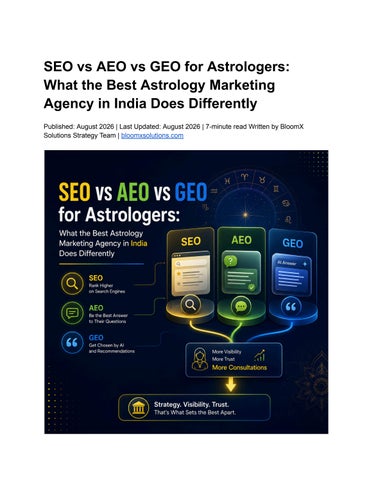
SEO, AEO and GEO: What Each One Actually Wins Strip away the acronym noise and the difference is simple. Each one wins a different prize. SEO wins a position. Keywords, page speed, backlinks, internal links, site structure. Everything under traditional SEO exists to move you up a list of links. It still matters enormously, because AI engines and answer boxes pull heavily from pages that already rank well. Losing your rankings means losing the raw material for everything else. AEO wins the answer. Answer Engine Optimisation shapes your content so a machine can lift a clean, correct answer straight out of it. Question-shaped headings. A direct 40 to 60 word answer sitting immediately under each one. Numbered steps for anything procedural. FAQ blocks backed by matching schema. When Google builds an AI Overview for "sade sati remedies," AEO decides whether your paragraph is the one it uses. GEO wins the citation. Generative Engine Optimisation aims at ChatGPT, Perplexity, Gemini and Claude. These engines don't rank pages. They synthesise an answer and name a handful of sources. Getting named is a separate outcome from ranking, and it turns on things SEO never measured: whether your claims are specific enough to attribute, whether independent sources describe you the same way, whether your credentials are stated plainly on the page. Parameter: SEO: AEO: GEO Target: Google’s ranked list: AI Overviews, featured snippets, People Also Ask: ChatGPT, Perplexity, Gemini Prize:A click: A visible answer with your name on it: A cited source Core lever: Authority and technical health: Structure and directness: Specificity and third party corroboration Astrology example: Ranking for “best astrologer in Mumbai”: Owning the answer for “what is manglik dosha”: Getting named when someone asks ChatGPT “how do I find a genuine Vedic astrologer” Time to result: 3 to 6 months: 4 to 10 weeks: 3 to 9 months
Notice the middle column. AEO is the fastest of the three by a wide margin, because it's mostly a formatting and structure job on pages you've already published. That's where most astrology practices should start.
The Same Page, Written Three Ways Take one page: your sade sati consultation page. Here's how each discipline changes it. Under SEO alone, you'd target "sade sati remedies," write 1,500 words around it, add internal links from related posts, and chase a few backlinks. Solid, and still necessary. Add AEO and the page gets restructured. Your H2 becomes "What Is Sade Sati and How Long Does It Last?" because that's how people actually phrase it. Directly beneath sits a tight 50 word answer a machine can lift whole. Remedies become a numbered list rather than flowing prose. A six question FAQ block closes the page, with a FAQPage schema that matches the visible count exactly, because a mismatch gets your rich result rejected. Add GEO and the page changes character again. You name your parampara and who taught you. You state how many years you've practised and how many charts you've read. You reference the specific classical texts your reading method draws on. Vague authority claims are unquotable, so a model skips them. "Practising Vedic astrologer trained in the Parashari system, 18 years, over 4,000 charts read" is attributable, and attributable content is what gets cited. That last point is the one practitioners resist most, and it's the one that moves the needle hardest.
What Separates a Real Astrology Marketing Agency From a Generalist Most agencies will happily take an astrology account and run the same playbook they use for a dental clinic. It doesn't transfer. Here's what to actually check before you sign anything. Do they understand your ad restrictions? If an agency's first proposal is heavy Google Ads spend, they haven't read the policy. Ask them directly how they'd handle a suspension.
Can they name a specific AEO change they'd make to your existing pages? A real practitioner will look at your site and say "your remedies are buried in paragraph four, they need to be a numbered list under a question heading." Vague promises about "optimising content" mean nobody's looked. How do they measure AI visibility? The honest answer involves running a fixed set of buyer questions across ChatGPT, Perplexity and Google AI Overviews on a schedule and logging who gets cited. None of that appears in Search Console. If their reporting is average position and nothing else, the playbook is out of date. Will they refuse fear-based marketing? "Your life will be destroyed unless" converts short term, damages your reputation permanently, and increasingly triggers platform rejections. An agency that suggests it is optimising for the wrong horizon. Who owns the accounts? Your Search Console, your analytics, your domain, in your name. Anything else is a lock-in tactic. At BloomX we run SEO, AEO and GEO as one programme rather than three separate line items, because the underlying asset is identical. Structured, specific, attributable content serves all three. What changes is how you measure it.
Where to Start If You Only Have Ninety Days Sequence matters more than scope here. Weeks one to four, fix structure on your five highest traffic pages. Question-shaped H2s, direct answers underneath, numbered remedies, FAQ blocks with matching schema. Cheapest visibility you'll ever buy. Weeks five to eight, build your credential layer. Training, lineage, years practising, charts read, real reviews with names. Vagueness reads as evasiveness in a category where scepticism is already the default. Weeks nine to twelve, earn off-page mentions. Genuine answers on forums where your buyers ask questions, guest articles, directory listings with consistent contact details. Models weight what other sources say about you, not only what you say about yourself.
Conclusion Rankings alone will quietly mislead you from here on. An astrology practice tracking only average position is measuring the one thing that's shrinking while ignoring the two that are growing.
The practical move is unglamorous. Restructure what you've already published so machines can read it. State your credentials specifically enough to be quoted. Then earn mentions somewhere other than your own website. Do that properly and you'll show up in the ranked list, the answer box and the AI citation at once, because all three feed on the same underlying work.
Frequently Asked Questions (FAQ) Q: What is the difference between SEO, AEO and GEO for astrology websites? A: SEO wins you a ranking position in Google's list of links. AEO shapes your content so answer engines lift your text into AI Overviews and featured snippets. GEO gets you named as a cited source inside ChatGPT, Perplexity and Gemini. Astrology sites need all three because most astrology queries are informational, which is exactly the query type AI answers absorb first. Q: Is SEO still worth it for astrologers in 2026? A: Yes, though the version most people picture has changed. Search demand for astrology questions hasn't fallen, but a growing share of answers get delivered inside the search result rather than on your site. Judge the channel on consultation bookings rather than session count, and shift the work toward structured, quotable content. Q: How do I get my astrology website cited by ChatGPT and Perplexity? A: Make your content easy to extract and specific enough to attribute. Use question-shaped headings with short direct answers beneath them, state your training, years of practice and chart volume plainly, and make sure independent sources such as forums, directories and press describe you consistently. Also confirm your robots.txt isn't blocking GPTBot, PerplexityBot or ClaudeBot. Q: Can astrologers run Google Ads in India? A: Google restricts astrology and divination advertising in several markets and enforcement varies, so accounts can be suspended with little warning. That makes paid search an unreliable foundation. Organic search, YouTube and referral channels are both cheaper and far more stable for astrology businesses. Q: How long does AEO take to show results compared to SEO? A: AEO typically moves fastest, often within four to ten weeks, because it's largely a restructuring job on pages that already exist and already rank. Traditional SEO usually needs three to six months, and GEO citation gains tend to appear over three to nine months as off-page mentions accumulate. Q: What should I look for in an astrology marketing agency? A: Ask whether they understand the advertising restrictions in your category, whether they can point to a specific structural change they'd make to your current pages, how they measure visibility inside AI answers, and whether all accounts stay in your name. An agency still reporting average position as its main KPI hasn't updated its approach.
Q: Does schema markup matter for astrology consultation pages? A: It matters a great deal, because it tells machines unambiguously what your page asserts and who is asserting it. FAQPage, Article, Person and LocalBusiness markup all apply. One rule worth remembering: your FAQPage schema must match the visible FAQ count on the page exactly, or the rich result gets rejected.
Work With Us
👉 Talk to our team about your astrology practice: bloomxsolutions.com/contact-us 🌐 See what we build for clients: bloomxsolutions.com/case-study 📖 Read the full guide: Digital Marketing for Astrologers 📊 More on the AI search shift: How AI Overviews, GEO and AEO Are Rewriting the Ranking Rulebook 📞 Call us: +91 7000190457 📧 Email: bd@bloomxsolutions.com