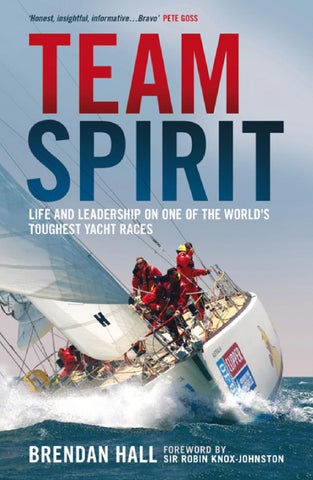
TEAM SPIRIT Life and leadership on one of the world’s toughest yacht races
BY SIR ROBIN KNOX-JOHNSTON BRENDAN HALL FOREWORD
ADLARD COLES NAUTICAL LONDON
team_spirit_ 9781408157503_90100.indd 3
19/04/2012 10:22
This adventure is a gripping read for the armchair sailor, non-sailor, any skipper and for that matter business leader. Honest, insightful, informative and underlined by the fact that as a team they won. Bravo. Pete Goss, British yachtsman, VendĂŠe Globe competitor and author of Close to the Wind
A really great read for anyone interested in team performance at the very highest level, coupled with a fascinating insight into human endeavour in a pressure cooker environment. Paul Bennett, Director, Henley Business School
Team Spirit is an insightful and honest story of the real ingredients of success. In most aspects of life, success derives from a focused team acting in harmony with clear and decisive leadership. These skills are invariably prerequisite in the crucible of offshore ocean racing, and never so brilliantly demonstrated as in Brendan Hall’s book. Chris Masterson, Chairman, Montagu Private Equity
team_spirit_ 9781408157503_90100.indd 4
19/04/2012 10:22
My personal exposure to extreme challenges and an unforgiving, competitive environment is limited to dry land and motor racing; building the Formula One team that became Honda GP, Brawn GP and now Mercedes GP, so I was exposed to the meticulous planning, the careful people management, pure hard work and the extreme stresses involved in trying to accomplish big tasks. Brendan forced himself through an incredible adventure that tested him as both skipper and a leader. When the pressure increased, his instincts, training, attitude and clear thought kicked in. It doesn’t surprise me that he was able to keep his crew motivated and bring his yacht home in first place. In this book, Brendan demonstrates that he is not just able to learn wisdom from others, but also pioneer many solutions that can readily be applied to business scenarios and has been able to record these in a compelling and exciting manner. Adrian Reynard, Founder of Reynard Racing Cars
This book is as much a team management manual as it is an exciting and well-written account of a great ocean adventure. Brendan Hall’s lessons about preparation, people skills and persistence make it required reading for budding CEOs and team leaders, as well as anyone putting a crew together to sail a boat. Roger McMillan, Editor, Australian Sailing + Yachting magazine
team_spirit_ 9781408157503_90100.indd 5
19/04/2012 10:22
CONTENTS Route map
8
Foreword by Sir Robin Knox-Johnston
10
Preface
12
1 Leadership The only real training for leadership is leadership
14
2 The race Every artist was first an amateur
16
3 Inspiration First say to yourself what you would be; and then do what you have to do
20
4 Preparation To be prepared is half the victory
24
5 Team Spirit If everyone is moving forward together, then success takes care of itself
44
6 Training We are what we repeatedly do. Excellence, then, is not an act, but a habit
54
7 Racing at last Coming together is a beginning. Keeping together is progress. Working together is success
70
8 Judgement A man should learn to sail in all winds
101
9 Attitude Attitude is a little thing that makes a big difference
128
10 Persistence
143
No great achievement is possible without persistent work
11 Danger He that will not sail till all dangers are over must never put to sea
165
12 Full circle It is not the mountain we conquer, but ourselves
205
Epilogue
223
The crew of Spirit of Australia
229
Appendix: The entire text of my Team SPIRIT vision
233
team_spirit_ 9781408157503_90100.indd 7
19/04/2012 10:22
TEAM SPIRIT
Route map of the 2009–2010 Clipper Round the World YACHT Race
Hull Cork Cape Breton San Francisco
New York
Jamaica Panama
Rio de Janeiro
8
team_spirit_ 9781408157503_90100.indd 8
19/04/2012 10:22
R o u te map
Ijmuiden La Rochelle
Qingdao
Singapore
Cape Town
Geraldton
9
team_spirit_ 9781408157503_90100.indd 9
19/04/2012 10:22
Foreword Don’t we all like to win? Competition, whether against other humans or the environment, is an integral part of human nature and one of the reasons we humans have developed into the prime animal on this planet. We can compete on our own or in teams, but the moment we have more than one person in a competitive unit we have to find methods to overcome the inherent instinct for people to behave as individuals, and work instead as one. But how to create an effective, harmonious and competitive crew from a group of disparate characters? This is a question asked by chief executives of businesses and skippers of yachts all over the world. We know that the more we can create a well-motivated and harmonious team, in whatever field, the better the results we will achieve. But how to achieve this? The crew of a yacht comes from diverse backgrounds, and often different countries. Their attitudes, formed by their upbringing, work and experience, do not provide homogeneous raw material. Bringing them all together successfully so they pull in the same direction, and are motivated to put all their efforts into achieving the one objective of winning as an effective team, is an art that is almost as elusive as the Holy Grail.
10
team_spirit_ 9781408157503_90100.indd 10
19/04/2012 10:22
FO R E WO R D
Living in a small boat is like being in a pressure cooker. Everyone is packed together in a confined space, with limited privacy. The crew works unsociable hours and shares the risks that are an inevitable part of crossing any ocean. There is no escape when living cheek by jowl for prolonged periods. You are as isolated from the world as if you were in space. It can take only one member of the crew to be out of step, not pull their weight, be overly opinionated or criticise everyone else, to turn what should be a thoroughly enjoyable experience into a nightmare. It is for the skipper to prevent this from happening. People think that the skipper’s task is just barking orders and supervising the crew. There is far more to it than that. At Clipper we choose our skippers very carefully, being far more impressed by their experience than their pieces of paper denoting marine qualifications. We know that most of the skipper’s time is taken up with personnel management and we do our best to prepare them for the challenges they will face over long months racing around the world. They have to be slightly distant to avoid any signs of favouritism; they have to be technically capable; they have to be good planners; and they have to watch the individual members to prevent small worries turning into major issues. People will handle this differently but it is not an easy job, and anyone who has successfully skippered a Clipper yacht around the world has shown the sort of qualities that businesses cry out for. Brendan shows how he dealt with it all, and brought in his boat and crew as winners. This is a thoughtful read for anyone contemplating a long ocean voyage, whether as crew or skipper. It has many lessons for how to get the best out of a group of people. Brendan did his research, worked out what he thought would be best, and then put it into practice. As the story of Spirit of Australia’s odyssey unfolds, we share the successes and failures as he and his crew worked together to achieve their final, well-deserved victory. Sir Robin Knox-Johnston
11
team_spirit_ 9781408157503_90100.indd 11
19/04/2012 10:22
Preface I was so worried, I was physically sick. I’ve skippered a lot of boats in heavy weather, but I’d never felt like this before. The only thought in my mind was that people die in conditions like this. The boat lurched sideways as it was struck by another massive North Pacific wave and I was thrown against the wall of the boat toilet. I caught a glimpse of myself in the small mirror and the fear was written on my face. Come on! Be strong, Brendan. We’ll get through this. You’ll keep them safe. Man up. Be strong. Outside, up on the deck of our 68ft racing yacht, the crew struggled to turn the wheel as we were struck side-on by that 50ft wave. The impact was like being T-boned by a lorry. The boat jolted sideways and lay over on its side. A 3-ton wall of white, frothing water flooded over the deck. The helmsman was thrown off balance and fell backwards towards the ocean below, brought to a jarring halt when his safety tether went taut. The backup helmsman, who was braced when the wave struck, grabbed the wheel and forced it over as the boat struggled upright again. ‘Are you ok, guys?’ shouted a scared voice from the hatch. The backup helm gave the thumbs up.
12
team_spirit_ 9781408157503_90100.indd 12
19/04/2012 10:22
PREFACE
It was pitch black, the hurricane-force storm was reaching its violent crescendo, the crew were frightened and we were smack in the middle of the North Pacific Ocean, thousands of miles from the safety of land. We had already taken a pounding and the next 12 hours were going to be some of the longest of our lives. I had to be a strong leader, keep a strong, calm face and tell the crew that we were going to be fine. That’s what they needed to hear. But we weren’t fine – the waves outside were enormous and every 20 minutes or so we would get smashed by one from an unusual angle, like the one that just got us. Fatalistic as it sounds, I knew that if there was a massive one out there with our name on it, it would get us, roll us over, snap our mast off and possibly drown the crew up on deck. We couldn’t see it and we certainly couldn’t avoid it. I gave reassurance, I put on a calm face and I stayed strong. We were as safe as we could be in the conditions and we were prepared for the worst. But the nightmare thought remained. People die in conditions like this.
13
team_spirit_ 9781408157503_90100.indd 13
19/04/2012 10:22
1 Leadership The only real training for leadership is leadership antony jay
My name is Brendan Hall and this book is the story of my race around the world as the skipper of the racing yacht Spirit of Australia in the 2009–10 edition of the Clipper Round the World Yacht Race. Being a sailing yacht skipper is a big undertaking. You are the one person responsible for the safety of the boat and the safety and wellbeing of the crew, for planning the voyage and navigating across the ocean. If you’re in a yacht race then you’re usually the one in charge of plotting the best course to win, interpreting the weather patterns and positioning the yacht in the best place to take advantage of the wind. It’s a large burden to bear, but ask most yacht skippers and they’ll tell you they have the best job in the world and they wouldn’t swap it for anything. I’m definitely one of these people. After ten months and 35,000 nautical miles of ocean racing, my crew and I won the Clipper Round the World Yacht Race, beating our nearest rivals Team Finland by 22 points. To have circumnavigated the world and to have won a highly competitive race was an amazing achievement for all of us. We struggled through the lows of defeat, the
14
team_spirit_ 9781408157503_90100.indd 14
19/04/2012 10:22
LEADERSHIP
setback of damage, the tension of being 18 people cooped up together on a small yacht – and came out the other side, a victorious team. Our success was not because we had a secret weapon or were more skilled sailors than the other nine teams competing; it came down to factors that were entirely human: teamwork, motivation, persistence and courage – things that are at the heart of any great endeavour. This is the story of my journey as the skipper of a winning yacht, interwoven with some of the lessons I learned along the way about leadership under pressure, which I think will benefit everyone, because we are all leaders in our own way. We all feel responsible for people in our lives, be they family members, friends or work colleagues. We want to do our best for them, look after them and help them reach their potential. We want their respect and cooperation. Sometimes we have to tell them things they don’t want to hear. Being a good leader all the time can be difficult and sometimes we struggle with it, but that just goes with the territory. I was 27 when I began the race and I’ll be the first to admit that I wasn’t always the perfect skipper. As much as I wish I was, I’m not always the hero of the story. Like all leaders, I made my mistakes and I learned valuable lessons from them. In fact, some of my most memorable leadership achievements were a direct result of learning from a mistake I made or from not being the good leader I should have been. In sharing these negative experiences too, I hope you can learn from them the same way I did. As Mark Twain humorously remarks: ‘If you hold a cat by the tail you learn things you cannot learn any other way.’
15
team_spirit_ 9781408157503_90100.indd 15
19/04/2012 10:22
2 THE RACE Every artist was first an amateur ralph waldo emerson
The Clipper Round the World Race is a unique thing in the sailing world. There are many round the world races. Some of them are singlehanded races, like the famous Vendée Globe race, which runs every four years, where the elite of the singlehanded sailing world race their powerful high-tech boats to the limit on a non-stop lap of the planet. Their challenge is managing the boat, their sleep, doing everything by themselves, and improvising solutions when things break. They cannot stop until the finish. These races give us harrowing stories of individual courage, bravery and determination, a lone sailor triumphing over the elements. The Clipper race is not like this. Other races are team races, like the renowned Volvo Ocean Race, which runs every three years, where the world’s best veteran ocean racers compete in shorter race ‘legs’ from continent to continent, with a cumulative points tally. The boats are some of the most powerful sailing yachts ever built. The budgets of the competing teams are in the order of tens of millions of pounds, with international sponsors
16
team_spirit_ 9781408157503_90100.indd 16
19/04/2012 10:22
THE RACE
like Ericsson, Puma and Telefonica pouring enormous resources into having the fastest, most advanced boat constructed and recruiting the rock stars of the sailing world for their teams. If there were a Formula One of ocean sailing, this would be it. The Clipper race is not like this, either. The Clipper race runs every two years and is unique because the people racing the boats are not professional sailors. Except for the skipper, they are all amateurs and about 40 per cent of them have never sailed in their life before signing up to the race. They go through a selection process to get on the race and, if accepted, they pay a fee to the organising company, Clipper Ventures, for their berth. They pay depending on how much of the race they want to do. The race is similar to the Volvo Ocean Race in that it is raced as a series of ‘legs’. Some crew choose to sail the whole way around the world, others just want to do a leg or two. The Clipper race is not as extreme as the Volvo Ocean Race. The boats are made from tough fibreglass, rather than lightweight carbon fibre, and they cost only a fraction of the price. If the Volvo boats were the Formula One cars of ocean racing, then the Clipper boats would be the Land Rovers. They’re strong, durable and safe and the crew don’t need to be experts to drive one. Clipper Ventures wanted their race to be a true test of amateur sailing skill, without the expensive yacht design arms race that characterises the upper echelons of the yacht-racing world. To ensure absolute fairness, all ten Clipper yachts were built at the same time, in the same factory from the same mould. They weigh the same; they all have the same sails and the same equipment. It’s called a ‘matched fleet’ in the sailing world, and it means that any race result out on the water is down to the skill and grit of the team sailing the boat, and not because the boat itself is superior. The matched fleet ensures an incredibly close race where the pressure is always on. On the leg of the race from Cape Town, South Africa to Geraldton, Western Australia, my boat, Spirit of Australia, finished a creditable second place, finishing 33 minutes after the winning boat, Team Finland. That was after 4,900 nautical miles and 25 days of non-stop ocean racing.
17
team_spirit_ 9781408157503_90100.indd 17
19/04/2012 10:22
TEAM SPIRIT
Clipper Ventures don’t send people out onto the oceans unprepared. All crew members have to undertake an intensive four-week training programme at Clipper HQ in Gosport, on the south coast of England. In that time, experienced sailing instructors train the amateurs to become safe, competent crew members who can look after themselves on board and are well drilled in all the procedures and manoeuvres involved in handling a 68ft racing yacht. Clipper Ventures also recruit the skippers to lead their teams of amateur sailors. In every race, they recruit ten exceptional sailors from a pool of about 160 serious applicants from all over the world. Racing around the world is a huge challenge and the dream of many professional sailors, so there is no shortage of talent applying. The selection process is intensive and the skippers’ sailing skills are tested to the limit. As a race skipper, the Clipper race is a formula you won’t find anywhere else. Your crew are not volunteers or professionals; they are customers who are paying for an experience – an experience skilfully marketed to them as a life-changing one. You don’t get to choose your team, either – the race organisers do that. They spend a lot of time dividing the total crew pool of 450 people into the ten teams. They have certain criteria to fulfil, like making sure each boat has a good mix of men and women, a mix of ages, and a mix of sailing experience. Some people who come to do the Clipper race are already skilled sailors, so care is taken to divide them equally between the teams. The crew who are doing the entire race are known as the ‘core crew’ and the people who are only doing a leg are ‘leggers’. As you can imagine, with the race open to everybody, you get people signing up for a lot of very different reasons. Some apply because they love sailing and want to cross an ocean, others because they fiercely want to win an ocean race. Some want to do the race to escape a humdrum life and other people are doing it to get back on their feet after a messy divorce. I even met one crew member who said she was doing the race to meet a husband! Some are competitive, others aren’t. Clipper Ventures cast the marketing net very wide, so the people who sign up are an incredibly diverse bunch. This is one of the great strengths of the race, but it’s also the single biggest challenge for the skippers – managing all those expectations.
18
team_spirit_ 9781408157503_90100.indd 18
19/04/2012 10:22
THE RACE
That’s the Clipper Round the World Race. Amateur crews. Professional skippers. Tough boats. Racing hard across the world’s oceans every two years.
19
team_spirit_ 9781408157503_90100.indd 19
19/04/2012 10:22
3 INSPIRATION First say to yourself what you would be; and then do what you have to do epictetus
Liverpool, July 2008 As the boats appeared on the horizon, a cheer went up from the crowd of 10,000 people lining the banks of the River Mersey. The Clipper race fleet was coming home. Ten months earlier, the fleet began their circumnavigation in this very river, to the boom of the starting cannon. Within minutes, the ten-strong fleet sailed away over that same horizon we were all expectantly looking at now. In ten months, they had sailed all the way around the globe: 35,000 nautical miles. Today, we would witness the final mile of a truly epic voyage. When the fleet left the dock all those months ago, the boats looked immaculate. Shining stainless steel, polished alloy and sponsors’ logos colourfully emblazoned on the side of the hulls. The boats’ battle flags were flying proudly and the sails lying on deck were white as morning snow, having been delivered brand new from the sail loft only a few weeks earlier. It was a formidable and impressive sight to behold.
20
team_spirit_ 9781408157503_90100.indd 20
19/04/2012 10:22
I N S P I R A T I ON
The crews of the yachts had a shiny new look to them as well. Wearing brand-new red oilskin waterproof suits and shiny brown waterproof boots, they looked fresh and ready to go. The looks on their faces told the story, though. Some were taking a final moment to say goodbye to family, embraced in their loved ones’ arms. Some were sitting quietly by themselves, swallowing the enormity of the challenge they were about to embark upon. Others busied themselves with jobs on the decks of the yachts – all under the watchful gaze of the thousands of spectators who had come to see them off. And now they were coming back. As the fleet approached the finish line, it was clear to see the boats were no longer as shiny as they were before the start. The sails were a dull grey, many of them covered in stitching and patches from the numerous repairs they had received over the course of the race. The branding on the hulls was scuffed in places and peeling in the corners. The stainless steel fittings were caked in salt, which masked their lustre. These were boats that had seen some battles and had the scars to prove it. Two of the boats had new masts, replaced in Hawaii when they were both dismasted in the treacherous North Pacific. The crews looked different as well. Even from the shore, there was a different look to them, compared to the start of the race. The frantic, nervous energy that we saw before was replaced with a slower, but more confident approach to manoeuvring the boats up the river. Well-practised drills were executed with skill as the boats tacked their way up the river towards the line that would signal the end of the race. The cannon fired, the crowd’s cheering reached a crescendo, and it was over. Ten boats, ten skippers and 180 crew, back where they started, having just sailed a lap of the planet. Amazing. But there was only one winner. The boat named New York won the overall race by two points, narrowly beating their main rivals Hull & Humber in the final race from Ireland to Liverpool. It was an amazingly close race and the two leading boats were less than 200 metres apart for much of it. One mistake, one line-handling error or one misjudged tack and the goal they had been striving towards would be lost. The pressure was
21
team_spirit_ 9781408157503_90100.indd 21
19/04/2012 10:22
TEAM SPIRIT
at maximum. New York held on by the skin of their teeth and won the close contest, securing the team achievement of a lifetime – winning a Round the World Yacht Race. They were inspirational. Inspiration is hard to come by. Genuine inspiration, that is – when you feel it down to your core. You know that something has shifted inside you and the trajectory of your life is going to be different because of it. Seeing the crew of New York being presented with the huge glass Clipper trophy in front of a crowd of thousands was my moment of inspiration. Their skipper, Duggie Gillespie, stood there, raised arms holding the trophy aloft, while his crew cheered and celebrated their success. His smile was from ear to ear and I knew only too well the blood, sweat and tears that he and his team had shed to earn that victory. The 2007–08 Clipper race was theirs. His achievement was inspirational to me. To have led a team of amateur sailors around the world was an amazing feat in itself, but to win the race – legendary. I knew in that moment that the trajectory of my life was shifting. I had to win this race too. There was no other option. The 2009– 10 Clipper race was going to be mine. You might think it a naive thought, a false bravado whipped up in the noise and emotion of the moment, but you couldn’t tell me that at the time. My mind was made up and I was going to dedicate everything I could to making sure I was as prepared as possible, to give me and my future team the best fighting chance of that same success. Reflecting on it later that evening, I began to feel uncertain. The interview for potential 09–10 race skippers was still eight months away. If I botched the interview or the sailing trial and didn’t get selected, then all my preparation would have been for nothing. Doubts began to creep in. Was I seriously capable of skippering one of those boats? Was I good enough? Why would a crew follow me? I was a good sailing instructor and a good leader, but was I really on the same level as those skippers who led their teams around the world and back into Liverpool?
22
team_spirit_ 9781408157503_90100.indd 22
19/04/2012 10:22
I N S P I R A T I ON
Yes, Brendan, damn it. You can do it and you are good enough. Stop doubting yourself. If you really set your mind to this and work your arse off, you’ll do it! Get busy.
23
team_spirit_ 9781408157503_90100.indd 23
19/04/2012 10:22
Published by Adlard Coles Nautical an imprint of Bloomsbury Publishing Plc 50 Bedford Square, London WC1B 3DP www.adlardcoles.com Copyright © Brendan Hall 2012 First published by Adlard Coles Nautical in 2012 Hardback: 978-1-4081-5750-3 Paperback: 978-1-4081-5723-7 ePub: 978-1-4081-5865-4 ePDF: 978-1-4081-5864-7 All rights reserved. No part of this publication may be reproduced in any form or by any means – graphic, electronic or mechanical, including photocopying, recording, taping or information storage and retrieval systems – without the prior permission in writing of the publishers. The right of the author to be identified as the author of this work has been asserted by her in accordance with the Copyright, Designs and Patents Act, 1988. A CIP catalogue record for this book is available from the British Library. This book is produced using paper that is made from wood grown in managed, sustainable forests. It is natural, renewable and recyclable. The logging and manufacturing processes conform to the environmental regulations of the country of origin. Photos courtesy of the author and Clipper Ventures Typeset in 11.25 pt HaarlemmerMT by James Watson Printed and bound in the UK by Clays Ltd Note: while all reasonable care has been taken in the publication of this book, the publisher takes no responsibility for the use of the methods or products described in the book.
team_spirit_ 9781408157503_90100.indd 6
19/04/2012 10:22
A GRIPPING ACCOUNT OF A RACE ON THE EDGE