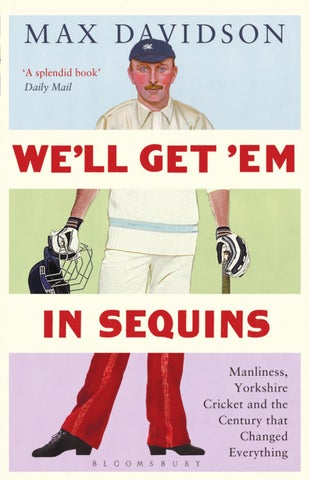
George Hirst of Yorkshire and England before victory in the Oval Test, 1902
‘It is with some elegance that Davidson entwines his tales of cricket and Yorkshire with reflections and observations of the world beyond … a splendid book’ Daily Mail ‘It is not simply a book about cricket: it is a book about life, seen – and why not? – through the prism of the nation’s greatest sport’ Standpoint ‘Entertaining’ Sunday Express Summer Reads Images: Alamy • Design: Sarah Greeno
www.bloomsbury.com
£9.99
MAX DAVIDSON
Just over a century later, Darren Gough, dripping with sequins, became the winner of Strictly Come Dancing. Goughy! There he was: the bustling fast bowler and macho Yorkshireman, cavorting on stage, dressed up like a... Like a what, exactly? Like a real man, perhaps? In one of the most original sports books in years, Max Davidson focuses on the history of Yorkshire cricket, looking at seven of their greatest cricketers. But this is not really a book about runs and wickets. He uses England’s largest county and most successful cricket club to tell the story of modern manhood.
WE’LL GET ’EM IN
SEQUINS Manliness, Yorkshire Cricket and the Century That Changed Everything
MAX
DAVIDSON
W I S D E N
We'll Get 'Em in Sequins 2013.indd 3
S P O R T S
W R I T I N G
30/01/2013 17:47
Published in the UK in 2012 by John Wisden & Co This paperback edition published 2013 An imprint of Bloomsbury Publishing Plc 50 Bedford Square, London WC1B 3DP www.bloomsbury.com www.wisden.com Copyright © Max Davidson 2012 ISBN 978 1 4081 5875 3 All rights reserved. No part of this publication may be reproduced in any form or by any means – graphic, electronic or mechanical, including photocopying, recording, taping or information storage and retrieval systems – without the prior permission in writing of the publishers. Every reasonable effort has been made to trace copyright holders of material reproduced in this book, but if any have been inadvertently overlooked the publishers would be glad to hear from them. Max Davidson has asserted his right under the Copyright, Design and Patents Act, 1988, to be identified as the author of this work. A CIP catalogue record for this book is available from the British Library. This book is produced using paper that is made from wood grown in managed, sustainable forests. It is natural, renewable and recyclable. The logging and manufacturing processes conform to the environmental regulations of the country of origin. Typeset in 10pt Haarlemmer by seagulls.net Printed and bound in Great Britain by CPI Group (UK) Ltd, Croydon CR0 4YY
We'll Get 'Em in Sequins 2013.indd 4
31/01/2013 17:58
contents
Padding Up
ix
1
George Hirst: Edwardian Man Personified 1
2
Herbert Sutcliffe: A New Breed of Yorkshire Cricketer 31
3
Hedley Verity: A Very English War Hero 63
4
Fred Trueman: Modesty out of the Window 91
5
Geoffrey Boycott: Manliness on the Back Foot 119
6
Darren Gough: The Twinkle-Toed Rhinoceros 151
7
Michael Vaughan: Captain Sushi 179
Close of Play
205
Appendix
215
Acknowledgements and Bibliography 219 Index 222
We'll Get 'Em in Sequins 2013.indd 7
30/01/2013 17:47
padding up
In an England cricket 11, the flesh may be of the South, but the bone is of the North, and the backbone is Yorkshire. Sir Leonard Hutton
On the afternoon of 13 August 1902, at the end of a famous Test match against Australia at the Oval, all eyes were on two professional cricketers from Yorkshire: fast bowler George Hirst and left-arm spinner Wilfred Rhodes. The foundations of an England victory had been laid by a Flash Harry amateur from Gloucestershire, Gilbert Jessop, with a whirlwind century, but now it was down to the bowlers: 15 runs to make, and the last pair at the crease. The situation called for cool heads, unflinching bodies and that most elusive sporting quality – patience. ‘We’ll get ’em in singles,’ Hirst said to Rhodes, as the two men conferred midwicket. Did he really say it? Or is it one of those apocryphal quotations one hates to let go, like a childhood friend? Hirst himself disclaimed the quote, but if he didn’t say it, he should have said it, just as Sherlock Holmes should have said, ‘Elementary, my dear Watson’, but never did. The quotation has stuck because it is so true to the man to whom it is attributed: a phlegmatic, pipe-smoking Yorkshireman with a bog-standard Edwardian moustache, an air of unhurried competence and a hatred of anything that smacked of excess or ostentation. He and Rhodes got ’em in singles or, pace the late Bill Frindall, got most of ’em in singles, and won a famous victory for their side.
We'll Get 'Em in Sequins 2013.indd 9
30/01/2013 17:47
x | we’ll get ’em in sequins
The crowd went wild. Hats were thrown in the air. But the two Yorkshiremen in the middle were unruffled. They always were. You did your job, you got paid a few quid, you had a beer after the match, and then you went home. But you didn’t make a song and dance about it. In fact, you didn’t make a song and dance about anything, certainly not if you came from Yorkshire, most sober and upright of counties. That was the world of the professional cricketer which George Hirst inhabited, and which he graced with distinction for more than 30 years. It was a small world, a narrow world, but it was rooted in good soil, and the sporting heroes it produced were as admired by their contemporaries as any modern superstar, perhaps more so. Just over a century later, on the same ground, in a Test match against the same opponents, another Yorkshireman took centre stage, as the England captain Michael Vaughan held the replica Ashes aloft and a nation went bananas. There were some striking similarities between the Ashes Tests of 1902 and 2005. Kevin Pietersen in 2005 might have been Gilbert Jessop brought back to life, biffing six after six in a neverto-be-forgotten century. But there were differences, too. Vaughan failed with the bat on the final day, but played a blinder in the dressing room in the lunch interval, encouraging Pietersen to go for his shots rather than play the dogged rearguard innings that the situation seemed to demand, with England needing only a draw to retain the Ashes. George Hirst would never have been so cavalier, so incautious, not in a thousand years. Cricket had changed. Yorkshire had changed. The world had changed. Vaughan, born in Manchester but brought up in Sheffield, broke the mould, first as a free-flowing batsman, then as a captain who prized aggression above containment, self-expression above efficiency. He had no appetite for the uncompromising maiden overs that had been meat and drink to generations of Yorkshire cricket fans. He played the game with a lack of inhibition that both appalled and titillated the traditionalists. ‘You don’t understand this, do you?’ Tony Greig asked fellow commentator Geoff Boycott, as Vaughan’s England hurtled to 400
We'll Get 'Em in Sequins 2013.indd 10
30/01/2013 17:47
padding up | xii
in a day at the start of the 2005 Edgbaston Test. ‘You’re right,’ said Boycott, as proud a son of Yorkshire as ever played with his bat close to his pad. ‘I don’t. It’s fun, though.’ It was as if Yorkshire, once the gold standard of English cricket, a temple of rectitude, had suddenly become two Yorkshires: Old Yorkshire, epitomised by Boycott and the players he had grown up with – Fred Trueman, Brian Close, Ray Illingworth – and a new, less hard-bitten, generation of players. They did things differently, not because they had a different tactical appreciation of cricket, but because they were different men, in a changing world. Relaxed, self-confident, comfortable in his own skin, Michael Vaughan was as much a man of his times as George Hirst had been. In 2004, captaining England against New Zealand, he left the ground before the end of play to attend the birth of his first child. Nobody batted an eyelid. In 2008, at the press conference when he resigned the England captaincy, he blubbed like a baby. Again, nobody batted an eyelid. Men did these things – even men’s men who played cricket, took some hard knocks, then went out drinking with Freddie Flintoff. Vaughan’s period as England captain became synonymous not just with success on the field, but with the famous huddle: the circle formed by the fielding side at the start of play, with players putting their arms around each other’s shoulders, geeing each other up with psychobabble, then patting each other’s bottoms as they dispersed. What would Brian Close or Ray Illingworth have made of a bonding ritual with such homoerotic overtones? One shudders to think. And if you were Old Yorkshire, and believed in Old Yorkshire ways, things were about to get ten times worse. In the autumn of 2005, within weeks of Michael Vaughan holding the Ashes aloft at the Oval, the Yorkshire fast bowler Darren Gough – having already dismayed the traditionalists by tearing in to bowl wearing an earstud – went the whole fashion hog, appearing on the BBC’s Strictly Come Dancing in lurid costumes on which it was possible, through the strobe lighting, to discern sequins. Was that thunder in the distance? No, it was generations of Yorkshire fast bowlers turning in their graves. If Gough had just entered the show for a laugh, to send himself up, Old Yorkshire might have forgiven him. But the boy from Barnsley had
We'll Get 'Em in Sequins 2013.indd 11
30/01/2013 17:47
xii | we’ll get ’em in sequins
other ideas. He threw himself into the tango and the cha-cha and the paso doble with the same zest as he had put into his bowling. He shook his booty. He swapped banter with the judges. And the nation loved it, voting for Gough in their millions until he was crowned series winner. What had gone wrong? Or – depending whether you were Old Yorkshire or New Yorkshire – what had gone right? Wasn’t there something rather exhilarating in a 90mph fast bowler and lusty tail-end batsman who could also do a nifty foxtrot in an outfit that glittered like a Christmas tree? Might we have to re-define what we meant by manliness? We’ll Get ’Em in Sequins is my attempt to grapple with that question. It is as much a social history as a cricket book, examining how attitudes to masculinity have changed in the last 100 years, sometimes at bewildering speed. The taboos of one generation became the acceptable norms of the next. Fathers bred sons who rejected many of the values they held dear. Nothing stood still. If there were rules governing how men should conduct themselves, nobody knew what they were any more. Even getting dressed in the morning, once so simple because all men dressed the same, became an obstacle course. Impressing the opposite sex got steadily harder. Women shopped around and, if they were not satisfied, returned the goods to the store. As nine-times-married Zsa Zsa Gabor put it, ‘Macho doesn’t prove mucho’. A man could no longer rely on striking tough-guy postures: he had to know when to hit softer notes; when to be vulnerable; when to give ground rather than soldiering grimly on. Historians of the 20th century have tended to focus on women rather than men. Feminism on the march made such dramatic strides that it eclipsed the subtler transformations in male attitudes and behaviour. But for men, too, it was a revolutionary century, even in a bastion of conservatism like Yorkshire County Cricket Club, fabled the world over for its unyielding toughness, a freemasonry of hard men with cold eyes, jutting chins and legs like tree trunks. Long before Darren Gough bought his first ear-stud, the solid Edwardian certainties of George Hirst were being dismantled, brick by brick. One of the players Hirst took under his wing at Yorkshire
We'll Get 'Em in Sequins 2013.indd 12
30/01/2013 17:47
padding up | xiv
was Herbert Sutcliffe, of whom Neville Cardus wrote that he was ‘a deviation from type’, wearing ‘flannels of fluttering silk’ on the field and Savile Row suits off it. The smell of honest sweat in the dressing room started to mingle with the smell of brilliantine and eau-de-cologne. By the 1950s, Fred Trueman was kicking over the traces like a stroppy teenager. Trueman was Old Yorkshire to his size 12 bootstraps, and on retirement, became a splendidly reactionary commentator. But there was a brashness about him in his youth that would have been alien to the pre-war generation, schooled in modesty and self-deprecation. Some values remained constant in the Yorkshire dressing room. A man had to be physically brave, whether it was Hedley Verity facing enemy fire in Sicily in 1944 – he later died of his wounds – or toughas-teak Brian Close letting himself be used for target practice by West Indian fast bowlers. Yorkshiremen of a certain age have tears in their eyes when they recall the exploits of Don Wilson in a match against Worcestershire in 1961, when he secured a vital victory for his side batting with his left arm in plaster from the elbow to the knuckles because of a fractured thumb. They do not actually shed the tears, being sons of Old Yorkshire, but they dab their eyes as they remember Wilson’s uncomplaining fortitude. Scratch a Tyke and you find a stoic. If courage is an eternal constant, as admired in 2012 as in 1912, many of the other attributes of manliness – how a man dresses, how he expresses his feelings, how he treats women and children – have changed with the times. It is one of the oldest clichés in sports writing to say that sport mirrors life. But in this instance, the world of Yorkshire cricket – a miniature England, but with a rich tribal folklore all of its own, with manliness at its core – has so faithfully mirrored the outside world that the cliché is unavoidable. In these seven portraits of Yorkshire cricketers, and of the values they shared with their male contemporaries, I have tried to map the contours of a sexual earthquake whose tremors are still being felt.
We'll Get 'Em in Sequins 2013.indd 13
30/01/2013 17:47
chapter 1
george hirst: edwardian man personified
All women become like their mothers. That is their tragedy. No man does. That is his. Oscar Wilde, The Importance of Being Earnest
‘Are you a man?’ Lady Macbeth demanded of her husband. Generations of men have been subjected to the same crude virility test. In their hearts, they have resented the question. Do they ask their wives if they are women? But they have had no choice but to answer in the affirmative – then furnish the necessary proof. Macbeth had to murder a king and look at ghosts without flinching. If he had ducked the challenge, his wife would have deemed him unmanly, a wimp, too full of the milk of human kindness. The majority of today’s husbands can pass the virility test by remembering wedding anniversaries, barbecuing a few sausages and putting the bins out on Fridays. But the subtext of their lives remains the same. ‘Are you a man?’ That same question, reverberating down the ages, challenging men to prove themselves: in the bedroom, in the workplace, in battles of every kind. The goalposts move from generation to generation, in subtle, incremental ways. When is it acceptable for a man to cry? Is it OK to
We'll Get 'Em in Sequins 2013.indd 1
30/01/2013 17:47
2 | we’ll get ’em in sequins
hug another man? Should a man ever admit to feeling depressed? Are conscientious objectors just cowards by another name? Is hitting a child admissible? Boxers or Y-fronts? Mercedes or a mountain bike? Aftershave or a splash of cold water? A pint of lager or a vodka martini? And how about moustaches/sideburns/tattoos? Are they (a) naff or (b) proof positive of virility? Men have to make up their own minds on such issues, having taken the temperature of the times. There is no reference book in which they can look up the answers, no court of last appeal. But the pressure to pass the test, or at least give a good account of oneself in comparison with one’s fellow men, is an eternal constant. And the price of failure remains the same – relegation to the second rank of manhood. Nobody ever needed to ask George Herbert Hirst, born in Kirkheaton, near Huddersfield, on 7 September 1871, if he was a man. Manliness was his birthright. He was virility made flesh. Whether it was the idealised George Hirst of the cigarette cards, with his spotless flannels and burly forearms, or the real-life cricketer, striding out to bat, pacing out his run-up or hurling himself through the air to take a catch, he epitomised the all-purpose man of action: tough, vigorous and combative, without being malicious. To the cricket-loving Yorkshire public, who hero-worshipped him, he represented a kind of platonic ideal of what a man should be. ‘Search as I might, I could find no warts whatever,’ reported one of his biographers. None of his contemporaries had a bad word to say against him. ‘There is something in his honest, genial, frank face that one likes,’ wrote a journalist who interviewed Hirst at the start of his career. ‘You feel instinctively that he will put on no side and tell you all you have any business to know.’ It could be a description of the young Freddie Flintoff, before he got his own agent. The portrait of Hirst in a 1903 edition of Vanity Fair is a gem of Edwardian understatement: ‘He may be summed up as a really fine fellow with the heart of a lion. He has a good appetite and quite a nice smile.’ That ‘quite’, in conjunction with the reference to his appetite, seems churlish. Had the author seen Hirst shovelling potatoes into his mouth, in no position to smile? Others were more
We'll Get 'Em in Sequins 2013.indd 2
30/01/2013 17:47
george hirst | 3
generous. They reckoned it was a very nice smile, one of the sunniest in county cricket. Hirst enjoyed the stardust of sporting celebrity in an age when professional sport was capturing the public imagination as never before. From May to September, his name was never out of the newspapers. His jovial face adorned tins of George Hirst’s Yorkshire Toffee (‘Unrivalled… Always Reliable’), produced by a factory in Huddersfield, his home town. Strangers stopped him in the street to ask for his autograph. But the celebrity did not go to his head. To the day he died, he kept his feet firmly on the ground. At his funeral in 1954, it was standing room only in the church, and the streets outside were so crowded that the hearse had trouble getting through. But it was a low-key service with – at his request – no music. George Hirst would have hated a fuss, a media circus. He went gently into that good night. The adulation that he received, particularly in his home county, was not based on crass name recognition. He was admired, even revered, not just for his feats on the cricket field – where he bowled fast-medium and batted with uncomplicated gusto – but for how he conducted himself off it. He was living proof that a man of humble origins could also be a perfect gentleman. Everything that made a man a man in the early years of the 20th century could be found in that sturdy frame and modest demeanour. It was not the manliness of the bully, the show-off, the tyrant who has to dominate every situation. It was rooted in kindlier soil. Hirst could be gruff, on occasion, but never rough. My own grandfather, Percy Horsfall, born within ten miles of Hirst, in the 1880s, might have been his younger brother. As a boy, I found him vaguely intimidating, with his walrus moustache and his aloof Edwardian manner. He was quite shy, I now realise: he could no more have started a conversation with a stranger in the street than flown to the moon. But you did not have to dig too deep to find his softer side. If I got a good school report, he would fish into his waistcoat pocket for a ten-shilling note and hand it over with a sheepish air, as if he was breaking the law. His natural reserve could not mask his benevolence. Fate had surrounded him with women. He had four daughters and two granddaughters before I came along. His telegram to my mother
We'll Get 'Em in Sequins 2013.indd 3
30/01/2013 17:47
4 | we’ll get ’em in sequins
after I was born was a classic: ‘CONGRATULATIONS STOP AND A BOY AT THAT STOP HORSFALL’. But he didn’t seem to mind. He had never been the blokeish type. The Yorkshire gruffness was leavened by affability and kindness. It was the same with Hirst. ‘Dear Willie,’ he wrote to one starstruck young fan. ‘You asked for my autograph. Here are two – one for yourself and one for a swap. Yours sincerely, G. H. Hirst.’ Young and old alike basked in the glow of his ebullient good humour. There was nothing of machismo in his make-up. There did not have to be. He conquered by other means. As a cricketer, he was a workhorse, not a thoroughbred. If his mastery of swing bowling, that most arcane of sciences, put people in mind of a wizard, his batting drew earthier comparisons. The poet William Kerr admired his ‘crisp, Merry late cuts, and brave Chaucerian pulls’ – and if Kerr had a Chaucer character in mind, it was probably the miller rather than the knight. There was no shortage of more brilliant, more eye-catching players. Hirst’s most famous achievement – the one which stands out in the record books, because it is unique – was to score 2,000 runs and take 200 wickets in a single season, 1906. Perspiration, not inspiration, was his hallmark. He soldiered on year after year, indomitable. He was hardly ever injured. The only hint of an Achilles heel was his susceptibility to seasickness. On tours to Australia, he took the train to Marseilles, and joined the rest of the team there, rather than risk the rough seas of the Bay of Biscay. But he did not make a fuss about it. That was not the George Hirst way. It was not the Yorkshire way. In no county in England was stoicism – letting nowt get t’better of thee – more prized. Yorkshire was to London what Sparta had been to Athens: a harsher, tougher society, and proud of it. Just as a real Scotsman wore nothing under his kilt, a real Yorkshireman gritted his teeth and didn’t show if he was hurting. Like other sporting heroes of the pre-television age, George Hirst is a shadowy figure, wreathed in the inevitable sentimentality. But peer through the shadows and what you see has a reassuring solidity. Nothing has had to be sexed up. The hero is no Nietzschean superman:
We'll Get 'Em in Sequins 2013.indd 4
30/01/2013 17:47
george hirst | 5
he is a creature of flesh and blood, and the more impressive for it. ‘When we were young, we used to nip out of Sunday school to catch a glimpse of George Herbert,’ recalled one of the Yorkshire cricket fans who idolised him. ‘Regular as clockwork he used to come over by bus to see his mother, and he’d come swinging along with his trilby hat and rolled umbrella, smart as a new pin. To see him smile – and he always would smile – used to set us kids up for the week.’ Every detail of this sepia-tinged vignette tugs at the heartstrings, from the neatly furled umbrella to the municipal bus – more poetic than any open-top sports car could ever be – bearing the dutiful son to visit his mother on a Sunday afternoon. Manliness can sometimes be the most humdrum of virtues, compounded of simple kindness and a neighbourly consideration for others. Hirst was not conventionally handsome or physically imposing. He stood at just five foot seven, short for a fast bowler. He was not a dashing batsman, the sort who made spectators swoon with a flamboyant sweep or textbook cover drive. And he certainly had none of the selfconfidence born of wealth, privilege or a good education. He grew up above a pub, the Brown Cow, and left school at ten. His schooling was rudimentary, Dickensian. ‘Children are crowded into such a small room that it is impossible for them to move from their seats to exercise,’ wrote a shocked visitor to the infant school he attended. Escaping the classroom to play cricket in the streets must have felt like a liberation. After school, Hirst worked in mills and factories before making the grade as a professional cricketer. His rise was steady rather than meteoric, based on the hard graft that has been instilled in generations of Yorkshire cricketers. But as he blossomed into a formidable allrounder, first for his county, then for England, he won friends wherever he went. People did not merely enjoy his company: they admired his sterling human qualities. His obituary in The Times in 1954 is as much a character reference as a litany of runs and wickets: ‘Hirst brought to everything he did a courage, an integrity, a vigour and a tenacity that meant that no game in which he took part was decided until the last ball had been bowled.’ Sir Pelham Warner, one of his England captains, declared him ‘the ideal cricketer, so straight, so strong, so honest’.
We'll Get 'Em in Sequins 2013.indd 5
30/01/2013 17:47
6 | we’ll get ’em in sequins
There can hardly have been a sports journalist in the land who did not apply the word ‘yeoman’ to Hirst. Or ‘salt of the earth’. Or ‘unpretentious’. He invited the clichés because he could be depended on to live up to them. Perhaps the best summation of his character can be found in A. A. Thomson’s double-decker biography, Hirst and Rhodes: ‘He had the gift, normally a royal prerogative, of being able to accept adulation without being puffed up or embarrassed. His natural dignity and courtesy were proof against his ever being anything but what he was: George Herbert Hirst, a plain, honest Yorkshireman, who had the good fortune to possess high skill in a happy, vigorous game. He had, to the highest degree, the virtue that the Victorians called manliness, but without a jot of Victorian sententiousness.’ Amen to that. There was a lot of the Victorian in George Hirst. He was his own man, beholden to nobody. He had the rugged selfsufficiency admired by Sir Richard Burton, the 19th-century explorer: Do what thy manhood bids thee do, From none but self expect applause. He noblest lives and noblest dies Who makes and keeps his self-made laws. But Hirst was far too level-headed to indulge in the airy theories of some of his contemporaries. Before Victoria came to the throne, being a man in England had been relatively simple: you just got on with doing the sort of things men did, whether it was tilling the fields or marching into battle. Now, suddenly, among what would today be called the chattering classes, there was intellectual baggage attached. What made a man a man? It was a question that exercised some of the finest minds of the day – and some of the biggest crackpots. When the Victorians made what amounted to a cult of manliness – the word barely existed before the 19th century – they imported preconceptions that seem plain weird today. Moral and physical purity became indistinguishable. Mens sana in corpore sano was the anthem of the age. Men were enjoined to look after their bodies and not yield to their baser instincts. Teenage boys were viewed as accidents waiting to
We'll Get 'Em in Sequins 2013.indd 6
30/01/2013 17:47
george hirst | 7
happen, a mass of noxious energies which needed to be stifled or, better still, channelled into harmless activities like sport, played in God’s good air. A boy with a cricket bat in his hand could not get into mischief. From Ascot to Aberdeen, there was a squeamishness about bodily functions which bordered on the hysterical. In the great public schools, where the debate about manliness raged most fiercely, masturbation was regarded as an evil to be stamped out at all costs. One headmaster of Harrow School famously insisted that the pockets of boys’ trousers be sewn up. Muscular Christianity, as advocated by Thomas Hughes, author of Tom Brown’s Schooldays, achieved the fervour of a fundamentalist creed, rooted in harsh values. A tough childhood was a good childhood. A tough childhood was character-building. Cold showers, savage beatings and a couple of hours a day running around a sports field would make a man of you. To be judged ‘manly’ was one of the highest accolades to which a Victorian male could aspire. ‘Lightly lie the turf upon thee, kind and manly Alfred Mynn,’ wrote William Jeffrey Prowse in his obituary poem commemorating the pre-eminent English cricketer of the first half of the 19th century. A bland-seeming epithet, used very sparingly in Shakespeare, now had a far more potent ring – even if its exact meaning, because of its tautologous construction, remained rather vague. Men were often defined as much by what they were not as by what they were. They were not women, ergo to exhibit womanly weakness was unmanly. They were not animals, ergo to surrender to their animal lusts was unbecoming. Self-denial rather than self-expression was the order of the day. ‘Feelings are like chemicals,’ warned Charles Kingsley, the Victorian clergyman who wrote The Water Babies and was one of the high priests of muscular Christianity. ‘The more you analyse them, the worse they smell.’ A manly man, in this new moral universe, got on with his life. He didn’t indulge in introspection or wallow in depression. It was an eccentric recipe – well summarised by E. M. Forster, who said of old-style British public schools like Eton and Rugby that they turned out boys with ‘well-developed bodies, fairly developed minds and undeveloped hearts’. But it achieved a surprisingly wide currency.
We'll Get 'Em in Sequins 2013.indd 7
30/01/2013 17:47
8 | we’ll get ’em in sequins
And the preoccupation with manliness as a moral imperative was not confined to a few eccentric C of E pedagogues. With the Empire to defend, the suppression of un-manly feelings, of the type that might undermine the morale of the tribe, became a matter of public policy. ‘History is strewn with the wrecks of nations which have gained a little progressiveness at the cost of a great deal of hard manliness,’ wrote the constitutional historian, Walter Bagehot, one of the most influential thinkers of the age. Manliness again, reverberating like a battle cry. It was not a good time to have homosexual leanings. In fact, it was an absolutely terrible time to have homosexual leanings. In Georgian and Regency England, social attitudes had been comparatively relaxed. While sodomy was still technically a capital offence, the crime was very hard to prove and the legislation rarely invoked. Outlandish fops like Beau Brummell – an occasional cricketer, who played for Hampshire in 1807, scoring 23 and 3 – were not just tolerated, but relished. So what if a man dressed like a dandy and wore white cravats which he had taken an hour to tie? It was a free country. Now the dandies’ days were numbered. In 1885, when Hirst was barely out of puberty, male homosexuality was designated a crime for the first time in Britain, under the Labouchere amendment to the Criminal Law Amendment Act. To the specific offence of sodomy, there was now added the much vaguer offence of ‘gross indecency’ between men, a coy, catch-all phrase which the judges of the day interpreted according to their own prejudices. In May 1895, the legislation claimed its most celebrated scalp when Oscar Wilde was convicted of gross indecency and sentenced to two years’ hard labour, the maximum allowable under the Act. Mr Justice Wills, presiding, declared the sentence ‘totally inadequate for a case such as this’. In the Yorkshire dressing room, as newspapers were passed from hand to hand, reports of the Wilde trial must have seemed like dispatches from another planet. What was this highfalutin’ nonsense about the love that dared not speak its name? By ’eck, the man had hair growing down to his shoulders! The cricket world had other things on its mind. In the very week Wilde was sentenced, all eyes were on W. G. Grace, in his annus mirabilis, as he closed in on the
We'll Get 'Em in Sequins 2013.indd 8
30/01/2013 17:47
george hirst | 9
unprecedented feat of scoring 1,000 runs in May, at the age of 46. The author of The Importance of Being Earnest was not going to upstage that. But, in the wider scheme of things, the Wilde trial cast a longer shadow than anything W. G. achieved. The new puritanism, a censoriousness that would have been unthinkable 100 years earlier, had well and truly arrived, driving homosexuality underground, where it would remain for nearly a century. ‘I liked you better than suits a man to say,’ wrote A. E. Housman, in a poem written to a male friend, published posthumously – it would have been unacceptable in his lifetime. There were a lot of Housmans in late Victorian England: anxious, repressed, guilty, unable to be true to themselves. The pressure to be a man – a real man, whatever that meant – had been ratcheted up a notch. At this remove of time, it is tempting to view the working-class Yorkshire world of George Hirst as fundamentally distinct from the metropolitan world of Oscar Wilde and the ex-public schoolboys. But the two worlds often overlapped – and nowhere more so than on the cricket field. The team photograph of the England XI that faced Australia at Trent Bridge in 1899 illustrates this point to perfection. Centre stage, the alpha-male, bearded like a lion, is W. G., captain of the side. Sitting beside him are K. S. Ranjitsinjhi, an Indian prince, C. B. Fry, an Oxford Blue, and F. S. Jackson, an Old Harrovian – Churchill’s fag-master, no less – who would later become a member of Parliament and Governor of Bengal. The rest of the team are working-class professionals, including Hirst himself and his great Yorkshire contemporary, Wilfred Rhodes. But the men do not look ill at ease in each other’s company, quite the reverse. Physically, they look extraordinarily similar – not least because every man jack of them, apart from the full-bearded Grace and the boyish Rhodes, is sporting a moustache. Some are pencil-thin, mere smudges on the upper lip. Others are broad and bushy, like well-tended garden borders. Some droop at the edges. Others end in a playful upwards twirl. But the overall effect is as harmoniously reassuring – or as monotonous, depending on your point of view – as a school uniform.
We'll Get 'Em in Sequins 2013.indd 9
30/01/2013 17:47
10 | we’ll get ’em in sequins
A lot of learned ink has been expended on the moustaches that became almost compulsory facial furniture in the late 19th and early 20th century. They certainly merit a passing mention in a book about manliness because they were, for a period, the badge of manliness – as they still are in some parts of the world. ‘The youth of 21 looks 30 with a moustache,’ wrote one Edwardian commentator, pondering the rich foliage around him. ‘Without it he would look 16.’ If you wanted to grow up quickly – and, with only a tiny fraction of the population going on to higher education, the gap between boyhood and manhood was far more sharply defined than it is today – you skimped on shaving and kept your fingers crossed. Winston Churchill tried to grow a moustache while a second lieutenant in the Queen’s Own Hussars – and was mortified when he failed. He had to wait until he was in his sixties before a baby-faced prime minister looked the part in Downing Street. Lloyd George had a moustache. Chamberlain had a moustache. So did Hitler. So did Stalin. The fashion had a long innings. In its heyday, the moustache was such a fixture that, in china shops, you could buy specially designed cups that enabled a man to drink tea without getting his pride and joy wet. George Hirst, naturally, grew an absolute beauty, effortlessly luxuriant, like a bed of moss on the Yorkshire moors. The moustache was his passport to manhood. And, just as significantly, it transcended class. In an age that was more egalitarian than it is sometimes presented, the moustachioed footman could look the moustachioed earl in the eye. They were both real men, albeit enjoying different stations in life. If the moustache was a bridge between men of different classes, the same could be said of the boys’ magazines which mushroomed in popularity throughout Hirst’s youth and early manhood. The decade of his birth, the 1870s, saw the principle of universal education established in Britain for the first time; and with education came a new audience for unsophisticated tales of derring-do, whether in the jungles of Africa or on the school sports field. The Boy’s Own Paper, a niche publication on its debut in 1879, acquired a nationwide readership. A boy is a boy: it does not matter how much money his parents have. Just as the Harry Potter books have been devoured by children who have never been to
We'll Get 'Em in Sequins 2013.indd 10
30/01/2013 17:47
george hirst | 11
boarding school, so working-class children of the late Victorian and Edwardian eras gorged themselves on tales set in minor public schools, peopled by dandies, bullies, cane-wielding teachers and sporty heroes who knew how to look after themselves in the scrum. The prototype of the genre was The Fifth Form at St Dominic’s, published in 1881 and originally serialised in The Boy’s Own Paper. Its author, Talbot Baines Reed, had attended the City of London School, where he was bottom of the class at maths, but on the sports field impressed with his ‘strength of muscle, length of limb, boldness of attack and absolute fearlessness’ – shades of George Hirst. Fearless or not, Reed understood the neuroses of adolescence, the doubts one must conquer before becoming a man. As his young hero is packed off to boarding school, and his mother reminds him to look after his flannel waistcoats or he will catch a cold, he frets that people will think him ‘a milksop or mollycoddle’. You don’t mind catching a cold when you are a boy of that age. You do mind being thought a sissy by your fellows. Where Reed had led, Charles Hamilton, aka Frank Richards and umpteen other aliases, followed. Best remembered as the creator of Greyfriars School, Hamilton was one of the most prolific writers ever, in any genre, with a readership of millions. He had an uncanny understanding of what made boys tick – or not tick. His books were execrably written, but the characters were timeless and classless. Billy Bunter, the Fat Owl of the Remove, who made his bow in 1908, was a warning to schoolboys everywhere what happened if you stuffed yourself with food, told fibs to teachers or squealed on your friends. It was better to be Harry Wharton, the dashing form captain, or the cheery optimist Bob Cherry. The world of Greyfriars was simultaneously parochial and universal. In The Classic Slum, Robert Roberts’ memoir of growing up in Salford before the Great War, slum boys fight each other according to strict Greyfriars rules – no kicking, no striking someone when he is down, no weapons, just fists. The boys’ magazines were hardly great literature. They had none of the high Christian seriousness of Thomas Arnold and other great Victorian headmasters. But, in the days before television, they shaped attitudes. They also brought a measure of social cohesion,
We'll Get 'Em in Sequins 2013.indd 11
30/01/2013 17:47
12 | we’ll get ’em in sequins
promoting values – loyalty, courage, honesty – that were as relevant in a working-class home as in the mansions of the landed gentry. One must tread carefully here: it is easy to fall into the trap of glib generalisation and gloss over significant differences between boys from different classes and, just as important, from different parts of the country. To treat Yorkshire County Cricket Club as a faithful microcosm of society at large would be absurd. The world of English county cricket has never, at any stage, been a simple homogenous whole. From the very inception of the County Championship in the late 1880s, a north–south divide has been clearly discernible. In the mythology of the game, players from Yorkshire or Lancashire have been made of sterner stuff than players from Kent or Sussex or Gloucestershire. They are less soft, physically. They don’t don a second pullover as soon as the sun goes behind a cloud. They are less likely to get out to airy-fairy shots. They can take their drink better. To that extent, Yorkshire cricketers could be said to occupy a different position on the spectrum of manliness to those born south of the Wash. Even away from the cricket field, Yorkshire is not England, but a sub-division of England, with its own sub-divisions – the late-lamented Ridings. The stereotypical Yorkshireman has strengths – resilience, stoicism, bluntness, common sense – and weaknesses – dourness, tightfistedness, stubbornness – which no amount of social engineering can shift. God’s own county is a law unto itself, a self-contained world, a ripe human comedy. But, with that important caveat, I don’t want to dwell unduly on the north–south divide, any more than I want to dwell on the nuances of the English class system. It is the shared attitudes of such a diverse-seeming group of men – and they did share attitudes, on a whole range of issues – that interest me. George Hirst’s first captain at Yorkshire was an Old Etonian, Lord Hawke, a man with an even more splendid moustache than Hirst, and one of the giants of the Golden Age of cricket. As a player, his contributions were negligible, but he brought a messianic zeal to the game. Hawke is to Yorkshire cricket what Lord Reith is to the BBC: a founding father, but also a
We'll Get 'Em in Sequins 2013.indd 12
30/01/2013 17:47
george hirst | 13
moral touchstone. What would Lord Hawke have thought of so-andso? You still hear the question posed by men born long after Hawke was dead. He was an amateur, with the mindset of an amateur – he was vehemently opposed to Yorkshire being captained by a professional. But his amateurism was not of the snobbish variety. Its roots lay much deeper – in the medieval age of chivalry, to which many Victorians felt an almost romantic attachment. Married but with no children – a combination that perhaps gives rise to unspoken suspicions – Lord Hawke did not have to clamp down on homosexuality or other Wilde-like decadence at Yorkshire. His players wed and procreated, as naturally as breathing. George Hirst, who married at 25 and had three children, was wholly typical. But Hawke did have to clamp down on drinking, which had reached endemic proportions. The team that Hawke, straight out of Cambridge, inherited as club captain in 1883 comprised ‘gifted but scarcely house-trained professionals’ and was dubbed ‘ten drunks and a parson’ – the parson being Ephraim Lockwood, a lay preacher. Hawke made the restoration of discipline his priority and, by the time Hirst cemented his place in the side in the 1890s, Yorkshire was well on its way to becoming a cricketing powerhouse, the most successful county in the land. It was no longer a drinking club, but an academy of excellence, with winning rather than entertaining being the priority. County championship after county championship was won on the back of hard-earned victories, with no quarter given, particularly to teams from Lancashire. Lord Hawke’s family motto was ‘Strike’, and his teams played aggressively when the situation required, but their success was rooted in miserliness – not giving away cheap runs or cheap wickets. There was the odd exception to the rule, like the batsman David Denton, nicknamed Lucky, who ‘hit merrily so long as he was at the wicket’, but efficiency rather than self-expression was the order of the day. The link between Yorkshire cricket and dour cricket was becoming as firmly established as the link between West Indies cricket and calypso cricket would be in the 1950s.
We'll Get 'Em in Sequins 2013.indd 13
30/01/2013 17:47
14 | we’ll get ’em in sequins
Douglas Moffat’s mischievous 1897 poem ‘As They Stood A-Blocking’ might have been written after watching Yorkshire batsmen at their most uncompromising: As they stood a-blocking, a-blocking, a-blocking. Wearily I yawned while I sat and watched the play: The bowling was all right, But they did not try to smite, Though many balls they might Have put away: As they stood a-blocking, I sat yawning at the play. Yes, I sat a-yawning, a-yawning, a-yawning. And several persons yawned who turned and looked at me: A lady sitting nigh Who chanced to catch my eye, In the middle of a sigh Yawned at me, Sat a-yawning; it was comical to see. Entertainment may have been at a premium at Yorkshire matches, but for spectators scouring the field for virile role models, there was no shortage of candidates. The wicketkeeper David Hunter, who had a particularly splendid moustache, was a successful amateur weightlifter, as well as a keen campanologist and concertina-player. Bobby Moorhouse, a forerunner of Brian Close, stood up so fearlessly to fast bowling that he earned the nickname The Man of Bruises. Frank Milligan volunteered for service in the Boer War and was killed in action during the relief of Mafeking. Moorhouse was a professional from Huddersfield, Milligan an Eton-educated amateur, but they shared qualities that transcended class. No history of cricket can ignore the quaint distinction between Gentlemen and Players, which endured until 1962. But what is so fascinating about the all-conquering Yorkshire side captained by Lord Hawke, the gentleman-amateur, and spearheaded by George Hirst, the supreme county professional, is how little the waters were muddied
We'll Get 'Em in Sequins 2013.indd 14
30/01/2013 17:47
george hirst | 15
by social frictions. The two men were on the best of terms, and would remain so for half a century. Hawke was as charmed as everyone else by Hirst’s cheerful disposition. ‘His smile used almost to meet at the back of his neck,’ he joked. But he could also see the steel behind the bonhomie. ‘It was not only what Georgie Hirst did but how he did it,’ he wrote, ‘coming off when an effort was most necessary and playing his best against the more formidable sides.’ When Hirst retired from the game, Hawke was instrumental in securing him the job of cricket coach at Eton, his old school, a post he held for nearly 20 years, venerated by all. There is a nice story, possibly apocryphal, about the match played to mark his retirement. The captain of the Eton XI thought it would be rather droll if the great fast bowler could bow out with a hat-trick. The scheme worked to perfection, with three batsmen surrendering their wickets to him with such artistry that the cheering spectators had no inkling it was a set-up. Hirst realised – but said nothing to show that he realised. He just entered into the spirit of the occasion. If he had had a chip on his shoulder, the laconic cricketer, with his Huddersfield vernacular, might have been a fish out of water at Eton. His brother-in-arms at Yorkshire, Wilfred Rhodes, took up a similar coaching appointment at Harrow, but never fitted in and was replaced by Patsy Hendren of Middlesex. But Hirst’s natural equanimity carried the day. He took people as he found them, the way he always had. Like Lord Hawke, his aristocratic mentor, George Hirst the coach was a disciplinarian without being a martinet. A well-run ship did not need to involve shouting. At Eton, he insisted that pupils wore spotless flannels and clean boots, believing that, if you did not look your best, you could not play your best. But his rollickings were tempered with kindness and good humour. One boy who appeared in grass-stained flannels, explaining that his spare pair were at the cleaners, was told: ‘It’s a bad do, but don’t fret, lad. I’ll show you how to cover those stains with chalk for the afternoon. But if you come here looking like that again, by gow…’ If Hirst fitted in well at Eton, it was because of shared values, both on and off the field. How the sporting gods must have smiled when he arrived! A scion of the county that turned maiden overs into an art
We'll Get 'Em in Sequins 2013.indd 15
30/01/2013 17:47
16 | we’ll get ’em in sequins
form teaching at the school where the 0-0 draw was regarded with equal reverence! Goals in the famously attritional Eton Wall Game are scored once every ten years or so, and in the annual St Andrew’s Day fixture between the Collegers and the Oppidans – the Eton equivalent of a Roses match – no goal has been scored by either side since 1909. Hirst must have watched the boys scrabbling around in the mud, giving no quarter to their opponents, and smiled in recognition. Whether or not the Battle of Waterloo was won on the playing fields of Eton, the school was still a tough environment for an adolescent boy – as unsentimental and unyielding, in its way, as the hard northern communities in which Hirst and his ilk were raised. Parents did not send their sons to Eton to be pampered. Coach and pupils had a shared way of communicating. They both spoke the language of understatement. Extravagant praise was out. So were great shows of emotion, high-fives at the fall of a wicket. An unspoken code of behaviour forbade it. In the well-ordered rituals of a cricket match, there was an echo of the orderliness that characterised society at large. You went about your business. You didn’t turn your life into a performance. A horror of excess, whatever form it took, conditioned how men of Hirst’s generation behaved. Self-indulgence was the ultimate betrayal, whether it took the form of drinking, wearing flash clothes or sexual shenanigans. A man had to be in control of himself and his emotions. He resisted temptation, whatever form it took. It seems an austere code today, and it sometimes manifested itself in ridiculous ways. One of the housemasters at Eton during Hirst’s time was George Lyttelton. His son was the jazz trumpeter Humphrey Lyttelton, whose account of the paternal advice he received about the facts of life belongs in a Monty Python sketch: ‘Most of the enduring things I learnt from my father were by example rather than precept. His “serious talk” with me as I approached puberty lingers in my mind for its almost startling brevity. He was standing in the traditional position with his back to the fireplace and he uttered the injunction in a strong, resonant voice, with a stern lowering of the massive eyebrows, as if to make up in portentousness what his message lacked in length and
We'll Get 'Em in Sequins 2013.indd 16
30/01/2013 17:47
george hirst | 17
detail. “Eschew evil,” he boomed, then gave me a heavy paternal bang on the shoulder and left the room, beaming to himself.’ But if self-discipline was prized, it was prized for a reason. All around George Hirst, both at Yorkshire and Eton, there would have been examples of what happened to men who were incapable of it. Manliness might have been the ideal, but it was an ideal from which many men fall sadly short. The strong battled through. The weak went to the wall. Darwin knew what he was talking about. Binge drinking, the bête noire of today’s Daily Mail, was more prevalent in Hirst’s day than the sentimentalists admit. Beneath those neatly trimmed moustaches and carefully buttoned waistcoats, chaos was lurking. Hirst himself was not a heavy drinker – ‘Everything in Moderation’ might have been his motto – but some of his team-mates were not so abstemious. The classic male bonding ritual of a night out at the pub often degenerated into mayhem – particularly when the players were on the road, away from home – almost as if the drinkers were using alcohol to escape the social inhibitions of the time. One of the saddest stories of the Hawke–Hirst era at Yorkshire involves Bobby Peel, a genuinely great spin bowler whose career was blighted by chronic alcoholism. He would drink himself to sleep, then hit the bottle again in the morning. Loyal to the last, Hirst covered for his team-mate, protecting him from the wrath of his captain, but things came to a head after one epic bout of drinking during a county match. Hirst helped Peel to bed in a drunken stupor, then approached Lord Hawke before the start of play the next day. ‘I’m very sorry, my lord. Peel’s apologies, but he’s been taken very queer in the night and won’t be able to turn out this morning.’ The excuse might have passed muster if Peel had not suddenly turned up in person, red-faced, his cap at an angle, three sheets to the wind. ‘Leave the field at once, Peel,’ ordered Lord Hawke, as his star bowler proceeded to make a spectacle of himself in the outfield, lobbing spinners towards the sightscreen. In some versions of the story, he even urinated on the wicket, the holy of holies. The bowler then added insult to injury by refusing to apologise. Hirst did his best to mediate, but it was a lost cause. Peel never played for Yorkshire again.
We'll Get 'Em in Sequins 2013.indd 17
30/01/2013 17:47
18 | we’ll get ’em in sequins
Another of Hirst’s Yorkshire contemporaries was Ted Wainwright, the all-rounder. He had a reasonably successful career, winning five England caps, and was then appointed cricket coach at Shrewsbury School, where one of his fellow teachers was the young Neville Cardus, who remembered his drinking bouts with less than affection. ‘He was a tall man who walked as if he didn’t give a damn for anybody,’ he wrote in his autobiography. ‘There was something sinister about him. Every night he got drunk as a matter of course, quietly and masterfully.’ When Cardus, on a visit to the pub, told Wainwright that he drank nothing stronger than ginger ale, Wainwright recoiled in horror: ‘Christ, th’art a reight bloody cricketer.’ Many of the heaviest drinkers were also heavy smokers. Chainsmoker Jack Brown, a contemporary of Hirst at Yorkshire, was dead of heart failure by the age of 35. The life of a professional cricketer might have appeared enviable from the outside, but there were hidden strains and stresses. It was a precarious living. Another Yorkshire player, Billy Bates, tried to commit suicide after an eye injury forced him to retire. He had been an Ashes hero in the early 1880s; his name is inscribed on the urn itself. But sporting glory could not mask the underlying sense of vulnerability. Emotional problems, whatever form they took, were swept under the carpet. It was unmanly to admit to depression or mental illness, even if one had the language to describe it. Victorian decorum forbade it. Poor Johnny Briggs, a Lancashire professional of the period, ended his days in a lunatic asylum. One way and another, there was a fair bit of unhappiness beneath the calm certainties of county cricket. Fit, healthy, moderate in his vices – he liked to smoke a pipe with his evening drink – Hirst lived well into his eighties, unusual for a man of his generation when, with high infant mortality rates, the life expectancy of a British male at birth was still below 50. He was born a Victorian and died an Elizabethan, in May 1954. But it is probably as a great Edwardian, the years of his pomp as a cricketer, that he will be remembered. Folk memory has the Edwardians playing croquet on sunlit lawns as the war clouds gathered in Europe, but folk memory is playing tricks.
We'll Get 'Em in Sequins 2013.indd 18
30/01/2013 17:47
george hirst | 19
Some of the wettest years on record occurred just before the Great War, notably the soggy summer of 1912, when cricketers spent half the season in the pavilion, watching the puddles grow. But it was certainly a time of peace, prosperity and steady economic growth. People of all classes enjoyed the simple pleasures of life, cricket not least of them. The Edwardians were no fools, sleepwalking to disaster. They thought for themselves. Revolution was vaguely in the air, although, in the British way of things, it felt more like evolution, practical Darwinism rather than red-blooded Marxism. Men of a reforming bent did not rush to the barricades: they wrote pamphlets or formed trade unions. The true militants were the women – like the suffragette Emily Davison, who threw herself under the King’s horse at the 1913 Derby. But if no comparable political cause united the men of the period, that does not mean their habits and attitudes were set in stone. The rocksolid Victorian world into which George Hirst had been born was changing around him. The man himself was essentially unaltered. That was one of the things people admired about Hirst. He was not a slave to fashion or prone to jumping on passing bandwagons. But the Edwardian England in which he played his most productive cricket was not simply Victorian England with a new backside on the throne. It was a different animal. Life had suddenly become a mite more complicated, whether you were a cricketer, a farmer or a poet. A man could not simply aspire to be the same sort of man as his father before him. New ideas jostled for attention, as old ways of looking at the world came under the microscope. Little by little, morality was shifting. Muscular Christianity, the great sledgehammer with which the Victorians had tried to crush the impulses lurking in boys’ breasts, came to be viewed as the flawed ideology it was. There was an appetite for a new approach to male adolescence that was saner, gentler, more understanding of human frailty. Men who had been raised with Victorian harshness – beaten, brutalised, expected to be seen and not heard – wanted something better for their own children. It was no longer thought axiomatic that a boy ought to develop into a man as soon as reasonably possible. Indeed, one of the defining features of
We'll Get 'Em in Sequins 2013.indd 19
30/01/2013 17:47
20 | we’ll get ’em in sequins
the Edwardian period was the proliferation of children’s books which sought to preserve childhood as a haven of innocent escapism. ‘Beyond the Wild Wood comes the Wide World,’ Ratty tells Mole in Kenneth Grahame’s The Wind in the Willows, published in 1908. ‘And that’s something that doesn’t matter, either to you or me. I’ve never been there, and I’m never going, nor you either, if you’ve got any sense at all. Don’t ever refer to it again, please.’ Growing up, toughening up, becoming a man, was pleasurably delayed – or, in the case of Peter Pan, who made his first appearance in 1902, put on permanent hold. The creation of J. M. Barrie, a mad-keen amateur cricketer – he ran a scratch team called the Allahakbarries, for which P. G. Wodehouse, Jerome K. Jerome, A. A. Milne and other overgrown schoolboys turned out – The Boy Who Wouldn’t Grow Up spoke to a generation as surely as Harry Potter a century later. Peter Pan struck a chord because he reflected new sensibilities and new priorities in the raising of boys. He was emblematic of a generation that, little by little, was beginning to unbutton emotionally. Different men express their emotions in different ways. That has been true since the dawn of time. But each generation of men shares its own emotional language, subtly different from the language of previous generations. Take one of the recurring litmus tests of manliness – crying. No statistics, alas, exist of how many men were caught blubbing in public (a) in 1810 (b) in 1910 and (c) in 2010. The figures would be quite revealing if they did. But it is a matter of simple observation that this is a field of masculine behaviour where attitudes change over time. In Shakespeare’s plays it is perfectly normal for a male character to cry at times of high emotion; indeed, tears are often a testament to his humanity, as when Coriolanus is moved to tears by his mother and his eyes ‘sweat compassion’. But the centuries that followed saw the hardening of that quintessential English accessory – the stiff upper lip. By 1770, Oliver Goldsmith could write admiringly of ‘the silent manliness of grief’. There was still the odd occasion when the floodgates burst – like the funeral of Nelson, when there were ‘tears in every eye’, according to newspaper reports. At a more banal level, the
We'll Get 'Em in Sequins 2013.indd 20
30/01/2013 17:47
george hirst | 21
death of Dickens’ Little Nell in 1841 was another cue for waterworks, from men and women alike. But by the late Victorian period, crying was widely regarded as a sign of womanly weakness, inadmissible in any circumstances. A man kept his tears in, and a boy was not a man until he had learnt the same trick. Now, little by little, teardrop by teardrop, the tide was turning. One of the men in the vanguard of the change was the pioneering psychiatrist Henry Maudsley, born in Yorkshire in 1835. ‘The sorrow which has no vent in tears may make the other organs weep,’ wrote Maudsley, anticipating one of the great themes of modern psychiatry, the need to express feelings, not bottle them up. Maudsley was years ahead of his time in believing that for a man to cry was not just socially acceptable but, on occasion, medically necessary. He knew what he was talking about: his own mother had died when he was a small child, and he had been expected not to make a fuss about it. But he was not a lone voice. As the new century dawned, there was a growing reaction against perceived repressiveness. On the surface, life went on much as before. Below it, there were the first stirrings of discontent. If a boy was to grow into a man, it was not enough to break him like a colt, with repeated thrashings. He needed to be given a broader understanding of his place in the world. One of the most significant milestones on the road to a more humane vision of manliness occurred in 1908, with the publication, originally in instalments, of Scouting for Boys: A Handbook for Instruction in Good Citizenship by Robert Baden-Powell, one of the best-selling non-fiction books of the entire 20th century. Its soldier-author was already a national hero after his exploits at the Siege of Mafeking during the Boer War. He had written military textbooks which drew on his experiences of scouting in Africa. Now he set his sights on higher things – a revolution in the way boys were brought up, a revolution that would cause ripples around the world. Baden-Powell has been criticised, lampooned, even branded a warmonger. Some passages in Scouting for Boys, the seminal text of the Scout Movement, cause a definite queasiness today. ‘Every boy ought to learn to shoot and obey orders.’ It sounds like the ravings of a megalomaniac, a blueprint for fascism. Others induce paroxysms
We'll Get 'Em in Sequins 2013.indd 21
30/01/2013 17:47
22 | we’ll get ’em in sequins
of laughter. ‘A Scout smiles and whistles under all circumstances.’ What miseries the non-whistlers must have endured! They probably spent hours in the bathroom, practising in vain. But many of BadenPowell’s precepts are just sound common sense, far more appealing, at an ideological level, than the fundamentalist values of the Muscular Christians who preceded him. A little of the old sententiousness lingers. The tenth article of the Scout Law, which codifies how Scouts should behave, reads: ‘A Scout should be pure in thought, word and deed.’ No sex, please, gentlemen, this is a Scout camp. But it is perhaps significant that Baden-Powell only added it as a rider in 1911, three years after the first nine articles were published. Stamping out masturbation was not his priority: he was fired by loftier ideals. His thinking had been influenced, not just by Western Christianity, but by Burmese Buddhism, which he had observed at first hand. There were suddenly some new, kindlier, ingredients in the recipe for manliness. In the Scout Law, dos are far more important than don’ts, which is appealing in any ideology. The famous injunction to do a good deed a day has been much mocked, but still holds good. You see the same sentiment encapsulated in that New Age sticker in car windows, ‘Practise random kindness and senseless acts of beauty’. Dated in many respects, the Scout Law is surprisingly forward-looking in others. If you think the Edwardians lived in a stratified world, riddled with class prejudices, think again. ‘A Scout is a friend to all, and a brother to every other Scout, no matter to what social class the other belongs,’ wrote Baden-Powell. ‘A Scout must never be a SNOB.’ Even the fact that he capitalises the ‘snob’, signalling the strength of his loathing of snobbery, endears the man to you. At the very heart of the Scout Law, impervious to passing fashion, is the Christian ideal of selflessness. ‘A Scout’s duty is to be useful and help others.’ What parent, in any era, would mind their son pinning that to his bedroom wall? And if Baden-Powell’s emphasis on the importance of obeying orders grates in 2012, in our more egalitarian times, he never preached slavish social conformity. ‘A boy should take his own line,’ he wrote, ‘rather than be carried along by herd persuasion.’ Another
We'll Get 'Em in Sequins 2013.indd 22
30/01/2013 17:47
george hirst | 23
bullseye – and a line that would have gone down well in the Yorkshire dressing room of George Hirst, Wilfred Rhodes et al. The senior professionals in the side were men of substance, not hired hands. You did what Lord Hawke said. If he told you to field at second slip, you fielded at second slip. If he told you to play for a draw, you played for a draw. But you didn’t grovel to his lordship. Real men didn’t grovel. They ploughed their own furrow in life. Two years after the publication of Scouting for Boys, another classic hit the bookshelves, probably the single most quoted poem in the history of the language. ‘If you can keep your head/While all about you are losing theirs…’ The opening words of Rudyard Kipling’s famous poem might have been written by a man who had been in the crowd at the Oval in August 1902, the zenith of Hirst’s career. Pandemonium in the stands, a nerve-shredding Test against Australia at stake, and two unflustered Yorkshiremen, Hirst and Rhodes, keeping their heads to see their side home. ‘We’ll get ’em in singles,’ Hirst reportedly said to Rhodes at the start of their immortal last wicket stand. Others might panic, but not the calm, methodical Hirst. He adjusted his pads between every ball, according to one observer at the Oval. He patted the pitch. He brushed aside stray bits of dirt. He refused to be hurried. If Kipling had been batting at the other end, he would probably have approached the same task in the same way. No fuss. No histrionics. No showboating. Just a good dose of British phlegm. Kipling was not at the Oval in 1902: he was house-hunting with his wife in Sussex and putting the finishing touches to The Just So Stories, published that year. He actually wrote ‘If’ in 1895, although it did not see the light of day until 15 years later, as part of a miscellany called Rewards and Fairies. But his celebrated advice to boys, with its cheesy punchline, ‘You’ll be a Man, my son!’, might have been written with George Hirst in mind. Hirst needed no lessons in how to treat those twin impostors, triumph and disaster. He was equanimity personified. Right through his long career, he could get a century one day and a duck the next and be the same man in the pub afterwards. He was never too down on himself
We'll Get 'Em in Sequins 2013.indd 23
30/01/2013 17:47
24 | we’ll get ’em in sequins
in lean seasons or too full of himself in times of plenty. Could he fill the unforgiving minute with 60 seconds’ worth of distance run? Could he ’eck. Hirst ran in to bowl day after day, season after season, for more than 30 years. He never let up. He never complained. He was one of the great workhorses of sport. As for walking with kings and not losing the common touch, a man who could grow up above a pub in Yorkshire, leave school at ten and end up a much-loved cricket master at Eton was clearly blessed with human attributes that transcended class. But it is probably one of the less well-known lines in the poem that best captures the prosaic values by which George Hirst lived. ‘Don’t look too good nor talk too wise.’ You can almost imagine him reading the words, puffing at his pipe, and giving a vigorous nod of approval. Hirst always dressed neatly, right through his life. But to have worn anything that made him stand out from the crowd – a velvet waistcoat or flamboyant tie – would have revolted him. He was a cricketer, not a peacock. To show off in conversation – gild the lily when telling an anecdote or brag about his achievements – would have been equally unthinkable. He left that to others. For all his sporting prowess, he was a modest man in a modest age; if we still have a soft spot for the Edwardians, that ubiquitous modesty goes a long way towards explaining it. They did some extraordinary things, but would have thought it vulgar to mention them. One of Hirst’s most celebrated contemporaries, the supplier of a quotation as well-known as ‘We’ll get ’em in singles’, was Captain Lawrence ‘Titus’ Oates, the polar explorer, who perished in Scott’s expedition to the Antarctic in 1912. Oates was born in London, but raised in Yorkshire, where he joined the 3rd West Yorkshire (Militia) Regiment, in George Hirst’s backyard, and was inculcated with the same quiet stoicism. Oates had fought in the Boer War, and been badly wounded in the leg. He and Scott never hit it off. ‘I dislike him intensely,’ he wrote in his diary, ‘and would chuck the whole thing if we were not a British expedition.’ Scott, for his part, called Oates ‘a cheery old pessimist’. But if he found him curmudgeonly, a stereotypical Tyke, he was forced to acknowledge his fortitude. Yorkshiremen were made of stern stuff. They never made a
We'll Get 'Em in Sequins 2013.indd 24
30/01/2013 17:47
george hirst | 25
fuss – not even if they were 12,000 miles from home, stuck in a howling blizzard, at minus 40 degrees, with galloping frostbite. ‘I am going out,’ Oates told Scott, as he left their tent, to certain death, ‘and I may be gone some time.’ What an exit line! And what a man! You want to give him a cricket bat and send him in to bat on a sticky wicket against Australia, with a nation on tenterhooks and George Hirst at the other end. And how about those other shadowy figures who lurk in the background of the great men of the past – the women? If George Hirst had been dogged by tabloid hacks 24 hours a day, who knows what peccadilloes they might have stumbled across? A mistress called Gwendoline in Bradford? A one-night stand on a tour of Australia? A bit of hankypanky with a maid behind the pavilion at Eton during a second XI match against Harrow? But if he behaved badly – to anyone, of either sex – there is no record of it. Indeed, his memory is as revered among his surviving family as it is among the Yorkshire cricketing public. ‘I remember him as a very loving granddad who was a friend as well,’ says his granddaughter Lindsay Watkins. When she was being bullied at school, her grandfather promptly wrote to her with some kindly words of advice: ‘Do your lessons and stick up for yourself and all will come right in the end.’ The values he bequeathed to her were prosaic but timeless: ‘Always be courteous and respectful to others, whatever their station in life. Be cheerful, good-humoured, never criticise others, never boast. Have self-control, self-discipline.’ We have already caught a glimpse of Hirst the family man, taking the bus to visit his mother in Kirkheaton every Sunday. One does not imagine him being over-demonstrative in his affections when he greeted her. That was not the emotional language of the time. Equally, one can feel sure that he would have experienced no sense of contradiction between being a man’s man and a solicitous son. Filial piety was prized by Edwardians of all classes – Lord Hawke attended Sunday morning church with his mother till the day she died. Hirst’s mother certainly doted on him. In 1906, his most successful season, she travelled to Scarborough in the hope of seeing him take his 200th
We'll Get 'Em in Sequins 2013.indd 25
30/01/2013 17:47
26 | we’ll get ’em in sequins
wicket – but was so overcome with anxiety that she left the ground before he had reached his milestone. Communications between men and women were laughably formal by modern standards, but not without tenderness. Here is one of the great Edwardians, Yorkshire-born Herbert Asquith, signing off a letter to a woman friend, Mrs Harrison, after he had resigned as prime minister in 1916: ‘Bless you, dearest, Ever your loving, H. H. A.’ Are modern text messages, with their folksy abbreviations, any more intimate? There is a natural temptation to assume that relations between the sexes at the turn of the last century were deep-rooted in inequality. George Hirst, remember, was nearly 60 before women were finally granted equal suffrage. At cricket matches at Kirkheaton, his home town, the women’s role was decorative and menial – to serve tea in the pavilion between innings. But inequality did not mean a lack of respect. Many men of the period viewed their mothers with a reverence bordering on devotion. They had been able to observe at first hand the sacrifices women had to make to hold their families together, while their menfolk were away from home. One of Hirst’s best-known contemporaries, born in the same decade, was John Masefield, later Poet Laureate. Masefield was just six when his mother died giving birth to his younger sister, prompting one of his most haunting poems: In the dark womb where I began My mother’s life made me a man. Through all the months of human birth Her beauty fed my common earth. I cannot see, nor breathe, nor stir, But through the death of some of her… What have I done, or tried, or said In thanks to that dear woman dead?
We'll Get 'Em in Sequins 2013.indd 26
30/01/2013 17:47
george hirst | 27
Men triumph over women still, Men trample women’s rights at will, And man’s lust roves the world untamed. O grave, keep shut lest I be shamed. The author may be male, but the sentiments have a raw feminist timbre. In an age when home births were the norm, and infant mortality rates were distressingly high, a growing boy was in no danger of viewing his mother through a sentimental lens. He saw her whole. He probably thought, ‘There, but for the grace of God…’ Not all men, inevitably, showed the same reverence to the mothers of their children as they did to their own mothers. In Glebe Street in Huddersfield, the suburban street where Hirst lived with his wife Emma and their three children, you would not have had to go very far to find a drunken brute beating his wife, while the neighbours turned a blind eye. Domestic tyrants were two a penny. But that does not mean they were the social norm. The great majority of young couples setting up home did so, one can confidently surmise, on the basis of love, affection and mutual respect. George and Emma Hirst married in the 1890s, the decade which saw the publication of A Duet With an Occasional Chorus, a neglected but delightful novel by Arthur Conan Doyle, whom Hirst would have known. The creator of Sherlock Holmes was one of the most enthusiastic amateur cricketers of the age. His roots were very different to Hirst’s. He was a Scots-born doctor and had been educated at a public school, Stonyhurst. But he was admired by his contemporaries for the same reasons as Hirst. He combined exceptional physical vigour with an enviably straightforward way of communicating. You knew where you stood with Doyle. On his gravestone in Hampshire are inscribed four words: ‘STEEL TRUE, BLADE STRAIGHT’. In Holmes and Watson and their little bachelor ménage in Baker Street, Doyle painted a portrait of a certain kind of male friendship – undemonstrative, unsentimental, but rooted in absolute loyalty – that has never been surpassed. He captures the distinctive flavour of Edwardian manliness – in particular, the absence of fuss – better than
We'll Get 'Em in Sequins 2013.indd 27
30/01/2013 17:47
28 | we’ll get ’em in sequins
any historian. ‘Wedlock suits you,’ says Holmes, after his friend has moved out of Baker Street to get married. ‘I think, Watson, that you have put on seven and a half pounds since I last saw you’ – not a line you would expect to hear in 2012, when Holmes and Watson would work out in the Baker Street gym, discussing cases over a carrot juice, and when putting on two pounds, never mind seven and a half, would trigger panic. The surnames by which the friends address each other seem comical today, but the bonds of trust that unite them are timeless. So is their quiet, understated fortitude. A Duet with an Occasional Chorus, though not nearly as familiar, is equally revealing of marital relations in suburban households of the era. The two main characters, Frank and Maude Crosse, have hardly moved into their new home before they are agreeing, and committing to paper, 20 principles for a happy marriage. They include: 4. Never be cross at the same time. Wait your turn. 5. Never cease to be lovers. If you cease, someone else may begin. 10. Permanent mutual respect is necessary for a permanent mutual love. 12. Let there be one law for both. 13. There is only one thing worse than quarrels in public. That is caresses. The tone is light, tongue-in-cheek. But the subtext is crystal-clear. This is not a domestic hierarchy, but a partnership of equals. The couple are not intellectuals, members of a social elite: their charm lies in the very ordinariness. The same spirit of egalitarianism seems to have animated George Hirst’s marriage to Emma, according to his granddaughter, Lindsay Watkins: ‘My grandmother must have been a strong woman. She had to cope on her own for long periods when her husband was away. They made a good partnership.’ Visitors to the Hirsts’ house in Huddersfield remember Emma doing most of the talking while her husband retreated behind a newspaper. He had his bugbears – they included swearing and women smoking – but he seldom raised his voice, unless it was to sing,
We'll Get 'Em in Sequins 2013.indd 28
30/01/2013 17:47
george hirst | 29
which he did in a gentle tenor, with his daughter Molly accompanying him on the piano. Quaint old songs, as innocent and artless as the man who sang them, would ring around the family parlour: I’ll sing thee songs of Araby, And tales of fair Kashmir, Wild tales to cheat thee of a sigh, Or charm thee to a tear… Like so many of the vignettes of Hirst the cricketer, the image of Hirst the family man relaxing has a reassuring tranquillity. He is master of his house, but he is not a tyrant. He is just playing the role nature intended for him with humility and good humour. As a professional sportsman, away from home for weeks at a time, even months at a time, George Hirst would have lived and breathed a male-dominated world. The sexes were far more sharply delineated than they are today. ‘Men as a rule prefer to associate with men and women with women, except for such functional purposes as procreation,’ declared anthropologist Ernest Crawley in 1902. Social institutions we take for granted today, such as the unisex health club, the workplace with equal numbers of men and women, or the pub packed with drinkers of both sexes, would have been unthinkable. Many women did go out to work, but the man was the main breadwinner, ex officio. Even if the tools of his trade were a bat and ball, he remained a hunter-gatherer, a figure wreathed in primitive romance. ‘Man is the doer, the creator, the discoverer, the defender,’ wrote the great Victorian aesthete John Ruskin. ‘He sallies forth to perform his rough work in the open world under conditions of peril and trial.’ The perils might have shrunk with time. A hunter-gatherer no longer had to bring a dead bison home to his cave, slung over his shoulder. A decent living wage was enough. But the principle remained the same. And, just as importantly, the hunter-gatherer, like a cricketer, was part of a team. He was not foraging for himself, but for his nearest and dearest. Family mattered to George Hirst. He treated men and women with the same respect, the way he treated everyone else. And, if the
We'll Get 'Em in Sequins 2013.indd 29
30/01/2013 17:47
30 | we’ll get ’em in sequins
evidence of his surviving relatives is to be believed, he seems to have brought the same quiet integrity to the role of husband and father as he did to his cricket. His manliness demanded no less.
We'll Get 'Em in Sequins 2013.indd 30
30/01/2013 17:47
George Hirst of Yorkshire and England before victory in the Oval Test, 1902
‘It is with some elegance that Davidson entwines his tales of cricket and Yorkshire with reflections and observations of the world beyond … a splendid book’ Daily Mail ‘It is not simply a book about cricket: it is a book about life, seen – and why not? – through the prism of the nation’s greatest sport’ Standpoint ‘Entertaining’ Sunday Express Summer Reads Images: Alamy • Design: Sarah Greeno
www.bloomsbury.com
£9.99
MAX DAVIDSON
Just over a century later, Darren Gough, dripping with sequins, became the winner of Strictly Come Dancing. Goughy! There he was: the bustling fast bowler and macho Yorkshireman, cavorting on stage, dressed up like a... Like a what, exactly? Like a real man, perhaps? In one of the most original sports books in years, Max Davidson focuses on the history of Yorkshire cricket, looking at seven of their greatest cricketers. But this is not really a book about runs and wickets. He uses England’s largest county and most successful cricket club to tell the story of modern manhood.