2026 Farm Vendor Handbook
With Market Information & Guidelines
The Bloomington Community Farmers’ Market mission is:
• To strengthen our local agriculture and food community by serving as a venue to nurture the direct, positive relationships between small farmers, food and beverage artisans and customers;
• To manage the Market as a gathering place where local farmers, markers, and neighbors come together to share the foods, traditions, and connections that strengthen our community;
• To promote and improve food justice by implementing programs to increase access to Market products by people whose incomes are below the poverty threshold; and
• To improve local food security and community sustainability by fostering a resilient food supply.
Clarence Boone, Market Coordinator
City of Bloomington Parks and Recreation Department 401 N. Morton St., Suite 250 Bloomington, IN 47404
Office: 812-349-3738
Email: farmersmarket@bloomington.in.gov
Market day cell: 812-327-7034
For more information on the Bloomington Community Farmers’ Market including: special events, weekly entertainment and farm vendor contracts, email: farmersmarket@bloomington.in.gov or visit bloomington.in.gov/farmers-market.
• April Market—Open every Saturday in April from 8 a.m.–12:30 p.m. at Showers Common, 401 N. Morton St.
• May–October Market—The peak season Market is open every Saturday May-September from 8 a.m.–12:30 p.m. and every Saturday in October from 9 a.m.–12:30 p.m. at Showers Common, 401 N. Morton St.
• Tuesday Market—Open every Tuesday, June–September, from 4–7 p.m. at Hopewell Commons, 332 W. University St.
• November Market—The November Market is held the first three Saturdays in November from 9 a.m.–12:30 p.m. at the Switchyard Park Pavilion, 1601 S. Rogers St.
• Holiday Market—The Holiday Market takes place at Showers Common, 401 N. Morton St. on the last Saturday of November from 10 a.m. until 3 p.m.
The Farmers’ Market Advisory Council consists of 11 members, six representing Market vendors, and five representing customers. The Council acts in an advisory capacity to the Board of Park Commissioners and Park staff on policy matters relating to the Farmers’ Market. Contact the Advisory Council members through contact information listed on the website at bloomington.in.gov/farmers-market. Members of the public are welcome to attend Advisory Council meetings. Meetings are usually held at 5:30 p.m. on the third Monday of each month. It is advisable to check the website prior to each month’s meeting in case there has been a change.
The Market Beet, the newsletter of the Bloomington Community Farmers’ Market, keeps Market vendors informed of issues, ideas and events important to vending at the Market and is published periodically throughout the Market season. Vendors are added to the Market Beet mailing list once their Market vending contract is received. Please be sure to notify Market staff of any email address updates.
Market customers and vendors may opt in to receive a weekly email, April through November, highlighting Market vendors, events, and more. Subscribe to the e-newsletter with the green ‘Subscribe’ button on the Market website.
Farm vendors who wish to sell at the Farmers’ Market are required to submit a complete Farm Vendor Application and a $20 application fee to the Parks and Recreation office by Friday, February 20, 2026 to reserve a space for the 2026 season. The information on these documents is public record. All vendors will be notified of either their accepted or denied application.
Farm vendors selected and approved to sell at Market must reside in Indiana and are expected to be consistently involved with and participate substantially in the production “including aspects like planting, cultivating, harvesting, and raising” of goods for sale at the Market. The ELIGIBILITY OF VENDORS section of the contract provides definitions to determine eligibility to vend. A primary mission of the Market is to support small farmers and these definitions provide clarification as to who is a small farmer.
Food and beverage artisans who wish to sell at the Farmers’ Market are required to submit a complete vendor application by Friday, February 20 to reserve a space for the 2026 season.
Food and beverage artisans and food trucks are selected by a panel of Farmers’ Market staff and Farmers’ Market Advisory Council members using criteria that includes menu, price, product balance, vendor capacity, and use of local products, with preference given to businesses located in Bloomington.
The Bloomington Community Farmers’ Market provides a venue for selected producers and artisans to sell directly to the public. The Market staff reserves the right to verify that all goods are produced in Indiana by the vendor and are eligible for sale at the Market. Vendors should contact the Market Coordinator (at Market or via contact information on p. 1) if there is reason to believe that a vendor is not producing the product they are selling at Market. Market staff will assess the situation and determine the best course of action. Vendors must display legible price markers for goods offered for sale. All displayed product must be for sale, unless the item is a part of display materials. Vendors may only display signs, information and/or items at their stands that promote the products they are selling or that are directly related to their business.
The following categories of products are permitted for sale: 1. Unprocessed Farm Products, 2. Prepared Food and Beverage items, 3. Plants, 4. Value-Added Foods, 5. Home-Based Vendor Foods, 6. Crafted Non-Food Farm Products, 7. Crafts, 8. Grown/Raised and Prepared at Market by Vendor, 9. Pet Foods, and 10. Aquaculture Foods.
In addition to distinct requirements for each category of product, the following considerations apply to all products sold at Market:
1. All of the non-native plant species listed on the Indiana Invasive Species Council plant list (at www.bit.ly/invasivelist) and all of their hybrids, cultivars and varieties, and any material produced by them are not permitted for sale at Market. It is the vendor’s responsibility to become familiar with this list.
Trees: Invasive species include Norway maple (Acer platanoides), sawtooth oak (Quercus acutissima), Siberian elm (Ulmus pumila), and Callery pear (Pyrus calleryana)*
*some of the many cultivars of Callery pear include Bradford pear, Aristocrat, Cleveland Select, and Chanticleer.
Shrubs: Invasive species include Japanese barberry (Berberis thunbergii), autumn olive (Eleagnus umbellata), Russian olive (Eleagnus angustifolia), glossy buckthorn (Frangula alnus or Rhamnus frangula), common buckthorn (Rhamnus cathartica), privet (Ligustrum obtusifolium and L. vulgare), burning bush (Euonymus alatus), wineberry (Rubus phoenicolasius), and sericea lespedeza (Lespedeza cuneata).
Grasses: Invasive species include reed canary grass (Phalaris arundinacea), Phragmites (Phragmites australis), and Chinese maiden grass (Miscanthus sinensis).
Flowers: Invasive species include crown vetch (Coronilla varia), dame’s rocket (Hesperis matronalis), Japanese knotweed (Reynoutria japonica or Polygonum cuspidatum), multiflora rose (Rosa multiflora), and purple loosestrife (Lythrum salicaria).
Vines: Invasive species include oriental bittersweet (Celastrus orbiculatus), Japanese hops (Humulus japonica), English ivy (Hedera helix), periwinkle (Vinca minor), wintercreeper (Euonymus fortunei), and moneywort or creeping Jenny (Lysimachia nummularia).
2. Product that is collected on public or private lands will be closely monitored. If collecting is done on public land, vendor must obtain all necessary permits. Collecting shall be done in a way that does not diminish the propagation of the resource. No threatened or endangered plants are permitted for sale.
3. Vendors wishing to sell cultivated fruits, vegetables or nuts from perennial plants acquired at or near maturity that require ongoing care, must seek permission from the Market Coordinator.
4. Citations to guidelines regulated by entities other than the City of Bloomington are for reference purposes only and do not relieve the vendor from knowing the underlying provisions.
1.
Unprocessed Farm Products are farm products that are not processed beyond harvesting, cleaning, drying and packaging. These products include: whole, uncut fruits and vegetables, herbs, nuts, cut flowers, seeds, whole grains, cultured mushrooms, wild collected mushrooms,* eggs,** and non-food animal products and plant material.***
Sprouts (generally defined as seeds germinated in water and both seed and sprout are eaten) and pokeweed, or other potentially hazardous, unprocessed farm products, are not permitted for sale. Microgreens and shoots (generally defined as young plants raised in a growing medium with the seed not being intended for consumption) are permitted for sale.
Community Supported Agriculture (CSA) boxed shares, which are sold in advance to subscribers, may be sold and/or distributed from vendor stands, but may only contain Market-eligible items produced by that vendor.
*Only the following wild-collected mushrooms are eligible for sale: Black Morel (Morchella angusticeps), Yellow, Grey, or Sponge Morel (Morchella esculentoides), Oyster (Pleurotus ostreatus), Smooth Chanterelle (Cantharellus lateritius), Common Chanterelle (Cantharellus cibarius), Peach Chanterelle (Cantharellus persicinus), Chicken of the Woods (Laetiporus sulphureus, Laetiporus cincinnatus), Hen of the Woods (Grifola frondosa), Hedgehog (Hydnum repandum), Lion’s Mane (Herinum erinaceus), Turkey Tail (Trametes versicolor), and Reishi (Ganoderma lucidum). In order to sell these mushrooms, vendor must give prior notice to the Market Coordinator. Mushrooms must be inspected prior to sale by a qualified inspector chosen by the City of Bloomington at a cost to the vendor of $5 per day on which mushrooms are inspected.
**If selling eggs, they must be kept at 41 degrees or less, and used egg cartons may only be used if relabeled with vendor’s name, address, pack date, expiration date and grade. Eggs on display at temperatures above 41 degrees must be labeled “For Display Only” and may not be sold. If selling chicken eggs, vendor must obtain a current egg vendor license issued by the State Egg Board. Contact information is on p. 19 in the “Vendor Resources” section. If selling shell eggs, not from chickens, vendor must obtain a Seasonal Food Vending Permit and/or Temporary Food Vending Permit from the Monroe County Health Department and have an initialed Shell Egg Exhibit attached to the Contract on file. This exhibit is available on our website at bloomington.in.gov/farmers-market/selling.
***If selling compost, the vendor must comply with the National Organic Program standards for composting plant and animal materials found here: www.bit.ly/NOPcompost. The vendor must keep thorough records of all components and processes.
The Artisan shall comply with all local, state and federal laws, including health codes regarding preparation of food, operation of open-air stand and employment of all personnel.
The Artisan shall obtain all necessary permits from Monroe County Health Department, Indiana Alcohol and Tobacco Commission, Federal Tax and Trade Bureau, Indiana State Excise Police, and from any and all other controlling agencies or boards, prior to commencement of operations. Copies of pertinent permits shall be submitted along with a signed copy of their contract.
If the Artisan is selling as a Home Based Vendor (HBV), Artisan is responsible for ensuring all products are “non-potentially hazardous foods” and are required to have an analysis completed to determine if a product in question is indeed a “non-potentially hazardous food” and provide written report of said analysis.
The Artisan must display legible price markers for goods offered for sale.
Artisans operating a Food Truck are subject to the same product requirements outlined for Food and Beverage Artisans. When necessary, Food Truck Artisans shall obtain a product analysis to confirm this designation and provide the Market with written documentation of the results. Food Trucks that exceed the standard 8’ x 10’ space allocation will be assessed a flat fee of $50 for each day of operation at the Market. Food Trucks that fit entirely within the designated space will be charged the standard flat daily rate of $35.
The Artisan agrees to attend and sell at Market each Saturday unless an alternate schedule has been created by Market staff. Excessive absences may result in forfeiture of a preferred space. Under Indiana House Bill 1149, Home-Based Vendors (HBVs) must complete a recognized food safety training and provide a copy of their certificate to the local health department in the county of their residence. One accepted option is the ServSafe Food Handler course offered by the National Restaurant Association, which typically costs $7–$15 and can be completed online. Certification is valid for up to three years, depending on the training provider. To review how this legislation impacts your business, search the internet for “DOH-HEA 1149 Guidance”. For additional information, search under Indiana House Bill 1149.
3. Plants
Plants (potted, in soil blocks, and bare-root) are permitted for sale with the following considerations:
1. For Annual Plants and Herb Plants (Annuals/Perennials):
• Must be grown by the vendor from seeds, cuttings or plugs.
• Purchased plant materials, other than seeds, must be grown on the vendor’s premises for at least six weeks before they can be offered for sale at Market.
1. For Nursery Stock: Woody Stock, Houseplants and Perennials:
• Must be grown by the vendor from purchased seeds, seedlings, cuttings or stock, or from seeds, transplants or cuttings raised or taken by the vendor.
• Purchased plant materials, other than seeds, must be grown on the vendor’s premises for at least eight weeks before they can be offered for sale at Market.
2. All containers must be utilitarian and not decorative.
3. Vendors selling any perennial plants should contact the Department of Natural Resources, Entomology Division to determine licensing and inspection needs. Contact information is on p. 19 in the “Vendor Resources” section.
Value-Added Foods are processed farm products made from raw ingredients in a licensed kitchen by the Vendor or, if required by law, at a processing facility. Value-Added Foods contain a significant portion of vendor grown/raised/collected product. Vendor must have an initialed Value-Added Foods Exhibit attached to the Contract on file and provide documentation of the all necessary permits, licenses, etc. Contact information for the Monroe County Health Department is on p. 19 in the “Vendor Resources” section.
The following categories of Value-Added Foods are permitted for sale at the Market: 1. Standard Value-Added Foods (products like salsas, relishes, ciders, jams, jellies, etc.), 2. Manufactured Grade Dairy Products (products like cheese), 3. Grade A Milk and/or Milk Products (products like milk and yogurt), 4. Fresh/Frozen/Preserved Beef, Pork, Rabbit, Goat, Poultry, Lamb or Other Meats, and 5. Wine. Specific requirements for Value-Added Foods are detailed in the Value-Added Foods Exhibit. This exhibit is available on the Market website at bloomington.in.gov/farmers-market/selling.
Home-Based Vendor Foods include some non-potentially hazardous processed farm products not requiring any permits. These products include jams and jellies (canned or frozen) made from acidic fruits; frozen/dehydrated fruits, vegetables and herbs; dried cultivated mushrooms; vinegar; maple syrup; honey; sorghum; ground grains; spices; fermented foods; frozen poultry; and rabbit. No baked goods are permitted for sale by farm vendors as Home-Based Vendor Foods.
Guidelines for Home-Based Vendor Foods
• 100% of product (with the exception of jams and jellies and fermented foods) must be vendor grown/raised/ collected.
• All processing and packaging must be done by the vendor and have proper labeling.
• Vendors selling home-based vendor items are required to sign a Home-Based Vendor Foods Exhibit attached to the contract, which specifies the regulatory requirements. This Exhibit is available on the Market website at bloomington.in.gov/farmers-market/selling.
6. Crafted Non-Food Farm Products
Crafted non-food farm products are agricultural products made with vendor-grown, raised and/or gathered products that are crafted. Five categories of items are permitted for sale and are detailed below:
1. Beeswax/beeswax candles made solely from wax from vendor apiaries and, in the case of candles, a wick.
2. Fleece, roving, and yarn made solely from fiber from vendor-raised livestock.
3. Bar soap, provided any plant material used in the crafting of the soap is vendor grown/collected (with the exception of plant-based oils such as olive oil or essential oils) and provided the other ingredients are grown/raised by vendor constitute at least 20% of soap by weight (e.g. milk, honey, and other emollients). Soap must be labeled with the contact information for the farm, ingredients in order by weight prior to any process of production, and the weight of the bar. A rope or string may be added to bar soap.
Soap must meet the following criteria:
a. The soap is processed by the vendor from scratch. The use of melt and pour soap bases is prohibited.
b. The soap contains either milk or fat or both that is raised and/or grown by the vendor; If producing the fat ingredients, the vendor must produce at least 50% of the fat ingredient(s). If producing the milk, the vendor must produce 100% of the milk ingredient(s).
c. The soap must be sold in bar form.
d. Any color additives must be FDA approved; and
4. Worm casting “tea” made from castings from worms and other farm products are raised by the vendor.
5. Potting soil and soil amendments containing not less than 70% vendor-produced compost and which has ingredients listed by volume on the packaging.
6. Vendors are permitted to sell skin care products that they make from scratch from products that they grow, raise, or wild gather. Allowable skin care products include, but are not limited to lip balms, salves, scrubs, and lotions made from vendor-produced beeswax, tallow, or seed oils.
Skin care products must meet the following criteria:
a. The vendor must follow all Market rules concerning the origin product that they grow, raise, or wild gather.
b. The vendor-produced ingredients must be at least 50% of the cost of goods.
c. Vendors must produce safe products using no U.S. Food and Drug Administration (FDA) prohibited ingredients and adhering to limits on restricted ingredients. Any color additives must be FDA approved.
d. Products must follow all FDA cosmetic labeling requirements.
e. Products cannot be labeled and/or marketed as a dietary supplement or drug.
7. Vendors are permitted to sell tinctures made of extracts of products that they grow as long as it meets the following criteria:
a. The vendor must follow all market rules concerning the origin product that they grow.
b. Tinctures must be processed by the vendor and be safe for internal consumption. No additives, flavors, or fragrances are permitted.
c. Promotional materials accompanying the tincture product shall not make any claims of medicinal healing. Rather, consider promotionals incorporating language such as, “These tinctures are concentrated herbal extracts, which many users derive benefit from.” Keep in mind that the U.S. FDA considers most tinctures supplements
8. The 2018 Farm Bill legalized CBD at the federal level and Indiana followed suit under Senate Bill 52. In accordance with federal law, CBD sold and purchased at the Bloomington Community Farmers’ Market must be certified organic by the USDA and contain less than 0.3% of THC —the primary psychotropic compound in cannabis, on a dry weight basis. Vendors shall obtain and display a Certificate of Authenticity. This test will show how much THC is in their CBD products that they sell at the market. Vendors selling CBD-based products can make no health-based curative claims, and can only inform people that the plant-based products are supplements. Again, they are not medicine, and are not meant to cure or treat and disease. For more information on regulation visit: https://indianacannabis.org/laws
9. Crafts
Registered crafts are permitted for sale in April, May, October and November. Vendors who sold at eight Markets in 2025 during the months of June through September are eligible to sell registered crafts during the months of April and May, 2026. Vendors who sell at eight Markets in 2026 during the months of June through September will be eligible to sell registered crafts during the months of October and November, 2026. All crafts must be registered and meet the following craft guidelines.
Craft Registration and Guidelines
• Prior to selling a craft, vendors must bring representative samples of each different type of craft item to the Market Coordinator. Items will be reviewed for compliance with the Craft Guidelines at that time. In most cases, the Market Coordinator will confirm the eligibility of an item on the day it is submitted, but consideration may extend for up to one week.
• All items must be original and handcrafted by the primary vendor, his/her immediate family (as defined in the vendor contract) or under the direction of the primary vendor.
• Items must be safe, have a reasonable life expectancy and exhibit quality craftsmanship.
• Balms and salves made from beeswax are permitted as long as the beeswax is vendor produced (plantbased oils and essential oils are not required to be vendor produced).
• In items made from or including minimally processed plant materials (e.g. flowers, herbs, vines, gourds, etc.), the plants must be vendor grown/collected.
• Items may not be made from commercial kits or plans, be made from molds not created by the vendor, contain a commercially made piece central to the design (unless it has been upcycled) or be made in a production facility.
• Items on display must be registered.
Preparing food at Market is permitted following the guidelines below.
• Preparation of food at Market requires prior approval (based on desirability of food item and safety of
setup) from Market staff. A limited number of farm vendors will be given permission to prepare foods at Market.
• All foods prepared at Market must meet the guidelines specified for Home-Based Foods (see p. 5) except requiring that foods be prepared in a licensed facility.
11. Pet Foods
Pet Foods are farm products made from raw ingredients, almost all of which are produced by the vendor. These products include dairy products and fresh/frozen/preserved meat or other processed agricultural or livestock products. Vendors selling pet foods are required to sign a Pet Foods Exhibit attached to the contract, which specifies the regulatory requirements. This Exhibit is available on the Market website at bloomington.in.gov/farmers-market/selling.
12. Aquaculture Foods
Vendors selling Aquaculture Foods, including fish and shrimp, are required to sign an Aquaculture Foods Exhibit attached to the contract, which specifies the regulatory requirements. This Exhibit is available on the Market website at bloomington.in.gov/farmers-market/selling.
There are two categories of Farm Vendors: Reserved Space Vendors and Day Space Vendors.
Reserved Space Vendors are vendors who claim the same space for the entire Market season by paying a fee in advance. Each vendor is limited to one reserved space unless otherwise assigned. No portion of the prepaid fee for the reserved space will be refunded after the beginning of the Market season unless the Market is suspended, in which case vendors will be reimbursed for their reserved space fee, prorated based on the number of days the Market is not open. Vendors who cancel their space reservations prior to the beginning of the season will be charged a $20 administrative fee. If, for reasons outside the City’s control, reserved spaces become unavailable on a particular Market day, the Market Coordinator will attempt to reassign those spaces. There will be no half year payment options in 2026.
Day Space Vendors rent spaces available each Market day (see “Market Season Specifics” on p. 9–13 for guidelines in utilizing these spaces). Payment is due on the day of reservation.
Relocation of Vendors: Notwithstanding the vendor point system, the City retains the right at its sole discretion to relocate vendors for reasons of public safety and/or to protect the efficient physical functioning of the Market.
A point system is used to reward vendors who have participated in the Market the longest and most consistently. The system is based on the number of seasons of participation and the number of days of attendance. The same system is used for the Saturday Market and Tuesday Market; however, points for the four Markets (April, May–October, November, and Tuesday) are kept separate. Vendors participating in the Holiday Market will earn one point for each year’s participation. Each Market day, a vendor must occupy and be prepared to sell from a vending space for 1½ hours during Market hours to be counted in attendance and be eligible to earn points.
Vending spaces are reserved prior to the season based on the following system: vendors with the most points select their spaces first. Space reservations will be made using the total number of points earned at the end of the previous season.
Points are earned and controlled by the primary vendor. Market attendance points are calculated as follows:
1. Two points per season for vending during a given season will be awarded to vendors who have participated in the Market in any of the three “recent seasons” (either the current season and the two prior seasons if Market is underway, or the three previous seasons if the Market has not yet opened for the year).
2. Also, for Market seasons beginning in 1983 up to the “recent seasons,” a vendor receives one point for each season she/he sold at Market.
3. Additionally, vendors who participated in the Market during any of the three “recent seasons” will receive 0.2 points for each day the vendor sold during those seasons. For the Saturday Market, May–October, a maximum of 4.4 points can be earned (22 days) for daily attendance.
In the event the primary vendor no longer vends at Market, points may be given to additional vendors for the years they were on the contract or in the case of “immediate family” for the years they were “immediate family” as defined in the farm vendor contract. In the event that the contracted vendors develop a spin-off vendor, points accumulated by the primary vendor in that space will either have to be divided among the contracted vendors, or the primary vendor will receive all the points. Vendors who have not sold at Market in more than five years will lose all points.
1. One point for attendance during the years of 2019-2025
2. One point if sold prior to 2019
3. 3 points if attended 20+ days in 2025
4. 2 points if attended 15-20 days in 2025
5. 1 point if attended 1-14 days in 2025
The vendor point system continues to be renewed annually and may be subject to adjustments as deemed warranted and/or necessary.
The Market runs each Saturday in April from 8 a.m. until 12:30 p.m. Reservations for April vending will be completed by staff based on vendor top choices. For information regarding coming and going, please refer to ENTERING AND EXITING THE MARKET in May–October information on p. 10–11.
Stand Information for the April Market
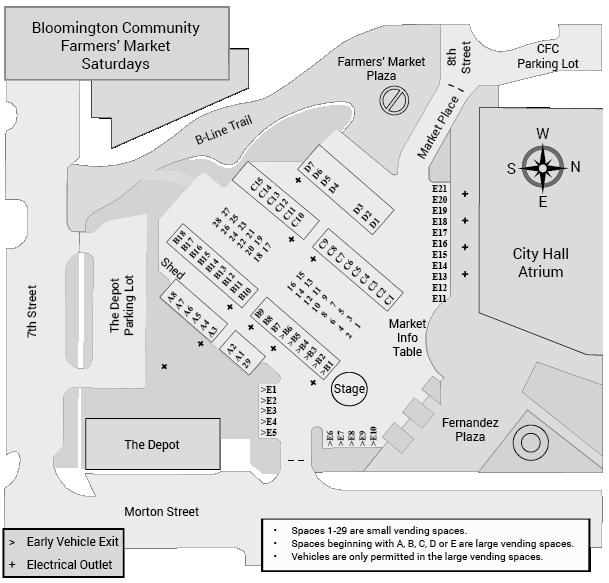
• The intention is to use the B, C and D shelters (see map on p. 20) as well as any small vending spaces for the reserved spaces.
• Space assignments will be based on April Market points earned.
• Vendor must occupy a reserved space by 7:30 a.m. on Market day or give up all rights to the space for that day.
• Day spaces will be available on a first-come, first-served basis. A map indicating which spaces are unreserved in April will be available in advance of the first Market and from the Market Coordinator.
• Unused, reserved spaces will be available on a first-come, first-served basis, as well. Vendors wishing to access these spaces need to contact the Market Coordinator. The Market Coordinator will notify them of the availability of those spaces at 7:30 a.m.
• After 8 a.m., vendors may utilize, for price of booth fee, the adjacent, unused spaces.
• Large vending spaces are approx. 9' × 26' in size and small vending spaces are approx. 9' × 8' in size. Due to space constraints, 10’ x 10’ size tents are not suitable at the Farmers Market. 9’ x 9’ tents fit large spaces and 8’ x 8’ tents fit small spaces. Vendors should keep their setup within their assigned space, allowing only for flared tent legs; however, the tent canopy itself must remain within the designated dimensions.
Vending Space
Large Space
Small Space
FBA Vendors
Food Truck
Reserved Price Day Price
$100 $25
$72 $18
$120 $30
$140 $35
The peak market runs every Saturday, May–October. Hours: May–September—8 a.m. until 12:30 p.m. and October—9 a.m. until 12:30 p.m. Reservations for May–October reserved vending spaces are made at the Space Reservation Meeting on Thursday, March 5, 2026.
Reserved space vendors are required to notify the Market Coordinator in person, by email— farmersmarket@bloomington.in.gov—or by phone—812-349-3738—before 5 p.m. Friday, or via the Market cell phone—812-327-7034—prior to 6:30 a.m. Saturday, if they will not be utilizing their space on a given Market day. If vendor does not notify the Market Coordinator in advance of an absence, it will be assumed vendor is not attending Market until notification of his/her attendance is received, and his/her space may in subsequent weeks be utilized as a day space.
In April–September, in order to alleviate congestion in the Market lot, trailers over 12' in length are required to either be parked in a vendor space or unloaded and removed from the Market by 7 a.m.
Early Vehicle Exit Spaces: Sixteen vending spaces have been designated “Early Vehicle Exit” spaces. Only vendors occupying the “Early Vehicle Exit” spaces are allowed to exit the Market site, with a Market staff escort, in motorized vehicles between 9:30 a.m. and noon (April–September) and between 10:30 a.m. and noon (October). The Market Coordinator will determine whether or not it is safe to leave.
Procedures for exiting the Market at 12:30 p.m.: The Market Coordinator will indicate when vehicle traffic is permitted only for vendors removing their vehicles from the Market. Also, the Market Coordinator will indicate to waiting vendors when space allows for vehicles to enter the Market (vehicles only will be permitted first, followed by vehicles with trailers in tow).
In November, all vendor vehicle traffic is permitted at the conclusion of the Market at 12:30 p.m.
Procedures for entering and exiting the Market may be modified if conditions warrant.
Stand Information for the May–October Market
• Reservations for vending spaces are made in advance of the start of the Market season at the Space Reservation Meeting. Each vendor may only reserve one vending space unless otherwise assigned.
• Day spaces are available on a weekly basis.
• Vendors must occupy a day (if already assigned) or reserved space by 7:30 a.m. in May–September and 8:30 a.m. in October, or give up all rights to the space for that day.
• Vehicles not parked within a large vending space need to be removed from the lot by 7:30 a.m. in May–September and 8:30 a.m. in October, unless the vendor is accessing an unused, reserved vending space that was reassigned at 7:30 a.m. or 8:30 a.m., respectively.
• Large vending spaces are approx. 9' × 26' in size and small vending spaces are generally 9' × 8' in size. Due to space constraints, 10’ x 10’ size tents may not be the best fit at the Farmers Market. 9’ x 9’ tents fit large spaces and 8’ x 8’ tents fit small spaces. Vendors should keep their setup within their assigned space, allowing only for flared tent legs; however, the tent canopy itself must remain within the designated dimensions.
Vendors interested in participating in the initial distribution of these spaces should park their vehicles outside the Market and report to the Market manager at the Market shed by 7 a.m. Day vendors may not set up/drop off items in a space prior to the lottery.
Vendors who do not have a space will select one space first, followed by vendors interested in accessing a second space, and then vendors interested in more than two spaces. Space assignments in the 7 a.m. pool will be based on the number of points earned by the vendor as of the space reservation meeting for the 2026 season.
Vendors interested in accessing day spaces, arriving after 7 a.m., should contact the Market Coordinator. Once all vendors in the 7 a.m. pool have received their spaces, they will be assigned to vendors arriving after 7 a.m. in order of arrival.
In the event all designated spaces are occupied, the Market manager may assign “overflow” small vending spaces in locations that do not interfere with customer walkways, current vendor spaces and emergency access. These spaces may be smaller than 9' × 8' and can only be utilized by vendors occupying a single stand. Every effort will be made to find space for all interested vendors.
Vendors interested in participating in the initial distribution of these spaces should park their vehicles outside the Market and report to the Market Coordinator at the Market shed by 8 a.m.
Vendors who do not have a space will select one space first, followed by vendors interested in accessing additional spaces, with no limit on the number of spaces they may select. Space assignments in the 8 a.m. pool will be based on the number of points earned by the vendor as of the 2026 Space Reservation Meeting.
Vendors interested in accessing day spaces, arriving after 8 a.m., should contact the Market Coordinator. Once all vendors in the 8 a.m. pool have made their space selections, spaces will be assigned to vendors arriving after 8 a.m. in order of arrival, with no limit to the number of spaces they may select.
Saturday Farmers’ Market Reserved Spaces (May thru October-27 Days)
Vending Spaces Day Price Reserved Pricing Notes
Application Fee ($20)
Large $25 $675
Small $18 $486
Application fee is a one-time fee to cover administrative costs associated with signing up to sell at market.
Vending Spaces Price Notes
Large space rate per day
Small space rate per day
FBA Vendors rate per day
Food Truck rate per day
Mushroom Inspection per occurrence
$25
$18
$30
$35 or $50
$5
Same for 2nd space
Same for 2nd space
Food Trucks that exceed the standard 8’ x 10’ space allocation will be assessed a flat fee of $50
The Tuesday Market runs each Tuesday, June–September from 4 p.m.–7 p.m. at Hopewell Commons, 630 S. Morton St.
Reserved space vendors are required to notify the Market Coordinator in person, by email— farmersmarket@bloomington.in.gov—or by phone—812-349-3738 before 5 p.m. Monday, or via the Market cell phone—812-327-7034—prior to 3 p.m. Tuesday, if they will not be utilizing their space on a given Market day. If vendor does not notify the Market manager in advance of an absence, it will be assumed vendor is not attending Market until notification of his/her attendance is received, and his/her space may in subsequent weeks be utilized as a day space.
Entering and Exiting the Market
At 3 p.m. and 7 p.m., the Market Coordinator will coordinate entry to and exit from the Market. No vehicle traffic will be permitted during Market hours (4–7 p.m.)
Stand Information for the Tuesday Market
• Reservations for reserved vending spaces will be assigned based on the point system. Each vendor is limited to one reserved 10' x 10' vending space, unless otherwise assigned.
• Day vending spaces are available on a first-come, first-served basis.
• Vendors’ setup must be within the boundaries of their space, although vendors’ tents or other shelters may extend in front of their space(s), with manager discretion to allow for adequate shading of their product.
• Vendors may not begin setting up until 3 p.m. Vendors must occupy a reserved space by 3:30 p.m. on Market day or give up all rights to the space for that day.
Vendor Parking for the Tuesday Market
There is ample parking available for vendors in the immediate vicinity of the Market.
Weekday Farmers’ Market (Tuesday Market June thru September- 18 days)
Application Fee ($20)
Application fee is a one-time fee to cover administrative costs associated with signing up to sell at market.
Weekday reserved space $216
Weekday unreserved space
$12
The November Market is held the first three Saturdays in November from 9 a.m. until 12:30 p.m. at Switchyard Park Pavilion, 1601 S. Rogers St. To reserve a space, reservation forms need to be submitted by the last Market day in September. Space Reservation Forms for the November Market are available from the Market Coordinator.
Entering and Exiting the Market
At 8 a.m. and 12:30 p.m., the Market staff will coordinate entry to and exit from the Market. No vehicle traffic permitted between 9 a.m. and 12:30 p.m.
Rental Fees for the November Market
The Holiday Market is the last Saturday in November from 10 a.m. until 3 p.m. To reserve a space, space reservation forms need to be submitted by the last Market date in September. There will be no day spaces available. Space Reservation Forms for the Holiday Market are available from the Market Coordinator.
Entering and Exiting the Market
Proceeding to and from the Holiday Market is the same as during the May–October Market (see p. 10–11), except that vendors must occupy their space by 9:30 a.m. and may not exit the Market until 3 p.m.
Stand Information for the Holiday Market
• The intention is to use the large spaces in the A, B, C, and D shelters (see map on p. 20). The small vending spaces in the middle of the Market may be available for reservation as well (please note small vending space preferences in the special request section of the Space Reservation Form). The setup may be adjusted depending on the number of Space Reservation Forms received.
• Space assignments will be based on Holiday Market points earned (with previous May–October points used as a tie breaker) and space availability.
Additional Information Specific to Selling at the Holiday Market
Vendors earn one point for each year in attendance at the Holiday Market.
Rental Fees for the Holiday Market Cost is $30 per farm vending space.
Market customers can purchase Market Gift Certificates, vouchers which are valued at $5 or $20 each, good toward the purchase of products at the Market. Any product offered by participating vendors is eligible. Customers can purchase gift certificates in the atrium in City Hall, or in the Parks and Recreation office in City Hall, Monday–Friday from 8 a.m.–5 p.m. Gift certificates are good for one year from the date of issue. Vendors may give cash change for gift certificate purchases.
Market Bucks improve access for community members with limited incomes to fresh, local food while increasing the customer base for Market vendors. During Saturday Market hours, in the City Hall atrium, and during Tuesday Market hours, at the Market Information Table, nutrition assistance recipients can exchange the electronic SNAP benefits on their Hoosiers Works cards for Market Bucks (vouchers valued at $3 each). The Market Bucks can be spent with participating farmers and prepared food vendors for allowable foods.
Allowed foods include fresh fruits and vegetables, meat, eggs, dairy products, bread and other baked goods, cereal and edible grains, packaged foods not intended for on-site consumption, and plants or seeds which will produce food. Packaged coffee and tea may be purchased, but not brewed coffee or tea prepared for on-site consumption. Please note that this is a federal program and adherence to rules by all vendors is extremely important.
Disallowed products include foods sold hot or prepared for on-site consumption, wine, any hot or cold prepared beverages, any food purchased with the intent of reselling and any non-food items.
Once the customer has made his/her selection, the vendor will verify the eligibility of the selected products, tally the prices and inform the purchaser of the total. In the event that the purchase does not equal an amount divisible by three, the customer may elect to pay the additional amount, or may add or subtract items in order to equal a three dollar increment. No money may be given as change or exchanged for Market Bucks. Market Bucks must be dated with a 2026 stamp.
Vendors are encouraged to participate in the Gift Certificate Program/SNAP (GCP/SNAP) offered by the Market. Vendors who have no SNAP-eligible products, and therefore cannot accept Market Bucks, can still participate in the Gift Certificate Program by following the same steps listed below.
In order to participate, all vendors must: 1) Indicate on the Market application their intention to participate, 2) fill out and return, or have on file, a W-9 form and a City of Bloomington Vendor EFT form, included in the Training Guide, which will be provided, and 3) read the GCP/SNAP Farmer/Food and Beverage Artisan Vendor Training Guide.
Vouchers may be redeemed on Saturdays in the City Hall atrium from 9 a.m.–noon and at Tuesday Market. At the Holiday Market, redemptions may be turned in at the Market Information Table from 10 a.m.–2:30 p.m.
The vendor will receive a redemption receipt and will be forwarded payment from the City of Bloomington within a few weeks. All Gift Certificates and/or Market Bucks should ideally be submitted at Market by the Holiday Market (or no later than December 15). Contact the Market Coordinator with any redemption questions.
Food safety starts on the farm. It is vitally important to practice safe food handling on your farm to help protect public health, as well as your family, business and livelihood.
All items intended for human consumption must be kept out of direct contact with the asphalt at all times and be in safe and sound condition. The vendor is solely responsible for damages resulting from the sale of unsafe or unsound goods. Glass containers used for display purposes must be properly secured. With the exception of service animals, animals are not permitted in the Market.
Vendors interested in offering samples of their products should see the Market Coordinator for Sampling Guidelines.
Each vendor must supply his/her own tables or other display equipment. Umbrellas or other weather protection devices are supplied by the vendor and must be securely anchored. The vendor is solely responsible for damages or personal injury resulting from the use thereof. Prior approval is required for any heat-producing devices. Vendors will be required to adjust their setup if it is determined to be unsafe by the Market manager. If selling items by weight, the Vendor must use an N.T.E.P. certified scale which is legal for trade. This scale will be subject to periodic inspection by the Monroe County Department of Weights and Measures. Some produce items are limited by what ways they can be sold. Please contact the Monroe County Department of Weights and Measures to learn about the legal method of sale for the most common fruit and vegetable items. Contact information is on p. 19 in the “Vendor Resources” section.
Plants, crafts and other non-food items sold in Indiana are subject to sales tax. Vendors should apply for a Registered Retail Merchant’s Certificate (RRMC). A business tax application (BT-1) must be filed through the Indiana Department of Revenue along with a registration fee. RRMCs must be renewed every two years.
On Saturdays, excluding the Holiday Market, vendors must vacate the premises, including the removal of all personal items and equipment, by 2 p.m. On Tuesdays vendors must vacate the premises, including the removal of all personal items and equipment, by 7:30 p.m.
The Farmers’ Market Nutrition Program (FMNP) is a USDA-funded program managed by the Indiana State Department of Health. The FMNP has two components: 1) For Women, Infants and Children (WIC) program participants and 2) for older adults with limited incomes. Participants in the FMNP are provided with vouchers which can be used to purchase fresh fruits and vegetables from participating vendors. Vendors with qualifying products (fruits and vegetables) are strongly encouraged to participate. Vendors must be approved by the Indiana State Dept of Health prior to participating in this program. See “Vendor Resources” on p. 19 for contact information or ask the Market Coordinator for help.
The Indiana Specialty Agriculture, Organics, and Small Farms Resource Guide is available online. Visit www. ams.usda.gov/nop for more information, including a list of USDA-accredited certification agencies. Federal law, which went into effect in 2002, requires that any grower with sales over $5,000 calling their product organic, must be certified organic by a USDA-accredited agency. Growers with gross sales less than $5,000 may call their product organic as long as they sign an affidavit to that effect and comply with all other USDA rules.
There is an automated teller machine located in City Hall on the first floor, between the men’s and women’s restrooms.
In the event of thunder, lightning, high winds, tornado, hail or other severe weather at the Market site, it is recommended that participants take shelter on the lower level of City Hall. In the case of heavy rain, thunder or lightning, if you cannot take cover in the building, then move to an enclosed vehicle with a metal roof and closed windows, taking care not to touch the metal frame of the vehicle until the threat has passed.
The Monroe County emergency sirens sound with a steady tone in the event that the National Weather Service has issued a tornado warning for the county or if emergency personnel have sighted a funnel cloud or tornado. At the time of the siren sounding, the Market Coordinator will alert Market patrons that the lower level of the City Hall is the safest nearby location and to seek shelter until the threat has passed. The tornado siren will sound for 5 minutes, but the cessation of the siren does not necessarily mean that the threat of a tornado has passed. Market staff will notify participants in City Hall when it is safe to return to the Market.
Sustained adverse weather or a potential natural disaster may necessitate a decision to suspend or cancel the Market. The safety of vendors, customers, and staff are always at the forefront of Market management’s judgment. Prior to such a decision, consultation will take place with appropriate City safety staff and/or county agencies such as the Monroe County Office of Emergency Management, or the National Weather Service.
Farm Vendors and Food and Beverage Artisans are invited to submit information and a photo for an online profile page on the Market website: bloomington.in.gov/farmers-market/vendor. The profiles give Market customers a chance to learn more about participating Market farm vendors or businesses, growing practices, available product and contact information. The City reserves the right to edit or modify any content submitted to ensure it is appropriate for the City website and consistent with the City’s objectives and goals.
To establish a profile submit an online form. The link to the online form will be available on the website after the space reservation meeting. Visit bloomington.in.gov/farmers-market for the online form. Profile information is due by March 23, 2026. Updates to existing profiles will be made once a year, during the application period, unless a major life event occurs that makes the profile inaccurate.
The City retains its rights to terminate the Market, or to change the times, dates, locations and/or policies related to the Market, at its sole discretion, whenever the City finds that it is in the public interest to do so. The City will make reasonable efforts to provide adequate notice of changes and cancellations to all vendors. In the event of Market suspension or termination, vendors will be reimbursed for their Reserved Space Fee, pro rata based on the number of weeks the Market is not open.
Commitment to the City of Bloomington’s Values and the Market’s Mission
The City of Bloomington considers diversity a source of strength that adds to Bloomington’s character. The Bloomington Community Farmers’ Market, as a program of the City, works to create an environment where all can feel welcome and safe regardless of race, religion, color, national origin, ancestry, sex, disability, sexual orientation, gender identity, veteran status, housing status or familial status. As a party to the Bloomington Community Farmers’ Market Farm Vendor Contract, vendors shall collaborate with each other and the City, assisting in creating a welcoming environment for all who attend the Market and shall represent themselves in a professional manner that reflects their commitment to the Market’s mission and customer satisfaction. Behavior outside of the Market that relates to the Market must not reflect poorly on the Market or the reputation of the City and must be consistent with the mission of the Market as presented in Part 1, Section A.
Vendors acknowledge that the City of Bloomington prohibits its employees from engaging in harassment or discrimination on the basis of sex, race, religion, color, national origin, ancestry, disability, gender identity, sexual orientation, housing status or veteran status, including harassing or discriminating against vendors or their stand assistants at the Market. If a vendor or stand assistant believes that a City employee engaged in such conduct at the Market towards the vendor and/or any of its stand assistants, the vendor may file a complaint with the Market Coordinator and/or with the City Human Resources Department or the Bloomington Human Rights Commission. The City takes all complaints of harassment and discrimination seriously and will take appropriate disciplinary action if it finds that any City employee engaged in such prohibited conduct at the Market.
Maintaining a supportive, respectful, and welcoming atmosphere at the Bloomington Community Farmers’ Market is critical to the overall success of the Market. Professional conduct is expected at all times. Yelling, swearing, or other harassing or threatening behavior in person or via digital media will not be tolerated. This type of behavior may result in expulsion from the Bloomington Community Farmers’ Market. Vendors who are expelled from the Market may appeal the decision to the Farmers’ Market Advisory Council or Board of Park Commissioners, depending on the infraction.
Market management cannot effectively act on rumor or anonymous, vague, or untimely complaints about the conduct of others. All complaints by a vendor against another vendor must be submitted in writing to the Market Coordinator. Unsigned complaints will not be addressed. Complaints must be signed by individuals with direct knowledge of facts and events. Market management will strive to handle all complaints as efficiently, fairly, and discreetly as possible.
• All complaints by a vendor against another vendor must be submitted in writing to the Market Coordinator within 14 days of the incident in question. Complaints by or about customers must also be submitted in writing.
• Consultation with knowledgeable individuals such as Monroe County Health Department officials, Human Rights Commission, Bloomington Police Department or other local experts may be needed in the evaluation of complaints.
• Market management will investigate the allegations regarding vendor farms and/or products within 21 days. This may include an inspection visit to the accused vendor’s farm or production site.
• The complainant and alleged violator may be asked to agree to attend a joint meeting if the Market Coordinator determines this would be useful in resolving the situation. The purpose of such a meeting would be to clarify policies, determine whether and to what degree there was a violation, and to determine what disciplinary action, if any, is appropriate.
• All investigations will be done directly and privately. At the conclusion of the investigation, a summary finding will be placed in the Market files and given only to parties involved. However, the complaint and all records of the investigation and sanctions are public records subject to disclosure pursuant to Indiana Law.
• The Market Coordinator and City of Bloomington Parks and Recreation representatives have full authority to interpret, implement, and enforce policies. Violation of these rules is cause for imposing sanctions up to and including expulsion from the Market.
Vendors must display a sign at their stand identifying their name, or the name of their farm or business.
Smoking and vaping are prohibited within the Market, as defined by the paved area of Showers Common, the Market B-Line Café, and the fee area of Info Alley during Market hours or on the Fernandez Plaza during events.
Do not tape anything to the shelters.
There are a few electric outlets located in the Market (see map on p. 20). Vendors located next to an outlet may utilize the electricity for themselves and/or allow other vendors access. Extension cords may not cross frequently traveled customer paths. Generators are not permitted.
The Market partners with the Farm to Family Fund to collect extra farm products at Saturday and Tuesday Markets. These products are distributed to local food pantries. More information about these opportunities will be available from Market staff.
Any produce that is too damaged to donate to the Farm to Family Fund must be removed from the Market. Do NOT place compost in the trash containers.
Clean up your area prior to leaving the Market. Dustpans and brooms are available in the Market shed for your use.
Be considerate of vendors downstream, and pour excess water out on the plants in the landscaped areas.
Landscaping carts are available on a first-come, first-served basis at the Market shed to assist you in moving produce and supplies in and out of the Market. After using, please return carts to the Market shed.
Vendors must work together when maneuvering vehicles through the Market. In particular, vendors unloading and removing vehicles (especially vehicles with trailers) from the Market must do so in a timely manner and in a way that does not unreasonably disrupt the vendor vehicle traffic flow in to and out of the Market. Detailed information on trailers in the Market is found on p. 10.
What the City expects from Vendors
Vendors and their stand assistants shall not be discourteous, disrespectful or dishonest to anyone with whom they interact at the Market, including Market customers and attendees, other vendors, staff, volunteers, entertainers or anyone else at the Market. It is expected that day stall vendors pay their fees on the day of reservation. This applies to all vendors, not just day vendors.
Conduct at the Market on the part of a vendor or stand assistant that the City deems to be contrary to the provisions of the Vendor Contract, the Market Handbook or any Market rules may result in administrative action in accordance with the provisions of the Vendor Contract, including but not limited to suspension or ejection from the Market and/or future Market events. Vendors may appeal an adverse administrative action in accordance with paragraph 6 of the Bloomington Community Farmers’ Market Farm Vendor Contract. Vendors shall notify the Market Coordinator or Supervisor immediately of any unsafe conditions. Vendors shall partner with the City to create a Market where every visitor feels welcome and safe. This includes practicing respectful customer service, following all Market policies, and working with staff to resolve issues quickly.
Vendors may not engage in political or religious activities at the Market, except for Info Alley.
What Vendors expect from the City
The City shall treat vendors and their stand assistants with courtesy, respect and honesty. The City provides the Market as a location for producers to sell what they grow or create. Vendors understand that by managing the Market, the City is making no guarantee of the number of customers or the volume of business.
Department of Natural Resources, Entomology Division
402 W. Washington St., Room 290W Indianapolis, IN 46204
317-232-4120
www.in.gov/dnr/entomology
Indiana Department of Health eFMNP
WIC Commodities Team
2 N. Meridian St. 5th Floor Indianapolis, IN 46204
wiccommoditiesprograms@health.in.gov
800-522-0874
www.in.gov/health/wic/farmers-marketsstandsinformation
Monroe County Department of Weights and Measures
119 W. Seventh St. Bloomington, IN 47404
812-349-2543
www.co.monroe.in.us
Monroe County Extension Office 3400 S. Walnut St. Bloomington, IN 47401
812-349-2575
extension.purdue.edu/county/monroe/index.html
Monroe County Health Department— Environmental Health Specialist
119 W. Seventh St. Bloomington, IN 47404
812-349-2896
www.co.monroe.in.us
State Egg Board
Poultry Science Building, Purdue University
125 S. Russell St. West Lafayette, IN 47907
765-494-8510
www.ansc.purdue.edu/ISEB
City of Bloomington Human Rights Commission
Bloomington City Hall
401 N. Morton St., Suite 220 Bloomington, IN 47404
812-349-3471
https://bloomington.in.gov/boards/human-rights
• Friday, February 20, 2026—Farm vendor applications shall be on file if reserving a space at the time of the space reservation meeting.
• Thursday, March 5, 2026 May–October and April Market Space Reservation Meeting and Mandatory Vendor Meeting. All vendors wishing to vend during the 2026 season shall plan on attending. Time and location information will be shared with vendors.
• Friday, March 13, 2026—Vendor contracts/W9’s/Electronic Funds Transfer forms are due by 5 p.m.
• Friday, March 20, 2026–Online and paper Vendor Profile submissions for the Market website due.
• Saturday, April 4, 2026—Bloomington Community Farmers’ Market begins.
• Friday, October 16, 2026—November Market and Holiday Market Space Reservation Forms shall be turned in at Market or to the Parks and Recreation Office.
• Farm Vendor Application—All vendors selling at Market shall have this form on file by Friday, February 20, 2026.
• Exhibits to the Contract—Any vendor selling Value-Added Foods, Home-Based Vendor Foods, Pet Foods, Shell Eggs (not from chicken), or Aquaculture Foods shall have the appropriate Exhibit on file along with any additional paperwork required by the different regulatory agencies, which are specified on each Exhibit, by March 9, 2026.
• Farm Vendor Contract—All vendors selling at Market shall have this form on file by March 13, 2026. Vendors joining after April 4, 2026, shall have this form on file prior to the first day of selling at the market.
• November and Holiday Market Space Reservation Forms—Any vendor interested in reserving a space for one of these Markets shall turn in reservation forms by the Friday, October 16, 2026 deadline listed for each above.
• City of Bloomington W-9 and Vendor EFT Forms—Any vendor accepting Gift Certificates and/or Market Bucks (see p. 14) shall have these forms on file by Friday, March 13, 2026.