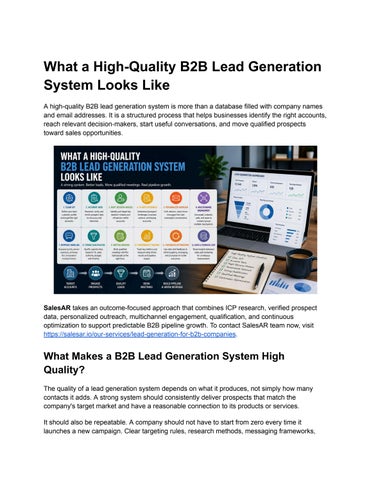
What a High-Quality B2B Lead Generation System Looks Like A high-quality B2B lead generation system is more than a database filled with company names and email addresses. It is a structured process that helps businesses identify the right accounts, reach relevant decision-makers, start useful conversations, and move qualified prospects toward sales opportunities.
SalesAR takes an outcome-focused approach that combines ICP research, verified prospect data, personalized outreach, multichannel engagement, qualification, and continuous optimization to support predictable B2B pipeline growth. To contact SalesAR team now, visit https://salesar.io/our-services/lead-generation-for-b2b-companies.
What Makes a B2B Lead Generation System High Quality? The quality of a lead generation system depends on what it produces, not simply how many contacts it adds. A strong system should consistently deliver prospects that match the company's target market and have a reasonable connection to its products or services. It should also be repeatable. A company should not have to start from zero every time it launches a new campaign. Clear targeting rules, research methods, messaging frameworks,
qualification criteria, and performance tracking create a process that can be improved and scaled over time. Most importantly, the system should connect lead generation with actual sales outcomes. Generating replies is useful, but qualified meetings and active opportunities provide a clearer picture of whether the process is working.
1. A Clearly Defined Ideal Customer Profile Every effective B2B lead generation system starts with a well-defined Ideal Customer Profile, or ICP. The ICP describes the companies most likely to benefit from the offer and become valuable customers. It can include industry, company size, location, revenue range, business model, growth stage, technology use, and common business challenges. Without a clear ICP, prospecting becomes too broad. Sales teams may receive contacts from companies that look relevant based on one characteristic but do not actually fit the solution. A useful ICP should be specific enough to guide prospect research while still allowing room to discover new high-potential account segments.
2. Accurate and Verified Prospect Data Even strong targeting can fail when the underlying data is unreliable. Job titles change, employees move between companies, businesses enter new markets, and contact information becomes outdated. A high-quality system therefore includes data verification before outreach. Researchers should confirm company information, contact details, job roles, and other important fields so campaigns are built on reliable information. Accurate data can also support better email deliverability by reducing invalid addresses and unnecessary outreach to irrelevant contacts. SalesAR's current B2B lead generation framework includes prospect research and data quality, with prospects manually researched, verified, and prepared for outreach based on agreed ICP criteria.
3. Decision-Maker Targeting A company can be a perfect account but still produce a weak lead if the outreach reaches the wrong person.
B2B purchases often involve several stakeholders. Depending on the solution, the relevant people may include executives, department heads, technical specialists, procurement teams, finance leaders, or operational managers. A strong lead generation system maps the relevant roles within target accounts rather than assuming the highest-ranking employee is always the right contact. This improves outreach relevance and gives sales teams a better chance of reaching someone who can influence the buying process.
4. Research Before Outreach High-quality prospecting does not stop at confirming a job title. Researchers should understand enough about the account and prospect to explain why the outreach is relevant. Useful research may include business changes, market activity, company growth, product launches, hiring, technology use, or challenges associated with the prospect's industry. This context can improve both targeting and messaging. It also helps sales teams avoid sending generic emails that could have been written for any company.
5. Relevant and Personalized Messaging Personalization is most effective when it has a purpose. Adding a prospect's name to a standard message does not automatically make the outreach relevant. Good B2B messaging connects the prospect's situation with a clear business problem or opportunity. It should quickly explain why the sender is reaching out and why the conversation may be worth having. Personalized outreach does not require writing every message from scratch. Businesses can develop messaging frameworks for different industries, roles, or account segments and then adapt them using relevant prospect information. SalesAR highlights personalized campaigns designed for decision-makers as one of the core elements of its B2B lead generation approach.
6. A Multichannel Outreach Strategy Email remains useful for B2B outreach, but a high-quality system should not automatically depend on one communication channel.
Depending on the market and audience, businesses may combine email, LinkedIn, phone calls, and personalized engagement. Each channel can serve a different purpose within the prospecting process. For example, email may introduce the conversation, LinkedIn may support familiarity, and a phone call may provide a direct follow-up. The objective is not to contact prospects repeatedly across every available platform but to create a coordinated experience. SalesAR's outbound framework combines LinkedIn, email, and personalized engagement to reach buyers across relevant channels.
7. Strong Qualification Before Sales Handoff Not every response should become a sales meeting. A prospect may reply out of curiosity, ask for general information, or show interest without having a current need. Qualification helps determine whether the opportunity has enough potential to move forward. Depending on the business, this can include checking company fit, business need, decision-making role, timing, and other relevant criteria. Good qualification protects sales teams from spending too much time on poor-fit meetings while allowing genuinely interested prospects to move forward quickly. A strong lead generation system therefore measures more than contacts and replies. It also considers lead quality, qualified meetings, and the eventual sales outcome.
8. Clear Conversation Handling The process after a prospect replies is just as important as the initial outreach. A high-quality system should have a clear method for reviewing responses, understanding intent, answering questions, and deciding on the next step. Some prospects may be ready for a meeting, while others may need more information or a different follow-up. Human judgment is particularly important here because prospects rarely respond in exactly the same way. Flexible conversation handling can help preserve genuine interest rather than forcing every reply into a standard sequence. SalesAR includes conversation handling and qualification as part of its lead generation framework, connecting prospect responses with qualified meeting opportunities.
9. Continuous Performance Tracking
A campaign should not be judged only after it ends. Ongoing performance tracking helps businesses understand what is happening while outreach is active. Useful metrics can include email delivery and bounce rates, reply rates, positive response rates, qualified meetings, meeting show rates, and downstream sales opportunities. These numbers become more useful when viewed together. A high reply rate is not necessarily positive if most replies come from poor-fit prospects. Similarly, a large number of meetings has limited value if very few become genuine opportunities. The goal is to understand which parts of the system contribute to pipeline quality.
10. Continuous Optimization Markets change, messages lose effectiveness, and prospect behavior evolves. A high-quality lead generation system therefore needs regular testing and adjustment. Teams can test different subject lines, messaging angles, audience segments, outreach channels, and qualification criteria. They can then use campaign data to decide what should be expanded, changed, or removed. Sales feedback is also important. If sales representatives repeatedly report that certain contacts are not decision-makers, the targeting criteria should be updated. If a particular industry consistently produces stronger opportunities, that segment may deserve greater attention. SalesAR's service structure includes performance tracking, campaign optimization, and real-time lead feedback and adjustments to improve targeting and outreach over time.
Two Signs Your Lead Generation System Needs Improvement ● Your database keeps growing, but qualified opportunities do not: This often points to weak targeting, poor data quality, or a lack of qualification. ● Your campaigns generate responses, but sales struggles to convert them: The issue may sit in messaging, response handling, qualification, or the handoff between outreach and sales. These signs show why lead generation should be evaluated as a complete system instead of through a single metric.
11. A Reliable CRM and Feedback Process
A high-quality system needs a reliable place to manage prospect information and campaign history. A CRM can help teams track account details, outreach activity, responses, qualification status, meetings, and follow-up actions. But technology alone is not enough. Teams also need clear rules for updating records and recording useful feedback. When information is kept consistent, researchers can learn from sales conversations and sales teams can see what has already happened with an account. This reduces duplicated work and helps preserve important context throughout the buyer journey.
12. Scalability Without Losing Quality A successful lead generation system should be able to grow without turning into mass outreach. Scaling does not simply mean adding thousands of contacts. It means expanding campaigns while maintaining the same standards for ICP fit, data accuracy, personalization, qualification, and performance monitoring. Businesses can scale by adding suitable account segments, testing new markets, increasing successful outreach volumes, or expanding channels while keeping quality controls in place. SalesAR describes its process as outcome-driven and designed to scale successful campaigns after performance data identifies what works.
Conclusion A high-quality B2B lead generation system is built around relevance, accuracy, consistency, and continuous improvement. It starts with a clear ICP, identifies the right accounts and decision-makers, verifies prospect data, creates relevant outreach, and uses multiple channels when appropriate. It then continues through response handling, qualification, meeting booking, performance tracking, and sales feedback. The biggest difference between a basic lead list and a strong lead generation system is what happens between those contacts and the sales pipeline. A well-designed system turns research into targeted outreach, outreach into meaningful conversations, and qualified conversations into opportunities that sales teams can actually pursue. That connected approach is what allows B2B companies to grow their pipeline without relying on contact volume alone.