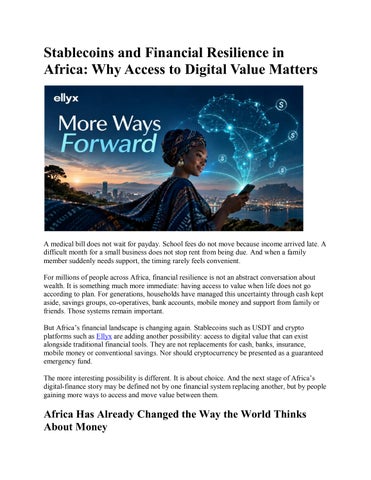
Stablecoins and Financial Resilience in Africa: Why Access to Digital Value Matters
A medical bill does not wait for payday. School fees do not move because income arrived late. A difficult month for a small business does not stop rent from being due. And when a family member suddenly needs support, the timing rarely feels convenient. For millions of people across Africa, financial resilience is not an abstract conversation about wealth. It is something much more immediate: having access to value when life does not go according to plan. For generations, households have managed this uncertainty through cash kept aside, savings groups, co-operatives, bank accounts, mobile money and support from family or friends. Those systems remain important. But Africa’s financial landscape is changing again. Stablecoins such as USDT and crypto platforms such as Ellyx are adding another possibility: access to digital value that can exist alongside traditional financial tools. They are not replacements for cash, banks, insurance, mobile money or conventional savings. Nor should cryptocurrency be presented as a guaranteed emergency fund. The more interesting possibility is different. It is about choice. And the next stage of Africa’s digital-finance story may be defined not by one financial system replacing another, but by people gaining more ways to access and move value between them.
Africa Has Already Changed the Way the World Thinks About Money
Africa’s digital-finance transformation did not begin with cryptocurrency. Mobile money had already changed how millions of people send, receive and manage money long before stablecoins entered the mainstream conversation. The scale is now extraordinary. According to the GSMA’s State of the Industry Report on Mobile Money 2026, mobile-money services processed approximately $2.1 trillion in transactions during 2025. The ecosystem reached 2.3 billion registered accounts and 593 million active 30-day accounts globally, with Sub-Saharan Africa continuing to play a central role in its growth. The World Bank’s Global Findex 2025 provides another important signal. Formal saving in Sub-Saharan Africa increased by 12 percentage points between 2021 and 2024, reaching 35% of adults. That is significant progress. But being able to send money digitally and being financially resilient are not exactly the same thing. Someone can receive money instantly on a phone and still struggle when income stops unexpectedly. A mobile-money balance can make payments easier while also being easy to absorb into everyday spending. A bank account can help organise money but may not solve every issue around access, currency or international digital payments. This is why the next chapter of financial inclusion may be less about whether someone has an account and more about how many useful financial options they can access.
The Financial Challenge Is Often About Timing Much of traditional personal finance assumes regular income. Real life frequently looks different. A freelancer may receive several payments in one week and then wait weeks for the next project. A merchant can experience strong and weak months. Agricultural income is often seasonal. A household can suddenly face healthcare expenses. School fees arrive according to a calendar, not according to when income is convenient. This creates a fundamental financial challenge. It is not always simply about how much money someone has. It is also about where that value is held, how accessible it is, how easily it can be moved and whether part of it can remain separate from everyday spending. That is what makes financial resilience such an important concept. And it is also why digital finance is beginning to extend beyond payments.
Why Stablecoins Are Becoming Part of the Conversation Stablecoins occupy a different position from many cryptocurrencies. Assets such as Bitcoin can experience substantial price movements. Stablecoins are designed around another purpose: maintaining a value linked to a reference asset, most commonly the US dollar. USDT is one of the most widely used examples. That does not make USDT the same as US dollars held in a regulated or insured bank account. Stablecoins involve issuer, technology, custody, liquidity, platform and regulatory risks that users need to understand. But the underlying use case is different from pure speculation. A person searching for “Bitcoin price today” may be following an investment market. Someone searching for “USDT to KES”, “USDT to UGX”, “USDT to TZS”, “USDT to ZMW” or “XAF to USDT” may be trying to solve a more practical question:
How can local money connect with digital-dollar value? That difference is important. It helps explain why stablecoins have become increasingly relevant across African digital-finance markets. Chainalysis reported that Sub-Saharan Africa received more than $205 billion in on-chain cryptocurrency value between July 2024 and June 2025, approximately 52% more than during the previous 12-month period. The region remains smaller than the world’s largest crypto markets in absolute value. But its usage patterns are particularly interesting because retail activity and practical financial use cases play a meaningful role. The bigger story, therefore, is not simply that more cryptocurrency is moving through Africa. It is why people are using it.
From Crypto Speculation to Financial Utility The crypto industry has historically talked a great deal about prices, market cycles and trading. But many of the next generation of digital-asset users may have completely different priorities.
A freelancer working with international clients may need to receive or manage digital value. A small business may need greater flexibility when interacting with different currencies or financial platforms. A remote worker may operate across several financial ecosystems. A household may want to keep different pools of money separated for different purposes. A user may simply want access to USDT.
These people may never think of themselves as “crypto investors”. They are looking for utility. This distinction could be particularly important in Africa. The future opportunity is not convincing everyone to abandon traditional money for cryptocurrency. It is making digital assets another understandable financial tool that can connect with the systems people already use.
Cash can continue to matter. Banks can continue to matter. Mobile money can continue to expand. Stablecoins can exist alongside them. The real opportunity is interoperability. Where Ellyx Fits Into This Changing Landscape
Ellyx crypto exchange platform providing access to digital-asset services across supported markets. Its current infrastructure supports USDT through the Tron TRC20 network for supported wallet operations including deposits, withdrawals and internal transfers. This focused approach is relevant to a market where users increasingly search for practical concepts such as USDT Africa, USDT TRC20, digital dollars, crypto exchange Africa and local-currency-toUSDT conversion.
Ellyx also supports users across numerous African countries. Its current documentation includes markets such as Kenya, Uganda, Tanzania, Zambia, Cameroon, Ghana, Rwanda, South Africa, Zimbabwe, Mozambique and Senegal, among others. The importance of this goes beyond simply putting countries on a list.
Crypto is global. People are local.
Someone in Kenya thinks about Kenyan shillings and the financial tools available in Kenya. A user in Uganda experiences finance through Ugandan shillings and local financial infrastructure. The realities of Tanzania, Zambia and Cameroon are different again. A global digital asset becomes genuinely useful only when people can understand how it relates to their own financial world. That is where platforms such as Ellyx can contribute: reducing the distance between global digital assets and the everyday financial reality of users in supported markets.
Financial Separation Can Be as Important as Financial Access There is also a behavioural side to financial resilience. People have separated money for centuries. One amount for food. Another for rent. Another for school. Something else kept aside for an unexpected expense. The technology changes, but the psychological principle does not. Money mixed into everyday spending is often easier to spend. Digital finance can create new ways to separate financial purposes. A person may use one service for daily transactions, another for longer-term savings and another for certain forms of digital value. For someone who understands stablecoins and their risks, a separate digital-asset balance could become one component of a wider financial structure. That does not mean USDT should be marketed as an emergency savings guarantee. It should not. The better concept is financial optionality: having access to more than one appropriate financial tool rather than depending entirely on one channel. Financial resilience should create more choices, not a new dependency.
Why USDT TRC20 Matters One phrase that appears frequently around stablecoin usage is “USDT TRC20”. For new users, the terminology can be confusing. USDT is the digital asset. TRC20 refers to the token standard used on the Tron blockchain. This distinction matters because blockchain transfers require compatible networks. Sending cryptocurrency through an unsupported network can result in funds being lost. Ellyx currently supports USDT through the Tron TRC20 network. Its Help Centre advises users to verify the network before transferring funds because transactions made through unsupported networks may not be recoverable. What sounds like a technical detail is actually part of a much broader requirement for the industry. If digital assets are going to reach larger audiences, financial education has to develop alongside access.
Users need to understand what they are holding, which network they are using, where their assets are located and which risks remain. Making these concepts understandable may be more valuable in the long term than simply offering more cryptocurrencies.
Trust Will Matter More Than Hype Financial products are ultimately built on trust. That becomes even more important when the conversation involves money that someone may need later. Trust cannot come from simply saying that a platform is trustworthy. It has to be built through clarity. Users need understandable account controls, transparent transaction information, identity and account-security processes, clear deposit and withdrawal statuses, accessible support and straightforward explanations of risk. The same principle applies to stablecoins themselves. Users should understand that price stability is an objective of a stablecoin structure, not a guarantee that every associated risk disappears. They should understand that blockchain transactions can be irreversible. And they should understand the difference between a crypto balance and money protected under a conventional deposit-guarantee scheme. Responsible digital finance does not hide complexity behind marketing. It translates complexity into something people can actually understand.
The Most Important Innovation May Be Interoperability Africa does not necessarily need one new financial system to replace everything that came before it. The more interesting future is one in which multiple systems become increasingly connected. A person’s financial life can already involve cash, a bank account, mobile money, local payment systems, online services and digital assets. In the years ahead, the ability to move between these environments may become increasingly important.
Local currency and digital value. Domestic finance and international platforms. Traditional financial infrastructure and blockchain-based systems.
This is where the long-term potential of crypto becomes much more meaningful. Instead of existing as an isolated world primarily for traders, digital assets can become another layer of global financial infrastructure. Crypto platforms can become bridges between these environments. Africa is particularly important in this evolution because the continent has already demonstrated something essential: people adopt financial technology when it solves a real problem. Mobile money did not succeed because millions of consumers became fascinated by telecommunications infrastructure. It succeeded because it became useful. Stablecoins will face exactly the same test.
Africa Does Not Need More Crypto Hype The industry should pay attention to what future users actually care about.
A parent thinking about school fees does not need blockchain jargon. A freelancer receiving an international payment may care more about access than market speculation. A small-business owner managing unpredictable cash flow does not necessarily want to become a crypto trader. People want financial tools that make sense in their lives.
That requires a different type of communication from crypto companies. Less hype. More education. Less obsession with token prices. More practical utility. Less emphasis on making people “crypto users”. More focus on making digital finance understandable. For platforms such as Ellyx, this creates a larger opportunity than simply participating in another technology trend. It creates an opportunity to help connect people with a financial ecosystem that is becoming increasingly digital, international and interconnected.
Financial Inclusion Is Evolving Into Financial Resilience For years, one of the central questions in financial inclusion was simple: Does a person have access to a financial account? That question still matters. But it may no longer be enough. A more useful set of questions is beginning to emerge.
Can people access different financial systems when they need them? Can they move between local and global forms of value? Do they understand the digital assets they use? Can they separate different financial purposes? Do they have alternatives if one financial channel becomes unavailable or unsuitable?
This represents a subtle but important evolution. Financial inclusion is about getting through the door. Financial resilience is about what happens after you enter.
A Future Built Around More Than One Way Forward
A medical bill may arrive tomorrow. School fees may be due next week. A business may unexpectedly need liquidity. Income may arrive later than planned.
Technology cannot prevent those moments. Cryptocurrency cannot eliminate financial uncertainty. Stablecoins cannot guarantee financial security. And no responsible crypto platform should suggest otherwise. But technology can continue doing something that has already transformed finance across Africa: giving people more options. Mobile money gave millions of people another way to access and move value. Digital banking added more possibilities. Stablecoins are introducing another financial layer. Platforms such as
Ellyx are helping connect that layer with a wider digital economy. The future of African finance may therefore not be about choosing between banks, mobile money and crypto. It may be about learning how these systems can coexist and connect. Because financial resilience is not simply about having more money. It is about having more ways to respond when circumstances change. More understanding. More flexibility. More choice. And when life does not go according to plan, more than one way forward.
Why are stablecoins becoming relevant in Africa? Stablecoins can provide access to dollar-linked digital value and are increasingly used within international digital payments, crypto transfers, online commerce and other financial activities. Their role is developing alongside Africa’s established banking and mobile-money infrastructure rather than necessarily replacing it.
What is USDT? USDT is a stablecoin designed to track the value of the US dollar. It is widely used across crypto platforms and blockchain networks. USDT remains a digital asset and should not be considered equivalent to money held in an insured bank deposit.
What is USDT TRC20? USDT TRC20 means USDT operating on the Tron blockchain using the TRC20 token standard. Users transferring USDT must make sure the sending and receiving services support the same blockchain network.
What is Ellyx? Ellyx is a crypto exchange platform providing access to digital-asset services across supported markets. Its current infrastructure supports USDT through the Tron TRC20 network.
Is Ellyx available in Africa? Ellyx currently supports users in numerous African markets, including Kenya, Uganda, Tanzania, Zambia, Cameroon, Ghana, Rwanda, South Africa, Zimbabwe, Mozambique and Senegal, among others. Availability and supported functionality should always be checked against the platform’s current documentation.
Can stablecoins replace emergency savings?
Stablecoins should not be treated as guaranteed replacements for cash, insured deposits or other conventional emergency reserves. They involve different technological, issuer, custody, liquidity and regulatory risks. Their potential role is better understood as one possible component of a broader financial toolkit for people who understand those risks.
Can crypto improve financial resilience in Africa? Crypto cannot by itself solve financial insecurity. Its potential contribution is narrower: it can add another way to access, hold or transfer certain forms of digital value. When combined responsibly with existing banking, savings and mobile-money infrastructure, that can give some users additional financial options.