

Chicago from reservations all over the country [fig. 6.1].2 Organized by Native activists in Chicago in cooperation with local social clubs and organizations, the AIC began as a space to help newly arrived Native families navigate life in the city and find community with one another.3 Since it opened, the AIC has served as a hub of Native art, life, and culture in Chicago, filling gaps in state-run social programs and providing a space for community members to deepen their connections to their roots while establishing themselves in the city. It was one of the first urban Native centers to be established in the United States, and it remains central to the Chicago Native community. In the decades before a formal gallery existed, the AIC served as a space for Native artists to host art shows and sales; groups like the Chicago Indian Artists Guild and individual artists like Robert Wapahi (Dakota Santee Nation) presented pop-up exhibitions there.4 In the 1990s, the AIC shifted to more structured arts programming, focused on re- centering Native creators as artists and connecting the younger generations to their tribal identities. According to the AIC’s interim executive director, Dave Spencer (Choctaw/Diné), “The goal was to rebalance powwow with fine arts. Powwow is intertribal, which is important to identity as an urban Native, where focusing on arts, and specifically first-voice representation in arts, is a way to connect to tribal-specific identities and traditions.”5 Among its art-focused programming, the AIC presents exhibitions in its gallery and offers a variety of programs that feature artists and artmaking. In 2003, the AIC celebrated its fiftieth anniversary with a gallery exhibition
Fig. 6.1 Leroy Wesaw (Pokagon Band of Potawatomi, 1952–2022), American Indian Center Sign when the Center Was Located on LaSalle Street, date unknown. Exhibition records for Seeing Indian in Chicago, 1958–84. The Newberry Library, Chicago.

Fig. 6.3
to foster contemporary and traditional art education, often centered around challenging stereotyped conceptions of what constituted Native art [fig. 6.2].7 Also in 1977, Sharon Okee-Chee Skolnick (Fort Sill Apache/Lakota), another of the guild’s founding members, said, “People want a traditional-looking thing—they think an Indian artist should paint traditional-looking things . . . but I just paint as I feel” [see fig. 3.5].8 Similarly, Poco spoke of young Native artists emulating art styles that mainstream audiences expected, even if they were not rooted in any real Native community’s tradition.9 The CIAG strove to push against these pressures by providing a space for open creativity that was not bound to non-Native perceptions. Guild members, like Skolnick and Poco, hoped to inspire and train younger generations of Native artists to make a space for themselves in both the art world and the city. Poco said, “I would like to see a renaissance of Indian art, a rebirth if you will, of some of the Indian artists of today. I would encourage them to draw for all Indians’ sake. . . . There are not that many Indian artists as far as the rest of the population. I think Indian artists will be kind of like a boon in later years. Indian artists work[ing] now aren’t going to have the recognition due [to] them in, say, thirty to forty years from now. Their work hasn’t been
Fig. 6.3 Brochure for the First Annual Art Exhibit and Sale of the American Indian Economic Development Association, 1993. Native American Educational Services, American Indian Economic Development Association Records, box 6, folder 7. Hanna Holborn Gray Special Collections Research Center, University of Chicago Library.
6.4 Wild Horse Gallery business card. Collection of Nora Moore Lloyd. Photograph by Holly Trevan.
that well known.”10 The guild hoped to rectify this situation, aiming to ultimately open a permanent Native- owned gallery through which to share all styles of Native art in Chicago (see Wild Horse Gallery below).11
Wild
Horse Gallery (1980s–1990s)
Today’s Indian Artists Are Creating Tomorrow —Wild Horse Gallery business card12
Sharon Okee-Chee Skolnick realized her dream from her days in the Chicago Indian Artists Guild when she opened Wild Horse Gallery in the mid-1980s [fig. 6.4]. The gallery served as a platform for Indigenous art and artists in Chicago and continued the CIAG’s work as a site for mentorship, culture keeping, and social networking. Through Wild Horse Gallery, Skolnick supported the next generation of Native artists by providing a gateway to the city. Skolnick was known for letting artists new to Chicago stay in the gallery if they had no place to live when they first arrived in the city. She also provided portfolio advice, bought artwork from young artists so they could pay rent, and advised them on obtaining representation. Skolnick and Wild Horse further acted as a hub for connecting artists with Indigenous art opportunities, as the city would often contact her first with any prospective programming.
American Indian Economic Development Association (1985–2001)
The American Indian Economic Development Association (AIEDA) was formed in 1985 with a mission to promote economic development within the Chicago Native community. This Native-run organization focused on advocacy and programming for Chicago’s urban Native population. By 1990, the AIEDA determined that Native Americans were underrepresented in museums and galleries and saw the economic benefit of creating more opportunities in arts and cultural institutions. To that end, it formed a subcommittee focused on creating a Native American cultural center in Chicago, seeking to “establish a Chicago-based institution which would serve as a

Fig. 6.4

living museum, preserving and interpreting aspects of Native American Indian (NAI) cultures, while exploring new income-producing opportunities for Native Americans. This facility will organize, promote and preserve Native American arts and crafts through the support of NAI artists, the expansion of public awareness and the definition and development of markets.”13 Through its cultural center, the AIEDA created a Native artist registry and offered a hub for finding Native artists, performers, and teachers citywide. It established an art residency at Chicago’s River Park, where participants could learn arts such as sweetgrass basket weaving, writing, painting, singing, and sewing. It worked with other Native organizations to sponsor events, like the First Nations Film and Video Festival of Chicago, which continues to promote original works by Indigenous film and video creators.14 The AIEDA arranged internships for Native artists in Chicago museums and Native-focused art galleries, including the Field Museum, Jan Cicero Gallery, the Mexican Fine Arts Center Museum (now the National Museum of Mexican Art), and the Mitchell Museum of the American Indian (now the Gichigamiin Indigenous Nations Museum). It co-sponsored events with museums, cultural institutions, and Native-led arts organizations to give Native artists
Indian Land Dancing
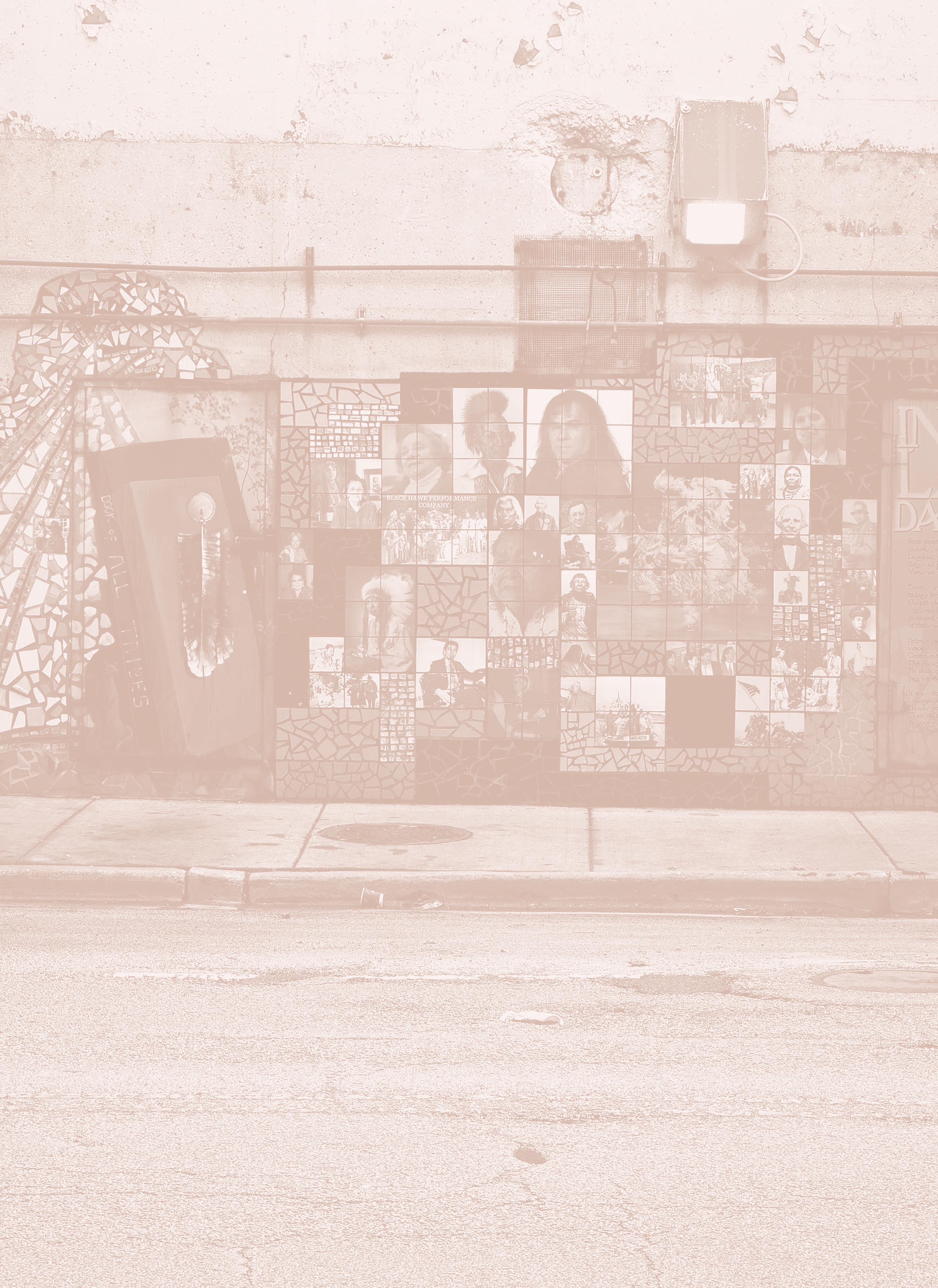
section), Foster Avenue underpass, date unknown. Chicago Public Art Group Photo Archives.
tours, and film screenings.16 It also serves as a place for Native artists to express their creativity and find fellowship while connecting their art to their cultures and histories. Among other priorities, Trickster works to increase the visibility of Native veterans and their contributions to the US military. For example, its Wall of Honor features a mixture of artwork and framed photographs of Native veterans in uniform, spanning from the Indian Wars beginning in the seventeenth century to modern conflicts in Iraq and Afghanistan.17 Speaking about the Wall of Honor in 2009, Vietnam veteran Joe Yazzie (Navajo), a Trickster artist in residence at the time, said, “We’re just trying to honor some of the people who served this country. We have every right to be remembered.”18 Through art, the Trickster Gallery and Cultural Center not only educates the general public about the role of Indigenous Americans in Chicago but also provides a space for recognition, commemoration, and community healing.
Indian Land Dancing Mural (2009)19
Events spiral to memories, linking lives to time and history. Culprit children frenzied with imagination stir small hands to mock battle, moments in a green galaxy of ferns and cedars and green pine trees. —E. Donald “Eddie” Two-Rivers (Ojibwe), “Indian Land Dancing”20
Developed in partnership with Chicago’s Native community and the Chicago Public Art Group, Indian Land Dancing is a vibrant bricolage mural on Foster Avenue in the city’s Edgewater neighborhood [figs. 6.5, 6.6]. The public artwork encapsulates Chicago’s relationship with Indigenous peoples—serving as a bridge between Native cultures of the past and present within Zhegagoynak. When interviewed about the work in 2009, artist Chris Pappan (Kaw [Kanza]/ Osage/Lakota), who served on the mural’s research committee, said, “We are contemporary, but we also have a foot in the past.”21 The American Indian Center, located near the mural, supported the project because of its focus on community involvement, as well as the location’s significance for Chicago’s Native history. According to historian Frances Hagemann, vice president of the AIC board when the mural was created, “The location is far more relevant than most people realize. Angle streets like Rodgers Avenue and Broadway are all former Indian trails that ran right through the Foster Avenue underpass.”22 Native artists, scholars, students, and elders came out to take part in the mural’s creation, adding photographs, regalia, maps, and more. Nora Moore Lloyd (Lac Courte Oreilles Band of Lake Superior Ojibwe), whose work is featured in Woven Being: Art for Zhegagoynak/Chicagoland, was among the artists who participated. She recalls traveling early in the morning to transport elders to the site, to ensure they were able to add a piece of their stories to the mural.23
Center for Native Futures (Established 2023)
During the global COVID-19 pandemic in 2020, a small community of Native artists developed the idea for a new nonprofit gallery space in Chicago that would center the promotion of Native art and artists. In 2023, the Center for Native Futures (CfNF) opened its doors in the Loop’s historic Marquette Building. Whereas early initiatives like the Chicago Indian Artists Guild had been unable to secure outside financial support, the Center for Native Futures received seed money from organizations such as the Terra Foundation for American Art and the MacArthur Foundation. Debra Yepa-Pappan (Jemez Pueblo/ Korean), a co-founder of CfNF and its director of exhibitions and programs, said, “These foundations, I think they’re in that moment now where they realize how they haven’t supported Native art and they’re all here now willing to support us because of what we’re doing.”24 Building on the work of the earlier initiatives, CfNF continues to challenge assumptions about what constitutes “Native arts,” and provides space for new and established Indigenous artists to showcase their contemporary works as part of a growing community focused on the future of Native art in Chicago. “This initiative has been a long time coming and the outpour of support is a clear indication that the city wants more contemporary Native art,” said Monica Rickert-Bolter (Prairie Band Potawatomi/Black), CfNF co-founder and director of operations. “CfNF is an investment in the community and a reaffirmation of the need for Indigenous artists for future generations.”25
Traveled to:
Chicago Historical Society, grand opening February 8, 2003
Spurlock Museum, Urbana, IL, January 27–June 26, 2004
State of Illinois Museum Gallery, Springfield, October 25, 2004–February 13, 2005
Castle Gallery, New Rochelle, NY, September 10–November 22, 2006
Mashantucket Pequot Museum, Mashantucket, CT, June 17–September 9, 2007
Comanche National Museum, Lawton, OK, September 14, 2007–January 3, 2008
Mayborn Museum, Waco, TX, 2009
Museo Nacional de Etnografía y Folklore, La Paz, Bolivia, August 2011 Museo Nacional de Arqueología y Etnología de Guatemala, Guatemala City, 2011
State of Illinois Museum Gallery, Springfield Elders Speak, October 25, 2004–February 13, 2005
Exhibited with 50 Years of Powwow
Trickster Gallery, Schaumburg, IL
Native Women’s Visions: Honoring Community through Art, September 23–December 30, 2005
Presented by the Native American Women’s Artist Guild
Trickster Gallery, Schaumburg, IL
Tribalistic Symphony, August 2006
Artists: Jessica Pamonicutt, Joe Yazzie, Ken Newton, Mike Marin, Joey Yazzie, Robert Wapahi
Elgin Community College, Elgin, IL
Native Women Artists: Creating Contemporary Life Journals, March 2–15, 2007
Artists: LeAnn Hascon (Navajo), Sharon Okee-Chee Skolnick (Apache/Sioux), Nora Moore Lloyd (Ojibwe), Julia Brown Wolf (Lakota), Frances Hagemann (Ojibwa/Metis)
Coordinated in partnership with the American Indian Center, Trickster Gallery, and Jessica Pamonicutt (Menominee Indian Tribe of Wisconsin) and Marcelyn M. Kropp (Osage/Kaw)
Cahokia Mounds Museum Society, Collinsville, IL
American Indian Photography Contest/Gallery Show, 2009
Foster Avenue underpass at Lake Shore Drive, Chicago Indian Land Dancing, completed July 2009
Mural developed in partnership with Chicago’s Native community and the Chicago Public Art Group
Trickster Gallery, Schaumburg, IL
Out of Context, Two Women Exhibition, August 1–October 31, 2009
Artists: Frances Hagemann (Ojibwe/Metis), Nora Moore Lloyd (Ojibwe), Norma Robertson (Dakota), Josee Starr (Arikara/Omaha/ Odawa), Robert Wapahi (Dakota)
Presented as part of Native American Heritage Month 2016, in partnership with the Chicago American Indian Community
The Art Center Highland Park, IL Contemporary Native American Art, 2018
American Indian Center, Chicago
Urban Sovereignty at the Center: American Indian Center Retrospective Part One, 2018
American Indian Center, Chicago [The] Native Art Seen, April 27, 2018
4000N (formerly the Northwest Portage Park Walking Museum), Chicago
Established August 2018
Artist: Santiago X (Coushatta Tribe of Louisiana [Koasati] and Indigenous CHamoru from the Island of Guam [Hacha’Maori])
Created in partnership between the Chicago Public Art Group, American Indian Center, and Portage Park Neighborhood Association
American Indian Center, Chicago
Roots of Resilience: Native Youth Art Exhibit, August 31–October 12, 2018
American Indian Center, Chicago
Standing Rock: Photographs of an Indigenous Movement, October 17–November 9, 2018
American Indian Center, Chicago
Modern TRADITIONS, March 8–June 28, 2019
Artists: Melissa Melero-Moose (Northern Paiute), Andrea Carlson (Ojibwe), Silvester Hustito (Zuni), Thomas “Breeze” Marcus (Tohono O’odham and Akimel O’odham, Ponca, Otoe)
American Indian Center, Chicago Reclaim: Indigenizing Colonized Spaces, July 17–September 23, 2019
American Indian Center, Chicago Visions of Home: Celebrating the Art of Leonard Peltier, November 15, 2019–January 30, 2020
Center for Native Futures, Chicago
Grand opening exhibition, September 17, 2023
ADDITIONAL RESOURCES CONSULTED
“American Indian Urban Relocation.” National Archives and Records Administration. Last reviewed October 4, 2024. Web.
Anthony Rayson Zine Collection. DePaul Special Collections and Archives, Chicago.
An Archive of Endurance. Newberry Library, Chicago. Digital exhibition.
Bureau of Indian Affairs Relocation Materials. Edward E. Ayer Collection. Newberry Library, Chicago.
Chicago American Indian Oral History Pilot Project. Native Voices in the City, 1982–1985. Edward E. Ayer Collection. Newberry Library, Chicago.
Chicago Field Office Photographs. Edward E. Ayer Collection. Newberry Library, Chicago.
Penney, David W., and Gerald McMaster. Before and After the Horizon: Anishinaabe Artists of the Great Lakes. Washington, DC: Smithsonian Books, 2013.
Ramirez, Reyna K. Native Hubs: Culture, Community, and Belonging in Silicon Valley and Beyond. Durham, NC: Duke University Press, 2007.
Lloyd, Nora, Warren Perlstein, Joseph Podlasek, and David Spencer. Chicago’s 50 Years of Powwows. In collaboration with Jane Stevens. Charleston, SC: Arcadia, 2004.
Townsend, Richard F., Robert V. Sharp, and Alan Bailey Garrick. Hero, Hawk, and Open Hand: American Indian Art of the Ancient Midwest and South. New Haven, CT: Yale University Press, 2004.
Two-Rivers, E. Donald. Powwows, Fat Cats, and Other Indian Tales Lawrence, KS: Mammoth Publications, 2003.
Virgil Vogel Papers. Edward E. Ayer Collection. Newberry Library, Chicago.
1 Terry Straus and Grant P. Arndt, eds., Native Chicago, 2nd ed. (Chicago: Albatross Press, 2002), 370. Pam Silas was known as Pam Alfonso in this period.
2 For a detailed account of the federal government’s relocation and termination programs, see Donald Lee Fixico, Termination and Relocation: Federal Indian Policy, 1945–1960 (Albuquerque: University of New Mexico Press, 1992).
3 For a detailed discussion on the founding of the AIC, see Grant Arndt, “‘Contrary to Our Way of Thinking’: The Struggle for an American Indian Center in Chicago, 1946–1953,” American Indian Culture and Research Journal 22, no. 4 (January 1, 1998): 117–34, web.
4 Dave Spencer, interview by the author, April 26, 2024.
5 Spencer, interview.
6 Loniel Poco, “Interview with Loniel Poco, Director of the Chicago Indian Artists Guild, Chicago, Illinois,” by Roberta Fiske-Rusciano and R. Hajnal, Chicago Ethnic Arts Project Collection, Library of Congress, May 19, 1977, audio, web.
7 Poco, “Interview with Loniel Poco.”
8 Sharon Skolnick, “Interview with Sharon Skolnick, Artist and Coordinator of the Foster Care Program at the American Indian Health Service, Chicago, Illinois,” by Roberta Fiske-Rusciano and R. Hajnal, Chicago Ethnic Arts Project Collection, Library of Congress, May 19, 1977, audio, web.
9 Poco, “Interview with Loniel Poco.”
10 Poco, “Interview with Loniel Poco.”
11 Skolnick, “Interview with Sharon Skolnick.” While this goal was never achieved by the guild as a group, Sharon Skolnick went on to open Wild Horse Gallery in the 1980s, and it served as a gallery for Native artists in Chicago for a decade.
12 Private collection of Nora Moore Lloyd.
13 “Executive Summary: Why This Center Should Be Established,” 1990–96, Native American Educational Services, American Indian Economic Development Association Records, box 6, folder 1, Special Collections Research Center, University of Chicago Library.
14 “Annual First Nations Native American Film/Video Festival of Chicago,” flyers, 1992–94, Native American Educational Services, American Indian Economic Development Association Records, box 6, folders 3–5, Special Collections Research Center, University of Chicago Library. See also the film festival’s website, fnfvf.org.
15 Connie Lauerman, “‘What Do They Have to Prove?’ Native American Artists Grapple with Questions of Culture, Identity and Seeing beyond Stereotypes,” Chicago Tribune, December 24, 1995.
16 Kara Silva, “Gallery Celebrates 5th Anniversary,” Chicago Tribune, March 11, 2010.
17 Dan Simmons, “Remembering Name, Tribe, Serial Number: Veterans Wall Honors American Indians’ Military Service,” Chicago Tribune, November 29, 2009.
18 Simmons, “Remembering Name, Tribe, Serial Number.”
19 Lead artists: Todd Osborne, Tracy Van Duinen, Cynthia Weiss; assistant artists: Andy Bellomo, Kamila Krusiva, Max Sansing; apprentice artists: Barahh Alaribe, Rhokym Alleyne, Ijeoma Arinze, Oneshia Collier, Kalvin Collins, Ramon Cruel, Dushawn Darling, Ikeyla Glover, Krystle Grayer, Luke Heikkler, Kevin Herron, Crystal Jackson, Zach Julian, Jade Lomax, Briana McCorkle, Samantha McCorkle, Lashawnda McCracken, Malik McCray, Dekiar McGee, Ziadelle McKeose, Alaysia Nelson, Ayana Peterson, Stephanie Posey, Darren Richardson, Kianna Richardson, Michael Schneider, Charie Toney, Ashley Weaver, Crystal Willis, Liah White, Lisa White; steering committee: Jolene Aleck, Richard Archambeau, Ruth Briccaman, Francis Hagemann, John Joe, Gerry Lang, Pascha Nihenhausen, Chris Pappan, Christine Redcloud, Sharon Skolnick, Cindy Starr, Doreen Weiss, Ernest Whiteman III, Debra Yepa-Pappan, J. Hae Yepa-Pappan.
20 The concept for the Indian Land Dancing bricolage mural is loosely based on the poem “Indian Land Dancing,” by E. Donald “Eddie” Two-Rivers (Ojibwe), which was painted into the mural. For more on Eddie Two-Rivers, see Anne Terry Straus’s chapter in this volume [pp. 69–70].
21 Clare Lane, “Vast Mural Will Depict Chicago’s Indian Roots,” Chicago Tribune, June 5, 2009, web.
22 Lane, “Vast Mural Will Depict Chicago’s Indian Roots.”
23 Nora Moore Lloyd, interview by the author, February 2, 2024.
24 Chadd Scott, “Center for Native Futures Gallery Opening in Chicago,” Forbes, September 14, 2023, web.
25 “Chicago’s Only Native Artist–Led Fine Art Gallery Opens in the Loop,” Chicago Loop Alliance, September 2023, web.