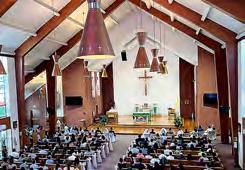
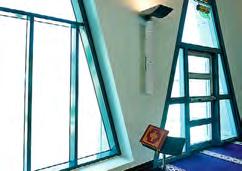
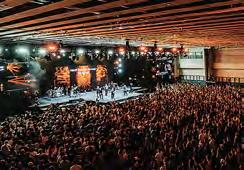
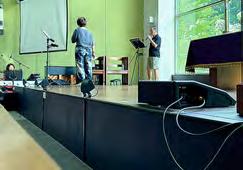
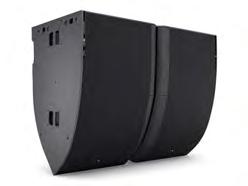
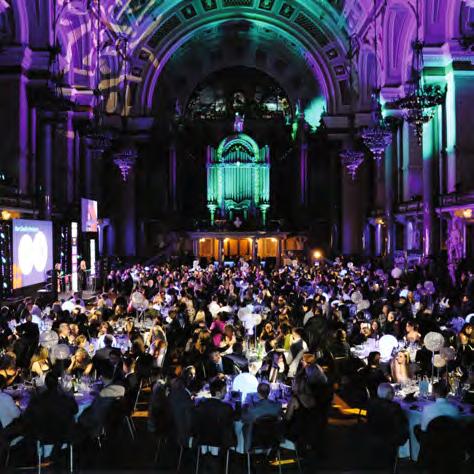
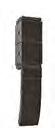
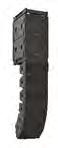
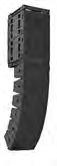
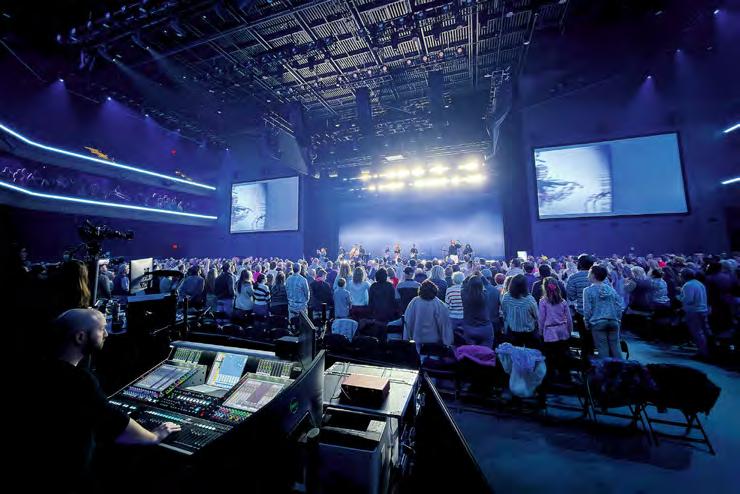
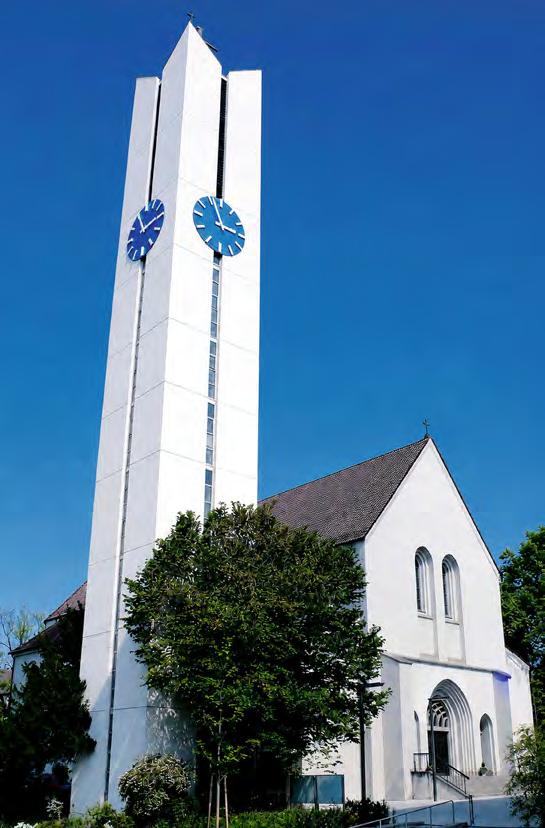
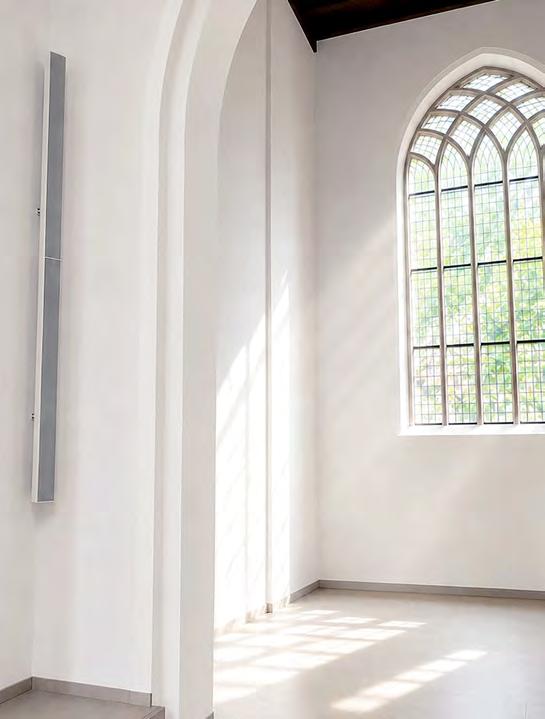
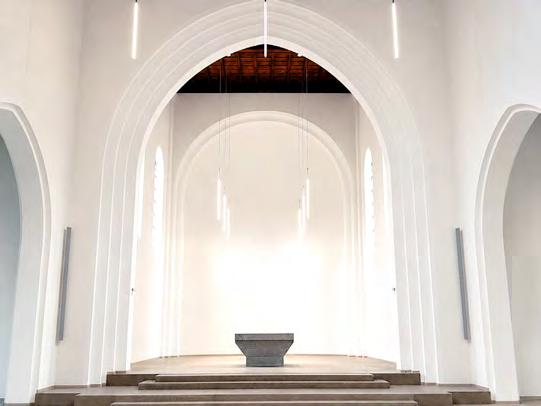
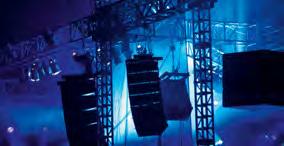
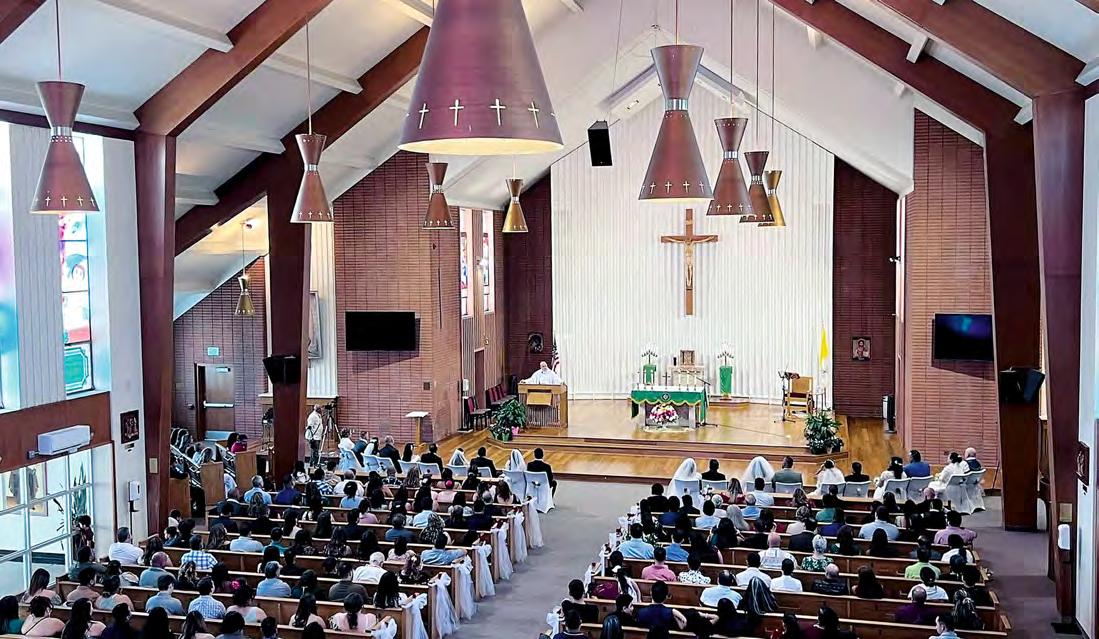
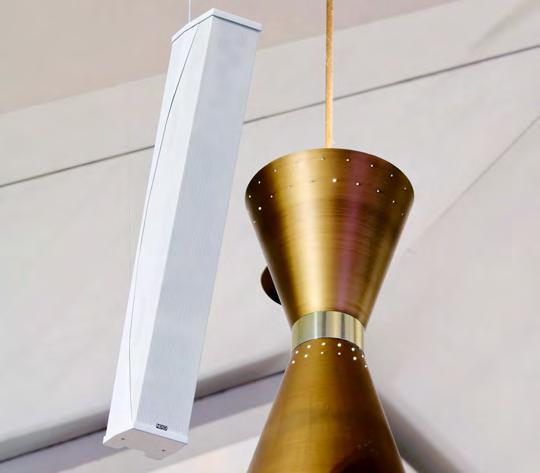
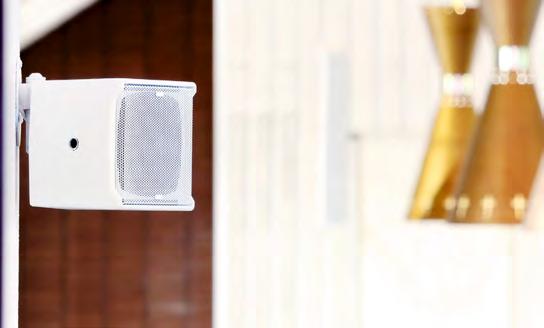
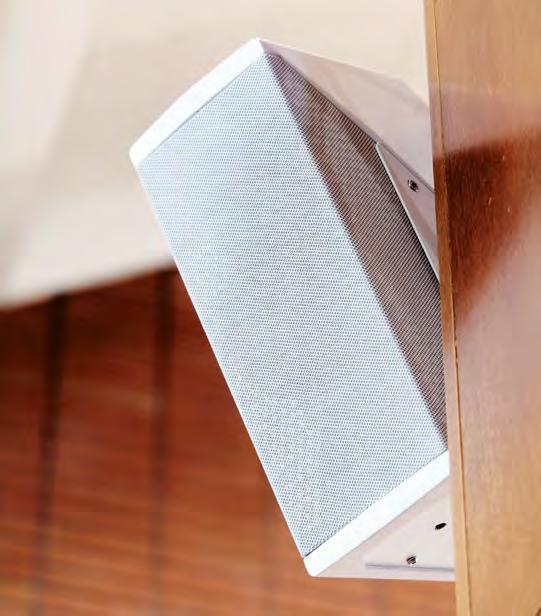
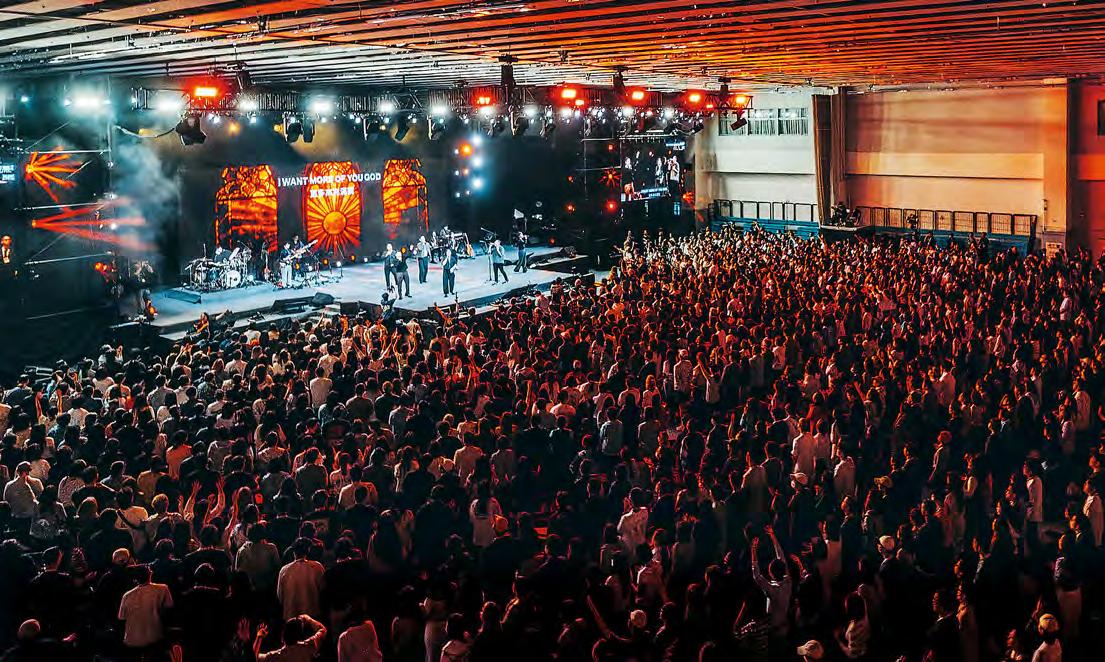
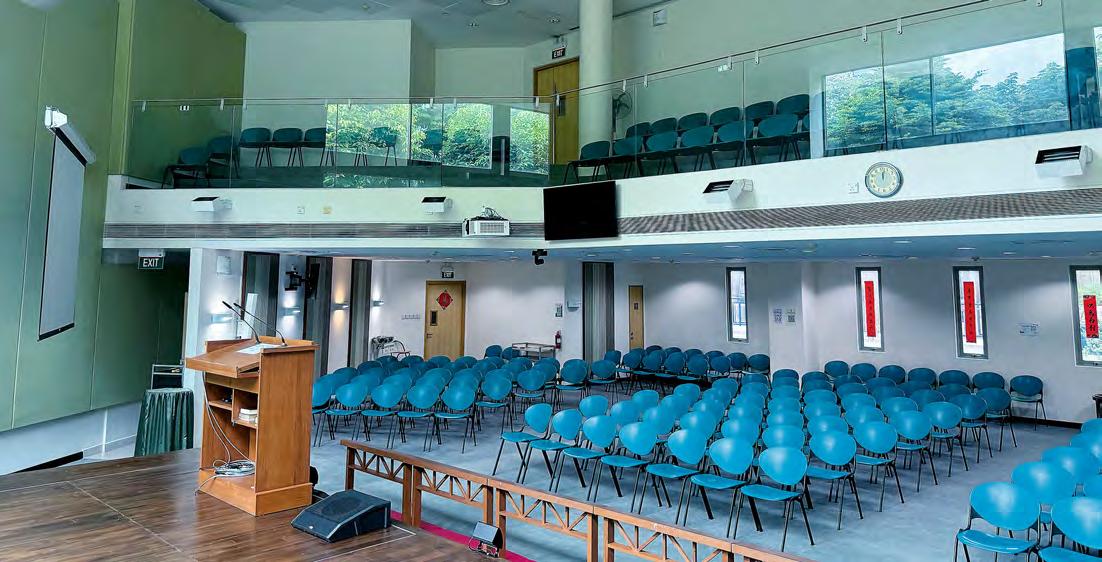
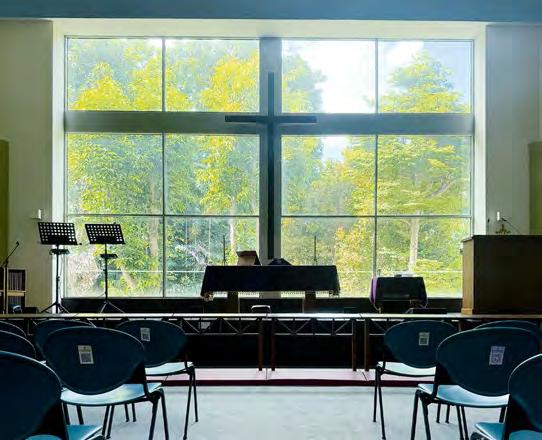
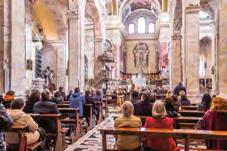
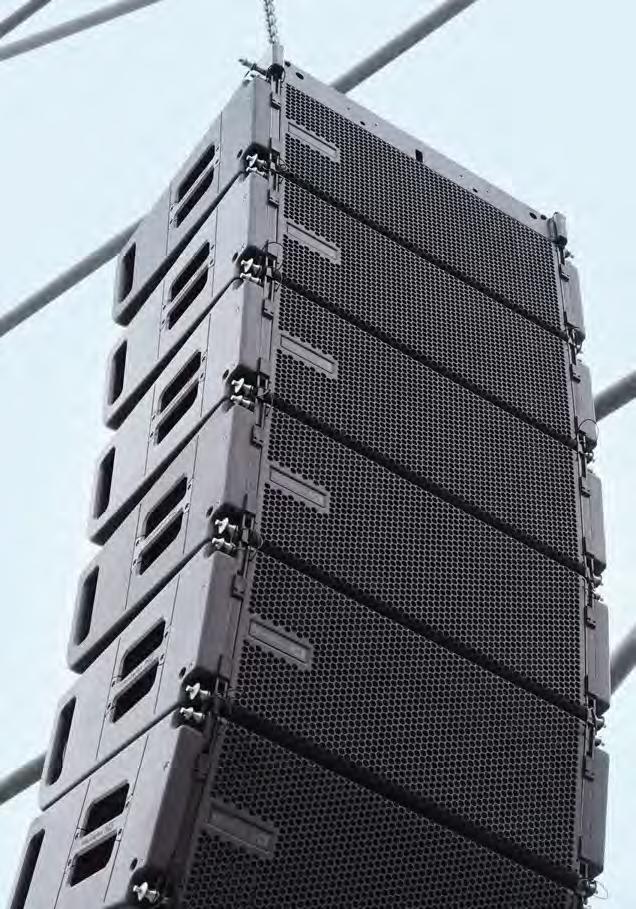
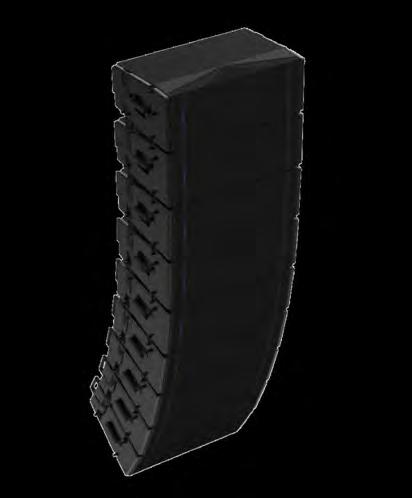
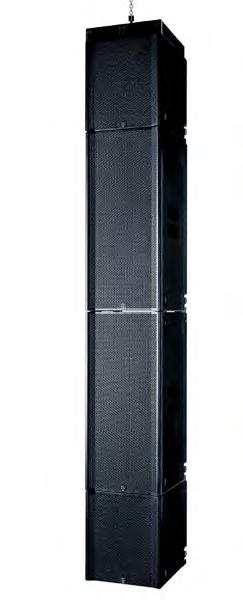
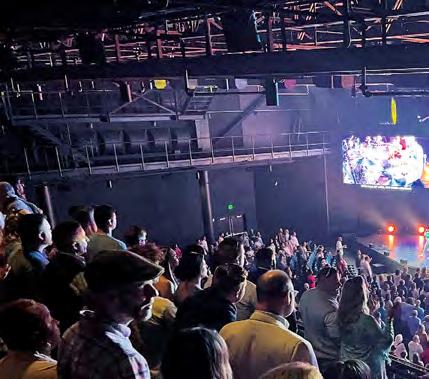
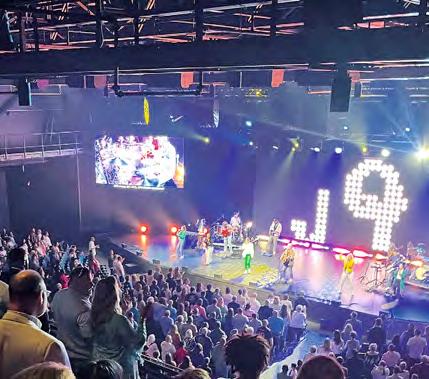
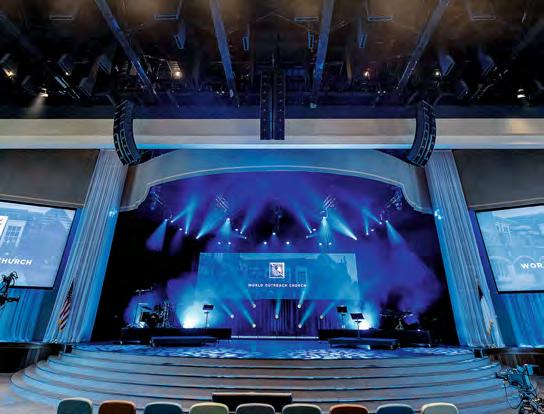
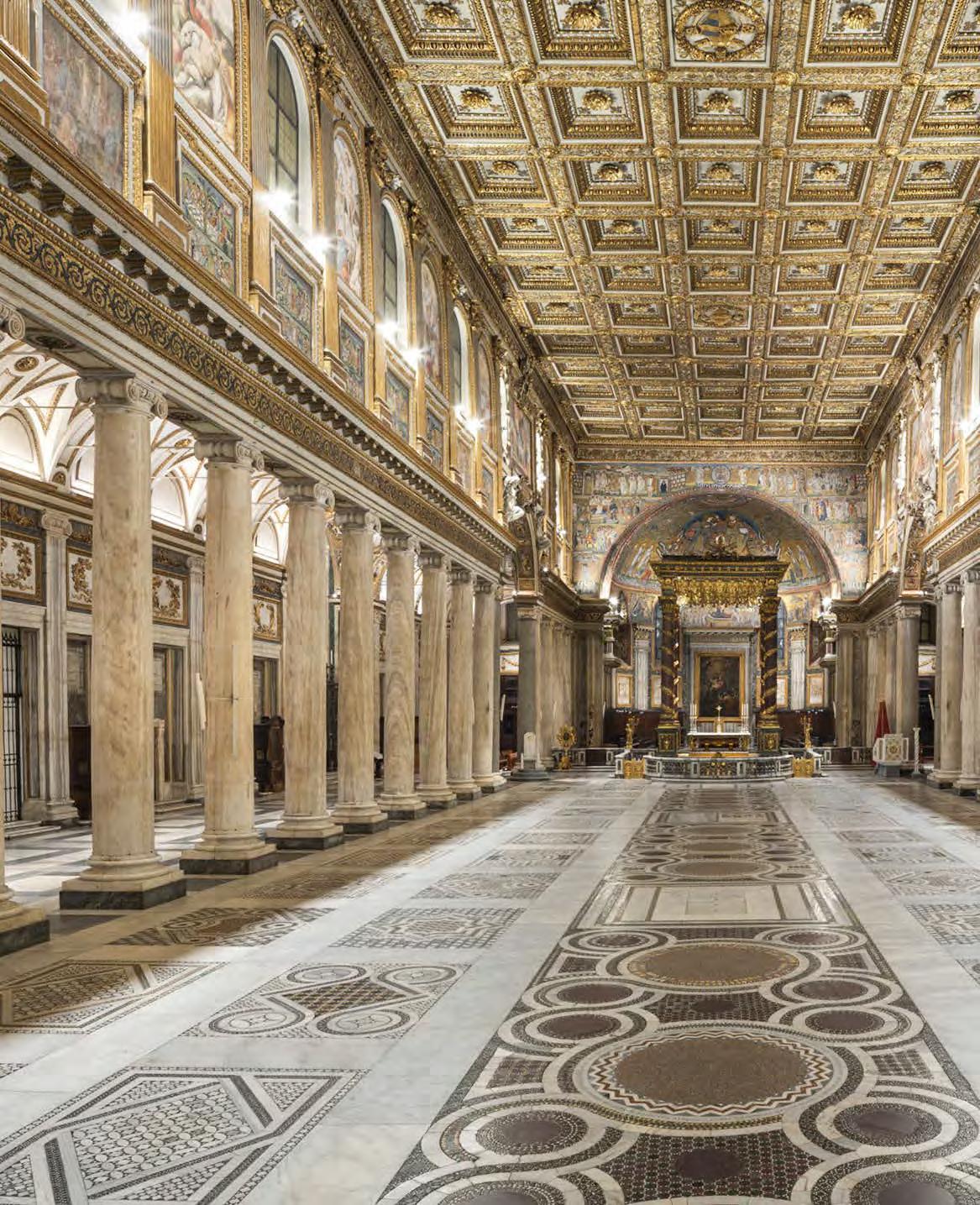
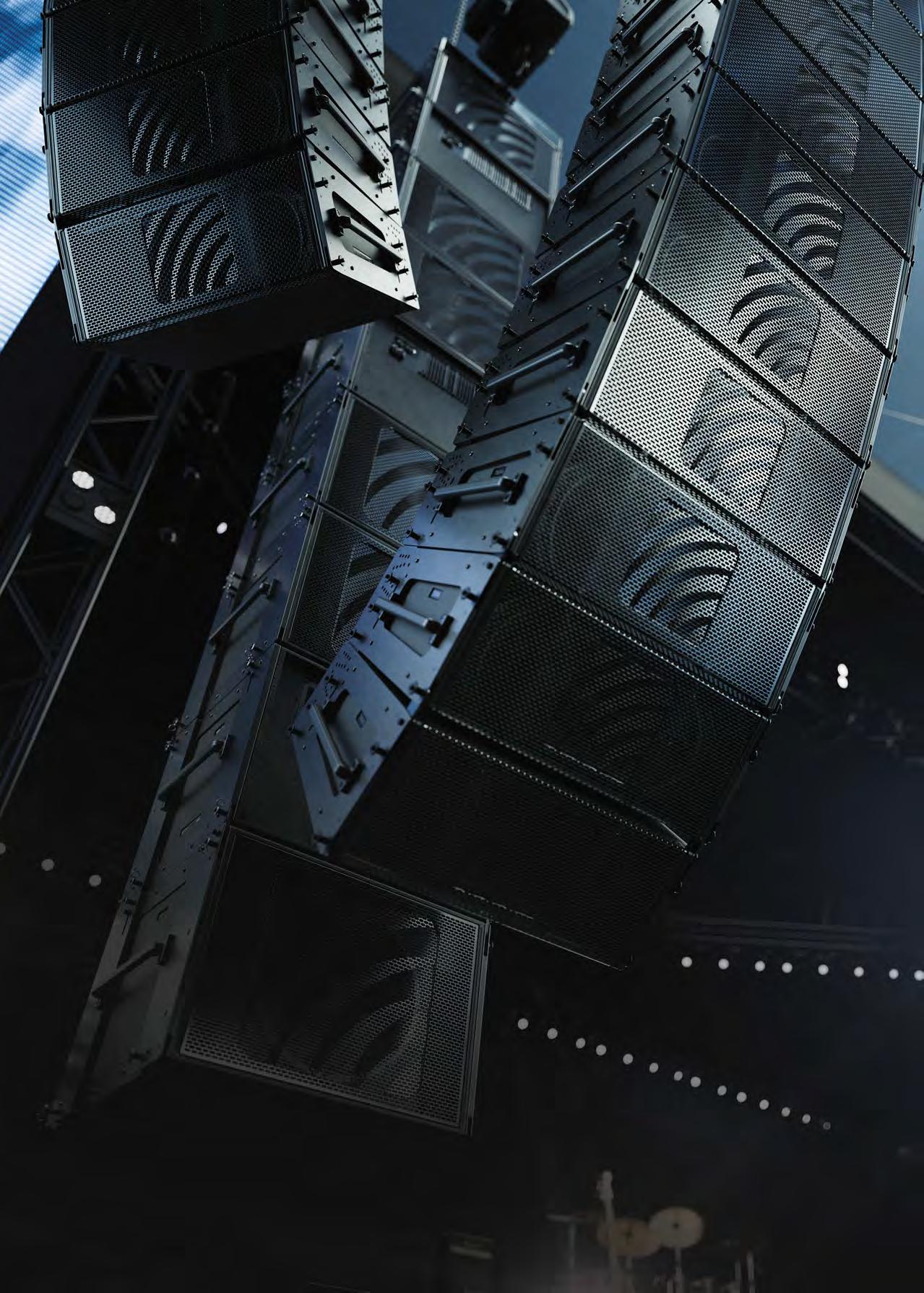
During a recent visit to Tunbridge Wells Baptist Church, just two doors down from our offices, I found myself doing what I always do when I walk into a place of worship: checking out the sound system. We originally covered the installation in the July–August 2021 issue of the magazine, with the main system comprising seven RCF HDL 26-A array elements, supported by two flown RCF HDL 35-AS subwoofers per side. With the room full and a live band leading the service, the experience was genuinely uplifting. It made me wonder whether
people in the room and a hymn I was familiar with, or whether it had come from the quality of the sound emanating from the speakers. Perhaps it was a combination of them both. The role of any piece of audio, video or lighting equipment is not to distract from worship but enhance it, and that was certainly the case. In fact, the experience was so compelling that I’m considering going back – in which case the speaker system has done its job perfectly!
I hope you enjoy the issue.
Richard Lawn General manager rlawn@worshipavl.com
Nick Smith Digital media manager nsmith@worshipavl.com
Casey Hawkins reports on the upgrade to GABC’s WC150, the latest in a series of improvements at the Tyler, Texas church
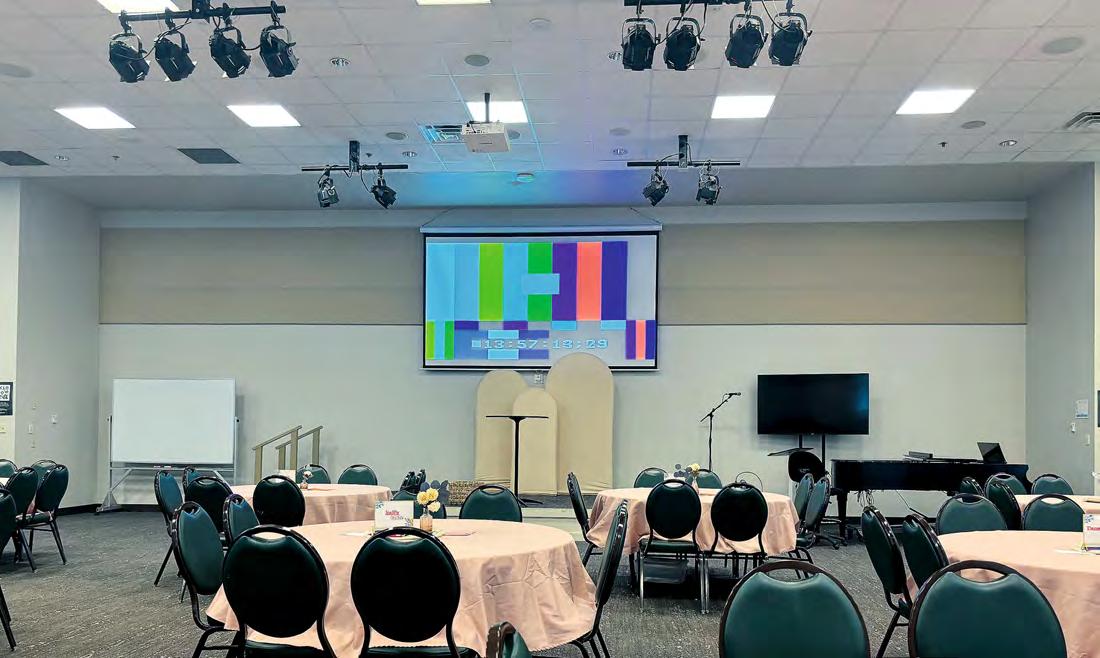
EARLIER THIS YEAR IN THE May–June 2026 issue of Worship AVL, we featured our upgrade of the main camera in Green Acre Baptist Church’s Crosswalk Conference Center, which replaced our 17-yearold original camera within that building. In this issue, we are looking at the upgrade of the original video equipment in one of our smaller general use rooms, WC150, which stands for Worship Center room 150. The Worship Center was completed in 2001 and, with it, room 150. Originally called The Galilee Room, WC150 was equipped with a 4:3 video projector and screen and a VGA connector at the front of the room by the stage. Although we have replaced the video projector over the years with another 4:3 one due to failure of the original, until this year we hadn’t upgraded the infrastructure to HD or 16:9, so it was extremely overdue. The need for the upgrade was ignited by a request from our pastor to prepare the room for Easter overflow with a live video feed from the Worship Center broadcast
control room. Since we didn’t have live feed capabilities in that room and I was going to have to install that, it was decided to go ahead and upgrade all the existing gear along with the new equipment that was to be added to accommodate the new live feed.
For the live feed, I decided to tap into the hallway IMAG feed that already existed. This was the easiest solution as 1) that meant just tapping into an existing HD-SDI live feed already in the hallway outside WC150, 2) it also allowed me to complete another project at the same time, which was to add a live feed to a large multi-display in the hallway, and 3) it saved an output spot on my backbone router which is already at capacity. Once I had the HD-SDI line into the room where I needed it, it was time to get the screen and projector upgraded. We hung the new screen in the exact location as the old and even utilised the same infrastructure to mount it. The same with the new projector. We didn’t have to move anything or
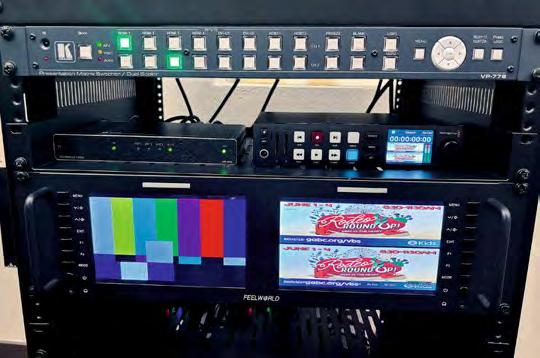
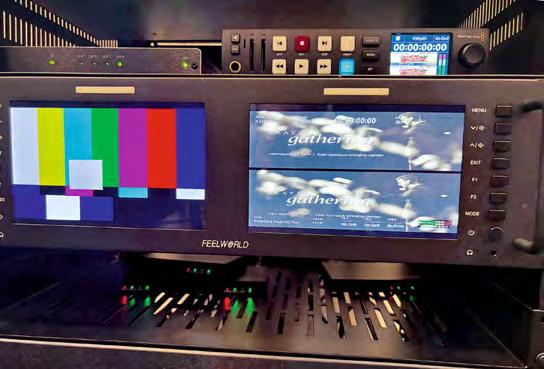
add a new mount, just new cabling. We had HDBaseT infrastructure installed to replace the old VGA technology. Once we had all those lines installed on a nice wall plate by the audio console, I went to build the video rack. We never had any video infrastructure in that room previously, just a video feed to the projector. Now we have a video switcher, recorder and monitoring capabilities. We also added two
additional feeds to mirror the projector feed. WC150 is three rooms, divided by an air wall that can open and close as needed. It can be three smaller rooms or one large room. When it is one large room, and there are chairs wall-to -wall, the chairs on the far sides might have difficulty seeing the centre screen. Therefore, we added an HDMI receive port in the side walls that is also HDBaseT in
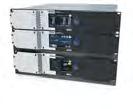
The Kramer VP-778 in the rack
WC150 has a new screen and projector
design, which will allow a mobile display to be added as needed that will extend the content from the centre screen to the side displays for easier viewing by the far side seats.
As the needs of our church become more complex over time, and more events require recording via both video and audio, I decided to add video recording capabilities to WC150 while designing this upgrade. The switcher I chose originally had two outputs. I was going to use one output for the centre screen and the other for the side screens so that we could have diverse content on the centre and side screens, for example, a camera shot on the centre screen for IMAG and then graphics on the side screens for presentations. Or just two separate presentations at the same time. But as time went on, we decided that we would have the first output for all three displays and the second output for the video recorder. That way, we could record different sources than what is on the screens. That has proven in other venues on campus to be more commonly needed than diverse content on the screens.
But after waiting and waiting several months for my original choice
The Blackmagic HyperDeck Studio HD Plus allows for SD card or external drive recordings
switcher to dispatch, we decided we couldn’t wait any longer, so we changed our order to the Kramer VP-778 8-input presentation matrix switcher/scaler with seamless video cuts and 4K30 output support. The only issue with that choice was they had discontinued that model so we would not be able to return it should it not be what we needed. But it has worked perfectly so far. And because the Kramer is natively rack mountable and my original choice wasn’t, I
am glad things worked out the way they did.
For the video recorder, I chose the Blackmagic HyperDeck Studio HD Plus half-rack 2160p30 recorder with 6G-SDI and USB-C. This allows for SD card or external drive recordings. I wanted standard media to be used so that nearly anyone could use this room and not need any proprietary recording devices.
We will be adding a static robotic auto-follow video camera so that the second output can be the camera
if desired. They can also choose to record a video presentation from one of the laptop hookups as well. Since I have also installed an audio embedder from the room’s audio console, whatever is recorded receives the house audio feed full-time without ever having to set one up.
I designed this new video upgrade to be easy to use so that we don’t have to have a qualified video technician to support every event in that room. I made detailed instructions on how to turn on the video system and how to select the sources on the switcher so that nearly anyone can use the room without one of our AV team members needing to assist. So far, it has been a huge success.
People can now enter the room and power on the projector and the video rack, route their sources with the dual-output switcher, record their event on an SD card with an unmanned camera and take the recording with them after their event, all without one of our staff AV technicians ever having to be involved. That, to me, is the definition of a multipurpose room in 2026.
www.gabc.org
Beyond tech mastery
The hidden cost of complexity
Audio engineer Kevin Yague argues the importance of understanding that complexity and excellence are not the same thing
If a microphone breaks, that’s when the system shows its true colours
A FEW YEARS AGO, I WALKED INTO a church where almost everything was automated. The console was programmed with scenes for every part of the service. The lighting cues were carefully timed. Routing had been meticulously configured. It was an impressive system built by people who clearly knew what they were doing.
There was only one problem – nobody wanted to touch it. Volunteers were afraid of pressing the wrong button. New team members felt overwhelmed before they even started. Whenever something unexpected happened, everyone looked for the one person who understood how the whole thing worked. The system was excellent; but the team wasn’t confident.
That experience has stayed with me because it taught me something important: complexity and excellence are not the same thing. Church production has never been more powerful. Today’s consoles can do things we once needed racks of equipment to accomplish. Wireless systems are smarter, lighting platforms are more capable and networked audio has given us incredible flexibility. These are all good developments. But every new capability comes with a question: does this make ministry easier, or does it make it harder? Sometimes we build systems for the church we wish we had instead of the church we actually have. We design for perfect conditions. The experienced operator is present,
the band follows the plan and every volunteer remembers every step. Then Sunday happens. Someone calls in sick or a song gets added. A microphone stops behaving or a volunteer serves in a position they’re still learning. That’s when systems reveal their true purpose. Not when everything goes right but when something goes wrong.
I’ve noticed that some of the healthiest production ministries aren’t necessarily the ones with the most advanced technology – they’re the ones where people understand the technology they have. The volunteers know where things are, the workflow makes sense and the system feels approachable. That’s not an accident –that’s design.
Take console programming as an example. I love a well-built show file. Good scene management can save time, improve consistency and reduce mistakes. But I’ve also seen files become so complicated that operators spend more time managing the system than mixing the service. At some point, a tool can become a distraction. The same thing happens with routing. Modern audio networks give us incredible flexibility, but flexibility isn’t always the same thing as clarity. Six months after an installation, the question isn’t whether the routing was clever – it’s whether someone else can understand it. The hidden cost of complexity isn’t technical, it’s relational. I’ve learned that volunteers rarely leave because a system is too simple.
solve every possible problem before it happens. But sometimes our desire for control creates barriers we never intended.
That’s why I’ve come to appreciate simplicity. Not simplistic systems but simple systems. There’s a difference. Simple systems are thoughtful –they remove unnecessary friction, make important things obvious and help volunteers succeed. A clearly labelled stagebox can be ministry; a well-documented startup procedure can be ministry; a console layout that a new operator understands in 10 minutes can be ministry. These things may never appear in a product brochure, but they often have a greater impact than the latest feature update.
More often, they step back because they no longer feel confident. Every additional layer of complexity creates another opportunity for uncertainty. When people are unsure of how something works, they naturally become more cautious. Over time, caution can turn into disengagement, and disengagement is far more damaging to a ministry than a slightly less sophisticated workflow. The more complicated a system becomes, the easier it is for knowledge to concentrate around one or two people. Training takes longer, volunteers become hesitant and confidence slowly fades. Eventually, the ministry starts depending on experts instead of developing people.
I’ve fallen into that trap myself. Most technical leaders don’t create complexity because they’re trying to exclude others. We do it because we care. We want the best result and to
As production leaders, we’re called to steward more than technology –we’re stewarding people. The goal isn’t to build a system that only the technical director understands. The goal is to build a system that still serves the church when the technical director is on vacation. That’s a very different measure of success.
Technical mastery still matters. We should pursue excellence, learn new tools and embrace innovation where it serves the mission. But excellence isn’t measured by how complicated a system becomes – it’s measured by how effectively that system helps people serve.
Because beyond tech mastery isn’t about adding more layers –sometimes it’s about removing a few. And sometimes the most powerful thing you can do for your team is make the booth a little easier to understand.
A console layout a new volunteer can understand is good ministry
Introducing Fairlight Live
The world’s most powerful broadcast audio mixer with support for a SMPTE-2110
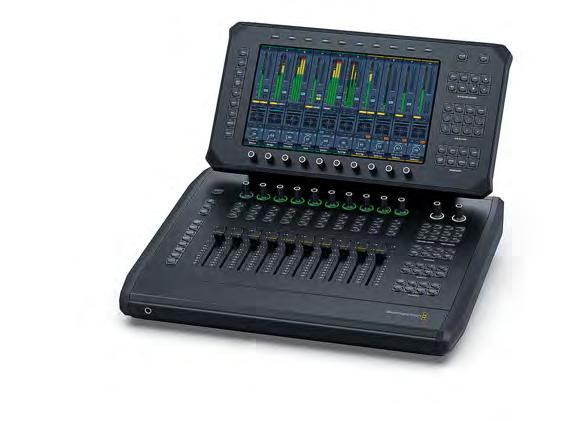
Fairlight Live is a software-based audio mixer which means it can support incredibly powerful features such as spatial audio mixing and SMPTE-2110 broadcast workflows. It’s a fully customizable live audio mixer with built-in effects and professional features such as a cue player, talkback busses, third-party plug-in support, snapshots and more. But the best feature is you can download it free!
Fully Customizable Software Mixer
Fairlight Live makes it easy to design your own audio mixer for any project from stereo to immersive formats. You can add, modify or move inputs and busses at any time. Simply click the channel number in the mixer to update inputs, or use the menu for bus management and I/O patching. Audio channels can be managed in the tracks index to show, hide or rearrange inputs and busses.
Thousands of Input Channels
From mono and stereo to LCR, 5.1 and fully immersive ambisonics, Fairlight Live supports hundreds and even thousands of input channels. Each channel has built-in EQ, dynamics and panning options including 1D, 2D, 3D, and spherical panning for spatial audio. Each channel has four effects slots with ChainFX hosting six-plugins per slot for up to 24 plugins per channel.
Build Your Own Bussing Structure
Fairlight Live let’s you create a customized bussing structure that can be changed dynamically as your show evolves. Use the bus management menu to add main, sub, aux or mix-minus busses, and choose their format, name and color. Assign input-to-bus or bus-to-bus routing in the bus assign window or right in the mixer! Plus multiple mixer channels can be assigned simultaneously.
Create a Fairlight Live Show
All of your productions are saved as a complete show including the mixer layout, routing, processing, cue player, snapshots and more! The file menu lets you quickly open existing shows or create a new one. Templates for common workflows are included plus there are layouts to match supported ATEM live production switchers. Unique productions can be custom built in the new show dialog.
Tech topics for houses of worship: Wi-Fi
Allen & Heath’s commercial audio manager, Samantha Potter, looks at the pros and cons of Wi-Fi and the best way to keep your connection safe
“TECH” HAS REALLY BECOME its own world over the last decades, and beyond that has not just seeped into our everyday but has become an integral part of living in modern society – whether we like it or not. It has its beautiful attributes, and it has some ugly ones. I wanted to cover a few key topics that can help us best understand life amongst tech inside a house of worship (or really, anywhere).
Today we’re going to cover one of the most fundamental applications of modern technology: Wi-Fi Prolific is the access to wireless internet. It’s available in most public places now and it is most definitely available in your building. Whether or not it’s unprotected (no password), public or hidden is besides the point: it’s there.
Wi-Fi is a made-up word without any real associated meaning. There are some safe assumptions it’s probably derived from the word “wireless” but there’s no consensus other than the word sounded cool – I am not joking, that is genuinely why this word exists.
Wi-Fi gives us the ability to connect to other devices wirelessly. Most commonly we see it used as a wireless connection to the internet. Wi-Fi is not synonymous with the internet, though. It only supplies a connection to other devices. Your tech team likely has a Wi-Fi connection to be able to connect their iPad to their sound console which is an exceptionally helpful tool allowing techs to walk around a space and listen as the congregation or musicians would listen and adjust the mix for those areas. Let’s go over a few pros and cons of W-Fi to define a few boundaries.
Pros
• Connect to things without le ngthy wiring or cabling between devices.
• Co nvenient.
• Af fordable.
• Easy to setup (usually with a QR code or what’s called a “captive
portal” [if you’ve ever connected to a hotel’s free Wi-Fi you’ve come across a captive portal]).
• Can b e a very secure connection.
• Automatic IP addressing supported out of the box.
• Cus tomisable.
Cons
• Just because it can be very se cure, doesn’t mean it always is.
• Anyone in the vicinity can theoretically access it.
• Inc onsistent data speeds (this is a huge one).
• So ac cessible that it’s everywhere and can become a crowded space for signals to fight through.
• “E asily hacked”.
Whoa that last one sounds scary. It is, but also it isn’t. An inconvenient truth about technology is that if someone wants to hack it badly
enough, they’re going to. It’s best practice to do what you can such as adding passwords, keeping firmware and software updated to the latest maintenance releases and keeping data streams of
different roles separated as much as you can. Let’s talk about how “they” could theoretically hack it, and then we’ll go into keeping things separated.
When we connect to Wi-Fi with passwords, a sort of handshake is made. This handshake is encrypted (hashed and heavily obscured). However, many magical devices exist to capture that handshake. Then, powerful computers can be used to de-encrypt the handshake and obtain the password to the Wi-Fi. I’ve played around with these sorts of devices before (in an environment where I have permissions) and all it takes is about US$10 and maybe an hour to put it together. Now, the powerful computers bit that is arguably the actual “hacking” I’m referring to is a horse of a different colour altogether. It could take a lot of time to retrieve the password –weeks, months. For lesser passwords, it could be only a few minutes.
I’m saying that theoretically it’s easy to do. But is it actually worth doing? That’s the important question here. And no, your Wi-Fi is probably not on the top 10 list of any nefarious actors. It can be done, technically, but the juice simply isn’t worth the squeeze.
I assure you that the people in your building are more likely to be targeted; both for their personal data but also access to your services.
Separation
Our best plan of attack is to keep things separate. Separate passwords for separate sites, separate Wi-Fi between internet access, guest users and production team, and separate hardware when we can help it. You would never, for instance, see a commercial business have their financial transaction data on the same “internet” as their guest Wi-Fi. That would be asking for a tremendous problem and security breach.
I could go on and on about the world of networking and how to manage it properly, but it’s somewhat outside this scope.
I want you, dear reader, to understand what Wi-Fi can offer us but be aware of the inherent risks.
My key takeaways
When I think about Wi-Fi or consider using it, these few things stay in my mind:
Will I need consistent data?
• Wireless connections (of all ty pes) are very inconsistent as far as data rates go and aren’t always good for mission-critical applications.
• If yo u find your device is sometimes laggy or can take a long time to load, I bet you can find significantly better results with a wired connection.
• If my d evice isn’t moving much or at all, I’m using a wired connection over Wi-Fi every time.
What kind of activities will be happening on this connection?
• If it’s just to connect your phone to y our production desk, you’re perfectly fine keeping security more minimal.
• If it has internet access, you’ll wa nt to lock it down far tighter.
How far away from the Wi-Fi access point will I be?
• Some Wi -Fi access points are made to be accessed close by, and others far away. I like to know what sort of coverage area I’m looking at and if it can be achieved by wired connection, or truly wireless is the only/best option.
Who is going to be managing this?
• Will it be managed at all?
If someone wanted to break into a physical Ethernet port I’ve got, they’ll need to get in and plug it in. If someone wanted to break into something wireless, they just need enough time. I love wireless technology and I love Wi-Fi. I carry my own travel router set up with a VPN to give myself a layer of security and ease of connection: the best of both worlds. You shouldn’t be afraid of Wi-Fi. No, we should love it. But we also need to look after it. We can’t continue to use technology without understanding it’s most important flaws and benefits.
www.allen-heath.com
Another factor to consider is how far away you will be from the Wi-Fi access point
Immersive sound
Neal Watson, vice president of integration at CTS AVL, asks, is immersive audio the future of live sound?
IN THE WORLD OF EVENT technology, there’s always a new breakthrough promising to change the game. Right now, immersive audio systems are the talk of the industry. Some call them “concert PA on steroids”. But is this the next must-have – or something your team is going to find hard to understand and benefit from?
What exactly is immersive audio?
An immersive audio system represents a paradigm shift from traditional PA deployments. At its core, it’s “spatial audio” – the technological foundation that creates a truly multidimensional sonic environment. This approach allows listeners to experience layers of music and spoken word moving around them, not just coming from the stage, making it the audio equivalent of 3D cinema. This sense of space and realism is achieved through “object-based mixing”. Unlike conventional methods that blend inputs into mono or stereo channels, the mix engineer treats each source (vocal, instrument, effect) as an independent “audio object”. The system then processes the positional information for these objects, allowing them to be placed
and moved precisely within the 3D loudspeaker space.
This fundamental change in how sound is rendered results in dramatic consistency in the audible experience. By expanding the sweet spot to cover the vast majority of the audience area, every attendee receives a more accurate, localised and emotionally impactful sonic image.
Who really needs it?
The truth is that most clients don’t need immersive audio – at least not yet. Many haven’t even heard of it. Of those who have, few understand what it actually does for their event, and even fewer know how to harness its unique capabilities. Without the right vision and preparation, you’re simply adding cost and complexity without experiencing the real benefits.
Counting the true cost
There’s no getting around it –immersive audio comes at a price. You’re not just buying more speakers; you’re investing in a radically different approach to system design, and that often means a larger price tag up front. We love innovation, but we only advocate for new tech when there’s genuine value for the client – when it serves a clear purpose, our
partners truly understand the concept, and they know how to bring that benefit to their congregation or audience.
Engineering for mission, not just magic
An immersive audio system is only as powerful as the team running it. It demands talented engineers who not only know the gear but “get” the vision.
In traditional stereo or mono PA deployments, FOH mix engineers needed to get creative on how to carve out space and bandwidth for specific inputs using EQ, compression and sidechain processing. With object-based mixing, you can use the physical venue as a creative canvas –deploying depth and width to create separation, align sound with visual stage elements or generate complex, dynamic sonic choreography that was impossible with traditional speaker deployments. You simply place the object where it needs to be and turn it up with minimal processing. Why does your space or event need to sound this way? Is there a ministry concept or a storytelling goal behind this leap in technology? These are the questions we ask long before any installation.
Choose your partner wisely
If you’re considering immersive audio, work with a company you can trust –one that’s invested in your outcome, not just your budget. Don’t let anyone sell you on sizzle if you haven’t done your homework on the steak. Know why you want immersive audio – and what you hope to accomplish with it.
Is it worth it?
Here’s something you’ll rarely hear from an integrator: sometimes, a thoughtfully tuned traditional audio system delivers every bit as much impact, clarity and engagement – all for a fraction of the cost. It all comes down to your needs, your space and your vision.
The
bottom line
It’s important you find an integrator that is passionate about helping its clients move the room with intention and purpose. Whether through immersive audio or smart, effective system design, the integrator’s job is to amplify what matters – connecting people to something greater.
If immersive audio is right for you, it can be used with integrity and impact. If not, then there’s still no reason why you shouldn’t be able to get the absolute most out of every dollar you invest.
www.ctsavl.com
Immersive audio can be the right solution in the right environment
Taking production to the next level
611 Bread of Life Church in Hong Kong has added to its growing inventory of Shure products
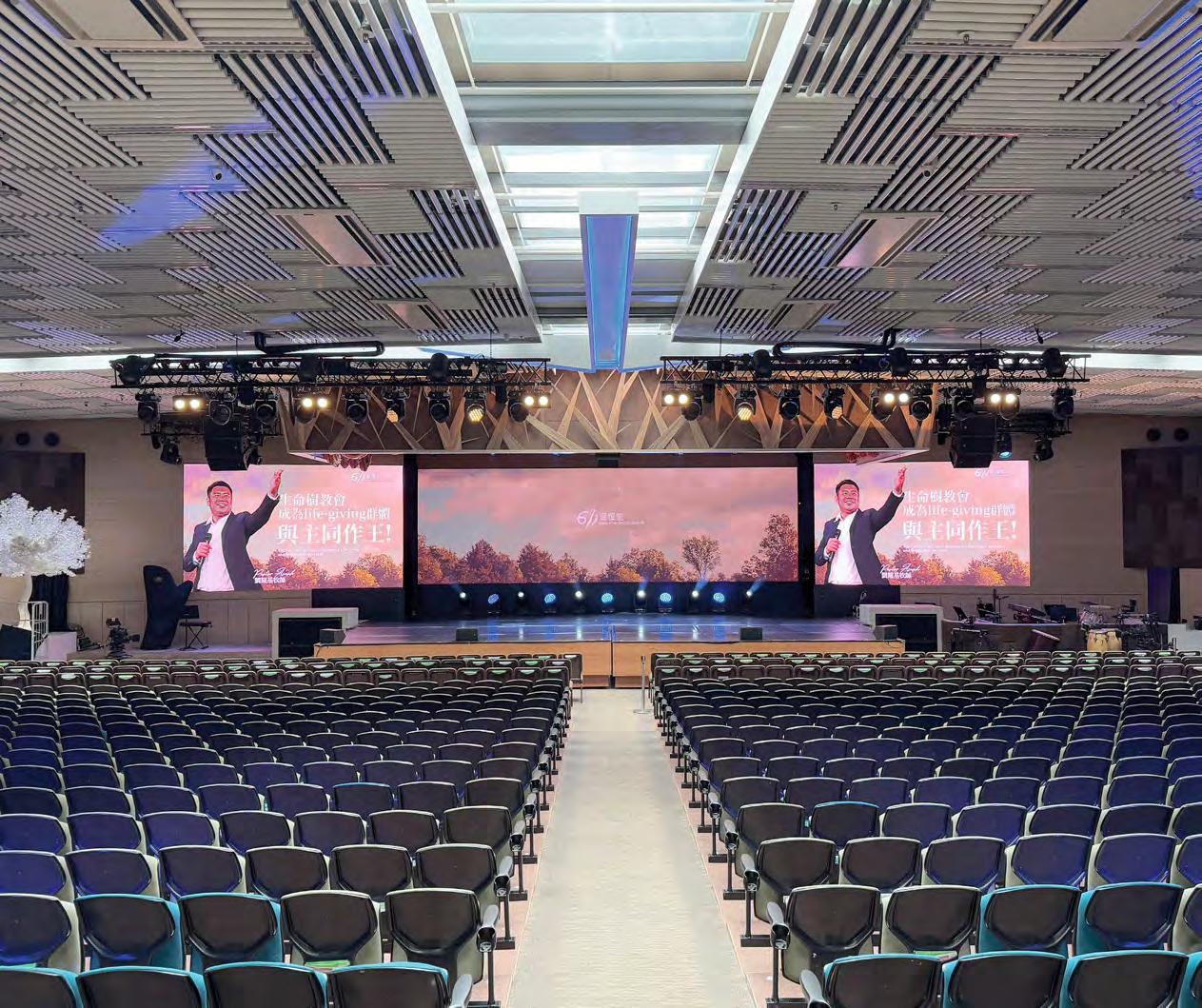
SINCE OPENING ITS DOORS IN 2014, 611 Bread of Life church has grown its membership exponentially beyond its two-level address in Hong Kong’s North Point. Adopting advanced broadcasting technology in its productions has allowed the church to spread the Word to multiple YouTube channels and missionary churches. Originally a cinema, the 1,200-capacity auditorium continues to stage highly captivating services following investment in cutting-edge audio, video and lighting infrastructures. A Shure wireless microphone system has played a central role in the staging of these varied productions.
The church’s original audio design 12 years ago simply included two channels of Shure UR4D+, together with a head-worn lavalier paired with a UR1M handheld transmitter. Additionally, three interpretation booths at the rear of the main auditorium were also outfitted with Shure Beta58 microphones. However, in recent years, media pastor Wei Min Lim and his technical team have increased the HOW’s inventory of Shure products. Playing a large role in conveying the church’s message, 611 Bread of Life stages dramas and large musical productions. This trend accelerated with the onset of Covid, as 611’s church members grew weary of watching services online. “By creating dramas, we grew the audience, with a lot of people now coming and watching these performances at the church and online,” furthers Lim. “The church wanted to take the productions to a higher level but, because the
media team wasn’t equipped for the challenge, we made a wireless microphone upgrade the priority.”
Following rigorous demonstrations, an extensive Shure wireless system was ordered, comprising 54 QLX-D transmitters paired with 30 bodypacks and 24 headsets for the actors and singers. Having previously rented wireless systems for the church’s big musicals, the increased inventory is continuing to serve the production demands and commanding a healthy ROI in the process. Benefitting from simplified setup times, the QLX Digital platform provides 611’s volunteers with complete control over the frequencies.
Above all else, the QLX-D system has proven to be ultra reliable.
“In the seven years to date that we have been deploying this extensive
multichannel system, we have not experienced major crashes,” declares Lim. The signal path is divided into three digital mixing consoles via Radial OX8 3-way splitters. The front of house, monitor and broadcast mixes receive their UHF transmissions from the QLX4D transmitters via the wireless antenna system, with each mix benefitting from a separate gain signal, and 15 sets of prism A/D convertors to digitise the signals for the broadcast mix on a DAW system through a Dante network.
In addition to UHF interference emitting from the two downstairs theatres, 611’s location in a densely populated neighbourhood puts pressure on wireless management. Having benefitted from using the PSM 900 IEMs for several years, the church recently increased its inventory with the purchase of the latest PSM 1000 IEMs. The church has almost ascertained an advanced
role as a Beta tester for the brand that celebrated its centenary in 2025. 611 technician Rocky recorded, mixed and edited a production using a prototype DCA901 digital array microphone, which “sounds amazing”, according to Lim. “Choosing Shure was one of the best decisions we made. We needed a system capable of handling a very high number of microphones simultaneously, for up to 60 channels. Added to our inventory of PSM 900 IEMs, the performance of the PSM 1000 IEMs is completely stable. The support from Shure Hong Kong has been exceptional, and they have assisted us with setup, RF planning, ongoing optimisation and training. It’s been a long-term partnership rather than a one-time purchase. Knowing that the audio foundation is solid, Shure’s reliability allows us to focus on the quality and the creative expressions of the production.”
Since 2024, Lim and the team have overseen an extensive upgrade of their broadcasting and postproduction facilities. Their faith in the Shure brand extended to the installation of 20 SM7B microphones for 611’s translation booths, recording studio and podcast setup. “Our relationship with Shure has strengthened over time, to the point that our working relationship extends beyond a partnership, and has become more of a friendship,” concludes Lim.
www.church611.org
611 Bread of Life has taken delivery of an extensive Shure inventory including a QLX-D system
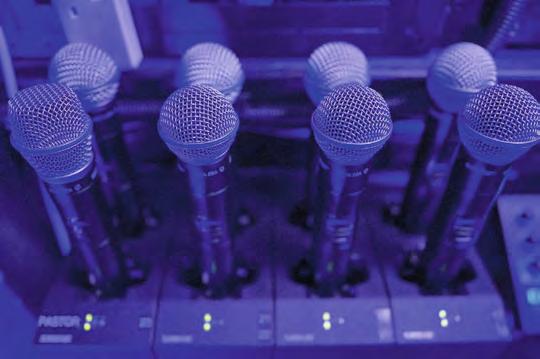
Shure Beta58 handheld mics charging backstage
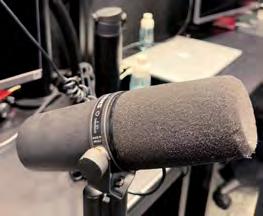
Twenty SM7Bs have been provided for the translation booths, recording studio and podcast setup
THERE AT EVERY STAGE
Flexible and scalable, the GEO M Series encompasses three, consistently-voiced line array systems with a shared networkable amplification and processing solution, utilising unique and patented NEXO technologies to achieve extraordinary levels of performance from compact, lightweight cabinets.
Deployment at a wide range events is quick and easy, thanks to integral rigging and a comprehensive suite of software tools for system configuration, control and monitoring.
Discover true versatility and a higher return on investment with NEXO GEO M at nexo-sa.com
The power of directivity
Creating clarity and connection in
worship spaces
d&b audiotechnik’s Steve Jones , team leader education and application support EMEA, explains why directivity matters
CONTROLLING THE DIRECTIVITY of sound – across the entire frequency band – is fundamental when trying to create distractionfree worship environments in which words are intelligible, and music is emotive and impactful.
What is directivity and why is it important?
Directivity is describing the ability of a loudspeaker to control the direction in which sound energy is emitted. The ideal goal of
each loudspeaker designer is to produce a loudspeaker that directs equal energy across the desired frequency band towards the intended audience area, whilst reducing the energy going to non-audience areas over as much of the frequency range as possible. This reduces reflections, resulting in clearer sound, which increases intelligibility and impact of the reinforced audio content.
An act of worship in the modern church setting includes spoken word through prayer, song or sermon to convey a message or story and music to stir the emotions of the listener. In both cases, the congregation will be listening to a combination of direct sound and reflected sound from the sound source (loudspeaker, human voice or instrument). The directivity of the sound source is the primary influence on the balance of direct to reflected or reverberant sound, and the perceived quality of each component. In most settings, a higher directivity to a lower frequency will minimise the effects of the reflected sound, which increases the intelligibility of the voice, as well as the impact and clarity of modern music.
How to gain control over the entire audio spectrum
There are three main ways we control the directivity of a sound source at d&b.
1) The most standard and widely used approach is to incorporate well-designed constant directivity horns to stop the varying dispersion patterns most sound sources create, where higher frequencies narrow and lower frequencies widen out in their coverage. Constant directivity horns allow us to create a defined dispersion angle for the higher frequencies down to a lower frequency linked to the size of the horn.
2) When the HF horn is no longer big enough to control the lower frequencies (usually just due to the practical size of the loudspeaker), we can use larger physical drivers and their arrangement to create specific interactions that lead to the desired changes in directivity. A good example of this is the recently launched d&b U-Series Its bipole arrangement of two LF drivers causes a narrowing of dispersion perpendicular to the driver arrangement linked to the
distance between the drivers. This causes a cancelling of sound due to different arrival times above and below the loudspeaker, whilst perfectly summing together directly in front, effectively creating directivity control to a lower frequency.
3) Where we cannot space drivers physically apart enough whilst keeping a loudspeaker design within sensible sizes for practical use, we can employ specific methods to actively cancel the sound energy in targeted directions. The d&b SL-Series is a market-leading product that employs this principle. Rear cardioid drivers are carefully arranged within the loudspeaker cabinets and, with the help of clever DSP, cancel energy in specific directions (especially behind the loudspeaker or array), whilst not negatively impacting the sound in the direction of the audience (in SL’s case complete coherence in front to increase the level).
Additional tools
Using d&b’s ArrayCalc software we can fine-tune the sub array’s performance to keep the tight direct
A d&b XSL Soundscape system at Passion City Church’s Trilith campus in Atlanta, Georgia
Steve Jones
The U-Series features a bipole LF driver arrangement starting from 500Hz
sound of the cardioid subwoofers in the audience area and reduce the spill of unwanted energy into the side walls and stage, therefore minimising late reflections and unwanted spill. Where a line array is concerned, ArrayProcessing enables an added layer to fine-tune the directivity of the full bandwidth to create the perfect dispersion pattern for a room’s
geometry. It creates absolute tonal consistency within the audience area, whilst also allowing the user to define the overall level distribution around the room.
More than just good loudspeakers
d&b’s success story over the last 45 years is built on the obsession to control the dispersion of our systems down to the lowest frequency. From the get-go, Mr d and Mr b realised that to achieve this, they had to go further than just designing good loudspeakers –they needed to look at all aspects of a sound system.
At d&b, the amplifier, processing and loudspeakers are all designed and finely tuned to work together as a system. This way, the product designer can perfectly balance all the compromises the laws of physics provide us with. It’s this behind-the -scenes balance that provides the end-user with intuitive, reliable choices to allow them to achieve consistent performance of d&b loudspeakers; for whoever deploys them, in whatever situation, wherever you are in the world.
Why directivity will play a key part in the loudspeaker design of the future
The frequency response of a loudspeaker a listener hears is the single biggest subjective interpretation of a loudspeaker’s performance. Unlike a studio speaker, where a single listener listens from a single position within a dead acoustic space, listening to the performance of a sound system in the professional audio world looks very different. We have to consider multiple listeners all in different positions relative to the loudspeakers in use, but also how the loudspeakers’
interactions with walls and surfaces affect the listeners’ experience. Loudspeaker directivity is the fundamental attribute that allows us to assess how a speaker behaves and interacts with all these complexities. If you want consistent tonality, with high speech intelligibility, free from the negative effects of reflections and reverberation, to create an impactful and distraction-free audio environment, directivity is key!
We’re already able to produce even smaller loudspeakers that can control the directivity to lower frequencies –our CL-Series is proof of that. CCL stands for Compact Cardioid Line Array. It delivers our renowned SL-Series precision but in a more compact cabinet, making it accessible for more applications, including smaller worship environments.
So, creating usable directivity, to the lowest of frequencies, within smaller and smaller cabinet sizes will no doubt keep progressing. Once we have directivity, we can start manipulating it. It will be exciting to see how loudspeaker design creates new solutions for system designers to shape and mold directivity, in smaller packages, in more detailed ways, in a range of new physical directions, for a whole host of new creative requirements.
The CL-Series brings SL-Series precision in a more compact cabinet
that results in vertical directivity control
The system is based around four ASCOLTO FF2470 digitally steerable column loudspeakers, supported by two FF0870 columns
Renewed sound
AVE Audio’s column speakers serve multiple roles at St Nikolaus church in Stuttgart
AS PART OF A MAJOR RENEWAL, St Nikolaus church in Stuttgart has invested more than €3mn into its infrastructure and its future role in the community. Part of this transformation is the creation of Stuttgart’s first youth church – a space intended not only for worship, but also for concerts, youth events and other cultural activities.
For AVE audio technician Paul Bleif, the project was interesting from the beginning because the sound system had to serve several purposes at once. “This was not a standard church installation,” he says. “The room needed to work for speech, for music and for events with a younger audience. At the same time, we had to respect the character of the building.”
The architecture of St Nikolaus gives the church its atmosphere, but it also creates a long reverberation time. This made speech intelligibility one
AVE installed a system based around four ASCOLTO FF2470 digitally steerable column loudspeakers, supported by two FF0870 columns, two 18-inch subwoofers and an Andante 16 digital mixer.
“The important point was control,” explains Bleif. “In a room like this, it is not enough to have power. You have to put the sound where people are sitting and avoid sending too much energy into the rest of the building.”
The FF2470 columns provide the main coverage in the church, while the FF0870 units are used for additional areas. The subwoofers give the system the depth required for live music, and the Andante 16 provides the processing and flexibility needed for different event formats.
For St Nikolaus, the result is a sound system that fits into the wider renewal of the church. It supports clear
of the key concerns. A conventional loudspeaker approach risked exciting the room too much, especially during spoken services.
There was also an additional practical requirement. With the church organ damaged, the new sound system had to help support musical use of the church during the interim period. It therefore needed enough headroom and low-frequency extension for band performances and concerts, without relying on extra temporary equipment.
speech for services, stronger musical reproduction for concerts and the flexibility required by a modern youth church.
“For us, the goal was to make the system feel natural in the space,” concludes Bleif. “People should understand the spoken word clearly, but the system also has to come alive when music is part of the event.”
www.ave-audio.de
The audio solution needed enough headroom and low-frequency extension for band performances and concerts
Modular system for customized infrastructure solutions
Wide range of modules for fully networked media technology concepts
Classified cable-bulkware according to EU Construction Products regulation (EU CPR)
Ready made Network and Fiber Optic Systems for mobile and installation applications
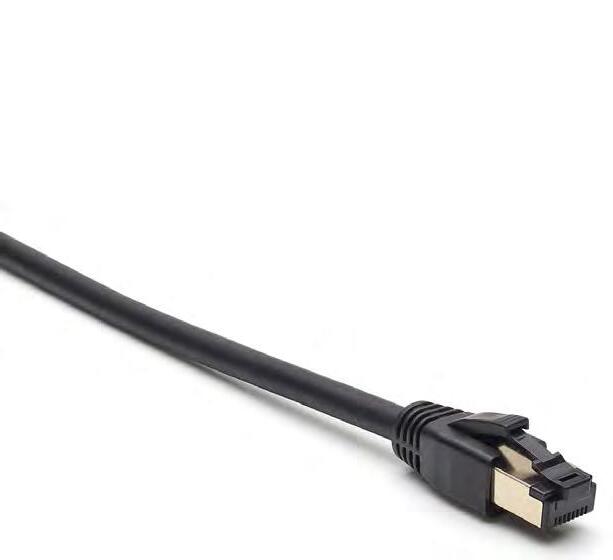
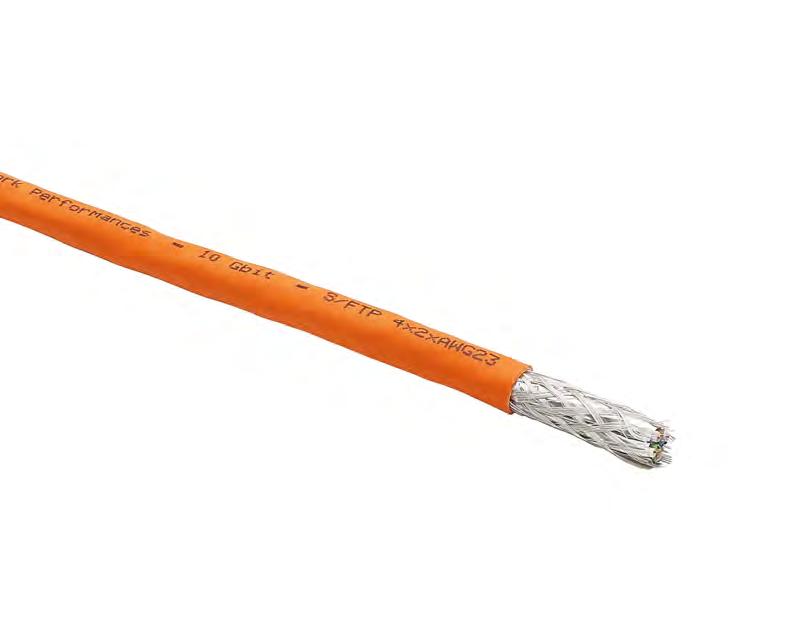
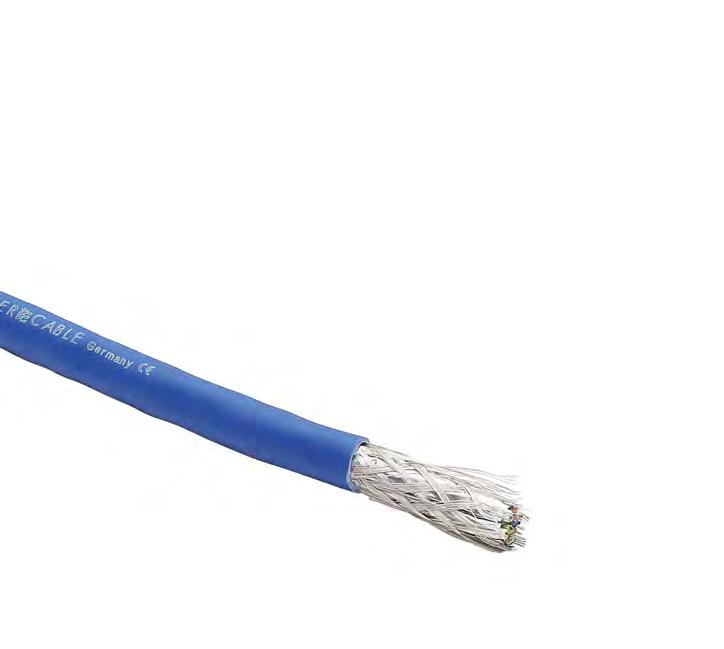
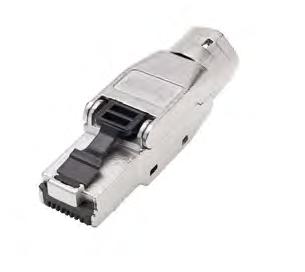
CPR-rated CAT.7 & CAT.8 installation and connection cables
High-quality, certified connection components
REQUEST
SOMMER CABLE, headquartered in Straubenhardt (Germany) and founded in 1999, is an international supplier of professional connection technology for the audio, video, broadcast, studio/media technology, and installation business. In addition to its in-house brands HICON, CARDINAL DVM, and SYSBOXX, the company offers a range of over 25,000 products, including bulk cables, connectors, assembled cables, customizable distribution systems, and active components.
A B2B shop guarantees customers fast availability and a 24/7 service.
Thinking outside the box
Alpha Sound’s Devin Sheets is fast becoming an expert in using NEXO’s ID84 speakers in unconventional ways
DEVIN SHEETS, LEAD engineer at Salem, Oregon-based Alpha Sound, has a long list of Catholic church installations under his belt. Relying mostly on a triedand-tested combination of NEXO, Yamaha, Shure and DPA Microphones equipment, the confidence he has in NEXO’s speakers has resulted in him experimenting with different combinations and deployment techniques. The result is the use of the French manufacturer’s ID84 column speaker as a line array and it’s slowly becoming a signature approach.
“I first tried hanging the ID84s as a mini line array shortly after they were launched in 2021,” Sheets explains. “We’d got some in our workshop and decided to play around with them, hang them up outside on some speaker stands and see what they sounded like. Then we had an installation where we really didn’t have the option to use anything else, so this was the first time that we hung the ID84 with a smaller ID14 underneath.”
Before installing the system onsite, Sheets had recreated the venue conditions in the workshop to confirm the concept would work. “It translated
perfectly”, he smiles. “I don’t think that’s exactly how NEXO envisioned the ID84 being used but it works
Sheets explains that if there’s a very long, narrow and flat surface to cover, an integrator would typically
really well in the right situation and the clients love it. We’ve probably done over 10 installations this way since and we’re still getting a lot of calls from other venues.”
do one of two things: either have a more distributed system with several point source or smaller column speakers spread out sequentially as you move further
back into the venue, or choose a more centralised system.
“We could use a NEXO GEO M6 system for example, with a few ID fill speakers in the corner, so 90% of the energy is coming from one centralised line array system, and we feel that the final result sounds more natural,” he adds. “But lots of churches can’t afford a GEO M6 system or it’s just too big for their space and provides too much SPL.”
As a result, Sheets has discovered that the ID84 works just as well as a replacement for a small line array. “Because of the geometry of the mid/high section with the dome tweeters, you end up with an asymmetrical distribution of the energy – like a glut of energy that’s on the upper part of that physical piece, angularly speaking, and it tapers off as you move down the vertical plane,” he explains. “We found that if you install the ID84 a little higher than where you would normally place a small line array and angle it downwards, you get the same effect.” But careful positioning is essential – because the ID84 isn’t truly a line array, if it’s installed too high with a steep
NEXO’s ID84 column speaker has been hung as a line array
downwards angle, it can cause a tapering effect.
In addition to height, Sheets explains that another factor to consider is the distance between the ID84 and the first row of seats –ideally there needs to be a gap of between 4m and 6m. If this is the case, correctly positioning the ID84 allows him to fire 25–30m down the room and create a pleasant SPL tapering effect that functions very much like a regular line array. “You end up with a pretty commensurate SPL experience from the first row all the way to the back row,” he describes. “And because it’s so directional in that upper midrange frequency where the intelligibility of the vocal is so critical, you can avoid spilling unnecessary sound on adjacent surfaces, which is so important in reverberant venues.”
And if a venue has seating closer to the speaker? Then Sheets has discovered that adding an ID14 underneath provides the extra coverage. “We can EQ the ID14 so that it’s complementary of the skewed frequency response of the ID84 at that point and they both fit together nicely.”
The latest recipient of Sheets’ new approach is St Vincent de Paul, a Catholic Church in Salem established in 1925, which today serves the growing Hispanic community. The church was “bursting at the seams,” explains Sheets. The congregation has grown so much that on Sundays, the whole building is full – including the foyer areas and narthex, and even outside. “These types of buildings tend to be minimalistic architecturally – they can be very tall and vertical, so having a NEXO P+ Series just wouldn’t be the right fit visually,” he adds. “People like the candlestick aesthetic of the ID84 and it looks very elegant in their space –you can hang it out in the open with other lighting fixtures and visually it works really well.”
At St Vincent de Paul, there’s a large gap between the steps of the altar area and the first row of seats, so this created the ideal opportunity to hang the ID84 speakers directly above the altar steps. “There were no columns that we could use to fix speakers, so they had to be hung. In this case, the ID84 was the only solution which would mimic a small line array, so you can get that J-shape sonic distribution and shoot
sound evenly all the way to the back of the room.”
Sheets has installed two ID84 as mains, two ID24 in the transepts, nine ID14 in the balcony and narthex/lobby, two P8 floor monitors for the musicians, one LS18 subwoofer near a forward pillar, one NX4x4 amplifier and one nanoNXAMP4 amplifier. Two Yamaha VXL1B-8 columns and four VXS3F surface-mount speakers have been fitted as fills in the altar/apse and in the narthex, along with one Yamaha MRX7-D matrix processor and two DCP panels for control. The microphone inventory includes one DPA Microphones 4018 supercardioid for the ambo, one 4080 cardioid lavalier and two 4099 instrument
microphones in the piano, along with two Shure QLX-D wireless systems and one MX391 boundary mic on the altar.
“We only needed two ID84s for the stereo pair and then it was just a case of filling in the rest of the space with the ID24s and ID14s,” says Sheets. “Plus we’ve installed our De-Feedback plugin. We’re using the best of everything – NEXO speakers, Yamaha consoles, DPA mics –but you can still have a problem with reverberation bleeding back into the microphone, especially if the priest moves in front of the speakers, so we designed De-Feedback exactly for this reason and we use it in all of our installations.”
With the help of an international group of computer coders, Sheets created this zero-latency AI plugin designed to prevent audio feedback. Marketed under the sister company he has set up called Alpha Labs, V1 of the plugin was launched in late 2024. With De-Feedback now available on both the Waves Livebox and Fourier Audio’s transform.engine platforms, the AI-powered live audio plugin is gradually appearing on more consoles and at more live events around the world. “If a church has invested in all this amazing equipment, you don’t want feedback spoiling the wonderful tone you’ve created,” he says. For permanent installations, Sheets recommends the dedicated NUC-style hardware units available on the Alpha Labs website.
Sheets secured the St Vincent de Paul installation after recently completing another local Catholic installation project featuring NEXO speakers. “In the Catholic community – as well as in other liturgical communities – if you do one job successfully, you get calls from people in similar situations because they talk to each other. But it’s also thanks to the quality of the NEXO speakers – I don’t really know what we’d be doing if we had to use a different brand. With NEXO, it’s just effortless.”
www.alphasound.tech
www.nexo-sa.com
www.svdpchurchsalem.org
An ID14 with an ID84 in the background
Two ID24 have been installed in the transepts
A DPA 4018 microphone has been fitted to the ambo
A clear direction
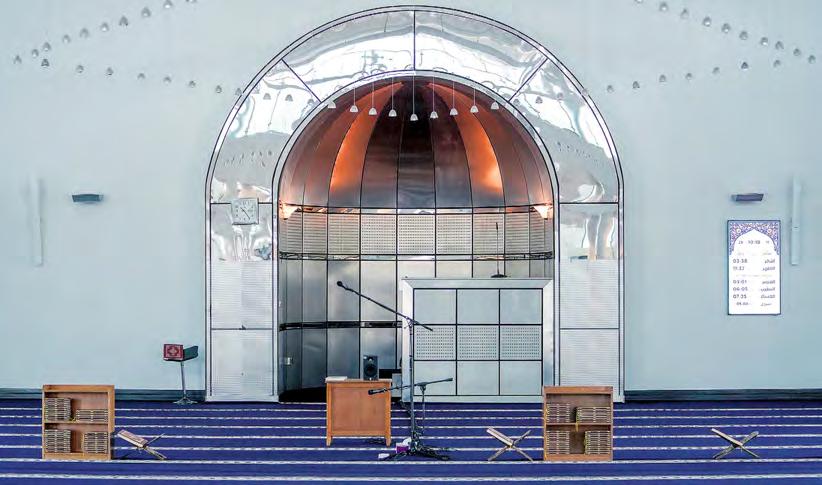
Darwish has upgraded the sound at Doha’s Al Kuwari Mosque, improving speech intelligibility while respecting the venue’s striking architecture
LOCATED NEAR KHALIFA
International Stadium within Doha’s Aspire Zone development, the modern, architecturally striking Al Kuwari Mosque has been serving as the central place of worship for visitors and the surrounding community since its construction in 2006. As part of a recent audio upgrade, Qatar-based systems integrator Darwish Technology was tasked with improving speech clarity and overall audio performance while working within the limitations of an already operational building.
Darwish handled the full project lifecycle internally, including systems design, integration, testing and final commissioning.
“The mosque plays an important role as a central spiritual hub within this prominent development,” notes Darwish operations manager Ahmed Dabberni. “For Darwish, this project was significant as it reinforced our capability to deliver high-quality AV solutions in prestigious and community-critical environments.”
The primary objective of the project was to ensure clear and intelligible reproduction of prayers and announcements across all areas of the mosque. While the venue’s acoustics were described as generally acceptable, the integrator explains that one of the main challenges came from the inability to make civil modifications to the structure itself.
“Optimising loudspeaker placement within an operational mosque where civil modifications were not permitted became the core focus of the project,” recalls Dabberni. “Instead of altering the architecture, our team relied on modelling and system optimisation to improve coverage and intelligibility while preserving the visual appearance of the worship space.”
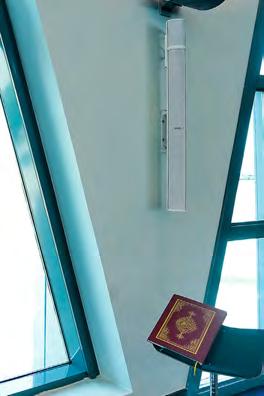
The audio refresh centres around a Bose Professional audio system, with eight MA12 modular column loudspeakers distributed along the walls of the main prayer hall. Designed to provide controlled vertical coverage and consistent speech reproduction, the MA12 was selected to help improve intelligibility within the reverberant environment while minimising visual intrusion within the interior.
Darwish utilised the manufacturer’s Modeler simulation software during the design phase to analyse the space
and determine ideal loudspeaker positioning. According to the company, this process helped identify the most suitable loudspeaker types and coverage strategy for the mosque while maintaining what it describes as a “natural and balanced sound profile”. Additional coverage for exterior spaces is provided by Bose Professional DesignMax DM6SE surface-mount loudspeakers installed on the outside mosque walls, while amplification duties are handled via PowerShare amplification, including the P2600A and P4300A models. The system also incorporates Yamaha processing and control infrastructure, including a Yamaha MTX3 matrix mixer and signal processor alongside a wall-mounted Yamaha MCP1 controller positioned near the Mihrab, providing straightforward day-to-day operation for mosque personnel. The mosque’s minaret systems operate independently and are activated specifically during the Adhan prayer call process. Monitoring within the system is handled through a Yamaha MSP3 powered reference speaker. Microphone provision includes a Sennheiser MEG14-40 -L-II gooseneck for the Imam position, alongside Sennheiser e835 handheld microphones and an MEB 114-S boundary microphone for supplementary speech reinforcement and announcements.
Eight Bose Professional
MA12
modular column loudspeakers have been distributed along the walls
With speech intelligibility forming a key part of the project brief, the commissioning process included extensive use of NTi measurement tools to validate system performance and confirm the required clarity levels had been achieved, with intelligibility and consistency across the prayer space prioritised throughout the tuning process. Onsite coordination was handled directly with the Aspire Zone team, which acted as both end user and primary stakeholder. This close cooperation was said to greatly
simplify decision-making during the project.
The overall delivery timeline was relatively compact. According to the Darwish team, the design phase was completed within a week, followed by another week of integration work, while procurement took approximately four weeks. Despite the relatively straightforward deployment, the project is notable for reflecting a broader challenge increasingly faced within worship environments: improving intelligibility and coverage within architecturally sensitive spaces where structural intervention is either undesirable or prohibited altogether. In this case, Darwish’s approach centred less on large-scale acoustic treatment or architectural modification and more on careful loudspeaker selection, simulation and positioning. For the integrator, the project also represented an opportunity to reinforce its capabilities within large-scale public and community-focused environments in Qatar. “We take pride in successfully delivering every project, particularly in meeting client expectations and achieving positive acceptance,” Dabberni states. “This project reflects our commitment to quality and reliability in critical environments.”
www.darwishholding.com
The microphone inventory includes Sennheiser gooseneck, handheld and boundary models
Illuminating Hope
Singapore-based systems integrator Illuminate has provided an end-to-end technical production for The Hope church’s annual conference in Taiwan
THE HOPE IN TAIPEI HAS rapidly established itself as one of Taiwan’s most influential churches, with a congregation that extends well beyond the island through a significant online following. As demand for high-quality broadcasts has grown, the church has continued investing in production technology to match its international reach.
Having partnered with The Hope for several years, Illuminate has played a key role in that journey. The company initially helped improve the church’s livestream production before completing a major broadcast infrastructure upgrade late last year. That project included a new SDI and fibre backbone designed to support increasingly sophisticated productions, alongside new cameras and lighting. As part of this ongoing partnership, Illuminate also helped build The Hope’s Taichung campus in 2024.
“Our relationship with The Hope is built on trust amassed over the years,” explains Illuminate’s director, Timothy Huang. “We’ve helped them improve the quality of their livestreams by upgrading their audio, video and lighting equipment so they can create high-quality productions. This is where our strength lies – integrating all three disciplines together rather than just focusing on one element.”
The 2026 edition of the conference marked another milestone in the partnership. Having provided lighting and production design in 2025,
Illuminate’s remit was extended in 2026 to include supplying the complete technical production package, deploying lighting, audio, networking, broadcast and communications systems from its growing Taiwan inventory.
Huang describes the project as an important step for the company following the establishment of a Taipei office: “It was a privilege to provide the full technical production for this year’s conference and a testimony of the strength of our relationship that they selected a Singaporean company for this role. We had a team of six people travel over from Singapore plus local staff from our office in Taipei and some hired help.”
Taking place over three-and -a-half days, the conference included workshops and keynote sessions featuring international speakers from Australia, Canada and beyond, while thousands more participated remotely through paid online access.
“With the entire conference streamed online, broadcast quality was a big part of the project,” says Huang. “The Hope has a very large online following with people streaming from Malaysia, Thailand, Hong Kong, Australia, the US and further afield as they can’t be there in-person.”
To support simultaneous live production and streaming, Illuminate deployed three Yamaha DM7 digital mixing consoles covering front of house, monitor and broadcast duties,
along with six Rio3224-D3 I/O racks.
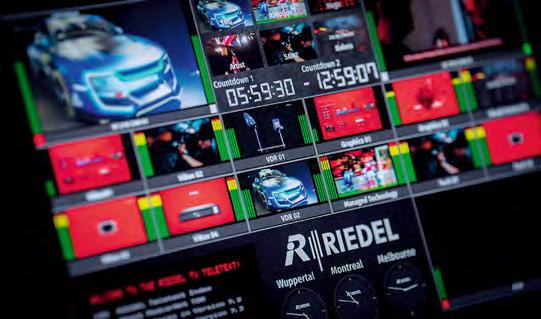
Lighting control was handled via a grandMA3 Compact XT console and four onPC 4Port Node 4k PoE driving LumiPro and EK fixtures. The integrator specified a Luminex network comprising one Gigacore 30i and two Gigacore 10i switches to tie up front of house, back of house and the core production room over the same fibre ring, along with a Riedel setup consisting of 10 beltpacks and two antennas across the entire space, in addition to traditional 2-wire partyline systems for fixed positions.
“We chose Riedel’s MediorNet as the backbone because each run between the hall and the control room was about 200m, so it only made sense to use fibre,” continues Huang. “When we calculated the difference in cost between normal fibre transport and
a MediorNet system, it made more sense for us to choose MediorNet, plus we have recently become a Riedel partner in Singapore.” Riedel’s Bolero also served as the main intercom system for the event.
Illuminate’s systems solutions engineer, Matthew Han, was able to set up the MediorNet system in as little as an hour and continued making adjustments throughout the event to ensure that everyone’s multiview and audio metering were correct. “It was incredibly easy to run and very user-friendly for anyone who knows the system,” explains Han.
For the production side of the event, Illuminate selected a Shure inventory consisting of wireless mics, IEMs and Wireless Workbench software, comprising PSM 1000 in-ear personal monitoring systems and ULX-D digital
Riedel’s MediorNet was used as the backbone between the hall and the control room
microphone systems. “Because the RF spectrum in Taiwan is so congested, having a reliable system like Shure’s ULX-D made a real difference – lower-tier RF systems tend to struggle with interference and dropouts in that kind of environment, and that’s exactly where ULX-D held up,” continues Huang.
The main PA system consisted of an eight-per-side L-Acoustics Kudo line array, eight SB218 subwoofers, along with four 12XT and four stacks of two dV-DOSC speakers for front fill.
The venue itself presented another significant challenge. Unlike a purpose-built performance space, the conference took place inside a university sports hall with difficult acoustics and limited rigging positions. Illuminate addressed these issues through detailed pre-production planning using Vectorworks. The complete production was modelled in 3D before arriving onsite, allowing loudspeaker positions, lighting trusses and LED screens to be coordinated well in advance. The lighting team then imported the Vectorworks model directly into the grandMA3 console,
custom-built everything and now the setup time is less than 25 minutes,” he explains. “Red to red, green to green – if you haven’t had your coffee yet you just follow the colouring and off you go! It significantly reduces the risk of errors. We try and build our show workflows in the same way so we can minimise time onsite.”
Creative design also evolved compared with the inaugural conference. This year’s stage featured an Absen Lura V2 transparent mesh LED screen with lighting fixtures positioned behind it, allowing beams and video content to interact for greater visual depth. Illuminate also supplied eight Sony FX3 cameras and a Blackmagic Design ATEM 4 M/E Constellation switcher. Despite the increase in workload, Huang believes that this allowed Illuminate to have more control over the event. “Last year, we simply approved the location of the PA system but this year we took our time to actually design the sound system and make sure that everything was correctly placed.”
allowing the whole lighting setup to be patched on the spot.
“This saved us so much time,” adds Huang. “We were able to pre-patch and reduce our on-the -ground time significantly. We built all our show files early – everything was pre-loaded, so we could just hang the fixtures and go.”
That preparation proved essential given the compressed schedule. Illuminate’s Singapore team arrived onsite Monday, with rehearsals beginning on Wednesday and the conference opening shortly after. The Taiwan office had already spent several days preparing lighting equipment, colour-coding cables and pre-configuring systems before the Singapore crew arrived.
Huang uses a similar approach at his home church in Singapore: “I’ve
As The Hope continues expanding both its physical congregation and international online audience, the partnership with Illuminate appears set to grow, with Taiwan increasingly becoming a strategic base for the company’s wider ambitions across Asia. Huang reports that the success of previous projects at The Hope has generated interest from other Taiwanese churches, many of which have looked to the conference as a benchmark for modern worship production. As a result, Illuminate hopes to secure additional systems integration and production work across the country.
Three Yamaha DM7 consoles covered FOH, monitor and broadcast duties
Sound by design
Since installation, both tiers of the church are now sonically covered
Working alongside Loud Technologies Asia, St Matthew’s Church has transformed its 20-year-old AV infrastructure with a distributed audio and livestreaming system
AFTER MORE THAN TWO decades of faithful service, the audiovisual infrastructure at St Matthew’s Church in Singapore had reached the point where reliability, flexibility and performance could no longer keep pace with the demands of a modern place of worship.
Working alongside Singapore-based distributor Loud Technologies Asia (LTA) and its pool of systems integrator partners, the church undertook a complete redesign of its AV ecosystem, centred on a distributed Bose Professional and Blaze Audio loudspeaker system, Allen & Heath digital mixing, Sennheiser wireless technology and an upgraded livestreaming workflow. Rather than simply replacing ageing equipment, the project sought to create an installation that responded to the realities of the building while supporting future ministry.
The church’s analogue infrastructure had gradually become increasingly difficult to maintain. Ageing cabling, intermittent faults and equipment failures were beginning to affect weekly services, while growing expectations around livestreaming, contemporary worship and volunteer-friendly operation highlighted the limitations of technology
The large window caused acoustic and reflective issues
installed when the building first opened around 20 years ago.
Working alongside LTA to design an installation around the realities of the building, the needs of its congregation and the requirements of future ministry, the church chose to rethink its entire AV ecosystem.
For Pastor Ilango, the decision to invest in a new system was driven first and foremost by reliability. “The main
reason for the upgrade was that the existing system had been having a lot of failures in recent years,” he explains.
“Sometimes microphones were not picking up properly, there would be sudden bursts of feedback, cables were failing and some of the buttons on the old consoles were breaking down. We felt it was time to change.”
The original installation had served the church well, but technology
had evolved significantly over the intervening years. While digital consoles and networked audio had become standard throughout the industry, the transition had previously been delayed by concerns about volunteer training and operational complexity.
“In the past there was some resistance to moving to a digital soundboard,” Pastor Ilango notes. “Not everybody was willing to jump on board. But, in recent years, younger members have joined the team and have been willing to learn, so that also helped influence the decision.”
The brief extended well beyond replacing like-for-like equipment. The church wanted a system capable of delivering clear speech for sermons while retaining enough headroom and musicality for a contemporary worship band, all without compromising the appearance of the sanctuary.
For LTA, that meant beginning with the architecture itself. With a ceiling height of only 2.7m, the large glass window behind the stage in the main sanctuary was one of the project’s greatest acoustic challenges. Combined with a fan-shaped seating layout and balcony level, the reflective surfaces made it difficult to achieve even coverage using conventional high-output systems.
According to Colin Quek, managing director of LTA, careful acoustic modelling formed the foundation of the design process. “The church team was very clear about the challenges they
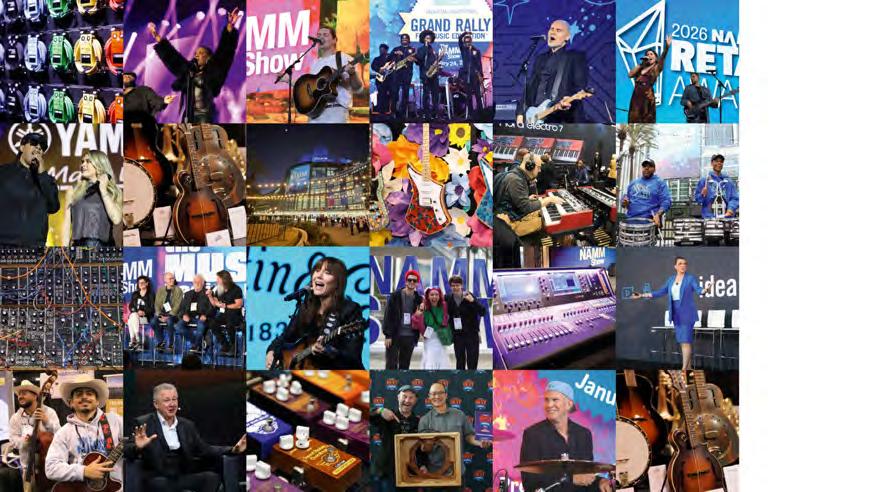
Five Days That Shape Your Year!
Your next best-selling products, biggest brand relationships and most valuable conversations all start here. Explore what’s new, meet the people behind the gear and discover the products that will shape your business and your customers’ music making in the year ahead.
60,000+ attendees
15,000+ artists
5,400+ brands
1,650+ exhibiting companies
550+ speakers
200+ education sessions
122 countries represented 5 days
“When you’re a one-man shop, you don’t necessarily have the experience with everything so to be able to be exposed to new technologies and new solutions that could be a perfect fit with the next church you’re working with, it’s a great opportunity here.”
Trent Perkins, Whole Hearted Productions
PROJECTS
faced and the outcomes they wanted,” notes Quek. “From there, we carried out speech intelligibility simulations alongside coverage modelling and compared different design approaches before submitting a design.”
Rather than relying on higher sound pressure levels to reach every seat, LTA adopted a distributed audio approach, allowing the system to operate at lower SPLs while maintaining intelligibility and reducing unwanted reflections from the glass surfaces.
The loudspeaker system combines Bose Professional MA12 modular line array columns with the manufacturer’s EdgeMax EM180 ceiling loudspeakers, supported by MB210 subwoofers.
Additional Blaze Audio Ci2 front-fill loudspeakers address listeners seated closest to the stage, while Blaze Ci4 loudspeakers provide coverage beneath the balcony, ensuring consistent sound throughout the sanctuary without drawing attention to the technology itself. That discreet approach was important to the church. “One of our considerations was how we could make the space feel less visually cluttered,” adds Pastor Ilango. “We didn’t want speakers hanging everywhere. As we explored different solutions, this design gave us what we wanted aesthetically, while also improving sound quality.”
The result has transformed the listening experience. “We can hear the sound all around us now instead of it coming from one direction,” Pastor Ilango continues. “The previous speakers were very directional, but the new system creates a more immersive feeling that is much easier on the ears.”
At the heart of the new installation sits an Allen & Heath Qu-7 digital mixing console, supported by two AB168 remote audio racks positioned around the sanctuary. The move to a digital workflow has reduced the physical footprint of the control position while simplifying setup, troubleshooting and day-to-day operation for the church’s volunteer technical team.
“It saves a lot of space,” notes Pastor Ilango. “More importantly, it gives the operators much more information. They can see what is happening visually onscreen as well as hear it, which makes troubleshooting and setting up mixes much easier.”
Musicians also benefit from the new infrastructure. Eight Allen & Heath ME1 personal mixers allow performers to create their own monitor mixes, reducing reliance on the FOH engineer during rehearsals and services, while a pair of low-profile dBTechnologies VIO W10 stage monitors provide discreet foldback onstage.
The church retained portions of its existing wireless microphone inventory, integrating Sennheiser ew100 G3 and ew G4 systems with five new EW Digital ME4 wireless systems. The only RF solution that would allow RF distribution amongst both digital and analogue UHF wireless, two RF Venue DISTRO4 antenna distribution systems with D-ARC architectural antennas were added to improve RF coverage and system reliability throughout the sanctuary, ensuring stable wireless performance during services and special events.
Supporting the audio infrastructure behind the scenes are Blaze PowerZone Connect amplifiers, combining compact form factors with Class-D amplification.
A PowerZone Connect 254 half-rack amplifier and a PowerZone Connect 6008 full-rack amplifier are complemented by Expert Power Sequencers, significantly reducing rack space while simplifying system startup and shutdown as well as remote DSP management over the network. According to Quek, those efficiencies extend beyond installation: “Based on our estimates, the current power draw is less than a tenth of what it was before. Previously the rack was completely full. Now the entire system is powered from only a few rack spaces using modern multichannel Class-D amplification.”
The audio installation was only one part of a wider technical upgrade. Recognising the growing role of online ministry, St Matthew’s also took the opportunity to completely refresh its video production workflow. Prior to the upgrade, the church relied on old lamp-based projection and manually operated tripod-mounted cameras for its weekly livestreams. While functional, both systems struggled with the sanctuary’s challenging lighting conditions, where the large windows behind the stage introduce significant natural light throughout the day.
A Panasonic PT-MZ782 laser projector now provides higher brightness and improved colour consistency for worship lyrics and presentation content, while Samsung 50-inch commercial
confidence displays have been installed to assist presenters and musicians during services. “The new laser projectors are much brighter and allow us to see colours and details much more clearly,” notes Pastor Ilango.
Livestream production has also been enhanced through the addition of Aida Imaging PTZ cameras. An Aida PTZ-X20 -NDI camera and PTZ-X12-IP camera, controlled via a dedicated camera controller, allow volunteers to operate multiple camera angles remotely without the need for operators positioned throughout the sanctuary.
“We livestream every week, so having reliable technology is very important,” notes the pastor. “The PTZ cameras make it easier to zoom, adjust shots remotely and capture clear images of the stage and speakers.”
Quek adds that image quality under difficult lighting conditions became one of the key selection criteria during system design: “We needed cameras that could perform well against a very bright background. High dynamic
range capability was an important factor because it helps maintain image quality even with challenging lighting conditions.”
Signal management has similarly been streamlined through the integration of AVMX video switching equipment, including a 6-channel multiformat streaming switcher and an 8x8 SDI crosspoint router. Together, the systems provide flexible routing for projection, recording and livestream production while simplifying operation for volunteers.
The project extended beyond the main sanctuary to include the church’s basement youth hall, which has been transformed into a more flexible multipurpose venue capable of supporting youth ministry, meetings and community events.
Rather than replicating the sanctuary installation, LTA specified an Allen & Heath Qu-5 digital mixer paired with a portable LD Systems MAUI 11 G3 MIX column array system. The portable solution allows the room to be reconfigured quickly for different activities while maintaining consistent speech intelligibility and musical performance.
As future expansion was another important consideration throughout the design process, infrastructure has been installed to accommodate future audio networking developments, allowing the church to expand its capabilities without replacing the core system.
For Pastor Ilango, one of the biggest successes has been how quickly the volunteers adapted to the technology: “The feedback has been very positive. The volunteers adapted quickly to the new system, the musicians enjoy the improved monitoring and the congregation has had no complaints. Previously we had issues with feedback and reliability. Those problems have disappeared.”
While the new equipment undoubtedly delivers higher performance, the project demonstrates that successful worship technology is about far more than replacing ageing hardware. By balancing the sanctuary’s architectural constraints with the practical demands of contemporary worship, LTA has delivered an installation that remains largely invisible to the congregation while enhancing every aspect of the church’s ministry.
More than 20 years after its original AV system was commissioned, St Matthew’s Church now has a platform built not only for today’s services but for the next generation of volunteers, musicians and worshippers.
www.loudtechnologiesasia.com smc1902.org
Dual dBTechnologies VIO W10 stage monitors provide foldback onstage
Bose Professional MA12 modular columns are supported by MB210 subwoofers
Looking to the future
611 Bread of Life has made a significant investment in its AV infrastructure to simplify the AV workflow for its “family” of volunteers
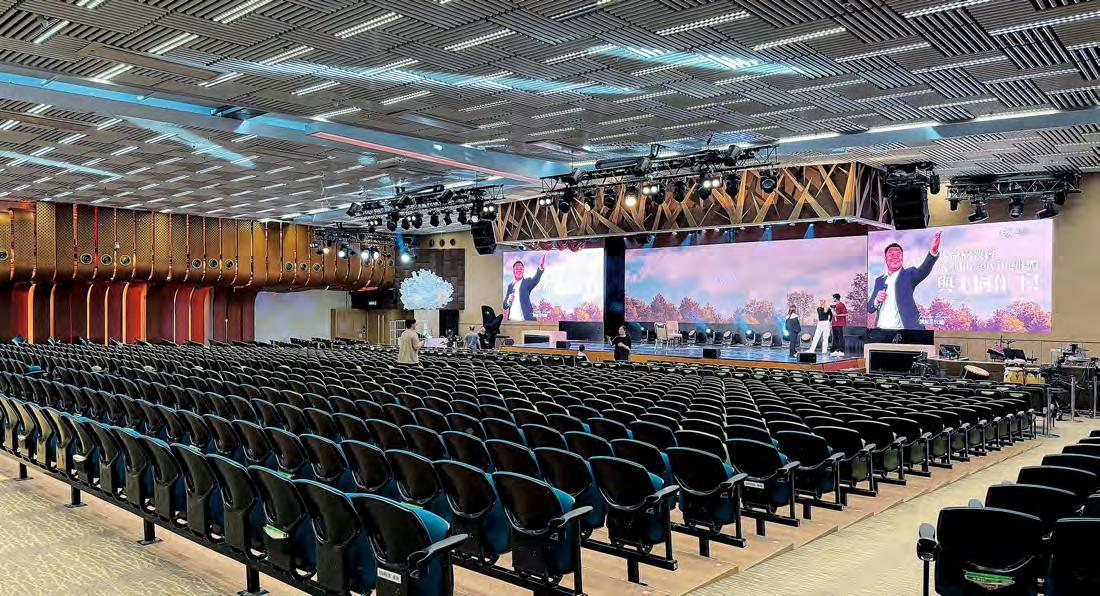
A QUARTER OF A CENTURY HAS passed since Reverend Joshua and his wife Delphine Cheung established the 611 Bread of Life Christian church in Hong Kong’s North Point district. Following a painstaking five-year conversion of a two-level derelict cinema in Tsuen Kwai Street, 611 Bread of Life began amplifying the word of God both internally and externally in 2014. Since making the church a home for its growing congregants, the production crew and stage talent have consistently relied upon advanced AV technologies to convey the message.
Located in a densely populated high-rise neighbourhood, the purpose-built, third-floor auditorium is devoid of the original horizontal pillars and corrugated metal roof that were architectural features prior to the conversion. Adopting a back-tobasics style of worship, the church has nevertheless installed a powerful AV inventory within the acoustically treated 45m x 40m (WxD) auditorium. To obtain an RT60 of 0.9, the walls of the 1,200-seat room were injected with acoustic foam diffusers in addition to being furnished with wooden absorbers and baffles.
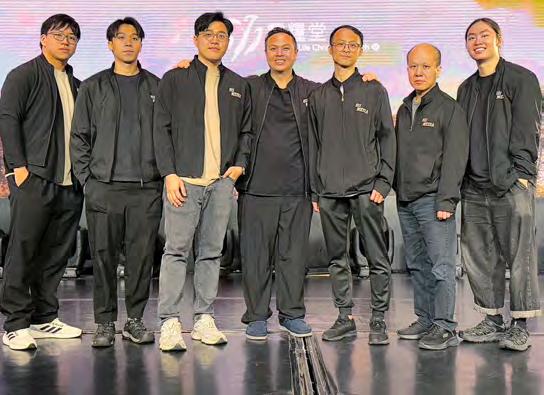
The 611 leaders called upon the broadcasting expertise of Live Group
Direct’s project director Mr Wan and technical director Cyril Lam. Enlisted to design and install an AVL system encompassing FOH audio and broadcast video production rooms, a motorised truss lighting system, an LED wall and IT network, the Live Group transformed the services within one of Hong Kong’s largest Christian churches.
Relocating to Hong Kong from Singapore in 2019, Wei Min Lim has further advanced the AV fortunes of
611 Bread of Life in his role as media pastor. Before stepping into full-time ministry, Lim gained vast experience managing a successful commercial filming agency. He also served at River Life Church in Singapore as media head for several years prior to his move.
Upon entering 611, Lim was initially impressed by the size of the church and the facilities, but soon realised that some of the technical setup required an overhaul. “There was a
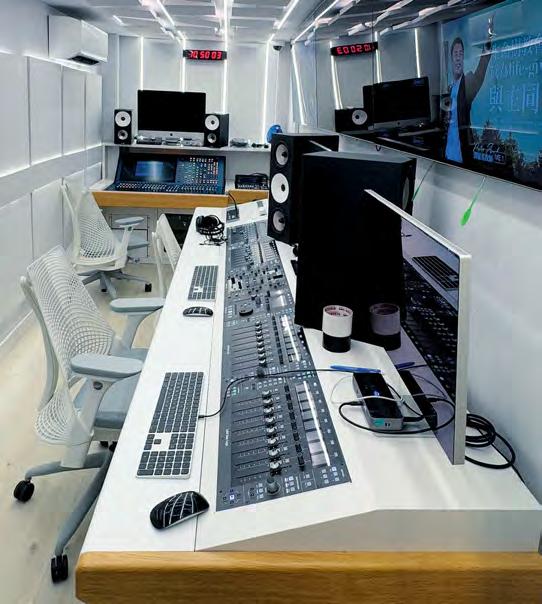
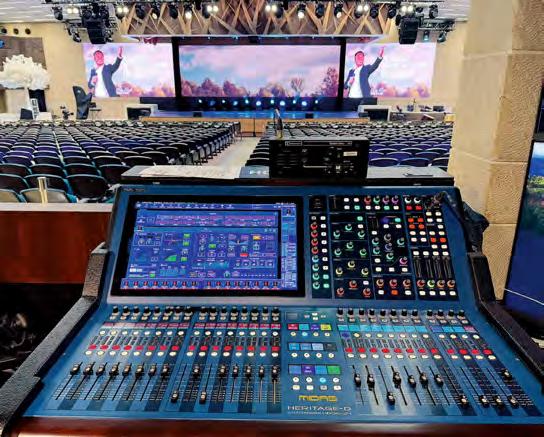
lack of technical volunteers to assist with all five Sunday services,” he recalls. “Audio was handled by a single engineer, mainly for monitors and a reliance on stage wedge monitors was creating a lot of spill and feedback. Front of house was managed by just one technician, and the control room had a very small team, consisting of one director, one CCU operator and a couple of people handling projection support. It was a very lean setup with around eight people running the entire service.”
Lim’s initial priority was to draft and train a young technical team. Having identified a deterioration of certain AV components, he started to create an AV media blueprint. Taking a 19-yearold with a passion for audio under his wing proved to be an inspirational step forward for 611. Since returning from Canada, Cyrus Kwok explored a range of upgrades, including connecting the network, wiring and creating schematics for systems integration. With growing confidence in his abilities, he has gradually applied his craft to advance the creative setup.
Building confidence with the leadership, Lim delivered weekly visual content over several months. Prior to the pandemic, a request to livestream
611 Bread of Life’s acoustically treated 1,800m2 auditorium
L–R: Angus, WaiLam, Cyrus Kwok, Wei Min Lim, Dave, Daniel and Rocky
a prayer meeting resulted in an upgrade of the original low-resolution streaming platform to HD.
“Despite the challenges, we pieced everything together and managed to deliver our first HD livestream,” explains Lim. “The pastors followed this up with a request for a livestream Bible school that would save on teacher travel budgets. By dismantling this setup, we rebuilt it in the Bible school using basic tools like OBS and Zoom. The enablement of remote teaching and interaction was a breakthrough moment as we executed this just before Covid fully hit.”
Like all other houses of worship, 611 was forced to close its doors during the pandemic. By organising temporary workstations, with multiple iMacs, the church became a production facility, where Lim organised intensive training sessions with his team of volunteers. “Ultimately, we broadcast more than 20 online services and created about 19 YouTube channels, with one for each ministry. Every department had its own content output, from children’s ministry to elderly and even specialised ministries.”
To support this initiative, the church approved a merger of the media and
Slightly shocked by the scale of Lim’s vision, the church elders asked his wife to review his plan and delete any requirements that could be deemed personal rather than genuine. Consequently, Lim’s wife removed the camera jib on account that it would take up approximately 15 seats in a venue where every seat matters. Pleased with this amendment, the elders approved the remainder of the budget proposal.
Previously nicknamed the “mushroom room” because of humidity issues, the rear prayer room was converted and repurposed as the main broadcast and postproduction control space. “The air conditioning units did not fully function in this room. When it was used for prayer meetings, the worshippers were sweating, the room accumulated mould and mushrooms would grow. However, when we took over the space and used it as a video control room, the air conditioning miraculously worked and, since then, we haven’t had to change the air conditioning units and have operated here for several months with some computers placed on temporary tables, before the custom desks were fitted.”
infrastructure for livestreaming can now be scaled according to the church’s needs when using multiple network lines. Capable of managing petabytes of data and content, the media centre runs on 10G networks and there is no need to ingest.
“During a typical Sunday service, the production team consists of a live camera crew operating up to 12 production cameras, including two Sony HDC-5500 units and a Canon box camera with a 66x zoom lens and image stabiliser. If the volunteer operator shakes, the image does not. We also deploy Sony FX3 cameras as production cameras creating a hybrid broadcast environment. Because the pastor loves playing basketball, we have suspended a basketball in front of the camera that he needs to look at. During our broadcasts, his eye line is perfect, as it aligns with the basketball.”
youth departments, which gave Lim access to a larger pool of young talent.
“I prefer to appoint young people who might not excel academically but demonstrate strong hands-on skills who we can train with audio and video production. We started with a group of seven or eight young people, paying them small allowances and training them. They became the foundation of our team.”
Providing each ministry with access to a studio setup, the expanded team built a full production ecosystem with standardised workflows using PTZ cameras, Zoom and OBS, before upgrading to more advanced systems incorporating IP-based streaming. “Cyrus and his colleagues designed and built a centrally controlled livestream distribution platform requiring fewer operators,” furthers Lim. “As the team grew, we began developing more structured environments.”
The combination of that growing team and results-driven video figures pleased the pastors. Harbouring an ambition to build a dedicated broadcast centre with a master control room for directors and producers, Lim decided to submit his bold blueprint.
4K wireless transmissions over fibre were previously stored on a server with 4TB hard disks as a backup. With the focus firmly on increasing workflow efficiencies, server-based ingest systems were created to handle the multiple high-resolution recordings. With media, IT and finance merged within the same department, the
The church carries a large inventory of Blackmagic Design video hardware for its price-performance credentials. Upon Kwok’s recommendation, a Blackmagic ATEM Constellation 8K Pro switcher and Videohub 80x80 connected to 20 sets of Hyperdeck Studio 4K Pro have been added to the video production suite at the rear of the sanctuary.
Specifying a Blackmagic platform helped Lim to reduce the cost of the setup. “Blackmagic Design technology has been transformative for us,” he adds. “In the past, broadcast systems required significant investment and large teams, but Blackmagic has made
A Blackmagic ATEM Constellation 8K Pro switcher in the video production suite
Assisted by Amphion monitors, the broadcast suite technicians operate on SSL UF8 studio controllers
Sony 4K cameras produce some of the main broadcast inputs
PROJECTS
it possible to scale these capabilities at a much lower cost. This technology allows us to deploy systems across multiple rooms and train people at every level, and cost efficiency includes redundancy and scalability.”
Initially cited as an audio broadcast room, the live translation booth was based on a vague room plan drawn by Lim, before being designed in AutoCAD by Kwok. To accommodate the volunteers, two adjacent air-conditioned rooms equipped with Shure SM7B microphones and Amphion monitors including subwoofers were created. For broadcast mixing on a DAW, the volunteers have been trained to operate Mac Pro Max Packs loaded with Apple Logic Pro and Reaper recording software for up to 120 tracks.
In addition to designing and building these rooms, Lim played a role in building the team and can take credit for the positive impact this has had on people’s lives. “Our volunteers range from professionally trained directors and producers, to students, school teachers, engineers and retired uncles and aunts. This community is more like a family, and I don’t want them to feel stressed during a production. It is our job to simplify the AV workflow processes and to ensure the volunteers only have one job to fulfil. We run five services here each week, but we are in the fortunate position today whereby we can call upon different volunteers for each service.”
From the control surface of the ATEM 2 M/E Advanced Panel surface, a director or a producer controls the Sony broadcast cameras and Sony FX3 on Teradek wireless transmitters, which are then transferred to any one of eight sets of AJA Colorboxes for postproduction editing. Receiving the director’s cut, the producer has access to all the camera inputs together with content from five Mac Studios, the Pro Presenter and Resolume Arena software, including lyrics, words,
pictures and controls for inputting onto the main LED.
In postproduction, the audio signal is transferred to four SSL UF8 digital audio workstations with UC1 plugin controls, with the final workstation used for last-minute additions. Processed and produced in Logic Pro, the visual image is synced and embedded before being broadcast on Facebook and YouTube. Designed by Rocky and built internally, the DAW-based audio broadcast system with plugins and processing manages over 100 channels. Monitored over Amphion speakers, the postproduction team also has access to an SSL Fusion processor, an SSL Bus+ compressor and a UA Apollo x8P interface. A Midas Heritage HD96 digital console works as a backup system, with its intuitive layout helping to simplify the production for the volunteers. Providing standardisation and familiarity of use in the church, both the front of house and monitor consoles are Midas Heritage HD96 control surfaces.
“It’s a very warm console and in terms of price-performance, takes some
and large musical productions. “During Covid, our members grew weary of watching our services online but, by creating dramas, we grew the audience and a lot of people now come and watch these performed at the church. They wanted to take their productions to a higher level but, because the media team wasn’t equipped for the challenge, we made this our priority.”
Over seven years, 611 has produced a staggering volume of content, livestreams, recorded shows and worship productions. Lim’s goal is to welcome over 100 worldwide branches connected over IP control over the next three years. “Many other churches have started to follow our livestream broadcasts and have openly expressed a desire to mimic our setup. As a result, we have provided
beating as the preamps are amazing,” says Lim. “For audio, we benefit from a split gain structure including Radial OX8 passive mic splitters. With the microphone feeds separated and simultaneously sent to front of house, broadcast and monitoring mixes, the three console operators maintain their own individual gain structure.”
The OX8 3-way splitters receive UHF transmissions from up to 54 Shure QLXD4 receivers via the wireless antenna system. Also racked backstage, 15 Prism Atlas 8-input multitrack interfaces have been added to process the gain signals for the broadcast feed and routed to six sets of Midas DL231 24-channel and three sets of Midas DL251 stageboxes. Acquired in 2019, the 54 Shure QLX-D transmitters paired with 30 bodypacks and headsets for the actors and singers onstage provide ease-of-use setups.
Playing a large role in conveying the church’s message, 611 stages dramas
them with tours and educated them on how to create a more scaled-down, cost-effective version of their own bespoke setups. The production videos we now produce for other churches is a first in Hong Kong.”
With technology, and especially AI, evolving rapidly, Lim’s focus going forward is to equip the younger generation to lead in the future.
“It was a high investment, but the pastors appreciate and understand that the upgrade is paying for itself.
In parallel, the church can now select from its dedicated team of 100 volunteers each week to run its services. We are extremely proud of the volunteers who operate within the same workflow. From children as young as six years old to volunteers in their 70s, we’ve built an inter-generational team, progressing through different levels as they grow.”
www.church611.org
The producer controls the Sony broadcast cameras via Teradek wireless transmitters
Front of house mixing is conducted on a Midas Heritage HD96 console
The broadcast production suite is furnished with SSL digital audio workstations and Amphion monitors
Building a complete vocal processing chain
In the first of a two-part series, sound engineer Erwin Balangue highlights the first phases of creating a practical workflow for shaping worship vocals
IMAGINE A WORSHIP SERVICE
where each word is understood, creating a strong connection with the congregation. Vocals carry the message, emotion and flow of a worship service, making them the main focus of every mix. Yet achieving this clearness is challenging. Live vocals often vary in volume as well as tone due to changing microphone distance, dynamic variations and transitions between speaking and singing. With added stage noise from drums, amps and wedges, a well-designed vocal processing chain becomes vital. Instead of relying on guesswork, presets or trial and error, a solid vocal chain follows a logical sequence; each stage prepares the next, guaranteeing the final sound is clean, controlled and musical. By sticking to this method, sound engineers can save time, anticipate outcomes and reduce unexpected surprises during live performances, rendering it an invaluable approach for both experienced and volunteer technicians.
The steps are grouped into three distinct mini-phases for easier recall: Clean, Control and Enhance. In this issue, we’ll look at phase 1, Clean, which includes the high-pass filter
and corrective EQ; and phase 2, Control, which covers compression, de-essing and the optional gate or expander. In the second part of this series in the next issue, we’ll focus on phase 3, Enhance, which focuses on tone-shaping EQ, effects, vocal bus processing and the full chain. Key takeaway: following this roadmap will hopefully help sound engineers achieve clearness and assurance in live vocal mixing.
Clean
High-pass filter (HPF): cleaning the foundation
Rationale: vocals do not contain essential musical information in the sub-bass (very low) and bass (low) regions. Everything below approximately 80Hz on a vocal channel is noise, including mic handling, foot thumps, rumble, stage vibrations, plosives (explosive consonant sounds like P and B) and bleed from bass guitar amps or kick drums. Engaging the HPF eliminates these before they enter the rest of the chain.
Why these frequencies? Fundamental notes for most male singers sit around 100–200Hz. Rolling off below 90–120Hz maintains vocal warmth
while reducing muddiness. Research indicates that the average speaking fundamental frequency for women usually ranges from 188–221Hz, which is higher than the range for men, generally between 100Hz and 146Hz. You can safely filter more aggressively without thinning the sound. Speaking vocals sit at around 140–180Hz; speech does not require the same low-end body as singing, so a steeper cutoff improves intelligibility.
Key reasoning: by removing unnecessary low-frequency information at the start, you stop the compressor from reacting to unwanted noises such as mic handling or rumble. This keeps the compressor focused on the true vocal signal, allowing it to respond more accurately and produce a clear, predictable vocal sound.
Worship stages often have subwoofers on or near the platform; HPF protects your vocal mic from “feeling” that energy. When the stage setup or subwoofer placement changes, adjust the HPF setting accordingly. For example, when subwoofers are placed closer, such as moving them from 3m to 0.5m away, increasing the HPF from 90Hz to 120Hz can help control the
extra low-frequency energy. On the other hand, if the subwoofer is far enough that the effect is minimal, you can lower the HPF to preserve vocal warmth and keep clarity. This makes the vocal sit in the mix without masking the kick or bass. Key takeaway: proper HPF settings assure clarity for the vocal and other instruments.
Corrective EQ: fixing the problems first
Rationale: before shaping the timbre, remove anything that makes the voice unclear. Correct EQ fixes issues caused by mic choice, room acoustics, singer miking technique or proximity effect (huge with handheld microphones). Here are some of the typical problematic zones: 250–400Hz (mud/boxiness): this range builds up in small rooms, hollow stages and when singers hold the mic too close. Reducing by 2–5dB cleans up the vocal and improves articulation. 2–4kHz (harshness): this is where vocal intelligibility lives, but also where the ear is most sensitive. If you boost here without checking harshness first, the vocal becomes shrill.
6–8kHz (scratchy or brittle sibilance): many live vocal mics (such as popular
Engaging the HPF eliminates background noise before it enters the rest of the chain
Beta-series models) exhibit a presence peak in this frequency range. Light cuts here prevent exaggerated S sounds before de-essing
Key reasoning: corrective EQ ensures the compressor works on a clean vocal sound, rather than reacting to room noise, mic flaws or muddiness. This results in a more transparent compression, preserves the vocalist’s natural quality and helps preserve balance in the mix. For quick troubleshooting, use a simple method, such as sweeping with a narrow EQ band, to pinpoint and cut problematic frequencies. This gives you a practical starting point to deal with any remaining issues. If harsh frequencies are left untouched, the compressor clamps too aggressively. If muddy frequencies remain, the compressor won’t tame dynamics evenly. Correct the problems first; shape the tone later.
Control
Compression: controlling dynamic swings
Rationale: even trained singers demonstrate considerable dynamic differences between quiet verses and belted choruses, between singing and speaking, and between head-turned and on-axis mic positions. Now that the mud is gone, let’s tame these active swings to ensure the vocals remain audible, present and stable in a dense worship mix.
Ratio: 3:1 to 5:1. Light-to-medium compression preserves musicality. Higher ratios (8:1+) start to sound like radio or studio vocals, often unnatural in live worship.
Attack: 10–30ms. A too-fast attack squashes the transient and removes vocal articulation. A moderate attack allows the consonants (T, K, P) to punch through, improving intelligibility.
Release: 40–90ms. Short enough to recover between syllables, long enough to avoid “pumping”.
Gain reduction: 3–6dB average. This is the sweet spot: controlled but not over-processed
Key reasoning: compression should improve consistency and not make the vocal feel “squashed”. Too much GR = fatigue. Too little = vocal disappears in the band. Compression also brings up softer details, which is why sibilance becomes prominent, making the next step essential.
De-essing: managing sibilance the smart way
Rationale: after compression, sibilant consonants (S, T, Sh) rise in level. For example, when a female vocalist uses a bright handheld microphone, the amplified S and Sh sounds can become noticeably harsh and fatiguing, especially during louder passages or when the singer is positioned close to the mic. In worship settings, where this combination is frequent, the resulting sibilance may become so piercing that it distracts listeners or reduces vocal intelligibility.
Frequency: 5–8kHz. This is where most S energy lives. Sibilance in male vocals can often be found between 4.5kHz and 6kHz, and microphones described as having a bright sound tend to feature a frequency boost in the range of 7–9kHz. A gain reduction of about 2–6dB is usually sufficient to manage harshness in vocals without making them sound unnatural or introducing a lisp. As a starting point for volunteers, set the de-esser frequency to 6kHz with a 4dB reduction; this provides a safe baseline while making tweaks as needed during a live session. De-esser after compression –compression increases sibilance so use the de-esser to fix it. Putting it before compression often makes it ineffective.
Back on stage.
More than ever.
Nettuno L28 marks Montarbo’s comeback to the stage with a newly designed, compact line-array.
Modular and versatile, it delivers professional performance for both touring and installed applications. Through scalable design, 135.5 dB SPL and perfectly balanced coverage, Nettuno L28 integrates effortlessly into any space, delivering sound that embraces every listener.
Its adaptive headroom handles both speech and live music with ease, while onboard presets simplify system configuration by reducing the need for external processing.
With added stage noise from drums, a well-designed vocal processing chain is vital
Guide to projection
Christie has produced a Projection Selection Guide to help customers choose the right technology for their environment
SELECTING THE RIGHT
projector is a lot like buying a car. You know how much you can spend, what you need it to do and some of the different models you want to explore. But here’s where it gets tricky: once you sift through all the available features and options, which model is the right fit?
The same thinking applies to display technology: how do you choose the right projector when there’s so much choice? A great way to get started is to have a firm handle on your “must-haves”: the criteria you will use to guide you through the selection process. This first part of a two-part series looks at narrowing down your requirements and considering factors such as size, noise and robustness.
What’s important to my project?
It all starts with that question. And if you can answer it, you have the information to help you find the right projector for your application or venue. It’s the question that helps you determine the right price, right brightness and right performance for your needs. It helps guide you as you consider different projector models.
Do your homework
Before you start to talk about all the technology options with a consultant, systems integrator or do your own research, spend some time looking at the environment you’ll use it in.
• Are t here any potential obstructions to the projector’s light path?
These factors will help determine
• How m uch ambient light –natural or artificial – is in your space?
• Wha t are you projecting on – a wall, screen, building or landmark? What are the dimensions?
• How b ig is the room?
• How f ar is the projector from the projection surface?
• Wha t’s the viewing distance?
• Wil l people be close to the projected image? Or will they sit or stand at a distance?
your audience is to the display, the higher the resolution you need so the image doesn’t appear pixelated. If your space is limited, an ultra-short-throw (UST) lens is invaluable, as it lets you locate the projector close to the screen and still get a bright, large image.
Size can matter
Size and weight won’t trump image quality and functionality, but they can influence your decision. If you need a projector that’s easier
to move around or you have a space-limited environment, then you may want to consider a smaller, lighter model. The combination of a compact form factor and the ability to operate your projector in any orientation (not every projector can do that) allows you to locate it precisely where it needs to be for optimal screen coverage and performance.
What about noise?
If your audience is far from the projector, you probably don’t need to think too much about the sound level. But what if the projector is close by? No one wants to distract from the audience’s experience or increase the amount of noise already in the room, so the projector’s sound level is now part of your decision. So, what does that mean as you consider noise? 30dBA is considered to be whisper-quiet, while 40dBA equates to quiet library sounds.
Environmental factors
You know where the audience will be and where the projector needs to go. Now we need to take a look at the environmental factors that can affect your projector. Will the projector be placed indoors or outdoors? Do you need to contend
with dust, heat or humidity? If you face demanding environmental conditions, you may need a projector with a sealed optical path or a dust-resistant optical engine.
How robust does your projector need to be?
Next on the list of considerations is how you’ll use your projector. Will it be used rigorously, going from one facility or venue to another? Do you need to operate it for long run times, maybe even 24/7? Answering these questions will help determine if you need characteristics like rugged design, high-usage capability or a longer operational life.
What will you display?
The more sophisticated your content, the more important colour fidelity is. Look for projectors that have technology that boosts colour performance, so it’s more balanced, uniform and accurate – and more realistic. If your application needs the most lifelike, pure and vibrant onscreen colours, RGB pure laser projection technology has the widest colour gamut available. It can reproduce real-world colours and dramatically enhance your audience’s visual experience.
Frame rate
Since displaying video is standard these days, a projector’s frame rate plays a big role in how dynamic (moving) content looks onscreen. Projectors with frame rates of 60Hz and above significantly reduce the motion blur that can happen with lower frame rates. Some models offer even higher image quality by projecting native 4K resolution content at 120Hz or 2K at 240Hz or 480Hz. If you want to display 3D content, higher frame rates of 4K at 60Hz per eye not only reduce motion blur but also help to make the visual experience more comfortable. Part two will look at multi-projector systems and maintaining your investment. www.christiedigital.com
Identifying what’s important for your project is the first priority
Christie’s Korus Series models have a compact, lightweight design with an optional Z-shaped ultra-short-throw lens
THE SLEEK AND ELEGANT LINES DEFINE THE DESIGN OF THE NEW VERTUS MODELS
FBT unveils two new VERTUS CLA point source models built in aluminium extrusion. The CLA 204T and the IP55 certified weather resistant CLA 203T that includes water resistant enclosure, water resistant treated loudspeakers, a grille with hydrophobic fabric and hermetic terminal box. These models are also EN 5424 certified for emergency and evacuation systems, with a ceramic terminal block and thermal fuse ensuring protection for the line connection in case of fire. A range of accessories is available to enhance the product’s functionality.
CLA 203T
CLA 204T
Haze – friend or foe?
John Black looks at the purpose of haze in worship and how it can be a powerful tool to create depth and focus
FEW TECHNICAL TOPICS IN THE modern house of worship world ignite as much passionate debate as the introduction of a haze machine. To some, it is an invaluable tool that enhances the visual storytelling of a worship service. To others, it feels like an unnecessary concession to “rock concert” culture that distracts from the true focus of Sunday morning.
When used thoughtfully, a haze machine is not about creating a spectacle; it is about creating depth, focus and an environment that minimises distractions while accentuating the intentional design of your service. Let’s unwrap the debate and take a look at how haze can be a powerful tool in the worship lighting technician’s toolkit.
Part 1: the “why” – the purpose of haze in worship
To understand why lighting technicians love haze (and we do!), you first have to understand
how light works. Light is invisible until it hits something. If you shine a powerful stage light across a completely clean, empty room, you will only see the fixture itself and the pool of light it casts on the back wall or floor. You do not see the beam of light travelling through the air. Haze changes this by introducing microscopic airborne particles. When a light beam passes through these particles, the light reflects off them, making the entire path of the beam visible. This phenomenon produces a number of desired effects.
1. Creating visual depth and dimension
Auditorium stages can easily look flat on video streams or from the back row. Haze transforms a two-dimensional stage design into a three-dimensional environment. It allows the lighting designer or technician to draw lines in space, establish a sense of scale and frame the platform in a way that separates the worship team from the background.
2. Enhancing mood and focus
Worship music is deeply emotional and reflective. Lighting is one of the most effective non-verbal tools available to mirror the narrative arc of a service. A soft, warm amber glow hanging in mid-air during an intimate acoustic moment can evoke a sense of reverence and warmth. Conversely, dynamic, clean beams cutting through the air during a high-energy song of praise can inject visual energy into the room without requiring chaotic, flashing lights.
3. Masking production visual noise
Every church stage has a certain amount of clutter – black backdrops, truss structures, speaker clusters and cable runs. By creating a subtle mid-air canvas of light, haze naturally draws the eye away from the utilitarian components of the room and focuses attention strictly on the intentional elements of the design: the people leading worship and the colours framing them.
Part 2: the critical distinction – haze vs fog
A common point of friction with church leadership or congregations stems from a misunderstanding of what a haze machine actually does. People often confuse a hazer with a fog machine.
The output of a hazer is a thin, translucent mist that disperses evenly, hanging subtly in the air. Haze is virtually unnoticeable until light hits it. The output of a fog machine is thick and opaque, and, depending on the type of machine and fluid, it can billow up, settle low or create fast dissipating bursts. Fog is highly
noticeable and often used to create a special effect.
If your congregation complains that they “can’t see the worship leader” or feel like they are standing in a swamp, you are either using a fog machine or drastically over-operating your hazer. The goal of a hazer is to make the light visible, not the air itself.
Part 3: the “how” –best practices for implementation
Using haze successfully in a house of worship requires a mix of technical precision, environmental management and cultural awareness.
1. Choosing the right fluid: water-based vs oil-based Haze machines generally fall into two categories based on the fluid they use. Water-based hazers use a glycol-and -water mixture. The particles they create are slightly larger, meaning they reflect light exceptionally well but tend to dissipate faster. Water-based haze is generally preferred in churches because it leaves virtually no residue on expensive gear and is less irritating to sensitive vocalists. Oil-based hazers use a mineral oil-based fluid to create incredibly fine, long-lasting particles. The “hang time” (how long the haze stays in the air) is unmatched, meaning you use far less fluid over time. However, over months and years of heavy use, oil-based haze can leave a fine film on projection lenses, LED walls and moving light fans if ventilation is poor.
2. Managing the airflow (the HVAC factor)
If your air returns are located directly
reflects off the microscopic airborne particles produced by the haze
above the stage, they will suck the haze out of the room as fast as your machine can produce it. If there is a draft from a side door, the haze will drift unevenly into the congregation. How can you deal with difficult room airflow?
Pre-fill the room: turn on your hazer 30–45 minutes before doors open. Let the machine build a light, consistent baseline throughout the room while the HVAC system is stable. Use low-velocity fans: place a small, quiet studio fan directly behind or above the hazer’s output nozzle. This helps break up the dense stream of vapor immediately as it leaves the machine, distributing it evenly across the stage before it can form a visible cloud.
3. The golden rule: less is more In a worship environment, the ideal level of haze is achieved when a person walking into the auditorium doesn’t look up and think, “Oh, they have a smoke machine on”. Instead, they should simply notice that the stage looks beautiful and clean. If you notice a haze cloud drifting heavily through the first few rows of the congregation or causing people to cough, turn the output down. Modern hazers allow you to control both the fan speed and the fluid output via DMX. Program your haze output so
that it runs at a low, continuous rate rather than blast-firing it intermittently.
Part 4: navigating the cultural and safety challenges
Even with perfect technical execution, introducing haze will likely prompt some questions or pushback. Addressing these concerns proactively with transparency and empathy is key.
1. Fire alarm safety
This is the most critical technical hurdle. Many modern commercial facilities use photoelectric smoke detectors, which detect fire by measuring how particles in the air scatter light – the exact mechanism that makes haze work. If your church uses these, a standard hazer will trigger a false fire alarm. Before you ever turn a hazer on in your building, consult with your facility manager and local fire marshal. You may need to temporarily bypass specific stage zones during services (requiring a dedicated “fire watch” person onsite); isolate stage detectors if the rest of the building relies on heat sensors; or opt for a water-based machine with an incredibly fine
micron output that is less likely to trip modern systems.
2. Vocalist concerns
Worship pastors and choir members are often protective of their vocal health, and rightfully so. Poorly made, cheap fog fluids can dry out vocal cords or irritate throats.
To win your team’s confidence, invest in high-end, cosmetic-grade fluids that
are certified by organisations like the Actor’s Equity Association. Show your team the safety data sheets (SDS) proving the fluid is non-toxic. When they see that the product is clean and that you are keeping the output levels subtle, their anxiety will typically dissolve.
3. Pastoral transparency
Do not surprise your senior leadership or the congregation with a smoky stage on a random Sunday morning. Have an honest conversation with your pastor about why you want to use it.
Conclusion
Ultimately, a haze machine is just another tool in the production toolbox, no different than a high-quality microphone, an acoustic drum shield or a well-designed graphic on a screen. Its goal is to serve the primary purpose of the gathering: to minimise visual distractions, engage the senses and draw the congregation’s focus towards worship. By executing it with technical precision, keeping it subtle and respecting the environment of your specific room, haze can become a seamless, beautiful bridge in your visual worship expression.
Cheap fog fluids can dry out vocal cords or irritate throats
Controlling directivity
The final instalment in this three-part series focuses on the importance of prediction and modelling tools and future developments that could change how directivity is handled
How critical are prediction tools for controlling directivity?
A modern sound system is generally made of various sub sections, such as front fills, subs and mains. Each element could be a single speaker, or it could be an array with lots of discrete speakers and drivers working together. “In a complex system design, we could easily have thousands of individual transducers interacting with each other,” explains Steve Jones, d&b audiotechnik EAS team leader EMEA. “The impact and adjustments of these interactions are far too much for the human mind to calculate alone.”
In worship environments, where you’re often dealing with a one-shot installation in an acoustically complex space, there’s no room for trial and error on the day of commissioning.
“Modelling software gives systems designers the ability to model the room in detail, place virtual loudspeakers and visualise exactly how coverage will behave across every seat – before a single rigging point is loaded,” adds Geoff McKinnon, senior director of engineering at EAW. “For conventional line array and point source systems, that means catching problems early: identifying dead zones under balconies, flagging hot spots near the front and comparing different configurations side by side.”
Fohhn’s Focus Venue is a modular line array system with beam-steering technology
“Key parameters such as coverage areas, mounting positions, system size and cabinet quantity must be defined in advance,” continues Christian Mayo Guedes, R&D engineer at Fohhn. “Modern simulation tools allow designers to evaluate how different loudspeaker types, directivity characteristics and system configurations will perform within a given space. This enables informed decision-making and helps ensure that the final installation meets the desired acoustic objectives.”
Mathieu Pobeda, technical director at Arbane Groupe, believes it is mandatory to have a good simulation tool and a good understanding of the acoustics wave behaviour to
Crossroads Dayton has an L-Acoustics Immersive Hyperreal technology
L–R: Mathieu Pobeda (Arbane Groupe), Steve Jones (d&b), Geoff McKinnon (EAW), Christian Mayo Guedes (Fohhn), Steve Mathis (JBL), Alan Johnson (L-Acoustics), Andy Davies (Meyer Sound) and Brandon Heinz (Renkus-Heinz)
Fohhn Designer allows parameters such as coverage areas, mounting positions, system size and cabinet quantity to be defined in advance
optimise your installation. However, he adds that there is a downside in that modelling doesn’t come for free. “There are very few projects that have an infinite budget. This is why both theoretical and practical knowledge must be kept in mind.”
“Because sound is invisible and follows complex laws of physics, guessing where a sound beam will land is difficult, if not impossible,” explains Steve Mathis, product development, installed loudspeakers for JBL Professional. “In worship spaces where architecture often fights against audio clarity, these tools bridge the gap between architectural beauty and acoustic reality.”
Alan Johnson, business development manager, house of worship global lead at L-Acoustics, describes audio modelling tools as non-negotiable. “You can model the room geometry, position loudspeakers, predict SPL distribution across the entire seating area, evaluate frequency response consistency and identify problem zones, all before anything gets specified or installed,” he says. “Once the design is taking shape, we can share it as an interactive 3D experience with anyone involved in the project.”
Directivity expressed on data sheets does not allow users to effectively design complex loudspeaker systems, states Andy Davies, senior director of product management at Meyer Sound. “Accurate prediction tools allow systems designers to place loudspeakers to best use their directivity, maximising coverage for the audience while minimising the amount of sound in unwanted areas.”
In addition to using modelling software to figure out the angles, number of cabinets or steering required for a single loudspeaker, modelling software can also be used to model entire loudspeaker systems with direct sound only. “This can be
useful for setting up filtering, delay times and placement for entire sound systems,” states Brandon Heinz, product manager at Renkus-Heinz. “At the most advanced levels, modelling software can be used to predict room acoustics and, when done correctly, will show exactly how the loudspeaker will sound in the room it was designed for.”
Are there any developments that could change how directivity is handled?
Pobeda believes that as a manufacturer, it’s important to offer a wide range of solutions that simplify the customers’ job. “Of course, we need to develop new technologies but we also need to keep in mind ease of use and avoid over engineering which is costly for everyone without necessarily adding anything to the result. We are in a constant state of research, but sometimes simple solutions don’t age and stay around for a long time. Customers need solutions that work and that they can trust.”
Directivity remains the key for achieving consistent tonality, with high speech intelligibility, free from the negative effects of reflections and reverberation, so that it’s easy to create an impactful and distraction-free audio environment, states Jones. “In the future, we expect to see loudspeakers that can control the directivity to the lower frequencies in smaller and smaller dimensions. Then, once we have directivity, we will be able to manipulate this directivity more and more, allowing the user the ability to match the speaker’s performance to the desired audience with greater speed, quality and ease.”
“Directivity has always been central to how we think about system design, but the tools available to manage it are evolving faster than at any point in the company’s history,” adds McKinnon.
“As you pack more individually controlled transducers into a single array, the resolution of your directivity control increases dramatically, giving designers the ability to shape sound with a precision that starts to feel less like acoustic engineering and more like sculpting. On the software side, we’re moving towards systems that don’t just model and control – they learn. The integration of intelligent processing and real-time feedback loops will allow future systems to adapt continuously to what’s happening in the room.”
Mayo Guedes believes that directivity is a central consideration in modern loudspeaker design, particularly as
applications lean towards immersive and multi-sensory environments. In such contexts, sound must integrate seamlessly with visual and even haptic elements, placing new demands on system design. “One clear trend is the move towards increasingly compact and visually unobtrusive loudspeakers that can effectively ‘disappear’ within the space while maintaining precise control over sound radiation. Advances in processing power, beam steering and active acoustics will continue to expand the possibilities for adaptive and highly controlled directivity in the future.”
Mathis adds that directivity will remain a foundational consideration in loudspeaker development, particularly for worship environments where clarity and consistency are essential. “Ongoing developments include more precise beam control, tighter integration between loudspeakers and processing, improved modelling accuracy and growing interest in immersive and object-based audio. As immersive technologies evolve, directivity will play an even larger role in ensuring accurate localisation and a coherent listening experience across increasingly complex worship services.”
“The most significant shift we’re seeing isn’t just about where sound goes, it’s about how intentionally you can place it,” adds Johnson. “Rather than a single mix going to the entire room, you’re working with discrete sound spaces like a scene system, surround speakers and support, each with its own configuration, all managed from a unified object-based environment. That fundamentally changes the directivity conversation. You’re not just trying to avoid exciting a reflective surface; you’re placing sound with enough precision that energy naturally stays where it needs
to be. For worship specifically, this is meaningful.”
Meyer Sound always takes directivity into account when defining and designing any new loudspeaker system, states Davies. How the system performs is defined by where the sound goes and how predictable that directivity is. “That focus influences our choices throughout the design phase, from loudspeaker size and layout through to what the products are made of. Processing technology that shapes directivity will continue to evolve in two ways. First, in the design stage, new generations of loudspeaker system design tools will continue to help designers place the right product in the right place. Alongside this, there will continue to be the opportunity to develop processing that controls arrays of sources.”
The emphasis on directivity and control has been something that has caried Renkus-Heinz forwards and is an integral part of every loudspeaker that the company designs. “When thinking about the future, there have been some very exciting developments in transducer technology and processing power which will enable revolutionary loudspeaker designs that we were not able to produce even five years ago,” concludes Heinz. “I don’t think these developments will radically change how directivity is handled, but they should enable new dimensions of control, which is incredibly exciting for me.”
World Outreach Church was the first HOW to install an L-Acoustics K3i system
IPMX and worship technology
AIMS board member Andrew Starks considers how IPMX can offer a single, unified framework from the outset
AS IPMX REACHES ITS FIRST formal certification milestone, the conversation around open standards in AV-over-IP is shifting from theory to deployment. AIMS board member Andrew Starks outlines the progress so far and what it could mean for worship production facilities of every size.
What is IPMX and why does it matter for worship?
AV-over-IP has transformed production environments across the board, and worship facilities are no exception. More than a dozen competing platforms now enable high-quality, low-latency audio and video transport over standard Ethernet infrastructure. Yet the market remains fragmented. Manufacturers, integrators and end users face a persistent challenge of products being built on different proprietary ecosystems that are not interoperable. For a church or ministry
weighing a significant infrastructure investment, that fragmentation creates real risk.
Internet Protocol Media Experience (IPMX) was created to address that problem. Developed under the Alliance for IP Media Solutions (AIMS) in collaboration with the Video Services Forum (VSF) and the Advanced Media Workflow Association (AMWA), IPMX is an open standard and specification for multivendor AV-over-IP. It builds on SMPTE ST 2110, the broadcast industry’s established standard for professional media over IP networks, and integrates AMWA’s Networked Media Open Specifications (NMOS) for device discovery and connection management. Where ST 2110 was designed for the extreme timing demands of live broadcast production, IPMX adapts and extends that foundation to meet the realities of pro AV deployment, including worship. It supports both synchronous and asynchronous
operation, allowing systems to run with or without Precision Time Protocol (PTP) infrastructure, which matters enormously for facilities that are not starting from scratch with a broadcast-grade network. It defines profiles for compressed video using JPEG XS, enabling visually lossless 4K60 transport over standard 1GbE networks. And it makes NMOS mandatory rather than optional, ensuring consistent device discovery, EDID handling and connection management across vendors. For worship environments specifically, IPMX also supports USB virtualisation for interoperable KVM deployments, standardised HDCP handling for protected content and a Privacy Encryption Protocol for secure multivendor AV transport. Rather than requiring bridges between incompatible ecosystems, where information is lost and complexity grows, IPMX offers a single, unified framework from the outset.
AIMS formally launched the IPMX initiative at ISE 2020. In the years that followed, the effort progressed through intensive development and real-world validation. A critical milestone came in 2023, when the first large-scale interoperability testing event, hosted at the NFL facility in Inglewood, California, brought early adopters together to validate assumptions and refine specifications based on actual device behaviour.
Andrew Starks
That work reached its culmination in January 2026, when the inaugural IPMX Product Testing and Certification Event was completed at the European Broadcasting Union (EBU) in Geneva, in collaboration with AIMS, VSF and AMWA. For the first time, the full certification process ran end to end: devices were independently tested, procedures were validated and the public IPMX Registry made its debut.
At ISE 2026, the results became tangible. The launch introduced 48 certified products from 11 manufacturers, spanning silicon providers, endpoint manufacturers and infrastructure vendors. For worship production teams, consultants and integrators who have been cautious about open AV-over-IP standards, this represents a clear inflection point. IPMX is now a verified, deployable ecosystem backed by independently tested multivendor interoperability.
The certification framework itself sends an important signal. It defines what compliance means, provides transparency through the public registry and creates accountability that proprietary platforms have not historically offered. Integrators are no longer forced to reverse-engineer
devices share a common transport and control framework from the ground up, which is exactly the kind of predictability that worship production teams need when building or expanding a facility.
What comes next?
With certification established and products entering the market, the next
AIMS is launching the IPMX Training Series in 2026, with the first formal sessions offered at the NAB Show in Las Vegas in April. The curriculum will progress from foundational concepts through system design and into advanced networking topics including PTP and ST 2110 integration, giving engineers and integrators a practical path for building AV-over-IP
capabilities are coming online. HDCP and Privacy Encryption Protocol certification are being added to upcoming test events. Support for widely deployed codecs such as H.265 (HEVC) and H.264 (AVC) is in progress, reflecting the practical realities of existing infrastructure. Interoperable USB transport has been specified and is moving towards certification.
For worship facilities planning a future upgrade, this is the right moment to start exploring IPMX. Whether your ministry operates a single-campus sanctuary or a multi-site production environment, the standard is designed to grow with you, starting simple over existing switches and scaling towards broadcast-grade timing and higher resolutions as budgets and requirements evolve. The goal is a future where AV-over-IP is no longer fragmented across competing proprietary ecosystems but is simply the way audio and video move over networks.
For anyone who has been waiting for proof that an open AV-over-IP ecosystem can function at scale, that proof is now visible. It is time to begin planning, specifying and deploying.
Controllable properties of light
ETC’s outreach and training specialist, Declan Randall, explores how the properties of light can be manipulated to achieve the essential objectives of lighting design
BY UNDERSTANDING AND harnessing the power of intensity, colour, distribution and movement, you will be able to create a mesmerising experience that captivates your audience. To achieve our five objectives of lighting design (visibility, revelation of form, composition, mood and information), we will need to make decisions about what types of lights we will use, where we will rig them, what colour they should be and how bright they will be in each cue. As a medium, light has four properties that we can control. By manipulating these properties, you will meet your five objectives and are well on your way to your first successful lighting design.
Intensity
We are all used to changes of intensity in light; we experience them every day. As lighting designers, we are less concerned about how bright a light is, and more with how bright it appears to be. Of course, the actual brightness is a consideration when selecting fixtures, but when you are creating the lighting, you will set the intensity (also known as “levels”) of the light to create the look and feel that you want.
Visibility – the more light you have onstage, the easier it is to see the
action. By simply changing the intensity of the lights on different parts of the stage, it will help guide the audience’s attention. We should be a little cautious here though – it is possible to create a situation where there is too much light onstage. The ability to skilfully balance the intensities of all the lights in your rig is part of what makes a successful designer.
Revelation of form – some people think that the lighting designer’s job is to eliminate shadows. Shadows can add depth and dimension, so it is not necessary to try and eliminate them all. If you have two lights focused onto your actor, one from each side, and one of the lights is at a lower intensity, then this will help “shape” the actor and create a three-dimensional shape onstage.
Composition – by varying the intensities of different parts of the stage, you can not only guide the audience’s focus, but you can create beautiful stage pictures with a brighter light centre stage that fades out to the edges, for instance.
Mood – as a general rule, the brighter it is onstage, the happier it will feel. Conversely, the darker it is onstage,
the more moody and ominous it can start to feel.
Information – brighter lighting will imply daylight, or a scene or location that would inherently have more light. Darker lighting will imply nighttime or locations that might inherently have less light.
Colour
Colour, perhaps more so than any of the other properties, helps you achieve the information, mood and composition objectives. While visibility determines whether or not we can see something, colour determines how we see something. Different colours can have different meanings and this is sometimes the motivation for our colour choice. Sometimes, our choice is more subliminal – if we want to manipulate the audience’s response to what is happening onstage, we can choose colours that have psychological or symbolic meaning instead.
Visibility – colour can play an important role in helping with visibility. Darker, more saturated colours will make it more difficult for the audience to see what is happening onstage. Also, the darker the colour (especially
By varying the intensity of light, you can guide the audience’s attention
ETC’s ColorSource PAR V Zoom is an LED position
Whether deploying a redundant or primary-only network topology, the MS8.2 Milan network switch is perfectly suited to simplify mobile, installed systems and spatial audio applications.
luminaire with a manual zoom
NEWPRODUCTS
L-Acoustics expands L Series
The L1 – and its companion cardioid subwoofer, the CS1 – have been added to L-Acoustics’ L Series
BUILT ON the manufacturer’s patented Progressive Ultra-Dense Line Source (PULS) technology, the L1 reportedly achieves a categorically higher concentration of transducers in an efficient form factor. Each enclosure integrates two 18-inch low-cardioid (LC) transducers side-mounted for frontal energy and rear rejection, four front-facing 15-inch low-frequency drivers, eight 8-inch mid-frequency drivers and six coaxial 4-inch + 2.5-inch HF compression drivers. This HF coaxial configuration, new to the L Series, increases SPL and long-throw capabilities. The result is a maximum SPL of 160dB per enclosure, across a full bandwidth of 35Hz–20kHz. The companion wide vertical coverage L1D element matches this transducer architecture with a progressive 60° vertical coverage pattern for nearfield zones, achieving 155dB SPL. The CS1 features four 21-inch transducers in a cardioid topology, delivers peak SPL up to 150dB and extends bandwidth down to 25Hz. A
new-generation Autofilter algorithm works within the manufacturer’s Soundvision software to shape the low-frequency beam of an L1 array to reportedly match – or even surpass – the low-frequency control of a much longer conventional professional sound system of equivalent power, down to 20Hz, with no added latency. The result is said to be greater tonal balance stability across the venue and noticeably less low-frequency spread from front to back. Horizontal directivity is managed by two Panflex modules per
enclosure, offering 70° and 90° symmetrical patterns plus an 80° asymmetrical mode. The L1D extends options to 110° or 70° symmetrical and 90° asymmetrical for nearfield coverage. Vertical control is built into the pre-shaped progressive geometry of the L1, with 0.8° inter-element coupling for long-throw formats and 5° for complex audience profiles. Meanwhile, the manufacturer has also released Source Intelligence, a proprietary voice-separation technology that delivers clearer, more intelligible vocals for live
performances. Running as an exclusive licensed application on the L-ISA Processor II and fully integrated in the L-Acoustics system workflow, Source Intelligence gives front-of -house engineers mixing on an L-Acoustics PA a tool to clean up vocals from noisy stages and allow performers to move freely across any stage configuration, including in front of the PA, without risking feedback or sacrificing vocal clarity.
Source Intelligence uses machine learning to continuously identify the voice in a microphone signal and remove everything else. PA bleed, crowd noise, stage instruments and room reverb can all be stripped away in real time, leaving a cleaner, more natural sound. The result is a vocal that “preserves the natural tone, character and intelligibility of the source”. The technology also reduces feedback risk by eliminating the PA bleed and ambient noise that cause it, rather than reacting after it starts.
www.l-acoustics.com
CS1
POWERFUL PERFORMANCE MADE EASY
POWERFUL SOUND
32-bit DSP with FIR filter – precise sound reproduction
PLUG & PLAY
4 on-board presets: Music, Monitor, Voice, Ext. Sub
WIRELESS FREEDOM
Bluetooth audio streaming with True Wireless Stereo (TWS)
PURE POWER
1,200 W peak – fanless, silent operation
Available in 10“, 12“ and 15“
RIGHT SIZE FOR EVERY GIG
BUILT TO LAST German quality - professional wooden cabinet
WORKS PERFECTLY WITH our
Yamaha upgrades DXR/DXS and CXR/CXS mk3 series
THE DXR mk3 powered loudspeakers and DXS mk3 powered subwoofers – along with their CXR/CXS mk3 unpowered counterparts – have been designed for live music, DJ sets, speeches and events. The DXR mk3 range is available in three models: the DXR15, DXR12 and DXR10. Respectively featuring highdurability 15-, 12- and 10-inch lowfrequency drivers with 1.75-inch
of highly accurate media synchronisation environments. The SWX2322P-30MC 100G/25G intelligent L2 PoE switch can be used to distribute between FOH and stage-side locations, allowing flexible signal routing and high-density encoder/ decoder connections with PoE++. In corporate facilities, it supports AV systems spanning multiple floors or departments.
high-frequency units, all models are housed in a lightweight, injection-moulded enclosure. As well as weight reduction, this attenuates cabinet resonance, with optimised port positions to reduce standing wave effects.
The DXS mk3 subwoofers share the same 96kHz DSP, power supply and rear LCD panel design, with a 2,500W Class-D amplifier and long-excursion 18-, 15- or 12-inch bass cones, plus a 4-inch (DXS18 mk3) or 3-inch voice coil. The DXS18, DXS15 and DXS12 are housed in durable, acoustically optimised plywood cabinets with a scratch-resistant polyurea coating. All feature switchable D-XSUB processing for extended low-frequency reproduction down to 32–38Hz.
The CXR mk3 and CXS mk3 series are unpowered versions of the DXR/DXS range, primarily intended for installation, fixed system and event applications, such as situations where nearby power sources may be limited.
The SWX3220-30TCs and SWX2322P-30MC switches come with support for 100/25 Gigabit and Multi-Gigabit Ethernet. The SWX3220-30TCs 100G/25G standard L3 switch ensures stable, low-latency transmission of audio and video signals. Fibre connections provide noise resistance and long-distance coverage. An IEEE 1588 PTPv2 Boundary Clock (BC) enables the construction
HK Audio’s newest family members
THE LUNAR series from HK Audio comprises three versatile, highperformance loudspeakers with 10-, 12- and 15-inch woofers. These can be flexibly deployed as full-range systems, monitors or as mid/high units in combination with subwoofers from the PORTABLE SUB series. Predefined presets provide direct access to optimally tuned sound settings for various applications such as music, monitor or voice. A 32-bit DSP with FIR filter and phase correction reportedly result in precise, dynamic reproduction with high impact, even at high volumes. Flexible connectivity options, including Bluetooth True Wireless Stereo, also allow for easy integration of a wide variety of signal sources.
The PORTABLE SUB series consists of two subwoofers with 15- and
18-inch drivers. These are not only tailor-made for LUNAR but also work alongside the HK Audio POLAR MK2 and SONAR systems. Specially developed presets for the respective HK Audio series provide precisely tuned, phase-stable interaction at the touch of a button. A general preset also allows the subwoofers to be easily combined with loudspeakers from other manufacturers. With 1,400W of peak power and a maximum sound pressure level of 131dB, the models are said to deliver a well-defined bass. The integrated DSP technology provides precise impulse response and reliable performance, even at high volumes.
www.hkaudio.com
The manufacturer has also expanded ProVisionaire Cloud, its cloud-based licence management service. The platform now includes the Room Planner feature from ProVisionaire Plan, an Automatic Voice Lift Designing feature that recommends device selection and optimises audio settings based on room size and layout, and an AI-powered image recognition feature that accelerates early-stage designs by generating room layouts from images to improve speed and accuracy. ADECIA firmware v3.0 includes auto design and setup for Voice Lift with ProVisionaire Cloud and ProVisionaire Plan updates, the ability for up to 64 RM-W wireless microphones to be automatically mixed and managed by a single RM-CR processor, an AI-powered Denoiser for clearer, more focused audio and expanded admin tools for wireless microphones.
Finally, RIVAGE PM v7.0 firmware allows engineers to control the immersive panning of Sound xR Image direct from the screen of a RIVAGE PM digital mixing system. The update also creates a seamless connection to the Yamaha DME7 or NEXO DME10 signal processor which is used by Sound xR Image. It also supports ADM-OSC, an industry initiative designed to standardise the real-time exchange of object-based audio positioning metadata in live production and broadcast environments.
www.yamaha.com/2/proaudio
DirectOut shrinks Smart Audio Platform into ACE
DIRECTOUT HAS introduced ACE, a compact Smart Audio Platform designed for playback, drive rack and custom processing applications within a portable form factor. Built around the same FPGA core used in the company’s PRODIGY Series, ACE combines audio networking, routing and processing within a backpack-sized chassis intended for touring and live production workflows.
The platform operates across three selectable ACE Modes. Playback Mode supports redundant playback systems and vocal processing workflows with EARS redundancy switching, while PA Mode provides drive rack functionality
including EQ, dynamics, delays and integrated Smaart support. PRODIGY Mode unlocks the full globcon environment for custom signal routing, mixing, summing and snapshot control. Users can switch between modes as requirements change, with additional functionality enabled through perpetual licensing.
Connectivity includes MADI, AES3, analogue I/O and audio-over-IP formats including Dante and Milan variants. The platform also integrates with Ask.DirectOut, the company’s AI-based support and configuration service.
www.directout.eu
DXR/DXS and CXR/CXS mk3
The LUNAR and PORTABLE SUB families
Powersoft unveils MM-Force and Spixel
POWERSOFT HAS expanded its audio technology portfolio with two OEM technologies. MM-Force is a balanced, ultra-low-profile moving magnet low-frequency driver available in 8- and 10-inch formats, while Spixel is a compact 2.5-inch high-efficiency full-range driver. Both solutions have been designed to provide OEM partners with access to a complete audio technology ecosystem rather than individual components.
MM-Force combines motor strength with an ultra-shallow physical footprint of under 80mm in depth. This profile fits within installation standards that would ordinarily rule out subwoofer integration. The 8and 10-inch driver features a dual coil configuration, a square carbon fibre reinforced polymer piston that maximises the radiating area within its footprint and a robust design rated for operation in harsh environments and demanding conditions.
The driver’s moving parts are engineered to offset one another dynamically, achieving vibrationless operation at the transducer
level. This means that even a single-driver enclosure operates without the mechanical vibration that would ordinarily require additional structural reinforcement or dampening. The combination of moving magnet topology with high motor strength design reportedly delivers significant advantages in power efficiency and material economy compared to conventional moving coil approaches. Spixel takes the high motor strength philosophy underpinning Powersoft’s IPAL technology, which was originally developed for high-efficiency, low-frequency reproduction, and extends it to the full frequency range in a compact format. The driver achieves a low-frequency limit of 100Hz, an extended bass response, which enables direct coupling with subwoofers at a single, low crossover point and materially simplifies overall system design for loudspeaker manufacturers. Integrated into the driver is Powersoft’s AnyMATE technology, enabling onboard speaker identification, real-time monitoring and visual diagnostics via an LED indicator coupled with a translucent dustcap. As a result, loudspeaker manufacturers integrating Spixel can reportedly offer their customers an increased level of system intelligence and in-field serviceability compared with conventional transducers. The native AnyMATE/SpeakerMATE integration brings this capability without increasing system complexity.
www.powersoft.com
A true connection
NEUTRIK HAS released the TRUE1 DATA Connector Series, built to support modern high-performance data standards. The platform includes the mediaCON TRUE1 which comes with USB-C (USB 3.2 Gen 1x1, 5Gbps) and USB power delivery 3.0 up to 100W; the etherCON TRUE1 which features RJ45 with Cat6a performance supporting 10 Gigabit Ethernet; and the opticalCON TRUE1 which offers 2-channel fibre-optic connectivity available in both multimode and singlemode versions. The series has been engineered for applications where mechanical
RCF extends its EVOX credentials with V15
EXPANDING ON the EVOX J9, EVOX J11 and EVOX JMIX9 portable column series, the EVOX V15 from RCF is powered by a 3,500W Class-D amplifier with built-in DSP. It delivers extended low end up to 133dB SPL output. The 3-way architecture incorporates dedicated transducers for each frequency range, including a 1.75-inch neodymium compression driver on a 120° x 40° True Resistive Waveguide, 10 4-inch neodymium midrange transducers and a 15-inch RCF Precision low-frequency woofer. Available in black and white finishes, the lightweight composite column attaches to a precision-tuned plywood subwoofer enclosure. Offering a quick mechanical setup, onboard presets and complete system optimisation, the EVOX V15 combines high performance with minimalist setup complexity and a discreet visual footprint. When extended low end is required, dedicated presets ensure that RCF’s Advanced Crossover Engine (ACE)enabled subwoofer models can be added at the touch of a button. ACE precisely adjusts time delay and phase to optimise system power and low-frequency impact. The EVOX V15 package includes a padded transport bag for the column array. Optional protection and handling accessories are available, including a padded subwoofer cover, a protective transport sleeve and a transport cart. Created solely for the Americas, the Italian brand has also launched the ART 8 Series of portable active loudspeakers for PA and fill applications or as stage monitors. Based on the ART 9 Series design,
the versatile ART 8 Series of reinforced composite enclosures features M-Brace internal bracing, a steel grille, handles, a 35mm pole socket and M10 rigging points. Available with 10-, 12- and 15-inch woofers, each model features True Resistive Waveguide technology, 1,400W Class-D amplification and advanced DSP. FiRPHASE processing ensures coherent-source behaviour with 0° linear phase, enhancing imaging and vocal clarity. www.rcf.it
stress, environmental exposure and frequent mating cycles are part of daily operation. Some of its key features include ingress protection up to IP65/IP66/IP67 (in mated and locked condition), 1,440 hours of salt spray corrosion resistance, UV-resistant certified materials
and an airtight design for RJ45 and USB-C connections. These elements make the connectors suitable for outdoor productions, OB vans, remote broadcast operations, rental staging, touring and temporary indoor or outdoor installations. The robust construction
also supports long service life in high-cycle environments, helping reduce maintenance requirements and downtime in mission-critical systems.
Ease-of -use features include a locking cable connector enabling one-hand operation, colour-coding options for fast identification, minimal integration space requirements, replaceable and customisable sealing caps, and easy chassis integration via standardised D-Size format.
www.neutrikgroup.com
All good things come in threes
SOMMER CABLE has released the SC-MONOCAT 303 with three Cat7 lines and three DMX lines combined in a single, rugged hybrid cable, developed for professional live and touring applications where compact, flexible and durable solutions are essential. With an outer diameter of 18mm, the slim cable reportedly provides flexibility and resilience in demanding touring environments. Due to its UV-resistant PVC jacket, the cable is suitable for both mobile applications and permanent installations (−20°C to +75°C). High-quality OFC conductors and an effective shielding are said to provide a stable and reliable signal transmission, even under challenging conditions.
Combined with the HI-LKH222 connector developed by HICON, it makes a fully integrated system: up to
three Cat and three audio (NF) or DMX signals can be consolidated within the form factor of a 54-pin circular connector (CIR size 32). This reduces mating cycles, saves rack space and creates clean, well-structured signal paths in OB vans or touring productions, for example. The cable is available by the metre as well as a pre-assembled system solution. With transfer rates of up to 120Gbps in unidirectional mode or 80Gbps in bidirectional mode, the HI-T5CC USB-C
PreSonus goes live
THE STUDIOLIVE SE Rack
Mixers from PreSonus have been designed to fit into a 1U or 2U rack. The three models – SE 16R, 24R and 32R – feature FLEX DSP processing, seamless recording and playback, Milan-certified networking and a software suite including a perpetual licence for the DAW, Fender Studio Pro, Capture live multitracking software, Universal Control and QMix-UC. The 1U 18-channel SE 16R comes with 16 XMAX-R recallable
(via combo) and stereo RCA line inputs, and 16 ¼-inch TRS mix outputs.
All three models have dedicated XLR(M) main L-R outputs and a front-panel ¼-inch stereo headphone amp with 100mW/channel. They have nine state-space modelled EQ and 10 vintage-inspired compressor options available on every input and bus. The Milan-certified AVB audio networking ecosystem makes it easy to connect PreSonus NSB stageboxes, EarMix 16M personal
has been developed for applications such as video workflows, solutions or docking setups. The cable is complemented by signal transmission such as DisplayPort 2.1 in full configuration, PCIe tunnelling at up to 64Gbps, Thunderbolt 5 compatibility and support for current USB4 architectures. At the same time, the HI-T5CC delivers up to 240W of power delivery for even the most power-hungry devices.
The triple coaxial shielding provides a loss-free signal quality even in demanding environments. Features include robust, potted metal connectors
precisely controls the communication of all performance parameters. Whether in professional studio use, demanding IT environments, high-end workstations or complex multi-device setups, the HI-T5CC enables fast data transfers, the operation of high-resolution displays and stable connections in daisy-chain configurations.
www.sommercable.com
Focusrite unveils first ISA audio interface
mic preamps, 16 ¼-inch line inputs (via combo) and stereo RCA line inputs, and six ¼-inch TRS mix outputs. The 2U 40-channel SE 24R has 24 XMAX-R recallable mic preamps, 24 ¼-inch line inputs (via combo) and stereo RCA line inputs, and 12 ¼-inch TRS mix outputs. The 2U 40-channel SE 32R has 32 XMAX-R recallable mic preamps, 32 ¼-inch line inputs
Dante
bridge. The SE 16R comes with a continuously bidirectional 18x18 USB 2.0 interface (64x64 for the SE 24R and SE 32R) with included PreSonus Capture multitracking software with automated Virtual Soundcheck. Integration with Fender Studio Pro helps to simplify recording and seamless switching between onboard and plugin processing with Fat Channel XT.
www.presonus.com
REPRESENTING THE next evolution of the company’s mic preamp circuit, the ISA C8X is a 26-in/28-out USB-C audio interface in a 2U anodised aluminium rackmount unit in Focusrite’s original house colour. It is said to combine the ISA series’ warm character with an analogue console and 430 Air modes, analogue and digital I/O, and remote control via Focusrite Control 2.
Two of the ISA C8X’s eight preamps are built with the same Lundahl LL1538 transformer that Rupert Neve originally selected in 1985 for its warm, open and detailed character. With up to 79dB of gain, switchable impedance, balanced inserts and high-pass filtering, the two ISA preamps support a wide range of microphones, including low-output dynamics and ribbons. The two ISA preamps also feature relay-switchable, analogue circuits. Console mode reportedly introduces
warm saturation and low-end punch via a variable soft-clip circuit. 430 Air mode, lifted directly from the ISA 430 MkII, adds “high-end shimmer” through an inductor-based high-shelf filter. Alongside the ISA preamps, six ultra-low-noise Focusrite mic preamps offer 69dB of gain. Two front-panel instrument inputs run through the Lundahl transformer circuitry for a console-like feel. All eight preamps are fully remote controllable via Focusrite Control 2 software. The ISA C8X uses the same 24-bit/192kHz AD/DA converters as Focusrite’s RedNet range, delivering up to 125dB of dynamic range. Twelve balanced line outputs support monitoring in formats from mono to 7.1.4, with up to three monitor groups switchable from the front panel or via Focusrite Control 2.
www.focusrite.com
MIA SERIES
MIA Series brings professional sound into architectural spaces with a compact, minimalist design that integrates naturally into any environment. Its coaxial point source systems deliver coherent coverage from a single acoustic axis, combining precise sound reproduction with a clean visual presence. Available in different formats and finishes, MIA offers a flexible solution for installations where audio performance and interior design must work as one.
One acoustic axis. Coherent sound
PRODUCTS
NEXT Audiogroup powers ahead
THE X80 from NEXT Audiogroup is a 4-channel Class-D amplifier that delivers up to 4x2,000W at 4Ω. At the core is a 96kHz, 32-bit SHARC DSP, providing system control and tuning. Users can configure parametric EQ, FIR filters, limiters, delay, polarity and advanced routing, supporting
optimisation across a wide range of loudspeaker systems and venue conditions. Up to 24 onboard presets can be stored, recalled and used across multiple applications. Designed as a network-ready platform amplifier, the X80 integrates directly with X-NET software via Ethernet connectivity. This enables real-time monitoring, remote configuration and centralised management of multiple devices within complex sound systems, supporting deployments across touring setups, performance venues and multi-zone installations. Connectivity options include balanced analogue inputs, AES/EBU digital inputs and balanced signal outputs. This provides routing options for hybrid system architectures. It also incorporates protection systems including thermal protection,
short-circuit protection, DC protection and overload protection. The amplifier is housed in a 2U rack chassis with intelligent cooling.
The AD3000 smart matrix DSP amplifier has been designed to target multi-zone installed audio applications. Delivering 4x750W within a 2U chassis, the Class-D amplifier is designed to support both low-impedance (2–16Ω) loudspeakers and 70V/100V distributed systems, including mixed-impedance configurations within the same installation. Software-selectable operating modes include Normal Low-Z, Bridge Low-Z and Bridge Hi-Z configurations.
At the core of the AD3000 is a full matrix DSP engine designed to eliminate the need for additional external processing equipment, allowing users to manage multiple input sources, configure up to four independent audio zones, apply room correction and optimise loudspeaker outputs directly within the amplifier.
Remote access and monitoring are supported via Ethernet connectivity or the unit’s integrated wireless access point, with DSP configuration, routing and system management available through a browser-based interface compatible with PCs, tablets and smartphones.
Additional connectivity options include SPDIF digital I/O for system expansion and digital bridging between multiple amplifiers, alongside five programmable GPIO ports for external control functions. The unit incorporates an active PFC (Power Factor Correction) power supply, supporting universal AC mains operation while maintaining stable and regulated performance across international power standards.
www.nextaudiogroup.com
Free speech
CLEAR-COM HAS unveiled
FreeSpeak Cell, a cellular-based wireless intercom system that uses LTE and 5G infrastructure to support largescale production communications. It has been designed to operate over public and private LTE and 5G networks, enabling full-duplex wireless intercom across wide geographic areas without relying on traditional radio frequency coordination. FreeSpeak Cell directly addresses increasing congestion in UHF, DECT and Wi-Fi bands, particularly in large venues and high-density live event environments.
Unlike traditional wireless intercom systems constrained by local spectrum and physical boundaries, FreeSpeak Cell leverages cellular networks to support communications across much larger areas with fewer onsite components. It has been created for large-scale and distributed environments where conventional wireless systems can face channel limits or spectrum challenges. The system supports deployments of 100 or more beltpacks and can scale to hundreds of users depending on network configuration. Because it operates over LTE and 5G, coverage can extend beyond a single building or
compound, enabling communications across large properties or distributed production areas.
Meanwhile, the manufacturer has announced updates to its Arcadia Central Station as well as enhancements to the Eclipse HX Digital Matrix System now running the latest EHX v15 software. EHX v15 delivers expanded configuration capabilities, increased system capacity and enhanced network resilience, while also enabling the introduction of ARC (Access, Resource, Configuration). ARC introduces a new architectural model that redefines how intercom systems are designed, deployed and experienced, with the aim of shifting the industry towards a more flexible, software-defined future. Rather than binding users, devices and resources to fixed physical infrastructure, ARC decouples hardware from system behaviour, transforming intercom into a more software-defined platform.
Updates to Arcadia Central Station include IFB support, expanding programme audio and monitoring workflows, as well as support for AES67-enabled panels.
www.clearcom.com
ALLEN & HEATH has released the SQ+, an extension to the SQ range, introducing RackUltra FX processing, expanded DEEP processing power and a “bigger and bolder” interface across three new models: the SQ5+, SQ6+ and SQ7+.
The SQ+ brings the same 48-input low-latency 96kHz XCVI core from the SQ range, but reportedly adds significantly more processing headroom for studio-grade effects and the latest generation of DEEP Add-Ons. The four RackUltra FX engines each have dedicated stereo sends and returns. Developed for
ports for multitrack recording and computer interfacing, and remote control via free apps for Windows, macOS, iOS and Android. The range has three frame sizes: the SQ5+ with 17 motorised faders, 16 XLR mic/line inputs and eight SoftKeys, and an optional 19-inch rack kit; the SQ6+ with 25 faders, 24 XLR inputs, 16 SoftKeys and four SoftRotaries; and the SQ7+ with 33 faders, 32 XLR inputs, 16 SoftKeys and eight SoftRotaries.
www.allen-heath.com
Quantum225 DS doubles down
DIGICO’S QUANTUM225 console has evolved with the introduction of the Quantum225 DS. This latest addition to the lineup has been designed as a cost-effective console featuring dual integrated screens to give users expanded capabilities.
Compared to the standard Quantum225 which features a left-panel bracket to accommodate a channel or overview screen, KLANG:kontroller or laptop, the
Quantum225 DS is equipped with two 17-inch, full-colour, TFT multitouch screens for enhanced workflow functionality and control.
The desk also includes DiGiCo’s optional Pulse software package to raise its input channel count from 72 to 96, bus count from 36 to 48
Double the response with A-T
AUDIO-TECHNICA HAS introduced two MS (mid-side) stereo broadcast microphones: the BP350ST-UB and BP350ST-UL. Both mics have been designed to provide a wide range of stereo image options with the MS capsule arrangement, making them suitable for professional broadcast, production and field recording applications. The BP350ST-UB’s mic element can be configured using either of the two included mounting solutions – a low-profile boundary housing and a 5-inch gooseneck with clip-on mount – to enable inconspicuous capture of true stereo sound. The BP350ST-UL – a compact stereo shotgun mic with its cardioid element mounted on a 6.3-inch interference tube that rejects off-axis noise to focus on distant sounds – is
configured to mount securely to video cameras or support rigs (ideal for ENG and other on-the -move applications).
For both the BP350ST-UB and BP350ST-UL , the MS capsule configuration is said to provide a crisp, clear, well-balanced response, even at high SPLs. A switch on the included AT8547 power module allows users to choose between L-R stereo output (wide or narrow) and discrete MS signals for later manipulation. MS operation reportedly offers several advantages for postproduction editing, making it easier to place voices naturally in a mix, and providing audio that won’t lose its depth when stereo channels are combined into a mono track. The two-mics -in-one configuration also helps reduce common problems
Lectrosonics sheds weight
THE S1 shotgun microphone from Lectrosonics has been designed for high-end sound capture applications such as location sound and studio production. The lightweight module can be used in both indoor and outdoor harsh environments and on extended boom poles. It features a true condenser capsule with RF biasing, offering resilience and resistance to humidity. This is coupled with a line tube that offers a tight, consistent polar pattern with uniform off-axis rejection coupled with low colouration.
It measures 215mm long and is manufactured in aircraft-grade aluminium. With a diameter of 19mm, it is fully compatible with a wide range of suspensions and other microphone mounting options. The S1 has a broadly flat frequency
and Mustard and Nodal Processor tallies from 24 and 32 to 36 and 48, respectively. Mix Minus is also included in the console’s Pulse feature set and the desk may be further enhanced with the manufacturer’s optional T software package for bespoke theatre-centric amenities.
An upgrade path is additionally available for existing Quantum225 consoles, for users wanting to increase their functionality and performance.
Engineered for fast-paced live environments, the Quantum225 DS features 41 mini TFTs located across the surface. Also included are a 12x12 matrix, four MADI ports and dual DMI ports for added connectivity, 8x8 analogue and four AES channels for local I/O, built-in UB MADI, optional optics, Fourier Audio and Waves SoundGrid integration, plus dual PSU.
www.digico.biz
with stereo miking, such as time alignment and comb filtering.
The BP350ST-UB’s element is enclosed within the same compact body as Audio-Technica’s ATM350a instrument mic, allowing it to be used not only with the included boundary housing, gooseneck and clip-on mount, but with any of A-T’s ATM350a mounts and mounting
standard 48V phantom power.
The IFBT2.0 IFB (Interruptible FoldBack) transmitter base station comes in a half-rack chassis and features two independent transmitters, equalling the rack density of the older T4 unit. It has enhanced, menu-selectable input
connectivity including analogue line and mic level, Dante and AES digital, and RTS. The inputs are compatible with “wet” signals,
connections where DC is the audio lines. The unit and Ethernet connections for use with Wireless Designer
coordination and setup.
The IFBT2.0 offers IFB, NU Hybrid and EU Hybrid compatibility modes so that the unit can be used in IFB and other applications including point-to -point audio where audio fidelity is critical. The transmitter unit is fully compatible
systems. On the BP350ST-UL , the included AT8495 mount clip secures the mic to the power module, providing adjustable, modular placement around other peripherals; the power module can be mounted into a camera’s microphone mount or secured using third-party mounts.
www.audio-technica.com
with the existing line of IFBR1B, IFBR1C (IFBlue), legacy IFBR1 and IFBR1A receivers, along with all Digital Hybrid Wireless and current digital Lectrosonics receivers from the Venue 2 to LR, DSQD, DCR822 and DSR4. Finally, the manufacturer has updated its D-Squared digital transmitters and receivers. Improvements include over 10% more battery life, giving the unit a maximum battery life of over 7 hours. Both the DSR 2-channel and DSR4 4-channel digital slot receivers now have revised internal circuitry and modifications to the cases that further improve the sensitivity and self-noise performance of the receivers.
www.lectrosonics.com
Sennheiser reintroduces MD 9235 capsule
SENNHEISER HAS reintroduced its MD 9235 dynamic microphone head for wireless handheld transmitters following renewed demand from touring engineers and performers. The capsule returns to the German manufacturer’s portfolio after previously being discontinued, offering a cardioid option designed for high stage levels and applications where strong rejection of ambient sound is required. The MD 9235 connects via the manufacturer’s standard capsule interface and is compatible with several wireless systems including Spectera, Digital 6000, Digital 9000, EW-DX, EW-D, EW-DP, the 2000 series and evolution wireless G4 300 and 500 series transmitters. It offers a frequency response of 40Hz–20kHz with sensitivity rated at 1.8mV/Pa and maximum SPL of 163dB. The capsule weighs 119g and measures 51mm in diameter with a height of 72.5mm. The microphone head is supplied with a pouch and five replacement foam inlays. A firmware update for Profile Wireless introduces Bluetooth connectivity, allowing the clip-on microphone to connect directly to smartphones, tablets and laptops. The update supports both Bluetooth LE Audio and Bluetooth Classic, enabling a simplified recording setup without the need for a receiver. The system can still be used with an external lavalier microphone, with automatic switching between the internal and external mic. The update is designed to offer greater flexibility for mobile recording, with the option to prioritise convenience or maintain higher audio quality when using the dedicated receiver. Within the Spectera ecosystem, a new module for Bitfocus Companion and Buttons enables integration
with Stream Deck-style control interfaces. This allows users to trigger functions such as instrument switching or system control directly from button panels or touchscreen devices, extending Spectera into wider control workflows. Following feedback from the user community for a clear preference for Spectera WebUI over LinkDesk and interest in SoundBase for advanced multi-system, multi-vendor management, the manufacturer has also announced a change in the software landscape for Spectera. The platform will not continue LinkDesk development beyond version 1.6.0, and SoundBase will put a focus on the integration of Spectera to cover all LinkDesk features in the future. Also new is Spectera Studio, a system planning and configuration
users to build and edit configurations existing system
Online configuration
AUDINATE HAS released Dante Preset Creator as a companion to Dante Controller. It is a free online tool to help users configure network settings prior to setting up hardware. When hardware is available and ready for configuration, presets generated
by Dante Preset Creator can be imported into Dante Controller and applied to the network. Settings can be applied selectively, ensuring any existing configuration changes are maintained.
www.getdante.com
RØDE looks to the future
SONAURA FROM RØDE is a studio-grade MEMS (Micro-ElectroMechanical Systems) microphone resulting from a five-year collaboration with Infineon Technologies, a specialist in MEMS microphone technology. Available in a compact 4mm x 5mm form factor, Sonaura has an SNR ratio of 83dB and a self-noise measurement of 11dBA. Built on a newly developed low-noise ASIC, Sonaura reportedly offers robust SPL handling and high immunity to RF interference. It features Infineon’s Sealed Dual Membrane design which combines ultra-low self-noise with enhanced environmental robustness and reduces sensitivity to physical shock compared to conventional
RØDELink II has been built for filmmakers, broadcasters and content creators, and draws on decades of UHF experience from Lectrosonics. It includes two transmitters and a single receiver, offering dual-channel operation for recording multiple sound sources at once. Each transmitter is paired with a broadcast-grade lavalier microphone featuring locking connectors. RØDELink II comes with 32-bit float onboard recording, allowing users to capture clear audio directly to a microSD card, no matter how loud or quiet the source. A dedicated timecode I/O port makes it easier to accurately align audio and video, removing the need for complex postproduction adjustments. It features a rugged metal body designed to withstand the rigours of location recording, along with three included removable lithium-ion batteries that deliver extended operating time in demanding environments.
accurate low-end reproduction and long-term comfort. Passive isolation and a vibration attenuation system are used to reduce unwanted noise and distortion, while an ergonomic design supports extended use.
www.sennheiser.com
Complementing RØDELink II are a range of timecode and audio cables, designed to provide seamless connectivity for creators and filmmakers. These include the 3.5mm 5-Pin and 3.5mm TRS to BNC timecode cables, both featuring locking connectors, professional-grade construction and right-angle designs for a compact, secure setup.
www.rode.com
HD 480 PRO
Sonaura
Large worship spaces and historic halls often present complex acoustic challenges: long reverberation times, uneven sound dispersion, and reduced speech intelligibility.
The Kobra-KK52 I is designed to deliver clear, natural, and evenly distributed sound while blending seamlessly into the architecture. Featuring 8 × 2” neodymium woofers, selectable 16 Ω / 64 Ω impedance, and controlled vertical dispersion, the KK52 I ensures precise coverage and exceptional intelligibility for speech, music, and multimedia applications — all within an elegant stainless-steel design with minimal visual impact.
Kobra-KK52 I
Basilica S.Maria MaggioreRoma (Italy)
Shure adds transmission mode to Axient Digital PSM
SHURE HAS released a firmware update for Axient Digital PSM that introduces a new digital transmission mode alongside expanded CueMode
functionality for monitor engineers and live production workflows.
The update adds Single Carrier Narrowband, a transmission
option designed to provide a workflow more closely aligned with traditional analogue IEM systems while retaining the low latency and spectrum efficiency of a digital platform.
Intended for productions where RF coordination time or antenna infrastructure is limited, the mode is designed to offer greater resilience in challenging environments including reflective stages and compact performance spaces. Axient Digital PSM continues to support wideband, narrowband and analogue
Waves Audio releases ILLUGEN 2.0
DESCRIBED AS the next evolution of its sample creation app, ILLUGEN 2.0 offers two selectable sound-generation engines directly within the app: the new “Studio Engine”, trained to deliver high-fidelity and musically realistic productionready loops and samples for professional music creation, and the original “Creative Engine”, designed for “sonic exploration”. This dualengine approach is said to give users the freedom to choose between polished studio-grade output and raw sound design material within the same workflow.
The update also includes Lock to Key, which is the ability to set and
lock the musical key; Loop Length Control, which allows users to define loop length and create shorter or longer loops that fit the track; and Stereo Control which provides the ability to control stereo width, from tight mono to wide stereo. The manufacturer has also introduced the Voice ReGen service, extending its offering across voice processing and vocal production workflows. Voice ReGen is a web-based service designed to process spoken audio for video, podcast and content production. Users upload audio or video files,
Lawo moves to the Edge
WITH EDGE One, Lawo has created a compact stagebox for enabling flexible audio and video connectivity in broadcast and pro AV workflows. Functioning either as inputs or outputs, one side of the device integrates eight bidirectional HD-BNC connectors for SDI signals and four HDMI outputs, two of which can alternatively be used as inputs. SFP ports for MADI I/O, GPI I/O, an audio interface via USB-C and Sync, Reference and Wordclock connectors are also available. On the other side, three audio interface modules cover a variety of I/O applications including mic/line inputs, mic/line inputs and
FM operation, allowing mixed transmission workflows within the same production.
CueMode has also been updated to support multiple transmission modes simultaneously. Engineers can now preview CueMode entries before applying changes, with navigation between different setups streamlined for productions using varied monitoring configurations. The firmware update is available through ShureCloud and Shure Update Utility.
www.shure.com
balancing and level smoothing to deliver a consistent voice track.
The service also supports direct recording within the application and includes a built-in teleprompter. Sync Vx has been updated to expand compatibility across major DAWs, with support for VST, AU and AAX formats alongside ARA and AudioSuite workflows. The plugin is designed to align the timing and pitch of multiple vocal tracks within a single interface. Users can manage up to 16 tracks, assign reference tracks and adjust timing and pitch at both global and individual supporting use across music production and postproduction.
line outputs, together with a module for commentaries.
Since not all connectors and software functionality may be needed in every use case, Edge One supports Lawo’s software-licensable functionality. Available in audio, video and audio +
Scaping sound
D&B AUDIOTECHNIK has introduced the DS110, an upgraded Soundscape processing engine that builds on the DS100, featuring updated processing hardware and expanded I/O capabilities. Channel capacity now includes up to 128 Dante input channels at 96kHz, alongside integrated MADI connectivity with up to 128
activate exactly what they need. Functions including video signal instances (in or out), video frame syncs, JPEG XS en-/decoding, the Edge One Commentary App and audio MADI I/O with built-in SRC can be licensed if they are not included in the selected
inputs and 64 outputs at 48kHz or 96kHz. The DS110 maintains
package. SMPTE ST 2110 native with a bandwidth of up to 25Gbps, the 1U rackmountable Edge One comes with an optional mounting bracket and is equipped with both RJ45 ports including PoE++ and SFP ports. Meanwhile, the HOME Power Core app is the virtualised evolution of Lawo’s Power Core platform. It provides high-performance DSP processing, mixing, routing and monitoring on standard servers, with support for open industry standards. Partially derived from Lawo’s mc² console DSP algorithms, HOME Power Core delivers high-quality sound for broadcast productions.
www.lawo.com
full compatibility with existing Soundscape software and licences to provide a seamless transition for current users while providing a future-ready platform for new projects.
www.dbaudio.com
Fair winds at Blackmagic
FAIRLIGHT LIVE is a softwarebased live audio mixer from Blackmagic Design with spatial audio mixing and SMPTE-2110 broadcast workflows. It can reportedly handle thousands of audio channels, working with standard computer audio or USB audio from ATEM live production switchers. Fully customisable, it has built-in effects and professional features such as a cue player, talkback busses and snapshots.
Fairlight Live makes it possible to design a custom mixer with flexible audio workflows that are suitable for any project from stereo to 5.1 surround or immersive formats. Customers can add, modify or move inputs and busses at any time, and easily change a four-host panel show into a remote guest setup or route a stereo input to an ambisonics bus in seconds. Audio channels can be managed in the tracks index to show, hide or rearrange inputs and busses.
All productions are saved as a complete show including the mixer layout, routing, processing, cue player and snapshots. The file menu lets users quickly open existing shows or create a new one. To accelerate setup, factory templates for common workflows are included plus there are layouts to match supported ATEM live production switchers. Unique productions can be custom built in the new show dialogue. Shows also include virtual soundcheck setups and media, plus key system settings such as solo mode.
The UpDownCross 100G is an 8-channel standards converter with native SMPTE-2110 connections via 100G Ethernet. It converts up to eight separate channels of SD, HD and Ultra HD video to any other standard and features front-toback cooling in a 1U design. The
Analog Way enhances CorePlay Solo
WITH THE release of CorePlay 1.4, Analog Way has updated the software of its CorePlay Solo media player. The update simplifies the management of multiple playback systems by centralising control, improving system visibility and streamlining media distribution workflows across CorePlay units.
To manage multiple playback systems deployed across different locations, CorePlay 1.4 enables operators to view and control multiple CorePlay units on the network from a single interface. Providing a consolidated view of system status across multiple servers, a side panel displays discovered units with live thumbnail previews and key playback information.
To monitor complex primary and secondary playback systems, CorePlay 1.4 brings both systems into a single remote control application interface. Ensuring a backup server is ready if required, visibility can be maintained without relying on additional screens. To maintain stable connections to playback systems that can be affected by IP changes, CorePlay 1.4 also introduces automatic discovery of CorePlay units on the network. Enabling media to be deployed to multiple CorePlay units, the update promotes transfers from the remote control system, where transfers are processed sequentially.
www.analogway.com
converter also includes redundant 100G Ethernet for full SMPTE 2022-7 compliance, dual redundant AC power supplies and a separate NMOS control port for connecting to control networks.
DaVinci Resolve 21 has introduced a new Photo page, which enables colourists and photographers to use advanced
colour tools for still photos. Other updates include new AI tools such as IntelliSearch for fast content searching, CineFocus for focal point adjustment and tools for facial refinement. The Krokodove toolset adds over 70 new graphics to Fusion, Fairlight folders simplify audio track management, plus there are improvements to keyframing, MultiMaster trim passes and layer list node graphs. Finally, Blackmagic Camera for iOS 3.3 adds support for camera control and monitoring using an Apple Watch, so customers can start and stop recording, and monitor the shot from their wrist. The update provides support for ATEM camera control so the iPhone can be used as a live studio camera. Customers can also use the studio camera’s Blackmagic Focus and Zoom Demands when connected via the Blackmagic Camera ProDock.
www.blackmagicdesign.com
Riedel expands IP tools
THE MEDIORNET HorizoN ST 2110
MultiViewer App from Riedel brings multiviewing into SMPTE ST 2110 environments as a software-based solution running on the HorizoN platform. It integrates within IP infrastructures, supporting video, audio and ancillary data alongside
operate across multiple roles, including commentary unit, intercom panel and audio monitoring interface, with a user interface that can be adapted to different production requirements. Completing the lineup is the StageLink NSA-008A Network Streaming Adapter, a 1U device
NMOS-based control. The application enables high-density configurations, handling up to 128 picture-in-picture windows and 16 outputs within a 1U system.
Also new is the Commentary Control App for 1200 Series Desktop SmartPanels, designed to support IP-based commentary workflows. The application allows a single panel to
designed to provide audio interfacing within IP-based systems. Supporting SMPTE ST 2110-30 and NMOS standards, the unit offers six universal inputs and six outputs for integrating microphones, line-level and AES3 signals into production and intercom networks.
www.riedel.net
Fairlight Live
MediorNet HorizoN
PRODUCTS
AJA extends its Bridges
OFFERING BIDIRECTIONAL
SMPTE ST 2110 conversion to and from streaming IP video and audio codecs, Bridge Live IP simplifies the integration of compressed media into ST 2110 broadcast, live event production and streaming infrastructures. Intended specifically for use in 10/25GigE ST 2110 workflows, the Bridge Live IP transmits and receives up to four channels of UltraHDp60 or up to eight channels of 1080p60 HD. Built in collaboration with Comprimato, the 1U device unlocks many core remote production, synchronous multichannel video contribution,
streaming and multi-bit rate/multiformat delivery capabilities of other AJA Bridge Live SDI-based models. Designed to support live and remote production, the device can bring most IP video formats onto an ST 2110 network, including H.262, H.264 and H.265 – with MPEG-TS, HLS, RMTP, RTMPS and SRT formats.
With the OG-GEN10, the US brand has devised an HD/SD/AES-11 sync
generator that overcomes common timing challenges in broadcast, production, post and pro AV environments. Capable of unlocking equipment to a master clock for audio and video synchronisation in broadcast settings, the openGear-compatible card features nine HD/SD reference outputs and one AES-11 reference output. Introducing more reference outputs, redundant power, and
Anolis puts Calumma in the spotlight
DESIGNED FOR architectural lighting applications, Anolis has introduced Calumma Arts and Calumma UN (Ultra Narrow). Calumma Arts uses interchangeable textured glass and lens options to create a range of visual effects, allowing light to be adapted to different surfaces and structural features. The fixture is available in three sizes – XS, S and M – supporting use across a variety of installation scales.
Saving power
FEATURING ROBE’S optical design and seven 55W RGB Lime multichip LEDs, the LEDBeam 200 delivers 25,000 lux at 5m from a compact 6kg fixture, while drawing just 330W of power. A CRI of 86 and a variable white CCT range from 1,800–10,000K are said to result in accurate colour reproduction. Lamp-selectable tungsten emulation and onboard DataSwatch virtual colour library provide consistent colour control via RGBL or CMY control. The noisedampened 15.5:1 zoom ratio offers a beam angle of 3.8–60°, allowing smooth transitions from tight beams to wide, even coverage. ScreenPix reportedly enhances visual impact through multi-zone RGB control across the fixture display, while intuitive macro access adds an additional layer of effects.
The Arianne 6 features 19 55W RGB lime LED multichips and delivers 100,000 lux at 5m from a compact chassis. With variable CTO from 1,800–10,000K and authentic tungsten lamp emulation for 750W,
Calumma UN is designed for applications requiring tightly focused output, enabling accurate highlighting of fine architectural details as well as longer throw projection. Both fixtures form part of the Calumma range, targeting projects where control over beam shaping and visual flexibility is required.
www.anolislighting.com
1,000W, 1,200W, 2,000W and 2,500W lamps, users reportedly gain improved colour fidelity with a maximum attainable CRI of 86. A motorised zoom range of 3.8–60° enables seamless transitions from tight, concentrated beams to broad, expansive washes. The onboard DataSwatch colour library provides 66
remote configuration and control through Ross DashBoard software, the OG-GEN10 adds to the GEN10 Mini-Converter feature set. Simultaneous HD tri-level and SD sync output is also supported, with the ability to toggle between HD formats for HD sync and Colour Black or Colour Bars for SD synchronisation.
www.aja.com
pre-mixed colours and tones, including commonly used whites. Equipped with a digital camera on its head, the T3 Profile FS can be easily connected with the RoboSpot BaseStation. Designed for long-throw applications, it delivers over 40,200 lumens (integrating sphere) from its 1,400W MSL (Multi-SpectralLight) LED engine. The fixture offers
user-selectable CMY, RGB or individual colour emitter control. Colour features include the DataSwatch virtual colour library, factory calibrated whites, a 2,700–8,000K CCT range and lamp-selectable tungsten emulation. Finally, the T10 Profile MFS uses the MSL additive colour mixing system with advanced TE technology. To maximise output from the compact 200W design without overdriving the LEDs, ECHO2 (Enhanced Colour Homogenisation and Output) technology has been added to increase the lumens per watt performance while ensuring white and colour homogenisation and eliminating tint shifts, colour artefacts and fringing. The 200W LED engine produces over 8,300 lumens and delivers the same colour characteristics, response and control of other T Series luminaires. Virtually controlled CCT ranges from 2,700–8,000K (extended 1,800–10,000K) with calibrated whites and tungsten emulation for precise adjustment.
www.robe.cz
Calumma Arts
LEDBeam 200
T3 Profile FS
Chauvet strikes a hit
ADDITIONS TO Chauvet
Professional’s lighting portfolio see the STRIKE Array Ultra blinder and COLORado PXL Curve 1 batten targeting flexible stage and
production design applications.
The STRIKE Array Ultra combines a high-output central LED source with an RGB halo ring, creating a dual-layer fixture that can deliver both intense white output and colour effects, while the COLORado PXL Curve 1 is a compact RGBW batten designed for pixel-mapped applications.
Independent control of the STRIKE Array Ultra’s core and halo allows designers to build a variety of looks within a single unit. Built for touring and outdoor use, the IP65-rated fixture can be configured vertically or horizontally and integrated with other units in the range to form scalable blinder arrays. A motorised pan function adds further versatility, allowing multiple fixtures within a rig to move independently.
The COLORado PXL Curve combines a primary RGBW LED source with a linear array of warm and cool white strobe LEDs, enabling wash and strobe effects from a single fixture. Motorised pan, tilt and zoom allow the unit to be adapted to different rigging positions and beam requirements, while alignment pins support consistent spacing when multiple fixtures are used together. Control is supported via DMX, Art-Net and sACN, with RDM and NFC included for addressing and configuration. Housed in an IP65-rated enclosure, the COLORado PXL Curve 1 is intended for both indoor and outdoor use across touring, broadcast and installation environments.
www.chauvetprofessional.com
GLP expands its impression X5 Series
THE IMPRESSION X5 Dot Wash from GLP is described as the most compact fixture in the line to date, bringing the colour quality, consistency and system logic of the X5 platform to an ultra-compact form factor barely larger than a classic MR16 “Birdie”. It has been designed for applications where powerful, high-quality light is required in the tightest of spaces.
At its core is a 40W RGBL LED engine drawn from the X5 family, operating at up to 20W and delivering a light output of up to 550 lumens at 6,500K.
Weighing 580g, the fixture is described as light and versatile, and, thanks to its fanless design, reportedly operates in complete silence. The combination of an RGBL LED engine and GLP’s iQ.Gamut colour algorithm deliver “precise colour mixing, consistent white points and finely graded pastel tones”. 16-bit colour control further enables smooth transitions and clean dimming curves.
By rotating the front lens, the X5 Dot Wash’s beam angle can be adjusted manually from 16° to 68° without altering the physical dimensions of the unit. Meanwhile, the Colour Boost function gives the impression X5 Dot
Wash a power management system that provides additional output when producing deep, saturated colours. This allows the fixture to achieve high intensity even in bold hues. The X5 Dot Wash carries an IP65 rating; a supply voltage of 24–48V DC is sufficient –no dedicated external drivers or elaborate additional hardware are required. Control is available via DMX/ RDM or wirelessly through GLP’s iQ.Mesh.
www.glp.de
ETC expands control options Acoustic backdrop
WIRELESS FIXTURE connectivity and distributed power control are addressed in two additions to ETC’s portfolio, with support for both entertainment and architectural lighting applications. The Foundry DIN Relay 12 is a standalone DIN-rail switching solution designed for work lights, house lighting, architectural loads and LED installations. The unit provides
Foundry Switch Panel range and is intended for lighting and wider facility control applications requiring remote power switching.
For automated lighting users, select High End Systems fixtures can now be fitted with City Theatrical’s Multiverse Connect Module, bringing wireless DMX and RDM connectivity to Lonestar Prime, MegaPix and GigaPix fixtures.
12 independently switched channels with integrated DMX control and NFCbased configuration, allowing settings to be adjusted without applied power. Local override switches are included for commissioning and maintenance tasks. Built around standard DIN-rail architecture, the relay module can be integrated into off-the-shelf enclosures or custom control cabinets. It uses the same relay engine found in ETC’s
The compact module connects through the fixtures’ Universal Connect Module interface and enables wireless operation via the 2.4GHz Multiverse platform. RDM configuration can be handled directly through the fixture interface, while the IP64-rated module and mounting kit maintain suitability for outdoor use.
www.etcconnect.com
THE MOLTON Series from beamZ is range of textile solutions comprising the Molton320, Molton500 Acoustic, Molton160 Deco and Stage-Skirt320. The series has been designed for festivals, exhibitions, theatres, livestreams and studio productions and can be used for masking, decoration or acoustic control.
The Molton320 is a black stage backdrop made from a heavy 320g/m² fabric and comes with a deep black, non-reflective finish. The Molton500 Acoustic is a
sound-absorbing backdrop made from heavy 500g/m² acoustic fabric providing up to 85% sound absorption. The Molton160 Deco is a lightweight black decorative backdrop made from 160g/m² fabric for easy handling and is described as a cost-effective alternative to heavy standard molton. Finally, the Stage-Skirt320 is a stage skit made from heavy 320g/m² molton fabric and has a deep black, non-reflective appearance.
www.beamzlighting.com
STRIKE Array Ultra
Knowing the truth
Jerry
Motto serves as the director of content and production for Know The Truth, as well as overseeing communication and production at Kindred Community Church in Anaheim Hills, California
Jerry
Motto, director of content and production at KTT
KNOW THE TRUTH (KTT) IS THE teaching media ministry of Pastor Philip De Courcy, the teaching pastor at Kindred Community Church. In both his roles, Motto helps deliver pastoral teaching into broadcast, digital and worship-service environments designed to serve the local church while extending biblical truth to a wider audience.
KTT began as a radio outreach to share biblical teaching beyond the church walls. Kindred Community Church remains the source of Pastor De Courcy’s weekly pulpit ministry. At the same time, KTT serves as the media extension of that teaching, distributing sermons, devotionals, interviews and other resources across radio and digital platforms.
“Technology has changed significantly and rapidly,” explains Motto, who joined KTT six years ago to develop the church’s new technologies, such as podcasting, streaming and social media. “Now, in the digital age, while radio remains influential, there are other growing media. We are adapting to those as we seek to continue delivering the truth of Pastor Philip’s preaching.” Motto’s ability to think across ministry, media and physical environments was shaped long before he joined Kindred and KTT.
After studying architecture, Motto toured as a bass player for various Christian bands. He started applying his architectural skills to churches and was eventually hired by an architecture firm that worked with churches and faith-based organisations. “This exposed me to so much ministry,” he adds, “travelling all over the country, learning how different ministries functioned and becoming involved in many different capacities. I had started a podcast at my previous church where we recorded the pastor’s sermon.
“When I joined Kindred, the church had a podcast and a radio ministry. One of my earliest visions was to develop content in various formats and lengths to reach audiences across different media channels. While Kindred delivers long-form content, KTT delivers short-form content. The
metaphor we have used all along is that KTT scatters breadcrumbs that will hopefully lead people to the long-form content.”
Much of the ministry’s content begins with Pastor De Courcy’s preaching and writing. Sermon broadcasts and podcasts are drawn from studies he has written and preached, while devotionals are often developed from written content related to basic faith principles and real-life issues. The Conversations series extends the ministry further by addressing topics such as biblical counselling, depression, rest and sleep, and spiritual disciplines.
Behind that content strategy is a production workflow designed for reliability, flexibility and stewardship.
“Sunday mornings require a live-capture workflow, with audio interfaces, camera systems, switchers, stream encoders and local recorders working together to preserve the sermon and support the livestream.
The KTT studio functions differently. Devotionals and Conversations
episodes are pre-recorded with two or three cameras, using project-specific microphones, soundboards and production setups depending on whether the team is filming a one-onone conversation or a larger-room setting.”
That emphasis on reliable capture became even more important as streaming moved from optional to essential. Motto believes that the last few years have been a unique time for streaming; before Covid, it was a luxury, but during Covid it became a necessity. “Because of the increased quality and efficiency of streaming technologies, where we used to send recordings, we are now able to bring that live experience into people’s homes. Not everyone is ready or able to attend church in person, but many are willing to begin engaging through streamed services, recorded sermons or online resources. We also invite other churches to livestream content, and people outside our congregation can access recordings or listen to sermons and seminars online. It is a
way of stewarding the resources we have been given.”
Looking ahead, Motto is working with the team to develop new formats that give people additional ways to engage biblical truth throughout the week. “We’re looking into something I’m calling a pastoral journal, which will give people insight into Pastor Philip’s study and preparation for his sermons. These formats would give listeners and viewers additional entry points into his teaching beyond the Sunday sermon. Additionally, we are developing a question-and -answer format in which Pastor Philip can respond to questions
about theology and Christian living biblically. We are also looking to provide more opportunities for other pastors in our church to be featured in content.
We have been talking with our worship pastor about doing a hymn feature –he is a collector of hymns and their histories, so we’d love to feature him unpacking the story and background of the hymn, its meaning and how it connects to biblical truth.”
Whether through a Sunday livestream, a studio conversation, a radio broadcast or a short-form devotional, the production goal remains the same: to deliver the message and extend the reach of faithful biblical teaching.
www.ktt.org
The Conversations podcast features Pastor De Courcy talking with various Christian ministry leaders
The So True podcast records devotionals written by Philip De Courcy
carry the soul of our most powerful systems—built for clarity and impact at any level. A right-sized design made for every kind of venue, from the house of worship to the symphony hall, the corporate stage to the rock show. Equipped with integrated DSP and networked audio capability. and