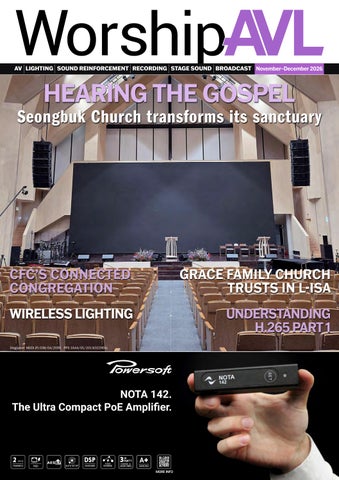
AV LIGHTING SOUND REINFORCEMENT RECORDING STAGE SOUND BROADCAST November–December 2026 November–December 2026
HEARING THE GOSPEL
Seongbuk Church transforms its sanctuary
MDDI (P) 038/04/2026 PPS 1644/05/2013(022954)
CFC’S CONNECTED CONGREGATION
GRACE FAMILY CHURCH TRUSTS IN L-ISA
WIRELESS LIGHTING
UNDERSTANDING H.265 PART 1
Singapore: MDDI (P) 038/04/2026 PPS 1644/05/2013(022954)
www.worshipavl.com
NOTA 142. The Ultra Compact PoE Amplifier.
MORE INFO
WAVL Front Cover.indd 1
25/09/2026 10:47
Untitled-1 12
25/09/2026 12:56
Contents Issue 101
November–December 2026
Editor’s Letter Despite only just returning from my summer holiday, we are now full steam ahead to the Christmas season. Even if you haven’t started your Christmas wish list yet, churches around the world will already be putting plans in place for one of the busiest times of year. On page 10, product manager at Resi Media, Justin Hwang, has put together a guide on how to prevent dropouts during peak holiday services and ensure that your bandwidth can cope with the extra pressures that an enlarged congregation can bring. Although we’re still a few months away from the big day, Hwang recommends using this time to audit local networking
COMMENT
4 Casey Hawkins Kevin Yague 6 Samantha Potter 8
16
SPECIAL REPORTS
equipment, run simulated stress tests, update encoder firmware and coordinate any dedicated bandwidth arrangements with your local ISP well ahead of peak demand. Livestreaming has become the digital front door for many churches, providing an accessible way for people to connect with worship, teaching and community from anywhere. If the stream drops during the service, it breaks the emotional and spiritual connection the at-home worshipper has come for and all anyone remembers afterwards is the technical failure. It’s time to start planning! I hope you enjoy the issue.
10 Testing your bandwidth for Christmas 12 Yamaha’s first mixing workshop in China 14 N-LABS at BAPS Shri Swaminarayan
PROJECTS
18
16 G race Family Church 18 St John the Baptist 20 The Experience at House On The Rock 24 Christian Family Church South 28 Seongbuk Church 30 Saint Mary of the Angels
24
KNOWHOW
32 B uilding a complete vocal processing chain part 2
34 Projection Selection Guide part 2 36 Cutting the cords: wireless lighting
30
TECHNOLOGY
38 L-Acoustics’ Source Intelligence 40 U nderstanding H.265 part 1 42 L et’s take this outdoors part 1
46
PRODUCT SPOTLIGHT
Email: kwallace@worshipavl.com Follow us on social media @WorshipAVLMagazine
44 Soundcraft Signature Plus Series
NEW PRODUCTS
46 The industry’s latest product news
TECH VIEW
58
58 Voice of Islam’s 10th anniversary
Contact us Richard Lawn
Carolyn Valliere
Yuvaraj Parmar
Simon Luckhurst
Caroline Moss
Bea Meikle
rlawn@worshipavl.com
cvalliere@worshipavl.com
yparmar@worshipavl.com
sluckhurst@worshipavl.com
cmoss@worshipavl.com
bmeikle@worshipavl.com
Nick Smith
James Boakes
Jack Stennulat
Adrian Baker
Jo Pugh-Jones
Marne Mittelmann
nsmith@worshipavl.com
jboakes@worshipavl.com
jstennulat@worshipavl.com
abaker@worshipavl.com
jpj@worshipavl.com
circulation@worshipavl.com
General manager
Digital media manager
Sales associate
Video editor
Account manager
Digital content creator
Senior reporter
Production editor
Contributing editor
Production manager
News editor
Circulation manager
PUBLISHED BY:
LICENCES: Singapore: MDDI (P) 038/04/2026 PPS 1644/05/2013(022954) CIRCULATION: circulation@worshipavl.com
Spa House, 18 Upper Grosvenor Road, Tunbridge Wells, Kent TN1 2EP, United Kingdom
All rights reserved. No part of this magazine may be reproduced or transmitted in any form or by any means, electronic or mechanical, including photocopying, recording or by any information storage and retrieval system, without prior permission in writing from the copyright owners.
Tel: +44 (0) 1892 676280
COVER: Seongbuk Church PRINTER: Times Printers Singapore
Web: www.worshipavl.com
November–December 2026 WORSHIP AVL 3
WAVL Pg3 Contents.indd 3
25/09/2026 10:49
COMMENT
Managing church events and crew
ev wh ca A tim ea an th st “c to co bu pe th em Yo of be th als ev PC ph on wo I so to m pr pl pe st th
Casey Hawkins sings the praises of a new piece of software that allows him to manage all of GABC’s events
Monday.com allows Hawkins to create “boards” for each building on campus AT GREEN ACRES BAPTIST Church in Tyler, Texas, we have nearly a thousand events each year and many of those require the support of the Broadcast Ministry team. Since we are responsible for all audio, video and lighting on the campuses, we become involved in events that need that type of support. We normally operate with a staff of 10 full-time technicians. We have four audio techs, four video techs and two lighting techs. We also have about 24 volunteers that assist us. On Sundays, we are all dedicated to a specific role. Audio techs are dedicated to audio roles, lighting techs to lighting roles and video techs to video roles. The Sunday church service model is what we base our Broadcast Ministry staff organisational chart on, then for the rest of the week we cover events with less of a focus on our specialties. Our “events” can range from a simple classroom with a laptop connection to a TV or projector all the way to a full production with lights, multi-camera video production and full audio production. So we have to be able to support any combination of all that at any time of the week. We all share covering the simpler events.
Managing a thousand events each year and 10 people to work them all is not an easy task. Making it easier is the system used to schedule and keep track of all of it. Historically, we have used a shared Microsoft Outlook calendar. While that solution has been simple in operation and since it has been in place for so long, it has become comfortable for our longer-term team members. But it really is not meant for event management, so I set out to find a better solution. Its major downside is the lack of ability to assign techs to events in specific roles and have them “accept” or “confirm” the assignment, allowing for better accountability on the part of each tech. We had a lot of issues over time with people not knowing which events they were working and which ones they weren’t. Another downside to that solution was that there is no way to track who makes changes to the event in the calendar. It is not a system that tracks user activity in a log anywhere. So if someone changes a date or time, there is no way for anyone to go into the event and find out who made that change and when. Something would change or get deleted
Each of the 10 seats is a member of GABC’s worship team by accident and nobody would admit to making the change, so there would be confusion and sometimes animosity, so that became something I wanted to see resolved. Also unavailable with our Outlook calendar solution was the ability to upload files to the event itself. We get events that have riders or contracts that need to be available for everyone on our team to review. Sometimes we have events that publish itineraries that need to be attached to the event for all to see. This needed to be something that we were able to do with the new system.
We really needed a way to organise our event load into a clear, easy-to-see way. Instead of just a calendar of all events over all of our buildings, we needed a way to sort them by building. The reason for that is because we often have techs dedicated to certain areas. For instance, I am primarily based in the Worship Center and I have a crew that is primarily based in the Crosswalk Conference Center. Each of us sometimes only wants to see what is going on in our area, without seeing all of the events in other areas that we are not concerned about. It really helps to remove those
4 WORSHIP AVL November–December 2026
WAVL Pg4-5 Casey's Comment.indd 4
25/09/2026 10:50
COMMENT events from your view of the calendar when you have as many events in the calendar as we do. As a supervisor, I spent a lot of time sorting through the old calendar each week, checking each event and asking everyone one by one if they were staffed, covered and fully staffed. There was not a good way to “confirm” that the event was ready to go. About the only way someone could do that was with event invites, but that did not specify what role that person would have in the event and that also created an issue with the email distribution of the event itself. You could place that data in the body of the event, but changing it could be cumbersome and notifications of the change were not automatic. We also needed to continue the ability for everyone to view this data either on a PC or a Mac, a desktop or a laptop, a phone or a tablet and either at church on the network or anywhere in the world. I researched a lot of possible solutions and I chose Monday.com to be our new platform for event management. They have a non-profit programme that provides their “Pro” plan with 10 seats for free. That is perfect because we have 10 on our staff. So we don’t even have to pay for this new system.
Each team member gets an invitation to an event which they can either accept or decline Monday.com has allowed us to create our own “boards” for each building on campus. We have boards for the Worship Center, Room 150, Crosswalk, Chapel, Adult Education Building, Lighthouse Building and the Student Center. Within each board we also classify each event by what church ministry the event is for or whether it is an “outside” event because we have nearly as many external events as we do internal ones. We can create “tasks” for each event, such as “Video”, “Audio”, “Lights”, “ProPresenter”, “Camera”, etc. Then we can assign that task to one of the seats within Monday.com, each seat being one of our team members.
We have an automation set up that when we assign a task to a team member, they get a notification and an email with a request to respond. They can either accept or decline the invite to work that event. When they do, that updates the status of that task of that event. Each status has a different colour with “accepted” being green, “declined” being red and “requested” being orange. That makes it so easy for me to see the status of that event without asking everyone about it. Then, when everyone has accepted their tasks, I can set the status of the event to “ready”, which is green. There is also a “pending” status before that which is orange. I also
have a “problems” status which is red, meaning we are having problems staffing that event. I can see a week’s worth or more of events and their status on one screen. It really has made things much easier for me to manage our events, and for our technicians: they can create their own dashboard and set it to only show the events that they are working or requested to work. They love that. While any change of this magnitude can come with some opposition, I believe in the long term our ministry will greatly benefit from this new system and I recommend it to you if you are looking for a similar solution for your ministry.
Faithfully heard. Safely informed.
ee
g.
n
In houses of worship, clear communication is essential. TOA supports churches, mosques and public venues with trusted communication solutions worldwide. From worship services and prayers to critical safety announcements, we help ensure every message is delivered with clarity, confidence and reliability. Planning a renovation or audio upgrade in 2027? Let’s discuss the right solution for your project: contact@toa-eu.com
d e
toa.eu
November–December 2026 WORSHIP AVL 5
WAVL Pg4-5 Casey's Comment.indd 5
25/09/2026 10:52
COMMENT
Designing for the volunteer, not the engineer Audio engineer Kevin Yague considers the importance of designing AV systems for both experienced engineers and volunteers WHEN WE DESIGN AN AV system, it is easy to approach it from the perspective of an engineer. We think about flexibility, processing, routing, expandability and everything the system could potentially do. We build workflows that make sense to us because we understand the signal flow behind them. But in many churches, the people operating those systems are volunteers. Some may eventually become excellent engineers. Others simply want to serve their church well, often spending only a few hours each week behind a console. That reality should influence how we design.
Complexity is not the problem There is nothing inherently wrong with a complex system. Sometimes complexity is necessary. At one church where I worked, our main campus needed a higher-end console and sophisticated production system because it supported broadcasts, worship services and various events. We needed the additional processing, routing and flexibility because the responsibilities of that campus demanded it. Our receiving campuses had different responsibilities. Their teams primarily needed to mix the local live band while integrating the broadcast feed from the main campus. They did not need to carry the full technical burden of the broadcast system. That experience reinforced something important for me: the question should not simply be whether a system is simple or complex. The better question is whether its complexity matches what the people operating it are actually being asked to accomplish.
Design around the operator One question I believe we should ask during system design is: who is going to operate this when I am not here? That question changes how we think about console layouts, patching, scenes, labelling, signal flow, documentation and equipment selection. A sophisticated console
Training is important, but should not become the solution for an overly complicated design may be completely appropriate, but routine operation should not require volunteers to navigate unnecessary layers of that sophistication. This does not mean hiding technical concepts from them. Good design should make signal flow easier to understand. Inputs can be named clearly, DCAs can follow a predictable structure, scenes can behave consistently and physical connections can be labelled. Training remains important, but training should not become the solution for an unnecessarily complicated design.
Consistency across campuses This becomes even more important when supporting several campuses. Volunteer shortages are something many churches experience, and system complexity can make that shortage worse. If every campus has a completely different console layout, routing structure, naming convention and operating procedure, a volunteer capable at one location may still require significant training before serving at another. We may have enough people across the church, but our systems have unintentionally limited where they can serve. Consistency has helped me manage that challenge. A larger campus with more volunteers can send experienced
team members to support another campus when needed. When basic workflows and system philosophy are familiar, those volunteers can become useful much more quickly. This does not mean every campus needs identical equipment. Standardisation is about creating a common operational language. A volunteer moving between campuses should recognise how inputs are organised, how important sources are labelled, how the basic signal flow works and where to begin when something goes wrong. Instead of training someone exclusively for one console in one room, we can develop volunteers capable of serving across campuses.
Design for troubleshooting The value becomes especially clear when something fails. Sunday morning is rarely generous with troubleshooting time. A microphone disappears, a musician loses a monitor or the broadcast feed is not reaching its destination while the service countdown continues. An experienced engineer may trace that problem quickly. A volunteer may not yet have that depth of knowledge. Good design gives them a logical path to follow. Clear labelling, consistent patching, predictable routing and useful documentation allow volunteers
to troubleshoot systematically instead of changing settings until something works. When supporting several campuses, that consistency also makes remote support easier. When another campus calls with a problem, both teams can speak the same technical language.
Build systems that outlast your presence There can be a temptation for technical people to become indispensable. We know the unusual routing, undocumented workaround or device that occasionally needs restarting. But if normal operation depends on one person remembering all those things, we have created dependency rather than reliability. The goal is not to eliminate complexity. Broadcast environments, large events and sophisticated productions require powerful systems and experienced engineers. The goal is to put complexity where it serves a purpose. Design for the responsibility, not for the capability. Give experienced engineers the tools they need while giving volunteers workflows they can understand, troubleshoot and operate confidently. Because the measure of a well-designed church AV system is not only what it can do in the hands of its designer. It is what the team can do when the designer is not there.
6 WORSHIP AVL November–December 2026
WAVL Pg6-7 Kevin's Commint.indd 6
25/09/2026 10:54
The world’s most powerful broadcast audio mixer designed for a SMPTE-2110 future! Fairlight Live audio panels are the mixing control center of your live production! Designed to integrate with Fairlight Live software, the world’s most powerful audio mixer, you can manage unlimited channels and complex mixes with subtle adjustments using precision faders and knobs. Real-time visual feedback is provided by LCD displays. USB-C and SMPTE 2110 network integration ensures seamless compatibility with ATEM switchers.
Upper Deck Function Buttons The function buttons allow fast access to channel processing and routing tools including EQ, dynamics, plugins, panning, and bus assignments. When you select a function, the menu buttons, encoders, and touchscreen automatically adapt to show relevant controls and parameters. Function buttons work with soft menu buttons to navigate parameter pages, keeping advanced mixer functions organized and accessible.
Customizable Channel Strips
Tools for Live Production
Fairlight Live audio panels feature customizable channel strips which include a motorized fader, solo, mute, and select buttons, plus a rotary encoder for fast access to channel functions. The bright LCD touch screen display keeps channel status and identification clear. Assign any strip to any track or bus, plus a single strip can control multiple tracks or buses simultaneously.
The most important live production functions are grouped so you can move quickly between rehearsal, playback, cue execution, and show automation. Player recorder lets you record and play back virtual sound checks. Cue player gives instant access to audio and MIDI cues for jingles, stingers, and effects. Snapshot controls enable fast preview, recall, update, and creation of snapshots for seamless show transitions.
LCD Touchscreen Display Each group of 10 channel strips has a dedicated LCD touchscreen, giving you a comprehensive graphical display of your audio mix including channel VU meters and mixer status. Adjust plugins, assign channels to busses, manage monitoring, configure layers, and set spill zones via the touchscreen. You can control complex live mixing in one place without navigating to separate menus during live production.
www.blackmagicdesign.com/sg SRP is Exclusive of Taxes.
Fairlight Live ������������������������������������������Free Download Fairlight Live Audio Panels ��������������������������������������������From S$2,795
Learn More!
COMMENT
As long as it serves the community in a way that makes sense, focus on technology that is easily available to you
To stream or not to stream Allen & Heath’s commercial audio manager, Samantha Potter, asks the simple question: what are we trying to achieve with livestreaming? AS WE’VE MOVED FURTHER and further away from the quarantine months in the early 2020s, houses of worship have begun to readjust expectations and standards. It wasn’t that long ago that we were all rushing to find whatever we could tape together to make worship accessible to people when we were all at our most siloed. But is that still the best solution? Should every house of worship be trying to put their service online to consume in real time? Are there other options that give us the solutions we seek without the technical burden? Livestreaming a service can be a great way to connect with your local (or not-so-local) community. There are plenty of populations out there that desire that connection but cannot venture out in person each week. I am certainly not advocating that we forsake those populations and go back to only acknowledging what’s in front of us. However, I am simply asking the question: “what are we trying to achieve with livestreaming?” Perhaps you’ve felt it, but in my very humble opinion, livestreaming, and by extension social media, has twisted into a landscape that isn’t particularly helpful or healthy. The twisting itself isn’t new, but
the extent of the effects of this distortion of “social connection” can be felt now more than ever before. So, I ask again: “what are we trying to achieve with livestreaming?” I ask my students this during each cohort and nearly every time we meet to discuss a new technical topic. I like to put this idea front and centre. It’s the lens through which each decision will be decided. Perhaps you livestream because it’s how your congregation prefers to engage. Or perhaps it’s because your congregation is ageing and this is their best chance to be able to worship from their residence. Perhaps you livestream because it’s just what you do these days. To skip to my primary point, how can we engage in worship and spiritual connection with our communities without going through a commercialised, anti-privacy platform? There is so much conversation around digital privacy these days – and rightfully so. If you haven’t read up on the topic, I would highly suggest seeking out more info on it. We’re at a reckoning. I will say that hosting the livestreaming on your own website (without the help of YouTube or another video platform) isn’t exactly
Recording then posting your service means you don’t have to rely on your Wi-Fi straightforward or easy. And I want to credit the interactions those larger platforms enable, even if they aren’t perfect. I think most houses of worship are better off simply recording their services and posting them for viewing after the fact. It removes so many variables. You needn’t worry about your Wi-Fi connection, your internet speed, the website’s
servers functioning and your phone or computer that’s running the stream won’t be pushed to the max. This also allows you a chance to remove anything that might be considered sensitive or private (thinking: prayers and concerns) and allows your congregation to feel more comfortable to share. If we want people to receive the Word, then is it affected by this? We
8 WORSHIP AVL November–December 2026
WAVL Pg8-9 Sam Potter.indd 8
25/09/2026 14:43
ca th wo a ha wh of th It ex bu St hy th ca an to up I ev ca liv to co Yo ch yo fo se pu yo ab I vid
m
COMMENT can also come back to this question that I’ve asked before: “what is worship?” I am not an expert nor a theologian, so I won’t pretend to have an answer. But as someone who has done a significant amount of work with houses of worship and their relationship with technology, I think that hybrid setups are extraordinarily difficult to sustain but can offer a lot of value. Streaming isn’t hybrid, though. Truly hybrid setups nearly equally include those remote and those local. You can get near this with livestreaming and almost mimic it by responding to comments, but you open yourself up to other pitfalls. I would go as far to say that even doing a video conferencing call would be superior to just livestreaming. It’s relatively easy to set up and you aren’t creating content for a platform to monetise. You could see other people who chose to be seen on camera and you could even set up a monitor for the preacher or speaker to see those individuals while on the pulpit/stage. The remote can see you, you can see the remote. Talk about the best of both worlds! I also appreciate the moderation of video conferencing. You don’t have
to let anyone in you don’t want to. You can mute people, or allow them to speak for themselves and let everyone hear them. There are so many options. Additionally, you can still record the service and allow others to view it later. As I’m writing this, perhaps it’s clear that social media may not be the best way to stay in touch with
our congregants any longer. Perhaps simply recording the service on our cameras or on our phones allows us to connect enough with the community without all the risk, fear, commercialism and consumerism that has become part of the greater internet. Maybe I’m just part of that generation that is tired of this.
Perhaps your congregation is ageing and livestreaming is the best way to connect with them
The generation that is seeking reality improved by technology yet without “augmented reality” and AI hallucinations. If every house of worship is livestreaming and stressing about quality and privacy, is anyone but the upper echelon of productions making it out above the chaff? Do we even want to be noticed? What’s the point, we return, of livestreaming for our house of worship? Does video conferencing satisfy the needs of our congregation? Are we better served by simply recording the service and sharing it? What value does streaming a service (much like a TV show) offer for us when there are 5,000 others doing the same at the same time? Does that even matter? I’m asking far more questions than I’m answering, so I apologise. This topic’s been on my mind lately. I love technology but not all technology loves us back. I want houses of worship to make the best version of their service that they can with the technology easily available to them without spending loads of money and that it serves the community in a way that makes sense. Simple as that. www.allen-heath.com
n
e
e
el
We
WAVL Pg8-9 Sam Potter.indd 9
25/09/2026 11:01
SPECIAL REPORT
H a re d
Image courtesy of Iris Lee/Prestonwood Baptist Church
Ia re vid sa or pr on ye pe Su lo wh m dr hi
W m m fo
Christmas is not the time for bandwidth issues
Stress-testing your bandwidth for Christmas Justin Hwang, product manager at Resi Media, considers what houses of worship can do to ensure that there are no dropouts at the busiest time of year PREVENTING DROPOUTS during peak holiday services comes down to treating the sanctuary production and the remote broadcast as one unified system, not two separate jobs. Lifeway Research1 found that 81% of Protestant pastors say Christmas is one of their three highest-attendance services of the year, and 28% say it draws the single largest crowd they see all year. That means overflow rooms get relied on heavily, and a video feed dropping out on a main screen or overflow display during a key moment can be just as disruptive to the in-person experience as a stream freezing at home. I tell teams the fix starts with isolating display networks so a hiccup on one screen doesn’t cascade to others, building signal redundancy into the video routers themselves and using hardware built specifically for encoding rather than software running on a general-purpose computer, since dedicated hardware holds up far better across back-to-back holiday services than a laptop juggling other processes in the background.
Justin Hwang
How important are regular system checks rather than a lastminute panic? A proactive testing cadence is what separates a seamless broadcast from a public failure, and I always push teams to start planning at least 6–8 weeks out for something like Christmas Eve. Last-minute testing almost always misses something: outdated firmware, a network switch quietly approaching its throughput ceiling or a cloud streaming account bumping up against a rate limit right as the service starts.
Those 6–8 weeks give a team enough time to audit local networking equipment, run simulated stress tests during a few regular Sunday services rather than waiting for the big day, update encoder firmware and coordinate any dedicated bandwidth arrangements with the local Internet Service Provider (ISP) well ahead of peak demand. It also gives volunteers real time to train on the system, so knowledge is shared across the team rather than living in one person’s head.
What types of issues can peak demand cause and how can they be solved? Peak demand tends to expose the same three weak points: upload bandwidth getting saturated, encoding hardware overheating and the connection between the venue and the viewer becoming unstable. Onsite, once a few thousand people walk in and connect their phones to the guest Wi-Fi, that traffic frequently competes with
and can choke the upload pipeline that the stream depends on. I recommend isolating broadcast encoders on their own network segment and using Virtual Local Area Networks (VLANs) with strict-priority Quality of Service (QoS) rules, so the stream always has first claim on available bandwidth regardless of how many people are on the guest Wi-Fi. On the hardware side, running high-bitrate encoding on a general-purpose computer for multiple back-to-back services is a common cause of Central Processing Unit (CPU) spikes, dropped frames and thermal throttling. Purpose-built encoding hardware, rather than software sharing a machine with other processes, handles that sustained load far more reliably. And, when it comes to the connection itself, what actually matters isn’t which single path you’re on, it’s whether the system can detect an unstable route in real time and reroute around it automatically, rather than letting one congested connection take the whole stream down.
10 WORSHIP AVL November–December 2026
WAVL Pg10-11 Special report Resi.indd 10
25/09/2026 11:03
On Is st ne ar se co re st af em ha as bu
W s
A la ju Cr ho av re
I
Vi
SPECIAL REPORT How can HOWs plan ahead so that they’re ready for a spike in demand? I always tell teams that year-round readiness means treating live video as core infrastructure, the same way you’d treat your network or phone system, rather than a production task you think about once a quarter. Throughout the year, it’s worth tracking basic performance metrics during normal Sunday services: encoder CPU load, bitrate, packet loss. Knowing what normal looks like is what makes it obvious when something’s drifting out of range, long before a high-stakes holiday service arrives.
What are the biggest mistakes churches make when preparing for high demand?
e
One of the most common mistakes I see is running a high-definition stream over the same unmanaged network that hundreds of attendees are using for guest Wi-Fi. A close second is stress-testing under conditions that don’t resemble reality at all, like running a test stream on a quiet Thursday afternoon when the building is empty, and the internet connection has all the bandwidth to itself, then assuming that result will hold on the busiest night of the year.
What would a typical stress test involve?
y
A real stress test has to push every layer of the workflow at once, not just confirm the camera turns on. Crucially, it provides hard data on how peak load directly impacts your available bandwidth. If that test reveals you need more headroom
What metrics should churches monitor to know they’re ready?
Image courtesy of Church of the City
Run a full dress rehearsal with every piece of equipment powered on at the same time and adding bandwidth through your ISP isn’t an option, you need a hardware or protocol solution with a configurable buffer. I start with a local network load test, which intentionally saturates traffic while watching how the encoder’s packet transmission holds up, to confirm QoS prioritisation actually works under pressure rather than just in theory. From there, I run a bandwidth-throttling simulation, deliberately restricting or cutting the primary internet connection mid-stream. The last phase is testing every destination at once: web player, mobile app, social platforms and any satellite campuses, all receiving the signal simultaneously, so you know the full distribution chain holds up under the same load it’ll see on the actual day, not a lighter version of it.
Which systems are likely to fail first? When demand spikes, the first thing to give out is almost always a software encoder running on a consumer laptop or general
d
e n
Image courtesy of Hillcrest Church
Visitors connecting to the Wi-Fi can choke the upload pipeline
workstation. Those machines are running a general-purpose operating system with background processes competing for the same resources, so a sudden jump in CPU load tends to show up as dropped frames, audio drifting out of sync or the application crashing outright. If the encoding side holds, unmanaged switches and routers are usually next. Consumer-grade networking gear tends to freeze or start dropping packets when it’s asked to handle heavy local traffic alongside a sustained high-bitrate stream. Standard commercial internet connections also often show their own weakness during peak holiday hours, in the form of localised ISP jitter and packet loss, which is exactly why a transmission approach that can tolerate and recover from that kind of instability matters more on these days than any other.
How do you simulate peak attendance and online traffic before major services? The most reliable way I’ve found is a full dress rehearsal, one to two weeks out, with every piece of production gear powered on at the same time. On the digital side, I’ll use load-testing tools to stress-test the web player and hosting infrastructure with thousands of simulated concurrent viewers and, separately, have staff and volunteers connect multiple devices to the venue’s Wi-Fi at the same time to mimic sanctuary density. That combination tells you whether the stream keeps its priority on the network even when the building is as full, digitally and physically, as it’s going to get.
The metric I watch most closely is the frame drop rate, which should be essentially zero. Any persistent dropped frames during a dry run are an immediate signal of either encoder overload or network congestion. On the network side, a good rule of thumb is to keep upload bandwidth running at two or three times your combined stream bitrate, so a 6Mbps stream has a meaningfully larger, stable upload connection behind it, not one just barely clearing that number. I’d also recommend checking the player’s buffer health.
How has the growth of livestreaming changed bandwidth requirements? The shift from a single 720p, 30-frame camera to high-motion 1080p60 and 4K broadcasts, often across multiple linked campuses, has completely changed what churches need from their network. It’s not just about raw bandwidth capacity anymore. Modern streaming demands real stability: low jitter and close-to-zero packet loss. High-framerate video is unusually sensitive to disruption. Even a small amount of packet loss over an older protocol like RTMP (Real-Time Messaging Protocol), which has no built-in error correction, can be enough to cause noticeable stuttering or audio drifting out of sync.
How can connectivity issues negatively affect the worship experience? Livestreaming has become the digital front door for many churches. For someone watching from far away, a homebound member or a family joining remotely over the holidays, persistent buffering, audio drifting out of sync or a service going dark entirely breaks the emotional and spiritual connection they came for. If a stream drops during the message or a candle lighting moment, all anyone remembers afterwards is the technical failure, not what was actually said. www.resi.io References 1. research.lifeway.com/2024/12/03/ less-than-half-of-americans-attendchurch-at-christmas
November–December 2026 WORSHIP AVL 11
WAVL Pg10-11 Special report Resi.indd 11
25/09/2026 11:03
SPECIAL REPORT
A masterclass in mixing
Over 500 people attended the masterclass
Sue Su talks with Yamaha’s Kosuke Saito and Russ Long at the company’s first-ever mixing workshop in China CO-ORGANISED BY THE School of Music and Recording Arts of the Communication University of China, Yamaha Music & Electronics (China) Co Ltd and EZPro, Yamaha’s “Live Sound Mixing Masterclass” brought together over 500 attendees for a day of presentations and networking. Afterwards, Sue Su caught up with Kosuke Saito, product manager for digital mixers at Yamaha Corporation, and Russ Long, field marketing engineer for pro audio at Yamaha Corporation of America, to discuss the history, development and real-world applications of the manufacturer’s digital mixing consoles. Yamaha’s first digital mixing console dates back to the DMP7 in 1987. The first console designed specifically for live sound reinforcement was the PM1D, launched in 2001. “It was a groundbreaking innovation for live performance,” explains Saito. “Before that, when multiple bands performed at the same event, each band had to bring its own console because all the settings were different. With the PM1D, each band
could simply recall its own settings at the push of a button. That meant one console could handle multiple bands in a single show, which at the time made it a world-leading touring console.” The flagship RIVAGE PM10 arrived in 2015, followed in subsequent years by more compact RIVAGE PM models such as the PM5 and PM3. In 2023, the company introduced two compact console models, the DM7 and DM3. “We take different approaches for different product lines because users have different levels of experience and different needs,” continues Saito. “But the most important principle is to be human-centred. Regardless of a console’s market positioning, we must ensure that it is designed to meet the needs of its target users. Placing reliability first is a shared understanding across our entire R&D team. From a technical standpoint, however, mechanical design, electronics and software each present their own challenges.” Over the last decade, Saito has witnessed an increase in demand for connectivity with other
Kosuke Saito highlighted the Assist functionality on the DM7 series
R fl
devices – for example microphones, amplifiers or other input/output equipment, and sometimes even applications running on computers. He believes the market’s demand for interoperability between devices is growing, with customers wanting to build large-scale audio systems that can be centrally controlled. “Our goal is to make it easier for engineers to create better sound,” he explains. “This is not limited to operating the console itself; it also means helping them control the entire audio system. The console is the core of audio
th “W pr in an wa to kn Ya W be en jo ap fu he
system processing, but resources are always limited, and controlling every device is not always easy. We therefore try to make our consoles as flexible as possible.” While Dante is a core networking technology across many Yamaha professional audio products, the company has recently worked with AuviTran on an HY slot I/O card supporting AVB/Milan. It is a third-party-developed HY card that can be used on the RIVAGE PM series for AVB Milan transport. “Another example of flexibility is our collaboration with Waves on
12 WORSHIP AVL November–December 2026
WAVL Pg12-13 Special report Yamaha.indd 12
25/09/2026 11:04
s
e
SPECIAL REPORT feature; rather, it is designed to support engineers. Our current Assist functions deliberately focus on practical setup and balancing tasks, including input signal-type detection (Naming Assist), HA Assist and Fader Assist.” “Our core philosophy is that AI will not replace engineers,” Long continues. “In a club environment, once a band arrives, an engineer may normally need 30 minutes to get everything set up. With Assist functions, they may be ready in just 10–15 minutes. Many people are resistant to AI because they fear losing their jobs. The key is to help engineers understand that this kind of AI is not meant to replace them. It is there to help them work better, avoid mistakes and ultimately keep their jobs. That brings us back to our development philosophy, which is to fully support engineers in their work.” Long cites two reasons for customers choosing Yamaha’s consoles: the ability to complete a full mix on the console without additional equipment and how they can achieve the sound they want without excessive processing. “Other platforms often need
Russ Long spoke about how the company makes its consoles as flexible as possible the WSG-HY128 card,” adds Long. “While our platform is capable of providing a finished mix without incorporating any third-party analogue or digital components, we want to give engineers the flexibility to easily utilise the tools they know and love, even if they aren’t Yamaha.” With the development of AI, Saito believes that the key is to “assist” engineers and help them do a better job. “One example of how we are applying intelligence is the Assist functionality on the DM7 series,” he says. “It is not a fully automated
additional equipment to achieve the desired sound,” says Long. “In addition, engineers often have to do lots of post-processing, EQ adjustments and other complicated operations. But with RIVAGE, for example, you can simply engage the Silk feature and make a few fine adjustments, and the sound is already excellent. You do not need a complicated workflow to achieve the result you want.” www.ezpro.com www.yamaha.com.cn/products/ proaudio
November–December 2026 WORSHIP AVL 13
WAVL Pg12-13 Special report Yamaha.indd 13
25/09/2026 11:27
SPECIAL REPORT
SPONSORED BY
Acoustic excellence for an architectural landmark N-LABS has delivered an all-weather audio solution for BAPS Shri Swaminarayan Temple in India • •
Improved coverage consistency. Reduced operational costs.
Engineering challenges Unlike many outdoor venues, the temple offers no practical means of protecting the loudspeaker system during heavy rainfall. Installing protective covers before every rain event was neither practical nor economically viable due to the scale of the site. In addition, the previous installation experienced:
N-LABS has provided BAPS Shri Swaminarayan Temple with an all-weather audio solution
Project overview When BAPS Shri Swaminarayan Temple in Nagpur, Maharashtra, sought a permanent outdoor sound reinforcement system, the objective extended beyond achieving higher output. The temple required a reliable, weather-resistant solution capable of delivering consistent performance throughout the year while eliminating the operational challenges associated with its existing system. Working closely with the temple’s technical team and consultant Adarsh Setu Swami Ji, N-LABS deployed its QLA122 line array system with QLS21 flown subwoofers, creating an installation designed specifically for continuous outdoor operation.
Client brief The temple hosts daily religious services, devotional music and large congregational gatherings in an open-air environment exposed to seasonal weather conditions. Its previous reinforcement system delivered acceptable performance under normal conditions but created significant operational challenges during the monsoon season. Because the loudspeaker system was not intended for permanent outdoor exposure, the technical
• team was required to dismantle and reinstall the system whenever rain was expected. This process demanded considerable manpower, increased operational costs and disrupted daily activities. The client therefore sought a solution that would: • • • • •
•
Limited maximum SPL. Uneven coverage across the congregation area. Phase alignment inconsistencies. Daily removal and reinstallation requirements during adverse weather.
Results Since commissioning in June, the installation has remained in continuous outdoor operation, including during periods of rainfall. The IP68-rated enclosure allows the loudspeakers to remain exposed to the elements without requiring protective covers or daily removal, significantly reducing labour requirements while improving system availability.
Remain permanently installed outdoors. Continue operating during rainfall. Reduce maintenance and labour requirements. Improve speech intelligibility. Deliver higher SPL and more uniform coverage.
Finding the solution
The setup consists of N-LABS QLA122 speakers and QLS21 subwoofers
The temple’s technical representatives first encountered the N-LABS outdoor product range during PALM Expo, where they visited the N-LABS booth and attended a live demonstration inside the N-LABS Arena. Following extensive listening tests and technical evaluation, the team selected the QLA122 line array together with QLS21 flown subwoofers for the installation. The deciding factors included:
The new system needed to eliminate these operational constraints while providing consistent performance throughout the venue.
• • •
IP68-rated weather protection. Permanent outdoor deployment capability. Higher acoustic performance.
14 WORSHIP AVL November–December 2026
WAVL Pg14-15 N-labs Adver.indd 14
• •
the factory-developed N-LABS Flat Preset, which provides optimised voicing and phase alignment directly within the system processing, matching the GLL files developed by the brand. This approach minimised commissioning time while maintaining tonal consistency across the installation.
System design N-LABS replaced the existing reinforcement system with a permanently installed solution comprising a main system of N-LABS’ QLA122 line arrays, flown QLS21 subwoofers for the low frequencies, network digital audio over Dante and an Allen & Heath CQ-12T mixing platform. Rather than relying on extensive equalisation, the installation uses
According to the temple’s technical team, the new installation has delivered: • • • • • • •
Higher speech intelligibility. Increased SPL. Improved linear frequency response. Better phase coherence. Uniform audience coverage. Reliable all-weather performance. Better bass fill/low-end fill.
The elimination of daily system dismantling has also reduced operational complexity while allowing uninterrupted use of the venue throughout the monsoon season. www.n-labs.co.in
25/09/2026 11:29
Now We’re Talking Spectera SKM. Now Shipping. The Spectera SKM handheld has arrived — and that means the core Spectera ecosystem is now complete. Ready to simplify virtually any live performance or broadcast application, Spectera delivers stunning, low-latency audio while also enabling continuous monitoring, remote control, and revolutionary reliability via Sennheiser’s WMAS technology.
Learn more: sennheiser.com/spectera
Sennheiser_Spectera_SKM_210x297_EN.indd 1 Untitled-1 12
08.09.26 15:35 25/09/2026 12:58
PROJECTS
L-ISA arrives in the Alps Grace Family Church has put its faith in immersive sound with L-Acoustics’ L-ISA amplified controller drives all 16 enclosures. Audio runs from a Yamaha RIVAGE console over MADI into the L-ISA Processor II, with Milan-AVB carrying the signal to the LA7.16i. Impact Atelier also renewed the venue’s audio network as part of the project. For a venue operated by a semi-professional volunteer team, ease of use was a key consideration. “Set against the almost endless possibilities the system offers, the basic functions are kept as clear as possible, so getting started isn’t overly difficult,” comments This Hochstrasser, head of audio at Grace Church. “It integrates very well into the building and is visually a win compared to a classic line array hang. Feedback from every side has been enormously positive.” The installation was completed in five days, from the Sunday evening after services to the following Friday evening ahead of the church’s worship night. A five-hang A15i system has been installed around a fabric dome A CHURCH SANCTUARY SHAPED by a fabric dome, chandelier and front projection has become the first house of worship in Europe to install an L-Acoustics L-ISA system, replacing a near-20-year-old PA with an immersive setup designed for both Sunday services and live music. Grace Family Church in Bubikon, in the Zürich Oberland, worked with Swiss L-Acoustics distribution partner SDS, Soundrig, Stagelight and Impact Atelier to equip what the congregation calls the Church Dome with a five-hang A15i system. The venue accommodates up to 350 people for services and worship nights. The 24m x 26m sanctuary rises to an 8m-high vaulted ceiling. Its previous L-R loudspeaker arrangement was reaching the end of its working life, prompting the church to seek a like-forlike replacement. However, a site visit revealed that the existing positions could not deliver the desired imaging for speech or music. Soundrig was already advising the church when the project reached SDS. Following a listening session at the distributor’s Winterthur auditorium, the team arranged a 1:1 L-ISA demonstration inside the Church Dome. The object-based system’s ability to localise voices and instruments
was central to the decision, allowing the congregation to hear sound from its apparent source rather than from a loudspeaker positioned to one side. The demonstration helped the church move from a conventional replacement to an immersive design. “The domed roof and a striking chandelier were certainly standout features that made the installation and design unique,” says Roger Sommer, company owner at Soundrig. “We also had to design the L-ISA configuration around the front lighting and front projection.” Soundvision was used to model coverage, SPL and loudspeaker positions, while helping the team balance sightlines with the projector’s field of view and front spotlights. “The building shell is remarkably well-insulated, so the amount of ambient noise getting in is surprisingly low,” comments Michael Graf at Stagelight. The final system comprises five hangs, each consisting of one A15i Wide over one A15i Focus. Two centre-flown hangs of two KS21i subwoofers provide low end, with an X8 flown on each side covering the lateral areas at the front. A single L-ISA Processor II handles object processing, while one LA7.16i
www.l-acoustics.com
L-Acoustics Soundvision calculated the optimal loudspeaker positions and SPL distribution
16 WORSHIP AVL November–December 2026
WAVL Pg16-17 Grace.indd 16
25/09/2026 11:30
A GIGA…ntic performance of up to 40 Gbit can be achieved with our CAT.8 connection world, or up to 10 Gbit with our CAT.7 or CAT.6a solutions.
Wide variety of cable and connection technology products for fully networked installation concepts Classified cable bulkware in accordance with the EU Construction Products Regulation Ready-to-connect media/network/fiber optic systems for robust mobile and installation applications
CPR-certified CAT.8 and CAT.7 installation and connection cables
High-quality certified cables and connection components
Installation & Conference
Broadcast Solutions
Professional Studio
Event Technology
SOMMER CABLE, headquartered in Straubenhardt (Germany) and founded in 1999, is an international supplier of professional connection technology for the audio, video, broadcast, studio/media technology, and installation business. In addition to its in-house brands HICON, CARDINAL DVM, and SYSBOXX, the company offers a range of over 25,000 products, including bulk cables, connectors, assembled cables, customizable distribution systems, and active components. A B2B shop guarantees customers fast availability and a 24/7 service.
REQUEST YOUR FREE INSTALLATION CATALOG!
www.sommercable.com • info@sommercable.com
Anz-PLANER-M2-B210xH297-EN-Worship-20260908.indd 1 Untitled-1 12
08.09.2026 10:11:02 25/09/2026 12:59
PROJECTS
Respecting the architecture Adlib has delivered an integrated AV system for St John the Baptist Church in Crawley we had to run it pretty loud to get to the back, which meant that the first 10 rows were often blasted. With the new system, it’s exciting to be able to hear the bass guitar for the first time.”
Control and stage infrastructure
RENTAL AND INTEGRATION specialist Adlib has completed a comprehensive audio and video installation at St John’s Church in Crawley, a Grade II* listed building. The project involved a three-year consultation and planning phase, resulting in a modern technical infrastructure designed to support contemporary worship while respecting the architectural heritage of the site.
The brief The requirement was to replace the church’s ageing technical provisions with a robust, integrated audio and video system. As a Grade II* listed building, the project faced significant aesthetic and structural restrictions. Specifically, the installation had to avoid intrusive fixings to the building’s historic fabric, including its prominent oak features. The timeline for the physical installation was critical; Adlib was required to complete the start-to-finish deployment within a five-day window to ensure no disruption to the church’s regular Sunday services. Furthermore, the brief included a requirement for a “pop-up” kit to support the church’s outreach events in Crawley town centre.
Approval process Due to the building’s protected status, the project underwent a rigorous three-year approval process with the Diocesan Advisory Committee (DAC). Adlib worked closely with worship pastor Pete Dobson and lead pastors, Steve and Liz Burton, to produce the necessary technical documentation and impact assessments. The DAC described the final submission as “exemplary”, stating that it set a new standard for faculty applications for technical works within the diocese. “This is a 13th-century building, so we needed to ensure that the system was appropriate to the services we offer now but also to what we might offer in the coming decades,” explains Dobson. “Adlib were really helpful with this and were flexible in putting forward multiple options of how things could be installed. The aesthetics of the building haven’t really changed; in fact, I think it’s cleaned up the space.”
selected for their compact profile and high output. The main arrays consist of two EM Acoustics R8 enclosures, supported by S18 subwoofers for low-end extension. Two EMS-61X units have been deployed as main left and right delays, along with one R5 in the side aisle and one EMS-61X as a side-aisle delay. The entire system is powered by EM Acoustics’ Installation Series networked amplifiers. “Before the new system was installed, we had a temporary setup that took up quite a lot of the visual aesthetic of the space, such as bulky-looking speakers, stands and TVs,” explains Dobson. “There wasn’t much clarity in the audio –
A new digital mixing console and stagerack have been installed to manage the church’s inputs. The system includes a comprehensive RF package and a mix of wired and wireless IEM solutions, reducing stage noise and providing the worship team with personalised monitoring. Sennheiser EW-DX transmitters were selected, complete with DPA 2028 capsules accompanied by Sennheiser G4 systems for IEM. “Adlib took out the original stagerack and replaced it with just one box, and in doing so has also reduced a lot of the wiring at the front,” continues Dobson.
Si
The video installation provides high-impact visuals for the congregation while remaining discreet when not in use.
Projection and distribution A bespoke motorised roll-down Screen International Compact Custom projection screen has been installed, paired with a high-output Panasonic PT-MZ882 laser projector. The screen was positioned to maximise visibility
A la
AV fle vid sp fo
O
The audio solution was designed to provide high-clarity speech reinforcement and full-range musical fidelity for the worship band.
Main PA and amplification The main arrays consist of EM Acoustics R8 enclosures, supported by S18 subwoofers
18 WORSHIP AVL November–December 2026
WAVL Pg18-19 John the Baptist.indd 18
wh lim co in wo la m bu st de to ou wh an ba in th
Si Bl
Video
Audio
The loudspeaker system was built around EM Acoustics components,
Th
25/09/2026 11:32
In in “p po to du to an ea vo
e
o st
e
e
e nd
s
The church is a Grade II* listed building with prominent oak features while adhering to the strict fixing limitations of the building. A comfort monitor has also been installed to assist speakers and worship leaders. “We also had large screens which worked for maybe the first half of the church but, once you got to the back, you still couldn’t really see much,” describes Dobson. “The screen is totally hidden behind the arch for our traditional service, and then when we need it, we drop it down and it’s visible all the way to the back.” A TV screen has also been installed in the left-hand aisle for that area of the congregation.
Signal management Signal routing is handled via Blustream IP distribution. This
Following the installation, Adlib conducted commissioning and onsite training sessions for the church’s volunteer team. The training focused on the daily operation of the Allen & Heath Avantis Solo control surface and Blustream interfaces, ensuring the staff felt confident managing the system for Sunday services. “It was amazing to have two people from Adlib’s tech team help us run through the launch of the new system,” says Dobson.
Outcome The project was delivered within the five-day window, ready for immediate use. Dobson commented on the success of the project, noting that the
New Hog. New Tricks. A motorised roll-down projection screen pairs with a Panasonic laser projector AV-over-IP solution allows for flexible routing of high-definition video sources across the main space and provides a scalable foundation for future expansions.
Outreach and training In addition to the permanent installation, Adlib supplied a “pop-up” equipment package. This portable system allows the church to maintain production quality during community events in the town centre. The same brands and products were selected for ease of use and familiarity for the volunteer team.
congregation and leadership are “really happy” with the results. The final system provides a futureproof production infrastructure that balances the demands of modern ministry with the preservation of a historic landmark. “The feedback has been great,” concludes Dobson. “Sound techs love it, but also older members of our congregation are so grateful that they can hear things a lot easier. Plus the sound is so much clearer and crisper now.” www.adlib.co.uk www.emacoustics.co.uk
The next generation of Hog is here! The Hog family brings a robust set of road tested features featuring RGB-backlit keys and 10 RGB-backlit motorized faders on the Hog platform programmers know and love. Boasting portability, adaptability, and cutting-edge technology, the Hog family is the perfect fit for any production environment.
#newhog
etcconnect.com November–December 2026 WORSHIP AVL 19
WAVL Pg18-19 John the Baptist.indd 19
25/09/2026 12:27
PROJECTS
Rock-solid reliability Robin Johnson discusses how Yamaha digital mixing consoles have once again been chosen for the annual The Experience gospel event in Lagos, Nigeria ATTRACTING OVER 500,000 worshippers over the course of its 12hour production, The Experience is an annual gospel music concert staged by House On The Rock in Lagos, Nigeria. The church and Londonbased production company Subfrantic has used Yamaha digital mixing consoles for the live and broadcast mixes for 12 years, this year choosing RIVAGE PM10, DM7 and DM7 Compact systems to bring music, sermons and other performances to the live audience and thousands more online. Held in Tafawa Balewa Square, the 20th Experience was the biggest yet, with 60 separate performances and prayers in an uninterrupted show from dusk until dawn. Subfrantic has been involved since 2013, handling front of house and monitor sound, stage design, lighting, video, production/stage management and electrical safety. Managing director Steve Davies is the event’s production manager and oversees FOH sound. The main house mix has used a Yamaha RIVAGE PM10 system for the past six years. Initially, Subfrantic flew out its own system,
Subfrantic used a DM7 Compact as a continuity desk
but House On The Rock was so impressed that it invested in its own, which has been used at The Experience and in The Rock Cathedral in Lagos ever since. Meanwhile, this year Subfrantic took out a DM7 Compact as a continuity desk. “This year, for the first time, we had two small sub-stages. The idea was that certain acts would perform on these while we prepared for the next act on the main stage,” says Davies. “While the local or guest engineers on the main RIVAGE PM10 were getting ready, I was on the DM7 Compact looking after the comperes, announcements and some of the smaller acts with backing tracks. While the continuity console increased the channel count, it gave the main acts more time to prepare for their show, rather than having to push through a really quick changeover. On such a big, high-pressure event with so many performers, it definitely made changeovers easier.” At the monitor position, House On The Rock’s recently purchased DM7 console handled the main mixes. Six Yamaha Rio3224-D2 I/O
20 WORSHIP AVL November–December 2026
WAVL Pg20-23 House of Rock.indd 20
25/09/2026 11:33
Giga Impact Anytime, Anywhere Compact High Output All-in-One IP65 Fixture Fast Prep and Easy Maintenance LSW-3TM 350W White Phosphor Laser Source Laser Class 1 RG 3 Device
Untitled-1 12
Discover More
25/09/2026 13:00
PROJECTS racks managed around 110 input channels, mainly comprising drums, two bass rigs, four keyboard rigs, two guitar rigs, 12 channels of backing tracks, 16 channels of wireless microphones and eight audience mics for the broadcast mix. Outputs comprised 20 channels of in-ear monitors and 28 wedges and side-fills, distributed throughout the main and sub-stages.
on the local electrical team and their infrastructure,” expands Davies. Another challenge with a production of this size was the need to bring in equipment from a range of sources. “It wasn’t just about getting it all to work, it was making sure everything had compatible, up-to-date firmware, because one supplier may have things up to date and others may not. If we put out a system this size in the
“People listen to The Experience on their phones, on TV, through different devices and in many different places. Our aim was to make sure everybody enjoyed the feel of The Experience,” describes broadcast mix engineer Muyiwa Isiaka. “Previously, we used the CL5 for the master broadcast and streaming mix, with the CL3 to submix the audience microphones. This year, we had the DM7 on the master mix, with the CL5 handling the crowd mics.
In previous years, the CL3 was used to submix the audience microphones “We were very pleased to see the DM7 added a couple of years ago,” adds Davies. “Previously, one of their two Yamaha CL3s was on monitors, but we ended up having to improvise workarounds to get more feeds and buses than the CL3 had available. This included repatching and sharing IEM packs, which was always a nightmare for the stage management team having to go backstage to retrieve them after an artist’s set, ready for the next one. The DM7’s vastly increased bus count has made this a much easier process, but we still have to busk and improvise certain things where other parts of the infrastructure don’t necessarily meet the standard that the DM7 brings to the table.” Working alongside the House On The Rock technical crew, Subfrantic’s eight-strong team faced a number of challenges, with reliability being key. “The humid Lagos climate is testing for the team and equipment alike. Ensuring a consistent, clean and safe power supply for the entire production also presents its challenges because, while the standards here consistently rise year on year, so does the demand
UK, it would all be flightcased and pre-tested, but that’s not a luxury we have working on an event of this size in Lagos.” Although the audio network has been Dante-based for many years, this year was the first time it was moved onto fibre. “Last year, we reached the limit of what we could do with the multiple Cat5 and Cat6 lines which had been in use for over a decade, so this time we brought the core infrastructure of the event up to date by bringing a multicore OM4 multimode fibre and switch network out from the UK,” adds Davies. “This allowed the routing of multiple Dante streams alongside multiple Art-Net and NDI streams, plus comms, the production internet connection and other things from a Starlink dish we also brought out. It made a huge difference having a high bandwidth backbone between FOH and the stage.” Meanwhile, House On The Rock handled the event’s broadcast/ streaming mix and multitrack recording from a soundproofed booth. Using another newly purchased Yamaha DM7 alongside a CL5 which has served the event well in previous years, Yamaha HS8 powered monitors also helped to ensure all listeners enjoyed great sound quality.
Six Yamaha Rio3224-D2 I/O racks handled around 110 input channels In the past, we hadn’t always had enough channels but, this year, the DM7’s higher channel count meant we did. It was my first time using it and it’s a lovely mixer.” “We plan to build on this in future years,” continues Davies. “Adding the
third DM7 to the network means that by no longer needing the CL consoles, both sides of the splits can now be run at 96kHz, which is an important milestone in the drive to make The Experience better year on year. In addition, the extra processing power of the DM7 alongside the increased quality and quantity of its effects and dynamics give the broadcast team a lot more tools to do a progressively better job. Thinking back to 12 years ago, the broadcast mix was done on an LS9-32 – that’s a great illustration of how things have improved in the time we’ve been involved.” As Mr M And Revelation brought the 20th The Experience to a rousing finish in the Lagos dawn, Davies reflected on another successful event where the company’s trust in Yamaha digital mixing systems again paid dividends at this challenging production. “The Experience isn’t an easy gig. Ignoring its size, we run into dozens of challenges every year which we have to overcome to make the event what it is, and that’s not just with audio, that’s with the entire production. “I can’t explain how much peace of mind it gives me having Yamaha consoles all over this event. They are incredibly robust and the reliability is rock solid; they perform in the harshest of environments in intense humidity, heat and occasional epic thunderstorms. They get left on for days with no complaints. When the power fails, they come back on quickly in the exact same place you left them, everyone knows how to use them and they all speak the same language. And the RIVAGE PM system sounds so good – that’s just something I take for granted whilst I’m spending my time dealing with other problems.” Davies concludes: “My team have done amazing work here in the last dozen or so years and I’m very proud of them for it. The local teams have been even more impressive and it’s been a huge cause of joy and pride for me to watch them develop professionally – from needing our help with lots of things to taking the reins on others and even showing us a few things too. Knowing that we’ve been even a small part of their professional journey is a hugely positive thing. Our equipment partners have been every bit as important, and none of them have been as integral to the growth of the event as Yamaha. Huge thanks to them for their excellent products and their continual support, both in the UK and in Nigeria.” www.yamaha.com/2/proaudio
22 WORSHIP AVL November–December 2026
WAVL Pg20-23 House of Rock.indd 22
25/09/2026 11:33
C
M
Y
CM
MY
CY
CMY
K
Untitled-1 12
25/09/2026 13:01
PROJECTS
One service, two locations Christian Family Church South has been designed to do more than host its own services, and has been engineered to operate as part of a single, live service shared with the church’s main home several kilometres away
BRINGING THE COMMUNITY together in a more interconnected and homogenous way is the goal of most ministries across the world; however, there’s an argument to be had for the fact that the evolution of AV technology has somewhat enabled the opposite – allowing individuals to tune into weekly services from the comfort of their own homes. It’s communal in theory, and certainly allows more people to take part in proceedings that otherwise couldn’t, but is it collaborative? Is the community really coming together in a more meaningful way than they were before? This was front and centre of City Family Church’s mind when it set out to construct a new satellite campus in Johannesburg South. The objective was not simply to reproduce a service taking place elsewhere, but to create a live, bidirectional connection through which pastors, worship leaders and production teams could participate from either location. A speaker could address both congregations from one campus during the first morning service, travel to the second and reverse the arrangement for the next. Musicians at one site could perform with feeds originating at the other, while camera feeds allow each congregation to see the worship taking place across the link.
It was an ambitious brief for a completely new venue, but the blank canvas also provided a rare opportunity. Rather than adding technology to a completed building or working around inherited infrastructure, the whole project could be approached as a single ecosystem encompassing the auditorium, production facilities, foyer, multipurpose rooms and children’s spaces. The resulting campus is centred on a 750-seat auditorium, but its defining feature is not the size of the room or any individual piece of equipment. It is the way the entire building has been designed to function as part of a church extending beyond its physical walls. The process began with a competitive tender issued to several of South Africa’s major distributors and integrators. Each submitted a proposal before being invited to demonstrate its proposed sound system in the church’s existing venue. Stage Audio Works (SAW) ultimately came out on top. “The process was incredibly fair and well thought out,” recalls SAW’s Kieran Hempel. “It gave everyone an equal opportunity to represent themselves as well as the products they were putting together. It also gave some life to the numbers and names on a piece of paper.” For the church, he continues, two requirements stood above the rest:
Th th
L–R: Stage Audio Works’ Pieter Van Hoogdalem and Kieran Hempel outside Christian Family Church South
24 WORSHIP AVL November–December 2026
WAVL Pg24-27 CFC.indd 24
25/09/2026 11:34
au an po re fro Al on de to be D co co co wa fin co vid of un “ on ra au “T sy on to W pl be or
PROJECTS
s
A discreet d&b front fill is integrated into the stage edge beneath the LED wall
The auditorium uses a distributed d&b point source system rather than a conventional line array audio quality inside the auditorium and the ability to deliver the point-topoint livestreaming system. The latter represented a significant departure from the church’s previous approach. Although services had been streamed online, this would be its first dedicated link created specifically to exchange live production feeds between campuses. Decisions about the auditorium could not be isolated from questions concerning ancillary rooms, lighting control, video distribution and the way volunteers would operate the finished system. Appointing separate contractors for audio, lighting and video risked producing a collection of individual systems rather than a unified working environment. “The church was keen to appoint one person to do a turnkey solution rather than have lighting from one and audio from another,” Hempel furthers. “The goal was to create a cohesive system that could all be brought into one, whether that was through a touchpanel, a sound desk or Q-SYS.” With initial conversations taking place approximately 12–13 months before the campus opened, the original scope remained largely intact.
The main challenge was coordinating the many direct contractors working towards the same opening date, each with a different route to completion. Early involvement nevertheless allowed the integrator to coordinate the underlying infrastructure while the building itself was taking shape. At the heart of the project is the link between Christian Family Church South and the main campus. The connection relies on matching
Matrox Monarch Edge E4 encoders and Monarch Edge D4 decoders installed at both locations. Each site can send and receive four discrete video channels together with 16 channels of audio over a Layer 2 connection, while the main campus upgraded its production switching as part of the project to a Blackmagic Design ATEM Constellation 4 M/E. The church specifically wanted a low-latency live link rather than a scheduled or time-shifted programme. The system therefore needed to support interaction within a service, not merely deliver a polished recording from elsewhere. SAW worked closely with the internet provider early in the project, and the availability of high-grade connectivity close to the South campus helped make the arrangement possible. For worship, individual console buses can be passed between sites. These can include drums, tracks,
The multipurpose overflow room can operate independently or receive audio and video feeds from the main auditorium
click, guide, lead vocal and other required elements, allowing the local musicians to perform with material originating at the remote campus. The arrangement is directional for any given segment: the remote lead and supporting feeds are brought into one campus, where the local musicians and vocalists perform alongside them. This avoids creating a return loop that would compound latency. The same video infrastructure enables a worship leader at one location to appear on the screens at the other. Teams can choose from local cameras and incoming shots, placing a remote worship leader on the auditorium screen while the singers onstage provide backing vocals. Wide views of the congregation can also travel in either direction, letting worshippers see the service taking place at the other location. Behind these public-facing elements, Hollyland 4-wire interfaces feed production comms into the Matrox link so that service producers can coordinate in real time. “Having real live comms between the sites was a big thing,” says Hempel. “It keeps the communication flowing, which brings the anxiety down tremendously.” The church’s service workflow begins well before Sunday morning. Teams rehearse across the connection on Wednesday evenings, running the link as they expect to use it during the service. The rehearsal provides both a creative run-through and a practical test of the complete path between the two campuses. This degree of integration introduces additional discipline. Running tracks, guide
November–December 2026 WORSHIP AVL 25
WAVL Pg24-27 CFC.indd 25
25/09/2026 11:34
PROJECTS feeds, remote camera sources and inter-campus communications require both sites to meet at the correct point in the service. Yet much of the complexity has deliberately been kept behind the interface presented to operators. This is particularly important in a church environment, where experienced technicians may work alongside volunteers who are still developing their production skills. “What jumps out for me is that technology now allows something technically complex to be managed easily and intuitively through the interfaces,” Hempel explains. SAW spent time onsite with the new team during commissioning and returned for follow-up sessions once operators had begun using the equipment in live services. “To an extent, you only find out what you don’t know when you start operating the equipment, even after you have gone for training. Being available once questions emerge in real services has consequently been an important part of the process.” Simplicity did not mean delivering only part of the required system and promising to complete it later. Hempel is emphatic that there should be no “phase two” for essential coverage or functionality. Once a church opens, new demands on budgets quickly emerge, from children’s spaces and parking to additional services and volunteer facilities. An incomplete system can therefore remain incomplete far longer than anticipated. “Whatever part of the audio, video or lighting we are doing, it has to be complete,” he says. “On opening Sunday, you can’t have part of the congregation sitting in a shaded area, audio-wise.” This philosophy is encapsulated in SAW’s internal motto: “Everyone can see and everyone can hear.” If a premium solution cannot be deployed completely, Hempel would rather specify a more economical system that covers the entire requirement than preserve a prestigious name on only part of the project. Education is central to that process, particularly when decisions made during construction may affect the church for the next 15 years. The auditorium PA is a clear example. Rather than follow the widespread preference for compact line arrays in contemporary worship spaces, SAW proposed a distributed d&b audiotechnik point source design. The church imposed no preferred format, but required
A Waves eMotion LV1 Classic at FOH overlooks the 750-seat auditorium every supplier to demonstrate its proposed system before a decision was made. The final design uses four Vi7P point source loudspeakers, supplemented by six discreet 44S front fills and a central pair of B22 subwoofers. On paper, the deployment appears relatively straightforward. Hempel argues, however, that the engineering and pattern control behind the Vi7Ps are more important than the visual complexity of the array. “There is much better control from a very well-engineered point source than from a poorly specified line array,” he says. “Wherever we can use great tools in our arsenal, we try to use them. The gain before feedback onstage is phenomenal.” The shape and scale of the auditorium suited the point source approach, while the loudspeakers’ controlled dispersion helped SAW address the proximity of neighbouring properties behind the venue. Adequate headroom and distributed coverage were prioritised over applying a familiar format regardless of its suitability. “We’re big on choosing the right box for the space,” Hempel continues. “The PA system and the room are synonymous with each other; they interact with each other.” From the church’s perspective, this was supported by the demonstration process. Rather than approving a system from drawings and hearing it only after installation, leaders could compare the proposed solutions in a familiar environment. The result is an audio system selected for the room and its operating requirements rather than for fashion or appearance. Acoustic treatment around the auditorium created a controlled but not excessively dead environment. SAW also supplied the backline,
including an electronic drum kit chosen to control stage volume without isolating the drummer behind a screen. Mixing is performed on a Waves eMotion LV1 Classic system, while Sennheiser wireless microphones form part of the stage package. The auditorium’s visual focus is an 18m x 4m (WxH) PixelPlus LED wall boasting a 2.6mm pixel pitch. Its proportions are far removed from a standard 16:9 display, requiring the church to produce content for the particular shape of the canvas. Several configurations were explored. Rather than install separate IMAG displays on either side of a central graphics screen, the team chose one continuous surface with a gentle curve towards its outer edges. The screen can accommodate live camera views as picture-in-picture windows at its upper corners or place a remote presenter in a large central 16:9 frame. Scripture and graphics can then occupy the surrounding
space. Instead of assigning fixed jobs to three separate displays, the production team can compose the entire wall according to the needs of each part of the service. Resolume runs on a custom PC with an Nvidia GPU, feeding the wall through two synchronised 4K outputs. Lighting helps carry the visual treatment away from the screen and into the room. Front lighting is provided by Plus Lighting SP350 Fresnels, with eight ACME Voltkas used for wash and strobe effects alongside 16 ACME Pixel IP pixel bars and eight ACME Willow 500 moving fixtures. The Plus Lighting RGBW house lights are also integrated into the system, with all lighting controlled from an MA Lighting Command Wing. Beyond the auditorium, Q-SYS provides building-wide audio and control. CFC already had experience with a comparable control environment at its main campus, although South represents its first Q-SYS deployment. SAW has used the platform to connect audio distribution with functions including lighting control, giving staff straightforward access to the facilities appropriate to each room. A wall-mounted interface in the foyer can control sources and dim the lighting when the space is used for a group gathering or to watch content. The multipurpose room can operate independently or receive a feed from the auditorium, while local recording is also available. Dante networking replaces traditional analogue consoles and multicore cabling in secondary spaces. The intention is not to expose every technical possibility to every user. Each area instead receives the controls needed for its purpose. “It extends beyond just the auditorium,”
Au m
Resolume runs on a custom PC with an Nvidia GPU, feeding the LED wall through two synchronised 4K outputs
26 WORSHIP AVL November–December 2026
WAVL Pg24-27 CFC.indd 26
Q fo
25/09/2026 11:34
sa th a pi th le is be A re ot th vid ea ho ca al
PROJECTS
s
d .
he n
o Q-SYS audio and control extend beyond the auditorium into the foyer and other shared spaces
n
al
Back on stage. More than ever.
e
,”
D
Nettuno L28 marks Montarbo’s comeback to the stage with a newly designed, compact line-array. Audio is distributed outside the auditorium via Audac wall-mounted cabinets says Hempel. “It’s the reception, the kids’ church reception, having a tablet on the wall, being able to pick different inputs and change the music. It’s giving people some level of 21st-century control. It isn’t complicated; it just needs to be throughout.” Achieving that cleanliness required early coordination with the other contractors. Infrastructure that touches lighting, networking, video, audio and control cannot easily be added at the eleventh hour without compromise. In this case, the new-build programme allowed the relevant pathways and
interfaces to be considered from the outset. Christian Family Church South may be a brand-new building, but the real achievement lies in making it feel as though it has always been part of a much larger whole. By treating networking, communications, production and worship as one integrated ecosystem rather than separate technical disciplines, SAW has delivered a campus designed not simply to host services, but to erase the boundaries between them.
Modular and versatile, it delivers professional performance for both touring and installed applications. Through scalable design, 135.5 dB SPL and perfectly balanced coverage, Nettuno L28 integrates effortlessly into any space, delivering sound that embraces every listener. Its adaptive headroom handles both speech and live music with ease, while onboard presets simplify system configuration by reducing the need for external processing.
www.christianfamilychurch.co.za www.stageaudioworks.com
Come visit us! Hall 7 Booth 7H450
montarbo.com
November–December 2026 WORSHIP AVL 27
WAVL Pg24-27 CFC.indd 27
25/09/2026 12:33
PROJECTS
Hearing the gospel
co ac m S ra AV wo pr (C inc pe co an be wi an pe T th se su su te tu m sp a low ph an re co M 21 as
Seongbuk Church has taken delivery of a Meyer Sound, Genelec and HK Audio speaker system for its new sanctuary in Seoul SEONGBUK CHURCH HAS undergone significant transformation over the past decade. Originally established as a branch of Yoido Full Gospel Church, it became an independent disciple church on 1 January 2010. Senior pastor Reverend Jaemyung Jung was appointed in June 2011, after which the church continued to expand, becoming fully independent in 2016. In March 2023, the church initiated the construction of a new sanctuary with a special service and groundbreaking ceremony. A topping-out service followed in September 2024, and the church was renamed Seongbuk Full Gospel Church in July 2025. The new sanctuary was officially dedicated on 24 December 2025, marking the completion of a major milestone in the church’s development. Built after demolishing the previous worship building, the new facility is situated on a site of approximately 6,083m2 and consists of two basement levels and two above-ground floors. The sanctuary can accommodate a total of 853 people,
comprising 703 seats on the main floor and 150 seats in the balcony. The building’s footprint is approximately 833m2, with a total floor area of around 3,630m2. The sanctuary integrates both functional and symbolic elements, including a main worship hall, communion room and broadcast/ control room. The design incorporates biblical symbolism, such as pillars representing the seven churches of Revelation and cross-shaped windows symbolising the 12 apostles. Speaking about the architectural vision behind the new sanctuary, Jung emphasises the concept of an “open roof”, symbolising a heart open towards God and allowing divine light to fill the space. “My hope is that the church will become a place people feel drawn to – where congregants and visitors alike can experience God’s grace not only within the sanctuary, but also beyond its walls, encountering his presence both inside and outside the space,” he says. From an acoustic perspective, several challenges were addressed. The space had high reverberation due
Each L-R array consists of six Meyer Sound PANTHER modules to size of the space and insufficient absorption in the initial design, so acoustic improvements were made through a revised design and interior material selection. To further reduce reverberation, the subwoofers and
front speakers have been integrated into the stage front with structural reinforcement to minimise vibration, with maintenance access provided beneath the stage. A large LED wall behind the stage introduces acoustic
28 WORSHIP AVL November–December 2026
WAVL Pg28-29 Seongbuk Church.indd 28
25/09/2026 11:35
PROJECTS compromises, but this was intentionally accepted as part of the church’s visual media concept. Seongbuk Church supports a wide range of events requiring advanced AV production, including weekly worship services (speech, live band, praise team), seasonal productions (Christmas, Easter, Thanksgiving) including musicals and choir performances, and annual New Year concerts featuring a 40-piece orchestra and choir. The previous system had been primarily optimised for speech, with insufficient channel capacity and limited flexibility for music-driven performances. The church worked with PreSNT for the overall system design, equipment selection and system integration, with support from Ingang Audio for the supply of the Meyer Sound system, technical assistance and system tuning. The PreSNT team led by project manager Park Weon Chul and technical specialist Kim Sung Hee has installed a Meyer Sound system based on its low-distortion performance, accurate phase response and coverage control, and transparent and reliable sound reproduction. Main system components comprise an L-R setup of six-per-side Meyer Sound PANTHER modules, two 2100-LFC subwoofers, one ULTRA-X20 as a choir side monitor, two ULTRA-X40
Two Meyer Sound ULTRA-X40 provide coverage for the balcony as balcony speakers, a further four ULTRA-X20 as under-balcony speakers and three ULTRA-X20 as front-fill speakers, two MJF-208 as pulpit monitors and a Galileo GALAXY 816 processor. In the lobby, PreSNT has installed two HK Audio IL60-TW passive 2-way speakers, four PREMIUM PR:O 112 monitor speakers on the podium and two PREMIUM PR:O 112 monitor speakers for the worship team. The speaker inventory also includes two Genelec 8340A as FOH monitor speakers, two 8330A as C/R monitor speakers and an 8300-601 GLM calibration kit. The church has also taken delivery of an SSL Live L200Plus as the main FOH console along with two ML32.32 I/O boxes and a BLII Concentrator high-density MADI I/O device. In
the control room, a Behringer Wing Compact provides backup and video audio mixing. A KLANG immersive personal monitoring system has also been provided, consisting of a KLANG:vokal IEM processor and a KLANG:kontroller, along with a pair of Sennheiser HD25 headphones. PreSNT has fitted an extensive microphone inventory, including eight Shure QLXD4K wireless microphone receivers, two QLXD2/BETA87 wireless handheld transmitters, six QLXD2/BETA58 wireless handheld transmitters, one QLXD1 wireless beltpack transmitter, one UA844+SWB wireless antenna distribution system and two UA874XA wireless antennas. A selection of DPA Microphones models consists of one 4088-DC-A-F10-LH-S headset
microphone, one KIT-4099-DC-4C-C consisting of four microphones, one 4099-DC-1-101-P kit for the piano, four 4098-DC-F-B01-120 soloist microphones, eight SC4098-BX15 choir microphones and four 2011 stage condenser microphones. Finally, six AKG P170 ambient microphones have been provided, four for the balcony and two for the stage. For distribution, PreSNT has installed an optical MADI optical connection between FOH and the stage, while a primary and redundant Dante network has been deployed across FOH, the control room, video editing suite and stage I/O infrastructure. The hybrid infrastructure combines analogue, MADI and Dante cabling. “The system was designed to meet key operational priorities, such as high sound quality, system stability and reliability, ease of operation, even with personnel changes, and fast and efficient troubleshooting,” explains Ingang Audio’s project manager Taehyun Son, who worked alongside technical support and tuning specialist Jiho Ahn. The Seongbuk team consisting of Sim Go-seong and Jung Bong-gil is delighted with the new system that delivers high-quality audio for both speech and live music. www.ingangaudio.com
MY SMART AUDIO PLATFORM
AES3 ANALOG Combine ii with
USB.MADI PATENT PENDING
ace.direccout.eu
November–December 2026 WORSHIP AVL 29
WAVL Pg28-29 Seongbuk Church.indd 29
25/09/2026 11:36
PROJECTS
Rising to the challenge Italian integrator Modus has selected an AVE Audio solution for Saint Mary of the Angels in Assisi FEW SOUND SYSTEM installations combine architectural scale, extreme reverberation and historical significance quite like the Papal Basilica of Saint Mary of the Angels in Assisi. For Italian systems integrator Modus, the project called for a carefully distributed digital audio system capable of delivering high speech intelligibility while also providing the bandwidth required for choirs, music and major liturgical celebrations. Measuring 126m x 65m (LxW), Santa Maria degli Angeli is one of the largest churches in Christendom. Yet perhaps its most remarkable characteristic is what lies inside it. Beneath the imposing dome stands the Porziuncola, the small church intrinsically linked with the life of Saint Francis, while nearby is the Chapel of the Transitus, marking the place of his death in 1226. The basilica effectively forms a monumental architectural shell around some of the most sacred places of the Franciscan tradition. “It really is a church within a church,” explains Paolo Mantovanelli, owner and CEO of Modus. “The basilica is enormous, but at its heart is the Porziuncola. This makes the building very special, not only historically and spiritually, but also acoustically.” For the sound system, the basilica was divided into several distinct listening areas, including the papal altar and presbytery, the Porziuncola
AVE Audio’s ASCOLTO FF Series was chosen for the principal listening areas and the extensive congregation areas. Treating the building as one conventional acoustic space was simply not an option. Modus therefore conceived a completely digital audio infrastructure built around Dante networking. Every AVE Audio ASCOLTO FF column installed in the basilica operates as a Dante-enabled network endpoint, allowing audio to be distributed directly to the loudspeakers. Because of the considerable distances involved, the system was organised across four interconnected network zones linked through a 10Gb fibre-optic backbone. “The dimensions and volume of the basilica dictated the architecture of the system,” continues Mantovanelli. “We needed to distribute audio over a very large area while maintaining
one integrated digital system. The fibre backbone connects the different zones, while the ASCOLTO FF columns are directly integrated into the Dante network.” The physical size of Santa Maria degli Angeli is only part of the challenge. Its huge internal volume and highly reflective surfaces produce an exceptionally long reverberation time. This becomes particularly critical around the Porziuncola, beneath the great dome, where Modus measured approximately 8.5s at 250Hz and 7.5s at 500Hz. In such conditions, simply increasing sound pressure would do little to improve intelligibility. The main requirement was instead to concentrate acoustic energy on the congregation while limiting
unnecessary excitation of the surrounding architecture. “With such a long reverberation time, particularly beneath the dome, the system had to be designed very carefully,” says Mantovanelli. “Controlling the vertical radiation and directing sound only where it was needed was fundamental.” For this reason, Modus selected AVE Audio’s ASCOLTO FF Series for the principal listening areas. The FF columns combine controlled vertical directivity with 4-inch wideband drivers and coaxial high-frequency transducers, providing the bandwidth required not only for speech but also for musical content. “The basilica does not need amplification only for the spoken word,” Mantovanelli explains. “Choirs
30 WORSHIP AVL November–December 2026
WAVL Pg30-31 St Mary of Angels.indd 30
25/09/2026 11:38
an im so a AS co an D se re Fo pr la co al Po FF FF co A ar fo lo pr Th 14 lo be T pa re at dis of po
si
y
h
PROJECTS
and musical instruments are an important part of many celebrations, so the system also had to reproduce a wide frequency range. The ASCOLTO FF columns gave us the combination of directivity, intelligibility and musical reproduction we needed.” Different ASCOLTO models were selected according to the coverage requirements of each area. Four FF0870 columns serve the presbytery and papal altar, while two larger FF2470 systems cover the congregation directly in front of the altar. The acoustically demanding Porziuncola area is served by four FF1670 columns, while a further 10 FF0870 systems provide distributed coverage along the central nave. All 20 ASCOLTO FF loudspeakers are connected to the Dante network, forming an entirely digital distributed loudspeaker system across the principal areas of the basilica. The side aisles are covered by 14 AVE Atlantic analogue column loudspeakers, extending coverage beyond the main ASCOLTO axes. This distributed approach is particularly important in such a reverberant environment. Rather than attempting to project over excessive distances from a small number of sources, multiple columns are positioned throughout the basilica,
with each responsible for a defined listening area. This helps maintain a favourable direct-to-reverberant ratio and provides more consistent intelligibility throughout the church. At the same time, Dante allows signals to be routed through the basilica without the limitations associated with long analogue cable runs, while the 10Gb fibre backbone ties the four network zones together as a single integrated digital environment. The installation was put to the ultimate test in early August 2026, when Pope Leo XIV visited Santa Maria degli Angeli for the GO! Franciscan Youth Meeting. More than 2,000 people were present inside the basilica, with a similarly large gathering outside. During the visit, Pope Leo XIV celebrated Holy Mass inside the basilica and subsequently entered the Porziuncola for a moment of silent prayer, placing the audio installation at the centre of an event of international significance. For Modus, the occasion also involved working alongside Vatican Media to support the live production. “We were there to assist Vatican Media and make sure that the live event proceeded correctly,” recalls Mantovanelli. “With more than 2,000 people inside the basilica and many more outside,
Pope Leo XIV visited for the GO! Franciscan Youth Meeting it was an important real-world test of the complete system.” Following the celebration, Modus received compliments from the Vatican Media representative for the quality of the digital audio system installed in the basilica. For Mantovanelli and the Modus team, the feedback confirmed the choices made during design, installation and commissioning. A system conceived for one of the most challenging acoustic environments found in a place of worship had successfully supported an internationally broadcast papal celebration. For AVE Audio, the project demonstrates the role that controlled
directivity and networked column technology can play in historic worship spaces. In a building where reverberation approaches 9s, successful reinforcement depends less on filling the entire volume with sound than on controlling precisely where that sound is directed. At Santa Maria degli Angeli, digital networking, distributed loudspeakers and carefully controlled acoustic coverage now work together discreetly, allowing the spoken word, music and liturgy to remain at the centre of the experience. www.ave-audio.de www.modustec.it
ELEMENTS MK2 THE MODULAR COLUMN ARRAY
Modular column array with up to 3 top units and 2 subwoofers • 90° dispersion with new Phaseplug • HK Audio SnapLock: fast, tool-free setup with hidden cables • Automatic detection and self-configuration • Milan-AVB and DSP CONTROL via one network cable • Flat, Contour, Voice and Remote presets • Designed for professional rental use S
hkaudio.com
s Elements_Quer.indd 1
WAVL Pg30-31 St Mary of Angels.indd 31
08.09.26 13:22
November–December 2026 WORSHIP AVL 31
25/09/2026 11:39
KnowHOW
Building a complete vocal processing chain In the second part of this series, sound engineer Erwin Balangue delves into the third phase for creating a practical workflow for shaping worship vocals “sucking” noise and light ratios (1.2:1 to 1.5:1) for expanders. Key reasoning: use gating tools sparingly – and only when the worship team setup demands it. Effects: adding space that supports the worship atmosphere
Vocals carry the message and emotion of a service VOCALS CARRY THE MESSAGE, emotion and flow of a worship service, making them the main focus of every mix. Yet achieving this clearness is challenging. I’ve written this roadmap to help sound engineers achieve clearness and assurance in live vocal mixing. The steps are grouped into three distinct mini-phases for easier recall: Clean, Control and Enhance. In part one, we looked at phase 1, Clean, which includes the high-pass filter and corrective EQ; and phase 2, Control, which covers compression, de-essing and the optional gate or expander. In the second part of this series, we’ll look at phase 3, Enhance, which focuses on tone-shaping EQ, effects, vocal bus processing and the full chain.
Enhance Tone-shaping EQ: the musical enhancement Rationale: once problems are fixed and dynamics are under control, you can now “flavour” the vocal. This is where you decide how the singer should sound in the worship context. Here are some typical boosts and why to use them.
3kHz (presence/forwardness): helps the vocal “lead” the mix and cuts through guitars and keys. 8–12kHz (air/sparkle): adds openness without harshness. Useful for worship leaders who want a “shimmer”. 150–250Hz (warmth/body): gives fullness, especially to thin voices or singers who stay far from the mic. Key reasoning: tone EQ should always be applied after compression to ensure your boosts and cuts remain consistent. If you boost before compression, the compressor will just undo your work.
the processor acts), effectively eliminating unwanted background noise between vocal phrases. An expander is a similar tool, but instead of fully muting the signal, it gradually reduces the volume of sounds under this threshold, resulting in a more natural sound. That’s why expanders are safer. They reduce background noise gradually, while the gate cuts it off sharply (usually undesirable for vocals). Key settings should be a slow release (200+ ms) to avoid
Sh
Rationale: FX gives vocals dimension, emotion and blend. However, too much FX can destroy intelligibility, something important for worship. Why these settings? In terms of reverb, a short plate or room (1.2–1.8s) adds dimension without drowning lyrics. Long cathedral-style reverbs are beautiful but tend to blur the message. In terms of delay, ¼- or 1⁄8 -note taps support the song’s tempo and lift the phrasing. Slapback delays (~80–120ms) can also add presence without appearing like a delay. Key reasoning: always use FX on sends, not inserts. This lets you share one reverb for multiple singers, control the wet/dry balance and avoid swallowing up the vocal. Vocal bus processing: moulding the whole team Rationale: when you have a worship team with 3–8 vocalists, a subgroup helps you glue the voices together,
Optional gate or expander: managing stage bleed Rationale: church stages often have loud drums, open wedges, multiple singers and reflective rooms. This means bleed – especially in calm moments. But gates on vocals can be dangerous. They can chop off the beginnings of words, open late and create unnatural “on/off” artefacts. A gate is an audio processor that mutes or reduces the signal when it falls beneath a certain threshold (the minimum level below which
Church stages often have loud drums which can result in bleed
32 WORSHIP AVL November–December 2026
WAVL Pg32-33 KnowHow AUDIO.indd 32
25/09/2026 11:41
ad ov m W of m ac al dy Pa po na pr bl K pr be in wo
Th w
He m co EQ se op fir tri Co be th ou su De on im Th ch FX so Bu to K pr
t le
y,
.
Shared processing means you don’t have to EQ each vocalist add shared compression, apply overarching EQ and simplify mixing. But why use a vocal bus? With shared processing, instead of EQing each singer individually to match, you can reduce harshness across the group, add air to all backing vocals and smooth dynamics using bus compression. Parallel compression is especially powerful for worship as it leaves natural dynamics intact, adds presence and makes harmonies blend better. Key reasoning: a vocal bus protects your FOH mix from becoming vocal-heavy or inconsistent during spontaneous worship moments.
ce The full chain: why this order works
ng
p up ,
Here is the recommended flow: mic → HPF → corrective EQ → compressor → de-esser → tone EQ → (optional expander) → FX sends → vocal bus (parallel comp optional). Why this order? HPF first prevents the low end from triggering the rest of the chain. Corrective EQ fixes problems before compression reacts to them. The compressor smooths out the vocal, making the succeeding steps consistent. De-esser becomes effective only after compression. Tone EQ improves the controlled signal. The expander at the end prevents chopping off softened syllables. FX sends come after EQ/comp, so FX reflect the final sound. Bus processing glues everything together for the team. Key reasoning: every step prepares the next. The chain
isn’t just a list, it’s a workflow. Each tool shapes what the next tool receives, resulting in predictable, musical outcomes. A great vocal chain is not a preset, it’s a system. When each stage is placed in the correct order and used for the right purpose, the vocal becomes clearer, more consistent and more expressive without coming across as processed. This approach empowers church sound engineers of every level, whether volunteers, intermediates or experienced pros, to achieve reliable and repeatable results regardless of the console or venue. While the steps in this guide offer an organised outline, it’s important to acknowledge that different mixing consoles might use varied terminology or routing steps for similar processes. Engineers should refer to their console’s manual for exact instructions and adapt the chain accordingly. Whenever the vocal sounds unclear, inconsistent, harsh or buried, the solution is almost always somewhere in this chain. Build it once, refine it for your room and console, and it will serve every worship team well. So, we’ve built a complete vocal processing chain using the tools available on modern digital mixing consoles. But great vocal sound isn’t reserved for digital desks. In many churches around the world, the reality is still analogue. The tools may change, but the same workflow principle still applies.
Big sound. Small format. MINIBO-5M delivers Montarbo’s signature professional sound in a compact, versatile design. High scalability, thought for environments where elegance and performance can’t accept compromise. With Bluetooth TWS, and flexible mounting it ensures high quality sound reinforcement in a small, lightweight footprint.
“Every gathering deserves to be heard, and MINIBO-5M helps bring your community together, enhancing every voice.”
montarbo.com
November–December 2026 WORSHIP AVL 33
WAVL Pg32-33 KnowHow AUDIO.indd 33
25/09/2026 12:35
Guide to projection Christie has produced a Projection Selection Guide to help customers choose the right technology for their environment THE SECOND PART OF THIS series looks at multi-projector systems, hidden savings and the value of the brand you choose.
Multi-projector systems Medium and large-scale settings, complex projection surfaces such as domes and buildings or obstacles in the light path often dictate the need for multi-projector arrays. These arrays are required to get the brightness, resolution and screen coverage necessary to deliver a quality visual experience. What are some of the considerations for a multi-projector system? • • •
•
W ho’s using the equipment? And how tech-savvy are they? W ill the equipment need to be moved often? W hat is the size and type of your screen or projection surface? Is it flat, curved, a wave or a dome? Or is it a building or landmark? W hat type of content will you display?
Depending on your answers to these questions, you may want to look at automated alignment technology. If you need to move your multi-projector array into a different room before using it or set the projectors up for a live event, built-in warping and blending or stacking capabilities will allow you to adjust the content on the fly so it appears as intended – perfectly aligned and seamless. Managing a multi-projector system, whether you have five or 250 projectors, can take a lot of time and effort. You can improve your team’s productivity with projector monitoring and control software. With this kind of software tool, they can perform repetitive processes, remotely power up and power down projectors, and quickly diagnose and resolve issues in real time, all from one central laptop. As you consider your projector options, check out the various manufacturers to see if they offer this software.
Maintaining your investment The good news? Most commercial projectors on the market today are laser or RGB pure laser, so the need to replace lamps every few thousand hours is officially history! Beyond replacing parts over time, it’s important to compare products to find out how easy it is to perform maintenance tasks without removing the projector from its installation. For instance, will you need to take your projector down to replace a filter or can you access the filter while your projector is mounted? When you need to run diagnostic tests, will you be able to access controls easily? Is the light source field-replaceable or will you have to return the projector to the manufacturer? The answers to these questions could be deciding factors in your purchase.
Complex projection surfaces often require multi-projector arrays However, a heavy-hitting projector doesn’t always come with a hefty price tag. With advancements in laser light sources and digital micromirror devices (DMD) technology,
What’s behind the sticker price? Here’s a good rule of thumb when shopping for a projector: the higher the brightness, the higher the price.
When choosing a reliable brand, your top consideration should be how their technology supports successful day-to-day operation, followed closely by the manufacturer’s reputation and commitment to service.
Total cost of ownership
Hidden savings Price is always a factor, but you also need to consider how much it will cost to run your projector. Determining the operational efficiency of a projector can help you identify potential cost savings. By calculating power requirements, heat load or energy efficiency, you can begin to determine your infrastructure needs and operating costs, which can both help offset the purchase price. Because laser and RGB pure laser projectors are much more efficient than traditional lamp-based technology, they cost less to run – something to consider if you want to replace your ageing lamp-based equipment.
The value of the brand
The Christie Inspire Series supports multiple 3D formats and features a fixed motorised zoom lens 1DLP projectors now deliver higher brightness, improved colour accuracy and stronger contrast from compact, efficient and attractively priced designs. It’s also important to look for projectors with comprehensive connectivity, integration with third-party systems and a variety of lens options. At the higher end of the scale is 3DLP technology. It’s designed for higher performance, larger-scale visuals and more complex or demanding environments, which you’ll see reflected in the purchase price. Since 1DLP projectors have fewer DMDs compared to 3DLP projectors, you’ll find this contributes to their lower cost.
Any discussion about pricing should include total cost of ownership so you get a more comprehensive look at the investment you’re making. When you start to factor in performance efficiency, the maintenance schedule and the cost to replace consumables such as filters, the discussion broadens further. If you need a projector that stays on for extensive lengths of time or operates in a high-use, demanding environment, you want a professional-grade projector with advanced electronics and sealed optics. Sealed optics reduce the possibility of dust or fog on the focal plane and minimise maintenance costs for the projector’s operational life.
Laser illumination life span Another consideration for your investment is the projector’s lifetime. Laser projectors deliver 20,000 hours of reliable operation before reaching 50% brightness, while the lifespan of RGB pure laser light sources is at least 25% longer. www.christiedigital.com
34 WORSHIP AVL November–December 2026
WAVL Pg34-35 KnowHow VIDEO.indd 34
25/09/2026 11:43
CD139601-Korus-Worship-AVL-Print-Ad-Sep-26-EN.pdf
1
2026-09-21
4:19 PM
Compact by design. Limitless by nature. When installation space is limited, your impact shouldn’t be. Let your message reach further with brilliant 4K projection. C
M
Y
CM
MY
CY
CMY
K
See what’s possible
Untitled-1 12
25/09/2026 13:03
fe no •
•
• Battery-operated instruments provide adaptable solutions for architectural challenges
Cutting the cords: wireless lighting John Black looks at the pros and cons of wireless lighting and whether it’s the right solution for your house of worship IN THE FAST-PACED WORLD OF production, time and aesthetics are everything – even in houses of worship. Battery-operated entertainment lighting instruments have rapidly evolved from niche novelty items into essential industry standards across live music, corporate galas, theatre and houses of worship. By removing the need for physical power runs and extensive cabling, cordless instruments drastically reduce setup and teardown times, eliminate hazardous trip risks and allow designers to illuminate spaces where power is either unavailable or visually unappealing. Let’s take a look at some of the wireless lighting options available, their features, how they can be controlled, some practical applications and some best practice tips.
•
•
•
Wireless lighting form factors Like all lighting instruments regardless of light source, battery-powered instruments come in specialised form factors, each engineered to address specific architectural and performance challenges:
•
W ireless PAR cans and uplights: the backbone of event production, these instruments wash walls, architectural columns, drape lines and backdrops. Housed in a compact, low-profile or wedge-shaped chassis, they frequently feature RGBWA+UV (Red, Green, Blue, White, Amber and Ultraviolet) LED chips for wide colour mixing. P ixel tubes and batten bars: cylindrical light tubes (such as the Astera Titan or Chauvet WELL STX series) and linear batten bars offer multi-zone, individually controllable LED pixels for dynamic visuals, glowing structures and pixel-mapped backdrop effects. P inspots: highly focused fixtures that project narrow, intense beams. They highlight specific focal points – such as floral centrepieces, banners, baptismal fonts or award trophies – without spilling ambient light into the rest of the room. B attery moving heads: compact to mid-sized automated spot, beam or wash fixtures equipped
•
Of wi DM if
A
Ho ar Battery-powered uplights can be used to highlight stained glass
•
with internal lithium-ion battery packs. These units bring dynamic pan-and-tilt motion, motorised zoom and gobo projections to temporary stages without generator feeds. A rchitectural wash panels and floodlights: high-output, heavy-duty wash lights built with weather-resistant housings (IP65) to cast broad beams across building façades, large outdoor stages and landscape features.
In order to narrow down the form factor you may want to consider, think about the characteristics of the
light that you are looking for, similar to trying to decide whether you need a wash, spot, flood or other type of instrument.
Technical features and wireless control capabilities The rapid adoption of wireless lighting is driven by advances in wireless control alongside battery technology. This provides even more flexibility in situations where you want to be completely wire-free or you are looking for fast deployment of the instruments. Some specific technical
36 WORSHIP AVL November–December 2026
WAVL Pg36-37 KnowHow LIGHT.indd 36
25/09/2026 11:49
KnowHOW features and control capabilities to note include:
Special event and creative lighting
•
Houses of worship often hold special services during the year in conjunction with religious holidays. Battery-operated lighting provides the flexibility to create unique and creative lighting solutions and atmospheres without extensive re-hangs of the existing rig. Battery-operated lights can be used on the stage, in the sanctuary or in the lobby to create welcoming and event-specific atmospheres.
•
•
•
Wireless DMX transmission: professional instruments integrate built-in wireless DMX receivers (such as CRMX or W-DMX). This allows a central console or wireless transmitter to send control signals across 2.4GHz or 5.8GHz RF spectrums without running data cables across the floor. App and Bluetooth integration: for smaller setups, mobile apps (like Astera App, Chauvet ILS or Ape Labs Connect) let technicians control instruments directly from a tablet or smartphone, establishing instrument groups, setting static colours or triggering sound-active looks. Battery chemistry and smart runtimes: powered by rechargeable lithium-ion battery packs, these units offer runtimes ranging from 5–20 hours depending on brightness. Many professional units feature onboard runtime management: you specify the required operational duration (for example 8 hours) and the fixture automatically caps its maximum brightness to guarantee it lasts the entire event. Flicker-free operation for video: high-refresh-rate LED drivers ensure light output remains flicker-free on camera, which is critical for livestreams and recorded video feeds.
Of course, many of these instruments will still allow you to plug in good-old DMX to connect directly to your console if need be.
Applications Houses of worship present unique architectural, operational and
Many churches feature stone walls where drilling is prohibited financial lighting challenges. From historic sanctuaries to portable church campuses, battery-operated instruments provide adaptable solutions that honour both sacred aesthetics and modern lighting needs.
Historic sanctuaries and protected architecture Many traditional churches, chapels and cathedrals feature high stone walls, vaulted ceilings and historic woodwork where drilling into walls or running conduit is strictly prohibited. Battery-powered uplights can be set along the perimeter of the sanctuary to highlight stained glass, archways and exposed wood beams without running extension cords down aisles or risking damage to historic floors. Because these LED instruments generate minimal heat, they can be safely placed near delicate interior features.
Mobile and portable church campuses Congregations that meet in rented spaces – such as school auditoriums, gymnasiums, community centres or movie theatres – face tight setup and teardown windows every weekend. Wireless LED PAR cans and battery pixel tubes can be deployed in
minutes to transform a sterile gym or stage into an inviting, reverent environment, then packed away into charging road cases immediately following the service.
Outdoor services and community events Sunrise Easter services, youth group parties, outdoor baptisms and other outdoor event gatherings rarely take place near accessible power outlets. Weather-rated (IP65) battery instruments provide clean, silent key lighting and background washes for speakers and worship teams, regardless of outdoor conditions or outlet proximity.
Best practices Deploying cordless lighting efficiently requires careful planning around battery life, optics and signal reliability: •
•
Multi-use spaces and flexible sanctuary designs Ministry spaces often double as youth centres, fellowship halls and community dinner spaces. Battery-operated moving heads and pixel tubes allow production teams to change the room’s atmosphere instantly, shifting from a clean, warm-white look for Sunday morning teaching to high-energy, dynamic colour chases for mid-week youth services, all without re-rigging overhead instruments.
•
ower draw: unlike corded P instruments, batteries won’t run forever. Be sure to calculate the time you need the instrument to operate with the life of the battery charge. Also, be sure to have a plan for charging. Master/slave and zone grouping: for quick setups without a complex controller, configure one fixture as the Master (or app host) and link adjacent fixtures as slaves. Divide your fixtures into practical operational zones – such as “altar wash”, “perimeter walls” or “stage accents” – so volunteers can transition room lighting smoothly. Maintain line of sight for RF signals: wireless DMX and Bluetooth signals operate on standard radio frequencies that can be absorbed or reflected by dense congregations, metal trusses or thick stone walls. Position your central wireless transmitter or app bridge above head height to maintain an unobstructed signal line to every fixture.
Whether you need a mic
r d
DWR DISTRIBUTION OR A FULL TECHNICAL SOLUTION
d
PROVIDES LIGHTING, AUDIO, AND AV EQUIPMENT ACROSS AFRICA
ng
.
www.dwrdistribution.co.za | sales@dwrdistribution.co.za
al
November–December 2026 WORSHIP AVL 37
WAVL Pg36-37 KnowHow LIGHT.indd 37
25/09/2026 11:51
TECHNOLOGY
Cutting out the noise L-Acoustics’ Ryan John and Joshua Maichele discuss Source Intelligence, the manufacturer’s proprietary voice-separation technology designed to deliver more intelligible vocals
Ryan John
The L-Acoustics L-ISA Controller display and DiGiCo Quantum5 console at North Point’s FOH mix position IN THE STUDIO, NOISE contamination can be controlled through increasingly elaborate arrangements of baffles, absorbers and diffusers. Onstage, however, the options for limiting spill are few and far between, with the most common approach today being to remove as much sound from the stage as possible, replacing traditional monitors with in-ear systems. Even then, background noise entering a vocal microphone remains one of live sound’s most persistent problems. In houses of worship, spill from drums, backline and loudspeakers can muddy vocals, reduce intelligibility and force engineers to balance performers’ freedom of movement against the risk of feedback. Although many tools are designed to tackle feedback, they do little to isolate the voice from unwanted sound already reaching the microphone. “I’ve been involved in touring and houses of worship for many years, and one of the problems that’s never been solved is removing background noise from vocals,” explains Ryan John, director of product management, software, at L-Acoustics. “Other
products often focus on feedback removal because feedback is a very audible problem that everyone in the room can hear. What audiences rarely put their finger on – but nonetheless feel – is just how much other noise is coming through that vocal microphone, and the compromises engineers have to make to keep it in check.” L-Acoustics developed Source Intelligence to address that gap. Available as an exclusive licensed application for the L-ISA Processor II and integrated into the L-Acoustics workflow, it uses machine learning to continuously identify the voice within a microphone signal and remove everything else. The result, according to the manufacturer, is a cleaner, more intelligible vocal – even on noisy stages or when a performer moves in front of the PA. Source Intelligence began life in the R&D department as an extension of the L-Acoustics DJ project. At which point, John recognised the possibility of repurposing it into a solution for engineers to remove background noise. “Feedback can take a while to build up which gives the engineer more time to process it, but you don’t
Joshua Maichele
North Point is the world’s first house of worship to deploy L-Acoustics
38 WORSHIP AVL November–December 2026
WAVL Pg38-39 Tech AUDIO.indd 38
25/09/2026 11:52
ha be ou In wi on S to no re na re of is a to so J pl on th ab th it’ he if ba th ev dr so In is O re on to sig
Source I
s
ustics
TECHNOLOGY have that time if there’s a snare drum behind a vocalist which comes straight out of the PA,” he says. “Source Intelligence has been designed to deal with immediate problems rather than ones that can ramp up.” Source Intelligence can be used to strip away PA bleed, crowd noise, stage instruments and room reverb, leaving a cleaner, more natural-sounding vocal without the restrictions that have long been a fact of life on live productions. The result is described by the manufacturer as a vocal that preserves the natural tone, character and intelligibility of the source. John explains that while there are plenty of other products available on the market, they are mostly threshold-based. “If the signal is above a certain threshold, it allows the signal to pass through and when it’s below that threshold, it reduces,” he continues. “This tends to work if the background noise isn’t too bad. But the challenge is that when the signal passes that threshold, everything comes through and a snare drum that’s behind the vocalist can sound louder than the voice. Source Intelligence is built to recognise what is a voice and what is not a voice.” Once installed, Source Intelligence requires no threshold setting, no ongoing adjustment and no changes to the existing console workflow or signal routing. End-to-end latency
Source Intelligence
is less than 8.5ms over MADI, fixed whether processing is active or bypassed, so that automation and snapshot changes never affect system timing. Full PSU, network audio and DSP redundancy are standard through the L-ISA Processor II core. “It’s entirely self-serviceable,” explains John. “The customer opens up their L-ISA controller software, types in the new licence they’ve been given and it’s ready. It’s the exact same routing that you would have otherwise used for your L-ISA processor, but now you’re enabled on the software side to use a completely different process. If you’re already familiar with L-ISA, you’ll understand every bit of the interface but, even if you’re not familiar with the L-ISA workflow, it’s incredibly intuitive.” Source Intelligence is the first product L-Acoustics has released that turns the L-ISA Processor II into a platform rather than just an L-ISA device. “One of the key tenets for us is reliability – you need to be able to trust that the product is going to work all of the time,” says John. “Historically, you’d just use the L-ISA Processor to run L-ISA, or you could run L-Acoustics DJ or Ambiance on it in conjunction with L-ISA. But when you switch on Source Intelligence mode, it only runs Source Intelligence. It’s about making sure that there’s enough memory and headroom available because reliability is so important.” The technology has been designed for any application where a voice is being amplified. It works with handheld, headset, lapel and distant-pickup microphones, and processes up to four channels simultaneously. Each instance can handle one vocal at a time and can even be placed in the path of a group of channels so that a single instance can serve all handheld microphones in any workflow. “By cleaning up the sound, the intelligibility goes up and the word is heard clearly, whether that’s in a loud worship environment or an incredibly cavernous liturgical church,” explains Joshua Maichele, applications project director, house of worship at L-Acoustics. From a broadcast and multisite perspective, one of the main challenges that engineers face is taking the main pastor’s voice from the broadcast location and ensuring it’s reproduced clearly at all of the campuses. Often, the pastor is being captured in a much larger environment than the size of the remote locations. Because Source Intelligence can handle four discrete processing channels, the engineer can process what’s happening in the main room
Source Intelligence runs on the L-ISA Processor II as a licensed software subscription separately to what’s being sent out to the other locations. “For the broadcast room, we want a very high level of refinement, but maybe at the remote locations, we might want that feed to have a little more of the ambient energy in it,” describes Maichele. “This is what we found at North Point Community Church in Atlanta – they liked the sound in the main room in terms of how much cleaning they were doing, but they actually found that it was a little too isolated going to the broadcast locations. In this case, the engineer can decide how much of the high-frequency and low-frequency energy they want to remove for each location.” Besides removing background noise, Maichele also believes the tool enables freedom of movement, allowing the pastor to move behind the PA, around it or out into the congregation. “At North Point, we’re able to get Pastor Andy Stanley above the band because we’re not fighting and triaging everything that’s happening behind him. The band members are also free to move around the stage without the engineer struggling to find the point where the vocalists are stable, clear and intelligible. Source Intelligence has been designed to clean that up so that the mix isn’t changing based on what’s happening with the microphone.” Because one processor can handle four channels, the FOH engineers at North Point use Source Intelligence on the main pastor, the host and the vocal leads. “It means that the tool is really flexible in that it’s not just locked to one person,” continues Maichele. “We can use the channels
however we need to. It senses the human voice and processes out everything that isn’t the human voice. Four channels suit the needs of most of our customers – they are already using tools like Song-by-Song Snapshots so Source Intelligence fits right into their workflow, and nothing stops a customer using multiple L-ISA Processors to gain more than four channels.” With HOW volunteers changing from week to week, the engineer’s traditional workflow could end up being a little heavy-handed in order to maintain consistency, for example using more compression because one person is very quiet while another person is a little louder. “But the more heavy-handed you get, the more you bring up the noise floor,” explains John. “With Source Intelligence, because you can remove that noise floor up to 40dB, you can actually be far more creative in what you do. This means when I go from a quiet singer to a loud singer, because I can process more heavily, I’m able to get a much more consistent output. “Up until now, we’ve mostly been focused on the system and space side of audio delivery – whatever comes into our system, we want to reproduce it perfectly and make sure every single audience member hears it,” concludes John. “Now, we’re trying to improve the quality of the source before it hits our system, so it’s a different approach for us. There’s no doubt this will help our customers who are trying to deliver a message and deliver an emotional impact in their storytelling.” www.l-acoustics.com
November–December 2026 WORSHIP AVL 39
WAVL Pg38-39 Tech AUDIO.indd 39
25/09/2026 11:53
TECHNOLOGY
Understanding H.265 Atomos has produced a guide to H.265 – this first article in a two-part series looks at why it’s a smart choice for content creators H.265 IS A MODERN VIDEO compression format approximately twice as efficient as its widely used predecessor, H.264. It’s a popular choice because of its low bandwidth requirements and smaller file sizes. H.265 is widely supported across Windows, macOS, Android and iOS, although compatibility can depend on the device, application, video profile and installed codecs. With H.265, you can store more video, stream in better quality, and edit and publish directly from the cloud for fast turnaround video social media posts. Introduced in 2013, the H.265 standard, like H.264, covers a wide range of uses. It is incredibly flexible, offering an extensive range of bitrates and file sizes, from low-bitrate streaming to relatively high-bitrate video production. When H.265 was first released, computers weren’t quite powerful enough to handle it fluidly, but technology has improved, and most current computers and mobile devices can play common H.265 formats efficiently, particularly when hardware-accelerated decoding is available. This article is for anyone considering using H.265 as a recording format. H.265 is also known as HEVC (High-Efficiency Video Coding) and H.264 is also known as AVC (Advanced Video Coding).
The Atomos Ninja TX GO records in Apple ProRes, Avid DNx or H.265 bandwidth of up to 18Gbps and can carry uncompressed 4K video at 60fps, depending on the signal’s bit depth and chroma sampling. That’s a lot of data, and it would quickly fill up any reasonably sized storage and overload virtually any network connection. But with compression, that’s not so much of an issue. Modern compression can reduce the
quality. It’s a pretty immutable rule that you need more bandwidth for higher quality. If you have a limited bandwidth, you must reduce the quality to give a lower bitrate. That’s from a technical point of view. In practice, there’s always a flavour of compression that will give you an acceptable picture under almost any circumstances. Are there any downsides? Not in
What is the job of compression? Why do we need compression in the first place? It’s because digital video needs a lot of data. Imagine a high-resolution photo and then imagine 60 of them every second. Video formats like 4K and 8K can generate massive quantities of video data, so much so that it is hard to deal with, even with today’s computers. But with compression, there’s no need to. The fundamental purpose of video compression is to reduce the data bandwidth needed to move or store digital video while still providing an acceptable picture in the context. Let’s unpick that. The available bandwidth is the amount of information you can squeeze through a connection. Most types of connection have a limited data bandwidth. HDMI 2.0, for example, supports an aggregate
The purpose of compression is to reduce the data bandwidth needed to move or store digital video data rate by anything from a few times to hundreds of times, depending on the source, codec, settings and required image quality. The idea is to reduce the amount of data by only throwing away stuff you won’t miss. This is, of course, a vast oversimplification, and the mathematics behind it is, frankly, terrifying, but the result is exactly what’s needed: the pictures look great, and they need much less data. With compression, there’s always a trade-off between data rates and
terms of quality and bitrate, it’s a direct swap. But all those new calculations mean that you need more processing power in comparison. To understand why, think about wrapping up some clothing in a parcel, where the tighter you wrap it, the less space it takes up. Wrapping it tightly takes up more sticky tape and more energy, and the same applies when you unwrap it: it takes longer to slice through all that tape. But you can fit more tightly wrapped parcels into a mail van. Putting this
in computing terms, you need more processing to wrap up (encode) H.265 parcels and more to unwrap (decode) them. H.265 is easier to decode than encode. In other words, it’s easier to play back than to record. When H.265 was designed, it seemed a good idea to put more effort into encoding so that decoding would be easier. Most operating systems and hardware can now play back H.265. Hardware H.265 decoding and encoding are now common in modern cameras, phones, processors and GPUs, although their supported resolutions, profiles and bit depths vary. It’s tempting to think that since you’re already working with H.265, you will never need to encode it after your initial capture. During editing, the NLE must decode the relevant frames to process effects such as dissolves. It may then encode preview or cache files, while the final sequence is encoded during export. That’s when you need H.265 encoding. But that’s only if your delivery format is H.265. You are more likely to deliver in H.264 for video hosts like YouTube, and the older format is somewhat easier to compress. Your NLE will typically take care of H.264 encoding and transcoding. In part two of this article, we’ll look at the difference between H.265 and Apple ProRes and when it’s best to use H.265. www.atomos.com
40 WORSHIP AVL November–December 2026
WAVL Pg40-41 Tech VIDEO.indd 40
28/09/2026 13:19
MIA SERIES
One acoustic axis. Coherent sound
COAXIAL SYSTEMS
ALMA SOFTWARE
8Ω / 16Ω
BLACK/WHITE
DIGITAL AUDIO
F
FIR FILTERS
MIA Series brings professional sound into architectural spaces with a compact, minimalist design that integrates naturally into any environment. Its coaxial point source systems deliver coherent coverage from a single acoustic axis, combining precise sound reproduction with a clean visual presence. Available in different formats and finishes, MIA offers a flexible solution for installations where audio performance and interior design must work as one.
www.dasaudio.com
Untitled-1 12
25/09/2026 13:04
TECHNOLOGY
Let’s take this outside In the first of a two-part series, ETC’s outreach and training specialist, Declan Randall, presented a seminar at the recent PLASA show in London called “Let’s Take This Outside”, focusing on the realities of specifying fixtures for outdoor applications WEATHERPROOF FIXTURES seem to be the next big battleground in the Entertainment Luminaires market, especially now that the technology for making moving lights weatherproof has improved to the point that IP-rated moving lights are now very much in the mainstream, whereas the first IP-rated moving light that I can think of (the SGM G-Spot) was released just 13 years ago. It is a good benchmark for IP-rated moving lights, the fixture was indeed large, weighed 52kg and had a 1,000W RGB engine that produced just 15,000 lumens. In comparison, our IP54 Lonestar Prime has a 350W light engine (albeit a white source) that is producing 17,000 lumens – but crucially it is packaged in a much smaller body weighing in at 23kg. Are all IP-rated fixtures created equal? Obviously not. What exactly do all the IP ratings actually mean, both in terms of the weather
essentially how well it will keep things outside of the fixture. So, the question you need to be asking is not “are your fixtures IP-rated?” but rather “what is the IP rating of this fixture” or, better yet, “is this fixture rated for outdoor use?” Figure 1 shows that the rating is made up of two numbers, and
Figure 1 protection they provide and what effect that has on the performance of the fixture? This article will aim to bring some clarity to the numbers and the ramifications of IP-rated fixtures. I’m sure you’ve all heard fixtures being referred to by their IP ratings, IP20, IP54, IP65, IP66, all the way up to IP68. That is the first thing to note. All fixtures are IP-rated but there is a difference between IP rating and weatherproof. The IP rating is a measurement of the Ingress Protection a fixture has –
these tell you how well the fixture is protected from ingress. The first number tells you how well it’s protected from solids ingress; the second tells you how well it’s protected from liquid. This first number is important, and becoming more important in the entertainment world: fixtures having protection against solids such as dust. Fixtures are often located in dusty environments, and solid particles like dust can have a dramatic influence on the optical quality of a lighting instrument.
Limiting dust ingress in fixtures can improve maintenance schedules. So, IP ratings are not just about using fixtures outdoors. Some manufacturers will only test for one of these numbers so you may see a fixture that has an IP rating of x5 where the solid ingress has not been tested but liquid has. Typically, this is where a manufacturer is only interested in one type of ingress protection. This doesn’t mean that the fixture isn’t protected from dust, it just means that it hasn’t been tested. You also may find in some specifications they call out a type of location rather than, or in addition to, an IP rating. Those are: dry, damp and wet locations. In Figure 2, each number tells you essentially what size of solid would be allowed into the fixture without affecting the function of the fixture – crucially though “without affecting the function” is not specifically defined.
With liquids, Figure 3 doesn’t show that there is actually a 9 rating as well, but it is not always referenced. It is for protection against high-pressure, high-temperature water jets, so it is only a rating for a pretty specific scenario – and while I know we all love our lights, I doubt too many of you are showering with them. But let’s talk about that 8 rating where the test is conducted under manufacturer-defined conditions, which leads us to the next question…
How are IP ratings tested? There is no standard test, while there is an international standard for IP ratings IEC 60529 or BS EN 60529 for anyone that fancies, I imagine, some very dull reading – it is down to the individual manufacturer to determine how to test for ingress protection.
Figure 2
42 WORSHIP AVL November–December 2026
WAVL Pg42-43 Tech LIGHT.indd 42
25/09/2026 11:56
M m to no fix th pr fo th se m T fo wh IP co al te m
Fi
th Th IP to an m wi re ch nu is yo be IP yo fo kn ap br I no fix th so th Th th fro fro Y m m fix a
Manufacturer A’s IP65 might mean something totally different to manufacturer B’s. There is nothing that says how many fixtures should be tested, how they should be tested or if any provisions need to be put in place for serviceability that maintain the IP rating. An IP rating is self-certified and declared by the manufacturer. Think about what this means for you and your application when you are specifying IP-rated fixtures – it makes the comparisons between fixtures almost impossible. It also tells you nothing about how to maintain the IP rating throughout
have been given a marine-grade coating. Shockingly, again there is no actual standard that determines what can be classed as marine. It’s really important to bear that in mind if you are specifying marine-grade fixtures – the danger with fixtures labelled marine-grade is complacency – it is easy to assume that because my fixture is identified as marine that it will be fine to be installed permanently in a marine environment. Nothing is forever corrosion-resistant and because there is no standard to this, there is no way of knowing actually what level of protection the fixture actually provides.
SCALABLE NETWORKING SIMPLIFIED.
ow
d.
a e bt h
Figure 3 the working life of the fixture. This is especially interesting for IP65 fixtures which need to be totally sealed for dust exclusion and most significantly in IP65 moving lights. A moving light will often need to be opened for regular maintenance and gobo changes, so this will immediately null the IP rating until the seal is re-established. This is why you may see various innovations being developed for resealing IP65-rated fixtures. How do you know which option is right for you? It comes down to you knowing your use case and fixture applications. It comes down to brand loyalty and trust. It’s much less of a problem for non-moving luminaires, and these fixtures are a good reminder that the rating refers to ingress of solids or liquids that can affect the functionality of the product. The IP rating refers to the bits of the fixture that need to be sealed from dust ingress and protected from water. You’ve probably seen some manufacturers advertise marine-grade fixtures. These are fixtures that are still rated as a standard IP65 (or better) but
A marine coating should provide corrosion protection for at least 15 years but bear in mind that this is only the protection from corrosion – and has no relationship to the IP rating of the fixture and therefore doesn’t mean the fixture is necessarily designed for permanent install. The lack of any kind of standard just makes this a difficult area to know exactly what you are specifying. So, why does all this matter? I said right at the beginning that IP rating of fixtures seems to be the next big battleground. As little as seven or eight years ago, the IP rating of fixtures just wasn’t talked about, unless you were specifically working on an outdoor project. Outdoor events have been getting on just fine with IP20-rated fixtures since forever. Now, it seems everyone wants to know “is this fixture IP-rated?” – which I’ll remind you again, is the wrong question to be asking. In part two of this article in the next issue, I’ll look at why attitudes have changed over the last eight years.
Whether deploying a redundant or primary-only network topology, the MS8.2 Milan network switch is perfectly suited to simplify mobile, installed systems and spatial audio applications.
www.etcconnect.com
November–December 2026 WORSHIP AVL 43
WAVL Pg42-43 Tech LIGHT.indd 43
25/09/2026 11:58
PRODUCT SPOTLIGHT
SPONSORED BY
SP
Simple analogue, modern ministry
The new Soundcraft Signature Plus Series bridges traditional mixing and today’s worship workflows
Modern worship production also relies heavily on effects processing to create depth and engagement. The Signature Plus Series stands apart as the only console in its class to feature a built-in Lexicon hardware effects processor. Long trusted by audio professionals worldwide, Lexicon effects are known for their warm reverbs, rich delays and musical modulation effects. New Store and Tap Tempo functionality make it easy to save preferred settings and quickly adapt effects to different worship styles and musical arrangements. From subtle ambience during spoken-word ministry to spacious vocal reverbs that enhance contemporary worship music, integrated Lexicon processing helps churches deliver a more immersive worship experience without investing in additional external processors. The result is
WORSHIP AUDIO HAS CHANGED dramatically over the past decade. Today’s churches are no longer mixing solely for the congregation seated in the sanctuary. Audio teams are often responsible for livestreams, overflow rooms, lobby speakers, outdoor gathering areas, sermon recordings, social media content and, increasingly, multilingual audiences. Yet despite these growing demands, many houses of worship still value the immediacy, reliability and straightforward operation that only analogue mixing consoles can provide. The challenge is finding a mixer that preserves that simplicity while supporting modern ministry workflows. The new Soundcraft Signature Plus Series was designed to bridge exactly that gap. As the next generation of the acclaimed Signature Series, it combines premium analogue sound quality with professional workflow tools typically found on more advanced systems. Available in 12-, 16-, 22- and 32-channel models, every mixer in the family shares the same core operating philosophy, ensuring a familiar experience regardless of system size. At its heart, the Signature Plus Series delivers the audio quality worship leaders, musicians and
professional sonic capability built directly into the console. Beyond sound quality, church audio teams increasingly require flexible distribution of audio throughout multiple spaces. Signature Plus includes four auxiliary sends and Mix to Auxes functionality, allowing operators to quickly create monitor mixes for musicians and worship leaders while simultaneously feeding additional areas of the facility.
congregations expect. Renowned Soundcraft Ghost mic preamps provide smooth overload characteristics and rich harmonic detail, while the musical Soundcraft Sapphyre EQ allows operators to shape vocals and instruments with confidence. Built-in dbx one-knob compressors with harmonic enhancement help maintain consistent levels and clarity across worship leaders, pastors, vocal teams and acoustic instruments.
44 WORSHIP AVL November–December 2026
WAVL Pg44-45 Harman.indd 44
For many churches, volunteers play a significant role in operating the sound system. The inclusion of dbx OverEasy-style one-knob compression makes professional dynamic control accessible without requiring extensive training. Whether managing a worship leader transitioning between speaking and singing or ensuring sermon audio remains clear and intelligible, operators can quickly achieve polished results with minimal adjustment.
www.soundcraft.com
25/09/2026 11:59
F ex ca ar ou or co th sim ch in A ev th au m 19 pl an wi th br op wo O is Se Co be an ac in an m de
w
PRODUCT SPOTLIGHT
SPONSORED BY
For many ministries, this capability extends far beyond the stage. Audio can be routed to overflow seating areas, fellowship halls, cry rooms, outdoor gathering spaces, patios or lobby speakers, helping ensure a consistent worship experience across the entire campus. Mix to Auxes simplifies these workflows, allowing churches to expand their reach without introducing unnecessary complexity. As worship production continues evolving, churches are also balancing the needs of both physical and digital audiences. Every Signature Plus model incorporates a 4x4 USB-C 192kHz audio interface for seamless playback and recording with laptops and production systems. Combined with the included software bundle, the mixer becomes a powerful bridge between traditional analogue operation and contemporary digital workflows. One particularly valuable addition is the inclusion of FLUX:: MiRA Session metering software. Connected via USB-C, a laptop becomes a sophisticated metering and analysis platform, providing access to advanced monitoring tools including FFT spectrum analysis and broadcast-style loudness WAVL_half page-vokal+_print.pdf measurements. Audio teams gain 1
s
s
deeper insight into signal quality while maintaining the familiar workflow of an analogue console. This combination is especially relevant for churches producing livestreams and recorded content. Engineers can monitor loudness consistency, verify signal integrity and maintain confidence that both in-room and online audiences are receiving the best-possible experience. Rather than forcing ministries to choose between analogue simplicity and modern measurement tools, 16.07.25 13:08 Signature Plus delivers both.
These capabilities can also support increasingly common multilingual worship environments. Many churches now serve congregations speaking more than one language. Using the console’s flexible routing and USB connectivity, operators can create dedicated feeds that support translation workflows. A separate feed can be sent to a translator in another room, allowing translated audio to be distributed through headphones, overflow systems or even a second webcast stream serving another language community. While remaining
simple to operate, the workflow stays predictable and manageable for technical teams. This makes Signature Plus particularly attractive to ministries serving diverse and growing congregations. The mixer’s USB-C connectivity, recording flexibility and hybrid workflow support make these types of applications practical to implement. Ultimately, the Soundcraft Signature Plus Series represents a new approach to worship audio: professional capabilities without unnecessary complexity. By combining dbx compression, Lexicon hardware effects, Mix to Auxes flexibility, USB-C connectivity, advanced metering options and support for modern ministry workflows, it allows churches to focus less on technology and more on delivering their message. For worship teams seeking exceptional sound, intuitive operation and the flexibility to serve sanctuary, stream, overflow spaces and multilingual audiences alike, Signature Plus offers a compelling new standard for analogue mixing. Studio. Stage. Stream. Sanctuary. Ready for whatever comes next. www.soundcraft.com
s
t
m
UPGRADE YOUR
FLYRACK NOW!
C
M
Y
CM
MY
CY
CMY
K
IMMERSIVE IN-EAR MIXING | SUPER COMPACT MADI | DANTE | FLEXIBLE CONTROL
www.soundcraft.com
WAVL Pg44-45 Harman.indd 45
November–December 2026 WORSHIP AVL 45
25/09/2026 12:13
NEWPRODUCTS
AV • LIGHTING • LIVE SOUND • INSTALLATION • BROADCAST • RECORDING
A–ZCONTENTS Adamson VGx / VGd / VGo
49
Analog Way CorePlay Tetra / Aquilon Cmini
56
Astera QuikBeam 8-Unit QuikCase Kit
56
Audinate Dante AVIO Install 4-Ch Analog Input
52
Audio-Technica D50 / 20 Series Control Application 48
Hollyland launches large-scale wireless intercom system Designed for broadcast, live events and industrial applications, Hollyland has released the Solidcom H1 bundle comprising the Geo Central Station, Solidcom ANT01 and Solidcom BPK01 AT THE centre of the system is the Geo Central Station, a flexible hub that supports up to 80 wireless beltpacks when used with an antenna, all without any licensing fees. Leveraging roaming cascade technology, the system extends wireless coverage to over 4 million m2, equivalent to approximately 560 soccer fields. Equipped with native Dante integration and 4x4 network ports, the Geo Central Station eliminates the need for additional audio interfaces, reducing rack space and installation complexity while maintaining reliable, independent audio channels for every group. The Solidcom H1 system offers flexible deployment options, functioning as either a standalone system or integrated with the Geo Central Station. It supports up to 30 beltpacks in standalone mode, which can be expanded to 80 beltpacks when linked with the Geo Central Station. Built for productions of any scale, it has been designed to provide uninterrupted connectivity and dynamic deployment across diverse shooting or operational environments. According to Dave Liu, CTO of Hollyland’s R&D management centre, the modular topology allows scalable user capacity based on project
needs. Beltpacks can seamlessly roam across remote radio units (RRUs) and central stations, offering location-independent deployment in challenging environments. With built-in cloud call capabilities, the system enables real-time communication across wide-area networks. The 30–80 beltpack expansion capability is said to support everything from small sets to major live productions, all on the robust 1.9GHz frequency band. A single Solidcom ANT01 unit provides a 500m radius
Avolites Prism
56
Barco I65
55
beamZ DOTBAR Series
57
Blackmagic Design Media Dock Ultra
55
Bose Professional ShowTime STS118E
51
BSS Omni 600 / 300 / 200 Series
54
Cameo OPUS H6 IP / OPUS SP6 IP
57
Clear-Com Avalon
48
DAS Audio MIA Series
50
DHD audio DHD Discovery
53
Dynacord SONICUE v1.6
54
Gravity SP 5322 B
52
HK Audio POLAR 8 MK2
50
Hollyland Solidcom H1
46
JBL VTX B35 / VTX B35G
51
K-array Keystone KST110 / Dragon KX2
51
KLANG:technologies KOS 6
53
KV2 Audio ESD Series certified IP55
50
L-Acoustics Digital Construction
49
MA Lighting grandMA3 onPC DMX-key starter
57
Magewell Director Plus 4K
56
RCF MMR 30T
50
Sommer Cable Mercator Cat.6a (C6AFU)
55
Symetrix C20
54
TT+ Audio GTX 7CP
49
Waves Audio Hear Technologies Dante-WSG XS
52
Williams AV Infinium Flex Bundle
48
of coverage in open-field conditions. When cascaded, the system creates a seamless large-scale wireless network spanning an extensive area. To meet the demands of multi-team coordination, smart group management also enables operators to save, assign and switch between up to 100 preset communication groups, ideal for multi-team collaboration in fast-paced environments. Even in smaller setups, the system supports up to 12 independent groups per cluster of ANT01 units.
In addition, the Solidcom BPK01 beltpack is built for mobility, weighing less than 305g including battery and offers up to 15 hours of operation. Integrated Bluetooth support allows users to pair wireless earbuds or headsets for a fully cable-free experience. Its four programmable buttons can be customised for advanced control, including multichannel talkback, call alerts and combination actions, all within a simplified user interface. Adding to its adaptability, cloud access is fully integrated. Two Geo Central Stations linked across sites can manage up to 80 beltpacks, while three Solidcom ANT01 units linked in the cloud can handle up to 30, allowing flexible participation from off-site coordinators, remote directors or technical leads. In addition, the system enables real-time remote diagnostics and support. Authorised users can access system settings and configuration interfaces via a secure web browser, providing technical assistance and maintenance without the need for onsite intervention. www.hollyland.com
46 WORSHIP AVL November–December 2026
WAVL Pg46-57 Products.indd 46
25/09/2026 12:38
Untitled-1 12
25/09/2026 13:06
PRODUCTS
Clear-Com targets IP-only productions with Avalon
C
REMOVING THE need for analogue connectivity, Avalon, a 1U intercom platform from Clear-Com, has been launched specifically for IP-based production environments. Developed for broadcast, live events and production applications, Avalon supports FreeSpeak wireless beltpacks, HelixNet digital partyline, V-Series user panels and I.V. Direct connectivity within a compact rackmounted platform. Unlike systems designed to accommodate both analogue and IP workflows, Avalon focuses exclusively on networked deployments, providing a streamlined option for facilities operating solely over modern IP infrastructures.
LDi ca an m Di sc ap st th LiD in m de ha It ve sc lim th tru ac E th
The platform employs a scalable licensed-port architecture, allowing users to activate capacity as required and expand systems over time without replacing hardware. Support for AES67, Dante and Clear-Com’s I.V. Direct technology enables integration with a range of local and remote communication workflows.
Audio-Technica advances with D50 DESIGNED FOR high-density RF environments, Audio-Technica has released the D50 digital UHF Wireless System. Featuring up to 224MHz of tuning bandwidth, depending on the region, the D50 enables flexible channel planning in complex RF conditions. Switchable antenna combining diversity and maximal ratio combining (MRC) true diversity modes reportedly improve signal reliability, while high-density mode allows up to 63 simultaneous frequencies within a single 8MHz TV channel. A compact half-rack receiver is available in either a 2-channel (AudioTechnica Link) or 4-channel (Danteenabled) version, supporting 96kHz audio, redundancy and PoE+ power. Transmitters in the form of handhelds with interchangeable Artist Elite capsule options, together with goosenecks and bodypacks, can operate for 9.5–17.5 hours on a single battery charge. Alongside the commercial audio release, the manufacturer has unveiled
the 20 Series Control Application, a Stream Deck plugin that provides direct control of compatible USB microphones from Elgato Stream Deck devices. Compatible with the AT2020USB-X, AT2020USB-XP and AT2040USB microphones, the application enables users to mute or unmute microphones, adjust input gain and, for the AT2020USB-XP, control Automatic Gain Control (AGC) and Noise Reduction settings. Controls can be assigned to Stream Deck keys, dials or foot pedals using drag-and-drop configuration. Designed for streamers, podcasters and content creators, the software aims to simplify microphone control during live production and recording workflows, while complementing Audio-Technica’s existing USB microphone range. www.audio-technica.com
D50
According to the manufacturer, the design is intended to reduce system complexity while maintaining the flexibility required for larger productions and installations. Expanded IP capacity and networking options are aimed at users operating across converged network environments.
Avalon joins the company’s existing intercom portfolio alongside Arcadia Central Station, which continues to address applications requiring hybrid analogue and IP connectivity, front-panel control and support for legacy systems. www.clearcom.com
Williams AV expands Infinium platform THE INFINIUM Flex Bundle combines FM, Wi-Fi and Auracast broadcast audio technologies in a single solution, helping venues support more listeners without choosing a single listening platform. By pairing the Infinium controller and FM+ transmitter in a single rackmounted package, the bundle
delivers FM, Wi-Fi and Auracast audio streams that enable assistive listening, language interpretation, audio description and other guest-listening applications. Guests can listen using hearing aids, cochlear implants, smartphones, Auracast-compatible devices or venue-provided receivers. The Infinium T1 Transmitter with Outdoor Enclosure extends Auracast broadcast audio beyond a building’s walls, enabling delivery of assistive listening, language interpretation, audio description and other audio services in outdoor environments. The package includes an Infinium T1 Transmitter and an IP66-rated enclosure designed to protect against dust and high-pressure water exposure while maintaining the same low-latency audio performance used throughout the Infinium platform. It is suitable for outdoor performance venues and other large outdoor venues that require accessible audio. The transmitter is also available in black.
The Auracast Headphone Receiver (BA-HR1) provides a simple way for venues to offer Auracast audio to guests without compatible personal devices. Designed to deliver the volume and intelligibility required for assistive listening compliance, it supports inclusive listening for all guests. Unlike many Auracast listening solutions, the receiver
connects directly to Auracast broadcasts without requiring a smartphone, app, assistant device or complicated setup process. It automatically discovers nearby channels and allows guests to quickly select and listen to their preferred audio stream, providing a dedicated listening option for venues that supply devices to their guests. Infinium’s Enhanced Scale & Management (ESM) features expand the platform’s ability to support large and complex Auracast deployments. ESM allows integrators to organise transmitters into arrays, apply settings across multiple transmitters simultaneously and manage deployments through a centralised web-based interface. The system reportedly supports virtually unlimited transmitter expansion across rooms, zones and facilities. www.williamsav.com
48 WORSHIP AVL November–December 2026
WAVL Pg46-57 Products.indd 48
25/09/2026 12:38
PRODUCTS
Capturing the building L-ACOUSTICS HAS released Digital Construction, a service that captures a venue exactly as it is built and delivers a verified geometric model ready for use in Soundvision. Digital Construction includes an onsite scan carried out by an L-Acoustics application engineer that includes stage areas, balconies and the spaces that connect them, using handheld LiDAR. The method records the room in high resolution far faster than manual measurement and captures detail that less advanced methods like hand drafting or a P2P laser can miss. It is built for the scale of professional venues, where the short-range scanners found in consumer devices, limited to roughly 5m, cannot cover the space. The result is said to be a true-to-life record of the room as it actually stands. Each scan is verified and processed through a standardised workflow with
A Soundvision view of a stage quality checks at every stage. Clients receive two deliverables: a detailed point-cloud file of the venue for their own reference, and a simplified, Soundvision-ready model for acoustic simulation and system design. Post-processing scales with the size
TT+ extends coverage DESIGNED FOR applications requiring tighter horizontal coverage and enhanced long-throw performance, the GTX 7CP from TT+ Audio extends the GTX 7C platform with a narrower linear resistive waveguide while maintaining the same active cardioid architecture, high-output capability and DSPdriven directivity management. By concentrating high-frequency energy into an 80° horizontal angle, the GTX 7CP delivers higher SPL over distance than the standard
The GTX 7CP has been designed to give system engineers a more focused coverage option within the compact GTX cardioid family. The 80° waveguide helps project sound further while limiting excess energy outside the audience area. Combined with active cardioid technology, it reportedly minimises rear spill towards the stage, backstage areas and surrounding environments. The enclosure provides 140dB max SPL, 80° x 10° linear resistive waveguide, 22dB average rear
120° GTX 7C configuration. While combining GTX 7C and GTX 7CP modules can be recommended for specific venue geometries, arrays composed entirely of GTX 7CP modules are suitable when wide horizontal coverage is not required, helping reduce unwanted reflections from side walls, nearby boundaries and reflective architectural surfaces.
attenuation along with FiRPHASE and BMC processing. It comes with two 7-inch front and two 5.5-inch rear neodymium woofers and a 3-inch titanium dome neodymium compression driver. The speaker has been designed to operate with XPS 16K amplifiers and is compatible with the GTS 16C cardioid subwoofer. www.ttaudio.com
and architectural complexity of the venue, and the L-Acoustics team works with each client to set a realistic timeline before work begins. Digital Construction strengthens the first step of every design by making sure the model reflects the
real room before any loudspeaker is specified. It works alongside the Soundvision tools and Architectural Drafting services that L-Acoustics’ teams and partners already use, giving Certified Providers, AV consultants and venue owners an accurate as-built reference. The benefit is clearest in renovations, older buildings and venues without reliable documentation, where verified geometry reduces the risk of late surprises, such as unexpected ceiling structures, rigging constraints or sightline conflicts. An accurate model of a venue also outlives a single project. The same as-built data supports future upgrades, clearer communication between stakeholders and the growth of the L-Acoustics venue database that designers draw on worldwide. www.l-acoustics.com
Adamson unveils the VGx
VGd DESCRIBED AS the largest and most powerful full-range addition to the Vergence Group, Adamson has announced the arrival of the VGx. Capitalising on the transducer, waveshaping and amplification technology first introduced with the VGt, the VGx uses three M140 midrange transducers and three NH3-V-16 highfrequency compression drivers on a newly designed 3° coaxial mid-high assembly, resulting in 1.5dB extra headroom per element, compared with the VGt. A new 18-inch driver with a dual wound voice coil provides low end, while the ND13-S used in the VGt now provides low-end support and directionality as a side-firing driver in the VGx. The VGx exhibits 22dB of rear rejection across its entire bandwidth. Omni presets are also available. A new Class-D amplifier module powers the VGx, with two full bridge channels devoted to the low-frequency
section, and four half-bridge channels powering the remaining devices, ensuring plenty of headroom across the board. The manufacturer is also releasing two new subwoofers. The VGd is a large-format subwoofer enclosure and the largest subwoofer enclosure in the Vergence Group. Designed to keep up with the high-output capabilities of the full-range products, the VGd is a dedicated cardioid subwoofer and comes with two SD21.5 transducers front-loaded, as well as two SD18 transducers rear-loaded. To complement the VGd, the VGo uses the same technology and transducers but in a single-driver format. Both subs include onboard Class-D amplification, have built-in rigging and can reproduce audio to 27Hz. www.adamson.ai
November–December 2026 WORSHIP AVL 49
WAVL Pg46-57 Products.indd 49
25/09/2026 12:39
PRODUCTS
DAS unveils MIA platform DAS AUDIO has introduced the MIA Series, an installation platform comprising loudspeakers, amplification, processing and control tools designed to operate within a single environment. The range includes seven passive coaxial point source loudspeakers and two lowprofile subwoofers. Models span 5- to 12-inch formats, with varying output levels and coverage patterns for applications ranging from distributed audio to installations requiring greater output and directivity control. The MIA-X5 and MIA-X6 provide 120° conical coverage, while the MIA-X8 offers 110°. The MIA-X10 and MIA-X12 are available with 70° x 50° or 110° x 60° coverage patterns via rotatable waveguides that can be adjusted to suit installation requirements. The MIA-X5 and MIA-X6 feature a nominal impedance of 16Ω, allowing up to eight loudspeakers to be connected per channel when used with the recommended INTEGRAL-MA matrices. Low-frequency support is provided by the MIA-S110 and MIA-S115 subwoofers. Their low-profile band-pass enclosures can be installed horizontally or vertically, while the MIA-S110 also supports wall mounting via an optional accessory. The accompanying INTEGRAL-MA range comprises six amplified matrices with 2- and 4-channel configurations, delivering between 250W and 750W per channel at 4Ω. Each unit combines Class-D amplification, DSP, an audio matrix
MIA-X10 and 4x4 Dante/AES67 connectivity, enabling signal routing, zoning, priority management and output processing from a single platform. Factory presets incorporating FIR filters and limiters have been developed for each MIA model, enabling different loudspeakers from the series to be combined within the same installation. System configuration, control and monitoring are managed through ALMA software. The INTEGRAL-MA1002, MA1502, MA2004 and MA3004 also feature an integrated web server with ALMAweb for browser-based management. The matrices support low-impedance, 70V and 100V systems and can be integrated with third-party platforms via OSC and GPIO.
HK Audio announces POLAR expansion
K a
HK AUDIO is expanding the POLAR MK2 series with its most compact model to date. The POLAR 8 MK2 portable all-in-one column system has been designed specifically for smaller applications. Inside the column element, six 2.5-inch neodymium midrange drivers operate in a specially developed Curved Column arrangement. This design reportedly combines even sound distribution with wide dispersion angles of 120° x 45° (HxV), creating a uniform sound coverage in acoustically challenging environments. Minimising unwanted vibrations, the metal-reinforced 8-inch Birch plywood subwoofer is fitted with a low-resonance plastic enclosure. The integrated 1,200W Class-D amplifier offers high power reserves. Promoting individual sound preferences, the developed CONTOUR control provides audio parameter adjustments between the DJ, Music and Voice presets. Internal 24-bit DSP is complemented by a multiband limiter that intervenes specifically in critical frequency ranges. As a result, the overall sound is said to remain stable at maximum volume.
BO Po te to KS Dr T at lo or on ul m an to su D KS wi do bla op ve de J KX in bl wi lo dr 2. pa T a re a pa co of als ou
Integrating two mic/line inputs and aux/Bluetooth 5.0 audio streaming, external audio sources can be directly connected. Using True Wireless Stereo (TWS), two POLAR 8 MK2 units can be paired wirelessly and operated as a true stereo setup without any additional cables. www.hkaudio.com
KV2’s ESD Series certified IP55
www.dasaudio.com
Indoors and out
RCF HAS unveiled the MMR 30T, a full-range wall-mount speaker designed for a wide range of indoor and outdoor applications. It has been designed to blend into any architectural setting and features a 3-inch transducer, 10W RMS power handling and 101dB max SPL. It also comes with an integrated
transformer for connection to 70V/100V constant-voltage lines. With a 200Hz–20kHz frequency range and 130° conical constant directivity, it offers consistent coverage for both background music and speech. The connection is described as simple and secure through removable 2-pole screw terminals. The included wall-mount bracket provides swivel and tilt adjustment for precise orientation. The MMR 30T integrates smoothly with compatible RCF amplifiers using onboard presets. Available in black RAL 9005 and white RAL 9003, the speaker comes in a lightweight ABS enclosure with an aluminium grille. www.rcf.it
THE ESD Series loudspeakers from KV2 Audio have been formally certified to IEC 60 529 – the international standard defining the degree of protection provided by mechanical casings and electrical enclosures. Following rigorous laboratory testing, KV2’s ESD Series has been certified to IP55. The enclosures are dustprotected, preventing harmful deposits from reaching internal components, and can withstand water jets projected from any direction without harmful effect. Built from Baltic birch plywood bonded with exterior-grade adhesive, the cabinets are finished with an abrasion-resistant, UV-stable polyurea hard coat for long-term durability. The grille features acoustically transparent,
liquid-repellent fabric to block water and debris without affecting frequency response, while conformal-coated circuit boards help seal electronics against dust and moisture. The ESD Series is available in two protection variants, both carrying the IP55 rating. The Weather-Proof (WP) variant uses steel metalwork with KTL cataphoretic anti-corrosion treatment, making it ideal for protected outdoor and semi-exposed installations. For coastal, marine and fully exposed environments, the Marine-Grade (MG) variant specifies stainless steel hardware throughout, including grade 1.4301 and 1.4571 alloys with A4-rated fasteners. www.kv2audio.com
50 WORSHIP AVL November–December 2026
WAVL Pg46-57 Products.indd 50
25/09/2026 12:39
o
a al
PRODUCTS
K-array debuts Keystone and Dragon
JBL Professional extends VTX appeal
BORNE OUT of the innovations in Powersoft’s new MM-Force and Spixel technologies, K-array is bringing them to market in the form of the Keystone KST110 architectural subwoofer and Dragon KX2. The Keystone KST110 is aimed at projects where conventional low-frequency systems are too large or visually intrusive. Available in both on-wall and in-wall versions, the ultra-slim design employs MM-Force moving magnet technology, which uses an inertially balanced architecture to minimise vibration transfer into surrounding structures. Despite weighing just 6.6kg, the KST110 delivers up to 119dB peak SPL with a frequency response extending down to 40Hz. An aluminium chassis, black and white finishes, custom RAL options and an optional marine-grade version further position the product for design-sensitive installations. Joining the subwoofer is the Dragon KX2, the most compact loudspeaker in K-array’s Dragon family. Designed to blend into architectural environments with minimal visual impact, the loudspeaker is built around Spixel driver technology, combining a 2.5-inch full-range driver with dual passive radiators. The IP65-rated loudspeaker delivers a peak SPL of 116dB and frequency response down to 110Hz, while a 100° x 100° conical dispersion pattern is intended to provide consistent coverage across a variety of applications. Weather resistance also allows deployment in covered outdoor environments.
WITH THE introduction of the VTX B35 and VTX B35G compact single-enclosure subwoofers, JBL Professional has added directional low-frequency control to touring and installed versions of the VTX Series. With an ability to be flown directly above VTX A12 arrays, the VTX B35 enables clean mixed-array configurations particularly in applications where space for ground-stacked subwoofers is limited or unavailable. Reducing rearward energy while keeping low-frequency coverage focused on the audience, the VTX B35 integrates cardioid behaviour
Keystone KST110 The Koral KO102 combines line array directivity and point source performance within a single enclosure, providing flexibility for system designers and installers across a range of applications. The loudspeaker is equipped with six 3.15-inch woofers and a 1.1-inch tweeter, delivering a frequency response of 125Hz–18kHz, a peak SPL of 128dB and a rated power handling of 360W. In line array mode, the KO102 provides 10° x 90° (VxH) coverage, while point source mode expands coverage to 60° x 90° (VxH). A dedicated switch manages the contribution of the system’s components according to the selected configuration, allowing Koral to adapt its acoustic behaviour and deliver a more open and evenly distributed sound field. Constructed from stainless steel, the enclosure features a fully flush grille and supports both on-wall and recessed mounting options, enabling integration into architecturally sensitive environments. www.k-array.com
The interior design comprises three JBL Differential Drive 15-inch woofers arranged in a front-rear configuration, with two forward-facing drivers and one rear-facing driver. Resulting in predictable cardioid directivity, each section of the VTX is powered independently via dedicated Crown I-Tech HD amplifier channels. Bypassing the requirement for additional subwoofer cabinets, optimised presets create predictable rear rejection and forward-focused, low-frequency energy. Extending the LF down to 32Hz, the VTX B35 includes full touring-style
VTX B35
within a single-enclosure design. By eliminating the need for additional rear-facing cabinets, complex array spacing or field-built subwoofer configurations, the VTX B35 simplifies deployment. The VTX A12 can be suspended directly below the B35 without the requirement for adaptor frames. Supporting flown, standalone and hybrid deployment configurations across touring and installed applications, the B35 also integrates with A12 rigging accessories, including the A12 Array Frame and current A12 Suspension Bar.
rigging, while the B35G includes 16 M10 Quick Link eyebolts for fixed installations and ground-stacked applications. Both models share the same acoustic design, amplifier presets, performance characteristics and NL4 wiring. Constructed from outdoor-grade Baltic birch plywood, the units are finished with JBL’s impact-resistant DuraFlex coating, stainless-steel grilles, corrosion-resistant hardware and an IP55 rating. www.jblpro.com
It’s showtime
cy
d
BOSE PROFESSIONAL has released the ShowTime STS118E, an installation-grade 18-inch subwoofer designed to deliver deep, immersive bass for the manufacturer’s systems in indoor or outdoor environments. Built for permanent installations and performance-driven spaces, the ShowTime STS118E has been designed to provide the low-frequency impact required for music-forward and high-energy applications. Designed to match the voicing of high-output Bose Professional loudspeaker systems such as AMU, AMM and Forum, the ShowTime STS118E provides the controlled
low end required to expand system capability without adding complexity. From venues that need more impact to outdoor spaces that demand reliability, the subwoofer integrates naturally with Bose Professional platforms, allowing designers to
maintain control, consistency and predictability. The 18-inch low-frequency driver delivers high-output bass, while the installation-grade enclosure supports both ground-stacked and suspended deployment.
Integrated suspension points and removable feet provide flexibility to accommodate layout, sightlines and mounting requirements. A universal pole cup accepts both 35mm poles and M20-threaded poles for secure top-box mounting when needed. Designed with indoor and outdoor deployment in mind, the ShowTime STS118E features IP55 outdoor-rated construction for use in exposed and partially exposed environments. Available in black or white, it can integrate into a wide range of architectural and performance spaces. www.boseprofessional.com
November–December 2026 WORSHIP AVL 51
WAVL Pg46-57 Products.indd 51
25/09/2026 12:39
PRODUCTS
N
Cranking up GRAVITY HAS expanded its portfolio with the SP 5322 B speaker stand designed for sound and lighting applications. It features a built-in crank mechanism and automatic LockPin locking system for height adjustment. The stand supports equipment weighing up to 60kg, enabling controlled
raising and lowering. The collapsible crank remains attached for setup adjustments. The LockPin system is designed to prevent uncontrolled movement and maintain the selected height position, while an additional locking screw secures the stand tube. An M10 threaded insert allows the SP 5322 B to
Hear Technologies simplifies connection to SoundGrid DESCRIBED AS an affordable way to connect Dante audio networks directly to Waves SoundGrid systems, Waves has announced the Hear Technologies Dante-WSG XS, a compact Dante-to-SoundGrid bridge that brings the technology to a smaller form factor and lower price point.
addition of ProLink support to Waves SuperRack SoundGrid and SuperRack Performer. The integration establishes a direct connection between the HD96 and SuperRack, allowing engineers to manage selected plugin parameters using the console’s Touch and Turn
Designed for live sound, broadcast and installed audio applications, the device supports 64 channels of bidirectional audio between Dante and SoundGrid at 44.1kHz and 48kHz sample rates, or 32 channels at 88.2kHz and 96kHz. For Waves LV1 Classic users, the Dante-WSG XS provides a compact option for expanding into Dante-based workflows, while also offering Dante connectivity for wider SoundGrid deployments including LV1 and SuperRack systems. The half-rack unit is aimed at applications where space is limited, including flypacks, portable production systems, houses of worship, touring rigs and compact installations. Measuring 220mm x 42mm x 227mm (WxHxD), the Dante-WSG XS weighs 1.36kg and can be mounted on a rack shelf or installed using optional rackmount accessories. Control of Waves plugins directly from a Midas HD96 console is now possible following the
encoder rather than relying on an external keyboard and mouse. Among the new capabilities is snapshot synchronisation, enabling console snapshots to automatically recall corresponding SuperRack snapshots. Session management is also integrated, allowing show files loaded on the HD96 to automatically load the associated SuperRack session. Additional workflow enhancements include automatic plugin rack focus when channels are soloed, helping engineers quickly access the relevant processing chain. Time-based Waves plugins, including delays and tremolos, can also synchronise automatically with the console’s global tempo. According to Waves and Midas, the integration is intended to reduce the need to switch between control surfaces and screens during live productions, creating a more unified workflow between the console and SuperRack environment.
be used as either a speaker or lighting stand, supporting mobile sound systems and medium-sized event productions. The stand has a foldable, double-braced construction with a zinc die-cast foot mount. Height adjustment ranges from 133–210cm. www.gravitystands.com
Audinate increases channel density for AVIO Install AUDINATE HAS expanded its Dante AVIO Install family with three analogue adaptors designed to simplify Dante integration in installed audio environments. The additions comprise Dante AVIO Install 4-Ch Analog Input, 4-Ch Analog Output and 2-Ch In/2-Ch Out Analog models, providing higher channel counts for connecting amplifiers, DSPs, line mixers and other analogue equipment to Dante networks. A key feature of the new adaptors is the inclusion of dual switched Ethernet ports, allowing up to four units to share a single network connection through daisy-chaining. The approach is intended to reduce switch port requirements, minimise cable runs and lower network infrastructure costs in larger installations. Designed specifically for fixed installations, the adaptors utilise Euroblock connectors for permanent wiring and include mounting hardware alongside the Dante AVIO ClickGrid system, enabling installation beneath shelves, on rack rails or attached to structural elements.
As part of the wider Dante ecosystem, configuration and routing are handled through Dante Controller, while integration with Dante Director and Dante Domain Manager provides additional capabilities including remote monitoring, access management and system diagnostics. According to Audinate, the new models are suited to a wide range of applications including campus-wide audio distribution systems. The manufacturer has also announced new OEM partnerships with Angekis and Bolin to bring native Iris technology directly into the firmware of select PTZ camera models from the two brands. With a simple free upgrade to the latest firmware on the Angekis Saber X and Bolin B2 camera lines, customers can instantly link their now Iris-enabled cameras to the Iris platform. This unlocks a suite of features accessible through a single browser or app window with no additional hardware required. www.getdante.com
www.waves.com
52 WORSHIP AVL November–December 2026
WAVL Pg46-57 Products.indd 52
25/09/2026 12:40
D de of sy an Th ba de wa DH on RM in co Da
l
PRODUCTS
Network discovery DHD HAS released DHD Discovery, designed to increase the efficiency of the manufacturer’s audio mixing systems during initial installation and subsequent configuration. The tray app runs quietly in the background using the Multicast DNS decentralised networking protocol to watch the network and show every DHD device the moment it comes online. This includes DHD cores, RM1 broadcast-from-anywhere interfaces and audio-over-IP devices connected via AES67/Ravenna or Dante.
A single click opens the device’s web apps. Everything can then be seen at a glance: a local dashboard with IP, firmware, serial and connection status, plus favourites, search, filters and manual entries for other subnets. Any device’s web apps can be inspected straight from the tray or the dashboard without the need to type IP addresses into the browser. The display includes colour-coded status dots, optional auto-start and automatic updates. www.dhd.audio
KLANG expands console integration with KOS 6 DIRECT CONTROL from SSL Live consoles is available in KOS 6, the latest operating system update for KLANG’s immersive IEM platform. The free firmware release expands integration across the KLANG ecosystem, adding native SSL Live support that allows engineers to access immersive mixing functions directly from the console surface. The integration also enables routing configuration, personal mixing management and perchannel EQ control from within the SSL environment. KOS 6 additionally introduces ADM-OSC support, enabling external immersive audio systems and compatible mixing consoles to communicate directly with KLANG processors through standardised spatial audio control protocols. The update also brings support for the recently launched KLANG:1 and KLANG:1pro immersive processors. For KLANG:1pro users, Dante patching to third-party devices can now be handled directly within KLANG:app, removing the need to switch between separate software environments.
Workflow improvements include new Action Buttons that provide one-touch access to commonly used functions such as snapshot recall, mix loading and show preparation tasks. A redesigned settings interface consolidates device configuration into a single view, while Batch Snapshot Editing allows parameters including gain and panning to be adjusted across multiple snapshots simultaneously. www.klang.com
AIMLINE SERIES DIGITALLY STEERABLE ARRAYS
ENHANCE INTELLIGIBILITY AND WORSHIP EXPERIENCE Even In Acoustically Challenging Spaces
Find out more at AtlasIED.com or engage with us on your favorite social platform.
WAVL Pg46-57 Products.indd 53
25/09/2026 12:44
PRODUCTS
S
V1.6 expands SONICUE control and DSP capabilities VERSION 1.6 of Dynacord’s SONICUE sound system software introduces Automixer and Ducker functionality for IX Series networked DSP amplifiers, bringing processing features previously associated with the company’s MXE5-64 Matrix Mix Engine directly into the amplifier platform. The Automixer uses a gain-sharing algorithm with adjustable response characteristics, while the Ducker automatically attenuates background sources in response to microphone activity.
The update also broadens integration capabilities through new TCP, UDP, WebSocket and PJLink protocol blocks within the TaskEngine environment. This enables direct communication with a wider range of third-party devices, including projectors and Visionary Solutions AV-over-IP products, allowing audio and video systems to be managed through a common interface. SONICUE Control has also gained native support for Android hardware,
allowing customised control panels to run directly on Android tablets and touchpanels. Separate versions are available for fixed-installation control surfaces and mobile devices, providing an alternative to dedicated hardware controllers. Additional improvements include the ability to change loudspeaker
modes without disconnecting amplifiers, enhanced drag-anddrop functionality within Panel Designer and TaskEngine, and the addition of new demonstration projects for system design and programming. www.dynacord.com
Symetrix targets simpler AV deployments DESIGNED AS a bridge between USB-equipped devices and IP networks, the Symetrix C20 Smart Processor combines DSP, audio transport and control within a single platform. The device supports 64 Dante transmit and 64 Dante receive channels alongside eight channels of acoustic echo cancellation, 32 playback channels and eight recording channels, with processing at up to 96kHz. An 8x8 USB-C audio bridge with HID synchronisation enables straightforward integration with conferencing and computing devices, while media playback
and recording are supported via a USB-A port. Designed around Symetrix’s Cognio platform, the processor incorporates an integrated web server that
enables system control from personal devices, while compatibility with TC Series touchscreens, WC Series remotes and third-party control systems extends deployment
BO of M ca hig an na an dia br an pr en Eq co he lab re
flexibility. Support is also provided for JSON-RPC, Lua scripting and an extensive driver library for external device integration. Additionally, the processor features dual 1Gb Ethernet ports, supports multiple independent Signal Flow Spaces on a single system and can be mounted on a surface, under a table or in an equipment rack. Typical applications include installations requiring audio routing, acoustic echo cancellation, playback, recording and device control from a single processor. www.symetrix.co
BSS unveils Omni 600, 300 and 200 Series MARKING THE introduction of video capabilities within the BSS Soundweb Omni platform, BSS has added three scalable families of networked AV solutions. Engineered to address specific application requirements, from low-latency video to bandwidthefficient streaming and networkroutable USB connectivity, the Omni 600, 300 and 200 Series currently make up the Omni Networked AV portfolio. All products are configured, managed and monitored through Harman’s AVX Suite software platform. Supporting 4K60 4:4:4 video, audio, control and USB 2.0 over Gigabit Ethernet, the Omni 600 Series delivers AV-over-IP in performance-critical applications. Featuring Motion Wavelet Compression, the series preserves image quality for fastmotion video and detailed visual content
with ultra-low end-to-end latency. Virtual Network USB 2.0 Hub technology enables a single USB host to connect to devices at up to four remote Omni 600 or 200 endpoints. Native support for Dante AV-A and Dante audio, together with seamless switching, videowall processing, an open control API and enterprise-grade security, the series provides flexible system design, professional-quality AV presentations and third-party integration. Designed for bandwidth-efficient AV distribution over shared LANs or WANs, the Omni 300 Series uses H.264 or H.265 compression, and streams 4K60 4:4:4 video while simultaneously generating a secondary 1080p H.264 or H.265 video stream for third-party platforms. USB-C connectivity on both the encoder and decoder supports USB video and audio for recording
B
Omni 200 Series and collaboration workflows, with conversion between Dante audio and USB AV (UAC and UVC). The Omni 300 Series provides support for Dante AV-H interoperability and centralised management through AVX Suite. Built around Virtual Network USB 2.0 Hub technology, the Omni 200 Series allows a PC to communicate with USB devices at up to four remote endpoints over standard Gigabit
Ethernet, supporting data rates up to 480Mbps. Integrating with Omni 600 systems and supporting PoE+ powering, the Omni 200 Series provides 2-channel Dante audio input and output at the USB host endpoint to enable USB audio conversion (UAC) for conferencing and collaboration workflows. www.bssaudio.com
54 WORSHIP AVL November–December 2026
WAVL Pg46-57 Products.indd 54
25/09/2026 12:44
TH pr re a Co an Ba co th th ch th ad ca A len co
e
s t t C)
PRODUCTS
Sommer retains its shape BOASTING A tight bending radius of less than 20mm, Sommer Cable’s Mercator Cat.6a (C6AFU) high-flex patch cable has been designed for flexible, high-performance connections in Gb and 10Gb environments, including narrow patch panels, data cabinets and touring racks. Measuring 6mm in diameter including a PVC jacket, the braided shield S/FTP construction and AL/PT foil shielding for each pair provides shielding of all wire pairs to ensure a bandwidth of up to 500MHz. Equipped with compact 25mm RJ45 connectors and a transparent 50mm heat-shrink tubing for individual labelling, the cable offers an optional retrofit with a Neutrik etherCON cable
connector guard. Complementing the German manufacturer’s existing network product line, the Cat.6a S/FTP high-flex patch cable is available in various lengths and is complemented with a durable PUR jacket. Integrating eight conductors within one durable jacket, the manufacturer has also released the SC-Octave Tube stereo microphone cable. Ensuring a linear transmission with added
C6AFU flexibility, the four audio conductors for the stereo pair each consist of 72 super-fine wires. Meeting complex studio demands, each stereo pair is supplemented by two control conductors, one anode wire and one heating voltage wire. A full shielding made of spiral copper braid plus AL foil
SC-Octave Tube
protects the signals from electromagnetic interference. Measuring 6.5mm in diameter, the PVC jacket is said to be durable and flexible. The SC-Octave Tube is available by the metre or as a ready-made connection cable. www.sommercable.com
More dark arts from Blackmagic EQUIPPED WITH the same high-speed media modules as Blackmagic URSA Cine cameras, the Blackmagic Media Dock Ultra provides high-performance storage that can be instantly removed. Created for editing media from URSA Cine cameras directly from the modules without copying files, in addition to recording from the HyperDeck ISO Recorder 100G, the media module can be unplugged when a live production ends. Capable of syncing to Blackmagic Cloud, one model features four 10G Ethernet connections and another incorporates two separate 100G Ethernet connections. The rack-mount design holds up to three Blackmagic Media Modules for network sharing. Marked by illuminated LED rings, each module has four M.2 flash memory cards
in RAID 0. Featuring faster network speeds, front-to-back cooling and multiple fans for redundancy and quiet operation, all models include dual redundant power supplies. A single local cache of media can be shared and uploaded instantly to the Blackmagic Cloud without needing to be downloaded. Designed to bridge low-cost single link 10G Ethernet SMPTE-2110 connections into high-end redundant 100G Ethernet-based systems, the Blackmagic StudioBridge 10G PWR converter can connect and power up to eight 10G Ethernet 2110 IP channels. If the 10G Ethernet products use a single connection, then the Blackmagic StudioBridge 10G PWR will also bridge into the two 100G Ethernet connections for a redundant broadcast system. With four internal power supplies, it can
Media Dock Ultra provide each of the 10G Ethernet connections with 90W PoE++ power over managed IP broadcast networks. Building on the digital film features of the URSA Cine 12K LF, including the large-format RGBW 36mm x 24mm sensor, the URSA Cine 12K LF 100G adds faster networking for cinematic live production workflows. With 100G Ethernet for SMPTE-2110 live production high frame rate output up to 440fps, the camera can be transformed into a live studio camera when the SMPTE-2110 Live has been set in the menu. The URSA Cine Immersive 100G has been designed for live
production with Apple Immersive Video. Featuring dual 8Kx8K RGBW sensors with 16 stops of dynamic range, the URSA Cine Immersive 100G uses 100G Ethernet to deliver the bandwidth needed to output live immersive video. Meanwhile, the URSA Live Encoder is a live processor module that compresses live immersive video into Apple ProRes for output as SMPTE-2110-22 IP video, allowing customers to combine the stereo, high frame rate image streams into a single 100G Ethernet connection. www.blackmagicdesign.com
Barco expands I-series THE I65 from Barco is a smartline projection platform built to bring reliable 4K UHD performance to a broader range of applications. Combining image quality with flexibility and ease of use, the I65 expands Barco’s I-series portfolio, offering a complementary solution alongside the I600. The manufacturer reports that while the I600 remains the go-to choice for multichannel applications, the I65 complements the portfolio by addressing more budget-conscious use cases. All I-series projectors support ILD lens compatibility which offers a complete interchangeable lens range,
from ultra-shortthrow to long-throw applications. A newly developed 0.35 snorkel ultra-short-throw lens extends the platform’s capabilities, offering customers new possibilities in space-constrained environments. This
reportedly allows users to standardise on one lens series across multiple setups, helping simplify logistics while optimising long-term value. The I65 comes with a compact and lightweight form factor which supports straightforward transport
and installation, even with limited staff. Barco Pulse Lite software provides intuitive setup and control, while Barco Auto-alignment capabilities help ensure precise image positioning with minimal effort. Designed for houses of worship and rental workflows, the I65 enables customers to deliver engaging visual experiences while keeping operational complexity and costs under control. The projector comes with integrated Intel Smart Display Module (SDM) and includes the ability to leverage IPMX (Internet Protocol Media Experience) in projection environments. www.barco.com
November–December 2026 WORSHIP AVL 55
WAVL Pg46-57 Products.indd 55
25/09/2026 12:45
PRODUCTS
Analog Way expands CorePlay and Aquilon offerings ANALOG WAY has introduced CorePlay Tetra, a quad-output media server designed to simplify multi-output productions and help users deliver more from a single system. Built around an operator-
Magewell levels up WITH THE unveiling of its Director Plus 4K production and presentation system, Magewell has expanded its HDMI and IP input capabilities, 4K recording and enhanced connectivity options. Designed for portability and end-to-end workflows, the system ingests live AV feeds and media assets from a range of devices, networks and software platforms. Production tools include source switching, compositing, telestration and instant replay. The Director Plus 4K features four HDMI inputs, two USB inputs and support for up to 10 live IP sources,
focused workflow, CorePlay Tetra is intended for applications ranging from multi-screen environments to large digital canvases. The media server combines quad-output playback capabilities with an
O CorePlay Tetra emphasis on operational simplicity and production efficiency. The manufacturer has also unveiled the Aquilon Cmini as the latest addition to the Aquilon range. Designed for live events and fixed
installations, the compact processor brings the image quality, flexibility and reliability of the wider Aquilon platform into a smaller form factor. www.analogway.com
Avolites expands media control
AVOLITES HAS introduced Prism, a media control platform designed to simplify the creation and management of dynamic visuals for lighting and video applications. Prism aims to provide an intuitive visual workflow that enables users to control media without requiring advanced programming knowledge. The platform is intended for productions where lighting, video and pixel mapping are increasingly integrated, but
dedicated media specialists may not be available. Prism integrates with the manufacturer’s Titan lighting control platform through Synergy, allowing media and lighting to operate within a unified workflow. It can also function as a standalone media control system for live events, touring productions and permanent installations. Key features include pixel mapping tools, timecode triggering, a Media Manager supporting formats including
HAP, NotchLC and DXV, AiM encoding for high-resolution playback, 10-bit colour support, adaptable surfaces, layers and regions, 17 blend modes, and output options including physical outputs, NDI and RTSP. Access to Prism is provided through the updated AvoKey Collection and Travel Collection, available in A1+, A2+, A3+, T1+, T2+ and T3 Bundle configurations. Depending on the licence, users can unlock one, two or three display outputs. Avolites has announced that Prism is also expected to add DMX pixel support, offering up to 1,024, 2,048 or 4,096 pixels depending on the licence tier. Pixels can be configured between one and four DMX channels, supporting applications ranging from intensity control to full RGBW operation. www.avolites.com
Astera doubles QuikBeam capacity
including SRT, RTMP, RTSP, NDI High Bandwidth and NDI HX3 streams. The platform can simultaneously process up to six 4K sources, comprising two HDMI, one USB and three IP inputs, or up to 16 1080p60 sources, consisting of four HDMI, two USB and 10 IP inputs. Output options include two HDMI interfaces, one USB-C connection, NDI HX3 and streaming formats. Enabling the transmission and reception of multiple network streams, connectivity options include 5G cellular, Wi-Fi and 2.5Gbps Ethernet. Supported by the Director Utility mobile application, plugins and API integration for third-party control systems, the compact unit also incorporates a 7-inch touchscreen for local operation. www.magewell.com
ASTERA HAS expanded its QuikBeam lighting range with the introduction of the QuikBeam 8-Unit QuikCase Kit, a portable package designed to simplify deployment for live events and broadcast productions. Building on the QuikBeam luminaire introduced earlier this year, the new kit combines eight QuikBeam fixtures, eight PowerFlow AC power modules, 16 swappable QuikBrick batteries and two ChargingDocks in a single QuikCase. Despite doubling the fixture capacity, the case retains the same footprint as the brand’s existing 4-Unit PrepCase Kit. The package is intended to support both wired and wireless operation while streamlining transport, setup and battery management. It joins the manufacturer’s existing QuikBeam accessory options, including the 4-Unit PrepCase Kit and the 2-Unit BackPack Kit, while the QuikCase
C
W he pr ex a IP at co pe sp T de a m to pa re ec wi 60 22 OP ap ra
M is also available separately for users wishing to reconfigure existing QuikBeam inventories. QuikBeam features a compact Fresnel design with a 13–60° QuikTurn zoom, the Titan LED Engine and OutputGain technology. The fixture can operate using either a QuikBrick battery or the PowerFlow AC module, allowing users to switch between wireless and mains-powered operation.
PowerFlow supports daisy-chaining multiple fixtures from a single power run using IP65-rated AC cables, reducing cabling requirements and enabling continuous operation at full output. QuikBrick batteries are hot swappable and can be charged via ChargingDock, USB-C or PoE, with integrated Ethernet support for sACN and Art-Net connectivity. www.astera-led.com
56 WORSHIP AVL November–December 2026
WAVL Pg46-57 Products.indd 56
TH co sta ch mo int br co ba am sh T en wa LE th vib te se to Th to an
25/09/2026 12:45
TH ke ge
a
or
g
PRODUCTS
One system, three applications THE DOTBAR Series from beamZ consists of a wall wash, strobe and stage wash. Each fixture has its own characteristics, but they form part of one modular system. All models come with an integrated coupling system, an adjustable bracket with up to 90° positioning, compatibility with the optional DotBar-B baseplate, DMX and standalone operation, a master/slave function, pre-programmed shows and adjustable speed. The DotBar Bat1 is described as an energy-efficient outdoor or indoor wall wash light. Featuring 16 12W RGBW LEDs, it has been designed to transform the ambience of a stage with rich, vibrant hues. Equipped with 4-in-1 RGBW technology, the DotBar Bat1 offers seamless colour mixing, allowing users to create a wide range of visual effects. The control interface helps customers to easily manage the colour, brightness and effects of their stage lighting.
DotBar Bat1 The DotBar Pix1 is a compact strobe bar wall washer with electronic frost, designed for indoor and outdoor use. Reportedly consuming 70% less energy than traditional lighting fixtures, the model features two zones: Zone 1 with 384 RGB LEDs, individually controllable over 32 zones with 12 LEDs, and Zone 2 with 96 CW LEDs controllable over 16 zones with six LEDs. The white and coloured LEDs work seamlessly together, providing smooth dimming, dynamic macro-tracking and a wide range of strobe effects.
The DotBar CYC1 is equipped with 144 LEDs divided into 48 LEDs for each primary colour: red, blue and green. The RGB LED technology allows for a wide range of colour combinations, from soft pastel shades to intense, vibrant hues. Built for durability, the DotBar CYC1 is designed to withstand the demands of touring and frequent use. Its robust construction and reliable performance make the bar suitable for lighting professionals and stage designers. The manufacturer has also released the Neutron Series, comprising the
Neutron-Bold, Neutron-Atom and Neutron-Dot. All three LED hybrid fixtures include high-power warm white and amber LEDs, a pixel-controllable RGB Aura backlight, a beam angle of 23°, 16-bit PWM dimming, an IP65 rating and come in a compact and lightweight aluminium housing. The coupling system allows users to connect the fixtures with each other and combine them on light bars, arrays or other imaginative shapes. www.beamzlighting.com
Cameo expands OPUS series WITH THE OPUS H6 IP hybrid moving head and the OPUS SP6 IP spot profile moving head, Cameo has extended its OPUS series to include a new performance class. The 600W, IP65-certified moving heads are aimed at rental, dry-hire and production companies seeking compact, highperformance and fully outdoor-ready spotlights. The OPUS H6 IP has been specifically developed for applications where a single fixture needs to handle as many tasks as possible. According to Cameo, this makes the model particularly suitable for dry-hire and rental stocks that need to be deployed economically and flexibly across a wide variety of productions. With its 600W LED white light engine delivering 22,000 lumens of light output, the OPUS H6 IP covers a wide range of applications thanks to its large zoom range of 1.8–53°. The continuous pan
rotation enables dynamic movements and rapid position. With four prisms on two levels, the moving head can be used to create striking aerial effects and complex beam structures. Weighing approximately 30kg, the model also remains compact and easy to handle.
The OPUS SP6 IP also features a 600W LED white light engine with 22,000 lumens, but its primary emphasis is on precise lighting design in outdoor settings. Created to produce defined projections and controlled illumination, even under changing production conditions, the model
comes with a fully lockable framing system with ±87° rotation to enable precise beam shaping, while the large zoom range of 3.5–53° makes both narrow, clearly defined spots and wide areas of light possible. The continuous pan rotation is said to expand creative freedom in terms of positioning and movement. It has a 165mm front lens, compact housing and a low weight of 31.5kg. Both new OPUS models are NFC-ready and compatible with the Cameo CONNECT app. This allows users to carry out configurations as well as service and maintenance processes in one place, reportedly offering a significant workflow advantage for productions with tight schedules, frequently changing setups and large equipment inventories. Both fixtures are supplied with a matching flight case insert. www.cameolight.com
MA Lighting goes PC THE GRANDMA3 onPC DMXkey starter is aimed at the next generation of lighting
designers and programmers. The USB device unlocks grandMA3 onPC software, providing access to 1,024 parameters via two DMX outputs.
Compatible with PCs and laptops, the DMX-key starter connects via USB-C, allowing users to launch the grandMA3 onPC software and begin working without additional setup, configuration or networking knowledge. A lockable USB-C connector helps secure connections, while the aluminium housing aids its durability. Anti-slip strips on the base keep the device stable on
work surfaces, while integrated guide rails with a matching screw set enable mounting in racks or cases. The DMX-key starter completes MA Lighting’s “MA Starter Pack”, which also includes MA StartShow and a comprehensive e-learning programme designed to help users get started with grandMA3. www.malighting.com
November–December 2026 WORSHIP AVL 57
WAVL Pg46-57 Products.indd 57
25/09/2026 12:45
THE TECH VIEW
A decade of broadcast The Ahmadiyya Muslim Community’s Voice of Islam radio station has celebrated its 10th anniversary General secretary of VOI, Imam Mujeeb Ahmed Mirza
VOICE OF ISLAM (VOI) IS THE first and only Ahmadiyya Muslim Community radio station in the UK. However, around the world there are several Ahmadiyya Muslim Community radio stations that were established by the community, many of which predate VOI. The decision to establish the UK station was made by the worldwide head of the Ahmadiyya Muslim Community, the Fifth Khalifa (Caliph), His Holiness Hazrat Mirza Masroor Ahmad who spoke on the live inaugural broadcast on 16 February 2016. Over the past 10 years, VOI has evolved from a new DAB station into a broad, multi-platform broadcaster offering a diverse range of live, interactive and on-demand programmes. While its founding mission has remained the same, the variety of its content has expanded considerably. In 2016, programming centred primarily on news and current affairs from an Islamic perspective, religious discussions and teachings, interviews and debates addressing misconceptions about Islam and community-focused programming promoting peace and social cohesion. Today, the station offers a much broader schedule, including live interactive news programmes covering UK and international current affairs; science, technology and health shows exploring topics such as artificial intelligence, medicine and scientific discoveries; and history, literature and philosophy. Women’s programmes, such as Sisters on Air, give Muslim women a platform to discuss faith, family and contemporary issues. A special 10th-anniversary documentary featured interviews with founders, presenters, volunteers and technical teams reflecting on the station’s journey. Digital content is also available online, through the mobile app and on-demand listening, extending the station’s reach beyond traditional radio. Several flagship programmes form the backbone of the radio station’s
Voice of Islam has been broadcasting 24/7 since 2016 schedule, such as the weekday Breakfast Show covering the day’s headlines with guests and discussion from an Islamic perspective, Drive Time featuring discussions on current affairs and social issues, and Weekend World, an in-depth review of political, religious and international news. Pathway to Peace examines challenges facing society,
The setup includes Audio-Technica AT4040 studio microphones and Beyerdynamic DT 880 headphones
Faith in Focus explores how religious belief remains relevant in today’s world, Voice of the Caliph broadcasts keynote addresses by His Holiness Hazrat Mirza Masroor Ahmad and Understanding Islam explains the basic teachings and principles of Islam for listeners from all backgrounds. “VOI has been broadcasting 24 hours a day, seven days a week from its headquarters at Baitul Futuh Mosque in Morden since its launch,” says Imam Mujeeb Ahmed Mirza, general secretary of VOI radio. “From the outset, the station utilised Digital Audio Denmark [DAD]’s ENCO playout system running on Windows to automate and manage its broadcast output. The station was available both via DAB Digital Radio and an online web stream from its first day of broadcasting. The core studio equipment includes professional broadcast microphones, digital audio mixing facilities, studio monitoring equipment and telephone hybrid systems for live interviews and listener participation. During the pandemic, LUCI was also used extensively to facilitate remote interviews and programme production.” Over time, there has been a continuous development of studio production facilities and remote contribution capabilities. “In late 2024, we migrated from DAD’s ENCO
system to the cloud-based RadioCloud platform which became our primary playout and broadcast automation system,” explains Mirza. “In 2026, we introduced iconik Cloud Media Management, integrated Adobe Enhance Speech where appropriate, began developing a cloud-based scheduling platform and started preparations for visual radio and live video streaming.” The current setup includes an AEQ Forum Digital broadcast audio mixer, Audio-Technica AT4040 studio microphones, Beyerdynamic DT 880 headphones, a Magic TH6 telephone hybrid system, the RadioCloud playout platform, Adobe Audition video editing software and iconik cloud media asset management. Distribution is via DAB to 12 UK cities, web streaming and 24/7 YouTube audio. The legacy DAD ENCO platform has been retained as backup, while a visual radio infrastructure is currently being developed. “Most programmes are pre-recorded within the studio before transmission,” continues Mirza. “Some interviews are recorded remotely where required. The workflow starts with content recorded in Adobe Audition then edited by the production team, uploaded to iconik, sent to the producer for review and approval, final content check (QC) and then the programme is scheduled for transmission via RadioCloud. This provides version control, collaborative review, cloud storage and structured approvals before broadcast. “The purpose of the radio station is to inform people of the true teachings of Islam and to make it abundantly clear that Islam’s teachings perfectly conform and relate to the needs of every era and every person,” concludes Mirza. “God willing, the listeners of this radio station will come to recognise that Islam’s teachings are of peace, love and compassion for all of mankind.” www.voiceofislam.co.uk
58 WORSHIP AVL November–December 2026
WAVL Pg58-59 Tech VIEW.indd 58
25/09/2026 12:16
Broadcast Audio for Assistive Listening
Auracast™ Broadcast Audio is a new standard for Bluetooth® Low Energy Audio (BLE). It can broadcast low-latency audio simultaneously to an unlimited number of compatible devices, including receivers, cochlear implants, hearing aids, earbuds, and smartphones. Auracast™ broadcast audio will transform assistive listening and consumer audio experiences. ENGAGED EXPERIENCES WITH AURI™ Auri™ is the first complete assistive listening system for professional installation utilizing Auracast™ broadcast audio. Auri™ enables end users to use their Auracast™ compatible device or a venue-provided receiver to enhance their audio experience.
Multi-language
Open or Secure Audio
Easy to Use
Multi-channel Broadcast
Globally Compliant
Visit our www.listentech.com/auri to learn more. The Bluetooth® word mark and logos are registered trademarks owned by Bluetooth SIG, Inc. The Auracast™ word mark and logos are trademarks owned by Bluetooth SIG, Inc. Any use of such marks by Listen Technologies Corporation is under license. Other trademarks and trade names are those of their respective owners.
Untitled-3 12
25/09/2026 17:07
L-Acoustics_Sound Forward_ WorshipAVL_297x210mm.indd 1
Untitled-1 12
16/12/2024 11:03:13
25/09/2026 13:07