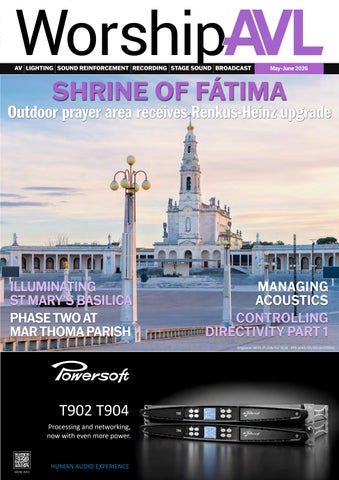
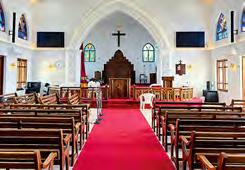
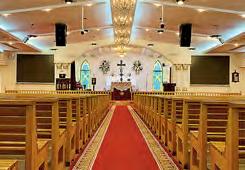
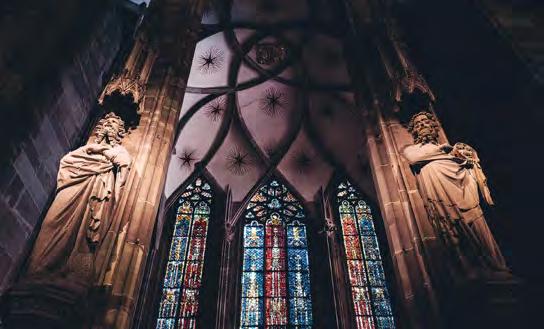
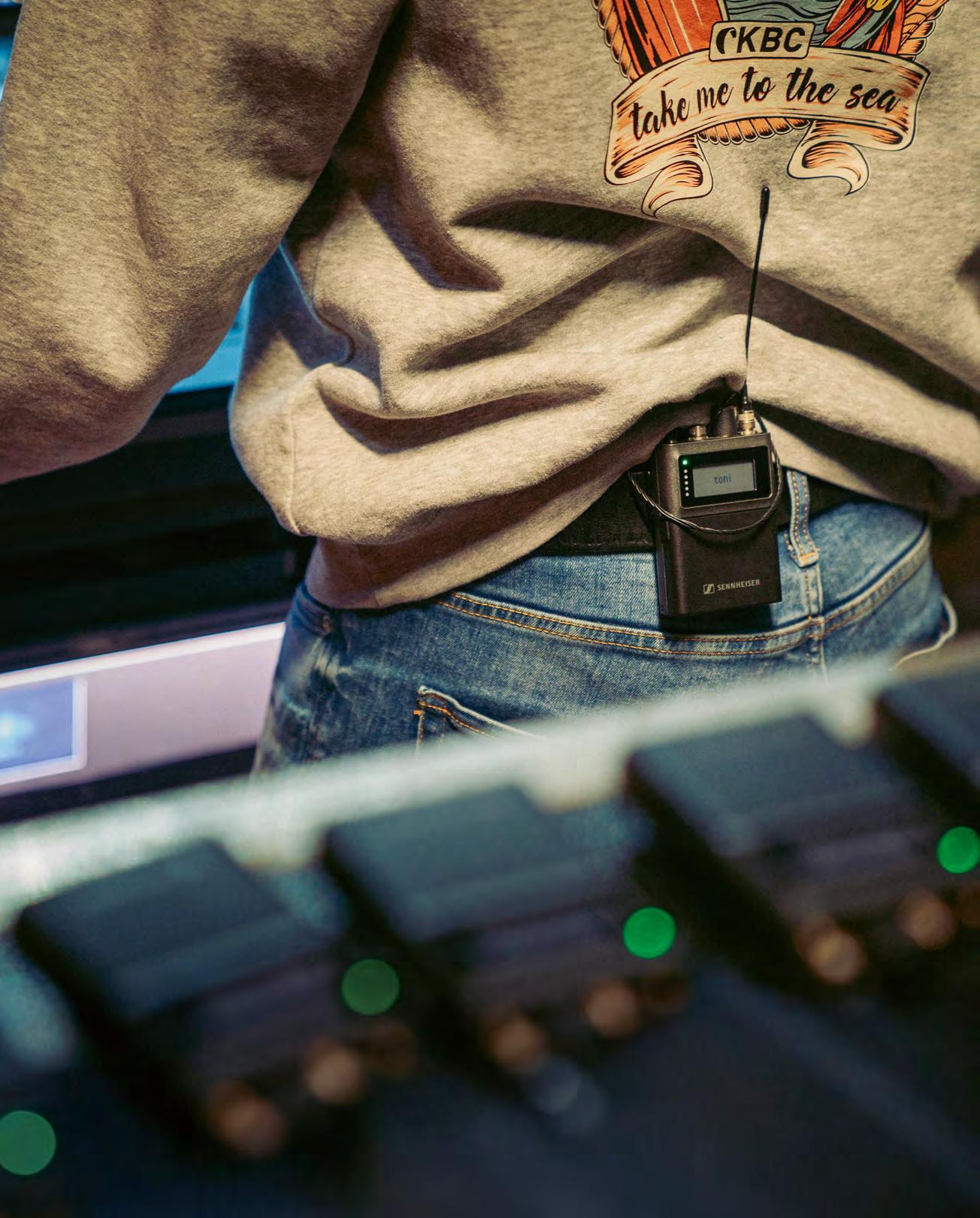
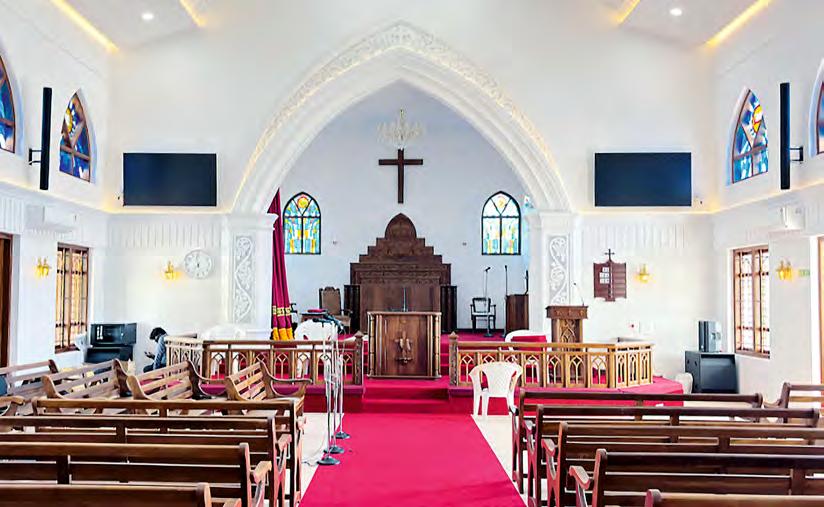
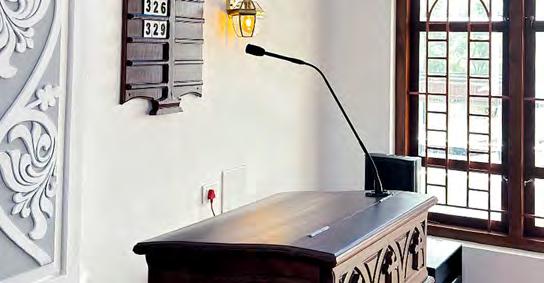
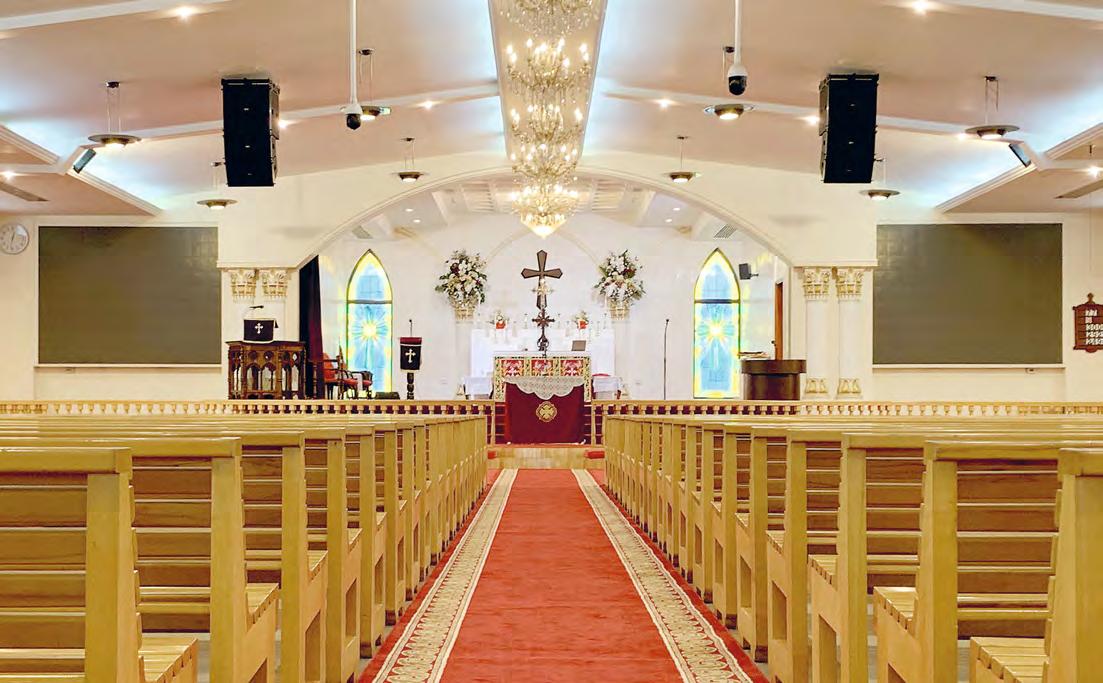
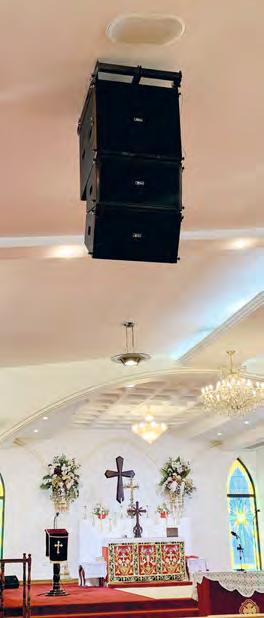
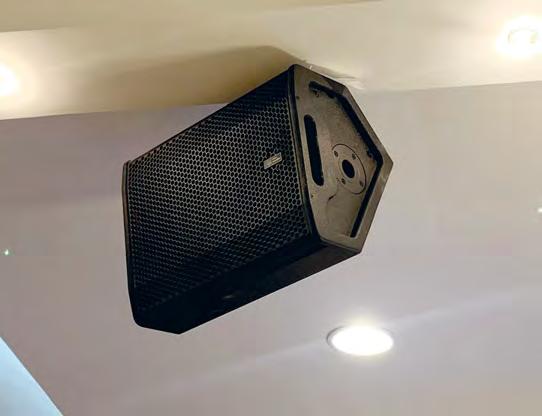
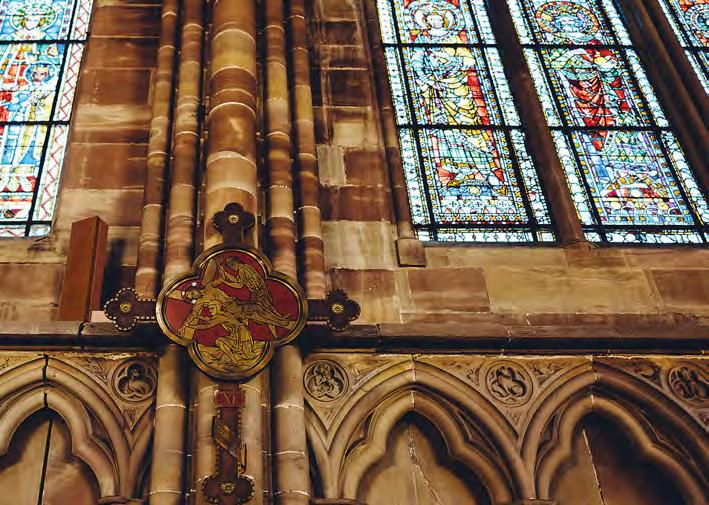
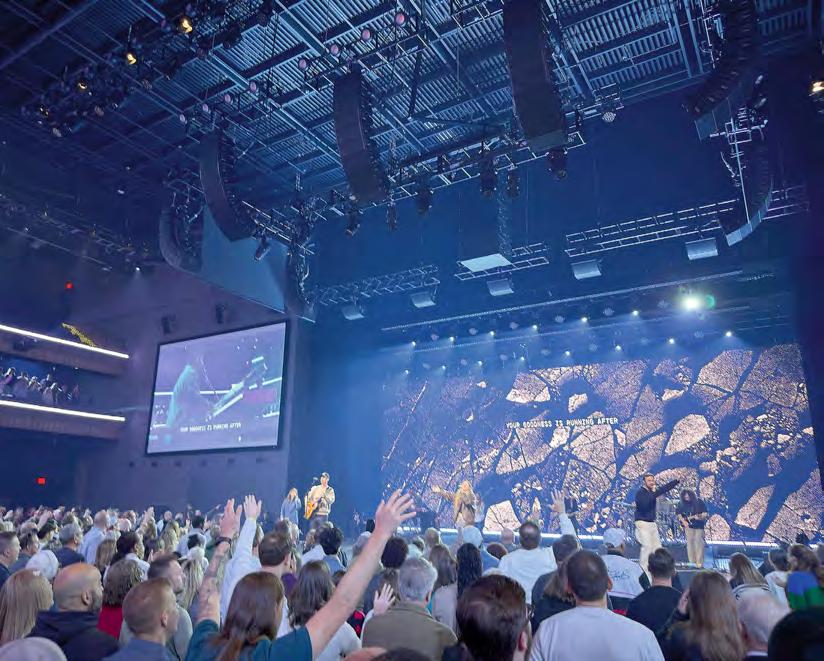
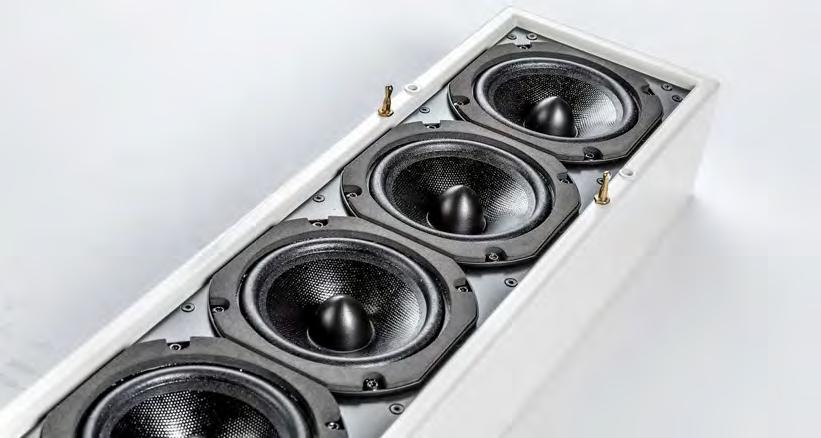
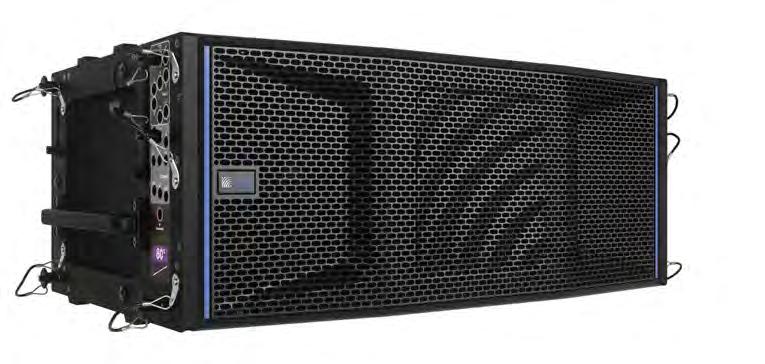
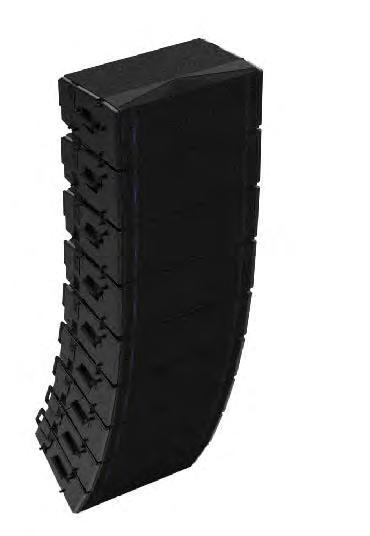
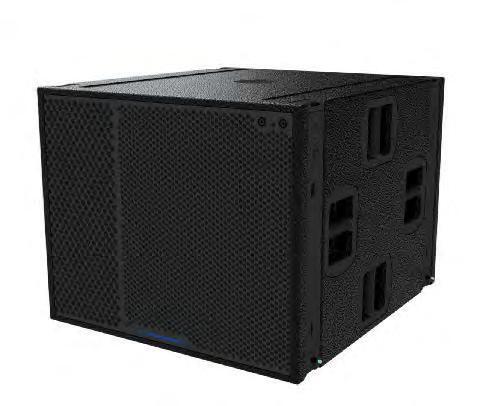
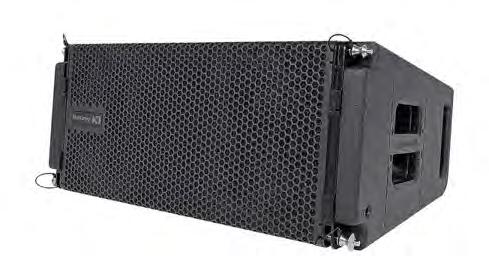
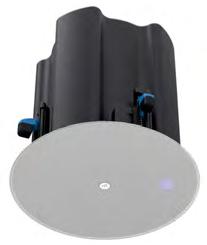
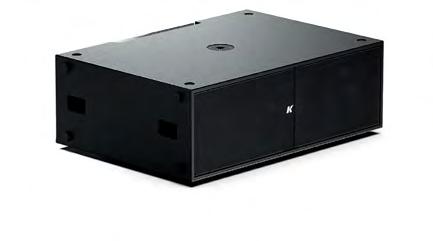
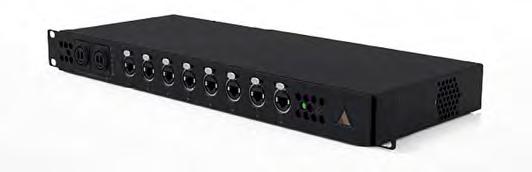
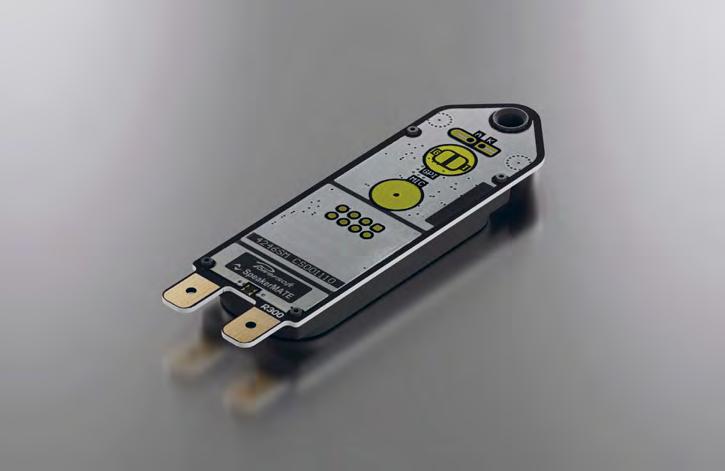
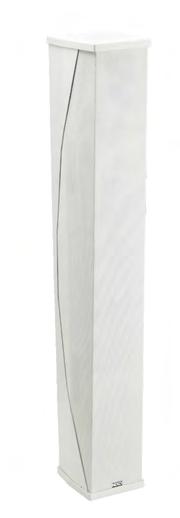
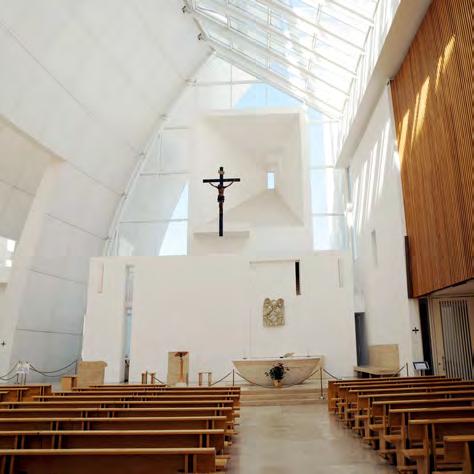
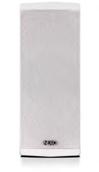
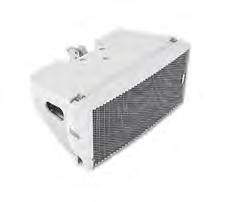
In the UK, we have a saying about buses (not audio busses!) – you wait for ages then two come along together. The Mar Thoma Syrian Church has expanded over the years, extending away from its origins in Kerala, India. HOW installation specialist Zacs and Phils was entrusted with the audio system design and integration at St Paul’s Mar Thoma Church in Kozhikode, India, selecting Tannoy VLS 30 asymmetrical vertical line source loudspeakers for the project (p.16). Meanwhile in Dubai, Alpha Acoustics has returned to Mar Thoma Parish Dubai for a second phase of audio upgrades having installed its Kannon 10 speakers and
couple of years ago (p.24).
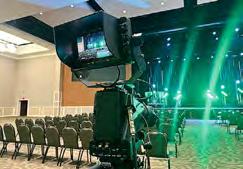
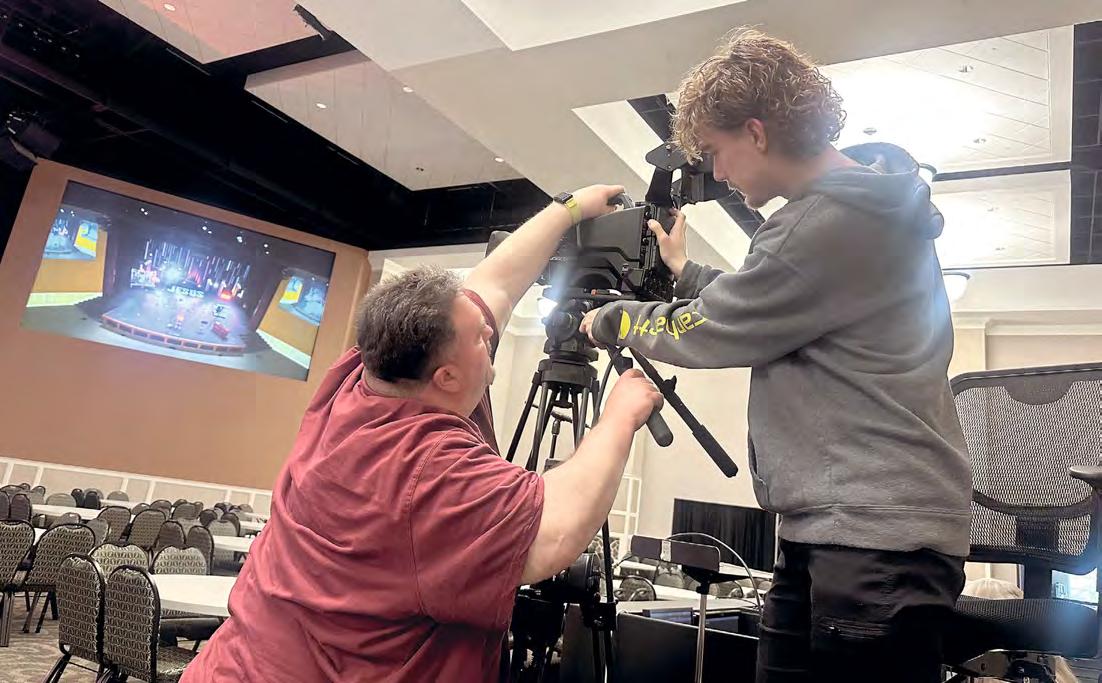
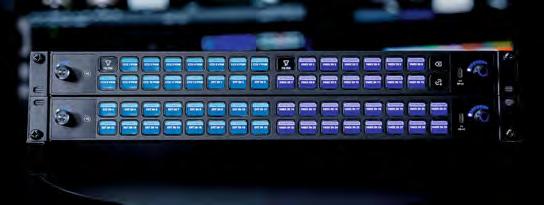
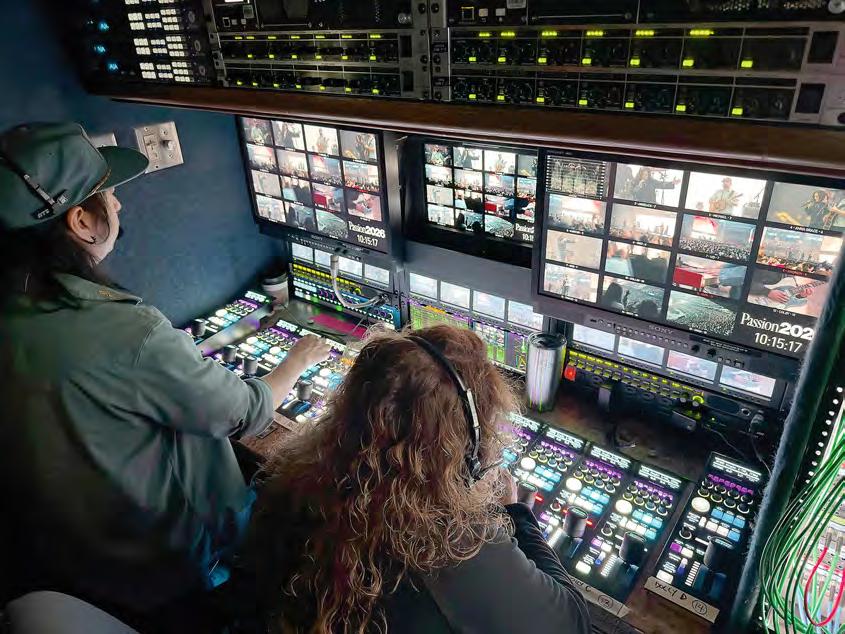
Casey Hawkins is a familiar name in the magazine, having contributed many an article over the last few years. It was lovely catching up with him following an upgrade to Green Acres Baptist Church’s 2,200seat Crosswalk Conference Center (p.18). Along with team members Taylor Newton and Hunter Peggs, Casey has installed a Blackmagic Design ATEM 2 M/E Advanced Panel 20, a Sony HXC - FX90 camera and a Clear-Com intercom system. With further upgrades planned for other rooms at the campus, we’ll catch up with Casey again soon in a future issue.
Richard Lawn General manager rlawn@worshipavl.com
Nick Smith Digital media manager nsmith@worshipavl.com
Sue Gould
director sgould@worshipavl.com
Chris Yardley Video editor cyardley@worshipavl.com
Carolyn Valliere
cvalliere@worshipavl.com
Jack Stennulat Digital content creator jstennulat@worshipavl.com
Simon Luckhurst Senior reporter sluckhurst@worshipavl.com
Adrian Baker Production editor abaker@worshipavl.com
THE VOCAL OF MOST MUSICAL styles holds a very important role. While several styles of music don’t rely on word to convey emotion and story, the addition of this dimension changes the depth and complexity of the stories we tell. I would very much make the argument that in worship, it’s even more important. And this is why we must take extra care of the vocals.
First, let’s address what people are attempting to do when they come and worship. They’re likely there to connect in some fashion, right? Connect with their community, connect with a higher power of some kind, connect with themselves, maybe even their family. Worship offers this very interesting experience that goes beyond our normal human connection to music (as powerful as that is in itself) and can help people connect spiritually. That is not to say that secular music can’t also offer spiritual connection, but music designed for spiritual connection (especially for any organised religion) carries a certain weight to it in that everyone experiencing it is receiving it through a similar lens. In contrast,
secular music is entirely up for debate, and the meaning can be almost anything for anyone on any journey. So, we can agree that vocals are important, so now we can look at how to respect them in the mix.
Cleanup crew
We want each vocal to be recreated and reinforced as honestly as possible. A reminder that we aren’t magicians, and we can only do so much. That being said, we can clean things up to make our lives a bit easier.
High-pass filtering: if you read my two-part series on mixing fundamentals (July–August and September–October 2025), this will all ring a bell. Using an HPF is one of our greatest tools and should be used freely. This filter (available on literally every mixing console on every channel) rolls off the low-frequency junk that doesn’t naturally exist in the human voice and serves only to clutter up the mix (especially when multiple voices will be stacked). I recommend starting at 100Hz and
Music plays an important role in helping people connect spiritually
When a vocalist isn’t singing, the microphone can pick up bleed from other instruments
rolling it higher until you hear an audible shift in the tonality of the vocalist – then roll it back a bit. We want to take away everything that isn’t the vocal without affecting the vocal.
Gates: if your stage is a bit crowded and has lots of noise makers on it, it’s easy for the vocal mics to pick that all up; they are standing in front of all the noise makers, after all. When the vocalists aren’t vocalising, their microphone can be adding in a lot of bleed from the other instruments (looking at you, drums). We can use gates to eliminate sound below a certain level threshold. In turn, this means that any sound that’s quieter than, say, the level of our vocalist, never gets let in. Setting up a gate requires some attention and shouldn’t be left alone week-to-week. No one likes the sound of the first part of their syllable being cut off or suddenly coming back on – it’s very unnatural. If you want to go into advanced mode, try an expander. Expanders are wonderful tools.
When mixing more than one vocal, I keep their faders always at hand. That sometimes means adding the channels onto the top-most layer of my digital mixing desk (or assigning them to a DCA or control group) so that I can very quickly make minute changes to the balance between one another. I nearly always have my hand directly on them to be constantly making changes that suit the song, passage and comfort level of the vocalists.
Can you pick out all the vocalists individually in the mix? Is there one that’s clearly leading? Is it a choir and all should come across equal? Is there one you’re intentionally hiding a bit? Does it sound like several individual singers or a group?
Sum of its parts
The human voice by itself can be quite fragile, easy to pick
apart. We can put it under a microscope (soloing or PAFLing in our headphones) and find every issue. But I think that takes away from what the music or other voices are adding. A vocal in worship music is hardly truly only a vocal. It’s a summation of multiple vocals, effects or musicians and instruments.
There’s typically one leader or soloist in any given passage of music. Even when this is the case, we must ensure that it’s balanced between the other vocals (and/or instruments). Check out my mixing fundamentals articles to learn more about intra- and interinstrumental mixing and balance.
Ask yourself these questions regularly as you’re mixing. The vocals are key and nailing their position and clarity in the mix easily takes the mix up several levels in quality and experience. And don’t be afraid to encourage them to have good mic technique, too. It’s easy to forget about it in the heat of the moment.
www.allen-heath.com
Line Array Speakers
Beyond tech mastery Systems that serve people
“A system that only works when the expert is present isn’t strong –it’s fragile,” discusses audio engineer Kevin Yague
CHURCH PRODUCTION conversations usually revolve around upgrades. Should we move to a new console? Is it time to replace the wireless rack? How can we improve our livestream quality? These are important questions. Stewardship matters. Tools matter. The right system removes friction and supports excellence. But there’s a deeper question underneath all of it that we don’t ask often enough: who is this system built for?
It’s easy to design AVL systems for ideal conditions, the most experienced operator, the perfectly rehearsed band, the service that runs exactly as planned. But most churches don’t operate in ideal conditions. They operate with volunteers who serve once or twice a month, musicians who make spontaneous changes and pastors who occasionally extend a moment without warning. Looking beyond tech mastery means designing with people in mind.
Take console configuration. You can build an advanced show file with layered routing, carefully structured DCAs, parallel processing and detailed scene automation. Technically, it may be impressive. But if a newer volunteer struggles to identify vocal channels or doesn’t understand what a mute group controls, that complexity becomes a liability.
gain structure. These aren’t small details – they’re leadership decisions. They determine whether someone feels confident or intimidated when they step behind the desk. The same principle applies to RF coordination. A clean frequency plan protects your service from interference. But walking your team through the reasoning behind it protects your ministry from dependency. When volunteers understand why antenna placement matters or why frequency spacing must be deliberate, they begin thinking proactively instead of reactively. Knowledge shared is resilience gained.
Livestream workflows provide another example. Many churches have built impressive broadcast setups over the past few years.
Separate broadcast mixes, ambient microphones blended for room feel, carefully tuned compression for online listeners. These are good developments and reflect care. But what happens when your most experienced broadcast engineer is unavailable? If only one person understands the routing, the system is one absence away from failure. Resilient systems account for that reality. That might mean simplifying bus structures. It might mean building clear startup and shutdown checklists. It might mean documenting your philosophy for balancing room mics with direct inputs so someone else
can participate confidently. That’s not compromise – that’s wisdom. Excellence in church production isn’t measured by how complex our systems are – it’s measured by how reliably they serve the mission. If a volunteer can walk into the booth, understand the signal flow and operate with clarity, that reflects thoughtful design. Technical mastery still matters. We should pursue clean gain structure, intentional mic placement, disciplined stage volume and well-balanced mixes. We should care about redundancy, signal integrity and proper system tuning. These are expressions of stewardship.
But mastery finds its highest expression when it removes intimidation from the room. When the booth feels calm, creativity grows. When systems are understandable, ownership spreads. When knowledge is documented and shared, ministry
can replicate the result. None of this lowers the standard – it strengthens it. Even gear selection reveals what we value.
When choosing between two pieces of equipment, we often compare specifications: preamp transparency, processing headroom, expandability, integration with other platforms – all important considerations. But we should also ask a quieter question: which option fits the skill level of our current team?
The most advanced solution is not always the most faithful one. A console with unlimited flexibility is powerful, but if your team only uses 10% of its capability and feels overwhelmed by the rest, the investment may create more anxiety than impact. Sometimes a slightly simpler workflow leads to greater longterm excellence because more people
multiplies. The goal is not to build a production environment that showcases our expertise – it’s to build one that invites others into it.
One practical step many churches overlook is documentation. A simple signal-flow diagram taped inside a rack, a labelled stage patch sheet or a shared folder with console screenshots can save hours of confusion. These small tools turn tribal knowledge into shared knowledge. They also communicate something important to new volunteers: this system was built with you in mind. Clarity today prevents stress on the next Sunday.
Beyond tech mastery is not abandoning the craft – it’s refining it until our systems reflect both precision and generosity. Because, in the end, the best production systems don’t just sound good. They serve well.
Churches don’t operate in ideal conditions – musicians and pastors can make spontaneous and unexpected changes
Clear labelling helps develop confidence in volunteers
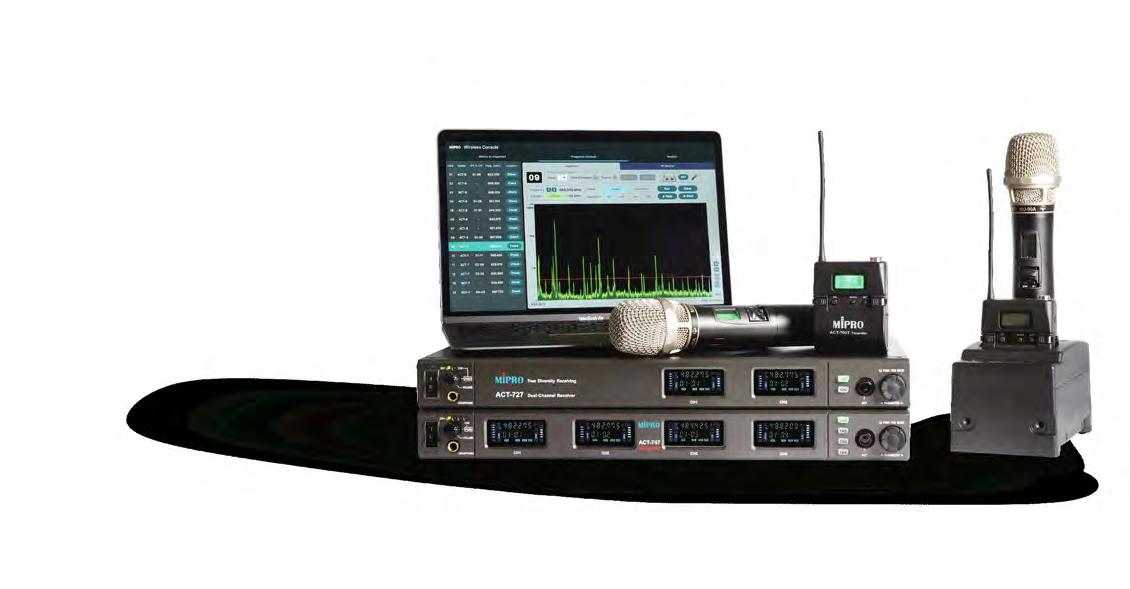
ACT-700 Series Professional Wireless System
When worship deserves your best, trust the MIPRO ACT-700 Series to deliver.
Engineered with a true diversity receiving circuit, it ensures drop-out-free audio — so every word, every note, and every message reaches your congregation with clarity and power.
The all-new MWC software makes system setup and frequency coordination intuitive and efficient, even in multi-channel environments.
Our dual-power handheld and bodypack transmitters support both 18500 rechargeable and AA batteries, with flexible USB-C or dock charging — ready to serve faithfully in any venue or workflow.
Pair it with our MU-57 Series waterproof headworn and lavalier microphones for extended durability, ideal for long services, active worship, and life on the road.
MIPRO — Professional wireless audio, designed to support your calling.
Is digital audio moving us further away from the truth?
Jon Schumann, product specialist and outreach at Digital Audio Denmark, considers latency and the responsibility of manufacturers to ensure they are prioritising artists’ needs
GROWING UP AS AN ENGINEER who was too antsy to constantly sit in a studio but also too lazy to go on tour the whole time, I ended up with my feet in both camps. Almost all of my work was setting up mics, coiling cables and splicing tape. When digital happened in the kind of productions I was working in, I was so excited. Ever since my Fleetwood Mac Tango in the Night CD, I had been obsessed with digital and it seemed to be the inevitable yellow brick road towards audio perfection. There were opinions and heated discussions about quality and formats flying around like sacred religious texts and every denomination had their enthusiastic clergy.
We’re very much still there, but mostly the format wars are about compressed audio and which codec is the ultimate one – it’s almost a chat amongst friends. But as someone who, as mentioned before, has lived happily in both the recording and the live performance space, I am increasingly frustrated by a little gremlin that we’re seemingly starting to accept as just the cost of doing business in
the pursuit of flexibility and everexpanding audio channel count and DSP needs. Latency.
Now, we always knew that digital conversion took time. Trying to mitigate this time-hit was a huge business model for the early DAW manufacturers. We bought extortionately expensive Pro Tools rigs because it was (almost) the only way to record with any kind of pseudo-real-time monitoring. The non-real-time recording systems would have a mix-mode that would route the direct inputs straight to your headphones, so it was almost like the real thing – but no plugins on record unless the interface had some DSP. We all knew that latency was horrible for the artists and it could completely ruin a session. But it always felt like the next version was just around the corner. Faster computers, better interfaces, new formats. It was a mess, but it was a creative mess made by people trying to move things along towards the more perfect solution.
Then audio-over-IP (now AoIP) started gaining traction with many manufacturers jostling to offer the
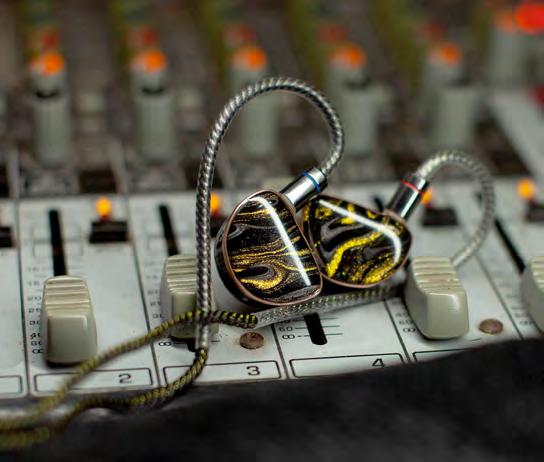
Musicians will often request wired IEMs to reduce delay
best solutions. All of them offered the thing that we had never had in our business: convenience. Move x amounts of channels over unfathomable distances with high channel counts in “more or less” real time. The possibilities were endless and it allowed us room to think bigger
and more involved. Skipping ahead to now, this is our reality.
A common Dante network in a larger production easily has 100 devices on the network and multiple hops across switches. The benefits are clear, with oversight and complete control from centralised
Latency can make musicians feel like they’re playing in different time zones
locations – not even mentioning the hardware, saving thousands of kilos of copper and plugs. The benefits for the crew and budget sheets are endless, but the performing artist is still faced with challenges in this new reality.
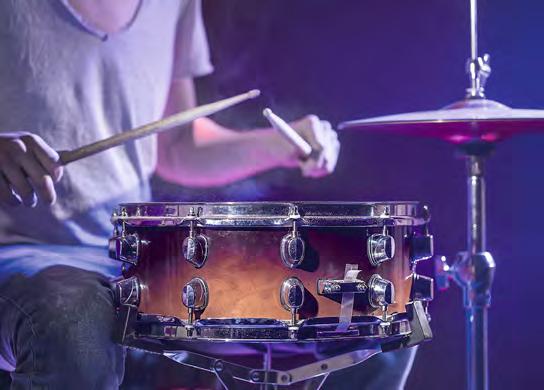
Consider the drummer on IEMs: his snare drum hit travels from microphone to the mic preamp, gets converted to digital and then typically gets on an optical loop to the console. On the console, it hits the onboard DSP and then leaves the console again onto your external processing of choice, comes back and then may even leave again for group processing, adding another run around the track with latency incurred. Only then does the monitor engineer push it into the IEM rack – again over AoIP and it then finally travels to the drummer. From the instant that the stick hits the head to the moment the sound hits the in-ear monitor, it is not uncommon to have waited up to 10ms in such a modern scenario. That delay between physical impact and audio return is a complete disconnect for the drummer. Most drummers will now ask for wired IEM packs to at least minimise the delay.
For singers with even heavier processing, you can easily exceed 15ms from source to return. In practical terms, the singer will feel their voice instantly through their jawbone, yet sound will enter their ears like they are singing back at themselves from 4m. (Approximately – don’t get the Smaart out!) That’s a strange ghost duet and your body knows it. Adding to this that every player is now an island on the stage with little-to-no direct interaction with their fellow players and you have people literally playing in different time zones.
There is no version of this that is going to make music better. No groove is going to benefit from keeping the players so far away from each other in time that they may as well be in separate rooms. We are primitive animals and time is critical to our understanding of sound – it is how we know which direction the tiger is coming from and it will allow us to, perhaps, avoid being eaten. Luckily, many in the industry feel this way too, and solutions are being developed. As manufacturers, we owe it to artists to prioritise these needs in developing the tools required to
keep music “feeling” right and just in time, but there are also many companies that believe that it’s “good enough”, allowing AoIP to be the only way to interact with their products.
My take is that wireless mics or IEM systems exclusively on AoIP seems almost like an insult to the artist. Plugin processing for channel inserts on AoIP may be the only way to stay within budget, but you must accept the limitations. You are literally moving the artist away from
the music. I believe that staying on top of time and demanding not only higher channel counts and more features, but also better time fidelity, is going to be a winning formula both artistically, but also as a direct result of this – financially. Perhaps it’s time to break out the trusty old MADI connection or, dare I say it, analogue?
I believe that the philosopher Freddie Mercury said it best when he sang: “I want it all, I want it all, I want it all – and I want it now.”
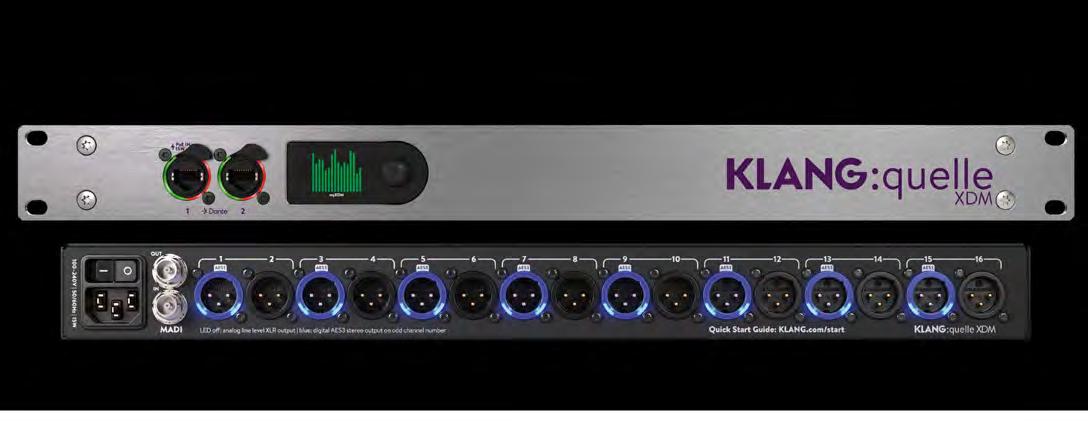
THE ONE BOX THAT
Works with any Dante or MADI system 16 analogue or 8 stereo digital outputs
Built-in redundancy with dual power and backup network
Converts both ways: Dante <> MADI, with passthrough Simple remote control via the KLANG:app
design for touring or tight spaces
It can take up to 10ms from the drum hit to reach the IEM
Managing acoustics in worship spaces
Sergio Molho, partner and director of business development at WSDG, discusses why it’s important to consider acoustics in a worship space
UNDERSTANDING ACOUSTICS
in any auditorium, lecture or performance space is absolutely critical, and we consider houses of worship to be equally important, because intelligibility – which means what the pastor or reverend or rabbi is saying – is critical for the congregation to understand the “speech” or the “word”. In addition, in contemporary worship spaces, there is a lot of musical content that makes internal room acoustics really important in order to provide the congregation with the best worship experience.
As a result, acoustics – when we think in terms of reverberation, intelligibility and frequency response – is ultra-critical in modern contemporary worship spaces. If you don’t pay attention to that, you are going to have spaces that are too reverberant or where speech is not understood by the congregation.
Is acoustics the most difficult audio challenge to manage?
Acoustics is one of the most complex things to manage, particularly in worship spaces. Traditionally, these spaces are very large in volume, such as the old cathedrals from the Middle Ages. We feel that we are in God’s
presence when the space is huge, but huge spaces mean high volume, and high volume means high reverberation times. Controlling acoustics/ electroacoustics is one of the most challenging aspects for a worship space but, with careful planning, these issues can be overcome.
What makes some rooms easier or harder to manage than others?
Surface materials have a big influence. In acoustics, we can manage reflection, absorption and diffusion. In churches, you’re always dealing with large concrete or marble floors, concrete walls or large glass windows – these are all materials that
receiving area, so that’s what needs to be managed.
How can measurement tools help in planning?
As acousticians, we deal with architectural acoustic simulations. We try to get a three-dimensional acoustic model of the space and use these simulations to position the source of the sound in relation to the audience. We can simulate the performance of the room and plan accordingly regarding the internal room acoustic placement and shapes of the room.
are very reflective, and that makes it a little more difficult to control and manage. That’s the reason we do a lot of acoustic simulations to understand the behaviour of the space from the drawings, and that’s part of the acoustic consultant role we provide.
Do certain building materials result in adverse acoustics?
They can make it more of a challenge, but not necessarily unfixable. Reflections need to be managed in order to reduce or control the reverberation time and the speech intelligibility. But, on the other hand, some of these materials found in churches can be used in our favour, such as carpet and curtains.
How does room shape affect acoustics?
Normally in worship, you’re dealing with large spaces with tall ceilings. And when you have live music, lowfrequency control is also a challenge because you usually have drums and bass that will make everything more difficult to manage. From an acoustic point of view, churches are like any kind of venue or musical performance space where you have a stage or an altar and then a congregation. In all scenarios, there’s a source and a
Are you able to work with architects during the design of a building?
We always work with architects because we are never the main architect; we are always the consultant in this kind of worship space. Normally, when you are talking with architects that work in worship spaces, they have some kind of understanding of critical listening and are able to pay attention to the technology and acoustics. Worship leaders require perfect intelligibility so that their words and emotions are effectively spread throughout the congregation.
Can the acoustics of the room influence your choice of speaker?
Yes, because sometimes the acoustics of the room or the shape of the room doesn’t allow you to use certain kinds of speakers. For us as designers, it’s the integration between architectural acoustics and technology that matters. All the elements need to work cohesively in order to have a perfect alignment of architecture, aesthetics and technology.
www.wsdg.com
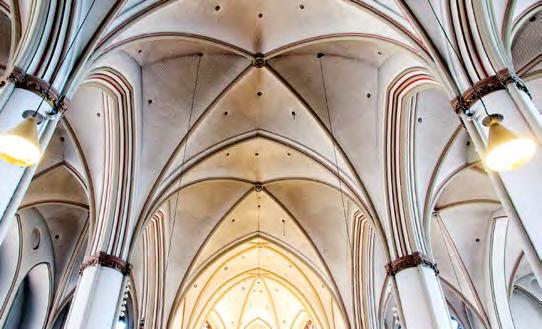
Churches are often large, reverberant spaces with tall, vaulted ceilings
Sergio Molho
Knowing how to manage highly reflective materials such as stone and glass is critical
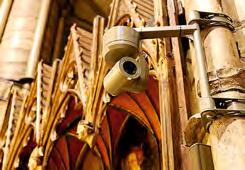
Marshall Electronics feature-rich POV cameras
New compact POV cameras have been added to Marshall Electronics’ lineup, built to deliver high-quality video in a variety of locations
MARSHALL ELECTRONICS HAS introduced several new high-performance POV cameras designed for worship, broadcast, live production and professional AV environments. The lineup includes the all-weather CV574-WP with NDI|HX
standard Ethernet networks, simplifying installation and reducing the need for complex cabling. Its IP67-rated weatherproof design makes it a strong option for outdoor services, baptisms and special events, as well as campuses with
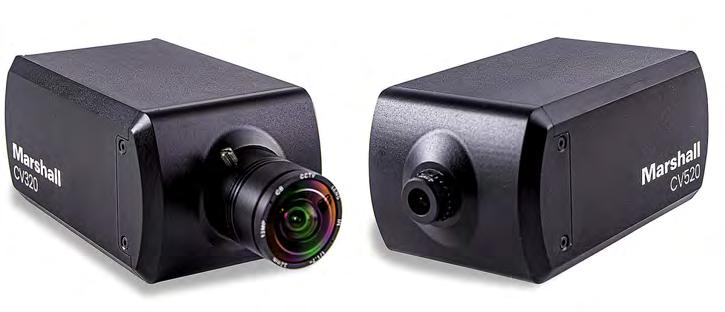
HD camera with 3G-SDI and HDMI, and the CV320 and CV520 compact POV solutions with IP and 3G-SDI connectivity.
As houses of worship continue to expand their production capabilities, reliable, easy-to -deploy cameras are essential for capturing services without distraction. Marshall’s new POV cameras are built to deliver high-quality video while remaining compact and unobtrusive, making them ideal for sanctuaries, stages and overflow spaces.
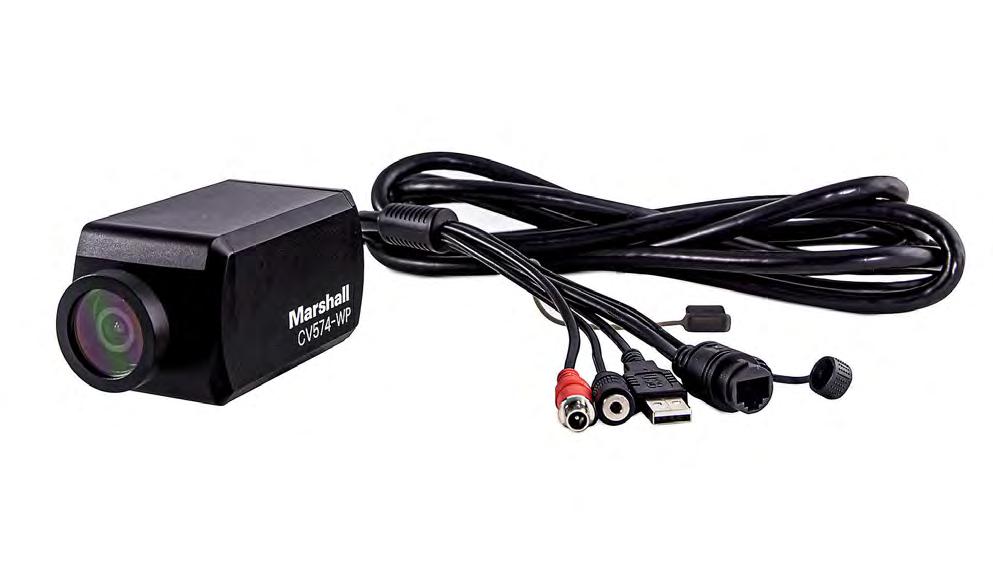
The CV574-WP, Marshall’s first all-IP 4K POV camera, is designed for modern, network-based workflows. With NDI|HX support, it enables low-latency video transport over
The camera features an interchangeable M12 lens mount with a 4mm lens that provides a 77° horizontal angle of view, ideal for wide sanctuary shots or stage coverage. Built around an 8.46-megapixel 1/2.8-inch 4K UHD sensor, it delivers up to 3840x2160p60 over IP and supports multiple streaming protocols, including NDI|HX2/3, RTSP, RTMP and SRT, along with H.264 and HEVC encoding.
An integrated audio input allows sound to be embedded directly into the video stream, streamlining workflows for volunteer teams. Remote control via VISCA-over-IP or a web-based interface makes it easy to adjust settings without physically accessing the camera. This is especially useful for
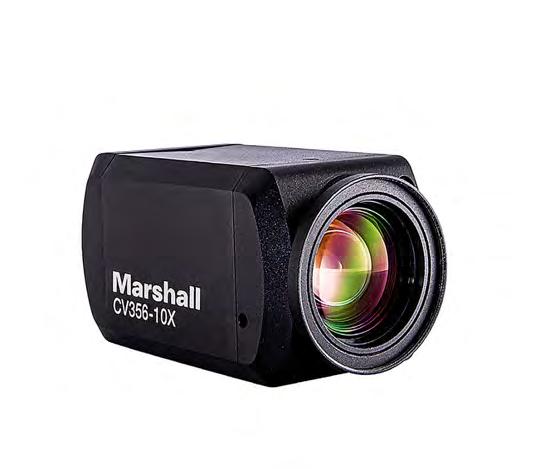
houses of worship that typically mount cameras in hard-to -reach locations, such as high up on the wall and ceiling. Power over Ethernet (PoE) further simplifies installation by allowing a single cable for power and video. Also among Marshall’s latest CV356-10X offers a compact, versatile solution for capturing speakers, pastors and musicians. Featuring a 2.13-megapixel
outputs, it delivers up to 1080p60 video with clear, detailed image quality suitable for both in-room displays and livestreams. Additionally, its 10x optical zoom (12x digital) allows operators to move seamlessly from wide platform shots to tight close-ups, supporting more engaging storytelling during services. A threaded ring adapter enables the use of 49mm filters, including ND filters, for added control in varying lighting conditions.
The camera also includes an audio input for embedded audio and a breakout cable with a joystick for quick access to onscreen controls. Automatic image adjustments help compensate for changing lighting throughout a service, while remote control via VISCA over RS-485 allows operators to fine-tune settings such
as exposure and white balance from a control room. Its durable aluminium construction and locking connectors ensure dependable performance week after week.
For churches needing flexible placement options, the CV320 and CV520 provide compact solutions that can be discreetly installed in a variety of locations. Both cameras feature a 12-megapixel Full HD sensor and deliver up to 1080p60 over 3G-SDI and IP simultaneously, which makes well-suited for hybrid workflows that combine traditional and IP-based infrastructure.
The CV320 supports interchangeable CS and C lenses, allowing teams to customise field of view for different spaces, from tight choir lofts to wide sanctuary angles. The CV520 includes an M12 lens mount with a 4mm lens and an 80° horizontal angle of view, ideal for fixed, wide-angle coverage.
Both models support RTSP, RTMP and SRT streaming, along with H.264 and HEVC encoding, ensuring efficient video delivery across networks. Audio embedding, local joystick control and remote operation via VISCA over RS-485, VISCA-over-IP or a web interface provide flexibility for both
The Marshall CV356-10X is a versatile, durable option for houses of worship
production systems while allowing room to grow.
The CV356-10X is now shipping, while the CV574-WP, CV320 and CV520 are scheduled for Summer 2026 availability.
The Marshall CV574-WP is weatherproof and ideal for outdoor services, baptisms and events
The Marshall CV320 and CV520 are compact solutions for discreet installations
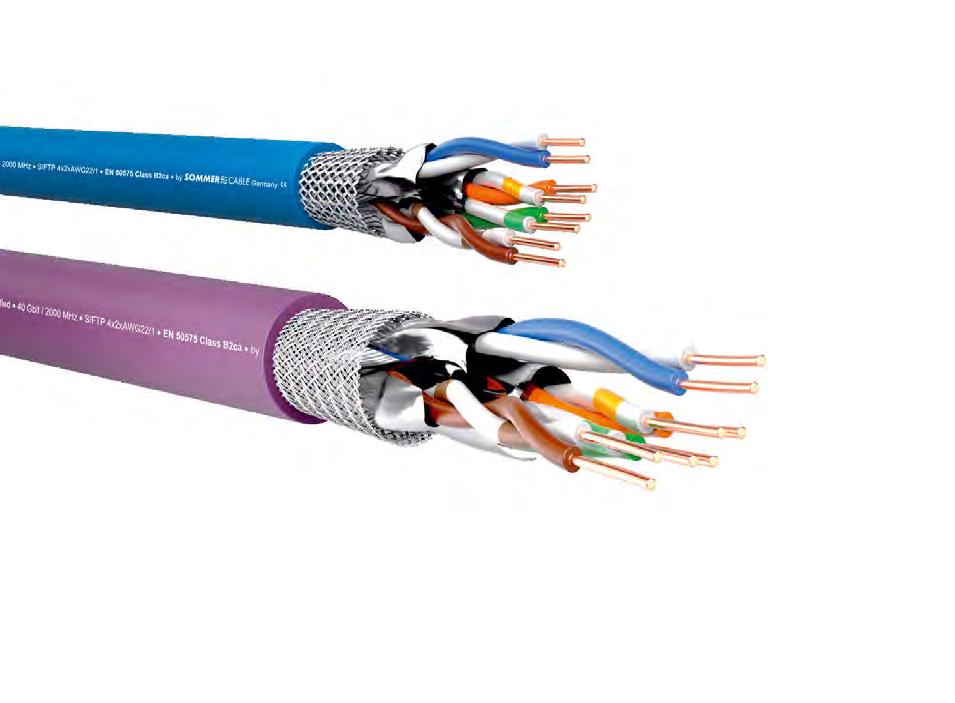
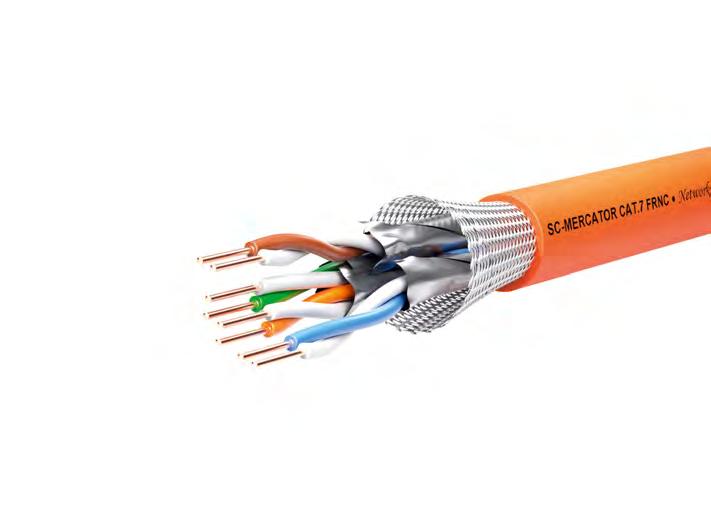
A GIGA…ntic performance
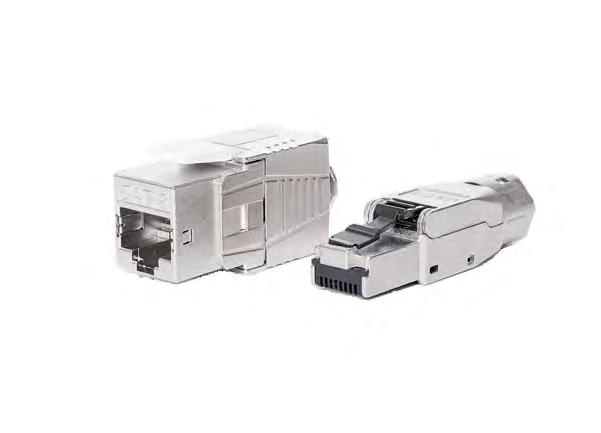
of up to 40 Gbit can be achieved with our CAT.8 connection world, or up to 10 Gbit with our CAT.7 or CAT.6a solutions.
Wide variety of cable and connection technology products for fully networked installation concepts
Classified cable bulkware in accordance with the EU Construction Products Regulation
Ready-to-connect media/network/fiber optic systems for robust mobile and installation applications
CPR-certified CAT.8 and CAT.7 installation and connection cables
SOMMER CABLE based in Straubenhardt/Germany was founded in 1999 and is now one of the leading suppliers of professional high-quality cable and connection technology with a focus on the audio, video, broadcast, studio and media technology sectors. The product range including the in-house brands HICON, CARDINAL DVM and SYSBOXX covers cable bulkware, connectors, connection cables, individually adaptable distribution systems and electronics.
A B2B shop with over 25,000 products is available 24/7.
High-quality certified cables and connection components
A beacon of peace
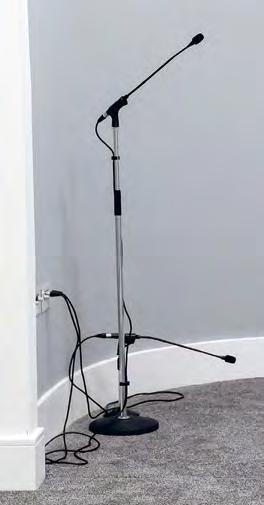
Shure Centraverse CVG12 B/C gooseneck microphones have been fitted in the up and down prayer positions
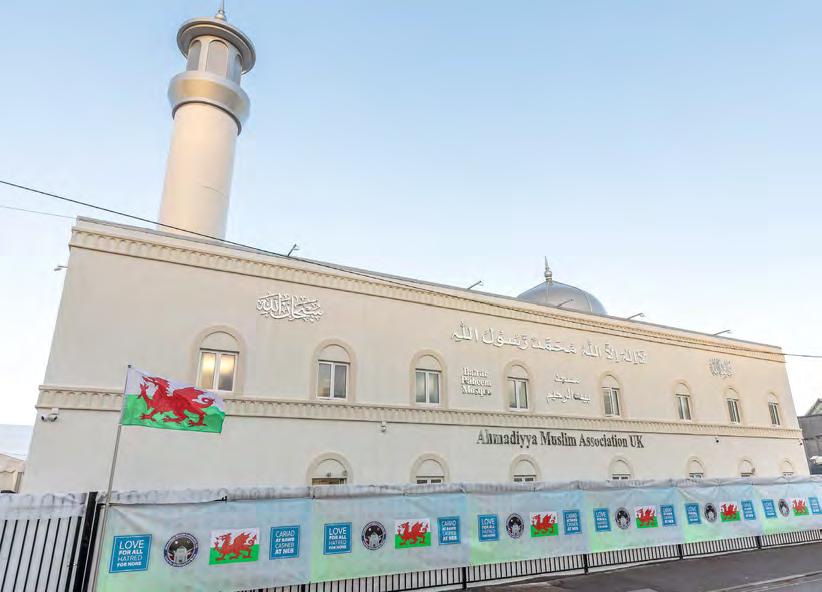
The Ahmadiyya Muslim Community has opened its first purpose-built mosque
THE AHMADIYYA MUSLIM Community – which has a presence in over 210 countries around the world –established its UK chapter in London in 1913 and the community now has 150 branches across the UK. It built London’s first mosque (The Fazl Mosque) in 1926 and, today, its Baitul Futuh Mosque in Morden, south London, is the largest mosque complex in western Europe.
“Our community has had a long association with Wales, with members living in the country since the 1970s,” says Mahmood Rafiq, head of external relations for the Ahmadiyya Muslim Community UK. “The Welsh chapter was formally established in the early
1990s and it now has four branches in Cardiff, Newport, Swansea and Rhyll.”
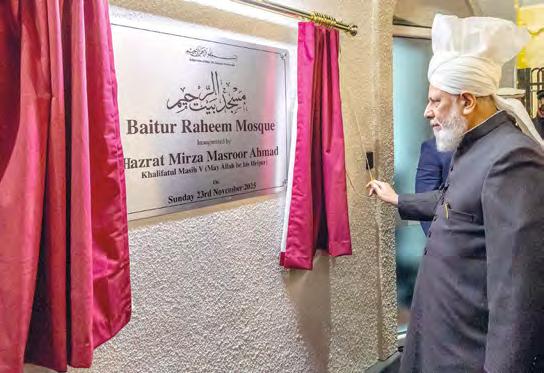
The initial proposal for Baitur Raheem in Cardiff was approved in 2011 and the Ahmadiyya Muslim Elders Association UK raised £1.5m to cover both the purchase of the 0.42-acre site consisting of a former office and warehouse in 2014 and the vast majority of the construction costs. Planning approval was secured in 2018, with the foundation stone laid on 9 September 2023. The inauguration was held on 23 November 2025 and attended by His Holiness Hazrat Mirza Masroor Ahmad, the worldwide head of the Ahmadiyya Muslim Community.
It is hoped the mosque will become a beacon of peace and a source of strength in the country.
“With the Baitur Raheem mosque, we now not only have a place of worship for our local members but also a community centre that provides a meeting point for the local youth and also for the elders to come together,” continues Rafiq. “We needed to equip the building with an AV setup that marries the needs of both a place of prayer and also a place where people hold seminars and run education classes, for example.”
Brothers Imran and Safdar Ali head up the UK community’s audio, video and telecommunications department. Helped by a team of over 300 volunteers, they are responsible for running the audio and video setups for key national events as well as for the community’s new mosques.
Working alongside local systems integrator Vaughn Sound, which is part of the PAI Group, Baitur Raheem is now home to a Cloud Electronics audio system and a Blustream video setup. “Our choice of equipment depends on the size of the mosque and the functionality that we require, for example at Baitul Futuh we have a Q-SYS system which is bigger and more robust for what we need,” explains Imran. “For the inauguration at Baitur Raheem, we travelled to Cardiff and
in Wales
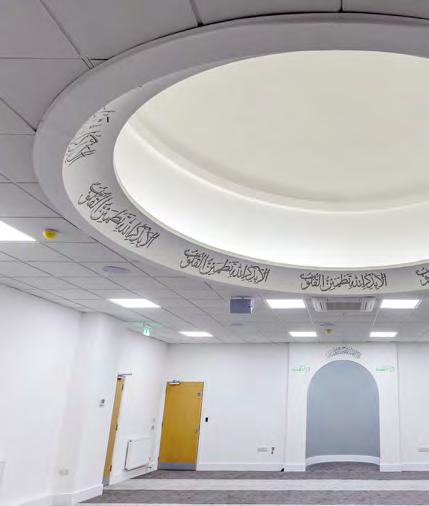
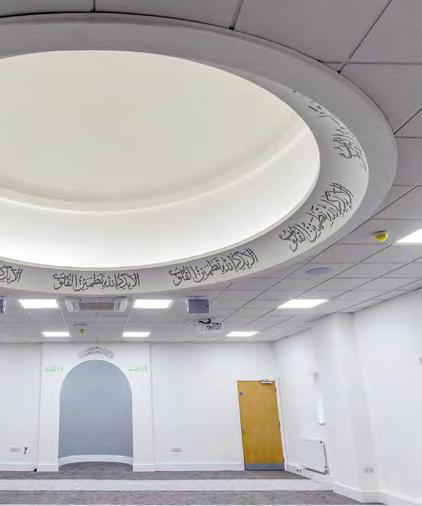
The men’s prayer room has 11 Cloud
took additional equipment with us for the two marquees outside and other auxiliary buildings we used for the guests but, on a day-to -day basis, the setup is being managed by local volunteers so it needed to be easy to use but robust enough to be expanded for larger events.”
The men’s prayer room has been fitted with 11 Cloud CS-C6B/W 6-inch ceiling speakers and two CS-S6B/W
The inauguration was attended by His Holiness Hazrat Mirza Masroor Ahmad
Whether deploying a redundant or primary-only network topology, the MS8.2 Milan network switch is perfectly suited to simplify mobile, installed systems and spatial audio applications.
CS-C6B/W and two CS-S6B/W speakers
A sanctuary reborn
Zacs and Phils has equipped St Paul’s Mar Thoma Church in Kozhikode, India with uniform coverage across all zones
AFTER MORE THAN SIX DECADES,
St Paul’s Mar Thoma Church has been rebuilt to ser ve a vibrant and growing congregation of around 250 worshippers. The new structure is being celebrated not only as an architectural renewal, but as a spiritual and acoustic transformation where speech and music are heard with clarity, warmth and reverence.
The church committee, under the leadership of convenor Dr Alexander K G, secretary Simon Mathews and Reverend Sunil Joy, entrusted Zacs and Phils with the audio system’s design, integration and consultancy. The committee provided Zacs and Phils with a clear brief: to provide speech intelligibility of the highest order, and musical reproduction that is “sweet, natural and never aggressive”.
“The new sanctuary presented a set of unique challenges,” explains Manu Philip, business manager at Zacs and Phils. “Architectural and HVAC constraints prevented loudspeakers from being mounted at lower, acoustically ideal heights. We were tasked with providing uniform sound coverage across the main nave, sanctuary, under-balcony and upperbalcony seating, without excessive sound pressure levels. Plus, there was a strong emphasis on natural vocal clarity for liturgy and sermons, and gentle, enveloping reproduction for choir and hymns.”
To address these issues, Zacs and Phils carried out a comprehensive acoustic treatment on both ceilings and floor surfaces to ensure reverberation time was controlled and speech articulation improved, all the while preserving the natural liveliness required for congregational singing.
“Our design philosophy centred on several factors: controlled directivity rather than brute-force SPL, a timealigned distributed system instead of a single overpowering source, asymmetrical vertical coverage to suit high mounting positions and precise DSP tuning for tonal balance, phase coherence and protection.”
Zacs and Phils specified a solution focusing on Tannoy VLS 30 asymmetrical vertical line source loudspeakers. “Due to the unavailability of low mounting positions, the main loudspeakers had to be installed at a considerable height,” continues Philip. “In such
conditions, conventional point source systems would have resulted in excessive front-row levels and poor rear coverage. With its asymmetrical vertical dispersion, we selected the VLS 30 to project sound evenly from the first pew to the last row, maintain consistent tonal balance over distance, minimise ceiling and floor reflections, and deliver exceptional speech intelligibility with low distortion.” The VLS system is powered by a Lab Gruppen PDX3000 2-channel amplifier.
To achieve coherence in the extended seating areas, Zacs and Phils specified Turbosound NUQ62 loudspeakers as delay systems for the under- and upper-balcony zones, powered by Lab Gruppen IPX 1200 networked amplifiers. The integrator has also supplied an audio solution to the first-floor overflow area using
NUQ122 speakers, again driven by IPX 1200 amplifiers. All zones have been time-aligned to ensure that worshippers experience a single, unified acoustic image, regardless of seating position.
For hymns, organ and choral music, controlled and musical low-frequency extension has been achieved using two Turbosound NUQ118B-AN subwoofers which have been carefully tuned to provide warmth and foundation without overpowering the vocal range, preserving the “sweetness” demanded by the parish. Central system optimisation and protection are being handled by a dbx Venue 360 processor, responsible for system EQ and voicing, crossovers and phase alignment, delay synchronisation between main, balcony and overflow zones, and loudspeaker protection.
The control backbone of the installation comprises a Behringer X32 digital mixing console and an S32 digital stagebox to provide St Paul’s Mar Thoma with flexible routing, scene recall and precise control for daily services, special liturgies, choir performances and festive celebrations. Stage and sanctuary monitoring is provided by Behringer DR110 DSP loudspeakers, ensuring clear foldback for clergy and choir without spill or colouration. To ensure natural and intelligible voice reproduction across all liturgical roles, Zacs and Phils also supplied Audio-Technica U857QLU condenser microphones for the lectern and pulpit, and MB3k dynamic microphones for the choir and lay leaders. AudioTechnica ATW-13HH2, ATW-11HH2 and ATM75cW wireless and headworn microphones were selected for their clarity, low handling noise, high feedback rejection and tonal consistency.
“Today, the rebuilt St Paul’s Mar Thoma Church stands not only as an architectural landmark, but as an acoustically refined house of worship,” concludes Philip. “The completed system has delivered exceptional speech intelligibility, even at low listening levels. The church now has uniform coverage across all zones, along with natural, warm and fatiguefree reproduction of hymns and music.”
www.zacsandphils.com
An Audio-Technica U857QLU condenser microphone on the lectern
Moving forwards
Green Acres Baptist Church’s Crosswalk Conference Center has upgraded its AV setup with Blackmagic, Sony and Clear-Com equipment
WHEN IT COMES TO LARGE houses of worship, ensuring that the AV equipment is always up to the task and replaced before it reaches the end of its life is a never-ending task. This is certainly the case for Green Acres Baptist Church (GABC) in Tyler, Texas, a Southern Baptist megachurch with over 17,000 members. The campus comprises the main Worship Center with 3,400 seats, the Crosswalk Center with 2,200 seats, a chapel with 1,350 seats and several other ancillary rooms that are used for internal and external events.
Responsibility for these continual upgrade efforts falls onto the shoulders of Casey Hawkins, a familiar name in Worship AVL who has written plenty of our KnowHOW, Technology and Comment articles over the last few years. He holds the role of director of video engineering and live production at GABC where he has worked since 2016. “You have to have the mindset of predicting when things
might break and what we would do if it does,” he says. “We’ve got a whole shelf system here of backup parts – we’ve got frame syncs worth US$5,000 that are just sitting here waiting to replace something crucial
that could break on a Sunday morning.”
The smaller Crosswalk Center holds the church’s Spanish services on a Sunday and has more of a theatre-style stage than the
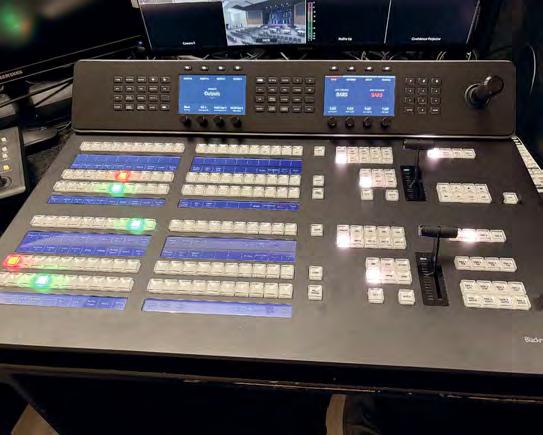
Worship Center. Hawkins and team members Taylor Newton and Hunter Peggs have recently undertaken an upgrade to Crosswalk’s AV infrastructure with a Blackmagic Design ATEM 2 M/E Advanced Panel 20, Sony HXC - FX90 camera and a Clear-Com system comprising an MS -702 Encore 2-channel rackmount intercom main station, RM -702 Encore remote headset station and six RS -701 singlechannel Encore analogue partyline intercom beltpacks.
“We have Ross Carbonites in the Worship Center where everything is broadcast-level, but over in Crosswalk the setup was controlled by a computer, mouse and keyboard. Because it didn’t have any buttons, it felt a bit untrustworthy at times,” explains Hawkins, who’d been hoping to acquire a Blackmagic Design ATEM 2 M/E Advanced Panel 20 for some time but there’d never been room for it in the budget. “It’s perfect for what we need in Crosswalk – it has great
Casey Hawkins and Hunter Peggs installing the new Sony HXC-FX90 camera
The team is enjoying using the ATEM 2 M/E Advanced Panel 20
onscreen settings that you can scroll through and the labels for all the input buttons allow for more letters and characters rather than having to use abbreviations.” The panel has 20 input buttons and two system control LCDs, plus buttons for control of four upstream keyers, four downstream keyers and two M/E rows and includes a joystick and T-bar fader.
“Like Casey, I’m a huge proponent of honouring the budget you’re given – and I’m also a huge proponent of always bettering yourself and seeing how you can move forwards and create a better production,” says Newton, who joined as GABC’s Crosswalk video director in March 2022. “We had to replace the switcher in 2024
“I’m more comfortable using the new Blackmagic panel,” adds Peggs, who’s been with the church since October 2025. “We’ve remapped some of the buttons to make more sense, so all the cameras we use on a Sunday are now on the left side and then everything we use for our events such as stage plugins is now on the right.”
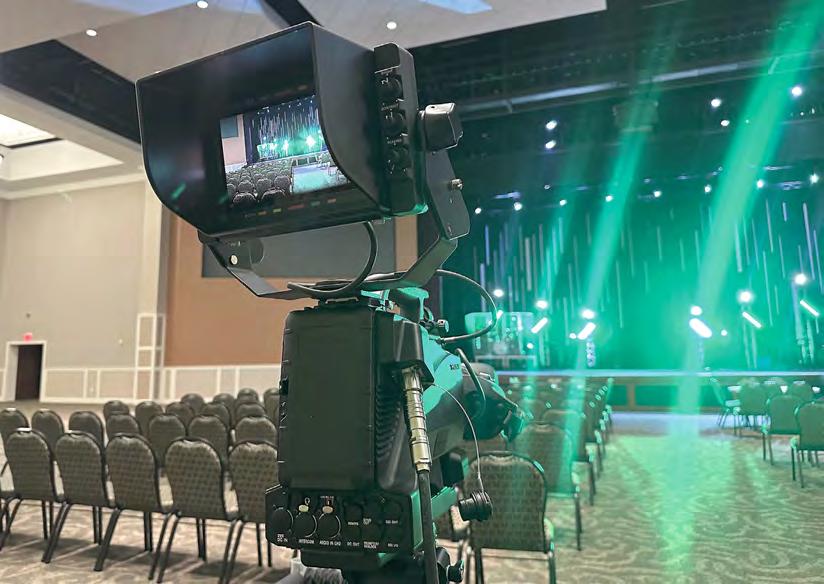
The Sony HXC - FX90 camera with a CCU, zoom and focus controller and LEMO fibre cable has replaced a tape-based, high-definition JVC HDV model. The previous camera was studio-configured, with a CCU, a 7- inch viewfinder, a rear lens and zoom controller, but it was 17 years old. “It lasted us really well but it was 1440x1080 rather than
“You can really notice the improvement – the colours are cleaner – the old camera didn’t show the correct colour on the viewer sometimes, so it’s made a big difference,” continues Peggs. “It was easy to plug in all the fibre, SDI and power cables and add the zoom controller.”
The Sony camera symbolises the start of plans to gradually improve the camera setup in Crosswalk. “It’s a bit of a mix-and-match setup at the moment, with some lipstick cameras pointing towards the keyboard area, there’s cameras on dollies for the drums and electric guitar, two robotic cameras for wide angles plus we have some older Sony models, but they still create a good production,” explains
so that was another expense –we’ve had a lot of equipment replaced because it was ageing. But because we’re multi-campus and we want to bring in and train more volunteers, it was important to us that we can offer something professional in each campus, so when they’re moving from the Worship Center to Crosswalk, they’re at least using something that’s better than just a mouse and keyboard. The greatest asset is bringing our volunteers in both campuses together and making training easier across the board moving forwards. And if new volunteers appreciate the quality of equipment we offer, they’re more likely to stay.”
1920x1080, so it was never full resolution. I was getting reports that imagery was starting to fail and it felt like it could break at any time,” says Hawkins. “I wanted the new camera to be similar to what we have in the Worship Center where we have good, high-level Sony HDC-1700 cameras. The HXC - FX90 camera looks the same – it doesn’t have all the controls and knobs on the back for intercom for example but, other than that, it’s the same body and we wanted to create a consistent workflow so if someone is running a camera in the Worship Center, they won’t have any problem operating this camera in Crosswalk. The new model is fully HD with a 4K CMOS sensor.”
and to do them well,” describes Newton. “When you have big Christian artists travelling with large LED walls for example, they can transform any space themselves. But now, we can connect with more upgraded technology if they’re bringing in Blackmagic equipment which can talk with our new switcher and we’re now able to give better support for those types of shows.”
“If we’re able to book more external events, we can generate more service fees, invest in more equipment and so the cycle starts over again,” adds Hawkins.
“There aren’t really any other venues in town that have the same infrastructure as we do, so when people come into our facility, the feedback is always positive.”
The final piece of upgraded equipment in the Crosswalk Center – for now – is a new analogue Clear-Com system with a 2-channel base, six beltpacks with headsets and one rackmounted station.
“We’re replacing the mainframe, the unit up in the booth which is a rackmounted receiver and all the beltpacks, but all the existing wiring infrastructure is staying in place,” explains Newton. “There’s a lot of static in several of the lines and a lot of mix-and-match connectors. The goal is to clear up the signal and give everyone clear and precise sound so they can hear direction and communicate effectively.”
And next on the upgrade list? The Crosswalk Center can be divided into three rooms, the smallest of which, Crosswalk C, has its own AV system comprising a screen and projector. Hawkins is preparing to replace the projector, wireless HDMI extender and in-wall HDBaseT line.
Newton. “With the new comms line, we now have the option to add camera volunteers to make them more interactive, which will help the director create a more dynamic production. For now though, we have one camera operator working the new Sony camera and six static cameras.”
In addition to Sunday services, the Crosswalk Center is used for external events such as Chamber of Commerce luncheons, which don’t require such a high production value. “The gradual upgrades with the Blackmagic switcher and replacing the camera and updating the comms have made everything more optimal and puts us in a position to do larger productions
In addition, in WC150, which is a multipurpose room that still has a 4x3 projector and screen, the entire video system is being replaced, including the VGA wall plate which is being upgraded to HDMI, a new matrix switcher which will provide an input for a camera which has never been offered in that room before, a rear connection for running presentations from the back of the room and a Blackmagic HyperDeck so that events can be recorded. The room will also receive a live feed so it can be used as an overflow from the main Worship Center. We’ll report back and cover these instalments in a later issue.
The HXC-FX90 matches similar Sony models in the Worship Center
Mission accomplished
The outdoor prayer area at the Shrine of Fátima in Portugal has received a complete audio system overhaul
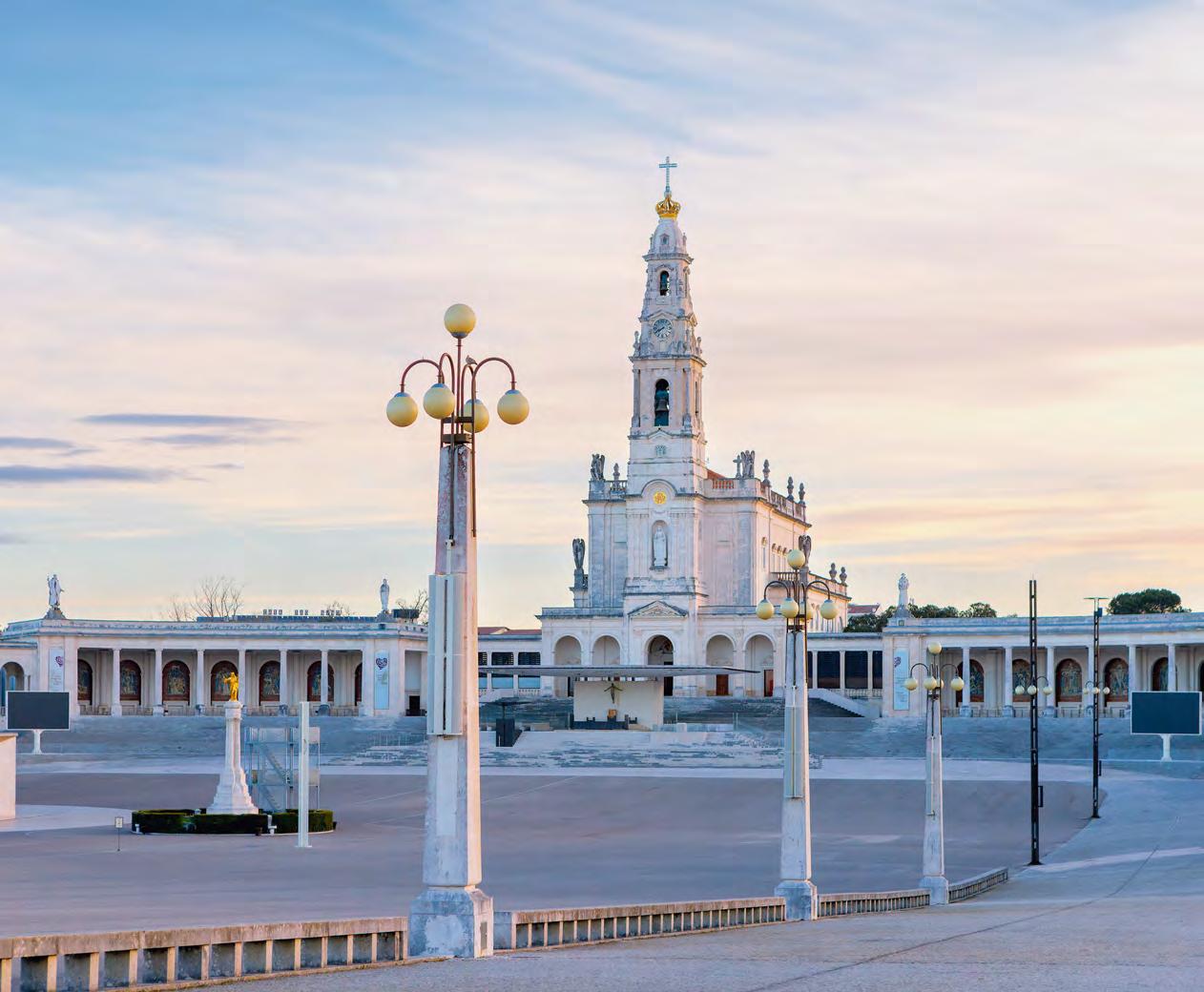
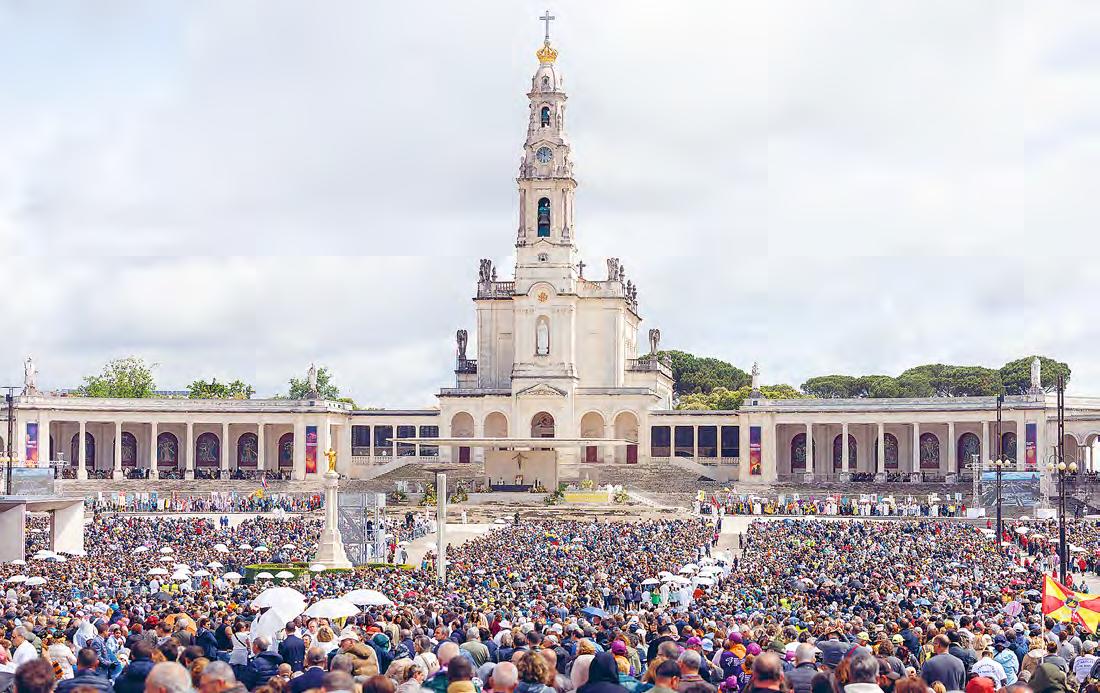
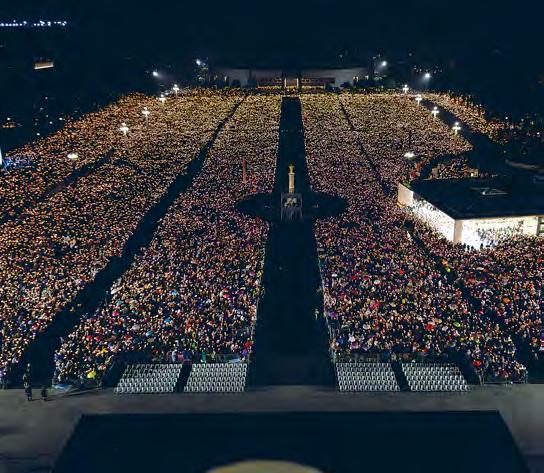
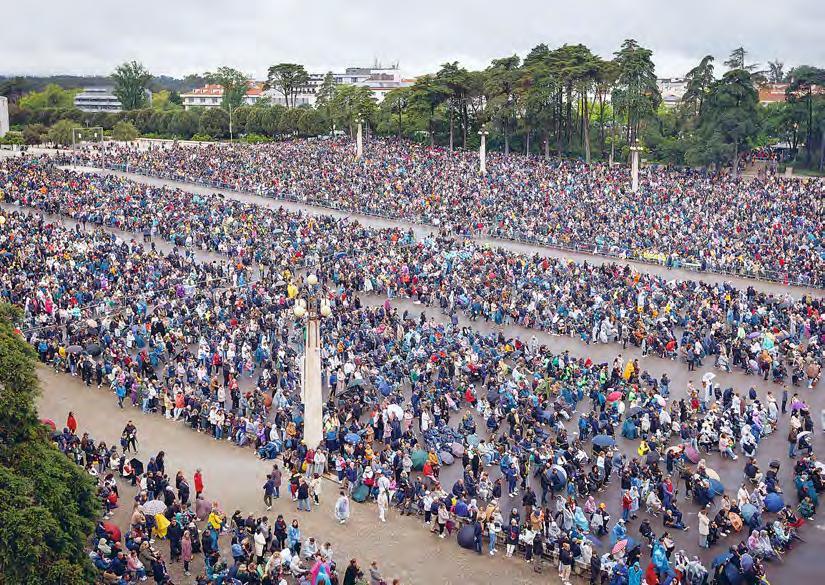
WITH THE CAPACITY TO HOLD approximately 300,000 pilgrims –with this number increasing for special services and events – the Shrine of Fátima is one of the most significant Catholic pilgrimage sites in Europe. The large, central outdoor prayer area was starting to experience issues with audio distribution and reinforcement, with many of the loudspeakers either damaged, outdated or no longer appropriate for the current requirements.
“Infrastructure issues were also present, including outdated cabling and network and DSP limitations,” explains audio consultant Ricardo Castro, who was responsible for the conceptual design of the renovation, as well as acting as supervisor during the upgrade.
“As a result, the overall sound quality and intelligibility during celebrations was insufficient. Furthermore, the system lacked redundancy and backup solutions, which posed operational risks.
These concerns led the sanctuary board to request a complete renovation.”
The Shrine of Fátima complex is composed of several buildings, including two main basilicas (Basílica de Nossa Senhora do Rosário de Fátima and Basílica da Santíssima Trindade) and a small chapel, the Chapel of the Apparitions, called Capelinha, as well as additional facilities such as auditoriums and a congress centre.
All these buildings are connected by a large central outdoor prayer area, which measures approximately 63,000m2. “The site has an official capacity of approximately 300,000 pilgrims,” adds Castro, “but, on certain occasions, such as the 13 May celebration of the first apparition of Our Lady of Fatíma and 13 October for the Miracle of the Sun celebrating the sixth apparition of Our Lady in Fátima and also for papal visits, this number is easily exceeded.”
The outdoor prayer area project involved the complete renovation of the sound system. Castro developed the design and specifications, while the
installation was carried out mainly by the shrine’s internal AV team and technicians. Some specialised services – such as networking infrastructure, civil and metal
The Shrine of Fátima is one of the most significant Catholic pilgrimage sites in Europe
PROJECTS
works – were outsourced, but the majority of the implementation was handled internally.
“From a technical perspective, the main goals were to improve sound quality and speech intelligibility for celebrations, spoken word and choirs,” explains Castro. “Additionally, the setup needed to function as a fully redundant emergency and paging system. The sanctuary board requested full redundancy at all levels, meaning duplication and distribution of equipment racks,
DSP with remote access and multioperator capability.”
One of the challenges was the short timeframe for designing the system, issuing tenders, procuring equipment and completing installation and commissioning, with the timeline from design to installation taking as little as eight months. “Once Father Carlos Cabecinhas, rector of the sanctuary board, had expressed the intention to carry out a full renovation, all studies, procurement, installation, testing and commissioning had
use of steerable column technology, careful system tuning, alignment and synchronisation of all distributed loudspeakers were required to achieve optimal coverage and intelligibility,” explains Castro.
As a very sensitive heritage site, special attention was also given to colour matching and discreet integration of loudspeakers into existing structures and façades. Because the site contains monuments and historically significant architecture, it was essential to avoid any visual
audio distribution, networking and power supply.”
Scalability was one of the core pillars of the design. The Shrine of Fátima is a growing site with multiple interconnected spaces, with the infrastructure needing to support integration between buildings. “During papal visits, all audio signals, such as microphones, feeds and routing, are distributed internally through the shrine’s infrastructure to broadcasters, television channels, radio and streaming platforms. The system has therefore been designed to be fully scalable and prepared for future expansion. With the existing shrine infrastructure running on the Dante protocol, the new system followed suit, with fully redundant primary and secondary Dante networks run alongside an additional analogue/AES backup layer for further redundancy. The setup also features distributed
to be completed within this period,” explains Castro. “Although installation took place during winter, when the outdoor area is quieter, the shrine remains active year-round, so work also had to be carried out without disrupting regular operations.”
Coverage limitations also posed problems in certain areas. Close collaboration with civil engineers, architects, electrical engineers and the shrine’s maintenance team was required to achieve the required intelligibility levels. One particularly complex task was installing additional coverage reinforcement in the centre of the prayer area, which required coordination across multiple disciplines.
Despite this being an outdoor space, acoustics still proved to be challenging, caused mainly by reflections from surrounding façades. The final design was created using EASE software. “The
seven LEA Professional CS354D and six CS1504D amplifiers. DSP processing and the core network infrastructure are provided by three BSS Audio BLU - 80 6DA signal processors with BLU Link and Dante. Castro also specified 15 Tascam AE- 4D 4 - channel AES/ EBU - Dante converters, 10 Tascam MM 2DX 2- channel mic/line input/ output Dante converters with a built-in DSP mixer and 23 Ruijie RG - NIS 3100 - 8GT4SFP - HP switches. Ten the t.bone EM 700 studio condenser microphones complete the inventory.
“The selection was driven primarily by technological requirements rather than brand preference,” says Castro. “The project was oriented around performance and specifications, but steerable technology was a must and Renkus - Heinz was the natural choice. The budget was defined based on the conceptual design and the required performance standards. The sanctuary’s board priority was to achieve a reliable, redundant, safe and intelligible system. Once the design was established, a corresponding budget was presented and approved.”
As with any site of this size, once one upgrade is complete, it’s time to think about the next. “There is a long-term plan to gradually renovate and improve existing systems throughout the place,” reports Castro. “Upcoming projects include renovations on the Capelinha and main outdoor altar, as well as inside the basilicas within the complex.”
or structural issues. The only exception was the implementation of a central speaker column, which has a very low visual impact on the audience area but has significantly increased performance and intelligibility.
“We took great care to minimise the sightlines and the structure of the existing heritage environment,” describes Castro. “All cabling routes, colours and installation details were studied to preserve the architectural integrity of the site. Apart from a few new locations defined to achieve the shrine’s expectations, the installation was mainly developed using previous points of diffusion for the loudspeakers.”
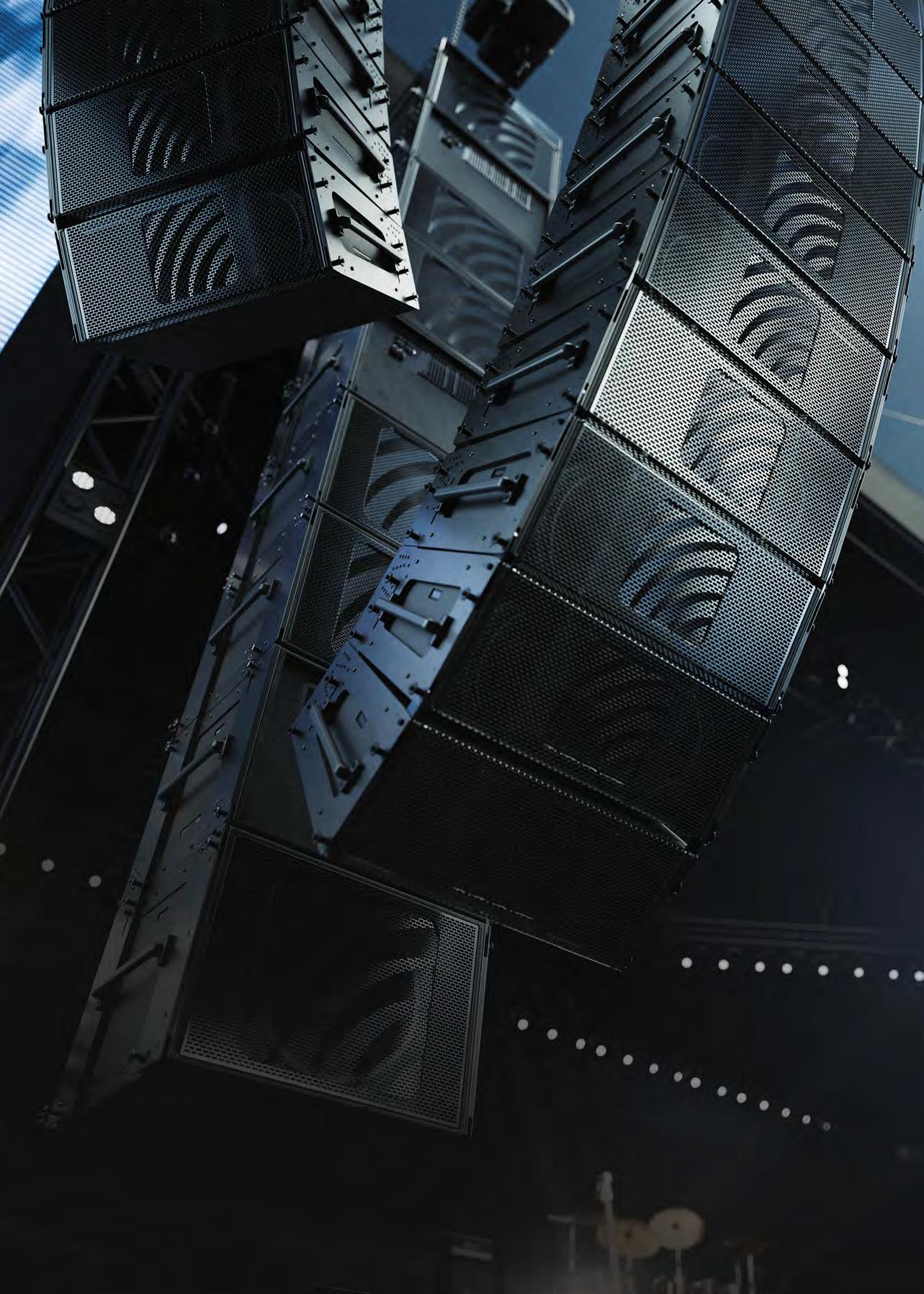
The final setup includes 38 Renkus - Heinz ICL- F - DUAL- RD - WR 2m steerable columns and five ICL- F - RD - WR 1m steerable columns. Amplification for the passive systems is provided by
Castro is rightly proud of what the shrine’s internal AV team and technicians have achieved. Despite the tight schedule, new infrastructures, an extended coverage area, new rack rooms and a larger infrastructure to prepare the venue for the future, the team was fully committed to ensuring a successful outcome. “The improvement is remarkable,” he concludes. “The comments from pilgrims and celebrants have been great, with everyone noticing the difference in sound quality, coverage and intelligibility. And for the operations team, the system now has more flexibility, safety and redundancy. All the key requirements defined at the beginning of the project have been fully achieved and the feedback from both the sanctuary board and visitors has been extremely positive.”
www.fatima.pt
www.rcoe.pt
The outdoor prayer area was starting to experience issues with audio distribution and reinforcement
Unconventional audio
Alpha Acoustics has completed a second phase of audio upgrades at Dubai Mar Thoma Church in Jebel Ali
NOT ALL CHURCHES FOLLOW the same format, as any systems integrator will contest. AV consultant and product specialist, Middle East, Africa and India at Alpha Acoustics, Joe Mathew, is no stranger to unusual layouts. While traditionally choirs stand on the stage and project into the congregation, the setup at Dubai Mar Thoma Church has the choir situated in front of the stage facing the opposite wall.
With the previous audio system in the main worship space on the first floor – installed when the church opened in 2001 – starting to fail and no longer meeting the church’s needs, the committee approached Mathew two years ago and asked him to design a setup that would provide even distribution across every seat. “The layout is a little unconventional,” he explains. “With the mics hanging above the choir, it meant we couldn’t hang a line array in the usual place. There are other Eastern churches in Dubai with a similar layout and some choose to hang one column array at the top and a second one behind the choir, but this can often cause
complications. So, we solved these problems by hanging the line arrays about 5m in front of the altar.”
The Mar Thoma Parish Dubai has grown from its humble beginnings in 1969 to a 5,000-strong congregation, becoming one of the largest parishes in the Mar Thoma Syrian Church. As rapid development in Dubai progressed in the 1960s, people from different parts of India, especially Kerala, travelled there for the prospects of employment and trade. Over 130 Marthomites first gathered in 1969, establishing the Mar Thoma Parish. Receiving permission to build on land donated by the Dubai government in 1999, construction commenced in 2001.
“It’s one of the oldest parishes in the area and has existed before the UAE became the UAE,” explains Mathew. “The site comprises other places of worship including a temple, a gurudwara and churches from other denominations such as Catholic and Greek Orthodox.”
After in-depth discussions with the church committee, Mathew proposed a system comprising L-R hangs of two Alpha Acoustics
L-R hangs consist of two Alpha Acoustics Kannon 10s and one Kannon Sub 18
passive 10-inch Kannon 10 speakers and one 18-inch Kannon Sub 18 with embedded Kontrol FIR48 DSP to power the tops. “We managed to pan the arrays a little to the left instead of the right to avoid bringing the choir mics into the line of fire but then we used our powered Kompact 10A 10-inch and Kompact 12A 12-inch coaxial speakers to create two delays to compensate for the loss of the high frequencies, routed through our pro audio DSP in the Kontrol FIR48,” adds Mathew. “The setup has been specifically designed for speech and music which is why we added the subs to accommodate the bass and drums. The room hasn’t been treated acoustically so we decided not to run the line array really hot but instead to compensate with the two delays and this has helped reduce the reflections and keep the SPL at a comfortable level.”
In addition, Mathew specified an Allen & Heath SQ-6 as the main mixing desk in the sanctuary, running two DX168s installed in the rack and a third that can be used as an I/O expansion card for
the church’s special events, such as carol services, Sunday school and youth fellowship. “The DX168s power everything – the choir mics, the priests’ wireless mics, the pulpit mic. By adding a Cat6 cable, the third DX168 can be moved around the room depending on the event, but it’s using the same mixer, so we’ve basically added 16 inputs and eight outputs that can be called on in any location. It means they don’t have to hire in any additional equipment for their special events.”
With phase one complete, Mathew has recently returned to the church to focus on the community halls on the ground floor that are used as overflow spaces. “It was great testimony to hear that they’ve had zero problems in the main sanctuary in the last couple of years,” smiles Mathew. “But there were a whole host of issues in their downstairs rooms and in the lobby, and the speakers in the stairway weren’t working anymore.”
Mathew has extended the matrix feed from the Allen & Heath desk upstairs into the three spillover rooms on the ground floor and to the basement. All three rooms can be run independently or can receive a feed from upstairs. Mathew has fitted further Kompact 10A units into the two smaller rooms, while the larger
room has two Kite 10 boxes and one Kite SUB 18 subwoofer for added low end. These boxes are powered by Alpha’s DAMP 4.300CM 4-channel DSP power amplifiers and linked to a Yamaha MG Series mixer. Two Alpha Acoustics Ambience W66T speakers have been fitted in the stairway, while two Ambience C65T models have been installed in the lobby. Both receive a matrix feed from the upstairs mix desk and are powered using the DAMP 2.300CM amplifiers in the vestry.
“We also wanted to enhance the audio in the main sanctuary even further,” describes Mathew. “Behind the choir, there are seats for officials when they visit for special events, but again we couldn’t put speakers there because of the hanging mics for the choir. So as side fills, we’ve added two Kite 6 boxes to improve intelligibility because the line array is hung almost above the first row of the congregation. We’ve also installed two Kompact 10A as floor monitors for the priests and four Kompact 10A as choir monitors.”
As part of phase two, Mathew has also enhanced the main sanctuary’s existing Shure microphone inventory with a new SLX-D wireless system with three DH5T omnidirectional headset microphones for the priests, 12 MX202 overhead mics for the choir, three MX418 gooseneck condenser microphones for the podiums and two SM58 vocal microphones on the altar.
Mathew reports that the project was an overall success. “Whenever I visit the church, they welcome me with a smile saying that the system has brought so much joy to their services.” Reverend Jijo T Mutheri, church trustee Vinodh Sam Isaac and church secretary Mathew P Thomas all agree: “We are very satisfied with the performance of the entire audio system. Since the upgrade, we have experienced no issues such as howling or feedback. The sound output is exceptionally clear, ensuring a pleasant and effective audio experience for all. We appreciate the quality of work and professionalism demonstrated throughout the project.”
www.alphacoustics.com
www.marthomaparishdubai.org
Kompact 12A speakers have been used as delays
Illuminating Saint Mary
Luminiscence and K-array have enticed visitors to experience the beauty of the Basilica of Saint Mary
SAINT MARY’S BASILICA HAS stood at the centre of Minneapolis for more than a century.
Completed in 1914 and designated the first basilica in the United States, the Beaux-Arts structure features a soaring dome, twin towers, carved stonework and stained glass. Today, it continues to function as an active place of worship, hosting services and visitors year-round
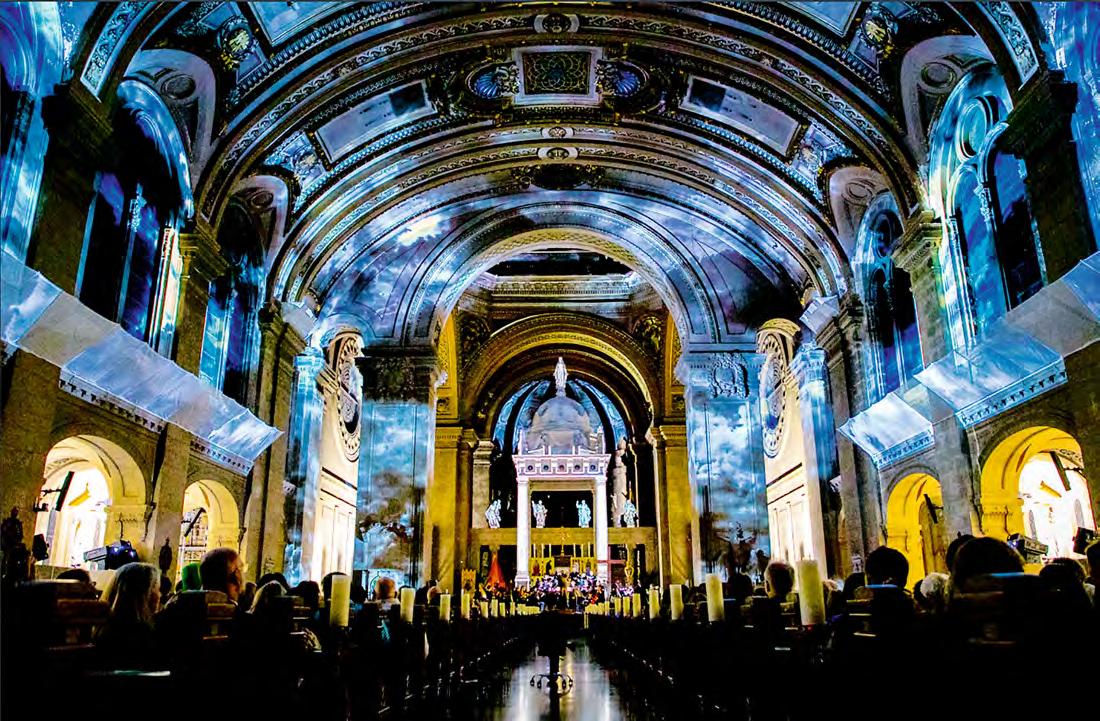
After a sold-out European run, Luminiscence made its North American debut by illuminating Saint Mary’s Basilica with 360° video mapping, while spectators listened to the history of the US landmark, accompanied by a blend of live choir, organ and instrumental music.
The production was designed to work within the building using light and sound to reveal its history without changing the structure or disrupting its daily schedule. During performances, sound filled
the basilica with presence and detail but, outside show hours, the building remained unchanged, just as it has been for over a century.
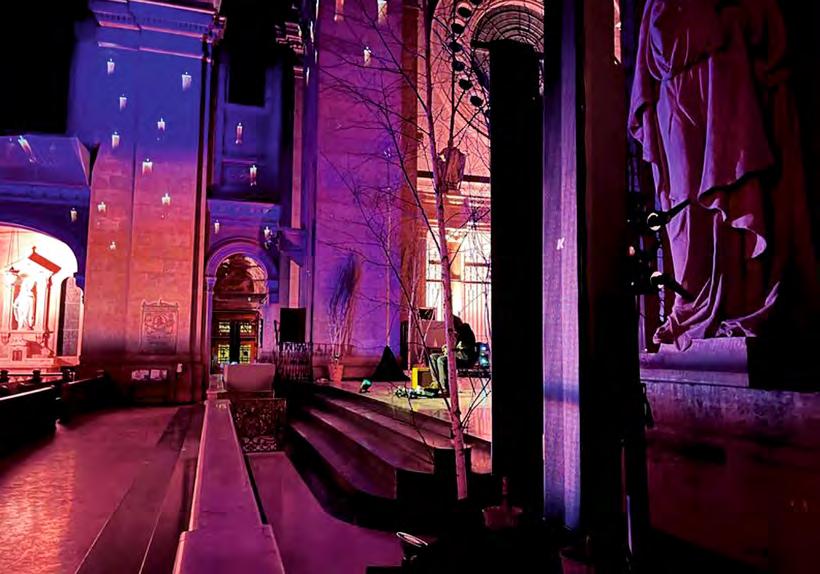
Audio played a central role in the immersive experience, supporting live music and narration. Loudspeakers, cabling and infrastructure had to disappear into the architecture, leaving no visual footprint during regular services. The system also needed to fill a vast, reverberant room evenly, within the natural acoustics that define the basilica’s sound.
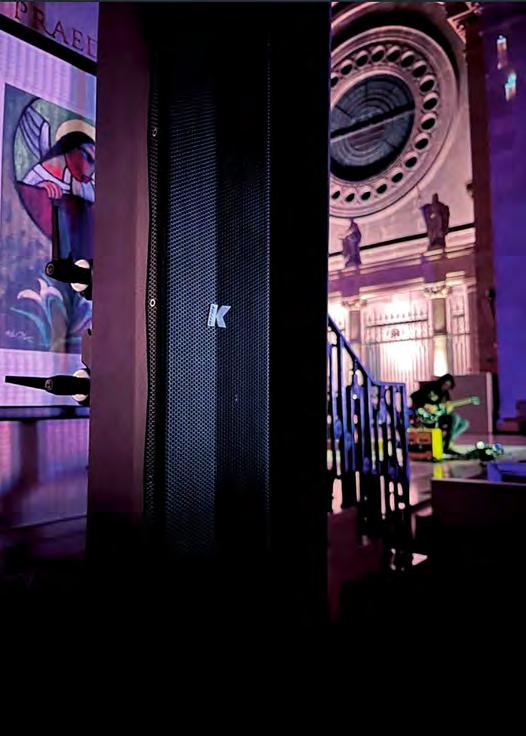
“The biggest challenge was keeping everything as hidden as possible,” says Philip Holden, director of production at Luminiscence North America. “Luminiscence runs inside a historic basilica that’s open to visitors every day, so whatever we installed couldn’t interfere with how the space normally functions. This is specifically why we went with the K-array speakers, as not only do they have superior sound, but the sleekness of the speakers allowed them to hide and not get in the way of the beautiful architecture of the building.”
The loudspeakers had to disappear into the architecture
K-array loudspeakers were selected for their ability to deliver volume and detail while remaining physically unobtrusive.
Sixteen slim Kayman KY102 line array loudspeakers provided even coverage throughout the basilica, supported by six Thunder KS2P I subwoofers. The installation also included two Mastiff KM112P passive monitors along with four Kommander KA208 amplifiers, allowing the system to adapt to spoken word, orchestral performances and choral moments within the same programme.
Video and lighting completed the installation. Barco G100 W25 projectors turned the basilica into a living canvas, while Elation PALADIN Panels shaped the architecture with subtle shifts in colour and pattern that followed the show’s narrative. Together with the audio system, the elements created an enveloping environment that supported live orchestral and choral performance without drawing attention away from the space itself.
www.k-array.com www.luminiscence.com
Antenna placement will depend on where the speaker is standing
Aim your antennas around obstructions
Antennas and antenna placement for wireless audio
In part two of this series, RF Venue’s antenna guide looks into polarisation, cabling, placement and diversity reception
Polarisation
Polarisation of RF signals and antennas has been a long-neglected aspect of wireless audio technology. We define the polarisation of a radio wave by the orientation of its electrical field, which is in turn determined by the orientation of the transmitting antenna.
In the world of wireless mics, these are simple, single-element whip antennas, usually either a short piece of wire (as on most bodypacks and some handheld units) or a linear element within the housing (as most modern handheld transmitters use). Note that we cannot control or predict the position or orientation of these antennas because people who are moving about are holding or wearing them. If the receiving antennas are of a single polarisation, like a whip or paddle, this may present a problem because they are fixed in position. If they are parallel to the transmitting antenna – that is, if they are aligned with the signal’s electrical field – they should receive the signal fairly well. But when the signal’s polarisation is angled differently than the fixed polarity receiving antenna (because of how the talent holds or wears the
transmitter, for instance), the receiving antennas become far less effective. Fixed, single-polarisation antennas cannot adapt to the off-angle polarisation of the signal. In practice, whips or paddles are good for about 300° of all the possible angles of polarisation, and they drop off sharply as the mismatch angle approaches 90°. This phenomenon is commonly called a polarisation cross-fade. This is largely why, even with the industry’s decades of diversity reception experience, sound system operators still struggle with dropouts when using a traditional arrangement, such as two vertical paddles or two whip antennas. For IEM transmission, the solution is to use a circularly polarised antenna to transmit to the bodypack receiver’s whip antenna, which, as we know, could be oriented in any direction at any time. For wireless mics, diversity pairs can be made impervious to polarisation cross-fade in a couple of different ways. One is to use two co-located antennas – one a vertical element and the other a horizontal element.
These cross-polarised diversity pairs are built into a single unit. As long as the antenna has a direct line of sight to the transmitter and the range is
Diversity pairs can prevent polarisation cross-fade for wireless mics
not excessive, there will always be a usable signal on at least one of the two antennas – A and/or B – which is exactly what we need for diversity reception to prevent dropouts. Another approach is to use a spatially diverse pair of circularly polarised antennas.
Antenna cabling
Coaxial cable (or coax for short) is used to carry RF signals between pieces of wireless audio equipment, including antennas. Use high-quality
50Ω cable with a non-conductive dielectric material separating the centre conductor and shield; TV cable, typically specified as RG-6 or RG-59, has a 75Ω impedance and is not suitable.
Coax keeps RF signals inside the cable from getting out and outside signals from getting in. That’s why it’s advisable to use cable that is double shielded, using both foil and copper braid as the outer conductor (or shield). Coax cable, though, is lossy, and the losses increase with frequency. Some types of cable have more loss than others. RG-8X is a decent choice in the middle, offering good performance and price. Longer runs may require lower-loss cable like LMR-400, and short jumpers within a rack might be suitable for RG-58. These loss characteristics may be important to consider when deciding where to place antennas; sometimes it may be better to increase the antenna-to-talent distance in order to shorten the coax cables.
Placement and aiming
Once you have a basic understanding of what the different antennas can do, you can apply them effectively in various
situations. There are several different considerations involved, including the room or space; the nature of the event; where the talent or speaker is (on a stage, an altar, a dais, etc.); the location(s) available to put antennas; and the location of the mic receiver rack and IEM transmitter rack. Remember, there may be more than one “best way” to place the antennas
for a particular application. Here are some rules of thumb for placement and aiming antennas. Never point your IEM transmitting antenna at your mic receiving antennas. In fact, it’s a good idea to put them side by side, spaced apart by at least 2m. Aim your antennas by simply pointing them in the direction of the action. Locating the antennas closer to the action is generally good,
but so is shortening the cable runs to the transmitter or receiver. Don’t try to make your RF penetrate metal structures, dense wall materials, people or other obstructions – aim your antennas over and around them. In an oddly shaped room or space, try to use the antennas’ coverage patterns to your advantage.
Diversity reception
Wireless microphone receivers are fitted with two antenna inputs (A and B) for diversity reception. The receiver selects between the two inputs based on signal strength. A common practice is to use two antennas aimed at the same stage but spaced apart to provide differing lines of sight –different “views” of the RF signals from the transmitters. The idea is to accommodate the movement of talent upon the stage. However, if the antennas are aimed straight ahead, their coverage patterns only overlap in the very centre of the stage. If the antennas are spread wide, they should be angled more towards the centre of the stage.
In this case, only microphones received by both antennas in the overlapping zone in the centre would truly be served by diversity reception, while mics on other areas of the stage
would be served merely by a single antenna. If these are single-polarised antennas, like vertical paddles or whips, they could still be susceptible to dropouts caused by polarisation cross-fade.
A stronger option is to use a pair of co-located antennas that cover the performance space with crosspolarised antenna elements (polar diversity). The strength of this polarisation diversity approach is that as long as both antennas have a direct line of sight to the transmitter, there will always be a good signal on at least one antenna. Any polarisation angle that is bad on one antenna will be optimal on the other, so the antenna system will never be fully blind, regardless of how the talent moves, twists or turns.
Perhaps because radio waves are invisible, wireless audio may seem mysterious. But if you learn some basics and develop a sense for visualising the way RF moves in free space, you can more easily and confidently deploy wireless systems that are solid and reliable. Most situations will have more than one solution, and you’ll be able to choose the direction that suits the resources you have at hand.
www.rfvenue.com
Finding the right balance
Chris
McNamara, senior technical marketing specialist at Elgato,
considers the importance of ensuring new technologies are accessible and easy to use
AS HOUSES OF WORSHIP increasingly adopt livestreaming to reach congregants beyond physical walls, technology must remain accessible and simple to operate. Many faith communities rely on volunteers rather than technical staff, so systems should require minimal setup, clear interfaces and reliable automation. When technology feels welcoming rather than intimidating, leaders can focus on ministry and community, ensuring digital outreach strengthens spiritual connection instead of becoming a technical burden.
What is Elgato’s current focus?
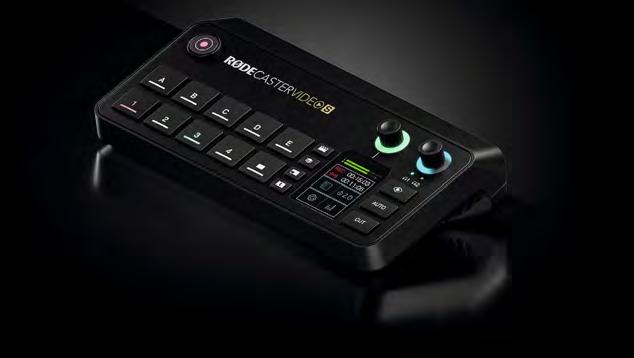
For 2026, we are continuing to develop our “Stream Deck Everywhere” initiative. The days of the mouse and keyboard as the primary peripherals are long overdue for an update. As software and workflows become more complex, value that is hidden behind multiple layers of UI should be surfaced contextually to the user at the click of a button.
What trends are you currently witnessing and how are you responding to them?
With the advent of AI tools, we are seeing a shift in how people interact with computers. Your software and hardware should simply know what you are trying to do and help you achieve it. The distance between user intent and action is getting smaller and we are focusing on ensuring this is as seamless as possible. We are looking at how MCP, or Model Context Protocol, can be used to trigger actions with your
Where is the house of worship content creation market heading?
With the increasing scale of content creation as a whole, I believe that house of worship production is accessible and available to any size congregation at present. Whether it’s a megachurch or a local chapel, the capabilities of a camera and microphone have progressed immensely over the last five years. With the innovation of on-the-go broadcasting equipment, or even a mobile phone with a wireless lapel microphone, everyone can share the message.
voice. Voice sync in our prompter has been live for over a year now, auto scrolling your script based on the speed at which you are reading. These and other new features are small technology tweaks that are meant to make the equipment feel like it’s working with you to achieve your goal.
As streaming technology advances, what factors do you need to consider as a manufacturer?
I think it’s really important as a manufacturer to understand the concept that “just because you can, doesn’t mean you should”. We always strive to create products that improve upon something that we deem fixable. Quality broadcasting hardware doesn’t need to cost thousands of dollars if you can create a high-quality device with equally high-quality software. Technology indeed moves quickly and enables new possibilities. The main lens we look at technology development through is a problem/
solution mindset. What does our customer currently struggle with that requires a solution vs what is “nice to have”? By being ruthlessly focused on solving core customer problems, it allows us to cut through all the noise of new technological advancements and pick the elements that truly add value to users.
Could today’s streaming technology become overwhelming for a volunteer?
I think that is a risk in all technology, not just broadcasting. For every new product, providing resources in order to properly detail the release and all the updates that follow is good business practice. Introductory videos, educational articles and step-by-step guides are all essential to make users’ lives easier. And it shouldn’t stop at launch day either; providing educational support throughout the product’s lifespan, both for hardware and software, is equally important. Technology enables broadcast engineers to do incredible things, so it’s essential as manufacturers that we strive to take those incredible things and package them in a form factor that is approachable and easy to use.
How important is the size of the equipment?
I think quality content can be created with nothing more than a mobile phone and a wireless microphone. TikTok Live and YouTube Live are great ways to get the message out to a congregation, even with a small budget. If you have the budget, a mobile streaming pack can be a great addition with a mirrorless camera. All of these things can fit into a backpack or Pelican case and travel with you. Some of the biggest content creators in the world are mobile/IRL content creators.
www.elgato.com
Chris McNamara
Churches can extend their reach, even with a small budget
Elgato’s Stream Deck Studio is a customisable control surface for pro broadcast systems
A regular, people-oriented training plan will strengthen your lighting team
Spring training: the lighting tech team
John Black lists four goals to approaching training and interactions with team members
AT THE TIME YOU ARE READING this article, you may still be recovering from the busyness of the Easter season. The sprint between Christmas and Easter seems to fly by faster every year, and what better way to follow that up than to step back, reflect on, acknowledge and invest in your lighting tech team? Hopefully you’ve had the opportunity to hang out, relax and have fun as a team, and training can also be an important part of this season. When the topic of training comes up, many leaders immediately focus on the need to teach technical skills. I can be guilty of this. I sometimes struggle with the voice on my shoulder telling me, “the team is here to do a job – to light the service – so we need to focus on the technical skills to be able to do it better!”
But let’s not forget that there is more to the team than just technical skill. Over my time leading professional technical staff members as well as student crews, I have developed four goals that I focus on as I approach training and interactions with my individual team members: to value, to equip, to motivate and to grow. The truth is, even if the team or an individual member is able to successfully accomplish a task or job
assigned, I may still have failed them if they don’t feel that I value them, that they have a purpose on the team or that they are connected to the rest of the team.
A regular, people-oriented training plan will help you continually develop, maintain and retain tech team members, which is incredibly important after coming off such a busy season. Let’s take a look at each of these four goals.
Goal 1: to value
I work predominantly with two groups of people. I have my paid, professional technical staff members (we are a small team of three, myself included) and then I have a volunteer technical team comprised of around 16 high-school students. Many of these students initially get involved in the technical team because of the spectacle and wonder of working with moving lights, operating control consoles and putting on a great visual show. The majority of them don’t initially realise the amount of work that happens behind the scenes in the preparation phases of an event, which can often be less glamorous, long and tiring.
Therefore, before getting into any technical skills training, I try to educate and re-educate my teens on where they fit in as individuals to the team, as well as where the team as a whole fits into the bigger picture of putting on an event or service. My goal is to ensure they understand how important they are individually so that they can develop a sense of ownership and pride in the work that they are asked to do. When the days get long or work becomes monotonous, the feeling of being valued and a part of something greater than themselves will help pull them through.
Note that this isn’t something to do now and then come back to in Spring 2027. This is a continual process that I try to factor into each work period. As the work is behind the scenes, team members often do not receive praise or gratitude for their efforts. There are an infinite number of ways – both large and small – that you can show gratitude towards your team. I make it a habit to verbally thank each member at the end of every work period. I will also often let the team leave at the end of a full-day rehearsal or closing event and clean up/shut down the systems for them. Other small acts of service that seem simple – such
as distributing water bottles or providing food when working through mealtimes – show team members (and the team) that you value them. In my experience, when members feel valued, they will remain involved in the long run, which results in increased skills and productivity. Conversely, when team members do not feel valued, their commitment, work ethic and ownership suffer, which can spread to other team members.
Goal 2: to equip
My next goal is to equip each member with the technical and non-technical skills that they need to be able to successfully complete the jobs and tasks assigned. Equipping team members is also a continual task that doesn’t only include learning new skills, but reviewing and reinforcing skills that they may have already learned in order to keep them up-todate and maintain good habits. I start off all new team members with the same orientation session to ensure they begin with some basic knowledge that they need to get involved without feeling lost. This begins with tours of the facilities, including control booths, dimmer
rooms, catwalks, stage support areas, storage rooms, etc. We cover terminology that the team uses to effectively communicate with each other (for example, stage directions and intercom/radio etiquette and directions).
Once new members are comfortable with the physical spaces, I can start to work on more specific skills using two different methods. The first, and what I’ve found to be the most effective, method is “on-the-job mentoring”. As my team is comprised of high-school students, I have crew members each year that graduate, leaving space on the team to be filled. To speed up the training process, I always have the team working in pairs with one experienced member paired with a
sessions will focus on teaching a new skill or a new piece of equipment. Using these two methods in combination, the team learns not just from me but from each other, which also helps to build team unity and ownership. The key to this goal is not to over-do it as it is possible to burn out team members with information overload. This is why I like to use the “on-the-job mentoring” method where the learning is not just input, but it is used immediately in a real context.
Goal 3: to motivate
My next goal is to motivate my team members. While closely tied to the goal of valuing, building motivation involves ensuring all team members
newer member. Through working on actual events, the new crew members learn skills and processes such as focusing instruments, console programming, stage wiring and microphone placement. All of this is done in the context of contributing to a real event. This also helps to build camaraderie between members.
The second method of skills training that I do are focused in-service days. I try to schedule three or four in-service days a month and team members who desire to learn more and increase their level of responsibility can choose to attend according to their schedule. Usually, one session will focus on reviewing and practising skills that I observe need to be reviewed (correction). One session will focus on maintenance and we’ll put together a cleaning party for all of the lighting instruments. In this way, the crew helps to keep equipment and facilities in good shape (stewardship). The other two
know what is expected of them, what their responsibilities are and instilling a clear sense of purpose. When interested individuals approach me about joining the team, I have a set of documents that detail expectations, responsibilities and purpose for the team. Existing on paper though is not enough to continue to motivate them. One of the most effective ways that I have found to be successful in motivating the team is to involve them in creative decisions and the event planning process. This also helps to develop a sense of ownership and pride in the team. This doesn’t happen for all events, and it is important to be able to recognise when there is opportunity for this or not. When I’ve identified opportunities to put this into practice, I will plan a series of “design meetings” with the team specifically focused on involving them in these decisions.
Another method I have also found to be effective is to set up a “hierarchy”
of roles based on responsibility that members can work their way up through if they so desire. With each step comes additional responsibility, which I find team members are eager to “step up” into. It’s important to ensure that these levels are based on proven skill and commitment and that you continue to emphasise the unified structure of the team as a whole (battling against any power plays between different roles).
In my context, the sense of being just a “labour force” is perhaps one of the most destructive feelings that my team members can have and it is the one I must be very aware of. Building in areas to value and motivate the work of individual team members helps me to actively fight against this.
Goal 4: to grow
Last, my goal is that by valuing, equipping and motivating each individual member, they will
grow into a functioning, effective team. If there isn’t any room for relationships to develop and have a bit of fun, then motivation and value run dry and the team will suffer.
To help create this sense of connectedness and unity, I try to ensure that the start of each work period is relaxed and free for catching up between members. It gives myself (and each other) a chance to check-in with members and hear what’s going on in their lives before getting into the work needing to be accomplished. When I don’t do this, that sense of being a labour force begins to rise, which puts a damper on the rest of the work period.
Another way that I grow my team is to make sure that I plan a team activity once a month or so. My team works together 5–6 days per week, so if you see each other less frequently, this could be once every two months or once a quarter. Regardless of the frequency, this is a workday without any work. Its sole purpose is the team – to bring them together around food, games or another activity for the sole purpose of connecting and building relationships.
It’s about people
It is when I am able to balance all four of these training goals that my team is the most effective, skilled, creative and connected. The times when they are out of balance, either due to reasons within or out of my control, I can almost immediately see the impact. It doesn’t matter how big or small your house of worship is or how many you have in your tech team. Every team is made up of people and we need each other.
Good stewardship requires regular maintenance and cleaning
Team activities can bring people together with food and games
Controlling directivity
In the first of a three-part series, experts from Arbane Groupe, d&b, JBL, L-Acoustics, Meyer Sound and Renkus-Heinz discuss directivity and why it matters so much in worship settings
AT ITS MOST BASIC, DIRECTIVITY
is the ability to control where sound goes and – just as importantly –where it doesn’t go. “Every loudspeaker radiates energy in a pattern determined by its design,” explains Alan Johnson, business development manager, house of worship global lead at L-Acoustics.
“The question is whether you can shape and predict that pattern with precision. In a worship environment, that matters enormously. You want sound to reach every seat in the congregation with consistent level and clarity. You want to avoid exciting reflective surfaces like a rear wall, a glass façade or a hard ceiling that degrade intelligibility. Directivity is the tool that lets you achieve coverage without chaos.”
According to Mathieu Pobeda, technical director at Arbane Groupe, the mathematical expression of directivity is the ratio of the intensity in a specific direction to the average radiation over the entire sphere that surrounds the object that emits the energy. This concept is commonly used in microwaves and specifically antenna design as it gives an idea of which direction the antenna is aiming or in which direction the energy emitted by the antenna is being sent. “However, direction (or main axis) is only one parameter of the directivity concept, and it should be associated with the angle in which the energy is mainly concentrated around this main axis,” he says. “For a given loudspeaker, we do express directivity with two angles, vertical and horizontal, assuming everybody knows that the direction for any loudspeaker is orthogonal to the front baffle. If we take it the other
way round (from the receiver point of view and not from the emitter), directivity will give you a good idea about who is going to get the sound and who ‘isn’t’ for a given audience size and shape relative to their position from the speaker.”
“The ideal goal of each designer is to produce a loudspeaker that directs equal energy across the frequency band towards the intended audience area and reducing the energy going to nonaudience areas over as much of the frequency range as possible,” adds
Steve Jones, d&b audiotechnik EAS team leader EMEA. “This reduces reflections, resulting in clearer sound which increases intelligibility and impact.”
Controlling where sound goes –and where it does not – is critical to managing room reflections, delivering consistent coverage and ensuring that listeners hear the intended content clearly rather than a buildup of reverberant sound from walls, ceilings or architectural features. “In acoustics, directivity describes how a loudspeaker
radiates sound into a space relative to its frequency,” says Steve Mathis, product development, installed loudspeakers for JBL Professional. “It is the measure of how much sound energy is directed towards the listener versus the rest of the space.”
Brandon Heinz, product manager at Renkus-Heinz, explains that directivity is measured by considering a loudspeaker’s output on-axis (directly in front) and then comparing that to the loudspeaker’s output when off-axis
The Trilith campus of Passion City Church in Atlanta, Georgia is home to a d&b Soundscape XSL system
Mathieu Pobeda (Arbane Groupe)
Steve Jones (d&b)
Steve Mathis (JBL)
Alan Johnson (L-Acoustics)
Andy Davies (Meyer Sound)
Brandon Heinz (Renkus-Heinz)
(off to the sides, above/below or behind). Directivity is a relationship between wavelength and how large the loudspeaker cabinet or array is. Due to that relationship, directivity changes with frequency because low frequencies have very long wavelengths and high frequencies have very short wavelengths. “If a loudspeaker is described as having ‘high’ directivity, it will be very good at maintaining a high ratio of ‘on-axis’ to ‘off-axis’ sound over a wide frequency range; while a loudspeaker described as having ‘low’ directivity will have a lower ratio,” he describes. “The ideal goal for high directivity loudspeakers is called ‘constant directivity’, which means the loudspeaker maintains its nominal coverage pattern over a wide range of frequencies.”
In any building, and more specifically ancient buildings where natural acoustics were used to distribute sound, directivity control is very important, explains Pobeda. “The reflections created by the architecture and material were important in ancient times for the acoustic energy (words emitted by the celebrant in worship) to reach everyone in the audience. Nowadays, we do not need the acoustics to ‘help’ us to spread the energy – we can aim the energy directly from the loudspeaker to the audience, even those sitting the furthest away from the speaker. Even worse, natural acoustics can create a secondary source that is delayed compared to the sound that comes directly from the loudspeaker, creating a confusing message and resulting in a lack of understanding.”
An act of worship in the modern church setting includes spoken
word through prayer, song or sermon to convey a message or story about God and music to stir the emotions of the listener.
In both cases, the congregation will be listening to a combination of direct sound and reflected sound from the sound source (loudspeaker, human voice or instrument). “The directivity of the sound source is the primary influence on the balance of direct to reflected or reverberant sound, and the perceived quality of each component,” adds Jones. “In most settings, a higher directivity to a lower frequency will minimise the effects of the reflected sound, which increases the intelligibility of the voice, as well as the impact and clarity of modern music. Good loudspeaker directivity is a key component to providing an easier listening experience free from undesired audio distractions.”
before it hits the reflective surfaces and ensure the highest levels of speech intelligibility.”
“Worship audio has to serve two very different masters simultaneously: the pastor’s voice and the band,” explains Johnson. “Spoken word is unforgiving. Intelligibility relies on clarity, on the
much energy is directed towards the audience as opposed to how much is directed towards the stage, it is critical for spoken word applications in worship environments which rely on consistent, defined directivity control to ensure optimal gain before feedback on vocal microphones. “Aiming the sound coming from the loudspeakers away from the microphone and towards the audience will give you greater gain and more freedom to deal with quiet presenters,” continues Andy Davies, senior director of product management at Meyer Sound. “Another key aspect of directivity is how sound coming from the loudspeakers interacts with the surfaces in the room. If these surfaces reflect sound easily, then controlled directivity is even more important to prevent the buildup of unwanted echoes in the room.”
High directivity loudspeakers will help keep most of the energy where you want it: on the people in the seats, not the walls/ceilings. “This will help ensure that there are as few reflections or reverberations as possible to ensure good clarity for
In houses of worship, directivity control can mean the difference between a message that is clearly understood and one that isn’t. “Because houses of worship frequently feature high ceilings and hard surfaces, managing where the sound doesn’t go is just as important as where it does,” adds Mathis. “In reverberant sanctuaries, uncontrolled dispersion can cause reflections that blur speech and reduce musical definition. By using speakers with tight vertical control, you can aim the sound specifically at the seated area, ‘cut’ it off
direct-to-reverberant ratio in the room. If your system is throwing energy into reflective surfaces, you’re fighting the room and the message gets lost. Music is more forgiving of some room energy, but contemporary worship production demands punch, clarity and dynamic range that requires just as much control. What makes the worship environment unique is that these two needs often exist in the same service, sometimes within minutes of each other. Your system has to handle both well, and that means directivity has to be dialled in precisely.”
While directivity control is important in most live audio applications as it determines how
spoken word and music,” concludes Heinz. “Additionally, loudspeakers with good directivity characteristics can ensure even coverage with fewer loudspeakers, resulting in lower total system costs without sacrificing performance.”
In part two of this series, we’ll look at the challenges of controlling directivity in difficult spaces, while in part three, we’ll highlight how different manufacturers approach directivity in their product designs.
JBL’s Intellivox incorporates Digital Directivity Synthesis (DDS) beam shaping technology
Meyer Sound’s PANTHER has been engineered for directional control with the cardioid design projecting sound forwards, not backwards
The infrastructure challenge
Bart Swinnen, CEO at Luminex, discusses the gains to be made from transitioning to a purpose-built network infrastructure
MANY HOUSES OF WORSHIP
continue to rely on legacy lighting infrastructure built around incandescent fixtures, centralised dimmer racks and circuit-breakerbased power distribution. While these systems have served faithfully for decades, they were built to control electrical loads rather than data and present increasing limitations in flexibility, scalability and operational efficiency. Upgrading and expanding them requires additional investments that are difficult to justify financially in community-driven environments
of controlling voltage through dimmers, lighting control is handled via data protocols such as sACN and Art-Net and are managed over Ethernet-based networks. A network-centric infrastructure offers several advantages:
• Greater flexibility in system layout.
• Simplified expansion.
• Reduced cabling.
• Centralised configuration and monitoring.
• Improved fault detection.
and come with no guarantees towards scalability.
Other aspects of legacy infrastructure are power consumption, thermal management, and frequent part and lamp replacement compared to modern networked LED technology. As worship environments increasingly incorporate dynamic lighting to support contemporary services, theatrical productions and multi-use spaces, the constraints of legacy infrastructure become more apparent. The challenge is therefore twofold:
• Transitioning from power-based control to data-based control.
• Ensuring that the new system remains accessible to nontechnical operators and volunteers.
From power distribution to data infrastructure
Modern fixtures operate primarily as networked devices. Instead
However, networked systems introduce a new concern for many houses of worship: perceived complexity. Many HOW environments depend heavily on volunteers who may not have had formal IT training. A system that is technically powerful but operationally intimidating risks underutilisation.
Design for the volunteer operator
Network infrastructure designed specifically for entertainment applications addresses this concern directly. Luminex network solutions are developed with the realities of live production environments in mind, including volunteer-driven teams.
The configuration philosophy focuses on clarity rather than complexity. Tasks such as VLAN management and redundancy
setup are simplified into easyto-understand workflows via intuitive Web UIs and software applications. This reduces the risk of misconfiguration, prep time and prevents downtime during rehearsals or live services.
Reliability remains critical in worship environments where technical failure can disrupt important moments. Network redundancy mechanisms, such as ring topologies and automatic failover, ensure continued operation even in the event of a cable or device failure. This approach provides peace of mind without requiring advanced networking expertise.
Scalability for the future of worship spaces
Houses of worship rarely stand still. Over time, many integrate
By transitioning from legacy electrical control systems to a purpose-built network infrastructure, worship spaces gain:
• Flexibility to adapt to new service formats.
• Imp roved energy efficiency.
• Op erational simplicity for volunteers.
• Built-in redundancy for reliability.
• Long-term scalability for lighting, video and sound applications.
The best of both
mapping, audio networking, and streaming, recording and broadcast infrastructures. A modern Ethernet-based backbone provides the foundation to support these evolving needs.
A scalable network architecture allows lighting, video and audio systems to coexist securely and efficiently on the same infrastructure with sufficient bandwidth that seamlessly and simultaneously supports video and digital audio protocols such as IPMX, NDI, Dante, Milan AVB and AES67.
that is both technically robust and operationally accessible. Replacing outdated dimmer-based systems with a resilient, scalable network backbone enables houses of worship to enhance their services today while remaining prepared for tomorrow’s applications. A purposebuilt entertainment networking platform, underpinned with true and extensive interoperability validation, offers reliability, redundancy and simplicity, ensuring that technology continues to support the message.
www.luminex.be
Bart Swinnen
Modern worship environments require infrastructure that is both robust and accessible
Luminex’s LumiNode range
Connecting to the cloud with Iris
Noah Johnson, VP of video applications at Audinate, takes an in-depth look at Iris and how it aims to eliminate the traditional constraints of camera operation
LAUNCHING IN LATE 2025, Audinate’s Iris platform has been designed to remove long-standing pain points for production teams: fragmented control tools and protocols across brands, the need for constant manual adjustments and the limits of onsite equipment and staffing. Iris hopes to change this by providing universal, browser-based control that works across camera brands and enables full production management from anywhere in the world.
“Iris connects PTZ cameras to the cloud, offering centralised control through a browser-based interface that eliminates the need for traditional, hardware-intensive
workflows,” explains Noah Johnson, VP of video applications at Audinate. “By integrating AI-powered automation, such as real-time subject tracking, framing and position presets, Iris reduces the burden of manual camera adjustments. This allows teams to focus on storytelling and delivering polished productions, whether they operate onsite or remotely.”
Iris grew out of a company Johnson founded called LiveControl, which installs PTZ cameras in venues and connects them to a remote marketplace for videographers. Building repeatable workflows, a single operator can remotely control multiple cameras, switch the production and distribute content.
“As we scaled the platform, I realised the real innovation wasn’t
just the service model – it was the technology that made remote production possible. While audio and video have largely transitioned to IP-based workflows, camera control is still dominated by on-premises physical joystick controllers. We created Iris to solve that problem. It’s a cloud-based, brand-agnostic control platform that gives operators a single intuitive interface to access, operate and manage cameras locally or from anywhere.”
Historically, camera control has been dominated by physical joystick controllers. While there are many brands and models, most offer broadly similar functionality, a
Noah Johnson
Iris connects PTZ cameras to the cloud
limited range of commands and are built primarily for local, onsite operation. The broader challenge is that camera control has also remained highly fragmented. Different brands use different protocols, interfaces and feature sets, which creates friction for production teams. When managing multiple camera types, multiple operators or multiple locations, that complexity adds up quickly.
“Iris takes a software-first approach to solving that problem,” continues Johnson. “It gives users a single, browser-based platform to control and manage cameras across different makes and models, whether the workflow is local, remote or a mix of both. Because it is software-driven, we can continue expanding functionality over time, support both legacy and new cameras, and create a more flexible and universal control experience.”
What makes Iris compatible with PTZs from multiple manufacturers is the custom drivers Audinate builds for each camera model, often working directly with the companies to achieve much deeper command and feature parity. Behind the scenes, Iris is powered by Device Registry, which takes the different protocols and drivers used across camera brands and translates them into a standardised language that the platform can understand. “That is a meaningful departure from traditional joystick controllers, which usually provide full functionality for one brand and only a limited set of commonly used commands for others,” explains Johnson. “That means when a camera is connected to Iris, the user can access more of its full capabilities rather than being limited to the common subset of functions that generic controllers typically expose. From the user’s perspective, the experience remains consistent. You might have five cameras from five different manufacturers, but they all appear within a single standardised interface.”
While remote capability is becoming a standard part of how places of worship approach production, it is not about replacing onsite teams – it is about giving them more flexibility. Most venues are working with small teams, often volunteers, and the expectation around production quality keeps going up. Remote technology lets HOWs do more with the people they already have – a technical director can monitor and adjust cameras from home during a midweek
service or troubleshoot a camera issue from a phone instead of driving to the venue.
“The most immediate benefit is operational flexibility,” explains Johnson. “Churches can monitor and manage cameras across services, campuses or events
visual consistency across multiple cameras automatically. It will also move into automated switching –understanding context like who is speaking, where attention should be and when to cut between shots. Over time, systems will learn the patterns of a specific environment –
Over time, AI will make accurate production decisions without manual input
without requiring a trained operator physically at every location. Beyond that, remote management lowers the barrier to getting help. If your most experienced production volunteer is travelling, they can still jump in and support a service. If you are a multi-campus church, a single production lead can oversee camera setups across all locations from one browser window.
“There is also a reliability benefit,” he adds. “With centralised monitoring and alerts, you can catch issues, like a camera going offline or firmware updates, before they affect the livestream. That is hard to do consistently when you are relying on whoever happens to be in the room noticing the problem.”
Johnson predicts that the next five years will be defined by two major trends: cloud and AI. Production workflows are moving out of the room and into the cloud. Camera control, monitoring and configuration will live in software, accessible from anywhere. That enables distributed teams, centralised oversight across locations and far more flexible operations.
On the AI side, Johnson sees the biggest shift being production automation. “This goes well beyond camera framing. AI will start handling colour correction, exposure balancing and maintaining
switching and monitoring hardware in certain workflows. If you can monitor feeds, adjust framing and manage cameras remotely, some of the infrastructure that used to live in a production booth can move to software. That said, you still need the cameras themselves, networking and a solid internet connection.”
Cost also becomes a major factor. Traditional onsite setups are capital-intensive. Venues need to purchase hardware like controllers and switchers upfront, and upgrades typically mean replacing that equipment. Cloud-based platforms shift that model – they reduce upfront costs and move to a subscription that includes ongoing updates, new features and expanded device compatibility without additional hardware purchases. “There is also a labour cost consideration. If remote and AI-powered tools allow fewer volunteers to manage more with less training, the total cost of operating your production goes down, even if the subscription itself is a recurring line item.”
whether it’s a church service, live event or broadcast – and make increasingly accurate production decisions without manual input. The role of the operator shifts from actively running the production to supervising and guiding it.”
The second major area will be troubleshooting and system management. AI will continuously monitor device health – connection stability, performance and error patterns – and identify issues before they become failures. More importantly, it will simplify troubleshooting. An operator can describe a problem in plain language, and the system can diagnose the issue, suggest a fix or resolve it automatically. This dramatically lowers the expertise required to maintain a reliable production, especially in volunteer-driven environments. So, does this remote technology allow the church to reduce the amount of hardware onsite? “Yes, meaningfully,” says Johnson. “The most obvious example is the joystick controller itself. Traditional PTZ setups require a physical controller at each location. With cloud-based control, that hardware is replaced by a browser. Any laptop, tablet or even a phone becomes the control surface. Beyond controllers, remote technology also reduces the need for dedicated onsite
If a house of worship prefers to have an onsite camera operator, Iris also has a local network mode that lets users bypass the cloud and operate entirely over a private network. Johnson agrees that being in the room gives context that a remote feed does not always capture – the energy of the congregation, the pace of the service or something unexpected happening that you want to react to creatively.
“What is changing,” he concludes, “is that ‘someone operating the cameras’ does not have to mean someone manually controlling every movement in real time. With auto-tracking or our framing tools, the cameras can follow the action intelligently on their own. The operator’s role shifts from manually driving each camera to overseeing the production and stepping in when creative judgement is needed. So, the question is less about onsite versus remote and more about flexibility and ease of use, whether it is onsite or not. If you have a skilled volunteer in the room, they can focus on making creative decisions rather than fighting a joystick. If your strongest operator cannot be there that week, someone can support remotely. The technology should give you options, not force a single workflow.”
www.audinate.com
PRODUCT SPOTLIGHT
Livestream flexibility for every worship screen
AJA BRIDGE LIVE unlocks a world of multichannel HD and 4K/UltraHD production possibilities for streaming to HOW audiences in person and online
LIVESTREAMING IS INCREASINGLY common in church productions, but today’s house of worship (HOW) teams must think beyond simple camera-to -content delivery network (CDN) workflows. Congregants want low-latency streams with multiple views and dynamic graphics, whether watching in the main facility, an overflow room or on a laptop or smart device.
To accommodate this, churches are working with a broader range of professional audio and video tools that include both SDI and IP connectivity. Multiple high-end cameras, switchers, reference monitors, presentation computers, PTZ cameras and more are deployed.
Getting all the equipment to communicate for livestreaming can be challenging in these hybrid environments, so having the ability to move between video protocols, formats and standards is critical. As a result, many religious facilities are turning to high-density SDI/IP streaming solutions like AJA BRIDGE LIVE, which comes in two models.
BRIDGE LIVE 12G-4 offers up to four channels of 12G-SDI I/O, and BRIDGE LIVE 3G-8 provides up to eight channels of 3G-SDI I/O. Both give HOWs the power and
and audio feeds and convert them into standard IP video transport protocols and encoding formats. They can distribute them to any location, like a satellite campus or a platform like YouTube, over the public internet, saving on satellite or dark fibre costs.
The BRIDGE LIVE family also supports pure IP conversion and distribution, making it ideal for livestreaming, remote production and collaboration, video contribution and backhaul, and more.
Diverse applications
BRIDGE LIVE serves various applications for HOWs. For example, a megachurch can send an SDI video feed through BRIDGE LIVE for SRT encoding and transmission to a satellite
a main production feed. Since the devices enable 2-way interviews, they could also be used to ensure a remote speaker could interact with the main campus in real time using SRT or RTMP with nominal delay.
Additionally, production teams can augment main feeds with high-quality live footage shot remotely from a religious conference, gathering, retreat or mission using BRIDGE LIVE. Its synchronous multichannel contribution capabilities ensure the signals arrive in time and aligned.
Flexible transmission and encoding/decoding
Users can configure BRIDGE LIVE to suit a multitude of transmission deliverables. It supports H.264,
flexibility to enable real-time, bidirectional encoding, decoding and transcoding for multi-source UltraHD or HD workflows, driven by an easy-to -use yet powerful user interface.
Using BRIDGE LIVE, church production teams can intuitively and cost-efficiently take SDI video
campus. The device’s low-latency design ensures minimal delay between the activity at the main church and the stream at the satellite campus.
A satellite campus could also use a BRIDGE LIVE to send live feeds of audience reactions back to the main campus for integration into
H.265, JPEG 2000 and JPEG XS, with HLS, RTPMS, SRT and more containers and transmission standards. This level of support makes it easy to stream to popular platforms like Twitch, YouTube Live and Facebook Live.
BRIDGE LIVE also supports transport formats like MPEG-TS,
NDI, AVC-TS and fragmented MP4, as well as audio formats including AA-LC, AAC-HE , AC3, E-AC3 (input), Dolby-E pass-through, MPEG-2 audio and uncompressed PCM.
Bidirectional encoding, decoding and transcoding for UltraHD and HD workflows between SDI and common streaming formats such as H.265 (HEVC), H.264 (AVC), H.262 (MPEG-2) and NDI are also possible with the device.
A design fit for church production
Both BRIDGE LIVE devices boast a 1U design, which means HOW teams don’t have to worry about the devices consuming large amounts of rack space. They also easily fit into a flypack for remote production needs, offer redundant power supplies and include a three-year warranty.
A browser-based user interface with preset options is standard on BRIDGE LIVE, making access and control intuitive, whether on- or offsite, even for volunteers. The systems also support closed captioning for audiences, high dynamic range (HDR) and a host of metadata.
As HOWs look to elevate the congregant livestream experience on- and off-campus, workflows will only grow more complex. With a tool like BRIDGE LIVE backing their productions, they have the scalability, flexibility and reliability to deliver a standout experience to every member of their communities, regardless of location. To learn more, visit www.aja.com/bridge-live
Back on stage. More than ever.
Nettuno L28 marks Montarbo’s comeback to the stage with a newly designed, compact line-array.
Modular and versatile, it delivers professional performance for both touring and installed applications. Through scalable design , 135.5 dB SPL and perfectly balanced coverage, Nettuno L28 integrates effortlessly into any space, delivering sound that embraces every listener.
Adaptive headroom goes beyond expectations, while onboard presets simplify the system by reducing the need for external processing.
NEWPRODUCTS
Waves adds more faders to the LV1
WITH LV1 Control, Waves Audio has expanded the LV1 fader count via a single USB cable connection. Functioning as a fader expansion for Waves’ LV1 Classic mixing consoles, the control surface also operates as a dedicated fader bank for modular LV1 systems.
Built on the architecture of the LV1 Classic surface, LV1 Control delivers 17 motorised 100mm faders, 17 encoders and 17 minidisplays featuring per-channel LCD metering. Features include Touch-and-Turn mapping for onscreen parameters, Select/ Mute/Solo toggles per channel, eight layer keys, eight utility keys, a tempo pad, a 12V XLR4 lamp connection and 16+2 user-defined keys. The recent LV1 80-channel software upgrade enables LV1 users to handle larger shows without compromising speed or clarity. The current addition of the fader expansion within the LV1 ecosystem now adds more tactile control with enhanced ergonomics.
Expanding its custom-shop Magma series, the manufacturer has also added the Magma StressBox as a dynamics tool for
shaping musical tension, tone and feel. The Magma StressBox shapes emotion by turning right for compression or left for expansive cinematic depth. Each adjustment unlocks new sonic characters, enabling dynamic movement between song sections.
An AutoGain is incorporated for consistent output level. The Magma StressBox has been added to the Waves Ultimate and Waves Essential monthly or annual subscriptions. Finally, the company has added Curves Resolve to its Curves Series, introducing a mixing plugin focused on managing frequency masking between pairs of tracks. Unlike conventional EQ tools that process signals independently, Curves Resolve is designed to analyse the interaction between two audio sources simultaneously, applying processing only where overlapping frequencies create conflicts.
congestion and disengaging when conflicts are no longer present.
Curves Resolve provides two core operating modes. In dynamic mode, frequency curves adapt in real time as the audio changes. In steady mode, the plugin analyses a defined passage and generates a fixed response that remains consistent over time. Users can blend between these modes to control the balance between responsiveness and predictability. Additional sidechain filtering and tilt controls allow engineers to focus detection on specific frequency ranges, reducing unintended reactions to nonessential content.
The plugin continuously monitors a sidechain input while shaping the target signal, dynamically carving space at points of
This track-to-track analysis aims to preserve tonal balance and transient detail by avoiding static cuts or broadband-level reduction. Processing is limited to frequencies that are actively colliding, rather than affecting the full spectrum.
For level interaction, the plugin offers both wide-band ducking and a frequency-selective Unmask mode. While wide ducking lowers the overall level of a signal in response to another, Unmask mode applies reduction only at frequencies responsible for masking, maintaining overall energy and presence.
Snapshot starting points are included for common sources such as vocals, bass, guitars,
and snare.
PRODUCTS
A new chapter
DESCRIBED AS a new approach to compact multipurpose point source loudspeakers that “redefines versatility and performance”, d&b audiotechnik has unveiled the U-Series. The three passive (U3, U5, U7) and three hybrid-topology networked loudspeaker models (U3N, U5N, U7N) are physically and acoustically identical. The passive models integrate into the d&b workflow and amplifier ecosystem and are suitable for applications where cost-efficiency and amplifier channel count are key. The other three variants feature a hybrid-topology networked DSP power module and operate with AC and/or PoE++ power in dual Milan and R1 networks.
Complementing the U-Series, the manufacturer has introduced the B10 compact omnidirectional dual 10-inch bass-reflex ground subwoofer, available in both passive and networked variants. The passive version will be offered in two options: a mobile (B10) and a fixed installation version (Bi10).
The networked versions include the B10N for mobile applications and the Bi10N for installation-specific use. Enhancing its Milan-AVB-enabled audio networking portfolio, the manufacturer has also added the DS22 audio network bridge, DS1 USB Milan interface, 5DM Milan amplifier and DN2 AVB switch. Incorporating 16 AES3 digital input channels, four of which can be switched to analogue, the DS22 streamlines input management for Milan-based audio systems. The DS1 USB Milan interface enables direct audio playback and recording from PCs and Macs to Milan devices and amplifiers. Created for use with d&b loudspeaker series, including the E-, xS-, xC-, T- and U-Series, the 5DM is a compact, 4-channel, Class-D installation amplifier. Specifically designed to integrate with the U-Series, the DN2 is a Milan-AVB switch that integrates with d&b R1 remote control software.
www.dbaudio.com
EVOX J
RCF expands EVOX family
DESCRIBED AS an evolution focused on higher headroom, clearer vocal projection and faster deployment, the EVOX J features a dedicated high-frequency section incorporating a 1.75 -inch neodymium compression driver (Kapton dome) loaded by RCF’s True Resistive Waveguide (TRW), which has been engineered to deliver constant 120° x 40° coverage and designed to reduce typical horn harshness. The midrange is handled by an array of 3-inch neodymium cone transducers. Low frequencies come from a high-power 12-inch woofer in a bass-reflex enclosure. A new generation of Class-D amplification delivers 2,100W for the J9 and JMIX9 or 3,500W for the J11. Standout features of the EVOX J9 include 130dB max SPL, six 3-inch mid arrays and three EQ presets (Live/Linear, Club, Voice), while the EVOX JMIX9 adds to the J9 acoustic platform with an integrated 8-channel stereo digital mixer with a 2.4-inch colour touch display, THAT mic preamps, Bluetooth audio, perchannel processing, scene recall, audio ducker, reverb and JMixRemote
JBL Professional expands SRX900 Series
JBL PROFESSIONAL has expanded its SRX900 Series of self-powered scalable loudspeakers with the addition of 12-, 15- and dual 12-inch point source models together with a full range of supporting accessories. The SRX912M is a multipurpose, 2-way 12-inch powered speaker that can fulfil roles as a low-profile stage monitor, a main PA or as a front fill. Designed for applications that require enhanced low-frequency extension and greater headroom, the SRX915M is a 2-way 15-inch powered loudspeaker. For applications requiring high output and precise directivity control, the dual 12-inch SRX922 is a 3-way, powered point source model which
distinguishes itself as a trapezoidal enclosure. Sharing consistent voicing, amplification and DSP, together with common rigging and accessory options, the modular SRX900 platform seamlessly scales. An updated range of rigging, mounting and transport accessories – including horizontal and vertical U-brackets, array frames, truss clamps and carts – supports flexible deployment across fixed and portable applications.
Developed for JBL’s touring systems, the SRX900 Series includes Differential Drive dual voice coil, dual gap transducer technology. An extensive DSP toolset includes a 24-band parametric EQ with 2,000ms
of delay in addition to an Array Size Compensation (ASC) filter that
app control via Bluetooth BLE (with optional security PIN). The EVOX J11 provides 132dB max SPL and has 12 3-inch mid arrays, four EQ presets (Live, Linear, Club, Voice) and powerCON TRUE1-TOP for more demanding applications.
The KXM Series features the KXM 20-A which delivers 131dB max SPL with 2,000W peak power and 90° x 70° constant-directivity coverage in a symmetrical dual 8-inch neodymium configuration. The KXM 25-A steps up to 137dB max SPL, 3,200W peak and a 60° x 60° pattern using a 15-inch neodymium coaxial architecture for coherent summation. Derived from the XPS 16K, the XPS 4K platform is a high-density 2U 4-channel DSP power amplifier delivering 4x1,000W continuous power at 4Ω, with 96kHz processing and extensive routing designed for demanding touring and installed sound. The onboard interface and RDNet remote management enable streamlined tuning, monitoring and scalable deployment.
www.rcf.it
corrects the tonal effects of varying array sizes and the LevelMax limiter suite. Bypassing the requirement for IP addressing to streamline network setup, Harman’s HControl Ethernet protocol is built on standard networking protocols. The SRX900’s software ecosystem integrates JBL Venue Synthesis for 3D acoustic simulation, JBL Performance for system management and ArrayLink for onsite deployment and configuration. The line arrays feature a 3-point rigging system, while the point source models include multiple QuickLink M10 attachment points for use with eyebolts.
www.jblpro.com
The Blackmagic PYXIS Pro Handle transforms Blackmagic PYXIS into a flexible run and gun camera for ENG and documentary work! The top handle includes an integrated HD OLED viewfinder with precision glass optics, making outdoor shooting easy and accurate. It also features a high quality stereo microphone with an ultra low noise floor for great sound in any location.
World’s Most Riggable Full Frame Digital Film Camera!
Blackmagic PYXIS is a high end digital film camera that produces precise skin tones and rich organic colors. You get a full frame 36 x 24mm 6K or 12K sensor with wide dynamic range with a built in optical low pass filter that’s been designed to perfectly match the sensor. Plus there are 3 models available in either EF, PL or L-Mount.
Designed for Maximum Customizability!
With multiple mounting points and accessory side plates, it’s easy to configure Blackmagic PYXIS into the camera you need it to be! PYXIS’ compact body is made from precision CNC machined aerospace aluminum, which means it is lightweight yet very strong. You can easily mount it on a range of camera rigs such as cranes, gimbals or drones!
Get the “Hollywood Look” with Digital Film!
Blackmagic PYXIS has the professional features you need for feature film, television programming and documentaries, however now this same quality can be used to create cinematic content for social media, YouTube videos and more. Imagine shooting with large format digital film on low budget independent films, TV commercials or even corporate video!
Large Format Cinematic Digital Film Sensor!
Blackmagic PYXIS models feature a large full frame sensor with a native resolution of 6048 x 4032 or a massive 12288 x 8040! That’s almost three times larger than a Super 35 sensor and lets you shoot with a shallow depth of field or use anamorphic lenses uncropped for a true cinematic look. Plus, you can shoot up to 120 fps on the 6K model or 112 fps on the PYXIS 12K.
Blackmagic PYXIS Pro Handle S$1,145
Blackmagic PYXIS From S$3,825
Montarbo returns to the stage
DEVELOPED FOR both touring and permanent installations, Montarbo has released the Nettuno L28 compact line array. It features two 8-inch ferrite woofers, a 1.4-inch neodymium compression driver with 3-inch voice coil and a 1,000W RMS Montarbo-engineered amplifier with integrated DSP and FIR filtering. Capable of delivering up to 135.5dB SPL, the L28’s symmetrical waveguide and phase plug design are said to provide consistent performance, even in acoustically challenging environments.
Up to 20 cabinets can be configured using just two rotary encoders, with coupling and HFC presets easily accessible. A 100° horizontal dispersion and built-in, highfrequency compensation reportedly result in precise control over each cabinet’s throw without external processing. Paired with Nettuno S181 or S182 subwoofers, the L28 creates a scalable system capable of delivering consistent energy and reliable performance for audiences
of up to 5,000 people. The cabinet is constructed using lightweight touring-grade plywood with a polyurea coating, and includes recessed pins for quick setups and versatile configurations at a variety of locations, including houses of worship.
The Nettuno S182 is a highoutput, adaptive subwoofer that delivers extended low-frequency reinforcement down to 35Hz and reaches up to 139dB SPL. It comes with two 18-inch ferrite woofers with dual 4-inch voice coils, a 2,000W RMS Class-D amplifier (4,000W peak) and integrated DSP with system presets and limiter management. Developed as a companion to the L28, the S182 supports groundstacked, cardioid or coupled configurations. The enclosure is constructed from touring-grade plywood with a polyurea coating, making it suitable for touring sound reinforcement, live concerts and houses of worship.
www.montarbo.com
QSC expands its portfolio
QSC HAS announced the debut of the CB10 compact battery-powered loudspeaker system, the LS218 double 18-inch powered subwoofer and the QSC Loudspeaker Control app for Bluetooth-equipped QSC powered loudspeakers.
The CB10 has been designed for event production professionals, musicians and bands, or any application where high-performance audio is required, with the added portability and versatility of a batterypowered system. The CB10 comes with a 10-inch low-frequency driver and 1-inch compression driver, while the integrated 3-channel mixer allows simple connections for microphones and instruments, as well as streaming Bluetooth music. Input presets and DSP are said to further optimise system performance and ease of setup. Additionally, up
APG expands installation catalogue
ARBANE GROUPE has expanded the APG loudspeaker portfolio with the introduction of two product series, the eX and tS ranges. Both series are designed primarily for fixed installation applications, with the tS series also intended for small and mid-sized event use, offering flexible deployment across installed and mobile sound reinforcement environments.
The eX series is designed as a coaxial loudspeaker solution for fixed installations in venues where consistent coverage and tonal accuracy are required. The range is based on APG’s coaxial technology, developed to deliver wide and uniform sound dispersion without phase disturbances or response variation across the listening area. The series comprises multiple models, including the eX5, eX6, eX8, eX12 and eX15, covering cabinet sizes from 5–15 inches.
Engineered for indoor and outdoor installations, the eX range cabinets have durable polyurethane finishes designed to withstand challenging environmental conditions. The compact models within the range
are compatible with VESA mounting systems, supporting discreet integration into architectural spaces. Installation has been simplified through the inclusion of mounting grommets and cable glands as standard.
Alongside eX, Arbane Groupe has introduced the tS series, beginning with the tS121 subwoofer. Derived from the UM121 subwoofer platform used in the Uniline Max system, the tS121 has been adapted with hardware optimised for smaller-scale systems. The design is intended to balance compact dimensions with high acoustic output, making it suitable for both permanent installations and mobile applications. The tS series uses a bass-reflex rear enclosure to extend low-frequency response, while the front-loaded design is intended to deliver controlled and precise low-frequency impact. This dual design approach supports use across a range of programme material, from electronic music to acoustic and popular music applications.
www.arbane-groupe.com
to 200ms of room delay makes the CB10 suitable as an extension for distributed PA deployments. The CB10 can operate for up to 12 hours on its battery, which is user-swappable without tools. It can be mounted on a loudspeaker stand or deployed on the floor via its integrated tiltback angle.
Operating the CB10 is further enhanced by the QSC Loudspeaker Control app for Apple and Android devices. It provides additional finetuning of audio and DSP parameters as well as advanced system management for connected devices, including the CB10, KC12 “K Column” and future Bluetooth-equipped QSC powered loudspeakers.
Meanwhile, the LS218 dual 18-inch active subwoofer is powered by a
5,000W Class-D amplifier with Power Factor Correction, providing 141dB peak output. Featuring QSC Acoustic Linear Phase (ALP) design, which permits the combination and deployment of QSC loudspeakers within the same sound system, the LS218 also provides daisy-chain
connections for analogue, networked digital audio (Dante) and AC power (powerCON TRUE1). Two or more LS218s can be configured in a cardioid arrangement, maximising low-frequency output in front while minimising unwanted energy around the sides and rear of the system. Offering rugged plywood construction with polyurea coating, the LS218 can be deployed together with the LA108 or LA112 active line array loudspeakers using either an array frame/groundstack adapter or loudspeaker poles in both horizontal and vertical orientations. When connected to the QSC SysNav (System Navigator) app, users can design, configure, control, monitor and apply signal processing to individual subwoofers, full arrays or groupings of both.
www.qscaudio.com
CB10 L28
Atlas+Fyne power on with added PoE++
COMBINING POE++ power and IsoFlare point source transducer technology, AtlasIED has added the Atlas+Fyne FC-D (ceiling) and FS-D (surface) Dante-enabled PoE++
loudspeakers to its growing portfolio. Producing full-bandwidth, high-output performance, the latest models incorporate PoE++ technology via a single network cable. Engineered for
phase-coherent summation across the entire passband, each model
K-array extends its ecosystem
ITALIAN MANUFACTURER K-array has revealed several new additions to its K-array, KScape and KGear product portfolios. Providing low-frequency output while minimising rear sound radiation, the Thunder KSCARDIO412P marks K-array’s debut in cardioid subwoofers for live sound and fixed installations. Comprising a 12-inch neodymium magnet with a 3.5-inch voice coil, the passive subwoofer
operates within a frequency range of 24Hz–150Hz (–6dB). Capable of attaining a maximum SPL of 126dB (peak), the wooden enclosure weighs 26kg.
The KGear GT8 has joined the GT12 12-inch full-range point source loudspeaker. Enabling scalable system configurations from distributed setups to multicabinet clusters, the versatile
incorporates an IsoFlare point source transducer. Its integrated waveguide geometry ensures constant directivity, reduced off-axis colouration and improved time-domain accuracy. Delivering lobe-free dispersion, the mechanically aligned HF/LF centres negate inter-driver latency.
www.atlasied.com
enclosure can be arrayed both vertically and horizontally. Dual speakON NL4 connectors and an 8Ω impedance promote ease of integration into existing installations or rental inventories.
Adamson’s Milan range bridges a gap
ADAMSON HAS introduced two Milan-ready networking audio products, the MS8.2 Network Switch and USB Milan Bridge. Designed to simplify connectivity of audio networking while maintaining performance, both systems expand the brand’s ecosystem with flexible tools tailored for live sound and installed applications.
The MS8.2 Milan AVB-ready network switch has been engineered as a streamlined, deployment-friendly
solution, compatible with all Milan equipment. Optimised for stage monitors, small arrays and distributed systems, the MS8.2 supports streaming of up to 48 networked loudspeakers while offering roadready connectivity options. Key
specifications include eight Neutrik etherCON Cat5 ports, two Neutrik opticalCON Multimode DUO fibre ports and the ability to connect up to 10 devices.
Housed in a compact form factor, the USB Milan Bridge has been
physical-layer implementation. Rather than relying on Ethernet or wireless connections, AnyMATE exchanges data directly via an amplifier’s output channels. This makes it possible to
practical application of the AnyMATE platform. The compact hardware module establishes communication between amplifiers and passive loudspeakers and can be deployed
either as an external add-on near the speaker or integrated directly by loudspeaker manufacturers. For retrofit applications, SpeakerMATE connects in parallel with the speaker line via quick-splice connectors and requires no dedicated power supply, simplifying installation and minimising downtime. Once installed, SpeakerMATE devices are automatically discovered and configured through Powersoft’s Armonía+ software. Additional data can be written to the device in advance, including speaker brand and model information, enabling the system to suggest appropriate presets and helping to reduce configuration errors during commissioning. Beyond identification, SpeakerMATE incorporates a temperature sensor, accelerometer and microphone, with the option to interface with an external
K-array’s KMC microphone portfolio has been enlarged with the Capture KMC20 MKI ultra-slim line array microphone featuring upgraded capsules, a built-in preamp, 3D-printed steel body, an integrated XLR cable and new mounting accessories.
www.k-array.com
designed as an all-in-one solution that provides direct Milan network connectivity for macOS and Windows 11. Engineered for stability and performance, the solution has prioritised low latency and highresolution audio as a significant feature in its design and is marketed at engineers requiring integration between computers and Milan networks.
www.adamson.ai
sensor via a GPI port. These features enable new levels of monitoring and diagnostics for passive loudspeakers, including temperature and tilt measurement, on-demand sound pressure level testing and access to detailed metadata such as installation notes, serial numbers and lifecycle history.
Powersoft is introducing AnyMATE as a platform rather than a single product, with the potential for future expansion and licensing to thirdparty manufacturers. By embedding intelligence into existing infrastructure, AnyMATE and SpeakerMATE can transform passive loudspeakers from silent endpoints into active participants within the networked AV environment.
www.powersoft.com
Thunder KSCARDIO412P
DirectOut launches Companion native plugin
A NATIVE plugin for Bitfocus’s Companion has been released, the outcome of a collaboration between DirectOut, its German distributor sphereo and Dorian Meid, an experienced Companion module programmer. Compatible with Companion 4.0.0 or later, the plugin automatically detects the PRODIGY and MAVEN Series devices. It can be used with any Stream Deck hardware interface to enable greater control with fully programmable presets and parameters.
Companion is an open-source control surface software that can control multiple devices across the live and broadcast industries and can be used with or without a physical interface. Buttons can be
programmed with many different outcomes, from simple selections to fully stacked sequences of commands. The result is a customisable interface that can take the guesswork out of complex commands and manage several hardware devices from a single control panel.
DirectOut’s module for Companion allows access to the majority of PRODIGY and MAVEN functions, including in/out routing, configuration and status reporting. Each parameter-control features a learn button, which enables the plugin to read out the currently handled parameter and its value. This is useful if the function is not part of a preset and the user wishes
to add a particular command without knowledge of the actual control protocol. The Action Recorder allows the user to capture sophisticated operations for triggering, so a series of actions can be inputted quickly and efficiently.
Designed in collaboration with RME, DirectOut has created the USB.MADI as a fully fledged computer interface. Reduced in size to an SFP (Small Formfactor
HK Audio releases ASHLY templates
HK AUDIO has introduced filter templates for ASHLY AquaControl and FX Control, designed to enable fast, precise and reliable system configuration for selected HK Audio models. The presets have been engineered to work with the brand’s FINEO, SI and LINEAR 5 series, and can be integrated into existing ASHLY systems, providing a basis for professional audio installations and live applications.
LD Systems extends its Questra appeal
WITH THE latest v1.4 update to the Questra design and management platform, LD Systems is closer to creating a one-stop software
audio matrices, the AMP 205 D Dante mini amplifier, in addition to the MX AV 44 HDMI matrix and SWAV 41 HDMI switcher video
devices. With the additional support of the OSC protocol – also available for the X-EDAI/X-ECI Ethernet cards in the IPA power amplifier series –Questra 1.4 extends the control of a variety of external systems and applications and enables the control of central parameters, such as level and mute. With the NMP Series, the TICA Series has expanded with DSP audio matrices, for integration and control within the Questra network. The NMP 8 8x8 DSP matrix comes with four analogue inputs and outputs and 4x4 AES67 channels, while the NMP 32 provides four analogue inputs and outputs in addition to 28x28 AES67 channels. DSP functions including EQ, delay and dynamics processors plus automixing functions are currently standard.
Pluggable) module, it can be directly installed in any compatible DirectOut MADI SFP slot for connection via USB-C to computers. Based on RME’s USB core, the USB.MADI delivers 64 channels of I/O at standard sample rate and offers low-latency interfacing between DirectOut devices and DAW software.
www.directout.eu
The preconfigured filter settings provide users with optimised sound tuning, enhanced operational reliability and reduced setup effort. The templates are suitable for both fixed installations and mobile sound reinforcement applications. They are available in the download area for the products on HK Audio’s website.
www.hkaudio.com
Operating within the Questra platform, the TIVA Series (Tools for Integrating Video and Audio) of AV interfaces now extends beyond the existing SWAV 41 HDMI switch and SGP 42 Ethernet interface. Incorporating audio de-embedding, support for HDMI 2.0, HDCP 2.2/1.4 with resolutions up to 4K60 (4:4:4) and EDID management, the MX AV 44 is a 4x4 HDMI matrix that distributes multiple sources to different displays. Supporting HDMI 2.1 with up to 48Gbit/s, video resolutions up to 8K60 or 4K120, HDR formats including Dolby Vision and HDR-to-SDR conversion, the SPAV 14 is a 1x4 HDMI splitter with audio extractor which suits highresolution AV setups. Both modules enable separate audio output for the connection of external audio systems.
www.ld-systems.com
Companion plugin
Digital Audio Denmark adds Junior to Thunder | Core
DIGITAL AUDIO Denmark (DAD) has launched Junior, a compact hardware controller designed to provide hands-on access to Control | Pack routing within the company’s series of Thunder | Core audio interfaces.
Junior is built to give users realtime, tactile control of preconfigured Control | Pack settings in DADman software. DAD says Control | Pack enables native switching between defined sources and output destinations, adding an additional layer of playback redundancy and show control across the Thunder | Core range. Junior connects via Ethernet and can be deployed accordingly.
The controller provides six RGB LED illuminated buttons, six RGB status LEDs and six character displays for visual feedback. Four buttons are dedicated to switching between Control | Pack buckets, while the corresponding LEDs and displays show bucket status and names.
Two further buttons are assigned to lock functionality, the engineering menu and routing preset selection. Junior can be powered via PoE or an external power supply. It is supported by DADman v5.8 and Thunder | Core firmware v1.1.0.3 onwards.
The manufacturer has also announced that ST 2110-30 audioover-IP connectivity is now available for the brand’s audio interfaces via a new ST 2110/Ravenna/AES67 card and free corresponding updates to the brand’s DADman control software and device firmware settings. The release package supports ST 2110 across the Dante SRC Card, Ravenna SRC Card, Thunder | Core, Penta and AX32 product ranges. Functionality is specific to each device or configuration while still providing the same high-quality connectivity, flexibility and control.
www.digitalaudio.dk
Neumann
DESIGNED FOR the Apple Vision Pro, Neumann has launched VIS (Virtual Immersive Studio), a spatial audio positioning controller application that introduces a three-dimensional approach to immersive mixing within Logic Pro. The platform allows producers to visualise and position audio objects in augmented reality, using hand gestures to move sound sources naturally in space.
According to Neumann, the workflow transforms automation into a physical performance and places creative decision-making at the centre of spatial mixing. The application
connects directly to Logic Pro, appearing as a device within the DAW. Once paired, users can view Logic Pro on a virtual, resizeable screen inside Apple Vision Pro while continuing to interact with physical studio equipment, supported by low-latency passthrough technology.
VIS supports both loudspeaker-based monitoring and headphone workflows. For headphone use, it incorporates Neumann’s RIME plugin, enabling spatial audio playback up to 7.1.4 and using Apple Vision Pro head tracking.
www.neumann.com
PRODUCTS
AKG focuses on sustainability
DESIGNED TO deliver cost-effective, professional-grade sound capture for musicians and modern content creators, AKG has expanded its professional microphone portfolio with the launch of the C-Series condenser microphones. The series comprises three models – the C104 large-diaphragm condenser, the C114 multi-pattern condenser and the C151 small-diaphragm condenser –each developed to combine the manufacturer’s acoustic heritage with simplified operation and a contemporary, sustainability-focused design.
Aimed at applications including vocal recording, speech, instruments, podcasting and streaming, the C-Series microphones feature a wide frequency response and are engineered to preserve the full detail
engineered, transformer-less FET circuit, delivering an ultra-low noise floor and broad dynamic range suited to a wide variety of recording environments and sound sources. According to AKG, this approach ensures consistent clarity and definition across both studio and content creation workflows.
Ease of use has been a central design consideration, with the microphones intended to integrate quickly into modern setups without complex configuration. The range supports both cardioid and multipattern operation, allowing users to adapt to different acoustic environments and recording scenarios while maintaining professional audio performance. The microphones have also been designed with on-camera use in mind and feature a refreshed aesthetic that references AKG’s design legacy while aligning with contemporary visual expectations. Sustainability plays a significant role in the C-Series design, with microphone bodies manufactured from 100% recycled PIR metal.
WITH THE launch of the Shure MV88 USB-C stereo microphone, mobile content creators can instantly record professional-grade audio. Modified to plug directly into a phone or tablet, the revamped MV88 USB-C mixes the original stereo condenser mic with a USB-C connector for recording on the go. The MV88 USB-C pairs straightforward connectivity with simple-to-customise audio processing found in the MV7+ and MV6 microphones. With Auto Level Mode, the MV88 continuously adjusts gain in real time to ensure audio records at the correct level, whereas Realtime Denoiser intelligently removes unwanted background noise. Building on the legacy of the SLX-D wireless microphone system, Shure has introduced the SLX-D+ platform incorporating a range of advanced
AKG states that accessories and packaging have also been engineered to reduce environmental impact, with fully recyclable packaging materials used across the range. This approach reflects a broader focus on responsible product design within the company’s professional audio portfolio.
www.akg.com
and ease-of-use features. Operating across multiple frequency bands, the SLX-D+ includes wide tuning across all components up to 138MHz. ShowLink Ease technology provides 2-way communication between the receiver and the transmitter in real time. Once synced, the transmitter remains paired to the receiver every time it is powered on for automated radio frequency (RF) setup and remote parameter adjustments. With the Wireless Workbench (WWB) Mobile app over Wi-Fi or Bluetooth, mobile system monitoring and management is included. Remote operations include gain visibility and control over system gain, transmitter locking and unlocking, battery status, frequency scans and audio metering.
slim and discreet design. Operating on standard 5V wireless bodypack transmitters, the MBW models promote plug-and-play simplicity and wireless compatibility. Operating within a frequency response of 50Hz–19kHz with a dynamic range of 95dB, the MBW Series currently consists of the 50-inch MBW50B and MBW50BHC together with the 84-inch MBW84B and MBW84BHC models. The cardioid MBW50B and MBW84B are designed for precision audio capture in environments with minimal environmental noise. Registering superior noise rejection, the hypercardioid MBW50B and
For original MicroBoom customers, the US manufacturer is offering the M1370B Retrofit Kit which provides those models with a cost-effective upgrade to wireless. The kit includes the M1370B miniature condenser mic, which requires 5V power and is available in cardioid (M1370B) and hypercardioid (M1370BHC) options. Mounting options include a MBWCLIP for connection to the base of the current carbon fibre boom or a MBWFLEX that can be used on any standard mic stand.
www.audixusa.com
RF cascading allows up to three KSM40C and KSM44MP models. The KSM32C large diaphragm delivers a smooth, balanced response and low-frequency performance for vocals, instruments, drum overheads and ensemble work, and is available in a stage and studio bundle. Delivering natural, detailed audio with enhanced proximity effect and natural highfrequency boost, the KSM40C is a large diaphragm condenser that captures rich nuances in vocals and instruments, guitar amps and kick drums. Ideal for vocals, pianos, stereo techniques, distant miking and ensembles, the KSM44MP dual-diaphragm design maximises sensitivity, stabilises pattern consistency and improves off-axis control at low frequencies.
www.shure.com
Shure’s MV88 adds USB-C
EVOX J9
ACTIVE THREE-WAY PORTABLE COLUMN SPEAKER
EVOX JMIX9
ACTIVE THREE-WAY COLUMN MUSIC SYSTEM
EVOX J11
ACTIVE THREE-WAY PORTABLE COLUMN SPEAKER
Whether you’re DJing, playing live, performing on stage, or hosting a corporate event, EVOX keeps setup fast and results consistent. Choose EVOX J9 (2100 W) or EVOX J11 (3500 W) for true three-way performance, or step up to EVOX JMIX9 with its integrated 8-channel stereo digital mixer and remote control app. Free-standing, elegant, and available in black or white, EVOX J delivers quick deployment and high-level power wherever the music takes you.
DPA adds N-Series accessories
FOUR TYPES of instrument cables as well as rechargeable lithium-ion batteries and accompanying charging stations have been added to DPA Microphones’ N-Series digital wireless microphone system. Available for the bodypack transmitters, each instrument cable incorporates a precisely matched impedance converter inside the jack to ensure optimal
signal transfer from the connected instrument to the bodypack. Users can choose between two jack configurations: Type R, with a rear, straight cable exit or Type S, with a side, angled cable exit. There are also two input plug options available: MicroLock or 3-pin LEMO. Each input and jack option can be aligned with another –rear/MicroLock, rear/LEMO, side/ MicroLock or side/LEMO.
Wisycom heralds the next generation
DEVELOPED TO
requirements of professional inear monitoring in live production and large-scale house of worship applications, Wisycom has developed the MPR60 wideband IEM receiver. With RF wideband frequency agility spanning 470–800MHz, 940–960MHz STL in the US and 1,240–1,260MHz in the same device, users can operate across virtually any RF spectrum in the world. By measuring the headphone impedance and intelligently adjusting the output level to the in-ear headphones, the MPR60 incorporates automatic audio power limitation. To maximise frequency use in congested RF environments, the receiver also includes enhanced RF channel selectivity and stereo channel separation of more than 60dB (one channel per every 400kHz).
Additional features include true diversity reception, a readable display and a robust mechanical construction for touring use. Providing a dedicated RF narrowband mode for even higher-frequency
RØDE mixes it up
THE RØDECASTER Video S is an all-in-one console for video and audio production, giving users control over every aspect of their content. A streamlined version of the RØDECaster Video, it combines video switching, recording and production tools with a fully integrated professional audio mixer, all in a compact, desktop-friendly package. The console has been designed for podcasts, interviews and livestreams. Customers can switch between up to four video sources and five fully customisable scenes. The console comes with a high-performance octacore CPU video and audio processor, along with three HD (1080p) HDMI inputs, one configurable HDMI output
and one multi-function USB-C port for connecting webcams and RØDE
efficiency, the MPR60 can also operate as an IFB bodypack. The receiver is fitted with an enhanced water-resistant 3.5mm connector to the in-ear headphones and is prepared for remote control functionality.
demanding multi-zone wireless infrastructures, the MATF wideband antenna matrix is the manufacturer’s
distribution management solution. Created for challenging live event productions, the MATF consolidates multiple rack-based components into a single, flexible unit. With an ability to combine up to eight RF zones in diversity, delivering either 8:4 or two times 4:2 outputs, the input modules include both pure electrical (BNC) RF inputs and up to six fibre-input modules. Four coaxial RF pairs provide either four equal diversity or two times two diversity outputs.
The company has also released rechargeable lithium-ion batteries for both the bodypack and handheld transmitters. The accompanying Docking Recharging Station is available with an interconnection cable or a mains power supply and can charge up to two transmitters as well as two spare batteries simultaneously.
www.dpamicrophones.com
Big Bottom and Compellor effects; media playback, keying, transitions,
Operating within an RF frequency range of 170–1,260MHz, the MATF delivers configurability for largescale or complex environments, including Centralised Apparatus Rooms (CAR). The system’s support for Wisycom’s BFL2 M0 and M2 fibre endpoints provides compatibility with the company’s existing ecosystem. Like the combined RF spectrum, the integrated Frequency Spectrum Analyser assesses and observes all inputs, ensuring faults can be avoided before adding a signal to the combined outputs.
Including fully remote-controllable antennas for zone-specific gain and filtering, the MATF integrates seamlessly into Ethernet-based networked infrastructures. Available in four versions, users can manage zones, monitor system status and label inputs or outputs from the unit’s full-colour touchscreen.
www.wisycom.com
intelligent auto-switching allows seamless hands-free switching of video sources and scenes based on audio inputs. The console features a 2-inch high-resolution touchscreen and versatile rotary encoder for quick configuration and setting adjustment. Dual USB-C audio interfaces provide simultaneous connection to two computers and/or mobile devices, plus customers have access to advanced configuration options via the RØDECaster app, including remote control, userassignable graphics and media, custom scene building, audio mixing and effects.
www.rode.com
MPR60
Yamaha launches CC1 USB controller
multifunction rotary controls can be assigned to a wide variety of parameters, and a jog/shuttle wheel can operate as an “AI” rotary control for adjusting any parameter at the project’s current position. Working with the OBS Studio video recording/
Converting
fader, solo/mute/pan/record and transport controls. For hybrid live performances, a socket for a Yamaha FC5 foot pedal or FC7 expression pedal is included.
Combining the legacy of the MG audio mixer range with video capture and streaming, Yamaha
like a pro
MAGEWELL HAS unveiled the Pro Convert IP to HDMI multiformat IP decoder, the successor to the company’s Pro Convert for NDI to HDMI decoder. Developed to provide enhanced
1080p60 streams in multiview mode. Video preview is provided via real-time stream or MJPEG thumbnails in the new web GUI.
has added the latest digital mixers to its digital MGX series. The 12-channel MGX12V and 16-channel MGX16V mixers incorporate an HDMI-USB audio/ video interface with capture and passthrough functions to simultaneously capture video to a PC for recording or streaming, together with the audio. Other features include premium microphone preamps with an 86dB gain range on the mic/ line combo inputs, in addition to eight line and Bluetooth audio inputs, two XLR outs, six or eight TRS OMNI outs and four headphone ports. The four mixers in the MGX series feature up to 16 tracks of
audio recording and two tracks of playback direct to/from a microSD card. Supplied with a suite of Steinberg music production tools, the MGX mixers also incorporate a noise gate, compressor, EQ, delay, reverb, amp simulator and voice changer together with latency-free monitoring.
Ross reaches new heights with Vertex
ADDING NEW capabilities for the broadcast AV sector, Ross Video has launched the Vertex control platform. Empowering creators to design, manage and automate immersive experiences, Vertex brings together video, audio, lighting and control within a single, unified system. Strengthening the Canadian brand’s expansion into experiential technologies, the Vertex platform was incorporated into the Ross Video portfolio following the company’s ioversal acquisition in
IP streams into a single HDR 10-compatible, QHD (2560x1440) HDMI output. Using the integrated multiviewer, decoded input streams can be displayed in preset single, dual or quad layouts. The device can decode one input stream up to 2560x1440 at 60fps in single-view mode, or up to four
via PoE/PoE+ or USB and is suitable for a range of monitoring scenarios, including broadcast applications. An additional USB port is reserved for peripherals like keyboard or mouse. A new rotary control dial provides easy menu navigation, while an improved user interface allows access to setup, monitoring and troubleshooting tools.
www.magewell.com
Designed for interactive installations, live entertainment, large-scale productions and advanced projection-mapping environments, the real-time AV
production suite offers a simplified workflow for a variety of tasks ranging from basic to advanced. Featuring a high number of real-time render engines such as Ventuz or Notch, servers include the Vertex Server 4x4K RT, Vertex Server 4x4K, Vertex Server 4K and Vertex Workstation. For room control, building automation or show control, Vertex features advanced scripting and node programming functions, in addition to custom control panels. Available as 4-, 5.5- and 10-inch POE-powered installation tablets, the control panels incorporate a proprietary software solution for easy configuration via Vertex.
www.rossvideo.com
PRODUCTS
beamZ unveils the Nuke series
CONSISTING OF strobes, beams and washes designed for applications of all sizes, from intimate productions up to largescale events, beamZ has released the Nuke series. The range comprises the Nuke1 strobe/ beam, Nuke2 high-power strobe/ wash and Nuke3 twin strobe/ wash with electronic frost, and will soon be joined by the Nuke4 beam with electronic frost.
The Nuke1 has been created for bands and stage productions. It comes with 96 10W cool white LEDs controlled in 12 sections and 14 40W RGBW high-power LEDs controlled in 14 sections. Features include RGBW and cool
white colour mixing, four different DMX channel modes, DMX (RDM) and Art-Net control capability, as well as a control panel with LCD display and key lock.
The Nuke2 has the most powerful strobe output in the series, making it suitable for high-energy events. It has 96 10W cool white LEDs controlled in 12 sections and 864 0.5W RGB SMD LEDs controlled in 96 sections. The unit supports RGB and cool white colour mixing, six different DMX channel modes and DMX512, standalone and Master/ slave Mode.
The Nuke3 offers enhanced RGB SMD power for vibrant colours,
Chauvet keeps a low profile
THE COLORADO Solo Edge 1 and COLORado Solo Edge 3 from Chauvet Professional are low-profile 0.5m and 1m IP65-rated footlights respectively with full-colour and high-quality white light. They have a single-source lens for smooth, even output with no distracting points of light and an additional “stealth” filter to help the fixture disappear when it’s turned off. Additional, fully controllable RGB marker lights can be used to cue talent or mark the edge of a stage. The units have been designed for end-to-end use with no gaps or distracting cable
mess, and come with a covered display. The COLORado Solo Edge 1 comes with 56 LEDs (112 for the COLORado Solo Edge 3) and a colour temperature range of 2,800–8,000K. Meanwhile, the ÉPiX Line 10 IP is an outdoor-rated linear pixel strip with 10mm pixel pitch designed to deliver vivid, wide-gamut RGB colour for dynamic architectural and entertainment applications. It comes with standard 4-pin XLR connectors and three included
combined with an electronic frost filter for soft diffusion. Suitable for larger shows and outdoor events, the fixture has two rows of 48 10W cool white LEDs and 864 0.5W RGB SMD LEDs controlled in 96 sections. It comes with six different DMX channel modes and DMX (RDM) and Art-Net control.
The Nuke4 has 21 40W RGBW LEDs, 21 1W RGBA and 32 3W RGBA LEDs. All four modules come with pixel-mappable zones, a 180° motorised tilt angle, 16-bit dimming and are IP65-rated for indoor and outdoor use.
www.beamzlighting.com
optical filters support multiple use cases, including wide viewing angles. The slim form factor is said to simplify integration into tight spaces, while native compatibility with the ÉPiX Mapping System and MVR support reportedly makes
Ayrton extends Ultimate Series
THE RAWBEAM 350 from Ayrton is a laser-sourced, ultracompact fixture that emulates a discharge-style beam, yet with all the efficiency and power of a laser source. The flat-beam fixture has the same footprint and dimensions as the Stradale but delivers an output of 1,200,000 lux at 10m. It also features a 160mm front lens and a proprietary 13-lens optical system offering a 35x zoom ratio with a working range from 1.2–42°. Sharing all the features common to Ayrton’s Ultimate Series in terms of miniaturisation, colour capabilities, effects and movement (including continuous pan and tilt), the Rawbeam 350 is equipped with multiple graphics tools that provide razor-sharp visual effects and broader, more versatile applications.
Like every Ayrton luminaire since 2023, the Rawbeam 350 is IP65-rated and has been engineered to be equally at home outdoors or indoors, including in saline environments, while remaining fully accessible and weighing 24.5kg. Additional features include infinite pan and tilt; a CMY, CTO and fixed colour wheel with 15 colours, two multicolours and
two minus green filters; two gobo wheels (with 12 and 31 metal gobos); light and heavy frosts; an animation wheel; and combinable and indexable 3-way prisms.
The manufacturer has unveiled several other additions to its portfolio.
Part of the Nando family, the Nando 1202 has been built for hybrid use, indoors
outdoor-rated ÉPiX Line 10 IP and ÉPiX Line 10 IP S linear pixel strips. Its processing unit handles fixture addressing, allowing users to focus on layouts and concepts.
www.chauvetprofessional.com
or out. It is equipped with 28 high-performance 42W RGB-L LEDs delivering a luminous flux of 25,000 lumens, additive colour mixing that produces blended pastels and saturated colours and a CRI exceeding 86. The MagicBlade Neo has been added to the Dot Neo family and has been built on the foundation of the MagicDot Neo. It features five independent moving heads, spaced just 3mm apart, with continuous pan and tilt rotation. Finally, the Naja is a waterproof, laser-sourced fixture that boasts brightness and precision, and features a 35x zoom ratio (0.6–21°), an outsized 200mm l e ns and 1,840,000 lux at 10m.
www.ayrton.eu
Nuke1
COLORado Solo Edge 3
Cameo adds IP65 models to the family
CAMEO HAS expanded its lighting portfolio with a variety of IP65rated moving light, PAR and blinder fixtures, introducing additions to the OTOS, ZIYA, SUNO and OPUS product families aimed at touring, live production and outdoor event applications.
The OTOS family has been extended with two moving bar luminaires designed for linear and kinetic lighting designs. The OTOS L16 is a 720W LED bar featuring 16 50W RGBL LEDs capable of delivering up to 9,300 lumens output. It offers two independently controllable
zoom segments, a motorised 208° tilt range and an integrated effects strip, allowing it to produce beams, dynamic zoom effects and clustered looks. Alongside it, the OTOS LC12 combines 12 individually tiltable and zoomable 50W RGBL moving heads arranged in a linear format, enabling curved beam effects and kinetic visual designs for both indoor and outdoor productions.
The German brand has also introduced the ZIYA series of IP65-certified LED zoom PARs.
The ZIYA 200 models are available with either four 60W RGBL LEDs
or as a COB version with RGBALC colour mixing and Fresnel optics, supporting applications that require both tightly focused beams and soft, even washes. For larger stages, the ZIYA 400 and ZIYA 400 COB models increase output using either seven 60W LEDs or a COB engine, while retaining motorised silent zoom, IP65-rated housings and the integrated SPIN16 rigging system across the range.
In the blinder category, the SUNO series introduces IP65-rated RGBAWW models in 2- and 4-light configurations. Designed for touring and outdoor use, the fixtures deliver up to 1,200W of LED power and feature a boost mode capable of producing more than 55,000 lumens,
combined with a PAR-36-DWE-style visual appearance. The weatherproof design allows the SUNO series to be used in outdoor environments without compromising output or performance.
Rounding out the announcement, Cameo has unveiled the OPUS X4 IP, the first IP65-rated fixture in the OPUS series. The spot profile moving head is built around a 1,400W LED engine delivering 50,000 lumens output, and retains the 5–55° zoom range and colour and effects features found in the standard OPUS X4, while adding weather protection for outdoor and touring applications.
www.cameolight.com
OTOS L16 and LC12
ZIYA Series
PRODUCTS
GLP’s new nexus
GERMAN LIGHT Products (GLP) has launched a range of portable, battery-powered LED fixtures called Nexus Lights that have been designed to meet the growing demand for wireless, app-controlled lighting across professional and semiprofessional markets.
The Nexus Lights range consists of fully wireless LED fixtures with IP65rated housings, making them suitable for both indoor and outdoor applications. Designed for mobile and flexible use, the fixtures combine professional lighting output with simplified operation, targeting users who require quick deployment without the need for external power or complex control infrastructure.
Each fixture is powered by a high-capacity internal battery capable of delivering up to 24 hours of runtime, depending on usage. Recharging is via USB-C power delivery, allowing for quick turnaround times between events and supporting modern charging workflows common across touring, rental and installation environments. Control is handled via a dedicated appbased platform, allowing users to configure colours, scenes and effects directly from a mobile device. This approach removes the need for traditional lighting desks in many use cases, while still providing sufficient flexibility for live performance, broadcast and architectural scenarios.
www.glp.de
Elation multiplies by six
THE SIX+ Panel is the latest member of Elation’s SIX+ Series. Its RGBLA+UV six-colour engine with high CRI, precise calibration and integrated UV is said to produce natural whites, consistent fixture-to-fixture colour and creative depth beyond traditional RGBW or RGBL panels. Multi-zone control enables pixel-style effects, gradients and dynamic looks, while still allowing the panel to operate as a smooth, unified wash when needed. With an output of
approximately 46,600 lumens from a high-power array of 40W LED engines, the SIX+ Panel comes with a 15° native beam and optional lenses provide wider coverage options, allowing the fixture to adapt easily as scale, layout or conditions change.
The FUZE Series has also gained a new family member. The FUZE Profile+ brings advanced RGBMA colour mixing, 92 CRI and Virtual CCT to produce natural skin tones, accurate whites and consistent colour across every look. A robust 500W LED engine delivers 12,700+ lumens of output and comes with additional features such as a wide 4–54° zoom range and a true full-blackout framing system with no light spill. Rotating and fixed gobos, an animation wheel and integrated tools including an iris, two prisms and dual
Lonestar reaches its prime
ETC BRAND High End Systems has unveiled Lonestar Prime, an enhanced addition to the Lonestar automated offerings. With its IP54 rating, the fixture is suitable for broad-purpose rental applications and indoor and outdoor venues.
Lonestar Prime is reportedly 20% brighter than the original Lonestar with improved colour rendering and a new CTO flag which gives users a wider range of bright white points to design with.
Features include an extensive library of gobos and programmers
can select from nine rotating and 10 fixed gobos that all can be combined with continuously rotating animation and dual prisms. Lonestar Prime also features framing shutters and dual frosts that function without optical adjustment or conflict. The fixture can be ordered with the optional RigPOV camera accessory, streaming live video right from the fixture. It also supports manual followspot operation.
www.etcconnect.com
variable frosts are said to add depth, motion and texture.
Built to cut through LED walls, ambient light and layered visuals, the S Ō L I Strobe has been created to deliver fast, clean strobe flashes that make timing-driven cues immediately noticeable. It gives designers control over how strobe energy moves and feels. Multi-zone architecture enables rhythmic patterns and animated movement, while variable electronic frost allows the beam to transition from crisp, high-impact flashes to smoother, more blended looks.
The fixture features 252 5W CW strobe LEDs in eight zones, 48 1.5W RGB LEDs in 16 zones and has a total fixture output of 14,500 lumens.
Meanwhile, the S Ō L I ACL 150W RGBLA LED array integrates seamlessly into existing arrays, adding a focusedbeam tool that expands creative possibilities without complicating the rig. Engineered for consistent visual impact, the S Ō L I ACL produces controlled, narrow beams that remain uniform across distance, atmosphere and multi-fixture arrays. Its dedicated narrow-beam optical approach and RGBLA engine prioritise beam clarity and saturated colour. A 4–41° zoom adds dynamic range so that designers can instantly shift from tight, punchy beams to wider effects for layered visual moments.
www.elationlighting.com
SŌL I ACL
RoboSpot gets sACN and RDM Net support
ROBE HAS announced a suite of software updates for its RoboSpot remote followspot system.
Productions can now use RoboSpot and supported devices purely on Ethernet networks, eliminating the need for running XLR-based DMX cables to the BaseStation. XLR DMX and sACN output can be combined within a shared addressing space, allowing some fixtures to run on DMX and others on sACN simultaneously. Device discovery is handled seamlessly via RDMnet.
Operators can now define fade times for position buttons (up to 10s) for smooth automatic tracking between two points. If they need to stop the transition, they can double-press the button for an instant snap to final destination.
Additionally, new Channel Fade Control (up to 1s) for Dimmer, Iris, Zoom and Focus channels eliminate manual jitter, enabling new possibilities when operating in standalone mode without a console.
Storage capacity has been increased to four pages of slots for both colours (up to 32 slots) and positions (up to 36 slots), while enhanced colour buttons allow operators to manually select desired colour or directly input precise hue and saturation values. When compatible fixtures like the iFORTE LTX WB, iESPRITE LTL WB or
iPAINTE LTM WB are connected, the system automatically detects them and displays a dedicated LT button, allowing for instant mode switching without menu diving.
Additional features include Fixture Reset under the Wrench
The DMX-key to grandMA3
MA LIGHTING International has unveiled the grandMA3 onPC DMX-key, described as a solution for achieving professional lighting results in compact and flexible environments. It unlocks 4,096 parameters directly via a conventional USB-C connection to the free-of-charge grandMA3 onPC software. It is said to provide the performance and reliability of the grandMA3 platform while eliminating the need for dedicated consoles or complex infrastructure.
The plug-and-play operation minimises technical barriers, as it requires neither configuration nor any networking setup. The DMX-key can simply be connected to a P C that has the grandMA3
onPC software installed and is ready for use. This makes it suitable for houses of worship where space, budget and simplicity are important considerations.
For system designers and integrators, the compact form factor and robust feature set make it an ideal choice for permanent installations. Anti-slip strips at the bottom and guide rails, including a matching screw set, enable easy mounting in system racks or cases. With full access to unrestricted grandMA3 onPC software, users benefit from an MA-ready installation offering long-term flexibility, scalability and compatibility with professional workflows.
menu, which reads all connected devices, displays them in a group by fixture type and allows operators to trigger quick, specific feature resets or complete unit resets for an entire group of identical fixtures simultaneously. Dynamic Crosshair is a new setup wizard that allows operators to configure the crosshair to dynamically change its size in
The MDC setup has been refined, and operators can now use colours during the MDC setup process. Customers can adjust GUI Transparency to maximise screen real estate and also enable a Value Change overlay to briefly see what channel is changing and its value, while a long-requested feature that shows the RoboSpot is receiving a signal from the console has been implemented.
www.robe.cz
In addition, the grandMA3 onPC DMX-key starter is described as the ideal introduction to the world of lighting control and is a small USB device that unlocks the full potential of the free-of-charge
Vari-Lite debuts screenless Neo X console
environments. It delivers the same advanced features and customisable software platform as the Neo X5 Console, but in a smaller, screenless form factor that is ideal for tighter spaces and budget-conscious projects.
The X5 CRE runs Vari-Lite’s Neo software platform, which aims to help designers find the best look in less time by including an advanced effects engine that supports pixel mapping, media
grandMA3 onPC software, giving 1,024 parameters via two DMX outputs without compromising on features or functionality.
www.malighting.com
playback and timelines. It offers five multifunctional motorised playbacks and backlit keys, and can output over 50,000 channels out of the box. The hardware layout includes a soft touch control screen and supports up to two external touchscreen monitors, giving operators the flexibility to adapt their workstation to their needs.
www.vari-lite.com
THE NEO X5 CRE from Vari-Lite is described as an affordable, compact lighting console designed specifically for space-constrained
Aspiring for perfection
TNDV’s
ASPIRATION35 IS A 40-FOOT
UHD/3G/HD Expando production unit owned by TNDV, a mobile television production company based in Nashville, Tennessee. Built in 2011, it was the first expander and HD truck in TNDV’s fleet and was designed for live sports, concerts, corporate events and major broadcasts. After clocking up over half a million miles, the engine was stripped down in 2024 and the truck given a lick of paint and an overhaul of some of the technology inside.
“We spent the first couple of years figuring out the best mix of equipment onboard,” explains Rob Devlin, TNDV president. “We initially ran with a Ross Vision switcher, a Soundcraft audio console and included Hitachi cameras which were a lower-cost option so we could pass on those cost savings to our customers. We didn’t have any EVS at that point and were using AJA Ki Pros for ISO
recording. It was trial and error initially – we’ve used five different switchers since we first started.”
Now, the truck is powered by a Ross Carbonite Ultra switcher and a Studer Vista V digital mixing console. For replay and recording, it includes one EVS XT3 6-channel LSM server, one EVS XT2 4-channel LSM server with Spotbox functionality, one EVS X-File 3 for fast file transfers, one AJA HELO H.264 recorder for streaming and 12 AJA Ki Pro 12G recorders for high-quality, multi-source recording. Aspiration35 is wired for up to 12 CCUs and features eight ARRI Alexa 35 Live hybrid fibre cameras, supporting 2160p, 1080p, 1080i and 720p at 59.94, 29.97 and 23.98 frame rates. Signal routing and multiviewer system is powered by an Evertz NEXX 192x192 12G video/audio router.
“Adding the ARRI Alexa 35 Live cameras has been the most
significant part of the upgrade,” continues Devlin. “We were seeing a lot of blurring of the lines between broadcast and cinema, and a lot of our worship clients were looking for multicam cinematic productions. Once we’d decided to go with ARRI, we built out the truck’s system to handle the cameras in terms of a complete workflow from the CCU through to the record decks into the live grade area and now through the switcher as well. We’ve been really happy with the results.”
With eight other units in the fleet, Devlin explains that it depends on the type of event in terms of which truck is used. “Some are built to be more entertainment-based, some have extra replay and graphics machines for sport – but, if it’s worship, Aspiration35 is normally the truck for the job,” adds Devlin. “The engineers onboard are well-versed
in the way these events work. We’ve built Aspiration35 to be more versatile so rather than having a replay area, an EVS area, then tape and audio, we’re able to add in extra technology such as Pro Presenter for lyrics or an extra web stream for a secondary language, for example.”
Most recently, Aspiration35 was deployed for the annual Passion Conference, the 17th year that TNDV has partnered with the popular Christian event. The vehicle supported two simultaneous productions: one programme fed the venue’s IMAG screens, while a separate broadcast programme was produced for distribution and archive. Both productions shared a switcher infrastructure but operated with independent production teams, graphics systems and intercom communications.
TNDV also expanded its role this year by supporting broadcast audio production from within the truck. Audio mixing was integrated into the onboard console, reducing the need for additional external equipment while simplifying signal routing from the FOH mix.
“The ARRI cameras made a huge difference to the workflow at Passion this year,” describes Devlin. “Normally, we’d start at dawn and continue until midnight the next evening, but this time we were able to build the cameras, connect the fibre and have instant connection with the truck so we could communicate, see tally and make adjustments to the image as if it were a broadcast production. Because you have a much shallower depth of field with the ARRIs, you have to be a really skilled camera operator to get the shot looking perfect but, once you land the focus, it looks really good and the colours are so rich. There’s a lot more control on these cameras than in the broadcast world.”