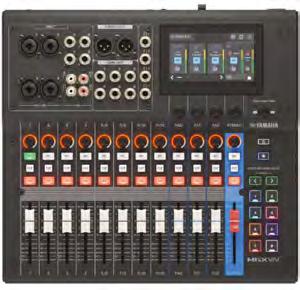
DIGITAL MIXING CONSOLE MGX12 BLACK / WHITE
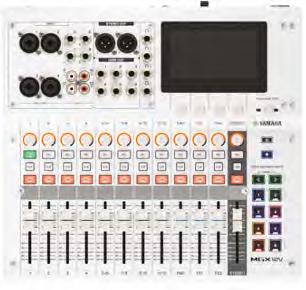
DIGITAL MIXING CONSOLE WITH VIDEO INTERFACE MGX12V BLACK / WHITE
DIGITAL MIXING CONSOLE MGX12 BLACK / WHITE
DIGITAL MIXING CONSOLE WITH VIDEO INTERFACE MGX12V BLACK / WHITE
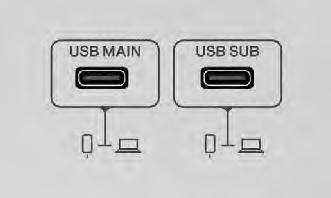
OPTIMIZED INTEGRATION
By making full use of its flexible routing functions and dual MAIN/ SUB USB ports, you can integrate a wide range of audio sources and devices into a setup that works exactly the way you want.

DIGITAL MIXING CONSOLE MGX16 BLACK / WHITE
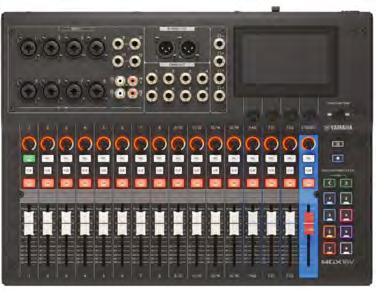
DIGITAL MIXING CONSOLE WITH VIDEO INTERFACE MGX16V BLACK / WHITE
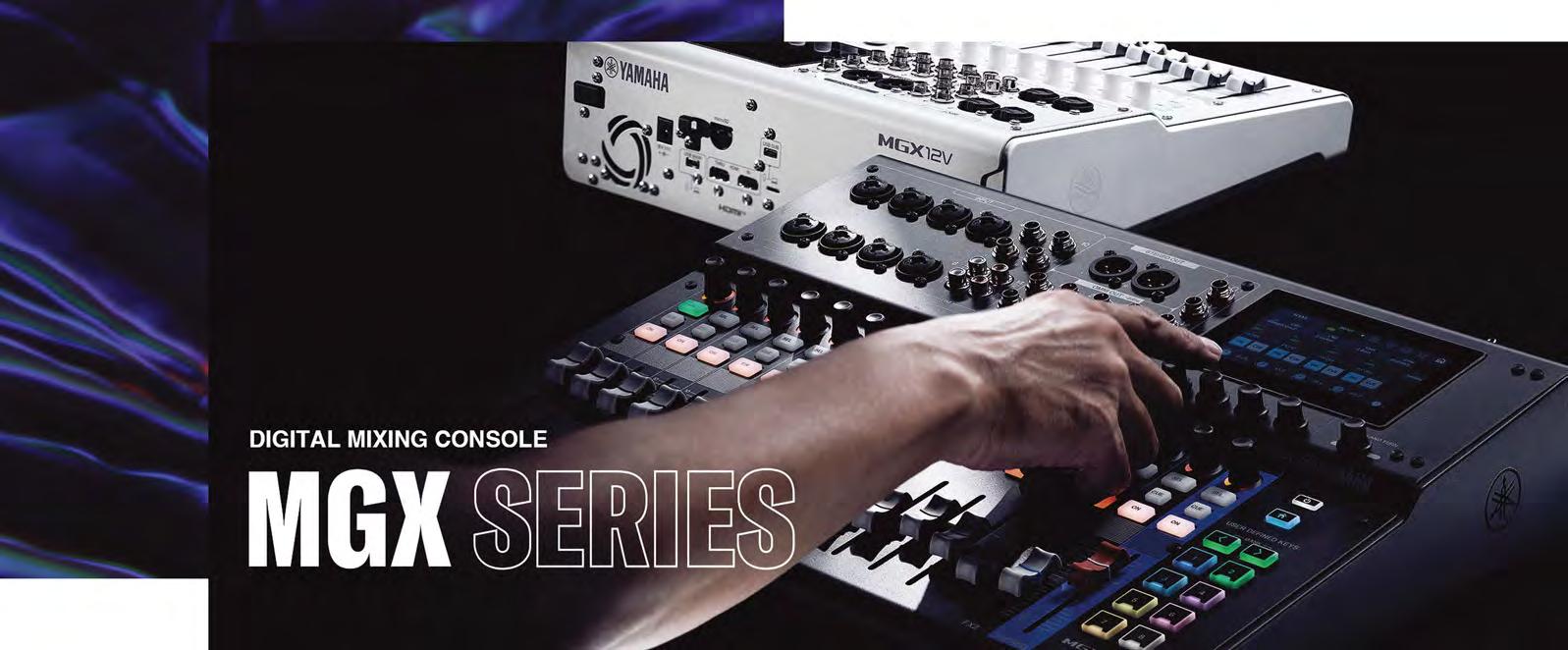
Yamaha's MG series compact analog mixers are renowned for their sound quality, versatility, and intuitive design, gaining industry acclaim for a wide range of applications. The new MGX series enhances this legacy by delivering "True Sound," capturing every nuance of performance while offering expanded functionality and flexibility for modern sound reinforcement and music production needs. Combining advanced digital technology with the MG series’ trusted heritage, the MGX series effectively supports live sound, installed systems, podcasting, streaming, recording, and hybrid video production, with special models for video signals. The MGX series digital mixers are designed to inspire performers, engineers, and audiences with superior sound and performance in any audio environment.
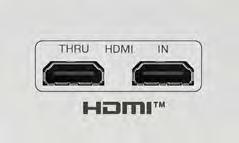
ALL-IN-ONE AUDIO & VIDEO*
Equipped with HDMI IN/THRU, the MGX-V models feature a powerful HDMI-USB audio/video interface enabling users to record & pass through both audio & video from external devices such as cameras & consoles.
*Function for 12V and 16V only.
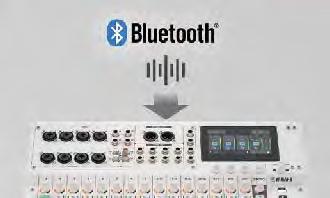
CONVENIENT BLUETOOTH AUDIO INPUT
Bluetooth connectivity allows users to easily integrate wireless audio sources into their live performances, streaming, and studio sessions.
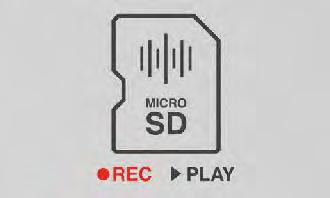
MAXIMIZE YOUR MULTI-TRACK
With the MGX, you can record up to 16 tracks of audio and playback 2 tracks directly from a microSD card. the way you want.
SCAN FOR MORE DETAILS


Each year, the world’s biggest AV tradeshow in Barcelona brings us the same challenge. For a team of fewer than 10 people, getting around more than 1,200 exhibitors is already a nearimpossible task. Extracting anything meaningful from the surrounding promotional noise often takes far longer, and aligning our different perspectives usually means we are well into the next week before clear themes begin to emerge. This year, it seems we were not alone in that struggle.
Our industry has become accustomed to talking about growth in terms of scale. Larger displays, more powerful processing, higher channel counts and brighter projectors. These standouts were somewhat absent this year. If we had to seize on a buzzword doing the rounds, it was probably AI, whatever that means in practice. And this has been part of the problem. Conversation often centres on what technology is capable of, rather than
environments where performance alone is no longer the primary concern, from government headquarters and energy sector facilities to national command centres and enterprise-scale corporate campuses. These spaces demand reliability, security and interoperability at a level traditionally associated with IT infrastructure rather than live production. It might be a quiet shift, but it carries significant implications for integrators, manufacturers and end users alike.
In that regard, this year’s ISE felt like one of the clearest reflections yet of the industry it serves. Across the show floor, success appeared less tied to headline specifications and more to how seamlessly systems integrate with wider organisational networks. Not everyone agreed though, and you can read our full report on pp.48–50.
Email: sluckhurst@proavl-mea.com



Richard Lawn General manager rlawn@proavl-mea.com
Nick Smith Digital media manager nsmith@proavl-mea.com
Sue Gould Advertising director sgould@proavl-mea.com
Chris Yardley Video editor cyardley@proavl-mea.com
Carolyn Valliere Sales associate cvalliere@proavl-mea.com
Jack Stennulat Digital content creator jstennulat@proavl-mea.com
Caroline Moss Contributing editor cmoss@proavl-mea.com
Adrian Baker Production manager abaker@proavl-mea.com
Karen Wallace Editorial coordinator kwallace@proavl-mea.com
Marne Mittelmann Circulation manager circulation@proavl-mea.com
Bea Meikle News editor bmeikle@proavl-mea.com
Sue Su Guangzhou manager ssu@proavl-mea.com
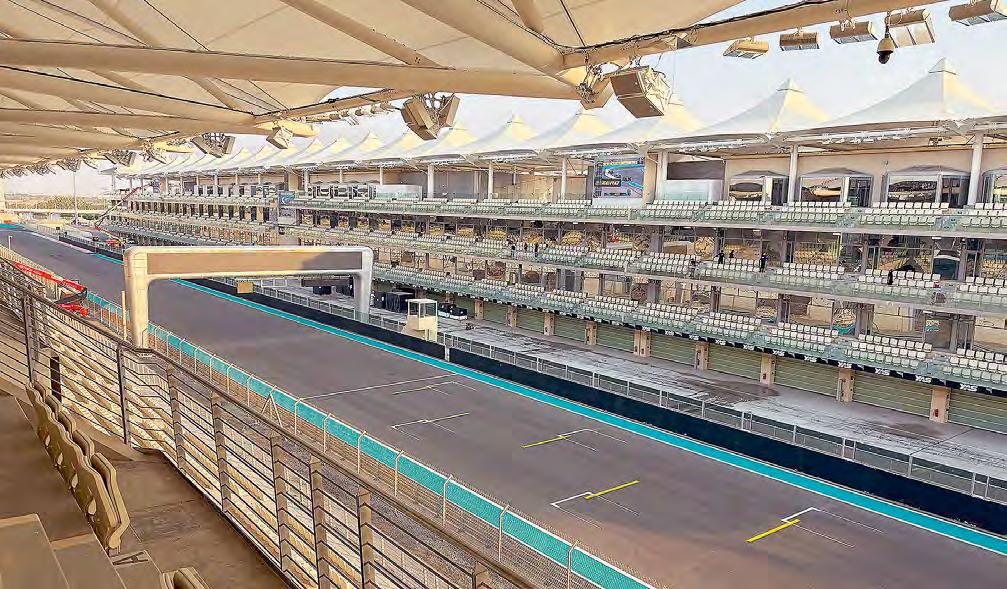
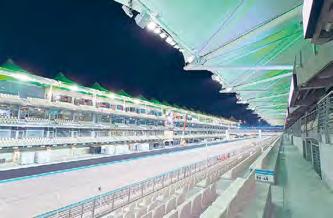
Yas Marina Circuit – home to the Formula One Etihad Airways Abu Dhabi Grand Prix – has been upgraded with a fully digital architecture to replace the analogue backbone which was installed when the circuit opened in 2010. The project, which also involved updating the main grandstand’s audio system, was delivered by PKE Gulf, and called on equipment from Electro-Voice and Dynacord to ensure the circuit would meet modern international sports venue standards. Further phases will cover the remaining north, south and west grandstands.
PKE Gulf opted for equipment from ElectroVoice and Dynacord to help it achieve the results that the circuit required. “ElectroVoice and Dynacord were selected for their outstanding professional design and proven performance,” explained Gerald Zak, senior technical manager at PKE Gulf. “The large portfolio and scalability of the Electro-Voice solutions allowed the entire project to be covered with a single, coherent audio platform, ensuring consistent sound quality, reliability and visual integration across all areas of the main grandstand. Combined with Dynacord’s
powerful processing and amplification technologies, the solution delivers a robust, future-ready system that meets the highest standards expected at a modern international motorsport venue.”
“The circuit needed a complete digital evolution to meet international motorsport standards and deliver a premium audio experience,” added Aju Antony, sales manager MEA for Electro-Voice and Dynacord. “By implementing our high-end multichannel IPX series DSP amps combined with Electro-Voice EVH, EVF and EVC point source loudspeakers,
we provided the brain and power to deliver a premium, futureproof experience.”
The first phase of the project saw 155 weatherised loudspeakers and subwoofers powered by 30 amplifiers added to the main grandstand. Flown in vertical clusters from the front lip of the roofline, the new sound system is intended to ensure an optimal spectator experience during motorsport events held in the facility and delivers homogenous sound coverage to every seat. Dante was selected for audio distribution throughout the facility with professional audio electronics and software from Dynacord playing a critical role.
The combination of IPX amplifiers and MXE5 matrix mix engines managed by SONICUE provides effective production signal management for audio engineers at the track. A customised GUI allows instant signal selection, pre-listening and routing to audience areas. SONICUE has also enabled a precise, application-specific control environment, not only replicating the old analogue audio console but also providing extra features such as instantaneous delay control for lip-syncing with video displays in the public areas or scene recalls during different event stages.
A third element of phase one saw the installation of a Praesensa public address system which ensures that live and prerecorded announcements can be broadcast across all zones of the circuit for effective communication. The system has been buffered from the rest of the audio network using a proprietary Dante gateway unit, to ensure overall system compatibility.
“From an operations and risk management standpoint, the upgrade delivered exactly what we were looking for,” concluded Omar Naiem, smart venues senior manager at Ethara, the venue management company for Yas Marina Circuit. “The system now aligns with international motorsport venue standards and gives us the confidence that audio performance will be consistent across different event formats, broadcast requirements and crowd capacities.”
www.dynacord.com www.electrovoice.com
Audiotonix has announced its agreement to acquire three microphone and wireless audio companies to complement its current roster of global technology brands: DPA Microphones, Wisycom and Austrian Audio. The acquisition is now being filed for regulatory approval and should be completed in H1 2026. All three brands now join the growing Audiotonix portfolio, including Allen & Heath, Calrec, DiGiCo, DiGiGrid, Fourier Audio, Group One Limited, Harrison, JH Audio, KLANG:technologies, Slate Digital, Solid State Logic, sonible and Sound Devices.
“With the development work we have been investing in with Sound Devices, it makes technological sense to add Wisycom to the team,” said James Gordon, CEO of Audiotonix. “The next logical step is to move closer to the performer with microphones and DPA as a premium brand is the ultimate choice. Austrian Audio, with their decades of microphone and headset design experience,
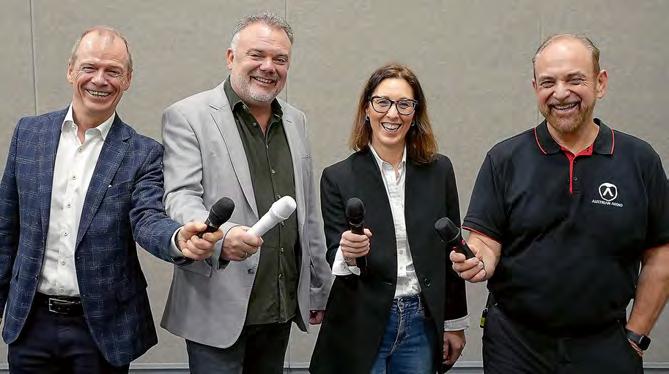
have immense potential and will help complement our existing and future portfolio. We always aim to work with brands that
add value for our customers and the future potential of this trio as part of Audiotonix is not hard to imagine.”
Kalle Hvidt Nielsen, CEO at DPA Microphones, added: “DPA Microphones, Wisycom and Austrian Audio are premium brands known for their strong and visionary product offering, used by many high-end customers who are familiar with all the Audiotonix brands. We share many location sound professionals with Sound Devices who rely on best-in-class audio quality and top-notch reliability and so by joining Audiotonix, DPA Microphones, Wisycom and Austrian Audio get the opportunity to offer more premium solutions to discerning, qualityfocused customers. The synergy across the brands enhances the group’s capacity to deliver substantial advantages to all professional customers who demand the best. I look forward to more collaboration and moving the state-ofthe-art forward in new verticals.”
www.audiotonix.com
www.austrian.audio
www.dpamicrophones.com
www.wisycom.com

ATEM Mini Extreme ISO G2 makes it easy to create professional multi camera productions for live streaming! Simply connect ATEM Mini Extreme and you can live switch up to 8 high quality video camera inputs for dramatically better quality images. You can even sync your recording to Blackmagic Cloud, so you can edit your live production with DaVinci Resolve anywhere in the world!
The ATEM Mini Extreme ISO G2 is ideal for building a high-end broadcast studio as it offers all the ATEM Mini features plus extra features! It has a professional style control panel with amazing input buttons. It has 3 independent video outputs that can be routed. The built-in Thunderbolt offers live video capture and playback, enabling real-time effects software or live action replay.
Blackmagic Replay uses the ISO files recorded by ATEM Mini Extreme ISO G2 to do replay in DaVinci Resolve. The ISO files are recorded to a CFexpress card which DaVinci can access via Ethernet. You can use multi-view in the cut page to view all cameras in DaVinci Resolve at the same time. The files will even continuously upload as you’re recording so you can edit live!
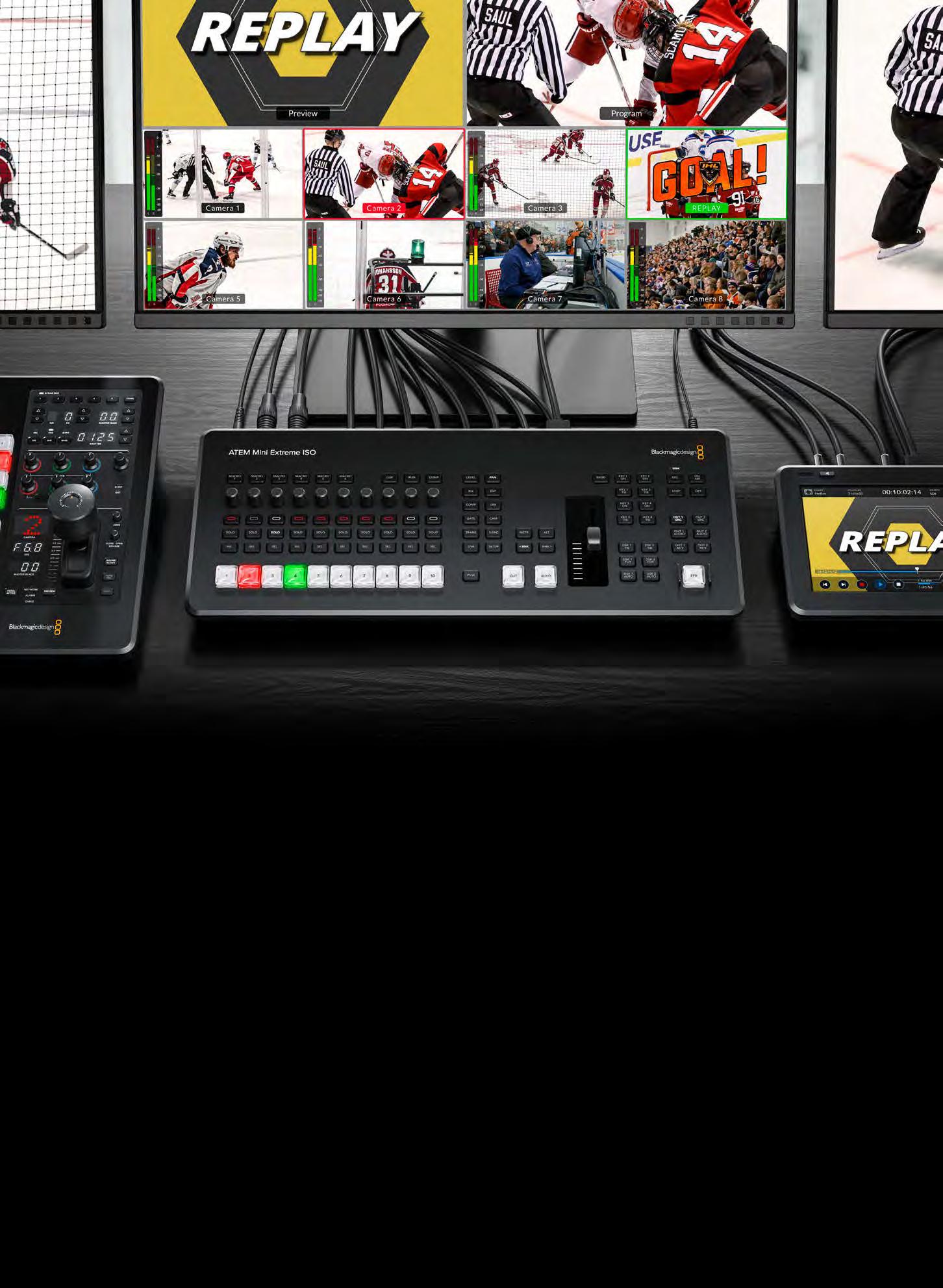
ATEM Mini Extreme ISO G2 is not just a switcher, it’s also a shared network disk using the 10G Ethernet port to the internal CFexpress memory card or external USB disk! CFexpress cards are extremely fast so they can keep up with recording multiple ISO video files while external network users all work on separate computers for editing, color correction, VFX and audio post production.
The front panel has buttons for selecting sources, triggering transitions, and setting video effects. It also features an innovative audio mixer control area with live metering on a Fairlight style HDMI status output. You get buttons for re cording, streaming, and dedicated output buttons for changing outputs between the 8 cameras, program, preview, multi-view, or Fairlight status.
ATEM Mini Extreme ISO G2 US$2,025

The Equipson Group has acquired fellow Spanish audio manufacturer, Musicson. The move will capitalise on Musicson’s legacy, and extensive manufacturing and R&D experience, to enable Equipson to expand the development of its large-format loudspeaker enclosures. It also aligns with the manufacturer’s commitment to create audio products that are entirely manufactured in Spain.
Based in Valencia, Musicson was established in 1965. Unconventionally to other manufacturers, the company uses wooden waveguides to give its products a warm and natural sound, and it also manufactures its own loudspeakers and compression drivers, enabling it to maintain full control of critical components.
“This acquisition fits perfectly with Equipson’s long-term plan to invest in the
people, infrastructure and technology needed to create effective and high-quality solutions for the professional audio market,” said Juan Jose Vila, CEO of the Equipson Group. “Prior to setting up Equipson, my father, José Luis Vila, was Musicson’s sales manager for more than 30 years. As family-owned companies, both are renowned for their high levels of customer service and are committed to providing comprehensive and immediate support.”
Through the deal, Musicson, which has its own in-house engineering, woodworking and electronics departments, will move all its employees to the new facilities located next to the Equipson site. Additional staff will also be recruited to boost production and manufacturing.
It was also reported that Joaquin Benavent Diaz – son of Musicson founder Joaquin Benavent Pérez and until now CEO and key figure in acoustic design and R&D – will continue to be associated with the brand.
“As the granddaughter of Musicson’s founder and daughter of its CEO, I am very excited about this acquisition, which heralds a new chapter for the company,” commented Ana Benavent, Musicson’s brand manager. “I am confident that, as part of the Equipson Group, we can take this legendary brand and project it into the future without compromising the passion for authentic sound.”
A new brand identity has already been created for Musicson and this will soon be revealed followed by the launch of a new website.
www.equipson.es
www.musicson.com
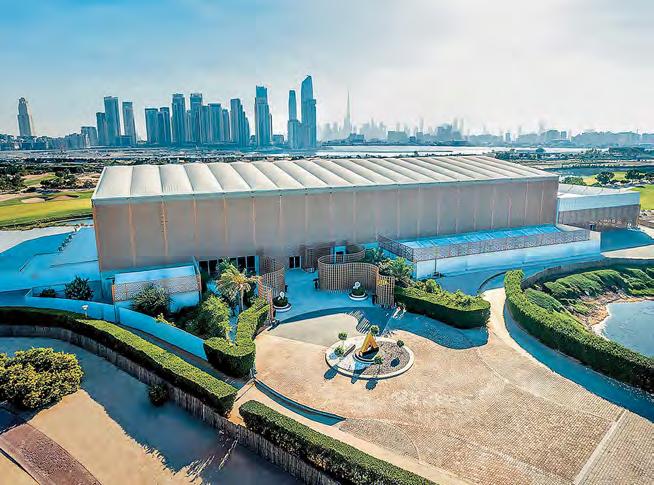
InfoComm EDGE will take place at the Festival Arena in Dubai from 27–28 October 2026. Organised by AVIXA, the two-day event is aimed at key buyers and stakeholders outside the traditional pro AV trade. It will focus on technology, thought leadership and networking for senior leaders involved in projects across government, enterprise, education, retail, leisure and entertainment.
“Experience lies at the heart of InfoComm EDGE. The GCC is a region that has an unquenchable thirst for innovation and it has the vision and resources to turn its dreams into reality,” said David Labuskes, chief executive officer of AVIXA. “We have an established pro AV community in the region at the forefront of this innovation, which has both the talent and the creativity to deploy the buyer-focused activations that will form the core of InfoComm EDGE.”
The Festival Arena offers more than 7,200m² of indoor and outdoor space. The
Christie Digital Systems USA and Vista PHX have announced an agreement in principle to sell the Christie broadcast and professional video business to Vista PHX, a new corporation created by former Vista Systems owners and industry veterans, Clark Williams and Jeff Wilson. The transaction will mark the return of some of the industry’s well-known video processing technologies to the innovators who designed, built and championed them.

Continuing to operate in Phoenix, Arizona, Vista PHX will acquire the Christie intellectual property and essential operational infrastructure for the Spyder, Terra, Phoenix and Mastering Gateway product lines. This transition will bring these video processing platforms back
to their roots, where the products were originally developed and manufactured. In particular, the transaction will help secure the future of the Spyder brand. The Phoenixbranded distributed content management system, Terra SDVoE platform and Mastering Gateway Series further reinforce Vista PHX’s capabilities in delivering endto-end, mission-critical video processing solutions.
“Bringing Spyder and the other innovative video processing product lines back under independent ownership is significant,” said Clark Williams, CEO of Vista PHX. “For our customers, this acquisition means continuity where it matters and acceleration where it counts. The same team, the same engineering DNA – now with the clarity and
event will be built around a central stage rather than a traditional exhibition layout. Activations will be designed and delivered by members of the local integration community, supported by pods intended to facilitate discussion and networking.
“It’s challenging for high-level decisionmakers to visualise solutions as they walk around a conventional tradeshow floor, stand by stand,” added Cara Turner, event director, InfoComm EDGE. “That’s why, for InfoComm EDGE, we are taking a unique approach by co-creating an event with the design and deployment community for the first time.”
InfoComm EDGE will include live activations intended to demonstrate integrated solutions in practical contexts. The programme will focus on standards-based approaches and project delivery, with an emphasis on integration and outcomes for end users.
www.avixa.org
autonomy to move faster and invest deeper in the platform our customers rely on.”
Michael Phipps, president, Christie, commented on the transition: “The divestiture of the broadcast and professional video group reflects our continued focus on our long-term strategic priorities. We believe that returning the video processing family of products to Clark Williams, Jeff Wilson and the Vista PHX team will best position them for sustained growth under owners whose core mission is centred on these products. We are committed to ensuring a smooth and responsible transition for employees, customers and partners.”
www.christiedigital.com
www.vistaphx.com
Audio Technology has completed a long-term audiovisual and conferencing project at the headquarters of the African Space Agency (AFSA) in Egypt’s Space City, New Cairo, delivering a fully automated system for the organisation’s main conference hall. The complex project began in 2020 and reached completion after five years, reflecting the scale of the installation.
AFSA’s objective was to create a conference environment capable of supporting highstakes, multilingual international meetings, with technology that could underpin structured debate, voting and interpretation for continental cooperation.
Audio Technology was responsible for the full system integration. For visuals, the hall has been installed with an indoor direct-view LED videowall from Absen. With a P2.5mm pixel pitch and a surface area of more than 18m2, the display was selected to provide clear, detailed imagery for formal presentations and conferences. The screen is managed via Crestron Electronics, which also acts as the central switching and control platform for the entire room.
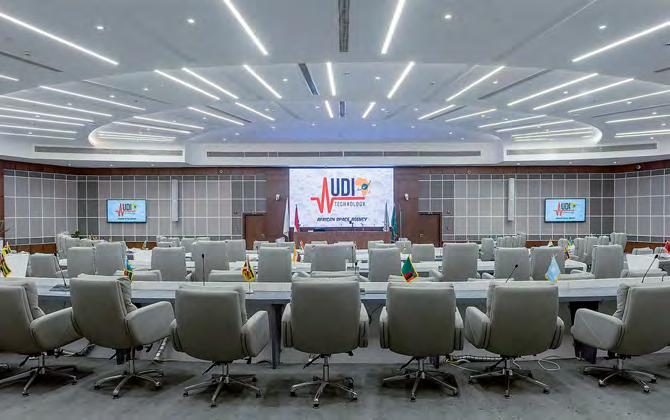
Audio coverage presented one of the main technical challenges. The brief required even sound distribution across the hall while limiting the number of speaker positions. This was achieved using two JBL Professional CBT 1000 line array speakers positioned at the front of
the room. The controlled dispersion of the CBT design allowed full coverage from only two locations, with audio processing handled by Soundcraft Si Series digital mixers.
For conferencing and discussion, 59 Televic Confidea FLEX delegate units were
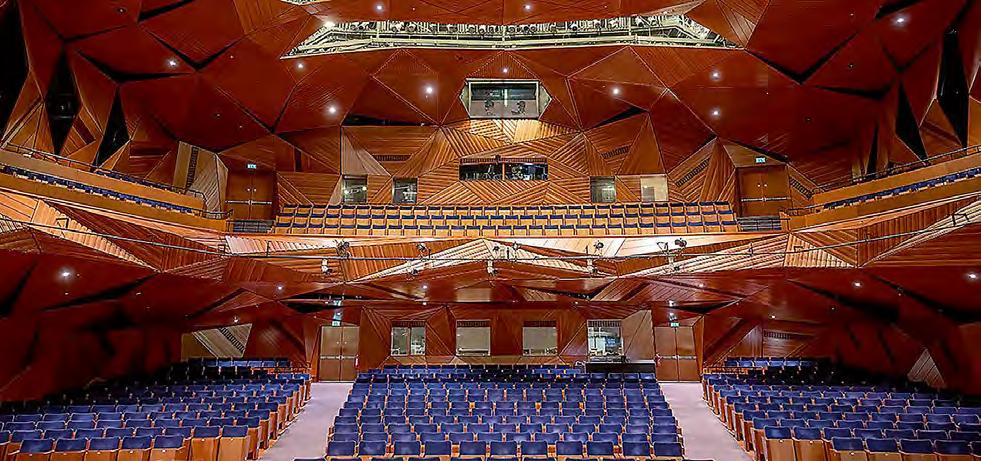
The Arts Center at NYU Abu Dhabi (NYUAD) has implemented two Yamaha RIVAGE PM5s, provided by Thomsun Trading, as part of a major sound upgrade of its three performance spaces.
A focal point of the Abu Dhabi campus is the NYUAD Arts Center, home to the theatre, music, film and new media, visual arts and interactive media departments. The Arts Center includes three performance venues, a project gallery, rehearsal rooms, film editing studios, classrooms and a workshop. As well as showcasing music, theatre, dance, film, poetry, family and interdisciplinary productions by students, faculties and the local community, it presents public performances by professional artists from around the world.
The 685-seat Red Theater is the largest venue of the three and includes a large stage with sprung floor, lighting, digital and 35mm projection capabilities, an orchestra pit and adjustable acoustic panels. The flexible Black Box theatre has an audience capacity of up to 300. With full lighting and sound reinforcement, it can accommodate a range of configurations for music, dance, theatre and multidisciplinary performance. Meanwhile, the Blue Hall is an intimate, 150-capacity concert hall with a sprung wood floor stage and digital projection for film and video. It is ideal for concerts, small-scale dance performances, readings, panel conversations and more.
The Arts Center previously featured a Yamaha system, including CL5 and TF-Rack
installed, providing integrated voting and camera tracking. These are supported by a Shure wireless microphone system comprising four SLX-D dual receivers with SM58 handheld transmitters, four SLXD1 bodypack transmitters with DH5 headsets, and four MX418 gooseneck microphones. Multilingual support is delivered through a Televic simultaneous interpretation system, with 120 receivers enabling interpretation in eight languages.
All components are brought together through a single Crestron touchpanel interface, allowing operators to manage visuals, audio, microphones and interpretation without manual reconfiguration.
Audio Technology’s regional pro AV presales and design manager, Jacko Makram, described the installation as “a proud moment”, adding that the completed hall now functions as “a powerful platform for highstakes diplomacy, combining visual clarity, precise audio, structured discussion tools and multilingual capability in a unified system”.
www.audioteceg.com
digital mixers, plus a Rio3224-D I/O rack.
Although the CL5 offered a substantial input mixing capacity, the Arts Center was facing the challenge of the escalating scale and complexity of events.
Kalith Ahamed of Yamaha Music Gulf explained it was “running short of inputs, outputs and mix matrices. As the venue’s popularity and the ambition of its programming has increased, so has the demand for more extensive audio routing and processing, which was pushing the existing system beyond its capabilities.”
After evaluating various options, the Arts Center’s audio team settled on a pair of Yamaha RIVAGE PM5 digital mixing systems, supplied by Dubai-based Thomsun Trading. It was reported that the new systems satisfied
their requirements, as well as provided a futureproof, versatile and reliable solution that is internationally accepted by sound engineers.
The interface between Yamaha’s TWINLANe digital audio protocol – which allows it to transmit up to 400 audio channels through a single optical cable –and the Arts Center’s existing Dante network mean the RIVAGE PM5 systems can be moved between the venues, according to the specific event requirements and unique acoustic needs of each space.
“A key advantage of the RIVAGE PM5 is its relatively lighter weight, compared to its impressive feature set,” noted Ahamed.
“This significantly benefits the in-house technical staff, making the systems easier for engineers to handle, transport and set up between the different theatres, enhancing operational efficiency and allowing for quicker changeovers between productions.”
Ahamed added that the Theater mode has made a notable difference in the preperation and pre-production of theatre shows, while the hybrid mic preamps with Rupert Neve Designs’ SILK processing and the plugin’s capacity and quality have lifted the sound quality of productions to a “new level”.
“The long-term reliability of Yamaha equipment and its ability to plug into the Dante network has also meant that the Arts Center has kept the previous CL5/ TF-Rack-based system for use on smaller productions,” he concluded. “It highlights how Yamaha audio systems always maximise the return on investment.”
www.thomsunmusic.com/proav www.yamaha.com/2/proaudio
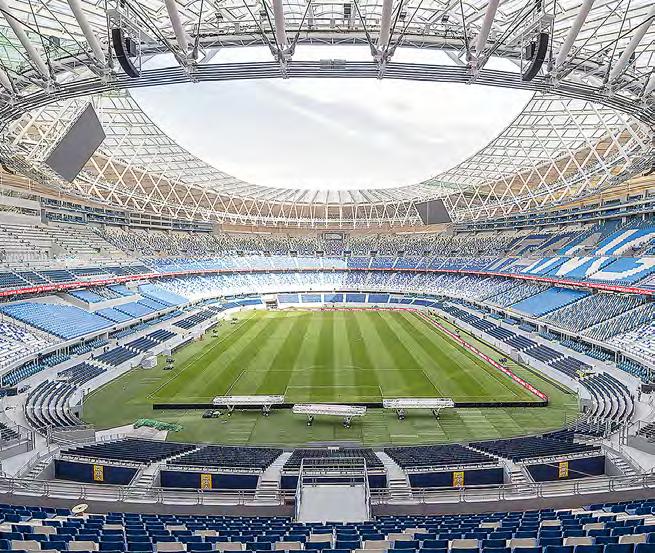
An RCF sound reinforcement system has been installed at Grand Stade de Tanger, also known as Stade Ibn Battouta. Following a major renovation completed ahead of the 2025 Africa Cup of Nations and as part of Morocco’s preparations as a co-host of the 2030 FIFA World Cup, the football stadium now has the capacity to seat approximately 75,500 visitors.
The system comprises over 350 loudspeakers and 55 DSP power amplifiers for total continuous power exceeding 800kW. “The assignment began through a competitive tender process managed by ANEP, the National Agency for Public Facilities,” said Rachid Mediouni, chairman of ENCOM, the official RCF and TT+ Audio distributor for the country. “Performance targets defined in the tender specifications included a continuous sound pressure level on seating positions of 100dB(A) and a peak level of 105dB(A), along with speech intelligibility objectives.”
The installed system comprises 16 main flown arrays, each comprising 12 TT+ Audio GTX 10i IP modules, deployed under the roof canopy at 45m from pitch level. Each array is paired with two RCF HL 38-S VFB 18-inch subwoofers in an endfire configuration, for a total of 32 subwoofers. Under-balcony seating and lower-tier areas are covered by
96 RCF P 4228 and 36 Compact C 45 WP loudspeakers.
Power and processing are provided by 55 RCF XPS 16KD 4-channel 96kHz
DSP amplifiers, each rated at 16,000W continuous. “Speakers are supported by dedicated presets and further optimised with specific equalisation tailored to
























the stadium’s challenging acoustics. All amplifiers are connected and managed via RDNet on a data VLAN and receive audio feeds via the Dante audio-over-IP protocol on two redundant Dante VLANs,” added Francesco Venturi of the RCF Engineering Support Group.
“The stadium’s long-span roof canopy is similar to the Maracana stadium in Rio de Janeiro,” continued Mediouni. “Its narrow under-canopy catwalk creates significant rigging and access constraints, requiring a solution adapted to fixed structural attachment points and a compressed delivery timeline. Our colleagues from the RCF Engineering Support Group provided systems design and commissioning support, including acoustic verification using calibrated instrumentation and IECaligned speech intelligibility methods.
“We are very happy with the results,” concluded Mediouni. “Professionals visiting from other venues have been impressed by the clarity, and the first events confirmed the system’s impact. This project sets a new reference for stadium sound in Morocco.”
www.rcf.it www.ttaudio.com































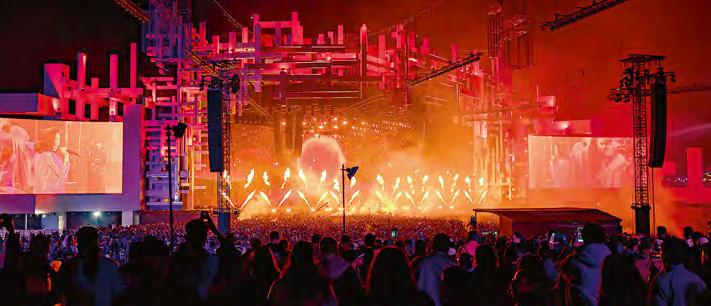
Clair Global has provided audio, communications and data services for the 2026 edition of Soundstorm, the three-day music festival staged in Riyadh by MDL Beast. The event attracted approximately 450,000 attendees across a large, multistage site and marked the fifth consecutive year of Clair Global’s involvement, with an expanded remit that included main stage audio design.
For the first time, Clair Global KSA designed and supplied the complete audio reinforcement system for Soundstorm’s flagship Big Beast stage, in addition to its existing responsibilities covering site-wide audio, data, communications and radio systems.
“We do plenty of stadium shows all over the world, but this one was very different,” said Stu Wright, regional manager, Clair Global KSA. “Given the amount of people that backed us by making the change, we had to make sure we delivered it flawlessly.”
The Big Beast system was designed by the production company’s UKbased engineering team and built around an L-Acoustics loudspeaker deployment. K1-SB, K1 and K2 enclosures were used for main and side hangs, with flown and groundstacked KS28 subwoofer arrays providing low-frequency extension and the necessary sound pressure levels across the audience area. Additional K1-SB, K1 and K2 systems were deployed across six delay hangs.
DiGiCo consoles were specified throughout, with SD7 Quantum desks at FOH and monitors, and an SD12-96 used as a production console.
System design considerations were influenced by the festival’s musical programme. “It’s varied in terms of artistic content, with a mix of EDM acts and live bands,” explained system designer Josh Lloyd. “From a system design point of view, we needed to generate high impact, with an ‘in your face’, chest-pumping low end for that club experience, while creating a system that also works for bands.”
Soundstorm’s site layout includes elevated viewing decks and Very Important Beast (VIB) suites beyond the main audience area. These spaces were equipped with Cohesion CF24 loudspeakers and subwoofers, controlled via Yamaha CL5 consoles. Clair Global also supplied the festival’s EVAC PA system using Clair i-3 loudspeakers and Yamaha DM7 series consoles.
Beyond the main stage, Clair Global delivered audio systems for four Underground stages, featuring deployments from Cohesion and d&b audiotechnik, and DiGiCo control packages. The company also provided communications infrastructure using
Riedel Bolero wireless intercoms, RTS hardwired beltpacks and Artist frames, alongside a site-wide Motorola digital mobile radio system.
Supporting all technical departments, Clair Global’s data services team deployed an enterprisegrade network across the site. “What makes data especially critical is that it functions as the integration layer between every department,” said Carlos Elizondo, director of IT for Clair Data Services at Soundstorm. “This environment is high performance; everything is live and there is no margin for error.”
www.clairglobal.com
KENYA
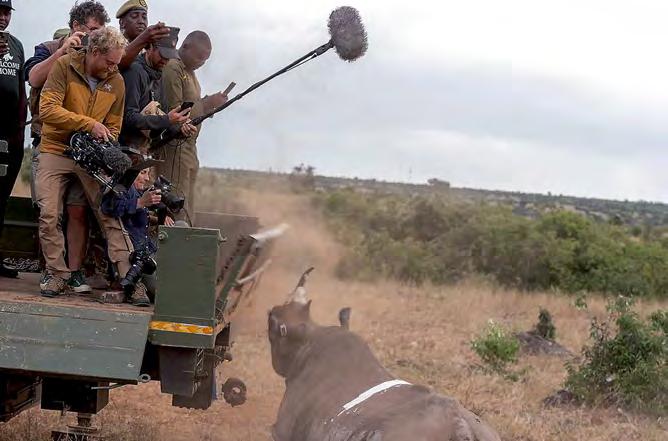
Documentary maker and Dustoff Films
founder Tom Martienssen has used Sennheiser’s MKH 8000 RF condenser
microphones on his latest film, Rhino. The documentary follows a group of elite wildlife rangers in Kenya protecting the critically
NMK Electronics has launched NMK Beyond, an experience hub measuring almost 2,000m² in Al Quoz, Dubai. The facility provides a space where visitors can see and test professional audio, video, lighting, control, infrastructure and collaboration technologies in working environments rather than traditional product displays.
NMK Beyond is intended for industry professionals and content creators, with spaces designed to reflect workplaces, studios, classrooms and entertainment venues.
“We created a space for non-technical people, where technology works quietly in the background and feels completely natural, allowing people to experience it live and understand its value through interaction,” said Alex Kemanes, regional managing director, MESEA, Midwich Group.
The venue also supports training and professional development. Since opening, it has welcomed more than 6,000 visitors, with over 4,000 industry professionals taking part in training sessions, certifications and
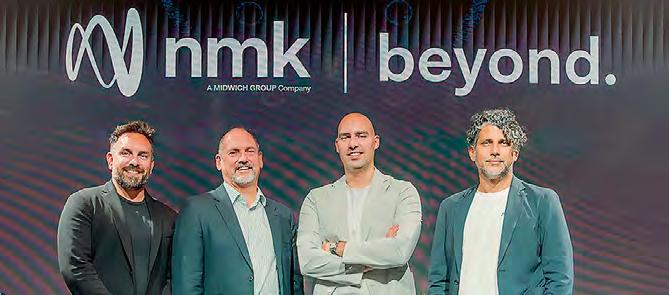
“NMK Beyond reflects how technology is fundamentally changing the way people work, learn and collaborate,” said Stephen Fenby, managing director, Midwich Group. “As the UAE continues to invest in connected, experience-led environments, this venue provides the industry with a practical space to explore, test and understand those technologies in real-world settings.”
The facility includes immersive audio and visual environments, a Dolby Atmos-enabled recording and listening studio, AI-powered meeting and collaboration rooms, and content creation areas designed to demonstrate production workflows and installed systems.
endangered black rhino. The microphones allowed Martienssen and his small team to capture the environment’s sounds on location, even in the toughest conditions of Kenya’s wilderness.
Dustoff Films produces documentaries tackling critical issues such as climate change, conservation and human rights. In Rhino, Martienssen chronicles the recovery of Kenya’s rhino population, which, after near extinction in the 1970s, is now thriving thanks to successful conservation efforts. This resurgence has caused the population to outgrow its habitat, leading to territorial disputes and aggression among the animals.
“We wanted the sound to be real,” said Martienssen. “We didn’t want to recreate wildlife calls or add anything that wasn’t there. It was important that the sounds we recorded were the ones you’d hear if you were actually there in the African savanna.”
The MKH 8060 captured isolated sound from specific sources, such as animal calls and rangers’ conversations. “We used two main
setups,” explained Martienssen. “One was an MKH 8060 mounted on the camera, capturing audio wherever it pointed. The second setup involved a boom mic, alternating between the double MS stereo rig with two MKH 8040s and an MKH 8030, or just the MKH 8060. After two-and-a-half years, the older 8060 sounded identical to a new one.”
Sound Devices MixPre-3 II and MixPre-6 II recorders provided enough channels for the double MS rig. Martienssen used RED KOMODO-X and V-RAPTOR cameras for a compact but efficient visual setup.
A standout feature of the documentary is its Dolby Atmos sound mix, using 70 speakers to create a rich, immersive experience.
“With Dolby Atmos, the audience isn’t just watching – they’re experiencing it. You can hear rhinos moving behind you, feel the wind through the trees and become enveloped in the environment. It takes the documentary to a whole new level.”
www.sennheiser.com
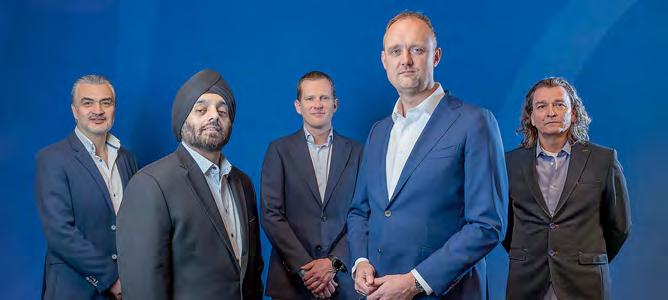
Keenfinity Group’s Audio Business has acquired Avonic, a provider of AI-driven cameras and voice-tracking technologies for the AV conferencing market. The addition of video solutions to Keenfinity Group’s audio conference offering will provide systems integrators and equipment providers with access to an integrated, one-stop audio and video portfolio.
demonstrations. Students and early-career professionals also use the space to gain practical insight into production and enterprise applications. The hub features technologies used by major touring acts and professional environments, demonstrating their application across live and corporate settings. During the inauguration, NMK Electronics announced that it had become the exclusive GCC distributor for Neat and unveiled a new control room within the facility, expanding its capabilities for critical-operations environments.
www.nmkelectronics.com
“This acquisition helps to expand our leadership position in the conferencing segment,” stated David Hunter, CEO of the Audio Business at Keenfinity Group. “More importantly, it supports our mission of delivering exceptional user experience by enabling our customers total, seamless and integrated solutions, whatever the vertical. With Avonic’s AI-driven video capabilities seamlessly integrated into our conference solutions, we will be creating more engaging and natural experiences, where human connection takes centre stage.”
Both companies are suppliers of conference technology serving mission-critical environments in the governmental market, including councils, parliaments, international institutions and higher education, as well as commercial applications such as corporate boardrooms and international
events. Keenfinity noted that, as today’s hybrid meeting landscape increasingly demands video for visual context, the integration of AI-enabled video capabilities with clear, reliable voice communication will provide a futureproof, intuitive meeting experience for both on-premise and remote users.
Now part of the Keenfinity Group’s Audio Business, Bosch-branded conference solutions build on more than 75 years of expertise in the global conferencing market. The integration of Avonic’s PTZ cameras and AI-powered software aims to deliver the highest-quality standards while providing seamless integration and reliable execution for systems integrators.
“Our cameras are deployed globally in professional, high-impact meeting environments where decisions truly matter,” said Walter Harrewijn, CEO of Avonic. “Moving beyond our long-term technology partnership, this acquisition allows us to collectively grow our offering, delivering more integrated solutions for new applications, use cases and markets.”
www.avonic.com
www.keenfinity-group.com
our robust, sporty and long-distance-proven multimedia infrastructure solutions come into play.
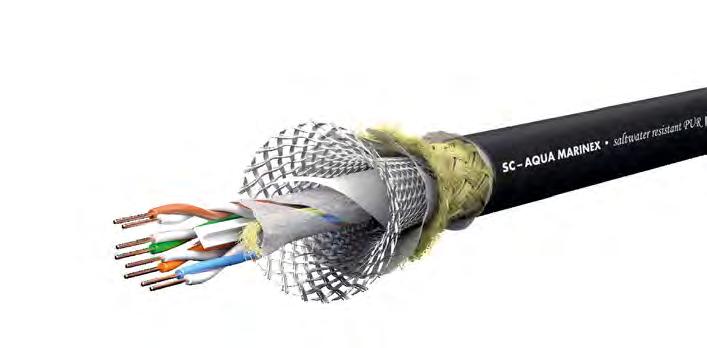
Robust, transversely watertight and aramid-reinforced custom-designed cable solutions for outdoor use
Wide range of cable and connection technology products for fully networked installation concepts
Classified cable bulkware in line with the EU Construction Products Regulation (CPR)
Connection-ready media/network/fiber optic systems for robust mobile and installation applications When

Transversely watertight, halogen-free, UV- and microbe-resistant Salt and fresh water resistant outer jacket
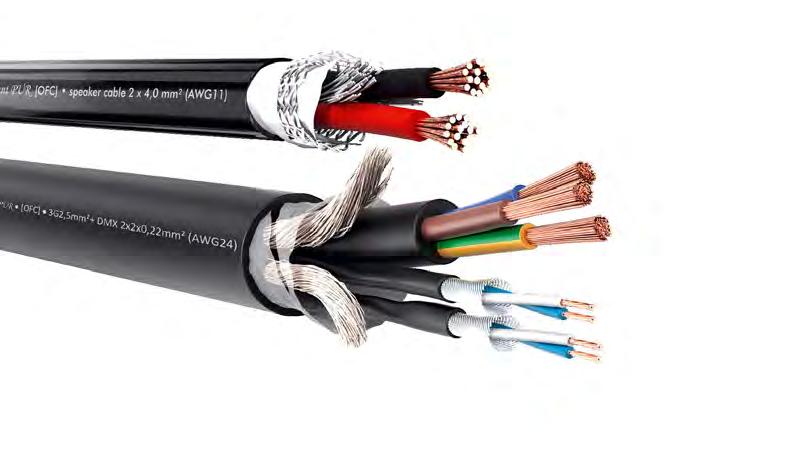



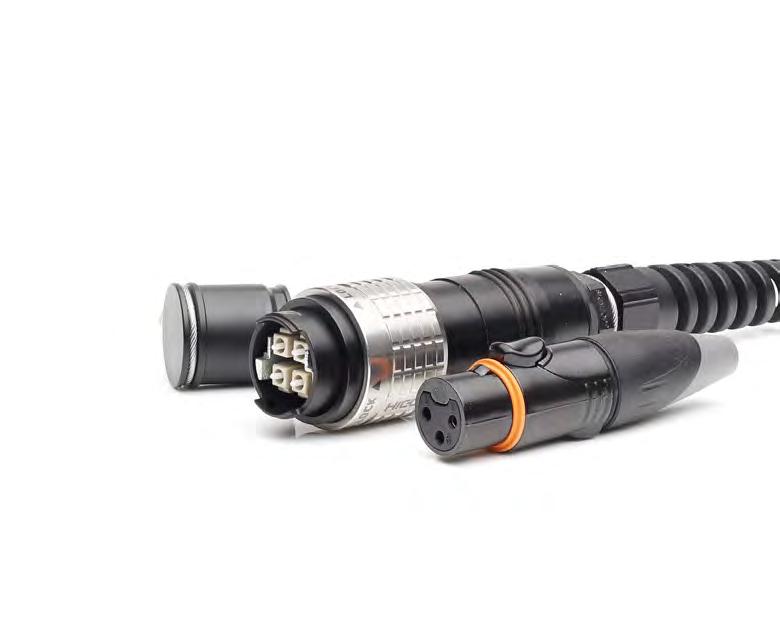


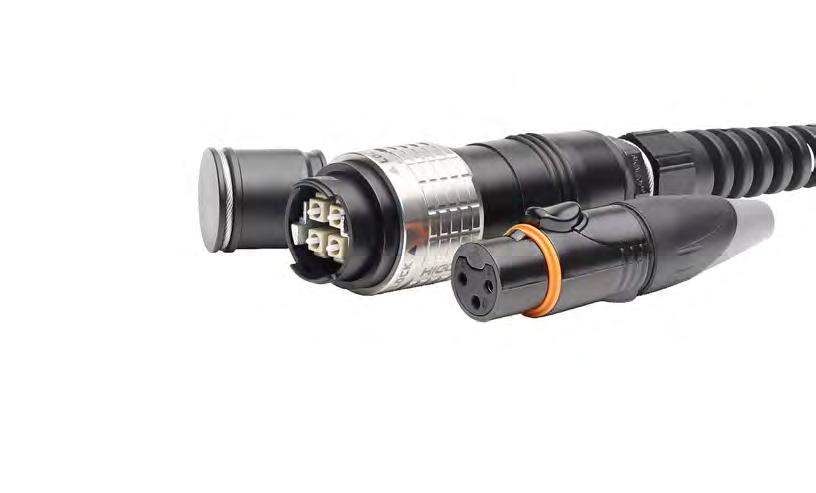






based in Straubenhardt/Germany was founded in 1999 and is now one of the leading suppliers of professional high-quality cable and connection technology with a focus on the audio, video, broadcast, studio and media technology sectors. The product range including the in-house brands HICON, CARDINAL DVM and SYSBOXX covers cable bulkware, connectors, connection cables, individually adaptable distribution systems and electronics.
A B2B shop with over 25,000 products is available 24/7.
Expanding its operations in the Middle East, Audio-Technica has announced the formation of Audio-Technica Middle East.
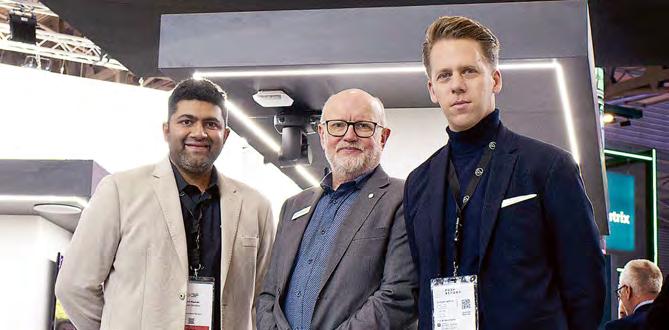
Based in Dubai, the new office will be headed up by long-standing company member John Dodson and will see the arrival of several new staff with wide experience in the territory. The team will be built around sales director, commercial audio, ME, Akhil Raphael, who joined Audio-Technica in 2024.
“Establishing a dedicated Audio-Technica presence in the GCC is a major milestone for the brand,” said Dodson. “This region has shown tremendous growth and potential and having a local team allows us to support our partners and customers more closely than ever before.”
The new operation is designed to provide enhanced service for commercial audio customers and end users in what are increasingly important markets for the brand. Product advice, design input and after-sales support for
projects across key sectors including education, broadcast, hospitality, studio and live event
sectors will be available to customers directly from Audio-Technica Middle East and its partners.
“I’m really excited to be working with the expanded Audio-Technica team at such an important time,” furthered Dodson.
“Announcements will be made about the appointment of new wholesale partners over the coming weeks and we are looking forward to working closely with our friends in the region.”
Stephan Grawe, managing director Audio-Technica EMEA sales division, added: “Audio-Technica Middle East marks a decisive step forward for us in the region. With the establishment of a dedicated local organisation and a dedicated and passionate team, customers and partners in the GCC will be supported at an entirely new level.”
www.audio-technica.com

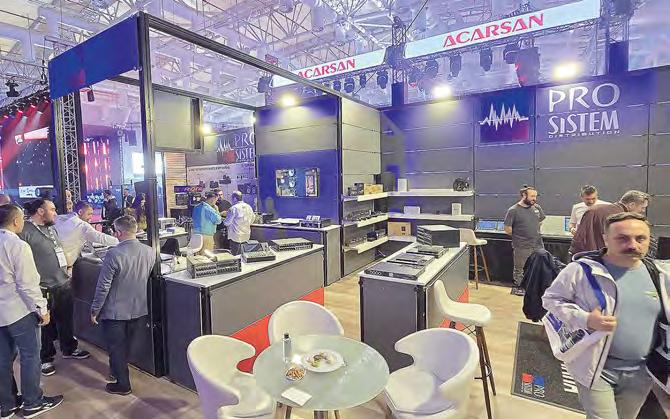
Turkish AV distributor Prosistem
Distribution has hosted a two-day professional audio training and exhibition event in Ankara, bringing together more than 400 industry professionals from across the country.
“The objective of this event was to fully introduce local engineers to our product range, providing thorough hands-on experience with new technologies and delivering in-depth Yamaha console training to both our existing and prospective customers,” commented Prosistem Distribution CEO Yurder Ertekin. “We welcomed attendees from all regions of Turkey, with the exception of Istanbul and Izmir, where Prosistem recently held similar exhibitions.”
The event took place across three halls, with two 2,000m² training spaces dedicated to hands-on sessions with Yamaha’s Rivage
PM3 and PM5 digital mixing systems, alongside the DM7 series and the latest Yamaha digital mixer platforms. Training sessions focused on system workflows, real-world operation and advanced console features.
A third exhibition hall, covering 2,500m², showcased the full Prosistem Distribution portfolio, allowing attendees to test and evaluate products in a practical environment.
Exhibits included Yamaha professional audio and business solutions, digital and analogue mixing consoles, interfaces, loudspeakers, amplifiers and hi-fi products, as well as solutions from LD Systems, Gravity, Defender, Palmer, Seetronic and Denox Cable.
www.prosistem.com.tr
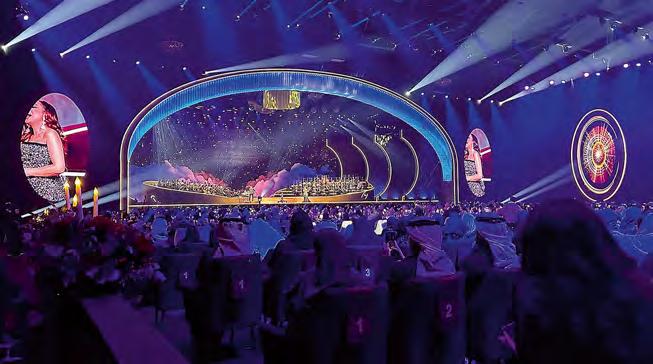
Gravity Media facilitated the live production of a New Year’s Eve concert at New Eve Boulevard E-Game Square in Riyadh. Broadcast in UHD, the event aired on MBC and over 10 digital channels, attracting millions.
Produced by German company Premium Projects for Ad Dimension, a subsidiary of Jeddah-based Benchmark, the concert featured a 60-piece orchestra alongside Egyptian artist Angham Mohamed Ali Suleiman, with a special guest appearance by global superstar Toni Braxton.
Gravity Media provided end-to-end technical facilities, deploying its NOVA 101 outside
broadcast truck and a 23-camera setup, including Sony HDC-3500 as the main system. Specialist and robotic cameras captured dynamic angles, including Agito and Furio robotics, Sony FR7 auto pods, track-mounted units, LUNA wire cam, Jimmy Jib, Steadicam, RF cameras, Sony FX3 and P50, Marshall minicams and drones.
Twenty Gravity Media crew collaborated with the international team to streamline live and digital delivery. “Delivering a live event of this scale, with orchestra, international stars and advanced UHD production, was a true testament to
our expertise,” said Eamonn Dowdall, BDM, Gravity Media Middle East. “Our team leveraged NOVA 101 and specialist cameras to capture every moment with precision, ensuring viewers experienced the
energy and emotion of the performance as if they were in the arena.”
www.gravitymedia.com www.pro.sony
Unica will have a fresh-out-of-the-box feel throughout its life, and it will be possible to integrate features and functionalities down the line, making it truly futureproof. Proving the engineering efforts undertaken in the development of this platform are 5 registered patents
INFiLED’s MVmk2 Series LED technology has been implemented for digitalout-of-home (DOOH) advertising on Dubai’s major thoroughfare, Sheikh Zayed Road, potentially being seen by up to half a million passersby daily.
The digital screen has been installed at A Tower – Emirati DOOH company Pixels World’s new location on the busy Dubai road which is reported to be the longest in the UAE and is within walking distance of major landmarks including Dubai Mall and the Museum of the Future.
The installation features a 10.4mm pixel pitch MVmk2 LED display which delivers up to 10,000-nits of brightness across a 300m² canvas. According to Pixels World, the
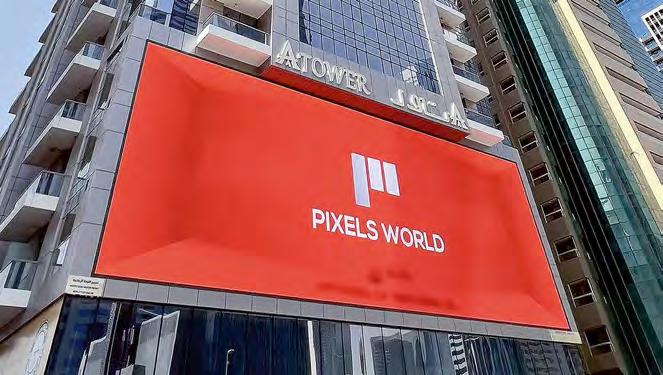
decision to upgrade to the INFiLED display was driven by reliability and performance concerns: the previous screen at the site was overheating frequently, causing power and resolution problems. The IP65-rated MVmk2 Series features a fanless approach that removes the need for additional fans or AC, addressing these concerns while supporting energy-efficient operation and lower maintenance costs over the long term.
The A Tower project took approximately 12 weeks from initial concept to full installation. INFiLED’s LED experts offered support from the outset, ensuring the chosen spec matched the realities of the location.
www.infiled.com
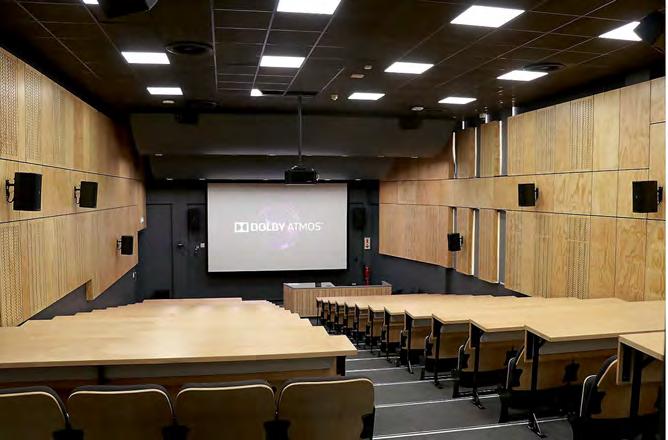
AV Distribution has designed and supplied an audiovisual solution featuring an Audac sound system for a leading university in South Africa. As part of its Media Communications and Culture Department, the School of Social Sciences has launched an oncampus cinema, designed to enable students to experience the work they have directed and produced in a professional, immersive environment.
The project was carried out as part of a large-scale technology upgrade, with the university enlisting audiovisual specialists, Digital Fabric, to specify a solution for the cinema. As the 18.5m x 8.5m venue is fitted with 140 raked seats to be used for film and video screenings, as well as everyday lectures, extra specification was needed for microphones, audiovisual presentations and a central control system that could be
easily operated by the university staff. “Our goal was to create an environment where students can view their own work with the same impact and quality sound found in professional theatres,” explained Sagrys Fourie, consultant, Digital Fabric.
With the intention of creating a Dolby Atmos 7.1.4-capable theatre, AV Distribution was appointed to supply and assist with the design of this comprehensive system, while the university’s integration partner, Ubuntu Technologies, handled installation. “The products specified by AV Distribution were perfectly suited to the requirements, resulting in a venue that delivers professional-grade sound and visuals,” noted Johan Burger, operations, technical and project manager at Ubuntu Technologies.
The AV Distribution team specified an Audac VEXO system to maximise power and clarity throughout the theatre. Three fullrange VEXO112 loudspeakers are deployed front of stage for direct audience coverage, while 10 VEXO108 loudspeakers are installed along the side and rear walls for a surround sound experience. An additional four VEXO108 loudspeakers are mounted to the ceiling for overhead audio, while low-frequency effects are provided by two BASO15 bass-reflex subwoofers.
Grass Valley’s AMPP-based Playout X and Framelight X solutions have expanded Saudi broadcaster Asharq News’ cloud-based disaster recover (DR) capabilities. Owned by the Saudi Research & Media Group (SRMG), the multiplatform Arabic news service has made the move to strengthen its operational resilience.
Asharq News delivers 24/7 news and business coverage across the MENA region. Its exclusive content collaboration with Bloomberg Media – Asharq Business with Bloomberg – a multiplatform business news service, provides audiences access to Bloomberg’s global financial reporting network of over 2,700 journalists and analysts. The news broadcaster has transitioned from a traditional monolithic playout system to a cloud-native DR architecture, as part of its continued investment in futureproof infrastructure. The new system is powered entirely by Grass Valley’s AMPP Agile Media Processing Platform. Asharq initially launched DR channels for its History and Discovery services in June 2025 and followed with a third for its flagship News service in late 2025.
“Our vision is to operate with the highest level of reliability and flexibility across our entire media ecosystem,” said Omran Abdallah, CTO of Asharq News. “Grass Valley’s Playout X solution allows us to ensure business continuity from anywhere in the world, without the dependency on traditional hardware infrastructure. The SaaS model simplifies management and provides the scalability we need to grow with confidence.”
A SMQ1250 quad-channel amplifier delivers 630W RMS to each stage front loudspeaker in the engine room, while a second SMQ1250 is bridged to drive 2,500W RMS to each subwoofer. Four SMQ500 amplifiers deliver 200W RMS to each of the surround loudspeakers. “Every amp has an Audac ANI44XT Dante card for a complete digital signal path,” said AV Distribution’s general manager, Fred van der Merwe. “After commissioning, the SPL measured at the Reference Listening Position was set at 85dB, with a maximum capability of 100dB.” In addition, AV Distribution and Digital Fabric specified a Christie M 4K15+ RGB laser projector and a Da-Lite Cinema Contour screen with a HDPro1.1 perforated surface. “The projector showcases student work in 4K, providing an authentic cinema experience, while the ambient lighting is essential when the venue is used as a lecture theatre,” added van der Merwe.
“It was a privilege for AV Distribution to be part of this project and work alongside Digital Fabric and Ubuntu to create a unique cinema solution for the university,” he concluded. “The Audac products selected deliver a powerful experience at an affordable cost.”
www.audac.eu
www.avdistribution.co.za
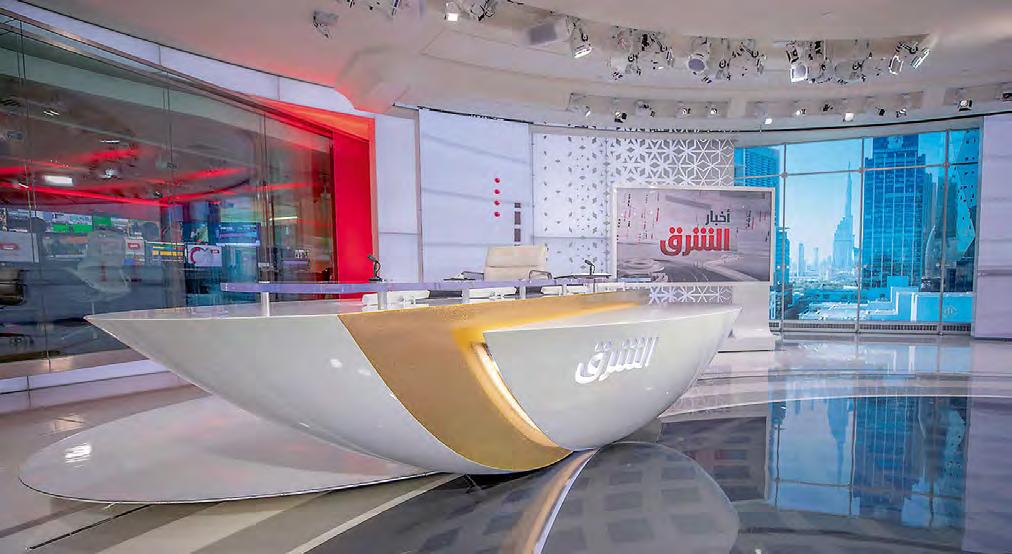
Grass Valley has provided the solution as a fully hosted offering combining Playout X services and Framelight X services powered by AMPP, with the underlying cloud-hosted compute, allowing Asharq to manage its DR as a single, predictable monthly SaaS expense. This aims to reduce the complexity of personally managing cloud infrastructure, while the OPEX-driven model has been designed to eliminate the need for capital-intensive hardware investments.
“Asharq News has been a pioneer in adopting cloud-native broadcast operations in the region,” commented Hany Bartela, VP of sales for MEA at Grass Valley. “Their continued investment in AMPP demonstrates the real-world advantages of software-defined workflows – from disaster recovery to full-time operations – that scale effortlessly to meet evolving demands.”
The deployment combines Playout X for cloud-native channel playout and Framelight X for media asset management, providing a
unified end-to-end foundation for both live and on-demand content delivery, enabling Asharq to maintain operational continuity and continue to deliver real-time news across its platforms.
It was reported that the success of this deployment has fuelled broader adoption within the region, with Asharq’s technical leadership exploring further use cases within the business.
www.grassvalley.com







Un dflh
nprecedented colour consistency

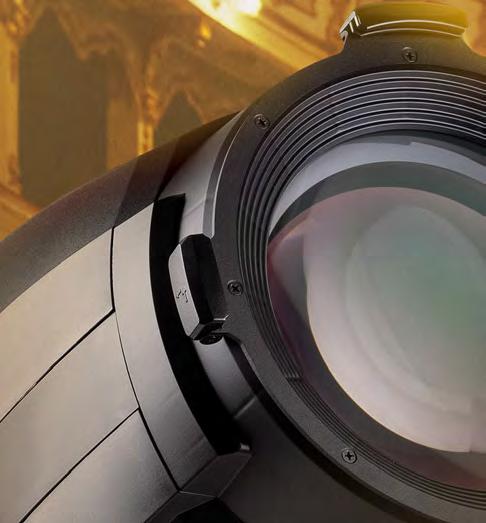
Unprecedented colour consistency and coverage for large theatres, TV studios and venues




Bergamot Asset Management has acquired a 50% stake in Augspurger, Professional Audio Design and Malekpour Design Partners. Through the move, the three companies will now operate under Augspurger Holdco, a new parent company created in partnership with Bergamot and Dave Malekpour, founder and president of the group.
The partnership combines Bergamot’s capital investment and operational leadership with Malekpour’s entrepreneurial vision, with the aim of positioning Augspurger for new growth and operational efficiencies while maintaining its global reputation.
Bergamot Asset Management’s CIO, Christopher Liong, has been named CEO of the newly created entity Augspurger Holdco while Malekpour will serve as president and chief product officer. According to Malekpour, the partnership will result in increased operational scale and new product development: “Our new relationship with Bergamot opens a new phase of the Augspurger brand, allowing us to continue
delivering the highest-quality products to our customers while significantly increasing our capacity to meet the increased demand for our monitors around the world.”
He added that the new partnership will also enable Augspurger to maintain inventoryready production cycles, while opening up our distribution channels in every region. “These operational improvements will help make our products more readily available to customers around the world,” Malekpour noted.
Liong said: “Augspurger monitors have been the standard in the pro audio industry for decades when it comes to recording and mixing. We recognise the value and legacy this legendary brand carries and have formed this partnership to facilitate the financial tools and logistical support needed for expansion, while honouring the sonic qualities and design attributes at the heart of the brand.”
www.augspurger.com www.bergamotam.com
Qatari systems integrator Ventum Tech has joined forces with Emergent, an AI-powered media production platform, to introduce datadriven creative workflows to the Middle East.
Under the deal, Ventum Tech will serve as Emergent’s integration and distribution partner across the region. The collaboration aims to deliver AI-enhanced media production solutions to broadcasters, government institutions and enterprise organisations seeking to modernise content creation, optimise production efficiency and elevate audience engagement.
Ventum Tech will leverage its regional expertise, systems engineering capabilities and market presence across the GCC to drive adoption of Emergent’s production technologies. Together, the companies aim to redefine how content is conceptualised, produced, managed and delivered across the region.
A central pillar of the partnership is the deployment of Emergent’s platform at the Ventum Tech Experience Center in Doha. The facility will host a permanent demonstration of the “data in, graphics out” workflow, allowing clients to see how AI prompts generate real-time broadcast graphics, data-driven visualisations
and immersive virtual environments. It will also function as a regional hub for live demonstrations, proof-of-concept development, technical training and solution enablement.
“The Middle East is rapidly advancing towards sophisticated, real-time and data-driven content experiences,” said Tarek Mrad, managing partner at Ventum Tech. “This partnership reflects our commitment to introducing transformative technologies that redefine how content is created and consumed. Emergent’s platform offers unprecedented speed, efficiency and creative flexibility, and we are proud to make these capabilities accessible through our experience centre in Doha.”
David Jorba, chief business officer and partner at Emergent, added: “The Middle East is among the most dynamic global markets for media technology, with a strong appetite for innovation and efficiency. Ventum Tech’s reputation and regional footprint make it an ideal partner to drive our growth and support clients in their AI transformation journey.”
www.emergent.solutions www.ventumtech.com

FBT’s application engineer Matteo Stella, alongside export manager Alessandro Bassetti, recently provided onsite product trainings in Zimbabwe with Hardsound and then South Africa with Stage One.
Harare-based Hardsound had recently purchased a large MYRA system for a government project, with the full setup including 48 MYRA 214L, 24 MYRA 218S and six MyRack
units. The Hardsound team invested in MYRA as a touring-ready system to provide quality sound to its speech applications in large public squares.
Stella and Bassetti conducted two days of intensive sessions for a mix of Zimbabwe professionals ranging from audio engineers to government representatives. According to Bassetti: “The audience was highly focused and we ensured
everyone had hands-on experience with the system. From rigging to system management, the training was dense and practical. We also set up the system to demonstrate its performance in a real-life scenario.”
After Zimbabwe, the team flew to Johannesburg to visit Stage One. Providing an optimum location for the event, Stage One’s facility features a working demo room
showcasing nearly the entire FBT range, from touring products to installation and portable sound. As part of the planned activities, Stella and Bassetti organised an in-depth session on the brand’s MIURA amplifiers – the 8-channel 150W MIURA 1208 and the 8-channel 1,000W MIURA 8008.
“We delivered a presentation to several installers and contractors, who were able to see firsthand how easily the speakers can be deployed and how our INFINITO – System Management Suite software streamlines the management of all devices connected to the network,” commented Stella, adding that they also offered an in-depth view of FBT’s touring range to a second group of audio professionals on the second day of the event.
Bassetti concluded: “Overall, the trip offered valuable insight into two very different markets and we look forward to planning larger-scale demonstrations together in the future.”
www.fbt.it
www.hardsound.co.zw
www.stage-one.co.za

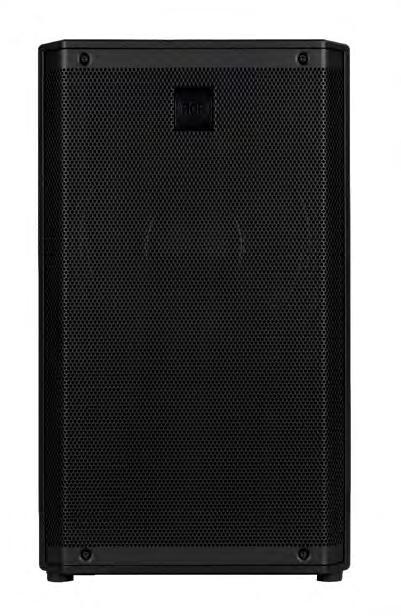
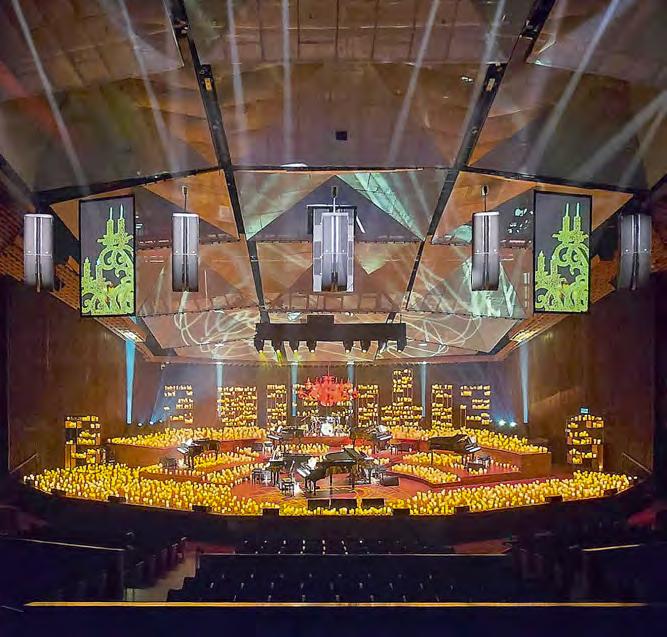
An immersive L-Acoustics L-ISA configuration is elevating performances at Tel Aviv’s Lowy Hall, following an audio upgrade designed to complement the venue’s architectural significance and acoustic heritage.
Lowy Hall opened in 1957 and was designed by Dov Karmi and Ze’ev Rechter, founding architects of the State of Israel. Home to the Israel Philharmonic Orchestra, the wood-lined hall within the Charles Bronfman Auditorium has hosted performers including Frank Sinatra, Barbra Streisand and Leonard Bernstein, alongside leading international orchestras. In 2013, acoustician Yasuhisa Toyota renovated the 2,479-seat amphitheatre-style venue. Today, Lowy Hall hosts classical, jazz and pop concerts, as well as choirs, conferences and ceremonies.
AV consultant Harel Tabibi was commissioned to design and oversee the latest upgrade, producing a tender that attracted three global manufacturers. As Israel’s first permanent immersive audio installation, the selection process was critical. Tabibi evaluated sound quality, artist specification compliance, usability for visiting engineers and visual integration within the protected structure. L-Acoustics partner Sincopa 2002 was awarded the contract, with Charmer Group handling integration alongside Assa Efrat and the L-Acoustics application team.
Design development began in close collaboration with the manufacturer. “The Israel Philharmonic Orchestra not only performs in the hall but rehearses there daily,” said Efrat. “We coordinated around their schedule and used a month-long closure for installation.”
A key challenge was achieving precise loudspeaker positioning while preserving existing infrastructure. “We replaced ceiling infrastructure and lighting to accommodate the L-ISA stage-wide configuration,” said
Bringing together systems integrators, consultants and AV professionals from across the region, Venuetech recently hosted a Demo Day at the SEE Institute in Dubai. The session featured a technical programme focused on compact, high-performance audio systems and their application in contemporary venues, showcasing solutions from AuviTran, Meyer Sound and Sennheiser.
According to the distributor, the event addressed increasing industry demand for space-efficient, scalable and network-ready solutions across corporate, education, hospitality and live performance environments. Manufacturer-led sessions combined technical presentations with live demonstrations and deployment insights, allowing attendees to evaluate system performance and integration strategies in real-world contexts.
demonstration of configuration and monitoring workflows.
“Spectera WMAS represents a shift in how wireless audio systems are designed and managed,” Burr said. “Sessions like this help professionals understand not only the technology itself, but how it integrates into everyday workflows.”
Loudspeaker solutions were presented by Andrea Granata, sales manager for the Middle East, Africa and India at Meyer Sound, highlighting the Ultra-X series for small- to mid-sized venues. “Point source loudspeakers are becoming central again in modern venues, especially with the increasing demand for spatial audio options,” noted Granata, “The discussion focused on delivering performance and flexibility while enhancing overall audio quality.”
Audio networking and deployment were addressed in a session led by Stéphane
Omri “BaBu” Levy of Charmer Group. “The goal was to integrate new technology without compromising the hall’s historic aesthetic or acoustic performance.”
Sincopa also hosted the venue’s technical team at L-Acoustics’ Marcoussis facility to experience the L2 line source system. Soundvision software was used to model and refine the design prior to deployment.
Lowy Hall now features five hangs of one L2 over an L2D, with two extension hangs of four A10 clusters per side for wider seating coverage. A centre-hung array of six KS28 subwoofers in cardioid mode is integrated into the ceiling, whose net-like construction allows low frequencies to pass through without affecting sightlines. Ten Kiva II provide front fill, while side balconies are covered by four X6i per side. A mobile system of two KS21 subwoofers and A15 Wide and Focus loudspeakers can be repositioned as required.
Processing is handled by 12 LA7.16i amplified controllers and LA12X units for the subwoofers. With no house console, the system accommodates visiting productions via a dedicated technical room housing control computers, a master clock and redundant LS10 Milan-AVB switches. Connectivity runs from FOH to a dedicated amplifier room via fibre, with L-Acoustics P1 processors converting analogue and AES3 inputs into Milan-AVB streams across a fully redundant network.
Engineers have reported clear improvements. Mix engineer Eran Pereldik described the sound as “clear and crisp”, with improved intelligibility at lower levels. Lior Tevet highlighted consistency across seating positions, while FOH engineer Yossi Lugassi praised its ability to overcome the hall’s reverberation characteristics.
www.l-acoustics.com www.sincopa2002.co.il
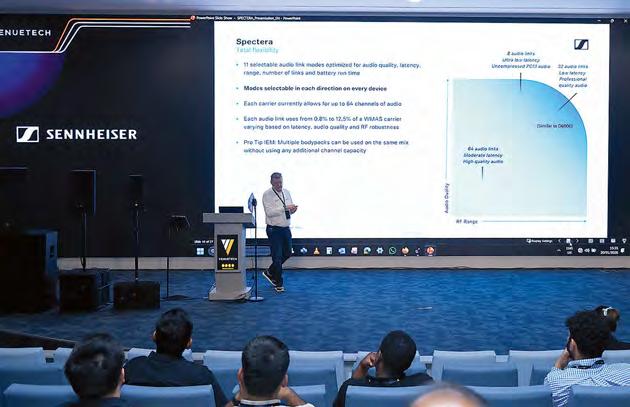
A central demonstration highlighted the integration of multiple technologies within a single, compact system rack.
Alice Macaluso, pro audio manager at Venuetech, said: “We presented a live demonstration of the most compact system configuration among the three brands. The demo highlighted a design philosophy focused on achieving extremely high channel density and advanced loudspeaker deployment within the smallest possible footprint.”
As Macaluso explained: “The system integrated 64 RF channels, more than 1,000 matrix processing channels, AVBnative loudspeakers and a dedicated spatial audio processor, all housed within a single rack.”
Wireless audio was explored during a session led by Ryan Burr, head of technical sales and application engineering at Sennheiser, focusing on the company’s Spectera WMAS platform. The presentation covered bidirectional transmission, spectrum efficiency and system architecture, followed by a live
Bert, pre-sales manager at Digigram, who presented AuviTran Audio ToolBox solutions. “The session highlighted a practical approach to building scalable, reliable systems from diverse AoIP and legacy technologies,” Bert said. “Central to this is interoperability, where AuviTran bridges serve as the gateway; seamlessly converting and routing signals between formats like Dante, Milan and AES67/ ST 2110 to unite legacy I/O within a unified, high-capacity network.”
Live demonstrations and international case studies complemented the technical sessions, illustrating how compact, highperformance audio systems are being deployed across a range of venue types. Venuetech revealed it plans to host similar technical events in the future, as part of its ongoing engagement with the professional AV community.
www.auvitran.com
www.meyersound.com
www.sennheiser.com
www.venuetech.ae











































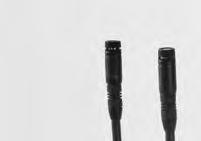








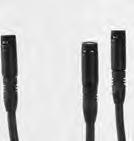













































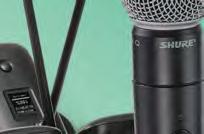



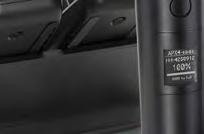











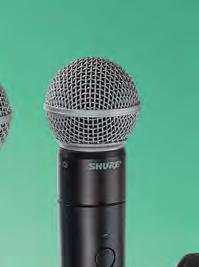




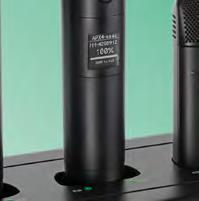



































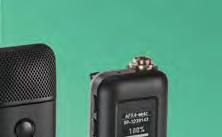




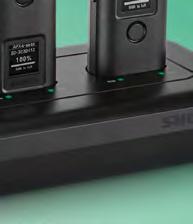
















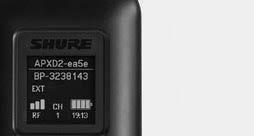

















INTRODUCING MICROFLEX® WIRELESS

Enhance your wireless audio offerings with the new Microflex Wireless (MXW) neXt microphone system. Now with 4 and 8 channel options, streamlined deployment with Designer 6, and ShureCloud remote management, transform and set up the most complex spaces in minutes. With MXW neXt any big turnout is simply solved.





Current Microsoft Teams Certified solutions include MXWAPX8, MXW6X, MXN5-C. Contact us for live demonstration.
Tel: +971 4 266 5244 | Email: info@nmkelectronics.com
Website: www.nmkelectronics.com |





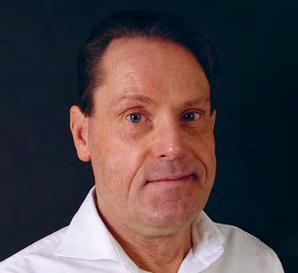
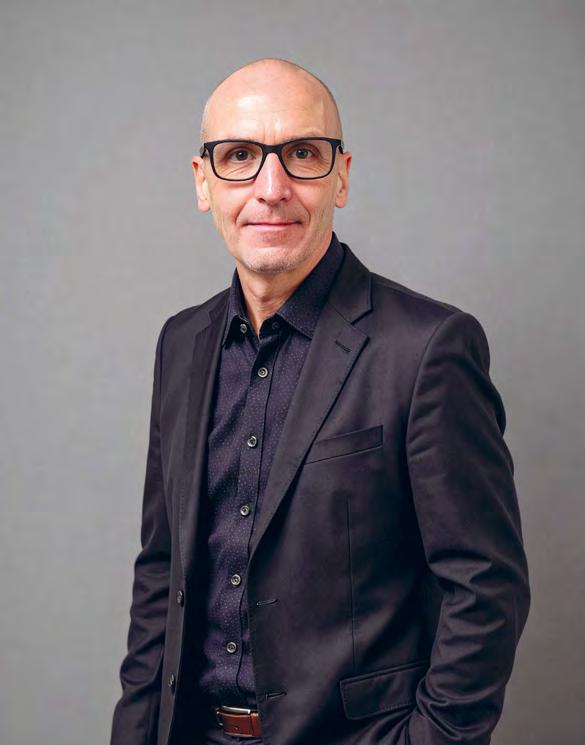


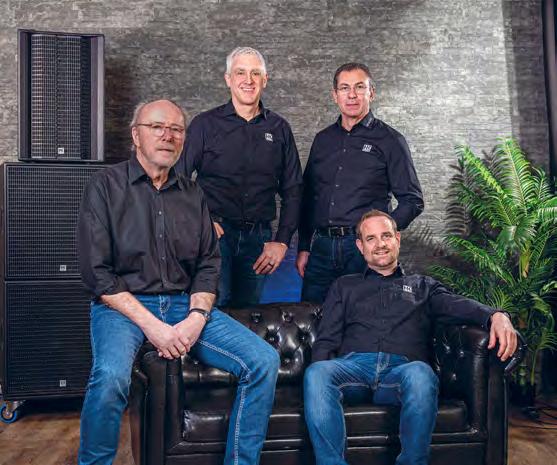
HK Audio has announced that an experienced internal management team has taken over management of the business, led by company founder and MD Lothar Stamer. The new team consists of three long-standing executives who have played a key role in shaping and developing HK Audio over many years: Christian Jordan, CSO and CMO, Holger Kartes, CTO and COO and Stefan Persch, CFO. The management tasks have been transferred to the new leadership trio gradually and in close consultation since the beginning of 2026. The management team brings a wealth of combined experience in their respective areas of responsibility, as well as trust both internally and among international partners and customers. Jordan has been responsible for HK Audio’s
international sales and marketing strategy for many years and has contributed significantly to the global positioning of the brand.
Kartes brings technological expertise in production, the global supply chain and the consistent further development of “Made in Germany” product and system solutions. Lastly, Persch brings expertise in the areas of finance, controlling and corporate management and will provide economic stability and sustainable growth.
“With Christian Jordan, Holger Kartes and Stefan Persch, we are handing over responsibility to a team that knows the brand, the market and our values down to the last detail,” said Stamer.
“I am convinced that HK Audio is perfectly positioned for the future with this leadership.”
www.hkaudio.com
Olivier Maynard has been appointed into the role of executive director of strategic market development at L-Acoustics. The recently established division regroups three core disciplines –business development, creative engagement and market intelligence. In his new role, Maynard will spearhead commercial innovation, developing new business models from concept to implementation throughout the organisation. Joining the company’s executive committee, he will work alongside the leadership team and will report directly to

Sonic Electronics has appointed new general managers for both its Qatar and MEA operations. Through the move, Victor Bitar will lead the company’s Qatari division, while Girish Nair assumes the position in the MEA region.
Bitar brings extensive experience in AV technology, sales leadership, business development and management which he will leverage to advance the company’s regional strategy. During his career, he has served as regional sales manager at companies including Lightware, Crestron and others.
“I’m excited to take this role and join the Sonic Electronics team at this important stage and I look forward to building on the company’s strengths, empowering people behind the work and driving sustainable growth across the professional AV market together,” Bitar said.

Nair boasts extensive leadership experience and a proven track record in driving business growth, fostering strategic partnerships and expanding market presence.
At Sonic Electronics, he will play a pivotal role in shaping the company’s regional strategy, strengthening channel relationships and expanding its technology portfolio. He joins from BenQ Middle East, where he served as regional sales manager, leading sales initiatives and contributing to market development.
“This opportunity marks an important step in expanding my expertise within the audio video solutions industry,” commented Nair. “I look forward to contributing to the organisation’s growth, collaborating with industry partners and deepening my understanding of the AV ecosystem.”
www.sonicelec.com
L-Acoustics co-CEO, Laurent Vaissié.
“In an industry where detailed market data is scarce, our ability to truly understand our customers, their challenges and their ambitions gives us a decisive advantage,” said Maynard. “Our mission is to support our clients’ business by engaging end users in ways that are inspirational and experiential rather than purely technical. By working hand-in-hand with our sales teams in every territory, we’re creating sustainable demand that benefits our entire partner ecosystem.”
www.l-acoustics.com
Expanding its presence in the region’s growing installation and live event solutions market, Outline has appointed Riccos Sound & Lights as its exclusive distributor for Cyprus. The deal was confirmed following a visit to the manufacturer’s headquarters in Italy by Pambos and Dimitris Christodoulou, the brothers behind Riccos Sound & Lights, reflecting a shared approach to technology, service and long-term development.

Fernando Rey Méndez, Outline’s sales and marketing director, commented:
“Hosting Pambos and Dimitris offered us the opportunity to show not only our technologies, but also the way we work as an organisation. When partners see how coordinated and methodical this process is, it becomes easier to understand the culture behind our products.”
Founded in 1989, Riccos Sound & Lights is a family-owned company in the pro audio and lighting industry in Cyprus. “Outline has always struck us as a company that builds things with intention – solid engineering, real durability and a clear technical identity,” noted Pambos.
“That made us confident this partnership would be a good match.”
According to Riccos Sound & Lights, Outline’s product families align well with the Cypriot market. The company highlighted the P Series for rental and installation use across live sound, theatre and corporate events, as well as fixed installations in clubs and theatres.
www.outline.it
www.riccossound.com
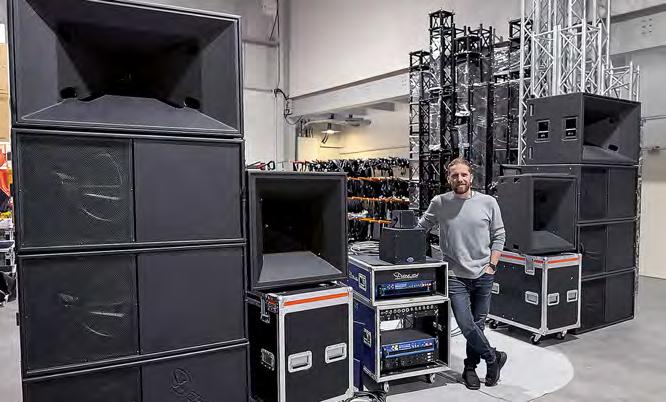
Strengthening the brand’s presence across the GCC’s pro audio market, Danley Sound Labs has appointed Avail MEA Trading as its official distributor for the region.
The collaboration aims to capitalise on the GCC’s ongoing investment into hospitality, entertainment, theme parks and sports infrastructure, enhancing availability of the brand’s audio solutions for a diverse range of applications – from installed sound in hotels, lounges and nightclubs to systems for stadiums, arenas and large public spaces.
“From the very first listening tests, the clarity and precision of Danley loudspeakers stunned us,” commented Jan Tarakji, sales director, Avail MEA. “The Synergy Horns are
remarkable and the subwoofers are nothing short of breathtaking. We’re excited to bring this level of performance to our partners’ projects.”
Gregor Ward, director of Danley Distribution, said: “From our very first conversations, it was clear that the Avail team brings a wealth of technical knowledge, along with extensive industry relationships across the GCC region.”
Pavel Shemiakin, managing partner at Avail MEA, concluded: “Danley’s unique approach to loudspeaker design, combined with its reputation for uncompromising performance, aligns perfectly with the demands of our market.”
www.avail-int.com
www.danleysoundlabs.com
Electro-Voice and Dynacord have named ApexPro as their sole distributor for South Africa. ApexPro is the distribution arm of the Prosound Group, giving the distributor a relationship with the brands that spans more than 50 years.
“We are delighted to team up with ApexPro,” said Christian Gress, sales director export EMEA, Electro-Voice and Dynacord. “The team there has always worked hard to make both brands successful across the region and played a key role in some of the most important projects in our history. Their combination of technical understanding and customer focus makes them the perfect partner for this region.”
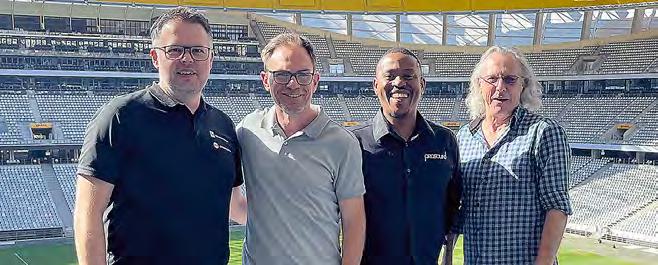
“The Electro-Voice and Dynacord brands are deeply embedded in the history and evolution of our business and represent far more than products within a portfolio,” said Justin Acres, director at ApexPro. “The partnership is grounded in shared values – strong R&D, intelligent engineering and a passion for audio
that delivers meaningful, emotional impact when correctly implemented.”
The appointment has been designed to provide clarity to the Southern African market. There had recently been a period of dual distribution which this new relationship now replaces. “With the new, simplified distribution model, the channel has been cleaned up, partner confidence has been strengthened and customers can once again engage with the brands knowing there is clear, stable and fully supported representation through ApexPro in Southern Africa,” explained Acres.
www.dynacord.com www.electrovoice.com www.prosound.co.za
DWR has bolstered its portfolio through its new distribution agreements with both DirectOut Technologies and Panasonic.
Based in Germany, DirectOut develops professional audio connectivity, networking and bridging solutions for broadcast, studio, live and installed sound applications.
“After a period of searching, we know we’ve found a solid and well-established partner in DWR that is perfectly positioned to support our customers in the region,” commented Lorenzo Sassi, head of sales, DirectOut. “Their reputation precedes them and the brands they represent are a testament to this.”
DWR managing director Duncan Riley commented: “DirectOut enables audio engineers and technicians to elevate their sound to a more
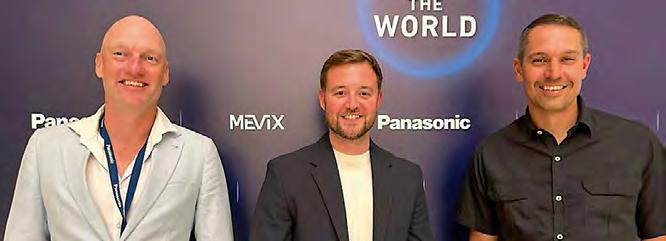
professional level, ensuring optimal integration, flexibility and redundancy. It brings peace of mind and tremendous value to the range of products we already represent.”
Through its partnership with Panasonic MEVIX (Media, Entertainment, Visual Transformation), the distributor will now offer customers access to the full range of Panasonic Business
Projectors, as well as the manufacturer’s high brightness range. Furthermore, DWR’s technical support team has undergone extensive training and is now an official Panasonic service and maintenance centre. “We can now service the business projector market, high-end staging and retail which is incredibly exciting,” noted Timothy Wilson, strategic partnerships development manager – SI channel, DWR.
“From the first meeting, it was clear that DWR has the necessary skills, expertise and people to drive our brand forward in South Africa,” added Anthony Molloy, division head of projector and display division, Panasonic Marketing MEA.
www.directout.eu
www.dwrdistribution.co.za


























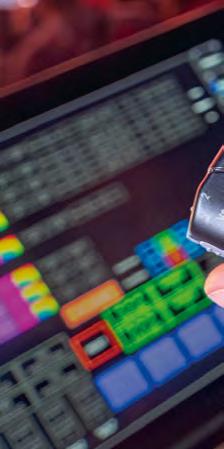

All the wireless power, audio clarity, and seamless integration you expect from Bolero now in a lighter, smaller form. With proven Boleroperformanceinacompactanddiscreet body, Bolero Mini is ready for any challenge inbroadcast,sports,orliveevents.















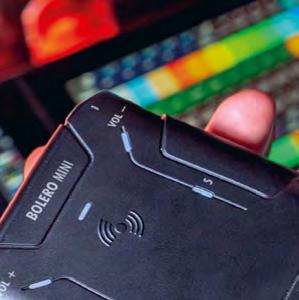




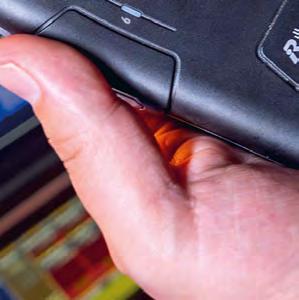


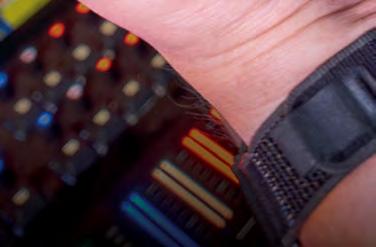












•165g,28mmthin •Touch&GoNFCbeltpackregistration •Bluetoothconnectivity •Riedel-exclusiveAdvanced DECTReceiver(ADR)




Following its successful trading relationship with Tech Ease Systems across East Africa, Martin Audio has elevated the partnership by appointing the reseller as its official distribution partner for the region. The company was previously promoting the brand on an informal basis throughout Uganda, Kenya, Tanzania, DR Congo, Rwanda and Burundi. Under the new agreement, Tech Ease Systems will cover these territories from its headquarters in Kampala, supported by staff in other regional locations. The distributor has also been working closely with Martin Audio’s Product Support Group (PSG) on virtual systems training, with in-person training planned for this year.
According to Tech Ease Systems founder and systems consultant Vincent Kasule: “Music is a major part of African cultural expression and demand for quality is growing in the region, especially in the house of worship and rental sectors.”
To service major one-off concerts featuring international and local acts, the distributor plans to establish Martin Audio’s largerformat systems. “There is already an entity in DR Congo that holds WPL, WPC, SXH and XE inventory, and we are in talks with others in Kenya,” said Kasule, adding that the company will host local and regional open days and demo sessions to extend outreach.

Martin Audio EMEA account manager Andy Duffield commented: “Since 2018, the team at Tech Ease Systems have consistently impressed with their technical competence, proactive sales and customer-focused approach.”
www.martin-audio.com www.techeasesystems.net
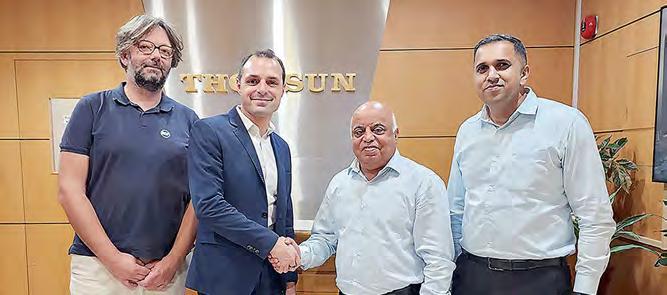
RCF and TT+ Audio have expanded their presence in Saudi Arabia through a new distribution deal with Innovative Audio Solutions, a division of the Thomsun Group.
Innovative Audio Solutions will manage sales and support for both audio brands throughout the country. With a presence in the GCC since 1976, Thomsun Trading has built a comprehensive distribution network and an extensive customer base across multiple sectors.
RCF and TT+ Audio noted that, as they continue to strengthen their reach in the Middle East, they sought a technically proficient and market-aware partner for Saudi Arabia. The Kingdom is a priority market for both brands as the region advances
wide-ranging developments across tourism, culture, entertainment and hospitality.
“Thomsun’s long-standing track record in the GCC region and their investment in audio distribution infrastructure make them a strong choice for our presence in Saudi Arabia,” commented Luca Ombrati, sales manager, RCF. “We are confident that Innovative Audio Solutions will support our customers with the same professionalism and market understanding that define our global network.”
www.innovativeproaudio.com www.rcf.it www.ttaudio.com
NMK Electronics has announced it has assumed exclusive distribution across the GCC for ChamSys, a UK-based manufacturer of lighting control systems and a member of the Chauvet Group.
Expanding NMK’s lighting portfolio, the partnership complements the company’s existing distribution of Chauvet Professional products. It is hoped that the integration of ChamSys’ lighting control solutions will strengthen the distributor’s end-to-end lighting ecosystem to deliver a more holistic experience for lighting professionals across the region.
Audio Technology has been appointed as the exclusive distributor for Epson projection solutions in Egypt. The partnership is aimed at broadening market access to the brand’s projection technologies across the corporate, education, government and entertainment sectors.
“With over 30 years of deep expertise in the audiovisual industry, Audio Technology brings an exceptional level of technical excellence and market insight,” commented Ahmad Abuzannad, regional sales manager, Epson. “Their highly skilled team and strong local presence make them an ideal partner
The partnership is designed to support a wide range of applications from live events and rental environments to broadcast studios, hospitality venues and architectural projects.
“Our focus has always been on building a portfolio that enables our customers to design, deploy and operate complete solutions with confidence,” said Dino Drimakis, director, strategic development, MESEA, NMK Electronics. “ChamSys strengthens that vision by adding worldclass lighting control to an already powerful lighting technology offering. This is about
giving the market access to a complete, future-ready solution under one trusted partner.”
Through the agreement, customers in the GCC will be able to access both lighting fixtures and control platforms through a regional partner supported by local enablement, training and technical guidance.
“We are excited to partner with NMK Electronics to bring ChamSys solutions to the Middle East,” said Simon Cox, EMEA business development manager at ChamSys. “NMK’s extensive network and commitment to excellence make them an
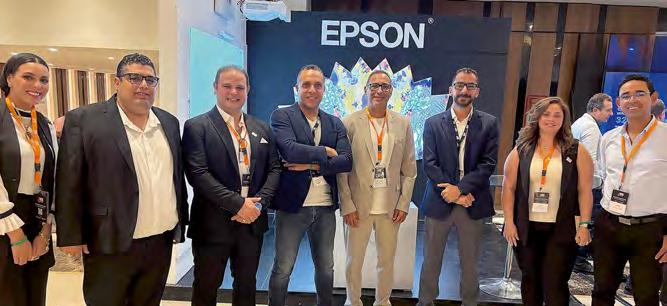
ideal partner to support our growth in this dynamic market.”
NMK plans to launch the ChamSys line through targeted marketing campaigns, training sessions via the NMK Academy and live demonstrations at upcoming industry events. These initiatives aim to equip systems integrators, rental companies and lighting designers with the knowledge and tools to leverage ChamSys’ technology in real-world workflows and deployments.
www.chamsyslighting.com
www.nmkelectronics.com
for Epson’s professional video projector range as we expand our footprint across key sectors in Egypt.”
Jacko Makram, regional pro AV pre-sales and design manager at Audio Technology, added: “This partnership marks an exciting next chapter for Audio Technology as we align with an industry-leading innovator. By working alongside Epson, we can deliver more integrated, high-performance solutions that elevate the end user experience and unlock new opportunities for growth.”
www.audioteceg.com
www.epson.com
KUWAIT
Enhancing its presence in the region, Montarbo has appointed Zeriab & Barakat Musical Instruments as its official distributor in Kuwait. The partnership has been launched to ensure ongoing support and availability for local users, musicians and audio technicians.
Montarbo highlighted the steady expansion of Kuwait’s pro audio sector, driven by increasing demand for reliable equipment for live events, venues and growing interest in music production among younger creators. Due to this, the Italian manufacturer sees strong potential for its professional sound systems in the country’s increasingly dynamic market. The collaboration with
Galtech Trading has been appointed as the exclusive distribution partner for FlatPanel Audio in the GCC. The partnership is designed to grow the US brand’s presence, support major project opportunities and enhance availability of the manufacturer’s audio solutions in the local market.
“As demand for high-performance audio solutions continues to accelerate across
the Middle East, establishing a strong and knowledgeable regional partner has been a strategic priority for our global expansion,” said Gary Vlaeminck, director of international sales, FlatPanel Audio. “Galtech Trading brings an exceptional track record in professional AV distribution, deep regional market expertise and an established network of integrators and
consultants – making them the ideal partner to represent FlatPanel Audio across the GCC.”
FlatPanel Audio provides architectural sound solutions based on vibrational panel Distributed Mode Loudspeaker (DML) technology. The brand’s audio systems are suitable for museums, offices, commercial interiors, retail environments and public spaces where both
Zeriab aims to capitalise on this potential, ensuring continuity, efficiency and quality of service in the region.
“We are pleased with our collaboration with Montarbo,” remarked Essam Barakat, manager at Zeriab & Barakat. “For us, this represents an important step, also supported by the introduction of increasingly structured after-sales services designed to best support the brand’s growth in the markets in which we operate. In addition, our company will organise a series of customer events to present each new Montarbo product as it becomes available.”
www.montarbo.com
www.zeriabkw.com
acoustic performance and visual discretion are required.
Under the terms of the agreement, Galtech will provide localised sales support, technical training, project consultation and logistics infrastructure.
www.flatpanelaudio.com www.galtechtrading.com


As co-founder and managing director of JAA Systems in Kuala Lumpur, Malaysia, I oversee the business and lead our team of 10 engineers and staff. In 2024, we proudly celebrated our 10th anniversary, marking a decade of growth, innovation and commitment to excellence.
My role centres on delivering professional solutions across audio, video and IP technologies. We focus on using the latest advancements to design cost-effective systems while providing strong after-sales support. Our core business serves the broadcasting, audiovisual and live sound markets throughout Southeast Asia.
What inspired you to get into hiking?
I owe my interest in hiking to my wife, Ann. She has always been very focused on fitness and encouraged me to get involved. A few years ago, I joined a fitness group and, although I started later in life, it felt natural rather than forced. From there, hiking followed naturally. We now hike regularly, sometimes just the two of us and sometimes with larger groups. Hiking has grown in popularity in Malaysia and what began as a fitness goal quickly became something I genuinely enjoy.

Is there a standout place for you?
My most memorable climb is Mount Kinabalu on the island of Borneo. It’s the highest mountain in Malaysia and one of the highest I’ve climbed. Reaching the summit was a huge achievement and the feeling was priceless. That moment showed me just how rewarding hiking can be.
I also enjoyed climbing Mount Yotei in Hokkaido, Japan, last summer. While it isn’t as high as Kinabalu, the sense of achievement was just as strong. Looking ahead, I’d love to take on trail hikes in Nepal and explore more hiking opportunities in Europe.
What kind of preparation do you need before these climbs?
Preparation is essential. You don’t need extreme training, but a good level of fitness is important, particularly to strengthen your legs and avoid injury or fatigue. I usually train by hiking smaller hills regularly and going to the gym to build strength. Overall conditioning is key to an enjoyable hike.
What are some of the biggest challenges you face?
The biggest challenge is mental. Midway through a climb, exhaustion sets in, water may be running low and muscles start to ache. That’s when you have to push yourself and remember that turning back isn’t always an option. Encouragement from fellow hikers is vital. Ann, in particular, is very supportive, and we motivate each other to keep moving forward, step by step.
Why do you find this hobby beneficial outside of your busy schedule?
Hiking is a great way to de-stress from work. It keeps me active and healthy while allowing me to release stress physically. There’s also a strong mental focus – you’re present in the moment and concentrating on reaching the
summit. Staying aware of your surroundings and handling unexpected situations keeps you alert and engaged.
Do these benefits have an impact on your work life?
Definitely. Hiking helps clear my mind and often sparks new ideas. When I reach the top of a summit and take in the view, I feel a strong sense of clarity and calm. Those moments give me space to reflect and think about future plans, both personally and professionally.
Conquering a summit is similar to building a career or business. There are challenges along the way, but perseverance and self-motivation are essential. The only way to succeed is to keep climbing until you reach the top.
Why do you feel it’s important to have an outlet outside of work?
Having a passion outside of work is essential for mental wellbeing. Many of us work too much, which isn’t healthy longterm. Staying active helps maintain both physical and mental health, especially as you get older. After a demanding climb, I feel refreshed, centred and able to think clearly again.
What other activities do you do to stay active?
I’m part of a local fitness group and regularly take part in events such as the Spartan Race and Viper Challenge, which feature up to 50 obstacles testing strength, agility and endurance. Most participants are much younger than me, so completing the course feels especially rewarding and makes me feel young again.
Fitness can be addictive. After completing the Spartan and Viper Challenge, I’ve already suggested to Ann that we try the HYROX fitness challenge next. I enjoy pushing myself and taking on new challenges. Life is too short not to try – as long as my body allows it, why not take on the next one?
www.jaasys.com
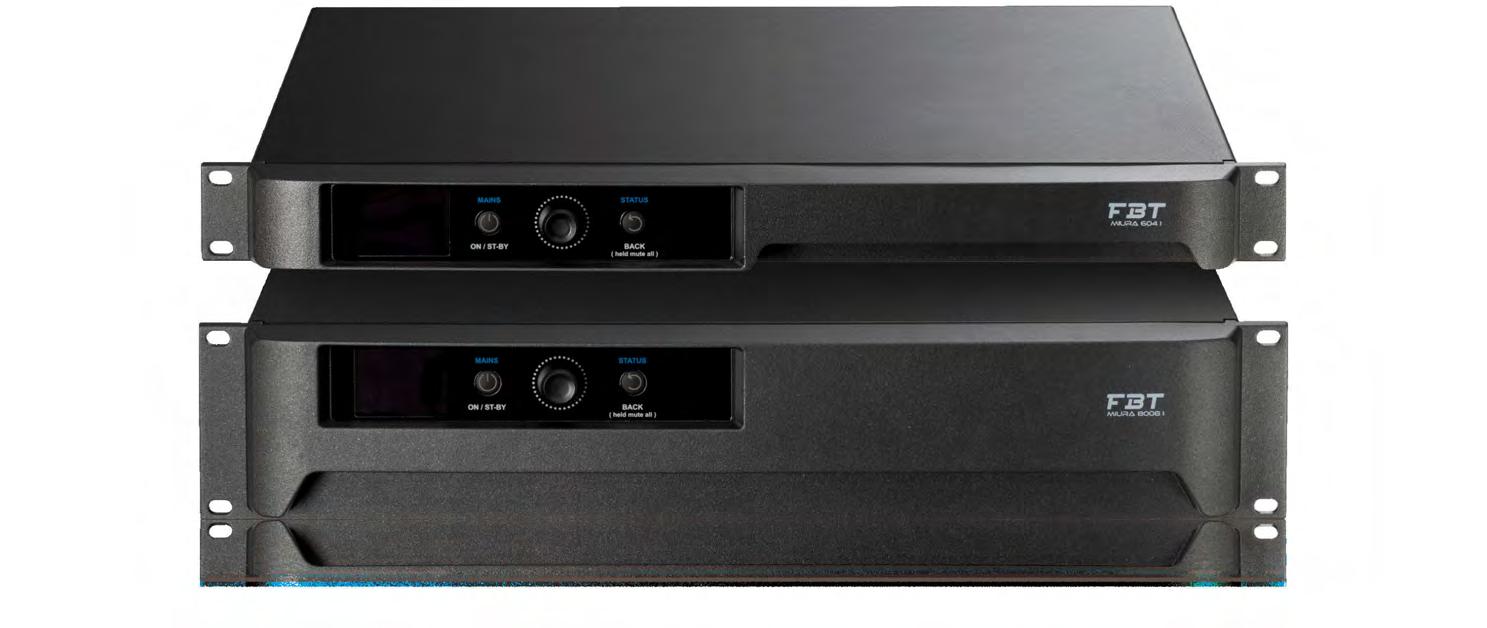

Sonido Technology reimagines Buddha-Bar Dubai’s guest experience with a modern, performance-led AV approach
FEW HOSPITALITY BRANDS PLACE AS MUCH LONGterm emphasis on atmosphere as Buddha-Bar. Designed to evolve sonically as the evening unfolds, each venue in the brand’s global portfolio operates somewhere between restaurant, lounge and performance environment. Music is never incidental, but neither is it designed to overwhelm. The challenge lies in creating an experience that can scale naturally, night after night, without losing control.
At the Dubai venue, which first opened more than two decades ago, that balance had become increasingly difficult to maintain. While the programme and concept remained as popular as ever, the underlying AV infrastructure was no longer aligned with how the venue now operates. After several years of discussion, the decision was taken to embark on a comprehensive system refresh, bringing performance, control and operational flexibility back into step with the venue’s ambitions.
Led by founder Gareth Armstrong, Sonido Technology was initially engaged as a consultant as part of a wider restaurant refresh. Rather than beginning with equipment selection, Sonido’s role was to step back and assess how sound and performance functioned across the venue as a whole. That consultative phase ultimately led to the company being appointed to design and deliver the full audio, entertainment and control solution.
“The goal was never just to change boxes,” Armstrong explains. “It was about understanding how the venue actually works now and rethinking how sound supports that, rather than forcing it into a fixed category.”
Although the venue had previously operated on systems from other manufacturers, discussions around a move to Void Acoustics had been ongoing for several years. For the client, the decision hinged less on headline performance and more on long-term confidence in design, delivery and support. Sonido’s familiarity with the brand, combined with its advisory role on the project, provided the assurance needed to move forward.
“Sound quality matters, but for a venue like this it’s just as much about professionalism and after-sales support,” Armstrong notes. “They wanted to know the system could be maintained, adapted and supported properly over time. Control platforms, amplification and monitoring have moved on significantly, and so has the way Buddha-Bar is programmed. It was time to bring the infrastructure up to date – to modernise it without changing the character of the venue.”
Crucially, the brief was never about turning Buddha-Bar into a nightclub. While DJs anchor the evening’s soundtrack, live elements are central to the experience, including saxophone, multiple percussion instruments and choreographed aerial performance acts that appear throughout the night. A typical service progresses from dinner at controlled levels into a more performance-led atmosphere later on, often incorporating more than 10 live segments over the course of an evening.
That gradual progression shaped every aspect of the audio design. Rather than relying on concentrated output, Sonido adopted a highly distributed approach, allowing energy to build naturally without excessive volume or listener fatigue.
Loudspeakers from Void Acoustics were specified across the space, with a combination of Air Series and Cyclone Series models deployed throughout reception areas, bars, dining spaces, private rooms, VIP zones and the upstairs Dragon Bar.
“The more evenly you distribute the system, the less you need to push it,” Armstrong says. “That’s especially important in a venue like this, where people still need to talk earlier in the evening. You want scale, but you don’t want aggression.”
Aesthetics played a significant role in those decisions. “Void doesn’t look like a generic black box, which makes a big difference in a theatrical space like this,” he adds. “Being able to use different series across the same project gave us the flexibility to match both form and performance to each area, without losing a consistent character.”
Low-frequency energy is equally integral to the experience, particularly as the venue transitions into its later operating modes. Rather than relying on a single sub-heavy focal point, Sonido implemented a distributed subwoofer strategy designed to work within the constraints of a hotel environment. With guest rooms and public areas located above, controlling low-frequency transmission was as important as delivering impact on the floor.
“Instead of fixing the system to a single tuning, we created multiple bass profiles that can be recalled depending on occupancy and programme,” Armstrong explains. “Bass is subjective. Some nights they want more weight, some nights less. We’ve given them flexibility without compromising the system.”
Amplification is handled via Void’s Bias platform, with system processing and show-level control managed through a Q-SYS Core 110f. Scene-based recall, zoning and remote access form a key part of the operational strategy, allowing Sonido to intervene quickly if required. “If something gets changed by staff when it shouldn’t, we can log in remotely and restore the system very quickly,” Armstrong furthers. “That kind of reliability is essential when you’re dealing with a live performance every night.”
Live audio is managed through an NMK Electronics-supplied Allen & Heath SQ-5, with wireless microphones from Shure’s SLX-D range used for saxophone and percussion. A distributed RF antenna system supports performer movement throughout the venue, while Dante-based audio transport underpins routing across zones and sources.
Operational simplicity was another guiding principle. Five core audio zones were defined, with iPad-based user control deliberately limited to prevent unintended adjustments. “You want to give staff enough control to do their job, but not so much that they can break things,” Armstrong notes. “In
hospitality, everyone has an opinion about sound. The system needs to protect itself.”
Alongside audio, Sonido also refreshed elements of the venue’s entertainment lighting and effects. Custom DMXcontrolled LED strip lighting was integrated into the venue’s 18m-high glass façade, requiring precise alignment to avoid visible joins. Additional effects, including haze, fog and laser elements, were introduced to support the live performance programme, with careful attention paid to airflow and odour control to ensure the dining experience remained unaffected.
To manage these new elements, Sonido implemented a lighting control layer based on MADRIX, used for animated, pixel-mapped and audio-responsive lighting effects. Q-SYS provides triggering and scene recall at the system level, allowing lighting (controlled via an Avolites console) and audio behaviour to be coordinated without overcomplicating operation.
“We went with MADRIX because the brief was about animated, performance-led lighting rather than conventional cue-based operation,” Armstrong explains. “It gave us far more flexibility for pixel control and sound-to-light interaction, which suits how Buddha-Bar actually runs night to night.”
Rather than a single extended shutdown, the project unfolded over close to three years as a phased and carefully managed
process, shaped around the realities of operating a hightraffic hospitality venue. The refreshed system was finalised towards the end of 2025, with the venue continuing to trade throughout.
Since reopening, Buddha-Bar Dubai has continued to draw near-capacity crowds on a nightly basis, a response Armstrong sees as the most meaningful measure of success.
“Buddha-Bar has been around for a long time, so it doesn’t have the luxury of being one of Dubai’s newest or trendiest venues,” he says. “When people keep coming back months later, you know the experience is working. They might not consciously talk about the audio, but it’s shaping how they feel in the room.”
In a market as competitive as Dubai’s hospitality sector, that ability to deliver consistency over time is increasingly critical. For Sonido Technology, the Buddha-Bar project demonstrates how a consultative, performance-led approach to AV can renew an established venue without changing its identity, ensuring it continues to perform long after opening night.
www.buddhabar-dubai.com www.sonido-tech.com www.voidacoustics.com
Combining dome-based projection, spatial audio and centralised control, TMCA Group and PRO LAB have delivered a multi-zone immersive AV environment for Tahakom
TELLING THE STORY OF SAUDI HISTORY AND THE development of traffic policing through projection, spatial audio and tightly linked show control, Tahakom’s new Tahakkum Dome in Saudi Arabia has been delivered as an immersive audiovisual environment designed to communicate a specific national narrative. Created for the Saudi Technology and Security Comprehensive Control Company (Tahakom), the installation sits within the organisation’s broader public safety
and smart mobility remit, aligning with the Kingdom’s Vision 2030 direction for intelligent city systems.
Executed by Saudi systems integrator TMCA Group, the project was supported by PRO LAB, which supplied the core audiovisual ecosystem. The relationship between the two companies was initiated at the Saudi Light & Sound Exhibition (SLS), where early discussions developed into a full technical collaboration. The project was delivered with Mahmoud Omran
Basmouk Co (MOBC) acting as contractor alongside TMCA, supporting coordination, integration quality and schedule management.
At the centre of the attraction is the dome itself, built around a 360° projection concept that extends beyond walls to incorporate the floor as part of the visual canvas. A total of 10 Panasonic PT-RQ10 projectors were deployed, with four covering the curved dome wall surface and a further six dedicated to floor projection. To manage alignment and blending across multiple projection planes, VIOSO servers were employed, supported by an auto camera calibration position located in the middle of the dome to streamline geometry correction and calibration.

Audio for the dome was designed to support the client’s immersive intent without visually dominating the space. TMCA selected BEC akustik IC50 loudspeakers for the main immersive environment, citing the combination of sound quality and a minimalist, non-obtrusive physical design as the deciding factors. For the remaining areas, Martin Audio Adorn Series loudspeakers were used to support distributed background audio, with the selection justified on the basis of maintaining a consistent sonic profile regardless of mounting option. The overall system was not confined to a single show space. In total, seven distinct zones were delivered across two floors, combining the dome attraction with additional environments that required different content and interaction models. Alongside background audio across the facility, the system includes four rooms capable of hosting video presentations where audio is triggered via a third-party video server, a zone featuring an interactive AI engine that supplies an audio feed into the wider AV system and a wireless presenter microphone integrated with both the main audio infrastructure and the AI-driven element. The result is a project that mixes conventional AV presentation spaces with interactive and experiential elements, all sitting under a single operational framework.
That requirement for a unified operational framework shaped the approach to control and processing. LD Systems LDQTP8 and
LDQTP5 touchpanels have been installed as wall-mounted user interfaces, described by the project team as Android-based tablets suited to fixed installation control points. In this deployment they were used to control Xilica processors via the XTouch application, providing a touchscreen route into the DSP environment for day-today operation across zones.
Within the broader ecosystem, Xilica DSP and Powersoft amplification form part of the audio backbone, supporting routing, processing and power delivery across the installation. Roxtone cabling also featured heavily as part of the infrastructure build. Show playback and synchronisation have been addressed with Merging Technologies Ovation servers, which the project team positions as both a content source and a control component. In practical terms, Ovation handles audio playback across all zones, maintaining synchronisation between tracks while supporting a range of audio formats and channel counts as required. The same server platform is also used to trigger projection playback, linking audio events and visual playback into a coordinated timeline. Lighting, by contrast, was kept deliberately minimal and architectural, with the exterior of the dome illuminated using
Elsewhere, the venue incorporates Vision LED RGBW strip lighting around the site. Control for the lighting system is handled via a ChamSys MagicQ Rack console.
demanding with schedule pressures and first-time deployment challenges within the project scope. “The Public Security project by Tahakom represented a significant challenge for our team, both in delivering it within the required timeframe and in implementing advanced, innovative technologies for the first time within this scope,” explains Eng Mazen Ahmed, project technology manager at MOBC, adding that the project’s success was enabled by close collaboration with PRO LAB. “The supplier’s technical expertise and support was a primary factor in overcoming those challenges.”
TMCA Group’s Tony Germanos also emphasised performance and reliability through the delivery cycle, crediting the brands selected by PRO LAB with contributing to a “flawless outcome” from planning through installation and final tuning. Germanos noted that client feedback has been extremely positive, positioning the project as a benchmark example of TMCA’s delivery capability when paired with a supplier providing an aligned technology ecosystem.
For the Dubai-based distributor, the Tahakkum Dome is presented as a demonstration of how a consolidated portfolio
can support immersive builds that span projection, audio, lighting
engineering approach.
“The Tahakkum Dome project exemplifies the impact of bringing together bold vision, technical expertise and industry-leading technology,” says PRO LAB CEO Rami Haber. “TMCA approached the project with ambition and precision, and PRO LAB was proud to support that mission with a complete ecosystem capable of elevating every aspect of the dome’s immersive experience.” While the project’s headline feature is its immersive, domebased show environment, the wider details showcase a far wider operationally complex brief than a single-room attraction. The inclusion of multiple zones, triggered presentation spaces, an interactive AI-driven audio feed and a presenter microphone integrated into the wider system has created a venue capable of hosting a range of visitor modes, from guided narration to interactive engagement, without fragmenting the underlying technical platform.
www.prolabllc.com
Nu-Touch and Avenger Electronics collaborate on a new audio installation that sets a benchmark for gym audio quality in the UAE
OPENED IN LATE 2025 FOLLOWING AN EXTENSIVE refurbishment, Fitness First Dubai Media City has become the latest Ecler showcase on how thoughtful audio design can flexibly transform the atmosphere of a fitness environment. With 10 other outlets spread throughout the city, the Fitness First brand has developed a reputation for quality that extends throughout all elements of the gym environment.
Requiring both high-energy background and foreground music depending on use-case, the Media City location’s new AV solution has been delivered by long-term Ecler brand partner Nu-Touch, which turned to the Spanish manufacturer’s loudspeaker and amplifier ecosystem to achieve balanced, low-impedance sound throughout the facility. Working closely with regional distributor Avenger Electronics, the integrator has devised a solution that blends performance with control, meeting the site’s varied acoustic demands while still remaining simple for instructors and staff to operate. Nu-Touch founder Majed Zane has been associated with Fitness First for more than two decades, initially as a DJ and brand ambassador before expanding into AV integration. His experience on both sides of the console shaped his approach to the Dubai Media City project. “Many gyms rely on 100V background systems that often sound harsh or fail after just a few years,” Zane explains. “I wanted something that would feel warm and full, even when only a fraction of the system’s
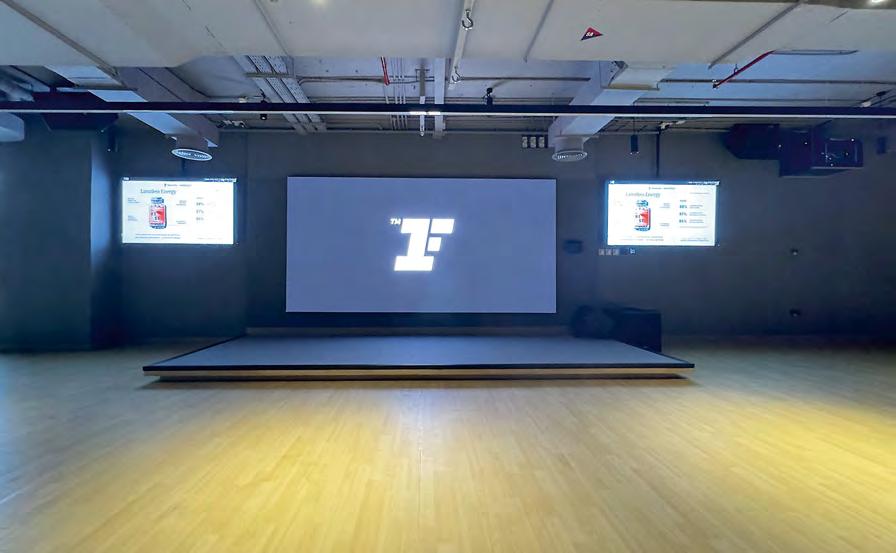
power is being utilised. The goal was for the speakers to work comfortably and still deliver energy and clarity.”
This philosophy informed all aspects of the audio design, which covers all major zones inside the two-storey venue, from the Pilates and cycling studios to the main group exercise (GX) studio, gym studios, corridors, reception and outdoor pool. To achieve consistent coverage, Nu-Touch specified more than 40 6-inch 75W Ecler DROP6 pendant speakers for the cardio, freestyle and common areas, complemented by 10 ARQIS SB10i wall-mount subwoofer cabinets. Low-impedance wiring was used throughout the training zones, with 100V lines reserved only for the eUC106 in-ceiling speakers covering the washrooms and changing rooms.
Given their contrasting intensity levels, different fitness zones required distinct tuning. The Pilates area maintains a
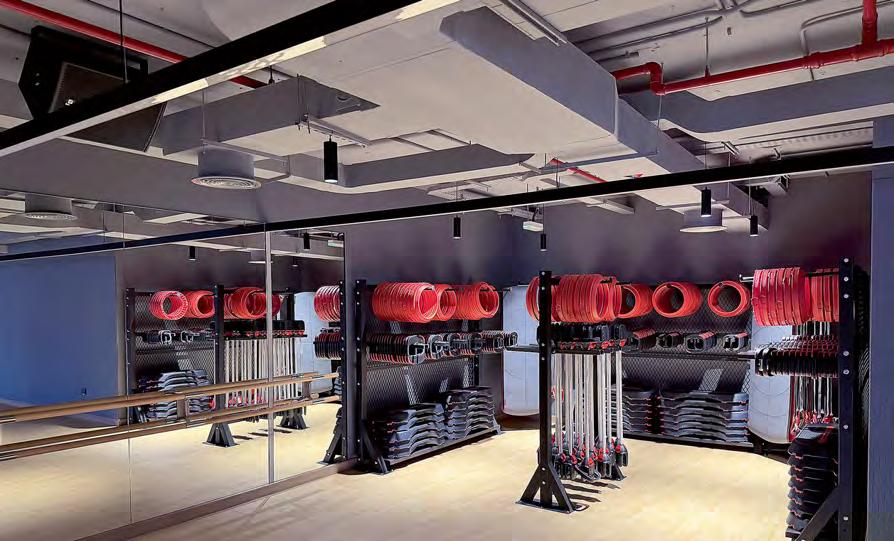
softer tonal balance from its four ARQIS 110i 10-inch point source cabinets with subtle low-end warmth from ARQIS SB12i subs, while the main GX studio was voiced for high-intensity programmes such as fusion, squat-based and aerial yoga classes and therefore calls on ARQIS 112i cabinets and LABI1-SB18 subwoofers.
The cycling studio – another high intensity space –combines four 12-inch ARQIS 112is with a pair of LABI1SB18 subwoofers and an ARQIS 110i stage monitor for the instructor, producing what the Nu-Touch founder describes as “one of the best sound experiences for riders in any Fitness First location I’ve visited”. “Even at 20–30% of the maximum output, the sound now feels rich,” Zane adds. “When members walk in, they can sense the elevated, top-class experience.”
The poolside zone even benefits from high-performance reinforcement, with eight outdoor-rated 8-inch eMOTUS8ODBK loudspeakers distributed around the perimeter supported by two KICK-SB28 subwoofers. “These provide background music dayto-day, but we can increase the levels for aqua-fitness sessions,” Zane notes. “The subs are vibration-free dual 18-inch designs –compact yet surprisingly powerful for outdoors.”
From the trainer’s perspective, each studio operates as an independent zone driven by Ecler VIDA-24Q, VIDA-48Q or HADA-4B500 amplifiers with built-in DSP, eliminating the need for a centralised control rack. Via Ecler PULSO-4 wallpanels integrated into each space, instructors can connect directly via Bluetooth and use wireless microphones housed in secure racks to lead sessions, with presets limiting maximum gain to protect the system from overload. “Previously, instructors used analogue mixers,” notes Zane. “With the new preset system, they can simply pair their phones, start the class and enjoy even more consistent audio every time.”
Acoustic treatment and rock-wool isolation have been incorporated during construction to contain energy within each room and counter the reflections from mirrors and hard surfaces. Nu-Touch also performed extensive calibration across all zones using measurement microphones to fine-tune the frequency balance and eliminate overlapping coverage. “It’s not about simply filling the ceiling with speakers,” explains Zane. “But getting the right number in the right places. Each one covers its own area cleanly,
so the result feels natural rather than overpowering.”
In total the complex is now home to more than 100 Ecler cabinets in various forms, serving as a perfect demonstration of the brand’s flexibility and varied offering for fitness environments. “When Fitness First asked for regional references, I introduced them to our installations across Europe where the same products are used across hundreds of clubs,” recalls Ecler’s Middle East representative, Jithin Jose. “They were impressed by the performance-to-price ratio and the range of options from signal sources to DSP integration. It gave them the confidence to select Ecler for Dubai Media City as the pilot site.”
The partnership with distributor Avenger Electronics also proved crucial in meeting the project’s logistics and technical requirements. “Avenger provided excellent
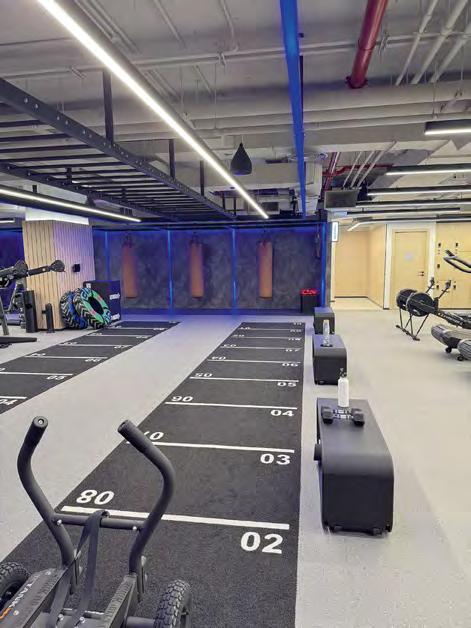
stock availability,” furthers Jose. “When one shipment was unexpectedly delayed, they even air-freighted the subwoofers at their own cost to meet the deadline.”
Avenger’s sales and technical head Nikhil Rayaroth notes that this level of reliability has been key to building local acceptance for the brand. “We maintain strong inventory, offer flexible payment terms and handle all after-sales and warranty needs through our service centre,” he explains. “For integrators like Nu-Touch, that means they can focus on design and delivery without worrying about supply or support.”
The result has quickly become the reference for Fitness First’s regional network. Within a month of handover, Nu-Touch and Ecler have since been commissioned to equip three additional clubs, with further sites in Abu Dhabi and beyond also planned. “Members immediately responded to the enhanced sound,” concludes Zane. “It’s bringing an added sense of motivation while helping instructors run classes with greater ease, proof that the right technology enriches the whole experience.”
www.avengerproav.com www.ecler.com
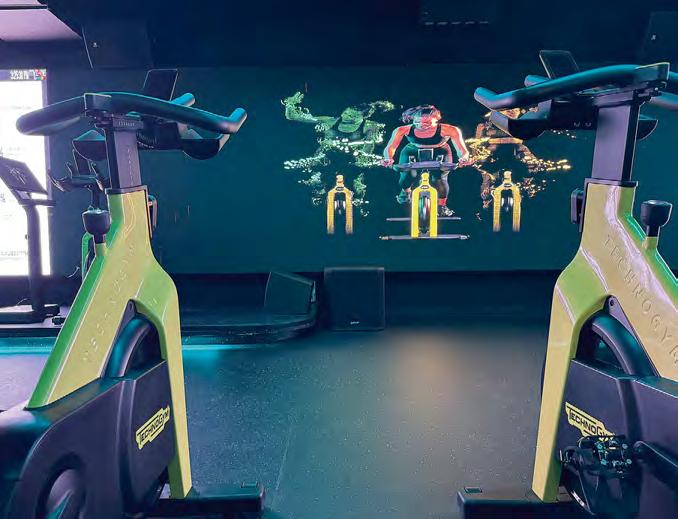


Nettuno L28 marks the Montarbo’s comeback to the stage with a newly designed, compact linearray. Modular, versatile, and highly adaptable, it delivers professional performance for both touring and installed live applications. Adaptive headroom designed to go beyond expectations
Key features:
• 1000 W RMS Class D amplifier • 135,5 dB SPL
• 100° horizontal dispersion
• Polyurea-coated plywood cabinet • Weight: 23,4 kg

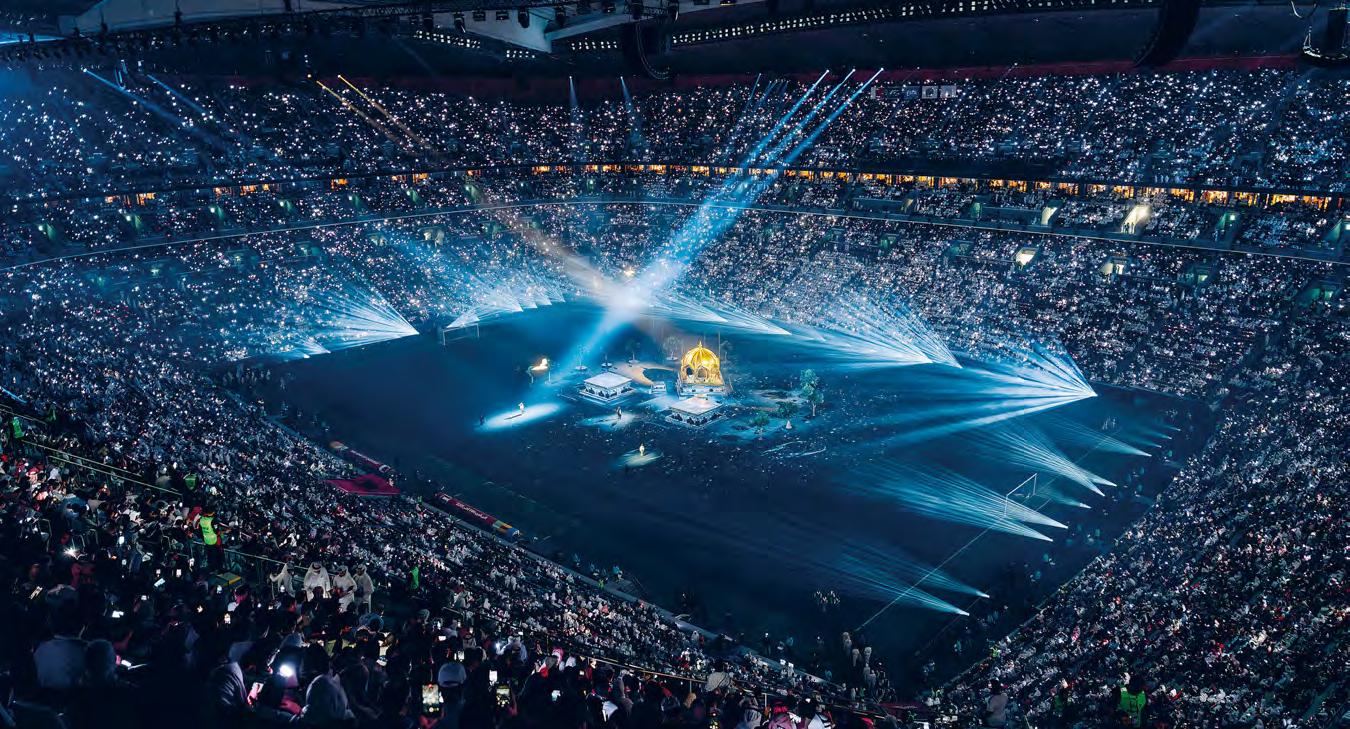
Creative Technology returned to an old home with a new challenge as the FIFA Arab Cup opening ceremony was executed flawlessly in next to no time
AS THE LARGEST STADIUM IN THE COUNTRY AND THE flagship venue of the 2022 World Cup, Qatar’s Al Bayt Stadium grabbed the spotlight when millions of global viewers tuned into their TV screens to not only witness Argentina beating France on penalties in the final to claim the trophy, but also a series of impressive visual displays across the tournament’s opening and closing ceremonies.
Creative Technology Middle East (CTME) was a key component in helping bring those past productions to life. With Qatar’s Katara Studios – the same production company that the team worked with on those events – appointed to deliver the mostrecent Arab Cup production, the Dubai-based AV specialist was brought in once again, building on a working relationship that had spanned previous Arab Cup ceremonies and the 2022 World Cup at the same venue, and more recently the AFC Asian Cup. For Creative Technology, the ceremony was a projectionled show in which reliability and familiarity with the stadium environment were just as critical as brightness or resolution. Developed in collaboration with creative studio Sila Sveta, the ceremony design introduced floating curtain elements above the pitch, requiring projection onto moving surfaces suspended within the stadium volume. The 20-minute production saw the stage itself become a powerful storytelling device, tracing the creation, collapse and symbolic rebirth of a monumental structure throughout gradually ascending and descending platforms.
An initial brief outlined an ambitious vision built around largescale projection across the field of play and complemented by scenic elements suspended above the pitch. Brightness targets, pixel density requirements and creative intent were defined early, but with the event calendar already congested and multiple events taking place simultaneously, the delivery window was compressed. According to senior project manager Riaan Gomes, the early
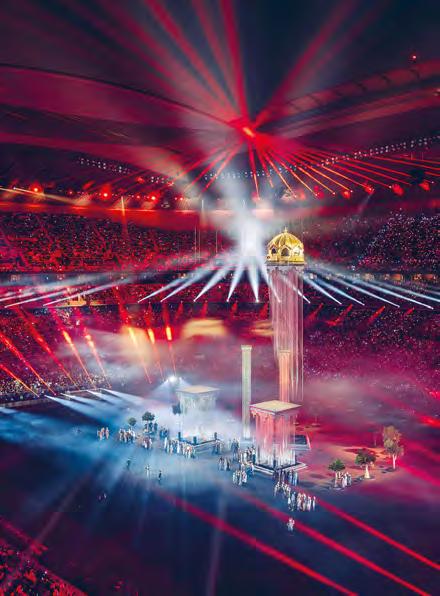
stages followed a familiar pattern for major international ceremonies. “We got a very early brief of what they were looking to do,” he recalls. “Projection on the field of play, floating scenic
elements and a very high brightness requirement. After that, there was a bit of a gap before the production team came back and asked how we could value engineer the concept to make it work within budget.”
That process brought CTME’s engineering team into closer alignment with the ceremony’s designers and producers. With the organisers pushing for maximum visual impact, the team worked through a variety of technical scenarios to meet the creative ambition without compromising reliability. Once the project was confirmed, things moved quickly into delivery mode. “At that point, we very much hit the ground running,” says Gomes. “Q4 is always an intense time of year, and this was no exception.”
Working in CT’s favour was the fact that having previously delivered multiple ceremonies inside the same venue, the team already had a detailed understanding of cable routes, possible projector positions and access constraints.
“This familiarity shortens the engineering phase considerably,” explains CTME head of video, Carlos Aguilar. “We already know where projectors can be positioned, how fibre needs to be routed and what the stadium infrastructure allows. That makes a big difference when timelines are tight.”
CTME’s scope for the opening ceremony was focused squarely on projection. Field-of-play visuals were delivered from four projection towers positioned around the stadium, each supporting multichannel projection. Twenty-four high-brightness Barco UDX projectors were deployed to achieve the required luminance levels across the pitch, while 12 more compact Panasonic 35K units were used for the floating scenic elements. However, while the field-of-play projection was a known quantity, the introduction of the scenic elements added a new layer of complexity. Floating curtain structures were introduced as part of the ceremony design, requiring projection onto moving surfaces suspended above the pitch, which was achieved using the Panasonic 35K units. “That was the most challenging and interesting part of the show,” Aguilar notes. “We had to work out projector positioning, tracking, pixel mapping and content alignment so that the visuals matched the creative exactly, even as those elements moved. The choice of smaller-format

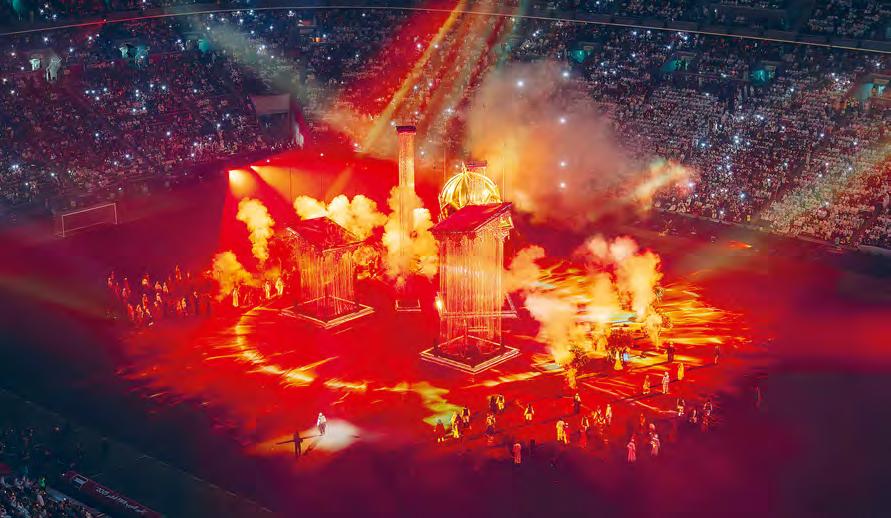




Now operating nightly, a new permanent lighting installation created by Oasis Enterprises has enhanced the evening experience at Global Village Dubai
WHEN GLOBAL VILLAGE DUBAI OPENED ITS GATES FOR Season 30, guests were greeted not only by the familiar mix of pavilions and live performances, but also by a newly installed large-scale lighting spectacle designed to run nightly across one of the city’s most established destinations. The permanent light show was delivered end-to-end by Oasis Enterprises, marking a notable step in the company’s evolution from systems integration into full concept and show delivery. Now in its third decade of operation, Global Village attracts millions of guests each season and occupies a unique position in Dubai’s entertainment landscape. While the destination already benefits from high footfall, the brief for the new installation was to introduce a fresh visual centrepiece capable of enhancing the evening experience without overwhelming the site’s existing character or attractions.
According to Richard Burton, lighting design lead at Oasis Enterprises, the project began life with a very different specification. “The original tender was actually for a laser show,” he explains. “But the entertainment team felt they had reached saturation point with lasers and wanted to try something else. That opened the door for us to come back with a new and interesting idea.”
Rather than simply adapting the initial brief, Oasis developed a completely new lighting-based concept. Working alongside Storyline Productions, the team created a full visual treatment, produced renders and proposed a permanent automated light show integrated directly into the architecture of the area in front of Global Village Main Stage, rather than a single focal installation.
The approved design spans a broad central plaza measuring approximately 400m across. Lighting is distributed across pavilion rooftops, perimeter poles and existing lamp-post structures, all tied together by a central vertical tower that forms the visual anchor for each show sequence. Rising to a height of 25m, the tower is fitted
with close to 300 vertically stacked Cameo PIXBAR SMD G2 LED battens arranged in a dense grid, allowing it to function as both a sculptural feature and a high-impact lighting surface.
The wider system is built predominantly around Cameo fixtures, with more than 130 ORON H2 IP65 hybrid phosphor-laser moving heads installed across pavilion rooftops and perimeter positions, extending the lighting effects into the skyline and giving the show a sense of scale.
Oasis’s design supports five distinct shows, each paired with a dedicated soundtrack. These range from Arabic-themed programming to a rock-influenced sequence, alongside seasonal content for Ramadan and Christmas. Each show runs multiple times per evening.
Lighting control is handled by an MA Lighting grandMA3 light paired with two grandMA3 Processing Unit L nodes, providing
frame-synchronous control across the entire system. Audio playback is initiated by Global Village’s own in-house control platform, which sends timecode directly to the lighting system to ensure synchronised playback without the need for manual operation.
Wireless DMX distribution is handled using LumenRadio Stardust and Galileo systems, while wired DMX and RDM traffic is managed over a Cat6A network backbone via ETC Response Mk2 gateways. Network switching is provided by Luminex GigaCore switches, with fibre links used to support long-distance data transport across the area.
From a creative perspective, the choice of LED battens was central to the design. According to Burton, the Cameo PIXBAR fixtures offered an important advantage through their independent strobe layer. “That separate strobe element was fundamental to what we wanted to achieve,” he explains. “It allowed us to layer sparkle and twinkle effects over colour content without compromising the colour itself. This gave us far more flexibility in how the tower could behave visually.”
While aesthetics played a central role, practical considerations were equally important. As a permanent outdoor installation, the system required robust IP-rated fixtures capable of operating reliably over long periods, alongside realistic considerations around budget, lead times and availability. “At the end of the day, delivery time and cost matter,” Burton says. “Cameo provided us with the balance we needed.”
If the design phase represented a creative shift for Oasis, the delivery phase tested the company’s operational limits. Once confirmation was received, timelines compressed dramatically. Equipment was sourced and shipped directly from Europe, with close to 60 pallets of fixtures flown into Dubai and cleared through customs in just over a week.




The New Capital Cairo Opera House brings together multiple performance venues within a City of Arts complex, with Audio Technology delivering professional audio and AV systems across the site
CONCEIVED AS A FLAGSHIP DEVELOPMENT WITHIN
Egypt’s New Administrative Capital, the New Capital Cairo Opera House represents a significant expansion of the country’s performing arts infrastructure. Rather than a single large auditorium like its counterpart in the main city, the project forms part of a broader City of Arts complex, incorporating multiple performance venues, rehearsal spaces, public circulation areas and supporting buildings designed to host a wide programme of cultural and entertainment activity.
For local systems integrator Audio Technology, the project combined two distinct but closely linked scopes of work: supplying, commissioning and tuning professional audio systems for the main performance venues, while also assuming responsibility for the design, installation and commissioning of AV systems throughout the non-auditorium spaces. In parallel, the company delivered an extensive stage engineering and machinery package in cooperation with German stage systems manufacturer Waagner-Biro.
The New Capital Cairo Opera House comprises three principal performance venues: the main concert hall, a drama theatre and an additional performance space, supported by rehearsal rooms and ancillary spaces. Beyond these, the wider complex includes public areas, outdoor zones and a mosque, all requiring integrated background audio and AV solutions aligned with the building’s architecture.
“The project was effectively divided into two parts,” explains Audio Technology systems designer Mario Abadeer. “For the main halls, we supplied the professional audio systems specified by the consultant and carried out commissioning and tuning. For the rest of the complex, our engineers were responsible for the complete AV design, installation and commissioning.”
Across the performance venues, L-Acoustics systems form the backbone of the sound reinforcement design. In the main concert
Primary sound reinforcement inside the main space comes from L-Acoustics line array clusters and distributed fill loudspeakers
hall, the system is built around dual main clusters, supported by SB18 subwoofers and a comprehensive deployment of X Series loudspeakers providing fill coverage across the audience areas. These include 5XT, X8 and X12 models, selected to address differing coverage requirements while maintaining tonal consistency throughout the space.
The drama theatre adopts a different approach, centred on a Syva-based system, again supplemented by X Series fills and a dedicated centre cluster to support spoken-word performance and theatrical production. Rehearsal rooms within the complex are also equipped with solutions from the French manufacturer, providing continuity between rehearsal and performance environments.
Despite being a brand-new construction, the impressive space has been intricately stylised
Overhead truss and suspension grid within one of the performance spaces
Amplification across the performance venues is handled via the LA4X platform. “Each space has a significant channel count,” says Abadeer. “That meant commissioning was a detailed process, checking every channel to ensure the correct presets were applied and that each loudspeaker was behaving exactly as intended.” Wireless audio forms another key part of the system architecture, with Shure Axient Digital Wireless deployed across the performance spaces. The system supports a wide range of production requirements, from orchestral and theatrical use through to spoken-word events, while SM series microphones provide additional flexibility for performance and production workflows. Commissioning the systems required detailed programming and verification. With early elements delivered during the Covid period, manufacturer travel was restricted, increasing reliance on local expertise. “Beyond loudspeaker alignment and tuning, the most time-consuming aspect was system programming and verification,” Abadeer explains. “Every signal path, amplifier channel and preset had to be checked. And as each room had a large number of channels, the process was extensive.”
Tuning focused on detailed measurements across audience areas, delay alignment and final optimisation for each space’s acoustic conditions. “We worked hard to tailor each system precisely to its environment,” Abadeer adds, “but, beyond the extensive procedure, we didn’t encounter any fundamental technical obstacles.”
While audio and AV systems formed a visible part of the integration scope, the scale of Audio Technology’s involvement also extended significantly into stage engineering. In cooperation with Waagner-Biro, the company delivered the stage engineering packages for the opera house, concert hall and drama theatre, including installation and after-sales services. The scope included orchestra pit elevators, seating wagon systems, adjustable
proscenium elements and unified control and emergency stop systems.
In the main hall alone, up to 72 multipurpose fly bars were installed, with drive system winches arranged at grid level. Loudspeaker cluster hoists and over-stage lighting trusses were integrated within the wider machinery framework.
A substantial element of this work involved local steel fabrication. Audio Technology fabricated approximately 700 tonnes of welded steel construction and machined components in Egypt, while Waagner-Biro supplied motors and drive mechanisms. Installation was executed by Audio Technology under Waagner-Biro’s supervision.
The moveable seating towers, reaching heights of approximately 20m and weighing around 85 tonnes each, required precise mechanical and structural coordination to ensure stability and smooth electric drive operation. “Keeping the drive system columns vertical, particularly with column heights of around 9m, was extremely challenging,” Abadeer notes.
Across the non-auditorium spaces, Audio Technology was responsible for designing and integrating AV systems that balanced technical capability with day-to-day usability, particularly as the venue moved towards operation without a fully established in-house technical team.
“We became involved at an early stage, working alongside the consultant during the transition from conceptual design to equipment selection,” says Audio Technology’s AV spokesperson, Jacko Agaiby. “Each venue operates on standalone AV switching, which ensures full operational independence between spaces while maintaining consistent system behaviour across the wider site.”
Resilience and redundancy were approached pragmatically.
“Redundancy was assessed based on application criticality,” Agaiby explains. “Additional layers were introduced where they offered genuine operational value, rather than complexity for its own sake.”
The extended project timeline also influenced technical decisions. Design and tender phases extended beyond 18
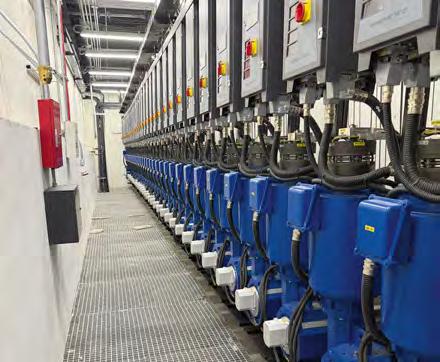
months, with architectural changes continuing throughout development. “Many adjustments were made after the design phase because of architectural changes,” notes Agaiby. “On long-term cultural projects like this, one of the biggest risks is misalignment between stakeholder timelines and shifting priorities.”
As the venue moved towards operation, Audio Technology remained closely involved. With no permanent in-house technical team initially in place, the company provided hands-on support during early events and performances. “That ensured continuity as the venue came online,” says Abadeer. “Later training was delivered in a cascaded format, tailored to different stakeholders based on their operational responsibilities. This allowed the teams to build confidence progressively.”
According to the team, only minor refinements were required following handover, primarily to fine-tune workflows once systems began to be used under live production conditions. Feedback from early use has been positive, with operators reporting smooth operation across both performance and public spaces.
Looking back, both Abadeer and Agaiby describe the project as a defining milestone. “It stands among the most significant large-scale venues we’ve delivered locally,” Abadeer reflects.
For Audio Technology, the New Capital Cairo Opera House reinforces the importance of end-to-end responsibility and local support. “Local sustainment capability was critical to protecting the integrity of the systems over time,” says Agaiby. “The project demonstrates what can be achieved when precision, partnership and turnkey delivery come together at scale.”
www.audioteceg.com
www.l-acoustics.com
www.shure.com
www.waagner-biro.com
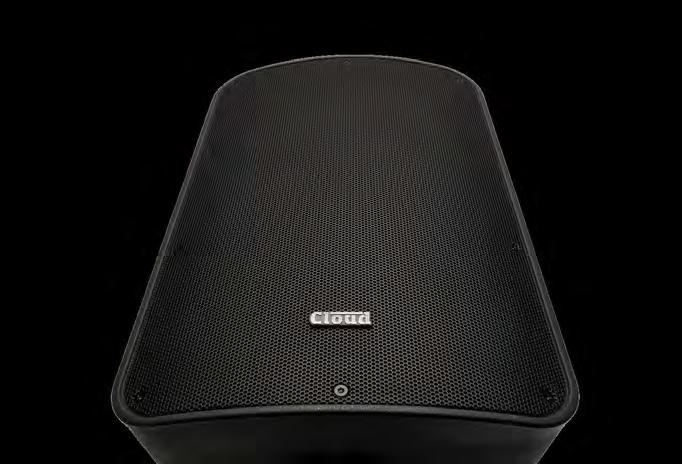
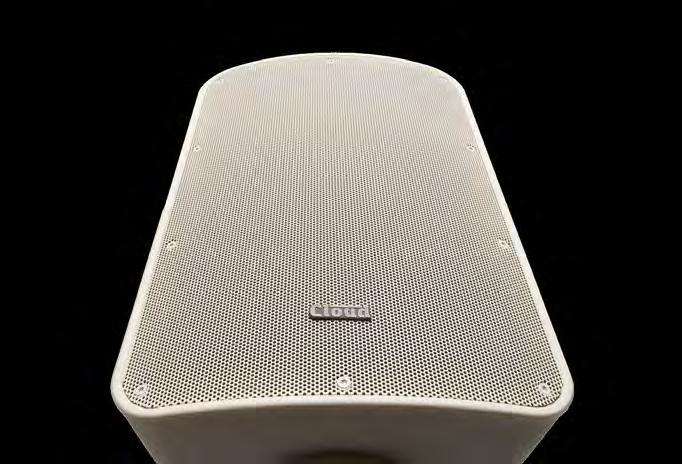
The newest season of The Final Pitch Dubai placed sustained pressure on wireless audio workflows, prompting the adoption of a digital wireless approach capable of supporting a fast-moving, multi-location shoot
the luxury of stopping the action and taking stock. When the format depends on natural exchanges, quick reactions and constant movement, it’s essential that the audio workflow employed keeps pace with shooting. That was the operating reality on the latest season of The Final Pitch Dubai, where the production leaned heavily on the latest digital wireless solutions from Sennheiser to keep dialogue consistent across a fast-moving shoot that shifted between indoor and outdoor locations.
Created and hosted by John Aguilar, The Final Pitch follows contestants, judges and presenters across a mix of structured moments and more fluid sequences, including walk-and-talk scenes and backstage capture. For the Dubai edition, that variety extended to multiple locations, with filming taking place both indoors and outdoors, including around the Expo site. Portability was essential, but so was repeatability. The show demands the
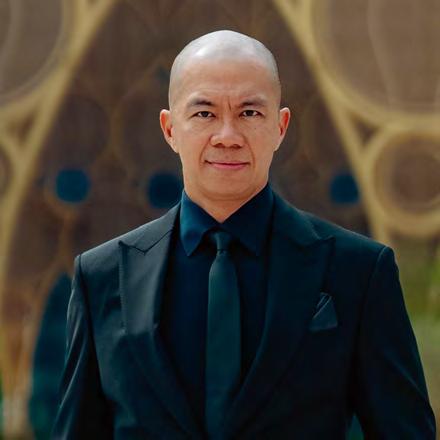
same broadcast-quality intelligibility whether the scene is static and controlled or unfolding on the move.
Aguilar’s production company, Dragon’s Nest, has used Sennheiser products since 2003, but the Dubai shoot became a milestone in terms of workflow. For this season, the audio team built its wireless infrastructure around EW-DP, using the platform not just as an add-on for a handful of key contributors but as the primary system for principal talent. All contestants, presenters and judges were miked using EW-DP systems, with 12 channels deployed across the production.
Those channels were configured to suit a range of capture scenarios. Some were catered to with EW-D SK bodypacks paired with lavalier microphones, while others used EW-D SKP plug-on transmitters attached to MKH-416 shotgun microphones. This combination supported discreet personal miking while allowing the team to reinforce coverage with directional pickup where needed. In addition, the production backed up key contributors with shotgun microphones, creating an additional layer of security for dialogue in more challenging environments.
As a result, a varied array of lavalier microphones were called on, including MKE-2, ME-4 and ME-2 models. In outdoor locations, Aguilar notes that Dubai presents a particularly dense RF environment. “Dubai’s a dense RF environment, particularly in outdoor and mixed urban locations where multiple wireless systems are operating simultaneously,” he explains. “While occasional RF
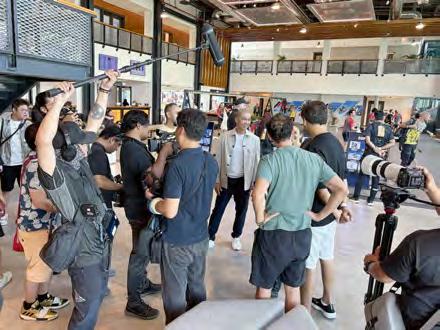
interference is inevitable, the new wireless system made frequency coordination significantly easier through fast and accurate digital scanning. This helped the crew identify clean spectrum quickly and maintain stable transmission throughout the shoot.”
The operational gains were not limited to setup. According to Aguilar, one of the most significant on-set advantages came from the ability to make adjustments via Bluetooth control. With the newer platform, volume and gain adjustments can be handled through a Bluetooth app rather than requiring physical access to a camera-mounted receiver or bodypack. Aguilar says that while changes were not required constantly, the option became critical in high-pressure moments. “Adjustments were not frequent, but the availability of Bluetooth control was extremely valuable,” he says. “In critical moments, being able to fine-tune gain remotely ensured audio integrity without disrupting performance or camera continuity.”
In practical terms, that meant fewer interruptions. Aguilar adds that remote adjustments significantly reduced the need to stop takes or physically access talent. “This preserved performance flow, reduced downtime and helped maintain production momentum. Compared to previous seasons, the Dubai production benefitted from faster frequency coordination, quicker gain adjustments and overall greater RF stability.”
Traditional pain points such as slow scanning, RF conflicts and stopping takes for adjustments were greatly minimised. The result was a noticeable increase in reliability and speed, with shorter
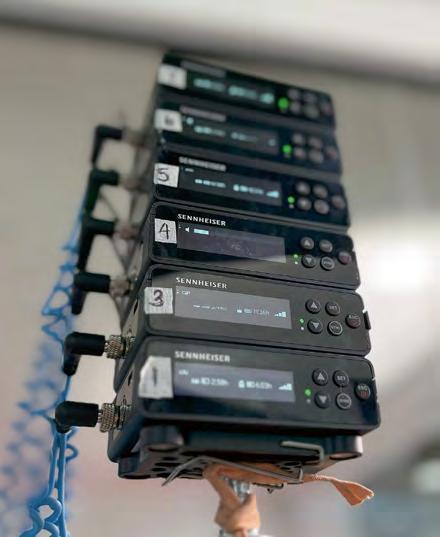
setup time, faster troubleshooting and greater confidence in the wireless infrastructure overall.
Sennheiser Middle East’s head of technical sales and application engineering, Ryan Burr, says the shift to digital RF was central to the platform’s design. “EW-DP is the successor to our earlier Evolution Wireless on-camera systems, but with digital RF at its core,” Burr explains. “That shift gives users more control, particularly when it comes to frequency management and gain adjustments, which can now be handled remotely via Bluetooth.” Alongside EW-DP, the production also trialled Sennheiser’s Profile Wireless system for the first time. “Profile Wireless is a very new product, and The Final Pitch Dubai was the first time it had been used professionally in the region,” Burr furthers. “Seeing it deployed on a working production gives us a real understanding of how it fits into modern content workflows.”
Looking ahead, Aguilar says the upgraded Dubai workflow has set the show’s future standard. “The workflow we implemented in Dubai has now become our reference standard for future productions across the MENA region,” he says.
As The Final Pitch expands into new markets, the flexibility, stability and remote control capabilities of the digital wireless setup now form the template the production intends to carry forward for future seasons, spin-offs and regional editions.
www.sennheiser.com
www.thefinalpitch.world
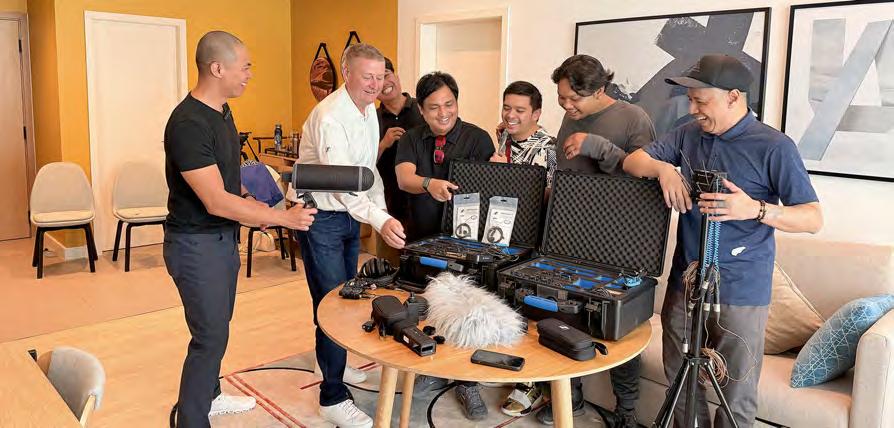


Dan Daley examines the meteoric rise of K-pop and how it has helped place Korean culture firmly on the world stage
THROUGHOUT MUCH OF THE 20TH CENTURY, MEDIA spread American culture globally. Music, films and later television and streamed content were consumed voraciously, making official efforts like Radio Free Europe seem positively superfluous. A century of American pop music did as much, or perhaps even more, towards making English the world’s lingua franca than 400 years of colonialism.
That phenomenon provides a template for what Korean pop music – K-pop – has been doing to the world for the last decade or so. Just as the advent of radio in the early 20th century gave American music its reach, the Korean wave has risen on the proliferation of social media in the early 21st century. By 2019, South Korea ranked sixth among the top 10 music markets worldwide, with groups such as BTS and Blackpink leading the way. A year later, South Korea’s music business saw a record-breaking 44.8% growth and became the fastest-growing major market of the year globally. Last year that juggernaut continued, as KPop Demon Hunters became Netflix’s most-watched film ever, helping the streaming company grow its third-quarter revenue by 17%, while also stimulating demand for Korean fashion and other consumer goods. K-pop has had to make some compromises along the way, reflecting the transactional environment in which the genre
came of age. For instance, artists have been increasingly using English in their lyrics and even in their band names, like Beast and After School – a strategy to get onto Western airwaves and over cultural speed bumps. That’s a decision made not for the sake of art but rather for commerce. Of course, it’s also paid off handsomely: one economist’s estimate contends that every US$100 increase in music export revenue generates $400 in revenue from related consumer goods including food, clothes, cosmetics and IT products.
More ominously, K-pop artists are notoriously managed by corporations and a handful of dominant record labels, replacing organic career building with carefully calculated marketing campaigns in which band members are often replaceable cogs. It took Sony/Warner/Universal nearly 40 years of predatory consolidation to achieve that kind of economic hegemony. However, there remains a hopeful rebellious spark within K-pop – a small but palpable rock-and-roll ethos that pushes back here and there against those corporate overlords. This is visible when legal battles pop up in the news, like NewJeans vs Ador/ Hybe, highlighting allegations of unfair contracts, mistreatment and the system’s restrictive demands for perfection and gruelling scheduling. Of course, those periodic mutinies can go either
way, earning some artists more creative freedom, or giving a momentary cover of authenticity to K-pop moguls.
But how different is K-pop’s palpable commercialism to how the American model has evolved, becoming one in which artists now actively seek corporate collaborations, selling pickup trucks and beer along with concert tickets and records. The great irony would be an American music industry that started taking cues from its Korean cousins. K-pop’s controversial “trainee” system, which takes as long as three or four years of intense training to develop new acts, often cites Motown Records’ star-making machinery of the 1960s as its model. Perhaps Simon Cowell and Lou Pearlman were even further ahead of their times. Hard to see where one narrative leaves off and the other begins.
A few blocks from my midtown Manhattan flat is West 32nd Street where, in the shadow of the Empire State Building, the Korean version of a Chinatown has taken rapid and expansive root in the last decade. It’s a block of jangly Asian urbanity with a K-pop soundtrack and Hangul lettering emblazoned on cool streetwear. It’s now K-pop’s turn to show how a culture projects itself globally through music. Here’s hoping they don’t have to sell their Seoul to do it.

Phil Ward looks at how the Audio Engineering Society is ensuring that audio is staying relevant in a fast-changing, often virtual, world
THE AUDIO ENGINEERING SOCIETY (AES) DOES exactly what it says on the tin. Over and above being a society where audio engineers meet, it does its level best to engineer audio into society. As our daily lives change, especially in a professional sense, the AES conjures up all kinds of conferences, conventions and symposiums designed to re-tool the community and its chattels for the future – trying to make sure that audio has its say. This is especially welcome in a multimedia bunfight.
The ancient lament of the rental company spec-ing for a tour, or the installer planning for a building or the integrator desperately keen to, er, integrate, is that decisions about where to put the speakers are repeatedly put off until the minute before the last one, while the interior designers, the architects and the experience-builders swan about balancing vases of flowers on a pin. This kind of second-class citizenship seems destined only to continue into the age of virtual and augmented reality and its artificially intelligent icons.
Right on cue, here’s the AES coming to the rescue again. This June and July in Paris, the AES is hosting the International Conference on Audio for Virtual and Augmented
Reality and Immersive Games, snappily condensed into “AVARIG2026”. It will be spread across two venues: the Institut Jean Le Rond d’Alembert (IJLdA), part of the famous Sorbonne University that researches acoustics, signal processing, speech synthesis and all matters concerning audio for VR/AR as well as gaming, spatial audio and human-computer interaction; and IRCAM, the renowned centre for the science and technology of music and sound located beneath the Pompidou Centre.
This is a European debut for a series of conferences already established by the AES on Audio for Virtual and Augmented Reality and takes this opportunity to add Immersive Gaming to the agenda. According to yet another august body of opinion, the AES Technical Committee on Interactive Media and Games, the merging of VR/AR and digital gaming reflects the latest patterns of social change and, just for good measure, drags us into the world of Extended Reality (XR) too. And the key to all this interactivity and reality-bending – the ingredient that the AES quite naturally hopes to keep to the fore – is spatial audio. This is the format that will carry the interests of audio manufacturers and users into this brave new world.

The mission statement from the AESTC-IMG is telling: it is “to advance the science, technology and artistic expression of interactive media with audio”. Note how this statement places audio at the vanguard of how the whole industry will progress, the agent by which it will advance. The entire meld of visual tech and how it connects with human emotion and inspiration is held together by sound, which is quite a bold statement. No one who works in audio would disagree, but it does reveal how the AES is taking the fight to the front line.
It has friends in some high places. AVARIG2026 is also supported by SONICOM, which I promise is the last group of imploded vowels and consonants I’ll throw at you. Funded by the EU, SONICOM is a broader research programme into “the way we interact socially within augmented and virtual reality environments and applications”, including online meetings. Again, the entire field is auditory based, guaranteeing that our imminent plunge into new social interactions will not be silent. As we reshape reality, audio will be moulding the clay – just as SONICOM’s sponsor FET-PROACT (Future and Emerging Technologies Proactive) imagined. Oops, sorry, I lied.
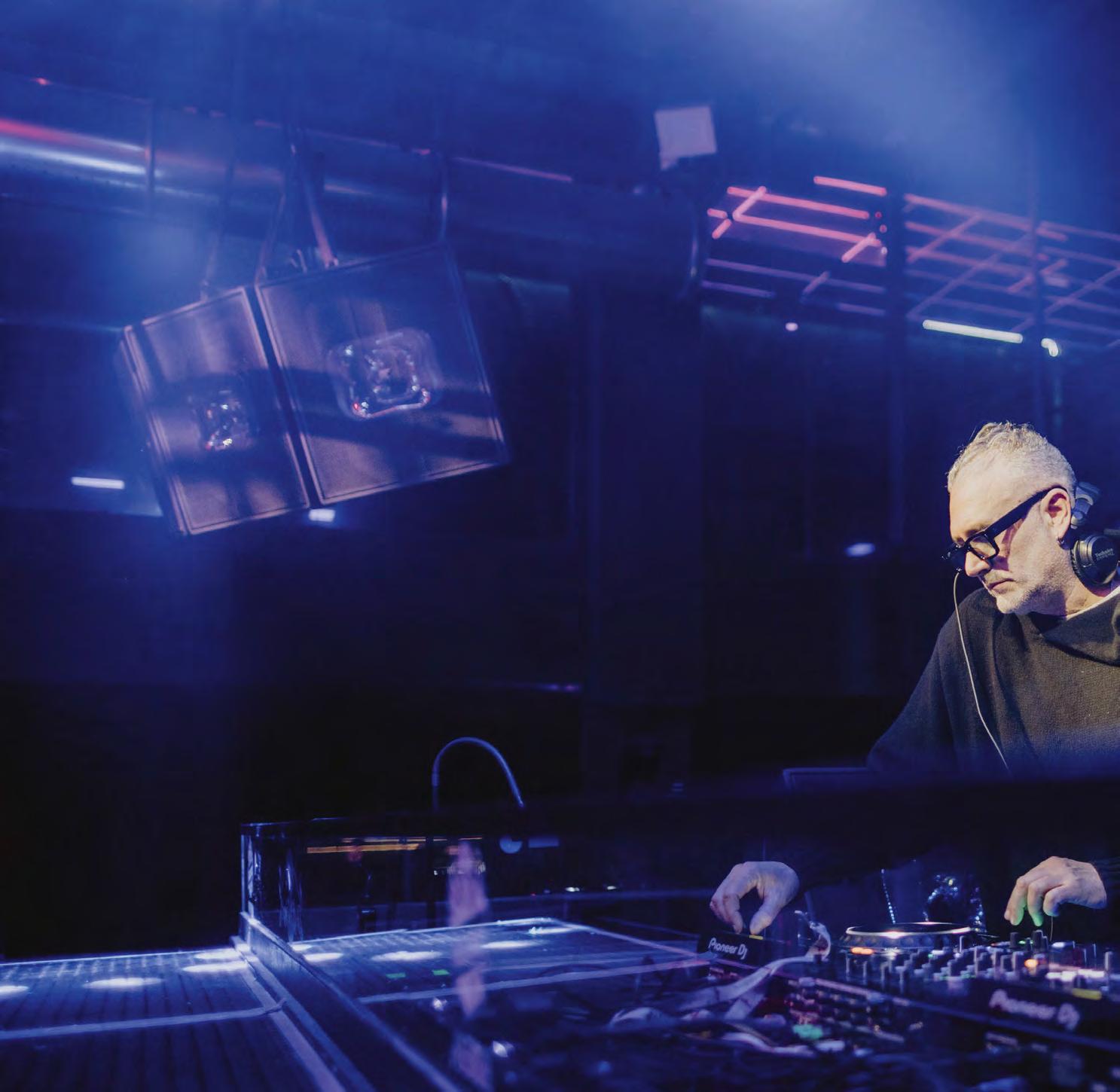


Modern nightclub systems demand more than volume. They require control, endurance and precision at extreme SPL. At Tenax, a cornerstone of European electronic culture, K-array delivered a full-system upgrade built around clustered Dragon-KXT18P loudspeakers configured in horizontal arrays for controlled dancefloor coverage and extended headroom.
On the main floor, twelve KXT18 units operate as coherent
clusters, delivering extreme SPL with consistent tonal balance and precise energy distribution. Twelve Thunder-KS4 subwoofers provide deep, tight and controlled low-frequency impact.
Driven by Kommander Amplifiers, the system is phasealigned and optimized for uniform coverage and musical integrity while maintaining clarity and control even at peak levels.
Sue Gould reports from the annual Anaheim gathering, which benefitted from increased exhibitor and visitor participation and improved scheduling
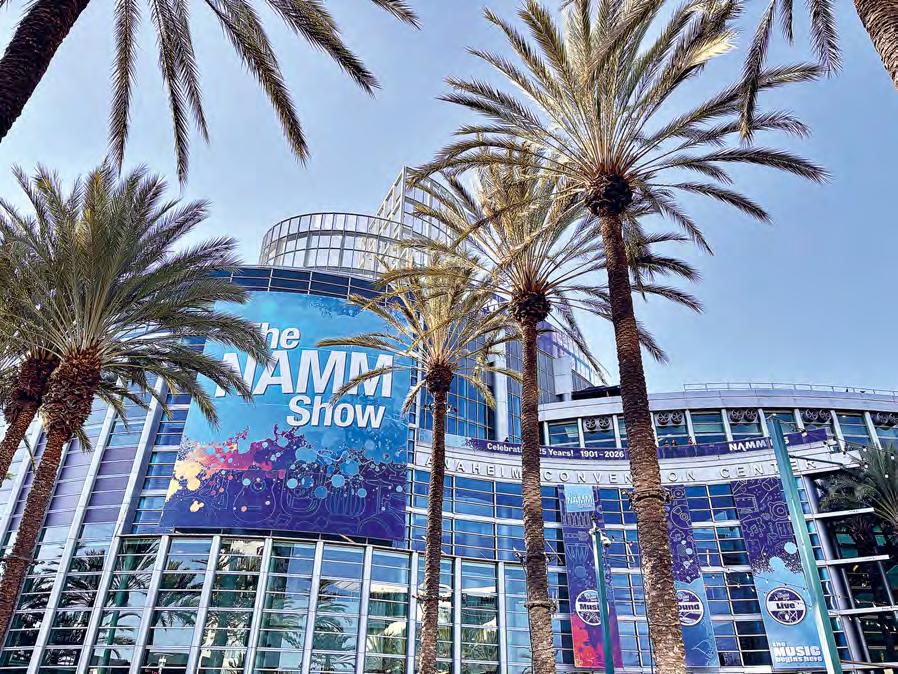
ALTHOUGH THERE WAS AN ABSENCE OF BLUE Californian sky and sunshine to greet visitors on the first day of NAMM 2026, it was nevertheless an opening day to be proud of as the show celebrated its 125th event, 50 of which have taken place in Anaheim. There’s a genuine fondness and passion rarely heard these days when industry professionals discuss NAMM, but the show has continued to struggle to regain its crown following the pandemic and amid shifting timeslots. Coming into play last year, the reduced three-day show format appears to have worked in its favour as an increased number of exhibitors and visitors headed to the Anaheim Convention Centre (ACC) from 20–22 January. But, against a backdrop of geopolitical uncertainty, it would be safe to say that expectations were mixed, with valid concerns about the impact on international visitor numbers and some
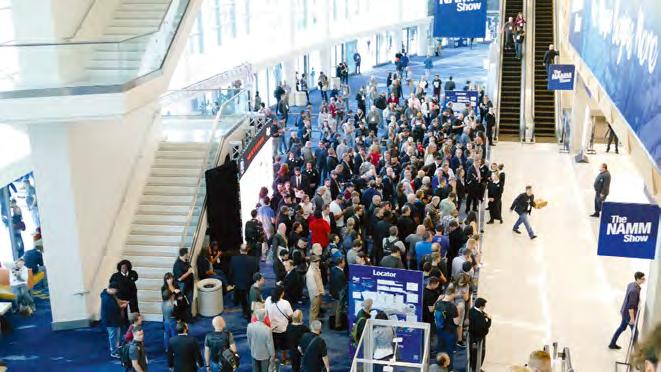
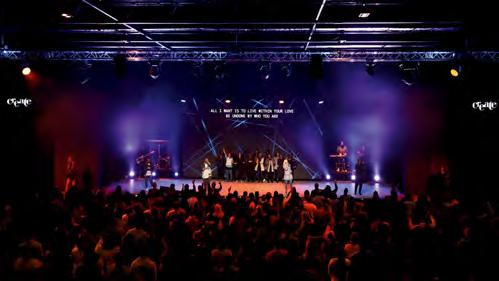
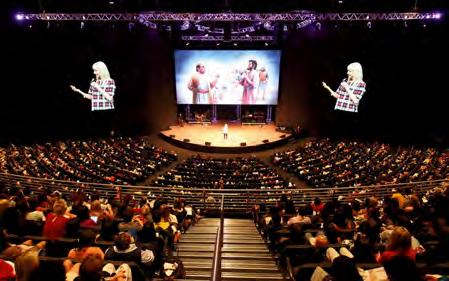
notable names missing from the floorplan. However, the organiser was pulling out all the stops, providing well-attended off-the-floor offerings that encompassed concerts, TEC Tracks and training sessions, seminars, hands-on workshops and immersive demo rooms. There was also a concerted effort to ensure that overseas visitors were supported and welcomed more than ever as several country-specific networking receptions and events with an international focus took place.
In a discussion with Pro AVL MEA on the eve of the show, NAMM president and CEO John Mlynczak was keen to stress that NAMM is not an American show but rather a global event welcoming people from all over the world, with a constant reminder that music brings people together.
This year’s show hosted the largest number of demo rooms in its history, flanking the side walls of ACC North’s upper floor, with those exhibitors who had made the substantial investment attesting to a solid flow of traffic through the demo room doors. Among the aisles though, the booth layout felt more compact than in previous years, but footfall appeared consistent and a calm, business-like atmosphere prevailed. As is usual at NAMM, it was the recording and studio exhibits on the lower level where the volume was higher – both in terms of noise levels and visitors on the floor. The markedly different vibe between the two levels undoubtedly benefits those walking the aisles and ensures the widest-possible mix of exhibits. With blizzards hitting the country’s East Coast as the week came to an end, many were heading to LAX earlier than intended to ensure they didn’t get stranded. Ultimately though, the weather may be the least of NAMM’s concerns for next year. The challenge for the organiser in 2027 will be the shift of show dates to later in January, putting it again within two days of ISE in Barcelona. While feedback on this year’s show from the vast majority of people was positive, if forced to choose it will be interesting to see which platform they will opt for.
2026 Dates: 20 – 22 January
2027 Dates: 28 – 30 January
Venue: Anaheim Convention Centre
Total exhibitors: 1,650+
Attendance: 60,000+
Contact: www.namm.org/thenammshow
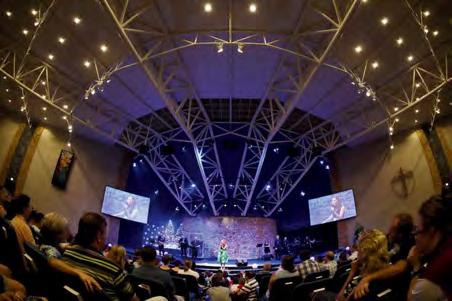

Gianluca Turra, FaitalPRO:
“Rather than being a good show, I’d describe it as a good meeting point. Given the investment, it’s been great for me to see more people at NAMM and I felt like it was getting back to normal. But the date of next year’s event is a bit of a blow, with it coinciding so closely with ISE. I think it’s going be a problem for European companies in general, given the amount of resources, physical distance and effort that’s required to attend this show. Overall, I’m happy we came and our products have been very well received but, for the future, there’s a bit of a question mark.”
Christian Jordan, HK Audio:
Samantha Kotlicky, Trulli Audio:

“Last year we were here as part of another booth but this year we decided to get a demo room and it’s been incredible. The show has been unlike anything I could have ever expected, and it’s really exciting to bring our new technology here and see everyone’s reaction to it. We’ve seen a huge mix of people at the demos – obviously a lot from California and the US, but also visitors from across Europe, and we’ve had a lot of people looking to talk to us about distribution. We’re working on getting certification to sell overseas so hopefully the show will bring us more business.”
“It’s been a good show for us and the biggest presence for our brand here to date, and we’ve taken our first proper demo room, so we’re quite happy with where we are. There’s room for improvements of course, but step by step. I heard that visitor numbers were down compared to previous years but, in terms of the pro audio areas, I feel it’s very similar to before. There were more of our international distributors here in the past, but I feel that a lot of those from the South American and Asian regions are now gravitating towards ISE rather than NAMM.”
Karen Anderson, Rational Acoustics:
“This NAMM show has felt really good and energetic. It’s always a positive show for our brand because this is where we meet many of the live sound engineers. It’s January and a lot of them are off tour and it’s great for them to be able to come to a show that’s timed specifically for them. It’s also great to see our direct users of Smaart. It feels like everybody’s very enthusiastic; as if they’re in a really good mood. It seems busier than it was a couple of years ago, so all very positive.”
Summer Xu, ROQ Audio:

“It’s our fifth year exhibiting here and the show seems better than last year. There’s been more interest in our in-ear monitors and also for the drum microphone sets we launched this year. We’ve seen a lot of dealers and distributors but also end users. I chose to exhibit in the pro audio hall because I wanted our brand to stand out. I don’t want people to see us as just another manufacturer from Asia or one that just does OEM business. I’m hoping to get a booth on Level 1 next year because it’s more focused on the recording side and gives me that visibility to help grow the brand.”
Oran Moked, Waves Audio:
Stefano Bini, dBTechnologies:

“NAMM is always a good show for us and we get a lot back from being here. This year, we had an incredible launch party offsite at the nearby Grand Theatre for the L1608 line array module, the new product in our Vio family. NAMM was founded and created essentially for the music industry rather than pro audio and what they do really well is keeping that soul of musicality and instruments at the forefront. So, although I feel the internationality of NAMM is perhaps reducing a little on the pro audio side, I don’t see a difference in the musical part of it.”
Dan Zimbelman, PMC:
“It’s been a great show for us, particularly because it’s the 35th anniversary of PMC, and we’ve debuted four new, very large system speakers. We have a purpose-built recording control room on our booth, it’s completely isolated so visitors can experience the products first-hand. We’ve been flooded with people and 15 of our international partners are here; this show has become “the” professional show for the industry around the world. There’s a lot of drama on the world stage today, so I was a little nervous, but it was a false concern because we’ve seen people from all over and the reaction has been overwhelming.”
“We’re very happy with the show this year, especially since we won a Tech Award for the LV1 Classic in the small-format console category. And, of course, a major change for us has been participating up here on Level 2 in the live sound section. It’s a different type of crowd, with more of the higher end, professional visitors as opposed to the musicians and studio market. This is an area of the industry where we are starting out and there’s so much more to gain from meeting and talking to this crowd and getting their reaction.”





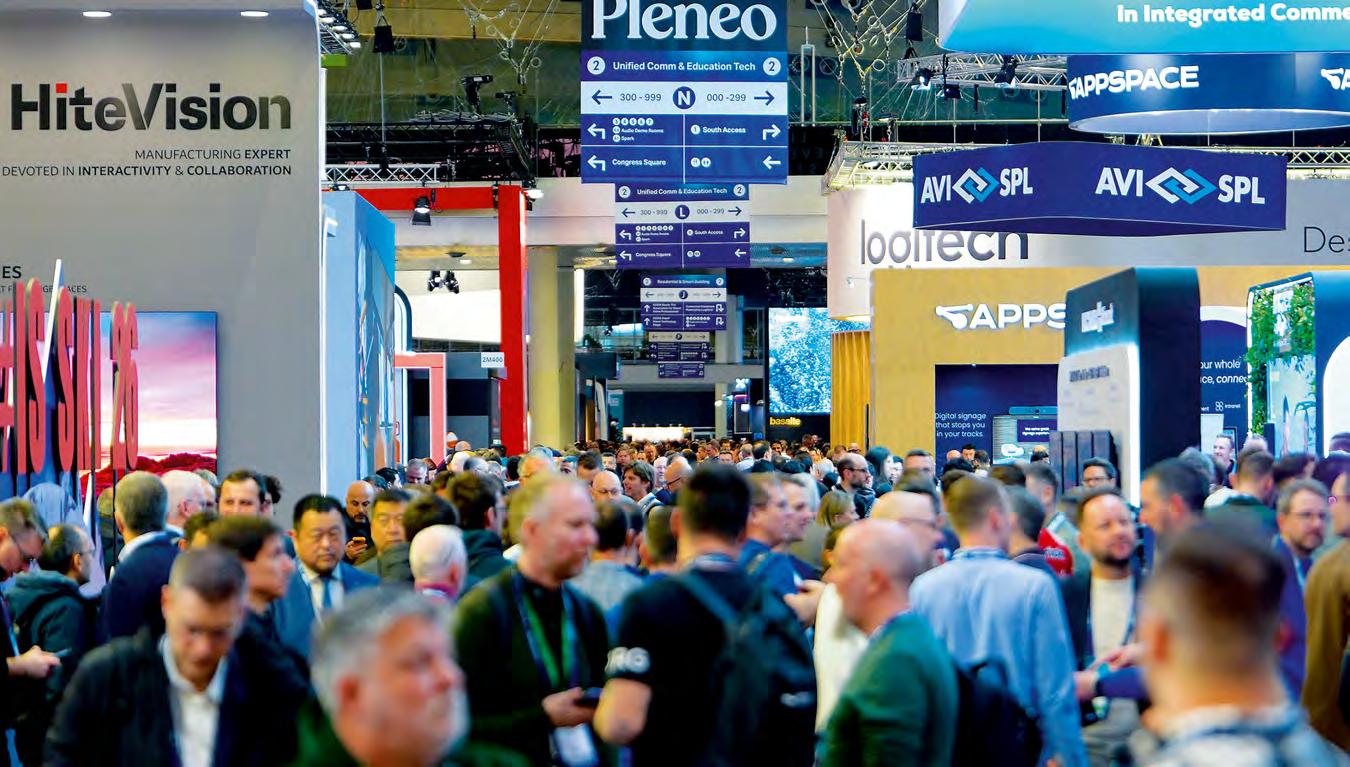
An eight-strong Blank Canvas team was on the ground in Barcelona to assess the scale, ambition and direction of ISE – here’s what defined this year’s show
OH WHAT A CIRCUS. ISE ROLLED INTO BARCELONA IN the first week of February, its four-day presence rippling through the Fira and out across the city, fully delivering on its Push Beyond theme.
Unsurprisingly, records were broken again. A total of 92,170 international visitors represented an 8% year-on-year increase. For those anticipating that number to have extended into six figures, it was unsurprising to learn there were over 212,000 individual visits, a 14% increase, with 64,198 on Wednesday alone. Exhibitors and floor space had also increased to 1,751 and 101,000m² respectively, including 323 first-time participants. Big trends of recent years such as AI and immersive technology have both quickly matured from buzzwords to being a part of everyday life. AI in particular has fast become integral to how we work across a range of disciplines and was in evidence throughout the show, integrated into hardware and software platforms, embedded into displays, cameras and control systems and enabling devices to respond to the requirements of environments and users.
The same is true for AVoIP, which is also becoming a standard offering across infrastructures for audio, video and control systems. Manufacturers consistently highlighted how ISE’s inclusive forum accelerates collaboration between R&D teams, progressing networking capabilities and interoperability.
Advanced display technologies were everywhere on the show floor, particularly in Hall 3, where mesmerising displays on LED walls and screens of varying shapes and configurations caused visitors to stop in their tracks.
The audio contingent in Hall 7 has matured to become almost a standalone exhibition, facilitating meetings between the tight-knit audio community. Immersive and spatial audio platforms and configurable speaker arrays were being shown on stands and activated in demo rooms, underscoring the flexibility of tailoring sound for different environments with the right tools. Meanwhile,
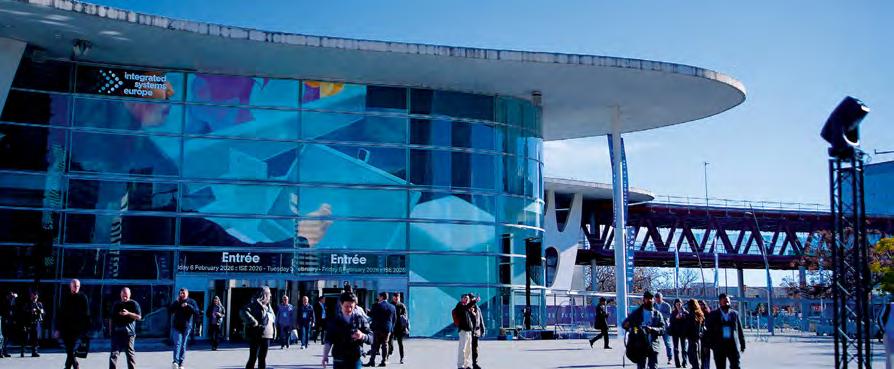
across the walkway in Hall 6, the same could be said for lighting and staging which this year extended into Hall 8.1, offering a cohesive forum separate from the AV, broadcast, audio and signage exhibits.
Although the promised Hall Zero is still under construction, there were plenty of new offerings. The Spark creative hub in Hall 8.1 brought live events, broadcast, gaming, design and marketing professionals together to explore cross-disciplinary innovation. Each day closed with a spectacular, 600-drone show above the Fira. And it would have been easy to skip the exhibition halls altogether and spend four days in thought-provoking seminars, keynotes and panels.
This show has evolved to become all things to everyone involved in AVL. Maybe because of its sheer scope, it was difficult to identify brand-new trends this year, though ongoing themes like the aforementioned AI, robotics, cybersecurity and smart buildings
were very much in evidence, while product launches and updates proliferated as companies increasingly choose this show for their debuts and announcements. But the overall impression coming away from ISE 2026 was one of an industry that is maturing yearon-year, is extremely upbeat about a smarter, integrated future and is collaborating like never before to advance its technology. And that is in no small part due to ISE.
2026 Dates: 3 – 6 February
2027 Dates: 2 – 5 February
Venue: Fira de Barcelona Gran Via Total exhibitors: 1,751
Attendance: 92,170
Contact: www.iseurope.org
Rob Fowler, Brompton
Technology:
“ISE has always been a very international show and if you had to choose one global event, this would be the one everyone comes to. We’ve been exhibiting here for over a decade and making that move to exhibit at a show like this is a significant step for any growing company. It’s how you start to cement yourself in the minds of customers and partners. The [planned] expansion into Hall Zero is simply a reflection of the show’s continued success. While competition for space remains strong, what really matters is committing to the show and letting people know you’re here.”
Sally Yu, Maxhub:
“It’s been very good, the first and second days in particular were nonstop and we’ve seen customers from all over the world, from as far away as Australia. Our booth is bigger this year, and next year we’re taking an even bigger stand of over 200m2. Our brand awareness is growing year-on-year, with more people coming to visit us, so we need more space for meetings. Also, we have more products coming next year so we want to build an immersive conference room and an LED experience centre so people can see our solutions in action.”
Bart Swinnen, Luminex:
“This show brings a lot of elements and the international AVL industry together. For Luminex, as a network infrastructure manufacturer that is focused on AV, we are sitting at the right place here because all these different technologies need to be network-connected. It’s very important to be present here as a brand, to have all our latest technology on display, and it’s been a huge success so far. It’s one of the best shows in terms of both the attendance and quality of people. And it keeps going up a level and growing each year.”
Sergio Molho, WSDG:
“We’ve taken a stand for the first time in Barcelona, although WSDG exhibited at the first ISE in 2004 in Geneva. This is the most exciting show in the world right now in terms of size, calibre, networking, displays and professionalism, and we’ll continue to exhibit. We’re seeing all the people we need to: our friends, manufacturers that we collaborate with on our projects, the media. It’s a great networking event and meeting place – we work day-to-day with all these guys virtually, so to be in the same place at the same time is invaluable. If they want to show us something new, we are here.”
Tomoko Ashizawa, Linear Sound Japan:
“It’s my first time at ISE and the show has been really impressive, it’s very different from InterBEE, our Japanese industry tradeshow. I haven’t seen many other Japanese people so far as it’s a long way to come, but I would definitely recommend that people make the trip. All the brands are here on the show floor, with a lot of the speaker brands also taking demo rooms; it’s rare to see that at other shows. It’s a great opportunity for doing business on an international scale.”

Christian Stumpp, d&b audiotechnik:
“ISE’s development from Amsterdam to here has been phenomenal. I’d just go to the Amsterdam show to meet people from the industry but not many of my customers from Latin America. Moving to Barcelona, all our partners from Latin America are here, plus a lot of end users from the region. All our international d&b offices are present, so I meet the whole company, plus everybody from the industry is coming. The combination of tradeshow floor and good demo rooms helps the audio industry a lot. It’s not just sales people coming – many of our R&D and product management staff are also here and there’s a lot of collaboration with other manufacturers. That’s very interesting for the visitors.”
Anthony Berry, Genelec:

“Hall 7 is the pro audio segment of ISE, but this range of speakers has been developed for integration and installation, so being in Hall 2 with more likeminded manufacturers just makes sense. There are a lot of visitors that know us from the pro and broadcast side and they’re surprised to see that we’ve branched out and are doing smart IP, networking and focusing on integration. The beauty of ISE is that you can find solutions for every problem. It gives systems integrators and designers so many possibilities in one spot that they wouldn’t normally have access to.”
James Godbehear, Cadac:
“We’re mainly here to network and look for new distributors; it’s the only show where we can see so many people in this amount of time. We have the OSC server built into our ecosystem now so we can interface with third-party manufacturers.
It’s not a traditional ‘tradeshow’ anymore, people come to see what everyone is doing so systems can integrate. The show is definitely helping to develop technology – we all talk to people we wouldn’t otherwise meet, and our R&D team get lots of new ideas about how we can take our technology forward.”
Mark Posgay, EAW:
“We’ve had really good attendance, both on the booth and also here in our demo room, focusing on the Adaptive systems and our new NT206L rig. We’ve done six demos a day and we’ve been really pleased with the attendance. We promote it well in advance, and we don’t take preregistrations, people just turn up and walk in. We always take a demo room at ISE and this year we’ve seen a lot more people. We’ve simplified our demos to highlight just a few products, with a lot more listening time for each. It’s been a success and we’ll be back next year.”
Kristof Jeuris, Areal:
“It’s been an amazing show – we’re a new company and we’re really impressed with how well the market aligns with what we do. As a new brand, we’re testing the water and exhibiting for the first time here in the Innovation Park. You try to evaluate what the market’s going to do and how the product is going to fit, and ISE has been spot-on for us, it’s checking all the boxes. We’re doing the right things and we’re seeing all the right people here, but we did put in quite a bit of outreach in advance to make sure that we could talk to the right audience.”

James King, Martin Audio:
“The first two days were utterly magic; I’ve never seen anything like it. The stand was consistently busy across those two days. It’s felt very international, although I haven’t seen much representation from the US. It’s become a default show for anything AV-related, and there’s increasing interaction between brands and technologies. People want to find out about the latest trends, although there hasn’t been anything this year that features in all the new products. With buzzwords like spatial sound, people don’t necessarily understand it so you start digging into it and helping on the educational front. We can get quite blasé about technology, thinking that everyone knows.”
Levente Lavrinyuk, Lightware:

“Lightware has been part of ISE since 2006, and every year proves why face-to-face matters. Our solutions usually live behind the scenes, so showing them in action –letting people hold, touch and understand them – makes all the difference. The show isn’t just about customers; it’s where we meet the partners we integrate with, connect in person and explore how our technologies can work together. ISE brings everyone into one space to collaborate, share ideas and build the relationships that keep the AV industry moving forward every year.”
Jeremiah Karni, Adamson:
“The show has been bustling this year, with things slowing down slightly on the last day offering a welcome respite after a great week. We’ve seen people come through from all over the world, including more from the US than we expected. When you work with distributors and dealers across different regions, having that face-to-face touchpoint once or twice a year helps business move more smoothly. It also gives us the opportunity to look around the floor, see what other manufacturers are doing and get a sense of new products and emerging trends across the industry.”
Ian Cookson, Audio-Technica:
“Our offering at ISE remains firmly focused on the installation market. While we’re an audio company at heart, this show is about demonstrating how our solutions fit into broader integrated environments. The booth design reflects that approach: products at the front to draw people in and dedicated seated spaces for longer conversations. As industry boundaries continue to blur between AV, broadcast and control, it’s increasingly important that we show how our solutions pair with third-party platforms. Interoperability is central to our message.”
Pavel Nemec, Robe:
“The show has been extremely busy for us, we’ve seen a lot of our distributors and team coming to ISE this year, especially since Prolight + Sound announced it will not continue. That shift has made ISE the main show for us in Europe and even worldwide. Our distributors come not only to see our latest developments, but to understand what’s new across the wider industry. As ISE brings together integrated solutions, audio and entertainment, it has become the central meeting point we simply can’t miss.”
Gareth Collyer, NEXO:

Marcel Termeer, BeamZ:

“We’ve had lots of people coming to our booth and getting to know us and our products better. Being here gives us much more visibility and it’s been a great coming together of the industry. We come once a year to reconnect and do business face-to-face. With there no longer being a lighting show in Frankfurt, ISE has become an even more integral platform for us to meet international partners, strengthen relationships and ensure our products are seen by the right people from across the global market.”
“Having received a great reaction to our Sound XR immersive system alongside our colleagues from Steinberg and Yamaha, ISE 2026 has been NEXO’s best and busiest to date. In 2025, we took a demo room for the launch of the new Alpha system. Such an investment is a huge financial consideration and you must measure what the reward is. Last year, the demo room served a purpose but, for our current plan this year with regards to Alpha+, we had to decline. The demo makes the sale, but there are better environments to demonstrate a loudspeaker.”
Jeff Moore, Ross Video:
“ISE represents an amazing opportunity to connect with a broader set of global customers and business partners, including banks and corporations that are adopting high-level, broadcast-quality technology. This has been an extremely successful exhibition, and we will take a bigger stand in 2027. And Barcelona, with its great restaurants, architecture and warmer climate than Canada at this time of the year, further appeals. By meeting so many partners, competitors, clients, integration partners and end users, our team receives a huge amount of input and stimulation.”

Glenn Lightbody, Blackmagic Design:

“Blackmagic is demonstrating end-to-end solutions covering content creation, editing, immersive and ST 2110 technologies rather than focusing on products. Postproduction has been our heritage, but our technology can be used dynamically across varied industries. We’ve spoken to everyone from podcasters to cruise ship builders. We first exhibited here in 2019, but ISE has grown and many attendees are coming to learn rather than simply reconnecting with familiar faces. The high level of interaction and large numbers of attendees justify our continued presence at ISE.”
Arik PK, Sennheiser:
“ISE continues to grow year-on-year, and this edition felt particularly strong, especially in terms of footfall from the Middle East. We saw a healthy mix of familiar systems integrators and a rising number of end users wanting to better understand the technology being specified for their own spaces. That was a positive shift. Rather than just asking what’s new, many visitors were keen to dive deeper into how products work, and it’s probably for that reason that our demo areas were consistently busy, even through to the final day.”

Andreas Hilmer, Lawo:
“ISE has evolved greatly over the years and remains inspiring. Lawo has enhanced its renowned solutions with video processing, audio processing, user interfaces for integrated workflows, multiviewers and monitoring capabilities. Corporations, governments, educational facilities and financial institutions now demand professional communications and that means implementing broadcast quality in AV setups. Our software-based platform helps customers build solutions based on hardware to scale up and maximise their investment potential. The next generation is ready to utilise server- or computerbased processing to cater for requests in video and audio, but the migration of the complete industry will take longer.”

Lee Harrison, Epson:

“The show has clearly become a primary global launch platform for the AV industry. There’s no doubt that ISE’s continued success benefits our business and the return on investment remains strong, particularly in markets such as the Middle East and South Africa, where we’ve seen tangible growth directly following conversations here. There’s also significant value in maintaining a visible and creative presence, and each year we relish devising new ways to demonstrate that projection remains relevant, flexible and capable of transforming almost any surface. Logistically, I think Barcelona works really well. Yes, there were a few learning curves in the early years, but now everything feels settled.”

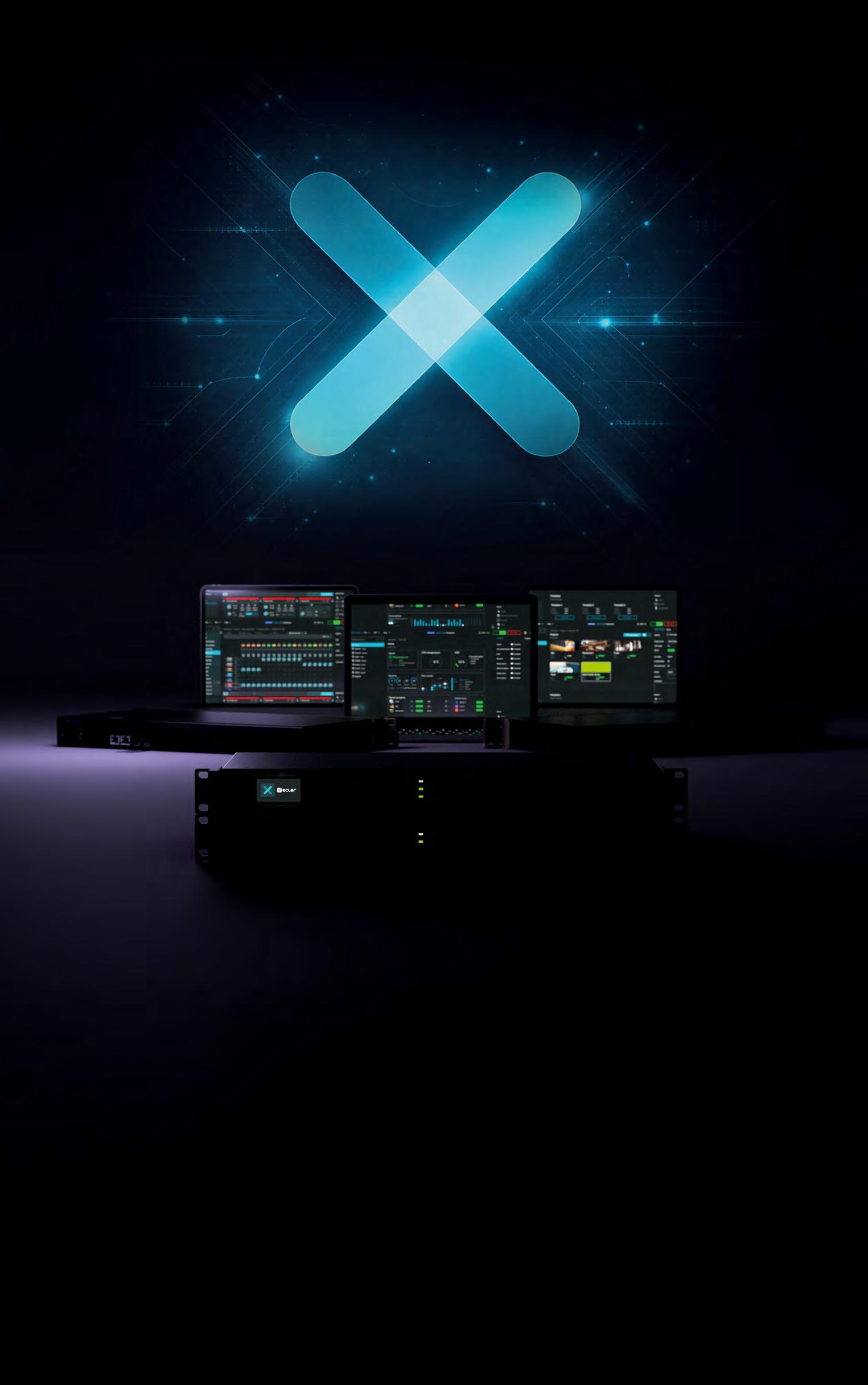





As broadcasters face mounting pressure to deliver more content with fewer resources, Dynamic Media Facilities offer an alternative approach
discussed transformation, those conversations have typically revolved around technology advances – new boxes offering allnew features and capabilities. In a world increasingly shaped by software development, however, that model is beginning to look outdated. The challenge today is no longer access to technology, but whether long-established infrastructure philosophies still align with how content is produced, monetised and consumed.
“The biggest challenge facing the industry today is not technical readiness, but mindset,” observed Lawo’s Andreas Hilmer, speaking at IBC, where the company’s presence was defined less by large-format consoles and more by expansive displays and software-driven workflows.
For decades, broadcast facilities have been designed around worst-case scenarios. Every gallery, edit suite and control room was specified to handle maximum channel counts and peak production demands, regardless of how often those limits were actually reached. That approach delivered reliability and predictability, but it also hardwired inefficiency into system design. Dynamic Media Facilities, a concept formalised by the EBU (European Broadcasting Union), aims to reverse that logic by replacing static, overprovisioned infrastructure with software-based platforms that can be shaped around the needs of each production as it happens. It is a trajectory that Lawo had already been pursuing well before the concept was formally named. A visit to the company’s headquarters in Rastatt in late 2025 offered a deeper insight into
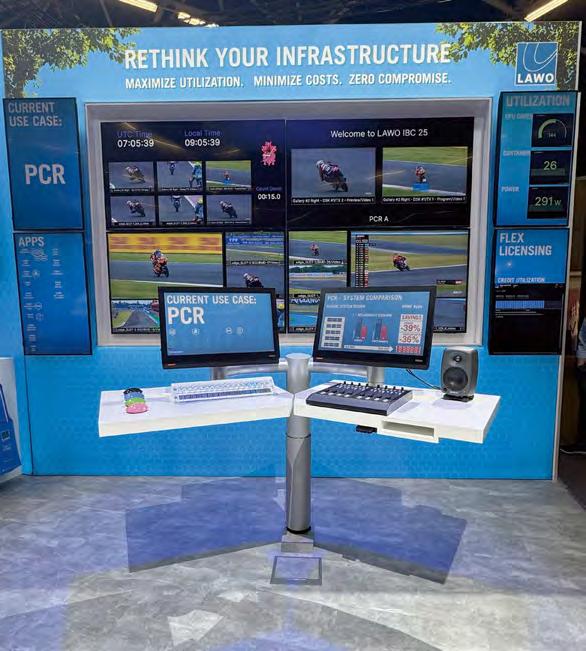
how this shift is reshaping broadcast production, and why its implications extend well beyond technology choices alone.
“The problem is not that the technology isn’t there,” Hilmer explains. “The challenge is that people try to apply old structures and old thinking to new software-based systems. That doesn’t work. You have to think differently from the beginning and see the opportunities that come with that freedom.”
At the technical core of the Dynamic Media Facilities approach is a long-term move away from dedicated, proprietary processing hardware towards software running on standard CPU-based platforms. For Lawo, this has been an evolutionary process rather than a sudden pivot.

“Using the best available technology has always been part of what we do,” says Hilmer. “We replaced analogue audio with digital, then point-to-point systems with networking and then moved through different networking technologies until IP became the obvious choice. CPUs and server-based systems have now reached a point where they can replace former
Historically, broadcast manufacturers invested years of R&D into FPGA-based processing cores. By the time those systems reached the market, the underlying silicon was already ageing. Over a typical product lifecycle, both manufacturers and customers were effectively locked into a fixed processing envelope.
“With proprietary hardware, once you release it, it’s often already two years old,” Hilmer continues. “You then sell that platform for another 5–7 years. The customer is stuck with what that box can do. You
can improve things with firmware, but you cannot fundamentally change it.”
By contrast, CPU-based platforms benefit directly from the pace of the wider IT industry. “We are standing on the shoulders of companies like Intel, AMD and Nvidia,” he explains. “They continue to push processing power forward, and that progress lifts our software immediately, without requiring manufacturers to redesign entire hardware platforms from scratch.”
For vendors, this fundamentally changes the development equation. Software can evolve continuously, with new functionality delivered far faster than was ever practical in a hardware-first world. For customers, it extends the useful life of their investment, not because boxes last longer on the rack, but because the processing environment itself can grow and adapt over time.
Crucially, this shift does not imply that physical interfaces disappear. Hilmer is clear that professional productions will continue to rely on dedicated control surfaces and tactile operation. What changes is where the processing happens and how tightly it is tied to a specific piece of hardware.
While the shift towards software-based processing is often framed as a technological evolution, Hilmer emphasises that its primary driver is economic reality. Broadcasters are not spending more money, but they are still expected to deliver more content, more formats and greater flexibility than ever before.
Dynamic Media Facilities address this by replacing fixed, room-specific provisioning with pooled resources and elastic licensing. Instead of every gallery or edit suite being specified for maximum possible demand, processing capacity can be allocated dynamically and scaled up or down depending on the production.
“In traditional facilities, everything is designed for the worst case,” Hilmer says. “You buy maximum capacity for every single space, even if you only need a fraction of it most of the time. With a dynamic approach, you only call on the resources you actually need for the production at hand.”
Licensing becomes function-agnostic, allowing the same pool of resources to be used for mixing, monitoring or visualisation as required. “The financial implication is subtle but significant,” he adds. “It’s not simply about making systems cheaper. The total spend may remain similar, but the return on that spend improves. More productions can be delivered, more flexibly, without duplicating infrastructure.”
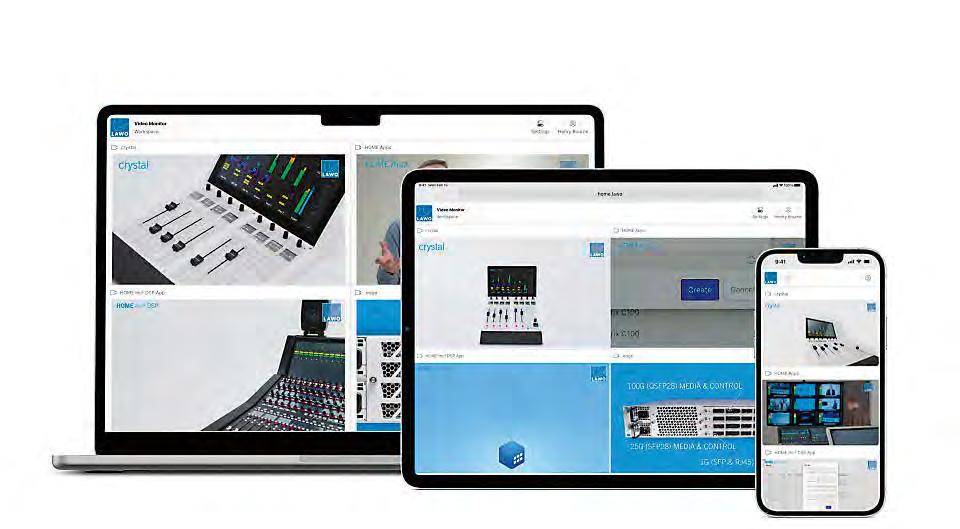
One of the clearest patterns Hilmer observes is that service providers and OB operators have often embraced dynamic architectures faster than traditional broadcasters. The reason is straightforward: commercial pressure.
“For truck companies, the advantages are immediately obvious: less weight, lower power consumption, fewer converter boxes and much more flexibility,” he explains. “They can configure a truck for the application at hand and
move licences around as needed. It just solves problems for them.”
Public broadcasters, by contrast, often face internal resistance rooted in legacy workflows and long-established skillsets. “There are organisations that say, ‘This is great, but we don’t have the staff to operate it’,” Hilmer notes. “Or their staff are used to working in a certain way, and they just want to survive with their existing knowledge.”
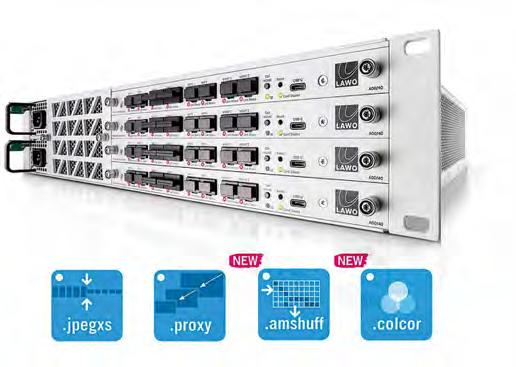
That hesitation carries long-term risk. “At some point those engineers will retire,” he warns. “If the organisation hasn’t adapted by then, the challenge becomes far greater, as finding successors with that legacy expertise will be increasingly difficult.”
Although Dynamic Media Facilities are most commonly discussed in a broadcast context, Hilmer also sees growing relevance in live production and entertainment venues. As productions become larger and more immersive, the need for scalable, software-driven processing increases.
“Audio processing is audio processing,” he says. “Whether it’s broadcast, theatre or live events, it’s signals
coming in, being processed and producing an output. The core principles are the same.” Technologies developed for broadcast-scale environments are now enabling increasingly complex immersive audio systems in venues and festivals, where requirements can vary dramatically from one production to the next. Rather than building fixed infrastructures around a single use case, operators can deploy platforms that adapt dynamically.
“I think we are only at the beginning of virtualised and immersive environments,” Hilmer adds. “Creating acoustic spaces through software rather than fixed room acoustics is something we will see much more of.”
Asked how broadcasters should prepare for an uncertain future, Hilmer’s outlook is pragmatic. Predicting specific technologies, he suggests, is less important than building systems that can evolve.
“No one knows exactly what will come next,” he says.
“Processing power will increase, networks will get faster and software will continue to improve. But the safest approach is to stay flexible.”
The visit to Rastatt underlined a broader point. This shift is not about chasing trends or introducing new product categories. It reflects a growing recognition that the economics of traditional, fixed infrastructure no longer align with how content is produced, monetised or consumed today.
Dynamic Media Facilities, in that sense, are not a destination but a strategy. By prioritising flexibility over peak provision, broadcasters and production companies position themselves to adapt as requirements change. In an industry under constant pressure to deliver more with less, Hilmer urges that adaptability is no longer optional and is the only sustainable path forward.
www.lawo.com
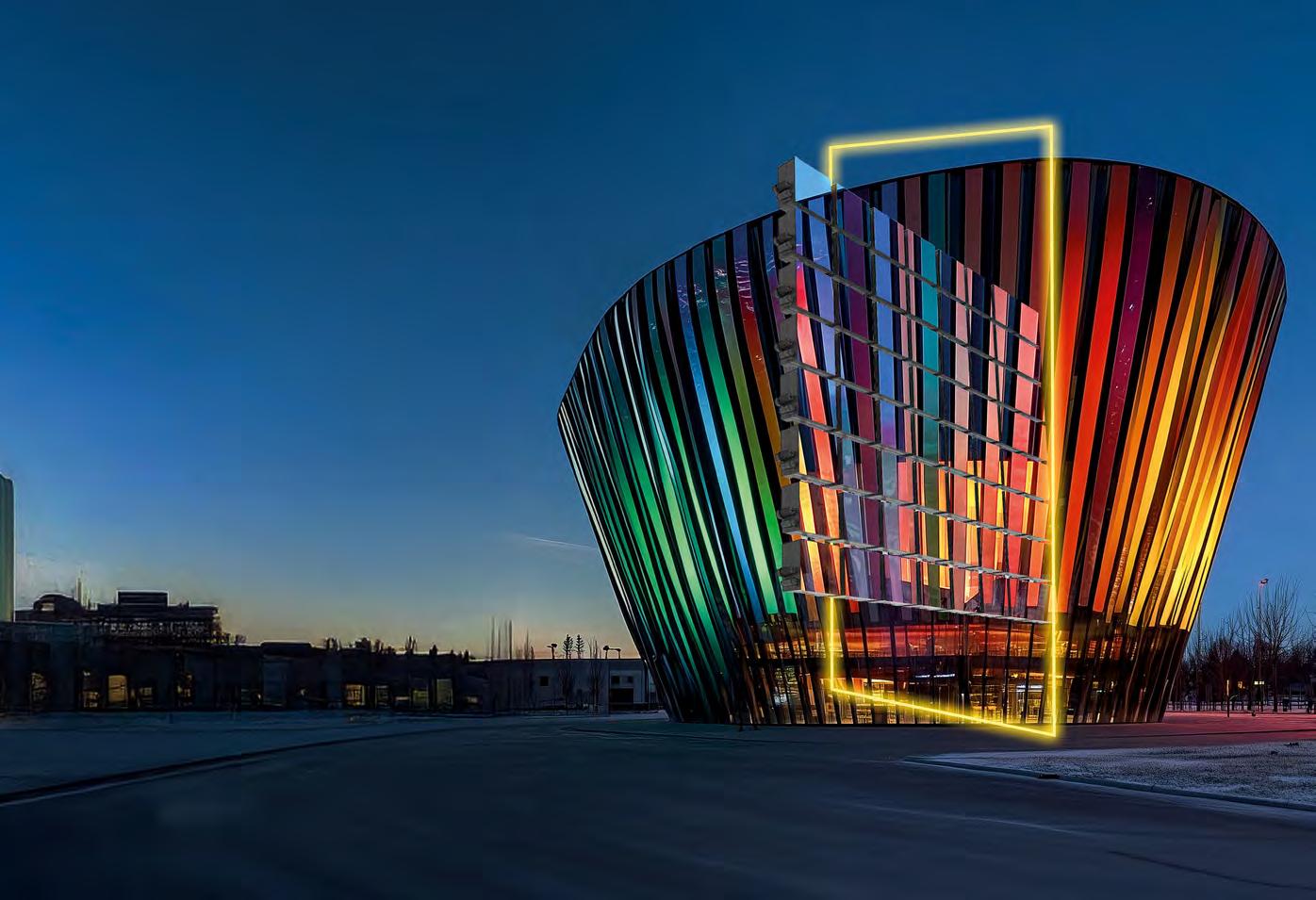
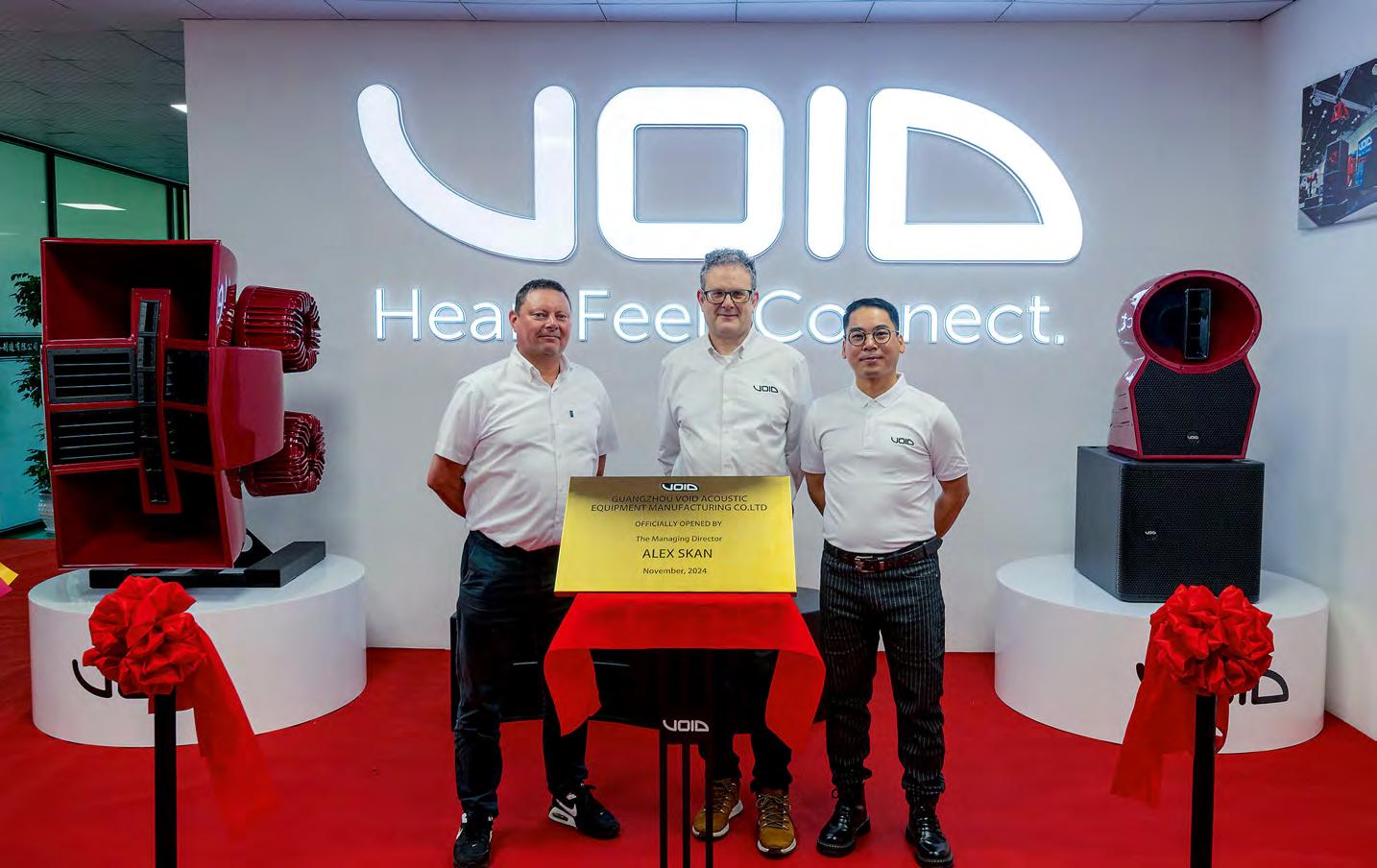
ESCHEWING THE SATURATED CLUB OF INDISCRIMINATE black boxes for 25 years, Void Acoustics continues to set the bar high by designing electroacoustic magnificence within abstract works of art. Cofounders Rog Mogale and Alex Skan may have welcomed Sam Brandon into the fold as managing director, but these teenage friends and audio addicts are hardly stepping out of the spotlight anytime soon.
Coming from a family with very little musical ability, Mogale’s flair for playing drums and the piano at three years old was balanced by his love of drawing circles on shoe boxes that resembled loudspeakers and connecting them to other boxes with string. “I don’t think you pick a career in life, I think it picks you,” he maintains. “I’ve always loved audio from a very young age and audio picked me.”
With an electronic specialist father who worked for a computer company, Skan’s curiosity about technology and records stirred a musical passion and, when the rave scene arrived in the UK in the late 1980s, his time had arrived. Set against a turbulent sociopolitical backdrop, dance music and acid house marked a new era of creative expression and an escape from the norm. As like-minded individuals gathered and the social fabric shifted, Mogale and Skan met and discussed taking on the established world order of professional audio.
Confronted with club systems plagued by inferior design qualities, the duo’s increasing frustration led to them challenging conventional audio. “Both Alex and his business associate would come to my house, and we’d talk excitedly about loudspeakers until the early morning,” recalls Mogale. “Clubs were spending millions on the décor and the lights, but the loudspeakers remained black boxes hidden away
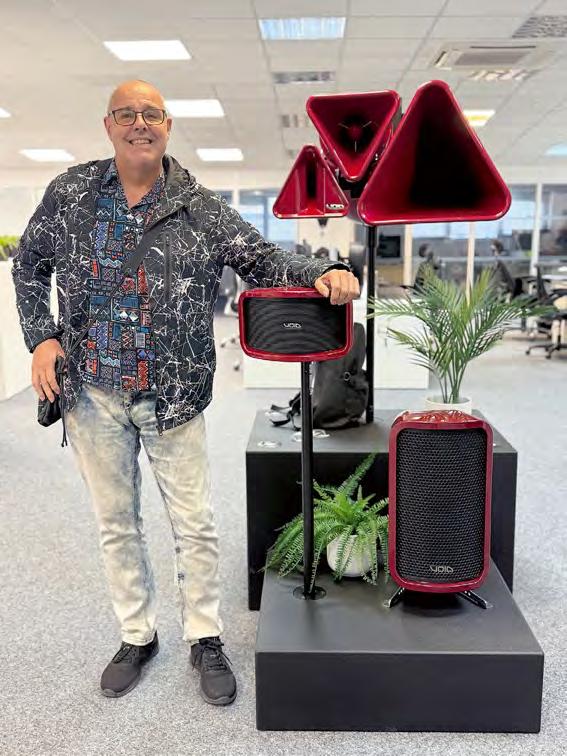
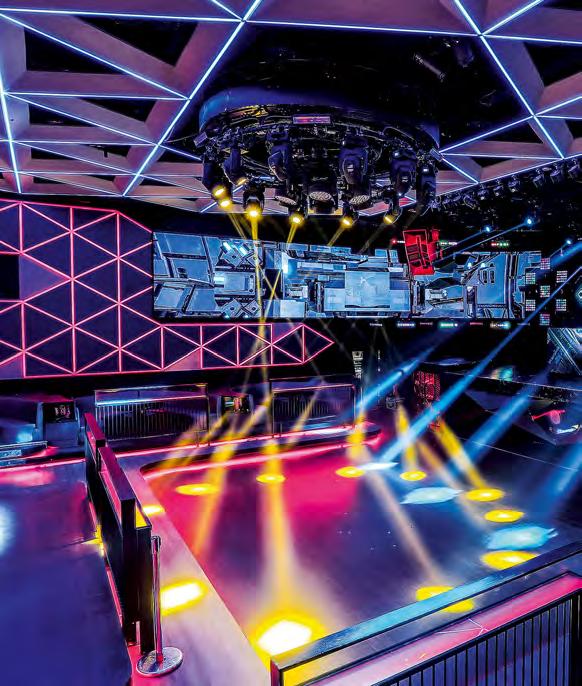
apologetically in the corners. For the loudspeaker to come out, I knew that the design had to mirror the aesthetics of the club. Like hidden sculptures, loudspeakers had always been there, but needed uncovering.”
As Mogale pursued a career in writing, performing and producing music, his enthusiasm for speaker design was placed on hold until 2002. “I was mixing live shows for big artists including George Clinton in addition to writing music for TV and film,” he says. “However, I’d reached a defining moment and just couldn’t carry on in the music industry, so I quit. Suddenly, I was urged to follow my first dream of building speaker systems. It was a natural evolution with Alex because we shared the same vision.”
Driven by an insatiable desire to create a more cohesive experience for venues and their guests, Void Acoustics instantly differentiated itself in the market. “The vision was to make the speakers a part of the whole clubbing experience,” explains Mogale. “There’s no point going to a club and not being able to totally connect with every part of the performance. With established loudspeaker brands not taking risks, Void could make a difference. We didn’t have a business plan because we simply wanted to turn people on and let them have a good time.”
If Mogale’s maverick designer role was to be fulfilled, Skan knew he had to manage the business. Having gained experience of how other brands installed equipment into venues, he confesses: “Rog enjoys designing speakers and creating for venues, but I knew he wasn’t keen on business formalities. Fortunately, I enjoy sales and the business side including administration, purchasing, recruitment and human resources. As we grew, it was important to identify new employees who could fulfil the roles we could not do, freeing up the time for us to focus on what we’re good at.”
During a 14-day visit to Shanghai to attend an exhibition and conduct meetings with suppliers, Mogale opted to extend his stay and work in China, where he remained for over 10 years. “Everything in the UK was either cost- or time-prohibitive and, because I work very quickly, prototyping with metal, wood and fibreglass was a lot easier in China,” he attests. “Several Chinese factories invited me to their facilities. Unlike in the West, they all shared a hunger to learn and move forward. Ultimately, I rented an office and demo room in a factory north of Guangzhou where I was also permitted to create prototypes in their manufacturing facility.”
Several years later, Void Acoustics China established its own R&D lab and fibreglass shop. For this, Mogale recruited two
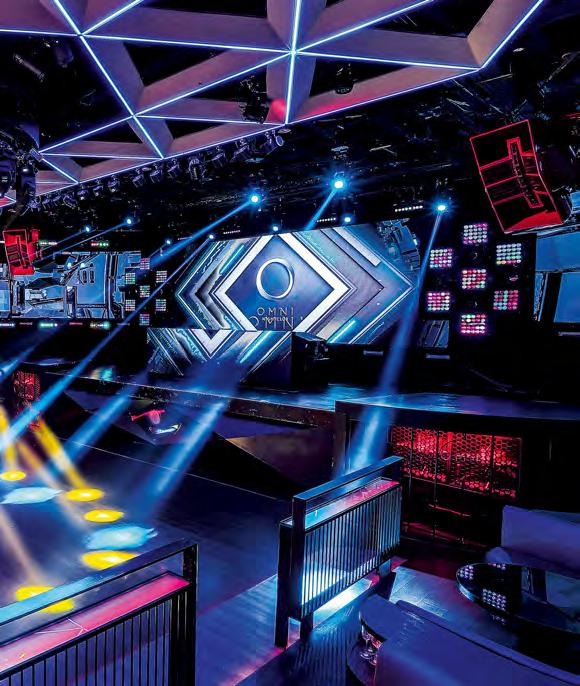
engineers, including a street craftsman he had noticed during his daily walks: “This man could ingeniously make car parts such as bumpers out of anything, including fibreglass. When his business took a downturn, I asked him if he could transfer these skills to create speaker enclosures, and he made the moulds for the first Air Motion in 2005.”
Despite having limited resources, this period marked a highly productive phase for the fibreglass specialist, Mogale and Sheng, who helped with the 3D CAD drawings. “In 2013, we created Venu V1 Series which incorporated 12 models alone, in addition to Tri Motion, Nexus 6, Psyco X and Stasys Xair,” says Mogale. “This would take a normal manufacturer around 10 years to design, produce all the crossovers, cabinets, hardware and transducers, but we did it in a year. The production of these systems continues today.”
The Chinese operation – a manufacturing resource for the fibreglass enclosures portfolio – is overseen by general manager Leo Lin. “It is well-structured, the factory floor
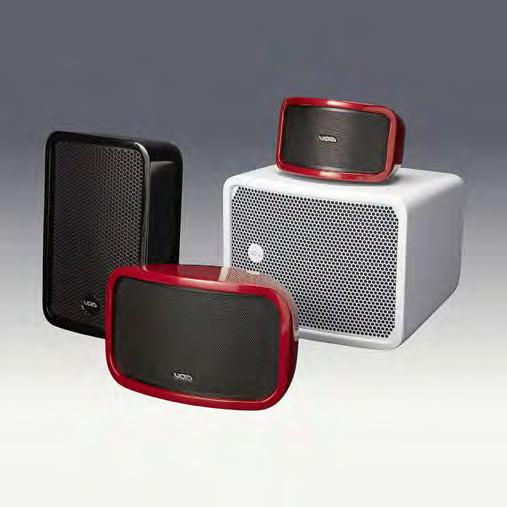
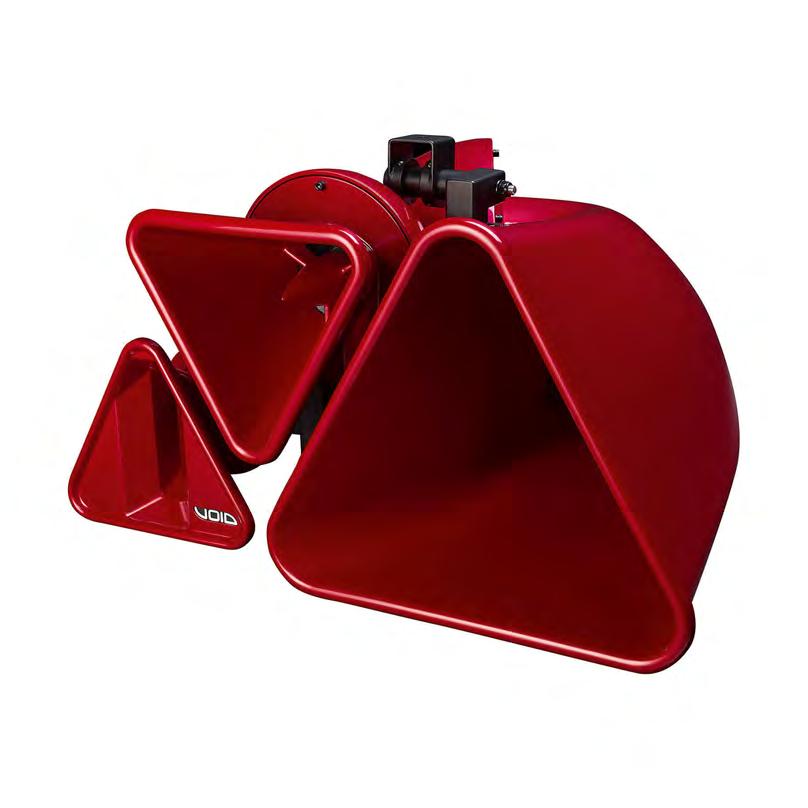
we try not to over-manage from the UK because this setup could not be replicated anywhere else. Many OEMs originally gravitated towards China because they were attracted by cheaper labour, but our ethos has always been different. With their unique mindset, spirituality and incredible work ethic, we knew we could not manually manufacture our fibreglass designs anywhere else.”
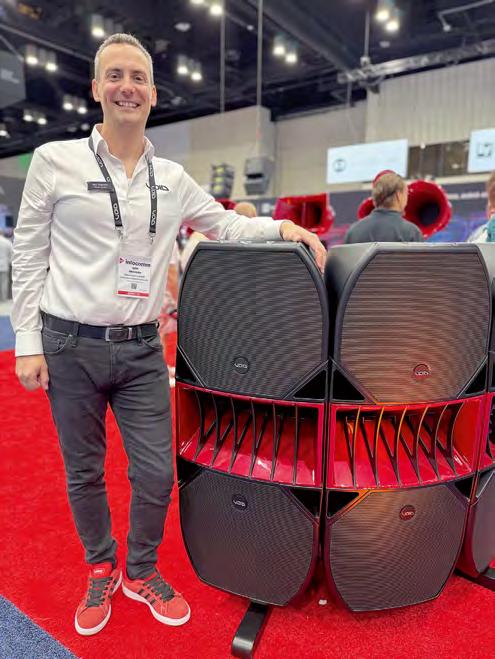
Maintaining a balance, Skan marshalled the upwards trajectory of Void Acoustics in the UK. Increasing turnover generated from the company’s initial industrial unit at 10b Dawkins Road in Dorset demanded expansion into neighbouring units over several years. Simultaneously, the product portfolio permeated into other vertical sectors beyond nightlife. “Nightlife remains our spiritual home, but Void is perhaps renowned for its design aesthetics and amazing sound quality in high-end boutique hospitality,” suggests Skan. “Exclusive residential spaces and the marine market are other interesting sectors for us. It’s no coincidence being here in Poole, Dorset, because the biggest yachting boatyards are very close to our headquarters and we have attracted many employees from this sector over the years.”
The Void Acoustics catalogue partly consists of designs catering to customer demand, but Mogale’s pioneering spirit sees him also creating his own designs. “Fulfilling certain specifications such as weight, output and dispersion for our sales division is commercially astute, but I enjoy creating prototypes without any constrictions as well,” he explains, exemplifying the birth of Tri Motion. “With its cylindrical enclosures, Air Motion is a perfect 3-way format for a club. However, I wanted to substitute this form with asymmetric triangles, so the dispersion pattern could tilt downwards in venues with low ceilings to avoid reflections.”
Following the decade spent in China, Mogale decamped to the Malaysian island of Penang before settling down in his current abode of Gran Canaria, where blue sky thinking helps him create some of his unique designs. “I go through creative cycles, pursuing different interests that all blend together to improve my speaker designs,” he continues. “I may take two months with my photography before I get into hiking around the island, then into motorbikes and fixing old engines and back to speakers and then into my studio to record music.”
A keen artist since he was an infant, Mogale continues to sketch when an idea comes to mind: “I must draw it before translating into CAD, and then run simulations to see if it works. With Incubus, I wanted two stacks to cover 2,000 people in a club, but with some dispersion control, allowing more HF to be thrown into the middle of the dancefloor to combat air absorption. I wanted all 14 drivers in the cabinet
to sum as one point source with less than one wavelength between them, so the distances between the sources are minimised to ensure there is zero destructive interference.”
Combining a group of engineers around the world including Simon Rains in Thailand, the R&D division hosts weekly online meetings, working closely with the product design team. Internally, Mogale’s influence covers a wide spectrum, from conception to packaging the final product. A current peek into the R&D inner sanctum reveals Void ceiling speakers and subwoofers for outdoor applications, incorporating new technology that resists water entering the ports. “Rather than work in isolation, each department combines as one in delivering a new product,” explains Skan. “There is a feeling of ownership, and this is where the family vibe has developed.”
To date, the biggest-selling Void products are the Airten and Cyclone 55 models. However, changing trends in the hospitality market are now witnessing Air Motion speakers being specified in restaurants, according to Skan: “From a development perspective, creating products that are commercially viable is a huge asset. There is no need for
us to design specifically for certain sectors of the hospitality market but, should we do so in future, it will be in our own unique Void way.”
Following the appointment of the highly experienced Andy Rigler as head of sales in 2024, Skan and Mogale revealed Sam Brandon as Void’s managing director in May 2025. While aiming to step away from the managing director role, Skan is not looking for the exit just yet. “I am continuing to support our team and contribute to the vision by playing a continued role in its next exciting chapter,” he says. “We have now reached a point where we’re attracting the best employees. We have collectively done a brilliant job to get us to this point but, to go further, the business demands someone with amazing experience and connections. Sam is that man.”
Brandon enters Void with experience in technical, engineering, commercial and leadership roles across Europe, the Middle East and Africa. Most recently, he served as CEO of the EAV Group and, prior to that, he was director of audio at Harman Professional. “I first came across Void at PLASA in 2008 because they were sponsoring the show, and they definitely stood out,” he recalls. “Having admired the brand from afar since then, I’m incredibly honoured to join as managing director. With a commitment to elevating sound into an art form and a bold design philosophy that sets it apart in an industry often defined by conformity, no other brand looks or sounds quite like Void.”
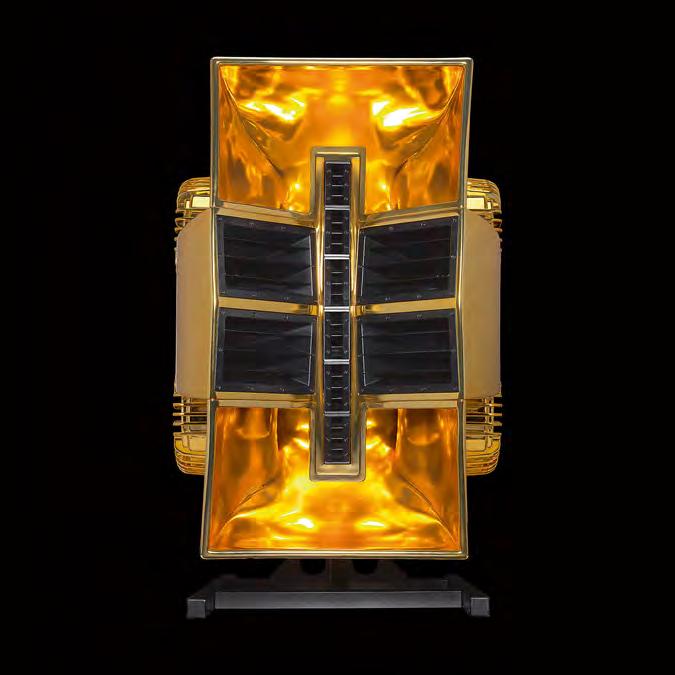
Having taken a year off work to decide and cement the next 20, Brandon was unconsciously gravitating towards a company where the owners retained full control. “When the Void proposition came up and I had a meeting with Alex and Rog, I rediscovered the passion and knew that I wanted to remain in this industry,” he says. “This is one of the massive strengths of Void, as is their speed in making decisions. I know that I can send a message at whatever time I want in our WhatsApp group and they will immediately respond. This contrasts markedly with most other companies today.”
As he hit the ground running, Brandon identified the challenges resulting from unprecedented sales growth each year since 2021. “The company turnover almost doubled in that year, and the upwards momentum has not tailed off,” he explains. Coming out of the pandemic, Void had been very active with its sales and marketing. But, with warehousing, sales, technical and marketing in one building and accounting, planning, operations and manufacturing in the other, this division added to the growing pains.
Coinciding with Brandon’s appointment, Void Acoustics relocated from its previous 900m2 premises to an all-in-one, facility. “By unifying the team under one roof, the dynamic has changed, and the relocation has added to our credibility,” says Skan. “It’s a ‘wow’ building and we can breathe again, with fewer distractions. Over the last 20 years,
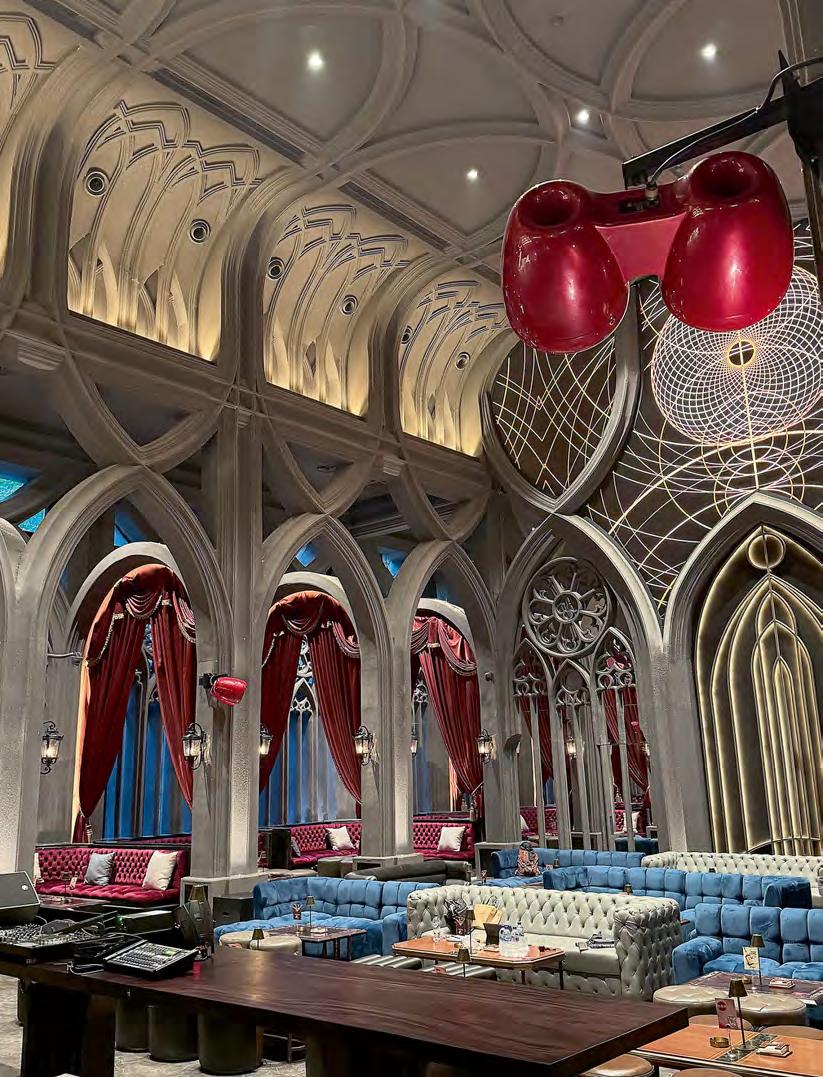
and venues, Brandon agrees that the brand has naturally penetrated hospitality sectors including hotels, restaurants and cafés. “My analysis concluded that our speaker systems such as Cyclone are increasingly specified across hospitality environments, where the design aesthetic remains a critical factor,” he reveals. “There is a revenue benefit for a venue manager investing in something that not only looks great for that space but sounds excellent. It becomes easier to justify that spend because paying guests remember, and return. Ahead of the curve, perhaps, but Void was ready for this increasing demand from boutique, high-end hospitality spaces.” Being a passionate business, Void has continued to expand its pool of dedicated personnel. “Void has attracted like-minded people over the years such as DJs, musicians and performers, who have a big passion for what we do,” says Mogale. “When recruiting a reseller or distributor, you can look into their eyes during a discussion about speakers and, when you see their faces light up, you know they are on your side. If that doesn’t happen, and they’re more interested in numbers and shifting boxes, its generally not going to work. We have always gravitated towards like-minded souls to be a part of the journey.”
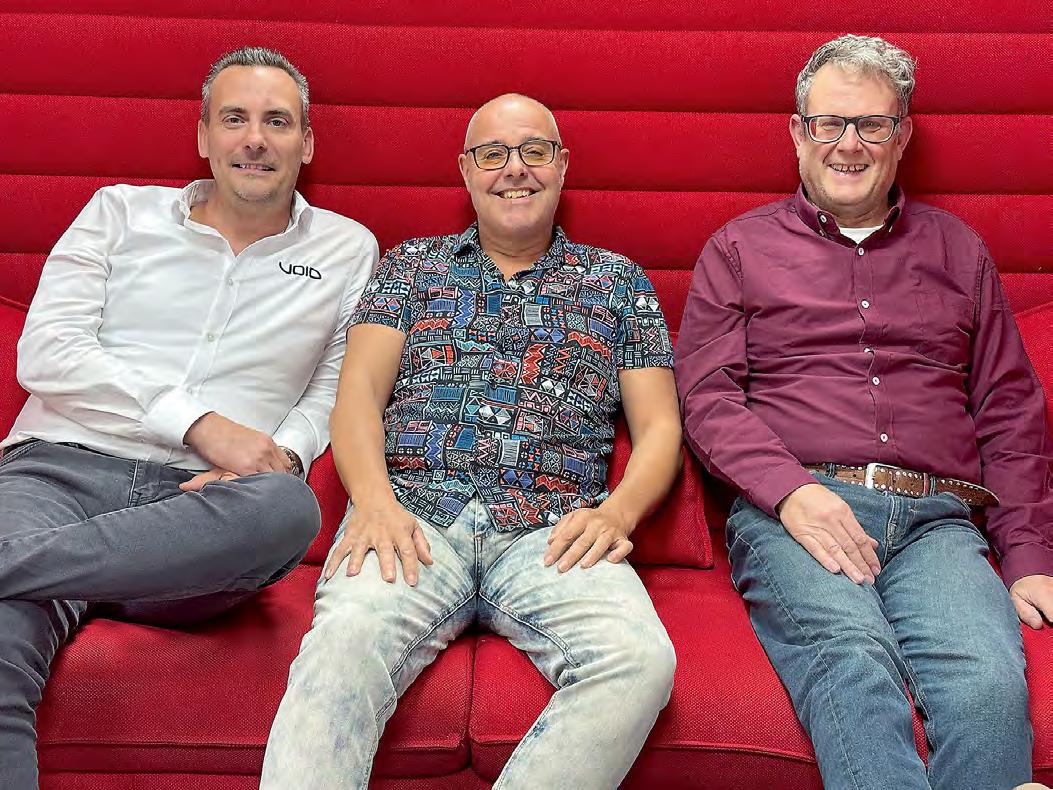
A bemused smile appears on Mogale’s face as he views the various departments processing orders, creating sales leads and discussing projects with clients in the new office space. “I always knew that the business would be successful because I work fast, I’m focused and, once I sink my teeth in, I don’t stop,” he asserts. “Financial success doesn’t motivate me, it’s looking around the world at the most amazing people that work with Void – that’s my motivation. I’m the luckiest man alive to have our staff; everything and everyone is just perfect for the massive growth that’s to come.”
www.voidacoustics.com
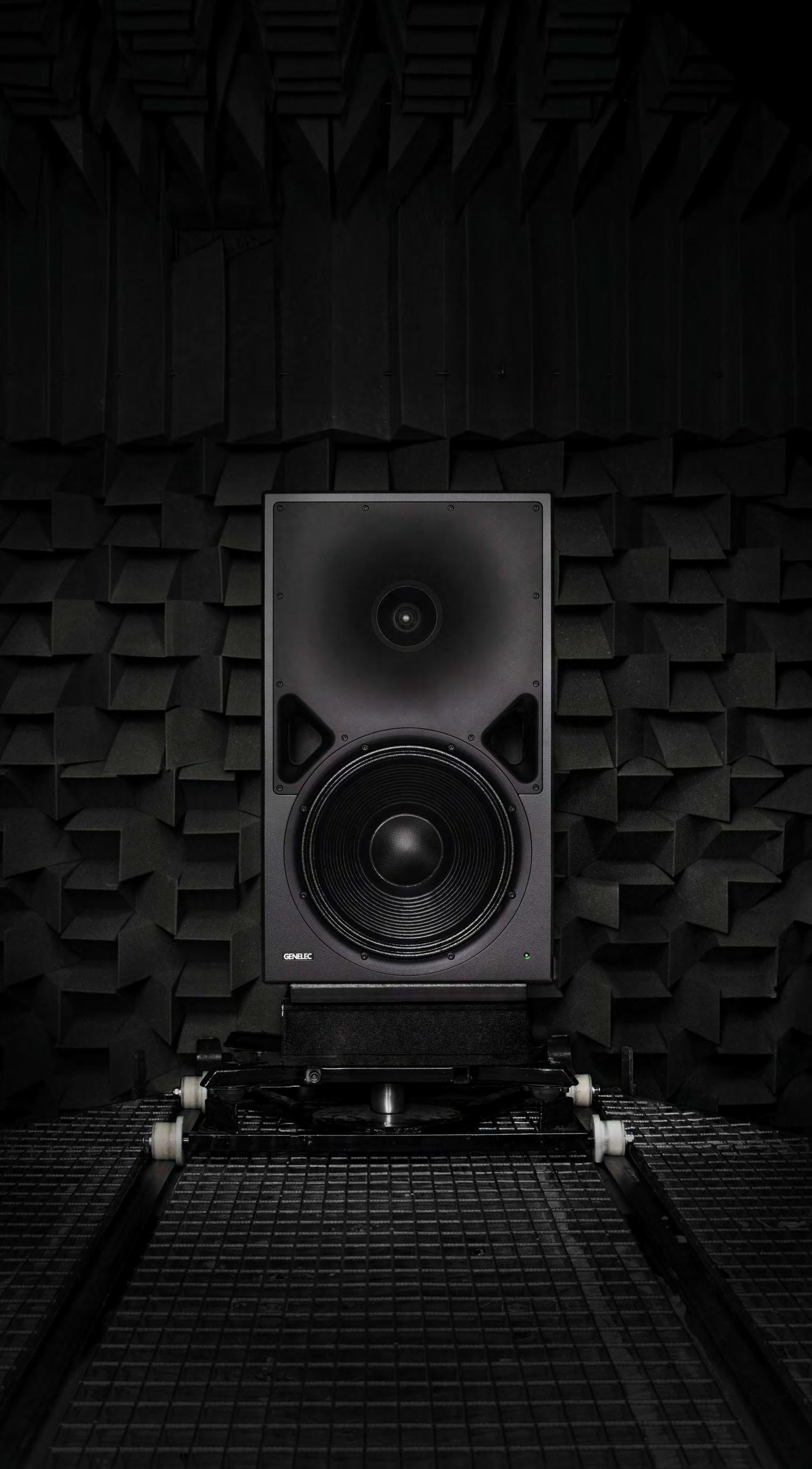

genelec.com/8380a

Singapore-based Phoenix Broadcast Solutions has deployed a new hybrid remote IP infrastructure to support some of the region’s biggest sporting events
WITH MULTIPLE EFFECTS, REMOTE COMMENTARIES crossing continents, back-to-back fixtures and millions of viewers watching every play unfold, live sports broadcasting leaves little room for compromise.
The UAE’s International League T20 cricket (ILT20) and the Bahrain Horse Racing Series are two of the most prestigious live events in the region’s sporting calendar. As Singapore-based facilities company Phoenix Broadcast Solutions opened the batting, it delivered a winning double thanks to its extended technical team.
In addition to investing in a range of flexible audio broadcast technology from Calrec, Phoenix Broadcast Solutions also bought into a three-year strategic partnership with the UK audio specialist. Designed for flexible deployment and forming the heart of Phoenix Broadcast Solutions’ portable flypack infrastructure, phase one of the agreement included the acquisition of Calrec’s IP Argo S and Argo M consoles, its modular IP Type R mixing system and an ImPulse IP processing core, as well as an inclusive ongoing support partnership.
Phoenix Broadcast Solutions’ founder Siddhartha Tyagi explains that the transition to the British manufacturer has marked a significant change for his engineering team. “Our sound engineers have many years’ experience working exclusively on a different hardware platform, so this was the very first time they have worked with Calrec consoles,” he says. “Mastering new technology usually takes time, but Calrec’s outstanding support has accelerated both our team’s capabilities and confidence.
“Calrec ensured there was an engineer onsite to help them understand the signal flow during setup. And although they shadowed our team for the first day, Calrec’s user interface is so intuitive that our guys picked it up very quickly. In fact, they reported that Calrec provided more capabilities and flexibility to produce a much more immersive mix.”
The demands of the International League, taking place from December 2025 until January 2026 and staged across three venues with matches often scheduled back-to-back on the same
day, placed particular emphasis on speed and reliability. More than 20 effects and crowd microphones, multiple commentary positions in two languages, guest commentators and sponsorship activations all had to be accommodated within tight turnaround windows. Calrec’s Argo S handled the world feed, while the Argo M produced the unilateral Hindi feed, both connected via a shared IP backbone.
“From the outset, it proved to be a highly reliable and professional piece of equipment, consistently exceeding expectations in a live environment,” says sound supervisor Mr Narayanan (Nana). “During the ILT20 2026 cricket production in Dubai, the Argo S was paired with Argo M surface controllers for two different language productions simultaneously, delivering remarkable performance. Features such as no-tones-on-air mode, extensive preamp headroom, one-click immersive audio expansion, seamless IP integration, rapid redundancy handling and the ability to switch instantly to a Type R surface as standby make it an exceptionally versatile and production-ready console.”
If cricket tested the system’s ability to manage dense, repeatable workflows, the team’s next stop at the Bahrain
Horse Racing Series presented an entirely different operational challenge. Produced in conjunction with Racecourse Media Group, the 29 race meetings forming the 2025–26 series taking place at the Rashid Equestrian & Horseracing Club required multiple effects microphones distributed around the course, alongside live commentary feeds originating more than 3,000 miles away from commentators’ homes.
“Our obligation to deliver world feeds to a range of clients requires some races to have both English and Arabic commentary,” explains Tyagi. “This demands a flexible transmission mix which has both languages mixed on different tracks. When the Arabic commentary is not required, we replace it with clean effects. Previously this all needed to be assigned manually and switched in and out, but with Calrec the switch happens automatically with a single button press.”
He also notes that the platform’s internal networking capabilities allowed the team to integrate an RTS communications system over a Dante network, reducing rig time and simplifying setup.
For Bahrain Horse Racing sound supervisor Rakesh Palleri, the impact of the new investment was felt across the entire season. “It delivered a genuine step change in both remote and live production workflows,” he says. “The intuitive webbased Calrec Connect interface enabled configuration in just a few clicks, while its AoIP integration, customisable controls, On-Air protection, generous DSP resources and responsive touchscreens created a calm and efficient working environment.”
Now embedded within Phoenix Broadcast Solutions’ live production workflow, the Calrec systems are being deployed on further top-tier events including the Singapore Smash table tennis tournament and the Caribbean Premier League, reflecting a broader strategic shift towards scalable IP-based broadcast infrastructures capable of supporting complex, multi-language and multi-location productions across the region and beyond.
www.phoenixbroadcast.com
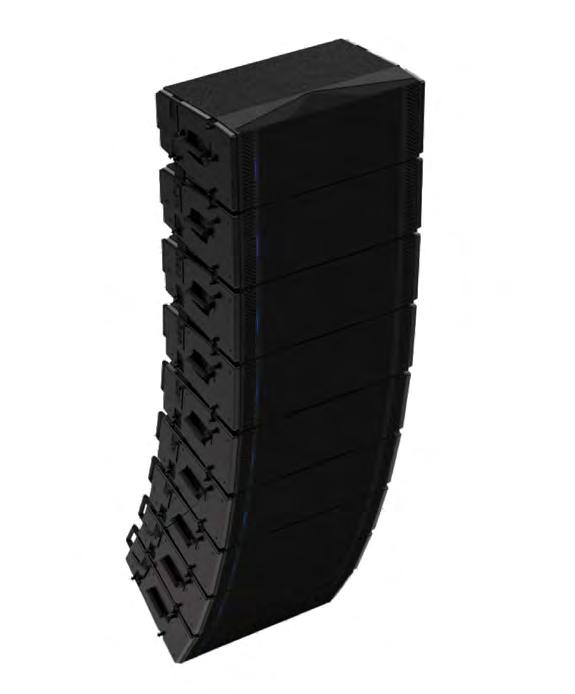
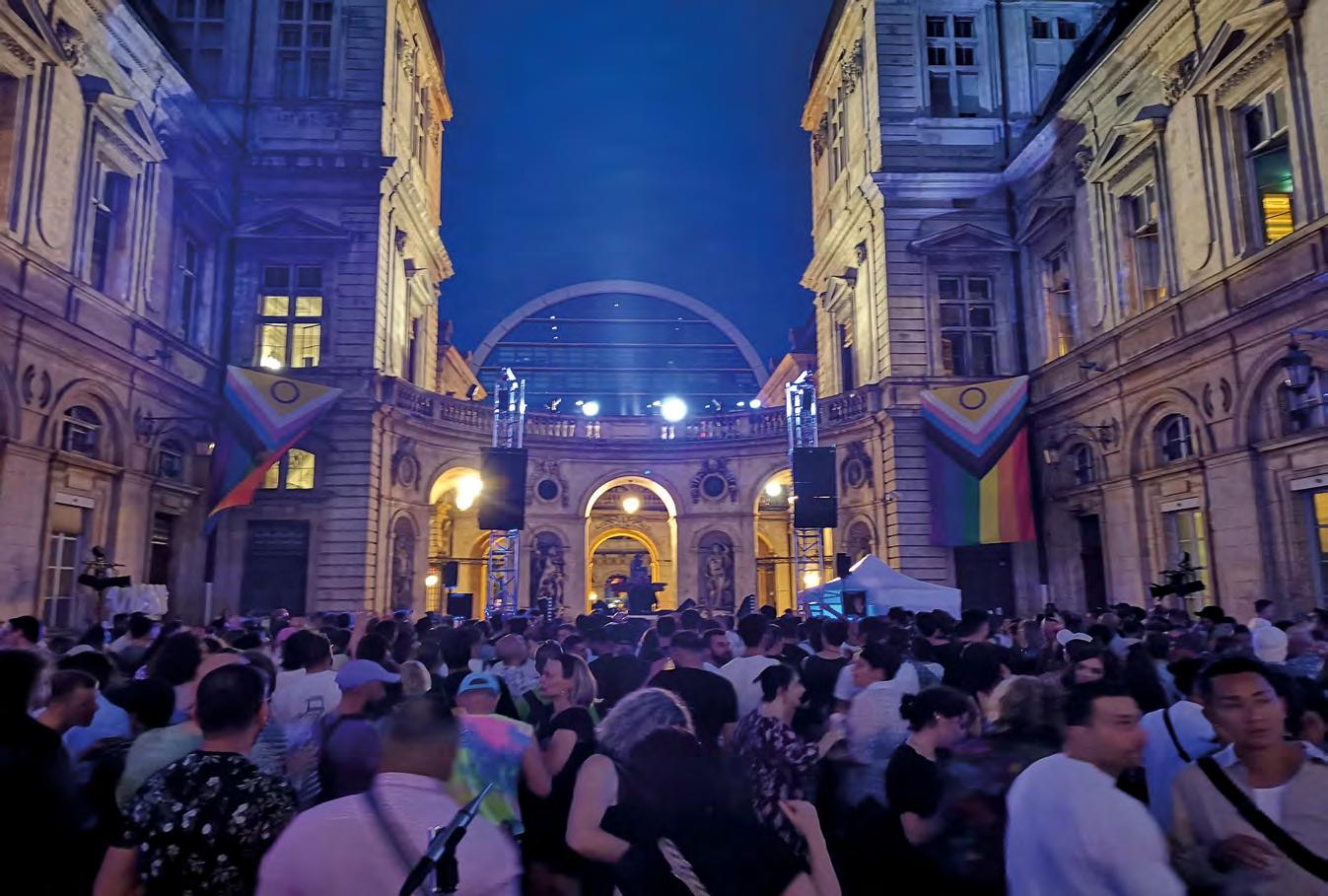
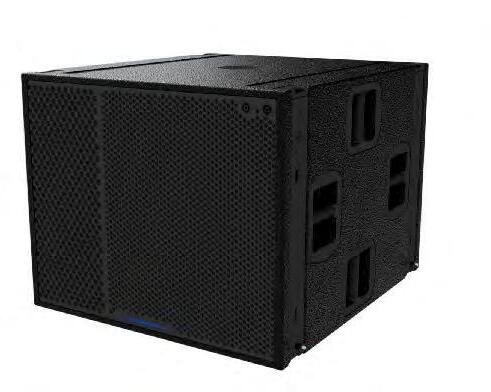


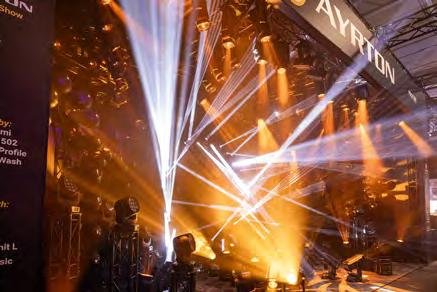
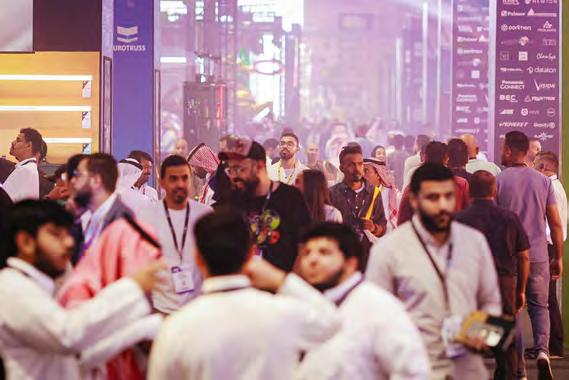

www.saudilightandsoundexpo.com


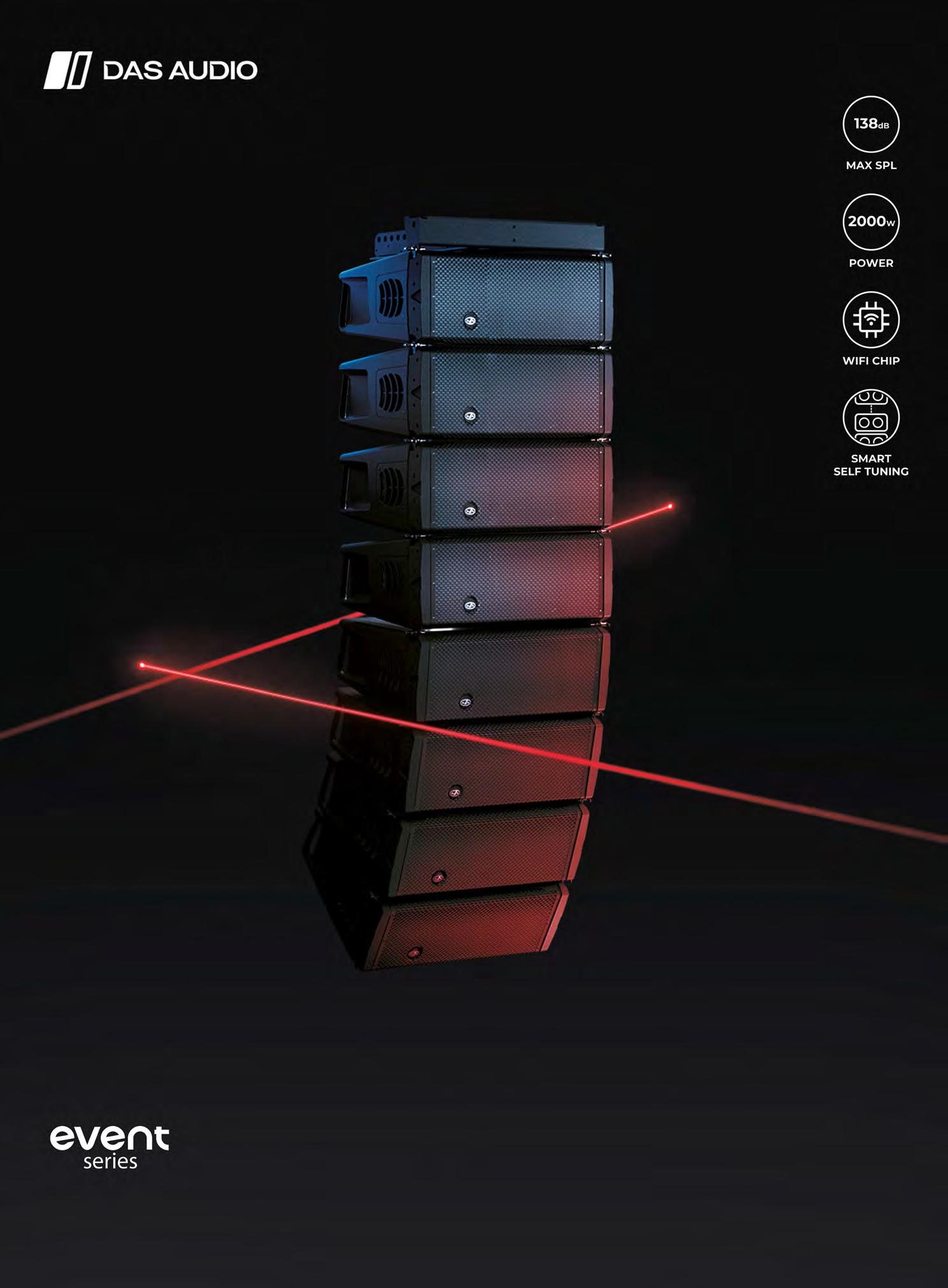

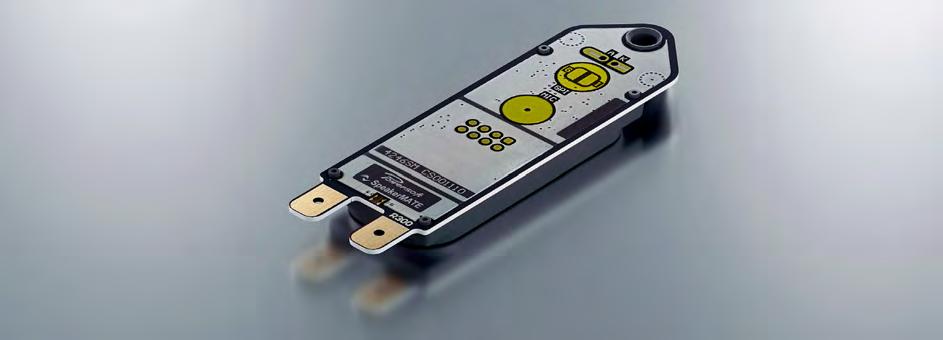
ANYMATE – AND its first implementation, SpeakerMATE – have been developed by Powersoft to come a step closer towards smarter, more connected installed audio systems. The new technologies add identification, monitoring and data exchange capabilities directly to passive loudspeakers, without the need for additional network cabling or external power.
For years, the professional AV industry has focused system intelligence on active devices and IP-based infrastructure, while passive loudspeakers have largely remained disconnected endpoints. AnyMATE aims to address this imbalance by enabling communication over existing speaker lines, allowing the amplifier to act as a communication hub for both audio and data.
AnyMATE is a communication technology based on a proprietary protocol and a patent-pending physical-layer implementation. Rather than relying on Ethernet or wireless connections, AnyMATE exchanges data directly via an amplifier’s output channels. This makes it possible to identify and monitor downstream devices without deploying a separate control network, aligning closely with the realities of installed audio environments that often feature long cable runs, Hi-Z architectures and legacy infrastructure.
Developed within Powersoft’s R&D department over more than a decade,
AnyMATE has been refined through extensive internal testing before being brought to market. Importantly for systems designers and integrators, the technology is not limited to new installations. Where amplifiers have sufficient current-sensing and processing capability, AnyMATE can be introduced into existing systems by adding compatible downstream hardware, making it suitable for retrofit projects in sectors such as transport, retail and large venues.
SpeakerMATE represents the first practical application of the AnyMATE platform. The compact hardware module establishes communication between amplifiers and passive loudspeakers and can be deployed either as an external add-on near the speaker or integrated directly by loudspeaker manufacturers. For retrofit applications, SpeakerMATE connects in parallel with the speaker line via quick-splice connectors and requires no dedicated power supply, simplifying installation and minimising downtime.
Once installed, SpeakerMATE devices are automatically discovered and configured through Powersoft’s Armonía+ software. Additional data can be written to the device in advance, including speaker brand and model information, enabling the system to suggest appropriate presets and helping to reduce configuration errors during commissioning.
Beyond identification, SpeakerMATE incorporates a temperature sensor, accelerometer and microphone, with the option to interface with an external sensor via a GPI port. These features enable new levels of monitoring and diagnostics for passive loudspeakers, including temperature and tilt measurement, on-demand sound pressure level testing and access to detailed metadata such as installation notes, serial numbers and lifecycle history. When integrated with cloud-based services such as MyPowersoft, accessed via MyUniverso, SpeakerMATE allows system status and anomalies to be monitored remotely. This capability supports faster fault-finding, preventative maintenance and reduced site visits, particularly valuable for large, distributed systems such as shopping centres, airports, stadiums, cinemas and theme parks. Powersoft is introducing AnyMATE as a platform rather than a single product, with the potential for future expansion and licensing to third-party manufacturers. By embedding intelligence into existing infrastructure, AnyMATE and SpeakerMATE can transform passive loudspeakers from silent endpoints into active participants within the networked AV environment.
www.powersoft.com

The NA-4I4O-AES72 is a 4-channel (4I/4O) stagebox for transmitting microphone levels, analog line levels, AES3, DMX or even intercom via one single CAT cable. The device has male and female XLRs in the same housing and can be used directly as a splitter for monitoring. An additional etherCON serves as feedthrough and allows further looping of the signals to other devices. A ground lift at each input prevents possible ground loops. In addition, each input connector offers the possibility to invert the signal.




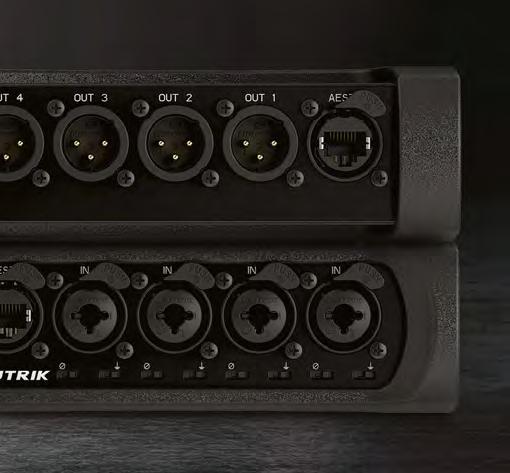
FULL SUPPORT for EASE (Enhanced Acoustic Simulator for Engineers) and CLF2 (Common Loudspeaker Format) data integration has been added to Crest Audio’s CPL+ loudspeaker series. The move gives AV consultants, systems designers and integrators direct access to accurate, manufacturer-verified loudspeaker data for use in predictive acoustic modelling, coverage mapping and design validation.
Designed for both fixed installation and mobile reinforcement, the CPL+ range includes both full-range and subwoofer models, offering
coverage and configuration options for a wide variety of applications. Now EASE and CLF2enabled, each CPL+ loudspeaker ships with comprehensive GLL and CF2 data files, allowing users to perform detailed design simulations within EASE 5, EASE 4 and CLF Viewer, as well as most CLF-compatible simulation software. This provides 3D balloon and polar plots for precise directivity analysis, frequency response and phase plots validated to industry standards, comparative overlays to match CPL+ models against other manufacturers and accurate SPL coverage and STI mapping when deployed in EASE-modelled venues.
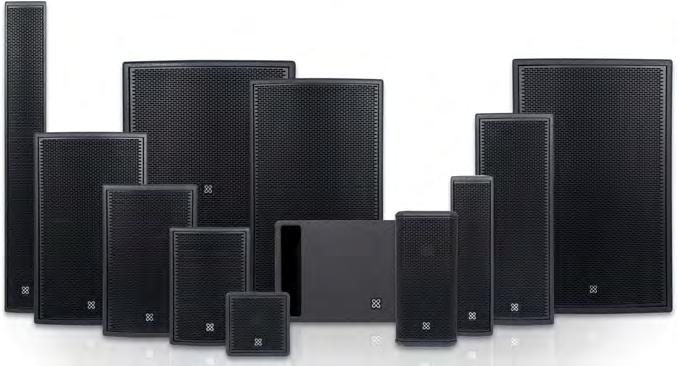
FOLLOWING THE release of the C5 Pro and C6 Pro ceiling loudspeakers, NEXT Audiocom has created what it describes as its most powerful model to date with the C8 Pro.
Providing seamless adaptation to different system requirements, a built-in transformer enables operation on both 100V line systems and low-impedance 8Ω
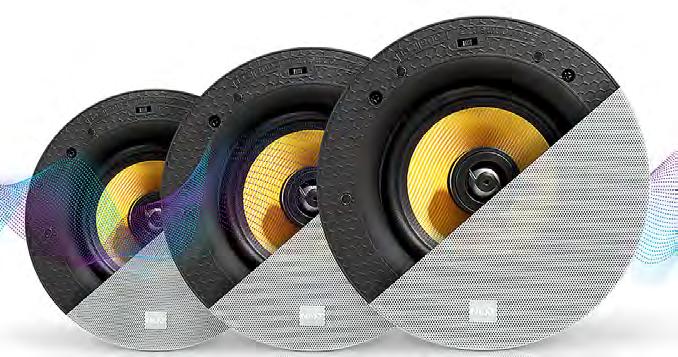
Measuring 80W RMS power with a maximum SPL of 112dB (programme/peak), the C8 Pro has been engineered for applications that demand higher output and enhanced lowfrequency response.
Designed for installation in false ceilings, walls and panels, the low-profile magnetic grille provides a frameless appearance and can be painted to match or contrast with the surrounding surface. For projects requiring a completely discreet look, the detachable logo provides an unobtrusive finish.

HK AUDIO has introduced filter templates for ASHLY AquaControl and FX Control, designed to enable fast, precise and reliable system configuration for selected HK Audio models. The presets have been engineered to work with the brand’s FINEO, SI series and LINEAR 5 series, and can be integrated into existing ASHLY systems, providing a basis for professional audio installations and live applications.
The preconfigured filter settings provide users with optimised sound tuning, enhanced operational reliability and reduced setup effort. The templates are suitable for both fixed installations and mobile sound reinforcement applications. They are available in the download area for the products on HK Audio’s website.
www.hkaudio.com
COMBINING POE++ power and IsoFlare point source transducer technology, AtlasIED has added the Atlas+Fyne FC-D (ceiling) and FS-D (surface) Dante-enabled PoE++ loudspeakers to its growing portfolio. Producing full-bandwidth, high-output performance, the latest models incorporate PoE++ technology via a single network cable. Engineered for phase-coherent summation across the entire passband,
each model incorporates an IsoFlare point source transducer. Providing predictable coverage, its integrated waveguide geometry ensures constant directivity, reduced off-axis colouration and improved time-domain accuracy. Delivering lobe-free dispersion, the mechanically aligned HF/LF centres negate inter-driver latency.
www.atlasied.com
installations. Additionally, the adjustable tweeter provides control over high-frequency coverage, for directing the audio where required. Promoting automatic sound tuning based on the room, the C8 Pro supports Environment Equaliser adjustment to simplify acoustic optimisation. Increasing long-term reliability, an HF Driver Protection circuit safeguards the high-frequency driver against unexpected audio peaks.
www.nextaudiogroup.com
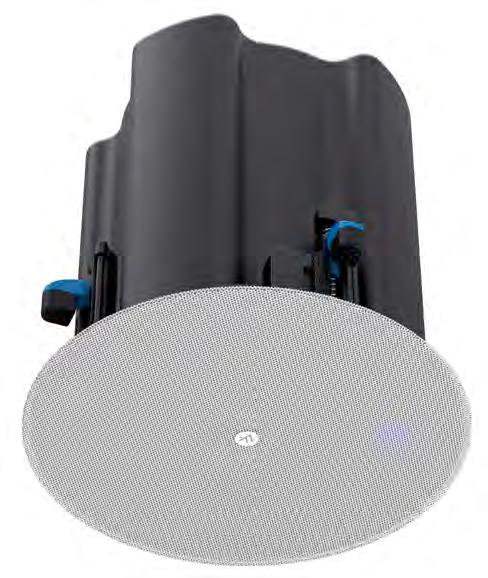
BELGIAN LOUDSPEAKER manufacturer
Audiofocus has expanded its Cyris coaxial loudspeaker range with the introduction of the CX5 and CX8, two compact passive models designed for shortthrow installation and live applications demanding controlled coverage, output and discreet aesthetics.
The Cyris CX5 is the smallest model in the range, built around a 5-inch coaxial transducer and delivering a maximum SPL of 124.3dB. Measuring 144mm across, the enclosure is intended for visually unobtrusive deployment in corporate AV, hospitality and cultural environments. The loudspeaker can be
wall or ceiling mounted using an optional bracket and includes a threaded insert for mic stand mounting, allowing it to be used in portable scenarios.
The larger Cyris CX8 features an 8-inch coaxial transducer with a wide 100° x 100° dispersion pattern, enabling even coverage with a reduced number of loudspeakers. It delivers a peak SPL of 134.4dB and a frequency response of 80Hz–18kHz. Mounting options include wall and ceiling
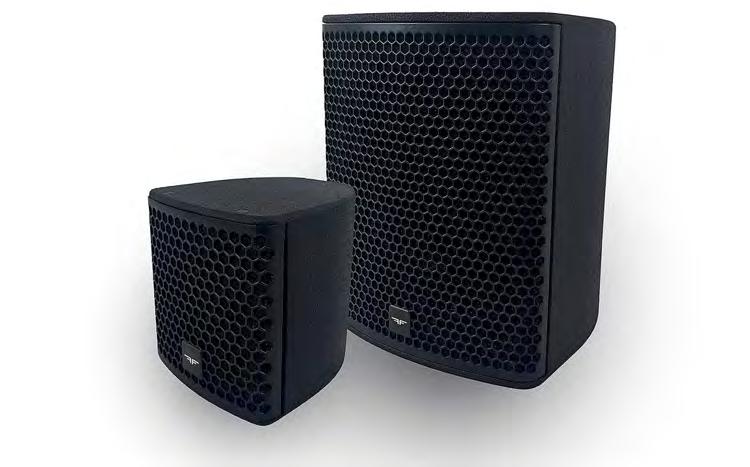
DESIGNED TO deliver seamless system integration, simple installation and high-fidelity networked audio for small and medium-sized meeting rooms, the ATSP-30 speakers from Audio-Technica are supplied as a pair – one active, one passive – that connect via standard speaker cable. Mounting flush in drop or hard ceilings with the included mounting hardware, the 10.4-inch diameter speakers take up minimal space but produce rich, full-bodied sound with a 140° coverage angle. Their low/ mid-frequency reproduction makes them suitable not only for microphone amplification but for playing background music and audio from video sources. For installations in which more than one pair of speakers is deployed, discrete audio signals can be sent to each pair –a helpful option for zone-based sound reinforcement and background music playback.
Featuring Audio-Technica’s AT-Link protocol (allowing for the transmission of uncompressed multichannel digital audio), the speakers form part of a sound reinforcement ecosystem featuring the ATDM-0604a and ATDM-1012 Digital SmartMixers, wireless and ceiling microphones and PC, all tied together by Cat5e or better cable for simple, affordable installation. For planning purposes, the ATSP-30 speakers are compatible with AFMG’s EASE software for convenient 3D sound modelling of the installation space. Audio-Technica also offers its own easy-to-use Speaker Layout Tool, which estimates sound pressure levels for a proposed speaker setup in a given space, along with the Audio-Technica LINK Simulator app which calculates how many power devices (such as the ATLK-EXT165 link extender) are required in a configuration of LINK devices. Once installed, the speakers’ onboard DSP settings, including 4-band EQ, sound
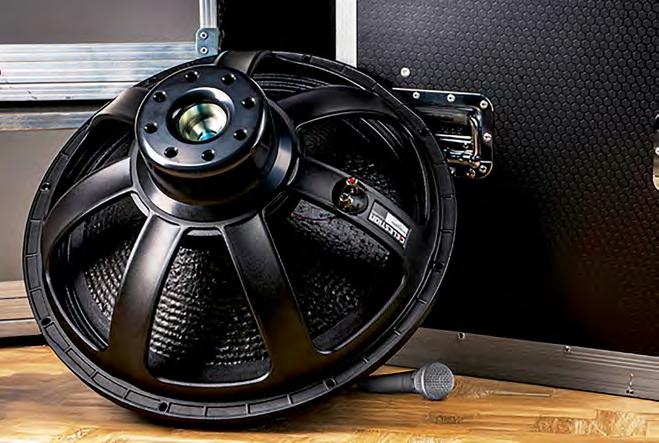
installation, while the enclosure also incorporates a dual-position polemount socket for flexible deployment. Both models are compatible with the manufacturer’s C210S low-profile double 10-inch subwoofer and A Series 4-channel amplifiers. In applications requiring rapid setup, up to four Cyris loudspeakers can be powered directly from the active C210Sa subwoofer. Both the Cyris CX5 and CX8 are manufactured from birch plywood at the company’s headquarters in Belgium, with custom-coloured cabinets available to suit architectural requirements.
www.audiofocus.eu
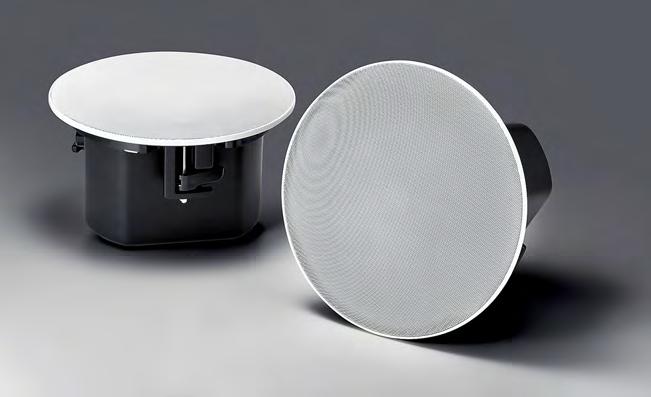
profile presets, delay, power restriction, phase shift and connection status can be adjusted via the ATDM mixer’s Web Remote and Smart Mixer Manager
www.audio-technica.com
large-format line arrays and 2- or 3-way loudspeaker systems.
The TSQ2460 features a 4,800W continuous power rating and achieves 98dB sensitivity. Its high-power handling capability is tied to its 6-inch diameter round copper voice coil, supported by an aluminium chassis, combined with the driver’s magnet cooling technology.
The driver incorporates the Precision Tuned Venting (PTV) system, a 3-channel system that provides constant, efficient cooling across the frequency band. According to the manufacturer, this temperature control enables the voice coil to operate at temperatures typically up to 80°C lower than competing drivers in this class.
Further enhancing thermal performance is a proprietary coil structure featuring custom winding done in-house at Celestion. The voice coils use a hybrid multilayer, inside/ outside methodology, using proprietary adhesives and adhesive application methods. This approach maximises cooling
potential by exposing the greatest surface area to free air, synergistically combining with PTV to achieve significant reduction of power compression and thermal stress, further enhancing lifespan.
The system employs a Reconfigured Magnet Assembly that allows for greater cone excursion and a high Xprotection level. This capability works in tandem with the driver’s Polysiloxane Laminated Dual/ Triple Suspension design, which takes advantage of a new process that optimises the laminates’ application method and polymer density between suspension rings and prevents the suspension system from losing stiffness under heavy loads. This means that the electrical motor strength (Bl) and mechanical compliance (CMS) reach their defined Xprotection limit at virtually the same point, resulting in consistently low distortion performance even during high excursion.
www.celestion.com
DESIGNED BY dBTechnologies to create a true 3-way system the size of a traditional 2-way dual 8-inch enclosure, the VIO L1608’s dual 8-inch neodymium LF drivers work alongside a coaxial MF/HF assembly powered by a 1,600W RMS Class-D amplifier. An optimised waveguide on the coax assembly and a low crossover point around 600Hz extend part of the midrange into the horn, producing a stable horizontal response and
and a fibrous protective layer behind the grille that helps reduce water ingress. The L1608 also incorporates current-generation VIO technologies, including inclinometer integration, opto-isolated preamps to minimise unwanted noise, NFC-assisted positioning and a bright front ID LED designed for visibility during setup and system verification.
For the first time in a VIO module, A2Net protocol is included, enabling high-resolution
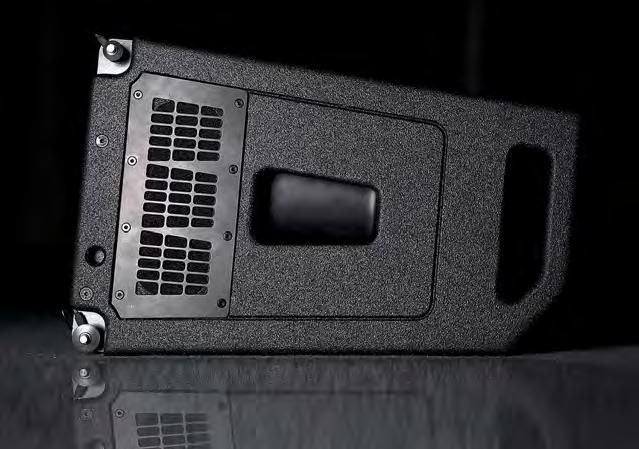
an open, natural midrange character. The manufacturer’s side-firing Bassreflex Port geometry manages airflow through lateral acoustic paths to reduce turbulence, stabilise internal pressure and increase low-frequency efficiency.
Extending its reach into performance spaces and applications traditionally reserved for larger systems, the L1608 exhibits several design principles that shaped the success of the L1610. These include hybrid midrange propagation through both waveguide and horn for improved pattern precision, an enhanced 3-point rigging system that accelerates deployment and increases safety, and improved environmental protections such as sealed electronics, upgraded moisture treatments for transducers
digital audio distribution and complete Aurora Net control. An optional Dante interface remains available for networked environments requiring advanced routing and integration.
As part of the VIO ecosystem, the L1608 benefits from the unified platform established with firmware 2.0. All VIO modules running this firmware share matching phase response, latency and input sensitivity, allowing engineers to deploy different models together. This uniformity lets the L1608 operate as a standalone main PA, as a compact touring system, as a down or side fill for larger arrays such as the VIO L1610 or L212, or as a flexible utility element in complex touring configurations.
www.dbtechnologies.com
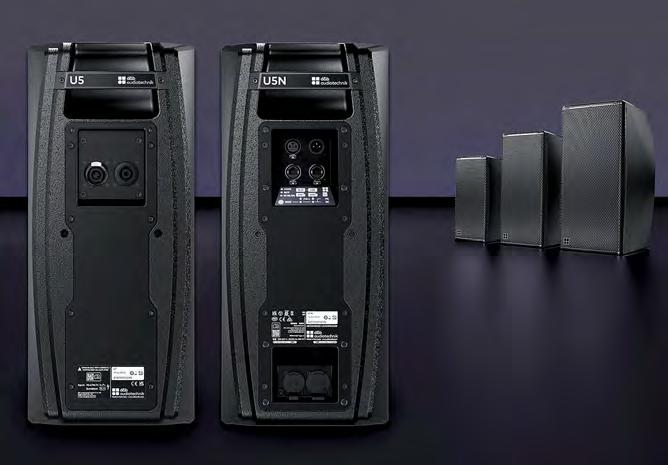
D&B AUDIOTECHNIK has unveiled the U-Series, described as a new approach to compact multipurpose point source loudspeakers. With three models available in both networked and passive variants, the U-Series’ modern, application neutral design integrates into both mobile and installed setups.
The bipolar woofer configuration extends vertical directivity control down to ±500Hz. All variants deliver identical low-frequency performance down to 55Hz and feature the port design technology developed for the SL-Series, ensuring consistency across the range and supporting full-range performance for nearfield applications without subwoofers. Each model features a patent-pending waveguide horn assembly that can be rotated 90° without tools.
The three passive (U3, U5, U7) and three hybrid-topology networked loudspeaker models (U3N, U5N, U7N) are physically and acoustically identical. The passive models integrate into the d&b workflow and amplifier ecosystem and are suitable for applications where cost-efficiency and amplifier channel count are key. The networked variants feature a hybrid-topology networked DSP power module and operate with AC and/or PoE++ power in dual Milan and R1 networks. Complementing the U-Series, the manufacturer has introduced the B10 compact omnidirectional dual 10-inch bass-reflex ground subwoofer, available in both passive and networked variants. The passive version will be offered in two options: a mobile (B10) and a fixed installation version (Bi10). The networked versions include the B10N for mobile applications and the Bi10N for installationspecific use. Both are fully compatible with
DELIVERING A true stereo spatialised sound field from a single, ADA-compliant enclosure, the Panorama 65 self-contained loudspeaker from 1 Sound incorporates the US manufacturer’s proprietary Mono+Stereo Technology. It produces a hybrid mid and sides sonic image with a consistent mono experience throughout the entire listening field. Capable of producing a maximum output of 122dB SPL and extending down to 40Hz, the Panorama 65 delivers full-range, highfidelity performance across a 120° x 70° (HxV) listening plane. Measuring the same width as a standard 65-inch display and 101.5mm in depth when flush-mounted using the included bracket, the shallow profile supports custom recessed installations without compromising down-tilt angles and a stand accessory for isolated free-standing deployment. Designed to operate as a multichannel TV soundbar, standalone listening system or part of a distributed audio solution, the Panorama 65 is available in active plug-and-play or remote powered versions with a Powersoft
Housed in an IP55-rated, saltwater-resistant enclosure, 1 Sound offers custom colours and finishes for indoor and outdoor applications.
Comprising a single 5-inch coaxial, dual 5-inch LF drivers and dual 5-inch passive radiators, 1 Sound has released a full-
the U-Series networked models and share the same system architecture possibilities. Enhancing its Milan-AVB-enabled audio networking portfolio, the manufacturer has also added the DS22 audio network bridge, DS1 USB Milan interface, 5DM Milan amplifier and DN2 AVB switch. Incorporating 16 AES3 digital input channels, four of which can be switched to analogue, the DS22 streamlines input management for Milan-based audio systems. A Milan-enabled 5-port switch and flexible input options promote its use for connecting mixing consoles with Milan-ready amplifiers. Delivering a secure operating environment for mobile and fixed installations, the 1U device extends the d&b workflow to the input side, when placed near the FOH console. The DS1 USB Milan interface enables direct audio playback and recording from PCs and Macs to Milan devices and amplifiers. With firmware updates via Milan Manager, dual network interfaces support redundant audio streaming. Created for use with d&b loudspeaker series, including the E-, xS-, xC-, T- and U-Series, the 5DM is a compact, 4-channel, Class-D installation amplifier. Featuring advanced DSP for loudspeaker-specific configurations, the 5DM includes a wide-range, switch-mode power supply with active power factor correction, together with system management and protection. Specifically designed to integrate with d&b U-Series, the DN2 is a Milan-AVB switch that integrates with d&b R1 remote control software. Designed for use in demanding applications and immersive audio environments, the DN2 includes eight PoE++ ports offering up to 90W per port, which can power networked U-Series loudspeakers via a single cable.
www.dbaudio.com
range architectural enclosure in the form of the Sona 35. The single-channel, 3-way point source output delivers extended bass response to 58Hz (–6dB preset dependent) and can produce 120dB SPL @ 1m with a preset. Housed in a compact 150mm x 820mm x 99mm (WxHxD) form factor, the ADA-compliant Sona 35 can be positioned just 100mm from a wall or ceiling when mounted using the included recessed bracket. Allowing for down tilt or horizontal rotation in either orientation, the 7kg enclosure can be installed horizontally or vertically, recessed into a wall or aimed by adopting an optional swivel mount accessory.
www.1-sound.com



JBL PROFESSIONAL has expanded its SRX900 Series of self-powered scalable loudspeakers with the addition of 12-, 15- and dual 12-inch point source models together with a full range of supporting accessories.
The SRX912M is a multi-purpose, 2-way 12-inch powered speaker that can
fulfil roles as a low-profile stage monitor, a main PA or as a front fill. Designed for applications that require enhanced lowfrequency extension and greater headroom, the SRX915M is a 2-way 15-inch powered loudspeaker. For applications requiring high output and precise directivity control, the dual 12-inch SRX922 is a 3-way powered point source model which distinguishes itself as a trapezoidal enclosure. Sharing consistent voicing, amplification and DSP, together with common rigging and accessory options, the modular SRX900 platform seamlessly scales. An updated range of rigging, mounting and transport accessories – including horizontal and vertical U-brackets, array frames, truss clamps
ASTRYA IS Meyer Sound’s new flagship cinema screen channel loudspeaker series designed for postproduction mixing studios and premium cinemas. It combines the manufacturer’s self-powered loudspeaker and DSP technologies with built-in processing, system monitoring and networking capabilities.
Leveraging research from Meyer Sound’s Bluehorn technology, ASTRYA provides a “predictable and extremely linear” phase response for precise time alignment. Its driver density, with concentric mid-high drivers, reportedly results in optimal clarity and coverage in a minimal footprint and cohesive behaviour across the loudspeaker’s full range from 30Hz–20kHz.
The first product in the series is the ASTRYA-140, suitable for rooms measuring up to 42.5m from the screen to the back wall. Its digital input removes a digital-to-analogue conversion stage, ensuring a low noise floor. The selfpowered loudspeaker approach allows the manufacturer to implement a fully digital input path supporting AES67 at both 48kHz and 96kHz, which facilitates modern audio-over-IP workflows while also improving the dynamic range of the product. Delivering signal to the loudspeaker and telemetry data back to the user on a single connector results in a simple to install solution. www.meyersound.com
Performance for system management and ArrayLink for onsite deployment and configuration. The line arrays feature a 3-point rigging system, while the point source models include multiple QuickLink M10 attachment points for use with eyebolts. www.jblpro.com
and carts – supports flexible deployment across fixed and portable applications. Developed for JBL’s touring systems, the SRX900 Series includes Differential Drive dual voice coil, dual gap transducer technology. An extensive DSP toolset includes a 24-band parametric EQ with 2,000ms of delay in addition to an Array Size Compensation (ASC) filter that corrects the tonal effects of varying array sizes and the LevelMax limiter suite. Bypassing the requirement for IP addressing to streamline network setup, Harman’s HControl Ethernet protocol is built on standard networking protocols. The SRX900’s software ecosystem integrates JBL Venue Synthesis for 3D acoustic simulation, JBL
PSI AUDIO has created an extended main monitor system with the A226-MAIN and A326 D-REX (Dynamic Range Extender) models, which can be combined as a column or side-byside. Capable of delivering a maximum 132dB SPL through seven drivers, the combined A226-MAIN and A326 D-REX extension create a classic main monitor experience across the entire frequency spectrum. The A226-MAIN is an active 3-way speaker that combines symmetrically configured 10-inch woofers. It combines an EXD midrange driver with a specifically developed aluminium coil tweeter and the double woofers to cover 20Hz–23kHz, with all the frequencies aligned above 100Hz.
When used in tandem with the A226-MAIN, the three additional woofers in the A326 D-REX add more dynamic bass response in the lower frequencies. For LFE use, the A326 D-REX offers a special mode that opens its frequency band upwards to 160Hz. The combination of the A226-MAIN and A326 D-REX for the main stereo set can easily be enhanced with another A226-MAIN in horizontal configuration as a centre speaker. One homogenous soundfield can be created by adding A21-M models for the surrounds and A17-M enclosures as ceiling speakers.
www.psiaudio.swiss
NOW PART of AEB Industriale, Montarbo has unveiled a compact, active loudspeaker in the form of the MINIBO-5M. Designed for background music, vocal reinforcement and multimedia applications, the combination of a 5.25-inch woofer with a 1-inch compression driver is said to deliver a balanced response.
COINCIDING WITH the company’s 35th anniversary, PMC has introduced a Main Monitor Series. The launch represents the brand’s first complete redesign of main monitoring systems in more than 30 years and covers driver technology, system architecture and software control, with a focus on increased headroom, lower distortion and suitability for current stereo, multichannel and immersive audio workflows.
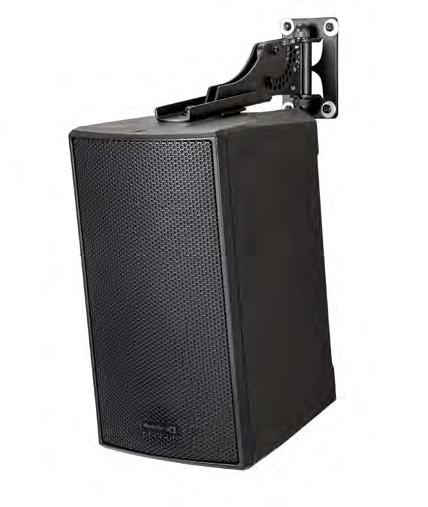
An integrated 2-channel 60W RMS preamplifier with mic/line selection, together with combo and XLR (mix out) connections are included. Measuring 190mm x 170mm x 304mm and equipped with a top handle, the 4.4kg polypropylene cabinet promotes portability and ease of installation. Optional accessories include a WB-5M wall mount and TB-5M tilt mount for installing the enclosure on walls or ceilings, in either horizontal or vertical orientation. For speeches, the MINIBO-5M can be quickly mounted on microphone stands for connection through the built-in microphone input.
www.montarbo.com
Low-frequency performance is based on a new generation of large-format bass drivers working with PMC’s Advanced Transmission Line (ATL) bass-loading system and LaminairX airflow technology. The bass drivers feature heavily vented motor assemblies, dual-spider suspensions and triple-wound voice coils, providing up to 36mm of linear excursion. This is
intended to support controlled low-frequency output at high sound pressure levels.
Midrange reproduction is handled by the PMC75v3 soft-dome driver, which incorporates the company’s a-void absorber. This damped acoustic chamber reduces rearwave reflections behind the dome. The driver is paired with the n-compass dual-profile waveguide, designed to maintain consistent dispersion through the crossover region.
High frequencies are produced by a handbuilt 34mm soft-dome driver with a shallow waveguide and low-distortion motor assembly, aimed at maintaining a neutral in-room response over extended listening sessions. All models in the series are fully active and operate with the manufacturer’s latest DSP and amplification platform. System configuration is handled via the SoundAlign2 software and the master36 controller,
which allows browser-based control of EQ, delay, crossover settings, polarity and presets for up to 32 loudspeakers. The master36 combines 32-bit DSP processing with six Class-D amplifiers delivering a total of 3,600W in a 3U chassis. For larger systems, the power20 provides an additional 2,000W of Class-D amplification for bass sections and XBD configurations.
The series launches with four 3-way models – the PMC10, PMC12, PMC15 and PMC10-4. Each can operate as a standalone full-range monitor or be expanded with matching XBD bass cabinets. Matching subwoofers are also available, allowing systems to be configured for different room sizes and immersive formats using consistent voicing and dispersion characteristics.
www.pmc-speakers.com
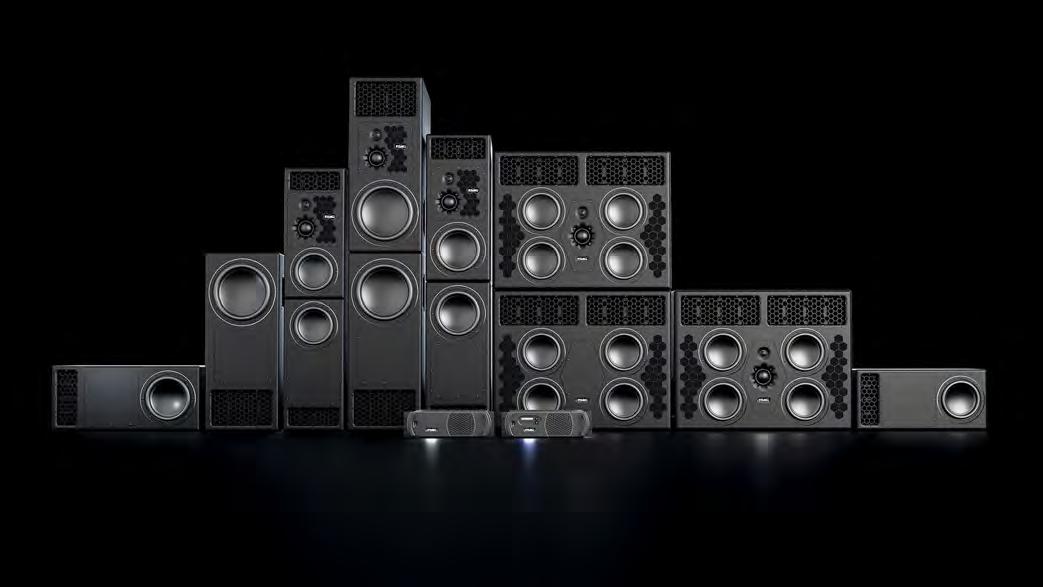
QSC HAS announced the debut of the CB10 compact battery-powered loudspeaker system, the LS218 double 18-inch powered subwoofer and the QSC Loudspeaker Control app for Bluetooth-equipped QSC powered loudspeakers.
The CB10 has been designed for event production professionals, DJs and mobile entertainers, musicians and bands, or any application where high-performance audio is required, with the added portability and versatility of a battery-powered system. The CB10 comes with a 10-inch low-frequency driver and 1-inch compression driver, while the integrated 3-channel mixer allows simple and easy connections for microphones and instruments, as well as streaming Bluetooth music. Input presets and DSP are said to further optimise system performance and ease of setup. Additionally, up to 200ms of room delay makes the CB10 suitable as an extension for distributed PA deployments. The CB10 can operate for up to 12 hours on its battery,
which is user-swappable without tools. It can be mounted on a loudspeaker stand or deployed on the floor via its integrated tilt-back angle. Operating the CB10 is further enhanced by the QSC Loudspeaker Control app for Apple and Android devices. It provides additional fine-tuning of audio and DSP parameters as well as advanced system management for connected devices, including the CB10, KC12 “K Column” and future Bluetooth-equipped QSC powered loudspeakers.
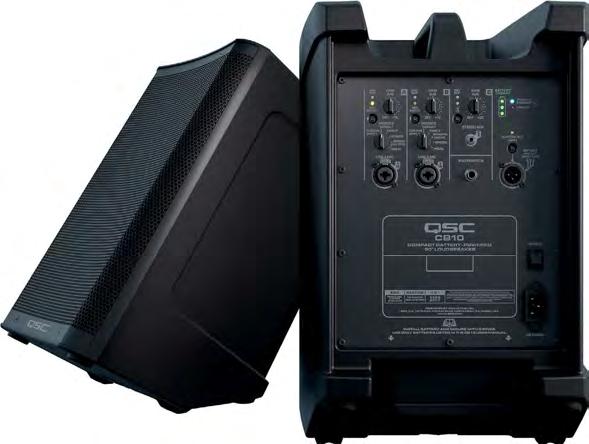
Meanwhile, the LS218 dual 18-inch active subwoofer is powered by a 5,000W Class-D amplifier with Power Factor Correction, providing 141dB peak output. Featuring QSC Acoustic Linear Phase (ALP) design, which permits the combination and deployment of QSC loudspeakers within the same sound system, the LS218 also provides daisy-chain connections for analogue, networked digital audio (Dante) and AC power (powerCON TRUE1). Two or more LS218s can be configured in a cardioid arrangement, maximising low-frequency output in front while minimising unwanted energy around the sides and rear of the system. Offering rugged plywood construction with Polyurea coating for lasting durability, the LS218 can be deployed together with the LA108 or LA112 active line array loudspeakers using either an array frame/ground-stack adapter or loudspeaker poles in both horizontal and vertical orientations. When connected to the QSC SysNav (System Navigator) app, users can design, configure, control, monitor and apply signal processing to individual subwoofers, full arrays or groupings of both.
www.qscaudio.com
THREE ACTIVE column systems have been added to RCF’s EVOX lineup, built around a true 3-way electroacoustic design, a new amplification platform and a clean, neutral aesthetic. All models are available in black or white. Described as a ground-up evolution focused on higher headroom, clearer vocal projection and faster deployment, the EVOX J features a dedicated high-frequency section: a 1.75-inch neodymium compression driver (Kapton dome) loaded by RCF’s True Resistive Waveguide (TRW), engineered to deliver constant 120° x 40° coverage and designed to reduce typical horn harshness. The midrange is handled by an array of 3-inch neodymium cone transducers that integrate the HF section to provide the focused “singlesource” feel associated with point source systems.
Low frequencies come from a high-power 12-inch woofer in a bass-reflex enclosure.
A new generation of Class-D amplification delivers 2,100W for the J9 and JMIX9 or 3,500W for the J11, reportedly providing significantly more headroom than previous architectures. The system is managed by
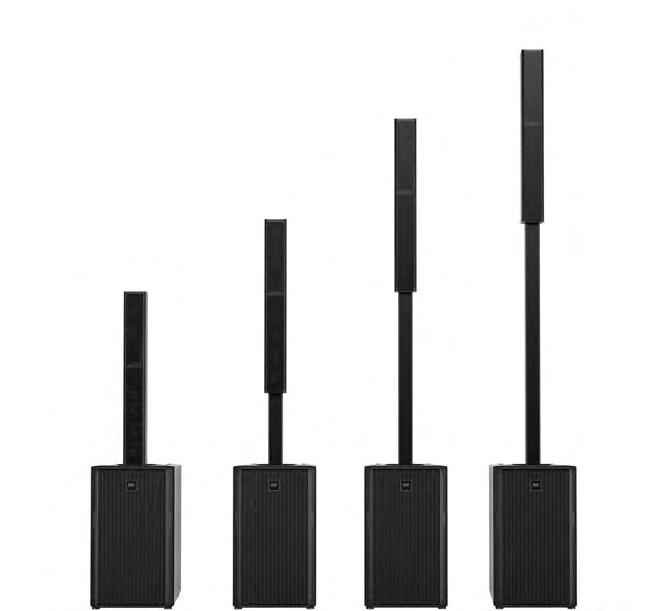
onboard processing that includes FiRPHASE (0º linear-phase response with minimal latency), Bass Motion Control (extended low-end without instability) and protection features. The EVOX J9’s features include 130dB max SPL, six 3-inch mid arrays and three EQ presets (Live/Linear, Club, Voice), while the EVOX JMIX9 adds to the J9 acoustic platform with an integrated 8-channel stereo
ENGINEERED TO deliver an immersive infra-sub performance, Audac has unveiled the Basso Series of ultra-highpower infra subwoofers. Alongside their waterproof, lightweight and durable attributes, the Basso Series subwoofers incorporate a pure carbon fibre cone. Combining clear low-frequency power delivery with minimised airflow noise, an exponential low-noise vent design is a hallmark of AeroVent technologies. Incorporating inner framing for added durability, a host of flexible mounting options ensures flexibility of use in a variety of applications.
The compact Basso112 12-inch model provides low-frequency extension to 26Hz without processing, a maximum SPL of 130dB and 2,000W of programme power. The Basso115 records low-frequency extension down to 31Hz, a maximum SPL of 136dB, with 3,000W of programme power. Finally, the Basso118 can produce low frequencies down to 23Hz, a maximum SPL of 137dB, with a similar 3,000W of programme power. Each model features a robust chassis and inner framing, providing long-term durability and sound integrity.
www.audac.eu
EM ACOUSTICS has expanded its subwoofer portfolio with the CS15 and CS18, two passive cardioid subwoofers developed in response to demands from live event, installation and theatre professionals for high-performance, lowfrequency control without increased system complexity.
The CS15 and CS18 are designed to deliver effective cardioid behaviour while requiring only a single amplifier channel per enclosure. Unlike many cardioid subwoofer designs that rely on bandpass group delay and multiple amplifier channels, the CS models generate their directional performance through a proprietary passive crossover network. According to the manufacturer, this approach was engineered to ensure no reduction in performance compared with actively driven, 2-channel cardioid subwoofer systems, while maintaining consistent behaviour across the full operating range. Rear rejection is a key focus of the series, with the design intended to significantly reduce low-frequency energy radiating behind
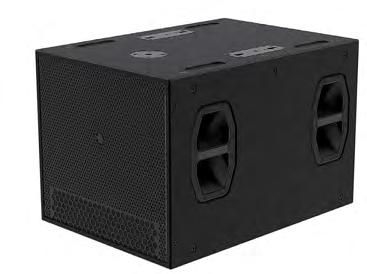
the enclosure, helping keep stages and performance areas sonically cleaner, improving overall system accuracy and providing a more controlled listening environment for both performers and audiences. The single-channel amplifier requirement also offers practical benefits in installations and venues where rack space, cabling or amplifier resources are limited. Both models are available with standard installation hardware or touring flyware options, allowing them to be deployed across a range of fixed and mobile applications.
www.emacoustics.co.uk
digital mixer with a 2.4-inch colour touch display, THAT mic preamps, Bluetooth audio, per-channel processing, scene recall, audio ducker, reverb and JMixRemote app control via Bluetooth BLE (with optional security PIN). The EVOX J11 provides 132dB max SPL and has 12 3-inch mid arrays, four EQ presets (Live, Linear, Club, Voice) and powerCON TRUE1-TOP for more demanding applications.
The KXM Series has been built for highoutput stage monitoring with tour-ready features, internal presets and RDNet network control. The KXM 20-A delivers 131dB max SPL with 2,000W peak power and 90° x 70° constant-directivity coverage in a symmetrical dual 8-inch neodymium configuration. The KXM 25-A steps up to 137dB max SPL, 3,200W peak and a 60° x 60° pattern using a 15-inch neodymium coaxial architecture for coherent summation and a stable listening window. Both models combine a low-profile design, stand-mount versatility and reliable performance over long show days.
Derived from the XPS 16K, the XPS 4K platform is a high-density 2U 4-channel DSP power amplifier delivering 4x1,000W continuous power at 4Ω, with 96kHz processing and extensive routing designed for demanding touring and installed sound. The onboard interface and RDNet remote management enable streamlined tuning, monitoring and scalable deployment, with the XPS 4KD variant providing Dante support for AoIP integration.
www.rcf.it
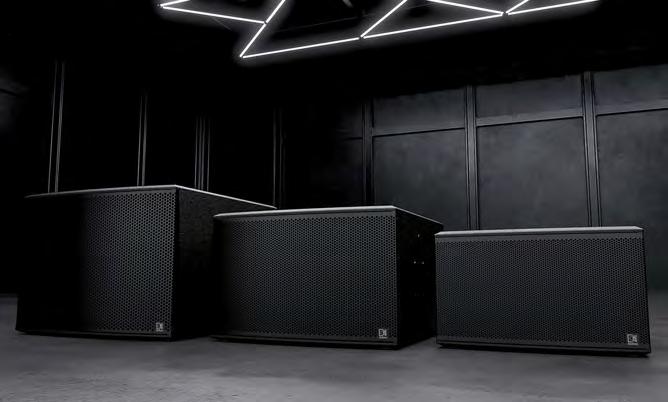
ADAMSON HAS introduced two Milanready networking audio products, the MS8.2 Network Switch and USB Milan Bridge. Designed to simplify connectivity of audio networking while maintaining performance, both systems expand the brand’s ecosystem with flexible tools tailored for live sound and installed applications. The MS8.2 Milan AVBready network switch has been engineered as a streamlined, deployment-friendly solution, compatible with all Milan equipment.
Optimised for stage monitors, small arrays and distributed systems, the MS8.2 supports streaming of up to 48 networked loudspeakers while offering road-ready connectivity options. Key specifications include eight Neutrik etherCON Cat5 ports, two Neutrik opticalCON Multimode DUO fibre ports and the ability to connect up to 10 devices.
Housed in a compact form-factor, the USB Milan Bridge has been designed as an all-in-one solution that provides direct Milan network connectivity for macOS and Windows 11. Engineered for stability and performance, the solution has prioritised low latency and high-resolution audio as a significant feature in its design and is marketed at engineers requiring integration between computers and Milan networks. Key product specifications include up to 32 inputs in four streams, 16 inputs and 16 outputs, 96k at 32bit resolution and USB-C bus power.
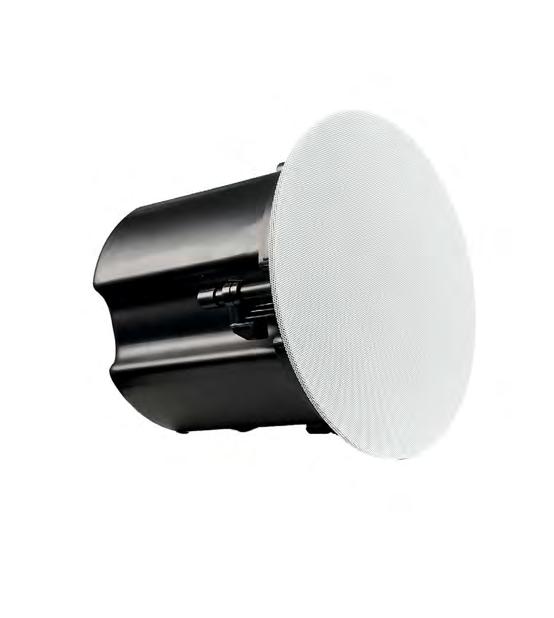
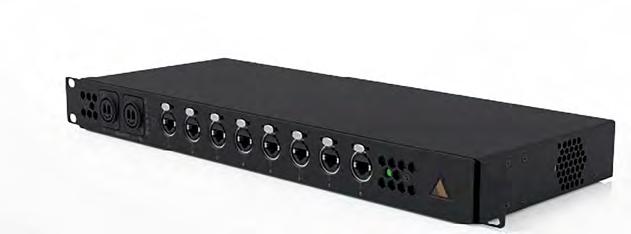

THE NF 4C LP 4-inch ceiling speaker system from Extron has been designed with scalable power, DSP and Dante connectivity. It can drive up to three external passive speakers from its integrated 4-channel amplifier, providing a single - cable solution for individual zones within larger distributed ceiling speaker systems. Leveraging Extron’s DSP Configurator Pro software, the integrated DSP can be set up independently for each amplifier channel with essential processing per zone. Dante Domain Manager and AES67 support enable wide compatibility with enterprise configurations and other network audio devices. Available in packages of two, three or four speakers, the NF 4C LP has been engineered to meet the requirements of complex, decentralised systems with a self-contained PoE-powered speaker solution. The 4-inch full-range driver features a wide frequency range of 110Hz–20kHz and is designed with a 135° conical dispersion.
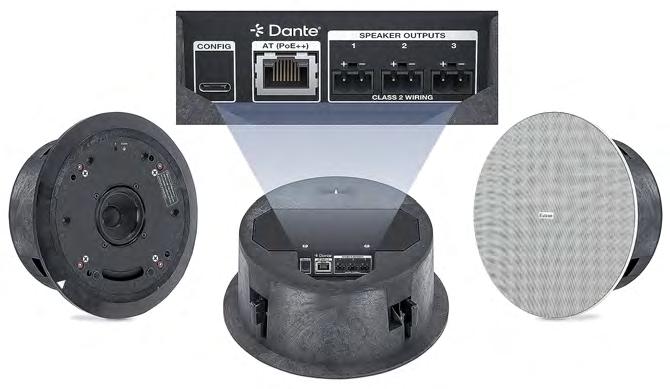
It has also been engineered for enhanced coverage and vocal clarity in voice lift applications.
WITH THE P-ANS-6CW1D (Dante) and
Meanwhile, the manufacturer has also released
products to extend HDMI and bidirectional RS-232 signals up to 100m over a shielded Cat6A cable. It supports video resolutions up to 4K/60 at 4:4:4 colour sampling and complies with HDCP 2.3. For maximum image quality and minimal latency, all supported video resolutions are transported without compression. The one-gang form factor is said to provide maximum space efficiency in wall-mount, floor-box and furniture-mount applications. The wall-mountable design and remote power capability of the DTP3 R 201 D means that output connections can be placed precisely where they are needed. In addition to supporting data rates up to 18Gbps, HDR, Deep Color up to 12-bit, 3D and embedded HD lossless audio formats, DDC communication of EDID and HDCP is continuously maintained between source and display to provide direct compatibility and optimal signal transmission between devices.
BUILDING ON its Taurus UCX product family, Lightware has introduced the HC60 lineup. The product line provides a hardware update to the existing HC40 models, made necessary by recent technological and supply chain developments.
with faster and more intuitive experiences, the manufacturer has also added the ChargeLink (P-AVN-CL100) USB-C onecable connection hub. It provides network access, USB data transferring, video sharing and up to 100W of power delivery.
Providing low-latency, H.264/H.265 streaming, the P-AVN-2E encoder and P-AVN-2D decoder deliver image fidelity at 40Mbps and achieve 33ms end-to-end latency, producing visual performances on bandwidth-constrained networks. With native USB support for KVM routing, the encoder and decoder seamlessly enable interactive workflows.
www.plexusav.com
Phasing out all HC40 models completely, every UCX-HC40 and DCX model will receive a one-to-one replacement for a new HC60 version, with capabilities and functionalities unchanged. However, the HC60 range has been designed to deliver wider product availability, long-term compatibility and improved performance.
The HC60 platform’s key hardware upgrades include improved video handling, a high-speed Gigabit Ethernet switch for faster network performance and modern connectivity with dual, device-side USB-C ports replacing the previous USB-A interfaces. Display Stream Compression (DSC) is also now supported, enabling 2-lane 4K@60 with minimal compression. These enhancements aim to deliver greater bandwidth, reliability and compatibility in AV environments.
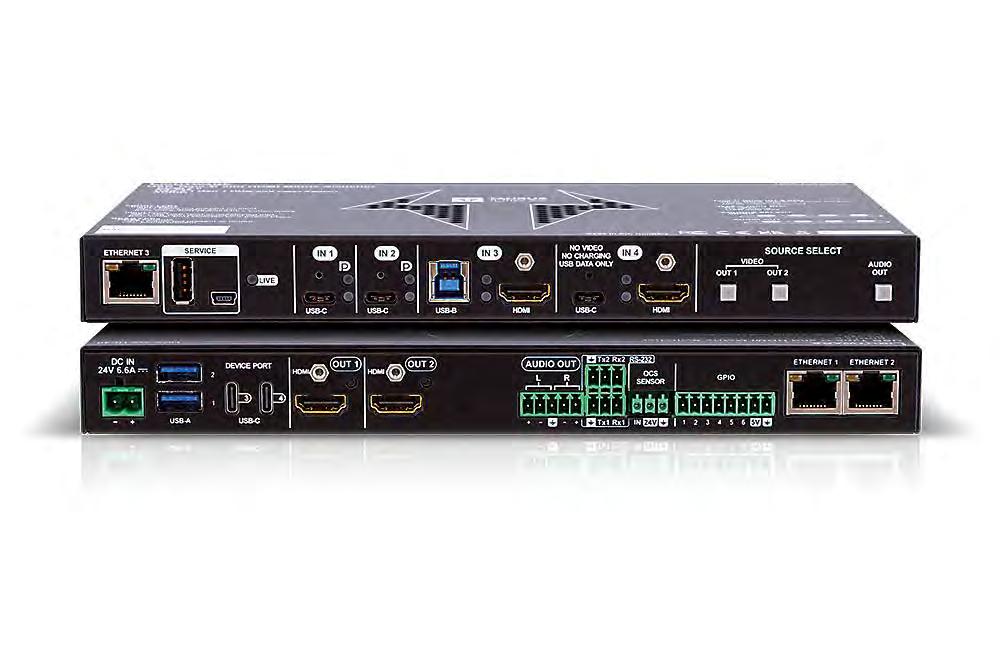
disabled on inputs for simplified integration, plus USB and audio following the active video source. Additional improvements include LARA automation enabled by default and a USB-C BYOD port that now defaults to Power Role: Source for broader device compatibility.
Factory defaults have also been improved to streamline setup and strengthen security. All HC60 models now support 5K video output by default, delivering 5120x2160 resolution
DESIGNED TO streamline connections between multiple audio and video source devices, Alfatron Electronics has updated its ALF-UC1 (Gen2) wireless conferencing system. An updated feature for the USB-C and HDMI dongles enables the PC to use a dual screen mode, sharing two screens from a computer to the UC-1. Incorporating all the features of the UC-1 as opposed to the video sharing-only application, the dongle now installs the full software application. As part of the ALF-UC1 (Gen2) update, a USB peripheral can be selected from the software application to switch between two USB cameras or two USB audio devices. The selection is accomplished via the wireless
The company has also unveiled its USB-C BOOSTER-V1, a purpose-built, plug-and-play solution which extends USB-C functionality –including USB 2.0/3.2 data and Display Port Alt Mode – up to 12m for greater
need for an additional power brick. Finally, Lightware has launched its TPN MMU Matrix Management Unit for TPN AV-over-IP which offers integrated device discovery, while auto detecting and managing all SDVoE endpoints in the system. The TPN MMU features an interface designed to make complex TPN systems faster to deploy and easier to operate, supported by a Netgear network backbone.
www.lightware.com

DESIGNED FOR flexibility and performance, the HALO 80 all-in-one speakerphone features advanced AEC, AGC and ANS for clear audio in remote conferences. With support for USB and Bluetooth connectivity, it adapts seamlessly to various setups – from huddle rooms to large meeting spaces. Equipped with four omnidirectional mic arrays and a full-range speaker, it offers plugand-play convenience and broad compatibility with major operating systems and conferencing platforms.
The NHD-120-RX-S takes the manufacturer’s 100 series “to a new level”. This “S” model has been treated with Sealoc’s Weatherloc technology to resist the elements such as water, moisture, humidity, dust, salt-fog, salt-air and acidic products. With 4K resolution, video transmissions are said to look better than ever and use up to 6x less bandwidth. AV streams are fully secure over the network using
AES 128-bit encryption methods, ensuring any sensitive data cannot be maliciously accessed.
100W PD and MST support for receiving dual video signals. It can also be used as a USB 3.0 switcher, which is further enhanced by support for wireless host through the APO-DG2.
Designed to simplify video switching and integration for conferencing, streaming,
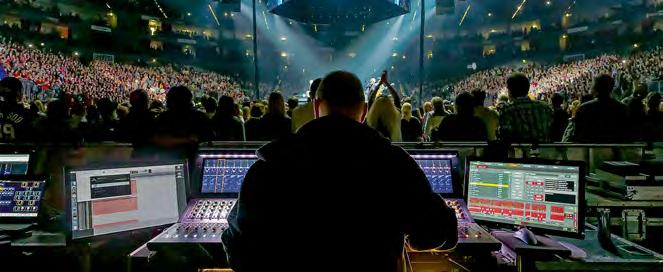
ADDING HIGH-CHANNEL-COUNT Dante connectivity directly into the platform without the need for external interfaces or workflow compromises, Avid has introduced the Dante HD option card for its VENUE | S6L live sound systems. Designed for large-scale touring, installed sound and complex environments, the card brings 128x128 channels of Dante I/O at 96kHz into the core of the S6L ecosystem, with support for up to two cards per system for a total of 256x256 channels.
The Dante HD option card enables integration with the audio-over-IP protocol, supporting distributed audio routing across concerts, theatre, corporate AV and in houses of worship. By operating fully within VENUE’s unified architecture, the card allows engineers to route, mix and manage high-resolution audio alongside AVB, Milan and MADI sources from a single VENUE software environment and show file.
BNC-based clocking is included to ensure stable synchronisation within Dante domains, while full compatibility is maintained across all VENUE | S6L systems. The card also integrates with Avid’s E6LX engines, supporting expanded I/O capacity.
www.avid.com
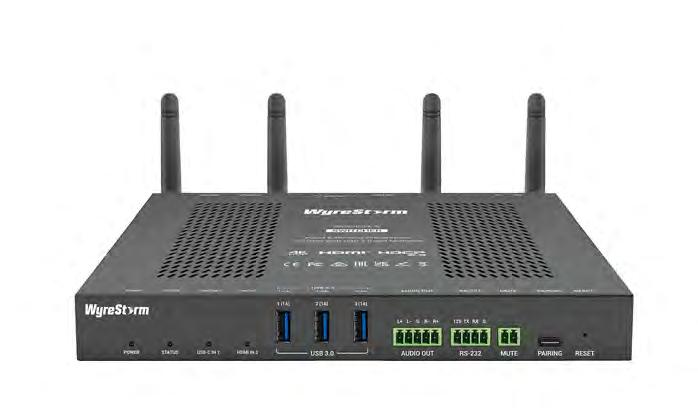
NDI-BRG is a compact, 4K, multi-camera video bridge. Supporting up to two wired HDMI and two wired USB inputs with four networkbased NDI streams, a unified 4K video output can be delivered via USB, HDMI or NDI.
Bridging NDI and NetworkHD ecosystems with bidirectional conversion, the NHD-128-NDITRX gateway allows up to eight NDI streams to be converted into NetworkHD transmitters.
A single NHD channel can be simultaneously output over NDI for integration with platforms such as Microsoft Teams, OBS or vMix.
Enabling remote monitoring, firmware updates and proactive management from anywhere, the PoE-powered NHD-128-NDI-TRX is fully compatible with WyreStorm Sygma Cloud.
Synergy Control Flow is a control platform designed to simplify automation across
variants, the SYN-CTL-FL10 and SYN-CTL-FL20, the system functions as a central control processor capable of managing IP-based devices alongside legacy hardware. Displays, DSPs, matrix switchers, lighting, sensors and environmental systems can be brought together within a single control framework. Finally, the MV-0401-PRO multiview processor has been designed for monitoring applications. The unit supports four simultaneous inputs and outputs multiview layouts in 4K resolution without compression. It provides real-time scaling and supports custom LED resolutions, making it suitable for control rooms, LED walls and presentation spaces.
LAON HAS expanded its Genie intercom range with the launch of the BP950, a multichannel wireless beltpack designed for complex production workflows requiring extended battery life, increased wireless range and intuitive operation. LaON’s matrixless IPbased Genie intercom system integrates wired and wireless intercoms alongside wireless receiver systems, with the BP950 further extending the platform’s flexibility. The beltpack
is positioned for applications including broadcast studios, OB trucks, esports, referee communications, theatre productions and large-scale live events.
Building on the earlier Genie BP850/851 models, the BP950 is designed to operate without a dedicated matrix or licensing
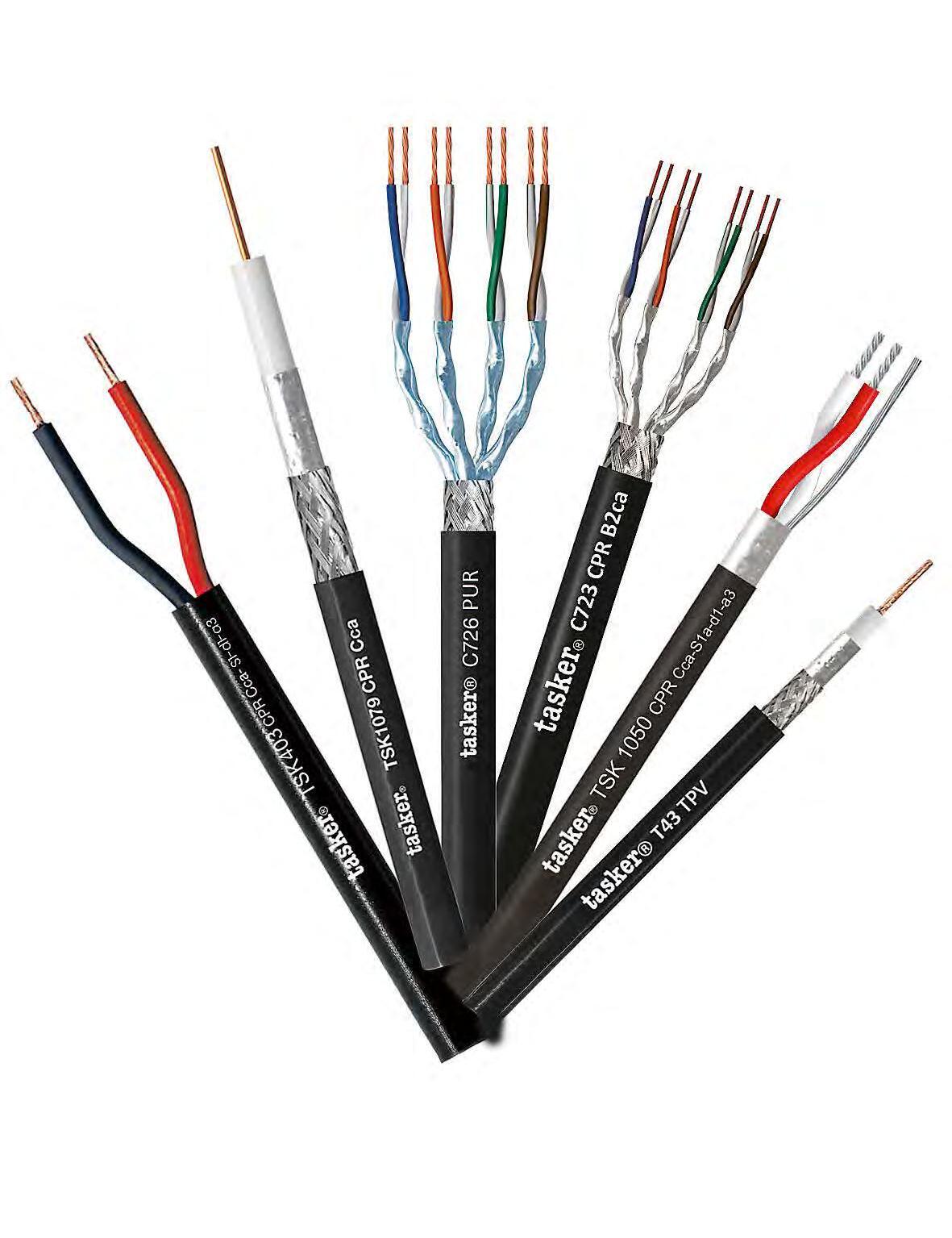
colour display and seven configurable keys. Additional www.laon-tech.com
AVAILABLE AS a free download for its TeamConnect (TC) Bar solutions, Sennheiser has upgraded camera performance, improved security, added further Dante audio outputs and increased network reliability with the release of its 1.3.8 firmware update.
Designed for small and mid-sized meeting rooms and collaboration spaces, the TC Bar S features four microphones and two speakers, while the TC Bar M comes with six microphones and four speakers.
Certified for Microsoft Teams, both bars offer ease of setup, brand-agnostic integration, simplified management and control, and added security features.
With the latest firmware update, the TC Bars’ 4K AI-enhanced camera frame movement has
been reduced to create a more natural video when using person tiling and auto-framing.
Fitted with full-range stereo speakers, the TC Bars can now accommodate additional audio outputs and the connection of standalone speakers via Dante. The external speakers can also be used to stream audio to Sennheiser’s bidirectional MobileConnect platform.
To ensure meetings start without delays, the TC Bars’ standby wake-up times have been significantly reduced by optimising the default energy mode and adding an optional “Always On” setting. For more complex applications, including split mode setups, network reliability has been improved through enhanced routing.
www.sennheiser.com
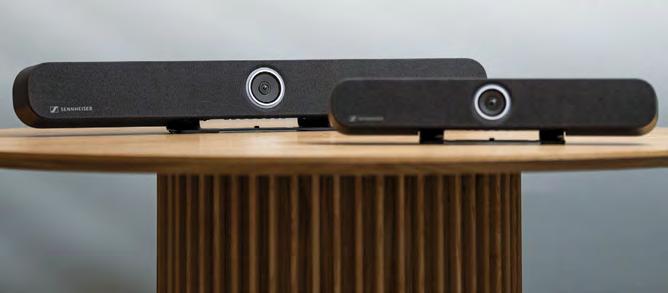
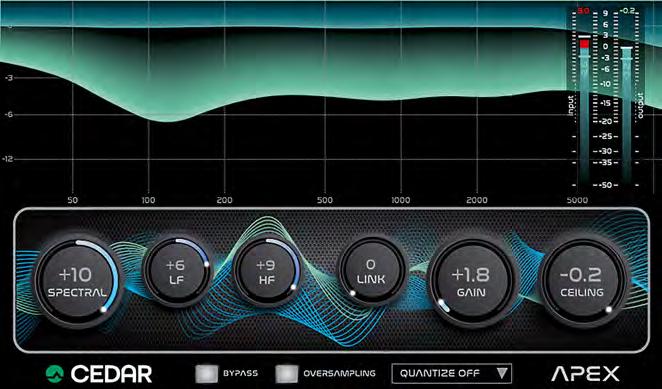
DESIGNED FOR audio professionals who want to push the limits of their audio even further, CEDAR Audio has released APEX, the new flagship model in its range of adaptive and spectral limiter solutions. It offers higherresolution processing at low frequencies, while the Link capability helps users improve the warmth and vibrancy of the audio.
APEX is suitable for a wide range of applications and genres. It can help add richness and power to classical music without affecting transparency, as well as providing extra energy and depth to electronic dance music. A small increase in latency provides significant processing benefits, enabling users to shape audio to their preferred taste without any of the artefacts normally associated with limiter products.
Conventional limiters control the loudness of
they would otherwise exceed user-defined thresholds. Unlike these, APEX uses an adaptive algorithm that calculates continuously varying EQ profiles for each audio channel that constrain the amplitude of the output while retaining the integrity of the input signal. This is said to give engineers precise control over audio, enabling them to increase the apparent loudness in a very transparent fashion without increasing the peak signal level. In addition, engineers can use APEX’s Spectral and Temporal controls to obtain a wide range of “colours” ranging from richer, weightier but undistorted sounds at higher settings, to brighter or smoother sounds. APEX can also limit loud instruments or voices with prominent high-frequency content while leaving the bass end of the track unaffected.
AEQ HAS designed the Forum IP Plus digital console for on-air control and versatile production environments. It features automatic muting, fader start, talkback/intercom and external communications management, with direct per-channel control and advanced settings via its 7-inch touchscreen, with the aim of delivering precision, ergonomics and error-free operation. Meanwhile, Systel Max is an incoming call and multi-conference system that reduces costs and enhances audio quality. It can integrate with existing telephone systems, enable multiconferences, support internal coordination and handle VoIP connections. It has been designed as an efficient and practical solution for radio and TV studios, as well as corporate environments.
www.aeq.eu
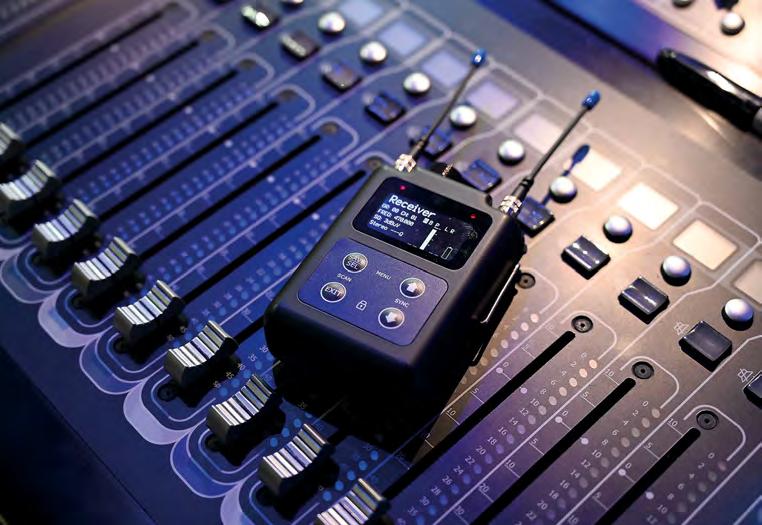
DEVELOPED TO meet the evolving requirements of professional in-ear monitoring in live production, theatre and large-scale house of worship applications, Wisycom has developed the MPR60 wideband IEM receiver. With RF wideband frequency agility spanning 470–800MHz, 940–960MHz STL in the US and 1,240–1,260MHz in the same device, users can operate across virtually any RF spectrum in the world. By measuring the headphone impedance and intelligently adjusting the output level to the in-ear headphones, the MPR60 incorporates automatic audio power limitation. To maximise frequency use in congested RF environments, the receiver also includes enhanced RF channel selectivity and stereo channel separation of more than 60dB (one channel per every 400kHz).
DESIGNED TO deliver cost-effective, professional-grade sound capture for musicians and modern content creators, AKG has expanded its professional microphone portfolio with the launch of the C-Series condenser microphones. The series comprises three models – the C104 large-diaphragm condenser, the C114 multi-pattern condenser and the C151 small-diaphragm condenser – each developed to combine the manufacturer’s acoustic heritage with simplified operation and a contemporary, sustainability-focused design.
adapt to different acoustic environments and recording scenarios while maintaining professional audio performance. The microphones have also been designed with on-camera use in mind, and feature a refreshed aesthetic that references AKG’s design legacy while aligning with contemporary visual expectations.
Sustainability plays a significant role in the C-Series design, with microphone bodies manufactured from 100% recycled
Additional features include true diversity reception, a readable display and a robust mechanical construction for touring use. Providing a dedicated RF narrow-band mode for even higher-frequency efficiency, the MPR60 can also operate as an IFB bodypack. The receiver is fitted with an enhanced water-resistant 3.5mm connector to the in-ear headphones and is prepared for remote control functionality.
Supporting RF and fibre for demanding multizone wireless infrastructures, the MATF wideband antenna matrix is the manufacturer’s reimagined, centralised RF distribution management solution. Created for challenging theatre, live event, outside broadcast and TV station productions, the MATF consolidates multiple rack-based components into a single, flexible unit. With an ability to combine up to eight RF zones in diversity, delivering either 8:4 or two times 4:2 outputs, the input modules include both pure electrical (BNC) RF inputs and up to six fibre-input modules. Four coaxial RF pairs provide either four equal diversity or two times two diversity outputs. Operating within an RF frequency range of 170–1,260MHz, the MATF delivers configurability for large-scale or complex environments, including Centralised Apparatus Rooms (CAR). The system’s support for Wisycom’s BFL2 M0 and M2 fibre endpoints provides compatibility with the company’s existing ecosystem. Like the combined RF spectrum, the integrated Frequency Spectrum Analyser assesses and observes all inputs, ensuring faults can be avoided before adding a signal to the combined outputs. Including fully remote-controllable antennas for zone-specific gain and filtering, the MATF integrates seamlessly into Ethernet-based networked infrastructures. Available in four versions, users can manage zones, monitor system status and label inputs or outputs from the unit’s full-colour touchscreen.
www.wisycom.com
Aimed at applications including vocal recording, speech, instruments, podcasting and streaming, the C-Series microphones feature a wide frequency response and are engineered to preserve the full detail and nuance of the source material. At the core of each model is a precision-engineered, transformerless FET circuit, delivering an ultra-low noise floor and broad dynamic range suited to a wide variety of recording environments and sound sources.
According to AKG, this approach ensures consistent clarity and definition across both studio and content creation workflows. Ease of use has been a central design consideration, with the microphones intended to integrate quickly into modern setups without complex configuration. The range supports both cardioid and multi-pattern operation, allowing users to
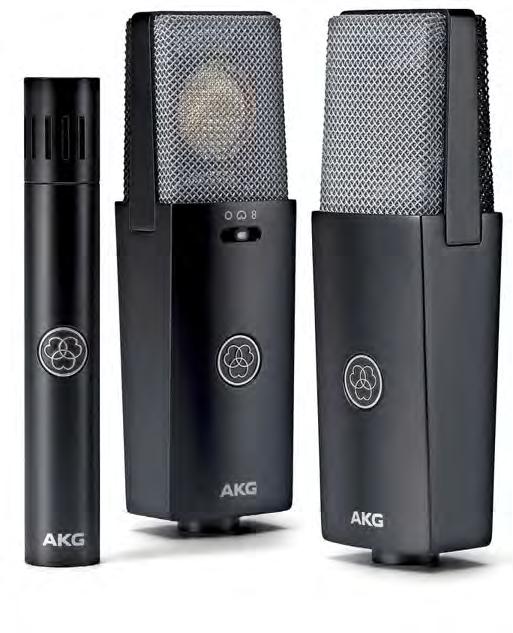
to reduce environmental impact, with fully recyclable packaging materials used across the range. This approach reflects a broader focus on responsible product design within the company’s professional audio portfolio.
www.akg.com
first large-diaphragm condenser bass drum microphone, integrating a large-diaphragm capsule into a compact, stageready design capable of handling high SPL while delivering the pure, unprocessed sound of the instrument and the new CKR6-B capsule.
The OC-B6 allows musicians to shape and sculpt the sound to their needs and vision either through drum choice, microphone placement inside or outside the drum, and any desired signal processing.
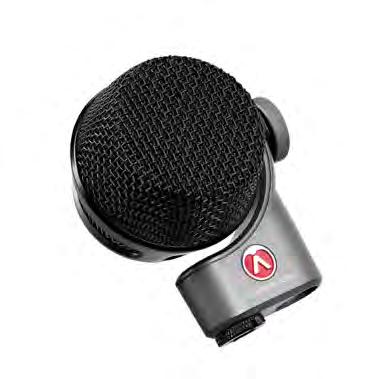
Based on the manufacturer’s original swivel joint design (introduced with the OD5 and OC7), the OC-B6 offers 220° rotation for maximum flexibility and accuracy in miking up any bass drum. The “B” version of the
CKR6 capsule doubles the distance between diaphragm and electrode and features a lower-tuned resonance frequency.
Meanwhile, the Drum Microphone Kit DMK1 is described as a complete solution for miking an entire drum set, whether onstage or in the studio. The DMK1 features seven condenser microphones –three of which are largediaphragm condensers –and one dynamic mic, all securely housed in a compact, rugged, waterproof case for reliable transport and storage. Included in the DMK1 are one OC-B6, two OC18, one CC8, three OC7, one OD5, four DPH12 drum holders and windscreens for the OC18 and CC8 for outdoor use.
BUILDING ON MicroBoom Series, Audix has released the Wireless MicroBoom (MBW) condenser as a forerunner of its digital wireless ecosystem. Described as a transformative approach to stage and choir miking, the MBW Series has been developed for a wide range of applications, from choirs and houses of worship to theatre and stage productions, sports and live events. Enabling faster setups, simplified workflows and quicker stage changeovers without cabling, the MBW distinguishes itself by its slim and discreet design. Operating on standard 5V wireless bodypack transmitters, the MBW models promote plug-and-play simplicity and wireless compatibility.
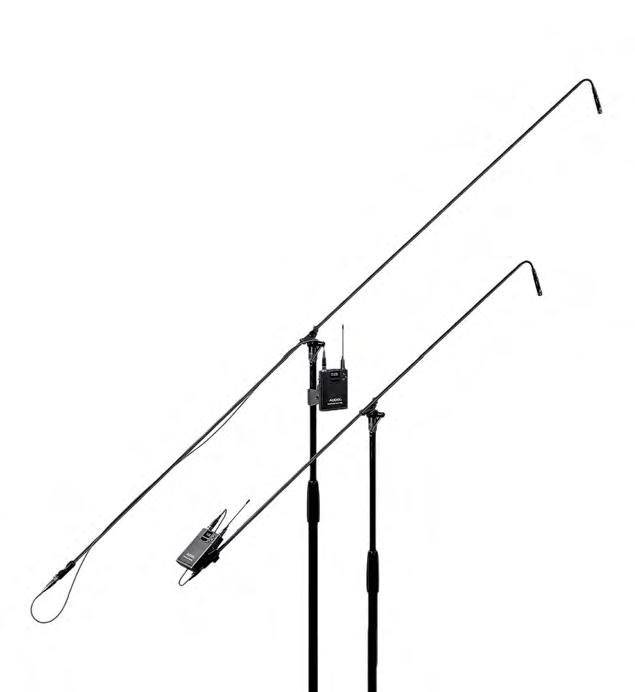
Operating within a frequency response of 50Hz–19kHz with a dynamic range of 95dB, the MBW Series currently consists of the 50-inch MBW50B and MBW50BHC together with the 84-inch MBW84B and MBW84BHC models. The cardioid MBW50B and MBW84B are designed for precision audio capture in environments with minimal environmental noise. Registering superior noise rejection, the hypercardioid MBW50B and MBW84BHC focus their audio capture in acoustically reverberant and noisy environments. Ideal for rooms where mounting from a distance is required, the
MBW84 models can capture larger groups and ensembles with their longer reach. For original MicroBoom customers, the US manufacturer is offering the M1370B Retrofit Kit which provides those models with a costeffective upgrade to wireless. The kit includes the M1370B miniature condenser mic, which requires 5V power and is available in cardioid (M1370B) and hypercardioid (M1370BHC) options. Mounting options include a MBWCLIP for connection to the base of the current carbon fibre boom or a MBWFLEX that can be used on any standard mic stand.
www.audixusa.com
DPA MICROPHONES has added the DPK2015 Piano Stereo Kit to its range of piano miking solutions, alongside the DPK4099 CORE+ and DPK4011 Piano Stereo Kits. The three kits are designed to address different piano miking requirements across live sound and studio applications.
The DPK2015 is built around a stereo pair of DPA 2015 wide cardioid microphones and is intended to support fast and consistent setup. The kit includes dedicated mounting hardware that allows the microphones to be positioned securely inside a piano with
minimal adjustment, accommodating a variety of lid positions. The wide cardioid pattern is designed to provide a balanced stereo image while capturing detail across the instrument’s dynamic range. Supplied components include two GM1500 gooseneck mounts, DAO2015 XLR microphone cables, an SB0400 lightweight stereo boom, foam widescreens and a protective transport case. The configuration is designed for repeatable placement in touring, venue or studio environments.
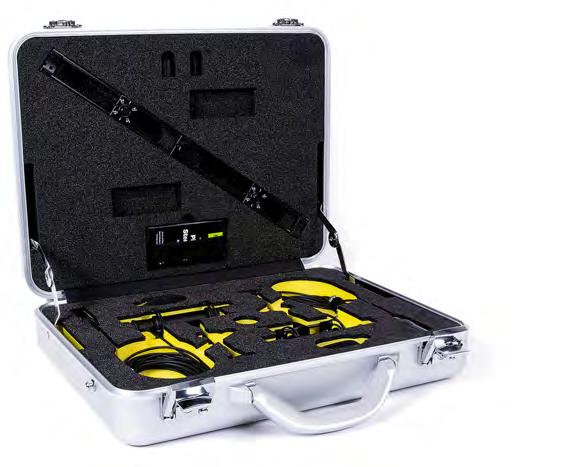
WITH THE launch of the Shure MV88 USB-C stereo microphone, mobile content creators can instantly record professionalgrade audio. Modified to plug directly into a phone or tablet, the revamped MV88 USB-C mixes the original stereo condenser mic with a USB-C connector for recording on the go. The MV88 USB-C pairs straightforward connectivity with simple-to-customise audio processing found in the MV7+ and MV6 microphones. With Auto Level Mode, the MV88 continuously adjusts gain in real time to ensure audio records at the correct level, whereas Real-time Denoiser intelligently removes unwanted background noise. Paired with four selectable polar patterns – adjustable stereo, mono cardioid, mono bidirectional and raw mid-side – the mic can be configured to suit any recording scenario. Building on the legacy of the SLX-D wireless microphone system, Shure has introduced the SLX-D+ platform incorporating a range of advanced and ease-of-use features. Operating across multiple frequency bands, the SLX-D+ includes wide tuning across all components up to 138MHz. ShowLink Ease technology provides 2-way communication between the receiver and the transmitter in real time. Once synced, the transmitter remains paired to the receiver every time it is powered on
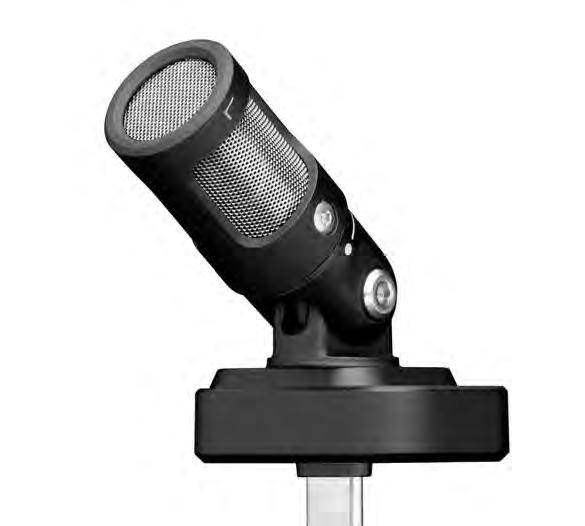
metering. RF cascading allows up to three SLX-D+ quad receivers to be linked together to create a 12-channel SLX-D+ receiver system. Simplifying the management of wireless output levels and receiver outputs to match open mixer channels, the audio summing feature allows the setting and combining of audio levels to one and two outputs on the dual and quad receivers.
The KSM condenser series has been extended with the introduction of the KSM32C, KSM40C and KSM44MP models. Providing off-axis rejection, clarity and flexibility for vocals, instruments and ensembles, the lightweight, metal 0.75- to 1-inch capsules include advanced shock mounts and curved magnetic pop filters.
The KSM32C large diaphragm delivers a smooth, balanced response and low-frequency performance for vocals, instruments, drum overheads and ensemble work, and is available in a stage and studio bundle. Delivering natural, detailed audio with enhanced proximity effect
Alongside the DPK2015, the DPK4099 CORE+ Piano Stereo Kit offers a compact solution based on a stereo pair of 4099 instrument microphones. With clipbased mounting and high isolation, it is suited to loud stages or situations where discreet placement is required.
The DPK4011 Piano Stereo Kit features a matched stereo pair of 4011ES cardioid microphones and a range of mounting accessories to support flexible positioning. It is typically used in controlled acoustic environments where detailed capture and placement flexibility are priorities. Together, the three kits provide different approaches to piano miking, allowing engineers to select a system based on application, space and
www.dpamicrophones.com
and natural high-frequency boost, the KSM40C is a large diaphragm condenser that captures rich nuances in vocals and instruments, guitar amps and kick drums. Ideal for vocals, pianos, stereo techniques, distant miking and ensembles, the KSM44MP dual-diaphragm design maximises sensitivity, stabilises pattern consistency and improves off-axis control at low frequencies. With selectable cardioid, omnidirectional and bidirectional polar patterns, the multi-pattern microphone provides natural clarity and smooth detail.
www.shure.com
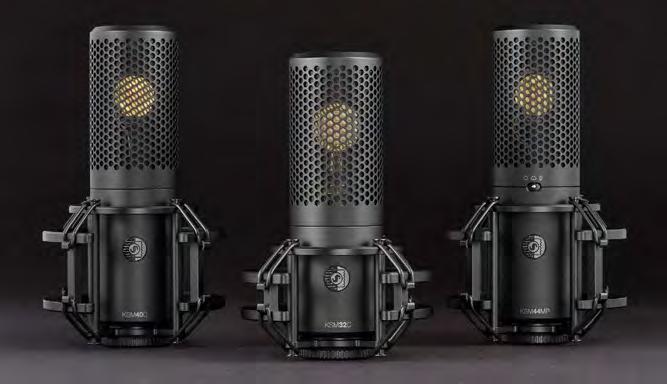
ROLAND HAS added the GO:MIXER STUDIO to its GO:MIXER range. The device is a compact audio mixer and recording interface designed for performance video creators and mobile music production using iPhones, iPads and Mac or Windows computers.
GO:MIXER STUDIO provides 12 input channels and six outputs in a portable form factor, allowing users to capture audio from multiple sources while recording video or producing music on location. The unit supports recording resolutions of up to 24-bit/192kHz and allows mixer configurations to be stored in 16 scene memories, enabling quick recall of setups for repeat workflows.
The input section includes two XLR mic/ line inputs with wide-gain mic preamps for
vocals and acoustic sources, a dedicated guitar or bass input and ¼-inch inputs for stereo instruments such as keyboards, electronic drums or wind controllers. An auxiliary input with TRRS support allows bidirectional audio with mobile devices, extending the mixer’s flexibility for streaming and mobile recording applications.
Monitoring options include a ¼-inch headphone output alongside a mini jack for earbuds or a headset with inline microphone, which
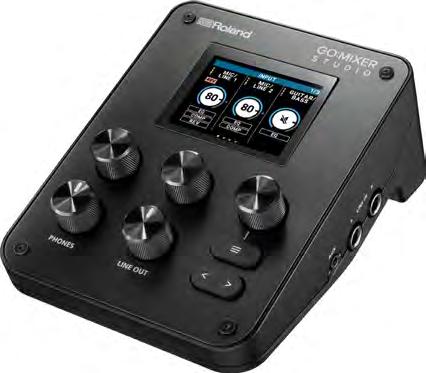
REPRESENTING A clean-sheet approach to networked digital mixing, Violet Audio has released the next-generation dMix 128. Delivering up to 128 channels at up to 96kHz, with sub-millisecond system latency and sonic transparency for mission-critical environments, the dMix 128 has been developed by Violet Audio’s international engineering team.
At the core of the FPGA-centric architecture, the dMix 128 is natively optimised for IP-based audio workflows. Currently supporting AES67 as standard, with plans for ST 2110-30 compatibility, the dMix 128 seamlessly integrates into broadcast and large-scale networked systems. With MADI I/O onboard,
together with three Ethernet ports and support for Dante via an optional expansion card, flexible connectivity allows systems designers to precisely tailor the dMix 128 to current and future infrastructure requirements. Eliminating the need for proprietary software and enabling intuitive PC and dedicated control surface operability, the dMix 128 is controlled via a browser-based user interface. Built to adapt to FOH or monitor mixing, in addition to OB vehicles and fixed installations, the system offers flexible routing, DSP resources and scalable workflows. Equipped with 32 analogue inputs and 24 analogue outputs, the dMix 128 supports a wide range of remote I/O and stagebox solutions.
WITH LV1 Control, Waves Audio has expanded the LV1 fader count via a single USB cable connection. Functioning as a fader expansion for Waves’ LV1 Classic mixing consoles, the control surface also operates as a dedicated fader bank for modular LV1 systems.
Built on the architecture of the LV1 Classic surface, LV1 Control delivers 17 motorised 100mm faders, 17 encoders and 17 minidisplays featuring per-channel LCD metering. Features include Touch-and-Turn mapping for onscreen parameters, Select/Mute/ Solo toggles per channel, eight layer keys, eight utility keys, a tempo pad, a 12V XLR4 lamp connection and 16+2 user-defined keys. The recent LV1 80-channel software upgrade enables LV1 users to handle larger
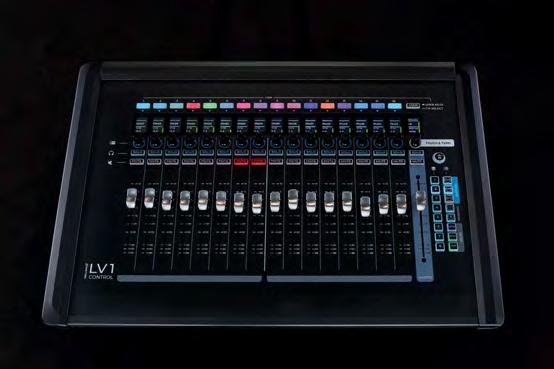
within the LV1 ecosystem now adds more tactile control with enhanced ergonomics. Expanding its custom-shop Magma series, the manufacturer has also added the Magma StressBox as a dynamics tool for shaping musical tension, tone and feel. Providing control over tension and feel in the mix, the Magma StressBox shapes emotion by turning right for compression or left for expansive cinematic depth. Each adjustment unlocks new sonic characters, from soft and spacious to bold and explosive, enabling dynamic movement between song sections. An AutoGain is incorporated for consistent output level. The Magma StressBox has been added to the Waves Ultimate and Waves Essential monthly or annual subscriptions. Finally, the company has added Curves Resolve to its Curves Series, introducing a mixing plugin focused on managing frequency masking between pairs of tracks. Unlike conventional EQ tools that process signals independently, Curves Resolve is designed to analyse the interaction between two audio sources simultaneously, applying processing only where overlapping frequencies create conflicts. The plugin continuously monitors a sidechain input
can also serve as an additional recording source. Two ¼-inch line outputs are provided for connection to external speakers, with level control handled via dedicated front-panel knobs.
Onboard processing includes a 3-band EQ, compressor and reverb, with effects available for recording or monitoring without the need for
external equipment. Power can be supplied via a connected iOS device or computer, an external adapter or a USB battery, with USB-C ports provided for device connection and independent power. An integrated mount allows the unit to be secured to a tripod for accessible operation during shoots or live sessions. The interface is supported by the GO:MIXER Cam App for iOS, which enables multitrack audio capture alongside video recording, as well as export of individual tracks for postproduction.
A dedicated GO:MIXER Editor provides access to all mixer parameters on a computer display, supporting larger sessions and more detailed control when working in studio environments.
www.roland.com
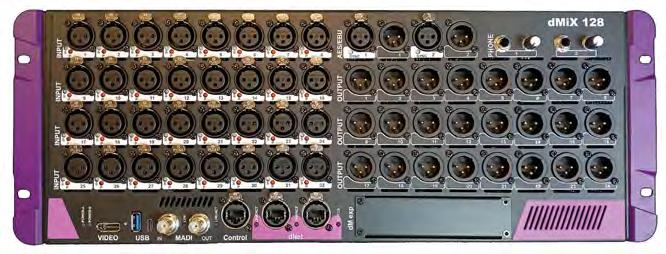
For recording and hybrid workflows, a lowlatency 64x64-channel computer enables DAW connectivity and native plugin integration in live-to-studio, broadcast and virtual soundcheck
while shaping the target signal, dynamically carving space at points of congestion and disengaging when conflicts are no longer present. This track-to-track analysis aims to preserve tonal balance and transient detail by avoiding static cuts or broadbandlevel reduction. Processing is limited to frequencies that are actively colliding, rather than affecting the full spectrum. Curves Resolve provides two core operating modes. In dynamic mode, frequency curves adapt in real time as the audio changes. In steady mode, the plugin analyses a defined passage and generates a fixed response that remains consistent over time. Users can blend between these modes to control the balance between responsiveness and predictability. Additional sidechain filtering and tilt controls allow engineers to focus detection on specific frequency ranges, reducing unintended reactions to non-essential content. For level interaction, the plugin offers both wideband ducking and a frequency-selective Unmask mode. While wide ducking lowers the overall level of a signal in response to another, Unmask mode applies reduction only at frequencies responsible for masking, maintaining overall energy and presence. Snapshot starting points are included for common sources such as vocals, bass, guitars, keyboards, synths and snare.
www.wavesaudio.com
environments. Additional expansion cards and software updates will be available in 2026.
www.violetaudio.com
run VST3 plugins during live event applications, Fourier Audio has released the compact transform.go plugin server. Featuring the same features as the larger transform.engine within a 2U, ½-rack, 3.5kg, tour-grade chassis, the transform.go fits into a backpack for fly-pack shows and is suitable for mid-sized productions. When compared to the 64-channel transform.engine, the smaller chassis and reduced I/O count of 16 channels of the transform.go offer an entry level into live plugin hosting for a much larger market segment of live engineers and venues. Like the transform.engine, the transform.go is fully compatible with Fourier Audio’s transform.suite companion 70 plugin bundle with a one-click install.
www.fourieraudio.com
A NATIVE plugin for Bitfocus’s Companion has been released, the outcome of a collaboration between DirectOut, its German distributor sphereo and Dorian Meid, an experienced Companion module programmer. Compatible with Companion 4.0.0 or later, the plugin automatically detects the PRODIGY and MAVEN Series devices. It can be used with any Stream Deck hardware interface to enable greater control with fully programmable presets and parameters.
Companion is an open-source control surface software that can control multiple devices across the live and broadcast industries and can be used with or without a physical interface. Buttons can be programmed with many different outcomes, from simple selections to fully stacked sequences of commands. The result is a customisable
interface that can take the guesswork out of complex commands and manage several hardware devices from a single control panel. DirectOut’s module for Companion allows access to the majority of PRODIGY and MAVEN functions, including in/out routing, configuration and status reporting. Each parameter-control features a learn button, which enables the plugin to read out the currently handled parameter and its value. This is useful if the function is not part of a preset and the user wishes to add a particular command without knowledge of the actual control protocol. The Action Recorder allows the user to capture sophisticated operations for triggering, so a series of actions can be inputted quickly and efficiently.
Companion also benefits from a web-admin emulator, so actions can be triggered without
IMMERSIVE AUDIO specialist Areal has unveiled its Upmix Engine stereo upmixing hardware. Powered by the RISE (Realtime Immersive Stereo Expansion) algorithm, the Upmix Engine converts stereo content into immersive audio by redistributing spectral elements across multiple channels. With low latency from input to output, the engine permits real-time upmixing of stereo performances and recordings in live sound, corporate AV and broadcast scenarios.
The Upmix Engine is the first release from Areal, a Belgium-based developer and
manufacturer of immersive audio technologies. It is compatible with all loudspeaker brands and supports 5.1, 7.1, 7.1.4 and custom arrays without needing multitrack stems or objectbased audio. Areal’s FocusField technology allows the spatial image to be defined and steered to fit the application, while LF Warp functionality enhances low-frequency depth and impact. The engine’s I/O includes Dante, AES3, AVB, MADI and balanced analogue connectivity for ease of integration with multiple workflows.
www.areal.world
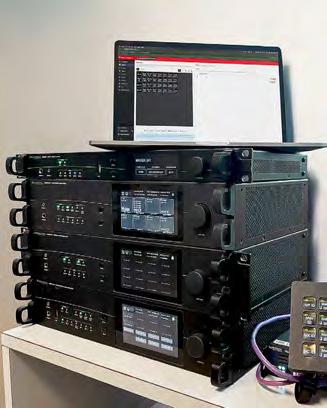
setting up the hardware controller devices. The button position on Stream Deck can be customised and perfected for any application. Pages of buttons can be saved and quickly accessed as required. There is also a list of presets provided within the module, which can be used as a starting point to edit from and adjusted within the module configuration.
Designed in collaboration with RME, DirectOut has created the USB.MADI as a fully fledged computer interface. Reduced in size to an SFP (Small Formfactor Pluggable) module, it can be directly installed in any compatible DirectOut MADI SFP slot for connection via USB-C to computers. Based on RME’s USB core, the USB.MADI delivers 64 channels of I/O at standard sample rate and offers low-latency interfacing between DirectOut devices and DAW software. The interface is compatible with portable devices, such as an iPad, while driverless operation is possible with Class Compliant (CC) firmware.
The USB.MADI adds features from both RME and DirectOut, including EARS (Enhanced Automatic Redundancy Switching) and DirectOut’s continuous audio playback with automatic switching in the event of signal loss. Providing comprehensive control over all I/Os on the computer, RME’s TotalMixFX is also included. www.directout.eu
WITH THE latest v1.4 update to the Questra design and management platform, LD Systems is closer to creating a one-stop software platform for specialist planners and installation service providers. In the area of native hardware integration, Questra 1.4
With the NMP Series, the TICA Series has expanded with DSP audio matrices, for integration and control within the Questra network. The NMP8 8x8 DSP matrix comes with four analogue inputs and outputs and 4x4 AES67 channels, while the NMP32 provides four analogue inputs and outputs
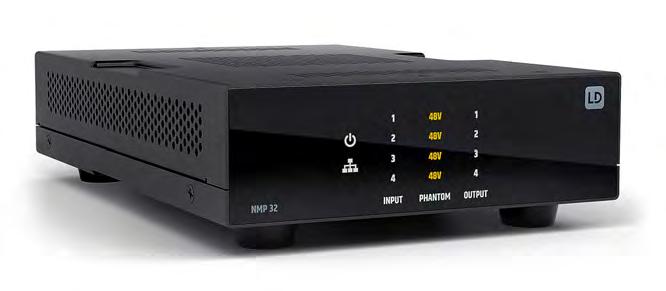
DEVELOPED TO support supervised multibranch loudspeaker lines, the Praesensa IP-based public address and voice alarm system (PAVA) has been upgraded with the PRA-EOB end-of-branch device. For retrofit and replacement projects compliant with EN 54-16, it targets tree or star loudspeaker topology configurations. The PRA-EOB is connected at the end of a loudspeaker line in a series of looped-through loudspeakers and can also be used to monitor individual loudspeakers. Supporting fault detection across more complex cable topologies, the device can individually supervise individual loudspeakers in applications where existing infrastructure does not allow for straightforward cable routes. By enabling multiple supervised branches on the same speaker line, the device can contribute to reduced
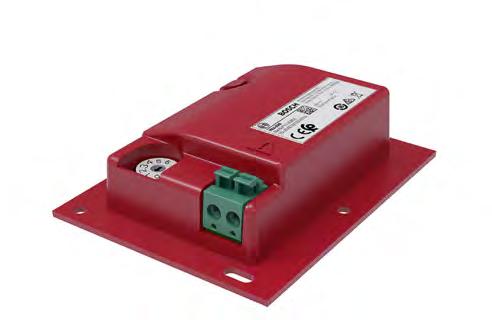
cable lengths. Integrating into the Praesensa system supervision, the end-of-branch devices are supported by an Open Interface API. By adopting addressable smart pilot tone handshake technology across the existing speaker cable network, each device on a branched line can be individually addressed and monitored. Without having to set signal thresholds, the installation process is simplified, and calibration steps are eliminated. Designed to remain stable across varying ambient temperatures and operating above 25kHz, the pilot tone is inaudible to human hearing in sensitive environments such as hotels or office spaces. To ensure compatibility and full functionality, the Praesensa firmware needs to be installed on existing amplifiers.
www.keenfinity-group.com
expands the range of supported, network-compatible devices and enables the centralised integration of audio, video and control components. These include the NMP8 and NMP32 DSP audio matrices, the AMP 205 D Dante mini amplifier, in addition to the MXAV 44 HDMI matrix and SWAV 41 HDMI switcher video solutions, together with the QTP10 10-inch touchscreen display.
Allowing third-party devices to integrate into the system via customised logic functions and user interfaces, Questra 1.4 introduces the concept of virtual devices, including the option of transferring them to the internal library as virtual devices. With the additional support of the OSC protocol – also available for the X-EDAI/X-ECI Ethernet cards in the IPA power amplifier series – Questra 1.4 extends the control of a variety of external systems and applications and enables the control of central parameters, such as level and mute.
in addition to 28x28 AES67 channels. DSP functions including EQ, delay and dynamics processors plus automixing functions are currently standard, with other functions becoming available via software updates. Operating within the Questra platform, the TIVA Series (Tools for Integrating Video and Audio) of AV interfaces now extends beyond the existing SWAV 41 HDMI switch and SGP 42 Ethernet interface. Incorporating audio de-embedding, support for HDMI 2.0, HDCP 2.2/1.4 with resolutions up to 4K60 (4:4:4) and EDID management, the MXAV 44 is a 4x4 HDMI matrix that distributes multiple sources to different displays. Supporting HDMI 2.1 with up to 48Gbit/s, video resolutions up to 8K60 or 4K120, HDR formats including Dolby Vision and HDR-to-SDR conversion, the SPAV 14 is a 1x4 HDMI splitter with audio extractor which suits high-resolution AV setups. Both modules enable separate audio output for the connection of external audio systems.
www.ld-systems.com
DESIGNED FOR the Apple Vision Pro, Neumann has launched VIS (Virtual Immersive Studio), a spatial audio positioning controller application that introduces a three-dimensional approach to immersive mixing within Logic Pro. The platform allows producers to visualise and position audio objects in augmented reality, using hand gestures to move sound sources naturally in space.
According to Neumann, the workflow transforms automation into a physical performance and places creative decision-making at the centre of spatial mixing. The application connects directly to Logic Pro, appearing as a device
DIGITAL AUDIO Denmark (DAD) has launched Junior, a compact hardware controller designed to provide hands-on access to Control | Pack routing within the company’s series of Thunder | Core audio interfaces.
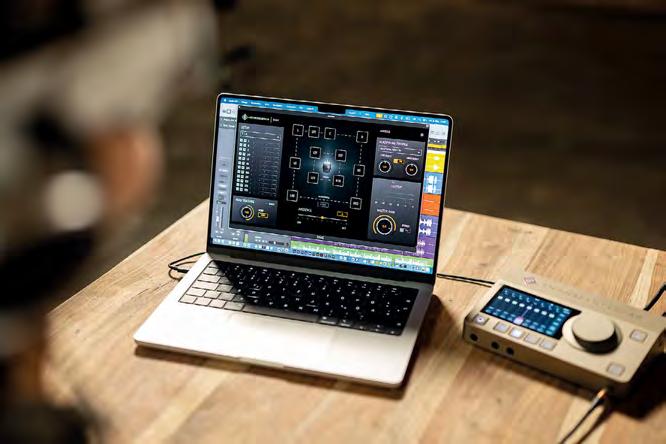
show bucket status and names. Two further buttons are assigned to lock functionality, the engineering menu and routing preset selection. Junior can be powered via PoE or an external power supply. It is
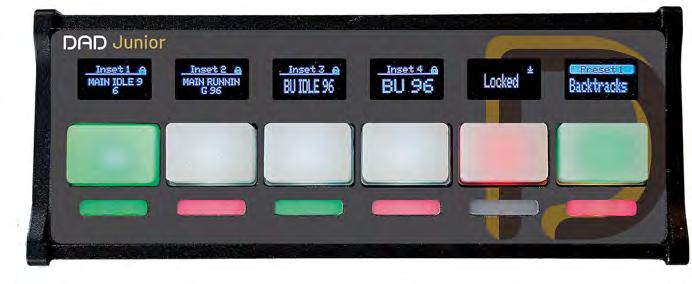
Junior is built to give users real-time, tactile control of preconfigured Control | Pack settings in DADman software. DAD says Control | Pack enables native switching between defined sources and output destinations, adding an additional layer of playback redundancy and show control across the Thunder | Core range. Junior connects to a Thunder | Core device via Ethernet and can be deployed accordingly. The controller provides six RGB LED illuminated buttons, six RGB status LEDs and six character displays for visual feedback. Four buttons are dedicated to switching between Control | Pack buckets, while the corresponding LEDs and displays
supported by DADman v5.8 and Thunder | Core firmware v1.1.0.3 onwards.
The manufacturer has also announced that ST 2110-30 audio-over-IP connectivity is now available for the brand’s audio interfaces via a new ST 2110/Ravenna/AES67 card and free corresponding updates to the brand’s DADman control software and device firmware settings. The release package supports ST 2110 across the Dante SRC Card, Ravenna SRC Card, Thunder | Core, Penta and AX32 product ranges. Functionality is specific to each device or configuration while still providing the same high-quality connectivity, flexibility and control.
www.digitalaudio.dk
within the DAW. Once paired, users can view Logic Pro on a virtual, resizeable screen inside Apple Vision Pro while continuing to interact with physical studio equipment, supported by low-latency passthrough technology. VIS supports both loudspeaker-based monitoring and headphone workflows. For headphone use, it incorporates Neumann’s RIME plugin, enabling spatial audio playback up to 7.1.4 and using Apple Vision Pro head tracking to deliver a realistic monitoring experience outside traditional studio environments.
www.neumann.com
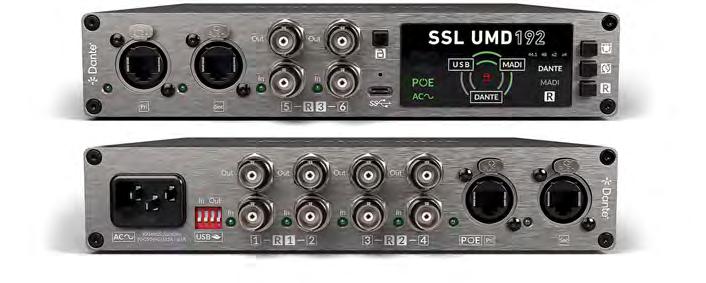
DELIVERING 192 channels at both 96kHz and 48kHz, or 128 channels at 192kHz in a compact and portable ½-rack form factor, the UMD192 from Solid State Logic has been designed for live sound, broadcast and highspec studio environments. With seamless integration across MADI, Dante and USB protocols, the USB audio provides flexible routing possibilities and high channel counts. The UMD192 works reliably in both Mac and Windows environments, and is compatible with any DAW. Whether it is used as a high-capacity interface or a format bridge, it can keep workflows streamlined and future ready.
The UMD192 can support bidirectional audio between any two formats – MADI, Dante or USB – with the third format being able to receive a split feed. This makes it suitable for bridging multiple MADI-connected devices into a Dante network, or for high-channelcount recording and playback via USB 3.0. It delivers fully interoperable Dante AoIP with
AES67 and ST 2110 (with DDM) support and ultra-low Dante latency reaching just 0.25ms. The interface provides flexible clocking options from either MADI or Dante. Additionally, with its six MADI BNC pairs, the UMD192 can be configured in redundant mode, enabling three dual-redundant MADI connections to be provided for mission-critical broadcast and live workflows. Meanwhile, the manufacturer has also launched its autoSeries plugins, combining SSL’s 4000 E modelling with sonible’s AI-assisted audio analysis. The trio of new plugins, which include autoEQ, autoDYN and autoBUS, are the only official SSL 4000 Series plugins on the market that leverage sonible’s AI assistive capabilities. Each AI-assisted plugin analyses the audio’s spectral and dynamic characteristics, suggests adaptive profiles with style-matched settings and instantly delivers fully editable processing.
www.solidstatelogic.com
DESCRIBED AS the next-generation advancement of the 2-channel version, Clear-Com has released its 4-Channel HelixNet beltpack. The solution has been engineered to meet the evolving demands of live productions and broadcast environments, introducing an expanded channel count and improved user interface design.
To provide greater flexibility for multiteam coordination in complex production setups, the 4-Channel HelixNet beltpack allows users to communicate across four distinct channels simultaneously. While fully compatible with the recent updates to Arcadia Central
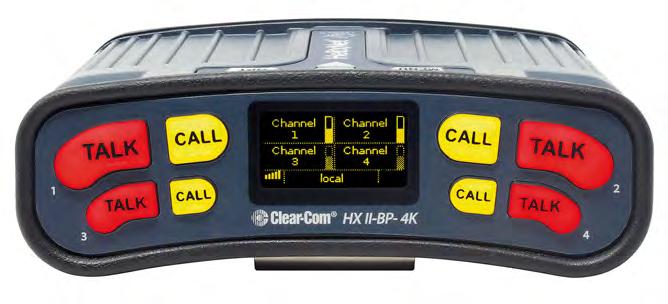
Station, it maintains backwards-compatible, 2-channel functionality on legacy HMS stations and earlier Arcadia versions, facilitating integration for existing users. The current HelixNet product family delivers networked partyline intercom systems built on Clear-Com’s heritage of analogue systems. Powered by the manufacturer’s I.V.Core technology, the existing system manages audio mixing across up to 24 channels, making it suitable for live performances, broadcast productions, theme parks and public safety applications.
www.clearcom.com
THE RØDECASTER Video S is an all-in-one console for video and audio production, giving users control over every aspect of their content. A streamlined version of the RØDECaster Video, it combines video switching, recording and production tools with a fully integrated professional audio mixer,
the Aural Exciter, Big Bottom and Compellor effects; media playback, keying, transitions, multi-source scenes and graphic overlays accessible from the front panel; and support for network cameras (including PTZ operation) with up to four NDI inputs and one output via Ethernet, plus dual-cam streaming with the
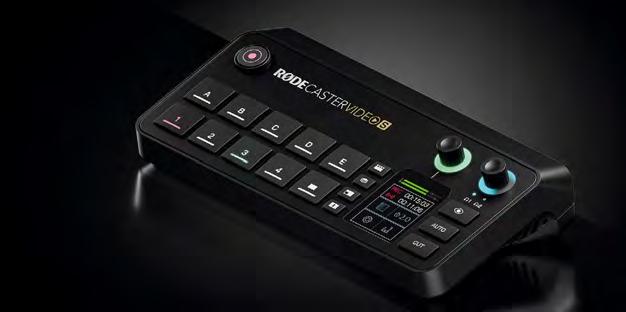
octa-core CPU video and audio processor, along with three HD (1080p) HDMI inputs, one configurable HDMI output and one multifunction USB-C port for connecting webcams and RØDE USB audio devices. Two studiograde Neutrik combo jacks with ultra-low noise, high-gain Revolution Preamps are included for capturing audio from XLR microphones, instruments or any other audio source.
Additional features include APHEX audio processing, including an EQ, compressor, noise gate, high-pass filter, de-esser and
Users can connect an external SSD via USB to record video or output directly to a computer via UVC, while intelligent auto-switching allows seamless hands-free switching of video sources and scenes based on audio inputs. The console features a 2-inch high-resolution touchscreen and versatile rotary encoder for quick configuration and setting adjustment. Dual USB-C audio interfaces provide simultaneous connection to two computers and/or mobile devices, plus customers have access to advanced configuration options via the RØDECaster app, including remote control, user-assignable graphics and media, custom scene building, audio mixing and effects.
www.rode.com
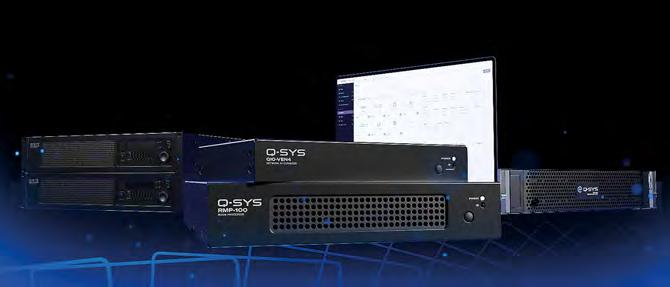
INTRODUCING SOLUTIONS that standardise collaboration spaces within highperformance workplaces, QSC has announced a strategic expansion across its Q-SYS Full Stack AV Platform.
The Q-SYS expansion includes the introduction of purpose-built RoomSuite modular systems for rapid, repeatable configuration and deployment of standardised medium-tolarge spaces. Traditional Q-SYS Core-based systems adopt Q-SYS Designer Software to support customised, high-impact spaces. Q-SYS RoomSuite Modular Systems differ by extending Q-SYS into more standardised collaboration environments through a streamlined, web-based, no-code workflow. Both approaches are unified through centralised cloud management via Q-SYS Reflect. Combining processing with a built-in network switch for native Q-SYS collaboration peripherals, in addition to AV distribution and bridging functionality, the RMP-100 lies at the core of Q-SYS RoomSuite modular systems.
The QIO-VEN4 expansion module enables
DESIGNED TO give operators real-time control of sources using its Aligo AVoIP and KVM platform, Datapath has launched the Aligo Workstation. The purpose-built interface has been introduced as part of an update to the Aetria ecosystem. Operating via a dedicated onscreen menu accessed via the Aligo receiver, the Aligo Workstation combines real-time responsiveness with multiscreen KVM control, and reportedly offers customers more options when creating their control room solutions. With built-in OneControl technology, users can seamlessly switch keyboard and mouse focus across multiple screens simply by moving the cursor, eliminating the need for hotkeys, toggles or additional hardware. In
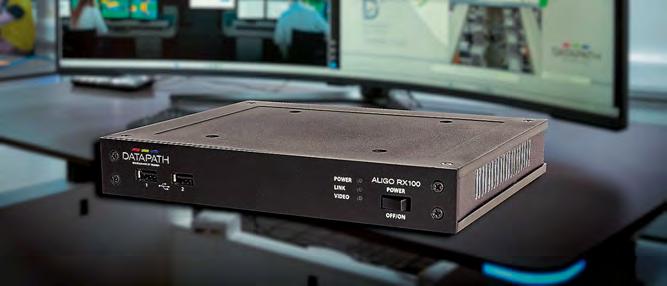
addition to support for HD and 4K monitors with 16:9 aspect ratios, the Aligo AVoIP solution
DESIGNED TO simplify system design, accelerate deployment and deliver flexible, scalable AV scenarios, Cognio from Symetrix is a software-driven audio, video and control (AVC) platform. Powered by DesignOps software, the wireless Cognio hardware and software platform unifies design, configuration, commissioning, control and operations into unified, streamlined workflows. Systems can naturally scale across rooms, buildings and campuses. A single device can power multiple spaces or multiple devices can support a single space.
Before the addition of the hardware, workflow designs can be based on rooms, zones and signal flows. With true pre-hardware emulation, AV line checks can be run before installation when audio and video signals are detected from a remote location. By generating digital
audio through the design so indicators move, signal paths can be validated and issues detected before any hardware is installed.
Adopting a spreadsheet-like canvas, Cognio automatically connects and routes the processing modules in sequence rather than having to draw them manually as signal paths. When adding, removing or rearranging modules, the signal flow adapts instantly. With offline emulation, designs can be validated and systems deployed rapidly without any loss in quality. Every connected device shares a common firmware foundation within the distributed architecture. This enables signal processing, AVoIP and web-based access to exist throughout the system, rather than being confined to a centralised processor.
The no-code control interface builder bypasses a dependence on external graphics tools
additional localised peripherals to be positioned closer to distributed AV bridging endpoints. Simplifying Zoom Room meeting controls within divisible spaces, Q-SYS Connect for Zoom Rooms is capable of linking all controllers to an active Windows-based device in combinable spaces. The certified Zoom Rooms room controller solution is created by combining a Q-SYS TSC-101-G3 touchscreen panel with Windows software. The MPA-Q Series of network amplifiers has been extended with a mid-power tier of 4-channel (250W or 500W per channel) and 8-channel (125W or 250W per channel) models. Designed for demanding hospitality and entertainment installations, the X Class Server Core X50r is an AV&C processor which combines the Q-SYS Full Stack AV Platform with server hardware. It supports 10Gbps networking, which enables up to twice the network audio channel capacity of the existing Q-SYS Core 5200.
www.qsys.com
Operators can instantly open any source onscreen using the Aligo Workstation, while multisource layouts can be saved, recalled with ease and assigned to keyboard shortcuts for ultra-fast switching. Layouts can also be pushed to other workstations within the Aetria ecosystem, where permissions allow. The Aligo Workstation integrates fully with Aetria’s User Rights Management, providing fine-grained, permission-based access to sources and videowalls. It connects only to sources within the control room, operating via direct hardware access with no operating system.
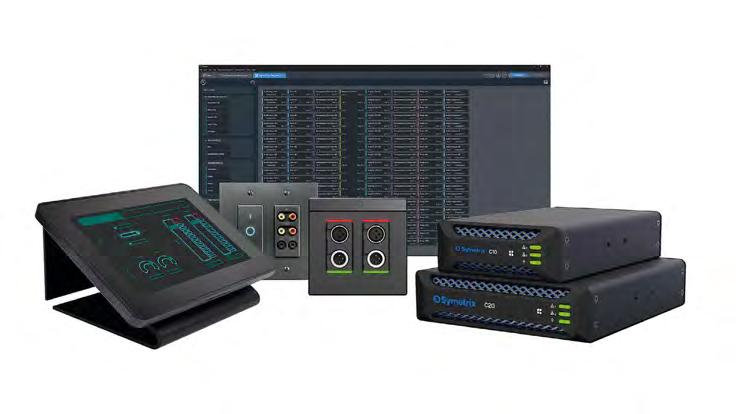
and custom programming. Vector-based interface elements scale across devices, and an integrated theme system allows the application of branding, colours and styles. Cognio unifies the AV lifecycle with modes for design and operation, with dynamic switching between the two. These include design mode
for building and editing systems; operation mode for real-time monitoring, logging and diagnostics across the entire site; and seamless switching between modes to instantly troubleshoot, adjust and verify changes.
www.symetrix.co
workflows and seamless control across multiple software applications, Yamaha’s CC1 single-unit USB controller combines control options for DAWs and non-DAW software used in music and video production, streaming and podcasting. The 12 LCD keys with unlimited banks can be customised through the CC1’s Yamaha Control Centre application, in addition to Elgato Stream Deck software. Four multifunctional rotary controls can be assigned to a wide variety of parameters, and a jog/shuttle wheel can operate as an “AI” rotary control for adjusting any parameter at the project’s current position. Working with the OBS Studio video recording/ streaming application and Steinberg audio software, the CC1’s dedicated DAW channel section comprises a 100mm touch-sensitive motorised fader, solo/mute/pan/record and transport controls. For hybrid live performances, a socket for a Yamaha FC5 foot pedal or FC7 expression pedal is included. Combining the legacy of the MG audio mixer range with video capture and streaming, Yamaha has added the latest digital mixers to its digital MGX series. The 12-channel MGX12V
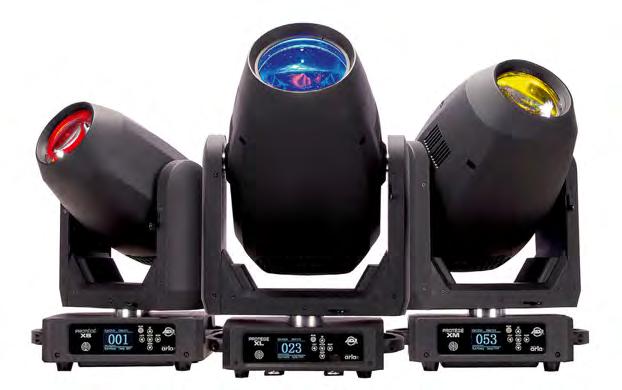
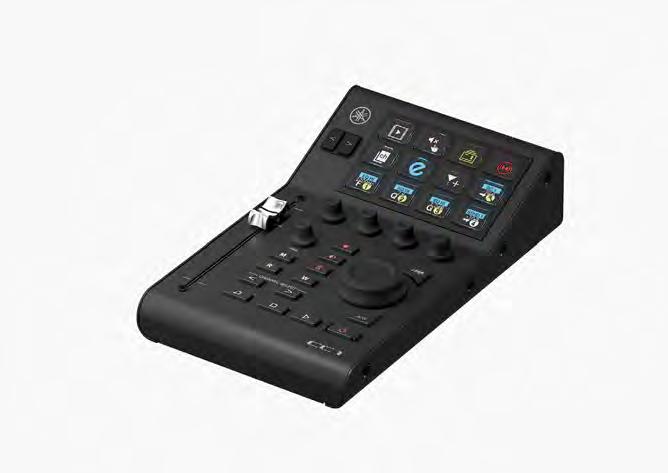
to a PC for recording or streaming, together with the audio. Other features include premium microphone preamps with an 86dB gain range on the mic/line combo inputs, in addition to eight line and Bluetooth audio inputs, two XLR outs, six or eight TRS OMNI outs and four headphone ports. The four mixers in the MGX series feature up to 16 tracks of audio recording and two tracks of playback direct to/from a microSD card. Supplied with a suite of Steinberg music production tools, the MGX mixers also incorporate a noise gate, compressor, EQ, delay, reverb and amp simulator.
www.yamaha.com/2/proaudio

Protégé Series
CONSISTING OF the Protégé XS, Protégé XM and Protégé XL, the Protégé Series from ADJ features 360° infinite pan movement with “lightning-fast speed and smooth precision” from their 3-phase, high-performance motors. The Protégé XS comes with a 250W white LED engine and produces up to 9,800 lumens of crisp, highintensity light. It features motorised zoom and focus, two 8-position colour wheels, two gobo wheels (one rotating and replaceable, the other fixed), two rotating prisms (linear and circular), a frost filter and an animation wheel, and has been designed to replace the manufacturer’s Focus Spot 4Z and 5Z models. The Protégé XM comprises a 350W white LED engine with a native colour temperature of 8,000K and a motorised zoom ranging from 3.8–44°. Features include CMY colour mixing alongside two colour wheels, two rotating gobo wheels, two prisms, two frost filters and an animation wheel. The
Protégé XL delivers 20,000 lumens and is powered by a 450W white LED engine with a 7,000K colour temperature. It has a 4.1–45° motorised zoom range and comes with CMY and CTO colour mixing, a separate colour wheel, two rotating gobo wheels, two rotating prisms (linear and circular), two frost filters (light and heavy) and an animation wheel.
The Hydro Beam CMY is an IP65-rated automated beam luminaire. Comprising an OSRAM Sirius HRI 310W PRO discharge lamp, focused through precision-engineered optics and projected from a high-quality glass lens, the unit is said to generate a razor-sharp 2° beam. Its feature set includes CMY colour mixing, 17 static gobos, two rotating prisms, a frost filter and integrated Aria X2 wireless DMX control and remote fixture management.
www.adj.com

CAMEO HAS expanded its lighting portfolio with a variety of IP65-rated moving light, PAR and blinder fixtures, introducing additions to the OTOS, ZIYA, SUNO and OPUS product families aimed at touring, live production and outdoor event applications.
The OTOS family has been extended with two moving bar luminaires designed for linear and kinetic lighting designs. The OTOS L16 is a 720W LED bar featuring 16 50W RGBL LEDs capable of delivering up to 9,300 lumens
output. It offers two independently controllable zoom segments, a motorised 208° tilt range and an integrated effects strip, allowing it to produce beams, dynamic zoom effects and clustered looks. Alongside it, the OTOS LC12 combines 12 individually tiltable and zoomable 50W RGBL moving heads arranged in a linear format, enabling curved beam effects and kinetic visual designs for both indoor and outdoor productions.
The German brand has also introduced the ZIYA series of IP65-certified LED
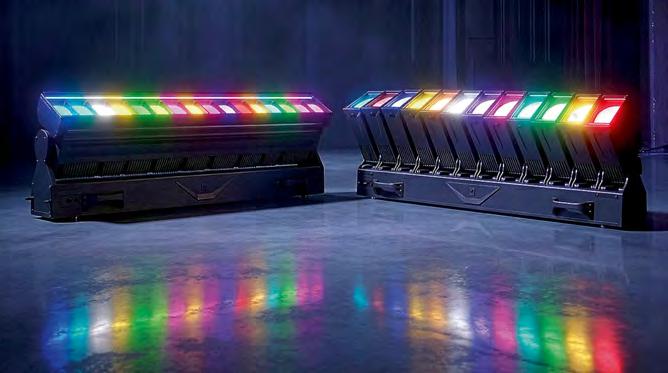
AYRTON HAS released its EagleStrike LT followspot, designed for “maximum output, speed and precision”. The first LED-source followspot in Ayrton’s catalogue, the EagleStrike LT has been engineered for use across long distances, and comes with an optional camera which transforms the unit into a fully automated tracking spotlight. It comes with an oversized 270mm front lens capable of delivering a 2.9° beam. Its 13-lens optical system with 15:1 zoom ratio provides a working range of 2.9–43°, with dedicated gobo reducers that can narrow the beam to 0.9° or 2.5°.
Equipped with a 1,200W LED module, the EagleStrike LT outputs a luminous flux of 55,000 lumens at a colour temperature of 6,500K. It achieves a light output of over 100,000 lux at 10m and 6,250 lux over 40m. The followspot also introduces a new CMY flag-based colour mixing system, capable of matching the speed of
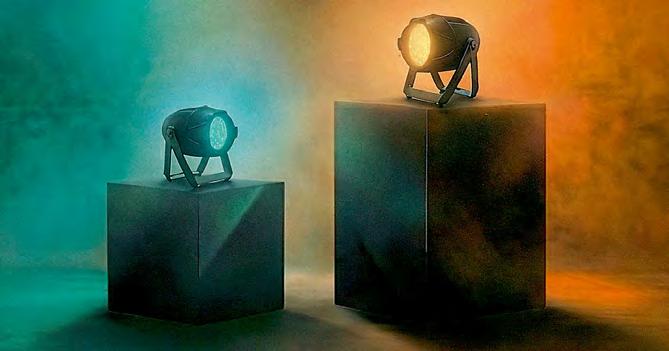
zoom PARs, which have been developed for touring, theatre and corporate lighting applications. The ZIYA 200 models are available with either four 60W RGBL LEDs or as a COB version with RGBALC colour mixing and Fresnel optics, supporting applications that require both tightly focused beams and soft, even washes. For larger stages, the ZIYA 400 and ZIYA 400 COB models increase output using either seven 60W LEDs or a COB engine, while retaining motorised silent zoom, IP65rated housings and the integrated SPIN16 rigging system across the range. In the blinder category, the SUNO series introduces IP65-rated RGBAWW models in 2- and 4-light configurations. Designed for touring and outdoor use, the fixtures
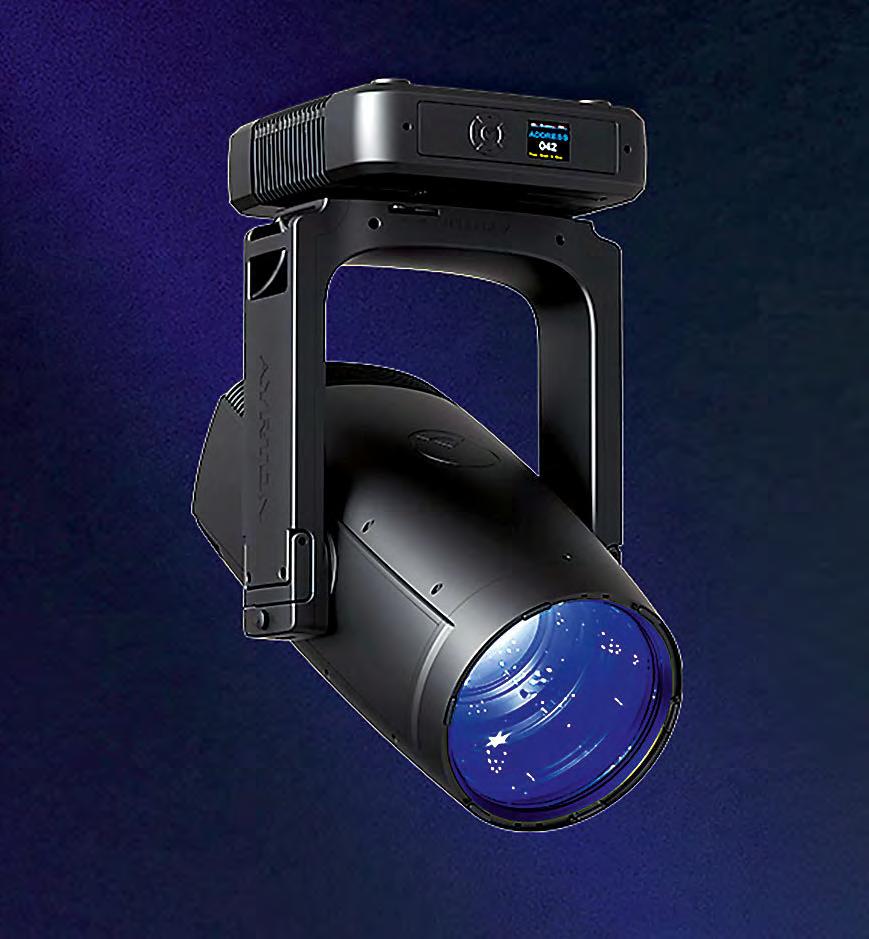
Ayrton’s “Ultimate” series luminaires. A progressive CTO offers subtle tuning from 2,900–6,500K. The colour section
enhancement filters, one minus green, one gobo correction and one multi-colour filter. The unit also offers tools for sculpting the
framing across 100% of the file and ±90° rotation, two overlaying rotating gobo wheels,
filters, as well as two combinable
multiplier prisms: a 4-facet linear and a 5-facet
pan axis expands the EagleStrike LT’s use in automatic followspot mode. The design integrates all waterproofing features while maintaining full access to internal components.
www.ayrton.eu
deliver up to 1,200W of LED power and feature a boost mode capable of producing more than 55,000 lumens, combined with a PAR-36-DWE-style visual appearance. The weatherproof design allows the SUNO series to be used in outdoor environments without compromising output or performance. Rounding out the announcement, Cameo has unveiled the OPUS X4 IP, the first IP65rated fixture in the OPUS series. The spot profile moving head is built around a 1,400W LED engine delivering 50,000 lumens output, and retains the 5–55° zoom range and colour and effect features found in the standard OPUS X4, while adding weather protection for outdoor and touring applications.
www.cameolight.com
IN CELEBRATION of its 50th anniversary, Claypaky has unveiled its latest additions to the Arolla Aqua series. The Arolla Aqua M-LT has been designed for lighting designers, rental companies and broadcasters requiring uncompromised outdoor performance in a lightweight body. It delivers 28,000 lumens from a custom 550W calibrated white LED engine (6,500K) and combines throw-optimised optics with a 160mm front lens for enhanced beam capabilities. The fixture boasts a 3.8–52° linear zoom, while a centre-peaked hotspot aids gobo projection and mid-air effects. Engineered to balance performance, portability and projection, the Arolla Aqua S-LT brings 21,000 lumens of calibrated output to permanent installations and outdoor productions in a 25.9kg form factor. Inside, a custom 350W cold white LED engine (6,500K) powers an optical system optimised for long-throw brightness and midrange punch. A 140mm front lens and 3.8–52° linear zoom facilitate a range of functions from aerials to stage washes. The centre-peaked hotspot has been engineered to provide consistent beam quality, even at long distances. Said to be the most powerful fixture in the series, the Arolla Aqua HP is aimed at lighting professionals seeking a versatile, high-performance, all-weather moving head. Equipped with a custom 1,400W white LED engine that delivers over 60,000 lumens, it has been designed with brightness, precision and creative flexibility in mind. The fixture comes with a rugged design
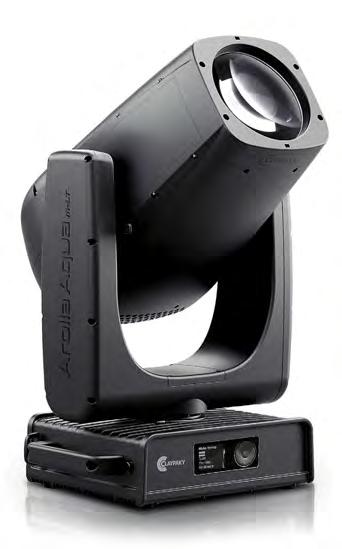
for use during touring and demanding environments. To aid sharp beams that remain impactful over long distances, it features a 220mm front lens. Its zoom range of 3.6–55° enables transitions from narrow beams to wide washes, making it suitable for key lighting, aerial effects and visual displays.
www.claypaky.it
AN UPDATE to the manufacturer’s Dartz 360 LED, the Rebel Dartz from Elation brings four times the brightness with improved optics, an upgraded FX toolkit and full all-weather protection. A 150W RBL engine produces a tight 1.5° beam for smooth, colour-mixed beam effects with an output of 125,475 lux at 5m. It comes with 10 rotating and 16 static gobos, stackable prisms and continuous pan and tilt.
The KL Batten series is a high-brightness colour wash fixture line engineered for
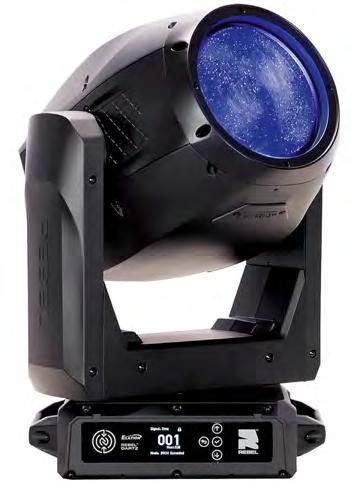
stage and broadcast environments. The KL Batten 12, KL Batten 48 and KL Batten 72 are said to deliver rich, full-spectrum colour with full pixel control, a homogenised beam and built-in CCT control. With their RGBMA engine and integration with the KL Series, the IP65-rated KL Battens come with a high-output 100W RGBMA engine with a CRI of over 94 and deliver 10,500, 46,500 and 71,250 lumens, respectively.
The KL Fresnel 6 IP and 8 IP have been designed for light-critical and noise-sensitive venues. They deliver high-output soft light with precise colour reproduction and adjustable colour temperature. They combine classic Fresnel beam quality with modern RGBMA colour versatility and integrate with Elation’s KL and Fuze families. The 250W KL Fresnel 6 IP and 500W 8 IP have a 7,400- and 15,500-lumen output, respectively, with both models featuring an 8–60° motorised zoom and high CRI for natural colour rendering.
The Rebel Line series of linear tilt bars is available in 0.5m and 1m lengths, with each bar driven by high-output 60W RGBL engines that integrate with Rebel Wash and Limelight fixtures. An uninterrupted linear lens system delivers a continuous beam with no breaks, while a SparkX array of 5W white LEDs creates crisscross aerials over any RGBL background.
The 8-cell Rebel Line 8 and 16-cell Rebel Line 16 deliver 11,548 and 25,355 lumens, respectively. Both models come with a 4–35° zoom and 210° tilt control and are IP65-rated.
www.elationlighting.com
GERMAN LIGHT Products (GLP) has launched a range of portable, batterypowered LED fixtures called Nexus Lights that have been designed to meet the growing demand for wireless, app-controlled lighting across professional and semiprofessional markets. The Nexus Lights range consists of fully wireless LED fixtures with IP65rated housings, making them suitable for both indoor and outdoor applications. Designed for mobile and flexible use, the fixtures combine professional lighting output with simplified operation, targeting users who require quick deployment without the need for external power or complex control infrastructure. Each fixture is powered by a high-capacity internal battery capable of delivering up to 24 hours of runtime, depending on usage.
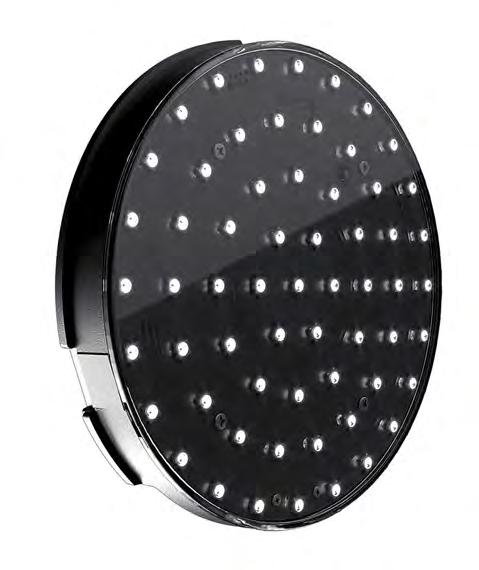
Recharging is via USB-C power delivery, allowing for quick turnaround times between events and supporting modern charging workflows common across touring, rental and installation environments. Control is handled via a dedicated appbased platform, allowing users to configure colours, scenes and effects directly from a mobile device. This approach removes the need for traditional lighting desks in many use cases, while still providing sufficient flexibility for live performance, broadcast and architectural scenarios.
The series is suitable for a broad range of applications, including mobile DJs, weddings, bars, clubs and touring productions, as well as theatres, TV studios, sports venues, cruise ships and houses of worship.
www.glp.de
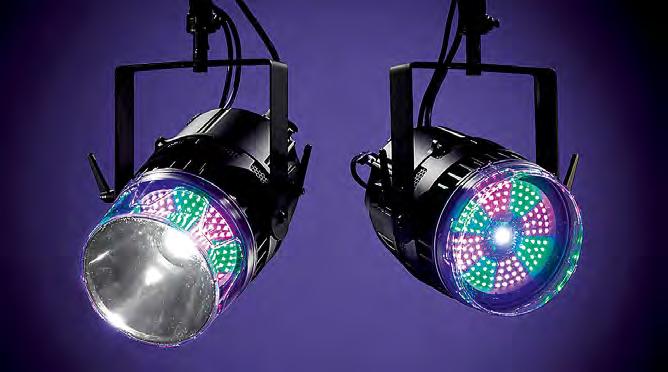
A flash of inspiration
HIGH END Systems has released the Dataflash 5000, a high-energy strobe fixture capable of 52,000 lumens. With both an RGB LED array and a 3,200–7,500K white light centre, the Dataflash 5000 has an IP65 rating and an LED engine that “turns on and stays on”. With the variable white light centre and the surrounding RGB LEDs, designers can achieve both warm and cool strobing while also painting
the stage with vivid colour. It also comes with a large collection of strobe modes and macros. Dome accessories include the Reflector Dome which attaches to the fixture face to provide strobes and atmospherics, while the transparent Eye Candy (EC) dome highlights all of the fixture’s bold effects.
www.etcconnect.com
RoboSpot gets sACN and RDM Net support
ROBE HAS announced a suite of software updates for its RoboSpot remote followspot system. Productions can now use RoboSpot and supported devices purely on Ethernet networks, eliminating the need for running XLR-based DMX cables to the BaseStation. XLR DMX and sACN output can be combined within a shared addressing space, allowing some fixtures to run on DMX and others on sACN simultaneously. Device discovery is handled seamlessly via RDMnet.
Operators can now define fade times for position buttons (up to 10s) for smooth automatic tracking between two points. If they need to stop the transition, they can double-press the button for an instant snap to final destination. Additionally, new Channel
Fade Control (up to 1s) for Dimmer, Iris, Zoom and Focus channels eliminate manual jitter, enabling new possibilities when operating in standalone mode without a console. Storage capacity has been increased to four pages of slots for both colours (up to 32 slots) and positions (up to 36 slots), while enhanced colour buttons allow operators to manually select desired colour or directly input precise hue and saturation values. When compatible fixtures like the iFORTE LTX WB, iESPRITE LTL WB or iPAINTE LTM WB are connected, the system automatically detects them and displays a dedicated LT button, allowing for instant mode switching without menu diving.
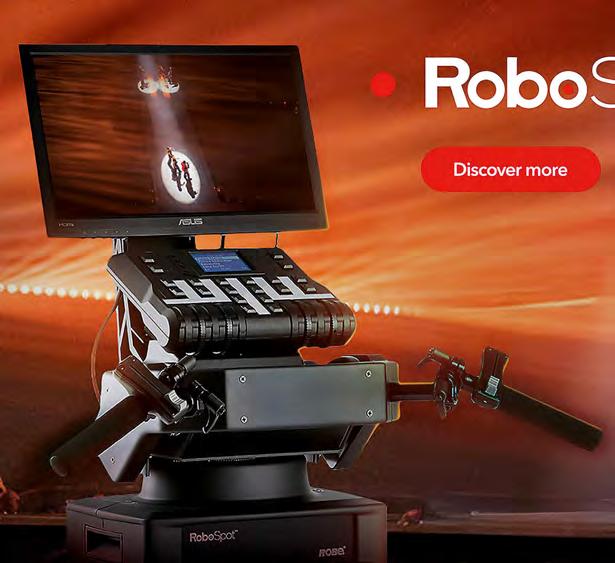
Additional features include Fixture Reset under the Wrench menu, which reads all connected devices, displays them in a group by fixture type and allows operators to trigger quick, specific feature resets or complete unit resets for an entire group of identical fixtures simultaneously. Dynamic Crosshair is a new setup wizard that allows operators to configure the crosshair to dynamically change its size in real time. The MDC setup has been refined, and operators can now use colours during the MDC setup process. Customers can adjust GUI Transparency to maximise screen real estate and also enable a Value Change overlay to briefly see what channel is changing and its value, while a long-requested feature that shows the RoboSpot is receiving a signal from the console has been implemented.
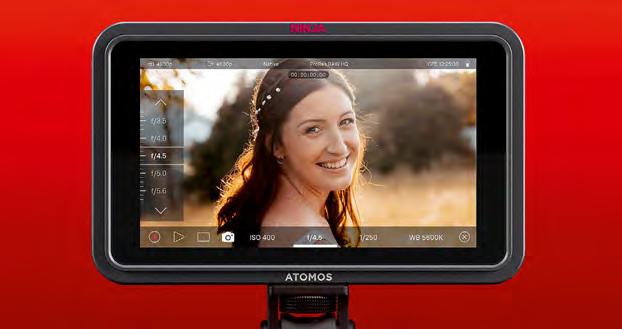
ATOMOS HAS announced a firmware update that brings integrated camera control to the Ninja TX GO and Ninja TX. The monitor-recorders now incorporate USB-C ports to enable camera control on supported cameras from Canon, Fujifilm, Nikon, Panasonic, Sony, Z CAM and other leading brands. Instead of struggling with the camera’s tiny on-body controls and menu, key camera functions can be easily managed from a much larger touchscreen monitor interface. This includes start and stop recording without reaching for the camera, changing essential settings such as ISO, shutter and white balance, and monitoring and adjusting from a more comfortable position (for example when the camera is mounted in a tight spot).
With a 5-inch, 1,500-nit HDR touchscreen, the Ninja TX GO and Ninja TX offer a more user-friendly monitoring experience than the camera’s built-in display. Both feature professional tools such as EL Zone, waveform, vectorscope and focus peaking, giving content creators control over framing, exposure and colour accuracy on-set.
The Ninja TX series records directly to CFexpress Type B or external USB-C SSD storage and supports Apple ProRes, ProRes RAW, Avid DNx and H.265/H.264 formats.
The Ninja TX GO is HDMI-only and can record up to 6Kp30 RAW, while the Ninja TX adds SDI input/output, AirGlu wireless timecode and expanded 8Kp30 RAW recording.
www.atomos.com
DESCRIBED AS the first secure KVM switch to support up to 5K resolution, the PSD PP v4.0 Universal Secure KVM Switch Series from ATEN has been certified to the NIAP PSD PP v4.0 (Protection Profile for Peripheral Sharing Device) standard. Designed for highsecurity environments and financial institutions, the series enables users
workspaces, while retaining a rugged metal enclosure for long-term reliability. To aid operation across multiple security domains, the series introduces configurable port LED colours and customisable port name labels. This enables faster and more accurate switching between classified and unclassified networks without compromising security protocols.
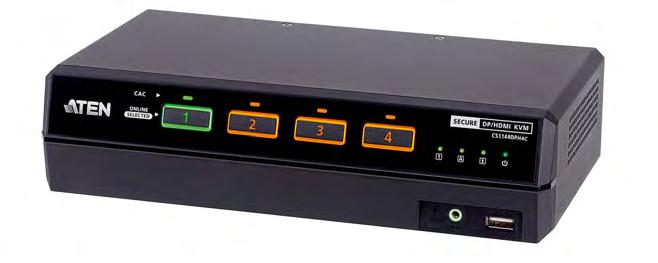
to manage multiple systems securely while maintaining high-resolution visual performance and simplified peripheral sharing. The range supports DisplayPort and HDMI via a single combo video connector and is available in single- and dual-display configurations, delivering resolutions up to 5120x2880 at 60Hz. Compared with previous generations, the switches feature a more compact form factor to support efficient use in control rooms and secure
RESI MEDIA has unveiled Studio AI, a proprietary AI-powered feature within Resi Studio that simplifies video creation, boosts content discoverability and streamlines workflows for church production teams. The solution streamlines video content creation by combining AI-driven automation with seamless video editing tools. Powered by proprietary technology, Studio AI transforms video into clips, transcripts and
remove these barriers by delivering a single workflow that is fully integrated within Resi Studio, eliminating the need for additional third-party AI solutions and editing tools. Features include instant transcripts so that users can make content more searchable, editable and accessible; real-time clips for creating social-ready and algorithm-friendly clips with captions for Instagram, TikTok and
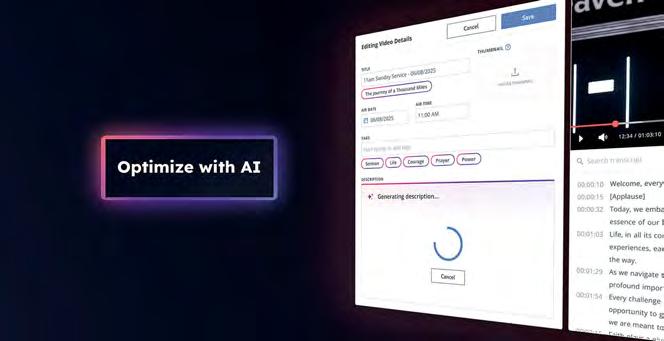
suggests smart metadata enhancements, reportedly making every video more searchable, shareable and impactful.
Studio AI directly addresses challenges many ministry teams face today, including manual editing of long-form video content, disconnected tools and cumbersome workflows that hinder churches from maximising the value of their content. Studio AI has been designed to
YouTube; and instant discussion prompts which automatically develop group discussion questions, saving time and enabling ministry teams to focus on strengthening community and deepening spiritual connection. A fully integrated workflow allows users to upload, trim, caption and schedule without leaving Resi Studio. www.resi.io
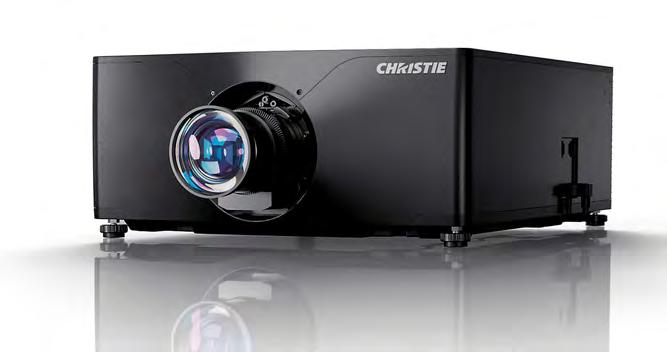
FEATURING THE latest 0.98-inch 4K
Compliance with the PSD PP v4.0 standard provides hardware-based isolation, unidirectional data transmission and always-on tamper protection, preventing unauthorised data leakage between systems. The switches also incorporate peripheral and audio filtering, visual security indicators and configurable CAC port management, allowing a single keyboard, mouse, monitor and peripheral set to be shared securely across networks.
www.aten.com
SST DMD with CineLife+ electronics and Phazer illumination, the CP4415m-RGBH and CP4420m-RGBH cinema projectors from Christie are compatible with existing legacy lenses and accessories from lampbased projectors, to further reduce costs for customers transitioning from lamp to laser. The CP4415m-RGBH and CP4420mRGBH feature 15,000 and 20,000 lumens of brightness, respectively, and a configurable hybrid laser light source that is optimised for postproduction and high-quality visuals on all cinema screen types. The new models are also quiet, at less than 47dBA, making them suitable for small spaces and boothless installations. Engineered with performance and affordability in mind, the Korus Series of 1DLP laser projectors offer 4K UHD+ resolution in a
compact package. The family features four models, including two TAA-compliant projectors, with brightness up to 14,250 lumens. Powered by 0.8-inch HED DMD technology, the projectors unite 4K UHD+ resolution and 1,500:1 native and 25,000:1 contrast resolution. Furthermore, they have been designed with portability in mind, weighing 17.2kg. The Korus Series has been engineered to simplify space-constrained and complex projects, by combining omnidirectional flexibility and eight interchangeable lenses, including a Z-shaped short throw lens. The series also supports both active and passive 3D, and leverages the built-in Twist feature for warping and blending, optional Mystique for camera-based alignment, plus Christie Intelligent Camera compatibility.
www.christiedigital.com

WOHLER HAS added three SRT capabilities to the feature set of its iVAM2-MPEG Secure Reliable Transport (SRT) monitor: Caller and Listener modes, monitoring of encrypted SRT streams and Stream-ID selection for multistream endpoints. The Advanced MPEG Stream Analyzer is now also directly available via the front panel, in addition to the web interface. The Caller and Listener modes enable operators to initiate or accept SRT connections based on their workflow. The unit can also monitor encrypted SRT streams, giving customers confidence when observing secured contribution and distribution feeds. For workflows carrying multiple SRT streams over
a single IP/port, operators can now select and monitor the desired stream using its Stream-ID, reducing setup friction and simplifying multi-programme confidence monitoring
The iVAM2-MPEG has long supported viewing and selecting packet identifiers (PID) tables on the web interface. Providing this capability on the front panel gives operators a structured, at-a-glance view of parsed MPEG tables and programmes, and allows the direct selection of specific audio, video or subtitle PIDs for decoding on the fly without having to pivot to the web UI.
www.wohler.com
like a pro
MAGEWELL HAS unveiled the Pro Convert IP to HDMI multi-format IP decoder, the successor to the company’s Pro Convert for NDI to HDMI decoder. Developed to provide enhanced decoding capabilities, higher input counts, common form factors and an improved web user interface, the decoder is a small, standalone unit that converts up to four IP streams into a single HDR 10-compatible, QHD (2560x1440) HDMI output. Using the integrated multiviewer,
ADDING NEW capabilities for the broadcast AV and sports and entertainment sectors, Ross Video has launched the Vertex control platform. Empowering creators to design, manage and automate immersive experiences, Vertex brings together video, audio, lighting and control within a single, unified system. Strengthening the Canadian brand’s expansion into experiential technologies, the Vertex platform was incorporated into the Ross Video portfolio following the company’s ioversal acquisition. Designed for interactive installations, live entertainment, large-scale productions and advanced projection-mapping environments, the real-time AV production suite offers a simplified workflow for a variety of tasks. Featuring a high number of real-time render engines such as Ventuz or Notch, servers include the Vertex Server 4x4K RT, Vertex Server 4x4K, Vertex
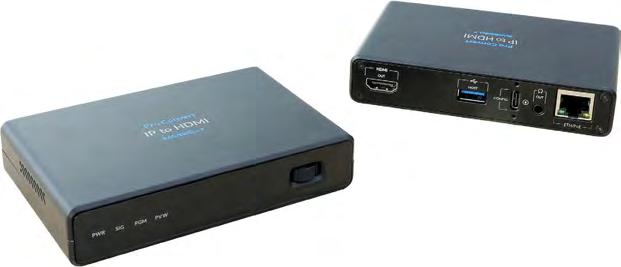
decoded input streams can be displayed in preset single, dual or quad layouts. The
device can decode one input stream up to 2560x1440 at 60fps in single-view mode, or up to four 1080p60 streams in multiview mode. Video preview is provided via realtime stream or MJPEG thumbnails in the new web GUI. The decoder can be powered via
Server 4K and Vertex Workstation. For room control, building automation or show control, Vertex features advanced scripting and node programming functions, in addition to custom control panels that incorporate a proprietary software solution for easy configuration via Vertex. www.rossvideo.com
PoE/PoE+ or USB and is suitable for a range of monitoring scenarios, including security/ surveillance, command and control, and broadcast applications. An additional USB port is reserved for peripherals like keyboard or mouse. A new rotary control dial provides easy menu navigation, while an improved user interface allows easy access to setup, monitoring and troubleshooting tools.
www.magewell.com

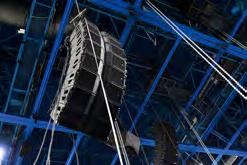
THE LATEST evolution in its Polaris Series, Absen’s PL 3.9 Pro V3 has been engineered for both indoor and outdoor use and is suitable for live events, festivals, touring productions and immersive brand experiences. Featuring a unibody dual-layer magnesium cabinet that
matte-black anti-reflective masks. Features include a high dynamic brightness range of 0.1–5,000 nits, 16-bit grayscale and a 7,680Hz refresh rate. The locking systems and tool-free rear maintenance are said to streamline installation and servicing.
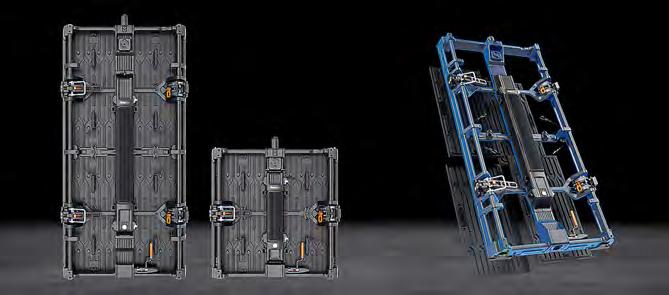
offers both strength and lightness and available in two panel sizes (500mm x 1,000mm and 500mm x 500mm), the system is described as easy to transport and install. Protective features, including triple-guard modules, reinforced corner shields, anti-drop safety ropes and anti-shock locking knobs, reportedly ensure the panels are safeguarded against bumps, drops and impacts. The PL 3.9 Pro V3 delivers deep blacks and high contrast with true black-face LEDs and
The PL3.9 Pro V3 can utilise an optional integrated wind-bracing system with a triple-stable design. When combined with reinforced triangle hanging bars, it supports secure installations up to 20m high and can withstand winds up to Beaufort force 8. Optional climb-assist ladder systems also provide secure technician access for module and power box maintenance.
www.absen.com
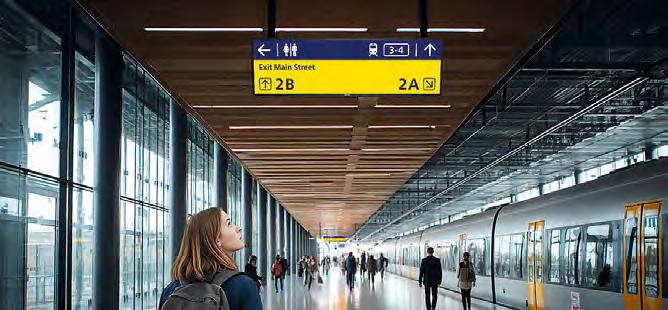
SUPERSEDING THE Philips S-Line, PPDS has added the 32:9 Philips Stretch 3150 model to its portfolio of displays. Designed for applications ranging from retail and hospitality to transportation, education, banking and arenas, the 37-inch screen features a 32:9, 1920x540 resolution display.
Offering clear visibility in natural and artificial lighting conditions, the portrait and landscape mountable display provides 700cd/m2 brightness. With the ability to transform spaces deemed unsuitable for conventional-sized displays, including instore shelving or temporary pop-ups within shopping centres, the 7.6kg unit incorporates narrow 7.7mm L/R and 14mm T/B bezels.
The Philips Stretch 3150 displays can be installed as standalone units or as multiple daisychained displays using the HDMI Out and HDMI In ports. For tiled setups, two or more displays can be routed to an external player for single source content management. Representing a significant
ENGINEERED TO address key structural and visual challenges in the transparent LED market, the Vanish Air Rental has been released by ROE Visual. Incorporating the power system directly into its frame, the LED panel’s 92% visual transparency enhances light transmission and onstage sound permeability.
Eliminating the need for a conventional central PSU column, the Vanish Air Rental is reportedly the first rental LED panel to deliver and distribute power through the panel frame. Developed as a 1,000mm x 1,000mm platform, the panel combines a wider viewing area with a more open appearance. To further enhance transparency, the Vanish Air Rental replaces the traditional grille-style LED layout with a refined perforated LED design. The tiny perforations fade from perception as the panel’s structural components visually disappear from 5m away.
upgrade, optional wireless network connectivity and Bluetooth functionality can be added by including a discreetly integrated slot for a CRD32 Wi-Fi module. AV/IT managers can create and schedule content to play on their displays directly from the cloud (centrally and remotely managed), from local memory or via USB.
Enhancing connectivity and security, the Philips Stretch 3150 is powered via the Android 13 System-on-a-Chip, which is also optimised for native Android apps and eliminates the requirement for an external media player. In addition to being monitored and controlled over the display network, the Philips Stretch 3150 units can also receive firmware upgrades, have their playlists managed and power schedules set over the Philips Wave cloud platform. Compared to its predecessor, the display reportedly delivers a 60% reduction in power use, typically consuming 26W.
www.ppds.com
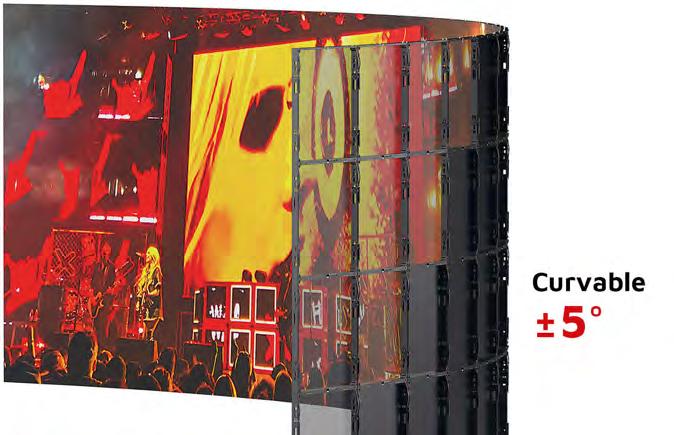
SONY HAS expanded its direct-view LED range with the Crystal LED S Series, a pair of dvLED models positioned as cost-conscious options for corporate, education and commercial environments where high visibility and consistent image quality in brightly lit spaces are required. The series comprises the ZRD-S12G and ZRD-S15G, each promising a maximum brightness of 800cd/m² and featuring pixel pitches of 1.25mm and 1.56mm, respectively. Designed as scalable, modular displays, the two models are intended to address growing demand for mid-market dvLED solutions while maintaining accurate colour reproduction and low reflectivity for use in a wide range of indoor applications. Both displays incorporate the manufacturer’s Anti-Reflection Surface Technology previously
used in its BH Series Crystal LED products. The bezel-free design also enables the creation of seamless videowalls in various sizes and configurations, supporting flexible deployment across different installation requirements. Installation has been simplified through a slim cabinet design with a depth of approximately 45mm, supporting flexible mounting options and compatibility with European Accessibility Act requirements when used with appropriate wall-mount frames. The S Series is also designed to integrate with NovaStar MX30 and MX40 Pro controllers, enabling extended distances of up to 100m between the display cabinets and controller to support more complex installations.
www.pro.sony
With a 6.94mm pixel pitch and brightness levels of up 4,000 nits, the screen can deliver visual impact in high ambient light. Incorporating black LEDs, dark GOB technology and a clean PCB layout, the panel enhances its contrast ratio to create a high-fidelity image. Capable of curving up to 5°, projects requiring a non-transparent display can mount an optional blanking plate to the rear of the panel. Offering a dual-purpose solution across diverse production needs, the addition can transform the screen from transparent to solid. Finally, the Omni Tube is a mappable 360° LED solution that delivers 1,000 lumens of brightness. Users can connect each unit into strips, triangles or cubes using custom connectors, cables and lock pins.
www.roevisual.com
INTRODUCING AI-POWERED capabilities aimed at improving speed, accuracy and efficiency in media asset management workflows, the latest version of Vizrt’s Viz One MAM integrates with aiconix’s DeepVA sovereign AI platform to automate key stages of logging, search and content discovery.
Designed to address the growing pressure on broadcasters and content owners to deliver more content across multiple platforms, Viz One 8.1 reduces reliance on manual shot logging and archive research. The DeepVA integration enables AI-driven visual recognition, automatically identifying and tagging faces, objects
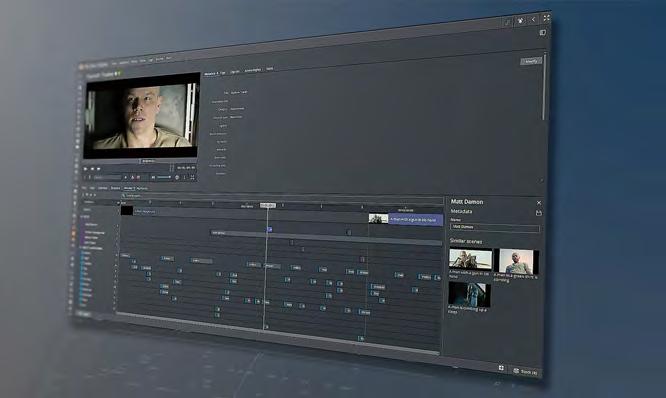
OPTIMISED FOR use with Panasonic’s projectors and ET-FMP50 Series media processors, Panasonic Connect has released its Windows-based Visual Software Suite (VSS) platform. Consolidating separate Panasonic software tools into a single platform, VSS streamlines multiple functions into one fourscreen interface.
Available for free download, VSS gives AV professionals control over multi-projector environments. Its user-friendly design reportedly requires no training and boosts productivity through automated features that reduce time and manual intervention. Projector setup and management is streamlined with auto calibration features, including geometry correction, edge blending, black level adjustment, colour matching and content splitting. Users can also perform
as distortion correction, free-shape masking, and uniformity and brightness control.
VSS also allows adjustments to lens shift, zoom and focus, as well as power and shutter management, test pattern display and web browser access. Its content playback and management functionality supports multiple playlists, gapless looping, external UDP command integration and real-time previews on a PC or projection screen. When used with Panasonic’s FMP50 Series of media processors – both the box-type devices (ET-FMP50/FMP20) and an Intel SDM specification slot-compatible function board (ET-SBFMP10) – VSS is compatible with nearly every Panasonic projector and display currently available.
and scenes within video content, with support for trainable custom models. According to the manufacturer, AIgenerated metadata can deliver up to a 50% increase in logging accuracy, 10 times faster logging workflows and five times faster search and discovery. Users retain oversight of the process, with the option to review AI-generated metadata, train models for unknown entities and carry out quality assurance checks where required.
Viz One 8.1 is built on a containerised architecture designed to scale across onpremises, hybrid and cloud environments.
www.vizrt.com

TELESTREAM HAS announced the release of ARGUS v2.3, introducing a feature that enables operators to visually and audibly inspect live and on-demand streams directly within the ARGUS monitoring environment. The Live Look feature has been designed for rapid validation of service health and quality, bringing real-time video playback and audio confirmation to the ARGUS consolidated dashboard, enabling direct inspection for fault validation and triage. Compared to other monitoring systems requiring operators to pivot between dashboards and third-party tools for signal validation, ARGUS Live Look advances the workflow into a single experience. It has been designed to enables users to verify impairment alarms, assess their impact, escalate
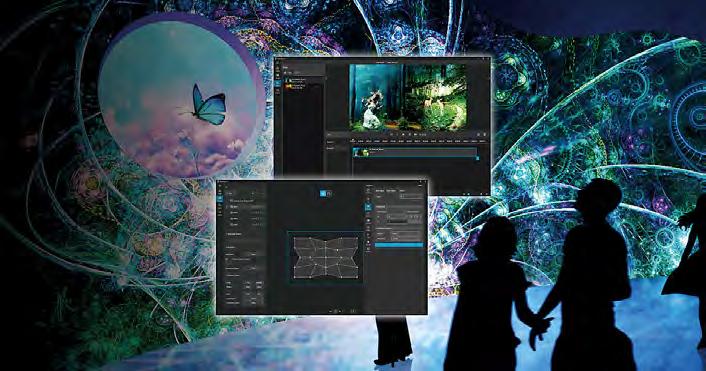
AUDINATE GROUP has announced the launch of Iris, following the company’s purchase of Iris Studio in June 2025. The platform has been designed to transform how cameras are controlled and productions are managed. By turning virtually any PTZ camera into a softwareconnected, remotely controlled device, Iris reportedly eliminates the traditional constraints of camera operation, such as hardware dependencies, inconsistent control and the lack of onsite crews.
The platform’s AI-powered automation handles traditionally manual tasks, like realtime subject tracking and framing, allowing operators to focus on creative decisions rather

than technical adjustments. Its interface is said to allow non-technical users to achieve professional results, democratising access to advanced capabilities that deliver the production quality of larger-budget operations.
Iris can be used to scale operations without proportionally increasing costs or crew size. A single operator can manage multiple cameras across multiple locations, while remote teams collaborate in real time as if
and reduce mean time to repair (MTTR) while improving operational efficiency. Live Look has been engineered in response to the need for visual confirmation at scale, particularly for organisations managing hundreds of linear or OTT channels across distributed operations. Without leaving the ARGUS environment, users can verify audio presence and confirm editorial intent when silence or anomalies are detected. Beyond Live Look, ARGUS v2.3 delivers several updates to streamline management, improve security and optimise monitoring performance. These include enhanced SSO-enabled user management, automated lineup import/export and improved audio PID monitoring.
www.telestream.net
they were in the same room. Through the Iris desktop application, production teams can discover, link to and control over 300 models of cameras on their local network. For those using Iris-enabled cameras, the platform is built directly into the device’s firmware, connecting instantly to the cloud without any additional hardware or complex setup. This direct-to-cloud capability debuts alongside broad support from leading PTZ camera manufacturers, including AIDA, BirdDog, Bolin, BZBGear, Everet, HDKATOV, Lumens, Marshall, NEOiD, Telycam and Z CAM.
www.tryiris.ai
Phil Ward examines the worrying dangers posed by AI-generated music and consequent attempts to raise consumer awareness and promote fair compensation
HER NAME IS AINA SABRINA. SHE’S A DJ AND SHE presents two hours of music a day on Fly FM, based in Kuala Lumpur. She chats with listeners, mixes in real time and has won a huge audience along with a few industry awards. And she isn’t real.
Aina is generated by AI, a product of Media Prima Audio’s creative team. They use data analytics, voice synthesis, digital video and generative AI to build her persona into a live radio show and more besides, including sponsorship citations and even a recording career, placing her alongside the virtual pop stars of South Korea and Japan in a new paradigm for the whole industry.
But while Aina’s arrival is glaringly open, something a lot more subtle is happening to the music she and many of her human counterparts might play. Country rock “band” The Velvet Sundown has racked up over 1m streams while another – Breaking Rust – topped the Billboard Country Chart with their song Walk My Walk . Both acts are fictitious, the music 100% AI-generated.
In Iceland, Ekfat is doing well in playlists such as Lo-Fi House and Chill Instrumental Beats. We’re told he or she is “a classically trained Icelandic beatmaker who graduated from the Reykjavik music conservatory, joined the legendary Smekkleysa Lo-Fi Rockers crew in 2017 and released music only on limited-edition cassettes until 2019”. There is no such Reykjavik music school, and Smekkleysa Lo-Fi Rockers do not exist, prompting Iceland’s Minister of Culture Lilja Alfreðsdóttir to challenge Spotify to “discuss the proliferation of fake artists posing as Icelandic musicians on the music streaming platform… costing real Icelandic artists a substantial amount of potential revenue,” according to Iceland Review
There are many, many more and the numbers are increasing: streaming platform Deezer estimates that the number of fully AI tracks uploaded per day has gone up from 10% in January 2025 to 34%, arriving at a rate of around 50,000 per day. And it’s good business: AI music software company Suno is estimated to be worth US$2.5bn.

This is another digital wake-up call for the music industry, similar to controversies that surrounded streaming and downloading, and sampling. Protests such as a UK campaign by the Fairly Trained lobby are winning high-profile support, while predicting that about 24% of human income will be lost to AI over the next four years. The lobby’s name exposes the main problem: the unlicensed use of copyrighted material to train AI models. This has been happening with no consent from artists, no indication to consumers and all royalties going to the tech companies. Fairly Trained wants the government to step back from proposed changes to copyright law that will make it legal to train AI models on copyrighted material, so removing the legal framework that is currently supposed to protect rights holders. It seems clear that this policy expresses an ideological faith in growth, especially for tech, without any consideration of the consequences.
Spotify, for example, provides no notification of AI content, so consumers are given no choice. While listeners may legitimately be unconcerned about the use of AI in the studio, which can be genuinely creative, it may
cause concern to realise that the practice also engenders fraudulent chart-fixing, including algorithms to trick streaming data and boost sales. Spotify has also been developing what it calls Perfect Fit Content (PFC) by getting struggling musicians – crucially at a level before they need to worry about registering with PRS or other royaltygathering agencies – to churn out playlist-themed material. There are signs of responsible leadership, however. Deezer is responding with “AI-generated content” warning signs, using new AI-spotting software. It has joined the lobby for permission and disclosure, recognising a shift in 2022 when it first became apparent that AI-generated content was competing with human music – and after surveys revealed that 97% of listeners in a blind test could not tell the difference. CEO Alexis Lanternier reveals that small patterns in the signal can be detected, caused by the apps: every AI tool generates its own signature. Ironically, other AI tools are needed for such digital forensics. Deezer’s new algorithm claims to identify each method currently deployed on the open market. Lanternier believes AI can be a legitimate creative tool if it helps a songwriter who can’t play guitar but
needs a convincing backing track, or a musician who struggles to come up with satisfying lyrics. However, with up to 340,000 new tracks each week, it’s clear that a dangerous proportion are being pumped into the system by fraudsters attempting to inflate royalty figures. The warnings next to individual tracks, he says, dissipate the fraudulent business model and, if combined with support for royalties for content used in AI training, could prevent the industry from sliding into chaos.
Meanwhile, a landmark case has been won against ChatGPT in Munich for breach of copyright. Furthermore, licensing deals are beginning to appear: Warner has partnered with three leading music tech companies that generate remixes, covers and new material using established voices in “original” songs, with opt-in clauses designed to ensure compensation.
Of course, it’s entirely possible for the market to develop a taste for AI-generated music, a process that may have started already. It’s analogous to the genuine taste for synthesised over acoustic sounds, and it won’t really matter, provided everyone involved – from influencer to trainer to creator – gets a fair deal.

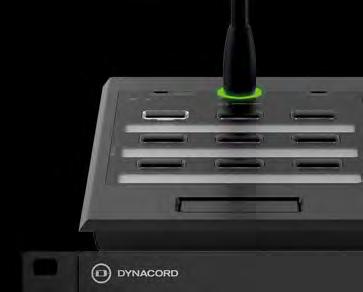
V Series Zone Audio Platform







In commercial installs, you need a zone audio system that is fast to set up, easy to manage, and flexible. But often, you end up juggling DSPs, accessories and amps that really don’t talk to each other.


That’s why we created a complete zone audio platform, reliably handling background music, paging, and messaging with maximum ease and flexibility.