www.campbellrivermirror.com
Campbell River Mirror
Wednesday, February 5, 2020 A13
Overdose Prevention Resource Guide
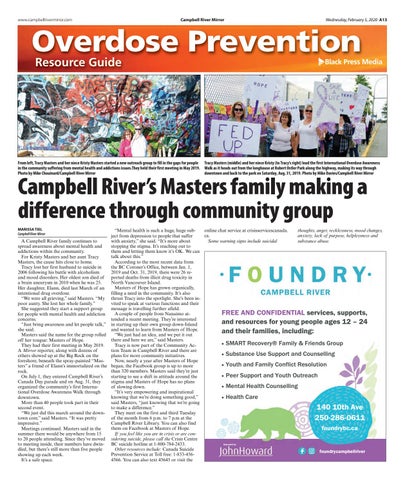
From left, Tracy Masters and her niece Kristy Masters started a new outreach group to fill in the gaps for people Tracy Masters (middle) and her niece Kristy (to Tracy’s right) lead the first International Overdose Awareness in the community suffering from mental health and addictions issues.They held their first meeting in May 2019. Walk as it heads out from the longhouse at Robert Ostler Park along the highway, making its way through downtown and back to the park on Saturday, Aug. 31, 2019. Photo by Mike Davies/Campbell River Mirror Photo by Mike Chouinard/Campbell River Mirror
Campbell River’s Masters family making a difference through community group MARISSA TIEL Campbell River Mirror
thoughts, anger, recklessness, mood changes, online chat service at crisisservicescanada. “Mental health is such a huge, huge subanxiety, lack of purpose, helplessness and ca. ject from depression to people that suffer substance abuse. Some warning signs include suicidal with anxiety,” she said. “It’s more about A Campbell River family continues to stopping the stigma. It’s reaching out to spread awareness about mental health and them and letting them know it’s OK. We can addictions within the community. talk about this.” For Kristy Masters and her aunt Tracy According to the most recent data from Masters, the cause hits close to home. the BC Coroner’s Office, between Jan. 1, Tracy lost her first husband to suicide in 2019 and Oct. 31, 2019, there were 26 re2006 following his battle with alcoholism and mood disorders. Her oldest son died of ported deaths from illicit drug toxicity in North Vancouver Island. a brain aneurysm in 2010 when he was 25. Masters of Hope has grown organically, Her daughter, Elann, died last March of an filling a need in the community. It’s also intentional drug overdose. “We were all grieving,” said Masters. “My thrust Tracy into the spotlight. She’s been invited to speak at various functions and their poor aunty. She lost her whole family.” message is travelling further afield. She suggested they start a support group FR FREE EE AND C CONFIDENTIAL ONFIDENTIAL ser services, vices, ssupports, upports, A couple of people from Nanaimo atfor people with mental health and addiction tended a recent meeting. They’re interested concerns. and resources for young people ages 12 – 24 “Just bring awareness and let people talk,” in starting up their own group down-Island and wanted to learn from Masters of Hope. she said. and their families, including: “We just had an idea, and we put it out Masters said the name for the group rolled there and here we are,” said Masters. off her tongue: Masters of Hope. SMART Recovery® Family & Friends Group Tracy is now part of the Community AcThey had their first meeting in May 2019. tion Team in Campbell River and there are A Mirror reporter, along with dozens of Substance Use Support and Counselling plans for more community initiatives. others showed up at the Big Rock on the Now, nearly a year after Masters of Hope foreshore, beneath the spray-painted “Mas Youth and Family Conflict Resolution ters” a friend of Elann’s immortalized on the began, the Facebook group is up to more than 320 members. Masters said they’re just rock. Peer Support and Youth Outreach starting to see a shift in attitude around the On July 1, they entered Campbell River’s stigma and Masters of Hope has no plans Canada Day parade and on Aug. 31, they Mental Health Counselling of slowing down. organized the community’s first Interna“It’s very empowering and inspirational tional Overdose Awareness Walk through knowing that we’re doing something good,” Health Care downtown. said Masters, “just knowing that we’re going More than 40 people took part in their to make a difference.” second event. They meet on the first and third Tuesday “We just did this march around the downof the month from 6 p.m. to 7 p.m at the town core,” said Masters. “It was pretty Campbell River Library. You can also find impressive.” them on Facebook at Masters of Hope. Meetings continued. Masters said in the foundrybc.ca If you feel like you are in crisis or are consummer there would be anywhere from 15 to 20 people attending. Since they’ve moved sidering suicide, please call the Crisis Centre Operated by to meeting inside, their numbers have dwin- BC suicide hotline at 1-800-784-2433. Other resources include: Canada Suicide dled, but there’s still more than five people foundrycampbellriver Prevention Service at Toll free: 1-833-456showing up each week. 4566. You can also text 45645 or visit the It’s a safe space.
140 10th Ave 250-286-0611
A14 Wednesday, February 5, 2020
Campbell River Mirror
www.campbellrivermirror.com
Campbell River Mirror
www.campbellrivermirror.com
OVERDOSE PREVENTION A traumainformed approach to substance use Island Health encourages a traumainformed approach when discussing drug use and overdoses. This means recognizing and acknowledging trauma, and being aware and sensitive to its dynamics. Some youth may be more affected by these subjects than others. Youth may have witnessed family members, friends or significant others using substances, or they may have used themselves. Youth who have suffered recent losses or who are coping with grief or toxic stress may also be triggered by overdose materials and education. Teachers are experts in what is developmentally appropriate in educational settings.
Wednesday, February 5, 2020 A23
OVERDOSE PREVENTION
TALKING While talking about drugs with your teen may not be easy, it is essential. Chances are teens are hearing about drugs anyway – from friends or social media, for example – but there’s a good chance at least some of that information won’t be accurate. Sharing factual information and your values, and teaching them how to make safe, healthy decisions about substance use can help prepare them. While it’s never too early or too late to talk about substance use with your kids, the recent rash of fentanyl-related incidents is a reminder of just how important this conversation is, notes Island Health. Keeping that line of dialogue open may let them talk about concerns they have about someone else who is using drugs or about their own use. They may want to talk about finding help to stop. Regardless of their questions, it’s important to provide accurate information. Health Canada offers the following suggestions: • think ahead about what you want to discuss but avoid saying everything you think all at once. • look for opportunities to mention drug use, like when discussing school or current events. • offer teens control and let them pick the time and place. • give them room to participate and ask questions. • respect their independence and their opinion. • avoid being judgmental.
4X6 UNITED WAY
HELP MAKE HOMELESSNESS #UNIGNORABLE SHOW YOUR LOCAL LOVE
DONATE AT UWCNVI.CA
with your teens about drugs
• listen – if you’re a good listener they may be more inclined to trust your input. • tell them you’re trying to help them make good decisions by sharing information they may not already have. • be clear about why you’re worried and tell them that your main concern is for their well-being.
• focus on facts rather than emotions; as a parent, if your teen is using drugs you may feel anger, sadness, fear or confusion, however talking about the issue is more productive than talking about your feelings. Learn more at islandhealth.ca and Canada.ca.
IS YOUR TEEN USING DRUGS? HELP IS AVAILABLE If you love and worry about a teenager who may be experimenting with or regularly engaged in relationship with alcohol or other drugs, you’re not alone. The Island Health workbook, Recognizing Resilience: A Workbook for Parents and Caregivers of Teens Involved with Substances, can help you understand and respond to substance use. Find additional information and support at Island Health’s Youth & Family Substance Use Resources (islandhealth.ca/learn-about-health/ substance-use-addiction/youth-substance-use). A consultation with a substance use counselling professional may also be beneficial for your family. Ask your family doctor or other health care professional for referrals, and visit Island Health’s Youth and Family Substance Use Services page.
Prescription drugs Some prescription drugs, such as opioid pain relievers, stimulants and benzodiazepines, are used to get high because they have psychoactive – or mind-altering – properties. In fact, Health Canada notes that psychoactive pharmaceuticals are the third most commonly used substances among Canadian youth, after alcohol and cannabis.
However, taking prescription drugs without a doctor’s approval is dangerous and can be fatal. Prescription opioids can be just as dangerous as illegal opioid drugs such as heroin and carry dangerous, unpredictable risks including addiction, overdose and death. To learn more: islandhealth.ca/learnabout-health/substance-use-addiction/youthsubstance-use
More resources Additional resources are available from Here to Help, a project of the BC Partners for Mental Health and Substance Use Information, and From Grief to Action, a volunteer-based BC not-for-profit providing a voice and a support network for families and friends affected by drug use. Learn more at fromgrieftoaction.com and heretohelp.bc.ca You’ll also find a toolkit (heretohelp.bc.ca/ workbook/fgta-coping-kit) for parents or caregivers concerned about a son or daughter’s early experimental substance use or more serious substance use. Find information about drugs and substance use, strategies for supporting a loved one, strategies for taking care of yourself, and treatment options – all from families who have been there themselves.
Programs offered by The John Howard Society of North Island: • Youth and Family Substance Use Services -Alcohol and drug counselling services for youth, offering assessment, treatment, and individual, group, and family counselling. Selfreferrals welcome. • 180 Degrees -Provides detox and supportive recovery services to youth. Youth reside in John Howard Society family carehomes for up to six months. • Alcohol & Drug Prevention & Early Intervention -Provides alcohol and drug services within designated School District #71 and #72 school(s). Provides information and assists youth in early identification and access to services, including education, counselling, referrals, and groups. • Youth Outreach -Provides an outreach service to youth who may be at risk by misusing substances, vulnerable to exploitation, and need to connect with resources and healthy activities. Offers a safe contact for youth.
Supervised consumption is key to overdose prevention Island Health has seen more than 315,000 visits across its nine supervised consumption and overdose prevention sites on Vancouver Island since they first opened in December 2016. During the same time, staff reported more than 1,200 reversed overdoses, but zero deaths. Staff have also delivered additional supports and services to people who are using drugs and for people who are ready to begin a recovery journey, Island Health reported earlier this year. “Observed consumption services are more than just overdose prevention – these are the beginnings of a supportive community,” said Dr. Richard Stanwick, Island Health Chief Medical Health Officer. “And the staff and peers working at these locations play a vital role in addressing stigma and supporting people who are the most vulnerable.” Overdose prevention and supervised consumption services help people reduce
“Overdose prevention and supervised consumption services are a critical part of our response to the overdose crisis,” said Judy Darcy, Minister of Mental Health and Addictions. “These services not only save lives but also connect people to treatment and recovery options and other supports to help them make safer choices and find
Opioid crisis BY THE NUMBERS: Island Health photo
their risk of overdose by using drugs under the supervision of trained staff, who also offer harm-reduction supplies, peer support, public health nursing, mental health and substance use supports and linkages and referrals to treatment.
HARM REDUCTION SERVICES Campbell River - 1371 - c Cedar Street
• harm reduction supplies, support and education • Overdose Prevention Room for safer drug use and rapid overdose response education for safer drug use referrals and links to other services • referral to and assistance navigating social and health care systems • Nurse Practitioner onsite - weekly outreach Monday - Thursday: 9 a.m. - 11:30 a.m., 1 p.m. - 3:30 p.m. Friday - Sunday: 11 a.m. - 2:30 p.m.
THE RIGHT WAY TO DISPOSAL OF NEEDLES The safe disposal of needles saves others from getting hurt accidentally. Island Health shares what you need to know: • Stay calm; pick up the needle with care, using work gloves if desired • Don’t try to replace the cap on needles; don’t snap, break or bend needles or other sharps • Hold the needle point away from you and put it in a metal or hard plastic container with lid, like a drink bottle. • Replace cap on container securely and label it • Wash hands thoroughly with soap and water • Drop off the sealed container at: community drop box (call your municipality about locations); participating pharmacy; dispose of the sealed container in a nearby waste bin; or your local public health unit Anyone who uses a needle to inject should dispose of it safely. However, sometimes discarded needles are found in public areas.
a pathway to healing and a pathway to hope.” Island Health supervised consumption and overdose prevention sites are found in Duncan, Nanaimo, Port Alberni, Campbell River, Courtenay and Victoria. An average of 3,000 visits are made every week to these sites.
Fortunately, the risk of being infected by an accidental needle stick is rare. If someone is injured by a discarded needle, stay calm, take reasonable care and follow these steps: • Wash injured area with soap and warm water as soon as possible • Apply an antiseptic and a clean bandage; dispose of the needle safely • Call 8-1-1 for advice 24/7 • Visit your local emergency department or primary care provider, preferably within 24 hours • For more information, call Island Health’s Communicable Disease program on the Central Island, 8:30am to 4:30pm – 1-866-770-7798. Visit islandhealth.ca/safe-needle-disposal for more information. Learn more about harm reduction at: towardtheheart.com
n 1,533 people died of drug overdoses in B.C. in 2018, including 242 on Vancouver Island n 78% of the people who died from drug overdoses were men in 2019 n 87% of deaths occur indoors n 71% of those who died were aged 30 to 59 n 0 deaths at supervised consumption and overdose prevention sites n 678 Take Home Naloxone Kits were distributed in the Island Health region in August 2019 n 291 active prescribers of Opioid Agonist Therapy in the Island Health region in August 2019
4X6 VANCOUVER ISLAND HEALTH You don’t need a referral and most therapies are covered for residents of BC. There are resources, services and medications that can help you be well. Visit your doctor or a care provider to explore treatment pathways. For more information, visit: islandhealth.ca/oat
A24 Wednesday, February 5, 2020
Campbell River Mirror
www.campbellrivermirror.com
OVERDOSE PREVENTION
LANGUAGE MATTERS When discussing substance use and the current overdose crisis, does language matter? Yes, say the province’s health professionals. “Treating people who use substances with respect improves health outcomes and helps save lives,” explains the BC Centre for Disease Control’s Toward the Heart website. The foundation of Toward the Heart – towardtheheart.com – is that every person has the right to the best health possible and should be treated with dignity and respect. It’s in this belief that Language Matters. The goal is to encourage the use of respectful, non-stigmatizing language when describing substance use disorders, addiction and people who use drugs. “Whether used in a healthcare setting or in the news media, negative and stigmatizing language discredits people who use drugs and can result in discrimination,” Toward the Heart explains. “Stigmatization contributes to isolation and means people will be less likely to access services. This has a direct, detrimental impact on the health of people
who use drugs.” How can we change the conversation around overdose? • Use people-first language. This means referring to a person before describing his or her behaviour or condition – important because it acknowledges that a person’s condition, illness or behaviour is not that person’s defining characteristic. For example,“person with a cocaine-use disorder” instead of “cocaine user” or “addict.” • Use language that reflects the medical nature of substance use disorders. Numerous factors contribute to drug addiction, from personal factors to social, environmental and political ones. Avoid terms that reinforce a belief that addiction is a failure of morals or personality, rather than a medical issue. Use “addictive disease” and “substance use disorder” instead of “abuser” or “junkie.” • Use language that promotes recovery. Use language that conveys optimism and supports recovery, and respects the person’s autonomy, such as “opted not to” and “not in agreement with the treatment plan” instead of
How to reduce stigma, and why that’s important
“unmotivated” or “non-compliant.” • Avoid slang and idioms. Slang terms and idioms have negative connotations and a significant level of stigma attached to them – use “positive” or “negative” when referring to drug tests, for example instead of “dirty” or “clean.” For information, including a video about creating a safer space with less stigma, visit towardtheheart.com/reducing-stigma
Supporting a loved one? “The most important thing in terms of family members is just understanding that addiction is an illness,” says Island Health’s Dr. Ramm Hering. “Very quickly when you become physically dependent, it’s not a choice. Have compassion for people with substance use – meet them where they’re at without judgment.”
The Campbell River RCMP and
Overdose Safety
4X6 RCMP
This is a bigger issue beyond policing which requires a multi-pronged approach that includes prevention, education, harm reduction and enforcement. Simply put, we cannot arrest our way out of this crisis. Thanks to the Good Samaritan Drug Overdose Act in Canada, an individual can be provided legal protection for basic drug possession if they seek emergency help during an overdose incident, whether they are a witness or are experiencing the overdose themselves. Calling 911 when someone is having an overdose saves lives; staying with them to explain what the individual took and how long they’ve been experiencing symptoms helps emergency personnel determine what course of action they should take. Through our partnership with other law enforcement agencies such as the BC Chiefs of Police and the Canadian Association of Chiefs of Police, the RCMP has moved forward with significant initiatives that deal with this emerging crisis in the most impactful way. The RCMP has taken a proactive approach on education surrounding the dangers of opioids.We are focusing our enforcement efforts associated to opioids on the importation, production, distribution and trafficking of these drugs.
Where can I find NALOXONE? North Island Medical Clinic 1405 Spruce St., 250-86-1334 Kwakiutl Health Centre – Campbell River 1400A Drake Rd, 250-286-9766 Kwakiutl Health Centre – Quinsam Office 2005 Eagle Dr., 250-286-8064 AVI Campbell River 1371 - C Cedar St., 250-830-0787 Campbell River Mental Health & Substance Use Services 207 - 1040 Shoppers Row, 250-850-2620 Campbell River Health Unit 200 - 1100 Island Hwy., 250-850-2110 Laichwiltach Family Life Society 441 4th Ave., 250-286-3430 Sunshine Wellness Centre 375 2nd Ave., 250-850-2605 Quadra Island Medical Clinic 3A - 654 Harper Rd., Quathiaski Cove
PHARMACIES
Campbell River Health & Drug Store B1B - 465 Merecroft Rd., 250-286-1771 London Drugs 260 - 1400 Dogwood St. Real Canadian Superstore 1424 Island Hwy, 250-830-2735 Save-On-Foods Pharmacy 400 - 1400 Dogwood St., 250-286-1245 Shoppers Drug Mart (Tyee Plaza) 1297 Shoppers Row, 250-286-1166 Shoppers Drug Mart (Hilchey Rd.) 101 - 801 Hilchey Rd., 250-923-1575 Thrifty Foods 1400 Ironwood Rd., 250-850-3585 Pharmasave – Campbell River (Willow Point) 102 - 2276 South Island Hwy., 250-923-7311