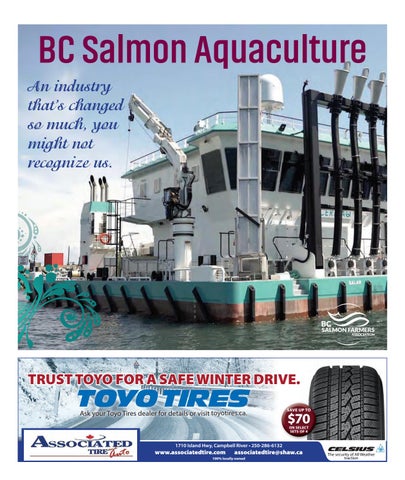
BC Salmon Aquaculture An industry that’s changed so much, you might not recognize us.
TRUST TOYO FOR A SAFE WINTER DRIVE. http://www.toyotires.caa Ask your Toyo Tires dealer for details or visit
SAVE UP TO
$70 ON SELECT SETS OF 4
1710 Island Hwy, Campbell River • 250-286-6132
www.associatedtire.com
associatedtire@shaw.ca
100% locally owned
The security of All Weather traction
B2 Friday, September 27, 2019
Campbell River Mirror
http://www.wcrl.com
www.campbellrivermirror.com
Campbell River Mirror
www.campbellrivermirror.com
Friday, September 27, 2019 B3
British Columbia a Hotbed for Innovation in Aquaculture By BCSFA Staff Writer August 20, 2019
Steve Atkinson, president of Taste of B.C. Aquafarms, which raises steelhead salmon at its Little Cedar Falls fish farm in Nanaimo also spoke at the session. “If you don’t look after the environment from the waters to the bottom of the ocean, the environment will bite you back,” said Steve Atkinson. Atkinson said there is a common perception that the technology currently exists to take the salmon farms out of the ocean and move them on land. “It simply is not
“
We are not hearing enough of the aquaculture innovations that started here and have been refined here. Sean Wilton
“
British Columbia is a hotbed of innovation in aquaculture, providing new technologies to protect the environment and make seafood farming more sustainable. But more needs to be done to let world know about the technologies being developed and adapted locally by the aquaculture industry. “We are not hearing enough of the aquaculture innovations that started here and have been refined here,” said Sean Wilton, CEO of Agrimarine Holdings Inc., who raises steelhead salmon in the mountain-fed waters of B.C.’s Lois Lake. Speaking at plenary discussion at the recent B.C. Seafood Expo in the Comox Valley, Wilton called for a better climate for aquaculture investment in B.C. and Canada. He said more fact-based debate about fish farming is needed as it will raise opportunities for greater innovations and advances in technology. Jeremy Dunn, director of public affairs for Mowi Canada West, another of the speakers at the session, which looked at innovations and advances in farmed, harvest and wild fisheries said: “there is really nothing more important than the environment when it comes to fish farming.” “If you don’t protect and maintain the quality of the environment, you won’t succeed in aquaculture,” he said.
CEO, Agrimarine Holdings Inc.
so,” said Atkinson, adding that Atlantic salmon has not been successfully raised at commercial scales on land at a profit anywhere, other than at hatchery stage. Atkinson, who operates one of the very first closed containment salmon farms in production in North America, credited the cooperation between ocean-based and land-based fish farmers for making B.C. a global leader when it comes to fish farming. He said land-based
salmon farming has a future in B.C. as a complement to ocean farming, not a replacement. The Department of Fisheries and Oceans (DFO) told RaisingOpportunity. ca that there is an ongoing study on the alternative technologies for aquaculture, including land and sea-based closed containment technology. This will enable us to determine gaps that limit commercial readiness and help to inform
future technology development efforts, a DFO spokesperson said. The study is being conducted in partnership with Sustainable Development Technology Canada and the Province of British Columbia. “The Government of Canada has in place the Fisheries and Aquaculture Clean Technology Adoption Program, a $20 million program over four years that encourages Canadian fisheries and continued...
Supporting ocean health and working to slow or reverse the impacts of climate change are two critical issues facing the world,. As food producers, we have an important role to play. Warming ocean temperatures, changing ecosystems and increasing ocean plastics are all issues which those of us on the west coast of BC see on a daily basis. The United Nations has laid out 17 Sustainable Development Goals, aimed at meeting the needs of society, while improving conditions for people, animals, marine life and the planet. Called out within these goals is the need to expand our use of the ocean to produce food, energy, raw materials and transportation. Globally, we are partnering with the UN to support these goals and are taking a leadership role in the UN’s Action Platform on Sustainable Ocean Business which is tasked with looking at ways to improve ocean health and reduce commercial impacts. Locally, we partner with organizations on habitat restoration projects, beach clean-ups and ocean plastic removal and enhancement projects. This work is aimed at supporting wild salmon populations while improving ocean health. As one of the lowest carbon footprint farmed proteins, we are working towards the solution. Find out more at www.Cermaq.com
We are Cermaq, and we are proud to be more than just salmon.
B4 Friday, September 27, 2019
continued... aquaculture industries to reduce the potential environmental impacts of their activities through using clean technologies, he said. Here are some of the new technologies and innovations in aquaculture being developed and adapted in British Columbia: Brown’s Bay Packing Company Brown’s Bay Packing Company is a federally licensed and provincially permitted fish processing company which has been safely and efficiently processing farm raised salmon in the coastal community of Campbell River since 1989. It has received $424,219 under the Fisheries and Aquaculture Clean Technology Adoption Program to adopt and install effluent treatment equipment that will significantly reduce bacteria and suspended solids, kill viruses and remove blood color from fish processing plant waste water. Cargill Aqua-Nutrition Canada / EWOS Feeds Cargill’s sustainable, plant-based alternative to omega-3 fish oil has just been approved for US cultivation. Currently, aqua feed for farm-raised salmon contains fish oil to help fish reach desired EPA and DHA omega-3 fatty acid levels. By combining technology with its canola innovation capabilities and
Campbell River Mirror
aquaculture expertise, Cargill is able to provide farmers access to Latitude™, a plant-based alternative that relieves harvesting pressure on wild fish populations, while meeting the market need for a reliable supply of long-chain omega-3s at a predictable price. Cermaq Canada Ltd. Cermaq’s experimental closed containment pen system will likely have a home in B.C. waters soon. Cermaq has reported good results from the early stages of its Horsvågen trial of the new technology, which it has named Certus (Latin for “safe”). Under water, it has a flexible composite wall surrounding a traditional net. “The health and growth of the fish, partnered with the limited interaction with wild populations make this an exciting possibility for us here in Canada. The development of new technology is continually improving the way we operate and these latest results are really exciting,” said Cermaq Canada’s Managing Director David Kiemele. Grieg Seafood Since 2007, Grieg Seafood has successfully implemented a strategy for recycling fresh water on its smolt sites in order to use less fresh water, save energy for heating water and keep smolt in tanks longer before exposing them to the sea. The process has demanded Innovation & Technology Report
www.campbellrivermirror.com
heavy investments, but has also provided great results. The upgraded smolt sites only need 0,1% – 1% of the fresh water compared to a traditional flow through system. The obvious advantage is that smolt production is significantly less dependent on a large fresh water supply. The major economic factor is the minimal temperature loss in recycled water. Another important reason for investing heavily in water recycling is the possibility to keep the fish on land after smoltification (post-smolt), thus reducing the time salmon spend in the sea significantly. Innovation & Technology Report Mowi Canada West The largest and most technologically advanced ship to ever serve the Canadian aquaculture industry is now in B.C. waters to revolutionize the treatment of sea lice in farmed salmon. Mowi Canada West’s Aqua Tromoy, costing about $35 million, will be used to provide environmentally friendly fish health treatments, and for moving fish from site to site. The Aqua Tromoy is a state-of-the art aquaculture vessel. Called a wellboat, it has two large holds that can be filled with water, which are used to move fish from site to site, and to provide environmentally friendly treatments of fish. This vessel is on the cutting edge of aquaculture technology and is a crucially important tool in Mowi’s AKVA Subsea Feeder
HD Camera System
Ocean farming feeding systems utilize environmental sensors, hydroacoustic technology, production control software, and autonomous feeding systems work together to ensure fish are fed at the right time. This highly-technical and centralized feeding concept is capable of managing the feeding of multiple cages at multiple locations—all from a single laptop, tablet, or mobile device. AKVA Subsea Feeder
integrated pest management strategy allowing treatment with both freshwater bath and hydrogen peroxide, two sea lice treatment methods encouraged by the Aquaculture Stewardship Council. Skretting North America Skretting is a world leader in the manufacture and supply of aquaculture feeds. Its latest research has led to the development of Protec, a functional feed for fish that helps shield skin, gut, and gills. It supports the immune system, provides the building blocks for new cells and optimizes the balance between fish, microbes, and their environment. An equivalent feed, called Lorica, has been developed for shrimp Badinotti Badinotti Net Services on Vancouver Island provides robust engineering solutions for ocean pens used around the world. It has developed Oceanis 1 Innovation & Technology Report (submersible cage) operation, mooring engineering, mooring service and the Combinet, which are nets that mix textile fibers with steel or copper. The submersible cage advantage is that it allows fish farmers to develop activities in an exposed and unprotected sites, also it protects the farming from hurricanes and other weather conditions, and at the same time reduces visual impact. Combinet is part of Badinotti´s new line products, that combine textile fibers with metals to improve resistance and the abrasion level. Poseidon Oceans Systems Ltd. Campbell River-based Poseidon is a full-service aquaculture engineering and support company specializing in infrastructure design, engineering, development, supply, and installation. Poseidon’s new Trident Hybrid was specifically designed to withstand the harshest conditions in the open ocean. The Trident Cage System is designed with all the aquaculture farm processes in mind. It allows for the full integration of aquaculture systems, including feed systems, advanced rigging options for smolt, grow-out and predator nets, life support systems, cameras and lighting, mort recovery, and almost any other ancillary aquaculture systems. AKVA Subsea Feeder
HD Camera System
21
HD Camera System
Technology for Sustainable Biology 21
1481 16th Ave - Unit 400, Campbell River
Locally supplying and servicing the aquaculture industry since 1993. 21
www.campbellrivermirror.com
Can’t you just move the ocean farms on to land?
BC salmon farmers actually lead the world in land-based aquaculture. Several BC fish farmers operate smaller, boutique landbased operations and all of our ocean-based farmers raise fish for the first half of their lives in land-based hatcheries. However, any operation in the world that has tried to raise a large number of fish entirely on land has failed for one reason or another – the technology is being developed, but isn’t there yet. Also, raising a large number of Atlantic Salmon on land requires paving over a lot of soil for concrete tanks and huge amounts of water and electricity to replicate natural conditions. So land-based farming comes with significant environmental considerations that need to be part of the conversation. With demand for healthy fish to eat rising with the world’s population and new technology being developed it’s likely land-based fish farming will play a larger role in the future, along side ocean-based farming.
Campbell River Mirror
Doesn’t feed and salmon waste pollute the ocean floor beneath the salmon farms? Salmon farmers are developing automated feeding systems equipped with innovative cameras coupled with machine learning capabilities to make sure they don’t feed more food than their fish can eat. This reduces the amount of food that is wasted. Salmon farmers are also developing new DNA-based technology to study the marine species living on the ocean floor beneath the farms. By monitoring these species, farmers can make sure that their farms are not impacting the quality of the ocean environment.
Friday, September 27, 2019 B5
Isn’t salmon farming old school, like a bunch of pens in the ocean? Salmon aquaculture is a fastgrowing global industry, and here in B.C., we’re leading the charge. With half a billion dollars invested and planned from 2016 to 2022 in clean tech, innovation, and skills training. Today’s industry is highlytechnical and skilled. Professional fish health experts, engineers, scientists, veterinarians, policy and communications teams make up the people raising fish on B.C.’s coast.
Do hydrolicers use chemicals or pesticides to remove sea lice? No, hydrolicers use ocean water to gently remove sea lice from fish as they shoot through the hydrolicer. It takes a fish about 9 seconds to move through the hydrolycer, and water pressure is the equivalent to a garden hose. So, the fish are kept happy as we remove and dispose of the sea lice.
Innovation & Technology Report
Proud Suppliers of the
OCEAN
CLEANUP
The Ocean CLEANUP develops advanced technologies to rid the world’s oceans of plastic. That’s 50% of the Great Garbage Patch every 5 years! VIPF is proud to build Ocean CLEANUP technology here in Campbell River and will continue to work together for a better and safer environment.
80’ Self-Propelled Landing Craft Tugs, Workboats, Crew boats & Research Vessels Crane & Ramp Barges Aquaculture support Marinas, Dockage & Anchor Installation & Inspections General Marine Construction & Salvage Scientific Research & ROV Services
Phone: 250 871 8870 Fax: 250 871 8873
35
www.searoamermarine.com
B6 Friday, September 27, 2019
Campbell River Mirror
NORTH ISLAND COLLEGE
|
www.campbellrivermirror.com
CAMPBELL RIVER
AQUACULTURE TECHNICAN CERTIFICATE www.nic.bc.ca/trades Aquaculture Technician Certificate Learn essential skills to support aquatic food production for marine, freshwater and land-based systems. This industry-informed training program prepares you to work as a farm or hatchery technician, maintenance, harvest and new cleaning crew positions, or as a deckhand on harvest vessels, wellboats, feeding and site maintenance vessels. The knowledge and skills I received from NIC was second to none. It gave me instant employability, an insight in to the diverse aquaculture industry along with the skills I apply each and everyday. — Stephan Valen, Aquaculture Technician grad
Aquaculture Technician Diploma Advance your aquaculture career and expand your skills. This industry-informed training includes equipment and facility maintenance, growout and hatchery production and a directed research project.
Shellfish Aquaculture Technician Certificate Learn in-demand skills for aquatic production of shellfish and aquatic plants in marine, freshwater and landbased systems, and technical aspects of productions.
Apply now, start in January
1-800-715-0914 | www.nic.bc.ca/trades
Coastal Forest Worker Certificate Gain hands-on skills for a range of entrylevel careers in the forestry industry. As a graduate, you’ll be prepared to work safely and productively in a range of entrylevel forestry and harvesting positions.
Campbell River Mirror
www.campbellrivermirror.com
Friday, September 27, 2019 B7
A Sea of Opportunity for Canadian Aquaculture Tech
HAVE YOU Canadian technology used in aquaculture is well positioned to STEPPED THROUGH enhance sustainable seafood farming globally. OUR DOORS By BCSFA Staff Writer August 15, 2019 LATELY? enough is being done by Ottawa to identify the value of and innovations in the nation’s aquaculture technology industry.
“
This is an industry that’s changed so much, you might not recognize us. John Paul Fraser,
“
Canada’s reputation for sustainably farmed seafood, largely enabled by new technologies and innovations in aquaculture, is world renowned. This technology is easily transferable and provides Canadian aqua-tech companies a sea of opportunities said Dr. Marlon Lewis, a world renowned oceanographer and Professor Emeritus at Dalhousie University. “When it comes to food production, this is a very interesting space now and Canadian technology is well positioned to enhance sustainable seafood farming globally,” said Dr. Lewis, whose research interests span a broad range, from upper ocean physics to biological processes to the ocean’s role in global climate. “Canadian technology has strong potential in countries, especially in Asia, that are increasingly moving towards aquaculture,” Dr. Lewis told RaisingOpportunity.ca. According to Fishsite.ca the aquaculture sector is flourishing, being the fastest growing form of food production in the world with a market value of $13.3 billion. In the next 25 to 30 years, the global population will rise to 10 billion people and as investors commit their interest to the sector, start-ups in seafood and aquaculture technology have raised $193 million in 2016. Fundamental to aquaculture is understanding how fish grow and what factors influence fish growth from a health, feeding, and biomass perspective, Fishsite.ca reported. “The industry is shifting towards precision fish farming, enabled by technologies including machinelearning and computer vision,” The report said. Tim Kennedy, executive director of the Canadian Aquaculture Industry Alliance (CAIA) said not
WE ARE READY TO HOST YOUR MEETING, CONVENTION OR GATHERING! WE HAVE THE PERFECT VENUES, INCLUDING FULL CATERING AND BAR FACILITIES PLUS GUEST ROOMS FOR ALL ATTENDEES!
250-286-1131 | 261 Island Highway, Campbell River | manager@anchorinn.ca
www.anchorinn.ca
FULL CONFERENCE SERVICES SPECIAL RATES FOR OUT OF TOWN GUESTS. The view is complimentary!
Executive Director, BCSFA
“There are incredible strengths between the agriculture and aquaculture sectors and bringing them together will provide a climate that can generate innovations and shared technologies,’ said Kennedy. He pointed to Norway where technology from the offshore oil and gas industry is being used to develop deep-sea fish farms. These offshore production systems can withstand 100 foot (31 meter) waves and can be put anywhere in the open sea. Kennedy said his association is pushing Ottawa to conduct research in Canada’s growing aquaculture technology industry to get a map of the eco-system. “This will be a great tool to market Canada’s aqua tech innovations around the world,” he said. On Canada’s West Coast where farm-raised salmon generates over $1.5-billion towards British Columbia’s economy, resulting in about 7,000 jobs, $500 million has been invested and planned in new technology, innovation and skills training from 2016 to 2022. “We’ve come a long way from our humble ‘wood pen’ beginnings in the 1960s,” said John Paul Fraser, executive director of the B.C. Salmon Farmers Association (BCSFA). “Today, continued...
www.guillevin.com
PROUDLY SUPPORTING
THE
Aquaculture Aquacultur Industry
JAMES WALKUS FISHING CO. LTD. Gwa’sala-’Nakwaxda’xw Reserve P.O. Box 1606 Port Hardy, B.C. Canada VON 2PO Office: (250) 949-7223 Fax: (250) 949-7239
Cellular: (250) 949-1322 Autotel: (604) 662-9858
B8 Friday, September 27, 2019
Campbell River Mirror
www.campbellrivermirror.com
continued... British Columbia’s ocean farming containment methods are highly technical, integrated, production systems that lean on real-time data and clean technology solutions, many of which are home grown in Canada,” said Fraser. “This is an industry that’s changed so much, you might not recognize us.” The BCSFA has just released its new report BC Salmon Aquaculture: Innovation and Technology which highlights some of what the industry is doing currently; • Ongoing development of stateof-the-art monitoring—combined with machine learning and artificial intelligence—will allow the industry to further optimize its use of sustainable feed with as low a reliance as possible on wild fish resources. • Machine learning and artificial intelligence (AI) in virtually every aspect of the ocean farming business. From managing feed systems smarter, to repairing ocean farming production facilities, to proactive fish health treatments. • Industry is testing new platforms to track, compare, and improve treatment strategies against sea lice. These platforms are based upon treatment effectiveness data
across the entire industry; this database allows the platform to determine the best treatment to use under a given set of conditions (e.g. environmental, fish health etc.). The platforms will also allow the treatment effectiveness at a specific farm to be compared with the industry average. • BC farmed salmon processors continue to identify and implement new technologies that will ensure that discharged wastewater will not negatively impact the marine environment. For example, the implementation of fluidized bed reactors will allow the removal of 80-90% of the organics within wastewater. • The industry is currently developing floating, semi-closed production systems. These S-CC systems will make use of a large but controllable water intake, solid tank walls, and optimized internal water hydraulics—and will have the potential to extract particles from the discharge water. • The industry is currently developing ocean farming technologies that will allow salmon farming to take place in more exposed deeper water coastal areas. Higher velocity water currents in exposed areas will
facilitate a further reduction in the already minimal impact of salmon farms on benthic quality. • State-of-the-art floating closed containment systems have been designed to reduce losses in sea production, protect the environment against undesired impacts, increase productivity, and at the same time reduce production costs. The walls of these systems are impenetrable to both sea lice
and pathogens—and escape-proof for the farmed salmon. Their water intake is filtered and then treated with UV light to prevent lice, algae, bacteria, and viruses from entering the production environment. • Post-smolt programs focus on rearing smolts (juveniles) to a larger, more robust size within land-based recirculating aquaculture systems (RAS) before transferring them to ocean-based production systems.
Thank you for your contribution to our community! Proud to support B.C.’s Aquaculture Industry. The Campbell River Advantage: Love where you work and play.
250-287-2627
www.whitesdiesel.com #2 & #3- 2705 North Island Highway, Campbell River, BC V9W 2H4
CR advantage
Contact Rose Klukas rose.klukas@campbellriver.ca 250.286.5738 www.campbellriver.ca/ business-economy
Campbell River Mirror
www.campbellrivermirror.com
Friday, September 27, 2019 B9
We would like to thank the following organizations for inviting our contribution in 2019 to support dozens of community events on Vancouver Island and the Sunshine Coast: Vancouver Island University Culinary
Killer Whales Swim Club
BC Children’s Hospital Foundation
Arts program
Campbell River Minor Hockey
Scouts Canada Pacific Jamboree
Nootka Sound Watershed Society
Association
CR Ravens Junior B Lacrosse
Oyster River Enhancement Society
Vancouver Island Western Heritage
Habitat for Humanity VI North
CR Daybreak Rotary’s Wine, Brews &
Association
River City Arts Fest
Blues Festival
Words on the Water Festival
Campbell River Hospital Foundation
The CURE Foundation
North Island College Foundation
Tahsis Days
Fraternal Order of Eagles
Sayward Community Recreation
OrcaFest - Port McNeill
Night B4 Celebration
Association
CR Oldtimers Hockey
Sayward’s Canada Day Celebration
Cystic Fibrosis Campbell River
North Island Craft Beer Festival
CR Fish & Wildlife Association
Chapter
Sunshine Coast Eagles Boys Soccer
Tahsis Salmon Enhancement Society
Volunteer Campbell River
BC Special Olympics - Howie Meeker
Catholic Women’s League
Carihi Senior Girls Soccer
Golf Classic
CR Salmon Fest’s Highland Gathering
CR Shoreline Arts Society
NEDC Aboriginal Conference
EAT Tour
CR & District Association for
Sechelt Cops for Cancer
Little Dino’s Fishing Derby - Gold River
Community Living
Sayward Cops for Cancer
Gold River Days
Discovery Passage Aquarium
Campbell River Family Services
Powell River Salmon Society
Kusam Klimb
Sayward Futures Society
Tidemark Theatre Society
CR Storm - Cyclone Taylor Cup
Gold River Mixed Golf Tournament
Campbell River Youth Soccer
Carihi Fly Fishing Club
Navy League of Canada, CR Branch
Storm Girls’ Basketball - Port Alberni
Ducks Unlimited Canada
Campbell River Hospice Society
Campbell River Children’s Choir
Cups for Cancer
Wei Wai Kum Tribal Journey
CR Community Centre’s Specialized
Campbell River Art Gallery
CR Women in Business
Recreation
RainCoast Performing Arts
International Women’s Day - Comox
Port McNeill Chamber of Commerce
Sunshine Coast Salmon Enhancement
Valley
Quatse Salmon Stewardship Centre
Society
Young Life Nanaimo
www.griegseafoodcanada.com
B10 Friday, September 27, 2019
Campbell River Mirror
www.campbellrivermirror.com
Proposed wet lab will raise opportunities on Vancouver Island By BCSFA Staff Writer September 18, 2019
“It took some time but we got here,” said Dr. Jim Powell the CEO of BC CAHS, who has been working on getting this project off the ground since 2005.
“
Having an operational wet lab here in Campbell River would be a tremendous asset to continue this critically important research and works very well with the City’s potential plans for a Salmon Centre of Excellence facility. Andy Adams,
“
Campbell River wet lab plan will lead to more scientific collaborations, help attract more students to higher educational institutions, and boost the local construction industry. The planned wet lab facility in the Campbell River area to address a myriad of fish health concerns will serve as a catalyst for increased scientific collaborations and be a boost for the higher education and the construction industries on Vancouver Island. The wet lab is one of four Vancouver Islandbased projects, which will be receiving a total of $2.2 million dollars under the British Columbia Salmon Restoration and Innovation Fund (BCSRIF), industry has also committed $1 million dollars to the project. The BC Center for Aquatic Health Sciences (BC CAHS) and partners, including the BC Salmon Farmers Association, will establish the wet lab facility to increase research and diagnostic capacity to identify and examine fish health threats and interactions between farmed and wild stock, the Department of Fisheries and Oceans said.
Mayor, Campbell River
“We showed a demonstrable need to build this facility and it’s become a reality because of the current political and biological realities,” Dr. Powell told RaisingOpportunity.ca. “We are overjoyed that both levels of
government share our vision and this wet lab will play a big part in Campbell River realizing its ambition to host a Salmon Centre of Excellence,” he said. Campbell River Mayor Andy Adams had said the city is very supportive of work that the BC CAHS does in providing the region with science-based evidence for the sustainability of all fisheries whether it be wild, commercial, recreational, farmed or indigenous. “Having an operational wet lab here in Campbell River would be a tremendous asset to continue this critically important research and works very well with the City’s potential plans for a Salmon Centre of Excellence facility,” he said. According to Dr. Powell, the Level 2 Wet Lab is projected to be functional in the summer of 2021 and will be the only such private facility in Western Canada. It is expected to create at least half a dozen direct jobs for lab technicians and project coordinators immediately. “We are currently looking for a project manager,” said Dr. Powell, who expects the workload at BC CAHS to increase
Campbell River Marine Terminal
cr marine terminal 6x4
PRESENTS
150 ton travel lift and full service boatyard
menziesmarine.ca | (250) 286-3370 www.menziesmarine.ca
Located 15 minutes north of Campbell River in Menzies Bay
with the wet lab, necessitating more hires down the road. In addition to boosting the local construction industry, the wet lab facilities will serve as a catalyst to attract local and foreign students for aquaculture studies at institutions like the North Island College and Vancouver Island University. Dr. Powell said a social and cultural advisory committee which will include representatives from salmon habitat restoration groups, First Nations communities and the aquaculture and wild fisheries industries will guide the construction and operations of the wet lab. “We will also be heavily invested in gaining and incorporating traditional First Nations knowledge to guide our work,” said Dr. Powell. The BC CAHS is a non-profit organization in Campbell River B.C. with a state-of-theart laboratory serving all stakeholders in fisheries and aquaculture, First Nations and the enhancement communities. It operates on a science-based model and adheres to a rigorous academic ethic. In addition to the wet lab, Jonathan Wilkinson, Minister of Fisheries, Oceans and the Canadian Coast Guard together with Courtenay-Comox MLA RonnaRae Leonard announced this round of contributions for three other Vancouver Island-based projects under the British Columbia Salmon Restoration and Innovation Fund (BCSRIF). The other three projects are led by: The University of Victoria (UVic) which will support BC rockfish recovery and assessment through outreach and citizen-science emphasizing angler awareness of regulations (via the MyCatch app) and through an evaluation of the effectiveness of rockfish descending devices on reducing rockfish mortality. UVic will partner with academia, conservancy organizations and local First Nations. The Cowichan Valley Regional
continued...
• Builders of quality nets for the local and international fish farming industry • Custom designed, cage nets, seines, predator and specialty nets • Shellfish farming equipment • Anchor ropes, chain and hardware • Net Washing, Disinfection, and Net Sealant Application
Tel: 250.286.3249 • Fax: 250.287.2475 Toll free in North America: 1.866.NET.LOFT (638.5638) 4225 Midport Rd. Campbell River, BC CANADA V9W 5A7 www.morenot.ca • crn@connected.bc.ca
Campbell River Mirror
www.campbellrivermirror.com
www.bcsalmonfarmers.ca
Friday, September 27, 2019 B11
B12 Friday, September 27, 2019
continued... District and partners, including the Cowichan Tribes, which will conduct an evaluation of the natural boundary of Cowichan Lake to support building critical new water storage infrastructure to provide flows required to sustain Cowichan salmon populations. The Comox Valley Project Watershed Society, with the K’ómoks First Nation, North Island College and other partners,
Campbell River Mirror
The Government of Canada is investing $100 million over five years for the British Columbia Salmon Restoration and Innovation Fund, and is providing a one-time investment of $5 million for the Pacific Salmon Endowment Fund. “Working in partnership with the Province of British Columbia, I am confident that we can and are making substantive progress in protecting and enhancing our wild fish stocks and in
strengthening our fishing industry for today, and for the generations ahead,” said Wilkinson. Lana Popham, BC Minister of Agriculture said the four projects support wild salmon populations and habitat at different stages of their lifecycle and are the results of British Columbians from First Nations, governments, academia, and not-for-profit organizations working together.
Don’t salmon farmers use a lot of wild fish to feed their farmed fish?
What is floating closed containment technology?
Is machine learning and AI playing a role in industry work?
Salmon farmers have reduced the use of wild fish by finding alternative sustainable sources of protein and oil—like soy protein and palm oil. They even use trimmings and processing byproducts from sustainable wild fisheries in their salmon feed—so they’re converting waste materials into healthy food. By doing this, salmon farming has become a net producer of high quality marine protein.
Salmon farmers are designing floating closed containment (CC) systems to better protect farmed salmon during their life in the ocean—and, at the same time, make sure that salmon farming doesn’t impact the ocean environment. The walls of CC systems will be impenetrable to both sea lice and pathogens—and escape-proof for the farmed salmon. The water the fish live in will be filtered and then treated with UV light to make sure it’s healthy and safe for the fish. And all waste material will be collected— so it won’t build-up on the ocean floor. CC systems aren’t quite ready for use in BC yet…but we’re getting there.
which will apply and test tools for identifying, mapping and quantifying important forage fish populations and their habitats. This work will contribute to the conservation of important food sources for Pacific salmon, including Chinook and Coho. The British Columbia Salmon Restoration and Innovation Fund is a 70 per cent federal, 30 per cent provincial cost-shared program.
What is deep sea open ocean farming?
Salmon farmers are continually developing new production systems to raise more fish to feed the world’s increasing population. Typically, salmon farms have been located near the coast. By moving into the open ocean, salmon farmers can build bigger farms so they can raise more fish. The world’s first deep sea salmon farm was trialled three miles off the coast of Norway. It cost $300 million to build—and can hold 1.5 million salmon.
www.campbellrivermirror.com
Industry is testing technologies that utilize machine learning and artificial intelligence. Examples include testing cameras that will radically change underwater monitoring. The new cameras will provide high-quality images that allow a machine to be trained to recognize and count sea lice. The switch to automatic sea lice counting will eliminate the need for laborious manual sea lice counting. Other applications in which machine learning and artificial intelligence are being tested are during feeding time, developing cutting edge strategies that provide our salmon the optimal feeding diet for happy, healthy growth.
PAK-A-ROO Rain Gear for the Salt Water Cowboy
A western store & so much more.
920 Island Hwy., Campbell River 250-286-3554 V9W 2C3
CANADA’s Largest Commercial Dive School • Aquaculture Diver - Occupational SCUBA & Surface Supply. • Unrestricted Surface Supply 50m and beyond (includes Underwater Welder/Chamber Operations)
1-888-325-3483 info@divesafe.com Campbell River BC
www.divesafe.com
Campbell River Mirror
www.campbellrivermirror.com
Salmon farming is a major employer in coastal communities, supporting nearly 7,000 families.
“
This isn’t just a job. It’s a career that I am proud of. The work we’re doing out on the ocean respects the environment and everything we stand for…
“
Damon
Friday, September 27, 2019 B13
Northern Ropes & Industrial Supply Ltd. WIRE ROPE & FITTINGS • SPLICING FACILITIES CHAINS • INDUSTRIAL SUPPLIES • HYDROTESTING FIRE EXTINGUISHER RECHARGING 2860 North Island Hwy, Campbell River › 250-286-1027 norrope@telus.net
259 Puntledge Road, Courtenay › 250-334-3707
Big and small, we have industrial hose, tubing and fittings for all your needs
CRES Meet Damon, he’s a passionate salmon farmer based in Tofino, BC. Having grown up in Tofino, the environment is everything to him. That’s why he’s proud to be working in an industry that uses technology and innovation to support and protect the environment, helping his fish thrive on the wild west coast. Damon’s passion for the ocean started at a young age and has evolved into a blossoming salmon farming career. Now, his brother and relatives are working alongside him here at home on B.C.’s coast. Damon is today’s B.C. salmon farmer. With three little ones (and even a dog!), he and his wife Tamiko are raising opportunity for their kids and community. We’re proud of the nearly 7,000 families salmon farming touches in B.C.
LTD.
1033 Ironwood St. 250-287-7121 cres1986@telus.net
Providing Quality Solutions
Full Service Provider on Land and Sea • Net Design and Manufacturing, • Complete Net and Tarp Servicing • On-site net washing
B14 Friday, September 27, 2019
Campbell River Mirror
Meet Heather, she’s a proud mom, technology entrepreneur, and community leader. Heather and her husband co-founded Poseidon Ocean Systems, which is a small business innovating in salmon farming. Their company helps salmon farmers build custom ocean-based systems that protect the environment and help farms operate safely. Now, employing nearly 20, her story is one of many that we’re proud to be a part of.
www.campbellrivermirror.com
Heather
“I started the company with my daughter on my lap…and we couldn’t be more proud to call Campbell River home.”
EST. 1900
Fiv 1 eV an co 2 uv er Isl an dL
Solutions for the Aquaculture & Marine Industries
“
3
“
oc ati on s!
4 5
I don’t think there’s any other industry that we would have grown as quickly as we did in aquaculture. We’ve built a technology company that’s focused on the marine environment.
Victoria
888-HORSMAN | ebhorsman.com
Campbell River Toyota Proudly Supports
CAMPBELL RIVER’S AQUACULTURE INDUSTRY!
2785 N Island Hwy. •
250-287-9527
www.campbellrivertoyota.ca
Innovation & TechnologyInnovation Report & Technology Report
www.campbellrivermirror.com
Campbell River Mirror
Friday, September 27, 2019 B15
State-of-the-art floating closed containment systems have been designed to reduce losses in sea production, protect the environment against undesired impacts, increase productivity, and at the same time reduce production costs. The walls of these systems are impenetrable to both sea lice and pathogens—and escape-proof for the farmed salmon. Their water intake is filtered and then treated with UV light to prevent lice, algae, bacteria, and viruses from entering the production environment.
As world leaders in aquaculture nutrition, we proudly support BC Aquaculture For more information contact Customer Service Toll Free 1.800.663.0476 Ewosca_Cs@cargill.com
EWOS.COM www.ewos.com
FISH HEALTH MAKES THE DIFFERENCE
Your North Island Industrial Plastic Experts 47
47
–  � � �  �
B16 Friday, September 27, 2019
Campbell River Mirror
Innovation is at the core of what we do at Mowi Canada West. Our 600 employees, along with local suppliers and local contractors, are hard at work every day, constantly seeking to improve our industry.
www.campbellrivermirror.com