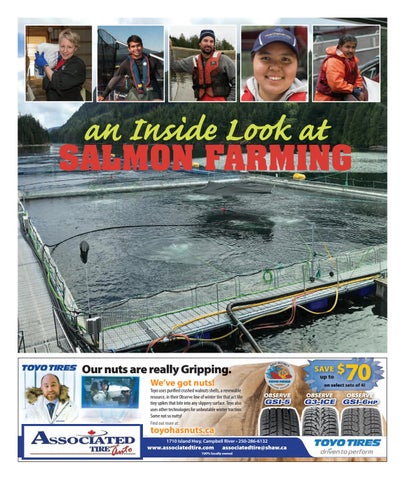
an Inside Look at
SALMON FARMING
Our nuts are really Gripping.
SAVE
up to
We’ve got nuts!
Toyo uses purified crushed walnuts shells, a renewable resource, in their Observe line of winter tire that act like tiny spikes that bite into any slippery surface. Toyo also uses other technologies for unbeatable winter traction. Some not so nutty! Find out more at:
OBSERVE
GSI-5
1710 Island Hwy, Campbell River • 250-286-6132
associatedtire@shaw.ca
100% locally owned
70
on select sets of 4!
toyohasnuts.ca www.associatedtire.com
$
OBSERVE
G3-ICE
OBSERVE
GSI-6HP
B2 Wednesday, September 26, 2018
Campbell River Mirror
www.campbellrivermirror.com
Campbell River Mirror
www.campbellrivermirror.com
Wednesday, September 26, 2018 B3
Aquaculture 2018
Salmon farming is important to this province, supporting thousands of families with good jobs and providing almost three-quarters of the salmon harvested off our Pacific coast every year on just 0.05 per cent of the coast. B.C. salmon farming by the numbers: • BC Salmon Farmers Association (BCSFA) members harvested 78,000 metric tons of salmon in 2016, about three pre cent of the global total and three-quarters of the salmon harvested in B.C. • Globally, the UN recent reported almost half of all fish the human race consumes today is farm-raised, and that will grow to 62 per cent by 2030 to meet growing demand. • Salmon farming supports 6,600 direct and indirect jobs in B.C., creating 1,600 new jobs between 2013 and 2016. • About 20% of the direct salmon farming jobs in B.C. are held by people of First Nations heritage. • BCSFA members have agreements with 20 First Nations, so that more than threequarters of the fish they harvest is done so in partnership with a First Nation. • Salmon farming generates $1.5 billion economic activity every year in B.C. Farmed salmon is B.C.’s highest-valued seafood product and top agricultural export. • The B.C. industry contributed $86.1 million in tax revenue in 2016.
Northern Ropes & Industrial Supply Ltd.
EST. 1900
Fiv eV an
WIRE ROPE & FITTINGS • SPLICING FACILITIES CHAINS • INDUSTRIAL SUPPLIES • HYDROTESTING FIRE EXTINGUISHER RECHARGING
Solutions for the Aquaculture & Marine Industries
1
co uv er
2
Isl
an
3
dL
oc ati on
s!
2860 North Island Hwy, Campbell River › 250-286-1027 norrope@telus.net
259 Puntledge Road, Courtenay › 250-334-3707
CAMPBELL RIVER NETLOFT LTD.
4 5
Victoria
888-HORSMAN | ebhorsman.com
• Builders of quality nets for the local and international fish farming industry • Custom designed, cage nets, seines, predator and specialty nets • Shellfish farming equipment • Anchor ropes, chain and hardware • Net Washing, Disinfection, and Net Sealant Application
Tel: 250.286.3249 • Fax: 250.287.2475 Toll free in North America: 1.866.NET.LOFT (638.5638) 4225 Midport Rd. Campbell River, BC CANADA V9W 5A7 www.crnetloft.ca • crn@connected.bc.ca
B4 Wednesday, September 26, 2018
Campbell River Mirror
www.campbellrivermirror.com
The environment:
• All salmon farms in B.C. have been voluntarily certified by at least one audited third-party standard program.
• In 2015 the BC Salmon Farmers Association founded the Marine Environmental Research Program, committing $1.5 million through 2020 into research projects into better understanding the interactions between wild and farm-raised salmon, environmental dynamics, and improving fish health data accessibility. An independent body oversees the funds and research. • All salmon farms in B.C. are now sited in areas determined to be appropriate for salmon farming by geotechnical surveys. Sites are selected in order to maximize fish health while minimizing environmental impact. • Farm-raised salmon has less environmental impact and a lower carbon footprint than farming other protein sources such as beef, chicken, and pork. Beef farming produces approximately 10 times more carbon dioxide per kilogram of edible product. • B.C. salmon farmers have extensive measures in place to manage sea lice to prevent transfer to wild salmon. • B.C.’s salmon farmers had just four fish escapes in 2016, resulting in just 23 salmon being lost. Since 2012 fewer than 100 fish have escaped B.C. farms in any year. Salmon farmers have invested significantly in new technologies such as modern pens and specialized boats to remove materials weighing down nets in order to prevent escapes. • B.C. salmon farmers have steadily reduced the amount of fish meal and fish oil in salmon feed – from about 50% 20 years ago to 18% today.
First Nations:
• The province’s salmon farmers have agreements with 20 First Nations. • Every new farm proposed in the last decade has had the support of local First Nations. • Seventy-eight per cent of the salmon farmed in B.C. is done so in partnership with First Nations. • An estimated 20% of the jobs in B.C. salmon farming are held by people of First Nations heritage. • Salmon farming can be particularly important in small, remote communities along the coast. The Kitasoo/Xai/xais First Nation of Klemtu, for example, produces 6,000 tonnes of farm-raised salmon each year – about five per cent of Canada’s total.
• Since Marine Harvest opened its operations in Klemtu 25 years ago unemployment rates in that community have been halved from 80 per cent. Recent reports by the World Bank and UN’s Food and Agriculture Organization found about half of the fish the human race eats today is farmed, and that will grow to about two-third by 2030 to meet the demand created by population growth. • Fish is a healthy, protein-rich food. A recent report from the UN’s food and Agriculture Organization found we will need to double the amount of food produced globally by 2050 to meet the needs of growing populations. With limited land left to farm, the report states aquaculture is a critical part of the answer. The report stated that in 2016 fisheries yielded 171 million tons of fish for consumption, and that number is expected to reach 201 million tons by 2030. Wild fish populations are under pressure, so aquaculture will meet a lot of that growth.
www.guillevin.com
Campbell River Mirror
www.campbellrivermirror.com
Wednesday, September 26, 2018 B5
Aquaculture paving the way for First Nations’ prosperity By SeaWestNews. James Walkus was 15 when he found an abandoned boat on the traditional territory of the Gwa’sala-’Nakwaxda’xw Nations in northern Vancouver Island. “I fixed it when nobody claimed it and went out to fish...I made about $250,” said Walkus, 79. The next week he bought an old gillnetter that also leaked. “I had to pump it regularly to keep it afloat.” Today, Walkus is one of BC’s largest independent commercial fishermen in British Columbia as well as a First Nations aquaculture success story. “Sustainable aquaculture is key for our wild fish to thrive,” Walkus said. “The employment it creates for many of our First Nations and other Canadians is important. “We need it, British Columbia needs it, the world needs it. If we don’t do it some other country will and it will be our loss and some other country’s gain,” said Walkus. This month, surrounded by family and friends, Walkus launched the MS Geemia Joye, a $11 million addition to the James Walkus Fishing Company’s fleet. It was his testament to the fact that aquaculture is a thriving and sustainable Sustainable aquaculture is key industry that helps First Nations and for our wild fish to thrive coastal communities in British Columbia. JAMES WALKUS, INDEPENDENT COMMERCIAL FISHERMAN AND A FIRST NATIONS AQUACULTURE SUCCESS STORY The Geemia Joye is the sister vessel to the MS Amarissa Joye, which hit the water four years ago. Both have been outfitted with the latest technology for safe travel, as well as state-of-the-art fish handling equipment and temperature control to ensure quality salmon. The Port Hardy based James Walkus Fishing Company is contracted by Marine Harvest to operated year-round harvest and transport vessels. “The First Nations owned and operated business employs 30 people, and has invested in the latest equipment that is a big part of ensuring Marine Harvest’s product quality,” said Jeremy Dunn, director of community Relations and public affairs for Marine Harvest Canada. A recipient of the BC Aboriginal Business Award for Individual Achievement, Walkus is proud to have his children and grandchildren working on the boats in his fleet and his business. “The aquaculture industry has been tremendous for me, my family and my community…there are a lot of us First Nations that are for aquaculture,” he said. “I’m a commercial fisherman as well but our wild fishery won’t support the supply and demand. “We need to have both because they complement each other,” said Walkus. Walkus, earlier this year joined other First Nations leaders in Vancouver to send a message to the anti-fish farm activists – stay away from our traditional territory. “They show deformed fish in pens…but there are more deformed fish in the wild... they talk about sea lice but they don’t talk about the uncontrolled large populations of sea lions and seals which are constantly eating up wild stocks...it goes on and on,” Walkus told Seawestnews.
❝
❞
James Walkus at the launch of the MS Geemia Joye, a $11 million addition to the James Walkus Fishing Company’s fleet.
“Aquaculture needs to continue,” Walkus said. About 20 per cent of the people working for salmon farmers in B.C. are of First Nations heritage, said John Paul Fraser, executive director of the B.C. Salmon Farmers Association. Farm-raised salmon is B.C.’s highest valued seafood product, the province’s top agricultural export, and generates over $1.5-billion towards the B.C. economy, supporting more than 6,600 jobs. Wild fish populations here and around the world are under pressure from over-fishing and climate change. So if we want to eat fish responsibly we need to farm it. First Nations leaders like James Walkus play a key role in that,” said Fraser. “The industry is committed to productive engagement with First Nations, such that our farmers have agreements with 20 First Nations along our coast and more than three-quarters of the salmon they produce is done so in partnership with a First Nation,” he said. One of them is the Tlowitsis First Nations, whose traditional territories span the coastal area of Northern Vancouver Island. Continued to next page
Big and small, we have industrial hose, tubing and fittings for all your needs
CRES
80’ Self-Propelled Landing Craft Tugs, Workboats, Crew boats & Research Vessels Crane & Ramp Barges
Providing Quality Solutions
Aquaculture support Marinas, Dockage & Anchor Installation & Inspections General Marine Construction & Salvage Scientific Research & ROV Services
Full Service Provider on Land and Sea
Phone: 250 871 8870 Fax: 250 871 8873 www.searoamermarine.com
LTD.
1033 Ironwood St. 250-287-7121 cres1986@telus.net
•
Net Design and Manufacturing,
•
Complete Net and Tarp Servicing
•
OnͲsite net washing
B6 Wednesday, September 26, 2018
Tlowitsis Chief John Smith
Harold Sewid, is the Clan Chief of the Qwe’Qwa’Sot’Em people of the Broughton Archipelago and a commercial fisherman who also works in the aquaculture industry.
Campbell River Mirror
from previous page “The salmon farmers have been a real blessing for us,” said Tlowitsis Chief John Smith, in an earlier interview with SeawestNews.com “I wish it had happened earlier and I wish we had more fish farms otherwise we would be on welfare,” said Smith. “We lost a lot of our people when the local economy dried up, we lost our language and much of our traditional way of life…now it is coming back and the fish farmers are helping our children grow,” Smith told Seawestnews. “We as First Nations leaders have a responsibility to protect our environment and we watch over it carefully…we have done it for thousands of years and we don’t need these activists telling us what to do,” he said. Smith added salmon farming has become an important economic driver for his members, creating jobs and economic activity allowing them to purchase land for their community and establish a post-secondary education scholarship fund for their youth. In a published op-ed, Chief Smith articulated why fish farming is so vital to his community. “We are striving to become self-sufficient. The Tlowitsis receive very limited funding from the government as we don’t have a home community. So, we have had to find alternative economic drivers for our Nation. We know what’s happening to all the sea resources as well as other food supplies as the world population continues to grow. Like many First Nations in British Columbia the Tlowitsis are eager to grow our community and develop a lasting economy from our traditional territory. Developing salmon farms in Clio Channel is a cornerstone for our Nation and after careful consideration, we developed an economic
www.campbellrivermirror.com
partnership with Grieg Seafood. We have studied Grieg Seafood and the way they do business and we are pleased. This is not to say that they will not be under scrutiny by our guardians, who are our eyes and ears in our territory. Council is also keeping a watchful eye on behalf of our Nation. Grieg Seafood and our council are always in communication and have a very good reporting system in place. They are proving to be a good partner. We receive no royalties or economic gain from the forestry giants on their onslaught of our forests and this agreement with Grieg Seafood is vital to the Nation’s economic well-being.” Harold Sewid, is the Clan Chief of the Qwe’Qwa’Sot’Em people of the Broughton Archipelago and a commercial fisherman who also works in the aquaculture industry. “In the sixties when there were no salmon farms and when the salmon did not return, my father had to feed his family by cleaning gutters for $10 but now we have we have the fish farms to provide us with a steady economy,” Sewid told Seawestnews. Sewid owns and operates Qwe’Qwa’Sot’em Faith Aquaculture Ltd., which supply a wide range of support to the farm sites including delivering feed, mort removal, installing nets, pulling dirty nets, towing pens and houses, anchoring and more. Not only has his business provided stable employment for First Nations people, but it provides Sewid, a firsthand view of the changes in the industry as technology advances. “I’ve seen improvements in the aquaculture industry over the years and they have been very significant” said Sewid in an interview published on Marineharvest.ca. “I have seen attitudes change positively over the years, as First Nations see the many opportunities that exist with aquaculture in general,’’ he added.
Thank you for your contribution to our community! The Campbell River Advantage: Love where you work and play.
REINVESTING IN R&D MAKES THE DIFFERENCE World leaders in aquaculture nutrition Ewos is a world leader in the research, development and manufacture of feed and nutrition to the international aquaculture community.
CR advantage
Contact Rose Klukas rose.klukas@campbellriver.ca 250.286.5738 www.campbellriver.ca/ business-economy
EWOS Canada 7721–132nd Street, Surrey, BC Canada V3W 4M8 Customer Service-Orders-shipping Toll Free 1-800-663-0476 Toll Free Fax 1-866-287-4422 | customer.service@ewos.com 7721–132nd Street, Surrey, BC Canada
KNOWLEDGE MAKES THE DIFFERENCE.
EWOS.COM
EWOS.COM KNOWLEDGE MAKES THE DIFFERENCE
Campbell River Mirror
www.campbellrivermirror.com
Wednesday, September 26, 2018 B7
Global Leaders in Certifications and Regulatory Compliance The B.C. farm-raised salmon sector is one of the world’s most closely regulated and transparent industries. Fisheries and Oceans Canada posts at least 22 different reports on regulated salmon farming practices in B.C. with many identified to the farm-level. Salmon farmers in B.C. go above and beyond regulatory compliance to meet stringent global third-party certifications. They are committed to meeting the requirements of the world’s top independent, audited, third-party certification systems – including certifying all Atlantic salmon farms to the Aquaculture Stewardship Council (ASC) standard by 2020.
Our Value to Communities B.C. salmon farming companies strive to build strong communities where they operate and where their employees live and work, and they are delighted to support many community organizations in coastal B.C. In 2017, BC salmon farming companies supported hundreds of initiatives for education, health and well-being, indigenous peoples, environmental conservation efforts and arts and sports - all of the organizations and activities that make a community, a community. Specifically, local food banks, women’s resource centres, the SPCA, aquariums, Rotary, sports clubs, children’s choirs, hockey associations, school associations, festivals, ski clubs, cancer societies, fire associations, Sea Cadet Corps, community pools, Scouts, Special Olympics, Twinning Society, seniors’ associations, rugby associations, refugee support and fish and game associations received contributions this past year.
Aquaculture Dive aining Specialists
NG PROFESSIONALS FOR THE WORKFORCE
“The knowledge and skills I received from NIC was second to none. It gave me instant employability, an insight in to the diverse aquaculture industry along with the skills I apply each and every day.”
ding
Become a Commercial DIVER!
rs.
*
GET Certified! For details call toll free: 1-888-325-3483 or email: info@divesafe.com
Become a cations in: International certifi • Commercial SCUBA Diver RTIFIED COMMERCIAL SCUBA Diver!
• Commercial NITROX Diver • Dive Supervisors Course nal certifi cations in: • Custom courses for groups UBA Diver (5• Surface weeks) Supply Diver 30m & 50m Nov. 18th, 2013 • Dive Accident Management TROX Diver (3 day) • Underwater WELDER October 15, 2013 • PLA courses for scientific divers
ace Supply Diver (7weeks) October 21, 2013
Stephen Valen, NIC Aquaculture Technician certificate graduate
NIC AQUACULTURE TECHNICIAN CERTIFICATE Learn essential skills to support aquatic food production for marine, freshwater and land-based systems. This industryinformed training program prepares you to work as a farm or hatchery technician, in maintenance, harvest and new cleaning crew positions, or as a deckhand on harvest vessels, wellboats, feeding and site maintenance vessels. Watch for NIC’s Aquaculture Technician Diploma program coming in 2019.
Launch your career at NIC
Gain in-demand skills and credentials that employers are looking for
Commercial Dive Training 250-287-3837
1-888-325-3483 www.divesafe.com info@divesafe.com
www.divesafe.com
Starts January 2019 Campbell River campus 1-800-715-0914 www.nic.bc.ca/trades
B8 Wednesday, September 26, 2018
Campbell River Mirror
www.campbellrivermirror.com
Environmental Awareness
Understanding Wild Pacific Salmon Populations
As the climate changes, accurate and frequent monitoring of the ocean environment is important to ensuring the health and well-being of farm-raised salmon. Small increases in water temperature can affect the abundance and distribution of marine species and cause a northward shift for some species. Over the last few years, several tropical species have been recorded in B.C.’s waters. In 2017, approximately 200 bottlenose dolphins were spotted, for the first time, on the west coast of Vancouver Island. There have been sightings of green and loggerhead sea turtles, swordfish, triggerfish, and an ocean sunfish was spotted in Quatsino Sound near a farm site during a jelly fish bloom. Warming waters provide an environment for some viruses, bacteria and harmful algae to thrive which can impact the health of wild and farm-raised salmon. On a daily basis, on each farm, B.C. salmon farmers monitor the health of their fish and collect environmental data including water temperature, dissolved oxygen and salinity and take plankton samples to assess for harmful algae blooms. The data is recorded in the BCSFA fish health database and is available to researchers to use for wild and farmraised salmon research projects.
B.C. salmon farming companies are committed to investing in collaborative research to better understand wild pacific salmon, and contribute as much relevant information to science as possible. Salmon farmers maintain healthy farm-raised populations to ensure that risks posed by salmon farms to the health of wild salmon stocks are low in B.C. coastal waters. The industry is actively engaged in several programs to minimize risk of farm-raised salmon to wild salmon and to actively support the health of wild salmon populations. Significant resources are dedicated to wild salmon enhancement programs in B.C. by the B.C. salmon farming industry including support to a wide range of salmon enhancement facilities in coastal B.C.
NORTH ISLAND NISSAN proudly supports the AQUACULTURE INDUSTRY in our community!
DL# 40069
NORTH ISLAND NISSAN’S BEST INVENTORY SELECTION WITH OVER 100 NEW VEHICLES IN STOCK.
Mike Ball
General Manager
1-855-291-4335
2700 North Island Hwy., Campbell River
Brian Quan
Finance Manager
Sean LaFleur Sales Manager
Colin Woodside Sales Consultant
Colton Smith
Sales Consultant
Hayley Wood
Sales Consultant
Shanda Palliser Office Manager
www.northislandnissan.ca
PROUD TO BE A PART OF OUR COASTAL COMMUNITIES
WWW.SKUNASALMON.COM
www.campbellrivermirror.com
Campbell River Mirror
Wednesday, September 26, 2018 B9
Research and Collaboration Marine Environmental Research Program The B.C. salmon farmers contribute significant resources to help piece together the puzzle of understanding wild salmon populations and our marine environment. In 2015, through the BC Salmon Farmers Association and the support of the membership, the Marine Environmental Research Program (MERP) was created. The program’s goals are to develop collaborations with researchers to investigate shared questions related to the health of wild and farm-raised salmon, salmon migration and environmental conservation. The Association’s members committed $1.5 million dollars over five years (2015-2020) to MERP. So far, eleven projects were funded at approximately $800,000, partnering with 14 different research organizations. Project applicants apply for funding in the fall through a competitive process directed by an independent Science Advisory Council. Council members represent Fisheries and Oceans Canada, BC Ministry of Agriculture, University of British Columbia, Pacific Salmon Foundation, and industry. Some recent projects include: • Fish health investigations, including in-depth studies on Piscine Orthoreovirus (PRV) • Investigations into the use of kelp and pile perch as a sea lice cleaner for farmraised Atlantic salmon.
For more information about the MERP program and to see workshop reports please visit http://bcsalmonfarmers.ca/research-innovation/
• Exploration of how the aquatic environment around salmon farms is used as a new habitat for marine plant and animal life. • Tracking wild salmon using acoustic tags to investigate migration routes from the Fraser River to the Johnstone Strait, survival rates and exposure time to salmon farm sites in the Discovery Islands.
Workshops Beyond providing support for research projects, the BC Salmon Farmers Association works to engage and mobilize people in research and development hosting workshops throughout the year. Between 2017 and 2018, the Association hosted 5 workshops with over 450 participants, from across Canada and internationally. In March, the Associations signature workshop – Collaborations on the Coast is held annually. Participants gather to hear about the latest research on wild and farm-raised salmon, climate change, ocean plastics, marine mammals etc. The event is well attended with guests from government, conservation groups, colleges and universities, chef associations, industry and more.
Proudly Serving Campbell River for over 35 years! 1860 Antonelli Road, Campbell River
www.seymourservices.ca Tel: (250) 287- 3505 Fax: (250) 287-3501
A part of coastal communities griegseafoodcanada.com
B10 Wednesday, September 26, 2018
Campbell River Mirror
www.campbellrivermirror.com
Chef Rob’s Cedar Plank Salmon S����� ���� F���� H���������� S����
Rub Salmon s brown sugar 2 ½ cup ked salt od smo o w r e f Ald ning ¼ cup o Old Bay seaso ck pepper f la o a ls ¼ cup esh cracked b erry Sa r Huckleb fresh 2 tbsp f oked Paprika m S 3 cups berries p r 2 tbs n Peppe lic o m huckle onion small e L p r 2 tbs ted ga ed ½ cup r granula sil p s t 2 diced per ied ba ow pep 1 tsp dr d oregano ll e y p u ie ½c ed 1 tsp dr n powder iced e remov n io small d n pepper a n r o b ell p m s 1t me d ree n g a powder nts and mix w p s li u d il c e h ¼ e c s p , ie s d d e ¼t ice r ingred rmed small d peno finely dic in wate sh Cermaq Fa bine allns t m h o ig la C n r ja e e o ½ fresh al) Directi edar plank ov of boneless Fr your plank) me c own s (option est from ½ a li laze 1. Soak y 500 g portion atever size fit nk skin side d z g d h r la r n a p w d a vineg Juice 2. Pat n, skin on (or oaked cedar 10-15 alsamic ook for o not Salmo lmon on pre-s er salmon C 3 tbsp B ve oil . t a e h D v li Place sa Rub liberally o edium to high to the touch. es not . 3 tbls o in powder 3 o r t n m m o m d ila fir kle er ¾ tsp cu fine chopped c 4. Sprin on the BBQ ov d until salmon sure the plank e flavour ur m o e h h r h t 1 h e e t e e c r k d s p c o n o a n p t f lo d Pe an fi ½ bu t sit 5. Pla h lid c ill add ck to m e If you c s and le f Salt an utes wit nsistently che g the edges w o cook over th if in m ) Pinch o all ingredient t Coast secret. d e o r t in e C ic y n g . d r a k n u o w le s e overco fire. Slightly b also a great to be a little lo Pineapp Combin rries are a We cipe. h s e r f is n d e d e catch o earance. (This time may nee ) Huckleb ve to try this r 3 cups of grille with a e t h u u d app fire; cooking to cover with t stand inside t o n ti y s a b u s lid mp nd le n also open ca have a dome turn off BBQ a (You ca ’t n d o e b you d lmon is cook minutes ef Ro r o 5 sa s Salsa i Enjoy! Ch nada v r e p u 6. Once ed for another e Huckleberry S l o r a t C n s d o q lid clo ith homema Cerma Quality C d w n a y et f . 7 Serve Food Sa
AQUACULTURE PACKAGE
F150 SUPER CREWS
PROUDLY SUPPORTING
THE
Aquaculture Industry
Regular Price
$52,093
Aquaculture Edition Special Price
Gwa’sala-’Nakwaxda’xw Reserve P.O. Box 1606 Port Hardy, B.C. Canada VON 2PO Office: (250) 949-7223 Fax: (250) 949-7239
Cellular: (250) 949-1322 Autotel: (604) 662-9858
$10,500
$41,517
STK 584150
JAMES WALKUS FISHING CO. LTD.
Save OVER
Heavy off-road tire Trailer tow package Skid plates Rear view camera Trailer brake controller
*Aquaculture Package NOT exclusive to those in the industry.
EVERYONE WELCOME!
Be sure to mention this ad*
www.stevemarshallford.com 1384-16th Avenue Campbell River, BC V9W 2E1
1-877-581-7922
Selling price is subject to applicable taxes (PST & GST) as well as $125 air tax & tire levy, $395 undercoat and $499 DOC Fee. Total paid $47,641.
Campbell River Mirror
www.campbellrivermirror.com
WHY EAT
Wednesday, September 26, 2018 B11
Salmon?
1. It tastes really good!
6. Salmon is a potent anti-aging food
2. Salmon provides a great source of protein
3. It’s easy to prepare a quick and delicious meal with salmon 4. There are so many ways to enjoy salmon. Try grilled, baked, smoked salmon or explore salmon sushi rolls
7. Omega 3 fatty acids help to reduce inflammation in the body and help keep your skin healthy 8. Omega 3 – rich foods like salmon boosts brain function including improved memory
5. Salmon is packed with a power house of healthy ingredients such as omega - 3 fatty acids, vitamin D and collagen
9. Vitamin D helps to protect your skin from sun damage 10. Eating salmon regularly promotes heart health
Working with BC’s Aquaculture Industry to create sustainability and employment opportunity.
250.286.3441 or info@niefs.net
The Employment Program of British Columbia is funded by the Government of Canada and the Province of British Columbia
Proud to support B.C.’s Aquaculture Industry.
YOUR logistical, competitive edge in the global marketplace
250-287-2627
www.whitesdiesel.com #2 & #3- 2705 North Island Highway, Campbell River, BC V9W 2H4
Vancouver, BC | www.flyingfresh.ca Phone: 604.233.1377 | Fax: 604.233.1399
B12 Wednesday, September 26, 2018
Campbell River Mirror
www.campbellrivermirror.com
Thousands of B.C. businesses support calls for a Federal Aquaculture Act Campbell River Chamber of Commerce resolution for a Federal Aquaculture Act gets overwhelming support By Fabian Dawson | SeaWestNews Realizing the potential of Aquaculture in Canada; Thousands of B.C. businesses in British Columbia have lent their support for a Federal Aquacul• The combination of the worlds’ longest coastline, high biophysical farmed seafood potential, ture Act to clarify industry responsibilities and provide fair access to long-term fish farm tenures. a skilled workforce, and dedication to science and innovation, positions Canada for future success. The push for a Federal Aquaculture Act, which has been embraced by B.C. salmon farmers, was raised by the Campbell River Chamber of Commerce. • Currently, Canada stands 26th in the world in terms of total global farmed seafood production It was tabled as a resolution at the BC Chamber of Commerce Annual General Meeting, last and fourth in the world for salmon production. Salmon farming has grown to take its place as one of the country’s largest agricultural export, generating $1,561.9 million in economic Spring. The BC Chamber of Commerce represents more than 125 Chambers of Commerce and output. (MNP’s 2017 Economic Impact Study) Boards of Trade, and 36,000 businesses. The resolution passed with a clear two-thirds majority, said Jessica Gares, Director of Commu• Farmed seafood revenues rose to $1.347 billion in 2016, driven by growth in output as well nications for the BC Chamber of Commerce, adding the recommendations will now be relayed as strong prices, particularly for farm-raised salmon. Production also showed positive gains to the minister responsible via a letter. in 2016, increasing to an all-time high of 200,565 tonnes. “After the resolution was tabled and debated, 88 percent of the delegates representing thou• Global appetite for Canadian farmed seafood is also growing. In 2016, Canada’s farmed sands of businesses voted to support it,” said Corby Lamb, Board Chair for the Campbell River seafood exports soared to over $1 billion. Canada’s farmed seafood sector is strongly Chamber of Commerce. dependent on exports: around 70% of Canada’s farmed seafood production is exported, almost all of it to the U.S. He said the resolution was crafted after consultation with the public, the BC Salmon Farmers Association and a panel discussion to address myths and past perceptions about the industry. • Farming and fish processing activities generate an estimated $5.16 billion in economic activity, $2 billion in GDP, and 25,000 full-time jobs for Canadians earning an estimated $1.16 billion The panelists included Dallas Smith of the Nanwakolas Council; Dr. Jim Powell, CEO of the BC in wages in 2016. When the full value-chain of economic activity from the seafood farm to Centre for Aquatic Health Sciences; Jeremy Dunn, the former Executive Director of the BC Salmon your plate is considered, Canadian farmed seafood generated a total of over $7.3 billion in Farmers Association (BCSFA); and Randall Heidt, VP Strategic Initiatives, North Island College. economic activity throughout the economy, $3.75 billion in GDP, and $2.18 billion dollars in “We felt the industry needed a champion,” said Lamb. wages for almost 54,000 Canadian workers in 2016 (Canadian Aquaculture Industry Alliance) “Aquaculture is the fastest-growing sector of the agriculture industry and a Federal Aquaculture • More than 40 Indigenous communities are directly or indirectly involved in farming seafood Act will provide a simplified regulatory path to grow our businesses, especially in coastal commuacross Canada; this involvement occurs in nine of the ten Canadian provinces. In addition nities,” said John Paul Fraser, the new Executive Director of the BCSFA. to those Indigenous communities already participating in farming seafood, there are many “B.C. business owners, who support hundreds of thousands of livelihoods, know the value of others whose traditional territories have the biophysical capacity to support farmed seafood sustainable aquaculture to the local economy,” he said. development. “They also know the value of such legislation which will codify a pathway to establish aquaculture The Campbell River Chamber of Commerce is recommending that the Federal government: as a legitimate caretaker of Canada’s aquatic resources.” i) Through regional engagement, develop a Federal Aquaculture Act, to establish national The Campbell River Chamber of Commerce will now take the resolution to the Canadian Chamenvironmental standards and clarify industry responsibilities; ber of Commerce AGM and convention this month, which brings together over 320 chamber of ii) Ensure that Federal consultation with First Nations clarifies and is beneficial to resolving commerce executives and community business leaders to discuss the economic and political issues that affect the prosperity of Canadian business. concerns and provides a framework that meets the needs of the industry for timely decisions; Here are some highlights of the resolution by the Campbell River Chamber of Commerce entitled iii) Support efforts to build public confidence in aquaculture management and place a focus on science and solution; and iv) Create a truly modern federal management regime that is science based, agible, adaptable and focused on performance outcomes that ensure highest standards of sustainability and protection. A similar piece of legislation is also being proposed for the United States by Senator Roger Wicker, who has introduced a bill that would streamline the permitting process for aquaculture farms in American waters. The American bill – “Advancing the Quality and Understanding of American Aquaculture (AQUAA) Act” aims to establish an Office of Marine Aquaculture within the National Oceanic and Atmospheric Administration (NOAA), which would be charged with coordinating the federal permitting process. Additionally, a permit would be established through NOAA that would give an individual the security of tenure necessary to secure financing for an aquaculture operation. The legislation would also maintain environmental standards and fund research and extension services to support the growth of aquaculture in the United States. The bill is cosponsored by U.S. Senator Marco Rubio. “This bill would give farmers a clear, simplified regulatory path to start new businesses in our coastal communities. The AQUAA Act would also fund needed research to continue the growth and success of this important industry,” Wicker said.
Sustainability It’s not just what we aspire to do, it’s what we do.
Campbell River Mirror
www.campbellrivermirror.com
Wednesday, September 26, 2018 B13
Campbell River has big plans for a Salmon Centre of Excellence By Fabian Dawson SeaWestNews
Campbell River, which prides itself as the ‘Salmon Capital of the World,’ has big plans for developing a Salmon Centre of Excellence on waterfront city-owned land as part of a larger community development. Mayor Andy Adams said the city is very supportive of work that the BC Centre for Aquatic Health Sciences (BCCAHS) does in providing the region with science-based evidence for the sustainability of all fisheries, whether it be wild, commercial, recreational, farmed or indigenous. “Having an operational wet lab here in Campbell River would be a tremendous asset to continue this critically important research and work very well with the City’s potential plans for a Salmon Centre of Excellence facility.” Earlier this year, the centre supported recommendations by the Ministry of Agriculture Advisory Council on Finfish Aquaculture (MAACFA) report to investigate the risk of pathogen transfer between wild and farmed salmon. “The council recognizes that Level 2 Wet Lab Facilities – those where salmon are kept in land-based tanks for experiments – is well below what is required,” noted BCCAHS CEO Dr. Jim Powell. “We have been working with the Ministry of Agriculture to establish a world-class facility here in Campbell River to address the needs identified in the MAACFA Report.” “A Level 2 Wet Lab will help us conduct the much needed additional scientific research aimed at a better understanding of potential effects of pathogen transfer between wild and farmed salmon,” said Powell. “It is necessary to have the facility in Campbell River because this is where migratory salmon pass through to get to the open ocean and then back to the spawning grounds. It is also the meeting place of wild and farmed fish, so it’s perfect to conduct research using the local waters.” Randal Heidt, Vice President, Strategic Initiates, North Island College said: “As North Island College grows its capacity to conduct applied research with local industry partners, such as BCCAHS, we see tremendous value in collaborating on the establishment
of facilities capable of hosting world-class research and expertise in support of the fisheries and aquaculture sectors and particularly for salmon.” “We are looking forward to working with the Province on developing the Wet Lab here in Campbell River” said Powell. “We have the people, we have the space and we have the water. We will continue our efforts in the development of the facility in partnership with a broad array of stakeholders and beneficiaries of the resource.” The BCCAHS is a non-profit organization in Campbell River BC with a state-of-the-art laboratory serving all stakeholders in fisheries and aquaculture, First Nations and the enhancement communities. It operates on a science-based model and adheres to a rigorous academic ethic.
Supporting the Aquaculture Industry.
Your Aquaculture Technology and Service Partner Your Your Your Your
Technology for Sustainable Biology
Aquaculture Aquaculture Aquaculture Aquaculture
Technology Technology Technology Technology
and and and and
Service Service Service Service
Partner Partner Partner Partner
• Your North Island industrial cooling experts • Repair & recore of industrial rads & coolers • All auto, industrial and marine applications
Mon. – Fri: 8-5 Sat. by appt.
Locally supplying and servicing the aquaculture industry since 1993.
1495 Baikie Road, Campbell River, BC Phone: 250-286-8802 www.akvagroup.com www.akvagroup.com www.akvagroup.com www.akvagroup.com www.akvagroup.com www.akvagroup.com
1501 A Willow Street, Campbell River
250-287-7003
Proud to be a Locally Owned & Operated part of B.C.’s Aquaculture Industry.
Engineered Solutions for the marine environment
www.PoseidonOS.com
B14 Wednesday, September 26, 2018
Campbell River Mirror
Wa-kwa
www.campbellrivermirror.com
Grieg
www.campbellrivermirror.com
Campbell River Mirror
Wednesday, September 26, 2018 B15
BC Salmon Farm Tours: What’s it all about? The BC Salmon Farmers Association runs salmon farm tours from March until October each year. The tour program was initiated by the salmon producing companies, as they wanted to provide an opportunity for the public to visit a farm, see the fish and chat with the farmers. As the farms are remotely located, the tour provides a chance for visitors to travel by comfortable water taxi, explore Discovery Passage and channels, search for wildlife, visit a farm and enjoy a lunch featuring farm-raised salmon. In 2017, over 400 people toured farms owned by Cermaq Canada, Grieg Seafood and Marine Harvest Canada. The visitors are from colleges, universities, government, chef associations, international buyers groups, community associations and locals from Campbell River and Courtenay, and more. The tours are a highlight for the salmon farmers as they enjoy sharing their knowledge and passion for growing fish with guests. Public tours are booked through the Vancouver Island Visitor Centre 1-855-400-2882. As well, you can book online at https://discovercomoxvalley.com/tours/
Q&A: The top five What’s in the feed? While on the farm tour, guests have candid conversations with their hosts and the The feed is formulated to provide the best nutrition and health for B.C. farm-raised salmon farmers. Here are the top five questions asked by our guests about Atlantic salmon and the ingredients include plant and fish proteins and oils, binders, vitamins and minerals and water. Feed companies have made great strides to reduce the marine farm-raised salmon. ingredients in the feed and are experimenting with algae and insect meal. How long does it take to grow a farm-raised Atlantic salmon? It takes between 2.5 to 3 three years to grow a salmon. The process begins in a Do the salmon farmers live on the farm? freshwater hatchery on land and takes about a year. After the year, the salmon are Usually, the farmers live on site at the farm in float houses. They commute to work in transported to the farm sites where they are raised in salt water for another 1.5 to 2 crew boats and spend about eight days on the farm with a six day break in between years and reach between 6 and 7 kilograms. shifts. On the west coast, there are some farmers that travel to work by boat every day and go home at the end of the day. How many fish in a pen? On average, there are between 55,000 to 60,000 salmon in a pen, and eight to ten Why do the fish jump? pens per farm. A farm is about the same area as two soccer fields and at peak density And, here’s the number one question! There are lots of creative responses to this question, but did you know that the scientific name for Atlantic salmon is Salmo salar there is 2 percent fish and 98 percent water. which means salmon leaper! Proud to be Canadian
HAPPthY 10ra0tulati!ons Cong ailey Jason rB100th
on you age build lture C a Aqu cu
Jason and Van Island Plastic Factory Ltd. would like to thank: • All the past and present employees of VIPF/BPF for their dedicated hard work. • All the men and women who go to work with gum boots and rain gear. • The major cage manufacturers for their trust and support: Aqualine, AKVA and HValpson. • Proud to service the North Island salmon farming industry for the last 20 years. Special thanks to - Marine Harvest, Grieg Seafood and Cermaq.
Thank You!
n o s a J
B16 Wednesday, September 26, 2018
Campbell River Mirror
SERVING YOU FRESH SERVING YOU FRESH BC SALMON EVERY DAY BC SALMON EVERY DAY
www.campbellrivermirror.com