2018
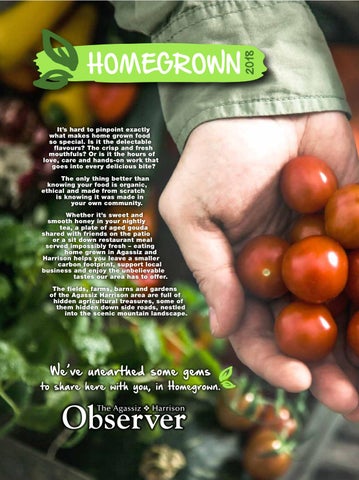
HOMEGROWN It’s hard to pinpoint exactly what makes home grown food so special. Is it the delectable flavours? The crisp and fresh mouthfuls? Or is it the hours of love, care and hands-on work that goes into every delicious bite? The only thing better than knowing your food is organic, ethical and made from scratch is knowing it was made in your own community. Whether it’s sweet and smooth honey in your nightly tea, a plate of aged gouda shared with friends on the patio or a sit down restaurant meal served impossibly fresh – eating home grown in Agassiz and Harrison helps you leave a smaller carbon footprint, support local business and enjoy the unbelievable tastes our area has to offer. The fields, farms, barns and gardens of the Agassiz Harrison area are full of hidden agricultural treasures, some of them hidden down side roads, nestled into the scenic mountain landscape.
We’ve unearthed some gems
to share here with you, in Homegrown.
A8 Thursday, April 26, 2018
Agassiz-Harrison Observer
www.agassizharrisonobserver.com
BACK BY POPULAR DEMAND.
You wanted a small tractor with a mid PTO for more versatility. Massey Ferguson responded by bringing back a versatile workhorse, the Massey Ferguson 1526 compact tractor. This one’s built especially for people like you a new generation of landowners who want a tractor that’s as hardworking and no-nonsense as they are. Come check out the MF1526 today. www.AvenueMachinery.ca
YOUR LOCAL MACHINERY DEALER 1521 Sumas Way, Abbotsford, B.C, V2S 7P4 (604)-864-2665 AvenueMachinery.ca
THE Z400 SERIES Residential users require high levels of comfort and convenience. Professional users demand superior durability and performance. Both want easy operation and top-level performance to handle even the most mo challenging mowing tasks. The Z400 series of zero-turn mowers delivers all that and more, including powerful engines matched with rugged transmissions, smooth operation levers, and, of course, Kubota’s reputation for outstanding quality and durability.
www.AvenueMachinery.ca
Agassiz-Harrison Observer
www.agassizharrisonobserver.com
Thursday, April 26, 2018 A9
A bee-autiful partnership
HOMEGROWN
Worker Bee Honey Company bees help local fruit farmers NINA GROSSMAN
One thing that strikes you as you walk onto Rosedale’s charming Worker Bee Honey Company farm (WBH) (previously known as Honeyview Farm Ltd.) is that there seems to be everything but bees. There are warehouses filled with boxes of empty hives and a large chunk of yellow-ish protein waiting to be fed to hungry honey bees. The store front where the company once sold its popular honey jars to passerbys is empty, a display left behind from its day as Rosedale’s ‘top tourist attraction.’ There are huge 45-gallon drums – some empty, a dozen or so full of honey, and a large semi-truck ready for bee transportation. But where are all the bees? One apiary sits next to a cluster of flowering trees, but even the thousands of buzzing tenants don’t seem enough to warrant an entire honey producing company.
When the first killing frost hits Alberta – usually in September – the bees head west again, back to their Agassiz and Rosedale area homes. The honey they produce in both provinces is collected and packed up in barrels before being distributed, mainly in bulk, to a number of purchasers. The Alberta honey is sold to a co op that supplies honey to big names like Compliments, Costco and No Name brand.
Protein at the top of a cluster of hives sits uneaten. Worker Bee Honey Company has about 6,000 hives spread across the Agassiz Rosedale area. (Nina Grossman/The Observer)
In 1985, after experimenting with different methods of ‘wintering bees’ – attempting to keep bees healthy over the winter – Awram decided to take the honey company to B.C. for the mild Fraser Valley winters.
That’s because WBH bees spend their winters and springs across the Agassiz-Rosedale area, their apiaries buzzing next to the blueberry, blackberry and even raspberry fields of different Fraser Valley Farms. These fruit-producing landlords benefit from their hosts too. When the honey bees pollinate the fields, they help more flower pistils receive pollen, naturally increasing berry size up to 30 per cent. But the bees don’t stop at B.C. agriculture. Every summer, after the last B.C. blueberries are harvested, the hives are loaded onto a semi-truck and taken to the family’s farm north of Edmonton, Alta. to pollinate clover, alfalfa and canola fields.
WBH founder and bee keeper Jerry Awram has been researching and working with bees since the 1960s when he studied apiculture in England before accepting the job of Alberta’s provincial apiculturist in 1970. Awram did some of his own beekeeping as a side gig, but it became a full-time job when he quit the provincial position in 1973 and ran his Alberta bee farm full time.
Awram’s wife Pia and their three sons, Peter, Tom and David are all part of the business, which eventually branched off back to Alberta.
Worker Bee Honey Company partners with University of British Columbia students researching disease and resilience in honey bees. The queen bee in this hive is marked with a green sticker. (Nina Grossman/The Observer)
While the honey can no longer be purchased directly from the Rosedale farm, there are a few local spots that carry the familiar glass jars. Rosedale Grocery and Farm House Natural Cheeses have shelves lined with WBH local honey, boasting deliciously tempting flavours from across the Valley like raspberry,
Homemade Soup Fresh Baking • Lunch Antiques • Gifts
COFFEE AND MUFFIN DEAL
✃
BIG BIG SALE
Or Free Bottles With All 6-8 Week Wine Kits Made In Store*
MORE OFFERS & DISCOUNTS AVAILABLE IN-STORE
MAKE SURE YOU DROP BY FOR ALL THE EXCITEMENT & HUGE $AVING$! HOME VINTNERS DON’T MISS OUT!
Agassiz best kept secret A&R Country Wine Cellar is back in action. Serving Wine Lovers In Agassiz, Harrison Hot Springs & Surrounding Areas. Craft Your Favourite Award Winning Wines & Buy Wine Making Supplies At Guaranteed Low Prices Without Leaving Agassiz. Make Wines For Every Occasion: Weddings, Parties, Events, BBQ & more...... Make Commercial Quality Wines At A Fraction Of The Cost! Best & Lowest Prices On Wine Kits. JOIN US FOR A GREAT WINE MAKING EXPERIENCE! CRAFT YOUR UNIQUE WINES WITH THE EXPERTS!
It's Fast, Fun & Affordable.
*Conditions Apply, Cannot Be Combined With Any Other Offer
SATISFACTION GUARANTEED!
NOW OPEN: Tues - Fri: 10am-4pm; Saturday: 11am-3pm
1-7384 Pioneer Avenue | 604-796-8496
Bring this coupon in and get a 12oz. house coffee and freshly baked muffin for
3
$
✃
$20 off all wine kits*
95
Come see us at 1824 #9 Hwy., Agassiz, BC or call at (604) 491-5958
SAVE THE DATE!
114th Agassiz Fall Fair and 70th Corn Festival September 14th & 15th, 2018
Year of the Corn
604-796-3246 www.agassizfallfair.com
A10 Thursday, April 26, 2018
Agassiz-Harrison Observer
HOMEGROWN
www.agassizharrisonobserver.com
A bee-autiful partnership Worker Bee Honey Company bees help local fruit farmers
...Continued from Page 3
blueberry and blackberry.
While temperate Fraser Valley winters provide sustainable bee-keeping that keeps populations alive through the year, Awram says it’s the big-leafed maple trees that make the area a special place to make honey. “The big-leafed maples are the most important thing,” he said. “It’s the best quality pollen and honey that they’re likely to get. If we have even three or four days on the maples, that’s enough to set us on a positive course for the rest of the season.” Currently the company has about 6,000 hives, which, depending on the season, can host up to 20,000 bees each. Although growth is good for business, it’s led to one reoccurring problem for the family of beekeepers: space. Since arriving in the Valley in the mid 1980s, Awram said he’s seen the area change significantly. The family used to keep bees on Chilliwack Mountain and Cheam Wetlands, areas they were pushed out of thanks to population growth.
Innocent-looking wooden boxes house hives with thousands of bees inside. Worker Bee Honey Company has apiaries at a number of different locations where the bees are put to work pollinating fruit fields – helping the fruit to grow bigger and the bees to create tasty honey.
Over the next few weeks, the honey bees from Worker Bee Honey Company will be gorging on the nectar of fruit fields in the Agassiz Rosedale area.
“The most limiting factor for us is the lack of places to keep bees,” he said. “We depend on the generosity of people who have a fair-sized acreage to allow us to keep the bees there over winter.” WBH does have some local partnerships with generous landowners, including with First Nations bands in the area such as Popkum, Cheam and Seabird. Still, the family company is always looking for willing farms to take on some bees. “The development has had a serious impact on us. It’s a real blow to be told: there’s going to be a new subdivision here, your bees have to go.”
Still under its old name, ‘Honeyview Farms,’ Worker Bee Honey Company sells its honey at select locations in the area like Rosedale Grocery. Otherwise the honey is mostly sold in bulk.
These queen bees were imported from Hawaii to replace those that have died or been killed. The little cases are inserted into the hive, and as the queen eats through the protein, she gets a chance to grow accustomed to her new hive, and vice versa. Bee worlds can be cutthroat – queens who don’t lay eggs are often killed, hence the need for replacement queens.
Circle Farm Tour
Agassiz + Harrison Mills • Celebrating the Past and Present A celebration of past and present, this tour is a rich mix of wonderful things to see, do, smell, and taste! See cows roaming the fields, watch artisan cheese and hand crafted pottery in the making. Take a self-guided tour of a 1920’s living history historic site, explore a garden and shop for antiques, home & garden décor. Smell fresh coffee being roasted and taste homemade dishes with locally sourced products, heirloom tomatoes, garlic, corn, cheese, raspberries, blueberries, and fresh veggies. Pick up artisan salmon products from locally caught Harrison River Salmon.
Proudly Sponsored by Tourism Harrison
Agassiz-Harrison Observer
www.agassizharrisonobserver.com
HOMEGROWN Destination: Local How farm to table revitalized Muddy Waters NINA GROSSMAN
Over the past few years, Muddy Waters has become a hot tourist destination and a beloved lunch and coffee spot for Harrison and Agassiz residents. But the little business, fronting the Harrison Lagoon and one of the last stops on Esplanade Avenue, didn’t start with the ‘fresh and local’ philosophy it’s known for today. When it opened back in the mid-90s,’ it sold coffee only. Eventually the shop started selling food, but it wasn’t local – or fresh. When Richard Fife and partner Jenny purchased the restaurant in 2012, they knew they needed to find a way to give Muddy Waters an edge. Only 30 per cent of business came from food purchases, recalled Fife. “We had to assess, why is that?” he said. “What it came down to is that there is approximately 25 places to purchase food between the Harrison Resort and us.” The duo decided to go as local as possible, hoping it would bring in more hungry customers. A partnership with Cobs Bread Bakery in Chilliwack brings in fresh sourdough breads and Kent’s Farm House Natural Cheeses supplies soft, delicious dairy products. The restaurant uses only fresh salmon and crab, and most of its vegetables are sourced from a local Rosedale farm that even supplies veggies through the winter months by growing crops in a greenhouse. “We took really exciting food and put it in a situation where it’s quick [and] people can get it for a reasonable price,” said Fife, adding that 85 to 90 per cent of everything that comes into Muddy Waters is purchased locally. “Local and farm to table was how Muddy Waters survived,” he said. Judging by the long lines and crowded tables on warm summer days, farm to table is also the reason that Muddy Waters thrives. “We’re quite happy and content. The more local we can get, the better.”
Freshly Foraged Dining riverside in Harrison Mills NINA GROSSMAN
Look one direction and you’ll see a stunning mountain and river view. Look down at your table and you’ve got a plate of fresh salmon caught from the river beside you. That’s the unique charm of dining at The Clubhouse at Rowena’s Inn on the River at Pretty Estates. The ebb and flow of the Harrison River provides not only a breathtaking view for lucky visitors, but a supply of fresh fish for head chef Jonathan Gee, who loves exploring and playing up local flavours of Harrison Mills. “I love the area. it’s beautiful and it’s bountiful for tons of local products that are just wonderful to use,” he said. Gee gets his supply of chinook, chum, sockeye, coho and pink salmon from River Select, a collective of Sts’ailes and Scowlitz First Nation salmon fisheries located in Chehalis, Harrison and the adjacent Fraser Rivers. “We can know where it’s coming from and it’s sustainable, it’s ocean-wise, it’s responsibly produced. Which is what I want to see,” he said. The Clubhouse is attached to Rowena’s Inn on the River, an early 19th century establishment that’s been restored to maintain the soft textures and rich colours of old world design. The Pretty family once lived on the 160-acre waterfront estate that now serves as a popular golf course, boutique bed and breakfast, wedding destination and of course – restaurant. Not everything on the menu is local, but Gee prioritizes food from the area. For fresh greens, he turns to local sources like Hole in the Clouds Farm for sustainably produced seasonal vegetables. Everything from tomatoes, jalapeños, herbs, pumpkin, squash and gourds are sourced from the Harrison Mills farmers, who Gee said have even experimented with tomatillos and bitter melon. “That’s the awesome part of working with these guys, a lot of them love to see their food used locally.” Down the road might seem pretty fresh to most people, but Gee takes it a step further by plucking food right on the Pretty Estates property and adjacent Sandpiper Golf Course. The property has an herb garden and apple, pear and plum trees ripe for the picking. Gee takes it even further by wild foraging: searching for ripe huckleberries, salmonberries and redcaps growing along the pathway through the estate. He even sources fresh watercress and bow rushes from streams out of the river. “You just got to know when to look, and that’s the hardest part,” he said. “It seems that some of them are ripe on one side of the property before the other.” Gee said local food has powerful flavours and textures, and of course, a freshness that can’t be beat. “When I go to [Hole in the Clouds], and I use it that night, it’s super fresh. It’s never been in the fridge,” he said. “It’s easy to work with these things. I want to do as little as possible to that item to make it shine.” And it makes a difference for guests, he adds. “You see their eyes light up when you tell them, this fish came from right over there. That salmon that’s in front of you was caught up the road,” he said. “I think that people nowadays are looking for better choices. They’re not boycotting – but buy-cotting….They want to see that we’re providing responsibly produced and local food as much as possible.” One of the chef’s go-tos recipes is the Salmon Wellington. “We do an artichoke spread on top of the salmon with a little bit of spinach. Then we cover it in puff pastry and serve it with a lemon dill cream sauce.”
AGASSIZ
PRODUCE
Jonathan Gee, head chef at the Pretty Estates in Harrison Mills poses with the historic building behind him. Gee works with local fisheries and farms to bring fresh products into his kitchen.
Locally sourced hot peppers make the freshest sauces and flavours at The Clubhouse on Pretty Estates in Harrison Mills. (Submitted)
Gee loves finding the freshest berries and vegetables to feature in his dishes. (Submitted) The restaurant is open to the public, but the inn is frequently used for weddings, and Gee said the summer season sees a wedding ceremony almost every weekend. Another favourite for locals and tourists alike is ‘Step Back in Time’ dining, a monthly four-course dinner that lets guests step into past, dining in the old style with the historic beauty of the inn around them. “It feels like you’ve stepped out of time and back into a different era,” said Gee, who hopes to add a feature local item to the weekly fresh sheet at the restaurant this summer. “I’ve been trying to get to the point where we can do a feature farm item…sourced from places all around here.”
Celebrating 25 years of helping BC agricultural businesses stay safe, healthy and productive
25TH ANNIVERSARY 1993-2018
SAFETY TRAINING
7266 Pioneer Avenue | 604.796.8444
SAFETY TOOLS
L O C A L LY O W N E D A N D O P E R A T E D
PROFESSIONAL ADVICE
F 0% OFRS
1FOR SENIOAYS WED
Thursday, April 26, 2018 A11
NESD
EMS ICED IT R P . G ON RE
OPEN: Mon. - Sat. 8:30am to 6:00pm
COR CERTIFICATION
Let us help you get started today 1.877.533.1789 | contact@agsafebc.ca
ON-SITE & ONLINE SUPPORT
www.AgSafeBC.ca
A12 Thursday, April 26, 2018
Agassiz-Harrison Observer
www.agassizharrisonobserver.com
Launch a Career in Agriculture
Now takiNg orders for
HoNey Bee 5-frame Nucs witH QueeN! 0 Honey Bees $2fo2 r 5 will be ready -fNruacms e for pick up May 26th
NEW:
Bachelor of Agricultural Science HORTICULTURE MAJOR
UFV’s agriculture grads are amongst the most employable in Canada
ESSENTIALS CERTIFICATES ÇŚ ÇŚ ÇŚ ÇŚ ÇŚ
Š——ž •—”‰šˆ™Ž”“ š——Š“™ †Œ—Žˆš‘™š—Š •—†ˆ™ŽˆŠ˜ ŽŠ‘‰ ›ŠŒŠ™†‡‘Š •—”‰šˆ™Ž”“ “™ŠŒ—†™Š‰ •Š˜™ ’†“†ŒŠ’Š“™ Ž‘�Š— ™Šˆ�“ŽˆŽ†“
www.ufv.ca/agriculture
DEGREES
ÇŚ †ˆÂ?Š‘”— ”‹ š˜Ž“Š˜˜ ‰’Ž“Ž˜™—†™Ž”“ ‰ŠŒ—ŠŠ ÇŠ Œ—Žˆš‘™š—Š Â†Â“Â†ÂŒÂŠÂ’ÂŠÂ“Â™ÇŞ ÇŚ †ˆÂ?Š‘”— ”‹ Œ—Žˆš‘™š—†‘ ˆŽŠ“ˆŠ ‰ŠŒ—ŠŠ ÇŠ ”—™Žˆš‘™š—Š †Â?”—Ǫ
1-YEAR CERTIFICATES AND 2-YEAR DIPLOMAS ÇŚ ”—™Žˆš‘™š—Š ˆ—”• •—”‰šˆ™Ž”“ †“‰ •—”™Šˆ™Ž”“ ÇŚ Ž›Š˜™”ˆÂ? •—”‰šˆ™Ž”“
SPECIALTY PART-TIME COURSES ÇŚ ÇŚ ÇŚ ÇŚ ÇŚ ÇŚ ÇŚ ÇŚ
†Ž—ž •—”‰šˆ™Ž”“ †“‰ ’†“†ŒŠ’Š“™ –šŽ“Š •—”‰šˆ™Ž”“ †“‰ ’†“†ŒŠ’Š“™
—ŠŠ“�”š˜Š •—”‰šˆ™Ž”“
“™—” ™” ˜”Ž‘˜ †“‰ ˜”Ž‘ ‹Š—™Ž‘Ž™ž š˜™†Ž“†‡‘Š �”‘Ž˜™Žˆ †Œ—Žˆš‘™š—Š š—˜Š—ž •—”‰šˆ™Ž”“ †“‰ •—”•†Œ†™Ž”“ “ǂ‹†—’ ‹””‰ ˜†‹Š™ž Š˜™ ’†“†ŒŠ’Š“™
Apply now! Call 1-888-504-7441 ext. 2813
w w.handlersequipment.com 31852 marshall Pl, abbotsford, Bc V2t 5Z9 (Take Clearbrook Road Exit off Highway 1)
ufv.ca/agriculture
call 604-556-7477 to secure your bees
spring ClearanCe speCials at Handlers equipment! Tractors & Utility Vehicles
TOMORROW’S EDGE TODAY
Hyundai’s lineup of fast and efficient wheel loaders, which are ideal for a wide range of applications including construction, demolition and recycling, utility and agriculture!
#1 Selling Tractor in the World 2555 HST
A solid choice for general-purpose farming and agriculture.
$1000 SPRInG CLEARAnCE DISCOunT!
MPACT XTV 1000 C DIESEL Best-in-class work capabilities in a six-seater diesel side-by-side, backed by a three-year Powertrain warranty.
$1000 SPRInG CLEARAnCE DISCOunT!
339 Sumas Way, Abbotsford • 604-850-3601
www.handlersequipment.com
Agassiz-Harrison Observer
www.agassizharrisonobserver.com
HOMEGROWN
Living local in Agassiz NINA GROSSMAN
With colourful, fresh cut flowers and a huge assortment of produce and natural food, Agassiz Produce has been drawing local customers through its yellow door since 2005. Owner Jackie Greene said she does her best to bring in local whenever possible, but local produce always peaks over the summer months. “A lot of people like to buy local. And of course in the summertime people eat differently, more salads and fruit,” she said. “That’s good for business.” Greene said her family has its own farm and grows oranges, strawberries, rhubarb, corn, squash, pumpkins, pickling cucumbers zucchini, peas and beans at different times throughout the year. “It depends, certain times of the year a lot of product is local, other times very little is local,” she said. Unless it’s winter though, Greene said the tulips, daffodils and other fresh flowers will always be local, coming in from Chilliwack and Rosedale.
Thursday, April 26, 2018 A13
AESS student builds hydroponic Onos builds system that growing system Keoghan uses water to grow food NINA GROSSMAN
A grade 10 student at Agassiz Elementary Secondary School (AESS) is trying his hand at modern farming. Keaghan Onos killed three birds with one stone when he created a hydroponic growing system for his school’s meal program. Supported by the Public Health Association of B.C. and the Farm to School program, Onos’s multidisciplinary project was researched in science class, built in wood working class, and managed in foods. The impressive design of three by four wood planks, lights and plant containers was completely designed, built and orchestrated by the young student, who has plans to take over his father’s tulip farm when he’s finished school. “I’ve always been interested in plants,” he said. “I’ve heard of hydroponics before, I researched it and it grows bigger and faster…it’s almost better than growing in soil.”
Keoghan Onos designed, built and manages a hydroponic growing system that he hopes will contribute to the AESS meal program.
Hydroponics replaces soil with nutrient-rich water, allowing plants to grow indoors, and save energy, according to Onos. “It helps the plants grow faster because when it’s in soil the roots have to look around for nutrients,” he explained. “But now [the nutrients] are right there and it can focus on growing rather than looking for nutrients.” The hydroponic system also provides protection from aphids, said Onos. “They live in the soil and lay eggs. Now if we have it on water, we have way less pests.” Ones ordered the lights from Amazon and found little toy boxes at Ikea to use for plant containers. He carefully planted seeds in tiny pieces of foam, but said he’ll be experimenting with jiffy pellets and rockwool to see which medium yields the best results. So far, no plants have emerged from the foam, but Onos only just planted the tiny seeds, and expects to see a couple batches of lettuce before the school year is over. Next year he plans to plant herbs, lettuce, tomatoes and more for use in the school’s meal program, which feeds up to 200 students free of cost.
Want to know why we say our veggies live in a spa 24 / 7 before making it to your plate?
JOIN US FOR A GREENHOUSE FARM TOUR Check out our May 5, 2018 farm tours for a look inside our 10 am - 2 pm greenhouse!
Sunnyside Produce 1133 176 St, Surrey Westcoast Vegetables 3975 46A St, Delta | Gravis Farms 4653 Bell Rd, Abbotsford Spring is here and so are fresh, local veggies. Spring onto www.bcgreenhouse.ca for all the cool details!
8647782
Jackie Greene, owner of Agassiz Produce on Pioneer Avenue, does her best to bring in as much local fruits and veggies as she can.
Small pieces of foam inside Ikea toy boxes hold seeds ready to grow in the nutrient-rich water of Keaghan Onos’s hydroponic creation.
A14 Thursday, April 26, 2018
HOMEGROWN Farm tours feature the best of Agassiz, Harrison Mills
Agassiz-Harrison Observer
www.agassizharrisonobserver.com
Natural cheeses loved by tourists The Farm House Natural Cheeses and locals alike feels like a step back in time
Offer both tourists and locals a chance to see the past and present of agriculture in the area NINA GROSSMAN With so many specialty farms in the Agassiz-Harrison Mills area, the Circle Farm Tour is one of the best ways to make sure you see them all. Circle Farm Tours run across the Fraser Valley, offering tourists and locals the opportunity to check out the hidden gems of their chosen area. In Agassiz-Harrison Mills, the Circle Farm Tour road map and brochure directs visitors to top spots like the Farm House Natural Cheeses and Muddy Waters Cafe. Tourism Harrison events coordinator Stephanie Gallamore said the tour gives people the opportunity to see and learn where their food comes from and get a feel for the history of the area. “I think that’s what makes it so popular. And it’s great because you can tailor your experience,” she said. Participants build their own itinerary on a self-guided tour that celebrates the past and present of farming in the area. Check out pottery and coffee roasting at The Back Porch and stop for a taste of fresh corn at Sparkes Corn Barn, or visit Earthwise Society Agassiz’s organic demonstration farm and garden and enjoy a stroll along the Miami River before stopping for some fresh local produce at the Earthwise farm gate stand. With a deep agricultural history, the Circle Farm Tour is certainly one way to learn about the rich farming roots of the region. A stop at Kilby Historic Site in Harrison Mills gives visitors the chance to experience early 19th century Fraser Valley living. With the help of costumed interpreters and friendly farm animals, ‘B.C.’s museum of rural history’ is a hit for families. “We’re lucky we have so many great farms here,” said Gallamore. “We’ve got educational experiences, we’ve got family experiences [and] if people are into shopping than there’s shopping experiences.” “We have award winning cheeses and great historical sites that you can see, amazing coffee [and] gardens you can wander through,” she added. “There’s a lot that you can do in this tiny little area.” Appreciate the charm of the rolling countryside and scenic mountain views in Agassiz-Harrison Mills with your own tour. Visit CircleFarmTour.com to learn more about planning your own trip. Agassiz Farms Cycle Farm Tour For those who like to hit the pavement, the upcoming 12th annual self-guided Agassiz Farms Cycle Tour is another way to check off some local farms, and get a bit of exercise while you’re at it! The stops are similar to the Circle Farm Tour but as a one-day event, farms will be prepared for visitors and offering tours and samples. The tour, on July 21 from 9 a.m.- 4 p.m., will see cyclists following a 30-kilometre flat route through Agassiz and the surrounding countryside, starting, stopping and finishing when they please. Participants will enjoy stops at the UBC Dairy and Research Centre, Agassiz Harrison Museum, Agassiz’s local community garden and the revitalized Agassiz Farm Fresh Market plus many more. Registration is required at the Agassiz Agricultural Hall and there is a $10 cost for adults. Participants have to bring or rent their own bikes for the event. For more information, visit FraserValleyCycleTours.com.
Tucked away neatly off of McCallum Road is a tiny, local gem known to animal and cheese lovers alike. NINA GROSSMAN
The Farm House Natural Cheeses is a Fraser Valley treasure, where visitors can not only purchase award-winning, artisan cheeses but can take a quint jaunt to the barns next door to see the animals their cheese came from. With 14 different cow cheeses and 11 different goat cheeses, the adorable little cheese shop at the front of the property has something for everyone. The handmade cheese come from the rich, fresh whole milk produced by the on-site goats and cows, who greet visitors with a curious sniff or an innocent nibble. Alpine, Lamancha, Saanen and Billy goats greet visitors at every turn, propping their hooves up on stable doors to get a closer look at the guests. “Having our animals on site makes a better quality cheese,” said head cheesemaker Emily Bowen. “It’s fresher…basically it’s milked and brought right over here.” As a certified organic farm, the goats and cows graze on lush, fresh grass for the majority of the year– about 220 days – and are fed organic hay and grain when the grass isn’t available. “We have dieticians that come in to make sure the cows are getting exactly what they need,” said office manager Dana Dinn. “We are 100 per cent certified organic. Which is a lot of work.” Farmers live on site and milk the goats and cows morning and night. The cheese is then made in small batches before being aged to perfection in climatecontrolled refrigerators at the back of the cheese shop. Opening a fridge door reveal shelves of aging cheddar, gouda and alpine gold cheese – which
will sit for anywhere from three months to four years before it’s at its peak. Farm House Natural Cheeses has a deep commitment to tradition, set in place by previous owner Debra Amrein-Boyes, who studied cheesemaking in Switzerland for years. And the new owners haven’t changed a thing, said Dinn. “We’re very farm to table – old school values. Our farm is wide open, any of our customers can come here at any time.” As Bowen transfers curds into small containers in the creamery – where large windows allow customers to peak in on the process – she explains the basics behind the delicate procedure of making a perfect cheese. Bowen pasteurizes the milk she gets each morning, and once it’s reached the proper temperature, she adds particular cultures to create the type of cheese she wants.The brie she’s making will take 12 days to be ready, and the Alpine Gold cheese being made next to her will take at least six months. Much of the cheese is shipped off to wineries and restaurants around the province weekly, but a large portion is sold at the shop, especially over the summer months when tourists and cyclists take pop by on the self-guided Circle Farm Tour orchestrated by Tourism Harrison. Made with love and aged to perfection, Farm House has won a number of awards for its beloved cheeses and is no stranger to media coverage. There’s just something about the home grown, hands-on process that captures the hearts and taste buds of everyone who pays a visit to this small traditional farm that feels like an homage to the simple, wholesome ways of the past.