TAKING REFUGE, SEEKING RELIEF
THE ABBOTSFORD NEWS / FRIDAY, DECEMBER 27, 2013 B1
TAKINGREFUGE SEEKING
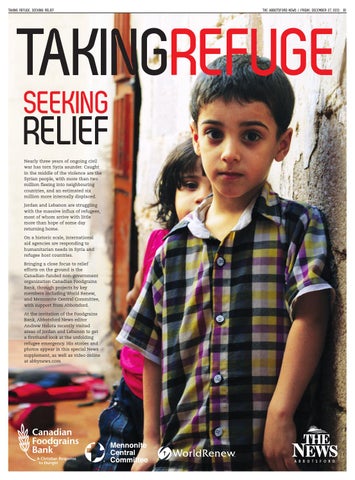
RELIEF Nearly three years of ongoing civil war has torn Syria asunder. Caught in the middle of the violence are the Syrian people, with more than two million fleeing into neighbouring countries, and an estimated six million more internally displaced. Jordan and Lebanon are struggling with the massive influx of refugees, most of whom arrive with little more than hope of some day returning home. On a historic scale, international aid agencies are responding to humanitarian needs in Syria and refugee host countries. Bringing a close focus to relief efforts on the ground is the Canadian-funded non-government organization Canadian Foodgrains Bank, through projects by key members including World Renew, and Mennonite Central Committee, with support from Abbotsford. At the invitation of the Foodgrains Bank, Abbotsford News editor Andrew Holota recently visited areas of Jordan and Lebanon to get a firsthand look at the unfolding refugee emergency. His stories and photos appear in this special News supplement, as well as video online at abbynews.com
B2 TAKING REFUGE, SEEKING RELIEF
THE ABBOTSFORD NEWS / FRIDAY, DECEMBER 27, 2013
EASING THE BURDEN SINCE THE CONFLICT IN SYRIA BEGAN NEARLY THREE YEARS AGO, MORE THAN SIX MILLION PEOPLE HAVE BEEN DISPLACED.
Many end up in the Qalamoun region of Syria, near the border with Lebanon, where there are approximately 15,000 families in need of food assistance. “It is difficult for people to buy food; prices are rising with inflation and low currency,” says Riad Jarjour, president of the Forum for Development, Culture and Dialogue, a partner of Mennonite Central Committee (MCC). The situation has been aggravated by an increase in violence in Qalamoun
since late October. Opposition and government forces are fighting for control of several towns in the region, trapping many people in their homes and forcing others to flee. “The Qalamoun battle continues to be another unexpected crisis in the midst of an incredibly dirty war,” says Jarjour. To help ease the burden, an MCC project, funded by MCC’s account at the Canadian Foodgrains Bank (CFGB), is providing monthly food baskets to 6,000 families. The food is purchased locally and includes staples such as rice, oil, sugar, canned meat and tea. “In all, the project has made a great and positive impact on the internally displaced people and the people of the Qalamoun area,” says Jarjour. “It not only fed people, but helped people emotionally, socially and psychologically.” The effects of the conflict have also
spread beyond Syria’s borders. Lebanon now hosts an estimated one million Syrian refugees and Palestinian refugees from Syria. In southern Lebanon another MCC project, funded by MCC’s account at CFGB, provides food vouchers for 3,780 of those families. MCC‘s partner is Popular Aid for Relief and Development. Using vouchers instead of supplying food directly reduces administrative costs, increases the diversity of foods people can eat and benefits the local economy. Vouchers also allow people to choose their food, returning a sense of dignity to people living with uncertainty. In addition to the vouchers, the same project provides supplementary food for 450 babies between six months and one year old. To date MCC has allocated $10 million to assist people affected by the crisis, proving shelter and rent support, as well as relief and hygiene supplies.
MCC photo To learn more go to mcccanada.ca/ syriacrisis MCC is a ministry of Anabaptist churches that focuses on relief, development and peacebuilding. MCC has been working in Syria since 1991. Submitted by MCC Canada
ASSISTANCE IS A PARTNERSHIP WORLD RENEW IS A CHRISTIAN DISASTER RESPONSE, DEVELOPMENT AND JUSTICE ORGANIZATION WORKING FOR LOVE, LIFE, JUSTICE, AND MERCY AROUND THE WORLD.
Our expert staff members work in 35 of the world’s poorest countries to help communities recover from disaster and poverty, and realize their own potential to create positive change. As a result of World Renew’s ministry, communities around the world are seeing improved health, increased literacy rates, improved agricultural yields, increased family incomes, and a growth of local leaders who are equipped to continue creating change into the future. The secret to World Renew’s success is our partnership with local churches and organizations. In nearly every community around the world, there is a church made up of local men and women who desire to serve God and reach out to those around them. These men and women are ideally situated to know about local needs, tap in to local resources, and stay for the
long-term. World Renew builds up these leaders and equips them to carry out ministry to everyone in their community, regardless of their religious beliefs. In the midst of the overwhelming situation surrounding the conflict in Syria, World Renew is bearing witness to the love of Christ by partnering with local churches and Christian organizations to provide essential food and other assistance to those who are experiencing devastating trauma within Syria, as well as to Syrian refugees who have reached Jordan and Lebanon. Within Syria, World Renew is working with the Lebanese Society for Educational and Social Development (LSESD) and the Fellowship of Middle East Evangelical Churches (FMEEC), to provide food assistance, emergency supplies, bedding, cooking tools, heating fuel, and
rent assistance to 2,000 families who have been forced from their homes. In Jordan, through its alliance with the Canadian Foodgrains Bank, World Renew is providing food assistance to 1,000 families with its local partner Arab Woman Today / Arab Centre for Consulting and Training Services (AWT/ ACCTS). In Lebanon, World Renew is working with its partner the Lebanese Society for Educational and Social Development to provide food assistance to 1,525 households. Some families receive vouchers to purchase food in local stores, and those who are more vulnerable or who have limited access to stores are receiving a monthly food package. For more information, or to donate visit worldrenew.net Submitted by World Renew
World Renew photo
$65=
food for a Syrian refugee family for one month
Each monthly ration contains staples such as lentils, rice, cooking oil, tuna. Please give today. worldrenew.net/syriaconflict
worldrenew.net đ 1-800-730-3490
TAKING REFUGE, SEEKING RELIEF
THE ABBOTSFORD NEWS / FRIDAY, DECEMBER 27, 2013 B3
Refugees from Syria collect their monthly food boxes at a Baptist church in Irbid, Jordan. Funding through the Canadian Foodgrains Bank makes it possible for World Renew to distribute the aid through local partners.
CHURCHES CHANNEL AID RELIGION IS DEEPLY EMBEDDED IN THE FOUNDATIONS OF THE SYRIAN CIVIL WAR, AND IT IS RELIGION THAT IS ALSO COMING TO THE RESCUE. Deeper than the spreading revolution of the recent Arab Spring in the Middle East is historic friction between Sunni and Shia Muslims, with minority Christians often caught in the middle. Nearly three years of bloody, grinding
conflict in Syria has created a miserable wave of humanity flowing into neighbouring countries including Jordan and Lebanon – more than two million refugees, three-quarters of whom are women and children. The immense humanitarian need is seeing huge efforts from international aid organizations such as the UN Refugee Agency (UNHCR), however, the sheer magnitude of response can create cracks though which refugees fall. One family living in UN-provided tents on the outskirts of the city of Irbid, Jordan, say they applied to the UNHCR for aid a year ago, after initially living in a camp in Zataari. They’ve received nothing further, they maintain. Pouring help into those gaps are orga-
nizations that are minuscule by comparison – local Arab Christian churches – but with their own advantages. Faith-based agencies such as the Canadian Foodgrains Bank, and one of its members, World Renew, seek out such partners on the ground to deliver aid, while mosques undertake similar efforts, although they primarily assist Muslims. Foodgrains Bank considers churches an effective, efficient means through which to distribute food and non-food assistance. They are established institutions in the communities receiving the huge influx of refugees, with local knowledge and networks that can quickly identify families in need. CONTINUED ON B4
Abbotsford News editor Andrew Holota spent a week in late November reporting on the Syrian refugee situation in Irbid, Jordan and Beirut, Lebanon, with representatives of the Canadian Foodgrains Bank, one of Canada’s largest non-governmental aid organizations, and World Renew, a key member agency. The unconditional media trip was sponsored by the Foodgrains Bank, which is funding refugee relief in Jordan, Lebanon and Syria. Abbotsford is an important donor community for the faith-based organization, which receives four-to-one Canadian government matching funds, and partners with other NGOs to deliver food aid. Designed by Sue McMurchy
PRAYING FOR PEACE IN 2014!
worldrenew.net đ 1-800-730-3490
B4 TAKING REFUGE, SEEKING RELIEF
THE ABBOTSFORD NEWS / FRIDAY, DECEMBER 27, 2013
IT’S NOT UNCOMMON FOR TWO OR THREE FAMILIES TO CRAM INTO A TINY APARTMENT, WITH ALL THE TENSION AND DISCOMFORT THAT CREATES. FROM B3
Due to the work of congregation volunteers, and a high degree of accountability, churches also represent a lowcost means of delivering aid. Fear and distrust loom large in this humanitarian crisis. Even if they don’t take political sides, fleeing Syrians are coming from either government or opposition-held areas. Hoping to return one day, they have no idea who will be in control, and many are afraid they’ll face persecution, or worse, upon their return. For that reason, many refugees refuse to have their photo taken, even by visiting Canadian journalists. The level of trust in accepting aid from a church or mosque is often higher than that which people are willing to place in a vast international agency. Similarly, the Syrian government and the opposition forces it is fighting are generally more accepting of aid delivery from local churches than foreign agencies. Rupen Das, director of community development for the Lebanese Society of Education and Social Development – an important NGO (non-governmental organization) based in Beirut – says of its aid efforts in Syria, “The only space we could get in without being aligned with the opposition or the regime, was actually through the local churches.”
They occupy “a neutral space … with no conditionality...” World Renew, which along with its own funds, draws financial support from the Canadian Foodgrains Bank and flows it to partners such as LSESD, commonly delivers aid through a wide variety of Christian churches. There is no distinction made among the beneficiaries in terms of religion, ethnicity or political affiliation. Refugees fleeing Syria have numerous serious challenges – primary among them, of course, is food and basic survival items such as shelter and clothing. Money is also critical, and occasionally, one-time distributions of cash to pay rent are approved. In Irbid, Jordan, a handful of local Arab Christian churches including Baptist, Nazarene, Assemblies of God and others, provide a conduit to refugees not yet receiving UNHCR assistance, or those who are too afraid to register. Similar work is being done by Christian organizations in Lebanon, such as the Mennonite Central Committee. Providing refugees with food not only addresses hunger, but equally importantly, it frees up whatever precious cash they may have to pay rent and buy other supplies. Rental rates in towns and cities near the Syrian border are soaring, often doubling or more to $100 to $350 CAN
for a one- to two-room apartment. For people with no money and little or no work, those are crippling sums. Consequently, it’s not uncommon for two or three families to cram into a tiny apartment, with all the tension and discomfort that creates. In Jordan, refugees may not legally work. They do anyway, but typically for far less than Jordanians. Not surprisingly, that creates distinct tension among local populations, as business owners and farmers take advantage of cheap labour. In Jordan, an unskilled labourer will earn $300 to $350 Jordanian dinar (JD) per month (approx. $400-$415 CAN) with double that for someone in a skilled position. Refugees will commonly work for half that, often less – with no benefits. World Renew officials have also seen food and/or food vouchers being sold by refugees in order to pay rent. It’s not only an unhealthy trade, it’s costly, since a $100 food voucher will sell for perhaps $60 or less. Nevertheless, it’s often a choice between that or living on the street or in a tent. Aside from food, the next challenge now upon refugees is the winter. While the season in that part of the Middle East may seem relatively mild to Canadians, temperatures dipping below 10C represent distinct survival issues for refugees, particularly those living in tents, poorly insulated apartments, or in the case of thousands in Beirut shanty-towns, accommodation that consists of leaky concrete cubicles. Heaters, mattresses and blankets are critical items currently being distributed by UNHCR and other aid agencies.
BASIC FOOD BOX For a family of six people for one month • 10 kg rice • Two 1.8-litre bottles of cooking oil • 2 kg tea • 4 pkg of pasta, short • 4 pkg of pasta, long • 3 pkg of beans, 3 kg each • 4 pkg lentils, 1 kg each • 3 pkg chickpeas, 3 kg each • 3 kg bulgur wheat • 8 pkg of tomato paste • 2 cans sardines • 2 cans tuna • 4 cans cooked cheese
TAKING REFUGE, SEEKING RELIEF
THE ABBOTSFORD NEWS / FRIDAY, DECEMBER 27, 2013 B5
A BRUTAL WAR, WITH HARSH CHOICES “. . .THEY PUT THEM IN A STRAIGHT LINE AND THEY SHOOT THEM ALL, IN FRONT OF THEIR MOTHERS.” One day, the soldiers arrived. “They asked for all the men to come out on the street and they asked for the mothers to come and see what they are doing. They put them in a straight line and they shoot them all, in front of their mothers.” Through an interpreter, Fatina stands in the backyard of a church in Irbid and relates the inexplicable slaughter that, in June 2012, after many months of shelling and nearby fighting, compelled her and her family to make the intensely difficult decision to leave their home near Damascus in Syria and flee to Jordan. By some miracle of timing, the men in her family were away when the killings took place. Fatina’s journey to becoming a refugee began two years ago. She lived with her husband, 27-year-old son and his wife, and two daughters, 21 and 13. Her husband worked in construction and her son made furniture. They were a middle-class family, living comfortable, happy lives. The Syrian civil war brought a crushing end to that, as bombs and shells from government and rebel forces began tearing apart their community. Several exploded in front of her house. “There were so many injuries.” They were planning her son’s wedding at the time, and they were afraid to keep the date. Yet, eventually they decided to proceed with the occasion nevertheless, more fearful that the couple “may die” before they were married.
Two weeks later, as more bombs fell, the family had to flee the Damascus area. Waiting out the fighting was no longer an option. They tried to stay at half a dozen different sites, but each time the war drove them on. They collected some belongings and began a taxi journey to Jordan. With some previous connections in the country allowing them legal entry, they were not ordered into one of several refugee camps like thousands of others. Friends sheltered them for three months until the displaced family rented an apartment in Irbid. Syrian refugees are not allowed to work in Jordan, so families such as Fatina’s use whatever assets they have, along with some meagre underthe-table wages, to pay rent and buy whatever food they can afford. Usually, it is not enough. Meanwhile, rental rates are climbing as landlords exploit an opportunity to charge more for their apartments, which are in ever-increasing demand in areas near the Syrian border. Fatina’s Muslim family applied for aid from international organizations, but waited in vain. Now, the food they receive from World Renew via funding from the Canadian Foodgrains Bank, is all the assistance they get. Fatina comes to the church to collect one box of food items per month, including rice, cooking oil, pasta, beans, sardines and tuna. Her family will stay in Irbid as long as the civil war continues. “There is nothing to return to. No furniture, no house, nothing.” The situation inside Syria is even more grim, where aid is unavailable in many areas. Fatina’s eldest daughter and son stayed behind, and their parents have heard they’ve not seen bread since Ramadan – about four to five months ago. World Renew is assisting Fatina’s family, and 1,000 others – about 6,000 people in total – in cities near the Syrian border. Of those, approximately 15 per cent are poverty-stricken Jordanian citizens, demonstrating that aid is available not only to Syrian refugees, of whom there are now an estimated 1.4 million in Jordan.
Above: Through an interpreter, Fatina tells journalists how her family fled the violence of war around their home near Damascus in Syria, and moved to Irbid, Jordan. More than two million refugees have sought refuge in Jordan, Lebanon and other neighbouring countries. That number is expected to reach four million by the end of 2014.
B6 TAKING REFUGE, SEEKING RELIEF
THE ABBOTSFORD NEWS / FRIDAY, DECEMBER 27, 2013 B7
A FATHER MAKES DIFFICULT DECISION TO MOVE HIS FAMILY: “IF I DON’T DIE IN THE WAR, I WILL DIE IN THE CAMPS.”
LIFE AMONG STONES
A dozen tents are pitched on a narrow patch of boulder-strewn, stony ground on the side of a potholed road. There is no water, no shade – no facilities of any kind. For Abdul, 32, and his two wives and six children, along with 60-some other people, this is home, on the outskirts of Irbid, Jordan. They’ve been there for seven months, and their previous location was worse – the Zataari refugee camp, which Abdul describes as full of disease and trouble. He gathered his family and fled Syria for reasons familiar to virtually all Syrian refugees – the vio-
lence of war. He tells his story through interpreter Ra’ed Haddad, project manager for World Renew, which is providing food aid to about 1,000 families – 6,000 people – in the Irbid area, through funding from the Canadian Foodgrains Bank. “If he needs to just go out to buy bread, they can catch him. ‘Either you work for us, or we kill you.’” Abdul is referring to forces from both the government and rebels. He refused to work with any of the fighters, because his brothers are in the Syrian army. It was not a choice he wanted to make, and the family fled to Jordan.
The Jordanian police put everyone on buses to the refugee camp in Zataari, which is presently home to 150,000 to 160,000 people. Abdul says the camp is plagued with problems. Rebels burn tents, and carry out rapes. There are serious diseases among the occupants. They stayed only five months, and then packed their UN tents and trekked south for a better site. “If I don’t die in the war, I will die in the camps,” he tells Haddadd. Abdul registered his family with the UNHCR last year, but has received no aid yet, he says. The only food he gets is from World Renew, run by the Christian
The children of Abdul el-Razek pose inside their UN tent, which is pitched with several others on a rocky piece of private land on the outskirts of Irbid, Jordan (above). By spring, the refugee family will have been there for a year.
Reformed Church, and funded since the summer by Canadian Foodgrains Bank. The food donations, which are provided once a month, are critical to the family’s survival. The main problem they have is water, which they have to buy. “We are feeling good to have this aid and help from you. It’s the best thing for God to have somebody like you giving us this because we cannot
find it any other place,” says Abdul. And if the food donations did not exist? Abdul shrugs and says, “I can cut pieces from my body for my family.” Although it’s illegal for refugees to work in Jordan, Abdul has found occasional labour jobs for farmers in the olive season. The police have caught him twice, once with one of his wives, and sent him off to Zataari. He came back to Irbid both times.
The nine-member family lives in two connected tents from the United Nations – each about three by eight metres. The floor consists of carpets, and the canvas shelter will be heated by a diesel or oil heater this winter. The unit will cost $100 to $150 to buy initially, with fuel consuming about $60 per month of precious funds. Bizarrely, there is a TV in the corner – donated by a Jordanian family – as is a satellite dish and a genera-
tor, which is used to provide power to several of the tents. It is the main source of entertainment for the children, for whom there is no school. They spend their days playing in the dirt, or watching TV during the limited times when the generator is running. Haddad says the conditions are of a “medium” standard for refugees in tents. At the low end of the scale are CONTINUED ON B8
B8 TAKING REFUGE, SEEKING RELIEF
THE ABBOTSFORD NEWS / FRIDAY, DECEMBER 27, 2013
HE JUST WANTS SAFETY FOR HIM AND HIS FAMILY, AND TO VISIT HIS NEIGHBOURS “WITHOUT FEAR OF BOMBING OR ANYTHING ELSE.” FROM B7
tents with holes, no carpets on the floor, and a lack of mattresses, blankets and no heater. A car salesman in his former life, Abdul says he will “absolutely” go back to Syria if there is peace, but in the meantime he’s trying to find somewhere else – another country. Any country, he says, but he likes Canada, because it has plentiful, good water. As for who is in power when the fighting eventually ends, Abdul doesn’t care. He just wants safety for him and his family, and to visit his neighbours “without fear of bombing or anything else.”
Right: Abdul el-Razek, 32, holds his 15-month-old son Mahdi. He lives in a tent camp on the outskirts of Irbid in Jordan with two wives and six children.
LIVING JUSTICE LOVING MERCY SERVING CHRIST
worldrenew.net đ 1-800-730-3490
TAKING REFUGE, SEEKING RELIEF
THE ABBOTSFORD NEWS / FRIDAY, DECEMBER 27, 2013 B9
A QUESTION OF ENDURANCE IF THERE IS ONE WORD THAT OVERRIDES ALL OTHERS IN DESCRIBING LEBANON IN RELATION TO THE SYRIAN REFUGEE CRISIS, IT IS “OVERWHELMED.” Since the civil war began, more than one million refugees have poured into the tiny nation of Lebanon. In the two weeks following Nov. 15, 25,000 refugees entered the country – in just one area. One-quarter of Lebanon’s population now consists of refugees. Placing that in perspective, imagine Canada suddenly dealing with eight million displaced people. Aside from the vast need for humanitarian aid, tremendous pressure is being placed on the Lebanese cities and towns hosting these desperate people. Water, power and sanitation systems are under increasing strain,
as are the people of Lebanon, most of whom remember four decades of Syrian occupation which ended less than 10 years ago. Nevertheless, they endure, and continue to provide support. How long that can continue, however, is a question of increasing importance and concern. There aren’t many bright lights among the deep shadows cast by the Syrian refugee crisis. A small school in a district of Beirut is one though. Run by the Lebanese Society of Education and Social Development (LSESD) – which receives funding from World Renew – the school is
situated in what is regarded as Lebanon’s poorest, roughest neighbourhood. Many of its students also receive food aid from Canadian Foodgrains Bank, a faith-based non-governmental organization that sees four-to-one matching funds from the Canada government. Surrounded by slum housing, the Tahhadi school provides an educational environment for 140 children – a place where they can learn, and play, and laugh; all things distressingly absent for so many kids in this corner of the world. Including a significant percentage of Lebanese students as well as refugees, the school is a rare option for families who cannot enrol their children in public schools, and can’t afford private education. Yet, a moment’s walk from the school’s gates plunges one into a depth of stunning poverty and deplorable living conditions. The area is a collection of ramshackle single and multi-storey apartment blocks, with the poorest of the occu-
Relief, development and peace in the name of Christ.
pants on the ground, existing in little more than leaky concrete bunkers, some covered with tattered tin, and connected by filthy, garbage-strewn dirt alleys where sewage and run-off water trickles. When it rains, the maze is turned into a muddy, soggy mess. Paying $60 US a month for a cement 12’x16’ room is a quiet, shy woman who won’t allow her photo to be taken. Like so many Syrian refugees, she’s afraid of being associated with a wrong side or faction if and when she and her family return to Syria. Tears well up after she describes the home she used to have in her home country. It was spacious, and there was room in the yard for her children to play. Now she owns one pan, and cooks meals over a single-burner stove in a kitchen the size of a broom closet, with no running water. A block over is Leila Chawa, from Nabaa. Her living conditions are even CONTINUED ON B10
mcccanada.ca
B10 TAKING REFUGE, SEEKING RELIEF
THE ABBOTSFORD NEWS / FRIDAY, DECEMBER 27, 2013
ONE SYRIAN BOY CAN DESCRIBE HOW MANY SNIPERS THERE WERE IN HIS NEIGHBOURHOOD. FROM B9
more grim. A concrete box not much more than 25 square metres is home for nine people, including five children. There is no power, although it’s unclear whether the family can’t afford it, or whether the space was simply never wired for electricity. Perhaps both. The room is surrounded by a warren of others, with laundry strung between doorways and open staircases. The Canadian doctor in charge of a neighbourhood medical clinic run by LSESD says the area is a nightmare for injuries among children. Ragged tin, glass, metal, wire and other objects protrude everywhere. A fall often ends in cuts, which can infect quickly. A variety of skin conditions and head lice are not
uncommon. Refugees from Syria cluster in the Sabra area of Beirut – which became a refuge for another wave of people more than six decades ago. Hundreds of thousands of Palestinians who fled to Lebanon in the late 1940s now share their already densely crowded spaces with Syrian refugees in what were first called camps, but are now know as “gatherings.” The neighbourhoods consist primarily of older apartment buildings which, compared to the shanty-town of Hay el-Gharbeh, provide almost reasonable shelter, albeit expensive – upwards of $200 for a one-room bottom floor suite. Consequently, it’s common for an entire extended family to live in one or two rooms, or for multiple families
to share tiny apartments, which see three hours of scheduled power outages per day. Along with other infrastructure, demands on Beirut’s power grid is beyond capacity. Evidence of dangerous electrical workarounds between homes is apparent in every poor neighbourhood, with webs of crude wiring festooned between and along outside walls – sometimes running beside jury-rigged water pipes. At least the refugees are permitted to have a job if they can find it, as compared to Jordan, where it is illegal for them to work. Relief comes in the form of food vouchers through World Renew with funding from the Canadian Foodgrains Bank. Further assistance is supplied in this area by the Mennonite Central
Your donation will change lives: donate.mcccanada.ca
Committee. One of the MCC partnerships is with the Popular Aid for Relief agency in the Palestinian area of Beirut, which provides a school for children aged four to six. They engage in activities that allow them to forget for a few hours what has happened to their lives. One of the Lebanese teachers relates how one youngster who keeps saying all he wants is his toy which he left behind in Syria. When some of them draw pictures, they draw weapons. One Syrian boy can describe how many snipers there were in his neighbourhood. His father, whose wife died in childbirth, now lives alone with his young son in Beirut. He says he is preparing his boy to become “a very important person.”
mcccanada.ca
TAKING REFUGE, SEEKING RELIEF
THE ABBOTSFORD NEWS / FRIDAY, DECEMBER 27, 2013 B11
Left: Students focus on a lesson at a kindergarten in Beirut, watched by MCC Canada’s executive director, Don Peters (MCC photo). Right: Naomi and Doug Enns are co-representatives for MCC Lebanon.
A RESPONSIBILITY TO SHARE WORKING FOR MCC, FORMER ABBOTSFORD MAN AND PARTNER SHARE THOUGHTS ON REFUGEE CRISIS A unique thread binds Syrian and Palestinian refugees in Lebanon. They recognize they are in the struggle for life together. Such is the insight that comes with serving both groups, providing aid and relief in an ongoing humanitarian crisis of inconceivable scope, involving millions of people displaced by civil war. How Doug and Naomi Enns came to Beirut to represent the Mennonite Central Committee’s (MCC) efforts in Lebanon speaks to their commitment to the organization and the people it serves. Living in Winnipeg after recently completing a term for MCC in Chad, Africa, Doug and Naomi were alerted to a posting in Beirut by their daughter, a university representative on the MCC Ontario board. The Ennses packed up in August and are now co-representatives for MCC Lebanon on a three-year contract. Doug was born in Abbotsford, attended elementary school in the area, and graduated from the Mennonite Educational Institute. He and Naomi were married in 1985 and lived in Winnipeg and then
Victoria before returning to the Manitoba city. Although there are many obvious differences between their aid work in Chad and the Syrian situation, one specifically struck Doug upon arrival at their new posting: “The shock is in the disparity between the facade of western-style wealth in Beirut and the downtown, and then you’ve got these gatherings within the city limits as well, where you’ve got impoverished situations which aren’t covered by municipal and government aid. “So it’s a huge disparity within a small area between rich and poor…” Working in the Palestinian gatherings (formerly called camps) is PARD, or Popular Aid for Relief and Development, which formed in the late 1940s to respond to the plight of Palestinians who fled to Lebanon and other neighbouring countries after the state of Israel was created. Through PARD, and with support from the Canadian Foodgrains Bank, MCC is providing food vouchers and other assis-
tance to refugees from Syria, and local Palestinians, among others. MCC has been in Lebanon since 1950 and now has approximately 17 partners who have or had current projects sponsored with MCC’s help over 2013, including food baskets, cash allowances, health and educational support, peace-building conferences, and training in trauma and conflict for victims, and front-line responders and trainers. The Ennses presently supervise two Foodgrains Bank food-related projects and three Canadian government projects focused on winterization and nonfood items. Access to food is a key factor for families throughout the Syrian refugee crisis, not only to meet hunger, but to alleviate some of the pressure on their meagre flow of money, if they have any at all. Rents are climbing in Jordan and Lebanon, and often refugees have an impossible choice – buy food or pay the rent. In the Palestinian gatherings, a Syrian refugee father and his young son live with 16 other people in an apartment for which they pay $400 per month, with no power. They’d have to add another $200 to have electricity. His child goes to a kindergarten run by PARD with MCC support. Syrian refugee children in Beirut wouldn’t otherwise have that opportunity, but presently 70
kids attend classes at the school, and the organizations hope to increase that number. “Many here in Lebanon and Syria feel that through the aid of MCC they have been given back dignity and worth along with a renewed purpose for their lives – says Naomi. “Many refugees are finding strength to prepare for the day in which they can return to help rebuild their Syrian country when this present war is over… Doug notes, “...Syrian refugees and Palestinian refugees and Lebanese are truly grateful when they can share and when they are shared with... “For all of us, it is important to be valued enough to be remembered. “I now recognize the privilege and responsibility we have to share what we have with others in need. Abbotsford is far cry from so many others across the globe who struggle for daily life and basic human rights.” In total, MCC has invested about $10 million in response to the Syrian refugee crisis since it began. In addition, the organization contributed 69,400 comforters; assisted 9,555 Syrian families with food; medical aid or shelter; provided education support to 1,508 Syrian children; and made it possible for 450 infants to receive milk and diapers.
Thank you for supporting MCC in our work in responding to the disasters in Syria and the Philippines. MCC is active in 46 countries worldwide, working in Disaster Relief, as well as Sustainable Community Development and Peacebuilding. We thank you for your continued support. And we ask you to remember MCC in our ongoing work in countries like Congo, Ethiopia,Afghanistan and Colombia in your year-end giving.
mcccanada.ca
B12 TAKING REFUGE, SEEKING RELIEF
THE ABBOTSFORD NEWS / FRIDAY, DECEMBER 27, 2013
Canadian Foodgrains Bank photo
Food distribution in Niger, 2012
FEEDING HOPE CANADIAN FOODGRAINS BANK IS NO ORDINARY BANK. HELPING TO RELIEVE HUNGER IS NO ORDINARY CAUSE.
YES — I want to donate to help Syrian refugees. To make your gift, either fill out the coupon below and mail your cheque to Canadian Foodgrains Bank, or donate online to the Syria Crisis Appeal at foodgrainsbank.ca/syria CONTACT INFORMATION: Name: ______________________________________________________________________________ Mailing Address: ________________________________________________________________________
A partnership of 15 churches and church agencies representing 32 denominations, the goal of the Foodgrains Bank is to collect donations from Canadians to share with people in the developing world who don’t have enough to eat. Since its founding in 1983, the Canadian Foodgrains Bank has supplied over half a billion dollars of assistance for millions of people in 78 countries. This includes 1.1 million tonnes of food and seed. This assistance is provided through programs implemented by Foodgrains Bank members, each of which has an account in the bank. They use the donations collected by the Foodgrains Bank for their accounts to address emergency food needs, help farmers to grow more and better food, and to improve nutrition for children and mothers. Last year, through its members, the Foodgrains Bank provided almost $43
million of assistance for 2.1 million people in 37 countries. This included 40,000 tonnes of food and seeds. This assistance was made possible by donations from thousands of people across Canada, including farmers who donated the proceeds of over 17,000 tonnes of grain. It was also supported by the Canadian government, which annually provides a matching grant of $25 million. Today, over 800 million people in the world don’t have enough food to lead healthy and active lives. This includes many people who are affected by the conflict in Syria. By supporting the Foodgrains Bank Syria Crisis Appeal, you can make a difference in their lives today, and provide them with hope for the future. Thanks for your support! Submitted by Canadian Foodgrains Bank
City/Province: ________________________________
POSTAL CODE: _____________________________
Email: _____________________________________
Phone: _________________________________
We invite you to designate your donation for Syria to one of our member’s accounts. Undesignated or general account donations are available for all members to use.
____ ADRA Canada (Adventist Development & Relief Agency) ____ Canadian Baptist Ministries ____ Canadian Catholic Organization for Development & Peace ____ Canadian Lutheran World Relief ____ Christian & Missionary Alliance in Canada ____ ERDO (Pentecostal Assemblies of Canada) ____ Evangelical Missionary Church of Canada ____ Mennonite Central Committee Canada ____ Nazarene Compassionate Ministries ____ Presbyterian World Service & Development ____ Primate’s World Relief & Development Fund (Anglican) ____ The Salvation Army ____ United Church of Canada ____ World Relief Canada ____ World Renew (Christian Reformed Church) ____ General Account/Canadian Foodgrains Ban
DONATION: Amount Enclosed: __________________________ PAYMENT METHOD: Cheque: Credit Card: (please fill out below info for credit card payment) CREDIT CARD INFORMATION: Visa:
MasterCard:
American Express:
Credit Card #:_____________________________ Exp Date (MM/YY):_________________________ Date: ___________ Amount: _________________ Name on Card: ____________________________ Cardholder’s Signature: _______________________________
MAIL TO: CANADIAN FOODGRAINS BANK Box 767 Winnipeg, MB R3C 2L4
Copyright and/or property rights subsist in all other material appearing in this special supplement to The Abbotsford News, Black Press. Permission to reproduce wholly or in part and in any form whatsoever, particularly by a photographic or offset process in a publication, must be obtained in writing from the publisher.
Canadian churches working together to end global hunger. www.foodgrainsbank.ca