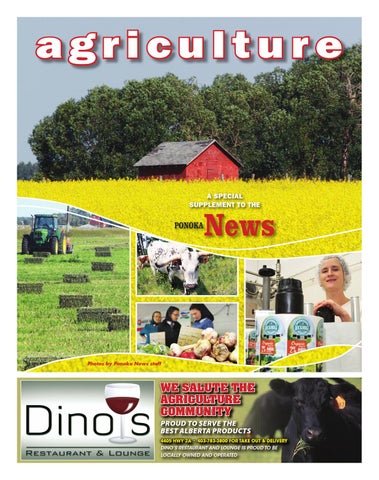
agriculture
A SPECIAL SUPPLEMENT TO THE
PONOKA
News
Photos by Ponoka News staff
WE SALUTE THE AGRICULTURE COMMUNITY PROUD TO SERVE THE BEST ALBERTA PRODUCTS
4405 HWY 2A • 403-783-3800 FOR TAKE OUT & DELIVERY DINO’S RESTAURANT AND LOUNGE IS PROUD TO BE LOCALLY OWNED AND OPERATED
Page B2 PONOKA NEWS
Wednesday, March 20, 2013
National ag mentor program researched By Amelia Naismith With a well-devised and lofty plan, the backing of an international organization and years of experience in agriculture, one woman is setting out to travel the world to improve agricultural pressures on Canadian women. After 15 years of holding out because she felt she wasn’t prepared for the opportunity, world renowned agricultural mentor Brenda Schoepp is finally living her dream as a 2012 scholar of Nuffield Canada. Nuffield Canada is an organization offering scholarships to agricultural leaders — between the ages of 25 and 45 — working to promote advancement and leadership in agriculture through international studies. Schoepp’s Nuffield project, which she began in 2012, is still heavily in the research stages. The project is working to develop a mentorship program for Canadian women in agriculture. As a scholar, Schoepp will travel extensively for the next few years — and has been travelling since last fall — looking at agricultural industries around the world, and the involvement of women. “Not just farms, but look at food production,� she explained. Schoepp is immersing herself in international agricultural farms, technology, infrastructure, policies and people. “I represent agriculture and Canada worldwide,� said Schoepp. “It’s a very big honour to be a scholar it comes with a lot of responsibility.� Schoepp is talking with women around the world to see what mentorship means to them. “I’ll present my thesis in November to Nuffield Canada.� She’ll also speak at the Australian National Nuffield Conference in Perth in September. For as many surprises Schoepp’s project is revealing, she’s finding just as many challenges for women around the world and for the project itself. “It’s proving quite challenging.
Women are the major contributors of food worldwide, says Schoepp. Because of the international urbanization movement, where people are relocating from rural to urban areas, there’s even more pressure being places on women farmers. In Canada, 30 per cent of farms and ranches are owned by women, and because more and more children are moving away from family farms to find work elsewhere these women struggle to staff their operations. “It’s hard to find educated and dedicated help in a booming economy, and Canada has one of the strongest economies in the world,� said Schoepp. Last year Schoepp travelled to India to meet with millionaire coffee plantation owners. She also got to meet their wives. “(The) role of the wives was to be beautiful, be educated and have children.� Urbanization is also affecting plantation owners, and because of that the roles of the upper class wives are changing. “They shifted from conducting the affairs of the household to conducting the affairs of the business to actually having to work in the production of coffee,� Schoepp explained. For her project Schoepp will also travel to Cuba. Schoepp says because of a land reform policy the country is, for the first time, allowing women to own farms and ranches and allowing them to sell their produce. Another struggle in the international world of agriculture is in Ukraine, where a land reform policy is harming the agricultural industry “to the point where no one can survive.� However, Schoepp has witnessed what she feels is incredible strength and organization by women around the world, who’ll push through these adversities “with the intense focus of bettering themselves and their families.� Continued on page B3
Along with livestock, Brenda Schoepp keeps other animal companions on her family’s farm; including two dogs and several barn cats. Photo by Amelia Naismith
WE’VE GOT IT ALL.
Agro Equipment is your resource for everything John Deere. :HÚUH KHUH WR áQG WKH ULJKW HTXLSPHQW IRU WKH MRE DQG \RX FDQ DOZD\V FRXQW RQ XV IRU SDUWV VHUYLFH DQG VXSSRUW
www.AgroEquipment.com
More models. More parts. More knowledgeable staff.
OLDS 403.556.6961
CALGARY 403.280.2200
PINCHER CREEK 403.627.4451
CLARESHOLM 403.625.4421
PONOKA 403.783.3337
CORONATION 403.578.3744
STETTLER 403.742.4427
CRANBROOK 250.417.0272
TROCHU 403.442.3982
Wednesday, March 20, 2013
PONOKA NEWS Page B3
Woman’s strength, love aid program development Continued from page B2 Schoepp says people often ask her why women around the world never give up, and she has one answer for them: “In simple terms they’ll never watch their children starve . . . In broader terms they have a deep commitment to the growth of family.” Another challenge of the project is actually developing a mentorship model for women. This includes complexities, such as cultures, social structures, Out of her home, northwest of Rimbey, Brenda Schoepp also runs a core values and beliefs, horse rescue operation. One of her greatest success stories is Treasure Photo by Amelia Naismith principles, economic (far left), a serious burn-victim horse. status, trust, finances and with a set of skills and beliefs a person already has. location. “Logistically Schoepp’s mentoring and her project are known on it’s hard to implement.” Talking to someone over the phone can go only an international level. She was recently asked by two so far, says Schoepp, and that’s coaching. What she women in England for mentorship. However, she was feels is true mentorship requires forming a face-to-face also approached by a man with the same request. In Holland, the first question she was asked by a relationship built on trust. group of young male scholars was “why not us? Why Because so many woman are in remote areas of aren’t you developing a mentorship program for us?” the world this causes difficulties. “Every country is so Another challenge is finding mentors with the time different,” said Schoepp. However, Schoepp feels strongly there’s a need for to work with the program for true mentorship. “True mentorship worldwide, she applied for the Nuffield mentorship actually becomes a lifelong commitment. It’s a deep commitment of behalf of the mentor,” Scholarship on that conviction. “I think an objective third party is empowering. The Schoepp explained. Finding mentors who’ll work with someone for a world of agriculture is very small . . . and so if there’s the opportunity to have someone grow with you, I matter of months then write a report is easy. However, this can leave the mentee more confused than they think that’s very enticing for a lot of people.” Because mentors are outside the mentee’s business, were initially says Schoepp. Funding is also a challenge. Schoepp says she they can look at actions from different avenues, such as personal, financial and business objectives, said doesn’t yet know how the program will be funded. But Schoepp. “A mentor never tells you what to do. A she says there are some people who believe it should be funded federally as part of the model’s development. mentor allows you to find the solution yourself.” Schoepp wants the program to get off the ground Schoepp says the mentoring program is about empowering woman because mentorship is working because of the need for it. “At this point in time there
Ponoka County Ponoka County Council / Agricultural Service Board Division 1 Division 2 Gordon Svenningsen Gawney Hinkley
Division 3 George Verheire
Division 4 Paul McLauchlin
Division 5 Keith Beebe
is no mentorship for rural women in the world.” If enough interest is generated to develop the model Schoepp plans on bringing in other female leaders for expert help. The model must also be constructed to grow with the changing agricultural industry. “Agriculture is really shifting, and has no borders as far as class, culture or income.” The program cannot be designed with the limitations of only what she knows. “It’s what’s new in agriculture around that world that’s going to attract people.” “I look to the day when I can joyfully talk about success after success for a mentorship program for rural Canadian women,” she added. She also hopes the mentorship program is so powerful other countries will adopt and implement it — that’s how Schoepp would classify the program as successful. “Also all the players within the program say this is the most rewarding part of my business,” she added. Through her travels as a Nuffield scholar, Schoepp has also gained an appreciation for what food production is. “You get to see that you’re just a small part of a food production system.
When I step onto your farm... I AM not alone: I am backed by over 1,000 retail stores and over 10,000 employees. I carry with me the knowledge and resources that come from doing business with farmers for over two decades.
I AM here for one reason: To make your farm a more productive and profitable business. I am a technical expert, a problem solver and a trusted partner. I will bring knowledge, solutions and innovation to your farm.
I AM
the new generation of Ag retail.
Ponoka County Agricultural Service Board strives to provide services and programs which protect, promote and enhance the sustainable and economical growth of the agricultural industry within Ponoka County. Our Farmers portray amazing resilience in living the lifestyle they deeply adore while providing food for all of us to enjoy. We wish you success in 2013. 4205 Highway #2A, Ponoka, Alberta T4J 1V9 Phone: 403-783-3333 Fax: 403-783-6965 Email: PonokaCounty@PonokaCounty.com
It just broadens your horizons.” Schoepp grew up on a dairy farm and was always passionate about agriculture. “I see agriculture as more than love of the land . . . I see it as a societal need.” “My definition of the best day on earth is probably sorting cattle all day,” she added. Schoepp and her husband live northwest of Rimbey were they own cattle, chicken in the summer, and horses; Schoepp also runs a rescue horse operation. She’s also a columnist, agricultural speaker, the owner and publisher of BEEFLINK; a national newsletter on the strategies of beef and beef cattle marketing, and was recently appointed to Farm Credit Canada’s board of directors. Schoepp wants to write a series of children’s book about her travels when she has the time. While Schoepp knows she’s earned the success that has come with her work she says they aren’t her alone. “My success is just a reflection of anybody I’ve ever known who’ve supported me. Any leader who thinks otherwise is not being true to where their real wealth and their real empowerment comes from.”
...and the new definition of quality, service and trust.
Welcome to the future of Agriculture
Welcome to www.cpsagu.com PONOKA (403) 783-1890 Grant McCormick (403) 506-3915 grant.mccormick@cpsagu.ca
Leann Kruger (780) 991-7576 leann.kruger@cpsagu.ca
Page B4 PONOKA NEWS
Wednesday, March 20, 2013
Ag Safety Week organizers encourage safety plan The Canadian Agricultural Safety Association (CASA), the Canadian Federation of Agriculture (CFA), and Farm Credit Canada (FCC) encourage farmers to “Get with the Plan!” for Canadian Agricultural Safety Week. Canadian Agricultural Safety Week (CASW) is an annual public education campaign focusing on the importance of practicing safe agriculture. In 2013,
organizers want to inspire farmers to develop their own written health and safety plans by hearing about the struggles, and successes of other Canadian farmers. “It’s not just about connecting the dots. It’s not even just about managing business risks or becoming a preferred employer, although those are all great benefits of safety planning,”
says Marcel Hacault, executive director of CASA. “It’s about making a commitment to safety. That’s why it’s important for farmers to hear from other producers that have faced injuries, or achieved success with their own safety planning, because producers can learn from one another and motivate each other in the process.” “As a farmer myself, I can vouch for the importance of on-farm safety. It makes good business sense, but it’s also a responsibility we have to ourselves, our families and employees. We encourage all farmers to develop a safety plan and
to take advantage of the resources available through CASA, including the FarmSafe Forums,” says CFA President Ron Bonnett. “With an industry that’s growing, there’s even more need to ensure safety in our business practices,” says Remi Lemoine, Vice President and Chief Operating Officer at FCC. “We’re committed to helping Canadian producers stay safe at work, and encourage thoughtful planning through written health and safety plans. This year’s Canadian Agricultural Safety Week is a great forum to be inspired, and make safety a priority.”
Ag society keeps busy By Amelia Naismith
rg et t o
• B-PRESSURE • PIPELINE • OILFIELD • ASME Section VIII Division I VESSEL FABRICATION & PIPING• SHOP/ PORTABLE • CNC PLASMA CUTTING • ALUMINUM • SHEARING & FORMING
us book with
!
A o ’t f Don
We offer FREE trucking after the sale
tion 4-H B tt en
ers uy
We are proud to be a part of the Agriculture industry
Every year the Ponoka Agricultural Society hosts an array of events to enhance the rural flavour of the town. Once again the agricultural society will put on the entertaining, educational and rewarding spectacle
4207 - 67 St. Ponoka 403-783-MEAT www.familymeats.com
MAIN: 403-783-7591FAX: 403-783-8178 Website: www.harbinwelding.com Email: bharbin@telus.net
that is the County Fair, which will be held Aug. 10. Another event on the table is the Black Elk Cutting Classic, May 26. “To produce that we’re brining cattle penning in,” said ag society president Sherry Gummow. The penning event has been previously held in Edmonton, but this year they’re brining the show to the Calnash Ag Event Centre. “They like it and they’re happy to come to Ponoka,” Gummow explained. The society is also committed to supporting 4-H within the community, as well as Ponoka’s youth. Scholarships are made available to high school students through the agricultural society, and Gummow says the deadline to apply for those is at the end of May. Information can be found on the society’s website, http://www.ponokaagsociety.ca/. However, students with their eye on those scholarships should be looking at going into postsecondary agricultural-based studies.
Locally owned and operated - servicing our agriculture sector with pride.
“Great People... Great Deals!” FULL INSPECTION PLUS CAR PROOF ON ALL UNITS
2009 F350 LARIAT CREW CAB
2005 F250 XLT SUPERCAB
2004 F350 LARIAT CREW CAB
2012 F350 NEW LARIAT Stk #74535. FX4 pkg., lifted, after market rims, etc, over $11,000 in additions
2010 F150 SUPER CAB XLT
Stk #17758A. loaded, power boards, etc. 6.4L auto, low kms
Stk #W2917A. 8’ box, 6.0L auto, great work unit, 121,000 kms
Stk #74536A. one owner, clean unit, leather, roof, etc.
$35,400
$14,800
$15,900
Blowout $68,599
2009 F150 XLT SUPERCREW
2010 GMC SIERRA 2WD
2008 DODGE RAM 2500 QUAD SLT DIESEL
2012 EXPEDITION MAX LIMITED
2006 EXPEDITION EDDIE BAUER
Stk #72944A. 5.4L auto, nicely appointed, 81,000 kms
Stk #76384A. great shape, one owner, 113,000 kms
Stk #W2976. auto, 132,000 kms
Stk #W2964. loaded, 14,000 kms
Stk #W2969A. loaded, low kms
$22,700
$14,500
$25,900
Stk #98064A. one owner, mint, with warranty & maintenance, 41,000 kms
$22,900
$18,500
$46,900
Toll-Free 1-877-783-5501 Hwy. 2A South Ponoka Website: www.ponokaford.com
Pat Boardman Sales Manager
Jered Neufeld Finance Manager
Trevor Feragen Collen Bootsman Robert Slater Sales Sales Sales Consultant Consultant Consultant
Wednesday, March 20, 2013
PONOKA NEWS Page B5
Reflections of Ponoka Going back to the roots of our agriculture heritage By Mike Rainone for the News This week the Ponoka News proudly salutes our agriculture community of yesterday and today, including the small family farm, ranch, dairy operations, massive feedlots, and the many rural and urban industries and businesses that serve and support these progressive operations. The ongoing value and outstanding contributions of each and every facet of our lucrative agriculture industry has and always will be vital to the success and growth of our town, our county, and our province, with the spin-off being tremendous products, benefits, and opportunities for citizens of all ages. During my many years of living in this community, I have had the pleasure of meeting countless individuals and families, as well as listening to and writing the amazing stories and memories of folks like Laura Wierzba (Doran), Bill Doran, Glen Crandall, Ralph Vold, and so many other pioneers who grew up in the rural districts of Ponoka. I would like to pass on some of their exciting adventures and accomplishments on to you as they were all taken in stride one day at a time, and eventually achieved with a great deal of hard work and a keen sense of humour and fun. • In 1902 Lawrence Doran, along with wife Minnie and their young children, Robert and Madge, arrived after a gruelling trek from Missouri at the small Village of Ponoka in the Northwest Territories, a few years before the Province of Alberta was formed. While the family stayed in Lacombe, Lawrence built a small home and cleared the land on his homestead quarter, about 20 miles northwest of the Ponoka Canadian Pacific Railway siding. Situated about a mile from the Battle River, the land was covered by dense stands of spruce and poplar, and clearing was hard and back-breaking work, using only such crude equipment as cross-cut saws, axes, shovels, and sheer muscle and will power. Eventually using mule and horse drawn devices, a few
R
This amazing photo was taken in 1907 in the Wilmot area near Ponoka and shows many rural families and neighbours gathering for a gala celebration at “The Old Wintering Place.” Such is the longstanding and true spirit of our busy agriculture community. Photo submitted acres were wrested from the virgin forest, fences were put down to hold his stock of horses, cattle and sheep, and it was there that the humble beginnings of early farming and survival on the Prairies was born. • Early in 1904 Sam Doran, still a bachelor at the time, arrived here from Maryville, Mo. and joined his brother, Lawrence, in the sheep raising business. Together, along with many other settlers who had moved into area, they faced relentless hardships and losses of
emember when
This classic 1913 Bull tractor was quickly nicknamed “The Bull with the pull” and became one of the best selling tractors in the world because of it sheer power. The Bull weighed only 3,000 pounds, but featured 24 belt horsepower, increased crop output by 33 per cent, and cost only $395.
The 1912 Bear, built by the Wallis Tractor Company, was a monstrous unit that weighed 21,000 pounds, had seven-foot high steel wheels and a powerful engine displacement of 1,480 ci.
The Massey-Harris Company would make great strides in the farming equipment industry in 1935 with the introduction of this Model GP 15/22. The rugged four wheel-drive 3,861-pound tractor was powered by an OHV Hercules four cylinder engine, and was available with modern new features such as automatic starter, lights, and an implement lift system. Photos submitted
livestock and crops due to howling blizzards, raging floods, hailstorms, prairie fires, and predation by coyotes and wolves. Bill Doran would recall many years later in his vivid memories of growing up in that early era where his father, Sam, first operated a livery barn in Ponoka, and then established his first homestead two miles northwest of his brother Lawrence. • Large families were the norm in those early days, usually ranging from 10 to 16, with countless infants dying in childbirth, as well as everyone facing the ravages of devastating diseases such as small pox, diphtheria, tuberculosis and others, with medical support and medicines at a premium. Everyone was required to share the chores, including planting, harvest, field work, trapping, hunting and tending to the livestock, then back at home there was always a big garden to attend to, berry picking, and the canning and preparation of the food and supplies that would have to last through the long and cruel winter. Many planting and harvest crews worked the districts with those magnificent new and noisy steampowered machinery, and if a neighbour was in distress or needed help, the district always responded. Those hardy women always managed to keep the home fires burning, but still found time to join a church group, make quilts and bake for sales, attend their children’s concerts, and even help to deliver a baby if necessary. Many of our history books, including Wagon Trail to Hard Top, CrestomereSylvan Heights Heritage, Mecca Glen Memories and Ponoka Panorama vividly display the stories and the pictures of our countless district pioneer families. There have always been the vibrant generations who have followed in the footsteps of their hardy ancestors and proudly carried on what had been established over countless decades of grit and determination. Although we often hear that life was difficult way
back then in the pioneer community, there was also an extremely strong sense of humour, fun and togetherness that helped to make their survival just a little bit easier. This included the warmth and learning support of the tiny one-room district schools, Sunday picnics after church, games of sport, rodeos, swimming or fishing in the river, a trip into town on horseback, or Model T Ford for supplies, trading, and maybe even a special event. • In those early days, especially through the Dirty Thirties, teachers were paid $500 a year and harvest crews got $1.50 for a long day, but then again oats sold for 25 cents a bushel, butter for 13 cents a pound, dressed beef went for five to six cents a pound and hay for $2.50 a ton. At that same time room and board in town was $4 a week and you could buy a pair of the premium leather shoes for $1.15 and a really good suit for $10. • Finally, when radios and the phone came into popular use, the sense of isolation felt by so many rural folks disappeared, giving mothers a special treat and an afternoon break to catch up on soap operas, chat on the party line with everyone, and then the whole family sat down after supper to listen to the Lux Radio Theatre and all the rest of the news and glitz that was happening in the other world beyond the farm. • Over the year’s new modern modes of equipment, vehicles, appliances, and gadgets have made life a little easier, but of course with progress and success wages would increase steadily, and the cost of living continued to rise at a steady pace. We have come a long way over the last exciting century, and while I don’t believe that there was near as much politics in those early years, we should all be proud of our accomplishments, which have been achieved both then and now by unselfishly working together to complete those lofty goals and successes that will continue to take us into the future.
Page B6 PONOKA NEWS
Wednesday, March 20, 2013
Social media spurs farm appreciation movement By Amelia Naismith They may be young but they work to feed the world — some have families who’ve been farming for generations and some are just starting out on their own — and on April 22 young farmers are getting the opportunity to stand up and show the world how important agriculture is. The Farm Voices, an international movement, is a social media phenomenon in the making; encouraging young farmers around the world to stand up and share their stories about what farming is and what it means to them via photos uploaded through FarmOn social media connections such as Twitter, Facebook and Instagram. FarmOn is an organization created to help farmers, particularly younger ones, find resources to support their organizations. Sarah Wray, director with the FarmOn Foundation, says the idea for Farm Voices came to FarmOn about six months ago when the foundation saw that approximately 80 per cent of online content regarding agriculture was negative. “Some of it wasn’t being written by farmers, it was from special interest groups like PETA,” Wray explained. Farm Voices is an opportunity for
farmers to present a real, first-person point of view of farming. Farmers are encouraged to upload photos depicting what they love about farming or one of the struggles they face. “From there, that stream (of photos) will actually run onto our website and people can see it in one collective area,” said Wray. Farm Voices is an awareness project. “I’m really passionate about it and it’s a long time coming,” said Wray. To help promote the event and its message, FarmOn teamed up with Lakeland College and approximately 200 agricultural sciences students to create a promotional video, which can be viewed at www.farmon.com/farmvoices. The video carries several key phrases that ring with the hopes for the state of agriculture around the world; “Today will go down in history as the day we truly stand for farmers, whose very hands feed the world . . . Let us not only use our hand to feed the world, but our voice to change it.” In a news release, FarmOn had one question to ask the world. “Since when did feeding the world become simply a pastime? Nobody would expect a restaurant owner to run his establishment, not even break even and then take a second job in the oilfield, just
INDUSTRY: FARMING | TIRE: GOODYEAR DYNA TORQUE RADIALS
Gary Both
Owner, Gary’s Dairy
ONLINE COUPON
INSTANT REBATES ON SELECTED GOODYEAR FARM TIRES. $100 Rebate on rear farm radials, 38” or larger $75 Rebate on rear farm radials, 26” – 36” $50 Rebate on all farm bias tires, 26” or larger Find more savings at fleetdeals.ca Offer valid from March 11, 2013 until May 4, 2013 at participating Fountain Tire locations only. No cash surrender value. No change will be provided. One coupon per transaction. Not for payment on account. Cannot be combined with any other offer. See in-store for details. Fountain Tire is licensed by AMVIC in Alberta.
FOR ALL YOUR MECHANICAL NEEDS
BRAKES
ALIGNMENT
EXHAUST OIL CHANGE
6502 46 AVENUE PONOKA • 403.783.3411 MON- FRI: 8AM - 5:30PM SAT: 8AM - 12 NOON SUNDAY: CLOSED
to make ends meet for his family. But this is exactly what is being expected of farmers.” “Very few people are questioning the fact that young farmers have to take a second job to feed their families. They work to feed to feed other families and have to take a second job to feed their own, it’s sad,” said Wray. More than 70 per cent of young farmers in North America work more than 40 hours a week off farm to support their operations. Wray and her husband farm near Bashaw, they also work off farm. She spoke of how, with the work that goes into Val Van Aken (left) and Nicole Sehuur both grew up in the agricultural running a farm and industry. They consider themselves the next generation of farmers working another job, in Alberta. there’s hardly enough time to sleep. “Sometimes it’s hard to get our story out there, so we wanted to make this as simple as possible.” April 22 is only the first step in what Wray wants to achieve with the project. “It’s just starting a conversation By Amelia Naismith between the producer and consumer.” Wray wants to create live exhibits with the best Within Ponoka County farmland values have photos received and take them across Canada and the jumped considerably more than the market was world. excepting. She also wants to develop a program and educate County CAO Charlie Cutforth says $4,000 per consumers on how they can purchase certain products acre for “reasonably good” farm land isn’t out of the that would go to directly benefitting farmers. question. These programs are still months down the road, says Cutforth says this market is good for sellers but Wray, but FarmOn considers farming to be one of the even with grain prices sitting where they are, it would most noble professions and they want to lift farmers still take new owners a long time to pay for the land. onto “a solid rock of gratitude.” In the Ponoka area oil and gas is the largest economic driver but agriculture is still a priority for the county. “This is agriculture county. Agriculture is still the stable base of the county,” said Cutforth. • Fabricating However, because of a common challenge agriculture is facing across the board there are fewer • Waterjet Cutting people in the county now than there was 10 years ago. • CWB Certified “The farm kids, the majority of them, certainly • Portable don’t stay home to farm,” said Cutforth. “Older generations are selling to larger operations that are Tel: 403-783-6140 • Fax: 403-704-1708 expanding.” The average farmer in the county is 50 years old. morskate@albertahighspeed.net “Agriculture will always be the base of the county but it will move towards larger, corporate farms,” said www.morskatemanufacturing.com Cutforth. He says those raised on small family farm values may not like the direction the county’s going but that’s the way it is. “The family farm way of life is rapidly fading.” Regardless of whether it’s family farms or corporate ones, Cutforth says the economic driver of the industry will remain consistent because feeders, fertilizers and other equipment will still be needed. “That really hasn’t changed, and won’t change I don’t think,” he added. When it comes to costs to maintain and run the county 3.6 per cent of the tax revenue comes from farms, 73 per cent form oil and gas, 20 per cent from residences and the rest from smaller commercial ventures.
Despite aging farmers ag remains staple industry
Wednesday, March 20, 2013
PONOKA NEWS Page B7
Agriculture at heart of Ponoka’s economic success By Amelia Naismith As to be expected, with the town’s history, the Town of Ponoka lists its agricultural endeavors as one of the most important economic staples. “I would say it’s probably one of the primary pillars of our economy,” said Sarah Olson, economic development officer for the town. Primary industries for the town include commercial, industrial and retail businesses, health care, hospitality and tourism. However, Olson places emphasis on the strength and importance of industry and agriculture. “For the amount of land we have our production is quite high,” she said. In the 2011 Census of Agriculture, Ponoka County had 1,106 farms and 1,610 farm operators. There were 311,715 acres of crops, the county’s livestock and poultry operations valued at $1.5 million, while the gross farm receipts were more than $248 million. Ponoka’s agricultural ventures include much more that the traditional crops and livestock such as cattle, hogs and poultry. There are also bison, elk, emu and ostrich producers. Along with farming operations, Ponoka’s agriculture industry includes the Vold Jones and Vold Auction Mart, fuel, fertilizer and equipment dealers, as Vold Jones and Vold, the centrally located and well-known auction mart, sees livestock well as veterinary services and other businesses. When the Calnash Ag Event Centre opened its doors such as cattle, bison and horses pass in the fall of 2011 a new agricultural avenue appeared. through its gates each year. To keep up with “I think that is one of the biggest opportunities, there’s changing times the mart also has Internet two streams to it,” said Olson. auctions to enable buyer from across North The event centre brings a flow of people through the File photo town with the diverse selection of events it hosts, which America access to the cattle. brings more exposure and an expanded clientele to businesses. Also, Olson says the knowledge of the centre will be spread through word of mouth, which will help introduce Ponoka to the world in a new light. Olson says Ponoka has always been known for things such as the Centennial Centre and the Ponoka Stampede. The Calnash Ag Event Centre will show Ponoka in another context. The town’s agricultural industry will continue to expand, says Olson, through food production and consumer products being introduced. Ventures that The values that we associate with could provide many opportunities for Ponoka Canada - hard work, perseverance and its farmers are and commitment to community- have their biomass operations, where popularity is roots in our farming heritage. gaining in Europe, the United States, the Our federal Conservative Government is Netherlands and Canada, says Olson. working hand in hand with farmers to ensure that Biomass is the use of a strong future for farming because it means a crop material, such as brighter future for all of Canada. fibers or cellulose, for purposes other than food production. The material can be added to other consumer materials such as plastic. “I think there’s an opportunity for Ponoka and all of central Alberta Bay 6A, 4612 - 50 St. because we have such Ponoka, AB T4J 1S7 a strong agricultural industry,” said Olson. Phone: 403.783.5530 “In agriculture industry, Fax: 403.783.5532 that (biomass) provides a www.blainecalkinsmp.com lot of new opportunities Blaine Calkins, MP for farmers just doing rotational crop.
A young girl competes in a horse championship and futurity in the Calnash Ag Event Centre. File photo
Throughout Rural Canada,
entire local economies are based around the work of farmers.
Matejka Farms is dedicated to raising
SOUND, FUNCTIONAL BREEDING BULLS with MODERATE BIRTHWEIGHTS, TOP PERFORMANCE
View complete listing
rs YouToday
www.mflivestock.com BLACK ANGUS RED ANGUS HEREFORD 2 YEAR OLDS & YEARLINGS
EASY TO FIND 7 MINUTES FROM PONOKA To Edmonton To Rimbey
Ponoka Hwy 53
(Exit 446) Matejka Road
To Calgary
Hwy 2A
200 BREEDING FEMALES
Select
Hwy 2
honest, hard-working cow herd of
Matejka Farms
2 miles South of Ponoka on Hwy 2, just off Matejka Road.
Mark & Kathy Matejka John Matejka Ph: (403) 783-6389 or Cell: (403) 783-9857
33 4JUF #PY t 1POPLB "# 5 + 3 email : mkm@platinum.ca
Page B8 PONOKA NEWS
Wednesday, March 20, 2013
County, farmers fight war on crop dangers By Amelia Naismith While infrequent diseases such as aster yellows aren’t expected to damage crops, farmers need to be on the lookout for a number of other weeds, crop diseases and pests common to Ponoka County. Shayne Steffen, county manager of agricultural services, says one of the biggest problems is clubroot, which continues to expand throughout the county; 16 quarter sections are infested. “Basically we want to remind farmers to clean between fields,” said Steffen. “It’s a challenge because we see it out here. Farmers need to be more aware of cleaning between fields, itís farm machinery making the clubroot spread.” Those renting land should ask if clubroot has ever need a problem, to ensure their sanitation measures are addressing all factors. Steffen also said county inspectors donít have jurisdiction on federal lands, something people renting on the land need to be aware of. He also stresses those coming off federal land need to be vigilant with the equipment cleaning. The hawkweed species is also spreading at an “alarming rate” within the county. County inspectors are finding
the weed along Highways 53 and 20 and Secondary Highways 792 and 611. Steffen says buyers who know the producers they’re purchasing hay from should try and inspect the fields before the crop is cut to check for hawkweed. This ensures the weed is not being spread through farming operations. Hawkweed is in the west part of the county, and has been found as far east as Elkhorn Road. Steffen says an important way to limit the spread of crop disease such as clubroot is through crop rotation and sanitation requirements set by the Canola Council of Canada. The council has different recommendations for high and low risk areas listed on their website www. canolacouncil.org/. For growers in an area known to have clubroot, steps a recommended to reduce the risk of disease spread are: The more soil you clean from the unit and leave behind in the field, the more viable clubroot spores you leave behind as well. Work in infested fields last. If a farm has only one field known to have clubroot, by working that field last, growers will reduce the risk of directly
COMMERCIAL/ RESIDENTIAL /RECREATIONAL
PORTABLE TOILET RENTALS
ice is ne! v r e S r Ou to No Second
transferring contaminated soil from infested to noninfested fields and should have extra time to give equipment a thorough cleaning before being used again. Don’t work fields when the soil is wet. Wheels caked in mud are that much harder to clean. Ensure custom operators and anyone else entering your fields follow sanitation protocols. Growers should inform local authorities and also tell custom operators that clubroot has been discovered in their field. Some municipalities require this by law. In other areas, this is just a common courtesy. Consider posting ‘Do Not Enter’ signs beside any of your fields known to have clubroot. For growers in areas where clubroot has not been reported: If in doubt, decontaminate. Do a rough cleaning at a minimum. If you know all your fields are clubroot free and your own equipment is used exclusively on your farm, the reduced risk of contamination may make sanitizing your equipment less necessary. Ask anyone entering your fields whether they’ve recently been in a clubroot-infested area. If the answer is yes or they aren’ t sure, ask about their sanitation protocols and check that their vehicles and equipment have been cleaned and disinfected. Make sure used equipment is clean. When buying used machinery or vehicles make sure they are clean before they leave the auction site or the farm they come from. Also check that the transport truck is clean. As a precaution you may want to pressure wash and disinfect the equipment again when it gets to your farm. Perform this task in a low-traffic area away from any cultivated soil. Animal challenges Animal and insect pests are always a problem for farmers, but Steffen isn’t worried about the upcoming year. “In our area here we’re not seeing anything that’s going to cause any pressures.” However, if the spring and early summer are hot and dry rather than cool and wet, grasshoppers could have a
Bovine Veterinary Services On-Farm Mobile Veterinary Services Dairy ConsulƟng CETA CerƟĮed Embryo Transfer
• Restroom Trailers • Hand Sanitizers • Winterized units • VIP Units • Handicap Units available • Wash Stations
Ultrasound-aided ReproducƟve Programs 24 hour Emergency Service Phone 403-391-1684 Fax 403-704-1318
403-783-8322 sales @littlejons.ca
Vip Restrooms Trailers
Vip Solar Powered
Evidence that a crop is infected by clubroot. Photo submitted by Shaye Steffen
‘minor’ impact in the county. Another pest within the county are wild boars. “There was conformation of wild boars near Rimbey,” said Steffen. There have also been other sightings of pigs, but they’re unconfirmed as wild boars. “We’re on the lookout for them in the area . . . If they’re on their property they should destroy them,” said Steffen. Fusarium graminearum is boardering the county. Steffen says farmers need to keep crop rotations to three years to minimize negative impacts on crops. While a farmer’s land and animals are their responsibility, the county works to provide a number of services and tools to fight the war on pests. Steffen says strychnine is being distributed to “bonafide farmers” this year as a means to control gophers. Historically, Ponoka County is plagued with high numbers of gophers, but for a reason unknown to Steffen, their numbers were uncharacteristically low last year. Last fall Ponoka County purchased 10 waterfowl scare cannons, which are available to farmers for no charge with a damage deposit. Also available to residents of the county are sprayers, cattle scales, skunk traps and canine traps for coyotes that make their way into subdivisions. When coyotes interact with livestock — not humans — the county has the jurisdiction to intervene. “Typically what we try to do is get people to take measures to deter them.” Ponoka County can also ‘issue toxicants to address confirmed preditations.’ “They’re kind of a last resort thing we do,” said Steffen. However, he says it’s mainly up to landowners to look after their property through proper infrastructure, and there is no compensation program for coyotes anymore. A rat program is also in place to deal with problems as they arise. Steffen said there was a rat sighting a few Dr. Bruce Wine years ago in the Bluffton area. The site was heavily baited and the problem dealt with. “We never found any more infestation there.” Steffen says 99 per cent of the calls on rats the county receives are actually muskrat. Beavers are considered a pest for the county, depending on where they are. When they’re blocking culverts, or if a dam is on farmers’ land backing up water and affecting production, the county will use dynamite to remove the dam at no charge. However, because land is landowners’ Dr. Murray Jacobson responsibility, the farmer must deal with the beavers Dr. Clayton West themselves. Steffen says Dr. Ashley Shannon they can either kill or trap the beavers; whichever Hwy 2A Ponoka, AB T4J 1M1 way they feel is most effective.
Helping farmers maintain
HEALTHY LIVESTOCK
Ponoka Veterinary Clinic •Running Water • Flush Toilets • Lighting
l
5502 -
Wednesday, March 20, 2013
PONOKA NEWS Page B9
Crops expect strong prices from fair finish By Amelia Naismith With strong prices, Ponoka County can expect to see increased wheat and flax crops planted this spring. “Canola is going to be the staple. That’s the one that pays the bills,” said Shayne Steffen, Ponoka County manager of agricultural services. Steffen urges farmers to plant the clubroot resistant variety to ensure their yield is high. If the weather remains consistently warm, with no large snowfalls prone to the May long weekend, Steffen says the results will mean more good news for farmers. “If the melt stays the way it is I don’t see too much runoff. If things stay the way they are farmers will be in their fields a little bit early this year.” However, too little moisture tips the scales in the opposite direction. Last year a major drought affected portions central and eastern Canada, the United States,
Australia and South Africa. While reviews are mixed as to whether crops around the world will be affected by those extreme conditions two years in a row it is possible. “It will affect the prices of grain for sure,” said Steffen. “We’re hoping we don’t experience that up here.” The county’s crop from last year also received mixed reviews from Steffen. “Cereals went well. With wheat prices up there’s probably going to be more wheat planted,” he stressed. Canola had a “fair” yield. “The canola wasn’t as good as expected.” Within the county the crop was affected by aster yellows, disease transferred by leafhoppers migrating from the United States each spring. “This is the first time I’ve seen it where it’s had a direct impact on production, here anyway,” said Steffen. He feels the outbreak was an anomaly
Canola top revenue crop for farmers Farm gate receipts for canola deliveries in 2012 were $8.1 billion in Canada, according to estimates in Agriculture and Agri-Food Canada’s Farm Income Forecast. That is 5.4 per cent higher than the final Statistics Canada tally of $7.7 billion for canola in 2011. Wheat generated $6.3 billion in farm gate receipts in 2012. AAFC forecast total farm cash receipts for all crops at a record $29.0 billion for 2012, a 12% increase over 2011. Total farm cash receipts for all livestock are estimated at $21.1 billion, a four-percent increase over 2011. “Canola continues to lead all crops in Canada when it comes to farm gate revenue,” says Patti
Miller, president of the Canola Council of Canada. “Generating $8.1 billion for growers in 2012 reflects on the power of the whole value chain. Canola’s success in the field and on the farm ripples through the Canadian economy, supporting thousands of other jobs in research, crop inputs, grain handling, exporting and processing.” The revenue increase is based on increased acres but also strong prices, which reflect strong global demand for canola products. “The world wants the healthy oil and productive animal feed that canola provides, and that means continued strong demand for Canadian canola,” Miller says.
and shouldn’t affect crops again this year. Crops were affected across the county but the disease prevailed most heavily in eastern sections. As a means of protecting their crop yield—and pockets—Steffen says farmers should use the website http:// www1.agric.gov.ab.ca/$Department/
deptdocs.nsf/All/prm1377p. The website enables farms to track insects in their region. If the insects track above the average threshold it would be economic for farmers to spray their crops at that time. If the insects are below the threshold, spraying isn’t needed because the yield will still be there.
The Ponoka Agriculture Society promotes, supports & encourages agriculture opportunities & events in our urban and rural community The Ponoka Agriculture Society promotes, supports & encourages agriculture opportunities & events in our urban and rural community Don’t Miss the 4th Annual
Spring Twist Off Bullarama
JOIN THE April 30,US 2010 FOR at the Arena Get your tickets at Busted Ladies or VJV Auction PONOKALingerie AGRICULTURAL FAIR Saturday, August 10
Other Coming Calnash Ag EventEvents: Centre Ponoka County Fair Featuring “The Fun• Side Agriculture” • Ranch Rodeo Agilityof Dogs • Muttin Bustin’ August & •15, 2010 • Mechanical Bull 14 Ride Lumberjack Show
November Fest • Home, Hobby & Horticultural Show November 20, 2010 • Build a Hobby Horse • Petting Zoo • Contests Annual General •Meeting • Local Entertainment AND MORE! November 29, 2010
Visit our website: www.ponokaagsociety.ca
At The Co-operators, we insure people today the same way we did in 1945... with care Farming isn’t like other businesses. That’s why we offer insurance plans designed to meet the specific needs of farmers. It’s what you’d expect from a company founded by farmers.
5103 48 Avenue, Bay 3 Ponoka, Alberta 403-783-3987
“Our Agency’s #1 priority is THE CLIENT’s financial security.”
Page B10 PONOKA NEWS
Wednesday, March 20, 2013
DUNC’S SEPTIC TANK SERVICE salutes the farmers and ranchers in this agricultural community during AGWEEK
SPECIALIZING IN: • septic tanks • holding tanks • fresh water services
The farmers’ market will return to Ponoka on May 1 for a season of firsts.
File photo
Farmers’ market helps charities By Amelia Naismith
FOR FAST RELIABLE SERVICE CALL: DENNIS DICK • OWNER/OPERATOR BUSINESS 403-783-3135
With the calendar saying spring is just around the corner — fingers crossed the weather agrees — one of Ponoka’s popular attractions is gearing up for another season. The farmers’ market will re-commence on May 1, and manager Donna Merrill says there are already new vendors waiting for that day. “Hopefully it’ll be enough new vendors that it’ll be interesting for the public.” In its 37th year running the market attracts between 60 and 65 tables, which is approximately 45 vendors. Merrill says it’s the welcoming family atmosphere what’s kept it strong in the community. “It’s a good social event every Wednesday. Some people come every Wednesday, even if they don’t buy anything.” There are regulars who attend the market every
week only for the social and coffee affair it provides. Merrill is happy to see those faces walk though the doors week after week. “It’s an outing for everybody. I’ve been with the market for 30 years it’s a real outing for me,” she said. “It fills in for what’s missing in this town.” Along with its social components the market is vital for those attending to sell their products. “It’s also important for the vendors to sell their produce and their crafts,” said Merrill. This year, for its first time in Ponoka, the Ride for Sight has asked the market to bring vendors and partake in the show. “It’s quite a big deal,” sad Merrill. Ride for Sight is a motorcycle charity working to raise money to fight blindness. This year Merrill says the farmers market wants to take part in a local charity endeavor each month.
Thanks To Our
AG Community
PONOKA 403-783-3831
Ponoka Co-op Oils Ltd. 4700 - Hwy 2A, Ponoka 403-783-4288
- Gates - Panels - Horse Feeders - Round Bale Feeder - Round Pens - Roping Equipment - Cattle Systems
- Calf Tables - Team Roping Chute - Arena Groomer - Chain Harrows - Rodeo Equipment - Water Tankd - Heel o Matic
CALL FOR QUOTES ON CATTLE HANDING SYSTEMS, CUSTOM CORRALS AND ARENA DESIGN
jonesboyswesternwear.com
Salutes the Agriculture Community
Spring Oil Sale On Now!! $
SAVE
$
* Retail & Bulk Fuel Sales * Locally Owned and Operated
This is a good opportunity to stress the importance of keeping our farm families safe and healthy. The agriculture industry is unique in that so many of its members live, work and play at the worksite. We salute the men and women of our agriculture industry.
JOHN W. LOW Agencies Inc. 5118 - 50th Street, Ponoka
783-5512
Wednesday, March 20, 2013
PONOKA NEWS Page 11
County promotes watershed quality By Amelia Naismith There are numerous outfits within Ponoka County operating as farms, and several other smaller ventures and hobby farms, each affecting the Battle River Watershed area with their practices. Sarah Skinner, watershed planning co-ordinator with the Battle River Watershed Alliance, says it depends on the professional practices farmers use when dealing with factors such as manure and pesticides whether they’ll negatively affect the watershed. “Over winter we hope producers don’t spread manure on frozen ground,” said Skinner. The manure would be carried away in spring runoff to bodies of water such as the Battle River. Under the Agricultural Operations Practices Act spreading manure without proper approval isn’t allowed. However, Skinner says approval can be attained from the provincial government. Skinner says farmers should store their manure properly to avoid runoff problems. She also hopes farmers will increase their storage capacity and decrease how much manure they spread. “(Farmers should) make sure manure isn’t to close to any bodies of water,” said Skinner. Around Ponoka and the Battle River Watershed area, pesticides are “more often than not” below the surface water quality guidelines, which are provincial guidelines. Ponoka County CAO Charlie Cutforth says he’s never had to deal with a serious complaint regarding pesticide uses and wind drift. Two practices to help ensure pesticides have a minimal impact on water quality are not spraying close to bodies of water and not spraying on windy days. “Wait for calm conditions,” said Skinner. Riparian buffers are another aspect of agriculture and the land that help preserve water quality and aquatic wildlife. “Riparian areas are those green zones of water-loving vegetation,” Skinner explained. Riparian areas act as buffers between upright land and bodies of water, and help to filter what reaches the water.
“Even if there are just willow trees . . . It helps control the temperature of the water too,” which is beneficial for fish. Skinner says there are ephemeral streams in the area and some will farm right through them. Rather than set crop right to the water’s edge, she encourages farmers to create a set-back distance and seed the area with grass or let natural vegetation, such as pussy willows, grow. Another way to protect riparian areas is for livestock producers to water their animals off stream. Farmers who water livestock off stream and have health assessments done on their land help protect riparian areas. Agricultural also has positive impacts on the watershed area. “There’s a lot of great work being done by many people,” said Skinner. Rotational grazing is another beneficial practice. “It ensures that particular land isn’t overgrazed,” said Skinner. This ensures the health of the pastures is maintained and prevents erosion. Within Ponoka County there are no set guidelines regarding manure operations because those are set by the Natural Resources Conservation Board (NRBC). Regulatory jurisdiction of such matters were taken out of county authority around 2001, says Cutforth. However, Cutforth says the county has set one rule for when manure is being transported along county roads. If an operation is hauling more than six loads of manure for one task they need a permit number from the county. This way the county is aware of their activities and can keep equipment handy to ensure roads are kept in good shape.
We salute our area farmers and agriculture industry for their contribution to our local community.
Allen B. Olson Auction Service 403-843-2747
www.allenolsonauction.com
ECKLUND Water Well Service Submersible pumps: Goulds • Berkley Grundfos Home: 403-783-3712 Cell: 403-704-3413 Fax: 403-783-3702
Saluting our agricultural community RANDY HAMMOND LIVESTOCK HAULING For all your livestock hauling needs 403-783-6281 53 ft. TRIAXLE CATTLE LINER
Cell: 403-318-8484 Email: forth12@telus.net
We salute the hardworking men and women of our local agriculture community for their dedication to the industry.
Crawford Agencies
Th Honda TRX420FM The is a combination that’s pretty tough to beat with its get-up-and-go performance
- General Insurance Brokers
R. JOHANSEN SALES LTD.
5023 - 51 Ave. 403-783-4033
½ mile east of Ponoka on Hwy 53, 2 mi. south on MacDonald Rd. & ½ mile east OPEN: Tuesday - Friday: 8:30 a.m. - 5:30 p.m. Saturday: 9 a.m. - 3 p.m Sunday & Monday - Closed
Ponoka: 403-783-5185
Sales Desk: 1-800-662-7135
Page 12 PONOKA NEWS
Wednesday, March 20, 2013
Bison industry experiencing demand challenges “ “ By Amelia Naismith
Alberta’s bison industry is healthy and within the last few years people’s taste for the meat has increased so much producers are struggling to keep up with demand. “The industry is experiencing an unusual paradigm for producers,” said Linda Sautner, office manager with Bison Producers of Alberta (BPA). BPA is encouraging established producers to expand their herd and new producers to break into the industry. However, the bison industry is experiencing the same challenge as other agricultural sectors; the older generation is beginning to retire and there aren’t enough younger producers coming in to replace them. “We’re experiencing the same struggle . . . We’re not unique in that way,” said Sautner. Despite that challenge, Sautner believes the bison industry is only going to get stronger as more people realize the value of the meat. “We really think we’ve got an incredible product. We don’t sense there’s going to be a drop in our industry.” Bison meat’s popularity is rising because it’s seen as healthier option in red meat. “Bison are raised without any artificial hormones or steroids and no antibiotics,” said Sautner. The animals thrive best on a variety of grasses and shrubs, grains, minerals and fresh water. Sautner says that information is common
Bison are raised without any artificial hormones or steroids and no antibiotics
knowledge throughout the industry. And while there may be a few producers who may try to enhance their herds the practice isn’t common because it’s detrimental to their operations, the animals don’t take well to that treatment. Mark Stewart, a bison producer west of Ponoka, and owner of MSW Meats, says bison are an economical animal to raise. “They’re just a very easy animal to deal with, they’re very maintenancefree.” Stewart says the animals can live on the land year-round, with food supplements when the ground is icy or the snow too deep for the animals to dig through. “They have a very great grass finish product,” he added. The bison market has its ups and downs but Stewart says the cost of raising bison is offset by the price of its meat. For the week of March 1 bison prices were stable, according to a weekly report released by the Canadian Bison Association. At slaughter markets Grade A heifers in the desirable weight range sold up to $3.70/lb at hot hanging weight (HHW). Bulls and cow prices ranged from $1.70 to $1.80/lb HHW.
KJ’s Repair Service • Ag & Heavy Duty Repair • Truck Inspections
Bison meat is becoming more popular as people begin to see it as a healthy choice of red meat. File photo At live markets quality 2012 bulls sold for approximately $2.20/lb and 2011 bulls sold up to $165/lb. 2012 heifers reached $1.85/lb and 2011 heifers sold around $1.70/lb. For the producers already established, Stewarts feels the market is good to them. “Unfortunately we’re not attracting a lot of young people into livestock,” said Stewart, in line with Sautner’s
own concerns. He feels, because of the prices younger people are going into grain production and the oilfield. Stewart says, for his business, the market is lucrative. Each year he has five to 10 to butcher, which he sells to local restaurants and at farmers’ markets. “We’re trying to do organically raised product for some local people.”
WWW.MSW.FARMS.COM Specializing In MST Longhorn Breeding Stock, Ropers & Lean Meat Sales (including beef, elk, bison, pork, chicken, turkey and pheasants - all free range and organically grown.)
Great selection of 2 yr. old and yearling Longhorn breeding bulls available for this summer.
Proud to be serving Ponoka and area for over 25 years
403-783-4729
Mark & Tina Stewart RR #4 Ponoka, AB.
403-704-1138
mswfarms@gmail.com Cell (Mark): 403-357-9833 Cell (Tina): 403-783-0226
Biosecurity protects flocks Owners of small flocks should develop simple but effective biosecurity plans to protect their flocks. “Biosecurity focuses on disease and infection control in all animals and in people,” says Nichole Boutilier of the Alberta Veterinary Medical Association. Biosecurity is simply a set of procedures and standards owners of small farm flocks and unregistered flocks can use to protect themselves and their animals from the threat and spread of disease. It is much easier to prevent disease than to try and eliminate it. Having good biosecurity practices in place, aids in protecting a flock from disease. “The ultimate goal is to have happy and health animals,” explains Boutilier. “We try to promote safe practices, encouraging proper nutrition and proper handling,” says Boutilier, “so we limit the transmission of disease between birds and the families that are caring for these birds.”
Wednesday, March 20, 2013
PONOKA NEWS Page B13
Recognizing hazards on the farm operations By Carolyn Van Den Heuvel In the not-to-distant past, I took pride in getting things done around the farm quickly. Everything from jumping in the grain bin without a second thought to performing feats of acrobatic wizardry in order to unclog jammed machinery (I had smaller hands). You name it, I did it. Looking back, it’s not so much that I was a rebel without a cause, as much as I just didn’t realize that I was putting myself in harm’s way. For producers, farming is a way of life. When you live, work and play on your farm, certain activities become second nature. You don’t even think about it, and neither does anyone else.
When I work with producers to implement written health and safety plans, one of the biggest challenges — and rewards — is helping farmers and farm workers re-train their brains to recognize hazards. A key activity involved in developing a health and safety plan includes conducting on-farm inspections. These reviews should be conducted regularly by those most familiar with the overall operation of the farm. Hazards are defined as anything
that may cause injuries or negatively impact your health. Hazards can take many forms, including stress (lifestyle); pesticides, fertilizers, and disinfectants (chemical); repetitive strain injuries (ergonomic); gases from manure pits, dust from grain and feed, and animal-borne illnesses (biological); and machinery, livestock and extreme weather (physical). When assessing the degree of risk, inspectors should take into consideration the likelihood or potential of the hazard to cause harm
Too many children still dying on farms According to the most recent report from Canadian Agricultural Injury Reporting (CAIR), an average of 13 children die every year as a result of agricultural incidents in Canada. The report shows that between 1990 and 2008, almost 250 children under 15 years of age were killed in agricultural incidents. Between 2000 and 2008, the number of child fatalities per year fell to an average of 10 deaths per year, down from an average of 16 deaths per year in the previous 10 years. While this drop is encouraging, the actual fatality rate of children adjusted for population has decreased an average of only 0.4 per cent annually. “Children on farms and ranches are very vulnerable to injury. It is important that parents make a concerted effort to keep their children away from harm until they can participate in agricultural activities safely,” said CAIR co-chair Pamela Fuselli of Parachute Canada. Fuselli says parents must take responsibility
for ensuring all tasks assigned to children are appropriate for their age and abilities. “Never take children of any age as extra riders on tractors and other farm machinery.” Although 71 per cent of the child agricultural fatalities were workrelated, in almost eight out of 10 cases, the victim was not actually performing farm tasks, but was killed by someone else (usually an adult) who was engaged in agricultural work. This would include incidences such as a
child passenger falling from a tractor, or a combine operator reversing and hitting a child bystander. In about 20 per cent of the work-related fatalities, the child victim was working. Eighty-one per cent of the children who were killed on farms were male. Seventy-three per cent were the children of farm owners or operators. Another 10 per cent were child visitors and nine per cent were relatives of farm owner/operators. Continued on page B15
PROUD TO BE IN AGRICULTURE We salute the dedicated farmers across our country.
to people or property, as well as the impact of the harm. The more likely, and the more significant the impact of the hazard, the higher the risk and the more urgent the need to address it. When assessing risk, I tell producers to ask themselves a series of questions. Under what conditions is harm likely to occur? How quickly could that unsafe condition arise? How many workers could get hurt? How badly would they be hurt? When it comes to a specific operation or task, it may be necessary to outline the degree of hazards associated with each step of a work process. Can a body part get caught in or between objects? Can the worker slip, trip or fall? Is there a danger from falling objects? Is the lighting adequate? Is contact possible with hot, toxic or caustic substances? Is the worker entering a confined space? Is this individual working alone? Take a step back and look at your entire operation. Do you see any potential hazards? What about on your neighbour’s farm? Now do you see any hazards there? You eat, sleep and live your farm, but it’s really important to look at your farm with an outside perspective when identifying hazards. The deeper you probe in identifying hazards on your farm, the safer your farm will be.
PONOKA BARLEY • high yielding 2-row feed • high silage yield • excellent disease resistance including scald • high bushel weight
SUNDRE BARLEY • high yield 6-row feed • smooth awned
• excellent silage • high bushel weight
BUSBY BARLEY
Charmaine Landon, Lacombe, AB, office 403-782-6369 Dan Dixon, Supervisor (cell) 403-391-1968
Crossroads Breeders Co-op Ltd. ¾ Finance your own ¾ 5-year contract. bred heifers and No early pay out cows. penalty. ¾ Only 15% ¾ Roll feeder refundable deposit. association heifers ¾ Cattle are insured. into breeder co-op.
BASHAW CROP SERVICES 5115 46 ST. BASHAW, AB T0B 0H0
B
ASHAW
C S ROP
ERVICES
Employee Owned & Operated PH: 7803723036
FAX: 7803723031
INDEPENDENTLY OWNED & OPERATED
P
ONOKA
F
ERTILIZER LTD.
Toll Free 1-888-783-4103 Phone 403-783-4103 Fax 403-783-6522
Take pride with Ponoka Fertilizers experienced & dedicated services: • Seed Sales • Custom Spreading • Soil Sampling • Field Walking • Ag Chemicals • Custom Spraying With new Technologies and Agronomic advice.
• medium maturity • high bushel weight • excellent disease resistence • high digestible energy • high yield 2-row feed
JORDAN OATS • top grain yield • very good lodging resistance • very large plump kernels • good forage potential SERVICES: Charter Seed Treatment Overdelivery Permits Spring Pickup of Seed Orders Good, Reliable Information
GREG and THERESA JONES 403-783-6495 or 403-704-6277
“There’s a little MAGIC in every seed”
MASTIN SEEDS
Page B14 PONOKA NEWS
Wednesday, March 20, 2013
4-H competes for Gord Bamford concert ATB branches and 4-H members across Alberta can team up for the fourth annual year to compete for an opportunity to host a 4-H District community concert with Gord Bamford, a Canadian country music star and 2010 CCMA Male Vocalist of
MAKE YARD WORK
the Year. The “Why 4-H is Great Contest” has transpired into more than just an opportunity to bring a class act, like Gord Bamford, to a smaller community. The financial outcome of winning the contest has helped enrich
&
BG G 55 Gas Blower
LIMITED TIME ONLY LIMITE
27.2 cc / 0.7 kW / 4.1 kg (9.0 lb)
FS 38 Gas Trimmer
179
$
95 MSRP $219.95
MS 170 Gas Chain Saw
27.2 cc / 0.655 kW W / 4.1 kg (9.0 lb)* * Without fuel, cutting tting tool and deflector or
30.1 cc / 1.3 kW / 3.9 kg (8.6 lb)† LIMITED TIME T ONLY
149 95
LIMITED TIME ONLY
$
MSRP $179.95
JOIN THE CLUB that everyone is talking about! www.STIHLCLUB.ca
199 95
$ †
Power head only
@STIHLCanada
STIHL Canada
TOWN & COUNTRY SUPPLIES & RENTALS LTD. 6305 - 48 Ave. 403-783-5555
enjoyed the process of applying for the contest, recruiting enough facebook votes and being involved in helping to plan and execute a successful community event. There were over 900 attendees that came to see Gord Bamford live in our little community”, said Joan Miller, assistant leader of the Lakedell 4-H Lighthorse Club. “The fundraising dollars are an additional bonus on top of a really great one-of-akind experience”. This year, the contest is encouraging all members to apply by submitting audio visual entries that highlight “Why 4-H is Great” or “Why 4-H loves Alberta”. The top three entries will be posted to Facebook to be judged by the general public. The winning candidate, with the most Facebook “likes” will be announced in August and will receive a Gord Bamford community concert on Nov. 14 to fundraise for their 4-H district. 4-H members and alumni across Alberta can also enter the 5026 Chipman Ave. Musicians Contest, Phone: 403-783-2299 Fax: 403-783-2371 via audio visual submissions for the Saluting the chance to become Gord Agriculture Community Bamford’s opening act. The top six entries will during Ag Week compete at live auditions held at the Alberta 4-H Centre at Battle Lake in August and the selected candidate will open for Bamford at the “Why 4-H is Great” community concert. The deadline to submit a audio visual presentation is May 24. Visit “Why 4-H is Great” on Facebook or www.4h.ab.ca for contest details.
Central Office Supplies Ltd.
MSRP $249.95 with 16 “ bar
VISIT YOUR LOCAL STIHL DEALER FOR MORE INFORMATION OR WWW.STIHL.CA Feature prices are in effect until June 30, 2013 for chain saws and July 31, 2013 for all power tools and accessories at participating STIHL Dealers.
4-H programs and experiences 4-H members have available to them. The partnership between ATB Financial, Gord Bamford and 4-H Alberta has lead to more than $37,000 in total being raised for 4-H in the past three consecutive years. Last year’s concert alone raised $19,000 and the community is still reeling from the incredible show put on at the Lakedell Agricultural Society at Pigeon Lake. “All of the 4-H members really
www.stihl.ca
www.townandcountrysupplies.ca
Rowland R owland Parker Parker & A Associates ssociates Chartered Accountants, Chartered Accountants, LLP LLP p pr o id ov idiin ing pr ing prof ofes of e si es sion onal on a sservices al ervi er viice cess to tthe he e providing professional a agri ag gri ricu cult cu ltur lt ure ur e in iindustry. ndu dust dust stry ry. ry y. agriculture 403-783-3315 5013 - 49 Ave., Ponoka
Wednesday, March 20, 2013
PONOKA NEWS Page 15
Restaurant creates local produce menu By Amelia Naismith
season but even in the winter Kay says they try to find local root vegetables. “We’re just taking it as it comes, taking it with a grain of salt.” With the program in place Cilantro and Chive have developed an extensive menu and positive repertoire with local producers, and the producers get more exposure. “I don’t even see it as us helping them out, they’re helping us out huge,” said Kay, who feels fortunate to be in the same area as the producers. “It’s about being part of the community and giving back, and being responsible and respectful of what we’re given.”
Cilantro and Chive has worked hard with Ponoka and Lacombe County agriculture producers to create a menu program that benefits both venues. The program, Explore Local, started two to three years ago with Cilantro’s catering. “A lot of it’s a big, underground kind of market . . . it kind of spreads like wildfire,” said restaurant owner Rieley Kay. “As far as our relationship with our local suppliers, it’s incredibly huge,” he added. The concept for the Explore Local menu at the restaurant developed from catering’s success. As the program developed a relationship with one producer was lost, but another stepped up. “We gained another huge asset with MSW Meats.” Kay says Cilantro and Chive works regularly with about six local producers. From MSW Meats, Cilantro and Chive receives several different kinds of meat, such as elk, bison and longhorn. The restaurant also has local lamb meats from Brown Eggs and Lamb, and trout fillets and steaks from Northwinds Trout Farm. The potatoes come from Scholings Produce and “we try to support as Southwest Industrial Park much Pik-n-Pak produce 4102-64 St., Ponoka as we can,” Kay added. The items on the menu depend on the
SUPPORTING AGRICULTURE
Rieley Kay, owner of Cilantro and Chive, uses his restaurant’s Explore Local program to cook dishes such as lamb burgers, bison steak and crab cake stuffed trout steak, all from locally found producers. Photo by Amelia Naismith
Farm deaths Continued from page B13 Almost four out of 10 children aged 14 and younger died as the result of being struck or run over by a machine (tractor, off-road vehicle, motor vehicle or a wagon or trailer) followed by drowning (16 per cent), machine rollovers (12 per cent), animal-related incidents (six per cent), being caught in or under an object (five per cent) and being struck by a nonmachine object (four per cent). At least 45 per cent of child deaths on farms occurred close to the farm house (ie, farm yard, driveway, barn and sheds). “It is especially crucial for adults to keep preschool children away from farm work at all times,” says Fuselli. “An adult who is engaged in agricultural tasks cannot supervise a preschool child adequately at the work site.”
403-783-5200
Sommer
fresh. simple. eats
Our success is due to the fine ingredients produced by Alberta farmers. Without farmers we would not be able to serve you the finest fresh cuisine. Tuesday-Thursday: 11am – 9pm Friday & Saturday: 11am – 10pm Suite 2, 4213 Hwy 2A
403-783-3377 w w w. c i l a n t r o a n d c h i v e . c a
6503 - 44th Ave., Ponoka, AB T4J 1J8 T 403 783 4464
OPEN 7 DAYS A WEEK REGULAR STORE HOURS: Weekdays: 8:00 am - 5:30 pm Saturday: 8:00 am - 5:00 pm Sunday: 11:00 am - 5:00 pm - Closed Stat Holidays
SALUTING ALBERTA’S AGRICULTURE INDUSTRY One of Alberta’s great strengths is the agriculture industry and the values it still portrays in today’s lifestyle. It is my honour to work for the Agriculture Industry in the Lacombe/ Ponoka Constituency.
www.homehardware.ca/sommerhhbc twitter @sommerhh HELPING YOUR FARM BUSINESS GROW! • Quality lumber & building materials • Roofing & metal cladding & siding • Insulation & drywall board & supplies • Concrete products - stucco, cement supplies & rebar • ARXX Insulated Concrete Forms • Landscaping blocks, retaining walls & pavers
• Basic automotive & RV supplies • Flooring - laminate, hardwoods, ceramics & carpet
Dr. Bill Frischke Dr. Kelly Loree Dr. Leighton Coma Dr. Trevor Hook Dr. Emily Ames
Rod R d Fox, F MLA Lacombe - Ponoka
• Windows & exterior doors • Engineered joist & roof trusses • Tools & hardware • Housewares & cleaning supplies • Lighting & electrical
• Millwork - Interior doors & mouldings
• Plumbing & heating
• Paint & sundries - Beauti-Tone & Benjamin Moore
• Pet food & supplies
• Cabinets & vanities • Special orders
#101, 4892 - 46 St. Lacombe, AB T4L 2B4 403-782-7725 or Email: lacombe.ponoka@assembly.ab.ca
Page B16 PONOKA NEWS
Wednesday, March 20, 2013
2013
Rentals
Specializing in Farm Equipment Rentals
MANUFACTURERS OF WILPAC EQUIPMENT (Sales & Rentals) Wilpac Wilpac Wilpac Wilpac Wilpac Wilpac
Shear Harrow 34’ (for mole hills) ..................................................................... $350/day or $195/half day Chain Harrow 34’ ............................................................................................ $250/day or $165/half day 20’ Shear Harrow ............................................................................................ $225/day or $135/half day 20’ Chain Harrow .............................................................................................. $175/day or $95/half day Landroller 14’ ................................................................................................. $1.50/acre Minimum $150 Pasture Aerator 16’.......................................................................................... $195/day or $125/half day
IN STOCK: Flatdeck Trailer 16’ Car Trailer ..........................................................................................$85/day or $60/half day Flatdeck Trailer 24’ Gooseneck with Beavertails ........................................................... $150/day or $95/half day Enclosed Trailer 8’ x 20’ x 61/2’ ..................................................................................... $130/day or $90/half day Field Disk 29’ ............................................................................................................ $8.00/acre Minimum $795 Heavy Disk 22’ .......................................................................................................... $8.50/acre Minimum $795 Heavy Disk 14’ .......................................................................................................... $8.50/acre Minimum $525 Heavy Harrow 62’ ..................................................................................................... $2.50/acre Minimum $495 Heavy Harrow 50’ ..................................................................................................... $2.50/acre Minimum $495 Landroller 50’ ............................................................................................................ $2.50/acre Minimum $425 Kuhn Rake 12 Wheel .................................................................................................. $295/day or $195/half day Kuhn Manure Spreader w/Vertical Beaters ................................................................. $495/day or $295/half day Post Pounder with Engine ............................................................................................ $125/day or $85/half day Rotary Mower 15’........................................................................................................ $395/day or $275/half day Grain Vac .................................................................................................................... $295/day or $195/half day Rock Picker ................................................................................................................ $350/day or $250/half day Haukaas Bale Carrier - 10 bale .................................................................................. $350/day or $195/half day
ALSO AVAILABLE: Heavy Harrow 40’ ..................................................................................................... $2.50/acre Minimum $450 Landscraper 10 yard ................................................................................................... $450/day or $295/half day Landscraper 17 yard ................................................................................................. $595/day or $395/half day Log Splitter............................................................................................................................................ $85/day Rotary Mower 26’........................................................................................................... $5.00/acre or $595/day
More Than Just A Welding Shop! •Specializing in Trailer Repair & Maintenance •Retail Sales For All Your Farm & Industrial Needs •Special Orders Filled on Request
Plasma Table Cutting
Now selling
Shearing and forming of steel available.
Hydraulic Hose & Fittings
EQUIPMENT SALES Stock Trailers Bale Processors Disks Post Pounders
Hay Rakes Trail Tech Trailers Other Equipment on Request
TRAILER SUPPLIES Axles Bearings U-Bolts Wheel Seals
Brake Shoes Brake Magnets Hubs Hub & Drums
WELDING SUPPIES
STEEL
NUTS & BOLTS Gr 5 & Gr 8 Course & Fine Thread Cement & Metric
Backing Plates Spindles Hitches Hitch Inserts 5th Wheel Hitches
Angle Iron Flat Square Tubing Rectangular Tubing Steel Plate Steel Checker Plate Expanded Metal
Round Rod Square Rod I-Beam Wide Flange Beam Bar Grating Channel Iron Pipe (New & Used)
ALUMINUM Flat • Angle Square Tubing Plate • Checker Plate Pipe • Rod
Rod Grinding Disks Cut off Wheels Welding Cable Ground Clamps Stingers Helmets Lenses
Cutting Tips Cutting Torches Cutting & Welding Gases (Praxair) Welding Machines Wire Buffing Wheels
HARDWARE
Chain & Chain Hooks Clevises Hitch Pins Chain Boomers
Tools Tool Box Latches Tool Box Hinges Paint
Tie Downs
WILL’S WELDING 6506-44 Ave Ponoka Industrial Park
STEEL & ALUMINUM WELDING
403-783-3733