Northern Secwepemc te Qelmucw
Shuswap People of the North
Lexey’em “to tell a story” January 2013 - Pell7emtmin (Stay at Home Month)
NSTC fully supports Chief Theresa Spence in her protest against Bill C-45 NSTC Press Release - Friday, December 21, 2012
The Northern Shuswap Tribal Council (NSTC) which represents the Northern Secwepemc (NStQ) communities of Tsq’escen’ (Canim Lake Band), T’exelc (Williams Lake Indian Band), Xats’ull (Soda Creek Band), and the Stswecem’c Xgat’tem First Nation, are in full support of Attawapiskat Chief Theresa Spence who is on a hunger strike in protest of Bill C-45. This Bill, which received Royal Assent on December 14, was passed by the Harper government without any consultation with First Nations. This government is passing new laws that will change the Indian Act and diminish our Aboriginal rights, which are protected under Section 35 of Canada’s constitution.
across the country are working to peacefully bring these issues to the attention of the general public. “Idle No More” has received the support of federal opposition, along with other non-aboriginal groups and individuals. Today as we meet there are a number of protest rallies taking place: in Egypt, at the Canadian Embassy in London, England, and throughout North America. This is only the beginning of Aboriginal people coming together with strength and pride to protect our future for generations to come.
The NStQ communities are negotiating a treaty, with the goals of protecting our identity as Secwepemc, and the protection of our lands and resources to benefit our people now and in the future. First Nations must continuously fight for handouts from the government when the natural resources are being exploited from lands that are rightfully ours. “We are beggars in our own lands,” Chief Ann Louie of Williams Lake Indian Band quoted Chief William’s statement of 1879.
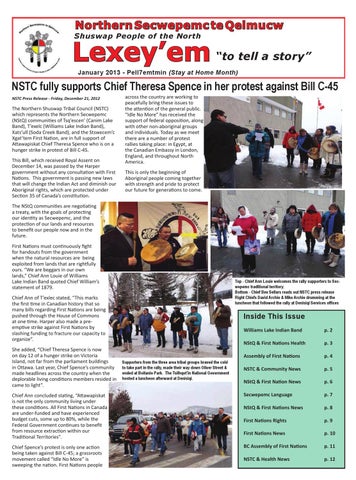
Top - Chief Ann Louie welcomes the rally supporters to Secwepemc traditional territory. Bottom - Chief Bev Sellars reads out NSTC press release Right Chiefs David Archie & Mike Archie drumming at the luncheon that followed the rally at Denisiqi Services offices
Chief Ann of T’exlec stated, “This marks the first time in Canadian history that so many bills regarding First Nations are being pushed through the House of Commons at one time. Harper also made a preemptive strike against First Nations by slashing funding to fracture our capacity to organize”.
Inside This Issue Williams Lake Indian Band
p. 2
NStQ & First Nations Health
p. 3
Assembly of First Nations
p. 4
NSTC & Community News
p. 5
NStQ & First Nation News
p. 6
Chief Ann concluded stating, “Attawapiskat is not the only community living under these conditions. All First Nations in Canada are under-funded and have experienced budget cuts, some up to 80%, while the Federal Government continues to benefit from resource extraction within our Traditional Territories”.
Secwepemc Language
p. 7
NStQ & First Nations News
p. 8
First Nations Rights
p. 9
First Nations News
p. 10
Chief Spence’s protest is only one action being taken against Bill C-45; a grassroots movement called “Idle No More” is sweeping the nation. First Nations people
BC Assembly of First Nations
p. 11
NSTC & Health News
p. 12
She added, “Chief Theresa Spence is now on day 12 of a hunger strike on Victoria Island, not far from the parliament buildings in Ottawa. Last year, Chief Spence’s community made headlines across the country when the deplorable living conditions members resided in came to light”.
Supporters from the three area tribal groups braved the cold to take part in the rally, made their way down Oliver Street & ended at Boitanio Park. The Tsilhqot’in National Government hosted a luncheon afterward at Denisiqi.
Principal Negotiator’s Report Williams Lake Indian Band
Pell7emtmin p.2
Chief Ann Welcomes ‘Idle No More’ Supporters - December 21, 2012
Weytk
Chief Ann Louie of Texelc aka Williams Lake Indian Band I want to welcome you all to our traditional territory. Home of the Secwepemc people. We are one of 17 Shuswap tribes and one of 5 northern tribes. Welcome to all other Chiefs councillors respected elders and youth and all who have gathered here today. Many of you are aware of the situation with Bill C-45 which is a bill that the Harper Government has passed without any consultation with First Nations. The
There is a huge movement occurring regarding our First Nations Peoples in attempt to bring these issues to the forefront of the Canadian Public. Her community is not the only community that have these conditions it is all First Nations in Canada who are underfunded and have their budgets cut while the Federal Government benefits from the resource extraction from our Traditional Territories.
First Nations must fight continually for handouts from this Government when the resources are rightfully ours. Many of our leaders state we are beggars in our own lands. You just have to review Chief Williams’s statement 1879 to see this has been going on for over a hundred years and nothing is changing for our people. He states ‘LAND LAND A LITTLE OF OUR OWN LAND THAT IS ALL WE
Harper government is passing new laws by changing the Indian Act and it is diminishing our Aboriginal rights which are protected under the constitution Sec 35.
ASK FROM HER Majesty. NOW WHAT I HAVE TO SAY IS THIS: THERE WILL BE TROUBLE SOON’.
Chief Theresa Spence is now in her 11th day of a hunger strike related to this issue.
He then stated, ‘A WAR WITH THE WHITE MAN WILL END IN OUR DESTRUCTION, BUT DEATH IN WAR IS NOT SO BAD AS DEATH BY STARVATION’.
She is the Chief of Attawapaskat whose community, many of you saw televised where many of her members reside in deplorable conditions including living in shacks and tents. I have been following this on APTN news and it was also on Global news.
This clearly tells me that we are still fighting the same fight and his words ARE NOW COMING TO FRUITION. I ask that all of you keep Chief Theresa Spence in your thoughts, hearts and prayers. She has children
First Nations speaking out as part of Idle No More Movement by Kirk Dressler
In recent weeks, First Nations have spoken out about the potential impacts of the proposed omnibus Bill C-45. The “Idle No More” movement has spread like wildfire through the country, fueled by rallies, teach-ins and social media like Twitter and Facebook. The movement demonstrates that First Nations are no long willing to sit idly by while their rights are eroded through legislative changes and shifts in government policy. The movement has gained strong support from non-First Nations groups, as well, who see First Nations as protectors of the land and water that can utilize their constitutionally protected rights to keep the government in check.
made a legitimate effort to communicate about the content of the bill or the impacts of the bill. Of greatest significance to First Nations are the changes to the Indian Act, the Navigation Protection Act (former Navigable Waters Protection Act), and the Environmental Assessment Act. Changes to the Indian Act will make it easier to surrender reserve lands. The Aboriginal Affairs minister can call a meeting to consider surrendering band territory. The minister can choose to ignore a Band Council Resolution from that’s in opposition to a decision at the meeting.
Where did the Idle No More movement start?
Fortunately for WLIB, it is making the transition out of the land provisions of the Indian Act and moving towards First Nations Lands Management.
The Idle No More movement started in October, in Saskatchewan, not long after Bill C-45 was introduced in the Ottawa. It was the brain child of four women --Jessica Gordon, Sheelah McLean, Sylvia McAdams and Nina Wilsonfeld. They decided to organize an event in Saskatoon, set for Nov. 10, and to help spread the word they turned to Facebook. They chose to call the event “Idle No More”.
Changes to the Navigation Protection Act will make it easier for major pipeline and power projects go ahead without serious scrutiny, and changes to the Environmental Assessment Act will reduce the number of projects subject to Environmental Assessment (the process where the greatest attention is given to the impacts of projects). These changes will have serious impacts on First Nations traditional territories.
A month later, there was a national day of action, and the movement exploded from there.
All of this is being done with minimal discussion or consultation with First Nations. The government has a legal obligation to act with great care and to have a detailed dialogue with First Nations where their action impacts Aboriginal rights. Despite this responsibility, the Harper government is choosing to trample on First Nations.
What is Bill C-45 and why should you be concerned?
Bill C-45 is what the government calls an “omnibus bill”. It proposes changes to a number of pieces of legislation, many of which have profound impacts on First Nations. The changes will have impacts on non-First Nations as well. The omnibus bill is confusing to read and understand, and the Harper government has not
So what is happening around the country?
Around the country there have been a series
of rallies and tech-ins to raise awareness about the issues and the possible impacts of Bill C-45. Attawapiskat Chief Theresa Spence is currently on a hunger strike to raise awareness. A rally took place in Williams Lake on December 21. First Nations are demanding that Prime Minister Harper meet with them to discuss the issues, and now an initial meeting took place January 11th. The movement demonstrates that First Nations have to remain ever vigilant to ensure their rights are respected and protected. We can’t assume the government is acting in our best interests, or that they are negotiating fairly or in good faith. For more information on this article, or other issues in your community, please contact the WLIB Treaty Dapartment.
The Lexey’em is brought to you by the Northern Shuswap Tribal Council and The Williams Lake Tribune Publisher: Lisa Bowering,The WLTribune Editor: Agness Jack, NSTC Advertising: The WL Tribune Lexey’em is an independent community newspaper, published monthly, by the Williams lake Tribune and the Northern Shuswap Tribal Council. The circulation is 500, and it is distributed to the NStQ members through the community treaty offices, to various businesses in Williams Lake and it is mailed out to the NStQ members throughout B.C. and North America. It is also available on the Northern Shuswap Tribal Council website at http://www.northernshuswaptribalcouncil.com/ & by e-mail to NStQ members. If you would like to receive the Lexey’em by e-mail please forward your e-mail information to a.jack@nstq.org.
NSt Q New s & Firs t Nati ons Hea lth
NStQ Survey Results
CopperMoon and NStQ launched a survey for members so we could understand how familiar NStQ members are with the treaty, the best way to communicate with members, and to learn more about the questions you have. The survey is now closed and we are very pleased with the results; we’ve had over 208 responses from you!
•
Survey Results:
•
• • • •
65% of respondents were female Average age is 40 years old 70% of respondents were community members 47% of respondents live on-reserve
•
•
•
We had a very good representation from all communities, with Canim Lake being the highest The top 3 values listed were: healthy children & families, meaningful education & employment, and protection of land & territory 38.5% are somewhat familiar with the Treaty, while 21% are very familiar The top 3 sources of receiving Treaty news is through: word of mouth, community meetings, and the Lexey’em newspaper For Treaty updates, most members
A joint statement from the First Nations Health Authority and First Nations Health Council January 21, 2013
To BC First Nations Leadership, Health Directors and Citizens, Recently the First Nations Health Authority (FNHA) was approached by the National Post with questions about how the FNHA is operated, how we use our funding and our state of preparation for the transfer of First Nations and Inuit Health-BC Region to the FNHA later this year. It is our understanding that these questions stem from an incorrect, outdated and incomplete Health Canada financial report. The document raises issues and questions which have since been resolved to the satisfaction of all parties. Unfortunately, we believe this is an effort to upset the final federal approval process in this historic transfer of health services. As you know, we have been working for a number of years to build governance capacity, to ready our communities and structure the FNHA to meet the needs of BC First Nations people. Much work has been done and we continue to make significant progress. You, our constituents, require the FNHA to implement a high level of openness, transparency and accountability. We continue to take direction from BC First Nations in the form of the seven directives, approved in 2011. The FNHA prides itself on our ability to meet our obligations to Canada and BC through the various funding arrangements in addition to advancing the work of implementing the Tripartite First Nations Health Plan. The FNHA has registered clean audits year over year. In addition, the clean reporting record of the FNHA and our ability to meet the extensive reporting requirements of Tripartite Framework Agreement on First Nations Health speaks for itself. We will continue to move this work forward and the tripartite partners are standing firmly in support of one another on this – there
has been no mismanagement of funds, our innovative work has shown many results, and will proceed.
It is disappointing to have the work that we have done with thousands of First Nations people across our province put into question, but we remain committed to openness, transparency and accountability, and we will openly address any questions or concerns that are raised. We stand behind all our achievements to date and we continue to prepare for the October 2013 full transfer of responsibilities for First Nations Health to the FNHA. We will continue to keep you informed and of course, encourage you to please contact us with any questions you may have. Sincerely, Lydia Hwitsum , Chair, First Nations Health Authority Grand Chief Doug Kelly, Chair, First Nations Health Council Davis Mckenzie, Director, Communications and Public Relations
January 2013
p.3
preferred emails, followed by the Lexey’em newspaper, followed by community meetings We will take the valuable feedback we’ve received through this member survey and integrate it into our communications work ahead to ensure NStQ members have all of their questions answered and their concerns addressed. We have already held one round of NStQ Urban meetings, and dates for the second round are:
• • • • •
Prince George, February 27 Kamloops, March 4 Kelowna, March 5 Abbotsford, March 6 Vancouver, March 7
Contact NSTC at 1-888-392-7361 or your community Treaty Department for the locations. Meeting times for all of the above schedule Urban Meetings will be 5 - 8:30 p.m., and will start with a supper., followed by presentations on where we are at in the treaty process and the floor will be open for questions from the membership.
The online version of the survey results can be found here: www.nstqsurvey.com
NStQ Citizen Data Base The NStQ Citizen Data Base is up & running. The NSTC needs your current information. To have your information included, s ee the ‘contact’ person for your community. Northern Shuswap Tribal Council Dave Feil Contact person Ph: 250-392-7361, Ext, 206 Fax: 250-392-6158 Canim Lake (Tsq’escen’) Jesse Archie Ph: 250-397-2227 Fax: 250-397-2769 E-mail: eas@canimlakeband.com Stswecem’c Xat’tem First Nation Loni Fastlin Ph: 250-440-5645 Fax: 250-440-5679 E-mail: socdev@canoecreekband.ca
1205-100 Park Royal South | West Vancouver, BC | V7T 1A2 Phone: 604.913.2080 ext. 243 | Fax: 604.913.2081 Email: dmckenzie@fnhc.ca |
Soda Creek (Xats’ull) Roxanne Stobie Ph: 250-989-2323 Fax: 250-989-2300 E-mail: r.stobie@xatsull.com Williams Lake (T’exelc) Shawna Philbrick Ph: 250-296-3507 Fax: 250-296-4750 E-mail: shawa philbrick@williamslakeband.ca The Citizen Data Base will assist in areas such as planning for funding needs for Citizen training & education programs.
Assembly of First Nations
Message from the AFN National Chief - Shawn A-in-chut Atleo January 14, 2013 First Nations citizens have just witnessed one of the most important chapters in our recent history. Through the pressure of the grassroots, the sacrifices made by Chief Spence and her fellow strikers, and the work of many regional Chiefs and the National Executive of the AFN, we have seized the attention of Canadians and of this government. We forced open the door to the PMO and to the Governor-General. We achieved a commitment to the personal leadership of the Prime Minister, the Privy Council Office and other senior ministers. Now they know that the whole world is watching what progress we make. Now they understand the consequences of failure. We have a responsibility to work together to push forward our work that relates to each of the eight elements that emerged from our discussions this week – on Treaty, on comprehensive claims, resource revenue sharing, action to assess and halt provisions of legislation that contravene our rights, on the urgent needs of our communities and justice for our missing women. We have leaders in place to ensure that detailed work gets done. And now we have the public commitment of this government and this Prime Minister that they will treat these issues as their priorities. I am proud of the support we received from First Nations citizens and Chiefs across Canada, even during the most difficult days. There were many long conference calls, late night meetings, and frustrations in the past two weeks. I regret to have to tell you that those long days have caught up with me. This weekend, my doctor ordered that I take some time now to rest and recover and I have agreed with my family that I do this now. I ask that Regional Chief Augustine continue to chair and facilitate our National Executive meetings in my brief absence and that Regional Chief Bellegarde and Regional Chief Wilson- Raybould continue the work that they led this week on Treaty implementation and on comprehensive Unbelievable Passenger Tire Prices All Your Tire & Mechanical Needs
claims. As we did in the meeting on January 11 – we must seize the agenda and drive the next steps on each and every element. I encourage everyone to contribute fully to these next steps. I have also directed the senior staff of the Assembly of First Nations to mobilize staff working teams on these elements to provide the analysis and support required. Finally as we have done from the very beginning, we continue to offer our support and prayers for Chief Spence, the hunger strikers and for all of our peoples standing up through peaceful demonstrations and protest. As we told the Prime Ministers – our voices, the voices of all of our citizens will not be silenced. We will drive change now. Friends and colleagues, this has been a fateful moment in the decades of struggle by our peoples. We have secured important new ground. Now the harder, but less visible, work of turning promises into action begins. I look forward to working with all of you on those tasks in the weeks and months ahead. Together I am confident we ensure that this week marks the end of a long bitter chapter of paralysis and provocation in our relationship with the GoC, and that it truly is the beginning of a new chapter. I will see you all very soon and will return re-invigorated and strengthened to work with you to drive this change together with all of you. Kleco Kleco
Behind the 150 Husky Centre
p.4
“There’s a great little business I’d love to buy. But How?” If you’re interested in buying a successful business, come see us at Community Futures. We’ve got a lineup of services for the entrepreneur who sees opportunity waiting.
2 2 col Ads
250-392-3626 • 266 Oliver Street, Williams Lake www.cfdccariboo.com
Contractors, Forestry, Liability, Equipment, Silviculture & Ranch Insurance
Agencies Group CUSTOMER SERVICE FIRST
& FOREMOST!
Ph: 250-398-9033 • Toll Free:1-888-696-1855 Fax: 250-398-9063 • williamslake@jmins.com 180C North 3rd Avenue, Williams Lake Northern Secwepemc te Qelmucw
Northern Shuswap Tribal Council
17 South First Avenue, Williams Lake BC V2G 1H4 Ph: 250-392-7361 Toll free: 1-888-392-7361 Fax: 250-392-6158
Executive Director - Yvonne Smith Treaty Team Coordinator - Allan Tweedie Executive Assistant - Frieda Belleau Consultation, Accommodation & Reconciliation Coordinator–Vacant Communications Coordinator - vacant Communications Assistant - Agness Jack
Stswecem’c/Xat’tem First Nation (formerly Canoe Creek
Band)
General Delivery, Dog Creek BC, VOL 1J0 Ph: 250-440-5649 Toll free: 1-888-220-4220 Fax: 250-440-5672 Treaty Manager - Ernest Kroeker Governance - Allan Adams Treaty Assistant/Comm. - Rick Archie
Shawn A-in-chut Atleo
Tsq’esecn’ (Canim Lake Band) PO Box 1030, 100 Mile House BC VOK 2E0 Ph; 250-397-2002 Toll free: 1866-797-2277 Fax: 250-397-2769
National Chief ASSEMBLY OF FIRST NATIONS 473 Albert Street, Suite 900, Ottawa, ON K1R 5B4 Telephone: (613) 241-6789 Toll-free: 1-866-869-6789 Fax: (613) 241-5808 | www.afn.ca
2 - 2 col Ads 250-296-4116
Pell7emtmin
1
COUPON
$ 00
OFF
Car/Truck Wash (Timed Wash Only) Limit 1 per customer
Blacky’s Truck & Car Wash 1130 Boundary Street • 250-398-8274
Treaty Manager - Elizabeth Pete Governance - Helen Henderson Treaty Assistant - Melody Henderson Mapping Tech/Communications - Irene Gilbert
Xat’sull/Cmetem’ (Soda Indian Band) 3405 Mountain House Road, Williams Lake BC V2G 5L5 Ph: 250-989-2323 Fax: 250-989-2300 Treaty Manager- Gord Keener Governance - Cliff Thorstenson Treaty Assistant -Kellie Louie
T’exelc (Williams Lake Indian Band) 2672 Indian Drive Williams Lake BC V2G 5K9 Ph: 250-296-3507 Toll free: 1-877-856-3507 Fax: 250-296-4750 Treaty Manager - Chris Wycotte Governance - Charlotte Gilbert Communications - Kirk Dressler Treaty Assistant - Judy Boston
NSTC & First Nations
January 2013
Amnesty International Canada - BC events
p.5
Courses offered in Partnership
January 29 (Victoria)
Public lecture. Indigenous rights are human rights: the
importance of international law for land, water & the future of Indigenous peoples. An evening of dialogue with Robert Morales, lead
negotiator Hul’qumi’num Treaty Group, Paul Joffe & Jennifer Preston, coeditors Realizing the UN Declaration on the Rights of Indigenous Peoples: Triumph, Hope and Action. Moderator: Craig Benjamin, Campaigner for the Human Rights of Indigenous Peoples, Amnesty International. An unprecedented push to further intensify resource development in Canada. A federal legislative agenda to undermine environmental oversight. And an extraordinary grassroots resurgence of demands for recognition of the rights of Indigenous peoples. This panel brings together experts and activists who have been deeply involved in the advancement of global recognition of the human rights of Indigenous peoples at the United Nations and the Inter-American system. They will lead a discussion of how these vital international standards can make a difference in the defense of Indigenous rights in Canada and the promotion of government accountability for environmental protection. 7 pm. Cadboro Bay United Church, 2625 Arbutus Rd, Victoria. Sponsors: Aboriginal Neighbours, Amnesty International, Sierra Club BC, Canadian Friends Service Committee(Quakers), Hul’qumi’num Treaty Group.
University College Entrance Prep Courses
YMCR 5140-Microsoft Office Excel- Spreadsheets on the Microcomputer
This course will teach you how to create and format spreadsheets so you can analyze and share information. Basic spreadsheet concepts such as file management, sorting, columns and rows, ranges, moving and copying data, formatting worksheets. Introduction to Excel functions, and formulas, referencing and absolutes, charts, using Excel 2010. Dates: January 15- February 19th Instructor: Leona Lang
Tuesdays and Wednesdays 3:30 pm – 6:30 pm Place: Room 1291 TRU
This course can be used as credit towards the TRU Microcomputer Certificate Program.
_______________________________________________________________________
YMCR 6150-Microsoft Office-PowerPoint-Professional Presentations
This course will teach you how to present meaningful, memorable and captivating information. You will gain skills and techniques required using Microsoft Power Point program. Business presentations, and teaching presentations, slides for meetings are just a few of the possible applications. Power Point has consistency is color, design, layout, and templates that help to present creatively and effectively. Dates: February 26-March 27th Instructor: Leona Lang
Tuesdays and Wednesdays 3:30 pm -6:30 pm Place: Room 1291 at TRU
This course can be used as credit towards the TRU Microcomputer Certificate Program.
_____________________________________________________________________
NAST 600- First Nations Studies
January 30 (Vancouver) Public lecture. Indigenous rights are human rights: the
importance of international law for land, water and the future of Indigenous peoples. An evening of dialogue with Grand
Chief Stewart Phillip, Union of BC Indian Chiefs Chief Doug White, Snuneymuxw First Nation, Ann Marie Sam, Nak’azdli First Nation, First Nations Women Advocating Responsible Mining (FNWARM) Paul Joffe & Jennifer Preston, co-editors Realizing the UN Declaration on the Rights of Indigenous Peoples: Triumph, Hope and Action. Other panelists to be confirmed. Moderator: Craig Benjamin, Campaigner for the Human Rights of Indigenous Peoples, Amnesty International. An unprecedented push to further intensify resource development in Canada. A federal legislative agenda to undermine environmental oversight. And an extraordinary grassroots resurgence of demands for recognition of the rights of Indigenous peoples. This panel brings together experts and activists who have been deeply involved in the advancement of global recognition of the human rights of Indigenous peoples at the United Nations and the Inter-American system. They will lead a discussion of how these vital international standards can make a difference in the defense of Indigenous rights in Canada and the promotion of government accountability for environmental protection. 7 pm, Lecture hall room
112, Vancouver Community College, 250 West Pender Street. Everyone welcome, no charge for admission. http://www.facebook.
com/events/390788727679523/?context=create Don Wright Regional Activism Coordinator,
An Overview of Major Issues in First Nations Studies (6,0,0) 4 credits ABE – Provincial: This course provides students an opportunity to explore issues related to the role of elders, women, and leaders in matters pertaining to health, education, justice, and economic development. Topics for research will be generated after an introduction to general literature in the field. Time: to be announced (TBA) Instructor: TBA
Dates: January-April 2013
Prerequisite: ENGL 0500 or equivalent **May be Ancillary fees and textbook fees for this course payable to TRU.
**Tuition Free (Priority will be given to NSTQ members) Students may register at TRU. Call 250-392-8000 (registrations) for more information. Or Contact: Cindy -NSTC-Skills Development Coordinator Phone: 250-392-7361 Ext. 221 Email: c.charleyboy@nstq.org *Priority will be given to NSTQ membership-Please Call for more Information
Information Session When: Wednesday, February 6, 2013 Time: 12:00 to 2:00 pm Location: House of Learning, Thompson Rivers University, Kamloops, Room 150 LUNCH WILL BE PROVIDED!!
Amnesty International Canada - Vancouver Office, 430-319 West Pender Street, Vancouver, BC, V6B-1T3 p: 604-294-5160 ext 101
Northern Shuswap Tribal Council
e: dwright@amnesty.ca
Amnesty’s life-saving human rights work is independent. We accept no government money. We are funded by people like you. Please donate today. www.amnesty.ca
There is a shortage of Aboriginal teachers in BC. NITEP is designed to meet these needs. The intention of the NITEPprogram is to build upon and strengthen the cultural heritage and identity of the professionals in training. Using these strengths as a base, students develop the skills and academic knowledge expected of beginning educators. If you are interesting in becoming an Aboriginal Educator, please join us for this information session. RSVP to: Larissa Blank at 250.828.5227 or Karen Blain at 250.371.5699 or email: lblank@tru.ca or karen.blain@ubc. ca
NSTC & Community News
Pell7emtmin
p.6
Pink Shirt ‘anti-bullying’ Day February 27th 2013 Submitted by Sarah Hood, NSTC Aboriginal Victim Services
With the 6th Annual Pink Shirt Day fast approaching we would like to invite you to participate in anti-bullying awareness, and to show support against bullying by wearing a pink shirt on February 27th 2013. The origin of Pink Shirt Day is an inspiring story that everyone should become familiar with, as it shows how one act of kindness can create ripples across Canada to take a stand and make the world a better place.
Nations Summit meeting held in Vancouver. This act did not go un-noticed as a number of peers approached and acknowledged Leadership for their recognition of Pink Shirt Day and to help take a stand against Bullying. The Northern Shuswap Tribal Council staff proudly wears Pink Shirts on this day to support the stand against bullying while promoting our culture, as the shirts that the NSTC had prepared for this event say “Don’t be a bully” as well as “Ts’nikwtcwey’e” which is a Shuswap translation derived compliments of Amy Sandy and Cecelia Derose. With respect and appreciation to the youth that had inspired Pink Shirt Day as an annual event across Canada, please join us in showing support on February 27th 2013 by wearing a pink shirt and taking a stand against bullying.
With bullying in schools, work places, homes and over the internet on the rise, two Students at a Nova Scotia High School took a stand against bullying. David Shepherd and Travis Price as well as their high school friends arranged a protest to wear pink in sympathy of a grade 9 boy who was being bullied (for wearing a pink shirt).
Figure 1 Chief Ann Louie shows her support at the First Nations Leadership Summit 2012
In protest against the harassment of this student David and Travis had purchased 50 pink tank tops, then distributed them to all of the boys in their high school to wear. The message was heard, and the bullies were never heard from again.
Figure 2- Dave Feil-Technology Training Coordinator, Yvonne Smith- Executive Director, Chief Bev Sellars, Fisheries and Natural Resource Department Head-Gord Sterritt show their support
February 29th 2012 members of Board of Directors showed their support by wearing a pink shirt for the duration of the day as they participated in the First
Soda Creek Indian Band Employment Opportunity Job Title: Band Administrator Job Summary: The Band Administrator is responsible for the successful leadership and general management of the organization according to the vision, objectives, and strategic direction set in conjunction with the governing body. The Band Administrator is responsible for the efficient management of all programs and departments, setting goals and measuring the achievement of the organization’s objectives by leading the community’s governing body as a skilled administrator who is a positive role model. This role focuses on establishing effective working relationships with community groups, funding agencies and other external contacts, the efficient financial responsibilities of the organization, economic development, treaty negotiation and other improvements for the organization. Education and Experience: • Diploma in Business or a related field • Five to seven years of progressively responsible program management experience preferably in the community social service sector or with First Nations groups • Experience supervising and managing staff as well as developing and managing budgets • Knowledge of legislation on Labour Code, Occupational Health and Safety, Privacy & Human Rights • Knowledge of financial and reporting requirements for AANDC • Knowledge and experience in human resources and financial management, governance procedures, and the treaty process Skills and Abilities: • Ability to work independently and build effective interpersonal relationships • Ability to work collaboratively with the leadership team in the establishing of goals, and preparation of budgets and funding proposals • Ability to self-regulate, meet deadlines, have attention to detail • Recognizes and respects all cultural diversity and has an understanding of Aboriginal culture Type of Employment: 35 hours per week, subject to 90-day probation – full benefit package after completed probationary period. Working Conditions: • Must be able to obtain and maintain a Criminal Records Check • Must be able to obtain and maintain a valid BC Driver’s License • Must provide a vehicle in good operating condition and appropriate vehicle insurance to meet program requirements Salary: As per company salary grid, this position is Pay Grade 8
The Northern Shuswap Tribal Council supports Pink Shirt Day
For a complete job description and application package contact: Roxanne Stobie, Office Manager r.stobie@xatsull.com Soda Creek Indian Band 3405 Mountain House Road Williams Lake, BC V2G 5L5 (250) 989-2323 FAX (250) 989-2300 Applications will be accepted by email, hand delivery, fax, or by post. Please provide a cover letter with salary expectations and availability. Application Deadline: Feb 22, 2013. 4:00 PM **NOTE** Applications received after 4:00 PM on Feb 22, 2013 will not be considered. Only those selected for an interview will be contacted. Previous Applicants need not apply. Preference will be given to persons of Aboriginal ancestry as per Section 16(1) of the Canadian Human Rights Act.
Secwepemc Language
January 2013
p.7
Secwepemc Cultural Education Society -
The game of saving a language By Tim Petruk - Kamloops This Week December 03, 2012
“It’s a very complex language. It was used for thousands of years here before contact.”
Isn’t it always the case with technology?
Manuel said many native languages — Secwepemc included — died or came close as a result of the Canadian residentialschool system, which officially ended in the 1990s.
You buy the latest iPad, BlackBerry or laptop, only to find it’s outdated before you’ve taken it out of the box. That’s what happened to the Secwepemc Cultural and Education Society (SCES) with its latest high-tech attempt at saving a dying language. But, a replacement is almost ready to go. The SCES secured a $25,000 grant to have language-learning software built for the Nintendo DSi — a fancy new-school Game Boy. Think of it as digital flash cards, with each card showing a picture and its meaning in written and audible Secwepemc form. It took a year to complete and now it’s done — but, the society’s work is not. “The Nintendo [software] is great,” said Kathy Manuel, language co-ordinator with the SCES. “But, the way technology moves, there’s always something bigger or better.” And, because the Nintendo software was the society’s first stab at creating high-tech, interactive Secwepemc-language learning tools, there were also a few snags. For one, Manuel said, the software’s volume is too low, which means students — mostly between three and 10 years of age — wear earbuds to get the full effect. That has been frowned on by educators and day-care operators. Now, with digital archives of the Secwepemc language already put together, Manuel said the SCES is developing an iPad app that will replace the brand-new Nintendo software. She expects the app to be complete — and ready for download — by Christmas. Manuel said the preservation and growth of the Secwepemc language is critical for local First Nations. There are believed to be just 150 speakers of the language alive today, located across the vast Secwepemc traditional territory ranging from the Kootenays to Williams Lake. According to Manuel, there are about five people in Kamloops who can speak Secwepemc. “And, they’re all elders,” she said, emphasizing the need to teach the language to youngsters.
“They were beaten and had their mouth washed out for speaking their language,” she said. “It was literally beaten out of them. We had generations there that didn’t learn the language because of that.” According to Manuel, the Secwepemc language didn’t even include written text until the 1970s. For millennia until then, it had been solely oral. Now, it’s going to be available for download in the App Store. It’s quite the change, Manuel said, but a necessary step to get to today’s youth. “From zero to six is the critical years,” she said. “Those kids are like sponges. And, I’ve heard of three- or four-year-olds using iPads. “We can’t wait until they’re 12 or 20 years old.” Manuel said the iPad app will also be an improvement on the Nintendo software because of the broader accessibility. A lot of people have iPads, or at least have access to them, she said, while Nintendo DSis are harder to find and equally expensive.
Kathy Manuel, SCES’s language coordinator, displays a new video game for the Nintendo DSi that will help children learn the Secwepemc language ANDREA KLASSEN/KTW
Attention: All First Nations Chiefs & Grand Chiefs
Re: Status of Hunger Strike and National Leadership Situation Victoria Island, Ottawa, January 15, 2013 Today marks the 36th day of my hunger strike, 35th day for Raymond Robinson of Manitoba and yesterday Jean Sock from New Brunswick was his 28th day and his last. With this letter, I want to make it clear once again the purpose of our hunger strike. As I stated from the beginning, something had to be done to bring our Nations immediate needs, treaty implementation issues among many other issues to the brought attention of the PM along with the Crown in meeting on Nation to Nation basis at the earliest time possible. We had a plan, we need now to refocus and stick to the original plan. This is our best chance to settle the struggles our Nations have had to endure for far too long.
This jump into cyberspace could be the start of a linguistic rejuvenation, Manuel said. “That would be nice,” she said. “But, we need TV shows in the language, radio shows in the language, games in the language — because they [children] are just inundated with English all the time.”
What we endured here at the island is a small price to pay compared to what our ancestors endured. This was our way to pay tribute to our ancestors who have forgone some of the harshest periods in our history, to honor those among our Nations who continue to struggle for the basic standard of living to this day, as well as to raise new hope among our youth and to protect our future generations.
The Secwepemc language is taking a big step forward in January, when Thompson Rivers University is slated to begin its first course teaching the dialect. University staff are in the process of hiring an instructor to teach FNLG 100 — Introduction to the Secwepemc Language.
We thank you for the support and prayers from all of you, from our grassroots, Elders, women and particularly the youth brought us comfort and assurance that we are all in this together.
“We’re really looking forward to it,” Manuel said. “Right now, it’s just a specialty course, but we’re hoping they accept it as an elective. It’s a credited course, but it doesn’t belong in any of the programs.” Manuel said the Secwepemc iPad app will be free for download once it’s completed, likely before the end of the month.
We have all been part of something historic which brought us a sense of pride; our people have come together in solidarity for a common cause. The citizens of this country have also taken notice and we have their attention. Soon the rest of the world must to be informed and this Government along with the Crown must accept that the only way forward in this country is a renewed relationship with First Nations, May the Creator guide us through the challenges up ahead.
Gichi Meegwetch, Chief Theresa Spence, Attawapiskat First Nation Cc: Shawn Atleo, AFN National Chief & All AFN Regional Chiefs [ Note: this is an excerpt from a letter to our leadership]
NStQ & First Nations News NStQ Citizen’s Forum April 10 & 11, 2013 Hosts: Soda Creek Band Location: Elks Hall, Williams Lake, B.C. Agenda and Guests Speakers to be confirmed.
Lunch provided both days There will be Door Prizes! ALL NStQ Citizens are invited to attend Note: Honouraria ONLY for Elders
More info in next month’s Lexey’em Contact Kellie Louie, Soda Creek Treaty at (250) 989-2323 or NSTC Treaty Department @ 1-888-392-7361
First Nations don’t want to be wards of the state Michael LeBourdais
The Globe and Mail, January 8, 2013 (TteS Weekly)
I am the chief of the Whispering Pines/ Clinton Indian Band. Our reserves are located near Kamloops and Clinton, B.C., and our community strongly supports the proposal for First Nation property ownership legislation, a position which some in the Idle No More movement have criticized. Since Confederation, Canada has faced two principle challenges as a nation – finding a place in the federation for Quebec and finding a place for us, the original inhabitants. Others can speak about the success of Quebec within Canada, but I think I can illustrate the failure to bring us fully into the federation. When my grandfather met the woman who would become my grandmother and asked her to marry him, she agreed on one condition – he had to build her a home. My grandfather was a hard working rancher, just like his son and just like me. He built her that home and they got married. They had a large family. My grandfather built two more homes on reserves for his children. He owned three houses outright and ran a farm and orchard on his land near Lillooet.
My father later inherited one ranch from his father. He owned a house and built another. But when he went into a bank in the 1980s and applied for a credit card (so he could rent a car and reserve a hotel, like any other Canadian), he was turned down, because, he was told, he didn’t have any collateral. His two houses and his ranch were insufficient collateral because of the provisions in the Indian Act which state an Indian reserve is “a tract of land, the legal title to which is vested in Her Majesty”. We don’t even own our own lands. Not owning our land has been an economic
3 - 2 col Ads 250-398-8177 366 Yorston Street
p.8
Dear Canada:
As it turned out, none of these houses had any value other than to keep the weather off our backs.
“Dedicated to providing fast, courteous & informative prescription service”
Pell7emtmin
Lo’s Florist
124B North 2nd Avenue Williams Lake, BC V2G 1Z6 Ph: 250-392-4633 Fax: 250-392-5420 Toll Free: 1-877-588-4633 Tammy French & Wendy McPhee www.losflorist.com
catastrophe. We have little of the equity in our homes that is needed to build wealth, gain access to credit and start businesses. We don’t have wealth to bequeath to the next generation so it can do better than us. We need the Minister of Aboriginal Affairs and our band government to guarantee our mortgages. We don’t want to be wards of the state. Dependency is not our way. More than 60 per cent of my community’s population is younger than 30. I am proud that many of our young adults are educated and employed. They want to stay, live and prosper in our community. The proposed property ownership legislation is both First Nation-led and optional. It will give us hope that we can own our lands collectively and exercise our jurisdictions forever. We can provide ownership to our members so their lands and homes are as valuable as any other in the region. We can register our title in a modern system instead of the costly and unreliable deeds system we currently have. Property rights will provide a cost-effective method to provide opportunity and increased wealth for my members, give them access to capital and reduce poverty. At a time of government fiscal restraint – and little prospect of constitutional change – this is an option that should be available to interested First Nations. After 140 years of the Indian Act, we are ready to take on this responsibility. We will work with our First Nation institutions to provide government that raises and maintains property values, builds equity in our homes and creates strong self-sufficient communities. I am confident that, with legislation affirming our jurisdiction, our land will forever remain ours, just like Ontario remains Ontario even if I, a resident of British Columbia, buy land there. I am not talking about granting us special rights. We want the same property rights that all other Canadians take for granted. We want ownership of our lands and recognition of our governments. After 140 years, we want to be a true partner in the Canadian federation. Michael LeBourdais is chief of the Whispering Pines/Clinton Indian Band
RANCHING RODEO HISTORY BC COWBOY HALL OF FAME History of Williams Lake
Museum of the Cariboo Chilcotin
Open Year Round
Monday to Saturday 10 am - 4 pm
250-392-7404
Located downtown Williams Lake Web: cowboy-museum.com At the corner of 4th & Borland Email: mccwl@uniserve.com
First Nation Rights
Pell7emtmin
p.9
Six landmark rulings on Native rights in Canada
Court cases that helped define land, treaty and human rights for Aboriginals CBC News , Jan 8, 2013 Today’s Federal Court decision recognizing Métis and non-status Indians as Indians under Section 91(24) of the Constitution Act is just one of several landmark court decisions over the years that have helped define and shape Aboriginal rights in Canada. Below is a selection of some key court rulings. Calder et al. v. B.C. attorney general (1973) — The split Supreme Court of Canada decision in this case opened the door to negotiations between the government and First Nations to establish rights to land and resources and launched the land claims process that continues to this day. B.C. cabinet minister and Nisga’a chief Frank Arthur Calder, the first status Indian to be elected to a Canadian legislature, and the Nisga’a tribal council took the B.C. government to court, arguing that Aboriginal title to about 2,600 square kms of Nisga’a land in and around the Nass River Valley in northwestern B.C. had never been extinguished. Although the court ultimately ruled against the Nisga’a, the decision was the first time the courts acknowledged Aboriginal title to land existed prior to colonization and the Royal Proclamation of 1763. The judges could not agree, on whether that title extended to the modern day, with three of them saying it did and three arguing the title was extinguished when the laws of the B.C. colonial government took effect. A seventh judge ruled against the Nisga’a on a technicality, but the case laid the groundwork for the adoption of the groundbreaking Nisga’a Treay in 2000, the first contemporary land claims agreement in B.C., and other land agreements. R. v. Sparrow (1990) — This case is considered the first Supreme Court test of the scope of Section 35(1) of the Constitution Act, 1982, which recognizes and affirms the “existing Aboriginal and treaty rights” of Aboriginal people in Canada and has been at the centre of many court battles over land and resource rights. In its decision, the court for the first time set out criteria for deciding whether a right can be considered to be an “existing” right and whether the gov’t is justified in curtailing such a right. The case stems from the 1984 arrest of Ronald Edward Sparrow, Musqueam band member in B.C., who was charged with violating fisheries regulations when he used a net longer than his fishing licence allowed. Sparrow argued his right to fish with the net was an existing Aboriginal right protected by the Constitution Act- Sec. 35 (1). The court agreed but stipulated the right is not absolute and can be, in certain circumstances, infringed upon.
Delgamuukw v. British Columbia (1997) — Although the Supreme Court of Canada never ruled on the question at the heart of this case, the statements it made about Aboriginal land title were precedent setting for future land rights cases and the land claims process. The court confirmed Aboriginal title entails rights to the land itself, not just the right to extract resources from it. The court also ruled the gov’t has a duty to consult with First Nations on issues concerning Crown land and in some instances may have to compensate them for infringing on their rights to that land. The case launched by Chief Earl Muldoe, known as Delgamuukw, and other hereditary chiefs of the Gitxsan and Wet’suwet’en First Nations in B.C., took the BC gov’t to court in an effort to establish ownership and jurisdiction over 58,000 square kms of territory in the Skeena watershed in northwestern B.C. The Supreme Court did not rule on the question of ownership, saying the issue had to be decided at a new trial, but gave a detailed interpretation of what constitutes Aboriginal title, laying out guidelines for how the issue should be approached in future disputes. R. v. Marshall (1999) — This court battle over fishing rights in Nova Scotia inflamed tensions between Aboriginal and non-native fishermen in the Maritimes and Quebec. Donald Marshall Jr., a Mi’kmaq man from Nova Scotia who decades earlier had been wrongfully convicted — and ultimately acquitted, had been charged with fishing eels out of season, fishing without a licence and fishing with an illegal net but argued Aboriginal rights stemming from 18th-century treaties with the British Crown exempted him from fisheries regulations. After the Supreme Court ruled in his favour, upholding the Mi’kmaq and Maliseet people’s rights to earn a “moderate livelihood” from commercial fishing and hunting, native lobster fishermen interpreted the ruling as granting them rights to catch lobster out of season and clashed with their non-native counterparts, who feared lobster stocks would be jeopardized. The court was forced to issue a clarification of its ruling, which underlined the ruling applied to fisheries only and not to all natural resources and that the gov’t could restrict Aboriginal fishing rights in the interests of conservation. The ruling was considered a key test of native fishing rights and sparked debate over what should and shouldn’t be considered “traditional’ use of natural resources. Corbiere v. Canada (1999) — John Corbiere and other members of the Batchewana band near Sault St. Marie, Ont., took their band and the federal Ministry of Indian and Northern Affairs to court challenging the Indian Act provision
that denied band members who lived off reserve the right to vote in band elections. They argued that Sec. 77(1) of the Act violated the equality provision of the Charter of Rights and Freedoms. The Supreme Court of Canada agreed, declaring the part of the Act that required electors to be band members “ordinarily resident on the reserve” unconstitutional. The decision led to the changing of the Act, which now defines an elector as someone who is at least 18 and a registered member of the band, and impacted the way some bands formulated their own rules governing membership. McIvor v. Canada (2009) — This B.C. Court of Appeal decision forced the federal gov’t to amend the Indian Act to eliminate discrimination against the wives and children of non-status Indians. The case was launched by Sharon McIvor, a B.C. Aboriginal woman who had married a non-status Indian, and her son, who was married to a non-Indian and could not legally pass on Indian status to his children. McIvor and her son, Charles Grismer, launched a Charter challenge alleging that Sec. 6 of the Indian Act violated the right to gender equality under Sect. 15 of the Charter of Rights and Freedoms. Prior to 1985, Aboriginal women who married a non-status Indian lost their status while men who married non-status women remained status Indians and could confer this status onto their wives and children. The court found a 1985 amendment to the Indian Act eliminated this provision but left in place provisions that still discriminated against some children of nonstatus Indians by conferring status to those whose Indian grandparent was a man but not to those whose Indian grandparent was a woman. The appeal court ruled in the plaintiffs’ favour and ordered the gov’t to amend the legislation within a year.
! - 2 col Ad www.treadpro.ca Sugar Cane Treadpro Willie Sure, Manager P: 250.296.4453 F: 250.296.4473
2579 Cariboo HWY 97 S Williams Lake
First Nations News
January 2013
p.10
The true scandal of First Nations’ funding -- not the Deloitte and Touche version! JANuARY 9, 2013
of FN funding and services throughout Canada gets zero coverage.
It’s sad to report, but the strategic leak of the Deloitte & Touche (Deloitte) Attawapiskat Band audit seems to have had its desired impact.
Sadly, it seems the best way to get the mainstream media’s attention is to make them believe you’ve given them some kind of “scoop.”.
The leak tarnished the reputation of a woman who has only been Chief since 2010, the audit goes back to 2005, and it significantly distracted national attention from the issues at stake.
However, the only way to make sense of the Attawapiskat audit is to read it in the context of what Fraser says about the whole system.
BY KARL NERENBERG - RABBLE.CA
For example, a friend of mine -- who may not follow these matters as closely as some -- asked if the dressing down Deloitte gave Spence means she might actually be going to jail. It might sound like an naïve question -- but you have to remember that most Canadians are preoccupied with their own lives. And so, if you tell them a lurid story of what seems like improper handling of millions of (taxpayers) dollars, with no context and no background, they’ll naturally be impressed. Of the 409 transactions that Deloitte said lacked proper documentation, only about 30 were conducted on Spence’s watch, nothing approaching any sort of scandal, let alone crime! Sheila Fraser found a true scandal- But that’s not the real point. The real point is the way in which the system for providing First Nations (FN) services is fundamentally flawed. When she was Auditor General (AG), Fraser repeatedly warned the management and funding system the Government imposes on FN would almost inevitably lead to problems of the sort Deloitte identified in Attawapiskat. Fraser’s most recent damning report on the entire system came out in June of 2011. It got some scattered media attention at the time, but was generally treated as “same old, same old” -- not as the unmitigated scandal Fraser evidently thought it was. In the fall of 2011, when Aboriginal Affairs officials went before the Commons Public Accounts Committee to answer to Fraser’s charges, no media -- except for rabble.ca -thought that worthy of any coverage. A leaked auditor’s letter to Chief Spence -- dated last August and lacking any specific detail -- gets breathless “CBC has obtained a copy” coverage. A departmental response to a thorough critique
Here are some of the former AG’s key points. What’s wrong with ‘contribution agreements?’To start with, Sheila Fraser explains that the federal government uses those strange beasts called “contribution agreements” (CAs) to fund the delivery of services on FN reserves, and then she bluntly states: “We see several problems with the use of this funding mechanism for the provision of core government services.” The first is the lack of targets or expected outcomes, a basic feature of all sound administration. “While the agreements state the services or actions to be provided, they do not always focus on service standards or results to be achieved.” Then, there is the issue of gaps in funding, gaps which force FN to scramble and improvise. “Most CAs are renewed yearly ... we found the funds may not be available until several months into the period to be funded ... Consequently, FN must often reallocate funds from elsewhere to continue meeting community service needs.” Fraser noted the CAs do not define who is responsible for what: “The use of CAs between the federal gov’t and FN may also inhibit appropriate accountability. It is often unclear who is accountable to FN members for achieving improved outcomes or specific levels of services...” ‘A significant reporting burden for small First Nations’ - Fraser gets to the nub of the problem that Deloitte describes (but fails to explain) in the Attawapiskat case. That is the issue of the demanding and inappropriate level of paperwork, record-keeping and reporting imposed on First Nations -- an issue Fraser raised with the Aboriginal Affairs on numerous occasions, to no avail: “CAs involve a significant reporting burden, for small FN with limited administrative capacity.
Communities have to use scarce admin resources to respond to numerous reporting requirements stipulated in their CAs. We followed up on Aboriginal Affairs efforts to reduce FN reporting requirements and found progress to date to be unsatisfactory...” ‘Long-term planning difficult’ - Fraser also underscores the constant financial insecurity to which the federally mandated system subjects FN: “The use of CAs to fund services for First Nations communities has led to uncertainty about funding levels. Statutory programs such as land claim agreements must be fully funded, but this is not the case for services provided through CAs. Accordingly, it is not certain whether funding levels provided to First Nations in one year will be available the following year. This situation creates a level of uncertainty for FN and makes long-term planning difficult...” ‘Lack of expertise for delivering key programs’ Finally, the former AG points out the challenges small and relatively poor FN communities face in providing complex services that, elsewhere in Canada, are provided by larger, well-resourced entities such as school boards: “The federal government established each FN band as an autonomous entity and provides separate program funding to each. There are more than 600 FN across Canada. Many of them are hampered by the lack of expertise to meet the administrative requirements for delivering key programs within their reserves. They often do not have the benefit of school boards, health boards, or other regional bodies to support FN as they provide services to community members.” Tip of the iceberg - And that is just a small part of the AG’s withering critique, repeated many times during her tenure, of abject federal government failure in the provision of basic services to First Nations. In her final report,in June 2011, Fraser came as close as a public servant can to throwing up her hands in despair and frustration. She had to conclude the federal gov’t failed, over a period of many years, to adequately deal with the vast majority of her recommendations. Now, if there’s a scandal worthy of national media attention it is in what Canada’s AG found, systemically and throughout the country; not in what Deloitte uncovered in one Northern Ontario community.
BCAFN Report
January 2013
p.11
From the AFN – BC Regional Chief Jody Wilson-Raybould To the BC Chiefs, Following the meeting with the Prime Minister and his colleagues on January 11th, 2013, in Ottawa, I am sending you a quick note to provide you a brief update.
items for action. The delegates then engaged in a round table discussion of the issues and priorities – elaborating on all the items. Towards the end of the meeting the Prime Minister spoke to each of these items.
In focusing on action items 1 - Treaty Implementation, 2 - fair, expeditious resolution The meeting with the Prime Minister was held at of the land question and 8 - fundamental the off ices of the PMO, and lasted approximately change to the machinery of government, the 4.5 hours. Those in attendance included: Prime Minister stated “we are seeing some progress, but it is obviously not enough”. He First Nation Delegation: National Chief Shawn agreed it would be useful to establish with Atleo, Regional Chiefs - Jody Wilson-Raybould government a “high level dialogue on the (BC), Ghislain Picard (Québec/Labrador), Mike issues of Comprehensive Claims and Treaty Smith (Yukon), and Roger Augustine (New Implementation”. Brunswick/PEI); Grand Chiefs - Matthew Coon Come, Charles Weaselhead, Craig Mackinaw,and In looking back since the Crown–First Nations Ed John; and Chiefs - Roland Twinn, Norma Gathering (CFNG), the PM conceded that Johnstone, George Ginnish, Deborah Robinson, supervision could be strengthened at the central Marcel Head, Terrance Paul, Leo Omani, Doug level. He agreed with the need to provide White III, Eric Fairclough; and Sasha Maracle, enhanced oversight from the Prime Minister’s National Youth Council Co-Chair; and Elder Office and the Privy Council Office on Aboriginal Bertha Commanda. matters. He went further to say this need for increased central oversight is “not to neuter Government of Canada Delegation: Prime but to enhance the Department of Aboriginal Minister Stephen Harper, Ministers - John Affairs”. Duncan (AANDC), Leona Aglukkaq (Health), Tony Clement (President of the Treasury Board); On the issue of resource revenue sharing, the PM Parliamentary Secretary Greg Rickford; and stated he was open to it but recognized, as we Deputy Minister Michael Wernick (AANDC). all do, that the provinces must be at the table. The Prime Minister stated the government’s A ceremonial meeting was also held with the objective is for the resource benefits from Governor General on the evening of the 11th be not just about money, butalso to see First at Rideau Hall, the official residence of the Nations participating fully in the development Governor General, to which a number of chiefs, of resources and spin-off benefits such as including Chief Theresa Spence, attended. employment, skills training, operating services and trade businesses, and operating businesses We hoped that having these meetings would to market capacity outside of local resource have met Chief Theresa Spence’s requirements development. and consequently allow her to end her hunger strike and the hunger strikes of Elder Raymond In speaking about the Indian Act, the Prime Robinson and Jean Sock. She and Elder Raymond Minster stated “we all agree that it (the Indian Robinson, have decided to continue their fasts. Act) is flawed but no one knows how they want As of today, I can report that Mr. Sock has ended to get rid of it all or change it.” He is “open to his hunger strike to be with his ailing mother. suggestions on how to do this” and he invited Awareness has been raised, the momentum solutions. I previously indicated to the PM that is incredibly strong and the government has, First Nations have solutions to moving beyond uncharacteristically, been forced to meet with us the Indian Act and are doing so in many different and substantially, on our own terms. ways. The question of his support for our Nation Our expectations for the January 11 meeting was re-building agenda was specifically asked and our measured given the positions of the government, insistence that he rethink his unilateral legislative agenda was pressed firmly. the complexity of the issues and the short time frame we all had to organize for it. Following To varying degrees the PM spoke to the other our planning sessions with the chiefs in Ottawa eight areas requiring action, including: issue and the development of the consensus position 5- fiscal relationship with Canada; issue 6 - the to take into the meeting, Regional Chief Perry call for a national inquiry into violence against Bellgarde, former National Chief Ovide Mercredi women and girls; and to issue 7 - education. and I met with the PM’s Office to discuss the With respect to a national inquiry he did not logistics and the agenda. think another inquiry would see anything new, We were successful in broadening the agenda to but he said he will open up the briefings on the investigations and the studies that have been include all the issues identified in our eight key items for action in the consensus document. We done. He conceded that the time has come to act on these matters and again he was open to also asked for a meeting between the Governor suggestions. General and the treaty leadership and that was agreed to but not with the PM present. With respect to education the PM is not opposed to what is needed as stated in our outcomes The following is a brief overview of the meeting statement but said “it is not about who has with the PM. The National Chief in his opening control, but is what we are doing going to best remarks referenced each of the eight key
address education of our children?” To close out the meeting, the Prime Minister said he hopes to meet with the National Chief in the next couple of weeks and he is open to meetings of the leadership across the county but wanted to achieve progress first. He went further to state the “big gatherings work best when we have something done.” There is much work that, in fact, needs to be done to ensure we hold the PM to his commitments and those are acted upon and followed up on quickly while we have momentum. We must continue to do the hard work required from our end. In this regard, I will provide updates in my quarterly reports on our progress in the context of our BCAFN Action Plan. We need to continue our multi-pronged strategy as set out in our political/legal strategy (negotiations, litigation, direct action and communications) and keep the pressure on. We do have strategies and plans. We also have solutions. What we have not had is the ear of government or the political will to act. While the National Chief Shawn Atleo is recuperating, Regional Chief Roger Augustine (NB/NS) will chair and facilitate our national executive meetings and Regional Chief Bellgarde and I will continue with the work on treaty implementation and comprehensive claims, respectively. The energy of the “Idle No More” movement continues. The voices of our citizens continue to speak out and they will not be silenced. The Idle No More events, however they are organized and directed to whatever purpose or message, are very important to keep up pressure on the government and public awareness generally of our issues. There have now been hundreds of events all across the country and, indeed, around the world. While this has been a “grass roots” movement using social media, and while for the most part our leadership has not been involved in organizing or carrying out events, I do know many of you have supported and attended events, as I have. The next two months will be very busy and as events unfold I will ensure you are kept up to date so you can provide the advice and direction needed as we move forward. Working with my Leadership Council Colleagues, we planned a BC All-Chiefs meeting on January 24 & 25 to discuss these issues and to develop and refine our existing strategies. Gilakas’la, Jody [Note: watch for more on the BCAFN in the next issue of the Lexey’em’]
NSTC & Health News Computer Corner By Dave Feil, NStQ Technology Training Coordinator
Have you noticed lately a lot of questionable email coming through the channels. Emails from banks, credit card companies, payroll companies and even shipping companies. These emails are not from the banks or credit card companies or even the shipping companies. They are from spammers, trying to get a hold of your personal information or to install a nasty virus such as Trojan horses. These emails usually have an attachment, such as a .zip or .txt file.
DO NOT OPEN THESE! If you do, guess what, your banking and personal information will be sent to the spammer or your computer will be infected with a virus. Either way it’s bound to cost you some money to get fixed.
The thing is unless you have set it up with your financial institution, no bank or credit card company will ever ask you to confirm your information in an email. So just don’t do it,
If you are unsure, then delete it. If it is real and important, they will send it again or telephone you directly. Do not fall for the scam! Good luck and be safe!
Pell7emtmin
p.12
The Healthy Aboriginal Network
Non-profit promotion of health, literacy & wellness 2013 is looking good for us here at HAN. Update on our health and social comic books: Financial literacy focus group testing We are now testing our new draft story on FinLit and would love to hear your comments. The focus group short can be found on YouTube at www.youtube.com/user/healthyaboriginal and on our website at www.thehealthyaboriginal.net. Please send your comments to sean@ thehealthyaboriginal.net by January 31 at the latest. We need to know is how we can improve it - were concepts and pitfalls conveyed clearly, is the story realistic for youth, et cetera? The finished, color comic book will be released late spring 2013. This project is proudly supported by a grant from the TD Financial Literacy Fund. Diabetes prevention resources and comic book reprint We are reprinting our diabetes prevention comic book, An Invited Threat, in the next month. If you know of any good youth-friendly diabetes prevention websites for the rear resource page, please send them to sean@thehealthyaboriginal.net. The comic book may be previewed at www.thehealthyaboriginal.net. Please send your order and address to sean@ thehealthyaboriginal.net. Indian Residential School comic book We have been working on an IRS comic book for several years now. We are going to release the book before fiscal year end. It’s our longest ever at 64 pages and has a truth and reconciliation theme. Pricing hasn’t been confirmed yet but budget something in the neighborhood of between $5 and $6 each. We are taking pre-orders and hope to have a preview of the book on our website by mid to late February. More in the coming weeks. Custom rear covers A few of our larger clients order custom rear comic book covers to advertise new services, websites and programs each spring. We design the graphics free of charge but there is a 10,000 book minimum order (preferred pricing is available). Any of our comic books are available for this service. Please send a request to sean@thehealthyaboriginal.net if you’re looking to distribute your information provincially or nationally, and want youth to read and retain the information. Interesting work and websites We continue to watch what other leaders in the field are doing and hope to learn from them. Ideas and areas we are working on: Augmented reality - using image recognition from a smart phone to trigger additional still images and video. Check out a TED Talk demonstration at www.ted.com/talks/matt_mills_ image_recognition_that_triggers_augmented_reality.html. If you’d like to discuss what we can do for your educational materials please email sean@thehealthyaboriginal.net.
Computer Corner by Dave Feil NStQ Technology Training Coordinator Organize your Outlook Email Important emails from important senders should stand out from the chaos that’s usually our Inbox. The easiest way is to of course put them in a separate category. The second easiest visually striking way is to mark them by color. Select a message from the important contact. From the menu, click on Tools >Organize. This opens a section on top. Choose the second option ““Using Colors. Select your preferred color and click on Apply Color. You can also pick a color for Show messages sent only to me as a way to mark out messages that’s only for you and not a group mail. Further, you can click on Automatic Formatting to apply more rules and to use a different font.
Animation - These guys are doing some amazing work with animation and health promotion - www. iheedcrowd.org/story_of_cholera.html. ‘Cholera’ and ‘Imagine...’ are my favorites. This is work we plan to start in the spring. I like what Dr. Mike Evans is doing with visualizing health tutorials in 23 & 1/2 hours. You can check out his videos at www.youtube.com/user/DocMikeEvans. Sean Muir, Executive Director 3240 Comox Road Courtenay , BC V9N 3P8 Phone 250-941-8881 sean@thehealthyaboriginal. net A BC incorporated non-profit Society
1 - 2 col. Ad Bruce Charbonneau Certified Picture Framer/Artist
Custom Picture Framing Heirlooms • Collections Memorabilia • Artworks
Click the close button [X] in the upper right hand corner after you are done.
Phone 250-392-3996 35 First Ave South Williams Lake, BC V2G 1H4