ORD
NT TO
A SUPPLEME
LEY REC L A V X O M O C THE
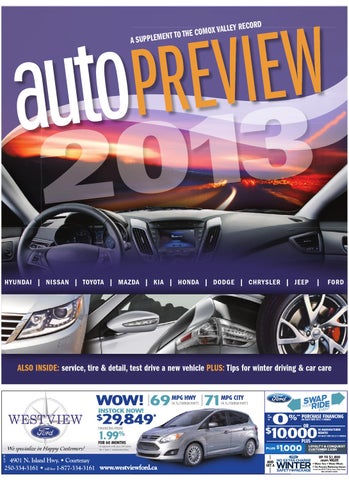
HYUNDAI | NISSAN | TOYOTA | MAZDA | KIA | HONDA | DODGE | CHRYSLER | JEEP
|
FORD
ALSO INSIDE: service, tire & detail, test drive a new vehicle PLUS: Tips for winter driving & car care
WOW! 69 MPG HWY 71MPG CITY INSTOCK NOW! $29,849* 4.1L/100KM HWY
FINANCING FROM
%
1.99 We specialize in Happy Customers!
AP W S R U O Y RIEDVEE NT
4.1L/100KM HWY AS LOW AS
0
$
DL 10773
4901 N. Island Hwy. • Courtenay 250-334-3161 • toll free 1-877-334-3161 www.westviewford.ca
APR
PURCHASE FINANCING ON SELECT NEW 2012-13 MODELS OR
10000 ,
IN MANUFACTURER REBATES ON SELECT NEW 2012/13 MODELS
PLUS
FOR 60 MONTHS * on approved credit, plus $389 admin fee + taxes + environmental fees
%
PLUS
$
1,000
LOYALTY & CONQUEST CUSTOMER CASH For Qualifying Customers
UP TO $1,800
AND GET A
(MSRP) VALUE • Winter Tires • Winter Wheels • Tire Pressure Monitoring Sensors on most new 2012/13 Fiesta, Focus, Fusion, Escape, Edge and Explorer models
2013 AUTO PREVIEW
Wednesday, November 28, 2012
2013 Nissan
Pathfinder BASE PRICE (+ FR & PDI):
$
29,998
NEW FOR 2013! Type: Four-door tall wagon Engine (hp): 3.5-litre DOHC V6 (260) Layout: Front-engine, two- /four-wheeldrive Transmission: Continuously variable l/100 km (city/highway): 10.5/7.7 (FWD)
Safety: Front airbags, side-impact airbags; side-curtain airbags; anti-lock brakes; stability control; traction control Weight (lb.): 1,900 (est.) Overall: Nissan beats a lighter, roomier and sleeker “Path” to your (garage) door; now shifts into the tall wagon class from its previous sport utility perch; fuel economy rises dramatically. Drivetrain: Both front- and four-wheel-drive versions use a single 260-horsepower V6; gets the job done with the assistance of a continuously variable transmission.
BEST IN CLASS FUEL ECONOMY: 37 MPG
2013 Nissan
Sentra BASE PRICE (+ FR & PDI):
$
14,848
NEW FOR 2013! Type: Four-door sedan Engine (hp): 1.8-litre DOHC I4 (130) Transmissions: Six-speed manual; CVT(opt.) Layout: Front-engine, front-wheel-drive l/100 km (city/highway): 6.6/4.9 (CVT)
Safety: Front airbags; side-impact airbags; side-curtain airbags; anti-lock brakes; traction control; stability control Weight (kg): 1,270 Overall: Nissan’s brand new Altima-copying compact is slightly bigger, easier on the eyes and more fuelefficient to boot. Drivetrain: One-size-fits-all 130-horsepower fourcylinder engine mates with a six-speed manual transmission, or optional continuously variable unit; no sign of a Spec V performance model.
BEST IN CLASS FUEL ECONOMY: 58 MPG
2013 Nissan
Altima Sedan
BASE PRICE (+ FR & PDI):
$
23,698
NEW FOR 2013! Type: Four-door sedan; two-door coupe Base Engine (hp): 2.5-litre DOHC I4 (182) Optional engine (hp): 3.5-litre DOHC V6 (270) Layout: Front-engine, front-wheel-drive Transmissions: Six-speed manual; continuously variable (opt.) l/100 km (city/highway): 7.4/5.0 (2.5, CVT)
Safety: Front airbags; side-impact airbags; side-curtain airbags; anti-lock brakes; stability control; traction control Weight (kg): 1,410 Overall: The fifth-generation Altima is as easy on the eyes as it is on fuel; coupe (four-cylinder only) returns unchanged, but its days might be numbered. Drivetrain: Moderately updated four-cylinder and V6 engines for the sedan. Four-cylinder gets a new continuously variable transmission and improved fuel performance.
BEST IN CLASS FUEL ECONOMY: 56 MPG
2013 Nissan
Titan BASE PRICE (+ FR & PDI):
$
33,898
Type: Two- or four-door pickup Base Engine (hp): 5.6-litre DOHC V8 (317) Layout: Front-engine, rear- /four-wheeldrive Transmission: Five-speed automatic l/100 km (city/highway): 16.1/10.9 (4x2)
Safety: Front airbags; side-impact airbags; side-curtain airbags; anti-lock brakes; traction control; stability control. Weight (kg): 2,210 Overall: You’ll have to settle for a bit more content, revised packages and minor visual changes until a new Titan arrives. Drivetrain: There’s nothing quite like the exhaust rumble of the Titan’s 317-horsepower 5.6-litre V8, but giving away 60 horsepower to the competition - and having a 16.1/10.9 (city/highway) l/100 km rating for 4x2 models?
UP TO $15,000 OFF OR 0% & $7,000 OFF (2012)
2013 Nissan
Frontier BASE PRICE (+ FR & PDI):
$
24,700
Type: Two- /four-door pickup Base Engine (hp): 2.5-litre DOHC I4 (152) Optional engine (hp): 4.0-litre DOHC V6 (261) Layout: Front-engine, rear- /four-wheel-drive Transmissions: Six-speed manual; five-speed automatic (opt.) l/100 km (city/highway): 10.7/8.6 (2.5, MT)
Safety: Front airbags; side-impact airbags; side-curtain airbags; anti-lock brakes; traction control; stability control Weight (kg): 1,670 Overall: Mid-sized Frontier is one of the few remaining entry-level pickups around with Ford, Dodge and GM gone; big changes coming for calendar-year 2013. Drivetrain: Carryover four-cylinder and V6 engines, the latter being mandatory if you select the optional four-wheel-drive.
UP TO $8,000 O OFF OR 0% & $4,000 OFF (2012) DL #10636
2
The Tennessee-built Pathfinder had remained virtually untouched since the 2005 model year. A robust body-on-frame chassis made it ideal for boulderbashing, creek-fording activities. The 2013 edition has undergone a serious weight-loss regimen; shedding about 110 kilograms (145 kilograms on 4x4 units). Its diet included converting to a unitized (frameless) platform shared with Nissan’s Infiniti JX luxury wagon and eliminating the 305-horsepower-V8 option. The base 266-horsepower 4.0litre V6 has also been dropped. In their place resides Nissan’s one-engine-fits-all 3.5-litre V6 that generates 260 horsepower and 240 pound-feet of torque. The 3.5 is teamed with a continuously variable transmission (CVT) that replaces the previous five-speed automatic. Front-wheel-drive versions are rated at 10.5 l/100 km city and 7.7 highway, while four-wheel-drive Pathfinders achieve 10.8/7.9. Nissan’s All-Mode 4x4-i option allows you to select either two- or four-wheel-drive, or engage the Auto setting and let the AllMode make the call, based on which tire(s) has traction.
Nissan has apparently taken a page from other automakers such as Hyundai and has produced a totally new Sentra that, at first blush, might seem a bit confusing. That’s because the design of the compact four-door so closely mimics the mid-size Altima that, from not too far away, you could easily confuse the two. Both cars share similarly styled grilles and muscular-looking fenders and the sweep of the roofline that ends at a short rear deck also appears familiar. Compared with the outgoing Sentra, the new car is slightly wider, lower and longer and has about the same interior volume, but the optical illusion is that it appears larger than it actually is. Ultimately, there’s nothing about the Sentra to remind you of the old one (cue Martha Stewart’s signature line). Under the hood is a similar story. The new 130-horsepower four-cylinder engine replaces the 2.0-litre 140-horse fourcylinder. But with about 70 kilograms less weight to haul around due to a lightened body structure, you’ll likely never notice the loss in peak power. What you will notice is more
The mid-size Altima sedan for 2013 presents a more graceful shape that’s sure to find favour with current and potential owners. Most of the basic length/width/height dimensions vary only slightly, including a bit wider front and rear track (the distance between the left and right wheels). The well-appointed interior features NASA-inspired “zero-gravity” front-seats for greater comfort. Cabin noise has been reduced with more soundabsorbing materials around the instrument panel, floor and roof areas and upgrading the engine mounts. The base 2.5litre four-cylinder now delivers 182 horsepower, up from the previous 175 mark, due to a new valvetrain plus peak torque adjustments. In addition, an all-new continuously variable transmission (CVT) offers fewer moving parts, significantly reduced friction and electronic control improvements so that it more closely mimics a traditional multi-speed automatic. Nissan now claims fuel performance of 7.4 l/100 km city and 5.0 highway, compared with 8.8/6.2 for the previous Altima. Those numbers also beat current four-cylinder versions of the
With nearly a decade virtually unchanged, the full-size Titan can be a hard sell, especially against the competition in the ultra-competitive pickup market. However, Titan makes an appeal to hard-working individuals with two frame lengths and two choices in bed length, ending at 8’2”. The bigger box is only offered on extended-cab models and not the fourdoor Titans. From the outside, the Titan mimics the dimensions and attitude of its domestic rivals and attempts to match them under the hood with an allaluminum 317-horsepower 5.6-litre V8. That might be well shy of what Dodge, GM and Toyota deliver, but perhaps more important than peak horsepower numbers is the torque, as in close to 400 pound-feet of it, most of which is available from just 2,500 rpm. That helps the Titan tow up to 4,320 kilograms. Two cab styles are offered: extended King Cab (with a pair
Although Nissan is planning to update its mid-size Frontier early in 2013, the current truck remains a strong option for those not needing the bloat and mass of fullsize offerings. Being about 500 kilograms lighter (base weight to base weight) than the Titan and having a smaller engine(s) translates into a 10.7/8.6 (city/highway) l/100 km rating (V6) versus 16.1/10.9 for the V8-powered Titan. Frontier can also be ordered with a base 152-horsepower 2.4-litre four-cylinder. The optional 261-horsepower 4.0-litre V6 is better suited to towing and off-roading since it’s the only way to get the optional 4x4 system. The 4.0-litre engine is closely related to the award-winning V6 that appears in many other Nissan vehicles. The
COMOX VALLEY RECORD
There is a penalty to be paid for the new Pathfinder’s weight and power decrease in that the maximum towing capacity has been curtailed to 2,300 kilograms from 3,100. The new sheetmetal manages a passing resemblance to the outgoing rig as far as the grille is concerned. But from there, the boxy body of old has given way to gentle, sweeping curves and rounded edges. The new “Path” gains about 13 centimetres in length, 11 centimetres in width and five centimetres between the front and rear wheels. Nissan created a third row reclining seat and a second row with 13 centimetres of fore and aft travel, while a portion of the split-second bench slides forward for easier third-row access, even if there’s a child seat attached. The base Pathfinder S arrives with trizone climate control and 14 cup/bottle holders. The SV adds roof rails and a rearview monitor while leather-covered seats, remote engine start and a power liftgate are SL highlights. From there the sky’s the limit where the SL Premium, Platinum and Platinum Premium trim levels are concerned. An up-level sound system, Around View camera, panorama moonroof and a navigation system are on the menu, depending on the depth of your pockets. cash in your jeans from fewer trips to the gas bar. Sentras are rated at 6.6 l/100 km city and 4.9 highway. That’s about a 13 per cent improvement compared to the previous rating. Note that to achieve those values you’ll need to step up to the optional continuously variable transmission, as most buyers will do anyway, since the six-speed manual gearbox is standard only on the $16,200 base S model that isn’t all that base. Standard features include air conditioning tilt and telescopic steering column, power windows and door locks and remote keyless entry. Content levels increase as you head up the remaining four trims, topping out at the $24,500 SL that comes with dual-zone climate control, premium sound system, 17-inch wheels (16-inch rims are standard), push-button ignition and a fancier interior. However you’ll need to head beyond that point to add leather-covered seats, a touchscreen navigation system, rearview monitor and other niceties that can take the Sentra as far away from a bare-bones econo-box as you can imagine. There’s no hint that a sporty SE-R model (or Spec V for that matter) with a larger engine and added performance is about to reappear anytime soon. Toyota Camry, Hyundai Sonata and Honda Accord. The Altima’s optional 270-horsepower 3.5-litre V6 remains unchanged, but it also benefits from the same CVT upgrade and is now rated at 9.3 l/100 km city/6.4 highway. Altima now boasts Active Understeer Control that applies light braking pressure to the inside wheel in a corner to counteract the car’s natural tendency to continue in a straight line. Also assisting the driver is Nissan’s Easy Fill Tire Alert that was initially installed in the Quest minivan. Instead of trying to decipher your tire pressure gauge (especially daunting at night), the horn will sound when the correct amount of inflation has been reached. Finally, the Altima’s headlights automatically turn on after the wipers have completed four cycles, which helps other drivers see you during downpour conditions. The base 2.5 includes all the standard bells and whistles plus a six-way power driver’s seat and keyless start. S and SV models progressively add dualzone climate control, heated front seats and Bluetooth handsfree connectivity with hands-free messaging. Move up to the SL and a leather interior, heated steering wheel and a power moonroof are yours. The coupe remains available, but only with a 2.5-litre four-cylinder.
of reverse opening rear access doors that swing 180 degrees); and a four-door Crew Cab. Both two- or four-wheel-drive versions are available. There’s enough interior room to hold five tall adults with front and rear legroom that’s practically identical. Interior amenities include a choice of bench or bucket seats as well as adjustable foot pedals. Four-wheel disc brakes with anti-lock are standard as well as sideimpact and side-curtain airbags and rear-proximity sensors that alert you when your backup path is blocked. Back for more is the revised off-roadinspired PRO-4X model that comes with a lower final drive ratio, unique wheels wrapped in off-road rubber, additional skid plates to protect the Titan’s underbelly and electronic-locking rear differential, along with unique appearance upgrades inside and out. For 2013, a new audio system with a larger display and USB capability becomes standard on most models.
Frontier continues to be offered in both extendedlength King Cab and four-door Crew Cab body styles and in several trim levels, including the fourcylinder S, and SV and V6-equipped SV, SL and off-road-inspired Pro-4X (in either King or Crew Cab body styles). The PRO-4X can be had in two- or four-wheel-drive and includes off-road tuned Bilstein-brand performance shocks, skid plates, unique 16-inch wheels and electronic locking rear differential. For bigger loads, try the Long Bed fourdoor Crew Cab model that tacks an extra 33 centimetres onto the Crew Cab’s standard 167centimetre box for a total of about 195 centimetres.
COMOX VALLEY NISSAN
Commitment to Excellence • Good People • Good Service 535 Silverdale Crescent • Courtenay • 250-338-1988 • 1-800-595-1988 • OPEN: Monday-Saturday, 8am-7pm • Good Business
www.comoxvalleynissan.com
COMOX VALLEY RECORD
2013 AUTO PREVIEW
Wednesday, November 28, 2012
When You Become Part of
OUR FAMILY... this is what you get!
FREE… 1
… … … … … …
Courtesy Shuttle Available Courtesy Car Including Gas BBQ on Fridays at Noon Wash & Vacuum - Anytime Vehicle Pickup & Drop Off Weekly Draw for Prizes
in Canada for Customer Satisfaction Quality & Affordable Service for
ALL MAKES & MODELS
Good People Good Service Good Business Give Us A Chance to Earn Your Business
COMOX VALLEY 535 SILVERDALE CRES., COURTENAY
www.comoxvalleynissan.com 250.383.1988
After you buy your vehicle we don’t stop loving...
3
4
2013 AUTO PREVIEW
Wednesday, November 28, 2012
COMOX VALLEY RECORD
How to conduct a test drive A test drive can tell potential car buyers a lot about a vehicle. Conduct a test drive when you can devote your undivided attention to the task.
When shopping for a new vehicle, some drivers know exactly which model of car they want to buy, while others are not so sure.Though price and features often carry the most weight when making a decision, a test drive can narrow down the prospects as well. It is easy to become awestruck by the look of a new car, and even easier to fall into the eager hands of a salesperson. It can be confusing when comparing the dozens of statistics and numbers associated with a car — from price to horsepower to gas usage ratios. One of the best ways to judge a car is to take it out for a test drive. There are many things that a test drive can tell you about a car or truck. A test drive shouldn’t be a quick jaunt around the block. It should include a thorough examination of the vehicle, and the drive should be long enough for you to get a feel for the vehicle. It is important to take your time on a test drive and not feel rushed. There are also many other tips that can help you find the right buy.
Avoid distractions
Pick a time when you feel focused
Try out different terrain
Doing a test drive on your lunch hour or right before you’re expected at a meeting or carpool is not the ideal time to make an assessment of the vehicle. You certainly may feel rushed and distracted by the other tasks you have to accomplish. Rather, pick a time when you are well rested and well fed and able to concentrate on the job at hand.
Sometimes schedules conflict, and you may have to bring other people, including children, along on the test drive. However, when possible, only include those people who will be driving the vehicle in the test drive. This way you will be able to focus solely on the car and not worry about what the other passengers are doing as well. It is also perfectly acceptable to ask the salesperson to be quiet during the test drive and reserve explaining the features and attributes for before or after the drive. This way you can focus on the driving experience.
Change lanes Take the opportunity to change lanes so you can judge the visibility of the vehicle.
Adjust the seating This will help you determine the comfort level of the vehicle and if it will fit your frame. You don’t want the car to be uncomfortable to drive.
Test the radio and the climate control
If you won’t be distracted by it, have a friend or family member ride along and pay attention to the things you might be missing while focusing on the road. These may include road noise, suspension and the general comfort of the vehicle. A test drive is an important component of buying a car. It can often make or break a sale, so be sure to include it on your must-do list.
See how the car functions, including whether it takes a long or short time to reach a comfortable temperature.
WINTER TEMPERATURES CAN ADVERSELY AFFECT A VEHICLE’S COMPONENTS AND SAFETY FEATURES
Research the vehicle
It’s time for your Winter Service!
It helps to go into a test drive already knowing the majority of the specifications on the vehicle and what the car or truck is capable of doing.
Most test drives consist of a short jaunt to and from the dealership. Salespeople also may recommend certain routes, but these could be tailored to get the best response out of the car. But if you’re familiar with the area take a test drive on your terms. Try different road surfaces and speeds. Also be sure to make turns to gauge the turning radius. This can be as simple as making some turns in a parking lot.
Have a passenger ride in the back
$
79
95 plus taxes and environmental levies
Oil and Filter Change Inspection of:
Tires, Battery, Cooling System, Windshield Wipers, Lighting, Heater & Defroster, Four Wheel Drive System, Fluids, Brakes and Ignition System.
Even a well maintained vehicle will periodically run into trouble. Being as prepared and informed as possible is your best approach to safe driving.
Everyone yone needs a guardian angel. a BONUS
$20
PLUS! Enter our monthly draw for an Emergency Roadside Safety Kit that includes 24 Hour Roadside Assistance.
Give the gift of a BCAA Membership this winter. Get help out on the road, 24-7, with the best roadside assistance in North America. Enjoy exclusive savings on gas, hotels, rental cars, shopping and more. Plus, Members save on home, car, life and travel insurance.
FREE GAS* WITH A NEW MEMBERSHIP
Call 250-703-2328 or click on bcaa.com
*Offer expires December 31, 2012 and is valid on all new Primary and Associate driving Memberships. Not available on Membership renewals. Cannot be combined with any other offer. Please allow up to 4-6 weeks for gift certificate delivery. While supplies last. Insurance is sold through BCAA Insurance Agency and underwritten by various underwriters. Visit bcaa.com/underwriters for more information.
250.334.3012
511 McPhee Avenue, Courtenay
2013 AUTO PREVIEW
COMOX VALLEY RECORD
2013 Kia
Rio 4 Door
sedan/hatchback $
BASE PRICE $ (incl. destination):
15,350 (sedan) 15,750 (hatchback)
Type: Four-door sedan/hatchback Base engine (hp): 1.6-litre DOHC I4 (138) Layout: Front-engine, front-wheeldrive Transmissions: Six-speed manual; six-speed automatic (opt.) Safety: Front airbags; side-impact airbags; side-curtain airbags; anti-lock brakes; traction control; stability control Weight (kg): 2,430 Overall: Once merely an inexpensive car, the Rio has grown into a gorgeous compact that you just gotta have. Drivetrain: Just one engine; the 1.6-litre fourcylinder makes 138 horses and goes far on fuel; six-speed manual transmission or optional sixspeed automatic.
2013 Kia
Sportage BASE PRICE (incl. destination):
$
23,650
Type: Four-door sport-utility vehicle Base engine (hp): 2.4-litre DOHC I4 (176) Optional engine (hp): 2.0-litre DOHC I4, turbocharged (260) Layout: Front engine, front- /all-wheel-drive Transmissions: Six-speed manual; six-speed automatic (opt. / std. with turbo) Safety: Front airbags; side-impact
airbags; side-curtain airbags; anti-lock brakes; stability control; traction control Weight (kg): 1,430 Overall: Cooler, sportier, roomier and more costly than the Soul and with optional all-wheeldrive. Drivetrain: Base 2.4-litre four-cylinder or 2.0-litre turbo; four-wheel-drive system can lock up the front and rear axles for improved off-road agility.
2013 Kia
Optima
BASE PRICE $ (incl. destination):
23,450
HYBRID
(incl. destination):
$
32,000
Type: Four-door sedan Layout: Front-engine, front-wheel-drive Base engine (hp): 2.4-litre DOHC I4 (200) Optional engines (hp): 2.0-litre DOHC I4, turbocharged (274); 2.4-litre DOHC I4 with electric assist (206, hybrid) Transmissions: Six-speed manual, six-speed automatic l/100 km (city/highway): 8.7/5.7 (2.4, MT)
Safety: Front airbags; side-impact airbags; side-curtain airbags; anti-lock brakes; brake assist; hill assist control; traction control; stability control Weight (kg): 1,450 Overall: The honeymoon is long over with, which means our continued affection for Kia’s midsize sedan must in fact be true love. Drivetrain: All engines have four cylinders in regular, turbocharged and hybrid flavour; manual transmissions available at every rung in the trim level.
2013 Kia
Soul BASE PRICE (incl. destination):
$
18,450
Type: Four-door, five-passenger front-wheel-drive compact/tall wagon Base engine (hp): 1.6-litre DOHC I4 (138) Optional engine (hp): 2.0-litre DOHC I4 (164) Layout: Front engine, front-wheel-drive Transmissions: Six-speed manual; six-speed automatic (opt.) Safety: Front airbags; side-impact airbags; side-curtain airbags; anti-lock brakes; traction/stability control Weight (kg): 1,190 Overall: The cutest Kia of all time has the same base price as a Rio; which would you choose? Drivetrain: Base 1.6-litre four-cylinder shared with the Rio; 2.0 option adds passing power; sixspeed transmissions.
Wednesday, November 28, 2012
5
The Rio raises the bar for small-car optional six-speed automatic. To help save fuel dollars, automatic-equipped cars can be ordered with value, features and style. what Kia calls Idle Stop and Go (ISG). This feature “Direct fuel injection” and “six-speed automatic transmission” are phrases not normally associated with entry-level transportation, but here they both are in a nearly perfectly styled small car. The pleasing sheetmetal is highlighted by the fact that the Rio sedan and Rio 5-Door hatchback have completely different front ends. Kia didn’t just put a hatchback on the tail of the Rio and call it a day. That kind of attention to detail extends to the dashboard layout that’s clearly presented and, due to a reduction of hard plastic surfaces, is far richer looking than in past Rios. The air conditioning, rear-window heat and ventilation toggle switches are a particularly nice touch. The standard 1.6-litre four-cylinder produces 138 horsepower and 123 pound-feet of torque, which is decent in a 1,150-kilogram vehicle. All Rio models come with a six-speed manual transmission, or
shuts off the engine after the Rio comes to a complete stop, then instantly fires it up again once the brake pedal is released. ISG is part of an Eco Dynamics Package that includes a special alternator that disengages under high engine load (such as when heading up hill) for reduced power loss and improved fuel performance. Kia claims overall fuel consumption is reduced by about three per cent with ISG. That’s not much, but every little bit helps. The base Rio LX with the manual gearbox is somewhat light in the content department, while the mid-range LX+ includes air conditioning, plus a few more goodies. The EX adds 16-inch alloy wheels, power sunroof and a rearview camera, while the top-end SX UVO adds a “Steptronic” automatic transmission, 17-inch wheels (15-inchers are standard), leather interior, rain-sensing wipers and more. To add navigation, you need the SX.
It’s tough to fault the Sportage, which covers a fairly broad spectrum of price, features and performance.
models. The base LX Sportage includes Kia’s UVO in-car hands-free entertainment and communication system along with air conditioning, cruise control, Bluetooth short-range wireless connectivity and Hill Start Assist (that prevents the vehicle from rolling backward down a hill while in gear). Downhill brake control maintains a fixed forward speed without the driver having to touch the brake pedal, which prevents a runaway situation. The EX features dualzone climate control, power driver’s seat, keyless entry, glovebox cooler, re-tuned high-performance shocks and 18-inch wheels (16s are standard). The EX Luxury adds leather seats and a panoramic sunroof, while the top-line SX features the turbocharged engine, unique body pieces and wheels, and more supportive seats. An upgraded audio system, push-button start or even a cargo cover are all optional, as is a panoramic sunroof, heated and cooled front seats (offered when the leather seat-cover option is specified.)
The base powerplant is a 176-horsepower 2.4-litre four-cylinder that’s hooked to a six-speed manual transmission (available only in base front-wheeldrive models). A six-speed automatic is optional and returns slightly better fuel economy than the manual. Optional is a 260-horsepower turbocharged 2.0-litre four-cylinder. The Sportage is a front driver by nature, while the optional all-wheel-drive system directs 100 per cent of the engine’s torque to the front wheels until tire slip is detected. At that point, the required power is instantly deployed to the rear wheels. Additionally, a manually selected “Lock Mode” allows for a fixed 50:50 torque split at speeds up to 40 km-h for those times when sustained maximum traction is required. You can get either engine in front- or all-wheel-drive
If you’ve been wondering who lit the fire under Kia’s rear bumper, the most likely person is designer Peter Schreyer who joined the company after a long stint with Audi. That’s right, Kia has a hotshot German designer and one of his best creations to date is the Optima. The Optima uses two powerful four-cylinder engines: the entry-level is a 2.4-litre unit that produces a very healthy 200 horsepower, while an optional 274horsepower turbocharged 2.0-litre four-cylinder engine quenches your thirst for thrust. There’s also a hybrid-electric version of the 2.4, but with only 169 horses (206 total with the electric motor). As you might expect, the hybrid is the most fuel efficient (5.6 l/100 km city and 4.9 highway) but even the base engine produces a respectable 8.7 l/100 km in the city and 5.7 on the highway. Most interesting is that
On one hand you could spend about $15,500 on a practical and smartlooking Kia Rio sedan or hatchback. On the other you could do something a little different for a a few thousand more and put a 2013 Soul in your driveway. Their skill sets are similar with the nod going to the Rio for fuel economy while the Soul makes a much bigger fashion statement while also providing a more powerful engine option. Tasteful design and decent function highlight the 2013 Soul that continues into the new model year after an inside/outside refresh for 2012. The entrylevel 1.6-litre four-cylinder was taken from the Rio sedan and produces 138 horsepower, while the optional 2.0-litre delivers 164. A six-speed manual transmission is standard while a six-
the hybrid system uses unique lithium-polymer batteries that are lightweight and can actually be formed into shapes. The hybrid can travel at speeds of up to 60 mph (96 km-h) without the gas engine assisting. Kia’s reputation is built on value, and the Optima is no different. Very well equipped for the class with standard air conditioning, power everything, a cooled glovebox, tilt and telescoping steering wheel and keyless entry. Once you move up to mid-range EX or top-range turbo-only SX models, features such as front and rear heated seats, leather upholstery, back-up camera, a premium Infinity sound system and a navigation system are available as options. For buyers with a sporting intent, the SX comes with 18-inch wheels, bigger front brakes, sportier suspension, bright high-intensity-discharge (HID) headlights, LED taillights, a rear spoiler, side sills and unique bumper design. Throw in a five-year warranty and customers should be beating a path to their local Kia dealer.
speed automatic is optional, but standard on the higher trims. The base 1.6 L model has a fair amount of equipment (power items, heated seats and Bluetooth connectivity), but no air conditioning. For that, you’ll have to get the Soul 2u, which also adds the bigger engine, wildlooking patterned seat fabric and bigger wheels. The Soul 4u adds to its inventory even bigger wheels, premium audio system, sport-tuned suspension backup camera. The 4u Luxury adds navigation, leather seats and climate control. Fully loaded, you’ll be crowding $30,000, which puts you in the higher end of the Optima range.
These 2013s and many more are now available at Courtenay Kia!
Visit us to find out more about our new & used vehicle selection...
COURTENAY KIA 1025A Comox Road Courtenay • 1-877-380-1633 • www.courtenaykia.com DL#30891
Wayne Grabowski Jan Vandenbiggelaar Malcolm Fletcher GSM
Sales Specialist
Sales Specialist
Stacey Dion
Sales Specialist
Darren Lloyd-Jones Loretta Lafortune Sales Specialist
GET APPROVED NOW! CALL FROM ANYWHERE IN BC: 1-877-398-2375 Hours: Monday - Saturday 9:00 am - 6:00 pm • Sunday 11:00 am - 5:00 pm
Finance Specialist
6
Wednesday, November 28, 2012
2013 AUTO PREVIEW
COMOX VALLEY RECORD
How to stay safe on winter roads Be sure you can see clearly
Steer your car into the skid
Clear off the snow from the windshield, side mirrors and windows so it does not compromise your view. Also, top off the windshield fluid so you will be able to clear snow and salt kick-up from your windshield. Look for a washer fluid that has an antifreeze component, otherwise, your washer jets and wiper blades could be rendered useless.
Remain calm and do not panic and jam on the brakes if your car starts to skid. Slamming on the brakes will only exacerbate the skid. Rather, take your foot off the accelerator, allowing the car to naturally slow down as you turn your wheels into the direction the car is skidding. This should help right the car and get you back on track.
Drive slowly
Invest in snow tires
Reduce your speed when driving in inclement weather. It can be more difficult to stop or maneuver around a potential obstacle when conditions are less than ideal. Traveling at a high speed will increase the risk of accidents.
Those who live in especially snowy climates and do a lot of driving would be wise to purchase snow tires. Snow tires, also called winter tires, have special tread patterns that offer better traction in snow and ice. They also are made from softer rubber compounds than regular tires that retain their flexibility in cold weather, allowing the tire to conform to the surface of the road. Although many vehicles come with technology to prevent accidents, they cannot do their jobs if tires are not maintaining their grip on the road. All-season tires are not a replacement for snow tires. All-season tires are designed to work in all sorts of conditions, from rainy weather to dry roads. Therefore, it is better to invest in a set of snow tires that will offer you better protection. When putting snow tires on a car or truck, be sure to do so on all the wheels — not just the driving wheels. Otherwise you may still risk spin outs or uneven gripping of the road. It is not a good idea to keep snow tires on all year. Because they are softer, snow tires tend to be more noisy and can wear out faster in warmer weather.
Leave enough room between you and other motorist
Driving in the winter time, especially during or after snowfall, can be dangerous Snowy weather can be a time for fun, especially for avid skiers or children who relish spending days off from school tossing snowballs and building snow forts. Many adults, however, do not look forward to the snow as much as youngsters do. Snow can be hazardous when driving, but putting snow tires on a vehicle can improve vehicle safety. Each winter, snowfall compounds treacherous road conditions, increasing the risk of accidents. It is important to know how to drive when weather conditions are dangerous. It is also
wise to outfit a vehicle to reduce its risk of slipping and sliding on icy, snowy roads. Here are some tips to follow. • Limit time spent driving in the snow. Avoid driving during snowstorms or directly after whenever possible. Snow not only makes roads slick, but falling flakes can impair a driver’s visibility and reduce his or her response time. Try to wait until snow-clearing teams have salted, plowed and sanded roads before venturing out.
Learn the proper way to rotate your tires Rotating tires is something that many people do religiously while others put off the task until they notice a problem with the car’s performance. An important component of vehicle upkeep, rotating tires not only extends the life of the tires, but it also helps ensure safer driving. There are some who are unfamiliar about how and when to rotate the tires and the benefits this routine maintenance can provide. This also could be a factor in why people procrastinate on tire rotation. One may not realize that the front tires often bear the brunt of the work in vehicle operation. Making turns or parallel parking requires the force of the front tires. Vehicles that are front-wheel-drive have front tires that supply the main motive power for the vehicle, according to Edmunds.com. The frequent use and requirements of the tires produces friction on the road, and eventually heat. The front tires wear more quickly than the rear tires. In order to extend the life of the tires, drivers must periodically rotate them. Tire rotation essentially means moving the front tires to the rear and vice-versa. This means the front passenger side tire will be moved to the back passenger side position. The same thing will occur on the driver’s side. There’s a reason for this. Tires have unique wear patterns that are related to the suspension and the alignment. Should you switch the tires in a criss-cross pattern, it could affect the alignment and lead to a bumpy ride. These scenarios can depend on the vehicle
and the tire, however. Certain vehicles have tires of different sizes in the rear and front, which prevents front-to-back rotation. There are also cars that have tires that are unidirectional, where they are specific to one side of the car and asymmetrical, with a tread pattern that changes from the inside of the tire to the outside. Though these tires are rare, you can’t rotate them at all. Tire rotation is adviseable to preserve balanced handling, traction and even outer tire wear. But how often should it be done? Many tires should be rotated every 3,000 to 5,000 miles, even if they don’t show signs of wear. Some service stations will do tire rotation at the same time that oil changes are done because the car is already on a lift. Don’t expect tire rotation to correct wear problems due to worn mechanical parts or as the result of improper inflation pressure. Rotation is not the only tire maintenance task to do to ensure safe tires. Consult with a service station to determine the best pattern for rotating your tires and the ideal interval between rotations.
Tailgating is responsible for many accidents, even when there is no snow on the ground. In inclement weather, it can take longer to slow or stop the car after pressing on the brakes. Having an additional space between your car and the one in front of you helps you avoid a collision.
Be aware of black ice Black ice gets its name from its veritable invisibility. It is so thin and hard to spot, it just looks like the black asphalt of the road. Black ice tends to form in areas that have had snow or ice melt, which then refreezes at night when temperatures drop. Be extra cautious on turns and on highway exit ramps, where black ice frequently forms.
Providing state-of-the-art technology with old-fashioned service since 1977
Volkswagen, Import & Domestic Repairs Our highly trained technicians employ the latest technology to ensure reliable performance. Performance Electrical Testing & Service • Tune ups Engine & Transmission Rebuilds • Exchange Alternators & Starters Electrical Fuel Injection Servicing • Brakes, Suspensions & Exhaust Government Designated Inspection Facility
160 Headquarters Road • Courtenay • 250.338.5841 www.glennsautorepairs.com
2013 AUTO PREVIEW
COMOX VALLEY RECORD
2012 RAM 1500
QUAD CAB 4X4
2013 GRAND CARAVAN
Wednesday, November 28, 2012
4.7L 310hp V8 Air Conditioning Full Power Group Trailer Tow Package Heavy Duty 17" Wheels Full 6'3" box Plus so much more...
MSRP: $
Our Discount: $
149 bi-weekly
$
25,488
Your $ Price: MSRP:
Power Windows Power Locks Cruise Control 7 Passenger Rear Stow 'n Go
4.49%
37,995
12,507
7
$
29,675
Our Discount:
9,677
$
$
114
4.49%
bi-weekly $
Your $ Price:
122
bi-weekly
with DVD entertainment system
19,998 Make ASK US HOW!
2013 JOURNEY NEY
42 MPG.
MSRP:
Canada’s #1 Selling Crossover 2.4L, 4cyl. A/C, Keyless Entry Power Group 7 Passenger Available
2013 WRANGLER SPORT
$
22,500
Our Discount:
2,502
$
$
Your $ Price: $
114 bi-weekly
19,998
MSRP:
3.8L V6 3 pc. Removable Hard Top Available 3.73 Axle Ratio Tubular Side Steps
4.49%
26,605
Our Discount:
5,607
$
4.49% 119 bi-weekly
$
Your $ Price:
20,998
*Giving away 40" TVs, iPad’s and $1,000 Holiday Cash on selected vehicles only. All prices and payments plus taxes and fees ON APPROVED CREDIT. Prices above do not include $499 Administrative Fee which is mandatory on purchase of new and used vehicles. Lowest cash prices and payments using all dealership incentives. All Vehicles available at time of printing. Vehicles may not be exactly as shown. File photos used on some vehicles when required. 1) 2012 Ram 1500 q/cab $25,488 $4300 down, $149 bi-weekly, x 96 months @ 4.49%. 2) Dodge Journey $22,500 $2700 down, $114 bi-weekly, x 96 months @ 4.49%. 3) Grand Caravan $18,900 $0 down, $114 bi-weekly, or $246 month x 96 months @ 4.49%. Cost of borrowing: $4190, total obligation; $23,687 before taxes. 4) Wrangler $19,888 $3000 down, $119 bi-weekly, x 96 months @ 4.49%. Factory Incentives subject to change as new Chrysler Retail Incentive Programs are announced. See Dealer for details.
SHOP • TOWING & RECOVERY YOUR FULL SERVICE DEALERSHIP BODY PARTS & SERVICE • TIRE CENTRE
Michael Marchi
D# 5682
Dealer Principal
Kevin Kozlowski Sales Manager
Barry Kruger Consultant
Rick Barrs Consultant
Don Harrison Consultant
Justin Lockhart Consultant
Jim McLeod Consultant
Dave Clark Consultant
Parker Humphrey Consultant
Robert Kirinic
Finance Manager
4847 N. Island Highway • Courtenay • Open Monday to Saturday 7:30am - 5:30pm
250.338.5451 • 1.877.850.2828 • www.comoxvalleydodge.com
8
2013 AUTO PREVIEW
Wednesday, November 28, 2012
COMOX VALLEY RECORD
TOYOTA FOR 2013: MORE VALUE, LESS MONEY. 2013 Toyota
New for 2013!
Avalon
BASE PRICE (incl. destination): $36,800 (est.)
Type: Four-door sedan Base Engine (hp): 3.5-litre DOHC V6 (268) Optional engine (hp): 2.5-litre DOHC I4 with electric assist (200, hybrid) Layout: Front-engine, front-wheel-drive Transmission: Six-speed automatic; CVT (Hybrid) l/100 km (city/highway): 11.2/7.6 (V6)
Safety: Front airbags; side-impact airbags; side-curtain airbags; driver’s knee airbag; anti-lock brakes; stability control; traction control Weight (kg): 1,620 Overall: Now that’s better! The new Avalon displays a sharp new look that makes it appear more Lexusand less Toyota-like, which we like . . . a lot. Drivetrain: Back is a 268-horsepower V6/sixspeed-automatic-transmission combo; Camrybased gas-electric Hybrid becomes optional for the first time.
2013 Toyota
New for 2012!
Tacoma
BASE PRICE (incl. destination):
$
23,700
Type: Two-/four-door mid-sized pickup Base Engine (hp): 2.7-litre DOHC I4 (159) Optional engine (hp): 4.0-litre DOHC V6 (236) Layout: Front-engine, rear-/four-wheel drive Transmission: Five-speed manual; four-speed automatic (opt. on I4); sixspeed manual (std. on V6); five-speed automatic (opt. on V6) l/100 km (city/highway): 10,0/7.7 (2.7, MT, 4x2)
Safety: Front airbags; side-impact airbags; side-curtain airbags; anti-lock brakes; traction control; stability control Weight (kg): 1,610
is year, NEW for th odels feature a m all Tacoma 6.1” display audio six-speaker, integrated system with nnectivity, Bluetooth co o and USB inputs. di auxiliary au
Overall: Few competitors are left in the sub-fullsize class; Tacoma gets more luxurious with new Limited Package. Drivetrain: Holdover 2.7-litre four-cylinder and truck-specific 4.0-litre V6.
Price is for base 2WD, manual transmission. Model Code: TX4CNM
2013 Toyota
Tundra
BASE PRICE (incl. destination):
$
27,700 (regular cab)
Type: Full-size pickup truck Base Engine (hp): 4.6-litre DOHC V8 (310) Optional engine (hp): 5.7-litre DOHC V8 (381) Layout: Front-engine, rear- /four-wheel-drive Transmission: Six-speed automatic l/100 km (city/highway): 14.1/9.9 (4.6, 2WD)
Safety: Front airbags; side-impact airbags; side-curtain airbags; driver/front passenger knee airbags; anti-lock brakes; traction control; stability control Weight (kg): 2,310
Overall: Toyota makes a run at luxurious Ford and GMC rivals with new Platinum package; only five combinations of cab, bed and drive after axing base V8. Drivetrain: Sole choice in most is the hot-rod 381 horsepower 5.7-litre V8 found in even the most basic work truck; old 4.6-litre V8 only comes in base Double Cab models; six-speed automatic transmission with rear- or four-wheel drive.
For 2013, Toyota has dramatically altered the chemistry of Avalon’s formula, combining passionate styling, innovation, and an elevated level of craftsmanship to position Toyota’s flagship sedan as the leader of the competitive premium mid-size segment in Canada. This potent and persuasive sedan symbolizes Toyota’s exciting new design and product direction for future sedans. What is perhaps most remarkable is that Toyota Canada is offering this new Avalon at a suggested starting price of just $36,800. “Toyota designers and engineers infused the 2013 Avalon with a fresh new look and more driver-focused, responsive performance, then
The Toyota Tacoma enjoys sporty performance and surprising versatility – backed by Toyota’s reputation for building trucks that conquer the toughest weather and driving conditions on the planet. And the tradition continues with the 2013 Toyota Tacoma lineup – eight compact pickup trucks that provide Canadian drivers with an impressive choice of engine size, drive train, cab and cargo bed configuration. “Whether it’s work or fun, there’s a Toyota Tacoma for every need, and we’re pleased to offer 2013 models with an upgraded audio system plus an exciting new Limited Package on popular Tacoma 4x4 Double Cab models,” said Tony Wearing, Senior Managing Director, Toyota Canada Inc. “With eight models, Canadian drivers know they can count on Toyota for an authentic, powerful compact pickup
Canadians with full size work to be done trust the Toyota Tundra for power, performance, utility, comfort - and above all, dependability. Add it up, and Tundra is the full-size pickup that delivers big value – including the 2012 Best Retained Value Award for large pickup trucks, from Canadian Black Book. For 2013, several Tundra models receive enhanced available options packages including the added safety of a backup camera with display integrated into the rear view mirror. Choice defines Tundra – with two drive trains, two engine sizes, three cab styles and three cargo bed lengths. Two Tundra models are available with powerful yet efficient 4.6L iFORCE V8 engines, developing 310 peak horsepower and 327 lb-ft of torque. For
enhanced our next generation flagship with numerous premium features as standard equipment – and we’re able to offer this new Avalon to Canadian drivers at a starting price that’s 11 per cent lower than the starting MSRP on 2012 models,” said Tony Wearing, Senior Managing Director at Toyota Canada Inc. “The 2013 Avalon comes in two models, plus an available Premium Package, so it’s easy for Canadians to find a premium intermediate sedan with the comfort, performance and features they desire – plus the safety, quality and overall value that they’ve come to expect from Toyota.”
truck that delivers quality and dependability, day in and day out.” For more power, Tacoma models equipped with Toyota’s 4.0 liter V6 generate 236 peak horsepower and up to 266 lb-ft of torque, paired with either a six-speed manual transmission or five-speed Super ECT automatic transmission with lockup torque converter. V6 models feature 4x4 drive trains and a choice of four-person Access Cab or five-passenger Double Cab. All models are generously equipped with comfort and convenience features, including: air conditioning; power door locks; power windows with driver side auto-down function; a tilting/telescoping steering column; plenty of thoughtful in-cabin storage; a digital clock; 12-volt accessory power outlet; front tow hook; dual exterior mirrors; rear step bumper; removable tailgate; tie-down cleats; a double-wall, composite cargo bed; a 3,500 lb towing capacity; two-speed wipers with mist feature; and more.
more power, a 5.7L iFORCE V8 delivers up to 381 horsepower and 401 lb-ft of torque All Tundra models feature a six-speed Super ECT automatic transmission with overdrive, sequential shift mode, tow/haul settings, lock-up torque converter, transmission cooler and automatic transmission fluid warmer. All Tundra models feature an auto-limited slip rear differential, while those with 4x4 drivetrains are equipped with one-touch four wheel drive to maximize fuel efficiency while delivering additional driving confidence when needed. 4x4 models are equipped with underbody protection plates to protect the engine and transfer case from offroad hazards. All Tundra models are ready for a full day of work – generously equipped with many comfort, convenience and utility features as standard.
Price is for base 2WD, regular cab, short box. Model Code: L45F1T
We will make your car make you smile again. Free Brake Inspection with purchase of
Featuring “Road Force Balancing” the most advanced technology in the industry for the most accurate wheel balance. We will match any advertised price on Michelin & BF Goodrich* *On tires with matching product codes.
From
525
$
mounted & balanced plus tax
Wheel Alignment From
99
$
Winter Inspection Special Complete winter inspection including Lube Oil and Filter service, check all fluid levels and condition, wiper system, tire pressures, all belts and hoses, battery test and report, front and rear brake inspection and report, and exhaust system check. Full report included.
From
$
95
69
29.
$
95 Value
Expires: Dec. 31, 2012
RICE TOYOTA COURTENAY Dlr#7478
445 Crown Isle Blvd., Courtenay 250-338-6761 • courtenaytoyota.com Service Hours: M-F 8:30 – 5:30 DLR 7478
All makes and models.
www.courtenaytoyota.com Dlr#7478
445 Crown Isle Boulevard • Call 250-338-6761 • www.courtenaytoyota.com
D10154
Winter Tire Special
Brake Fluid Flush
2013 AUTO PREVIEW
COMOX VALLEY RECORD
2013 Mazda
Type: Four-door, front-wheel-drive compact sedan and wagon Base engine (hp): 2.0-litre DOHC I4 (148) Optional engines (hp): 2.0-litre DOHC I4 (155); 2.5-litre DOHC I4 (167); 2.3-litre DOHC I4, turbocharged (263) Layout: Front engine, front-wheel-drive Transmissions: Five-speed manual (2.0); six-speed manual (std. on SkyActiv, 2.5, Mazdaspeed3); five-speed AT (opt.)
3
l/100 km (city/highway): 8.1/5.9 (MT); 7.7/5.0 (Skyactiv MT)
Safety: Front airbags; side-impact airbags; side-curtain airbags (opt.); anti-lock brakes; traction control; stability control Weight (kg): 1,300 Overall: Mazda’s compact sedan and hatchback wagon carry over with some minor trim and content adjustments. Drivetrain: The thrifty 155-horsepower 2.0-litre “SkyActiv” engine now enters its sophomore year and is recommended for more for its ability to ignore gas pumps that its sheer performance; both 148-horsepower and 167-horsepower four-cylinder engines return, as does the 263-horse Mazdaspeed3.
2013 Mazda
CX-5
New for 2013!
Type: Four-door compact tall wagon Engine (hp): 2.0-litre DOHC I4 (155) Layout: Front-engine, front- /all-wheel-drive Transmissions: Six-speed manual; six-speed automatic l/100 km (city/highway): 7.8/5.7 (FWD, MT)
Safety: Front airbags; side-impact airbags; anti-lock brakes; stability control; traction control Weight (kg): 1,460 Overall: Mazda’s all-new wagon takes its funto-drive and fuel-sipping roles seriously. Drivetrain: A 155-horsepower four-cylinder is part of Mazda’s SkyActiv brand that will eventually be employed on all Mazda vehicles.
2013 Mazda
5
Type: Four-door minivan Base Engine (hp): 2.5-litre DOHC I4 (157) Layout: Front-engine, front-wheel-drive Transmissions: Six-speed manual; five-speed automatic (opt.) l/100 km (city/highway): 9.7/6.8 (MT)
Safety: Front airbags; side-impact airbags; side-curtain airbags; anti-lock brakes; traction control; stability control Weight (kg): 1,550 Overall: Unless you need to, why drive a big, hulking minivan when you can save on the purchase price and at the pumps with something a lot more fun to drive. Drivetrain: A 157-horsepower 2.5-litre fourcylinder connects to a six-speed manual transmission or optional five-speed automatic.
2011 Mazda
CX-9
Type: Four-door sport-utility wagon Engine (hp): 3.7-litre DOHC V6 (273) Layout: Front-engine, front- /all-wheel-drive Transmissions: Six-speed automatic l/100 km (city/highway): 12.7/8.4 (FWD)
Safety: Front airbags; side-impact/ side-curtain airbags; anti-lock brakes; stability control; traction control Weight (kg): 1,930 Overall: Now that the CX-7 has been retired, the CX-9 and the new-for-2013 CX-5 handle Mazda’s wagon duties; the seven-passenger CX receives an attractive new nosepiece that shows off the automaker’s “Kodo” design language. Drivetrain: The Ford-based 273-horsepower V6 carries over, as does the supporting sixspeed automatic transmission; An upgrade to all-wheel-drive from FWD is optional.
Wednesday, November 28, 2012
9
Mazda has seen the future and its speed manual transmission or optional fivespeed automatic. Optional is a 167-horsepower name is SkyActiv. 2.5-litre four-cylinder that’s derived from the Available for the first time for the 2012 model year, the 2.0-litre four-cylinder uses direct-gasoline-injection technology to boost both power and efficiency. Compared to the old 2.0-litre (which carries over on some models) the Skyactiv has 155 horsepower (versus 148) and 148 pound-feet of torque (versus 135). It also wins in fuel economy too, netting 7.1 city and 4.9 highway with the available six-speed automatic transmission, or 7.7/5.0 with the six-speed manual. However SkyActiv is much more than just a powertrain upgrade as the philosophy extends to lowering weight, improving chassis stiffness and steering response. The base sedans and hatchbacks (called the Sport), however, run with the same non-Skyactiv 148-horsepower 2.0-litre four-cylinder engine that’s connected to the five-
larger Mazda6 sedan. Here, your transmission picks consist of a slick-shifting six-speed manual gearbox or an optional five-speed automatic. The Mazdaspeed3 hatch is also back sporting its 263-horsepower 2.3-litre turbocharged engine. Here, drivers are treated to sportier looks, wider front fenders, hood scoop, bigger wheels and tighter seats. The price-leader GX is somewhat content starved, but does include power windows and locks, tilt/telescopic steering column and a four-speaker stereo with steeringwheel-mounted audio controls. The GS includes a few more goodies, but you have to move up to the GT or the very well tricked-out Mazdaspeed3 for a reasonably full complement of standard equipment. Skyactiv only comes in GS, while the GT gets the 2.5.
If you’re looking to cheap out on fuel while still maintaining the quality of your ride, then the brand new Mazda CX-5 could be driving right up your alley.
combined with a highly efficient engine and transmission. The powerplant consists of a high-compression 2.0-litre four-cylinder that, due to its unique design, is able to run on low-grade 87-octane fuel and is lighter by 10 per cent than Mazda’s non-Skyactiv 2.0. Output is rated at 155 horsepower and 150 pound feet of torque, down from the Tribute’s 171/171 levels. However, the smaller-displacement CX-5 is slightly less paunchy so it all evens out a bit. Both sets of numbers are significantly improved over the Tribute and CX-7 and beat league-leaders Honda CR-V and Hyundai Tucson. Mazda hasn’t scrimped loading up even the most basic CX-5 Sport model. For $24,900, including destination charges, the base GX gets the usual air conditioning and power-operated items, along with cruise control and pushbutton start. Head up the line and you’ll find the GS and GT model, the latter of which comes with dual-zone climate control and leather seats.
Replacing the longstanding Ford Escape-based Tribute wagon, the attractively designed five-passenger CX-5 also fills in for the gone-for-2013 CX-7. The majority of the CX-5’s mechanical bits are promoted under the “Skyactiv” name that made its initial appearance with the 2012 Mazda3. More than simply a marketing slogan, SkyActiv represents a holistic transformation of the powertrain plus various other components that help save fuel in addition to making Mazdas better driving machines. From a chassis and suspension perspective, the automaker’s engineers have attempted to infuse the vehicle with as much MX-5 Miata-type sporty behavior as possible,
One would assume the Mazda5 carries 2.5-litre four-cylinder powerplant that’s also over unchanged from 2012, as Mazda isn’t employed in the Mazda3 and Mazda6 passenger cars. For its Mazda5 role the 2.5 produces a peak talking about its 2013 version . . . at all. There is a possibility, however, that the front bodywork will be swapped out for the more contemporary look inspired by the automaker’s latest Kodo design theme and also fitted with one of the “SkyActiv” powerplants known for their thrifty behavior. We’ll just have to see, but meanwhile the Mazda5’s platform is based on the same one supporting the Mazda3 sedan/hatchback, except stretched by five inches between the front and rear wheels to accommodate three rows of seats. Interestingly, Mazda’s mini minivan is a hair shorter than the Mazda3 sedan, which restricts the amount gear you can cram into the back when all three rows of seats are in use. The highly versatile interior allows you to fold flat either or both of the sliding and reclining second-row buckets, or the 50:50 split folding rear bench to create just the right mix of passengers and cargo. The Mazda5 uses with a
157 horsepower and 163 pound-feet of torque. The “5” continues to be the only vehicle in its class available with a manual gearbox. A six-speed manual is standard for base models, while a five-speed automatic is optional. Fuel economy is rated at 9.7 l/100 km in the city and 6.8 km on the highway with the manual gearbox. The base GS features the usual air conditioning and power-operated accessories, tilt and telescoping steering wheel, six-speaker audio system, rain-sensing wipers and 16-inch alloy wheels. The GT adds cruise control a rear liftgate spoiler, Bluetooth short-range wireless networking and 17-inch wheels (16-inch alloys are standard). The option sheet contains a power moonroof and leather-covered seats (heated in front). In essence, the Mazda5 is the complete package, minus the size and capacity of its much bigger competitors, of course, but also without their much higher list prices and their bigger appetites at the gas pumps.
The new face attached to the CX-9 est revision, with much of the effort concenmight lead some to believe that the trated on the dashboard that now accommodates new audio and navigation systems. When whole car is brand new for 2013. That’s not exactly the case, but the physical adjustment has resulted in a more attractive tall wagon. Both it and the recently introduced CX-5 are the recipients of Mazda’s “Kodo” (Soul of Motion) design approach that will eventually proliferate the rest of the lineup (the MX-5 Miata is slated for a similar update). Left unchanged is a 273-horsepower 3.7-litre V6 that was designed by Ford (the Blue Oval automaker maintains ties with Mazda) and shows up in a number of applications, including the Mustang, Ford F-150 and Lincoln MKZ. For fuel consumption, the 3.7 is rated at 12.7 l/100 km in the city and 8.4 on the highway (front-wheeldrive). The wagon’s interior comes in for mod-
the updated CX-9 finally arrives, you’ll be greeted with new safety options, such as lanedeparture warning that signals when the driver strays off the intended path, and active cruise control that maintains a safe distance from the vehicle in front. The CX-9 is available in frontwheel-drive GS and all-wheel-drive GT trims with a healthy base features list that includes front and rear air conditioning, new-design 18-inch wheels and most power features. Selecting the GT also adds leather seats, power moonroof and liftgate, power seats, blind-spot monitoring, keyless start, revised 20-inch wheels, bright xenon headlamps and rain-sensing wipers. A navigation system is optional.
www.courtenaymazda.com
COURTENAY
250-338-5777 • 1-800-872-6800 • 475 Silverdale Crescent
D10154
Across from Crown Isle Golf Course by Home Depot
10
2013 AUTO PREVIEW
Wednesday, November 28, 2012
COMOX VALLEY RECORD
How to help teenagers become better drivers Traffic accidents account for many injuries and fatalities among teens. Education and practice are essential to helping teenagers become better drivers.
A new crop of teenagers is ready to take to the roads with their newly minted drivers’ licenses. Most teenagers are anxious to get behind the wheel because having a licence and access to a car means freedom they may not have had before. However, parents and guardians may be worried about these teens on the road because they lack the practice and experience of more advanced drivers. Continuing to educate young drivers about safety can help reduce the risk of accident.
Traffic accidents are the leading cause of death for teenagers in the United States. The National Highway Traffic Safety Administration reports that vehicular accidents account for 35 percent of all fatalities among people 15 to 20 years old. What puts teens particularly at risk is the tendency of many young drivers to engage in reckless behavior and/or distracted driving. It is often up to parents to reinforce the rules of the road and also consistently work with their children so that the teens can become better drivers. • Practice safer driving. As with any activity, practice helps hone skills and teaches people through their own mistakes. Driving is no exception. Mistakes on the road can be serious; therefore, it is best for teen drivers to practice driving in areas that are not heavily populated or full of traffic. Parents may want to establish rules that the teen is not able to drive solo until he or she passes the requirements set forth by Mom or Dad. Parents can routinely ride around with their teen
children to gauge how progress is coming along. • Get the facts. Talk to teens about road risks and how to stay safe. Research the laws and statistics pertaining to teenage drivers and share that information. It may not always be well received, but there’s a good chance that some of the message will get through. • Set a good example. According to a 2007 study from Students Against Destructive Decisions, the biggest influence on how teens drive is their parents. Almost half of high school teens say their parents speed and almost one-third say their parents don’t wear a safety belt. Parents should be mindful of their own behaviors when driving and the impression those behaviors are making on youngsters. • Establish rules. Distracted driving is claiming more and more lives each year. Many accidents are as the result of texting while driving. According to Distraction.org, in 2010, 3,092 people were killed in crashes involving a dis-
tracted driver and an estimated additional 416,000 were injured in motor vehicle crashes involving a distracted driver. Text messaging creates a crash risk 23 times worse than driving while not distracted. Also, research has found that sending or receiving a text takes a driver’s eyes from the road for an average of 4.6 seconds, the equivalent — at 55 mph — of driving the length of an entire football field blind. Parents can implement rules, such as that cell phones are not allowed to be on while in the car or the phone should be stored in the back seat or trunk while a teen is driving. Parents also may want to set rules that multiple passengers (friends) are not allowed to ride in the car until the teen is more accustomed to driving. Driving is an activity that offers freedom and mobility. It is also one that places a very large and potentially destructive piece of machinery into the hands of a driver. Education should be ongoing as teens learn to drive.
Stay abreast of vehicle recall information Driving a new vehicle off of the sales lot can be exciting. Brand-new vehicles are supposed to be reliable and free from maintenance concerns. However, sometimes manufacturers recall a vehicle, forcing drivers to visit the auto body shop sooner than they had hoped. According to the Auto Insurance Organization, 390 million vehicles have been recalled since the National Traffic and Motor Vehicle Safety Act became law in 1966. Vehicles are recalled for a variety of reasons, including poorly performing tires, faulty pieces of motor vehicle equipment and unsafe child safety seats. From 2009 to 2010, Toyota alone recalled 8.5 million cars, the single largest recall in history. It can be disconcerting to learn that your vehicle is being recalled. The uneasiness of driving a potentially dangerous vehicle coupled with the prospect of being without a car can be daunting. Vehicle manufacturers must notify consumers that a recall is in place. But sometimes a vehicle owner may not be aware that there is a recall. In the event of large recalls, like the recent ones involving Toyota and Bridgestone Tires, the story makes the national news. But there are other ways drivers can stay current on recall information to ensure their personal safety. The National Highway Traffic Safety Administration, an arm of the U.S. Department of Transportation, is a source of information on vehicle recalls. Their database dates back to 1966. The NHTSA provides
REGISTRATION FOR SECRET SANTA Program for Kids in Need at Christmas (up to the age of 16) REGISTRATION DEADLINE DECEMBER 3rd
Name: __________________________________________________ Girl Boy Age: _______ Max 16 Years Old Total number of children in family registered: __________________ Child/Children Registered by: _______________________________
Gift Suggestions for Santa (Dollar value not to exceed $30 • Please State Sizes • No Gift Cards)
Information about vehicle recalls and necessary repairs can help protect drivers from injury. information on equipment recalls, entire vehicle recalls, child safety seat recalls, and tire recalls. There also is information on school bus recalls. Individuals can visit www.Recalls.gov and select the categories they want to check. To check recalls on a particular motor vehicle, select that category, enter the make and model as well as the year, and the information about any recalls will appear. Recall information can help save lives and prevent injuries. It is important to be aware of recalls to ensure the vehicle you’re driving is as safe as possible.
1st Choice: ____________________________________________ OR 2nd Choice: ______________________________________________
Confidential Information (mandatory)
Parents Name:____________________________________________ Ph#: _____________ Address: ______________________________ Alternate Address & Number: _______________________________ (example: friend, relative, neighbour, social service agency)
Who will pick up the gift: ________________________________
OR
I need the gift delivered We will call to arrange delivery - Deliveries: Dec. 20 & 21
Sponsored by: Comox Valley Record, Jet FM Radio
SECRET SANTA PHONE LINE: 2507030858 #P______________
2013 AUTO PREVIEW
COMOX VALLEY RECORD
2013 Hyundai
Accent
BASE PRICE (incl. destination):
$
14,369
Type: Four-door sedan/hatchback Base engine (hp): 1.6-litre DOHC I4 (138) Safety: Front airbags; side-impact airbags; side-curtain airbags; anti-lock brakes; traction control; stability control Overall: No longer the car you have to settle for, the stylish Accent is a bright entry in its class.
$88 2.95% $0
bi-weekly payment
with and
financing for 84 months
down payment
Includes a price adjustment of $425.
2013 Hyundai SEDAN
(incl. destination):
$
Elantra
15,694
GT
(incl. destination):
$
18,969
Type: Mid-size four-door sedan/ hatch, two-door coupe Base engine (hp): 1.8-litre DOHC I4 (148) Safety: Front airbags; side-impact airbags; side-curtain airbags; anti-lock brakes; traction control; stability control Overall: Hot-selling Elantra sedan now joined by two-door Coupe and hatchback GT body styles.
$96 2.95% $0
Starting at bi-weekly payment
with
and
financing for 60 months
down payment
GT Includes a price adjustment of $1675. Elantra Sedan Includes a price adjustment of $1750.
2013 Hyundai
Sante Fe
BASE PRICE (incl. destination):
$
27,109
Type: Four-door tall wagon Base engine (hp): 2.4-litre DOHC I4 (190) Optional engines (hp): 2.0-litre DOHC I4, turbocharged (264); 3.3-litre DOHC V6 (290) Safety: Front airbags; side-impact airbags; side-curtain airbags; anti-lock brakes; traction control; stability control Overall: Would you like your Santa Fe in regular or super sized? For 2013, you get you choice of both.
$166 2.95% $0
bi-weekly payment
with and
financing for 84 months
down payment
Includes a price adjustment of $1150.
2013 Hyundai
Veloster
BASE PRICE (incl. destination):
$
20,594
Type: Three-door hatchback Base engine (hp): 1.6-litre DOHC I4 (138) Optional engine (hp): 1.6-litre DOHC I4, turbocharged (201) Safety: Front airbags; side-impact airbags; side-curtain airbags; anti-lock brakes; traction control; stability control Overall: Hyundai has made the nimble Veloster more fun by adding power, big wheels, a big grille and big exhaust in a new Turbo model for 2013.
$126 2.95% $0
bi-weekly payment
with
and
financing for 84 months
down payment
Includes a price adjustment of $400.
Wednesday, November 28, 2012
11
Let’s just say that the long wait between 123 pound-feet of torque. Just one year after launch, Hyundai is already adding new standard generations of Accents was worth it. Released last year as a four-door sedan and hatchback, it’s certainly another game-changing model for Hyundai, one that presents a formidable challenge to such pack leaders as the Honda Fit, Ford Fiesta and Mazda2, et al. The wagon-like hatchback, with its sweeping roofline, curvaceous liftgate and dominating tail lamps make it the most practical Accent and arguably the best looking. Both share the same platform that extends the distance between the front and rear wheels by about seven centimetres over the previous model, which is important real estate for maxing out both leg and knee room. In terms of stowage, Hyundai claims the hatchback bests all comers with the rear seat folded flat. The Accent’s 1.6-litre engine produces 138 horsepower and
Hyundai has been readying itself to better take on competitors such as Honda by expanding the successful Elantra line to include a two-door coupe and four-door hatchback. The newcomers share the swoops-and-swirls theme that’s visible along the Elantra sedan’s flanks while mimicking the more aggressive front-end style of the Veloster Turbo. Blacked-out grilles and unique wheel designs are another area of differentiation. The GT‘s expanded cargo area allows for 23 cubic-feet (650 litres) of room with the rear seats up (compared with 15 - 425 litres - for the sedan/Coupe) and more than 50 (1,400 litres) with them folded flat. The Elantra’s 1.8-litre four-cylinder engine puts out 148 horsepower, and is at 6.8 l/100 km in the city and a seriously impressive 4.9 l/100 km on the
features including heated side mirrors, cloth (instead of plastic) door inserts and remote keyless entry. The base four-door L with the manual gearbox includes just the basics plus a full suite of safety gear. Stepping up to the GL gets you air conditioning, cruise control, new heated seats and the usual powered accessories, while the top-level GLS takes its full-load role seriously by adding climate control for 2013. Leather seats and navigation system are missing from the factoryinstalled option list, indicating that Hyundai is keeping the Accent’s trim levels as close to the bone as possible and in line with the competition. highway with the standard six-speed manual transmission (6.9/4.9 with optional six-speed automatic). All three Elantras use the same ultramodern dashboard and cabin design and it’s a genuine work of art. Base Elantra L sedan models include the usual power-operated assortment of features plus a six-speaker audio system, but no air conditioning. The GT hatchback joins in at the GL trim level (which gets air conditioning) while the Coupe joins in one more notch up at the GLS level, which means the Coupe has the highest starting price of the three. After GLS, the sedan tops out at the Limited, while the GT and the Coupe end at SE, which are just as loaded up as sedan Limited is.
Two sizes of the 2013 Hyundai Santa Control (TVCC) that monitors driving conditions and can instantaneously direct the correct amount Fe are on the menu. For 2013 the shorter-wheelbase five-passenger Santa Fe Sport, arrives first, followed by the longer seven-passenger Santa Fe in early calendar 2013. The bigger Santa Fe is heftier than the Sport by more than 150 kilograms, which explains why it’s only available with a 290-horsepower 3.3-litre V6 that replaces the previously optional 274-horsepower 3.5-litre V6. Conversely, the Sport comes with a base 190-horsepower 2.4-litre four-cylinder, or optional 264-horsepower 2.0-litre turbocharged four-cylinder. In all cases the only transmission is a six-speed automatic with manual shift controls. Hyundai will let you add its latest allwheel-drive setup with any Santa Fe you select. The system includes Torque Vectoring Corner
Is the three-door Veloster the definition of divisive? Sure. It’s a love-itor-hate-it proposition, but more will love it this season as the dramaticlooking Turbo has finally arrived. The Veloster’s 138-horsepower 1.6-litre engine is one of the car’s main sources of criticism: something that hot looking shouldn’t be so slow… It’s just OK with the six-speed manual transmission but the optional six-speed automated dual-clutch transmission (DCT) is tuned more for economy than performance. Specifying the DCT adds a selectable Active Eco mode that adjusts the computer-regulated engine and transmission mapping to maximize fuel economy. For those seeking more adrenaline, the new Veloster Turbo uses the same four-cylinder engine but adds a turbocharger and intercooler to bring the magic
of power or braking force to any single wheel. TVCC assists in slippery conditions and provides added precision when negotiating turns. The Santa Fe features plenty of standard content plus unexpected treats, including Driver Selectable Steering Mode with Normal, Comfort (reduces steering effort by 10 per cent) and Sport (increases effort by the same amount) settings. Turbo models add performance suspension components (stiffer shocks and stabilizer bars), 19-inch wheels (17s are standard), fancier gauge AJAC’s Best new cluster, push-button start SUV over $35,000 2013 and heated front seats. number of 201 horsepower. A six-speed manual transmission is standard, but Turbos use a regular six-speed automatic, optionally. Visually, the Turbo gets a more aggressive front end with a larger blacked out grille, a different hood, lower ground effects, a revised rear bumper and a gigantic (yet almost annoyingly quiet) twin exhaust poking out back. The base Veloster at $21,000 is actually quite loaded up with heated front seats, air conditioning, pushbutton start, power windows and door locks, power heated outside mirrors and a backup camera. The Turbo, for $6,500 over the base car adds 18-inch wheels, panoramic sunroof, naviAJAC’s Best new gation and sport-tuned Design 2012 steering.
*Plus taxes and fees.
finneronhyundai.com
250 Old Island Highway, Courtenay
250-334-2441
DL: 30993
see dealer for details.
12
Wednesday, November 28, 2012
2013 AUTO PREVIEW
COMOX VALLEY RECORD
No substitute for winter tires if winter really comes Canadian drivers lag in adopting winter tires in spite of evidence that their use saves lives and reduces road-accident injuries. A 2011 study by the Quebec government shows that winter road-accident injuries have dropped by five per cent since winter tire use was made mandatory by law in 2008. Widespread use of winter tires is credited with preventing about 575 injuries per winter in the province. These findings are supported by a new report from the Traffic Injury Research Foundation (TIRF) that concludes that winter tires decrease costly collisions. The report cites extensive research that shows that winter tires deliver superior traction, cornering and braking on all cold-weather road surfaces. “All the evidence points to winter tires being the safest choice for driving in cold weather,” says Glenn Maidment, president of the Rubber Association of Canada (RAC), which represents tire makers. “Drivers should carefully consider whether winter tires are right for them and make an educated choice.” This fall tire makers are urging motorists to get the facts about winter tires. A wealth of on-line information about the performance advantages of winter tires is available at the RAC’s website,www.rubberassociation.ca. The TIRF report, entitled Winter tires: A Review of Research on Effectiveness and Use, stresses that the benefits of winter tires are not well understood and clarifies commonly held myths about winter tires. Many motorists, for example, think that winter tires are only useful in regions with lots of snow. In fact, research shows that, once temperatures drop below seven degrees
The benefits of winter tires are not well understood. Celsius, winter tires perform better whether the road surface is dry, snow covered, slushy or icy. Winter tires feature specialized rubber compounds that retain elasticity in temperatures below -30 degrees Celsius and treads that grip at cold temperatures. In fact, winter tires deliver up to 50 per cent more cold-weather traction than all-seasons. Another misconception is that all-season or summer tires provide sufficient traction in winter. One of the most important advantages of winter tires is reduced stopping distance when braking.
According to research cited by the TIRF report, at temperatures just below freezing on dry pavement stopping distance for vehicles with all-season tires can be as much as 30 per cent longer than for vehicles with winter tires. Winter tires have also been shown to have better traction on a snowy surface at -40 degrees Celsius than an all-season tire has at plus four degrees Celsius. Some motorists avoid winter tires because their vehicles are equipped with Anti-lock Braking Systems, All-Wheel Drive or fourwheel drive. The TIRF report notes that
these systems require sufficient traction to be effective and that winter tires provide that needed traction. Another commonly believed myth is that two winter tires, rather than a set of four, is sufficiently safe. Mixing different types of tires creates a traction imbalance between the front and rear wheel positions and can cause a vehicle to “over steer” (when the winter tires are mounted on the front axle) or “under steer” (when the winter tires are on the rear axle). These unsafe conditions can make a vehicle difficult to control, particularly when cornering. Proper tire inflation is also important during the winter-driving month. Tires that are under- or over-inflated have a smaller footprint on the road surface, which lessens their grip. The result is reduced stopping and handling capabilities and wasted fuel. Tire inflation pressure can drop quickly during cold snaps. Every five degrees Celsius change results in about one psi change in pressure, so a temperature drop of 15 degrees Celsius would result in 10 per cent or three psi under-inflation. During winter, tire makers recommend measuring tire inflation frequently using a reliable tire gauge to ensure tires are properly inflated to the vehicle manufacturer’s recommendation. “Winter tires and proper inflation should be considered driving essentials from December to April,” says Maidment. “Motorists should also practise defensive driving and keep their vehicles properly maintained and prepared for winter driving.” Learn more by visiting www.rubberassociation.ca and click on winter driving. — Rubber Association of Canada
For all your insurance needs: from auto, to RV, and more!
Visit one of our 4 Vancouver Island locations today! t t t t t t
ALSO INSIDE: service, tire & detail, test drive a new vehicle PLUS: Tips for winter driving & car care
Read Automotive Preview 2013 cover-to-cover on-line. Now available in an easy to read downloadable and printable format. www.comoxvalleyrecord.com
PAPER COVER TO COVER ON-LINE
COMOXVALLEYRECORD.com
1-800-655-5255 www.firstins.ca
Home Auto Travel Commercial RV All-Terrain
4 locations to serve you: Comox Mall, Washington Park plaza, 8th Street Courtenay or Campbell River.
2013 AUTO PREVIEW
COMOX VALLEY RECORD
Remove clutter
Spot cleaning
The first step in cleaning the interior is to remove the excess items that may have accumulated in the car. Busy families tend to leave toys, books or clothing in their vehicles. There also may be discarded food wrappers or beverage containers. People who commute also may accumulate a number of items in their cars, including business materials. These items should be sorted through and put where they belong before tackling the rest of the cleaning work.
Spills and stains do occur in vehicles, just as they do elsewhere. Cleaning these stains may require a little elbow grease and a cleansing agent. Most automotive supply stores will sell an upholstery cleaner designed for car interiors. You also can use a mixture of laundry detergent and water applied with a slightly damp rag or sponge. Go over each area that is soiled so you can devote adequate time to each stain. The same process can be used on the vehicle’s carpeting. Use a brush to really clean heavily soiled areas. Leather upholstery can be more delicate than cloth upholstery. When cleaning a leather interior, use only products that are designed specifically for leather so as to avoid damaging the interior.
Vacuum
Simple steps to a clean interior Much like curb appeal improving the chances of a sale on your home, having a car that is presented well inside and out may boost the amount of money and potential of a resale on your vehicle. Even vehicle owners who don’t anticipate selling their vehicles in the near future should maintain the vehicles to ensure they are safe and sound. After home and work, a car is where many people spend most of their time. As a result, a vehicle can easily become soiled, scratched or overrun with clutter. Maintaining the interior of your vehicle need not take much time or effort, but it should be done often enough to keep on top of the mess. Here’s how to start.
Wednesday, November 28, 2012
Much of the dirt and debris that accumulates in vehicles can easily be removed with a vacuum. A shop vac will have enough power to thoroughly clean upholstery and mats. If you do not have one, visit a self car wash. Remove the floor mats and set them on a flat surface. Thoroughly vacuum the mats to clear them of dust, dirt, food crumbs, and any other debris. Vacuum the floor of the car as well as any seat upholstery that may be a catch-all for crumbs. Using a soft-bristled vacuum attachment, you also can remove dust from the vents, speakers and the center console of your vehicle .
Console and dashboard detailing A barely moist cloth can be used to clean the plastic components of the dashboard and consoles of the vehicle. The goal is to wipe away any dust and any minor stains or sticky areas without saturating important electrical components. It is always better to spray polish or cleaning agents on your cloth than directly on
13
the dashboard. In hard-toreach-areas, consider using a soft-bristled paintbrush or cotton swabs to clean in crevices. Wipe down everything with a dry cloth or towel afterward.
Windows Having clean windows is essential to driving safely. Cleaning the windshield and windows is relatively simple to do with a glass cleaner spray and a lint-free cloth. Use caution when cleaning the rear windshield if it has a defogger/defroster grid on the window. These wires can be damaged easily. Clean with the direction of the defroster grid lines.
Freshen the car Place an air freshener or spray a product on the air intake vent to eradicate musty smells in the car. It also is important to replace the cabin air filter periodically, otherwise you could be breathing in dust and dander that is trapped in the filter. These are the basic steps to cleaning a car’s interior. Other detail work can be done depending on your preferences and the make of the car. Routine maintenance helps others see you have pride in your vehicle and can ensure a better return on your investment down the line..
IT’S NOT JUST FOR TRUCKS
TRUCK BED PROTECTION FOR LIFE!
VAN INTERIORS
BOAT HULLS
CALL US FOR:
• COMPLETE AUTO DETAILING • LIFT KITS • CUSTOM WHEELS • ACCESSORIES
TRAILERS
PLAYGROUND EQUIP.
250-334-0750
❖ GIFT CERTIFICATES AVAILABLE ❖ 785B-27TH STREET, COURTENAY
250.338.2242
14
2013 AUTO PREVIEW
Wednesday, November 28, 2012
COMOX VALLEY RECORD
How to maintain a healthy environment inside your vehicle Over the last several years, homeowners have increasingly emphasized clean air in their homes. The growing popularity of home air purifiers suggests today’s homeowners want to make certain the environment inside their home is as healthy as possible. While protecting the environment in a home is important, it’s equally as important for motorists to maintain a healthy environment in their vehicles. The average American spends roughly 10 to 15 hours per week inside a car, where dust, odors, smoke and other potentially sour smells can make riding in a car rather unpleasant. In addition, air pollution and allergens inside a vehicle can pose a significant health risk to drivers and their passengers. Fortunately, there are several steps drivers can take to maintain a healthy environment inside their vehicle.
Improve air quality. Perhaps the best way drivers can ensure their passengers have a healthy environment while traveling in a car is to improve the air quality within the vehicle. The GoPure Automotive Clean Air System from Philips quickly and effectively purifies the air inside a vehicle by eliminating harmful gases, dust, pollen, smoke, odors, and bacteria. Employing a 3-stage filtering process, the system, which can be easily placed beneath a seat, in the rear of
the vehicle or on a seatback, captures big particles, such as human hair and pet hair, during the pre-filter stage before the HEPA filter removes these particles and others, including pollen and pet dander. In the final stage, the advanced HESA filter removes harmful gases and even bad odors, such as those caused by smoke, ensuring the vehicle’s interior is not only healthy, but also pleasant for drivers and passengers alike.
Clean the vehicle’s interior. Many automobile owners pay particular attention to the appearance of their vehicle’s exterior. However, those same drivers don’t spend nearly as much time, if any, tending to the vehicle’s interior. But a neglected interior doesn’t just fall victim to spills and dirt or other particles brought in from the outside. Over time, a neglected interior might begin to grow mildew, which is both unhealthy and unpleasant. In general, clean the vehicle’s interior once a month to prevent mildew growth and the buildup of dirt and grime.
Don’t fall in love with the “new car smell.” Few consumers can resist the famed “new car smell.” Though enticing, the new car smell is actually an outgassing of toxic chemicals from newly formed plastics, and the chemicals in these gases have been linked to birth defects, impaired learning, liver toxicity, premature births, and early puberty in laboratory animals. Though this doesn’t mean consumers should avoid buying new cars, it should inspire consumers to address the new car smell immediately. GoPure’s HESA filter can easily and effectively remove the harmful gases that stem from the new car smell, while continuously removing additional odors as the car ages.
Vacuum carpets, floor mats and between seats Carpets and seating are another collection point for dirt and pollutants and need to be vacuumed thoroughly. Make sure to get the floor mats, the floor under the floor mats and all the
way under the seats. Pound your seats with something large like a baseball bat to loosen and knock out all the dirt and soil that has settled into the creases and stitching.
Protect newer vehicles on hot days Hot weather can take its toll on drivers, and it can also wreak havoc on their vehicle’s interior. Heat from the sun can cause the vehicle’s plastics, vinyl or leather parts to emit volatile organic compounds, or VOCs, which, according to the Environmental Protection Agency, can produce both short-term and long-term adverse health effects. Whenever possible, park in the shade or use a sun shade on the windshield. In addition, slightly opening the windows in spring and summer promotes air flow through the cabin, helping reduce the risk of VOC buildup inside the vehicle.
Improve vision for a safer ride in your car As the motor vehicle industry continues to evolve, the emphasis drivers and manufacturers place on safety continues to increase. But even though technological advancements have vastly improved driver safety, accidents still happen. One of the more concerning trends with regards to traffic accidents is when they occur. In spite of the fact that there are five times as many motorists during the day, statistics indicate that one-third of all accidents and roughly half of all traffic fatalities occur at night. Though that might seem counterintuitive, this peculiarity can largely be traced to a driver’s visual acuity, which is reduced by 70 percent at night. Simply put, the human eye is not adapted for nocturnal vision, so drivers must take steps to improve their vision and visibility within their vehicle. The following are just a few of the ways drivers
can do just that.
Replace headlight bulbs every two years. Addressing automobile lighting is one of the most underperformed vehicle maintenance tasks. In fact, many drivers do not even consider replacing their headlight bulb until it fails. But as a bulb ages, its light output is drastically reduced by a host of factors, including humidity, electrical resistance and filament fatigue. Industry experts recommend replacing headlight bulbs every two years, and motorists should add bulb inspection and/ or replacement to their list of routine maintenance tasks.
Upgrade your headlight bulbs. Perhaps the best way drivers can improve nocturnal vision is to upgrade their headlight bulbs.
Philips, a leading innovator of automotive lighting, makes a series of upgrade headlight bulbs that put out more light and create longer beam patterns than the standard halogen bulb found on many of today’s vehicles. Philips even produces a special headlight bulb for motorcycles that not only improves vision but creates a unique orange reflection that helps distinguish the motorcycle from other vehicles on the road.
on three month intervals. That’s because the longer a wiper blade is on the vehicle, the more brittle and ineffective it becomes, putting drivers and passengers at risk. Drivers can also purchase inexpensive treatments designed to make the rubber more pliable and extend the life of the wipers. In addition, when inspecting or replacing wiper blades, top off the windshield washer fluid as a precautionary measure.
Inspect and replace wiper blades when necessary.
Install daytime running lights, or DRLs.
Similar to headlight bulbs, wiper blades are often overlooked when it comes to vehicle maintenance. But many motorists would be shocked to discover that industry experts recommend wiper blades be replaced at the change of each season or
While many drivers will admit to having trouble driving at night, just as many, if not more, might also concede they struggle with visibility at dusk or even during the day. But DRLs operate whenever the vehicle is moving, helping to increase visibility during the day and at dusk. While most DRLs are based off
the car’s headlights, causing the headlights to wear down over time, the new LED DayLight DRLs operate on their own and use high powered LEDs which draw less power from the vehicle. These LEDs are incredibly bright for maximum visibility in daylight and have a much longer life expectancy than headlight bulbs.
Clean interior glass and mirrors. Another way to improve visibility is to clean interior glass to remove any film buildup that can reduce vision and create a hazy reflection from the sun. This is especially important for motorists who smoke in the car, as this film is typically thicker. When addressing interior glass, take the time to adjust all side and rearview mirrors properly to cover all of the views around the car, especially the blind spots.
COMOX VALLEY RECORD
2013 AUTO PREVIEW
Wednesday, November 28, 2012
These gadgets make driving safer
Guys love gadgets. Be it the newest smartphone or the latest model television, men revel in staying up-to-date on the latest gadgets and gizmos to hit the market. While many popular gadgets are geared toward entertainment, some are aimed at making life safer for consumers. Such is the case with the following gadgets and innovations, each of which makes the roadways safer for drivers and their passengers.
Blind spot detectors: Blind spot detectors and intervention systems use radar or image detectors on side mirrors to determine if an object is in the car’s blind spots. Intervention systems are connected to the braking system of the car. The systems pull the vehicle back to safety should the driver attempt to change lanes into potential danger. While this technology has the potential to prevent accidents, sometimes the detectors offer false positive warnings, picking up oncoming traffic, parked cars and even trees.
Lane departure warning: This mechanism is designed to warn a driver when a vehicle begins to move out of its lane, unless a turn signal is activated to alert to the lane change. These systems use a camera or another tracking device to pick up on the visual lines on a roadway, accommodating for turns. Some will signal with an audible sound, visual notification or a vibration of the steering wheel if the driver is veering into another lane. Other systems will work in concert with the steering to keep the car in its lane.
Back-up cameras: In an era of monster-sized vans and trucks, some drivers have difficulty gauging the length of the vehicle with respect to items behind it. Also, taller vehicles may have obstructed vision in the back by the rear bumper, which can be a safety hazard should a child or object be in the path of the auto. The camera can provide an image of what’s behind the vehicle to better assess whether it’s safe to go in reverse. A beeping sound or other signal also may alert to a potential obstruction.
Night-vision technology: Individuals who do a good portion of driving at night may want to consider night-vision options on a vehicle. This is a system that increases the driver’s perception and seeing distance in darkness or poor weather beyond the scope of headlights. Many systems rely on the driver looking at a screen that portrays a video image, which some assert is a danger in itself because it takes one’s eyes off of the road.
Put a Smile on a Child’s Face this Christmas!
DROP OFF your pennies at the following locations : COMOX VALLEY RECORD : 765 McPhee Ave., Courtenay FIRST INSURANCE : All Comox Valley and Campbell River locations SUBWAY : Courtenay and Comox WOOFY’S DISCOUNT PET FOOD : Courtenay & Campbell River
100% of Proceeds benefit the First Insurance Secret Santa Program
15
2013 AUTO PREVIEW
Wednesday, November 28, 2012
Civic
2013 Honda BASE PRICE $ 16,500 COUPE $19,700 (incl. destination):
$
26,500
HYBRID
Type: Two-door coupe, four-door sedan Base engine (hp): 1.8-litre SOHC I4 (140) Optional engine (hp): 2.4-litre DOHC (201); 1.5-litre SOHC I4 with 23-horsepower electric motor (110, combined) Layout: Front-engine, front-wheel-drive Transmissions: Six-speed manual; six-speed automatic (opt.), continuously variable (Hybrid) l/100 km (city/highway): 7.2/5.0 Safety: Front airbags; side-impact
airbags; side-curtain airbags; anti-lock brakes; stability control; traction control Weight (kg): 1,200 Overall: The ninth-generation Civic is still one of the most popular small cars on the road; exterior tweaks and interior upgrades are expected for 2013 sedans and coupes due to arrive later in the 2012 calendar year. Drivetrain: A 140-horsepower four-cylinder carries the ball for most Civic iterations; 110-horsepower gas-electric Hybrid pulls 4.4/4.2 l/100 km city/hwy.
2013 Honda
CR-V
$
27,600
Type: Four-door compact sport-utility vehicle Base engine (hp): 2.4-litre DOHC I4 (185) Layout: Front-engine, front- /all-wheel-drive Transmissions: Six-speed automatic l/100 km (city/highway): 9.0/6.4 (FWD) Safety: Front airbags; side-impact
airbags; side-curtain airbags; anti-lock brakes; stability control; traction control Weight (kg): 1,500 Overall: The CR-V with its new-for-2012 styling and convenience features continues its winning ways for 2013 as one of the most popular entry utes around. Drivetrain: A 185-horsepower four-cylinder connects to a five-speed automatic transmission; all-wheel-drive is available in all trims.
BASE PRICE
New for 2013!
Accord
(incl. destination): SEDAN
$
27,200
COUPE
$
27,900
Type: Four-door sedan; two-door coupe Base engine (hp): 2.4-litre DOHC I4 (185) Layout: Front-engine, front-wheel-drive Transmissions: Six-speed manual; six-speed automatic (opt.); six-speed manual (opt. on V6 coupe) l/100 km (city/highway): 7.8/5.5 (2.4, CVT)
Safety: Front airbags; side-impact airbags; side-curtain airbags; anti-lock brakes; traction control; stability control Weight (kg): 1,470 (sedan) Overall: More of everything Accord buyers have always wanted, but in smaller package. Drivetrain: All new “Earth Dreams” 2.4-litre fourcylinder makes 185-189 horsepower and features an optional continuously variable transmission. Optional V6 remains optional on coupes and sedans. Both plug-in and conventional hybrids arriving in early-mid 2013.
2013 Honda
Civics are selling very well these days! Currently, both coupes and sedans feature Honda’s “one motion profile” ; a sweeping roofline plus hi strength but non-obtrusive roof pillars that help maximize visibility. Compared with the previous models, the sheet metal on the sedan and slightly shorter coupe is attached to a stiffer platform that reduces the distance between the front and rear wheels a tad. Despite this, inside, Honda increased shoulder and legroom for frontand rear-seat passengers and modestly enlarged the trunk space. The two-tier instrument panel is slightly more formal, and the centrally located tachometer is topped by a speedometer and the the new intelligent Multi-Information Display (i-MID) that lets you personalize your Civic and manage many of its essential functions. Civics’ get heated front bucket seats and the EX-L model
includes leather trimmed upholstery and built in touch screen navigation. Most Civic models operate with a 140-horsepower 1.8-litre four cylinder engine. If you opt for the sporty Si coupe and Si sedan under the hood you will find a 2.4-litre four-cylinder that generates 201 horsepower and 170 pound-feet of torque. A five-speed manual transmission and optional five-speed automatic are offered in regular-strength Civics, while a sixspeed manual gearbox is exclusive to the Si. On the cleaner, greener front, the Civic Hybrid sedan runs with a 1.5- litre four-cylinder that combines with an electric motor to produce 110 horsepower. Honda claims the Hybrid will achieve a 4.4 l/100 km city rating and 4.2 on the highway, compared to the 7.2/5.0 for the base car with the automatic transmission.
THE ALL NEW CR-V has undergone some big changes in the last year.
BASE PRICE (incl. destination):
2013 Honda
COMOX VALLEY RECORD
Odyssey
BASE PRICE (incl. destination):
$
31,600
Type: Four-door minivan Engine (hp): 3.5-litre SOHC V6 (248) Layout: Front-engine, front-wheel-drive Transmissions: Five-speed automatic; six-speed automatic (opt.) l/100 km (city/highway): 10.9/7.1 (Touring)
Safety: Front airbags; side-impact airbags; side-curtain airbags; anti-lock brakes; traction control; stability control Weight (kg): 1,970 Overall: Size and comfort matter when you’re talking minivans, as does the ability to ignore fueling stations. The Odyssey does well on all fronts. Drivetrain: A 3.5-litre V6 blends power and economy, especially when equipped with the optional six-speed automatic transmission.
The 2012 model was all new and 2013 model carries those major improvements forward. The CR-V’s shape, along with modifications to the undercarriage to increase airflow, has reduced fuel robbing aerodynamic drag by eight per cent when compared to the previous CR-V. The interior provides a slightly enlarged passenger area, that is very comfortable and quiet. Maximizing the load floor is a snap with the standard Fold-Down Rear Seat that operates by flipping a pair of levers located just inside the tailgate. The rest of the cabin is standard Honda fare, which translates into an uncluttered dashboard, comfy, supportive seats and generously sized storage compartments, including a large floor-console bin that can hold a purse or other bulky items. Under the hood is a 2.4- litre four-cylinder engine that makes 185 horsepower and 163 pound-feet of torque. Fuel-
economy is a Honda trademark, but by activating the “ECON” button that alters the transmission and air conditioning functions, drivers can save a bit more on fuel. As for function, the lift gate is wide and tall while the cargo area extends more than five feet from the rear with the back seat folded. In base LX trim, the CR-V arrives with a significant amount of standard equipment including standard back-up camera with 3 viewing angles , Hondas i-MID which is connected to the backup camera, Bluetooth Hands Free system for your cell phone and much more, and heated front seats, just to name a few features. The EX includes a power moonroof, fog lights; The EX-l adds heated leather seats, power drivers’ seat and a few other niceties. Move up to the Touring model and navigation screen also adorns the dash of the CR-V.
Welcome to the All New 2013 Accord... When we say all new, we mean ALL NEW! The 2013 Accord has undergone a lot of changes. Sedans are 9 cm shorter in overall length, about 2 cm narrower in wheelbase, and 1.5 cm wider in width. Trunk space increased by 5%, thanks to a more compact rear suspension. The Coupe remains one of the most appealing models of its type on the road. Inside all models, the artistically sculpted dashboard is tastefully designed with no clutter or unnecessary redundant switches and dials. Drivers will find clear and crisp white-on-black centre gauges and a 20-centimetre Intelligent Multi-Information Display screen (Hondas new i-MID). Safety is standard on all Hondas, and the Accord is no exception. In addition to standard antilock brakes and airbags, Accord’s have rear view camera and available on upscale models is Honda’s LaneWatch BlindSpot Display, and available Lane Departure Warning system as well as Forward Collision Warning system. All passengers are treated to more comfort; Front seat passengers will enjoy the more supportive heated bucket seats with a power driver’s seat. On leather trimmed cars, the rear passengers will get heated seats as well as the front two seats. There’s also an extra 2.5 centimetres of legroom for those in the back. Entertainment and communication are covered with HondaLink and Aha internet radio, and Blue Tooth Hands Free
for your cell phone including Streaming Audio. The base 2.4-litre four-cylinder makes 185 HP (Sport Model=189 HP), up from 177. The optional 278 HP 3.5-litre V-6 gains 7 HP, but has a higher fuel economy rating than last year’s model, thanks in part to Variable Cylinder Management which allows the V-6 engine to operate on 3 cylinders under light loads, saving fuel. Customers can choose between automatic or manual transmissions, which vary by model and engine choice. A manual 6 speed is available on 4 cylinder models, and V-6 Coupes, while the V-6 sedan uses a 6 speed automatic. The automatic in a 4 cylinder is a silky smooth CVT (Continuously Variable Transmission) for optimum fuel economy and performance. In early 2013, Honda will introduce the Accord plug-in hybrid with a 2.0-litre four cylinder mated with a 124-kW electric motor for a total of 196 net HP. It can travel up to 24 km on electric-only propulsion; operate in battery only up to 96 km/h and has a maximum 800-km combined range. It will take 3 hours for 100% charge or 10 minutes for a 50% charge on household current (120 volt) or about 1 hour with a 240-volt charger. The plug-in Hybrid will be followed by a conventional hybrid, giving the Accord a one-two punch in this category.
With each successive generation, Honda has tweaked and honed its full-size people mover to the point that every aspect of the vehicle functions in near-perfect harmony.
at 10.9/7.1. Fuel consumption aside, the Odyssey drives flat and true with minimal body roll while turning. Base models that ring in at $31,600 carry all of the essentials plus a power driver’s seat, keyless entry Bluetooth Hands free cell, rear backup camera, phone connectivity, active cabin noise cancellation, active motor mounts and cruise control. From that point the sky is the limit, culminating with the $48,600 Touring with its self-leveling headlights, huge (at least in the automotive world) 16.2-inch (41-centimetre) rear-video screen and a 650-watt 12-speaker surround-sound system.
The sharp-looking grille, neatly tapered rear roof pillar and the pronounced front fenders make the Odyssey’s stance look solidly planted. The standard 248-horsepower 3.5-litre V-6 features a variable cylinder- management program that seamlessly cuts out cylinders under light loads and helps contribute to the engines’ impressive fuel rating. LX, EX and EX-L Odysseys equipped with the five-speed automatic transmission are rated at 11.7/7.2 l/100 km city/ highway, while the Touring edition’s six-speed automatic is rated
Test drive any new vehicle and you could win a 2012 Civic LX*. Valid at BC Honda Dealers until November 30th. Draw date December 1st, 2012. *The ‘Drive a Honda, Win a Honda’ contest is open to all residents of British Columbia and the Yukon Territories who are the age of majority (nineteen years) or older at the time of entry. The contest begins at 8:00am PST on Thursday November 1 and ends Friday, November 30 at 6:00pm PST. Enter the contest by visiting one of the participating BC Honda dealers and test driving a new Honda vehicle of their choice during hours of operation. Limit one (1) entry per person. No purchase necessary. For full contest rules and regulations, visit www.bchonda.com
bchonda.com
Island Honda
1025 Comox Road, Courtenay • 1-877-380-1634 • www.islandhonda.ca Monday - Friday 8:30 - 6:00, Saturday 8:30 - 5:00, Sunday 11:00 - 4:00
DL# 30592
16