Kamloops This Week THE CITY AND THE TIB AT 200 Est. 1988
Thursday, August 23, 2012
FREE
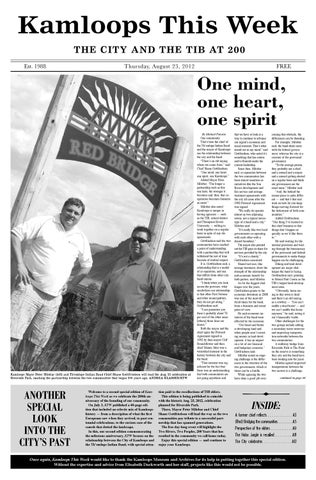
One mind, one heart, one spirit By Michael Potestio
Kamloops Mayor Peter Milobar (left) and Tk’emlups Indian Band Chief Shane Gottfriedson will lead the Aug. 25 celebration at Riverside Park, marking the partnership between the two communities that began 200 years ago. ANDREA KLASSEN/KTW
ANOTHER SPECIAL LOOK INTO THE CITY’S PAST
Welcome to a second special edition of Kamloops This Week as we celebrate the 200th anniversary of the founding of our community. On July 3, KTW published a 40-page edition that included an eclectic mix of Kamloops history — from a description of what the Àrst Europeans saw when they arrived, to past centennial celebrations, to the curious case of the camels that dotted the landscape. In this, our second edition commemorating the milestone anniversary, KTW focuses on the relationship between the City of Kamloops and the Tk’emlups Indian Band, with special atten-
One community. That’s how the chief of the Tk’emlups Indian Band and the mayor of Kamloops see the relationship between the city and the band. “There’s an old saying where we come from,” said Chief Shane Gottfriedson. “One mind, one heart, one spirit, one Kamloops.” Added Mayor Peter Milobar: “The longer a partnership such as this one lasts, the stronger it becomes and, thus, that cooperation becomes business as usual.” Milobar also noted Kamloops is unique in having agencies — such as the TIB, school district and Thompson Rivers University — willing to work together on a regular basis in spite of any disagreements. Gottfriedson said the two communities have reached a point of understanding with a partnership that will withstand the test of time because of mutual respect. It is, Gottfriedson said, a relationship that is a model of co-operation, and one that differs from other cityband unions. “I think when you look across the province, what symbolizes our relationship is that other First Nations and other municipalities, they do not get along,” Gottfriedson said. “I can guarantee you there’s probably about 70 per cent of the other areas [where] those lines are drawn.” Both the mayor and the chief agree the Protocol Agreement signed in 1992 by then-mayor Cliff Branchflower and thenchief Manny Jules was a watershed moment in the history between the city and the band. “That moment was significant for the fact that there was an understanding that both communities are not going anywhere and
tion paid to the recollections of TIB elders. This edition is being published to coincide with the historic Aug. 25, 2012, celebration planned for Riverside Park. There, Mayor Peter Milobar and Chief Shane Gottfriedson will lead the way as the two communities pay tribute to a successful partnership that has spanned generations. The free day-long event will highlight the Two Rivers, Two Peoples, 200 Years that has resulted in the community we call home today. Enjoy this special edition — and continue to enjoy your Kamloops.
that we have to look at a way to continue to advance our region’s economic and social interests. That’s what stands out in my mind,” said Gottfriedson, who noted it’s something that has continued to flourish under the current leadership. Since then, Milobar said, co-operation between the two communities has been almost seamless as initiatives like the Sun Rivers development and fire-service and sewagetreatment agreements with the city all came after the 1992 Protocol Agreement was signed. “We really do operate almost as two adjoining towns, not a typical stereotype of a band and a city,” Milobar said. “It’s really like two local governments co-operating with each other with a shared boundary.” The mayor also pointed out the TIB pays its share for services provided by the city. “It’s not a charity,” Gottfriedson concurred. Shared services, like sewage-treatment, show the strength of the relationship and economic benefit for both parties, said Milobar. As for the biggest challenges over the years, Gottfriedson points to the economic downturn in 2008 was one of the most difficult times for the band, from a business and social point of view. He said economic initiatives of the band were affected by the recession. “Our bread and butter is developing land and, when people aren’t investing money in land development, it has an impact on a lot of our financial and budgetary concerns,” Gottfriedson said. Milobar noted an ongoing challenge is the differences in the structure of the two governments, which at times can be a hurdle. While agreeing the two have done a good job over-
coming that obstacle, the differences can be daunting. For example, Milobar said, the band deals more with the federal government, whereas the city is a creature of the provincial government. “To the average person, they probably see a chief and a council and a mayor and a council getting elected on a regular basis and think our governances are the exact same,” Milobar said. “And, the behind the scenes piece is quite different — and that’s that real trick on how do you keep things moving forward for the betterment of both communities.” Added Gottfriedson: “One thing I’ve learned in this chief business is that things don’t happen as quickly as we’d like them to.” He said waiting for the internal processes and wading through the bureaucracy of the provincial and federal governments to make things happen can be challenging. Diking and land development are major challenges the band is facing, Gottfriedson said, pointing to Mount Paul Centre as the TIB’s largest land-development issue. “Obviously, horse racing in this town is dead and there’s an old saying as a cowboy — ‘You can’t saddle a dead horse' — and we can’t saddle that horse anymore,” he said, noting it isn’t financially viable. Other challenges for the two groups include adding a secondary water reservoir and improving transportation networks between the two communities. A walkway bridge from Riverside Park to The Point on the reserve is something they city and the band have been looking into for years. Milobar agreed improved transportation between the two sectors is a challenge. continued on page A4
—
INSIDE: A former chief reflects . . . . . . . . . . . . A3 (Red) Bridging the communities . . . . . . . . . . A5 Perspective of the elders . . . . . . . . . . . . A9 The Hobo Jungle is recalled . . . . . . . . A11 The City celebrates . . . . . . . . . . . . . A12
Once again, Kamloops This Week would like to thank the Kamloops Museum and Archives for its help in putting together this special edition. Without the expertise and advice from Elisabeth Duckworth and her staff, projects like this would not be possible.
A2
FOR OVER 77 YEARS © ROTO-ROOTER PLUMBERS HAS BEEN A RELIABLE CHOICE FOR CUSTOMERS ACROSS NORTH AMERICA For over 40 years Roto-Rooter Plumbers© has been earning the confidence and trust of the people of Kamloops. We thank you for thinking of us first for all your plumbing and heating needs. HISTORICAL TIMELINE
FAST, DEPENDABLE PLUMBING, HEATING, COOLING & DRAIN SERVICE Locally Owned & Operated Since 1972
RESIDENTIAL & COMMERCIAL • Sinks • Tubs • Toilets • Hot Water Tanks • Water Treatment • Sewers • Drain Tiles • Plugged Drains
• Video Inspections • Re-piping • Heating • Fireplaces • Boilers • Heat Pumps • Gas Piping • Air Conditioning
We Don ’t Do Dra Just ins
• Wood & Electric Furnaces • Oil Gas & Propane Furnaces • Septic Systems • Broken Water & Sewer Mains
EMERGENCY SERVICE - 24 HOURS - 7 DAYS A WEEK QUALITY SERVICE BY LICENSED JOURNEYMEN, PLUMBERS & GASFITTERS
#102-1139 12TH STREET, KAMLOOPS
372-2750
250
www.rotorooterplumbers.ca
A3
Thursday, August 23, 2012
Kamloops This Week
City and Tk'emlups at 200
Tk'emlups and city linked forever Former chief and Order of B.C. recipient says two people connected like the rivers By Michael Potestio
The Tk’emlups Indian Band and the City of Kamloops shall be linked forever, according to Manny Jules, former Tk’emlups chief. "We’re linked like an umbilical cord that can never be severed," Jules said. "It’s critically important for us to always have a good working relationship because, indeed, just like the rivers symbolically join, that’s how our peoples are — they’re symbolically joined for all time. "And, you can never sever that any more. "Time always marches forward. "You have to know the past, but time always marches forward and the result of that — our populations have to learn how to adapt and work together for the good of all of us," he said. Jules said maintaining a working relationship between the two groups was paramount for him during his 16 years as chief—from 1985 to 2000. He said he always put in a great deal of effort to meet with and maintain an open dialogue with the Kamloops mayor.
Jules said he has plenty of memories of the relationship between the band and the city, noting he facilitated the first Protocol Agreement, in 1992, between the two groups with then-mayor Cliff Branchflower.
"It raised a bit of controversy at the time from a couple of the council members because they felt it was usurping the City of Kamloops’ jurisdiction which was not the intention," Jules said. "The intention was to make sure that we work together." He said its mandate was to have the two parties promote each other and have their administrations meet regularly to deal with planning issues. "And, also, just to have dialogue because
you can’t have these two communities in this incredible valley without having any formal avenue of discussion," Jules said. The former chief said this intimate relationship has been evident ever since the fur-trade days, when Kamloops was set up as a trading post 200 years ago. He noted the Secwepemc word for money dates back to this time and is synonymous with their word for beaver pelt. "Even today, we’d say money, it’s 'sqlew,' which is beaver pelt," Jules said. He said the band has always been a vital part of the economic landscape of the region because it is at the crossroads of trade. Jules said the Gold Rush, the arrival of the Overlanders and the creation of large ranches ultimately led to an establishment of permanent settlement. "It wasn’t until the late 1870s when the demographic started to change," he said. "Up until that point, the majority of people, indeed in the province and indeed in the Interior, were First Nation." Many goods and
industries became well known in Kamloops, such as hop growing, the tomato canneries, the cigar factory, apple orchards and the timber industry. "And, throughout all of these industries, First Nations have always been a part of it," Jules said. "They were involved as labourers, leasing land for some of these ventures, early loggers — First Nations were part of the horse logging industry. "As a matter of fact, Kamloops lumber got its start on the reserve a long, long time ago,” Jules said. After the fur trade, natives were involved in industries such as fishing, tourism, agriculture — and even as deckhands on paddlewheel steamers, which graced the Thompson rivers beginning in the 1870s. “So, the relationship between the band and the city, I think, has been incredibly important and it’s also going to be into the future even more so,” Jules said, predicting future growth in the Kamloops area will likely take place on Tk'emlups Indian Band land.
Stop in for that old-fashioned customer service! A lot of things have changed over the years, but one thing remains the same at Gord’s...
CUSTOMER SERVICE!
e v a h o s l a We st cookies the bne town! i
Just like days of old, you still get the same great customer service at Gord’s. Our friendly, professional sales and service team treats every customer sincerely with genuine concern to help each person who visits our store.
Gord’s MAYTAG & More! 948 TRANQUILLE RD, KAMLOOPS • 2503765353 • FREE DELIVERY IN KAMLOOPS •
Kamloops-North Thompson MLA Terry Lake (right) congratulates Clarence Thomas (Manny) Jules on receiving the Order of B.C. Jules, a former Kamloops Indian Band councillor and chief and co-founder of the Shuswap Nation Tribal Council, was one of 13 people to receive the 2009 Order. Said Jules of the relationship between the city and the band: "It’s critically important for us to always have a good working relationship because, indeed, just like the rivers symbolically join, that’s how our peoples are — they’re symbolically joined for all time." KTW FILE PHOTO
At Minos We Care About Quality and Quantity! For nearly 50 years George has been serving Greek dishes that haven’t changed in centuries. His commitment to selecting the finest ingredients and cooking them the old fashioned way is the reason for his overwhelming success. George’s attention to detail and personal service has gained him the reputation he enjoys today.
For the best in Greek & Mediterranean food, stop by Minos today and taste what everybody is raving about.
GREEK RESTAURANT 262 TRANQUILLE RD • 250-376-2010
A4
Thursday, August 23, 2012
Kamloops This Week
City and Tk'emlups at 200
Seamless relationship spans generations Economies of city, Tk’emlups cross boundaries not visible to passersby continued from page A1
“As both communities grow transportation links, both foot and automobile, those have significant potential cost drivers to both communities in terms of how people will move around on both sides of the river,” Milobar said. How they manage those connections will dictate how the two areas grow over time, he said. Gottfriedson said the reserve has plenty of potential for expansion, opining that, as the city grows, it makes sense that future growth will likely come on the reserve as the cost of developing land will likely be cheaper than building at higher elevations in Kamloops. “I think that’s where the partnership comes into play and I think that’s a lot of the things we talk about as joint councils, trying to work through long-term visioning and long-term planning,” Gottfriedson said. But, as the City of Kamloops and the Tk’emlups Indian Band move forward together, future development will rely on co-operation over time from both future leadership and those on the ground floor. “Stability and understanding, not only from
the leadership, but from our technical people, is paramount as we move forward,” Gottfriedson said. “Some of these troopers, as I call them, they’re here forever. "Leadership, you’re here for a period of time and then you pass the baton.” “There’s no certainty in politics, my friend,” he said. “The only certainty is that, someday, you won’t be one [a leader] anymore,” Milobar added as the two leaders shared a laugh. Milobar said any outsider looking in on the two wouldn’t notice where boundaries lie. “Which is a good thing in terms of co-operation and overall economic well-being,” he said. “If jobs are being created on band lands, it’s no different than any other regional employer. Chances are a lot of those people live in Kamloops, work outside of Kamloops and vice-versa, so every dollar spent there is still a dollar spent in our area.” The chief added the TIB helps support the local economy as well. Milobar said the relationship has only gotten better with age, noting differences between the two
areas are practically nonexistent. Visually, housing, businesses and commercial areas look similar and citizens of Kamloops and the TIB live on both sides of the river, which makes the boundaries of Kamloops and Tk’emlups seamless, Milobar said. “I think the chief and I both very much understand where those borders are in terms of governance but, in terms of the average person’s day-to-day life, they’re able to be seamless,” he said. Gottfriedson said he’s seen a better understanding from ordinary citizens regarding the TIB and its history — and he believes he and the mayor have a fantastic relationship. “We don’t necessarily have to wait until the quarterly meeting to have a conversation about something that arises,” Gottfriedson said. “I mean, after all, he was my son’s hockey coach this year, so I had a lot of time to talk about things.” “More importantly,” Milobar quipped, “I was able to have the chief impart his hockey knowledge from the stands on me as I was coaching — very valuable advice received from the stands.”
'The longer a partnership such
'Stability and understanding,
as this one lasts, the stronger it becomes and, thus, that co-operation becomes business as usual.' — Mayor Peter Milobar
not only from the leadership, but from our technical people, is paramount as we move forward.' — Chief Shane Gottfriedson
For Over 45 Years!
Continental
Cooper’s Foods has been proudly serving communities throughout BC’s interior and lower mainland since 1957.
BARBER SHOP
Stop by today and experience our friendly customer service, great prices and wide selection of quality products, because “Cooper’s People Care” about our community.
Same great service... same great guy since 1962!
50 YEARS
John DeCicco ,
Owner/Barbe
r
319 VICTORIA STREET - 250.374.6042 Dan Magee - Manager Brocklehurst Location Open Since 1981
Bill Campbell - Manager Westsyde Location Open Since 1971
We’ve welcomed visitors to Kamloops since 1939 Ernie Cordonier - Manager Valleyview Location Open Since 1967
Larry Bertoncini- Owner/Operator Lansdowne Location Open Since 2007
1290 West Trans Canada Hwy. (Exit 368) Kamloops, BC T 250 374 3377 TF 1-800-662-1994 tourism@kamloopschamber.ca 73 YEARS
A5
Thursday, August 23, 2012
Kamloops This Week
City and Tk'emlups at 200
The original Red Bridge connecting Kamloops and Tk'emlups, as seen in 1887. Today's span is the third Red Bridge and is 76 years old. KAMLOOPS MUSEUM AND ARCHIVES
SEEING RED WHEN LINKING KAMLOOPS, TK'EMLUPS By Michael Potestio
Kamloops’ first span over the Thompson Rivers was the Red Bridge, built after a decade of lobbying from people demanding a bridge connecting the city and the Tk’emlups Indian Band reserve. It was built in 1887—in only two months — slightly west of where today's Red Bridge (the third such structure) stands. A bit of a bidding war ensued over the original bridge. James McIntosh, known as "The King of Kamloops", put in a bid of $9,700, but he was usurped by Daniel Adams, who was given the contract for his bid of $7,000. The Inland Sentinel reported on Sept. 17, 1887: "Several
tenders were received; but Mr. Adams’ being the lowest, it was accepted. We understand this contract has been taken at a low figure." When completed, the bridge was 1,000 feet long, had a main span of 120 feet and a 50-foot opening for paddlewheel steamers. Built 27 feet above the low water mark, it even withstood Kamloops’ largest flood in 1894. When the bridge opened, it was referred to in the Sentinal as "The Thompson River Bridge" but, it soon acquired the nickname “Red” because the wooden structure was built with Douglas Fir. That article also noted the bridge “provides convenient
DID YOU KNOW? 1st Protocol Agreement: On Canada Day in 1992, the City of Kamloops and the Tk‘emlups Indian Band made history by signing the first protocol agreement. This agreement made meetings between the two councils mandatory and made history as it established the first formal agreement in Canada to have an open dialogue between a city and a band. The signing ceremony was held at McArthur Island Park, where both Chief Manny Jules and Mayor Cliff Branchflower each put their John Hancock on the historic document. The agreement states the city and band agree to “declare their mutual intentions to pursue a renewed and lasting relationship based on mutual respect and honour, in keeping with that of the first white settlers and the original people of the territiory.” The agreement called for the two groups to meet twice a year to discuss issues of concern.
access to a large district on the North Thompson and will prove a great advantage to the residents of that section as well as the business people of Kamloops.” It’s a link that has been vital for the Kamloops area, according to former Tk’emlups Chief Manny Jules. “It’s been an important link between the two communities and it’s always been there as far as I know,” Jules said. One Red Bridge story Jules finds amusing involves another former chief. Chief Louis ran a ferry service between the city and the reserve. “The Red Bridge put him out of business,” Jules said
with a laugh. Despite the later construction of the Yellowhead Bridge to the east, the Red Bridge remains in business and is, Jules said, “a major artery” between the reserve and the city. In 1912, 20 years after the first Red Bridge connected the two shores, it was rebuilt in the same location. That second Red Bridge lasted until 1931, when a fire damaged the span's south end, resulting in the structure being condemned. It was reconstructed and a third Red Bridge — the very arch in use today — opened in 1936. The current Red Bridge is 1,200-feet long, with two pre-
fabricated spans of 100 feet and 135 feet and four piers. It sits just east of where the first two bridges rose. It took 300,000 feet of lumber and $60,000 to complete the project in the middle of the Great Depression. Forman Paul McMasters and 23 men worked five months to finish it. McMasters said it would be good for more than 30 years. Seventy-six years later, the Red Bridge remains a major connector between Kamloops and Tk'emlups. It was closed for three months in 1970 to undergo a remodelling that would better reflect its name. The bridge was painted
“a bright fire-engine red in keeping with requests from the Downtown Business Association,” according to a 1870 article in the Kamloops Daily Sentinel. That article also noted that “many of the companies on the subdivision reported customers complaining of the inconvenience of the longer trip using the Yellowhead Bridge.” This was in reference to the three months during which the Red Bridge was out of commission. In 1970, the bridge was also widened six inches, with new stringers, wheel guards, decking and hand railings also installed. This project was reported to
have cost an estimated $75,000. After seven decades, the third Red Bridge continues to get the work done. Colleen Stainton of Communities in Bloom said her group has taken it on as their bicentennial project. So far, the group has enhanced its entrance, with a heritage sign and a new threeway stop on the south side. Further plans include illuminating the historic span from below with red light. Stainton said the bridge is a critical link between Kamloops and Tk’emlups, which has symbolic meaning as a link between the city and the band, which is why it was chosen as the bicentennial project.
As former chief Manny Jules notes elsewhere in these pages, the lumber industry in the Kamloops region grew with the help of First Nations workers. KAMLOOPS MUSEUM AND ARCHIVES
A6
Thursday, August 23, 2012
Kamloops This Week
City and Tk'emlups at 200
In November 1969, Kamloops hosted the largest gathering of First Nations chiefs in the history of B.C. Largely in response to the White Paper, the chiefs gathered to discuss many political issues facing First Nations and formed the Union of B.C. Indian Chiefs. The 1969 White Paper was a Canadian policy document in which then-minister of Indian Affairs Jean Chrétien proposed the abolition of the Indian Act, the rejection of land claims and the assimilation of First Nations people into the Canadian population, with the status of other ethnic minorities, rather than a distinct group.
Kamloops site of historic First Nations conference By Michael Potestio
From Nov. 17 to 22, 1969, Kamloops hosted one of the most significant conferences in First Nations’ history. The largest gathering of chiefs ever in British Columbia was held that week, partly in response to the White Paper. All but four chiefs in B.C. attended the Kamloops conference to discuss the various political issues facing First Nations, said former Chief Manny Jules, who was a high school student at the time. Clarence Jules, thenchief of Tk'emlups, was
host chief and, on the first day, he welcomed his fellow chiefs to the place where the rivers meet. The minutes from that meeting note Clarence thanked the chiefs for choosing Kamloops and described the meeting as "most important," referring to the fact the it was the first of its kind. He called the meeting "a good thing; it is the first step in gaining recognition of our wishes, our aims and our demands." Peter Wing, thenmayor of Kamloops, also welcomed the chiefs to Kamloops that day, noting
how proud he was the city was hosting such a landmark gathering. "The discussions I am sure will be most useful, the questions that you have on your agenda as suggested by Chief Jules are very important questions," Wing said. "They are, I think, updating laws that were made over a hundred years ago. "Everything else has been updated and the laws for our first citizens have not been updated in the same manner as the laws and regulations for the rest of the citizens of Canada
and I think this is a very good step in the right direction . . ." One of the most significant outcomes of the conference resulted in the chiefs establishing the Union of B.C. Indian Chiefs. Today, the B.C. Union of Indian Chiefs still has its founding head office in Kamloops. Another significant development the conference helped get started was the amendment to the Indian Act, allowing First Nations to tax businesses on their reserves, said Clarence.
It was an amendment his son, Manny, would eventually make a reality in 1988. "It took years," said Clarence. Taxation had been an ongoing issue for First Nations since 1965 and was one of many topics discussed during the conference at Kamloops. Clarence pointed out Manny attended the B.C. Chiefs conference even though he was supposed to be in class. "He played hooky from school," said Clarence. "Maybe that’s when he got the idea he wanted to
help his people — and he certainly came a long way." A wide range of political issues and questions were discussed amongst the chiefs at the conference, such as the White Paper, taxation and unresolved land claim issues. The meeting was a turning point for Manny. After listening in on those meetings, he knew he wanted to get into politics. “I realized at that point that there was a movement, that there was really a rebirth and a re-energizing of First Nations’ politics in my community, provincially and nationally — and it
inspired me,” said Manny. Even while in first grade, he would tell people he wanted to be chief, as he was inspired by his father's work. "It was watching my dad, knowing that he helped organize the Union of B.C. Indian Chiefs, that he did the welcoming address, that he was involved in it," said Manny. "I witnessed it first-hand, going to the meetings first thing in the morning and staying all day, listening to the debates. It was just one of those epiphany moments in my life,” he said. Manny said Kamloops
was chosen for the meeting in part because it was a central location and many of the major political leaders of the day were from the area. He said the 1969 conference held in Kamloops, and the formation of the Chiefs Union that resulted, sparked a maturing of the First Nations political movement in B.C. and opened the door for many more political movements amongst First Nations. “When the historians will look at the modern First Nation movement, this is where it happened,” said Manny.
LOOKING FORWARD TO THE NEXT 200 YEARS
1930
2012
Fashion always finds its place in time. In the Heart of the Downtown - 418 Victoria St. Open Monday - Saturday, 10:00 to 5:00
Family Care for Generations 34 Your trusted local source for prescriptions and home health care supplies since 1978.
YEARS
Since 1988, The North Shore Business Improvement Association (NSBIA) has represented commercial property and business owners with a mandate to expand the business opportunities in North Kamloops & Brocklehurst. We currently take up residence in the historical Wilson Street Heritage House.This house was originally built in the 1920's and has been fully restored to its original glory. At one time, it was the home to Stewart Wilson, the first Commissioner of the Council of North Kamloops (equivalent to the modern day mayor). It is now at 115 Tranquille Road. For all business opportunities in the sectors we represent, stop by and take advantage of the information available to help your business succeed in these vibrant city neighbourhoods.
Free Delivery on all Home Health Care Supplies & Prescriptions! (within city limits)
KIPP-MALLERY PHARMACY 273 Victoria Street • 250-372-0842
NORTH SHORE BUSINESS IMPROVEMENT ASSOCIATION 115 Tranquille Road, Kamloops B.C. • 250-376-2411 • www.nsbia.com
A7
Thursday, August 23, 2012
Kamloops This Week
City and Tk'emlups at 200
Chief Louis an iconic TIB figure Legendary leader fostered band through dramatically changing times as centuries overlapped By Michael Potestio
He was known as HliKleh-Kan and the Little Chief — or Petit Louis to the fur traders. And, he became one of the most renowned chiefs of the Tk’emlups people. Louis was born in 1828 and grew up right in the middle of the fur trade, witnessing the change in his people’s traditional Secwepmc lifestyle after contact with Europeans right before his eyes. Louis became chief during a significant turning point for the Tk’emlups people and their relationship with the Europeans. He succeeded Chief Grand Guile in the mid1850s, during a time when issues such as over-trapping and the discovery of gold in the Kamloops area — which attracted a large influx of miners and settlers — were putting great stress on his people. During the fur trade, the natives had an amicable relationship with the fur traders. The traders wanted the furs and the natives wanted the traders' goods as it made life more convenient, said Ed Jensen, comprehensive community co-ordinator with the Tk’emlups Indian Band. The natives also showed the traders how to survive in the area, Jensen said.
Chief Louis died on April 12, 1915 and his funeral was later held at St. Joseph’s Church (right) on Tk’emlups Indian Band land. Louis is buried in the historic church’s cemetery. Louis became chief in 1852 and served as hereditary chief until his death.
This all changed, however, when gold was found in the area and a tidal wave of miners and settlers flooded into Kamloops. This was, Jensen said, a turning point for the Secwepmc people and for all First Nations people in B.C. "Thousands seeking their fortunes came through our territories and they were a different breed of man," he said. "They had no respect for the local inhabitants, the original inhabitants," Jensen said. "To them, we were just in their way." Jensen said the chief would have seen the settlers grow from a couple to a couple of thousand during
his lifetime. "I often visualize being there, seeing the change in the territory overnight, so to speak," Jensen said. "It must have seemed to be like a great horde of locusts coming in," he said with a laugh. Living through such a dramatic increase in the settler population, Chief Louis knew it was crucial to set some land aside for his people so they did not get pushed out completely, said Jensen. In 1862, Chief Louis was instrumental in getting the Douglas Reserve established for his people. He even requested
the development of the Industrial School, said former chief Manny Jules. This school would later become the Residential School, he said. In 1866, when the Douglas Reserve was reduced to three square miles, Chief Louis played a critical role again in getting a portion of that original reserve restored, Jules said. This happened in 1877 and is the reserve the Tk’emlups has today. "When you look at Chief Louis as an individual, he was really the father of our community," Jules said. The chief made many trips to Ottawa to negotiate
for more land for his people and on behalf of other B.C. natives. His last visit to the capital was in 1908. Louis even made a trip to London to discuss the land issue with Queen Victoria. He oversaw the construction of St. Joseph's Church and was known to have had a close association with Father Le Jeune. When he died in 1915, Louis was buried in St. Joseph's Cemetery outside the church. Louis even had an audience with Pope Pius X in 1904, when the pontiff presented him with a bronze medal.
Louis also liked horses and owned some, which he raced and from which made money. Louis often attended horse races in Kamloops, Ashcroft, Savona and the Nicola Valley. He was known to have worked at times for the Hudson's Bay Company as a horse trainer, trip-man, express rider and trader. In 1876, Louis and the Kamloops band welcomed Governor General Lord Dufferin on his visit to the area with a ceremony. In 1894, Louis presented a speech when Governor General Earl of Aberdeen came to visit the Residential
School. During that delivery, Louis spoke in Shuswap and stressed the need to live happily together. Father Le Jeune translated. As chief of the band, Louis was also responsible for law enforcement. In 1887, Alex McLean rode over to the reserve, where he killed one person and wounded two others. Chief Louis ordered him to be shot down and may have had to do the deed himself. Elder Christine Tronson remembers hearing that story from her mother and said the chief did indeed have to shoot the notorious McLean. “He just took his gun and he went out and got his horse and went and shot that guy,” Tronson said. In 1912, at the age of 84, Louis went to Clinton as part of a search for Moses Paul and Paul Spintum, who were later convicted of murder. The chief was married
twice. His first wife was Eugenie Shushtalorx, whom he wed in 1881. After her death, Louis married Marie, the widow of Abraham La Rocque, in 1889. Louis spent more than 60 years as chief until his death on April 12, 1915, at the age of 87. His funeral at St. Joesph’s Church was heavily attended by members of the Kamloops band and First Nations people from other districts. On that day, the Kamloops Sentinel wrote that Chief Louis “was generally recognized as one of the ablest chiefs in the Interior. He was a man of keen intelligence, very diplomatic, in all business connected with the interests of his people, and will be much missed by them.” The people of Kamloops attended as well, with a large group gathering outside the church to pay their respects to the “Little Chief” who lived a big life.
Proudly serving Thompson Country Region since 1987 Promoting community economic development through the support of businesses and communities
The Plaza Hotel
•
Business Plan Development
•
Business Loans
•
Business Training
•
Business Consulting
•
Self Employment Program
•
Community Economic Development
Kamloops’ Grand Dame, The Plaza Hotel, is proudly reopening after an 8-month multi-million dollar renovation which has added style and modern conveniences throughout the hotel while preserving its treasured heritage charm. With central downtown location, heritage charm and modern conveniences to match its unbeatable value and inclusions, The Plaza Hotel is poised to offer every guest an unforgettable stay in Kamloops.
#230—301 Victoria St.
Restaurant The newly-renovated Fireside Steakhouse & Bar at the Plaza Hotel will be proudly offering a full range of locally-raised Black Angus steaks and other selections in relaxed, heritage surroundings perfect for any occasion.
Kamloops, BC V2C 2A3 T 250 828 8772
Fireside Steakhouse & Bar will also feature a selection of dishes cooked on Himalayan Rock Salt blocks. This unique process cooks, sears and seasons the food while it sits on the preheated pink salt block. An appealing variety of salads, starters for sharing and lighter meals complete the menu and offer something to please any appetite. Complimentary Rate Inclusions: • Bottled water in-room replenished daily • Full hot breakfast for 2 • WiFi throughout hotel • Access to YMCA Indoor Pool & Fitness Facilities • Business services and business centre access • Parking for 1 Vehicle per Guestroom • Local & long-distance calls New amenities: • New 24 hour business centre • 32” & 40” Samsung HDTVs • Premium HD entertainment and sport programming • Upgraded complimentary WiFi • Updated paint, wallpaper and colour schemes • New guestroom furniture • Superb triple sheeting and bathroom linens • iPod docking clock radios • Highest quality eco-friendly amenities • New bathrooms
F 250 828 6861 info@communityfutures.net www.communityfutures.net
Heritage Elegance, with modern comfort
www.plazaheritagehotel.com like us
follow us
locate us
review us
A8
Thursday, August 23, 2012
Kamloops This Week
City and Tk'emlups at 200
The great Mosquito War of 1939 The region was abuzz with the battle between Kamloops and Tk'emlups, with the biting pest at the centre By Michael Potestio
The City of Kamloops and the Tk’emlups Indian Band have not always had the great relationship the enjoy today. In fact, in 1939, the two got into a heated disagreement, which has been dubbed the Mosquito War. In the early 1930s, the City of Kamloops began to put mosquito spraying into operation. The process involved oiling sloughs and ponds around town with hand pumps at locations where mosquito larvae was known to hatch. Soon enough, the city wanted to spray a large
slough on the Tk’emlups reserve. An agreement was signed, which stated the city would be allowed to do so as long as it compensated the band for any damage caused by the oiling. On May 26, 1939, the Kamloops Sentinel reported that the Tk’emlups band had told city council slough oiling in 1938 had destroyed hay crops. The band asked for $244 ($4 per acre) for the 61 acres that had been destroyed. If the city refused to pay, the oiling on the reserve would be zapped. The city refused and so began the Mosquito War.
Charles Spencer, alderman and head of the civic health committee, was livid as he believed it was critical to spray for mosquitoes before the end of May. Two other aldermen — F.W. Scott and Bert A. Edwards — had apparently examined the site in the fall of 1938 and determined the mosquito spraying had not damaged the hay crop. The Dominion entomologists concurred with this opinion. Alderman Spencer then went to negotiate with Indian Agent W.J. Ferguson, but the meeting made little progress. The Tk’emlups agreed
to drop the compensation price by a dollar per acre, though the chief at the time emphasized the fact the city had welched on the original agreement. The city countered with an offer of 50 cents per acre on the condition the oiling could continue immediately. The two sides were now in a stalemate and city council backed Spencer’s claim that no damage had been proven and, therefore, no payment would be made. Instead the city contacted Ottawa to get permission to spray. A letter to the editor of the Kamloops Sentinel, from Tk'emlups resident
Amy Leonard, stated when council contacted Ottawa, it was advised to compensate Tk'emlups $183 before it could continue spraying. At this point, Spencer was claiming a lack of fertilizers and degeneracy in the soil were the real culprits for the destruction of the hay crop. City council then supported a resolution to the B.C. Union of Municipalities to make mosquito spraying mandatory on reserve lands. While this war was raging, the Sentinel ran a front-page story with a headline reading Council seeks Dominion-wide support to Contention Reservations that
are Nuisance or Detriment Should be Removed from the Vicinity of Cities. It was a unanimous resolution, sent to the BCUM with the expectation of endorsement and that it would be sent to the “Canadian body”, with copies sent to cabinet members, according to an article in the Kamloops Museum and Archives. Spencer emphasized the reserve was a detriment to the city and that it would be better for both parties if the reservation was moved. Leonard’s letter to the Sentinel summarized the situation. After mentioning the
request by the federal government to pay $183 compensation, she wrote: "The city immediately tried to stampede us by clamoring for the removal of all reservations from municipalities. The question of oiling is forgotten. Now 'let’s show those Indians—crush them, beat them to the ground, let might be right. Now is the time to sling all the dirt and mud at them we can. Let’s do anything but pay the $183.’ "A new Hitler has arisen to crush the timid, the poor and faltering Indian. Because Ottawa has recognized the justice of our claim, Ald. Spencer must
talk all the dirt he can about us. "What about Kamloops itself? How cleverly he talks about transients, etc. "Those who live in glass houses should not throw stones. Clean up your own city, Ald. Spencer, before you throw dirt at the unfortunate Indian.” Leonard's letter concluded by saying natives felt the people of Kamloops supported their claim and wished to see justice done. Around this time, there was no more word of resolutions or appeals to government and the Mosquito War appears to have been unresolved.
DID YOU KNOW? Kamloops Indian Days: The inaugural Kamloops Indian Days were held on June 23 and 24 in 1961. The program for the two-day festival offered a welcome from the mayor and council, stating the integral role of First Nations in the development of Kamloops and the hope the event would become an annual celebration. Day 1 started with a parade downtown, starting on Victoria Street. There was then a rodeo at Exhibition Grounds and, that night at Memorial Arena, there was competitive dancing, singing and drumming. Tribes from B.C., Alberta, Montana, Idaho and Oregon competed in
Your Family Owned Funeral Home For over 20 years Kamloops Funeral Home has been helping Kamloops families through very difficult times. We will answer any questions you may have regarding funerals and assist you with the decisions you need to make during a stressful time. Should you desire, we are also available to make funeral arrangements in the comfort of your home. "We are the owners of the Kamloops Funeral Home and have been involved in the funeral business for over 30 years. The picture is in Smithers, BC where we learned the funeral business from our grandfather and father at the DeFrane Funeral Home (later, R.A. Schrader Funeral Home). We purchased Kamloops Funeral Home with the desire to continue a long tradition of Family Funeral Service in Kamloops BC.
these events. There was also a ceremony for the Honorary White Chief - Sandy Sandiford of the Indian Days Committee. Day 2 had teepee judging, more rodeo activities, as well as more dancing, singing and drumming competitions and the crowning of the Indian Princess. Groups such as the Kamloops Council of Women, the City of Kamloops, Kamloops Venture Club and the Kamloops band were just a few of the groups acknowledged in the program for their help in organizing Kamloops Indian Days. The next year, in 1962, the festival was expanded to three days on June 14, 15 and 16.
Our passion is the hobby of model railroading & trains.
Located in the Kamloops Craft & Antique Mall 634 Victoria St. Hours: 10am to 5:30pm, Mon-Sat 250-377-8510 • www.kellyskaboose.ca
KELLY'S KABOOSE
16 YEARS
The Natural Solution for your pet Keep your pet strong, healthy & satisfied with the largest selection of raw & dry natural food in the Valley!
Locally owned and operated
Lawrence (left) and Darren (right) Third generation Funeral Home owners
KAMLOOPS FUNERAL HOME & CREMATION SERVICES
THEBONEAND BISCUITCOMPANY .COM
Kamloops Only Family Owned Funeral Home Serving the Thompson & Nicola Valleys for over 20 years
250-554-2577 • Toll Free: 1.866.420.7758
A103 - 1180 Columbia St. W
250.851.9247
A9
Thursday, August 23, 2012
Kamloops This Week
City and Tk'emlups at 200
M ILDR
ON TRONS E N I T IS
ED DIL LABOU GH
CHR
CLARENCE JULES
MINDING OUR ELDERS A trio of Tk'emlups citizens share their stories By Michael Potestio
Tk’emlups elders have seen their fair share of the shared history between the city and the band. A few Tk’emlups elders shared that history with KTW. "They communicate a lot better than they did years ago, because there was a lot of discriminating going on," said Mildred Dillabough. The Tk’emlups elder attended the Residential School when she was about eight — leaving in the mid-1950s — and has spent the past 50 years living on the reserve, where she raised seven children. Mildred said the Tk’emlups band has progressed significantly since the development of the subdivision and better housing and the introduction of running water and electricity. "We’re doing a lot better than we ever did before," she said. Former Tk’emlups chief Clarence Jules concurred that the relationship between the band and the city has improved over the years. "The band spends a whole pile of money here in town. I mean, how the heck can you deny that? We live here in Kamloops just the same as everybody else does," said Clarence, noting natives need to purchase items, such as groceries and clothing, in town. Christine Tronson grew up on the reserve and said
there were never really any significant problems between the two sides of the river that she can recall. For the most part, Christine said, people got along, as there was never really much fighting —though there was some discrimination against First Nations. “Always been that, I think, and probably always will be,” she said. Christine recalled that, when she was a little girl — in the mid-1940s — there were certain stores in town in which natives were not allowed. "When I was younger, we couldn’t go into certain stores," said Christine. "They didn’t want anybody like us in their stores. There was just a few stores and a restaurant that we could go to." Clarence remembers the hardships of growing up during the Great Depression. “They didn’t call it the hungry '30s for nothing,” he said with a laugh. Back then, Clarence said, the livelihood of First Nations people was probably as good as anybody else's. He recalled many people having a few chickens, cows, horses and a garden of their own. "My dad had quite a little orchard. Mind you, it all got torn down and I think the flood of 1948-49 had a lot to do with it," said Clarence. "Just imagine — you
can’t go out, you don’t know if you got a price to buy some tomatoes, potatoes or whatever." Clarence said his father told him about the "great flu" [Spanish Flu] of 1918, explaining just how devastating it was. "My dad was telling me, you could be talking to a guy at eight o’clock in the morning [and by] 5 o’clock he was gone. Just like that," said Clarence. Christine said her roots in Kamloops stretch far into the past. Her great-great-grandfather, Joseph LaRocque, a French-speaking Iroquois, was one of the first traders to come to Kamloops. Chief Louis would go on to marry the widow of LaRocque’s son, Abraham. Christine noted the widow married Chief Louis, which brought the chief into the Tronson family. "We were even related to the Macleans," she said with a laugh. "The notorious Macleans." "The LaRocques are like the roots of the reserve," said Christine, pointing out they had land on the east side of the reserve, from The Point to the site where the Residential School now sits. "And, when the Residential School was built, the government expropriated the land for the school," Christine said, noting grandmother
was elderly and didn’t understand what they were doing at the time. Christine attended the Residential School in or about 1945 and left around 1955. "I couldn’t stand it anymore," she said. Christine said she had fun during her childhood, as she would go for swims, ride horses and hike up Mount Paul. Attending the Residential School was a difficult time, she said, noting its intent was to assimilate natives. "Change the Indian, make him into a white man," she said, her voice quivering. "It didn’t work." Christine was 17 when she married Robert Tronson of Vernon in 1956. He is a native, but is considered non-status, which caused Christine to lose her status. They decided to move to Chase, where her husband worked as a logger and where they raised seven children. Christine didn’t return to Kamloops until 1990. "I just wanted to come back to my reserve," she said. "I always longed to be home. This was my home. This is where my roots are." Kamloops has always been a beautiful city, in the eyes of Christine. "My Mother used to say, 'It’s God’s country.'" Life on the Kamloops reserve could be difficult
back in the day. Mildred said it was hard living on the reserve because, up until about 50 years ago, they didn’t have electricity or running water, unlike in the city. "A lot of them had a hard time living on the reserve, because it wasn’t easy," she said. Clarence remembers the reserve didn’t have electricity until about 1960. Until then, coal-oil lamps lent light to night. "You didn’t turn a bulb on," he said with a laugh, noting the only telephone was located at a church. Mildred recalls getting her first electricity bill — for the sum of $2. Clarence said that, after the industrial subdivision was established in the early 1960s, conditions began to change, as telephone and electric companies wanted to serve businesses on the reserve. "That’s when it started to come in," he said. "We [said], ‘OK, you’re going to serve those guys, you’ll serve the Indians too.' And they did." Clarence noted that, as chief in the 1960s, he had a great relationship with former Kamloops mayor Peter Wing. "Peter Wing was just a tremendous person,” Clarence said. "Most of the council for the City of Kamloops were really great to us, always."
A10
Thursday, August 23, 2012
Kamloops This Week
City and Tk'emlups at 200
The Passion Play took place in Kamloops twice — in 1892 and 1901. Here, participants re-enact the crucifixion along the main street of the village on the reserve. KAMLOOPS MUSEUM AND ARCHIVES
Passion was at Play at turn of century By Michael Potestio
The Passion Play was used in the B.C. Interior by Oblate missionaries as a way to assimilate First Nations people — and it came to Kamloops at the end of the 19th century. It was a visual representation of the crucifixion of Jesus Christ, which the Oblates used to overcome language and cultural barriers with the natives. The Oblates were intent on spreading Catholicism amongst the First Nations and phasing out their traditional customs, such as marriage, potlatches, shamans, songs and dances. Outright conformity was not demanded as Christian and First Nations customs were tolerated, though natives were to be “Europeanized” as much as possible. St. Mary’s Mission — located near Mission in the Fraser Valley — became the model on which other Oblate Villages in British Columbia would be based. European-style houses were built and the mission church was the main building in the villages. In 1889, Father Chirouse of St. Mary’s Mission started the Passion Play, which portrayed the arrest, trial and crucifixion of Jesus
Christ, using a series of tableaux to visually represent the key stages of the Easter Passion. This ceremony took place twice in Kamloops — in 1892 and 1901. Oblate Father JeanMarie Lejeune —who arrived in Kamloops in 1882 — was instrumental in getting the Passion Play brought to the area. The first one was to happen in June, but was held off until September, when Father Chirouse arrived with First Nations from Sechelt to lead the religious instruction. In all, 1,300 people attended Kamloops’ inaugural Passion Play. The week-long event featured singing hymns, sermons and magic lantern slide shows. The Passion Play itself was held on Day 3. A large congregation of people were led past the posed actors, who depicted various stages of the crucifixion along the main street of the village on the reserve. The procession stopped at a large cross at one end of the village, where people in the crowd performed acts of contrition. On the Saturday, a native brass band had a concert and the event wrapped up on Sunday after communion service. A decade later, the
second—and final— Passion Play took place in the River City in June of 1901, when Father Lejeune from Kamloops returned with Father Chirouse after attending a Passion Play in Chilliwack. On Saturday, June 15, people from throughout the area arrived via steamboat, canoe and horseback for the event. By Wednesday, there were 700 people camped out in white canvas tents around the village. Every weekday began with a mass at 6 a.m. and ended with prayers at night. Daily meetings and ceremonies were scheduled for the play’s actors, chiefs, men, women and children. Those meetings took place in a special, temporary building called The Big House, which was built for the occasion. The village’s main street was cleaned and decorated with evergreens on the day of the Passion Play. That night, there were confession and prayers held, along with hymns, which were sung in both Chinook and Shuswap. During the play procession, the congregation was joined by the students and staff at the First Nations Industrial School — which became the Residential School.
Actors posed in costume along the street, with 13 different stages for the congregation to walk by. The play finished with a tableaux of the crucifixion, with special effects that poured blood on the cross — apparently without the help of human hands. The actors had to pose for a half-hour as the procession made its way through the stages. The following day (Saturday night), featured a procession with torches and lanterns. There were various stops for benedictions and prayers at outdoor alters. There was also a large bonfire ceremony honouring St. John the Baptiste. Sunday began with communion, followed by another procession. Children were blessed by priests during another ceremony that night. Sunday ended after a gathering in The Big House, where the chiefs pledged to “keep good order among their people.” The final day was Monday, June 24, and all 700 people gathered to say goodbye to the priests and shake their hands. And, with that farewell, so, too, went the Passion Play for Kamloops.
LEST WE FORGET
MCpl. Erin Doyle
The original purpose of the Royal Canadian Legion was to support returned Veterans, and their widows and children. The RC Legion hold these continues to uphold principles to this is day.
Master Cpl. Erin Doyle was killed on Aug. 11, 2008, while defending a combat outpost in Afghanistan. On Friday, May 25, Doyle’s name was added to the Kamloops Cenotaph, the Àrst addition in 65 years. Doyle’s mother, Kathy Mitchell, would like to see all of Canada’s fallen in Afghanistan honoured in their hometowns across the country.
Become a local Legion member and support our Veterans and their families. 1927 • Celebrating our 85th Year in Kamloops • 2012
ROYAL CANADIAN LEGION
Branch #52 425 Lansdowne St. • 250-374-1742
85 YEARS
A11
Thursday, August 23, 2012
Kamloops This Week
City and Tk'emlups at 200 Author Sydney Hutcheson quotes a poem in his book, Depression Stories, from one of the hobos who stayed at Kamloops’ hobo jungle: OH KAMLOOPS IS AN A-1 TOWN, TO TRAMPS AND BOES SO CROOKS BEWARE, FOR IF YOU TOUCH A THING NOT YOURS CHIEF ANDERSON WILL BE IN YOUR HAIR. WHERE THE RIVER THOMPSON FLOWS, THE TRAMPS AND HOBOES COMES AND GOES, WHEREVER THEY MAY MEET YOU, WITH THE B.S. THEY WILL GREET YOU, WHERE THE RIVER THOMPSON FLOWS.
KAMLOOPS MUSEUM AND ARCHIVES
The hobo jungle was home to many By Michael Potestio
Kamloops is known as a desert-like region but, back in the 1930s, there was a jungle in the River City —a hobo jungle. With little to no work available during the Depression hobos — as they were called —would often ride the rails from town to town, looking for jobs. In Kamloops, some hobos settled in an encampment located at The Point on the reserve, across the Thompson River from Riverside Park. Police actually helped the camp grow as any transients found camping in the city were asked to move to the
hobo jungle. Former Tk’emlups Chief Clarence Jules remembers the "hobo days" from his youth, noting the camp was located below the CN train tracks. "At that time, I didn’t understand these guys were looking for jobs," Jules said. The jungle started with 100 unemployed and grew to more than 1,000 at times. Most stayed just a few days, others hung around for a week, while a few made the jungle their home. Though it was called a jungle, it was the city that was going wild with rumours. Some people had crazy
ideas the jungle was a place of epidemic disease, where sex-starved revolutionaries camped out, according to an article in the Kamloops Museum and Archives. A Kamloops Sentinel reporter visited the camp in July of 1931 and gave it a favourable review. There were about 100 hobos living in tents and paper shacks, each with a tidy pile of firewood. Their shelters were laid out on each side of the railway tracks. A 14-year-old boy and young girl were also living amongst the hobos. The jungle appeared sanitary, orderly and had no sign
of troublemakers. There was a problem for the natives, though, as they were upset with the hobos cutting down good trees for firewood. This dilemma was solved by having the transients collect deadwood. There were relatively little agitation caused by the large group, aside from the occasional drunkenness and plenty of the hobo specialty — panhandling. Much credit for the mild behaviour went to Kamloops’ chief of police, Charles Anderson. Many of the hobos gave credit to the police chief for his fairness and common
and erstwhile president of the club, said the group was initially started by the University Women’s Club. Mika Nika Club: He went to the meetings as a delegate from Formed in 1961, this club’s aim was to the labour council, where they looked to promote better understanding between improve the relationships between people native and non-native Canadians. living in the city and the people from the It also worked to find solutions to problems Tk‘emlups band. faced by natives in the Kamloops Executive members from the city and the community. Cliff Branchflower, former mayor band put on events, such as bringing kids
DID YOU KNOW?
1904
sense in dealing with the jungle. Other accolades for the tame jungle went to the hobos themselves, who took pride in having a clean and orderly encampment. In 1931 and 1932, D.L. Curtis — known as "The Barber" — and 24 other men rallied together to ensure morale, discipline and sanitary conditions were kept at high levels in the jungle. They took the name The United Order of Beavers and were respected by the people of Kamloops. They were so respected the Baptist Church had a honorary banquet for them.
from the reserve into the city for swimming lessons at Riverside Park and having gatherings over on the reserve. Mount Paul Industrial Park: This was Canada‘s first planned subdivision on reserve land. In 1962, the band started the subdivision primarily because it had about 24 applications for leases. In 1965, there was a
2012
When the province took over the local soup kitchen, Curtis was made supervisor and his men formed the staff. Sydney Hutcheson wrote a book — Depression Stories — about his experiences travelling Canada during the Great Depression and has an entire chapter on the hobo jungle in Kamloops, according to the museum archives. In this chapter, Hutcheson describes the Kamloops jungle as a place where people could get a tooth pulled, legal advice, a haircut, medical checkups or even school lessons. All this was possible by
bartering food. Most of the jungle inhabitants were honest people, but some gave lessons on how to steal. There was a rule in the camp that specified no store in Kamloops was to be robbed, lest the good relations with police be ruined. Tk'emlups elder Christine Tronson remembers seeing the jungle when she would walk into town. Tronson was born in 1939, but said there were plenty of hobos still hanging around at The Point during the Second World War. “I remember those years, there was lots of hobos,” she said.
surrender vote for the industrial park,roads were built and the band began the process of getting the right to tax businesses in the park. Bill C-115: Kamloops has its name on many important items. An air squadron and a naval ship both adorn the Kamloops name, but that name is also in
Tronson recalls hobos stopping by her home during the day, when she and her mother were by themselves. They would knock on the door and her mother would make them a bean sandwich, said Tronson. “I remember because there was two big slices of homemade bread and she would put beans in there and give it to them because they were hungry,” Tronson said with a laugh. Sometimes, they would ask if they could chop some wood in exchange for a meal. Tronson's mother would give them some chores to do in exchange for food,.
Canadian legislation In 1988, Tk’emlups Chief Manny Jules was successful in getting the Indian Act amended to allow bands to tax land and mortgage leaseholds on the reserve This is known as the Kamloops Amendment.
IN 1922, George Brown opened Brown’s Repair Shop, providing Kamloops with premier bicycle sales and repairs, knife-sharpening, gunsmith and locksmith services. 90 YEARS LATER, his nephew Eric & staff are still providing Kamloops with top-quality safe and lock sales and services. They are proud to be a part of Kamloops’ rich history.
Tradition meets innovation. Corner of Victoria Street & 1st Ave. 250-851-9939 • brownstone-restaurant.com
Brown’s Repair Shop Ltd. 220 Lansdowne Street 250-372-3656 Safe sales & repairs • Keycutting Locks re-keyed • Keys by code Lock sales & service
90 YEARS
A12
www.kamloops.ca