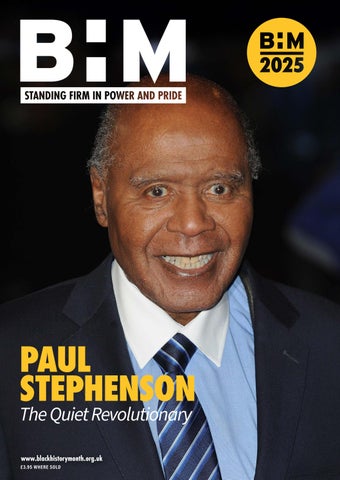
PAUL STEPHENSON
The Quiet Revolutionary www.blackhistorymonth.org.uk £3.95 WHERE SOLD
Here when you need us.
Every day, Age UK’s friendly team help with the challenges people face as they get older – from housing and health to money and mobility. Call the Age UK Advice Line on 0800 169 65 65, 8am to 7pm. Or head to www.ageuk.org.uk for help 24/7.
Age UK is a charitable company limited by guarantee and registered in England and Wales (registered charity number 1128267 and registered company number 6825798.) Registered address: 7th Floor, One America Square, 17 Crosswall, London, EC3N 2LB. ID205737 09/25
CONTENTS 04 WELCOME MESSAGE
By Cherron Inko-Tariah MBE
06 LORD PAUL BOATENG By L.J Mark
10 TRIBUTES TO LORD HERMAN OUSELEY 14 MICHAEL'S STORY OF WAR AND PEACE By The Royal British Legion
40 W. E. B. DU BOIS: A PAN-AFRICAN LEGACY IN THE HEART OF BRITAIN 42 BLACK SERVICE IN BRITAIN'S WAR: 80 YEARS OF REMEMBRANCE 44 STORMZY: A MODERN ICON OF BLACK BRITISH BRITAIN 46 THE DEVIL THEY NAMED US: WITNESSING JAB JAB AT NOTTING HILL 48 THE £86 FAYRE THAT CHANGED BRITAIN: SIR GEOFF PALMER'S LEGACY 50 JOEL THOMAS: FINDING PURPOSE AND FUELING CHANGE 54 WINDRUSH - BRITAIN'S PROMISE AND BRITAIN'S BETRAYAL 58 STANDING FIRM: THE CAMPAIGNERS WHO FORCED BRITAIN TO LISTEN 60 DESMOND TUTU: THE VOICE OF CONSCIENCE
10
16 BARONESS FLOELLA BENJAMIN: SMILE AND STAND FIRM IN POWER AND PRIDE
16
By L.J Mark
18 LEWIS HAMILTON: DRIVING CHANGE ON AND OFF THE TRACK 22 MARKING 60 YEARS SINCE THE RACE RELATIONS ACT 24 A SLAVE SHIP CALLED JESUS
30
By Dele Ogun
26 MALCOLM X: BRITAIN'S FORGOTTEN ENCOUNTER AND ITS ENDURING LEGACY 28 PAULETTE HAMILTON MP 30 BARONESS LOLA YOUNG By L.J Mark
32 EIGHTY YEARS ON: THE FIFTH PAN-AFRICAN CONGRESS AND THE GLOBAL STRUGGLE FOR BLACK FREEDOM 34 PAUL STEPHENSON: THE QUIET REVOLUTIONARY 36 DIANE ABBOTT 38 STANDING FIRM IN POWER AND PRIDE
64 LYLA SMOOTH: AN INTERVIEW WITH GLAYSON CARVALHO 66 ELAINE OWUSU-DEBORAH: LAUGHING THROUGH LIFE, LIVING THROUGH FAITH By Cherron Inko-Tariah MBE
68 YOU CALLED AND WE CAME: REMEMBERING NURSES OF THE WINDRUSH GENERATION 70 SCRATCHYLUS: A MESSAGE OF LOVE FOR THE WORLD TODAY 74 BIG BLACK BAST*RD - MY STORY By Geoff Thompson
By Patric Okumi
44
PUBLISHER: Ian Thomas EDITOR IN CHIEF: Cherron Inko-Tariah DESIGNED BY: Becky Wybrow PRODUCTION MANAGER: David Ruiz PRODUCTION TEAM: Mohammad Sadegh, Kim Thomas ADVERTISING: Ian Thomas SPECIAL THANKS TO: All our contributors, our advertisers and sponsors Discover comprehensive listings and events celebrating Black history across the nation by visiting https://www.blackhistorymonth.org.uk/listings/.
BLACK HISTORY MONTH 2023 00
BLACK HISTORY MONTH 2025
Standing Firm in Power and Pride
T
he theme for this year’s Black History Month, “Standing Firm in Power and Pride,” has sparked conversation — and in some cases, questions. “What power?” some have asked, suggesting doubt about the influence the Black community holds today. But history provides the answer. From rebellions that challenged the institution of slavery to the movements that laid the groundwork for abolition, Black people have consistently exercised courage, vision, and agency. On both sides of the Atlantic, civil rights movements were propelled by Black communities who marched, organised, and demanded change — winning victories that reshaped laws and societies. That power continues into the present, even when it faces resistance. In the United States, backlash against diversity, equity and inclusion (DEI) has led some companies to scale back programmes supporting Black employees and communities. Activists have responded with the economic strength of the “Black dollar,” calling for boycotts and reinvestment in Blackowned businesses. Here in the UK, similar movements are unfolding. Campaigners have urged the Black community to buy hair products only from Black-owned stores — a call for economic empowerment rooted in solidarity, echoed in the rallying cry #NoMoreCrumbs. The tradition of using economic action as a tool of empowerment has deep roots here: from the 1963 Bristol Bus Boycott, which challenged racist hiring practices, to Claudia Jones establishing the Notting Hill Carnival as a celebration of culture and pride. The writer Alice Walker once observed, “The most common way people give up their power is by thinking they don’t have any.” It is a reminder that resonates powerfully with this year’s theme. The need to stand firm is especially clear against a backdrop of rising
04 BLACK HISTORY MONTH 2025
By Cherron Inko-Tariah MBE Editor in Chief nationalism and systemic inequalities. Campaigns waving the St George’s Cross and Union Jack under the banner of “patriotism” can, at times, echo the divisive undertones of the far-right movements that Black communities resisted in the 1970s and 80s. Yet the story of power in Black history is not only about struggle — it is also about resilience and pride. Figures such as Altheia Jones-LeCointe, who led the UK chapter of the Black Panther movement, stand as enduring icons of this legacy. The Panthers’ mission — to instil pride, purpose, and strength in Black communities — feels as urgent today as it did then.
The message of this year’s Black History Month is clear: unity is strength. Despite challenges and differences, there is beauty and power in shared heritage. And so, as the community reflects on its history, it is also being called to action — to embrace that power, to speak it loudly, and to stand together in unity and pride. The question “What power?” has only one answer: the power we have always held — to resist, to create, to lead, and to inspire. This month, and every month, we stand firm in that power. And we take pride in it.
LORD PAUL BOATENG Standing Firm in Power and Pride
L
ord Paul Boateng’s presence commands attention. Britain’s first Black Cabinet minister, a lawyer, diplomat and lifelong activist, speaks with a calm eloquence born out of a conviction rooted in values. There is dignity in his bearing, but also a deep realism – a solidity in his power and pride. His journey from Ghana to Britain, from Parliament to Soweto, is not only a story of personal achievement but one of national and global significance. Sitting with him, I was reminded why his life and work should be required learning for younger generations. His words carried both history and urgency: a lifelong commitment to activism, and a reminder of the enduring impact of speaking up in the face of adversity.
Foundations of Faith and Values Boateng’s career has been defined by firsts. In 1987, he became one of the first Black MPs elected to Parliament, representing Brent South, alongside Diane Abbott, Keith Vaz and Bernie Grant. Fifteen years later, in 2002, he made history again as Britain’s first Black Cabinet minister, serving as Chief Secretary to the Treasury. He would later become the UK’s High Commissioner to South Africa, returning to the continent that had shaped his early life and connecting back to the struggle for freedom he had once saluted with his words. His story is not only one of personal achievement but of historic importance for Britain itself. When asked what it means to stand firm, Boateng leaned on both experience and belief. “Standing firm always requires a foundation, and the foundations have to be values based on… respect for difference, shared humanity and tolerance.” Faith, he explained, shaped this conviction: “That is why I always say with my own faith, God is love, and if He is we must have love as not just a soft sentiment but also as a strategy.”
From Ghana to Britain Born in England but raised in the Gold Coast of Ghana, Boateng grew up with pride in his ancestry. “I was always brought up to be a child who delighted in their inheritance, in terms of my ethnicity. I am British, but I am African.” That sense of identity was
06 BLACK HISTORY MONTH 2025
BY L.J. MARK
tested when, at fifteen, his father was unjustly arrested in Ghana, forcing the family to return to Hemel Hempstead, Hertfordshire UK. “The return was a shock, but we had to manage.” Despite the disruption, he valued the stability of grammar school, the influence of good teachers, and the determination of a loving mother. Family, he insists, is central to success: “Your relationships with each other are significant to getting in positions and making change.” That same belief, he added, applies to his wife, who, he stressed, “[…] was supportive to me when I was as a lawyer and politician.”
Inherited Activism For Boateng, activism was part of his upbringing, passed down like an heirloom. “I was brought up at a time in which you were expected to be politically engaged, and to seek in your life to make a difference. If you weren’t part of the solution, then you were part of the problem. I knew from the law that you could make a difference. Get the qualifications… but always be an activist.” His father, a lawyer for the Convention’s People’s Party (in Ghana), had challenged colonial power and political opponents. His mother, a teacher, was also an activist. It was within this atmosphere that activism was not an option but an expectation. Returning to Britain and experiencing the stark lack of diversity in politics, Boateng refused to be defined solely by race. “My colour is a part of me, but I do not choose to be defined by it.” He recalled his time as Treasury spokesperson on the BBC Radio 4’s Today Programme: “I was asked by the interviewer about race relations, and I said to him ‘hold on I am not here to talk about that, I am here to talk about the appalling economic record of this Conservative govt and my party’s alternative’. I had to make it clear from day
one that I was a politician who was Black, but I was not a Black politician.” That statement has lost none of its power. In an era when representation is celebrated but often reduced to identity alone, Boateng’s insistence that his politics must be judged on substance rather than skin was a refusal to be pigeonholed. He understood both the weight of symbolism and the danger of being trapped by it.
“Today, Brent South, Tomorrow Soweto” On the night of his election victory in 1987, he made a declaration that has since become famous: “Today, Brent South, tomorrow, Soweto.” For many watching, it was a startling reminder that the local and the global were connected, that the struggle for racial justice in Britain could not be separated from the struggle against apartheid abroad. Reflecting on that moment nearly four decades later, he explained: “It was an important moment for us in Britain because Parliament became a multiracial one. But I felt it was important to avoid any type of triumphalism. The fact that you have a multiracial parliament doesn’t mean that the struggle had come to an end. It didn’t mean that Black people would stop experiencing racism, it was only the next stage of the struggle. And I brought attention to Soweto because in the room was Adelaide Tambo the wife of Oliver Tambo – who led the struggle for freedom in Africa.” When asked whether his aspiration has been realised, Boateng was candid. “Yes and no, yes in the sense that both Britain and South Africa are successful multiracial democracies, but no in the sense that in both they remain real deeply entrenched patterns of disadvantage that we as people of colour experience. For example, Black women struggle in pregnancy in both Britain and South Africa, and their child is more likely to die. So long as that
BLACK HISTORY MONTH 2025 07
stays the case then my aspiration has not been met.” His answer is telling: progress is real, but injustice remains entrenched. He refuses the easy narrative of success, insisting that the struggle must always continue.
The State of Politics Today
Four decades on from that historic night in Brent South, the questions Lord Boateng raised then still echo in Britain today. The presence of Black MPs in Parliament, once unthinkable, is now a reality – but the inequalities he pointed to remain unresolved. Just as he warned against triumphalism in 1987, his reflections now turn to the wider state of politics itself: what it means for democracy, and for the next generation. The extreme difficulties faced to enter Parliament, Lord Boateng reflected, can be defined in the words of the African American abolitionist Frederick Douglass: “Power concedes nothing without a demand, it never has, and it never will.” It is a quote Boateng carries with him, one that he says embodies his own experience. “What brought all races together was a determination to see change. Because the system will never ever give you anything. Opposition doesn’t stop and in the struggle for political progress when it comes to race
and gender no one party has a monopoly of virtue” Those words, spoken with quiet certainty, remind us that for Boateng politics has never been an arena of easy victories. Change has always required pressure, organisation, and persistence – qualities he has embodied throughout his career. Despite “taking a step back” from the front line of politics, his concern for the state of democracy today is clear. “People are
disaffected. They feel let down and do not feel represented... it is for people who are engaged with the political process to seek by their actions to change that perception. You have got to seek to lead opinion and seek the truth. My plea to young people, whatever your politics please opt in, organise, make your demands, do not just accept things for being what they are, your views matter, your passion, commitment, and intellect matter...” Humanity, he suggested, is always battling for and against change. In that battle, he has found a nuance in his own sense of pride and power – standing firm in the continuing struggle to lead progression. And on this, his final petition was both a warning and a charge: “If good people give up on politics, the game is over because bad people don’t.” Leaving the interview, I carried with me more than just his words. I felt an increased sense of responsibility, a sharpened awareness of the work that remains to be done, and a strengthened belief in the power of political activism. As Britain marks Black History Month 2025, Lord Boateng’s voice is not simply part of our history. It is a call to this generation – and the next – to stand firm, in power and in pride.
Creating a better world of work for all Black workers Community has spent decades supporting, advising and bringing together working people from across the UK. Community is proud of our diverse membership. Throughout Black History Month, our reps will be celebrating in their workplaces, raising awareness and promoting the rights of Black workers. Many Black workers still face discrimination and harassment at work (41% – TUC) but most do not report it (1 out of 5). We’re committed to creating workplaces where racism in all forms is not tolerated and everyone is given equal opportunities to succeed.
With Community in your corner, you can: •
talk confidentially to an expert about any issue you face at work
•
get support to address unfair practice, bias and prejudice in your workplace
•
be part of the fight to create fairer and more equitable workplaces.
Scan the QR code to learn more about the work we do to support Black workers across the UK, and how we can help you too.
1 BLACK HISTORY MONTH 2025 08CMYK_BHM2025_HalfPage.indd
03/09/2025 11:51
Their Service, Our History For generations, Black men and women have stood at Britain’s frontlines — on land, at sea, and in the air — serving with skill, discipline, and pride. The six lives remembered here reflect a far greater story: one of courage, loyalty, and service that strengthened Britain and earned a lasting place in its history.
walter tull
johnny smythe
Professional footballer who became a commissioned officer in the British Army during the First World War. On the Western Front he led his men with courage until his death in 1918.
david clemetson
RAF navigator in the Second World War who flew hazardous missions over Europe, survived being shot down and held prisoner, and later served Britain in distinguished public roles.
Cambridge-educated Jamaican who served as a commissioned officer in the First World War — a rare distinction at the time. He saw frontline service before his death in 1918.
richard (dickie) Barr
Royal Navy veteran whose notable career reflects the long tradition of Black sailors defending Britain at sea and proudly serving with skill across the world’s oceans.
blackhistorymonth.org.uk
ulric cross
The most decorated West Indian serviceman of the Second World War, whose RAF missions preceded a diplomatic career that shaped newly independent African nations.
lilian bader
Among the first Black women in Britain’s armed forces, she trained as an instrument repairer in the WAAF during the Second World War, keeping aircraft ready for combat.
L
ord Herman George Ouseley (1945–2024) was a pioneer of justice, equity, and inclusion whose influence reshaped Britain. From his groundbreaking leadership of the Commission for Racial Equality to his creation of Kick It Out, from his service as the first Black chief executive in local government to his steadfast voice in the House of Lords, his life was devoted to challenging injustice and creating a fairer society. But beyond the institutions, policies, and public platforms, Herman’s truest legacy lies in the lives he touched. He was a mentor, confidant, and champion for countless individuals across sport, civil service, policing, politics, education, and community life. He gave time when he had none, offered clarity when others faltered, and always amplified the voices of those too often unheard. This collection of tributes, gathered from those who worked with him, learned from him, and were lifted by him, offers a portrait not just of a public leader, but of a profoundly humane man whose integrity, humility, and courage inspired generations.
PROFESSOR GEOFF THOMPSON
MBE, FRSA, DL
Chair of the Youth Charter, Chair of the Professional Footballers’ Association Operational Board, Chair of the London Youth Games, Advisory Board Member of the Muhammad Ali Center
T R I B U T E S TO
LORD HERMAN OUSELEY 10 BLACK HISTORY MONTH 2025
Standing Firm in Power and Pride In a world still grappling with inequality and injustice, the life of Lord Herman Ouseley stands as a towering testament to the enduring strength of conviction, dignity, and purpose. With unwavering resolve, he stood firm – powered by principle, and proud of his heritage, community, and cause. His life was a shining example of what it means to transform struggle into strength, and adversity into action. Born into a world of racial and social challenges, Lord Ouseley dedicated his life to dismantling the barriers of discrimination that held back generations. Yet he did so not with anger, but with quiet force, tireless advocacy, and moral clarity. From the streets of Peckham Rye to the corridors of Parliament, his voice was consistent and clear: representation, justice, and equity for all. A lifelong lover of sport – and football in particular – Lord Ouseley understood the game not just as a pastime, but as a platform. As the founding chair of Kick It Out, he led one of the most significant anti-racism initiatives in football history. His leadership
Lord Ouseley at the 30th Anniversary of Black History Month
helped forge a new consciousness within British sport, turning conversations into policies, and policies into cultural change. Football would never be the same again – because of him, it became more inclusive, more aware, more just. As Chair of the Commission for Racial Equality and Vice President of the Youth Charter, Lord Ouseley’s work was rooted in purpose and delivered with poise. Whether guiding institutions or mentoring individuals, he created space for those historically excluded – amplifying their voices and championing their rights. His belief was simple but profound: diversity is not a threat but a strength; inclusion is not charity but justice. With humility that belied his achievements, Lord Ouseley made people feel seen, heard, and valued. His pride was not arrogance – it was the pride of a man who knew where he came from, who carried his ancestry and
community into every room he entered, and who left it better than he found it. In marking his passing, we do not simply mourn – we rise in his legacy. For Lord Herman Ouseley was not just a campaigner or peer. He was a standard-bearer of justice, a steward of conscience, and a symbol of what it means to stand firm in power and pride.
DONNA FRASER OBE Four-time Olympian, Director of People, Equity, Diversity & Inclusion, Professional Cricketers’ Association Mentorship and Confidence Lord Herman Ouseley was hugely instrumental in my career development; a voice of reason, a voice of strategic thinking, a voice of care and support. When I was Chair of the BAME Network
at EDF Energy, my Deputy Chair and I delivered a number of momentous events; the first being An Evening with… hosted by the French Embassy in London. Of course, Lord Ouseley was our first choice, and without fail, he wowed the audience with his storytelling. Later, when I returned to my sporting roots at UK Athletics, Lord Ouseley once again lent his voice as keynote speaker at the ‘COACH’ exhibition hosted by Grant Thornton. His words hit the hearts and minds of the attendees, his tone captivating those who may have felt uncomfortable with the realities of racism in sport. I will forever be grateful for the support he gave me as I embarked on my career in Equality, Diversity and Inclusion. I would often meet Lord Ouseley at the Houses of Parliament, where he would host me for conversations filled with wisdom and encouragement. They were the kind of conversations you have with elders – rooted in respect and guidance. His experiences in this space became my reality, and his tone of voice was magical. Every meeting left me with a spring in my step, full of confidence that no matter what challenges came my way, I would have the courage to navigate them. He was a great man with a wonderful heart, and I will always cherish the moments and support he gave me through my journey.
PAUL HAUGHTON MBE Civil Servant, Inaugural Chair of RESPECT Minority Ethnic Staff Network
Leroy Logan with Lord Ouseley
Guidance and Support in the Civil Service I first heard Herman Ouseley’s name around 1997, when I was considering whether to file a grievance after five years of being
BLACK HISTORY MONTH 2025 11
overlooked for promotion despite working above my grade. The Commission for Racial Equality (CRE), with Herman as Chair, was one of the few places you could turn for advice. After presenting my case to a CRE staff member, I was astonished to receive a follow-up call from Herman himself. He outlined my options, and based on his recommendations, I filed a grievance. Two years later, my department settled my Employment Tribunal case out of court. But that was just the beginning of his support. In 2001, when I helped establish the RESPECT minority ethnic staff network in my department, Herman agreed without hesitation to chair its External Advice Committee. Under his leadership, RESPECT became one of the most influential minority ethnic staff networks in the Civil Service. For me personally, his greatest gift was his time. During my seven years as Chair, I called him countless times for advice. Not once did he say he was too busy. He always gave me his full attention, as I know he did for so many others. I will be forever grateful and never forget the support and guidance he provided.
L LOGAN Founder Member, Black Police Association Championing Justice and Courage I first met Herman Ouseley in the early 1990s while we were forming the Black Police Association (BPA). As Chair of the Commission for Racial Equality, Herman not only advised us personally but also delegated his senior team to support us. Without that input, the BPA would not have been established in the way it was, nor survived to influence policing nationally for three decades. Our first Chair, Ron Hope, personally thanked Herman for putting his neck on the line to help us make changes for the Black community, at a time when we were unrepresented inside policing and over-policed as members of the public. His support gave us the courage to speak out. This courage carried through to key moments: the Race for Justice Conference in 1994 and the Macpherson Inquiry in 1998, when members of the BPA – including myself – declared publicly that the police was institutionally racist. Even after leaving the CRE, Herman continued to offer advice and mentorship. I absorbed his wisdom like a sponge, and it gave me strength to withstand 30 years in policing, leaving with my head held high and joy in my heart. That’s how I saw Herman: a man of infectious optimism and steely determination, who made the impossible possible.
12 BLACK HISTORY MONTH 2025
PROFESSOR PATRICK VERNON OBE Pro-Chancellor, University of Wolverhampton; Social Commentator and Co-Author of 100 Great Black Britons Mentor, Confidant, and Friend Lord Herman Ouseley was more than a public figure; to me, he was a mentor, confidant, and friend. We first connected during my time as Director of the Brent Health Action Zone, where his leadership talks inspired and guided local change. Over the years, we would often meet for tea at the House of Lords. He never dictated solutions, but invited reflection and empowered others to lead with integrity. When the Windrush scandal erupted, he was deeply troubled. He advocated passionately for truth, transparency, and justice – not only to respond to the harm done, but to prevent future injustice.
I was proud to include him in my book, 100 Great Black Britons. His service – as the first Black chief executive in local government, Chair of the Commission for Racial Equality, and founder of Kick It Out – was trailblazing. Yet it was his humility and consistent elevation of others that left the deepest mark. When he retired from public life, I made sure to give him his flowers while he was still with us. I was privileged to present a tribute to him on the Guyanese Speaker platform – a public expression of the deep gratitude and admiration shared by many. He embodied the theme of Standing Firm in Power and Pride: he stood firm against injustice, carried himself with dignity, and never faltered in his pursuit of justice. I miss our tea chats, but more than that, I miss his steady presence in turbulent times. His legacy endures in the hearts of all he inspired.
ROB NEIL OBE Community Leader, Reach Society Patron Still Kicking it Out I first met Herman in the late 1980s at a community conference in Lambeth. He was among the people, listening intently, before stepping onto the stage as Chief Executive of Lambeth Council. He was a champion of the people, a principled leader who amplified community voice. Born in Guyana in 1945, Herman came to London as a boy of 11. Rising through local government, he became the first principal race relations adviser, then Chief Executive of Lambeth Council, and later the first Black leader of the Inner London Education Authority. In the 1990s, as Chair of the Commission for Racial Equality, he spearheaded Kick It Out, transforming football’s fight against racism. In 2001, he accepted a peerage, taking his passion and clarity of thought into the House of Lords. Yet he never lost touch with the grassroots. In 2010, he became the first Patron of the Reach Society, often attending our events to listen and share wisdom with young people. His rise from modest beginnings to the House of Lords is a testament not only to
his intellect and perseverance, but to his profound sense of duty. His life’s work embodies courage, compassion, and conviction. Lord Ouseley remains a beacon of justice – a reminder that progressive change is possible when led with vision and heart. We really can kick it out! Across these tributes, a portrait emerges of Lord Herman Ouseley not only as a public leader but as a mentor, guide, and source of courage. He championed fairness in workplaces, reformed institutions, empowered young people, transformed British sport, and spoke truth to power in policing and politics.
Shape
Yet what unites every voice here is the same refrain: his humility, his time, his wisdom, and his care. He gave confidence to those stepping into new careers. He listened when others felt ignored. He stood firm when justice demanded it, and he inspired others to do the same. As Britain reflects on his passing during Black History Month, we honour not only what he achieved, but how he achieved it – with dignity, pride, and unwavering principle. His example lives on in those he mentored, those he inspired, and those who continue his work. Lord Herman Ouseley stood firm in power and pride. May we do the same.
future.
Bring your identity. Make your impact. Train as a children’s social worker with Approach Social Work. Apply now thefrontline.org.uk/bhm BLACK HISTORY MONTH 2025 13
MICHAEL ADJIVON PROUDLY BEARING THE BLACK TARANTULA INSIGNIA OF THE 81ST WEST AFRICAN DIVISION
Michael’s Story M of War and Peace
ichael Kofi Adjivon's legacy is one his grandson, Londoner Mensah Sarbah, carries with immense pride. “I think the military shaped him to such an extent... the way he ran a household, taking keep fit classes in his 70s, everything was possible. He was a pretty unstoppable man.”
One man’s journey from Ghana to the battlefields of Burma and a celebrated military and sporting life
Supported by
Michael's story began in Togo in 1920, but he moved to Ghana when still a child. As a 15-year old Boy Scout he was fascinated by the soldiers of the local barracks and would run errands for them. Mensah explains: “he had a number of tasks that they would set him each week and he would get a little bit of money off the back of that around the barracks: that’s where he felt most comfortable.” “Coming from Togo, and being so different, he had to learn to handle himself because he stood out. I think that, and hanging around the barracks, really gave him a sense of self-worth.”
It was little surprise that when Michael turned 18 he persuaded some of the officers to help him enlist, and he trained as a signaller (despatch rider). Mensah reflects: “I think that was the first time he got that level of order. His life up until then had been kind of tempestuous”. And then war was declared.
THE FATHER OF GHANAIAN CYCLING
Michael was one of 600,000 men from Africa who served in British forces in WW2. When Britain declared war, the countries in the British Empire were automatically at war. Says Mensah: “They had been told ‘the Germans are going to come over and destroy your way of life’, they were told that conditions were going to improve for everybody, there would be a stipend, and everything would improve. And when they got back that wasn’t the case”. In 1943, Michael was deployed to Burma (Myanmar) – one of 90,000 men from Africa who were part of the legendary 14th Army. On his uniform he proudly bore the Black Tarantula insignia of the 81st West African Division. He arrived in India in August, and the following year took part in the Arakan campaign, operating in the Kaladan Valley. A strong swimmer, Michael was chosen for reconnaissance missions along the Kaladan River. MICHAEL WITH INDIAN TROOPS
finally over. The contribution of one million service personnel from the Commonwealth was crucial in the liberation of Burma and eventual victory.
him... it was ‘in stone’ that Remembrance events were important as he set up some of the associations in Ghana with a number of veterans”.
Mensah takes up Michael’s post-war story. “As soon as he came back he was demobbed, then eventually re-enlisted: it was in the blood. I think he went back with the Signals and then came to the UK to a couple of different training spots (including Catterick)”. In the Signal Squadron, Michael rose to the impressive rank of Regimental Sergeant Major. The camaraderie and experiences of Burma were deeply etched in his memory. This profound influence led him to build a house in Ghana’s capital, Accra, that became known as 'The Barracks', which contained tributes to his fellow soldiers. In recognition, the Accra authorities renamed the location of the house as ‘Arakan Square’.
"He was front and centre of several Veterans Associations, so I can only imagine that is the space that he felt he could talk about those things." Michael passed in 2006, and Mensah reflects: “I’m very proud of what he did, I only wish that I knew more. I guess as those accounts weren’t seen as being worthy of recording earlier on, we have to now try and fill in a number of the gaps. When I think of his life and the thousands of African servicemen who were in the campaign, you just wonder what an incredible tapestry of stories we could have had, and that’s a real shame, but I’m grateful and I think he would be too, that there was still curiosity in ‘old mike’.”
One of the plaques on the house features Michael’s words:
Conditions were harsh and many of Michael’s comrades fell ill. The Japanese forces were determined to defend the territory they held at all cost. “He said that it was nothing like he had ever seen and that it was tough, really difficult,” recalls Mensah. Michael was among the infantry of the 81st Division when they played a vital role in halting the Japanese advance in early 1945. They launched a joint attack with the 82nd (West Africa) Division to liberate the strategically-important town of Myohaung. After more than a year on active service, the 81st Division was rested and prepared for the invasion of Malaya. They were in India when the Japanese surrender was announced in August and the war was
‘It is courage and determination that wins a battle... Brace up, chest out, stride out briskly and close the gap’. Michael was a keen, almost fanatical, sportsman and later promoted cycling nationwide. A relentless competitor, he took victory in the inaugural Coronation Race in Accra in 1953 and several national titles. He is fondly remembered as the father of Ghanaian cycling. His retirement years were dedicated to supporting the Veterans Association of Ghana and the RBL poppy appeal. Mensah says that the family still fondly remember the booming sound of marching bands throughout the house, being played on the BBC World Service during Remembrance Day. "I know that was an annual event for
MICHAEL ADJIVON'S GRANDSON, MENSAH SARBAH
The Royal British Legion is proud to support Black History Month. To discover more stories about service, sacrifice, power and pride, visit: blackhistorymonth.org.uk/rbl
Smile and Stand Firm in Power and Pride BY L.J. MARK
B
aroness Floella Benjamin is an inspirational, affectionate, and kind woman who has remained true to herself as she achieved success. Her strength in pride and power are just two attributes that illustrate her prominence. During our brief time together, Floella Benjamin greeted every individual we encountered with a big smile and a conversation. To me, this illustrated something which I deeply believe in when it comes to life – unity.
BARONESS
F LOELL A BENJAMIN
“My mother stood tall. She was the most incredible woman of force and energy, despite a terrible childhood, she forgave those responsible because they taught her how to aspire for better. She wanted to live in Beckenham, Kent (predominately white and middle class), because the residents had the best of everything. And when we went to buy the house, the neighbour called the police on us! But we bought that house and Mum lived there until her death. Now I have claimed Beckenham for my parents. ...if my mother hadn’t stood tall, Lord only knows what would have happened.” Benjamin’s mother motivated her aspirations and empowered her to disseminate that maternal love forward. Furthermore, her family were entrenched in politics, which spurred her desire for justice. “My grandfather was the deputy prime minister of Antigua, my father was a union man and so I have politics in my DNA, always having this feeling of doing the right thing.” This is the legacy of the Baroness who received her damehood for charitable work with the Sickle Cell Society and her BAFTA fellowship for her work with children.
Embracing your identity to fulfil your power The 1970’s saw Benjamin audition as a model for an advert in an African magazine but they admonished her advising: “We can’t have you look like a tribal woman, put a wig on.” Continually Benjamin was told to ‘stay in her place’ or to conform. However: “I have never taken parts that I don’t believe will make Black people proud.” Ironically, it was her interview at Play School which emboldened her to show off her blue beaded plaited hair with pride. Consequently, Benjamin was empowered to push for change: “In Play School there weren’t any black stories or illustrations, so I went to the producer with my smile, and said can’t we have different races included too? And do you know what she said? ‘we hadn’t noticed’.” Upon this realisation, Benjamin became more vocal, which led to her writing diverse stories. Despite Baroness Benjamin achieving significantly for the Black community, she still faces stereotypical labelling. Benjamin firmly counters this by asserting: “I am never ashamed of my Blackness.” This assertion is illustrated in her words to her children: “.. you’re Black and you’re white mixed together which makes you golden.”
Affirmations such as this positively impact upon youth to develop cultural pride and thus feel empowered and confident. We live in a culturally diverse society, so why judge those for embracing that when we fight so hard for diversity and inclusion?
What is next? Baroness Floella Benjamin is a culturally industrious woman, who continuously strives for progress: “I am forever passing on the baton […] the earlier you teach children about diversity and inclusion the better.” Currently, almost all schoolchildren in the UK are studying the pictorial version of her book ‘Coming to England’. Those children, send her messages as follows: “Dear Floella, we are naming our class after you, and when we grow up, we want to be like you.” Commencing this interview, I was amazed that this powerful woman had so much faith in children, which is something that I rarely encountered outside of my home growing up. However, learning about Benjamin’s life and the impact of her
work, I left the House of Lords extremely optimistic for the future. So, I would like to end this article with Baroness Benjamin’s own words of wisdom: “Whenever you get a rejection, smile because every disappointment is an appointment with something better.”
BLACK HISTORY MONTH 2025 17
LEWIS HAMILTON: DRIVING CHANGE ON AND OFF THE TRACK
When Lewis Hamilton pulls on his helmet, the world goes quiet. The roar of the car, the blur of colour on the circuit, the stopwatch ticking in thousandths of a second — all of it distils into a single focus: to be faster than anyone else alive. Formula One is a sport where margins are microscopic. Yet Hamilton’s story has never been about margins. It has been about defying entire systems — class, race, tradition — to become not just a champion, but a symbol of change.
18 BLACK HISTORY MONTH 2025
ROOTS IN STEVENAGE
Hamilton was born in Stevenage, Hertfordshire, in 1985. His father, Anthony, of Grenadian heritage, worked multiple jobs — IT contractor by day, putting in shifts as a waiter and security guard by night — to support his son’s passion for karting. At eight, Lewis was racing on weekends in a second-hand kart bought by his father. Money was tight, but determination was abundant. Karting circuits were overwhelmingly white and middle-class. Lewis often stood out as the only Black child, the only one without a wealthy family or corporate sponsor. He later spoke about racist taunts at school and on the track. Yet these early battles sharpened his resolve. By age ten, he was already winning junior titles. At an awards dinner that same year, he approached McLaren boss Ron Dennis and declared: “Hi, I’m Lewis Hamilton. I want to race for you one day.” Dennis told him to come back in nine years. Hamilton returned in eight.
A NEW FACE IN FORMULA ONE
In 2007, Hamilton became the first Black driver in Formula One history. In his rookie season with McLaren, he stunned the sport:
nine consecutive podiums, four race wins, and a title fight that went down to the final race. The following year, at just 23, he won his first World Championship in dramatic fashion — overtaking on the last corner of the last lap of the last race. It was the kind of cinematic ending that cemented his place in sporting folklore. Yet beyond the victories, Hamilton’s presence on the grid was a seismic cultural shift. Formula One had long been seen as an elite, European, largely inaccessible sport. Here was a young Black man from a council estate in Stevenage, rewriting the image of who could belong in the paddock.
DOMINANCE AND DOUBT
Over the next decade, Hamilton built a career that would eclipse every record in the sport. Driving first for McLaren and then Mercedes, he has won seven World Championships — equalling Michael Schumacher — and more than 100 Grand Prix, the most of any driver in history. His name sits atop nearly every statistical leaderboard in Formula One. But Hamilton’s dominance was never just about engineering or speed. It was about mindset. He spoke openly about the pressure of being the only Black driver in the sport, about the scrutiny of being in the
public eye, about the whispers that he did not “fit” the mould of a British champion. He admitted to moments of doubt, even depression, yet always returned with resilience. That honesty became part of his legacy.
BEYOND THE TRACK: ACTIVISM AND RESPONSIBILITY
If Hamilton’s records made him famous, his activism has made him historic. For years, Formula One was slow to reckon with issues of diversity. Hamilton changed that. In 2020, after the murder of George Floyd, he became one of the few athletes in global motorsport to speak openly about racism. He wore “Black Lives Matter” shirts on the podium, took the knee before races — often alone — and called on Formula One and the FIA to address systemic inequality. He established the Hamilton Commission, which produced a landmark report into barriers for Black talent in motorsport. Its recommendations, from STEM education support to new recruitment pathways, are now shaping programmes across the UK. Hamilton’s activism extends further. He pledged millions to scholarships, grassroots charities, and initiatives for underrepresented youth. He has spoken out on sustainability,
BLACK HISTORY MONTH 2025 19
urging Formula One to confront its environmental impact, while adopting a plant-based lifestyle himself. He uses fashion not just as self-expression, but as a political statement — whether in bold streetwear or on the Met Gala carpet. He has become, in every sense, a modern Renaissance figure.
REPRESENTATION AND STYLE
Hamilton’s presence is cultural as much as sporting. For young Black fans, seeing him lift trophies in a sport that had never before embraced them was transformative. Representation matters — and Hamilton knew it. His success has encouraged a new generation to look at motorsport differently, from karting clubs to engineering careers. Style has always been part of his language. He collaborates with designers, experiments with looks, and challenges stereotypes of what an F1 driver should be. In doing so, he has brought Formula One into spaces — fashion, music, pop culture — where it rarely appeared before.
STANDING FIRM IN POWER AND PRIDE
For Black History Month, Lewis Hamilton’s story resonates as both inspiration and challenge. He embodies Standing Firm in Power and Pride. Power, in the records, the championships, the unrelenting pursuit of excellence. Pride, in his heritage, his activism, his refusal to hide vulnerability. Hamilton often speaks of wanting to inspire young people who feel excluded — those who, like him, grow up on estates, face discrimination, or doubt their place in elite spaces. “The important thing is that little kids see me and know that anything is possible,” he once said. That, perhaps, is his greatest victory: not the trophies, but the futures he has opened.
20 BLACK HISTORY MONTH 2025
LEGACY STILL IN MOTION
At 39, Hamilton is still racing, still chasing an eighth world title. Yet even if he never wins another race, his impact is secure. He has changed not only what Formula One looks like, but what it stands for. He has made space where there was none. He has driven change, on and off the track. Lewis Hamilton is more than Britain’s greatest racing driver. He is a pioneer, an activist, and a modern icon of Black British Britain. And like the circuits he commands, his legacy loops forward — circling back to inspire, to challenge, to remind us that history is never finished, only ever in motion.
BLACK HISTORY MONTH 2025 21
MARKING 60 YEARS SINCE THE RACE RELATIONS ACT OF 1965
I
n August 1965, Britain made history. For the first time, Parliament recognised that racism was not just a private prejudice but a public wrong that demanded the law’s attention. The Race Relations Act was modest in scope and weak in enforcement, yet it marked the beginning of a legislative journey towards racial equality in public life. The Act outlawed discrimination in public places and made it an offence to incite racial hatred. Its powers were limited, but its symbolism was profound. For many Black and Asian Britons, who had long endured exclusion in housing, jobs and daily life, it was recognition — not justice, but at least acknowledgement.
A CHANGING NATION
The story of the Act cannot be told without the story of post-war Britain. In the late 1940s and 1950s, tens of thousands of men and women from the Caribbean, South Asia and West Africa came to the UK, many at the invitation of the British government, to help rebuild a nation scarred by war. They worked in hospitals, factories, transport and public services. They arrived as British citizens, steeped in British values, yet their welcome was cold. Landlords turned them away. Employers dismissed applications on sight. Pubs, hotels and restaurants refused service. The infamous signs — “No Blacks, No Irish, No Dogs” — were not legend but reality. At the time, none of this was illegal. The courts
22 BLACK HISTORY MONTH 2025
would not intervene. The state stayed silent, clinging to the belief that racism was an American problem, not a British one.
RACISM EXPOSED
The injustice was not new. In 1943, the celebrated cricketer and barrister Learie Constantine took London’s Imperial Hotel to court after it refused him and his family
a room because of their colour. He won the case, but the ruling was narrow and offered no wider protection. His experience showed that racial discrimination in Britain pre-dated the Windrush era, placing the 1965 Act within a much longer timeline. That illusion of Britain being free from racism collapsed again in the late 1950s and early 1960s. The Notting Hill riots of 1958, when white mobs attacked Caribbean residents, exposed the violence on Britain’s streets. The 1964 Smethwick by-election, fought with openly racist slogans, showed prejudice was not only social but political. At the same time, grassroots resistance was growing. In 1963, the Bristol Bus Boycott — led by civil rights pioneers Paul Stephenson, Roy Hackett and others — challenged a company’s refusal to hire
to enforce decisions or impose penalties. Housing, jobs and education — the areas where discrimination cut deepest — were left untouched. Campaigners quickly recognised these weaknesses. They had not won the protections they needed, but they had secured something important: the first admission by the state that racial discrimination was wrong. It was a start — and starts matter.
BUILDING ON THE FIRST STEP
Black or Asian bus crews. Inspired by the Montgomery Bus Boycott in America, the campaign mobilised the whole city, winning national headlines and forcing the company to reverse its policy. Stephenson also made waves when he refused to leave a Bristol pub that denied him service because of his colour — an act of defiance that exposed everyday discrimination in stark terms. International events added pressure. The civil rights movement in the United States was reshaping global attitudes, and campaigners in Britain took note. In early 1965, the Campaign Against Racial Discrimination (CARD) was formed, bringing together activists, clergy, lawyers and community leaders. CARD drew inspiration from figures such as Claudia Jones — the Trinidadian journalist, publisher and organiser who had founded The West Indian Gazette and the early Notting Hill Carnival before her death in 1964. CARD provided a united voice, insisting that Britain needed its own laws to protect minorities from racial injustice.
THE FIRST STEP
Labour’s 1964 election victory created an opening. Harold Wilson’s government, aware of mounting tensions, tasked Home Secretary Frank Soskice with introducing the Race Relations Bill. The debate in Parliament was heated. Supporters argued that the law was overdue. Opponents protested that it threatened “freedom of association” — a coded defence of the right to discriminate in one’s home, business or club. Others dismissed it as unenforceable or unnecessary, claiming Britain had no real “colour problem.” Despite resistance, the Bill passed. In August 1965, the Race Relations Act made it illegal to deny service in public places such as hotels, pubs, restaurants and transport on the grounds of race, colour or ethnic origin. It also outlawed the publication of material likely to incite racial hatred. To oversee complaints, the Act created the Race Relations Board. But the Board’s role was conciliatory, not punitive. It could investigate and advise, but it had no power
The shortcomings of the 1965 Act were obvious, and pressure for reform mounted quickly. In 1968, Parliament extended protections to cover housing, employment and the provision of goods and services — directly addressing the daily struggles of finding a home or securing work. Still, enforcement was weak. By 1976, further reform created the Commission for Racial Equality, with wider powers to investigate, support victims and hold institutions accountable. The Commission became a visible symbol of the state’s responsibility to tackle racism, even if its resources were often stretched thin. Over time, Britain’s anti-discrimination framework widened further. The Equality Act 2010 consolidated earlier laws, protecting not only against racial discrimination but also against prejudice on grounds of religion, gender, sexuality, age and disability. The journey that began with the 1965 Act had grown into a comprehensive — if still imperfect — attempt to legislate fairness. It is important to remember that none of this began in Westminster alone. It was demanded, shaped and forced onto the political agenda by ordinary people: tenants denied housing, workers turned away from jobs, families refused service, and campaigners who refused to remain silent.
Learie Constantine
Figures like Paul Stephenson, Roy Hackett, Claudia Jones and the leaders of CARD represent countless others whose names are less known but whose persistence created change. Their demands gave the 1965 Act life, and their disappointment with its limits ensured that stronger laws followed.
AN UNFINISHED STRUGGLE
Looking back, it is tempting to judge the 1965 Act by its failures. It did not end racism. It did not guarantee equality. It left too many people unprotected. But to dismiss it entirely is to overlook its role in changing the political and legal landscape. The Act planted a marker: that racial discrimination, however limited the law’s reach, was unacceptable in British society. That marker still stands. It reminds us that rights are not handed down as gifts but won through struggle and secured by vigilance. Sixty years later, the language of legislation has evolved. So too has the public debate. Yet the work of racial equality remains unfinished. Reports such as the Macpherson Report (1999) into the murder of Stephen Lawrence and the Windrush Lessons Learned Review (2020) show how deeply racism remains embedded in Britain’s institutions. Disparities continue in policing, health, education and employment. Marking this 60th anniversary is not simply about commemoration. It is about honouring those who fought for the Act by recognising how much more remains to be done. The Race Relations Act of 1965 did not close the chapter on racism in Britain. It opened a new one: a chapter where the law could no longer excuse discrimination but was required, however imperfectly, to challenge it. It was not the end of the struggle. It was the beginning of another — rooted in rights, recognition and the long, unfinished demand for justice.
Claudia Jones
BLACK HISTORY MONTH 2025 23
W
illiam Pitt the Younger was born on 28 May 1759, the year before the new round of slave uprisings in Jamaica. At the age of fourteen he had gained admission to the University of Cambridge where his main subjects were Classical Literature, Moral Philosophy, Political Philosophy, Natural History, Medicine, Theology and Mathematics. He excelled in all of them before gaining admission as a Barrister and later becoming Member of Parliament for the, then, University of Cambridge constituency. Making his debut entry into the House of Commons on 23 January 1781 he became Prime Minister in 1783 at the age of twenty-three. As physically weak as he was mentally strong, Pitt was a formidable orator. It was he who, in 1795, as Prime Minister of England, initiated the Second Maroon War, and the invasion of Toussaint L’Overture’s Haiti, with the object of entrenching the institution of slavery in both islands. Yet two years prior he had been leading the argument in Parliament for Britain to take the lead in the debate on the abolition of the slave trade: How is this enormous evil ever to be eradicated, if every nation is thus prudentially to wait until the concurrence of all the world shall have been obtained?... There is no nation in Europe that has, on the one hand, plunged so deeply into this guilt as Britain; or that is so likely, on the other, to be looked up to as an example, if she should have the manliness to be the first in decidedly renouncing it... How much more justly may other nations point to us, and say, ‘Why should we abolish the slave-trade, when Great Britain has not abolished?’...This is the argument with which we furnish the other nations of Europe, if we again refuse to put an end to the slave trade...
24 BLACK HISTORY MONTH 2025
A SLAVE SHIP CALLED JESUS BY DELE OGUN
The explanation for what might appear to be high hypocrisy was the distinction Pitt was drawing between abolition of the slave trade and abolition of slavery: the trade had to go but those who were already enslaved were to remain in their condition. Pitt was shrewd. He knew that it was on the back of the enslaved Africans that all things had been made possible for all the slaving powers. Africans had become the raw materials on which all enterprise depended. The labour of the enslaved being cheap and plentiful, all that was required was suitable land on which to deploy them. So long as Britain owned the American colonies, its status as the major player in the game was assured. With the loss of these colonies, it faced relegation, as the other players, France, Netherlands and Spain together with the newly independent United States, played on. The US Constitution was drafted at the Philadelphia Convention of May 25 to September 17, 1787, before being formally adopted on September 17, 1787. It is significant that it was in that same year that Pitt’s moment of conversion to the cause of abolition of the trade came. The epiphany is couched in near Newtonian terms by his biographer, William Hague, the former leader of the Conservative Party:
In the grounds of Holwood, where Pitt used to love to cut and plant, a celebrated oak tree lived on into the twentieth century. Only a small stump remains today. One day in 1787, Pitt sat beneath this tree with one of his closest friends, discussing a subject which was moving rapidly from being an accepted part of the economy to a burning moral outrage: the Atlantic slave trade. The friend was William Wilberforce, who later wrote: ‘When I had acquired so much information, I began to talk the matter over with Pitt and Grenville. Pitt recommended me to undertake its conduct, as a subject suited to my character and talents. Pitt’s conversion to the course of abolition of the slave trade was aided by a shrewd calculation which gave him assurance that Britain could survive without the slave trade because it already had an ample stock of Africans in captivity in the Caribbean Islands: It was in this retirement [of parliament] that Mr Pitt made those able calculations, which satisfied him for ever after, as the minister of the country, as to the safety of the great measure of the abolition of the Slave-trade; for he had earlier proved, that not only the islands could go on in a flourishing state without supplies from the coast of Africa, but that they were then in
a condition to do it. With this assurance, Pitt fixed his gaze on the prize of Britain being able to claim to be the first to abolish the evil trade in which it had been the primus inter pares operator. Knowing that the Americans had committed themselves to a constitutional standstill on abolition for the next twenty years, until 1808, Pitt was in no hurry. In the end, the entirety of the American twentyyear standstill on abolition would be used by Britain to build up its own stock of Africans in the West Indies. Dele Ogun, Nigerian-born lawyer, author, and commentator; founder of Akin Palmer LLP, acclaimed for works on Nigeria’s history.
y to a w e t a g Your ring e t s o f l i c n local cou Becoming a foster carer is a journey unlike any other. Find out more below or scan the QR code, because you’ll know what to say better than anyone else. www.fosterwithyourlocalcouncil.org.uk
BLACK HISTORY MONTH 2025 25
BRITAIN’S FORGOTTEN ENCOUNTER AND ITS ENDURING LEGACY
MALCOLM X
I
n February 1965, only days before his assassination at Harlem’s Audubon Ballroom, Malcolm X embarked upon a short yet profoundly significant visit to Britain. This visit, though often overlooked by mainstream historical narratives, provided a critical reflection on the state of race relations in Britain, exposing uncomfortable truths and leaving a lasting impact that resonates to this day. Malcolm’s primary destination was Smethwick, a small industrial town in England’s West Midlands, which had gained notoriety for its explicitly racist climate during the mid-1960s. The town had recently captured national attention through a deeply divisive political campaign during the 1964 general election. Conservative candidate Peter Griffiths had unapologetically capitalised on anti-immigrant sentiments, using the inflammatory slogan, “If you want a nigger for a neighbour, vote Labour.” Griffiths’ election was a stark indicator of Britain’s simmering racial tensions, shattering the myth of British tolerance and exposing widespread prejudice. Upon arriving in Smethwick, Malcolm was confronted with an environment openly hostile towards racial minorities. Marshall Street had become infamous due to explicit discriminatory housing policies, reinforced by signs barring “coloured” individuals from renting or purchasing homes. The reality Malcolm encountered – streets marked by racial segregation, signs promoting hatred, and blatant exclusion – shocked even him. Despite his familiarity with America’s own entrenched racial divisions, Malcolm openly declared, “This is worse than Harlem,” delivering a penetrating critique of Britain’s self-image as a tolerant society. Malcolm’s invitation to Smethwick had come from Avtar Singh Jouhl, a leader of the Indian Workers’ Association (IWA), an organisation actively campaigning against racial discrimination. Jouhl recalled Malcolm’s visit vividly, stating, “When Malcolm came to Smethwick, he was calm but clearly disturbed by the racism he witnessed. He told us we must not be silent and must always confront injustice wherever we find
26 BLACK HISTORY MONTH 2025
it.” During his stay, Malcolm engaged directly with local residents, confronting discrimination head-on. He visited establishments openly denying service to people of colour, spoke with residents who shared stories of ongoing prejudice, and toured areas marked by racist slogans and graffiti. This firsthand experience allowed Malcolm to highlight the global nature of racial injustice, challenging Britain to recognise and address its own embedded racism. He explicitly rejected the convenient narrative that racism was solely an American problem, urging British society to confront and dismantle its internal prejudices and systemic inequalities. Malcolm also addressed a crowded hall at the Birmingham University Students’ Union, delivering a powerful message that resonated deeply with the predominantly young audience. He asserted passionately,
“I believe in human beings, and that all human beings should be respected as such, regardless of their colour.” His speech became a catalyst for reflection and action among students, many of whom would later become active participants in Britain’s civil rights and anti-racist movements. Despite its significance, Malcolm’s visit remained largely unacknowledged in Britain’s historical accounts for decades. Only recently have dedicated activists, historians, and community organisers successfully begun reclaiming and commemorating this critical event. A commemorative blue plaque now marks Malcolm’s presence in Smethwick, and vibrant murals honour his contribution, serving as reminders of the enduring relevance of his courageous stance against racism. Beyond symbolic recognition, Malcolm’s brief but impactful presence contributed to
tangible social and legislative changes. His visit, alongside continued local advocacy, influenced public opinion and policy, notably helping to push Britain toward passing the Race Relations Act of 1965. Though limited in scope, this act was Britain’s first legal attempt to address racial discrimination, setting a precedent for subsequent and more comprehensive legislation. Today, Malcolm’s message continues to resonate profoundly, particularly as Britain once again grapples with persistent racial inequalities amid contemporary societal challenges. The racial disparities Malcolm confronted—such as unequal access to
employment, education, healthcare, housing, and the discriminatory practices in policing – remain prevalent issues. The resurgence of the Black Lives Matter movement, both globally and within Britain, underscores the continued importance of Malcolm’s emphasis on grassroots activism, solidarity, and an international approach to fighting racial injustice. However, this resurgence has not been without backlash. In Britain, as in the United States, protests have been met with political resistance, media scepticism, and attempts to reframe the movement as divisive. Calls to address systemic racism have been challenged by those who argue that Britain is a post-racial society, and efforts to diversify education or reform policing have been met with accusations of cultural erasure or political correctness gone too far. This reaction reveals the depth of discomfort that often accompanies honest discussions about race. Yet, the very presence of such resistance affirms the relevance of Malcolm’s core message: that justice requires not just acknowledgement of inequity, but also an unwavering commitment to confronting it. Malcolm X’s forgotten British encounter invites contemporary society to reflect deeply on persistent racial inequalities and the complexities of British identity and history. It highlights the necessity of confronting
historical injustices honestly to achieve meaningful social progress. Revisiting this critical historical moment fosters greater awareness and understanding, challenging Britain to actively address and dismantle systemic racism. As Malcolm’s legacy endures, Britain faces an ongoing imperative to engage with its complicated racial history transparently. This historical moment provides critical insights that continue to inform contemporary movements for justice and equality. Malcolm X’s unwavering advocacy for dignity, equality, and human rights remains an essential guiding light, encouraging sustained activism and solidarity across diverse communities. Ultimately, Malcolm X’s British visit serves as a powerful reminder that confronting racism is not merely a historical exercise but an ongoing moral and societal obligation. Malcolm’s conviction that injustice must be confronted “by any means necessary” challenges Britain today to recommit to dismantling racial inequalities. By remembering and honouring Malcolm’s brave and profound impact, Britain can move forward with greater honesty, inclusivity, and determination toward achieving genuine racial justice and equality.
Discover your future in policing Search WMP Jobs to apply
westmidlands.police.uk
BLACK HISTORY MONTH 2025 27
Black History Month is a time to celebrate our resilience, honour our stories, and reaffirm our unbreakable commitment to justice. Paulette Hamilton MP Member of Parliament for Birmingham Erdington
T
his year’s theme, ‘Standing Firm in Power and Pride,’ is deeply personal to me, not just as Birmingham’s first Black MP, but as a woman who has dedicated her life to fighting for health equity in our communities. I’ve always said my journey into politics was forged in the NHS, where I worked as a district nurse for 25 years. Day after day, I saw the disparities in our health system, the barriers to access, the gaps in outcomes, and the quiet neglect that our communities endured. That experience didn’t just shape my career, it ignited a fire in me to challenge systemic inequity head-on. As Cabinet Member for Health and Social Care on Birmingham City Council, I fought for policies that tackled the root causes of health inequality, such as housing, poverty, and discrimination that disproportionately devastates Black communities. But it was during the COVID-19 pandemic that the brutal reality of these inequities became impossible to ignore. The Birmingham and Lewisham African
28 BLACK HISTORY MONTH 2025
Caribbean Health Inequalities Review (BLACHIR), which I led, exposed a harsh truth, Black and Asian communities bore the brunt of COVID-19, suffering higher death rates as frontline workers. Our mothers, fathers, brothers, and sisters were forced to risk their lives in low-paid, insecure jobs because they had no choice. The pandemic didn’t create these injustices; it exposed and amplified them. Today, as Vice Chair of the Health and Social Care Committee and Chair of the APPG on Black Health, I continue this fight. Black women are four times more likely to die in childbirth than white women. Sickle cell disease, a condition disproportionately affecting Black communities, remains underfunded and overlooked. Black women suffer in silence with fibroids and reproductive health conditions, while research and treatment lags far behind. This isn’t just a failure of our health service; it’s a failure of trust. It’s about who gets heard, whose pain is believed, and who holds power in the decisions that shape
our lives. Discrimination isn’t always a shouted slur; sometimes, it’s a system that ignores our pain, underfunds our needs, and silences our voices. But leadership demands more than just outrage. It demands courage. It demands action. It means standing firm when the odds are stacked against you. It means demanding answers when lives are lost through neglect or indifference. And it means fighting not just for words of solidarity, for targeted funding, research, and policies that truly save lives. More than 30 years of fighting for health equity has taught me that our power lies in our pride, and our pride lies in our refusal to accept injustice. Whether in politics, our health system, or our daily lives, we must strive for leadership in all spaces, we must lead with conviction, because “a man who stands for nothing will fall for anything”. And we, as a community, stand for justice. We stand for equity. And we stand for the unshakable truth that we matter too, in every hospital ward, every waiting room, and every decision made about our lives.
BARONESS
LOLA YOUNG
STANDING FIRM IN POWER AND PRIDE
B
aroness Lola Young of Hornsey is a crossbench peer in the House of Lords, cultural advocate, and campaigner for social justice. A former actress, professor of cultural studies, and champion of the arts, she has spent her career bridging creativity and politics. Young is a woman of remarkable intellect, passion, and authenticity. Her life and career reflect a deep commitment to learning, justice, and self-expression. She has cultivated knowledge across diverse fields, notably politics and the arts, and consistently challenges societal expectations and stereotypes. Young’s refusal to conform to reductive labels is a testament to her character.
Power of hindsight
Young’s reflections on her childhood reveal a profound impact of hindsight in understanding racism and identity. Raised by a white foster mother, Daisy Vince, during a time of overt racial prejudice, Young experienced both love and alienation. Vince, born in 1886 at the height of the British Empire, took Young in aged 8 weeks. Despite societal norms, Vince embraced Young, however, her family did share her acceptance: “Hindsight made me realise that it was racism. It was a very different time, not trying to excuse anybody but it is just that you lived in a different kind of reality. Racism negatively impacted me... I knew at the time that it was rubbish, but it was not until I did my degree that I started to look at where the stereotypes came from…. I didn’t know that Daisy’s daughter went to the Nigerian embassy to send me back or that she wrote to a social worker that ‘she was anti-colour’, which is a weird way of saying that ‘I am racist’.” The care system was not reflective of Young’s desire to be educated. Nonetheless Young perceived this as an alternate pathway that shaped her rather than a disadvantage, believing that overcoming these obstacles shaped her to stand firm in herself. Speaking on the current fostering and adoption experience for ethnic minorities raised in white families. Reflecting upon her own experience, Young cautioned: “You better be damn sure that you know how to deal with those kinds of things and support the child with what they are going to deal with, whether it is about cultural needs, their hair or their skin.”
30 BLACK HISTORY MONTH 2025
Fluidity of identity
Young embodies confidence in her identity accepting her lack of connection to her ethnicity as part of her growth. Having spent most of her life in Britain raised by a British family, contrary to her Nigerian ethnicity. Young discloses: “I didn’t feel that connection and that was the sadness of it. When people ask me what I identify as I say that ‘I am a north London care experienced black woman’ half-jokingly. Someone else asked me...if I feel Nigerian and I said, ‘not in the way you might’. Some people are invested in me making that identification, but I would be lying if I said that I did.” Recalling a brief reconnection with her parents, Young says: “My parents were a culture clash because they were totally different to anything I had known. …I remember when I went to Nigeria it was difficult because I was expected to be slotted in, but lots of things worked against me being accepted in that society.” Young’s reflections challenge the idea that identity is fixed to a specific culture: “I strongly identify with the concept of African diaspora.” This embraces the recognition of hybrid identities, consequential of immigration and colonialism. Contrary to conforming to labels that don’t reflect one’s truth, just adopting conformity’s divisive nature. This is a robust reminder that identity is personal, fluid, and shaped by lived experience.
THE ARTS TO POLITICS
Young first connected with politics through the art’s acceptance of freedom of expression: “I loved the arts; I read a lot when I was kid. The book was my friend, because it told me things that people around me did not. I learned about racism in books. Reading up on …the American Civil Rights movement and that was a huge part of my education.” Young enjoyed writing and studied A level art. She, was discouraged from publishing, after being rebuked that: “It wasn’t up to the likes of someone like you.” Being overlooked in major roles in art, as well as honing knowledge of active discrimination, Young emphasised that: “[To me] art is as political as anything else.” In the 1990s, Young became aware of reforms in the House of Lords, including opportunities for crossbenchers. She applied for a position in the Lords. Though unsuccessful at first, she was supported by some who saw her value and eventually secured a seat. Her journey illustrates how persistence and self-belief can overcome systemic exclusion.
Trailblazers or Tokenism
Young famously abhors the “one of the firsts”, label describing trailblazers from marginalised communities. Acknowledging the importance of pioneers, she argues
that such labels reinforce alienation by insinuating success is a rare/abnormal aspiration for her demographic: “…when my publishers do it, I’m like ‘really?’ Who is that we are waiting for?” This thought-provoking perspective challenges institutions and society to move beyond tokenism and toward systemic inclusion, where Black individuals’ achievements are normalised and celebrated: “You want to be at the stage when it is commonplace.”
What is next?
Asked what she is proud of, Young responds with characteristic humility: “Having the opportunity to learn new things and then have the platform to change things that look and are wrong.” In relation to her future, she said: “A lot of friends of mine are retired, and I think that would be nice, but then someone offers me an opportunity, and I am like ‘ooh yes please I would love to do that’. I am not that person who would just stop. I must be really engaged with stuff; I think that I would like to do more writing...” Baroness Young’s achievements are not just inspiring; they are rooted in a sense of purpose and integrity. This fuels her passion to stand firm in power, pride and influence with intention.
BLACK HISTORY MONTH 2025 31
EIGHTY YEARS ON: The Fifth Pan-African Congress and the
I
global struggle for Black freedom
n October 1945, in the industrial heart of Manchester, a gathering took place that would help reshape the course of the twentieth century. Over the course of six days, from 15 to 21 October, the Fifth Pan-African Congress brought together a powerful coalition of Black activists, intellectuals, trade unionists, students and future heads of state. They met in a post-war Britain weakened by conflict but still clinging to empire. What they demanded was clear: an immediate end to colonial rule, full racial equality, and the right of African and Caribbean peoples to determine their own futures. Eighty years later, the Congress remains a watershed in the history of Pan-Africanism and global Black resistance — not just for what it achieved in the moment, but for the world it helped to bring into being.
The road to Manchester: Pan-Africanism before 1945 Pan-Africanism as a formal movement began at the dawn of the twentieth century. The First Pan-African Conference, organised by Trinidadian lawyer Henry Sylvester Williams, was held in London in 1900 and attended by delegates from Africa, the Caribbean and the United States. Later congresses — including those in Paris (1919), London and Brussels (1921), Lisbon (1923), and New York (1927) — were largely the work of W. E. B. Du Bois, the African American intellectual and civil rights pioneer. These early gatherings were important in articulating Black self-determination and solidarity but were often elite in composition and moderate in tone. Most delegates were lawyers, scholars, clergy and professionals. They worked largely within the moral framework of empire, advocating for reform, civil rights and racial equality rather than complete decolonisation. By 1945, the tone and tempo of Pan-Africanism had shifted. The war had globalised racial politics. Black soldiers had fought for Allied democracy only to return to segregation, discrimination and colonial subjugation. A younger, more radical generation now led the movement — one rooted not in respectability politics but in mass mobilisation and anti-colonial revolution.
32 BLACK HISTORY MONTH 2025
Why Manchester? Manchester, though not an obvious choice to some, was deeply symbolic. It was the city where cotton from slave plantations in the Americas had fuelled industrial growth. Yet it was also a city of resistance — home to strong trade unions, anti-slavery societies, and working-class internationalism. Manchester’s Black communities — made up of students, seafarers, ex-servicemen and workers — were politically active. Organisations like the West African Students' Union, the Negro Welfare Centre, and the Pan-African Federation had roots in the city. Crucially, Ras Makonnen, a Guyanese-born businessman and activist, ran a bookshop and café that acted as an organising hub. Alongside George Padmore, a Trinidadian Marxist and Pan-Africanist, he helped bring the Congress to Manchester and secured venues, accommodation and resources.
W. E. B. DU BOIS
DR HASTINGS BANDA
Who was there? Roughly 87 delegates from over 50 organisations attended the Congress, representing Africa, the Caribbean, the United States, and the Black British diaspora. Among them were individuals who would go on to become independence leaders in their own countries: • Kwame Nkrumah (Ghana) – A dynamic organiser who would become the first Prime Minister of Ghana in 1957. • Jomo Kenyatta (Kenya) – Later President of Kenya, although notably silent during the Congress due to British surveillance. • Dr Hastings Banda (Malawi) and Obafemi Awolowo (Nigeria) – Both key players in their countries’ independence movements. • Amy Ashwood Garvey – Feminist, pan-Africanist, and co-founder of the Universal Negro Improvement Association with Marcus Garvey.
KWAME NKRUMAH
W. E. B. Du Bois, then aged 77, attended as honorary president — a passing of the torch from an earlier generation to a new, more confrontational cohort. Yet it was George Padmore who truly directed the Congress’s strategic tone, shaping its radical agenda and preparing the political resolutions that would travel with its
GEORGE PADMORE
But the Congress’s women remain underrepresented in mainstream accounts. Amy Ashwood Garvey chaired its opening session. Others, such as Marion Glean, Alma La Badie, and Akua Rugg, worked behind the scenes to organise events, print materials, and handle communications. These women’s names deserve equal recognition in any full telling of 1945.
What Pan-Africanism meant and means
delegates back to Africa and the Caribbean. Makonnen later wrote: “We did not meet to make speeches for history. We met to bring down empires.”
The Resolutions: Radical, Practical, Unapologetic The Congress did not aim for diplomatic politeness. It called for: • The immediate and complete liquidation of colonialism • National independence and self-governance • Freedom of the press, the right to education, trade unions and assembly • An end to racial discrimination, both within the colonies and in metropolitan centres like Britain • Return of land and resources to colonised peoples Unlike earlier Pan-African meetings, this one endorsed mass action — strikes, civil disobedience, and political mobilisation. The Congress described colonial governments as “alien dictatorships” and condemned imperialism as “exploitation masquerading as civilisation.” Importantly, the Congress also addressed what it called “the colour problem in Britain” — examining systemic racism faced by Black communities in housing, employment, policing and education. This recognition of Britain as both a coloniser and a site of racial injustice was an important development in Black British political thought.
A Bluepoint for Decolonisation The influence of the Fifth Pan-African Congress can be seen in the decade that followed. Ghana, under Nkrumah, gained independence in 1957. Nigeria followed in 1960. Kenya, Tanganyika (later Tanzania), Uganda and others would gain independence by the mid-1960s. The
Caribbean would soon follow. Though national independence had many causes — including economic pressure on Britain and armed uprisings — the political solidarity, strategy and urgency forged at Manchester helped set the tone. Delegates left the Congress not just inspired but organised. They returned home with resolutions in hand, began forming national liberation movements, and established relationships between independence parties across borders. The Congress had not only imagined freedom — it had mapped the route.
The vision of Pan-Africanism in Manchester was bold and broad. It was not merely anti-colonial — it was also economic, cultural and psychological. It rejected the idea that Africa was backwards or dependent. It affirmed that Black people, wherever they lived, shared a history of struggle and a right to liberation. It insisted that African peoples had a right to their land, labour, languages, and leadership — not as favours from the empire, but as birthrights. Today, Pan-Africanism continues to evolve. It inspires campaigns for reparations, the return of looted artefacts, and the decolonisation of education. It is present in Afrocentric education, the resurgence of Swahili and Yoruba in diaspora communities, and in Black Lives Matter protests that link US police violence to European racism and African neocolonialism.
Eighty years later: The andate remains
AMY ASHWOOD GARVEY
Marginalised memories Despite its monumental impact, the Fifth Pan-African Congress was largely ignored by the British press at the time. The BBC did not cover it. Most national newspapers made no mention of it. The racism that the Congress condemned was reflected in its lack of visibility. For decades, its legacy was preserved largely in community memory and the writings of participants. Only recently has Manchester begun to publicly honour its role. The People’s History Museum, the Working Class Movement Library, and local activists have worked to recover the story — producing exhibitions, educational materials and commemorative plaques.
The call issued from Manchester in 1945 was not only political — it was moral. It declared that Black freedom was nonnegotiable. That dignity was not dependent on geography. That solidarity was not sentiment but strategy. Eighty years on, these demands are as vital as ever. Neocolonial economic models, racialised policing, climate injustice and cultural erasure still disproportionately affect the African continent and its diasporas. The African Union has reaffirmed the relevance of Pan-Africanism as a foundational principle. So too have Black-led organisations in Britain and across the globe, who continue to challenge racial injustice in all its forms. As we honour the Fifth Pan-African Congress today, we are not merely remembering an event. We are reactivating its message — a message crafted in the heat of struggle, written by the hands of those who knew freedom must be seized, not granted. The delegates in Manchester stood not as supplicants, but as visionaries. And in their collective voice they said: “We are determined to be free — today.” The question now is not whether we remember them. The question is: Are we prepared to finish the work they began?
BLACK HISTORY MONTH 2025 33
O
n a damp spring morning in 1963, Bristol’s buses rolled through the city half-empty. Passengers stayed away. The boycott had begun. At its heart was a young youth worker named Paul Stephenson — calm, determined, and unwilling to accept that a man’s skin colour should dictate his place in Britain. He was not the kind of man who sought fame or applause. He did not raise his voice to dominate a room, nor court the cameras. Instead, he stood his ground with quiet dignity. His power was in the way he refused to bend. He was, in every sense, a quiet revolutionary.
A CHILDHOOD SHAPED BY DIFFERENCE
Paul Stephenson was born on 6 May 1937 in Rochford, Essex, the only child of a West African father and a white British mother. When the Second World War broke out, he was evacuated and spent seven years in a children’s home in Great Dunmow. It was there he first experienced what it meant to be “different.” He grew up being constantly reminded that he did not quite belong. The taunts of other children, the raised eyebrows of strangers, the subtle exclusions — they marked his early years. Yet instead of turning that difference into bitterness, he transformed it into resilience. As a teenager, he returned to London and attended school in Forest Gate, where he was often the only Black pupil. Later, he joined the Royal Air Force in 1953, serving for seven years until 1960, including time posted in Germany. The RAF gave him structure and pride, and for the first time he felt himself part of an institution where discipline, rather than prejudice, set the terms. Those years shaped his confidence and his sense of himself as a citizen with rights and responsibilities.
THE ROAD TO BRISTOL
After leaving the RAF, Stephenson studied at Heriot-Watt College in Edinburgh before training as a youth and social worker. In 1962 he moved to Bristol to take up a post as the city’s first Black social worker. Bristol, like many British cities, had seen a large influx of Caribbean and African migrants after the war. They had come to rebuild the country, to drive its buses, staff its hospitals, and work in its factories. Yet despite their labour, they were often treated as unwelcome outsiders. The Bristol Omnibus Company made its position clear: Black and Asian men could clean buses, but they would never be allowed to drive them or take tickets from passengers. The local branch of the Transport and General Workers’ Union supported this “colour bar.” For the company, it was simple: white drivers and conductors,
34 BLACK HISTORY MONTH 2025
Paul Stephenson The Quiet Revolutionary
Black cleaners. For Stephenson, it was intolerable. Inspired by the civil rights movement in the United States — where Martin Luther King Jr. and Rosa Parks had shown the power of resistance — he saw that change in Britain would also come from ordinary people refusing to accept injustice.
THE BRISTOL BUS BOYCOTT
On 29 April 1963, the Bristol Bus Boycott began. Stephenson, working alongside community leaders Roy Hackett, Owen Henry, Audley Evans, and Guy Bailey, organised a campaign urging Bristolians to stop using the buses until the company relented. The boycott caught the imagination of the press. Newspapers across the country reported the story. National politicians, including Harold Wilson, were forced to respond. Within just over 60 days, the company lifted its ban. It was a turning point. Britain could no longer pretend that racism was only an American problem. Here, on the streets of Bristol, the colour bar had been defeated. And yet, Stephenson himself never claimed the limelight. He described the boycott as a collective victory, insisting that it belonged to the community, not to him. His modesty was not false humility; it was the core of who he was. For him, the cause always came before the man. He would later reflect: “Every generation has a duty to fight against racism, otherwise it will find its way into our country and into our homes.”
QUIET ACTS OF DEFIANCE
The boycott was only the beginning. In 1964, Stephenson walked into the Bay Horse pub in Bristol and ordered a drink. The landlord snapped back: “We don’t want you black people in here — you are a nuisance.” Where many might have left in weary silence, Stephenson refused to move. His calm defiance turned a small act of everyday prejudice into a national headline. The case went to court and once again exposed Britain’s racial inequalities. It also fuelled the growing demand for legal protection against discrimination. Within a year, Parliament passed the Race Relations Act 1965, the first law in Britain to make racial discrimination in public places unlawful. Stephenson’s defiance had not only made a stand; it had shaped the law.
A LIFE OF SERVICE
Stephenson’s later career reflected his deep commitment to fairness. He worked in housing, education, and community development. He became a member of the Commission for Racial Equality and advised both local and national government on race relations. His goal was always the same: to create a Britain
Paul Stephenson next to a Great Western Railway train bearing his name after it was unveiled at Bristol Temple Meads station to celebrate Black History Month
where people were judged by their ability and character, not by the colour of their skin. Those who knew him remember a man of warmth and humour. He was approachable, a good listener, and quick to encourage others. But beneath that gentleness lay unshakeable resolve. He was not a man to be intimidated. He would always stand his ground, even if he stood alone.
“Every generation has a duty to fight against racism, otherwise it will find its way into our country and into our homes.” RECOGNITION AND LATER YEARS
Recognition came later in life. In 2009, Paul Stephenson was awarded the OBE for his services to equal opportunities and community relations. For many, the honour was long overdue. By then, he had already become a symbol of Britain’s civil rights movement. In his later years, he lived quietly, battling Parkinson’s disease and dementia. Yet even as his health declined, his legacy continued to inspire. Young campaigners in Bristol and beyond looked to his story as proof that ordinary citizens could change the direction of history. Paul Stephenson passed away on 2 November 2024, aged 87. Tributes poured
in from across the country. Community leaders, politicians, and ordinary citizens alike spoke of his courage and humility. In Bristol, vigils were held. Murals were painted. His name was spoken with reverence — the quiet revolutionary who had stood up and said no.
THE QUIET POWER OF REFUSAL
Paul Stephenson’s life shows us that history is not only written by those who seek the stage, but also by those who quietly refuse to move. He was never interested in fame. He did not shape his life around titles or honours. What he wanted was fairness, the simple dignity of being treated as an equal citizen. That dignity was not just for himself, but for his community. When he stood firm in a Bristol pub, when he called on a city to boycott its buses, he was saying: we belong here. His actions carried a message that Britain could no longer ignore — that its Black citizens were not visitors, but part of the fabric of the nation. He matters because he reminds us that courage does not always roar. Sometimes it whispers no, calmly, firmly, and changes the course of a city, a law, a country. He matters because his story belongs not only to Bristol, but to Britain. And he matters because his life is a challenge to us all: to find the courage to stand, as he did, quietly and unshakably, against what is wrong.
BLACK HISTORY MONTH 2025 35
DIANE ABBOTT STANDING FIRM IN POWER AND PRIDE
I
n June 1987, the House of Commons changed forever. Diane Abbott, a 32-year-old Cambridge graduate and trade union equality officer, was elected Labour MP for Hackney North and Stoke Newington. In doing so, she became the first Black woman in British history to sit in Parliament. That day did not just add a new name to the Commons — it transformed what the Commons could look like. A photograph taken the year before, in 1986, see main image above, shows Abbott in her ACTT union office. Even then, there is a clarity of purpose in her gaze. She was preparing for something bigger: not just a campaign, not just a career, but a role that would mark her out as a pioneer. She carried with her the hopes of generations who had been told that Westminster was not a place for them. From the moment she took her seat, Abbott became a symbol of representation. A Black woman in a chamber almost entirely white and male, her presence alone was a statement. It said: Britain belongs to all of us. For young people of colour across
36 BLACK HISTORY MONTH 2025
the country, she was proof that the doors of power could be opened. For Black women in particular, her election shattered an old barrier and replaced it with a path. But Diane Abbott was never content to be a symbol. From the beginning she set out to use her platform to fight for the issues that mattered: equality, public services, civil rights, justice for working people. She spoke out against discriminatory policing, she defended the NHS, she raised the concerns of her Hackney constituents with passion and persistence. She showed that representation must be more than presence — it must be voice, action, and service. Abbott’s career has spanned nearly four decades, yet what strikes anyone looking back is her consistency. She has never altered her core beliefs to suit the political fashion of the moment. She has never turned her back on the causes that first brought her into public life. While others shifted to the centre, softened their message, or recalculated their stance for convenience, Diane Abbott stood her
ground. She has never changed her values. She has stood firm in power and pride. That firmness has not come without cost. Abbott has faced an onslaught of hostility, much of it racist, much of it misogynistic. She has endured levels of abuse and scrutiny that few others in British politics have experienced. She has often been singled out unfairly, her mistakes amplified, her achievements overlooked. And yet she remained. That resilience — the decision to stay in Parliament when many might have walked away — is itself an act of courage. Every election victory, every year of continued service, is a testament to her strength and her refusal to be silenced. Today, Diane Abbott continues to serve as MP for Hackney North and Stoke Newington. She holds the honour of being the Mother of the House, the longest-serving woman in Parliament. Her constituents know her as a tireless advocate, someone who never lost sight of the struggles faced on the ground: housing, healthcare, jobs, and justice. Her
voice still carries weight on the issues that matter most to her — racial equality, social fairness, and the defence of public services. Her influence extends far beyond Hackney. She is an icon for those who believe politics must remain rooted in principle. She is a role model for young people who dream of following her into public life. The many women of colour now sitting in Parliament owe something to Diane Abbott’s example. She went first. She bore the weight of being the first. And because of her, the path is wider for those who have followed. Abbott has also reflected deeply on her life and service in her memoir, A Woman Like Me. In its pages she tells not only her story, but also the story of a country still learning what equality truly means. It is a reminder that representation is not a destination, but a journey — one that must be renewed and defended by every generation. It is important, too, to recognise the endurance of Abbott’s relationship with the people she represents. In Hackney, she
has been a fixture of public life since the late 1980s, attending community events, championing local causes, and giving a national voice to a borough that embodies the energy and diversity of modern Britain. Her bond with her constituents is built on trust, familiarity, and an unshakable sense that she is one of them, not apart from them. Diane Abbott’s place in history is secure. She will forever be remembered as Britain’s first Black woman MP, a trailblazer whose election transformed politics. But to reduce her story to a single “first” would be to miss its depth. She is also a servant of her community, a voice for justice, a survivor of political storms, and a figure of inspiration who has helped reshape the imagination of Britain itself. As Black History Month is marked in 2025, the theme Standing Firm in Power and Pride finds a natural embodiment in Diane Abbott. She has stood firm through decades of challenge and change. She has carried herself with pride, not arrogance, but the quiet pride of a woman who knows she is part of a larger struggle for justice and equality. She has never shifted her values, never compromised her core beliefs, never allowed herself to be written out of the story. Diane Abbott today remains what she has always been: a pioneer, a fighter, and a symbol of resilience. She is not only a figure of history but a living reminder that progress is never complete. Her story tells us that barriers can be broken, but they must also be defended, strengthened, and widened for others. She reminds us that politics can be principled, that representation must be more than symbolic, and that
leadership rooted in values can endure even in the harshest storms. Nearly four decades after her election, Diane Abbott continues to inspire. She shows that representation is not a fleeting victory, but a lifetime of service. She reminds us that standing firm is not easy, but it is essential. And she proves that power, when carried with pride and principle, can change the very fabric of a nation.
Standing Firm in Power and Pride
B
lack History Month is always a moment to pause. A time for all to honour those who came before us, reflect on where we stand, and look ahead to what we are building for the generations to come. This year’s theme – standing firm in power and pride – resonates deeply with me, because I appreciate those words carry different meanings depending on who you are, and the history you inherit. In the West, power and pride are often associated with dominance, achievement, and individual assertion. In parts of Asia, they may be tied to quiet dignity or harmony with tradition. Through an African lens, they mean something else entirely: reclaiming identity, resisting erasure, and celebrating the strength passed down through generations. That interpretation has shaped my life. I was born in Ghana, where identity wasn’t questioned – it simply was. My name, my skin, my heritage were reflected everywhere I turned. There was no undertone of erasure. But when I moved to the UK at five years old to live with my mother – herself born in Britain in the 1960s – things shifted. Like many children of colour, I learned early that childhood innocence doesn’t last long. The world reminded me – often and unkindly – that I was moving through spaces rarely designed with me in mind. Sometimes the exclusion was unintentional, and at times even understandable. Too often, it was deliberate. I grew up straddling two realities: Ghanaian at home, British outside. Pride felt like something I had to earn. Power, something I had to perform. Some suggest this unease stems from an “African victim mentality” but such a view dismisses the profound and enduring impact of centuries of racialised colonisation – systematic campaigns that distorted history, devalued identity, disenfranchised societies, and exploited an entire continent in the pursuit of greed. These reverberations do not have a neat end date. They fade, but never fully disappear, and their echo will remain audible for generations to come. What continues to disappoint me is the resistance some still show in acknowledging this truth. Behind that resistance, I see shame – for who wants to be cast as the oppressor in a world that prizes moral superiority? Who wants to accept that the privileges
BY PATRIC OKUMI
they enjoy are, at least in part, built on tainted foundations? In ancient times, Africa was cast as a land without history, art, or culture – the very markers the West claimed as the essence of a “civilised” society. In more recent history, the contributions and sacrifices of African colonial forces in the world wars were erased, buried beneath Eurocentric narratives of dominance. These were not wars fought to preserve African values, but to defend European supremacy. Even in death, soldiers of African descent were denied dignity – refused proper burials, or segregated from their non-African counterparts. Of course, not all individuals subscribed to this – many ordinary people resisted with the sentiment “not in my name” – but power rested in the hands of those who did. There is an old adage: power is never given – it is taken. Our history makes painfully clear how often it was taken from us. And then there was the classroom. In the West, the curriculum presented Africa almost entirely through the lens of slavery, poverty, and plight. What reason, then, would a young me have to feel power or pride? Especially when the world around me was exporting narratives of Eurocentric excellence across every field – excellence rarely accompanied by acknowledgment of the injustice, exploitation, and moral compromise that underpinned it. It took years of reflection to understand that neither power nor pride were things I needed to chase. They were already mine. My story as an African may differ from that of many in the diaspora whose families were directly impacted by the slave trade, but one truth unites us: from a global perspective, we share a collective inheritance of power and pride through ancestors who endured, created, resisted, and thrived. My task was not to earn these qualities, but to reconnect with them – to live them fully and unapologetically. That conviction eventually shaped what I went on to build. I founded ADINKRA not as a conventional fashion business, but as a cultural statement. The name comes from the Ghanaian Adinkra symbols – visual languages of wisdom, resilience, unity, and spirituality. These symbols are more than patterns; they are philosophies. They carried meaning for centuries, even when African voices were dismissed or erased.
For me, ADINKRA became a way to carry that heritage forward. To create something that affirms our culture, celebrates its depth, and opens it to wider understanding. It is not fashion for fashion’s sake. It is about ensuring African creativity is recognised as central, not marginal. That our culture is seen not as trend or token, but as both legacy and innovation. The aim has always been simple: for Africans, ADINKRA is a reminder of the richness we carry. For the diaspora, it is a bridge to traditions that can sometimes feel distant. For non-Africans, it is an invitation to engage with our culture with respect, not appropriation. In that sense, ADINKRA is my way of standing firm in power and pride. It represents a refusal to let culture be diluted or dismissed. It says: our stories matter. Our symbols matter. Our heritage matters. And we do not need to apologise for centring them. That feels especially important during Black History Month. Too often, our narratives are reduced to trauma. While we must acknowledge the injustices of our past and present, we must also tell the other side of the story: one of creativity, excellence, and joy. We are not defined solely by survival. We are innovators, builders, dreamers, leaders. Standing firm in power and pride means embracing that fullness. It means walking into every space knowing that pride is not conditional, and power is not performative. They are ours by right, carried within us, carried forward by us. As I think about the future, my hope is that children and adults of African ancestry – whether partial or full – will not have to search so hard for reflections of themselves. That they will know, without question, that their heritage is not something to shrink from, but something to stand tall in. That when they stand firm, they will be standing on the shoulders of giants. And for those without African ancestry, this is not an invitation to carry guilt, but to widen the aperture. To recognise the forces that shape the power and pride they may have inherited at birth, and to understand that true strength is not diminished when it makes space for others to stand tall too.
An Inclusive Employer and Place of Study
St Andrews is creating a cultural environment in which diversity is valued as integral to the continuing pursuit of excellence and in which every individual staff and student is enabled to thrive. It is our aim therefore to attract staff and students from a range of diverse backgrounds who will contribute to the achievement of our goal of remaining a worldleading university. The University is committed to equality, as evident from our work on self-evaluated frameworks such as the Advance HE Athena Swan and Race Equality Charters and being a Carer Positive Employer. Join us at Scotland’s first university. Job vacancies: www.vacancies.st-andrews.ac.uk Study: www.st-andrews.ac.uk/study The University of St Andrews is a charity registered in Scotland, No: SC013532
BLACK HISTORY MONTH 2025 39
T
he morning of 23 July 1900 dawned grey over London. Outside Westminster Town Hall, the capital’s streets were alive with the sounds and smells of turn-of-the-century Britain — the clop of horses’ hooves, the rumble of trams, the acrid scent of coal smoke. Inside the hall, the atmosphere was entirely different. The air buzzed with expectation. Men and women from Africa, the Caribbean, North America, and across Britain had gathered in their finest dress. They came to speak of injustice, to imagine freedom, and to send a message to the imperial powers. At the centre of the hall stood William Edward Burghardt Du Bois — scholar, activist, and, in that moment, the voice of a movement taking shape. He looked out at the delegates and declared: “The problem of the twentieth century is the problem of the colour line.” His words cut through the air, carrying across the Atlantic and into history.
The Scholar who bridged worlds
W. E. B. Du Bois was born in 1868 in Great Barrington, Massachusetts, a small, predominantly white New England town. His prodigious intellect set him apart early. Encouraged by teachers and his community, he graduated from Harvard in 1890, later earning his doctorate there in 1895 — the first African American to do so. Studies at the University of Berlin deepened his intellectual horizons, and he returned to the United States to take up a post at Atlanta University, determined to use scholarship as a tool for liberation. His landmark 1903 work, The Souls of Black Folk, introduced the concept of double consciousness — the tension of seeing oneself through a society that views you as “other.” It was a concept that resonated far beyond the United States. For Black Britons living in the imperial metropole, it was a truth they recognised intimately.
London, 1900: The birth of a movement
W. E. B. Du Bois A Pan-African Legacy in the Heart of Britain
The First Pan-African Conference, held from 23–25 July 1900 at Westminster Town Hall, was convened by Henry Sylvester Williams, a Trinidad-born barrister practising in London. Over thirty delegates attended, among them lawyers, journalists, clergymen, and students from across the African diaspora. It was the first organised attempt to bring together people of African heritage from across the globe to address the shared challenges of racial discrimination, colonialism, and economic exploitation. Du Bois was tasked with drafting the conference’s Address to the Nations of the World. In it, he appealed directly to the conscience of the imperial powers, demanding political rights, an end to the degradation of African peoples, and the recognition of their shared humanity. The now-famous phrase — “The problem of the twentieth century is the problem of the colour line” — appeared here first, foreshadowing both his later writing and the century’s struggles. In the heart of the British Empire, this was a radical intervention. The conference did not bring immediate policy change, but it forged connections and a sense of shared purpose that would echo for decades.
Between the Wars: Pan-Africanism gathers pace
In the decades that followed, Du Bois remained a central figure in Pan-African thought and organisation. The Second Pan-African Congress in 1921 brought him back to London, alongside sessions in Brussels, Paris, and Lisbon. The tone had sharpened: no longer content with polite appeals, delegates demanded education, labour rights,
40 BLACK HISTORY MONTH 2025
and greater self-governance for colonies in Africa and the Caribbean. For Black Britons, these gatherings offered more than policy debates. They were spaces to network, strategise, and exchange ideas that transcended borders. They also allowed Black intellectuals in Britain to situate their struggles — for fair housing, jobs, and social standing — within a global context.
Manchester, 1945: From words to action
By October 1945, the world had changed. The Second World War had drained Britain’s coffers, and anti-colonial sentiment was sweeping through Africa, Asia, and the Caribbean. The Fifth Pan-African Congress met in Manchester’s Chorlton-on-Medlock Town Hall. Du Bois, then 77, presided over the gathering. He was joined by figures who would soon lead their nations to independence: Kwame Nkrumah of Ghana, Jomo Kenyatta of Kenya, and Caribbean activists like George Padmore and Amy Ashwood Garvey. The resolutions passed in Manchester were unambiguous. Colonial rule must end. Political independence was a right, not a privilege to be granted. Economic justice, fair wages, and an end to racial discrimination
were non-negotiable. If London 1900 had been about speaking truth to power, Manchester 1945 was about seizing it.
The British connection: Influence and inspiration
Du Bois’s role in British Pan-African history was more than symbolic. His intellectual framework gave coherence to disparate anti-colonial struggles. His presence in Britain — whether addressing a formal congress or meeting informally with students and activists — legitimised their cause and linked it to a global movement. The West African Students’ Union in London, formed in 1925, found inspiration in Du Bois’s insistence on education and political action. Post-war Caribbean migrants, arriving on the Empire Windrush in 1948 and in the years that followed, could trace part of their political consciousness to the Pan-African tradition he helped shape.
From Empire to equality: A continuing legacy
In the Britain of the 1950s–70s, Du Bois’s name was invoked in community halls, trade union meetings, and university seminars. His analysis of racism as a structural and global phenomenon resonated with campaigners against the “colour bar” in
housing and employment, and with those fighting for fair immigration laws. Black British intellectuals like CLR James, Stuart Hall, and Darcus Howe inherited — and adapted — his methods: combining rigorous analysis with grassroots mobilisation. The cultural and political vibrancy of Britain’s Black communities in these decades owed much to the Pan-African groundwork laid earlier.
Standing firm in power and pride
Today, as Black History Month 2025 unfolds under the theme “Standing Firm in Power and Pride”, Du Bois’s legacy offers both inspiration and instruction. His power lay not only in his eloquence but in his ability to connect the struggles of African Americans, Africans, and the African diaspora into a single, interlinked fight. His pride was rooted in history — a deep knowledge of the achievements and resilience of African peoples. The “colour line” he identified in 1900 has shifted in form, but inequality and prejudice endure. To stand firm in our own time is to remember that freedom is not given but won; that alliances across borders are as vital now as they were in Du Bois’s day; and that history is a tool for liberation, not simply a record of the past.
Belonging at Sheffield At the University of Sheffield, our people make us who we are. We’re proud to be a community where every background, culture, and story is valued and celebrated. Developed in partnership with our BAME student community, our information hub offers tailored support, resources and guidance to help every student thrive, connect, and feel at home.
BLACK HISTORY MONTH 2025 41
Black Service in Britain's War: 80 Years of Remembrance
T
he defeat of Nazi Germany in May 1945, followed by Japan’s surrender three months later, ended the most destructive conflict in human history. For Britain, the cost was staggering: 384,000 military dead, 70,000 civilians killed by enemy action, and an economy mortgaged for generations. Yet the war was not fought by the British alone. It was prosecuted by a global empire, dependent upon manpower and resources drawn from every corner of the world. Among the most important contributors were the men and women of Britain’s Black communities, and of the Caribbean and African colonies. They fought in the air over Germany, in the jungles of Burma, on the merchant ships that sustained the nation, and in the hospitals that restored the wounded. Their service was not peripheral. It was integral to Britain’s survival and ultimate victory. The Royal Air Force proved the principal destination for volunteers from
42 BLACK HISTORY MONTH 2025
the Caribbean. More than 16,000 men and women from the West Indies served in Britain’s forces during the war. Many paid their own passage across the Atlantic to do so. Ulric Cross of Trinidad became one of the most accomplished navigators in Bomber Command. He flew more than eighty missions with the elite Pathfinder Force, a unit entrusted with marking targets for Britain’s bombing raids. His courage and technical skill earned him the Distinguished Flying Cross and the Distinguished Service Order — decorations rarely awarded to colonial volunteers. Other West Indians made their mark in the skies. Billy Strachan of Jamaica flew thirty sorties as a bomber pilot, surviving odds that killed half his comrades. Sam King, another Jamaican, served in the RAF’s ground crews, maintaining the bombers that delivered Britain’s air offensive. He later returned on the Empire Windrush in 1948 and became the first Black mayor of Southwark, a civic leader whose authority
was rooted in wartime service. Gilbert Clarke, also Jamaican, joined the RAF and emerged from the war determined to fight new battles in peacetime — for equality, representation, and recognition. Together, men like Cross, Strachan, King and Clarke exemplified the professionalism and resolve with which Caribbean volunteers distinguished themselves in Britain’s war. If Caribbean airmen and ground crews demonstrated excellence in the RAF, Africa provided Britain with massed infantry. Nearly half a million troops were raised from the West African colonies, serving in the Royal West African Frontier Force. They campaigned in Ethiopia, North Africa, and Gilbert Clarke
Ulric Cross
Above: Wes (L-R) Hector t Indies veteran Connie M the Imperial Watson, Sam King, and ark in wheelchair with Li War Museum fundraising pr , London. Thlian Bader outside and Caribbe oject to commemorate ey helped launch a an men and women durinthe efforts of African g the two wor ld wars.
most notably in Burma, where the terrain and climate made soldiering among the most punishing of the war. Isaac Fadoyebo, a Nigerian who enlisted at sixteen, survived an ambush in 1944 only by crawling into the jungle, where he was sheltered for months by a Burmese family. His survival was remarkable, his endurance emblematic of African troops who fought in appalling conditions far from home. From Sierra Leone, John Henry Smythe trained as an RAF navigator, flew missions over Germany, and after being shot down, survived two years as a prisoner of war. He later became Attorney General of Sierra Leone. Both men illustrate the scale and consequence of African service to Britain’s war. Black women, though smaller in number, played vital roles. Connie Mark of Jamaica joined the Auxiliary Territorial Service in 1943, working as a medical secretary. Her diligence and competence were never in doubt. Thousands more Caribbean women served as nurses in Britain’s overstretched hospitals, tending the wounded of the Blitz and of the front. They were forerunners of the post-war generations who built the National Health Service, their wartime experience a foundation for Britain’s reconstruction. The Merchant Navy, often described
as the fourth service, endured some of the highest casualty rates of the conflict. One in seven seamen was lost, and among them were thousands of Black sailors from the Caribbean, Africa, and Britain’s own ports of Cardiff, Liverpool and London. Their contribution was indispensable: without the convoys of food, oil, and armaments, Britain could not have continued the fight. They were not auxiliaries but a vital artery of the Allied war machine. The close of the war presented new challenges. Black veterans returned to find that opportunities in employment and housing were narrower than they had a right to expect. Yet disillusion did not define them. Instead, many became leaders of their communities. Wartime service had conferred confidence, discipline, and authority. Men such as Strachan, King, and Clarke channelled those qualities into post-war activism and public service. In this way, the legacy of Black service in the war extended far beyond 1945, shaping the struggle for equality and representation in modern Britain. For decades, the national story of the “People’s War” omitted these contributions, focusing narrowly on white Britons. This was a distortion of reality. The war was a global conflict, fought by a global empire.
Only recently has this truth begun to be fully acknowledged. The unveiling of the African and Caribbean War Memorial in Brixton in 2017 marked a symbolic correction — recognition, albeit late, that Black servicemen and women were indispensable to Britain’s war effort.
“Their legacy is not one of grievance but of professionalism, courage, and contribution.” Eighty years on, it is clear that their story was never marginal. They were not passengers in Britain’s war but participants of the first rank: airmen in the skies, soldiers in the jungles, sailors on the convoys, nurses in the hospitals. They endured the same dangers as their comrades, often more. Their legacy is not one of grievance but of professionalism, courage, and contribution. To understand 1945 is to understand that Britain’s survival was achieved not by Britain alone but by a coalition of peoples, among whom Black servicemen and women played a vital and honourable part.
BLACK HISTORY MONTH 2025 43
STORMZY A modern icon of Black British Britain
On a summer evening in 2019, Stormzy stood on the Glastonbury Pyramid Stage, wearing a stab-proof vest painted with the Union Jack by Banksy. For two hours, he wasn’t just performing — he was holding up a mirror to Britain. His words carried faith, anger, joy, and truth. It was a moment when a young Black man from Croydon turned music into history.
00 44 BLACK HISTORY MONTH 2025
S
tormzy’s journey started far from festival fields and headlines. Born Michael Ebenezer Kwadjo Omari Owuo Jr. in 1993, he grew up in south London in a Ghanaian family that valued faith and resilience. By his teens, he was already known for his sharp freestyles, trading bars in playgrounds and on pirate radio. What set him apart was more than talent. It was presence. Even before the world knew his name, he had a way of commanding attention. That presence exploded onto the mainstream with Shut Up. A freestyle filmed in a park, it wasn’t meant to be a single, but the people made it one. A grassroots campaign pushed it into the UK Top 10 at Christmas 2015. It felt raw, unfiltered, impossible to ignore — a declaration that a new generation of Black British artists weren’t asking for permission anymore. Two years later, Gang Signs & Prayer became the first grime album to top the UK Albums Chart. The record did more than make history; it showed the depth of Stormzy’s artistry. Grime collided with gospel. Bars of struggle sat alongside songs of prayer. He spoke openly about faith, about doubt, about life in his community. For young Black men in Britain, it was powerful to see vulnerability and strength held together in one voice. By Glastonbury, the world had caught up. That set wasn’t just entertainment; it
was testimony. In the vest, under the lights, he turned Britain’s eyes toward its own contradictions: joy and violence, pride and prejudice, faith and fire. It was a reminder that music can be more than charts and streams. It can be resistance. But Stormzy’s story goes beyond the stage. In 2018, he launched scholarships at Cambridge for Black students — a move that has already changed dozens of lives. He set up #Merky Books to publish writers who might never have been given a platform by traditional publishing. In 2020, he pledged £10 million over a decade to organisations tackling racial inequality in the UK. These are not gestures; they are commitments. They show that success, for Stormzy, is not only personal — it is collective. He has also never shied away from speaking truth to power. At the 2018 BRIT Awards, he used live television to call out the government’s response to the Grenfell Tower tragedy, giving voice to grief and anger that official statements could not carry. For Stormzy, silence has never been an option. Even when turning to community football, buying into AFC Croydon Athletic with Wilfried Zaha, the message was the same: invest where you come from. Lift others as you rise. Stormzy understands the weight of images too. From suits that mark him as a statesman to streetwear that roots him in
everyday London, what he wears often speaks as loudly as his lyrics. The Banksy vest was the clearest example — fashion as protest, art as armour. To place Stormzy within Black British history is to see continuity. He follows in the footsteps of Linton Kwesi Johnson, Olive Morris, Paul Stephenson, and others who turned art and action into change. But Stormzy is also something new. He is part of a generation that doesn’t only fight for space but builds new spaces — scholarships, publishers, football clubs — to ensure the next generation doesn’t face the same barriers. For Black History Month, Stormzy represents the theme of Standing Firm in Power and Pride. Power, because he has used his platform to demand justice and invest in change. Pride, because he has done it while staying true to his roots: his Croydon accent, his Ghanaian heritage, his Christian faith. Stormzy is not interested in being perfect. He talks openly about mistakes, about growth, about learning. And maybe that’s why he resonates so deeply. He shows that you can be vulnerable and unbreakable at once, human and heroic in the same breath. That is why Stormzy is more than a star. He is a modern icon of Black British Britain. A reminder that our voices matter, that our stories are worth telling, and that the future is ours to shape.
'He shows that you can be vulnerable and unbreakable at once, human and heroic in the same breath.'
BLACK HISTORY MONTH 2025 45
At 4 am on J’ouvert morning I picked up my camera and stepped into something I will never forget. In the dark streets of Notting Hill, devil-like figures emerged covered in oil, horns rising from their heads, chains dragging across the ground and around their necks. This was Jab Jab, a Grenadian tradition born from slavery, rebellion and the fight for freedom. I had been to Carnival before, but nothing prepared me for this. It was raw, unapologetic and powerful. Every detail carries history. The oil recalls the tar and molasses once used by enslaved people to protect themselves and escape unseen from plantations at night. The chains symbolise slavery, now carried with defiance. The horns reflect how enslaved people were demonised and portrayed by their oppressors, an insult they transformed into strength. Jab Jab is not theatre. It is remembrance. Before dawn, the first horns tore through the darkness. Dancing, singing and the pounding of improvised drums shook the air. Then came the silence. Hundreds of Jab Jab moved together in a single line, only the scrape of chains against the road. It felt as if history itself had stepped into the present. That silence struck deeper than any drumbeat ever could. The smell of oil clung to me long after I left. It felt like being pulled into a time I had never lived but only read about. Watching it unfold gave me goosebumps. I wanted to cry. Carnival is too often described in the press as nothing more than drunken crowds and crime. We all know which papers love those headlines. What they will not show you is Jab Jab at dawn, people reclaiming
46 BLACK HISTORY MONTH 2025
L I V E D E H T : S U D E THEY NAM G N I S S E N T WI T A B A J JAB L L I H G N I T NOT
the very images once used to demonise their ancestors. This is the story some would prefer to hide because it unsettles and because it remembers. It is uncomfortable. That is exactly why it needs to be seen. As a photographer, I have worked on many personal projects, but this was different. My aim in sharing these images is to open eyes. Jab Jab is both a celebration and a lesson, carrying the memory of pain while transforming it into pride. What struck me most was how many people had never heard of it, a silence that reveals how much history is still hidden. To witness Jab Jab is to understand its urgency. It unsettles because it refuses to forget, becoming a way for a community to keep alive what others tried to erase, and a reminder for all of us that history must be faced if it is not to be repeated.
JAB JAB IS BOTH A CELEBRATION AND A LESSON, CARRYING THE MEMORY OF PAIN WHILE TRANSFORMING IT INTO PRIDE That morning gave me not only powerful photographs but a lasting perspective. It marked me with something more permanent than oil, something I will carry always. When I finally got home, exhausted after walking over 30,000 steps and still covered in oil, I washed. The oil and smell faded, but what remained was clear. Their struggle is our inheritance, their survival our responsibility. In the silence I carried home, I felt closer to my ancestors and to the truth that memory itself can be an act of rebellion.
BLACK HISTORY MONTH 2025 47
The £86 fare that changed Britain: Sir Geoff Palmer's Legacy
W
hen news broke on 11 June 2025 that Sir Geoff Palmer had died at the age of 85, tributes poured in from across Scotland, Britain, and beyond. To many, he was Scotland’s first Black professor and a distinguished scientist whose research transformed the brewing industry. To others, he was a courageous campaigner who demanded that Britain face up to its role in slavery and colonialism. To all, he was a voice of wisdom, justice, and humanity. His passing marked the end of a remarkable life, but his legacy will resonate for generations. It was a legacy made possible by one extraordinary act of sacrifice: in 1955, his mother saved £86 — a fortune at the time — to bring her son from Jamaica to Britain. That investment not only changed his life, but in time helped reshape Britain’s understanding of science, history, and race.
Beginnings in Jamaica and the Windrush Journey
Geoff Palmer was born on 9 April 1940 in St Elizabeth, Jamaica. His father, a shoemaker, left for America when Geoff
48 BLACK HISTORY MONTH 2025
was still a boy. His mother, Ivy, raised him and his younger brother while working as a dressmaker in Kingston. In 1951, when Geoff was eleven, she boarded the Ariguani bound for England, hoping to build a better life. He remembered waving from Port Antonio as the ship, heavy with people and green bananas, sailed away. It would be four years before he saw her again. Sir Geoff Palmer with his mother and brother
By March 1955, Ivy had saved enough to pay for his passage. Fourteen-year-old Geoff disembarked from the Ascania in Liverpool and travelled to Paddington, where a woman took him by the shoulder and said, “I am your mother, come with me.” He barely recognised her, but when he looked in the mirror their resemblance was clear.
Sir Geoff Palmer and mother at his Doctor of Science Graduation, Heriot Watt University, Scotland
The next morning, Ivy told her son he would start work in a grocer’s shop to help with rent. But as they set off, a man stopped them: “You can go to work but he cannot. He is not yet fifteen.” Reluctantly, Ivy took him to school. There he was labelled “Educationally Sub-Normal” and sent to a secondary modern. The irony, Geoff later recalled, was that his mother had listed him as a “Scholar” on the ship’s passenger record. Inadvertently, she had set him on a scholarly path.
Struggles and Second Chances
Life in London was tough. They lived in overcrowded housing, cooked on a paraffin heater, and fought an eviction in magistrates’ court — and won. To keep warm and study, Geoff spent hours in Islington Library. Cricketing talent earned him a place at Highbury Grammar School. He worked a paper round to share wages with his mother, who never took holidays, using the time to double her income. He left school in 1958, worked as a laboratory technician, and entered Leicester University in 1961. At first, jobs were scarce — even with a degree in botany he was offered little more than peeling potatoes. Ivy urged patience. Later that year he secured a place for doctoral study in Edinburgh, completing his PhD in 1967. It was her faith, he said, that turned “a grocery boy into a scholar.”
Pioneering Grain Scientist
At Heriot-Watt University, Palmer became a world authority on grains and malting. His most significant achievement was the barley abrasion process, which allowed brewers and distillers to test grain quality quickly and accurately. The innovation revolutionised Scotland’s whisky and beer industries, while also influencing food science globally. In 1989 he was appointed Professor of Grain Science, becoming Scotland’s first Black professor. His textbooks became standard references, and generations of students remembered his enthusiasm and the way he linked science to real life.
Science, Activism, and Truth-Telling
Palmer never separated science from society. He used his platform to challenge inequality and to highlight the transformative power of education. He often reminded audiences that he had once been written off as “sub-normal,” only to find his way through perseverance, support, and his mother’s sacrifice. He also became a leading voice on history and memory. His book The
Enlightenment Abolished: Citizens of Britishness (2007) demonstrated Scotland’s deep connections to the profits of slavery. He insisted that facing such truths was not about guilt but about honesty and justice. Palmer chaired the Edinburgh Slavery and Colonialism Legacy Review Group and led Scotland’s national review of museums and slavery. In 2018 he unveiled a plaque at Glasgow University honouring enslaved people whose labour had enriched the institution. He called it “a light which others should follow to help repair the consequences of chattel slavery — the most profitable evil the world has known.”
Honours and Recognition
Palmer’s contributions were recognised at the highest level. He was knighted in 2014 for services to science, human rights, and charity. In 2021 he was installed as Chancellor of Heriot-Watt University, symbolically returning to the institution where his career had flourished. He also served as Jamaica’s Honorary Consul in Scotland from 2018, strengthening cultural ties across the Atlantic. Despite these honours, he remained grounded. When he was awarded a Professorial Chair, Ivy joked: “You have enough chairs in the house, tell them to give you more money!” He always credited her for giving him his sense of belonging.
Tributes and Legacy
Since his death in June 2025, tributes have poured in. Heriot-Watt’s Principal described him as “an extraordinary leader and a man of warmth.” The University of Edinburgh praised him as “a pioneer who inspired
profound change.” Scotland’s First Minister, John Swinney, called him “an inspirational figure whose work in both science and equality will leave a lasting legacy.” Beyond public honours, his legacy is personal. He mentored countless students, broke barriers, and forced Britain to face uncomfortable truths. He reminded us that Jamaicans had contributed “twice” — first through slavery, and then through Windrush. He believed racism should be treated with dignity and disdain, just as his mother had taught him. Ivy’s presence remained central throughout his life. When she died in 2003, she asked to be buried in Jamaica. Today a plaque in Edinburgh University’s gardens honours her, and Geoff often watched students pause before it. In those moments, he said, he could hear her voice: “People are not just ‘races’, named and ranked by man — people are people.”
A Lasting Lesson
Sir Geoff Palmer’s story embodies the spirit of Black History Month: resilience in the face of adversity, the pursuit of excellence, and the courage to confront injustice. He showed how education can transform lives, because it transformed his own. He believed science was not separate from society, but a tool to improve it. And he reminded us that reckoning with history is essential to building a fairer future. From Kingston to Paddington, from “sub-normal” schoolboy to knighted professor, his journey was powered by sacrifice, belonging, and determination. As his mother once said — and as his life so powerfully proved — “See what a little hard work and the goodness of people can do.”
BLACK HISTORY MONTH 2025 49
FINDING PURPOSE AND FUELING CHANGE
Joel Thomas is the CEO and co-founder of Base Wellness. The company is supporting the next generation of fitness entrepreneurs as they navigate the challenges of running a business in the health and wellness industry.
Joel
Louis
50 BLACK HISTORY MONTH 2025 00
J
oel is a man of compassion, courage and community. His life and career reflect a deep commitment to giving back and passing on the baton. Having successfully honed his expertise in the fitness industry as a personal trainer (PT), he is determined to equip, primarily but not solely, 100 black men to replicate this achievement in their own PT business journeys. This is a man on a mission but there was a time in his life when he was lost. Like a ship without a sail, Joel found himself directionless, at risk and vulnerable to peer pressure which subsequently drew him towards street life. Joel grew up in a strict Christian Caribbean home. Both of his parents were pastors and heavily involved in various activities that came with leading a ministry. Church provided community and fellowship but also dictated rules which often felt, for Joel and many young people, confining, especially as they try to fit in with their school friends. “There’s an element of being forced to go to church… Once you got to that age, it was like, okay, that’s me. I’m out” This was the beginning of a slippery slope for Joel. In his attempt to escape, he went from one extreme to another. He was on a quest to find his identity, feel accepted
young men that he knew also recovering from gunshot wounds. Nothing new – it happened all the time because guns were their accessory and violence and death was their normality. He explains: “The gang is protection; if you’re not part of it, you become the prey…” Secondly, the elders who visited him in hospital were upstanding and respectable
people who knew him for being a helpful bright young boy. When asked what he was doing, he lied, not willing to face the truth that he was lost and following his own path. This was the turning point. Once discharged, Joel enrolled in college on the other side of London and once again found himself on the hunt for a new identity. “I wanted to start a new path and try to go down the mainstream path of success. One that for a long time I didn’t feel was for me.” After college, he went to University and discovered a love of sociology, psychology, communication and culture. During his spare time he was working for charities and community organisations – helping NEET (Not in education, employment or training) individuals, often black youth people get back into work. “I wrote a dissertation about the second and subsequent generations of Caribbean boys and their existence with the mainstream culture in London.” Joel was beginning to understand how and why things happened to people like him. He wanted to steer clear of the path paved for him to fail and decided to go to Zambia for a charity project. This opportunity opened his eyes more to culture, identity and opportunity. Joel returned home and
BLACK HISTORY MONTH 2025 51
was fired up to make a change. He applied for various roles without success and took on lower paid jobs to earn money. Joel realised he had a lot to change in his life starting with his health. He was overweight and a poor routine leading to poor mental health. He took a personal fitness challenge. While filming himself and sharing his journey online to hold himself accountable, Joel finally got the transformation that he wanted: “Everyone was surprised by the huge change. People wanted me to show them how I did it.” Joel saw this as another opportunity to help. Putting a course together, Joel discovered that while people may love the results, they didn’t want to pay for the course. Unable to understand why, he enrolled in a programme designed to help entrepreneurs turn their ideas into a reality. This was the game changer. Joel was ready to take his PT business to the next level. He successfully diversified his client base, demonstrate his success on clients and the bookings continued to flood in. “I would be fully booked but other trainers were dropping like flies after a few months in. Most of whom were minorities” Little did Joel realise that the seeds for Base Wellness were being sown and cultivated. When a local gym opened, Thomas seized the opportunity and started his PT business to help the community. His diary was full but once again saw new
>>>>>
52 BLACK HISTORY MONTH 2025
PTs start and leave within a few months because their business wasn’t growing. This is when the “ah ha” moment happened for Joel. “They didn’t know how to position themselves, price themselves, communicate about their services. I need to do something about this.” Joel wanted to grow his business in a way that would achieve 3 things: - Support newly qualified PTs - especially those from disadvantaged starts. - Create something that has wellness at its core. - Foster an environment where trainers, particularly those from minorities felt like they belonged, supported and had a sense of community. Together with his brother Louis, they started Base Wellness in 2023. They now have a
cohort of young Personal Trainers building their businesses; offering mentoring, coaching and equipping them with opportunities to build their client base. Many of their PTs are young, black men who come from a similar experience as Joel did growing up. The holistic approach from Base Wellness helps the individuals both personally and professionally. Having values and knowledge that help foster the right mindset is something Joel imparts to all his PTs. One thing clear from Joel’s story is that the journey of identity and acceptance can be painful and confusing. Finding your place in the world takes time and requires courage, and strength. “Probably took me a long time to accept myself as a black male from Hackney, but now I’m standing in it very firmly….I’m a mentor, a husband, a father, a PT and business owner…my identity is forever changing. Like everyone, I’m a mosaic of my experiences” Joel’s drive to pass on the baton has fueled his desire to give back to the community and his personal journey to fitness has increased his passion for wellness. But perhaps it’s Joel’s yearning to belong and make a difference that has been the most inspiring. His sheer determination to help the next generation of black men have the physical and mental power to stand firm in their identity is a legacy he can be proud of.
To find out more, visit: www.basewellness.co.uk
>>>>>
POWER IN PROTEST
Altheria Jones-LeCointe
Scientist and leader in the British Black Panthers whose organising and intellect built community programmes, defended Black Britons, and inspired a generation with the language of resistance.
Paul Stephenson
Civil rights pioneer who led the 1963 Bristol Bus Boycott, breaking the city’s colour bar and helping to lay the foundations of race relations law.
claudia jones
Journalist, organiser, and visionary who founded the West Indian Gazette and launched Britain’s first Caribbean Carnival, blending culture with protest to empower communities.
Olive Morris
Radical activist and member of the British Black Panthers who fought for housing rights, women’s liberation, and racial equality, leaving a fearless legacy that continues to inspire today.
Mavis Best
Grassroots leader who spearheaded the Scrap the Sus campaign, uniting communities to end racist stop-andsearch laws and proving that ordinary people could force national change.
Roy Hackett
Architect of the Bristol Bus Boycott whose quiet strength and direct action changed transport policy and set in motion a wider movement for equality.
For generations, Black activists have spoken out across Britain — in the streets, in community halls, and in the courts — challenging injustice with courage and resolve. The six figures remembered here reflect a far greater story: one of protest and perseverance that reshaped laws, mobilised communities, and inspired new movements for justice and equality.
blackhistorymonth.org.uk
Windrush - Britain’s Promise and Britain’s Betrayal
T
he story of the Windrush generation is the story of Britain itself. It is a story of call and response, of invitation and rejection, of building and breaking. It begins in the summer of 1948, when the Empire Windrush docked at Tilbury and men and women stepped off the gangway into a land they had been taught was home. They came with their Sunday best, their memories of the Caribbean sun, their children’s futures folded into their suitcases. They came with dignity, with a sense of duty, and with the quiet conviction that they belonged. They had been told as much. Britain needed them. The Second World War had left factories empty, hospitals understaffed, buses without drivers. The promise was simple: help us rebuild, and you will share in the future you create. And so they came, not as strangers but as citizens of the Commonwealth, believing that the words of the Mother Country meant what they said. What awaited them was not always welcome. Signs in windows that read “No Blacks, No Irish, No Dogs.” Cold streets
54 BLACK HISTORY MONTH 2025
where neighbours shut their doors. Jobs denied, houses refused, insults hurled. But through it all, they endured. They built lives in the face of hostility, formed churches, opened shops, raised families, and infused British life with new rhythms, new food, new culture. Their children became British in ways both ordinary and extraordinary: footballers, nurses, writers, teachers, activists. They were not outsiders. They were builders of modern Britain.
And yet, seventy years later, the promise was broken. The word Windrush, once a symbol of arrival and hope, became a byword for betrayal. The scandal erupted in 2018, but its roots ran deeper. Laws passed decades earlier had slowly chipped away at the right to belong. Bureaucracy hardened into suspicion. The so-called “hostile environment” policy demanded paperwork that few possessed – birth certificates lost, old passports thrown away, decades-old records destroyed by the Home Office itself. The consequences were devastating. People denied life-saving medical care. Workers dismissed from their jobs. Pensioners left without support. Families torn apart. And in the cruellest cases, people who had lived in Britain since childhood deported to countries they barely remembered. It was not an accident. It was policy. And it forced a reckoning. The Home Secretary resigned. The Prime Minister apologised. Reports were written, inquiries launched, promises made. A compensation scheme was established, meant to offer redress. But apologies without justice are only words, and the scheme itself quickly became another barrier. Complex forms, endless delays, derisory offers. Survivors were forced once again to prove their right to belong, to fight for recognition in the face of the same system that had wronged them. The cruellest truth of all is that many never lived to see justice. At least sixty-four claimants have died before their compensation was paid, their final years clouded by uncertainty and indignity. Behind each number is a family left to fight on, grieving while battling bureaucracy, arranging funerals while still waiting for redress. Some families have received nothing at all, as claims for the deceased remain unresolved.
Others speak of the bitter knowledge that their loved one died without the recognition they deserved. For them, the scheme has added another layer of trauma, another wound to carry. It has left children and grandchildren not only bereaved but disillusioned, convinced that the state is waiting for their stories to fade with time. And why does the stalling continue? Part of the answer lies in the very design of the scheme. The process is labyrinthine, forcing people to gather evidence from half a century ago, as if lives lived in service to this country can be reduced to faded documents and scraps of proof. Those without lawyers are left adrift, because unlike other state redress schemes, there is no funded legal aid. As a result, those with legal help secure larger settlements, while those who struggle alone often receive only a fraction of what they are due. The scheme is housed within the Home Office, the same department that created the scandal, and so survivors see not compassion but the shadow of the hostile environment still alive in the paperwork. Even when reforms are proposed – partial payments for the elderly, faster reviews, trauma-informed processes – they are implemented slowly, if at all. Time ticks by. Lives end before justice is delivered. So when we speak of Windrush, we are not speaking only of history. We are speaking of the present. This year, Black History Month carries the theme “Standing Firm in Power and Pride.” It is a phrase that resonates with the Windrush generation. For what is their story if not one of standing firm? In the face of racism, they stood firm. In the face of bureaucracy and betrayal, they stood firm. They stood firm in their belief that they belonged, even when the country they helped to build turned them away.
BLACK HISTORY MONTH 2025 55
To speak of power is to speak of their legacy. They did not simply survive; they transformed Britain. They made its hospitals function, its transport move, its culture sing. They gave Britain not only labour but imagination, creativity, resilience. To speak of pride is to recognise that, despite everything, they held their heads high. They raised children who became leaders, artists, campaigners, voices that continue to shape the nation. But pride and power are not enough on their own. They must be matched by justice. And justice remains incomplete. The compensation scheme must be reformed – made faster, simpler, rooted in dignity rather than suspicion. Survivors must not be forced to relive their trauma on endless forms. Legal support must be funded, so that ordinary citizens are not left to battle alone. The government must embed Windrush into the national curriculum, so that every child understands what happened, and why it must never happen again. Because Windrush is not only about those who came from the Caribbean. It is about what kind of country Britain wants to be. If the state can erase the rights of people who have lived here for half a century, then citizenship itself is fragile. If belonging can
56 BLACK HISTORY MONTH 2025
be withdrawn by policy, then none of us is safe. That is why Windrush matters to everyone. There are warnings in the present. The shift towards digital-only visas, already criticised by campaigners, risks creating another Windrush – thousands of people suddenly unable to prove their right to stay because of systems they do not understand. The echoes are unmistakable. History does not repeat, but it rhymes. And so we return to the theme: Standing Firm in Power and Pride. To stand firm is to refuse amnesia. Britain has a habit of forgetting its injustices, smoothing over the rough edges of its past. Windrush cannot be allowed to fade into the background. It must remain in the foreground, not as a wound to wallow in, but as a lesson to learn from. To stand in pride is to celebrate the contribution of the Windrush generation, to honour their labour and their culture, to see them not as victims but as architects of modern Britain. To stand in power is to demand that the state does more than apologise – it must act. The Windrush generation showed Britain what loyalty looks like. They answered the call. They came when needed. They built a life out of little and gave much more than
they received. They showed that belonging is not granted by government, but forged in daily life – in work, in community, in love of place. Their strength is the measure of Britain’s strength. The scandal, however, showed us something else: that a country can betray its own, that racism can be embedded in policy, that dignity can be denied with the stroke of a pen. That is Britain’s contradiction. That is Britain’s unfinished business. Black History Month gives us a space to hold both truths at once. To celebrate the power and pride of a people who stood firm, and to confront the betrayal that tried to break them. It is a call to remember, and also a call to act. Because the Windrush story is not closed. It continues in every survivor waiting for justice, in every child learning this history for the first time, in every demand that “never again” must finally mean something. Windrush is Britain. Britain is Windrush. One cannot be told without the other. And until that truth is honoured in full – in law, in education, in justice – the promise remains unkept. The task for us, standing firm in this moment, is to make sure that the betrayal is never repeated, and that the pride and power of Windrush remain at the very centre of the nation’s story
Creativity. Courage. Change. Black British artists, writers, and cultural leaders have transformed the way we see ourselves — and each other. Through bold expression and fearless innovation, they challenged stereotypes, championed representation, and reshaped Britain’s cultural landscape. The six individuals honoured here reflect a wider creative legacy: one rooted in talent, truth, and the enduring power of storytelling in all its forms.
Benjamin Zephaniah
Poet, performer, and activist whose dub-infused verse gave voice to the streets, challenging injustice with rhythm, rebellion, and hope.
Edward Enninful
Fashion visionary who transformed British Vogue into a platform for inclusion, beauty, and cultural change on a global scale.
Stormzy
Globally renowned artist blending lyrical power with bold activism, creating space for Black British excellence in music, education, and publishing.
Trevor Nelson
Radio pioneer and music tastemaker who brought soul, R&B, and Black British music into the mainstream, shaping the sound of a generation.
blackhistorymonth.org.uk
Margaret Busby
Trailblazing publisher, editor, and broadcaster who has opened doors for new voices, inspired generations, and transformed literature into a more inclusive and powerful cultural landscape.
Lubaina Himid CBE
Acclaimed visual artist and educator whose vivid work honours overlooked histories and gives voice to powerful stories of identity and resistance.
CLAUDIA JONES
DAVID PITT
STANDING FIRM:
THE CAMPAIGNERS WHO FORCED BRITAIN TO LISTEN Honouring the voices and movements behind the 1965 Race Relations Act — and the legacy they left behind.
T
he Race Relations Act of 1965 did not arrive by accident. It was not born of a spontaneous change of heart in Westminster, nor handed down in response to polite suggestion. It was the result of years of pressure - moral, political, and personal - applied by those who refused to accept that inequality was inevitable. They stood firm. Against exclusion, against silence, and against the law as it stood. What they achieved, together, was more than legislation. They forced the country to confront itself. Campaigning for racial justice in Britain in the early 1960s was a task undertaken with little guarantee of success and no protection under law. Discrimination in housing, employment and public services was widespread and entirely legal. What changed was not the prejudice, but the refusal to tolerate it. In Bristol, when the local bus company
58 BLACK HISTORY MONTH 2025
ROY HACKETT
refused to employ Black workers, a young social worker helped lead a boycott that brought national attention. Paul Stephenson’s calm resolve and public poise became a catalyst. But it was the quiet groundwork of people
like Roy Hackett, organising churches, trade unions and community leaders, that turned local frustration into a national cause. In Parliament, David Pitt - a doctor from Grenada, then one of the very few Black political figures in public life continued to speak plainly about racism in Britain. He had faced abuse and death threats, but he stayed the course. He believed the law could be changed from the inside, and he used his position to make the case with dignity and force. Even before the idea of legislation had taken root, others were laying the foundations. Claudia Jones, journalist and political thinker, founded the West Indian Gazette to give voice to Britain’s Black communities. She knew that visibility was power. Her cultural and political organising helped create a sense of Black British identity - one that would shape future generations. Though she died in 1964, the year before the Act was
PAUL STEPHENSON
passed, her legacy runs through its pages. In Parliament, MP Fenner Brockway spent years tabling private member’s bills to outlaw racial discrimination. Each was voted down. Still, he returned to the chamber again and again. His was a persistence that eventually helped bring the 1965 legislation to life. But no individual effort stood alone. In 1964, following a visit to London by Dr Martin Luther King Jr., a national coalition emerged. The Campaign Against Racial Discrimination - known as CARD - brought together lawyers, clergy, students and organisers from across the Commonwealth diaspora. It was CARD that helped transform lived
DR MARTIN LUTHER KING JR.
experience into legal argument, and community testimony into policy. Among its members were Akua Rugg and Marion Glean - often overlooked in the historical record but instrumental in coordinating its message. CARD’s approach was clear: racism was not only a matter of public behaviour, but public law. Together, these voices - from Bristol, from London, from the Caribbean, from the grassroots and from Westminster - changed the political landscape. Their pressure created the space in which the Race Relations Act became possible. The Act itself was limited. It applied only to public spaces. It did not touch housing, employment or education. And it offered little by way of enforcement. But it broke a silence. For the first time, the British state put into law what Black and Asian Britons had known all along: that to be excluded because of one’s race was not unfortunate - it was unjust. What followed - the Race Relations Acts of 1968 and 1976, the formation of the Commission for Racial Equality, and eventually the Equality Act 2010 - would build on what these campaigners began. Today, their legacy continues. Campaigners such as Chantelle Lunt, Dr Shola Mos-Shogbamimu and Professor Kehinde Andrews speak to a new generation - one that understands that equality, without vigilance, is easily eroded. Organisations like the Runnymede Trust and the Black Equity Organisation
continue the work of shaping public policy and holding institutions to account. There is still a great deal to do. But there is also something to hold onto: the example of those who came before. They stood without certainty of success. They stood when there were no protections to shield them. And they stood for others as much as for themselves. Sixty years after the passing of the 1965 Race Relations Act, we remember those who forced Britain to listen - not just as campaigners or historic figures, but as citizens who changed the course of justice by standing firm in power and pride.
DR SHOLA MOS-SHOGBAMIMU
FENNER BROCKWAY MP
BLACK HISTORY MONTH 2025 00
DESMOND
TUTU THE VOICE OF
CONSCIENCE He was small in stature, but his laugh could fill a room. Archbishop Desmond Tutu carried the weight of South Africa’s conscience, yet never lost the twinkle in his eye. He named apartheid for what it was: evil. He named forgiveness for what it could be: salvation. And he left the world a model of courage wrapped in joy, reminding us that justice can be fierce without losing its humanity.
I
t is almost impossible to conjure Desmond Tutu without hearing his laugh. High-pitched, childlike, utterly infectious, it would bubble out of him at the most unexpected moments. He laughed in meetings with heads of state, he laughed in the corridors of power, he laughed even when recounting some of the darkest days of his country’s torment. For many, it seemed almost incongruous that a man carrying so much pain should be so full of joy. But in truth, his laughter was one of his greatest weapons. It was a sound of defiance, a refusal to surrender his humanity to an inhuman system. Under the long, bleak night of apartheid, when brutality was policy and cruelty the law of the land, Desmond Tutu’s laughter was rebellion. It was the declaration that dignity, once rooted, cannot be crushed. Born in 1931 in Klerksdorp, a dusty mining town in South Africa’s Transvaal, Desmond Mpilo Tutu’s early life gave no sign of the international figure he would become. His father was a teacher, his mother a domestic worker. His family lived modestly, part of the precarious Black middle class that apartheid would soon squeeze and humiliate. As a child he suffered from polio and tuberculosis, spending long months in hospital. He survived, but the experience left him with deep empathy for
60 BLACK HISTORY MONTH 2025
the suffering of others. He had planned to follow his father into teaching, and indeed qualified in the early 1950s. But when the apartheid government introduced the notorious Bantu Education Act in 1953, deliberately designed to keep Black South Africans uneducated and servile, Tutu resigned in disgust. He could not in good conscience participate in a system built to break the minds of children. It was then that he turned to the Church. The Anglican communion offered him a different kind of pulpit, one from which he could speak truth to power with authority and protection. He was ordained in 1961 and proved immediately that he was not simply a parish priest. His sermons combined the thunder of a prophet with the tenderness of a pastor. He could denounce apartheid as “evil, unchristian and immoral,” and in the next breath remind his listeners that they were loved, cherished, precious. His Christianity was no quietist creed of resignation; it was a faith of fire, rooted in justice, rooted in the God who stood with the oppressed. His rise was rapid. Dean of Johannesburg. Bishop of Lesotho. Then, in 1975, the first Black Dean of St Mary’s Cathedral in Johannesburg, a position long reserved for whites. The timing was fateful. In 1976, schoolchildren in Soweto rose up against the imposition of Afrikaans as a medium of instruction. The police fired live ammunition, killing hundreds. The uprising spread like wildfire across South Africa. And into this storm walked Tutu, newly appointed Bishop of Johannesburg. He was no armchair cleric. He was in the streets, comforting parents, shielding
children, confronting police. He became, in that moment, not simply a bishop but a national conscience. In 1978 he was appointed General Secretary of the South African Council of Churches. From this platform his voice reached the entire nation. He framed the struggle not in the language of Marxism, which the regime dismissed as foreign, but in the language of morality, which it could not so easily ignore. He declared apartheid blasphemy, heresy, a sin against God and humanity. The government loathed him.
He was denounced, threatened, vilified in the press. His passport was confiscated. He was regularly harassed by the police. Yet he refused to be silenced. By the 1980s, Desmond Tutu had become the most recognisable face of resistance within South Africa. With Mandela silenced behind bars on Robben Island, it was Tutu who carried the flame of the movement to the outside world. He travelled tirelessly, urging sanctions, speaking at universities and parliaments, pressing foreign governments to cut ties with the apartheid regime. In Britain, he clashed directly with Margaret Thatcher, who insisted on “constructive engagement.” Tutu’s reply was devastatingly simple: “The system is killing people already. Sanctions are the price we pay for freedom.” His words carried the moral clarity of a prophet, and he would not blunt them to please the powerful. The world took notice. In 1984 he was awarded the Nobel Peace Prize. The Nobel Committee hailed him as “a unifying leader figure in the campaign to resolve the problem of apartheid.” The award not only honoured him but offered him protection. The regime could no longer move against him without provoking international outrage. He used that space to intensify his advocacy, lending his small frame and booming laugh to marches, funerals, rallies, sermons. He became the living embodiment of nonviolent resistance. And yet for all his seriousness, he remained irrepressibly joyful. Journalists were often startled when, after excoriating the apartheid system as demonic, he would break into peals of laughter at some absurdity. His laughter was not escapism;
BLACK HISTORY MONTH 2025 61
it was strength. It was his way of refusing to let hatred dictate the terms of his life. When Mandela was finally released in 1990 and South Africa began its halting transition to democracy, Tutu was once again at the centre. Mandela called him “the voice of the voiceless.” In 1994, when the first free elections were held, Tutu coined the term “the Rainbow Nation,” capturing the fragile hope that South Africa might transcend race and build unity out of diversity. President Mandela asked him to chair the Truth and Reconciliation Commission. It was an extraordinary experiment: instead of revenge, there would be truth; instead of silence, testimony; instead of impunity, confession. Tutu sat at the hearings day after day, listening to victims describe atrocities, listening to
62 BLACK HISTORY MONTH 2025
perpetrators admit crimes. He wept often, covering his face with his hands, his body shaking with sobs. But he insisted it was necessary: “Without forgiveness,” he said, “there is no future.” His life, though rooted in South Africa, was deeply intertwined with Britain. He had first arrived in London in 1962 to study theology at King’s College. Those years abroad broadened his perspective, exposing him to the complexities of empire, race and faith beyond his homeland. He formed friendships that lasted a lifetime. Britain became not just a place of study but a second home of sorts. He returned frequently, especially in the 1980s, urging the British government to take a harder line against apartheid. For many in Britain’s Black communities — in Brixton, Toxteth, Tottenham — he became a symbol that faith and fire could walk hand in hand.
“DO YOUR LITTLE BIT OF GOOD WHERE YOU ARE; IT’S THOSE LITTLE BITS OF GOOD PUT TOGETHER THAT OVERWHELM THE WORLD.” In 1990, only months after Mandela’s release, he came to south-east London to receive the Freedom of Lewisham, honoured at Goldsmiths. In Hull, he was awarded the Freedom of the City and later the Wilberforce Medal, linking his struggle to Britain’s own abolitionist heritage. In 1994 he delivered a sermon in Britain marking South Africa’s re-entry to the Commonwealth, a symbolic return to the family of nations. And in
November 2013, in one of the most poignant encounters of his later life, he was received by Queen Elizabeth II at Buckingham Palace. The Archbishop, beaming as always, stood before the monarch whose empire had once ruled his land. The photograph of their meeting captured a moment of history: the laughing prophet and the long-reigning queen, bound together by the weight of a shared past and the hope of a reconciled future. But Tutu never allowed himself to become a mere symbol. Even in his later years he was fearless in speaking truth. He condemned homophobia with the same passion he had condemned racism, declaring: “I would refuse to go to a homophobic heaven. I would not worship a God who is homophobic.” He criticised the Iraq War, warned against the Israeli occupation of Palestinian territories, and lambasted corruption and betrayal within post-apartheid South Africa itself. He loved the Rainbow Nation, but he would not flatter its leaders when they fell short. His words could sting, but they were never without hope. “Hope,” he said, “is being able to see that there is light despite all of the darkness.” And again: “Do your little bit of good where you are; it’s those little bits of good put together that overwhelm the world.” Desmond Tutu died on 26 December 2021, aged 90. True to his humility, his coffin was plain, his funeral modest. No grand display, no pomp. Just the final act of a man who believed that greatness lies not in spectacle but in service. South Africa mourned, Britain remembered, the world gave thanks. What remains is not only his record of resistance, but his model of humanity. He showed that justice can be fierce and still full of joy. He showed that forgiveness is not weakness but strength. He showed that laughter can be a weapon sharper than any sword. From Klerksdorp to Soweto, from King’s College London to Buckingham Palace, his life was a bridge between continents and consciences. He was a prophet, a priest, a politician of the spirit. Above all, he was a human being who never let go of his humanity, even in a world designed to strip it away.
Truth to power Across continents and generations, these global figures stood up to injustice, gave voice to the oppressed, and demanded a better world. Through words, music, activism, and faith, they ignited movements, challenged empires, and inspired millions. The six lives honoured here are part of a wider global legacy — of resistance, brilliance, and unwavering belief in the dignity of all people.
Amy Ashwood Garvey
A trailblazer of Black feminism and Pan-Africanism. She organised, mobilised, and uplifted generations — building global networks long before the world truly took notice.
Martin Luther King Jr
A dreamer with unmatched resolve. His voice echoed from the pulpit to the streets, inspiring a non-violent revolution rooted in justice and love.
archbishop Desmond Tutu
A global moral compass. Through compassion and conviction, he helped dismantle apartheid and taught the world the power of truth, justice, and reconciliation.
Nina Simone
The High Priestess of Soul. Her music was defiance, her voice a weapon. She sang what others dared not say, and turning resistance into beauty.
blackhistorymonth.org.uk
Malcolm X
Fearless and uncompromising, he demanded dignity, pride, and liberation. His words awakened minds and stirred movements that still resonate today.
W.E.B. Du Bois
A towering intellect and warrior for equality, he championed education, self-determination, and Pan-African unity before the world was ready to listen.
Lyla Smooth A N I N T E RV I E W W I T H G L AYS S O N C A RVA L H O
F
rom the vibrant outskirts of Belo Horizonte, Brazil, to the bustling, multicultural heart of London, Glaysson Carvalho has carried with him a story of resilience, creativity, and love. For over 15 years, he has built a career as a hairstylist, mentor, and now founder of Lyla Smooth Premium Hair Care — a brand that blends the richness of Brazilian expertise with the needs of European clients. His story is not just about beauty products. It is about migration, identity, and legacy. At its heart, it is also about family — and the remarkable influence of his parents, both of whom were blind, and his late mother Ana Marília, lovingly remembered as “Lyla.” In this conversation, Glaysson reflects on his journey, his philosophy, and why haircare can be a powerful act of heritage and pride. Glaysson, let’s begin with your early life. What was it like growing up in Brazil? I grew up in Belo Horizonte, a busy city in Brazil, but my home life was unique. Both my parents were blind. That shaped everything about how I saw the world — literally and emotionally. From a young age, I had to take on responsibilities that other children maybe didn’t. But it also gave me empathy and patience. My parents taught me resilience, the importance of care, and how to see strength where others might only see struggle. I think that’s one of the reasons I became drawn to hairdressing. It’s such a personal profession — you’re not just styling hair, you’re caring for someone, helping them feel seen and valued. That’s something I learnt from my parents every day. When did you first discover your passion for hair? I always loved the creativity of it. At first it was something I did informally, helping friends, experimenting. But then I realised how powerful it could be. When someone sits in your chair, you have the chance to transform not only how they look but how they feel about themselves. That was addictive in the best way — making people walk out taller, happier, more confident.
64 BLACK HISTORY MONTH 2025
Eventually, I trained professionally and opened my own salon. Today I run CG Hair Studio here in London, where I still work as a stylist. I never wanted to give up that one-to-one connection with clients because that’s what keeps me grounded. You moved to the UK and have lived in London for many years now. How did that transition influence your career? Moving to London was both exciting and difficult. The city is so diverse, and I had the chance to work with people from all different backgrounds. That was a gift because it pushed me to adapt my techniques and expand my understanding of hair. But it was also challenging. I noticed quickly that many of the Brazilian products I had relied on didn’t perform the same way here. The water is harder, the weather is colder, and people have different routines. For example, in Brazil, people wash their hair more often because of the heat. In Europe, it’s not always the same. So treatments I knew were excellent back home just didn’t last as well here. That’s when I started thinking: why not create something that bridges both worlds? And that became Lyla Smooth? Yes. I developed Lyla Smooth Premium Hair Care to solve a real problem. I wanted to create treatments that offered the same professional results I grew up with in Brazil but adapted for European conditions. That meant thinking about ingredients differently, using organic technology, and designing formulas that could withstand the realities of British and European climates. At the heart of it was one principle: never compromise on health. Too many treatments rely on harsh chemicals. I wanted Lyla Smooth to be about nourishment as well as beauty — products that protect, strengthen, and smooth without damaging the hair. What makes Lyla Smooth different? Two things: the ingredients and the philosophy. Our products are free from
aggressive agents, instead enriched with plant-based proteins and extracts. They deliver shine and smoothness, but also integrity — because hair health comes first. We’ve developed two main lines. The Professional Line is for salons, designed to give stylists the tools they need to create amazing results with confidence. Then there’s the Aftercare Line, for clients at home, so they can prolong those results. It’s infused with argan oil and has this beautiful passion fruit fragrance — very Brazilian in spirit! But beyond the formulas, I think what really makes us different is the connection. Lyla Smooth isn’t just a brand. It’s a tribute, a community, and a promise. The name is a tribute to your mother. Can you tell us more about her? My mother, Ana Marília — or Lyla, as we called her — was an extraordinary woman. She was blind, but she lived with so much love and dignity. She gave me strength and inspiration. When she passed away, I knew I wanted to honour her somehow. So I named the brand after her. The logo, which I also have as a tattoo, represents her presence in everything I do. Every product that carries her name is more than a business creation — it’s a piece of her legacy. For me, Lyla Smooth is love turned into something tangible, something that can make people feel good about themselves. You also run training and workshops. Why was that important to you? I’ve always believed in sharing knowledge. For me, success isn’t just about what I can achieve but what I can help others achieve. That’s why I run training sessions for stylists who want to use Lyla Smooth. We cover everything: product knowledge, techniques, and also business confidence. Many hair professionals work long hours and face challenges balancing creativity with making a living. I want to support them not just technically but personally, to build their confidence and create communities of support.
Hair is such a powerful subject in Black and diaspora communities. How do you see Lyla Smooth fitting into that bigger picture? Hair is identity. For Afro-Brazilian and Afro-European people, it’s not just styling — it’s culture, history, even politics. I think about how hair was seen historically, how certain textures were discriminated against, and how movements for natural hair and cultural pride have reclaimed that space. So when I developed Lyla Smooth, I wanted it to respect that heritage. It’s not about forcing one look but about giving people the choice — whether they want smoothness, curls, or colour, it should always be healthy, dignified, and beautiful. I see it as a way of empowering people to express themselves fully. This year’s Black History Month theme is “Standing Firm in Power and Pride.” How does that resonate with you? For me, it’s everything. Standing firm is what I had to do when I moved countries, when I faced challenges, when I tried to build something new. Pride is what I feel when I look at my parents’ legacy, my mother’s memory, and the brand I’ve created in her honour. It’s not always easy, but standing firm means believing in yourself even when others doubt you. And pride is about recognising the strength of our heritage — Brazilian, Black, immigrant — and showing that to the world without apology. What do you hope people take away from Lyla Smooth? I hope they feel care. Whether it’s a stylist using the professional line in their salon or a client maintaining their look at home, I want them to know this brand was created with love and intention. It’s about elevating beauty, but also honouring heritage and health. And I hope they feel inspired. If someone sees my journey — from growing up in Brazil with two blind parents, to building a life and career in London, to creating a brand — and thinks, “If he can do it, maybe I can too,” then I’ve done something worthwhile.
Discover more at: www.lylasmooth.co.uk Instagram: @lyla_smooth | @glaysson.rc BLACK HISTORY MONTH 2025 65
ELAINE OWUSU-DEBORAH Laughing Through Life, Living Through Faith BY C H E R RO N I N KO - TA R I A H
66 BLACK HISTORY MONTH 2025 00
W
hen Elaine Owusu-Deborah opens her phone camera, she’s not just making skits – she’s opening a window into the everyday lives of Black Britons. With her razor-sharp humour, her instinctive storytelling, and her seamless shifts between cultures, Elaine has become one of the UK’s most relatable comedic voices. But if you ask her how she balances her heritage with her environment, she laughs off the idea of planning it out. “No, it just comes into my head,” she says. “Everything I do has always been about expressing what I’ve gone through. Luckily, my audience is other Black British Ghanaians and Nigerians – they get it. My mum did this, but at work they said that. It’s universal, but also very niche. It wasn’t intentional – it’s just my experience.” A Childhood Shaped by Art and Faith Elaine credits her mother for spotting her spark early. Enrolled in performing arts school from the age of eight, she learned to sing, dance, act, and write on weekends. “She saw I was bubbly, creative – and probably too much for everyone else in the house,” Elaine jokes. “She always knew. She even said when she was pregnant with me, God told her to send me there.” Still, growing up in a Ghanaian household meant navigating the familiar tension between practicality and creativity. Doctors and lawyers were the ideal; acting and comedy, not so much. “West African mums will still say, ‘Where is this going to get you? You’re the only Black person there – isn’t that a warning?’” Elaine recalls. But in her mother’s faith – and later her own – Elaine found the courage to pursue her creative calling.
The Rise of a Digital Storyteller Social media was Elaine’s stage. What began as skits in her bedroom quickly reached audiences far beyond her neighbourhood. From lampooning African hairdressers to parodying “Grand Designs” in gritty London settings, her work struck a chord across generations. “It’s funny because my content started in my secret place – just me, my intuition, and God,” she reflects. “But that’s what people needed. I’ve had people tell me they were depressed, in hospital, even in labour, and my videos helped them through. That’s divine favour. That’s not me – it’s bigger than me.” Despite her growing recognition – strangers stop her in the street, her work reaches across the diaspora from Accra to Lagos – Elaine remains grounded. For her, success isn’t about competition. “Competition is the thief of joy,” she says
firmly. “If you create from fear or scarcity, it shows. But if you do it from love, from fun – that’s when people connect.” A Universal Yet Intimate Voice One of Elaine’s greatest strengths is her ability to capture the nuances of cultural duality. In one viral sketch, she slips effortlessly from documentary-style narration to “road” slang while ordering fried chicken. For older Caribbean and African audiences, it echoes the code-switching they’ve lived for decades. For younger fans, it’s instantly recognisable. “It’s amazing that a grandmother, a mum, and a Gen Z can all laugh at the same video,” she says. Her personal favourites? “The African hairdresser sketch, the chicken shop parody, and the one where I bought a new bed and my mum couldn’t believe a single woman deserved it. Those are my babies.” Advice for the Next Generation With teenagers listing “content creator” as a career aspiration, Elaine has clear advice for those starting out. “The North Star has to be intent,” she stresses. “If you’re doing it for clout and money, you’ll burn out. But
if you know this is what you’ve been called to do, if it gives you joy, you’ll keep going— whether a video gets five likes or 50,000.” For Elaine, consistency and adaptability are vital – upload everywhere, from TikTok to YouTube Shorts – but never at the expense of purpose. “Your ‘why’ has to be strong enough to get you through slow days and setbacks. That’s what will carry you.” The Secret Made Public From her bedroom to millions of screens, Elaine Owusu-Deborah has turned private musings into public joy. What she calls her “secret place” has become a shared cultural touchstone, blending humour, heritage, and honesty. “It’s evidence of divine favour,” she says with quiet conviction. “What I thought about in secret turned out to be exactly what people needed.” Elaine isn’t just making people laugh – she’s taking pride in her heritage to build bridges of recognition, healing, and joy. Follow Elaine on social media @elainebabey
BLACK HISTORY MONTH 2025 67
YOU CALLED AND WE CAME Remembering Nurses of the Windrush Generation
T
hey came with crisp uniforms folded into battered suitcases, with certificates of training carefully tucked away, with the songs of the Caribbean still fresh in their ears. Britain had called, and the Caribbean answered. The new National Health Service, launched in July 1948, promised healthcare free at the point of use, but from its earliest days it struggled. Short of nurses, short of hands, short of the human presence that would make its vision a reality. And so the call went out across the Empire. The British Nationality Act of 1948 gave Commonwealth citizens the right to live and work in the United Kingdom, and
68 BLACK HISTORY MONTH 2025
posters soon appeared in Jamaican and Trinidadian newspapers, offering steady wages and training. In churches, schools and community halls, the message spread: the Mother Country needs you. Thousands of young women, many in their late teens or twenties, chose to answer. Their first steps into British hospitals were taken with pride and trepidation. They were often sent directly to the hardest wards: geriatric, psychiatric, surgical. The hours were long, the corridors draughty, the patients unfamiliar. One Jamaican nurse remembered her first night on duty: “The ward was full, the patients looked at me as if I was something strange. But I smiled.
I kept working. I thought: I am here to help.” For patients, their presence could be a blessing, the warmth of Caribbean voices breaking the chill of cold wards. But prejudice followed them in. One recalled a patient saying: “Don’t put your black hands on me,” before a white colleague was called to take her place. Another remembered staff joking bitterly about “the plantation”, with the sting of “We’re here and you’re there, we progress, you don’t.” The cruelty could be casual, but it was real. And still, they endured. Among them was Nazerone, known to friends as Neddie, Howells. She left Trinidad in March 1966, just turned twenty-two, travelling by boat for two weeks to reach Britain. She had an aunt already working as a nurse in Shrewsbury, and it was there, at Cross Houses Hospital, that she began her training. The discipline was strict, the matrons formidable, and she quickly discovered that even off duty a nurse’s life was tightly controlled. “You had to be in at ten o’clock even after a night out,” she remembered with a laugh, though at the time the hours and the rules felt unrelenting. The work was hard, the wards demanding, and she often finished shifts exhausted. Yet she found friendship and kindness too — not only from fellow recruits from the Caribbean but from British girls who welcomed her into their circle. Shrewsbury itself, with its market town pace and surrounding countryside, struck her as gentle and manageable. “I thought it was lovely,” she recalled. “A complete contrast to the Caribbean. The weather took a bit of getting used to, but I liked that
Neddie Howells
it was small, and I thought it would be a nice place to rear children if I was lucky enough to have them.” Life unfolded just as she imagined. She qualified as a State Enrolled Nurse and soon after married, for student nurses at the time were not permitted to wed until their training was complete. She and her husband raised two sons and a daughter, and she balanced night duty with motherhood, working when the children slept, caring for strangers while also caring for her own. She spent much of her career at the Royal Shrewsbury Hospital and at the renowned Robert Jones and Agnes Hunt Orthopaedic Hospital in Oswestry. In the mid-1990s, determined to progress, she undertook the conversion course to become a State Registered Nurse, a recognition of her skill and professionalism earned over decades. Her personal story is also one of love and resilience. She had left behind a sweetheart in Trinidad when she first sailed to England. Years later, after her husband passed away, she returned home and found that her first love, Peter, had waited. They spent two happy years together before he too died. Today, Neddie lives alone in the family home in Shrewsbury, surrounded by memories of both the life she built in Britain and the ties she never lost to Trinidad. Her story is one of quiet heroism: over forty years of service to the NHS, of love and loss, of family and endurance. She did not seek recognition, but she deserves it. In her life we see the essence of the Windrush nurses: duty carried with dignity, sacrifice lived with grace. There were also pioneers whose names are now part of history. Kofoworola Abeni Pratt, who trained at the Nightingale School and became one of the first Black registered nurses in the NHS before returning to Nigeria to transform its nursing profession. Tryphena Anderson, who became Britain’s first Black health visitor in 1966. Daphne Steele, from
Guyana, who in 1964 was appointed the first Black Matron in the NHS. “It did something for race relations,” she said. “And it also did something for other blacks because if one can do it, we all can do it.” Louise Da-Cocodia, a nurse and midwife in Manchester, who combined her nursing with tireless campaigning for racial justice. For every trailblazer there were thousands like Neddie Howells, women whose names may not appear in books but who worked decades of night shifts, kept hospitals alive, and retired without honours but with the satisfaction of lives dedicated to service. They were the backbone of the NHS. Their contribution was more than labour. They brought with them an ethic of care rooted in patience and humanity, and they reshaped the culture of the NHS itself. They were proof that diversity was not an afterthought but a foundation of the service from its very beginning. Their presence challenged ideas of who could be British, what the NHS looked like, and who it was for. That legacy is visible in the lives of their children. Dame Donna Kinnair, born in Hackney in 1961 to Antiguan parents, is one of nine children whose family journey was shaped by the Windrush generation. She trained as a nurse at the Royal London Hospital in the early 1980s, working in intensive care and with HIV patients before becoming a health visitor in East London. Later she studied law and ethics, held senior positions in hospitals and public health, and went on to lead the Royal College of Nursing. She was made a Dame in 2008. Donna has often spoken about the barriers faced by Black nurses – promotions blocked, training limited, doors closed – and how the slow pace of change has meant that too much potential was wasted. Her leadership today is part of the inheritance of Windrush: a reminder of what was begun, of what was endured, and of what is still to be fought for.
And yet, too often the original generation were forgotten. The Windrush scandal of 2018 was a cruel reminder of how little gratitude was sometimes shown. Among those caught up in it were nurses who had served the NHS faithfully for decades. Women who had trained in British hospitals, who had worked night shifts for thirty and forty years, suddenly found themselves told they were here illegally. Some were denied access to the very healthcare system they had built, others lost jobs or pensions because they could not produce paperwork that the government itself had destroyed. One retired nurse described her humiliation at being dismissed after a lifetime of service, another spoke of the disbelief of being told she could not see a doctor in the country whose patients she had once cared for. The scandal revealed not just bureaucratic failure but something deeper — a national amnesia, a forgetting of the debt owed to those who came when Britain called. The nurses who had given their youth and strength to the health of others were forced to fight for their own right to belong. It was a betrayal, stark and painful, and it cast a long shadow over the gratitude that should have been theirs. Still, their legacy endures. Today the NHS is one of the most diverse employers in Britain, and the sons, daughters and grandchildren of the Windrush nurses carry on their work. They are consultants, surgeons, midwives, campaigners. They embody the inheritance of service and resilience passed down through generations. “You called and we came.” Those words are not just a line from history. They are a refrain, a testimony. They came with their hands, their hearts, their hope. They came when Britain needed them most. They came, and they stayed. And because they came, Britain was healed.
Dame Donna Kinnair
BLACK HISTORY MONTH 2025 69
SCRATCHYLUS
B
Black History Month: A message of love for the world today
lessed love to the people. Black History Month 2025 meet us in a world full of turmoil, full of confusion, full of pain. Wars rage across the nations. Division grow between brothers and sisters. The youth are searching for answers in a system that too often hides the truth. But in the middle of this storm, I also see awakening. The ancestors are whispering. The people are rising. The youth are questioning. The truth is breaking through the cracks. We are in a time of challenge, yes — but also a time of great possibility. That is why this year’s theme — “Standing Firm in Power and Pride” — is so important. Because we cannot bend anymore. We cannot bow anymore. We must stand. Stand in truth. Stand in dignity. Stand in love. Too long they have told us only His Story. Too long they have shown us only the pain. But our story is greater than chains. Our story is pyramids and palaces, healers and teachers, kings and queens. That is why I always chant: “Teach the children Our Glory.” For when the children know their glory, no Babylon can break them. And let me make it plain: when I say Babylon, I mean the system of oppression — the governments, the institutions, the media, the powers that profit from lies, from division, from keeping people down. Babylon is confusion, Babylon
70 BLACK HISTORY MONTH 2025
is corruption, Babylon is every force that tries to erase our greatness. But once the children know who they are, Babylon lose its power. But hear this — pride without love is dangerous, and power without love is empty. True pride is dignity, and true power is upliftment. Love is the key. Love is the balance. Love is the highest vibration. So my message for this Black History Month — and for the world today — is love. Not soft love, but strong love. The kind of love that unites nations, heals wounds, and lifts up the broken. The kind of love that stands up to Babylon and says: You cannot win, because truth and love will always rise. Teach the children with knowledge, yes. Give them truth, yes. But surround them with love. Because knowledge without love can become heavy. Truth without love can become hard. But when truth is carried in love, it becomes healing, it becomes light, it becomes unstoppable. The world today may be full of wars, lies, and division — but it is also full of hearts ready to love, souls ready to rise, and children ready to learn. This is our moment. Let us stand firm, let us stand proud, but above all, let us stand in love. One Love. Always.
Lyla Smooth Premium Hair Care
Professional and Aftercare Line www.lylasmooth.co.uk
Pride in Our Roots
mary seacole
Fearless nurse and entrepreneur whose skill and compassion during the Crimean War won the gratitude of soldiers and the admiration of a nation.
Fanny Eaton
Jamaican-born muse of the Pre-Raphaelite Brotherhood, whose image redefined Victorian ideals of beauty and remains immortalised in art.
john edmonstone
Formerly enslaved in Guyana, he became a respected taxidermist in Edinburgh and taught Charles Darwin, influencing the science that reshaped how we understand life.
Samuel Coleridge-Taylor
Celebrated composer whose music blended African, Caribbean, and European traditions, earning him worldwide acclaim and the nickname “the African Mahler”.
Dido Elizabeth Belle
Raised in one of Britain’s grandest households, she navigated privilege and prejudice with dignity, quietly challenging the racial attitudes of her age.
George Bridgetower
Virtuoso violinist who performed with Beethoven and dazzled audiences across Europe, his talent defying the limitations others sought to place upon him.
Black presence in Britain spans centuries. Some were born here, many came through empire, building lives in towns and cities. They created culture, shaped society, and challenged prejudice. The six lives honoured here are part of that deeper legacy — a reminder that Black history has always been at the heart of Britain’s story.
blackhistorymonth.org.uk
Saturday 18th October ExCel London
Exhibit at UK Black Business Show 2025 8,000+ Attendees
200+ Exhibitors
100+ Speakers
It’s more than a stand it’s your space at the centre of a movement. The UK Black Business Show is the premier expo for Black-owned brands and diversity-forward companies looking to grow, connect, and be seen.
Stands are selling fast... BOOK YOUR STAND NOW ukblackbusinessshow.co.uk/why-exhibit Headline Sponsors
13th–18th October Mon: The Londoner Tues – Fri: ILEC Conference Centre Sat: ExCel London
From tech and finance to fashion & property,
this is the space where Black professionals come to grow, connect, and win. What’s Inside: 10+ dynamic events including Black Women Talks, Black Tech Experience, Black Finance Talks 200+ speakers sharing real stories and business strategies Live exhibitions, networking, mentoring, and more...
TICKETS FROM £35 | EARLY BIRD DISCOUNT ENDS SOON ukblackbusinessshow.co.uk/why-exhibit
Big Black Bast*rd — My Story BY GEOFF THOMPSON
Big Black Bast*rd is more than an autobiography; it is my act of testimony, resistance, and reclamation. It captures my personal struggles and triumphs as I have navigated life at the intersections of race, class, sport, and politics.
At the heart of the book is my identity as a child of the Windrush generation. My parents’ migration from the Caribbean to post-war Wolverhampton set the stage for the dislocation, hardship, and resilience that defined my early life. The premature death of my father left my widowed mother to raise me in an environment marked by racism, poverty, and the turbulence of inner-city East London. For me, revisiting these experiences is not simply autobiographical; it is a way of situating myself within the broader Black British narrative and showing how adversity forged my worldview. I carried “two chips” on my shoulders — my skin colour and my Wolverhampton accent — challenges that gave me an early awareness of the structural and cultural barriers Black people faced in Britain. My journey through sport was another motivation. My discovery of karate offered not just self-protection against hostile environments of gang rivalry and racial violence, but also a curriculum for life, discipline, and empowerment. From my entrepreneurial beginnings selling patties to fund my training, to my rise as a World Champion, my sporting career epitomised a transition from the streets to the world stage. But sporting success was not an escape from racism — it was another arena in which it had to be confronted. My later work, campaigning for the role of sport for social change, serving seven Prime Ministers, and advising on youth development, emerged from this conviction. Another powerful motivation lies in my political and social activism. The riots of the 1980s, the rise of the National Front, and my later involvement in international struggles from post-apartheid South Africa to Manchester’s ganglands placed me at the heart of civil rights battles. My memoir is intended as a corrective to sanitized or partial histories of these struggles. Having “walked the corridors of power,” I am uniquely positioned to expose how Black voices have been ignored or tokenised, and why systemic racism persists. The provocative title speaks to another motivation: reclamation. “Big Black Bast*rd” is not a term of endearment but a racist slur that I, like many others, have endured. By naming my book with these words, I transform insult into empowerment, forcing the reader to confront the rawness of Britain’s racial lexicon. The title is deliberately unsettling, designed to provoke reflection on the casual cruelty of language and its impact. Finally, Big Black Bast*rd is motivated by the urgency of the present. Written in the aftermath of Black Lives Matter and amid ongoing debates about Britain’s colonial legacy and institutional racism, I wanted to situate my story in dialogue with contemporary struggles. My account insists that the racism I experienced is not relic but reality, and that the fight for equality remains unfinished. My book is both a reflection and a rallying cry, an attempt to inspire readers regardless of race, background, or belief, to confront injustice and embrace resilience. Big Black Bast*rd is also a spiritual journey of my relationship with God, reflected in my Mother’s core beliefs instilled in me and in the life steps that I have taken as a self-confessed “Mummy’s boy” — serving God, working hard, and treating people as you wish to be treated. This is a book that you can believe, belong, and identify with.
74 BLACK HISTORY MONTH 2025
BECAUSE RACE EQUALITY MATTERS
PROUD SPONSOR OF BLACK HISTORY MONTH 2025 Our partners are organisations and companies who are actively seeking to recruit from minority groups, regardless of race, gender, ethnic origin, disability or sexual orientation. www.diversitydashboard.co.uk
FIND YOUR ROLE ENGINEERING Engineer Officer (Aerosystems) Aircraft Technician Avionics Aircraft Technician Mechanical Aircraft Technician Weapons Aircraft Technician Survival Equipment Vehicle & Mechanical Equipment Technician Advanced Manufacture & Repair Technician Electrician
CYBERSPACE Engineer Officer (Communications Electronics) Communications Infrastructure Technician Cyberspace Communication Specialist Digital Reserves AIRCREW Pilot Weapon Systems Officer Weapon Systems Operator Weapon Systems Operator Aircrew Linguist INTELLIGENCE Intelligence Officer Intelligence Analyst (Linguist) Intelligence Analyst
Media Services CRN 20250903 46_386 EM Find Your Role A4
Commissioned Specialisations Non-commissioned Specialisations Degree required RAF Apprenticeship
AIR & SPACE OPERATIONS Control Officer Operations Officer Air Traffic & Weapons Controller Operations Specialist Aviation Data Analyst Firefighter Flight Operations Manager
GROUND COMBAT & SECURITY RAF Police Officer RAF Regiment Officer RAF Police RAF Regiment Gunner LOGISTICS Logistics Officer Driver Mover Supply Chain Specialist Chef Air & Ground Steward LEGAL Legal Officer MUSIC SERVICES Musician Reserves specific
Search RAF Recruitment
0345 605 5555 /rafrecruitment
@RAF_Recruitment
PEOPLE OPERATIONS People Operations Officer People Operations Officer - Media HR People Specialist Physical Training Instructor Photographer People Specialist - Media CHAPLAINCY Chaplain MEDICAL SERVICES Medical Officer Nursing Officer Medical Support Officer (MSO) MSO Physiotherapist Dental Officer MSO Pharmacist Registered Nurse (Adult) Registered Nurse (Mental Health) RAF Medic Environmental Health Practitioner Operating Department Practitioner Radiographer Biomedical Scientist Pharmacy Technician Dental Nurse Student Nurse
All information correct at time of publication.