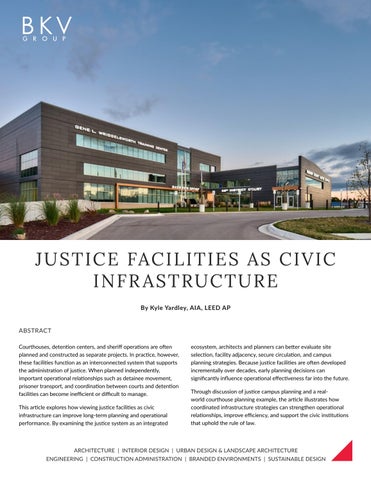
JUSTICE FACILITIES AS CIVIC INFR ASTRUCTURE By Kyle Yardley, AIA, LEED AP ABSTRACT Courthouses, detention centers, and sheriff operations are often planned and constructed as separate projects. In practice, however, these facilities function as an interconnected system that supports the administration of justice. When planned independently, important operational relationships such as detainee movement, prisoner transport, and coordination between courts and detention facilities can become inefficient or difficult to manage. This article explores how viewing justice facilities as civic infrastructure can improve long-term planning and operational performance. By examining the justice system as an integrated
ecosystem, architects and planners can better evaluate site selection, facility adjacency, secure circulation, and campus planning strategies. Because justice facilities are often developed incrementally over decades, early planning decisions can significantly influence operational effectiveness far into the future. Through discussion of justice campus planning and a realworld courthouse planning example, the article illustrates how coordinated infrastructure strategies can strengthen operational relationships, improve efficiency, and support the civic institutions that uphold the rule of law.
ARCHITECTURE | INTERIOR DESIGN | URBAN DESIGN & LANDSCAPE ARCHITECTURE ENGINEERING | CONSTRUCTION ADMINISTRATION | BRANDED ENVIRONMENTS | SUSTAINABLE DESIGN