Our Lady Of Walsingham Statue

Page 1


Our Lady of Walsingham Statue

A new statue of Our Lady of Walsingham has been blessed and enthroned in Arundel Castle. Enter into the remarkable grace of Our Lady of Walsingham’s presence in Arundel Castle and how it relates to ages past, and directly to St Philip Howard, patron saint of the Dukes of Norfolk. “When England goes back to Walsingham, Our Lady will come back to England”. Prophecy of Pope Leo XIII when he signed the rescript for the restoration of Our Lady of Walsingham’s Shrine in 1897.

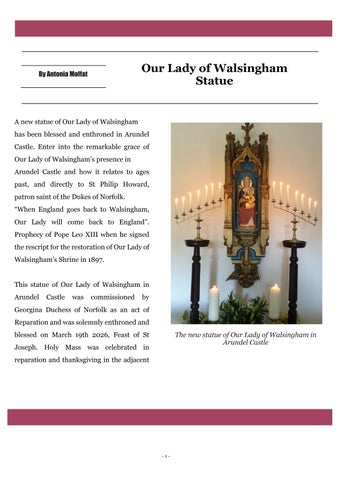
This statue of Our Lady of Walsingham in Arundel Castle was commissioned by Georgina Duchess of Norfolk as an act of Reparation and was solemnly enthroned and blessed on March 19th 2026, Feast of St Joseph. Holy Mass was celebrated in reparation and thanksgiving in the adjacent

The new statue of Our Lady of Walsingham in Arundel Castle

Fitzalan Chapel by Fr Stephen Dingley, Dean of Arundel Cathedral. Canon Alexander Sherbrooke parish priest of St Patrick’s Soho Square blessed and enthroned the statue, and Fr Rod Jones OSB parish priest of Worth Abbey read St Philip Howard’s Wracks of Walsingham.

The Sculptor and Sculpture of Our Lady of Walsingham.

The statue was sculpted by renowned Catholic artist Martin Earle who specialises in artwork in service of the sacred liturgy. He carefully researched the materials, colour, and the symbolism included in the statue, so that it reflects as closely as possible what the original may have looked like. The statue is carved in English sycamore and painted in encaustic (wax) paints. He was particularly inspired by the 13th century battered, wooden English oak statue, to be found in the V&A Museum in London, which could in fact be the original statue of Our Lady of Walsingham, somehow salvaged and hidden from destructive reformers.

We experience Our Lady’s pity and sorrow for us poor sinners, her strength, and total obedience to God’s will, amidst the joy of caressing and presenting her Divine Son.

Our Lady of Walsingham

Our Lady appeared in 1061 to Richeldis de Faverches, Lady of the Manor in Walsingham during the reign of King Edward the Confessor. Richeldis had a vision in which the Mother of God took her in spirit to Nazareth and showed her the holy House of the Annunciation. Our Lady requested that a replica of the holy House of Nazareth be built in Walsingham.

Religious Symbolism in the Statue

Our Lady of Walsingham is the Seat of Wisdom and sits upon a throne. She is amidst two pillars which represent the Church as the gate of Heaven; the seven rings on these pillars signify the seven Sacraments and the seven gifts of the Holy Spirit; the arched back of the throne represents the rainbow, the sign of the Covenant between God and His people; the lily symbolises virginity, purity, sovereignty, sign of resplendent beauty and testifies that Our Lady remained the Blessed Virgin before, during and after the birth of the Saviour Jesus Christ; a toadstone symbolising evil is beneath her feet, showing that she crushes Satan and all his empty works; and finally she wears a Saxon Crown representing her Queenship. For Mary is Queen of Heaven and as Our Lady of Walsingham, the spiritual Queen of England. An ancient tradition

A stained glass window featuring Our Lady of Walsingham. All Saints Episcopal Church, Jensen Beach, Florida

states that the Lily sprang from the repentant tears of Eve as she went forth from paradise. Here Our Lady of Walsingham is seen as the New Eve, the Mother of life, who bore JESUS, Saviour of the World.

Arundel & Devotion to the Blessed Virgin Mary

Prior to the Reformation the town of

Arundel possessed no fewer than three important shrines to Our Lady. The shrine of Our Lady of Arundel was located in a chapel near the site of the present cathedral. Thomas, Earl of Arundel, in his will dated October 10th 1415, willed that his executors build at the Mary Gate in Arundel a chapel in honour of the Blessed Virgin Mary. In time, another chapel of Our Lady stood over the Mary Gate, this was built at the close of the 13th century.

Our Lady was honoured under the title Our Lady of the Gate. The Shrine of Our Lady of Calceto was in the Augustinian Priory Church overlooking what is now the Causeway (Calceto).

Link with Henry, 15th Duke of Norfolk

St Philip Howard & Walsingham

St Philip Howard the 13th Earl of Arundel (1557-1595), of whom the present Duke of

Our Lady of Walsingham is displayed in an Edicule (from the Latin aedicula meaning “little house”), which has traditionally served as a small ornate shrine for a treasured statue. This Edicule was originally purchased by Henry, 15th Duke of Norfolk (1847–1917), who extensively rebuilt and restored Arundel Castle between the 1870s and 1890s, adding the Norfolk Family private Chapel. Duke Henry was the duke who had the vision for the building and construction of Arundel Cathedral. As a young student at the Oratory, he was taught by Cardinal John Henry Newman, and they became great friends in later life. Significantly alongside the statue are displays of fragments of ancient ruins dating back to the 12th and 13th centuries, when the renown of Our Lady’s Shrine in Walsingham would have been at its height.

The new statue of Our Lady of Walsingham

Norfolk is a lineal descendant, penned a powerful lament on Walsingham’s destruction during the tragic English Reformation..

His lament entitled “The Wracks of Walsingham” probably written whilst he was imprisoned for his faith in the Tower of London, was discovered after his death. The Wracks demonstrate an overwhelming sorrow and grief over the destruction of Our Lady’s Shrine, and what this indicated to the peoples of faith at that time. St Philip Howard was canonised by Pope Paul VI in October 1970 as one of the forty Catholic martyrs of England and Wales.

Philip Howard at 18 years of age by George Gower, c. 1575.

The presence of Our Lady of Walsingham in Arundel Castle invites all who pass by to reflect upon her message of hope and to spend some moments in prayer:

“To all in any way distressed or in need that seek me at Walsingham, shall be given succour. And there, in this little house shall be held in remembrance the treat great joy of my “salutation”, when St Gabriel told me that I should become the Mother of God’s Son.”

Walsingham became known as England’s Nazareth. This small shrine of Our Lady of Walsingham in Arundel Castle arrives at a pivotal moment in world history, as nations face once again the tragic prospect of a widening war. With this in mind, we are invited to pray strongly for peace in the Middle East and throughout the world.

A Pilgrim’s Prayer: Dear Lord, I am present here at this shrine of Our Lady of Walsingham, mindful of the martyrs and saints of the past and the divisions within your Holy Church today. I seek forgiveness of all the sins committed by my own self, the leaders and peoples of our country and ask for reconciliation and forgiveness for us all. I pray thatournationwillreturntotheloveofYouand of your Holy Mother and that once again it will be proud of being her Dowry as pledged by King Richard II long ago. I ask that the Holy Spirit enters all our hearts and sweeps through this land renewing our faith and love of You, so that once more we may be a truly holy nation at peace, and in harmony, with all the peoples of the world. Please Lord, may the past be put to rest so that all may be healed, and move on into the future, in the joy of your love and mercy, in the glory of your passion, death and Resurrection. I pray for the souls of all the faithful departed of our land. May they rest in peace.IaskthisinthenameofJesusChristyour Son. Amen.

This article is a precis of that originally published in EWTN on 19th March 2026.

Turn static files into dynamic content formats.

Create a flipbook
Our Lady Of Walsingham Statue by bji12341 - Issuu