Reflection by Antonia Moffat
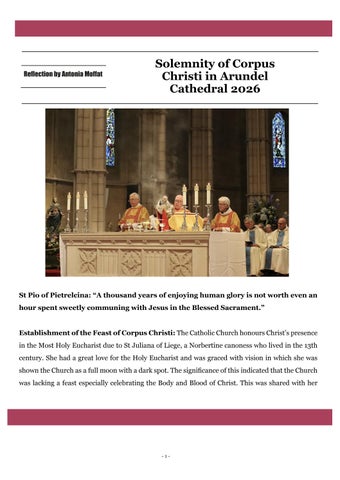
Solemnity of Corpus Christi in Arundel Cathedral 2026
St Pio of Pietrelcina: “A thousand years of enjoying human glory is not worth even an hour spent sweetly communing with Jesus in the Blessed Sacrament.”
Establishment of the Feast of Corpus Christi: The Catholic Church honours Christ’s presence in the Most Holy Eucharist due to St Juliana of Liege, a Norbertine canoness who lived in the 13th century. She had a great love for the Holy Eucharist and was graced with vision in which she was shown the Church as a full moon with a dark spot. The significance of this indicated that the Church was lacking a feast especially celebrating the Body and Blood of Christ. This was shared with her
spiritual director who in turn consulted the local bishop. Bishop Robert de Thorte of Liege established the Feast in his local Diocese. It was extended to the universal Church following an intervention by St Thomas Aquinas, Doctor of the Church in 1264, with His Holiness Pope Urban IV.
This followed the Eucharistic miracle of Bolsena, Italy, which occurred in 1263. A priest doubting the doctrine of transubstantiation (the belief that the bread and wine become the Holy Body and Blood of Christ during the Consecration at Mass) was celebrating Mass when the consecrated host began to bleed onto the altar cloth, called a corporal. This miraculous corporal was taken to Orvieto, where Pope Urban IV was living, and the miracle is credited with inspiring him to establish the Feast of Corpus Christi.
The Meaning of Corpus Christi: The Solemnity of Corpus Christi is celebrated by the Catholic Church and commemorates the Body and Blood of Christ. It is a moveable solemnity on the Thursday following Trinity Sunday (eight weeks afer Easter Sunday). Thursday is the traditional day of the Feast, as it was on Holy Thursday that Our Blessed Lord hosted the Last Supper before his Sacred Passion, Death and Resurrection, and instituted the Sacrament of the Most Holy Eucharist and the Sacred Priesthood. In celebrating Corpus Christi, the Church honours Our Blessed Lord, celebrating the Real Presence of Jesus, Body, Blood, Soul and Divinity in the Most Holy Eucharist.
Corpus Christi Traditions: On this Holy day following solemn Mass, Our Blessed Lord is placed in a Monstrance that is then carried by the priest in solemn procession to the joyous acclaim and adoration of the faithful. Scripture readings, Eucharistic prayers, devotions and hymns are sung. The procession ends with Benediction of the Blessed Sacrament. Eucharist Processions became more widespread from the 14th century and have been greatly encouraged by successive popes, church councils, documents and by many saints, thus highlighting the supreme importance of the Holy Eucharist
Arundel Cathedral and Corpus Christi: To celebrate the Solemnity of Corpus Christi, the clergy and faithful of Arundel Cathedral faithfully maintain a beautiful and sacred tradition of the creation of a floral carpet in honour of Our Lord and Saviour Jesus Christ, truly present in
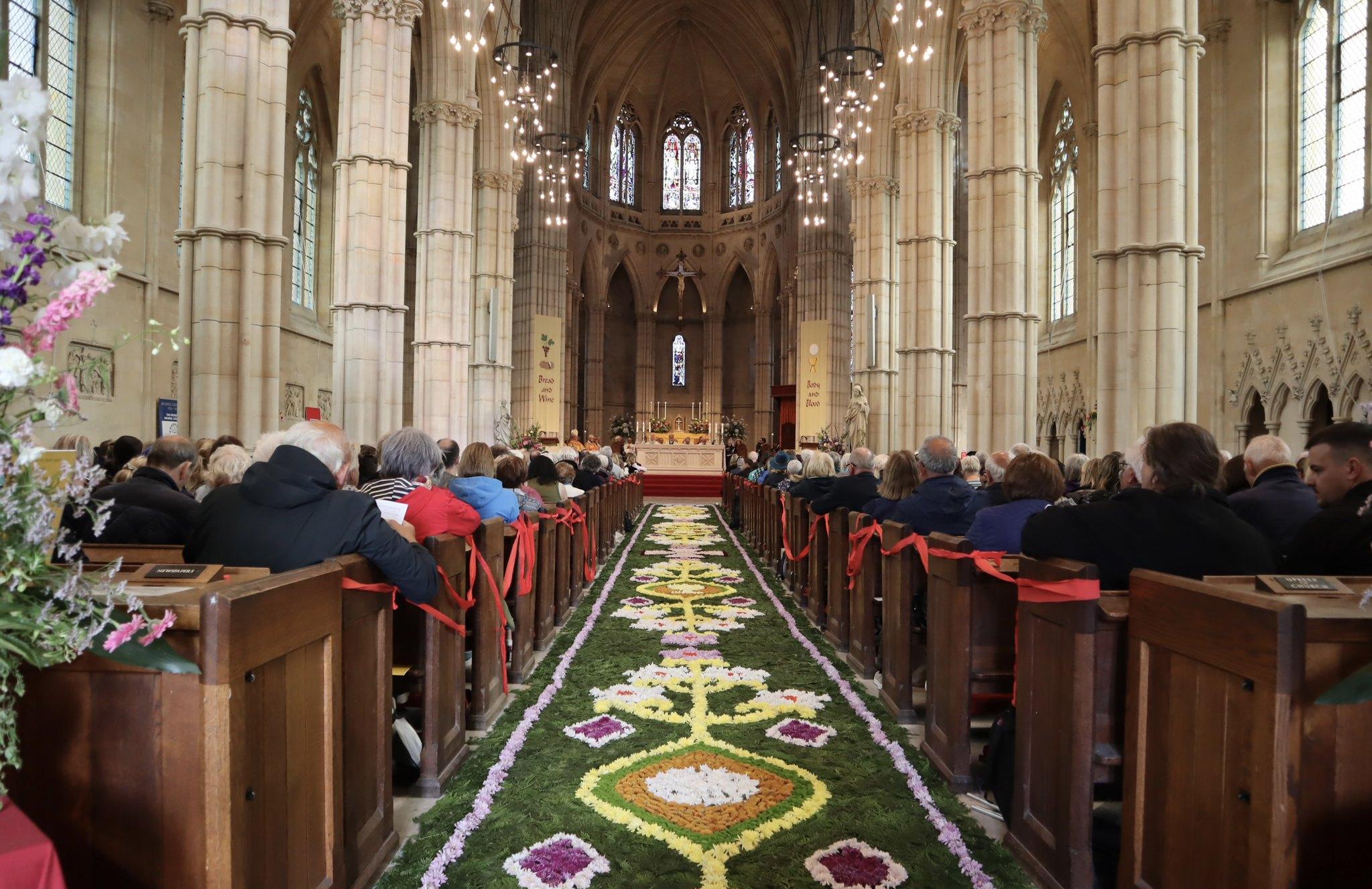
the Blessed Sacrament, which extends the entire length of the cathedral’s central aisle of around 98/29.8m.
Arundel Cathedral is perhaps one of the few places left in the world which still keeps alive, this sacred and spiritual tradition of the carpet of flowers for Our Blessed Lord. In some places, carpets of flowers are displayed but have no religious ceremony or significance attached
anymore, as in former ages of faith!
Historical Context: This sacred tradition was started in 1877 by Henry FitzalanHoward, the 15th Duke of Norfolk, who also founded the Church of Our Lady and St Philip Neri in 1873, built in the French Gothic style. This Church became a Cathedral in 1965, when the Diocese of Arundel & Brighton was
founded. The Cathedral took on the new name of Our Lady and St Philip Howard in 1973. This followed the canonisation of the 40 Martyrs of England and Wales on October 25th 1970, of which St Philip Howard (1st Earl of Arundel) was one.
Duke Henry Fitzalan Howard whilst on holiday in the Italian village of Sutri, just outside Rome, was spiritually moved when he witnessed a Corpus Christi Procession through a beautiful carpet of flowers. This inspired him to introduce a carpet of flowers to Arundel which has continued ever since, with the exception of part of the First World war years when the Estate workers were at the Front, and in 2020 due to the covid 19 pandemic.
The Arundel Cathedral Tradition of the Carpet of Flowers: The tradition of the magnificent Carpet of Flowers was originally implemented and
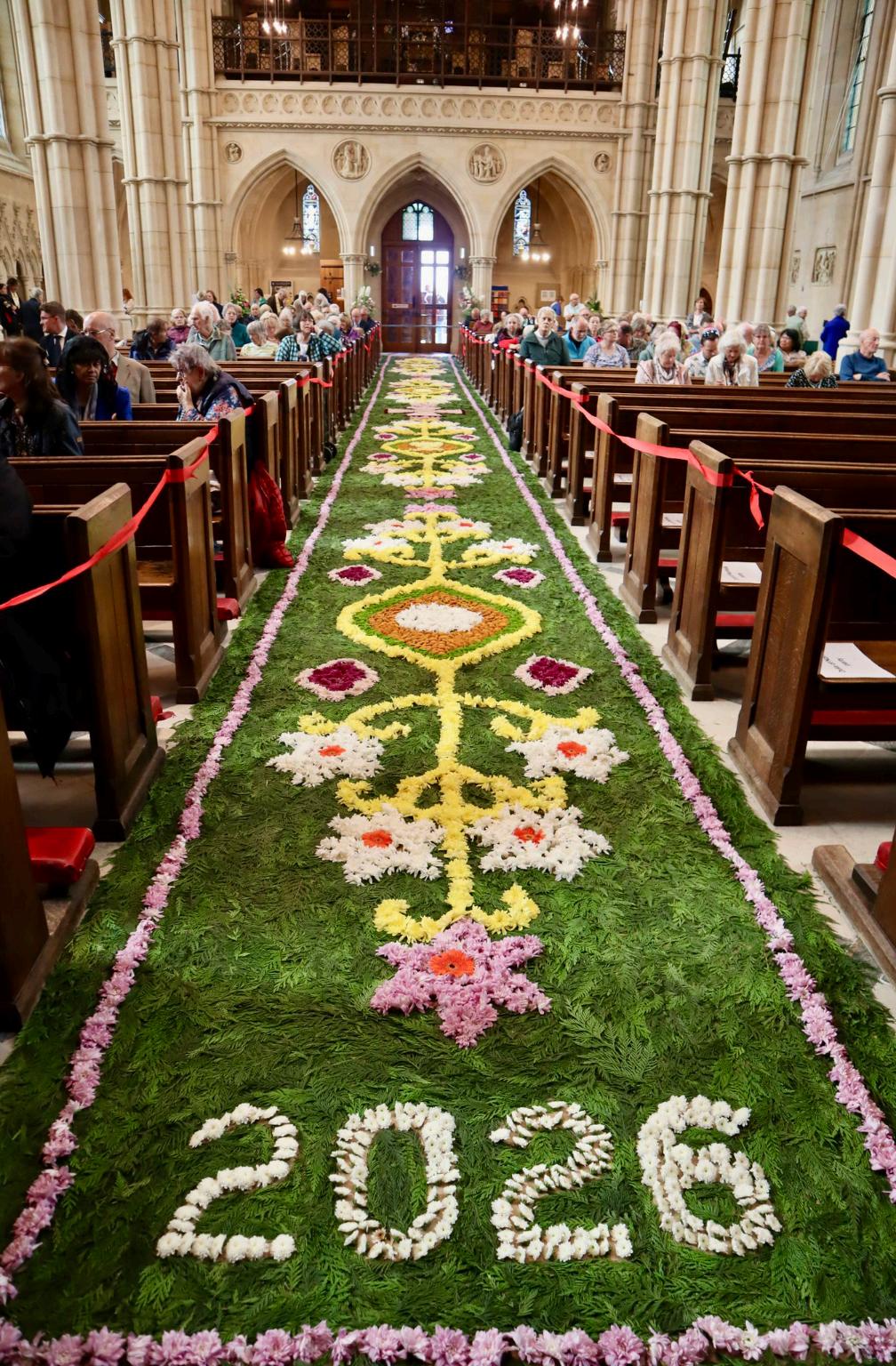
created, in the initial years, by the gardeners of the great Norfolk Estate. They grew the greenery and the flowers in the castle grounds and prepared and laid the flowers.
Sylvia Jones is the current administrator of the flower team, and the one who coordinates the large group of volunteers numbering
around 90, the ordering of the flowers, the collection of the greenery and their preparation, and most importantly she oversees the laying of the Carpet with expert flair and creativity.
Oliver Hawkins has prepared the carpet template over many decades and is a walking history book on the life and works of the 15th Duke, and the tradition of the Arundel Carpet of Flowers. Every year significant themes are chosen in close collaboration with the Cathedral Dean, and in continuity with the liturgical traditions of the Universal Church and local Diocese. Months of preparations go on behind the scenes, before the volunteer teams ever arrive!
The highlighted themes for 2026: This year 2026 marked the 146th presentation of the Carpet of Flowers which reflected the themes of: the Holy Eucharistic Host and Sacred Chalice which enthrone the very body, blood, soul and divinity of Our Lord Jesus Christ truly present and entire in each Eucharistic Host and drop of Precious Blood. This importantly highlighted the celebration of the Holy Body and Blood of Christ – the very reason for the Solemnity of Corpus Christi. Secondary themes encouraged prayers for peace amongst the peoples of the war-torn areas of our suffering world.
The spiritual significance of the Carpet of Flowers: The carpet of flowers is designed to be enjoyed as a spectacle for the two days before the solemn Mass of Corpus Christi and Blessed Sacrament Procession, which are at the very heart of the celebration of the solemnity of Corpus Christi. Many thousands from all over the country come to view it. However, there is a deeply spiritual meaning
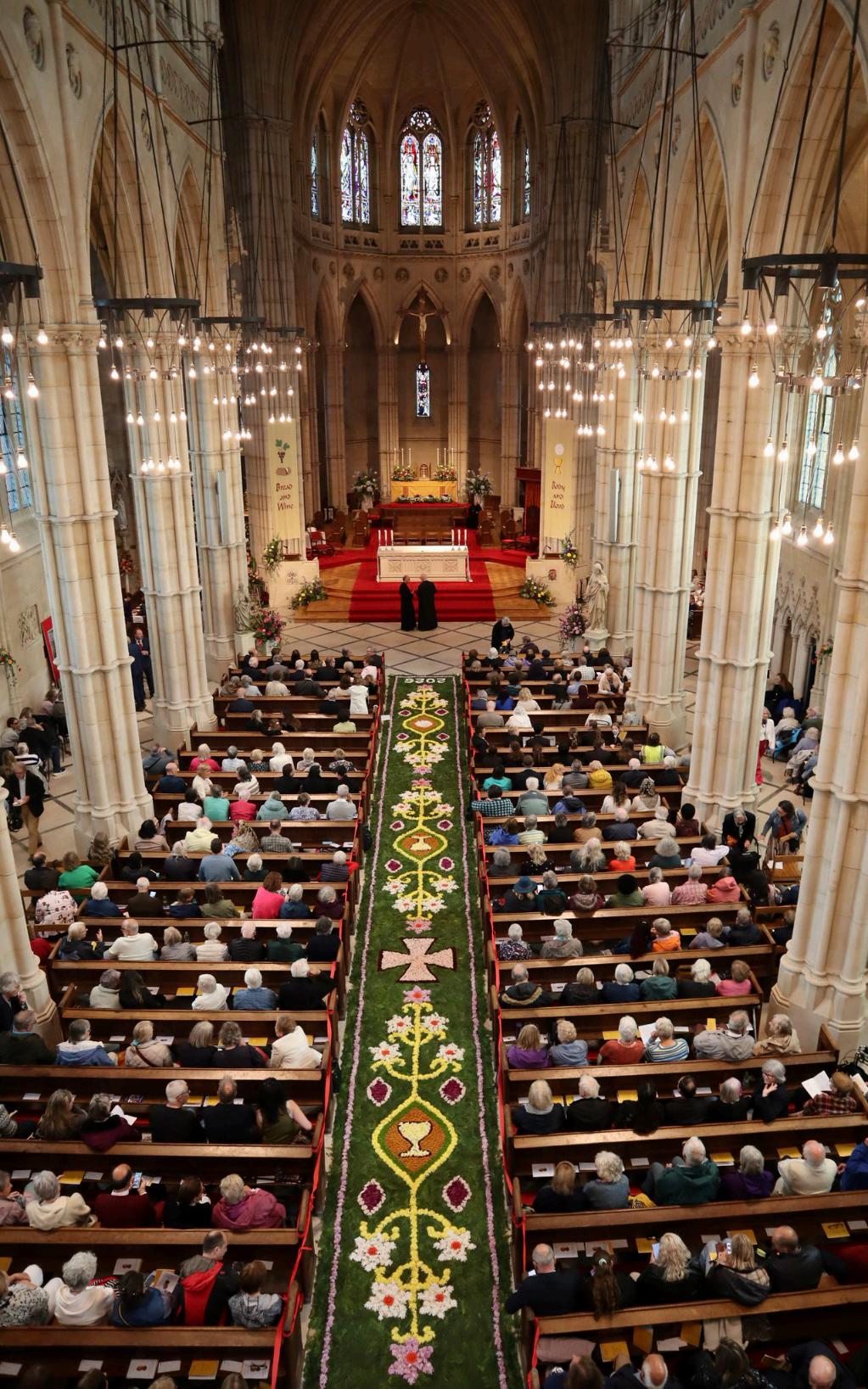
and reality connected with the tradition of the magnificent carpet of flowers. This was prayerfully highlighted throughout the two days of viewing, as the Dean, Fr Stephen Dingley encouraged a moment of Eucharistic and Scriptural Reflection each hour! All present were called to prayer, to reflect in moments of silence. A rota of Eucharistic adorers were also encouraged to pray before the Tabernacle in the Blessed Sacrament Chapel to ensure that constant prayers of
intercession were being offered up for peace and for all the intentions of those preparing and attending these great days of celebration and solemnity. It was a time of grace to be in prayer with our Eucharistic Lord.
A most beautiful Floral Pathway for our Eucharistic Lord: The tradition is that the bishop/abbot/priest, solemnly carrying the Blessed Sacrament, will be the first to tread the Carpet of Flowers with the Eucharistic Lord, focus of all our love, adoration, prayer and praise. The deeper meaning of the flowers is that they are a sign of love and sacrifice, a mirror image of
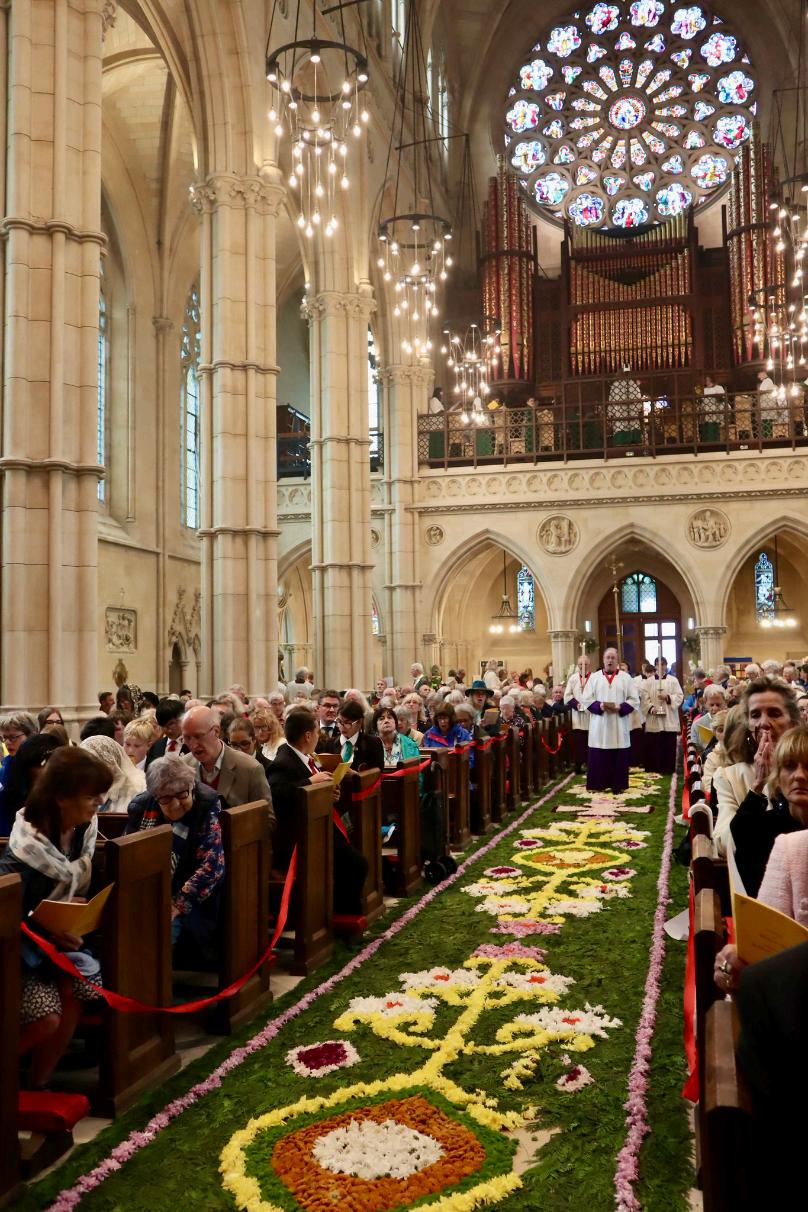
the Sacrifice of Our Lord's own love for us, when he laid down his life for us on the Cross for the salvation of all. The glory of the beauty of the flowers, and of all the skill and sacrifice of time, of those who prepared and laid the carpet of flowers are sacrificed to God, acknowledging that He is the King of Kings, Lord of Lords, and author of all Life and of all Creation.
Mass
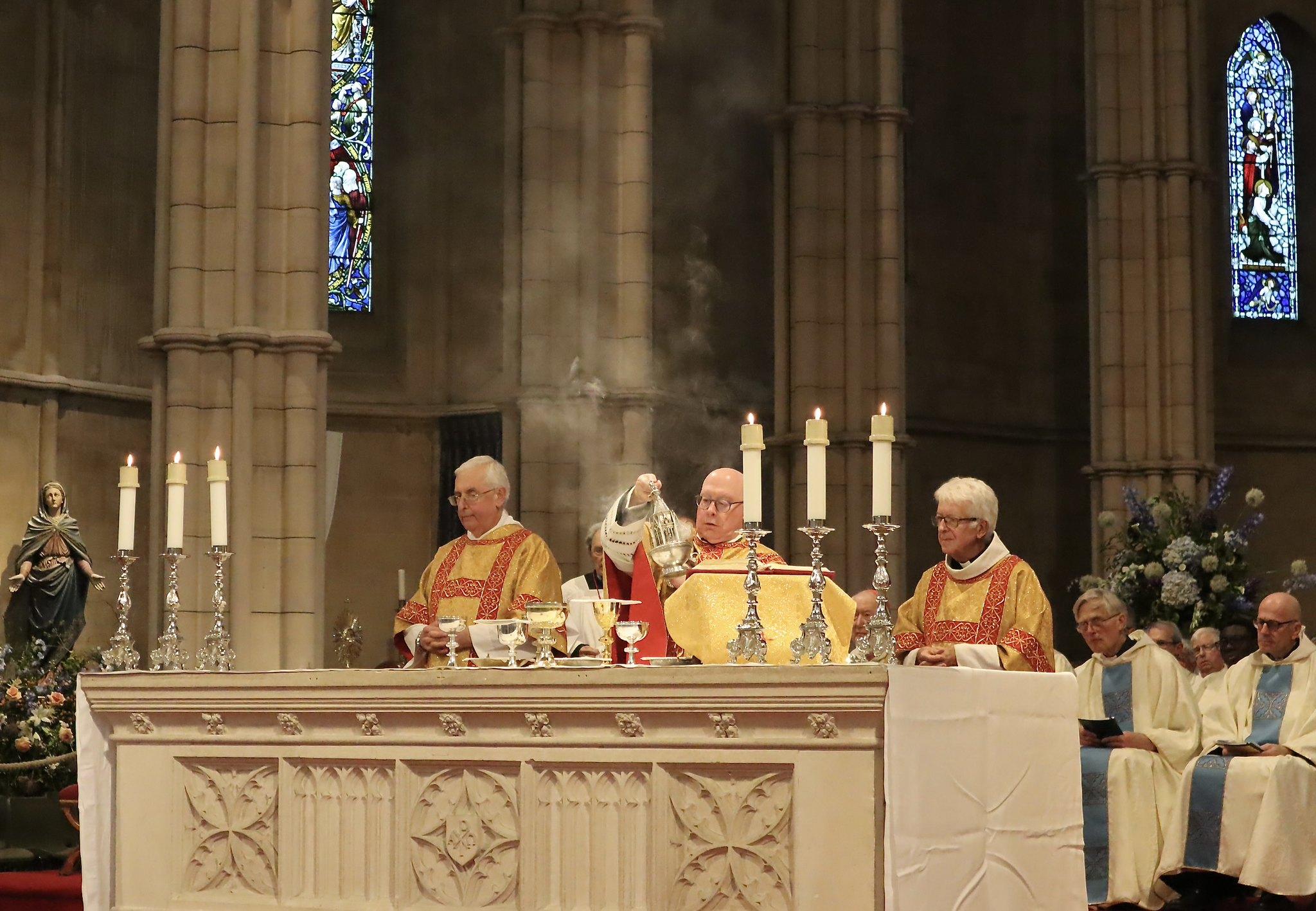
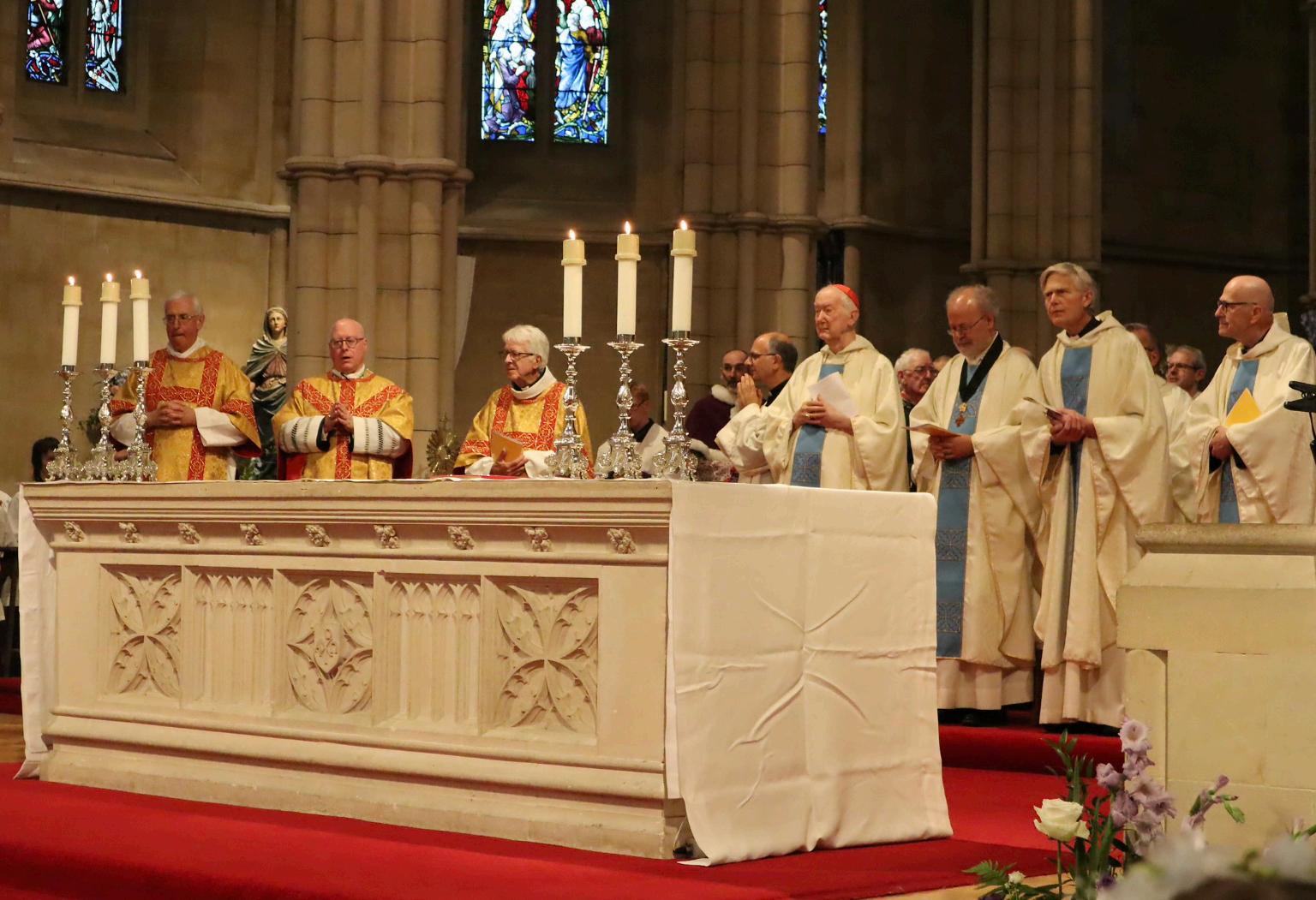
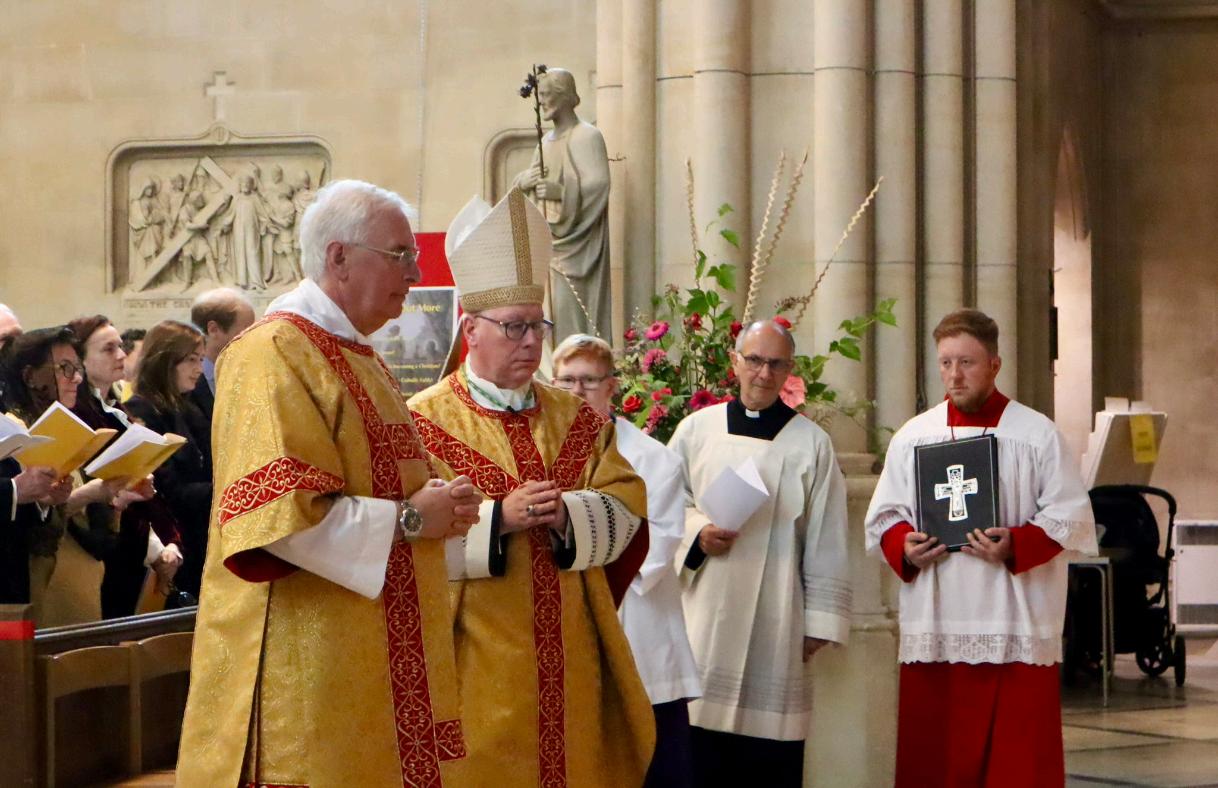
of Corpus Christi in Arundel Cathedral – Corpus et Sanguinis Christi: Abbot Paul Gunter of Douai Benedictine Abbey, celebrated the beautiful Mass of the Solemnity of Corpus Christi.
Deacon Roger Stone with Abbot Paul Gunter
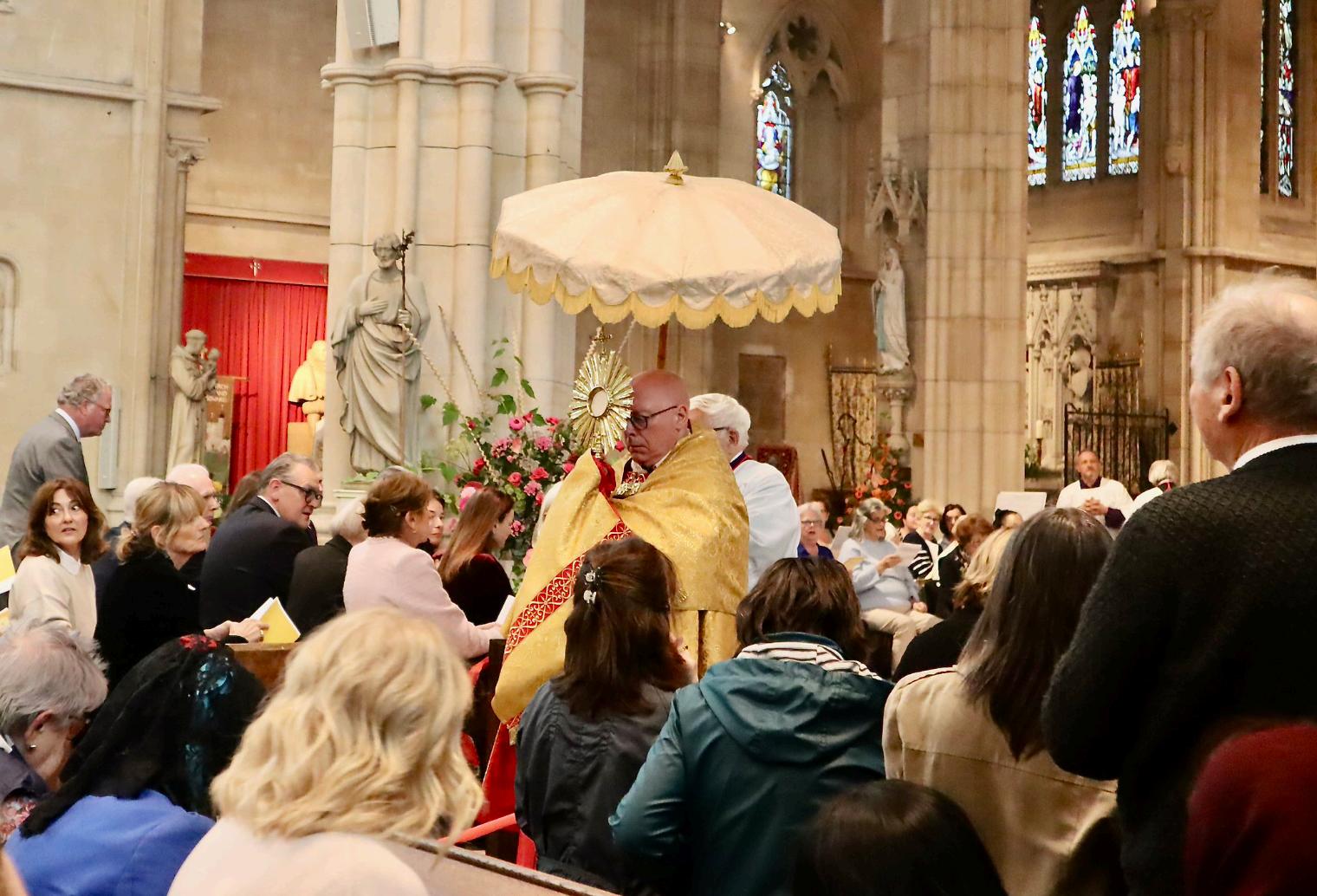
Due to blustery wind and torrential rain the Blessed Sacrament Procession from the Cathedral to Arundel Castle was unable to go ahead. Instead we had the most beautiful procession of the Blessed Sacrament in and around the Cathedral. It was a precious moment when Abbot Paul processed through the carpet of flowers with Our Blessed Lord – the true laying down before the Living God, of all the time, gifts, talent and creativity of those who had worked so diligently to create the Carpet of Flowers.
This precious moment, reminded me, that all the glory and all thanksgiving is given to Jesus as our Saviour and Redeemer - Sweet Sacrament Divine, O Bread of Heaven, Let all mortal flesh keep silent, Soul of my Saviour, O Sacrament Most Holy - the first lines of many traditional Eucharistic hymns came to mind.
As the procession wended its way, so First Communion children followed. What was so beautiful was that young girls kissed the flowers each time before they were strewn before our Eucharistic Lord. They will surely remember that gesture of love forever! And certainly JESUS will!
Abbot Paul continued to process the Blessed Sacrament around the Cathedral and finally again down the central Isle of flowers to give solemn Benediction. The celebrations ended with the spiritually electrifying hymn Faith of Our Fathers and an Organ Voluntary!
May the Most Holy Body and Blood of Christ be forever praised, loved, adored and glorified. Amen, Amen.
I leave you with these powerful words of exhortation from the recently canonised St Carlo Acutis: “Try to go every day to Mass and to receive Holy Communion. … If you can, stay a few minutes every day in Eucharistic Adoration in front of the tabernacle where Jesus is really present, and you will see your level of holiness increase considerably.”