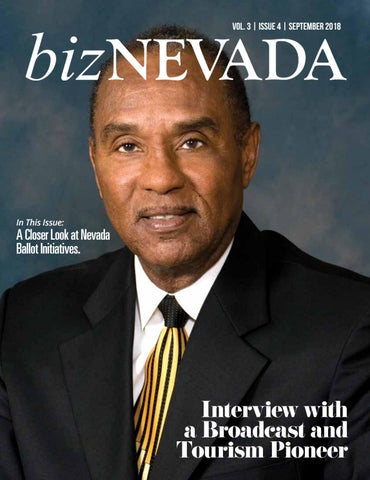
Vol. 3 | ISSUE 4 | September 2018
In This Issue:
A Closer Look at Nevada Ballot Initiatives.
Interview with a Broadcast and Tourism Pioneer
LETTER FROM THE
LETTER FROM THE
By Craig A. Ruark
Richard W. Moore
EDITOR I have to say that I am very proud to be a part of a business magazine that feels it is important to provide useful, current information to its business readers. This month, Corrine Casanova the editor of the Northern Nevada edition, and I, have split the duties of exploring more of the upcoming ballot initiatives as well as, going further in depth into Question 3. Corrine’s interview with proponents for and against Question 3 along with Jim Wadhams, a respected lawyer and wellknown lobbying advocate for businesses in Nevada, will explain why the ballot questions are worded the way they are and detail each sides reasoning. I was also fortunate enough to have coffee with Roosevelt Toston, a graduate of Las Vegas High School, the first AfricanAmerican news anchor in Nevada, and an ambassador for Las Vegas during his 28-year career with the Las Vegas Convention and Visitors Authority. I think that you will find his personal story very interesting as well as, his insight into what it takes to bring national conventions to Las Vegas. In addition, we are diversifying the types of articles and expertise that we are presenting to you, the readers. We have found many experts in their fields who are willing to write articles that can help you with your business decisions. These are in no way the definitive answer to the way business decisions should be made, but they do provide thoughtprovoking advice that may offer an additional perspective to questions that you may have. We look forward to your continued support of our magazine and, we hope, our advertisers. If there is a subject that you would like to see covered in the future, please feel free to send your comments and requests to Craig@biznv.com.
2 · ISSUE 4 ·SEPTEMBER 2018
PUBLISHER
SO MANY QUESTIONS Nevada voters are faced with six little questions this November. Some are hot, and some are not. But all of them require our attention and, as responsible voters, our due diligence. These questions represent not one, not two, but three possible changes to our Nevada State Constitution. Craig has taken great care in researching those ballot issues that will impact your business and offers some excellent impartial information. September is our fourth month here in Las Vegas. It’s hard to believe we’ve published four editions already! The feedback has been great, and we encourage you to chime in with your comments and questions. This month we will be re-launching our website, with a choice to follow the Northern or Southern editions. Of course, you’ll be able to toggle between the two, and at the same time choose your preferred site. This update will also lead to greater opportunities for digital advertising and marketing. Speaking of digital, please check out and download our bizNEVADA app, it’s available in both the App Store and Google Play. The app will give you access to past issues, our exhaustive calendar of events, and a form to receive our monthly email newsletter. Even more interesting and exciting is the Augmented Reality (AR) viewer portion of our app. Each month, as we develop content for the magazine, we will be incorporating appropriate AR visuals into the stories. We are also making the AR technology available to our clients so that you can include digital links to their your print advertising. This technology will bring 3D renderings or 360-degree visuals to life. The technology also has the ability to incorporate action buttons that people can push on their touchscreens. In next month’s issue, we’ll be covering the SBA and Banking in the Silver State. Until then, have a profitable month.
INTHISISSUE PG 4-6
VOL. 3 / ISSUE 4
Roosevelt Toston, Pioneer and Creator of Change
BizNEVADA PUBLISHING TEAM PUBLISHERS: Richard Moore and Chris O’Sullivan GRAPHIC DESIGNER: Kaylyn Dazey EDITOR-IN-CHIEF: Craig A. Ruark ADVERTISING: Chris O’Sullivan chris@biznv.com PHOTOGRAPHER: Brian Janis COVER PHOTO: Roosevelt Toston FEEDBACK/IDEAS We welcome your feedback and ideas regarding BizNevada. Send a message to info@biznevada.com
PG 7
© 2018 Carpe Diem International. All rights reserved.
Nevada REALTORS® Selected For Leadership Roles on NAR Committees
PG 8-11
Yes or No on Question 3?
PG 12
The Skinny on Two More Ballot Questions
PG 14-15
Question 1, Marsy’s Law, Faces Final Confirmation
CONTACT US info@biznevada.com www.biznevada.
PG 16-17
Twenty Years of Togetherness
PG 18-19
Direct Mail Delivers Proven Results!
PG 20-21
Market Segmentation for Fun and Profit
PG 22-23
CALENDAR OF EVENTS
PG 24-25
How To Hire a Contractor
PG 26-27
Ballot Question 5 Aims to Increase Voter
PG 28-29
Can’t We All Just Eat Cake and Get Along? When Business and Personal Beliefs Collide Book Review: 30 Years Behind Bars
PG 30-31
The Correct Way to Use Free Online Directories Such as Yelp & YP.com
EXPERT CONTRIBUTORS Raul Chacon Workers Compensation EMPLOYERS EMPLOYERS.com 775-327-2700
Mike Menath Insurance Menath Insurance MenathInsurance.com 775-831-3132
KJ Smith Background Checks Employer Lynx EmployerLynx.com 775-883-3733 Joe Ross Creative Agency OCG Creative www.OCGCreative.com 775-324-1644 Bill Houghton Printing Horizon Business Services www.PrintEfficiency.com 702-369-1399
BIZ NEVADA MAGAZINE · WWW.BIZNEVADA.COM · 3
Roosevelt Toston, Pioneer and Creator of Change by Craig A. Ruark
4 · ISSUE 4 · SEPTEMBER 2018
There are many paths to becoming successful in business, some of them easier than others but each of them takes a lot of work. For Roosevelt Toston, the key to his successful career can be summed up in one word— typing. Back in the 1960s, it was rare for a male to learn proper typing skills and even rarer yet for an African-American man. At the age of 76, Toston has just published his third book Seeing Stars, which is a photo scrapbook with comments about the people he has met during his time as the first African-American television anchorman in Nevada, followed by his 28-year career with the Las Vegas Convention and Visitors Authority. Toston grew up in a rural town in Louisiana, the son of a sharecropper who lost both parents before the age of 15. In 1959, Toston’s older brother, who was working as a sous-chef in the Freemont Hotel, convinced him to come to Las Vegas for the summer with the promise of a job washing dishes. Toston jumped at the chance to leave the toil of the cotton fields and ended up finishing his education at Las Vegas High School. After high school, Toston was working a number of jobs, washing dishes, maintenance, etc., and decided to enroll in the Dana McKay School of Business. “I was one of only a few males in the class and learned how to type. I had no idea where that education would lead, but as it turned out, that ability to type allowed me to get a job as a supply clerk at Bell Telephone of Nevada,” explained Toston. Toston later joined the military where his typing ability was again a key asset, first working as a payroll clerk and then working in a clerk position for a Lt. Col. at the
military headquarters. After the military, Toston went back to work for Bell Telephone, this time as a lineman. “Though the money was good, I could not see myself working the rest of my life repairing telephone lines. I applied for a position in the marketing department but was not lucky enough to be accepted,” said Toston. But, Toston was determined to make his own future and enrolled in the John Cameron Swayze School of Broadcasting correspondence course. At the end of the course the Swayze school suggested that broadcasting was not for him. However, in 1970, Toston was offered an intern position as a news reporter for KORK-TV Channel 3 (now KVBC), and in 1972 KLAS-TV Channel 8 hired him to become the weekend news anchor and co-anchor for the 11:00 pm nightly news. Toston became the first African-American to anchor a newscast in Nevada. Interesting to note that the first African-American news anchor did not appear on network television until Frank Reynolds co-hosted the ABC World News with Peter Jennings in 1978. While typing was not an important part of being a reporter, Toston remembers that most of the others in the news room used the twoindex-finger-method to peck out their stories. “I remember starting out, my first assignment was to interview the ‘father of the hydrogen bomb,’ Dr. Edward Teller,” Said Toston. “So, I put together a few questions to ask during the news conference and then interviewed him after the conference. Needless to say, I was very nervous.” Toston remembers one of the key
stories from his reporting days was Ruby Duncan’s Nevada Welfare Rights Organization and her march with 6,000 protesters down Las Vegas Boulevard. Another major story was the reoccurring flood events that happened during the monsoon seasons before the Clark County Flood Control District was founded to develop a mitigation plan. “Most of the stories were pretty normal for the day, the Las Vegas population was only around 250,000,” said Toston. In 1975, Toston was hired by the Las Vegas Convention and Visitors Authority (LVCVA). His first job was on the tourist side of the house, traveling around the country to meet with travel agencies and promote Las Vegas as a vacation destination. Despite not having any experience in the hotel convention industry, the LVCVA transferred him to the convention side of the house to try to convince minority businesses and organizations to hold their conventions in Las Vegas. Although that was his original task, Toston proved that he could sell the value of Las Vegas to convention groups of all types and persuasions and was the account executive to a variety for regular
convention groups, including COMDEX, which at the time was the largest convention in the world. For a total of 28 years, Toston proved his value to the LVCVA. In 1975 the room inventory in Las Vegas was 35,190, visitor volume was 9,151,427 and of that number 349,785 were convention attendees. By 2004, when Toston retired, the room inventory had increased to 131,503, visitor volume was up to 37,388,781 and of that number 5,724,864 were convention attendees. The average room occupancy rates rose from 79.5 percent in 1975 to 88.6 percent in 2004. Gaming revenues rose from 770,336,695 in 1975 to 8,711,426,000 in 2004. “When I started at the LVCVA we were competing against Chicago’s McCormick Place which was and still is the largest convention center in the U.S.,” said Toston. “There was also a lot of talk in the industry about the gaming threat that Atlantic City was posing.” Currently, Chicago’s McCormick Place at 2.6 million square feet is still the largest convention facility in the U.S., followed by Orlando’s Orange County Convention Center at 2.1 million, and the Las Vegas Convention Center at 1.94 million. However, if you add in the Mandalay Bay Resort convention center at 1.04 million, and the Sands Expo & Convention Center at 1.25 million, Las Vegas is over double the convention capacity of any single city and with over 6.6 million rooms, far exceeds the housing capacity for convention attendees. For Toston, selling Las Vegas was a mixed challenge, “For a lot of groups it [Las Vegas] was the ideal location because they knew that bringing their convention to Las Vegas would mean more attendees and the trade show
planners could sell more booths and make more money. On the other hand, there were those that felt that you couldn’t do serious business in Las Vegas, that the attendees would end up in the casino and not attend the meetings. However, once I talked them into it, they found that not only did the attendees attend the meetings, but they also had more fun at night and therefore over time, their conventions grew, and they started trying to book more dates to come back.” As far as the current headlines appearing in the Las Vegas Review-Journal about the LVCVA, “I see those articles as mostly political and influenced by someone who has been fighting the LVCVA for years,” said Toston. “In my 28 years in the business, I know what it takes to market Las Vegas against Chicago and Orlando and many of the other places competing for convention business. These cities are spending big money to woo these conventions, and they treat them like royalty.” There are only a few major conventions like CES, COMDEX, NAB, MAGIC, the World of Concrete, and the National Finals Rodeo which fill up both convention and hotel space six weeks of the year. However, the LVCVA is tasked with finding conventions to fill the space the other 46 weeks of the year as well, “And that takes a lot of work and money,” said Toston. “Las Vegas can’t expect that to happen if it starts low-balling or pennypinching. When the LVCVA goes on the road to attract a convention, they put on a show, because that is what these groups expect of Las Vegas.” After retiring from the LVCVA in 2004, he started The Toston Group, a meeting and events planning firm that consults with organizations and groups on how to plan a successful conference.
Nevada REALTORS® selected for leadership roles on NAR committees Special to bizNEVADA
Three Nevada REALTORS® have been selected to represent their peers nationwide by serving in leadership roles on National Association of REALTORS® (NAR) committees. NAR recently announced its national committee chair and vice-chair appointments for 2019. Las Vegas-based members Scott Beaudry, Bobbi Miracle and Soozi Jones Walker were among those appointed. Beaudry will chair NAR’s Data Strategies Committee in 2019. He is a past president of the Greater Las Vegas Association of REALTORS® (GLVAR). Miracle, a Certified Commercial Investment Member (CCIM) and member of the Society of Industrial and Office REALTORS® (SIOR), was selected to chair NAR’s Federal Technology Policy Committee in 2019. The longtime local commercial real estate broker is a past president of the Commercial Alliance Las Vegas (CALV). Walker, CCIM and SIOR, will serve as vice-chair for NAR’s Commercial Real Estate Research Advisory Board. Like Miracle, her daughter and business partner, she is also a past president of the CALV and a longtime local commercial real estate broker. “Our association is very proud of this news,” Nevada REALTORS® CEO Teresa McKee said. “To see Nevada honored with this representation means our great state has hard-working, knowledgeable people invested in the business of promoting the REALTOR® cause, and that is being recognized at the national level.” NAR only announced its committee chair and vice-chairs for 2019. Committee member announcements will be made in October. Nevada and Colorado were the only states from Region XI in the West to have two members chairing national committees, McKee added. About Nevada REALTORS® Nevada REALTORS®, formerly known as the Nevada Association of REALTORS® (NVAR), is a professional trade association with more than 17,000 members committed to protecting, promoting and preserving our communities. Visit www.NVAR.org. BIZ NEVADA MAGAZINE · WWW.BIZNEVADA.COM · 7
By Cra ig by Corr ine Cas anova 8 · ISSUE 3 · AUGUST 2018
A. Rua rk
BIZ NEVADA MAGAZINE · WWW.BIZNEVADA.COM · 9
Q: Why use a constitutional amendment to make the change? On November 6, voters will vote yes or no on Question #3, “The Energy Choice Initiative.” The debate is heating up on both sides. Essentially, it is about deregulating Nevada’s energy market and allowing consumers to make a choice on their electrical provider. The measure seeks to amend the Nevada Constitution by adding language that would open the state’s energy markets to competition. It is one of the hot-button issues on energy that’s dominating the state of Nevada.
To gain a better perspective on Question 3, I spoke with James Wadhams, a government affairs attorney at Fennemore Craig; Bradley Mayor, a spokesperson for Yes on 3; and Tracy Skenandore, a spokesperson for the Coalition to Defeat Question 3. As you may recall, in the last general election in 2016, Nevadans voted yes on Question 3 by a whopping 72 to 28 percent vote. Because it amends the constitution, it has to be voted on again. “This sort of process of getting a constitutional amendment takes longer than to change a legislative statute. For example, if the legislature thinks they did something wrong in 2017, they can go back in 2019 and change it. However, as a constitutional amendment, it will take two general elections requiring votes by the people to do that. Once you amend the constitution it kind of locks things in,” said Wadhams. If it passes, they have three legislative sessions in 2019, 2021 and 2023 to create laws that will allow a competitive marketplace.
10 · ISSUE 4 · SEPTEMBER 2018
Question 3 has turned into a multimilliondollar public battle that goes way beyond party lines. A big proponent for Yes on Question 3 is Sheldon Adelson, chairman, and CEO of Las Vegas Sands Corp. In contrast, a big supporter of No on 3 is Phil Satre, Chairman of the Board at IGT and former Chairman & CEO of Harrah’s. Warren Buffet who is chairman of NV Energy’s parent company, Berkshire Hathaway Energy who acquired NV Energy in 2013 is also a No on 3 proponent. If the “Energy Choice Initiative” passes, NV Energy has been vocal about selling off their power plants and no longer being an energy provider in the state of Nevada. At the time of this writing, Governor Brian Sandoval and Senator Dean Heller are undecided.
TS: We are the only state to use a constitutional amendment to deregulate an electric system and no state in 20 years has attempted something like this. Locking it into our state constitution is too risky and would take a minimum of four years to undo when things go wrong. The Public Utilities Commission of Nevada found that 2,200 statutes would have to be amended if Question 3 passes. Imagine the time it would take to do this. Also, a lot of those statutes related to renewable energy programs and incentives would be dismantled.
BP: All that is being put in the constitution are really two items: a ban of electric generation monopolies in the state of Nevada and having the legislature create the new market by July 1, 2023. In that sense, the legislature maintains full authority to implement the market just like they’ve done in the 14 other energy choice states. In fact, the Governor’s Committee on Energy Choice came up with a 52-page report of recommendations on implementing the plan to give the legislature a head start. Q: How will this impact electrical rates for consumers?
Attorney James Wadhams (JW), Yes on 3’s Bradley Mayor (BM) and Coalition to Defeat Question 3’s Tracy Skenandore (TS) weighed in on some of the biggest topics–making a change with a constitutional amendment, rate implications, and what happens when a monopoly goes away.
TS: Nevadans currently enjoy some of the lowest average electricity rates in the country and are 17 percent lower than the national average. It is likely to increase the average monthly electric bills of Nevadans, at least in the first 10 years. In deregulated states, average residential electrical rates are 30 percent higher than Nevada’s, and there is less reliable service.
JW: The proponents argue two things: the monopoly is always self-benefitting, and the customer can usually do better for himself or herself. Regular voters might ask, if the big guys can find better deals, will I too? As a monopoly, NV Energy has built the infrastructure—the poles and wires that give us access to electricity.
BP: Free market principles drive costs down, not up, in competitive markets across the country. A July 2015 study shows that consumers in choice states have seen their power costs fall 4.5 percent against inflation on average. In contrast, consumers in monopoly states have seen their price rise 8.5 percent more than inflation. The data really proves that energy choice lowers prices. In our current system, businesses with more than one megawatt of usage can leave NV Energy, but it comes with a price tag. For example, MGM paid $87 million for the right to leave NV Energy. That tells me they must be saving more than $87 million getting their power somewhere else in a relatively short time. Switch left NV Energy and not only are they saving 40 percent on their power bills, but have gone 100% green.
Q: What happens when a monopoly system like NV Energy is dismantled after over 100 years of service? Will it impact the quality of service and reliability?
BP: NV Energy is trying to hold onto their monopoly. If I had a monopoly, I’d want to keep it too. We want to bring choice to Nevadans and allow them to take control of their energy future and really that is to access lower power bills, access more renewable energy and the jobs that come with having more renewable energy. NV Energy will still operate and maintain the poles and wires. If the power goes out, you will still call NV Energy just as you do today. The difference is you will choose your energy provider and choose the plan that fits best for you. In Texas, for example, they have something like 250 providers offering over 2,000 different types of plans. As far as reliability, NV Energy’s own CEO Paul Caudill in August 2016 said that energy choice would have no impact on reliability because ‘the backbone of the system are the poles and wires.’
They want reliable utility options to keep their operational costs affordable, fair and manageable. For example, if a huge manufacturing facility is looking to move to Nevada and because of deregulation realizes that we no longer have a reliable electricity system in place, they may choose another state for relocation because they have a more reliable system. In April 2018, NV Energy announced they will invest $2 billion in six new solar projects. The reality is, this will not move forward if Question 3 passes. There are so many implications to this that we really want voters to look into and understand before they vote. As the debate continues, so does the passion on both sides. Voters will make the final determination about how to proceed with Question 3 this November.
TS: Electricity requires significant infrastructure. Deregulation has shown that it brings higher rates, less reliable systems, rolling blackouts, etc. There is something to be said for a provider like NV Energy that provides reliable service to consumers with affordable rates. From an economic development perspective, can we truly recruit corporations and businesses to consider our state [as their home] if we no longer have that reliable electricity system? That is one thing these corporations look into when considering relocation to another state. BIZ NEVADA MAGAZINE · WWW.BIZNEVADA.COM ·11
by Corrine Casanova Question 2, also known as the “pink tax” and Question 4, the Medical Patient Tax Relief Act will also be on the ballot this November. While neither of them are swirling in controversy like the energy choice and renewable energy initiatives in Questions 3 and 6, there are a few things you should know about, as they pertain to taxes.
According to a 2015 study conducted by the New York City Department of Consumer Affairs, women are paying thousands of dollars more over the course of their lives to purchase similar products as men. They claim products marketed toward women cost an average of seven percent more than products marketed toward men. The state of California studied the issue of gender-based pricing of services and estimated that women effectively paid an annual “gender tax” of approximately $1,351 for the same services as men. Minnesota, Illinois, Pennsylvania, New York, Massachusetts, Maryland, New Jersey, Connecticut and Florida have all outlawed the “pink tax.” Now Nevada, Wisconsin, Nebraska, Arizona, and Ohio are considering it in the November election. 12 · ISSUE 4 · SEPTEMBER 2018
$ Question 2, “the pink tax” would exempt certain feminine hygiene products from being taxed in Nevada. “Because the Sales and Use Tax Act of 1955 was enacted by referendum, it can only be changed by a vote of the people. The requested exemption is not a radical change in the law, instead, it’s a clarification,” said James Wadhams, a government affairs attorney at Fennemore Craig. Medical Patient Tax Relief Act Question 4, the Medical Patient Tax Relief Act, proposes to amend the Nevada Constitution to exempt certain durable medical equipment and mobility enhancing devices from any tax upon the sale, storage, use or consumption of tangible personal property. Voters in 2016 passed it, but it requires a second vote this year to amend the Constitution. “Question 4 is amending the Sales
and Use Tax Act just like Question 2, but in this particular case, they are doing it by amending the Constitution to give the legislature the power to amend the statute. It says the legislature has the power to provide for the exemption of oxygen tanks, nebulizers, drug infusion devices and a whole range of devices that were probably not used in the 1950’s in a healthcare environment. Question 4 is really adding the modern technology as well as hard goods that people use to compensate for structural or systemic problems. “It’s interesting that drafters of Questions 2 and 4 took two different routes to get there (referendum and Constitutional amendment) but are doing the same thing with tax exemptions,” concluded Wadhams.
BIZ NEVADA MAGAZINE · WWW.BIZNEVADA.COM · 13
Question 1: Marsy’s Law Faces Final Confirmation Que Fina by Craig A. Ruark
For individuals accused of committing a crime, and those convicted of a crime, the U.S. Constitution and the constitutions of each state has a list of rights afforded to them by law. However, neither the U.S. Constitution nor the constitutions of around a dozen states enumerate strong rights to the victims of crime. Marsy’s Law for All seeks to amend state constitutions that don’t offer protection to crime victims and, eventually, the U.S. Constitution, to give the victims of crime, a set of rights equal to those already afforded to the accused and convicted.
During the 2015 and 2017 Nevada legislative sessions, state representatives in both the Assembly and Senate passed “Marsy’s Law for NV Rights to Protect Crime Victims” and, as required by the Nevada Constitution, the measure will appear on the November ballot as Question 1. This initiative must be approved by Nevada’s voters to solidify these victim’s rights as a Nevada Constitutional Amendment. The push for the law started after 21-year-old Marsalee (Marsy) Nicholas, a beautiful, vibrant University of California Santa Barbara student, was stalked and killed by her ex-boyfriend in 1983. Only a week after Marsy was murdered, Dr. Henry Nicholas and Mrs. Marcella Leach, Marsy’s brother and mother, walked into a grocery store after visiting her grave and were confronted by the accused murderer. They had no idea that he had been released on bail. 14 · ISSUE 2 · JULY 2018 14 · ISSUE 3 · AUGUST 2018
Part of Marsy’s Law would make it mandatory that Nevada victims and their families are notified before an attacker is released. It would also give the victims more of a voice in the criminal proceedings. “Question 1/Marsy’s Law would guarantee that the victim has a voice during the court and penalty process. There are many judicial officials who keep victims involved in their case right now, but we want to make sure that it’s a constitutional right so victims have guaranteed protections,” said Will Batista, the State Director for Marsy’s law Nevada.
Going into this election, six other states have ratified constitutional amendments known as Marsy’s Law. The first of these states was California in 2008, where voters approved the citizen-initiated Proposition 9. In 2014, the Illinois State Legislature became the first legislature to refer a Marsy’s Law, which voters approved. Marsy’s Law for All sponsored initiative campaigns in Montana, North Dakota, and South Dakota in 2016 and Ohio in 2017.
estion 1: Marsy’s Law Faces al Confirmation If approved by Nevada’s voters, the following rights to crime victims will become part of the Nevada Constitution:
•
be treated with fairness and respect and be free from intimidation, harassment, and abuse throughout the criminal justice process;
•
be reasonably protected from the defendant;
•
have the safety of the victim and victim’s family considered when setting bail;
•
prevent the release of information the defendant could use to locate the victim;
•
refuse an interview or deposition unless under court order;
•
reasonably confer with the prosecuting agency; reasonable notice of all public proceedings and be present at all public proceedings;
•
be reasonably heard at any public proceeding;
•
the timely judgment of a case;
•
provide information to officers concerning the impact of the crime on the victim;
•
be informed of the conviction, sentence, incarceration, and release date of the defendant;
•
full and timely restitution;
•
prompt return of property when no longer needed as evidence;
•
be informed of all post-conviction proceedings;
•
have the safety of the victim, the victim’s family, and the public considered before any parole;
•
have restitution money first applied to the amount ordered to the victim; and
•
be informed of the rights in the amendment.
In addition to Nevada, voters in Oklahoma, North Carolina, Kentucky, Georgia and Florida will also consider Marsy’s Law amendments during the 2018 election. Dr. Henry Nicholas, the co-founder and former cochairman of the board, president and chief executive officer of Broadcom Corporation, and brother to Marsy Nicholas, has provided financial backing for each of the initiatives rather than ask for donations from citizens to fund the effort. While an official opposition to Marsy’s Law has not been filed in Nevada, the ACLU has posted their opposition to the law on their website stating, “This national effort seeks a specific list of constitutional rights for crime victims more expansive than the statutory rights afforded victims in every state. Granting victims constitutional rights equal to the accused in criminal proceedings inappropriately undermines due process by creating conflict between victim and defendant rights. It also exacerbates flagrant inequalities in our criminal legal system.” Despite the opposition by the ACLU, Marsy’s Law has not been rejected by the voters in any of the state ballot initiatives. In Nevada, Marsy’s Law is widely supported by lawmakers in both major parties, as well as city and county leaders, civic figures, heads of law enforcement, advocacy agencies and victims of crime. Among the many officials endorsing Marsy’s Law for Nevada are Governor Brian Sandoval, Lt. Governor Mark Hutchison, Nevada Attorney General Adam Laxalt, Nevada US Senator Dean Heller, Nevada US Senator Catherine Cortez Masto, Washoe County District Attorney Chris Hicks, Washoe County Sheriff Chuck Allen, Reno Police Chief Jason Soto, Clark County District Attorney Steve Wolfson and Clark County Sheriff Joe Lombardo. Nevada voters will have the final say on Question 1 and this proposal to expand victims’ rights in the November election.
BIZ NEVADA MAGAZINE · WWW.BIZNEVADA.COM ·15
Families are stronger when they are together, and their presence helps a sick child cope better. Research even proves that while we cannot make medicine taste better or take away painful treatment, we can help lessen the burden and ensure families have the stability and resources to support their child’s recovery.
16 ¡ ISSUE 3 ¡ AUGUST 2018
Twenty Years of Togetherness by Craig A. Ruark
The Ronald McDonald House Charities® of Greater Las Vegas (RMHC®) is celebrating 20-years “of togetherness” with an annual fundraising gala on October 20th. What better theme for the event is the ‘Glitz & Glam’ of the Roaring 20s, where men are encouraged to put on their tux and women to find their inner flapper. Ronald McDonald House Charities (RMHC) of Greater Las Vegas is an autonomous non-profit located in Las Vegas. Their mission is to provide a supportive “home-away-from-home” for families and children who are receiving inpatient or outpatient medical treatment at local hospitals. “Without our House, families might have to sleep in the hospital lobby, a child’s hospital room or even in their cars, as most families cannot afford a hotel room for weeks or sometimes months – especially under the financial stress of mounting medical bills,” said Alyson McCarthy, Chief Executive Officer. Since opening in July of 1998, the House has served more than 4,600 families for more than 56,500 nights. In 2017, the House served 452 adults and 194 children for more than 3,600 nights. The average length of stay was 11 days, and the House saved families more $460,000 in lodging costs in 2017 (based on 2017 average nightly lodging rates in Las Vegas of $130.48). The House was designed specially to accommodate up to 12 families at one time, for a total of 72 family members. Each guest room includes two double beds, private bathroom, TV, and telephone. Families will also find a fully stocked pantry; a non-coin operated laundry facility with detergent and fabric softener, a fun-filled game room for kids to play in, an outdoor patio area with a BBQ grill, and ample seating as well as toys and games for the kids.
92-98 percent of their annual funding through the local community. It’s a common misconception among donors that McDonald’s is funding the operation. McDonald’s does lend their collective advertising dollars, restaurant packaging and the hospitality of their team members to create customer awareness and support for RMHC. Also, one cent from every happy meal goes to local RMHC as well as donation boxes in the lobby. RMHC and the community hold a number of fundraising events including the annual Rock the Socks Golf Classic, Runnin for the House 5K Run and Fun Walk, and the annual Gala. This year’s gala will take place at the Four Seasons Hotel Las Vegas, October 20th, from 6-10 p.m. Along with the gourmet dinner and entertainment, there will be both a silent and live auction. The evening will also honor long-time corporate sponsor Capital One and House Hero Eva Martin, a current McDonald’s owneroperator. Besides the participating in the Gala and other events, there are other ways to get the business community involved. Ronald McDonald House Charities® offers programs for individuals, groups, and youth. They also have offsite opportunities to volunteer. More information can be found at https://rmhlv.org/volunteer or by calling 702-252-4663.and the hospitality of their team members to create customer awareness and support for RMHC. Also, one cent from every happy meal goes to local RMHC as well as donation boxes in the lobby. RMHC and the community hold a
While McDonald’s restaurants are an incredibly supportive founding partner in the mission, the Greater Las Vegas House raises between BIZ NEVADA MAGAZINE · WWW.BIZNEVADA.COM ·17
Direct Mail Delivers Proven Results! Special to bizNEVADA
By Bill Houghton While I recognize the USPS continues to take a beating to their reputation and I hear many times weekly, that ‘print is dead,’ the evidence and behaviors of Americans, even youngest adults, tell a completely different story! Mail get results! People check their mailboxes almost daily, and even if they sort their mail over a recycling bin (like I do), each piece earns face time with the receiver, and there are many ways to stand out. Appeals to All Ages – Senior citizens love mail, and Direct Mail remains one of the foremost and preeminent 18 · ISSUE 4 · SEPTEMBER 2018
ways to reach this demographic. Middle-aged, Gen X and Y adults who grew up to adulthood before the internet also overwhelmingly sort thru and review their mail. And the great news, young adults, aka millennials also love receiving mail. They love the physical form and messaging that they receive in their mailboxes daily and give it their attention. Here is the opportunity for savvy businesses to connect with customers & prospects that they may otherwise not have access. Does this mean it is easy or every business will achieve success? Well no, but a review and adoption of the following Tips may greatly improve an organization’s odds of success.
Tip #1
Stand out from the rest – Marketers have seconds to grab the attention of their prospective audience, make it count. Consider color, unique sizes, paper types or spot UV coating, and colorful envelopes. Build the organization’s personality into the mailing piece.
Tip #2
Make sure the messaging or offer has great appeal. Something that will motivate the audience to participate, engage, enroll, or seek further information. Companies want to gain the attention of their prospect and right here is where to do it.
Tip #3
Three ‘touches’ significantly increases the response! Prospects have proven time and time again that the ‘third time’s the charm’ with marketing messaging sticking. In some cases, this could mean coordinating your Direct Mail message along with email, phone, outdoor, text or other digital avenues, or it could simply mean getting your message out via direct mail three times to the target audience.
Tip #4
Carefully define the Target Audience! Marketing 101 will dictate that the need to determine who the best customer is and learn where to find more of the same. What is not as well known is that list providers can dig into depths to provide lists well beyond geographic locations or income. Details such as whether they have children living in the home, hobbies, charitable tendencies, and vacation habits are also available and can be important details in a marketing campaign.
Tip #5
Once you have information about the prospect, how is that information best used? The use of images that the prospects can relate, people of similar backgrounds, preferences, and tendencies can greatly improve the opportunity to make the prospect feel as though you are speaking directly to them. Using variable print technology, this capacity is no longer price prohibitive.
Tip #6
Direct Mail & Technology are Teammates, not Competitors! Today’s most sophisticated mailers are embedding technology into their mail piece, often at little or no additional cost. Consider QR codes, which can be scanned, will link readers to a web address, YouTube video, or many other destinations
electronically, are an easy inclusion to a print piece, typically no added cost. Augmented Reality and PURLs (Personalized URL addresses) are other ways to bring Direct Mail into the digital age.
Tip #7
Types of Mailing Pieces; Flat piece, postcard, selfmailer or Envelope with letter/collateral are the primary options for styles of a Direct Mail piece. For postage cost purposes, anything above postcard size (4.25” x 6” inches) is the same postage cost until you get to oversized (larger than 11” wide or 6” tall), when the postage increases.
Tip #8
Types of Postage; Standard mail, now called Marketing Mail used to be called Bulk Mail, and the cost for this is between $0.287 and $0.30. This type of postage typically delivers in 4-7 days, but in some cases can take up to 2-3 weeks to arrive at the destination. First Class Presort mail is treated the same as stamped mail in that it is given highest priority and often gets to market with 2-3 days. Cost for First Class Presort is $0.378 and $0.422. The reason for the variance is that more mailing pieces in a single route, the lower the rate. This is called Saturation. Another great option is EDDM or Every Door Direct Mail. This option can easily touch every residence and business on a specific postage route, for a low price of around $0.18.
Tip #9
Measure results. This can be a significant investment with huge potential ROI, but companies need to pay close attention to the types of media to which their audience responds. Track everything to gain feedback and modify the messaging to appeal to the largest percentage of prospects.
Tip #10
Use experts in the Mailing Industry. Mailing Service Providers (MSPs), USPS mailing specialists and the local Postal Customer Council (PCC) provide muchneeded information, advice, insight, and experience to a Direct Mail Campaign. Visit USPS.com and NevadaSierraPCC.org for more information. Bill Houghton is the owner of Horizon Print Solutions. A Las Vegas-based company specializing in printing solutions for business. BIZ NEVADA MAGAZINE · WWW.BIZNEVADA.COM · 19
Special to bizNEVADA
by Joe Ross If you have been in business for a while, you’ve likely made discoveries about your industry, customers, and market. Hopefully, you’ve uncovered new opportunities and have a strong understanding of how to prosper and grow. Naturally, marketing plays a role in any growth plan. There are tools you can begin using right away to make the most of your promotional efforts. Expert marketers use a fundamental technique to segment your market into groups based on interests and shared motivators. Broad segments like industry, income and location are obvious. You can imagine how the messaging would be different for each of these, however, depending on the goal, these are too broad. The key is to address motivators of individuals that comprise each segment. The more specific the better. Before getting into specific examples, let’s explore another concept; positioning. Positioning is the sales and marketing process/technique of matching interests, activities, lifestyle, personal goals, location, income and other attributes to the products and services individual consumers care about. Get started by asking questions. Business books teach you to ask, “who cares?” Let’s take that up a level by asking the following for each product or service you offer. • • • • • • • •
Who cares about this product or service? Why do they care? How much do they care? What problem does it solve? Is this the best solution on the market? Why? How much does the consumer care about this product or service? Why? What is the most important reason consumers would want and not want this? How does it make your consumer’s life better?
20 · ISSUE 4 · SEPTEMBER 2018
Come up with as many questions as you can and answer them thoughtfully and completely. Build a profile and mental picture of individuals that share common motivators. The idea is to match the right consumer with whatever you sell. It can be tricky, but the ones that do care probably care a lot. Imagine a leaky pipe. It is natural to assume someone with a leaky pipe needs a plumber. However, a different consumer might resolve the problem with a trip to the hardware store and fix the leak himself. It’s a problem with two very different solutions, which is why positioning is critical. If you are a plumber, it is important to position your service for the “call a plumber” group. Likewise, if you own a hardware store, it is pointless to market plumbing supplies to those that have no interest in fixing their own leaky pipes. As suggested, segmentation is the process of organizing consumers into similarly motivated groups. This allows you to position your products or services to the groups that are most likely to be interested, by matching your messaging with their goals. You can do this several ways. You could simply list them or use a spreadsheet but it will require manual action to keep it up to date. A bigger problem is it’s difficult to work with more than one attribute at a time. Segments are typically built from several attributes (income, interests, special needs, etc.) that add up to form a complete consumer profile. The best tool for this is client relationship management software. You’re probably familiar with CRM. Perhaps you use it in your business. If not, CRM provides a means for storing customer/client information including simple stuff like contact information and purchase history, along
with anything else you find relevant. However, storing information is just the beginning. Most CRMs provide tools to manage your sales pipeline, contact clients and colleagues, send emails and even automate tasks. CRM is a dream for managing customer/client segments. Usually this is accomplished by creating groups by filtering attributes that are stored as fields. For example, you might know from experience that customers that purchase product X frequently also purchase product Y. With a few keystrokes, your CRM will provide a list of customers that purchased product X, but did not purchase product Y. Now you have a segment for a future campaign to market product Y. This makes it possible to focus your message on those who will be most likely to make a purchase.
Imagine a friend coming to you for advice. The first thing you’re likely to do is listen and make sure you understand the problem or need. You’ll ask clarifying questions and think about similar experiences of your own or others before offering ideas. Personas not only make your market segments human, they make you human. No one wants to be sold, but we all want to learn from someone we trust. Try to imagine how you will earn the role of trusted advisor to each of your personas. While each persona represents a larger group of similarly motivated individuals, be careful not to simply give your market segments names. Give them context, challenges, goals and even objections.
Once you have developed consumer segments, create personas to represent individuals in each segment. Personas serve as real people that have a reason to be interested in your services. They help you develop a relatable, personalized understanding of what motivates individual consumers to make buying decisions.
Market segmentation is not a new concept. Same with buyer personas. The challenge for most small business owners is limited time and budget constraints. However, taking time to define and address groups of customers as individuals can mean the difference between thriving and merely surviving. The good news is your competitors probably won’t put in the effort. Advantage: You.
This will be especially useful when deciding on the marketing mix and to develop messaging. Personas will help you avoid talking about yourself by focusing on the needs of individuals rather than you and what you sell.
Joe Ross is the President of OCG Creative, a digital marketing agency based in Reno, NV with clients throughout the world.
BIZ NEVADA MAGAZINE · WWW.BIZNEVADA.COM · 21
September/October LAS VEGAS METRO CHAMBER 575 Symphony Park Ave Ste 100 Las Vegas, NV 89106 SEPTEMBER 11 5:30 pm - 7:00 pm Chamber Connections Las Vegas Metro Chamber of Commerce SEPTEMBER 11 11:30 am - 12:45 pm Chamber Voices Toastmasters Las Vegas Metro Chamber of Commerce SEPTEMBER 12 2018 6:00 pm - 7:00 pm VYP Events & Marketing Committee Meeting Las Vegas Metro Chamber of Commerce SEPTEMBER 12 5:30 pm - 7:00 pm Chamber Connections II Las Vegas Metro Chamber of Commerce SEPTEMBER 18 8:00 AM - 9:00 AM New Member Orientation Las Vegas Metro Chamber of Commerce SEPTEMBER 25 5:30 pm - 7:00 pm Chamber Connections Las Vegas Metro Chamber of Commerce SEPTEMBER 25 5:30 pm - 7:00 pm Chamber Connections II Las Vegas Metro Chamber of Commerce
22 · ISSUE 2 · JULY 2018
SEPTEMBER 27 Morning Mingle – Fall into Connections Blind Center of Nevada 1001 N. Bruce St., Las Vegas, NV 89101 OCTOBER 2 5:30 pm - 7:00 pm Chamber Connections Las Vegas Metro Chamber of Commerce OCTOBER 4 Ribbon Cutting Red Rock Pointe Retirement Resort 4445 S. Grand Canyon Dr, Las Vegas, NV 89147 OCTOBER 9 Chamber Connections Las Vegas Metro Chamber of Commerce OCTOBER 9 6:00 pm - 7:00 pm VIP Events & Marketing Committee Meeting Las Vegas Metro Chamber of Commerce OCTOBER 10 5:30 pm - 7:00 pm Chamber Connections II Las Vegas Metro Chamber of Commerce
HENDERSON CHAMBER OF COMMERCE
400 N. Green Valley Pkwy. 2nd Floor, Henderson, NV 89074 September 11 7:00 am - 9:00 am Networking Breakfast Sunset Station - Sunset Room
Calendar of Events OTHER EVENTS
SEPTEMBER 9-11 TRAVCON - The Travelers Conference Bally’s Las Vegas SEPTEMBER 13 6:00 pm - 8:00 pm 5th Annual Celebrate Progress The Wedgewood, 5500 E Flamingo Road Las Vegas, Nevada 89122 (Celebrate Nevadans working to make our state a more progressive place for all) Anne Pearson at 702.900.3665 SEPTEMBER 20-22 Act Like an Author, Think Like a Business 2018 Conference Rio All Suites Hotel & Casino info@pathtopublishing.com SEPTEMBER 21 5:30 PM - 6:30 PM The Public Education Foundation’s Education Hero Award Gala Mandarin Oriental Alex Bybee (702) 799-1042 or abybee@ccpef.org. SEPTEMBER 24-27 ASIS International 2018 Westgate Las Vegas Resort & Casino www.asisonline.org
SEPTEMBER 25-28 Las Vegas Souvenir & Resort Gift Show – 2018 Westgate Las Vegas Resort & Casino www.urban-expo.com For more complete and up-to-date calendar information, visit www.bizNEVADA.com/events-calendar
Special to bizNEVADA
How to Hire a Contractor by Margi Grein – Executive Officer, Nevada State Contractors Board
As a business owner or executive, you know the importance of working with established and proven professionals. You also know the value of protecting your investments and interests by properly evaluating the qualifications of those you engage in business with. The same principles and judgement reign true when looking to make repairs or remodeling improvements to your place of business. Such endeavors often require a working knowledge and awareness of the requirements from building departments, state agencies, construction and business laws, and industry standards for the various trades being performed. The Nevada State Contractors Board not only licenses qualified businesses and individuals, but holds them accountable to these expectations during the course of their construction work. 24 · ISSUE 2 · JULY 2018
Like you, licensed contractors have invested in their businesses and themselves. To obtain their licenses, contractors have logged at least four years of experience in their trade. They have passed trade and business law exams, as well as criminal background checks. They have demonstrated financial strength and are responsible for adhering to all industrial regulation (workers’ compensation), building, and other laws regulated by the state. Unburdened with these qualitycontrol measures, unlicensed contractors may be able to offer you a better deal upfront, but they carry risks most prudent businesspeople would be reluctant to assume. Because their work experience, qualifications, or business acumen have not been properly vetted, there is greater risk and loss of protections for you as a business owner should they make mistakes or fail to make adequate progress, delaying your business
opening or expansion. Unlicensed contractors have not proven their knowledge of acceptable building practices, which could leave your business liable for costly code violations, or lawsuits as a result of injuries caused by poor workmanship or non-compliance with the Americans with Disabilities Act or other regulations. As they have not undergone the Board’s background checks, unlicensed contractors may be hiding past fiscal improprieties or violent crimes, jeopardizing your finances and the safety of your customers and employees. Licensed contractors are required to carry workman’s compensation insurance; unlicensed individuals may not, leaving you liable if workers are injured on your premises.
ensure the license is “active,” that there are no disciplinary actions of concern to you, and that the information provided to you matches the Board’s records. • Insist on a detailed, written contract that includes model numbers, quantities and related specifications of materials to be used, the date when construction will commence, payment/ construction schedules, and any other information about the project that may have been verbally discussed or agreed upon. • When it comes to payment, do not let payments get ahead of the work performed, pay with check or credit, and always keep a record of the transaction in your files.
Nevada law requires a contractor’s license for all plumbing, electrical, heating or air conditioning work, no matter how minor the scope of work may be. In addition, state law mandates any work that requires a building permit or carries a value of more than $1,000 combined value for labor and materials must be performed by licensed contractors.
• Contact the Board if you are unable to resolve issues with your contractor or if other circumstances arise that elevate your concerns. The Board’s investigative process is a free resource to consumers to seek resolution for workmanship-related concerns.
While some smaller jobs may not require a license, it is always recommended to hire licensed contractors to ensure you receive the full protections of the Board in the event damages or issues occur during your project. Here’s how to hire a contractor:
The Board takes seriously its mission to protect the health, safety, and welfare of the public while building public confidence in the integrity of the licensed contractor community. As such, the Board is happy to field any questions you may have before, during, or after your project. Office hours in both Reno and Henderson, Nevada are Monday through Friday, 8:00 a.m. to 5:00 p.m., excluding holidays. We welcome the opportunity to assist you and wish you the best outcome in your next repair or remodeling endeavor!
• Obtain at least three bids from licensed contractors, ask for references, and contact past customers to inquire about the quality of service received and their overall satisfaction. • Verify the contractor’s license number on the Board’s website: www.nscb.nv.gov, to
BIZ NEVADA MAGAZINE · WWW.BIZNEVADA.COM · 25
by Craig A. Ruark To vote or not to vote—that may be the only question if Ballot question 5 passes during the 2018 Nevada election. Ballot Question 5 asks if Nevada residents support “automatic voter registration” of eligible citizens when they apply for a Nevada Drivers License or make changes to their license.
and informed voter registration.” He continued, “IP1 upsets that balance, removing the element of allowing an individual to initiate the voter registration process, and increasing the possibility of improper registration.”
Currently, in Nevada, registering to vote is something that eligible individuals are responsible for choosing to do. This is often referred to as an opt-in system of voter registration, as eligible individuals need to opt-in to the voter rolls. Enacting an automatic voter registration (AVR) system would change voter registration from an opt-in system to an opt-out system. In 2017, the question of automatic voter registration Initiative Petition 1 (IP1) was bounced around both floors of the Nevada Assembly where the Democrats controlled each of the chambers. As a result, the legislature passed the initiative with 27 Democrat member of the House and 11 Democrat members of the Senate, including one Independent Senator voting “YES.” The initiative obtained ZERO votes from any of the Republican Senate or House representatives. On March 16, 2017, IP1 was delivered to the governor’s desk. Earlier in March 2017, Gov. Brian Sandoval (R) said he had not made a decision whether to sign or veto the initiative. But, on March 21, 2017, Gov. Sandoval vetoed IP1, sending the issue to a public vote in 2018. In his veto, Sandoval said the existing system of voter registration “provides the necessary balance for voluntary 26 · ISSUE 4 · SEPTEMBER 2018
Sandoval went on to explain, “IP1 advances a worthy goal by encouraging more eligible Nevadans to register to vote. However, such a result must partner with sound policy. IP1 fails this test because it extinguishes a fundamental, individual choice—the right of eligible voters to decide for themselves whether they desire to apply to register to vote—forfeiting this basic decision to state government. … the core freedom of deciding whether one wishes to initiate voter registration belongs to the individual, not the government. Moreover, if IP1 became law, it would create an unnecessary risk that people who are not qualified voters may unintentionally apply to vote, subjecting them to possible criminal prosecution, fines, and other legal action.”
different means turned out at 82 percent. As of August 17, 2018, one political action committee, the Nevada Election Administration Committee, was registered to support this initiative. The committee was previously known as Nevadans for Modern and Secure Elections. The Nevada Election Administration Committee had raised $371,400, with iVote Inc. as the sole donor. The committee spent $371,167, and all expenditures were paid to Ramirez Group for campaign consulting. According to the Pew Center on States, as of 2012, approximately 51 million eligible Americans are not registered to vote. This number represents a disproportionate share of low-income voters, people of color, and younger Americans. 30 percent of eligible African Americans, 40 percent of Hispanics, 45 percent of Asian Americans, and 41 percent of young adults (ages 18-24), were not registered to vote in 2008. As of August 15, 2018, 14 states and the District of Columbia had enacted automatic voter registration policies. The Nevada Automatic Voter Registration via DMV Initiative is modeled on the automatic voter registration system implemented in Oregon on January 1, 2016. Oregon became the first state to provide automatic voter registration in the United States. The law was also approved in the Oregon State Legislature along partisan lines, with Democrats voting for and Republicans voting against the bill. Known as the Oregon Motor Voter Act or House Bill 2177, the law authorized the Oregon Department of Motor Vehicles (DMV) to register and update voter information for individuals who are over 17 years old, an Oregon resident, and a U.S. citizen. Between January 1, 2016, and the election on November 8, 2016, about 250,000 voters were registered using the DMV automatic registration system. As a result, the turnout for the 2016 election was a record 2.02 million. However, the voters registered under the automatic system only turned out at 43 percent, while those who registered through
iVote is a national political action committee (PAC) that, according to the group’s website, aims to “secure voting rights for all Americans.” The group seeks to elect Democratic candidates to secretary of state positions and to implement automatic voter registration policies across the country. The organization is headquartered in Washington, D.C. Ballot Question 5 does not have any registered objectors. However, in January 2018, Nevada Secretary of State, Barbara Cegavske was asking for residents to serve on two committees to write arguments for and against Question 5. Each ballot question committee would be made up of three members. “The role of each Ballot Question Committee is very important, “Cegavske said during a press conference. “The arguments for and against provide Nevada Voters with information necessary to make an informed choice at the polls.”
BIZ NEVADA MAGAZINE · WWW.BIZNEVADA.COM · 27
Special to bizNEVADA
When Business and Personal Beliefs Collide or a baker declining to bake a gay couple’s wedding cake for religious reasons, some business owners are increasingly willing to let personal beliefs guide business decisions, even at the risk of negative publicity. Lately, we cannot go more than a few news cycles without reports of business owners facing media backlash for business decisions that are based on personal beliefs. Whether it’s White House Press Secretary Sarah Huckabee Sanders being asked to leave a restaurant due to political differences 28 · ISSUE 4 · SEPTEMBER 2018
One area of risk lies in connection with employment matters. If a business owner’s sincerely held religious beliefs causes the business to avoid hiring applicants based on their membership in a
protected class (e.g., individuals of a certain race, gender, or sexual orientation, or individuals who identify with a gender other than the gender of their birth), without proper business justification, liability for discrimination may result under state (and possibly federal) law. Similar risks exist when customers are denied service. Contrary to popular opinion, businesses do not always enjoy carte blanche to refuse service to patrons. Rather, Nevada law prohibits certain types of discrimination in public accommodations, meaning that businesses who offer goods or services to the public cannot deny those goods and services due to (e.g., a patron’s sexual orientation or other protected classifications as noted above). While the recent Colorado baker decision from the U.S. Supreme Court confirms that a state’s protection of the LGBTQ community cannot extend so far as to signal animosity toward religion, proving that a state has ventured beyond merely enforcing its own anti-discrimination laws and into antireligious sentiment may be an uphill (and expensive) battle. To complicate matters further, even declining to take action based on personal beliefs can result in liability. Speaking hypothetically, if a gay or lesbian employee expresses discomfort at serving an overtly religious patron (or vice versa), over time, the lack of a response by the business owner could lead the employee to claim that a hostile work environment has resulted. If both the employer and employee allow business decisions to be driven by personal beliefs and avoid taking sides when personal beliefs collide, can each lead to liability? The question becomes, how can businesses minimize risk? While each set of facts will differ, and while there is no fool-proof way to avoid liability in all circumstances, businesses should analyze factors including the following before denying employment or public accommodations based on personal beliefs. •
Is There Truly a Conflict? Business owners should examine whether the proposed action truly compromises personal beliefs (as opposed to merely causing discomfort). While some might agree that baking a cake for a gay or lesbian couple could be inconsistent with a devoutlyreligious baker’s beliefs, outside of the unique
context of religious wedding services, some businesses may have difficulty establishing that hiring or providing services to someone of a different belief system or lifestyle compels the business owner to violate religious creeds or other sincerely held beliefs. Without a genuine conflict, the risk of liability may increase. • Is It Worth the Risk? With the prevalence of social media and other rapid news sources, a single patron denied service, or a single job opportunity denied, can spark local or even nationwide backlash. Especially for smaller businesses, the risk of picketing or brand boycotts may put into perspective whether the issue warrants potential business disruption. Perhaps there will be times when the risk is justified, but either way, businesses should carefully weigh potential outcomes before moving forward. • Is There a Business Necessity Justifying the Decision? In some cases, businesses may be able to offer (and the law may provide) justification for what might otherwise appear discriminatory. For example, Nevada’s public accommodation regulations expressly allow “differential pricing, discounted pricing or special offers” based on gender, if these differences are implemented for marketing purposes (hence, the “ladies drink free” events). If a business can provide a business justification—separate and apart from a personal belief system—that justifies the action being taken, this, too, may reduce risk. • WWTLD (What Would The Lawyers Do)? Finally, given the rapidly changing nature of laws concerning employment and public accommodations (which appear amplified by the current Administration’s attempt to enhance protections for the religious beliefs of business owners), businesses are advised to consult with experienced counsel to ensure that they remain up-to-date on the ground rules applicable to infusing personal beliefs into business decisions. Shannon Pierce and Brandi Planet are practicing attorneys in the offices of FennemoreCraig and, for the last 15 years, have represented businesses against claims of discrimination brought by employees and business patrons.
BIZ NEVADA MAGAZINE · WWW.BIZNEVADA.COM · 29
What have you done recently to improve the online presence of your business? You at least have a company website, right? Shockingly, according to a recent study commissioned by GoDaddy, over 50 percent of small businesses in America do not have a website. And about 10 percent of those businesses without a website don’t even have a Facebook page. If any of this applies to you, listen up because your competitors who have a good online presence are grabbing a lot of your potential business. Let’s be honest, many small businesses (whether they are brick and mortar or online wwonly) want more of a prominent web presence but have no idea where to start or what to do. What if I told you that you can increase your online prominence dramatically for little or no money? The good news is you can and it is fairly easy to do. The trick is to correctly utilize the free (or mostly free) online business directories that exist. Yelp. com is one of the most popular, however, there are surprisingly many more online directories you should be aware of and probably be listed on. Keep in mind that many of the small businesses that are already on Yelp.com have incorrect business profiles. These Seven Free Online Directories Are a Must I suggest being on these top seven online
30 · ISSUE 4 · SEPTEMBER 2018
directories: Yelp.com; Google My Business; LinkedIn Company Directory; Foursquare; YP.com (online Yellow Pages); Angie’s List and Manta. How many of these are you already using? By not utilizing all seven, you are probably losing business to your more websavvy competition. When you list your business properly on online business directories like these, you will: • increase your SEO (basically placing you higher in the search engine rankings for those such as Google and Bing) • show up in more individual spots or places on the pages viewed when someone does an online search • increase the number of potential customers or clients who visit your website, call you, and/or send you an email possibly leading to new business (and profits) from new customers
Now that you see the advantage of being on these free online directories, it’s time to create a business profile that packs a punch.
How to Create a Business Profile The following are what you need in your business profile for any online business directory: • Your website and/or Facebook/LinkedIn direct link. • Your company hours. Even if you are not
a brick and mortar, state when human beings will be answering the phone or responding to an email •
Your physical address if you have a store front or an office.
•
A company description that tells people what you do and what you offer.
•
Make sure ALL your online directory profiles match and there are no discrepancies.
•
On your profile, include a picture of your office, your staff working or something else to more personalize your business.
Not Rocket Science Does this seem like too much work? How about delegating it to someone you trust? OK, I know, I know. Many of you reading this hate anything to do with the Internet. I get it. Not to worry, there are companies that specialize in doing these profile postings for businesses just like yours. Some have modestly priced fees as well. A common question I sometimes get from clients is, “What if I get bad reviews?” That is a topic for another day which I refer to as “Reputation Management.” As we conclude, are online business directories worth “the trouble,” so to speak? Well, I have known businesses that have seen their revenue increase from a few hundred dollars to tens of thousands of dollars each month by doing this. Since the price is right (generally free), why not give them a try? You and your bank account may be quite pleased with the results. Bruce Brown has had his own successful small businesses and is the author of four how-to books. He helps business owners to start and/ or grow their business(s) (even B2B’s.) But he also shows business owners and executives how writing a book can help position them as “experts in their field.” He can be reached at: www.brownmarketingconsulting.com and www. yourpublishedbook.com or 1-(800) 982-5007 anytime. Also contact him for a free copy of the report this article is based upon.
BIZ NEVADA MAGAZINE · WWW.BIZNEVADA.COM · 31