Vol. 3 | ISSUE 5 | October 2018
In This Issue
The Big Power of Small Business; Community Banks and Cryptocurrency
LETTER FROM THE
LETTER FROM THE
By Craig A. Ruark
Richard Moore
EDITOR It is no secret that small business is big business here in Nevada and nationwide. In 2016, 55,446 loans under $100,000 (valued at $744.3 million) were issued by Nevada lending institutions to small businesses. Small businesses created 26,753 net jobs in 2015. As we move into the final quarter of the year, many businesses are assessing their current market position and projecting where they want to be in the future. Part of that assessment involves financing for growth. This month we take a look at finance options available to businesses, from the federally backed SBA program to community banks. In addition to banks, short-term financing options are also available through private companies that “factor” accounts receivables. We are also excited about the new frontier of cryptocurrency and blockchain technology, these are subjects that in the future we think will be as common as check writing was in the past. Does your small business have a story to tell? If you are a small business and you’d like to share your story, consider applying for or nominating another small business for the 2019 Small Business Awards. Submissions will be considered until the deadline of January 9, 2019. Categories include: Person of the Year, Exporter of the Year, Young Entrepreneur of the Year, Minority Owned Business of the Year, Woman-Owned Business of the Year, Veteran Owned Business of the Year, and Rural Business of the Year. Winners will be honored during National Small Business Week in May 2019. If you are interested, go to Nevada’s SBA website. Not only will you find the application form for the 2019 Small Business Awards, you’ll have an opportunity to explore all that the SBA has to offer to make your business successful. We look forward to your continued support of our magazine and, we hope, our advertisers. If there is a subject that you would like to see covered in the future, please feel free to send your comments and requests to Craig@biznv.com.
2 · ISSUE 5 · OCTOBER 2018
PUBLISHER
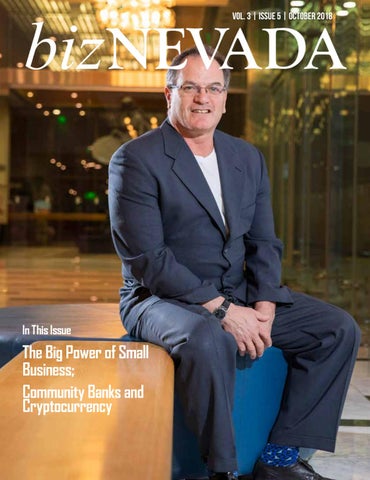
In review of all our Cover stories and our publisher letters, it is interesting to note that we have not made mention of the actual person or people on the cover very often. I feel compelled to write about the strength of character, poise and image this cover projects. Over the past 17 months we have had many charismatic individuals and groups of people on our covers. When we as a team began the process of preparing this issue for printing, we all loved this cover. In business, whether we are talking about the business of the public or private sectors, we would all agree leadership is a quality necessary for success. Simply stated when I look at the cover with Joseph Amato, the SBA’s Nevada District Director on it I see LEADERSHIP! Here are some extra’s on Joseph Amato which may explain why his cover is so captivating: •
His position is an appointed one from the highest levels of the Executive Branch
•
He is a former executive with over thirty years in small business development and commercial lending
•
A successful Entrepreneur who eventually sold his business to a major financial institution
•
Former Executive Director of a Small Business Development Center
•
Was recognized as SBA Financial Services Advocate of the Year
•
Prior to injury was considered a professional football prospect
These are just a few elements from Joseph’s life which lend a small insight as to why this cover is so powerful, charismatic and simply stated eye catching. I would like to personally thank Joseph and his staff for making this cover happen. Needless to say he and his staff are extremely busy and yet they always seem to find the time for the extra’s which are helping Nevada lead the way in business.
INTHISISSUE VOL. 3 / ISSUE 5 BizNEVADA PUBLISHING TEAM PUBLISHERS: Richard Moore and Chris O’Sullivan GRAPHIC DESIGNER: Kaylyn Dazey EDITOR-IN-CHIEF: Craig A. Ruark ADVERTISING: Chris O’Sullivan chris@biznv.com PHOTOGRAPHER: Jeff Scheid COVER PHOTO: Joseph Amato, District Director Small Business Administration
PG 4-6
The Big Power of Small Businesses
PG 7
7 Myths About SBA 504 Loans
PG 8-9
Reputation Management and Reputation Rehabilitation for Your Business
PG 10-13
Community Banks are a Valuable Resource to Small Businesses
PG 14-17
Nevada’s Business Community Comes Together to (BE) Engaged
PG 18
8 Tips for Building Your Business Support Network
FEEDBACK/IDEAS We welcome your feedback and ideas regarding BizNevada. Send a message to info@biznevada.com
PG 20-21
Blockchain 101
PG 22-23
Calendar of Events
© 2018 Carpe Diem International. All rights reserved.
PG 24-27
Tokes Cryptocurrency: An Alternative to
CONTACT US info@biznevada.com www.biznevada.
PG 28-29
One Way to Defeat ALS? Walk
PG 30-31
Factoring—the Loan Alternative
Banking for the Cannabis Industry
EXPERT CONTRIBUTORS Raul Chacon Workers Compensation EMPLOYERS EMPLOYERS.com 775-327-2700
Mike Menath Insurance Menath Insurance MenathInsurance.com 775-831-3132
KJ Smith Background Checks Employer Lynx EmployerLynx.com 775-883-3733 Joe Ross Creative Agency OCG Creative www.OCGCreative.com 775-324-1644 Bill Houghton Printing Horizon Business Services www.PrintEfficiency.com 702-369-1399
BIZ NEVADA MAGAZINE · WWW.BIZNEVADA.COM · 3
The Big Power of Small Businesses by Corrine Casanova
According to the U.S. Small Business Administration (SBA), over half of the U.S. workforce either owns or works for a small business. In fact, small businesses create two out of every three net new jobs in the private sectors. Rachel Dahl, a sixth generation Nevadan, has been the Senior Area Manager of SBA since March 2018. “You can’t do economic development without strengthening your
4 · ISSUE 5 · OCTOBER 2018
small business community. It is paramount to being able to attract new business to the area. In my mind, you can’t do one without the other,” said Dahl. Small businesses are the drivers of Nevada’s growing economy. Nationwide, there are 30.2 million small business owners and in Nevada alone there are 254,337 small businesses. (US SBA Office of Advocacy, 2018).
Nevada Small Business Facts: •
Over 428,000 Nevadans are employed by small businesses in Nevada
•
95.6% of Nevada businesses are classified as small
•
Between 2007-2012, minority ownership increased by 57.8%
•
Women own 36.6% of small
businesses in Nevada
The SBA’s mission is “to maintain and strengthen the nation’s economy by enabling the establishment and viability of small businesses and by assisting the economic recovery of communities after disasters.” Depending on your industry, a small business could be defined as a business with a maximum of 250 employees or 1,500 employees. Privately owned corporations, partnerships or sole proprietorships can all be classified as small businesses. Dahl is passionate about growing the small business community here in Nevada. “I always go back to the economic development world when I think about how important small businesses are. You spend all your time chasing that one big company to come to your town and hire 500 local people, but if you focus on your small business community, you can achieve similar results but in a different way. You can end up with maybe 100 really strong small businesses and achieve your 500-employee quota. That way the community can absorb all of things that come with that workforce including housing and so on. I don’t belittle developing a community by attracting large businesses as when it happens, it is fabulous but I think a lot of time we get stars in our eyes wanting that one 500 employee factory and totally forget to take care of our small businesses. When that happens, suddenly you have no strengths in your small business community and you don’t have the infrastructure
to attract a big company,” said Dahl.
Joseph Amato is the District Director of SBA in Las Vegas. He sees Nevada as a land of entrepreneurial opportunity with its low tax and low regulatory environment. “The SBA is a primary resource for government guaranteed and fixed-asset loan programs. The SBA serves as an integral partner with area, regional and national lenders that seek to provide competitive commercial loans utilizing these loan programs. Access to capital remains a priority and our efforts to increase small business lending will reflect the importance of our lendingrelated programs to the Nevada small business community,” said Amato. There are 13 banks headquartered in Nevada that work with the SBA to provide loans. However, most lenders have the authority to make loans nationwide. Currently, 69 banks have made SBA loans in Nevada this fiscal year. In Dahl’s role as the Nevada Service Area Manager for SBA, she travels extensively throughout the state doing outreach letting the community know about the resources available to them. Frequently, she delivers the most recent Small Business Resource Guide that contains an overview of the depth and breadth of the services they provide. Many aren’t aware of the training SBA provides small businesses. On their website, www.sba.gov/ offices/district/nv/las-vegas, they have a learning center which includes training videos that includes writing a business plan, marketing and anything else you’d like to know about running a small business. “One of the strengths of the BIZ NEVADA MAGAZINE · WWW.BIZNEVADA.COM ·5
SBA in Nevada is our resource partners. These include: the Nevada Small Business Development Center, Nevada Women’s Business Center, SCORE Northern Nevada and Las Vegas, the Procurement Outreach Program, the Procurement Technical Assistance Center. All of these help small businesses gain access to government contracts. Often, small businesses aren’t taking advantage of government contracting,” said Dahl. She shared a hypothetical example of someone who owns a cupcake shop. They may not consider applying to be a government contractor because they wouldn’t know how it could benefit them. They may be missing a huge opportunity when suddenly a government agency wants 500 cupcakes once a month for an ongoing event. “If you can land a government contract, that can become the bread and butter of your business. You can then rely on a certain amount of money in a certain time period. It gives your business stability. Government contracting is a focus of ours right now. We just don’t believe small businesses are taking advantage of this opportunity enough,” said Dahl. Nevada’s SBA works closely with other government agencies including the Governor’s Office of Economic Development. “All the different agencies at the local, state and federal levels work together. In the state of Nevada our strength is that we respect the heck out of each other to support small businesses in our community. Everyone works together and it is awesome,” Dahl concluded.
6 · ISSUE 5 · OCTOBER 2018
does not have to stand in the way for your future. MYTH 5: There is just too much paperwork. Fact: The paperwork is comparable to that of any business loan. There are a few SBA documents that need to be completed, otherwise the packages for a commercial real estate loan and SBA 504 loan are the same. Tip: Work with your local certified development company so they can share the pertinent documents with the local lender. MYTH 6: I have to put down 30% to buy or build a commercial building and pledge my home.
7 Myths About SBA 504 Loans by Evan Dickson, President, Nevada State Development Corporation The following seven myths and facts refer to the U.S. Small Business Administration (SBA) Commercial Loan Program. MYTH 1: It takes four to six months to get a loan approval. Fact: You can obtain an SBA approval as quickly as ten business days. Tip: Provide your lender with a complete package and answer your lender’s questions as soon as you can. Being available to the lender will greatly speed up the overall process. MYTH 2: SBA loans are expensive. Fact: All commercial real estate loans have loan fees, professional fees, and closing costs. The SBA 504 loan program will allow you to finance the fees associated with your 504 loan and use many of your out of pocket fees towards your 10% equity injection. Tip: If there is enough value in your appraisal, additional fees and costs can be financed. (example: appraisal and environmental reports) MYTH 3: SBA lending limits are too narrow. Fact: SBA 504 loans start at $25,000 and can go as high as $5,500,000. Tip: Talk to your local certified development company to see what you can qualify for based on your particular situation. MYTH 4: It is hard to qualify for a loan based on my past. Fact: People with a criminal history, bankruptcies, or significant credit issues can and have received financing through the SBA 504 loan program when they otherwise would not qualify for standard bank products. Tip: Be forthcoming with all personal history as soon as possible, no matter how long ago the incident happened, so your lender can address the possible issues. Your past
Fact: Most businesses qualify for 10% down when they use SBA 504 financing for their purchase. In most cases the loans are only secured by the building and/or machinery being financed and the personal guarantees of majority business owners applying for financing. Tip: To qualify for the lowest down payment, your business must have two years of verifiable income. Also be sure your business ownership structure is in line with the business’ future goals of real estate ownership before applying for financing. MYTH 7: Fixed rate commercial loans or refinancing of existing business debts are seldom available. Fact: The benefits of an SBA 504 loan include a low down payment, longer loan terms, and larger loan amounts than may be available through a conventional loan. In most cases, the borrower’s down payment will be 10% of project costs. Interest rates on the SBA 504 loan are below market rate and are fixed for the duration of the loan term (10, 20, and 25 years). Eligible small businesses may also be able to refinance certain qualified existing debt under the SBA 504 Debt Refinancing Program. Loans made through this program are structured like traditional 504 loans. Borrowers can refinance up to 90% of the current appraised property value. The refinancing may also include a limited amount of eligible business expenses. Tip: Ask your bank for an SBA 504 loan/refinance if you are considering financing through this particular program. Banks have a lot of different loan products and the SBA 504 loan may not be something that they do often but could provide the best solution for your particular situation. Nevada State Development Corporation (NSDC) www. NSDC.COM is a local non-profit certified development company licensed by the U.S. Small Business Administration (SBA) to assist business owners in obtaining financing though the SBA’s 504 Loan Program. With over 32 years of experience in business financing, NSDC has forged strong relationships with numerous financial institutions and brokers through-out the region. Reno office: 6572 S. McCarran Blvd.; 775-770-1240 Las Vegas office: 1551 Desert Crossing Ct.; Office: 702877-9111 BIZ NEVADA MAGAZINE · WWW.BIZNEVADA.COM · 7
Reputation Management and Reputation Rehabilitation for Your Business: What You Can Do to Protect and Fix your Online Reputation by Bruce Brown – special to bizNEVADA
8 · ISSUE 3 · AUGUST 2018
Maintaining a good reputation and especially reputation rehabilitation is a challenge for U.S. for businesses in 2018. Yelp.com, YP.com, Google Business, and other similar websites can make or break a company. Unethical competitors, angry customers and others with legitimate complaints can harm a business, hurt profits, even put a business out of business unfairly. And yes, the same result can happen because of legitimate poor customer service when a business owner or employee might be having a bad day. Uber is an excellent example. I won’t go into the security breach, alleged illegal activities and sexual harassment suits. However, just do a search for, “Uber government fines and fraud,” and see what shows up. Uber had to do some serious costly reputation rehabilitation. And it worked. Today, if you search simply, “Uber” the scandalous information is now at the bottom of the first page or even on page two. Statistically, only about 20% of people go to page two when conducting a search. So, what can you learn from Uber if you are a small business owner? Trust me, a lot! The following are some rules of thumb when it comes to keeping your reputation intact BEFORE anything really bad happens to hurt it. Protecting the Reputation of Your Business •
•
Give someone the job (who understands exactly what to do) to keep track of your social media as well as the most important online business directories such as: Yelp.com, Google Business, YP.com (a more compete list is in my free report mentioned in my article in last month’s issue of BizNEVADA). You can also do the research yourself if YOU have time and know where to look and what to do. You could also hire a skilled company to keep track of your reviews and help you fix them in a timely fashion if things go badly. If you get a poor review, most of the time you can contact the person who made the negative posting. If you can answer their negative comments publicly on the review site itself all the better. Say you are sorry and offer to give them a customer service solution that seems reasonable. Maybe their money back, something free or guarantee you will also talk to the “bad” employee. Let them know you are the owner, sales director or manager who has the power to make it right, so to speak. Request that they contact you directly so you can fix it. It is seldom a good idea to ignore the posting. That generally leads to bad ratings/rankings and even “copy-cat,” bad review posters. If that happens, you can create a snowball effect dropping your review rankings into the basement.
If the Problem Seems Insurmountable One method that can often work (although it may be against the rules of the online business directory and they may penalize if they can prove or believe you did it) is to “bury” the bad reviews with good reviews. By the way, if your complaint(s) are because of legitimate poor service and you refuse to fix the problem this method will generally not work because you will continue to receive poor reviews. Some business owners use different customers/ clients to place legitimate reviews by asking, begging or bribing for reviews. Some use reviews from family and friends. I cannot recommend using any of these “sneaky” fix it ideas...contained in this article. If you are discovered by the specific review site using “sneaky” methods they may temporarily or permanently suspend your business profile. If that happens, this problem can often be reversed by paying the business profile company “advertising money” to get your profile posting back and up and “straightened out” completely with even some poor reviews deleted. If you do not have the time for any of this and you suspect or are certain that your poor ratings are losing you business...your only recourse may be hiring a professional company with reputation enhancement/ reputation skills. A good company will not be cheap but they will use a multi-pronged approach that could include: a positive press release perhaps even a PR/ Publicity campaign, a SEO (search engine optimization campaign) to improve what customers will find out about you online, doing a PPC (pay per click advertising campaign), a cleverly created social media campaign, and more. The whole topic of building, keeping and fixing a business reputation is much more extensive than what I have been able to cover in this hopefully helpful article. Under a special arrangement with the publishers of BizNEVADA, I have agreed to offer a free 15-minute no obligation phone consultation to readers. This is a limited time offer and may be withdrawn at any time. You can call to set up a day and time here: 1-800-982-5007. Be sure to mention you are a BizNEVADA reader to take advantage of this free offer. Have a positive business month. Bruce Brown has had his own successful small businesses and is the author of four how-to books. He helps business owners to start and/or grow their business(s) (even B2B’s), with services and consulting. But he also shows business owners and executives how writing a book can help position them as, “experts in their field.” He can be reached at: 1-(800) 982-5007 anytime. www.brownmarketingconsulting.com and www.yourpublishedbook.com
BIZ NEVADA MAGAZINE · WWW.BIZNEVADA.COM · 9
10 · ISSUE 5 2018 4 · OCTOBER SEPTEMBER 2018
Community Banks are a Valuable Resource to Small
Businesses By Craig A. Ruark
Saying that all banks are the same is like saying all dogs have tails—there may be a wagging appendage but the length, shape, and how the dog carries and uses its tail greatly vary. So, while all banks deal with money, the size of the institution, the way they handle the money, criteria for loans, and their target customers also differs from one end of the scale to the other. Ten years ago, when the recession hit, it was thought that some banks were too big to let fail. Banks such as Citigroup, Bank of America, JPMorgan Chase, Goldman Sachs, and Morgan Stanley on a national level and regional institutions such as Zions Bancorp (Nevada State Bank), Western Alliance Bancorporation (Bank of Nevada), and Bank of George received bailout money. All totaled, 979 financial institutions received a total disbursement of $627 billion. To date, the government has been reimbursed $390 billion in principal and $323 billion in revenues from dividends, interest, and other fees. There is still another $86.1 billion in outstanding principal to be collected. Despite the bailouts, the Federal Deposit Insurance Corporation (FDIC) closed 465 failed banks between 2008 and 2012. The accounts from those failed banks were either taken over by larger banks, or the customers received money for their deposits from the FDIC. Because of the banking crisis, regulations were put in place under the Dodd-Frank Wall Street Reform and Consumer Protection Act, to improve accountability and transparency in the financial system, to end “too big to fail,” to protect the BIZ NEVADA MAGAZINE · WWW.BIZNEVADA.COM ·11
American taxpayer by ending bailouts, and to protect consumers from abusive financial services practices.
Perhaps, one of the best outcomes of the recession is the improved stability of ‘community’ banks that focus on serving the local businesses. Before the recession, there were 18 community business banks in Nevada and today; there are four at each end of the state. Along with the economy, these banks are growing in strength. “However, the Dodd-Frank language was written as a one size fits all bill, not written with community banks in mind, so there were a lot of things being applied to smaller banks that didn’t make a lot of sense,” said Ryan Sullivan, president and CEO for the Bank of George, one of the community banks in Las Vegas.
businesses,” said Sullivan. Bank of George is a locally owned bank that opened its doors just before the recession on September 24, 2007. Today, the bank has $220 million in assets, $197 million in deposits, and two branches in the Las Vegas Valley. While it is federally authorized to make loans up to $8 million, the board of directors have made an internal decision to cap their loans at $6.5 million. Bank of George is also listed as one of the Top 100 SBA 7A lenders in the country and has found a niche in helping small businesses, making loans as low as $50,000 to $100,000. “We don’t try to take care of casinos,” said Paul Workman, senior vice president of asset development for Bank of George. “We take care of the small to medium size businesses and have a large percentage of professionals, doctors, CPAs, and small business owners as banking clients.”
Workman, with nearly 35 years in the Las Vegas banking business, spends a lot of his time helping startup and young businesses develop a plan for their business future and making key connections that help them along the way. To remove and adjust some of the over-reaching and unduly burdensome regulations of DoddFrank, the 2017-2018 Economic Growth, Regulatory Relief and Consumer Protection Act was established. “This act remedies many of the issues with Dodd-Frank, helps to promote economic growth, provide tailored regulatory relief, and enhance consumer protections, and lets community banks do what they do best, which is to help small 12 · ISSUE 5 · OCTOBER 2018
Another community bank with a 20-year history in the state is Bank of Nevada in southern Nevada and sister bank, First Independent Bank in northern Nevada. A division of Western Alliance Bank, their corporation has $20 billion in assets (which is still small compared to the trillions held by the larger bank corporations), is one of the larger community banks in the state with a total of sixteen branches between them.
“The entire industry has transitioned from what it was 15 years ago, and electronic services play more of an important role in how customers use a bank. When it comes to actual business operations, it is more common for businesses to bank remotely,” said Joyce Smith is the senior vice president and regional manager of Bank of Nevada. “Even with fewer branches—because of technology we are able to offer all of the same consumer services as the larger, nationwide banks.” According to Smith, because of the local management, their bank is more agile and can move quickly when it comes to loan decision making. Another advantage is the fact that while all banks are subject to strict government regulations, smaller banks are more in touch with their client’s businesses and industries and because of the personal relationships, might find better ways to structure loans than larger banks would consider. “We would not make any loans that would jeopardize our integrity, but we do have a better understanding of our clients and their businesses,” said Smith. Town & Country Bank with four locations in the Las Vegas Valley is a locally owned community bank with $160 million in assets. Resources within the bank allow them to loan up
cash pickups for deposit. The goal is to handle the customers banking as much as possible without them having to set foot in the bank. While community banks are generally chartered to service the needs of small to medium size businesses, they also provide a full complement of personal banking services for their business customers. They have competitive checking and savings account programs, accept mobile deposits and are members of one or more of the ATM networks such as the Plus System®, Star System®, and Interlink® so that customers can use thousands of ATMs in the U.S. and around the world. Other community banks in Nevada include the Meadows Bank with branches both north and south, Heritage Bank of Nevada in Reno, and the new Valley Bank of Nevada in Las Vegas.
to $5 million but they also collaborate with sister banks in other areas outside of Nevada to increase their lending power up to $15 million. “All of the community banks are pretty much alike in that each of us tries to serve our clients, we are a high touch bank and get to know our customers very well, we are accessible, and truly a community-oriented bank in a large town,” said Darrel Small, president, and CEO. “I think what makes us stand out is we have a mid-west philosophy when it comes to lending
and how we treat customers.” More than 90 percent of today’s commerce transactions are electronic, so the limited availability of bank branches is compensated by the ability of customers to bank remotely. Community banks will process credit cards, provide equipment that will quickly scan a large number of checks and make the deposits directly to the business account. If a business, such as a restaurant, deals with a lot of cash, the banks use armored transport service partners to schedule regular
BIZ NEVADA MAGAZINE · WWW.BIZNEVADA.COM · 13
(BE) ENGAGED!
Nevada’s Business Community Comes Together to (BE) Engaged By: Mitch Truswell, Special to bizNEVADA
14 · ISSUE 2 · JULY 2018 14 · ISSUE 3 · AUGUST 2018
BIZ NEVADA MAGAZINE · WWW.BIZNEVADA.COM ·15
For many years in Nevada, the business community and the public education system often operated in their separate and independent worlds. However, both communities would mutually benefit if they understood more about each other and what each is trying to achieve.
That was the idea behind the very first Business + Education (BE) Engaged Conference. The conference was founded by Bank of Nevada CEO John Guedry and his wife, Debra, a former teacher. Both had the independent experience to see where business and education — if working together — could do so much more to benefit students, educational outcomes, and the state’s workforce. With help from corporate sponsors including the Las Vegas Global Economic Alliance (LVGEA), Henderson Chamber, Latin Chamber, Las Vegas Metro Chamber, Urban Chamber, Women’s Chamber, Boulder City Chamber, the Council for a Better Nevada and many others, BE Engaged moved forward. During BE Engaged events in 2016 and 2017, business leaders, educators, and nonprofit organizations received a fresh perspective on the challenges and frustrations amongst the public education system, as well as the achievements and alliances that are moving student achievement higher.
Why should the business community care about education? Without a skilled workforce capable of meeting the demands of current and future employers, Nevada will have a difficult time convincing new businesses to relocate here. Although the Governor’s Office of Economic Development (GOED), the LVGEA and others around the state are doing excellent work to attract new businesses, without improvements
16 · ISSUE 5 · OCTOBER 2018
to educational achievement and outcomes and additional workforce training, the state is limited in what it can do. Significant progress has been made, but there is much more work to be done. If Nevada wants to be considered a top competitor for the relocation and expansion of major headquarters and companies in emerging industries like technology, there should be a call to action for public education and the business community to work together to improve educational outcomes further and to ensure the availability of a qualified workforce.
How (BE) Engaged is helping to improve student achievement. STEM 101 - With encouragement from Bank of Nevada’s John Guedry and other business leaders, STEM 101, the premier provider of Science, Technology, Engineering and Math (STEM) curriculum in the United States, agreed to donate its STEM curriculum to every public middle school in the State of Nevada. The Clark County School District was among the first in the state to make this voluntary curriculum available to its middle school teachers. Square Panda - Third grade is when most students make the critical transition from learning to read to reading to learn. Students that haven’t learned to read by this time will fall behind in achievement since so much of their education relies on reading. Square Panda helps to build fluent readers. The Public Education Foundation, working with the Clark County School District, has utilized the Square Panda learning device in several schools and has achieved promising results in helping students to learn and improve their reading skills at an early age. Corporate Connections - This is a program of STEM 101 that helps students experience and understand future job possibilities, while also engaging local businesses to interact with students and potential future employees. The students are tasked with completing real-world projects for corporations and other entities that include: Aristocrat Gaming, Bank of Nevada, Helix Electric,
Martin Harris Construction, Nellis Air Force Base and United Health Services. By participating in these projects, students see the strong connection between what they learn in school and how it applies to the workforce. The program also connects students and adult learners to in-demand career pathways.
(BE) Engaged! Among the most crucial aspect of the BE Engaged conference is the call to action. Business and community leaders are asked to think about what they can do to help improve the outcome of Nevada’s educational system and to increase the pool of Nevada’s trained workforce. Attendees are encouraged to donate their time, their expertise, or their financial resources to move our public education system — and our economy — forward. Many attendees have been prompted to work directly with a school; others have assisted nonprofit organizations that provide essential educational or wrap-around services. It was through this exposure to nonprofits that Bank of Nevada came to learn of Green Our Planet. The nonprofit organization has placed more than 150 gardens on school grounds and provided stateapproved STEM learning curriculum so that teachers can incorporate garden activities into classroom learning. Bank of Nevada’s collaboration included hosting a large, student-run farmer’s market at Bank of Nevada’s Sahara office location earlier this year. School-grown produce and other items were sold by representatives of nearly 40 participating schools, raising a combined $9,000 in support of school gardens.
There are many opportunities to become involved. To (BE) Engaged. The next Business + Education (BE) Engaged Conference is happening in the Spring of 2019 official date to be announced. Bank of Nevada is a division of Western Alliance Bank. Member FDIC.
BIZ NEVADA MAGAZINE · WWW.BIZNEVADA.COM ·17
3. SCORE: Supported by the SBA, SCORE is a nonprofit that helps entrepreneurs launch and grow their business. There are SCORE locations throughout the U.S. Between workshops and mentorship business owners can access professional support year-round. 4. Faith-based community:
8 TIPS FOR BUILDING YOUR BUSINESS SUPPORT NETWORK by Ijeoma S. Nwatu – Special to BizNevada Whether you are just branching out or gearing up for your umpteenth year in business, it never hurts to have a supportive network around you. Owning a business can not only be stressful but lonely. Not every family member or friend will understand or emphasize with your entrepreneurial journey. The key is to surround yourself with likeminded individuals who can offer advice, share opportunities and listen to your big ideas. Go beyond your typical inner circle and broaden your network of support. Consider the following strategies in either engaging with people you hope to connect with or need to re-engage to strengthen the support around you as well as to look for new business opportunities. 1. Alumni: Reconnect with college and/or high school staff and classmates by letting them what you are doing now and what you have accomplished or plan to accomplish in your business. There might be opportunities to collaborate with university or community college by speaking at the school, hiring seasonal workers or bidding on a project. If you have children or are engaged in your local community, this strategy applies to reaching out to the parents and teachers association (PTA) or a similar group within the school. 2. Chamber of Commerce: Join a local or state chapter and meet and support business leaders. Becoming an active member can expose you to other industries, opportunities and like-minded contacts. 18 · ISSUE 5 · OCTOBER 2018
Your spiritual relationship with the members at your place of worship can have a positive effect on your personal life and business goals. Lean on faith-based organizations and activities that promote a healthy, productive lifestyle. 5. Extracurricular groups: It’s easy to forget that we form bonds with people we meet through leisure activities like sports leagues, volunteer and travel groups. When not working on or in your business, it’s essential to have a release. 6. Former co-workers: If you’ve shared ideas or worked well with previous coworkers and staff, re-engage them to share your current business venture. Their skillset might be useful in your next idea or they can provide insight or contacts that you may have not consider. 7. Professional organizations or conferences: Depending on the nature of your work and business, there might be an established network of professionals who meet annually. Conferences and professional groups are instant support systems because they bring together small and large crowds of people who are similar. You can get a lot of inspiration and information by not only attending events but potentially sponsoring or speaking at one. 8. Online groups via forums, private Facebook groups or Slack communities: Thanks to the internet and social networking, interfacing with other business owners across the world is reality. Building connections that go beyond day-to-day business matters, can provide new ideas and a different perspective. Ijeoma S. Nwatu is a digital strategy and communications consultant. Reprinted with permission from SBA.gov.
BIZ NEVADA MAGAZINE · WWW.BIZNEVADA.COM · 19
Blockchain 101 by Craig A. Ruark When you talk about mining to most people, the image of house-size earth moving equipment and gigantic craters, or long dark tunnels are generally what come to mind. However, a new mining industry has been evolving since 2009, and it involves what is called cryptocurrency. Perhaps you have heard about Bitcoin. But in reality, Bitcoin, along with other popular cryptocurrencies, (Litecoin, Ethereum, Zcash, Dash, Ripple, and Monero) are not hard currency at all; they exist only in cyberspace. But, how these currencies exist is becoming more important than the existence of the currencies themselves. What do you know about distributive ledger or blockchain technology? To explain the process, we start with the mining of cryptocurrencies which requires a dedicated and fairly powerful computer with specialized processors, a reliable power source, an internet connection (2 megabits per second or faster), and a cooling system to dissipate the substantial heat that is generated. Depending on the cryptocurrency, establishing mining operation can cost a minimum of between $5,000 and $10,000, and requires many hours of constant study. The mining process itself involves computing the answers to intensely complicated algorithmic equations. Once an equation is solved and a coin mined, that coin is registered with a number and placed into a password-protected electronic coin wallet. Notice that I said the wallet is password protected. Unlike the passwords that you set up for access to 20 · ISSUE 5 · OCTOBER 2018
the internet, bank account, or computer programs, these passwords consist of a long string of numbers and letters that are randomly generated when the wallet is initiated. A typical password may look like this: 34fe9f09e27cc9057e03d29e5ebde996be2869acla4 The wallet holder cannot change the password and must keep it in a very safe place because, without it, the cryptocurrency is impossible to access, and the passwords cannot be recovered. Without that password, the wallet and its valuable contents are lost forever. Each crypto wallet is tracked through a series of connected computers called a node, each with a matching ledger system referred to as distributed ledger technology. Hundreds of node computers are located around the world with matching ledgers. Every cryptocoin transaction is recorded in a block on the ledger sheet that identifies the product sold and the cryptocoins used. Every subsequent transaction generates a new block which is verified against the previous block in what becomes a Blockchain. It is because of these individual node computers, each with their matching ledgers, that it becomes impossible for someone to hack into the system to steal information. These ledgers keep track of every cryptocurrency transaction that has ever taken place and processes the information through what is called “Distributive Consensus” whereby each node on the network mathematically verifies that the transaction is accurate and has not be modified. During a transaction, the network receives three pieces of information. The purchaser’s digital wallet address, the amount of currency to be spent, and the recipient’s digital wallet address. The blockchain computers verify that the person sending the currency is the actual owner of the account and that the funds are available. Once a consensus of the ledgers is verified, the transaction is completed, and each of the ledgers is updated to transfer
the cryptocoins from one wallet to the next. The advantages of cryptocurrency are numerous, including the fact that Cryptocurrency is completely decentralized. No single person or institution controls the network. Its structure, money supply, and transaction record cannot be manipulated by any bank, government, organization, or rogue bad actor. Also: • • • • • •
No bank or credit card company taking a cut No third party holding the funds No monthly account charges No overdrafts No convenience fees Transaction fees range from free to just a few cents
On June 5, 2017, Nevada became the first state to ban local governments from taxing blockchain use. In addition to preventing local governments from taxing the use of a blockchain or smart contract (or requiring a licensure for their use), the bill stipulates “if a law requires a record to be in writing, submission of a blockchain which electronically contains the record satisfies the law”–meaning that data from a blockchain can be introduced in “proceedings.” While the distributed ledger technology and blockchain verification system is the backbone of the cryptocurrency world, it is also finding its way into other industries. For instance, in the real estate sector, the demand for international property is up 334% since 2009. But since there are no international real estate standards, rampant fraud and bureaucratic red tape make it almost impossible for Americans to buy property overseas. Propy, a global property store and decentralized title registry, is using blockchain to become a safe and secure global property solution. On Sept. 24, 2017, the purchase of an apartment in Kiev by TechCrunch founder Michael Arrington using Propy made history—it’s the first real estate purchase with cryptocurrency, and the first real estate transfer on the blockchain.
Propy uses the nearly impenetrable Ethereum blockchain to record the proof of ownership and is the most secure real estate system to adopt worldwide to standardize the industry. Blockchain simplifies a complicated buying process that ordinarily takes months, into a simple online transaction—opening the international market to American investors and allowing hundreds of billions of foreign dollars to flow into the American residential sector. In the same way real estate transactions are recorded and held secure, healthcare providers are looking at a blockchain-enabled health information exchange that would alleviate security concerns related to data-sharing between different providers. A patient would be able to access and share their data from the blockchain, and each provider would be able to update relevant information with an individual key. In the world of finance, a financial technology company called Populous is using blockchain technology and digital tokens as a secure, transparent, and modern solution for businesses to get immediate funding for international financial transactions including bank loans and invoice factoring. The transparency of transactions recorded via Blockchain is a major enabler of faster payments and improved financing across international borders. It reduces risks such as currency exchange fluxuations and fraud, and lowers cost. Populous created a Blockchain-based Smart contract platform to autonomously perform all necessary functions connected with funding, releasing payments, and the distribution of recorded data. This technology eliminates manual error and the need for any services from third parties. Of course, local onsite verifications are still necessary. Since the time when man first bartered for goods and then developed a currency system, the business of doing business has constantly evolved. Businesses need to keep up with current technologies in order to grow.
BIZ NEVADA MAGAZINE · WWW.BIZNEVADA.COM · 21
October/N Calendar
NOVEMBER 1 11:30 am - 12:00 pm Fall Neighborhood Mingle Series North Las Vegas City Hall NOVEMBER 1 8:00 pm - 9:30 pm Fall Neighborhood Mingle Series Jason’s Deli, Boca Park
LAS VEGAS METRO CHAMBER 575 Symphony Park Ave Ste 100 Las Vegas, NV 89106 OCTOBER 23 5:30 pm - 7:00 pm Chamber Connections Las Vegas Metro Chamber of Commerce OCTOBER 30 5:30 pm - 7:00 pm Chamber Connections Las Vegas Metro Chamber of Commerce 22 · ISSUE 5 · OCTOBER 2018
NOVEMBER 6 11:30 AM - 12:45 PM Chamber Voices Toastmasters Las Vegas Metro Chamber of Commerce NOVEMBER 6 5:30 pm - 7:00 pm Chamber Connections Las Vegas Metro Chamber of Commerce NOVEMBER 13 3:30 pm - 6:00 pm Pop-Up Business Showcase 2018 , Smith Center, Boman Pavilion
NOVEMBER 14 5:30 pm - 7:00 pm Chamber Connections II Las Vegas Metro Chamber of Commerce NOVEMBER 15 6:00 pm - 8:00 pm VYP Fusion Mixer Camden Lounge 4321 W. Flamingo Rd. LV, NV. 89103 NOVEMBER 20 11:30 am - 12:45 pm Chamber Voices Toastmasters Las Vegas Metro Chamber of Commerce
NOVEMBER 20 5:30 pm - 7:00 pm Chamber Connections Las Vegas Metro Chamber of Commerce NOVEMBER 21 11:00 am - 11:35 am Chamber Call w/ Mary Beth Sewald Register - Danica Torchin at dtorchin@lvchamber.com
November of Events
NOVEMBER 28 5:30 pm - 7:00 pm Chamber Connections II Las Vegas Metro Chamber of Commerce
HENDERSON CHAMBER OF COMMERCE
400 N. Green Valley Pkwy. 2nd Floor, Henderson, NV 89074 OCTOBER 18 7:30 AM - 9:30 AM Roadmap to Success Are You Running Your Business Or Is It Running You? Wells Fargo Building 112 S. Water Street Henderson, NV 89015
OTHER EVENTS
OCTOBER 25 5:00 pm - 8:00 pm Networking Mixer Westin Lake Las Vegas 101 Montelago Blvd NOVEMBER 1 7:30 am - 9:30 am Roadmap to Success Business Valuation: What’s it
Worth to You? Wells Fargo Building 112 S. Water Street Henderson, NV 89015 NOVEMBER 4 0:30 AM - 12:00 AM HCC Community Cares Event Walk to Defeat ALS Cornerstone Park 1600 Wigwam Pkwy Henderson, NV 89074 NOVEMBER 7 6:00 PM Henderson Economic Development Water Street Rall-E Gold Mine Tavern 23 S. Water Street Henderson, NV NOVEMBER 13 7:00 am - 9:00 am Networking Breakfast Business of Caring – panel disscusion Sunset Station Sunset Rom
NOVEMBER 15 7:30 am - 9:30 am Roadmap to Success Thinking Outside the Bank: Money Solutions for Your Business Wells Fargo Building 112 S. Water Street Henderson, NV 89015 NOVEMBER 15 6:00 pm - 7:00 pm Henderson’s 19th Annual Economic Development & Small Business Awards Green Valley Ranch Grand Ballroom
TOKES
An Alterna Ca
24 · ISSUE 5 · OCTOBER 2018
CRYPTOCURRENCY:
ative to Banking for the annabis Industry By: Craig A. Ruark
BIZ NEVADA MAGAZINE · WWW.BIZNEVADA.COM · 25
Nine states in the U.S. have legalized marijuana for recreational and medical use and an additional eighteen states allow legal medical usage. However, the problem is that marijuana is still considered a Schedule I Controlled Substance by the Federal Government and therefore money generated from the cultivation, testing, processing, and sale of the drug cannot be deposited into a bank that is backed by the Federal Deposit Insurance Corporation (FDIC). Just the retail sale of marijuana alone has exploded to $9.7 billion in 2017, and that number is expected to increase to $24.5 billion by 2021. That does not include the amount of money generated by the growers. Special state-mandated testing laboratories also generate significant revenue from the manufacturers of cannabis oils, edibles, and tobacco products. For the customers and businesses, the buying and selling of cannabis have been a cash-only option. But in Las Vegas, a company called Tokes Platform and partners Michael Wagner and Gabriel Allred, Ph.D. is offering an alternative to cash in the form of a cryptocurrency called Tokes with the obvious nod to marijuana cigarettes. The Tokes cryptocurrency, like Bitcoin and other cryptocurrencies, works on the blockchain secure transaction system which is talked about in this issue. Cryptocurrency companies and related tokens are regulated by various federal entities. Regulation is still highly subjective and largely related to commodities and/or financial instrument oversight, generally through the lens of the U.S. Commodity Futures Trading Commission (CFTC) or United States Securities and Exchange Commission (SEC). The benefit of decentralized payment solutions like crypto is two-fold: 1) assets/funds are custodied entirely by the individual holding them, not in a custodial or bank account, and 2) payments are processed exclusively by the network of individual nodes on a given blockchain network, not the companies (like Tokes) that may have released them. Cryptocurrencies are stored securely via complex cryptographic functions on a local digital currency “wallet.” To the extent that a user follows standard security measures: uses strong, unique passwords, backs up wallet files, keeps wallets offline unless sending transactions, and ensures they don’t have viruses or malware on their computer, a cryptocurrency wallet is virtually impossible to 26 · ISSUE 5 · OCTOBER 2018
break into. One particularly beneficial feature of cryptocurrency is a sort-of built in escrow without the need for a third party. Through what is called a multi-signature wallet, it’s possible to require more than one party to sign off on any individual transaction. This multi-signature process is great for businesses with more than one owner who want to prevent any individual partner from absconding with the totality of the funds in a digital currency wallet, as they can’t move them without all parties signing off. Finally, cryptocurrencies are not subject to asset seizure like bank accounts and custodial accounts, as there is no centralized service holding those assets. A recent study by RewardExpert revealed that Nevada is already ranked #4 in the nation with the best infrastructure to use cryptocurrencies. According to the report, Nevada is just as cryptocurious as it is crypto-friendly, with residents showing high interest in various currencies. There are four Bitcoin ATMs available in the Las Vegas area, and a total of 78 other establishments that accept Bitcoin for payment, including real estate and legal firms, and one “Zombie Apocalypse Store.” By utilizing cryptocurrency, cannabis growers, processors, testers, and retail sellers can avoid the problem of having hundreds of thousands of dollars in cash being transported and stored in unsecured locations and susceptible to theft. Tokes was launched in December of 2016, and the cryptocurrency is currently available, but the partners have purposely delayed the full-scale launch of their product. Instead, they have been beta testing and perfecting the final products that they want to bring to the market. Because Tokes is exploring the frontier of this technology, they feel it’s best to be forthright and open with regulators to discuss both the advantages and potential pitfalls of the technology. Although not currently required for cryptocurrency, the partners are making every attempt to communicate Their services and business model to regulators like Nevada Division of Financial Services in advance of launch to ensure they’re not inadvertently undertaking an activity that would otherwise require these licenses or be illegal. The company issuing the cryptocurrency is also developing a consumer app, supply chain visibility tracking system, managed cloud hosting, and a point of sale platform called Tokes Merchant Gateway. “While we are focused on cannabis as
being the most opportunistic market, in terms of the need for our service, everything that we develop today can be used by any merchant who would like to use cryptocurrency in their business, either brick n mortar in an e-commerce application,” Said Wagner. “The Merchant Gateway will also accept cash, credit, and debit cards.” The government’s biggest fear is the introduction of a black- or gray-market product into a legal supply chain, and state regulators of the cannabis industry want to track the plant from the grower all the way to the consumer. The data that can be contained in the blockchain technology is ideal for that purpose. In addition, the Tokes Merchant Gateway will accurately record every transaction and will ensure that proper taxes are being paid, there is no diversion of product, no money laundering, and without the build-up of cash, businesses are at less risk of being robbed. The key to the Tokes Merchant Gateway is the melding of blockchain technology with other more common credit and debit processing. Tokes Platform has essentially developed a bankless ATM to serve any type of cash-heavy business without the need for a bank account. On the backend of the debit or credit transaction, the customer is going to be purchasing Tokes and using those Tokes to purchase the cannabis. “We do want to champion the cannabis movement. In fact, we launched the company under the banner of the cannabis revolution,” said Wagner. “It’s really about understanding the benefits, through the adoption of cryptocurrency, that provides the power to the people that are using the money, to be able to spend it and control it in their own fashion. And likewise, the way the people are empowered by the cannabis industry to consume products that they feel are good for them.” However, this is a solution that spans well outside of cannabis,” said Allred. “We’ll have a white-labeled version with which the average person can use to set up an online storefront.”
BIZ NEVADA MAGAZINE · WWW.BIZNEVADA.COM · 27
#Every90Minutes by Corrine Casanova
Every 90 minutes someone is diagnosed and another person dies from Amyotrophic Lateral Sclerosis (ALS) also known as Lou Gehrig’s disease. This rapidly progressing neurological disease is fatal and attacks the nerve cells that control voluntary muscles. Stephen Hawking who died in March at age 76 defied all odds by living with ALS since he was first diagnosed at age 21. Once someone is diagnosed, typically they are looking at a life span of two to five more years. The Harvard School of Public Health conducted an epidemiological study where men with a history of any military service in the last century were nearly 60 percent more likely to die of ALS than those in the general population. The reason for this is unknown. 28 · ISSUE 5 · OCTOBER 2018
According to Lisa Tomlin-Kurr, Events Coordinator of the ALS Association Nevada Chapter, the Ice Bucket Challenge in 2014 brought a lot of awareness and funds toward research. “Though we may not know a lot about ALS, researchers are saying they know more now because of proceeds from the Ice Bucket Challenge which has actually given them a ten-year jump start on research. We still have a way to go because there currently is no cure and there are only two drugs currently approved by the FDA for ALS,” explained Tomlin-Kurr. Creating awareness is one way to combat ALS. Fast approaching is the Walk to Defeat ALS which will be held in Las Vegas on November 4. “The one mile Walk is a party. We will have a DJ, food trucks and of course the Ice Bucket Challenge. We also have pumpkins for Smash Out ALS. You get a
lot of fun. People can bring their dogs and dress them up. It’s a fun, family event,” said Tomlin-Kurr. Last year, 438 people attended the event and this year they expect over 500. As the awareness grows, so do the participants. Not only do people learn about the disease while participating in this event, they learn more about what services ALS Nevada provides. There are three ways Nevada businesses can get involved and Support ALS: •
Event Sponsorships – there are four major events a year and businesses can sponsor anywhere from $250 to $10,000
•
A Corporate Team – this promotes team building within an organization and displays brand loyalty.
•
Donate gift certificates – these are used for prizes and incentives for team captains and other event cheerleaders.
services include allowing our patients to go to one appointment where they will see ten clinicians in one visit. This may include their respiratory therapist, dietician and physical therapist. We also have a loan closet where we loan out equipment like wheelchairs. Our care service coordinators who have a nursing background are amazing at what they do. They do home visits, answer any insurance questions, help to fill out any necessary paperwork and can help explain Veteran’s benefits. They not only know the medical side of the disease, they are compassionate and caring too. People can apply for Respite Grants which provide funding each quarter for respite breaks. Caregivers need a break. Eventually, patients require 24/7 care. I was surprised to learn that each year someone is living with ALS, they can expend about $250,000 in out of pocket costs for lost wages and purchasing medical equipment not covered by insurance. That’s where we come in. We can help,” concluded Tomlin-Kurr. If you’d like to learn more about ways you can get involved, contact www.alsa.org or contact Lisa Tomlin-Kurr at Lisak@alsanv.org
“Studies show that employers who do a charity event or something revolving around a nonprofit cause employees to form a tighter bond and more loyalty to the company. When companies show they care about a cause it goes a long way with employees. Showing unity by wearing the company t-shirts shows brand loyalty too. That means something to people and goes a long way with employees,” said Tomlin-Kurr. Currently, there are about 160 people that have been diagnosed in the state of Nevada with ALS and ALS Nevada has interacted with about 80 of those patients. “We are trying to close the gap to actively be involved with all 160 patients. And that all starts with awareness. We want to get the word out that we have resources they need. Our BIZ NEVADA MAGAZINE · WWW.BIZNEVADA.COM · 29
FACTORING— the loan alternative By: Craig A. Ruark A loan is a loan whether it is a government-backed SBA loan, a secured equity loan through a bank, or a personal loan through an associate. Each of them has a principal and interest amount that must be paid back either in a lump sum or over time. Often, companies find themselves to be asset rich but cash poor. While business is thriving, they have a healthy amount of account receivables on the books but are strapped for immediate cash. One option for a quick infusion of cash is invoice factoring. Receivables represent work completed (and money paid out), for which you are not yet paid. When you carry a large dollar amount of receivables, you become a bank for your customers. In turn, this can also hamper your ability to pursue lines of credit or conventional loans from your bank to fund growth or even continue operations. A quick search of the Internet reveals over 100 factoring companies operating across the U.S. However, most of those companies either cater to very specific types of businesses and are operated by large financial institutions or corporations. Invoice factoring is available to a business that invoices
30 · ISSUE 5 · OCTOBER 2018
other businesses (B2B) or government agencies (B2G) and provides short-term working capital in exchange for selling and assigning invoices to a factoring company. In simple terms, the factoring company advances a business roughly 70%-80% of the invoice’s value when an invoice is purchased. Then, once the invoice is paid, the factoring company pays the remaining 30% to 20% (minus agreed upon factoring fees). Factoring is not a loan, it represents work provided to a client in the form of a service or a product, and therefore the money belongs to the company. The invoice factoring company is simply advancing the money that the business has coming to it, in exchange for a small percentage of the amount owed. According to David Cabral, President of Las Vegas-based Business Finance Corporation, “A factoring discount rate is determined by a number of variables such as the type of business you are in, (for example: construction is more expensive than manufacturing) the number of monthly invoices to be factored, the dollar amount of each invoice, the credit quality of your clients
and their payment history, as well as other credit risks. In addition to the per-transaction discount rate, a factoring company may charge an additional monthly fee on accounts that require specialized services or customized financing.” “Typical factoring discounts range from 3%-5% for 30 days. An invoice that is not paid within 30 days will accrue daily fees at 1/30th of the factoring rate per day. For instance, if your factoring discount rate is 3½%, and the invoice does not pay within 30 days from the date we fund the
invoice, the daily fee would be 1/30th of 3 ½ % or .1167% per day. On a $1,000.00 invoice, the amount would be $1.17 per day,” said Cabral. In many parts of the country, and in many industries, factoring is a routine and commonly used method of asset-based financing. It does not reflect badly on a business. In fact, it demonstrates to your clients that you actively and aggressively manage your business and your cash flow. As with banks, there is a process to setting up an account with a factoring company and building a trusted relationship is important. Factoring companies generally look at three things, the current business financial
statement (Balance Sheet & P&L), a current accounts receivable aging report, and three months of your most recent bank statements, before purchasing receivables. Once a business relationship is established with a factoring company, a company can present only the invoices they want to factor, and the company will be approved for a monthly invoice factoring amount. At that point, the turnaround time for factoring a group of receivables and receiving cash can be as short as 24 hours.
BIZ NEVADA MAGAZINE · WWW.BIZNEVADA.COM · 31