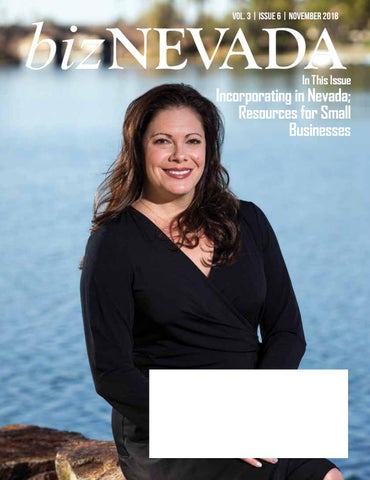
Vol. 3 | ISSUE 6 | NOVEMBER 2018
In This Issue
Incorporating in Nevada; Resources for Small Businesses
LETTER FROM THE
LETTER FROM THE
By Craig A. Ruark
Chris O’Sullivan
EDITOR With 2018 vanishing fast in the rear-view mirror, most small businesses are planning their journey into 2019. In addition to budgets and tax planning, some businesses may be looking at employee insurance options and keeping their employees healthy. This issue talks about options during the open enrollment period and the advantages of an employee flu vacation program. There are also, as a result of the recession and improved economy, a growing number of individuals that have left the corporate world to become freelance and independent contractors. However, without incorporating as a legal entity, they are walking a highwire without a safety net and subject to legal liabilities that could take away everything they own. Our feature article this month discusses the pros and cons of various incorporating strategies. Be sure to also check out our redesigned website where you will find tabs for resources and stories in Northern and Southern Nevada. This website is expanding with many additional exciting features, so be sure to check back once a month. If you missed any past issues of our magazine, you will find them online at https://issuu.com/ biznevada. We look forward to your continued support of our magazine and our advertisers. If there is a subject that you would like to see covered in the future, please feel free to send your comments and requests to Craig@ biznv.com.
PUBLISHER
We just came from the Governor’s Conference on Business 2018. What a great event! The conference set an attendance record of just over 800 attendees. Governor Sandoval wrapped up the event with his final Conference on Business invocation, and what a speech it was! The Governor received two standing ovations, one at his introduction and one at the conclusion of his speech. I have to say, his message was just as inspiring as his first seven years ago, reiterating that “if Nevada was a stock, he’d be buying right now”! Our November edition gives some insight into exactly why Nevada is such a great place to incorporate and set up trusts of all kinds. Thank you to our many experts that helped with the rather complex content this month, and especially to our editor Craig, for doing double duty this month! I love doing business with locals, and I wanted to give a shout out to a couple of local companies whose businesses have been challenged by larger regional and national chains, yet through great personal customer service, and competitive pricing, have been able to survive and thrive! Two of my favorite meeting places are Sambalatte and Avery’s Coffee! Sherman & Linda Ray, owners of Avery’s have been wonderful supporters of bizNEVADA, and you can often pick up an extra copy of the magazine to read while sipping on a delicious drink in their friendly establishment. If you’re ever out near Sahara and Fort Apache, stop in and tell them I sent you! Have a wonderful Thanksgiving, and a special shout out to all of the men and women who have served in our Armed Forces. Thank you for your service and for keeping our nation safe and strong! Happy Veterans Day!
2 · ISSUE 6 · NOVEMBER 2018
INTHISISSUE VOL. 3 / ISSUE 6
PG 4-7
The Care and Feeding of Your Business
PG 8-9
The Art of Staying Healthy During Flu Season
BizNEVADA PUBLISHING TEAM PUBLISHERS: Richard Moore and Chris O’Sullivan GRAPHIC DESIGNER: Kaylyn Dazey EDITOR-IN-CHIEF: Craig A. Ruark ADVERTISING: Chris O’Sullivan chris@biznv.com PHOTOGRAPHER: Jeff Scheid COVER PHOTO: Gina Bongiovi, managing partner of Bongiovi Law Fim
PG 10-11
Starting the New Year with a Well-Planned Estate
PG 12-13
Nevada Health Link Begins Open Enrollment
PG 14-15
Nevadan’s Score with Business Startup Advice from SCORE
FEEDBACK/IDEAS We welcome your feedback and ideas regarding BizNevada. Send a message to info@biznevada.com
PG 16-18
Preparing your 2018 Taxes
PG 20-21
Calendar of Events
PG 22-24
How To Weather The Worst Of Storms In Your Business
© 2018 Carpe Diem International. All rights reserved. CONTACT US info@biznevada.com www.biznevada.
PG 25
Calendar of Events
PG 26-27
Chamber’s Association Health Plan Give Businesses Affordable Coverage Options
PG 28-29
How Business Owners Can Protect Their Employees from Workplace Violence
PG 30-31
Hitting The Reset Button On Your Workplace Security
EXPERT CONTRIBUTORS Raul Chacon Workers Compensation EMPLOYERS EMPLOYERS.com 775-327-2700
Mike Menath Insurance Menath Insurance MenathInsurance.com 775-831-3132
KJ Smith Background Checks Employer Lynx EmployerLynx.com 775-883-3733 Joe Ross Creative Agency OCG Creative www.OCGCreative.com 775-324-1644 Bill Houghton Printing Horizon Business Services www.PrintEfficiency.com 702-369-1399
BIZ NEVADA MAGAZINE · WWW.BIZNEVADA.COM · 3
4 · ISSUE 6 · NOVEMBER 2018
THE CARE AND FEEDING OF YOUR BUSINESS By Gina Bongiovi –Special to bizNEVADA TO INCORPORATE OR NOT TO INCORPORATE? Let’s begin with discussing whether it makes sense to form an entity at all. If you print business cards and attend networking events, you are automatically acting as a sole proprietor. (You still need proper business licensing, but that’s a topic for another article.) Operating a sole proprietorship means there is no distinction between you and your business and that you would be personally on the hook for any liability arising out of your actions as a business owner. Translated: you sign a contract for services and fail to pay; the party expecting the money can come after you personally. Similarly, if you and another person come up with a business name, print business cards, and begin doing business, you have automatically formed a general partnership. This is an even riskier proposition because not only can each of you be held personally liable for any issues that arise with the business, but any partner can bind the “company” (the other partners) without first getting permission. Forming an entity separates your personal assets from your business assets so that a lawsuit
against the business doesn’t put the business owner’s personal assets at risk. The concept of the “corporate veil” describes this separation – it’s as if a veil shrouds the personal assets from liability stemming from business activities. The strength of the corporate veil depends on whether and how the business owner has managed the business. More on that later. Historically, to avoid personal liability, one would have to form either a corporation or a limited partnership. A corporation would provide limited liability for the individual shareholders, but could not be taxed as a partnership, which was desirable for many companies. A limited partnership, with that partnership tax treatment, offered limited liability to those named as limited partners, but not to the required general partner who had unlimited liability. The limited liability company was created to offer the best of both worlds – limited liability for all owners found in a corporation, but with partnership tax treatment previously found only in a limited partnership. By 1996, all 50 states recognized the LLC structure, and it remains a popular option today.
WHICH IS BETTER - LLC OR CORPORATION? Contrary to popular belief, a corporation and an LLC provide the same level of limited liability protection for the business owners. The statutes, NRS 78 and 86, explicitly state that the individual officers of a corporation or members of an LLC are not personally liable for the debts or obligations of the business, providing the entities are managed properly. Whether you should form an LLC or a corporation depends largely on the type of business involved, how it will be funded, the growth strategy, how it will be managed, and the ultimate exit strategy. As you may be thinking, these questions indeed should be answered at a stage of the business during which you have the least amount of information. That’s why it’s so important to put a business plan together prior to making any of these decisions. Incidentally, the value of a business plan is not in the resulting document; it’s in the journey of researching and learning about the market and your business model’s probability of success. Keep in mind your company exists in two different worlds – the legal world and the tax world. Legally, you can operate as a sole
BIZ NEVADA MAGAZINE · WWW.BIZNEVADA.COM ·5
LEGAL ENTITY
TAX TREATMENT
Sole Proprietorship
Disregarded Entity
Partnership
Partnership
Corporation
S-Corporation
LLC
C-Corporation
proprietor, a partnership, a corporation, or an LLC. There are other types of entities like LLPs and LLLPs, but we’ll focus on the most popular options – corporations and LLCs – for now. As discussed, a corporation and an LLC both provide limited liability protection, but the final decision may be based on tax considerations. While a corporation can only be treated as an S-corporation or a C-corporation, an LLC has those choices, plus that of a disregarded entity if it has one owner or if the only two owners are married, or as a partnership, which achieves the goal that originally brought LLCs into existence – partnership tax treatment plus limited liability for the owners. We find ourselves defaulting to the LLC structure unless a corporation makes more strategic sense or is required based on ownership or other factors. A corporation may be more appropriate for highgrowth companies planning to seek sophisticated funding (such as tech startups), those interested in attracting international investors whose countries of domicile may not provide benefits to LLC ownership (looking at you, Canada), or those who want to offer preferred and common stock. LLCs may be preferable for any of the following reasons: •
LLCs tend to be lower maintenance, as they don’t typically require bylaws, a board of directors, or advance written notice of company meetings (though we do encourage LLC members to hold at least annual meetings);
6 · ISSUE 6 · NOVEMBER 2018
• Corporations cost more to maintain in Nevada since the associated state business license fee increased by $300; • LLCs have more tax flexibility; • LLCs can be taxed as disregarded entities. CLEARING UP CONFUSION – S CORP OR LLC? When someone wants to “form an S corp,” we must clarify the type of entity because, as discussed above, either an LLC or a corporation can be treated as an S corp for tax purposes. Similarly, we often encounter advisors who will talk about “an LLC or an S corp” as if they are two distinct choices, which can be confusing for the same reason – an LLC can be taxed as an S corp. Often, when an advisor discusses an LLC and an S corp as if they are completely separate, the “LLC” refers to the default tax treatment – a disregarded entity if a sole owner or married couple, or a partnership if two or more unmarried people are involved. If you encounter this confusion, don’t be afraid to ask for clarification. S CORP OR C CORP? The S corp tax treatment is a “flow-through” or “pass-through” structure, which means that the business profits and losses will “flow” or “pass” through the corporate tax return and show up on the individual owners’ personal tax returns. This means the entity itself is not taxed on the profits and losses; the individual owners will pay taxes on those amounts through their personal tax returns.
The C corp tax treatment is usually disfavored because, unlike the S corp, the profits of the corporation are taxed twice – once at the corporate level and again at the individual shareholder level when those same profits become dividends. The new tax laws have created rumblings that the C corp structure is now more favorable than the popular LLC-taxed-as-S-corp approach. We haven’t found that to be the case, but it’s always best to enlist the help of both a lawyer and a CPA to discuss the pros and cons of each in light of your business plan. MAINTAINING YOUR CORPORATE VEIL I mentioned earlier that corporations have more stringent requirements than LLCs when it comes to maintaining corporate records. That doesn’t mean LLCs don’t have any requirements. Regardless of the type of entity you form, it’s crucial to keep that corporate veil in place by not allowing anything to pierce it. A common approach to piercing the corporate veil is to argue that the entity is just an “alter ego” of the individual business owners who are using the entity to shelter assets, avoid taxes, or otherwise abuse the protections of the corporate veil. Evidence of this can include personal expenses being paid from the business account, undercapitalization, personal use of business assets, and failure to observe corporate formalities. Anytime you take an action that might blur the line between your business and personal assets, be sure to ratify that action with a corporate resolution. Your CPA might ask for this too. For example, if you are going to pay an otherwise personal expense, like a cell phone bill, out of the business account, make sure that the owner(s) have signed a resolution approving this expense so that it becomes a legitimate business expense.
Don’t get carried away with this, however. While a cell phone’s function in a business can easily be justified, a vacation to Tahiti might not. Date, sign, and file these resolutions in your corporate book. You know, that three-ring binder you probably received when you formed your entity? The one collecting dust on the shelf that likely contains only the tabs? Yeah, that one. Similarly, be aware that any personal guaranty will act like Edward Scissorhands to your corporate veil. It is a contractual provision, or maybe a completely separate contract, that sets aside the corporate protection as to the obligation it refers to, and holds the individual guarantors (often the business owners) personally liable. You almost can’t rent commercial space, borrow money from a bank, or get a credit card without signing a personal guaranty. While they eliminate the veil as to that obligation only, it’s worth mentioning because we meet with too many people who signed them without understanding the consequences. We haven’t even explored the importance of business licensing, owners’ agreements, or managing the business to achieve your ultimate exit strategy. From the moment a business idea pops into your head to the day you sell, you’ll make thousands of decisions, large and small. Surround yourself with a team so you can leave the technical legal, tax, financial, insurance, and banking matters to those who deal with them every day and focus your energy and expertise on running the company. Gina Bongiovi is the managing partner of Bongiovi Law Fim and dedicates her practice to serving small businesses. A Las Vegas native Bongiovi graduated magna cum laude from the UNLV Honors College with a B.S.B.A. in marketing and minor in business law in 2001. In 2007, she was one of the first students to earn a dual law degree/MBA from the William S. Boyd School of Law and College of Business at UNLV. https://bongiovilaw.com/
BIZ NEVADA MAGAZINE · WWW.BIZNEVADA.COM · 7
The Art of Staying Healthy During Flu Season Special to bizNEVADA Keeping your staff healthy ensures they’re able to keep your customers happy and healthy, which translates to higher profits in the long run. And one of the easiest ways to accomplish this is to encourage them to get vaccinated against the flu, which ensures they’re able to work and provide for their families, while also protecting your customers from potentially contracting the influenza virus. Chelsey Lundin is the manager of human resources and security for the Nevada Museum of Art, which provides a flu vaccination clinic for its employees every fall. “We interact with so many people, including busloads of children, so it’s critical we do what we can to keep everyone healthy,” she says. 8 · ISSUE 6 · NOVEMBER 2018
If last year is any indication, you don’t want to take a chance with this potentially deadly disease. According to the Centers for Disease Control (CDC), the 2017-2018 flu season wasn't just bad; it was the worst we've seen in 40 years. An estimated 900,000 were hospitalized, due to something that can be prevented with a flu vaccine. Of those, 80,000 Americans died of flu and its complications last winter. That's almost double the number of people estimated to die the same year in car crashes. In addition to the human cost, the CDC reports that up to 111 million workdays are lost every year because of the flu (influenza) at an estimated $7 billion per year in sick days and lost productivity.
Work Habits to Reduce the Risk of Flu Businesses can take steps to cut these costs and keep workplaces healthier: •
Get your flu shot. Businesses can host vaccination clinics or reimburse employees for the time and money it costs them to get the flu vaccine.
•
If you’re sick, stay at home. Flexible leave policies encourage sick employees to stay at home.
•
Keep it clean. Disinfect frequently touched objects. Hotspots include doorknobs, railings, countertops, telephones, keyboards, faucets and vending machines.
•
Stock up. Have supplies such as tissues, soap, alcohol-based hand sanitizers, paper towels and disinfecting wipes readily available in common areas.
•
Work up a lather. Wash hands frequently and thoroughly with soap and water for 20 to 30 seconds. If using hand sanitizer, use one with at least 60 percent alcohol.
Lundin says the Museum is proactive in many ways when it comes to keeping its staff healthy. “We have healthy snacks available for them, and we encourage them to stay home when they’re sick,” she says. “Full-time employees have a generous sick leave policy. And we let part-time employees make up hours or figure out a way they can work from home.” CDC recommends that those who do contract the flu stay home for at least 24 hours after their fever is gone, except to get medical care or other necessities. For those who are pregnant, seniors, or are immune-compromised, it is advisable to seek medical attention. For people at high risk of serious flu complications, treatment with antiviral drugs can mean the difference between milder or more serious illness, possibly resulting in a hospital stay. Nevada has many options for free or low-cost flu vaccinations, many of which can be found at immunizenevada.org/flu/flu-vaccine-locations, which allows Nevadans to input their zip code, generating a list of locations nearby offering the flu vaccine. Immunize Nevada is widely recognized as Nevada’s trusted resource for immunizations and community health for all ages by fostering education and statewide collaboration. For more information, visit www. immunizenevada.org.
BIZ NEVADA MAGAZINE · WWW.BIZNEVADA.COM · 9
Starting the New Year with a Well-Planned Estate
By Dara J. Goldsmith, Esq. – Special to bizNEVADA
The catchphrase “it is all good” summarizes the advantages of estate planning. There is no downside to setting up an estate plan. Estate plans generally consist of a will, powers of attorney for health care and financial matters, and a living will. Basic estate planning allows an individual to decide who will make decisions when the individual can no longer make decisions, the types of decisions to be made, who will handle the burial/cremation, manage the settlement of the estate (garnering assets, paying creditors and getting the estate ready to be distributed), and ultimately who will receive the assets. A misconception that many people have is that ‘if I make a will, I will avoid probate.’ Actually, nothing is further from 10 · ISSUE 6 · NOVEMBER 2018
the truth, ‘If all you have is a will, you will go through probate.’ Now probate is not as awful as it is made out to be, and for some, it is a simple and relatively painless process. However, for others, more advanced estate planning would have eased the financial or emotional burden on the family. Oftentimes a client will come into our office and state emphatically that a trust is needed. The first question we ask is “why?” Why does the client believe that a trust is needed. Sometimes the client is correct, while other times the trust is not necessary, and a will may be sufficient to transfer the assets upon passing. There are a number of will substitutes; these include holding assets in a joint tenancy, designating a pay on death
beneficiary on an investment or bank account, or naming a deed upon death beneficiary for real property. Each of these designations has advantages and disadvantages which should be considered or discussed with legal counsel before using one of these alternatives. The advantages of these substitutes are that they are low cost and relatively simple to set up. The disadvantages include, but are not limited to the risk of loss, loss of a stepped-up basis (tax issue), and loss of control. Often, the disadvantages outweigh the advantages. The use of wills and/or will substitutes to craft an estate plan is akin to buying a paintby-number painting, the creativity options are somewhat limited. Whereas, trusts offer infinite solutions to the client’s
objectives. A trust is like a blank canvas waiting for the artist’s brush and paints to awaken the canvas. The attorney/artist is able to craft a trust that is individualized to the client’s wants and needs and is not limited to “staying between the lines.” Moreover, unlike a will which is public record, a trust is a private document. Many clients like the idea that the public will not know what their beneficiaries receive. Some trusts are complex, and others are relatively simple. In basic terms, there are two types of trusts, inter-vivos trusts, and testamentary trusts. Testamentary trusts are created by a will. The biggest disadvantage of a testamentary trust is that the estate assets go through probate and then the trust is created. Probate avoidance is the main reason many select a trust, so 99% of trusts drafted are inter-vivos trusts. An inter-vivos trust is created during the lifetime of the individual[s] and should be funded during life so as to avoid probate. If the assets are not properly transferred to the trust, then a probate proceeding will be necessary to fund the trust. Inter-vivos trusts may be revocable or irrevocable. Revocable inter-vivos trusts are the most commonly created trust and serve as the cornerstone when creating an estate plan. Revocable inter-vivos trusts provide the trustor (the person or persons making the trust) the ultimate flexibility. The Trustor retains the right to modify, amend, or revoke the trust during his or her lifetime. This type of trust provides maximum flexibility, but it does not provide any asset protection since the trustor retains control of the assets. It
also provides a mechanism to avoid guardianship by naming a successor Trustee in the event the Trustor can no longer act as Trustee. Upon the Trustor’s death, the assets may remain in trust for the beneficiaries’ use, providing the beneficiaries with asset protection. Alternatively, the Trustor may want some or all of the assets distributed outright to the beneficiaries upon the Trustor’s death or upon reaching certain ages or other life milestones. The options are endless. Sometimes clients need asset protection and cannot be adequately insured to cover the risk in their chosen career field or otherwise. Imagine the multi-millionaire obstetrician who is worth far more than her malpractice insurance will cover. She may be a candidate for an irrevocable trust for asset protection reasons. Nevada allows the self-settling of such trusts, not all states allow for the same. Due to her wealth, she may be willing to give up control of certain assets to ensure that the assets are still there for her benefit in the future. Other clients may be disabled or have disabled children. Planning for a disabled child or beneficiary
is more complicated and requires the use of first party or thirdparty special needs trusts to ensure that the disabled person retains benefits without losing the assets to pay medical bills during life. The most important piece of creating an effective estate plan is for the client to assess what the planning objectives are and then to work with an attorney to create a solution that achieves those objectives. Once the estate plan is in place, the most important part of maintaining an effective estate plan is to review and assess the plan on an annual basis or when a life-changing event occurs. Don’t just file your estate plan away. Things change. People change. Mark your calendar for an annual review. Your loved ones will be glad that you did. Dara Goldsmith has been practicing law in Nevada for more than 27 years. Her law practice is primarily focused in the areas of trusts and estates. She drafts estate plans, serves as legal counsel to personal representatives and beneficiaries in administrations, and handles litigation in those areas. To learn more information about Dara and her law firm, Goldsmith & Guymon, P.C., please visit www.goldguylaw.com and www.goldguytrusts.com.
BIZ NEVADA MAGAZINE · WWW.BIZNEVADA.COM ·11
Nevada Health Link Begins Open Enrollment Special to bizNEVADA 12 ¡ ISSUE 6 ¡ NOVEMBER 2018
Nevada Health Link is the state's health insurance marketplace for Exchange-based health insurance plans. Starting November 1, consumers can enroll in Qualified Health Plans for 2019. Continuing until Dec. 15, the 45-day enrollment period is an opportunity for uninsured and underinsured Nevadans to purchase budget-appropriate, quality health insurance.
Consumers are encouraged to meet with a licensed enrollment professional who can help them navigate the enrollment process and assist in determining their eligibility for federal tax credits and cost sharing reduction subsidies, which can aid them with health insurance costs, or monthly premiums. Residents who are currently insured with Exchange-based health plans are also encouraged to shop for new plans that might better fit their circumstances and their families’ needs, which could result in a decrease in average monthly insurance costs.
Nevada residents can make an in-person appointment with an enrollment professional near them by using Nevada Health Link's in-person assistance lookup tool. For more information about health insurance offered through Nevada Health Link, call 1-855-768-5465, visit www. nevadahealthlink.com.
BIZ NEVADA MAGAZINE · WWW.BIZNEVADA.COM · 13
Nevadan’s Score With Business Startup Advice From SCORE. –Special to bizNEVADA 14 · ISSUE 6 · NOVEMBER 2018
Originally an acronym for Service Corps of Retired Executives, SCORE was founded in 1964 to provide free and confidential business mentoring services to prospective and established small business owners in the United States. Nationwide, SCORE has more than 13,000 active and retired business professional who volunteer their time and expertise. In 2016, SCORE mentors helped start 54,072 new businesses and create 78,691 new jobs. If you want to start your own business in Nevada, your first stop should be the SCORE office in Las Vegas or in Reno. SCORE in Nevada is part of the Small Business Roundtable, sponsored by the Nevada Department of Business and Industry. The Roundtable includes more than twenty-five resource partners who can help small businesses in the state for every aspect of their enterprise. The SCORE partnerships include various chambers of commerce, business councils, banks, and is affiliated with the Small Business Administration. Experienced volunteers also lead low cost seminars and workshops covering everything from starting a business, creating a business plan, sources of funding, licensing, operations and financial management, understanding marketing, basic bookkeeping, and how to successfully recrute or contract with employees. Many of SCOR’s volunteers have owned their own business or have been senior managers and executives with years of experience. In most cases, you can find a mentor who has the specific background in the business you are investigating. And best of all, the one-on-one mentoring that they provide is free, for as long as you want it. In addition to the local support, SCORE has a national network of experts who can help you by telephone, email, or SKYPE if you cannot find a local match for your needs. The program for veterans includes no cost for the seminars and a “Boots to Business” workshop for those about to leave the service. If you would like to know more about the services SCORE offers, Go to www.scorelv.org or call 702-388-6104. You can also visit the SCORE office at 300 South 4th Street, Suite 400, Las Vegas, NV 89101
BIZ NEVADA MAGAZINE · WWW.BIZNEVADA.COM ·15
Preparing your 2018 Taxes What you should know about the changes in the Tax Law By Brent Forbush – Special to bizNEVADA The Tax Cuts and Jobs Act (TCJA) contains a treasure trove of tax breaks for businesses. Here are the most important changes in the new law that will affect businesses and their owners.
16 · ISSUE 6 · NOVEMBER 2018
NEW 21% CORPORATE TAX RATE Under pre-TCJA law, C corporations paid graduated federal income tax rates ranging from 15% to 35%. For tax years beginning in 2018, the TCJA establishes a flat 21% corporate rate.
REDUCED CORPORATE DIVIDENDS DEDUCTION Under pre-TCJA law, C corporations that received dividends from other corporations were entitled to partially deduct those dividends at either 70% or 80% dependent upon ownership percentage of the other corporation. For tax years beginning in 2018, the TCJA reduces the 80% deduction to 65% and the 70% deduction to 50%. CORPORATE ALTERNATIVE MINIMUM TAX REPEALED
Before the TCJA, the corporate alternative minimum
tax (AMT) was imposed at a 20% rate. For tax years beginning in 2018, the new law repeals the corporate AMT. For corporations that paid the corporate AMT in earlier years, an AMT credit was allowed under prior law. The new law allows corporations to fully use their AMT credit carryovers in their 2018–2021 tax years. NEW DEDUCTION FOR PASS-THROUGH BUSINESSES For tax years beginning in 2018, the TCJA establishes a new deduction based on a noncorporate owner’s qualified business income (QBI). This new tax break is available to individuals, estates and trusts that own interests in pass-through business entities. The deduction generally equals 20% of QBI, subject to restrictions that can apply at higher income levels. QBI is generally defined as the net amount of qualified items of income, gain, deduction and loss from any qualified business of the noncorporate owner. QBI doesn’t include certain investment items, reasonable compensation paid to an owner for services rendered to the business or any guaranteed payments to a partner or LLC member treated as a partner for services rendered to the partnership or LLC. The QBI deduction isn’t allowed in calculating the noncorporate owner’s adjusted gross income (AGI), but it reduces taxable income. •
W-2 wage limitation. The QBI deduction generally can’t exceed the greater of the owner’s share of:
•
50% of the amount of W-2 wages paid to employees by the qualified business during the tax year, or the sum of 25% of W-2 wages plus 2.5% of the cost of qualified property.
Qualified property is the depreciable tangible property (including real estate) owned by a qualified business as of year-end and used by the business at any point during the tax year for the production of qualified business income. This limitation applies once taxable income exceeds
$157,500 ($315,000 for joint filers). Specified Trade or Service business limitation. Finally, the QBI deduction generally isn’t available for income from certain specified service businesses. Under an exception, the service business limitation doesn’t apply until an individual owner’s taxable income exceeds $157,500 ($315,000 for joint filers). Above those income levels, the service business limitation is phased in over a $50,000 phase-in range ($100,000 range for joint filers). The W-2 wage limitation and the service business limitation don’t apply as long as your taxable income is under the applicable threshold. In that case, you should qualify for the full 20% QBI deduction. NEW LIMITS ON BUSINESS INTEREST DEDUCTIONS Under the TCJA, affected corporate and noncorporate businesses generally can’t deduct interest expenses in excess of 30% of “adjusted taxable income,” starting with tax years in 2018. Business interest expense that’s disallowed under this limitation is treated as business interest arising in the following taxable year. Amounts that cannot be deducted in the current year can generally be carried forward indefinitely. There are some exceptions to this limit for business with gross receipts average of $25 million or less for the three previous tax years, real property businesses that elect to use a slower depreciation method for their real property, and interest expense from dealer floor plan financing. Reduced or eliminated employer deductions for business-related meals and entertainment Under the new law, for amounts paid or incurred after December 31, 2017, deductions for businessrelated entertainment expenses are disallowed. Meal expenses incurred while traveling on business are still 50% deductible, but the 50% disallowance rule will now also apply to meals provided via an on-premises cafeteria or otherwise on the employer’s premises for the convenience of the employer. After 2025, the cost of meals provided through an on-premises cafeteria or otherwise on the employer’s premises will be nondeductible. CHANGES TO SOME EMPLOYEE FRINGE BENEFITS The new law disallows employer deductions for the cost of providing commuting transportation (unless for safety) and eliminates other qualified employee transportation fringe benefits. BIZ NEVADA MAGAZINE · WWW.BIZNEVADA.COM ·17
OTHER CHANGES Here are some of the other business-related changes in the TCJA: •
For business net operating losses (NOLs) that arise in tax years ending after December 31, 2017, the maximum amount of taxable income that can be offset with NOL deductions is 80%. In addition, NOLs incurred in those years can no longer be carried back to an earlier tax year (except for certain farming losses). Affected NOLs can be carried forward indefinitely.
•
More generous business asset expensing and depreciation tax breaks are available. The maximum Section 179 deduction increases to $1 million, and the phaseout threshold amount is increased to $2.5 million along with increased bonus depreciation.
•
Domestic production activities deduction is eliminated for tax years beginning after December 31, 2017.
•
The eligibility rules to use the more-flexible cash method of accounting are liberalized to make them available to many more medium-sized businesses. Also, eligible businesses are excused from the chore of doing inventory accounting for tax purposes.
•
The Section 1031 rules that allow tax-deferred exchanges of appreciated like-kind property is allowed only for real estate for exchanges completed after December 31, 2017.
•
Faster depreciation is allowed for eligible farming assets.
•
Compensation deductions for amounts paid to principal executive officers generally cannot exceed $1 million per year.
•
Specified R&D expenses must be capitalized and amortized over five years, or 15 years if the R&D is conducted outside the United States instead of being deducted currently.
The TCJA is the largest overhaul of the tax code in more than 30 years, and we’ve covered only the highlights of the business-related tax provisions here. Brent Forbush is the audit and accounting manager at Forbush & Associates. He holds a Master of Business Administration with an emphasis in accounting and is a certified public accountant. For questions about information in this article call 775-337-6001.
18 · ISSUE 6 · NOVEMBER 2018
BIZ NEVADA MAGAZINE · WWW.BIZNEVADA.COM · 19
November/
Calendar o
LAS VEGAS METRO CHAMBER 575 Symphony Park Ave Ste 100 Las Vegas, NV 89106 NOVEMBER 15 VYP Fusion Mixer at Camden Lounge, 4321 W Flamingo Rd NOVEMBER 20 11:30 AM Chamber Voices Toastmasters Metro Chamber of Commerce, 575 Symphony Park Ave NOVEMBER 20 5:30 PM Chamber Connections Las Vegas Metro Chamber NOVEMBER 21 11:00 AM Chamber Call with Mary Beth Sewald NOVEMBER 28 5:30 PM Tony Robbins Gary Vaynerchuk Ultimate Wealth & Achievement Summit NOVEMBER 28 5:30 pm - 7:00 pm Chamber Connections II Las Vegas Metro Chamber of Commerce NOVEMBER 30 7:30 AM Nevada Population Health Conference 2018
20 · ISSUE 6 · NOVEMBER 2018
DECEMBER 4 7:30 AM Morning Mingle Spread Holiday Cheer! DECEMBER 11 6:00 PM VYP Fusion Mixer Camden Lounge 4321 W. Flamingo Rd. LV, NV. 89103
HENDERSON CHAMBER OF COMMERCE
400 N. Green Valley Pkwy. 2nd Floor, Henderson, NV 89074 NOVEMBER 15 UNLV Lee Business School 2018 National Conversation on Board Diversity NOVEMBER 15 Nevada State College Building Novel Compounds: New Approaches to Understanding Human and Plant Health NOVEMBER 15 Henderson’s 19th Annual Economic Development & Small Business Awards Green Valley Ranch in the Grand Ballroom. NOVEMBER 20 New Member Briefing NOVEMBER 23 Gun Doctor Nevada Featured on Master of Arms (TV show)
/December
of Events NOVEMBER 24 Vegas Events and More Shop Small Henderson
NOVEMBER 29 Networking Mixer Next Level Ballroom & Dance Studio DECEMBER 4 HCC Foundation Golf Tournament To benefit The HCC Foundation and HopeLink of Southern Nevada DECEMBER 5 Networking Mixer Toys for Tots Drive at Miller’s Ale House. DECEMBER 11 Networking Breakfast “The Growth and Evolution of Galleria at Sunset,” presented by Kevin Budny, General Manager at Galleria at Sunset DECEMBER 15 HCC VIP Tailgate Party and 27th Annual Las Vegas Bowl
GENERAL EVENTS
C-LEVEL GROUP NOVEMBER 14TH 11:30 – 1:00PM Panevino Restaurant The Raiders and Business in the Valley, Ken Evans, President of the Urban Chamber of Commerce and Raiders Stadium board member
NETWORK AFTER WORK NOVEMBER 14TH 6PM Borracha Mexican Cantina, 2300 Paseo Verde Parkway, Henderson VEGAS YOUNG PROFESSIONALS DECEMBER 12TH 6:00 – 8:00PM VYP Mixer CLIQUE Lounge
LAS VEGAS CONVENTIONS NOVEMBER 15-16 National Marijuana Business Conference 2018 - Anne Holland Ventures, Inc
NOVEMBER 16-17 National Association of Immigration Consultants - 2018 National Convention of Im DECEMBER 8-10 National Association of Mortgage Brokers - National Convention 2018 For more complete and up-todate calendar information, visit biznevada.com/events-calendar
BIZ NEVADA MAGAZINE · WWW.BIZNEVADA.COM · 21
TOKES C
22 · ISSUE 6 · NOVEMBER 2018
CRYPTOCURRENCY: HOW TO WEATHER
THE WORST OF STORMS IN YOUR BUSINESS by Scott Menath – Special to bizNEVADA
Many people watched the news with horror as Hurricane Michael swept through Florida and Georgia last month. How could anyone defend themselves against this threat? The impact of the hurricane’s sustained 155 miles per hour winds was almost complete in its devastation of Mexico Beach, a shoreline community of the Florida panhandle. Scattered like ruins were fragments of a once thriving neighborhood and nearly nothing was spared.
That is, with the exception of what many news reports calling the “Miracle Home.” The spacious white house owned by Dr. Lebron Lackey and his uncle, Russell King, looked impossibly untouched while surrounded by shattered debris in all direction. As it turns out, the survival of the home wasn’t a miracle at all, but rather was the result of foresight and an investment in being prepared for the worst. Dr. Lackey shared that it only cost an additional 1520% in materials and building costs to construct a home that was designed to withstand 250 mile-perhour winds.
The lesson is obvious for business owners in today’s thriving corporate climate. Yes, these are good times being experienced by most in Nevada, but is your organization prepared for when the next big storm hits? For many businesses, the next tempest may actually be caused by Mother Nature, be it of strong winds, or a raging firestorm. Many buildings in flood zones, high waters are always a risk. But, there are many other threats to the health and wellness of a business. These can include embezzlement, lawsuits, and workplace injuries. And, while many could properly argue that the #MeToo movement of reporting workplace sexual abuses is advancing gender equality and safety, it’s also exposing corporations to radically elevated legal risks to the leadership at all levels of an organization. Sure, things may be going great for your business today. But, are you as prepared as you can be for the next great storm. Have you built your business to withstand 250 mile-per-hour winds? Sadly, as is the case in Florida and Georgia, and also with the devastating fires last year in Santa Rosa, California, the tragedy extended well beyond the natural disasters. Because it was the day after when many of the victims discovered they were insufficiently insured. Many in Santa Rosa had coverage for their homes, based on a valuation that was ten and twenty years out of date. Few of those homeowners could afford to rebuild their houses with the settlement they received. BIZ NEVADA MAGAZINE · WWW.BIZNEVADA.COM · 23
Almost all businesses are insured. But, all too many of them are grossly underinsured, leaving them in a position of great vulnerability. Many had employed a “set and forget” approach where they streamlined their insurance coverage many years ago when the local economy was in a tailspin. Not only did they make their coverage “lean and mean,” but they based it on valuation that only made sense in a crashed economy, when contractors were gasping for air and would work on the cheap. In today’s super-heated climate, if a building you own takes a big hit, you are going to be shocked to know how expensive it is to rebuild in a market where labor costs and materials have skyrocketed. Undervaluation isn’t just an issue when it comes to your building. Many businesses have increased their inventory and equipment to record levels, but haven’t made the insurance adjustment to ensure they are covered if something bad should happen.
24 · ISSUE 6 · NOVEMBER 2018
In the event of a legal storm during this increasingly litigious business environment, are you confident you have the coverage you need to keep you afloat? Many business owners have woefully inadequate coverage for these types of all-too-frequent storms. Ten years ago, businesses in Nevada were forced to take on much of the risk themselves just to preserve their thin margins. Now as business is booming, there is no better time to weatherproof your investment of a lifetime. Because, as we all know, the storms will come again at some point. How do you know if you’ve got 50 mileper-hour or 250 mile-per-hour coverage? It’s simple. Meet with the right insurance professional and get a thorough review of your policy. Don’t wait until the storm sirens ring. It’s when the skies are blue, and the sun is shining that you should make sure you are properly prepared. Pick up the phone, and take the first step to get coverage strategy reviewed. It may just be the most important business call you’ll make this year.
5. Choose a business structure. The legal structure you choose for your business will impact your business registration requirements, how much you pay in taxes, and your personal liability.
10 Steps to Start Your Business Special to bizNEVADA
Starting a business involves planning, making key financial decisions, and completing a series of legal activities. 1. Conduct market research. Market research will tell you if there’s an opportunity to turn your idea into a successful business. It’s a way to gather information about potential customers and businesses already operating in your area. Use that information to find a competitive advantage for your business. 2. Write your business plan. Your business plan is the foundation of your business. It’s a roadmap for how to structure, run, and grow your new business. You’ll use it to convince people that working with you — or investing in your company — is a smart choice. 3. Fund your business. Your business plan will help you figure out how much money you’ll need to start your business. If you don’t have that amount on hand, you’ll need to either raise or borrow the capital. Fortunately, there are more ways than ever to find the capital you need. 4. Pick your business location. Your business location is one of the most important decisions you’ll make. Whether you’re setting up a brick-and-mortar business or launching an online store, the choices you make could affect your taxes, legal requirements, and revenue.
6. Choose your business name. It’s not easy to pick the perfect name. You’ll want one that reflects your brand and captures your spirit. You’ll also want to make sure your business name isn’t already being used by someone else. 7. Register your business. Once you’ve picked the perfect business name, it’s time to make it legal and protect your brand. If you’re doing business under a name different than your own, you’ll need to register with the federal government, and maybe your state government, too. 8. Get federal and state tax IDs. You’ll use your employer identification number (EIN) for important steps to start and grow your business, like opening a bank account and paying taxes. It’s like a social security number for your business. Some — but not all — states require you to get a tax ID as well. 9. Apply for licenses and permits. Keep your business running smoothly by staying legally compliant. The licenses and permits you need for your business will vary by industry, state, location and other factors. 10. Open a business bank account. A small business checking account can help you handle legal, tax, and day-to-day issues. The good news is it’s easy to set one up if you have the right registrations and paperwork ready. Reprinted with permission by SBA.gov.
BIZ NEVADA MAGAZINE · WWW.BIZNEVADA.COM · 25
CHAMBER’S ASSOCIATION HEALTH PLAN GIVE BUSINESSES AFFORDABLE COVERAGE OPTIONS By Las Vegas Metro Chamber of Commerce–Special to bizNEVADA This time of the year, many businesses are considering their employee benefits for the coming year. Top of that list is evaluating their health insurance plan options. Yet, finding affordable health care insurance is one of the biggest challenges facing businesses— particularly small businesses and sole proprietors. Small businesses, because they have fewer people to cover, do not have the ability to negotiate more favorable rates. And those in business without employees—sole proprietors and freelancers—have limited choices. 26 · ISSUE 6 · NOVEMBER 2018
Fortunately, through an Executive Order issued by President Donald Trump last year, Association Health Plans (AHPs) are back, allowing for businesses to join with other companies through an association, such as the Las Vegas Chamber of Commerce, in order to broaden the risk pool, which often lowers their insurance rates and gives them more choices. This is great news for small employers and entrepreneurs. Currently, the price of health care insurance for small businesses and sole proprietors has been rapidly increasing on a yearly basis. In the Medical Expenditure Panel Survey conducted by the U.S. Department
of Health and Human Services, the average premium for a health insurance plan cost $2,889 per employee in 2001. By 2017, that rate had climbed to an average of $6,368 per employee. The Las Vegas Chamber has been very involved in bringing back AHPs since the Executive Order by the President was issued last fall and is one of the first chambers of commerce in the United States to offer an AHP to its members. The Las Vegas Chamber has decades of experience in offering AHPs. Before the full implementation of the Affordable Care Act, the Las Vegas Chamber had offered a comprehensive health plan for
small businesses for nearly 30 years, covering more than 20,000 lives. That’s why the Las Vegas Chamber has proudly joined forces with Anthem Blue Cross Blue Shield to offer an AHP for Chamber members beginning this fall, and businesses are currently signing up for the plan. The plan is an exclusive partnership between the Las Vegas Chamber and Anthem. It is the only AHP in Nevada that is open to businesses of any size – including sole proprietors. The Las Vegas Chamber – Anthem health plan brings many outstanding advantages to businesses, including •
Custom plans and pricing for sole proprietors and any size employer groups
•
Two-year rate guarantee with rates locked in until January 1, 2021
•
Flexibility for employers to choose up to four different benefit streams
•
Embedded life insurance for employees enrolling in plans
•
Vision and dental insurance options
•
Flexibility in underwriting that allows out-of-state employees of Nevada domiciled businesses, in most cases, to access the plans
•
Health and Wellness fair to build awareness and to encourage good health habits
“We’ve listened to our members and brokers about what they needed most, and we took our time to make sure the plans offered through the Las Vegas Chamber combine great health coverage with affordability and the most competitive pricing,” said Mary Beth Sewald, president and CEO of the Las Vegas Metro Chamber. “Bringing back an Association Health Plan has been the Las Vegas Chamber’s top priority because we know how important it is to Nevada businesses and their employees to make health insurance more affordable.”
Offering employee health insurance gives a business a competitive advantage in attracting and retaining quality workers. According to a recent survey by the job search company Glassdoor, 88 percent of workers say better health, dental, and vision insurance is a deciding factor when selecting a job. And more than half of workers say health insurance is their most important employee benefit. It’s easy to see why. Just as the costs to businesses to provide health insurance have gone up, so have the premium prices for individuals who must pay for their own insurance. While some Americans are eligible for a subsidy through the Affordable Care Act to help cover the cost of insurance, many people do not qualify and have to shoulder the entire financial burden alone. For unsubsidized customers in 2016, according to eHealthInsurance.com, “premiums for individual coverage averaged $321 per month while premiums for family plans averaged $833 per month. The average annual deductible for individual plans was $4,358, and the average deductible for family plans was $7,983.” These high out-of-pocket costs keep health insurance top of mind for many workers. In fact, research found that more than half of employees would accept a position with lower pay but offered better benefits. Another advantage to businesses that offer coverage? It helps keep your workforce healthy, reduces absenteeism, and boosts productivity, all of which have a good return on investment to companies. If you are interested in learning more about the Las Vegas Chamber of Commerce health plan, contact a Chamber-member broker to request a quote. Or contact the Las Vegas Metro Chamber at LVChamber.com or 702-6415822.
BIZ NEVADA MAGAZINE · WWW.BIZNEVADA.COM · 27
HOW BUSINESS OWNERS CAN PROTECT THEIR EMPLOYEES FROM WORKPLACE VIOLENCE By Raul Chacon–Special to bizNEVADA Each year, 2 million incidents of workplace violence are reported, ranging from verbal abuse to physical assaults and even homicide. Twenty-two percent of reported fatal workplace injuries in Nevada in 2016 were caused by workplace violence. Acts of violence in the workplace can occur anywhere and at any time, and all businesses can be affected. However, certain types of businesses, such as bars, restaurants, nightclubs, convenience stores, retailers, and hotels have a higher risk. These types of businesses often have more cash on hand, serve alcohol, are open later hours, or may operate in higher crime neighborhoods. There are four steps that every Nevada business owner should take to reduce the likelihood of workplace violence, prepare employees to deescalate potentially violent situations, and help 28 · ISSUE 6 · NOVEMBER 2018
employees know how to respond appropriately if an act of violence does occur. INVEST IN A SAFE WORK ENVIRONMENT When it comes to deterring potentially violent situations in the workplace, practical investments can make a big difference. For instance, make sure locks are installed on all doors and windows, and that the locks function properly. Employees also need to ensure they don’t leave access entry ways unlocked or ajar as this jeopardizes the integrity of the building. Make sure parking lots, nearby alleys and areas around dumpsters are well lit at night. Install surveillance cameras and post signs clearly warning customers and employees that their actions are being recorded. Invest in an alarm system and panic buttons that enable employees to call police discreetly when they feel physically threatened and need help immediately.
ALTER BUSINESS ROUTINES Slightly adjusting business routines can also drastically reduce the chance of a violent situation occurring. This may include staffing at least two workers per shift, especially in businesses that are open late at night, including bars, restaurants and convenience stores. These and other retail businesses should also limit the amount of cash they keep on hand. Don’t fall into a predictable pattern for cash drops at the business’ bank. Deposit cash frequently, but on different days of the week and at different times of the day. This enables business owners to remove varying amounts of cash from the premises, which makes them a less appealing target for would-be robbers. PROVIDE VIOLENCE PREVENTION TRAINING All employees should receive violence-prevention training so they learn effective de-escalation techniques and what to do in the event of a robbery, assault or other act of violence in the workplace. This type of training should be done at least once a year and conducted by a local safety or law enforcement official. OSHA provides resources that can help business owners find a reputable professional that provides violence prevention training. DEVELOP AN EMERGENCY ACTION PLAN As important as it is to prevent acts of violence in the workplace, it’s just as important for employees to know how to respond if one does happen. Provide CPR and first-aid training so employees can attend to any injured colleagues or customers until first-responders are able to arrive. Make sure employees know which authorities to contact for help, how to reach them quickly, and the best way to direct them to the premises. Beyond these basics, make sure employees are prepared to recall and document what happened, as they may likely be questioned by police or asked to provide official statements for use in future court proceedings. These statements not only help authorities’ investigations, but they can also help business owners and managers improve their safety policies and procedures for the future. While workplace violence prevention may not be at the top of a small business owner’s daily to-do list, it needs to be considered. Small adjustments to business practices and training programs can make all the difference in deterring workplace violence and keeping employees and customers safe. OSHA, Workplace Violence, Retrieved on July 26, 2018 from https://www.osha.gov/SLTC/
workplaceviolence/ The Bureau of Labor Statistics, Fatal Work Injuries in Nevada 2016, Retrieved on July 26 from https:// www.bls.gov/regions/west/news-release/ fatalworkinjuries_nevada.htm OSHA, Workplace Violence, Retrieved on July 26, 2018 from https://www.osha.gov/SLTC/ workplaceviolence/ The information provided is intended to provide a general overview. This information is not legal advice and should not be relied on as such. EMPLOYERS® makes no warranties as to the accuracy, adequacy, or completeness of the information provided, and will not be responsible for any actions taken based on the information contained herein. If you have legal questions or need legal advice, please consult an attorney. Raul Chacon is Western Region Loss Control Manager for EMPLOYERS, America’s small business insurance specialist, which offers workers’ compensation insurance and services through Employers Insurance Company of Nevada, Employers Compensation Insurance Company, Employers Preferred Insurance Company, and Employers Assurance Company. Not all insurers do business in all jurisdictions. EMPLOYERS and America’s small business insurance specialist are registered trademarks of Employers BIZ NEVADA MAGAZINE · WWW.BIZNEVADA.COM · 29
HITTING THE RESET BUTTON ON YOUR WORKPLACE SECURITY by K.J. Smith, Special to bizNEVADA
Stripped from the headlines on a daily basis are stories of workplace violence. Things have gotten so bad with enraged employees that active shooter training for corporations is becoming as common as customer service workshops. Although these events draw the biggest attention, there is an older and more prevalent crime wave crashing through small, medium, and large businesses. That crime is—employee theft. There are some studies which reveal as many as 70 percent of employees privately admit to having stolen from an employer at some point in their lifetime. In many cases, this may be as innocuous as pocketing some office supplies or adding a few extra drinks for friends or family on the company’s credit card. But, sadly, there is a growing caseload of companies having to file for bankruptcy as a result of embezzlement. When you are a small firm with a million dollars in annual revenues, even an internal theft in the tens of thousands is enough to mortally wound a company. So how do you go about protecting yourself? Is it possible? Or are we defenseless against the rising tides of human frailty? 30 · ISSUE 6 · NOVEMBER 2018
As a partner of more than 20 years in a company providing background screening and investigation services, I can honestly tell you there is no perfect solution. There are no guarantees. However; you do have the ability to tremendously reduce your risk with a thorough and professionally managed background screening program. In fact, having one of these programs is as critical to the viability and survival of your company as is having anti-virus software on your company computers and servers. Unfortunately, so few companies have adequate programs in place. Worse, many of them think they do, and yet their screening plans are woefully inadequate. The biggest issue is that many companies are relying on dirt cheap national screening programs that, unfortunately (and unknown to their users), don’t have access to many Nevada court records! This means they are often misleading and useless when it comes to protecting your employees. There is another major problem with corporate background screening programs which flies under the radar of most business owners, CEO’s and even human resources experts.
That problem is that people change, and the longer your employees are with you, the more they change. Hopefully for the better. But, sometimes this is not the case, and their situations at home are creating extraordinary pressures on their performance and trustworthiness at the office. They have health challenges that create crushing debt. Or gambling or substance abuse problems that produce the same negative results. Then there are family crises which can cause tremendous emotional damage. Sometimes, it’s merely a case of someone who loved working for you, and now they don’t. And because of this, they aren’t going to tell you they have lost their driving license as a result of a DUI and shouldn’t be making those quick runs to your clients’ offices anymore. In other words, that wonderful, dear, trusted employee of so many years, can no longer be trusted. They’ve become unhinged, and no one at the office has a clue they have reached a tipping point that could endanger your other employees or cripple your company’s fiscal health. What this means is if you’re only screening new hires, your “anti-virus software” isn’t providing full protection. That’s like installing it on new computers, but not putting it on your servers or all of the computers on the network.
The reality is many companies do pre-employment
background screening, which will keep you from hiring a bad apple. But, all too few do an annual screening of their entire team to ensure there aren’t worms getting into your once shining apples. The simple solution is to do what we call, “hitting the reset button” on your company’s safety and security. What we offer to our clients is a program where we will perform a comprehensive screening of their entire existing workforce. Then we manage screening for new hires, as well as providing annual screening for everyone in your company. That is all of your computers and all of your servers. Much, much more secure and safe. This type of program may require an official change in your company policy to properly administer the service, but whatever effort it will take will be a small price to pay for the tremendous confidence boost you’ll get in having a better idea of who exactly is working for you. And, your team will thank you for the investment in ensuring a safe, secure and highly productive workplace. After all, a safe workplace is the number one most important employee benefit you can possibly offer. And it’s the one benefit, your team most deserves.
BIZ NEVADA MAGAZINE · WWW.BIZNEVADA.COM · 31