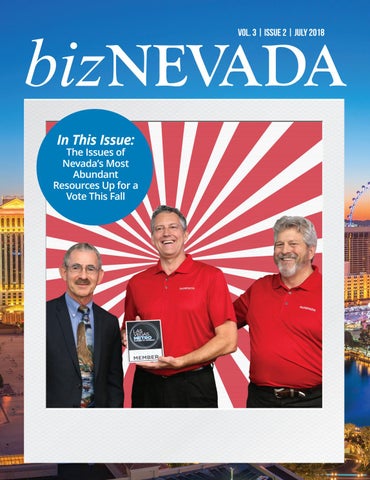
Vol. 3 | ISSUE 2 | July 2018
In This Issue:
The Issues of Nevada’s Most Abundant Resources Up for a Vote This Fall
LETTER FROM THE
EDITOR By Craig A. Ruark
Thank you to everyone who attended the launch party for the first Southern Nevada edition of bizNEVADA. It was great seeing many long-time acquaintances and to make the acquaintance of many new people. I hope that you enjoyed the evening and look forward to working with you in the future as we develop stories that influence and effect your businesses and industries. This second issue of bizNEVADA is special to me as it deals with one of my favorite topics, sustainability. In particular, this issue is about green energy. Back in 2008, I became one of the few persons in the country, who was not an architect or engineer, to become a LEED AP. LEED stands for Leadership in Energy and Environmental Design and the AP designates me as an Accredited Professional. This designation is given through the U.S. Green Building Council (USGBC) and is an achievement of which I am very proud. The USGBC also gives LEED designations to buildings that meet a certain level of sustainability (i.e., Platinum, Gold, Silver, Bronze, and Certified). Since 2008, I have researched and studied all things sustainable and in 2013, I published a book titled Marketing Your Green Side, A practical guide to greening and marketing your business.
2 · ISSUE 1 · JUNE 2018
Starting in late 2014 and through to December 2015, Nevada’s solar industry was on trial at the Nevada Public Utilities Commission(PUC). During that time, as a journalist, I attended each of the public meetings and wrote several articles for a local business publication. The PUC’s ruling did not favor rooftop solar, and as a result, thousands of Nevadans were laid off from their jobs, and several solar installation companies went out of business. However, I am happy to report that in June of 2017, the Nevada Legislature reversed the PUC’s decision and the solar industry is back in business. In this issue, we will give you an update on the current rooftop solar rules, and we will also give you insight into two ballot initiatives for which you will be asked to vote in the November election. As a journalist, my job is to present facts and let you, the reader, make up your own mind as to which way to vote. I hope that I have accomplished this goal without bias or prejudice toward one side or the other. Ribbon cutting ceremony for bizNEVADA South was held at the Innevation Center in Las Vegas on June 12. (L to R) Craig A. Ruark Editor, Christina Santana Advertising/Sales, Art Goldberg Metro Chamber of Commerce, Chris O’Sullivan Co-Publisher; and Richard Moore Co-Publisher.
INTHISISSUE PG 5-7
VOL. 3 / ISSUE. 2
On the Ballot: Nevadans to Vote to Increase Renewable Energy Standard
BizNEVADA PUBLISHING TEAM PUBLISHERS: Richard Moore and Chris O’Sullivan GRAPHIC DESIGNER: Kaylyn Dazey EDITOR-IN-CHIEF: Craig A. Ruark ADVERTISING: Cristi Santana santana@biznv.com PHOTOGRAPHER: Lou Manna COVER PHOTO: L to R: , Art Goldberg Metro Chamber of Commerce, Chris O’Sullivan CoPublisher; and Richard Moore Co-Publisher)
PG 8-11
Question 3: What You Need to Know
PG 12-13
How Nevada’s Next Governor Can Expand Clean Energy Jobs
PG 14-17
Business Spotlight: Hiring with Your Eyes Wide Open
FEEDBACK/IDEAS We welcome your feedback and ideas regarding BizNevada. Send a message to info@biznevada.com
PG 18-19
Calendar of Events
PG 20-22
How to Foster a Culture of Safety
PG 24-27
Sunny Days Ahead: the Current State of Nevada’s Rooftop Solar Program
PG 28-31
Caridad Strives to Humanize the Homeless
© 2018 Carpe Diem International. All rights reserved. CONTACT US info@biznevada.com www.biznevada.
EXPERT CONTRIBUTORS Raul Chacon Workers Compensation EMPLOYERS EMPLOYERS.com 775-327-2700
Mike Menath Insurance Menath Insurance MenathInsurance.com 775-831-3132
KJ Smith Background Checks Employer Lynx EmployerLynx.com 775-883-3733 Joe Ross Creative Agency OCG Creative www.OCGCreative.com 775-324-1644 Bill Houghton Printing Horizon Business Services www.PrintEfficiency.com 702-369-1399
BIZ NEVADA MAGAZINE · WWW.BIZNEVADA.COM · 3
The Power of
(AUGMENTED) PRINT by Chr is O’Sullivan, Publisher BizN evada Good morning Las Vegas! I hope you enjoyed the first installment of bizNEVADA. We are totally devoted and committed to being here for the long haul. Each month you can expect the same quality as we grow and expand our publication. Keep an eye out for us at local events, with our rebel red shirts! Please pull us aside and let us know how we’re doing. This magazine, and all of our supporting media, is designed with you in mind. Our purpose is to connect and empower businesses. With your help, we hope to get better and better at doing that. You can also reach us at info@biznv.com with your comments. I answer those emails personally, and look forward to hearing from you! This month we are proud to be offering the first phase of our strategy to bring you the very best, very latest, and very coolest technology available. Many of you have heard of “Augmented Reality” in one form or another. At the same time, I’m certain that there are an equal number of you that have no idea what in the world I’m talking about! Augmented Reality (AR) and Virtual Reality (VR) are two of the hottest buzzwords in tech today. VR is the ability to immerse yourself in a digital world, through goggles or some sort of headset, that blocks out the real world and only lets you experience what the programmer has created in their virtual world. AR, on the other hand, is a layer of digital content that you can experience by viewing the real world through a device, such as your phone or a tablet. We are launching the first of a series of content and ads that use AR to give you content, previously unavailable through printed material. In this first and simplest instance, we are going to show you how we can deliver video through our magazine! Yes, you can watch a short video on your phone, right on this page!! First, we’ll ask you to download our bizNEVADA App. Just go to the App Store (iOS) or the Google Play Store (Android) and search bizNEVADA. The app is free to download and gives you access to past issues of bizNEVADA, a link to our sortable calendar of business events, a sign up for our email newsletter, anda link to our AR viewer. Each time you see this icon at the bottom of a page, that’s Wyour clue that there is hidden AR content on that page. Open up your viewer and see what there is to see. Each month we will dive deeper into the possibilities of this amazing technology and what it means to you. This page, for instance, has a special greeting from me to you. Try it out! AR will be available for our cover stories and articles, our expert contributors and our advertisers. The types of content can varyfrom animated charts and graphs to live hyperlinks, call buttons, mail-to, and even 3D animation!! So, download the free app and check out our new AR content every month. The future of print is here! 4 · ISSUE 2 · JULY 2018
On the Ballot:
NEVADANS TO VOTE TO INCREASE RENEWABLE ENERGY STANDARD by Craig A. Ruark
On June 18th, Representatives of Nevadan’s for a Clean Energy Future and dignitaries, gathered outside the election registrar’s office to present over 230,000 signatures collected from all of the Counties across the state, to place initiative “50by30,” on the ballot in the upcoming mid-term election. BIZ NEVADA MAGAZINE · WWW.BIZNEVADA.COM · 5
Under Nevada law, ballot initiatives and referendums require at least 112,544 signatures from registered Nevada voters, including at least 28,136 in four “petition districts” (which have the same boundaries as the state’s four congressional districts). The last day to submit signatures was June 19. The Nevadan’s for a Clean Energy Future is a bi-partisan collation of local partners advocating for a healthier state environment by harvesting clean, renewable energy and is calling for a mandate that NV Energy generates 50 percent of its power from renewable sources by the year 2030. Currently, the Renewable Portfolio Standard (RPS) is 25 percent by 2025. According to a report by the U.S. Energy Information Administration: •
About 88 percent of the energy Nevada consumes comes from outside the state.
•
Nevada’s largest generating plant uses high-efficiency natural gas combined-cycle technology and recycles three-fourths of the water it uses, minimizing the use of the state’s scarce water resources. In 2016, 73 percent of the state’s electricity generation came from natural gas.
•
Nevada ranked second in the nation in utility-scale net electricity generation from geothermal energy and fourth in utility-scale net generation from solar energy in 2016; 16.2 percent of Nevada’s utility-scale net electricity generation in 2016 came from those two sources.
•
In 2016, geothermal resources fueled more than 44 percent of Nevada’s renewably sourced electricity generation and nearly 10 percent of Nevada’s total net electricity generation, a larger share than in any other state. The Nevada RPS was first adopted by the Nevada Legislature in 1997 and has been modified nearly every legislative session since then. The current requirement states that at least six percent of the total renewable energy portfolio must be generated by solar facilities by 2016. Of the 25 percent total mandate, 50 percent must come from residential solar installations. Nevada’s RPS, when originally initiated 21 years ago, was one of the first and best in the nation. Nevada was five years ahead of California and ten years before Oregon. However, since that time, more states have initiated much stronger portfolio standards, and Nevada’s standard does not rank among the “Top Ten” Standards. According to the Solar Energy Industries Association, 38 states and Washington D.C. have some sort of a renewable energy minimum production standard. During the ceremony to submit signatures, former State Senator Warren Hardy remarked that he has spent a lot of his career supporting the idea that a strong Renewable Portfolio Standard, “is the right thing to do, but it is also imperative for the State of Nevada from an economic development standpoint to make this happen.” “We have set our sights on, and indicated to the rest of the Country, that we want to be the center of the Universe in terms of technical advancements and renewables, yet our policy does not currently match that aspiration,” said Hardy.
Nevada’s Energy Portfolio Standard requires that 25 percent of electricity sales come from renewable energy resources by 2025; in 2016, 21.6 percent of Nevada’s utility-scale net electricity generation came from geothermal, solar, wind, biomass, and hydroelectric power sources.
In 2017, a bi-partisan Assembly Bill No. 206, sponsored by assemblymen Brooks, Frierson, Yeager, McCurdy II, and Fumo was introduced and passed that would require an update to the Comprehensive State Energy Plan, every two years. The Bill also required “The assessment of
Elspeth DiMarzio, Beyond Coal Campaign Representative at Sierra Club, talks about Clark and Washoe Counties’ “F” grade in air quality from the American Lung Association. (Photo credit: Nevadans for a Clean Energy Future)
Katie Robbins, campaign manager, Nevada for a Clean Energy Future, speaks during an event outside the Nevada Election Registrar’s Office. (Photo credit: Nevadans for a Clean Energy Future)
6 · ISSUE 2 · JULY 2018
technically feasible and economically viable pathways for providers of electric service within this State to achieve by 2040 the goal of generating or acquiring an amount of annual renewable energy production equal to at least 80 percent of the total amount of electricity sold by providers of electric service in this state.” To reach that goal, the Bill introduced a stepped process of years and goals, including “not less than 50 percent” by the calendar year 2030. Assembly Bill No. 206 was passed by a 30-12 vote in the Assembly and a 12-9 vote in the Senate but was Vetoed by Governor Sandoval. This new Initiative, which would require the state to amend the Constitution to eventually increase its Renewable Portfolio Standard (RPS) to 50 percent by 2030, if approved by voters in 2018 would need to pass again in 2020 before it could be adopted.
Former State Senator, Warren Hardy, speaks about the importance of clean energy. (Photo: Nevadans for a Clean Energy Future)
Brian Beffort, Sierra Club Toiyabe Chapter Director, speaks at a Nevadan’s for Clean Energy Future event in Reno on June 18th. (Photo credit: Kyle Roerink, Nevadans for a Clean Energy Future)
BIZ NEVADA MAGAZINE · WWW.BIZNEVADA.COM · 7
8 · ISSUE 2 · JULY 2018
QUESTION 3: What You Need to Know by Craig A. Ruark
BIZ NEVADA MAGAZINE · WWW.BIZNEVADA.COM · 9
In November, one of the ballot initiatives that Nevada voters will be asked to decide is Question 3, the “Energy Choice Initiative,” a constitutional amendment that would deregulate energy providers, provide competition, and allow consumers to choose the company from which they buy their electricity. If passed, the ballot measure would add a new section to Article I of the Nevada Constitution. The full text of the ballot question can be found at bizNEVADA/question3. While it is well known in the business world that a free market and open competition is good for the consumer, there are a lot of nuances to the deregulation of a utility, whether public or private and Ballot Question 3 is complicated. As of June 19, 2018, the support campaign had raised $19.7 million, with 10.90 million from Switch and $8.50 million from the Las Vegas Sands Corporation, which owns the Venetian and Palazzo hotels along with the Sands Convention Center. The proposition is also backed by Gov. Brian Sandoval, former U.S. Sen. Harry Reid, and a number of green energy proponents and providers. Those opposed to the initiative include the Culinary, IBEW and Nevada AFL-CIO unions, six current and former State Officials, and NV Energy who contributed $11.9 million. This ballot initiative was passed during the 2016 election and needs to pass a second time, in 2018, to become a constitutional amendment. Nevada State Controller Ron Knecht (R), siding with the Vote NO camp, said that while he agreed with the amendment’s intentions to deregulate the energy market, the amendment did “not belong in the state constitution.” He elaborated by saying, “Constitutions should be limited to fundamental matters of government organization, the rights of citizens, and specifying and limiting the powers of government, etc. Under Nevada’s constitution, the legislature already has the power to do all the good things this measure would require. However, particular provisions of this measure may be found defective or in need of change. As long as such reforms are done legislatively, they can be remedied timely by the legislature. That’s not the case if they are enshrined in the constitution.” The biggest fear by opponents of the initiative is that Question 3 would deregulate Nevada’s electric utility system, removing all limits on what providers could charge. Customers would have to buy their power on the open market and energy prices could go sky high. 10 · ISSUE 2 · JULY 2018
As proof of that fear, opponents sight cases in Texas, New York, California and other states that have tried similar plans with disastrous results. “In California, market manipulation led to an 800 percent increase in electricity prices in just eight months – and to skyrocketing utility bills, rolling blackouts, and the Enron scandal. It cost ratepayers 45 billion dollars to fix. Prices have gone up in every state that tried deregulating, and Question 3 would create the same mess in Nevada.” However, on the proponent side, John Hanger, former head of the Pennsylvania Department of Environmental Protection, provided Pennsylvania’s market deregulation as an example of deregulation’s benefits. He said, “After 20 years of allowing customers to choose their generation supplier and competitive power markets with appropriate oversight, customers in the Philadelphia and Pittsburgh regions are paying much less for power generation than they were in 1996. In real or inflation-adjusted dollars, those residential customers are paying about 50 percent less. And Pennsylvania’s statewide average electricity price is at the national average as opposed to well above it.” Jon Wellinghoff, energy law attorney, chief executive officer of GridPolicy, Inc., and former chair of the Federal Energy Regulatory Commission, also responded to criticism of the measure, saying, “Fearmongering surrounding the potential for market manipulation should also be put to bed. In the wake of the Western energy crisis of the 1990s, Congress voted to give the Federal Energy Regulatory Commission (FERC) far-reaching power to better oversee the energy market, protect consumers from fraud and other misconduct, and deliver stiff fines for wrongdoing. The agency’s budget has also been expanded to provide for teams of lawyers, economists, and investigators that monitor our power markets on a daily basis. As a result, manipulative market behavior of the type seen during the crisis is no longer a legitimate threat.” Wellinghoff continued by stating, “Question 3 provides for the possibility of a neutral grid operator and fair and wellregulated competition that produces lower prices, more green energy options and advances in energy technology with the power to change the way we live. The measure is an important step forward that creates a foundation for Nevada’s green grid of the 21st century. I urge you to look into the facts and vote yes on Question 3.” Public Utility Commission Weighs In On April 18, the Public Utilities Commission, in a unanimous vote, approved a 109-page report that emphasized how electricity deregulation would raise power rates, cost billions of taxpayer dollars, and could be a major setback for Nevada’s growing renewable energy sector. The PUCN report concluded that Question 3 would:
•
•
•
•
•
•
Increase average monthly electric bills for Nevadans and expose Nevada ratepayers to market volatility and profit-driven ratemaking practices Leave Nevada consumers liable for billions of dollars in stranded costs, require in excess of $100 million in new startup costs, and cost Nevada ratepayers more than $45 million annually in new operation and maintenance costs Push Nevada to join California’s wholesale energy market, requiring major legislative changes in both states Negatively affect net metering and other state laws that were designed to spur growth in the rooftop solar and renewable energy sectors Result in significant job lossSpark significant legal challenges and court battles over the implementation of Question 3’s ambiguous and contradictory language Make Nevada the first state to deregulate electricity by a constitutional amendment. Locking deregulation into the Nevada Constitution would make the consequences relatively permanent.
The report further highlights that Nevadans currently have some of the lowest average electricity rates in the country. Nevada is already a leader in solar and renewable energy development, as well as job and business growth, and, if passed, Question 3 would require an immediate and unprecedented commitment of Nevada’s financial, legislative, and legal resources. However, Bradley Mayer, spokesman for the Yes on 3 campaign, has commented that, “The PUC has written a one-sided report as a power grab to protect NV Energy’s monopoly and attempt to overturn the will of 73% of Nevada voters. These are the same insiders who killed rooftop solar in 2016 and have overcharged Nevada families hundreds of millions of dollars.” Nevada’s Power Providers There are eleven electric companies serving metropolitan and rural Nevada. NV Energy (pronounced NVee) with its two subsidiaries, Nevada Power and Sierra Pacific Power, is by far the largest purveyor in the state. Combined, NV Energy serves 1,272,645 customers. Other power companies include Overton Power District, Boulder City Electric, Valley Electric Association. Lincoln County Power, Mt. Wheeler Power, Wells Rural Electric, Raft River Rural Electric Cooperative, Harney Electric Cooperative, Surprise Valley Electrification, Fallon Municipal Electric, and Plumas-Sierra Rural Electric.
metropolitan areas would be affected the most. In addition to its network of transmission lines, NV Energy owns two renewable energy and ten natural gas power generating plants and is part owner of two coal-fired power generating plants. According to the report from the Public Utilities Commission, if Question 3 is passed, NV Energy would likely have to divest many of its power plants and power generating assets across the state, leaving ratepayers on the hook for between $4 billion and $6 billion in any financial losses incurred by the company. Recently, NV Energy suffered a major loss when MGM Resorts International and Wynn Resorts elected to purchase their power from other providers. However, in order to receive approval to stop purchasing power from the utility, the companies were required to pay exit fees amounting to $87 million for MGM, $15 million for Wynn. The Las Vegas Sands Corporation had applied to leave NV Energy but backed out after being assessed a $23.9 million fee. Station Casinos which owns ten properties in Southern Nevada has also filed an application with the Public Utilities Commission and expects to receive approval to purchase its power from Morgan Stanley’s energy company around December of 2018. Currently, the option to purchase power from other providers is only available to large companies under a 2001 law that was passed during the Western Energy Crises. At the time, its purpose was to bring new power generation into the state, but the statute has increasingly been used by companies eager to tap into more renewables and take advantage of low natural gas prices. According to a report by the U.S. Energy Information Administration: Nevada’s RPS, when originally initiated 21 years ago, was one of the first and best in the nation. Nevada was five years ahead of California and ten years before Oregon. However, since that time, more states have initiated much stronger portfolio standards, and Nevada’s standard does not rank among the “Top Ten” Standards. According to the Solar Energy Industries Association, 38 states and Washington D.C. have some sort of a renewable energy minimum production standard
Although Question 3 would affect all of the power providers in Nevada, NV Energy which serves the major BIZ NEVADA MAGAZINE · WWW.BIZNEVADA.COM ·11
by the Advanced Energy Economy and the Clean Energy Project 12 2018 12 路路 ISSUE ISSUE 1 2 路路 JUNE JULY 2018
On June 21, 2018, the Clean Energy Project (CEP) and the Advanced Energy Economy (AEE) announced they have delivered a policy roadmap to the Nevada gubernatorial campaigns of Republican nominee Adam Laxalt and Democratic nominee Steve Sisolak outlining how Nevada can grow as a clean energy leader and create jobs. The policy roadmap, “Nevada’s Clean Energy Roadmap: How the next governor can make Nevada’s energy system more secure, clean, and affordable while driving job creation and economic growth,” outlines key marketbased policy considerations Nevada’s next governor can pursue to capture the billions in investment dollars and thousands of jobs that come from embracing the clean energy industry. “This roadmap charts a path for accelerated economic growth for Nevada—one that we anticipate will spur billions in economic growth and thousands of good paying jobs for the state,” said Ray Fakhoury, State Policy, Advanced Energy Economy. “We encourage the next governor of Nevada to adopt these energy policies into their platform as economic development tools that harness the economic potential of the clean energy industry.” In its policy roadmap, AEE presented six key principles for the campaigns to consider: • Increase the Renewable Portfolio Standards (RPS) to secure Nevada’s position as a national clean energy leader. The addition of higher renewable energy targets has the potential to generate an additional $5 billion in wages and create 92,000 jobs in the state. This policy mechanism would also stimulate the development of clean energy resources beyond solar and wind, like battery storage, demand response, microgrids, and electric vehicles that reduce energy waste, improve the reliability and resilience of the grid, and keep consumer dollars in state. •
•
Expand access to clean energy by establishing a community solar program. Many Nevadans still face barriers to accessing clean energy. The state currently does not have a community solar program, which would offer an option for customers, both large and small, to purchase a portion of a large renewable project. Community solar has the potential to meet the needs of a broad range of customers—from residential consumers all the way to large corporations—and has proven to be successful in both regulated and deregulated energy markets. Establish an energy storage requirement. Energy storage is innovatively changing the way to think about electricity and the grid. Strategic deployment of storage can manage supply and demand, shift load to improve grid reliability and resilience, support higher levels of low-cost renewables on the grid and maximize the value of all resources, whether they are large projects or smaller distributed resources.
•
Encourage the electrification of the transportation sector. While these efforts are a substantial step forward, more can be done to incentivize the growth of EVs in the state. The next governor should set an EV goal for the state to strive towards. This will send a clear signal to businesses, consumers, and regulators about Nevada’s ambition to lead the emerging industry of transportation electrification.
•
Expand access to cost-effective energy efficiency and demand response investments. Energy efficiency is the lowest cost and most readily available resource to meet energy demand. Both energy efficiency (savings from reducing energy waste) and demand response (payments for targeted reductions in energy use during periods of peak demand) have the potential to save money for residents and businesses and create jobs in Nevada.
•
Modernize the electricity system to focus on consumer needs. While various steps were taken to modernize the grid during the 2017 legislative session, Nevada stands to make additional gains by modernizing its energy system to allow innovative technologies to thrive and meet consumer needs.
“Nevada has been on the forefront of the clean energy development, boasting more than 25,000 clean energy jobs,” said Karen Wayland, Ph.D., Executive Director of the Clean Energy Project. “With corporate demand for clean energy on the rise, embracing these policies could secure a legacy as a job-creating governor while making Nevada a more attractive place to do business for both buyers and sellers of innovative energy technologies.” In addition to these policies, the platform also includes executive actions and short, medium and long-term policy options that could further ignite economic growth through the development of clean energy resources. About Advanced Energy Economy AEE is a national association of businesses that are making the energy we use secure, clean, and affordable. AEE’s mission is to transform public policy to enable rapid growth of advanced energy businesses. AEE and its state and regional partner organizations are active in 27 states across the country, representing more than 1,000 companies and organizations in the advanced energy industry. Learn more at www.aee.net. About Clean Energy Project CEP is a nonprofit, non-partisan organization dedicated to powering a cleaner, more sensible energy future through education and engagement with policy makers, business and community leaders, and citizens on the benefits of developing a clean energy economy. Learn more atcleanenergyprojectnv.org. BIZ NEVADA MAGAZINE · WWW.BIZNEVADA.COM ·13
14 · ISSUE 2 · JULY 2018
Business Spotlight – Employer Lynx
HIRING WITH YOUR
EYES WIDE OPEN By Corrine Casanova
BIZ NEVADA MAGAZINE · WWW.BIZNEVADA.COM · 15
When it comes to background checks, you don’t want to be in the dark. During the hiring process, ignorance is not bliss. Having your eyes wide open is a better option. Employer Lynx, Inc. is a Nevada based full-service background investigation company specializing in employee and tenant screenings. The company’s name came from a managing partner who was fascinated by the Native American culture and their use of animal symbols. The lynx is the knower of all secrets and is often viewed as smirking as if it knows a secret that nobody else does. K.J. Smith, Employer Lynx managing partner and licensed Nevada private investigator, noted, “The lynx is a 16 · ISSUE 2 · JULY 2018
powerful symbol which accurately defines what this company does so the name stuck.” Secrets can be deadly to a company of any size especially when it comes to compliance issues, the embezzlement of funds or illegal activities of employees. With two million assaults and threats of violence in the workplace occurring each year in the U.S., employee safety is another facet of background screenings. There are some misconceptions about what background checks are designed to do. Smith explained, “Background screening isn’t here to keep people from working. Instead, it is here to provide a safe place for
employees to work and where they feel safe. These screenings help protect the company from liabilities and help them avoid violating federal or state laws while providing information vital for choosing a great hire and peace of mind.” “A lot of companies rely on the Internet to do their background screenings but they aren’t aware of the federal guidelines and specific state laws. One of our current clients which is a large company came to us after using a national agency online where they received an instant response to a background check. Initially, they told us they were really happy with their current service because they weren’t getting any hits. What they didn’t
have to know how to deal with other states and other countries too. As a result, we do a lot of research which is continually being updated. In fact, we have contractual relationships with researchers from all over the world. We are a Nevada based company with a global reach,” said Smith. Recently, Employer Lynx created a new program that focuses on safety in the workplace where annual background checks are conducted on current employees. In some industries such as transportation or mining, this is already a requirement but most companies in other industries don’t do it. Smith explained,
“When you’ve been in business for 10 years, some employees on staff may have never had a background check. That’s a problem. When people go off the clock, you don’t know what they are doing. As Nevada is a gaming state it becomes a true problem. When you provide a safe workplace, that message is strong for both the employer and employees.”
realize is that they weren’t digging deep enough and just receiving the surface results. Since they have come on board with us they actually have a true idea of the person that they are hiring. They were shocked by the results and now very happy that they know the truth,” said Jenny Hunsaker, Director of Operations. Employer Lynx takes the mystery out of background screening and is a safety net for employers as it provides detailed verified information about potential hires and their employees. Being a smaller local agency allows them to react quickly and provide excellent customer service especially if any issues crop up. “We are very well steeped in Nevada law but we
Employer Lynx provides a free comparative analysis of background screening services. “We are happy to talk to any company even if they are currently doing background screenings to analyze if there are any holes in what they are getting. Several companies have come on board with us when they realize the gap of what they thought they were receiving and what they were getting. The cost of our service is comparable to one day’s wage of whatever level of employee you are hiring for. Consider one day’s wage versus the cost of a liability issue or embezzlement. When you think about it, it’s pretty minimal,” concluded Hunsaker. If you’d like to conduct your background checks from the eyes wide open perspective, contact Employer Lynx at 775-883-3733 or visit employerlynx.com. BIZ NEVADA MAGAZINE · WWW.BIZNEVADA.COM · 17
July/AugustCale LAS VEGAS METRO CHAMBER TUESDAY JULY 17, 2018 5:30 PM LV Metro Chamber Connections
WEDNESDAY JULY 18, 2018 3:00 PM Ribbon Cutting - Oasis Biotech THURSDAY JULY 19, 2018 8:00 AM VYP Community Conversations: Downtown Development MONDAY JULY 23, 2018 8:00 AM Southern Nevada Forum: Economic Development Committee TUESDAY JULY 24, 2018 5:30 PM Business After Hours: Lazy Dog Restaurant at Town Square WEDNESDAY JULY 25, 2018 4:00 PM #WCW 5:30 PM Chamber Connections II TUESDAY JULY 31, 2018 11:00 AM Veteran Hiring Event FRIDAY AUGUST 3, 2018 5:00 PM Boys Town Nevada Back to School Event TUESDAY AUGUST 7, 2018 11:30 AM Chamber Voices Toastmasters 5:30 PM Chamber Connections
WEDNESDAY AUGUST 8, 2018 5:30 PM Chamber Connections II SATURDAY AUGUST 11, 2018 10:00 AM American Dream U Presents Larry Broughton 2:00 PM A Touch of Africa Las Vegas WEDNESDAY AUGUST 15, 2018 11:00 AM Chamber Call with Mary Beth Sewald 11:30 AM Chairman's Lunch - President's Club Members Exclusive Program THURSDAY AUGUST 16, 2018 8:00 PM White Hot Mixer TUESDAY AUGUST 21, 2018 11:30 AM Chamber Voices Toastmasters 3:00 PM Southern Nevada Forum: Healthcare Committee 5:30 PM Chamber Connections
HENDERSON CHAMBER OF COMMERCE WEDNESDAY JULY 18, 2018 4:00 PM Golden Corral Grand Opening/Ribbon Cutting
FRIDAY JULY 20, 2018 11:00 AM NV Starr Show Tickets & Tours Grand Opening/ Ribbon Cutting THURSDAY JULY 26, 2018 5:00 PM Networking Mixer
endar of Events TUESDAY JULY 31, 2018 8:00 AM TSK Architects Ground Breaking Phase II of Southend on Water WEDNESDAY AUGUST 8, 2018 11:30 AM HDA Luncheon and Panel Discussion TUESDAY AUGUST 14, 2018 7:00 AM Networking Breakfast 12:00 PM Natural Grocers 2nd Year Anniversary Ribbon Cutting Celebration TUESDAY AUGUST 21, 2018 8:00 AM New Member Briefing THURSDAY AUGUST 23, 2018 4:00 PM HCC CONNECT panel + expo + mixer
OTHER EVENTS
THURSDAY JULY 26, 2018 6:00 PM Network After Work JULY 19 - JULY 21, 2018 Nerium International - Annual Conference 2018 JULY 25 - JULY 29, 2018 ROLLERCON 2018 JULY 29 - JULY 31, 2018 Cosmoprof North America 2018 JULY 29 - AUGUST 1, 2018 ASD Market Week Summer 2018
JULY 29 - AUGUST 2, 2018 Las Vegas Market - Summer 2018 AUGUST 1 - AUGUST 5, 2018 Star Trek Convention AUGUST 5 - AUGUST 8, 2018 2018 Association of Public-Safety Communications Officials AUGUST 9 - AUGUST 18, 2018 American Poolplayers Association, Inc. - 2018 National Team Championships AUGUST 13 - AUGUST 15, 2018 MAGIC Marketplace Fall Show 2018 AUGUST 13 - AUGUST 15, 2018 PGA Fashion & Demo Experience 2018 AUGUST 22 - AUGUST 25, 2018 US Jiu Jitsu Federation, Inc. Evexia Fit Fest 2018 For more complete and up-todate calendar information, visit www.bizNEVADA.com/ events-calendar
20 · ISSUE 2 · JULY 2018
How to Foster a
CULTURE of SAFETY
by Raul Chacon
Nevada businesses reported approximately 34,000 nonfatal workplace injuries and illnesses in 2016, according to the U.S. Bureau of Labor Statistics. This equates to an incident rate of 3.7 cases per 100 full-time workers which was significantly higher than the national average. The report also found more than half of the Nevada incidents were serious and required days away from work, a job transfer or job restriction for the injured employee. Work-related injuries and illnesses negatively impact the affected employee and their family. But they can also hurt the business with out-of-pocket expenses, lost productivity and potentially higher insurance premiums. For instance, when injured employees are unable to complete their duties, other employees must fill in for their injured co-workers. This may involve overtime pay, temporary workers, or in some cases, hiring a new fulltime employee. All of these hidden costs add stressors on already strained operations. Nevada business leaders must commit to fostering a culture of workplace safety to help reverse these trends and keep their employees safe and productive. How to get started It’s important to keep workplace safety at the forefront of operations year-round and there’s no better time than the present to reevaluate and recommit to your business’ safety culture. By investing in workplace safety programs and training, businesses can reduce accidents, increase employee retention and improve productivity. Safety programs protect employees and create real bottomline operational and cost benefits. According to the Occupational Safety and Health Administration (OSHA), an effective safety and health program can save a business owner $4 to $6 for every $1 invested. A strong workplace safety culture begins with having an effective injury and illness prevention plan and committing to make safety procedures part of everyday operations. Here are four steps Nevada business owners and managers can take toward that goal: BIZ NEVADA MAGAZINE · WWW.BIZNEVADA.COM · 21
1. Lead from the top
To be effective, a workplace safety program needs to be more than a dusty binder on a shelf. It requires a commitment from the business’ owners and managers. Management must clearly define safety goals, communicate those goals to employees and set the example for others to follow. If the company’s policy requires all employees wear closed toe, rubber soled shoes, then owners and managers must also follow suit. Not doing so sets a bad example and sends the wrong message.
2. Identify risks
A safer workplace begins with identifying and assessing potential hazards. Business owners and managers should actively analyze workplaces and work-related functions to anticipate and prevent injuries. Additionally, they should make sure all employees understand the potential hazards in their work environments.
recent EMPLOYERS survey, 40 percent of small business employees said their employer does not display OSHA signage prominently or they are not sure if it is displayed.
4. Enforce and evaluate
Business leaders must commit to the company’s safety plan and insist employees follow all related policies and procedures. Failure to comply can lead not only to employee injuries or illnesses, but also steep financial penalties to the business in the form of OSHA fines. Conducting regular workplace safety audits, meetings and training sessions are effective ways to enforce safety rules and keep safety top of mind for management and employees. By committing to a strong safety culture and making safety a part of doing business, Nevada’s companies can help keep their most important assets—their employees— safe while contributing to long-term business success.
With businesses in leisure and hospitality and trade, transportation, and utilities accounting for 60 percent of Nevada’s reported occupational injuries and illnesses in 2016, state business leaders should conduct walkthroughs of the work environment and engage with employees to identify top safety risks. For example, hotel housekeepers may be commonly exposed to strains from overexertion or repetitive motion injuries and restaurant staff may be at increased risk of slips, trips and falls from slippery kitchen environments or uneven floors. Once potential hazards have been identified, policies and procedures must be established to allow employees to do their jobs safely. It is also a good practice to revisit the corrective measure implemented to determine if the changes were adequate or if additional measures need to be taken.
3. Train and educate
Training should be held during each new employee orientation, whether that’s part of a larger seasonal hiring ramp up or when a team member is added, and reinforced regularly. Training sessions should also be held whenever new processes, procedures or equipment are introduced. These sessions should cover how to identify hazards, prevent accidents and respond to injuries. All workplace safety policies should be clearly communicated to employees in a language of their understanding and included in employee handbooks. Business leaders can consult their independent insurance agent and workers’ compensation insurance carrier for available helpful safety materials, such as safety posters, payroll stuffers and written safety policies. They should also be sure to properly display all workplace safety and fair employment practices posters required by OSHA. In a
22 · ISSUE 2 · JULY 2018
Raul Chacon is Western Region Loss Control Manager for EMPLOYERS, America’s small business insurance specialist, which offers workers’ compensation insurance and services through Employers Insurance Company of Nevada, Employers Compensation Insurance Company, Employers Preferred Insurance Company, and Employers Assurance Company. Not all insurers do business in all jurisdictions. EMPLOYERS and America’s small business insurance specialist are registered trademarks of Employers Insurance Company of Nevada.
BIZ NEVADA MAGAZINE · WWW.BIZNEVADA.COM · 23
Sunny Days Ahead: by Craig A. Ruark 24 · ISSUE 2 · JULY 2018
The Current State of Nevada’s Roof Top Solar BIZ NEVADA MAGAZINE · WWW.BIZNEVADA.COM · 25
December 23, 2015, was a dark day for Nevadan’s with a rooftop solar system mounted on their home. Not because the sun didn’t shine. But because that was the day the Nevada Public Utilities Commission (PUC) ruled that the “Net Metering” rates customers would receive for selling excess power back to the grid, would be significantly lowered, and therefore eliminating the return on rooftop solar investments. The average homeowner pays about 12.5 cents per kilowatt-hour for electricity during peak hours of the day. Before the PUC ruling, a homeowner with a rooftop solar system that generated more energy than was used could sell the excess power to the grid at about 12 cents per hour. The excess power would more than likely simply travel to the nearest neighbor who did not have solar panels and power company would in effect make one-half a cent on the sale of that power. Based on the energy savings and the sale of excess power, the return on investment for the average solar installation was about seven years. After the PUC ruling, starting in 2016, the amount of credit that customers would receive from the sale of their excess power dropped to 9.199 cents per kilowatt hour and would continue dropping by roughly 2 cents per kilowatt hour each year until the year 2020 when it bottomed at 2.69
26 · ISSUE 2 · JULY 2018
cents per hour. In addition, home and business owners with a solar system were to be charged a monthly impact fee. While a rooftop solar system still lowered the homeowner’s electric bill, the addition of the impact fee and the lower net metering credit structure for excess energy purchased, meant that the return on investment (ROI) was stretched out to around 20 or more years and the ruling essentially killed the industry. However, on June 15, 2017, the sun began to emerge from behind its dark cloud, thanks to Assembly Bill 405 (AB 405). Under that bill, a new net metering rate structure was devised for renewable energy systems of not more than 25 kilowatts, which is typical of a rooftop solar system installed at a home or small business. Contrary to the previous ruling which levied an impact fee on rooftop solar owners, AB 405 stated that “net metering customers will remain in the same customer class as nonnet metering customers and cannot be charged any fee or charge that is different than that charged to non-net metering customers. Net Metering customers will pay the same basic service charge and other fees as nonnet metering customers.” AB 405 also established a more realistic tiered net metering rate and customers who sign up at a specific
net metering rate (listed below) are guaranteed that rate for 20 years, but it only applies to the location where the system was originally installed. The amount of money paid for excess energy is based on a percent of the retail rate that the energy company charges its customers for electricity. (“Retail rate” is defined as the Base Tariff General Rate (“BTGR”), Base Tariff Energy Rate (“BTER”) and Deferred Energy Accounting Adjustment (“DEAA”) Rate combined. For more information on the BTGR, BTER, and DEAA, please review the PUCN’s Northern Nevada Electric Rates & Charges or Southern Nevada Electric Rates & Charges fact sheets.) •
95% of the retail rate: This is the current net metering rate and will be in effect until the amount of electricity produced by net metering systems signed up at this tier equals 80 megawatts.
•
88% of the retail rate: The net metering rate will decrease to 88% of the retail rate when the amount of electricity produced by net metering systems under the 95% tier equals 80 megawatts.
•
81% of the retail rate: The net metering rate will decrease to 81% of the retail rate when the amount of electricity produced the 88% tier equals 80 megawatts
•
75% of the retail rate: The net metering rate will decrease to 75% of the retail rate when the amount of electricity produced by net metering systems under the 81% tier equals 80 megawatts.
With the passage of AB 405, applications for rooftop solar went from 287 in 2016 to 3,308 in 2017. Solar advocates and industry leaders say Nevada’s rooftop solar success story shows how quickly a stable policy foundation can deliver economic benefits to the state. Since the passage of AB 405, most residents in Nevada have been receiving an onslaught of flyers and phone calls soliciting for “No-Cost” solar. However, most people realize that there is no such thing as “free” anything. There are three ways that a resident or business can put solar to work for them on their roof:
1. Purchase a system.
While the cost of residential solar has dropped by approximately 70 percent between 2010 and 2016, the systems are not cheap. But, a Federal Investment Tax Credit (ITC), which can be applied to solar systems can reduce the cost. However, you must have an income level that can take advantage of that credit. The ITC is available at the rate of 30 percent until 2019. That amount drops to 26 percent in 2020, then to 22 percent in 2021, and levels out at 10 percent from 2022 onward. Financing options can include home improvement loans, and some solar companies offer a low-interest loan with a 10 to 15-year term.
Most “quality” solar systems come with a 20 to 25-year warranty which means, after the system is paid off in 10 to 15-years, the energy savings benefits greatly increase. And since the solar system is owned, it becomes an asset should the house be sold.
2. Lease a solar system.
In a lease, the homeowner still receives the benefit of a lower “fixed” energy rate but does not receive any ITC credits and the leasing company, not the homeowner, receives the net metering credits.
3. A Power Purchase Agreement (PPA).
Under a PPA plan, customers purchase the power that is produced from their rooftop system at a discounted rate from what they would normally pay to the electric utility. The advantage is that the homeowner does not pay any money upfront and only pays for the amount of electricity used. With both the lease and PPA options, the homeowner is still paying more for power than if they owned the system and were receiving net metering credits, but the rate is less than the retail rate charged by the power provider. However, if the owner decides to sell the home or business, the new owner would be obligated to take over the contract, which could be a sticking point for some buyers. The other option in a sale situation is for the current owner to buy out the remainder of the contract before selling the property. As with any contract, it is best to carefully read all of the terms and conditions and perhaps get legal advice before signing an agreement.
To offset the payments on the solar system, home and business owners have a much lower monthly energy bill, and they receive net metering credits for the energy they sell back to the grid. BIZ NEVADA MAGAZINE · WWW.BIZNEVADA.COM · 27
28 2018 28 路路 ISSUE ISSUE 1 2 路路 JUNE JULY 2018
Caridad Strives to Humanize the Homeless BIZ BIZNEVADA NEVADAMAGAZINE MAGAZINE路路WWW.BIZNEVADA.COM WWW.BIZNEVADA.COM路路29 29
Caridad means ‘charity’ in Spanish and Portuguese. After overcoming homelessness in 2008, Merideth Spriggs founded Caridad in 2010 in San Diego to collect socks and underwear donations for local homeless charities, educate the public about the facts of homelessness and create partnerships between legitimate agencies and volunteers. Spriggs brought the charity to Las Vegas when she and her husband relocated in 2013. Today, Caridad is a full-time street outreach agency that fulfills its mission at the lowest cost possible by partnering with numerous homeless outreach organizations and companies. Through a partnership with Clark County, Caridad will conduct the Clark County Community Housing Assessment Tool to prioritize which clients need housing immediately. Caridad is recognized as a collaborative partner to connect homeless focused agencies in Southern Nevada. By creating a specific geographical footprint that can be walked each day, Caridad is able to provide outreach using a customer service approach. This walkable territory allows Caridad to network with not only homeless but also parking enforcement, security teams, and business owners. The team utilizes these community partners to engage and assist in case plans with clients. Caridad believes in the specialization of service, not duplication. Caridad achieved an 80% operational benefit to 20% administrative cost margin in 2016. Their 2017 budget improved this ratio to a 91% operational benefit and 9% administrative cost margin.
30 · ISSUE 2 · JULY 2018
Caridad has proven to be a reliable, effective and a costefficient organization dedicated to serving the needs of the Las Vegas homeless population and its supporters. In 2017 Caridad averaged ten client encounters per day. By partnering with volunteers, existing agencies and local businesses, Caridad can keep costs around $24.75 per client encounter. Caridad uses a proactive outreach strategy in a concentrated geographic focus compared to other outreach teams that cover the entire county. Partnering agencies outreach costs can be as much as $1,172 per client encounter. Volunteers have the opportunity to go out with Caridad’s street outreach teams five days a week during the hours of 11:00 AM to 6:00 PM. Caridad is the first program to offer specialized assistance for the SSI/SSDI Outreach, Access and Recovery (SOAR). Caridad staff is committed to enrolling clients in the SOAR program to qualify for expedited processing of their SSI/SSDI benefits that will also allow them to receive Medicaid. These combined benefits will allow clients and the community to receive federal funds to decrease the financial load on our local resources. When these clients receive their benefits, they will be paying for their rent, and Medicaid will be paying for previously unpaid medical benefits. These clients will also be spending money in local businesses. The economic benefits are conservatively estimated to generate three times the economic impact of the expense. Two new initiatives will have a lasting impact on the Las Vegas community. Caridad will take over the Downtown Project’s Freight Farm and use urban agriculture to
provide both food and employment for local homeless populations. A farm manager will work with homeless employees to provide training and coordinate produce delivery. In addition, Caridad outreach and SSI/SSDI Outreach, Access and Recovery (SOAR) staff will support employees at Freight Farm. Once the Freight Farm is operating at full capacity, additional urban agriculture, such as micro green production, can be added to the program to diversify crops. After Caridad completes its community village housing project, the garden will be relocated to the permanent location. Caridad is currently seeking land for its pilot senior village project. The concept is to build 3-D printed homes, cap the rental rate at $400 and include utilities in the cost of the rent. The revenue will pay all operating expenses of the property, including staffing. Four units will be reserved for college students. The students in exchange for free room and board will be required to volunteer 20 hours per week on the property.
Merideth Spriggs. Recognized as a homeless advocate and trusted leader, Spriggs was invited to participate in the 100,000 Homes Campaign; has provided training for Seattle, Boise, and San Diego communities under the 25 Cities Initiative; continues to work with Community Solutions to provide outreach leadership in Southern Nevada under the Built for Zero Campaign; and The City of Las Vegas recognized her with a Citizen of the Month Award in October 2015. A champion of the housing first model, Spriggs has housed hundreds and helped thousands of homeless. Recently, People Magazine and the American Heroes Channel recognized Spriggs as one of three finalists for the Red Bandanna Hero Award for her dedication and innovative approach to help humanize the homeless by providing customer service based street outreach. Her story was featured on 911 Hero: The Red Bandanna Legacy on the American Heroes Channel appeared in the October 19, 2017 issue of People Magazine.
While Caridad relies on collaboration with local agencies, officials, and businesses, the driving force remains BIZ NEVADA MAGAZINE · WWW.BIZNEVADA.COM · 31