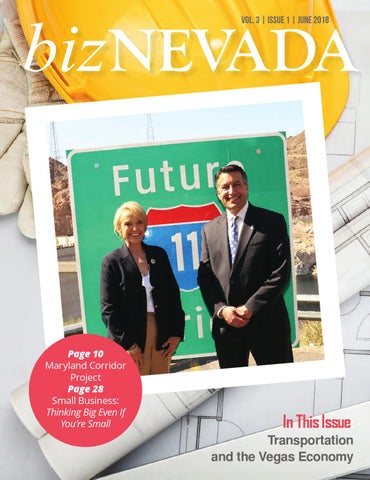
Vol. 3 | ISSUE 1 | JUne 2018
Page 10 Maryland Corridor Project Page 28 Small Business: Thinking Big Even If You’re Small
In This Issue: Transportation and the Vegas Economy
LETTER FROM THE
EDITOR By Craig A. Ruark Welcome to the first Southern Nevada edition of BizNEVADA Magazine. It is only fitting that as we begin our journey to identify and talk about key business topics, we start off with the subject of infrastructure, the thread that connects all businesses. In this issue, we will look at the future of Interstate 11, the Maryland Parkway Corridor Project, the Las Vegas Project Neon, and the expansion of the Monorail. In researching articles for this infrastructure issue, I was reflecting upon the fact that we, as a society, have dramatically changed in the way we design our innercity roads. Instead of pushing a ribbon of asphalt from point A to point B, painting a few stripes, adding a curb and sidewalk and calling it good, we are also looking at the project to enhance the aesthetics of the community and sustain its natural beauty while transporting its citizens. We are not only looking to safely move automobile traffic but bicycles and pedestrians as well. We are looking to slow traffic down in residential areas and make walking more pleasurable by detaching sidewalks and adding trees, for shade and aesthetics. The Regional Transportation Authority calls this design “Complete Streets” and is dramatically transforming many of the older streets in downtown Las Vegas. I am fortunate to have grown up in the late 50’s early 60’s when the pace was a lot slower. Before graduating from high school, I had visited every state east of the
2 · ISSUE 1 · JUNE 2018
Mississippi (except Wisconsin). In fact, I am even more fortunate to have traveled most of the old Route 66, which runs from Chicago all the way to L.A., before Interstate 40 was built. I remember seeing signs for the “World’s Largest Ball of String,” visiting Meramec Caverns where Jessie James hid out, and could not wait until we stopped at Stuckey’s known for their “world famous Pecan Log Roll.” As we headed out west, I remember the huge teepee shaped gift shops on the side of the road where we bought “authentic” Indian moccasins, and along the way, we played car games such as “Spud” (the spotting of VW Bugs) or counting the number of RR Crossings. Nowadays the pace is a lot faster with the development of Interstate Highways and automobiles being able to travel farther on a tank of gas. In order to see the roadside teepees and other historic sites, you need to slow down and exit the interstate. Next month, on July 4th, America will be celebrating 242 years as an independent nation. In addition to fireworks and bar-b-ques, the holiday is a popular time for summer vacations. If your plans include a road trip, drive safely and don’t forget to slow down and take in the sites.
INTHISISSUE VOL. 3 / ISSUE. 1 BizNEVADA PUBLISHING TEAM PUBLISHERS: Richard Moore and Chris O’Sullivan GRAPHIC DESIGNER: Kaylyn Dazey EDITOR-IN-CHIEF: Craig A. Ruark ADVERTISING: Cristi Santana santana@biznv.com COVER PHOTO: COURTESY OF NEVADA DEPARTMENT OF TRANSPORTATION FEEDBACK/IDEAS We welcome your feedback and ideas regarding BizNevada. Send a message to info@biznevada.com @ 2018 Richard Moore and Chris O’Sullivan. All rights reserved. CONTACT US info@biznevada.com www.biznevada.
PG 4-7
Project Neon Moves Las Vegas into the Next Century
PG 8-9
Horizon Print Solutions
PG 10-11
Maryland Parkway Corridor Project
PG 12-13
Summer Cleaning Your Insurance Portfolio
PG 14-16
The Nevada-Sized Hole In Your Company’s Security
PG 17
With Widespread Roots, Nevada Public Radio Connects and Enriches the Silver State
PG 18-19
Calendar Events
PG 20-22
The Economic Impact of Interstate 11 on Southern Nevada
PG 24-27
Transit Meets Technology
PG 28-29
Strategic Planning for Small Business: Thinking Big Even if You’re Small
EXPERT CONTRIBUTORS Joe Ross Creative Agency OCG Creative www.OCGCreative.com 775-324-1644 Bill Houghton Printing Horizon Business Services www.PrintEfficiency.com 702-369-1399 KJ Smith Background Checks Employer Lynx www.EmployerLynx.com 775-883-3733 Workers Compensation EMPLOYERS www.EMPLOYERS.com 800-700-9113
BIZ NEVADA MAGAZINE · WWW.BIZNEVADA.COM · 3
Moves Las Vegas into 4 · ISSUE 1 · JUNE 2018
o the Next Century
Anyone that has driven through downtown Las Vegas, either on Interstate 15, U.S. 95, or many of the surface streets, knows the frustration of gridlocked traffic. Like most cities with significant population growth, the problem is a balance between budget and projected need.
BIZ NEVADA MAGAZINE · WWW.BIZNEVADA.COM · 5
Project Neon is an effort to try to get ahead of the curve and improve the downtown transportation infrastructure with a design that will take the City into the next half of the century. The nearly $1 billion design-build project broke ground in 2016 and will widen Interstate 15 between Sahara Avenue and the U.S. 95 interchange. Two decades in the making, Project Neon is the state of Nevada’s largest and most expensive public works project undertaken during its 152-year history. The project goals are to:
•Improve safety •Reduce congestion •Reduce travel delays •Improve air quality •Improve freeway operations •Create new surface street connections •Provide better access to downtown Las Vegas •And create opportunities for businesses and jobs 6 · ISSUE 1 · JUNE 2018
In the mid-1960s, when Las Vegas had a population of under one-hundred-thousand, it was difficult to imagine growth beyond half a million in the coming decades. So, when the interchange from Interstate 15 to U.S. 95, nicknamed the Spaghetti Bowl, was completed in 1968, it had a design capacity of 60,000 vehicles per day. However, by 1990 the metropolitan population had reached 741,459, casinos were expanding, visitors were increasing, and the population was growing at the rate of 10,000 per month. It didn’t take long to realize that improvements needed to be made and by 1999, new exit and entrance ramps had been constructed somewhat improving the traffic flow. Today, the metropolitan population has swelled past the two million mark, and the 3.7 mile stretch of I-15 from Sahara Avenue to the Spaghetti Bowl is the busiest stretch of highway in Nevada with 300,000 vehicles daily and 25,000 lane changes each hour. Projections are that those numbers will double by 2035. The centerpiece of Project Neon is an 81-foot-tall, 2,606-foot-long carpool flyover from southbound U.S. 95 to southbound I-15 that also accommodates carpool traffic from northbound I-15 to U.S. 95 northbound. There will also be a full diamond interchange at Charleston Boulevard for easier access to downtown, the Medical
District, and Symphony Park. Other improvements call for several “ramp braids” that will reduce merge and weave traffic as well as turn Martin Luther King Boulevard into a feeder-like roadway paralleling the I-15. Project Neon will convert two existing I-15 express lanes into a general purpose and carpool lane, thereby creating 22 consecutive miles of carpool lanes between I-15 and U.S 95. The carpool lanes will allow carpoolers and rapid transit vehicles, to access downtown Las Vegas by way of the newly created Neon Gateway carpool interchange between Oakey Avenue and Charleston Boulevard. Project Neon is expected to reduce travel delays by nearly 30 percent and provide businesses with a $110 million annual savings through increased productivity. The project will also improve air quality due to less idle time and vehicle exhaust while enhancing motorist safety by reducing merge and weave traffic. Once completed, Project Neon will have created over 4,000 direct, indirect, and induced local jobs as well as, numerous business opportunities for Southern Nevada-based disadvantaged suppliers and companies. Construction is currently 63 percent complete, with anticipated completion by summer of 2019. Ancillary to the improvements to I-15, many of the streets in downtown Las Vegas are also getting a major makeover, and both Commerce and Main streets have been reduced to two-lane one-way streets making way for widened sidewalks and a protected “green lane” bicycle path. For those newcomers to the Las Vegas Valley, here is a bit of historical trivia that has been lost. The Spaghetti Bowl was nicknamed, accidentally, by Red McIlvaine, a very popular 1960s and ‘70s Las Vegas morning radio announcer. When the newspaper printed the conceptual design for the original I-15 and U.S. 95 interchange, Mcllvaine commented to his listening audience that it looked like a bowl full of spaghetti, and the name association stuck. Perhaps, in the opinion of this writer, McLlvaine should at least have a bridge bearing his name.
BIZ NEVADA MAGAZINE · WWW.BIZNEVADA.COM · 7
By BizNevada Staff
Serving Las Vegas for 26 years, Horizon Print Solutions strives to make the process of outsourced printing easy and efficient, and as such strives to be your printed products partner. Bill Houghton, founder, and owner of Horizon Print Solutions, started in the printing industry as a print broker, working with clients to find the best quality printer for their project need, at the lowest price. After four years of working for other companies, he discovered that the only way to give better customer service was to open his own business. “My goal is to elevate, by example, the kind of service that a client would expect from a printing firm.” Said Houghton. “If there are five steps in the print process, we try to figure out how to do it in three to make it as easy as possible for the client to order their printing products.” Today, Houghton and his staff still strive to meet that goal and their website name, www.PrintEfficiency. com, emphasizes this commitment. In 1999, during the early days of the internet, Horizon was the first print company in Las Vegas to establish a “Company Store” website for his high-volume customers. In their custom Company Store, clients will
find all of their logoed print collateral from letterhead to business cards, along with shirts, hats, coffee mugs, and other client give-a-ways, that have been pre-designed and approved with authorized logos and corporate colors. The password-protected Company Store makes it easy for clients to go in, select the quantity of items needed and instantly place their order. For instance, if a new employee is hired, the HR person can log into the store, find the business card template, type in the information for the new employee and press finish. Once an order is made, it is usually completed within a few days and delivered directly to the client. Since the most economical pricing for a printed product can be achieved by large quantity runs, Horizon assists clients with multiple locations and constant product demand, by warehousing some stock paper items and delivering it to locations as needed. Approximately 40 percent of all print work is completed in-house using one of Horizon’s large Ricoh digital printers. They have the capability to print two-sided, color, documents up to 26 inches in size. They will also fold printed products down to brochure sizes. Printed products that require offset printing, special carbonless paper, or are larger than 26 inches are still brokered to companies that produce the best quality work for the best price.
Many times, clients have ideas about a brochure or mailer that they would like to send to customers but don’t have the in-house expertise to bring that design to life. Horizon has an in-house graphic designer and can take a project from concept to fulfillment. Once the product is printed, Horizon has a complete bulk mail processing system that can fold, stuff, label, apply postage, and deliver the material to the post office. Horizon completes so many print-mailing projects that they have a regular delivery to the post office five days a week. Horizon is so proficient in their bulk mailing operation that Bill Houghton currently serves as the chairman of the Postal Customer Council for the Sierra Nevada Region. As such, he represents the mailing community as the liaison to the post office. In addition to printed paper products, Horizon has close working relationships with suppliers of logoed merchandise and manages each order to make sure they are printed correctly and delivered on time. As of this writing, Horizon is working to deliver a customdesigned plush stuffed tooth for a client that teaches children the necessity of good oral hygiene. Horizon Print Solutions is located at 5125 W. Oquendo Road, Suite 6, Las Vegas, NV 89118. For more information about go to their website www.PrintEfficiency.com or call 702369-1399. Each month, BizNEVADA highlights a different local business and industry expert. If you would like to have your company highlighted, call BizNEVADA at 702-8944-0104.
Maryland Parkway Corridor Project
By Craig A. Ruark One of the major infrastructure improvements under consideration for the Las Vegas Valley is the improvement to the Maryland Parkway Corridor. A study by the Regional Transportation Commission (RTC), which began in 2014, is currently looking at environmental issues, funding alternatives, and conceptual designs. The goal is to finalize the design and begin construction by 2020 and initiate service by 2023. The Maryland Parkway Corridor, nearly five-miles long and one-mile wide between Charleston Boulevard and Russell Road, is a densely developed residential and commercial area with 55,000 residents, 81,000 jobs. Combined with an employment density of 11.9 jobs per acre (495 percent higher than the 2.0 for the rest of Las Vegas) and a population density of 8.1 persons per acre (80 percent higher than the 4.5 per acre for Las Vegas as a whole), Maryland Parkway is one of the most heavily traveled north-south streets in the Las Vegas Valley with 33,000 vehicles that travel the corridor each day. Economically, forty-six percent of households in the corridor are low-income, and fifty-five percent of the households are minorities. Twenty-five percent of the 10 · ISSUE 1 · JUNE 2018
households do not own automobiles. Because of those numbers, the RTC is evaluating ways to make transportation more efficient and the corridor safer for bicycle and pedestrians. In addition to improving transportation, the RTC is also looking to expand service to McCarran Airport and the Downtown Transportation Center with connections to the University Medical District at Charleston and Shadow Lane. These additional connections will lengthen the corridor route to 8.7 miles. The goal of the project is to: • Improve mobility between downtown Las Vegas, UNLV, the airport and other key activity centers. • Provide premium transit service with enhanced stations, dedicated lanes, increased frequency, and reduced travel times. • Build signalized pedestrian crossings and wider sidewalks to enhance pedestrian safety. • Design additional turn lanes at intersections to improve traffic flow. • Enhance the transit service to make it faster, more reliable, safe, and attractive for users. • Transition the identity of Maryland Parkway to a corridor that instills a sense of place. • Make transportation infrastructure investments that enable and support the economic development of the corridor.
Identified as Bus Route 109, the current ridership is the highest of any route in the Valley with approximately 9,000 passengers boarding the RTC buses each day. There are approximately 30 stops (roughly one every quarter mile), and the RTC buses operate on a schedule that picks up riders at each stop every 15 minutes on weekdays during peak and midday hours. It takes 31 minutes to travel between Charleston Boulevard and Tropicana Avenue, averaging 7.6 miles per hour. In contrast, an automobile making the same midday trip takes 14 minutes and averages 18 miles per hour. The problem is that fifty-percent of stops have less than 55 boardings per day, and twenty-five percent of the stops have less than 20 boardings per day. In addition, approximately twenty-percent of the time, the busses are stopped at bus stops. Key to the improvement of public transit service will be the type of vehicle used and how it will travel along the public right-of-way. Two of the vehicle choices under consideration are Bus Rapid Transit (BRT) and Light Rail. From construction, operating, and maintenance cost point of view, the BRT option is hands down the least expensive to build and maintain with the cost of construction at nearly half and operating/maintenance at one-third the cost of Light Rail.
The choices under consideration for the dedicated bus lanes included running along the side of the street, as is typical of the current busses, or dedicating two lanes, one in each direction, in the center of the street with a single bus shelter for both the north and southbound buses. The Side-Running design, which is more efficient for moving other vehicle traffic along the corridor, requires less dedicate vehicle right-of-way, but the travel speed for the busses is slightly slower. Both the Side-Running and Center-Running concepts will require the total reconstruction of Maryland Parkway which will be designed as a “Complete Street.” The Complete Street concept includes dedicated bus and bicycle lanes, and wider pedestrian sidewalks that are separated from the street curb by a landscaping strip. This landscaping strip, with a combination of low desert plants and trees, will not only beautify the corridor but will also provide a safety barrier for pedestrians should a vehicle accidently jump the curb. The corridor enhancements will also include public art, urban design elements and other aesthetic treatments that create an attractive environment and instill a sense of place. The Regional Transportation Commission is currently holding public meetings and soliciting comments. For more information on the project and to make comments, go to https://www.rtcsnv.com/maryland-parkway/#input
Although both systems will operate in a dedicated street lane, the light rail must operate on tracks that are inlaid into the pavement, making detours around accidents and emergency construction projects next to impossible and route modifications very expensive.
BIZ NEVADA MAGAZINE · WWW.BIZNEVADA.COM ·11
Summer
Cleaning your
INSURANCE PORTFOLIO by Mike Menath As the sun makes its welcomed appearance in summer, most people will devote a weekend or two joining in on the seasonal tradition of cleaning out their garage. Who knows what you’ll find? For most businesses, their insurance portfolios are often equally in need of a good summer cleaning. Usually, the end of the year is used for racing to the finish line (and holiday parties), while the beginning of the year is focused on launching new objectives. That’s why it’s not uncommon for your insurance coverage strategies to have gathered some dust and cobwebs by this time of the year. In this competitive environment it is important to keep your attention on the “urgent” activities of your business. This allows for you to have proper focus on your core business. Keeping your insurance planning on a shelf usually doesn’t seem to be a problem. That is, until a corporate emergency suddenly transforms your insurance coverage into the most “urgent” matter in your business. 12 · ISSUE 1 · JUNE 2018
All it takes is one slip and fall by your customer, an automobile accident by one of your employees on an errand or a burst pipe in the computer room and suddenly your business is on critical life support. That is, if you aren’t properly prepared. Not only this. But if your insurance coverage isn’t updated to be maximized for cost efficiency, you could wbe squandering away precious profits. The good news is, if you’re working with an experienced, knowledgeable insurance professional, they can handle the summer cleaning of your insurance portfolio, while you keep your eyes on the ball of your core business. So what should cleaned up in your “insurance garage” this summer? Here are some of the most critical areas for you to have reviewed: Workplace Safety & Workforce Coverage Employees are both your greatest asset, and your biggest risk. A seasoned insurance professional can assist you in identifying the largest threats to your business,
whether those are in the area of workplace safety or litigation risks. Not only can they point out these red alert issues, but they should be able to give you actionable advice on limiting your exposure to claims, costly audits, OSHA violations and legal action. With the surge in business activity over the past year, many companies are hiring at a strong clip. Unfortunately, too few of them are paying close attention to how this is impacting their safety and coverage.
Health Insurance In this tight labor market, most businesses are discovering they need to be highly competitive in offering the benefits employees are seeking, and chief among these is health insurance. Unfortunately, many business owners get busy and end up waiting until the last minute to review their coverage and to explore alternative options. Because they find themselves in such a tight time schedule they end up simply renewing without finding the best strategy. Summer is actually a great time to do some advance planning for your
health care package for 2018. Is it competitive enough? Does it need to be strengthened? Sometimes in the course of improving your offering, you may discover you’re able to also reduce costs. Make sure you evaluate your healthcare coverage early and often.
Umbrella Coverage Your business is constantly evolving, and your insurance needs will as well. Contrary to the major misconception, comprehensive coverage should never be considered as a “set and forget” business activity. Too many business owners wrongly believe their umbrella coverage will protect them from every corporate rainstorm. Sadly, it can be only at your greatest time of need when you discover your package is lacking in one significant area or another. Similarly, there is a good chance you’re paying for some element of coverage you haven’t needed for years. Insurance is a living, breathing, strategy for your business. It requires care, attention and cultivation. Summer time is the perfect time to have your portfolio reviewed to
make sure it’s 100% up to date with your strategic goals.
Key Person Coverage The most fluid part of your business is people. Some get promoted to significant roles. Others move on. New members arrive, and even your roles and needs will change in the business. Ideally, you should be reviewing your key person coverage at least once a year, if not more often. You would be amazed to know how many companies are still paying for key players, who left the company many years ago. Also, many business owners put together their coverage during the Great Recession, where a conservative approach was a matter of survival. Now that business is humming, it’s important to make sure you’ve got the coverage you and your family deserve. Making the initial call to get your review started is the most important step to getting your coverage strategy out of hibernation. Once that’s done, and if you’re working with the right insurance agent, you’ll find this process to be just like a... breath of summer air.
BIZ NEVADA MAGAZINE · WWW.BIZNEVADA.COM ·13
THE NEVADA-SIZED HOLE IN YOUR COMPANY'S SECURITY
by K.J. Smith The only thing worse than doing no background screening for your workforce is thinking you’re doing background screening, when in truth you’re not. This, sadly, is the case for a vast number of businesses in Nevada. How could this be? Because they are trusting national background searches in order to learn about prospective and current employees. Many of these national background screenings are offered by reputable, if not overly thorough, companies. The reports are clean and professional. They are turned around in a short period of time. And in many cases, they come back to the employer giving the prospective hire a clean bill of health. There is only one problem. Most of these national background searches don’t include vital information from Nevada. That domestic violence rap? No. Doesn’t show. That dipping into the till? That fraud case? The time spent in the county jail? Missed, missed and missed. This is because, by law, the State of Nevada doesn’t report to national databases. They are only one of a handful of states in America that don’t and unsurprisingly, Nevada’s independent spirit means they are included among them. What does this mean? It means that if you’re hiring a Nevadan to fill a job in Nevada, then your national background screening is virtually useless.
The worst part is you think it’s doing the job. There you are, unknowingly whistling in between sips of your coffee as you walk the hallways of your office, waving at many employees who should have never, ever received a company badge. I was talking to a human resources director at a large company recently, and they were explaining how they hadn’t got a ‘hit’ on any of their background checks for quite some time. A ‘hit’ is what happens if something is flagged as troublesome on a background check. It can be a number of issues depending on the report that can vary from criminal activity to civil litigation to serious credit issues.
I think this HR director was essentially boasting about how they were recruiting so well. But when she told me she was relying on national background checks to do these screens I had to break the news to her and watch as literally the color drained from her face.
We took over screening for them, and predictably, we started getting hit after hit. The basic reality in background screening is that with the employment rates being at such lows, hits are going to come at a much higher percentage because many of those who don’t currently have a job, don’t have them for a reason. You absolutely have to be screening new hires, and our firm recommendation is that everyone in your organization should be screened at least once and then re-screened on an annual basis. After all, people change as do their life situations. That wonderful, perfectly balanced individual you hired three years ago may have recently gotten a driving under the influence violation and had her license revoked. Now, she is putting your company at risk every time she picks up donuts for the office. So how should you go about ensuring that your background screening processes are rock solid?The first step would be to get an evaluation of your current processes. Just because you have a human resource professional in your office doesn’t mean they should be fully expected to be an expert on the topic. The truth is I have been spending 100% of my time over the past 20 years focused exclusively in the area of background investigations, as has much of my staff. However; with the ever-shifting legal landscapes it can be a challenge even for us to stay on top of the intricacies and details...all who matter a great deal. Not only do you need background screening, but you need a customized, comprehensive approach. We offer more than 25 screening options, not necessarily because we want to manage all of those variables, but because businesses and organizations are so unique that they need catered solutions. By getting a comprehensive review of your current employment screening practices, you can be confident that who you are hiring and retaining are going to add positively to your culture and productivity.
BIZ NEVADA MAGAZINE · WWW.BIZNEVADA.COM ·15
Hiring the Nevada Way
There is an ongoing push to “shop local” when it comes to business services. In the field of background screening, that may be imperative if you want trustworthy results in a timely manner. The Nevada Repository which houses criminal records for all counties and courts (Municipal, District & Justice) in the state, requires background screening companies to hold a Private Investigators License for Nevada amongst other stringent requirements for online access. National criminal databases combine criminal records from automated court systems that allow open access. This excludes many courts, especially lower courts and courts located in areas that have not yet created online systems. Nevada’s repository is not available to these databases. Therefore, a National criminal search will not include records from the majority of Nevada courts. This isn’t necessarily a major issue if you’re hiring a secretary in Minneapolis, Minnesota, but it certainly is a major issue if you’re bringing on an accountant in your office in Nevada.
16 · ISSUE 1 · JUNE 2018
Not only will a Nevada background screening organization have the proper credentials, but they’ll also have the relationships and understanding of the bureaucratic infrastructure required to make sure your background screening is based on the most accurate findings possible.
Secure Equals Productive
Although background screening can seem to be one of those bothersome tasks that are non-productive for your organization, the opposite is actually the case. The truth is the extra effort you put into assuring a safe and secure workplace will pay great dividends. Study after study shows, employees that feel safe and secure at their place of work, are the most productive employees of all. Make sure you’re playing it safe...and productive. Review your background screening processes today.
WITH WIDESPREAD ROOTS CONNECTS AND ENRICHES
THE SILVER STATE Nearly 40 years ago, the first National Public Radio (NPR) affiliate station in Southern Nevada made its debut in Las Vegas. Today, 93 percent of Nevada’s population is reached by Nevada Public Radio’s (NVPR) broadcast signals, more than 200,000 choose the organization’s broadcast and published content each month, and it’s all sustained by more than 11,000 contributing members that leverage corporate and foundation support. Operating as a Nevada Registered Non-Profit since 1980, NVPR has remained true to its mission to enrich the lives of all Nevadans through trusted journalism and cultural content that embraces diverse perspectives and complex topics with fairness, context, and editorial independence. NVPR’s broadcast network includes three FM stations serving Nevadans - News 88.9 KNPR and Classical 89.7 in Las Vegas, and music discovery channel NV89 in Reno. Launched in April of 2017, NV89 are champions of local music and purveyors of emerging artists. Fans of Reno’s vibrant music scene can now hear Battle Born bands every hour and see those bands live on stage every week during NV89’s live shows downtown. At its core, the expansion into Northern Nevada marked an investment that also allows NVPR to provide new audiences, including Carson City residents, with its public affairs program “State of Nevada.” Combined with five associate stations, 12 translator stations, and HD digital channels, NVPR serves a geographical area of more than 67,000 square miles including parts of California, Utah, and Arizona. Each month, NVPR publishes Desert Companion, southern Nevada’s award-winning city magazine. Each issue celebrates the pursuits, passions, and aspirations of its communities with award-winning
lifestyle journalism, design, and events, like the annual Photo Showcase, which encourages amateur and professional photographers statewide to submit their best work to the magazine. NVPR touches the lives of all Nevadans in ways they may not be aware of, sometimes in our most dire times of need. The Emergency Alert System (EAS) is part of the Nevada infrastructure network that helps keep people informed in preparation for or in the heart of an emergency. Throughout Nevada, this may entail forest fires, flash floods, high winds, Amber Alerts, hazardous waste spills or other crisis scenarios. Wherever you are, emergency broadcast information originates through NVPR’s expansive and reliable network. Other media outlets (cable, local tv, cell phone providers) activate their notifications to you when they receive an originating alert from KNPR. NVPR is an on-ramp to community, sparking conversation and creating a space for storytelling and discovery. And, in many instances, self-discovery, too. Throughout the U.S., more than 30 million people listen to NPR programs and newscasts every week. Even with a proliferation of ways to get news, music, and entertainment, NPR stations nationwide are enjoying a surge of audience growth that began in 2014 and accelerated after the 2016 election. NPR has been at the forefront of podcasting, apps, and in-home devices making sure that national and local content is available no matter how you choose to consume it. In Nevada, local investments in original journalism over the last decade have propelled Nevada Public Radio to toptier status among the 264 NPR affiliates nationwide. In the Silver State, Nevada Public Radio has grown into an institution that truly “connects” – our communities, our cultures and our state with a broader conversation.
BIZ NEVADA MAGAZINE · WWW.BIZNEVADA.COM · 17
June/July 2018
CALENDAR OF EVENTS
4930 W Flamingo Rd, Las Vegas, NV, 89103 Las Vegas NV 89103
LAS VEGAS METRO CHAMBER JUNE 19 Chamber Connections 5:30 PM - 7:00 PM Las Vegas Metro Chamber of Commerce 575 Symphony Park Ave Ste 100 Las Vegas, NV 89106
JUNE 19 Chamber Voices Toastmasters 11:30 AM - 12:45 PM Las Vegas Metro Chamber of Commerce JUNE 20 VYP Excursion: Poker 101 & Hearthstone Mixer 6:00 PM - 8:00 PM Red Rock Resort 11011 W Charleston Blvd, Las Vegas, NV 89135 JUNE 21 Morning Mingle - “If you’re going to rise, you might as well shine” 7:30 AM - 9:30 AM Ricardo’s Mexican Restaurant, Catering & Gaming Cantina
JUNE 29 Ribbon Cutting - Frameless 3:30 PM - 5:00 PM ComiCon - Las Vegas Convention and Visitors Authority 3150 Paradise Rd, Las Vegas, NV 89109 JULY 3 Chamber Connections 5:30 PM - 7:00 PM Las Vegas Metro Chamber of Commerce
JUNE 21 Las Vegas Networking Social 6:00 PM - 9:30 PM Libre Mexican Cantina 11011 W. Charleston, Las Vegas, NV 89135
JULY 11 Chamber Connections II 5:30 PM - 7:00 PM Las Vegas Metro Chamber of Commerce
JUNE 22 Leadership Las Vegas Class of 2018 Graduation Ceremony 6:00 PM - 9:30 PM Four Seasons Hotel Las Vegas 3960 Las Vegas Blvd S, Las Vegas, NV 89119
JULY 12 Crescent Electric Supply Customer Appreciation & Trade Show 11:00 AM - 2:00 PM Celebrity Cars Event Center 7770 Dean Martin Drive 301, Las Vegas, NV 89139
JUNE 27 Lunch & Learn: National Safety Awareness - CPR Classes 10:00 AM - 2:00 PM Las Vegas Metro Chamber of Commerce JUNE 27 Chamber Connections II 5:30 PM - 7:00 PM Las Vegas Metro Chamber of Commerce
JULY 16 Nevada State Dinner in Washington, D.C. 6:00 PM - 11:00 PM Willard Intercontinental Washington D.C. 1401 Pennsylvania Ave NW, Washington, DC 20004-1010 JULY 17 Chamber Voices Toastmasters 11:30 AM - 12:45 PM Las Vegas Metro Chamber of Commerce JULY 17 Interstate 11 Caucus Reception 5:30 PM - 7:30 PM
18 · ISSUE 1 · JUNE 2018
The Porter Group Townhouse 11 D St SE, Washington, DC 20003 JULY 17 Chamber Connections 5:30 PM - 7:00 PM Las Vegas Metro Chamber of Commerce JULY 18 Ribbon Cutting - Oasis Biotech 3:00 PM - 4:30 PM Oasis Biotech 6225 Annie Oakley Dr, Las Vegas, NV, 89120
HENDERSON CHAMBER OF COMMERCE
JUNE 14TH Ribbon Cutting for Eastern Hills Family Dental 4:00 pm 5905 S. Eastern Ave., Ste 112, Las Vegas, NV 89119 JUNE 19 Romano’s Macaroni Grill Ribbon Cutting Event at 1:00 pm 573 N. Stephanie Street, Henderson, NV 89014 JUNE 20 Dechan II Inc. 24 Year Anniversary/Ribbon Cutting 11:00 - 11:30 Henderson Chamber of Commerce Office 400 N. Green Valley Pkwy., 2nd Floor, Henderson, NV JUNE 20 “PUSH the Envelope” Ribbon Cutting & 24th Anniversary Celebration 11:00 - 11:30
Henderson Chamber of Commerce Office – 400 N. Green Valley Pkwy., 2nd Floor, Henderson, NV JUNE 20 Row 24 Concierge Grand Re-Opening & Rebranding Ribbon Cutting 11:00 - 11:30 am Henderson Chamber of Commerce 400 N. Green Valley Pkwy., 2nd Floor, Henderson, NV 89074 JUNE 25 Pet Wants Henderson Grand Opening/Ribbon Cutting 4:00 - 4:30 pm 10740 S. Eastern Ave., Suite 115, Henderson, NV 89052 JUNE 28 Networking Mixer 5:00 PM to 8:00 PM PDT Revel Nevada 1525 Wigwam Pkwy., Henderson, NV 89074 JULY 18 Aqua Element 7 Year Anniversary Ribbon Cutting Celebration 11:00 - 11:30 am Henderson Chamber of Commerce 400 N. Green Valley Pkwy., 2nd Floor, Henderson, NV 89074Anniversary Ribbon Cutting Celebration Henderson Chamber of Commerce
OTHER EVENTS
JUNE 15 Labor Consultants International 8:30 AM to 4:30 PM (PDT) Tropicana Hotel Casino Las Vegas, NV JULY 7 Entrepreneurs Assembly Startup Incubator Workshop & Roundtables 9:00 AM – 12:00 PM PDT Rob Roy’s The InNEVation Center 6795 S. Edmond Street, 3rd Floor, Las Vegas, NV 89118 JUNE 19 POWHer Breakfast: Be Seen; Be Heard! (Digital Marketing & Networking) 8:00 AM – 10:00 AM PDT Las Vegas Review-Journal 1111 W. Bonanza Road, Las Vegas, NV 89125 JUNE 21 Network After Work Las Vegas at VooDoo Lounge 6:00 PM – 9:00 PM PDT VooDoo Lounge 3700 W Flamingo Rd Las Vegas, NV 89103
For more complete and up-to-date calendar information, visit www.bizNEVADA.com/events-calendar
BIZ NEVADA MAGAZINE · WWW.BIZNEVADA.COM · 19
THE ECONOMIC IMPACT
OF INTERSTATE 11 ON SOUTHERN NEVADA By Craig A. Ruark In July of 2015, the U.S. Congress passed a six-year-highway-bill that not only paved the way for the construction of an interstate highway (I-11) between Las Vegas and Phoenix but also includes funding to extend the interstate into northern Nevada and onward to Canada. 20 · ISSUE 1 · JUNE 2018
An interstate highway connection that would make for a shorter drive time between Las Vegas and Phoenix has been talked about for over thirty years. These are the only two major markets in the U.S. that are not connected by an interstate highway. However, it was not until the implementation of NAFTA on
January 1, 1994, that talks outside of the two cities began to take place. The vision is to create a north-south alternative to I-5 as well as linking to I-15. Today, the San Diego port of entry connecting to California’s I-15 and I- 5 has become overly congested leading to major delays in the transportation of goods.
to Las Vegas, Southern Nevadan’s will find themselves ideally situated at a crossroads, both literally and figuratively, approximately 450 miles equal distance from Nogales and Reno. When that happens, there is the very real potential for making Las Vegas an inland port, where containers of goods As a result, alternative transport routes were explored leading to the CANAMEX corridor and the recommendation to create I-11, which would run from Tucson through Phoenix and on into Las Vegas. The U.S., Canada, and Mexico are an economic powerhouse of $20.08 trillion, as measured by gross domestic product. The I-11 corridor will add an important link between the economies of the United States ($18.5 trillion), Canada ($1.67 trillion), and Mexico ($2.3 trillion). The latest estimates show that since the adoption of the NAFTA agreement, trading between the three members quadrupled from $297 billion in 1993 to $1.17 trillion in 2017, creating the world’s largest free trade area of 450 million people. So, what does this corridor mean for Nevada? Once the Interstate Highway is completed from the Mexican border
operations that could serve the entire Southwest region. In addition to the movement of goods, I-11 will make it easier for tourists from Arizona to drive to Las Vegas. Reno, which has an already established “Inland Port” designation, would likewise be able to redirect goods onto I-80 or air freight, and also has railroad access. The completion of I-11 between Las Vegas and Reno would also greatly reduce highway travel time between the two ends of the state. The initial construction has already benefited nearly 200 construction workers in Southern Nevada, as well as the many ancillary support businesses that cater to the construction industry. The first huge step in the design process was the completion of the Mike O’Callaghan – Pat Tillman Memorial Bridge, also known as the Hoover Dam Bypass Bridge, which enables traffic to quickly cross the
could go through customs and are switched between various modes of transportation such as trains and air freight or rerouted to the I-15 corridor. This inland port could create a massive economic diversity turning Las Vegas into not only a transportation hub but a center for warehouse and distribution
BIZ NEVADA MAGAZINE · WWW.BIZNEVADA.COM · 21
Colorado River. The total cost for the bypass road, which included six smaller bridges, and the bridge over the Colorado River was $240 million. The next step in the process, the $318 million, 15-mile Boulder City Bypass Road will be completed in October of this year and create an interstate level roadway from the bridge to Railroad Pass. However, the total completion of I-11 is still many years away and will likely be more of a benefit to your children and grandchildren than to you. The Nevada Department of Transportation (NDOT) is still examining where the next segment of I-11 should run. As such, a $5.3 million traffic study analyzing the Las Vegas Valley’s major freeway corridors — including I-11 — is expected to finish by late August 2018. on the 215 Beltway, winding up to a new connection with U.S. Highway 95. • Option two would travel North on U.S. Highway 95 through the Spaghetti Bowl to the northwest end of the valley. • The third option would involve building a new freeway that would run from the Lake Mead National Recreation Area past Frenchman Mountain, about 8 miles east of Las Vegas, before emerging at Interstate 15, where it would connect with the 215 Beltway west and then connect to U.S. 95 going north. Governor Sandoval – who also serves as chairman of Nevada State Transportation Board – has indicated the U.S. Highway 95 will serve as the preferred route between Vegas and I-80 in northern Nevada. However, at this time, there are still too many variables, including potential environmental impacts and funding availability, to establish a timeline for the construction of I-11 north to Reno. Meanwhile, the Federal Highway Administration (FHWA) and Arizona Department of Transportation (ADOT) are currently preparing an environmental impact statement for the 200-mile-long I-11 corridor between Nogales and Wickenburg, Arizona. The project will be open for public discussion in September of this year, and a Record of Decision on that study is expected by November 2019. Detailed and updated information on the I-11 corridor study in both Nevada and Arizona can be found at http:// i11study.com/
22 · ISSUE 1 · JUNE 2018
BIZ NEVADA MAGAZINE · WWW.BIZNEVADA.COM · 23
Transit
Meets Tech By Craig A. Ruark
24 · ISSUE 12 · MAY 2018
nology
BIZ NEVADA MAGAZINE · WWW.BIZNEVADA.COM · 25
Winding its way on an elevated track, almost silently, behind the towering hotels that line the east side of the Las Vegas strip, is the Las Vegas Monorail.
residents, could park their car at a remote parking area along the Monorail route and take the Monorail from the parking area to the Mandalay Bay.
The current configuration, officially opened in December 2004 and takes passengers 3.9 miles from the MGM Grand Hotel to the SLS hotel. In February 2018, plans were announced to extend the track an additional 1.14 miles to the Mandalay Bay Hotel. Once completed, the monorail will provide express transportation service between the one-million square foot Mandalay Bay Convention Center and the approximately 3.2 million square foot Las Vegas Convention Center, two of the ten largest convention facilities in the U.S.
Currently, the Raiders stadium development team is working with the Clark County Department of Public Works to develop a plan for efficiently getting local fans and tourists alike, to and from the stadium. One of the avenues being considered is a pedestrian bridge that would cross over I-15 between the stadium and the Mandalay Bay Hotel. Currently, the closest crossing over I-15 is Hacienda Avenue, but that bridge is not designed to handle the number of potential pedestrians that would be walking from the resort corridor. The Raiders stadium team expects to have their plan complete by September of this year.
However, most Las Vegas residents do not realize that the monorail is operated by a registered not-for-profit corporation, and although the State of Nevada assisted in the bond financing, no public money was used in the construction of the system. Likewise, this planned extension will also be privately funded. According to the Monorail Corporation’s website, the transit system reported more than 4.81 million passenger boardings in 2017, about 124,000 fewer than in 2016. By extending the monorail service to the Mandalay Bay, the company is hoping to increase ridership. Plans are still being developed for design and construction costs, but completion of the new extension is expected by August or September of 2020. Another key element to the extension of the Monorail to Mandalay Bay is the opening of the new Las Vegas Raiders football stadium in June of 2020. The Monorail would be the obvious choice for football and concert fans visiting Las Vegas to travel from their hotel to the Mandalay Bay Hotel and from there walk to the stadium via a pedestrian walkway. Likewise, local Las Vegas
26 · ISSUE 1 · JUNE 2018
In addition to extending service and accessing more convention and entertainment venues, the Monorail Corporation is also hoping to improve ridership by making it easier to purchase tickets. On March 19th, the Las Vegas Monorail announced a partnership with Google Pay that will allow riders to use their smartphones to purchase monorail tickets in advance and store them in the app. Google Pay (formerly Android Pay) is an app that uses Near Field Communication (NFC) technology to purchase products at the checkout counter without removing your credit or debit card from your wallet. Google Pay, like other NFC technology apps (e.g., Apple Pay, Chase Pay, etc.) stores your credit or debit card information in the app but does not transmit any information about the card during a transaction. Instead, the app uses “tokens” to communicate back and forth with the credit card company and the vendor. Each transaction uses a different token, so it is impossible for anyone to steal any of the information.
Curtis L. Myles III, President and Chief Executive Officer of Las Vegas Monorail Company (r) shakes hands with Gerardo Capiel, Product Management Director, Consumer Payments, Google. (Photo: Craig Ruark) Google’s partnership with the Las Vegas Monorail is their first partnership with a transportation company. When a visitor arrives in Las Vegas and opens their Google Pay app, they will see an advertisement for the Las Vegas Monorail and a button to push to buy a ticket.
Both the Las Vegas Monorail Corporation and Google hope that by making ticket purchases as easy as pushing a button on your smartphone, that ticket sales will increase along with the use of the app. As part of the partnership agreement, Google has paid to advertise its service by buying a wrap on two of the monorail cars. Monorail advertising Google Pay travels behind the hotels of the Las Vegas Strip (Photo: Las Vegas Monorail Company)
BIZ NEVADA MAGAZINE · WWW.BIZNEVADA.COM · 27
Strategic Planning for
SMALL BUSINESS
Thinking BIG Even if You’re Small by Joe Ross
I have worked with small business owners for a very long time. As a marketing agency, OCG Creative is approached every day by owners and managers looking for help meeting their growth objectives. Most often, they have something in mind. They’ll ask about a website, social media plan, print ads, or more sophisticated tools like automation, CRM or ERP. All of these can be incredibly powerful, but only when framed within the context of specific business goals.
How Big is Big?
The purpose of this article is to provide tools to help you assess opportunities and frame your competitive landscape—ultimately, carving out a greater share of your market. In other words, to help you to think and act like a much larger company.
Management can be a team of two or twenty-two, so long as those criteria are met. In fact, all the requisite traits can be present in a single individual. Regardless of actual size, “big” companies have the brains and resources to continue to attract the most customers.
28 · ISSUE 1 · JUNE 2018
The definition of “big” can vary depending on your perspective. For this purpose, we’ll define big based on market position, resources, perspective and operating practices. These are market leaders in a given industry or region. They not only dominate their market, but have ample resources to remain on top. The executive team is nimble and focused on growth strategies and market influences as much as daily operations.
The Difference Between Small and Big
I’ve observed common traits smaller companies tend to share. Almost always, the business was started by a passionate founder with mad skills and a sincere desire to be in the business he or she is in. Frequently, that same individual operates inside the business, performing all the duties required for daily operations. Focus is task oriented, and tactics are more about survival than growth and profits. There are many “lifestyle” business owners that wouldn’t have it any other way. But, for others, the “lifestyle” can evolve into a daily grind, which is not fun at all. What to do?
Orienting Your Business for Growth
Business leaders understand their first responsibility is to shareholders. Public or private, shareholders expect a profit from their investment in resources. If you own a small business, “shareholders” means YOU. Notice I said “resources” rather than invested capital? Resources certainly includes capital, but your greatest resource is also you. It is essential that you invest that resource wisely so that there is a handsome payoff for your primary shareholder. Treat your time like any other investment. Expect a profit, and invest differently if you aren’t seeing it.
Understanding market share
Any business worth being in has competitors. It is natural to view competition in terms of “us versus them” when what really matters is market size, growth and relative market share. Here are a few terms big businesses use to asses their competitive landscape. TAM: TAM stands for total available market and represents the total demand for your product or service. TAM can represent a very large segment. Imagine a product like canned peas. TAM is useful for assessing service businesses as well. The important thing is to understand the industry you are in and where it’s headed. SAM: This is the serviceable available market. This is the subset of the TAM that is within reach of your business. Trade organizations, business journals, the government and even your local university can help you determine the SAM in your market. SOM: Sometimes termed, “where we play,” this is the serviceable obtainable market. It is the subset of the SAM your co mpany is equipped to pursue. BIZ NEVADA MAGAZINE · WWW.BIZNEVADA.COM · 29
Once you understand the unbiased scope of your market, you can asses your position in it. This represents a tidal shift in strategic thinking. Knowing the numbers will provide clues about what your next move should be, given your available resources.
The Truth About Marketing
It is often said that 90% of marketing dollars are wasted. There are hundreds of reasons, but a common theme in unsuccessful marketing efforts is that they focus on the business rather than the consumer. It might sound harsh, but no one cares that you’re the number 1 dry cleaner for over 60 years. Dry cleaning customers care that their shirts are clean and starched just the way they like. They care that they don’t have to park a block away. They care that your kids play soccer together. Marketing must be about the consumer. Your message should address their desire to make their lives better through your product or service. How you deliver that message depends on the business you are in. Social media might be a huge influencer, or not at all. Same for radio commercials, PPC, etc. Before investing in marketing, be certain a given channel will reach your intended market, and get the messaging right.
Next steps
It’s time to formulate a plan, so grab your pencil and make two columns on a sheet of paper. Label the first, “What I know.” Label the other, “What I need to know.” Start with the TAM, SAM and SOM. Chances are you’ll need to do some research. If so, these go in the “need to know” column. Do the same for anything you can think of that is important to your business. In particular, list the things your customers care about, where they hang out, demographics, etc. Include what you know and don’t know about your competitors. Eventually, you’ll want multiple lists specific to certain aspects of your business. Commonly, these will include your customers, competitors and market forces. Chances are, you’ll discover dozens of things you “need to know.” The next step is to do the research to find answers. That process alone will shed light on potential strategic moves that will make you a stronger competitor. Longer term, the information you gather here can be used to form the basis of a reliable blueprint for growth. The important thing is to get started. 30 · ISSUE 1 · JUNE 2018
LETTER FROM THE
PUBLISHER Chris O’Sullivan
Wow! What a long strange trip it’s been! After six months of planning and weekly trips to Las Vegas, Richard and I are super excited to be launching our latest edition of bizNEVADA Magazine, Vegas Style!! We would love to thank everyone who has helped us get to this point. I’m sure I’ll forget many, but especially to The Metro and Henderson Chambers for embracing us, Zachary Miles at UNLV, Joe Amato with the SBA, Marcel Schaerer at the Department of Business & Industry, for giving us their support. Thanks to BNI, TEAM, Pronet, Rotary, and all of the great networking groups we have visited. A very special thanks to Craig Ruark, our Editor in Chief for hanging in there and maintaining his great enthusiasm for the journey upon which we are embarking. So, what is bizNEVADA, and how is it different? bizNEVADA is focused on you. On creating and supporting a community of businesses regardless of your size or sector of the economy. It is a B2B publication that is directly delivered to 15,000 business owners, C-Level executives and local decision-makers of companies in the greater Las Vegas area (20,000 statewide). If you’ve gotten your hands on a copy and you’re not one of those, don’t worry! You can access digital copies of bizNEVADA at www.issuu.com/ biznevada or on our website (currently being revamped) at www.biznevada.com. You can reach out to us on social media @biznevada or email us at info@biznv.com with your input and feedback!
In our first edition in Clark County our focus is on transportation infrastructure. Craig has done a wonderful job of putting together a collection of stories that impact us all at one level or another. How do we continue to keep up with the demand of higher traffic and rising population? How does it affect productivity, supply chains, and overall economic performance? We’ll look at projects currently underway as well as future plans. It’s been our observation that Las Vegas has done and continues to do a great job of staying just ahead of the curve when it comes to transportation. One last editorial rant before I go. In this edition, we are covering the construction, which is well underway, of Interstate 11 from Phoenix to Las Vegas. This road also has future plans to connect Las Vegas to the Reno area (somewhere east of Reno near the Tahoe Reno Industrial Center) and eventually reach from Mexico to Canada as a main Interstate artery. I am a great supporter of One Nevada. Meaning that, other than a competitive rivalry between UNLV and UNR, I believe that we should think and act as one State. A four or six-lane I-11 would help to connect north and south economically, traversing the desert with just a 5-hour route for goods and services. So, let’s get creative and get it done! This would have a huge impact on commerce in Nevada. Perhaps Elon Musk would even get on board if he could use the road for his autonomous 18 wheelers! What do you say Mr. Musk? I’m much more excited about a quality freeway (Autobahn?) from Vegas to Reno than I am about a hyper tube! Happy Independence Day! BIZ NEVADA MAGAZINE · WWW.BIZNEVADA.COM · 31
Integrity Support Excellence Every Business Owner Needs a Wingman Bookkeeping, Hosted Quickbooks, Training, Virtual Assistant, Phone Reception,
Summerlin 702-815-0731
Henderson 702-815-0756
Las Vegas 702-649-3495