Vol. 2 | ISSUE 11 | April 2018
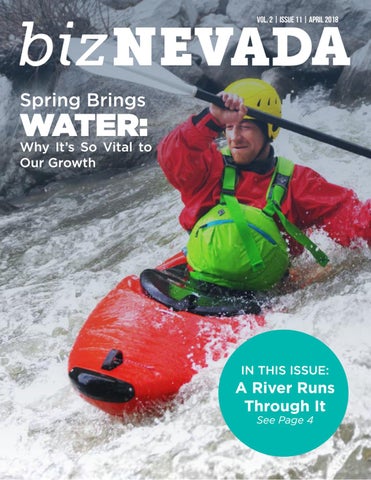
Spring Brings
WATER: Why It’s So Vital to Our Growth
IN THIS ISSUE:
A River Runs Through It See Page 4
LETTER FROM THE
LETTER FROM THE
Corrine Casanova
R i c h a r d W. M o o r e
EDITOR
Water is something most of us take for granted. Despite living in the driest state in the nation, we are lucky to have excellent water resources here in northern Nevada. According to water.org, about one in nine people in the world live without access to safe water. In some countries, people spend up to six hours each day collecting water. In Cape Town, South Africa their water crisis is so severe that they are on a Countdown to Zero. Predictions are by July the city’s taps will be turned off and residents will then need to line up to get water at distribution points. Currently, residents are allowed 11 gallons of water per person per day. To put this into perspective, the average American uses about 80-100 gallons per day. I recall a water crisis when I was a child. I grew up in Duluth, MN which gets it drinking water from Lake Superior. We weren’t allowed to drink the tap water because of high asbestos levels caused by Reserve Mining Company dumping waste rock into the lake. Asbestos is known to cause cancer. To learn more about the dangers of asbestos, see our Construction 101 story on page 8. Drinking water from the tap was something we took for granted. It was a national news story when the case went to trial and the judge ordered the mining company to quit dumping its waste into the lake. Back in the 1970’s, it was the first time a judge had shut down a major industrial operation to protect the environment. I remember it so well. As we put together this issue that’s all about water I kept thinking about what it felt like to have unsafe water as a kid. In this issue, I think you’ll be fascinated to discover how the Truckee Meadows Water Authority (TMWA) works together with many other partners to ensure that we don’t have a water crisis and our water is safe to drink.
2 · ISSUE 11 · APRIL 2018
PUBLISHER
First, welcome to the second quarter of 2018, where does the time go? I wanted to let you know about two exciting updates at bizNEVADA. The first is the addition of our new Chief Designer, Kaylyn Dazey. Kaylyn brings the latest in design technology to the team and some exciting skillsets which will place bizNEVADA in a truly unique space for our readers, contributors, advertisers, and sponsors; this is her first issue. Also, be on the lookout for our other exciting announcements in the near future. The second update involves our Editor-In-Chief, Corrine Casanova. As you may have heard, bizNEVADA will be a statewide publication in a few months, serving the needs of 20,000 executives, their staff and readers in Nevada on a monthly basis. As many of you can relate to, managing growth comes with challenges and the key for us has been our strong management team which has taken us to this point. In order for us to guarantee the same level of experience our management philosophy must be carried to the next level and we believe Corrine is the solution. Please welcome Corrine to the new position of Managing Editor for bizNEVADA statewide. We are also very proud to introduce Craig Ruark who will handle the writing responsibilities for the southern part of the state. Craig’s career has truly been remarkable, starting out in the world of broadcasting before discovering his true passion, journalism. Craig has been a contributing writer for the Las Vegas Business Press and the Las Vegas Review-Journal writing over 100 in-depth articles. I hope you enjoy his article “Who Owns the Water”. Finally, this letter is not complete without us taking a moment to thank you, our readers, for the incredible support and encouragement which has enabled us to continue the growth bizNEVADA. Our mission of connecting, educating, and giving a voice to the Nevada business community has been a dream of ours from the beginning all possible because of your support.
INTHISISSUE VOL. 2 / ISSUE. 11 BizNEVADA PUBLISHING TEAM PUBLISHERS: Richard Moore and Chris O’Sullivan GRAPHIC DESIGNER: Kaylyn Dazey EDITOR-IN-CHIEF: Corrine Casanova PHOTOGRAPHER: Marcello Rostagni ADVERTISING: Chris O’Sullivan chris@biznv.com COVER PHOTO: Courtesy of Truckee Meadows Water Authority FEEDBACK/IDEAS We welcome your feedback and ideas regarding BizNevada. Send a message to info@biznevada.com @ 2018 Richard Moore and Chris O’Sullivan. All rights reserved. CONTACT US info@biznevada.com www.biznevada.com
PG 4-7
A River Runs Through It
PG 8
Construction 101: Asbestos and Our Schools
PG 9
Love the Truckee River
PG 10
A WIN, WIN
PG 12-14
Who Owns The Rain?
PG 15-17
Non Profit: The Science of Snow
PG 19
Peanut Butter & Jelly...Better Together
PG 20-21
5 Best Home Renovations for the Biggest Return
PG 22-23
Calendar Events
PG 24-25
Water Technology Could Make Las Vegas the Next Silicon Valley
PG 26-27
Non Profit: Dreams Do Come True When You Make a Wish
PG 28-29
Spring Cleaning Your Insurance Portfolio
PG 30
Simple Solutions for Smooth Operations
EXPERT CONTRIBUTORS Jeffrey Benjamin Corporate Training Breakthrough Training BreakthroughTraining.com 775-337- 1600
Tim Kirk Credit Card, Merchant Services PaidRight GetPaidRight.com 775-393- 9669
Kyle Reeves Digital Marketing Revolution Online Marketing RevolutionReno.com 775-335- 0091
Brian D. Wheeler Financial Advisor Massachusetts Mutual Life Insurance Agency BoulderBasin.MassMutual.com 775-870- 1552
Govind Davis Digital Marketing Agilcore and RSO Consulting RSO-Consulting.com 415-992-7711 Brent Forbush Certified Public Accountants Forbush & Associates ForbushAndAssociates.biz 775-337- 6001
Ward Sutton Golf Hidden Valley Country Club HVCCReno.com 775-857- 4735
Mike Menath Insurance Menath Insurance MenathInsurance.com 775-831- 3132 David Spillers Printing Digiprint DigiprintCorporation.com 775-786- 4464 BIZ NEVADA MAGAZINE · WWW.BIZNEVADA.COM · 3
A River Runs Through It
By Corrine Casanov/photos by TMWA The Truckee River watershed is unique. While most watersheds drain into an ocean, our watershed starts and ends in a lake. There are 63 streams that flow into Lake Tahoe, but only the Truckee River flows out of its source. It winds for about 120 miles through Sierra mountain canyons past Reno and Sparks eventually emptying into Pyramid Lake. The river also flows north and east, the opposite direction most watersheds in the west flow. In the Reno/Sparks area, most of the water we drink comes from the Truckee River. In fact, it supplies about 85 percent of the drinking water for homes and businesses in the area. Nevada is considered the driest state in the nation. Reno gets about 7.39 inches of rain per year. Coincidentally, Las Vegas is even drier and gets 4.17, nearly half that amount. In a typical year, Reno and Sparks divert and use about six percent of the Truckee River’s total volume. About half of that is returned to the river through the sewage treatment plant for reuse. As our desert community continues to grow, having safe drinking water and enough water resources will always be a factor. While the Truckee Meadows Water Authority (TMWA) is a non-profit communi-
4 · ISSUE 11 · APRIL 2018
Photos courtesy of Truckee Meadows Water Authority
ty-owned water utility that supplies quality drinking water to over 411,000 customers, it does not play a direct role in community growth decisions. Rather, local governments including the Reno and Sparks City Councils and the Washoe County Commission are the decision makers. In March, the Reno City Council approved rezoning nearly 1,730 acres from industrial to residential for StoneGate, a master planned community located near Cold Springs. The development will provide about 4,135 homes and apartments in the North Valleys. Two of the Council’s biggest concerns were ample water supply and sewage disposal. According to Don Pattalock, managing member of StoneGate,
“Water is one of the first concerns anytime development is talked about in northern Nevada. TMWA has done an amazing job with our natural resources. They are the most sophisticated forward-looking utility that I have ever been involved with. We are fortunate. We have water rights that we can use for development of the project as well as water resources in the North Valleys through TMWA. That gives us two specific resources we can use to meet the growth. We are in one of the best situations in the western United States as far as water resources go.”
Photos courtesy of Truckee Meadows Water Authority
Michelle Sherven, president of Wetlab, an environmental testing laboratory in Sparks, commented on the unique aspects of our area. “Nevada is interesting because there are so many environmental considerations. You have Lake Tahoe in the west and there are a whole lot of different sets of environmental land uses with mining in the eastern part of the state. Then in Reno/Sparks we have a lot of industrial manufacturing. We have different environmental issues going on depending on what part of the state you are in.” The City of Reno recently released their 2017 First Sustainability Report and the role of water was first and foremost in the Sustainability & Climate Ac-
BIZ NEVADA MAGAZINE · WWW.BIZNEVADA.COM · 5
Photos courtesy of Truckee Meadows Water Authority
tion Plan. Mark Foree, General Manager, TMWA, explained that as our community grows, safe drinking water will always be crucial. “It is our #1 priority to deliver safe drinking water to our customers. Lake Tahoe is an outstanding source of water to work with in terms of quality and quantity. It is known for its clarity and is one of the most clean, clear, pristine lakes on the continent. So, we start with a good source of water and then our treatment plants treat it to a higher standard to where it is better than all drinking water standards 100 percent of the time,” Foree said. Today, TMWA’s water quality ranks among the highest in the country. The Truckee River Operating Agreement (TROA) provides a new approach to managing the Truckee River. After 26 years of negotiation, TMWA, the state of Nevada, the state of California, the U.S. Department of Interior and the Pyramid Lake Paiute Tribe signed the agreement that went into effect in December 2015. Essentially, it increases the operational flexibility and efficiency of reservoirs in the Lake Tahoe and Truckee River basins. Foree said, “It allows us a lot more water in the upstream in the federally operated reservoirs than we could ever have before. 6 · ISSUE 11 · APRIL 2018
The idea is for users on the river to be able to store water in those reservoirs when we don’t need it like in the winter months and release it when we need it most like during a severe drought in the summer months.” TMWA is also working with outside agencies like UNR, the Desert Research Institute (DRI) and the U.S. Geological Survey to look at climate change and its impact on water supply. Foree explained, “Together we have put together a kind of a stress test for TMWA regarding resiliency to extreme drought even with a growing customer base. The results have been very favorable. Having all these other agencies, experts and stakeholders involved is a great thing. We are happy that the results show that TMWA has really good resiliency to droughts.” And their efforts haven’t gone unnoticed. TMWA was one of only 18 water utilities to receive the President’s Award for the Partnership for Safe Water. “This is a big deal for us. It took us several years to get through the rigorous application process. But in the end, being nationally recognized for consistently providing high-quality drinking water is a high honor for us. We are proud of this recognition,” said Foree.
Photos courtesy of Truckee Meadows Water Authority
Water conservation is something TMWA strongly believes in. Because Reno has been recognized as becoming one of the fastest warming cities in the nation due to climate change, the city has initiated a program, ReEnergize Reno. Their goal is to improve energy and water efficiency of commercial, industrial and multifamily buildings by 20 percent by 2025. TMWA has a Smart About Water initiative smartaboutwater.com. “With this initiative, we provide leadership and customer education about water efficiency measures, multimedia campaigns and our water usage review program,” concluded Foree. In southern Nevada, WaterStart, a Las Vegas-based non-profit partnership of public- and private-sector organizations, is diligently working to become the next Silicon Valley of water technology. Since their inception in 2013, they have evaluated 214 proposals and completed 17 pilot projects. They are poised to become a leading resource for global and municipal water management and sustainability. One of those pilot projects, the Atlantis Casino in Reno, may save $100,000 a year due to a new technology designed to track and monitor water use. Executive director, Nathan Green said, “Often it is not possible to measure the water going into the building once it is in there. There may be no system for tracking what the major water uses are. In this case, how much are the restaurants using versus the water features, the lawn, pools versus the cooling towers? With the Atlantis project there are smart meters that actually measure the consumption of water in real time and do the math around consumption trending.”
pros and cons of each. According to Green, “Water is something all of us need to be constantly thinking about. It’s not just about how to manage the supply, but how we can all be managing the demand. For our economy to continue to grow we need a water supply to support that. There has been a tremendous amount of investment all over the state in infrastructure and resources. We can take those resources to the next level by bringing new technology solutions here. Nevada for a long time has been a leader in adapting new approaches to managing water. A big part of what Waterstart is trying to do is coordinate that demand so we actually can build a technology ecosystem here so we aren’t only the buyers of the new water technology, we are also a home to that new technology.” What Waterstart and other partners are doing is solving water challenges in Nevada, building partnerships with others and helping to diversify our economy. And through it all, the Truckee River is the water source that continues to supply the area with almost all our drinking water. A river runs through it indeed.
Photos courtesy of Truckee Meadows Water Authority
All of this tracking helps look at the math behind the performance. MGM Casinos in Las Vegas is also utilizing a similar type of application as the Atlantis but with a different technology. WaterStart will now be able to compare the two and look at the BIZ NEVADA MAGAZINE · WWW.BIZNEVADA.COM · 7
CONSTRUCTION 101: Asbestos and Our Schools “Asbestos” is a word that, for the general population, often conjures mental images of yellow caution tape draped across the doorways of aging buildings. Unfortunately, as many people in the construction industry know, aging schools are among the buildings most in need of abatement. Construction industry professionals have been addressing asbestos issues for decades, and now that many of our local schools in our area are subject to renovations, our community needs to know about how this material is a hazard to both students and teachers in these facilities. Asbestos, of course, is a highly toxic mineral once widely used in consumer goods, shipbuilding, and the construction industry prior to regulations introduced in the 1970s. The mineral was predominantly used for its beneficial physical characteristics, including durability and heat resistance. However, asbestos can also break down into thin, microscopic fibers that pose a threat to human health. Being exposed to asbestos doesn’t have an immediately noticeable impact on health. This, in addition to asbestos fibers being invisible to the naked eye, results in people not realizing that they have inhaled asbestos or that their health could be compromised decades in the future. Asbestos exposure leads to several harsh diseases, most notably a type of cancer found in the linings of internal organs (most often the lungs). In a 2014 report by the National Center for Education Statistics, the average age of a public school in the United States was 44 years old. This figure is calculated based on the number of years from the construction of the main instructional building rather than any potential additions. On top of this, the average number of years since a public school had undergone a renovation rose from 11 to 12 years, compared to a similar study conducted in 1999. Given that it was common to use asbestos products to construct buildings until the 1970s, it’s likely that 8 · ISSUE 11 · APRIL 2018
some form of asbestos is still present in many public schools. The federal government has regulations in place to help guide schools in addressing asbestos issues. The Asbestos Hazards Emergency Response Act (AHERA) requires schools to inspect facilities for asbestos products, create a management plan, and take action to best prevent exposure to asbestos. General Contractors, like Clark/Sullivan Construction (C/S), take asbestos abatement very seriously. Whether crews are renovating a school, office building, or any other existing structure, the C/S teams prioritize the safety of the building’s occupants and the construction crews to ensure the abatement process is thorough and safe for all involved. This may mean scheduling abatement during Spring or Summer vacations to avoid exposure to students and school staff or cordoned-off wings or areas within a building to protect occupants. At the end of the day, safety is the number-one priority on any job site. It’s extremely important for local communities to be aware of the issue and the potential health risks associated with unintended asbestos exposure. Many people are unaware that school teachers have an extremely high risk of dying from mesothelioma compared to the national average. That is why having trained professionals remove asbestos from schools is an important step in protecting the health and futures of both students and educators. This article is brought to you as a collaboration between Clare Christensen of Clark/Sullivan Construction and Anna Suarez, a mesothelioma health advocate.
by Corrine Casanova
Longtime local, and owner of Reno Tahoe Promotions, Jeannette Halderman, has combined her love of the Truckee River with her 27 years of experience as a professional botanist and restoration ecologist to create the Love the Truckee River Campaign. The goal of the campaign is to improve the health of the Truckee River, raise awareness of the importance of a vibrant river connecting our communities from Lake Tahoe to Pyramid Lake and to work in partnership with existing programs and organizations, such as Foriver, (the Truckee River Watershed Council). “Together we can revive our watershed, so nature and humanity can thrive here for generations,” said Lisa Wallace of the Truckee River Watershed Council whose team has managed numerous large-scale projects, mobilized over 472,000 volunteers and raised over $11.5 million in funding in the past 21 years. Halderman’s company, Reno Tahoe Promotions, has created custom “Love the Truckee River” swag, including apparel, stickers and outdoor gear that have been sold during a variety of fundraising events in the Truckee and Reno areas, with proceeds going to the campaign. She shared, “I wanted to create something that people would love to have while
supporting the beautiful place we live. For me, it is combining my creativity and passion as a restoration ecologist with my desire to help others and our community.” Since its inception in 2017, the Love the Truckee River campaign has hosted educational booths and have participated at chamber of commerce mixers and various fundraisers. In addition, they’ve provided educational content through e-blasts and social media. Halderman is seeking partners and sponsors who are interested in her Love the Truckee River campaign and would like to feature her products at their events, host a benefiting event or provide an educational opportunity. Reno Tahoe Promotions is a full-service vendor for promotional items, apparel and anything creative needed for your business, personal or special events. For more information, visit RenoTahoePromotions.com and then click on the Love Truckee River button. See truckeeriverwc.org to learn more about Foriver.
BIZ NEVADA MAGAZINE · WWW.BIZNEVADA.COM · 9
A WIN, WIN by Corrine Casanova
This year marks the 50th anniversary of the networking organization, Western Industrial Nevada (WIN). The mission created in 1968 in their charter still holds true today. Advancing civic and commercial activities through promotion, development and implementation of economic diversification in Western Nevada is what they are all about. They are well known in the business community for their monthly breakfasts at the Atlantis with world class speakers. WIN Executive Director, Jacki Hallerbach, is in charge of these monthly breakfast meetings as well as the annual WINner, WINner, Breakfast for Dinner evening event. The selection process for each monthly keynote speaker is extensive. Hallerbach explained, “We choose speakers that are high quality and have broad appeal. Many of the topics are motivational in nature. To ensure we continue to have quality speakers, we send out a survey after each event to make sure we are on the mark.”
We have people who are running for office, entrepreneurs, small businesses and large businesses alike from different industries. Our membership is diverse in age, gender and job description. Our ongoing relationship with the University of Nevada, Reno (UNR) provides us with student volunteers at our events which helps ensure younger people know about our organization.” Cantwell has been a WIN member for nine years now and does his best to attend every meeting.
The Board of Directors is made up of 19 volunteers and is always changing as the President is given a one year term, then becomes President Emeritus. Following that, he/she no longer serves on the Board. The goal of WIN is to provide a fresh forum where members and guests alike have educational opportunities on pertinent issues along with impactful networking.
If you are interested in attending, you can access your tickets on their website or if you would like a personal introduction, contact Jacki Hallerbach at info@winevada.com or 775.359.7117 or Pat Cantwell at pcantwell@ktvn.com or 775.772.7164. Their WINner, WINner, Breakfast for Dinner evening event will take place on Wednesday, April 18 from 4:307 p.m. The event features encore performer, entertainer, leader and motivational speaker, Roddy Chong. It will also include a business expo. As with all their events, tickets can be purchased online at winevada.com.
WIN currently serves about 400 members. Pat Cantwell, VP of Marketing, shared, “What makes us unique is the diversity of our membership. They come from all types of businesses and industries. 10 · ISSUE 11 · APRIL 2018
Their breakfast meeting is held the last Friday of the month at the Atlantis from 7 to 9 a.m. Prospective members are encouraged to check it out. The first 30 minutes is devoted to networking, followed by breakfast, the introduction of guests and sponsors and then the speaker. Each meeting ends promptly at 9 a.m. Typically, there are 250-300 people in attendance with about 25 percent being guests.
BIZ NEVADA MAGAZINE · WWW.BIZNEVADA.COM · 11
Who Owns the
by Craig A. Ruark In nearly every part of the world and most of the U.S. when it rains, people take advantage of the heavenly gift and in many cases capture the precious liquid in rain barrels or cisterns for later use. However, in Nevada, it is illegal to capture the rain because it is owned by all of the residents and the state assures that the water is made available to everyone on an equal basis. To further explain, “Who Owns the Rain,” we need to go back to the late 1930’s when the Nevada Water Law was adopted and forward to 1994 and 1999 when the law was revised. Nevada Water Law, (set forth in NRS Chapters 533 and 534), state that: “All waters within the boundaries of Nevada, whether above or beneath the ground surface, belong to the public and are managed on their behalf by the State. The State Engineer is responsible for the administration of Nevada Water Law, which ensures that these waters are managed so that sufficient quantities are available to preserve our quality of life and to protect existing water rights.” The reasoning behind the Nevada Water Law is simple, we live in the driest state in the union. The Las Vegas Valley receives an average rainfall of 4.5 inches per year based upon a 30-year norm. Reno, which sits in the rain shadow of the Sierra Nevada mountain
12 · ISSUE 11 · APRIL 2018
range receives nearly double the amount at 7.48 inches per year. Some years are wetter than others and controlled by the surface temperature of the Pacific Ocean. The warmer surface water, identified as an El Niño brings more rain than the cooler water or La Niña. Anyone that has lived in Las Vegas and Reno long enough knows that during storm events there is a lot more than 4.5 or 7.4 inches of water running down the streets. That is because rainfall data is gathered and reported by the National Weather Service from their “official” rain gauges located at McCarran and the Reno-Tahoe airports. However, due to the geography of both valley communities and the science of weather, we know that the heaviest amount of the precipitation received during a storm event is along the mountains that surround the Valley. In addition, due to the desert hardpan crust, water does not easily soak into the ground but rather flows in sheets toward the lowest point where it gathers into major natural washes, making their way toward wetlands and rivers. Approximately 60 percent of the water withdrawn in Nevada comes from surface water sources (lakes, rivers, and streams) and the other 40 percent is pumped from underground lakes. Both of these water sources are highly dependent upon rain and snowmelt to keep them full. In essence, the reasoning behind the Nevada Water Law is to allow for the natural recharge of streams, rivers, lakes and underground aquifers. According to the Nevada Division of Water Resources, 67 percent of the groundwater and 64.9 percent of the surface water is used for irrigation.
While the Nevada Water Law prevents individuals from capturing the rain, it also places a burden on developers to design drainage plans to allow the rain that falls on their property to allow for natural absorption and to direct flowing water safely off the property and into storm drains. To accomplish this task, engineers utilize various software programs including one called “DDMS,” developed by the Southern Nevada Regional Flood Control District, to calculate the amount of water flowing onto a site. Based upon these calculations, or what is referred to as a “Drainage Study,” they are able to design grading plans and drainage components to safely accommodate those flows and allow the water to continue on its natural course to Lake Mead. In the last ten years, there has been increasing interest (through the institution of the U.S. Green Building Council LEED Certification for green buildings), to capture and treat the stormwater that crosses a development’s property. In those cases, engineering firms have been able to develop plans that allow up to 30 percent of the water to be filtered back into the ground through a pores infiltration system,
while the rest is captured in an underground vault, cleaned of its suspended solids and metered over a 72-hour period back into the normal stormwater channel system. This later system gives the builder One LEED Point toward their green building certification under the category of Sustainable Site Credit 6.2. Nevada is not much different from most of the other western states when it comes to water laws, which is understandable due to its precious little quantity. However, change is in the air, and a 2010 ruling in Colorado made it legal for individuals to install rain barrels to capture melting snow and rain from their roof, but only if they live outside of an urban area. The state of Arizona has also implemented a new ordinance which mandates developers of commercial properties to “harvest” rainwater for landscaping. And in October 2008, the city of Tucson, which receives an average rainfall of 12.17 inches annually, became the first municipality in the country to require developers of commercial properties to harvest rainwater for landscaping. The new water-saving measure—approved by a unanimous vote by the City Council—mandates that new developments meet 50 percent of their landscaping water
requirements by capturing rainwater. The rule went into effect June 1, 2010. Other local governments, including Santa Fe and Albuquerque, New Mexico, require new homes to use rainwater harvesting, but not commercial properties. One acre-foot of water which is 325,851 gallons or the equivalent of a football field covered with one foot of water can supply two families of four (depending on irrigation needs) with enough water for one year. If you had a 1,000 square foot roof from which you were to capture rain, you would collect 83.3 cubic feet (625 gallons) of water during a rain event that produced one inch of rain. That means a resident of Reno who receives 7.48 inches of rain on average, would only collect 4,675 gallons of water in a one-year period, far short of the 162,925.5 gallons that a single family of four would need to survive. So, to answer the initial question of, “Who Owns the Rain?” It belongs to everyone, and therefore, it is shared equally among all Nevada residents. Craig A. Ruark is a popular freelance writer and journalist. He will soon be the new Editor-in-Chief of the new bizNEVADA South Magazine.
14 · ISSUE 11 · APRIL 2018
The Science of Snow by Corrine Casanova
At the end of February, snow in the Lake Tahoe Basin was 30 percent of the normal snowfall. We experienced a particularly warm and dry winter with little snow and then came our miracle March. In recent years, there’s been a change in how the snowpack is dispersed in Nevada. In the Sierra Nevada, warmer temperatures are causing precipitation to fall as rain and pushing the snow lines higher up the mountains, often above 8,000 feet. This results in less water being stored as snow for the spring melt and makes runoff more unpredictable.
research is world renowned, they are housed right here in our own backyard.
Snow droughts, or periods of below-normal snowpack, happen when abnormally warm storms or abnormally dry climate conditions prevent mountain snowpack from accumulating. Snow drought is a relatively new term and was thoroughly described by three University of Nevada, Reno (UNR) researchers in 2017.
I spoke with Benjamin Hatchett, Ph.D., a postdoctoral researcher with DRI’s Division of Atmospheric Sciences, and Daniel McEvoy, Ph.D., a regional climatologist at DRI’s Western Regional Climate Center (WRCC) to learn more about our snowpack and how it impacts our local watersheds. The two published a paper in the journal, Earth Interactions, where they looked at the origins of snow drought in the northern Sierra Nevada from 1951 to 2017. They discovered snow droughts can result from extreme early season precipitation, frequent rain-on-snowevents and low precipitation years. Even the record-breaking winter of 2016/17, which ended with far above-average snowpack levels, experienced snow drought early in the season during November and December.
The depth of our snowpack and our winter precipitation have direct impacts on our water supply, wildfire likelihood, recreation and seasonal businesses like our ski resorts. To discover why declining snowpack levels are happening and what to do about them, it’s necessary to look back on history. That’s where the Desert Research Institute (DRI) comes in. DRI is the non-profit environmental research arm of the Nevada System of Higher Education. While their
“I think people are kind of surprised that you can experience snow drought when you have average or even above average precipitation. People wonder how we can have a wet year and still be in a drought. It is kind of counterintuitive,” said McEvoy. Recently, researcher Hatchett looked at the winter snow level rise in the northern Sierra Nevada over a 10-year period from 2008 to 2017, published in the journal Water. What he and his research team BIZ NEVADA MAGAZINE · WWW.BIZNEVADA.COM · 15
discovered was there has been a roughly 1,200 foot rise in winter snow levels in a decade. The implications of this are profound. Hatchett explained, “The changing elevations of winter snow line has very strong connections to flooding and water resources as well as recreation and ecosystems. The big motivation of that study was to put numbers on anecdotal information and see how much change has occurred in the past decade. We wanted to see what those changes looked like in longer terms and what processes might be driving those changes. We found a decent connection to Pacific Ocean surface temperatures offshore of California and with atmospheric rivers. Warm ocean temperatures result in more rain and less snow, and as the ocean continues to warm, we will see rainier winters in general. Atmospheric rivers tend to bring higher snow level storms. They are also projected to increase in their frequency and magnitude. So, looking to the future it appears that we will likely see storms that have higher snow level elevations than in the past. This means a greater fraction of our mountainous areas will see rain rather than snow. That has many implications depending on what your interest is in. This
16 · ISSUE 11 · APRIL 2018
links to the snow drought concept because if we have high snow level storms with the snowline elevation being near or above the top of the mountains, now we are getting all rain and accumulating precipitation but not snowpack. This drives us into the warm snow drought scenario. We need to look at how we can adapt to a climate characterized by higher snow level storms on average. Of course, we will still have very cold storms, but they seem to be occurring less frequently,” explained Hatchett.
The Timing of Snow Drought In Hatchett and McEvoy’s recently published research, they wanted to see how snow drought evolves throughout the year. There are different implications if the snow drought begins early, in the middle, or late in the year. It directly impacts things like recreation, ecology, wildfire potential, vegetation and health of ecosystems. McEvoy has observed some significant changes regarding the changing climate. “One way that it is really impacting us is recreation. We are seeing
things like ski resorts opening later and closing earlier than normal. Through the end of February, most of the cross country ski resorts in Tahoe, and Royal Gorge, which is the biggest cross country ski resort in North America, were closed until the March snows. It also matters for water supply and water resources, which is a little bit more uncertain. Flooding is another concern. It sounds counterintuitive, but we found that during four of the seven snow drought years, we had very high stream flows in the middle of the winter. That’s because we got more of the water falling as rain instead of snow. We also get substantial melting of existing snow. This combination can lead to big flooding problems during these otherwise drought winters,” McEvoy said. Our landscape changes as our snowpack continues to change. According to McEvoy, the changing conditions can stress our forests. Even occasional wet years like 2016/2017 make it difficult to make up for persistent drought conditions. “Droughts stress the ecosystem for multiple years. They are not being remedied by just one wet year. That changes the subsequent likelihood of fire or other disturbances like beetle infestations. What we are used to seeing is changing before our eyes. In the southern Sierra, the big winter last year can’t make up for the long four to five year drought we’ve experienced. You can’t make dead trees come back to life. What we think we are going to be seeing more of are frequent long dry periods punctuated by rare really wet years,” said McEvoy.
prepared for these changes. Water users in their homes and others may not know these things are going on. The average person hopefully won’t experience the negative impacts of drought because the people that are responsible for getting them their water or keeping their forests healthy are able to adapt to these changes and never let it propagate down to the individual,” Hatchett responded. Hatchett concluded, “Supporting snow science research in Nevada will help to maintain a healthy, growing and sustainable economy and lifestyle for Nevadans. A lot of the work we are doing is with the intent of keeping our communities going. We are lucky to have the Truckee Meadows Water Authority (TMWA) who always has a long view of water resources. Their long-term drought planning has really showed its value in the last drought episode while a lot of communities in California were scrambling to avoid running out of water. We have a lot of opportunity in Nevada with our snow-dominated climate to identify and adapt to the changes we are observing and apply this knowledge globally.” To learn more about other DRI research, visit www.dri. edu. Follow Dan McEvoy on Twitter (@hydromet_man) and Benjamin Hatchett (@_Dr_OpS).
Why Research? DRI researchers like Hatchett and McEvoy aren’t the type of researchers who are sitting in their offices with their doors closed writing scientific papers. Although they do publish their research, you are more likely to see them out in the backcountry skiing, hiking, or doing public outreach to share their findings. Hatchett explained, “When Dan and I go skiing we aren’t just skiing. We are thinking about the changing landscape and apply what we are doing to the people that are turning the knobs to the water supply for communities in Nevada or California. Our research is practical in nature for sustainable business practices.” Why do they do what they do? “We try to understand and characterize changes that are taking place right now so we can inform people who are in charge of management decisions to be more BIZ NEVADA MAGAZINE · WWW.BIZNEVADA.COM · 17
18 · ISSUE 11 · APRIL 2018
lly Jelly & Je terr & utte But nutt B eanu Pea P ...better together!
by Mitch Tarr Email marketing plus Facebook is just like peanut butter and jelly... better together. Sometimes you don’t know what you don’t know. Here’s a nice integrated marketing campaign that makes use of the power of email marketing combined with remarketing tools in Facebook. The concept of an integrated email campaign is to combine a message in one medium (email) with a matching or supporting message in another medium (Facebook). The great thing about today’s digital marketing tools is you now have some of the same capabilities as companies with big marketing budgets. This process works whether you have a email list of 1,000 or 100,000 names. Here’s the Simple Process Let’s say you’re planning a summer campaign and want to offer your customers a 25 percent off coupon. To make this campaign work, you’ll need to have an email account to send emails to your customers. You’ll also need a Facebook Ads Manager account. Step 1: Create a Custom Audience in Facebook I won’t bore you with the technical details on how to set this up. You can look it up on YouTube. Simply export the email addresses from your email system into a file and upload that list into your
Facebook Ads Manager as a custom audience. Facebook will match its users with your email addresses. You might find that 60 percent of your customers will match up. Step 2: Design Your Email Campaign Now set up your email campaign with your offer. In this case we’re going with 25 percent off. The use of strong visuals will make it easier for you to tie in your email campaign with your Facebook ads. Step 3: Send Your Emails This style of campaign works best with a multi part email series. For example, send message one email on the first week of the month. Then, send a reminder in the middle of the month and a last call with one day to go. Make sure you have a defined start and finish date for the campaign. Use tracking codes on your email visitors so you can see this block of traffic on your site and how it behaves and converts. Step 4: Create and Run Your Facebook Ad Campaign This is the fun part. Design an ad campaign with images and a creative approach that looks like your email. It works best when people connect the dots between your emails and your Facebook ad.
Create your ad campaign and target this custom audience. This way only people who are on your email list will see this ad. Try to connect the subject line in the email and the title in your Facebook ad. Make sure you are also using tracking and conversion codes on your Facebook visitors so you can see how many of your email audience reacts to your ad. Why This Works Most people are bombarded with advertising during their day… and it’s no different online. You send an email to their inbox. You get their attention (maybe). Then, a sponsored post shows in their Facebook newsfeed. Then, a sponsored post shows in their mobile Facebook newsfeed. Then your reminder email lands in their inbox. Three days later, they see your ad in their Facebook newsfeed. <CLICK> Frequency works in your favor. It’s been proven that repeated messaging is more effective than a single touch. It helps you break through the clutter. This is a really powerful integrated campaign. Email + Facebook. Look into it. Mitch Tarr is the CMO of Big M Marketing which solves marketing challenges and bottlenecks to maximize your ROI. For more information, see bigm-marketing.com.
BIZ NEVADA MAGAZINE · WWW.BIZNEVADA.COM · 19
for the biggest return by Lindsay Clarke and Nicolle Gust You are ready to take advantage of this seller’s market and sell your home. Likely you are upgrading, downsizing or looking to cash out. Either way, you want your sale to yield the most profit. This may require you to update some features in your home. What projects will make sure you have the highest Return on Investment (ROI)? The obvious first course of action is generally to replace old appliances and update flooring, which are important, but won’t necessarily yield the highest increase of your home’s value. Some renovations have little to no return. So what home improvements should you tackle first? First, speak with your real estate professional. A local realtor with local knowledge can provide you 20 · ISSUE 11 · APRIL 2018
with recently sold comparatives in your neighborhood to make sure you do not over-improve your home. Considering the conditions and features of similarly sold properties in your neighborhood is vital to making sure your remodel will pencil. Remodeling magazine compared the average costs of 21 remodeling projects in 149 markets throughout the U.S. Their 2018 Cost Vs. Value Report revealed the top five home projects with the best ROI.
Top Five Home Projects with the Highest ROI: 1. Garage door replacement
Get a new four-section garage door with new heavy-duty galvanized steel tracks. Not only will
this improvement increase reliability and efficiency, but a new garage door will modernize the exterior of your home.
2. Manufactured stone veneer
Stone veneer also does wonders for curb appeal. Replacing existing vinyl siding or stucco with manufactured stone veneer adds dimension and will surely add cash to your pocket.
3. Entry door replacement (steel)
You know the saying, “You don’t get a second chance to make a first impression.” Well, the front door is the gateway to the interior of your home. Replace your old door with a new factory finished 20-gauge steel unit and you’ve made a wonderful investment.
4. Deck addition (wood)
A yard is one of the most coveted aspects of home ownership. A deck allows for maximum enjoyment. Adding a wooden deck will substantially increase your home value and enjoyability.
5. Minor kitchen remodel
A common misconception is you must completely overhaul your kitchen to see a return on investment. The opposite is true—a minor kitchen overhaul that includes updating cabinetry, countertops, fixtures and appliances to more modernized styles will go a long way in recouping cost. Add some fresh paint and you may like it so much you no longer want to sell! In northern Nevada, buyers are demanding a more updated home. With new home communities and higher prices, buyers want to substantiate their purchase with features and finishes that are “move-in” ready. Whether you plan on selling or staying in your home, it is always a good decision to know which home renovations will generate the most money at resale. With the help of your realtor, you can determine which projects to tackle that will be sure to increase your chances at landing towards the top of your market. Lindsay Clarke & Nicolle Gust of the Clarke & Gust Group are residential real estate specialists in Reno-Sparks area with over 15 years of experience. For additional information or a personal market analysis of your home contact them at cggroup@wesellrenotahoe.com or visit wesellrenotahoe.com. BIZ NEVADA MAGAZINE · WWW.BIZNEVADA.COM · 21
CALENDAR OF EVENTS RENO+SPARKS CHAMBER APRIL 13 4PM Ribbon Cut: Inspire Reno 615 Riverside Drive
APRIL 2018
APRIL 17 8-10AM Public Forum: Energy Choice Initiative Grand Sierra Resort, Sierra room APRIL 17 5-6:30PM Business After Hours Nothing to It! Culinary Center
FERNLEY CHAMBER
TUESDAY MORNINGS Fernley Ambassadors The Golf Course at Fernley APRIL 21 8AM-NOON Mayor’s Clean Sweep! Fernley Out of Town Park MAY 5 9AM-NOON Longrider Cowboys MC – 14th Annual Poker Run Old Tyme Saloon
NCET
APRIL 18 2-4PM Biz Café: Amber Barnes, StartHuman (re)Defining Failure: Rumble, Rise, Repeat Rancharrah Pavilion APRIL 25 11AM-1PM Biz Bite: Mikalee Byerman, Estipona Group The Introvert Revolution: Valuing Diverse Personalities in the Workplace Atlantis Casino Resort Spa
22 · ISSUE 11 · APRIL 2018
MAY 9 5:30-7:30PM Tech Wednesday Dragonfly Energy 4814 Longley Lane
MAY 16 2-4PM Biz Café: Mike Crawford Lessons from a Serial Entrepreneur Rounds Bakery MAY 23 11AM-1:30PM Cannabis Commerce 2.0: The Supplier Story Panel Presentation Atlantis Casino Resort Spa
WIN
APRIL 18 4:30-7 PM WINner, WINner, Breakfast for Dinner Roddy Chong, The Rockstar Perfomer Atlantis Casino Resort Spa
April 27th
7-9 AM WIN Breakfast
Melanie Duckworth, ‘Mentoring Generously: The Key to Successful Leadership’
May 18
7-9AM WIN Breakfast Crisis Ready: Building an Invincible Brand in an Uncertain World Melissa Agnes Atlantis Casino Resort Spa
CARSON CHAMBER
APRIL 17 2:30-4:30PM Chamber Professional Development Seminar Robert Ash, Why We are Biased—What Makes Us Different Carson City Chamber
APRIL 18 5-7PM Chamber Social Mixer Eagle Valley Golf Course 3999 Centennial Park Drive APRIL 26 11:30AM-1PM Soup’s On Luncheon Gold Dust West-Carson City 2171 E. William St. MAY 10 8AM-5PM Carson City Leadership Institute Carson City Chamber 1900 S. Carson St. MAY 16 5-7PM Chamber Social Mixer Carson Nugget
CARSON VALLEY CHAMBER APRIL 14 11AM-4PM Ice Cream Social/Bingo Sponsored by the Young at Heart Douglas County Community/ Senior Center MAY 9 7-8:30AM Chamber Coffee TBD MAY 12 10AM-3PM Big Mama’s Show & Shine Car Show Lampe Park, Gardnerville
ONE MILLION CUPS EVERY WEDNESDAY
9AM The Innevation Center
BNI MEETINGS TUESDAY 7AM
Mimi’s Café BizClub Zero Swill Coffee Napa Sonoma South
WEDNESDAY 7AM Napa Sonoma South Meadowood Courtyard
WEDNESDAY NOON Wildcreek Golf Course Famous Dave’s Reno/Sparks Association of Realtors
THURSDAY 7AM Swill Coffee Lakeridge 19th Hole The Plaza Hotel, Carson City Mimi’s Café Napa Sonoma South
THURSDAY 11:30AM Famous Dave’s
OTHER EVENTS
APRIL 11 5-8:30PM Euphotoria: Photography for a Purpose Dolan Lexus of Reno 7175 S. Virginia St. APRIL 11 & 12 Startup Angels Workshop – Reno Desert Research Institute 2215 Raggio Pkwy. APRIL 14 9AM-NOON Entrepreneurs Assembly Startup Incubator Roundtable Innevation Center
APRIL 18 UNR NSAC Luncheon 11:30AM-1PM Atlantis Casino Resort Spa MAY 15 5PM Breakthrough Network Mixer - free Coach’s Grill & Bar #2 4050 S. McCarran MAY 15 11:30AM-1PM American Marketing Association May Luncheon TBD
For more complete and up-to-date calendar information, visit www.bizNEVADA.com/events
BIZ NEVADA MAGAZINE · WWW.BIZNEVADA.COM · 23
Could Make Las Vegas the Next Silicon Valley by Craig A. Ruark WaterStart, a Las Vegas-based non-profit partnership of public- and private-sector organizations, is diligently working to diversify the Las Vegas economy, create job growth and provide answers to drought and water quality issues in Nevada. Their goal is for Las Vegas to become the ‘Silicon Valley of Water Technology.’ Sounds like an impossible undertaking, especially for an organization based in a community that, to the rest of the world, may appear to be a mecca of opulence and wasteful negligence of precious natural resources. A spinoff from the Desert Research Institute (DRI), WaterStart is a 501(C)6 organization that gets its funding from the Governor’s Office of Economic Development (GOED). It also receives matching funds for specific projects from its public and private partners, Southern Nevada and Truckee Meadows Water Authorities, MGM Resorts, Winnemucca Farms, LVGEA, Reno Sparks Tahoe Economic Development Authority, and both UNLV and UNR.
1) to solve water challenges in Nevada through the use of new and innovative technology 2) build partnerships between private industry and the academic community 3) diversify the economy by attracting new businesses that create jobs To find these ‘innovative technologies,’ Allen, with a BA in environmental science and geology and a Masters in environmental education, has participated in the Governor’s Trade Mission(s), most recently to Australia, in an effort to facilitate an exchange of ideas. “Because Nevada is the driest state in the Union, we have a cluster of experienced first adopters of innovative water technology that are beneficial to the advancement of newer technologies found in these other countries,” said Allen.
Entering their second year of funding, WaterStart was networking with over 1,500 water conservation professionals from the U.S., Canada, and Mexico during the ninth annual Water Smart Innovations Conference last October.
Allen, and his team, also network with groups similar to WaterStart in other countries to find technology companies that have products needed by partner companies here in Nevada. The organization currently works with groups in the UK, Israel and Singapore. “Many of these technology companies have been very successful in other countries around the world, but have not figured out a way to break into the U.S. market,” said Allen.
Nathan Allen, executive director of the WaterStart initiative, explained that there are three basic drivers to the organization:
However, the WaterStart team is not looking for conceptual ideas; they are only interested in prototypes that have been proven in the laboratory but
24 · ISSUE 11 · APRIL 2018
have not had the opportunity to bring the product to market. They are also looking very closely at the price point to make sure that the technology is cost-effective for the end user. In the past 23 months, the four-member WaterStart team has vetted over 150 technologies, received proposals from more than 60 companies that want to work with them and funded eight projects. One of the projects is the installation of over three miles of leak detection equipment on the water line that runs below the Las Vegas Strip. Edchologics, a Canadian company, is the first to develop this technology using a special microphone called a hydrophone that can hear water escaping. Another company, Syrinix, headquartered in the UK, is also testing their TrunkMinder and PipeMinder on water lines in the Valley to monitor pressure and flow data.
WaterStart currently has two on-going pilot projects to solve the nitrate problem, and a third project ready to start. Two of the companies involved are experimenting with brand new technologies and the third is using a technology that has been around for a while, but their business model is a little different. “In the world of water treatment, nothing disappears, you simply remove the bad stuff, such as nitrates, and end up with a very hazardous and expensive waste stream. The question then becomes; how do you manage that waste?” said Allen. The answer may lie with one of the companies involved in the pilot program, they have figured out a way to reduce the cost of managing that waste stream for areas that cannot just put it down the sewer.
WaterStart is also responsible for bringing IONEX, a California company that builds customized smallscale, water treatment plants, to Nevada. IONEX plans to build an assembly and R&D facility in North Las Vegas and estimates are that this company will bring $2.5 million in tax revenue to the state. IMGeospatial, a UK company, has worked with utility companies throughout Europe to supply water managers with automatic cloud-based analytics for their internal geospatial platforms. WaterStart pared the company with the DRI to utilize their automated, patent pending flood modeling solutions. The DRI has over 400 research projects on all seven continents. They hope to use this technology to bring life-changing improvements to those affected by pluvial flood events around the world. Winnemucca Farms, the largest agricultural producer in the state with 35,000 acres of irrigated land, have adopted water saving irrigation technologies from around the world. Working with WaterStart, they are experimenting with a company that uses drone technology to measure plant stress from the air and improve irrigation precision while saving, even more, water. All 17 counties in the State of Nevada have been under a Drought Emergency Declaration since 2012. Besides having a lack of water for drinking, the drought has also caused major problems with the buildup of nitrates in the groundwater. “The solution to pollution is dilution,” said Allen. “Without the usual amount of rainfall, we are having to look for other cost effective, technology-based means for removing harmful nitrates.”
When asked about WaterStart’s program, Alexis Smith of Intelligent Modeling Ltd. called it “Massively useful.” Her firm maps rain-induced flood patterns and is doing a test run with the Southern Nevada Water Authority. “We can use it as a springboard, it opens up the whole territory,” stated Smith, who is British, referring to the North American market. Craig A. Ruark is a popular freelance writer and journalist. He will soon be the new Editor-in-Chief of the new bizNEVADA South magazine. WaterStart Executive Director Nathan Allen (L) with staff members Rebecca Shanahan, Cecilia Sample, and Raja Bushnell, pose in front of the WaterStart booth at the Water Smart Conference. (Photo courtesy of Craig A. Ruark)
BIZ NEVADA MAGAZINE · WWW.BIZNEVADA.COM · 25
WHEN YOU MAKE A
by Corrine Casanova In April 2016, Reno native, Morgan Moreno suffered from a collapsed lung. After multiple tests, doctors realized he was battling Ewing’s sarcoma (cancer) as well. While undergoing chemotherapy and radiation, Morgan, 15, was no longer able to play team sports like his beloved baseball because his immune system was so compromised and he couldn’t be around germs. He needed to be more isolated. That’s when he discovered his passion for golf. Being out in the fresh air post chemo and radiation gave him a new sense of freedom and put him on the road to recovery. As he golfed throughout his cancer treatments, he and his family learned about Make-A-Wish®. This organization grants “wishes” to children in the community who are suffering from a progressive, degenerative or malignant condition currently plac26 · ISSUE 11 · APRIL 2018
ing the child’s life in jeopardy. Children who are between the ages of 2 ½ and 18 at the time of referral are eligible to make a wish. Their vision is to grant one wish to every eligible child. Nationwide, about 15,300 wishes are granted annually to children with critical illnesses. Michele Flynn, Senior Director of Communications & Outreach, Make-A-Wish® Northeastern California and Northern Nevada, explained that every donation made supports wishes in the local area. They grant about 300 wishes per year throughout the 37-county area. In northern Nevada alone they grant about 35 wishes annually. Flynn explained the impact of granting a wish and noted how important sponsors and supporters are in the grant wishing process. The average cost of a wish is about $10,000. She said, “Every wish and child is unique.
Wishes not only can turn a child’s outlook around, but also others impacted by the critical illness, including the family and community. There is still a misconception that wishes are granted only to terminally ill children. In actuality, about 75 percent of the children do survive. Granting a wish is not only just a nice thing to do for an ill kid, in fact, a lot of physicians are prescribing wishes as part of their treatment protocol.” Morgan’s wish was to go to Titleist Performance Institute in San Diego to get new custom golf gear. At the Make-A-Wish® event in 2017, Waffles and Wishes, he and his family learned that his wish would indeed be granted. Last summer, the Moreno family visited Titleist. Morgan’s wish experience was everything he could dream of and more. Morgan was able to get an experience just like the pro golfers as he was fitted for custom clubs and received a golf fitness evaluation. During the times that treatment was taking a harsh toll on his body, Morgan was able to focus on his wish, and he will always remember the time that his heartfelt wish came true. Western Nevada Supply was a sponsor for Morgan’s wish. The Make-A-Wish® annual fundraising event where they highlight wishes in the local area and grant a wish takes place at Grand Sierra Resort on May 16. Contact Make-AWish® at Northernnevada.wish.org or 775-826-8008 for more information on the Waffles and Wishes event and how you can make a difference in a child’s life by donating to their wish.
BIZ NEVADA MAGAZINE · WWW.BIZNEVADA.COM · 27
Spring Cleaning Your Insurance Portfolio by Mike Menath
As the sun makes its welcomed appearance in spring, most people will devote a weekend or two joining in on the seasonal tradition of cleaning out their garage. Who knows what you’ll find? For most businesses, their insurance portfolios are often equally in need of a good spring cleaning. Usually, the end of the year is used for racing to the finish line (and holiday parties), while the beginning of the year is focused on launching new objectives. That’s why it’s not uncommon for your insurance coverage strategies to have gathered some dust and cobwebs by this time of the year. In this competitive environment it is important to keep your attention on the “urgent” activities of your business. This allows you to have proper focus on your core business. Keeping your insurance planning on a shelf usually doesn’t seem to be a problem. That is, until a corporate emergency suddenly transforms your insurance coverage into the most “urgent” matter in your business. All it takes is one slip and fall by your customer, an automobile accident by one of your employees on an errand or a burst pipe in the computer room and suddenly your business is on critical
28 · ISSUE 11 · APRIL 2018
life support. That is, if you aren’t properly prepared. Not only this. But if your insurance coverage isn’t updated to be maximized for cost efficiency, you could be squandering a way precious profits. The good news is, if you’re working with an experienced, knowledgeable insurance professional, they can handle the spring cleaning of your insurance portfolio, while you keep your eyes on the ball of your core business. So, what should cleaning up your “insurance garage” this spring look like? Here are some of the most critical areas for you to review:
Workplace Safety & Workforce Coverage
Employees are both your greatest asset and your biggest risk. A seasoned insurance professional can assist you in identifying the largest threats to your business, whether those are in the area of workplace safety or litigation risks. Not only can they point out these red alert issues, but they should be able to give you actionable advice on limiting your exposure to claims, costly audits, OSHA violations and legal action.
With the surge in business activity over the past year, many companies are hiring at a strong clip. Unfortunately, too few of them are paying close attention to how this is impacting their safety and coverage.
Health Insurance
In this tight labor market, most businesses are discovering they need to be highly competitive in offering the benefits employees are seeking, and chief among these is health insurance. Unfortunately, many business owners get busy and end up waiting until the last minute to review their coverage and to explore alternative options. Because they find themselves in such a tight time schedule they end up simply renewing without finding the best strategy. Spring is actually a great time to do some advance planning for your health care package for 2018. Is it competitive enough? Does it need to be strengthened? Sometimes in the course of improving your offering, you may discover you’re able to also reduce costs. Make sure you evaluate your healthcare coverage early and often.
Umbrella Coverage
Your business is constantly evolving, and your insurance needs will as well. Contrary to the major misconception, comprehensive coverage should never be considered as a “set and forget” business activity. Too many business owners wrongly believe their umbrella coverage will protect them from every corporate rainstorm. Sadly, it can be only at your greatest time of need
when you discover your package is lacking in one significant area or another. Similarly, there is a good chance you’re paying for some element of coverage you haven’t needed for years. Insurance is a living, breathing strategy for your business. It requires care, attention and cultivation. Spring time is the perfect time to have your portfolio reviewed to make sure it’s 100 percent up to date with your strategic goals.
Key Person Coverage
The most fluid part of your business is people. Some get promoted to significant roles. Others move on. New members arrive and even your roles and needs will change in the business. Ideally, you should be reviewing your key person coverage at least once a year, if not more often. You would be amazed to know how many companies are still paying for key players who have left the company many years ago. Also, many business owners put together their coverage during the Great Recession where a conservative approach was a matter of survival. Now that business is humming. It’s important to make sure you’ve got the coverage you and your family deserve.
Spring is in the Air
Making the initial call to get your review started is the most important step to getting your coverage strategy out of hibernation. Once that’s done, and if you’re working with the right insurance agent, you’ll find this process to be just like a breath of spring air. Menath Insurance is an independent insurance agency with headquarters in Incline Village, NV and an office in Reno, NV.
BIZ NEVADA MAGAZINE · WWW.BIZNEVADA.COM · 29
Simple Solutions For By Kirk Hurford
SMOOTH OPERATIONS
Recently, a bridge in Miami collapsed and six people lost their lives. The day after the collapse, somebody at the Department of Transportation (DOT) listened to their voicemail and came across a message that was two days old. The message was an alert about cracks in the bridge.
these options, or didn’t use them—it seems to make sense that an organization like the DOT should have had an “In Case of Emergency, dial X” option. That way they could have emailed the voicemail message to a group of people, increasing the odds that the message would be handled in time.
Just pause to think about how many things are wrong with this. Where to begin? Who leaves a voicemail about something so urgent? And if someone else had been checking their voicemail, how many families would not now be fractured by a senseless tragedy? The tools were there—why weren’t they used? The systems we have available to us these days can help us sift through the mundane noise so we can react to matters of importance—but only if those systems are set up to do that in the first place. But, exactly how do we do that?
I can hear your skepticism already—what government agency is using a phone system with advanced features like that? My answer? First, these are not advanced features today, and second, you’re probably right—their phone system is most likely so ancient it still has a rotary dial.
It begins with what failed for the Department of Transportation in Miami: their phone system. What if the DOT phone system had forwarded the voicemail to the person’s email? Maybe, if they had checked their email, this wouldn’t have happened. What if the DOT person had forwarded their phone to a colleague if they were out for a while; or, what if the caller had had the option to transfer out of voicemail to someone else if their call was not answered? Even though it looks like they didn’t have
30 · ISSUE 11 · APRIL 2018
The real question is, would you want to be in their shoes? Look at your phone system. Does it have the capabilities that you need to be responsive? Are you using them? If not, isn’t it time to consider alternawtives? Maybe lives aren’t at stake in your business, but a contemporary telephone service that’s properly configured will go a long way toward making sure your business runs smoothly, and when it doesn’t— you’ll know about it. Kirk Hurford is cofounder and CTO of DSX VOICE. For more information, visit http://dsxvoice.com/
BIZ NEVADA MAGAZINE · WWW.BIZNEVADA.COM · 31