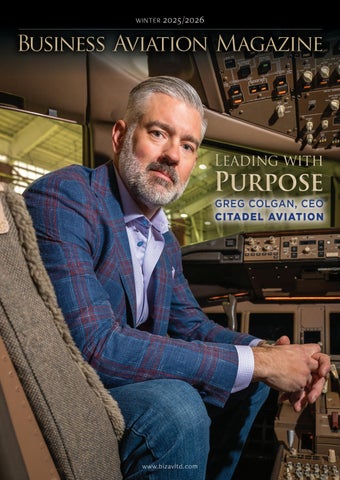
WINTER 2025/2026
GREG COLGAN, CEO CITADEL AVIATION
www.bizavltd.com
SM
Sidewall Cestino Rubino Seat Cielo Kite
DISTINCTLY EMBOSSED. EXPERTLY CRAFTED. Introducing Cestino; one of five new, tactile collections. This leather’s versatile texture, two-tone and hand-tipped finish boasts a luxurious, multidimensional appearance. Cestino is roller-embossed on center-cut hides with no plate lines. Visit garrettleather.com to request samples.
LETTER FROM THE EDITOR
Facing up to growth challenges
WINTER 2025/2026
GREG COLGAN, CEO CITADEL AVIATION
www.bizavltd.com
Nasim Raja CHAIR Max Raja PUBLISHER & CEO Anthony Harrington EDITORIAL DIRECTOR Noel Barton CREATIVE DIRECTOR Roger Baker BUSINESS DEVELOPMENT DIRECTOR Elle Smith SALES EXECUTIVE Zayn Raja SALES EXECUTIVE Jane Stanbury GLOBAL LUXURY CORRESPONDENT
Business Aviation’s Growing Pains Signal a Stronger Future usiness aviation is experiencing one of the most dynamic periods in its history. Demand for private travel has surged to unprecedented levels, driven by shifting corporate travel patterns, new entrants to the market, and a global appetite for flexibility. Yet with this remarkable growth comes a set of equally remarkable challenges — from supply-chain bottlenecks to workforce shortages and infrastructure strain. The good news? These pressures are not signs of decline, but indicators of an industry on the cusp of transformative expansion.
B
The supply chain remains the most visible pinch point. Aircraft and engine manufacturers face historic backlogs, with deliveries stretching years into the future. Avionics components, especially chips, remain constrained, and in some cases airframes are rolling off the line faster than engines can be delivered. But this imbalance is already driving investment in production capacity, automation, and supplier diversification. Manufacturers are modernising facilities, expanding partnerships, and accelerating digitalisation — steps that will ultimately create a more resilient, efficient ecosystem. Infrastructure challenges tell a similar story. Congested airports, limited slots, and stretched FBO capacity reflect the sheer volume of new users entering the market. Rather than a ceiling, this is a catalyst for innovation: secondary airports are expanding services; FBOs are investing in new facilities, including extending the amount of hangarage available and MRO shops continue to expand their capabilities. The industry continues to evolve and innovate. Workforce shortages — from pilots to mechanics to manufacturing specialists — remain a critical constraint. Yet here too, momentum is building. Training pipelines are expanding, apprenticeship programmes are growing, and business aviation is becoming more attractive to younger talent seeking stability and technological sophistication. The industry’s shift toward advanced avionics, predictive maintenance, and AI-driven operations is creating new career pathways that will help close the talent gap.
• www.bizavltd.com •
Environmental and regulatory pressures are also shaping the future in positive ways. Sustainable aviation fuel (SAF) adoption is accelerating, electric and hybrid propulsion technologies are advancing, and operators are embracing data-driven efficiency tools. These trends not only address regulatory scrutiny but position business aviation as a leader in sustainable innovation.
For all enquiries, please contact Max Raja at max@bizavltd.com or on +44 (0)203 865 3736
Yes, the challenges are real — but they are the challenges of an industry expanding faster than its infrastructure, workforce, and supply chain can keep up. That’s a good problem to have. With strategic investment and continued innovation, business aviation is poised not just to overcome these hurdles, but to emerge stronger, smarter, and more resilient than ever.
Printed in the UK by Print Pro Consultancy Distributed by Seabourne logistics, Asendia, and Aeglobal ANTHONY HARRINGTON
BizAv Media Ltd is the holding company. Business Aviation Magazine, BizAv Yearbook, BizAv Events, BizAv Maintenance Conference and BizAv Connect are all subsidiaries of BizAv Media Ltd. BizAv Media Ltd. Copyright: © 2025. All rights reserved.
1
Magazines are printed on FSC® certified paper
CONTENTS
42
Moving with style
Winter
68
issue 36 2025/2026 36
48 76 12 Leading with Purpose Greg Colgan, the recently appointed CEO of Citadel Aviation, talks to Anthony Harrington about the realities of high-pressure MRO operations
62 Going above and beyond Lifetime Warranties 54
22 Rising with demand
68 Moving with style
George Galanopoulos, CEO of Luxaviation UK, on the rising demand for charter
Thilo Wiers-Keiser, Global Sales Director of Mototok, on the origins and evolution of the company’s range of iconic fully electric aircraft tugs
28 The Experience Economy Takes Flight Kenny Dichter, founder of REAL SLX and REAL Jet, on curating unforgettable moments for high-net-worth individuals and why memories matter more than merchandise
36 Local Insights – Scaling Aviation Training for a New Era Andy Trinchero, founder of Academy Aviation, on the company’s expanded reach as Academy Aviation Group (AAG)
42 Solid success Michal Laboutka, Managing Director, Eclair s.r.o., on growing the company’s managed fleet, dealing with market shifts, and navigating a changing region
David Colindres, President, San Marino Aircraft Registry, on meeting today’s complex challenges
76 Bespoke Interiors 48 Innovation as the key to success Gregory Davis, President of Raisbeck Engineering, on his ambitions for the company in the years ahead
54 Parts with Lifetime Warranties: A QT Aerospace world first Barry Fine, CEO of Quiet Technology Aerospace, and Martin Gardner, EXC VP, on innovating to solve serious corrosion and noise problems in aircraft inlets and thrust reversers
2
Noah Zuckerman, CEO of LifePort, on building a company focused on niche projects
82 NBAA 2025 Party Photos from the Hard Rock cafe, Las Vegas BizAv networking event
88 Bringing Cabin Humidification to Business Aviation Eric Beverage, incoming nextgeneration leader within sales for CTT Systems, and Peter Landquist, the outgoing first & original generation leader.
LETTER FROM THE EDITOR
ÐÑÖ Ì×ÕÖ ÆËÈÈÇÔÇÐÖ®ÆËÕÖËÐÅÖ
REDEFINING PRIVATE AVIATION “Your team worked in perfect harmony — operations, crew, and Member Services — to make the impossible possible. That’s not just service; that’s heart, and it’s why you’ve earned our loyalty for life.” - NICHOLAS AIR Member
NicholasAir.com • 866.935.7771 #NicholasAir All aircraft are Owned and Operated by NICHOLAS AIR. NICHOLAS AIR and YOUR JET IS READY are registered trademarks ®2026 NICHOLAS AIR. All rights reserved.
Sundt Air Executive Handling AS
IS-BAH Stage 3 First Scandinavian FBO to reach the Advanced Safety Standard
Sundt Air Executive Handling AS, a part of the Sundt Group, has achieved the International Standard for Business Aircraft Handling (IS-BAH™) Stage 3 registration. The first Scandinavian FBO to achieve IS-BAH Stage 3, Sundt Air Executive Handling is also the second FBO in Europe to achieve the advanced safety standard level.
Executive Handling
IS-BAH Stage 3 Registered Company NATA Safety 1st Clean Certified NATA Safety 1st Certified Professional Line Service Specialists
Safely serving you since 2004 Zero Accidents or Incidents! Frequency 134,175 Mhz, Oslo, Norway - ENGM Gardermoen Airport Tlf + 47 64 82 02 00 | handling@sundtair.com Frequency 134,175 Mhz, Stavanger, Norway - ENZV Sola Airport Tlf + 47 40 04 10 10 | svg.handling@sundtair.com
Handling Supervision - Anywhere in Scandinavia! Sundt Air Executive Handling will supervise and support any flights you have within Scandinavia. Our NATA Professional Line Service and Management teams are the most experienced and can assist in making every flight seamless from arrival to departure.
www.executivehandling.com
Skylink Services Ltd is part of the Skylink Group of Companies. The company is well-established and provides ground handling services for General Aviation Aircraft in Cyprus. We began operations in 1992, filling the gap in the Executive Aircraft ground handling market, at both international airports of Cyprus, Larnaca and Pafos.
LARNACA INTERNATIONAL AIRPORT P.O.Box 43012, CY 6650 Larnaca - Cyprus T: +(357) 24 84 09 00 • F: +(357) 24 66 58 05 E: flightops@skylink.com.cy
24HR OPERATIONS T: +(357) 24 64 33 34 F: +(357) 24 64 35 99
WWW.SKYLINK.COM.CY
Flight Planning 2YHUÀ LJKW DQG /DQGLQJ SHUPLWV *URXQG +DQGOLQJ Fuel :HDWKHU DQG 1RWDP VHUYLFHV +RWHO $FFRPPRGDWLRQ
PHONE: +44 (0)8700 467777 | FAX: +44 (0)8452 800159 EMAIL: OCC@flight-assist.com | WEB: www.flight-assist.com ARINC: HDQFA8X | AFTN: KLGWFJEO
OUR EXPERTISE BRINGS PEACE OF MIND AIRCRAFT INTERIOR DESIGN | ACCEPTANCE AND DELIVERY | AIRCRAFT OUTFITTING COMPLETION CONTRACTS & NEGOTIATIONS | DESIGN ENGINEERING | PROJECT MANAGEMENT MAINTENANCE OVERSIGHT | EXTERIOR DESIGN & PAINT OVERSIGHT When the time comes for a starlink install, fresh paint job, due maintenance, complete cabin refurbishment or a new green completion, trust our team to provide tailored solutions to your aircraft needs. With meticulous attention to detail, our technical oversight and design team will manage your complete project from ideation to completion and delivery. +1 (310) 488-9452 sarah@sarahlarranaga.com
www.sarahlarranaga.com
PROFILE … CITADEL AVIATION
Leading with Purpose: Greg Colgan on Citadel Aviation’s Future Greg Colgan, the recently appointed CEO of Citadel Aviation, talks to Anthony Harrington about the realities of high-pressure MRO operations, what drew him to Citadel’s founding vision, why he is broadening the company’s mandate under the new Citadel Aviation banner, and how he intends to build a culture built on credibility, long-term partnerships, and operational excellence AH: You’ve spent nearly three decades in high-pressure commercial maintenance environments. How has that experience shaped your approach at Citadel?
this through PowerPoint decks and spreadsheets. They’re important tools, but they don’t solve problems. Problems get solved by being on the floor, being active and engaged with your people, the aircraft and understanding the nuances. That’s where credibility is earned.
GC: Everything in the aircraft maintenance world is high pressure. In my previous role we managed roughly 100 active lines of heavy maintenance at any one time—so you can imagine how even the smallest slip could create ripple effects. That level of complexity hard-wires you to think about risk proactively. But aviation as a whole is like that. Everyone is working with high stakes and tight margins. We’re all wound pretty tight because the industry demands it.
And personally, that’s where I find joy. I’ve never once walked through a hangar or a back shop and not been happy to be there. Everyone you meet has some connection to flight, whether it’s a trip they took with their family or the sound of an aircraft passing overhead. That shared passion is part of why this industry works.
What those 29 years really taught me is that the moment you feel things are under control, you better be looking over your shoulder. That’s the nature of MRO. Things can change quickly, and you must do your best to anticipate those changes or respond just as quickly. Coming from the commercial world, I’ve lived through macro-economic swings, geopolitical pressures, and of course the pandemic— which was a shock to the entire ecosystem.
AH: What specifically drew you to Citadel? What made this the right opportunity? GC: It really begins with Mr. Adelson and Dr. Adelson and their shared passion for aviation and their dissatisfaction with how VVIP completions were being handled—too bureaucratic, too slow, too inconsistent—led them to create Citadel. They believed it was possible to build a company that was faster, better, and more reliable. That mindset is still in the DNA of the business.
In commercial aviation, we were tied at the hip with the airlines. Success was measured in fleet utilisation. If we could hand two aircraft back to the airline’s network, that was real money for the customer and a signal that we were aligned in a common definition of success.
While I never had the chance to meet Mr. Adelson, when I was introduced to Patrick Dumont, you can feel the continuity of that vision. There’s a clear expectation that there has to be a better way to serve this market, and there’s a commitment to building it methodically and intelligently.
That mindset—anticipate, adapt, and maintain alignment, translates everywhere. It’s especially true in the VVIP environment. Operational credibility is the real asset. Turn times and consistent performance matter, but so does the relationship behind them. You can’t run a business like
Eight years after Citadel’s founding, what I see is a tremendous opportunity to build something broader than completions. The company has always had a wide skill set comprised of full
12
PROFILE … CITADEL AVIATION
“ Eight years after Citadel’s founding, what I see is a tremendous opportunity to build something broader than completions.” - Greg Colgan, CEO, Citadel Aviation
13
PROFILE … CITADEL AVIATION
nose to tail maintenance, refurbishment, connectivity, and modifications, but completions tended to be the headline. It’s like having an exceptional bakery and only advertising wedding cakes. We can make a lot more than that.
our capabilities. And what’s been energising is seeing how employees have responded—they see the direction and the connection back to Mr. Adelson and Dr. Adelson’s vision, they see the investment, and they’re excited. Industry feedback has been equally strong. There’s a sense that what we’re doing fills a real gap in the market.
Customers today want a partner, not a vendor. They want someone they can trust across the lifecycle of their aircraft and be there to support them when things are not going as smooth. That aligns perfectly with how I like to build teams: put the right people in the right roles, invest in their expertise, and back them with a clear organisational ethos.
AH: What leadership lessons have you carried into this new role, and what are you learning along the way? GC: I’ve learned tough lessons running large operations. In commercial aviation, sometimes you’re not debating aesthetics, you’re telling an airline their aircraft won’t be ready to leave and get plugged back into the network on schedule. That teaches you directness, clarity, and accountability.
One of my first moves was rebranding to “Citadel Aviation”. It signals both internally and externally that we’re broadening
14
PROFILE … CITADEL AVIATION
At Citadel, I’m only a couple of months in, so I’m applying what translates—but with humility. The VVIP world has its own rhythm. I’m asking a lot of questions: Where are the pain points? What’s slowing people down? What would an ideal partner look like from their perspective? There’s a real unmet need for providers who can deliver holistic, predictable solutions. Often, older aircraft or bespoke aircraft projects fall to the bottom of the priority list at large MROs simply because they don’t fit neatly into the operational cadence they need to be financially successful. That leaves owners searching for reliable partners. Our ownership group’s long-term mindset is to build a strategic advantage addressing some of these areas. In my
“ One of my first moves was rebranding to “Citadel Aviation”. It signals both internally and externally that we’re broadening our capabilities. And what’s been energising is seeing how employees have responded.” - Greg Colgan, CEO, Citadel Aviation
15
PROFILE … CITADEL AVIATION
previous world, we moved away from short-term contracts and toward eight- or ten-year agreements. It let us price risk more intelligently and commit to investments that paid off over time. I believe that kind of thinking translates well to what we are looking to achieve here at Citadel.
“ They see the direction and the connection back to Mr. Adelson and Dr. Adelson’s vision, they see the investment, and they’re excited.” - Greg Colgan, CEO, Citadel Aviation
AH: Inventory challenges, supplier relationships, and refurbishment demand are all growing. How are you approaching these issues? GC: Inventory is always a balancing act. There are great technologies now that help identify slow-moving or
16
PROFILE … CITADEL AVIATION
Aircraft refurbishment work is becoming increasingly important. Sometimes parts simply aren’t available anymore. That’s where having integrated capabilities such as completions, maintenance, modifications and refurbishment creates real value. Customers appreciate that we can bring multiple disciplines to the table in one cohesive package.
“ In the VVIP world, the complexity changes. A seat isn’t just a seat; everything is customised. That means you need strong internal cabinetry and upholstery capability, and we need supplier partners who complement our capabilities.” - Greg Colgan, CEO, Citadel Aviation
We have no ambition to be the biggest. That’s not the metric. Operational credibility is. I’ve been deeply impressed by the technical expertise within our team, and that’s allowed us to accelerate our plans.
AH: How important to you is it to maintain financial discipline when we are in a strong market, such as the industry is currently experiencing?
obsolete stock and also evaluate stock availability in real time. I’ve worked with those tools in earlier roles, but in the VVIP world, the complexity changes. A seat isn’t just a seat; everything is customised. That means you need strong internal cabinetry and upholstery capability, and we need supplier partners who complement our capabilities and understand the long game.
GC: There’s no blank cheque, and that’s a good thing. The best time to show financial discipline is when the business and the industry are doing well. That’s when you build resilience—so that when the downturn comes, and it always
18
ak ) Bec ec 8 kØ e 8F )ě e Ik c)¥
) F ¥
{ F e ¥
Bk {F eXF ¥
7 r© =ºrČ2¯ ¡r ½º¯½Ç ă 2¯ª ČU ½© OÇrÛ ĵ H½ ½½ ! = ½ © ªÇÁ Ôr ¤r~¤ ½© OÇ ìîððë 8c ïòÇ Ô ªË ÷ =ºrČ2¯ ¡r÷ !2 îîëðï ă U 2ø Ħì Ćîëðć ñòòČîñôñ ¡r÷ !2 î ª ¯Ĵ ©~rÁÁr ½Č¯º ö ¯© ă ÕÕÕö ©~rÁÁr ½ö ¯© ă !½ ¼Ë ª Ûø ìîìöóëë 7&à ©~rÁÁ
PROFILE … CITADEL AVIATION
veneer panel. My role is to ensure the right experts are in the room, that they’re empowered, and that the ethos of the organisation supports them.
Left to right: Noel Christen, Vice President of Operations, Kasie Jenkins, Vice President of Cabin Programs, and Greg Colgan, CEO, Citadel Aviation
Good people want accountability. They want to win. My job is to put them in a position to win—through resourcing, through structure, and through long-term thinking. When you combine that with humility and curiosity, which the family owners embody, you create a culture that is both highperforming and resilient.
comes, you’re prepared. We’re keeping some of our powder dry, making smart investments, and focusing on stability.
AH: What elements of your leadership philosophy translate most directly into where you see Citadel going in its new, rebranded form?
For me, it all comes back to that simple question: Am I putting the team in a position to succeed? If the answer is yes, the business will follow. |BAM
GC: Culture, accountability, and clarity of purpose. I don’t need to be the one choosing the leather or shaping a
20
LUXURY.
REDEFINED.
CMSAERO.COM
PROFILE … LUXAVIATION UK
Rising with demand Catching up with George Galanopoulos, CEO of Luxaviation UK, on the rising demand for charter
Q
: Have you noticed a rise in demand for charter? If so, what could be causing it?
Q: What are the trending destinations for private jet travellers?
GG: At Luxaviation UK, demand for our charter services is strong. A real trend influencing our sector is the rise of younger jet travellers and aircraft owners. As generational wealth is transferred, and Gen Z’s influence expands across the tech and social media sectors, we’re seeing an increased interest in private travel from this demographic. We’re connecting with them more on TikTok and Instagram. These platforms provide us with a chance to show our aircraft, crew and unique destinations to an audience driven by visual content and social media influence.
GG: Traditional European and Mediterranean summer locations like Mykonos and Ibiza remain hotspots – people want to relax and party, within the same holiday, and these locations allow just that. Major cities like London, Paris and Zurich also continue to be top destinations for our business travel clients. During the winter season, St. Moritz is a go-to for skiing holidays, while others opt to escape the winter blues with trips to Dubai or the Caribbean – St. Lucia is very popular.
22
From Ramp to Route Seamless Support, Worldwide !" #$ % & !" ' #! ' ! " ( ) !!" * ' $ % #$ (! +! " ,- * & !' % " "! $!" ! !( . % %! #! $ + "$ % / '$ %+ )! $) 0! $ ! !$! ' +! !1 ! ! 2 "$ % #! / 3*- / 440 / " $ ## $ - ! ## $ !" ' !5 ! ! ! " # * % % + !$ / # / " $ %
! " # $ $ 6 ,.7 8 $ 9 6 0:7 8 !& 6 ;<7 - ! '$ %+ / 3*- / . " %/ =$ / 440/ > ! 4! / =#! $ 4! % # , % " **4? *< '!! # ) ! %! ! * ' 8 !( @ 4 A 8 0!' !$ % 8 < %% %! @ % 8 ! % 8 2 @ #
23
PROFILE … LUXAVIATION UK
“ Many of our clients also look for that unique and ‘new’ travel experience, somewhere their friends have not been yet. This often includes off-the-beaten-track trips, such as visiting a tribe in Papua New Guinea, diving the Great Blue Hole in Belize, exploring the ‘Gates of Hell’ in Turkmenistan or flying to Antarctica.”
G e org e G alanop o u l o s , CEO, Lux avi atio n U K Many of our clients also look for that unique and ‘new’ travel experience, somewhere their friends have not been yet. This often includes off-the-beaten-track trips, such as visiting a tribe in Papua New Guinea, diving the Great Blue Hole in Belize, exploring the ‘Gates of Hell’ in Turkmenistan or flying to Antarctica. One of the advantages of private aviation is the ability to reach destinations such as these via smaller, more remote runways – places inaccessible to most commercial aircraft. Of course, key calendar events also encourage air charter bookings, such as the Formula One Grand Prix, the British Open golf championship in St. Andrews, and even St. Patrick’s Day. Private jets give our clients the freedom to be there, whenever and wherever the celebrations are happening.
24
XLR BIRMINGHAM EGBB | Fly direct to XLR Birmingham, in the heart of England
Services
Experience a serene and efficient journey at XLR Birmingham with direct tarmac access, ample parking, and stunning airfield views.
•
VIP lounges
•
Dedicated crew facilities
Dive into the excitement of Premier League football matches or the adrenaline rush of the British Grand Prix at Silverstone. If you're attending a sold-out concert, you're just a 5-minute drive from Resorts World Arena & NEC.
•
27,000 sq.ft. heated hangar
•
Private security screening facilities
•
In-house fuel team for quick turnarounds
•
Voted Best Handling Agent / Best FBO 2024 award by Air Charter Association
•
Air Elite Network Member
Our executive jet centre includes:
Our dedicated customer service team goes above and beyond to ensure VIP passengers and private aircraft owners enjoy the ultimate luxury travel experience from start to finish.
xlrjetcentres.com
Experience the difference clarity makes with World Fuel Trip Support When things are smooth, communication matters, and when they aren’t, it becomes crucial. For more than 25 years, our unwavering commitment to providing customers with accurate and clear information has set World Fuel Trip Support apart. WE ARE TRIP SUPPORT.
2024 and 2025 Professional Pilot PRASE Survey Results
LEARN MORE
PROFILE … LUXAVIATION UK
Q: How does Luxaviation UK accommodate the differences between leisure and work charter?
value the flexibility, privacy and reliability we provide. If a sports team needs to arrive in Barcelona for a match that same afternoon, flying privately affords them the security of knowing they will arrive on time, without the stress of commercial airports or the risk of delays.
GG: Understanding what each client values most is key. For leisure travel, this often means families or small groups who want space to relax and unwind. At Luxaviation UK, we believe the journey should feel like part of the holiday itself, so we focus on delivering a seamless, stress-free experience from the very start.
Q: What steps is Luxaviation UK taking to improve sustainability in private charter, and how can travellers make greener choices? GG: The biggest challenge for private aviation has always been the public’s perception of the industry. At Luxaviation UK, we are fully aware of the sustainability challenges and proactively seek ways to reduce our impact.
For business travellers, maintaining the same standard of luxury is essential, but so too is creating an environment that enables productivity at altitude. Private jets provide the space to rest, hold meetings, take calls and focus without interruption. By recognising and meeting these priorities, we show the unique value of private aviation over commercial air travel.
We were one of the first private jet operators to offer a carbon offset programme, and we continue to optimise routes to improve fuel efficiency. We also encourage the use of Sustainable Aviation Fuel (SAF) wherever available.
Q: How have you adapted to the rising demand for group charter flights? GG: We’ve adapted to the rising demand for group charter by tailoring our services to the unique logistics of moving larger parties. This includes sourcing aircraft with the right capacity, bespoke schedules, and providing dedicated account management.
Our latest Sustainability Report shares measurable insights into our progress in key ESG topics, showing how we are putting our vision for sustainable aviation into practice. From electrifying ground operations to launching the industry’s first in-app Carbon Calculator – and earning the Sir Michael Marshall Award for Sustainability in Aviation – we’re continuing to innovate while enabling clients to travel with purpose. |BAM
Luxaviation is renowned for its excellence in safety, compliance and reliability. Large groups also particularly
“ At Luxaviation UK, we believe the journey should feel like part of the holiday itself, so we focus on delivering a seamless, stressfree experience from the very start.”
26
çȒɖȸ ǔƏɀɎƺɀɎ JƏɎƺɯƏɵ ɎȒ ³ɯǣɎɿƺȸǼƏȇƳ וב והד ה גڷ۴ ǔƫȒ۬ƏǣȸɀƺȸɮǣƬƺƫƏɀƺǼِƬȒȅ
0ɴƺƬɖɎǣɮƺ ǝƏȇƳǼǣȇǕ ȵȸȒȇ ۭ RƏȇǕƏȸ ȵƏȸǸǣȇǕ ! x ۭ ÁƺƬǝȇǣƬƏǼ ³ƺȸɮǣƬƺ 0Əɀɵ Ƭƺɀɀ ɎȒ xÁæ ȇɀǣɎƺ ǔɖƺǼ ɎȸɖƬǸ ǝɎɎȵɀٖٖيɯɯɯِƏǣȸɀƺȸɮǣƬƺƫƏɀƺǼِƬȒȅٖ
PROFILE … REAL SLX AND REAL JET
The Experience Economy Takes Flight Kenny Dichter, founder of REAL SLX and REAL Jet, talks to Anthony Harrington about curating unforgettable moments for high-net-worth individuals and why memories matter more than merchandise enny Dichter has a reputation for spotting opportunities others miss. The American entrepreneur revolutionised private aviation not once, but twice—first with Marquis Jet in 2001, then with Wheels Up in 2013. Now, with REAL SLX and its aviation arm REAL Jet, he’s pursuing an even more ambitious vision: positioning himself at the centre of what he calls the Experience Economy. We caught up with Dichter to discuss his latest venture and why he believes the future of luxury lies in curated moments rather than material goods.
K
28
PROFILE … REAL SLX AND REAL JET
“ Our mission is to curate special moments, assemble the partners to make them reality, and deliver experiences that HNWIs will treasure forever.”
AH: Kenny, this is your third major entrepreneurial venture, and each seems more ambitious than the last. What drives you to keep building new companies? KD: I think once you’ve identified how markets function, you start seeing untapped potential everywhere. The question becomes: what can you do that’s genuinely different? What fresh momentum can you create? With Marquis Jet, we took the jet card concept and made private aviation accessible to a much broader audience. With Wheels Up, we democratised access further through a membership model and proved that twin-engine turboprops could represent a new entry level. Now with REAL SLX and REAL Jet, we’re tapping into something even bigger—the Global Experience Market.
intersection of three explosive growth sectors: private aviation, experiential hospitality, and sports wagering and predictions. These are the pillars the Global Experience Economy. Our mission is to curate special moments, assemble the partners to make them reality, and deliver experiences that HNWIs will treasure forever. That creates the business winwin-win: our members get unforgettable experiences, partners associate their brands with premium moments, and everyone walks away delighted. That momentum begets momentum.
AH: The Experience Market—can you define that for our readers? KD: Absolutely. We’ve positioned REAL SLX at the
+ HARTZELL CARBON FIBER PROPELLER 'YMPX XS QIIX 7EMWFIGO *RKMRIIVMRKƶW XST WTIGMǻ GEXMSRW
WOOD CORE | OTHER BRANDS
CARBON FIBER | HARTZELL PROPELLER
Aerodynamic Advantages Stronger Materials = Better Performance Designed For Durability + Built To Last raisbeck.com
Contact Raisbeck to Upgrade your Cessna Caravan or King Air
29
PROFILE … REAL SLX AND REAL JET
AH: That’s quite a vision. Can you put some numbers on this market opportunity? KD: The numbers are staggering. We estimate the Global Experience Market will be worth roughly eight trillion dollars by 2030 with the highest end representing over one trillion dollars. What’s crucial to understand is that affluent consumers and leading brands are fundamentally shifting their core priorities toward premium experiences. This is not a fad, it’s a macro long-term trend—experience-based sectors already outperform goods-based sectors during inflationary cycles and market shifts. We’ve positioned REAL SLX to capitalise on this transformation.
AH: Your pop-up event with Rao’s at the Ryder Cup at Bethpage Black generated considerable buzz. Can you walk us through how that came together? KD: That was truly an epic moment for us. Partnering with Intersport and being selected by the PGA to stage something never done before at the Ryder Cup, and having the opportunity with our partners to create a once in a lifetime on-course culinary experience. For those unfamiliar with Rao’s, it’s not merely an Italian restaurant. It’s a 130-year-old New York institution, one of the most difficult reservations in the world—one has to be invited in. We recreated the entire Rao’s experience at the Bethpage Black golf course— the décor, the atmosphere, and Chef Dino Gatto’s signature dishes. For four nights, our guests experienced something genuinely delicious.
AH: Events of that calibre must carry substantial costs. How do you make the economics work? KD: These are big-ticket productions, but that’s precisely what we do. The key is creating differentiated value. When our brand partners see that unique experiences have a highimpact for HNWIs, it becomes an must-have opportunity for their brands. That’s how we’re attracting some of the world’s biggest brands—Crypto.com presented the Rao’s experience,
30
Fueling the need to fly Global Fuel Savings
FBO Branding
SAF + Book & Claim
Pilot Rewards
Insurance
Carbon Offsets
PROFILE … REAL SLX AND REAL JET
AH: But you’re taking a different approach this time compared to Marquis Jet and Wheels Up. You’re not operating aircraft yourselves? KD: Correct. This go-around, we’re not looking to own aircraft. We’re partnering with the top 100 to 200 operators globally to provide exceptional lift and white-glove service for our REAL members. Robert Withers, who serves as President of REAL Jet, leads a team that works closely with WYVERN, a global leader in aviation safety, providing some of the most rigorous on-site safety audits with our bespoke global operator network. The REAL Jet team has decades of experience and expertise that it brings to our members.
AH: So it’s a pure brokerage model? KD: Yes, but we’re approaching it with an operator’s mentality. Our assets are our people. We’ve built out a global operations centre in Atlanta focused on empowering our operations teams to deliver exceptional service and solve problems in real time. There are world-class brokerage brands that are built to last: Sotheby’s, Christie’s, Burgess Yachts and Camper & Nicholsons are our North Star.
and we’ve proudly partnered with FanDuel, BetMGM, ESPN Experiences, and many other great companies.
AH: Speaking of which, how significant are your partnerships with FanDuel and BetMGM?
AH: What’s been the uptake so far?
KD: They’re transformative. FanDuel has over 12 million registered users. BetMGM’s user base jumped significantly over the last year. These digital platforms have enormous reach and REAL SLX delivers HNWI customers and creates physical touchpoints for the platform’s best customers. We call it “phygital”—seamlessly blending the digital and physical worlds.
KD: In our first three months of operation, we facilitated over 100 flights. I fully expect that we’ll exceed 2,000 flights in our first full year of operation. Our medium-term target (3 to 5 years out) is achieving a 500 to 750 million USD annual run-rate. That would make REAL Jet a very significant player in the global market.
AH: Those are ambitious projections. Where do you see demand coming from?
AH: That brings us neatly to REAL Jet. How does the aviation component fit into the broader REAL SLX ecosystem?
KD: Two primary sources. First, existing private aviation users—since 2001, I’ve served over 40,000 unique customers. Those relationships endure. But perhaps more exciting is the opportunity to bring new private flyers into the market. Of the 22 million millionaires in the United States, only about 250,000 fly privately on a consistent basis. That’s massive untapped potential.
KD: It’s simple; it’s what we do! Over the last 25 years, we’ve brought over 40,000 private jet flyers representing over 10 billion USD to the industry. In order to drive the approximately 90% retention rate that we’ve earned since our foray into private aviation in 2001, we’ve created extraordinary experiences for our members and customers. Add in sports and entertainment and there’s your ecosystem.
We’re also focusing on the newly-minted crypto millionaires—there are over 250,000 of them now—who spend roughly 10% of their
32
Excellence That Soars Above the Rockies.
PROFILE … REAL SLX AND REAL JET
digital earnings on lifestyle alone. Their psychographic profile aligns perfectly with REAL SLX and REAL Jet. They value experiences, they’re comfortable with technology, and they want access.
supplemental lift, or professional sports organizations and Division I universities arranging team travel. REAL Jet and its operator partners have global reach.
AH: You mentioned earlier that experience-based sectors outperform during inflationary cycles. Why is that?
AH: You mentioned the “phygital” concept earlier. Can you elaborate on that? KD: In 2007, my close friend Chris Weil coined the term “Phygital” as a way to describe the intersection between physical and digital ecosystems where all brand experiences lie.
KD: When economic uncertainty rises, material goods feel less appealing. They depreciate, they lose value, they clutter your life. But experiences? Those appreciate in memory. The trip you took with your son or daughter to a championship game or awards show becomes more valuable over time, not less. The evening you spent at a small dinner with your favorite sports, entertainment or business legend—that’s an investment that pays lifetime dividends.
The more AI we consume, the more HI—human intelligence, human interaction—becomes premium. You can order anything online and have it tomorrow. You can stream any film, access any information instantly. What you can’t easily get is authenticity. REAL connections. REAL moments. REAL memories. That’s the space we’re creating.
AH: After two decades in private aviation and multiple successful exits, what keeps you energised about this venture? KD: [laughs] At this point in my life, I could call it a day and slow it down. But this is the most exciting idea I’ve ever worked on. We’re not just selling jet cards or private flights— we’re fundamentally changing how affluent people think about what’s important to them. We’re operating at the intersection of private aviation, hospitality, sports, entertainment, and technology. The opportunity to build a platform that enhances how people live their lives—that fires me up every morning. Our goal is to wipe out the world-wide fun deficit!
AH: How do you ensure consistency across all these experiences you’re curating? KD: Obsessive attention to detail and choosing the right partners. Every REAL SLX experience goes through a rigorous planning process. Exceptional execution is our bar.
AH: Beyond the Ryder Cup, what other events are on the horizon? KD: We’ve got an incredible slate developing. We’re leveraging relationships that we built over the years with major sports and entertainment properties globally. Each activation is bespoke, tailored to that specific event’s character and we always strive to exceed our members’ expectations.
AH: What’s been the biggest challenge so far? KD: Addressing the scale of the opportunity.
AH: You’ve funded REAL SLX personally initially. Are you bringing in outside investors?
AH: You’ve mentioned members several times. Is REAL SLX a membership organisation? KD: We’re building a community of like-minded individuals who value highly curated experiences. A sense of belonging is powerful—it’s what creates long-term relationships.
KD: We’ve now added a small group of highly strategic investors who understand our vision and they bring valuable perspectives. We’ve been very selective. This isn’t about maximising investor count or dollars—it’s about partnering with people who can help us execute the REAL dream.
AH: Looking at the broader private aviation market, where do you see REAL Jet fitting in competitively?
AH: Final question: if REAL SLX achieves everything you’re envisioning, what does success look like in five years?
KD: We’re not trying to compete head-to-head with traditional programs. We’re creating something complementary. REAL Jet operates without membership fees or long-term commitments. It’s designed for flexibility— whether that’s a family vacation or to and from one of our REAL SLX events, a corporation needing primary or
KD: In five years, REAL SLX is the global leader in delivering premium experience. That’s the legacy we want to build. REAL SLX is headquartered in New York, New York and REAL Jet is headquartered in Atlanta, Georgia. For more information, visit realslx.com and realjet.com |BAM
34
PROFILE … ACADEMY AVIATION GROUP (AAG)
Global Reach, Local Insights – Scaling Aviation Training for a New Era Andy Trinchero, founder of Academy Aviation, on the company’s expanded reach as Academy Aviation Group (AAG)
Q
: Andy, a lot has happened over the last year to 18 months. Before we get into the innovations, what’s your view of the current demand for training in the MRO space? Are MROs thriving, or under pressure?
AT: The MRO world is growing, and investment in MRO capability is increasing. Demand for training is higher than ever. At the same time, organizations are under significant pressure. We’re experiencing a global skills shortage that isn’t easing—it’s deepening. MROs are thriving in terms of opportunity, but they’re navigating economic uncertainty, regulatory complexity, rising customer expectations, and talent gaps that widen year by year. For training providers like us, the moment demands innovation. The industry wants faster, more flexible delivery, cross-regulatory capability, and scalable workforce solutions. They want training partners who can meet them wherever they operate—Europe, Africa, Asia, the Americas, the Middle East, or online. That’s the environment we’ve been building toward, and we’re ready for it.
36
PROFILE … ACADEMY AVIATION GROUP (AAG)
Q: Let’s start with the big news: your new brand message, “Global Reach, Local Insights.” How does this reshape the future of training?
• Academy 147 (Malta) • AAMT (Florida)
AT: “Global Reach, Local Insights” is more than a slogan—it’s our direction. In 2025, we unified our business units under one umbrella: Academy Aviation Group (AAG). This includes:
• Academy Aviation Online • ATC Dubai (majority-owned)
CUSTOM PARTNER SOLUTIONS
If we were in a beauty race... We’d finish first,
Every time. Learn more about all the finishes we offer:
S I G N AT U R E P L AT I N G . C O M
37
2 1 0 . 6 5 8 . 5 5 9 9
PROFILE … ACADEMY AVIATION GROUP (AAG)
From these hubs, we can support customers— virtually or on-site—in every country in the world.
“ By bringing our group together, we’re showing that we’re no longer a single training shop. We’re a global network supporting large, multi-site MRO operations.”
The strategy is simple: customers want breadth and consistency. They want one partner who can deliver EASA, UKCAA, GCAA, DGCA India, CAAS Singapore, CASA Australia, FAA, and more, while tailoring that training to local culture and local regulators.
introduced business jet maintenance training in the region. We immediately saw the potential of North, Central, and South America. But FAA-aligned training has its own expectations, so we launched AAMT in 2022.
The new Melbourne facility is the natural evolution of that journey. It gives us: • A physical hub for the Americas
By bringing our group together, we’re showing that we’re no longer a single training shop. We’re a global network supporting large, multi-site MRO operations. And yet, each unit retains autonomy to stay agile for its home market. That balance—global strength with local flexibility—is exactly what the industry has been missing.
• A deeper instructor base • Infrastructure for type training and practical instruction The road wasn’t easy—regulatory alignment, the right location, recruiting experienced instructors, and developing our own materials all take time. But Melbourne positions us for long-term growth. It’s also ideally placed for Latin American and Canadian customers, where demand is strong.
Q: You’ve also opened a new training facility in Melbourne, Florida. What brought you there, and how difficult was it to launch? AT: Our story in the U.S. goes back to 2018, when we first
38
RAISING THE STANDARD OF EXCELLENCE
Engine & APU Airframe & Avionics Paint & Interiors STC Development
DOWNLOAD OUR AIRCRAFT MRO SERVICE & SUPPORT BOOKLET View a full list of our global capabilities by segment and location: > Business Aviation > Commercial / General Aviation > Helicopter
VIEW BOOKLET
PROFILE … ACADEMY AVIATION GROUP (AAG)
This location fits our culture perfectly, and from Florida we can deliver world-class training anywhere in the Americas.
inadequate training cascades risk through every flight. Our approach blends:
Q: How does the new unified website support everything you’re building?
• Rigorous theoretical instruction
AT: Our new site—academyaviationgroup.com —is central to the strategy. Academy 147 and AAMT share many customers, aircraft types, and services. A unified digital home shows the full breadth of what we offer.
• Practical training on real aircraft • Live maintenance environments • Experienced instructors with current, hands-on knowledge and experience in both line and base maintenance of the types they are teaching.
Just as important, is the Academy Aviation Online site— academyaviationonline.com—which delivers self-paced courses across FAA, EASA, GCAA and more. Modern training must be flexible:
The transfer of real-world experience from one generation of maintainers to the next is what keeps aviation safe. The quality of training directly influences the integrity of every aircraft that leaves a hangar. As educators, we have a responsibility to lead by example and promote a strong safety culture.
• Some customers want on-site trainers • Others want virtual classrooms • Others want self-paced global access
Q: Any closing thoughts? AT: What excites me most is what comes next. AAG may be new as an umbrella organisation, but our teams are seasoned, talented, and globally active. We’re expanding across new regulatory spaces, new aircraft types, and new regions.
The unified platform ties these channels together and signals that we’re building a scalable, global training ecosystem.
Q: Let’s talk about the real-world impact of MRO training—passenger and crew safety across millions of flights. AT: First, we don’t only train MROs. We train CAMOs, aircraft operators, and a wide range of industry professionals. Academy Aviation Online is intentionally built for this wider audience.
We’ve grown from a startup in 2014 into one of the major players in business jet maintenance training. This next chapter is about scale, technology, and global capability. We’re committed to innovation, and to helping close the skills gap facing aviation worldwide. Keep an eye on us—2026 will bring major announcements and major advances. |BAM
Ultimately, everything we do comes down to safety. Welltrained maintainers are the backbone of aviation. Poor or
40
15 $&/53& 0' &9$&--&/$&
&VSBWJB TQFDJBMJ[FT JO 15 FOHJOF .BJOUFOBODF 3FQBJS BOE 0WFSIBVM %FMJWFSJOH DVTUPNJ[FE .30 TFSWJDFT ձSTU DMBTT FOHJOF QFSGPSNBODF BOE SFMJBCJMJUZ GPS PQFSBUPST BSPVOE UIF XPSME
-BSHF *OWFOUPSZ PG 4FSWJDFBCMF 0WFSIBVMFE 1BSUT BWBJMBCMF GPS 4BMF PS &YDIBOHF
XXX FVSBWJB BFSP
PROFILE … ECLAIR S.R.O.
Solid success Michal Laboutka, Managing Director, Eclair s.r.o., on growing the company’s managed fleet, dealing with market shifts, and navigating a changing region
Q
: The last few years have been turbulent for aviation. How has the regional situation affected Eclair s.r.o.’s operations?
Q: Take us back to the beginning. How did your aviation career start, and how did that lead to Eclair s.r.o.?
ML: We were hit in two major ways. First, we lost about 35 percent of our charter customers from Russia almost overnight. Second, the airspace restrictions became so extensive that they now stretch all the way toward South Korea and Japan.
ML: My journey began in 2004 with the aeroclub— quite a typical path for Czech pilots. I flew a King Air 90 for a local businessman and the Škoda factory, but at the same time I had my own private business outside aviation.
To reach many destinations, we have to divert through southern corridors—via Istanbul or Dubai—change crews, refuel, and take longer routes. That all adds cost for customers, and it creates an uneven playing field because some operators in Turkey and the Middle East still have access to routes we cannot use.
In 2005, I sold that business to fully commit to aviation and joined ABS Jets , flying the Citation Bravo for eight years. Then, in 2013, I launched Eclair s.r.o.. One of our early customers owned a Piaggio Avanti privately and wanted to move into professional operations under an AOC. We helped establish the AOC based on that aircraft. From there we added a G200 to the AOC, followed by further aircraft. We grew naturally from there.
So yes, it’s challenging. But we’re adapting, and demand outside the affected region has stayed strong.
42
PROFILE … ECLAIR S.R.O.
“ The demand for AOC operations led us to expand. Today, we focus on the management of privately owned aircraft and charter operations.”
Our original intention was only to support private owners through managing factors such as crew training, maintenance coordination and aircraft management. However, the demand for AOC operations led us to expand. Today, we focus on the management of privately owned aircraft and charter operations. Currently we manage five aircraft and we’re adding more, including three additional Challenger 605/650s in early 2026. We also plan to bring in another entry-level jet, possibly a Phenom, or a Citation M2, or perhaps a HondaJet.
43
PROFILE … ECLAIR S.R.O.
Our customers today, in general, can come from all over the world.
At the same time younger HNWIs often want single-pilot aircraft so they can fly themselves. This confines their choices, generally, to single pilot aircraft models.
Q: What about technical support? How do you manage maintenance across your fleet?
All of this influences our business model. But it is important to emphasise that there is still strong demand from clients who want to buy a super-mid-size aircraft and put it under our AOC in order to have us manage costs.
ML: We work with our own licensed technicians, but they operate under the coverage of a German Part-145 maintenance provider. Their certification extends to our base, so in effect we have their technicians on our site and on our payroll.
Q: What about managing unrealistic owner expectations about how much charter sales can defray the costs of ownership?
It is a very efficient system—they can work on our aircraft, and if their other customers come to Prague and ask for for maintenance, they can support them as well.
ML: This is a very key point. We are always honest from the beginning. We still see operators who will promise the Earth to customers simply to win business. It is, of course, fundamentally dishonest to dangle the lure of unrealistic profits in order to attract new customers and it is ultimately a selfdefeating strategy. The customer’s disappointment when it does not work out will come back to bite the operator, yet they still do it, prioritising short term gains over long term relationships.
Q: How would you describe the market today? Stable? Growing? Shifting? ML: I’d call it stable with some upward momentum. We’re seeing more aircraft coming onto the market, both new and as replacements. Flying hours among charter clients are increasing, and, as I said, we expect our managed fleet to grow by three more aircraft soon. At the same time, the G200, which has been with us for 10 years, is being phased out. It will be sold shortly.
One very interesting point, during COVID, a lot of wild expectations and promises could get fulfilled. It was perfectly possible for tremendous profits to be made by buying, briefly holding and then selling on, certain much-in-demand aircraft types. Those days, however, are now completely gone.
Another point I am noticing is that buyer behaviour is changing. The new generation of high-net-worth individuals tends to think differently from the previous generation of billionaires and multi-millionaires. They are less concerned with outright ownership. Fractional programmes are attractive to them as a means to an end.
Today customers need to be provided with clear, realistic business plans and this is exactly what we give them. We make it clear that there will be no unpleasant surprises that come home to bite them a year into the contract.
44
PROFILE … ECLAIR S.R.O.
“ We’re lean, flexible, and not exposed to ownership or major assets that depreciate. We can adjust quickly, and that’s a real advantage.”
Q: How worried are you that the current strong market could suddenly dip into a downturn? ML: The big operators on the market could create ripple effects if they face trouble, but we’re lean, flexible, and not exposed to ownership or major assets that depreciate. We can adjust quickly, and that’s a real advantage.
Q: And looking ahead—how do you see the region, the market, and Eclair s.r.o.’s future? ML: Despite the difficulties in our part of Europe, I’m optimistic. Our team’s knowledge of local markets, languages, and regional dynamics is a major strength. And yes—the reconstruction effort that will follow the end of the conflict in Ukraine will bring significant international investment. Aviation will naturally be part of that broader economic revival. We’re positioned well for whatever comes next. We’re stable, flexible, and confident in our business model. Growth opportunities will continue, both in the region and globally. |BAM
46
DEAUVILLE PARIS-LE BOURGET
CAEN
QUIMPER
CHÂTEAUDUN
SAINT-ÉTIENNE
A CORUNA RODEZ
SANTIAGO DE COMPOSTELA
AVIGNON
BIARRITZ PORTO
BÉZIERS &$3 '·$*'( MADRID
AZORES
CASCAIS LISBON BEJA
TRIESTE
ALBENGA
SAINT-TROPEZ
GIRONA BARCELONA
VALENCIA
PALMA DE MALLORCA
FARO
MALAGA MADEIRA
CUNEO
CANNES
THESSALONIKI
IBIZA CORFU AKTION ATHENS MYKONOS PAROS SANTORINI CHANIA
HERAKLION
LARNACA PAPHOS
PROFILE … RAISBECK ENGINEERING
Innovation as the key to success Gregory Davis, President of Raisbeck Engineering, on his ambitions for the company in the years ahead
Q
: As the President of Raisbeck, how do you intend to shape the company’s strategy, especially in terms of innovation or new market segments? GD: Over the next five years, my strategy has three clear priorities.
• First, we will continue to grow Raisbeck’s in-house products by responding directly to market demand and operator feedback. Raisbeck has always succeeded by solving real problems for the King Air and Caravan communities, and we intend to accelerate that by expanding the depth and cadence of our internally engineered upgrades. • Second, we will expand our offerings through strategic partnerships with companies whose technologies complement our own. Our collaborations with CiES and Metrea are great examples — leveraging Raisbeck’s brand, engineering rigor, and global sales reach to bring highvalue products to market more quickly. We will continue identifying companies where teaming together creates solutions neither could deliver alone.
48
PROFILE … RAISBECK ENGINEERING
“ We will expand our offerings through strategic partnerships with companies whose technologies complement our own. Our collaborations with CiES and Metrea are great examples.”
• Third, we will grow Raisbeck’s international presence by expanding sales and dealer engagement beyond the U.S. target markets include Canada, Brazil, Peru, Australia, and the European Union. These are all regions with strong turboprop fleets and operators who value the performance, reliability, and mission flexibility Raisbeck products deliver. Taken together, this strategy builds on Raisbeck’s strengths while positioning the company for broader global influence and long-term, innovation-driven growth.
GD: CiES is the industry leader in digital fuel-quantity sensing, and their technology solves a persistent pain point for King Air operators: aging, analog fuel-measurement systems that lack accuracy and reliability.
Q: Raisbeck recently announced a partnership with CiES Inc. to deliver a next-generation fuel quantity indication system (FQIS) for the Beechcraft King Air series. What prompted this move, and how does it fit into Raisbeck’s broader product roadmap?
Working with CiES allows us to bring a modern, fully digital FQIS to the King Air platform — improving reliability, maintainability, and pilot confidence.
ÞɝǠ Ģɬ˔ʢljǠճ ńɝɆȜɗȜ˄ǠǓ ÞȂȂǠʢȜɝȅʰճ Ë Ëy ÕĶMyËÕÏĶ ÏÕË ÚÕ ¼¶ĶÈ˼ä ÏĶ¼¶ Ķ¼ ĶÕ Ķµ¼ÏÕĶ ¼µÈË ¶Ï ä Ķ¼ Ë ¶ ÏĶ¼ ĶÏ Ëä ÏĶy¶ ĶÈyËÕÏĶ ¶ĶÕ Ķ ¶ ÚÏÕËëĶ Õ¼ yëěĶ ˼µĶy¶Ķ êÕ ¶Ï ä Ķ ¶ä ¶Õ¼ËëĶ¼ Ķ; åĶMyËÕÏĶy¶ ĶP¼Õy ¯ ÏĶ ¼ËĶ ¼µ yË ËĶ!¯¼ y¯ĖĶ y¯¯ ¶ ËĖĶ4 y˪ ÕĖĶ%yå¬ ËĖĶ ÕyÕ ¼¶ĖĶ Ëy ÕĶy¶ Ķ!Ú¯ ÏÕË yµĶµ¼ ¯ÏĶĪĶÕ¼Ķ ¶ ÚÏÕËëī¯ y ¶ ĶP Èy ËĶ:y¶y µ ¶ÕĶT Ëä ÏĖĶ Ë Ëy ÕĶMyËÕÏĶ ÏÕË ÚÕ ¼¶Ķ ÏĶÕ ĶÏ ¶ ¯ īϼÚË Ķ ¼ËĶë¼ÚËĶ ¶ ä Úy¯Ķy Ë Ëy ÕĶÈyËÕÏĶ¶ ÏěĶ
5ÞÐķ 5ķ ńĢ ķ ʰƚɆǠʰƚȜʢljʢƚȂ˄ʜƚʢ˄ʰճɝǠ˄
49
3 ÅtÅ3 Ó Á3ÅÓÍ z ÍÓÅ sØÓ µ¯
ҭҫҰ֬ҭұү֬үұҲҪ ץƚȜʢljʢƚȂ˄ʜƚʢ˄ʰճɝǠ˄
PROFILE … RAISBECK ENGINEERING
Strategically, it aligns perfectly with our roadmap, which now pairs Raisbeck’s well-known aerodynamic enhancements with modernisation of critical aircraft systems. It reflects our expansion toward integrated performance and cockpit-experience upgrades that extend the utility and value of the King Air fleet.
We are targeting the largest market first — the 200-Series — since it represents the greatest demand and opportunity. Installations will begin on the timeline we’ve outlined, with first deliveries in 2026. From there, we will roll out the solution model by model until every operator who wants it has access.
Q: The new FQIS kits are slated for STC approval in Q4 2025, with first deliveries in Q2 2026. Can you outline the main certification challenges and what the company is doing to ensure a smooth rollout?
Q: With increasing attention on operating costs and aircraft efficiency, how does Raisbeck balance performance improvements with cost, maintenance burden, and certification complexity?
GD: The technology behind the new FQIS is proven, and the fuel senders already have TSOs. The complexity lies in the varied configurations of the many different King Air models in service.
GD: Operators today are focused on value: every upgrade must earn its place on the airplane. With that in mind, we design Raisbeck products to deliver a clear and measurable operational return.
50
In A Class of Its Own M&N Aviation, based at Centennial Airport in Centennial, Colorado, is a boutique provider ȉnj٪ƲɫƤƲȬɅǛȉǾƇdzdzɬ٪ƲɫȬƲȯǛƲǾƤƲƫؙ٪ȮɍƇdzǛ˚٪Ʋƫ٪ƇǾƫ٪ƤƇǾƫǛƫ٪ȬȯǛɥƇɅƲ٪ƇɥǛƇɅǛȉǾ٪ȷƲȯɥǛƤƲȷؘ٪
When you engage M&N Aviation for your Private Aircraft Charter, you will have a controlled experience that is honest and candid, with factual and realistic cost and expectation setting ƇǾƫ٪ǼǛȷȷǛȉǾ٪ƇȬȬȯȉȬȯǛƇɅƲ٪ȯƲȷɍdzɅȷؘ٪
ãȉɍ٪ ɦǛdzdz٪ ˛٪ɬ٪ ȉǾ٪ ȉǾƲ٪ ȉnj٪ ȉɍȯ٪ ȉɦǾ٪ ǼƇǾƇǍƲƫ٪ ƇǛȯƤȯƇnjɅ٪ ȉȯ٪ ƇǾ٪ ƇǛȯƤȯƇnjɅ٪ ɅǕƇɅ٪ ǼƲƲɅȷ٪ ȉɍȯ٪ ȷɅȯǛǾǍƲǾɅ٪ ȯƲȮɍǛȯƲǼƲǾɅȷ٪ȬƲȯɅƇǛǾǛǾǍ٪Ʌȉ٪ȷƇnjƲɅɬؙ٪ȯƲǍɍdzƇɅȉȯɬ٪ƤȉǼȬdzǛƇǾƤƲ٪ƇǾƫ٪ǼǛȷȷǛȉǾ٪Ȭȯȉ˚٪dzƲؘ٪
Please contact us by phone at: ׀ֿׁ־ׇׇؘؘׅ־׀ׅ Or e-mail us at: ƤǕƇȯɅƲȯہǼƇǾƫǾؘƇƲȯȉ
PROFILE … RAISBECK ENGINEERING
For example, our EPIC Performance Package for the King Air B200 improves climb rate and cruise speed, while also expanding range, opening access to shorter or higheraltitude runways, and creating a quieter, smoother passenger experience. Those benefits translate directly into productivity and flexibility for the operator. When evaluating new products, we consider the full picture: mission capability, installation downtime, integration into existing maintenance programs, and long-term support. We target opportunities to enhance performance — such as our High-Flotation Gear Doors, which restore OEM performance while accommodating larger wheels. We also look to improve reliability, efficiency, and comfort across all phases of flight, as seen with our Ram Air Recovery System, Enhanced Performance Leading Edges, and Swept-Blade Propellers. Our philosophy is simple: real performance gains, minimal burden, and long-term value for operators and passengers.
Q: With 140+ dealers worldwide, how is Raisbeck adapting its services and support to different regional regulatory environments and customer needs? GD: Our dealer network is a cornerstone of Raisbeck’s success, and we are investing in standardised documentation, training, digital support tools, and technical resources to ensure consistent quality across regions. Because regulatory environments vary — FAA, EASA, ANAC, CAAC, and others — our engineers maintain a global focus on certification services that support validations, export approvals, and region-specific requirements.
Just as with any premium brand, there is global demand for the performance, quality, and reliability associated with Raisbeck products. We plan to expand the reach of our existing upgrades into new regions, beginning with Europe, Brazil, Peru, Canada, and Australia. These markets have strong turboprop fleets and operators eager for enhancements that improve capability, efficiency, and passenger experience.
On the product support side, we are continuously improving our illustrated parts catalogues, maintenance manuals, installation resources, and training to ensure dealers can support operators reliably, even in remote or demanding environments. The outcome is a unified global Raisbeck experience, regardless of aircraft registry or mission profile.
At the same time, we remain highly responsive to operator needs. That agility will continue to drive new product development. You can expect the success we’ve had on the Caravan and King Air platforms to translate into solutions for new aircraft types. Initially, these will be aftermarket offerings, but over time we anticipate expanding into OEM installations, bringing Raisbeck performance improvements directly to the production line.
Q: Looking ahead to the next 3–5 years: what are Raisbeck’s strategic priorities under its current leadership, and how does the company view emerging trends in aviation? GD: I view Raisbeck’s future through a three-dimensional Ansoff matrix: products, aircraft types, and geographic reach. Our goal over the next five years is to expand along all three dimensions.
Our priorities are clear: grow our product portfolio, broaden the range of aircraft we support, and build a much larger global footprint. This multi-axis expansion positions Raisbeck to remain a leader in performance and missionenhancement solutions as the industry evolves — whether through regulatory changes, sustainability trends, or emerging propulsion technologies. |BAM
Geographically, Raisbeck already has deep penetration in the United States — the largest general-aviation market in the world — but the rest of the world represents an immense opportunity.
52
Luxury seats are common * FHUWLƮHG SHGHVWDO VHDWV DUH QRW 9LVLW XV DW $LUFUDIW ,QWHULRUV ([SR 6WDQG $
www.lifeport.com
PROFILE … QUIET TECHNOLOGY AEROSPACE
Parts with Lifetime Warranties:
Barr y F i ne, CEO, Qu iet Technol o g y A e ro s p a ce Barry Fine, CEO of Quiet Technology Aerospace, and Martin Gardner, EXC VP, on innovating to solve serious corrosion and noise problems in aircraft inlets and thrust reversers
Q
: Barry, how did Quiet Technology Aerospace begin, and what problem were you originally trying to solve?
That product achieved something unprecedented: it was the first commercial carbon-fibre aircraft component certified by the FAA, back in 1986. That certification alone took 3 years of testing and development. The technology used carbongraphite honeycomb acoustic barrels that absorbed fan blade noise rather than reflecting it forward, which dramatically reduced the high-frequency whine from the tips of the fan blades that people find seriously irritating.
BF: Next year marks 40 years since I first produced parts in aviation. I started with a cargo airline with my father operating noisy DC-8s. At the time, two companies were trying to develop hush kits to meet emerging noise regulations. One of them had an all–carbon-fibre acoustic inlet solution, and we ultimately acquired that company — Quiet Nacelle Corporation — which became Quiet Technology Aerospace (QTA).
Q: Why was carbon fibre such a breakthrough compared to existing designs? BF: At the time, competitors were using aluminium
54
PROFILE … QUIET TECHNOLOGY AEROSPACE
A QT Aerospace world first
Ma r ti n G ard ne r, E XC V P, Qu iet Technol o g y A e ro s p a ce honeycomb construction. The problem was moisture — rain, washing fluids — which penetrated the acoustic mesh becoming trapped in the all-aluminium honeycomb cells and caused corrosion. Carbon-graphite didn’t suffer from corrosion at all.
1990s, we had to evolve. That led us into thrust reversers, exhaust mixer nozzles, and ejectors, all incorporating carbon-fibre acoustic structures. We applied these upgrades to military 707s, Gulfstream GII’s and GIII’s, and completed roughly 130 aircraft in that phase. The aft exhaust ejectors were carbon fibre as well — lightweight, acoustically effective, and extremely durable. The aircraft burned a little bit more fuel during climb-out but once it settled into long range cruise, it burned less fuel, so that meant there was no fuel penalty to flights longer than an hour or more.
We quieted around 78 DC-8 aircraft using this approach. It equated to 312 Nacelles we quieted down. It was lightweight, aerodynamically efficient, and had no adverse fuel impact installing the hush kits; it just reduced the noise dramatically. What we found out over time was that the hush kits extended the life of the aircraft. Aircraft without the technology were being phased out while aircraft with it continued flying. It became indispensable.
Q: Martin, how did this experience translate into later Inlet Upgrades?
Q: How did the technology evolve as noise regulations tightened?
MG: One turning point came at a Gulfstream operators’ conference, where corrosion issues in aluminium inlet barrels were a major complaint — particularly on the G200. Operators were extremely unhappy, and the manufacturer had no solution.
BF: Initially, the solution met Stage 2 noise regulations, but when ICAO introduced Chapter 3 standards in the late
55
PROFILE … QUIET TECHNOLOGY AEROSPACE
Q: How successful was that program?
“ We backed the product with something unheard of in aviation: a Lifetime Warranty, tied to the aircraft serial number. Ownership changes don’t matter — the warranty stays with the aircraft. To this day, we’ve had no warranty claims.”
MG: Very. We received the Lear 60 STC in 2016. Since then, we’ve produced over 300 Inlet barrels for that fleet alone, out of roughly 400 remaining aircraft. We’ve had zero structural failures. We backed the product with something unheard of in aviation: a Lifetime Warranty, tied to the aircraft serial number. Ownership changes don’t matter — the warranty stays with the aircraft. To this day, we’ve had no warranty claims.
M a r t i n Ga rd n e r, E XC VP, Qu i e t Te ch n o l o g y A e ro s pace
Q: How did this lead to work on larger platforms like the Challenger 300/350? We immediately recognised the problem because it was exactly what Barry had seen decades earlier on the DC-8s. So, we applied the same carbon-fibre inlet barrel technology to a series of corporate jets.
MG: A charter operator (Jet Select) approached us about corrosion on Challenger 300 inlets, powered by the Honeywell HTF7000 engine. That same nacelle design was used across multiple platforms: Challenger 300/350/3500, Gulfstream G280, Embraer Legacy 450/500 and Praetor 500/600 and Textron Longitude 700.
We started with the Learjet 60, followed by the G200, and Falcon 2000EX/LX models all powered by the PWC305 series engines. The construction — aluminium honeycomb with stainless steel acoustic mesh — was failing in the same way in these aircraft types. Carbon fibre solved the corrosion problem completely and our Inlets all weighed less than the original.
We developed a carbon-fibre Inlet Upgrade, all by STC, certified it in 2018, and demand was immediate. That success led directly to the bigger challenge: tackling the thrust reverser corrosion on all the family of aircraft powered by the HTF7000 series engines.
56
ʸˡ˔˕˟˘ ˬˢ˨˥ Є ˜˚˛˧ ˢˣ˘˥˔˧˜ˢˡ˦ One-stop security intelligence & training for business aviation
ٔ BESPOKE AVIATION RISK MANAGEMENT ٔ DYAMI ACADEMY: TRAINING FOR BUSINESS AVIATION CREWS
www.dyami.services/bizav
57
PROFILE … QUIET TECHNOLOGY AEROSPACE
Q: What was wrong with the original thrust reverser design?
Once corrosion exceeded limits, the doors had to be scrapped. Operators were facing recurring AOG events and with doors beyond limits it caused a maintenance nightmare to the industry.
MG: The original doors were made from aluminium 2219, which simply cannot survive sustained exposure to jet exhaust and combustion byproducts. The environment is incredibly corrosive. Safran’s interim fix involved grinding out the corrosion and applying special coatings, but those coatings eroded quickly and the structure continued degrading.
Q: What solution did Quiet Technology develop? BF: We re-manufactured the aluminium doors and side beams and integrated new titanium skins to the surfaces impacted by the jet exhaust, all by STC. This was
58
PROFILE … QUIET TECHNOLOGY AEROSPACE
Q: How has the market responded?
CP-70 commercially pure Titanium, which is highly ductile, corrosion-proof, and extremely resistant to vibration and sonic fatigue.
BF: Exceptionally well. As of now, we have 120 aircraft sets of QTA TRs flying and over 600 inlet installations. That represents about 5.8% of the existing global fleet, and the fleet is still growing by roughly 150 aircraft per year. Many orders for 2026 are already booked.
Critically, we scientifically maintained the exact inner mould line, throat area, and exit geometry, so there was zero aerodynamic or performance difference when compared to a new original TR. That was non-negotiable from day one.
These thrust reversers are FAA-classified as “New” parts, with new QTA part numbers and broad international regulatory approval and acceptance. Our polished titanium is visually striking, and functionally permanent. Like our Inlets, they carry a Lifetime Warranty.
We filed for the STC in December 2020 and received approval in May 2023, after about 2.5 years of research, design and development.
“ We re-manufactured the aluminium doors and side beams and integrated new titanium skins to the surfaces impacted by the jet exhaust, all by STC. This was CP-70 commercially pure Titanium, which is highly ductile, corrosion-proof, and extremely resistant to vibration and sonic fatigue.”
B arr y F ine, CEO, Q uiet Technolog y Aero space
59
PROFILE … QUIET TECHNOLOGY AEROSPACE
Q: Are these Upgrades now appearing on new aircraft?
Q: How broad is Quiet Technology’s current product portfolio?
MG: Yes — and that’s a major shift. At NBAA last October ‘25, we announced that AB Jets, operating three new Challenger 3500s, is installing our Inlets and Thrust Reversers from day one on new-build aircraft.
MG: We now support nine inlet products, including large platforms like the Gulfstream G450, as well as all HTF7000 powered aircraft with inlet and thrust reversers Upgrades.
BF: They remove the OEM parts, send them to us, and install our Upgraded components before entry into service. The goal in doing this is to eliminate all future corrosiondriven downtime along with AOG risk. AB Jets call these the “no excuse airplanes”.
All are cleared for the aftermarket, and increasingly, for installation on new aircraft. Across these platforms, the addressable market exceeds 2,000 aircraft, with another 2,000 expected over the next five years. |BAM
We believe this will become a growing trend.
60
PRECISION SYSTEMS FOR PRECISION AIRCRAFT CAV Systems delivers proven ice protection solutions for Hawker and other leading business jets. Engineered for performance, safety and reliability.
CAV’s relationship with Hawker stretches back over 50 years, when we designed and manufactured TKS® panels for their first business jet... 20 years later, we became responsible for the entirety of the Hawker’s leading edge sections. Today, we are the only company equipped to overhaul TKS® panels and Hawker leading edge sections to the original specifications. We combine proven history with innovation, keeping your aircraft flying safely, efficiently and reliably.
cav-systems.com customerservice@cav-systems.com sales@cav-systems.com
PROFILE … SAN MARINO AIRCRAFT REGISTRY
Going above
and beyond David Colindres, President, San Marino Aircraft Registry, on meeting today’s complex challenges
Q
: How are things with San Marino Aircraft Registry today?
The short version? We’re scaling, but carefully. We’re very protective of the reputation of the flag, even as we make the process easier and more transparent for serious clients.
DC: San Marino Aircraft Registry is in a strong phase of growth and consolidation. We’ve really been focused on three things: service quality, regulatory credibility, and what I call “speed with certainty” – meaning efficient timelines without compromising on oversight.
Q: The recent Polar Operations approval for the ACASS San Marino team made some noise. What does that achievement represent? DC: It’s an important milestone because Polar Operations are among the most demanding operational environments— technically, procedurally, and from a safety-governance standpoint.
Operationally, we continue to attract owners and operators who want a premium, stable jurisdiction with a registry that’s accessible, responsive, and commercially aware. At the same time, we’ve been sharpening our internal processes, strengthening our partner ecosystem, and making sure the Registry experience feels more like a high-end service than a bureaucracy.
You’re dealing with complex route planning, crew training, dispatch, MEL considerations, contingency procedures, and a higher bar for operational robustness. What this approval really demonstrates is that the San Marino framework can
“ We’ve been sharpening our internal processes, strengthening our partner ecosystem, and making sure the Registry experience feels more like a high-end service than a bureaucracy.”
62
InXJRÁ³ áXÁR ÈÁ ! x¨« xX³0 áǝƺɎǝƺȸ ɵȒɖٔȸƺ ɎȸƏɮƺǼǣȇǕ ǔȒȸ ƫɖɀǣȇƺɀɀ Ȓȸ Ǽƺǣɀɖȸƺً 0ƬǼƏǣȸ ɎƏǣǼȒȸɀ ƺɮƺȸɵ ǔǼǣǕǝɎ ɎȒ ɵȒɖȸ ɖȇǣȷɖƺ ȇƺƺƳɀِ
IǼƺɴǣƫǣǼǣɎɵ
HFODLU DHUR
¨ȸǣɮƏƬɵ ƏȇƳ ƬȒȅǔȒȸɎ
ƺɀȵȒǸƺ ɀƺȸɮǣƬƺ
PROFILE … SAN MARINO AIRCRAFT REGISTRY
support high-complexity operations when they’re backed by the right operator standards and compliance culture.
These are exactly the conversations we want to be having, because the registry is a key part of the overall ownership and operating strategy.
It also reflects very well on ACASS as an organisation: strong documentation, strong operational control, and the discipline to meet audit requirements in full.
Q: How are current geopolitical tensions affecting business aviation from your vantage point? DC: Geopolitics is clearly shaping the operating environment. The main impacts we see are:
More broadly, it sends a clear signal to the market: San Marino is not just a “paper registry.” We’re fully capable of supporting sophisticated missions and serious international operators—provided the standards are met.
Route complexity and airspace constraints – more planning, longer routings, higher costs, and a greater need for disciplined dispatch.
Q: You were at the Dubai Airshow and MEBAA. What major themes are you seeing in Middle East business aviation right now?
Sanctions and compliance pressure – deeper KYC, more rigorous due diligence, and greater investor sensitivity.
DC: Three big themes stand out.
Volatility in operations – sudden changes that can affect Sustained demand and fleet expansion - Appetite for
insurance, permitability, and general feasibility of certain routes or basing strategies.
business aviation in the region remains very strong. We’re seeing more aircraft, higher utilisation, and a continuing professionalisation of operations.
That said, business aviation is also very adaptable. When commercial routes and schedules become complicated or unreliable, business aviation often becomes more attractive for continuity, especially for time-critical or senior-level travel.
Premium experience plus reliability - Owners still care about product and cabin, but increasingly their real focus is on dispatch reliability, crew quality, maintenance continuity, and operational flexibility. The market is becoming more mature—less about “flash,” more about performance and dependability.
The key is to operate with strong compliance, robust governance, and to choose jurisdictions and partners that can handle scrutiny professionally. That’s where a credible registry and good structures make a real difference.
Regulatory and structuring sophistication - There’s Q: Are you positive about Europe going into 2026?
much more awareness now of registration strategy, operational models, financing alignment, and cross-border compliance. People are asking sharper questions: Which flag best supports my mission profile? What do financiers prefer? Which framework makes transitions easier? How do I protect asset continuity over the long term?
DC: Cautiously positive, yes. Europe remains a cornerstone market with sophisticated operators, strong infrastructure, and resilient demand drivers. The sector is performing, but in a more disciplined way:
64
FBO AND CHARTER SERVICES IN BRAZIL WITH TAM AVIAÇÃO EXECUTIVA With more than 60 years of experience, TAM Aviação Executiva delivers the best infrastructure and premium service for aircraft, passengers, and crew.
Ground Handling: Full assistance with immigration and customs procedures Bilingual staff End-to-end flight operation planning Complete infrastructure at Brazil's top international airports Aircraft Charter: Dedicated team available 24/7 One of the most modern fleets in Brazil Safety under strict operational protocols CONTACT US
Comfort, privacy, and exclusivity onboard
Elite Flight Services
Contact Olesia Samoilenko at Skytrek:
¯g㽧-g٪ȬȯȉɥǛƫƲȷ٪ȬȯƲǼǛɍǼ٪˛٪ǛǍǕɅ٪ƤȉȉȯƫǛǾƇɅǛȉǾ٪njȉȯ٪
Email:٪ƤǕƇǛȯǼƇǾہȷǯɬɅȯƲǯؘƇƲȯȉ
¤ȯƲȷǛƫƲǾɅǛƇdzؙ٪ÜU¤ؙ٪%ǛȬdzȉǼƇɅǛƤؙ٪ƇǾƫ٪ ȉȯȬȉȯƇɅƲ٪ƤdzǛƲǾɅȷؙ٪
Phone: +90 549 113 86 00 Mobile:٪׆ׁڋ٪ׅׄ־٪ׁׂׂ٪׀־٪׆ׅdz٪
ƲǾȷɍȯǛǾǍ٪ȷƲƇǼdzƲȷȷؙ٪ȷƲƤɍȯƲؙ٪ƇǾƫ٪dzɍɫɍȯǛȉɍȷ٪ɅȯƇɥƲdz٪
www.skytrek.aero
ƲɫȬƲȯǛƲǾƤƲȷؘ
65
PROFILE … SAN MARINO AIRCRAFT REGISTRY
• Clients are value-conscious and expect high service levels. • Regulatory scrutiny and operational standards continue to rise—which, in my view, is healthy long-term. • Fleet decisions are increasingly tied to financing conditions, resale value, and compliance predictability. So I’m positive, but realistic. Those who invest in governance, service quality, and operational excellence will do very well going into 2026. Those who cut corners will find the environment increasingly unforgiving.
Q: What are your main priorities for San Marino Aircraft Registry in the coming year? DC: Our roadmap is quite clear and built around five priorities:
Premium positioning - Continue to build San Marino as a differentiated, high-end registry—where the customer experience is polished and the governance is respected by regulators, financiers, and operators. Operational capability
and continuity - Make transitions—operator changes, private ops setups, ownership updates—as seamless as possible while maintaining strong oversight. Clients should feel that complexity is being managed for them, not added to their workload. • Anything that reduces friction and uncertainty in those areas is viewed positively. A strong registry is part of the overall risk-management package that helps financiers sleep at night.
Stronger partner network - Deepen relationships with trusted providers in management, CAMO, maintenance, legal, and finance so that clients know they are supported end-to-end, not just at the registration step.
Q: What’s the biggest misconception you encounter about aircraft registries?
Market development in priority regions - Continue
DC: That it’s “just paperwork.”
outreach across Europe and the Middle East in particular, meeting owners, operators, and financiers where they are and speaking their language in terms of structure, risk, and credibility.
In reality, a good registry is a risk-management tool. It’s about safety oversight, audit discipline, operational governance, and a service model that helps serious operators stay compliant without unnecessary delays.
Brand and communications - Tell the San Marino story better: stability, service, sophistication, and long-term credibility. We want the perception of the flag to match the reality we’ve built.
If a registry is doing its job well, everyone around the aircraft— owner, operator, financier, insurer—has more confidence in the asset and its operation.
Q: What makes an offshore registry attractive to financiers?
Q: Is there one trend you expect to accelerate in 2026?
DC: Financiers like predictability and clarity. They look for:
DC: I expect to see even more emphasis on what I’d call “compliance-grade operations.”
• Clear title and recognised legal frameworks. Clients will increasingly choose structures, operators, and registries that can stand up to scrutiny, not just offer convenience. The days of purely opportunistic setups are fading. The industry is moving towards combinations of flexibility and robustness, and I think that shift will only accelerate in 2026. |BAM
• Consistent, transparent compliance. • Smooth processes for repossession, transfers, and operational continuity if things go wrong.
66
Maintenance: technics@nomadtec.eu | Management & Charter: fly@nomadjet.eu NomadClasicCar.indd 1
www.nomadjet.com
01.07.24 20:15
PROFILE … MOTOTOK
Moving with style Thilo Wiers-Keiser, Global Sales Director of Mototok, on the origins and evolution of the company’s range of iconic fully electric aircraft tugs
Q
: Thilo, can you tell us a little about Mototok’s origin. How did the company start?
TW-K: Mototok traces back to 2003, when it was founded by Kersten Eckert and his partner Thilo Wiers-Keiser. The idea came from a practical problem: Kersten was frustrated by how difficult it was to manoeuvre aircraft in and out of tight hangars manually. He was convinced he could build a better, simpler solution — and from the beginning, Mototok was conceived as fully electric. We never built diesel or gasolinepowered tugs.
68
PROFILE … MOTOTOK
“ Eventually, we rolled out three different product lines for the commercial market: from small business jets, through mediumsize business jets, up to machines rated for narrow-body aircraft.”
Q: How did the product line evolve — from small aircraft to business jets and beyond? TW-K: At first, Mototok started with smaller aircraft. Over time, we moved up incrementally — refining our design, adding remote-control capability, and expanding pulling/towing capacity. Eventually, we rolled out three different product lines for the commercial market: from small business jets, through medium-size business jets, up to machines rated for narrow-body aircraft. The very first sale was in 2008, and the customer was based in Switzerland. It wasn’t easy: there was a competing USbased manual-bar tug manufacturer who put forward a lot of sceptical comments concerning our remote-controlled, electric approach. But once our first professional customer, the Federal Police in Germany, saw the advantages, everything started to go our way.
The first version took a while to reach the market. This was partly because we needed to become confident as far as both performance and safety were concerned. With even small aircraft you are moving very expensive assets about so it was essential to be very confident in our equipment and that it could be operated very safely.
69
PROFILE … MOTOTOK
Q: What makes Mototok different from traditional diesel or tow-bar tugs?
can operate a Mototok. No driving licence is required. The remote-control system gives full visibility around the aircraft, so there’s no need for a wing-walker or additional staff.
TW-K: Several things, but it all comes down to four factors: simplicity, efficiency, safety, and low maintenance. Because our tugs are fully electric and remote-controlled, they eliminate many of the common problems associated with diesel tugs. With the latter, you have to deal with frequent mechanical breakdowns, constant oil changes and heavy maintenance schedules. By way of contrast, our tugs rely on maintenance-free batteries and electric motors that deliver high torque right from standstill.
Because there’s no complex manual coupling or winching, human error is largely eliminated. Everything from the initial connection to the nose wheel to lifting and securing is automated, with sensors and safety interlocks.
Q: Who uses Mototok and where? TW-K: Mototok exports worldwide. The United States is our largest market, especially for business-jet operations. But our machines are used globally: in South America, Asia, Europe and beyond. They serve a wide range of clients: fixed-base operators (FBOs), MRO facilities, OEM aircraft manufacturers (during production and delivery), military operators. They are also increasingly used in commercial airport ground operations for aircraft pushbacks at major airports.
Also, the tug connection to the aircraft’s nose gear is hydraulic and closely sensor monitored. The operator doesn’t need to use winches, straps, or tools. They simply drive the tug to the nose wheel, press a button, and the hydraulic system locks and lifts the nose gear in seconds. It takes about 10–15 seconds from approach to ready-to-move. Because of its compact build, Mototok fits under nearly any aircraft, even helicopters with low ground clearance. That space efficiency means hangar capacity can increase — in some cases by as much as 160%.
Q: Can you give examples of real usage and business impact? TW-K: Absolutely. For instance, one of our flagship pushback machines, the Spacer 8600 PB, has been used by multiple major airlines globally. With this electric tug, operators have managed dozens of pushbacks at a stretch on a single battery charge. The tug is radio-controlled, requires only one person, and fully automates nose-wheel engagement.
Q: What about operation — is it complicated? Does it require special licensing? TW-K: Not at all. One of our biggest advantages is that a single person, with minimal training (typically half a day),
70
KVNY - Van Nuys, CA
PHNL - Honolulu, HI
818-988-8385
808-548-2948
Fuel Ground Handling Catering Hangar Storage Customs
Available LEARN MORE
PROFILE … MOTOTOK
Loading Process Of a Mototok electric tug
A video showing the loading process can be viewed here:
1 Loading the nose wheel with a Mototok electric tug is quick and easy. No winch, no lashing straps, no laborious bending down to fix the nose wheel. Let the hydraulic system do the work for you!
2 Drive the Mototok with opened hydraulical door and lowered platform towards the nose wheel of the aircraft until the nose wheel touches the inner wedge the nose wheel platform. Then press the start-button on the remote control.
3 The hydraulical door closes. If necessary, the sliding table is adjustable for fitting smaller nose wheels.
4 The sliding table presses the nose wheel towards the closed hydraulical door until a specified pressure is reached.
5 The platform lifts up and raises the nose wheel.
6 Lastly the operator has to bring down the safety paddles manually – ready for moving the aircraft. The whole procedure takes 10-15 seconds only.
72
PROFILE … MOTOTOK
Some customers reported a significant increase in hangar capacity because of how compact Mototok is: you can park aircraft right up against walls or in corners where a bulky conventional tug would never reach — effectively giving you more usable hangar space.
versions designed to perform pushbacks on fully loaded jets, and special tugs for low-profile helicopters. That will broaden the scope of what electric ground-handling tugs can do. As you can see, our product range already spans small jets, business jets, helicopters and on up to sizeable commercial aircraft.
One customer testimonial from our website sums it up: “I didn’t need to build another hangar to increase my revenue — purchasing the Mototok did that for me.”
Looking even further ahead, we anticipate automation — thinking about how AI could play a role in future pushback operations. In time, automated or semi-automated ground handling could be feasible. That said, for now, we consider the human operator’s judgement and attention indispensable; our systems are designed to facilitate that — not replace it.
Q: Safety is clearly critical when you’re handling expensive aircraft — how does Mototok address that? TW-K: Safety is central to everything we do. The nosegear engagement is fully hydraulic and sensor-monitored. There is no manual hooking under the fuselage. The operator never touches the nose gear with their hands; all operations are remote-controlled.
Q: Finally, why should an FBO or airport ground-handling company choose Mototok over conventional tugs? TW-K: Because you get a highly efficient, low-maintenance, and safe solution that pays for itself over time. The elimination of diesel engines — and the heavy maintenance and operating overhead they bring — dramatically reduces lifetime cost. Electric drive means virtually no mechanical wear, no oil changes, and much less downtime.
In addition, there are optional safety systems like the Intelligent Nosegear Protection System (i-NPS), which monitors steering torque and can automatically counter-steer to avoid overtorque situations. That helps prevent damage to the nose gear, especially important with double wheel nose gears.
The compact size and precise manoeuvrability allow you to use hangar space far more effectively — in many cases increasing capacity without building new infrastructure. One-person operation reduces staff needs and simplifies scheduling.
Because of the high torque straight from zero speed and fine control, Mototok ensures smooth, safe acceleration and movement — much gentler than traditional tow-bar tug maneuvers.
Add in fast setup (nose-wheel engagement in seconds), high safety standards, and versatility across a wide range of aircraft, and you end up with a tool that shifts groundhandling from being an expensive burden into a streamlined, cost-effective—and even revenue-generating—asset.
Q: What’s next for Mototok? Any new developments on the horizon? TW-K: Mototok Cooperation, our subsidiary in Atlanta, is now fully operational, ensuring local availability of machines and spare parts. We continue to refine and diversify our product line. For example, we’re working on next-generation business-jet tugs with even greater capabilities. These include
From my perspective, that’s what makes Mototok the best tool in the hangar. |BAM
74
BRING THE COMFORT OF HOME INTO YOUR AIRCRAFT.
Aviation’s best sleep solution is also the most luxurious. * " I Q N 7 Q Q N / * " & # * " V Q Q N % Q > N * " , C;; @;; N $ N
* I N n EBE B@; ;;@? n H I N
PROFILE … LIFEPORT
Bespoke Interiors
Noah Zuckerman, CEO of LifePort, on building a company focused on niche projects
Q
: Hi Noah, can we begin with a brief account of how LifePort started out?
NZ: LifePort started approximately 35 years ago, by making modular medical systems for small fixedwing aircraft. At that time, there were very limited options for aircraft operators. They could either fully dedicate their aircraft, which was a very expensive and limiting option, or they could try to utilise ground ambulance stretchers. However, safely securing these for flight was clearly a risky and dangerous option. LifePort created the Patient Loading Utility System to address the scarcity of options, and as a result, this system has become
76
H A W KE R A P A NEL
CHALLENGER 6 00 WI NDSHE I L D
Sp e c i al i zi n g in th e Man ufact ur i ng , Insta l l at i o n , Insp e ct i o n , a n d Repa i r o f A i r cr af t Wi ndshi e l d s & Wi ndow s 932 3 E . 34 TH S T N . WICHI TA , K S 6 7 2 2 6 1-8 0 0 - 379 - 6 84 0 316 - 6 36- 9 20 0
BEECHJET 400 COCKPIT WIN D OW
A FT ERM A R KE T W I N D O W S
H A W KE R B PA NEL
L E A R JE T 31 / 31 A / 35 W I N D S H EI L D
FA A /C RS #YLI R 8 6 3 L SA LES@LEEA ERO SP A C E .C O M REPA I RS@ LEEA ERO S P A C E .C O M LEEA ERO SPA C E .C O M
PROFILE … LIFEPORT
“ The core mission that started LifePort remains consistent today – we seek to provide comprehensive solutions to our customer’s most challenging problems.”
ubiquitous throughout the multi-mission air medical market. Over the years, LifePort has expanded into various other aerospace segments as our product line has expanded and matured. For example, today LifePort provides ballistic armor, static and dynamic VIP seating, custom cabinetry, and a range of interior composites. The core mission that started LifePort remains consistent today – we seek to provide comprehensive solutions to our customer’s most challenging problems.
Q: What are the particular challenges that come from the unique niche - or should that be niches - that LifePort offers?
Harkening back to my earlier comment, LifePort focuses on solutions. Every customer in every niche we service is looking for a “solution”. They come to us with a problem – sometimes a fairly simple one, but other times very complex – and our job is to provide the best possible solution to address their challenges.
NZ: LifePort definitely services a wide variety of niches within the broader aerospace and defense market. The challenges really circle around forecasting, product design requirements, and specific customer approach.
78
info@qtaerospace.com | 305.687.9808 | qtaerospace.com
PROFILE … LIFEPORT
demand lighter weight and more affordable options for products, while simultaneously looking for designs that are tailor-made for their operations.
The complexity of those customer problems varies widely across our product niches, which is one of the biggest challenges we face. For example, how we approach an advanced ballistic threat with our armor systems is very different from designing a crashworthy dynamic VIP seat.
There is, has, and always will be a conflict between lead time, weight (or whatever the most important requirement is), and cost. LifePort has excelled at effectively addressing that conflict. While we are seldom the least expensive option in the markets we serve, we work to strike a balance between the critical requirements that our customers bring.
Q: LifePort has a wide range of products, from ‘big ticket’ services like VIP completions and medivac refurb, to specific addon bits of medical equipment. How do you balance out the commitment across such a wide product range?
Q: What are the current ambitions for the company?
NZ: We currently have three GM-led divisions that, while part of a bigger whole, stay focused on satisfying their respective customers and developing their products. We also have engineers that have spent decades designing and certifying top-tier aerospace products within their division’s focus areas.
NZ: LifePort has grown exponentially over the past 25 years. When I first came to the company it was made up of 35 employees and two manufacturing facilities. Now, there are quite a few people who would be surprised to hear that LifePort has 300 employees and five manufacturing facilities.
This practice allows us to employ and develop committed, knowledgeable, and dependable subject matter experts across our complete product range. Our aim is to be viewed as trusted business partners by our customers. We endeavour to accomplish this through transparency, professionalism, and a focus on doing what is right for them in all situations. This approach inherently results in LifePort being very in tune with our customers’ challenges, and therefore allows us to balance a diverse set of commitments.
We have expanded from two primary product lines to over five. This type of growth can be challenging for organisations, and we have been successful in executing it while simultaneously staying focused on what the company was built on – a relentlessly obsessive customer focus, and an entrepreneurial mindset. In 2024 we acquired PAC Seating – an extremely well known and respected player in the bespoke custom seating market. PAC was a great fit for LifePort because the underlying themes of our respective cultures were aligned as was the way we approached customers. Our aspirations are to continue both organic and inorganic growth while remaining laser-focused on our customers. |BAM
Q: How have you seen demand evolve over your 33 years in business? NZ: It’s no surprise that customers have continued to
80
VISIT US:
Singapore Airshow February 03–08 2026 Singapore
MOTOTOK TWIN 7500 NG: ULTIMATE MANEUVERABILITY FOR MODERN BUSINESS JETS
Engineered and Made in Germany with Passion.
Experience the power of electric drive, engineered to handle even the heaviest business jets with ease. From BBJs to all Gulfstreams, Globals and Falcons to smaller aircraft such as Pilatus and Learjets, this state-of-the-art electric tug is suitable for all. With a towing capacity of up to 75 tons, it offers powerful performance in a remarkably compact form. The fully automatic nose wheel pick-up and radio remote control ensure the highest degree of control throughout every ground handling operation. The robust hydraulic lifting platform ensures a firm and secure hold of the nose wheel at all times. Designed for maximum maneuverability and efficiency, each Mototok is agile, energy-efficient, and perfect for tight hangar spaces. This next generation tug is revolutionizing the way you move your fleet of aircraft on the ground. Get ready to elevate your operations!
Contact us.
Smart Tug Technology
FULLY ELECTRIC DRIVE
REMOTE AUTOMATIC CONTROLLED NOSEGEAR LOADING
HYDRAULIC NOSE GEAR PLATFORM
No Barriers to Entry
NO DRIVER‘S LICENSE REQUIRED
ONLY 2 HOURS TRAINING
Mototok International GmbH (Headquarter Germany) Mototok Corporation (USA) info@mototok.com · www.mototok.com ·
We‘ve got you covered! Sales and Service in Europe, North America, Asia and Australia.
Innovative remote controlled electric-drive tugs
BIZAV EVENTS … NBAA 2025 NETWORKING EVENT
Third time is a Charm y the time the doors opened on October 15th, 2025, there was already a sense that this year would be different. Returning to the Hard Rock Café in Las Vegas for the third consecutive year, BizAv Media’s NBAA networking event delivered a true third-time-is-the-charm moment — breaking records for industry attendance, participation, and momentum.
The pace was set early by a live band, which brought the room to life and established a confident, celebratory tone. As the evening reached its midpoint, the crowd gathered for one of the night’s standout moments. Greg Colgan of Citadel Aviation, featured on the front cover of this issue, took centre stage to fire up the room with a lively game of heads and tails, drawing widespread participation and plenty of good-natured competition from across the crowd. The moment proved to be the perfect transition, lifting the energy in the room and setting the stage for what came next.
B
Over the course of the night, more than 3,000 business aviation professionals moved through the venue, making this the largest and most dynamic NBAA networking event BizAv Media has hosted to date. Senior decision-makers from across the global aviation landscape were out in force, with owners, operators, OEMs, brokers, financiers, completion specialists, FBOs, and MRO leaders all represented. The sheer scale of engagement transformed the evening into a genuine industry focal point, where introductions quickly turned into meaningful conversations and lasting connections.
Just as anticipation peaked, the spotlight shifted to corporate aviation’s most recognisable DJ, Delray Dobbins of Engine Assurance Programs, who stepped in seamlessly as the game concluded. With his wife looking on proudly, DJ Delray delivered a crowd-pleasing set that blended classic favourites with modern hits, keeping the dance floor full and the atmosphere buzzing well into the early hours. The handover from crowd participation to full-scale celebration was effortless, and the energy never dipped.
82
BIZAV EVENTS … NBAA 2025 NETWORKING EVENT
83
BIZAV EVENTS … NBAA 2025 NETWORKING EVENT
84
BIZAV EVENTS … NBAA 2025 NETWORKING EVENT
RESERVE YOUR RIDE TODAY US: +1 914 738 1200 UK: +44 20 3286 3212 Toll-free: +1 800 828 8283 reservations@limousinesworldwide.com dispatch@limousinesworldwide.com We are a FKDX HXUHG WUDQVSRUWDWLRQ PDQDJHPHQW VROXWLRQ providing services in FLWLHV JOREDOO\. Whether you need ground transport for a EXVLQHVV MHW SDVVHQJHU, quiet travel between business meetings, or just want to show up in style to your night on the town, we have you covered We provide XS WR GDWH QRWLȴ FDWLRQV for each reservation and our customer service team is friendly and knowledgeable.
WWW.LIMOUSINESWORLDWIDE.COM
Global Capability. Personal Commitment. Independent aircraft advisory representing clients through every stage of Ɂʄ͉ͺ˔͝˔ͮ˔̟̒ Ɂ̒ʍ ͝Ɂ˴ʗ ՚ ʷ̟͋̋ ˔̒˔ͮ˔Ɂ˴ ͮ͋͝Ɂͮʗʺά ͮ˄̟͋ͺʺ˄ ϓ ̒Ɂ˴ ʍʗ˴˔Κʗ͋άփ
Operating at Orlando International Airport | KMCO | FL | USA
85
www.novajetsusa.com
BIZAV EVENTS … NBAA 2025 NETWORKING EVENT
Bringing an event of this magnitude together requires commitment, collaboration, and the support of the wider industry. BizAv Media extends its sincere thanks to its sponsors, partners, and the exceptional team at the Hard Rock Café, whose professionalism and dedication helped make the evening a resounding success. The NBAA 2025 Networking Event didn’t simply build on previous years — it set a new benchmark, firmly establishing itself as one of the defining social and networking highlights on the business aviation calendar. |BAM
BizAv Events
For a complete gallery of photos from the event visit: www.bizavltd.com/bizav-events/nbaa2025party
86
PROFILE … CTT SYSTEMS
Bringing Cabin Humidification
to Business Aviation
Interview with Eric Beverage, incoming next-generation leader within sales for CTT Systems. And Peter Landquist, the outgoing first and original generation, number one employee and leader within CTT Systems
Q
: Eric, you’re stepping into a critical role following Peter Landquist’s decades of leadership and wisdom. How are you approaching this transition, and what excites you most about taking on these sales responsibilities within CTT?
since Peter has been slowly training us and transitioning responsibilities to all of us over the past couple of years. Peter and I have worked side by side for some 15 years in total now within the VVIP and OEM Business Jet industry. When I was at Collins Aerospace, CTT was already closely partnered with us, so joining the company felt like a very natural transition. The first couple of years were about immersing myself in the products and systems. CTT operates in a deeply technical space — much more in mechanical systems than my previous electrical-systems background — but because it’s all engineering-driven, I could relate and adapt quickly to the challenges and the potential.
EB: Those are definitely big shoes to fill — in fact, I’m not sure anyone could ever fill the shoes of Peter Landquist. It will for sure take a team, and luckily, we have a great team being led by our CEO, Henrik Hojer. I’ll be taking on the bulk of Peter’s VVIP and Business jet accounts, but our CCO Ola Haggfeldt and several others have already taken many responsibilities from Peter as well. This was essential because I can assure you, it’s a daunting task, but we are absolutely up for it. The task has been made easier
And the potential really is enormous. Having the correct humidity level in the aircraft cabin isn’t a “pretty seat” or a
88
PROFILE … CTT SYSTEMS
“ I’m not sure anyone could ever fill the shoes of Peter Landquist. It will for sure take a team, and luckily, we have a great team being led by our CEO, Henrik Hojer.”
- E ric Beverag e
H umidifier B y CT T Sy stems “shiny cabin feature”, it’s invisible, but having humidification transforms passenger comfort and wellbeing. Dry air at altitude is tougher on the body than most people realise: it dries skin, irritates the throat and nasal passages, as well as many other negative effects on the body, which is something many passengers don’t even know or realise.
j³ÍÀĚc Ä ³ĝĚj³ÍÀĚL s§ ÊÞĜ $"# # $)$.#$)" 222ƻ#/!ƻ) / $)!*ǫ#/!ƻ) / ƣƛƛƻƤƟƤƻƛƜƝƟ
89
PROFILE … CTT SYSTEMS
why dehumidification also matters, and how CTT systems quietly improves every part of the flight experience. Just to take dehumidification for a moment, dry air is not good, but neither is excess condensation, which always forms on the skin of the aircraft during high altitude flights. This may cause corrosion of components over time, as well as adding weight to the aircraft. So, both have to be taken into account and dealt with, which is what CTT has specialised in since the 90’s.
Q: One of the biggest recent milestones has been securing agreements with both BBJ and ACJ. What does this mean for CTT’s future? EB: It means a great deal — and honestly, it’s the result of years of work. Peter began those conversations with our partners at BBJ and ACJ many years ago, and so I supported him once I came onboard with CTT back in 2023 as we pushed it across the finish line together. Boeing, as you can imagine, moves carefully and methodically, and so there were a lot of engineering details to sort out, a lot of “crossing T’s and dotting I’s” before our partnership was finalised.
A dehydrated body will make you far more susceptible to catching colds, flu, or other viruses after you leave the aircraft and mix with people in the airport or any other face-to-face environment. Your body’s first line of defence is compromised when exposed to prolonged dry environments. This has been proven by many studies.
But now, going forward, all 737 MAX aircraft — the core BBJ platform — will be delivered with our CTT System to their selected VVIP completion centre. For ACJ, we are just shy of
So, a key part of my role as Senior Director within CTT is customer education: explaining why humidity matters,
90
PROFILE … CTT SYSTEMS
“ Peter began those conversations with our partners at BBJ and ACJ many years ago, and so I supported him once I came onboard with CTT back in 2023 as we pushed it across the finish line together.”
- Eric B eve rag e
787-Zonal-Dryer By C T T System s universal adoption, as it’s an option the customer will select through ACJ. So far, around 98 percent of clients have taken the option; the small number who didn’t take our system option simply aren’t flying long enough legs to justify it. For flights over a couple of hours, the comfort and health benefits of having humidification speak for themselves.
This validates the long-term vision CTT had from the early 1990s onwards. CTT spent decades laying the foundation, proving reliability, proving efficiency, and demonstrating measurable health and maintenance benefits. Now we’re at a point where major OEMs are starting to see humidification/anticondensation as a baseline part of the premium cabin experience.
Î ėÇÇ»ėąŨl»ąĨѱ»
ѱΠ+»í» l Ñ » ä í· » ôí· ±ôí ± ·» Ñí ±Î ·» Ñí ±Î
91
PROFILE … CTT SYSTEMS
Q: You’ve mentioned a renewed push into the business jet market. What’s the strategy there, and what kind of reception are you getting?
CTT intends to be the partner that brings that capability into the OEM business aviation in a scaled, standardised way.
EB: We’re campaigning aggressively in the large-cabin segment — aircraft in the Global 6500, G650, and/or larger OEM airframe. These airframes are the long-range platforms with clients who really feel the effects of cabin dryness. And yes, we’re finally reaching the right people inside the OEMs.
Q: From a leadership standpoint, what does this next chapter at CTT look like for you personally? EB: Honestly, it’s energising. After years inside very large corporations, it’s refreshing to be in a company where communication flows quickly, and leadership decisions actually move. I have direct access to our CEO and the rest of the senior team. I missed that agility from my early career in smaller companies many years ago.
First, you have to win over the technical, human-factors, and passenger-experience teams. Only then do you reach the decision makers. But that momentum is building. Many people we meet — even those deep within the business jet OEM world — simply haven’t thought about humidity. They focus on fresh air rates, not realising that fresh air at 40,000 feet is effectively drier than the Sahara Desert.
Crucially, we’re building on an incredibly solid foundation. Peter asked me to join because of our past working relationship, and he knew the company was ready for deeper OEM integration and a global push that aligns with the air transport and business jet priorities of the new next generation of owners, operators, and passengers.
“Health is wealth” is becoming a meaningful mindset. If an operator or their customers can land after a 12-hour flight feeling hydrated, clear-headed, and less susceptible to illness, that’s a competitive advantage. The Flight crew will also benefit from having humidification in the aircraft, as they are exposed to the environment just as much or more than the passengers.
PL: We’ve already made major headway with the biggest names in aviation. We are scaling, innovating, and helping the industry understand that “invisible comfort” is just as vital as anything you can see or touch in a cabin.
They handle long, demanding schedules; dry air doesn’t help alertness or long-term comfort. That’s why flight deck and crew-rest humidification are being adopted more aggressively in the air transport market. Premium cabins — especially first class — are following the same curve.
And as reconstruction and travel growth eventually accelerate across the globe, we expect wellbeing-driven cabin specifications to expand, not contract. There’s real momentum behind this segment. |BAM
92
ăŎ¾ÝáĘΨ ŧă¾ŎăĦğ͝Ψ áÝáƄğăğ÷ΨWœŭœłŮΨƈłĦœ÷ÿΨ}łá×ăņăĦğ͜ EğğĦŧ¾ŎăĦğ͜Ψ¾ğÝΨ$ŭ×áĘĘáğ×á
SERVICES 0DLQWHQDQFH 5HSDLU DQG 2YHUKDXO 052 _ $LUFUDIW 0RGLƙFDWLRQ &RQQHFWLYLW\ _ &DELQ 5HIXUELVKPHQW 5HGHVLJQ _ (QJLQHHULQJ &HUWLƙFDWLRQ _ &RPSOHWLRQV _ $2* 6HUYLFHV
&LWDGHO $YLDWLRQ LV DQ $XWKRUL]HG 6WDUOLQN %XVLQHVV $YLDWLRQ 'HDOHU DQ $XWKRUL]HG $LUEXV &RUSRUDWH -HW _ $&- 6HUYLFH &HQWUH 1HWZRUN 3URYLGHU DQG D %RHLQJ %XVLQHVV -HW 0DLQWHQDQFH 3URYLGHU
&LWDGHO $YLDWLRQ SURYLGHV $2* VXSSRUW IRU SULYDWH DQG FXVWRP DLUFUDIW RIIHULQJ UDSLG UHVSRQVH RQ VLWH UHSDLUV DQG VSHFLDOL]HG H[SHUWLVH 7KHLU JOREDO QHWZRUN DQG DGYDQFHG ORJLVWLFV HQVXUH TXLFN VRXUFLQJ RI SDUWV PLQLPL]LQJ GRZQWLPH DQG UHVWRULQJ DLUFUDIW WR SHDN RSHUDWLRQDO VWDWXV
email: info@citadelaviation.com www.citadelaviation.com