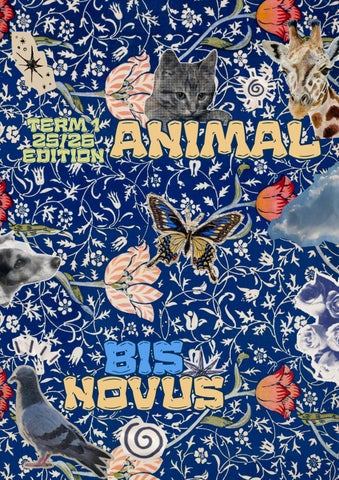
TERM 1 TERM 1 25/26 25/26 EDITION EDITION
ANIMAL ANIMAL
BIS BIS NOVUS NOVUS
Editorial Editorial Well, W ell, this is a first! Seeking an interesting change and development, we decided on ‘Animal’ as the theme for this edition. ‘Animal’ feels like a concrete concept, a word that’s easy to understand, you might think. Yet, as our writers and interviewees have evidenced in the subsequent pages, ‘Animal’ is simultaneously material and abstract. Animals are living beings exhibiting physical characteristics (see Minchan’s exploration of animal adaptations, page 13). They also suffer under abuse and overexploitation (see Soohyun’s advocacy for better animal protection laws, page 14) that - now we get to the abstract part - reflects a lack of empathy and kindness that still permeates our society.
Similarly,, Olivia (page 1) and Colin (page 5) examined how Similarly humans’ interpretation of animals reveal our own ethical dilemmas and hypocrisy respectively. As you might have noticed, for this edition we interviewed members of the school community and inquired them for their thoughts about the theme of ‘Animal’. Specifically Specifically,, we asked 5 questions (see page 10) linked to the physical and conceptual aspects of ‘Animal’. Through the responses, you will uncover different perspectives and analyses that will no doubt make you question your assumptions about this theme. If not, you will feel intrigued nonetheless! Most importantly, me and the entire Novus team - we hope you will enjoy reading this magazine!
Hoang Thai Anh
Contents Contents The Psychology behind the Perception of Animals (Dakyung (Olivia) Hwang Y11)
1
Humans vs Animals (Colin Noah Gibson Y12)
5
Theme Interviews
10
The Effect of Adaptation on Species (Minchan Kim Y7)
13
The Animal Right (Soohyun Choi Y7)
14
Crossword
15
Crossword Answers
16
Contributors
17
The Psychology behind
the Perception of Animals
1
Written By: Dakyung Hwang Y11 Designed By: Angela Jane Balistoy Y13
Introduction The wolf wears sheepskin. He sneaks among the sheep, until darkness falls, and he eats the sheep one by one. This is the story of The Wolf in Sheep’s Clothing. Animals are often used as objects in stories or artworks to reflect human characteristics and nature, especially using the connotations behind a wolf and a sheep. These animals are brought to life through countless paintings, their colours and mood conveying deeper meanings such as human morality. By utilising animals we see as prey and predator, such as a sheep and a wolf, these artists attempt to make sense of the human perception of “good” and “bad.” One of the most famous representations of the wolf and the sheep is one we see in Austin Manchester’s oil painting, “Wolf in Sheep’s Clothing” (2004), where the wolf’s greed is hidden under the purity of the sheep’s clothing. The painting portrays a lesson of false virtue, warning people to look beyond one’s appearance. This is a commentary on human nature, much like how many other artworks convey a lesson or a message, using the connotations of different animals.
Austin Manchester, “Wolf in Sheep’s Clothing” oil on wood (2004)
artworks portraying wolf and sheep
August Friedrich Schenck, “Anguish” oil on Canvas (1878)
2
The sheep generally represents innocence and purity, due to their gentle, non-aggressive, and herd nature. Psychologically, people tend to associate their white wool with calmness and goodness. This perception of sheep is further built up by paintings such as “Anguish” (Schenck, 1878). Schenck often paints animals in bleak, emotional scenes, where they are usually surrounded by a harsh environment like snow, storm, or death itself. In Anguish, a grieving mother sheep stands over her lamb buried in snow, with black crows circling them, showing indifference to the tragedy they are faced with.
Immediately, the sheep’s grief evokes compassion as her mournful expression humanises her pain. Because a sheep represents innocence and purity, her despair comments on the unfair suffering of the weaker prey in nature. This pushes the viewers to reflect on the cruelty and indifference of the world, just like the scavenging crows that show no mercy or warmth. Schenck challenges the morals of the people that overlook pain that is not their own and also suggests that these emotions and morality are not unique to humans.
As for the wolf, “Symphony in White, No. 1: The White Girl” (Whistler, 1861) depicts a scene of neutral colours with a young woman dressed in white, standing on the darker wolfskin rug. The wolf’s head can be seen still baring its teeth, staring directly at the audience. This sense that the fourth wall has been broken by a predator creates an unnerving image. However, this threatening creature is suppressed under a composed young woman in a white dress, which again, represents innocence.
James McNeill Whistler “Symphony in White, No. 1: The White Girl” oil on wood (1861)
This time, the wolf represents the wildness or the suppressed instincts of the supposedly calm woman. Her suppression of the wolf could symbolise moral control, reflecting humanity’s moral challenges and almost drawing out compassion as well, not because of helplessness like in “Anguish”, but because it mirrors our own inner restraint. The viewer’s empathy comes from recognising that same struggle within themselves: The constant tension between instinct and morality that defines human nature.
Interpreting the Wolf and the Sheep in Symbolism
In a way, the wolf starts to represent more than just the evil and greedy nature of humans. The fact that the wolf co-exists with purity and innocence reflects the moral duality within humanity. This also highlights the irony of simplifying morality into “good” and “bad,” like sheep and wolf, black and white. In reality, these animals display complex behaviours. Individuals like the wolf are not representation of cruelty and evil, they maintain balance in food chains, and display loyalty and coordination within their packs.
3
Sheeps are praised and seen as pure due to their passive nature and obedience, despite it showing a lack of independence. People often equate being “good” with blindly following authority and avoiding conflict. The sheep in “Anguish” also further criticises the unnecessary but common suffering of the weaker creatures. In both paintings, the audiences are reminded that morality is the conscious act of navigating the shades of grey, also recognising that outward appearances often hide deeper truths.
In conclusion... Ultimately, through the depiction of wolves and sheep, these artworks challenge viewers to reconsider traditional ideas of morality and virtue. Whether it is the innocent grief of the sheep in “Anguish”, the deceptive wolf in “Wolf in Sheep’s Clothing”, or the restrained predator beneath the composed woman in “Symphony in White, No. 1: The White Girl”, animals are used as mirrors of human behaviour, emotion, and ethical struggle. They remind audiences that morality is not fixed, but is instead shaped by instinct and conscience. In this way, art becomes a space for moral contemplation, using the animal world as a lens to explore the complexities of human ethics.
Animals assist in understanding our past, and if we are attentive, animal totems can reveal glimpses into our future.
- Skull Bliss 4
HUMANs VS ANIMALS How far do Human actions really differ from those of an animal? written by: colin noah gibson y12 Designed by: que nhi luong y9
5
How far do Human actions really differ from those of an animal? Introduction Have you ever wondered what really was the difference between us and an animal that you would see at the zoo? At first, you might think that we are a more civilized species, or even somewhat “smarter”. According to the Cambridge Dictionary (2020), being civilized is acting in a calm and responsible way, exactly how we choose to perceive ourselves. Many animals have been thought to be especially aggressive and pose a danger to us (unlike a civilized animal would), as we are told from a very young age. We are taught that crocodiles, for example, will use their strong bites to kill their prey and anyone that poses a threat to them.
However this doesn’t stop us, humans, from acting any more differently and having major wars, discriminating against our own kind and destroying natural habitats in the process (very much unlike a civilized species would) mainly out of greed instead of necessity for survival. So I beg you to ask this question again: What really is the difference between us and an animal?
6
Human Conquest vs. Animal Instinct In the past and continuing into the In contrast to us, predatory present, greed was seen in the animals typically fight out of conquest for territory as a means to instinct rather than plain greed. gain resources in the land and assert This instinct can range from power over the globe. These hunting for other animals as territorial gains were often made food, necessary for their out of greed by a group of people survival, to defending their who believed there was economic or territory against intruders, social gain from this. In 1608, when which contains crucial resources. the British invaded India, they claimed that this would help them increase For example, primates like trade; however, this was mainly done chimpanzees can create a social to help their own industrial structure in which higherrevolution. Through the gain of this ranking individuals will assert territory, they had access to an their dominance over lowerabundance of raw materials like ranking ones. This will allow cotton, spices and minerals which was them to monopolize loweressential to building the local ranking chimps, granting them economies back at home in England. access to resources and This would result in the oppression reproduction opportunities. of the local communities, stripping them of their rights and freedoms. In Arguably, this is similar to the end, this resulted in the uprising human actions, suggesting that in 1857, as people wanted to reclaim human and animal actions can their freedom. both be exploitative.
7
Human development When asking how smart humans really are, we often think about how we have made scientific advances, such as space travel and medical breakthroughs. Even though animals may not have sent each other to space, they learn to live with and adapt to the environment in which they are living. Beavers, for instance, have learnt to build dams out of logs and sticks in order to create a safe environment from their predators. In turn, this has inspired our way of building modern-day dams to prevent floods. This suggests that we as humans aren’t really that creative at all; rather, we find existing things in nature and adapt them to meet our needs. Furthermore, humans regularly judge our development through our communication skills. While it is true that we have managed to develop effective communication between each other, we are not the only species that can do this. For example, dolphins communicate through a combination of clicks, whistles, and body language, and wolves use howls to coordinate hunting efforts.
One example can be found in insects. According to The Smithsonian, honey bees perform an elaborate “waggle dance”, which is an unusual form of symbolic communication. This dance conveys an exact distance, direction, and quality of a food source to their hive mates. The direction of the straight "waggle run" points relative to the position of the sun, and the duration of the run indicates the distance, highlighting a remarkable ability for silent, geographical-related communication. 8
Conclusion Overall, the answer to this question isn’t quite black and white. animals mostly act out their own deep-rooted survival instincts as opposed to us humans acting out our greed, which ends up leading to environmental catastrophes. As a society that prides itself on Creativity and progression and considering our elaborate social structures and generations of innovations, we might not think that it is possible for a less dominating species to have its own form of development. Overall, it becomes evident that we possess a form of intellect that can be used for various reasons, but we still choose to use it to achieve our goals without thinking about the long-term consequences that it can cause.
9
Theme Interviews This is the first time we tried a theme like ‘Animal’, and to commemorate that and engage with our community we decided to conduct interviews with the following questions:
1.Are greed and survival one and the same? 2.Why do we put animals on the morality spectrum? 3.How do we implement animal rights protection laws effectively? 4.Would you rather be a wolf or a sheep? 5.If humans went extinct tomorrow, what other animal do you think would take over the world and how? Below is the community’s answers (Disclaimer - The ideas portrayed are interviewees’ opinions and have not been fact-checked): “Are greed and survival one and the same?” Teacher 1: “I would say no; survival is about taking what you need and greed is about taking more than you need.” (Then we asked him to link this idea to animals) “I guess you could have a greedy animal”, “For example, a fat lion that ate too much.” Teacher 2: “Survival is about... Um... Kind of wanting, like making sure you’ve got what you need to thrive or to flourish”, “Greed would imply that you’ve already got what you need and yet you still want more”, “I would say that animals living in the wild almost aren’t capable of greed”, “They don’t have enough freedom over their own situation”. Student 3: “I don’t get the question” (After Olivia explained to him in Korean) “In economy there’s luxury good and there’s need good. One is you want it! (...) What you need, you’ll die without it! ” “Tigers sometimes hunt for fun instead of their food, but lions don’t hunt for their fun” (Then we asked him to elaborate) “Solo animals don’t have any friends to play with, so... They hunt.”
10
“Why do we put animals on the morality spectrum?” Staff 1: “Trying to apply... um, morality to animals is really just humans trying to understand the world around them by applying human principles.” (Following up on that, we asked him if that is a good thing) “Depends on what the goal is”, “If we’re putting morality on for... Um, to try and understand, um, why a certain animal would do something, erm, in a certain situation then potentially?” “But if it’s purely just to apply human thinking to how animals operate then I don’t think it’s right.” Student 1 and 2 are interviewed together: Student 2: “Cause we our own have our own moralities”, “Everyone has their own sense of justice” (We inquired if our judgement of whether an animal is “good” or “bad” depends on our sense of justice) “Yeah.” (We asked them if judging like that is good) Student 1: “I think depends on the animal”, “Maybe animals that eat stuff, eat other animals for no reason. That’s not good.” “How do we implement animal rights protection laws effectively?” Staff 2: “Public education and also you need to charge the fee for people who violate the law, like the government needs to, you know, pay attention in the execution”, “We need the people actually on board for the execution of the law”. Teacher 3: “I think the key is flexibility, working with emotions but strategic plan? And not letting- Letting emotions drive you without clouding your judgement”, “Of course, educating the general public on everything is great. Yeah, I mean reduction of, like, factory farming whether that’s through educating farmers”, “better infrastructure that allows for more sustainable methods of plantbased eating”.
11
“Would you rather be a wolf or a sheep?” Teacher 2: “Probably a wolf, um... I think... I don’t know; I think the connotation of a sheep is that it’s... It’s to conform all the time, and that even means that you’re living in a farm or you’re vulnerable to attack if you’re living in the wilds”, “Wolves I guess then they have more agency over themselves”. Teacher 3: “Maybe a wolf, I think, but mainly because, um, studies show that wolves have a higher level of like consciousness” (Based on the answer, we questioned if being more aware of dangers around you is better or not) “Yeah it might be quite nice to be a sheep, no worries in a field”. Staff 1: “If I was in Scotland, where I’m from, love to be a sheep It’s class; you just go around eating grass. There’s no real predator; there’s no actual predator really, erm, and sometimes a dog comes along to push you into like a wee- wee cage and you know you don’t have to think about anything”, “If I was somewhere else where, uh, there were predators that could easily get me, um, then I would probably consider being a wolf”. “I’d rather be able to chase what I need to survive, rather than be surviving and be scared of my environment”. “If humans went extinct tomorrow, what other animal do you think would take over the world and how?” Student 1: “I think it’s ants”, “cause they’re everywhere, and like I don’t think lions can eat them”, “They’ll keep producing”. Student 2: “I think rats”, “They have a large population, so much that like I think in the UK, uh... The sewers are packed with them”. Teacher 4: “Like a rat, something that is going to survive no matter what, pretty intelligent, like... Yeah, can work in a pack”, They would play the long game; they wouldn’t be stressed - they’d wait for all the other animals to kind of fight each other, kill each other and then they’d just come in”. Teacher 1: “I don’t think animals would take over the world; it goes back to your morality question, right? They don’t have that hierarchical structure and... That people have. Animals don’t want to be a billionaire or president” (We then reframed the question to what animal is the most dominant in the food web) “The world’s going to be flooded, cause of the ice caps melting anyway, so the killer whales would just be everywhere”.
12
The Effect of Adaptation on Species
Written by: by: Minchan Minchan Kim Kim Y7 Y7 Written Designed by: by: Thai Thai Anh Anh Hoang Hoang Y13 Y13 Designed
Have you ever wondered what adaptations are? Adaptations are changes in an organism’s body or behavior that help it survive. These changes often take thousands of years to occur. Adaptations are important because they help animals get food, run away from predators, and survive in harsh environments. Adaptations help animals survive by allowing them to fit in with their environment, for example through camouflage. One great example of camouflage is the grasshopper. This is because green grasshoppers camouflage with grass and leaves very well. It shows that camouflaging increases organisms’ chances of survival. Another example of an adaptation is the penguin, which has adapted flippers instead of wings for swimming underwater. Here, the flippers are more useful for escaping underwater predators. Therefore, I think adaptations hugely help animals survive. On the other hand, I think human causes animals to lose survival skills. An example of this situation is the pelicans. Lakes in modern cities may seem like nothing to us, but for some birds it’s their habitat. Sometimes, pelicans inhabiting the lakes are used to humans. They were not aggressive at all and most importantly, they relied on humans for food. This made them forget how to hunt naturally because people fed the pelicans. This is a huge problem. Due to this reason, I believe human causes animals to lose survival skills.
Grasshopper
Penguin
Adaptations are great. Adaptations help organisms (in this article I talked about animals specifically) survive by allowing them to fit in with their environment. However, humans can cause animals to lose survival skills. Therefore, I think humans need to think about every action they do and how it can affect any animal. Thank you.
13
Pelicans
The Animal Right
The Opinion Column: Opinion from a Y7 writer
Written by: Soohyun Choi Y7 Designed by: Thai Anh Hoang Y13
According to According to Wikipedia Wikipedia (2019), animal (2019), animal rights rights is is the the belief that belief that “many “many or or all all sentient animals” sentient animals” have have “moral “moral worth” regardless worth” regardless of of how how useful they useful they are are for for humans. humans. However, animal rights are not always good at protecting them. I think in some places the law can be loose. This is because I read that last time one man who killed 30 dogs only went to jail for 1 year. Also, I think some countries made better laws than others. 14
I think animal rights is very important for animals and a freedom they should have, so they don’t get hurt because of humans.
One day day when when these these One problems are are solved, solved, problems animals will will have have animals more rights. rights. II hope hope more animals get get aa better better animals life one one day. day. life
Animal Crossword Animal Crossword 1
2
3
4
5
6
7
8
9
10
11
12
13
14
15
Down: Down:
Across: Across:
aa place place When no no members members of of aa species species exist exist 6 When An area area defended defended by by organisms organisms 9 An 11 An An animal animal that that lays lays eggs eggs and and uses uses the the sun’s sun’s heat to heat to regulate regulate body body temperature temperature ®
help itit blend help blend into into its its environment environment wild or or dangerous dangerous animal animal 7 AA wild The The process process of of changing changing to suit to suit different different conditions conditions 8 Animals that that eat eat plants plants 10 Animals Animals that that are are hunted hunted and and killed killed by by other other animals animals 12 Animals group of of living living beings beings 13 AA group The natural natural environment environment of of an an organism organism 14 The use something something for for the the wrong wrong purpose purpose in in aa way way 15 ToTo use that is that is harmful harmful
The killing killing of of animals animals cruelly cruelly and and unfairly unfairly 11 The The way way in in which which populations populations of of living living things things 22 The change and change and develop develop The regular regular movement movement of of animals animals to to and and from from 55 The
6 9 11
Any animal animal of of which which the the female female feed feed her her young young with with 33 Any milk from milk from her her own own body body When an an animal’s animal’s colours, colours, patterns, patterns, or or shapes shapes 44 When
7 8 10 12 13 14 15 15
Animal Crossword Animal Crossword How did you do?
Answers Answers 16
Supervisor/ Supervisor/ Mentor Mentor Miss Sian Murray Miss Sian Murray
Editors Editors
Thai Anh Anh Hoang Hoang Y13 Y13 Writers Thai Writers
Colin Noah Gibson Y12 Dakyung (Olivia) Hwang Y11 Dakyung (Olivia) Hwang Y11 Soohyun Choi Y7 Designers Minchan Kim Y7 Designers Angela Jane Balistoy Y13 (Front cover) Dakyung (Olivia) Hwang Y11 Colin Noah Gibson Y12 Dakyung (Olivia) Hwang Y11 Soohyun Choi Y7 Minchan Kim Y7 Angela Jane Balistoy Y13 (Front cover)
Thai Anh Hoang Y13 (Front cover, Editorial, Contents, Theme Interviews, Crossword, Back cover) Dakyung (Olivia) Hwang Y11 (Contributors page) Thai Anh Hoang Y13 (Front cover, Editorial, Contents, Theme Interviews, Crossword, Back cover) Dakyung (Olivia) Hwang Y11 (Contributors page)
Que Nhi Luong Y9 Que Nhi Luong Y9
17
NO N O
ANIMAL ? ANIMAL ?
? S? VU V US HUMAN? HUMAN?