Serving a 24 County Area, Including Birmingham, Huntsville, Montgomery & Tuscaloosa
JANUARY 2026 / $5
Alabama’s First Fully Integrated Brachytherapy Suite Opens at UAB By anSLey FranCo
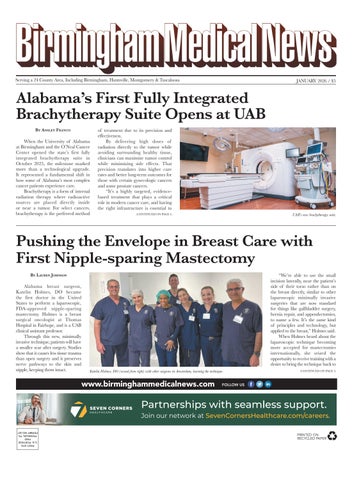
When the University of Alabama at Birmingham and the O’Neal Cancer Center opened the state’s first fully integrated brachytherapy suite in October 2025, the milestone marked more than a technological upgrade. It represented a fundamental shift in how some of Alabama’s most complex cancer patients experience care. Brachytherapy is a form of internal radiation therapy where radioactive sources are placed directly inside or near a tumor. For select cancers, brachytherapy is the preferred method
of treatment due to its precision and effectiveness. By delivering high doses of radiation directly to the tumor while avoiding surrounding healthy tissue, clinicians can maximize tumor control while minimizing side effects. That precision translates into higher cure rates and better long-term outcomes for those with certain gynecologic cancers and some prostate cancers. “It’s a highly targeted, evidencebased treatment that plays a critical role in modern cancer care, and having the right infrastructure is essential to UAB’s new brachytherapy suite.
(CONTINUED ON PAGE 4)
Pushing the Envelope in Breast Care with First Nipple-sparing Mastectomy By Lauren JohnSon
Alabama breast surgeon, Katelin Holmes, DO became the first doctor in the United States to perform a laparoscopic, FDA-approved nipple-sparing mastectomy. Holmes is a breast surgical oncologist at Thomas Hospital in Fairhope, and is a UAB clinical assistant professor. Through this new, minimally invasive technique, patients will have a smaller scar after surgery. Studies show that it causes less tissue trauma than open surgery and it preserves nerve pathways to the skin and nipple, keeping them intact.
“We’re able to use the small incision laterally, near the patient’s side of their torso rather than on the breast directly, similar to other laparoscopic minimally invasive surgeries that are now standard for things like gallbladder surgery, hernia repair, and appendectomies, to name a few. It’s the same kind of principles and technology, but applied to the breast,” Holmes said. When Holmes heard about the laparoscopic technique becoming more accepted for mastectomies internationally, she seized the opportunity to receive training with a desire to bring the technique back to Katelin Holmes, DO (second from right) with other surgeons in Amsterdam, learning the technique.
www.birminghammedicalnews.com
FOLLOW US
(CONTINUED ON PAGE 5)
You focus on patient care. We’ll focus on you. At the heart of one of the most highly regulated industries in the nation, health care facilities and providers face challenges that draw attention and resources away from their mission to provide quality patient care. Burr & Forman’s health care team works alongside you to address and anticipate your needs by providing preventative guidance and pragmatic solutions, enabling you to focus on providing care and achieving healthy outcomes.
Alabama Health Care Team
Birmingham | Mobile | Montgomery Jessie Bekker
Lindsey Druhan
Catherine “Cat” Kirkland
Howard Bogard
Kelli Carpenter Fleming
Garrett Lucey
Richard Brockman
Jim Hoover
Angie Cameron Smith
370 Attorneys. 22 Offices. Results that matter.
4 2 0 No rt h 20t h St reet , Suite 3 400, Birm ingha m , AL | (2 05 ) 2 51 -3 000 | www. b u r r.com No representation is made that the quality of the legal services to be performed is greater than the quality of legal services performed by other lawyers.
2 • JANUARY 2026
Birmingham Medical News
Children’s of Alabama And UAB Perform Rare Split Liver Transplants One Liver Went to Two Patients By Laura Freeman
In an average year, 9,000 American names go on the liver transplant registry list. For 1,500 to 2,000 of those patients, the call they are waiting for will never come, or not before they die or become too ill to qualify for a transplant. The sad fact is that there simply aren’t enough organs available from deceased donors. To save more lives, transplant teams are using alternative approaches to expand the supply of viable organs. One of those approaches is a split liver transplant. “Liver tissue is highly regenerative in nature and both sides of the organ have an independent blood supply. When there’s a liver of sufficient size in pristine condition, we may be able to save two lives when the functional capacity of each segment is adequate to keep a recipient of that body size healthy as they recover,” UAB surgeon Saulat Sheikh, MBBS said. Split transplants from a deceased donor organ tend to be rare because of the multiple factors involved, the need
(left to right) Marcos Pozo Jatem, MD and Saulat Sheikh, MBBS.
to have a second team ready nearby to transplant a donor of the right size, and because as organs become available, they are offered first to the person at the top
Pozo and Sheikh with the liver, readying for surgery.
of the transplant list. After meeting that person’s needs, that particular liver may not be adequate to share with a second recipient.
Surgeon and Director of Liver Transplant at Children’s of Alabama, Marcos Pozo Jatem, MD said, “In this (CONTINUED ON PAGE 8)
Happy New Year! Happy New Year! Happy New Year! Alabama’s Leaders in Pain Care Online Referral Form | BamaPain.com | 205.332.3160
Birmingham
Bessemer
Birmingham Medical News
JANUARY 2026 • 3
Alabama’s First Fully Integrated Brachytherapy Suite, continued from page 1 delivering it safely and effectively,” Samuel Marcrom, MD, associate medical director of Brachytherapy at UAB Medicine, said. However, the infrastructure for administering the treatment has traditionally been fragmented. It would often require patients to move between multiple rooms or departments for various parts of the therapy, such as the applicator placement, imaging, treatment planning and radiation delivery. “That fragmentation meant longer days, more waiting, more uncertainty, and in some cases, additional discomfort during a very vulnerable time,” Marcrom said. “The new brachytherapy suite was designed entirely around the patient experience.” The UAB suite consolidates every step of the process into a single, calmer space that allows patients to move around less and have a shortened treatment time. The radioactive applicators are placed, imaged and treated in the suite, which can enhance accuracy and consistency. Because patients are no longer transported between rooms, it eliminates delays, handoffs and unnecessary transitions. That consistency reduces opportunities for error and allows clinicians to make real-time decisions with greater confidence.
Samuel Marcrom, MD
“This integration is transformative. The care team works together in real time, which allows us to make decisions quickly and confidently, all of which ultimately benefits the patient,” Marcrom said. “Patients can focus on healing rather than logistics, which is a meaningful improvement in comfort and dignity during care.” UAB estimates the new workflow can reduce treatment times by as much as 50 to 60 percent. For patients, that
time savings carries both physical and emotional weight. Shorter procedures mean less time in uncomfortable positions, reduced need for pain medication and less fatigue. Emotionally, it can ease anxiety and help patients feel that treatment is not consuming their entire day, as well their lives. “Many patients describe cancer treatment as exhausting, not just physically, but mentally” Marcrom said. “Being able to complete treatments more efficiently helps restore a sense of normalcy and control. It allows patients to recover more quickly, spend time with loved ones and maintain a better quality of life during therapy.” As the only brachytherapy suite of its kind in Alabama, the new facility also addresses a longstanding access gap. Previously, some patients had to travel long distances or find care out of state to receive this kind of specialized care. Those barriers could delay treatment or make it unattainable altogether. “Now patients can receive worldclass brachytherapy close to home. That’s especially important for patients undergoing complex cancer treatment, who benefit enormously from being near their support systems,” Marcrom said. “This suite helps ensure that geography is no longer a limiting factor in receiving high-quality cancer care in Alabama.”
The benefits extend to clinicians as well. The streamlined workflow improves communication and efficiency, reduces fatigue and allows care teams to practice at the highest level of their training. That, Marcrom said, directly translates into better outcomes for everyone involved. “This type of investment reflects UAB’s role as Alabama’s academic medical center and a leader in advanced cancer care,” Marcrom said. “By investing in specialized infrastructure like this brachytherapy suite, UAB is setting a new standard for radiation oncology in Alabama. It reinforces our role as a referral center for complex cases and ensures that patients across the state have access to cutting-edge, evidence-based treatments.” Moving forward, the suite is expected to support expanded clinical capacity, new techniques and research initiatives. It will also serve as a training ground for future specialists and research. “Ultimately, this suite is not just an investment in today’s patients, but in the future of cancer care at UAB and across the region,” Marcrom said.
Trusted Orthopedic and Sports Medicine Care The expertise to diagnose and determine the best path toward less pain and more living
Call 205.985.4111 to Schedule an Appointment
4 • JANUARY 2026
Birmingham Medical News
Hoover 4517 Southlake Parkway
Birmingham-Grandview 3686 Grandview Parkway Ste 430
Pushing the Envelope in Breast Care, continued from page 1
All of the faculty and surgeons training in Amsterdam.
the U.S. She contacted Applied Medical, a global medical device company that makes the laparoscopic system called GelPort, and she was selected as one of five surgeons in the first group from the U.S. to go to Amsterdam for training. “There were surgeons from all over the world – from Spain, Italy, France, Taiwan – so they were able to combine all of their international experience and training models to give us all of their expertise in one sitting,” Holmes said. She and the other surgeons received hands-on training through a cadaver course, learning from the experts in the field. On April 18, 2025, Holmes became the first surgeon in the U.S. to perform a laparoscopic nipple-sparing mastectomy. Since then, she’s completed three more, all with successful results.
“It was a huge honor to be the first,” she said. “I was thrilled, but most of all I felt it was so important to have someone advocate for women in Alabama; to say we have to do things through the best approach possible for women with breast health issues, whether that’s breast cancer or prophylactic mastectomies. I feel strongly, as someone who grew up in a small town, that even women in rural communities deserve top-notch care. “With the GelPort surgery, a lot of women are able to still feel their breast area, whereas that’s typically not the case with open surgery. In addition to having a smaller scar, this technique saves the nipple and skin, so it preserves how a woman looked before the surgery.” The surgery is also expected to shorten recovery times and decrease
complications. And any patient who is a candidate for a traditional nipple-sparing mastectomy will likely be a candidate for this procedure. Some limitations depend on the shape and size of the patient’s breast, as well as how close the cancer cell is to the nipple. Holmes wants to ensure that clinicians are always pushing the envelope in breast care. She’s encouraged to see more surgeons adopt this new technique, and is looking forward to seeing what advancements will come in the future. There are currently clinical trials ongoing to test robotic-assisted nipple-sparing mastectomies. “In addition to this and other surgical advancements, we’re beginning to personalize every treatment plan to the patient and their exact cancer biology,”
Holmes (left) with her partner, Jimmie Gavras, MD, assisting.
Holmes said. “Now, it’s not a one-sizefits-all for breast cancer, whether that means minimally invasive surgery or personalized decision making about her tumor’s DNA and what that means for chemo or genetic testing. Every woman deserves to be at a treatment center where she is at the center and forefront of every decision.”
FEBRUARY 7 | 7:00 AM - 3:40 PM MARRIOTT BIRMINGHAM PRESENTING A concise and relevant review of the past year’s developments and recommendations for the prevention and treatment of cardiovascular disease. • Critical Limb Ischemia | J. Bradley Cavender, MD, FACC • Frequent Premature Ventricular Contractions | Chad Colon, MD • Hormone Replacement in Women | Wytch Rigger, MD • Monitoring Arrhythmias—Which Device? | Sanjeev S. Hasabnis, DO, FACC • Shortness of Breath After Pulmonary Embolism | Stephen Bakir, MD, FACC • Acute Coronary Syndrome Guidelines | Saji C. Jacob, MD, FACC • Management of Carotid Disease | Jan Skowronski, MD, MBA • Overview of Anti Arrhythmic Drugs | Scott Kirby, MD
February 8, 2025 Marriott Birmingham • Birmingham, AL
• Valve in Valve Transcatheter Techniques | Matthew Sample, MD, FACC
18th Annual
• Atrial Fibrillation – Ablation vs Anti Arrhythmic Drugs | Sarah Sandberg, MD
February 8, 2025 19th Annual
Cardiovascular CARDIOVASCULAR 18th Annual UPDATE Update 2026 2025
• LDL: How Low for Secondary Prevention? | John T. Eagan, Jr., MD, FACC
• Lifetime Benefit by Control of Modifiable Risk Factors | Saji C. Jacob, MD, FACC
Marriott Birmingham • Birmingham, AL
Cardiovascular Update 2025
ACCREDITATION This activity has been approved for AMA PRA Category 1 Credits™.
cvupdate.org
cvupdate.org
Birmingham Medical News
Scan To Register Today JANUARY 2026 • 5
Alabama’s Rural Health Transformation Program
Summary of Alabama’s Application for Federal Funds to Improve Rural Health By: Angie Cameron Smith
Federal Grant Background As part of the One Big Beautiful Bill Act, Congress established a $50 billion grant program, to be administered by the Centers for Medicare and Medicaid Services (“CMS”), to improve access, quality and outcomes in rural health. Beginning in 2026, $10 billion in funding is available each fiscal year through the end of fiscal year 2030. Fifty-percent of those funds will be distributed equally among all approved states, and 50 percent allocated by CMS based on certain factors including rural population, the number of rural health facilities and location of hospitals. Under the program, the funds must be used on specific approved uses as outlined in the Act, and states must apply outlining how it intends to meet the requirements of the grant. All 50 U.S. states are eligible, and the award decision is expected at the end of December 2025. Alabama’s Submission Alabama’s grant application, developed by the Alabama Department
of Economic and Community Affairs (“ADECA”), the Governor’s office, and the State Health Planning and Development Agency (“SHPDA”), among others, focuses on legislative and regulatory reforms to improve the delivery of rural healthcare. According to the Alabama Rural Health Transformation Program (“ARHTP” or “Program”) 58 of Alabama’s 67 counties are rural or partially rural under the HRSA definition of “rural,” and the Program would improve access to health care and outcomes for more than 1.6 million Alabamians. Some of the challenges identified in the ARHTP were rural healthcare facilities closing, loss of specialty services and the inability to recruit and retain physicians and other healthcare professionals in rural areas of the state. The plan prioritizes telehealth expansion, regional networks, workforce pipelines, and modernized data infrastructure so care can be delivered as close to home as possible. ADECA will administer the program, with enabling legislation in the 2026 legislative session, followed by
initiativespecific Request for Proposals in late FY2026, and the creation of an advisory group by executive order to coordinate policy changes in the areas of telehealth, EMS reimbursement, crossfacility credentialing, and datasharing standards. ARHTP lists three primary principles – transformation, sustainability and accountability. Proposed Initiatives 1. Digital infrastructure. The application provides for a “Collaborative EHR, IT, and Cybersecurity Initiative” that will create regional hubs, for integrating electronic health records, connecting providers to “Alabama One Health Record,” and delivering shared cybersecurity monitoring and incident response for rural providers. The concept provides for lower unit costs for providers and interoperability. The target is five hubs, 50 providers connected, and 40–60 EHR upgrades tied into a statewide Health Information
Exchange operated by the Alabama Medicaid Agency. 2. Telehealth. A Rural Health Initiative will expand access to emergent and specialty care through telehealth hubs with services such as “tele‑stroke,” “tele‑ICU,” “tele‑behavioral health,” and remote patient monitoring. The focus will be on EMS, FQHCs, rural health clinics, rural hospitals, and critical access hospitals. This initiative also includes the development of a Rural Health Network that is a shared services model for services such as billing, linen, waste, and laboratory. 3. Maternal and fetal health. Due to the closure of multiple labor and delivery units in rural facilities across the state, the ARHTP proposes a Maternal and Fetal Health Initiative. Using a digital platform, rural providers will be connected to regional care hubs that can provide services using tele-robotic ultrasound devices. (CONTINUED ON PAGE 10)
When people receive a communication from a law firm,
Alabama DDS Needs Part-time Medical Consultants The Alabama Disability Determination Service (DDS) invites letters of interest from physicians wanting to work part-time as a medical consultant. The work involves reviewing disability claims in the Birmingham or Mobile offices. An Alabama medical license is required.
they listen.
That’s the difference in having the attorneys at Cloud Willis represent your medical practice in managing your accounts receivables. We provide the complete services of an agency and a law firm or anywhere in between — you choose. We will collaborate with you to design a collection strategy that helps limit unpaid invoices and medical bills. Then we will implement that strategy in our office, and help you implement the strategy in yours.
We have the experience and know-how in medical collections
The DDS is committed to maintaining a diverse workforce; and therefore, the DDS encourages minority applications.
to make it better for you. Call today for a free consultation.
205.322.6060 • CLOUDWILLIS.COM If interested, please contact: DDS Medical Section Supervisor (205) 989-2234 or write to: PO Box 830300, Birmingham AL 35283-0300
6 • JANUARY 2026
Birmingham Medical News
BIRMINGHAM • MOBILE • NASHVILLE No Representation is made that the quality of the legal services to be performed is greater than the quality of legal services performed by other lawyers.
MEMBERSHIP HAS ITS REWARDS… $23.5 MILLION SINCE 2007, TO BE EXACT The Healthcare Workers’ Compensation Self-Insurance Fund exists to protect those who care for others. We are proud to declare a $2.5 million divided for the 2026 Fund Year. This reflects our members’ dedication to creating safer workplaces in healthcare across Alabama. Learn more about membership benefits at www.hwcf.net.
A relationship you can count on.
W W W. H WC F. N E T
334.271.5515 Birmingham Medical News
JANUARY 2026 • 7
Audio Articles
Children’s of Alabama And UAB Perform Rare Split Liver Transplants, continued from page 3 particular case, the name at the top of the list was one of our pediatric patients. When we received the call offering a full size adult liver, we realized that we had an opportunity to save a second life, so we contacted the UAB transplant program just down the street to see if they had someone waiting who matched the blood type, size and other criteria.” Sheikh, who is involved in UAB’s living donor liver transplant program which works from similar principles in organ sharing, said, “We quickly identified a patient who could benefit from the split transplant. That launched a massive coordinating effort between teams at Children’s of Alabama, UAB, and the hospital that would be preparing and sending donor organs across the country. Multiple shifts of a number of departments were involved, as well as transportation and support services, and we also called in a machine perfusion team to bring the organ from the donor hospital to Birmingham. Machine perfusion keeps the tissue in better condition even if it has to travel farther. It also gives us detailed data on how well the organ is performing before we transplant it.” Pozo said, “While the liver was in transit, we were busy at Children’s synchronizing two surgical teams to
work in carefully timed sequence. The first team started removing our patient’s diseased liver as soon as the donor organ was on site and we verified it was viable. The other team began splitting the liver, carefully making sure that both segments are in good condition and blood vessels are ready to connect. Meanwhile, a transport team was standing by to rush the second portion of the liver to UAB where their removal and transplant teams are ready to begin.” This carefully coordinated surgical ballet with a cast of so many was successfully performed a few weeks ago. It has been ten years since the last split liver transplant was performed locally, and it’s uncertain when all the right factors will come together again. When it does, Birmingham is fortunate to have enough depth of transplant capabilities to make it possible. In the foreseeable future, the shortage of transplantable livers is expected to be addressed through an expansion of the living donor option. “With the liver, tissue matching isn’t quite as complex as it is with some organs. Usually, a compatible blood type is what we’re looking for, if the organ size and quality are adequate,” Sheikh said. “This opens the door for more relatives and other living donors to be
evaluated to share a portion of their liver.” Another advance that is saving lives is an expansion of criteria for acceptable donor livers. Moving to the top of the transplant list is a good news/bad news situation. The good news is that you are first in line if a liver becomes available. The bad news is that the time before you become too ill to qualify for a transplant can be very short. “The general rule of thumb is that any functioning transplant gives you a better chance for survival than no transplant. Most patients don’t have the time to wait for a perfect ‘Cadillac’ donor liver. Now we are beginning to accept livers from older donors, especially for older patients and those who are running out of options,” Pozo said. Sheikh said, “We’re also able to accept some livers that we couldn’t in the past. For example, if a donor has hepatitis C, we can transplant the liver and give the recipient medication to eliminate the infection. The hepatitis is gone, but the liver is functioning, helping to keep the patient alive.”
Not every spot is as harmless as it looks. Regular skin checks and biopsies can catch issues early—and with same-week availability, there’s no reason to wait.
ads.indd 2
8 • JANUARY 2026
Birmingham Medical News
9/22/25 7:45 AM
Shingles Vaccine Linked to Lower Dementia Risk A shingles vaccine may do more than prevent a painful rash. It may also reduce the risk of developing dementia and could even slow progression in those already diagnosed, according to a large analysis of health records from Wales. In a new study published in Cell, researchers examined the NHS rollout of the live shingles vaccine Zostavax, which was offered based on strict date-of-birth eligibility rules. That policy quirk created an unusually useful natural experiment – a near-perfect comparison between people born just before and just after the cutoff – allowing the team to estimate how vaccination affected cognitive outcomes over time. The analysis drew on the Secure Anonymised Information Linkage (SAIL) databank and included health records from over 300,000 people in Wales between 2013 and 2022. The authors focused on the NHS vaccine rollout that made people eligible or ineligible based on their date of birth – in other words, whether you were born a handful of days too early or too late. That detail matters. Traditional observational studies of vaccination are often haunted by the “healthy user”
problem: people who choose vaccination may also have other advantages – better access to care, fewer comorbidities, more health-conscious habits – that can masquerade as protection. Here, eligibility was determined administratively, not behaviorally; the authors describe it as a regression discontinuity design, a causal inference approach that treats the cutoff as a quasi-random assignment. In the paper, the authors note that a one-week difference in age across the eligibility threshold produced a large difference in vaccine uptake – nearly 50 percentage points – giving them a strong lever to estimate downstream effects. The topline message is straightforward, if not simple: eligibility for Zostavax was associated with fewer new diagnoses of mild cognitive impairment (MCI) and fewer dementia diagnoses over follow-up. More unusually, the association did not stop at prevention. Among those already living with dementia, being eligible for vaccination was linked to a lower likelihood of dying with dementia recorded as the cause of death – a finding that raises the possibility of a diseasemodifying effect, or at least a slowing of
clinical decline. A consistent feature across analyses was a stronger apparent protective effect in women than in men – a pattern that has been observed in other research on vaccinerelated immune responses. Haroon Ahmed, MD and Clinical Reader in Epidemiology at Cardiff University’s School of Medicine, who was a member of the research team, said: “Our results suggest that the shingles vaccine could potentially prevent early memory decline and slow disease progression.” The mechanism of action is not settled. Still, the biological plausibility is not flimsy either, and it touches several themes longevity researchers have been circling for years: immunosenescence, chronic inflammation, latent infection and vascular risk. Varicella zoster virus, the cause of chickenpox, remains dormant in the body and can reactivate later as shingles. The authors discuss the possibility that preventing reactivation may reduce
neuroinflammation, with knock-on effects on pathways linked to dementia. They also mention herpes simplex, another latent virus implicated in cognitive decline, as part of a broader hypothesis that suppressing viral reactivation could reduce inflammatory and pathological cascades in the brain. A second line of plausibility is immune training – the idea that some vaccines do more than protect against their target pathogen and may shape immune function more broadly, potentially counteracting age-related immune decline. Then there is the vascular story. Independent research has reported that shingles vaccination may be associated with up to an 18 percent lower risk of stroke in older adults – a reminder that the boundary between neurodegeneration and vascular damage is often porous rather than neat. If vaccination reduces strokes, microvascular injury or systemic inflammation, it could plausibly slow trajectories that feed into cognitive impairment.
Banking for what’s next.
600 Luckie Drive, Ste. 200 • Birmingham, AL 205.313.8100 • SouthStateBank.com
Birmingham Medical News
JANUARY 2026 • 9
Alabama’s Rural Health Transformation Program, continued from page 6
Jefferson County Medical Foundation Trust
Answering Service Exclusively for medical professionals, The Service has provided reliable, caring service to physicians and their patients for over 30 years. • Change your schedule from computer, tablet or smartphone • Operator follow-ups with patient to confirm calls are returned • All calls recorded • Messages delivered via pager, text, phone, fax or email • HIPAA-compliant secure messaging
Winner of the International ATSI
2018 – 2025
Award of Excellence! After 6 months of scrutiny by trade industry judges, the Service beat call centers throughout North America & the U.K. with our distinguished customer service rapport, accuracy, & response time.
CONTACT MARY WHITEHEAD 205-933-8601
Additionally, the initiative seeks to expand a current pilot program providing L&D stabilization carts to rural healthcare facilities that provide lifesaving care and stabilization for mothers and newborns until they can reach an appropriate hospital setting. 4. Workforce. A Rural Workforce Initiative is intended to increase the number of healthcare providers in rural Alabama. According to the application, 61 of Alabama’s 67 counties are designated as primary care professional shortage areas, and all but one is a mental health professional shortage area. The workforce initiative will provide funding to the Alabama School
TRY CRI A STRATEGIC PARTNER IN HEALTHCARE HEALTHCARE@CRIADV.COM
CRIADV COM CRIADV.COM *Firm practice structure statement - criadv.com/disclaimer
$150 ,000 $150,000 The Alabama Rural Medical Service Awards (ARMSA) incentivize family medicine, internal medicine, pediatric medicine, Med/Ped physicians, OB/GYNs, and primary care nurse practitioners to practice in rural, medically underserved areas in Alabama. ARMSA offers $50,000 a year for primary care physicians, with a 3-year maximum award period. The award is a The Alabama Rural Medical Service Awards (ARMSA) Theservice Alabama Rural Service Awards (ARMSA) loan that Medical is payable by years of service.
incentivize incentivize family family medicine, medicine, internal internal medicine, medicine, pediatric medicine, Med/Ped physicians, pediatric medicine, Med/Ped physicians, OB/GYNs, OB/GYNs, and and primary primary care care nurse nurse practitioners practitioners to to practice practice in in rural, medically medically underserved underserved areas areas in in Alabama. Alabama. ARMSA ARMSA rural, offers $50,000 $50,000 aa year year for for primary primary care care physicians, physicians, offers with aa 3-year 3-year maximum maximum award award period. period. The The award award is is aa with service loan loan that that is is payable payable by by years years of of service. service. service
Scan link to e-mail for more information about ARMSA
ARMSA
ARMSA is administered by the Alabama Office of Primary Care and Rural Health and is supported by the Office for Family Health Education & Research, UAB Marnix E. Heersink School of Medicine. ALABAMA RURAL MEDICAL SERVICE AWARDS
Scan Scan link link to to e-mail e-mail for for more more information information about about ARMSA ARMSA
ARMSA
ARMSA ARMSA is is administered administered by by the the Alabama Alabama Office Office of of Primary Primary Care Care and and Rural Rural Health Health and and is is supported supported by by the the Office Office for for Family Family Health Health Education Education & & Research, Research, UAB UAB Marnix Marnix E. E. Heersink Heersink School School of of Medicine. Medicine. ALABAMA RURAL MEDICAL SERVICE AWARDS ALABAMA RURAL MEDICAL SERVICE AWARDS
10 • JANUARY 2026
Birmingham Medical News
of Healthcare Sciences for the development of curriculum and purchasing of training equipment. The school was established in 2025, and its first students will begin classes in 2026. It is a free, state-supported residential high school in Demopolis focusing on educating students for future healthcare focused jobs. Additionally, the proposal provides for the development of a partnership program between K-12, community colleges, institutions of higher education, the Alabama Department of Workforce and rurally-located healthcare providers to create a workforce pipeline through accelerated training programs. 5. Preventative Care and Emergency Response. A Cancer Digital Regionalization Initiative, Simulation Training Initiative, Statewide EMS Trauma and Stroke Initiative, and EMS Treat-in-Place Initiative are also part of the ARHTP. These programs are intended to advance preventative care and improve emergency response capacity. 6. Mental Health. This initiative has two phases intended to improve access to mental health. The first is a school-based tele-mental health program providing access to mental health services to students and their families. The second phase is aimed at increasing the number of Certified Community Behavioral Health Clinics (“CCBH”). A few CCBHs currently exist in Alabama and provide behavioral health care to anyone who requests care for mental health or substance use disorder, regardless of ability to pay. The initiative will provide funding to allow current Community Mental Health Centers to convert to a CCBH. ADECA will serve as the agency responsible for oversight of the program, and there will be an RFP process for selecting recipients of the funds should Alabama’s application be approved. According to the proposal, ADECA will conduct “duplication assessments” to ensure that funds are not duplicating programs already in place through state, local or federal efforts. Alabama’s application can be found at the following link: https://adeca.alabama. gov/wp-content/uploads/ARHTP-ProjectNarrative.pdf and information regarding the federal program can be found at https://www. cms.gov/priorities/rural-health-transformationrht-program/overview. Angie Cameron Smith is a Partner at Burr & Forman LLP practicing exclusively in the firm’s Health Care Practice Group. Angie may be reached at (205) 458-5209 or acsmith@burr.com.
Tushar Mishra, MD Joins Cardiology PC
UAB Health System Acquires Southview Medical Group EDITOR & PUBLISHER Steve Spencer
VICE PRESiDENT OF OPERATIONS Jason Irvin
CREATIVE DIRECTOR Katy Barrett-Alley
CONTRIBUTING WRITERS Jane Ehrhardt, Ashley Franco, Laura Freeman, Lynne Jeter, Marti Slay
Birmingham Medical News 270 Doug Baker Boulevard, Suite 700-400, 35242 205.215.7110
AD SALES: Jason Irvin, 205.249.7244
All editorial submissions should be e-mailed to:
Tushar Mishra, MD
On January 1st, UAB Health System finalized the acquisition of Southview Medical Group, a multi-specialty practice on the UAB St. Vincent’s Birmingham campus. As part of the agreement, UAB Health System assumes ownership of Southview Medical Group’s network of providers and facilities. “Southview Medical Group has a reputation for delivering exceptional, patient-centered care,” said UAB Health System CEO Dawn Bulgarella. “This agreement combines that tradition with the resources and innovation of an academic health system. It also strengthens UAB Medicine’s ability to provide seamless access to primary care, improve care coordination, and ensure our patients benefit from the full spectrum of services.”
East Alabama Health Opens Mental Health Facility
editor@birminghammedicalnews.com
FOLLOW US
Scan to visit birminghammedicalnews.com
Southview Medical Group has served Birmingham-area patients for more than 100 years, originally as Southside Medical Group and Lakeview Internal Medicine before the two entities merged in 1994. Southview Medical Group’s more than 30 providers — spanning internal medicine, cardiology, infectious disease, endocrinology and gastroenterology — care for over 51,000 unique patients every year and have more than 130,000 patient visits annually. “Southview’s integration with the UAB Health System marks a pivotal moment in advancing coordinated, community-based care,” said Southview Medical Group President Noah Fitzpatrick, MD. “We are excited to partner with an institution like UAB.”
Tushar Mishra, MD is joining the Cardiology PC team at Baptist Health Princeton Hospital. A board-certified Interventional Cardiologist, Mishra brings specialized expertise in high-risk percutaneous coronary interventions (PCI) and preventative cardiology. Mishra completed his Cardiovascular Disease fellowship at Wayne State University in Detroit where he awarded Outstanding Fellow of the Year. He went on to complete his Interventional Cardiology fellowship at Mount Sinai Hospital in New York, serving as Chief Fellow. He has authored over 25 peerreviewed articles and presented at numerous national conferences. He holds additional certifications in Adult Echocardiography, Nuclear Cardiology, and Vascular Interpretation.
The new 54,000-square-foot facility.
East Alabama Health celebrated the grand opening of its new mental health facility, East Alabama Medical Center North (EAMC), in December. Located in East Alabama Health’s North Campus, the new facility will expand access to inpatient and outpatient psychiatric care, increasing its inpatient psychiatry bed count from 28 to 40. The 54,000-square-foot facility includes specialized units for adults, adolescents and children seeking inpatient care, as well as increased space for East Alabama Psychiatric Services (EAPS), which provides outpatient mental health care.
Patriot Midtown Park Rehabilitation Clinic Renovation Completed Doster Construction Company has completed renovation of the Patriot Midtown Park Pediatric Rehabilitation Clinic, a 24,000-square-foot interior renovation located within the Patriot Midtown Office Park just west of I-65 in Homewood. The pediatric-focused rehabilitation clinic features a comprehensive PT/OT gym, orthopedic exam rooms, dedicated hearing and speech therapy spaces, multiple treatment rooms, and administrative support areas. Designed to support the unique needs of children and their families, the facility provides a modern, functional care environment that enhances comfort, accessibility, and engagement.
Scan to visit Birmingham Medical News Blog
Bright colors exude warmth in the clinic. Birmingham Medical News
JANUARY 2026 • 11
You deserve results. Not headaches.
Credentialing Services
Warmer weather isn’t the only gift summer brings. Along with the buzz of summer break comes a rush of graduating providers and physicians who are eager to start the next phase of their career. Summertime is when many healthcare organizations hire a new resource to join their busy team, and physician and provider enrollment with insurance payers is an essential component of the onboarding process. Kassouf’s credentialing specialists can manage the credentialing and enrollment process from start to finish, helping you avoid the headaches this time-consuming project can cause. Our team of experts leverages years of experience to make the process as efficient as possible, while our advanced credentialing software efficiently and accurately completes applications. Let us manage the enrollment process for you so you can focus on your practice. Contact us today to schedule a software demo and discuss how we can help you with your provider enrollment needs.
“I brag all the time on the great job you all did. To get up and running as quick as we did was truly remarkable, and I believe that was because you guys cared and appreciated our sense of urgency. Honestly, I don’t see how we could have done this on our own. We are truly grateful for you all.” – Owner & Physician, Obstetrics & Gynecology
KASSOUF.COM | 1.888.KASSOUF Birmingham, Huntsville, Orange Beach, Auburn, Baton Rouge