In 2025, Arts Council England, Birmingham City Council, Royal Birmingham Conservatoire, Birmingham Hippodrome Theatre Trust and West Midlands Combined Authority collaborated with the aim of scoping how a cutting-edge, ambitious and world-leading centre for Musical Theatre could drive urban regeneration in Birmingham.
This report sets out the Strategic Case for investment in the cultural infrastructure required, including a new world-class performance space, state of the art rehearsal facilities and an education campus, with a robust assessment of its anticipated economic and social impact
The Hippodrome is a major cultural landmark within Birmingham, the West Midlands, and the UK. In 2023/24, it:
• Directly and indirectly supported around 520 jobs across the West Midlands.
• Contributed around £33.5 million in GVA in the West Midlands.
• Attracted over 800,000 visitors to its theatre and festivals programme, injecting around £55 million into the Birmingham economy from on-and off-site visitor expenditure.
As well as being a major economic engine for growth, the Hippodrome is committed to delivering social inclusion and breaking down barriers to accessing the arts. In 2023/24, the Hippodrome:
• Worked with 44 local schools and around 37,400 young people to embed arts within the curriculum.
• Offered a broad range of early career and professional experience programmes for young people, as well as specialist training for local creatives.
• Provided theatre groups for over 1,400 young people, of which 125 regularly participated.
• Delivered accessible performances to nearly 31,800 people at a ticket saving of nearly £56.50 per person.
It is estimated that the Hippodrome’s programmes delivered at least £18 million in social value in 2023/241 .
A UK First: a national incubator for Musical Theatre
The centre would represent the UK’s first national hub for musical theatre learning, development, production and performance, supporting the full lifecycle of education, training and employment for the sector. As a pioneering initiative, it would bring together key players in the industry to house a complete ecosystem of theatre development and lead the production of new IP at Birmingham Hippodrome, innovating the form to develop musical theatre of the future.
If the project partners’ ambitions are realised in full, the project would include the construction of a purpose-built facility encompassing flexible studio space, a new performing arts space auditorium fitted with the latest available technology, as well as supporting facilities and infrastructure.
The centre would facilitate a new BA Musical Theatre course and the move of Royal Birmingham Conservatoire’s acting school into a single purpose-built facility, where education would co-exist with working practitioners and live productions hosted by expanded facilities at Birmingham Hippodrome.
1 We have used established techniques and metrics to estimate the social value impact of The Hippodrome’s activities; however, many aspects of social value are challenging to capture and quantify and therefore this likely underestimates the true scale of The Hippodrome’s social value contribution.
Urban Regeneration driven by a dynamic Growth Sector
A centre for Musical Theatre in the heart of Birmingham’s Central Cultural Quarter will:
1 Secure the future of a nationally and internationally significant sector
2 Drive Growth and Boost Export Potential
3 Deliver New Models for Sector Skills Development
4 Kick-start the regeneration of Birmingham’s Southside and Smithfield areas
Based on the concept outlined above, the centre would:
• Enable over 650 additional performances and attract around 339,300 additional visitors per year to Birmingham Hippodrome and associated festivals and events.
• Support around 230 additional highly-skilled FTE roles across the campus, provide 24 additional apprenticeships, 132 additional HE student places and create 570 vocational training opportunities through new workshops, youth musical production and mid-career retraining opportunities.
• Expand the number of schools and young people engaged in the Hippodrome’s programmes to include an additional 6,000 young people, plus digital reach nationally and internationally.
• Generate at least an additional £5.9 million in social value benefits.
Over a 30-year appraisal period, it is estimated that the proposed centre and Hippodrome expansion would support approximately:
• £228.6 million in off-site visitor spend within Birmingham.
• £80.7 million in additional supply chain spend on goods and services.
• £52.8 million in economic output from construction.
• £384.4 million in economic output from new employment.
• £11.3 million in student day-to-day expenditure within the Birmingham economy.
• £37.6 million from increased user value measured through ‘willingness to pay’ metrics (captures the monetary value local residents are willing to pay for improved cultural services).
Moreover, once established, the centre has the potential to generate substantial export value including: growth of UK musical theatre productions; attracting overseas visitors outside and additional to London; generating additional skills and talent that can be exported to other international venues; and stimulating investment from talented, high value overseas students.
Following Treasury Green Book guidance and based on benefits which can be reasonably monetised, we estimate the centre for musical theatre would deliver a total of £464.2 million in present value benefits over 30 years.
Set against the indicative costs of the infrastructure, the project would represent high value for money with an estimated Benefit-Cost Ratio of 3.3
Introduction
1.1 Lichfields has been commissioned by Arts Council England, Birmingham City Council, Royal Birmingham Conservatoire, Birmingham Hippodrome Theatre Trust [BHTT] and West Midlands Combined Authority to conduct an economic and social impact assessment and strategic case for the UK’s first centre for the development of musical theatre [‘the centre’].
1.2 This would be the first national hub for musical theatre learning, development and production in the UK, housing the full lifecycle of education, training and employment for creatives in Birmingham city centre. The centre would bring together key players in the industry, academia and local communities, to house a full ecosystem of theatre development and lead the production of new IP at Birmingham Hippodrome, created by artists representative of the UK today.
1.3 The purpose of this study is twofold. Firstly, we present a retrospective assessment of the existing impact of the Hippodrome to understand the benefits it already delivers to communities across Birmingham and the UK. This explores how the organisation contributes to Birmingham’s economy, supports local communities, feeds the cultural fabric of the city and enriches the lives of its people.
1.4 Secondly, we provide a strategic case for why investment in a dedicated centre for musical theatre will unlock additional economic benefits and deliver transformational change to the creative industries including growing the UK’s production and export of musical theatre. With Birmingham’s reputation as a globally diverse and inclusive city, we consider how the centre and its partners will deliver world-leading training that widens access, breaks down barriers and enables inclusive growth within the sector.
Structure of Report
1.5 The remainder of this report is structured as follows:
• Section 2: The Hippodrome Today presents an overview of the Hippodrome and an assessment of the existing social & economic impact of the Hippodrome’s current operations including their community programmes.
• Section 3: The Case for Change highlights the strategic rationale for the project, its alignment with national and local priorities, as well as wider qualitative arguments for a hub of musical theatre infrastructure.
• Section 4: The UK’s first centre for musical theatre sets out the concept of the proposal in detail.
• Section 5: Economic and Social Impacts captures the economic benefits resulting from the project and its Benefit-Cost Ratio.
• Section 6: Conclusion summarises the findings of the report and establishes the basis for moving the project forward.
1.6 The report is supported by three appendices:
1 Policy Context
2 Approach and Methodology
3 Lessons from Elsewhere
Partners and Supporters
1.7 The proposal for a UK centre for new musical theatre has been developed in collaboration from five partners:
1 The Birmingham Hippodrome Theatre Trust [BHTT];
2 The Royal Birmingham Conservatoire [RBC];
3 Arts Council England [ACE];
4 Birmingham City Council [BCC]; and,
5 The West Midlands Combined Authority [WMCA]
1.8 The proposal enjoys strong support across the region's cultural and education sectors, as highlighted by the supporters listed below.
The Funding Opportunity
1.9 At this early stage, it is envisioned that the core capital works required to kickstart the project could be funded through a mix of:
• BHTT fundraising via revenue, philanthropists and corporations.
• BCU and RBC contributions.
• Dedicated FE/HE funding.
A more detailed funding proposal will emerge this year as the project and its specification develops.
2.0
The Hippodrome Today
2.1 Having first opened in 1899, Birmingham Hippodrome is one of the most iconic theatres in the United Kingdom and the cornerstone of Birmingham’s arts and cultural sector
2.2 Recognised for its extensive repertoire of musicals, dance, opera, pantomimes, comedy, variety and concerts, and as the home of Birmingham Royal Ballet, FABRIC and Dance Hub UK, the Hippodrome attracts more than 800,000 visitors annually whilst engaging widely with its local communities through a series of outreach and educational programmes and free outdoor festivals. As a major landmark in Birmingham’s city centre, the Hippodrome plays a leading role in attracting visitors into the city-region and promoting the deep cultural offer of Birmingham and the West Midlands on an international scale.
2.3 The Hippodrome is known for staging some of the best touring musicals in the world and is widely considered to be one of the most in demand, best-attended theatres in the UK.2
2.4 Although a registered charity, Birmingham Hippodrome is one of only a handful of independent theatre venues not in receipt of regular funding either as part of Arts Council England’s National Portfolio or via local / regional authorities. The charity generates annual surpluses (95% of which is through ticket sales or ancillary trading) which is invested in artistic, education or community programmes.
2.5 While the Hippodrome is not a National Portfolio Organisation3 in itself, it is home to one of the highest funded and most valuable clusters of NPOs in the country Most recently - in line with the new vision around new musical theatre - it attracted two leading national organisations to relocate to Birmingham, namely Mercury Musical Developments and Musical Theatre Network.
2.6 The Hippodrome campus is a major cultural asset within Birmingham’s Southside area which, along with neighbouring Smithfield, is recognised as the City’s Central Cultural Growth Quarter. As one of Birmingham and the West Midlands’ premier tourist attractions and one of the most popular theatres outside of London’s West End, the Hippodrome is a significant economic asset for the region.
The Economic Impact of The Hippodrome
2.7 Through its programme of performances that attract hundreds of thousands of visitors from across the UK and beyond, its educational initiatives and supporting network which develop the next generation of talent and touring productions, and its diverse workforce which work in front of and behind the curtain to bring stories to life, the impact of the Hippodrome on the economy should not be understated.
2.8 In 2023/24, the Hippodrome:
• Hosted 604 performances.
• Staged 135 productions.
• Received over 600,000 visitors to the main stage and Patrick studio.
• Attracted over 200,000 visitors to its festivals in public spaces.
2 The Stage 100 2024: regional theatres
3 A National Portfolio Organisation is an arts organisation in England that receives funding from Arts Council England to deliver arts and cultural activities.
Employment
2.9 In 2023/24, the Hippodrome directly employed around 335 staff across full-time, part-time and flexible roles, whilst also providing short-term employment to hundreds of freelance touring production staff across its stages and performances each year.
2.10 After accounting for the hours worked and contract lengths of these workers, we estimate that the Hippodrome provided employment for around 245 Full-Time Equivalent [FTE] staff in 2023/24.
2.11 The Hippodrome also supports indirect employment through spending on goods and services in its supply chain, as well as induced employment supported through employees spending their wages on other goods and services. These indirect and induced effects support a further 275 FTE jobs in the West Midlands and 355 FTE jobs more widely across the UK.4
2.12 Taking direct and indirect/induced jobs together, it is therefore estimated that:
• The Hippodrome directly and indirectly supports around 520 jobs across the West Midlands; and nearly 600 jobs across the UK.
Contribution to Gross Value Added
2.13 It is estimated that each FTE worker in the creative industries generates around £62,000 in GVA5. On this basis, the 245 FTE jobs directly supported by the Hippodrome are estimated to generate a total direct GVA of around £17.2 million per annum.
2.14 In addition, the Hippodrome supports indirect and induced GVA through its supply chain spending and the wage spending of employees.
2.15 Based on a regional multiplier of 1.94, the Hippodrome also supports additional indirect and induced GVA of around £16.2 million per annum in the West Midlands. Nationally, this rises to £20.2 million per annum based on a multiplier of 2.176
2.16 In summary:
• Birmingham Hippodrome supports around £33.5 million in GVA per annum in the West Midlands.
• This rises to around £37.5 million per annum across the UK.
4 Estimates are based upon research carried out for Arts Council England (2020) ‘The Contribution of the Arts and Culture Sector to the UK economy’ by CEBR. This estimates that for every FTE job in the arts and culture sector in the West Midlands, 2.13 jobs are created within the region’s wider economy. More widely, it estimates that for every FTE job in the arts and culture sector, 2.48 jobs are created within the national economy.
5 DCMS (2022) Sectors Economic Estimates, Output per Filled Job for the Creative Industries. This includes Performing Arts (Music, Performance and Visual Arts) - Inflated to 2025 prices
6 Type II GVA multipliers taken from Arts Council England (2020) ‘The Contribution of the Arts and Culture Sector to the UK economy’ by CEBR
Tourism and Visitor Spending
2.17 As a major cultural institution and tourist destination in Birmingham and the West Midlands, the Hippodrome plays a key part in attracting visitors to the city and wider region and supporting local businesses.
2.18 The Hippodrome attracted over 600,000 visitors in 2023/24 with around 67,000 of those classed as new bookers.7 In addition, the Hippodrome welcomed over 200,000 people to festivals and free events in 2023/24 allowing thousands to enjoy the best in outdoor arts across the city and the region.
2.19 This further highlights the important role the Hippodrome plays in attracting people to engage with the arts in Birmingham and the West Midlands, particularly those from backgrounds which might not typically engage or feel able to engage.
2.20 Since 2022/23 the number of visitors to the Hippodrome has increased by 18% representing an additional 92,800 visitors since 2022-23. This not only provides a direct benefit to the Hippodrome by helping to generate revenue and support future operations but generates a wider knock-on effect for the city and West Midlands from tourism and helping to promote the city region as a destination both nationally and internationally.
2.21 Of those visiting the Hippodrome, 24% are local to Birmingham,8 whilst we estimate that 70% of non-local visitors come to Birmingham on daytrips and 6% stay overnight.9 Aside from spending on tickets to shows and on food and beverages within the Hippodrome, these visitors also generate spend in local retail and hospitality businesses throughout Birmingham.
2.22 Existing visitors to the Main Stage and Patrick Studio spent over £28 million on tickets and £3.3 million on food and beverages in 2023/24. This results in a total on-site spend of £31.3 million.
2.23 Visitors to the Hippodrome typically also have an off-site spend of between £26 - £212 per head, depending on whether they are Birmingham residents, or have travelled from further afield for a day or overnight stay in Birmingham.10 Using these figures, we estimate that in 2023-24, the visitors to the Hippodrome and its festivals/free events produced an off-site spend of £23.6 million in Birmingham. This highlights the crucial role the theatre plays in supporting the visitor economy. When combined with on-site spend, this represents a total visitor spend of £55 million.
7 Individuals who haven’t booked before and potentially first-time visitors.
8 Based on BHTT (2023-24) Ticket Bookers by Postcode. For the purpose of analysis, local has been defined as anyone within the Birmingham postcode.
9 Lichfields (2025). To estimate the proportion of visitors who are daytrips or overnight, Lichfields has drawn upon visitor information from the Great British Tourism Survey (2024) and applied to existing BHTT visitors.
10 Research for BHTT by BOP (2024) Off-site spend per head includes local (£26), daytrip (£34) and overnight (£212).
Existing Social Value of The Hippodrome
2.24 The Hippodrome is committed to promoting social inclusion and diversity for audiences, artists, and communities. It acts as an anchor in Birmingham and the West Midlands for supporting the lives and aspirations of residents through cultural enrichment, community partnerships and charity.
2.25 The Hippodrome’s programme of work delivers social impacts through its volunteering, learning & development, and community engagement.
2.26 Overall, we estimate that the Hippodrome delivered around £18 million in Social Value across this programme of work in 2023/24 11
Schools and Young People
2.27 The Hippodrome works with schools and colleges in the West Midlands to help develop the next generation of artists and audiences, providing an insight into careers off-and-on stage. The Hippodrome Education Network [HEN] harnesses the power of cultural education to help students develop confidence, foster creativity, and acquire soft skills to promote academic and personal development.
2.28 Over 80% of the schools supported by the Hippodrome 2023/24 were located within the UK’s top 10% most deprived areas, highlighting the outreach and widening participation delivered by the Hippodrome.
2.29 In 2023/24, HEN worked with 44 SEN, primary and secondary schools During this period, HEN delivered nearly 4,100 sessions across Birmingham and the West Midlands, with nearly 37,400 young people engaged with the programme regularly across the year. We estimate that this delivered around £15.9 million in social value through increased confidence and the development of soft skills.
2.30 In addition, the Hippodrome has been recognised for its leading cultural training, becoming a finalist in the Excellence in Arts Education category at the UK Theatre Awards in 2023. Research by Birmingham City Council and BHTT12 has previously found that:
• Participants in the Hippodrome’s Creative Partnerships programmes reported a wellbeing score of 66.8 out of 100 which is notably higher than the UK average of 59.
• English and math scores improved by 1% for disadvantaged students who enjoyed going to theatre and wanted more engagement
• Participants who wanted to see or take part in more theatre were 5-7% more likely to live in a deprived household.
11 Social value impacts can be measured through the application of various methodologies which are not directly comparable. Similarly, input data which drives valuation outputs is not gathered or counted consistently by different venues and organisations. This reflects the relatively early stage of development which social impact measurement guidance is at compared to established economic impact methods. Consequently, direct comparisons of the social value impacts of different venues / organisations should be treated with caution.
12 BHTT Creative Health Partnerships Framework.
Case Study: Hamilton Education Performance
In July 2024, the BHTT invited young people from disadvantaged backgrounds to the Hippodrome along with their teachers, carers and support workers to a sold-out performance of Hamilton followed by a post-show discussion with cast and crew. An evaluation by the BHTT found that:
Over one-fifth of participants had never visited the theatre and 43% were eligible for free school meals.
80% of young people felt they would consider a career in theatre as a result of the performance with 42% of first-time theatregoers saying they would definitely consider a career. This was the second-highest group who would consider a career highlighting the power of theatre and how projects like this can inspire career options students had not previously considered.
The study highlights the importance of developing audience engagement with young people from all backgrounds and how attending the theatre can open up career choices both on and off-stage. Case studies such as this highlight the impact theatre has on wellbeing, creativity and career aspirations, as well as the relationship between increased theatre attendance with increased participation and engagement.
Early Career Development & Support
2.31 The Hippodrome delivers a broad range of early career and professional experience programmes for children and young adults in the West Midlands. This includes:
• Curtain Raisers: providing talented young dancers with the opportunity to audition, rehearse and choreograph with world-class dance companies and work towards producing their own professional performance at the Hippodrome.
• Young Advocates: providing personal and professional development for 14–22-yearolds from the West Midlands during a structured 18-month programme, working with the Hippodrome to develop and produce relevant programmes and events for young people and contribute to organisational strategy and developments. Participants gain insight into a range of careers, receive mentoring and have access to different opportunities within the industry. Young Advocates also access paid placements and freelance opportunities.
2.32 Alongside this, the Hippodrome provides apprenticeship opportunities to young people in the West Midlands, helping to offer non-traditional career pathways and opportunity for young people to discover new careers. In 2023/24, the Hippodrome provided 7 apprenticeships across its organisation. This delivered £83,750 in social value in addition to the salaries received.
2.33 The Hippodrome also provided intensive employment training and development to around 3,830 artists and performers in 2023/24. This included paid work opportunities and career guidance across a range of areas from developing new musicals, performances or festivals to networking and freelance support. When converted to regular participants of 6 months or more, this equalled around 310 regular adult participants. This regular participation delivered around £295,780 in social value.
Youth Theatre
2.34 Finally, the Hippodrome runs four youth theatre groups across the year. This includes two Musicals Youth Theatre groups, a SEN Youth Theatre and a dedicated 11-16 Youth Theatre. The Youth Theatre groups also provide bursaries and transport cost support to ensure young people do not face barriers in accessing opportunity.
2.35 Through this activity, many young people gain wellbeing benefits from the feeling of belonging associated with attending a youth group, creative and social skills development. Around 1,400 young people participated in the youth group activities run by the Hippodrome in 2023-24, of which nearly 125 were regular participants across 6+ months. Through attending youth groups, this delivered £77,980 in Social Value.
Volunteering
2.36 Volunteers play an important role in welcoming audiences and assisting with the production and performance of shows, activities and festivals at the Hippodrome, providing high quality customer service, supporting audience engagement, and assisting operational staff across the business.
2.37 Regular volunteering over time has been shown to provide improvements in wellbeing and a person’s overall quality of life due to social interactions, sense of belonging and supporting personal and professional development.
2.38 In 2023-24, over 800 people volunteered their time to support the Hippodrome, of which around 50 volunteered on a regular basis for 6 months or longer. Based on this, we estimate that the Hippodrome’s volunteering programme generated around £194,500 in social value benefits.
Birmingham Weekender
The Birmingham Weekender festival has been a high-profile fixture in the city’s cultural calendar since 2015, with Birmingham Hippodrome as a lead producer for all but one edition. The festival sees the city’s streets, squares and shopping centres burst into colourful hubs of creativity and connection.
In 2024 the festival ran for four days, with communities from Birmingham and beyond invited to over 1,000 free performances, fantastical installations, and pop-up experiences from a diverse range of regional, national, and international artists.
With a total of 185,305 engagements and 26,377 unique attendees, the event’s inclusive programming and emphasis on accessibility ensured widespread appeal. The festival’s design enabled opportunities for people of all backgrounds to engage with culture, with 87% of attendees affirming this sentiment.
15% of visitors travelled from outside Birmingham specifically to attend, with a notable increase in diversity amongst audiences.
The annual event is delivered through strong partnerships and with generous investment from core supporters.
Widening Access to the Arts
2.39 The Hippodrome is committed to ensuring equal access for all. This includes offering concessionary discounts and dedicated relaxed performances to a range of groups such as those with specific access requirements, including BSL and captioned performances, and SEN schools and colleges across the West Midlands.
2.40 In 2023/24, the Hippodrome delivered accessible performances to 31,781 people which offered an average concessionary saving of around £56.50 per person or
£1.8 million in total. Whilst this offers a monetary saving for recipients, more widely it ensures that a wide breadth of audiences are able to access the arts and witness the magic of theatre in a setting which is relaxed and receptive to their needs.
2.41 Off the stage, in 2023 BHTT officially launched the New Work & Artist Development Department. This was created to help the Hippodrome support West Midlands creatives and break down barriers for those from under-represented backgrounds.
2.42 The department provides a space for artists to test new ideas, develop skills and new work, through residences, commissions, workshops and an open access artists lounge One of the main programmes it delivered was ‘Origins.’ This is an 18-month artist development programme for 8 creatives which provides:
• A £2,500 bursary
• Workshops and artistic development
• Access support
• Rehearsal and workspaces
• Dramaturgical and creative support
• A platform and resource to share new work
• Free tickets to select shows at the Hippodrome and discounts
• Funded trips to theatre and cultural events across the West Midlands and UK
2.43 ‘Origins’ helps artists to work on new ideas, grow their artistic and cultural experience, and develop their practice with a group of peers.
2.44 The Hippodrome’s Access & Inclusion Advocates group was launched in May 2024, building on the successful Access Forum which ran from 2016 The group has lived experience of access barriers and are supporting the Hippodrome towards the ambition to be the most accessible venue of our scale in the UK.
2.45 Encompassing a range of people representative of different ages, experiences, backgrounds and cultures, the group will explore a variety of topics throughout their time on the programme, ranging from development of the venue to the customer access experience. The group will also have the opportunity to engage with sector specialists, the staff and senior team at Birmingham Hippodrome, as well as other participants on the programme to explore, challenge and grow together.
2.46 Finally, the Hippodrome’s Community Team works to build deep relationships with young people’s groups from under-served communities, regularly delivering workshops at their bases, welcoming them to performances and workshops and hosting groups at all their festivals within a dedicated Community Hub.
Case Study: To The Streets!
Co-produced by the Birmingham Hippodrome and China Plate, To The Streets! was a new musical staged across parks in the West Midlands in 2022 including Handsworth Park, West Park and Windmill Hill.
The production employed and engaged local creatives and cast members, with a community of 20 ethnically diverse performers joining the professional company of 15. The show reached 47% new audiences, including 29% black, 4% South Asian, and 14% mixed background, with many coming from low arts engagement areas where the show was presented.
Alongside this, 3 co-curated creative community projects were delivered in North Birmingham. In total, To The Streets! reached 1,913 participants, 15,936 live audiences, and over 2 million through broadcast and online. To The Streets! continues to develop, with a weeklong workshop taking place at National Theatre Studio in January 2025, produced by Birmingham Hippodrome and China Plate. The workshop has attracted commercial producers and star performers to the project, with a national tour of largescale theatres planned for 2027/28.
This highlights the power of developing new musicals regionally, embedded in the local community and providing opportunities for local creatives to collaborate with worldclass talent, participate and shape the stories that are told.
Musical Theatre at the Hippodrome
2.47 Data provided by BHTT shows that every year musical theatre performances dominate the Hippodrome’s main stage comprising nearly half of all performances in 2023/24. In absolute terms, musicals comprise the highest in terms of overall level of admissions, sales and performances.
New Musical Theatre Department
2.48 The Hippodrome is home to the UK’s first in-house New Musical Theatre department, launched in 2023, dedicated to developing musical theatre talent, alongside commissioning, presenting and producing new musicals.
2.49 The New Musical Theatre department delivers workshop opportunities for companies and writing teams to explore their work with casts of professional performers. Alongside this, the Hippodrome regularly looks to commission work across its in-house stages and festivals, presenting it nationally,
2.50 The Hippodrome also works in partnership with theatres and companies across the UK to help nurture musical talent including:
• REWRITES, a twice-annual touring platform for new musicals in development, with The Lowry;
• MAST with Mayflower Studios and Norwich Theatres; and
• Musical Theatre Workroom, with China Plate and a range of national partners, offering a residency for global majority writing teams to collaborate and interrogate approaches to developing musical theatre, mentored by leading professors from New York University’s Tisch School.
2.51 BHTT also hosted the BEAM 2025 showcase, produced with Mercury Musical Developments [MMD] and Musical Theatre Network [MTN]. BEAM is the UK’s largest showcase of new musical theatre and helps raise the profile of new UK musicals in development by bringing together writers and producers, funders, theatres and agents. The 2025 edition saw the highest international delegate attendance and was universally lauded as the best yet. Since its launch, BEAM has evolved as a key part of the development infrastructure for new UK musicals.
2.52 In addition, MMD and MTN relocated to the Birmingham Hippodrome in Summer 2024 as part of ACE’s Transfer programme. Later in 2025, the National Youth Music Theatre [NYMT] is also set to relocate to Birmingham in partnership with BHTT as part of ambitions to expand its presence, grow its international reach, and facilitate high-quality training and create more pathways within the arts for young people.
2.53 Cumulatively, this represents an exciting period of growth and opportunity in Birmingham highlighting its potential to host a growing creative ecology and drive the sector forward.
Case Study: The Jingleclaw
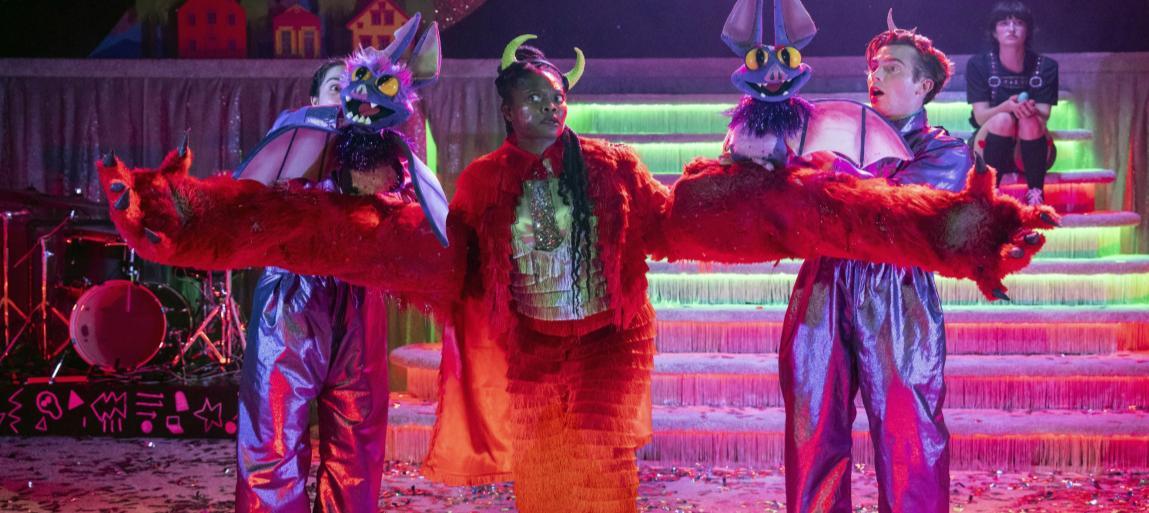
Open to roaring reviews in 2024, The Jingleclaw represented one of the Hippodrome’s first full new musical productions and was led by the Department of New Musical Theatre. This formed part of our new ‘My First Musical’ series aimed at family audiences and those who might not ordinarily attend the theatre. Of the 7,400 audience numbers reached, 31% were ‘new bookers’ highlighting the impact the production had in attracting new audiences and groups.
A key feature underpinning the production was the involvement of local creatives with 32 freelance creatives working on the show. This helped set a template for supporting and prioritising paid opportunities for involving West Midlands professionals in the cultural outputs in the region.
Following this success, the Hippodrome produced its next instalment in the series in 2025: No Such Thing as Wolves.
2.54 RBC is a key partner in the development of a centre for musical theatre and will work in collaboration with BHTT to deliver this vision. RBC is a world-class institution, featuring in the Top 5 Drama Schools in the UK for Dance and Drama, and is recognised for delivering leading education and training for the musicians, actors, stage managers, performers and designers of the future. The RBC is part of the Birmingham City University [BCU] which allows the Conservatoire to draw upon the wider institutional expertise and knowledge of BCU as well as the international links and global presence BCU has outside of the UK.
2.55 RBC provides a range of courses which are open to both undergraduate and postgraduate students. This includes:
• BA Acting
• BA Applied Theatre
• BA Stage Management
• MA/MFA Acting
Royal Birmingham Conservatoire
2.56 As of 2024, there were around 170 students enrolled at RBC School of Acting with the majority of students undertaking the BA or MA in Acting. The school also has a strong international reputation with around 20 international students enrolled including students from the USA, India, Canada and Ukraine.
2.57 Due to the absence of existing acting facilities within the campus, students who enrol on RBC’s acting courses are spread across two locations: Ruskin Hall (Bournville) and Digbeth, with a third location, known as 3B, used to design and store costumes and props. These locations pose existing challenges to RBC’s current acting offer, including:
• Poor accessibility to meet the needs of students and visitors with access requirements.
• Limited capacity which restricts the size of courses and prohibits the buildings being available outside of academic classes (e.g. for open days and marketing).
• Poor quality spaces unable to meet current standards including safety regulations, energy efficiency, and lack of sprung floors, or the high standards of tuition the courses offer
• Outside of the city centre with sites such as Bournville a 15-minute train journey away which places an additional financial burden on students wanting to study at the school.
2.58 Alongside this, RBC currently hire drama studios, theatres and acting spaces to support its productions. The cost of hiring the facilities for existing acting training costs the RBC an estimated £160,000 a year. On top of this, the RBC also pays around £150-160,000 on renting theatres across Birmingham to put on 12-15 productions per year, including £1,000 per week for rehearsal spaces. For full-scale productions and technical productions, they are unable to use the existing facilities particularly during the five-week full-time rehearsals.
2.59 The cost of hiring these spaces, alongside the inaccessibility and challenges faced with accessing the spaces, inhibits the RBC’s ability to market and promote its courses to students fully. Many students are unable to visit the sites until later in the audition process to join the school which limits the marketability of the RBC and its competitiveness with other acting schools.
The Case for Change
3.1 The UK is widely recognised as a cultural powerhouse, with a diverse and innovative sector that generates impacts far beyond being just a source of entertainment. Our cultural offer makes a profound contribution to our economy, improves peoples’ wellbeing, and promotes the UK on the international stage.
3.2 The cultural and creative industries are integral to kickstarting inclusive economic growth and raising productivity. This chapter sets out how the vision for a UK centre for musical theatre aligns, supports and unlocks ambitions to strengthen skills development, drive economic recovery, unlock regeneration and attract inward investment.
Strategic Fit
3.3 There are several national, regional and local strategies which have been released in recent years which highlight the strategic rationale and alignment of a national centre for musical theatre with economic, cultural and social objectives for growth.
3.4 The Government released its UK Industrial Strategy in June 2025 which sets out the Government’s 10-year plan for delivering economic growth.13 In this, the creative industries is identified as one of the Government’s eight-growth driving sectors which the Government will leverage to unlock private investment, boost exports, and develop a highly skilled workforce. Music, performing and visual arts are highlighted as a frontier industry, “with our artists, theatres, festivals and grass-roots venues bringing millions of domestic and international tourists to towns and cities across the UK”.
3.5 The Government sets out its plan to transform the business environment of the sector by accelerating innovation, growing the long-term skills pipeline and increasing trade and exports. It also references the West Midlands as a key creative cluster, and states its intention to partner with creative leaders, mayors, trade associations, universities and colleges to implement its plan.
3.6 Following this, the Government released its Creative Industries Plan which reaffirmed the performing arts as a frontier industry within the creative industries.14 This recognised that the sector faces barriers in innovating, accessing finance, developing skills, and exporting. Nevertheless, the Government commits to supporting the sector through public funding, strengthening creative education to boost skills fit for the future, and promoting IP creation. For the performing arts, the Government has promised to “back the next generation of British talent, unlock new growth at home and abroad, and capitalise on the opportunities from digital platforms.”
3.7 A centre for the development of new musical theatre aligns with the Government’s ambition to accelerate innovation-led growth, creating new IP and exploring new technological advancements in musical theatre; build a resilient workforce by addressing skills gaps and increasing sector-specific training; and increasing trade and investment through exporting new IP and showcasing British musical theatre around the world.
13 DfBT (2025): The UK's modern industrial strategy: https://www.gov.uk/government/publications/industrial-strategy
14 UK Government (2025) Creative Industries Sector Plan
3.8 At a regional level, the WMCA published its Futures Green Paper. This recognised that the creative sector has significant growth potential backed by a vibrant, locally driven cultural offer and anchor institutions, as well as a strong academic capability with leading universities. Over the next 10 years, the WMCA commits to supporting economic transformation in the region.
3.9 Birmingham City Council published its Local Plan Preferred Options Consultation in July 2024. Policy EC5 states that Southside is a preferable location for high-capacity night-time economy venues, whilst Policy EC6 ‘tourism and cultural facilities’ states that the City Council will support policies which reinforce and promote Birmingham’s role as an international centre for tourism, arts, culture and major events, and encourages growth in the visitor economy. In addition, support will be provided for new or expanded facilities where they enhance the visitor experience or cultural offer. As part of this, in 2025 BCC proposed a new Central Cultural Quarter across the Southside and Smithfield areas of Birmingham.
3.10 The centre therefore represents a unique opportunity to help transform the musical theatre industry and will:
• Support the UK Government’s Industrial Strategy15 to drive growth in the creative industries.
• Bolster the UK’s global standing through the soft power supported by our cultural offer.
• Provide skills development and high-quality employment to safeguard the sector’s future.
• Strengthen the UK’s cultural ecology and training infrastructure by bringing together members of the creative industries into one central hub of activity.
• Provide an additional centre for world-class training in Musical Theatre, for which there are very few affordable courses outside London and the South East.
• Deliver culture-led regeneration and help establish a cultural district within the Southside area and the wider cultural assets
The Sectoral Case for a Musical Theatre Hub
The Growing Potential of Musical Theatre
3.11 Live theatre is a fundamental part of our cultural offer. In 2023, the UK theatre industry employed over 200,000 people in its supply chain and contributed more than £2.3 billion in GVA.16 In the West Midlands alone, for every £1 spent on a theatre ticket, an extra £1.85 is spent in the local economy with 19% of visitor spend by theatre audiences derived from people not local to the region.
3.12 In particular, musical theatre is of the one of the most financially buoyant art forms in this country. Musicals make up 10% of performances across UK theatres, but account for 21% of tickets sold and 25% of revenue.
3.13 Nationally and internationally, there is a growing market for musical theatre evident by both its rising economic contribution and audience demand. Economic estimates from
16 Sound Diplomacy (2023) Economic Impact Assessment of UK Theatre Sector
DCMS for the performing arts (which includes musical theatre) indicates that there has been significant growth in the sector. The economic value of the performing arts was around £1,086 billion in June 2023, up 18.0% or £165 million compared from pre-Covid levels of £921 million in February 2020.17 This is notably higher than the wider creative industries sector which grew by 14% and is eighteen-times higher than the UK as a whole which grew by 1%. This shows how integral the performing arts has been to the post-Covid recovery of the sector and the role it plays in driving growth across the UK.
3.14 This sentiment was echoed across consultations with producers, writers, technicians and industry bodies who all share a consensus that musical theatre across the UK and abroad is encountering a sustainable resurgence in popularity and audience demand. For example, data provided by the Hippodrome highlights that, compared to pre-Covid levels of attendance, musical theatre has been the highest performing genre for audience admissions and ticket sales. From 2019 to 2024, there was a 32.6% increase in admissions to musicals and a 78.6% increase in sales.
3.15 Many in the sector believe that musical theatre is on track to enter a second renaissance defined by innovation in technology, new art forms, and more diversified storytelling and genres. The growth of the experience industry, with new events like ABBA Voyage, highlights the opportunity for further technological innovation, with potential to draw on and connect with the recent AHRC CreaTech Frontiers investment in the West Midlands.
3.16 The industry recognises the need for innovation and original IP, with audience desire for revivals and juke box musicals waning. Recent successful productions such SIX, Operation Mincemeat and Benjamin Button showcase the appetite for new musicals in the UK and beyond. There is strong audience appetite for new stories, genres and forms of musical theatre which has been crucial to the theatre sector’s recovery since the Covid-19 pandemic.
Case Study: SIX the Musical
From Tudor Queens to Pop Princesses, the six wives of Henry VIII are front-and-centre of a new British musical which has taken the West End, Broadway, and theatres around the world by storm. Enjoyed by over 3.5 million people worldwide and grossing over $1 million in its first full week on Broadway, SIX has proven to be a modern success story.
However, the story behind SIX the Musical is just as interesting as the story told onstage. The musical was penned whilst both writers were in their final year of university before being premiered at the Edinburgh Fringe in 2017 with a cast of Cambridge University students to a rapturous response. After being spotted by eager producers, the show premiered the West End in 2019 before beginning a UK tour which included the Birmingham Hippodrome.
Following an incredibly successful national tour, SIX premiered in North America in 2019 and on Broadway in 2020. The show has won two Tony Awards and has since developed successful productions in Norway, Hungary, Poland, Croatia, Australia, Canada, South Korea and Japan.
As of June 2025, SIX has grossed almost $200 million and has been performed over 1,500 times on Broadway. A filmed stage production of the musical featuring the original West End cast was released in UK & Ireland cinemas in 2025, with an international release set to follow.
3.17 Whilst shows such as SIX the Musical highlight that there is demand for new British musicals, success of this scale is rare and typically relies upon the right people being in the right place. For many, the costs associated with writing a new musical, developing the idea, and workshopping means many innovative and creative musicals do not get the opportunity to progress beyond conception. To succeed, actors, writers and performers often require an existing “in” to support networks, including have access to relevant and influential producers, as well as some ability to self-finance. This means many stories and narratives do not get the opportunity to develop, particularly those stemming from lower socioeconomic or global majority backgrounds. This inequality means the industry and, ultimately audiences, lose out on getting access to a broader range of cultural experiences and art forms. Birmingham is ideally placed to redress that imbalance
3.18 Productions such as SIX demonstrate how original ideas can transform when given the support and backing of those within the sector. To ensure more stories have the opportunity be told, targeted support and dedicated training is required to ensure the UK remains at the forefront of the sector’s growth trajectory. In response, BHTT and partners propose the development of the UK’s first centre for musical theatre.
Case Study: Peaky Blinders
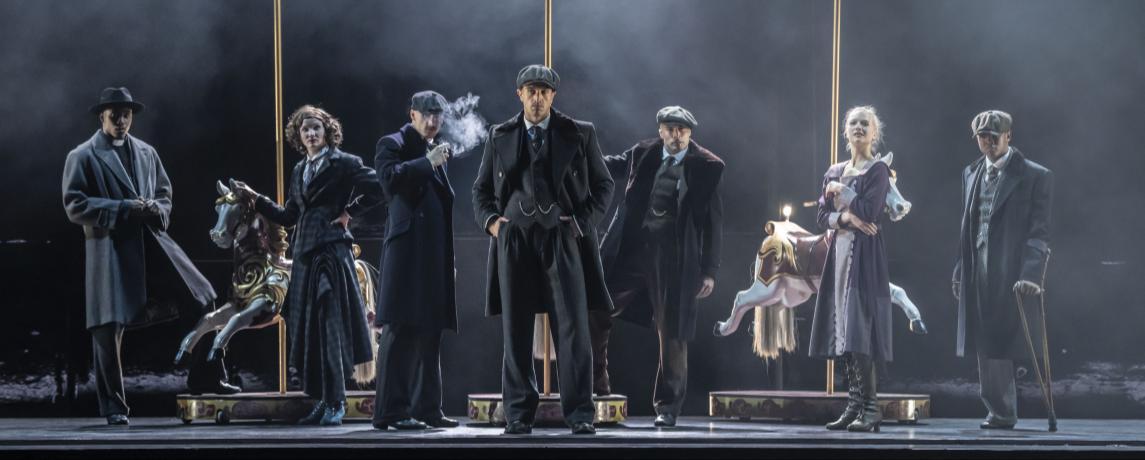
Co-produced between Rambert and the Birmingham Hippodrome, and written by Peaky Blinders creator, Steven Knight, Peaky Blinders: The Redemption of Thomas Shelby premiered as a new stage production in 2022.
The cross-artform dance show and has gone on to have international acclaim. Following its premiere in Birmingham, a successful global tour has taken place with performances in the UK, Luxembourg, Turkey and France. By the end of the tour in 2025, the show had performed at 19 different venues, across 29 touring weeks, and 196 performances, becoming Rambert’s most watched production.
Alongside this, the production has also been captured on film for tv and was aired on the BBC in 2024 which subsequently led to extracts of the work being performed live on air to 2 million people during the 2024 BAFTA Awards.
Productions such as Peaky Blinders not only demonstrate the ability of Birmingham Hippodrome to develop new IPs but highlight the international impact British-made IP can have and the appetite for new musicals from audiences across the world.
Expanding the UK’s Export Potential
3.19 Musical theatre is also an industry with enormous export potential, with the UK known as a world-leader in producing international touring work. In an increasingly globally competitive industry, the UK continues to export more plays and musicals than it imports. 18
3.20 British productions The Phantom of the Opera, Mamma Mia, and Cats have collectively generated over $13.6 billion in global gross revenue, surpassing major film franchises in earnings and reach. This acclaim has continued today with the recent 2025 Tony Awards seeing UK-originated productions take home 13 awards recognising success both on-andoff stage in acting, design, and production.
3.21 Moreover, the financial and cultural returns from international touring and promotion such as increased tourism, higher spending by international visitors, and ongoing demand for British talent and technical expertise further cement the sector’s global standing.
18 SOLTUK-Theatre-Briefing-for-MPs.pdf
Research carried out by UK Theatre found that 52% of its respondents toured their productions internationally.19 The export of British theatre is not only about economic benefit but also amplifies the UK’s reputation for artistic excellence, supports cultural diplomacy, and ensures that British theatre remains a benchmark for quality and innovation worldwide.
3.22 As acknowledged in the Government’s Creative Industries Plan, musical theatre is experiencing a boom within most of the Primary Markets and one of the Future Growth Markets. A national centre for musical theatre will help leverage the cultural export potential by building on the UK’s reputation as a creator of musical theatre by supporting to grow the pipeline of stories, talent and musical forms to be staged across the world. The centre will, therefore, contribute to the creation of new British IP which can be marketed and staged across international markets.
3.23 Alongside this, the involvement of RBC, which has a global reputation for acting and music training, will allow the centre to draw upon the wider international relationships and partnerships available within the conservatoire. In recent years, the sector has seen the training provided in the UK, such as stage design and costume making, go on to be used by international theatres. For example, the Theatre Royal Plymouth’s Producing and Learning Centre has gone on to work on international productions such as Sunset Boulevard at Sydney Opera House. However, these skills are still in decline and struggle due to years of decline in creative education and underinvestment in training. A UK centre for musical theatre will help to reverse this decline by bringing together key partners in musical theatre production alongside the globally renowned RBC. By promoting the course on a global stage through existing partnerships, as well as the attraction of international students, the centre will provide training to students who will go on to transfer the technical expertise, creative talent, and production knowledge around the world.
Case Study: Musical Theatre in South Korea
The rise of musical theatre in growing export markets such as South Korea further highlight this potential. From a modest market size of around $92 million in Korea in 2006, musical theatre’s economic impact has increased more than fourfold to reach around $370 million in 2023, rivalling the domestic impact of K-Pop and representing around 25% of Broadway’s $1.5 billion market size. The market share of Korean homegrown productions is also increasing, and many producers look to export shows abroad, such as Maybe Happy Ending, which hit Broadway in 2024.
Strengthening the Skills and Development Pathway
3.24 Across the industry, there is a clear consensus that there is both a need and strong support for new infrastructure which can strengthen the training, skills and talent development pathways for musical theatre in the UK and support the future production pipeline. Research conducted by BHTT20 identified that the sector currently faces particular skills gaps and challenges as a result of:
• A lack of low-cost, accessible training opportunities (including apprenticeships and practical traineeships) in off-stage roles, especially outside of London.
19 UK Theatre (2025) State of British Theatre
20 BHTT (2025) National Centre for Musical Theatre: Skills Development Opportunities
3.25
• A lack of musical theatre specific craft-based training in dramaturgy, book-writing and producing.
• Difficulty in recruiting for technical roles.
• Trajectory challenges around supporting people to progress from early to mid-career. As well as this, many people leave the sector once they reach ‘mid-career’ due to lack of professional support and continued development, particularly outside of London and those from lower socio-economic backgrounds.
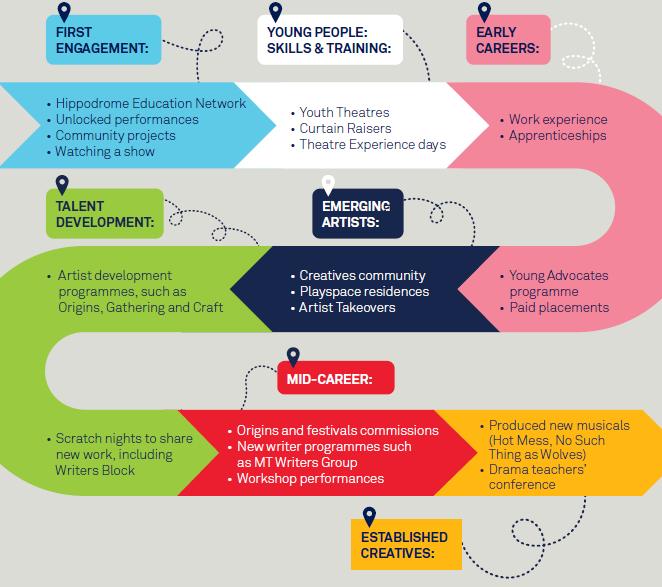
Furthermore, the current level of support available to those in the sector exists at the outset in youth theatres, drama clubs, and extra-curricular activities. However, as people reach the latter stages of their career pathway, the support available dwindles and becomes increasingly exclusive (both in terms of cost and location) with a lack of coordination or clear route for moving between stages.
Source: BHTT (2026)
3.26
Beyond this, a centre for the development of musical theatre will also offer a network not currently available within other drama schools or cities. Through its ‘acorn-to-oak’ approach, the centre would help provide applied routes at different stages of development within one central hub for on-and-off stage training. This will provide a more structured pathway and pipeline of talent and ensure that people are able to progress through the sector and access support at different stages.
Figure 3 1 Birmingham Hippodrome Skills Pathway
Addressing Skills Gaps
3.27 The centre will be dedicated to the creation, development and production of new musicals, and will provide skills of benefit to the wider creative industries and the cultural ecology which supports this. This will include:
• Technical production including sound/audio visualisation, stage automation and lighting.
• Script development, storytelling and composition including Book Writers, Dramaturgs and Composers.
• Production including costume, wigs, hair and make-up, set building, and stage management.
3.28 This is integral as the theatre industry suffers from a severe skills gap which has widened since the pandemic. According to research by the Creative Industries Policy and Evidence Centre, 65% of hard-to-fill vacancies caused by skills shortages particularly in technical skills and innovation and vocational skills.21 Furthermore, during consultation with industry representations, it was raised that the sector presently lacks sufficient training in sound and lighting, automation, stage management, and production. To help address this, there is a need for stronger collaboration between education providers, institutions and industry members to provide a direct pathway from training through to practice.
Why Birmingham?
The UK’s second city but a first-choice destination
3.29 Birmingham is recognised as the UK’s second city with over 1.1 million people living in the city.22 Demographically, the city is one of the UK’s most diverse cities with 51% of its population falling within the global majority compared to just 19% across England.23 In addition, Birmingham is also the youngest city in Europe with nearly 40% of the population aged 25 or under compared to around 30% nationally.
3.30 With diversity grounded in its DNA, Birmingham and the West Midlands has long been at the forefront of emerging new styles and platforms with a direct relationship between the diversity and range of musical forms which arise. Given Birmingham’s diversity, the city would be bursting with the potential to accommodate the UK’s first flagship centre for the development of a musical theatre and would drive innovation, exploration and collaboration across the styles and forms of musical theatre
Driving Inclusive Growth
3.31 The musical theatre sector has been long recognised as an inaccessible industry for many backgrounds and, following the Covid-19 pandemic, saw thousands leave the sector including actors, producers and technical staff with very few returning.
21 Skills mismatches in the UK’s Creative Industries
22 Census (2021)
23 Global majority is a shortened version of the term ‘people of the global majority.’ The term refers to all ethnic groups except white British and other white groups. This includes people from black, Asian, mixed, and other ethnic groups who were traditionally referred to as ‘ethnic minority.’
3.32 Due to this, there is a need to help support people from a diverse range of backgrounds access opportunities and stay within the theatre industry. Without intervention, the sector faces a cliff-edge which could see the British musical theatre industry lose the producers, writers, actors and technicians of the future who help drive innovation and maintain the UK’s competitive edge.
3.33 This poses an opportunity to move away from a London-centric model for musical theatre production and training with a new flagship centre in Birmingham providing a more accessible and affordable city for people within the sector.
Case Study: Local Talent
Alex Cardall is an actor and drummer from Solihull, who has been coming to the Hippodrome since he was five years old. He trained at BOA before going to ArtsEd in London to study Musical Theatre. Alex has worked with Royal & Derngate and the RSC and has toured the UK with multiple shows. In 2024, he starred in The Jingleclaw at Birmingham Hippodrome. He lives in London.
“It's really exciting to consider Birmingham-based stories, collaborative work across the Midlands, and local talent building. If that sort of infrastructure existed for me as the young person, it would have changed the whole track of my life.
Drama school in London was always the dream. It felt like being Midlands based was a drawback; there was a sense that you had to move away There were places in Birmingham doing a fantastic job of training people, but it felt at the time like it was in London where it happens.
It's happening more in Birmingham now. The possibility of people saying stay here to work in theatre would be the BEST thing for the city
It’s powerful to be able to think of your home as a launchpad - home is a place of safety and care which will allow you to go anywhere.”
Strengthening the Creative Industries Ecology
3.34 The musical theatre industry does not exist in isolation but often shares people, ideas and human capital with other creative industry sub-sectors such as film, gaming, and music. Beyond creating a new pipeline of talent and driving innovation, a hub for musical theatre will have spillover effects for other creative industry sub-sectors in the region as a result of more artists, producers, technicians and creative ideas being tested in Birmingham and the West Midlands.
3.35 The activity that will arise at the centre will tap into the wider programme of investment occurring within Birmingham and the West Midlands including:
• The relocation of the BBC’s regional headquarters to the Tea Factory in Digbeth.
• The film and television production studios at Digbeth Loc, the first major production facilities of this scale to ever be developed in Birmingham and a hub for creative businesses.
• CreaTech Frontiers, which received £7.4 million in November 2024 from the UK Government and investment from the Arts and Humanities Research Council.
Alongside leading partner BCU, the cluster is developing video games and immersive reality technology to help boost skills; building multi-platform content for live events including music, theatre and film; and developing new technology programmes launched by the CoSTAR National Lab.24 25 The new facilities provided by a new centre for the development of musical theatre will provide additional opportunities to explore this by pushing the technological boundaries of the performing arts.
3.36 The UK Government’s has already identified performing arts as a high potential cluster and growth area for the West Midlands.26 Not only is the West Midlands one of three where performing arts is identified as unleashing the potential of the UK, it is the only region named that doesn’t have a capital city making clear the economic significance of the region for the UK’s creative industries.
3.37 The specialist centre will help build upon this work by providing new ideas, skills development, and contributing to the cluster of creative businesses, people and culture within the West Midlands. This will make the region a place that will continue to intersect and explore the relationship between technological advancement with the arts and creative industries. By investing in theatre and performing arts, this will provide additionality to film and TV sectors through increased skills and a stable ecology of employment for freelance workers.
3.38 The increased flow of artistic talent and creative activity will help attract new businesses and encourage ideas and collaboration. For example, new musicals may explore AI or immersive reality technology, or they may lead to spin-off activity in other sub-sectors. This is evident in cases where musicals are developed into film, which not only provides knock-on effects for the film industry but creates wider growth in the creativity industry.
Culture as a Catalyst for Spatial Development and Regeneration
3.39 It is widely recognised that arts and culture can have wider spillover effects including supporting urban regeneration and place-making.27 Evidence by ACE found that public investment in the arts and culture can help contribute to development and catalyse wider regeneration. Through creating landmark cultural destinations, arts and culture can attract visitors, businesses, developers and new residents into areas which have previously been overlooked.
3.40 Investment in cultural infrastructure in cities such as Manchester and Salford show how transformative assets such as The Lowry, Co-op Live and Aviva Studios have been to deliver place-based change. A culture-led regeneration can power transformative change and breathe life into areas which have long been under-served and under-invested.
3.41 Building upon existing success stories like the nearby Digbeth Loc Film Studios, the development of a flagship centre could support the creation of a new “Cultural Quarter” in Birmingham The centre will act as a catalyst for the Southside area, with the direct and indirect job opportunities delivering an increase in footfall, visitors and new businesses. With Birmingham’s HS2 station in close proximity, the centre is in a prime position to attract new visitors and workers to the West Midlands, maximising international connectivity and opportunity.
24 Two major UKRI investments continue to boost creative industries – UKRI
25 Government boosts growth-driving creative industries in Merseyside and the West Midlands - GOV.UK
26 UK Government (2025) Creative Industries Plan
27 Arts Council England (2025) Spillover Impacts in the Publicly Funded Arts and Culture Sector
Case Study: Digbeth Loc
Once a former post-industrial district, Digbeth has taken a culture-led regeneration approach to stimulate re-development and investment. It is set to be home to Digbeth Loc Studios, a film and tv production hub, the BBC’s new broadcasting centre and MasterChef, with over 3,000 homes, offices and shops, and further investment set to come forward.
This is creating new job opportunities within filming, production and technical management. Alongside MAMA Youth and Birmingham Film Academy, it will deliver training and apprenticeships to young people in the region and provide professional talent manager support, industry mentoring and exclusive access to industry jobs.
This showcases how cultural-led regeneration can deliver both tangible development benefits through regeneration and the creation of new businesses, as well as wider social benefits such as skills development, pride of place, and a strong sense of identity.
Under-served cultural infrastructure
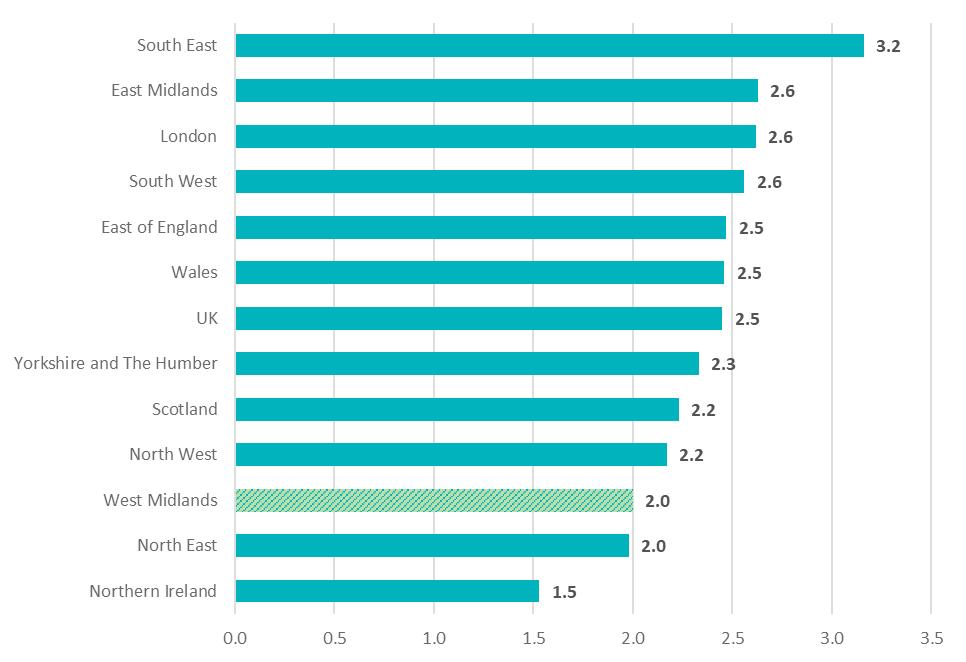
3.42 The West Midlands is underserved on cultural assets relative to other UK cities with only 2.0 theatre venues per 100,000 inhabitants in the West Midlands, which is the third lowest in the UK. 28 The relative lack of cultural assets and associated infrastructure within the West Midlands and Birmingham hinders the capability of the city and region to develop, support and retain the creative skills provision within the region.
Source: Sound Diplomacy (2023) Economic Impact Assessment of UK Theatre Sector
3.43 Objective 1 of the Birmingham Local Plan Issues and Options document states the need ‘To ensure physical, social and digital infrastructure meets the needs of all existing and future citizens.’ However, the city is significantly under-indexed in terms of theatre seats compared to other major UK cities, with around a third of the seated capacity compared to Manchester. In addition, the three largest theatres (Hippodrome main auditorium, Alexandra Theatre and Birmingham Rep main house) are all end-stage format, meaning there is a lack of variety in the theatre experiences the city can offer. This significantly limits the work that artists can create and the theatre that audiences can enjoy.
Overcoming the Creative Brain Drain
3.44 Whilst BCU and RBC produce one of the highest numbers of creative graduates into the region, very few stay in the region due to the lack of opportunities to establish and grow careers, particularly following graduation and during the early-career stages.
3.45 This represents a ‘creative brain drain’ with graduates and people within the creative industries profession locating outside of the region for employment opportunities. Data captured by BCU for the year 2021/22 showed that more than half (55%) of creative graduates report jobs outside of the West Midlands. Whilst this does not provide information on which locations this includes, anecdotal evidence with the university indicates this is typically London and the South East, with some also relocating to Manchester.
3.46 The departure of creative industry professionals from Birmingham and the West Midlands inhibits the economic growth of the city and region as it prevents the full economic potential associated with retaining graduates and young professionals. This means, whilst students benefit from the world-leading training offered at the university and RBC, this benefit is then transferred to other cities and regions following graduation. Reversing the under-provision of cultural assets will significantly broaden access to creative skills provision, increase employment and reverse creative brain drain away from Birmingham.
The Case for Change: Key Messages
• Based in the heart of the UK’s largest city outside of London, a flagship centre for musical theatre in Birmingham would make a substantial contribution to delivering the UK Government’s missions to kickstart economic growth and break down barriers to opportunity.
• The cultural and creative industries are integral to kickstarting inclusive economic growth, raising productivity, and are identified as one of eight growth-drivers in the Government’s industrial strategy.
• In particular, musical theatre is of the one of the most financially buoyant art forms in this country and has enormous export potential, with the UK historically a world-leader in producing international touring productions.
• Investment in arts and culture can help contribute to placemaking, attracting visitors, businesses, developers and new residents into areas which have previously been overlooked.
• The centre would help provide a multi-level system of support and a central hub for onand-off stage training, strengthening the region’s skills provision and securing the future pipeline of talent. This is vital to maintain the UK’s position as a world leader in musical theatre and unleashing the sector’s inclusive growth potential.
• A targeted intervention in Birmingham, with its young, diverse population and high levels of youth unemployment, would maximise this impact, whilst supporting economic growth outside of London and reducing creative brain-drain towards the south.
• The centre will deliver culture-led regeneration of Birmingham’s Southside District, kickstarting investment, attracting more tourists and visitors, clustering with other cultural assets such as Chinatown and the Gay Village, boosting the night-time economy and helping catalyse wider business investment and job creation.
• The musical theatre hub will ensure that the cultural infrastructure of Birmingham finally meets its creative talent and the needs of its audiences, with the city currently under-indexed in terms of theatre seats and limited in terms of the range of products that can be stage or developed.
The UK’s first Flagship Centre for Musical Theatre
The Centre for Musical Theatre Concept
4.1 The centre, based in Birmingham, would be the first national hub for musical theatre learning, development and production, supporting the full lifecycle of education, training and employment for creatives. Bringing together key players in the industry, academia and local communities, this world-leading purpose-built facility would house a full ecosystem of theatre development, from youth training and early-to-mid career education and development to the origination and production of new IP at Birmingham Hippodrome, created by artists representative of the UK today.
4.2 This represents an acorn-to-oak tree proposition not seen before in the UK, with multiple organisations operating from a single campus allowing the sector to flourish and people from every walk of life, background or stage of their career to gain support and benefit from a more cohesive musical theatre ecology. This centre would be developed around three core phases:
1 Transformative regeneration of the existing Hippodrome site as a national home for musical theatre including world-class musical theatre development facilities, and frontage onto Hippodrome Square;
2 The creation of a new campus dedicated to musical theatre development and education which brings together formal education by RBC with career support by the Hippodrome; and
3 A new performing arts space providing a flexible space designed for the future.
4.3 The proposed infrastructure will provide a dedicated space for the development of new musicals including rehearsal and performance space, improved technological capability, and a hub for people across the sector – nationally and internationally - to meet, exchange ideas and contacts, and pioneer new musicals.
4.4 The Hippodrome team have undertaken extensive research to develop the proposition, including in-depth consultation with industry representatives and research trips to international facilities which support the new musical theatre ecosystem (See Appendix 3 for examples). This has allowed for the design of a fresh and innovative offer which includes UK firsts, would collectively represent a nationally unique campus of supporting elements, and is truly designed to meet the current and future needs of the sector.
Phase 1: Regeneration of the existing Hippodrome site as a home for the musical theatre
4.5 Phase 1 would involve the redevelopment of the existing Hippodrome site and expansion to include new spaces in the adjacent Southside Building enabling publicly accessible frontage onto Hippodrome Square.
4.6 It will support people across the lifecycle of their musical theatre journey from children and young people, early-careers, through to those in their mid-career and established stages. This will ensure that people receive tailored training, professional and production support, including:
• Schools and colleges: providing additional capacity for visits, as well as exposure and insight into learning studios, exhibition/digital resources, and tech opportunities.
• Technical theatre training: placements and apprenticeships would be provided for work experience, post-16 and T-Levels, and professional development for those wanting to upskill. This will build upon and expand existing activity undertaken at the Hippodrome, such as their partnership with Solihull College to deliver a Creative Venue Technician Bootcamp, and the Mackintosh Apprenticeship programme.
• Post-graduate training: accredited training and courses in off-stage roles, including year-long placement and paid lead creative roles for mid-careers. These would be targeted at those less represented in musical theatre and leadership roles.
• Placements and Applied Experience: there will be opportunities for students to gain professional show credits through shadowing, placements and entry-level freelance opportunities, as well as offer additional qualifications (i.e. Working at Height).
• Mid-Career Training: this will include up-skilling support, mentoring for career change or retaining those at risk of leaving the sector (e.g. stage management to production management), and 12–18-month Associate programmes supporting directors, choreographers and other creatives to step up to the next level or scale or the industry.
• Established Career Support: commissioning and supporting a wider range of creatives to produce and stage new musicals and scale up productions between the different spaces.
4.7 This would include:
• Upgrades and refurbishment to the existing Main Stage and Patrick Studio including a reconfiguration to the existing auditoriums to enable improved access, new flooring and technical facilities, and upgrades to seating configuration.
• Expansion of the Thorp Street Atrium and the frontage onto Hippodrome Square to accommodate musical theatre growth through greater floorspace, upgraded facilities, learning space and extension into the Southside Building. This will provide new concessionary space and an expansion of the restaurant.
• A new Musical Theatre Campus including a new home for BCU’s Acting School and full-size rehearsal suite across a 400 sqm footprint in the lower half of the build. This would provide a suite of dedicated teaching studios, BCU support space and student facilities, and a rehearsal centre offering dedicated space for musical rehearsal, dance classes, and a recording studio. The upper floors of the development will provide additional student accommodation.
• Transformational impacts on energy efficiency, reducing the organisation’s environmental impact even as activity increases, enabling financial savings that can be re-invested into the Hippodrome’s programmes.
Phase 2: A new campus for musical theatre
4.8 To truly achieve the vision for the flagship centre, there will need to be expansion onto an additional site to provide further facilities to be shared with students from the RBC Acting School This would allow RBC to consolidate its existing footprint and relocate to a site
which meets the educational needs of existing and future students. Looking forward, RBC has ambitions to expand its current course offer and provide new courses in:
• BA Musical Theatre with a future option for MA Musical Theatre
• BA Production which will be an expansion of the BA Stage Management course to include other courses addressing industry skills shortage areas including Technical Production, Lighting Design and Sound Design.
• Under 18 pre-vocational training including Saturday classes, short courses and residential training during school holidays.
4.9 These courses require bespoke and specialist teaching facilities which can provide the equipment, infrastructure and studios required to undertake musical theatre training. The RBC is currently unable to respond to this demand due to the non-specialist teaching facilities provided in Bournville and Digbeth. RBC anticipate the centre for the development of musical theatre would enable an expansion of the existing acting courses which are currently limited in size due to the lack of space and timetabling within the facilities provided.
4.10 The musical theatre campus would allow RBC to better cater to the demand of students and attract more students due to the central location and proximity to the wider BCU campus, as well as the bus, tram and train connectivity (including HS2). Limited space management means that on open days RBC can’t open the acting spaces to prospective students which means students are unable to see the kind of spaces and facilities available to them until later in the audition process which can act as a deterrent and creates challenges in promoting the school. Without improved facilities, RBC will be unable to expand its current course offering which it believes could increase capacity to around 320 students.
4.11 The centre represents an opportunity for RBC to deliver musical theatre training in partnership with one of the UK’s major theatres which will provide students with both access to the highest quality teaching as well as theatre space and wider networks. This will provide a centralised location for careers across musical theatre and the wider industry including acting, technical production, stage management and musical production. Not only will this showcase to students the careers available to them on and off-stage, but it will allow the centre to tap into the wider cultural network that is developing within the West Midlands across film and television.
Phase 3: A new performing arts space
4.12 A key feature of the flagship centre for musical theatre would be the development of a new theatre space and cultural landmark – the region’s first in a generation and the first to be designed around the future of live performance. A purpose-built facility would be constructed in Birmingham’s Southside district as part of a wider culture-led regeneration of the area. This would provide a flexible performance and digital arts space that can accommodate a large multi-performance space or be adapted for performances whilst offering two connected studios, new support and concessionary spaces, and state-of-the-art technology including a XR digital studio.
4.13 In conjunction with Phase 2, the site would encompass training, research and development, creation and production space with a new flexible mid-scale auditorium fitted with the latest technology, as well as supporting facilities and infrastructure.
Lessons from Elsewhere
4.14 As part of the exercise in understanding the potential transformation and opportunity posed by a UK centre for musical theatre, BHTT has undertaken extensive research in understanding, visiting and exploring similar concepts around the world. More details of these comparable models can be found in Appendix 3. They include:
• The Pittsburgh Model’s American Music Theatre Project supports new musicals by providing artists with time, space and resource to aid their development through readings, workshops, and partnership with Carnegie Mellon University [CMU]. Over the next 12-months, AMTP will work with CMU to develop a centre for new work development and has partnered with the Pittsburgh Cultural Trust [PCT] to provide theatre and office space and will provide discounted studio space to house workshops and performances.
• Michael Rubinoff’s Canadian Music Theatre Project as part of the Capstone Project selects 3-4 projects to have the opportunity to perform at festivals and performed by third year students. This became an incubator for many new musicals including Come From Away which has gone on to perform on both Broadway and the West End. As part of this, students go to work with producers and organisations to explore ideas which helped form industry links and exposure to the real-world of musical development.
• Goodspeed Connecticut is a non-profit centre dedicated to preserving the American musical while also supporting the development and production of brand new shows Goodspeed supports new musicals through a layered, nurturing ecosystem from initial readings and residencies (through its Festival of New Musicals, Writers Grove and NYU writers’ residency programmes), to developing full scale productions (in the dedicated Norma Terris Theatre), to commissions (through the GoodWorks commissioning programme). Financially, it is majority funded by ticket revenues of touring shows developed at the centre, alongside individual memberships, philanthropic giving, and institutional grants. Fuelled by an artistic vision and a long history of success in musical-theatre development, Goodspeed has launched over 85 musicals and produced over 70 world premieres of touring productions.
5.0
Future Economic and Social Impacts of a UK Centre for Musical Theatre
5.1 Birmingham Hippodrome regularly attracts high numbers of musical theatre audiences, with over 300,000 people visiting to enjoy musical theatre every year. While musicals currently only make up 10% of performances across UK theatres, they account for 25% of revenue. The centre for musical theatre and expansion of the Hippodrome would not only see the attraction of significant additional visitors to Birmingham and associated economic impacts but would attract further footfall in the Southside District through students, visitors and new employment created.
5.2 This section highlights the potential future economic impacts of developing the centre and expanding the Hippodrome.
5.3 As set out previously, Lichfields has estimated the monetary benefits associated with:
• Off-site spend of new BHTT visitors within the Birmingham Economy.
• GVA per additional FTE job supported by the proposal.
• Increased supply-chain expenditure from BHTT injected into the economy
• An estimation of willingness-to-pay (consumer surplus).
• Additional student expenditure.
5.4 The results of the assessment are then combined with indicative costings for the development to calculate a BCR which provides an indication of overall value for money.
Reference Scenarios
5.5 It is typical when developing business case models to determine a “Do Nothing” scenario which in this case reflects the ‘Business as Usual [BAU]’ option as a reference point for assessing the preferred option.
5.6 For these reasons, the BCR estimate for developing the centre represents an incremental BCR, with the benefits being isolated to those which would not otherwise occur under the BAU option and are net additional.
Do Nothing / BAU Scenario
5.7 A Do Nothing or BAU would imply that BHTT and RBC are unable to deliver the centre for musical theatre in full. Without this, RBC will be unable to provide new courses in musical theatre and BHTT will not have the capacity to deliver more performances and generate additional spend, with no growth in musical theatre production or export generated.
5.8 The table below highlights the existing impact of the Hippodrome and RBC. This shows an existing economic footprint of nearly £91 million for 2023/24.
Table 5 1 Existing Impact of Birmingham Hippodrome and Royal Birmingham Conservatoire for 2023/24
Benefits
Total
Existing Direct Employment (BHTT/RBC) 260
GVA (2025 prices)
BHTT Expenditure (2023-24)
£18,260,679
£16,348,144
Existing Visitors (incl. festivals and free events) 840,000
On-site spend (2023-24)
Off-site spend (2023-2024)
Existing Student Expenditure
Total
Source: BHTT; RBC; Lichfields
£31,343,660
£23,607,077
£1,337,942
£90,897,501
5.9 Whilst this reflects the existing impact, BHTT has acknowledged that without intervention, the current economic impact will begin to decrease as a result of degradation and essential mechanical and electrical infrastructure reaching end of life.
Economic Benefits of the Centre and Hippodrome Expansion
5.10 As set out in Chapter 5, the project is centred around three core phases:
1 The creation of world-class musical theatre development and education facilities which brings together formal education by RBC with career support by the Hippodrome
2 Transformative regeneration of the existing Hippodrome site including new spaces and frontage onto Hippodrome Square.
3 A new performing arts space with a c.900-seat capacity providing a flexible space designed for the future
5.11 Based on the phases above, this section will identify and assess the economic impacts associated with the project including the Hippodrome expansion.
Increase in Off-Site Visitor Spend
5.12 The Hippodrome anticipate that improvements to the existing Hippodrome site, alongside the inclusion of a second stage and studios, will result in an additional 239,300 visitors across 660 additional performances per year once fully operational.
5.13 Based on the additional 239,300 visitors the Hippodrome expects to generate per year across its existing and new spaces, the centre could generate over £5 million in additional ticket sales plus £1.2 million in additional on-site spend from Food & Beverage sales [F&B]. This results in an additional £6.34 million per year once fully operational.
Source: BHTT/Lichfields
5.14 In addition to the 239,300 new visitors to the Hippodrome each year, BHTT also expect the centre will enable them to attract an additional 100,000 visitors per year through expanding their festivals programme which are free-of-charge events held across the city. This will result a total of around 339,300 additional visitors per year once fully operational.
5.15 Using the proportion split presented in Chapter 4, Lichfields has assumed that future visitors will continue to consist of 24% Birmingham residents, 70% non-local daytrips and 6% non-local overnight trips. This is highlighted in the table below to the four spaces and festivals programme.
5.16 The increase in visitors to the centre and Hippodrome will also generate an economic impact arising from off-site visitor spend in Birmingham and the West Midlands. Drawing upon the average off-site spend of visitors to the Hippodrome and factoring in additionality assumptions for local, day trip and overnight stay visitors29, this suggests that the centre and festivals programme will generate an additional £9.5 million in off-site spend per year within supporting sectors in Birmingham once fully operational.
Source: Lichfields
Willingness to Pay
5.17 Guidance released by ACE in 2021 provides a methodology for estimating the amount of money an average household is willing to pay to continue enjoying a theatre, represented by
Table 5 3 Additional visitor off-sites spend by space (with festivals)
the value that they would be willing to pay for a ticket over and above the actual ticket value. This is known as a Willingness-To-Pay value [WTP].
5.18 WTP can be used to estimate the direct use value of a theatre in its current (baseline) state, as well the additional WTP gained from for an improvement to the theatre (i.e. a theatre expansion).
5.19 To apply this valuation, ACE guidance recommends dividing the existing level of visitors by the average UK household size (2.430) and multiplying against the WTP value per household. To do this, Lichfields has inflated the 2020 WTP value (£13.10) to 2025 prices (£15.70).
5.20 Based on this, the Hippodrome in its existing state has a WTP of £3.86 million (2025 prices). However, when the visitor uplift is factored in, this increases to £5.4 million (2025 prices). This results in an additional WTP of £1.56 million per year.31
Staff Increase
5.21 Data provided by BHTT and RBC indicates that the proposed centre could result in additional FTE employment of around 88 BHTT/centre staff, 100 FTE freelance staff supporting teaching and new productions within the new facilities, and 41 additional RBC staff to deliver new courses. This will result in an additional 229 FTE jobs alongside 14 apprentice / trainee positions.
5.22 Using GVA per FTE for those within the performing arts32 and those within the educational sector33, the additional staff employed as a result of the centre and Hippodrome expansion is expected to deliver around £16 million in direct GVA per year once fully operational.
Source: Lichfields; DCMS (2022); Experian (2024)
Supply Chain Spend
5.23 As a result of the delivery of the musical theatre hub and expansion of the Birmingham Hippodrome, there will be an increased supply chain spend from BHTT on goods and services to enable production of new shows, an increased number of performances, scaling up of the hospitality offer for visitors etc.
5.24 Information provided by BHTT, suggests that the centre and expansion will generate an additional spend of £3.2 million within the economy per year once fully operational.
30 Census 2021
31 ACE (2021) Guidance Note: How to quantify the public benefit of your Theatre using Value estimates Please note: whilst ACE’s research acknowledges that an expansion to a theatre may result in increased WTP, it is not currently possible to estimate the increase in WTP due to lack of primary research or guidance. The WTP, therefore, represents a ‘point estimate’ (i.e. increase in visitors but experience remains the same) rather than the marginal value gained from changes to the theatre (i.e. increase in visitors and improved experience).
32 DCMS (2022) Output per Filled Job for the Performing Arts within the Creative Industries (inflated to 2025 prices)
33 Experian (2024) Education GVA per FTE
Table 5 4 GVA per FTE Increase (2025 prices)
Student Expenditure
5.25 Through the expansion of RBC’s existing educational programmes and new courses, the centre is also expected to deliver an increase in students living and studying within Birmingham.
5.26 Information provided by RBC estimates that there are currently around 190 students enrolled on RBC courses across its different year groups. Through the delivery of the centre, the RBC expects this to increase to around 320 students across its undergraduate and postgraduate courses. This will result in around 132 new students living in Birmingham, based on 3 cohorts.
Table 5 6 Total student numbers by existing, new and additional at undergraduate and postgraduate by course
5.27 Around 27% of existing RBC students are international. Based on existing student fees for both UK and international students at undergraduate and postgraduate level, we estimate that the new courses enabled by the centre could generate around £1.6 million in additional student tuition fees each year 34 Table 5 7 Additional Tuition Fees for Undergraduate and Postgraduate Students.
Source: BCU/Lichfields Analysis
5.28 New students will also generate additional spend within Birmingham through general living costs and within the retail and hospitality sectors.
5.29 Data provided by the Student Income and Expenditure Survey, suggests that a student on average spends between £8,500-£9,550 per year on living costs, dependent on the level of study
Source: Student Income and Expenditure Survey, 2021/22
5.30 Not every student who studies at the RBC will be new to Birmingham with a proportion expected to be ‘home students’ or students who were already living in Birmingham prior to study. Due to this, these students are excluded from student expenditure estimates as they cannot be classified as new and, therefore, not injecting additional spend into the area.
5.31 HESA data indicates that 58% of students studying at BCU are living at home during their studies. This will typically be students who are either living in Birmingham or the West Midlands with family or relatives, or commute to the university as part of their studies.
5.32 Removing these students to ensure additionality, we estimate that the expanded RBC courses as part of the centre for musical theatre could support additional student expenditure spend of around £492,100 within Birmingham per year.
Source: Lichfields
Construction Benefits
5.33 Lastly, the construction of the centre and expansion of the Hippodrome will generate capital investment which, in turn, will create direct construction jobs over the 6-year build period and support economic output.
5.34 Using labour coefficients from the Homes and Communities Agency [HCA] Calculating Cost per Job Best Practice Note (2015), it is possible to calculate the number of direct construction jobs supported by the Proposed Development over the course of the construction phase.
5.35 A ‘private commercial coefficient’ is considered as the most appropriate for calculating the number of direct construction jobs generated by the proposals. This coefficient assumes that 16.6 Full-Time Equivalent [FTE] employment would be generated per £1 million of construction cost in 2011 prices.
Table 5 8 Total Student Expenditure by Year of Study
Table 5 9 Student Spend by Year of Study
5.36 After deflating the c.£86 million35 construction cost to 2011 prices, this suggests the construction phase of the centre and BHTT expansion project could support 166 direct FTE construction jobs annually over the 6-year construction phase.
5.37 Although national and regional construction firms often use their own labour on projects, it is typical that a share of the contractors employed is drawn from the local labour pool. However, it is difficult to determine the likely source of labour to fill these jobs before contracts have been let. It is reasonable to expect a proportion of the construction jobs to be taken up by local workers, particularly if measures are in place to raise local skill levels and encourage local recruitment (e.g., through apprenticeships).
5.38 2025 Experian data indicates the construction sector generates an average GVA per FTE worker of £70,920 per annum in the West Midlands. Applying this to the direct employment impact of the scheme (as derived above), it is estimated the direct construction activity could generate £11.7 million of direct GVA per annum during each year of construction.36
Additional Social Value
5.39 As part of the Hippodrome’s expansion and development of a centre for musical theatre, the Hippodrome expects to expand its existing social and community programmes set out in chapter 4. Once complete and operational, this has the potential to increase the social value contribution of the Hippodrome and provide wider opportunities including:
• Offering 570 additional vocational training places annually through new workshops, large-scale youth musical production, and mid-career retraining opportunities.
• Expanding the number of schools and young people engaged as part of the HEN and festival programmes to include an additional 6,000 young people per year.
• Providing nearly 650 additional professionals with employment and vocational training through an expanded main stage programme, international summer school, and the production of youth musicals each year.
• Delivering 24 additional apprenticeships / trainee placements every year.
• Attracting an additional 600 young people to participate in its youth theatre programmes each year through producing large scale, youth musical workshops.
• Providing 152 additional volunteering opportunities every year.
• Developing new audiences and engaging local communities in the development of musical theatre, through expanded community projects and productions which engage local creatives and cast members, such as To The Streets!
5.40 On this basis and building upon the social value assessment set out in Section 4.0, the expansion and provision of new social and community programmes has been estimated to generate an additional £5.9 million in social value benefits through increased delivery of training, and improved confidence and wellbeing.
35 Only costs directly related to construction activity have been included in the assessment of construction benefits. Total capital costs for the project factoring in design, consultancy fees, contingency etc. are appraised in the Cost-Benefit-Analysis (£c.114m)
36 Construction benefits also factor in a 25% displacement assumption, based on the read reckoner for a ‘low’ level of displacement as set out in Table 4.8 of the 2014 HCA additionality guide. Displacement can be reduced through efforts to employ local firms and labour during construction.
5.41 In addition, the works to the existing Hippodrome site would have a transformational impact on energy efficiency, reducing the organisation’s environmental impact even as activity increases and enabling financial savings that can be re-invested into the Hippodrome’s programmes.
Non-Monetisable Benefits
5.42 It should be noted that many of the benefits of the centre are difficult to quantify and thus do not form part of the cost-benefit analysis. However, these impacts would nevertheless support significant additional economic and social benefits. These include:
• The value of new IP created at the centre;
• The national and international touring revenue of IP created at the centre;
• New partnerships with or expansion of existing (non-Hippodrome) creative activity in the city-region;
• Development and engagement of new audiences and talent, particularly those from currently under-represented backgrounds; and
• The wider benefits to the touring production ecology of new products developed at the centre and a new, versatile and large-scale venue in the UK’s second City.
Cost Benefit Analysis
5.43 To determine the value for money of developing the centre for musical theatre with regard to economic uplift, the costs and benefits have been modelled over a 30-year appraisal period to produce a benefit-cost-ratio [BCR].
5.44 A BCR of 1 or greater is generally considered to indicate good value for money in the UK:
• BCR > 1: The project's benefits are greater than its costs.
• BCR = 1: The project's benefits are equal to its costs.
• BCR < 1: The project's costs are greater than its benefits.
As further guidance, in the latest Value for Money Framework report released by the Department for Transport in November 2024, further detail was set out on what BCR indicates value for money as follows:
Table 5 10
Very
High
Medium
Low
Poor
Very Poor
Value for money categories
Greater than or equal to 4.0
Greater than or equal to 2.0 and less than 4.0
Greater than or equal to 1.5 and less than 2.0
Greater than or equal to 1.0 and less than 1.5
Greater than or equal to 0.0 and less than 1.0
Less than 0.0
Source: DfT (2024): Value for Money Framework, Table 5.1
5.45 Only monetised direct benefits which are considered to be robust and in the spirit of HM Treasury Green Book appraisal guidance have been factored into the benefits side of the appraisal, factoring in appropriate adjustments for additionality and displacement where
possible and being mindful of not double-counting effects. No indirect benefits or economic multipliers have been factored into the appraisal.
5.46 This modelling sets out the economic benefits of the capital costs associated with the physical development of the centre, with both costs and benefits being cash flowed over 30 years (with a base year of 2025) according to the estimated project timeline.
5.47 Benefits are presented as present values in 2025 prices, incorporating an annual 3.5% discount rate as recommended HM Treasury Green Book guidance. In addition, capital costs have been inflated by 23.5% to account for optimism bias.
5.48 The results of the modelling are set out in Table 7.14 and demonstrate that the project has an estimated BCR of 3.3 excluding indirect benefits, demonstrating that the project offers ‘high’ value for money in line with the categories set out in Table 7.13.
Table 5 11
Ratio over 30-year appraisal period
Source: BHTT / Lichfields numbers may not sum due to rounding
37 The optimism bias adjustment is the mid-point of the upper and lower bound adjustments for non-standard buildings, as taken from the ready reckoners suggested in Table 1 of the Supplementary Green Book Guidance - Optimism Bias. Typically in fullbusiness case appraisals, higher optimism bias adjustments should initially be applied, before being reduced as project risks are identified and mitigated for.
Conclusion
6.1 This report has set out the existing social and economic impact of Birmingham Hippodrome which is a major contributor to the West Midlands’ wider cultural ecosystem. The Hippodrome is committed to driving social inclusion, diversity and the breaking down of barriers for its audiences, artists, participants, employees and wider communities. It is more than a theatre; it is the cultural heart of Birmingham and the West Midlands, supporting cultural enrichment, community outreach and inspiring people to access the arts.
6.2 Based on its existing educational, charitable and social projects, Lichfields has estimated the Hippodrome has delivered benefits resulting in a total social value contribution of £18 million across 2023-24.
6.3 More widely, the Hippodrome plays a crucial role in facilitating access into the creative industries, advocating for diversity and inclusion, and supporting both vocational skills development and wider transferable soft skills which support access into future jobs and training.
6.4 The Hippodrome is also a major economic powerhouse within both Birmingham and the West Midlands. Not only does it provide direct jobs and employment, it supports a wider supply chain of businesses and attracts tourists to visit and inject expenditure into the wider economy. Based on Lichfields analysis, it is estimated that the Hippodrome delivers economic benefits including:
• Direct and indirect employment of 520 jobs in the West Midlands
• A contribution to GVA of £33.5 million in the West Midlands.
• In 2023-24, BHTT attracted over 800,000 visitors which resulted in a visitor spend of around £55 million from on-and-off site visitor spend.
Supporting Musical Theatre Growth
6.5 Whilst the Hippodrome delivers a range of genres; musical theatre accounts for nearly half (48.6%) of total admissions. Post-Covid, musicals have continued to grow in popularity with nearly an 80% increase in sales since the pandemic. In 2024, BHTT established the UK’s first inhouse New Musical Theatre department, dedicated to developing musical theatre talent and producing new musicals.
6.6 Musical Theatre across the UK and internationally is a major sector within the creative industries. The UK continues to export more musicals than it imports and is recognised internationally as the leading country for musical theatre. However, the sector needs support to maintain its competitive edge, attract a wider range of people, and develop new styles, genres and forms of musical theatre.
A UK Centre for Musical Theatre
6.7 Looking forward, the second half of report has set out BHTT and RBC’s vision for the future of musical theatre to ensure its survival, growth and continued acclaim to help support the creative industries.
6.8 The centre for the development of musical theatre represents an opportunity to deliver ‘acorn-to-oak’ support not seen before in the UK which will provide support across the
sector and bring together major partners to deliver new musicals, deliver training and education, and forge new industry partnerships. There are three core phases to the project:
1 The creation of world-class musical theatre development and education facilities which brings together formal education by RBC with career support by the Hippodrome;
2 Transformative regeneration of the existing Hippodrome site including new spaces and frontage onto Hippodrome Square; and
3 A new performing arts space – the region’s first for a generation, providing a flexible space focussed on the future of live performance
6.9 This will deliver both a new performing arts space and training for under-18s, as well as allowing the RBC to provide new courses in BA/MA Musical Theatre and BA Production. This is in response to increasing demand nationally and internationally for courses in musical theatre. In doing so, the centre will help attract additional students to Birmingham, increase the RBC’s capacity for courses, and increase the presence of international students.
6.10 The musical theatre hub will help unlock the ambitions associated with national, regional and local strategies, including:
• Supporting the UK Government’s Industrial Strategy to drive growth in the creative industries and sub-sectors. Musical theatre is a major economic driver of the creative industries and will deliver regional growth through tourism, jobs, economic clustering, and unlocking investment and exporting.
• Build talent and develop skills as part of the creative industries sector vision through training in innovation, IP development, and access to a wider, more diverse pool of young people and creatives. The hub will help the UK to maintain its competitive edge through supporting new writing, innovation in technical production, and helping to attract international students.
• At a regional level, the centre will help to diminish the creative brain drain currently faced in the region with many people leaving to take jobs elsewhere, particularly in London and the South East. It will support the Culture and People ambition to provide new employment and training opportunities for residents of the West Midlands, increasing accessibility and inclusion in the section, and ensuring musical theatre reflects the breadth of diversity reflected in one of the UK’s most ethnically diverse and youngest city regions.
• Locally, the centre will deliver culture-led regeneration and help revive the Southside District through an improved cultural district, attracting more tourists and visitors, and helping catalyse wider business investment and job creation.
6.11 There is a clear case for change and robust argument for supporting the UK’s first centre for musical theatre. The sector is currently at a knife-edge, with a need for greater diversity, inclusion, and a new generation of creatives to ensure the UK continues to lead the way internationally.
6.12 There is a clear economic, cultural and strategic case for not only creating the centre but for locating it within Birmingham. This will:
• Ensure a wider range of people and communities access the creative industries enabling a city known for its diverse tapestry and breadth of cultural output to widen access, develop new musical forms and innovation, and create new stories.
• Support the global export of musical theatre and respond to the appetite for training and support from the UK theatre industry.
• Drive inclusive growth and help overcome barriers to access, as well as provide a future generation of producers, writers, actors, composers, technicians and performers.
• Respond to opportunities within the region including complementing wider investment coming forward from HS2, Digbeth Loc, the creative industry cluster, BEAM Showcase, and relocation of major theatre producers.
• Rebalance the Midlands under-served cultural infrastructure compared to other UK cities The centre for musical theatre will not only address the cultural gap but will pioneer a culture-led cycle of regeneration which can help overcome deprivation, create jobs and skills, and attract wider business investment particularly in the Southside District.
• Finally, the centre will be at the forefront of both creative skills development and overcome the skills gap already faced within the sector. With the partners involved, including BHTT and RBC, this dynamic will ensure that students acquire industryrequired skills and are at the forefront of innovation in design, production and best practice. It will help widen access by inspiring young people, providing new degree courses, and offering apprenticeships to ensure no talent is lost within the city region and UK.
6.13 Based on the estimated costs for the flagship centre for musical theatre, this is anticipated to deliver an economic impact of £464.2 million over a 30-year appraisal period which results in a high-value Benefit-Cost Ratio of 3.3. This represents high value-for-money, underpinned by the delivery of substantial net economic and social benefits to the Midlands and the UK as a whole.
Appendix 1 Policy Context
National Policy
UK Industrial Strategy
The new Labour Government published its UK Industrial Strategy in June 2025. This reaffirmed the Government’s mission to deliver growth and the central role the Industrial Strategy played in this endeavour.
The Industrial Strategy is a 10-year plan which seeks to take advantage of the UK’s unique strengths and untapped potential as well as seizing opportunities in new and emerging sectors. The Strategy focusses on tackling barriers to growth in the highest growth-driving sectors and places, looking to create the conditions for increased investment, high-quality jobs and delivering tangible impacts for communities across the UK.
The creative industries is recognised by the Strategy as one of the UK’s eight growth-driving sectors which offer the highest growth opportunity for the economy and businesses. As part of this, the Strategy states it will also support sub-sectors within the broad sectors which meet objectives and can address barriers to growth. Musical theatre is one of the biggest economic drivers of the creative industries acting as a key source of tourism, jobs and audience engagement across the UK.
Following the Covid-19 pandemic, musical theatre has been integral to restoring audience numbers and continues to attract international acclaim, attracting visitors to the UK and supporting businesses throughout its supply chain.
One of the central objectives of the Industrial Strategy is regional growth. This acknowledges that to deliver higher national growth, the economic potential of the UK’s cities and regions must be unlocked by supporting sectoral clusters to reach their potential and a place-based approach to policy. The UK centre for the development of musical theatre aligns closely with this objective and will act as a central feature of delivering economic prosperity across Birmingham and the West Midlands through the jobs and investment it will generate within the musical theatre and cultural sector more broadly.
Within the Creative Industries sector, the UK Industrial Strategy states that the UK Government will leverage UK creative industries' global comparative advantages by unlocking private investment, boosting exports, and developing its highly skilled workforce. The Government needs to ensure the UK sector remains globally competitive as a home for world class talent while maximising access to important markets to tour and collaborative. The centre represents an opportunity to maintain the UK’s position as a leading producer and exporter of musical theatre, ensuring that future generations can enjoy new musicals, and will help attract private investment through the Hippodrome and commercial producers.
Birmingham and the West Midlands are a key ecosystem for the creative industries with strong subsectors across theatre, film and television, and music performance. The centre will support this wider sector to grow through its contribution to developing a suitable workforce of the future which requires training and development in production, technical development and performance. This helps create a wider workforce to enter the sector more broadly and helps strengthen the West Midland’s cultural proposition.
There is a strong potential within the musical theatre industry to explore greater innovation and development as part of training. By bringing together the different aspects of the industry through technical production, new forms and styles of musical, and helping to derisk parts of the production process, this will allow the sector to increase innovation within the production of musicals. The RBC is already part of the Creative Frontiers programme which leads performance-related PhDs as part of their exploration of the role digital technology plays in live performances. There are aspirations that as part of the centre, there will be an ability to grow the research development potential of the RBC through supporting developing within musical theatre. This supports the Industrial Strategy vision to increase and support innovation with the growth sectors.
Creative Industries Sector Vision
The Creative Industries Sector Vision set out the previous Government’s plan to drive growth, build talent and develop skills within the Creative Industries. This acknowledges the important role theatre plays in the UK’s ‘national life’ and the bonds between communities. Goal 2 of the vision states that more needs to be done to equip young people with the skills to thrive and aspires to building a highly skilled, productive and inclusive workforce by fostering creative talent from a young and developing a stronger skills and career pathway.
By bringing together the Birmingham Hippodrome and RBC in partnership through the centre for musical theatre, this will ensure that students have the highest quality industrydelivered experience required to support the sector to grow. A national centre will act as a central focal point where different facets of musical theatre production are together in collaboration from musical production, costume design through to technical production and stage management. This will not only showcase to students the skills and careers available to them but will help ensure the sector as a whole has a workforce fit for the future.
Furthermore, Goal 3 commits to maximising the positive impact of the creative industries on individuals, communities and the UK’s global standing. The creative industries is recognised as a soft power which can reach global audiences and strengthen the UK’s positive influence on the world.
The Hippodrome and RBC are already internationally recognised institutions with strong global audiences. The flagship centre will allow the UK to maintain its competitive edge as a major leader and producer of new musicals, supporting emerging and existing writers and producers to create new musicals, and increase the exporting of new musicals across the UK. Successful shows such as SIX the Musical have shown the international acclaim for British musicals and the centre will help maintain the UK’s reputation in this market.
Alongside this, the educational function of the centre will help attract international students to undertake training and developmentthrough the new courses offered by RBC. The UK’s existing theatre training is recognised for its rigorous and highly regarded training which the centre will continue to support by meeting the demand for musical theatre training amongst UK and international students.
Regional Policy
West Midlands Culture and People
The West Midlands Combined Authority acknowledges the benefits arts, culture and heritage across economic impact and social value including skills development, community cohesion, attractiveness of place, and health and wellbeing.
The centre for musical theatre will help develop these benefits for communities across the West Midlands. By improving the cultural ecology of the West Midlands and providing new training opportunities, this will help retain the cultural workforce within the West Midlands which currently suffers from a ‘brain drain’ to London with many people leaving the region to take up jobs elsewhere.
Alongside this, the centre will create new opportunities for West Midlands residents. This will include new roles across stage management, front of house, technical production, and writing. Both the academic and under-18 educational courses provided by the centre will help improve the skills of those within the theatre industry by partnering between the RBC and Hippodrome to deliver leading, industry-recognised training and encouraging people across the West Midlands to access arts and culture.
The hub will also help with developing the softer skills of residents. Through community projects and training for under 18s, this will help young people and communities to develop confidence and transferable business skills such as public speaking and writing capability.
The existing musical theatre landscape and training opportunities lack accessibility. With a few exceptions of private institutions, the majority of theatre training opportunities are based within London and the South East. The West Midlands is one of the most socially diverse and youngest regions in the UK. By locating the flagship centre within the West Midlands, this will act as a more accessible location for young people to undertake training, with better living conditions and cost of living, and connectivity to the wider UK.
Futures Green Paper
The West Midlands Combined Authority published its vision for inclusive growth. As part of this, the Green Paper sets out the four big areas of change on the horizon in the West Midlands and how stakeholders respond to them.
The Growth Plan provides a breakdown of where economic opportunity and foundations for growth will be found in the West Midlands. This includes tapping into opportunities around improved connectivity, innovation, and responding to the six components of the Growth Plan. The creative sector is recognised as a key priority within the West Midlands alongside the wider digital and tech sector. This is seen to represent significant growth potential with strong jobs and productivity growth.
The Green Paper recognises there are a number of opportunities within the sector including the diverse sub-sectors which comprise it (including musical and performance), the creative clusters (including Digbeth 13 and BBC), and emerging investment opportunities coming forward via CreaTech and digital technology. With this cluster of emerging innovation, the UK centre is well positioned to strengthen and grow the use of innovation technology in musical theatre.
Local Policy
Birmingham Local Plan: Preferred Options Consultation (July 2024)
The Birmingham Local Plan [BLP] will set out policies which guide the development of the City over the next 20 years. BCC consulted on an Issues and Options Document in 2022, taking all responses into consideration when preparing the Preferred Options document which was released in July 2024. The Preferred Options document includes several policies relevant to this case and the city’s cultural sector more widely and followed the submission of representations from BHTT at the Issues and Options Stage.
The Issues and Options document sets out the vision for Birmingham to be:
“A city of layers rich in heritage assets, the arts, and culture, which make Birmingham like no other place…”
This is reflected Policy EC6 ‘Tourism and cultural facilities’ which states that:
“Proposals which reinforce and promote Birmingham’s role as an international centre for tourism, arts, culture, and major events will be supported, while existing facilities important to the city will be protected. This policy approach will encourage growth in the visitor economy and will enhance the special cultural character found within Birmingham.”
The proposals for a centre for musical theatre will help BCC achieve its ambitions to be an international centre for tourism by working with BHTT and BCU to attract additional international students to the city region, as well as supporting the export and touring of new productions. It will also help promote the development of a Central Cultural Growth Quarter in the city which brings together the Hippodrome, RBC and other cultural assets, by creating a recognisable and well-known cultural destination.
Furthermore, the Policy goes onto state:
“The provision of new or expanded arts and cultural facilities will be supported where they enhance the visitor experience and cultural offer within Birmingham.”
Existing mid-scale to large-scale theatres within the city are typically homogenous proscenium arch theatres which means there is a limited range of products that can be staged or developed which meet the needs of audiences. However, to support innovation within musical theatre and support the staging of contemporary, visually-and-technically engaging productions, there is a need for a state-of-the-art venue which can drive the sector forward.
Birmingham Hippodrome has an aspiration to make the city an international destination for musical theatre and the creative industries. In line with Objective 4, the centre for musical theatre meets the need to “support business growth, job creation, and inward investment by providing a range of employment and economic growth opportunities" as well as Objective 5 and the need to “build on Birmingham’s competitive economic advantages and retain and attract the best talent”. With other creative investment coming forward in the city region, the centre will strengthen the cultural ecology in the city and ensure that Birmingham is able to both create, support and retain creative industry businesses and employees.
To achieve this, the musical theatre hub will help develop skills, training and education facilities in the Southside region, with support structures from BCU/RBC, which would help the centre provide growth for the city and expand employment and training opportunities. This will support the existing cultural venues in the Southside such as Birmingham Hippodrome, BRB, Dance Hub, The Old Rep and The Alex. With several streets marked as areas for revitalisation in the Central Birmingham Framework, this aligns with the planned revitalisation and represents an opportunity for culture-led regeneration.
The Birmingham Hippodrome Organisational Plan (2023-2028)
BHTT’s Organisational Plan (2023-2028) clearly sets out the Hippodrome’s mission: “Providing that ‘goosebumps’ feeling through memorable and extraordinary experiences.”
And vision:
“A distinctive, world-class Birmingham cultural scene with the Hippodrome at its heart”
These statements translate into four ambitions which form the Hippodrome’s ‘strategic core’. These include:
• Hippodrome Unlocked: We will provide unprecedented access to all the work on our stages, reflecting the youngest, most diverse city in Europe in everything we do;
• Hippodrome Stages: We will have three stages offering year-round world-class programmes, each reflecting the diversity of the region;
• Hippodrome Studios: We will open our studio and rehearsal spaces in order to develop and amplify the creative potential of the region, originating new work which will be seen on our stages and across the world, and;
• Hippodrome Tomorrow: We will start a transformational capital project created for and with the people of Birmingham and the West Midlands: the cornerstone of an extraordinary new era for the organisation and the region.
Strategy 2030 – Birmingham City University
As part of BCU’s institutional ‘Strategy 2030’ the University aims to meeting society’s needs through education, research, creativity, innovation and enterprise. The strategy has three pillars at its core:
1 Develop talent for tomorrow by focussing on multidisciplinary STEAM (Science, Technology, Engineering, Arts and Mathematics) approaches to keep at the forefront of innovation. As part of this, BCU aspire to become the largest provider of skilled graduates in the region.
2 Create knowledge for good by discovering, sharing and applying new knowledge to benefit students, the region, and the world.
3 Power prosperity by driving major change in industry and communities. BCU will focus on projects which link BCU to the local economy and work with Skills England to address local skills gap and boost regional prosperity.
West Midlands Growth Company – Business Plan (2023-2025)
The WMGC sets out the business plan for the West Midlands over 2 years following the Commonwealth Games. This highlights key areas of inward investment, capital attraction, the visitor economy, and strategic relationships. As part of this, the business plan identifies four drivers of change:
• Enhance the profile and reputation of the region
• Create and sustain good jobs for local people
• Facilitate the regeneration of the built environment
• Create and sustain vibrant destinations
The flagship centre for musical theatre helps contribute towards this ambition by helping to amplify the reputation of the West Midlands as a leading location for the creative industries and producer of musical theatre. By investing in the project, this will help create new job opportunities in the region, attracting additional investment through new businesses and visitor spending. The expansion and redevelopment of the Smithfield’s site will help contribute to a vibrant, creative district in Birmingham and deliver a culture-led regeneration
Appendix 2 Approach and Methodology
The approach is based on a robust and up-to-date HMT Green Book compliant methodology developed by Lichfields economists over many years. This methodology is regularly refined to reflect changing economic and social priorities of Government and evolving approaches applied in major funding programmes.
Our approach is specific to the measurement of economic, social and wider impacts of cultural, arts and music projects. It utilises information provided by BHTT to understand the existing footprint of the Hippodrome, alongside information shared to underpin our assessment of the proposed centre for musical theatre and expansion. Where primary evidence has not been available, Lichfields has utilised data from reputable data sources and public datasets including the Department for Culture, Media and Sport [DCMS], Arts Council England [ACE] and Higher Education Statistics Authority [HESA].
The methodology incorporates two main strands: an Economic Impact Assessment [EIA] and a Cost-Benefit Analysis [CBA]. These strands combine both quantitative elements focussing on the costs and potential returns of the project and qualitative evidence drawn from the stakeholder consultation and market research.
Throughout the study we have followed HM Treasury Green Book principles and guidance for project appraisal to determine the initial impact of the proposed project. Discussions have also been held with DCMS, ACE, and WMCA to supplement guidance with sectorbased advice to help make an effective case for investment in cultural projects.
Measuring Economic Impact
The Hippodrome’s economic output can be quantified in terms of Gross Value Added [GVA].38 To do this, our analysis relies on established industry-standard methods and utilises evidence and associated metrics produced by the Centre for Economics Research [CEBR] on behalf of Arts Council England, and economic estimates produced by the DCMS. The approach taken aligns with relevant guidance on impact appraisal within the HM Treasury Greenbook and emerging culture-focussed guidance from DCMS.
These are categorised into three key types of impact:
• Direct Impacts: The generation of economic value and jobs supported directly by the Hippodrome and the centre for musical theatre;
• Indirect Impacts: The value generated, and jobs supported by organisations in the supply chain, through the Hippodrome and centre’s spending on goods and services; and
• Induced Impacts: The value generated, and jobs supported in the wider economy through the wage spending of both direct and indirect employees.
The EIA element of the methodology utilises a range of data on existing levels of visitors and visitor spend, then applies uplifts based on the estimated increase in ticket sales generated by the Hippodrome expansion. Where appropriate, we have followed HM Treasury Green Book principles and guidance for project appraisal to determine the impact of the proposed project.
38 GVA is a measure of the value of goods and services produced by an industry, minus the cost of the inputs required to produce those goods and services. It is commonly used as a measure of productivity.
Cost-Benefit Analysis
The methodology for the assessment is based on a combination of existing information alongside secondary research. Existing information has been provided by BHTT and RBC and includes data on:
• Capital and maintenance costs.
• Master planning for the proposed flagship centre and Hippodrome expansion.
• Uplifts in visitors, revenue, and staffing.
• Additional students enrolled at the RBC.
The costs and benefits have been modelled over a 30-year timeframe which includes appropriate discounting, contingency and optimism bias factors to generate a Benefit-CostRatio [BCR] for the proposal.
In-line with HM Treasury guidance, the assessment has categorised benefits into the following:
• Monetised: benefits which can be quantified in monetary terms and included within the BCR.
• Quantitative: benefits which can be quantified but are not included within the BCR due to factors such as avoiding double-counting of benefits.
• Qualitative: benefits which cannot be quantified due to lack of data or relevant guidance but can be used to inform the narrative within the strategic case.
In particular, Lichfields has estimated the monetary benefits associated with:
• Off-site spend of new BHTT visitors within the Birmingham Economy.
• GVA per additional FTE job supported by the proposal.
• Increased supply-chain expenditure from BHTT injected into the economy.
• An estimation of willingness-to-pay (consumer surplus).
• Additional student expenditure.
The results of the assessment are then combined with indicative costings for the development to calculate a BCR which provides an indication of overall value for money.
Assumptions & Limitations
6.14 In order to estimate the potential returns on investment of delivering the national centre, it is vital to determine the effects which would be net additional. Economic additionality is defined as impacts which arise from an intervention that would not have occurred in the absence of that intervention. In other words, they are the net changes that are brought about over and above what would have already taken place.39
6.15 In order to convert gross impacts into net economic benefits, there are a several factors to consider in order to establish additionality40. The individual concepts of additionality include:
• Deadweight: Impacts that would have occurred without the centre.
39 HCA (2014) Additionality Guide
40 Ibid
• Leakage: Benefits that occur outside the impact area being considered.
• Displacement: Relocation of existing businesses therefore not contributing to additionality.
6.16 In all instances, we have drawn upon data provided by BHTT and RBC based on existing visitor information and estimated figures for the proposed centre in terms of increased visitors, new jobs created, and additional students. Where necessary, secondary data has been drawn upon from HM Treasury, HCA Guidance, HESA, Student Income and Expenditure Survey, and the Great British Tourism Survey to inform assumptions underpinning visitor spend and student impacts.
6.17 Throughout the assessment we have taken a conservative approach and have made assumptions which have the effect of reducing rather than inflating the potential economic impact.
Measuring Social Value
In valuing some of these impacts, this report relies on the HACT Social Value Bank,41 which focusses on individual wellbeing as a determinant of social impact. The methodology enables social impacts to be expressed in monetary terms by valuing improvements to wellbeing along with savings afforded to the state relative to comparable state-funded interventions.
Each outcome has a defined financial metric, which incorporates a wellbeing value, a health top up value and, where applicable, an Exchequer value (savings to the state). The outcomes have been developed using an established and nationally recognised methodology, using more than eight years of research and national data surveys to inform metrics.
Whilst the data is presented on a per annum basis relating to the impact of projects and programmes delivered in a single year, the wellbeing and health improvements can provide long-lasting impacts on individual participants that stretch far beyond this time period.
Appendix 3 Lessons from Elsewhere Pittsburgh Model
The American Music Theatre Project [AMTP] supports the development of new musicals by providing artists with time, space and resource to progress through the developmental journey. As part of their upcoming projects, AMTP will support a new work programme at Carnegie Mellon University [CMU] to develop a centre for new work development.
There are three aims behind this project:
1 Propel new work in Pittsburgh by helping theatres to support readings and workshop new work. Existing theatres, similar to those in the UK, focus on performing big main stage works which they can guarantee will attract audiences and generate revenue. This makes it harder for new shows to be developed and workshopped due to the risk associated with attracting audiences and the cost involved in developing new pieces of work.
2 Make Pittsburgh a national and international destination to develop the next generations of plays, musicals and boundary-breaking live performances. As part of their ambition to support the develop of new pieces of work, CMU and AMTP believe this will help push boundaries within the sector by having a dedicated centre to scoping new work and focussing on innovation within the sector.
3 Culture as a driver of urban regeneration. Pittsburgh’s downtown area presently suffers from deprivation, unemployment and is in desperate need of regeneration to attract more people into the area and support local residents. Through the creation of a new centre, this will help support job opportunities for residents, provide spin-off opportunities for further leisure, retail and cultural businesses from audiences and visitors, improve the existing buildings in the area.
Over the next 12 months, AMTP has received funding from the Richard K Mellon Foundation to scope out the project and develop ideas for a new work programme at CMU. As part of the project, AMTP are partnering with the Pittsburgh Cultural Trust [PCT] who can help provide theatre space, offices and support the creation of a centre for new work development. PCT will provide studio theatre space at a discounted rate to allow new shows to be developed, workshopped and staged to help attract audiences.
Learning for a UK centre for Musical Theatre
The power of partnering universities with theatres. The Pittsburgh model has been supported by partners because it will link universities with local theatres. This will allow students to gain early career exposure to the sector and real life experience in acting, stage management, and work development.
A new dedicated theatre space will help de-risk the process. This enables existing theatres to continue (in the short term at least) focussing on revenue generating programmes whilst providing space elsewhere for new work development which can be worked on concurrently and scaled up appropriately.
The importance of public funding to enable economic development. Central to the project is a further requirement for an economic development grant. Without this, the project will struggle to progress the new centre which will then have knock-on effects for
wider regeneration, job opportunities and skills development. Nevertheless, should funding be received, it demonstrates how culture-led regeneration can help generate life into a downtown area, create footfall and help catalyse wider regeneration which could see similar effects for the Southside District in Birmingham.
Michael Rubinoff / Come from Away
Whilst at Sheridan College, Michael Rubinoff ran the Canadian Music Theatre Project which included the Capstone Project which allowed students part of their performance degree to develop new musicals. Every year 3-4 projects would get a festival, books and an opportunity to present their ideas with one of the musicals taken to production by third year students in the following academic year.
This became a great incubator for new musicals to be developed which included the Tony Award and Oliver Award winning musical Come From Away which has been staged on both Broadway, the West End and across cities in both the UK and America. Following this, a production of the show was also recorded and released on Apple TV.
As part of these projects, students would also work with producers and not-for-profit organisations to consider suggestions and explore ideas. This helped form industry links and provide students exposure to professionals already working within the industry.
Learning for a UK Centre for Musical Theatre
Allowing students to fail. Due to the project being delivered in partnership with producers, writers and the university, students were able focus on the process of developing a musical rather than the actual performance. This allowed students to try ideas and see them fail which is a big part of the musical development process and a risk which has led to many commercial theatres avoiding new productions. This gave students an early opportunity to explore this reality whilst working alongside directors and writers.
An incubator for new, award-winning musicals Come From Away is an awardwinning musical and has gone on to have commercial success globally. This showcases the potential for dedicated centres to help create new productions whilst removing some of the risk and providing support to writers and producers who would struggle to secure funding for ideas otherwise. This is similar to SIX in the UK and highlights how a musical centre can forge and bring together industry connections across academia and theatre.
Projects operated like a regional theatre production. Despite being an academic project, musicals would have commercial contracts like regional theatres including copyright. This meant the College had 6 months to decide whether to present a show before they could be taken elsewhere and secured copyright for productions. This highlights how projects can give students early insight into the legal side behind developing new musicals which they wouldn’t gain elsewhere.