

City, Climate, and Architecture
A Theory of Collective Practice
Sascha Roesler

Second and Revised Edition

This publication rethinks climate control—a key concern of the discipline of architecture— through the lens of city climate phenomena. The control of climate is understood as a collective practice, rather than a practice of the individual. The publication highlights both the appropriation of urban climatology by 20th-century architecture, and the ideas and methods developed along the way, the aim being to provide theoretical and historical foundations for a design-based transfer between urban climatology and architecture. To consider urban climatology as detached from the practice of design relies on the erroneous assumption that its application is a purely techno-scientific project.
I European Developments before 1945: The Field of Knowlegde
Urban Studies of Man-made Climates 11 An Introduction
1 Thermal Geographies of the European City 17 Urban Hygiene and the Heat Economy
2 Man-made Climate by Design 43 Urban Climatology and Modern Architecture
3 Democratizing Urban Nature 75 Infrastructures of Climate Control at Large Scales
II Global Adaptations after 1945: Three Design Metaphors
Design Metaphors of Man-made Climates 115 An Introduction
4 Thermal Heritage 121 Collective Memory and the Natural History of Cities
5 Microclimatic Islands 155 Thermal Spectacles and Closed-system Imaginaries
6 Energy-Synergy 179 Energy Ecologies and Settlement Structures
III Epilogue
7 Singapore as a Model? 213 Urban Climate Control in Practice
Appendices
Endnotes 228
References 256
Index 265
About the Author 272
Acknowledgments 273
Illustration Credits 274
Karl Friedrich Schinkel, view of Edinburgh (UK), 1826. 3


Karl Friedrich Schinkel, view of Bath (UK), 1826.
4
William Atkinson, sun box, 1912.

5
Riding school, Brighton (UK). Schinkel’s comment on June 10, 1826: “Too hot inside, really crazy: it was designed to be a greenhouse.”

6
Joseph Paxton, Conservatory (84m long, 37m wide and 19m high) in Chatsworth (UK), 1840.


52
Temperatures above an asphalt road (at different heights).
50
The different wind structure over different types of fields. Recordings by Wilhelm Schmidt.
51
Thermal fluctuation as a function of the weather, 2 m above the ground. Source: Geiger 1927.


53
Bicycles were used for the measurement of microclimatic differences across the city of Munich (1933). Source: Büdel and Wolf 1933.
54
“The Urban and Rural Sky”. Source: Hilberseimer 1944.

55


Section through Vienna and its surrounding rural areas indicating the urban heatisland effect. Feb. and May 1932. Source: Kratzer 1937.

57
Temperature profiles across Munich. Source: Büdel and Wolf 1933.
56
Cloud formation over an ironworks (top). Cloud formation and rainfall over Munich. Source: Kratzer 1937.
where business life, if not flourishing, is vegetating, and then reaches a platform that can claim the status of a high-altitude health resort. For it is not simply a rectangular area of asphalt, but a kind of artificial alpine pasture. Lush green meadows stretch out directly above the stuffy offices, and lush flora sprouts in countless tubs from the soil of the cash books and files. Here the sun shines more brightly than down in the depths, here the wind blows as if around peaks. But the special magic of this skyscape is that it contains a lot of deck chairs, which are free to use.”12 The green terrace and the green facade became architectural means for mitigating the city climate. In 1931, Goldmerstein and Stodieck published a booklet relevant to urban climatology, which is characterized by its focus on feasibility. Entitled Grossstadtsanierung “Metropolitan Redevelopment”, the authors put forward green proposals for Berlin as a city of stones, which include intensive greening of vertical and horizontal surfaces.13
However, modern urban development increasingly followed the requirements of traffic, alongside those of industrial production. Motorized traffic demanded new and wider roads, competing with urban green. In 1937, Brezina and Schmidt complained about the inadequate greening of large cities. “Thus the street ground grows at the expense of the yard area, but a reduction of the built-up area or even a gaining of area for greenery hardly occurs at all”.14 In addition to the materials used, and the shape and alignment of the buildings, green areas have a crucial impact on the microclimates of the city. Albert Kratzer emphasizes the “climatic impact” of green areas: “They mitigate the strong warming effect on the bordering city districts and collect the dust of the streets.”15 Le Corbusier’s city is mentioned as an example of urban territory being made available for the development of green areas through the construction of high-rises; according to Le Corbusier, Kratzer maintains, “85 to 95% of city land” is to “remain available” for green areas.16 The central (hygienic) concept in the context of an urban-planning integration of housing estate and green space was aeration (Durchlüftung), which was applied at different scales. Green infrastructures were much more than mere vegetation; they were an agency to enable the ventilation of the city. In this respect, they appeared as the counterpart to the overheated and air-polluted streetscapes in inner cities; transportation systems and green infrastructures were understood as complementary networks of the city.
In fact, from the end of the 19th century a discourse was developing that assigned a comprehensive role to greenery in cities that went beyond mere

78
Hermann Jansen, general map in the frame of the competition for “Greater Berlin”, 1910.

79
Adapted old town of Bern (Switzerland). Rendering shown at the CIAM 4 exhibition on “Housing, Working, Traffic, Recreation in the Contemporary City” at the Stedelijk Museum, Amsterdam, 1935.
80
Old town of Bern (Switzerland).


81
View into the transformed Schillerstrasse in Berlin-Charlottenburg. Source: Goldmerstein and Stodieck 1931.
82
Example of the play, sand and green areas gained. Source: Goldmerstein and Stodieck 1931.

83
Different types of distribution of green areas in the city. Source: Heiligenthal 1921.

84
Greening of streets in different cities. Source: Stübben 1980 (1890).


110, 111
Hans Poelzig, Spa Palace Berlin, interior and exterior view, 1928.
112
Martin Elsaesser, Wholesale Market Hall, Frankfurt am Main, 1928.
113
Hans Poelzig and Marlene Moeschke-Poelzig, The Great Theater Berlin (Grosses Schauspielhaus), designed in 1919 for theatre director Max Reinhardt. The building was originally a market hall designed by Friedrich Hitzig.
114
Lilly Reich and Ludwig Mies van der Rohe, Café Samt und Seide, Berlin, 1927.


115
Leo Nachtlicht and Georg Pniower, wine bar “Traube” in the House Gourmenia, Budapester Strasse, Berlin, 1930.

116
Tony Garnier, slaughterhouse, Lyon (France), 1906–32.
120
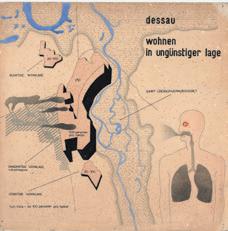
Dessau: Living in an unfavorable location.
122
Hubert Hoffmann, Wilhelm Hess, Cornelius van der Linden, 48-page leporello on Dessau’s climatic, social, and economic conditions, as part of the arbeitsgruppe dessau der int. kongresse f. neues bauen, 11, 1932.
121
Ludwig Hilberseimer, plan of the city of Dessau (Germany), announced as “European industrial city. Diagram of the present state and condition”.


124
123
Ludwig Hilberseimer, plan of the city of Dessau (Germany), announced as “European industrial city. Diagram of its proposed replanning, 1933”.
Ludwig Hilberseimer, “Wind conditions necessitate a separation of residential areas from industrial areas.” Source: Hilberseimer 1944.

132 Jerzy Soltan et al., Sports complex Warszawianka, Warsaw (Poland), 1954–72.

134 The megaform providing a microclimatic diversity.

133
The sports complex Warszawianka as man-made topography.

135
Interlocking concrete blocks (designed by Lech Tomaszewski) that could be laid as chains, were applied as stabilizers of the slopes, forming terraces across the complex.

136
José Luis Sert and Paul Lester Wiener (Town Planning Associates), master plan of Medellin (Colombia), 1948.
138
137
José Luis Sert and Paul Lester Wiener (Town Planning Associates), view of future Chimbote (Peru), 1946.
Impact of the topographical and urbanistic conditions on the temperature profile. Source: Manley 1949.


139
Temperature profile over the course of the day. Source: Manley 1949.

170
The roofscape of Hyderabad (today’s Pakistan), by Swiss photographer Martin Hürlimann, 1927.
171
Vertical and cross section of a windcatcher. Source: Rudofsky 1977.


Justus Dahinden, section of the Akro-Polis, 1974.

199
SITE, “Highrise of Homes” proposal for urban environments, ink and wash rendering by James Wines, 1981.
200
Superstudio, proposal for a forest cube crossed by the Golden Gate Bridge in San Francisco (USA), 1972.


201
SITE, “Highrise of Homes” proposal for suburban contexts, watercolor rendering by James Wines, 1981.


203
Early initiative in decentralizing the energy supply by using urban climatic forces: Solar collectors and a windmill installed by the residents, Lower East Side, New York, 1976.
202
Angela Danadjieva (Lawrence Halprin & Associates), opening day of the Lovejoy Fountain, city park in downtown Portland, Oregon (USA), June 23, 1970.


204
Visions of “radical technology”. Integrated energy infrastructures for urban environments. Source: Harper and Boyle 1976.
Adjustable louvres allow the ventilation of the apartments without having to suffer an “undue loss of privacy.”45 As such, these are used particularly along the main access corridors. Clothes-drying poles attached to the facade are a characteristic feature of Singapore’s large-scale residential buildings. The garments hung on them shade the exposed facades and, through evaporation of moisture, contribute to a cooling along the facades.
The task of ventilating large-scale blocks of urban mass housing by natural means is not an easy one and fundamentally different to that of rural settlements. The high-density population of mass housing leads, design-wise, to recurrent trade-offs between privacy and cross-ventilation requirements.46 Many HDB apartments have difficulties “to cope with noise problems, privacy necessities and thermal comfort for different activities”.47 For example, the access to units along single-sided buildings results in reduced privacy as windows open to the common corridor. Bedrooms, particularly, lack cross-ventilation since doors tend to be closed for privacy during the night. Social change has led to a degree of individualization that is increasingly incompatible with traditional forms of natural ventilation.
Residential Air Conditioning
HDB apartments are, even now, still officially cooled by means of natural ventilation. This state-sanctioned basic assumption is increasingly contradicted by the fact that more and more apartments are equipped with mechanical air-conditioning systems. The 30 years from 1978 to 2008 facilitated the necessary conditions for a comprehensive social penetration by the required technology, allowing the proportion of HDB apartments in Singapore with air conditioning to increase by more than 70 percent. Residential air conditioning is thus a very young phenomenon in Singapore. As air conditioning has increasingly infiltrated not only workspaces in factories and offices but also private dwellings in the form of a kind of “domestic furniture”,48 in recent years an all-encompassing regime of “man-made weather” (Willis Carrier) has taken the place of the naturally given (and experienced) climate. Three aspects lie at the center of today’s debates concerning residential air conditioning: 1) the productivity of the population, 2) its growing energy consumption and 3) the transformation of the Singaporean everyday culture.
The paradigm of the control of indoor climate has supplanted the traditional adaptation to outdoor climate, not only in the working environment. According

225
Satellite Map of the Southeast Asian Haze, June 2013, showing the fire hotspots in Riau province on the east coast of Sumatra (Indonesia).