Citizen science travel: How to join a whale
research expedition in the Azores
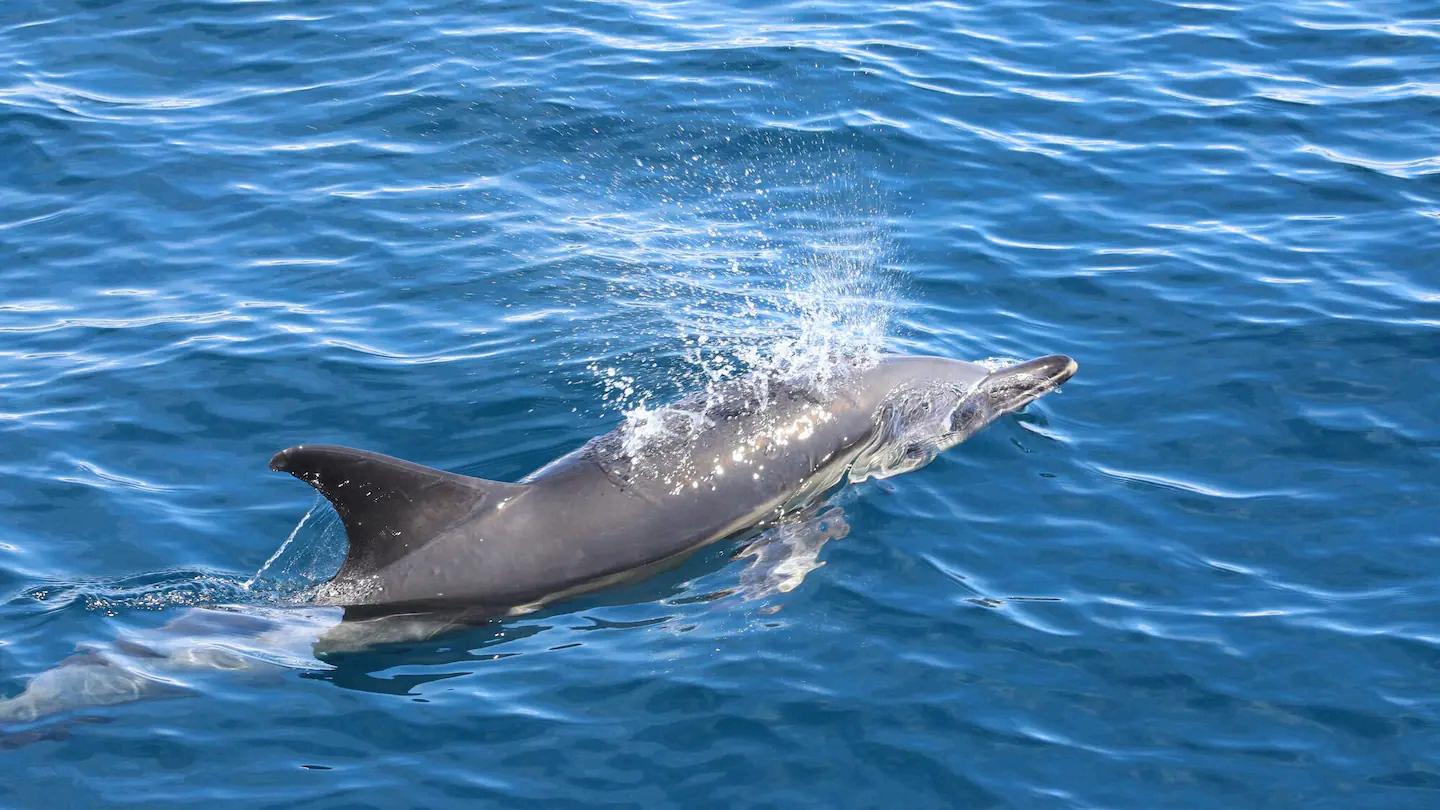
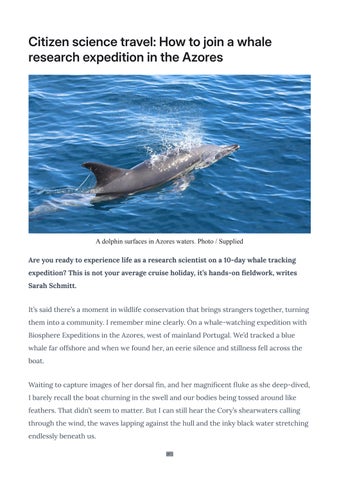
AdolphinsurfacesinAzoreswaters.Photo/Supplied
Are you ready to experience life as a research scientist on a 10-day whale tracking
expedition? This is not your average cruise holiday, it’s hands-on fieldwork, writes
Sarah Schmitt.
It’s said there’s a moment in wildlife conservation that brings strangers together, turning
them into a community. I remember mine clearly. On a whale-watching expedition with
Biosphere Expeditions in the Azores, west of mainland Portugal We’d tracked a blue
whale far offshore and when we found her, an eerie silence and stillness fell across the boat.
Waiting to capture images of her dorsal fin, and her magnificent fluke as she deep-dived,
I barely recall the boat churning in the swell and our bodies being tossed around like
feathers. That didn’t seem to matter. But I can still hear the Cory’s shearwaters calling
through the wind, the waves lapping against the hull and the inky black water stretching
endlessly beneath us.
AjuvenilespermwhalebreachesofftheAzores.Photo/Supplied
That moment on our second day, was when we moved from individuals to being united
in a shared experience.
With the rise of conscious travel, people are seeking more than passive sightseeing. No
longer satisfied with viewing the world through glass, we’re drawn to immersive,
participatory experiences that create real impact. The need to return home with new
perspectives, deeper awareness and a stronger sense of responsibility is palpable. This is
where citizen science is finding its moment
Citizen science, at its most basic, is everyday people contributing to scientific research, often through simple, structured data collection. You may already be doing it. Perhaps
you use iNaturalist to log local flora and fauna, or take part in birdwatching. There are
countless ways to get involved, many without leaving home. But now we are beginning
to see tourism and citizen science intersect.
Citizenscientistsbracetophotographcetaceansatsea.Photo/Supplied
To be clear, this kind of travel isn’t always comfortable, and it’s certainly not to
everyone’s taste – but that’s okay. Different strokes for different folks so we say. But for
those seeking ways to contribute to conservation, it’s a good place to start.
Unlike a safari, you may not even see the animal you’re studying. Some experiences are so remote, there are no bathrooms. Days can be long, the work repetitive, and outcomes uncertain. Nature offers no guarantees. But when you move through a landscape with
purpose beyond sightseeing, everything changes. The moments you capture become part of something larger and knowing that you’re making a contribution to science is
thrilling.
On my 10-day expedition, I arrived excited and mildly panicked. Was I smart enough?
Had I packed enough sea sickness medication? And how would I go sharing a room with
a stranger?
AmilogsfielddatawithPicovolcanobehind.Photo/Supplied
Run by Biosphere Expeditions, a non-profit organisation that runs expeditions around
the world, this one in the Azores is now in its 20th year.
Mornings started early, especially if you were on breakfast duty. We’d set out breakfast
and lunch items, then walk to the bakery in Horta on the island of Faial to pick up the
morning bread order Carrying a paper bag of freshly baked rolls along cobblestone
streets and past old colourful buildings before sunrise felt like I was in a fairytale. It was
worlds away from everyday life.
Under the guidance of our tour leader Craig, and field scientist Lisa Steiner we initially
had a half-day to learn our roles and equipment before setting out on the water By 9am
each morning, we were heading into the open ocean, the catamaran crashing through
waves, wind whipping our faces. It was wild fun.
Zaracross-referencesdorsalfinshotstoIDwhales.Photo/Supplied
With a new task allocated each day, we got a broad experience of life as a research
scientist. From being on lookout and scanning the water for signs of animals, to
recording the data being collected (which included things like wind speed, water
temperature, animal behaviour, numbers, species and GPS coordinates), to being the
day ’s photographer. Perhaps the most important job on board was to photograph the
flukes – whale tails, capturing their distinctive markings and shapes made from the bite
marks of other sea creatures. The job involved bracing against the railing, held in place
by another person, so you didn’t fall as the boat rolled in the swell. Then there was the
“poo collector” . If a whale surfaced and left a sample, we were ready with a net. The local
university was keen to study it but, sadly, no whale poo was collected on my trip
Back on land, we uploaded the day ’s data and organised the photos. Our evening meals
were communal and were followed by a daily debrief and guest speakers who discussed
their research. By 9pm, we were exhausted and happy to fall into bed.
A couple of land days were built into the schedule. One was for working on the data, the
other was a free day to explore the island. A group of us took off hiking the Caldeira rim.
When I asked others in my group why they chose this style of travel, their answers were
consistent. They wanted more from their holidays, something meaningful, something
with purpose. These expeditions offered that.
People are seeking new ways to experience the world, and in doing so they ’re reshaping
tourism By weaving citizen science opportunities into travel, we’re opening the door to
lesser-known places and creating space for meaningful travel experiences and forging a
deeper relationship with the world we move through. And that’s got to be a good thing.
The writer was a guest of Biosphere Expeditions.