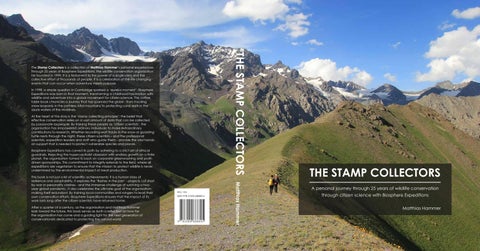
In 1998, a simple question in Cambridge sparked a ‘eureka moment’: Biosphere Expeditions was born in that moment, transforming a childhood fascination with wildlife and adventure into a global movement for citizen science. This coffee table book chronicles a journey that has spanned the globe - from tracking snow leopards in the pathless Altai mountains to protecting coral reefs in the azure waters of the Maldives. At the heart of this story is the ‘stamp collecting principle’: the belief that effective conservation relies on a vast amount of data that can be collected by passionate laypeople. By training these people as ‘citizen scientists’, the organisation has empowered ordinary individuals to make extraordinary contributions to research. Whether recording wolf tracks in the snow or guarding turtle nests through the night, these citizen scientists – and the professional scientists, expedition leaders and staff who guide them – provide the vital handson support that is needed to protect vulnerable species and places. Biosphere Expeditions has carved its path by adhering to a strict set of ethical guardrails. Rejecting the hypercapitalist obsession with endless growth on a finite planet, the organisation turned its back on corporate greenwashing and profitdriven sponsorships. This commitment to integrity extends to the field, where all expeditions are vegetarian to ensure that the mission to protect wildlife is never undermined by the environmental impact of meat production. This book is not just a list of scientific achievements; it is a human story of resilience and adaptability. It explores the ‘flashes in the pan’ - projects cut short by war or personality clashes - and the immense challenge of surviving a twoyear global pandemic. It also celebrates the ultimate goal of the organisation: making itself redundant. By training local communities and rangers to lead their own conservation efforts, Biosphere Expeditions ensures that the impact of its work lasts long after the citizen scientists have returned home. After a quarter of a century, as the organisation and Matthias Hammer look toward the future, this book serves as both a reflection on how far the organisation has come and a guiding light for the next generation of conservationists dedicated to protecting the natural world.
WG 194 ISBN 978-3-000-68880-5
9 783000 688805
THE STAMP COLLECTORS Matthias Hammer
The Stamp Collectors is a collection of Matthias Hammer’s personal experiences through 25 years of Biosphere Expeditions, the wildlife conservation organisation he founded in 1999. It is a testament to the power of a single idea and the collective effort of thousands of people. It is a celebration of the life-changing events that can occur when adventure meets purpose.
THE STAMP COLLECTORS A personal journey through 25 years of wildlife conservation through citizen science with Biosphere Expeditions Matthias Hammer
Matthias Hammer
THE STAMP COLLECTORS A personal journey through 25 years of wildlife conservation through citizen science with Biosphere Expeditions
For my father. For my family. For all the stamp collectors.
CONTENTS
12: Reef Check, drops in the ocean and underwater worlds................Page 100
1: Beginnings................................................................................................Page 12
13: Sea turtles and gravy trains...................................................................Page 108
2: Roots in East Anglia, Poland, Peru.........................................................Page 20
14: Elephants in camp (and elsewhere)....................................................Page 116
3: First expeditions: Wolves in Poland and parrots in Peru......................Page 28
15: Peter and the wolves.............................................................................Page 124
4: From Landscape to National Park.........................................................Page 36
16: Andrea and the bears...........................................................................Page 132
5: Cheetahs, leopards and lions................................................................Page 44
17: Arabia felix - for a while.........................................................................Page 140
6: The trouble with corporates...................................................................Page 52
18: Flashes in the pan...................................................................................Page 148
7: Malika and the leopards........................................................................Page 60
19: Pandemic................................................................................................Page 158
8: Lisa and the whales: a !Kung San of the sea.......................................Page 68
20: Brexit and guiding principles.................................................................Page 166
9: Slovakia: Chamois and large carnivores..............................................Page 76
21: Voices......................................................................................................Page 174
10: Marcelo and his squares.......................................................................Page 84
22: Timeline and expeditions......................................................................Page 184
11: Alan and the birds.................................................................................Page 92
23: Epilogue...................................................................................................Page 198
THE STAMP COLLECTORS: 25 YEARS OF BIOSPHERE EXPEDITIONS
CHAPTER 1: BEGINNINGS From some woods in Bavaria to a bathroom in Cambridge, this is where the Biosphere Expeditions journey starts.
THE STAMP COLLECTORS: 25 YEARS OF BIOSPHERE EXPEDITIONS
W
ater is splashing and it’s hard to hear her, talking and standing at the sink in the small bathroom in Cambridge, throwing ideas around. ‘Why don’t you get people to contribute to expeditions you then take them on – just as you did on those student expeditions we organised’? The world stops. Water splashes in slow motion. And there it is: the idea, the eureka moment, the moment you see a clear path ahead, bright and white against the tiles of that small bathroom. There it was. In that moment, the vision of what it is today. A short sentence, an idea, a beginning and so much more.
Wind back to some woods in Bavaria, a generation or so earlier. A steaming lake in the morning mist, no more than a puddle, but a sea of wonder to a small child with his father, staking out a badger sett. Seeds were laid there and then. A fascination with nature, a sense of wonder about the natural world in its infinite forms. The trees that tower above like silent guardians of secret places, their branches enveloping and protecting, but also threatening. The green mosses at their feet and ivy creeping up their trunks, dripping with water in droplets that turn the world upside down. Badgers making strange noises deep underground, grunting and whining far away, near the centre of the world. Muddy fox tracks and hidden squirrel feeding tables. The fragility of it all. The silence during hours of waiting that is not really silence, but bliss in what the child thinks must be the wildest and most exciting place on earth. Gone are the dreams of wanting to become a fireman, a jet fighter pilot or whatever young boys dream of growing up to be.
CHAPTER 1: BEGINNINGS
Previous page: The woods in Bavaria where the seeds for Biosphere Expeditions were laid in the 1970s © Werner Hammer †. Opposite page: Eureka moment student digs in Cambridge, 1998. Topsy-turvy world in a droplet. This page: Jungles - the word and the habitat - stir the child’s imagination and a desire to explore them.
14
CHAPTER 1: BEGINNINGS
THE STAMP COLLECTORS: 25 YEARS OF BIOSPHERE EXPEDITIONS The word ‘expedition’ takes hold in the child’s head without him knowing what it means. There it mixes with images of steaming green jungles, egged on by wide-mouthed viewings of Kipling’s classic of the same name, brought to flickering screens through Disney’s dream world. Later more serious contenders join. There’s Sielmann, a German Attenborough long before the child knows who Attenborough is, and his ‘Expeditions to the animal kingdom’ in books and on TV. There’s Horst Maas and his book ‘Waterways to freedom (with survival guide)’ with tales of long canoe journeys through the unknown. There is Alexander von Humboldt, the 18th century explorer and polymath with his expedition journals full of adventure and remarkable discoveries. And there’s Paul Theroux’s ‘The Mosquito Coast’ with Harrison Ford as the hero trying to conquer the jungle and failing.
This page: Influential books that charted a path towards Biosphere Expeditions. Opposite page: Paratrooper children taking themselves very seriously on exercise in Germany, 1988. The author is in the middle © Alexander Mätzig. The spires that beckoned: Tom Tower, Christ Church, Oxford University, 1991.
But far-flung travel was not on the cards. It did not have to be. The woods and Alps were on the doorstep and there was also exploration of the virtual, analogue kind: books, maps, TV and the endless expanses of a child’s imagination. In that expanse, the idea took hold, alongside the word. A path was charted, a dream created: a biology professor researching some beetles somewhere in the jungle. The rest followed, almost. Biology at school and then university, only interrupted by a spell of German Army national service and then Oxford University. Formative years of hardship and danger and children playing war. It almost swallowed the child, had the dreaming spires not beckoned strongly from abroad. There, in a most British ivory tower, expeditions finally start to mean something. Where else but in Britain would students be encouraged (and funded) to do research and explore far away, adding a little bit of knowledge to the archives of the Royal Geographical Society (RGS) and some dusty university library. ‘And if you don’t write up your results, you might as well lie on a beach. Then it’s not an expedition, but an excuse for a holiday’, said Shane Winser, godmother of all things expedition at the RGS. Lesson learnt. Forever. 16
17
THE STAMP COLLECTORS: 25 YEARS OF BIOSPHERE EXPEDITIONS
CHAPTER 2: Roots in East Anglia, Poland and Peru Cambridge, Lowestoft, the Suffolk Broads, Tambopata and Bieszczady – fertile ground for the seed to find purchase.
THE STAMP COLLECTORS: 25 YEARS OF BIOSPHERE EXPEDITIONS
A
llison not only provided the eureka moment, but also came up with the name ‘Biosphere Expeditions’ on a motorway drive in her Morris Metro one day. The logo was easy. It had to be something with zebra stripes so that the 4x4s could be zebra-striped, realising another childhood dream. But there were restless nights in Cambridge too, wondering whether the idea would fly. Worries about business acumen, start-up funding and more, somewhat alleviated by a mildly successful small student venture that provided some business environment and website-building experience.
CHAPTER 2: ROOTS IN EAST ANGLIA, POLAND AND PERU
Then out of nowhere came philanthropist Gerard Arnhold with an offer to provide start-up funding. Born in Dresden into a Jewish family in 1918, WWII breaks out whilst he is a student in Cambridge and he is interned. Two years later he’s convinced the British that, given his background, he is unlikely to want to fight for Nazi Germany, and joins the British Army. After the war, he emigrates to Brazil and makes his fortune there. Not one for holding a grudge, he generously funds schools and the arts in Dresden, amongst many other ventures. On a Boat Club reunion event, he hears about the plans for Biosphere Expeditions and simply says ‘you will need money then – how much?’ The answer (£30,000) does not faze him. ‘I’ll give it to you – you can pay me back without interest whenever you can’. No bank loan required. No interest. Thank you, Gerard. Biosphere Expeditions may never have spread its wings without you. RIP, my friend. Next stop, the Suffolk Broads in the late 1990s. A house at the edge of the Broads Authority / national park area. A business course in nearby Lowestoft, the voice of a business adviser on the phone who becomes Previous page: Felbrigg in the Broads wetland area in the UK © Chris Taylor. Opposite page: Silly, but true. The logo had to have zebra stripes, so that the cars could too, harking back to Grzimek’s Oscar-winning ‘Serengeti shall not die’ movie of 1959, which fascinated the author. This page: Gerard Arnhold on a Cam punt ride with the author, circa 1997. The house in the Broads where Biosphere Expeditions learnt to fly, circa 1999.
22
23
CHAPTER 2: ROOTS IN EAST ANGLIA, POLAND AND PERU time, through helping hands-on and by providing funding. Then out they go gathering useful data: camera trap pictures, tracks, scats, animal and plant inventories, whale fluke pictures, behavioural profiles, local community interview data… The possibilities are almost endless and everyone wins. If you know what you are doing. The other component is projects and their scientists who benefit from citizen science. A spectacled bear project in the Bolivian Yungas does not happen, but terms & conditions are drawn up on an altitude sickness bed in La Paz over three days of misery. Much lower down on the same continent, in the Madre de Dios jungles of Peru, the child’s dreams come to fruition as tree after tree slips by on a boat ride up the Tambopata river, the tuk tuk engine roaring like the sound of angels, the muddy brown waters a fluffy, white cloud nine. Sielmann, Grzimek, Theroux, Maas, Humboldt, Kipling all rolled into one in a heart full of joy and excitement. First steps in the rainforest for both, the person and the organisation. The sound of a million raindrops on thousands of leaves. a business partner, co-director and so much more: linchpin, wife, mother, expedition leader, strategist, fundraiser (thank you, Rosie). Gerard nursed the fledgling, Kathy teaches it to fly. Meanwhile, the child, now in his early 30s, travels in Europe and South America to look for projects to collaborate with. Citizen science was not a word in common usage then, but this was the direction: finding projects where laypeople can make an effective contribution to wildlife conservation and research. The stamp collecting principle: very often effective conservation is based on a large amount of data points. Collecting those data points is by and large both laborious and relatively simple. Often no technology exists (yet) to perform these kinds of tasks - no satellites or AI to scan the Himalayas for snow leopards. No robots for changing batteries and SD cards in the camera traps now involved in a vast number of surveys. Citizen scientist stamp collectors are needed for this. People who enjoy learning new, simple data collection skills within a day or two. People who want to do something meaningful during their holiday 24
This page: Kathy Gill with her daughter Liesl in the backpack, and a citizen scientist on expedition in the Ukraine, 2002. Opposite page: Stuck on a sandbank on the tree-lined Tambopata river, Peru 1999. Research station in Peru, around the turn of the millennium. The flag shows the first logo for Biosphere Expeditions, as it was then.
25
THE STAMP COLLECTORS: 25 YEARS OF BIOSPHERE EXPEDITIONS
CHAPTER 3: First expeditions: Wolves in Poland and parrots in Peru Three early challenges: arrogance, overenthusiasm and a rogue scientist.
THE STAMP COLLECTORS: 25 YEARS OF BIOSPHERE EXPEDITIONS
CHAPTER 3: FIRST EXPEDITIONS: WOLVES IN POLAND AND PARROTS IN PERU
T
wo expeditions, two permanent staff, paper and digital - that was the situation at the turn of the millennium. The website was Biosphere Expeditions’ (shop) window to the world from the very beginning, but in the early days there were also paper briefings and dossiers sent by post, ads in print magazines and a potpourri of non-digital information materials, a mountain of paper carted around the world in a way hard to imagine 25 years later. ‘Offices’, however, have almost always been virtual from the beginning – from a corner of a bedroom in that house in the Broads to something similar, if
Previous page:
Whale, dolphin & turtle research in the Azores - snow leopards of the Altai mountains - cheetahs in Namibia - chamois, wolves & bears of the Slovakian Tatra mountains - monkeys & macaws of the Peru Amazon.
Not for profit, for wildlife. Award-winning, non-profit conservation expeditions for everyone. Adventures with a purpose. No qualifications needed, no age limits, everyone can take part. Starting from two weeks and £990, two-thirds of which is spent directly in-country. 01502 583085 info@biosphere-expeditions.org www.biosphere-expeditions.org 30
A young wolf © Theo Grüntjens. Opposite page: An early advertisement for UK wildlife, nature and travel magazines, circa 2002. This page: No glass palace: interconnected home offices instead. Dr. Wojtek Smietana preparing his car for radiotracking wolves, 2001.
slightly larger, a quarter of a century later. The idea was always to have the admin in the background streamlined and virtually interconnected - from a workspace in a house in Australia, France, Germany, Ireland, the UK or USA to the odd physical meeting in a rented space somewhere around the world. We never wanted to be a dinosaur corporation with flashy glass palaces costing the Earth, quite literally. Instead we wanted to be nimble, low-impact, family and workerfriendly, streamlined and flexible. This has served us well, not least when the coronavirus pandemic hit in 2020 (see chapter 19). Expeditions remained firmly analogue, of course. Here one of the biggest early challenges was to convince scientists of the value of citizen science. At the turn of the millennium, the concept was hardly recognised, let alone accepted. Sometimes the arrogance and condescension from scientists was palpable. But some got it. Dr. Wojtek Smietana in his snowy, deep, dark woods - home to wolves - in Poland. Antonio in Lima, with his passion for frogs and access to lush rainforest bursting with life and a cacophony of sounds in Peru. 31
THE STAMP COLLECTORS: 25 YEARS OF BIOSPHERE EXPEDITIONS
CHAPTER 5: Cheetahs, leopards and lions Soaring high and sinking low in Namibia.
THE STAMP COLLECTORS: 25 YEARS OF BIOSPHERE EXPEDITIONS
CHAPTER 5: CHEETAHS, LEOPARDS AND LIONS
‘J
ust carry him over to that tree over there and put him in the shade to wake up’, Birgit says to me. ‘He’ is a male cheetah we have just captured in a box trap and sedated to put a radio collar on. With the procedure done, he needs to be put in a shady spot to come round. But we didn’t get the wake-up drug dosage quite right, so as I carry him, he wakes up and looks at me with the glassy eyes of a drunkard. I cast a nervous glance towards Birgit. ‘Just keep on walking and lie him down gently. He’s far too woozy still to be able to do anything’, she says calmly. Reassured, I do as I am told, step back and then we all watch him wake up, stagger to his feet and walk away like someone who’s had a good few too many. We’re in Namibia and we got there by chance and good fortune. In those days we still had to go out to look for scientists and their projects (nowadays they by and large come to us). My sister Claudia (see picture page 152), who was working for Biosphere Expeditions at the time, and I went to a travel show in Stuttgart to scout out destinations. ‘Let’s go to the Namibia stand’, Claudia says. There are several small desks arranged in a circle around the stand, each with a person behind it. One of them wears a zebra-striped scarf, so Claudia, with a wink of her eye, says ‘let’s speak to her’. Would she know of any wildlife conservation and research projects in Namibia that need helpers and funding? No, she doesn’t, but her husband is involved in a local conservancy and knows lots of people, including scientists. We exchange business cards and soon after we hear back. The answer is yes and we are put in touch with Birgit and Harald Förster, a scientist couple with a cheetah project in central Namibia. Within a year we run the first expedition there, in 2002. Namibia and big cats will stay on our expedition portfolio for 12 years until the government there starts to wage a war on citizen science and volunteering with impossible work visa rules and red tape galore.
46
Previous page: A radio-collared cheetah on a fly-by. Opposite page: A cheetah captured in a box trap is moved into the shade before sedation and radio-collaring. This page: Citizen scientists identifying and recording animal track data.
THE STAMP COLLECTORS: 25 YEARS OF BIOSPHERE EXPEDITIONS
CHAPTER 7: Malika and the leopards Chasing Arabian and snow leopards, whilst keeping calm under pressure, then landing a job in the office.
THE STAMP COLLECTORS: 25 YEARS OF BIOSPHERE EXPEDITIONS
CHAPTER 8: Lisa and the whales: a !Kung San of the sea Around the Azores archipelago, a scientist’s passion yields the longest-running expedition.
THE STAMP COLLECTORS: 25 YEARS OF BIOSPHERE EXPEDITIONS
CHAPTER 9: Slovakia: Chamois and large carnivores Monitoring chamois, wolf, lynx, bear and wildcat populations in various locations and seasons from 2004-2017.
THE STAMP COLLECTORS: 25 YEARS OF BIOSPHERE EXPEDITIONS
CHAPTER 10: Marcelo and his squares A decent methodology for citizen science that delivers – from Brazil’s Atlantic Rainforest in 2006 to the Tien Shan mountains of Kyrgyzstan in 2024.
THE STAMP COLLECTORS: 25 YEARS OF BIOSPHERE EXPEDITIONS
D
r. Marcelo Mazzolli’s thing is squares. 2x2 km quadrats to be exact. They are the units along which science progresses. Is an animal present in the quadrat? To find out, you scour the square for signs. Anything will do: A camera trap picture or a sighting are best and most reliable. A scat less so, unless the originator can be identified with certainty by DNA analysis. A track can be even more dubious. Many claim they can identify them with certainty, few actually can. The error margin for many species is huge, with a 50/50 chance to get it wrong. Not good enough if you take your science seriously. And seriously we take it, painstakingly covering and ticking off squares. Which animals are where and why? What are the ecological and conservation conclusions from this? It’s serious science and good fun. An expedition team can watch its progress over time and space on a map, tick off, colour in, pin down and compete over squares. How many has group Alpha managed today? How many groups Bravo, Charlie and Delta?
CHAPTER 10: MARCELO AND HIS SQUARES
If you know what you are doing, it’s not hard to convert laypeople into citizen scientists with a couple of days of intensive training on things such as GPS use, filling in datasheets, navigation, offroad driving, setting and maintaining camera traps, animal ID and more. If you know what you are doing, it’s not hard to gather useful data with a team of a dozen enthusiastic people over a week or two. Data that will make a difference by informing management strategies, creating protected areas, helping local people generate income from intact nature, preventing destruction of wilderness and so much more. That’s the essence of good citizen science in wildlife conservation. And yet charlatans abound, using and abusing people’s enthusiasm and willingness to help with their time and money. Shame on them – the animal cuddling farms tricking people to raise lions destined to be hunted, the ‘orphanages’ with no orphans in them, those who ask (young) people to come to ‘Africa’ to ‘teach’ English. They give volunteering a bad name and they have rightly been called out. Stay away from them.
Previous page: Ticking off quadrats in the hunt for tigers in the jungles of Sumatra. Opposite page: Dr. Marcelo Mazzolli setting up a camera trap in his native Brazil’s Atlantic Rainforest, 2008. This page: Using pins to mark squares covered and species found, Slovakia, 2016. 86
THE STAMP COLLECTORS: 25 YEARS OF BIOSPHERE EXPEDITIONS
CHAPTER 11: Alan and the birds Science matters. To Dr. Alan Lee and Biosphere Expeditions. More than 20 years together in the Amazon, South Africa and Kenya.
THE STAMP COLLECTORS: 25 YEARS OF BIOSPHERE EXPEDITIONS
CHAPTER 12: Reef Check, drops in the ocean and underwater worlds Reef Check is both a methodology and an NGO, based in California, and dedicated to the conservation of two reef ecosystems: tropical coral reefs and temperate kelp forests. It is also the bedrock upon which all Biosphere Expeditions diving projects are built.
THE STAMP COLLECTORS: 25 YEARS OF BIOSPHERE EXPEDITIONS
CHAPTER 12: REEF CHECK, DROPS IN THE OCEAN AND UNDERWATER WORLDS
A
n e-mail in 2004 gets this going. Would Biosphere Expeditions like to help in the management of Cayos Cochinos, a Marine Protected Area (MPA) in Honduras? Sure, how? By scuba diving and using a methodology called Reef Check. I can’t dive and I have no idea what Reef Check is, so I learn to dive and find out about Reef Check, which turns out to be both a methodology and an NGO, based in Los Angeles, and dedicated to the conservation of two reef ecosystems: tropical coral reefs and temperate kelp forests. In 1997 Reef Check was the first to conduct a global survey of coral reef health using one standard method. The data confirmed that coral reefs were in crisis due to overfishing, pollution and other human impacts. When this was published in 1999, it caused a stir and unsettled the coral reef scientific community, which had until then thought that reefs were doing fine. For Biosphere Expeditions, Reef Check seemed like a great partner, not least of all because it comes with a ready-made methodology for citizen scientists, complete with teaching materials, certification paths, instruction manuals, datasheets and data analysis tools. Whereas we usually have to develop the research methodology ourselves in a fairly laborious process (see chapter 10), here it was all packaged, ready to go and immediately providing local and global relevance to the datasets collected by our expeditioners. Reef Check is also run by great people who welcomed us with open arms. So far, so good. A year later, in 2005, I am on Cayos and Italo Bonilla (see picture on the right), the irrepressible Honduran marine biologist and dive instructor, takes me to his underwater realm and certifies me as a scuba diver, opening the diving chapter with Reef Check in Biosphere Expeditions’ history.
102
Previous page: Checking a reef - using hand signals and a slate to record substrate, Musandam peninsula, Oman, 2012 © Kelvin Aitken. Opposite page: A Cayos Cochinos expedition team in 2007. Italo Bonilla is on the right, standing. 103
THE STAMP COLLECTORS: 25 YEARS OF BIOSPHERE EXPEDITIONS
CHAPTER 13: Sea turtles and gravy trains Sea turtles are fascinating, ancient creatures; many are in urgent need of conservation action and that’s where the trouble with charlatans starts.
THE STAMP COLLECTORS: 25 YEARS OF BIOSPHERE EXPEDITIONS
CHAPTER 13: SEA TURTLES AND GRAVY TRAINS
S
he heaves herself out of the dark ripples and onto the beach in slow motion. Once on land, like a duck out of water, her progress up the beach is painfully slow. Weighing about half a ton, her leatherback kind have been around since the dinosaurs. The spectacle that unfolds before us, on a beach of black sand in the dark of the night in Costa Rica, has repeated itself for a 100 million years. Then there may have been velociraptors on the beach, hungrily waiting to devour her eggs. Today it is poachers and us – whoever gets to the turtle first, can keep the eggs. It’s the unwritten law of the jungle that backs onto the beach, palms leaning towards the Caribbean in a picture-perfect setting, green leaves dipping into the water wherever the beach recedes and lets the ocean come close. After what seems like an eternity, she has found her spot, high up on the beach. She turns around, head towards the water and enters a trance-like state of digging. Once this ancient program has initiated in her brain, we can approach. Her flippers kick sand into our faces, scooping out a nest, one slow stroke at a time. When she’s ready, she pauses for a minute. This is our cue. One of us lies flat behind her, the bag - largish, perfectly round, ready under her cloaca, waiting for the eggs to drop into the bag, largish, perfectly round table tennis balls, each containing a leatherback embryo. We know the poachers are lurking somewhere behind us, but they will leave us alone, because we got here first. Next time it will be different and we will leave them alone. This truce works for everyone and our success rate over the years is around 75%. Not bad at all. Before us the poaching rate was 100%.
110
Previous page: A leatherback sea turtle on the beach, ready to lay. Opposite page: Picture-perfect Pacuare beach, Costa Rica, 2017. Site of the leatherback expedition. Securing leatherback turtle eggs in the dead of night on Pacuare beach, Costa Rica, 2018 © Georg Berg. 111
THE STAMP COLLECTORS: 25 YEARS OF BIOSPHERE EXPEDITIONS
CHAPTER 14: Elephants in camp (and elsewhere) Elephants are flagship species for a reason; their plight varies across the planet, from ivory poaching to working elephants out of a job.
THE STAMP COLLECTORS: 25 YEARS OF BIOSPHERE EXPEDITIONS
CHAPTER 14: ELEPHANTS IN CAMP (AND ELSEWHERE)
F
irst, you hear the crashing, then perhaps the munching. You wake up and realise that now there’s only the thin canvas of a tent or the matting of a hut separating you from four tonnes of muscle, bone and thick elephant skin. Perhaps a trunk comes in to investigate - as it did in the Caprivi Strip in Namibia, with my son, about six years old at the time, screaming in surprise and the girls staying totally calm. Or perhaps it was just a swimming noodle suspended from the hut ceiling. In any case, foraging elephants can be quite gentle if left alone to do their thing. Then they move through camp slowly, pushing, shoving, grabbing, eating and just minding their own business. You can watch under the red light of your head torch, in awe and wonder, for after all, this is their domain and they – not us – are the all-powerful ecosystem engineers for once. Elephants are the largest land mammals on Earth and play a crucial role in maintaining healthy ecosystems by shaping landscapes and dispersing seeds. There are three species (African savanna elephants, African forest elephants and Asian elephants) all of which are under significant pressure. Poaching for ivory, habitat loss and human–elephant conflict have caused severe population declines, particularly in parts of Africa and across much of Asia. While conservation efforts such as anti-poaching patrols, protected areas and international ivory bans have helped stabilise some populations, many remain fragmented and vulnerable. The long-term survival of elephants depends on sustained habitat protection, coexistence with local communities, and strong international cooperation, all of which is where Biosphere Expeditions comes in.
118
Previous page: A herd of elephants at Vwaza Marsh Wildlife reserve, Malawi. Opposite page: Huts where someone had trouble distinguishing between an elephant trunk and a swimming noodle. Elephants moving through camp in Malawi. 119
THE STAMP COLLECTORS: 25 YEARS OF BIOSPHERE EXPEDITIONS
CHAPTER 15: Peter and the wolves Via expeditions in Namibia/Caprivi, the Altai, Oman, Slovakia and Germany, Peter Schütte has been a pillar of Biosphere Expeditions since 2004.
THE STAMP COLLECTORS: 25 YEARS OF BIOSPHERE EXPEDITIONS
CHAPTER 16: Andrea and the bears Imagine an action woman in conservation; a real, not Hollywood, one who has dedicated her entire career to bears in Sweden - this is Dr. Andrea Friebe.
THE STAMP COLLECTORS: 25 YEARS OF BIOSPHERE EXPEDITIONS
CHAPTER 17: Arabia felix – for a while The Dubai Desert Conservation reserve of the Emirate of the same name is a little-known gem - we worked in blissful partnership with conservationists there for many years before corporate greed intervened.
THE STAMP COLLECTORS: 25 YEARS OF BIOSPHERE EXPEDITIONS
CHAPTER 18: Flashes in the pan Sometimes expeditions just run for one year – it’s rare, but it happens and the reasons are varied: war, ‘boring’ species or just plain personality clashes – we are all human after all.
THE STAMP COLLECTORS: 25 YEARS OF BIOSPHERE EXPEDITIONS
CHAPTER 19: Pandemic No story of the early 2020s would be complete without mentioning the Coronavirus pandemic; for Biosphere Expeditions, it was touch and go, but generosity and kind words pulled us through.
THE STAMP COLLECTORS: 25 YEARS OF BIOSPHERE EXPEDITIONS
CHAPTER 21: Voices Biosphere Expeditions is what it is today because of the people it has engaged and inspired over the past 25 years. This chapter gives five of them a voice, representing different facets that make Biosphere Expeditions more than the sum of its parts. They are a citizen scientist, an expedition scientist, a member of staff, a placement recipient and a backoffice volunteer.
THE STAMP COLLECTORS: 25 YEARS OF BIOSPHERE EXPEDITIONS
CHAPTER 21: VOICES
T
his book is an account of my personal experiences with Biosphere Expeditions over the past 25 years. Personal though it is, it is also coloured and heavily influenced by the very many people who have shared the journey with me. We have hundreds of written testimonials. Sometimes I think they are too positive and appreciative to go on the website and elsewhere, because of course, anyone can make up anything in writing. But that’s silly, so here they are, with their names and faces.
Previous page: An expedition team in the Tien Shan mountains of Kyrgyzstan. Opposite page (clockwise): Expedition teams in Malaysia, Spain, Honduras and Kenya.
176
177
CHAPTER 21: VOICES
THE STAMP COLLECTORS: 25 YEARS OF BIOSPHERE EXPEDITIONS
‘When I signed up for an expedition, it was everything that I’d hoped for: structured, but with a sense of liberation. We went out into the wild, and as long as we did our tasks, we were free to do as we pleased. You’re up early, active from the off, but when you look back at the end of the day, shattered, you think – but look at what I’ve done. All day in nature, encounters with wildlife, collecting data with a team of people who were strangers a few days before. It’s hard, but it’s also one of the best things to experience because it connects with a lot of deep drivers that are rare to find in everyday life. My first expedition was to Africa, my third to the Amazon. People at work see me as the accountant.
178
But it changes people’s perspective of you. And the expeditions have given me more than just memories. They’ve given me new skills, opened new opportunities, and made me an activist for change. I even attended my first-ever protest march. I thank Biosphere Expeditions for giving me the confidence and the compulsion to stand for what I believe is a just cause, something I had not done before in my 68 years. The expeditions – 16 of them and counting – changed my idea of what’s possible. My sons – who see me as a boring old dad – they can’t believe what I’ve done.’ Neil Goodall, UK Neil Goodall (right) from Southampton (UK) entering data in Malawi. Neil, with 16 expeditions under his belt so far, has become one of the most experienced Biosphere Expeditions citizen scientists.
‘Biosphere Expeditions provides a unique and valuable opportunity to monitor different taxa of wildlife including primates, birds and our endangered species of felines such as jaguar, puma, ocelot and margay through transect census, camera traps deployment and more, all of this at the Tahuayo River basin, one of the richest areas in the Amazon in terms of diversity of species. I’m very grateful for the collaboration with Biosphere Expeditions as this will enable me to perform many research and conservation activities, which would be impossible without the help I get from Biosphere Expeditions in terms of funding, logistical support and a very committed and capable workforce of citizen scientists.’ Alfredo Dosantos Santillán, Tahuayo River Amazon Research Center, Peru
Alfredo Dosantos Santillán (in the red T-shirt) from Iquitos (Peru) with a crew of staff and citizen scientists at the Tahuayo River Amazon Research Center.
179
THE STAMP COLLECTORS: 25 YEARS OF BIOSPHERE EXPEDITIONS
CHAPTER 22: Timeline and expeditions Over the last 25 years, Biosphere Expeditions has evolved from its initial 1999 registration in the UK into a global non-profit force for wildlife conservation. This timeline charts a quarter-century of impact, from a first expedition to Poland to helping to establish protected areas all over the globe and a plethora of awards and recognitions on the way - all made possible by the dedication of citizen and professional scientists, staff, local and international partners and so many more.
CHAPTER 22: TIMELINE AND EXPEDITIONS
THE STAMP COLLECTORS: 25 YEARS OF BIOSPHERE EXPEDITIONS Expeditions to Namibia start and run in various locations until 2014. They play a role in the establishment of the Kavango Zambezi Transfrontier Conservation Area, at the time the world’s largest wildlife conservation area, spanning five southern African countries. They also play a pivotal role in establishing the country’s largest leopard conservation research project, working with local ranchers and resolving human-wildlife conflict, which leads to a significant reduction in big cats killed in the country. A research station is built also.
Expedition to the Peru Amazon starts. Biosphere Expeditions stays involved on and off in the Amazon until 2016. During this time, dams are not built based in part on Biosphere Expeditions’ biodiversity studies and impact assessments, local conservationists are trained and find jobs, and a research station is built. Guidelines for boat behaviour at clay licks in the Tambopata Reserve are also incorporated into local management plans. ‘Biosphere Expeditions’ is registered in the UK as a non-profit.
Partnership with Land Rover starts and lasts for 12 years, supplying cars to expeditions worldwide.
Expedition to the Azores studying whales, dolphins and turtles starts (and is still ongoing). It provides confirmation of previously theorised whale migratory routes. Prior to Biosphere Expeditions there were virtually no data on any type of cetacean in the Azores during spring.
2006 2003
2004
2005
2001 Registration in Germany as a non-profit e.V.
1999 2002 2000 First-ever expedition to Poland. It lasts two years and plays an active role in saving wolves from being declared legitimate hunting targets in the area. The project also captures and collars the first ever wolf in the Polish Carpathians.
186
An expedition to Sri Lanka studying elephants only runs once, because the local partner organisation shows itself to be corrupt and embezzles money.
Umwelt-Online-Award (Environment-OnlineAward): German government prize awarded to businesses and organisations with an online presence who have displayed excellence and best practice for the environment.
Expedition to the Ukraine Black Sea coast starts and runs for three years. The expedition studies wolves and birds of the Kinburnska Kosa and leads to the declaration of a national park, protecting an important stop-off point for many migratory birds, as well as a haven for fauna and flora (it boasts amongst other things Europe’s biggest orchid field).
Partnership with the Reef Check Foundation starts, working on coral reef conservation around the tropics.
Expedition to the Altai mountains starts and lasts until 2012. Data collected by the expedition helps with the declaration of a national park where snow leopards and other wildlife thrive to today.
Expeditions to Oman start, initially as Arabian leopard expeditions to Musandam and then Dhofar (2006-2011) and then also as coral reef expeditions to Musandam (2009 onwards). The former shows the local extinction of leopards in Musandam; the latter results in the establishment of MPAs (marine protected areas), a local NGO and community-based reef conservation initiatives.
Expeditions to the Slovakian Carpathian mountains start and last until 2017. In various locations and seasons, they monitor chamois, wolf, lynx and bear and help establish protection regimes and resolve human-wildlife conflicts.
187
CHAPTER 22: TIMELINE AND EXPEDITIONS
THE STAMP COLLECTORS: 25 YEARS OF BIOSPHERE EXPEDITIONS
27 9 24 3
1
26
15
(In chronological order) 1 Poland (2001-2003) - Wolf 2 Ukraine (2001-2004) - Wolf & migratory birds 3 Spain (2008) - Bearded vulture 4 Australia (2010-2011) - Flatback turtle 5 Honduras (2006-2011) - Coral reef 6 Oman (2006-2011) - Arabian leopard 7 Brazil (2006-2011) - Jaguar & puma 8 Altai (2003-2012) - Snow leopard 9 Scotland (2013) - Cetaceans 10 Namibia (2002-2014) - Big cats 11 Sri Lanka (2005) - Elephants 12 Malaysia (2012-2016) - Coral reef 13 Peru (2001-2016) - Parrots & biodiversity 14 Indonesia (2015-2017) - Tiger 15 Oman (2008-2017) - Coral reef 16 Slovakia (2004-2017) - Chamois, wolf, lynx, bear 17 Romania (2019) - Bear, lynx, wolf et al. 18 Costa Rica (2016-2020) - Sea turtles 19 Kenya (2019-2023) - Big Five & biodiversity 20 UAE (2012-2024) - Desert species 21 Thailand (2017-2024) - Elephants 22 Azores (since 2024) - Cetaceans 23 Maldives (since 2011) - Coral reef 24 Germany (since 2011) - Wolf 26 South Africa (since 2014) - African biodiversity 26 Kyrgyzstan (since 2015) - Snow leopard 27 Sweden (since 2015) - Brown bear 28 Malawi (since 2018) - African biodiversity
8
17
22
Expeditions
2
16
20 5
6
21
18 23 19
13
11
12 14
28 7 10 25
Past expeditions
Current expeditions
4
THE STAMP COLLECTORS: 25 YEARS OF BIOSPHERE EXPEDITIONS
CHAPTER 23: Epilogue Where does Biosphere Expeditions go from here? A manifesto for a world in crisis.