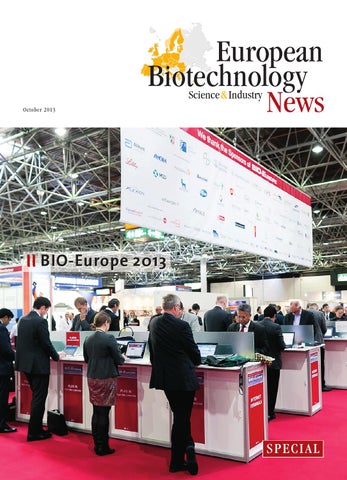
European Biotechnology News Science & Industry
October 2013
II BIO-Europe 2013
SPECIAL 31_EBN10_13_SPECIAL_BIO-Europe_2013_tg.indd 27
04.10.2013 11:33:17 Uhr
26367 EBN Ad. 30/05/2013 11:38 Page 1
Experience Flexibility Cell culture - Gene to GMP Following recent significant expansion of our mammalian cell culture facilities we offer a flexible approach to program delivery, for your mAb, ADC or non-mAb: l Cell line development, using in-house, CHO-based
expression system l HTS enabled process development, transfer and
characterization l cGMP cell banking
l cGMP manufacture in new, purpose built flexible facilities
up to 2000L, including the latest single-use technologies l Full analytical development for novel biologics and
biosimilars l Choice of US or UK production sites.
www.fujifilmdiosynth.com
32_EBSIN10_13_Fujifilm.indd 1
01.10.2013 16:21:28 Uhr
Nº 10 | Volume 12 | 2013
Euro|Biotech|News
33
Bio-Europe Intro
Licensing & Deals: Let’s waltz! Striking a good deal in a licensing agreement is above all a question of the right timing and a successful strategy. During negotiations you have to anticipate your counterpart’s next steps , and be ready to adjust your own position to new situations. Seen from this perspective, cutting deals has a lot in common with a formal dance. BIO-Europe 2013, Europe’s largest partnering conference, is taking place in Vienna this year, and thousands of executives and dealmakers will be out there hunting for the next blockbuster or the next marvellous niche drug. There are certainly plenty of potential dealmakers out there trying to sell what they hope will be the next big thing. So let the dance begin – or as the Viennese say: Alles Walzer! Places everyone, it’s time to waltz! Licensing has always been an integral part of the biotech business. Back in 1978 – the gray dawn of the industry – US pioneer Genentech licensed its first therapeutic (recombinant insulin) to Eli Lilly. After that things moved quickly. In 1994, Burrill & Company recorded 117 agreements on the world market. Last year, the global financial services firm tracked about 470 partnering deals involving pharma or biotech companies. Licens-
ing has become an important source of funding for biotechs, and practically every major pharma player is relying on external innovation to steer clear of the patent cliff. According to data gathered by Evaluate Pharma, however, the fast-spinning licensing carousel has begun to slow down. In the first six months of 2013, the number of pharma and licensing deals worldwide dropped by 4% to 416 (H1/2012: 434), while the amount of disclosed upfront payments
Table 1: Pharma and biotech licensing deals – a two-year overview
Source: Evaluate Pharma
Product count
Up-front payments ($m)
Deal values ($m)
H1 2013
H1 2012
Change
H1 2013
H1 2012
Change
H1 2013
H1 2012
Change
A Marketed
142
123
+15%
523
75
-32%
621
1,089
-43%
A Approved
7
18
-61%
41
20
+105%
239
50
+378%
A Filed
13
28
-54%
6
147
-96%
368
728
-49%
A Phase III
30
30
0%
130
183
-29%
966
1,831
-47%
A Phase II
32
22
+45%
434
328
+32%
3,201
2,844
+13%
A Phase I
30
32
-6%
80
77
+4%
775
948
-18%
A Preclinical
52
76
-32%
49
126
-61%
1,648
1,239
+33%
A Research
107
99
+8%
324
170
+91%
4,339
2,167
+100%
A Other
3
6
-50%
–
25
–
–
25
–
A Total
416
434
-4%
1,587
1,840
-14%
12,157
10,921
+11%
33-34_EBSIN10_13_Spezial-Intro.indd 33
also fell by 14% to US$1.59bn (H1/2012: US$1.84bn), compared to the same period last year (see Table 1). But even if licensing is now clearly a day-to-day business for pharma and bio tech companies, there has been a remarkable shift in paradigms in recent years. In the past, the usual route for a biotech firm was to discover and shepherd a molecule through the early stages (preclinical, Phase I and II), before selling to a pharmaceuticals company, which would undertake to finalise development and market the product through its sales network. Nowadays though, biotech companies have become more creative in structuring deals. It’s not uncommon for them to outlicense only specified territories or defined indications, either keeping the rest in-house or opting for co-promotion. And terms nowadays practically always include research or commercial milestone payments and royalties.
Shifting paradigms Other changes have gone even deeper, and are now enabling companies to define entirely new business strategies and occupy new commercial niches. Firms like Swiss Debiopharm have started to buy mole cules at the early-development stage just to resell them later with a significant added value. German drugscreening specialist Evotec has positioned itself as an accelerator between universities and Big Pharma, and is helping to speed up the translation of academic research projects into commercially viable products. Other biotech companies are consolidating their positions one step at a time, seeking to reach a level of maturity sufficient to develop and market their molecules compeletely in-house, or to acquire molecules from other developers.
New innovation strategies Pharmaceuticals companies are approaching the topic with new strategies as well. They have now changed their approach from ‘build it’ to ‘buy it’, says G.Steven Burrill, CEO of Burrill & Company (see p.
04.10.2013 11:34:05 Uhr
34
Nº 10 | Volume 12 | 2013
Euro|Biotech|News
Bio-Europe
Rank
Product
Therapy Category
Company
Deal partner / Source
Status on deal date
Upfront payment ($m)
Deal value ($m)
A –*
Tysabri
Central Nervous System
Biogen Idec
Elan
Marketed
3,250
3,250
A 1
Gilead/MacroGenics DART Program
Oncology and Immunomodulators
Gilead Sciences
MacroGenics
Research project
30
1,115
A 2
MOR202
Oncology and Immunomodulators
Celgene
MorphoSys
Phase II
92
910
A 3
Lu AE58054
Central Nervous System
Otsuka Holdings
Lundbeck
Phase II
150
825
A 4
Isis/Roche Huntington‘s Disease Project
Central Nervous System
Roche
Isis Pharmaceuticals
Research project
30
659
A 5
Cancer Antibody Research Project
Oncology and Immunomodulators
Pfizer
CytomX Therapeutics
Preclinical Research
25
635
Source: Evaluate Pharma
Table 2: Top five biggest deals in the first six months 2013 – ranked by deal value
* the sale of Tysabri was a product acquisition rather than a straight licensing deal
38). And with new outreach models, Big Pharma is also trying to tap into the entrepreneurial culture in biotech and the cutting-edge science of academia. Companies are doubling down on their presence in biotech hubs and investing heavily in new facilities and a proliferation of “centres of excellence” models for promoting innovation. Some firms have even gone a step further and are opening their own biotech incubators – as Germany’s Bayer AG recently did with their “CoLaborator” models in San Francisco and Berlin. Most pharma giants have also created smaller distributed R&D units, hoping it will spur some biotech-like performance. At the same time, there is an ongoing trend to reduce internal R&D and increase in-licensing of clinical-stage drug candidates. But even in an age where the routes to successful partnering are becoming increasingly serpentine, the fundamental questions have remained the same: How do I find the perfect partner? And how do I strike the perfect deal?
BIO-Europe 2013 visits Vienna Initially, that first question seems to be the easiest one to answer. Most pharma companies disclose their fields of interest for partnering, and a recent analysis by Forbion Capital Partners (doi:10.1038/ bioe.2013.3) suggests that “acquisitions by large pharmaceutical companies were
33-34_EBSIN10_13_Spezial-Intro.indd 34
generally in line with their official declared partnering interests...and when this was not the case, the deal value was lower than the average.” Of course, large partnering events offer an unrivalled chance to access several possible partners in just a few short hours. Europe’s largest event of this kind, BIO-Europe 2013, is taking place from 4-6 November at the Messe Wien Exhibition & Congress Center in the Austrian capital. It’s a superb choice of venue. The “Life Science Report Austria 2013”, carried out by BIOCOM AG on behalf of Austria Wirtschaftss ervice aws and Austria’s Ministry of Economy, reveals that Vienna is Austria’s most vibrant life science cluster. It also shows that the country’s biotechnology sector has grown at a scorching pace over the last two years (+23%) thanks to a prosperous industry, cuttingedge research institutes and continuous political support (see p. 36). At the beginning of November, some leading dealmakers from biotech, pharma and finance will also have the opportunity to put some statistical data to a real-life test. At BIO-Europe 2013, some 3,000 attendees will schedule more than 15,000 one-to-one meetings to discuss roughly 3,000 licensing opportunities. With proper planning, many participants could well conduct more meetings at this one conference than in the entire rest of the year together – maximising the chance of meeting someone interested in their idea.
On to the second question. Obviously there is no quick or easy way to strike a perfect deal; but there are several indicators that have to be observed to have a good chance of going home with an agreement in your pocket.
Timing is crucial Choose the right time to buy or sell a molecule, as that is one of the main factors affecting the terms of a deal. A closer look at the numbers reveals that Phase II assets remain in demand. Partnering at this stage increased significantly in the first six months of 2013 (+45%, see Table 1) and two out of five of the biggest deals struck during that period involved clinical Phase II assets (see Table 2). Furthermore, the average upfront payment to secure compounds at this stage of development climbed to $39m in H1/2013 (H1/2012:$34m), and has maintained the highest average across all stages of clinical development, according to data from Evaluate Pharma. Somewhat surprisingly, there is very little difference between average terms for Phase II and Phase III projects. In fact, average terms for Phase II assets outshone those for Phase III assets in terms of average upfront payment and the value of the average deal (see Table1). Phase II appears to be the sweet spot for drug developers seeking to extract maximum value for their experimental medicines. B
01.10.2013 16:22:34 Uhr
urt • O CPhl / ICS E ctober 22 – 24 • booth
Frankf
Vienna
Experience for the Future
Bio-Eu
• Nove mb
rope
# 3.1 D
46
er 4 – 6 • booth # 44
Biopharmaceutical Development and Manufacturing • recombinant proteins • antibody fragments • vaccines
Manufacturing Capabilities • from strain development to API production • from lab scale to 1500 L large scale manufacturing
Partnering and Licensing • full development up to finished product • global in- and out-licensing of biopharmaceutical projects
FDA and EMA GMP compliant
+ + + NEWS + + + FDA Approval for commercial production of a therapeutic recombinant protein + + + NEWS + + + Richter-Helm BioTec GmbH & Co. KG Suhrenkamp 59 D-22335 Hamburg Germany Phone: +49 40 55 290 435 Fax: +49 40 55 290 888 E-mail: p.wechmann@richter-helm-biotec.eu www.richter-helm.eu
HEL_BL_033_AZ_210x275_EBN.indd 35_EBSIN10_13_RichterHelm.indd 1 1
16.09.13 16:22 01.10.2013 16:22:46 Uhr
36
Nº 10 | Volume 12 | 2013
Euro|Biotech|News
Bio-Europe Austria
ma and medtech market had revenues of over a17.7bn in 2012 – roughly 5.4% of the country’s GDP. Two distinct primary markets emerge on perusal: the biotech/pharma segment’s 25,000 staff generated revenues of a10.33bn in 2012, while roughly the same number of employees in the medtech sector were responsible for a7.4bn in turnover.
A top location for the life sciences
Growth despite crisis
Four years ago, Austria’s vibrant cluster in Vienna Lisavienna for the first time hosted Europe’s largest partnering conference – BIO-Europe. According to the “Life Science Report Austria 2013”, the country’s sector has developed at a tremendous pace ever since. Hot off the press, the very latest statistics show 23% growth in Austria from 2010-2012 in terms of the number of companies with biotech as a core business (‘dedicated’ biotechnology firms). Those numbers will be presented at the BIO-Europe 2013, which returns to Vienna from 4-6 November. Just a few months before the key B2B meetings got started, Austria’s government provided a new growth signal with its “Action Plan Biotechnology”, which is based on its strategy of supporting rapid transfer from research to product. The central European country is pumping a50m into the emerging field of orphan diseases. Additionally, a new call by the „Research Studios“ programme is set to invest a further a16.8m in bringing life sciences and medtech innovations from bench to market. Austrian Economics Minister Reinhold Mitterlehner says the plan is aimed at “increasing the size of the sector significantly within the next five years.” Along with
Austrian incentives seeking to boost capital access – the “VC initiative”, the newlylaunched “aws Business Angel Fund” and the “aws Gründerfonds” – life science companies in the seed and development stage are now quickly acquiring the means for bridging the gap to a market launch. “Life science innovations can only make a difference once they have survived the road from lab to market,” says Edeltraud Stiftinger, Managing Director of Austria Wirtschaftsservice GmbH (aws), which commissioned the “Life Science Report Austria” on behalf of the country’s Economics Ministry. According to the study, Austria’s 723 companies active in the biotech/phar-
Business field
Number of companies
Employees
Revenues (am)
A Dedicated biotech companies
95
1,565
187.2
A Other biotech & pharma companies
62
16,492
4,920.4
A Suppliers, service providers and distributors to the biotech and pharma sectors
131
7,133
5,223.0
A Dedicated medtech companies
124
5,876
1,270
12
1,280
990.7
A Suppliers, service providers and distributors to the medtech sector
299
17,834
5,139.9
A Life sciences companies
723
50,180
17,730.9
A Other medtech companies
36_EBSIN10_13_Spezial-Austria_tg.indd 36
Source: Life Science Report Austria 2013
Key figures in Austria’s life sciences sector
Compared to 2010, growth in Austria’s bio tech/pharma sector has picked up even more speed. The number of ‘dedicated’ bio tech companies grew over the period from 77 to 95 in 2012, and revenues climbed to a187.2m – up from a161m in 2010. Most of Austria’s dedicated biotech firms are active in healthcare biotech (71.6%), contract research or manufacturing (17.9%). They have boosted drug development in the last two years, and now have 92 compounds in the pipeline – 12 more than in 2010. The number of pharma and biotech firms that do not exclusively develop biotech products also grew significantly, with 62 companies reporting turnover of about a4.9bn. For the first time ever, the survey included suppliers, service providers and sales & distribution companies to the biotech/pharma industry. The 131 firms surveyed contributed significantly to value creation. In 2012 they reported sales of a5.2bn. Most of the country’s life sciences companies are concentrated in Vienna (378) but Austria’s powerhouses of Styria (70), Tyrol (50) and Upper (75) and Lower Austria (94) have also expanded significantly due to their particular strengths, which range from regenerative medicine, oncology and bioprocessing to biosystem analysis. “This report demonstrates the vibrant development of the life sciences in Austria,” says Stiftinger. 17 new biotech companies and three pharma companies have been set up in just two years, and that growth looks set to continue. The Austrian government has named biotechnology a top priority in its R&D plans for the run-up to 2020. "We have set the course for building on our strengths, as well as occupying new fields and niches in the future," says Mitterlehner. "If past progress is maintained, then the best is yet to come." B
02.10.2013 13:23:45 Uhr
Comprehensive industry-speci�ic advice in Life Sciences. Dentons` Life Sciences experts in Germany advise on project-related transactions, or alternatively as an “outsourced legal department”, with deep industry-speci�ic knowledge, creativity and years of expertise to ensure their clients` success. Whether licensing contract deals or regulatory issues relating to the drug advertising law – as part of a team of over 80 consultants in Germany, Dentons provides companies in the areas of pharmaceuticals, diagnostics, biotechnology and medical devices with a future-oriented and interdisciplinary legal advice. Dentons is a new global law �irm with more than 2,500 lawyers and professionals in 79 locations in 52 countries offering creative, actionable business and legal solutions. Created by the combination of Salans LLP, Fraser Milner Casgrain LLP (FMC) and SNR Denton, Dentons is built on the solid foundations of three highly regarded law �irms. Your contact for Life Sciences: Peter Homberg peter.homberg@dentons.com T: +49 69 45 00 12 311 Dentons Frankfurt Pollux, Platz der Einheit 2 60327 Frankfurt am Main
Dentons Berlin Markgrafenstraße 33 10117 Berlin
Meet Dentons. The new global law �irm created by Salans, FMC and SNR Denton.
dentons.com 37_EBSIN10_13_Salans.indd 1
01.10.2013 16:23:03 Uhr
38
Nº 10 | Volume 12 | 2013
Euro|Biotech|News
bio-Europe Interview
Moving from ‘build it’ to ‘buy it’ Euro|BioTech|News
?
There is an IPO frenzy in the US, but Europe an stock markets remain shut pretty tight for biotech companies. Can you explain that?
! Burrill: First of all, you have to look at macro economic factors. The world economy is not particularly pretty right now. There is a net inflow of capital in the US on the belief that it is a better place to invest than most other places in the world. Secondly, there continues to be acquisition of biotech com panies at premium prices. Those premium prices are attractive to investors. Finally, I would say that the healthcare revolution is real. People understand that “turmoil“ in the marketplace is driven in part by technology, and is driven in part by where we are in un derstanding the human genome and the mo lecular basis of disease. Many people con tinue to believe healthcare is an attractive place to invest.
there when we were building this industry has disappeared.
Euro|BioTech|News
?
Pharma partners are increasingly riskaverse, and are structuring deals cautious ly. Will that continue?
! Burrill: I don’t think we’re moving back to a world where Big Pharma is going to spend more money on early-stage work. They are clearly looking for different models. You see more strategic relationships today between big corporations and universities than ever be fore. Big Pharma would rather pay the uni versities to do the core research, and rather have VCs and others finance the risk. They want to come in later and buy the devel oped technique, and are moving from ‘build it’ to ‘buy it’. Euro|BioTech|News
?
How has the confluence of new technologies affected the licensing market?
Are there trending topics right now where companies are moving en masse into a field that could dash a lot of hopes in the future?
! Burrill: The biotech industry has largely lived in a world of developing new drugs and bio logics. The digital health revolution enabled us to move on rapidly into improved tech nologies for healthcare delivery. There is a lot of capital that is moving away from basic biotech start-ups into other elements of the healthcare system, with nearer term reve nue. In short – some of the buzz that was
! Burrill: I think ageing is certainly an overriding topic that seems to get a lot of attention. Wheth er you look at Calico, the new company that was formed by the Google guys, the key re search centers in the US or at some of the Big Pharma companies that are looking at ageing, this will be a tremendous market. We have “categorised” ageing as a disease. That’s kind of funny terminology – to think
Euro|BioTech|News
38_EBSIN10_13_Spezial-Burrill_bk.indd 38
?
© BIO.NRW
Financing and licensing strategies have gone through many changes in the past. Euro BiotechNews spoke with CEO of Burrill & Company G. Steven Burrill about his views on the biotech sector’s economic situation and new opportunities for business. G. Steven Burrill is Chief Executive Officer at San Francisco-based Burrill & Company. As one of the original architects of the biotechnology industry and one of its most avid developers, he’s a soughtafter speaker for meetings like the NRW Investors Conference held in Chicago last April – where this picture was taken.
of ageing as a disease. Ageing is a proc ess. But it has been categorised as a dis ease now, and therefore we’re going to find a cure. Interesting.
Euro|BioTech|News
?
In what other areas will we see more in vestment?
! Burrill: The theme of orphan and rare diseases is still hot. For a lot of investors in particular, it sounds like a vehicle that can help you get a product to market more efficiently and ef fectively than multibillion dollar 5-10 year trials. We’ve seen that orphan drugs fre quently are then able to expand into broad er markets. Certainly there is no question that big diseases like diabetes and obesi ty are markets that will continue to be at tractive. We are spending disproportionate amounts of the world’s resources on them, and everybody is still looking for a magical solution. So many of those big markets are still very attractive, and I woud certainly say with a great deal of confidence that there is probably more interest in diabetes and obes ity today than ever before in the past. Virol ogy and viral diseases are also getting real attention today.
04.10.2013 11:34:43 Uhr
GE Healthcare Life Sciences Now part of GE Healthcare
Unlimited growth potential
Use one convenient bioreactor platform from process development to production. Don’t let different vessel forms, materials, and control systems impede your growth. Xcellerex XDR™ bioreactors simplify process scale-up and scale-down, providing a highly engineered, well-characterized product platform. Our service and support make scalability even easier. Spend your time growing cells — and outgrowing the competition.
www.gelifesciences.com/xcellerex
E: webinquiry@xcellerex.com P: 508.480.XCEL(9235) or 1.866.XCELLEREX
GE, imagination at work and GE monogram are trademarks of General Electric Company. Xcellerex is a registered trademark of Xcellerex, Inc. XDR is a trademark of Xcellerex, Inc. © 2012 General Electric Company — All rights reserved. First published September 2012.
1253076_EuroBiotechNews.indd 39_EBSIN10_13_Xcellerex.indd 11
10/5/12 9:44Uhr AM 04.10.2013 11:36:49
40
Nº 10 | Volume 12 | 2013
Euro|Biotech|News
Bio-Europe Technology Transfer Block Expemption Regulation
licensor and a licensee – but not, as a basic principle, to “patent pools”. What is new is that the agreement can also include restrictions for multiple levels of trade without being excluded from the scope of application of the new TTBER. The operative factor is that the two companies must enter into the agreement with the goal of having contractual products produced by the licensee and/ or its suppliers.
The impact of the new TTBER Peter Homberg, Partner und Christine Herkommer, LL.M., Associate, Dentons
There have been big changes pursuant to the draft of the new Technology Transfer Block Exemption Regulation (TTBER) and their respective guidelines, and this will have knock-on effects on fundamental non-exemption of non-challenge and termination clauses. The TTBER is a regulation of the European Commission (EC) that contains specific provisions for agreements in the area of technology transfer (e.g. for license agreements, patent purchase agreements etc.). This means that under certain preconditions provided for in the TTBER, the regulation exempts agreements that restrict competition in the area of technology transfer from the fundamental prohibition on agreements restricting competition pursuant to Article 101 (1) of the Treaty on the Functioning of the European Union (TFEU) (Article 101 (3) TFEU).
Based on the experiences that were amassed under the previous T TBER from 27 April 2004 (Regulation (EC) No. 772/2004), which is due to terminate on 30 April 2014, the Commission has now prepared a draft version of a new TTBER.
Scope of application of the new TTBER As in the past, the new TTBER is also to apply only to relationships between two parties, e.g. to agreements between a
No exemption pursuant to the draft of the new TTBER Alongside agreements that are not covered by the previous TTBER, under the draft version of the new TTBER, the following agreements will not be exempted, but rather will be subject to an individual assessment: – Agreements that fall within the scope of application of the block exemption regulations for research and development agreements (Commission Regulation (EU) No. 1217/2010) or for specialisation agreements (Commission Regulation (EU) No. 1218/2010). – Agreements for the mere reproduction and distribution of software copyright protected products. – Agreements in whose case the applicable market-share threshold is exceeded on one or more products or technology markets. – Agreements obligating one party not to challenge the validity of the other party’s intellectual property (nonchallenge clauses). – Agreements under which one party is permitted to give notice to terminate if the other party challenges the validity of its intellectual property (termination clauses).
© vege - Fotolia.com
New developments under the draft of the new TTBER
40_42_EBSIN10_13_Spezial-Homberg_tg.indd 40
The draft of the new TTBER contains new or changed definitions. Of these, the changed definition of the term “technology transfer agreement” deserves special attention. Agreements containing the following provisions are now also
01.10.2013 16:28:10 Uhr
ETB Award
for the most successful European biotech cooperation The ETB Award honours finalised cooperative projects, funded under the frame of the EuroTransBio (ETB) international funding initiative, that have generated innovative scientific and technological outcomes and show high economic potential.
SUEÑO – A European success story “Research on novel bio-signal technologies & methodologies for unsupervised, automatic extraction of electrophysiological biomarkers” The SUEÑO project aimed at the development of a high-quality automated analysis and the scoring of human sleep, as measured by EEG (Electroencefalograph-brain activity), EOG (Electrooculogram-eye movement) and EMG (Electromiogram-muscle movement). The targeted system was to be used in a completely unsupervised mode. The research was driven by the objective to reach high quality standards in respect to validity and reliability of basic electrophysiological biomarkers centred on spectral analysis, scoring of sleep and other medical applications. The dual objectives of automatic and unsupervised imposed non-trivial real-world practical requirements which were the main reasons why such a system did not yet exist on the market. The partnership between Starlab (Catalonia/Spain), which has a wide expertise in the electrophysiological sensor field, and the Siesta Group (Austria), which is specialised on EEG- and sleep-related clinical trials, developed the first truly comfortable, user friendly, and robust sleep analysis system for unsupervised home studies with full sleep scoring. Barriers that have prevented others from doing this, like the number of data channels needed for automatic sleep staging algorithms and the related effect on complexity of the sensor, have been overcome by the consortium.
Mr. Giulio Ruffini Tel.: +34 932540366 giulio.ruffini@starlab.es www.starlab.es
Impact of the ETB project The company Starlab coordinated the SUEÑO project. The company, founded in 2000, has a large expertise in the development of both innovative sensors and systems in space applications, applied neuroscience and signal processing algorithms, with a strong specialisation in electrophysiology algorithms, software and hardware. It was responsible for the technology development aspects of the project. Starlab developed several hardware prototypes which were tested and compared with state-of-the-art sleep monitoring systems. The final prototype leaded to a wearable and wireless electrophysiology medical certified sensor. The company also advanced in the state-of-the-art of dry electrodes which minimize the set-up time when recording electrophysiological signals. The Siesta Group provided their expertise on sleep related clinical trials by adapting the current scoring algorithms to work with a limited number of electrophysiological channels in an automatic and unsupervised system are required. The different prototypes issued during the project were tested by the Siesta Group in clinic trials, which were crucial for the development of a reliable hardware and software sleep scoring system.
EuroTransBio – International Funding Initiative ETB has funded 135 biotech projects worth more than 233 Mio € – involving 332 SMEs, 121 academic organizations and 7 large companies, organized in small consortia of 2 to 4 partners. With a usual application of approximately 30-40 projects the average success rate of ETB calls is 45%. The next ETB call is open since October 1st, 2013 and will close on January 31st, 2014. ETB is present at BIO-Europe 2013, visit us at booth n°14!!
www.eurotransbio.eu ETB-Ad_2013.indd 1 41_EBSIN10_13_ETB.indd 1
23.09.2013 13:33:30Uhr 04.10.2013 11:37:20
42
Nº 10 | Volume 12 | 2013
Euro|Biotech|News
Bio-Europe to be considered technology transfer agreements according to the following template: – Agreements that are directly and exclusively associated with production of contractual products AND – refer to the acquisition of products by the licensee OR – to the licensing or transfer of intellectual property rights OR – know-how to the licensee. This also applies if the risk associated with the use and exploitation of the technology remains in part with the seller. Within the area of “hardcore restrictions”, the draft of the new TTBER no longer contains any exemption for restrictions of passive sales made to an exclusive territory or an exclusive customer group for agreements between non-competitors. According to the guidelines that will apply only to the first two years after the market entrance of a product. Thus, it would be possible to grant an exemption following consideration of an individual case. The market-share threshold for technology transfer agreements between competitors remains at 20%, and for these types of agreements between non-competitors, the Threshold will be 30% as a basic principle. With regard to agreements between non-competitors, stricter provisions now apply if the licensee has technology that is used exclusively for internal production within the company and that is interchangeable with the licensed technology. In this case, the market-share threshold is 20%, as between competitors.
Non-challenge and termination clauses Under the previous version of the TTBER, it was permissible for an agreement to contain a right of termination for the licensor in the event that the licensee challenged the licensed intellectual property rights. This privilege granted to the licensor is no longer provided for in the new draft of the TTBER. In its guidelines, the Commission states that the licensee is generally best able to assess whether or not
40_42_EBSIN10_13_Spezial-Homberg_tg.indd 42
an intellectual property right is valid. It states as grounds for the exclusion of non-challenge clauses from the scope of application of the new TTBER that invalid property rights are incompatible with the interest in undistorted competition and with the principles upon which protection for intellectual property is based. With the exclusion of non-challenge clauses from exemption under the new T TBER, non-challenge clauses must also be held to the measure of Article 101 TFEU. In its guidelines, the Commission considers non-challenge clauses to be incompatible with the internal market, and has ruled they are to be prohibited pursuant to Article 101 (1) TFEU if the following three prerequisites are met: (1)the licensed technology is valuable (2) the companies are placed at a competitive disadvantage, and (3) the companies are prevented from using the technology or can use the technology only in exchange for payment of licensing fees. This applies if the prerequisites of Article 101 (3) TFEU are not met, which is generally the case. Moreover, there is supposed to be no restriction of competition if the license is based on outdated technology (ECJ, judgment of 27 September 1988, Bayer/Süllhöfer, Case 65/86, margin no. 18). In contrast, the Commission generally denies that there is restriction of competition pursuant to Article 101 (1) TFEU if an agreement obligates the licensee not to challenge the licensor’s ownership of a technology. Competition is not generally affected due to the link between the use of a technology and the granting of a license, the Commission says.
The role of public interest in termination clauses Because their effects are similar to those of non-challenge clauses, termination clauses also no longer enjoy exemption under the new TTBER. To fall within the scope of application of Article 101 (3) TFEU, what is required now is that the interests of the licensor be weighed
against the public interest. While the licensor does not want to be obligated to continue to transact business with a licensee who challenges the core object of the license agreement, the public interest lies in the elimination of economic obstacles that, under some circumstances, accrue to invalid intellectual property rights (ECJ, judgment dated 25 February 1968, Windsurfing International, Case 193/83, margin. no. 92). The provisions are different with regard to know-how. Non-challenge and termination clauses in this area are of less concern, as it is simply impossible to take back-licensed know-how that has been divulged, and this is also one of the factors – the Commission holds – promoting the dissemination of know-how. As a result, non-challenge and termination clauses in the area of know-how are also to be exempt under the draft version of the new TTBER.
Criticism and outlook The new provisions on non-challenge and termination clauses have met with plenty of criticism. The IP Federation, an association of various British companies, fears that transaction costs and/ or licensing fees will rise. The federation says this applies particularly in the area of long-term license agreements, making these types of agreements less attractive under the new provisions. In its expert opinion to the Commission, the IP Federation has therefore stated that it would prefer to continue to adhere instead to the current provisions of the TTBER. In its opinion, these have maintained a good balance between the interests of licensors and licensees to date. The criticism that has been voiced regarding the non-challenge and termination clauses in particular is both understandable and justified. It remains to be seen how the Commission, and subsequently the European Parliament, will conduct themselves in this regard. Regardless of this aspect, however, the new TTBER is set to enter into force on 1 May 2014, and will continue to apply until 30 April 2026. B
01.10.2013 16:28:17 Uhr