BINGHAMTON REVIEW

Dear Readers,
Oy,
From the Editor
mates! I hope you’re all having a cuppa with a jacket potato and some beans on toast, Le Bosh! Only real Big John fans will get that one. Anyway, it’s British Aiden here, ready to serve our British-esque Binghamton Review slop to our finest customer: YOU. Just like a tuna-filled spud, this magazine is visually intriguing on the outside, and probably pretty good on the inside (unless you’re a tuna fish, which means you’re a cannibal in the fish world). Just like David Beckham, I’m going to switch from being British and turn into the American version of myself now…
Hello, it’s me, Aiden. Oh, we’re talking about food?
Speaking of food, it’s been a couple of big weeks for food at Binghamton University. As of February 19th, 2026, the university will FINALLY be ending its contract with Sodexo. Instead of the Sodexo slop we know and love, Chartwells Higher Education will become the university’s new food supplier on June 1st of this year. Just like any marriage that lasts 40 years, Sodexo and the campus had its ups and downs. But instead of the lovey-dovey type of marriage, it’s more of the “husband beats his wife” kind of marriage. From constantly giving students food poisoning to underpaying their workers, Sodexo has robbed the university, its students, and its staff blind for over 40 YEARS!
After a real push by campus groups over the past couple of years, change has finally happened. Now, did we, the students, actually do anything, or did Chartwells just make a lucrative offer to campus officials? It’s really hard to say, but I’d lean more towards the latter. Not to say our voices didn’t matter, but our outcry probably came secondary to the money at play (I mean, how do you think Sodexo got here in the first place and stayed so long $$$). However, despite my pessimism, I’ll offer an optimistic caveat: The sheer possibility that Chartwells can offer things like meal swipes, expanded cultural/religious food options, and just a better dining experience for not only the students but the staff that works for the university is infinitely better than keeping Sodexo. HOWEVER, (back to the pessimism) from my initial research, Chartwells is really a crapshoot. Some universities like NYU and Pitt (which has one of the highest rated dining experiences in the country for college campuses) rave about Chartwells, while other universities like WPI and UMass complain, just like we did about Sodexo. So, here’s the moral of the story: This could be really good, or probably just meh/bad like Sodexo was. Ultimately, I think all of us should hold our heads high, stay optimistic about the future of campus dining, and continue to demand improvements if Chartwells doesn’t suffice. Now, that’s my spiel. I hope you enjoy a real classic Binghamton Review issue. Have a great read, and remember: Don’t do anything I wouldn’t do.
Sincerely,

Aiden Miller

Our Mission
Binghamton Review is a non-partisan, student-run news magazine founded in 1987 at Binghamton University. A true liberal arts education expands a student’s horizons and opens one’s mind to a vast array of divergent perspectives. The mark of true maturity is being able to engage with these perspectives rationally while maintaining one’s own convictions. In that spirit, we seek to promote the free and open exchange of ideas and offer alternative viewpoints not normally found on campus. We stand against dogma in all of its forms, both on campus and beyond. We believe in the tenents of free expression and believe all sudents should have a voice on campus to convey their thoughts. Finally, we understand that mutual respect is a necessary component of any prosperous society. We strive to inform, engage with, and perhaps even amuse our readers in carrying out this mission.
Views expressed by writers do not necessarily represent the views of the publication as a whole.
Advice Column
We offered to give you all life advice. Here were your questions:
How do i deal with a unmotivated gooning roommate
Eight-hour arm workout
Ok, jokes aside, does bonesmashing actually work? I kinda do need a stronger jawline…
Knock yourself out.
How do you rejuvenate
Slowly.
Life on the line, how many hot dogs do you think you could eat in an hour?
I think I could eat about 8 or 9. What, did you think I was gonna say 6 or 7? You unfunny fucker.
I just got the most devious job offer ever. How can I keep my motivation to study for good grades?
Grades don’t matter when you got the job secured
Is Chartwells really any better than Sodexo? I can’t imagine that switching to a different brand of institutional slop is going to save the dining halls.
You vill eat ze prison food
What’s the midterm situation like for y’all?
Should press charges for how hard we’re getting fucked
Is there a contract for professors to hold a certain amount of office hours? My stats professor is trying to hold his from 10 PM to 11 PM on Saturday and I can’t make that.
Is it at their house also?
The Sri Lankan I hired to do my homework keeps asking me at odd hours of the night to send over my code for two-factor. How can I make it so he can log in without me?
Cut off your finger and mail it to him
Who wanna get in this tub with me and rub my fuckin butt?
Written by our Staff
Who’s gonna be the next Editor-in-Chief when Aiden graduates?
We’ll get back to you in 6 or 7 weeks
Do people ever derive equations in real life? I signed up for this stupid class to learn how to use Excel but my professor won’t shut up about vectors and eigenvalues and other weird math stuff.
You need a class to learn Excel? Smh my head
So like what’s the deal with the Review? Is it a conservative magazine?
If ONE MORE PERSON asks me this I am going to FLIP MY SHIT. We are the free-speech, non-partisan, student-run magazine on campus. NON-PARTISAN!
Now that the “he was forced to eat cement when he was 6” seal turned 6, is he actually gonna be forced to eat cement?
I have a 40-pound bag of cement right here, and the only thing that can stop me is if they get rid of the Academic Excellence Fee. Your move, Anne.
Who we votin’ for this year, Big John or the Big Yahu?

Every time I come back from class the laundry room is full. What’s the best time to get there to snag an open washer?
6:7 a.m.
Is it normal for the OCCT bus driver to touch me on my body?
Yeah! But only for city residents.
I’m so done with Binghamton and I’m going to drop out. What should I do?
Open a burger place with your best buds from college with a crazy idea
There are 304s out there needing saving. Should I provide?
Cap’n save a ho
How easy is it to join the Binghamton Review?
You will be hazed like Iowa frat pledges
Looking for new food places in the area. What should I try out?
Endicott Autozone seafood boil
My girlfriend keeps complaining when I play video games while she’s over. Am I in the wrong?
No, the El Cinco will be played in the maternity ward
Bonnie Blue or Lily Phillips?
Have you ever noticed how all those degenerates are Br*tish???? Makes you wonder…
Is John Kiriakou a based chad or a psyop?
John get the hummus…..
What do you think of the Alysa Liu olympic performance?

How do I get dog poo off my shoe
Lick it off
If Binghamton was in GTA where would the Vanilla Unicorn be?
UUW-B05
How much wood can an endicott hooker stroke if an endicott hooker could stroke wood?
What’s up with all these endicott hooker questions. Are they really that good? I gotta find out
I really need to start going to the gym but I just can’t find the time
Can’t? Wtf do you mean you can’t. You’re wasting my time and you’re pissing me off.

My mom keeps getting on my case telling me to get a job. I’m only on my fortieth gap year, what’s her problem?

What are the new businesses gonna be at MarketPlace once Sodexo leaves?
Red Chili University Port!!!!!!!
Who would be the top and the bottom in a relationship between Baxter and Tony the Tiger?
Baxter is a power bottom
Need life advice? Email review@binghamtonsa.org for more wacky, quirky and zany responses.
Baxter Bearcat Brutally Slopmogged by BR Finance Leader
By Angelo DiTocco
BINGHAMTON, NY, FEB. 19 – Baxter Bearcat was SMV
larpmaxxing on NPCs live in C4 when he was brutally slopmogged by a local Reviewchad, causing a diabolical cortisol spike.
At 1:67 PM, during the slop factory’s sleeper hours, the bearchud was going live for the gram to minmax his cyberclout and inflate Sodexo’s Market Value (SMV) without resorting to kirkification in the big two-six. Baxter and his goons had deviously dialogue-treed a normalpilled “Get lunch with me at C4” promo stream for BU’s slop alt, @bingcampusfood. After the mundane slop acquisition process, the mascot approached the fluoridemaxxing NPC at the register. On his tray was a bacon cheeseburger, two shablingities, and a slopful of macking cheese from the michael wave. Larpmaxxing as a Gen-Z college normie, he egopilledly stated “No one eats more slop than me.”
“Nuh uh!” A framemogging finance bro approached the camera, calling cap on the jestergooning bearcel’s bluff. “I’m the slop goblin!” he asserted as he flexed his tray with three glizzatrons, two Big Macs, a bacon egg and cheese, and a chicken sammich. This highkirkenuinely gave Baxter a generational cortisol spike, as he was immediately jesterfied by all the moids and foids occupying the slop center. His cortisol levels were so diabolically maxxed out from being so brutally slopmogged that not even a 2016 Epstein summer could reset his flow state. Stunlocked and realitypilled, he immediately ended stream.

i forgor stream link so i lowkirkenuinely promptmaxxed this pic with claude hope it’s all good gang
On frame one following the mog, slop dealer Sodexo announced its humiliationship with BU was so unbelievably over. “Bro, ts [this school] is so Kevin fr. Even its own mascot can’t self-improve from jestergooning and getting mogged wherever he goes. I’m out gang,” the slop supplier’s shot caller Thierry Delaporte impulsively Blueskied, successfully defending SMV.
Unlucky for Terry, the top dog, Sodexo’s situationship with BU is locked in ‘til the birds sing, so it’s all quiet on the happening front for now. Nevertheless, Terry’s pulling out is being cheermaxxed by the newly freedompilled slopscribers. “Thank Kirk Sodexo’s gone. All those foodlarpers did was pipeline our zinc Lincolns to the big yahu, lowkey,” said one unidentified campusmaxxer. “We’re so back.”
The slopchad on stream was later recognized as our own Daniel Guido, a historypilled benchmaxxing finance bro committed to using his elite knowledge of B2B sales and regression analyses to help the Review churn out wordslop for all the normalpilled freshies on campus. “That bearchud was so goonmaxxed and egopilled that I just had to mog him,” Guido explained. It’s bulking season, as any gymcel knows, so this was a prime opening for the treasurer to slopmax and absolutely dunk on the furrylarping corpo-shill. It was truly a generational play, flexing niche ball tactics right out of Sun Tzu’s The Art of War. “85 grams of protein!” he statmogged.
Needless to say, the slopmogging incident has upgraded Guido to niche Binghamton micro-celebrity status, with the clip even earning a React by our GOAT Flight. “Yo, this is crazy,” Flight wisdomshilled as he first saw the bearcel getting deviously humbled and blackpilled in real time by the slopmaxxing Business Manager.
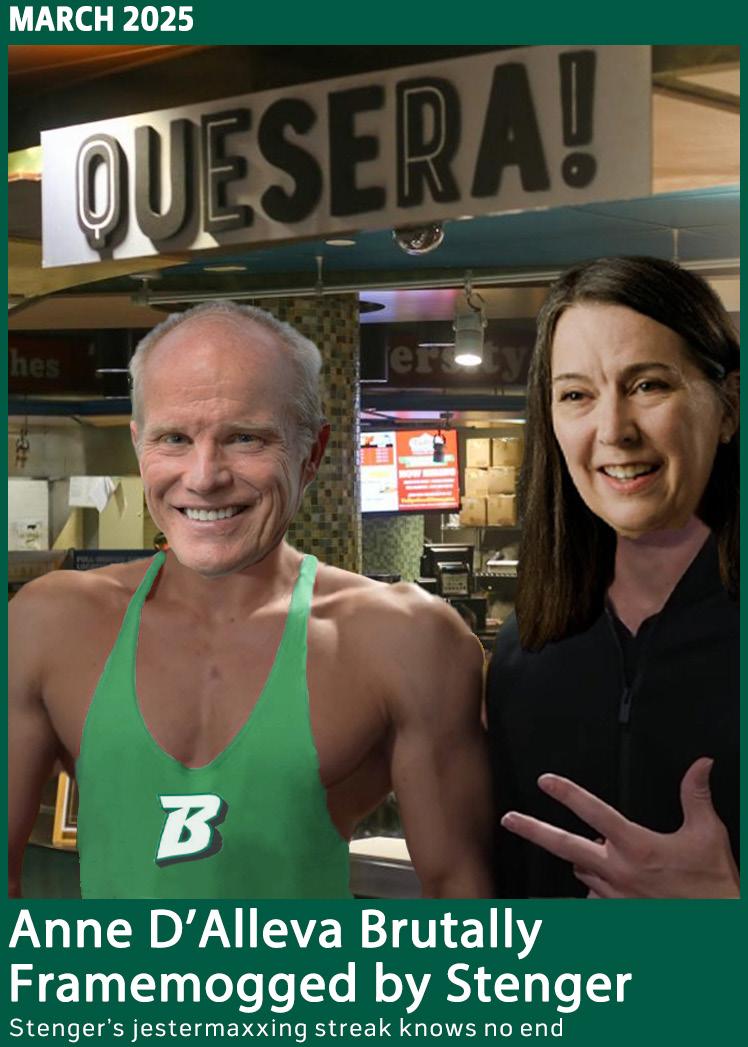
On the other hand, Baxter’s diabolical choke was so auraminning that it has lowkirkenuinely left his campuspilling career in shambles. President Anne D’Alleva was quick to further statusmog the bearchud following Sodexo’s transformation to a Business Going Their Own Way (BGTOW). “If I see that low-tier furry make one more goofy ahh fumble, he’ll be unempl*yed,” the BU shot caller announced on B-Line. “Ts deserves better than a jestergooning slopcel.”

The Melania Malaise
By Logan Blakeslee
Having watched the big-budget documentary Melania: A New Film at a local AMC theater in Washington, D.C., I felt as though it should have been titled Melatonin, considering how torturously bored I was during the entire runtime. I barely remember what I saw on account of fighting the urge to fall asleep in a nearly empty cinema hall. There was only one other person watching alongside me, and given his age and attire, I am convinced that he was a journalist of some sort rather than an average moviegoer. Any joy I felt during Melania came exclusively from my bag of chocolate pretzels that I had purchased from the concession stand.
The advertising of the film would convince you that you were about to experience a chaotic, off-the-cuff journey with Melania Trump as she dons the role of First Lady once again, following her husband’s stunning 2024 presidential victory. I have watched similar documentaries in the past, ones that gave special glimpses into the fascinating world of presidential campaigns. Each of those was far more entertaining. It is true that Melania stands out for making the First Lady the center of attention, but it refuses to take risks and never offers unscripted moments where Mrs. Trump conveys any kind of relatability or vulnerability.
“Melania is a film that I would describe as anti-art. This is undoubtedly an automatic contender for worst film of 2026.”
It is difficult to choose which aspect of the film drags it down the most. The “performances” are stilted and lifeless, the dialogue is so artificial that I am genuinely wondering if a machine wrote it, none of the soundtrack is fitting, and every scene consists of either people standing or people entering/exiting vehicles. Before delving deeper into my criticisms, I will point out a few moments where I felt some human emotion as a viewer:
Jimmy Carter’s funeral is sad to see. Regardless of my opinions about his presidency, Carter was a decent human being who did what he thought was best for the country. His charity work further demonstrated his character. He will be dearly missed.
Melania’s grief over the loss of her mother is also sad, but there’s an uneasy feeling created by her stoicism at the loss of a loved one. She verbally indicates that she’s sad onscreen, but it’s virtually impossible to tell from her facial expressions. Her own father, by contrast, shows his grief in a more natural manner. You can see the pain etched in his face, and it tugs at the heartstrings.
Any footage featuring Barack Obama or Joe Biden is darkly comedic. Obama often looks as though he’s holding in unspeakable rage, while Biden is still the somewhat senile geezer whom we all know and love. The contrast is very funny. Kamala Harris seems to be in a state of perpetual bewilderment, as if
she were trapped in a bad dream, but I can hardly fault her for that. I still commend her for attending President Trump’s second inauguration, given everything she endured on the campaign trail.
Those are all the positives that I could think of. Trying to recollect the events of the documentary already puts me half to sleep, so a full recap may yet induce a coma. Instead of droning on about the negatives, I wish to focus on the scene where Melania Trump discusses the issue of cyberbullying with Brigitte Macron. This serves to expand upon Melania’s “Be Best” [sic] awareness campaign, which focuses heavily on cyberbullying against children. It’s an important topic and worthy of our attention, but to my surprise, Melania does not meet a single child throughout the course of the whole documentary. She does not travel to a single school, nor does she interact with any teachers, school counselors, or mental health experts. Instead, she meets with the Queen of Jordan and the First Lady of France. Melania Trump does not engage with the lived experiences of the average American but instead isolates herself in the upper echelons of society. It’s frustrating to watch, even for someone who is perfectly fine with the existence of multimillionaires.
Melania is a film that I would describe as anti-art. It wasn’t made as a genuine introspective piece into the First Lady’s life, and it wasn’t made to be a commercially viable product, either. It appears that it was made to warm over relations between the Trump family and Amazon’s Jeff Bezos (who bankrolled the project), which is the only suitable explanation for Melania’s monstrous $40 million budget. This is undoubtedly an automatic contender for worst film of 2026. I suggest spending your money on chocolate pretzels instead.

Against Debate Culture
By Comson Cao
The internet has produced many strange subcultures, but few are as performative and as intellectually hollow as debate culture. What is often framed as a noble pursuit of truth is, in practice, closer to a gladiatorial sport for clout, applause, and algorithmic reward. It may look like discourse, but structurally, it is designed to reward winning, not learning. And that distinction matters.
At its core, debate culture is competitive. The participants are not there to refine their beliefs; they are there to defeat their opponent. That alone shifts the incentives away from truth-seeking and toward rhetorical dominance. In these debates, rhetoric carries at least as much weight as evidence, often more. Delivery, tone, speed, confidence, and the ability to interrupt cleanly all matter more than whether the underlying claims are actually correct. The format rewards the person who sounds decisive, not the person who is empirically cautious. Worse, “evidence” becomes a kind of verbal confetti. Studies are cited rapid-fire. Statistics are invoked mid-sentence. Historical claims are thrown out in passing. There is no real-time verification. No one pauses the debate to open a PDF, read the methodology, and assess whether the citation actually supports the claim being made. It is structurally impossible. If you are committed enough to winning, you could fabricate evidence, and the odds of immediate detection are slim.
Debate culture also rests on a fiction: that there is some large pool of neutral observers waiting to be persuaded by superior argumentation. In reality, audiences self-select. People who watch political debate streams on YouTube or Twitch typically already agree with the host they follow. They are not tuning in to evaluate arguments impartially; they are there to see their side perform well. Even in broader contexts, who chooses to watch debates? Generally, people who already have fairly strong opinions. Confirmation bias does the rest. Viewers tend to interpret ambiguous moments in favor of the debater they prefer. A stumble from their side becomes “thinking carefully.” A pause from the opponent becomes “getting destroyed.” And because claims fly by too quickly for real-time verification, the audience often lacks the tools to independently assess what was said.
One incident illustrates the dynamic perfectly. During a debate, the leftist streamer Vaush asked his opponent whether he was familiar with “Alden’s number.” The opponent claimed he was. Vaush then revealed he had invented the term on the spot. The moment went viral because it exposed something fundamental: in a high-pressure debate environment, admitting ignorance feels like losing. So many participants bluff. Not necessarily because they are uniquely dishonest — but because the format punishes humility. In debate culture, saying “I don’t know” feels like losing. So people don’t.
Debates also contain a built-in asymmetry: they structurally disadvantage heterodox or unpopular views. The popular opinion benefits from familiarity. The audience already accepts it by default. The person defending it can reiterate widely circulated talking points and appear reasonable simply by echoing
what most people already believe. The person defending an unpopular position faces a different burden. They must justify their position rigorously. They must anticipate objections. They must provide empirical backing. And they must do all of this under time pressure. In livestream debates, you often have seconds to respond before silence itself becomes a liability. Five seconds of hesitation can be clipped and reframed as defeat. In written exchanges — academic journals, essays, structured rebuttals — the playing field is slower and more level. Claims can be examined carefully. Sources can be checked. Arguments can be refined. In a debate stream? You are performing under a clock. And speed does not reward caution.
If rapid-fire evidence dumping is one distortion, the opposite problem is just as corrosive: weaponized citation demands. Consider a basic definitional claim like, “Marxists believe in historical materialism [the idea that history is driven by the conflicts between social classes created by existing material conditions].” Demanding an exact page number from Karl Marx in the middle of a debate misses the point. Historical materialism is not a controversial add-on to Marxism; it is foundational to the framework. It would be similarly odd to demand a citation for “liberalism emphasizes universal rights” or “Christians believe Jesus is the son of God.” These are conceptual descriptions, not disputed empirical findings. Sure, precision matters. Citations matter. But in debate culture, “source?” often functions less as a genuine request for clarification and more as a performative move, a way to stall, posture, or shift burden mid-exchange. Ironically, genuinely knowledgeable interlocutors rarely play this game. If you were debating an actual Marxist, they would not dispute that historical materialism is central to Marxism (again, because it is one of this philosophy’s most integral and foundational premises). The “source, bro?” move tends to appear when someone wants to posture rather than engage.
Structured disagreement, conducted in good faith, can sharpen thinking. But debate culture, especially in livestreams and other algorithm-driven spaces, is optimized for attention, not understanding. The format systematically privileges confidence over caution and speed over depth. It elevates performance above precision and loyalty above neutrality. These are not accidental byproducts; they are baked into the incentives of the medium. Platforms reward engagement. Engagement favors confrontation. Confrontation favors spectacle. Most viewers do not leave these debates with revised priors or newly acquired methodological humility. They leave feeling validated. The winning side feels triumphant; the losing side feels wronged; both feel confirmed. That may be entertaining. It may even be cathartic. But it is not a reliable mechanism for discovering what is true. If the goal is genuine inquiry, slower forms of exchange — writing, structured dialogues, research-based rebuttals — are simply better suited to the task. Debate culture, by contrast, is intellectual professional wrestling: dramatic, competitive, and occasionally impressive, but ultimately designed for applause. And applause is not the same thing as understanding.
Down:
1. The opps trying to force you to apply for j*bs
3. Your go-to insult for short men this St. Patrick’s Day
5. Anne D’Alleva’s last name
6. A mosh pit for freshies, unabbreviated
8. March
10. Our less-funny counterparts
11. The boy who turns Binghamton to gold
17. Big wins for Democrats, but not in November
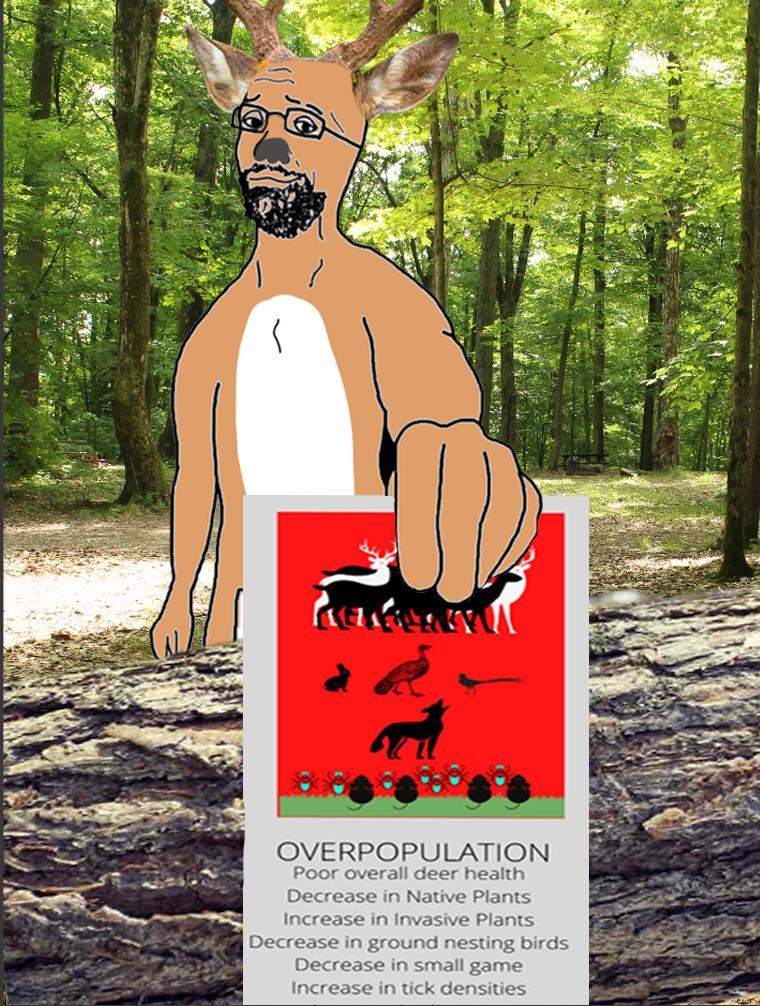
18. What they say about freshmen and those deer in the Nature Preserve
Across:
2. The road that’s like, not Glenn G. Bartle Drive
4. Binghamton patriot who watered the vast fields of campus
7. In a race with the AI center and the east gym for “last to be completed”
9. Two days when liberal arts majors skipped class and smoked weed for Palestine
10. What you browse when you’re bored and lonely
12. You think biomedical engineering is hard? Try this major
13. A $55 million generative model for producingbanal weather-complaints
14. Event somehow less arousing than a priondiseased deer’s spasms
15. Binghamton’s soon-to-be slop supplier
16. What you may be if you don’t start looksmaxxing…
Five Ways Conservatives Can Stop Sucking at the “Culture War”
By Nicholas Aparicio
As a Puerto Rican, I personally had little problem with Bad Bunny’s halftime show of Super Bowl LX (except that it was slightly underwhelming, but still fine). I do think America should be monolingual, but the NFL is an international brand that always selects artists people somehow complain about, so Bad Bunny wasn’t too out of the realm. One show won’t wreck American culture. However, after the horrendous Turning Point USA halftime show assembled in response to Bad Bunny headlining the official halftime show, one thing was made clear: the out-of-touch TPUSA Millennial and Zillennial conservatives who have been “leading” conservative outreach to young people for the past 10-15 years are complete & utter fucking idiots. Nobody with functioning ears is going to find generic country and Kid Rock either talented or sonically pleasing. Here are five ways conservatives can lock in.
#1- AVOID CELEBRITIES. Most celebrities who transition to conservatism either do so because they are in need of a pardon, a career rebrand, a nice check, or, quite frankly, a lobotomy. It comes off as desperate when Republicans accept anyone without actually analyzing their deeper motives/values to see if they truly align with conservatism. Does anyone think Snoop Dogg is a true Trump guy, or is he just looking out for himself? How many washed-up actors (like Dean Cain, Drea de Matteo, Zachary Levi, Rob Schneider, Scott Baio) are suddenly becoming conservative just to milk a new audience? Do Kodak Black and NBA Youngboy really represent conservatism well, or do Republicans just ignore their problems just because they want to appeal to black voters? It is also patronizing to assume, like Democrats do, that random celebrities will successfully brainwash people into a party platform.
#2- “Conservative Culture” exists outside of red states. Country music is OK, but a lot of conservatives (including myself) do NOT want to constantly be fed it by Republican platforms. Plenty of Republicans live in California, Illinois, New Jersey, and New York, and want to be seen. Conservatism doesn’t NEED a music genre; people can enjoy whatever without it being controversial. To be fair, a lot of contemporary non-country artists also shit on conservatives, but I think the constant recycling of country or Kid Rock is stupid. The conservatives should’ve just shut up and let the halftime show go on, rather than trying to compete with something most Americans didn’t mind or vehemently oppose. I think Trump, as a New Yorker, understands Republicans exist outside of red states, but it’d be nice if there were more genuine outreach to non-red-state Republicans and their cultural interests.
#3- Win on the big issues first. Most people won’t give conservatives consideration on the cultural issues if they have neither a plan nor implemented solutions for the pertinent economic issues. Nobody who’s struggling to make ends meet gives a fuck about Lia Thomas, the transgender swimmer. Nobody who is being crushed by credit card debt cares about D.E.I. The Democrats offer economic “solutions” while also pushing this shit onto people. Republicans need to win some relevant victories to gain the public’s trust in order to push back culturally. Otherwise, culture wars get dismissed, like dangling keys in front of children. This is not to say our culture is irrelevant, but they need to choose their battles better to dismantle the sick grip liberals have on our institutions of discourse and media. That starts by changing people’s hearts through impactful positive policy.
#4- No more “woke.” “Woke” has become a phrase synonymous with conservative fear-mongering and pandering, thanks in no small part to Fox News running the most vapid stories ever. Instead of giving something a name easily malleable and misunderstood, call it one word: stupid. Stupid is much more universal and much less manipulable. Stupid is based on logic; woke is based on vague ideological application.
#5- Hand over the reins. From 2009-2024, most of the social media era was led by young people engaging with each other and memeing. That generation of young people setting the course was overwhelmingly liberal. As a result, for the whole of the social media era thus far, a few awkward young conservatives and out-of-touch older conservatives were playing catch-up with the trends to get their message across. They always failed spectacularly by being too late to memes, being unfunny, and being disingenuous. The only person from the right who was the opposite of this was Donald Trump, who was himself a trend. But now that young people (Gen Z) are more conservative, it’s time they take the reins and lead social media offices for Republicans nationwide. Let the young people who support you and use Instagram & TikTok be your office’s social media chair. Republicans have made massive inroads with young people; it better not be wasted. This is part of the reason why I lambasted the TPUSA show, because nobody besides old people and braindead millennials would think young adults find that “cool.” Let Gen Z take on a greater role.
Beyond the Halo: Pretty Privilege and the Search for Inherent Worth
By Xinpeng Gao
Over this wonderful winter break, I’ve been rotting my brain by consuming Jubilee dating show videos. One of the videos, “Whose Girlfriend is the Most Attractive?” really vexed me. I’ll give you a brief summary of the video: five girls go on this show and rank each other based on their perceived attractiveness. Right off the bat, this one girl is noticeably more shy and quiet compared to the other girls, who have bubbly personalities. When she is consistently ranked last in each category by the other girls, she says it’s because all the other girls are considerably more beautiful, and she accepts this result. Even her own boyfriend says he loves her because she is “simple” and “plain,” as if it is any sort of compliment.
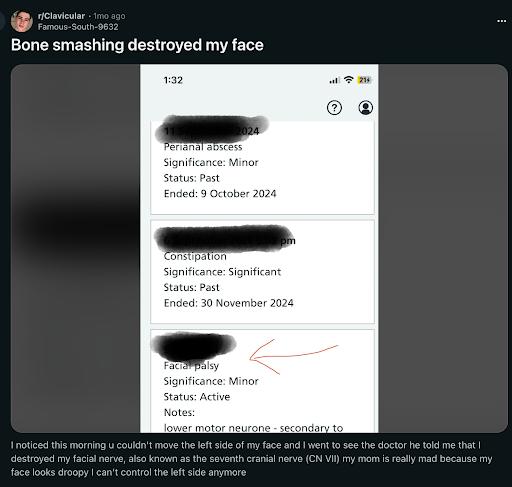
“It’s no surprise that streamers like Clavicular encourage young men to try extreme methods like double jaw surgery or “bone smashing” to improve their appearance.”
Clearly, her own self-esteem had been quietly eroded by the way everyone around her treated her, even if she tried to rationalize it with statements at the end like “I’m not that attractive,” with even her own boyfriend quipping a “damn right, baby” at that response. Even if she uses coping mechanisms such as laughing it off, you can tell through her body language that she was uncomfortable. The other girls on the show had nothing nice to say to her—it was as if they took the adage “if you don’t have anything nice to say, don’t say it” too seriously; they didn’t even look for a way to compliment her. I think she absolutely had qualities worthy of recognition, such as her clear skin, kindness, and subtle elegance, which were often overlooked in favor of more overtly flashy traits.
This same principle also applies to men. Modern dating apps like Hinge have very few ways on your profile to represent the quirks of yourself. At best, there are a couple of answerable prompts that show your “personality,” but with how easy it is to swipe to the next profile, very few seconds are ever spent reading what you typed. Most of the time, you are judged by the quantifiable metrics that the app has, like height and age, and by your looks relative to others. On these dating apps, personality will not get your foot in the door. At some point, you are forestalled by your genetics—conventional advice such as “just work out” and “be confident” will not be applicable. So it’s no surprise that streamers like Clavicular encourage young men to try extreme methods like double jaw surgery or “bone smashing” to improve their appearance.
It is evident in our society that “looks” function as the pri-
mary currency of social and romantic value; those who fall outside strict beauty standards are not merely rejected but quietly disciplined into accepting lesser worth. Our generation, notoriously shaped by social media, has made public comparison more pervasive than ever—even when it goes unspoken.
In contrast, traditional institutions such as the Church offer an alternative moral framework in which human value is inherent rather than grounded in one’s genetic circumstances. As Thomas Aquinas argues, beauty and goodness are fundamentally identical qualities that are not grounded in desirability or appetite but in form itself; beauty is that which pleases when seen, arising from the proportions of something rather than competitive appeal. In this way, it’s superficial to objectively quantify it. Historically, this framework enabled long-term commitment and stable bonds between people of disparate appearances, affirming that people have worth beyond their looks.
As Gen Z experiences appearance-based judgment on an unprecedented scale, it is not surprising that some are turning toward conservative or religious structures that reject conventional beauty standards in favor of a conception of human dignity that precedes optimization. This is probably why, according to the Barna Group, Gen Z now leads older generations in church attendance, averaging 1.9 services per month or 23 services per year.
Pretty privilege in our society is real. And it doesn’t just elevate beautiful people; it effectively trains everyone else to adjust. To soften themselves. To optimize. To disappear. Or to search for meaning in a place where the gaze has less influence. If so many of our “choices” are responses to the halo effect, then the question is no longer whether pretty privilege exists, but what kind of people it is quietly asking us to become.

Kalinagos and Colonizers
By Liam Steele
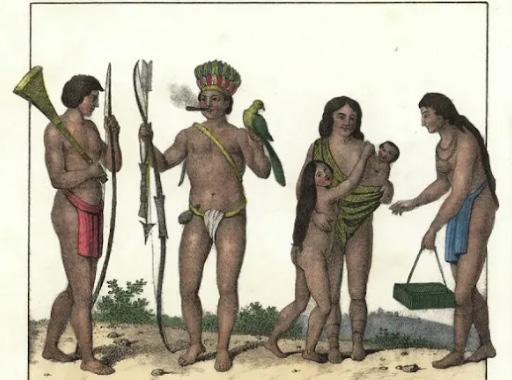
Perhaps the funniest thing I learned from reading about the Kalinagos while yearning for a connection to my home was the story behind the Europeans calling them “Caribs.” This name, given to them by the Spaniards, became associated with cannibalism through both faulty accounts and a bad-faith campaign to push for the Spanish crown to approve of their eradication. When the Kalinagos learned that outsiders thought they were cannibals, many just kinda… went along with it. They would perpetuate and even exaggerate the rumors that circulated about them. Whether they thought it made them look cool or if they joined their own smear campaign to create more reason to be left alone is unknown, but it’s easily one of my favourite historical tidbits.
The first peoples of the Eastern Caribbean, the Arawaks and Caribs, are a fascinating case in the many tales of European colonialism, as they were able to maintain their lands and culture for quite some time amid expanding European influence throughout the 16th and 17th centuries. One notable example was the primely positioned and advantageously shaped island of Grenada. Known by its inhabitants as Camahogne, the “land of many people” or “land of abundance.” The name comes from the fact that it had the largest Kalinago population at its peak, alongside its far-off neighbor Dominica (Waitukubuli, “tall/ wide is her body”).

The Kalinagos were a surprisingly complex society that prevailed against their predecessors, the Arawaks, because of their more war-oriented society. While their outwardly warlike culture led most onlookers to believe theirs was a society where power was the sole deciding factor of leadership, their ubutu, or war chiefs, were elected by a convening of male warriors of the island amid times of conflict, and relinquished power to trusted elders during times of peace. They were highly connected across islands, using the many small Grenadine islands between Grenada and St. Vincent as seasonal hunting grounds, often intermarrying between islands.
Grenada was first spotted by Columbus in 1498, but no landing was made on that voyage or by later Spanish voyages. Spain was crazed in their search for gold and otherwise didn’t
care to settle the island. They were already struggling to defend their other New World claims from the British and French (Spoilers: none of the Lesser Antilles speak Spanish today), leaving them quite stretched thin.
Per encounter, the conflicts between colonizers and Kalinagos often favored the Kalinagos. Colonizers were often strapped for resources and manpower from lengthy voyages and were armed with incredibly slow but powerful muskets, which were the cutting edge of weaponry at the time. The Kalinagos’ use of guerrilla tactics, combined with their highly skilled archers, allowed them to dish out far more damage in far less time. While they lacked metal tools, aside from those they traded for from Europeans, the Kalinagos were able to hold their own in direct combat with their stone clubs and axes. However, most favored the traditional hardwood war club, the boutou (this name persists in Caribbean accents as a sort of onomatopoeia; guess what for).
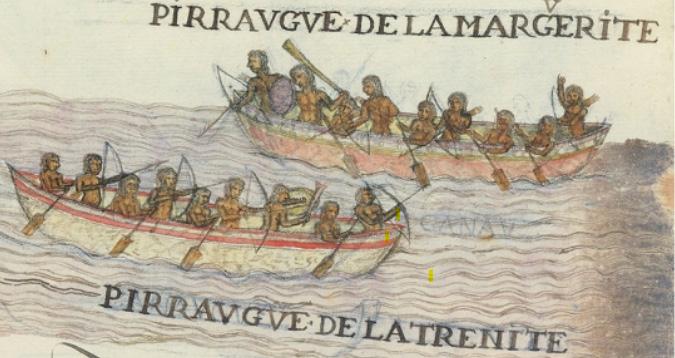
Even in offshore defense, the Kalinagos were a formidable force against the Europeans, as they expertly maneuvered their large yet agile pirogues, dugout canoes capable of carrying about 40 warriors. Kalinago resistance was further aided by their islands’ highly advantageous geography. Grenada’s coastline is full of calm, natural bays on its western and southern sides, which contrasts its harsh, straight coasts and rough seas on the east side—the side from which their attackers mostly came. The island’s interior is almost entirely large mountains covered in dense rainforest, which facilitated the Kalinagos’ many ambushes and raids. All of these factors allowed the Kalinagos’ presence to persist and scare the Europeans.
But there’s a reason the Kalinagos didn’t hold out any longer than they ultimately did. From the very first encounters with Europeans, the Kalinagos were peaceable and enthusiastic towards trading goods and allowing them to stay. Their frustrations only arose out of the Europeans’ insistence on sticking around. Many major early conflicts can be attributed to instances of hungry sailors stealing from pirogues, and more significantly, the fall of St. Kitts (Liamuiga, “fertile land”). In 1626, French explorer
Belain d’Esnambuc and his crew were stranded on the island after an attack by a Spanish galleon in the region. The Kalinagos facilitated them for a while, along with British castaways from a previous stranding. Eventually, local ubutu, Tegremante felt threatened by the mass clearing of land and the fact that European presence on the island began to outnumber his own. He called out to other islands for help, but one Kalinago woman snitched to the settlers, and the island’s entire native population was killed (woman moment). This began with an attack on the thoroughly shitfaced drunk Kalinagos at a party the Europeans had invited them to as a part of their plan, and concluded with a mass roundup and massacre in the following days, long before help came. European establishment on St. Kitts and, more notably, on Martinique (Madinina, “Island of Flowers”), spelled the beginning of the end for the Kalinagos, as what were once handfuls of weary travelers from unimaginably far away were now eager forces from basically two blocks away.
The cautionary tale of St. Kitts had spread throughout the islands and profoundly affected the way most Kalinagos approached the Europeans. The inciting incident is still debated by historians, with some suggesting Tegremante started it and others proposing that the Europeans had planned for it much earlier on due to their perceptions of the natives as being cannibal savages.
In any case, this incident would stay in the minds of many Kalinagos as a cautionary tale, chief among them being Kairouane, the ubutu of southern Grenada. In 1649, Kairouane parleyed with the most well-equipped European expedition in the region at the time, led by Governor Du Parquet of Martinique. Kairouane proposed an exchange of gifts if the French intended to settle in the area, as he had guessed from their unloading of all manner of fort and house-building materials. This event is well documented, and Du Parquet’s own interpreter, as well as account writer Brian Edwards, a British planter among their ranks, both note that Du Parquet entertained the parley with full intention of betrayal afterward. Edwards notes that they were greeted “with the utmost kindness and cordiality” by Kariouane and company, which came as a shock to Du Parquet and his crew, as it hindered his agenda against them. Edwards also notes that the governor “Thought it necessary to affect some little regard to moderation, by pretending to open a treaty with the Chief of the Charibs for the purchase of the country,” showing the height of Du Parquet’s ambitions. Ambitious himself, Kairouane used the treaty to take full advantage of the wealthy travellers, securing tools, knives, glass beads, food, and other trinkets for his people, as well as an ornate red cloak and two quarts of brandy as a personal gift to him (he just like me fr fr). More importantly, this treaty included that in exchange for the right to settle ¾ of the island’s southwestern side, where Kairouane and his people were, the French would give them protection, development, and trade, and leave the other portion of the island to the Northeast (with its own ubutu and people who were not consulted) undisturbed. Kairouane recognized the St. Kitts disaster as a wake-up call, realizing that without negotiation, Grenada would be next. When news of this deal spread, a conference was held between the other ubutu of Grenada, as well as those of St. Vincent (Hairouna, “land of the blessed”) and Dominica. A majority present considered killing Kairouane, but they ultimately decided to see
if Du Parquet would honor the treaty.
Beloved reader, at this point you can probably guess that he didn’t, in fact, honor the treaty. After a number of inciting issues by the French, ranging from theft of goods to eyeing and subsequent theft of wives, the Kalinagos turned hot again and called on the other two stronghold islands to stop the settlers’ genocidal campaign. One other ubutu named Duquesne snitched for whatever reason, and the attack failed. The extermination of the Grenadian Kalinagos would end up successful by1651. In an intense last stand against the French, the last 40 Kalinago warriors known to the French (supposedly including Kairouane) all jumped to their deaths off the 100-foot cliff on the coast now known as Leaper’s Hill, near the modern parish’s town Sauteurs (French for “jumpers”), in the island’s far north. These few chose death over the far worse fate of dying with shame at the hands of the French. Annihilation wasn’t complete, as a few remained hidden in the interior, but the resistance was at this point crushed.
As Grenada fell, Dominica and St. Vincent remained the only islands in the region to retain notable Kalinago presence, with extreme geography allowing the natives of the dense interior rainforests to live in relative peace. They persist to this day in their own parish in Dominica and in their own communities in St. Vincent. These survivors have a whole other story of their own, notably having allowed escaped African slaves to join their ranks, creating a unique cultural identity that would later influence the history of far-off Belize. I’m invested in these stories mainly because I’m Grenadian myself, and it’s fun to explore the parts of history most forget or overlook, especially since Grenadian history, as I understand it, is mind-numbingly boring from the 1650s to the early 20th century.
The Kalinagos, while mostly erased from Grenada, leave behind traces of their DNA, many of their place names, cuisine, a few artifacts, and even some minute pieces of their language,t informing local names for plants and animals. Looking at the many place names in Grenada which are Francized Kalinago terms, compared to the totally French or English names on other islands, keeps their resistance in mind even today. Maybe things would have been different if there hadn’t been so much backstabbing, or if a nicer Frenchman than Du Parquet had been made governor, or if the Kalinagos didn’t join in on being called cannibals, or if they simply treated their women better. Perhaps the Kalinagos would have survived the geographical transformation of the Americas. In any case, the moral of the story is clearly to never, ever, ever trust a Frenchman, especially if his last name is two words.