BINGHAMTON REVIEW
Managing
Copy
Business
Social
Cover
Staff
Broomba Bremner
Bren
Nicholas
Xinpeng Gao
Comson

Dear Readers,
Haigh a chairde, tá súil agam go bhfuil sibh go maith agus gur bhain sibh taitneamh as Lá na Paráide. Wait, I just realized that I have no idea what I said. HELLO everybody, I hope you’re doing swell, enjoyed the drunken wonders of Parade Day 1, and (depending on when you’re reading this) had or are planning to have a great St. Patrick’s Day and Parade Day 2! Also, I’ll say this now, while I have the space, please send in the best Borg name you see out on the streets this holiday season. All submissions should be sent to review@binghamtonsa.org.
As an Irish-American myself, this time of year is filled with mixed feelings. You get to see everyone drinking and cheering, bagpipes ringing out as processions filled with scummy politicians, veteran organizations, and random assortments of non-profits roll down the green-filled streets. That’s all great and fun (minus the politicians). Despite all this fun, there’s a topic very close to my heart that I need to bring up in this editorial: My Culture ISN’T YOUR COSTUME! Let’s just state the facts (that I haven’t researched): Half of you probably aren’t Irish-American. You cannot, as a non-Irish American, wear green shirts and try to force me to “kiss you on the lips.” That’s sexual harassment. Those shirts explicitly say, “Kiss me, I’m Irish,” not “Kiss me, I’m wearing a green shirt.” I will NOT kiss you if you’re not Irish on St. Patrick’s Day. The other 364 days on the calendar (unless it’s a leap year, then it’s 365) are still free.
Scooting right past that, let’s talk about some fun things you could do this St. Patrick’s Day season. Now, we all know the usual: Make a Borg with a silly name like “Top O’ the BORGin’ to ya,” (oh, that’s good), drink way too much, go to a darty, stand around, maybe hit a bar up, violently throw up, and go to sleep. However, what if I told you that you could do other things… For example, you could try going to your local pub (there are actually quite a few) and try to split the fucking “G” baby! It’s even easier this time of year because many a local dive like Tom’s is actually carrying Guinness on tap. If you want my advice, take a gulp bigger than you think, because people tend to drink too little. Outside of that, I’ve got nothing HAHA!
Oh, wait, I forgot to mention that this is a magazine! We’ve got a good one for all ye Irish folk. We’ve got Irish tales, Irish history, and some fun tips and tricks to tackle the wonders of St. Patrick’s Day. We’ve also got the funny, and like always, the serious. It’s truly a classic Binghamton Review magazine, so I hope you all enjoy!
Sincerely,

Aiden Miller
Our Mission
Binghamton Review is a non-partisan, student-run news magazine founded in 1987 at Binghamton University. A true liberal arts education expands a student’s horizons and opens one’s mind to a vast array of divergent perspectives. The mark of true maturity is being able to engage with these perspectives rationally while maintaining one’s own convictions. In that spirit, we seek to promote the free and open exchange of ideas and offer alternative viewpoints not normally found on campus. We stand against dogma in all of its forms, both on campus and beyond. We believe in the tenents of free expression and believe all sudents should have a voice on campus to convey their thoughts. Finally, we understand that mutual respect is a necessary component of any prosperous society. We strive to inform, engage with, and perhaps even amuse our readers in carrying out this mission.
Views expressed by writers do not necessarily represent the views of the publication as a whole.
Advice Column
We offered to give you all life advice. Here were your questions:
I didn’t come to a single class and the midterm is in a week. What’s the most efficient way to study?
Use the Pomodoro technique. Every time you study for 5 minutes, take a 25-minute break.
Has anyone even seen a single salamander crossing that road? Or are they just blocking it off to fuck with us?
I have, but the “salamanders” are paid operatives trying to funnel more traffic to the marketplace so we can buy their overpriced slop.
I have a cool new idea for a mobile app, it’s like the Jeremy Renner app but for Baxter. Are there any CS guys I can get in contact with to help bring it to life?
Yes! Now I have a place to put all my Baxter yaoi!!!!!!
They killed Peter Griffin, does that mean no more Family Guy?
CHUD DOWN! CHUD DOWN! CHUD DOWN!
Is there a feud answer key anywhere? I want free drinks dammit
If you slide Larry a 20, he will shove it up his ass.
im no my 10tth try of spoiliiintg the G and it wisnt wokving what cna i do
20 atmps tfoor me and igt acailcant do ti , kept dtyring dont up give up
What’s the best frat to rush this St. Patrick’s Day
Any, while you still can.
What is the boofing death rate?
15% so looking pretty good, ignore the 1 out of 9 people that died.
Are you telling me this war affects the flow of goods GLOBALLY?
Idk man I heard its cuz of a whore moose or somethin.
Why does everyone freak out over Guinness? I think it tastes like shit.
Written by our Staff
I think you need to stop drinking alcoholic Capri Sun and refine your taste buds.
My family fucking sucks so I wanna stay up here for spring break but I’m also broke. If I just chill in my room the whole time surely they won’t find me right?
Inshallah, they don’t find him.
Why does my friend not get on the game?

Are we using Kalshi to bet on the Iranian war?
I got my money on Big Yahu completely full-box double pumping a defenseless school.
Since Debby Ryan is coming here, what should I ask her?
How was your time on Sunny With a Chance?
Ok, for real, what do I ask Debby Ryan?
How much are they paying you to come to Binghamton, NY?
I went for a Shamrock Shake and they took 45 minutes. Are the workers stupid or something?
Water is wet
How can I get the bus driver to stop waiting for his friend and actually take me to class on time?
Let’s just say you’ll have to make “busjacking” a thing
I noticed a couple of cockroaches in C4 the other day… we good?
AAAAAHHH!!!!! THIS BITCH GOT ROACHES IN HER CRIB!
Need life advice? Email review@binghamtonsa.org for more wacky, quirky and zany responses.
The Interesting Tales Of Early Irish Saints
By Daniel Guido
Year after year, the arrival of March brings a surge of Irish culture and celebration across the United States. Cities nationwide host festivals and parades in honor of St. Patrick’s Day, and Binghamton is certainly no exception. The city’s annual “Parade Day” is well known for its sea of green crowds, day-long festivities, and plethora of drinking. While the season gives us a great excuse to celebrate, it’s worth pausing to consider why we do it to begin with. Saint Patrick himself is a fascinating historical figure, but he was far from alone. Many other important figures from his time helped shape the history of Ireland, though their stories are often omitted from the spotlight.
Saint Patrick, named Patricius (meaning “noble”), was born sometime in the 5th Century A.D. in post-Roman Britain. This was a turbulent period when the island faced frequent raids by Picts from the north, Saxons from the mainland, and Irish raiders from the west. Patrick belonged to a family of Romano-British Christians, but his life took a dramatic turn at the age of sixteen when he was captured by Irish pirates and enslaved in Ireland for six years. He eventually escaped back to Britain, crediting his survival to God alone.
Patrick later studied Christianity in Gaul (modern-day France), where he was ordained by Germanus of Auxerre and consecrated as a bishop by Maximus of Turin. Around 432, he began his missionary work in Ireland, though he had actually been preceded by Saint Palladius in 431. Patrick claimed to have baptized thousands and ordained new priests. He specifically focused on converting powerful members of society, including the sons of kings, and encouraged wealthy women to enter religious life as nuns. He also condemned attacks on his newly converted communities by Christian Britons. The exact date of Patrick’s death is unknown, with estimates ranging from 460 to 493.
Of course, St. Patrick is also surrounded by famous legends. The story of Patrick driving the snakes out of Ireland is widely understood as symbolic, representing the replacement of Celtic paganism with Christianity. The legend likely developed later, particularly in 7th-century depictions portraying Patrick as a militant figure who destroyed pagan symbols and battled Druids—an image not found in the earliest accounts. Another popular story claims Patrick used a shamrock to explain the Christian doctrine of the Trinity. This tale also appears to be apocryphal, with its roots in the 17th and 18th centuries. Even if these legends are not historically accurate, the real story of Patrick remains compelling. He is joined by Saint Brigid and Saint Columba as the three national saints of Ireland.
Saint Brigid of Kildare was born around 450 A.D. and was the daughter of a nobleman and an enslaved woman. According to tradition, she was baptized by Saint Patrick. One legend claims she was sold to a druid, whom she eventually converted to Christianity. Brigid eventually became a nun and founded the first Irish
nunnery at Kildare. She is credited with several miracles, including restoring the eyesight of a blind nun. Her feast day on February 1 is associated with the weaving of St. Brigid’s crosses from straw. Scholars debate whether Brigid was a historical figure or a Christianized version of the earlier Celtic goddess of the same name. Many historians believe she was a real person whose story later absorbed traits associated with the pagan deity.
Saint Columba, also known as Colmcille, was born in 521 in what is now Ulster. He studied under Saint Finnian of Clonard and was one of the group known as the “Twelve Apostles of Ireland.” Columba helped establish monasteries across Ireland, including one at Derry. He is best known for traveling to Scotland with followers to spread Christianity among the Picts and Scots. In 563, he founded a monastery on the island of Iona, which served as his missionary headquarters. The abbey still stands today in restored form. Columba is also remembered for converting Bridei I, king of the Picts, to Christianity. His story highlights an interesting historical detail: Scotland was not primarily converted by Britons or Anglo-Saxons from the south, but by Irish monks crossing the sea.
Early Irish monks developed a strong tradition of long-distance travel as acts of penance and missionary work. One of the most famous of these travelers was Saint Brendan the Navigator, who lived during the 5th and 6th centuries and is also counted among the “Twelve Apostles of Ireland.”
Brendan became famous for the legendary stories describing his voyages across the Atlantic in search of the “Isle of the Blessed” and even the Garden of Eden. A later text, The Voyage of Saint Brendan the Abbot, written a few centuries after his lifetime, describes Brendan traveling for seven years with fellow monks in a small leather boat while encountering strange islands and wonders. One such place, Saint Brendan’s Isle, entered medieval folklore and appeared on maps of the Atlantic Ocean well into the age of Christopher Columbus.
While many of these tales are clearly legendary, they may contain elements of truth. Irish monks are known to have reached remote islands such as the Faroe Islands and Iceland before even the Vikings. This has led some to speculate that Brendan himself may have reached the Americas, though there is no evidence for this claim. Most scholars agree, however, that Brendan was a real historical figure who likely sailed extensively along the Atlantic coasts and founded important institutions, including Clonfert Cathedral.
Today, St. Patrick’s Day is most commonly associated with crowded parades, green clothing, and drinking copious amounts of alcohol. While there’s nothing wrong with enjoying the festivities, it’s worth remembering that the holiday traces its roots back to a group of remarkably adventurous figures. Saints like Patrick, Brigid, Columba, and Brendan were missionaries, travelers, and storytellers whose lives helped shape Irish history in ways that go far beyond shamrocks and snake stories. So as Binghamton fills the streets with green once again, take a moment between celebrations to remember the real history behind the holiday—before returning to day drinking, of course.
By Liam Steele
Learning Spanish With Latino Shitposts
Having taken Spanish classes from grades 2 to 12, I have quite a history with it. I even took French and Spanish simultaneously in grades 3 and 4, which made me appreciate the simplicity of Spanish in contrast to the complexity of French. Growing up in the Eastern Caribbean meant that some of the broadcasts picked up by my TV were, in fact, in Spanish. Some channels had all their commercials in Spanish. Sometimes, entire blocks would occasionally just be in Spanish, and I, a scrawny, woolly-headed little Grenadian, had to recall Spanish class just to keep up.
However, since that stint in school satisfied my university foreign language requirement, I’ve had much bigger fish to fry academically here at Binghamton, and I’ve all but stagnated in my Spanish learning. I was accustomed to watching telenovelas in high school Spanish class on Fridays and at some point in college decided to bring it back, starting with Nuevo Rico, Nuevo Pobre from Colombia, just to keep sharp (highly recommend, btw). Soon after, the ever-nosy Instagram algorithm picked up on this activity and began sneaking Latino memes into my Reels feed. It began with videos of some Dominican guy eating fast food in his car and singing—the ever-popular Don Pollo—but only spiraled into the real deep cuts of the Latino community: Peru being ironically hailed as the next global superpower, Venezuela’s glaring instability and inflation, Argentina’s bumbling new Elon Musk fanboy president, and a litany of old-internet gems I’d missed out on by simply being born in the commonwealth—a whole new world of memes had opened to me.

Hearing genuine Latino speak outside of school learning material taught me all kinds of slang. I learned that there are a shocking number of terms for genitalia and coitus used across the Hispanophone world. Where “concha” may mean a kind of pastry in one country, it more closely translates to “cunt” in many more. Where “coger” is the verb “to take” in Spain, basically everywhere else it means “to fuck”, which is so outlandishly baffling to me that learning it reignited my passion for learning Spanish. Learning that Latin America views Spain and the Spanish accent in the same way American English speakers view England was where I truly began to realize how I could

stand to learn from these memes. Videos where funny Latino clips were dubbed by a Spaniard doing the most proper and verbose accent he could muster helped me decipher regional Latino accents, as the Spaniard’s dubbing helped unpack the raw, often Dominican source material. “Joder! ¡Vamos a tener un infortunio!”, “Esto es una Falacias,” and other wonderfully verbose phrases dominated my vocal stims for weeks. Conversely, I learned some of the most basic aspects of informal speech that classes left out. I learned that “Vaina” is deceivingly a slang word for “thing”, and not “vagina” as I had initially thought. “Osea” is a highly variable word that ranges in meaning from “therefore” to “I mean” and the informal English use of “like”. I picked up staples like this from the familiar medium of online tomfoolery, and with every new gem that appears on my feed, I’m able to understand more and more of how Spanish is actually applied outside of a dull, sterile classroom oral exam. Beyond language, I learned a significant amount about geography and politics. From what I came across online, I was able to figure out how different Latino countries view each other and their neighbors, even if it did mean that more than a few of the memes were at least a little racist. Eventually, I was able to locate video origins by accents alone. The rapid-fire Dominican, the “s” deficient Argentine, the oddly neutral Peruvian, and the English-borrowing Mexican, to name a few. Beyond learning the language, this online experience helped me learn the greater contexts of an entire world I was previously unfamiliar with. Unfortunately, Latino social media has also spread to my Twitter feed, and I now have to avoid falling for the most insufferable ragebait from this new frontier of content and the newfound understanding of it I have. Outside of social media, I’m also immersing myself more in Latino music, finding even more depth to the lyrics, and even knowing some of the greater contexts at play within them. Caribbean and Latino cultures have so much more in common than meets the eye, which I think plays a large role in my investment in the language and its peoples; even if this take is made slightly less novel by the recent Bad Bunny halftime show, I very much stand by it.
I won’t pretend to be an expert; I’ve got a long way to go, but at least now I feel like I stand a chance to not look like a dork speaking Spanish in a Latino country. If you’re trying to learn another language, I seriously recommend supplementing your education with an experience like this to keep sharp, invested, and engaged.
BAC-Maxxing
By Broomba Bremner
What’s up, fellas! Are you thinking about Borg names for this upcoming parade day? Great! Me too! I have a couple of good ones in mind, but I’m not sharing them with you. However, while you brainstorm (green needle) your gallons, you should also be thinking about your blood alcohol content (BAC). Do you want to get drunk fast? Are you graduating, and this is your last true Bearcat Parade Day? Do you even want to remember it at all?
Here is your solution: donate blood. The human body has, on average, about 5 liters of blood. When you donate, you give one pint, which is approximately half of a liter. Therefore, you lose 10% of your blood. That’s a small percentage, but it is relatively a lot. Because of this, your body becomes extra sensitive to alcohol, and 3 drinks now feel like 7. I made that ratio up, but I’m just going off of vibes lowkey.
“Helping others when you can safely do so is a moral duty, and it feels amazing to do so.”
Here’s my experience: I began donating blood regularly in late October 2025. There was a blood drive on campus, a 10 dollar gift card incentive, and nothing holding me back. So I thought, “Why the hell not?” As a first-time donor, my experience lasted 45 minutes due to additional screening, yet I was still surprised by how quick it was. The snacks in the recovery section? Fucking BOMB. I steal at least four juice boxes every time.
It wasn’t until recently that I started donating platelets as well. Platelets are small cells within your blood that help with clotting. Unlike whole blood donations, you actually get to receive your red blood cells back, which is why the process takes so damn long. While whole blood donations last all of five minutes, platelet donations take two hours. The worst part was trying to sit still the whole time. The setup is quite different as well. You’re unable to move your arms, since they draw blood from one, separate your blood, and give it back to you in the other. However, you get to have a heated blanket and a TV in front of you to watch a show in the meantime.
Donating has benefits for you, too, and not just for the people who receive your blood. Superficially, the American Red Cross is always ready to give you gift cards (with your merchant of choice) for every donation you make, even if you get turned away–an attempt still means something. Depending on the season, you’ll also receive a Red Cross shirt.
I’ve been to my fair share of donation centers: on-campus events, centers in my hometown, and the one in Johnson City. No matter where I went, I always had the same experience with the workers. The employees at the Red Cross donation centers are incredibly kind and are there to help you. Do you know how many blankets they gave me when I donated platelets? Your comfort and safety are their priority, and I feel nothing but welcome when I donate. It’s an atmosphere that makes you
want to come back.
On a deeper level, putting in an effort to donate regularly has more meaningful benefits. First and foremost, donating helped me get over my fear of needles. I used to be absolutely terrified to receive vaccinations as a kid. Reasonably, I wasn’t too stoked to get poked by a sharp needle. A vaccination needle, however, is relatively small, typically a 22-25 gauge. A donation needle is 14 gauge, which, by the way, is fucking huge. But fret not; it doesn’t hurt that bad, I swear. Donating regularly acted as some sort of exposure therapy, and I no longer tremble at the sight of needles.
Additionally, donating blood and platelets forced me to change my lifestyle–especially my diet. What you eat, how often you exercise, and whatever medications you take are all factors that determine your eligibility. I usually have low iron, resulting in a low hemoglobin level. Hemoglobin carries oxygen to your heart and brain, so we can see why it’s important. Low iron + low hemoglobin + low oxygen = pass out. On an even DEEPER (!!) level, the best benefit of donating is receiving an email after a month stating that your blood was used to save someone’s life. This is what you donate for; the thought that you contributed to something bigger is sublime and incredibly moving. If all the rewards and kind workers weren’t enough to bring you back, this will. Helping others when you can safely do so is a moral duty, and it feels amazing to do so.
Because you’re donating blood for those in need, the medical restrictions are extensive. Your eligibility depends on health, medications, and various lifestyle choices. Due to these restrictions, many people who wish to donate are unable to, resulting in a constant shortage of emergency blood. If you are able to, I urge you to donate. Have you ever watched season one episodes 11-15 of The Pitt? That’s how your blood is used. It is always an emergency, and it doesn’t hurt to help save lives. And you know what? You’ll walk out with a bomb-ass T-shirt, a couple of gift cards, and less blood. Bonus points if you donate Friday afternoon or Saturday morning, if you’re a try-hard. Have fun this parade day, and stay safe!

By Bren Dover
God Save The Rat: A Critique of Freshmen Syndrome and the Ethics of Whimsy
Dear Reader, by the time this article reaches you, I will have been severely hungover due to the events that transpired this upcoming (or I guess previous) Parade Day. I sense the mix of Pink Whintey shooters, Marlboro cigarettes, and bomb pop Smirnoff seltzers will render me completely fucked. While I look forward to the unavoidable tummy ache this will cause, there is something much more enchanting that will enthrall me on this Parade Day. Yes, reader, I am alluding to the ever-elusive nightclub known as The Rat.
“The idea that going out must be dictated by social pressures is toxic, and not only does it deteriorate fun, but it also deteriorates our own mental image.”
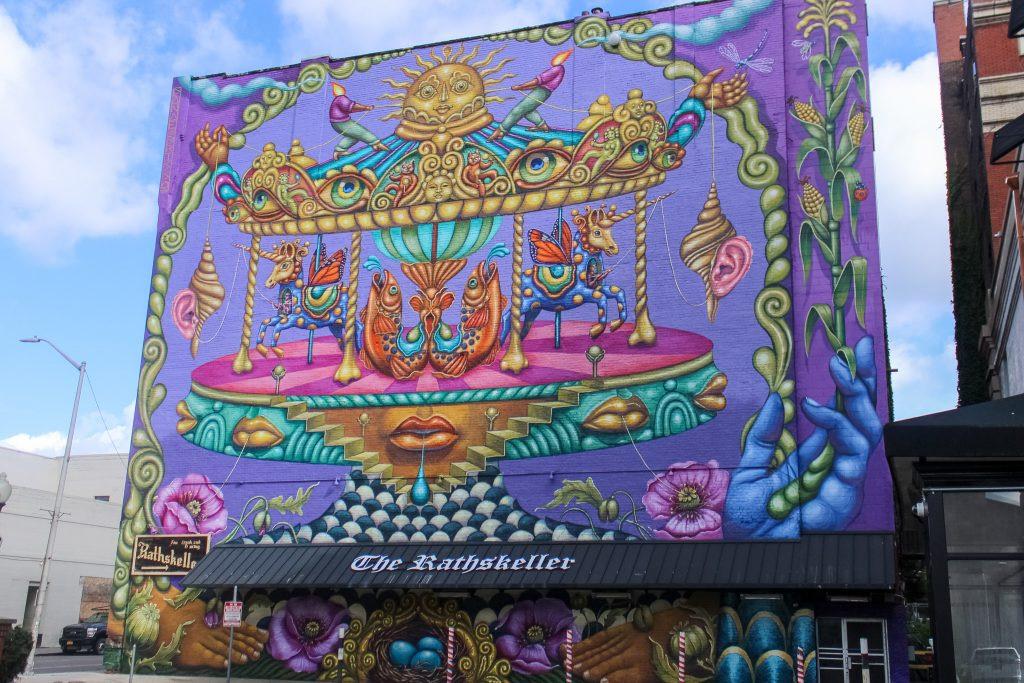
If you have been around Binghamton for more than two days, you most likely already know the establishment. For the parents that are reading this on their high school kid’s college tour, the Rat (or its government name, The Rathskeller), is a cesspool of roofies, suspiciously sticky floors, and piss boxes. If you send your kids here, they’ll let you know what a piss box is. The interesting thing about this place is that it holds a different reputation depending on whom you speak to.
As of late, it seems to be a barren wasteland that only comes alive during an active darty, such as Parade Day. It has been completely forsaken by the Binghamton student body, seemingly at random, leaving me and many other upperclassmen with a great yearning. For the underclassmen, however, there seems to be an agreement that The Rat was the spawn of the nine circles and that it is better left dead. The question is, how did these two schools of thought come to exist? Why exactly is the reputation of The Rat contested amongst students? Did The Rat deteriorate in recent days, or is there something more sinister at work?
My theory is that the current party culture in Binghamton and many other colleges, which is mostly dictated by underclassmen, has an aversion to fun and instead focuses on the perception they exude. The Rat is inherently not “cool” or “popular,” and thus it is subconsciously avoided like the plague. I intend to argue that this case of what I call “Freshman Syndrome” is a barrier to the joy and whimsy that could be experienced on a night out, and that this joy and whimsy can return with the reintroduction of The Rat to our nightlife ecosystem.
If you were to ask an upperclassman what they thought of The Rat, you would think they just returned from Coachella 2016. Adorning black Rathskeller hoodies, these students are
nostalgic for the cramped environment of The Rat, which was clearly in violation of many fire codes. They speak of The Rat as if it were a distant ex-lover who taught them how to truly love and be loved, now haunting their narrative. From my time at The Rat, I can concur that it is a magical experience. You wait in line next to space heaters (great fucking idea by the way) and pay the bouncer hitting a Miami Mint Geek Bar seven dollars using Apple Pay because you forgot cash. You walk downstairs to this evil lair that contains sticky floors from spilled drinks and the vomit you know is there, but try not to think about. You look around and notice the three beer pong tables that gather a crowd, the outrageously oversized bar, the seating area that people just don’t sit at, and the crowded dance floor, which is one torta away from becoming the pits of Tartarus. You find yourself ordering a drink that somehow costs you fourteen dollars and listening to a heavy dubstep yet afrobeat remix of Clarity by Zedd. You think to yourself, “This is the fucking life.”
The experience now is more or less the same, except there is no longer a crowd. It seems everyone realized that this bar is objectively shit, and wasting money there is illogical. It is hard for me to disagree there, yet I still miss the lovely Rat. Amongst those I have spoken to about this topic, this seems to be the consensus. Why exactly is that, though? Why were we drawn to such a raunchy place and drawn to it still? What I propose is that The Rat was avidly created for fun. We collectively accepted that the DJ will always be ass, and the drinks will always be too expensive. The vibe created by the people, staff, and environment was, however, made for quite a fun time. Despite the occasional police raid, The Rat was a joyous place where people went out of their way to dance. Truly dance. Not this light jumping or frat flicking bullshit I see now, but true dancing. It was practically an existential case. In the face of a horrendously managed bar,
we made our own fun out of it and applied ourselves to create this whimsy, completely from the ground up. The Rat facilitated an ecosystem that allowed this feeling to flourish, and it is this feeling that excites us still. Perhaps the music is painful to comprehend, and walking anywhere is like stepping directly on glue, but that brought us comfort and a smile. We were all suffering. We were all embarrassed. We were all free.
This whimsy now seems to be lost. With the freshman class, it seems that The Rat was left behind. This is not the fault of the freshmen, per se, but the fault of the culture they exist in. In collegiate nightlife, both here and in other places, going out is a social activity, and while that has always been the case, there is now a large emphasis on social perception. The idea that one goes out to the “popular” bar with their obnoxiously large friend group is the new standard due to the impact it has on one’s social perception. People go to these bars with the mindset that if a lot of people are there, it must be good. At bars like The Grove (derogatory), there is no dancing or frolicking or any joy of the sort, and this is because doing any of that is inherently weird. There is pressure on newcomers to appear put-together and nonchalant in order to impress other people who are under the very same pressure. This is what I call “Freshman Syndrome.” This syndrome prevents anyone who has it from enjoying the thrill of being stupid and weird. If you are constrained by made-up social pressures to be perceived a certain way, you will not have fun at The Rat. If there is no fun to be had, simply because they refuse to be the fun, then people will not go, and this is the reason why it is now empty.
Some of you may be wondering why I’m choosing to die on this hill. Is the Rat truly worth saving? Perhaps not, but the idea of The Rat is. In my recent going-out days, I find myself searching for a place to go where I can dance and jump and be silly with my friends, not holding a drink in my hand as I occasionally sway and catch judgmental glances. While I have found some places, especially those with live music, that successfully curate the whimsy I hold dear, they don’t seem to hold the same
social weight as other places, which suggests that there is more of an emphasis on going out somewhere popular than going out somewhere fun. The idea that going out must be dictated by social pressures is toxic, and not only does it deteriorate fun, but it also deteriorates our own mental image. The idea surrounding The Rat can be applied everywhere. Any place can be that of joy and complete tomfoolery only if we decide it is so. The fun you may think you’re having can be multiplied tenfold if we heal from this Freshman Syndrome. Party culture was never about how one looks or what is popular; it’s always about the fun and memories we make. We are the epitome of our lives, so why waste it standing with a blank expression at the fucking Grove? I will bring a big bundle of whimsy to each night out, and I hope you, dear reader, do as well. See you at The Rat.

Irish Name Quiz: Can You Pronounce It?
1. Siobhán
a. See-oh-bahn
b. Shiv-awn
c. Sigh-oh-ban
2. Aoife
a. Ee-fa
b. Eye-fee
c. Ay-oh-fee
3. Niamh
a. Ny-am
b. Neev
c. Nee-am-huh
4. Tadhg
a. Tad-hig
b. Tiger
c. Teeg
5. Caoimhe
a. Kee-va
b. Kwee-mee
c. Cow-ee-meh
6. Saoirse
a. Say-or-see
b. Seer-sha
c. Sair-sha
7. Eoghan
a. Egg-han
b. Owen
c. Ee-oh-gan
8. Gráinne
a. Graw-nya
b. Grain
c. Grain-ee
The Rotten Diet
By Nicholas Aparicio
It is no secret that America is dangerously unhealthy. According to CDC data, 40% of American adults are obese, 127.9 million Americans suffer from some sort of cardiovascular condition, and an estimated 40 million Americans are afflicted with diabetes. Health Secretary Robert F. Kennedy Jr. estimates that the federal government’s spending on treating these health issues is $1.3 trillion. It is no secret that the underlying cause of all these health issues, and perhaps even more, such as Alzheimer’s or ADHD, are related to the food Americans consume. To reverse the bodily damage being done to Americans, it is not as simple as just limiting ultra-processed foods (UPFs). In addition, it necessitates undoing decades of public manipulation, removing harmful additives across all foods, and ending deleterious practices in food production.
UPFs are obviously unhealthy. However, when compared to other products worldwide, American UPFs are significantly more processed. Potassium bromate, azodicarbonamide, BHAs, BHTs, brominated vegetable oil, titanium dioxide, red 40, yellow 5, and certain growth hormones are a handful of the hundreds of ingredients in American UPFs that are banned or heavily regulated in the E.U. due to research linking them to health issues. Aside from being substantially more unhealthy in America compared to Europe, they are also made up of less organic matter. Heinz Ketchup in America uses “tomato concentrate” vs. real tomatoes being used in the U.K. Canadian Froot Loop dyes are made from real fruits vs. artificial dyes in the United States. The comparison list continues for virtually every UPF and fast-food product. A clear trend is noticeable: Americans draw the shorter end of the stick from Europeans, often being sold extremely unhealthy UPFs. The unfortunate part is that before the Trump Administration approved Food Restriction waivers for 18 states to ban certain junk foods on S.N.A.P., these unhealthy products were a huge part of what poorer Americans purchased through welfare, making it no coincidence that the benefit-dependent quickly became some of the sickest.
Besides UPFs, unhealthy practices affect all of America’s foods. The European Union has strict regulations on Genetically Modified Organism (GMO) consumption for humans, with most GMO crops being used as animal feed. In fact, France, Austria, Germany, and Italy have banned GMO cultivation within their borders entirely. Yet in the United States, roughly 90% of corn grown in 2020 was genetically modified, 94% of all soybeans planted were genetically modified, and in 2013, 95% of canola was genetically modified. Following the trail of foods using soy, corn, and canola products, it can be ascertained that these GMOs work their way into more than just the pure crops. Americans who travel to Europe often find that foreign wheat foodstuffs are easier to digest when compared to American wheat foodstuffs. Wheat in America is higher in gluten, exposed to harmful pesticides like glyphosate, and fortified with additives that may complicate digestion. This wheat and its processing, which then turns into American refined flour, have
been linked to obesity, cardiovascular disease, and diabetes. Reflect on all the crackers, pastas, pizzas, toast, sandwich bread, bagels, and other wheat-derived products forced into the daily American diet, from adults packing their kids’ lunch to the kids getting food from the school cafeteria, chronic health issues lie in wait. Meat production also falls under this over-processing penumbra. 80% of beef-producing cattle in America is injected with hormones, while the E.U. has banned hormone injection for cattle since 1988. Europe also has stricter standards for preservatives put into its meats.
While research on seed oils is still disputed, it is undeniable that their rise coincided with a rise in chronic illness, all while animal products high in fats were admonished. That raises a separate question as to how it can be erroneously concluded that animal fats (used throughout history without issue) are the cause of chronic health problems. Well, that’s exactly what the “seven countries study” concluded. Cherrypicking from just seven nations, Ancel Keys saw that countries with higher saturated fat consumption (meat, cheese, butter) also saw higher rates of cardiovascular disease (CVD). Keys conveniently neglected to include the full dataset from 22 countries. Countries like France, with high consumption of saturated fats, lacked the high rates of CVD. The biggest contributors to the backers of this study, the American Heart Association (AHA), were being bankrolled by the food corporation Crisco. Crisco is the manufacturer of the aforementioned controversial vegetable oils, which boomed in popularity following this skewed study. It is worth noting that federal government-linked agencies also funded this study and touted its results. The same government that created the problematic food pyramid, emphasizing greater consumption of the harmful grains, as written about previously in the article. The original FDA food pyramid was rumored to have been redesigned after grain industry lobbying and lobbying from major farm operators wanting to blur the lines of healthy meat consumption. In the early 1960s, the sugar industry quietly funded Harvard studies to cast blame away from chronic illness from sugar, and instead onto fats.
Whether all this disinformation was intentional or not is a whole debate in itself; corporations have an incentive to promote their brands, and will do so at the misfortune of the consumer. Every politician loves money from lobbying. Evil politicians love to have weak, dependent, fat people to control. Regardless, the damage has been done. Now it is time for true substantive actions to be taken to remedy America’s health crisis. Reducing the toxicity and abundance of our UPFs, changing how we produce our staple food items, and looking to break up the control large entities wield over food production is warranted. In addition, giving seed oils a closer look from an unbiased perspective to determine their efficacy is warranted. Rectifying the health issues of Americans will alleviate major burdens off our budget and create a nation of productive, happy, and healthy citizens.
Research Spending at Binghamton
By Xinpeng Gao
According to the Carnegie Classification of Institutions of Higher Education, an R1 university is one that is recognized for having “very high research activity,” a designation held by fewer than 150 universities in the United States. In order to perform this research, the university needs to pull in tens of millions of dollars in highly competitive federal grants, mainly through the National Science Foundation (NSF) and the National Institutes of Health (NIH).
This might explain why Binghamton University professors aren’t always known for their teaching ability, as research is often their priority. According to the latest Fiscal Year 2025 Annual Report from the Office of Sponsored Programs (OSP), Binghamton University has spent $87.3 million from July 1, 2024, to June 30, 2025, in total. Over the last fiscal year, Binghamton’s sponsored research expenditures—which refer to the amount of grant funding that departments actually spend during a fiscal year—have skyrocketed by 27.5%. But the money isn’t distributed evenly across campus. A look at the numbers reveals exactly which academic departments have spent the most funds from the government, nonprofits, and private companies.
Across all academic departments, the psychology department, which is in Harpur College, accounted for $13,029,524 in expenditures from 2024-2025. Although this number might seem large, it isn’t surprising when you consider how large the psychology department is. Currently, there are around 52 full-time faculty members in the department (which does include lecturers who may not be principal investigators) and 2 adjunct faculty members. The PhD programs that the psychology department offers are also really broad—you can earn a PhD in Behavioral Neuroscience, Cognitive and Brain Sciences, or Clinical Psychology. So, as a result, the researchers most likely apply for grants from the NIH/NSF.
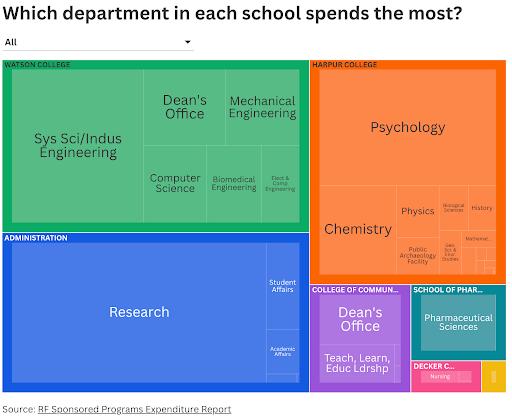
Trailing just slightly behind is the Systems Science and Industrial Engineering (SSIE) Department in Watson College, which spent roughly $12.7 million. The reason for SSIE’s budget being so high is likely due to the backing of industry companies in addition to NSF grants that it receives. Its industry partners range from defense companies like Lockheed Martin, tech companies like Google, and healthcare systems like the Mount Sinai Health System. When adjusted for department size, the SSIE department likely spends more per faculty member than the psychology department, since it has 43 full-time faculty members and 5 visiting faculty/research scientists.
In third place is the chemistry department in Harpur College, which spent $4.3 million in 2025. Binghamton has some high-profile faculty in the chemistry department—one of the professors, M. Stanley Whittingham, is a Nobel Prize winner in chemistry after all.
In general, engineering and physical science departments often report higher research expenditures because their grants fund expensive laboratory equipment and computing infrastructure. Psychology may be an exception to this because, in order to gather data, they must often pay people to participate in a study, which can add up if they want a large sample size.
All the departments added up in Watson College accounted for over $27 million of the total spending, making it the most well-funded college on campus. Following SSIE, Watson’s biggest spenders were mechanical engineering at $3.5 million, computer science at $3.0 million, and biomedical engineering at $2.6 million.
The second-largest spending category is “Administration,” which accounted for $25.6 million in expenditures. According to the report, roughly $22.7 million of that total is categorized under research administration. It likely includes centralized research costs such as compliance oversight, shared facilities, and institutional grant management, though the OSP report does not break down the category further.
If you’re interested in pharmaceutical sciences, Binghamton’s program will likely grow in the future. The School of Pharmacy and Pharmaceutical Sciences in Johnson City spent nearly $3.7 million in pharmaceutical sciences research in 2024—a 25% jump from just last year.
While $87.3 million in grant money might seem irrelevant to an undergrad, it is this influx of federal cash that keeps Binghamton classified as an elite R1 research institution. For STEM and Psychology students, it translates directly into millions of dollars meant to buy state-of-the-art lab equipment and fund graduate students who have a minimum stipend of $25,000. When a professor wins a massive NIH or NSF grant, they need researchers to do the heavy lifting—and they frequently hire from within their own classrooms. So if you’re an undergrad in those departments, maybe it’s worth building a close relationship with your professors so that you can eventually ask the question, “Do you know any opportunities for undergraduate research?”
5 Tips for a Productive Spring Break
In what is perhaps the greediest, slimiest, dirtiest move possible from Binghamton University Scheduling HQ, this year’s spring break has been overlapped with Easter break, giving us 10 days off instead of the usual 14. With your limited time off, you might be wondering how you can make the most of it. Well, fear not, because I’m here to explain how you can become a BEAST and LOCK IN at whatever it is you want to accomplish.
1. Plan, Plan, Plan
Start by listing out all the things on your backlog that you would like to accomplish or get ahead on. Include assignments, hobbies, personal projects, life goals, or anything of that sort. Be sure to write down at least 10 different things—there are 10 days in the break after all, and that’s a lot of time.
But just having a list of things you want to get done isn’t enough. You need to prioritize. Sort your goals into a new list, going from the most important down. Then, find a way to visually organize your ideas and goals. Put them in a timeline, a flowchart, or one of those Obsidian graphs. The more complicated the data structure, the better. How do you think all those successful managers and CEOs get it done? They ideate scalable, holistic action roadmaps to leverage their bandwidth and core competencies, and so can you.
In terms of time, the planning phase should span no less than a week and cover at least 18 hours. Anything less and you risk becoming a directionless doomscroller by day three. If you’re not having vivid dreams about what you plan to do this spring break, you’re not trying hard enough.
2. Stay Up Here
With an especially late spring break this year, it might actually be somewhat warm outside. This is great news for all the normies who want to waste their spring break doing nothing of substance, but for a hustler like you, this is a mere temptation. Ideally, you’ll want the coldest, nastiest, and most unstable weather ever, and what better place for that than Binghamton, NY? With a forecasted 6 days of rain, you won’t even think to step outside.
That’s not the only benefit of staying up here. With all your slacker friends gone, you won’t have anyone to distract you from your work. If you live on campus, you’ll also have close proximity to the dining halls, so you won’t have to waste your valuable time cooking. Sure, the spring break housing might cost a little extra, but depending on what you plan to do this break, you’ll make that money back in seconds. That’s what we call an investment!
3.
Spike Your Cortisol
Everyone works best under pressure, so why not try and make your spring break as stressful as possible? Ask your pro-
By Angelo DiTocco
fessors to make the deadlines for their assignments earlier. Gaslight yourself into believing that if you’re not shredded by day five, you’ll be a subhuman freak. Even better, hire a frat leader to framemog you. Max out all your credit cards so that you’ll work extra hard to pay off the debt. Commit tax fraud so that the IRS will be after you. The more dire the situation, the better—you want to trigger your fight or flight response so that you can conquer your goals efficiently.
4. Make Your Mornings Miserable
If you don’t have a morning routine set in stone, you’ll wake up and just watch brainrot all day like everyone else. Instead, you want to maximize your suffering so that everything else is fun by comparison. Things like cold showers, pushups, and 10-mile runs are good, but won’t quite induce the level of productivity that you want to accomplish. You might want to supplement that with 3 sets of falling down the stairs, 2 sets of contracting every muscle in your body, and 5 sets of banging your head against the wall (which is like a workout for your brain, anyway!). Lastly, find a new drug to experiment with so you can experience the worst trip of your life. By 6:30 AM, your new and improved morning routine will be all done, and you’ll be looking forward to the slightly-less-miserable rest of the day.
5. Change the World
If you’ve followed the first few steps, you’ll probably have done everything you want to do before the break is even halfway done, and you’ll be wondering what to do next. Luckily for you, there’s always some problem going on in the world that you can fix. This requires learning about the situation, and there’s no better way to learn than through social media. Now is your time to download every app you can find to get every possible perspective on all the happenings across the globe. If you ever have to ask who a political figure is, you’re not done yet.
Once you’re sufficiently informed, spread the word. Make a list of every social media platform and every group chat you’re involved in, and make it a point to enlighten everyone of your solutions to all the world’s problems. You’ll want to shoot for an average of at least 100 posts a day. Some people might tell you to “go outside” or “get a life,” but they’re just uninformed. Don’t give up, and eventually, your friends will be just as committed to fixing the situation in Guinea-Bissau as you are.
Across
2. My buddy, to whom this happened once
9. Charlie Kirk actually locks in (for real)
11. Where freshman act nonchalant instead of having fun
12. Frat bros who think they’re engineers because they can use Excel

Down
1. What you might have to resort to when some fool at Tom’s breaks the urinal
3. What you might get if you eat too much processed slop
4. The thing you do with the G
5. NOT a slang word for vagina, spanish
6. The bleeding edge of energyslop beverages
7. “alcohol” Made by two guys with a crazy dream (to charge you $30)
8. The stature of Danny Devito, also a dark beer
10. Gallon jug of pure bliss
The History of Irish America
By Comson Cao
Every March 17th, Americans put on green, raise a glass, and celebrate St. Patrick’s Day. The holiday has become so deeply embedded in American culture that it is easy to forget how improbable the Irish-American story once seemed. At the birth of the United States, people of Irish origin were barely visible in the country’s demographic landscape. Yet over the next century and a half, they would become one of the most prominent ethnic groups in American life, shaping its politics, culture, and identity in ways that continue to impact the country today.
In the first census taken after the American Revolution, Americans whose ancestry traced back to Ireland made up only 1.9 percent of the white population. By contrast, the young republic was overwhelmingly English in origin. An astonishing 82.1 percent of Americans reported English origins. The early United States was not the multicultural patchwork it later became but something much closer to an extension of the British world. The colonial population had been formed primarily by settlers from England and, to a lesser extent, Scotland, Wales, and nearby regions of northern Europe.
This population forged a common identity through shared struggle. The early European settlers of North America lived in a dangerous frontier environment and faced recurring conflicts with Indigenous American tribes. Whatever their differences of origin, they confronted the same threats from a far more different foe. Those circumstances encouraged a sense of solidarity among colonists who might otherwise have remained simply Englishmen or Irishmen living abroad. The idea of an American nation began to emerge surprisingly early. The Puritan minister Cotton Mather used the word “American” in 1684 to refer to the colonists themselves, and English writers began adopting the term in the eighteenth century. By the time of independence, a new identity had already taken shape.
Religiously and culturally, the early republic was surprisingly uniform. Roughly 97 percent of Americans were Protestant at the country’s founding. Because other ethnic and religious minorities were so small, and because the shared memory of colonial struggles remained strong, most white ethnic minorities were absorbed relatively easily into the category of “American.” Even as Irish and German immigration increased during the nineteenth century, Protestants still made up about 90 percent of the population by 1870. When Americans think about immigration, they often picture Ellis Island and the great wave of arrivals around the turn of the twentieth century. Yet there had already been a major immigration surge decades earlier, between roughly 1830 and 1880. Much of that earlier migration came from places that had already helped populate the colonies: Britain, Ireland, Anglo-Canada, and Germany. In other words, many of the newcomers belonged to the same broad cultural family as the founding population. Because of this familiarity, nativist hostility remained relatively muted. The immigrants were often seen less as foreigners than as distant relatives. For many of the Irish, immigration to the United States during this
wave stemmed from fleeing the Irish Potato Famine back home. The technological revolutions of the late nineteenth century changed everything. Steamships and expanding railway networks across Europe drastically reduced the cost of travel. Passage across the Atlantic, once a daunting undertaking, suddenly became affordable for millions. The United States began receiving migrants from nearly every corner of Europe: Italians, Poles, Russians, Jews, and many others, alongside continuing flows of Irish and Germans. To many Americans, this felt like an unprecedented transformation of the country. Nativist anxieties rose accordingly, and a long and uneasy assimilation process began. It is important, however, not to exaggerate the hostility these immigrants faced. One famous example is the supposedly ubiquitous “No Irish Need Apply” signs said to have hung in the windows of nineteenth-century businesses. According to popular lore, Irish immigrants encountered these notices everywhere as they searched for work. But historical research has cast doubt on that image. The historian Richard Jensen examined enormous newspaper databases and found only a few dozen examples of such advertisements across many decades. Considering the millions of job ads printed during the period, this suggests that the practice was extremely rare rather than widespread.
A widely publicized challenge to Jensen’s work came from a student researcher, Rebecca Fried, who claimed to have uncovered dozens of additional examples. Media coverage quickly framed the discovery as proof that the historian had been wrong. Yet when Jensen reviewed the evidence, he argued that many of the cases were misinterpreted. Some were not employment ads at all. One supposed example appeared in a college yearbook and was clearly a humorous mock advertisement about finding a marriage partner. Another turned out to be a partisan notice in a small Ohio town where Republicans had replaced Democratic officeholders; because Irish immigrants in the area were largely Democrats, the phrase functioned more as a political jab than a general hiring rule. Even after including Fried’s findings, Jensen noted that the number of authentic job ads remained extremely small. The episode illustrates how easily isolated examples can grow into sweeping historical myths once they enter popular memory.
Irish Americans today are regarded as one of the most inspiring fairytales of immigration advocates: uplifting an impoverished and criminal minority into a success story. But the reality of Irish success is much less rosy than it seems. One of the most overlooked factors behind this success was return migration. During the age of mass transatlantic migration, crossing the Atlantic was not necessarily a one-way journey. Large numbers of immigrants came to the United States, tried their luck, and eventually returned home. Between roughly 1850 and 1920, the return rate among European migrants was typically between 25 and 40 percent, and in some decades it climbed as high as 60 or even 75 percent. Crucially, this return migration was not random. Those who struggled economically were the most likely to
leave. In other words, the immigrant population that remained in America gradually became a self-selected group consisting disproportionately of those already positioned to succeed. Modern research by Stanford economist Ran Abramitzky has shown that many long-term immigrants in the early twentieth century, including Irish and Italian migrants, already had above-average incomes within the first generation, and that there was little change in incomes from the first to the second generation. The familiar narrative of dramatic upward mobility was actually a statistical filter.
Another persistent stereotype portrays Irish immigrants as arriving illiterate and crime-prone. The historical evidence again suggests a more nuanced reality. Literacy rates among most European immigrant groups were above 85 percent. Studies of crime patterns show that while the Irish did appear more frequently in arrest records, the differences were often driven by minor offenses such as public drunkenness rather than serious violent crime, the latter of which they always had a low rate of offending.
Perhaps the most decisive factor in the assimilation of European immigrants was the dramatic slowdown of immigration itself. World War I disrupted migration flows, and the Immigration Act of 1924 imposed strict quotas designed to stabilize the country’s ethnic composition. Without a constant influx of new arrivals reinforcing old languages and customs, immigrant communities gradually blended into the broader society. English became the universal language of advancement, and ties to the old country weakened.
This transformation can be seen clearly in marriage patterns. In the late nineteenth century, European ethnic groups married overwhelmingly within their own backgrounds. Irish immigrants in 1880 had endogamy rates approaching 80 percent. By the early twentieth century, those boundaries had begun to erode, and by 1960, they had largely collapsed. Over the course of several generations, the once-distinct European ethnic groups melted into a broader American identity.
But Irish immigrants did not simply blend quietly into American life; they became one of the most formidable political forces the country had ever seen. From the late nineteenth to mid twentieth century, Irish immigrants gravitated heavily toward urban politics, particularly in cities like New York, Boston, and Chicago. Their experience in crowded working-class neighborhoods, combined with strong community institutions centered around the Catholic Church, created dense social networks that translated easily into political organization. Nowhere was this more visible than in the Democratic Party’s urban political machines. The most famous example was New York’s Tammany Hall, which by the late nineteenth century had become synonymous with Irish-American political power.
The descendants of those immigrants also left a deep mark on American politics. Catholic voters, including many Irish Americans, became a central pillar of the Democratic Party during the twentieth century. Their electoral strength helped power the New Deal and later the Great Society programs of Lyndon Johnson, permanently reshaping the American welfare state. At the same time, Irish influence became visible in the country’s cultural life. The addition of St. Patrick’s Day as a national holiday is an obvious example, but perhaps one of
the most symbolically important moments was the election of John F. Kennedy, an Irish Catholic, in 1960. For much of American history, many voters had believed that a Catholic president would be impossible, fearing divided loyalties between Rome and the Constitution. Kennedy’s victory demonstrated that those old religious barriers had largely collapsed. In a sense, it marked the final political integration of the Irish into the American mainstream. What had once been regarded as an immigrant group had become part of the American identity itself, capable of producing a president of the United States.
Irish Americans also played an unusually large role in reshaping American immigration policy itself. For most of the early twentieth century, immigration had been tightly restricted by the quota system established in 1924, which limited arrivals based on national origin and was explicitly designed to preserve the country’s existing ethnic balance. But by the mid-century, descendants of earlier immigrant groups had begun to see the system differently. One of the most influential voices in changing the national conversation was none other than John F. Kennedy, who published the book A Nation of Immigrants in 1958, arguing that immigration had been central to the American story. The effort to dismantle the quota system was carried forward after his death by his brother Ted Kennedy, working alongside legislators such as Philip Hart and Emanuel Celler, all of whom were themselves descendants of immigrants. Their work culminated in the Immigration and Nationality Act of 1965, which abolished the national-origins quotas that had governed immigration for four decades. At the time, supporters insisted that the reform would not dramatically change the country’s demographic balance. During the congressional debates, Ted Kennedy famously reassured the public that the bill “will not upset the ethnic mix of our society.” In retrospect, that prediction aged like milk. The 1965 law reopened the United States to large-scale immigration from regions that had previously sent relatively few migrants, setting the stage for the demographic transformation that followed in the late twentieth and early twenty-first centuries. In an irony of history, the descendants of one of America’s most successful immigrant groups played a central role in dismantling the very immigration restrictions that had helped facilitate their own assimilation.
Today, Americans who claim full or partial Irish ancestry make up 9.2 percent of the population. Irish Americans are a relatively successful ethnic group in the country, with household incomes above the national median and representation across every field of public life. Yet many aspects of their distinct heritage remain visible in cultural attitudes, political preferences, and the enduring popularity of St. Patrick’s Day itself. The Irish serve as a reminder of how the American identity has been shaped and redefined by waves of migration. On St. Patrick’s Day, when Americans celebrate with parades and green banners, they are commemorating more than a cultural tradition. They are marking one chapter in the larger history of how a small and once-overlooked immigrant community became an inseparable part of the American nation.