BINGHAMTON REVIEW

From the Editor
Dear Readers,
Well, the time has finally come. This is the one you were all waiting for: I’m gone! Finally freed from the shackles of the Binghamton Review, at last! As many of you may or may not have known, this will be my last magazine as Editor-in-Chief of the Binghamton Review. Feeling lots of mixed emotions as it finally sets in that this is all coming to an end. Reflecting on the last two years, I’m extremely proud to say that we produced some amazing magazines, stories, and jokes. During my tenure, the covers were the most aesthetically pleasing in our magazine’s history, the advice columns were something, and the articles were beautifully introspective, personal, engaging, and funny. This had nothing to do with me and everything to do with our amazing team and the outpouring of support from you all, the students. This magazine would be nothing without you all, and this job would have been impossible if it weren’t for the amazing people I’ve had the pleasure of knowing during my two-year tenure as Editor-in-Chief and four-year tenure as a Staff Writer.
To our EiCs past (Madeline and Arthur), thank you for introducing me to the Review and teaching me the ropes of running a magazine so early on. More importantly, thank you for being some of my closest friends. That means more to me than any magazine. To the OG crew (Dillon, Shayne, Sid, and Midas), thank you for helping little stupid freshman me, and thank you for continuing the relationships we formed so long ago. To Amanda, thank you for making some of the most amazing covers ever, and thanks for putting up with my stupidity last year. You were the backbone of the club. To the E-Board members (Angelo, Arthur, Dan, Liam, Midas, and Shane), none of the logistical side of the club could have been done without the help of each and every one of you. Angelo the workhorse, Liam the cover guru, Arthur the old wise man, Dan the New York financier, Midas the GOAT, and Shane the jester. Although all your hard work and dedication meant the world to me as Editor-in-Chief, your friendships mean the world to me as Aiden.
To every single contributor and staff writer over the course of my tenure, thank you for having the tenacity and wherewithal to send in material you wanted published. This club runs on publishing student pieces of writing, so without you all, there’s no Binghamton Review. Finally, thank you to the new blood (Brennan, Elizabeth [Broom], Comson, and Luke) for courageously taking these positions. Without the new E-Board, this magazine’s legacy and impact on the student body would cease to exist. To those mentioned and omitted, I want you all to know one thing: Your voice matters. This magazine was never meant to be just funny covers and silly jokes. It was meant to be an outlet for students to voice their opinions, no matter their race, ideology, religion, gender, or sexuality. Every student’s voice matters, and I hope during my time running the magazine I honored that.
This is the last you’ll be hearing from me in the Editorial, but won’t be the last you hear from me for the Review. As I continue graduate studies here at Binghamton University in the Fall of 2026, I will try my best to give the people what they want: Shitty opinions and sports ramblings.
All the best,

Our Mission
Binghamton Review is a non-partisan, student-run news magazine founded in 1987 at Binghamton University. A true liberal arts education expands a student’s horizons and opens one’s mind to a vast array of divergent perspectives. The mark of true maturity is being able to engage with these perspectives rationally while maintaining one’s own convictions. In that spirit, we seek to promote the free and open exchange of ideas and offer alternative viewpoints not normally found on campus. We stand against dogma in all of its forms, both on campus and beyond. We believe in the tenents of free expression and believe all sudents should have a voice on campus to convey their thoughts. Finally, we understand that mutual respect is a necessary component of any prosperous society. We strive to inform, engage with, and perhaps even amuse our readers in carrying out this mission.
Aiden Miller
Views expressed by writers do not necessarily represent the views of the publication as a whole.
Advice Column
We offered to give you all life advice. Here were your questions:
It’s so hot, where the hell is the AC?
In my day, we went to bed with ice cubes on our balls. Grow up, snowflake!
How you know I Dominican Papi?
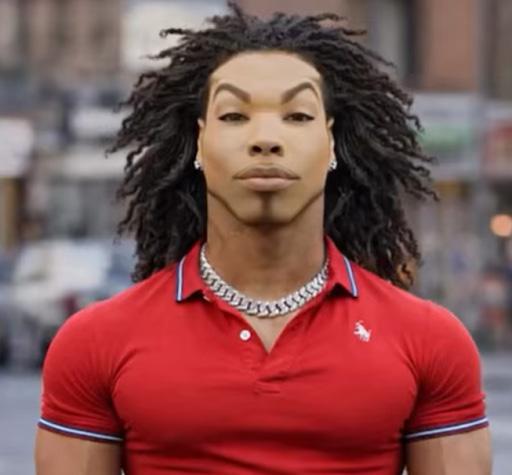
If you were an indigenous chief, what would your name be?
Chief Sitting Chud of the Wackahoe Tribe
How much would you pay to see Fetty Wap in concert?
An arm, a leg, and an eye.
I won the performative lesbian contest but I didn’t get the strap yet. How can I claim it? Preferably without giving them my school email.
It’s currently in use.
Now that Clav overdosed, who’s gonna be the next True Adam?
Many dont know this but Steven the C4 Cashier has the most diabolical sleeper build
I drank the brown water in CIW. Do I have superpowers now?
Yeah if your superpowers include giving gonnerhea to anyone you sleep with
If a company makes me submit a blood sample to apply and the listing says $17 an hour, is that a red flag?
Where’s Luigi when we need him?
Is Mein Bowl Mary here to stay when I come back in the Fall?
Written by our Staff
Absolutely, superpower by 2028. Also fun fact: theres an interview with her on spotify with asian outlook magazine!
I dipped my head in the discolored marketplace water but it didn’t let me fly? It’s not real guys! Don’t fall for it!
ChatGPT tells me that it takes 4-6 minutes for your head to have irreversible brain damage when it’s submerged in water. Remember: Patience is a virtue.
When will I be able to use the Cicada virus as an excuse to start slacking off and cheating again?
What the fuck is that??
How can I get away with cheating on my girlfriend?
Sorry babe, too stressed out about the Cicada virus.
How diverse is the staff?
We had an Indian guy, but they got him.
How diverse is the CS department?
See above, but opposite
What’s the most diverse club on campus?
Look at bottom left corner of page
Can we get a shoutout for that guy at C4 Nite Owl that always goes “HEY HOW’S IT GOING?”
If Brian has 1000 fans, I’m one of them…
What does g-dilf mean?

Need life advice? Email review@binghamtonsa.org for more wacky, quirky and zany responses.
The Relationship Theory
By Elizabeth Bremner
Originating from an episode of How I Met Your Mother, the “Olive Theory” claims that the perfect relationship includes one person who hates olives and the other person who loves olives, and will therefore eat all of them. It works because both the olive-lover and olive-hater help each other with something they desire, and everyone is happy in the end.
Although fictional, the “Olive Theory” has inspired many other theories and rules about relationships, which are born and die solely on social media. Due to the genesis of the “Olive Theory,” these online theories were similar, including the “Pickle Theory,” which is the exact same thing.
However, these rules became more abstract. Forget those simple theories from before, and read about the “19 Theory,” the “3-Month Rule” (and the subsequent 6-Month and 8-Month Rules), the “3-Year Rule,” the “Oldest Daughter and Younger Son Rule,” und so weiter.
“The people who comment about their failing 3-year relationship fail to mention that their chud boyfriend has forgotten their birthday three years in a row.”
For the sake of context, I’ll define some of these theories for you. The “3-Year Rule” claims that you will face your hardest challenges in the third year of your relationship. The “Hair Theory” claims that a woman’s hair stays in its natural state (or curly, depending on who you ask) when she’s truly in love; the evidence for this is within How to Lose a Guy in Ten Days. My favorite of all is the “19 Theory,” in which you will suffer a devastating breakup at that age.
These rules/theories are not based on any fact at all. This should not be surprising. Upon inevitably having to look these theories up, you’ll come across a video of someone passionately explaining the theory using their own experience. The comments support them as well, using their past relationships as evidence. For example, one TikTok video goes over the “April Theory,” claiming that once the spring season rolls around, it ignites doubts in women about the validity of their relationship. Some comments reminisced on past relationships, saying, “Yes, I broke up with him in April :/,” or “ts is starting to click now [broken heart emoji].”
These theories develop through confirmation bias. A person proposes some fuckass theory, and those who relate to the theory comment on it with their similar experiences. The comments that agree with the theory receive the most likes, since they reaffirm a created fear. The comments that disagree get less attention.
Imagine being a young teenage girl in her first relationship. I’m choosing this specific person because that is the audience that these theories are targeted towards. You’re nervous about your new relationship; you have no idea how to navigate issues
or how to care for another person, and your source of help is other people online. You see these videos and the comments. Every anxious fear you have is being confirmed by the positive comments, and you skip over any comment that disagrees. So what? The dissidents have fewer likes anyway, meaning fewer people agree with them.
The positive comments are incidental. The people who comment about their failing 3-year relationship fail to mention that their chud boyfriend has forgotten their birthday three years in a row. Do the oldest son and the oldest daughter clash too much? Maybe it’s due to their shared laziness and/or stubbornness instead of some predetermined birth-order psychology.
I now ask, why do we need to label everything? Why do we need to structure and reorganize how we interact with other people?
Relationships are complicated and made up of complicated people. Every person is different, has their own wants and needs, and their own plans for a relationship. This can be confusing for everyone, especially for those who are not particularly experienced with the dating world. This group tends to be younger adults who happen to also be on social media. We want to structure what is complex, because if we can figure that out, it becomes easier to approach. The result of this is a multitude of theories and rules that fall short of accurately describing how relationships really work.
These theories fail because they posit simple solutions to complex issues that often have multiple causes. Once again, people are complicated! Different people have different relationships; this is not a one-size-fits-all scenario.
Additionally, these theories act as a self-fulfilling prophecy. The people yearn for horoscopes and fortune tellers. Why navigate your relationship issues yourself when you can have someone else decide your fate for you? If you hear that your relationship is vulnerable to crumbling on November 18th, as per the “November 18th Theory,” you artificially doubt your relationship around that time. Your doubts manifest into weird behavior and a distrust in your relationship, causing it to fail around November 18th. Thus, the November 18th theory prevails.
Now, for you, dear reader, I cannot do much. You may be graduating this semester and heading out into the real, unemployed world. You may also be looking to settle down or get serious with a special lady friend. My advice is not to listen to anything that has a random word and “theory” attached to it. Hair Theory, Jeans Theory, 20s Theory, whatever. Relationship problems are solved through reflection and communication, not a predestined rule. What about the “Get a Fucking Job Theory”? Stay safe (and happy) out there. Stay woke.
Anti-Commencement
By Angelo DiTocco
I’m99% done with college. In just 15 days, I’ll be standing in a crowd of my fellow students yet again. But things will be different this time. As I walk up on stage to get my faux diploma, I’ll be shaking hands with a completely different set of people whom I don’t even know. Instead of a plain graduation cap, I’ll be wearing a 64x64 RGB LED matrix playing funny GIFs and memes my friends submitted. And much like the decoration’s overstimulating nature, I’ll likely be distracted by a whirlwind of thoughts, living in every time except the present.
That’s right, the Managing Editor gets two reflection pieces while everyone else only gets one.
Besides the graphs my advisors showed me years ago, where the bachelors made $80K, and the masters made $90K, the reason for staying for a master’s degree was simple. I liked school, I liked being up here, and if I could do something until I got burnt out and started to hate it, I’d miss it less when I left. Only problem is, I still like being up here. What the hell happened?
Well, first of all, I started to love my responsibilities and field of study even more. Who could have seen this coming with no more unrelated gen-eds and no more bureaucratic ABET requirements? Moments where things “clicked” in my students’ heads became intensely satisfying. Three whole projects strengthened my love triangle with embedded C and the Raspberry Pi Pico 2; there were nights of debugging where I lowkirkenuinely reached flow state. As the material got more interesting, I got to work under and take classes with some incredible professors, whom I will properly shout out later. Lastly, I got to see the Aiden administration continue to flourish, consistently bringing new talent and community to our beloved magazine. Oh, and living with five of my best friends. I suppose that made things fun, too.

A friend of mine recently asked me if I would go back to the first day of freshman year, given the chance. This offer, if it were possible, would certainly be a compelling one, on the
grounds that I didn’t exactly live these five short years to the fullest. The first two years consisted of little to no effort to find where I belonged and make friends. The next semester was consumed by my desire for love as I socialmaxxed and drove myself crazy. So it wasn’t until halfway through college that I actually figured out how to properly enjoy myself, and by that point, it started to dawn on me how much time I “wasted.” I can only imagine what more I would have learned and accomplished back then with the right mindset.
But can I really blame myself? Most people don’t get this stuff right on the first try. Even for an academic weapon like myself, college was a vastly different experience from high school, and I had to adjust. In 2019, I didn’t need extracurriculars to have a solid social life, and in 2020, there were none anyway. Before college, family members and guidance counselors had to push me to take any sort of academic and career initiatives, but up here, I had to learn to do it myself. Furthermore, the start of college was rife with busy work; even if I could go back and “do everything right,” those first few years would still be objectively less enjoyable. Something, something, rose-tinted glasses, something.
Well, now it’s time to go. Isn’t it ironic? As soon as things start to get really good, they vanish. Soon enough, I’ll be back home in bum-ahh Mahopac, NY, where there’s no Review to produce, no group projects to work on, and no Clearview Hall Bonesmashing Workshop to attend. With such limited social agency, it might be tough not to fall back into a lifestyle of eatsleep-work-repeat. That is, if I can even get a job in the first place.
But the uncomfortable reality is that this can’t be sustained. The cracks are already starting to show. Some of my friends have already left. Many of the department’s best professors are starting to throw around the R-word (retirement), and a few are already gone. Clearly, I’m going home because I see it as the best available option; staying up here would be an equally unappealing alternative where I watch everyone I know leave and descend further into unc status. It was always going to reach this point, no matter what I did—staying up here for one more year was just delaying the inevitable.
This begs the dramatically worded question at the top of the page. Should I even bother talking to acquaintances up here, trying to strengthen bonds when I’ll be outta here in 15 days? Should I even try to make new friends and find the best job back home if the end goal is to escape this fuckass weather and leave upstate New York? If I’m just doomed for another adjustment period in the future, why view the present as anything more than a waiting room?
Like with many things in life, it helps to zoom out and see the big picture. Someone recently pointed out that if I’m thinking about it like that, I might as well not try to live at all, ‘cause I’ll just die eventually. It was a bit silly, but it made me realize I was looking at things a bit too narrowly. What I should really be
asking myself is what changed between each cycle of adjustment and true enjoyment. In other words, how have these five years of college improved me?

I’m sure the apathetic, COVID-hardened freshman year version of myself would be at least somewhat proud of who I am now. Even if I didn’t quite do everything I feel I should have, I still got a lot done. I learned everything I wanted to learn coming into college and picked up some new interests along the way. I went from scorning résumé-builders in favor of what interested me, to realizing that something can both be interesting and look good on a résumé. I eventually came out of my shell and found a closer community than I could ever dream of having. Despite the temporary nature of college and the futility of wanting to make permanent changes, I learned valuable skills and lessons that will stick with me regardless of whether I’m in Binghamton, Mahopac, or somewhere completely different.
Perhaps I’ll graduate college and go home to another boring adjustment period where I do little of substance with myself. Perhaps I’m exaggerating, and it actually will be fun to be back home. Either way, I know I’ll be fine. High school was an adjustment, but I liked it. College was an adjustment, but I liked it further still. Without fail, my doubts about whether I would enjoy myself were always proven wrong. Perhaps you’re an underclassman reading this who thinks it’s silly to dread graduation, but I’d be surprised if you don’t eventually feel the same way. But, dear reader, remember that you’ve always made it through, and this time will be no exception.
Alright, enough cringe emotional crap. Shoutout time!
- Jason, my day one, I couldn’t have asked for anyone else to struggle with through years of lab assignments, projects, and workouts.
- Connor, my GOAT, your dedication and ambition are beyond anything I’ve ever seen, and I can’t think of anyone who deserves your future job more than you.
- Julian, my senior project big bro, your ability to quickly adapt to whatever is thrown at you is inspiring, and I always wish I could have your magic touch when shit hits the fan.
- Alan, we all wish we could smile and stay motivated through months of trial and error like you can. You are the most resilient
motherfucker I’ve ever met.
- Aiden, Dan, and Liam, it has been an honor to collaborate with you to keep the Review thriving through thick and thin.
- Bren and Broom, your writing is some of the best I’ve ever seen, and I can sleep easy knowing the Review will be in your hands.
- Arthur, Shayne, Madeline, Sid, Amanda, and Logan (and some others I’m probably missing), I have no idea where I’d be now if your whimsical 2023 issues and energetic meetings hadn’t welcomed me.
- Midas, thanks for helping us get the office back.
- Shane, Comson, and Victor, I admire your commitment to standing up for what you believe, and the world would be awfully silent without your crashout energy. I actually mean this.
- Dr. Jain, the privilege of taking two classes AND doing a senior project AND working as a TA under you was an enormous part of what made college rewarding and interesting. I’m so glad to have been there to witness your PhD grind finally coming together.
- Dr. Craver, I don’t think there’s a teacher or professor in the world who’s more interesting, knowledgeable, and engaging than you. I tell my fellow students all the time to take literally ANY class with you if they can.
- Dr. Summerville, your ability to create such fun and engaging curricula as quickly as you can is astonishing. You taught Embedded so well that I could never have guessed it was your second time teaching it.
- Dr. Mansfield, I admire your commitment to constantly refining and improving every class you teach. I have no doubt in my mind that DLD and Networking will soon be better than they ever were.
- And to my students and UCAs, thank you all for making the library basement of all places so fun to be in. I can’t wait to see you guys change the world as future engineers.
So, this is the end. I’ll miss it all. I’ll miss shooting the shit in Bing Review meetings and goofing off during production nights. I’ll miss troubleshooting unforeseen technical issues at night in the ITC. I’ll miss meeting my advisors to share the work I’ve done on my awesome projects. I’ll miss getting yelled at by my students from across the spine. I’ll even miss the Sodexo slop, crazy as it sounds. But I must go. Mahopac needs me.
Meet the E-Board
By Our Staff
Editor in Chief - Brennan Ciccolone
Hello! My name is Brennan, or perhaps better known as Bren Dover, and I am the new Editor-in-Chief of the Binghamton Review. For those who actively read the magazine, first of all, why? Second of all, congratulations, this is the big reveal! I have been unmasked! Decloaked! Now that’s outta the way, here’s a little about me: I study philosophy and play ultimate frisbee. I spend most of my time with my friends, driving around, finding some niche music artist, and hoarding clothes from the thrifts. Obviously, as you can tell, I love to write as well, and joining the Binghamton Review has been one of the best creative communities to be a part of. I am so grateful that they believe in me to the extent of electing me to be in charge. My promise to them, and you, dear reader: I won’t let you down!
Managing Editor - Elizabeth Bremner
To whom it may concern: My name is Elizabeth Bremner, writing under the name “Broom” or other variations, and I am the upcoming Managing Editor of the Binghamton Review. Perhaps you’ve already read one of my articles, such as my magnum opus, “Duolingo Sux.” I think it’s time you actually learn some more things about me outside of what I’ve written here. I am a philosophy major and minoring in German, so employment opportunities are looking fantastisch! I mostly spend my time writing, wasting away, or enjoying most of my time with friends. I started writing for this magazine just over a year ago, and I’ve had a hell of a time since then. I’m excited to start this new year as the managing editor, and I promise to catch all of the incoming typos.
Treasurer - Comson Cao
Hi. I’m the Treasurer for this academic year. After what I can only describe as an extremely convincing recruitment effort by God-Emperor Aiden Miller in which I may or may not have been kidnapped and forced to sign this agreement somewhere in the woods, I found myself becoming the one to manage the budget. In any case, I’m Comson. I’ve been a resident scholar at Binghamton Review since freshman year. As a renowned moderate and sensible centrist among my friends, I primarily write academic and politically oriented articles. Outside of writing, I’m a professional snoozer and a good food connoisseur.
Social Media Manager - Nicholas Aparicio
Hi. I am Nicholas Aparicio, and I am from Long Island, NY. In my spare time, I lie in my bed doomscrolling, sleep, and order Uber Eats. I truly enjoy writing for the publication, so I’m glad I can meaningfully help as Social Media Manager. In the past two years that I’ve been a member of the Review, my time spent writing articles has been some of the most cherished times at college, to just slip away into my own world and make my own platform. I hope that social media can generate more engagement for the magazine to hopefully attract more contributors. Aiden said I need a hundred words, so to conclude, I challenge you all to name 5 women.
Copy
Desk Editor -Luke Fehily
Hello everyone! I am Luke, from London in the U.K. (chewsday innit). I’m so excited to be next year’s Copy Desk Editor so that we can keep publishing the best and brightest of bearcat literature. The reason I joined the Binghamton Review was to promote free speech on this campus, something I am sure we will continue to do next year. I typically write about politics, philosophy, or culture (once every century or so), and I’m excited to continue doing so next year. Every year, the Binghamton Review only gets funnier and funnier, so my hope is that next year we find even more awesome writers.
Editor Emeritus - Aiden Miller
Elder Statesman. Teacher of History to the Youth. Man who walks. Hitter of small white balls. President of Nolan McLean, Adam Fox, Geno Smith, and Sepp Straka Fan Clubs. It’s not “Editor Emeritus,” it’s “Wise Sage, Knower of All Review Secrets.” I can partially assure you all that I will do everything in my limited power to keep this show on the road, as long as you don’t ask me to distribute the magazines anymore.
Where Does the E-Board See Themselves in 5 Years?
By Daniel Guido and Staff
As the 2025–2026 school year comes to a close, I found myself thinking about what I wanted to write for our final issue. With the vast majority of the E-Board graduating—myself included—I originally considered doing a heartfelt reflection on my time at Binghamton and in this club. But let’s be honest… nobody wants to read that. To spice things up, I figured it would be far more interesting to let our dear readers learn a bit more about our graduating E-Board and what exactly we think we’ll be doing after graduation.
Aiden Miller:
Starting off strong with our Editor-in-Chief—soon to be Editor Emeritus—Aiden Miller. Outside of being the undisputed shot caller of the Binghamton Review, Aiden is a history major with a minor in education. He’s sticking around for another three semesters to pursue his Master’s in Education. In five years, Aiden hopes to be a full-blown history teacher, ideally speedrunning his way to tenure. Wherever he ends up, he plans to settle down in the area—whether that involves dealing with Endicott gremlins or not remains to be seen.
Angelo DiTocco:
Next up is our vice shot-caller, Angelo DiTocco. Angelo is wrapping up his 4+1 program this spring, meaning he’ll be graduating with his Master’s in Computer Engineering… and, more terrifyingly, entering the workforce (AHHHHHH!!!!!!). When first asked where he sees himself in five years, he immediately responded with, “doing ur mom.” After some persistent follow-up, he said that he hopes to work with microcontrollers and embedded systems, possibly in robotics. He mentioned that he wants to live somewhere vaguely in the South (i.e. North Carolina). He’s still deciding whether he wants to teach others or become a corporate shill, but either way, he hopes to have things somewhat figured out in five years.
Liam Steele:
The man, the myth, the legend—Liam Steele. He is responsible for our amazing cover artwork as well as our social media accounts. Liam is an Environmental Science major with a minor in Geology and is graduating this semester. This summer, he’ll be working for a construction site inspection company. Long-term, Liam hopes to pursue either construction inspection or environmental consulting, ideally somewhere in Upstate New York or the broader Northeast. In five years, he hopes to be planning for his grand return to his home country of Grenada. There, he wants to work in ecotourism—possibly scuba diving—or use his construction experience to help improve infrastructure. What a guy.
Daniel Guido:
And finally, me. I’ve been serving as the Review’s treasurer for the past two years, and I’m graduating this semester as an accounting major with a history minor. Like Aiden, I’ll be sticking around Binghamton for one more year to complete an MBA. In five years, I’ll (hopefully) be working full-time as a tax associate (boring!!!!) and will have earned my CPA license after surviving several years of exams. I’d like to say I won’t let the busy season drain my soul, but that’s definitely asking too much. At the very least, I’m hoping that five years from now, I’ll have a clearer direction than the current “vaguely forward” trajectory I’m operating on.
You might be asking yourself: What is the point of this article, and why should I care about a handful of randoms? On a personal level, I hope this serves as a time capsule for the 2025–2026 Binghamton Review E-Board—a snapshot we can look back on someday to see whether any of these plans actually worked out (or completely fell apart). On a broader level, for future E-Board members—or anyone even mildly interested in joining—I hope this shows just how varied the backgrounds of this club really are. This is a news magazine, and yet not a single E-Board member is a stereotypical journalism or English major. If anything, that’s the point: regardless of your major, background, or interests, this club is open to you. And if you’re lucky, you might even find your people here. I know I did.


How to Win at Binghamton
By Liam Steele
As I begrudgingly finish my chapter at Binghamton and step out into the treacherous mire of full-time empl*yment, there’s a lot I’ve learned in my time here. This being the last issue of the academic year, I know some issues will stick around on campus for you babbling fetuses—uh, I mean, freshmen—to read. Hell, any non-senior undergrad, you’ll get a lot out of this.
Section 1. Academics
Coming to the end of my time at Binghamton, I’ve had time to reflect on what made my time here so productive and fun. For one, I was fortunate enough to know what I wanted to do right off the bat, starting with major-relevant classes instead of waffling in a mire of gen-eds while “figuring it out”. I initially wanted to do biology, but opted for Environmental Science after I learned about its broader scope and versatility post-graduation, at least for my goals. Oh, and it also doesn’t require you to take Organic Chemistry I and II, that was a part of it too. Completing major requirements should be a priority right out the gate, because escaping giant lecture weed-out classes as soon as possible is what’s best for being able to focus on what you really want to do. If you’re within the ENVI/BIO sphere, take General Chemistry and Introductory Biology immediately, because I promise you the upper-level classes within those streams are far less stressful, and once you’ve made time for them, room for any fall-through classes will follow naturally, leaving you able to take classes purely for fun (results may vary by major).
As for extracurriculars, I again urge you to get involved, as Binghamton has some of the best support for student organizations out there. I was able to help start and set the basis for official chartering for the Binghamton Marine Science Club with some good friends of mine, and being a writer and cover artist for this very magazine has been a thrill. I won’t claim to be knowledgeable on fraternities, but I would steer clear. Friendships on a subscription service, facetious gestures, and the potential that you’re in cahoots with a literal league of rapists (go ask what catchphrase people have regarding Alpha Pi Epsilon) just don’t seem worth the connections they might afford you, friendship or career-wise. Quite a few traditional student orgs will afford you all the same opportunities (leadership, fundraising, charity, event organizing, etc.).
A big part of squeezing as much value out of the over-ripe fruit that is New York’s #1 best-value public college is getting to know the faculty. Nothing is better for your sincere investment in your field than getting to know these people. Volunteering with Dylan Horvath, our Nature Preserve Steward, gave me a meaningful, non-classroom experience that I can bring forward in my Environmental Science career. Even faculty less related to my major, like the great Rick Schumaker of the technology hub, have been a huge help to me, giving me crucial (and brutally honest) counsel on my independent study work, as well as helping me with my own fun projects, like my growing interest in GIS software. Connections to the Geology Earth Sciences de-
partment helped me take a leap of faith and declare a minor in Geology last year due to how well it supplements my major and how engaging I found the classes I’d already taken. Above all else, faculty connections keep you informed on what really goes on at this school; they’ll share any opportunities they know of with you and take their job of, y’know, uplifting and teaching students seriously. We all love to fuss about the rigors of our education; why not know your enemy?
Section 2. Student Empl*yment
I know, I know. The J-word is a scary thing, but I cannot stress enough how valuable it is to get into student employment. I didn’t hop on early, and I regret it to this day. Our campus is a land of opportunity in this manner. Sign up for Handshake with your BU email, and I guarantee you’ll find something suited to your interests and schedule that is on campus in due time. If you get in early enough and play your cards right, you can have fullon managerial experience before you graduate, like Binghamton Review’s very own Midas Leung, Student Building Manager of the Union, whose departure will leave huge shoes to fill. Positions like this are a boon to any resumé.
Move-in and move-out crews are the easiest starting points, particularly for Reslife, but obviously very seasonal. As for more regular work, my journey started with Event Setup Associate in the Union, moving chairs, tables, and stages for events held in the Union. It’s very schedule-friendly for the overloading freshman, consisting of as many one- to two-hour shifts of moving stuff as you can manage. Taking this, and ideally the more seasonal moving-stuff jobs, you have more than a solid shot at my current job, Resource Manager. Preside over your dining hall (ideally C4) at your desk, manage building resources, as it were, and also move stuff around like the previous jobs, all in 4-hour shifts, which will more often than not leave you with plenty of time at your desk to study and get class work done, or just hang out. This is a good position for customer service and client-facing experiences on a résumé, and if you have enough room in your schedule to fit at least 3 shifts and supplement it with moving stuff in the union, you can hit the part-time maximum of 29 hours per week. Over fall break, I covered so many shifts that I went over this by 0.25 hours (less than $5 by the way) and got a firmly worded email.
If you happen to already have your driver’s license before literally the eve of your last semester, unlike me, your options open up even more. Campus shuttle, off-campus transport, Late Night safe-ride shuttle, all possible through OCCT. If you can drive but also have a hankering for moving crap like the first few jobs, you can join the ResLife operations crew or Physical Facilities, where you’ll have access to the quads and electric cars littered on campus and drive around keeping the school infrastructurally sound.
Beyond the vast opportunities for advancement and making more than minimum wage, working on campus affords you
even more connections beyond just professional ones. Stick around and you’ll become a core member of the campus community. It was through this that I became the most social I’ve ever been in my life. To point once again to beloved Binghamton Review mascot Midas Leung, who is technically also my supervisor in the union, he works so many jobs and has so many connections that he is as much of a celebrity as he is a crucial factor in the continued functioning of the union and its facilities.

Actual, real picture of Midas keeping the bowling alley functioning
Section 3. The Greater Binghamton Area
It seems to be the fashion for everyone on campus to endlessly dog on Binghamton as a dreary landscape that they itch to escape, but there is a lot going on beyond campus that I also caution you not to miss out on. From its unstoppable local hockey team to its genuine and engaging small businesses, after a few trips around Binghamton, you’ll soon fall in love with it as I did. Coming from the flat and monotonous suburban hell known as Nassau County, NY, I have a real love for Binghamton as a less dense area that has natural space, rich history, and a sincere air of community about it. Here are some favorites of mine:
NY Styles, Johnson City: the only trustworthy barber around here. Ask for Andy.
Tony’s Texas Hots, Johnson City: Amazing, affordable burgers in a pristine mid-century diner. Great place to hear old folks discuss the times at hand. Right next to the barber
Fat Cat Comics, Johnson City: Comics, figures, and amazingly priced retro consoles, also right next to the barber
PJ’s Flea Market, Binghamton: A flea market in an older town like Binghamton will always yield gems.
Stellar Human, Binghamton: The premier thrift spot around. Great vintage pieces, lots of community events, and the owner works with your budget.
Binghamton Rock and Mineral Show, Binghamton: Okay, I’m biased as a geology minor, but every April at the senior center, there are a ton of minerals, rocks, fossils, and related stuff to buy or gawk at.
European Market, Binghamton: Amazing little store for European groceries. Homemade Polish-style smoked bacon, kielbasa, imported beers, and other staples of Europe, run by an old Ukrainian guy who loves to see students engage with his business. Loves to offer samples and chat.
Visions Veterans Memorial Arena, Binghamton: Home of the Binghamton Black Bears. Cheap tickets to see an amazing team dominate. Lots of violence on the ice and tickets double as versatile coupons for local businesses.
NYC Style Deli and Juice Bar, Binghamton: Not to be confused with the JC barber shop. This new addition to the downtown scene is everything that the ever-popular Maryam’s is, and more, and better, and cheaper.
Recreation Park, Binghamton: Home of antique carousels from Binghamton’s golden days, a cool statue of Twilight Zone narrator, Rod Serling, and countless community events. The garlic festival in late August is my favorite.
Overall
In terms of big-picture takeaways, I would say college is a time to get out there, and comparing my experience here to those of my friends at other colleges, this is one of the best places to do it. Take your academics seriously and plan your schedule far ahead of time. Take a stand for your independence and career future with some on-campus work, where possible in your schedule. Socialize, be it through professors, supervisors, or student orgs, but by all means, socialize. You will dearly regret not doing so around and after graduation time. Finally, invest yourself in Binghamton outside of the university. Sure, the university keeps this area afloat in many ways, but this place is otherwise bursting with soul that too few students take the time to see. Having moved to the US from Grenada at 11, my view of the American experience has been turbulent, but my time getting to know the Tri-Cities area has made that view the most positive it’s ever been. I see a community with a rich culture putting in the work to better itself through real human connection. That being said, the word of the day is surely “community.” Find it. Cultivate it. You won’t regret it.
The State of Jefferson
By Luke Fehily
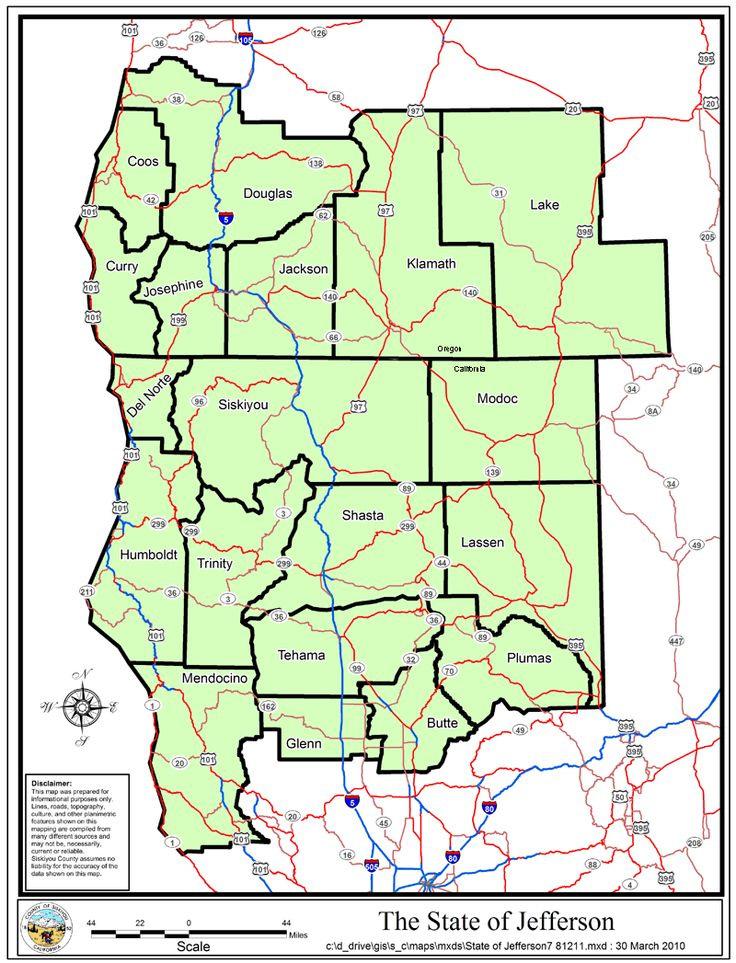
Buried in the diverse landscape of Northern California is a group of people distinct from any other around them. The “Jeffersonians” are a people who fear government in a way few do in America, or most certainly the states of California or Oregon in which they reside. As a believer in the cause of liberty, I have long held a fascination about the rebels in Northern California who call for a new state, the State of Jefferson, so last month I went and conducted some investigative reporting by visiting the “51st state”. This essay contains my findings on the Jefferson movement, the extent to which it exists today, and what effects this movement has had on libertarian culture in the United States.

Figure 1: A sign welcoming drivers to the State of Jefferson Andreas Fuhrmann, Record Searchlight, c.2017
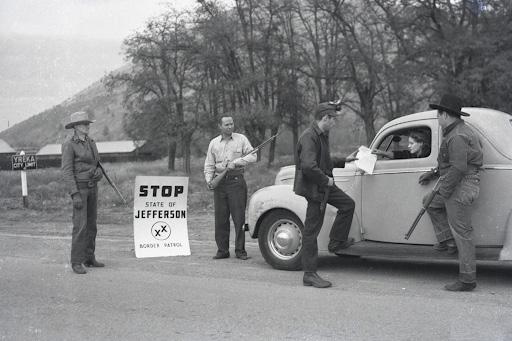
The State of Jefferson is a thing out of libertarian mythos, and the history of its movement to separate from California explains why we should pay attention to it rather than merely dismiss it as naive. There is a tendency in modern discussions regarding the State of Jefferson to address those in the movement as “uninformed” or “ridiculous”. However, this was not always the case. In 1941, the people of Northern California and Southern Oregon began this idea of a Jeffersonian state as a response to a feeling of neglect they had with regards to their state governments. The flag of the State of Jefferson represents this, as the two crosses fixed on a green background symbolize the feeling of being double-crossed by legislators in Sacramento and Salem. It is this core idea, failing to be represented by government, which gives the State of Jefferson its libertarian roots. The original Jeffersonians expressed this dissatisfaction with the government in many ways. One of the best documented forms of this civil disobedience was the “Yreka Rebellion”. Yreka, CA, the “Capitol of the State of Jefferson”, was host to the “Jefferson Border Patrol”, a group of individuals who set up roadblocks along the way to the State of Jefferson. While the border patrol had no concrete powers, an issue common in the Jefferson movement, it aimed to bring attention to the secessionist cause by setting up clear guidelines about where California ended, and Jefferson began. Jeffersonians appear to have gained a bad name for themselves over time, often mocked by those in California as being
“preppers” or “ridiculous”. For this reason, it is important to note the failures of the State of Jefferson movement along with its noble aims. A large reason for the “ridiculousness” associated with the movement is the wide array of distinct ideologies among those who claim to be Jeffersonian. With this comes debate over where the borders of the state are, how large this state government should be, whether or not to engage in civil disobedience, and even whether or not to become a state or remain part of California. This infighting, along with the “unconventional” political views of the Jeffersonians, has given the movement a bad name over time. However, it is important to understand the historical grounding of this movement and why I believe the movement itself can still teach us lessons today.
While the founding of the State of Jefferson occurred roughly 80 years ago, this movement is supposedly still going strong today. A revival in the idea that Jefferson is distinct from California was sparked by 2nd Amendment restrictions and the COVID-19 lockdowns. This gets to the root of what the State of Jefferson is supposed to represent, that is, decentralization of power and distrust of authority. These core tenets are what attracted me to the State of Jefferson and made me visit the “state” in March of 2026. I visited the state in order to gain a better understanding of what this movement is and whether it still exists out there. What I had found in my research before the visit was clear. There seemed to have been a co-option of the libertarian movement in favor of broadly anti-California, conservative rhetoric. The coherent Jeffersonian ideology no longer stood in place; instead, there seemed to be just broad “right-wing” disgruntlement.
Yet, when I made the journey from San Francisco into Northern California in late March, I found a different narrative. A narrative that points against pure co-option, but is still depressing nonetheless. The flags and bombastic Jeffersonian patriotism that I was promised were nowhere to be found. The
Figure 2: The State of Jefferson Border Patrol at a roadblock outside Yreka, CA San Francisco Chronicle, Goodyear c.1941
towns of Yreka, Weed, and Redding, which I visited had, on the surface, no clear remaining traces of the Jeffersonian movement. However, as I spent more time in Yreka, I began to notice a few traces of what this movement once was. In the storefront of a barber on Miner Street was a small Jefferson flag, giving me hope that there was more to find. On the road leading into Yreka, there was a barn adorned with the words “State of Jefferson”. And on the back of an old pickup truck was the seal of the State of Jefferson. These little symbols, while not meaning much in themselves, restored me with the feeling of hope about this movement. It instilled me with the idea that while this movement has died down, its message still stands strong.
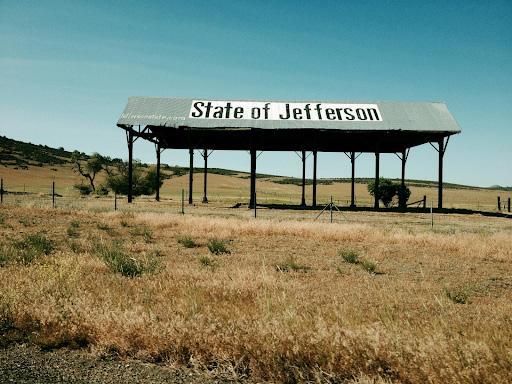
Figure 3: The Barn on the side of I-5, adorned with the words “State of Jefferson” Kami Horton, OPB c.2014
Furthermore, while explicit nods to the State of Jefferson may have been hard to come by, there was a clear cultural shift north of Shasta County. Instead of the typical California liberalism, there was an ardent libertarian ethos rooted within the region. Private property signs are placed outside every house, a clear lack of road signage, a clear lack of zoning allowing for people to build radio towers in their front lawns, radar detectors attached to nearly every car, and a clear disregard for government, which builds off of the message of the State of Jefferson. The best symbol for this break from government, and the best symbol for the Jeffersonian spirit, came as we were leaving Yreka: on the side of the road lay a vandalized Yreka city limit sign, peppered with bullet holes and spray-painted with the words “100 MPH”. After my trip, people asked me if I was disappointed. But my response remained the same: while there may be fewer official Jeffersonian separatists left, this region still strongly upholds the principles of liberty. The endurance of Jeffersonian ideals is something that all believers in the cause of liberty must learn from, and while this movement may have been driven underground, it is important not to make fun of the concerns of these citizens, but instead understand and sympathize with their concerns about government.
At the end of the day, I am unsure whether I agree with the notion that Jefferson should be a separate state. However, after my trip to Yreka, I do know one thing for sure: that the people who live in the rural regions known as “Jefferson” are not Cali-
fornians in any way.
In conclusion, while the idea itself may be naïve or lost to time, the values that those in the State of Jefferson movement hold remain true today. While the “border patrols” have stopped, there are still quiet nods to the movement all across the region. But more importantly, the region still lives by the values that the State of Jefferson was built to pursue: life, liberty, and the pursuit of happiness. These people should not be laughed at or mocked. Instead, we should view their pursuit of secession as a tale of those who feel oppressed by the government truly wanting better, even if it is hard for some in the movement to coherently express that. After all, even the most “unconventional” within the Jefferson community are adhering to the principle that government cannot always be trusted, especially a government that does not listen to its people.

Figure 4: Yreka City Limits sign vandalized with bullet holes and spray-painted with the words “100 MPH” Luke Fehily, Binghamton Review c.2026
On Need-Aware College Admissions and Reflection
By Xinpeng Gao
Ishould be happy. I Really should.
I’ve spent the past few months no-lifing on r/TransferToTop25, figuring out how to maximize my odds for transfer admissions. On Friday, April 3rd, 2026, this paid off as I got accepted into Vanderbilt University’s first wave. I was so elated. This was during spring break, so I told my family and close friends immediately, and they were extremely happy for me, although they were sad that I was leaving Binghamton.
I’ll save the motivations for leaving Binghamton for the end of this article. They’re not too relevant, but I do still want this to be a reflection piece, as it is likely my final article.
Although I got into Vanderbilt, this wasn’t my dream school. I had applied for a Transfer Early Decision (TED) to a different institution, Northwestern University, and that was the school I really wanted to go to. I even had a brief phone call with one of the reporters at Daily Northwestern, the student newspaper at the university, about applying early there—looking back at it, that may have been the colossal aura loss in my life. I waited and waited and realized they weren’t releasing decisions just yet. Still, my Vanderbilt acceptance brought my hopes up significantly for Northwestern, as they are often seen as peer institutions that frequently cross-admit in their applicant pool. So, I waited for decision day with a deep sense of hope in my heart—I had spent countless hours working on my personal statement and my transfer rationale for Northwestern.

Decision day came: I received a rejection letter from them. I wasn’t too disappointed or anything at first—maybe I just have delayed emotional processing. That was, until I looked on Reddit. Based on self-reported results from r/TransferToTop25—a community where a large portion of transfer applicants share outcomes and advice—I noticed a striking pattern: I could not find a single reported acceptance from a Transfer Early Decision applicant requesting financial aid. While this dataset is inherent-
ly incomplete, the subreddit functions as one of the most active public forums for transfer applicants; those not represented are often working with private admissions consultants, a group that is disproportionately able to pay full tuition.
It took a little bit for me to process as I inhaled a deep breath and stared at the ceiling for a few minutes. The more I thought about it, the harder it was to ignore what that pattern suggested. This was corroborated by the fact that one of my friends who didn’t receive any need-based financial aid got an acceptance letter from Northwestern (which is need-aware for transfer). Of course, he 100% deserved it since he is absolutely one of the most brilliant and hard-working people I know. However, it seems like they’ve only taken students who didn’t need financial aid this cycle.
Reader, you may call this cope. This obviously sounds really immature—after all, no one deserves acceptance, especially at an institution this selective. Furthermore, because admissions decisions are holistic and opaque, I do not have access to institutional data.
Still, in trying to make sense of it, I realized this pattern isn’t unique. Peer institutions that are need-aware for transfer admissions appear to show similar outcomes. For example, institutions like the University of Chicago, which do evaluate transfer applicants with financial need in mind, have historically admitted very few—if any—transfer students requiring aid in recent cycles. UChicago goes further in this by implementing Transfer Early Decisions, which allow them to guarantee they secure full tuition and housing payments from the student, and, to an extent, protect their yield (the number of applicants who enroll divided by the number of applicants admitted). It makes sense for UChicago to do this as their budget deficit has been in the hundreds of millions since the pandemic and they are carrying $6.4 billion dollars worth of debt. Since applicants apply without requesting financial aid, they have less of a reason to back out of these TED agreements if accepted. You may wonder what the consequences of backing out of these agreements are. Well, even though they are not legally enforceable, it may negatively affect future admissions considerations such as graduate school, though policies are not formally stated. I don’t think anyone wants to be an auto-reject for a top-tier graduate program. This year, Northwestern did the same thing as UChicago by adding TED as a way of applying. From the preliminary results, it seems like they are operating in the same way.
This wasn’t the first year that they instituted the change to go need-aware—they implemented this change last year. However, by the sheer number of students who needed significant financial aid last cycle that were accepted, I thought this cycle was going to be similar: Northwestern just wants to protect their yield rate, right?
Some may put this blame on the Trump administration. He did go to war with the elite universities; he cut federal funding and weaponized the DOJ to instigate lawsuits over campus antisemitism and Title VI violations. As a result, universities such as Northwestern had to pay $75 million in fines over antisemitism and DEI to restore their frozen federal funding.
However, I believe the true reason is cynical. The political crisis induced by the Trump Administration gave these decisions an alibi, but the financial logic behind them long predates it and will likely continue even if Democrats win the presidency in 2028. Universities useutilize transfer student enrollment to drive operational revenue and boost endowments. The percentage of students eligible for Pell Grants or who are first-generation immigrants is never reported to ranking websites like the U.S. News, meaning universities can shield these metrics from scrutiny while still capturing full tuition revenue from the transfer cohort.
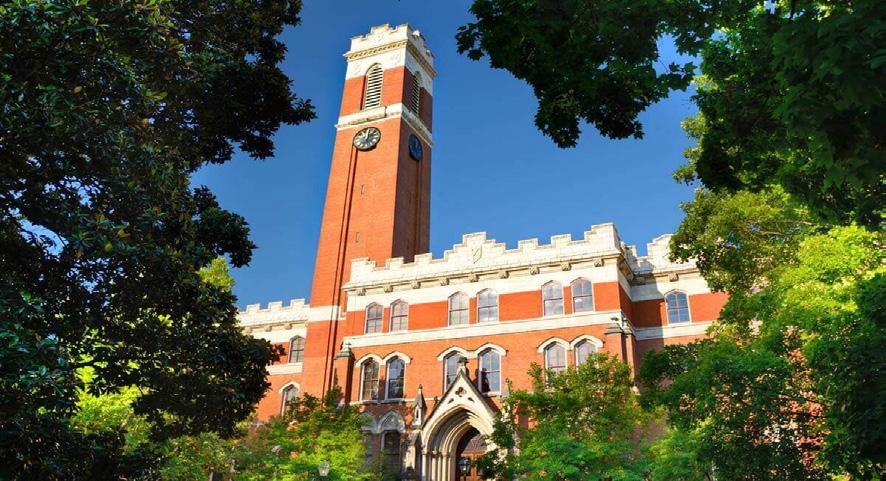
This is rational, of course. However, universities are seemingly admitting full-pay international students over domestic students who need financial aid. The problem I have with this is that universities, even private ones, are servants of taxpayers in a way, as they receive billions each year in federal funding. It’s therefore difficult to justify admissions practices that appear to prioritize revenue optimization over access for financially constrained domestic students, given the degree of public support these institutions rely on. Federal support for these institutions has always rested on an implicit expectation of broad access, and optimizing the transfer cohort for revenue quietly violates that expectation while leaving the subsidies intact. I wish universities would follow Vanderbilt’s example and be need-blind for ALL domestic undergraduate applicants. I’m incredibly grateful for how generous they were with their financial aid, as my cost of attendance is lower than what I pay currently for Binghamton while working towards a degree that will open up so many doors for my immigrant family.
Anyways, I digress.
Reflecting on my time at Binghamton, I’ve greatly enjoyed it. When I first applied in high school, I was actually waitlisted here. When I received a phone call that I got off the waitlist here, I was honestly in shock. I had a terrible college applications cycle and honestly thought I might just go to my local community college. Since arriving here, I’ve honestly gotten such a great education. My Calculus II instructor has made a tremendous impact on me and I don’t think there’s anyone as encouraging as
him to pursue my interests. My writing instructor is such a kind soul and I’ve learned so much about the hidden curriculum, which involves aspects on how to succeed in college or available resources, that I honestly had no idea about as my parents have never gone to college. She also provided a very clear motivation on why we were taking this class. My CS professor offered me a position as a course assistant, and I’ve had so much fun interacting with other peers. I have no doubt that it helped me in my transfer application. I’m incredibly grateful that my research advisor was so generous with her time throughout this year and took a chance on me despite my pretty low GPA, coming in as a freshman. I’ll miss the friends that I’ve made here. This place is honestly magical. But the food and the weather weren’t really it.. Also, I wasn’t really sure what I was going to do after college, and I feel like an institution with more resources will provide me an opportunity to learn more about what I want to do in life. Reading everyday about how cooked computer science is has frightened me into hedging my career options, so I thought transferring was right for me, as I’ll be able to pursue other careers if needed. It is funny that I’ve gone full circle, as my first article at the Binghamton Review was about being a first-generation college student, and my final one is somewhat also about it. I hope I don’t end up regretting my decision to transfer.