ISSUE13 2022-T1-W3
seeing is believing turning the invisible, visible
PRESIDENT’S ADDRESS 2022 OUR EXECS: MEET THE TEAM SOCIETY NEWS -SCAVENGER HUNT JEOPARDY WOMEN IN STEM PANEL IMAGE SOURCE: Martin Krzywinski Canada's Michael Smith Genome Sciences Centre mkweb.bcgsc.ca
O-WEEK PHYLOGENETIC TREE INTERNATIONAL WOMEN’S DAY: ADVICE FROM ALLEGRA ANGELONI
A CAREERS GUIDE TO BIOINFORMATICS: SNIPPET FEATURED ARTICLE: INFORMATION VISUALISED VISUALISATION OF SARS-COV-2 GENOME ‘GENE MACHINES’ ARTWORK BY MARTIN KRZYWINSKI CONTACT
Society News
BINFSOC
Student Guide.
We’ve finally released ‘A Careers Guide To Bioinformatics’ (affectionately known as ACGT BINF) to the world. You can find it here: https://issuu.com/binfsoc/docs/acgt_v4_print_pages ACGT is our student guide publication designed to give a curated set of information for first years and people still unsure about their degree structure. We’ve also got sections on exchange (fingers crossed), different options for picking electives, and bioinformatics-related career fields.
Scavenger Hunt.
Our first event for T1 was held in week 1 for Arc’s Taster Day. It was great to get to know some bioinformatics students who we’ve heard on zoom calls for the past year – in person, finally! First place winners got some GYG vouchers -- attend our events in future for your chance to get some yourself!
Women in STEM Panel. 15 MARCH 5:30 -- 7 PM
Want to celebrate the astounding work that women have done in STEM? Want to hear more about the research and career opportunities that come with postgraduate studies? Look no further, BINFSOC has your back. BINFSOC’s Women In STEM Panel/Showcase will give you a clear insight into the revolutionary work that our panelists are doing. Come along and chat with them about their journey and projects! Sign up Here: https://forms.gle/uZmu7qSKEH4nVj8L6
BINFSOC 2022 President’s Address
It’s T1 2022 and BINFSOC is BACK! As 2021 was BINFSOC’s founding year, our objective was to establish a tight-knit bioinformatics community, as well as uplift the development of our members by providing a supportive space for students to study, socialise and transition into industry. From O-Week ‘21 through to Term 3, that is exactly what we did, holding events such as networking nights, peer mentoring programs, trivia nights, career panels and more. Seeing the overwhelming positive response from so many Bioinformatics students at our events and via our socials has been so impactful. It is inspiring to know that the bioinformatics student experience is actively being transformed from isolated to integrated, despite the challenges presented by COVID. Now with O-Week 2022 having come and gone and as we settle into Term 1, BINFSOC is just getting started! It has been beyond wonderful meeting new club members on campus, and we can’t wait to roll out some more engaging events and publications that will keep you up to date
with all the latest and greatest research in the Bioinformatics field, opportunities to make new friends and connections, and most importantly enable you to maximise the potential from your Bioinformatics degree. So what can you expect from us next? Well, just as 2021 was a year of firsts, in 2022 our team at BINFSOC is working harder to grow even bigger and become even better. We have already kickstarted 2022 with our Scavenger Hunt, Jeopardy Night and A Complete Careers Guide to Bioinformatics publication (ACTG BINF). As we onboard our 2022 subcommittee members, prepare to meet the next generation of BINFSOC’s creative minds, and the exciting initiatives that will follow. Stay tuned and get keen for more bioinformatics puns, GYG vouchers and comfy merch to rep BINFSOC in 2022!
— Gabby Younes BINFSOC President
O-Week 2022 Thanks to everyone who came along to our stall at O-Week this year! Between our marble run and phylogenetic tree activities and freebies, we enjoyed talking to you about student life, coming back to campus in person, and of course doing our best to explain what bioinformatics is. The best way to be updated about plans for events this term and the rest of the year is to follow our Facebook page at https://facebook.com/unswbinfsoc To those that missed signing up, join our SpArc at https://unswbinfsoc.com/sparc You might have to make a new account with UNSW Arc if you’ve forgotten your login.
Phylogenetic Tree Solution O-WEEK ACTIVITY -BIOINFORMATICS DEMONSTRATION
HUMAN
NEANDERTHAL
CHIMPANZEE
BONOBO
GORILLA
ORANGUTAN
Meet the team BINFSOC Execs 2022
This year Gabby and Jason are reprising their roles from 2021, with Jasmin 2nd in command after a year in HR’s subcommittee.
Gabby
President
🔥
Fun fact: I set one of the microwaves in the business school on fire :/
Jasmin
Vice President
Fun fact: I don’t like coffee!
Jason
General Secretary
Fun fact: 1. I am still learning how to swim 2. I like surfing (the internet), and bouldering
Following our (first ever) Annual General Meeting, we’ve added some new roles to the BINFSOC Exec team: We’re splitting splitting the Digital Branding portfolio into two separate roles for Marketing and Publications/IT, which Michael and Cam are continuing on from last year. Gina’s treasurer skills from the UNSW Hall executives are a welcome addition to BINFSOC’s 2nd year.
Gina
Treasurer
Fun fact: I was born with a hole in my heart
Cam
Publications / IT
Fun fact: I have a pet yabby
Michael Marketing
🐦
Fun fact: t I am a bird nerd
Vandana and Aravind are back for a second year after being part of BINFSOC’s Events subcom; Vandana taking the lead while Aravind heads another new position this year: a dedicated sponsorship role. We’re also joined by Gabriel for HR.
Vandana Events
Fun fact: I have perfect pitch.
Aravind
Sponsorships
Fun fact: I can solve a Rubik's cube under a minute
Gabriel
Human Resources
Fun fact: By 2024 I will have three citizenships
A Allegra
> BINFSOC
Angeloni
PhD Candidate at G arvan Institute of Medical Research
Women in STEM Career Panel AC GT
WHAT’S YOUR CURRENT ROLE? I am a PhD candidate at the Garvan Institute of Medical Research and UNSW BABS. My research is focused on understanding the contribution of DNA methylation to developmental biology, disease formation and the evolution of gene regulation.
HOBBIES OR INTERESTS? When I’m not busy in the lab, I enjoy reading and discussing new books with my book club, playing social soccer and baking sweets.
ADVICE FOR WOMEN IN STEM? One of the most effective ways to learn as a scientist is to challenge yourself. Have confidence in your ability and don’t be scared of making mistakes!
-
“
We are in this together — and we will get through this, together.
— UN Secretary-General António Guterres
seeing is believing AN IMPORTANT TOOL IN BIOINFORMATICS AND THE LIFE SCIENCES: VISUALISATION.
Writer Cam McMenamie Visuals Martin Krzywinski
the gift of sight: turning the invisible visible IN THE WORLD OF THE LIFE SCIENCES, the use of data science is increasingly prevalent. With this comes great advances, and also great challenges -- and visualisation is often the key to solving both. Novel experimental techniques found in single cell transcriptomics, 3D genomics, 3D proteomics, and epiproteomics often present particular issues, with high-throughput data being challenging to comprehend.
Visualisation also goes beyond the actual hypothesis-testing process of research -- it is vital in science communication. Throughout the last two decades, the rapid improvement of sequencing techniques has resulted in an exponential increase in the magnitude of biological data. As a result, the emergent bottleneck in the process of finding new biological discoveries is the analysis itself -- and oftentimes a new breakthrough in genomics or other genetic models coincides with an analogous breakthrough in analysis techniques. However, despite the increasing reliance on data science, occasionally scientific studies will consider the use of visualisation as an “add on”, or an optional extra used to simply convey the results of a table or matrix in a more convenient form. In reality, visualisation is more than just a tool to convey information -- it is the mechanism
with which that information is understood, cognitively manipulated, and fully realised. Visual Creatures As visual creatures, we find ourselves with a world that we can explore, touch, and see in three dimensions of space. At this level, at this scale of the universe, the world is filtered down through our visual system and higher cortical areas that have evolved to recognise objects, people, animals, and landscapes. Although this system has served us well as a species; one should keep in mind that it is not necessarily a true depiction of reality. Whilst our 3D world at the human-level, with its concepts and colours and solid objects, has certainly proven useful -it may not be accurate. Since science is by definition objective (or at least, as objective a picture of reality as we can get, practically speaking), it does not ‘care’ about the nature of our human-made world and our concepts that filter everything that enters our brains. The true picture of reality, as yielded by science, is something much different to what our brains can imagine -- and sometimes, is something much different to what we can even find intuitive (quantum mechanics is a classic example of the ‘counter-intuitive’ nature of reality at the subatomic level). The biochemical pathways that comprise the
billions of cells’ activity in the liver, for instance, are a very different reality than what our brains could ever conceive of. In a similar vein, you do not know how your cells are copying themselves countless times a second -- nor do you know how you regulate gene expression. You don’t know how you are expressing genes needed for bone development; nor the intercellular communication via mRNAs. Yet you are performing all these tasks as you read this very sentence. The reality at the micro-scale, even when that reality is our own bodies, is fundamentally a mystery to our brains -- and thus the problem in any understanding of the science that reveals these mysteries, is somehow taking the reality and projecting it to a way compatible with our thinking.
Complexity The richness and information density in biological data is particularly difficult to get an intuitive grasp on. Oftentimes there are many emergent properties in cellular mechanisms that are not obvious or trivial; with feedback loops upon feedback loops upon thermodynamically equilibrating states, and so on. The amount of complexity present in just one single cell is enormously far beyond human comprehension, simply due to the number of different processes happening at once. As famously coined by Alan Watts, “A person cannot deal with more than three variables at once without using a pencil.” So, how do you turn the microscopic into something salient to understand? Or how does one turn the increasingly abstract into something concrete? These are the types of questions that visualisation attempts to answer. Space For those who’ve done any courses in molecular
biology or bioinformatics so far, the element of visualisation has already been a frequent player in understanding the frameworks with which data is represented, analysed, interpreted, and edited. A good example is when data is ‘high dimensional’, such as gene expression data in a transcriptomics experiment. Since we are unable to conceptualise geometric spaces with more than 3 dimensions, techniques from data science are used to ‘project’ the data into more manageable representation; such as by using Principal component analysis (PCA) or the t-SNE algorithm. In BABS3121, data from a single cell experiment was projected onto two dimensions and looking to see ‘clusters’ form to accurately discern two separate treatment groups. In BINF3010, transcriptomics would not be what it is without having a visual representation of gene expression; such as in the heatmaps during clustering approaches. In a way, this allows the small scale, reality of the cellular activity to be ‘transduced’, or magnified in some sense -- to get to our large scale, macroscopic, ‘human’ view of the world. Just as the many orthogonal dimensions are reduced down to a simplified (albeit distorted) view of geometric space in PCA; so too are the biological realities being “simplified” or projected onto our cognitive processes.
Tools Based on the usefulness of visualisation when applied to the life sciences, it should come as no surprise that many bioinformatics visualisation tools have been developed in the last decade or so. This development serves as an indicator of the growing use of visualisation as an integral part of analysis, and not just a convenient use of “aesthetics” or a clean-looking journal article. Two notable examples are the visualisation companies Looker and Tableau being sold for
$3B and $16B USD, respectively. Several open-source visualisation tools are also appearing on the market, such as Aequatus (http://aequatus.earlham.ac.uk/), an in depth viewer of homologous cross-species genes; or the easy-to-use Interactive Gene Viewer (software.broadinstitute.org/software/igv/). Circos (http://circos.ca/) is a circles-based visualisation tool for representing genomes and their interactions; with beautiful and aesthetically pleasing plots being a few lines of code away. Licensed under the GNU Public Licence, Circos is able to represent more than just genomics -- it has also been used to represent “the flow of refugees, where a relationship between two elements (countries) represents the extent of ingress and egress”.
Art and Science The quintessential example of what can be achieved with creativity and the wealth of information provided by open-source bioinformatics can be found in the visual works of Martin Krzywinski, a staff scientist at Canada's Michael Smith Genome Sciences Centre (http://mkweb.bcgsc.ca/). At first glance his website is a wild mess of all sorts of projects, half artistic experiment, half data analytics -like something out of a mad scientist’s lab workbench -- which is fitting given the source of many of Krzywinski’s projects. Scrolling past at the top are some of the highlights -- a DNA based sculpture setup on 10th avenue, Vancouver; charts depicting the effects of vaccination on COVID hospitalisations; and even the cover art for a vinyl record of soundscapes recorded from genetic laboratory equipment (you can listen to the album here: https://adsrmusic.ca/album/gene-machines).
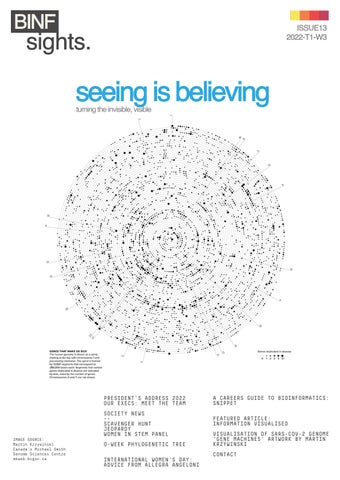
Notably, Krzywinski’s work has been featured on the cover of The Proceedings of the National Academy of Sciences (PNAS), and the Genome Informatics Conference program book. He’s also designed many infographics in Scientific American, often for studies on genetics and disease-related fields. A standout piece is his poster depicting the 13 WHO-recognised genomes of SARS-CoV-2 as a series of coloured paths: each visual path corresponds to the length of the COVID genome, created by a series of dots representing every 5th base pair in the genomic sequence. The colour ranges from red to blue, encoding the guanine-cytosine (GC) content as a proportion. Curvature is proportional to the repeat content, and the direction is determined by the GC content (whether it is above or below the average level for the whole genome). From these simple rules, a fascinating shape emerges: each twist and turn of the representation -- the “human level” depiction -remains a fundamental quality of the genome, put into terms that our eyes and brains can understand. With this, we are gifted a rare slice of the true reality that persists beyond what our minds can comprehend: the world of biology, invisible and unearthed: until we take a look and see.
BINFSOC
A C areers G uide To
Bioinformatics.
2021
[ EXCERPT FROM STUDENT GUIDE ] Full version here: https://issuu.com/binfsoc/docs/acgt_v4_print_pages
ATTGCCTTTAGATUNSW ACTBIOINFORMATICS GCCGATCGASOCIETY_
Page 1
If you are interested in Biotechnology: BABS3031 Covers bioprocessing and economic principles involved in the operation, development, and design of large-scale biotechnology-based processes
BABS3071 Commercial Biotechnology Covers aspects of biotechnology that are critical in the industry such as funding for R&D and Intellectual Property.
Page 24
School of Computer Science and Engineering cse.unsw.edu.au
If you liked…
Elective Suggestions
COMP1521
COMP3231 Operating Systems Involves the organisation and services of operating systems. Process, memory, storage management.
COMP1531
COMP6080 Web Front-End Programming Introduces the fundamentals and advanced techniques of programming for the web front-end in JavaScript.
COMP2041
COMP6714 Information Retrieval and Web Search COMP3141 Software System Design and Implementation Investigate the use of mathematically structured programming to deliver software that is more reliable, more veriıable, and more elegant
COMP2511
COMP3131 Programming Languages and Compilers Covers the fundamental principles in programming languages and implementation techniques for compilers (emphasis on compiler front ends).
COMP2521
COMP3411 Artiıcial Intelligence COMP3153 Algorithmic Veriıcation Learn about several automatic veriıcation techniques, the algorithms they are based on, and the tools that support them
COMP3121
COMP4121 Advanced Algorithms Continuation of the 3121 algorithms. Covers randomised algorithms and data structures.
COMP6741 Algorithms for Intractable Problems Explore algorithms for solving intractable computational problems (NP hard problems)
COMP3311
COMP9315 Database Systems Implementation examination of techniques used in the implementation of relational, object-oriented, and distributed database systems
COMP9318 Data Warehousing and Data Mining Introduction to the foundation of data warehousing, the theories of various data mining techniques and the practises of developing data mining applications
Page 25
AMINO ACID OF THE WEEK ---------
HISTIDINE
[ HISTIDINE ] CHEMICAL STRUCTURE --
H His
155.1546
DNA CODONS
CAY
POLARITY: DEPENDS ON pH POSITIVELY CHARGED AT PHYSIOLOGICAL pH DISCOVERY: ISOLATED IN 1896 BY PHYSICIAN Albrecht Kossel AND Sven Gustaf Hedin
PROTEINOGENIC - BUILDING BLOCK OF PROTEINS. PRECURSOR TO HISTAMINE, IMPORTANT AS AN INFLAMMATORY AGENT IN THE IMMUNE SYSTEM.
CAN FORM COMPLEXES WITH MANY METALLIC IONS IMIDAZOLE SIDECHAIN SERVES AS A LIGAND IN METALLOPROTEINS, NOTABLY ATTACHING TO Fe (IRON) IN HEMOGLOBIN (PROTEIN FOR OXYGEN TRANSPORT IN RED BLOOD CELLS)
Contact us IF YOU HAVE ANY COMMENTS or feedback regarding BINFsights, please write to us at binfsights@unswbinfsoc.com We also encourage anyone to share with us anything you’d like us to take a look at, be it a bioinformatics tool that you have made or find useful; or news in the bioinformatics world that you’d like to see written about in future issues.
TO VIEW PAST AND PRESENT issues of BINFsights, check out our website at unswbinfsoc.com/binfsights Stay tuned on our Facebook page regarding events and society news.
-- The BINFSOC Team
for
updates