THE MAGAZINE OF THE LEAGUE OF AMERICAN BICYCLISTS
SUMMER 2026 ISSUE
IN THIS ISSUE
04 OUR FIRST LOOK AT TRANSPORTATION REAUTHORIZATION Caron Whitaker
Get an early look at the House's transportation bill and what's at stake for the future of federal transportation policy.
12 BUILDING COMMUNITY AROUND BIKING IN FAIRBANKS, ALASKA Marlee Townsend
Learn how one planner is helping launch Fairbanks' first Bike Month and building a stronger biking culture.
16 SAVING AMERICA'S
2 Viewpoint: Bike Joy Summer Lauren Jenkins
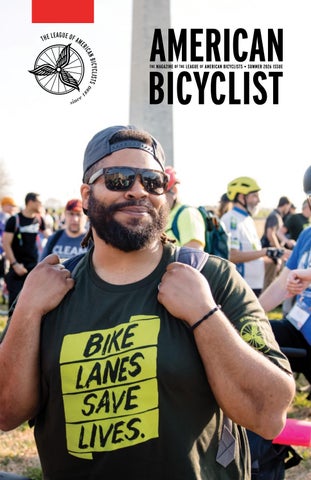
BIKE LANES
8 The Long Ride to Safer Streets
Kevin Dekkinga
26 LCI Spotlight: Vanika Mock
The League and local advocates fought to save a critical bike lane in Washington, DC—your support helps protect biking nationwide.
Marlee Townsend
30 New "Bicycle Friendly Trains" Report Grades All 46 Amtrak Lines Will Simpson
32 League SAG Wagon
20 CONGRATULATIONS
2026 ADVOCACY AND EDUCATION AWARD WINNERS! Marlee Townsend
Meet those recognized at this year's National Bike Summit for the impact they’re making in communities across the country.
EDITORS Lauren Jenkins, Communications Director Marlee Townsend, Communications Specialist CREATIVE DIRECTION & DESIGN: Ally Mabry, Graphic Designer
1
VIEWPOINT
BIKE JOY SUMMER BY LAUREN JENKINS
O
ne thing I can give summer—despite its mosquitos, its humidity, its bike-commute–interrupting evening storms—are the long days and warm (read: bearable temperature) nights. By extending the rideable portion of our daily lives, summer in turn increases the best part of daily life: being on a bike.
2
That joy of being on a bike permeates this issue of American Bicyclist, something I try to ensure in every edition as editor. Showcasing the bicycling movement is central to our mission at the League, because despite what some might say about bike lanes and safer streets, this movement reflects America—all kinds of Americans.
Lauren living her best life in Mallorca, fueling up on inspiration to bring back home.
That’s who we’re building a Bicycle Friendly America for: everyone. From school kids to adult learners, from Alaska to Washington, DC. That’s why we’re just as comfortable getting wonky on the next federal surface transportation bill and launching a new kid-friendly bookmark with bike basics on it. And all of this is thanks to members like you who support
us year in and year out. As you page through the magazine, I hope you see the bike joy you’ve made possible through our work together. Thank you for your membership and for reading the stories within, making a connection with the people of the bike movement from around the country.
3
FEDERAL ADVOCACY
Our Priorities
OUR FIRST LOOK AT TRANSPORTATION REAUTHORIZATION BY CARON WHITAKER
I
n late May, the House Transportation and Infrastructure Committee released its proposed legislative language for the next five-year surface transportation reauthorization bill. This 500-page plus bill is our first look at how Congress is approaching transportation issues in this reauthorization—and while it’s not our worst fears realized, there are proposed cuts and repeals across the board that temper any enthusiasm.
Here are the (many with an asterisk), the , and the parts of the House’s reauthorization bill.
4
Going into reauthorization, we’ve had several main priorities in our advocacy. These are the lifeblood of keeping bicycling and walking safe and accessible for everyone. Transportation Alternatives Transportation Alternatives (TA) is the largest, most reliable pot of funding for bicycling and walking projects. When Chairman Sam Graves was quoted earlier this year saying this would be a “traditional” highways bill and wouldn’t fund things like bike lanes, we grew concerned and thousands of you took action with us to remind Congress of the value of bike projects. The bill maintains Transportation Alternatives as a stand-alone program along with its statutory annual increases. This is very good. However, the asterisk is due to the removal of language limiting states’ ability to transfer funding out of TA to other projects, which had been introduced in the previous reauthorization.
Sarah Debbink Langenkamp Active Transportation Safety Act Sarah Debbink Langenkamp was a diplomat, a mother, a spouse, a person who biked. The bill named after her would ensure her life’s legacy of safer roads for everyone. Sarah’s bill has been a Summit ask of the League since 2023. Key provisions of Sarah’s bill have been included in the bill, a testament to the advocacy of her family and of advocates across the country. The provisions would make it easier for states and local governments to fund bicycling and walking safety projects. As for the asterisk, we are working with partners on an amendment that would ensure all the provisions of Sarah’s bill are included in the House’s reauthorization bill. Safe Streets and Roads for All Safe Streets and Roads for All (SS4A) is a discretionary grant program created by the previous reauthorization bill, the Infrastructure Investment and Jobs Act (IIJA). Disbursing $5 billion over five years, SS4A provided local grantees with direct access to funding for projects to plan for and implement safety improvements. Like TA, SS4A is a major source of funding for projects that make roads safer for everyone. SS4A is preserved in this reauthorization draft and includes changes that should benefit grantees, such as increasing the federal share of a project from 80% to 90%. The only asterisk is more about the unknown: the program will shift offices within the U.S. Department of Transportation and will be subject to new parameters. Magnus White and Safe Streets for Everyone Act The Magnus White and Safe Streets for Everyone Act will require a new car safety standard for bicyclist-Automatic Emergency Braking. The bill is named after Magnus White, a 17-year-old rising star in the cycling world who was killed while on a
training ride ahead of the world championships. The driver who killed him was asleep at the wheel. Lives like Magnus’s can be saved with bicyclist-AEB. The bill includes language moving bicyclist-AEB closer to being deployed in new cars. Active Transportation Infrastructure Investment Program The Active Transportation Infrastructure Investment Program (ATIIP) is another program created by IIJA—a major win by Rails to Trails Conservancy. ATIIP was intended to provide large grants to local governments to build out active transportation networks within cities, or to build connectors between communities, however its authorization did not come with funding. A push by advocates, including Lobby Day participants at the 2022 Summit, was able to secure $44.5 million in funding for ATIIP. Demand was huge: grant applications totaled more than $1.8 billion. ATIIP is repealed in this reauthorization, despite it not utilizing any funding. ATIIP projects are still eligible under the new Surface Transportation Accelerator Grant, but it is just one eligibility of many.
Other Top Issues More broadly, we’re keeping an eye on bicycling and walking issues in every section of the bill. BIKE Act The reauthorization includes updating the Highway Safety Program Guideline on Pedestrian and Bicycle Safety for elementary and secondary school students to “encourage on-bicycle training that promotes bicycling skills and safe practices,” a major provision of the BIKE Act, a 2025 Summit ask. Safety Funding The Highway Safety Improvement Program (HSIP) provides roughly $3 billion each year for all types of transportation safety projects. Before the IIJA, states spent
5
roughly 1% of their HSIP funding on vulnerable road user (VRU) safety, despite the share of VRU fatalities often being much higher than 1% of roadway deaths. The League for years advocated to create a special rule that would require states to spend more on VRU safety where VRU fatalities represented a higher share overall. In the IIJA, we secured a VRU Special Rule that required states with a VRU fatality rate 15% or higher to spend 15% or more of its HSIP funds on projects to improve VRU safety. The bill keeps the VRU Special Rule in place, ensuring continued funding for these safety projects. Project Eligibility Biking and walking projects can be funded by a broad array of core formula and discretionary grant programs. Allowing broad eligibility gives states and regions the discretion to build multimodal infrastructure, ensuring more efficient project delivery. The bill maintains broad eligibility so state and local governments can implement multimodal projects that benefit their communities. Small Project Delivery One of the most frustrating things about building high-quality bicycling and walking infrastructure isn’t just getting the funding, it’s getting the permits to actually build. For decades, small bike projects like installing bike racks have had to go through the same process as expanding the interstate. Under the new bill, the Federal Highways Administration is directed to create a short, easy-to-understand checklist to move a project through the environmental review process. We hope this will be modeled off of a similar checklist the transit administration already uses. In addition, some changes were made to make it easier to maintain and expand bicycle and pedes-
6
trian projects within parklands. These provisions were first approved under the Biden administration and this bill will codify those changes. Lithium Ion Battery Safety Standards The bill also requires the Consumer Product Safety Commission to transform their voluntary lithium-ion battery standards to permanent, required UL standards. (Anti-)Speeding Program For the first time, Congress is directing behavioral safety funding administered by NHTSA to address speeding, which is involved in about 30% of traffic deaths. While the focus is on speeding, the funding can also be used to post new—hopefully lower—speed limit signs. As in previous bills, automated speed enforcement is limited to school and work zones. MOVE Act The original MOVE Act required a study on the safety of micromobility, especially as it pertains to children, and high-speed personal transportation devices (such as e-motos). A study on micromobility is included in the bill, but high-speed personal mobility devices were left out. MOVE Act sponsor Representative Titus offered an amendment to include the faster vehicles in the study but withdrew the amendment because the votes weren’t there in the end. Bridge Access Under IIJA, project sponsors were required to provide bicycling and walking access on bridges if it could be done at a reasonable cost (as determined by the Secretary). The new bill says a Secretary may require it, but that such access isn’t automatically required.
Recreational Trails We had been working on an option to increase funding for recreational trails while maintaining existing funding for local active transportation projects. We were unsuccessful and Rec Trails will stay at its current level. Healthy Streets Authorized but not funded by IIJA, the Healthy Streets program would fund communities to address urban heat islands and flooding in low-income neighborhoods and communities of color. As a League ask, we had been successful in getting funding in the House budget but not the Senate. The bill repeals Healthy Streets and any potential for funding. Carbon Reduction Program The IIJA included the first-ever Climate title (essentially a dedicated subject area) in a transportation bill. With that title, the Carbon Reduction Program offered more than $1 billion a year for both bicycling and walking projects, as well as for projects that could help encourage more biking: congestion pricing, traffic demand management, and speed management. In the last two years, bicycling and walking projects received around 9% of funding from the Carbon Reduction Program—about $130 million per year. Along with the entire Climate title, the bill repeals this program. Bike and Safe Routes Coordinators The law requires every state DOT to have a Bicycle and Pedestrian Coordinator. That requirement is still there but changes their title to Bicycle and Pedestrian Safety Coordinator and changes their mission to only address safety concerns, and not—as was the case from 1991 until present—to promote active transportation. This gets an ugly because it is such a petty change!
Safe Routes to Schools Coordinator. In 2012, Congress removed that requirement. Since 2012, states that have retained statewide Safe Routes to School coordinator positions provide more robust programming, support implementation of infrastructure to support safe student travel near schools, and reach a wider array of communities, including small and rural communities, than states without statewide Safe Routes to School coordinators. Neighborhood Equity and Access Created by the Inflation Reduction Act of 2022, the Neighborhood Access and Equity (NAE) Program made $3.15 billion available to focus on improving community connectivity, especially in communities that had been made vulnerable by historic and/or contemporary policy, funding, and infrastructure decisions. In 2025, Congress moved to rescind all unobligated funding for NAE. This bill formally repeals authorization for the program.
What Comes Next The authorizations enacted by the IIJA expire on September 30, 2026. Congress is highly unlikely to pass a new bill before then. Rather, we will likely see a continuing resolution extending the IIJA for a short amount of time while the House and Senate hash out their differences. We knew this would be a difficult year for our priorities in reauthorization. Yet, the core of our work remains intact. It’s a testament to advocates at the local and state levels, and allies in Congress, who have made bicycling safety a non-negotiable at the national level. As we look to next steps, we’ll keep working to make sure those priorities continue to be reflected.
The League also supported the Safe Routes Partnership bill to reinstate a requirement for states to have a full-time
7
POLICY
A
THE LONG RIDE TO SAFER STREETS BY LOCAL ADVOCATES
8
dvocating for better places to bike and walk takes persistence, patience, and the willingness to keep showing up, even when progress feels slow. That's why it's important to celebrate the wins, no matter how incremental. With that in mind, we rounded up a few recent wins from local and statewide bicycle advocacy organizations across the country. Consider this a bit of inspiration to help you keep up the good work in your corner of the world. Progress is possible.
BikeLA launches a new Metro Bike Hub Earlier this summer, BikeLA was joined by Los Angeles Walks, the Willowbrook Inclusion Network (WIN), and Metro to activate the Los Angeles Metro Willowbrook Station community space. Through this partnership, the site will serve as a hub offering bicycle safety education, bike repairs, and valuable community resources at one of Metro's busiest transit centers. The event also featured a portrait exhibit honoring longtime mobility justice leaders in Los Angeles, photographed by Samantha Ramirez through the Las Fotos Project Digital Promotores program. Bike East Bay celebrates cutting the ribbon on the latest 1/2 mile of the planned 30-mile East Bay Greenway trail in Oakland This project includes an off-street bike/ walk trail north of the Coliseum BART train station in a historically disinvested part of East Oakland. New pathway lighting, 70 new street trees, pedestrian crossing treatments, and traffic signal upgrades were included. This is part of Bike East Bay's campaign for a planned 30-mile East Bay Greenway connecting Oakland to Fremont with a series of trails and protected bikeways between BART stations. More segments are in development and coming soon. BikePGH helps Pittsburgh build joyful, active transportation into everyday school trips BikePGH is seeing momentum after creating a Bike Bus Guide to help communities start and sustain bike buses and walking school buses. As of Pittsburgh's May 2026 Walk & Roll to School Day, at least twelve Pittsburgh Public Schools have participated in some form of walk- or bike-to-school initiative. BikePGH also helped five Pittsburgh schools apply for Outride's Riding for Focus program, supported implementation at four schools, and donated approximately 600 bike lights and helmets.
9
BikeWalkKC successfully advocates for Kansas City, Missouri’s New Ordinance to Ban Right Turn on Red in School Zones Following several high-profile crashes involving young children, Kansas City, Missouri adopted an ordinance banning right turns on red in school zones. BikeWalkKC advocated for stronger language that aligns with its efforts to make streets safer for e-bike and scooter users. A child who participated in BikeWalkKC's Community Transportation Academy testified in support of the ordinance; Russell, who is visually impaired, shared how unsafe streets prevent him and many classmates from walking to school despite living nearby.
From above: Russell with Mayor Quinton Lucas of Kansas City; Illinois delegation at Lobby Day in 2026.
10
Ride Illinois celebrates "Stop Super Speeders" bill signed into law in Illinois Speeding contributes to one-third of fatal crashes in the United States and a small number of "super speeders" are responsible for a disproportionate share of those fatal crashes. Ride Illinois partnered with Families for Safe Streets, the Illinois Secretary of State, and law enforcement to pass HB 4948, which Governor Pritzker signed into law on June 26, 2026. The organization's goal was to educate elected officials during the spring legislative session. Interest in the bill exceeded expectations, and it passed during the first legislative session in which it was introduced, a rarity in Illinois politics. Families for Safe Streets was an invaluable partner throughout the campaign.
More than half of campuses lack e‑mobility policies A joint report by UL Standards & Engagement and the League of American Bicyclists found that campuses need clearer, more adaptable guidance. We partnered with LAB to create a model policy which campuses can adopt to support safer riding, parking, storage, and charging
Scan here to learn more and access the model policy:
BICYCLE FRIENDLY AMERICA
BFC SPOTLIGHT:
BUILDING COMMUNITY AROUND BIKING IN FAIRBANKS, ALASKA BY MARLEE TOWNSEND
12
B
iking in Fairbanks is challenging, but not for the reasons you might assume from a city deep in the interior of Alaska. Fairbanksans are rarely fazed by the cold; winter temperatures regularly dive into the negative double digits, and residents go about their days in relative nonchalance despite monthslong darkness and endless snow. Fat tires and bright lights make biking throughout the winter totally feasible for these hardy Alaskans.
It’s not necessarily the terrain, either. The city of Fairbanks isn’t the frigid mountainous iceblock that folks from the lower 48 might imagine—the city, built in a basin, is actually pretty flat. Biking and walking trails are abundant, and low traffic volume (a perk of living in one of the most remote cities in the U.S.) means you can usually meander through the city without encountering traffic jams, even in construction season. One challenge is the community’s sprawl. Alaskans tend to prioritize their private acreage, and many prefer to live in the hills surrounding Fairbanks. Olivia Lunsford, a transportation planner at Fairbanks Area Surface Transportation (FAST) Planning and a participant in the League's Active Mobility Leadership Lab, says her commute is about 12 miles with 800 feet of elevation gain. “You get used to the distance,” she says. “I’ve used our active transportation network for years, mostly on rollerblades. In 2019, I got my first bike, a hot pink Cannondale, and realized this is a way more fun way to get around Fairbanks.”
According to the most recent American Community Survey (ACS), 2.7% of Fairbanks commuters bike to work, more than five times the national average of 0.5%.
Like Olivia, plenty of residents already ride their bikes year-round despite the snow and sprawl. According to the most recent American Community Survey (ACS), 2.7% of Fairbanks commuters bike to work, more than five times the national average of 0.5%. Students at the University of Alaska Fairbanks (UAF) frequently use the bike network, often opting for UAF’s bicycle rental program to get around. Groups of international workers arriving through the J-1 visa program to support the city’s tourism economy regularly rely on bikes provided through local partnerships. More families than ever are choosing to ride, and FAST Planning has distributed more than 600 high-visibility safety vests to local children. Olivia says, “I see gaggles of children wearing them all over the place.” The real challenge is building the kind of culture, partnerships, and community
13
support that help biking grow beyond a committed core of enthusiasts and into the broader Fairbanks community. In particular, many residents worry about traffic safety. According to the Connect Fairbanks Non-Motorized Plan, 71% of Fairbanksan cyclists describe themselves as “enthusiastic and confident,” with another 20% reporting they were “interested but concerned.” Olivia shares that concern, despite being a confident cyclist herself. A major factor in how it feels to ride on Fairbanks roads is the drivers. If what you picture when you think of Alaskan traffic is a giant truck, you’d be right. Alaska is no exception to the car bloat phenomenon, and it sounds like everybody’s driving a souped-up dually. Even once you get used to sharing the road with ice road truckers, there’s still the stigma to overcome. “When a buddy of mine first moved here,” Olivia recalls, “people would see him bike commuting and say, 'That sucks! You must be biking because you got a DUI or lost your license.’”
The assumption that biking is a last resort rather than a legitimate choice is something the community has been actively working to shake. “So many people don’t even realize how convenient and fun biking is. Plus, we have so many dark winter days, and bikes are excellent for mental health.” Winter, in particular, is when the maintenance gap really comes into play. Fairbanks has a solid bike network, but when winter comes, upkeep is minimal, and there's not a dedicated group of citizens consistently pushing for more. When Olivia joined the League's Active Mobility Leadership Lab, she came in with all of that context in tow. Throughout the Leadership Lab, League staff guided Olivia and participants from four other communities through training sessions, peer learning opportunities, oneon-one coaching, and the development of community action plans. A key part of the program asks participants to assemble a local working group, helping to build local collaboration, accountability, and community buy-in for projects that can help increase walking and biking. For Olivia, that local working group became the most valuable part of the experience. “I often feel very isolated in my work,” she says. “There are a lot of people heavily reliant on what I do [as a transportation planner], and yet the work is not super participatory. The Leadership Lab has been a really nice way to reorient with people who are willing to participate.” As the local working group began discussing Fairbanks’ needs, one idea quickly gained traction: Bike Month. National Bike Month, held each May, gives communities a framework to bring the community together to celebrate and encourage biking, and to help build bike culture.
ABOUT THE PROGRAM
Active Mobility Leadership Lab The Active Mobility Leadership Lab is a 16-week training program generously funded by the U.S. Centers for Disease Control and Prevention in support of their Active People, Healthy NationSM Initiative. Participants (local government agency staff in emerging and aspiring Bicycle Friendly Communities) form a working group, develop an Active Mobility Action Plan, and receive training, resources, and direct technical assistance from the League to implement it.
For Olivia and her local working group, normalizing biking and building public support through initiatives like Bike Month is an important step toward longer-term change in Fairbanks. By helping more residents experience the benefits of biking firsthand, the group hopes to build support for the programs, policies, and infrastructure improvements that make it easier and safer for people to bike as part of daily life. Beyond shaping the Bike Month action plan, Olivia says the Leadership Lab changed how she approaches community engagement and coalition-building. “It has helped me figure out best outreach practices and standards, made me ask how I can find new ways to strategize, and inspired new creative tactics,” she says. “I made a ‘gravel for breakfast’ video as part of an effort to win a street sweeper, and that creative energy came from the Leadership Lab for sure.”
Perhaps most importantly, the Leadership Lab helped turn what felt like a personal ambition into a shared community effort. “It went from me asking myself, ‘Am I the only one who wants to do Bike to Work Week?’ to having a whole group of people stoked for an entire Bike Month,” says Olivia. Planned for May 2027, the first Fairbanks Bike Month is still taking shape. But for Olivia, that's already a sign of success. What started as one planner's idea has grown into a community effort, with partners across Fairbanks helping to build a stronger culture around biking and creating more opportunities for people to experience the city by bike. By bringing more people into the conversation today, Fairbanks is laying the groundwork for the community support needed to make active transportation a more visible and accessible part of everyday life.
15
BY KEVIN DEKKINGA
16
b
ecause of supporters like you, the League is a powerful force for advocacy in Washington. This summer, we need your help to face our biggest challenge yet.
When the federal government moved to quietly rip out the 15th Street protected bike lane in Washington, D.C., a critical connector in the region’s bike network, the League of American Bicyclists and our local allies fought back—and won. The 15th Street bike lane serves 4,000 riders per day and its installation reduced crashes by 46%, including a 91% decrease in bicycle crashes. All this while increasing vehicle flow by 17%! Truly we weren’t up against logic but a culture war against biking and walking. With our friends at the Washington Area Bicyclist Association, the local advocacy organization, we rallied hundreds of advocates on 15th Street and the steps of DC's Wilson Building. Thousands signed petitions. On April 9th, a federal judge ruled in our favor, finding the removal "arbitrary and capricious." It was a victory for the region—and a signal to the entire country that bike infrastructure is worth fighting for. The story of the 15th Street bike lane is analogous to the larger battle for life-saving bike infrastructure. This has been our fight since 1880. Unfortunately, in 2026 that means fighting against the forces of a larger culture war that favors an idea of American life forever tied to driving as fast as possible. You may have seen a recent statement from Secretary of Transportation Sean Duffy trumpeting the ending of transportation dollars for “DEI bike
"The League of American Bicyclists is a vital national partner for a regional organization like the Washington Area Bicyclist Association, where I work. We work in DC, Maryland, and Virginia, and we were alerted by the League to a federal threat to take away a vital bike lane. The word came through federal channels which we were not a part of. We sued to stop it—and won—and the League was a crucial partner to us from the beginning—they even sat in court with us the day we were in court. I am so grateful that national leaders like the League have our backs and partner with us—we couldn't do our work nearly as well without them." –Elizabeth Kiker, executive director, Washington Area Bicyclist Association 17
lanes” and heralding the return of “real” transportation. Belittling bikes as a mode of transportation and then removing bike lanes and other road safety treatments from the Federal Highway Administration’s Proven Safety Countermeasures is not the way to make our roads safer for everyone.
making connections on Capitol Hill, it comes from the hundreds of advocates lobbying at the National Bike Summit, meeting their Members of Congress directly, as well as the tens of thousands of safe streets champions sending messages to congressional offices in support of critical legislation.
In the League’s 140+ year history, we’ve seen steps forward and steps back. Regardless of the direction of political winds in Washington, the League pushes forward. For neighborhood vitality, for personal health, for transportation justice: the fight is far from over. This summer, we’re asking for your support so we can strengthen our federal advocacy and push back against threats to safe biking and walking. Our campaign is being kicked off by a generous longtime donor pledging to match the first $10,000 of contributions. Will you help us leverage this pledge and protect the future of biking and walking? As a true ‘League’ of bicyclists, our power doesn’t just come from our team of insiders
18
With so much on-the-line in 2026, we’re asking you to directly invest in our federal advocacy work to ensure we’re able to build political pressure to save America's bike lanes. All gifts in this campaign are fully tax-deductible and contributions of $75 or more grants you our new Bike Lanes Save Lives five-panel hat! Your gift to the League today keeps our advocates at the table—in the courtroom, in the halls of Congress, and in communities across the country.
Together, let's double biking and walking by 2030 — from Maine to Florida and beyond!
19
POLICY
CONGRATULATIONS 2026 ADVOCACY AND EDUCATION AWARD WINNERS! BY MARLEE TOWNSEND
W
e were honored to celebrate the annual Advocacy and Education Awards at
this year’s National Bike Summit—one of the most beloved traditions in our movement and a chance to lift up the people and organizations doing the hard, joyful work of making bicycling safer, more inclusive, and more accessible across the country.
The 2026 award winners represent the very best of our movement: dedicated professionals, tireless volunteers, inspired educators, and creative changemakers who go far beyond what’s asked of them. Their work is building a more impactful, inclusive, and Bicycle Friendly America for everyone.
Youth Empowerment Award
Major Taylor Michigan Cycling Advocacy Major Taylor Michigan Cycling Advocacy (MTMCA) is a Detroitbased nonprofit that transforms bicycles into tools for economic mobility, workforce access, and community empowerment. Mark “Marco” Speeks is the organization’s founder, executive director, and a League Certified Instructor (LCI). Named for famed cyclist Marshall “Major” Taylor, MTMCA operates five interconnected programs that build a cycling culture rooted not in recreation, but in access, independence, and opportunity: the Joe Louis Greenway Bike Bus; Operation: Rack and Roll, an infrastructure initiative installing bike racks at Detroit Public Schools adjacent to the Joe Louis Greenway; Stride and Glide, a balance bike literacy program for pre-K through third grade; Bikes 4 Employees, a revolving loan fund connecting transportation-insecure workers with bicycles and gear; and Bicycle Safety Town at the Detroit Historical Museum, a museum-based bicycle safety program. Together, these programs reflect MTMCA’s deep commitment to making Detroit a city where cycling is essential transportation for everyone.
20
Susie Stephens Joyful Enthusiasm Award
Marley Blonsky, All Bodies on Bikes
Marley Blonsky is a nationally recognized cycling advocate, speaker, and educator whose work centers a simple but powerful idea: biking should be for everyone. She is the co-founder and executive director of All Bodies on Bikes, a nonprofit dedicated to creating welcoming spaces for people of all sizes to experience the joy of cycling. Marley has worked with bike brands to advance size inclusion and accessibility across the bike industry. She is a columnist for Cycling Weekly and a sought-after speaker on inclusion in outdoor recreation. In 2024, she was named an Outsider of the Year by Outside Magazine. Based in Portland, Oregon, she can usually be found on her bike, building community, and sharing the adventure.
Emerging Leader of the Year
Laura Pauls-Thomas Laura Pauls-Thomas is a storyteller, community organizer, and self-described joymonger based in Lancaster, Pennsylvania. A certified League Cycling Advocate, Laura is the founder and director of Ride, Roll, & Stroll Laster: a young adult-led, intergenerational advocacy and community-building project that advances safe biking, walking, and better transit. They also serve as a transit organizing fellow with Transit For All PA and volunteer in leadership and board roles across multiple transportation, land use, and urban vitality organizations in Lancaster. Laura works full-time as a nonprofit communications director, and still manages to weave advocacy, connection, and genuine joy into everything they do. When they’re not busy doing any of the above, Laura enjoys knitting, sewing, traveling, and being outdoors with their spouse, Andrew, and their dog, Pinto.
Gail & Jim Spann Educator of the Year
Fernando Martinez
Fernando Martinez’s relationship with bicycles began in the early 1980s in Mexico City, where he was introduced to the sport through the manufacturing of steel bikes and bike parts. He became a League Cycling Instructor in 2005, when he managed the Texas Safe Routes to School regional program in Amarillo. Now the head of the RideONE Bicycle Program in Commissioner Rodney Ellis’s office in Houston, Fernando has designed and led initiatives that have helped position Houston and Harris County as national leaders in cycling. His days are filled with bike rodeos, community rides, group rides, rolling meetings, and “golden rider” programming—work he approaches with the belief that the true power of bicycles lies in their ability to connect people and create lasting change.
21
Professional Advocate of the Year
Jacob VanSickle, Bike Cleveland
Jacob VanSickle has served as executive director of Bike Cleveland since 2012, growing the organization into Ohio’s leading safe-streets advocacy force. Under his leadership, Bike Cleveland has helped secure more than 160 miles of bike lanes and trails across the city and advanced model policies including Complete Streets legislation and Ohio’s three-foot passing law. Bike Cleveland’s outreach programs engage more than 12,000 people on bikes each year, educate more than 1,000 youth and adults in safe bicycling, and host the Bike Cleveland Fundo. Jacob helped convene the founding leadership team that built Bike Cleveland from the ground up. He is a generous resource for executive directors and advocacy organizations across the country looking to be more effective in their own communities.
Bicycle Friendly America Leadership
Ken Rose
Ken Rose leads the CDC’s Active People, Healthy NationSM initiative: a nationwide effort to help 27 million Americans become more physically active by 2027. A leading expert on how transportation and community design shape public health, Ken has spent nearly three decades at the CDC advancing active, healthy communities. He is an everyday cyclist and a longtime leader in Atlanta’s bike community, bringing both national perspective and real-world experience to his work. His career is a testament to what it looks like when public health and active transportation champions work together, and the League is proud to honor his extraordinary contributions.
Katherine T. “Kittie” Knox Award
MassBike and Plays in Place
This year’s Kittie Knox Award honors a collaboration between two organizations that are bringing Kittie Knox’s trailblazing story to new audiences in a genuinely unexpected way. In 2025, in partnership with MassBike, Plays in Place produced the Kittie Knox Plays: a series of “bike” plays about the biracial barrier-breaker Kittie Knox herself. Earlier this spring, the two organizations published a book of the plays, complete with production photos, essays, and production tips, to encourage cycling and theatre groups everywhere to explore Kittie’s legacy. Plays in Place was also recently recognized with the 2025 Excellence in Consulting Award from the National Council on Public History.
22
Club of the Year
Elmhurst Bicycle Club Founded in 1977, the Elmhurst Bicycle Club (EBC) is one of the largest, most active cycling clubs in the Chicago region. With members throughout northeastern Illinois and beyond, EBC rides at the speed of fun, welcoming cyclists of all skill levels year-round. Their reach extends far beyond the ride itself: EBC members can be found volunteering at regional cycling events and making the case for safer streets at every level of government. The club has been actively involved in bicycle advocacy at the local, state, and national level for more than 20 years, spearheading safety and infrastructure improvements, engaging with elected officials on relevant legislation, and showing up consistently where it counts.
Advocacy Organization of the Year
BikeWalkKC
BikeWalkKC works to make the bi-state Greater Kansas City region a place where residents are no longer required to drive to thrive. BikeWalkKC is reshaping what mobility looks like in Kansas City and beyond through advocacy, public policy, Safe Routes to School programming, urban planning, and bike share initiatives that support people living with transportation insecurity. As a founding member of Missourians for Responsible Transportation (a collaboration of the state’s four regional mobility organizations), BikeWalkKC has also been a consistent resource and partner for advocacy organizations nationwide.
Citizen Advocate of the Year
Rob Kadota
Rob Kadota is the mayoral-appointed chair of the City of Los Angeles Bicycle Advisory Committee and a League Cycling Instructor since 2023, with more than 350 hours of instruction specializing in Adult Learn to Ride classes. He was also a proud participant in the League’s inaugural League Cycling Advocate (LCA) class. Rob’s volunteer footprint is expansive: he staffs the Mar Vista Farmers Market Bike Valet and Repair Stand, supports SAFE, SFA, and Bike LA, and volunteers as a tandem captain with Wayfinder Family and Velo Club LaGrange, working alongside visually impaired stokers.
! SAVE TH E DATE
Join us March 9–11 in Washington, DC, for the 2027 National Bike Summit!
READY TO PRESENT AT THE SUMMIT? SUBMIT A PROPOSAL!
23
WE KNOW BIKE PARKING. Inside and out.®
®
Download our free bike parking guides at www.dero.com
50 YEARS of the best
Bicycle Routes in the U.S. Adventure Cycling is a nonprofit that inspires, empowers, and connects people to travel by bike.
Discover your next adventure
SMART CYCLING
Vanika with her husband, Dexter.
LCI SPOTLIGHT:
VANIKA MOCK BY MARLEE TOWNSEND
The League certifies hundreds of League Cycling Instructors every year and there are thousands of LCIs across the country leading bike education efforts in their communities. In our LCI spotlight series, we share the stories of League Cycling Instructors doing what they do daily: educating, mentoring, and empowering. You don’t have to be an extraordinary athlete or overachieving student to be a stellar LCI; all you need is the conviction that life is better for everyone when more people ride bikes.
26
T
his month, we connected with League Cycling Instructor Vanika Mock, co-leader of Black Girls Do Bike NYC. Vanika came to cycling later in life and hasn’t looked back since—and these days, she’s as passionate about bringing others into the bike movement as she is about getting out on the bike herself. In this spotlight, she shares what sparked her love of cycling, what it meant to find a community that felt like home, and what keeps her showing up to teach.
Tell us a little about yourself and why you enjoy teaching bike education. You are never too old to learn to ride a bike. I didn’t learn until my 40s because I was always intimidated by the idea, but I am so happy I finally did. There is a whole world out there for cyclists, and I love being a part of it. Teaching others to bike is very personal to me because I used to be the one making excuses until I finally committed to learning. When I first started riding with a group, their motivation and encouragement were essential. With their support, I ended up completing three centuries—something I never imagined I could achieve. Since then, I’ve even cycled through the hills of Italy and Colorado. Riding has become a true source of happiness for me. I ride my bike regularly as one of the co-leaders of Black Girls Do Bike NYC. I have met some of the most phenomenal women all across the five boroughs. When we ride together, we have the most amazing experiences. This has truly been life-changing!
If you are part of a community that is underrepresented in cycling, please tell us about your experience and how it shapes your approach to cycling education.
Partner Spotlight: Black Girls Do Bike (BDGB) is a 501c3 organization that was created to give BIPOC an opportunity to bicycle in a supportive and caring environment. Currently, there are over 100+ chapters worldwide, and 30,000 members. Learn more at blackgirlsdobike.org.
Discovering Black Girls Do Bike NYC changed everything. Seeing a group of Black women cyclists for the first time was an incredible experience. I was welcomed into a community of women from all walks of life who cycled for fun, competition, and commuting. Through their support, I gained the confidence to ride in traffic, learned essential safety signals, and found dedicated riding partners. My involvement grew until I became one of the four leaders of the organization. I eventually completed my training to become a League Certified Instructor (LCI).
Black women are significantly underrepresented in the cycling community, often due to the high costs associated with the sport. Between purchasing a bike, jerseys, helmets, and necessary tech, cycling can feel like an unattainable reach for many in New York.
Now, I volunteer as a marshal for major events like the 5 Boro Bike Tour and the Tour De Bronx, and I serve as an LCI for programs like Skyscraper (NY), where I teach young students how to ride safely and confidently.
As a BIPOC individual, I rarely saw people who looked like me cycling in the city. Initially, I felt too intimidated to ride alone, which eventually led me to quit altogether. I simply didn’t believe there was a place for me in the New York cycling world.
Seeing other cyclists utilize the skills I’ve taught them is incredibly rewarding. I strive to ensure every rider feels supported, encouraged, and educated. For me, cycling is no longer just an activity—it is a way of life.
27
What first motivated you to become an LCI? I was motivated to become an LCI by the other leaders of Black Girls Do Bike NYC. We took the training classes together to support and encourage each other. I also wanted to learn how to be a better rider and teacher.
What has been your greatest reward in teaching bike education? My greatest reward in teaching bike education is watching the smile on a new rider’s face when they finally ‘get it’! Or, when a former rider sends another student my way.
What is your best piece of advice for an LCI who wants to teach a class but isn’t sure how to get started? My best piece of advice for someone who wants to teach a class and isn’t sure how to get started would be the following. 1. Start with the end in mind. Picture what your successful class will look like. How many students need to show up for it to be a success? Location of class? Days and times of class? 2. Decide who your audience will be— youth or adults? How will you reach potential students? 3. Review your class notes. They will inspire you to write out your program and lessons. From above: Blessing of the Bikes at St John the Divine Catholic Church in Upper Manhattan the day before the 2026 TD Five Boro Bike Tour in New York. Many pictured are Rider Assist Marshals at the 5BBT;
4. Reach out to your LCI Instructor or classmates for help. They can help motivate or inspire you. Perhaps they can even help you teach the class! You can also bounce ideas off people who know you and your abilities.
Vanika riding in Italy in 2024.
5. Check out the League Cycling Instructor portal for additional information. Don’t reinvent the wheel. There is so much information already provided for you.
Opposite: Vanika with her husband, Dexter.
28
What is something you think that all LCIs should know about teaching bike education? I would want all LCIs to know that teaching bike education is fun and very rewarding. You will also meet a bunch of really cool people from all walks of life!
Give us an interesting or funny fact about you. My husband and I are huge outdoors people… We bike, camp, fish, boat, and hike. We absolutely love the outdoors. We also took the Polar Plunge in NYC on January 1st!
What is your favorite thing about being on a bike? The freedom of riding on the open road is my favorite thing about being on a bike.
What is your favorite memory from being on a bike? Riding my bike is a significant stress reliever for me, especially after a busy week as a New York real estate broker. This downtime allows me to reflect on my work and helps me to stay present when it matters most. Additionally, my husband and I bike together regularly. It is a wonderful way for us to connect as a family and enjoy quality time together.
ABC Quick Check Bookmark Helps Kids Get Ready to Ride Our updated ABC Quick Check bookmarks teach the basic elements of bicycle safety and key steps to make sure your bike is ready to ride. With a colorful new design, these bookmarks are a great lowcost, high-impact tool for cycling educators, advocacy organizations, and schools to share with students. Packs of 50 make it easy to supply an entire classroom, clinic, or camp.
SCAN TO UPGRADE YOUR YOUTH OUTREACH MATERIALS!
29
POLICY
O
NEW “BICYCLE FRIENDLY TRAINS” REPORT GRADES ALL 46 AMTRAK LINES BY WILL SIMPSON
n behalf of the Amtrak Bike Task Force, the League is proud to release Bicycle Friendly Trains: a systematic, route-byroute benchmark of how well Amtrak accommodates cyclists and their bikes.
In the report, we scored all 46 Amtrak lines on a 0–100 scale, looking at the things that matter when you're traveling with a bike: how many bike spaces are on board, what it costs, whether you need a reservation, how easy booking is, and whether the stations along the way can actually get you and your bike on the train. The framework is adapted from the European Cyclists' Federation's Cyclists Love Trains reports, which have been grading Europe's railways since 2021.
How Did the Rankings End Up? The Cascades (87) and Gold Runner (86) earned the only "Excellent" scores in the country, with ratings in striking distance of the top-scoring railways in Belgium and Switzerland. The Hiawatha (78), Pacific Surfliner (75), and Wolverine (74) round out a strong top five. Looking below the top five, there’s quite a dramatic gap between the frontrunners and the rest of the country’s rail lines. Two-thirds of all bike-service lines land in the "Moderate" band, with the average line scoring in the low 50s. And seven lines, including the Acela and the Auto Train, offer no bike service at all. Despite the moderately low bar, here's the good news: this is a snapshot taken right before things get better. Amtrak's new Airo trainsets are rolling out starting this year, doubling bike capacity on many routes and finally retiring the dreaded
30
front-wheel-removal requirement. The Vermonter alone is projected to jump 20 points once Airo arrives.
Average Score of Amtrak Lines with Bike Service(s) Offered For Amtrak lines with bike service(s) offered, the following is a 0–100 measure—including +10 max./-10 min. bonus/minus points— of the accessibility of bringing one’s bicycle onboard, based on adapted criteria from European Cyclists’ Federation (Cyclists Love Trains) reports. Note: * = Available at select stations
Bicycle-Friendly Trains Where Amtrak Stands on Bicycle Access—and What Comes Next
Who’s Keeping Amtrak on Track? Amtrak's overall scores show plenty of room for improvement—and we all have a role in making that happen. One major factor preventing more proactive changes is the fact that Amtrak owns just 13% of the stations it serves, 9% of the platforms, and 7% of the parking lots. Even the tracks themselves are primarily owned by freight railroads, with Amtrak owning only a mere 3% of its route mileage. Since Amtrak doesn't control much of its own footprint, local advocates play a powerful role in improving bike–train travel. Look no further than the report’s three case studies for proof of what’s possible when communities refuse to let institutional inertia slow them down: • In Anniston, Ala., the city and a regional rail commission extended a too-short platform to connect the Crescent to the ~100-mile Chief Ladiga/Silver Comet trail corridor. • In Davis, Calif., a university, a micromobility operator, and a joint powers authority built a pilot program that links your purchase of a train ticket to a free bikeshare (or scooter-share) ride. • In Columbia, S.C., a small bike co-op installed wayfinding signs directing riders straight from downtown to the Amtrak station. Instead of waiting for Amtrak, people in these communities took the initiative to make the train more useful for local riders, and we applaud their efforts. Making trains more accommodating for cyclists is a collaborative effort, and local organizations and advocates are key to accelerating momentum where it's needed most.
BICYCLE-FRIENDLY TRAINS: WHERE AMTRAK STANDS ON BICYCLE ACCESS—AND WHAT COMES NEXT · THE LEAGUE OF AMERICAN BICYCLISTS · BIKELEAGUE.ORG
PAGE 16
We hope you will join in this effort! We need your local advocacy to improve stations not owned by Amtrak, to work with communities to create safe routes to trains, and to support adequate funding for Amtrak as a key component of our transportation system. Learn more about how individuals can support this work by exploring the report’s recommendations for advocates, communities, and station owners to improve bike travel on Amtrak. The report also includes the Amtrak Bike Task Force’s recommendations for Amtrak. This year, our top priorities for Amtrak are to improve the reservation system so it is easier to see which routes have bike accommodations; add service at trailadjacent stations like Anniston, Ala., White Sulphur Springs, W.Va., and Greenville, S.C.; and create a bundled USA Rail + Bike pass to make it easier for long-distance riders to plan and arrange their trips.
What Comes Next? This report marks a milestone in rating bike–train travel, providing a quantitative baseline for assessing Amtrak’s current bike inclusivity. The report is meant to help the Amtrak Bike Task Force and advocates across the country push for the changes that matter most, and we'll be tracking progress as the network evolves. In the meantime, the full picture is in the report.
31
G
WAG N O
SA
LEAGUE SAG WAGON
BY MARLEE TOWNSEND
I
n this summer SAG wagon, we asked staff members: what change in your community would make your biking life better?
32
WILL I’m excited for the Metropolitan Branch Trail to go all the way to Silver Spring! I have cousins there, so it’ll be really nice to take that path all the way there.
MARLEE I live on a street that stretches between downtown Abingdon’s Main Street and the entrance to I-81. It’s signed for 25 but no one’s actually driving that slow, especially coming off the interstate, and it’s always scary to cross the street whether you’re going on foot or by bike. I’d really love to see more traffic-calming measures to slow down the cars, and some more basic infrastructure like crosswalks and sidewalks.
K E L LY I live in Bethesda, Maryland and I'm proud that Montgomery County has continued to improve our bike infrastructure despite constant pushback on social media from a few vocal critics following each announcement of the opening of a new stretch of county bike lanes.
33
CARON DC has put bike parking on blocks all around my neighborhood! There’s one on my block, one around the corner, and they’re full all the time, which is cool to see. It also helps alleviate the complaints of bikeshare bikes being left in the middle of the sidewalk or being locked to trees.
KEN The small thing I’m looking forward to in Roanoke is we have our first bike signals, but they haven’t been turned on yet. Having them turned on would be a nice, small win. The larger thing is that we’re very close to connecting our greenway system to the neighboring city! It’s less than a mile gap, and I think that’ll get done in the next 2–3 years.
ANNA Getting more people involved in any aspect of biking, and especially out riding to experience it. Seeing more people riding bikes encourages more and more folks to get on their bikes and go ride!
34
madrax.com|800.448.7931
Secure. Stylish.
LOCAL HERO
PELOTON
CLIMBER
SPRINTER
BREAKAWAY
ELITE CHAMPION
THANKS TO OUR 2026 SPONSORS
STAFF Kevin Dekkinga Director of Membership & Development
Alison Dewey Education Director
OUR MISSION
Lauren Jenkins
is to lead the movement to create a Bicycle Friendly America for everyone.
Communications Director
OUR VISION
Federal Policy Fellow
is a nation where everyone, whether they bike or not, recognizes and enjoys the many benefits and opportunities of bicycling and where everyone can experience the joy of bicycling.
Ken McLeod
Will Simpson
BOARD of DIRECTORS Danielle Arigoni Chair
Ed Fendley
Ally Mabry Graphic Designer
Dan Langenkamp Kecia McCullough
Treasurer
Vivian Ortiz
Katherine Garcia
Michael Payne
At-Large
Lori Richman
Jimmy Hallyburton
Secretary
Vice Chair
Torrance Strong
Diana ‘DevahD’ Hildebrand
At-Large
Triny Willerton
Scott King
Anna Zivarts
Policy Director
Amelia Neptune Bicycle Friendly America Program Director
Bill Nesper Executive Director
Kelly Gray Member & Operations Coordinator
Anna Tang Bicycle Friendly America Program Specialist
Riley P. Titlebaum Education & Summit Coordinator
Marlee Townsend Communications Specialist
Chris Vaughn American Bicyclist magazine (ISSN 0747-0371) is published by the League of American Bicyclists, Inc. to help the organization achieve its mission to educate the public and promote awareness of bicycling issues. ©2026 League of American Bicyclists. Reproduction in whole or in part without permission is prohibited. Article queries should be addressed to communications@bikeleague.org. Your submission of manuscripts, photographs, or artwork is your warranty that the material in no way infringes on the rights of others and that the material may be published without additional approval. Opinions expressed by writers are their own and do not necessarily reflect the policies of the League.
BFA Program Coordinator
Brianne Waldoch Membership Manager
Caron Whitaker Deputy Executive Director
37
Washington, D.C. 20006
1612 K Street NW, Suite 1102
LEAGUE OF AMERICAN BICYCLISTS
A gift of $75 or more grants you our new Bike Lanes Save Lives five-panel hat! Your gift to the League this summer keeps our advocates at the table—in the courtroom, in the halls of Congress, and in communities across the country.