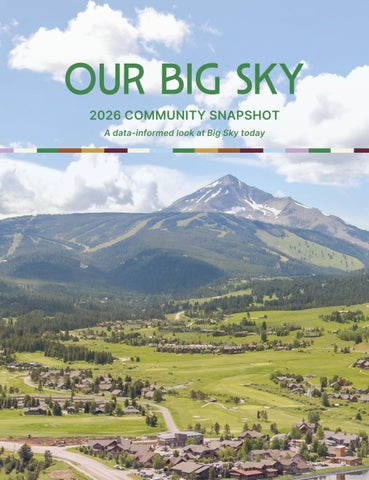
2026 COMMUNITY SNAPSHOT A data-informed look at Big Sky today
To Our Big Sky Community Our Big Sky originated in 2019 from a simple idea: the future of Big Sky should be shaped by a shared vision of what matters most to the people who live, work, and care about this community. As Big Sky continues to grow and evolve, it is increasingly important that decisions are informed by comprehensive data as well as local perspectives. The Community Snapshot is one tool in that effort. Providing a snapshot in time, this report is an objective view of the current landscape across the key areas that shape life in Big Sky. It combines community sentiment, local knowledge, and measurable data to establish a clear understanding of where the community stands today. Moving forward, this snapshot will be updated annually, allowing the community to track changes, monitor long-term progress, and identify emerging challenges and opportunities over time. This report is not intended to determine what is right or wrong, nor does it prescribe solutions. Instead, it serves as an open resource—a common point of reference that residents, businesses, nonprofits, public agencies, elected leaders, community organizations, and funders can use to better understand local priorities and inform decision-making. Through ongoing community engagement, each Community Snapshot will incorporate local perspectives alongside measurable data to create a more complete picture of Big Sky. Behind this effort is the Our Big Sky Team, a collaborative partnership between the Big Sky Resort Area District (BSRAD), Coordinating Council of Big Sky, Yellowstone Club Community Foundation, Moonlight Community Foundation and Spanish Peaks Community Foundation. While these organizations steward the process, the report is ultimately a reflection of the collective insights and the many voices that make up the Big Sky community. By establishing a common foundation, the community can better direct resources, make more informed investments, strengthen accountability, measure impact, and preserve the qualities that define our Big Sky. Thank you to everyone who contributed their time, perspectives, and expertise to this effort. Sincerely,
DANIEL BIERSCHWALE
Big Sky Resort Area District
MARIEL BUTAN
Coordinating Council of Big Sky
ANNA SHIPLEY
Moonlight Community Foundation
CIARA WOLFE
Yellowstone Club Community Foundation
HANNAH WATERBURY
Spanish Peaks Community Foundation
Table of Contents
04 - EXECUTIVE SUMMARY 07 - UNDERSTANDING OUR BIG SKY 08 - BIG SKY AT A GLANCE 10 - THREE PILLARS. ONE COMMUNITY 12 - OUR PEOPLE 18 - OUR CHARACTER 24 - OUR ENVIRONMENT 30 - HOW TO USE THIS REPORT
Executive Summary Big Sky is continually evolving. Population, visitation, investment, and development have transformed the community over the past several decades, creating new opportunities while increasing the complexity of the decisions that shape its future. The Our Big Sky Community Snapshot provides a shared understanding of where the community is today. Bringing together objective data, local knowledge, and community perspectives, it establishes a common foundation for conversations, planning, and collaboration. Rather than advocating for specific solutions, the report provides the context needed to understand the opportunities and challenges facing Big Sky. Several themes emerge across the data:
— A community connected to the region. Big Sky’s workforce, economy, and transportation system extend well beyond its boundaries. While home to fewer than 4,000 permanent residents, the community serves a peak population of nearly 15,000 people. More than threequarters of employees commute into Big Sky, and the local economy supports approximately one in three jobs across Gallatin and Madison counties.
— Growth brings both opportunity and pressure. Continued growth has strengthened the local economy and expanded community amenities while increasing demand for housing, transportation, childcare, healthcare, and infrastructure. Today, Big Sky’s remaining housing need is concentrated almost entirely in deed-restricted workforce housing, underscoring the importance of supporting the people who live and work in the community.
— The natural environment defines Big Sky. Mountains, rivers, forests, and open spaces shape the community’s identity, economy, and quality of life. Conserved landscapes and abundant recreational opportunities highlight the importance of balancing growth with long-term stewardship.
— Community is Big Sky’s greatest strength. Big Sky’s future is shaped through collaboration among local districts, nonprofit organizations, businesses, residents, and regional partners. Community surveys reveal high levels of trust and quality of life, while also highlighting a shared desire to thoughtfully manage growth, tourism, and future investment. The Community Snapshot establishes a baseline for measuring change over time. As Big Sky continues to evolve, future editions will help the community monitor progress, identify emerging trends, and support informed decision-making.
5
Bozeman
GALLATIN COUNTY
N
MADISON COUNTY 191
BIG SKY
64 1
287
2 3
191
YELLOWSTONE NATIONAL PARK
KEY
6
BSRAD boundary
National forest
1
Mountain
Roads
Big Sky CDP
Lee Metcalf Wilderness
2
Meadow
Rivers
County boundary
Yellowstone National Park
3
Canyon
Understanding Our Big Sky A community unlike any other in Montana. Spanning Gallatin and Madison counties and set within the Greater Yellowstone Ecosystem, Big Sky has evolved from a destination resort into a year-round community where collaboration is central to how the community functions. Big Sky is made up of several distinct areas that locals commonly refer to as the Mountain, Meadow, and Canyon, along with several private residential clubs. Surrounded by national forests, the community’s geography shapes everything from transportation and housing to recreation and economic activity. While many federal datasets reference the Big Sky Census Designated Place (CDP), this report uses the Big Sky Resort Area District (BSRAD) boundary whenever possible to better represent the community as a whole. Governance is shared across multiple organizations. Public, private, nonprofit, and philanthropic partners coordinate services, invest in community priorities, and help shape Big Sky’s future.
A BRIEF HISTORY
For thousands of years Indigenous peoples lived, traveled, hunted, and stewarded the lands that are now known as Big Sky.
LATE 1800S Ranching and homesteading established the area’s first permanent settlements.
Big Sky’s resort economy, high property values, and private investment are an important part of the community, but they do not tell the full story. Big Sky is a year-round home and workplace for the people who support its schools, businesses, healthcare, childcare, public services, and visitor economy. Understanding these different experiences provides a more complete picture of the community and the conditions explored in this report.
1973 Big Sky Resort opened, establishing the area as a worldclass recreation destination and accelerating community growth.
TODAY Big Sky is a thriving year-round community where tourism, recreation, and a growing permanent population come together to shape its future.
7
Big Sky at a Glance YEAR-ROUND POPULATION HAS QUADRUPLED SINCE 1990 Source: US Census Bureau
4,000
3,722 Total BSRAD
3,000
3,203 Gallatin County
2,000 1,000 0
519 Madison County 1990
2000
2010
2020
Population estimates are calculated for the Big Sky Resort Area District and represent year-round residents. Seasonal residents, visitors, and the commuting workforce are not reflected.
PEAK POPULATION IS NEARLY FOUR TIMES THE YEAR-ROUND POPULATION Peak population includes year-round, seasonal and overnight visitors.
NEARLY HALF OF ADULTS HOLD A BACHELOR’S DEGREE OR HIGHER Residents are more likely to hold a college degree than the national average. Source: US Census Bureau ACS 5-year 2020-2024
Bachelor's degree
Source: Gallatin County Infrastructure Deficiency Report, 2026
27.0%
Big Sky
15k
Gallatin County Madison County
ESTIMATED PEAK POPULATION
United States
Graduate degree
22.2% 18.9% 14.9%
15.7% 13.2%
6.5% 9.7%
MEDIAN AGE IS BETWEEN NEIGHBORING COUNTIES
Source: US Census Bureau ACS 5-year 2020-2024
Madison County
52.2
Big Sky Gallatin County
8
41.6 34.2
BIG SKY AT A GLANCE
MOST EMPLOYEES LIVE OUTSIDE OF BIG SKY Approximately 77% of the workforce commutes into the community from surrounding areas. Source: US Census Bureau, OnTheMap Tool
4,815
commute in to work
630
1,442
live here, work elsewhere
live and work in Big Sky 77% of everyone employed in Big Sky
US-191 CARRIES TRAFFIC WELL BEYOND BIG SKY’S POPULATION Source: Montana Department of Transportation
20,000
30% of everyone living in Big Sky
375 MAPPED MILES OF ROAD SERVE BIG SKY Responsibility for maintaining them is shared across state and federal agencies, local road districts and private property owners. Source: Gallatin County GIS analysis, estimated
53 mi
Federal Roads (Forest Service)
23 mi
State Roads (US-191 & MT-64)
31 mi
RIDs
264 mi
Private / Other
PEAK DAILY VEHICLES
US-191 is the primary transportation corridor serving Big Sky. Beyond connecting residents, commuters, businesses, and visitors, it is a critical regional and national route linking southwest Montana with Yellowstone National Park and destinations throughout the Mountain West.
MOST SURVEYED HOUSEHOLDS ARE SMALL Source: Big Sky Community Housing Trust, 2025 Housing Needs Survey
80.5% OF RESPONDENTS LIVE IN ONEOR TWO-PERSON HOUSEHOLDS
Rural Improvement Districts (RIDs) provide a way for property owners within a defined area to collectively fund road maintenance through property taxes.
9
Three Pillars. One Community. Our Big Sky builds on years of community planning and collaboration. The original Our Big Sky Community Vision and Strategy organized community priorities into four themes. As Big Sky has grown, so has the vision. Today, those priorities have evolved into three interconnected pillars that reflect the qualities that define life in Big Sky. Each pillar begins with a vision statement describing the future the community is working toward and provides a foundation for understanding community conditions and measuring change over time.
Our People A safe and livable year-round community with access to attainable housing and reliable public services, for people of all ages to learn, grow, and lead healthy lives.
10
THREE PILLARS. ONE COMMUNITY.
Our Character A vibrant and inclusive community shaped by creativity, economic opportunity, and a commitment to service, where residents and visitors thrive and take care of each other.
Our Environment An active community that embraces recreation and responsibly stewards its natural resources, creating a resilient ecosystem for generations to come.
11
12
OUR PEOPLE
Our People VISION STATEMENT
A safe and livable year-round community with access to attainable housing and reliable public services, for people of all ages to learn, grow, and lead healthy lives. What does it take to build a life in Big Sky? A safe and livable year-round community is one where people can build long-term lives. Achieving that vision depends on access to attainable housing, childcare, healthcare, and reliable public services that support residents and workers throughout every stage of life. Community surveys indicate that residents value the quality of life Big Sky provides. At the same time, the data highlight the conditions that influence daily life. Although median household income exceeds that of neighboring counties, housing affordability remains one of the community’s greatest challenges, while seasonal and second homes make up a large share of the community’s housing inventory, limiting the supply of homes available to year-round residents. Housing is one of several factors that influence the ability to build a life in Big Sky. Childcare and education, healthcare, public safety, transportation, and other essential services also shape daily life. Access to childcare can directly affect workforce participation: among two-parent households with children under age six, 74% had both parents participating in the labor force in 2024, down from approximately 97% in 2021. As Big Sky grows, the availability and capacity of these services play an increasingly important role in supporting a year-round community.
Community Sentiment RESIDENTS REPORT A HIGH QUALITY OF LIFE
Source: 2026 PRC Community Engagement & Behavioral Health Survey, Live in Big Sky respondents
99.3% good or better
Excellent
45.1%
Very good
40.2%
Good
14.0%
Fair
0.7%
Poor
0.0%
13
HOUSING NEED REMAINS CONCENTRATED IN DEED-RESTRICTED WORKFORCE HOUSING Current market-rate development is projected to meet demand, while the remaining need is almost entirely for below-market housing. Source: Big Sky Community Housing Needs Update, 2022
REMAINING HOUSING NEED THROUGH 2027 Below market (deed restricted) Market rate
TOTAL
OWNERSHIP
RENTAL
392
155
237
0
0
0
MORE THAN HALF OF ALL HOUSING UNITS ARE NOT OCCUPIED YEAR-ROUND
Source: US Census Bureau ACS 5-year 2020-2024
Occupied year-round
57%
not occupied year-round
Seasonal or unoccupied
MEDIAN RESIDENTIAL SALE PRICES IN BIG SKY ARE APPROXIMATELY THREE TIMES HIGHER THAN GALLATIN AND MADISON COUNTIES Source: Big Sky Country MLS. Median residential sale prices January 1-July 15, 2026
$1,680,000 Condominium
$499,999 $1,315,000 $2,732,538
Single-family home
$758,500 $734,000 $2,230,000
All residential
$661,750 $800,000 Big Sky
14
Gallatin County
Madison County
OUR PEOPLE
MEDIAN HOUSEHOLD INCOME EXCEEDS NEIGHBORING COUNTIES Household income provides context for understanding local housing and living costs.
Big Sky
$136,575
Gallatin County
$93,528
Madison County
$75,250
Source: US Census Bureau ACS 5-year 2020-2024
BIG SKY SCHOOL ENROLLMENT HAS DECLINED IN RECENT YEARS Source: Montana Office of Public Instruction
450
432
409 400
400
396 369 343
350
20/21
21/22
22/23
23/24
24/25
25/26
CHILDCARE ENROLLMENT IS BELOW LICENSED CAPACITY Licensed capacity does not always reflect available care, which can be limited by staffing and other factors. Providers currently report no active waitlists. Source: Big Sky childcare providers, September 2026
LICENSED CAPACITY
CURRENTLY ENROLLED
SHARE OF CAPACITY
Gallatin River Child Care – Big Sky
24
16
67%
Morningstar Learning Center
56
20
36%
Discovery Academy – Early Childhood
30
20
67%
PROVIDER
COST OF CHILDCARE EXCEEDS THE FEDERAL AFFORDABILITY BENCHMARK Source: Big Sky Child Care Market Analysis, 2026
12.5%
ESTIMATED SHARE OF HOUSEHOLD INCOME SPENT ON CHILDCARE
7%
FEDERAL AFFORDABILITY BENCHMARK
15
RISING DEMAND, FASTER RESPONSE Emergency calls are increasing as local law enforcement response times improve.
Sources: Gallatin County Sheriff’s Office; Big Sky Fire Department 2025 Annual Report
17-MINUTE
GALLATIN COUNTY SHERIFF FY25 RESPONSE TIME
Down 25% from FY24
1,560
BIG SKY FIRE DEPARTMENT EMERGENCY RESPONSES IN 2025
Up 9% from 2024 • 70% since 2019
Big Sky’s emergency response network includes local law enforcement, fire, and emergency medical responders serving residents, workers, and visitors. The network expanded with a third fire station serving the Spanish Peaks area, where limited fire protection had affected homeowners’ ability to obtain insurance. The station was funded through a Rural Improvement District, allowing participating property owners to support the additional fire protection through a dedicated assessment.
BEHAVIORAL HEALTH AFFECTS MANY BIG SKY RESIDENTS Substance use has directly affected the lives of more than seven in ten adults, while nearly three in ten residents reported needing mental health care in the past year. Source: Katz Amsterdam, 2026 Community Survey
Life directly affected by someone's substance use
71.9%
US Benchmark
46.8%
Needed mental health care
29.5%
11-Community Benchmark
FOOD ASSISTANCE HAS BECOME AN INCREASINGLY IMPORTANT RESOURCE
Source: Big Sky Community Food Bank
16
37.9%
2,000
1,970 Individuals Served
1,500
FOOD ASSISTANCE HAS BECOME AN INCREASINGLY IMPORTANT RESOURCE
1,000 500 FY16
Source: Big Sky Community Food Bank
FY17
FY18
FY19
FY20
FY21
FY22 FY23 FY24 FY25
FY26
OUR PEOPLE
Community Spotlight
Invested in Our People
BIG SKY WELLNESS DISTRICT: BUILDING A LOCAL FOUNDATION FOR HEALTH AND WELLNESS
$10,451,288* The Coordinating Council of Big Sky identified these highlights as a snapshot of collaborative work underway across Big Sky.
Access to healthcare can be challenging in a rural mountain community. While Big Sky has local providers, residents often travel outside the community for specialty and ongoing care, while behavioral health presents additional needs. Local healthcare providers and community partners have worked collaboratively to expand access and bring more services closer to home. Meanwhile, property taxes generated in the Madison County portion of Big Sky supported a hospital district whose facilities were located outside the community. Seeking to direct public funding toward health and wellness services in Big Sky, residents organized a sustained community effort and partnered with state legislators to create a pathway for Big Sky to withdraw from the existing hospital district and establish local districts. In May 2026, voters in both Madison and Gallatin counties approved the Big Sky Wellness Districts with more than 90% voter approval. The new districts establish a locally governed source of public funding to support existing services and expand access to health and wellness care in Big Sky, building on years of collaboration among local providers, residents, and community partners.
•
Nearly 400 homes are being built in the Cold Smoke Neighborhood; local employers have increased job-attached housing; and community partners continue to add and preserve homes for the workforce.
•
Voters approved the Big Sky Wellness District, creating funding to expand access to health and wellness services. 4,800 square feet of new clinic space will increase specialty care available locally.
•
Increased availability of in-person counseling, including addiction counseling, and expanded peer support services strengthen the continuum of care by helping individuals navigate mental health challenges and connect with appropriate services.
•
Big Sky now has five schools, including four with early learning programs. With 0–18 enrollment declining, education partners are working to preserve family choice while maintaining quality and affordability.
•
Local and regional coordination supports Big Sky’s wide-ranging emergency response needs; a new fire station at Spanish Peaks and a new Sheriff’s office expand publicsafety infrastructure.
•
A growing social services network is making food, housing, safety, family support, and other resources easier to access through expanded local office hours, resource navigation, and workforce outreach.
*Funding totals represent investment from the Big Sky Resort Area District, Yellowstone Club Community Foundation, Spanish Peaks Community Foundation and Moonlight Community Foundation during FY26 (7/1/25-6/30/26). Project highlights reflect broader community efforts and may include additional public, private, nonprofit, and philanthropic support.
17
18
OUR CHARACTER
Our Character VISION STATEMENT
A vibrant and inclusive community shaped by creativity, economic opportunity, and a commitment to service, where residents and visitors thrive and care for one another. What makes people choose to stay and invest in this community? Big Sky is widely recognized for its outdoor recreation and mountain lifestyle, but its character is reflected in the way the community lives, works, and comes together. That sense of community is supported by long-term commitment. According to the Big Sky Community Housing Trust’s 2025 Housing Survey, nearly one-third of respondents have lived in Big Sky for more than 10 years. That commitment is also reflected in civic life, with residents serving on volunteer boards that oversee essential public services and help guide nonprofit organizations, illustrating Big Sky’s unique approach to community governance. Opportunity draws people to Big Sky. As an important contributor to Montana’s economy, Big Sky supports more than 26,000 jobs statewide. A diverse business community—including locally owned businesses and major employers—creates employment opportunities that attract workers from across Montana, the United States, and around the world. Tourism is central to Big Sky’s identity and economy, supporting local businesses and a large seasonal workforce while influencing the pace and character of community growth. Survey responses reflect both the opportunities and challenges associated with a tourism-based economy. An active outdoor lifestyle is woven into everyday life. Recreation extends well beyond the ski season, with year-round opportunities for residents to hike, ski, fish, bike, paddle, compete in community sports, and connect through the outdoors. This lifestyle is a defining part of Big Sky’s identity and one of the qualities that continues to attract and retain residents.
Community Sentiment NEARLY 9 IN 10 BIG SKY RESIDENTS TRUST THEIR COMMUNITY Source: 2026 PRC Community Engagement & Behavioral Health Survey
85.4% trust completely or mostly
Completely
22.0%
Mostly
63.4%
Somewhat
13.8%
Not at all
0.8%
19
COMMUNITY GOVERNANCE RELIES ON VOLUNTEER LEADERSHIP 53 volunteer board seats across 11 special districts help govern essential public services and community investments.
SPECIAL DISTRICT
BOARD MEMBERS
Big Sky County Water & Sewer District
7
Big Sky Resort Area District
5
Big Sky Rural Fire District
5
Big Sky School District
5
Big Sky Trails, Recreation & Parks District
5
Big Sky Transportation District
5
Firelight Meadows Water & Sewer District
5
Gallatin Canyon Water & Sewer District
5
Wellness District – Gallatin County
3
Wellness District – Madison County
3
Yellowstone Club Fire District
5
In addition to public special districts, GuideStar identifies 31 active nonprofit organizations serving the Big Sky community. This count excludes the Big Sky Zoning Advisory Committee and other community organizations, reflecting an even broader network of volunteers who help guide programs, services, and community initiatives.
“Living and working in the Big Sky community is one of the most rewarding experiences of my life. This place is filled with incredibly interesting, resourceful, and kind individuals.” FULL-TIME RESIDENT OF 11 YEARS
20
OUR CHARACTER
Small Community, Big Economic Footprint BIG SKY’S ECONOMIC IMPACT EXTENDS WELL BEYOND ITS BOUNDARIES Source: Big Sky Resort Area District 2026 Business Registration; 2024 Big Sky Economic Impact Report
4.3%
13.6%
CONTRIBUTION TO THE MONTANA GDP
SHARE OF STATE LODGING TAX COLLECTIONS
1 in 3
Big Sky’s Taxable Value =
GALLATIN & MADISON COUNTY JOBS CONNECTED TO BIG SKY’S ECONOMY
BILLINGS + BOZEMAN + MISSOULA COMBINED
BIG SKY’S BUSINESS COMMUNITY SUPPORTS A LARGE, SEASONAL WORKFORCE Source: Big Sky Resort Area District 2026 Business Registration
1,306
REGISTERED BUSINESSES
8,019
EMPLOYEES WORKING WITHIN BSRAD
4,950
SEASONAL EMPLOYEES WORKING WITHIN BSRAD Nearly 5 in 8 employees
21
TOURISM’S PERCEIVED IMPACT VARIES ACROSS ASPECTS OF COMMUNITY LIFE Source: Institute for Tourism and Recreation Research, Big Sky Residents’ Sentiments and Attitudes Towards Tourism, 2026
Pace of Development at Big Sky
2.22
ACTIVE LIVING IS A PART OF EVERYDAY LIFE
2.51
Environmental Quality Sense of Community
2.75
Public Services
Residents participate in yearround sports, recreation and wellness activities.
3.4
The Local Economy
4.23
Source: Big Sky Community Organization
1 = Very negative impact | 3 = Neither positive nor negative | 5 = Very positive impact
RESIDENTS ARE NEARLY SPLIT ON TOURISM’S DIRECTION
Source: Institute for Tourism and Recreation Research, Big Sky Residents’ Sentiments and Attitudes Towards Tourism, 2026
Strongly in the right direction
COMMUNITY PARTNERS PROVIDE PROGRAMMING
9.5%
Somewhat in the right direction
29.3%
Neither right nor wrong direction
20.7%
Somewhat in the wrong direction Strongly in the wrong direction
13
26.2% 14.3%
9
ADULT SPORTS LEAGUES
11
PICKUP SPORTS
25+ WEEKLY FITNESS & WELLNESS CLASSES
Organized recreation complements Big Sky’s outdoor lifestyle, contributing to a culture of active living for residents of all ages.
22
OUR CHARACTER
Community Spotlight
Invested in Our Character
BIG SKY CENTER FOR THE ARTS: A HOME FOR CREATIVITY AND COMMUNITY
$3,260,876*
Big Sky offers a diverse arts and cultural community, with nationally touring performances, galleries, exhibitions, classes, workshops, and community events throughout the year. Opened in 2025, the Center for the Arts provides a dedicated home for many of these activities. Developed through a partnership of philanthropy, public investment, and private support, the facility reflects the collaborative approach that characterizes many community projects in Big Sky.
The Coordinating Council of Big Sky identified these highlights as a snapshot of collaborative work underway across Big Sky.
•
Expansive growth in classes, concerts, public art works, and events has broadened arts and cultural offerings; plans for an expanded arts and community hub will add creative and public spaces.
•
The business community is supporting leadership and professional development while increasing civic engagement through voter education, advocacy, and opportunities for state legislators to learn firsthand about Big Sky.
•
Tourism efforts focus on extending peak seasons and increasing slower-period visitation while balancing visitor and resident priorities; the Visitor Center welcomed more than 6,000 visitors in the past year.
*Funding totals represent investment from the Big Sky Resort Area District, Yellowstone Club Community Foundation, Spanish Peaks Community Foundation and Moonlight Community Foundation during FY26 (7/1/256/30/26). Project highlights reflect broader community efforts and may include additional public, private, nonprofit, and philanthropic support.
Today, the Center serves as a gathering place for creativity, learning, and community connection. It complements the community’s galleries, performance venues, and seasonal events, opportunities for arts and cultural programming throughout the year.
23
24
OUR ENVIRONMENT24
Our Environment VISION STATEMENT
An active community that embraces recreation and responsibly stewards its natural resources, creating a resilient ecosystem for generations to come. How does the landscape shape life in Big Sky? Big Sky’s mountains, rivers, forests, and open spaces shape both the community’s identity and its future. These natural resources support recreation, wildlife habitat, and the local economy while defining the landscape experienced by residents and visitors. An active outdoor lifestyle is supported by an extensive network of recreation infrastructure that includes parks, trails, public open space, rivers, and mountain recreation. Public access to the Gallatin River, community parks, and 50 miles of maintained trails and shared-use paths provide year-round opportunities to experience the outdoors. The community also invests in infrastructure that supports environmental management. Big Sky operates as Montana’s largest zero-discharge community, treating and reusing wastewater rather than discharging it directly to the Gallatin River. Recycling and composting divert material from the landfill, reflecting another component of the community’s environmental infrastructure. The surrounding landscape includes extensive public lands and wildlife habitat, with the US-191 corridor serving as an important wildlife movement area. At the same time, the community experiences environmental conditions such as wildfire risk and wildlifevehicle collisions that influence how the landscape is managed and experienced.
Community Sentiment NATURAL BEAUTY AND OUTDOOR RECREATION ARE AMONG THE STRONGEST FACTORS ATTRACTING PEOPLE TO BIG SKY
Source: Institute for Tourism & Recreation Research, Big Sky Residents’ Sentiments and Attitudes Towards Tourism, 2026
Outdoor recreation
4.51
Natural beauty
4.45
Quality of life
4.39
Community atmosphere
3.78
Family and/or friends
3.24
Remoteness of community
3.04
Career opportunities
3.01
Arts and cultural experience
2.82 1 = Not at all important → 5 = Extremely important
25
BIG SKY’S RECREATION INFRASTRUCTURE SUPPORTS YEAR-ROUND OUTDOOR ACCESS Public, nonprofit and private investments provide an extensive network of parks, trails, recreation facilities, and mountain recreation. COMMUNITY RECREATION Maintained Trails & Shared-Use Paths
50 miles
Community Parkland
100+ acres
Annual Trail Users
485k users
Annual Community Park Vehicle Visits
100k visits
REGIONAL RECREATION ASSETS Big Sky Resort
5,850 skiable acres
Yellowstone Club
2,900 skiable acres
Lone Mountain Ranch
85 km Nordic trails
Big Sky Resort has continued to invest in mountain infrastructure, including new lifts, expanded facilities, and the Kircliff Observation Deck.
THE GALLATIN RIVER PROVIDES WIDESPREAD PUBLIC ACCESS Source: Gallatin River Task Force
111 ACCESS POINTS
Public access to the Gallatin River supports recreation while underscoring the importance of protecting the river corridor.
“I like to call it the Montana Trifecta. In the spring, if you can ski in the morning, golf or mountain bike in the afternoon, then finish the day fishing or rafting, that’s about as good as it gets.” LIFELONG COMMUNITY MEMBER
26
OUR ENVIRONMENT
70% OF BIG SKY IS PUBLIC OR CONSERVED LAND
Source: Montana State Library, Montana Cadastral Framework; GIS analysis by Gallatin County GIS, 2026
KEY
Conservation Easements = 13,177 acres Montana Land Reliance
BSRAD Boundary = 168,967 acres
Gallatin Valley Land Trust
Montana Public Lands (US Forest Service) = 104,945 acres
The Nature Conservancy
BIG SKY FACES A VERY HIGH WILDFIRE RISK Source: USDA Forest Service, Wildfire Risk to Communities
BIG SKY’S WILDFIRE RISK IS GREATER THAN
96% OF U.S. COMMUNITIES
WILDLIFE-VEHICLE COLLISIONS REMAIN COMMON ON US-191 Important wildlife habitat and priority crossing areas overlap with the US-191 corridor.
Source: Gallatin County Wildlife and Transportation Assessment; Montana Department of Transportation carcass data
WILDLIFE-VEHICLE INCIDENTS Wildlife-Vehicle Crashes Wildlife Carcasses
101 reported 200 documented
US-191 passes through important habitat for wildlife including elk, moose, black bear, grizzly bear, wolf, lynx, and boreal toad. Several locations where wildlife movement intersects the highway have been identified as priority crossing areas, highlighting the overlap between wildlife habitat and the transportation corridor.
27
BIG SKY IS MONTANA’S LARGEST ZERO-DISCHARGE COMMUNITY Advanced wastewater treatment and water reuse result in the lowest estimated nitrogen load among the Gallatin watershed’s major wastewater systems. Source: Estimates based on data from EPA ECHO DMRs and permitted mixing zones
136490 lbs 9860 lbs 5440 lbs
3540 lbs
1800 lbs
410 lbs Big Sky WSD
Rae WSD
Four Corners WSD
SOUTH · UPSTREAM
8530 lbs
Bozeman WRF
River Rock Subdivision
Nitrogen / YR
Belgrade WWTP
Manhattan WWTF
DOWNSTREAM · NORTH
SOME NEIGHBORHOODS CONTINUE TO RELY ON OLDER WASTEWATER SYSTEMS Older wastewater treatment and septic systems treat wastewater to higher nitrogen concentrations, which can contribute nitrogen to groundwater and the Gallatin River. Source: Big Sky County Water & Sewer District, Water, Sewer & Beneficial Reuse Update, 2026
SYSTEM
TOTAL NITROGEN
Big Sky Water Resource Recovery Facility
1.2–3.0 mg/L
Canyon systems
20–85 mg/L
Firelight
56.7 mg/L
RECYCLING AND COMPOSTING DIVERT WASTE FROM THE LANDFILL Sources: L&L Site Services, Republic Services, Gallatin County Solid Waste District, YES Compost, WeRecycleMT, & Full Circle Recycling
919
13.4% diversion rate
Landfill
7,214 tons
Recycling
919 tons
Compost
202 tons
Total
8,335 tons
7,214
28
OUR ENVIRONMENT
Community Spotlight YELLOWSTONE CLUB SNOWMAKING: SUPPORTING WATER REUSE AND ENVIRONMENTAL RESILIENCE
Water management is a community priority in Big Sky, where protecting the Gallatin River and sustaining the watershed require innovative approaches to water use. Big Sky is the largest zero-discharge community in Montana, meaning treated wastewater is not released directly into rivers or streams. Instead, it is reused for purposes such as irrigation and snowmaking. Following years of research, permitting, and collaboration among utilities, regulators, environmental organizations, and private partners, Yellowstone Club launched Montana’s first permitted reclaimed-water snowmaking program. The system uses highly treated reclaimed wastewater to create snow, providing a beneficial use for treated effluent while reducing the demand for freshwater. The project is expected to provide a net benefit of more than 25 million gallons of water to the local watershed and aquifer. As the snow melts gradually in the spring, water is released later into the season, helping extend runoff and support groundwater recharge. The project demonstrates how recreation, infrastructure, and environmental stewardship work together to support long-term water resilience.
Invested in Our Character
$10,776,172* The Coordinating Council of Big Sky identified these highlights as a snapshot of collaborative work underway across Big Sky. •
Conservation partners have collectively improved nearly 50,000 acres of critical habitat, with efforts focused on wildlife, noxious weed reduction, and water quality.
•
Recreation organizations, land managers, local government, businesses, and nonprofits are coordinating programs, amenities, and infrastructure to improve access and connectivity while maximizing community resources.
•
Community-wide tools and strategies were created to help builders, businesses, residents, and visitors adopt more resilient practices around energy efficiency, wildfire preparedness, and water conservation.
•
The Community Park bond is funding park improvements and year-round programming; Big Sky’s trail network has grown 11.1 miles to 50 miles, increasing outdoor access and connectivity.
•
Skyline Transit ridership increased 26% to nearly 400,000 passenger trips, while community partners are coordinating broader solutions to traffic, road conditions, and transportation needs.
•
Annexation agreements have nearly doubled the Water & Sewer District’s boundaries to meet growing community needs, while partners focus on strategies to protect water quality and the environment.
*Funding totals represent investment from the Big Sky Resort Area District, Yellowstone Club Community Foundation, Spanish Peaks Community Foundation and Moonlight Community Foundation during FY26 (7/1/256/30/26). Project highlights reflect broader community efforts and may include additional public, private, nonprofit, and philanthropic support.
29
30
OUR ENVIRONMENT
How to Use This Report The Community Snapshot brings together data from multiple sources to describe conditions in Big Sky at a point in time. Because no single dataset fully captures the community, statistics should be considered within the geographic, seasonal, and methodological context provided throughout the report. This report is intended as a common reference for people and organizations working, investing, and making decisions in Big Sky. It can be used to inform conversations, planning, and investment, while recognizing that individual statistics represent one part of a larger community picture.
METHODOLOGY Measuring Big Sky
Capturing an accurate picture of Big Sky is not always straightforward. The community spans two counties, does not align neatly with common Census geographies, and experiences significant seasonal population fluctuations. Its relatively small year-round population can also result in larger margins of error and greater variability in survey estimates and other data sources. As a result, many public datasets provide only a partial picture of local conditions. To account for these challenges, the Community Snapshot combines federal, state, and county data with information from local agencies, service providers, nonprofits, community organizations, studies, and surveys. Together, these sources provide a more complete picture of the people, experiences, and conditions that make up Big Sky today. Reporting periods vary by source, so the most recent available data may differ from one statistic to another. Sources are identified near the data they support, with additional context provided where needed.
31
For more info, visit
OURBIGSKYVISION.ORG