MINING & EXPLORATION IN ONTARIO

AWARDS | Uranium miner expands downstream as nuclear sector powers up
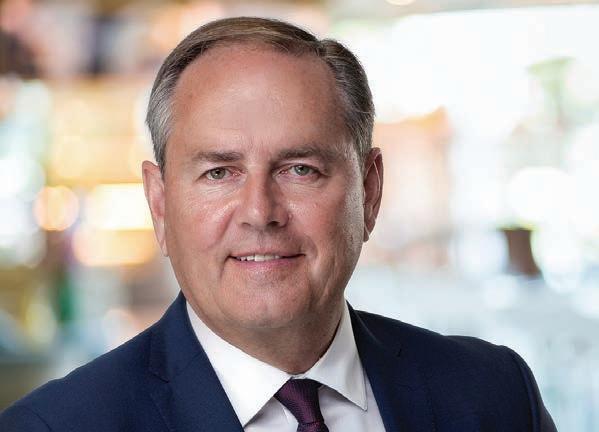
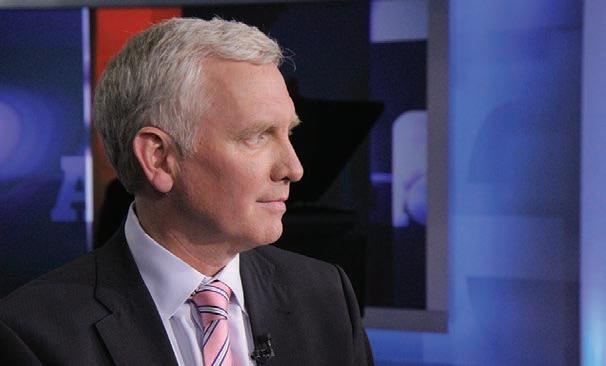
BY ALISHA HIYATETTim Gitzel, an executive at Cameco (TSX: CCO; NYSE: CCJ) for 17 years and president and CEO for 13, has led the company through more bad times than good. Among the bad times: repeated ooding at the Cigar Lake mine; the post-2007 uranium price crash; and the more devastating doldrums a er the Fukushima nuclear disaster in 2011.
Among the good times: right now.
e company’s shares have doubled in the past year, following the exploding uranium price. But Gitzel’s careful preparation has positioned Cameco for such a moment, when supply challenges, geopolitics, and renewed fervour for nuclear power have swung uranium back into favour.
at’s why Gitzel is our Mining Person of the Year for 2023.
Cameco’s discipline through the tough times allowed it to take advantage of a company-changing opportunity as the nuclear sector’s fortunes turned. It acquired a 49% stake in Westinghouse last year for US$2.1 billion, diversifying its revenues and going downstream into the reactor service and design business. is at a time when hundreds of reactors are in construction or being planned around the world.
Even keel
While excitement has been building around uranium for the past few years, Gitzel has always maintained a steady approach, regardless of the ups and downs of the market.
“It’s a tricky business. You’ve gotta try and maintain an even keel through it, cause it’s commodities,” he told e Northern Miner in April.
Gitzel got his start in the business when he was just 17. Born and raised in Saskatchewan, the son of an RCMP o cer, Gitzel’s rst job in uranium was working summers at the province’s Clu Lake mine — in the warehouse, as a heavy equipment operator and in other jobs. He earned an arts degree before studying law and working summers in France for state-owned Areva (now Orano). A er graduating, he practiced law for a couple of years before rejoining the company. Gitzel stayed for 15 years, learning every component of the
sector, and spent the last ve running Areva’s worldwide mining business unit from Paris.
Gitzel was recruited by Cameco in 2007, the year that spot uranium prices spiked to a record high of US$136 per lb. from less than US$10 per lb. in 2001.
“It was kind of a shaky train heading down the track a little too fast,” he says, recalling the mania that attracted about 400 junior explorers into the space. “ e Chinese were buying uranium. Everybody was talking about new reactors. Nuclear power had a lot of momentum.”
Gitzel recalls Cameco faced criticism at the time for not jumping to expand its portfolio. But assets were far too overpriced for the company’s taste.
“We
try not to get too swept up in the euphoria of the day and I’ve said that from the day I got here — let’s be disciplined in what we’re doing.”
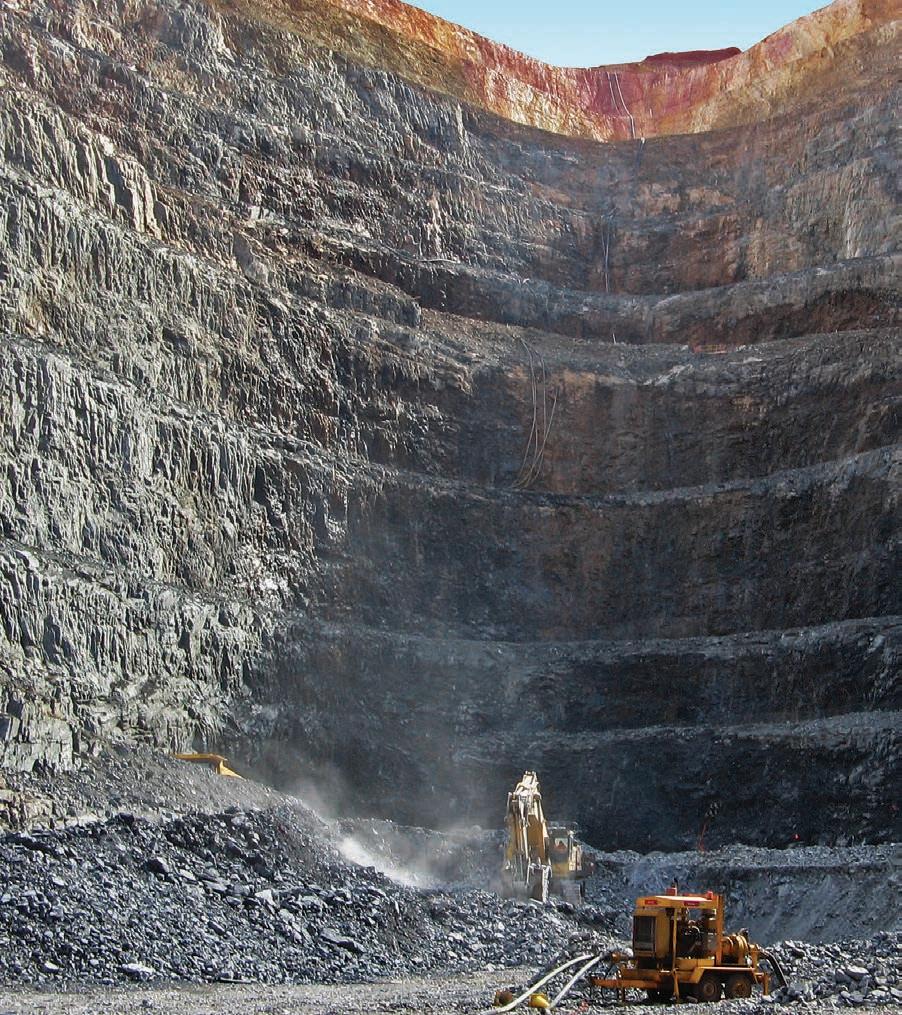
In the meantime, Cameco was seeking a solution to ooding challenges that started in late 2006 at its Cigar Lake mine, then in construction. e mine in Saskatchewan’s Athabasca Basin (now 54.5% owned by Cameco) was supposed to produce 18 million lb. U3O8 per year — a h of global production — starting in 2007.
e ooding and subsequent delay to production sparked fears of supply shortages, helping to propel uranium’s price rise.
While repeated ooding ultimately set back production by seven years, the company solved Cigar
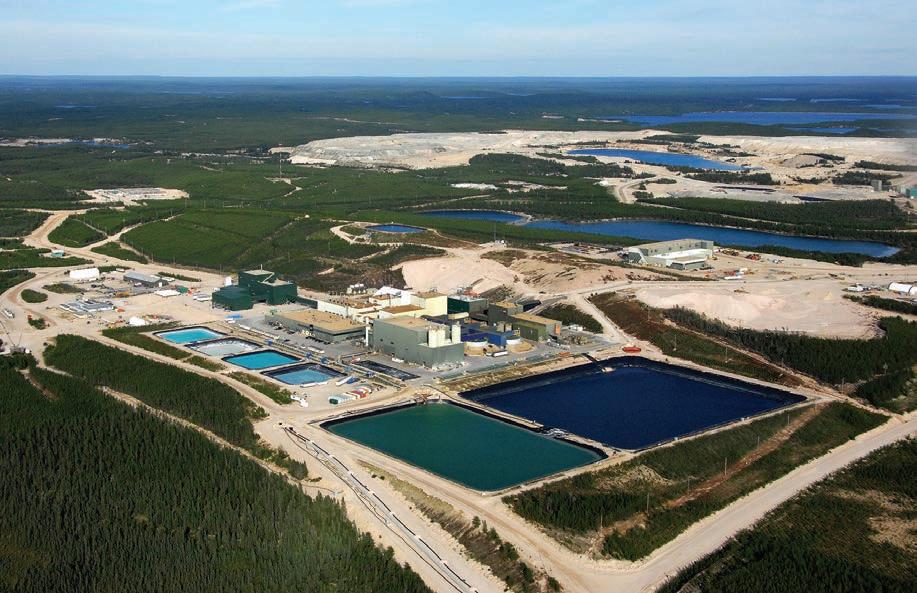
Lake’s water challenges by devising a new mining method that involves freezing the ore and surrounding rock. It’s now the highest-grade uranium mine in the world with proven and probable reserves of 555.6 million tonnes grading 17.03% U3O8 for 208.6 million pounds.
Fukushima disaster
Cameco faced a tougher challenge a er the Fukushima nuclear disaster, caused by a March 2011 tsunami, decimated uranium demand.
“We try not to get too swept up in the euphoria of the day and I’ve said that from the day I got here — let’s be disciplined in what we’re doing.”
TIM GITZEL, PRESIDENT AND CEO OF CAMECO
As Japan shut down more than 50 reactors within months and other countries backtracked or paused their nuclear power plans, mined production of uranium was only increasing.
“It was a complete oversupply of uranium,” Gitzel said. “We kept going for a while and then we just said, you know what, if we keep doing the same thing we’re gonna be done.”
Cameco suspended its Rabbit Lake mine, east of Cigar Lake, plus its in-situ recovery (ISR) operations in Nebraska and Wyoming in 2016. Its larger 70%-owned McArthur River mine and Key Lake mill (83%) followed in late 2017. e moves cut the company in half. ose di cult times motivated
PM44082538





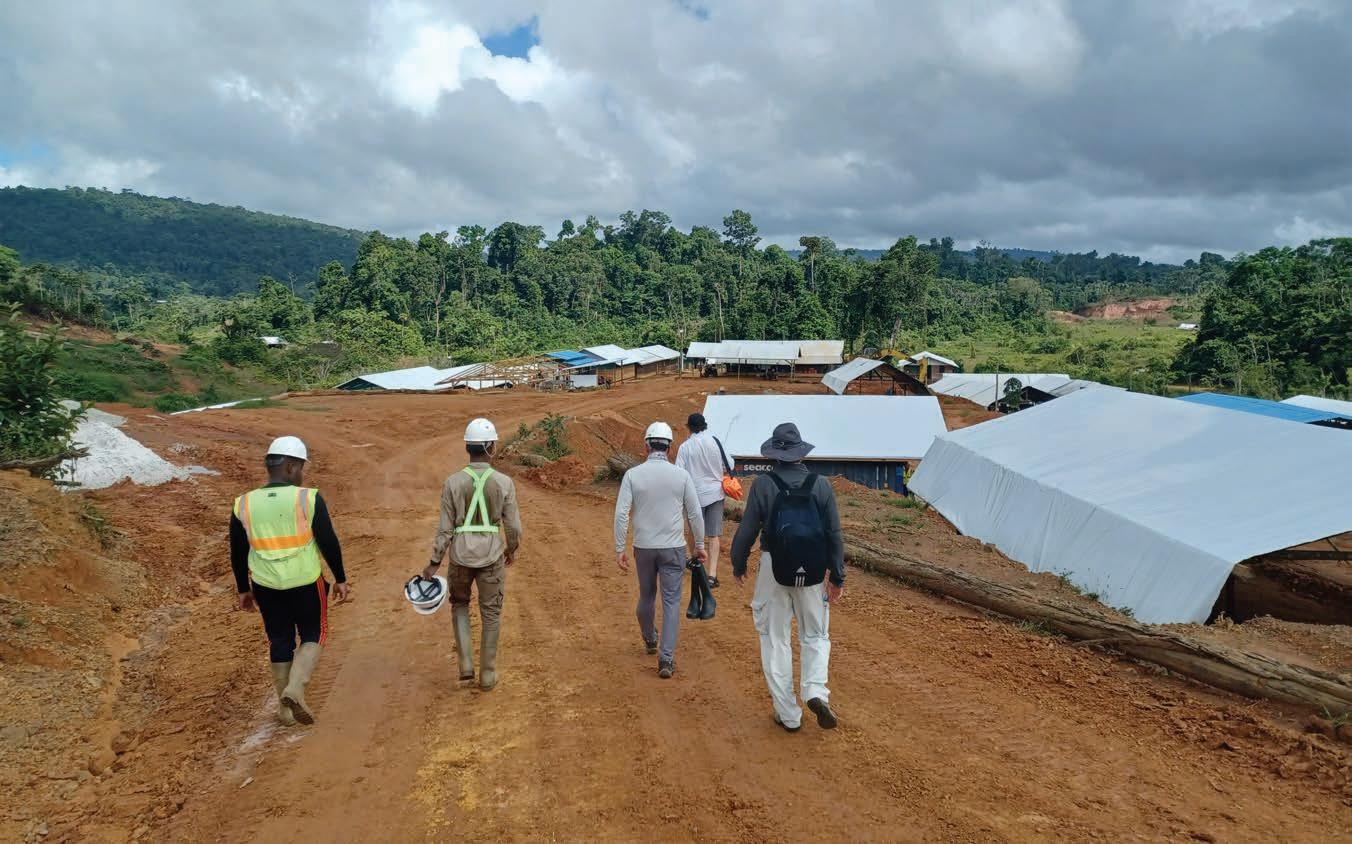
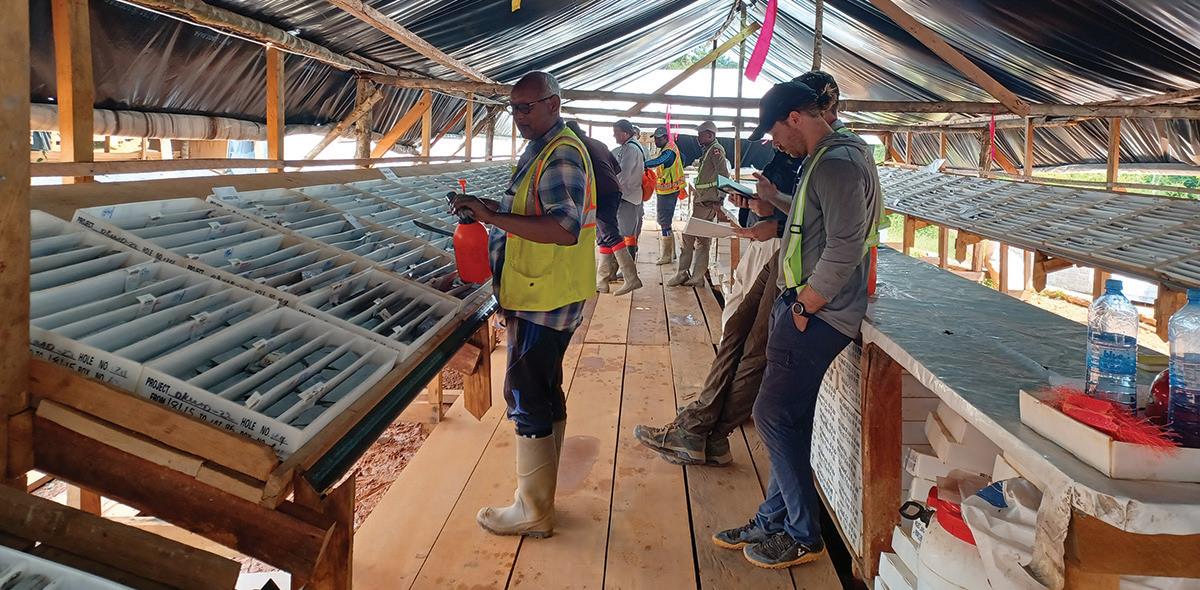
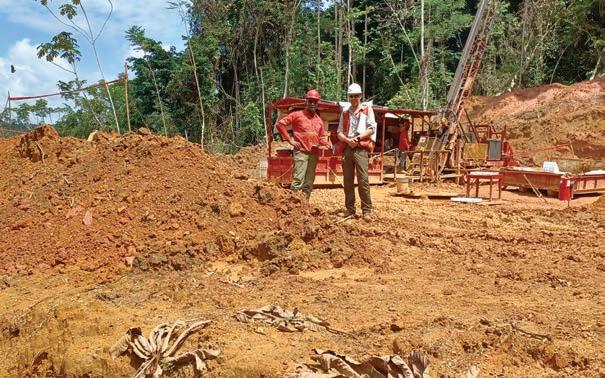
At Reunion Gold’s Oko West project in Guyana in late 2022.
(See story page 17.) .
SPECIAL SECTIONS » Uranium 31 » Exploration & Mining in Ontario 37
e Canadian Mining Hall of Fame (CMHF) has opened its call for nominations for the 2025 induction season. Each year, the Canadian Mining Hall of Fame seeks remarkable individuals to induct into its ranks during the annual induction celebration.
Nominees are distinguished by their leadership and achievements, having made signi cant contributions to Canada’s prominence in the global mining industry.
Nominations must be submitted through recognized member organizations or associate organizations of the CMHF.
ese include the Canadian Institute of Mining, Metallurgy and Petroleum; Mining Association of Canada; e Northern Miner; e Prospectors and Developers Association of Canada; e Mining Associations of British Columbia, Ontario, Quebec, and Saskatchewan, as well as the Association for Mineral Exploration.
Any organization or member of the public is encouraged to nominate a candidate.
e nomination deadlines for 2025 are: May 1 to approach a member or associate member organization regarding a nomination for induction; and May 31 for submitting nomination materials to a member or associate member organization for review.
Nomination guidelines, selection criteria, and nomination forms are available at mininghallo ame.ca/nominate.
BY MINING.COM STAFF
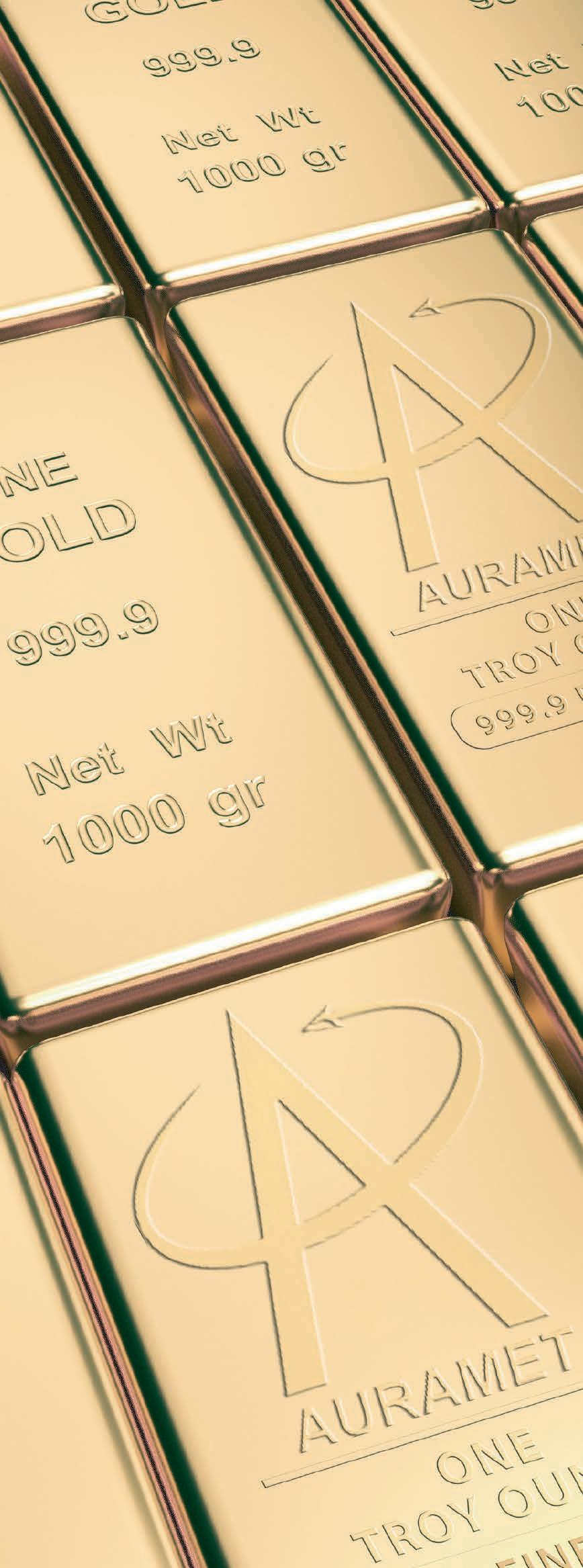
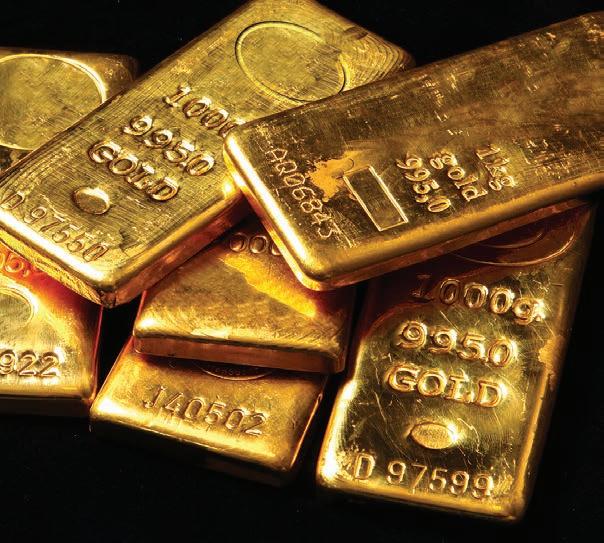
Costco has been selling up to US$200 million worth of gold bars and silver coins each month, say Wells Fargo analysts.
Since it started selling gold bars last year, social media forums have emerged where customers exchange advice on how to buy the bars before they run out.
Costco is selling 1-oz., 24-carat gold bars, according to its online store. It has also increased the maximum number of bars that can be purchased at once from two per customer
when the product was rst introduced to now allowing ve per customer.
As of April 11, the bars were sold out for members online, but e Wall Street Journal reported that shoppers had purchased them for around US$2,000 in December.
Costco has also been selling silver coins, advertised as 99.9% pure silver, since January, according to Wells Fargo report.
e growing sales have followed a surge in gold prices. e metal has registered all-time peaks so far this year, including US$2,394.95 per oz. on April 21. Since mid-February, gold has gone up by nearly 17%.
Given its pricing and shipping costs, however, it’s likely a “very low-pro t business at best,” analysts with Wells Fargo wrote in a note to clients on April 9. BY MINING.COM STAFF
Lithium production from Africa could almost triple in 2024 compared to last year, Benchmark Mineral Intelligence says.
In 2023, Africa contributed 4% to global lithium production, but this year it’s expected to reach 10% of the global supply. is surge is largely due to increased Chinese investment in the continent.
Chinese companies hold a virtual monopoly on lithium extraction in Africa, with over 90% of the continent’s projected lithium supply for this decade stemming from projects partly owned by Chinese entities, Benchmark estimates.
Most of the increased supply is expected to come from Zimbabwe. It’s estimated that the country produced 3,400 tonnes in 2023, placing it among the seven largest producers globally.
e southern African country hosts Zhejiang Huayou Cobalt’s Arcadia mine, one of the world’s largest lithium operations, with a capacity of up to 450,000 tonnes of lithium concentrate per year.
Chinese interest in Africa re ects its strategy to secure critical minerals needed for clean energy technologies.
Although China possesses only 11% of global lithium reserves, it re nes 60-70% of the metal.
Perpetua Resources has received a letter of interest from the Export-Import Bank of the United States (EXIM) for a potential debt nancing of up to US$1.8 billion to help develop its proposed gold-antimony mine in northern Idaho.
If approved, the loan would be one of Washington’s largest investments ever in a domestic mine. Perpetua’s Stibnite project is host to one of the largest gold deposits in the country, but could also be a signi cant source of antimony, a critical mineral deemed essential to national defence.
A 2020 feasibility study showed the project hosts proven and probable reserves totalling 104.6 million tonnes grading 1.43 grams gold per tonne and 0.06% antimony, for 4.8 million oz. of gold and 148 million lb. antimony. Its average annual metal production during the rst four years of operation is forecast at 463,000 oz. of gold and 18.4 million lb. of antimony.
Currently, the U.S. produces no antimony and depends entirely on imports. Meanwhile, its chief rivals China and Russia control over 70% of the global mined supply, according to the U.S. Geological Survey. Nearly half of U.S. imports come from China, the leading producer.
e funding for Stibnite would be made available through the bank’s “Make More in America” and “China and Transformational Exports Program” (CTEP) initiatives, both part of Washington’s strategy to o set China’s critical minerals sector dominance.
Miners Rio Tinto and Eramet, along with battery maker LG Energy, are among 30 companies from 12 countries that have presented plans to develop lithium extraction technology in Chile’s salt ats.
e tender process, run by state-owned miner Enami, kicked o in early March. Enami is seeking the best approach
GLOBAL MINING NEWS • SINCE 1915 www.northernminer.com
PRESIDENT THE NORTHERN MINER GROUP:
Anthony Vaccaro, CFA, MBA avaccaro@northernminer.com
EDITOR-IN-CHIEF:
Alisha Hiyate ahiyate@northernminer.com
MANAGING EDITOR: Colin McClelland cmcclelland@northernminer.com
WESTERN EDITOR:
Henry Lazenby hlazenby@northernminer.com
COPY EDITOR AND PRODUCTION EDITOR: Blair McBride bmcbride@northernminer.com
PODCAST HOST: Adrian Pocobelli apocobelli@northernminer.com
ADVERTISING:
Robert Hertzman
(416) 898-6654 rhertzman@northernminer.com
Michael Winter
(416) 510-6772 mwinter@northernminer.com
SUBSCRIPTION SALES/ APPOINTMENT NOTICES/ CAREER ADS
George Agelopoulos
(416) 510-5104 (Toll free) 1-888-502-3456, ext. 43702 gagelopoulos@northernminer.com
PRODUCTION MANAGER: Jessica Jubb (416) 510-5213 jjubb@northernminer.com
CIRCULATION/CUSTOMER SERVICE: (416) 510-6789 | 1-888-502-3456 northernminer2@northernminer.com
REPUBLISHING: (416) 510-6768 jmonteiro@northernminergroup.com
ADDRESS:
510-6789 tnm@northernminer.com
# 809744071RT001 (ISSN 0029-3164)
 BY ALISHA HIYATE
Despite its stranglehold on mining and processing, there’s one arena of critical minerals that China doesn’t control – underwater resources.
No one does, as deep sea mining has yet to begin. But it’s not the sci- fantasy it once may have seemed.
e International Seabed Authority (ISA), which next meets in July, is hashing out the world’s rst underwater mining code. Deep sea mining could technically begin as soon as July, even in the absence of rules which the ISA aims to have in place by 2025.
at’s because in 2021, ISA member Nauru triggered a two-year countdown for the body to either solidify regulations, or to allow mining with whatever guidance is in place. e island nation is the sponsor state for exploration licences held by the world’s most advanced sea oor miner in waiting, e Metals Company.
e NASDAQ-listed company plans to apply for a licence to “mine” sea oor polymetallic nodules, rich in cobalt, nickel, copper and manganese, this year. It hopes to start collecting the nodules using its robotic sea oor machinery in the Clarion-Clipperton Zone, a region of the Paci c Ocean that lies between Hawaii and Mexico, by late 2025.
Race to the bottom
e Metals Company may have a head start and an ambitious timeline, but China and other nations are intensely eyeing deep-sea minerals, even as environmental concerns mount.
Oil-rich Norway became the rst country to OK seabed mining in its waters in January. It approved the move in an 80-20 vote that crossed party lines, putting Norway at odds with the European Union, which has called for an international moratorium on deep sea mining. (Norway’s not an EU member, but it is part of the European Economic Area.)
Oil-rich Norway became the first country to OK seabed mining in its waters in January. It approved the move in an 80-20 vote that crossed party lines, putting it at odds with the European Union, which has called for an international moratorium on deep sea mining.
Norway doesn’t plan to start mining right away, and says much more study is needed before it would consider granting exploitation licences. While its wealth is based on o shore oil and gas, the nation has a progressive reputation as a leader on environmental protection and climate action. Still, the apparent contradiction had some scratching their heads.
Norway’s rationale for the decision was both to counter China’s — and neighbouring Russia’s — dominance in critical minerals and to increase supplies needed for the energy transition.
“Today, we are almost dependent on Russia and China and we have to diversify the global supply chain production of minerals around the world,” Norway’s Energy Minister, Terje Aasland, told CNBC in January. “We have been looking into the seabed minerals opportunity for a long time. We have a really reliable tradition on how we use the resources in the Norwegian continental shelf. We do it sustainably and we do it step by step.”
China’s motivations are exactly the same.
“Deep-sea mining has become a new frontier of international competition on science, technology, resources and industries, because there are a lot of polymetallic nodules on ocean oors that contain rich concentrations of nickel, copper, manganese and cobalt that are essential to the renewable energy industry,” Ye Cong, deputy director of the China Ship Scienti c Research Center, told state-owned China Daily last year.
“A large proportion of the metals I mentioned, which are extensively used at Chinese factories, needs to be imported. Mining them from the seabed will help us reduce the heavy reliance on foreign suppliers.”
While China is behind other players in developing technology for deep sea mining, it’s stepped up research and investment. It also holds ve of 31 exploration contracts issued by the ISA, with Russia, South Korea, India, Germany, Japan, France and Belgium also in the mix.
Absent from that list is the United States. It isn’t a member of the international body, leaving its Asian rival — also the ISA’s main funder — as a dominant voice in the organization charged with regulating seabed mineral exploration and mining.
In March, however, two Republican members of Congress introduced a bill that would see federal support for U.S. processing of polymetallic sea oor nodules.
e proposed bill notes that China controls roughly 60% of the global critical mineral production and over 85% of the world’s re ning capacity, thanks to aggressive investment around the world.
“Recognizing the potential of marine resources to further its position, China is increasing its investment in deep-sea mining, holding the most exploration contracts of any country,” the bill reads. “Investing in alternatives serving to diversify supply such as the collection of sea oor nodules is integral to ensuring the United States does not continue its over-dependence on China and other adversarial nations.” Familiar reasoning, but from the other side of the divide.TNM
 BY JAMES COOPER
Copper, gold and silver have been on a tear lately.
IIt’s this broad li across di erent commodity classes (precious and base metals) that’s starting to create an air of ‘commodity super cycle’ within mining circles.
Rumblings of the 2003 to 2011 upswing years are starting to stir.
Back then, everything swelled — from prices for rare earths to iron ore to wheat and gold. In 2003, gold sold for just US$340 an ounce. By the end of the boom years in 2011, it had surged 400%, reaching a high of more than US$1,900 an ounce.
And just like today, copper followed in gold’s wake.
Despite having di erent demand drivers, the last commodity boom witnessed a 528% gain for copper. It went from a low of U$70¢ per lb. in November 2022 to a peak of more than USto a peak of more than US$4.40 per lb. by 2011.
So, are gold, copper and silver prices signalling something big in 2024?
Last year, S&P Global wrote a piece titled: ‘ e world isn’t in a commodity supercycle, but it should be.’
Its analysis was based on strong, broad demand for commodities and poor supply outlooks as companies and investors dismissed project developments based on extreme capex demands. Add in permitting delays and lack of discoveries and this coming potential boom could be as much of a demand story as it is about supply.
So, what’s the angle here for investors? Ideally, they should focus on high-quality geological assets with several decades worth of mine supply, and target companies entering initial production within one to two years to capitalize on higher metal prices.
But there is one class of deposit that should sit high on investors’ watchlists.
Porphyries in the supercycle
Investing in companies that can push beyond junior mining status means they must own or have potential of nding enormous deposits.
at’s why companies exploring or developing deposits known as porphyries could bene t enormously in the years to come.
ese are the world’s largest storehouses for copper.
Escondida in Chile, the world’s biggest copper mine, began production in the late 1990s. e deposit holds an enviable 40-year mine life.
But there is another key feature positioning these deposits for potential outsized gains in the years ahead. Porphyries are o en endowed with gold and silver. Given the unfolding trend in 2024, gold, silver and copper motherlodes could become the winning trifecta if a commodity
supercycle plays out.
Common along the west coast of the Americas, dense oceanic plates collide and subduct below the continental crust. is slow-motion collision compresses the crust, forming a long northsouth chain of mountains from Patagonia all the way up to Alaska. But this subduction zone also gives birth to gigantic porphyry deposits; where rich mineralized uids combine with plumes of rising magmatic rock.
While gold and silver are typically considered ‘byproducts’ at these mines, at times, the quantity can be so large that it exceeds the total ounces at a standalone precious metals mine.
For example, one of the world’s largest development projects, Filo Corp.’s Filo Del Sol project in Argentina, holds a ‘byproduct’ totalling 4.6 million oz. of gold. at would be an enormous gold mine in its own right. Yet the company’s primary focus is copper. e company holds a resource of 3.2 billion lb. plus almost 160 million oz. of silver.
Assets like this are potential takeover targets for majors.
Supercycle now?
Copper is a clear bellwether for the broader strength of the commodity market.
Rising red metal prices should see a li across base metals from nickel to aluminum. at’s why investors ought to watch the copper market to nd clues of a budding supercycle ahead.
With the recent strength in 2024, copper has just begun testing an important resistance level. is is a critical juncture for the copper market, and perhaps the resource sector more broadly.
If the metal can break through this level, copper may head rapidly to its next major test, around US$4.80 per pound. is would be a retesting of its all-time highs from early 2022.
Copper still has two major hurdles to overcome.
Eventually though, if copper follows gold’s lead and breaks out into all-time new highs, this would be a de nitive indication that we have entered a new commodity supercycle.
And we may be far closer to this outcome than most would believe. e resource market is notorious for doing very little for years and then exploding rapidly with little warning.
As famous mining legend Rick Rule would say, “Commodity bull markets move a little, at rst, then all at once!’”
What we’re seeing right now could be the ‘little.’ It may pay to start preparing now in case we enter the ‘all at once’ phase.
To capitalize on the potential commodity boom ahead, remain selective and focus on companies with high quality geological assets — including porphyry deposits. TNM
James Cooper runs the commodities investment service Diggers and Drillers. You can also follow him on X (Twitter) @JCooperGeo

Canada’s Prairie provinces are emerging as hotspots of lithium brine exploration activity, as companies utilize oil and gas infrastructure and extraction methods to access brines through thousands of wells.
Almost a dozen companies are vying to put the first Canadian brine projects into production. Below, The Northern Miner tracks the progress of nine advancing projects in Alberta and Saskatchewan. Projects are colour-coded by their current status from initial resource, through preliminary economic assessments (PEA), PEAs plus successful brine recovery tests, up to the completion of a prefeasibility study. They’re plotted on the graph comparing the sizes of their global resources and grades.
Initial resource
Preliminary economic assessment (PEA)
PEA + successful recovery test
Prefeasibility study
• Highwood Asset Management
TICKER: (TSX: HAM)
PROJECT: Drumheller property (Alberta)
MKT CAP: $94.9M
RESOURCE: 18.1M inferred tonnes LCE at 20 mg/l
• E3 Lithium
TICKER: (TSXV: ETL; US-OTC: EEMMF)
PROJECT: Clearwater project (Alberta)
MKT CAP: $139.6M
RESOURCE: 16.9M global tonnes LCE at 74 mg/l
• NeoLithica
TICKER: (Privately traded)
PROJECT: Peace River project (Alberta)
RESOURCE: 10M inferred tonnes LCE at 70 mg/l
• Arizona Lithium
TICKER: (ASX: AZL)
PROJECT: Prairie lithium (Saskatchewan)
MKT CAP: A$106M ($94.4M)
RESOURCE: 6.3M global tonnes LCE at 106 mg/l
• LithiumBank Resources
TICKER: (TSXV: LBNK; US-OTC: LBNKF)
PROJECT: Boardwalk (Alberta)
MKT CAP: $39M
RESOURCE: 6.1M global tonnes LCE at 71.6 mg/l
• LithAlta Projects
TICKER: (TSXV: LAP, TSXV approval pending)*
PROJECT: Clear Hills (Alberta)
RESOURCE: 5.5M inferred tonnes LCE at 72 mg/l
• Volt Lithium
TICKER: (TSXV: VLT)
PROJECT: Rainbow Lake (Alberta)
MKT CAP: $39.9M
RESOURCE: 4.9 M inferred tonnes of lithium hydroxide monohydrate at 51 mg/l
• Grounded Lithium
TICKER: (TSXV: GRD; US-OTC: GRDAF)
PROJECT: Kindersley (Saskatchewan)
MKT CAP: $3.1M
RESOURCE: 4.2M global tonnes LCE at 74 mg/l
• EMP Metals
TICKER: (CSE: EMPS; US-OTC: EMPPF)
PROJECT: Viewfield and Mansur (Saskatchewan)
MKT CAP: $34.8M
RESOURCE: 1.2M inferred tonnes LCE at 148 mg/l
| Energy transition presents ‘generational opportunity’ for industry
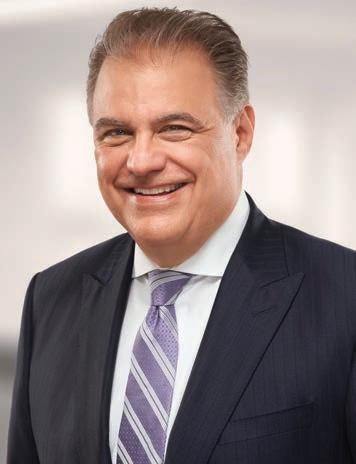
BY TOMMY HUMPHREYSJonathan Goodman has had it with rosy economic studies from junior miners that fail to live up to expectations.
“Have you ever seen a feasibility study or a pre-feasibility study that had a lower capital cost than the PEA?” asks the president and CEO of Dundee Corp. (TSX: DC-A) on a Zoom call.
“I believe we’ve created a false sense of stability with these documents. ey’ve hurt our market… at some point someone’s going to have to sue an engineering rm because it’s not acceptable.”
Goodman has been trading mining stocks for nearly 50 years and has had a long career as a mining executive, analyst and portfolio manager. He says Australian studies are better because they’re more likely to build their own mines, whereas Canadian juniors develop projects to sell.
To attract capital, Goodman wants the industry to become more predictable. “Unless we give them better data, the generalist investor isn’t going to show up.”
From investor to miner As a teenage speculator, Goodman’s legendary father Ned mentored him to do his own research. A er becoming a professional engineer and bank analyst, Goodman led closed end fund Dundee Precious Metals to 22.8% annual returns from 1992-2003.
He recalls visiting the Yanacocha gold project in Peru in the early ‘90s, part owned by Minas Buenaventura (NYSE: BVN), at the time an obscure Peruvian mining company. Goodman’s fund secured a 7% stake, leading to a 15% gain in two years, as Yanacocha grew to nearly 3 million oz. peak production.
“Growth funded by itself. at’s one of my key themes,” Goodman says.
In ‘89, Goodman co-founded, was initial CFO, and later chairman of Repadre Capital, a dormant $1-per-share shell company once controlled by Murray Pezim. Under Goodman, Repadre began as a diamond explorer, evolved to a royalty company through the Diavik diamond discovery, and later acquired an interest in the Tarkwa gold mine in Ghana. Iamgold (TSX: IMG) acquired Repadre for $12.60 in 2003 and later sold the Diavik royalty to Sandstorm Gold (TSX: SSL).
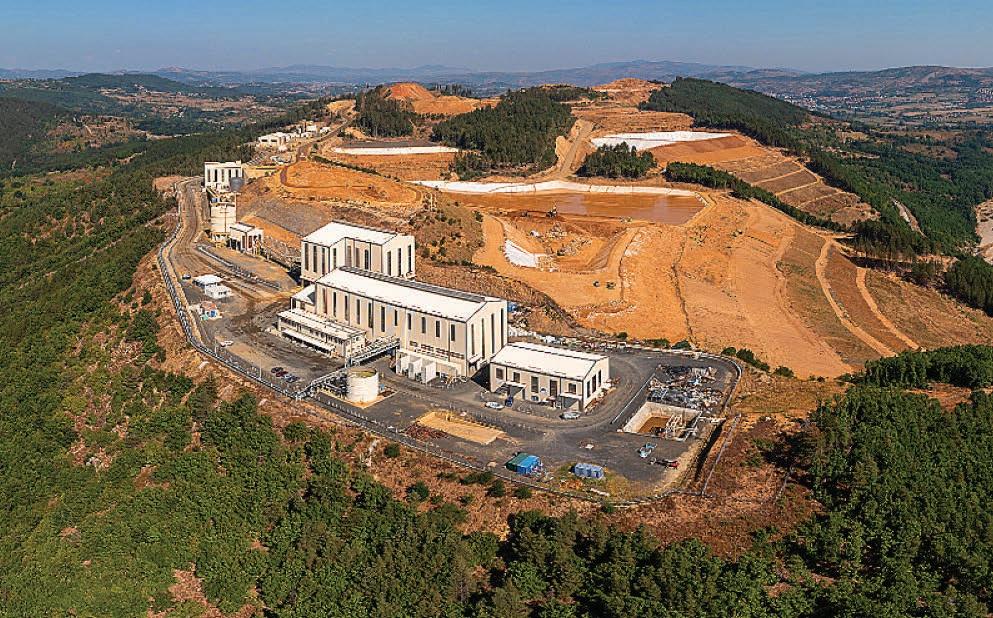
en Goodman transformed Dundee Precious Metals (TSX: DPM) from a passive investor to an actual mining company. rough the US$26.5 million acquisition of a Bulgarian mine portfolio in 2003, DPM modernized and expanded Chelopech, then permitted and built Ada Tepe.
Recalling the nine-year permit process for Ada Tepe, Goodman says, “We took cyanide out of the equation and we dry stacked the tailings. By doing those two things, the community felt that they had the ear of the company and it really worked well. So those listening skills are kind of important.”
“Growth funded by itself. That’s one of my key themes.”
Goodman retired from Dundee Precious in 2022. e company is a $1.8-billion market cap miner today with roughly $800 million in cash and no debt.
In 2018, Goodman rejoined family-controlled Dundee Corp. as CEO. e company, which incubated Dynamic Funds (sold to Scotia in 2011), DREAM Unlimited (spun out to shareholders in 2013), and others, faced nancial challenges a er a Vancouver casino bet and others struggled or didn’t materialize. A er a di cult restructuring period, Dundee Corp. has returned to its mining investment roots.
Goodman says he’s as optimistic as he’s ever been about mining. “I believe that we are at the precipice of a generational opportunity in mining as the con uence of the energy transition and the continued unsustainable strategy of decit spending by virtually every country in the world are happening at the same time.”
Dundee Corp. is looking under the hood at future mining projects, signing con dentiality agreements, and doing its own modelling. e company owns a 14.9% stake in Reunion Gold (TSXV: RGD), which is developing the Oko West deposit in Guyana, worth roughly $85 million. (At press time in late April, G Mining [TSX: GMIN] had just o ered $875 million in a friendly cash-and-shares deal for Oko West, with Dundee o ering its support.) It holds a 21% stake in Magna Mining (TSXV: NICU), a Sudbury nickel-copper junior. Other mining investments include a 1.5% royalty on Aura Minerals’ (TSX: ORA) Borborema gold project in Brazil.
Industry challenges
Returning to the topic of engineering studies, block-size is another of Goodman’s pet peeves. “So many of the companies we look at where they tout good feasibility studies, when you actually regularize the deposit for the right block-size, they lose the economics.” en there’s net present value (NPV). Goodman says it’s a weak metric since commodity price
assumptions are less reliable as time goes on. To him, the most important thing is how fast new mines repay their capital cost.
“Most mines start o with a 10-year mine life and you wake up 10 years later, they still have a mine life for 10 years.”
He’s speaking from experience. Dundee Precious Metals’ Chelopech had 6.5 million tonnes of remaining ore when Goodman acquired it. It has since mined over 25 million tonnes with 20 million more in reserves.
Long-life mines are “NPV irrelevant,” Goodman says. “If you can buy them for a quarter of NPV,
you’re really buying it for ve or ten cents on the dollar of what they’re worth. You don’t need a lot of those to be very successful in this business.”
Dundee Corp. avoids high capex projects. “When I look at a porphyry deposit, if you don’t have a high-grade starter pit, you don’t have a mine.”
Goodman sympathizes with CEOs having a tough time nding investors. “Companies that aren’t in the ETFs, they’re orphans.”
He says he thought investing was tough until he became a miner. Finance teams can work around a bad apple, he says. If a miner has
a perfect CEO, geologist and engineer, but a bad metallurgist, or vice versa, the whole thing fails. “It’s like this chain link fence where every link has to be right, and there’s no two industries worse suited for each other.”
Mining is a big part of Dundee Corp.’s investment portfolio. At year end 2023, the book value of mining investments was $161.3 million. It also holds non-mining investments, including an automotive parts manufacturer and an Alzheimer drug developer, with a book value of $126.3 million (this includes cash of $26.3 million and net debt of $15.1 million).
Dundee Corp. stock is undervalued compared to the $2.82 per share value of its asset portfolio ($287.6 million total assets, less $36.5 million market value of preferreds, divided by 89 million shares). e company has a $90.8-million market cap.
“I can’t predict where the market’s going to take things, but if we have a good orebody and we can hang onto it, great orebodies make great cash ow,” Goodman says. TNM
Tommy Humphreys founded CEO.ca, now part of EarthLabs Media, which also owns e Northern Miner Group. Read more about Goodman’s journey as a mining investor at Tommy’s blog, eBigScore.com.
COAL | FBI probes how cargo ship Dali knocked out port in one swoop
hermal coal producer Consol Energy (NASDAQ: CEIX) is one of scores of companies hit by the March 26 collapse of the Francis Scott Key Bridge that mostly shut the port of Baltimore, America’s second-largest coal exporter. e disaster could drop Consol’s revenues by more than US$140 million should it be unable to access its coal terminal for at least six weeks, as some experts say appears likely. e terminal shipped about 19 million tons of coal last year at US$62.50-US$66.50 per ton which amounts to about US$1.2 billion in annual revenue.
“ e extent of the nancial impact will depend on how long the terminal remains inaccessible to vessels,” Moody’s Ratings vice-president and senior analyst Sandeep Sama told e Northern Miner by email. ere is “some potential oset from any business interruption insurance coverage,” he said.
Near press time, the FBI had started a criminal investigation into what the crew of the container ship Dali knew as it lost power before the crash. And one of America’s largest cranes was working to open a temporary channel to the port, largely paralyzed since the collapse. O cials aimed to reopen the port’s main channel by the end of May.
Baltimore is America’s ninth-
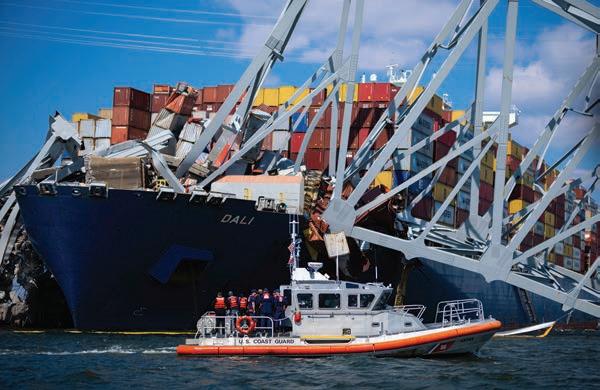
largest port by trade volume, but it’s especially important for coal and cars. More than a quarter of U.S. seaborne coal exports leave from Baltimore, most o en bound for India, China and Europe. It’s also a main entry point to the U.S. market for Asian automakers delivering vehicles and parts. Shutting the port will likely have companies trying new routes and suppliers, like when China blocked Australian coal imports 24 years ago.
“Rather than throwing global trade into disarray, what came next was the reshu ing of global suppliers,” Moody’s Analytics economist Harry Murphy Cruise recounted in a report late last month. “China
found new sellers in Russia and Indonesia, which forced Japan, India and South Korea to switch to Australian suppliers.”
US$1B loss
Rebuilding the bridge will likely cost US$600 million and be paid for by the federal government, IMPLAN, an economic so ware analysis company, said soon a er the crash. e accident’s hit to Maryland’s economy will be around US$1 billion, it said.
Other estimates were higher. A new bridge could cost between US$1 billion to US$5 billion, Justin Marlowe at the University of Chicago’s Harris School of Public
Baltimore is America’s ninthlargest port by trade volume, but it’s especially important for coal and cars. More than a quarter of U.S. seaborne coal exports leave from Baltimore, most often bound for India, China and Europe.
Policy, said in April. e U.S. accounts for around 5.5% of global coal exports, so about 1.5% of global coal trade may face disruptions, Moody’s said. e U.S. exported 85.9 million tons of coal in 2022, according to the Energy Information Administration. Although Baltimore’s contribution to global seaborne coal is less than 2%, it’s important for India’s electricity generation.
Consol said it’s considering alternative export markets and activating contingency plans.
“ ese plans include, but are not
limited to, the ability to move coal tons through open terminals on the East Coast and increasing domestic shipments,” spokesperson Erica Fisher said by email. “At this time, no one has a de nitive timeline of when vessel access or normal operations will resume, but we have initiated discussions with our customers and contingency plans are being implemented.”
Six dead Trade through the Port of Baltimore was suspended as investigators probed into how the Dali crashed into the world’s third-longest truss bridge, tossing people into the Patapsco River and leaving six dead, with two still missing. Investigators were focused on the container ship’s electrical power system to understand what happened just before the crash. O cials are also examining the bridge design and how it could be built with better pier protection.
Global trade was already being squeezed by Houthi rebel missiles in the Red Sea near the Suez Canal while drought limited shipping in the Panama Canal and strikes in Australia and Finland a ected their ports, Moody’s Cruise said.
“It won’t take much to hobble supply chains and rein ate price pressure,” the analyst said. “ e demise of a bridge in Baltimore won’t be the straw to break the camel’s back, but it takes us nearer to that limit.” TNM
Australian farmers are taking mining giant Glencore (LSE: GLEN) to court to block a carbon capture and storage plan they say will pollute an underground water reservoir a h the size of the country.
Glencore says its injection plan from a coal power plant is food-grade carbon dioxide, similar to that found in so drinks, to depths of more than 2.3 km. e Swiss company’s plan already has approval in a 2022 government decision and the backing of independent research groups.
Queensland-based group AgForce contends its thousands of members can’t a ord damage to a reservoir they depend on for watering cattle and crops. It led papers in a Brisbane federal court on April 11. e case, which may be heard in August, could be AgForce’s nal attempt a er previous disappointment at the state level, organizers said.
“We as farmers and agriculturalists know and understand the immense value of water,” AgForce president Georgie Somerset said in a release. “ at’s why we can’t
“The aquifer we’ve identified contains nonpotable water with fluoride levels six times above the safe drinking level and is not used by any agricultural producer within a 50-km radius.”
GLENCORE
understand why anyone would propose to put that at risk – and our food security along with it.”
e case, which puts environmentalists at odds with a plan to mitigate climate change, may create interest for projects as far away as Canada and the United States.
Carbon injections have been a part of the oil and gas industry for decades and mining companies are searching for ways to reduce emis-
sions. Alberta and Texas, home to the fossil fuel industry and burgeoning areas for lithium operations that may reinject brine, also have huge agribusiness sectors.
Coal plant e carbon from a Glencore coal plant in Queensland is to be liqueed. Initially it would be 330,000 litres before the program increases. e groundwater at the site is already unsuitable to drink because of uoride levels, the company said.
“ e aquifer we’ve identi ed contains non-potable water with uoride levels six times above the safe drinking level and is not used by any agricultural producer within
a 50-km radius,” Glencore says in talking points about the process.
“Our project has been reviewed by expert third-party institutions,” it said, “who concluded that the impacts would be local and minor.”
e groups include Australia’s Government Independent Expert Scienti c Committee, the O ce of Groundwater Impact Assessment and the Commonwealth Scienti c and Industrial Research Organisation, a government research agency.
Glencore has said it wants to reduce carbon dioxide equivalent emissions for its industrial assets by a quarter by the end of 2030. Its company, Carbon Transport & Storage, heads the e orts in Queensland.
Freshwater resource
e Great Artesian Basin, where the carbon would be pumped, ranges mostly over Queensland and Northern Territory in north-central Australia. It’s one of the largest underground freshwater resources in the world, according to the Queensland Farmers’ Federation. e reservoir generates about A$13 billion ($11.6 billion) in value annually to the national economy and is vital for 180,000 people, 7,600 businesses and 120 towns.
“ e absence of state and federal policy on this matter is appalling,” federation CEO Jo Sheppard said in the AgForce release. “Both levels of government need to respond to the uni ed concerns of community and industry to act immediately.”
e farmers say there is scienti c evidence that carbon dioxide reacts with underground rock, releasing stored toxins including arsenic and lead that make it unsafe.
Glencore says that’s misleading. e mobilization of trace metals already contained in the geology due to carbon dioxide storage is minor and localized, which is described in the project’s environmental impact statement, it said. TNM
COMMMENTARY | The assumption that mining’s got a bad rep deserves to be challenged
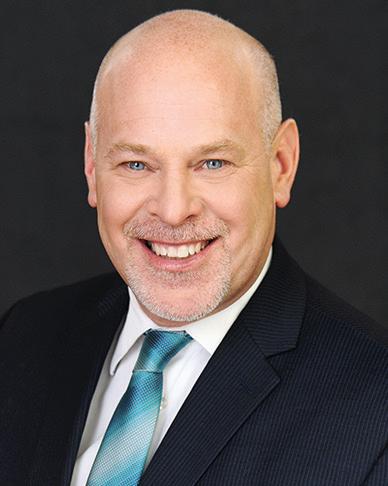
BY PIERRE GRATTON AND BRUCE ANDERSONFor decades, some critics have felt at liberty to describe the mining sector as lacking public trust, but the reality doesn’t really conform with that accusation, at least in Canada. More than a dozen years of national public opinion studies have documented precisely how Canadians feel about mining, including the sector’s strengths and weaknesses.
In an opinion piece published in e Northern Miner in April there were several observations o ered about the mining sector, which deserve to be challenged.
e column by Kevin PCJ D’Souza begins with “ e mining industry has a trust problem. Broad based trust in our industry is at an all-time low.” Neither of these assertions hold up against the evidence as far as Canada is concerned. Here are some ndings from our latest survey of 3,400 Canadians across the country, in March.
n 80% say they have a favourable impression of mining companies operating in Canada, the highest number recorded since these tracking surveys began in 2012.
n 83% say the industry does a good or acceptable job of being good neighbours.
n 82% say the industry does a good or acceptable job of being honest/ trustworthy.
n 80% say the industry does a good or acceptable job of earning public trust.
n 85% say the industry does a good (33%) or acceptable (52%) job of “ful lling their responsibilities to society.”
“Mining companies in Canada embrace their social and environmental responsibilities and the public has noticed and appreciated the effort.”
In order to avoid any confusion about what people mean when they give the industry an “acceptable” rating, we asked respondents to clarify how they used that response category. Just over half (55%) said that when they o ered an “acceptable rating they meant “I feel they are doing a good job,” 44% said “I have no reason to o er a poor rating but don’t know enough to o er a good rating,” while 9% said to them “acceptable” implied “I am somewhat disappointed.”
So, when it comes to “ful lling their responsibilities to society,” the proportion of respondents who feel the industry is doing a poor job (15%) plus the proportion of
to develop untouched salt ats in northern Chile, particularly the Salares Altoandinos project, which spans about 260 sq. km in the Atacama region.
“It is crucial for Enami to learn about processes that contribute to the creation of projects with the lowest possible environmental impact,” the company said.
Enami will now consider carrying out tests with one or more of the bidding companies.
e Chilean miner is one of two entities assigned to represent the state under President Gabriel Boric’s new public-private model for tapping the country’s lithium reserves, one of the world’s biggest.
Rio Tinto is among the few top miners investing in lithium. It has already committed US$350 million for its Rincon lithium plant in Argentina, with production expected by the end of the year.
France’s Eramet is progressing the Centenario lithium project in Argentina, which is slated to produce about 30,000 tonnes annually of lithium carbonate equivalent (LCE). BY
Rio Tinto will prioritize developing new copper mines over acquiring new ones to achieve its goal of producing 1 million tonnes of the metal annually over the next ve years, copper boss Bold Baatar has said.
e executive told the CRU World Copper Conference in Chile in April that boosting production from the 700,000 tonnes of copper it currently churns out mainly depends on organic growth.
Most of the output increase, Baatar said, will be driven by Rio Tinto’s expansion in Mongolia, Utah, and global exploration e orts, including a partnership with Chile’s Codelco.
Baatar said Rio would invest more in Chile if the country streamlines its permitting process for new developments and to optimize current operations.
Despite the increasing cost and time required for project development, Baatar believes that building mines is still more cost-e ective than buying existing ones, a stance that may disappoint industry watchers betting on a new wave of mergers and acquisitions.
Consolidation in the industry is only logical if it increases the supply of the metal used in wiring, considering the anticipated acceleration in demand growth due to the world’s ongoing energy transition, Baatar noted.
the “acceptable” responses which could be characterized as negative in nature (9% of 52%), amounts to a total of 20% who are disappointed or unhappy with the sector.
Solid reputation stands e point here is not that there is no room to improve public perception, or no need to work to continue to earn trust day in day out, and the author described actions and conduct that companies from any sector should embrace. But we also have to be clear-eyed about the current situation. Canadians by and large think the industry in Canada is valuable for the economy and takes
its responsibilities for environmental management, safety, and collaboration with local and Indigenous communities seriously.
at’s why 81% believe “Canadian mining deserves to have a good reputation.” And 83% think Canadian companies operating abroad are helping raise environmental standards for mining around the world. By a margin of 72% to 28% Canadians think the mining sector is ethical rather than unethical.
Mining companies in Canada embrace their social and environmental responsibilities and the public has noticed and appreciated the e ort. e Mining Association of Canada pioneered the rst site level ESG performance measurement standard in the world, Towards Sustainable Mining (TSM), which has at its core a commitment to engage with and respect the communities where the industry operates, particularly its Indigenous partners. Doubtless, TSM has contributed to this reputation.
Does it matter when public trust
is mining is so badly mischaracterized?
It sure does.
ose who believe in the importance of ESG e orts must know that enthusiasm for these policies will su er if these e orts are dismissed out of hand.
Companies shouldn’t get credit for things they don’t do, of course, but to pretend that there is a trust crisis in mining — at least in Canada — is so far from the truth, it does a disservice to all the e ort that has gone into this area in Canada over the last couple of decades, and diminishes the good work done by hundreds of thousands of Canadian workers, who make an e ort to produce useful products for the world with standards of care that they can rightly be proud of. TNM
Pierre Gratton is the president and CEO of the Mining Association of Canada (MAC). He was previously president and CEO of the Mining Association of British Columbia, and from 1999-2008, served as VP, Sustainable Development and Public A airs for MAC. In this capacity, he was instrumental in the development of Towards Sustainable Mining, MAC’s agship program that is gaining international recognition and adoption.
Bruce Anderson is one of Canada’s most experienced public opinion pollsters and chief strategy o cer with Spark Advocacy. He has been conducting reputation research for the mining sector for more than a decade and has conducted similar studies in banking, insurance, forestry, oil and gas, and other sectors.



| Mid-East tension, inflation feed into 15% surge this year
BY COLIN MCCLELLANDCentral bank buying and investors seeking the haven of bullion have driven the price of gold to new highs, analysts say.
e energy transition and technology uses are driving movements in the metal that are less tied to traditional commodity markets and broader economic cycles, BofA analysts say. Tight copper mine supply and a shortage of mining projects are nally starting to a ect markets, according to Michael Widmer, a commodity strategist and co-author of an April 8 report.
e spot price of gold as press time approached had slid about US$65 an oz. from its record of US$2,394.95 per oz. on April 21 a er Israel responded to an Iranian attack. Iran’s attack failed to do much damage and Israel’s response was muted, probably explaining why gold has eased. Still, the price has increased about 12% this year.
Bullion has been setting record prices since February even as markets such as the Dow Jones Industrial Average closed at a record 39,131.53 on Feb. 23 and the S&P 500 ended March 28 at an alltime high of 5,254.35.
In April, markets slipped. e S&P 500 fell more than 2% in the third week. e U.S. reported higher-than-expected 3.5% annual in ation for March and the Federal Reserve indicated interest rates may have to stay higher for longer.
“More investors view it as a better hedge against geopolitical risks than government bonds due to U.S. in ation concerns,” Mohamed A. El-Erian, former CEO of bond giant Pimco, said on X. “Gold is also seeing support from central
banks, some of whom are motivated by more than just in ation and geopolitics.”
Counter-intuitive
Gold’s run higher in February and March when stocks were roaring confounded some investors because there’s no historical correlation between high gold prices and elevated stock markets.
Investors then were diversifying into commodities like gold to protect the stock gains they made over the past few years, Je rey Christian, a gold expert with New York-based CPM Group, said by email.
“ e sharp increase in equity indices has contributed to the investor interest in gold and commodities,” Christian said. “Investors seek to take pro ts on some of their equity and bond
market positions, capitalize those gains, and diversify their exposure to include commodities.”
Copper, too Copper has also climbed. It’s risen more than 18% from US$3.67 per lb. on Feb. 9 to US$4.35 per lb. near press time. Investors are buying into the rising prices using futures, options and exchange-traded funds (ETFs) which are shorter term and o er easy entries and exits to commodities, Christian said.
“ e economic environment is strong in some industrialized nations, e.g. the U.S.,” he said. “Even so, many nancial market participants have pivoted away from expecting an imminent recession to thinking one may be avoided entirely. ey probably are still wrong, just on the other extreme.”
“More investors view it as a better hedge against geopolitical risks than government bonds due to U.S. inflation concerns.”
MOHAMED A. EL-ERIAN, FORMER CEO OF PIMCO
It’s a reaction against how the U.S. has levied sanctions against countries such as Iran, Russia and China, a move pundits called the weaponization of the dollar. It has been greeted by countries trying to reduce reliance on the greenback, a trend called de-dollarization. e central bank gold buying is “a strategy to hedge against in ation and the impact of relaxed monetary policy on global currencies and sovereign bonds, and a means of insuring against the escalating geopolitical tensions associated with deglobalization,” Wong said.
Deglobalization has been driven by events such as Russia’s invasion of Ukraine, COVID-19 disrupting supply chains, Britain leaving the European Union, countries developing their own resources and processing, and protectionist policies that create trade barriers.
Central bank buying of gold increased two years ago with the Russian invasion of Ukraine and the freezing of Russia’s foreign exchange. It hasn’t let up, dwarfing the sales of gold by ETFs and the Commodity Futures Trading Commission, Paul Wong, a precious metals analyst with Toronto-based Sprott, said in a report in April.
Central banks added a net 2,630 tonnes while the futures commission and ETFs sold a net 854 tonnes in last year’s second half. As of December, the di erence had widened to more than 2,980 tonnes or 95.8 million oz., Wong said.
‘Outside money’
“ ere is also a growing preference for ‘outside money’ (assets not linked to any speci c country) in central bank reserves,” Wong said.
Investors should also note the di erence in price for an ounce of gold between the Shanghai Gold Exchange and the global price that’s usually set by the London Bullion Market Association or e Commodity Exchange in New York, he said. e higher price in Shanghai shows Chinese demand as its economy weathers real estate turmoil.
“ ere is clear evidence — although di cult to fully quantify — that the general population is buying gold as a hedge to protect against their high wealth exposure to the fragile property market,” Wong said.
“Assuming global tensions persist and the trend toward deglobalization continues, central banks and sovereigns may likely maintain a supportive in uence on gold prices.”
TNM
ANALYSIS | Bank expects 324,000 tonne shortfall this year
BY HENRY LAZENBYCopper is increasingly ‘dancing to its own tune,’ say Bank of America analysts, who recently upped their 2026 price forecast for the red metal by 26%. In an April report, the bank said it now expects copper to reach about US$12,000 per tonne or US$5.44 per lb. in two years’ time. At press time the price was US$9,656 a tonne or US$4.42 per pound.
e energy transition and technology uses are driving movements in the metal that are less tied to traditional commodity markets and broader economic cycles, BofA analysts say. Tight copper mine supply and a shortage of mining projects are nally starting to a ect markets, according to Michael Widmer, a commodity strategist and co-author of an April 8 report.
“ e pronounced lack of new mine projects has begun to bite, constraining re ned copper production and spotlighting years of underinvestment in copper exploration and development,” Widmer
“The pronounced lack of new mine projects has begun to bite, constraining refined copper production.”
MICHAEL WIDMER, BANK OF AMERICA
wrote.
BofA forecasts a market de cit of 324,000 tonnes this year, growing to 743,000 tonnes by 2026. Supply has been slow to grow as capital costs at mines have risen faster than copper prices.
BofA’s price forecast contrasts against that of Fitch Solutions unit BMI, which calls for 2026 prices to
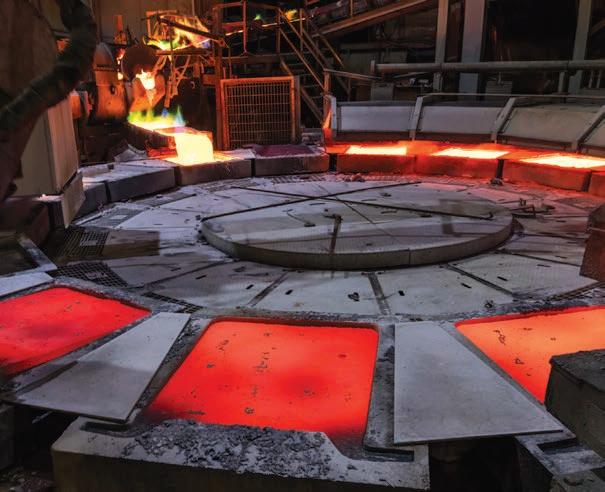
average US$9,600 per tonne while Bloomberg forecasts US$9,378 per tonne. BMI increased its 2024 forecast to US$9,200 per tonne from US$8,800 on the back of a tighter
supply outlook and a decline in
prices surged over 15%
8, near a 15-month high, following mine disruptions that closed re ned-copper capacity at Chinese smelters. ese smelters contribute to more than half of the global supply.
Copper reached a record on the London Metal Exchange in May 2021 of US$10,747.50 per tonne amid strong Chinese demand and COVID-19 supply disruptions.
Demand for copper remains healthy, fuelled by investments in green technologies, a rebounding global economy, restocking e orts, and possible rate cuts.
e red metal’s importance in renewable energy technologies, EVs, and infrastructure development makes it indispensable in the global shi toward sustainability.
As a major player in the copper market, China’s investment decisions, particularly with green technologies, can sway global copper demand, BofA warns. Should China reduce its green investments, demand could ease up, but supply constraints would remain, Widmer says. TNM
Alooming decision by Mexico’s Supreme Court is likely to toss out contentious new mining laws that industry sources deem as unworkable.
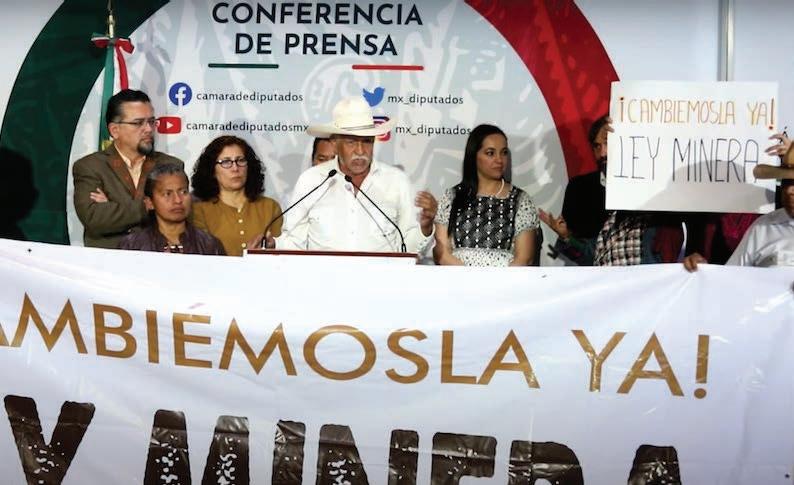
e reforms introduced last May by President Andrés Manuel Lopez Obrador (known by his initials as AMLO) require consultation with communities before exploration, impact studies and cash bonds in case of damage that junior explorers may struggle to raise. Authorities can cancel exploration concessions a er two years if no work is completed and critics say water allowances have become harder to get. AMLO has also nationalized the country’s nascent lithium sector and proposed a ban on open pit mining.
“If you plot a graph of the discoveries and production of gold and silver in Mexico, it starts a very rapid upward climb year on year from 1992, when they opened up exploration to foreign companies. And now, what you’re seeing is a cli ,” the CEO of a mid-tier silver mining company operating in the country told e Northern Miner in April. “And we’re going over the cli because no one’s doing exploration. You don’t have future mines if you don’t do exploration.”
Canadian companies accounted for up to US$8 billion in exploration spending and 70% of foreign investment in Mexico’s mining sector between 2012 and 2022, according to gures from the country’s mining chamber, Camimex. e industry is eyeing the Supreme Court ruling like a tra c light for project exploration and development.
ey’ve already been hard hit by AMLO’s mining reforms, Exploration Insights mining analyst Joe Mazumdar said.
“People with exploration assets in Mexico have a hard time getting funded,” he told e Northern Miner
At press time in late April, the court decision was expected at any time.
Mexico’s mining production was valued at US$16.7 billion in 2021, according to the U.S. Department of Commerce. Camimex says the new law will cost the country US$9 billion in investment and 420,000 jobs.
Since taking power in 2018, the AMLO administration has not granted any new concessions. And about a year ago, his Morena party shook miners when senators approved a new mining law in an accelerated late-night process that excluded opposition legislators.
Mexico mining law expert Santiago Suarez Sevilla says over 500 constitutional challenges (Amparos) have been led against the law because of the way it was passed. e Supreme Court recently issued new guidance walking back some of the reforms and, in some cases, grandfathering those ling challenges from enforcement of the new rules.
AMLO’s term ends in November, but his hand-picked successor Claudia Sheinbaum leads the polls ahead of an election scheduled for June. Sources were divided on
“Now, what you’re seeing is a cliff. And we’re going over the cliff because no one’s doing exploration. You don’t have future mines if you don’t do exploration.”
UNNAMED CEO OF A MID-TIER SILVER MINING COMPANY IN MEXICO.
what a win for her could mean for miners.
Given the regulatory uncertainty, several companies and investors e Northern Miner spoke to declined on-the-record interviews. at uncertainty a ects individual companies and economic ties between Mexico and Canada.
One senior executive of a gold-silver miner in Mexico says concern over AMLO’s mining and other reforms has overshadowed traditional investment concerns in the country, such as the in uence of drug cartels and violence.
Mexico’s mining slowdown has been in the making for some time. Camimex says there has been a 51% fall in exploration investment to US$572 million in 2022 from US$1.2 billion in 2012. Fiscal reforms in 2013 removed tax incentives.
Companies complain that last year’s reforms have created disincentives for mineral exploration, introducing exploration and water resource management plans that impose red tape, time, and extra costs.
Perhaps the most controversial stipulation is that proponents can only conduct green elds exploration in partnership with the state. Once a deposit has been proven, an open bidding process is still required, and the original proponent must match the highest bid to retain the concession. at means there’s no security of tenure for exploration assets.
AMLO threw fuel on the re in
February, pushing a new constitutional amendment banning openpit mining. at could crush the sector since open pit mines generate more than 60% of Mexico’s production, Mazumdar says.
Top producers with open pit mines include Newmont (TSX: NGT; NYSE: NEM), which operates Peñasquito; Fresnillo (LSE: FRES), which has two gold-silver mines; Grupo Mexico, which holds Buenavista del Cobre; and Industrias Peñoles.
Mazumdar points out that the economics for many projects such as San Nicolas, a joint venture between Teck Resources (TSX: TECK.A, TECK.B; NYSE: TECK) and Agnico Eagle Mines (TSX: AEM; NYSE: AEM), are based on an open pit scenario. Agnico paid US$580 million for half of the project last year.
GoGold Resources (TSX: GGD; US-OTC: GLGDF) has adapted its Los Ricos South gold-silver project to transition from a wholly open pit plan to underground mining initially. Other projects may never be developed if the open pit ban goes ahead.
ere are certain ironies to AMLO’s mining reforms. e apparent ban on open pit mines contrasts with the nationalization
of lithium mining in Mexico early last year. Hard rock lithium is usually best extracted by open pit, bulk mining.
One mining executive operating in Mexico noted the contradiction between populist AMLO’s advocacy for Indigenous and remote communities and his actions that undermine the mining sector. Mines in Mexico, o en located in remote areas, contribute to local development by building schools and hospitals, and provide job training and economic opportunities. Yet, AMLO’s policies are essentially “cutting the hand that feeds” the very people he claims to support, the executive said.
Majority to pass
Law expert Sevilla points out that AMLO’s proposed constitutional reforms need the support of twothirds of Congress for approval.
e Morena party and its coalition hold 273 of the 334 votes required for a quali ed majority in the 500seat Chamber of Deputies. In the 128-seat Senate, they have secured 71 of the needed 84 votes.
“Following this trend, we believe it will be very di cult for Morena to reach the necessary majority to approve constitutional changes in this and the next period,” Sevilla


said. “ e new mining law is highly unlikely to survive a challenge of unconstitutionality, a fate that open-pit mining also faces.”
In the upcoming election, Sheinbaum, the candidate for the ruling Morena party and its coalition, Let’s Keep Making History, is competing against Xóchitl Gálvez of the Broad Front for Mexico coalition.
Sources expect Sheinbaum to maintain the government’s hardline stance. However, some see the potential for her to take a more moderate approach once in power. ough its chances of forming a government are slim, the opposition is strongly pro-mining.
Camimex, for its part, says it is ready to work with the incoming government come November.
“As a business chamber and representatives of the mining industry in Mexico, we always maintain open channels of dialogue with the authorities with the aim of guiding and providing support in technical matters of public policies,” it said in a statement to e Northern Miner
“We are currently working with the authorities to build communication bridges that allow them to learn about the best practices that the industry has.” TNM










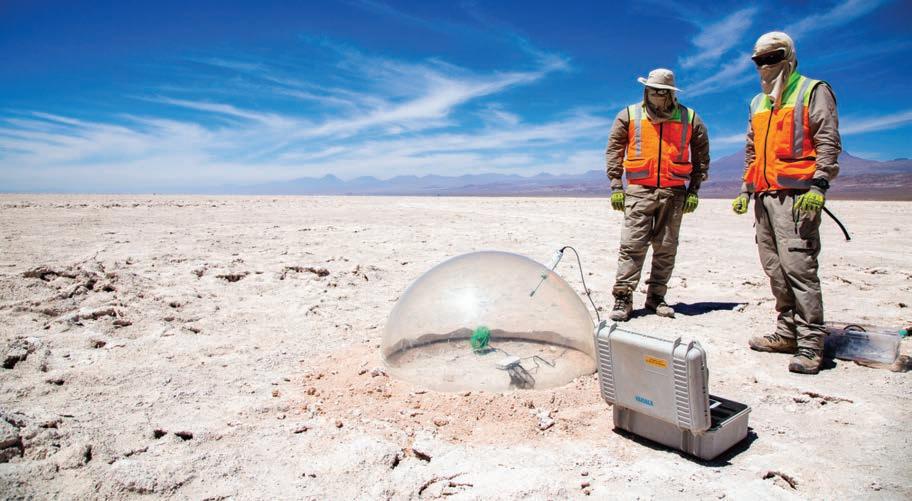 BY CECILIA JAMASMIE
Chile has revealed a long-await-
ed list of lithium-bearing salt ats that will be open to private investors with the goal of increasing local production of the battery metal by 70% in a decade.
But as the country’s mines minister anticipated in an interview with
e Northern Miner’s sister website MINING.COM last year, it has reserved the Atacama and Maricunga salars for state majority control.
e announcement provides insight into President Gabriel Boric’s government strategy to implement a national lithium policy announced a year ago. e model calls for public-private alliances in future projects, with state rms controlling partnerships in the most promising areas, while private rms can have majority stakes in projects located in less strategic zones.
A tender process for 26 salt ats was to start in April and conclude in July, the government said. It noted it expects to see three or four
new projects under development by 2026.
Atacama and Maricunga, the two salt ats deemed strategic and as such reserved to state-controlled partnerships, host a combined lithium potential of 10.8 million tonnes, corresponding to 64% of global reserves.
Nine other salt ats could contribute 3.3 million additional tonnes, according to expert José Cabello, head of consulting rm Mineralium.
O cials also announced the state will create a network of protected salt ats, which will not be touched as they are located in national parks.
Juggling act Chile is the world’s top copper producer and the second-largest producer of lithium a er Australia. Both metals are considered vital commodities for the global transition from fossil fuels to renewable energies.
Only two companies currently extract lithium in the country –Chile’s SQM (NYSE: SQM) and U.S.-based Albemarle (NYSE: ALB)
— both in the Atacama salt at.
e government is trying to juggle securing state control of the industry while attracting more private capital, protecting the environment and moving further down the value chain. Last year, it tasked state-owned copper producer Codelco with negotiating partnerships with each company.
e copper giant has already reached a preliminary agreement with SQM, which is set to last until 2060, but talks with Albemarle are ongoing. Earlier this month, Codelco also nalized the US$254million acquisition of Australia’s Lithium Power International, which handed the company the Maricunga lithium project, located in the namesake salt at.
Global demand for lithium, according to the Chile’s own projections, will quadruple by 2030, reaching 1.8 million tonnes. Available supply by then is expected to sit at 1.5 million tonnes.
Lithium carbonate exports represented 5.3% of total Chilean shipments in 2023, down from 8.4% the previous year.
SECURITY | Miner flags 14 incidents in two years
BY NORTHERN MINER GROUP STAFFThe Poderosa gold mine in northwestern Peru was attacked again in early April by illegal miners who this time used dynamite to topple two high-voltage towers that supply energy to the site.
e attack is the fourteenth on the mine in two years.
In a statement, Minera Poderosa said the criminals broke into the mine’s pits right a er knocking down the towers.
“ is attack occurred despite there being a State of Emergency and a contingent of more than 300 members of the National Police and the army in the area,” the company said in a release. “(It happened) shortly a er the police evacuated 150 troops from specialized units that had been providing services in Pataz, who had not yet been replaced.”
e Peruvian mining company noted that although the deployment of law enforcement o cers in Pataz province has been a positive step, their presence hasn’t come with any strategy to deter illegal mining or attacks on legal operations.
Illegal miners protected In Poderosa’s view, illegal miners feel protected by the Comprehensive Mining Formalization Registry and the recent repeal by the Peruvian Congress of regulations aimed at halting their activities.
Earlier in March, the parliament repealed the rst provision of a legislative decree that gave the police special powers to detain miners who are not in the registry and who are illegally transporting weapons and explosives.
“Unfortunately, law enforcement actions have been severely limited by the lack of support
from the Prosecutor’s O ce and regional representatives of the Energy, Mines and Hydrocarbons Management. Let us remember that the latter is in charge of supervising the work of artisanal and small-scale miners,” Poderosa’s statement reads. “ is criminal act emulates the actions of the terrorist groups that sieged the country in past decades, as it threatened the integrity of our personnel and endangered our operations. In the last two years, 16 employees have lost their lives in attacks by illegal miners and 14 towers have been knocked down.”
Industry demands action Minister of Energy and Mines Rómulo Mucho condemned the attack and emphasized that the operation would continue to be protected by the army and National Police.
Mucho also recognized that the mining formalization process has been more complex than expected, particularly a er certain decision-making processes were transferred to regional authorities.
But the minister’s statement wasn’t enough for industry representatives.
In Lima, the Chamber of Commerce demanded that authorities take swi action to locate and prosecute the criminal organizations behind such acts.
Similarly, Supera — a rm dedicated to the business transformation of mining companies — published a commentary saying that authorities must provide security to established mining companies, which are the main engine of the Peruvian economy.
Poderosa is an underground operation situated at an altitude that ranges between 1,250 and 3,000 metres above sea level. It produced 300,662 oz. of gold and 191,898 oz. of silver in 2022. TNM
| New law pauses
Canada’s Orla Mining (TSX: OLA; NYSE: ORLA) may take Panama to an arbitration court following the government’s rejection of a permit extension for the three mining concessions in the Cerro Quema gold project.
e Vancouver-based miner noti ed authorities of its intentions in the hope the move would lead to talks between the parties, the company said in April. e process would be done under the Panama-Canada free trade agreement and start this quarter, it said. “If these consultations are not successful, the company expects to le a formal request for arbitration,” Orla said April 10. “ e com-
pany’s preference is a constructive resolution with the government of Panama that results in a positive outcome for all stakeholders.”
e country’s Ministry of Commerce and Industry in December not only rejected the permit’s extension — it declared the area comprising the concessions a reserve area, revoking them altogether.
e cancellations occurred a er Panama’s national assembly passed a law in November which imposed a moratorium on granting, renewing or extending concessions for metal mining activities.
Orla, which also has assets in Mexico and Nevada, plans open pit mining of 21.7 million tonnes of ore from Cerro Quema’s La Pava and Quema-Quemita pits. e operation is to be built in several stages
“If these consultations are not successful, the company expects to file a formal request for arbitration.”
ORLA MINING STATEMENT
and produce 81,000 oz. of gold over an estimated six-year mine life. Construction would generate 3,600 direct and indirect jobs and 1,200 during operations, Orla estimated. e company’s arbitration
tactic was tucked into an update in April on the company’s Camino Rojo oxide mine in Mexico. Shares in Orla Mining traded at $5.47 apiece at press time, valuing the company at $1.7 billion. ey’ve traded in a 52-week range of $3.53 to $6.52. TNM








The Global Metals and Minerals Management (GMM) Diploma at the Schulich School of Business is designed to address the needs of the entire metals and minerals value chain by developing those who will lead the transition to a global low-carbon economy through responsible minerals development and use.
The GMM Diploma provides an MBA level of education while enabling you to continue full-time employment. The classes are taught by industry professionals and stakeholders and combine Schulich MBA students with Diploma students, ensuring a rich and diverse mix of backgrounds and experience.



The GMM Diploma is o ered over a nine-month period and includes online classes, in-person residences and one-on-one coaching.
For more information visit: schulich.yorku.ca/gmm







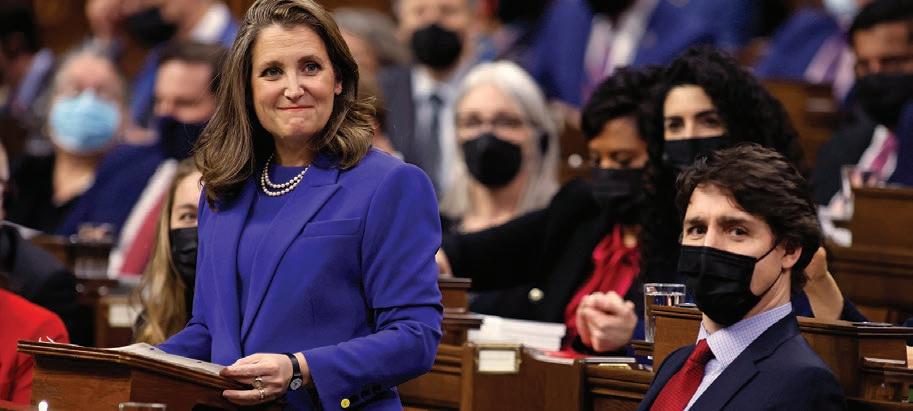
Canada’s new federal budget contained several measures impacting the mining industry including loan guarantees for Indigenous projects, increases in the capital gains tax and credits from mines to manufacturing for electric vehicles.
An Indigenous loan guarantee program o ers up to $5 billion to back natural resource and energy projects in Indigenous territories at lower interest rates than they might normally obtain. It’s aimed at helping communities secure capital and overcome barriers to equity investment. ere’s also a separate $16.5 million over two years to help applicants apply.
Investors may be most concerned about the tax rate increase to twothirds from half of pro ts from capital gains in the sale of property and securities. For individuals, it only a ects pro t of more than $250,000 while businesses face an immediate hike. e move is expected to raise $19 billion over ve years, according to government documents.
e Prospectors and Developers Association of Canada (PDAC) and the Ottawa-based Mining Association of Canada (MAC) said they support the Indigenous loan program and a target to approve mining projects within ve years. However, they expressed concern about the changes to capital gains tax.
“We believe this budget will be very damaging to nancing of mineral exploration in Canada at a time when new investment in critical minerals exploration is most needed,” MAC said in a release. “ e changes to capital gains may undermine the mineral exploration tax credit and harm mineral exploration nancing.”
On the capital gains tax, the government is increasing the lifetime personal exemption to $1.25 million from about $1 million. Also, entrepreneurs would be able to qualify for a one-third tax (known as the inclu-
“We believe this budget will be very damaging to financing of mineral exploration in Canada at a time when new investment in critical minerals exploration is most needed. The changes to capital gains may undermine the mineral exploration tax credit and harm mineral exploration financing.”
MINING ASSOCIATION OF CANADA
sion rate) on capital gains depending on criteria, instead of the new twothirds rate. Claimants must directly own the shares, the company must be Canadian-controlled and at least half of the company’s assets must do business in Canada.
e budget extends the 15% mineral exploration tax credit that applies to junior mining companies using ow-through shares.
ey allow investors to deduct the exploration expenses from their taxable income. It was approved for another year on March 28.
e budget allows individuals to claim 80% (instead of a proposed half) of the charitable donation tax credit. e British Columbiafocused Association for Mineral
Exploration (AME) called it a “strategic move that o sets some of the capital gains associated with the mining and exploration tax credit and the critical minerals exploration tax credit.
“However, we urge the government to ensure that the increased capital gains inclusion rate for corporations and trusts does not adversely a ect the competitiveness of Canadian companies, and disincentivize mineral exploration nancing,” the AME said in a release.
Tax credit details
is year’s budget clari ed last year’s introduction of the clean technology manufacturing investment tax credit, which provides a 30%
refundable tax credit on the cost of investments in eligible property.
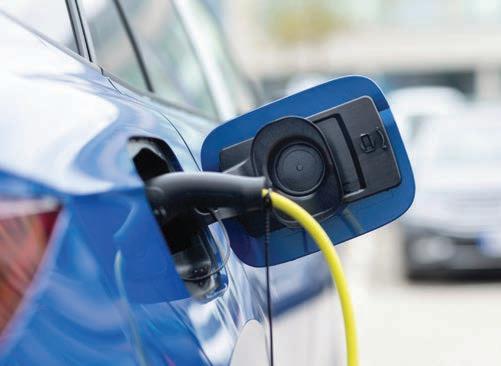
e credit covers the mining of copper, nickel, cobalt, lithium, graphite and rare earth elements and is expanded to include polymetallic operations that produce more than one mineral. It’s also making accommodations for tailings ponds and mills that contribute at least half to a site’s production.
“PDAC will be unwavering in voicing how uniquely Canadian investment incentives like owthrough shares and exploration tax credits must remain well-oiled and ingrained in our nancial landscape,” the group said in a release.
e budget doesn’t promote mining in the country’s far north, the Northwest Territories and Nunavut Chamber of Mines said. Over the past ve years it’s been demanding a north of 60 degrees latitude tax credit for mineral exploration to help the region compete with provinces that create their own tax incentives on top of federal help. Territories must rely on federal government initiatives.
“It’s not a cash outlay, just foregone revenue to Canada, which we believe is made up in spades with exploration spending and suc-
cess,” chamber senior adviser Tom Hoefer told e Northern Miner by email. “We don’t have enough mines to replace upcoming closures because exploration investment has been insu cient to increase the odds of nding new mines.”
‘Election budget’
e 2024-25 budget forecasts $59.2 billion in new spending over ve years – about a 1% increase –while keeping a de cit of around $40 billion for the next three years. It would decline to $20 billion in 2028-29. Pundits called it an election budget — the Liberal government faces a vote in the next 18 months — that is heavy on housing spending to attract younger groups such as Millennials and Gen Z’ers while being less concerned about the scally conservative.
“ ere are no measures in here to really stimulate investment in general and to stimulate competition, which will force businesses to use that investment more wisely,” columnist Andrew Coyne said on CBC TV. “ ere’s just the usual subsidies and tax credits and gimmicks for the particular favourite sectors of the government, arti cial intelligence or clean technologies.”
A new 10% electric vehicle supply chain tax credit applies to the cost of any building where EVs or the batteries and other components that power them are constructed.
e tax credit is expected to cost $80 million over ve years, and an additional $1 billion from 2029-30 to 2034-35.
e budget’s 15% clean electricity investment tax credit applies to new equipment or refurbishments related to low-emitting electricity generation systems. It’s expected to cost $7.2 billion over ve years starting in 2024-25, and an additional $25 billion from 2029-30 to 2034-35.
e energy systems can be wind, solar, water, geothermal, waste biomass, nuclear, or natural gas with carbon capture and storage. It also applies to batteries and pumped hydroelectric storage, and transmission of electricity between provinces and territories. TNM
EXPLORATION | METC expected to provide $65M in support for sector
BY HENRY LAZENBYThe federal government is extending its 15% mineral exploration tax credit for investors in ow-through shares for another year.
e extension, expected to provide $65 million in support for exploration, was due to expire at the end of March. In 2021, it helped 300 companies to raise equity by issuing eligible ow-through shares to more than 12,400 investors, the government said on March 28.
British Columbia’s Association for Mineral Exploration (AME), which had lobbied for the extension in recent months, welcomed the move, delivered in part by Canada’s Natural Resources Minister.
“We would like to thank Minister
Jonathan Wilkinson for his tireless advocacy on this matter to push for the extension,” AME president and CEO Keerit Jutla said in a social media post.
Uniquely Canadian e concept of ow-through shares, which give tax incentives to buyers and allow charitable donations, is uniquely Canadian — no other country has them. Proponents contend they are vital to attract investors troubled by the wide divergence between low company valuations and the relatively high prices of some metals. ey may be more important now as Canada strives to develop critical mineral resources for the batteries to mitigate climate change.
“Canada is a mining nation,” Wilkinson said in a release on
March 28. “ e responsible and sustainable management of our mineral resources has provided good jobs and wealth creation for generations of Canadians.”
Other tax credit
Ottawa also o ers the separate 30% critical minerals exploration tax credit applying to a list of 31 minerals deemed important for the energy transition, such as battery metals. It was introduced two years ago and can’t be used on top of the 15% exploration tax credit. e extension re ects an e ort to balance economic development with environmental stewardship and to boost the mining and exploration sector’s competitiveness on a global scale, according to the government announcement.
“Canada has an abundance
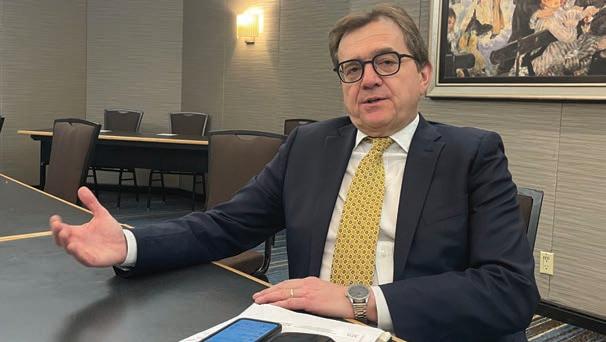
Ontario’s budget this year expands the critical minerals innovation fund by $15 million as the province begins to streamline mining permit approvals.
e innovation fund aims to spur technology advances from mining to processing to manufacturing in the transition to cleaner energy. e new funding is spread over three years, Ontario’s Mines Ministry said on March 26. It extends the program at its $5 million-a-year current rate.
It wasn’t exactly a huge budget day for the mining industry, with higher interest rates forcing Queen’s Park to nearly double its forecast de cit to $9.8 billion compared with the autumn economic update of $5.3 billion.
Even so, industry players supported the new funding and looked ahead to quicker permits under the Building More Mines Act. It was passed last May and came into force this April. Ontario wants to feed battery metals to the GM, Ford, Honda, Stellantis and Toyota factories manufacturing its number one technological export.
“ e province’s on-going work facilitating connections between our mining sector and automakers is ensuring a robust supply chain for the materials needed
“There’s not a word changed in two very important things: Ontario’s world class environmental standards and the duty to consult.”
— GEORGE PIRIE, ONTARIO MINISTER OF MINES
to build electric vehicles right here in Ontario,” Canada Nickel (TSXV: CNC; US-OTC: CNIKF) CEO Mark Selby said in prepared remarks. “ e opportunities for growth and innovation in critical minerals are unlimited.”
Crawford project Canada Nickel, backed by investments from Agnico Eagle Mines (TSX: AEM; NYSE: AEM) and Anglo American (LSE: AAL), is advancing the world’s largest nickel sulphide project, Crawford, near Timmins. It wants to build two processing plants nearby for nickel
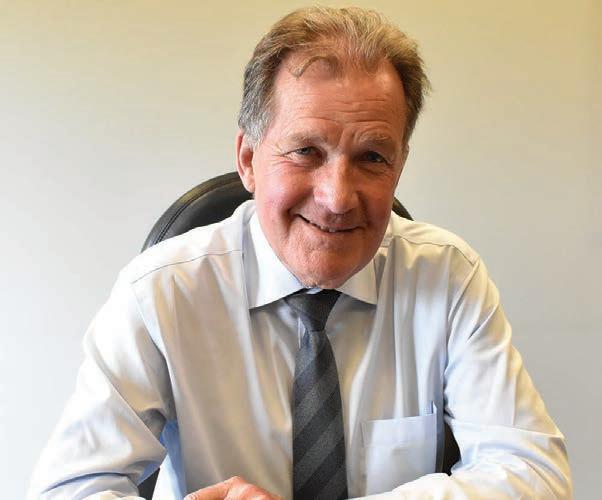
and steel that could cost more than US$1 billion and be North America’s biggest.
e continued critical mineral innovation funding strengthens collaboration among government, industry and research schools to help the sector, Frontier Lithium (TSXV: FL; US-OTC: LITOF) CEO Trevor Walker said in a statement.
“We commend today’s announcement,” Walker said. “ is investment underscores the importance of research, development and
technology commercialization.”
In Ontario’s far northwest near Manitoba, Frontier and Mitsubishi are partnering to develop the roughly $1.5-billion PAK lithium project and hydroxide plant. It would be Ontario’s rst integrated lithium mining and processing operation with the continent’s highest-grade spodumene resource.
e Mines Ministry is also running the $35 million junior exploration grant program to foster discoveries.
e new regulations that came into e ect April 1 under the Building More Mines Act aim to slash environmental deliberations around mine projects from two to ve years to a few months, Mines Minister George Pirie told e Northern Miner in interviews last year and again in March. e plan is to use industry experts instead of government o cials to evaluate projects, he said.
Exploration permits e act also gives the minister leeway to approve exploration permits when that was held previously only by the ministry’s director-level o cials. e new stance makes Ontario as exible as other provinces such as Quebec and Newfoundland, Pirie said. ere are also changes to reclamation allowing for more tailings reprocessing, and more lenient closure plan nancing. Companies can now provide nancial assurance of their plans in stages matching a site’s development, instead of demonstrating the ability to pay all at once up front.
“ ere’s not a word changed in two very important things: Ontario’s world class environmental standards and the duty to consult,” Pirie told e Northern Miner on March 3. “Capital is mobile. We want to be as good as the best jurisdictions in the world.” TNM
AFRICA | Zim Gold latest bid to stabilize cash system
BY CECILIA JAMASMIEZimbabwe launched a new currency backed by the country’s gold reserves, the latest move by President Emmerson Mnangagwa’s government to stabilize its fast devaluing currency.
Zim Gold (ZiG) will also be backed by foreign currencies and other precious minerals, the new central bank governor John Mushayavanhu told local press in early April, adding that it would circulate alongside a basket of other currencies.
e ZiG currency was to be introduced at a rate of 13.56 per U.S. dollar, along with a new interest rate of 20%, a monumental cut from the previous 130% rate, which stood as the highest central bank rate globally. Banks are expected to convert their existing Zimbabwean dollar balances into the ZiG.
Analysts and economists have suggested that this situation highlights more fundamental issues, including the government’s practice of printing money to nance spending.
For BMO Global Commodities expert Colin Hamilton, the new currency strategy could have potential wider implications, particularly regarding trade.
“We expect that many of Zimbabwe’s exports to China might now be paid for in Chinese yuan (rather than US dollars), which can be converted into gold through the Shanghai Gold Exchange,” Hamilton wrote in a note to investors.
“We expect this to become a growing trend in China’s trade with developing countries, amid the wider push to grow the international in uence of the CNY, which would also bring more gold back into the global monetary system.”
e Mnangagwa government’s decision to put in place a “structured currency” comes almost a year a er introducing a gold-backed digital currency for peer-to-peer and peerto-business transactions. e product was expected to act as a legal tender and a store of value as the country’s currency continues to lose ground against major currencies.
government had tried multiple strategies to stabilize the Zimbabwean dollar, which was reintroduced in 2018. It had been scrapped a decade earlier due to hyperin ation of 5 billion per cent, according to the International Monetary Fund.
Previous to these attempts, the
e IMF has criticized the unconventional methods Zimbabwea has used to address depreciation of its currency.
Since the beginning of the year, the o cial value of the current Zimbabwean dollar has dropped by four- hs, making it the world’s second worst-performing currency. At press time it traded at ZWD$361.90 to US$1.00. TNM
BHP (LSE: BHP; NYSE: BHP; ASX: BHP) has made a tentative all-share o er valued at £31.1 billion (US$38.8 billion) to take over Anglo American (LSE: AAL) and become the world’s largest copper producer in one of the biggest mining deals in recent years.
BHP has until May 22 to make a formal o er under United Kingdom rules, Anglo said in a release on April 24. It said it’s reviewing the proposal, which would require Anglo to separate its majority holdings of Anglo American Platinum (JSE: AMS) and Kumba Iron Ore (JSE: KIO) beforehand.
BMO Capital Markets commented on how the proposed deal targets Anglo’s copper assets estimated to produce 534,000 tonnes of the wiring metal this year versus BHP’s 1.4 million tonnes.
“With South African platinum and iron ore removed, Anglo could retain its Minas-Rio iron ore (mine in Brazil) and potentially
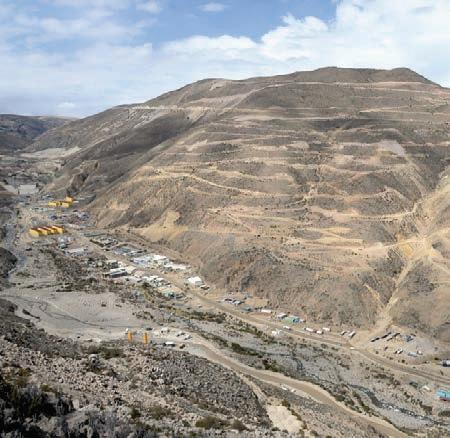
metallurgical coal, although interest in (diamond miner) De Beers, manganese and ferronickel would likely be limited,” mining analyst Alexander Pearce said in a note on ursday. “Given the potential size of the combined entity, particularly in copper, it would be subject to signi cant anti-trust/ competition scrutiny.”
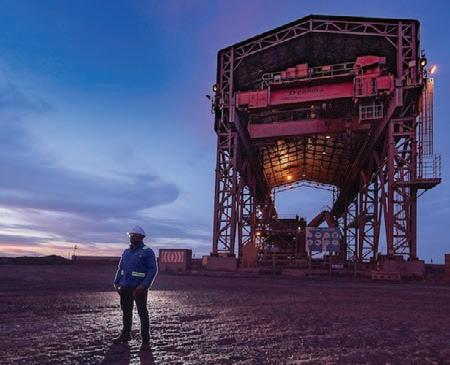
Shares mixed
BHP’s proposal is valued at £25.08 per Anglo share, a 14% premium to Anglo’s closing price on Wednesday. Anglo’s shares rose 13% to £24.99 apiece in London a er the announcement, valuing the company at £33.4 billion. BHP fell 3% to £22.91 each for a company market value of £115.9 billion.
Anglo American has been a takeover target in recent years a er output fell and costs mounted. If it occurs, the takeover would give BHP about 10% of global copper production as the price of the electrical component is expected to climb because of increased demand for the energy transition away from fossil fuels. It could
also herald more big deals as companies with cash consider merger and acquisition opportunities.
BHP bought copper producer OZ Minerals last year for about US$6.4 billion. Rio Tinto (NYSE: RIO; LSE: RIO; ASX: RIO) has been investing in copper assets in Utah and Arizona, while Glencore (LSE: GLEN) last year attempted to buy Teck Resources (TSX: TECK.A, TECK.B; NYSE: TECK), which has the Quebrada Blanca mine in Chile and the Highland Valley Copper mine in British Columbia.
BHP’s o er may not be high enough to satisfy Anglo shareholders, Edinburgh-based consultant Wood Mackenzie said in an emailed note.
“Anglo American shareholders may consider fair value closer to the share price in 2023 before operational issues emerged,” said James Whiteside, metals and mining corporate research director. “Other suitors may be compelled to act at this price.” TNM
him to help rebuild the company when nuclear power nally emerged from the ‘penalty box.’
“What kept me in through the dark years was I felt this obligation to our people to stay here and help put things back together again,” he says. “I believed our day would come again.”
Turnaround
And it has. Nuclear energy has seen nothing but momentum for the past several years. Starting with the rise of the net zero climate movement, nuclear is now gaining renewed traction as a secure, scalable and reliable power source.
e Western world’s e orts to cut Russia out of the nuclear fuel supply chain have further revved up sentiment for Western uranium producers.
As the long-term uranium price, which is what Cameco bases production decisions on, rose to US$68 per lb. at the end of 2023 from US$16 per lb. a year earlier, Cameco’s net earnings and cash from operations doubled last year, while revenues rose nearly 40% to $2.6 billion.
Cameco restarted McArthur River and Key Lake in late 2022 and is ready to OK an already-permitted expansion of McArthur River to 25 million lb. per year from 18 million lb. as soon as the market calls for it.
It’s also working to extend Cigar Lake’s mine life out to 2036. Between it and McArthur River, the company expects to produce more than 36 million lb. U3O8 this year in Saskatchewan. It also has a 40% stake in the Inkai ISR mine in Kazakhstan with Kazatomprom (LSE: KAP), and still has three other assets on care and maintenance in Canada and the U.S.
Its stake in Westinghouse adds a complementary business designing and engineering light water reactors, supplying fuel for those reactors and servicing about half the global eet of reactors.
Brook eld (TSX: BN) engineered a turnaround of West-
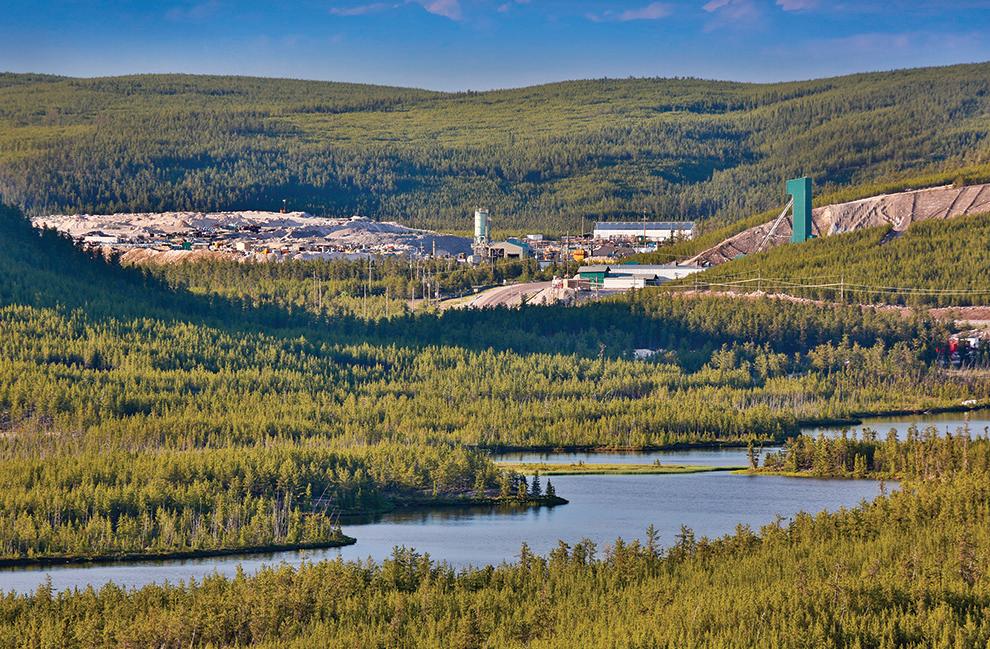
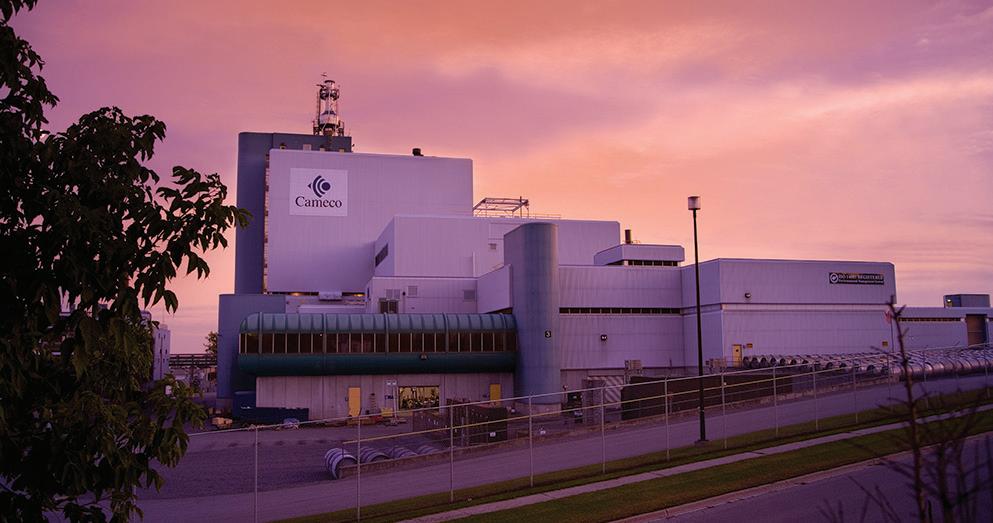
inghouse a er buying it out of bankruptcy protection in 2018 for US$4.6 billion. Its Brook eld Renewable Partners (TSX: BEPO) business is now Cameco’s 51% partner in the company.
Westinghouse still owes US$3.8 billion, but the company is expected to easily service its debt while generating cash for its owners. Earnings before interest, tax, depreciation and amortization are forecasted to grow at a compound annual rate of 6-10%
over the next ve years.
Importantly, Westinghouse doesn’t build reactors, a business where cost overruns are rife. e acquisition puts Cameco in a sweet spot for both exposure to China as a customer, and to compete with the country, which is in the midst of a “mind-boggling” nuclear buildout, Gitzel notes.
e country plans to have 100 or more reactors by 2030, up from 54 today. ey’re also able
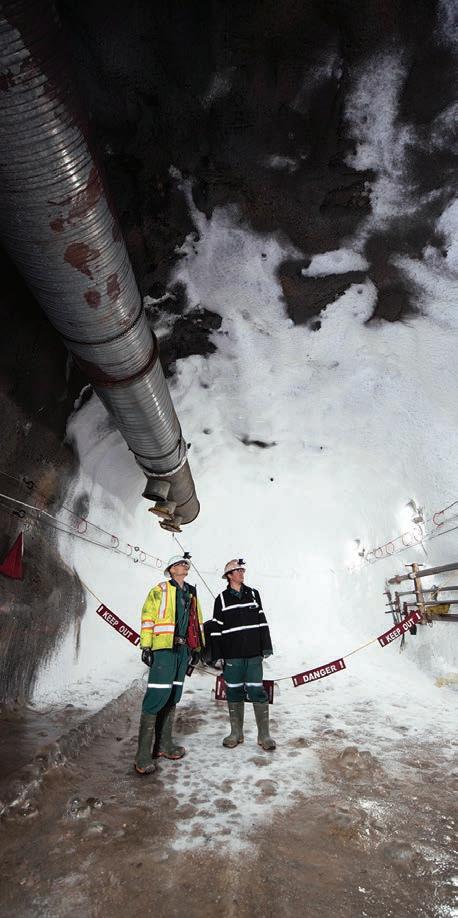
to build reactors that work well in a 60-month timeframe — shorter than in Western countries, he says.
“ ey will be a major player in the nuclear space going forward,” he said. “ ey’ve just started now to go outside of China and build reactors in other countries.”
Cameco’s Westinghouse stake puts it in a unique position as a publicly listed nuclear fuel and reactor technology company that’s not controlled by a state-owned enterprise.
“ e world was really looking for a Western supplier. I just got back from a week in D.C., and I can tell you they’re looking to reestablish American dominance in the nuclear industry that’s been lost over the last 20 years, space given up to the Russians and the Chinese,” he says.
“ ey want it back and we’re a critical component — we have the reactor technology and we have the fuel for those reactors.” TNM
NEVADA | Thacker Pass capex US$2.9B
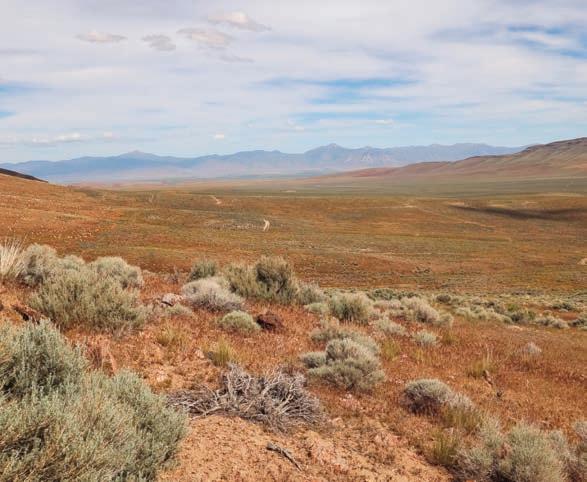 BY COLIN MCCLELLAND
Lithium Americas (TSX: LAC; NYSE: LAC) raised US$275 million through a stock o ering weeks a er getting initial approval for a record government loan to advance its acker Pass lithium project in Nevada.
e Vancouver-based company sold 55 million common shares at US$5 apiece in an o ering that closed April 22. In March, the Department of Energy prepared its largest ever loan, nearly US$2.3 billion, for acker Pass. Shares in Lithium Americas fell by about 5% a er the sale but recovered near press time to US$4.49 apiece in New York, valuing the company at US$787.7 million.
Major construction of acker Pass is expected to start in this year’s second half. e open-pit lithium clay project aims to produce 40,000 tonnes a year of battery grade lithium carbonate in a rst stage starting in 2027. It will probably be the largest lithium mine in the United States, helping build 800,000 electric vehicles a year. General Motors has pledged US$650 million in funding in return for all of the mine’s output for up to 15 years.
Counting US$196 million cash on hand, the government loan, GM’s contribution so far and the share o ering, Lithium Americas has US$2.7 billion for the project’s forecast cost of US$2.9 billion, the company said. It’s funded for this year, it added.
Bechtel Design and construction rm Bechtel has completed about a third of detailed engineering, Lithium Americas said in March. e build is to employ 1,800 workers.
“Our team has been focused on re ning the development plan and de-risking construction,”
Lithium Americas president and CEO Jonathan Evans said in a release. “We have completed all the early-works and infrastructure required for major construction, including excavating the processing plant areas.”
e Department of Energy loan is expected to be nalized before major construction starts.
e backing ts in with the Biden administration’s push for critical mineral developments to reduce dependence on China.
e site holds 385 million measured and indicated tonnes averaging 2,917 parts per million (ppm) lithium for 6 million tonnes of lithium carbonate equivalent (LCE).
ere are 147 million inferred tonnes averaging 2,932 ppm for 2.3 million tonnes of LCE.
Lithium Americas won a court case last year against environmentalists, ranchers and Indigenous groups who argued acker Pass would harm a type of grouse, groundwater and air quality.
e project may be expanded to produce 60,000 tonnes LCE a year over a 46-year mine life, according to a 2018 prefeasibility study.
New York-based investment banks Evercore ISI and Goldman Sachs, and BMO Capital Markets in Toronto ran the share o ering.
M&A | Tocantinzinho cash to fund development
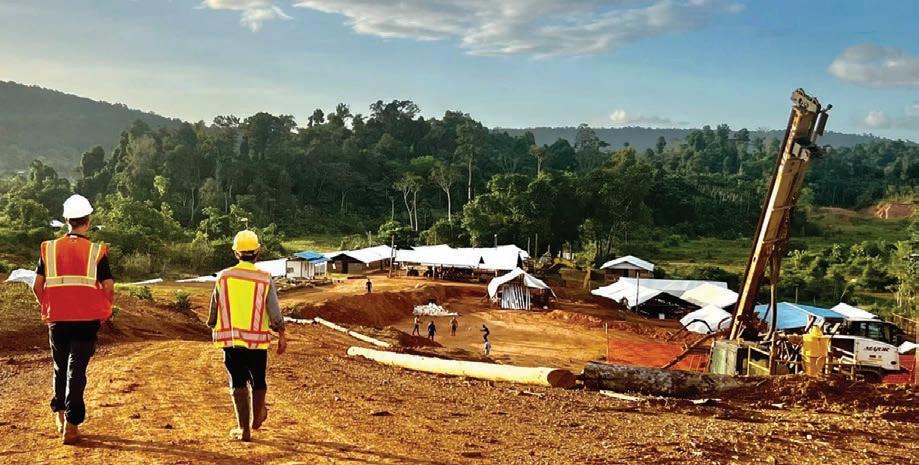 BY COLIN MCCLELLAND
Montreal-based G Mining Ventures (TSX: GMIN; USOTC: GMINF) is expanding its South American holdings by taking over Reunion Gold’s (TSXV: RGD; US-OTC: RGDFF) Oko West gold project in Guyana in an allshare deal valued at $875 million.
e deal is a 29% premium to April 19’s closing share prices. G Mining shareholders will hold 57% of the new entity, leaving Reunion with 43%, the rms said on April 22.
e new shares issued will amount to a four-to-one share consolidation of the combined companies.
G Mining plans to use US$480 million in near-term free cash ow from the permitted and construction ready Tocantinzinho gold project in Brazil to advance Oko West through technical studies to a construction decision. e 200,000-oz.-per-year Tocantinzinho is to start commercial production in this year’s second half. e company also announced a US$50-million equity nancing for the new G Mining.
“We are well-positioned to accelerate value creation at Oko West leveraging our unique expertise in building and operating mines on schedule and on budget in the Guiana Shield,” G Mining president and CEO Louis-Pierre Gignac said in a release. “We look forward to continuing to advance our ‘Buy, build, operate strategy.”
G Mining bought Tocantinzinho in late 2021 from Eldorado Gold (TSX: ELD; NYSE: EGO) for US$115 million a er Eldorado had invested US$90 million in the project.
Spinoff
G Mining and Reunion will also spin o Reunion’s assets besides Oko West into a new company. Ownership will be split 19.9% to G Mining for $15 million and 80.1% for Reunion under the deal.
e spino ’s focus will be on acquiring and exploring gold mineral properties in Guyana outside of a 20-km area of interest surrounding Oko West, and in Suriname, the companies said.
e Marowijne belt in Suriname holds Zijin Mining’s Rosebel and Newmont’s (NYSE: NEM; TSX: NGT) Merian gold mines. Other deposits including Saramacca, Overman, Benzdorp and Lely are being evaluated, Reunion says.
An updated resource in February at Oko West, about 95 km southwest of the capital, Georgetown, showed 64.6 million indicated tonnes grading 2.05 grams gold per tonne for 4.3 million oz. and 19.2 million inferred tonnes grading 2.59 grams gold for 1.6 million ounces.
At Oko West, Reunion has been working on its environmental and social impact assessment and is expected to complete a preliminary economic assessment by June, it said last month. A feasibility study and environmental permit applications would precede a construction decision by next year’s second quarter, it said.
“ e transaction signi cantly de-risks the advancement of Oko West given the nancial strength, free cash ow and development capabilities that G Mining brings to the table,” Reunion president and CEO Rick Howes said in the release. “ is is a great outcome for the country of Guyana.”
NEVADA | Developer plans ‘hub-and-spoke’ operation
Gignac family
G Mining, founded by the Gignac family, has a history in the region. Louis Gignac led Cambior (taken over by Iamgold [TSX: IMG; NYSE: IAG] in 2006) to build its rst South American operation in Guyana in the early 1990s. e family’s G Mining Services built Newmont’s Merian mine ahead of schedule and under budget, it said.
London-based resources investment adviser La Mancha Investments plans to put as much as US$45 million into the new G Mining to hold an 18.7% stake, the companies said.
Royalty and streaming company Franco-Nevada (TSX: FNV; NYSE: FNV) is buying US$25 million of shares in G Mining, although its holding will fall to 7.2% from 9.9%.
e deal requires two-thirds of approval from both sets of shareholders. Reunion shareholders owning 29% of the company, including directors, senior management, La Mancha, and Toronto-based mining investor Dundee (TSX: DC.A), pledged support for the deal.
A group of shareholders with 60% of G Mining agreed its support, including its three largest stockholders, La Mancha, Eldorado Gold and Franco-Nevada.
Reunion shares closed a h higher at 60¢ apiece when the deal was announced and was at 61¢ closer to press time, valuing the company at $784.4 million. ey’ve traded in a 52-week range of 32¢ to 61¢.
Shares in G Mining fell nearly 14% to $1.96 apiece before regaining to $2.17 nearer press time, valuing the company at $966.7 million. ey’ve traded in a 52-week range of $1.67 to $2.34. TNM
BY JACKSON CHENI-80 Gold (TSX: IAU; NYSE: IAUX) shares fell by over 11% when markets opened on April 9 a er it announced a $100-million equity nancing.
e units were priced at $1.65
each, comprising one share and half a warrant with an exercise price of $2.15.
Shares traded at $1.66 apiece near press time, valuing the company at $498.9 million.
e company upsized the o ering on April 8 due to strong investor demand. e original nancing
amount was for $86 million at the same per-unit price. e underwriters also have an overallotment option to buy 15% of the base o ering, taking the potential proceeds to $115 million.
e company will use the funds to advance exploration and development of its properties in Nevada.
It produced a total of 14,600 oz. at a realized gold price of $1,940 per oz. last year. I-80 is pursuing a “huband-spoke” operation centred on its high-grade McCoy-Cove property and processing facilities at its Lone Tree project. I-80, spun out of Equinox Gold (TSX: EQX) in 2021, holds a combined 6 million oz. of mea-
sured and indicated resources and 8 million oz. of inferred resources across its four properties. is makes it the second-largest holder of gold resources in central Nevada a er Barrick Gold (TSX: ABX; NYSE: GOLD) and Newmont’s (TSX: NGT; NYSE: NEM) Nevada Gold Mines joint venture. TNM
PRECIOUS METALS | Chile’s first greenfield start in decade
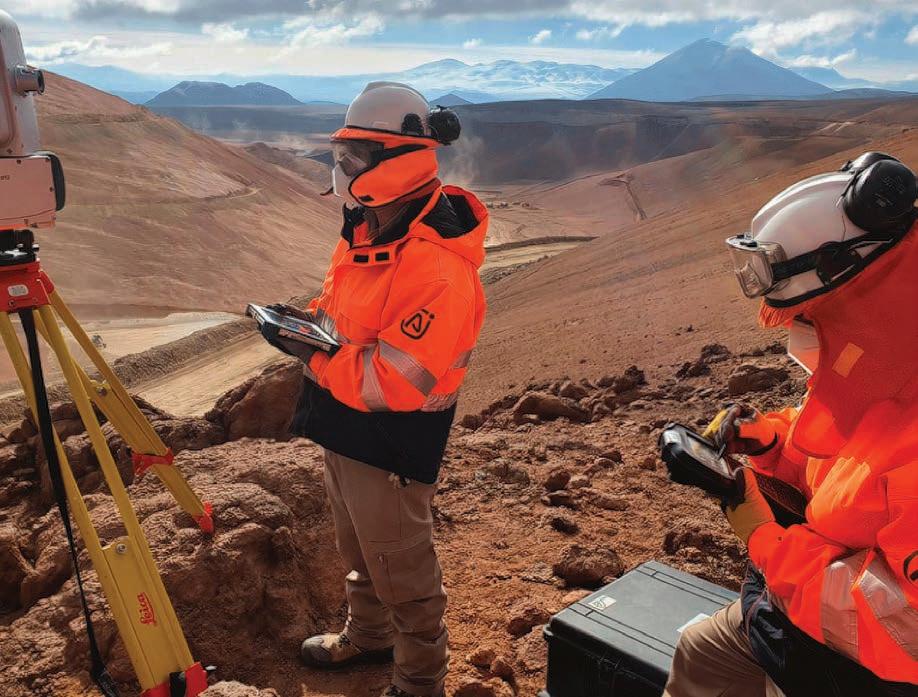 BY CECILIA JAMASMIE
Gold Fields (NYSE: GFI; JSE: GFI) has achieved rst production at its Salares Norte gold mine in Chile a er years of development challenged by endangered wildlife concerns, rocketing costs and technical delays.
e South African miner, which took 13 years to grow the US$1 billion project from exploration to output, said it poured its rst gold-silver doré bar at the mine on March 28. It’s Chile’s rst greeneld project to reach production in more than a decade.
e mine is key to the company’s goal of producing 2.8 million oz. of gold by 2025, it said. Production at
Salares Norte is expected to reach about 250,000 oz. of gold this year, ramping up to full annual output of 580,000 oz. next year.
“We are incredibly excited to have reached this milestone and delivered rst gold in line with the updated project schedule,” CEO Mike Fraser said in a release. “To build a remote mine at 4,500 metres above sea level with winter temperatures as low as -20 degrees Celsius and amid a global pandemic is an incredible feat.”
Gold Fields plans to reach 485,000 oz. in annual gold-equivalent production for the mine’s rst ve years (2025-29) at an all-in sustaining cost (AISC) of US$790 per oz. e annual rate until 2033, the mine’s life, is expected to be
360,000 oz. at an AISC of US$820 per ounce.
Economic impact
Salares Norte is to create 900 permanent jobs and contribute nearly US$800 million in direct and indirect taxes over its planned life.
In terms of innovation and environmental care, Salares Norte has incorporated new technologies including ltered tailings, which recirculates more than 86% of water to optimize use. is technology is also considered safer than conventional tailings storage.
e site will have a solar plant, which is expected to cut the mine’s annual carbon footprint by more than 10,000 tonnes of CO2, Gold Fields said. TNM
NICKEL-COPPER | PFS pegs Aguablanca mine life at 6 years
RNR Shareholder Group for about US$27 million.
Denarius Metals (CBOE: DMET; US-OTC: DNRSF) plans to reopen its halfowned Aguablanca nickel-copper mine in Spain for production early next year, based on positive economics outlined in a new prefeasibility study.
Last operated by Lundin Mining (TSX: LUN) until it closed in 2016, Aguablanca is located in the town of Monesterio, 88 km southwest of Denarius’s half-owned Lomero copper-zinc project.
Denarius acquired the stake in Aguablanca, one of the only deposits of its kind in Spain, last year from its joint venture partner
“By the end of this year, we will have restarted the processing plant, which has been maintained in good condition, and completed the preparation for underground contract mining,” Denarius chair and CEO Sera no Iacono said in a release.
e study gives the underground mine six years of life at capital costs of US$36.2 million. It has an a er-tax net present value (NPV) of US$83.1 million with a 5% discount, an internal rate of return (IRR) of 213% with payback by the end of 2025. Cash ow could be US$105.7 million.
e site in southwest Spain has 6.4 million indicated tonnes grad-
BRAZIL | Company seeks other options for US$1B
BY BRUNO VENDITTIShares of Glencore-backed Horizonte Minerals (AIM: HZM; TSX: HZM) plunged in April a er the company said it couldn’t secure more nancing to complete its Araguaia nickel project in Brazil.
e company is exploring options such as a sale, liquidation or raising nancing at the subsidiary level a er construction costs nearly doubled in February to more than US$1 billion.
“Horizonte Minerals does not believe that any of these options are likely to recover any value for the company’s shareholders,” the company said April 15.
Its shares fell from 5¢ apiece to 1¢ on the TSX, unchanged near press time and valuing the London-based company at £1.3 million ($2.2 million) compared with $241 million in October.
Horizonte started building the mine in May 2022 with the aim of producing up to 29,000 tonnes of nickel a year for the stainless steel market. It bought the project from Glencore in 2015.
In December, Horizonte’s three largest shareholders, Glencore, Orion Mine Finance Management and London-based La Mancha Resource Capital, loaned it $US15 million to advance Araguaia. It agreed with New York-based Orion’s Fund III to defer repayments on US$5 million it had already been lent.
Horizonte had a cash balance of $16.2 million as of April 10, excluding cash set aside for the development of the Vermelho nickel-cobalt project.
“Despite the strong long-term outlook for nickel, investor sentiment has been dampened by low spot prices and near-term uncertainties, including the supply surplus from Indonesia,” the company said.
Less than 100,000 tonnes of nickel from new projects outside of Indonesia is likely to enter the market in the next three to four years, Macquarie nickel analyst Jim Lennon said in e Financial Times is compares with 3.5 million tonnes of supply expected this year, according to Macquarie. TNM
MAGNESIUM | US$1B project could cut continent’s reliance on China
BY NORTHERN MINER GROUP STAFFVerde Magnesium plans to invest US$1 billion in a project in Romania a er the country’s government granted it the go-ahead to revive a mine that shut in 2014.
e Bucharest-headquartered company, backed by U.S. private equity investor Amerocap, aims to start production at the western Romania project in 2027.
e mine could be the rst new European magnesium metal project in decades and produce as much as 90,000 tonnes of magnesium a year, accounting for around 50% of the European Union’s demand.
ing 0.63% nickel and 0.56% copper for 43.2 million lb. nickel and 34.6 million lb. copper.
“ is is a relatively small, underground, low capital-intensive project with a robust economic pro le,” Red Cloud Securities mining analyst Taylor Combaluzier wrote in a note. “ e (prefeasibility study) demonstrates that Aguablanca could be restarted with only modest capex, while returning a compelling a er-tax NPV and IRR.”
Denarius plans to use half of the mill’s capacity for Aguablanca, and half to treat ore from Lomero. e pit is to be dewatered and mining begin from underground. Several potential customers in Europe are willing to buy the mine’s concentrates, Denarius says. TNM
e metal’s main use is in aluminum alloying, as the addition of magnesium produces highstrength, corrosion-resistant alloys. Such alloys are commonly used to make beverage cans and as structural components of automobiles and machinery.
Verde, which aims to become the EU’s rst dedicated primary metallic magnesium producer, also plans to build processing facilities that would use renewable power to recycle aluminum.
Over 90% of the magnesium the EU uses is imported from China. In 2022, its aluminum industry faced signi cant disruptions when China temporarily halted production of the metal due to high energy prices, leading to concerns
“Verde aims to become the EU’s first dedicated primary metallic magnesium producer.”
about potential plant closures.
Verde has said it is con dent about the project’s success, despite local opposition and environmental challenges that a ected previous projects.
Among the most well-known cases was Gabriel Resources (TSXV: GBU), which saw its plans to build Europe’s largest open pit gold mine in the western Romanian town of Rosia Montana crushed in March. e government, which had a 20% stake in the project, o cially withdrew its support for the mine in 2014 a er months of country-wide street protests against it.
A er a decade-long legal dispute in which Gabriel Resources sought compensation for its losses, the Washington, D.C.based International Centre for Settlement of Investment Disputes ruled in favour of Romania. TNM
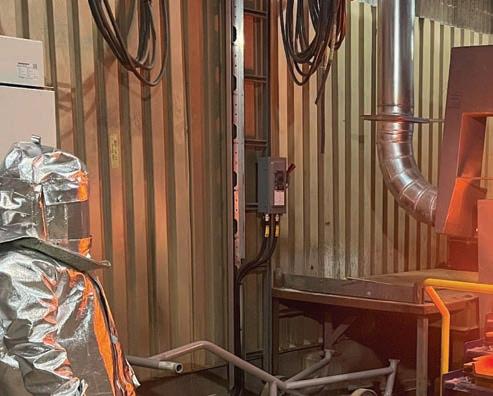
 BY JACKSON CHEN AND HENRY LAZENBY
Ascot Resources (TSX: AOT; US-OTC: AOTVF) poured rst gold at its Premier mine in late April, an event CEO Derek White says harkens back to its heyday a century ago as the British Empire’s largest mine.
“It’s a credit to our entire team’s e ort that we’ve completed the construction phase and begun to pour gold, demonstrating that there’s viable gold in the Golden Triangle,” CEO Derek White told e Northern Miner on April 22. “ e rst gold pour is a hallmark commissioning milestone for Ascot, representing the culmination of years of hard work.” Premier, in British Columbia’s Golden Triangle region, near Stewart, is home to a former underground gold mine that opened in 1918 and included four deposits — Silver Coin, Big Missouri, Premier and Red Mountain.
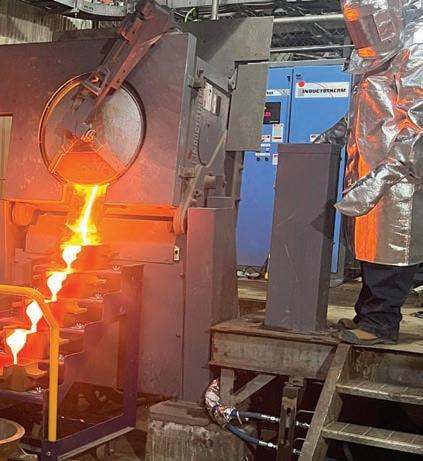

While in operation, it was the largest gold mine in North America until its surface buildings burned down, leading to its closure in 1952. By then, Premier had produced over 2 million oz. gold and 45 million oz. silver.
e mill was rebuilt in 1989, and mining from both the open pit and underground resumed until the project was put on care and maintenance in 1996. It produced about 260,000 oz. gold and 5.1 million oz. silver during that period.
Earlier in April, Ascot kicked o commissioning by feeding the rst ore into the mill. Now, with the rst gold recovered through the gravity circuit, commissioning activities have moved onto the carbon-inleach (CIL) circuit.
Ascot expects to declare commercial production by this year’s third quarter, with total output from the restarted Premier project forecast to reach 1.1 million oz. gold and 3 million oz. of silver.
Ascot’s path to production was
fraught with challenges, White said. “We launched a project without any resources, feasibility studies, or groundwork. Over six years, we rapidly progressed from assembling resources and conducting engineering work to securing nancing and managing construction,” he said.
Mining has resumed at the Big Missouri deposit, followed by Premier later this year. e ore will feed a refurbished 2,500 tonne-per-day processing plant to produce doré bars. Next year mining will focus on the Silver Coin deposit, followed by Red Mountain and then Premier. e project hosts 7.3 million measured and indicated tonnes grading 7.85 grams gold per tonne and 29 grams silver, plus 5.4 million inferred tonnes grading 7.11 grams gold and 27.1 grams silver, according to the company’s 2020 resource estimate.
Ascot shares traded at 73¢ at press time, valuing the company at $456.7 million. Its shares traded in a 52-week range of 34¢ and 91¢. TNM
EXPLORATION | Two-year dispute with province holds up Thor project
NORTHERN MINER GROUP STAFFTaranis Resources (TSXV: TRO) can go ahead with planned exploration at its or polymetallic project near Trout Lake, B.C., almost two years a er its permit application and ve months a er ling a lawsuit against the province.. e ve-year permit gives Taranis permission to explore using 24 drill sites, which will start on July 1. e or project, an amalgamation of ve historic mines, sits in the traditional territory of the Ktunaxa Indigenous nation, northeast of the village of Nakusp, in the West Kootenay region.
“We’re incredibly pleased,” said John Gardiner, president and CEO of Taranis, in an interview with e Valley Voice on April 18.
“It took two years and approximately $200,000 in legal fees to reach this stage,” he said, adding that permits are typically approved within about three months.
Last October, the Colorado-based explorer had asked the B.C. Supreme Court to order the province’s chief permitting o cer to make a decision on the permit application.
Taranis also requested the court to ask Mines Minister Josie Osborne to clarify her statement that First Nations were “the rightful owners of the land,” and her reference to a “Ktunaxa-declared moratorium,” which Taranis thought to be contrary to law.
e project is among several in B.C. facing increased legal scrutiny, especially a er the Supreme Court ruled in a separate case last September that the province must consult with Indigenous groups before mineral claims can be granted to companies. e court also gave the province 18 months to modernize its Mineral Tenure Act so that it aligns with the Crown’s duty to consult.
An updated resource estimate for or, formally led in mid-April, outlines 1.1 million indicated tonnes grading 0.75 gram gold per tonne, 152 grams silver and 0.12% copper for 27,400 oz. gold, 5.5 million oz. silver and 3.1 million lb. copper. It also holds 599,000 inferred tonnes grading 0.66 grams gold, 117 grams silver and 0.15% copper for 12,800 oz. gold, 2.2 million oz. silver and 2 million lb. copper.
In 2021, Taranis was granted a ve-year permit for bulk sampling activities.
POTASH | US$15B mine to start production in 2026
 BY CECILIA JAMASMIE
BHP (NYSE: BHP; ASX: BHP) said in April that construction at its Jansen potash mine in Saskatchewan was ahead of schedule and 44% complete.
Located 140 km east of Saskatoon, Jansen is set to become one of the world’s largest producers of potash, a commodity considered to be a pillar of future growth for the company. It also represents the single largest private economic investment in the province’s history.
e proposed mine is being built in four stages, with US$5.7 billion already spent on the rst stage. e aim, according to BHP, is to begin producing potash in late 2026 at a rate of 4.2 million tonnes a year.
Since giving the project its go-ahead in 2021, BHP has been injecting capital to speed up development even when potash prices were falling. Before its approval, the group had already spent US$4.5 billion on the project.
In its quarterly update on April
Located 140 km east of Saskatoon, Jansen is set to become one of the world’s largest producers of potash, considered to be a pillar of future growth for the company.
18, the Australian mining group also said that the second stage, which was approved last year and is expected to cost another US$4.9 billion, will start in 2029. is will add another 4.4 million tonnes of annual production.
e entire four-phased development could produce between 16-17 million tonnes annually, BHP previously stated. TNM
Flying Nickel Mining (TSXV: FLYN; US-OTC: FLYNF) has increased its pit resource at the Minago project in Manitoba by 42% and added a platinum group metals (PGM) estimate for the rst time.
Minago’s in-pit resource is 36 million measured and indicated tonnes at 0.67% nickel, 0.18 gram per tonne palladium and 0.08 gram platinum for 531.3 million lb. of contained metal, the company said on April 12. at compares with 23.9 million measured and indicated tonnes grading 0.71% nickel for 374.3 million lb. contained metal in a 2021 resource.
With an underground component, the project holds a total of 43.4 million measured and indicated tonnes grading 0.72% nickel, 0.2 gram palladium and 0.09 gram platinum for 689.5 million lb. of nickel, 279,330 oz. of palladium and 125,700 oz. of platinum, the company said in a release.
Flying Nickel aims the project to be world-leading in its carbon footprint. at would compare it favourably with the Chinese- nanced high-polluting projects in
Indonesia, the world’s leader in production.
Thompson nickel belt
Victory Nickel explored the Minago project area in the 2000s before Silver Elephant Mining (TSX: ELEF) bought the project in early 2021 and created Flying Nickel. Manitoba’s ompson nickel belt has produced some 5 billion lb. nickel, second to Sudbury, Ont. in Canada’s production of the metal.
Minago’s PGM resources are based on assays before 2022, plus core from Flying Nickel’s 2022 drill program and analysis of historical drill cores, the company said. In total, 4,041 metres from 47 holes drilled before 2021 were assayed for PGMs last year. e company drilled six holes for 1,320 metres of sampling in 2022 and had 70 holes for 9,622 metres of sampling by previous operators.
To date, about US$50 million has been spent on exploration, a historical feasibility study and environmental permitting, most of which was done by Victory and Flying Nickel.
At press time, shares in Flying Nickel traded at 8¢ apiece, for a market capitalization of $7 million. ey’ve traded in a 52-week range of 5¢ to 17¢. TNM
Australia’s Westgold Resources (ASX: WGX; USOTC: WTGRF) is buying Toronto-based Karora Resources (TSX: KRR; US-OTC: KRRGF) in a $1-billion (A$1.2 billion) deal to control the Beta Hunt mine, the jewel in the country’s gold sector.
e friendly cash-and-shares o er brings Karora’s Beta Hunt mine together with Westgold’s four underground mines and three processing plants in the territory under one Australian management team.
“ e prize here is Beta Hunt’s gold potential,” Westgold managing director and CEO Wayne Bramwell said in an April 8 release. “Rarely do you nd a gold asset of the quality and potential of Beta Hunt hiding in a nickel belt, and drilling is expected to further unlock value at this mine.”
e deal will position the new company as a mid-tier gold producer globally and a top- ve Australian producer with 400,000 oz. in annual output. Last year, Karora produced a record 160,492 oz. gold, beating the high end of its 145,000 — 160,000 oz. guidance range. Westgold produced over 257,100 oz. gold across its operations.
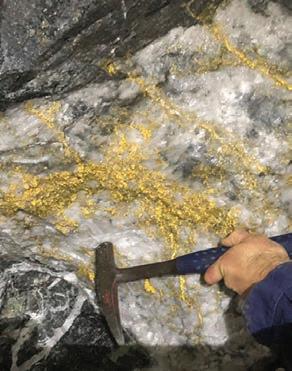
Beta Hunt got global attention in 2018 when teams discovered two of the largest gold specimens ever found, weighing about 95 kg and 63 kg, with gold content estimated at 2,440 oz. and 1,620 oz., respectively. e mine also hosts highgrade nickel.
Westgold operates gold mines in Central Murchison including Big Bell and the connected BluebirdFortnum project, along with the Great Fingall mine, which is expected to start production in the rst half next year.
Ioneer’s (NASDAQ: IONR; ASX: INR) Rhyolite Ridge lithium-boron project in Nevada is a step closer to shovel-ready a er the United States Bureau of Land Management issued a dra environmental impact statement (EIS) in mid-April. is dra , seen as a milestone in the Biden administration’s push to fast-track domestic lithium production, is open for comments for 45 days.
Sydney-based Ioneer expects to receive the nal EIS and a record of decision by October. Ioneer anticipates making a nal investment decision on the US$750-million project by December, with production slated to start by 2027.
e Department of Energy in January said it would lend Ioneer up to US$700 million to develop the mine, while South Africa’s Sibanye Stillwater (JSE: SSW; NYSE: SBSW) owns 50% of the project a er agreeing to invest US$490 million in 2021.
About 60 km by road southwest of Tonopah, Rhyolite Ridge is among North America’s few lithium-boron deposits. Ioneer has repeatedly revised its mining proposal to mitigate environmental impacts, particularly focusing on preserving the endangered Tiehm’s Buckwheat plant.
An April 2020 de nitive feasibility study on the project put capital costs at US$785 million, with the economics calculating an a er-tax net present value (using an 8% discount) of US$1.3 billion and an unlevered internal rate of return at 20.8%.
Ioneer has a market capitalization of A$432.8 million ($382.7 million).
BY NORTHERN MINER STAFFA prefeasibility study for Predictive Discovery’s (ASX: PDI) Bankan gold project in Guinea gives it a net present value almost 50% higher than its estimated capital cost.
e study released in April forecasts upfront capital costs of US$456 million. Using a conservative gold price of US$1,800 per oz., the a er-tax net present value (NPV) at a 5% discount sits at US$668 million and the internal rate of return IRR at 25.4%.
At current spot prices of around US$2,300 per oz. gold, the NPV rises to US$1.4 billion and the IRR to 41.7%. e mine plan outlines yearly output of 269,000 oz. gold over a 12-year life..
Bankan has probable reserves of 57.7 million tonnes grad-
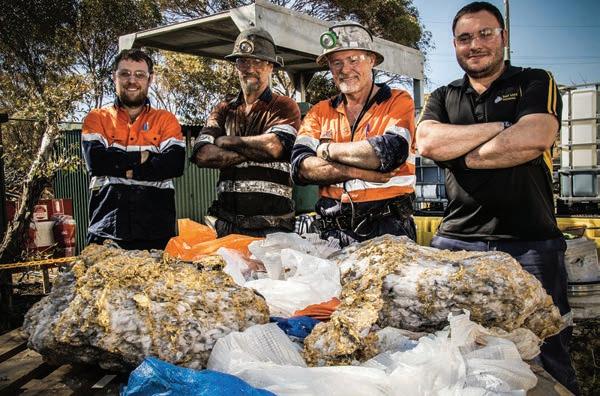
Mid-July close Karora walked away from merger negotiations with Ramelius Resources (ASX: RMS) in March.
e new deal is expected to close in mid-July and create cash on hand of about A$143 million for Westgold.
Facing slim margins amid record gold prices, Western Australian producers have over the past year focused on e ciency. Players like Northern Star Resources (ASX: NST) and Evolution Mining (ASX: EVN) have sought to manage all-in
costs a er higher upfront capital and exploration spending early in the scal year.
e companies say the deal will save $438 million in operating costs. e combined company will have a market capitalization of about A$2.2 billion, ore reserves totalling 3.2 million oz. gold, and global resources of 13 million oz.
Karora shareholders are set to receive a blend of 2.524 shares of Westgold, A68¢ in cash, and 0.3 share of a new spino company.
e spino will hold Karora’s 22%
ing 1.64 grams gold per tonne for 3.1 million oz. of metal, the bulk of which is slated for open pit mining. e resources are found across the NEB open pit, NEB underground, and BC open pit areas.
e study also outlines a scenario that could see it extract another 12.8% gold by drawing on areas of the NEB underground mine that now contain inferred resources during years six to 11. Predictive has started work on a de nitive feasibility study.
e company has completed an environmental and social impact assessment with “no fatal aws,” according to managing director Andrew Pardey.
e company aims to secure an exploitation permit that within six months of completing a prefeasibility study and submitting the impact assessment, both milestones expected by mid-year.
It has a market capitalization of A$456.8 million ($405.7 million).
BY NORTHERN MINER STAFFStanmore Resources (ASX: SMR) is buying the rest of the Eagle Downs metallurgical coal project in Queensland, from Aquila Coal, a er making a deal in February with South32 (LSE: S32; ASX: S32; JSE: S32) for its 50% stake.
It’s also acquiring the neighbouring Eagle Downs South tenement from Aquila, a subsidiary of China Baowu Steel Group, the company announced on April 5.
e Brisbane-based coal miner will pay US$15 million for Aquila’s stake in Eagle Downs and US$2 million for the adjacent project. Additional payments of US$20 million and US$10 million are due once the rst 100,000 tonnes of coal is extracted from each site, respectively.
It agreed to the same payment terms with South32 for its 50% stake in Eagle Downs.
e total for Eagle Downs also includes a capped royalty stream of up to nearly US$150 million, based on coal price thresholds.
e move boosts Stanmore’s portfolio of metallurgical coal assets, positioning the company to increase its production.
e acquisition is subject to regulatory approvals and it is expected to close in the second half of the year.
e Ontario government is helping fund Pioneer Lithium (ASX: PLN) for its Root Lake project in the province’s northwest.
interest in the lithium exploration company Kali Metals (ASX: KM1) and a 1% lithium royalty on speci c mining properties.
e transaction values each Karora share at A$6.60 ($5.90), considering Westgold’s last closing price. e valuation is a 10.1% increase over Karora’s previous closing price.
Karora CEO Paul Huet suggests the deal makes possible an eventual share price re-rate.
“With the combination of Westgold and Karora, we are taking the next step by combining two highly complementary, free cash ow generating asset bases in one of the world’s nest mining jurisdictions to create a premier Western Australian mid-tier gold producer,” he said.
Paying o Karora’s A$44 million ($39 million) revolving debt will further support fast-tracked development at the Beta Hunt Fletcher zone and Bluebird-South Junction, the companies said.
e new miner will also have a combined pipeline of growth options and exploration targets across Karora’s Beta Hunt and Higginsville properties and Westgold’s Murchison and Bryah properties. TNM
e Ontario Junior Exploration Program, which pays up to half of eligible exploration costs to a limit of $200,000, granted $180,916 to Perth -based Pioneer for expenses from April last year to mid-February, the company said April 10.
“ e program is a vital part of nancing and fostering early exploration projects and allows us to further advance our exploration activities,” chairman Robert Martin said in a release. “Funds will be allocated to summer eld work and maiden drilling campaigns.”
Pioneer is preparing a drill program for Root a er receiving a second exploration permit, the company said in January. Fieldwork identi ed targets in both permitted areas.
e company has been extending its footprint in Canada, where it now holds three exploration projects across Ontario and Quebec besides Root. Lauri Lake is about 70 km east of the town of Geraldton; LaGrande is located east of James Bay in Quebec; and Benham, acquired in November, is near Kenora in northwest Ontario.
BY MINING.COM STAFF
Boss Energy (ASX: BOE) expected to produce its rst drums of uranium in mid-April as it restarted its Honeymoon mine in New South Wales, Australia, a er low metal prices shut the operation in 2013.
Having reached a nal technical milestone in early April, at press time, Boss Energy was focused on lling its rst uranium shipment while ramping up production to full capacity, it said.
“Since acquiring Honeymoon, Boss’s strategy has been to increase the uranium tenor in the well eld feed solution to the plant and develop a larger processing facility utilizing ion exchange technology,” managing director Duncan Craib said in a statement.
At capacity, Honeymoon will produce 2.5 million lb. of uranium a year at all-in sustaining costs of US$25.60 per oz. and all-in costs of US$32 per lb., it said.
e company in February bought a 30% stake in enCore Energy’s (TSXV: EU) Alta Mesa in situ recovery mine in Texas for US$60 million, giving Boss a second horse in the uranium race. It said it would raise up to A$215 million in an equity nancing priced at A$3.95 per share to pay for the deal.
Shares in Boss Energy traded at A$4.78 apiece before press time, valuing the company at A$1.9 billion.
BY NORTHERN MINER STAFF
Our fit-for-purpose solutions encompass the skills of qualified geologists, geostaticians, analytical chemists, mineralogists, metallurgists, process engineers and mining engineers and inspectors brought together to provide accurate and timely mineral and process evaluation services across the entire project life cycle.
Our fit-for-purpose solutions encompass the skills of qualified geologists, geostaticians, analytical chemists, mineralogists, metallurgists, process engineers and mining engineers and inspectors brought together to provide accurate and timely mineral and process evaluation services across the entire project life cycle.
Our fit-for-purpose solutions encompass the skills of qualified geologists, geostaticians, analytical chemists, mineralogists, metallurgists, process engineers and mining engineers and inspectors brought together to provide accurate and timely mineral and process evaluation services across the entire project life cycle.
Our fit-for-purpose solutions encompass the skills of qualified geologists, geostaticians, analytical chemists, mineralogists, metallurgists, process engineers and mining engineers and inspectors brought together to provide accurate and timely mineral and process evaluation services across the entire project life cycle.
WWW.SGS.COM/NATURALRESOURCES
WWW.SGS.COM/NATURALRESOURCES NAM.NATURALRESOURCES@SGS.COM *Data
WWW.SGS.COM/NATURALRESOURCES
NAM.NATURALRESOURCES@SGS.COM
WWW.SGS.COM/NATURALRESOURCES
NAM.NATURALRESOURCES@SGS.COM
NAM.NATURALRESOURCES@SGS.COM
PearTree is a Canadian Securities Dealer and Investment Fund Manager advancing over (CAD) $500 million annually for resource exploration and mine development in a uniquely Canadian structure which results in as much as $2.00 of capital deployed for every $1.00 invested by global institutions and family offices.


our video in English, Français, Deutsch, and
https://soundcloud.com/northern-miner
http://www.northernminer.com/tag/podcast/
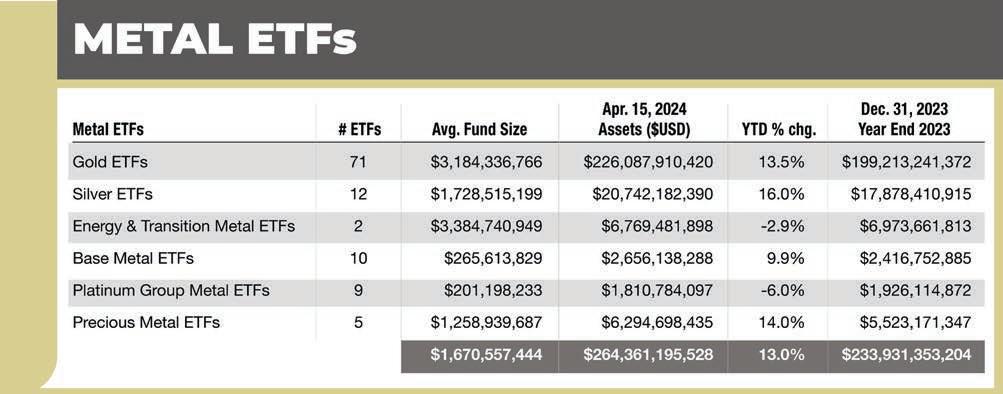
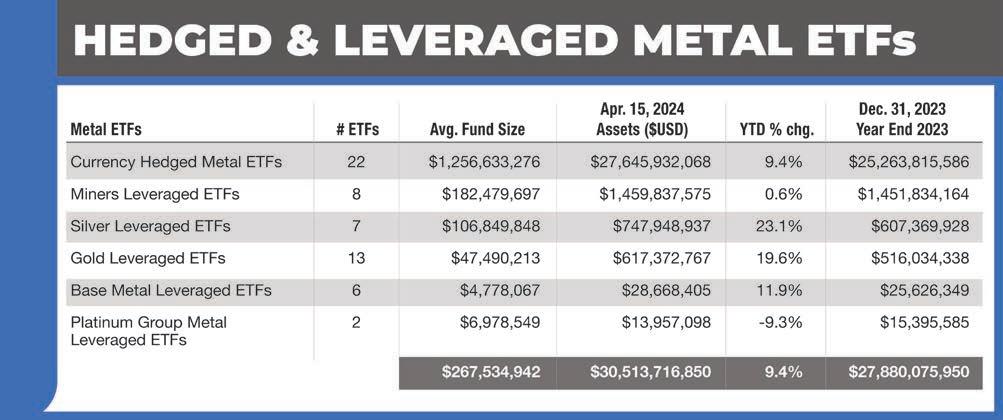
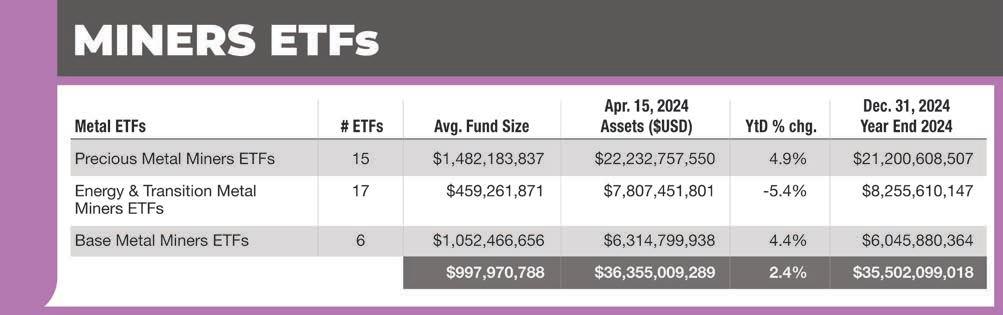
Our TNM Drill Down features the top 10 gold, copper and silver assays of the past month. Drill holes are ranked by grade x width, as identified by Mining Intelligence.
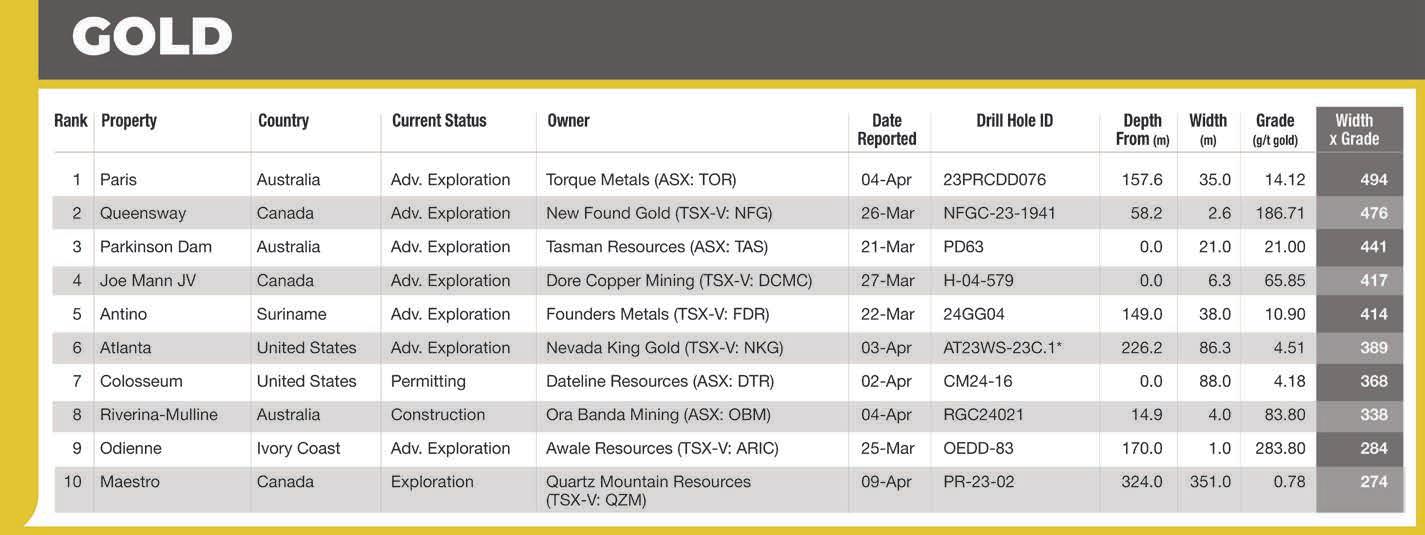
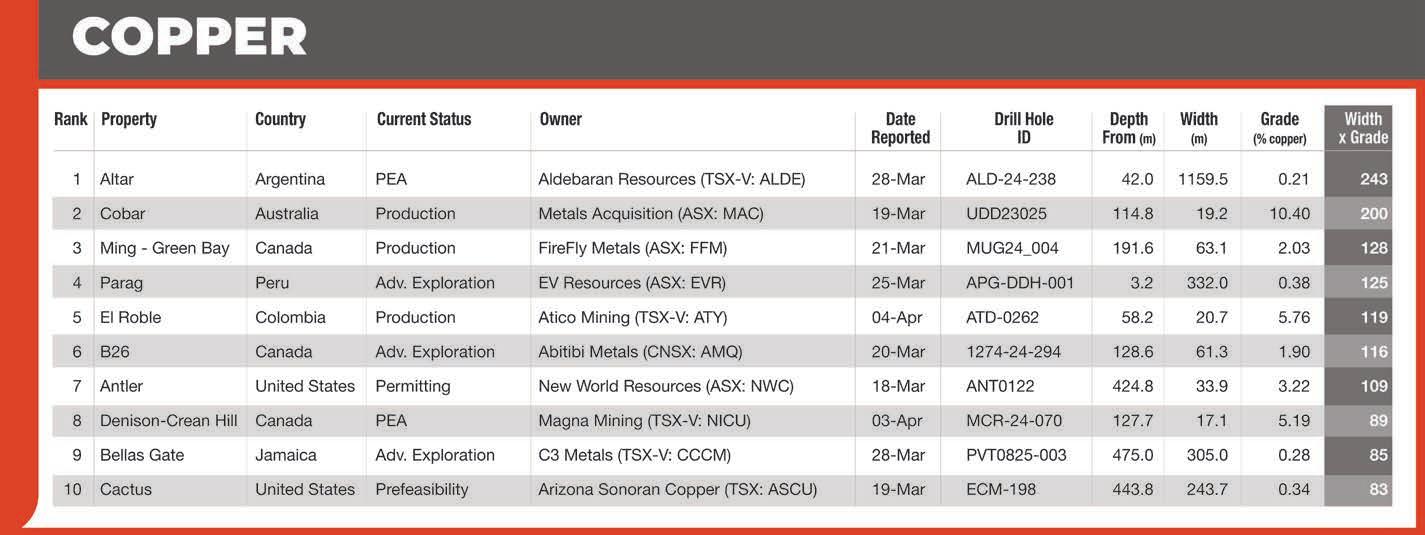
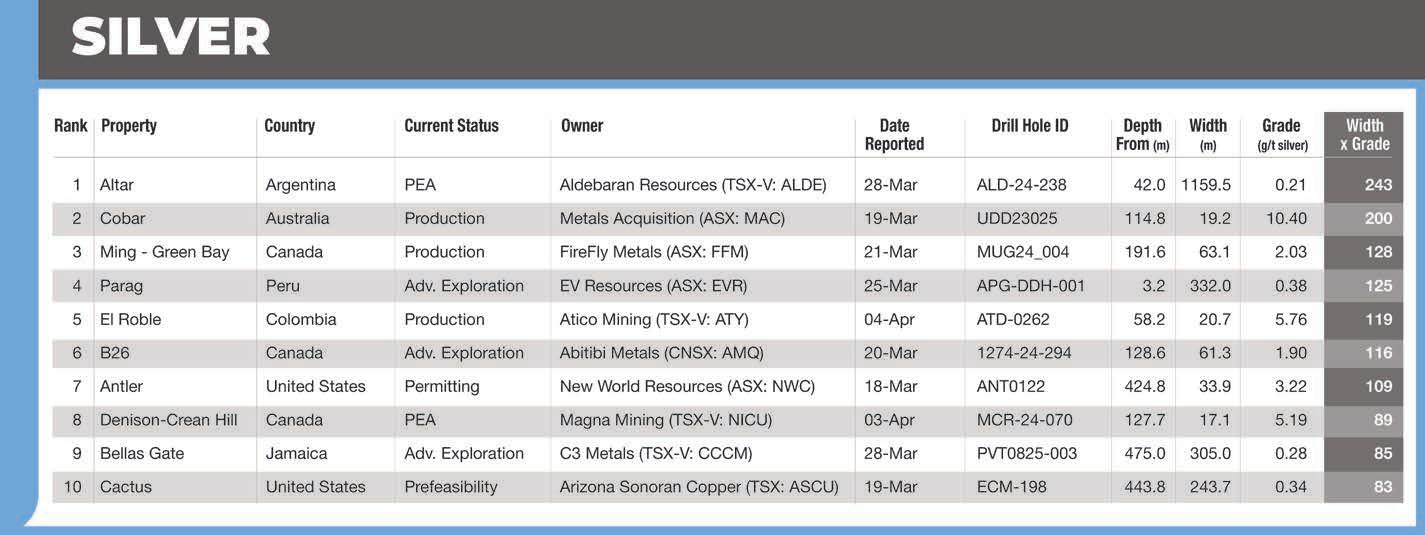
Name Symbol Subsciption Terms Expiry Date
Aris Gold Corporation ARIS.WT.B
Gran Colombia Gold GCM.WT.B
One Warrant to purchase one Common 04-30-2024 Share of the Issuer at $2.21 until expiry
One warrant to purchase one common 04-30-2024 share of the Issuer at $2.21 until expiry.
STLLR Gold Inc. STLR.WT One Warrant to purchase 0.21 of a 05-03-2024 common share of the Issuer at $1.05 until expiry
Novo Resources Corp. NOVO.WT.A One Warrant to purchase one common 05-04-2024 share of the Issuer at $3.00 until expiry.
TSX
Name Symbol Subsciption Terms Expiry Date
Novo Resources Corp. NVO.WT.A One Warrant to purchase one common 05-04-2024 share of the Issuer at $3.00 until expiry.
Aris Gold Corporation ARIS.WT One Warrant to purchase one Common 7-29-2025 Share of the Issuer at $2.75 until expiry.
Aris Gold Corporation ARIS.WT.A One Warrant to purchase 0.5 of one 07-29-2025 Common Share of the Issuer at $2.75 until expiry
Name SymbolSubsciption Terms Expiry Date
Giga Metals CorporationGIGA.WTOne warrant to purchase one common 04-23-2024 share at $0.60 per share.
American Lithium Corp.LI.WTOne warrant to purchase one common 05-11-2024 share at $0.30 per share.
Millennial Precious MPM.WTOne warrant to purchase one common06-16-2024 Metals Corp. share at $0.50 per share.
Mexican Gold Corp.MEX.WTOne warrant to purchase one common 07-15-2024 share at $0.12 per share.
Giga Metals CorporationGIGA.WT.AOne warrant to purchase one common 02-08-2025 share at $0.45 per share.
LithiumBank Resources LBNK.WTOne warrant to purchase one common02-16-2025 Corp. share at $2.00 per share.
Total Helium Ltd.TOH.WT.AOne warrant to purchase one common 05-01-2025 share at $0.75 per share.
Caldas Gold Corp.CGC.WTOne warrant to purchase one common 07-29-2025 share at $2.75 per share.
Rock Tech Lithium Inc.RCK.WTOne warrant to purchase one common 08-19-2025 share at $4.50 per share.
Lion One Metals LimitedLIO.WTOne warrant to purchase one common 11-11-2025 share at $1.25 per share.
TSX SHORT POSITIONS
Short positions outstanding as of April 15, 2024 (with changes from March 31, 2024))
Largest short positions
Company Ticker Short position Change
Calibre MngCXB322613513202764
i-80 Gold IAU3189481215716257
Ivanhoe MinesIVN284686531341708
Suncor EnergySU218488943294348
Barrick GoldABX157858491806927
Lundin MngLUN156997733512311
Equinox GoldEQX15025357-124649
New Gold NGD133117612925749
Denison MinesDML10230465-960873
IAMGOLD IMG10097910-644064
HudBay MinHBM9246730504105
Kinross GoldK 8665780460441
First QuantumFM79160632138669
B2Gold CorpBTO7818824-484498
Osisko Mng IncOSK7340814257778
Largest increase in short position
i-80 Gold IAU3189481215716257
Lundin MngLUN156997733512311
Suncor EnergySU218488943294348
Calibre MngCXB322613513202764
New Gold NGD133117612925749
Largest decrease in short position
Argonaut GoldAR3429111-10656885
Endeavr SilverEDR2275006-2225167
Nexgen EnergyNXE4647948-1588933
Denison MinesDML10230465-960873
OceanaGoldOGC3683872-813994
Name SymbolSubsciption Terms Expiry Date
Silver Mountain AGMR.WT.AOne warrant to purchase one common02-09-2026 Resources Inc. share at $0.45 per share.
Osisko Development ODV.WT.BOne warrant to purchase one common03-02-2026 Corp. share at $8.55 per share.
Denarius Silver Corp.DSLV.WTOne warrant to purchase one common 03-17-2026 share at $0.80 per share.
Aurania Resources Ltd.ARU.WT.BOne warrant to purchase one common 10-21-2026 share at $2.20 per share.
Freeman Gold CorpFMAN.WT.UOne warrant to purchase one common 11-29-2026 share at US$0.65 per share.
Osisko Development ODV.WT.AOne warrant to purchase one common03-02-2027 Corp. share at $14.75 per share.
Integra Resources Corp.ITR.WTOne warrant to purchase one common 03-13-2027 share at $1.20 per share.
Elevation Gold Mining ELVT.WT.AOne warrant to purchase one common03-24-2027 Corporation share at $0.70 per share.
Osisko Development ODV.WT.UOne warrant to purchase one common05-27-2027 Corp. share at US$10.70 per share.
Bear Creek Mining BCM.WTOne warrant to purchase one common10-05-2028 Corporation share at $0.42 per share.
TSX VENTURE SHORT POSITIONS
Short positions outstanding as of April 15, 2024
(with changes from March 31, 2024)
Largest short positions
Company Ticker Short position Change
An eld EnergyAEC5418642106408
Kintavar ExpKTR47357534734706
CanAlaska UranCVV3888378-934471
Japan Gold JG25669342566845
AbraSilver ResABRA24980912406280
Rio2 LimitedRIO23860022376972
Silver Viper VIPR18414371815902
Forum EnergyFMC18241261683603
ATHA EnergySASK1797524-295602
GoviEx UraniumGXU1551882-533815
New Found GoldNFG1466835-112581
Montero Mg&ExMON1433521-215234
Stallion DiscoSTUD13395331334024
BonTerra ResBTR1328365784314
EnCore EnergyEU129077742835
Largest increase in short position
Kintavar ExpKTR47357534734706
Japan Gold JG25669342566845
AbraSilver ResABRA24980912406280
Rio2 LimitedRIO23860022376972
Silver Viper VIPR18414371815902
Largest decrease in short position
West Red LakeWRLG362611-1794941
Founders MetalFDR155387-1383853
Adventus ADZN57385-1333538
CanAlaska UranCVV3888378-934471
GoviEx UraniumGXU1551882-533815
Aluminum: US$1.20/lb.
Cobalt: US$12.46/lb.
Gold: US$2,328.40/oz.
Iron Ore 62% Fe CFR China-S: US$117.50
Nickel: US$8.64/lb.
Silver: US$27.61 per oz.
Zinc: US$1.28 per lb.
Commodity Prices 12-Month Trend
$2,364.39 US$/oz. (+$359.99 vs. YA)
28.71 US$/oz. (+$3.32 vs. YA)
$4.36 US$/Lb. (+$0.28 vs. YA)
$8.18 US$/Lb. (-$2.35 vs. YA)
COMMODITY PRICES | Prices current Apr. 22, 2024
Coal: Central Appalachia, 12,500 Btu, 1.2 S02-R,W: US$72.50 Coal: Powder River Basin, 8,800 Btu, 0.8 S02-R, W: US$13.75
Copper: US$4.42/lb.
Iridium: US$4,850/tr oz.
Lead: US$0.98/lb.
Rhodium: Mid-mkt US$4,740/tr. oz.
Tin: US$16.18/lb.
S&P/TSX Global Gold
25 New Highs
79 Resources
Abitibi Metals*
Adyton Res
Adyton Res*
Aldebaran Res
Aldebaran Res*
Amarc Res
Amarc Res*
American Salar
Arcwest Explor
Aris Mining
Aris Mining*
Aura Minerals
Auric Res
Aya Gold
Aya Gold*
Batero Gold*
Bedford Metals
Canterra Min
Canterra Min*
Capstone Mng
Cariboo Rose
Cdn Critical
Cdn Critical*
Encanto Potash
Engold Mines
Entree Res
Gensource Pot
Giant Mining*
Globex Mng
Globex Mng*
Gold Hunter Rs
Golden Harp
Great Pacific
Great Pacific *
Green Bridge Highway 50 Gld
Intl Iconic
Intl Iconic*
Ivanhoe Mines
Ivanhoe Mines*
Jaguar Mng
Jaguar Mng*
Karora Res
Karora Res*
Kinross Gold*
Lundin Gold
Magna Terra
Mantaro Prec
Mawson Res*
Medaro Mining*
NevGold*
NV Gold
Petrolympic*
Phenom Res
Phenom Res*
Pinnacle S&G
PJX Res
Power Nickel
Power Nickel*
PPX Mining
Quadro Res*
Quebec Nickel Regulus Res
Rhyolite Res
Rio2 Limited
Silver Predatr
SilverCrest
SilverCrest*
Copper: CME Group Futures June 2024: US$4.50/lb.;
July 2024: US$4.51/lb.
Lithium carbonate: US$15,250/tonne
Ruthenium: Mid-mkt US$430 per oz.
Uranium: U3O8, Trading Economics: US$89.30 per lb.
South Pacific Sun Summit Sun Summit* Surge Copper Surge Copper*
Talisker Res*
Taseko Mines
Taseko Mines*
Timberline Res
Timberline Res*
Venture Mnrls*
Xtra-Gold Res*
28 New Lows
Alma Gold*
American Lith American Lith*
Bushveld Min*
Comstock Mg*
Fathom Nickel
Fathom Nickel*
GoviEx Uranium GoviEx Uranium*
Graphite One*
Gratomic
Jervois Mining*
Lake Resources*
Largo Res
Largo Res*
April 12-19, 2024
B2Gold CorpBTO245994.003.573.59-0.39
Ivanhoe MinesIVN2243119.9918.2819.21+0.85
Suncor EnergySU2046253.4651.0752.99+1.07
Barrick GoldABX1937324.5422.2823.53-1.10
Kinross GoldK186759.378.589.31+0.53
First QuantumFM1687416.2714.3515.96+0.69
Argonaut GoldAR168270.430.400.42-0.01
Lundin MngLUN1195716.1514.8915.84+0.22
Capstone MngCS110409.808.989.50+0.21
Calibre MngCXB103051.881.731.88+0.06
Greatest Percentage Change
Nickel CreekNCP3910.020.000.02+33.3
Talon MetalsTLO42070.200.120.17+26.9
Sulliden MngSMC1050.030.020.03+25.0
Nevada CopperNCU12690.140.100.13+23.8
Wallbridge MngWM30330.110.090.11+22.2
Century GlobalCNT310.040.000.04+16.7
Aya Gold AYA 293814.8112.0014.80+16.4
Fortune MinFT9640.040.030.04+14.3
Tanzanian GoldTRX2190.670.550.64+14.3
Karora ResKRR77115.775.055.69+12.2
Horizonte MnlsHZM63590.020.010.01-77.8
Trilogy MtlsTMQ4790.750.340.55-26.7
Orvana MnrlsORV8520.260.190.20-24.5
Niocorp DevNB1014.433.233.27-23.4
Ascendant ResASND2720.070.000.06-20.0
Black IronBKI5210.060.050.05-18.2
Titan MiningTI1830.420.300.33-17.5
Excellon ResEXN8950.230.180.19-17.4
Northcliff ResNCF3950.030.030.03-16.7
Nthn DynastyNDM6410.470.390.40-16.
Greatest Value Change
Franco-NevadaFNV1790167.00+4.35
Agnico EagleAEM588187.82+3.18
Aya Gold AYA 293814.80+2.09
Lundin GoldLUG161220.18+1.74
Suncor EnergySU2046252.99+1.07
Wheaton PrecWPM400972.38+1.04
SilverCrestSIL185110.87+0.97
Ivanhoe MinesIVN2243119.21+0.85
Torex GoldTXG105720.38+0.72
First QuantumFM1687415.96+0.69
Cameco CorpCCO457366.18-2.12
Teck ResTECK.A1464.77-1.23
Teck ResTECK.B656564.81-1.20
Barrick GoldABX1937323.53-1.10
First MajesticFR74769.28-1.09
Niocorp DevNB1013.27-1.00
Patriot BattPMET6136.62-0.72
Ero CopperERO137027.71-0.71
Nexgen EnergyNXE699110.47-0.58
Triple FlagTFPM51021.40-0.49
e S&P 500 fell 3.25% to 4,967.23 on April 19, marking its worst three-week stretch since last September and slipping below the psychologically important 5,000 level. is decline was fuelled by concerns over geopolitical unrest and comments from the U.S. Federal Reserve hinting at delayed interest rate cuts.
As the index dipped, the gold price sat in near-record territory on April 19 at US$2,390.86 per ounce. e Dow Jones Industrial Average ended the week at at 37,986.40.
e S&P TSX Composite Index closed the week 0.4% lower at 21,807.37. e TSX Global Gold Index edged 0.5% higher to 314.33 on the record metal price.
Among the top NYSE-listed perform-
Timberline ResTBR156790.150.060.15+0.08
GoviEx UraniumGXU126570.140.100.11-0.04
F3 UraniumFUU102830.430.380.39-0.04
Power NickelPNPN73880.390.250.38+0.13
Outcrop S&GOCG73180.260.210.22-0.02
An eld EnergyAEC68200.110.080.08-0.02
Thesis Gold TAU 58480.730.660.69-0.02
AbraSilver ResABRA57020.390.360.39+0.01
Hercules SilBIG49910.830.740.81 unch 0.00
Purepoint UranPTU47740.050.040.04-0.01
Golden HarpGHR.H6200.160.000.16+300.0
Adyton ResADY14800.090.000.09+125.0
Timberline ResTBR156790.150.060.15+123.1
Green ShiftGCOM1540.060.000.06+100.0
Millennium SilMSC1570.010.000.01+100.0
Highway 50 GldHWY410.240.000.24+60.0
Kubera GoldKBRA02.000.002.00+58.7
PetrolympicPCQ990.070.000.07+55.6
Power NickelPNPN73880.390.250.38+52.0
AFR NuVentureAFR150.020.000.02+50.0
Running Fox RsRUN.H80.010.000.01-50.0
Aranjin ResARJN700.010.000.01-50.0
Adex MiningADE5320.010.000.01-50.0
Power GroupPGP4720.010.000.01-50.0
Richmond MnlsRMD3770.030.000.02-50.0
In nitum CopINFI770.060.000.04-42.9
Wolfden ResWLF2480.050.000.04-41.7
St. James GoldLORD200.150.000.12-36.1
Intl Metals MgIMM1640.060.000.05-35.7
Mas GoldMAS110.020.000.01-33.3
VOLUME
Highwood AssetHAM496.70+1.00
Kubera GoldKBRA02.00+0.74
Li-FT PowerLIFT3703.14+0.39
Chesapeake GldCKG842.52+0.21
Lara Expl LRA1830.82+0.21
Metalore ResMET13.00+0.17
Bedford MetalsBFM1301.40+0.15
Power NickelPNPN73880.38+0.13
Golden HarpGHR.H6200.16+0.12
Pac Booker MinBKM520.54+0.12
Sigma LithiumSGML16218.63-1.46
IsoEnergy LtdISO9813.80-0.49
EnCore EnergyEU8305.70-0.34
Artemis GoldARTG4608.51-0.31
New Found GoldNFG8995.07-0.26
McChip ResMCS20.71-0.21
American LithLI12290.75-0.16
Nouveau MondeNOU2212.82-0.16
Snowline GoldSGD3945.42-0.15
Premium NickelPNRL12960.76-0.14
ers this week, Arch Resources closed US$6.30 per share higher at US$163.18, mainly on strong fundamentals and positive analyst earnings revisions. e stock has gained as much as 50% over the past 12 months.
Gold streaming and royalty rm Franco-Nevada gained US$3.42 per share to US$121.47 based on higher precious metals prices. Toronto-based miner Kinross Gold was the biggest percentage gainer, adding 6.1% to close at US$6.77.
On the TSX, the gold price also buoyed Agnico Eagle Mines, which added $3.18 per share to close the week at $87.82 and Aya Gold & Silver, which added $2.09 to close at $14.80 apiece.
Vale*VALE16477112.2311.5212.18+0.16
Barrick Gold*GOLD14795117.8416.1017.10-0.76
Kinross Gold*KGC969386.826.206.77+0.39
Freeport McMoR*FCX8208551.1448.0849.61+0.14
Kinross Gold*KGC969386.826.206.77+6.1
Peabody Enrgy*BTU1660724.8422.7324.08+4.3
Arch Resources*ARCH1631169.00156.81163.18+4.0
Agnico Eagle*AEM1924563.9560.1563.84+3.9
Black Hills*BKH208454.1450.7354.00+3.4
Sandstorm Gold*SAND126505.565.105.52+3.0
Franco-Nevada*FNV3249122.50114.19121.47+2.9
Suncor Energy*SU2148538.9036.9338.54+2.3
HudBay Min*HBM126337.977.287.79+2.2
Harmony Gold*HMY356199.388.689.29+2.0
Lithium Amer*LAC484917.404.644.73-33.2
First Majestic*AG558967.836.716.73-10.5
Nouveau Monde*NMG2622.152.022.02-7.8
Endeavr Silver*EXK319652.832.492.61-6.8
United States S*X1657641.8538.0938.59-6.6
Sibanye-Stillw*SBSW270465.565.105.12-5.9
Nexgen Energy*NXE223328.257.557.61-5.0
MartinMarietta*MLM2867619.49572.57575.89-4.4
Barrick Gold*GOLD14795117.8416.1017.10-4.3
Cleveland-Clif*CLF3594622.0420.5220.81-3.
Arch Resources*ARCH1631163.18+6.30
Franco-Nevada*FNV3249121.47+3.42
Agnico Eagle*AEM1924563.84+2.39
Black Hills* BKH208454.00+1.76
Chevron Corp*CVX31523160.00+1.04
Peabody Enrgy*BTU1660724.08+0.99
Rio Tinto* RIO1629866.97+0.98
Wheaton Prec*WPM1066952.65+0.85
Suncor Energy*SU2148538.54+0.85
CONSOL Energy*CEIX200484.08+0.47
MartinMarietta*MLM2867575.89-26.22
United States S*X1657638.59-2.74
Lithium Amer*LAC484914.73-2.35
Southern Copp*SCCO6548113.43-1.82
Cameco Corp*CCJ1615848.10-1.49
Cleveland-Clif*CLF3594620.81-0.83
First Majestic*AG558966.73-0.79
Teck Res* TECK1943447.13-0.77
Barrick Gold*GOLD14795117.10-0.76
Intrepid Pot*IPI50119.66-0.7
2024 n May
May 2-5
Mining Turkey 2024 — Istanbul, Turkey
VENUE: Tuyap Fair Convention and Congress Center
MOREINFORMATION: www.madenturkiyefuari. com/en/
May 7-8
International Mining Geology Conference 2024 — Perth, Australia
VENUE: Perth Convention and Exhibition Centre
MOREINFORMATION: www.madenturkiyefuari. com/en/ausimm.com/conferences-and-events/ mining-geology/
May 7-9
2024 Canaccord Genuity Global Metals and Mining Conference — Palm Desert, Calif.
VENUE: TBA
MOREINFORMATION: www.canaccordgenuity.com/ capital-markets/events-and-conferences/2024global-metals-and-mining-conference/
May 8-10
Minerals North Conference — Kitimat, B.C.
VENUE: Riverlodge Recreation Centre
MOREINFORMATION: www.mineralsnorth.ca/ conference/conference-news/
May 10
Mineral Tenure Act engagement session — Kitimat, B.C.
VENUE: Riverlodge Recreation Centre
MOREINFORMATION: www.members.amebc.ca/ event/MTAatMinNor
May 12-15
CIM Convention and Expo 2024 — Vancouver
VENUE: TBA MOREINFORMATION: www.cim.org/events/
May 12-15
Minefill 2024 — Vancouver
VENUE: TBA
MOREINFORMATION: https://minefill2024.cim.org
May 13
Mineral Tenure Act engagement session — Vancouver, B.C.
VENUE: Pinnacle Harbourfront
MOREINFORMATION: www.members.amebc.ca/ event/MTAPinnacle
May 13-14
Battery Minerals & Supply Chain 2024 — Toronto
VENUE: Hilton Mississauga
MOREINFORMATION: www.battery-mineralsshow.com
May 13-14
Direct Lithium Extraction 2024 — Buenos Aires, Argentina
VENUE: Sheraton Buenos Aires Hotel & Convention Center
MOREINFORMATION: www.argentina.directlithium-extraction-show.com/index
May 16-17
121 Mining Investment — London, U.K.
VENUE: TBA
MOREINFORMATION: www.weare121. com/121mininginvestment-london/
May 20-21
International Conference on Mining Technologies — Berlin
VENUE: TBA
MOREINFORMATION: www.waset.org/miningtechnologies-conference-in-may-2024-in-berlin
May 20-22
Current Trends in Mining Finance (CTMF) Conference — New York City
VENUE: Shearman and Sterling Conference Center
MOREINFORMATION: https://community.smenet. org/currenttrendsinminingfinance/home
May 21-23
Discoveries Mining Conference — Mazatlan, Mexico
VENUE: Mazatlan International Center
MOREINFORMATION: www.discoveriesconference. com
May 21-23
The Electric Mine — Perth, Australia
VENUE: Crown Perth
MOREINFORMATION: www.theelectricmine.com/ event/efa3c1b1-b8eb-42fd-bc22-f7a8b7fdc10f/ summary
May 28-29
Mining Transformed — Sudbury, Ont.
VENUE: Norcat Underground Centre
MOREINFORMATION: https://miningtransformed. norcat.org
May 28-30
Euro Mine Expo — Skellefteå, Sweden
VENUE: Skellefteå Kraft Arena
MOREINFORMATION: www.euromineexpo.com
May 29-30
Digitalization in Mining North America — Toronto
VENUE: Sheraton Centre Toronto Hotel
MOREINFORMATION: https:// mininginnovationnetwork.swoogo.com/
DMNA2024
n June
June 2-5
American Society of Reclamation Sciences — Knoxville, Tenn.
VENUE: Knoxville Convention Center
MOREINFORMATION: www.asrs.us/2024conference/
June 3-4
121 Mining Investment — New York
VENUE: TBA
MOREINFORMATION: www.weare121. com/121mininginvestment-new-york/
June 4-6
The Mining Investment of the North — Quebec City
VENUE: Quebec City Convention Centre
MOREINFORMATION: www. themininginvestmentevent.com
June 5-6
Canadian Mining Expo 2024 — Timmins, Ont.
VENUE: McIntyre Complex
MOREINFORMATION: https://virtex. canadianminingexpo.com
June 6-7
MiningForum 2024 — Berlin
VENUE: TBA
MOREINFORMATION: www.the-miningforum.com/ home.html
June 11-13
Indonesia Critical Minerals Conference and Expo — Jakarta
VENUE: TBA
MOREINFORMATION: https://ni-co-ev-indonesia. metal.com/home
June 12-14
10th International Conference on Tailings Management – Santiago, Chile
VENUE: Sheraton Santiago
MOREINFORMATION: www.gecamin.com/tailings/ index?idioma=ingles
June 17-18
Future of Mining — Perth, Australia
VENUE: Pan Pacific Perth
MOREINFORMATION: www.future-of-mining.com/ fomperth
June 27-28
Victorian Minerals Round-up 2024 — Ballarat, Australia
VENUE: Ballarat Goods Shed
MOREINFORMATION: www.aig.org.au/events/ victorian-minerals-round-up-2024/
June 27-29
China International Mining Expo — Shenyang, China
VENUE: Shenyang International Exhibition Center
MOREINFORMATION: www.bjminexpo.com
n July
July 8-12
12th International Kimberlite Conference — Yellowknife
VENUE: Explorer Hotel and Chateau Nova Hotel
MOREINFORMATION: www.12ikc.ca
July 23-25
Queensland Mining and Engineering Exhibition — Mackay, Australia
VENUE: Mackay Showgrounds
MOREINFORMATION: www. queenslandminingexpo.com.au/en-gb.html
n August
August 5-7
Diggers and Dealers Mining Forum — Kalgoorlie, Australia
VENUE: TBA
MOREINFORMATION: www.diggersndealers.com.au
August 7-9
2024 Beijing International Coal and Mining Exhibition — Beijing, China
VENUE: China International Exhibition Center
MOREINFORMATION: www.en.ciceme.com
August 19-22
63rd Annual Conference of Metallurgists — Halifax, N.S.
VENUE: Halifax Convention Centre
MOREINFORMATION: www.metsoc.org/2024
August 26-28
Critical Minerals Conference 2024 — Brisbane, Australia
VENUE: Brisbane Convention and Exhibition Centre
MOREINFORMATION: www.ausimm.com/ conferences-and-events/critical-minerals-2024/
n September
September 2-4
International Future Mining Conference — Sydney, Australia
VENUE: TBA
MOREINFORMATION: https://int.ausimm.com/ conferences-and-events/future-mining/
September 2-6
Electra Mining Africa 2024 — Johannesburg, South Africa
VENUE: Johannesburg Expo Centre
MOREINFORMATION: www.electramining.co.za
September 11-14
Mining Indonesia - Jakarta
VENUE: Jakarta International Expo
MOREINFORMATION: www.mining-indonesia.com
September 15-18
Gold Forum Americas 2024 — Colorado Springs, Colo.
VENUE: Broadmoor Hotel and Resort
MOREINFORMATION: www.goldforumamericas.com
September 17-19
Central Asian International Exhibition — Almaty, Kazakhstan
VENUE: Atakent International Exhibition Centre
MOREINFORMATION: https://miningworld.kz/en/ exhibition/about-the-exhibition
September 24-26
International Conference on Deep and High Stress Mining — Montreal
VENUE: Hotel Bonaventure
MOREINFORMATION: www.acgdeepmining.com
September 24-26
MINExpo International – Las Vegas
VENUE: Las Vegas Convention Center
MOREINFORMATION: www.minexpo.com
September 25-27
MINExpo 2024 — Dar-es-Salaam, Tanzania
VENUE: Diamond Jubilee Expo Center
MOREINFORMATION: www.expogr.com/ minexpotanzania/
September 29-October 3 International Mineral Processing Congress — Washington, D.C.
VENUE: TBA
MOREINFORMATION: www.smeimpc.org
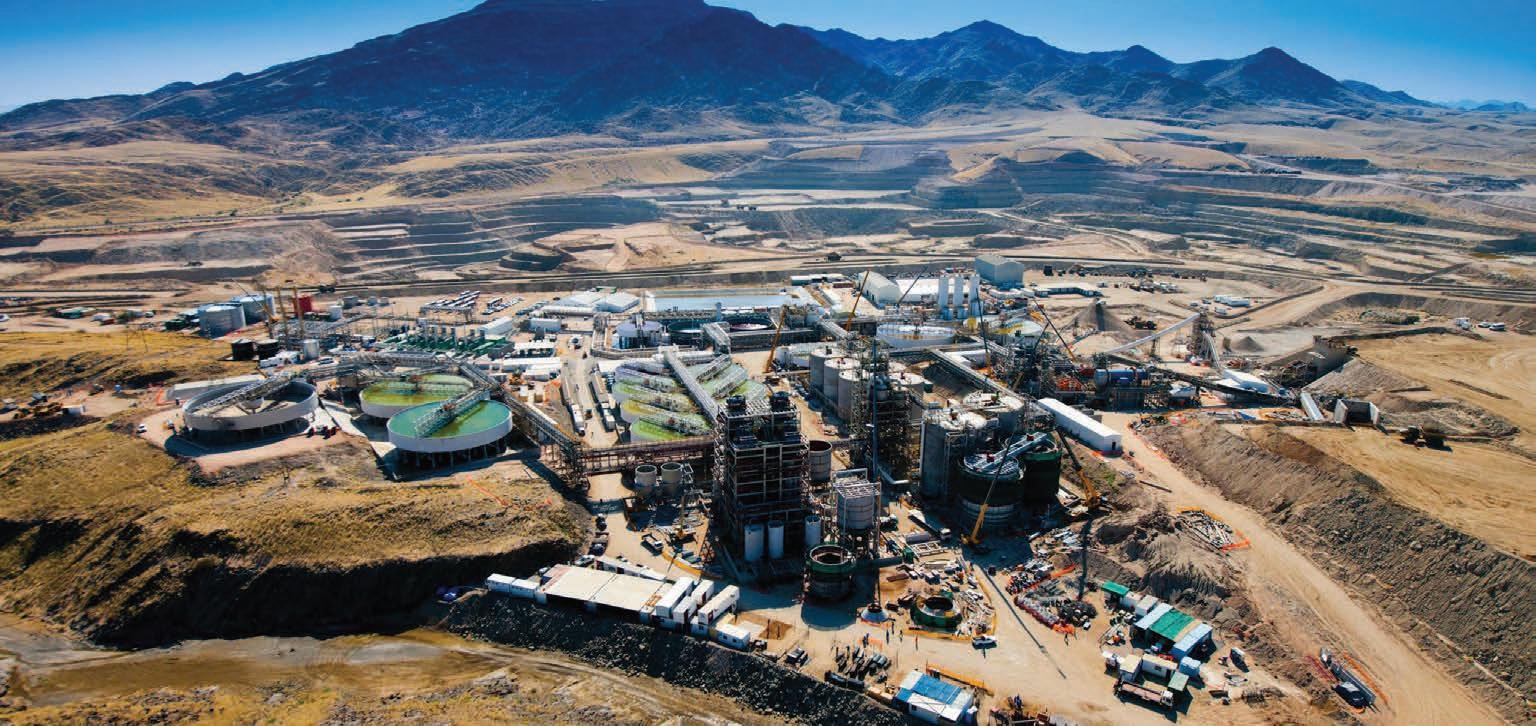 BY CECILIA JAMASMIE
Paladin Energy (ASX: PDN) says it’s begun producing and drumming uranium concentrate at its Langer Heinrich mine in Namibia, adding it would now focus on ramping up operations and building a nished product inventory.
e Western Australia-based miner said its rst concentrate production was achieved and packed into metal drums for shipping to customers on March 30.
As part of the transition to production, the company’s chief operating o cer, Paul Hemburrow, will take on responsibility for all activities at its 75%-owned mine, Paladin said on April 2.
Langer Heinrich is located in the Namib Desert, 80 km east of the principal seaport of Walvis Bay and 40 km southeast of Namibia’s
— and the world’s — longest-running open pit uranium mine, China National Uranium Corp.’s Rössing.
Achieving rst production at Langer Heinrich is an important milestone for Paladin, CEO Ian Purdy, said in a statement. He noted the company will update the market in July on production guidance for the mine for scal 2025.
A 50+ year history
Langer Heinrich was discovered in 1973 and Paladin Energy took over the asset in August 2002, kicking o production in 2007 with an initial capacity of 2.7 million lb. of uranium oxide (U3O8) per year. is capacity was later expanded to 3.7 million lb. U3O8 in 2009 and 5.2 million lb. U3O8 in 2012.
However, due to a sharp decline in uranium prices in the following years, the company axed produc-
tion in November 2016. Langer Heinrich was placed under care and maintenance in May 2018.
Rising prices for the radioactive material in the last 10 months have pushed several miners to reopen mines and resume activities at stalled projects. Leading uranium producers have rushed to meet the demand not only because of favourable prices, but also in light of increased interest from governments looking for nuclear power solutions to meet emissions targets.
e price of the energy metal has experienced a signi cant upturn. e NYMEX uranium 1st futures contract price hit a new high of US$106.40 a lb. on Feb 1. e material is now sitting at US$88 a lb. as of April 10 — still well above last year’s average price of US$66.60 a pound. e last time that contract was above US$100 was in August 2007.
e International Atomic
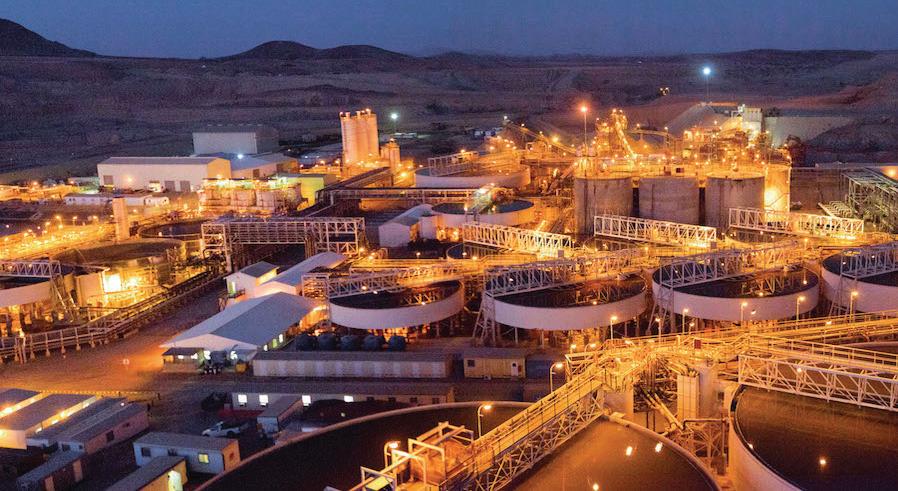
Energy Agency predicts that by 2040, global demand for uranium will exceed 100,000 tonnes per year, which is more than double
the present worldwide production. Currently, two-thirds of the world’s uranium comes from Kazakhstan, Canada and Australia. TNM
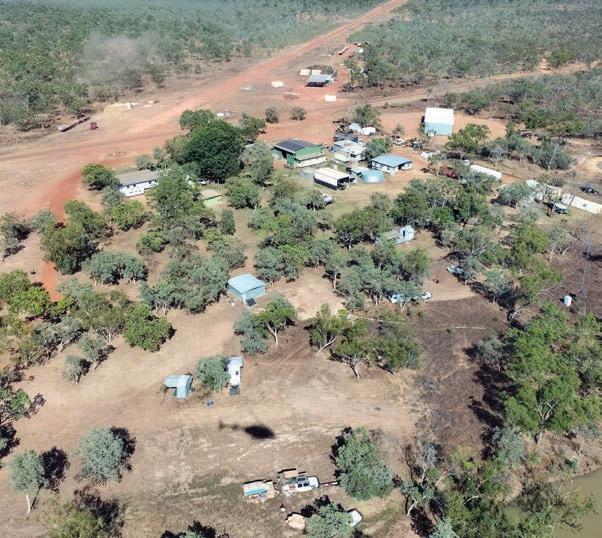
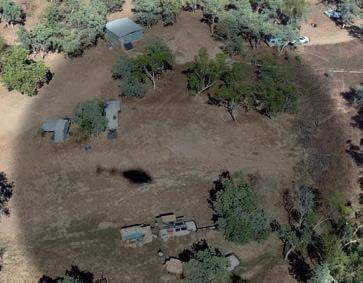

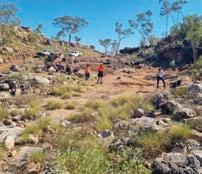
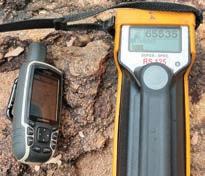
GoviEx Uranium (TSXV: GXU; US-OTC: GVXXF) has been discussing with Niger’s military leaders how to avoid losing its Madaouela project licence if it fails to start the mine by July 3.
GoviEx stock dropped almost a quarter to 9.5¢ apiece, its lowest in four years, when the company mentioned the negotiations April 19. Its value fell to $82.9 million. e shares had traded as high as 22¢ in the previous 52 weeks.
e government, which came to power in a coup last July, rules the continent’s biggest uranium producer a er Namibia and has a 20% stake in Madaouela. ere’s a risk the junta could revoke the mining permit, GoviEx said.
“ e company is committed to developing the project and is working with the Niger government towards a mutually bene cial solution that complies with applicable law and protects the company’s rights,” it said in a release. “While there is no guarantee of the outcome of these discussions, GoviEx is committed to exploring all viable options.”
e Vancouver-based company was trying to secure more than US$200 million in debt nancing for the project estimated to cost US$343
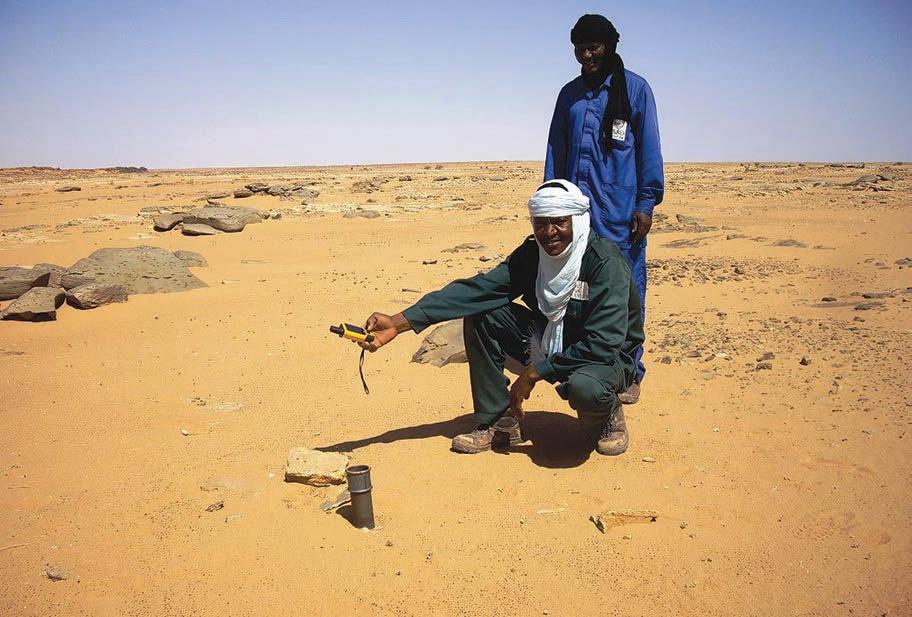
million to build. Lenders were conducting due diligence on funding, the company said. It led an environmental report required before startup and began site work, such as building an access road. It plans an open pit and underground mine with a life of more than 20 years.
Madaouela, with forecast output of nearly 2.7 million lb. a year, could push Niger higher than its current ranking of seventh-largest uranium producer behind Kazakhstan, Canada and Namibia to ahead of Russia, according to the World Nuclear Association.
Feasibility study
e project hosts proven and probable reserves of 5.4 million tonnes grading 0.87 kg per tonne uranium oxide (U3O8) and 123.1 parts per million molybdenum for 12.3 million lb. U3O8 and 664 tonnes molybdenum, according to a 2022
feasibility study.
Production is forecast at 50.8 million lb. of U3O8 over the life of the mine.
e study used a uranium price of US$65 per lb. and a molybdenum price of US$11 per lb. for an a er-tax net present value (at an 8% discount rate) of US$140 million and an internal rate of return of 13.3%. Spot uranium has increased to about US$90 per lb. and molybdenum to roughly $US20 per lb. since then.
Madaouela has one of the world’s largest resources, GoviEx executive chairman Govind Friedland said.
“ e company was able to do this because it cooperated with governments and worked with locals to create a mutually benecial outcome,” Friedland said in the release. “Our commitment to the country remains and we will use all appropriate means available to us to ensure that we continue to develop the project.”
GoviEx also has the permitted Muntanga uranium project in Zambia where it expects to publish a feasibility study in this year’s second half. In January last year, the company sold its uraniumsilver-copper Falea project in Mali to African Energy Metals (TSXV: CUCO; US-OTC: NDENF) in a $5.5-million cashand-share deal. TNM
Shares in NexGen Energy (TSX: NXE; NYSE: NXE; ASX: NXG) have risen by more than a third in the past six months on surging uranium prices but the federal regulator has put a temporary hold on approving the company’s $1.3-billon Rook 1 project in Saskatchewan.
NexGen’s environmental assessment ling doesn’t adequately address how proposed underground tailings and a ooded mine area might leach towards a lake near the site, the regulator says. It is pausing a two-year approvals process while the company addresses the issues for the project in the province’s far north Athabasca Basin.
Rook 1, Canada’s largest development-stage uranium project, received provincial approval in November. It still needs OKs from federal environmental, provincial permitting, and federal licensing before construction. But the Canadian Nuclear Safety Commission notes it may have to review NexGen’s submissions “several times to ensure the responses meet requirements,” according to letters from the commission posted to a government website.
‘Within weeks’ NexGen will reply within weeks to
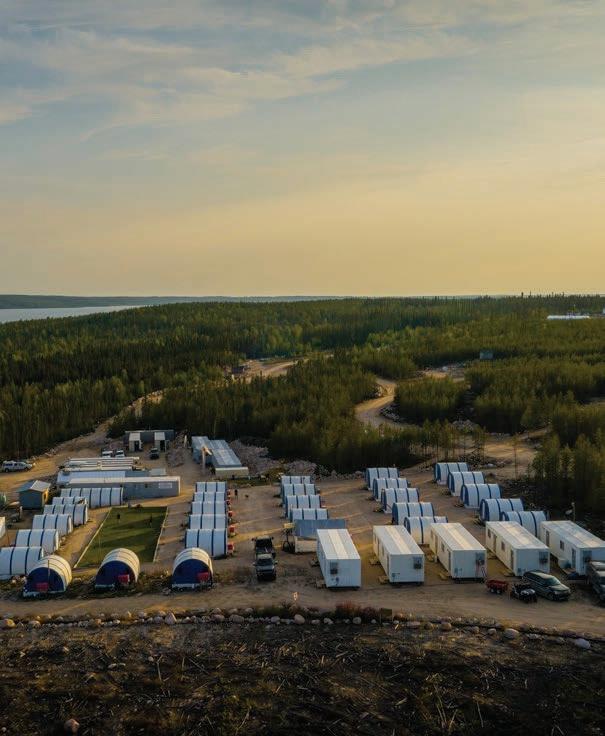
The exploration camp at NexGen Energy’s Rook 1 project. NEXGEN ENERGY the 49 remaining items to address with the regulator, the company said by email on April 12 in
response to questions from e Northern Miner. It backed up statements by CEO Leigh Curyer on a
March 11 earnings conference call.
“It is normal for uranium mine and mill developments undergoing federal environmental assessment to have follow-up comments during this process, which range from clari cations to requests for additional information,” spokesman Travis McPherson said.
“NexGen is highly con dent in addressing these remaining federal comments, and notes that the provincial environmental assessment process is complete, and evaluated all of these same aspects, including components such as tailings storage, water (e.g., lake) quality, and sh health.”
e company’s submission has already shown its plan to put tailings in a paste cemented to deep rock similar to granite is safer than surface storage, and it’s supported by the project’s Indigenous partners.
“ ere would be no signi cant adverse e ects on biophysical, cultural, or socio-economic components relating to water and sh as a result of the Rook 1 project,” McPherson said.
Fuel shortage e project is needed to narrow a forecast shortage in nuclear fuel as more countries embrace ssion for electricity generation that doesn’t produce greenhouse gases. ere are also concerns about securing Western supplies of the heavy
metal as China ramps up reactor construction and Russia remains a pariah state for the war in Ukraine yet controls most of the world’s uranium processing plants.
Rook 1 would produce 21.7 million lb. of uranium oxide annually over 11 years from the Arrow deposit, according to a 2021 feasibility study. Last month, the company said it had made a new discovery 3.5 km east of Arrow.
e Athabasca Basin is one of the world’s leading sources of uranium production.
Shares double e stock has more than doubled to $10.70 apiece in Toronto near press time from $4.90 a year earlier. e company’s stock market value is $5.7 billion.
Uranium similarly doubled from a year earlier to a 16-year high of US$106 per lb. in February before easing to US$87.75 a lb. closer to press time.
In comments on the earnings call in March, NexGen’s Curyer expressed con dence with the company’s ability to respond to the regulator’s queries.
“While every question is very, very important, we assess the materiality of them to be low and they will be easily clari ed and concluded,” the CEO said. “We are in the nal stages of the process and we also have full community support.”
Nuclear energy is gaining traction as a reliable non-carbon fuel source and as uranium prices have reached historic highs over the last few months. Here’s a list of eight uranium companies to watch as the world looks for more sources of the nuclear fuel.
n Aura Energy
Aura Energy (ASX: AEE; LSE: AURA) is focused on its Tiris openpit uranium project in northeastern Mauritania, about 1,450 km from the capital of Nouakchott. e company has an 85% stake in the project, with the government of Mauritania owning the remaining 15%.
An updated de nitive feasibility study released in March 2023 outlined an initial mine life of 16 years with average production over the rst 10 years of 2 million lb. U3O8 annually. Life-of-mine production will total 25.5 million lb. U3O8 e study used a base case uranium price of US$65 per pound.
e company describes Tiris as “one of the lowest capex, lowest operating cost uranium projects that remain undeveloped in the world,” with a capex of US$178.2 million, which could be paid back in four and a half years. e mine o ers a post-tax net present value (at an 8% discount rate) of US$22.6 million and an internal rate of return of 28%. Average all-in sustaining costs were pegged at US$28.77 per pound. Aura estimates a construction period of 18 months following a nal investment decision.
Tiris has measured and indicated resources of 62.1 million tonnes at 216 parts per million (ppm) U3O8 for 29.6 million lb. of contained U3O8. Inferred resources add 34.5 million tonnes grading 237 ppm U3O8 for 18 million lb. U3O8
e resource zones lie beneath at land surfaces covered by surcial hamada and thin aeolian sand deposits. e shallow overburden covers the basement rocks, which only appear as scattered outcrops.
Aura Energy signed a US$10-million o ake nancing agreement with London-based commodities rm Curzon Uranium Trading in 2021. e agreement includes an up to US$10-million facility.
Aura Energy has a market cap of about A$122.5 million (US$79.7 million).
n Bannerman Energy
Bannerman Energy (ASX: BMN; US-OTC: BNNLF) is focused on its Etango uranium project in western Namibia’s Erongo region, about 30 km southeast of the port city of Swakopmund.
Namibia granted Bannerman a mining licence for Etango in December 2023, following the completion in December 2022 of the Etango-8 feasibility study.
e study evaluated open pit mining and heap leach processing at Etango at a throughput rate of
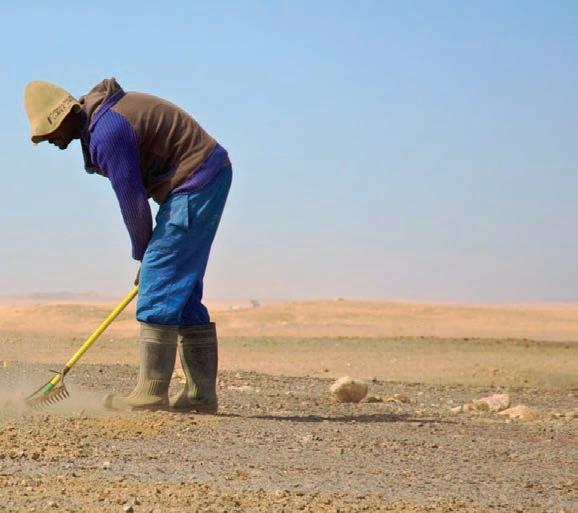

8 million tonnes per year. e operation would have an initial mine life of 15 years producing an average of 3.5 million lb. U3O8 per year (total life-of-mine production of 52.6 million lb. U3O8) at an all-in sustaining cost of US$38.1 per lb. U3O8. Preproduction initial capex was tagged at US$317 million.
Using a base case uranium price of US$65 per lb. U3O8, the study estimated the project would generate a post-tax net present value (at an 8% discount rate) of US$209 million and a post-tax internal rate of return of 17%.
In March, the company released a scoping study evaluating the viability of two options: a post ramp-up expansion in throughput capacity to 16 million tonnes per year (Etango-XP), and the extension of the mine life to 27 years from 15 at the same throughput of 8 million tonnes per year (Etango-XT). Bannerman said the company is committed to the development of Etango-8, but that the scoping study demonstrated that both the expansion and mine life extention options are technically and economically viable.
According to a November 2021 JORC-compliant resource estimate, Etango-8 hosts 32.4 million measured tonnes grading 201 ppm U3O8 for 14.3 million lb. contained U3O8 and 345.7 million indicated tonnes grading 195 ppm for 148.5 million lb. U3O8. Inferred resources add 140.6 million tonnes at 200 ppm U3O8 for 62 million lb. contained U3O8
Bannerman has a 95% stake in the project with One Economy Foundation, a Namibian charitable organization, owning the remaining 5%.

Bannerman Energy has a market cap of A$582.3 million (US$381.9 million).
n CanAlaska Uranium CanAlaska Uranium (TSXV: CVV; US-OTC: CVVUF) is a project generator with interests in about 5,000 sq. km of Canada’s uranium-rich Athabasca Basin in northern Saskatchewan. It is currently working with Cameco (TSX: CCO; NYSE: CCJ) at the West
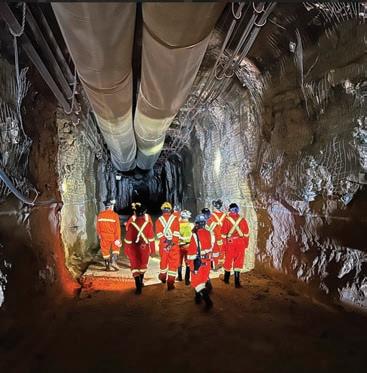
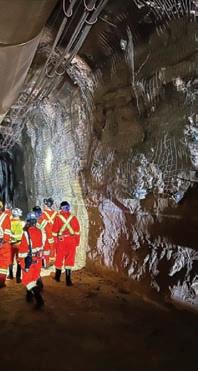
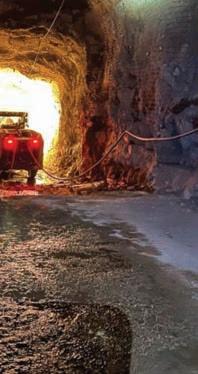

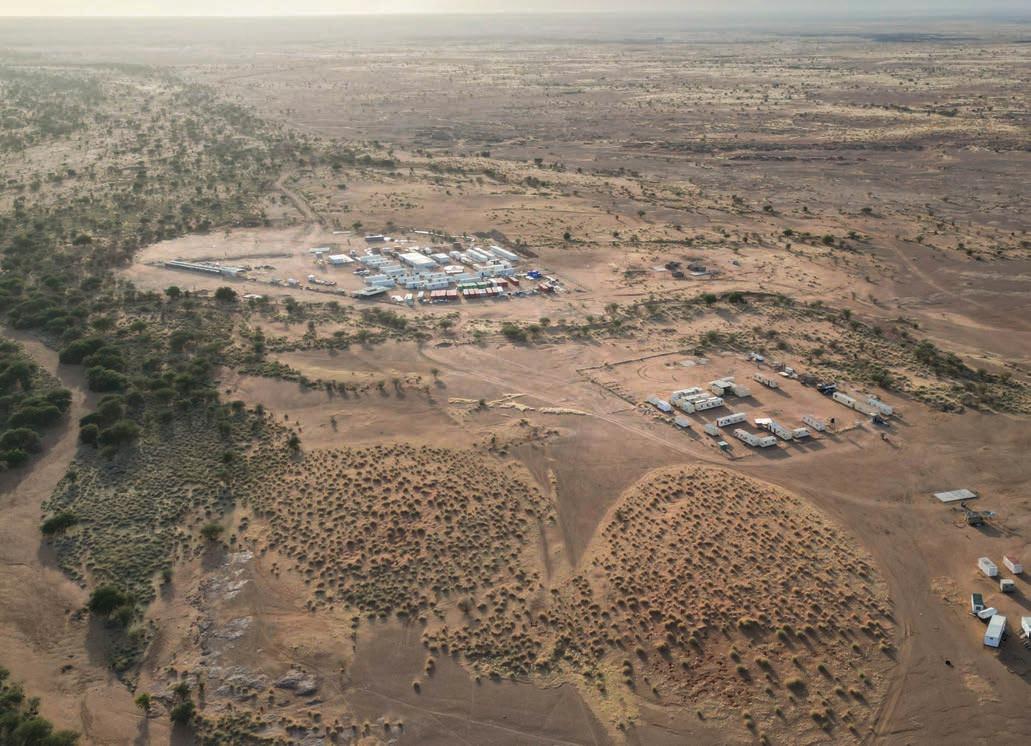
• Fully permitted, large, high-grade uranium deposit
• Only greenfield uranium project under development today
• Strong support from Niger government and local communities

• Excellent infrastructure and a local trained workforce
• Underground development since 2022, ore body reached
• 2024 Milestones:
• Feasibility Study (FS)
• Project Financing
• Equipment Deliveries
• Plant Construction
• 2024 FS to extend mine plan, increase reserves & NAV

• Yellowcake deliveries to utilities on track for early 2026
> Snapshot from P33
McArthur joint-venture project and with Denison Mines (TSX: DML; NYSE-AM: DNN) at the Moon Lake South JV — both in the eastern portion of the basin. is year CanAlaska is planning a $7.5-million drill program at West McArthur; another $2.7 million program of geophysics and drilling at Moon Lake South; and several drill programs on partner-funded projects.
In March, the company reported drill results from West McArthur’s Pike Zone of 11.5 metres grading 10.84% U3O8 starting from 798 metres downhole, including 9.5 metres of 12.99% U3O8 in drillhole WMA082-6. Hole WMA082-5 returned 4.5 metres of 1.4% U3O8 from 804 metres, including 2 metres of 2.78% U3O8. CanAlaska is sole-funding its 2024 West McArthur program, further increasing its majority ownership in the project. It currently holds an 83.5% stake.
Exploration at West McArthur, which is adjacent to the Fox Lake deposit that Cameco discovered in 2013, is focused on the Pike Zone, a basement-hosted uranium discovery made last summer.
At the Moon Lake South JV, assay results from last year’s winter drill program returned a highgrade intersection of 2.46% U3O8 over 8 metres from 418 metres depth, including 3.71% U3O8 over 4.5 metres, about 30 metres above the unconformity, in drillhole MS23-10A.
e Moon Lake South property hosts a 5-km-long northeast-trending conductive corridor called the CR-3 conductor, which is 2 km west of the K-trend that hosts the Gryphon deposit on Denison’s adjacent Wheeler River property. Denison owns 75% of Moon Lake South and is project operator, and CanAlaska holds the remaining 25%.
In February, the company started a 2,500-metre drill program at its 40%-owned Geikie uranium project, also in the eastern Athabasca. e project is sole-funded by Basin Energy (ASX: BSN) under an option earn-in agreement.
CanAlaska has a market cap of about $97 million.
In November, enCore Energy (TSXV: EU; NASDAQ: EU) became the newest uranium producer in the United States at its Rosita insitu recovery (ISR) uranium central processing plant (CPP) and well eld, about 98 km west of Corpus Christi in Texas. e Rosita plant has a production capacity of 800,000 lb. U3O8 a year.
Rosita produced 2.6 million lb. U3O8 between 1990 and 1997, but the plant was closed due to low uranium prices. Production resumed in June 2008, but technical di culties and a sharp decline in prices shut it down again four months later.
EnCore owns three of the 11 fully licensed ISR plants in the U.S. — Rosita, Alta Mesa, and Kingsville Dome — all of them within a 130km radius in Texas. Together they have a nameplate processing capacity of 3.6 million lb. uranium per year.
e company’s goal is to produce 3 million lb. U3O8 a year by the end of 2026 and 5 million lb. annually by the close of 2028. is year the company plans to put Alta Mesa back into production. Alta Mesa has a production capacity of 1.5 million lb. U3O8 annually.
Alta Mesa produced nearly 5 million lb. U3O8 between 2005 and 2013, when it was shut down because of low uranium prices.
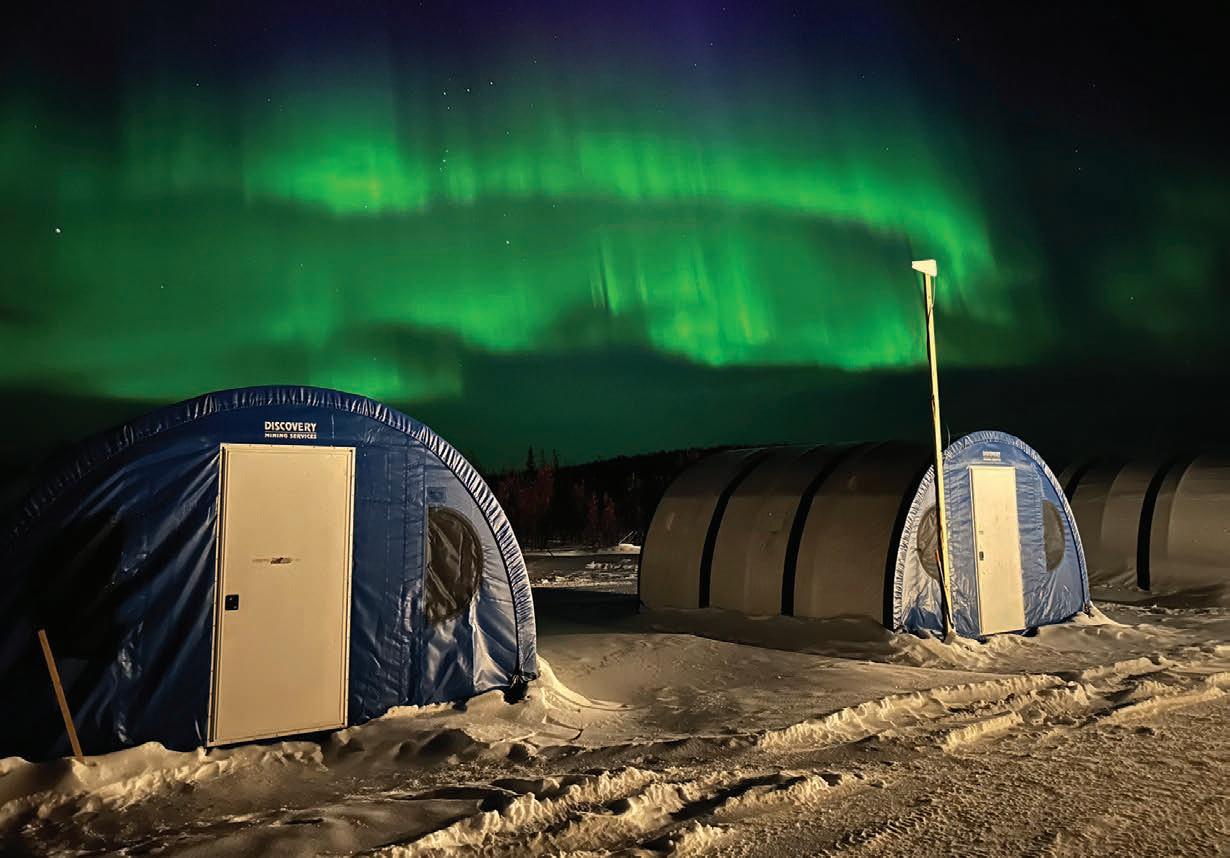
In addition to its central processing plant, Alta Mesa has significant resources and one of the largest uranium mineral properties in the U.S., encompassing about 810 sq. km. EnCore estimates less than 15-20% of Alta Mesa has been explored.
In mid-March the company reported the highest-grade drill results to date since drilling restarted at Alta Mesa. In terms of grade thickness, the results far exceeded the accepted cuto gures for ISR production in South Texas of around 0.3, ranging up to 8.4 (11 . of 0.76% U3O8 from

518 metres).
Elsewhere in the U.S., enCore is working towards production on two additional ISR assets: the Gas Hills project in Wyoming and the Dewey-Burdock project in South Dakota. e company also has uranium resource endowments in New Mexico.
Late last year the company announced it was selling Boss Energy, an Australian ISR uranium producer, a 30% stake in Alta Mesa for US$70 million. e funds will be used to accelerate development and production across its portfolio.
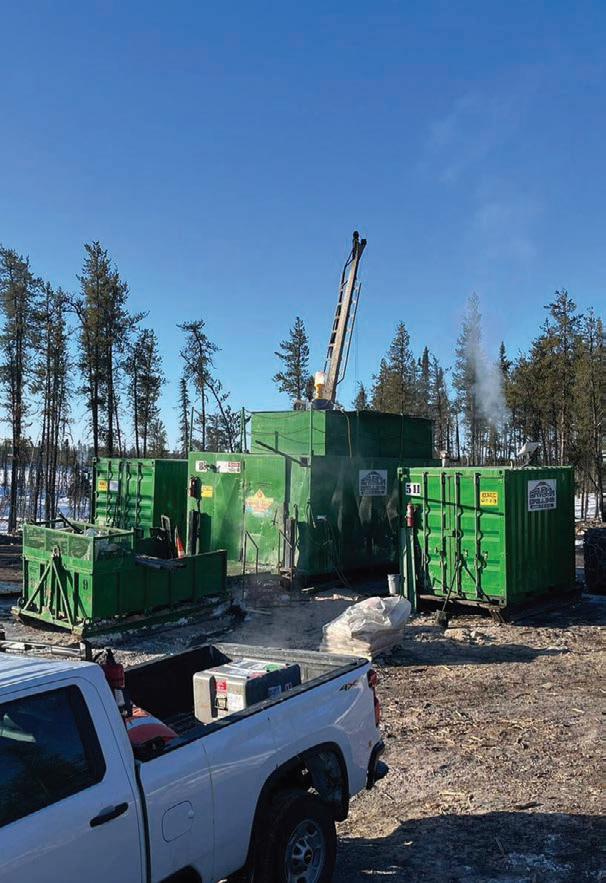
e company has a market cap of roughly $1.1 billion.
F3 Uranium Corp.’s (TSXV: FUU; US-OTC: FUUFF), formerly known as Fission 3.0, is focused on its 100%-owned Patterson Lake North (PLN) project near the southwestern edge of Canada’s Athabasca Basin. In the fall of 2022, F3 discovered the high-grade JR Zone on the PLN property with drill hole PLN22-035 assaying 59.2% U3O8 over 1 metre
within a 15-metre interval of 6.97% U3O8 starting from 258 metres downhole.
Since then, notable drill intercepts from the JR Zone have included 14.5 metres of 9.4% U3O8 starting from 239 metres, including 5 metres of 26.7% U3O8 in drill hole PLN23-060. Final assay results from the 2023 drill program released in February were highlighted by 2 metres of 42.4% U3O8 starting 226 metres downhole in PLN23110, including 1.5 metres of 55.4% U3O8 and 0.5 metre of 66.8% U3O8 e JR Zone is about 23 km
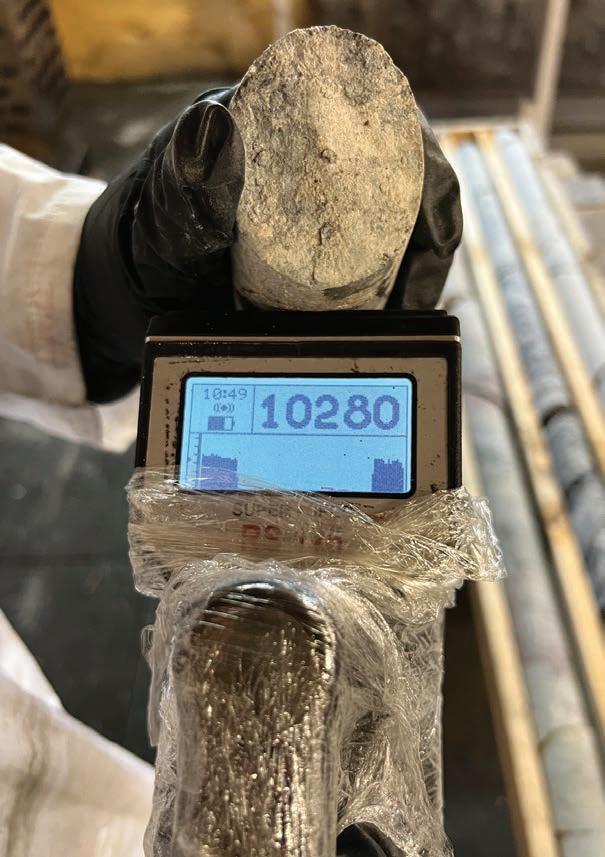
northwest of Fission Uranium’s (TSX: FCU; US-OTC: FCUUF) Triple R deposit.
In January, F3 Uranium announced it would spin out its 14 other uranium exploration projects in the Athabasca into a new company called F4 Uranium Corp. e company reasoned that PLN overshadowed the other projects (Murphy Lake, Cree Bay, Hearty Bay, Clearwater West, Wales Lake, Todd, Smart Lake, Lazy Edward Bay, Grey Island, Seahorse Lake, Bird Lake, Beaver River, Bell Lake and Flowerdew Lake) and that by spinning them out into F4, shareholders of F3 would not su er dilution for spending on non-PLN projects.
In February, F3 reported that it had signed a non-binding letter of intent with Canadian GoldCamps (CSE: CAMP) to option F4 Uranium’s Murphy Lake project, 30 km northwest of Orano’s McLean Lake deposits and 5 km south of IsoEnergy’s (TSXV: ISO; US-OTC: ISENF) Hurricane deposit. Under the letter, Canadian GoldCamps can earn up to a 70% stake in the project.
F3 Uranium has a market cap of approximately $199 million.
Laramide Resources (TSX: LAM; ASX: LAM; US-OTC: LMRXF) is focused on uranium exploration and development in Australia and the U.S. Its agship Westmoreland project in northwestern Queensland near the broder with the Northern Territory is one of the world’s largest uranium development assets held by a junior company. Currently, mineral resources have been de ned across three deposits or zones at Westmoreland — Redtree, Huarabagoo and Junnagunna. Indicated resources total 36 million lb. U3O8 contained in 18.7 million tonnes averaging 0.089% U3O8 and inferred resources add 15.9 million lb. U3O8 contained in 9 million tonnes averaging 0.083% U3O8. About 80% of the resource is within 50 metres of surface.
A preliminary economic assessment (PEA) in 2016 envisioned
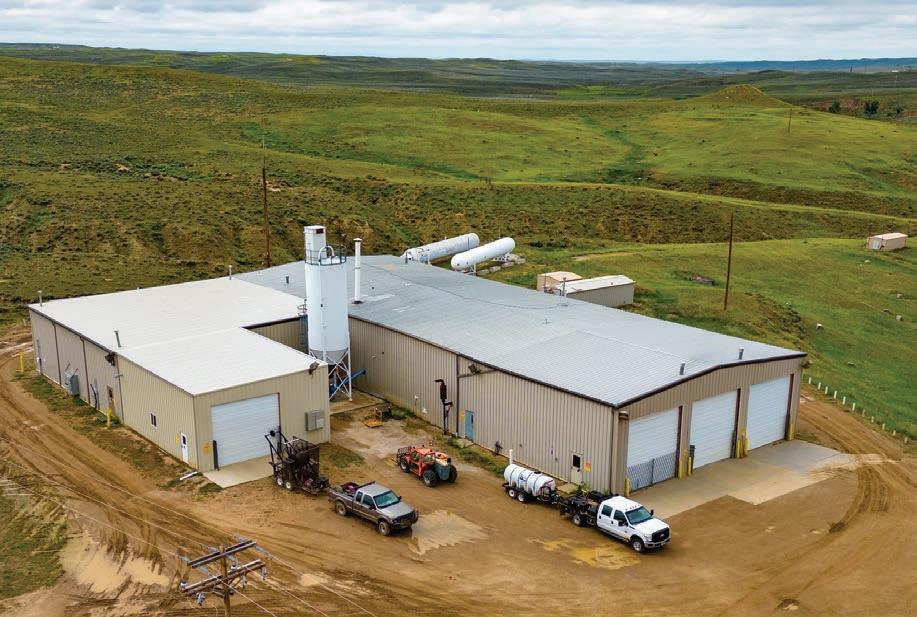
an open pit mining operation that would produce about 3.5 million lb. U3O8 annually over 13 years. Westmoreland is 350 km from the city of Mt. Isa and 260 km from the port city of Karumba.
Westmoreland’s three deposits or zones follow the Redtree dyke zone (about 10 km) on a northwest trend as discrete orebodies. e PEA labelled them as South, Central and North pits, but the company says mineralization in the 2.5km corridor between the deposits includes higher grades (greater than 0.1%) that are associated with the footwall contact of intrusive dolerite dykes and have seen little exploration drilling. e company wants to investigate whether the three known zones or deposits can be linked.
Laramide is also exploring its Murphy uranium project in the Northern Territory. Drillhole NEWM204 in the 2006-07 reconnaissance drill program at the Mageera prospect returned 4 metres grading 0.42% U3O8. e company believes that Mageera, formerly called NE Westmoreland, is likely to be a geological analogue of Westmoreland.
Laramide plans to drill up to 12,000 metres across multiple targets at Westmoreland and into the Murphy project this year, with about 1,500 metres earmarked for the Mageera prospect.
In the U.S., Laramide’s assets include the Crownpoint-Churchrock ISR project; the La Jara Mesa project in New Mexico and the La Sal underground project in Utah.
Laramide Resources has a market cap of about $177 million.
Purepoint Uranium Group (TSXV: PTU; US-OTC: PTUUF) has nine exploration projects — two joint ventures and seven 100%-owned projects — in the Athabasca Basin. Its agship project Hook Lake is jointly owned by Cameco (39.5%), Orano Canada (39.5%) and Purepoint (21%).
e project, on the southwestern edge of the basin in the Patterson uranium district, is adjacent to and
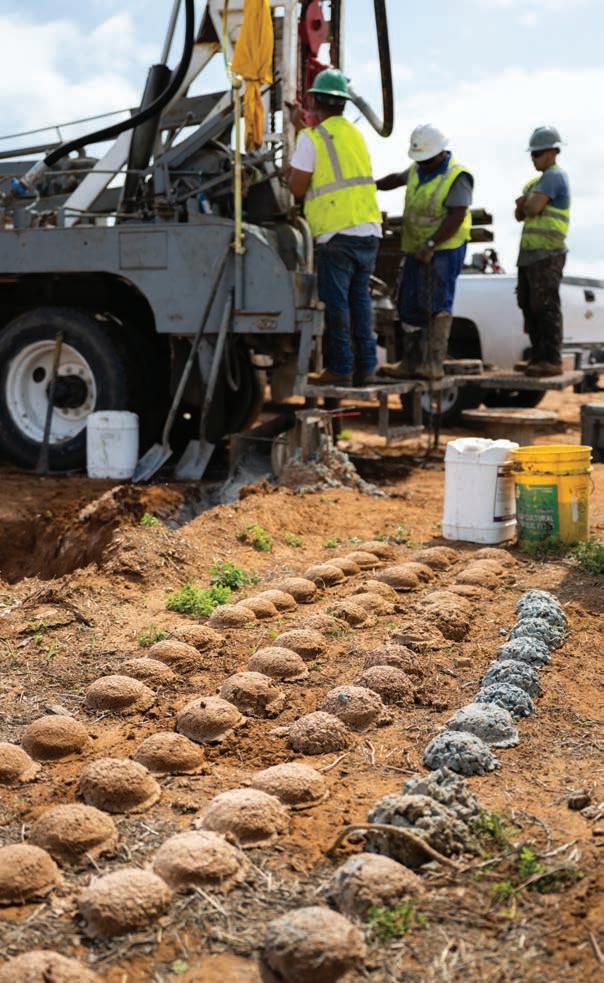
on trend with discoveries including Fission Uranium’s (TSX: FCU; US-OTC: FCUUF) Triple R deposit and NexGen Energy’s (TSX: NXE; NYSE: NXE; ASX: NXG) Arrow deposit.
e high-grade discovery of the Spit re target at Hook has yielded intercepts of 53.3% U3O8 over 1.3 metres and a 10-metre interval of 10.3% U3O8. Purepoint has operated the joint venture since 2007.
Purepoint is also the operator at its 27%-owned JV with Cameco at the Smart Lake project in the southwestern portion of the basin, about 60 km south of the former Clu Lake mine.
e company has a busy exploration program planned this year with eld programs at its two joint ventures and four of its wholly owned projects.
e company kicked o a 2,500metre drill program at Hook Lake in February to test the Carter Corri-
dor with ve holes. e Carter Corridor represents a reactivated fault zone that lies between the Clearwater Domain granitic intrusive rocks to the west and runs parallel to the Patterson structural corridor to the east. Purepoint notes that the 25-km strike length of the Carter structural/conductive corridor is “almost entirely located” within the Hook Lake JV.
It also plans to drill at its Red Willow and Turnor Lake projects and undertake geophysical programs at Smart Lake, Russell South and Tabbernor. Russell South, on the southeastern edge of the basin, is about 20 km northeast of Cameco’s Key Lake mine, and adjoins Rio Tinto’s (LSE: RIO; NYSE: RIO; ASX: RIO) Russell Lake property and Skyharbour Resources’ (TSXV: SYH; US-OTC: SYHBF) Moore Lake project.
Purepoint has a market cap of about $22.5 million.
Uranium Energy Corp. (NYSEAM: UEC) has ISR uranium projects in Texas and Wyoming, along with uranium assets in Canada and two ISR assets in Paraguay.
e Texas-based company, which acquired UraniumOne for $110 million in cash in April 2022, plans to restart its Wyoming huband-spoke ISR project in August.
e Christensen Ranch well elds will be the rst spoke to feed the project’s Irigaray central processing plant (CPP). e Wyoming operation currently has 11 satellite projects with 66.2 million measured and indicated lb. U3O8, in 58.5 million tons grading 0.069% U3O8 and another 15.1 million inferred lb. U3O8 in 10.9 million tons grading 0.064% U3O8
e Wyoming hub-and-spoke operation has a licensed capacity of 2.5 million lb. U3O8 per year, but the company plans to increase that to 4 million pounds.
Satellite ISR projects in Wyoming include Reno Creek, about 80 km from the Irigaray CPP, which is licensed for 2 million lb. per year; Moore Ranch, about 64 km from Irigaray, which is licensed for 3 million lb. U3O8 annually; and Ludeman, 193 km from Irigaray.
e company also has a huband-spoke production strategy in Texas, where its fully permitted Hobson CPP is licensed for a production capacity of 4 million lb. U3O8 per year. Hobson’s satellite projects include the Burke Hollow ISR well eld, about 97 km from the Hobson CPP, and the past-producing Palangana ISR mine, which is fully permitted.
In the Athabasca Basin, Uranium Energy has about 110 million measured and indicated lb. U3O8 and another 71 million inferred pounds across several projects. In January, it intersected 6.28% U3O8 over 2.9 metres from its 100%owned Roughrider project.
It has acquired a portfolio of other uranium projects (Henday; Milliken; and Carswell) from Rio Tinto. It also owns the Christie Lake project, the only exploration project not controlled by Cameco and Orano along the McArthur-RiverCigar Lake Corridor.
Uranium Energy is also the initial shareholder and has a major equity stake in Uranium Royalty Corp. (TSX: URC; NASDAQ: UROY), the rst and only pure play royalty company of the energy metal.
Uranium Energy Corp has a market cap of roughly US$2.7 billion. TNM











M&A | Adding neighbouring operation saves half a billion dollars in costs
BY COLIN MCCLELLANDAlamos Gold (TSX: AGI; NYSE: AGI) is acquiring Argonaut Gold (TSX: AR) and its past-troubled Magino mine in northern Ontario in an all-share deal valued at US$325 million to become Canada’s third-largest gold producer.
e transaction, scheduled to close in July, is expected to create US$515 million in cost-savings over about two decades of production from Alamos’s Island mine and the neighbouring Magino located northeast of Lake Superior, the companies said March 27. Alamos will use Magino’s larger mill and tailings facilities instead of Island’s. Total Alamos output is expected to increase by about a quarter to around 630,000 oz. gold per year.
“ e addition of Magino will make Alamos a stronger company and enhance our unique position as a growing intermediate producer, with declining costs, and one of the lowest political risk pro les in the sector,” Alamos president and CEO John McCluskey said during a webcast.
“With respect to our whole phase three expansion and some of the aspects of going into that, the fact that we were just about to practically rebuild a new mill. We just don’t have to do that now,” McCluskey said. It will also save about US$20 million it was going to spend on a li at its tailings facility.
e acquisition gives Alamos a fourth long-life producing asset in addition to its two mines in Ontario — Young-Davidson and Island — and Mulatos in Mexico. It also has the Lynn Lake development project
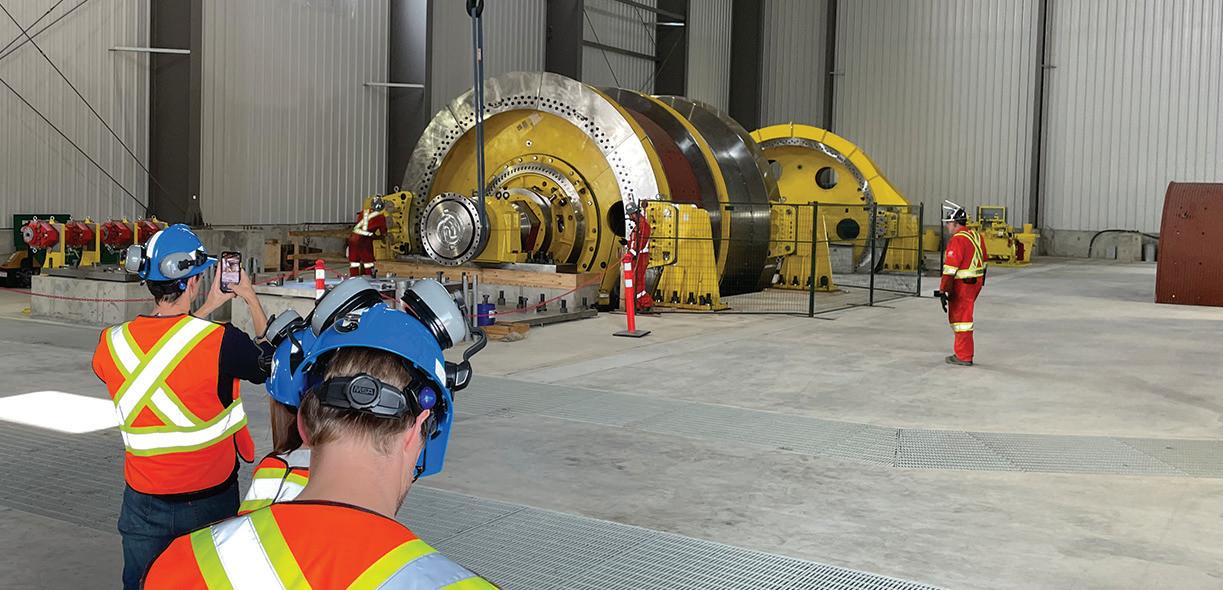
“That permanent tailings facility at 150 million tonnes, it’s hard to put a price on that. If you were settled on the path to permitting a facility like that today, that could take up to a decade.”
JOHN MCCLUSKEY, ALAMOS PRESIDENT AND CEO
in Manitoba, which received federal environmental approval last year, as well as others in Turkey and Oregon.
Analysts approve
Adding Magino “provides signicant integration of resources, furthers the company’s exposure to a top jurisdiction, with 88% of assets within Canada, and adds a long-life asset to its portfolio,” BMO Capital Markets said in a note a day later.
Haywood Securities said: “ is friendly deal signi cantly increases Alamos’s resources and reserves at the Island complex while minimizing dilution for existing shareholders.”
Argonaut shareholders will get a chance to vote on the transaction in June. e deal will require support of two-thirds of the votes cast.
Shares in Alamos rose more than 7% on the announcement to $19.79 apiece in Toronto. Near press time
they were at $20.80 each, valuing the company at $11.9 billion.
ey traded in a range of $14.80 to $22.00 over the previous 52 weeks.
Argonaut started commercial production at Magino in November. e Toronto-based company estimated the mine would cost $510 million to build in 2020 but in ation and other challenges increased the nal tally to $980 million. Founder, president and CEO Peter Dougherty le in late 2021.
A er it poured rst gold at Magino on June 15, production was delayed while the mill was repaired for 20 days in September, causing Argonaut to miss last year’s guidance. Argonaut sold another 1% output stream to Franco-Nevada (TSX: FNV; NYSE: FNV), which has a 3% net smelter return royalty, to shore up its nances.
In the Alamos deal, Argonaut’s
other assets such as the Florida Canyon mine in the United States, as well as the El Castillo Complex, the La Colorada operation, and the Cerro del Gallo project in Mexico, are to be placed in a separate company. e plan is to list the spinout on an exchange and Alamos would invest US$10 million for a 19.9% stake.
Alamos plans to issue 20.3 million shares valued at about US$276 million as part of the deal. e acquisition valued Argonaut at a 34% premium based on Argonaut’s and Alamos’s closing prices on March 26 on the TSX.
Each Argonaut common share outstanding will be exchanged for 0.0185 Alamos common shares and one share of the new spinout. It will give Alamos 95% of the combination and Argonaut 5%.
e deal implies an estimated total consideration of 40¢ per Argonaut common share or US$325 million, the companies said.
e company’s resource now stands at more than 5 million oz. and there are plans to hike production to 900,000 oz. a year by expanding and tweaking Magino’s mill with feed from Magino and Island, the CEO said.
“We had some pretty tough critics from our side go up and look at the mill and they really liked what they saw,” McCluskey said.
“ at permanent tailings facility at 150 million tonnes, it’s hard to put a price on that. If you were settled on the path to permitting a facility like that today, that could take up to a decade. With an ever growing mine and mineral reserve at Island Gold, that’s a big de-risking event for us.” TNM
| Gold Road drops talks for fund’s 40% stake
BY COLIN MCCLELLANDEquinox Gold (TSX: EQX; NYSE-AM: EQX) is buying partner Orion Mine Finance’s 40% stake in their new Greenstone gold mine in Ontario for US$995 million in cash and shares as it prepares to pour rst gold.
e purchase includes US$745 million in cash and 42 million shares valued at US$250 million. It was announced late on April 23 when Australia’s Gold Road Resources (ASX: GOR) said it was no longer considering buying a stake in Greenstone from Orion a er acknowledging mid-month it was in talks. Equinox said it would fund the purchase through a new US$500-million loan and a US$260-million bought-deal equity nancing.
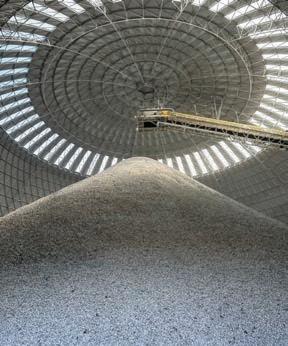
company at $2.4 billion. ey had traded in a 52-week range of $5.36 to $8.79.
e deal increases Equinox’s annual gold production by about 160,000 oz. while boosting earnings and cash ow, the company said. Greenstone will be its largest mine among eight in total, producing about 400,000 oz. of gold per year over the rst ve years. It’s expected to be one of the world’s lowest-cost open-pit gold mines with all-in sustaining costs (AISC) of US$890 per oz., Equinox said.
Seven others
9 it had started ore processing and was on track to produce rst gold at the $1.2-billion Greenstone project in northern Ontario this month.
Equinox bought Premier Gold for the project, located 275 km northeast of under Bay near the town of Geraldton, and developed it as a 60:40 partnership with New York-based Orion. It aims to produce 400,000 oz. of gold per year and more than 5 million oz. over a 14-year life.
to-net-asset-value ratio and growth potential.
“Equinox has moved from a non-producer in mid-2018 to a company with seven operating gold mines and a pipeline of growth projects today,” mining analyst Kerry Smith said in a note on April 9. “With higher-cost production, Equinox is highly leveraged to the gold price.”
Equinox produced 564,458 oz. of gold last year with US$1,612 per oz. in AISC, for US$304.4 million in earnings before interest, taxes, depreciation and amortization.
“When we acquired our 60% interest in Greenstone in 2021, our goal was to ultimately own the whole mine,” Equinox chairman Ross Beaty said in a release. “Consolidating 100% of Greenstone into Equinox Gold delivers our shareholders full exposure to a mine of outstanding scale and quality.”
Shares in Equinox fell 11% on April 24 to $7.23 apiece, valuing the
e company’s other mines are Aurizona, Fazenda, Santa Luz and RDM in Brazil, Castle Mountain and Mesquite in California and Los Filos in Mexico. Equinox expected total output this year of between 660,000 to 750,000 oz. of gold with US$1,630 to US$1,740 per oz. in AISC, it said in February.
e company reported on April
“Once operating at full capacity, Greenstone will be our largest and lowest cost-mine,” president and CEO Greg Smith said in a release on April 9. “We look forward to rst gold in May and continuing to advance the project to commercial production.”
Growth since 2018
Before the buyout, Vancouver-based investment bank Haywood Securities recommended Equinox shares for their low price-
Equinox has stockpiled more than 1.5 million tonnes of ore at Greenstone and pre-crushed 70,000 tonnes of low-grade ore for early commissioning feed, it said. Progressively higher-grade ore is to be fed into the mill as production ramps up towards a planned throughput of 27,000 tonnes per day. Commercial production is targeted for this year’s third quarter.
INDIGENOUS ISSUES | Environmental process near end for one of three all-season routes
BY COLIN MCCLELLANDConstruction timelines remain fuzzy but proponents are still optimistic two and half years into studying roads to serve the Ring of Fire critical minerals region in northern Ontario.
ree all-season roads totalling 362 km are planned for the area 540 km northeast of under Bay.
e main highway would start at the end of a forestry road north of Aroland First Nation and the village of Nakina and head to the Ring of Fire. One branch would run to the Marten Falls First Nation to the east while another would connect to the Webequie First Nation to the west.
e most advanced of the three roads, the Webequie branch, is in the end stages of its environmental assessment, but it still needs community (and government) review, Webequie First Nation Chief Cornelius Wabasse said on April 2 in Toronto.
“It’s not a long ways,” Wabasse said in an interview with e Northern Miner at the Indigenous Led Projects Forum. “I’m hoping that once we engage with our community about the environmental assessment ndings and all that, then we move to the next phase which is hoping to start working on the road itself.”
e roads are vital to unlocking billions of dollars — estimates vary widely — in critical minerals for supplying electric vehicle battery plants. e big three automakers — General Motors, Ford Motor and Stellantis — run factories in Ontario’s south. e province has pledged $1 billion to upgrade Ring of Fire infrastructure.
But the proposed roads themselves may likely cost more than $2 billion while environmentalists say their construction and any mining would uncork from the area’s
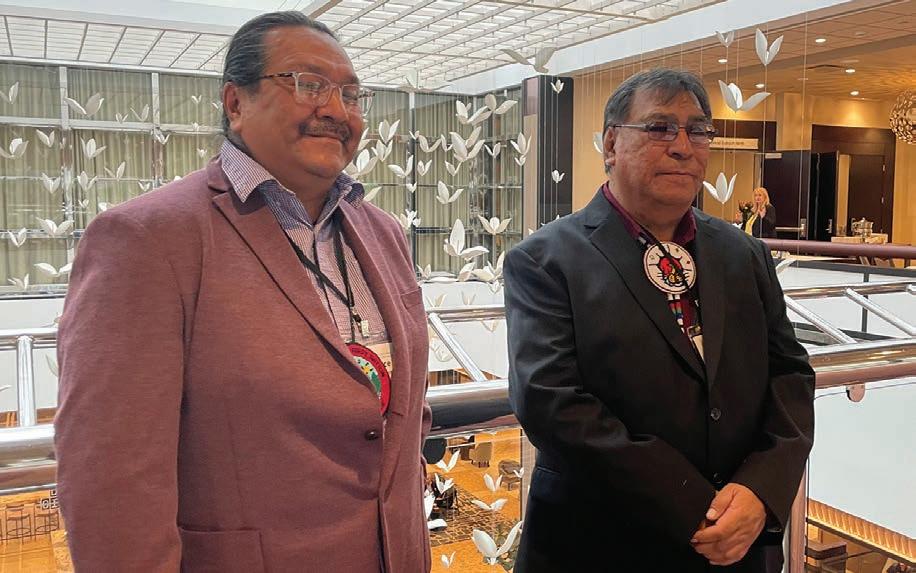
“I really believe that everybody wants to see this happen and what everybody sees is we need the roads. The winter roads don’t exist anymore.”
GEORGE PIRIE, ONTARIO MINES MINISTER
relentless bogland the very global warming gases the projects are supposed to mitigate.
Even by the most optimistic estimates, construction won’t likely be completed for a decade partly
Iamgold (TSX: IMG; NYSE: IAG) poured the rst doré bar at its Côté mine in northern Ontario, in late March. Canada’s newest gold mine and expected to be one of its largest, Côté is expected to start commercial production in the third quarter.
e mine, located 125 km southwest of Timmins, is a 60:40 joint venture between Iamgold, and Sumitomo Metals Mining of Japan. Côté joins Iamgold’s Essakane in Burkina Faso and Westwood in Quebec as the company’s third gold producer.
BMO Capital Markets said rst gold was on schedule, though at the very end of a targeted window in the year’s rst quarter.
“ is milestone is an accomplishment worth celebrating,” mining analyst Jackie Przybylowski said in a note on March 31.
“However, commissioning activities will continue through 2024. We maintain our expectation that full run rate will be achieved in the fourth quarter of this year.”
Performing as planned
Iamgold is targeting end-of-year throughput at 90% and production of 220,000 oz. to 290,000 oz. on a 100% basis if commissioning goes as planned. e crushing, high-pressure grinding rolls and processing circuits are performing as expected, including power consumption.
Renaud Adams, president and CEO of Iamgold, noted that the company had achieved rst gold less than 90 days since the start of pre-commissioning activities at the mine.
“ is achievement represents the culmination of over 15 million hours of work over four years of construction — an incredible e ort for the team on the ground
as the project cost to rst gold remains in line with the updated budget estimate while maintaining a near impeccable safety record,” Adams said in a late March press release.
“ is is just the beginning for Côté. We believe the project is the start of what will ultimately turn into a new mining district that will be a mining hub for decades to come.”
Côté has an 18-year mine life with production averaging 365,000 oz. per year. During the rst six years of operation gold output will be 495,000 oz. annually. It hosts proven and probable reserves of 234.6 million tonnes grading 1.01 grams gold per tonne and containing 7.6 million oz. of gold.
It’s also the rst gold mining project in North America designed and built for a fully automated haulage eet.
Iamgold has a market cap of $2.6 billion. TNM
Ring of Fire, there’s only one advanced project, the Eagle’s Nest held by Wyloo Metals. e company is owned by Fortescue Metals Group (ASX: FMG) chairman Andrew Forrest, Australia’s second-richest person.
e project was estimated to cost $609 million to build, but that was in a 2012 feasibility study. Wyloo says it’s spending $25 million on more studies to update the project. It hosts proven and probable reserves of 11.1 million tonnes grading 1.68% nickel, 0.87% copper, 0.87 gram platinum per tonne, 3.09 grams palladium and 0.18 gram gold, according to the earlier work.
“We’ve got one mine (project) right now, but exceptional drilling across the other parts of the Ring of Fire,” Ontario Mines Minister George Pirie told e Northern Miner at the forum. “Regardless of the timing, it’s not a competition because we will need everything that’s being developed.”
Even so, several First Nations in northern Ontario including the Neskantaga, Grassy Narrows, Wapekeka and Big Trout Lake, are against the project. Some leaders were expelled from Queen’s Park a year ago for protesting during a legislature session. However, the Ontario Superior Court in October dismissed a Neskantaga challenge against the province that alleged failure to consult during the road studies.
“I don’t think there’s any real opposition,” Webequie First Nation Chief Wabasse said. “It’s just clarifying some of the things that they want clari ed in terms of environment and also habitat and how we’re going to address these issues without destroying the land. ere has to be some things in place in order to satisfy some of the First Nations or even us as well.”
because of the studies, engineering and design, and funding arrangements needed.
Michael Fox, CEO of Indigenous and Community Engagement, an Indigenous consultant which is working with Toronto-based management consultant Suslop in assisting the environmental assessment process for the roads, said there are too many variables to say how long it would take.
ere are discussions with government ministries such as transportation and the environment on the amount of drilling to prepare for bridge designs, for example, or how many years to study water and caribou, Fox said. e weather and even the hunting season can delay some aspects such as species counting, he added.
“You hope when you do the plan, and at the end the report comes out, that it’s not de cient,” Fox said. “You do it right to the T because everybody wants a slam dunk in the rst round — because to go back will really increase the cost.” at said, the process is combining federal and provincial environmental assessments, somewhat mirroring what Natural Resources Minister Jonathan Wilkinson has called for in mining projects: to shorten approvals times by a third and knock o four or ve years.
Eagle’s Nest
While 15 companies and people own claims across the 5,000-sq.-km
Ice roads
Minister Pirie expressed similar optimism.
“All the nations agree with development. Individually, they’ll tell you that,” he said. “I really believe that everybody wants to see this happen and what everybody sees is we need the roads. e winter roads don’t exist anymore.”
Indeed, climate change itself is catching up to the road project. Usually, Ring of Fire ice roads are open for three months a year to serve the northern communities with truckloads of goods instead of the more expensive option of ying in cargo. is year it was just four weeks, Marten Falls First Nation Chief Bruce Achneepineskum said.
“It’s very dangerous conditions trying to transport thousands of tonnes of heavy grade equipment, materials and large trucks over frozen roads and muskeg that many times may be only 16 to 20 inches (thick),” he said. “It’s just crazy to think about that.”
e melting ice roads are the subject of a new documentary, Bridges to the North, by Indigenous lmmaker Tony McGuire. Marten Falls residents told him a er the lm was completed they only got half or less of their usual supplies in this year’s ice road season.
“ e lm itself had a prediction. I said it could be 10 to 15 years when there are no winter roads,” McGuire said in an interview. “I didn’t know that would come true so quickly.” TNM
Canada’s most populous province hosts numerous historic mines and has potential for many more new developments. Here are eight companies exploring for precious metals and critical minerals such as lithium, cobalt and nickel.
n Angus Gold
Toronto-based Angus Gold (TSXV: GUS; US-OTC: ANGVF) recently launched its rst exploration drill program on the Eagle River Splay at its agship Golden Sky project 50 km west of Wawa in northern Ontario. In January, it reported hole GS-23-100 cut 48.7 grams gold per tonne over 1.5 metres.
e 261-sq.-km project is located in the Mishibishu Lake Greenstone Belt between Wesdome Gold Mines’ (TSX: WDO) Eagle River and Mishi open pit operations. e high-grade intercept was within a broader, lower-grade alteration zone of 5.5 metres.
at hole was one of ve drilled in a late 2023 drill program targeting the Eagle River Splay, an o shoot of the Eagle River Deformation zone that hosts the Wesdome mine.
Angus planned a 5,500-metre follow-up winter drilling program to test additional targets on the Eagle River Splay and high-grade mineralization on the company’s Dorset Gold zone early this year.
“ is is the rst drill program on a new exploration target outside of our Dorset and BIF gold zones and to intersect a high-grade gold result on our rst try is incredibly encouraging,” Angus Gold CEO Breanne Beh said.
To date, drilling at Golden Sky has focused on the Dorset gold zone, which hosts an indicated resource of 780,000 tonnes grading 1.4 grams gold for 40,000 oz. and an inferred resource of 4.7 million
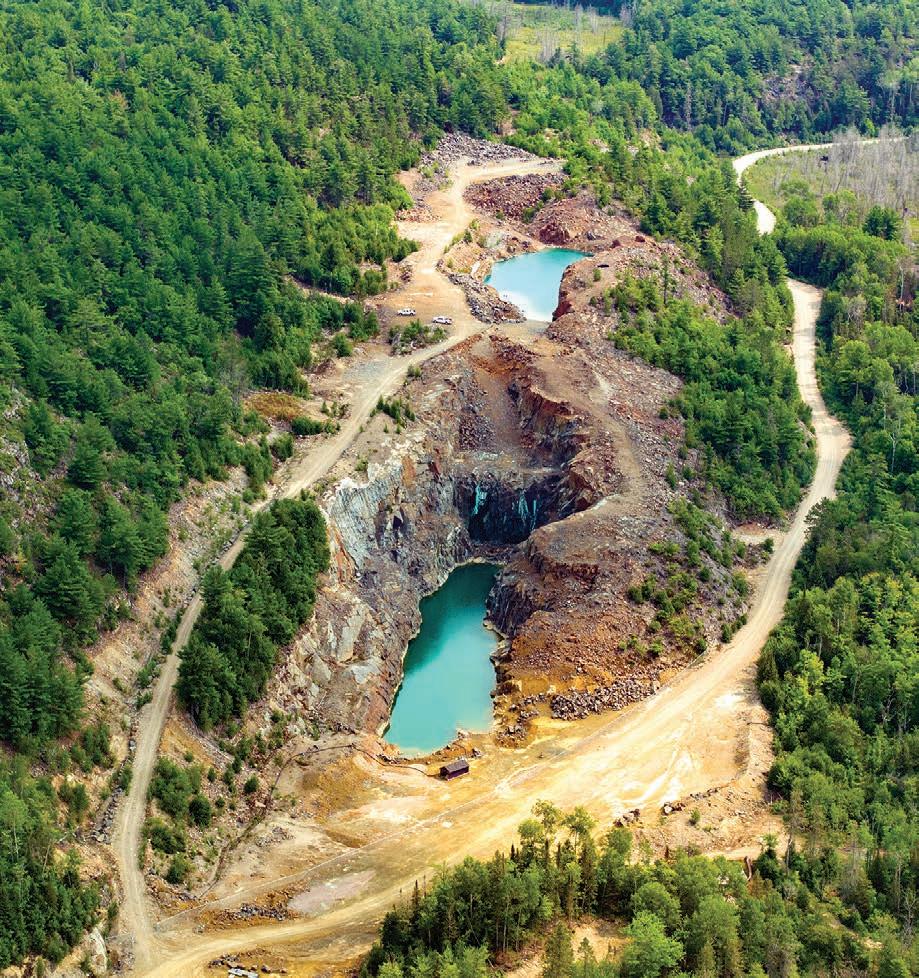
tonnes grading 1.2 grams gold for 180,000 ounces.
Angus’s portfolio also includes Slate Bay, a project prospective for copper-gold-silver mineralization located 10 km north of Red Lake, Ont.
e company also welcomed a $4.6-million investment from Wesdome in February. Wesdome acquired all 5.8 million units issued under the non-brokered owthrough private placement o ering, giving it a 10.6% ownership interest in the company. Wesdome’s interest could increase to 15% if it takes advantage of the right to purchase additional shares of the com-
pany at a strike price of 80¢ per warrant within 24 months.
An investors’ rights agreement gives Wesdome the right to participate in future equity nancings to maintain its interest in Angus.
Angus Gold has a market capitalization of $34.6 million.
Electra Battery Materials (TSXV: ELBM; NASDAQ: ELBM) is focused on advancing its cobalt sulphate re nery in Ontario to supply the developing local electric vehicle supply chain. e com-
pany signed a binding letter of intent with Luxembourg-based Eurasian Resources Group (ERG) for a three-year supply of 3,000 tonnes of cobalt hydroxide annually for the re nery. e supply agreement will provide Electra with su cient material to meet the annual cacpacity of the plant, in Temiskaming Shores, 510 km north of Toronto.
e cobalt hydroxide, from ERG’s Metalkol operation in the Democratic Republic of Congo, “is an intermediate product from mining operations and is the preferred feedstock for re ning a battery-grade cobalt sulphate product,” the company stated in an
April 2 press release.
Cobalt sulphate sourced from Electra will satisfy the requirement of the U.S. In ation Reduction Act for consumer subsidies of electric vehicles and support a North American EV battery supply chain.
In addition to the production of cobalt and nickel sulphate, Electra’s battery materials park will process black mass material for the recovery and recycling of lithium, nickel, cobalt, manganese, graphite and copper from shredded lithium-ion batteries.
e company operated a black mass recycling trial operation throughout last year and is planning an integrated recycling facility and re nery. In November, it said it requires another US$60 million in funding to complete the re nery. It received a US$5-million grant from the federal government in February toward the plant.
e company has an agreement to supply LG Energy Solution, a leading global manufacturer of lithium-ion batteries, with 19,000 tonnes of cobalt contained in sulphate beginning in 2025, representing 80% of Electra’s expected annual production. Last November, it also signed a memorandum of understanding with Rock Tech Lithium (TSX-V: RCK) for the supply of recycled lithium.
e company’s share price on the NASDAQ exchange on April 1 was US$64¢, down from a high of US$4.55 in April 2022. In March, it received a second 180-day extention to regain compliance with the exchange’s minimum bid requirements (US$1 per share).
Electra Battery Materials has a market capitalization of $35.7 million.
n EV Nickel
Toronto -based EV Nickel (TSXV: EVNI) is focused on the Shaw Dome nickel project about 30 km southeast of Timmins.
Shaw Dome is a 3,000-sq.-km property that includes the W4 deposit and the CarLang target.
W4 hosts 1.4 million measured and indicated tonnes grading 0.98% nickel for 31.2 million lb. of nickel, and 559,214 inferred tonnes at 0.98% nickel for 12 million pounds.
Snapshot P40

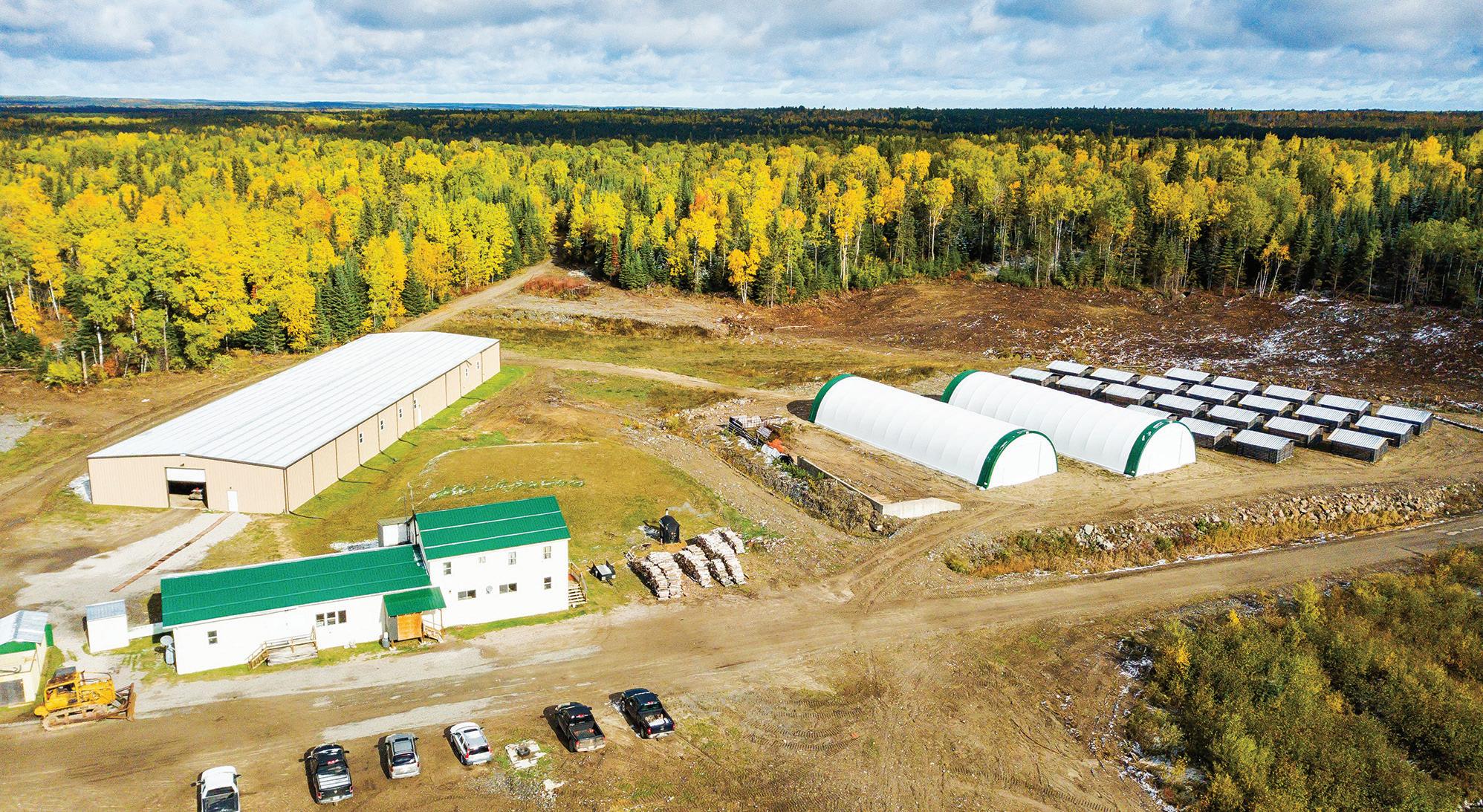
CarLang, which contains the A zone and is located just to the north of W4, hosts 510 million indicated tonnes grading 0.25% nickel for 1.2 million tonnes of nickel. Inferred resources add 497 inferred tonnes at 0.23% nickel for 1.1 million tonnes of contained metal.
In October, EV Nickel gave an update on its work with Arca Climate Technologies. e company reported improved results from ongoing research and experimentation on a carbon mineralization and storage solution, which has the potential to capture up to 40 kg of carbon dioxide per tonne of tailings.
“Brucite is the key mineral for carbon mineralization to occur with the ultrama c rocks,” it explained. “In a future potential mining operation, CO2 could be absorbed by the tailings and converted into solid carbonate material, permanently and safely trapping and storing CO2.”
Arca, a Vancouver-based company, specializes in the technology for using ultrama c mine tailings to help decarbonize mining operations.
EV Nickel raised $5.1 million in a private placement that closed in March. e placement was upsized from $3.5 million to accommodate the pro-rata participation by three strategic investors pursuant to a shareholder rights agreement negotiated in September 2023. ey include John Paterson, Hegemon LLC and one unnamed “industry partner.”
In a March 4 release about the o ering, the company announced the resignation of president and CEO Sean Sampson e ective on March 7, and the appointment of John Paterson as interim CEO.
EV Nickel has a market capitalization of $65.8 million.
Perth, Australia-based Green Technology Metals, (ASX: GTI) is advancing a set of lithium projects in northwestern Ontario.
Green Technology’s Seymour project is in its Eastern Hub of properties that include the Falcon and Junior Lake targets. Located
north of Lake Nipigon and 230 km from under Bay, Seymour hosts 5.2 million indicated tonnes grading 1.29% Li2O and 4.7 million inferred tonnes at 0.76% Li2O.
Drilling to date at its Eastern Hub projects totals 74,667 metres. It’s completed 42,000 metres at its Root project, located in its Western Hub projects area. Concentrators are planned for both locations with a lithium conversion facility planned to be in operation in under Bay by 2028.
In a release on March 26, GT1 detailed an assay result of 1.16% lithium oxide (Li2O) over 11.6 metres at Root, which is located near the First Nations community of Slate Falls and about 300 km northwest of under Bay.
It was the nal assay result from a 33-hole, 7,290-metre drill program completed in October focused on the eastern and western extensions of Root. e company has not yet compiled a resource, but the results of the drill program increase the company’s conceptual exploration target to 25 to 35 million tonnes of 1% to 1.5% Li2O, the company said.
Green Technology is planning another 10,000 metres of diamond drilling to test the Root Bay East target.
e company is targeting rst production at Seymour in 20252026, followed by Root in 20282029.
Green Technology Metals has a market capitalization of A$41.8 million.
Magna Mining (TSXV: NICU; USOTC: MGMNF) is focused on its Crean Hill and Shakespeare nickel, copper and PGM projects in the Sudbury Basin.
Crean Hill is a past-producing mine that operated from 1900 to 2002 under Inco. Magna Mining acquired the project in August 2022 from Lonmin Canada for $16 million.
On March 27, Magna signed a toll-milling agreement with Vale (NYSE: VALE) for production of 400,000 tonnes of ore from an advanced exploration project at
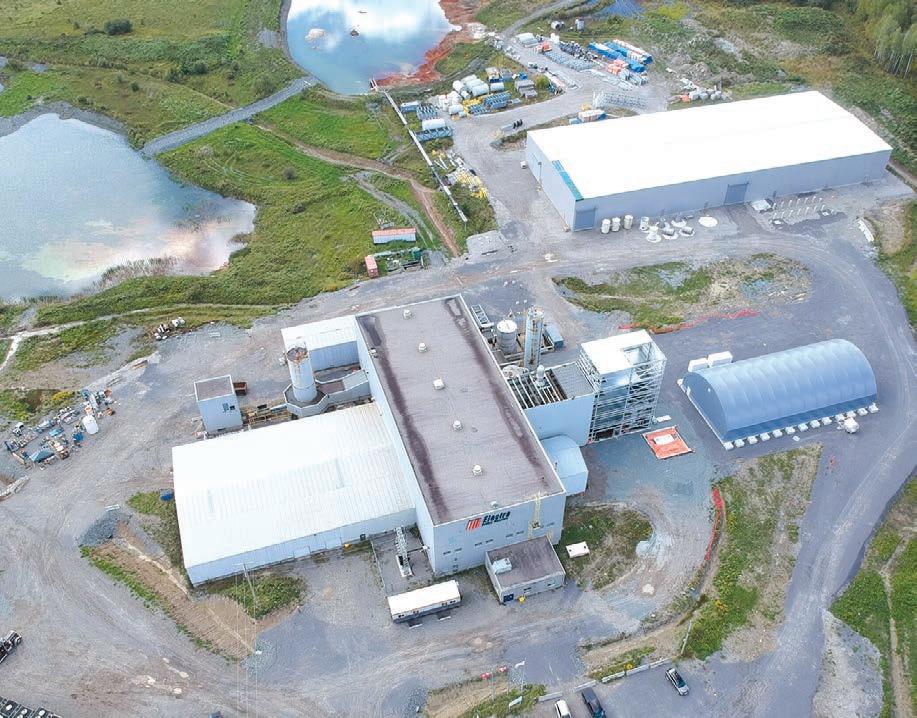
Crean Hill. e company received permits in April to dewater the mine, which will allow it to develop a ramp from surface for advanced exploration and test mining in the 101 Footwall, the 109 Footwall and Intermediate zones.
e company plans to update the resource in the second quarter, incorporating assay results from 19,000 metres of drilling since August 2022. Magna is fully funded to complete a 25,000-metre drill program this year.
In April, Magna released assays from drilling at Crean Hill, including 26.3 metres of 0.7% nickel, 2.4% copper and 9.7 grams of precious metals per tonne. e interval included a shorter section of 4.4 metres grading 3.2% nickel, 11.3% copper and 10.6 grams of precious metals.
Crean Hill produced 20.4 million tonnes of ore grading 1.31%
nickel, 1.12% copper and 1.65 grams of precious metals per tonne. It has an August 2022 indicated underground resource of 14.5 million tonnes grading 0.96% nickel, 0.84% copper and 2.07% nickel equivalent, which includes cobalt, platinum, palladium and gold. Open pit indicated resources come to 16.8 million tonnes grading 0.53% nickel, 0.49% copper and 1.08% nickel equivalent. e combined indicated resource totals 500 million lb. of nickel, 450 million lb. of copper and 1.7 million oz. of platinum, palladium and gold in situ.
Magna also owns the past-producing Shakespeare project, 70 km southwest of Sudbury, and the Shining Tree project, 100 km north of Sudbury, acquired in 2017 from Ursa Major Minerals.
Magna Mining has a market capitalization of $102.9 million.
n Onyx Gold
Vancouver-based Onyx Gold (TSXV: ONYX) announced the start of a spring drill program at its Munro-Croesus project, the most advanced of its three Timmins area projects, in March.
e company will drill 20 to 25 holes for a total of 3,000 metres to expand the high-grade GM Vein zone discovered in a fall 2023 drill program. Drilling will also include step-out drill holes on the bulk-tonnage style Argus zone discovered in 2022.
Munro-Croesus is located about 75 km east of Timmins, near the Porcupine-Destor deformation fault zone and the Pipestone fault. e property hosts the historic Croesus mine, famous for its bonanza-grade gold production and ve specimens at Toronto’s Royal



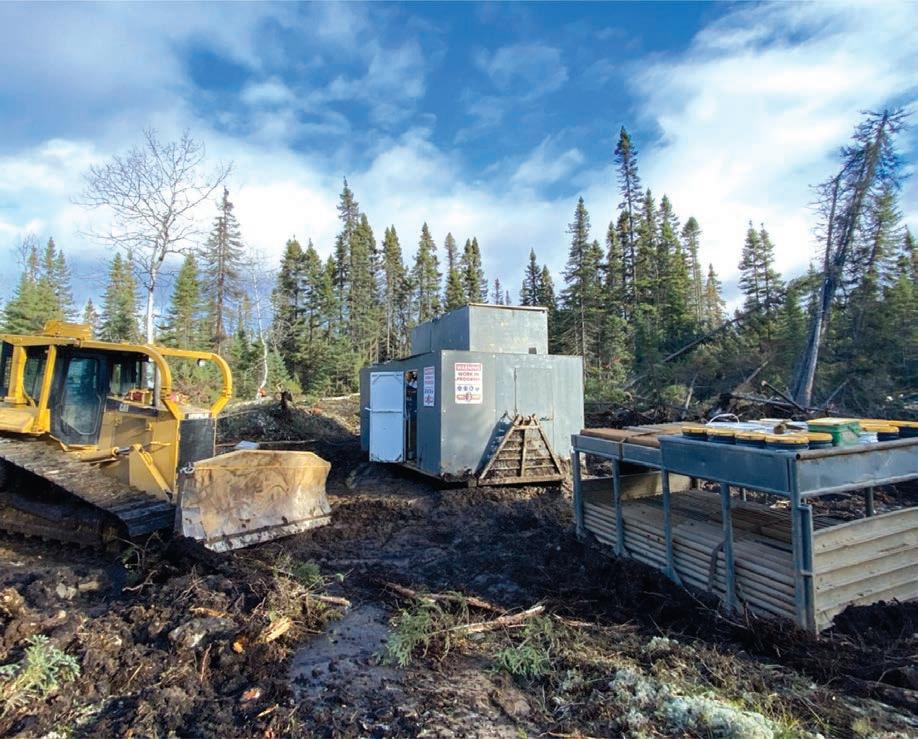
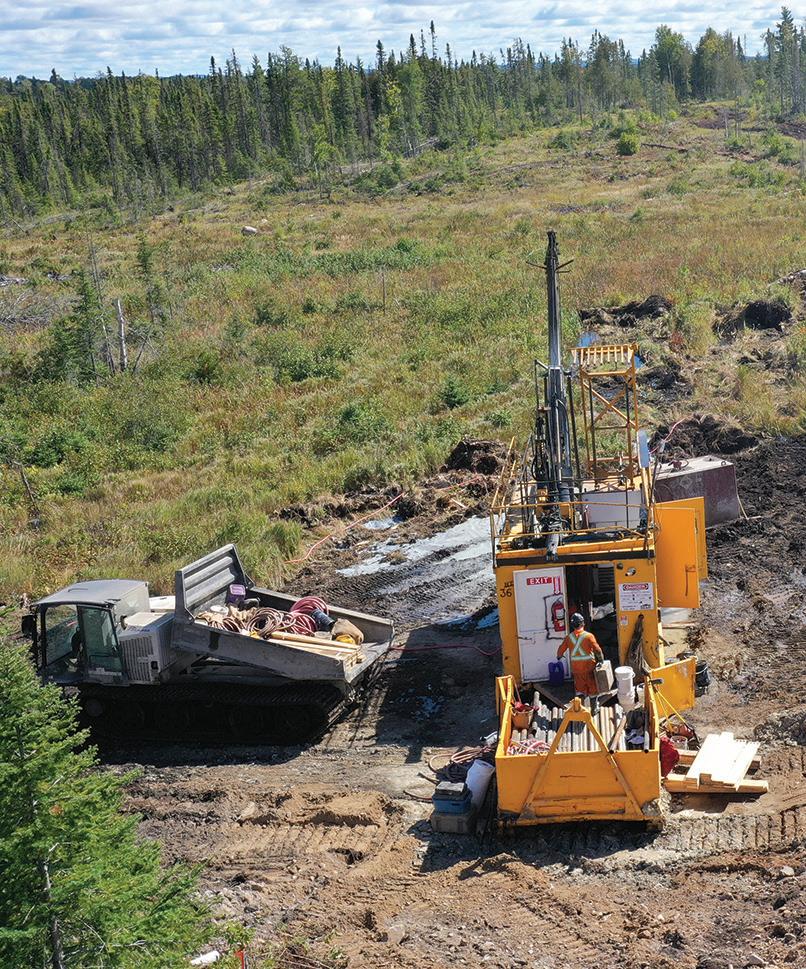
Ontario Museum that collectively weigh 85 lb. and contain 480.7 oz. of gold. Also located in the area are Mayfair Gold’s (TSXV: MFG; USOTC: MFGCF) multi-million oz. Fenn-Gibb deposit, STLLR Gold’s (TSX: STLR) Tower project and McEwen Mining’s (TSX: MUX; NYSE: MUX) Black Fox underground mine.
In January, Onyx expanded the size of Munro-Croesus by 42% to 92 sq. km by acquiring the adjacent Lalonde property from a private vendor in return for 400,000 shares and payment of $20,000.
Onyx also has 100% ownership of the 74-sq.-km Golden Mile project 9 km northeast of Newmont’s (TSX: NGT; NYSE: NEM; ASX: NEM) Holt Pond mine, for which it is seeking a joint venture partner, and the Timmins South project bordering Newmont’s former producing Dome mine.
In the Yukon’s Selwyn Basin, its portfolio includes four properties totalling 1,023 claims and 210 sq. km, the most advanced of which is the King Tut property.
HighGold Mining (TSXV: HIGH; US-OTC: HGMIF), spun out Onyx in May 2023 and maintains a 20% share of the company.
Onyx has $4.2 million in cash and marketable securities a er closing a $1.5-million private placement on March 21.
Onyx has a market capitalization of $15.1 million.
n Pan American Energy
Calgary-based Pan American Energy (CSE: PNRG; US-OTC: PAANF) is advancing lithium projects in northern Ontario and Nevada.
e company released assay results on March 21 from 15 drill holes at its Big Mack lithium project, 80 km north of Dryden. Highlights included 16.6 metres of 1.29% Li2O, including 0.57 metre of 3.61% Li2O in hole BM24-039, and 3 metres of 2.28% Li2O within a 22.3-metre interval of 0.68% Li2O in hole BM24-045.
e targets were identi ed using 2023 geochemical surface sampling and magnetic surveying designed to test prospective areas along strike and down dip of previously identi ed mineralization.
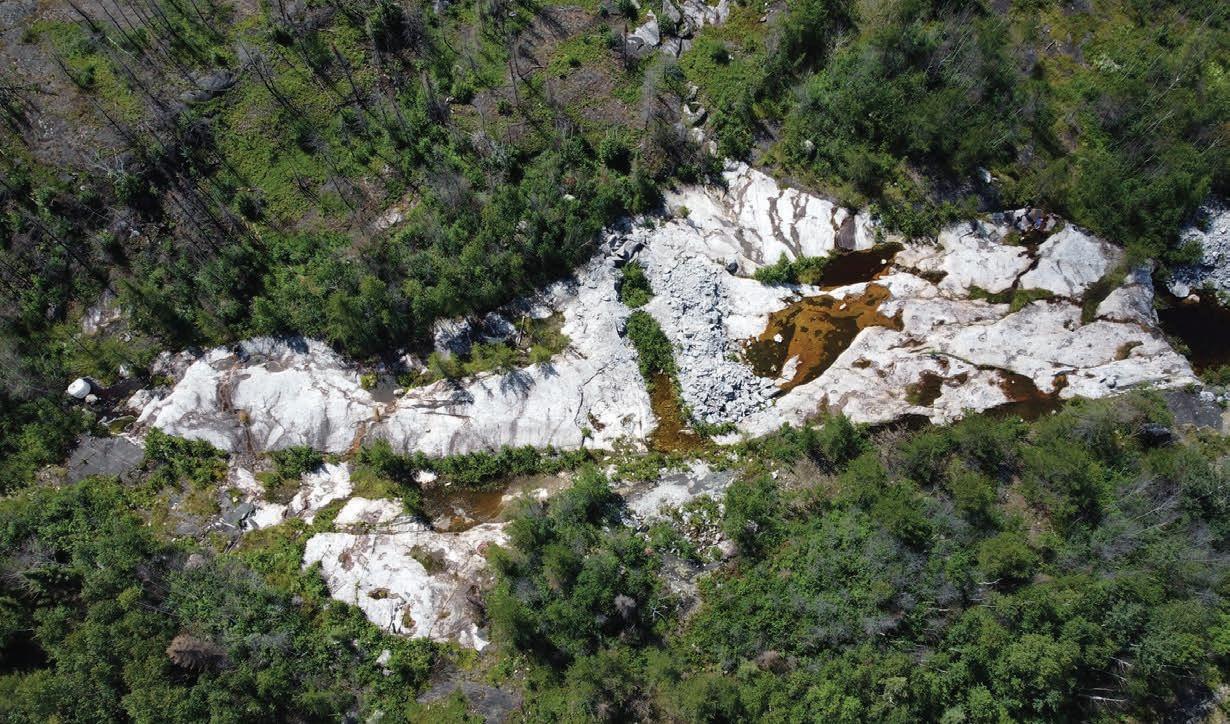
Drilling at Big Mack extended over two phases totalling 8,322 metres, with the second phase consisting of 25 drill holes completed on March 12. A resource estimate for the Big Mack project is scheduled for the second quarter.
In Nevada, Pan American describes its 70-sq.-km Horizon lithium project as one of the largest identi ed lithium deposits in the United States. Using the results from a 21-hole drill program in 2023 totalling 4,371 metres, the company declared a resource of 372.8 million indicated tonnes grading 669 parts per million (ppm) lithium for 1.3 million tonnes of lithium carbonate equivalent (LCE) at Horizon, located 7.5 km from Tonopah. e resource also included 2.5 billion inferred tonnes grading 680 ppm lithium for 8.9 million tonnes LCE.
e company is proceeding with metallurgical testing by the Saskatchewan Research Council and the University of Nevada at Reno of lithium bearing core samples from its Big Mack and Horizon projects, respectively.
On March 2, Pan American closed the rst tranche of a non-brokered private placement for gross proceeds of $889,000.
Pan American has option agreements with privately traded Magabra Resources for the right to acquire up to a 90% interest in the Big Mack project, and with Horizon Lithium to acquire a 100% interest in its Nevada project.
Pan American Lithium has a market capitalization of US$11.8 million.
Treasury Metals (TSX: TML; USOTC: TSRMF) is advancing its Goliath Gold complex that includes the Goliath, Goldlund and Miller projects located within the Wabigoon Greenstone Belt in the Dryden-Sioux Lookout area of northwestern Ontario.
A prefeasibility study released in early 2023 forecast the project could produce an average of 90,000 oz. per year over a 12-year mine life. With an initial capex of $335 million, the study estimated the
project’s a er-tax net present value at $336 million at a 5% discount rate and its internal rate of return at 25.4%. e study used a gold price of US$1,750 per ounce.
Treasury Metals announced a series of drill results from a two-phase drill program on its Far East target at Goliath, 20 km east of Dryden, on Feb. 29. e results included an intersection of 42.9 metres grading 0.54 gram gold per tonne and 14.66 grams silver, including 2 metres grading 2.6 grams gold and 3.4 grams silver.
e initial phase of the drill program consisted of 20 holes totalling 5,427 metres and a second phase of 14 holes totalling 3,078 metres. e program was undertaken to conrm the continuity of mineralization across the 600-metre Far East target, which is located 8 km from the proposed processing plant for the Goliath Gold Complex, which covers 330 sq. km.
e drill results successfully intersected the targeted lithology and mineralization adjacent to and between past drilling, extending the mineralized trend to about
1 km in length.
e results present the opportunity for material that can potentially extend and expand the mine life of the Goliath Gold complex, further enhancing the value from the 2023 prefeasibility study, Goliath Gold president and CEO Jeremy Wyeth said.
e prefeasibility study was based on an April 2022 resource estimate that outlined 6.2 million measured tonnes grading 1.2 grams gold for 239,500 oz. and 4.7 grams silver for 940,600 oz., and 58.5 million indicated tonnes grading 0.86 grams gold for 1.5 million oz. and 2.53 grams silver for 1.9 million ounces. e project hosts an additional 32.3 million inferred tonnes grading 0.73 grams gold and 0.8 gram silver.
e Toronto-based company received federal environmental assessment approval for the Goliath project in 2019 for an open-pit and underground gold mine and is focused on permitting and community consultations this year.
Treasury Metals has a market capitalization of $37.4 million. TNM











2.0
TNM Marco Polo’s integrated chatbot lets you quickly and easily search more than 2,600 global mining companies and 13,900+ properties by just asking a question.


Search more than 13,900 global mining properties for the right contact and connect with them directly through a single click.








Learn more at marcopolo.tnm.global


SCAN ME