Mexico’s ‘shock’ new mining law hurts juniors most
BY HENRY LAZENBY
Canadian juniors in Mexico were blindsided by a new mining regime on Apr. 29, after the Mexican Senate rushed through a contentious bill that experts say will deter investment.
Under the new mining law, companies will have to deal with an increased burden of pre-consultation, impact studies and water concessions, among other regulations. The new law also requires financial commitments (bonding) that will be difficult to meet for junior explorers. It also allows authorities to cancel exploration concessions after two years if no work is completed on them.
The “aggressive” move by the government is “extremely damaging” to Mexico’s mining industry, says mining entrepreneur Ross Beaty, who’s made a career of investing in high-risk jurisdictions across Latin America, including Mexico. “It’s a very significant negative to Mexico’s previously good investment climate for mining.”
It comes just a month after Mexico nationalized its lithium sector, although the country doesn’t have any producing mines.
The Senate unanimously and with little debate approved two constitutional reforms and a new mining law which the Mexican mining chamber and the Canadian federal government had rebuked as recently as Apr. 26.
Reuters reported at the end of April that Senators approved the laws in an accelerated process without opposition legislators present. Morena party legislators convened outside the chamber’s usual voting location after the opposition occupied the chamber trying to prevent the session.
Mexico’s federal government is led by the Morena party under President Andrés Manuel López Obrador (AMLO), a charismatic populist elected in a landslide victory in 2018. Since then, no new mining concessions have been issued in Mexico.
Investments ‘at risk’
The reforms appear to be most damaging to junior explorers as they make it harder to obtain a new concession, says Joe Mazumdar, an analyst with the junior mining newsletter Exploration Insights. “Therefore, those not currently working in Mexico may think twice before entering this jurisdiction.”
Chief among the concerns regarding the mining reforms is a shortened tenure of mining concessions, reducing the duration from 50 years to 30 years, with only a one-time 15-year renewal possible.

Applications for new concessions filed up to Apr. 20 will be rejected without further action, while Mazumdar believes that those with granted applications will be grandfathered in.
Beaty argues that future investments are at risk. He explains that due to investment capital being mobile, he can’t see any Mexican or international companies wanting to invest new risk capital in the jurisdiction’s exploration and mining industries because of these new laws.
“They are hostile to the industry and utterly uncompetitive with other mining jurisdictions,” Beaty said. “It’s a real shock.”
He says that responsible mining by Mexican and foreign mining companies has been a massive boon to many communities in Mexico that rely on the jobs, demand for services and community benefits
mining provides. “These will dry up because the new rules are so draconian and hostile to new investment,” he says.
He questions the motivation of the Morena party for the move, which in his view, will spell the end of mining investment in Mexico until the laws are modified to make them more competitive with other mining countries.
Mazumdar expects mining companies to argue the unconstitutionality of these reforms, given the nature of their rollout to the public. “I don’t think this will be a quick process but note that AMLO’s presidency is limited to one term, which ends in September 2024.”
The new law also tightens water extraction permits and requires some mining profits to be returned to local communities, among other modifications.
Another key change means mineral concessions will now be granted through public auction, and not via a first applicant priority process.
Jobs impacted
Under the new rules, juniors will be required to present more studies and work along with funds upfront to be held as bonds before obtaining the concessions amid the uncertainty of getting them due to the public auctions. This, says Mexico’s national mining chamber, Camimex, could cost the country some US$9 billion in investments and up to 420,000 jobs.
“As far as I can tell, within 12 months, concession holders will have to provide financial assurances for the potential environmental impacts of the mining project, without knowing what kind of mining project it would be as the See MEXICO / 2
BY COLIN MCCLELLAND
David Austin has already sold what may be the largest undeveloped metallurgical coal land package in western Canada for several billion dollars.
Now, in a strange twist of fate, he’s planning to sell some of the same properties again for billions more after a record year for the steel-making commodity.
Colonial Coal International (TSX: CAD), founded by Austin, has about 700 million tonnes of measured, indicated and inferred metallurgical coal across its Huguenot and Flatbed properties in northeast British Columbia, according to respective preliminary economic assessments in 2020 and 2018.
For the past year, 16 of the world’s largest steelmakers, miners and met coal brokers — mostly from Japan, India and China — have been under non-disclosure agreements to pick through Colonial’s books and development plans. Colonial is riding on the enhanced publicity of Glencore’s (LSE: GLEN) pursuit of Teck Resources’ (TSX: TECK.A/ TECK.B; NYSE: TECK), which has four met coal mines in B.C. producing about 27 million tonnes a year.

“Teck has basically put a magnifying glass on coal assets in British Columbia,” Austin said by phone from Vancouver. “And that’s really helped us because it’s allowed a lot of companies who haven’t really paid much attention now saying ‘hey, there’s an opportunity there.’”
The prospective buyers for Asia’s steel plants want to secure supplies of metallurgical coal, also known as coking coal, the world’s best performing commodity by value last year when it nearly quadrupled in price to US$660 per tonne. Prices have fallen to See COAL / 10
CHILE’S NEW LITHIUM POLICY: HALF-BAKED OR READY TO SERVE? / 2-3 905 841 5004 | geotech.ca VTEM™ | ZTEM™ | Gravity | Magnetics Geotech_Earlug_2016_Alt2.pdf 1 2016-06-24 4:27:20 PM WWW.SGS.COM/MINING MINERALS@SGS.COM DELIVERING QUALITY EXPERTISE GLOBALLY ACROSS THE ENTIRE MINING LIFE CYCLE expert advice from exploration to closure .com SPECIAL FOCUS TOP NEW PROJECTS BY MINE LIFE Ranking top projects in construction globally / P11-16 MAY 15 — 28, 2023 / VOL. 109 ISSUE 10 / GLOBAL MINING NEWS • SINCE 1915 / $5.25 / WWW.NORTHERNMINER.COM
LEGISLATION | Reforms follow nationalization of lithium sector in April
GOLD FIELDS FINDS ITS ENTRY INTO CANADA WITH OSISKO’S WINDFALL / 5
PM40069240
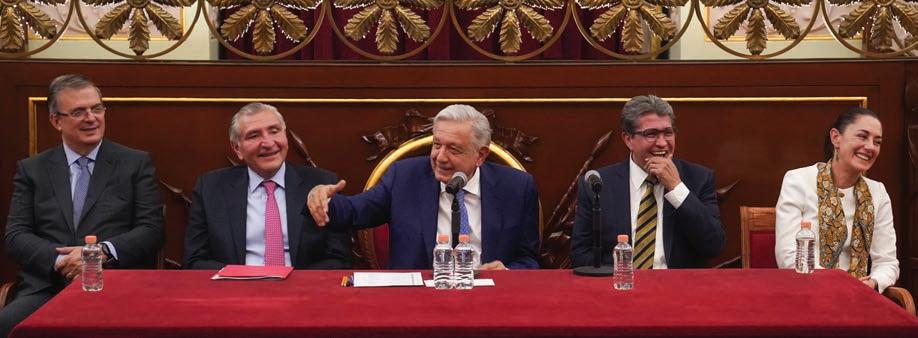
Mexican President Andrés Manuel López Obrador (centre) with senators on Apr. 28. LOPEZ OBRADOR/TWITTER
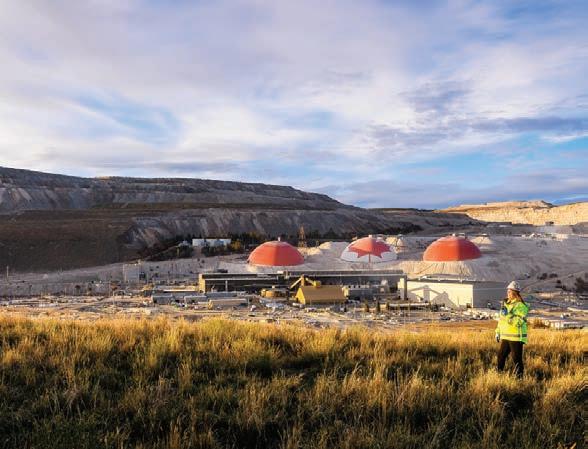
Colonial Coal is hoping to sell two metallurgical coal projects in northeastern British Columbia. COLONIAL COAL INT’L
Colonial boss scores two kicks at same coal can for billions in B.C.
M&A | Met coal projects attracting interest
Chile’s lithium policy could be a boon to other producers
CRITICAL MINERALS | There’s disagreement about whether policy counts as ‘nationalization’, but move still rattles investors
BY CECILIA JAMASMIE
Adecision by the world’s No. 2 lithium producer Chile to tighten control over its key battery metal sector has left many in the industry wondering what the state-led public-private model will look like and who, if anyone, will benefit from it.
The lack of specifics on how much ownership the government will demand from companies and the difficulties President Gabriel Boric will face when trying to create a national lithium company, add to the uncertainties Chile’s new lithium policy has created.
While Boric’s announcement has been branded as “nationalization,” Shawn Doyle, a lawyer and business advisor at Canada’s McCarthy Tétrault, believes it’s actually a positive development for private capital keen to invest in the battery metal.
“In his speech, Boric indeed invoked expropriations that occurred in Chile’s copper industry in 1971. However, it must be remembered that, as a result of policy paralysis, Chile has been effectively closed to new private investment in lithium for decades,” he wrote in a note to clients.
Doyle added that, as a result of the policy status quo, Chile has only two private producers — Albemarle (NYSE: ALB) and SQM (NYSE: SQM) — holding longstanding leases, while all other would-be players “have been left waiting,” he said.
Albemarle chief executive, Kent Masters, also sees the new policy as an opportunity to tap into new lithium reserves, beyond the mines it already has.
“I don’t fear about Albemarle’s future in Chile,” he told CNBC. “Boric’s government wants to bring more Chilean lithium supply to the market by partnering with companies interested in the business, which know how to operate those mines,” Masters said.
Nicolás Saldías, senior analyst at the Economist Intelligence Unit for Latin America and the Caribbean, said that phrasing Chile’s move as nationalization is “too strong.”
“It’s a quasi-nationalization in that the playing field will now be levelled in favour of the state,” he said.
Others are not so sure. Bernardo Fontaine, Chilean economist and academic, believes that private capital will hesitate before letting the state own the majority of their business, particularly if the same state competes with their other operations for buyers.
“It’s an optimistic and enthusiastic bet to ask investors to choose partnering with a state company, via minority stake, risking capital and technology as opposed to simply doing it alone,” Fontaine said in an interview.
Boric’s announcements seem more focused on the nationalization of production than on development and the maximization of tax revenue, he said. “Let’s hope the government proves otherwise,” Fontaine added.
For Joe Lowry, known in mining circles as “Mr. Lithium” due to his decades of experience in the sector, says that the ambiguity in Chile’s policy could be a boon to other producing countries, with Canada being in a particularly advantageous place.
According to Mining Intelligence, Canada currently has nearly 40 lithium projects in different stages of development, but only two operating mines, Sayona Mining’s (ASX: SYA) North American Lithium (NAL) in Quebec (owned 25% by Piedmont Lithium
[NASDAQ: PLL]) and Sinomine Resource Group’s Tanco mine, in Manitoba.
In its critical minerals strategy released in December, Ottawa listed lithium as one of the top six critical minerals due to its importance in the clean technology sector.
“I believe that Canada, with its vast hard rock lithium assets, will become the Australia of North America in terms of lithium supply,” Lowry says. “But the more capital that lands in North America’s lithium industry, the worse it is for Chile.”
Best cost-structure
Lowry, who is also President of Global Lithium LLC, believes Chile has the best cost-structure in the world for producing lithium.
“[It] not only has giant reserves with high concentrations of lithium, but it also has a geographical advantage — the driest desert in the world, where evaporation ponds work best,” he says.
The problem, he notes, is that the strategy unveiled last week could slow the development of the country’s local industry.
The expert, who has seen the global lithium sector grow from a US$200 million market when he entered the game in 1990 to US$1 billion by 2015 and over US$40 billion today, expects supply will continue to disappoint even as governments and automakers in the U.S. and Europe are investing heavily in the sector.
“[This is why] Chile is in a great position and it can remain there for at least two decades, but it needs to calm investors by providing details of how the new model will work,” he says.
The forecast shows how the power dynamics of the lithium industry are changing rapidly. “The top six lithium producers can sell all of their production today, without having to sell Tesla a gram. That wasn’t true six years ago,” Lowry says.
The North Carolina-based consultant believes Chile could easily recover its world leader position in the lithium market, lost to Australia in 2018, with the right policies.
“If you go back to early 2016, Australia had only one lithium mine in operation, while Chile was the dominant world producer. All of that has turned around in the last five to seven years and it’s a shame. It didn’t have to happen,” Lowry said.
Boric’s move places Chile closer to fellow Latin American countries
Bolivia and Mexico, which have discouraged investors by imposing greater state control, though Chinese groups may still be keen to fill the gap. “But is that what Chile wants?” Lowry wonders.
Investors have shown panic. Since Boric’s announcement, the value of the two lithium miners operating in Chile — U.S.-based Albemarle (NYSE: ALB) and Chile’s SQM (NYSE: SQM)— has dropped by a combined US$8.5 billion.
The world’s two top producers are set to operate in a different landscape once their current contracts expire.
Both companies have recently announced plans to expand operations elsewhere and experts say
they wouldn’t be surprised if they announce further geographical diversification. Albemarle is in pursuit of Australia’s Liontown Resources (ASX: LTR), while SQM is advancing the US$1.4 billion Mt Holland hard-rock project, also in Australia, with local lithium conglomerate Wesfarmers (ASX: WES).
In a recent commentary, German Mineral Resources Agency’s senior analyst Michael Schmidt wrote that regulatory uncertainties in Chile, Bolivia and Mexico will mean that about 63% of global lithium supply will come from rocks and not from brines by 2030.
Analysts from Fastmarkets believe that, if Chile fails to capital-
ize on the lithium boom, it would fall from the world’s second-largest lithium producer last year to fourth in 2030 after China, Australia and Argentina. They forecast the country’s share of production would shrink from almost a third to 12%.
While Boric needs approval from Congress for the creation of a national lithium company, he has the power to enact other elements of the policy. This is why he has enlisted two other state-owned companies, Codelco, the world’s largest copper producer, and state miner Enami, to determine how the private-public partnerships will operate.
Codelco will initially be in charge of negotiating a stake for the state in Albemarle’s and SQM’s operations. Enami will sign up partners for new contracts. Their roles will then be undertaken by the dedicated national lithium company, with a mandate to develop the industry into a pillar for Chile’s economy while protecting its environment.
Previous efforts to bring more actors into the country’s lithium sector have failed, with the most recent case being the one of Chinese automaker ByD Co, whose 80,000-tonne lithium contract was revoked following objections from a local governor.
Together with the lack of details in Chile’s lithium policy, expanding lithium mining in the Atacama desert is set to evoke environmental concerns. This, analysts agree, could make the process of awarding contracts more difficult and lengthier.
Asked about what he would say to Boric if he asked him for advice, Lowry does not hesitate: “I would tell him to put [the lithium policy announcement] back in the oven and finish the baking job.” TNM
project would still be in the early exploration stages. Within 90 days, the concession holders may also have to change their water access via the National Water Commission from industrial use to mining use,” Mazumdar says.
Mexican business conglomerate Grupo Mexico’s mining division on Apr. 27 indicated the change would not affect its operations, and Mazumdar assumes that the adjustment’s impact on producers will be minimal.
Toronto-based miner Torex Gold Resources (TSX: TXG), which has operations in Guerrero
state, says that while it was still reviewing the full impact of the amendments, it had not yet seen any indications they would be applied retroactively.
“As such, given that the tenure of Torex concessions has been granted on a 40- and 50-year basis, we see minimal impact to our operations in Mexico,” a spokesperson said in a statement sent to The Northern Miner “We are confident that discussions between industry and government will be ongoing as the government drafts the by-laws and directives, which will provide clarity on the operating parameters associated with the amendments,”
said the mid-tier company.
As recently as the week before the reforms passed, Canada’s Minister of International Trade, Mary Ng, expressed concerned that they could affect Canadian investment in Mexico’s mining sector, as well as North America’s supply chain resiliency and competitiveness.
Canadian mining companies, mainly listed on the TSX, represent the largest group of foreign investors in Mexico’s mining sector. According to government data, Canadian direct investment in Mexico was valued at $25 billion in 2021, making it Canada’s ninth-largest direct investment destination. TNM
2 MAY 15 — 28, 2023 / THE NORTHERN MINER WWW.NORTHERNMINER.COM
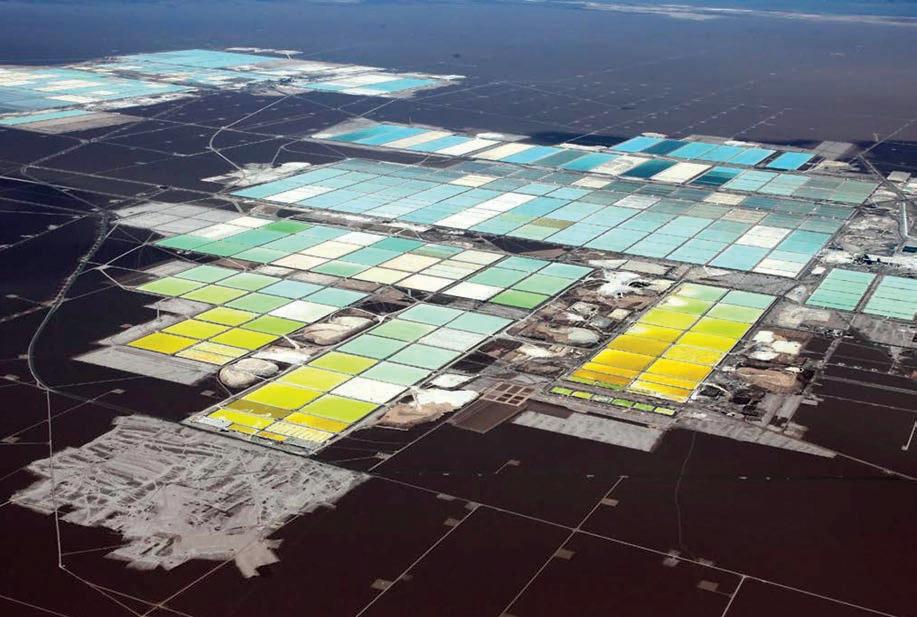
SQM’s Soquimich lithium brine project in the Atacama salt flat in Chile. SQM
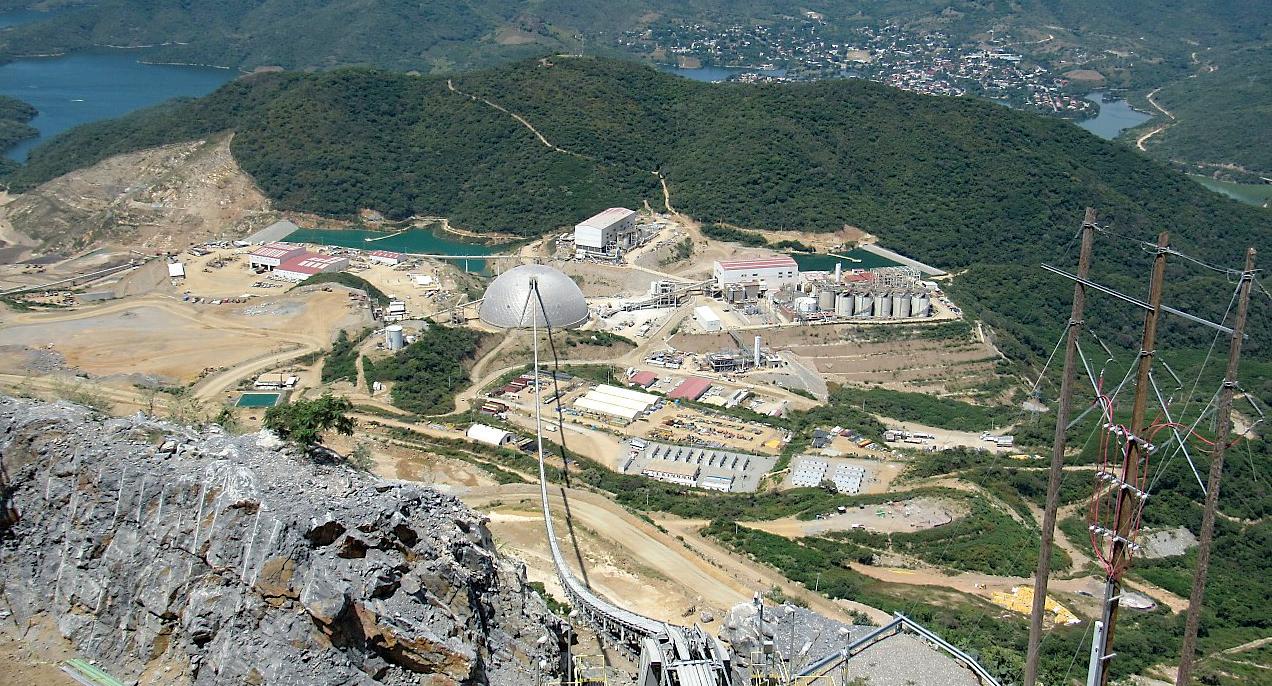
Torex Gold’s El Limón Guajes (ELG) Mine complex in Mexico’s Guerrero state. TOREX GOLD
MEXICO from 1
Juniors see glass half full in Chile’s new lithium plan
SOUTH AMERICA | Investors skeptical the policy will unlock new development
BY TOM AZZOPARDI
Plans by the Chilean government to strengthen control over the country’s lithium have sent shockwaves through the industry and markets.
As headlines warned of resource nationalism, shares in SQM (NYSE: SQM), Chile’s biggest producer, fell as much as 20% as investors digested the prospect of ceding control of its lucrative lithium business to the state.
However, companies on the ground are hopeful that the lithium strategy announced Apr. 20 by leftwing President Gabriel Boric could finally unlock Chile’s huge reserves of lithium after years of stasis.
“President Boric has had the courage to break the deadlock regarding government policy on lithium in Chile,” says Henk van Alphen, CEO of Wealth Minerals (TSXV: WML).
Under regulations dating back to the Cold War, Chile classifies lithium as a strategic mineral (due to its possible use in nuclear weapons), reserving its production for the state.
As a result, despite Chile hosting an estimated 40% of global reserves, only two companies have been able to produce lithium in the country, from tenements on the giant Atacama salt flat that they rent from economic development agency CORFO.
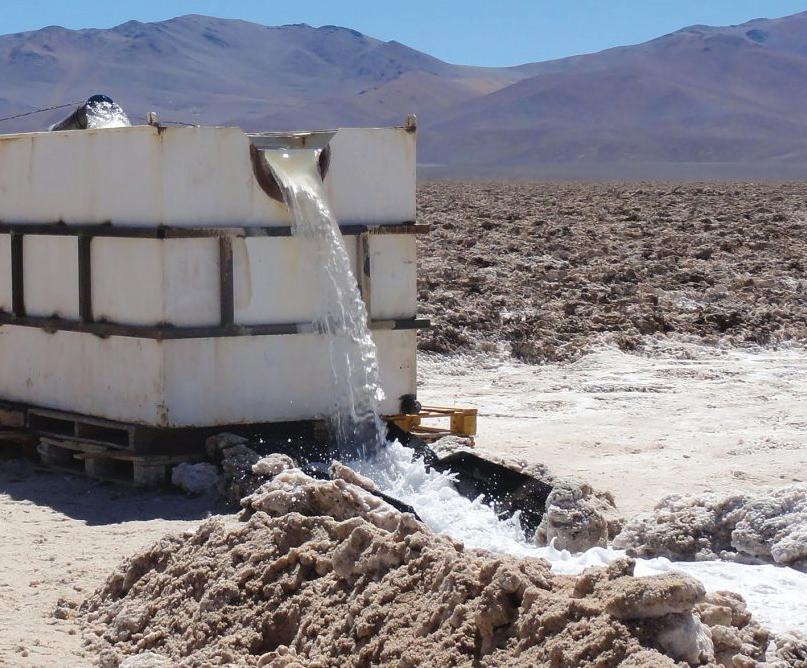
Under Boric’s plan, Chile’s state copper giant Codelco will negotiate with Albemarle (NYSE: ALB) and SQM to take majority control once their contracts expire (in 2030 and 2043, respectively).
But while the Salar de Atacama hosts the bulk of Chile’s lithium riches, its northern highlands host dozens of smaller saltflats which could boost production in the medium term.
Previous administrations have sought to bolster production by granting special licences to produce a limited volume of lithium over a set period of time.
But these efforts have fallen flat.
In 2012, SQM was stripped of such a contract after it was found to have breached the tender rules (and to have been paying a stipend to the government official in charge of the auction).
Last year, a court blocked similar contracts awarded to Chinese electric vehicle maker BYD and mining company Servicios y Operaciones
Mineras del Norte S.A., after Indigenous communities living near salt flats complained that they had not been properly consulted.
Under the government’s new plans, the state will seek to partner with private investors to explore,
produce and process lithium into value-added products. Until a new national lithium company is set up (which requires Congressional approval), Boric has ordered Codelco and state mining firm Enami to begin engaging with potential partners.
Government cooperation over control
Rather than scaring off investment, prospective lithium producers in Chile say the proposal could pave the way for new projects to advance towards construction.
“These proposals create a greater degree of certainty for the lithium
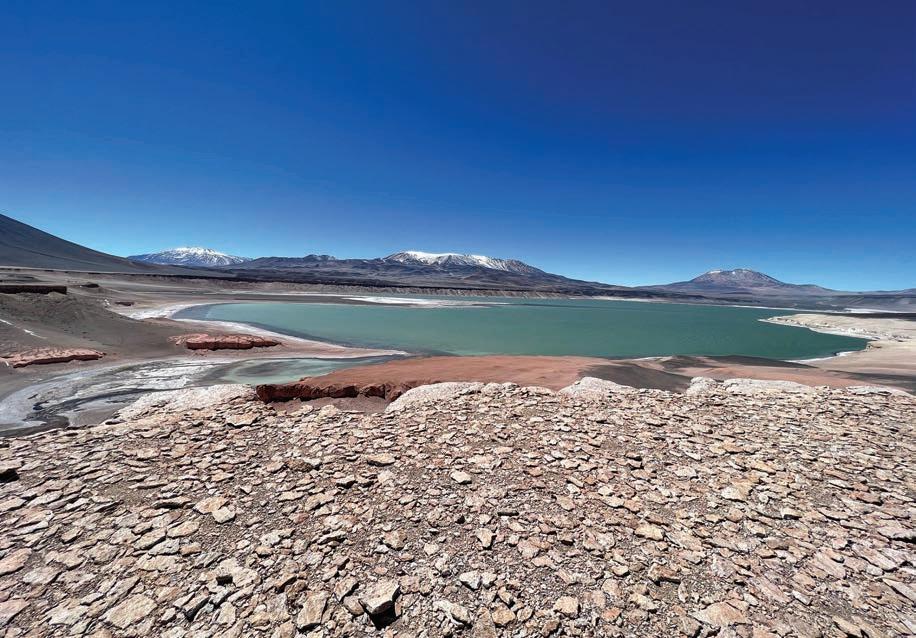
industry in Chile and therefore an improved climate for investment,” said Aldo Boitano, chief executive of CleanTech Lithium (AIM: CLT), which is working on a prefeasibility study at its Laguna Verde project, after releasing a positive scoping study in January.
With more clarity about how Chile plans to develop its lithium industry, multinationals are more likely to move in, firms argue.
“No doubt, this announcement will be noticed by multiple lithium consumers globally, who have been reluctant to enter Chile until this moment,” said Van Alphen of Wealth, which owns claims on two
salares.
Although President Boric’s initial announcement suggested that the government would seek control over all the aspects, this message was subsequently toned down.
Speaking to Chilean television on Apr. 23, Finance Minister Mario Marcel said that the majority state participation would only apply to assets considered of strategic importance, such as the giant Salar de Atacama. At smaller salt flats, the state could hold a minority stake, he said.
According to Clean Tech, the company has already received reassurances that its projects would not be subject to state control.
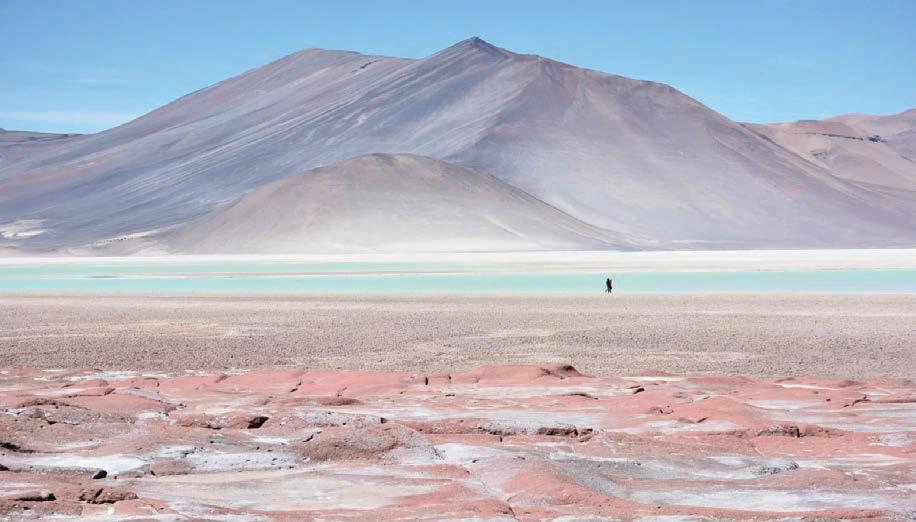
A major test for Chile’s new lithium policy will come at the Salar de Maricunga, where several firms are vying to develop the country’s second largest lithium reserves.
Australia-listed Lithium Power
International (ASX: LPI) and Singapore-backed Simco are both advancing projects using minerals claims that predate the restriction on lithium production. With environmental and export permits in hand, LPI is already in financing talks to begin construction later this year.
But Codelco has been exploring its own claims over the Salar with exploration work to measure a resource at the site close to completion. Speaking at its annual shareholders meeting on May 2, chairman Maximo Pacheco said that the company aimed to define a business model for its lithium project on the salar by the end of 2023, including estimates for investment and production.
“It’s a very attractive project,” he said. Moreover, Codelco is the only company to have been granted a licence to produce lithium by the government, covering almost the whole of the Salar, and expressed skepticism that the salt-flat can support multiple operations.
Responding to the new policy, LPI said it remains committed to developing the first stage of the project (based on grandfathered claims) alone but is exploring an alliance with the government to develop a further expansion based on newer claims, “in what could be the first example of a public-private alliance under the new parameters established by the new policy.”
Despite enthusiasm among corporate managers, investors remain skeptical about Chile’s new policy. LPI’s share price has fallen almost a quarter since the policy was unveiled. Clean Tech and Wealth have suffered similar declines.
The coming months could be crucial for Chile’s lithium industry as companies assess whether it can strike a workable deal with Codelco and other state entities or would be better off under the more laissez faire regimes in Australia and Argentina. TNM
GLOBAL MINING NEWS THE NORTHERN MINER / MAY 15 — 28, 2023 3
Lithium Power International’s Maricunga project in northern Chile.
LITHIUM POWER INTERNATIONAL
Wealth Minerals’ Atacama project on the namesake salar in Chile. WEALTH MINERALS
CleanTech Lithium’s Francisco Basin project in Chile. CLEAN TECH LITHIUM
GLOBAL MINING NEWS • SINCE 1915 www.northernminer.com
Work to sideline Russia on nuclear fuel begins in earnest
PRESIDENT THE NORTHERN MINER GROUP: Anthony Vaccaro, CFA, MBA avaccaro@northernminer.com
EDITOR-IN-CHIEF: Alisha Hiyate, BA (Poli Sci, Hist) ahiyate@northernminer.com
WESTERN EDITOR: Henry Lazenby hlazenby@northernminer.com
SENIOR STAFF WRITER: Colin McClelland cmcclelland@northernminer.com
COPY EDITOR AND PRODUCTION EDITOR: Blair McBride bmcbride@northernminer.com
PODCAST HOST: Adrian Pocobelli, MA (Engl) apocobelli@northernminer.com
ADVERTISING: Robert Hertzman (416) 898-6654 rhertzman@northernminer.com
Michael Winter (416) 510-6772 mwinter@northernminer.com
SUBSCRIPTION SALES/ APPOINTMENT NOTICES/
CAREER ADS
George Agelopoulos (416) 510-5104 (Toll free) 1-888-502-3456, ext. 43702 gagelopoulos@northernminer.com
PRODUCTION MANAGER: Jessica Jubb (416) 510-5213 jjubb@northernminer.com
CIRCULATION/CUSTOMER SERVICE: (416) 510-6789 | 1-888-502-3456 northernminer2@northernminer.com
REPUBLISHING: (416) 510-6768 moliveira@northernminer.com
ADDRESS:
510-6789 tnm@northernminer.com SUBSCRIPTION
Canadian miners are missing out on R&D tax incentives
Tax credit system rewards innovation
 BY ALISHA HIYATE
Cameco CEO Tim Gitzel first joined the company’s executive team in 2007 – the year that the uranium price peaked at a high of US$136 per lb., rising from less than US$10 per lb. In 2001. And although the current price of uranium oxide, at US$53.50 per lb. is nowhere near those bubbly (and it must be said, unsustainable) levels, Gitzel sounded downright giddy on the uranium miner’s first-quarter conference call at the end of April.
There are many things that are going for Cameco, one of the world’s top uranium suppliers, including increasing prices, and rising demand and contracting by utilities. But what they all boil down to is the realignment of energy markets post Russia’s invasion of Ukraine last year.
On the call, Gitzel described attending the dinner between Prime Minister Justin Trudeau and U.S. President Joe Biden in Ottawa in late March. During the event, he said the two leaders talked about the critical role of nuclear energy and the importance of nuclear collaboration between Canada and the U.S.
“It was almost hard to believe — like a dream come true,” Gitzel, who’ss been Cameco’s CEO since 2011, told analysts. “Nuclear energy would NEVER have made top billing at a meeting between our countries even a few years ago.”
The same day as the event, the two nations released a joint statement pledging more cooperation on nuclear energy and technology as a way to fight both climate change and Western dependence on Russia.
The “really positive” joint statement between the U.S. Department of Energy (DOE) and Canada’s Ministry of Natural Resources is “the kind of signal from government that our industry has been waiting for for a long time,” Gitzel said.
This signal extends beyond North America. In mid-April, five G-7 countries including Canada, the U.S., France, Japan and the U.K. signed a cooperation agreement on nuclear fuel, proclaiming their intent to “reduce reliance on civil nuclear and related goods from Russia, including working to assist countries seeking to diversify their nuclear fuel supply chains,” and to work together to establish a global commercial nuclear fuel market and support their “collective climate, energy security, and economic resilience objectives.”
In a separate statement, U.K. Energy Security Secretary Grant Shapps zeroed in on how Russia’s actions under President Vladimir Putin have spurred this new global geopolitical realignment.
“The U.K. has been at the very heart of global efforts to support Ukraine, defeat Putin and ensure neither him nor anyone like him can ever think they can hold the world to ransom over their energy again,” he said. “This is the next vital step, uniting with other countries to show Putin that Russia isn’t welcome anymore, and in shoring up our global energy security by using a reliable international supply of nuclear fuel from safe, secure sources.”
Shapps’ pointed words draw attention to just how little progress has been made on weaning off Russian supply since the war started last February, despite Western nations’ desire to punish Russia for its ongoing assault of Ukraine. While Russia is not a huge supplier of uranium (about 6%), it does control around 27% of global uranium conversion capacity, and nearly 40% of global enrichment capacity, according to Sprott, which has several uranium-centred investment products. Realizing the damage it would do to their own nuclear sectors, Western leaders have mostly opted not to impose sanctions on Russian supplies. In a mid-April report, U.K.-based defence and security think tank Royal United Services Institute (RUSI) noted that together, the U.S. and France imported close to US$1 billion worth of enriched uranium from Russia last year.
Even so, prices in the enriched fuel and conversion markets have been climbing as Western utilities have sought alternatives to Russian supply.
That’s helped Cameco break into new markets in Eastern Europe, including signing a 10-year contract with Westinghouse Electric to supply UF6 (converted uranium suitable for enrichment) to Bulgaria.
“Our recent contracting success to supply new markets in Eastern Europe clearly demonstrates the desire of our customers to diversify. These are markets where we were previously unable to compete,” the company said in its first-quarter results press release.
Price rise to come
While uranium prices have risen, enrichment and conversion prices have seen the greatest boom so far. In its most recent quarter, Cameco’s average realized price only ticked up 4% to US$45.14 per lb. of uranium oxide (U₃O₈) from US$43.24 per lb. in the same period last year.
But Cameco execs believe that’s still to come.
“We haven’t seen that kind of demand that’s gone through those two parts of the fuel cycle fully hit the uranium side yet, so we’re obviously pretty excited about it — it’s why we want to remain leveraged in both our portfolio and our pipeline,” said Grant Isaac, Cameco’s CFO and executive vice-president on the conference call.
In the meantime, the “positive fundamentals” Cameco has been pointing to for over a decade are finally starting to show up in the company’s financial results.
In the first quarter, Cameco’s revenue was up 73% to $687 million, while its net earnings and production both more than doubled. Cameco produced 4.5 million lb. U₃O₈ in the first quarter (up from 1.9 million lb. in the same period last year), and as it continues to ramp up the McArthur River mine and Key Lake mill, which it restarted last fall after a four-year suspension, it expects that mine alone to produce 15 million lb. this year and 18 million lb. next year.
The real test to what many see as a new uranium bull market will be whether the improving picture for nuclear power translates into new mines. From that perspective, a slow and steady rise in uranium will help junior miners hoping to develop new mines in Saskatchewan’s Athabasca Basin — including NexGen Energy, Fission Uranium (see page 10) and Denison Mines — a lot more than a return to sky-high prices. TNM
As mining companies across Canada face budget cuts and more pressure to make sound investments, it has never been more important to make the most of every cent available. Canada has one of the most generous tax credit programs in the world, yet many in the industry are either not aware it exists, or wrongly assume it does not apply to them.
The main tax incentive for research and development in the mining industry is the Scientific Research and Experimental Development (SR&ED) program, awarded by the Canada Revenue Agency (CRA). The name conjures up images of scientists in lab coats — a far cry from the world of drilling and mining, which may be another reason it is often overlooked.
In fact, industries related to natural resources typically have some of the lowest claim rates. While different rules govern how SR&ED is awarded in the case of mining, successful claims can potentially contribute thousands of dollars to a project, so it is worth a closer look.
SR&ED legislation specifically excludes claiming for activities related to ‘prospecting, exploring or drilling for, or producing, minerals, petroleum or natural gas.’ This is all considered field work carried out as part of business operations in the resources sector.
This wording can be a stumbling block for Canadian mining companies, and the headline exclusion of prospecting for minerals may deter many companies from exploring a claim for SR&ED Investment Tax Credits. What many financial officers overlook is that the regulation does not disregard supporting activities. As innovation is found in virtually every aspect of the mining industry, millions of dollars may be missed by this simple misunderstanding.
There are some key areas of the industry that are more likely to be eligible for tax credits, including:
• The design and engineering of new systems or components used in the extraction and processing of materials;
• The development of components for the industry where the work experiences technological uncertainty; and
• Technology that can be used to maintain equipment used by mining companies in Canada.
What does qualifying activity look like?
It can be difficult to predict exactly what the CRA will deem to be qualifying activity, so it’s worth going into the claims process with a solid understanding of the kind of innovation and R&D they will be looking for.
Some aspects of labour may qualify, including the personnel employed by the company, as well as any subcontractors. Any work that is directly related to the SR&ED activity could be eligible — outside of operations aspects such as marketing, sales and customer service. The CRA recognizes that a significant aspect of any R&D involves the time spent by personnel in successfully completing the project. One caveat: all employees and subcontractors must be Canadian-taxable suppliers. The development of new technology used by miners, as well as investment in capital equipment could also be eligible. You may even be able to secure funding from the payments made to third party researchers to conduct the necessary R&D on your behalf.
The CRA looks particularly favourably on mining companies’ efforts to improve processes in line with environmental concerns. This could include anything from reducing greenhouse gas emissions from machinery to mine reclamation. The regulation does not specifically exclude mineral processing technology either, so any investment into ore feed changes or reducing energy consumption could be eligible for SR&ED. Investment in new mineral exploration technology and methods, software and equipment that makes finding deposits easier and reduces environmental impacts could also be eligible.
How much are these tax credits worth?
Once all the qualifying activity has been taken into account, companies can expect the funding to be awarded in two different credits. This all depends on the corporate structure of the company, as well as the province in which it is based. Companies can claim a refundable Federal Investment Tax Credit of 35% on activity directly attributed to innovation. Alongside this, the Provincial Refundable Investment Tax Credit rate varies, so for example, the metal and coal mining companies of British Columbia would be able to claim a further 10% in refundable credits, as that is what the provincial program offers.
Canada’s mining sector is investing heavily in new technology and practices to keep up with global challenges around the use of natural resources. So long as mining companies can come to grips with federal tax credit rules on what might be eligible, they can tap funding that will help them continue to invest in innovation. TNM
—Richard Hoy, president of specialist tax consultancy Catax Canada can be reached at Richard.Hoy@catax.com.
COMPANY INDEX
4 MAY 15 — 28, 2023 / THE NORTHERN MINER WWW.NORTHERNMINER.COM
Canada: C$130.00 one year; 5% G.S.T. to CDN orders. 7% P.S.T. to BC orders 13% H.S.T. to ON, NL orders 14% H.S.T. to PEI orders 15% H.S.T. to NB, NS orders U.S.A.: C$172.00 one year Foreign: C$222.00 one year GST Registration # 809744071RT001 (ISSN 0029-3164) CANADA POST: Return undeliverable Canadian addresses to Circulation Dept. c/o The Northern Miner 225 Duncan Mill Road, Suite 320 Toronto, ON M3B 3K9 Publication Mail Agreement #40069240 Periodicals Postage Rates paid at Niagara Falls, NY, 14304. U.S. office of publication 2424 Niagara Falls Blvd, Niagara Falls, N.Y. 14304. U.S. POSTMASTER: send address corrections to: Northern Miner Box 1118 Niagara Falls, N.Y. 14304.-7118 THE NORTHERN MINER is published biweekly by Glacier Resource Innovation Group, a division of Glacier Media Inc., a leading Canadian media company with interests in business-to-business information services. From time to time we make our subscription list available to select companies and organizations whose products or services may interest you. If you do not wish your contact information to be made available, please contact us by one of the following methods: Phone: 1-888-502-3456; Fax: (416) 447-7658; Mail to: Privacy Officer, The Northern Miner, 225 Duncan Mill Road, Suite 320, Toronto, ON M3B 3K9. EDITORIAL
Toronto Head Office 225 Duncan Mill Road, Suite 320 Toronto, ON, M3B 3K9 (416)
RATES:
Aclara Resources 9 Alara Resources 14 Allkem 16 Alto Metals 6 Artemis Gold 11 Atlas Lithium 7 Aura Minerals....................................................12 B2Gold 11 Bellevue Gold 6 CleanTech Lithium 3 Colonial Coal International 1 Eldorado Gold 14 Emerita Resources 6 Fission Uranium 10 Fresnillo...............................................................11 Gascoyne Resources 6 Generation Mining............................................5 Glencore 8, 15 Gold Fields 5 Horizonte Minerals 15 Iamgold 12 IGO 16 Ioneer 7 Ivanhoe Mines 8, 11, 14 Lithium Americas 16 Lithium Power International 3 Lundin Gold 6 MAG Silver 11 Mayfair Gold 6 MetalsTech..........................................................6 Nevada King Gold 6 NexGen Energy 10 NextSource Materials 16 Nighthawk Gold 5 Northern Dynasty Minerals 7 Northern Star Resources 6 Nouveau Monde Graphite.............................16 Osisko Mining 5 Peak Rare Earths 9 Pensana 9 Rio Tinto 12 Sandfire Resources 14 Santana Minerals 6 SQM 3, 16 Teck Resources 7, 8 Tirupati Graphite 16 Triton Minerals 16 Walkabout Resources.....................................16 Wealth Minerals 3 West African Resources 11 COMMENTARY
Gold Fields to share in Windfall by buying half of Osisko gold project
M&A | Deal gives South Africa-based miner its entry to Canada after failed Yamana bid
BY COLIN MCCLELLAND
Gold Fields (NYSE: GFI; JSE: GFI), the eighth-largest miner by market value, has joined with Osisko Mining (TSX: OSK) to back the Windfall gold project in Quebec, one of Canada’s largest proposed precious metal developments.
Gold Fields said on May 2 it agreed to pay $600 million for half of the project in the Abitibi belt about 700 km northwest of Montreal. The funds are payable in two equal tranches, one now and one after the province approves construction.
The Gold Fields investment gives the Johannesburg-based miner the entry to Canada it missed last year when it was outbid for Yamana Gold. It also provides Windfall with more than enough cash for the estimated $789 million in construction costs and protects Osisko from a hostile takeover like it underwent with the Canadian Malartic mine it developed more than a decade ago.
“Windfall is the starter point for Gold Fields and ourselves in terms of having a mine come into production in about two and a half year’s time,” Osisko CEO John Burzynski said in a May 4 phone interview with The Northern Miner. “We also have about 2,400 sq. km of district scale property, an anchor in Quebec, and you know, there’s plenty of exploration to be done.”
The equal partnership may tweak plans to increase first-year production by a third, Burzynski said. It would extend the underground project’s ramp currently planned to run 630 metres deep to 800 metres instead, accessing ore grading about 9.1 grams gold per tonne rather than 8.1 grams, which could lift annual output to 400,000 oz. in contrast to 306,000 oz. in last year’s feasibility study, the CEO said.
“It’s in the interest of both Gold Fields and ourselves to look at scheduling some of the higher-grade material earlier,” Burzynski said. “They won’t require any changes to the mill design, so it won’t interfere with permitting.”
Funding secured
BMO Capital Markets analyst Andrew Mikitchook said the investment secures Windfall’s development.
“There is clearly a significant buffer over Osisko’s share of capex,” Mikitchook said in a note on May 2. “We view the large investment from Gold Fields as an endorsement of Windfall’s quality.”
Burzynski said it may take 18 months to get permits for the project, followed by a year of construction.
Gold Fields will also pay $75 million a
Nighthawk soars on NWT gold project’s
two-year
payback
GOLD | PEA sees output of 290,000 oz. a year at Colomac
Drilling at Nighthawk Gold’s Colomac site in the Northwest Territories. NIGHTHAWK GOLD
BY COLIN MCCLELLAND
Shares in Nighthawk Gold (TSX: NHK; US-OTC: MIMZF) jumped more than 20% after the company said its Colomac project in the Northwest Territories could pay for itself in about two years.
The open-pit project 200 km north of Yellowknife could produce 290,000 oz. of gold annually selling for US$1,600 each to generate US$464 million a year compared with estimated capital costs of $654 million, according to a preliminary economic assessment released on Apr. 26. The after-tax payback period is pegged at 2.1 years.
The study envisions a phased open-pit development starting with a central hub of the Colomac main, Grizzly Bear and Goldcrest deposits followed by satellite deposits 11 to 28 km away. Of these, Cass, Kim and Damoti are to be open pit and underground mined, while Treasure Island is only underground.
year in regional exploration costs. Bringing Windfall into production and exploring in the area is expected to cost the company $1.2 billion.
“What really excites us with the work that John and the Osisko team have done is the upside potential at both Windfall but then also at the Quévillon and Urban Barry prospecting areas,” Gold Fields interim CEO Martin Preece told BNN Bloomberg TV on May 4. “Canada is the cold version of Australia. It’s a great mining destination.”
Windfall has probable reserves of 12.2 million tonnes grading 8.06 grams gold per tonne for 3.2 million oz. gold. The feasibility study envisions a 10-year mine life.
Shares in Gold Fields in Johannesburg closed recently at 297.99 rand ($21.71) apiece, within a 52-week range of 126.62 rand and 319.17 rand, valuing the company at 262.5 billion rand ($19.1 billion). They were at 282.75 rand before the deal.
Osisko shares traded at $3.87 apiece at press time in Toronto, within a 52-week range of $2.36 and $4.53, valuing the company at $1.4 billion. They were at $3.77 before the deal. TNM
“The Colomac gold project has the potential to be a phenomenal asset,” Nighthawk president and CEO Keyvan Salehi said in a statement accompanying the study.“Only a handful of gold projects in the world that are owned by junior gold companies have similar favourable economics.”
Shares in Nighthawk rose 21% on Apr. 26 in Toronto to 58¢ apiece before setting a new one-year high at 72¢ at press time, valuing the company at $89.1 million. The stock previously traded in a 52-week range of 26¢ to 64¢.
Colomac would have an after-tax net present value of $1.2 billion at a 5% discount rate with an internal rate of return of 35% at the US$1,600 per oz. gold price, the study showed. The corresponding figures would increase to $2 billion at a 5% discount rate and 56%, based on a US$2,000 per oz. gold price. The payback period would shrink to 1.5 years.
Toronto-based Nighthawk’s plan would see a 11.2-year mine life with peak production of 340,000 oz. gold in the second year. Other forecasts include annual sustaining capital costs of $59 million, total annual cash costs of US$673 per oz. and all-in sustaining cash costs per year of US$828 per ounce.
Open pit extraction would focus on grades higher than 1.5 grams gold per tonne. Developing Colomac should take two years, the company said. Processing would be through a conventional milling, gravity and leaching circuit with gold recovery estimated at 96.3%. The company plans to spend $103 million to install wind turbines and solar panels to generate 60% of the site’s power. The rest would be provided by diesel generators.
A resource update in February showed the combined open-pit and underground indicated resource rose to 70.4 million tonnes grading 1.5 grams gold for contained metal of 3.4 million oz., a 26% jump from 2.7 million oz. in last year’s estimate. The corresponding inferred figures are 24.3 million tonnes grading 2.2 grams gold for 1.7 million oz., a 27% gain from last year’s estimate of 1.3 million ounces.
Nighthawk said it is preparing a prefeasibility study for the project and evaluating pit sequencing, equipment sizing, camp configuration, an airstrip extension and infill drilling to upgrade inferred resources.
The deposits are open along strike and at depth, while the 930-sq.-km property has 27 historical gold “occurrences” that warrant exploration, CEO Salehi said.
“We are expecting assay results from the highly prospective Leta Arm zone,” he said. “We are also planning to further drill the Cass, 24/7 and Damoti deposits, which we believe have the potential to expand mineralization beyond what has been outlined.” TNM
Generation Mining in US$400M debt deal for Marathon
ONTARIO | Updated feasibility for Marathon palladium-copper project pegs capex at $1.1B
BY MARILYN SCALES
With a new US$400-million debt financing expected to close in the third quarter, Generation Mining (TSX: GENM; US-OTC: GENMF) will have $740 million of the $1.1 billion needed to build its Marathon palladium-copper project in northern Ontario.
The company announced in early May that it has signed a non-binding term sheet for a senior finance facility of up to US$400 million ($540 million) with a syndicate
including Export Development Canada (EDC), ING Capital, and Societe Generale.
The debt facility adds to a $200-million streaming arrangement with Wheaton Precious Metals (TSX: WPM.CA; NYSE: WPM) signed in late 2021. Generation has also secured federal and provincial approvals for its environmental assessment.
“The interest of EDC, ING, Societe Generale, and Wheaton Precious Metals further validates the Marathon project’s status as an economic, sustainable, environmen-
tally sensitive, low-cost producer of critical metals that are needed to support emissions controls and the transition to a greener economy,” said Generation president and CEO Jamie Levy.
Generation updated its feasibility study for Marathon at the end of March, replacing a previous study published in 2021. It pegged capital costs at $1.1 billion ($898 million net of equipment financing and pre-commercial production revenue), with a payback period of 2.3 years. The project has a net present value (using a 6% discount rate) of
$1.2 billion and an internal rate of return of 25.8%.
The feasibility outlines an openpit mine and process plant with a mine life of 12.5 years, producing a total of 2.1 million oz. palladium and 517 million lb. copper. Payable metals over the mine life include 485,000 oz. platinum, 158,000 oz. gold and 3.2 million oz. silver.
In late March, Generation finalized an offtake agreement with Glencore (LSE: GLEN), which will buy 50% of the concentrates produced at Marathon.
The project is located 300 km east
of Thunder Bay and just north of Lake Superior.
Marathon hosts open pit proven and probable reserves of 127.6 million tonnes at 0.65 grams per tonne and 0.21% copper for 2.3 million oz. palladium and 530 million lb. copper. It also contains 285,000 oz. gold at 0.07 grams per tonne, 806,000 oz. platinum at 0.2 grams and 6.8 million oz. silver at 1.6 grams.
Generation shares traded at 52¢ in Toronto at press time, for a market capitalization of $94.3 million.
The stock has traded in a 52-week window of 51¢ and 95¢. TNM
GLOBAL MINING NEWS THE NORTHERN MINER / MAY 15 — 28, 2023 5
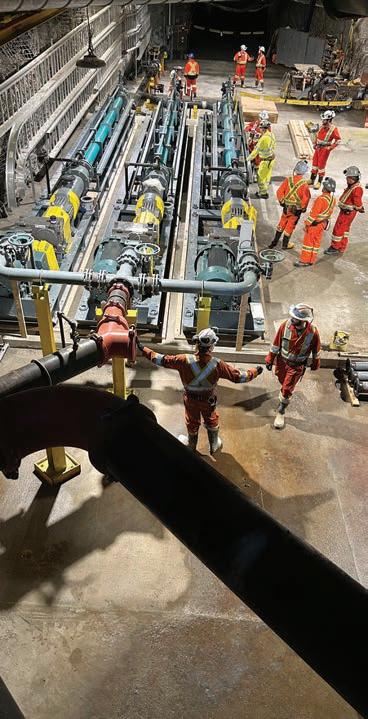
The pumping station at Osisko Mining’s Windfall project in Quebec. OSISKO MINING
TNM DRILL DOWN:
Bellevue Gold project in Australia tops week’s gold assays
BY BLAIR MCBRIDE
Our TNM Drill Down features highlights of the top gold assays of the week (Apr. 28-May 5). Drill holes are ranked by gold grade x width, as identified by data provider Mining Intelligence (www. miningintelligence.com).
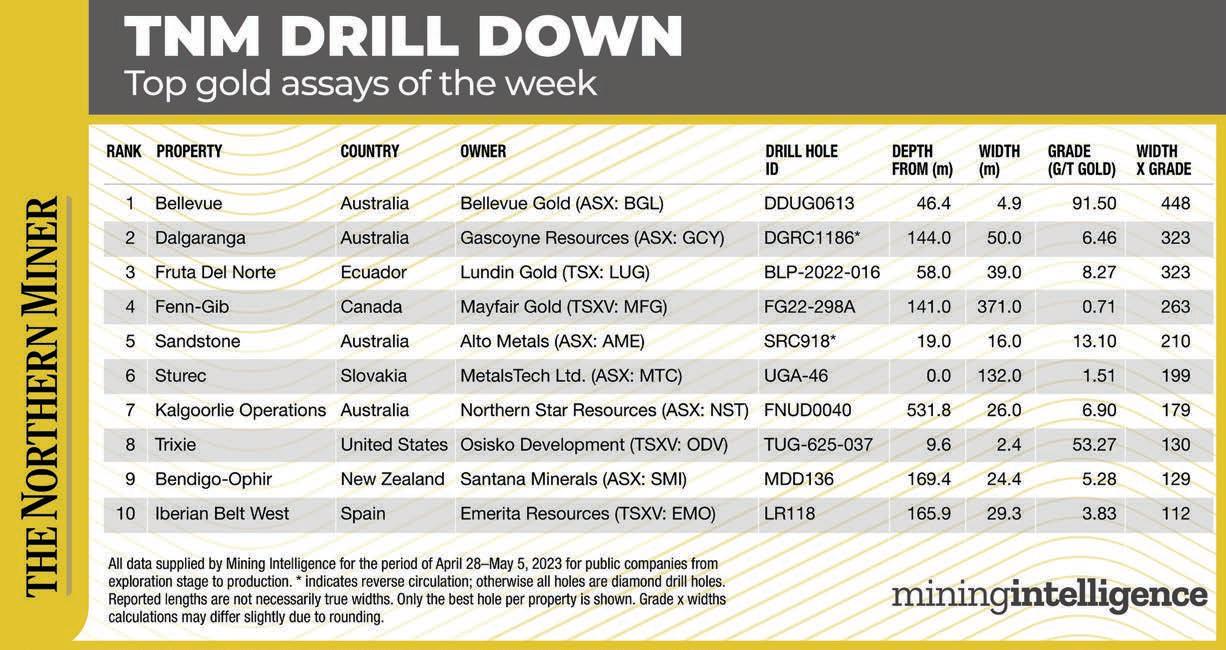
Last week’s top gold assays come from Australia and Ecuador. Bellevue Gold (ASX: BGL) leads the rankings with its namesake project in Western Australia. On May 1, the Perthbased company reported that hole DDUG0613 returned 4.9 metres grading 91.5 grams gold per tonne from 46.4 metres depth for a grade x width value of 448.35. The assays from the highlight hole were among results from more than 50 grade control drill holes in the Armand Upper Lode at Bellevue. Along with the Marceline and Bellevue South lodes, the area has returned highgrade results from underground drilling. “These exceptional results are important because they demonstrate the extremely robust nature of the resource model and therefore the strength of the production forecasts,” said managing director Darren Stralow in a release. While exploration drilling continues, first gold pour at the underground mine is expected in the second half of 2023, with an initial mine life of 10 years. Bellevue hosts probable reserves of 6.8 million tonnes grading 6.1 grams gold for 1.3 million oz. of gold.
The second best assay of the week came from Gascoyne Resources’ (ASX: GCY) Dalgaranga project in Western Australia. On May 2, the company reported that hole DGRC1186, cut 50 metres grading 6.46 grams gold from 144 metres depth for a grade x width value of 323. That reverse-circulation hole, from the Never Never deposit, also cut 10 metres at 23.7 grams gold. It also represents the fifth best intercept found so far at Never Never, said Gascoyne CEO and managing director Simon Lawson. “These standout results, provide further validation that Never Never is one of the most exciting new gold dis-
coveries in Australia, with hightenor, high-grade mineralisation now defined over a significant strike and dip extent just north of the existing mine,” he said. An updated resource for Never Never, released in January, shows it hosts underground and open pit indicated resources of 157,300 oz. gold in 1.3 million tonnes grading 3.69 grams gold. Another 145,800 oz. are in 710,000 inferred tonnes grading 6.43 grams gold. The company expects to release another resource update in the second half of the year. Dalgaranga was a producing gold mine until it was put on care and maintenance last November.
Gascoyne’s exploration program at the site began in February 2022.
The third best assay of the week came from Lundin Gold’s (TSX: LUN) producing Fruta Del Norte project in southeast Ecuador. On May 4, the miner reported diamond drill hole BLP-2022-016 cut 39 metres grading 8.27 grams gold from 97 metres depth, for a grade x width value of 322.53. The hole, in the Bonza Sur target, also returned 1 metre grading 277 grams gold from 70 metres depth hosted in a wide hydrothermal alteration zone. Bonza Sur is a new mineralized target discovered in near-mine drilling at the beginning of the year while
testing a 1.2-km-long geochemical soil anomaly along the south extension of the East Fault, located 1 km south of the main Fruta Del Norte deposit. Additional drilling confirmed the mineralization continues along strike to the south and at depth. “These results demonstrate the significant exploration potential of our land package that we have just started to test,” said CEO Ron Hochstein. Lundin plans to drill up to 23,000 metres in the near-mine program this year at an estimated cost of $24.6 million. The company has already completed 4,110 metres across eight holes since mid-April TNM
Nevada King Gold drills decades-high gold assay at old Atlanta project
EXPLORATION | Junior mulls
resource update next year at past producing gold-silver project
BY COLIN MCCLELLAND
Nevada King Gold (TSXV: NKG; US-OTC: NKGFF) says assay results show the highest-grade intercept in almost 50 years at the past-producing Atlanta mine in southeast Nevada.
Reverse-circulation drill hole AT23WS-022 cut 42.8 metres grading 5.64 grams gold per tonne and 6.7 grams silver from 288 metres downhole, including 7.6 metres at 28.5 grams gold, the company said in a release on Apr. 27.
This hole, located 290 metres northeast of the Atlanta pit “represents the highest-grade gold intercept exceeding 1.52 metres in length on the entire Atlanta property going back to the 1970s,” exploration manager Cal Herron said in the release. “How many more high-grade structures will we find at Atlanta that no one knew about?”
The Atlanta mine in the state’s Battle Mountain Trend, 264 km northeast of Las Vegas, produced 110,000 oz. of gold and 800,000 oz. of silver between 1975 and 1985. A 2020 estimate pegged measured and indicated resources at 11 million tonnes grading 1.3 grams gold per tonne for 460,000 ounces. Inferred resources add 5.3 million
tonnes grading 0.83 gram gold for 142,000 ounces.
Vancouver-based Nevada King drilled nearly 14,000 metres last year at the project and plans to hit a total of 30,000 metres by June on the 51.6-sq.-km site. More than 40,000 metres were drilled by Gold Fields (NYSE: GFI), Kinross Gold (TSX: K; NYSE: KGC) and Meadow Bay Gold starting in the early 1990s.
“With metallurgical test work well underway and our drilling progressing nicely, a second-quarter 2024 resource update could be in the cards,” Nevada King founder
and CEO Collin Kettell said in an emailed reply to questions. “It will incorporate quite a bit more drilling and we may push it back if zones continue to remain open.”
Historic drilling comparison
The release of assays on Apr. 27 was from holes drilled north of the Atlanta pit to test the grade and thickness of mineralized blocks in the Atlanta Mine Fault zone and the West Atlanta Graben moving northward toward the North Extension Target zone. Drill hole AT23WS-020 cut 61.1 metres grad-
ing 3.04 grams gold and 21.4 grams silver including 4.6 metres at 15.84 grams gold and 19.8 grams silver.
“This suggests that historic drill intercepts within the West Atlanta Graben failed to accurately reflect true thickness and grade,” Herron said. “This comparison illustrates the need for tightly spaced holes that thoroughly penetrate the mineralized zones, and also highlights the differences in grade and thickness being encountered by Nevada King compared to many holes reported by prior operators.
“We continue to see good conti-
nuity of mineralization over an area approximately 360 metres long in a north-south direction and at least 150 metres wide within the portion of the West Atlanta Graben drilled so far. Several historical holes suggest this mineralization extends further to the west and north from the area drilled to date.”
Nevada King began acquiring properties along the Battle Mountain Trend in 2016 and now holds 10,315 claims over 834.9 sq. km, making it the third largest mineral hard rock claim holder in Nevada behind Kinross and Nevada Gold Mines, a joint venture of Barrick Gold (TSX: ABX; NYSE: GOLD) and Newmont Gold (TSX: NGT; NYSE: NEM).
Nevada King’s holdings include the Lewis property beside Nevada Gold Mines’ Hilltop deposit, the Horse Mountain-Mill Creek project adjoining a Nevada Gold Mines exploration project, and the Iron Point property where the Battle Mountain-Cortez and GetchellTwin Creeks gold trends intersect. Shares in Nevada King rose 3.5% on the news to 44¢ apiece before hitting 47¢ at press time, valuing the company at about $131 million. The stock has traded within a 52-week range of 26¢ and 50¢. TNM
6 MAY 15 — 28, 2023 / THE NORTHERN MINER WWW.NORTHERNMINER.COM
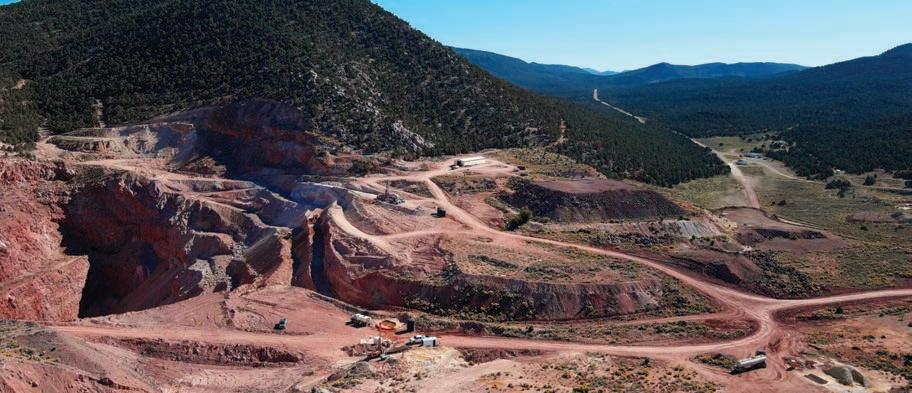
Nevada King Gold’s Atlanta property in southeastern Nevada. NEVADA KING GOLD
U.S. Army gives glimmer of hope for Pebble copper-gold project in Alaska
COPPER | Northern Dynasty says engineers could undermine stance of EPA, which has blocked the project
BY COLIN MCCLELLAND
The United States Army is improving the slim odds for the Northern Dynasty Minerals (TSX: NDM; NYSE: NAK) Pebble project in southwest Alaska which has already been blocked by environmental authorities.
The U.S. Army Corps of Engineers, which has its own approvals process for what would be North America’s largest mine with a 600-metre-deep pit, said Apr. 25 it will take another look at its refusal in 2020 to approve the project after Northern Dynasty successfully appealed the decision. The corps has to report back in 45 days.
“We have been saying that the record of decision process was not fairly conducted since 2020 and are pleased to see that the review officer has raised similar concerns,” Ron Thiessen, president and CEO of Northern Dynasty, said in a news release on May 1. “This remand decision is a strong win for the project because it brings these issues to light and directs the district to address them, potentially setting the stage for a much different outcome.”
BMO Capital Markets agreed in a May 1 note about items Northern Dynasty appealed when the corps ruled against the gold, copper and molybdenum project 380 km southwest of Anchorage.
“These include possible inconsistencies in the evaluation of a compensatory mitigation plan and
possible inconsistencies in weighing the benefits vs. detriments of developing Pebble,” mining analyst Andrew Mikitchook wrote. “Correcting the remanded issues could have a meaningful impact on the overall permitting decision.”
At issue this time in the decadeslong struggle to develop the project forecast to generate US$1.7 billion in annual revenue is whether Northern Dynasty was allowed to adjust its comprehensive mitigation plan with public feedback, and if the corps ruled wrongly on the project’s tailings storage.
Thiessen argues the company wasn’t given proper instruction, feedback or time to change its mit-
igation plan to meet requirements, which in turn could potentially prompt the U.S. Environmental Protection Agency’s to reverse its decision to reject the project. That refusal was based on concerns the project would breach the Clean Water Act and hurt the world’s largest sockeye salmon fishery at Bristol Bay.
He also noted the corps’ review said it had been wrong to consider potential catastrophic impacts of a tailings storage facility failure as a reason for its permit denial after the final environmental impact study had found the tailings storage design didn’t present any reasonably foreseeable failure risks.
Atlas Lithium lands US$20M royalty deal for Neves project
CRITICAL MINERALS | 40,000-metre drill program under way on battery minerals project now fully funded
BY JACKSON CHEN
Atlas Lithium (NASDAQ: ATLX) saw its share price explode on May 2 after securing US$20 million in funding for its flagship hard-rock lithium project in the Lithium Valley area of Minas Gerais state, Brazil.
By late morning, the stock surged 12.4% to US$43.70 apiece, having hit a 52-week high of US$45 in the earlier hours of trading.
Atlas sold a 3% gross overriding revenue (GOR) royalty on the Das Neves project to Canada’s Lithium Royalty Corp. (TSX: LIRC) for US$20 million in cash. The firm said it was the largest lithium royalty deal in Brazil so far. Das Neves covers four of Atlas’ 64 mining claims.
Lithium Royalty recently completed an initial public offering of $150 million. It holds a 1% royalty on all claims owned by new producer Sigma Lithium (TSXV: SGML; NASDAQ: SGML), which began production at its Grota do Cirilo mine in Minas Gerais in April.
With the royalty transaction, Atlas is now fully funded to complete its 40,000-metre drilling program at Das Neves, where it has 10 drills working towards delineating an initial resource. The property comprises over 304 sq. km.
So far, the company has outlined an important discovery at Anitta, which has a strike length of at least 1.1 km, a width of around 20 metres, and is open along strike and at depth. Recently, Atlas reported that a drill hole at Anitta hit a 25.4-metre spodumene intersect with a high reading of 4.4% lithium oxide, which is one of the highest grades reported at a spodumene deposit in the Lithium Valley.
According to Atlas, drilling at Anitta has yielded multiple instances of fresh, high-grade spodumene intersections located near the surface, and amenable to open pit mining.
“The Das Neves project exhibits highgrade coarse-grain spodumene ore that should lend itself to simple processing. Brazil is quickly developing into an important and environmentally friendly lithium jurisdiction, and we are excited to support Atlas Lithium on its accelerated path to production,” commented LRC president and CEO Ernie Ortiz in a news release.
Atlas shares traded at US$29 at press time, valuing the company at US$202.8 million. TNM
Northern Dynasty says it is considering how to challenge the EPA’s ruling in court. The Army Engineers review could give it ammunition. It marks another zigzag in the project that began as a discovery in the late 1980s by what now is Teck Resources (TSX: TECK.A/ TECK.B; NYSE: TECK).
There have been a series of studies, permits, refusals and appeals for the project since Northern Dynasty took control in 2001. The company even appealed successfully against the EPA more than a decade ago. This year’s EPA ruling barred the project from depositing waste material within the local
watershed, effectively cancelling it. But if the tailings storage design is indeed sound, that could undermine the EPA’s stance.
“The EPA in its final determination specifically refers to the risk of tailings failure to justify its decision, despite the (environmental impact study) saying that this is not reasonably foreseeable,” Thiessen said. “This contradiction will need to be explained.”
However, President Joe Biden has called Bristol Bay, which is home to a US$2.2-billion-a-year salmon fishery, “no place for a mine.” His administration has blocked other mines, such as the Antofagasta (LSE: ANTO) Twin Metals project in Minnesota, despite the loud cry for more critical minerals projects to challenge Chinese dominance and promote the country’s transformation to green energy to fight climate change.
Pebble has measured and indicated resources of 6.5 billion tonnes grading 0.4% copper, 0.34 gram gold per tonne, 240 parts per million (ppm) molybdenum, 1.7 grams silver per tonne and 0.41 ppm rhenium, for 57 billion lb. of copper, 70.6 million oz. gold, 3.4 billion lb. molybdenum and 345 million oz. of silver.
Shares in Northern Dynasty gained 3.5% on the news to 30¢ each, within a 52-week range of 28¢ to 46¢, valuing the company at $158.6 million. TNM
Ioneer’s Rhyolite Ridge lithiumboron resource soars by 168%
NEVADA | Mine would quadruple lithium output in US
 BY BLAIR MCBRIDE
Aleap in the estimated resources at ioneer’s (NASDAQ: IONR; ASX: INR) Rhyolite Ridge lithium-boron project in Nevada means the site could eventually produce enough lithium to charge more than 50 million EVs. The company is eyeing first production in 2026.
An updated estimate, released on Apr. 26, puts global resources at the project’s South Basin deposit at 360.2 million tonnes at 1,750 parts per million (ppm) lithium and 6,850 ppm boron for about 3.4 million tonnes of lithium carbonate equivalent (LCE) and 14 million tonnes of boric acid equivalent (BAE). The resource includes 60 million tonnes of proven and probable reserves at 1,800 ppm lithium and 15,400 ppm boron, as outlined in a 2020 feasibility study.
That study pegged the global resource at Rhyolite at 146.5 million tonnes of LCE and 11.9 tonnes of BAE in a 3 sq. km area.
“We are extremely pleased with the significant increase in the South Basin Mineral Resource estimate,” said ioneer executive chairman James Calaway. “It highlights Rhyolite Ridge’s optionality and multi-generational scale potential to provide a secure, sustainable and reliable domestic source of lithium for the growing electric vehicle battery supply chain.”
About 80% of the updated resource is classified as measured and indicated. Inferred resources total 65.7 million tonnes for 630,000 tonnes LCE at 3,550 ppm and 1.8 million tonnes BAE at 14,600 ppm.
Cut-off grades of 1,090 ppm lithium and 5,000 ppm boron, remain unchanged.
The increased resource takes into account drilling and assays from all four stratigraphic layers underneath the lake-bed sedimentary rocks of the Cave Spring Formation in
Nevada. The 2020 resource analyzed just two layers. All four layers remain open to the north, south and east, with further potential for resource growth.
The Sydney, Australia-headquartered company expects that once the project is permitted and construction is complete, Rhyolite Ridge will quadruple current lithium chemical output in the U.S.
The project is currently in the final phase of permitting and ioneer anticipates starting construction in 2024 for a 2026 production start.
Rhyolite Ridge is located about 60 km southwest of Tonopah, in southwestern Nevada. It is the only known lithium-boron deposit in North America and one of only two known such deposits in the world.
Ioneer shares traded at A31¢ (28¢) at press time, giving the company a market cap of A$650.5 million. The stock has traded in a 52-week window of A26¢ and A74¢. TNM
GLOBAL MINING NEWS THE NORTHERN MINER / MAY 15 — 28, 2023 7
Exploration at Atlas Lithium’s Das Neves property in Brazil. ATLAS LITHIUM
Zigzags
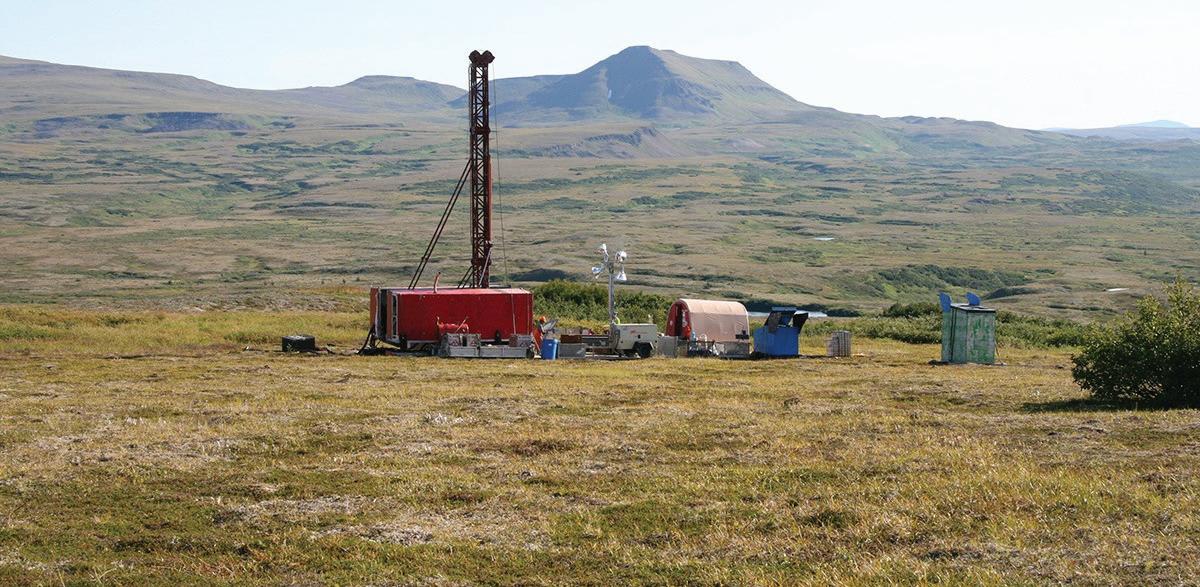
A drill rig at Northern Dynasty Minerals’ Pebble project in southwest Alaska. NORTHERN DYNASTY MINERALS
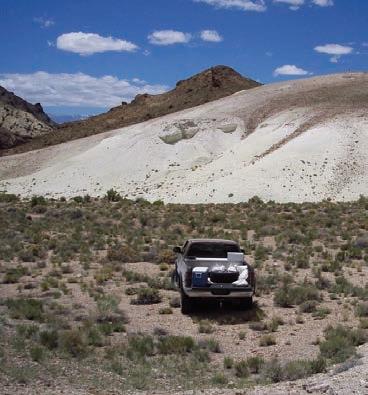
The South Basin deposit at Ioneer’s Rhyolite Ridge project in Nevada. IONEER
Ivanhoe taps Glencore for US$250M to start world-beating Kipushi early
AFRICA | Highest grade zinc project to begin production in January
Glencore says takeover bid for Teck stands after spinoff fails
M&A | Swiss firm says it will take its offer to shareholders if board refuses to engage
BY COLIN MCCLELLAND
Ivanhoe Mines (TSX: IVN; USOTC: IVPAF) says it has signed off-take and financing agreements with Glencore (LSE: GLEN) to restart the world’s highest-grade zinc mine at Kipushi in the Democratic Republic of Congo (DRC) next year.
Glencore, the Switzerland-based miner and commodity trader, will take all of the mine’s zinc concentrate for five years and fund the operation with a US$250 million loan to be repaid by 2028, Ivanhoe said in a news release on Apr. 28. The mine, located near the Zambian border in DRC’s far southern Haut-Katanga province has US$380 million in capital costs remaining, it said.
“When Ivanhoe Mines acquired its interest in Kipushi almost 12 years ago, the mine was flooded and in a dilapidated state,” company executive co-chair Robert Friedland said in the release. “We are proud to see new, state-of-theart mining equipment, operated by our Congolese employees, underground for the first time in three decades.”
Kipushi, 68% owned by Ivanhoe and the rest held by stateowned Gécamines, plans to mine a world-leading 36% zinc over the first five years of production.
The site, which produced from 1925 to 1993, is expected to yield 10.8 million tonnes of ore at an average head grade of 31.9% zinc over a 14-year mine life, generating 3.3 million tonnes of zinc metal in concentrate, according to a feasibility study last year.
Andrew Mikitchook, a mining analyst for BMO Capital Markets, noted the agreements with Glencore matched previous statements from Ivanhoe and the project is ahead of schedule.
“Detailed engineering is complete and procurement is 79% complete with all medium- and long-lead items ordered,” Mikitchook said in a note on Apr. 28. “Underground mining is also ahead
of schedule, with first equipment deliveries achieved and horizontal development of 682 metres (30% above plan) in the first quarter.”
Mining the Big Zinc deposit is planned to start in January, followed by the first concentrate deliveries in the third quarter, Ivanhoe said. The concentrator is to process 800,000 tonnes of ore a year for 437,000 tonnes of zinc concentrate annually at an average grade of 55% zinc.
Operations so far have been funded by a US$661 million Kipushi shareholder loan. The company is also considering interim bank financing of up to US$80 million, it said.
Vancouver-based Ivanhoe is working with Haut-Katanga to develop a dedicated commercial border crossing into Zambia at Kipushi to avoid shipping costs and congestion at Kasumbalesa
and Sakania, 110 km and 230 km, respectively, by road to the southeast. A new portal would also help Ivanhoe’s Kamoa-Kakula copper mine about 350 km to the northwest and provincial capital Lubumbashi less than 20 km away.
“We will also endeavour, with our partner Gécamines, to continue exploring Kipushi, including copper-rich and silver-rich zones,” Ivanhoe President Marna Cloete said in the release. “Kipushi soon will join Kamoa-Kakula as another tier-one production asset in our portfolio, and mark the next step as we execute our plan to emerge as the world’s newest diversified major mining company.”
Ivanhoe shares traded at $11.79 at press time in Toronto, giving the company a market capitalization of $14.3 billion. Its stock has traded in a 52-week window of $6.41 and $13.05. TNM
BY CECILIA JAMASMIE
Glencore (LSE: GLEN) is far from giving up on its plan to take over Teck Resources (TSX: TECK.A/TECK.B; NYSE: TECK) as it confirmed on Apr. 27 that its bid for Canada’s largest diversified miner still stands.
The mining giant and commodities trader, which does not typically take “no” for an answer, implied that Teck’s decision to withdraw its proposal to split up into two companies backed its own plans.
The Vancouver-based miner scrapped its plan to split into two just ahead of a key shareholder vote on Apr. 26, as Glencore circled with a US$23-billion offer made in March and the promise of a sweeter one.
Teck, which could not convince the majority of its investors to back the plan to separate its copper and coal businesses, said its board will work on providing a “simpler and more direct separation plan.”
While chief executive Jonathan Price said that the company received “very strong support” from shareholders for the goal of separation, it also gathered feedback suggesting that a more direct approach to dividing up the business was preferred.
“In the interim, Teck is poised for value creation; we are ramping up our flagship QB2 copper project to full production, advancing our industry-leading pipeline of copper growth projects, and safely and responsibly optimizing production at our existing operations,” Price said.
The executive noted that Glen-
core’s rejected proposals remained a non-starter and said the board will work on providing a “simpler and more direct separation plan.”
The move is considered as a key win for Glencore, which had been campaigning to persuade Teck’s shareholders to vote against the split, and instead accept its unsolicited bid, which includes a US$8.2-billion cash sweetener.
Glencore has framed the failed vote as a mandate to begin talks on its offer, noting on May 4 that its own proposal provided Teck shareholders with a “clean separation” for its coal business, while also creating significant additional value for its shareholders.
Its offer would have given Teck’s shareholders who did not want to own shares in the combined coal operation the option to receive cash plus 24% of the combined metals-focused business.
The Swiss firm added that it was willing to engage with Teck’s board to improve its proposal structure, but would still make an offer directly to shareholders if there was no response.
Glencore, which plans to acquire Teck and then split itself into two companies — metals and coal — appealed to the Canadian public by saying that its own metals unit would have “significant critical minerals and recycling operations in Canada, managed from Canada.”
The country’s deputy prime minister, Chrystia Freeland, said on May 1 that Teck should remain headquartered in Canada, providing the clearest indication to date that the federal government was closely watching the takeover battle unfold. TNM
8 MAY 15 — 28, 2023 / THE NORTHERN MINER WWW.NORTHERNMINER.COM
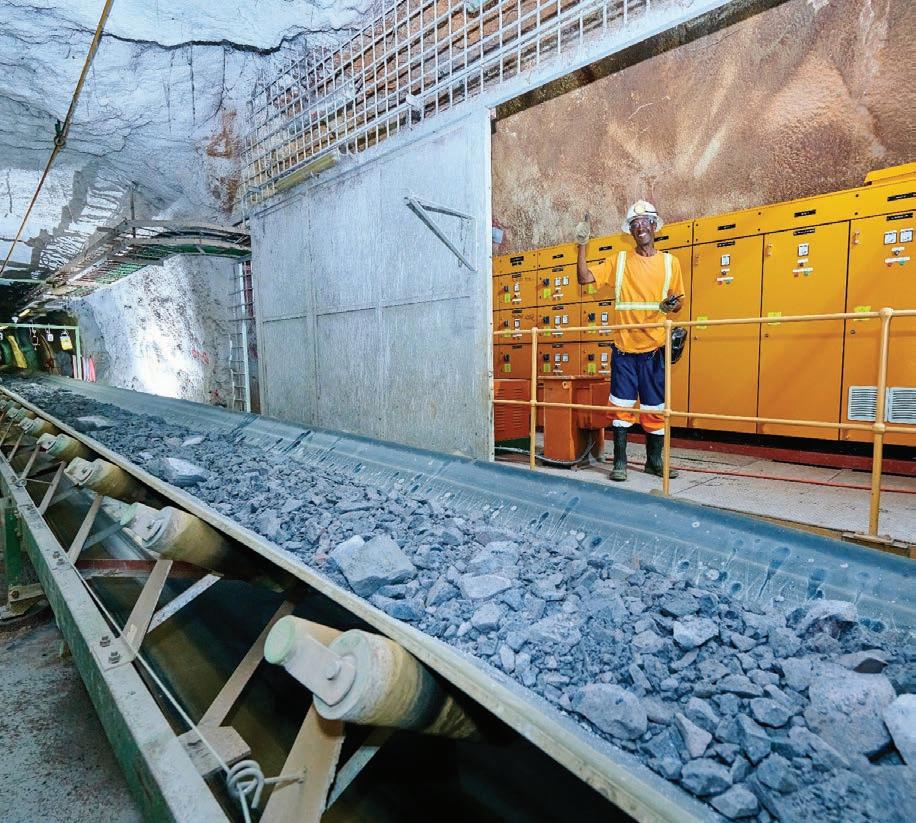
A conveyor belt carries ore at Ivanhoe Mines’ Kipushi zinc mine in the Democratic Republic of Congo. IVANHOE MINES
Teck’s Highland Valley Copper project in south-central British Columbia. TECK RESOURCES
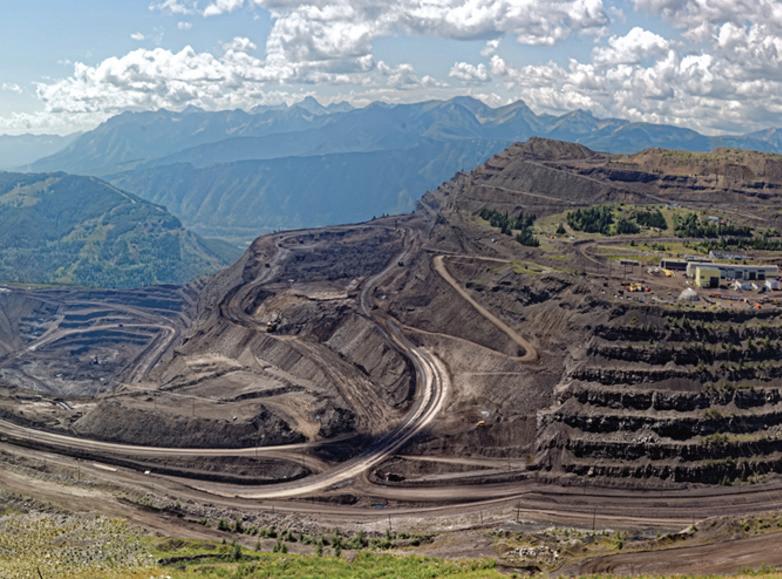
Teck’s Elkview steelmaking coal operations in B.C. TECK RESOURCES
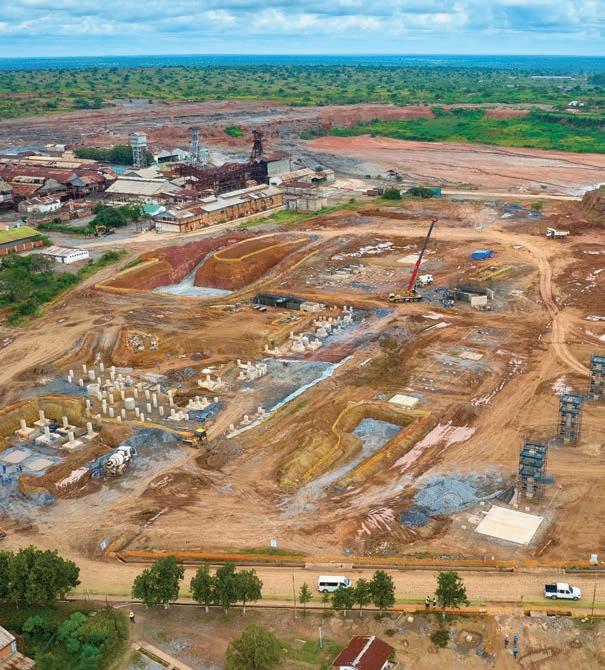
Ivanhoe Mines’ Kipushi zinc mine in the DRC. IVANHOE MINES
Aclara Resources says revamped EIA for rare earths project reduces impacts
CHILE | Feasibility for Penco Module slated for 2024
BY BLAIR MCBRIDE
Aclara Resources’ (TSX: ARA) Environmental Impact Assessment (EIA) submission for its Penco Module rare earths project has been admitted by the Chilean Environmental Assessment Service following a preliminary review, as the company targets a feasibility study for 2024.
The new assessment document makes several improvements on the previous filing that Aclara withdrew in March of last year after it was unable to satisfy requirements related to the environment and local flora and fauna, the company said in a release on Apr. 28.
“Today we feel proud, not only because we have addressed these technical aspects through a rigorous scientific investigation, but because the new EIA now includes world class environmental attributes that enhance the value proposition of the new project,” said Aclara CEO Ramón Barúa. “In doing so, we have strengthened our relationship with the host community by demonstrating that we want to co-develop the project, that we have listened to their concerns and that we are now presenting a new project that is stronger and better in all aspects.”
The Penco Module project hosts heavy rare earth elements in ionic clay deposits across a 6-sq.-km property located near the coastal city of Concepcion and about 500 km south of Santiago.
Aclara said that starting last April, it launched several studies aimed at assessing how the project can avoid adversely affecting the local environment, particularly the Queule and Pitao native tree species.
The new EIA includes plans to use only recycled water for all of Penco’s water needs; the revegetation of more than 2 sq. km of land with native species that will be donated to a Chilean foundation for the benefit of local communities, construction of a reproduction centre for the Pudu deer and a recreational park for the Penco community.
Aclara added that the project’s extraction process won’t involve the use of explosives, crushing or milling and a fertilizer will be used as its main reagent, which will also be recycled with 99% efficiency. Penco won’t require a tailings storage facility as no solid or liquid residues will be produced. The new assessment also includes details of a prefeasibility engineering study of Penco.
Construction and production at Penco would create more than 2,000 direct and indirect jobs, Aclara says, with priority on hiring workers from the local region.
The Chile-based company expects the new EIA will be subject to an evaluation period of about 18 months.
Pensana taps major UK investor to fund rare earths project in Angola
RARE EARTHS | M&G backs electric vehicle metals refinery in UK
BY COLIN MCCLELLAND
London-based Pensana (LSE: PRE) is being backed by one of the United Kingdom’s largest asset managers and the Angolan sovereign wealth fund to build a rare earths refinery in England and a mine in the African country.
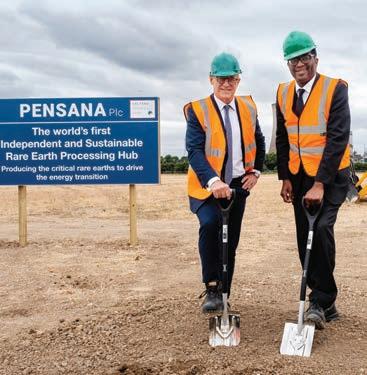
M&G Investment Management, which has £342 billion ($583 billion) under management, and the roughly US$3 billion Angolan fund (FSDEA) are investing a further US$10 million to increase their respective stakes in Pensana to 13% and 23%, the company said in a news release on April 29.
In March, Aclara said it had awarded a contract for the feasibility study to Chilean engineering firm Pares & Alvarez. The study is due out in the first half of 2024.
Aclara expects to begin construction of the plant in the second half of 2024.
Last October, the company posted an updated resource estimate for Penco, following its preliminary economic assessment (PEA) in 2021.
The PEA estimates initial and sustaining costs at Penco of US$148 million and operating costs of US$23.6 million over a 12-year mine life. Using a price assumption of US$96 per kg of rare earth oxide (REO), Penco’s after-tax net present value would be US$78 million based on a 5% discount rate, and its internal rate of return 23%, with a post-tax payback period of 4.7 years.
In terms of production, the PEA gives a base case of about 774 tonnes of REO per year, with peak production of 1,156 tonnes of REO in the third year, for 8,901 tonnes over the mine life.
Average EBITDA over the mine life is estimated at US$539 million.
Penco Module has measured and indicated resources of 27.5 million tonnes grading 380 parts per million (ppm) neodymium and praseodymium and 66 ppm dysprosium and terbium, with a combined rare earth oxide grade of 2,292 ppm for contained REO of about 63,000 tonnes. Inferred resources total 1.7 million tonnes grading 298 ppm neodymium and praseodymium and 71 ppm dysprosium and terbium, with a combined REO grade of 1,999 for contained REO of 34,000 tonnes.
Aclara shares traded at 45¢ apiece in Toronto at press, for a market cap of $74.2 million. The stock has traded in a 52-week window of 25¢ and 62¢. TNM
Pensana has started to build a US$195-million plant at Salt End in the port of Humber in northeast England that would be fed with ore from a US$305-million mine in the southwest African country more widely known for diamonds and oil than rare earths. The refinery would be one of only a handful of its kind outside China if it starts as planned in 2026.
“This additional investment reflects their confidence in our strategy and growth prospects, and we are grateful for their ongoing commitment,” Pensana chairman Paul Atherley said in the release. “The fact that M&G and FSDEA have also requested the right to participate in any future equity raises is a clear endorsement of our business.”
OPEC-member Angola is keen to diversify its oil-dominated economy while Pensana and M&G see opportunities in the surging market for metals in the green energy transition. Also, the U.K. is among Western countries investing billions to dislodge China from its domination of the critical minerals industry. Pensana has received funding from Britain’s £1 billion Automotive Transformation Fund.
The neodymium-praseodymium (NdPr) Pensana would mine in Angola is used to make magnets in electric vehicle motors. The company has a partnership with automaker Polestar, which is controlled by Volvo, itself now part of Geely owned by Chinese billionaire Li Shufu.
The new investment, split equally between the two investors, follows a US$4-million investment by M&G in December and £10 million a year earlier. The Angolan fund held 23% of Pensana in April 2021, but it wasn’t immediately clear how much it had invested or how its stake changed over the last two years to still show 23% now.
20-year mine
The project combining the open-pit mine and U.K. processing plant has a net present
value of US$2.2 billion at an 8% discount rate for an internal rate of return of 52%, according to a company report in October.
The life of mine is estimated at about 20 years, producing 1.5 million tonnes of ore annually and 40,000 tonnes of mixed rare earth sulphides (MRES) a year for the Saltend refinery. Its output is forecast at 12,500 tonnes a year of total rare earth oxides (TREO) including 5,000 tonnes of NdPr.
Angola, the fourth-largest diamond producer by value, would host the proposed mine at Longonjo, some 275 km inland from the port of Lobito. The site is 5 km from a main road and the historic Benguela railway running from the Atlantic to Zambia that China refurbished for billions of dollars in oil-backed loans about six years ago.
Operating costs at Longonjo would be US$127 million a year or US$3,943 per tonne of MRES. Saltend would cost US$59 million a year or US$6.40 per kg of TREO and US$17 per kg of NdPr to run.
The 31-sq.-km proposed mine site has proven and probable reserves of 30.1 million tonnes grading 0.6% NdPr and 2.6% TREO for 166,000 tonnes contained NdPr and 747,000 tonnes contained TREO, according to a Sept. 2022 estimate done according to the Australian mining code.
A hydro-electric power line and the provincial capital of Huambo, once a staging ground for rebels in the country’s decadeslong civil war that ended in 2002, lie 50 km to the east.
Shares in Pensana gained a third of their value on Apr. 29 to close at 32.9 pence before easing to 29.6 pence closer to press time, valuing the company at £76 million. The stock has traded within a 52-week price range of 21.8 pence to 86.9 pence. TNM
ASX-listed Peak Rare Earths lands US$18M for Ngualla project in Tanzania
CRITICAL MINERALS | Development decision for US$321M project to come in September
BY CECILIA JAMASMIE
Australian junior Peak Rare Earths (ASX: PEK) it has locked A$27.5 million (US$18 million) in funding from high net worth and offshore institutional investors to advance its Ngualla project in Tanzania.
The company said on May 1 about 55 million new shares would be offered at a price of A50¢ each, in a two-tranche institutional placement.
The first tranche of the placement raising A$14.3 million, was slated for May 5.
Peak’s largest shareholder, Shenghe Resources, committed to
increase its shareholding to 19.9% from 19.8% via the placement. Given Shenghe currently holds more than 10% of the company’s issued share capital and has a nominee director on the Peak board, its participation will be in tranche two and subject to shareholder approval.
The placement marks another step towards the development of the Ngualla rare earths project and follows the signing of a binding framework agreement with the government of Tanzania last month, after a five-year wait. The company expects to make an investment decision on the project by the end of September.
A recently updated feasibil-
ity study estimates that Ngualla requires a capital investment of US$321 million to produce 16,200 tonnes of concentrates per year to be sold to third party processors. The mine’s productive life has been pegged at 24 years with annual operating costs at US$93 million a year or US$5.8 per kg of total rare earth oxides. The project contains proven and probable reserves of 18.5 million tonnes grading 4.8% rare earth oxides (REO) for 887,000 REO. The reserves are dominated by cerium (45%) and lanthanum (30%), with higher value neodymium and praseodymium making up 22% and heavy rare earths 3%.
Peak shares traded at A53¢
apiece at press time in Sydney, in a 52-week window of A29¢ and A74¢, valuing the company at A$115.6 million.
Breaking away from China
Rare earths, a group of 17 elements, and other critical minerals including lithium, copper, cobalt and nickel are used in the manufacturing of a range of products crucial for national security and the fight against climate change, including solar panels, electric vehicles and consumer electronics.
China is not only the world’s largest rare earths producer but also the main consumer.
Its market is opaque, with sup-
ply determined by government production quotas and internal dynamics characterized by frequent mismatches with demand.
There is also the lingering threat that China could weaponize its rare earths supply if relations with the West deteriorate.
It did so in 2010 by cutting off exports to Japan in a dispute over the status of islands in the East China Sea called Senkaku by the Japanese and Diaoyu by the Chinese.
Western companies have since been trying to reduce their dependence on Chinese rare earths, with both miners and governments looking for deposits to develop elsewhere. TNM
GLOBAL MINING NEWS THE NORTHERN MINER / MAY 15 — 28, 2023 9
Pensana kicks off construction of its rare earths refinery at Salt End, in England. PENSANA
Aclara Resources’ Penco Module rare earths project in central Chile. ACLARA RESOURCES
NexGen, Fission power ahead at Rook I, PLS uranium projects in Saskatchewan
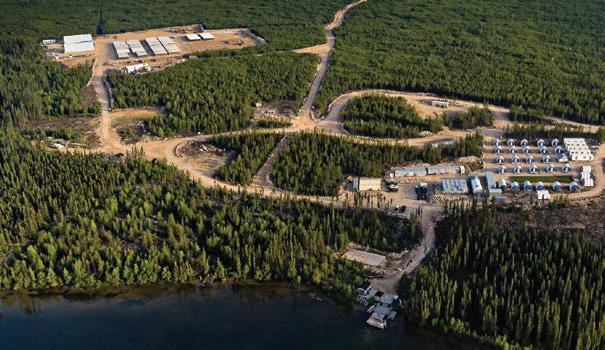
DEVELOPMENT | Rising U3O8 spot prices add to industry tailwinds
BY BLAIR MCBRIDE
Two uranium projects in Saskatchewan’s Athabasca basin moved closer to construction at the start of May, with NexGen Energy (TSX: NXE; NYSE: NXE; ASX: NXG) reporting strong interest from lenders in funding its $1.3-billion project and Fission Uranium (TSX: FCU; US-OTC: FCUUF) submitting an application for construction of a new mine and mill only 3 km away.
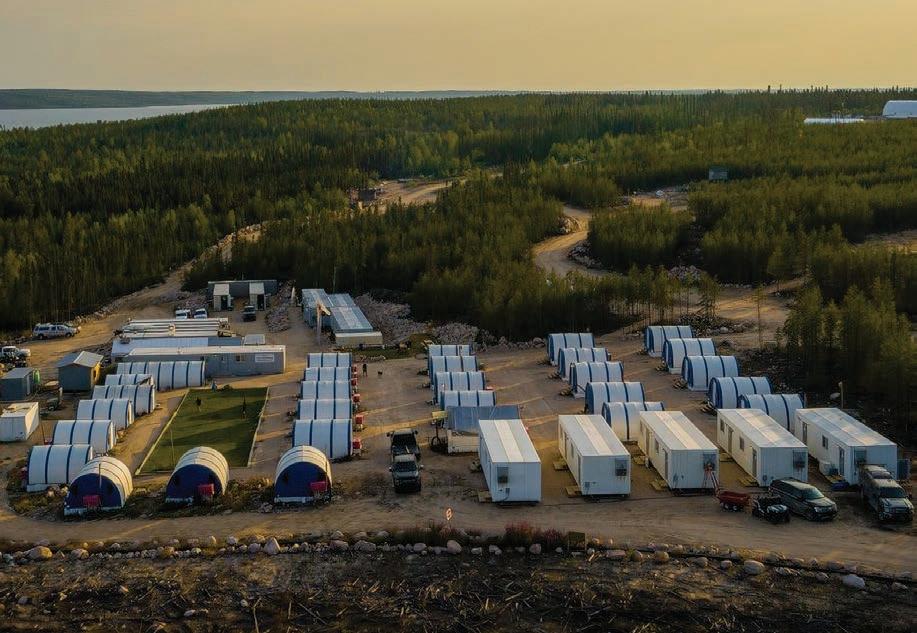
On May 1, NexGen said financial institutions have expressed interest in lending it more than US$1 billion to build its Rook I uranium project. The non-binding expressions of interest from unnamed commercial lenders and export credit agencies are in the form of available debt for Rook I, subject to financing terms and conditions, due diligence and documentation.
The company expects to finalize financing in the fourth quarter.
Its feasibility-stage Rook I underground project hosts the high-grade Arrow deposit and sits on the southwestern edge of the Athabasca basin.
“Strong interest from lenders and other financing parties for the development of Rook I demonstrates NexGen’s delivery of a sustainable, clean energy legacy that will benefit our valued stakeholders and all of Canada,” said CEO Leigh Curyer, in the release. “The receipt of these expressions of interest are a clear de-risking step demonstrating lender confidence in the economics of the Rook I project, the uranium market fundamentals incorporating the project and the elite ESG manner NexGen is delivering in the development of the project.”
NexGen says the financing talks are in line with its 2023 project development schedule, which includes the start of early construction works at Rook in the first half of the year, and the completion of front-end engineering design, detailed engineering, and final licencing by the third quarter. Production is targeted to start in 2027.
less than half that peak, but growing steelmaking in India will help buoy demand longer term, with coking coal accounting for most of the country’s 40% increase in coal imports by 2050, the International Energy Agency says.
Coking coal isn’t easily replaced in steelmaking, although 31% of plants use electric furnaces, according to Los Angeles-based Clean Energy Monitor. Even with widespread calls to cut coal use to fight climate change, global coking coal output is forecast to fall only 9% to 936 million tonnes by 2030 if countries follow current policies, the IEA says. Wind turbine farms and electric vehicle motors all require steel.
Austin is keen for a large partner with the heft and the $1 billion or so to develop the projects instead of Colonial trying to be an operator and diluting the company’s shares to raise the capital, like he did co-founding Western Canadian Coal more than a decade ago.
“When we got bought out, I owned less than half of 1% of the company, and I started it,” he said. “After all that work and I’d have been better off if I hadn’t done that, been better off just to sell in the
The Vancouver-based company also plans 22,500 metres of drilling with three rigs planned for this year, to follow up on positive drilling results from 2022.
Rook hosts probable mineral reserves of 4.5 million tonnes grading 2.37% U3O8, for 239.6 million lb. of contained U3O8, according to a feasibility study published in 2021.
The project would produce 29
beginning and not take it into production. So I did learn a lesson.”
Shares in Colonial have gained nearly 30% this year, trading at $1.59 apiece near press time in Toronto, valuing the company at $282.8 million.
Environmental approvals
The projects would have to go through provincial environmental assessments, a process that in December denied Glencore’s Sukunka open-pit metallurgical coal project mainly due to the impact it would have on endangered Quintette caribou. Sukunka would have produced around 2 million tonnes a year.
Michael McPhie, CEO of Vancouver-based Fallkirk Environmental Consultants, with clients such as Ascot Resources’ (TSX: AOT; US-OTC: AOTVF) Premier gold project and Teck’s Elk Valley met coal mines, said the most important factor for provincial approvals is the project’s relationship with Indigenous groups. He said Colonial benefits from the province having invested billions in a rail-link from the area and in the port of Prince Rupert on the Pacific.
“That part of the province is no stranger to the coal business,” McPhie said. “The B.C. govern-
million lb. of U3O8 annually for the first five years over a 10.7-year mine life. Its capex is estimated at $1.3 billion, with operating costs of US$5.69 per lb., what NexGen calls “among the lowest in the industry.”
In a research note on May 1, Canaccord Genuity analyst Katie Lachapelle wrote that the capex would likely be higher now due to inflationary pressure.
And given the tier 1 quality of
ment has a pretty well-defined process and if you have relationships in place and you’re able to manage the environmental issues, there’s no reason why a project like this couldn’t be considered for sure.”
Nancy Olewiler, a professor in the School of Public Policy at Simon Fraser University in Vancouver, said developers of Colonial’s projects might have to be concerned about greenhouse gas emissions.
“Project proposals will go through rigorous environmental assessment in B.C.,” she said. “It will be incumbent on the company to provide a fulsome report on how the project aligns with B.C.’s sectoral climate targets and environmental policy requirements.”
Austin says most of the companies interested in Colonial aren’t overly concerned about environmental approvals and that he expects to be retained by any buyer to shepherd the projects through a process he’s done several times. And he knows the properties because he’s got a history with them.
Late night call
In 2010, a confidant pointed out an opportunity: despite millions of dollars spent by Teck and several Australian investors battling in court for ownership of met-coal assets in
company has a market capitalization of $2.4 billion.
CNSC application submitted Meanwhile, Fission Uranium confirmed that it has submitted an application to the Canadian Nuclear Safety Commission (CNSC) for a licence to build a uranium mine and mill facility at its Patterson Lake South (PLS) underground project.
In the release in late April, Fission said its environmental assessment for PLS continues on schedule with community engagement, baseline assessment reporting and data compilation.
“Our development path to production is progressing on schedule and, at the same time, the fundamentals for uranium continue to strengthen in line with the global reactor construction boom,” said Fission president and CEO Ross McElroy.
Fission also announced progress with its front-end engineering design for PLS, including the collection of data from 772.6 metres of drilling to confirm feasibility-level assessment, geophysical surveys and Hydrogeological holes to inform future underground mine planning.
Arrow, and its short projected payback period of less than 12 months, she wasn’t surprised lenders are interested in financing it. According to her model, 65% of project capex will be funded through debt. The finalizing of project permits and a formal financing agreement would be two “significant near-term potential catalysts” for NexGen.
The news from NexGen also comes as the uranium spot price sits at US$53.85 per lb. U3O8, up about 6% since Apr. 19 and the first significant move this year after it was stuck at around US$50 per lb. U3O8 in the first three months of 2023, Lachapelle noted. The current price is also the first move above US$53 per lb. since May 2022.
NexGen shares traded at $5.11 at press time in Toronto in a 52-week window of $4.43 and $6.82. The
northern B.C. after a major shareholder died suddenly, licences on the properties were about to expire in less than 24 hours. A call answered at 3 a.m. in Perth, Australia brought Austin the $100,000 or so he needed to acquire the properties.
Austin and his team built up one of the properties, Belcourt, over a decade as Western Canadian Coal and sold it to Walter Energy for $3.3 billion. Austin’s separate company, Northern Energy and Mining, held the Saxon property until it was sold to Anglo American (LSE: AAL) for about $485 million just weeks after the WCC deal.
Walter and Anglo ran the acquisitions as a joint venture. But again, the licences on the properties weren’t renewed and Austin was there to scoop them up.
“I said ‘You gotta be bloody kidding me. We just sold them,’” Austin recounted. “I ended up doing a deal with Anglo and with Walter Energy and I sold them back the majority of the licences. But when we finished doing the paperwork, there was a block of coal licences that neither of them had asked for, which is basically Huguenot.”
This time around there’s the potential for a buyer to also purchase Anglo American’s Peace River met coal properties next to
The 310.4-sq.-km PLS project hosts the high-grade Triple R deposit, which contains probable reserves of 3 million tonnes of uranium grading 1.41% U3O8 for 93.7 million lbs. of contained metal, according to the feasibility study for PLS that was published in January.
PLS would have an after-tax internal rate of return of 27.2% and an after-tax net-present value of $1.2 billion at an 8% discount, for average unit operating costs of less than US$10 per lb. of U3O8
The study estimates a three-year construction period for the project, starting in 2026, with production slated for 2029. Its mine life is 10 years.
At press time, Fission shares traded at 57¢, in a 52-week window of 54¢ and $1. It has a market cap of $408.6 million. TNM
Colonial. They have been for sale since January, Anglo spokesman James Wyatt-Tilby said by email. Combining them into a larger project might produce more than 10 million tonnes of met coal a year, Austin said.
After several coal deals in western Canada in recent years paid US$1.86 to US$3 per tonne in the ground, Austin figures he can rely on a base value of his properties of about US$2 per tonne for a total of US$1.4 billion.
The price of coking coal fell to about US$290 per tonne in April. Prices are expected to decline 10% this year as El Nino conditions improve Australia’s production and demand in China remains uncertain, S&P Global said last month. Austin says Chinese and Indian coal buyers tell him the price will be US$225 longer term. He notes the 2020 study estimated Huguenot would cost US$120 a tonne to start, which should be maybe US$130 now, and fall to US$90 a tonne after a few years.
“The people who buy us out more than probably are not going to take it out of the ground for the next three to four years,” Austin said. “But at US$225 a tonne coal price, even at startup you would make a lot of money.” TNM
10 MAY 15 — 28, 2023 / THE NORTHERN MINER WWW.NORTHERNMINER.COM
Above: NexGen Energy’s Rook I uranium project in Saskatchewan.
Left: Rook 1 hosts the Arrow deposit.
NEXGEN ENERGY
COAL from 1
Top 10 new precious metals development projects by mine life
RANKED | Mining Intelligence data reveals South Africa, Canada as PGM and gold hot spots
P
BY ALISHA HIYATE
That includes gold, which last year saw demand jump 18% to 4,741 tonnes, while supply only grew by 2%, according to the World Gold Council.
Silver demand reached a new high of 1.2 billion oz. last year and was driven largely by industrial uses and the jewelry sector, according to the Silver Institute.
Meanwhile, analysts forecast a shortfall in platinum of up to 900,000 oz. this year on rising automotive demand and unstable supply from major supplier South Africa as it deals with a worsening energy crisis.
Using data provided by Mining Intelligence (www.miningintelligence.com), we’ve compiled a list of the top 10 precious metals mines now in construction, ranked by mine life. The list includes a mixture of gold, PGM, and silver-dominant projects.
Three projects in South Africa top the list of long-life assets, with Sedibelo Resources’ P-S-M operation in North West province, on the Western Limb of the prolific Bushveld PGM Complex, sitting at No. 1. Boasting a 30-year mine life, according to a 2021 prefeasibility study, the project incorporates Sedibelo’s existing Pilanesberg open pit mine with planned development of a second pit as well as two underground deposits. The company is also building a 110,000-tonneper-year processing plant. Once the plant is ready in 2025, Sedibelo
recious metals, long treasured for their lustre, beauty, stability and value, have diverse applications ranging from industrial and automotive to jewelry and investing. Demand for key precious metals, encompassing gold, silver and platinum group metals (PGMs), has been on the rise.plans to refine its own concentrate using the environmentally friendly Kell hydrometallurgical process, rather than selling its concentrate to third parties for traditional smelting. The Kell process uses a fraction of the electricity of smelting — a big plus in South Africa, where severe power shortages have dampened mine output. Capital costs for P-S-M are estimated at ZAR 16.9 billion (US$920 million) with its after-tax NPV at ZAR 28.3 billion (US$1.6 billion), with expected annual production between 2030 and 2040 of 278,000 oz. of platinum, palladium, rhodium and gold. Sedibelo is planning an IPO on the New York Stock Exchange. The other projects in South Africa are the Platreef PGM mine in Limpopo province, 64%-owned by Ivanhoe Mines (TSX: IVN) subsidiary Ivanplats, and slated for first production next year. According to a 2022 feasibility study, the project will produce 522,000 oz. of platinum, palladium, rhodium and gold annually over its 29-year mine life. And third on the list is Blyvooruitzicht Gold Mining Co.’s Blyvoor gold mine in the Witwatersrand Basin. Blyvoor is expanding the processing plant to 2,500 tonnes per day from 1,300 tonnes per day at the historic mine, which first began production in 1942. The
company acquired the project in 2015.
At No 4. is Artemis Gold’s (TSXV: ARTG) Blackwater open pit mine in B.C., the first of four Canadian entries on the list —
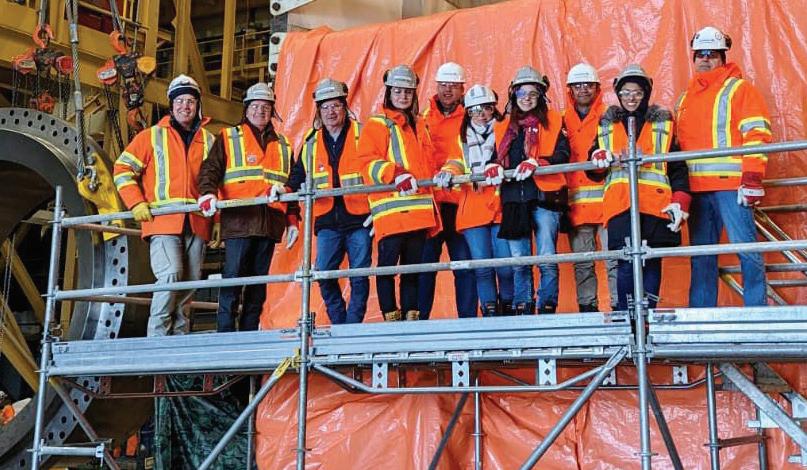
Above: Ivanhoe Mines’ Platreef project in South Africa in 2022. IVANHOE MINES
all gold mines. The project with a 22-year mine life is expected to produce 321,000 oz. annually over its first five years, with several more expansions that will see peak production of 438,000 oz. gold per year during years 11-17.
In spot No. 5 is Fresnillo (LSE: FRES) and MAG Silver’s (TSX: MAG) high-grade, silver-dominant Juanicipio underground mine in Mexico. Underground mine production began in the second half of 2020, however the connection of the processing plant to the power grid was only completed late last year, following delays in regulatory approvals. The plant, which
NATURAL RESOURCES
made its first shipment of concentrate in March, is now being commissioned. It’s expected to reach its 4,000-tonne-per-day capacity in the third quarter. Fresnillo reports proven and probable reserves at Juanicipio of 16.3 million tonnes grading 1.53 grams gold per tonne, 284 grams silver, 2.38% lead and 4.27% zinc.
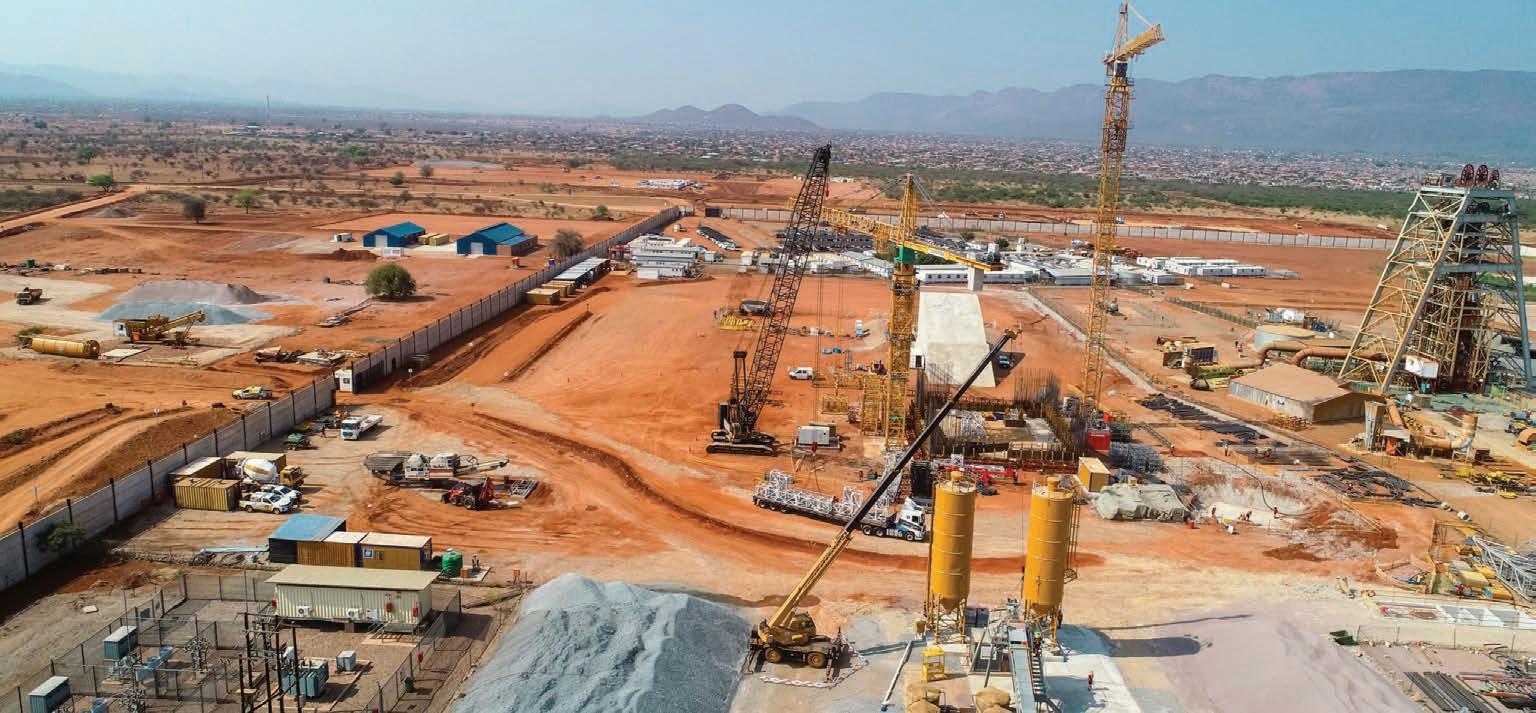
In the No. 6 spot, West African Resources’ (ASX: WAF) Kiaka gold project, acquired from B2Gold (TSX: BTO; NYSE-AM: BTG) in 2021. The project, in Burkina Faso, is on track for first production in
See PRECIOUS METALS / 12
VISITUS
PDAC2023!
Delivering fit-for-purpose solutions across the entire mining life cycle

Our fit-for-purpose solutions encompass the skills of qualified geologists, geostaticians, analytical chemists, mineralogists, metallurgists, process engineers and mining engineers brought together to provide accurate and timely mineral and process evaluation services across the entire mining life cycle.

SGS IS THE WORLD’S LEADING INSPECTION, VERIFICATION, TESTING AND CERTIFICATION COMPANY WWW.SGS.COM/NATURALRESOURCES NAM.NATURALRESOURCES@SGS.COM
Trusted. Independent. Committed. DURINGATBOOTH102
SPECIAL FOCUS SITTINAN/ADOBE IMAGES
TOP 10 DEVELOPMENT PROJECTS
Left: A site visit to Iamgold’s Côté gold project in early 2023. IAMGOLD
PRECIOUS METALS from / 11 2025 and will average 219,000 oz. gold annually over 18.5 years.
Iamgold’s (TSX: IMG; NYSE: IAG) 70% owned Coté and Argonaut Gold’s Magino are next on the list, with respective mine lives of 18 and 17 years. With first production expected next year, Coté is forecast to produce an average of 365,000 oz. gold per year, while the first gold pour at Magino is on track for mid-May with production averaging 117,100 oz. per year.
Aura Minerals’ (TSX: ORA) Almas gold project in Brazil, slated at No. 9, marks the first appear-
ance of a South American project on the list. However, with production forecast at only around 35,000 oz. gold per year over its 17-year mine life, it’s much smaller scale than the rest.
And back in Canada, B2Gold’s recently acquired Goose project in Nunavut rounds out the top 10. The high-grade gold project — B2Gold’s first project in Canada, acquired through a $1.2billion all-share takeover of Sabina Gold & Silver that closed in April — is forecast to begin production in 2025. The project is expected to produce an average of 223,000 oz. gold annually over 15 years. TNM
BY COLIN MCCLELLAND
Demand for copper, an economic indicator in itself because of its widespread use in wiring and plumbing, is expected to vastly expand as the world transitions to greener energy to fight climate change. Miners are scrambling to develop projects.
Annual global supply of the red metal may surge 26% to 38.5 million tonnes by 2035 while still falling 1.7% short of demand, according to data released in April by the International Copper Association, an industry trade group.
The world’s leading copper projects by mine life, according to data compiled by Mining Intelligence, part of The Northern Miner Group, are led by two in the Far East. The third is in Chile. There are none in North America, Africa has four and unlikely Greece makes an appearance.
The Zabaikalye region of Rus-
sia, which holds the Udokan copper project, borders on Mongolia where Rio Tinto (NYSE: RIO; LSE: RIO; ASX: RIO) leads the Oyu Tolgoi project.
Udokan Copper, part of the diversified USM Group owned by Russian billionaire Alisher Usmanov, has the country’s largest non-producing copper deposit. But that should change within months if not weeks as the project tests machinery ahead of first production. According to Udokan’s website, the development dwarfs others on the list with its potential mine life of 70 years and a resource value of US$178.6 billion, more than the other nine combined. (No economic studies have been released.)
The US$2.8-billion project holds 26.7 million tonnes of copper in ore grading 1.1% copper, according to a resource estimate following Australia’s JORC mining code. From 12 million tonnes of ore a year it plans to produce 135,000 tonnes
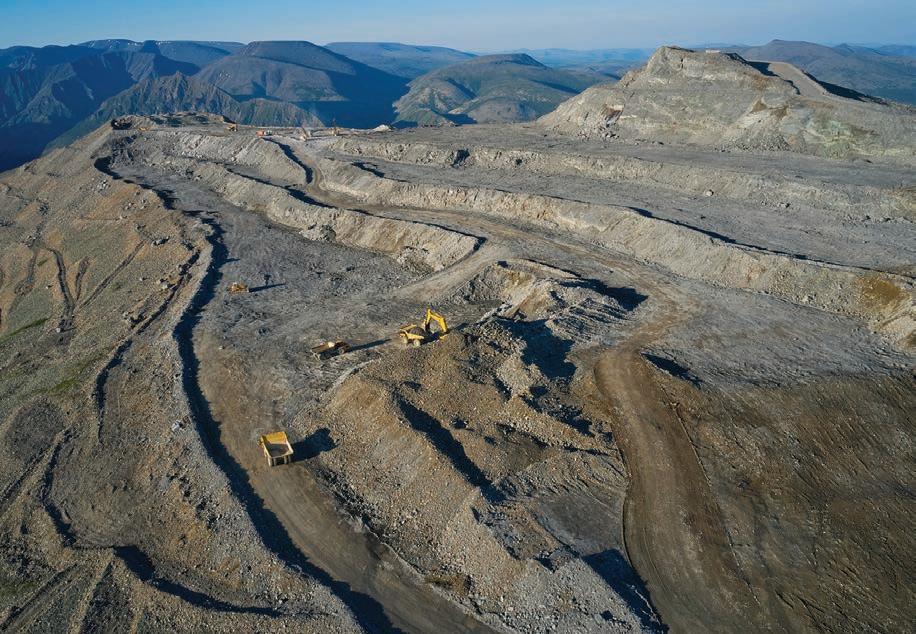
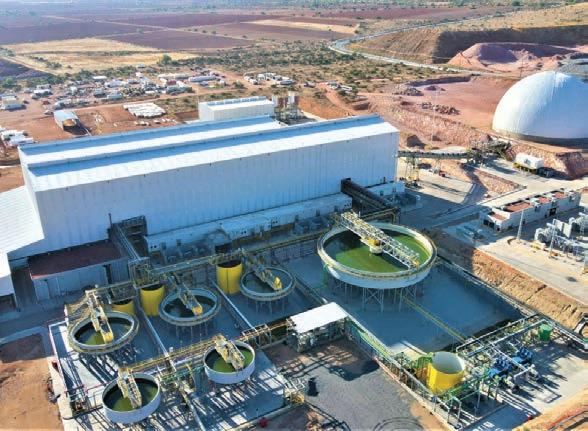
of 99.9% copper cathodes and 45% copper concentrate. It doesn’t say how much of each.
The deposit was discovered by geologist Elizaveta Burova in 1949 when Joseph Stalin still led the Soviet Union. Mines have been proposed for the site since the 1970s but only technological advances in recent years have propelled plans.
In second place, Rio Tinto’s US$7-billion Oyu Tolgoi project in the Gobi Desert started underground output in March. Annual production is expected to be around 500,000 tonnes of copper from 2028 to 2036. The open pit has been in production since 2011.
Teck Resources (TSX: TECK.A/ TECK.B; NYSE: TECK) started producing in March from its Quebrada Blanca 2 open-pit mine in northern Chile. Output is slated at 316,000 tonnes a year of copper in the mine’s first five years. Japan’s
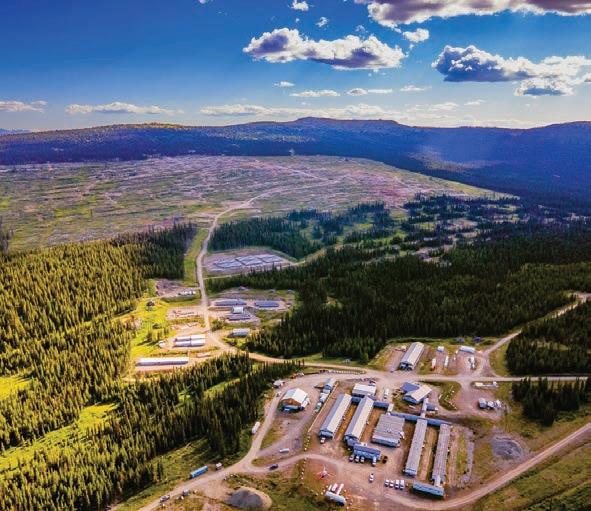
TOP 10 PRECIOUS METALS MINES UNDER CONSTRUCTION
Ranked by mine life
*Updated figure
12 MAY 15 — 28, 2023 / THE NORTHERN MINER WWW.NORTHERNMINER.COM SPECIAL FOCUS TOP 10 DEVELOPMENT PROJECTS
Far East, Africa
the list See SNAPSHOT / 16
Top 10 new copper projects by mine life RANKED |
and Greece make
PRIMARY LOM TYPE YEAR OF AFTER TAX TOTAL CAPEX PROPERTY OWNERSHIP WORK TYPE COUNTRY STATUS COMMODITIES (YEARS) OF STUDY STUDY NPV (US$) (US$M) 1 Sedibelo (P-S-M) Sedibelo Resources UG South Africa Construction Platinum 30 Pre-Feasibility 2021 1,546 918 2 Platreef Ivanhoe Mines (64%) UG South Africa Construction Palladium 29 Feasibility 2022 1,690 2,902 3 Blyvoor Blyvoor Gold UG South Africa Commissioning Gold 25 Pre-Feasibility 2021 824 181 4 Blackwater Artemis Gold Open-Pit Canada Construction Gold 22 Feasibility 2021 1,590 2,381 5 Juanicipio Fresnillo (56%)/ UG Mexico Construction Silver 21 PEA 2018 1,138 840 MAG Silver (44%) 6 Kiaka West African Open-Pit/UG Burkina Faso Construction Gold 19 Feasibility 2022 856 472 Resources (90%) 7 Cote — Gosselin Iamgold (70%)/ Open-Pit Canada Construction Gold 18 Feasibility 2022 1,109 2,965 Sumitomo (30%)
Magino Argonaut Gold Open-Pit/UG Canada Construction Gold 17 Feasibility 2017 288 730* 9 Almas Aura Minerals Open-Pit Brazil Construction Gold 16 Feasibility 2020 183 107
Back River B2 Gold Open-Pit/UG Canada Construction Gold 15 Feasibility 2021 832 760
8
10
Artemis Gold’s Blackwater project in B.C. ARTEMIS GOLD
MAG Silver’s 44%-owned Juanicipio project in Mexico. MAG SILVER
Udokan Copper’s namesake site in the Zabaikalye region of Far Eastern Russia. UDOKAN COPPER
See COPPER / 14
DEEPLY INVESTED IN MINING.



GLOBAL MINING NEWS THE NORTHERN MINER / MAY 15 — 28, 2023 13 SPECIAL FOCUS TOP 10 DEVELOPMENT PROJECTS
Sumitomo owns 30% of the project.
QB2 as it’s known, will double the company’s copper output. It incorporates many autonomous systems, which will include its entire fleet of haul trucks within five years. The mine will be controlled by a remote operations centre 1,700 km away in Santiago.
The project, estimated to cost as much as US$7.8 billion, includes the mine, located 4,400 metres above sea level, a concentrator, a desalination plant for water used in the concentrator, a pipeline for the concentrate and a new port on the Atlantic.
QB2 holds 1.4 billion proven and probable tonnes grading 0.5% copper and 0.2% molybdenum. There are also 3.6 billion measured and indicated tonnes, and 3.1 billion
inferred tonnes. Over a 27-year life, the mine would use only 18% of the proven and probable reserves, the company said.
Eldorado Gold (TSX: ELD, NYSE: EGO) marks the midway point on our top 10 list with its Skouries gold-copper project in northern Greece.
Local opposition and delays obtaining permits for the proposed open-pit and underground mine halted development from 2017 to 2021. But in April, Eldorado secured €680 million ($1.1 billion) to help complete the project. It has reserves of 3.7 million oz. of gold and 1.7 billion lb. of copper and aims to produce 140,000 oz. of gold and 67 million lb. of copper a year for two decades.
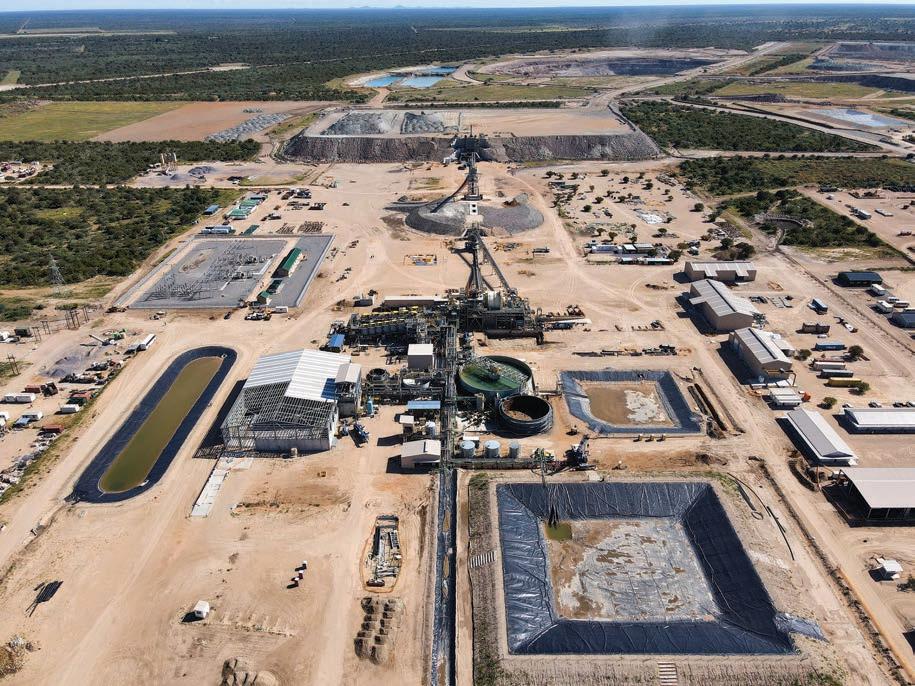
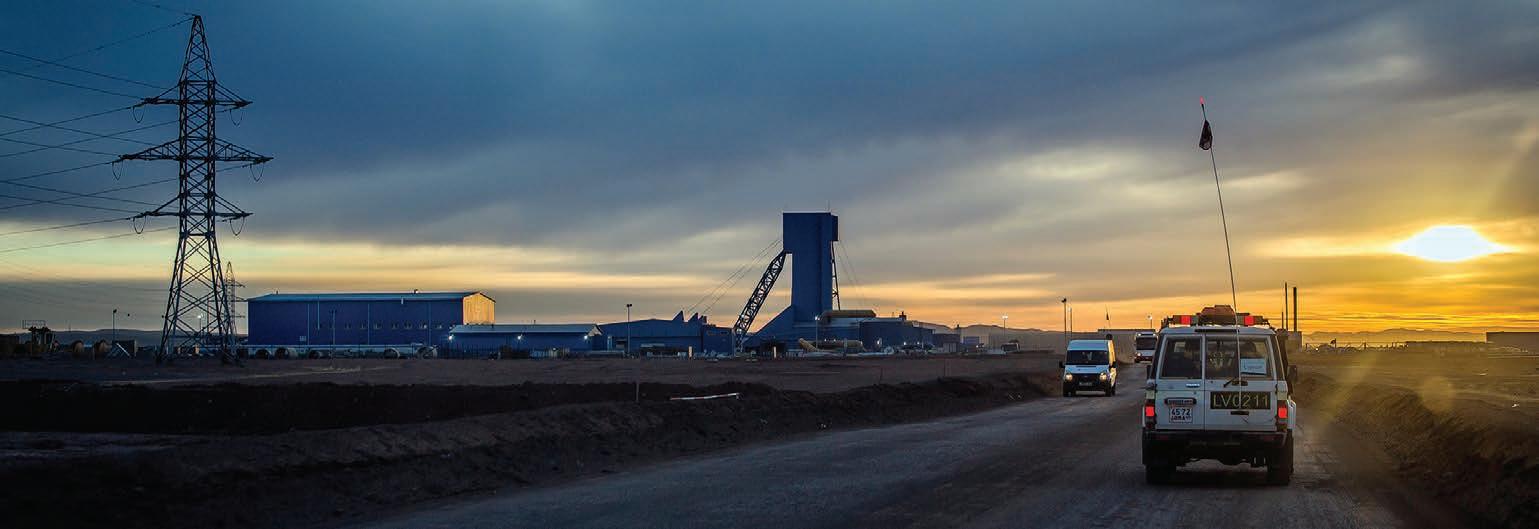
Asmara, being developed by China’s Sichuan Road and Bridge Group in Eritrea leads the four
projects in Africa on the list followed by Ivanhoe Mines’ (TSX: IVN; US-OTC: IVPAF) Kipushi in the Democratic Republic of Congo, Al Hadeetha by Alara Resources (ASX: AUG) in Oman and Motheo by Sandfire Resources (ASX: SFR) in Botswana. Information is scarce about the
Asmara project in Eritrea, a country run for the last 30 years by President Isaias Afwerki. The project forecasts total revenue of US$5.5 billion, China-run website Equal Ocean reported two years ago. The income estimate was based on a copper price of about US$9,400 per tonne, gold at US$1,780 per oz. and
TOP 10 COPPER MINES UNDER CONSTRUCTION Ranked by mine life
silver at US$25.78 per ounce. The open-pit project about 20 km from the capital sharing the same name would produce 65 million lb. copper, 184 million lb. zinc, 42,000 oz. gold and 1 million oz. silver during its first eight years, according to a 2013 feasibility study. TNM
*First production achieved in March 2023
14 MAY 15 — 28, 2023 / THE NORTHERN MINER WWW.NORTHERNMINER.COM SPECIAL FOCUS TOP 10 DEVELOPMENT PROJECTS COPPER from / 12 See SNAPSHOT / 16
PRIMARY LOM TYPE YEAR OF AFTER TAX TOTAL CAPEX PROPERTY OWNERSHIP WORK TYPE COUNTRY STATUS COMMODITIES (YEARS) OF STUDY STUDY NPV (US$) (US$M) 1 Udokan Udokan Copper Open-Pit Russia Commissioning Copper 70 No study N/A N/A N/A (company website) 2 Oyu Tolgoi JV Rio Tinto UG Mongolia Production* Copper 30 Feasibility 2021 131 55 3 Quebrada Blanca Teck Resources Open-Pit Chile Production* Copper 25 Feasibility 2017 1,253 4,714 (Phase 2) 4 West Musgrave — BHP Open-Pit Australia Construction Copper, Nickel 21 Feasibility 2022 1,010-1,490 1,307 Nebo-Babel 5 Skouries Eldorado Gold Open-Pit/UG Greece Construction Copper, Gold 20 Feasibility 2022 1,300 1,890 6 Asmara Sichuan Road and Open-Pit/UG Eritrea Construction Copper 17 Feasibility 2013 428 666 Bridge Group (60%)/ ENAMCO (40%) 7 Kipushi Ivahnoe Mines Open-Pit/UG DRC Construction Copper, Zinc 14 Feasibility 2022 941 540 8 Boa Esperanza Ero Copper Open-Pit Brazil Construction Copper 12 Feasibility 2021 380 507 9 Al Hadeetha Alara Resources (51%) Open-Pit Oman Construction Copper 10 Feasibility 2021 N/A 60 10 Motheo Sandfire Resources Open-Pit Botswana Construction Copper 10 Feasibility 2022 339 499
Ivanhoe Mines’s Kipushi copper mine in the DRC. IVANHOE MINES
Rio Tinto’s Oyu Tolgoi copper mine in Mongolia. RIO TINTO
Sandfire Resources’ Motheo copper project in Botswana. SANDFIRE RESOURCES
Top new battery metals development projects by mine life
RANKED | Nickel, lithium and graphite projects on the list span Asia, Africa, Australia and the Americas
BY HENRY LAZENBY
With growing demand for battery metals including nickel, lithium and graphite, The Northern Miner has teamed up with our data provider Mining Intelligence to rank the top battery metals projects under construction globally, based on expected mine life.
Nickel
Starting with nickel, Horizonte
Minerals’ (TSX: HZM; AIM: HZM)
Araguaia project in northern Brazil boasts a mine life of 28 years, according to a late 2018 feasibility study. The US$586-million mine is nearing completion, with a production start scheduled for the first quarter of 2024. Araguaia is set to produce cobalt and iron ore as byproducts, which helps boost the open-pit operation’s after-tax net present value (NPV) to US$401 million. Araguaia, which Horizonte bought from Glencore (LSE: GLEN) in 2015, will initially generate 14,500 tonnes of nickel a year, mainly destined to supply the stainless steel market. Output is expected to jump to 29,000 tonnes a year after a second production line comes
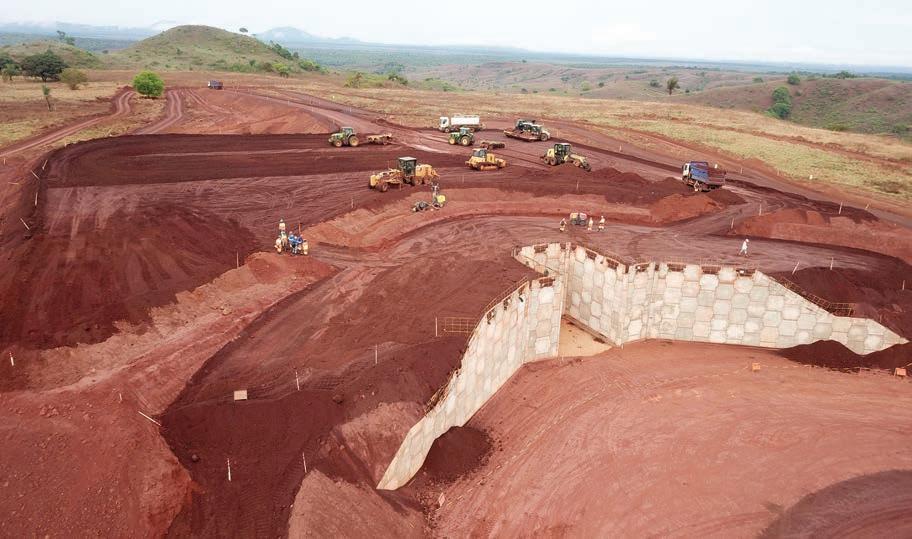
online in 2027.
The second longest-lived nickel project is West Musgrave in Australia, which was being advanced by Oz Minerals until the acquisition of the base metals miner
by BHP (NYSE: BHP; LSE: BHP; ASX: BHP) in April. The polymetallic project, which will also produce copper, gold, silver, palladium and platinum, has an expected mine life of 21 years. A Sept. 2022
TOP BATTERY METALS MINES
Ranked by mine life
feasibility study pinned preproduction capital costs at A$2 billion ($1.8 billion), and its after-tax NPV at between A$1.5 and A$2 billion. West Musgrave is estimated to produce about 35,000 tonnes of nickel
yearly in its first five years of production. The 13.5-million-tonnea-year open pit mine is expected to produce concentrate for C1 costs of between negative-US$1.10 per lb. and US50¢ per lb. payable nickel. The project includes the Nebo and Babel nickel-copper deposits and the Succoth copper deposit.
Indonesian nickel deposits rank high in terms of mine life despite tending to use more carbon-intensive extraction methods. Data on the deposit at Jakarta-based PT Merdeka Copper Gold’s 51%owned SCM-Sulawesi open pit mine is scarce, but it has one of the biggest nickel resources in the world at 1.1 billion dry metric tonnes at 1.22% nickel for 13.8 million tonnes of nickel, so we’ve placed it at third on the list.
Data is also sparse for two Vale (NYSE: VALE) JV nickel developments in Indonesia. MI ranks the Pomalaa-PTVI and Bahodopi-Morowali projects, which respectively began construction last year and in February, tied at number four. Vale expects Pomalaa to produce 120,000 tonnes of nickel and 15,000 tonnes of cobalt annually contained
See BATTERY METALS / 16
UNDER CONSTRUCTION
GLOBAL MINING NEWS THE NORTHERN MINER / MAY 15 — 28, 2023 15 SPECIAL FOCUS TOP 10 DEVELOPMENT PROJECTS
See SNAPSHOT / 16
Horizonte Minerals’ Araguaia nickel project in northern Brazil. HORIZONTE MINERALS
NICKEL LITHIUM GRAPHITE TYPE YEAR OF AFTER TAX TOTAL CAPEX PROPERTY OWNERSHIP WORK TYPE COUNTRY STATUS LOM (YEARS) OF STUDY STUDY NPV (US$) (US$M) 1 Araguaia Horizonte Minerals Open-Pit Brazil Construction 28 Feasibility 2018 401 586 2 West Musgrave — BHP Open-Pit Australia Construction 21 Feasibility 2022 N/A 1,313 Nebo-Babel 3 SCM-Sulawesi PT Merdeka Copper Gold (51%) Open-Pit Indonesia Construction unknown, but one N/A N/A N/A N/A of world’s biggest Ni resources 3 Pomalaa — PTVI Vale (44%), Inalum (20%) Open-Pit Indonesia Construction unknown, N/A N/A N/A N/A and Sumitomo (15%) assume 15+ years 3 Bahodopi — Vale, Inalum and Sumitomo Open-Pit Indonesia Construction unknown, N/A N/A N/A N/A Morowali assume 15+ years 4 Cosmos/Odysseus IGO Ltd. Underground Australia Construction 10 Feasibility 2018 N/A 255 TYPE YEAR OF AFTER TAX TOTAL CAPEX PROPERTY OWNERSHIP WORK TYPE COUNTRY STATUS LOM (YEARS) OF STUDY STUDY NPV (US$) (US$M) 1 3Q-Tres Quebradas Zijin Mining Salar Argentina Construction 50 Feasibility 2021 1,129 527 2 Mount Holland-Earl SQM (50%)/Wesfarmers (50%) Open-Pit Australia Construction 47 Pre-Feasibility 2018 2,200 737 Grey Lithium 3 Cauchari-Olaroz Ganfeng Lithium (46.7%), Lithium Salar Argentina Construction 40 Feasibility 2019 1,330 565 Americas (44.8%) 3 Sal de Vida Allkem Salar Argentina Construction 40 Feasibility 2018 1,480 474 3 Thacker Pass Lithium Americas Open-Pit United States Construction 40 Feasibility 2023 5,727 5,507 TYPE YEAR OF AFTER TAX TOTAL CAPEX PROPERTY OWNERSHIP WORK TYPE COUNTRY STATUS LOM (YEARS) OF STUDY STUDY NPV (US$) (US$M) 1 Montepuez Tirupati Graphite Open-Pit Mozambique Construction 30 Feasibility 2017 146 126 2 Ancuabe Triton Minerals Open-Pit Mozambique Permitting 27 Feasibility 2017 298 90 3 Molo NextSource Materials Open-Pit Madagascar Commissioning 26 PEA 2022 593 201 4 Matawinie Nouveau Monde Graphite Open-Pit Canada Construction 25 Feasibility 2022 1,168 1,106 5 Lindi Jumbo Walkabout Resources Open-Pit Tanzania Construction 24 Feasibility 2019 197 29
in mixed hydrate precipitate products for EV batteries. MI places both projects as tied for third place in terms of mine life.
Australian nickel and lithium miner IGO (ASX: IGO) is next on the list with its Cosmos/Odysseus project in Australia. The A$381-million underground project has a 10-year mine life, according to a 2018 feasibility study.
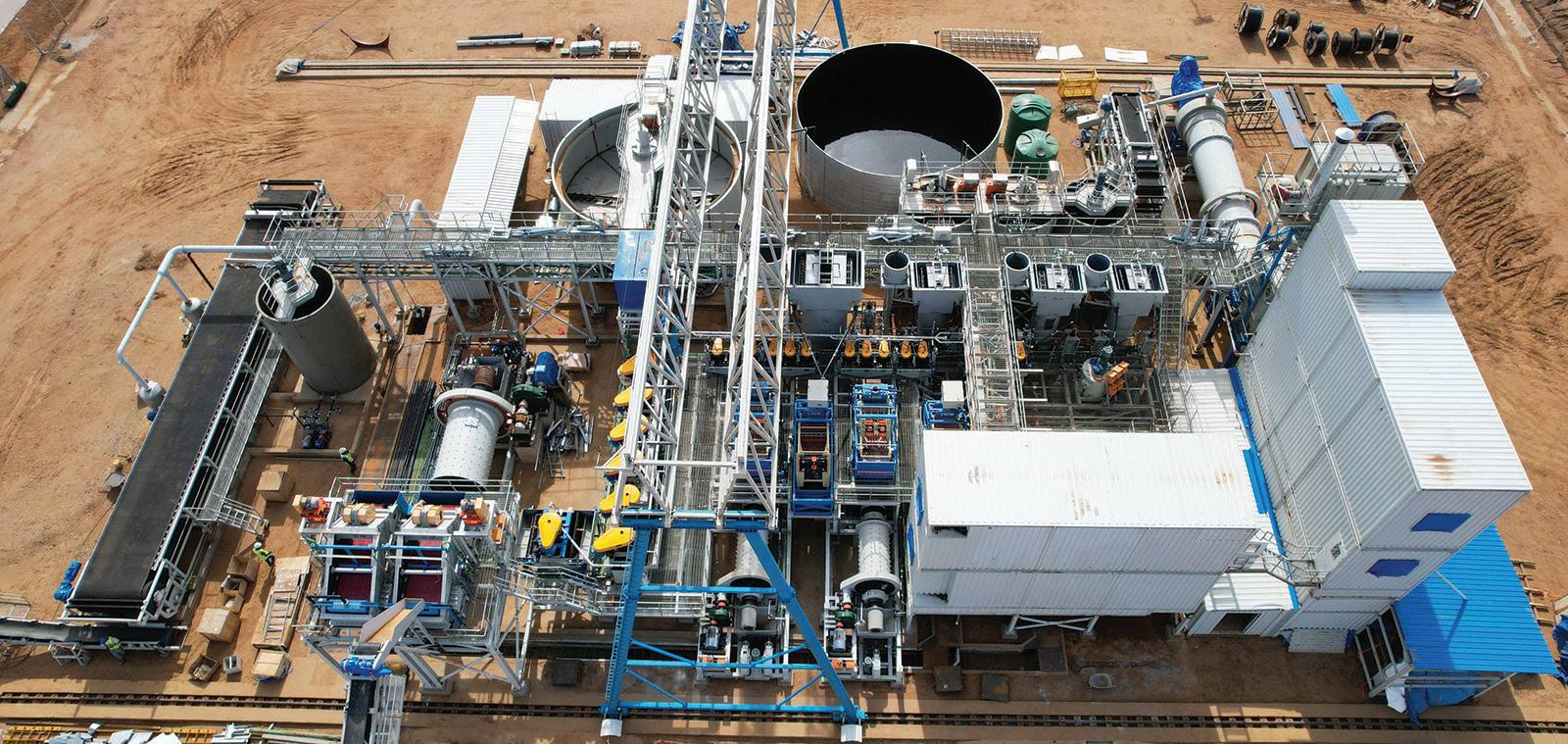
Lithium
When it comes to lithium, the longest-lived mine in construction belongs to China’s top miner, Zijin Mining: the 3Q-Tres Quebradas project in Argentina. An October 2021 feasibility study outlined a 50-year mine plan and calculated an after-tax NPV of US$1.1 billion for the salt flat (salar) based project, following a total capital outlay of US$527 million.
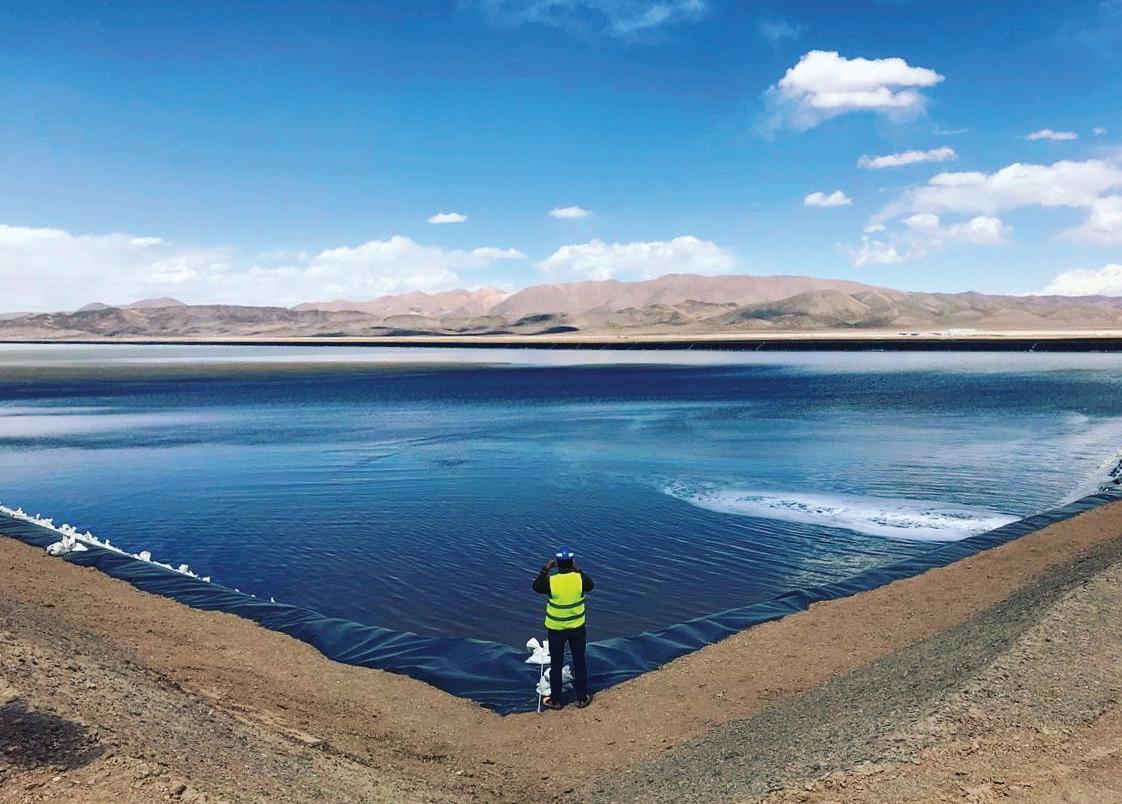
Next, SQM (NYSE: SQM) and Wesfarmers (ASX: WES) are building the Mt Holland-Earl Grey Lithium open pit project, with a mine plan stretching 47 years, in Australia. A 2018 prefeasibility study concluded that for capital investment of US$737 million, the JV partners could expect a post-tax NPV of US$2.2 billion.
Three projects are tied in the third spot, each with a 40-year mine life. They include the Argentina-based Cauchari-Olaroz salar project under development by Ganfeng Lithium (46.7%), Lithium Americas’ (TSX: LAC; NYSE: LAC) (44.8%) and JEMSE (8.5%); Sal de Vida, under development by Allkem (TSX:
AKE; ASX: AKE), and Thacker Pass being built by Lithium Americas in Nevada. A 2019 feasibility study calculated capital costs for Cauchari-Olaroz at US$565 million, and its post-tax NPV at US$1.3 billion. Sal de Vida costs are pegged at US$474 million to deliver an NPV of US$1.5 billion, according to a 2018 feasibility study, while Thacker Pass costs are estimated at US$5.5 billion for an NPV of US$5.7 billion.
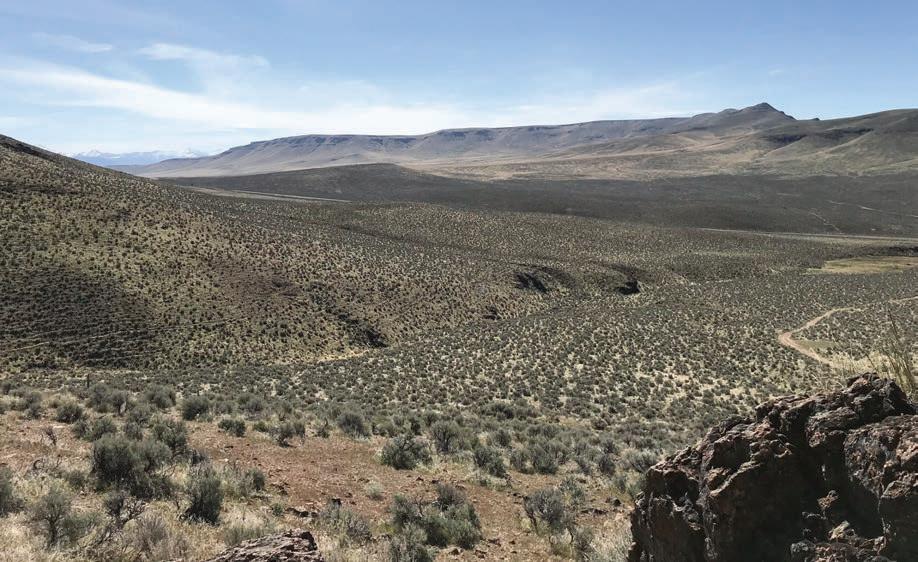
Graphite Africa leads the way in terms of
long-lived graphite developments. According to Mining Intelligence data, Tirupati Graphite’s (LSE: TGR) US$126-million Montepeuz project in Mozambique has the longest life spanning 30 years. Construction of the project under a previous owner stopped at the start of the pandemic, and on Apr. 3, Tirupati became the owner, with construction expected to restart soon. A 2017 feasibility study calculated a post-tax NPV of US$146 million. It is also likely to produce vanadium.
Ranking second is Triton Miner-
als’ (ASX: TON) Ancuabe project in Mozambique. While the company is still finalizing the construction schedule, the US$90-million project has an expected mine life of 27 years. A 2017 feasibility study calculated an NPV of US$298 million.
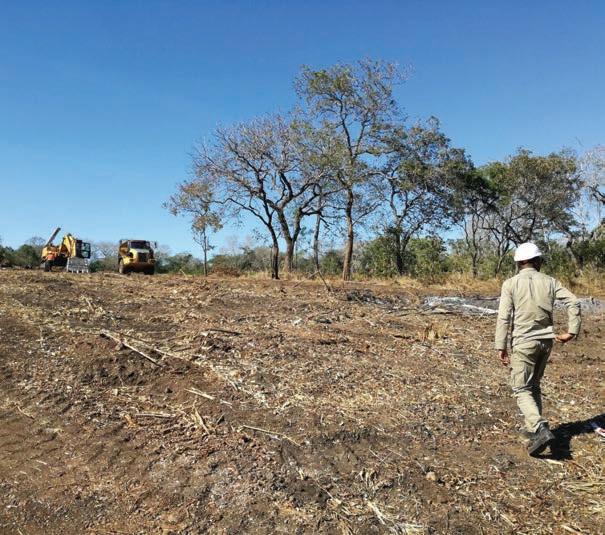
NextSource Materials (TSX: NEXT) has started commissioning its Molo graphite mine in Madagascar, which has an initial mine life of 26 years. The modular open pit project costs US$201 million, and a 2022 preliminary economic assessment calculated a post-tax
NPV of US$593 million.
Nouveau Monde Graphite (TSXV: NOU; NYSE: NMG) is building the $1.5-billion Matawinie open pit project in Quebec. A 2022 feasibility study calculated an NPV of $1.9 billion over a 25-year mine life.
Rounding out our list is Australia’s Walkabout Resources (ASX: WKT), which is building the Lindi Jumbo project in Tanzania. A 2019 feasibility study pinned the project cost at US$29 million and calculated an NPV of US$197 million. TNM
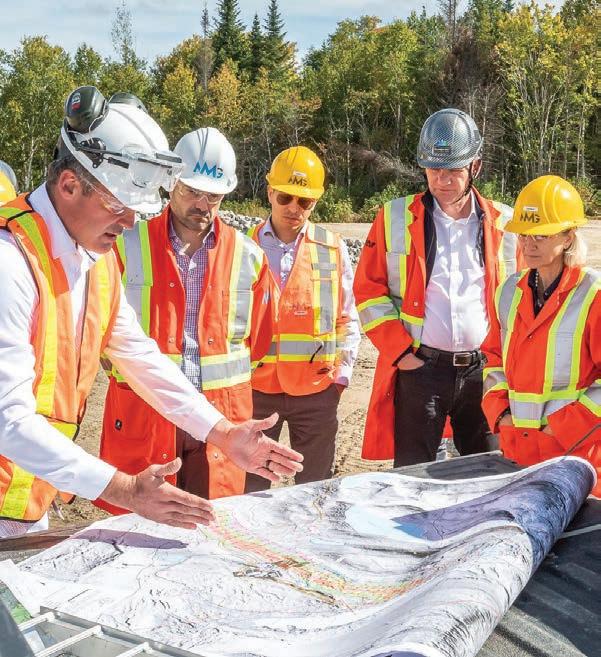
16 MAY 15 — 28, 2023 / THE NORTHERN MINER WWW.NORTHERNMINER.COM SPECIAL FOCUS TOP 10 DEVELOPMENT PROJECTS
Ganfeng Lithium and Lithium Americas’ Cauchari-Olaroz project in Argentina. LITHIUM AMERICAS
BATTERY METALS from / 15
Lithium Americas’ Thacker Pass project in Nevada. LITHIUM AMERICAS
At Nouveau Monde Graphite’s Matawinie project in Quebec. NOUVEAU MONDE GRAPHITE
Clearing the ground at Triton Minerals’ Ancuabe graphite project in Mozambique. TRITON MINERALS
NextSource Materials’s Molo graphite mine in Madagascar. NEXTSOURCE MATERIALS



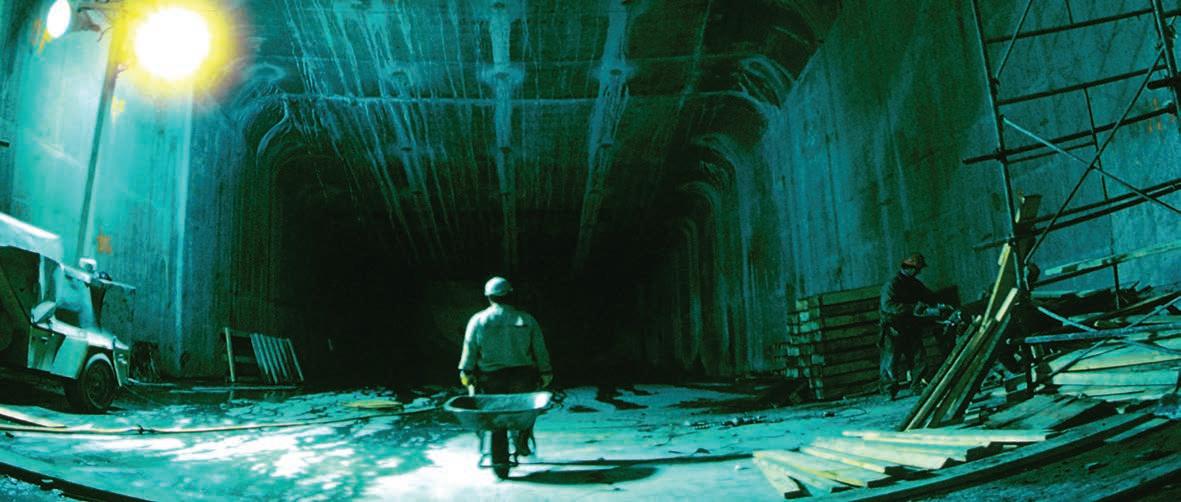





GLOBAL MINING NEWS THE NORTHERN MINER / MAY 15 — 28, 2023 17 CONCRETE SOLUTIONS Shotcrete - Concrete Paste Backfill www.sika.com/mining Offering the industry leading precision, absolute accuracy and sensitivity for Optically Pumped Potassium, Overhauser and Proton Precession Magnetometers/Gradiometers with new add-on or standalone VLF-EM systems for resistivity depth sections. UAV - Airborne – Ground Solutions Visit the website or call for a QUOTE today Highest Precision Magnetometers in the World • info@gemsystems.ca • Tel: +1.905.752.2202 • +1.888.635.1829 www.gemsystems.ca Leading the World of Magnetics since 1980 DRONEMag™ INSTRUMENTATION GEOPHYSICS MAKE Mining Basic the of the Now Available in Spanish PROFESSIONAL DIRECTORY MAKE SENSE OF THE MINING INDUSTRY Mining Explained is a 164-page reference manual (written in layman’s language) that includes the following chapters: Basic Geology • Ore Deposits • High-Tech Prospecting Sampling & Drilling • Mining Methods • Processing Ore • Mining & the Environment • The Mining Team • The Business of Mining • Feasibility: Does it Pay? • Metal Markets • Making Sense of the Numbers • Investing in Mining • Glossary of Mining Terms Call 1-888-502-3456 or email info@northernminer.com Order Your Copy Today! Spanish WEEKLY REPORT Email Newsletter for Mining Professionals Join thousands of high-performing mining professionals already receiving The Northern Miner’s free Weekly Report update. SUBSCRIBE FOR FREE www.canadianminingjournal.com SUBSCRIBE TO: CANADA’S FIRST MINING PUBLICATION Mining and Mineral Processing news Since 1882. Print edition is FREE for Canadians involved in mining. Digital Edition and Daily News is FREE. CONSULTANTS 1,800+ CLIENTS | 1 10,000+ PROJECTS 4 40 YEARS’ EXPERIENCE Corporate Consultancy Geotechnical Engineering Geology Mining Engineering amcconsultants.com Specialists in mining and exploration projects across all commodities and all stages of project development. csaglobal.com info@csaglobal.com CORPORATE I MINING I RESOURCES EXPLORATION I TECHNOLOGY I WATER FOR MORE INFORMATION ABOUT RESERVING SPACE IN OUR PROFESSIONAL DIRECTORY, PLEASE CONTACT: ROBERT HERTZMAN 416-898-6654 Toll free from North America: 1-888-502-3456 rhertzman@northernminer.com ASSAYERS SERVING THE EXPLORATION SECTOR WORLDWIDE SINCE 1977 1677 Powick Road Kelowna, B.C. Canada V1X 4L1 Tel: 250-860-8525 Fax: 250-862-9435 info@cfmresearch.com www.cfmresearch.com C.F. Mineral Research Ltd. INDEPENDENT SPECIALISTS IN HEAVY MINERAL GEOCHEMISTRY Diamond Indicator Heavy Minerals Extraction Precious and Base Metals Extraction Electron Microprobe Precision Analyses Best Diamond Indicator Mineral Classification Microdiamond Recovery and Characterisation High Quality / Low Cost / Quick Turnaround
TORONTO STOCK EXCHANGE / MAY 1-5, 2023
Over the May 1-5 trading period, the S&P/ TSX Composite Index shed 94.51 points or 0.46%, to close at 20,542.03. The S&P/TSX Global Mining Index gained 1.79 points or 1.58% to 114.98 and the S&P/TSX Global Base Metals Index was flat, inching up 0.42 points or 0.21% to 192.42. The S&P/TSX Global Gold Index rose by 14.3 points or 4.49% to 323.52 and spot gold ended the week US$18.40 per oz. higher, or 0.92%, at US$2,000.95 per ounce. The precious metal rose on recession fears, as well as worries about further potential bank failures in the U.S. as on May 3, the Federal Reserve raised interest rates by 0.25% to the highest level since 2007.
With strength in gold, royalty and streaming company Franco-Nevada posted the highest gains by value. Its stock was up $7.30 to $212.88 per share even though on May 3 it reported weaker revenues in the first quarter. Revenues fell by 18.4% to $276.3 million from $338.8 million in last year’s first quarter as mine suspensions at First Quantum Minerals’ Cobre Panama mine in Panama and Glencore’s Antapaccay mine in Peru curtailed production. Franco-Nevada has gold and silver streams at both assets.
The gold price outlook also buoyed other precious metals companies, including several that posted lower quarterly earnings during the week, SSR Mining, Wheaton Precious
Metals and Equinox Gold
Freegold Ventures saw the greatest percentage gain, rising 36% to 68¢. The junior, which owns the Summit gold project near Fairbanks, Alaska, didn’t release any news. But Freegold did recently raise more than $20 million for the project — a $16.5-million brokered private placement in March, and a $4-million non-brokered placement in April in which Eric Sprott was the sole investor. Sprott purchased 10 million units (each comprised of a share and half a warrant) at 40¢ apiece, increasing his holding in Freegold to 27.2% from 25.8%.
The company released an updated resource update for Summit in early March outlining 405.5 million indicated tonnes grading 0.92
TSX VENTURE EXCHANGE / MAY 1-5, 2023
The S&P/TSX Venture Composite Index inched 2.02 points or 0.3% higher over the May 1-5 trading session to close at 615.4.
Sigma Lithium led the charge among value gainers, rising $2 to close the week at $49.17 per share. The strong performance follows Sigma’s Apr. 27 news that it shipped the first lithium and lithium concentrates from its Grota do Cirilo lithium mine in Brazil’s Minas Gerais state a week earlier. The company reported that 10 trucks arrived at its warehousing facilities in Vitoria Port, four carrying 146 tonnes of lithium and six containing dry-stacked tailings set to be upcycled into battery-grade lithium concentrate. Sigma says it remains on track to produce its phase one capacity of 270,000 tonnes yearly by July.
Among the top TSX Venture value and percentage gainers was Tudor Gold, which closed the week 49¢ higher at $1.74, a gain of 40% over the previous week. The company recently expanded the resource estimate at its Treaty Creek project in B.C., with the latest drill campaign starting in May. Treaty Creek was recently ranked in Mining Intelligence’s top ten largest gold projects globally. The company holds a 60% interest in Treaty Creek, which spans 179.1 sq. km and borders
both Seabridge Gold’s KSM property to the southwest and Newcrest Mining’s Brucejack mine to the southeast. This year’s exploration program will total at least 20,000 metres and target the deposit’s north and northeast mineral extensions. In addition, the company plans to conduct exploration drilling at the Perfectstorm zone, which is about 2.5 km southwest of Goldstorm and about 2.5 km northeast of Seabridge Gold’s Iron Cap deposit near the southwestern boundary of the Treaty Claim block.
The week’s most active issue was Kesselrun Resources, which saw 7.8 million shares change hands. The company is exploring the Huronian project in Ontario, which hosts
U.S. MARKETS / MAY 1-5, 2023
The Dow Jones Industrial Average fell 423.78 points or 1.2% to 33,674.38 and the S&P 500 lost 33.23 points or 0.8% over the week to 4,136.25.
Consol Energy was among the top value gainers this week after releasing on May 2 its March quarter operating and financial results. The issuer gained US$3.17 to close the week at US$62.51 on a volume of 4.4 million shares changing hands. Consol reported strong earnings, as thermal coal prices increased, which, along with robust operating performance helped lift profit. Consol’s strong results came primarily from improvements at the Pennsylvania Mining Complex, the company’s main asset. The complex is now at operating at its full five longwall capacity, boosting revenue and driving margins as fixed costs per ton are leveraged downward. Consol also increased throughput at the wholly owned Marine Terminal, increasing inbound capacity, and increasing its allocation of sales to the export market.
Among the top percentage gainers this week was South Africa-based DRD Gold. The stock gained 22.5% to close at US$13.11. The company released its first-quarter results on May 8, highlighting a 4% production increase
of 42,728 oz. gold over the prior period. The company reported a 52% rise in adjusted EBITDA quarter-over-quarter at US$27.5 million, partially reflecting lower all-in sustaining cost of US$1,285 per oz. DRD specializes in recovering gold from processing mine dumps and tailings dams. The Ergo and the Knights plant in Germiston, with a combined capacity of 1.8 million tonnes per month, comprise arguably the world’s largest gold surface tailings retreatment facility. Both plants deposit onto the Brakpan/Withok tailings storage facility with a monthly capacity of 2 million tonnes.
The week’s most active issuer was Vale, which saw 101.7 million shares change hands
gram gold per tonne for nearly 12 million oz., and 272.8 million inferred tonnes at 0.85 gram gold for 7.5 million oz. Both classes of Teck Resources shares were down, with A-class shares losing $7.73 per share and B-class shares $4.74 per share.
The Vancouver-based miner’s future is still uncertain, with Glencore still in pursuit despite the Teck board’s rejection of its US$23-million bid and federal politicians
signalling their opposition.
Taseko Mines shares fell 9.4% to $2.02 per share on first-quarter results showing a 2.4% drop in revenues to $115.5 million on a 7% decrease in production at its 87.5%-owned Gibraltar copper mine in B.C. The company also announced an at-the-market offering of up to US$50 million to pay for capital costs at Gibraltar and to advance its permitting-stage Florence copper project in Arizona. TNM
a historical resource of 550,000 tonnes at about 14 grams gold per tonne and is sandwiched between other multi-million oz. gold projects and former mines in the Moss Lake Trend. Kesselrun most recently released the final results of its 2022 drill program on Feb. 9. Eight of the last 11 holes were drilled in the southern portion of the project area,
on strike from the adjacent Moss Lake gold project under development by Goldshore Resources, where outcrop exposure is below average. Seven of the eight drill holes intersected broad zones of shearing and alteration along with low-grade gold mineralization, much like the mineralization seen next door at the Moss Lake deposit. TNM
to close the week US51¢ higher at US$13.90.
Vale’s incoming chair, Mark Cutifani, said late April he wanted to the company’s newly formed base metals business unit to grow profit margins while preparing the market for the unit’s initial public offering. The former chief executive of Anglo American will take up the role at Vale in July. Vale expects
to announce the sale of a 10% stake in its base metals unit in the first half of this year, an executive told analysts in a conference call in February. The unit is estimated to be worth nearly US$2.5 billion. Vale Base Metals would have nickel mines in Canada and Indonesia, copper mines in Brazil, and interests in cobalt and platinum group metals. TNM
18 MAY 15 — 28, 2023 / THE NORTHERN MINER WWW.NORTHERNMINER.COM MARKET NEWS
TSX MOST ACTIVE ISSUES Suncor Energy SU 48007 42.65 38.55 39.68 - 2.74 B2Gold Corp BTO 21116 5.71 5.30 5.51 + 0.18 Barrick Gold ABX 20481 28.19 25.72 27.05 + 1.29 Lundin Mng LUN 16545 10.73 10.02 10.71 + 0.36 Kinross Gold K 15929 7.47 6.77 7.14 + 0.31 Argonaut Gold AR 15578 0.70 0.57 0.65 + 0.03 K92 Mining KNT 15354 7.12 6.29 6.72 + 0.28 First Quantum FM 9665 35.90 33.03 35.80 + 2.88 Capstone Mng CS 9029 6.65 6.00 6.45 + 0.08 Osisko Mng Inc OSK 8792 3.94 3.40 3.87 + 0.01 VOLUME WEEK (OOOs) HIGH LOW CLOSE CHANGE TSX GREATEST PERCENTAGE CHANGE Freegold Vent FVL 2304 0.71 0.50 0.68 + 36.0 Black Iron BKI 935 0.09 0.00 0.09 + 21.4 Scandium Intl SCY 214 0.07 0.05 0.07 + 18.2 SSR Mining SSRM 2488 23.12 19.17 22.90 + 18.0 Galiano Gold GAU 264 0.99 0.84 0.98 + 16.7 Minco Silver MSV 25 0.24 0.00 0.24 + 14.3 Meridian Mg MNO 2191 0.59 0.49 0.57 + 14.0 Candente Coppr DNT 837 0.18 0.14 0.17 + 13.8 Equinox Gold EQX 5885 7.89 6.49 7.59 + 12.8 IAMGOLD IMG 5256 4.53 3.91 4.34 + 11.9 EurOmax Res EOX 180 0.12 0.00 0.09 - 18.2 Belo Sun Mng BSX 1285 0.07 0.06 0.07 - 13.3 Nickel Creek NCP 397 0.05 0.04 0.04 - 12.5 PolyMet Mng POM 15 2.45 2.09 2.20 - 11.6 Sulliden Mng SMC 1282 0.05 0.00 0.05 - 10.0 Taseko Mines TKO 1656 2.32 1.92 2.02 - 9.4 Yorbeau Res YRB 110 0.06 0.00 0.05 - 9.1 Almonty Ind AII 313 0.68 0.56 0.61 - 9.0 Talon Metals TLO 1362 0.35 0.31 0.31 - 8.8 Novo Res NVO 370 0.33 0.28 0.28 - 8.3 VOLUME WEEK (OOOs) HIGH LOW CLOSE CHANGE TSX GREATEST VALUE CHANGE Franco-Nevada FNV 1927 212.88 + 7.30 SSR Mining SSRM 2488 22.90 + 3.50 Agnico Eagle AEM 7831 80.04 + 3.18 First Quantum FM 9665 35.80 + 2.88 Wheaton Prec WPM 4318 69.72 + 2.87 Torex Gold TXG 1498 24.49 + 2.26 Seabridge Gld SEA 368 21.08 + 2.09 Osisko Gold OR 2793 23.43 + 1.41 Lundin Gold LUG 1370 18.53 + 1.35 Barrick Gold ABX 20481 27.05 + 1.29 Teck Res TECK.A 17 97.55 - 7.73 Nutrien NTR 6720 87.03 - 6.96 Teck Res TECK.B 6359 58.37 - 4.74 Suncor Energy SU 48007 39.68 - 2.74 Labrador IOR LIF 1809 29.12 - 1.43 Aura Minerals ORA 270 10.40 - 0.55 Lithium Amer LAC 2648 26.64 - 0.44 First Majestic FR 4757 9.15 - 0.42 Cameco Corp CCO 4695 36.89 - 0.36 Solaris Res SLS 831 6.67 - 0.30 VOLUME WEEK (OOOs) HIGH CLOSE CHANGE TSX-V MOST ACTIVE ISSUES Kesselrun Res KES 7768 0.06 0.04 0.04 - 0.01 Strathmore SUU 6311 1.05 0.71 0.75 - 0.10 Blue River Res BXR 5569 0.01 0.01 0.01 unch 0.00 ATAC Res ATC 5550 0.16 0.15 0.15 - 0.01 Mineworx Tech RGX 5000 0.13 0.10 0.12 - 0.01 Wildsky Res WSK 4323 0.16 0.00 0.13 + 0.01 Goldshore Res GSHR 3602 0.32 0.25 0.32 + 0.06 Kootenay Silvr KTN 3574 0.12 0.10 0.11 - 0.01 Lion One Mtls LIO 3427 1.06 0.83 0.90 - 0.13 Aztec Minerals AZT 3193 0.37 0.31 0.32 - 0.01 VOLUME WEEK (OOOs) HIGH LOW CLOSE CHANGE TSX-V GREATEST PERCENTAGE CHANGE Zincore Mtls ZNC.H 99 0.08 0.00 0.06 +200.0 Lightspeed Dis LSD.H 1 0.06 0.00 0.06 +175.0 Noble Metal NMG.H 714 0.01 0.00 0.01 +100.0 Millennium Sil MSC 6 0.01 0.00 0.01 +100.0 Bocana Res BOCA 1123 0.06 0.04 0.06 + 71.4 Tombill Mines TBLL 60 0.02 0.00 0.02 + 50.0 Cortus Metals CRTS 95 0.02 0.00 0.02 + 50.0 Akwaaba Mining AML 1129 0.02 0.00 0.02 + 50.0 Churchill Res CRI 342 0.12 0.08 0.11 + 46.7 Tudor Gold TUD 1451 1.83 1.28 1.74 + 39.2 Highcliff Met HCM.H 52 0.08 0.00 0.08 - 50.0 Aurelius Min AUL 1704 0.05 0.02 0.03 - 50.0 Thunderstruck AWE 22 0.21 0.00 0.21 - 40.0 Adyton Res ADY 1381 0.02 0.00 0.01 - 33.3 Aranjin Res ARJN 109 0.02 0.00 0.02 - 33.3 Azarga Metals AZR 10 0.02 0.01 0.01 - 33.3 Enerev5 Metals ENEV 294 0.02 0.01 0.01 - 33.3 Southstone Min SML 21 0.01 0.00 0.01 - 33.3 Galore Res GRI 9 0.02 0.00 0.02 - 33.3 Trans Canada TTG 300 0.06 0.00 0.05 - 28.6 VOLUME WEEK (OOOs) HIGH LOW CLOSE CHANGE TSX-V GREATEST VALUE CHANGE Sigma Lithium SGML 86 49.17 + 2.00 New Found Gold NFG 889 6.69 + 0.56 Tudor Gold TUD 1451 1.74 + 0.49 Asbestos Corp AB.H 7 1.75 + 0.48 Nickel 28 NKL 1341 1.70 + 0.44 Artemis Gold ARTG 780 4.98 + 0.43 Prime Mining PRYM 2223 2.58 + 0.36 Teuton Res TUO 191 1.73 + 0.32 North Peak Res NPR 119 1.48 + 0.31 Atlas Salt SALT 1264 1.41 + 0.31 Chesapeake Gld CKG 61 2.05 - 0.65 Nouveau Monde NOU 365 4.90 - 0.51 Callinex Mines CNX 122 3.43 - 0.45 Los Andes LA 73 12.20 - 0.20 IsoEnergy Ltd ISO 194 2.54 - 0.20 Colonial Coal CAD 513 1.58 - 0.18 Uranium Roylty URC 214 2.56 - 0.18 Critical Elem CRE 1470 2.18 - 0.16 Thunderstruck AWE 22 0.21 - 0.14 ATEX Resources ATX 3137 1.41 - 0.14 VOLUME WEEK (OOOs HIGH CLOSE CHANGE U.S. MOST ACTIVE ISSUES Vale* VALE 101721 14.43 13.25 13.90 - 0.51 Barrick Gold* GOLD 96062 20.75 18.92 20.20 + 1.16 Kinross Gold* KGC 66324 5.50 4.97 5.32 + 0.27 Freeport McMoR* FCX 64724 38.86 34.76 36.47 - 1.44 Cleveland-Clif* CLF 53730 15.64 14.24 14.93 - 0.45 United States S* X 47665 23.14 20.90 21.68 - 1.20 Newmont Corp* NEM 42093 50.18 46.72 48.72 + 1.32 Hecla Mining* HL 38118 6.30 5.77 6.12 + 0.07 First Majestic* AG 37457 7.27 6.51 6.84 - 0.22 Chevron Corp* CVX 37096 168.73 155.42 160.21 - 8.37 VOLUME WEEK (OOOs) HIGH LOW CLOSE CHANGE U.S. GREATEST PERCENTAGE CHANGE DRDGOLD* DRD 4174 13.20 10.53 13.11 + 22.5 IAMGOLD* IAG 26970 3.34 2.87 3.24 + 13.7 Harmony Gold* HMY 33189 5.43 4.47 5.21 + 13.0 Seabridge Gld* SA 2596 16.02 13.89 15.79 + 12.5 MartinMarietta* MLM 2602 401.90 361.23 397.66 + 9.5 McEwen Mng* MUX 1934 9.11 8.10 8.92 + 8.8 Eldorado Gold* EGO 11791 12.11 11.00 11.99 + 8.5 Endeavr Silver* EXK 14133 4.36 3.86 4.21 + 7.9 Osisko Gold* OR 6877 17.96 16.40 17.51 + 7.7 Sibanye-Stillw* SBSW 15481 9.72 8.59 9.61 + 7.4 Intrepid Pots* IPI 1272 26.22 20.82 20.92 - 18.9 NACCO Ind* NC 73 36.95 30.19 32.52 - 10.0 Mosaic* MOS 21578 43.99 37.70 39.11 - 8.7 Nouveau Monde* NMG 497 4.00 3.39 3.66 - 8.5 Teck Res* TECK 14446 47.03 42.32 43.61 - 6.4 Nutrien* NTR 13624 70.07 63.07 65.04 - 6.3 Suncor Energy* SU 23005 31.50 28.47 29.65 - 5.3 United States S* X 47665 23.14 20.90 21.68 - 5.2 Peabody Enrgy* BTU 16514 24.18 21.87 22.81 - 5.0 Chevron Corp* CVX 37096 168.73 155.42 160.21 - 5.0 VOLUME WEEK (OOOs) HIGH LOW CLOSE CHANGE U.S. GREATEST VALUE CHANGE MartinMarietta* MLM 2602 397.66 + 34.46 Franco-Nevada* FNV 3387 159.01 + 7.23 CONSOL Energy* CEIX 4471 62.51 + 3.17 Agnico Eagle* AEM 16814 59.81 + 3.08 Wheaton Prec* WPM 11382 52.09 + 2.71 DRDGOLD* DRD 4174 13.11 + 2.41 Southern Copp* SCCO -5204 79.21 + 2.38 AngloGold Ash* AU 19499 28.34 + 1.76 Seabridge Gld* SA 2596 15.79 + 1.75 Arch Resources* ARCH 1947 123.85 + 1.60 Chevron Corp* CVX 37096 160.21 - 8.37 Intrepid Pots* IPI 1272 20.92 - 4.86 Nutrien* NTR 13624 65.04 - 4.36 Mosaic* MOS 21578 39.11 - 3.74 NACCO Ind* NC 73 32.52 - 3.60 Teck Res* TECK 14446 43.61 - 2.99 Natural Res* NRP 102 50.39 - 1.67 Suncor Energy* SU 23005 29.65 - 1.67 Freeport McMoR* FCX 64724 36.47 - 1.44 Peabody Enrgy* BTU 16514 22.81 - 1.21 VOLUME WEEK (OOOs) HIGH CLOSE CHANGE
METALS, MINING AND MONEY MARKETS
TSX WARRANTS
PRODUCER AND DEALER PRICES
LME WAREHOUSE LEVELS
Metal stocks (in tonnes) held in London Metal Exchange warehouses at opening on March 30, 2023 (change from March 23, 2023 in brackets):
Alloy 1920 (0)
Alio Gold Inc. (ALO.WT) - 10 Warrants to purchase one common share of the Issuer at $7.00 until expiry Alio Gold Inc. J (ALO.WT.A) - One Warrant to purchase one common share of the Issuer at $8.00 until expiry
Aris Gold Corporation (ARIS.WT) - One Warrant to purchase one Common Share of the Issuer at $2.75 until expiry.
Aris Gold Corporation (ARIS.WT.A) - One Warrant to purchase 0.5 of one Common Share of the Issuer at $2.75 until expiry
Aris Gold Corporation (ARIS.WT.B) - One Warrant to purchase of one Common Share of the Issuer at $2.21 until expiry eCobalt Solutions Inc. J (ECS.WT) - One Warrant to purchase one common share of the Issuer at US$1.95 per share until expiry Excellon Resources Inc (EXN.WT.A) - One warrant to purchase one common share of the Issuer at $2.80 until expiry Excellon Resources Inc. (EXN.WT) - One Warrant to purchase one common share of the issuer at $1.40 per share until expiry Excelsior Mining Corp. (MIN.WT) - One
Warrant to purchase one Common Share of the Issuer at $1.25 until expiry.
ABE Resources Inc. (ABE.WT) - One warrant to purchase one common share at $0.15 per share.
Alpha Lithium Corporation (ALLI.WT) - One warrant to purchase one common share at $1.10 per share.
Alpha Lithium Corporation (ALLI.WT) - One warrant to purchase one common share at $1.10 per share.
American Cumo Mining Corp. (MLY.RT)2 rights and $0.07 are required to purchase one share
American Lithium Corp. (LI.WT) - One warrant to purchase one common share at $0.30 per share.
Antioquia Gold Inc. (AGD.RT) - One (1)
Right and $0.042 are required to purchase one share.
Aurania Resources Ltd. (ARU.RT) -
Fourteen (14) Rights exercisable for one common share at $2.70 per common share.
Aurania Resources Ltd. (ARU.WT) - One warrant to purchase one common share at $5.50 per share.
Aurania Resources Ltd. (ARU.WT.A) - One warrant to purchase one common share at $4.25 per share.
Aurania Resources Ltd. (ARU.WT.B) - One warrant to purchase one common share at $2.20 per share.
Avidian Gold Corp. (AVG.RT) - Three rights and $0.11 are required to purchase one Share.
Boreal Metals Corp. (BMX.WT) - One warrant to purchase one common share at $0.50 per share.
Boreal Metals Corp. (BMX.WT) - One warrant to purchase one common share at $0.30 per share.
Cabral Gold Inc. (CBR.WT) - One warrant to purchase one common share at $0.80 per share.
Caldas Gold Corp. (CGC.WT) - One warrant to purchase one common share at $2.75 per share.
Cascadero Copper Corporation (CCD.RT)One right and $0.015 are required to purchase one Share.
Cordoba Minerals Corp (CDB.WT) - One warrant to purchase one common share at $1.08 per share.
Cordoba Minerals Corp (CDB.WT) - One warrant to purchase one common share at $1.08 per share.
Cordoba Minerals Corp. (CDB.RT) - One (1)
Right exercisable for One (1) Rights Share at $0.05 per Share.
Cordoba Minerals Corp. (CDB.RT) - One right to purchase one common share at $0.54 per share.
Denarius Silver Corp. (DSLV.WT) - One warrant to purchase one common share at $0.80 per share.
Elevation Gold Mining Corporation (ELVT. WT) - One warrant to purchase one common share at $4.80 per share.
Elevation Gold Mining Corporation (ELVT. WT.A) - One warrant to purchase one common share at $0.70 per share.
Empress Royalty Corp. (EMPR.WT) - One warrant to purchase one common share at
Gran Colombia Gold (GCM.WT.B) - One
warrant to purchase one common share of the Issuer at $2.21 until expiry.
Karora Resources Inc. (KRR.WT) - One
Warrant to purchase one common share of the Issuer at $0.50 until expiry.
Liberty Gold Corp. Wt (LGD.WT) - One
Warrant to purchase one common share of the Issuer at $0.90 until expiry may 16, 2019
Lithium Americas Corp (LAC.WT) - One
Warrant to purchase one common share of the Issuer at $0.90 until expiry
Lydian International Limited (LYD.WT)
- One Warrant to purchase one additional ordinary share of the Issuer at $0.36 per share until expiry
Nevada Copper Corp. (NCU.WT) - One
Warrant to purchase one common share of the Issuer at $0.20 until expiry
Nevada Copper Corp. (NCU.WT.A) - One
Warrant to purchase one common share of the Issuer at $0.22 until expiry
Nomad Royalty Company Ltd. (NSR.WT) -
One Warrant to purchase one common share of the Issuer at $1.71 until expiry.
Novo Resources Corp. (NOVO.WT.A) - One Warrant to purchase one common share of
TSX VENTURE WARRANTS
$0.75 per share.
Equinox Gold Corp (EQX.WT) - One warrant to purchase one common share at $3.00 per share.
Eros Resources Corp. (ERC.WT) - One (1) Right exercisable for (1) Unit at $0.05 per Unit. Falco Resources Ltd. (FPC.WT) - One warrant to purchase one common share at $1.70 per share.
Firefox Gold Corp. (FFOX.WT) - One warrant to purchase one common share at $0.60 per share.
Firefox Gold Corp. (FFOX.WT) - One warrant to purchase one common share at $3.00 per share.
Freeman Gold Corp (FMAN.WT.U) - One warrant to purchase one common share at US$0.65 per share.
Giga Metals Corporation (GIGA.WT) - One warrant to purchase one common share at $0.60 per share.
Giga Metals Corporation (GIGA.WT.A)One warrant to purchase one common share at $0.45 per share.
Giyani Metals Corp. (EMM.WT) - One warrant to purchase one common share at $0.60 per share.
Goldstar Minerals (GDM.RT) - One Right to purchase one common share at $0.03 per share.
Goldstar Minerals Inc. (GDM.RT) - One (1) Right and $0.05 are required to purchase one common share.
Hot Chili Limited (HCH.WT) - One warrant to purchase one common share at $2.50 per share.
Kaizen Discovery Inc. (KZD.RT) - One warrant to purchase one common share at $0.51 per share.
LaSalle Exploration Corp. (LSX.WT) - One warrant to purchase one common share at $0.15 per share.
Lion One Metals Limited (LIO.WT) - One warrant to purchase one common share at $2.75 per share.
LithiumBank Resources Corp. (LBNK.WT)One warrant to purchase one common share at $2.00 per share.
LSC Lithium Corporation (LSC.RT) - One (1) right exercisable for One (1) Unit at $0.40 per Unit.
Mako Mining Corp. (MKO.RT) - Rights exercisable for One (1) share at $0.10 per share.
Mako Mining Corp. (MKO.WT.A) - One warrant to purchase one common share at $0.60 per share.
Manganese X Energy Corp. (MN.WT) - One warrant to purchase one common share at $0.15 per share.
Maple Gold Mines Ltd. (MGM.WT) - One warrant to purchase one common share at $0.40 per share
Maple Gold Mines Ltd. (MGM.WT) - One warrant to purchase one common share at $0.40 per share
Mexican Gold Corp. (MEX.WT) - One warrant to purchase one common share at $0.12 per share.
Millennial Lithium Corp. (ML.WT) - One
IAMGOLD*
Kinross Gold
Kinross Gold*
Lundin Gold
MartinMarietta*
Metallica Met
Metalquest
Minsud Res
Mundoro Cap*
Nevada Expl
the Issuer at $3.00 until expiry.
Novo Resources Corp. (NVO.WT.A) - One Warrant to purchase one common share of the Issuer at $3.00 until expiry.
Platinum Group Metals Ltd. (PTM.WT.U)One Warrant to purchase one common share of the Issuer at US$0.17 until expiry
Royal Nickel Corporation (RNX.WT) - One Warrant to purchase one common share of the Issuer at $0.50 until expiry.
Sandstorm Gold (SSL.WT.B) - One Warrant to purchase one common share of the Issuer at US $14.00 until expiry.
Sherritt International Corporation (S.WT)
- Each whole Warrant entitles the holder to acquire between 1.00 and 1.25 additional common shares (as bulletin 2018-0062 table ) determined based on the Applicable Reference Cobalt Price at an exercise price of $1.95 per Warrant at any time prior to the Expiry Date Treasury Metals Inc. Wt (TML.WT) - One Warrant to purchase one common share of the Issuer at $1.50 until expiry.
Trevali Mining Corporation (TV.WT) - One Warrant to purchase one common share of the Issuer at $0.23 until expiry.
warrant to purchase one common share at $4.25 per share.
Millennial Lithium Corp. (ML.WT) - One right to purchase one common share at $4.80 per share.
Millennial Precious Metals Corp. (MPM. WT) - One warrant to purchase one common share at $0.50 per share.
Mineworx Technologies Ltd. (MWX.RT)For every one (1) Share held, Shareholders will receive one (1) Right exercisable for One (1) Share at $0.015 per Share.
Mineworx Technologies Ltd. (MWX.RT)One right to purchase one common share at $0.015 per share.
Northern Vertex Mining Corp. (NEE.WT)One warrant to purchase one common share at $0.80 per share.
Novo Resources Corp. (NVO.WT) - One warrant to purchase one common share at $4.40 per share.
Orezone Gold Corporation (ORE.WT) - One warrant to purchase one common share at $0.80 per share.
Orezone Gold Corporation (ORE.WT) - One warrant to purchase one common share at $0.80 per share.
Osisko Development Corp. (ODV.WT) - One warrant to purchase one common share at $10.00 per share.
Rock Tech Lithium Inc. (RCK.WT) - One warrant to purchase one common share at $4.50 per share.
Sandfire Resources America Inc. (SFR.RT) -
Forty one (41) Rights exercisable for One (1)
Share at $0.15 per Share.
Sandfire Resources America Inc. (SFR. RT) - Eight (8) Rights exercisable for One (1) share at $0.06 per unit.
Silver Mountain Resources Inc. (AGMR. WT) - One warrant to purchase one common share at $0.70 per share.
Silver Mountain Resources Inc. (AGMR. WT.A) - One warrant to purchase one common share at $0.45 per share.
Star Royalties Ltd. (STRR.WT) - One warrant to purchase one common share at $1.00 per share.
Three Valley Copper Corp. (TVC.WT) - 20 warrants to purchase one Class A common share at $6.66 per share.
Tintina Resources Inc. (TAU.RT) - Nine(9) Rights exercisable for one share at $0.06 per share.
Ucore Rare Metals Inc. (UCU.RT) - One (1) right exercisable for one share at $4.00 per share. Vision Lithium Inc. (VLI.WT) - One warrant to purchase one common share at $0.15 per share.
Vizsla Silver Corp. (VZLA.WT) - One warrant to purchase one common share at $3.25 per share.
Westhaven Gold Corp. (WHN.WT) - One warrant to purchase one common share at $1.00 per share. Yellowhead Mining Inc. (YMI.RT) - One (1) Right and $0.12 are required to prchase one Share
Zincore Mtls
Palamina Corp*
Perpetua Res
Perpetua Res*
Reunion Gold
Reunion Gold*
Royal Gold*
Satori Res*
Silverfish Res
Sky Gold*
Soma Gold
Stallion Disco
Galiano Gold
Galiano Gold*
Gold Fields*
Gold Reserve
Goldex Res
Harmony Gold*
Highcliff Met
Highcliff Met*
Huntsman Exp*
IAMGOLD
Nevada Expl *
New Gold
Newcrest Mg
Nicola Mg Inc
Nicola Mg Inc*
Nighthawk Gold
Nighthawk Gold*
Orogen Roy
Osisko Gold
Osisko Gold*
Strathmore
Tanzanian Gold
Teck Res
Torex Gold
Torex Gold*
Triple Flag
TRX Gold*
Val-d’Or Mg*
Wheaton Prec
33 New Lows
Almaden Min*
Alpha Lithium*
AmmPower
AmmPower*
Desert Mtn Egy
Eskay Mng*
GCX Metals*
Goliath Res
Goliath Res*
Intrepid Pots*
Labrador Gold
Largo Res
Largo Res*
Leading Edge*
GLOBAL MINING NEWS THE NORTHERN MINER / MAY 15 — 28, 2023 19
IndexName Apr 21 Apr 20 Apr 19 Apr 18 Apr 17 High Low S&P/TSX Composite 20693.15 20630.69 20680.83 20684.68 20641.97 21593.86 17873.18 S&P/TSXV Composite 614.20 615.49 626.16 630.49 631.69 855.96 555.25 S&P/TSX 60 1248.99 1244.85 1246.76 1246.44 1244.53 1307.07 1080.34 S&P/TSX Global Gold 318.59 319.37 318.75 322.79 321.54 347.14 216.92 DJ Precious Metals 258.41 260.43 260.32 268.64 268.64 306.19 176.14 52 weeks NORTH AMERICAN STOCKEXCHANGE INDICES NEW 52-WEEK HIGHS AND LOWS MAY 1—5, 2023 80 New Highs Agnico Eagle Agnico Eagle* Alamos Gold Alamos Gold* American Creek AngloGold Ash* Apex Res Arbor Metals Arizona Silver Arizona Silver* Asbestos Corp Aztec Minerals* Boundary Gold* Brazil Min* Calibre Mng Calibre Mng* China Gold Int Collective Mg Collective Mg* Condor Res* DRDGOLD* Eldorado Gold Eldorado Gold* Ero Copper Ero Copper* Franco-Nevada Franco-Nevada* Freegold Vent G Mining Vent
Manganese X* Medaro Mining* Metallica Min* Millennial Pr Mosaic* NACCO Ind* Nutrien Nutrien* Oberon Uranium PolyMet Mng* Power Group* POWR Lithium Puma Expl Silver Eagle Silver Eleph* Silver Mount* Syrah Res* Texas Mineral* Uranium Energy* Financial information provided by Fundata Canada Inc. ©Fundata Canada Inc. All rights reserved LEGEND A – Australian Securities Exchange C – Canadian Stock Exchange L – London Stock Exchange N – New York Stock Exchange O – U.S. over-the-counter Q – NASDAQ or U.S. OTC T – Toronto Stock Exchange V – TSX Venture Exchange X – NYSE American * – Denotes price in U.S.$ STAFF INVESTMENT POLICY The Northern Miner does not permit any editorial employee to file stories about companies in which the writer owns shares. Editorial employees are also not permitted to take part in initial public offerings or to engage in short selling. CONVERSIONS OF WEIGHTS & MEASURES 1 troy ounce = 31.1 grams 1 kilogram = 32.15 troy ounces 1 kilogram = 2.2046 pounds 1 (metric) tonne = 1,000 kilograms 1 (metric) tonne = 2,204.6 pounds 1 (short) ton = 2,000 pounds 1 (metric) tonne = 1.1023 (short) tons 1 gram per (metric) tonne = 0.02917 troy ounces per (short) ton = 0.03215 troy ounces per (metric) tonne 1 kilometre = 0.6214 miles 1 hectare = 2.47 acres Re-Publishing License Own your moment in the press with a Re-Publishing License for any article printed in The Northern Miner or posted on our website. Basic Re-Publishing License cost: $525 Contact: moliveira@northernminer.com OR 416-510-6768
Aluminum
Copper 69,525 (-3,150) Lead 26,375 (675) Nickel 44,460 (6) Tin 2,480 (70) Zinc 39,125 (-525)
Aluminum
525,275 (-7,450)
Coal: Central Appalachia, 12,500 Btu, 1.2 S02-R,W: US$81.35 Coal: Powder River Basin, 8,800 Btu, 0.8 S02-R, W: US$15.75 Cobalt: US$15.54/lb. Copper: US$3.87/lb. Copper: CME
June 2023: US$3.90/lb.; July 2023: US$3.90/lb. Iridium: NY Dealer Mid-mkt US$4,600/tr oz. Iron Ore 62% Fe CFR China-S: N/A Lead: US$0.96/lb. Rhodium: Mid-mkt US$7,850/tr. oz. Ruthenium: Mid-mkt US$465 per oz. Silver: Handy & Harman Base: US$25.62 per oz.; Handy & Harman Fabricated: US$32.03 per oz. Tin: US$12.25/lb. Uranium: U3O8, Trading Economics spot price: US$53.50 per lb. U308 Zinc: US$1.18 per lb. Prices current May 9, 2023 TSX SHORT POSITIONS Short positions outstanding as of April 15, 2023 (with changes from March 31, 2023) Largest short positions B2Gold Corp BTO 25310949 2015228 3/31/2023 Ivanhoe Mines IVN 21470409 920554 3/31/2023 Suncor Energy SU 19449249 -622720 3/31/2023 Lundin Mng LUN 16748359 2744132 3/31/2023 Kinross Gold K 14980119 1356176 3/31/2023 i-80 Gold IAU 11127411 -5577638 3/31/2023 Osisko Mng Inc OSK 10526084 349731 3/31/2023 Denison Mines DML 10075706 1052490 3/31/2023 First Quantum FM 9560476 1047431 3/31/2023 Equinox Gold EQX 8938499 -1978851 3/31/2023 Fortuna Silvr FVI 8642643 188729 3/31/2023 Barrick Gold ABX 8348154 -4287242 3/31/2023 Copper Mtn Mng CMMC 8159982 -3123281 3/31/2023 Taseko Mines TKO 7947619 -179078 3/31/2023 HudBay Min HBM 7716692 -1212266 3/31/2023 Largest increase in short position Lundin Mng LUN 16748359 2744132 3/31/2023 B2Gold Corp BTO 25310949 2015228 3/31/2023 Discover y Silv DSV 1864143 1733034 3/31/2023 Kinross Gold K 14980119 1356176 3/31/2023 Teck Res TECK.B 5010905 1080490 3/31/2023 Largest decrease in short position Capstone Mng CS 6108324 -37626807 3/31/2023 i-80 Gold IAU 11127411 -5577638 3/31/2023 Euro Sun Mg ESM 284285 -5276796 3/31/2023 Argonaut Gold AR 1049752 -4401322 3/31/2023 New Gold NGD 5498473 -4320215 3/31/2023 TSX VENTURE SHORT POSITIONS Short positions outstanding as of April 15, 2023 (with changes from March 31, 2023) Largest short positions F3 Uranium FUU 5226512 -1366507 3/31/2023 Arianne Phosph DAN 2877185 36054 3/31/2023 Dolly Vard Sil DV 2708079 1271601 3/31/2023 Jourdan Res JOR 2317420 2236436 3/31/2023 ATAC Res ATC 2180651 2160651 3/31/2023 American Lith LI 1959072 -117711 3/31/2023 Strathmore SUU 1412984 1369542 3/31/2023 IMPACT Silver IPT 1296859 820021 3/31/2023 Kootenay Silvr KTN 1290342 861726 3/31/2023 Cassiar Gold GLDC 1210901 1179989 3/31/2023 Integra Res ITR 1159208 1040609 3/31/2023 Artemis Gold ARTG 1126672 -133936 3/31/2023 Heliostar Met HSTR 1108890 670977 3/31/2023 Jer vois Mining JRV 1053405 -3347126 3/31/2023 Brunswick Expl BR W 954036 -56598 3/31/2023 Largest increase in short position Jourdan Res JOR 2317420 2236436 3/31/2023 ATAC Res ATC 2180651 2160651 3/31/2023 Strathmore SUU 1412984 1369542 3/31/2023 Dolly Vard Sil DV 2708079 1271601 3/31/2023 Cassiar Gold GLDC 1210901 1179989 3/31/2023 Largest decrease in short position Jer vois Mining JRV 1053405 -3347126 3/31/2023 Montage Gold MAU 35078 -1437395 3/31/2023 F3 Uranium FUU 5226512 -1366507 3/31/2023 Giga Metals GIGA 75073 -1090212 3/31/2023 Silver Spruce SSE 64029 -733379 3/31/2023 DAILY METAL PRICES EXCHANGE RATES Date May 05 May 04 May 03 May 02 May 01 US$ in C$ 1.3525 1.3525 1.3633 1.3621 1.3553 C$ in US$ 0.7394 0.7394 0.7335 0.7342 0.7379 Exchange rates (Quote Media, May 05, 2023) C$ to AUS C$ to EURO C$ to YEN C$ to Mex Peso C$ to SA Rand 1.1043 0.6708 99.2175 13.2365 13.5274 C$ to UK Pound C$ to China Yuan C$ to India Rupee C$ to Swiss Franc C$ to S. Korea Won 0.5877 5.1069 60.4239 0.6547 976.7450 US to AUS US to EURO US to YEN US to Mex Peso US to SA Rand 1.4934 0.9072 134.1820 17.9009 18.2943 US to UK Pound US to China Yuan US to India Rupee US to Swiss Franc US to S. Korea Won 0.7947 6.9067 81.7164 0.8855 1321.1500 CANADIAN GOLD MUTUAL FUNDS FundName May 05 ($) Apr 28 ($) Change ($) Change (%) YTDChange (%) MER (%) TotalAssets (M$) BMO Prec Mtls Fd A 27.00 1.32 4.84 12.75 2.40 75.71 BMO ZGD 86.56 81.74 4.83 5.91 17.51 0.62 BMO ZJG 78.62 73.90 4.72 6.39 15.27 0.62 83.91 CANL Prec Mtl Fd A 20.05 19.25 0.80 4.16 11.66 2.59 165.96 CI Gld+ Gnts CovC A 11.90 0.63 5.24 0.43 CI Pre Met Fd A 53.77 3.11 5.73 11.27 2.31 270.94 CIBC Prec Metal Fd A 17.00 16.29 0.71 4.36 12.19 2.25 58.86 Dyn Prec Metls Fd A 12.58 12.17 0.40 3.32 3.96 2.64 506.74 Har vest HGGG 29.50 1.24 4.15 11.69 0.68 17.09 Horizons GLCC 27.31 1.51 5.48 8.87 0.79 IG MacGbPreMetCl A 16.80 16.16 0.64 3.97 11.52 2.61 133.32 iShares XGD 20.03 1.07 5.28 11.17 0.55 1144.37 NBI PrecMetFd Invt 18.91 0.81 4.25 6.75 2.41 25.09 NP Silver Equ A 7.04 6.85 0.18 2.68 4.80 3.19 NPT Go&PrMinFd A 50.34 48.64 1.71 3.51 7.58 3.02 RBC GblPreMetFd A 56.06 53.68 2.37 4.42 7.18 2.09 684.01 TD Prec Mtl Fd Inv 57.17 54.64 2.53 4.63 12.02 2.26 129.33 Date MAY 1 MAY 2 MAY 3 MAY 4 MAY 5 BASE METALS (London Metal Exchange — Midday official cash/3-month prices, US$ per tonne) Al Alloy 1940/1997 1937/1997 1938/1997 1940/1997 --/-Aluminum 2340/2342 2352.5/2353 2329/2342 2296/2306 --/-Copper 8569/8585 8572/8592.5 8485/8516 8538/8555 --/-Lead 2160/2130 2169/2157 2143/2145.5 2124/2130 --/-Nickel 23760/24025 24215/24290 25050/25090 25050/25100 --/-Tin 26300/26050 26750/26350 27075/26825 26900/26625 --/-Zinc 2678/2678 2618/2619 2608/2612.5 2609/2613 --/-PRECIOUS METAL PRICES (London fix, LBMA silver price, US$ per troy oz.) Gold AM 1980.90 2016.90 2036.05 2038.90 Gold PM 1995.40 2014.30 2044.70 2000.95 Silver 24.77 25.25 25.62 25.84 Platinum 1049 1060 1053 1044 Palladium 1453 1441 1426 1455
Group Futures

24 MAY 15 — 28, 2023 / THE NORTHERN MINER WWW.NORTHERNMINER.COM JOHANNESBURG|TORONTO|PERTH| NEW YORK | LONDON | LIMA | VIENNA INFO@AURAMET.COM WWW.AURAMET.COM 300 Frank W Burr Blvd Teaneck, NJ 07666 (201)905-5000 Serving the Global Metals Industries since 2004 Physical Precious Metal Offtake Metals Financing Including Equity, Debt and Royalties / Streams Project Finance Advisory Supply and Risk Management
Global Mining Symposium Q2













TNM Symposiums are back in North America for the rst time since before the pandemic, and it couldn’t come at a better time for investors.


Geopolitics are now shaping our industry more than ever before as the West’s decoupling from China sparks a push to secure domestic supply of critical minerals, and the late stage of the debt cycle pushes us towards the de-dollarization of the global economy and the resurgence of gold as a stable currency.

To tackle the big themes of the day e Northern Miner brings you not only the industry’s leading minds but also the industry’s leading journalists, who know how to ask the right questions to get you the information you need to make the right decisions in this unprecedented time for our sector.



TNM Global Mining Symposium established itself as the go-to virtual event in the mining and metals industry during the pandemic and now we get to bring this powerful platform to a physical space so you can not only hear from but also meet industry leaders like Rob McEwen, the founder and CEO of McEwen Gold; Futurist George Hemingway, and the newest members of the Canadian Mining Hall of Fame Jim Cooney, Alex Davidson and Douglas Silver.
Joining them is a slate of other executives that are driving the industry forward with new projects and new technologies that will be shaping the industry in the coming months and years. On this edition you will nd out the latest developments at Generation Mining, Nine Mile Metals, Omai Gold Mines, Power Nickel, Pure Point and Victoria Gold.




















We look forward to seeing and hearing from you all again on Thursday, May 25th at the TMX Group


Best Regards











 Anthony Vaccaro President, The Northern Miner Group
CRITICAL AND STRATEGIC MINERALS




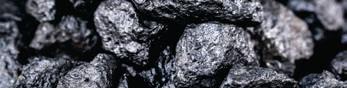








EVENT GUIDE | MAY 25 | 2023 GLOBAL MINING SYMPOSIUM
https://events.northernminer.com/
A more electric future A greener economy An eco-friendly Québec DISCOVER MORE +
Presented by The Northern Miner
KEYNOTE SPEAKERS
Canadian Mining Hall of Fame Member

Alexander John Davidson
Few modern-era geologists have experienced a more productive quest for mineral wealth than Alexander (Alex) Davidson. From 1993 to 2009, he contributed to the remarkable success of Barrick Gold as it evolved from its North American base into the world’s leading gold producer. As Executive Vice President of exploration and [later] corporate development, Davidson helped expand Barrick’s gold resources through a series of world-class discoveries and strategic mergers and acquisitions. Most notably he led the discovery team at the Pascua Lama gold-silver deposit in the Andes, recognized the exploration upside of the Pierina prospect in Peru, led the team for the grassroots discovery of Lagunas Norte in Peru and evaluated and recommended the acquisition of the Bulyanhulu project in Tanzania. He also maximized the value of assets acquired through takeovers of senior producers such as Lac Minerals, Homestake Mining and Placer Dome.
Born in Montreal, Davidson graduated from McGill University in 1976 with a M.Sc. degree in Economic Geology. Soon a er he led an exploration program for a predecessor of Cameco and drilled the discovery hole at the McArthur Lake uranium deposit in Saskatchewan. In 1980 he joined Falconbridge Copper in Ontario, where he contributed to the discovery of the high-grade Winston Lake zinc deposit, which produced from 1988 to 1999. He also played a role in the discovery and development of the Samatosum silver-lead-zinc mine near Adams Lake, BC.
Davidson joined Barrick in 1993 and became part of a top-tier team led by Peter Munk and Robert Smith (both CMHF inductees). He expanded the company’s exploration e orts outside of North America and devised a system to identify quality projects and share knowledge and talent within the global group. His vision and team leadership skills helped Barrick meet the challenge of expanding total resources while continually replacing mined ounces on an annual basis.
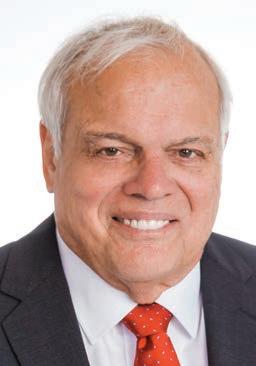
In 1994, Barrick acquired Lac Minerals and began exploring its South American assets. A year later, Davidson’s team discovered the Pascua deposit in Chile, which led to ground acquisition and exploration across the border at the Lama project in Argentina. Subsequent drilling at Pascua Lama de ned reserves of 18 million ounces of gold and 600 million ounces of silver. During this period a joint venture with Argentina Gold led to the discovery of the nearby Valadero mine.
In 1996, Davidson championed the US$800-million acquisition of Arequipa Resources, based on nine holes at its Pierina discovery. Pierina opened two years later with eight million ounces of reserves and produced for 18 years as one of the world’s lowest cost mines. He also urged Barrick to acquire Sutton Resources and its Bulyanhulu gold deposit and led exploration that quadrupled reserves to 15 million ounces. As part of the deal Barrick gained a dominant position in the Lake Victoria greenstone belt and acquired nearby projects later developed into mines. Davidson continued to make discoveries, including Lagunas Norte in the Alto Chicama district of Peru. In 2005 he spearheaded the US$9.2billion acquisition of Placer Dome, which gave Barrick a dozen new mines around the world and importantly, consolidated the Cortez Trend which resulted in the Cortez, Goldrush and Fourmile deposits in Nevada. Davidson’s achievements helped elevate the stature of Canadian mining at home and overseas and earned him industry honours including the PDAC’s Prospector of the Year Award (2003), the CIM’s A.O. Dufresne Award (2005) and the SME’s Charles F. Rand Gold Medal (2019).
2 WWW.NORTHERNMINER.COM GLOBAL MINING SYMPOSIUM
KEYNOTE SPEAKERS
Canadian Mining Hall of Fame Member
Douglas Balfour Silver

e career accomplishments of Douglas Silver re ect the close ties between the Canadian and American mining communities and the mutual bene ts of enhanced exposure to new concepts and wealth-generating opportunities. Silver rose to prominence in the early 1990s as president and owner of Balfour Holdings, which became a leading mineral economics and management consulting rm. His training in economic geology (including being involved in a major molybdenum discovery) and rare expertise in mining valuation made him a sought-a er consultant and speaker at mining and investment conferences on both sides of the border. Silver also launched the Denver Gold Group (DGG), one of the world’s leading investment forums for gold producers that features a dominant contingent of Canadian-listed companies. He has made many other contributions to Canada’s mining industry, notably in the mineral royalty and streaming sector. In 2005, he launched International Royalty Corporation (IRC) and grew revenues from US$400,000 to US$50 million by 2007 and sold the company for $749 million in 2010. Silver next joined private-equity rm, Orion Resource Partners., and built another large royalty portfolio that ultimately sold for $1.1 billion to Canadian company, Osisko Gold Royalties, and participated in hundreds of millions of dollars in Canadian mining investments.
Silver was raised in New Jersey and graduated from the University of Arizona with a Masters degree in Economic Geology. He launched Colorado-based Balfour Holdings in 1987, and soon constructed multiple comprehensive databases on mining issues. He developed new valuation techniques for a broad range of mines, mineral deposits and exploration projects. His pioneering expertise in valuations improved the due diligence process, set market values, and ultimately contributed to the dra ing of industry valuation standards, such as the CIMVAL Code.
Silver is a proli c writer and speaker, having given more than 130 presentations, including dozens of keynote addresses at industry events such as PDAC and CIM conferences. He also supported Canadian mining through the DGG, which he conceptualized and founded to introduce gold companies to gold institutional investors. e DGG has long been dominated by Canadian-listed companies, and its annual conference continues today as one of the world’s principal forums for gold investment discussion.
Early in his career Silver recognized the downstream value of royalty investments, and chose Canada as the place to ful ll his dream of creating not one, but two outstanding royalty portfolios. He cofounded IRC as a private entity in 2003, with only a small royalty from the Hemlo gold project, and then raised $190 million to expand the portfolio. IRC was the largest mining-related initial public o ering on the Toronto Stock Exchange in 2005. Silver and his team turned IRC into a $749-million company within seven years by acquiring 86 royalties, with a net smelter royalty on Labrador’s giant Voisey’s Bay nickel project being IRC’s agship asset.
A er selling IRC to Royal Gold for a 60% premium in 2010, Silver joined privately-held Orion Resource Partners and focused on building his second royalty portfolio. e portfolio included a diamond stream from Stornoway Diamonds—a Canadian rst—and more than a dozen royalties from projects in ve Canadian provinces. e portfolio was ultimately sold in 2017 to Osisko Gold Royalties for $1.1 billion, which made Osisko the third largest Canadian royalty company.
Silver has received numerous awards for his many achievements, notably from the Society of Mining Engineering, Metallurgy and Exploration (SME), and also was a 2018 inductee into the U.S. National Mining Hall of Fame.
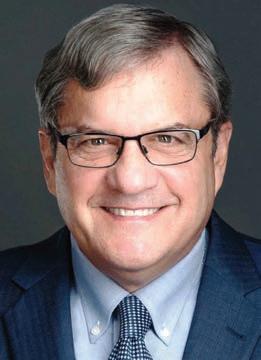
3 GLOBAL MINING SYMPOSIUM
CONTINUED ON PAGE 4
KEYNOTE SPEAKERS
Canadian Mining Hall of Fame Member
Jim Cooney
As a non-miner in the mining world, Jim Cooney championed the concept of sustainable development and pioneered the application of policies and procedures to improve the industry’s social and environmental performance. His strongly held convictions were controversial in the early 1990s, but eventually found acceptance from major companies that understood the risks of not adapting to changing times. Among them was Placer Dome (later part of Barrick Gold), which gave Cooney the opportunity to introduce sustainable development across its Canadian and international operations. He introduced the term “Social License to Operate” in 1997, which quickly gained prominence in the mining industry and eventually spread to other industry sectors. From the mid-1990s until his retirement in 2006, he was a thought leader in a broad range of national and international forums that helped mining associations and other organizations dra and adopt sustainable development policies and practices.
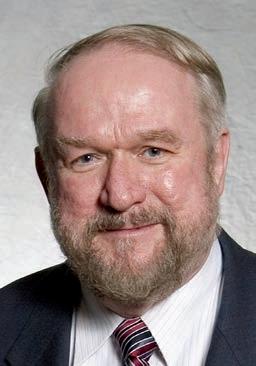
Cooney initially intended to become an academic. He studied philosophy and political science at Georgetown University and East Asian studies at the University of Toronto. In 1976, he decided to leave academia and was hired by Cominco (now Teck) as a research generalist supporting the company’s strategic planning group.
In 1982 Cooney was hired by Placer Development as manager of government a airs. In 1986, he le Placer for an Interchange Canada assignment as resource policy analyst with the o ce of the Federal Economic Development Co-ordinator. During that time Placer Development merged with Dome Mines. In 1988, he returned to Placer Dome as director of international and public a airs. His primary responsibility was to assess and help manage social and political risks in the host countries and communities of Placer’s exploration and mining investments.
In 1987, Cooney was inspired by the Brundtland report, Our Common Future, which introduced the world to the concept of sustainable development. Yet he noted that while governments and civil society embraced the vision of the report, mining risked being le behind in a changing policy environment. In publications and speeches, Cooney advocated that mining companies should adopt sustainable development as an integrated strategy for managing social and environmental risks. In 1996, Placer’s CEO, John Willson, agreed with Cooney’s vision and directed him to prepare a corporate sustainable development policy. During a year of consultations, Cooney garnered input from key stakeholder groups and from Placer’s managers and professionals around the world. Placer’s sustainable development policy was thus embedded in the corporate culture as a statement of the values, insights and aspirations of employees at all levels and locations. In 1998, Placer became the rst mining company to fully embrace sustainable development in principle and in practice.
Under Cooney’s guidance, Placer implemented two path nding sustainability initiatives. e company’s Las Cristinas mine in Venezuela conducted a multi-year project of constructive engagement with artisanal miners, and in South Africa the company undertook a multi-year project of providing employability and medical support to retrenched mineworkers at the company’s South Deep mine. Both projects attracted complementary funding from the Canadian International Development Agency and both received commendations from the World Bank as innovative and instructive approaches to community development by a mining company.
Cooney helped provide the intellectual framework for the practical application of sustainable development and this legacy endures today through standard industry practices such as stakeholder outreach and indigenous consultation. In recognition of his leadership and achievements, Cooney received the CIM’s award for excellence in sustainable development (2011) and AME BC’s Robert H. Hedley award for social and environmental responsibility (2016).
4 WWW.NORTHERNMINER.COM GLOBAL MINING SYMPOSIUM
KEYNOTE SPEAKERS
Rob
McEwen • Chairman, Chief Owner, McEwen Mining

Rob McEwen: Chairman, Chief Owner of McEwen Mining, which has four mines located in USA, Canada, Mexico and Argentina. Associated with the gold industry all his career, rst 18 years in the investment industry and since 1990 as CEO of several gold mining companies.Founder of Goldcorp Inc., where he grew its market capitalization from $50 million to over $8 billion. At McEwen Mining (MUX) he owns 17% of the company, takes a salary of $1/ year and the cost of his investment in MUX and McEwen Copper exceeds US$220 million. He and his wife have donated over $60 million to encourage excellence and innovation in healthcare and education. Awards: Order of Canada, Canadian Mining Hall of Fame member, Honorary Doctorate of Law Degrees from York University and Western University.
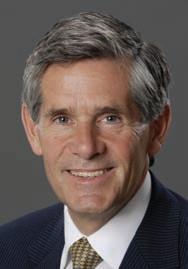
George Hemmingway • Managing Partner, Stratalis

George Hemingway is Managing Partner and leads the Innovation Practice at Stratalis where he advises the leaders of companies, organizations and countries on the future and how to succeed in uncertain times. Considered one of the leading futurists in the mining industry, he regularly keynotes at venues ranging from the World Mining Congress to NASA and the Pentagon. He has advised many of the world’s leading natural resource and industrial companies, ranging from Vale, Anglo American and BHP to BASF and the Air Force on how their operations and organizations can best pivot and transform to succeed. In addition to corporate boards, he is passionate about supporting the next generation of leaders as a board member to the Chamber Orchestra of New York, Moon Mark Aerospace and the Lassonde Institute of Mining at the University of Toronto. He holds an MBA from Columbia Business School and a BS from the Stern School of Business at NYU.

Dundee Sustainable Technologies Inc. (DST) is engaged in the development and commercialization of environment-friendly technologies for the treatment of materials in the mining industry. rough the development of patented, proprietary processes, DST extracts precious and base metals from mineralized material, concentrates and tailings, while stabilizing contaminants such as arsenic, which could not otherwise be extracted or stabilized with conventional processes because of metallurgical issues or environmental considerations.
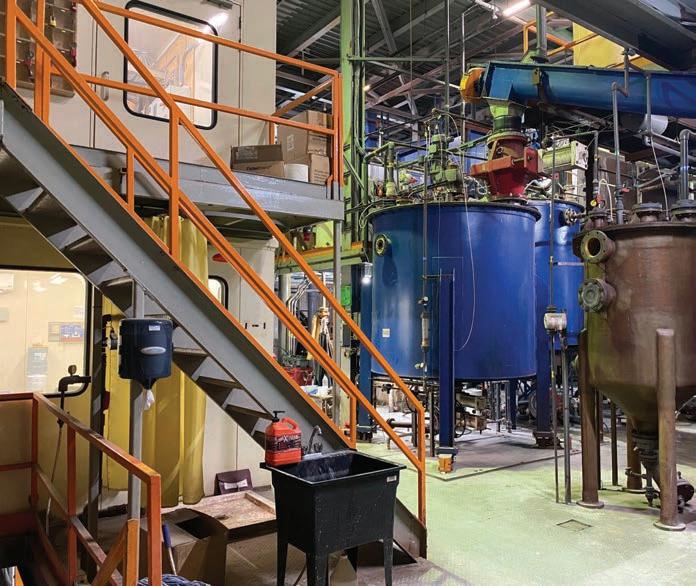
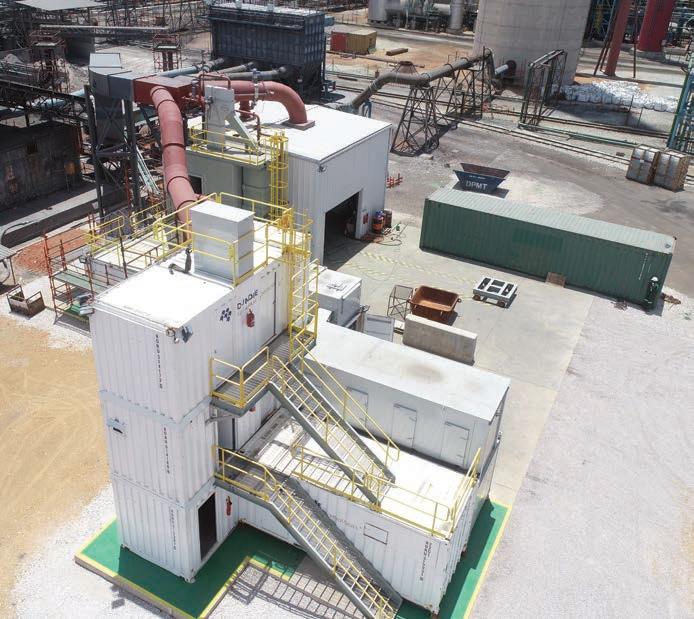
DST’s core technologies are the CLEVR Process™ (gold extraction) and the GlassLock Process™ (arsenic stabilization).
5 GLOBAL MINING SYMPOSIUM
CONTINUED ON PAGE 6 Company Profile
dundeetechnologies.com | CSE:DST
KEYNOTE SPEAKERS

Peter Grosskopf • Chief Executive O cer, SCP Resource Finance




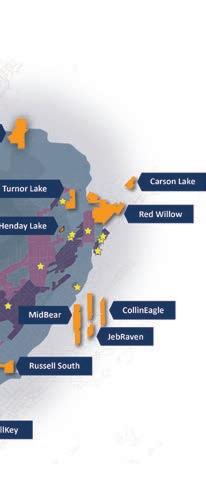
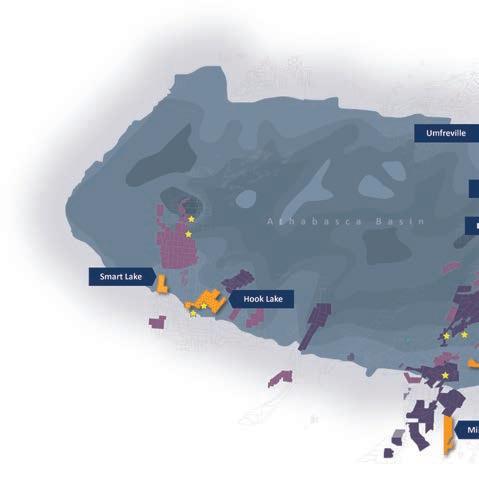






Peter Grosskopf is Chief Executive O cer of SCP Resource Finance. With over 35 years of experience in the nancial services industry, Peter served as Chief Executive O cer of Sprott Inc. from 2010 to 2022. During that time, he led the Company’s growth from $5 billion to more than $20 billion of assets under management. Prior to joining Sprott, Peter was President of Cormark Securities. He has a track record of building and growing successful businesses including as co-founder of Newcrest Capital, which was acquired by the TD Bank Financial Group in 2000. Peter serves as a Director for Agnico Eagle Mines Ltd and the World Gold Council. Peter is a CFA® Charterholder and earned an Honours Degree in Business Administration and a Masters of Business Administration from the Richard Ivey School of Business at the University of Western Ontario.
6 WWW.NORTHERNMINER.COM GLOBAL MINING SYMPOSIUM
Carefully Assembled Athabasca Basin Portfolio Advancing 12 drill ready projects strategically situated in the the world’s richest uranium region Partnered with Two of the World’s Largest Uranium Suppliers Strong Long Term Fundamentals The availability of capital in the uranium sector is fuelling aggressive project advancement TSXV: PTU OTCQB: PTUUF www.purepoint.ca A COMPELLING EXPLORATION ADVANTAGE
FEATURED SPEAKERS
Paul Carmel • Senior Management, Sidex
Mr. Carmel has 30 years of experience in the mining industry and capital markets. Over the course of his career, he has held senior management and board positions at mining companies, investment banks and private equity rms focused on the mining industry.
Positions held by Paul Carmel prior to 2020 include: Chairman of the Board of Orbit Garant Drilling Inc., Chairman of the Board of Mason Graphite Inc, Inc; President, CEO and Director of Richmont Mines, Managing Director and Head of Mining at Desjardins Capital Markets and President and CEO of MinQuest Capital, a mining private equity fund.

Mr. Carmel holds a Bachelor of Engineering, Mining degree from McGill University, and also an ICD.D certi cation granted by the Institute of Corporate Directors.
Amyot Choquette • Senior Director Investments Ressources Québec, a division of Investissement Québec
Amyot Choquette is a senior director investments since 2012 at Ressources Québec, a division of Investissement Québec that invests and nances projects in the mining, forestry and energy sectors. Prior to occupying these functions, Mr. Choquette has held a number of functions at the Société Générale de Financement du Québec in the mining and forestry sectors. Mr. Choquette has also worked at the Fonds regional de Solidarité FTQ, a labor sponsored fund, and at Raymond Chabot Grant ornton.
Mr. Choquette earned is business degree from Université Laval in 1991 and is a CPA CA since 1993.
(PNPN.V)
Battery Nickel Demand Is Forecasting Major Growth
By 2030. Power Nickel (PNPN.V) Is In An Excellent Position To Capitalize.
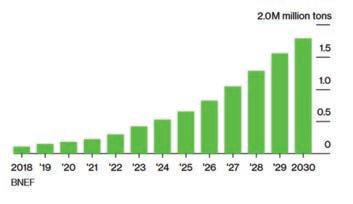
• Automakers to double EV battery spend to $1.2 trillion by 2030 - Nickel Demand Expected To Explode.
• Power Nickel’s (PNPN.V) Nisk deposit has the lowest market cap per pound of NiEQ in ground - with Class 1 nickel.

• An “ultra mafic” deposit with comparables at Lynn Lake (22m tons) and Voisey’s Bay (50m tons), which sold for$4.5 billion.
• Located In Quebec - a top North American jurisdiction for mine development with financing incentives.
Investor Catalyst: Drill Results+ Assays Are Expected By The End Of November. Final Assays In Feb, 2023 - Followed By An Updated 43-101.
PowerBoost Batteries fuel demand for nickel over the next decade
7 GLOBAL MINING SYMPOSIUM
CONTINUED ON PAGE 8
WE NEED 72 NEW NICKEL MINES TO MEETPROJECTED 2030 EV DEMAND. THAT’S GREAT NEWS FOR POWER NICKEL
FEATURED SPEAKERS
Laurie
Clark • Serial Entrepreneur, ONYEN
Ms. Clark, a serial entrepreneur, experienced in early stage and mature high growth companies, successfully started, grew and sold three companies and is presently the founder and principle of 3 Financial and Regulatory Technology companies: a Financial Advisor licensing system, an AML and Terrorist Finance entity checking system with AI identity veri cation; and an AI driven ESG reporting system with real time data and predictive modelling to manage risks and outcomes. Ms. Clark also advises, invests in, or capital raises for private and public companies, and has been 3X awarded the “Top 100 Most Powerful Women in Canada” in 2017, 2019 and most recently in 2022. Ms. Clark is Chair of the Board of a venture capital company: Independent Director of a North American Futures, Options and Swaps Securities Exchange: Member Advisory Committee for Pelangio Exploration Inc., Board Advisor for AdvisorSavvy – a Securities’ Advisor ratings technology system, and Strategic Advisor to the Canadian Regulatory Technology Association. Ms Clark also sits on the TSX Advisory Council. Ms. Clark is frequently asked to speak at international conferences on Finance and Technolgy, and has written a comprehensive textbook for Financial Advisors and their support sta entitled “Inside Canada’s Securitis Industry”.


Elaine
Ellingham • President & CEO, Omai Gold Mines Corp.
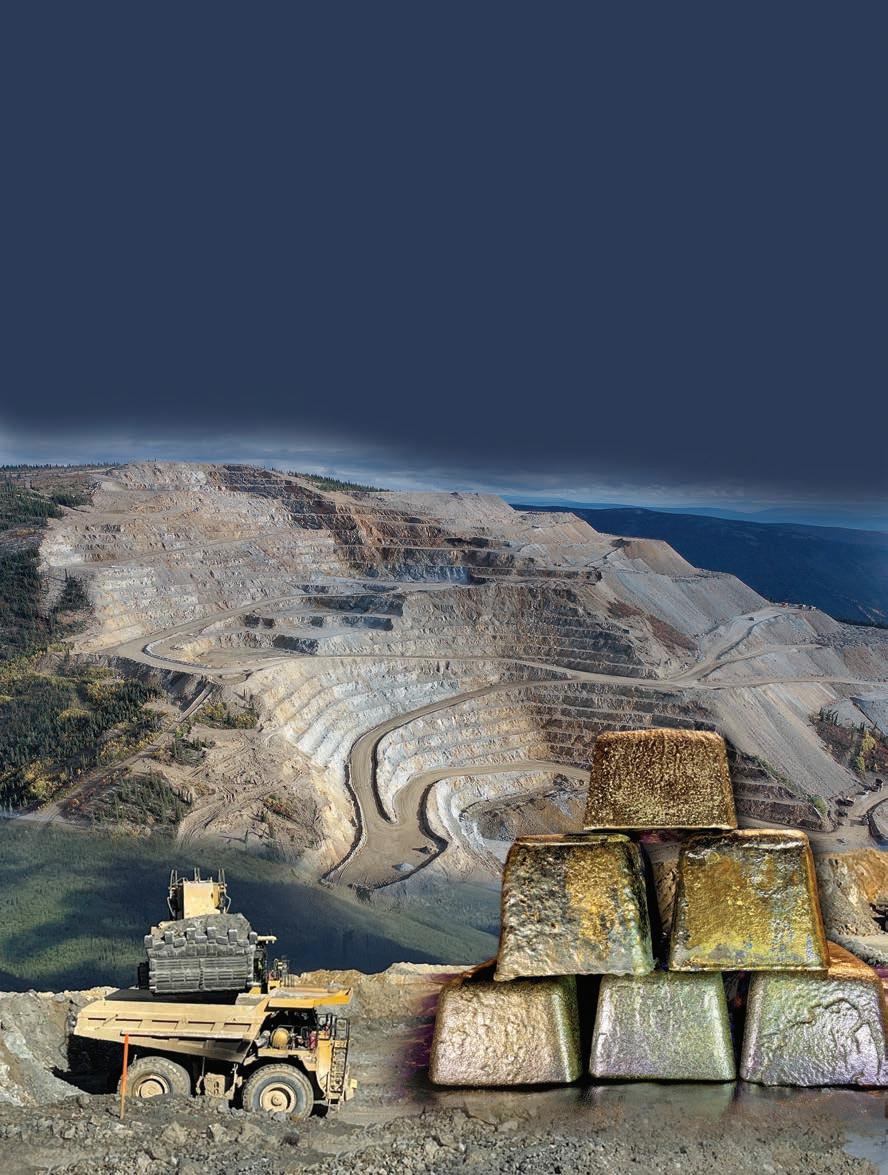
Over 30 years of mining industry experience in exploration, production, corporate development and numerous Board & executive roles. National Leader, Mining at TSX for 8 years. At Richmont Mines Inc, acted as lead director for 7 years, stepped in as interim CEO, introducing a new chapter for the gold producer, and remained on the Board through to the successful near-billion-dollar acquisition by Alamos. Current Director at Alamos & Almaden, previously at Wallbridge Mining and Aurania Resources. Signi cant capital markets and M&A experience.
8 WWW.NORTHERNMINER.COM GLOBAL MINING SYMPOSIUM
TSX:VGCX | OTC:VITFF | VGCX.COM Leading Yukon’s New Gold Rush EAGLE GOLD MINE EXPLORATION: NEW DISCOVERY — RAVEN CRITICAL MINERALS for now and for the FUTURE Near Term Producer 2023 Feasibility Study
INTERNAL
MINE
Update 166,000 ounces of payable palladium and 41 million pounds of payable copper per year NET PRESENT VALUE (6%) – C$1.16 BILLION
RATE OF RETURN – 25.8%
LIFE – 13 YEARS
FEATURED SPEAKERS
Chris Frostad • President & CEO, Purepoint Uranium Group
A founding partner bringing over 40 years of expertise to his position as President and CEO, Chris Frostad led Public Companies in both the technology and mining & metals industries. roughout his career, he has been instrumental in the development and building of a variety of high growth, early stage, public and private companies and served as Director for several mining and technology companies. Prior to Purepoint, he held numerous senior positions in the technology industry including CEO in Residence of a Toronto-based Venture Capital rm. Mr. Frostad is a Chartered Accountant and a Chartered Professional Accountant who began his career in International Taxation with Deloitte.
Scott Hicks • Executive Vice President, Prime Mining Corp
Scott Hicks is currently Executive Vice President at Prime Mining Corp., a gold-silver exploration company focused on its multi-million ounce high-grade Los Reyes project in Mexico.
Prior to joining Prime, Scott was Sr. Vice President of Geology, Mine Planning and Project Evaluations with Kinross Gold Corporation, overseeing global technical services, project optimization and technical diligences.

Prior to joining Kinross in 2011, he held positions of increasing responsibility with Inco Ltd. and Vale in the areas of corporate development, strategic planning and nancial evaluation, including several years in Indonesia at one of the world’s largest integrated nickel operations. Scott has several years of Management Consulting experience with Mercer (now Oliver Wyman). Scott holds a Bachelor of Applied Science in Mining Engineering from Queen’s University in Kingston, Ontario, is a Professional Engineer and a Chartered Financial Analyst (CFA®) charterholder.

Jonathan LaFontaine
Mining exploration activity monitor for the ministère des Ressources naturelles et des Forêts
Mr Jonathan Lafontaine started his current role as the Mining exploration activity monitor for the ministère des Ressources naturelles et des Forêts in August 2020. Mr Lafontaine graduated with a B.Sc. in geology from Laval University in 2001 including an academic exchange with the University of Alberta, and graduated with a M.Sc. in geology from the University of New Brunswick in 2007. He began his professional career in Saskatchewan for a uranium exploration and mining company and pursued professional interests as a geologist in New Brunswick, Quebec and Saskatchewan. Among his successes, he contributed to the discovery of the Matoush project, Quebec’s discovery of the year in 2008, which helped him convince the IAEA to now recognize it as a new deposit type.
Between 2013 and 2020, he has assumed several di erent roles in the elds of corporate development and mining investments, and he managed technical committees in the eld of hydrogen standardization at both the international and Canadian levels for ISO and SCC respectively, with hydrogen a signi cant path in the eld in electri cation. Since the beginning of his career, he has been involved with several commodities and numerous projects representing the entire mineral development process. Mr Lafontaine is a registered professional in Québec, du New-Brunswick and Saskatchewan.
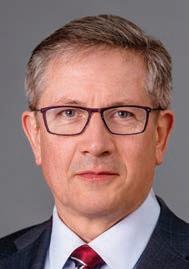
9 GLOBAL MINING SYMPOSIUM
CONTINUED ON PAGE 10
FEATURED SPEAKERS
Terry Lynch • CEO, Power Nickel Inc.
Mr. Lynch is currently CEO of Power Nickel Inc. a publicly held mining company with the advanced stage Nisk Nickel project south of James Bay Quebec. It also has projects in BC’s Golden Triangle and Chile. Mr. Lynch is also the Founder and Managing Director of Save Canadian Mining. Save Canadian Mining was launched in November2019 to unify Canada’s junior mining sector in requesting regulatory changes in Canada’s capital markets. e organization is supported by the TSX Venture Exchange, the Ontario Mining Association, the Ontario Prospectors Association, as well as mining industry leaders like Eric Sprott (Sprott Mining) Sean Roosen (Osisko Mining), Keith Neumeyer (First Majestic Silver Corp), and Rod McEwan (McEwan Mining Inc) and over 25 junior mining companies and over 3,000 members. Mr. Lynch graduated in 1981 from St. Francis Xavier University with a joint honours degree in Economics and BBA. Prior to becoming a director with International PBX Ventures in 2012, Mr. Lynch had been CEO of privately held Nevada-focused Relief Gold. He also had been a director and later CEO of TSX- listed Firstgold Corp. He assumed the CEO position a er the company had run into nancial di culty bringing its Relief Canyon mine into production. He arranged a sale of 51% of the company for a total capital injection of $26.5 million from Northwest Non-Ferrous Metals, one of China’s largest mining engineering and consulting groups.

From 2005 to 2008 Mr. Lynch was a partner with Kingsmill Capital Partners, a nancial advisory rm specializing in advising public and private early stage growth companies. Prior to joining Kingsmill Capital he spent 15 years operating start-up companies in industrial products, oil and gas and media. Mr. Lynch was also the Cofounder of TSX and NASDAQ listed Cardiol erapeutics. A leader in producing Pharmaceutical CBD and developer of ground breaking therapies for heart disease.
Jean-Philippe Mai • President & CEO, Dundee Sustainable Technologies
Mr. Mai holds a degree in Geology from the University of Quebec in Montréal and over 15 years’ experience in the mining and metal industry as an executive, senior project manager and geologist in coal, base metals and gold projects in Canada, Australia and South America. Mr. Mai has been with Dundee Sustainable Technologies since 2013, and with strong business oriented, geochemistry, gold metallurgy and processing skills, he has been a key player in the development and commercialization of the Corporation’s Proprietary Processes and current implementation projects.
John McConnell • Director, President & CEO, Victoria Gold Corp.
John McConnell’s +40 years of mining experience is mostly in Canada’s northern territories. John has been President & CEO of Victoria Gold since 2010 and has led the exploration, development, and nancing of the Eagle Gold Mine in Canada’s Yukon Territory. Eagle has been in production since 2019 and at full production will produce +200,000 ounces per year of gold.
Previously, he was President & CEO of Western Keltic Mines until it was acquired by Sherwood Copper; VP, NWT Projects for De Beers Canada primarily responsible for permitting and development of the Snap Lake Diamond Mine; Breakwater Resources Ltd in operations at the Nanisivik Zinc & Lead Mine on Ba n Island; and Strathcona Mineral Services Ltd.
Mr. McConnell is the 2021 Winner of AME BC’s prestigious EA Scholtz Award for Excellence in Mine Development for his role in building the Eagle Gold mine. A graduate of the Colorado School of Mines, with a B.Sc. in Mining Engineering Mr. McConnell is also a Director of Lahontan Gold Corp.
Mark Selby • Canada Nickel Company
Mr. Selby is a founder of Canada Nickel Company and was formerly President & CEO of RNC Minerals (Royal Nickel Corporation) where he led a team that successfully raised over $100 million and advanced the Dumont nickel-cobalt project from initial resource to a fully permitted, construction-ready project. He has held several senior management roles with Quadra Mining, Inco, and Purolator Courier, and was a partner at Mercer Management Consulting.
Since 2001, Mr. Selby has been recognized as one of the leading authorities on the nickel market. He graduated from Queen›s University with a Bachelor of Commerce (Honours) and has also served on the boards of multiple junior mining companies.


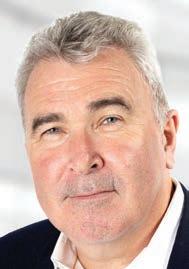
10 WWW.NORTHERNMINER.COM GLOBAL MINING SYMPOSIUM
AGENDA | THURSDAY MAY 25, 2023
11 GLOBAL MINING SYMPOSIUM all times shown are Eastern Time (EDT)
START TIME PRESENTATION
EST - 9:00am EST Registration & Breakfast
EST - 9:40am EST Critical Minerals Fireside Chat with Rob McEwen Moderated by Colin McClelland
EST - 10:00am EST Investor Presentation 10:00am EST - 10:40am EST ought Leadership Panel - Process Innovation: Can good for business also be good for the environment? 11:40am EST - 12:00pm EST Investor Presentation 10:55am EST - 11:10am EST Investor Presentation 12:00pm EST - 12:45pm EST Lunch 12:45pm EST - 1:25pm EST e Power of Success • George Hemmingway 1:25pm EST - 1:40pm EST Investor Presentation
EST - 1:55pm EST Investor Presentation
2:25pm EST Canadian Mining Hall of
Precious
8:30am
9:00am
9:40am
1:40pm
1:55pm EST -
Fame:
Metals Panel,
• Alex Davidson
EST Investor Presentation
EST
Financing Ecosystem
4:30pm EST Cocktail Reception
• Doug Silver 2:25pm EST - 2:40pm
2:40pm EST - 3:05pm
ought Leadership PanelQuébec’s Unique
Panel 3:30pm EST -
THOUGHT LEADERSHIP PANEL
Process Innovation: Can good for business also be good for the environment?
PANELIST
Jean-Philippe Mai • President & CEO, Dundee Sustainable Technologies

Mr. Mai holds a degree in Geology from the University of Quebec in Montréal and over 15 years’ experience in the mining and metal industry as an executive, senior project manager and geologist in coal, base metals and gold projects in Canada, Australia and South America. Mr. Mai has been with Dundee Sustainable Technologies since 2013, and with strong business oriented, geochemistry, gold metallurgy and processing skills, he has been a key player in the development and commercialization of the Corporation’s Proprietary Processes and current implementation projects.
PANELIST

Laurie Clark • Serial Entrepreneur, ONYEN

Ms. Clark, a serial entrepreneur, experienced in early stage and mature high growth companies, successfully started, grew and sold three companies and is presently the founder and principle of 3 Financial and Regulatory Technology companies: a Financial Advisor licensing system, an AML and Terrorist Finance entity checking system with AI identity veri cation; and an AI driven ESG reporting system with real time data and predictive modelling to manage risks and outcomes. Ms. Clark also advises, invests in, or capital raises for private and public companies, and has been 3X awarded the “Top 100 Most Powerful Women in Canada” in 2017, 2019 and most recently in 2022. Ms. Clark is Chair of the Board of a venture capital company: Independent Director of a North American Futures, Options and Swaps Securities Exchange: Member Advisory Committee for Pelangio Exploration Inc., Board Advisor for AdvisorSavvy – a Securities’ Advisor ratings technology system, and Strategic Advisor to the Canadian Regulatory Technology Association. Ms Clark also sits on the TSX Advisory Council. Ms. Clark is frequently asked to speak at international conferences on Finance and Technolgy, and has written a comprehensive textbook for Financial Advisors and their support sta entitled “Inside Canada’s Securitis Industry”.
PANELIST Mark Selby • Founder, Canada Nickel Company
Mr. Selby is a founder of Canada Nickel Company and was formerly President & CEO of RNC Minerals (Royal Nickel Corporation) where he led a team that successfully raised over $100 million and advanced the Dumont nickel-cobalt project from initial resource to a fully permitted, construction-ready project. He has held several senior management roles with Quadra Mining, Inco, and Purolator Courier, and was a partner at Mercer Management Consulting.
PANELIST Scott Hicks •Executive Vice President, Prime Mining Corp
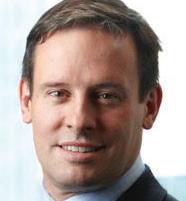
Scott Hicks is currently Executive Vice President at Prime Mining Corp., a gold-silver exploration company focused on its multi-million ounce high-grade Los Reyes project in Mexico.
Prior to joining Prime, Scott was Sr. Vice President of Geology, Mine Planning and Project Evaluations with Kinross Gold Corporation, overseeing global technical services, project optimization and technical diligences.
Prior to joining Kinross in 2011, he held positions of increasing responsibility with Inco Ltd. and Vale in the areas of corporate development, strategic planning and nancial evaluation, including several years in Indonesia at one of the world’s largest integrated nickel operations. Scott has several years of Management Consulting experience with Mercer (now Oliver Wyman). Scott holds a Bachelor of Applied Science in Mining Engineering from Queen’s University in Kingston, Ontario, is a Professional Engineer and a Chartered Financial Analyst (CFA®) charterholder.


12 WWW.NORTHERNMINER.COM GLOBAL MINING SYMPOSIUM
THOUGHT LEADERSHIP PANEL
Québec’s Unique Financing Ecosystem Panel
PANELIST
Jonathan LaFontaine
Mining exploration activity monitor for the ministère des Ressources naturelles et des Forêts
Mr Jonathan Lafontaine started his current role as the Mining exploration activity monitor for the ministère des Ressources naturelles et des Forêts in August 2020. Mr Lafontaine graduated with a B.Sc. in geology from Laval University in 2001 including an academic exchange with the University of Alberta, and graduated with a M.Sc. in geology from the University of New Brunswick in 2007. He began his professional career in Saskatchewan for a uranium exploration and mining company and pursued professional interests as a geologist in New Brunswick, Quebec and Saskatchewan. Among his successes, he contributed to the discovery of the Matoush project, Quebec’s discovery of the year in 2008, which helped him convince the IAEA to now recognize it as a new deposit type.
Between 2013 and 2020, he has assumed several di erent roles in the elds of corporate development and mining investments, and he managed technical committees in the eld of hydrogen standardization at both the international and Canadian levels for ISO and SCC respectively, with hydrogen a signi cant path in the eld in electri cation. Since the beginning of his career, he has been involved with several commodities and numerous projects representing the entire mineral development process. Mr Lafontaine is a registered professional in Québec, du New-Brunswick and Saskatchewan.
PANELIST
Amyot Choquette • Senior Director Investments Ressources Québec, a division of Investissement Québec

Amyot Choquette is a senior director investments since 2012 at Ressources Québec, a division of Investissement Québec that invests and nances projects in the mining, forestry and energy sectors.
Prior to occupying these functions, Mr. Choquette has held a number of functions at the Société Générale de Financement du Québec in the mining and forestry sectors. Mr. Choquette has also worked at the Fonds regional de Solidarité FTQ, a labor sponsored fund, and at Raymond Chabot Grant ornton.

Mr. Choquette earned is business degree from Université Laval in 1991 and is a CPA CA since 1993.

PANELIST Paul Carmel • Senior Management, Sidex
Mr. Carmel has 30 years of experience in the mining industry and capital markets. Over the course of his career, he has held senior management and board positions at mining companies, investment banks and private equity rms focused on the mining industry.
Positions held by Paul Carmel prior to 2020 include: Chairman of the Board of Orbit Garant Drilling Inc., Chairman of the Board of Mason Graphite Inc, Inc; President, CEO and Director of Richmont Mines, Managing Director and Head of Mining at Desjardins Capital Markets and President and CEO of MinQuest Capital, a mining private equity fund.
Mr. Carmel holds a Bachelor of Engineering, Mining degree from McGill University, and also an ICD.D certi cation granted by the Institute of Corporate Directors.
13 GLOBAL MINING SYMPOSIUM
SPONSORS
PRESENTING
PRESENTING COMPANY PROFILES
Generation Mining is developing its Marathon Project, a large undeveloped palladium-copper deposit in Northwestern Ontario, Canada.
Generation Mining’s Feasibility Study, released in March 2021, estimated that at US$1,725/oz palladium, and US$3.20/lb copper, Marathon’s Net Present Value (at 6% discount rate) is approximately C$1.07 billion with a payback of 2.3 years and an Internal Rate of Return of 30%. Upfront capital costs were estimated at C$665 million, net of equipment financing and pre-completion operating costs and revenues. The mine is expected to produce 245,000 palladium equivalent (PE) ounces per year over a 13-year mine life at an All-In Sustaining Cost of US$809 per PE ounce. Under a Precious Metal Purchase Agreement with Wheaton Precious Metals Corp, Wheaton will pay Generation Mining CAD$240 million in return for a stream on all gold production and 22% of the platinum production. Generation Mining has received the first two tranches of this financing for a total of CAD$40 million. Final Ministerial (Federal and Provincial) decisions in the Environmental Assessment process are expected by November 30, 2022. Upon receipt of favourable decisions and the required permits, the Company anticipates starting early construction activities late in the first quarter of 2023.
Nine Mile Metals Ltd. is a Canadian public mineral exploration company focused on Critical Minerals Exploration (CME) VMS (Cu, Pb, Zn, Ag and Au) exploration in the world-famous Bathurst Mining Camp, New Brunswick, Canada. The Company’s primary business objective is to explore its four VMS Projects: Nine Mile Brook VMS; California Lake VMS; Canoe Landing Lake (East–West) VMS and the new Wedge VMS Projects. The Company is focused on Critical Minerals Exploration (CME), positioning for the boom in EV and green technologies requiring Copper, Silver, Lead and Zinc with a hedge with Gold.
Power Nickel is a Canadian junior exploration company focusing on high-potential nickel, copper, gold, and other battery metal prospects in Canada and Chile.
Power Nickel is also 100 percent owner of five properties comprising over 50,000 acres strategically located in the prolific iron-oxide-copper-gold belt of northern Chile. It also owns a 3-per-cent NSR royalty interest on any future production from the Copaquire copper-molybdenum deposit, which was sold to a subsidiary of Teck Resources Inc. Under the terms of the sale agreement, Teck has the right to acquire one-third of the 3-per-cent NSR for $ 3 million at any time. The Copaquire property borders Teck’s producing Quebrada Blanca copper mine in Chile’s first region.
14 WWW.NORTHERNMINER.COM GLOBAL MINING SYMPOSIUM
PRESENTING COMPANY PROFILES
Omai Gold Mines Corp. holds a 100% interest in the Omai gold project in Guyana, that produced over 3.7 million ounces of gold between 1993 and 2005.
The property hosts two gold deposits, the shear-hosted Wenot Deposit and the adjacent intrusive-hosted Gilt Creek Deposit. The updated NI43-101 Mineral Resource Estimate, released in October 2022, more than doubles the initial Resource announced in January 2022 by expanding the Wenot Mineral Resource and incorporating the Gilt Creek Deposit that lies below a former pit that produced 2.4 million ounces of gold.
Omai Gold has completed a total of 16,648 meters of diamond drilling on the Omai property, as well as trenching and mapping of several exploration targets, and a geochemical survey that commenced along a 4 km strike projection to the east along the Wenot shear corridor. In 2023, the initial program will focus on drilling the main nearby exploration targets that we believe hold significant potential for new discoveries on this gold-rich property. Work will continue on expanding the known resource at Wenot, both along strike and on the flanks, where 2022 drilling provided evidence of extensions.
Purepoint Uranium Group Inc. (TSXV: PTU/OTCQB: PTUUF) is actively advancing a carefully assembled portfolio of strategically situated, drill ready uranium projects in the Athabasca Basin, the world’s richest uranium region. In addition to its flagship joint venture project at Hook Lake with partners Cameco and Orano, and a second joint venture with Cameco at Smart Lake, Purepoint also holds ten, 100% owned projects with proven uranium rich targets. The company has aggressive exploration programs underway at multiple projects
Victoria Gold (“VGCX”) is Leading Yukon’s New Gold Rush. The Company’s core holding is the 100% owned Dublin Gulch property in central Yukon, approximately 375 kilometers north of the capital city of Whitehorse. Dublin Gulch is home to the Eagle Gold Mine - the largest gold mine in Yukon history. As at December 31, 2022, the Reserve is 2.6 million ounces of gold (124 m tonnes grading 0.65 g/t). The long-life Eagle Gold Mine has high likelihood for further mine life extension at depth and along strike. Exploration potential across the greater Dublin Gulch property is excellent and includes priority targets Raven and Lynx among others.
15 GLOBAL MINING SYMPOSIUM
PRESENTING
SPONSORS
THOUGHT LEADERSHIP PANEL
PRESENTING SPONSORS

16 WWW.NORTHERNMINER.COM GLOBAL MINING SYMPOSIUM https://events.northernminer.com THANK YOU TO OUR VALUED SPONSORS
