Air Canada caper shows gold’s criminal allure hasn’t dimmed / 11
THE NORTHERN MINER | JANUARY 2024
GLOBAL MINING NEWS
Geotech_Earlug_2016_Alt2.pdf 1 2016-06-24 4:27:20 PM
specialfocus
Au
.com
GLOBAL GOLD Promising gold exploration and development projects from around the world / 29–36
expert advice VTEM™ | ZTEM™ | Gravity | Magnetics 905 841 5004 | geotech.ca
from exploration to closure
DELIVERING QUALITY EXPERTISE GLOBALLY ACROSS THE ENTIRE MINING LIFE CYCLE WWW.SGS.COM/MINING
MINERALS@SGS.COM
JANUARY 2024 / VOL. 110 ISSUE 1 / GLOBAL MINING NEWS • SINCE 1915 / $5.25 / WWW.NORTHERNMINER.COM
Can beaten-up junior miners fight illegal short-selling? STOCK MARKET
| Thinly traded sector seen as vulnerable to manipulation
BY ALISHA HIYATE
T
erry Lynch began to notice unusual price movements in Power Nickel (TSXV: PNPN; US-OTC: PNPNF)’s stock (then called Chilean Metals) years ago. The shares consistently traded down at the end of the day, regardless of news, with late day trades often made anonymously. Now the stock is stuck in a range of 25¢ to 30¢ — despite a recently released initial nickel-sulphide resource for the company’s optioned Nisk project in Quebec. It’s not unusual for a junior mining CEO to be unhappy with his share price, but Lynch says Power Nickel isn’t alone and something is amiss in the junior sector. The disconnect between the commodity markets and the junior mining-heavy TSX Venture Index, which is at an all-time low, has reached its widest point. “When I first started talking about this, people thought, Terry, you should have a tinfoil hat on your head. They thought I was a crazy conspiracy theorist,” he told The Northern Miner in early December. “But you know what? I got proof. Man, this is really happening and I’m not the only one that sees it.” In search of answers to the sector’s woes, he formed the Save Canadian Mining group in 2019, recruiting big names like Eric Sprott, Rob McEwen and Sean Roosen as supporters. Now, he can point to exactly what’s bleeding the junior market dry: Predatory short-selling. “We’re in a market where the governments to their credit, federally and provincially, have put out some amazing incentives for miners to actually get out there and explore and develop mines,” he said. “So really, we should be in our glory years and we’re instead about to go extinct.” Short selling is a legal way for traders to profit from a falling stock price. Traders sell borrowed shares in the hope of buying them on the market at a lower price. It serves an important function in helping the market discover the true value of a company’s shares and has even helped uncover frauds like Enron. But it can also be done illegally, if
“We’re in a market where the governments, to their credit, have put out some amazing incentives to explore and develop mines. So really, we should be in our glory years and we’re instead about to go extinct.” — TERRY LYNCH CEO OF POWER NICKEL
traders don’t “cover” their position — meaning the trader is selling shares they haven’t borrowed, located, or confirmed are available for them to buy. Lynch and others say “naked” shorting is a widespread and destructive problem in the junior mining sector. Last week he filed a formal complaint with the Canadian Investment Regulatory Organization (CIRO) and FINRA (Financial Industry Regulatory Authority) in the United States asking them to act on illegal short selling and restore investor confidence in the market. (see explainer)
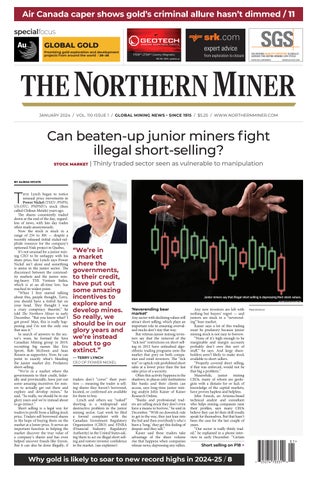
Junior miners say that illegal short selling is depressing their stock values. ADOBESTOCK/VALIANTSIN
‘Neverending bear market’ Any sector with declining values will attract short selling, which plays an important role in ensuring overvalued stocks don’t stay that way. But veteran junior mining investors say that the removal of the “tick test” restrictions on short selling in 2012 have unleashed algorithmic trading programs onto the market that prey on both companies and retail investors. The “tick test” or uptick rule prohibited short sales at a lower price than the last sales price of a security. Often this activity happens in the shadows, in places only institutions like banks and their clients can access, says long-time junior mining analyst John Kaiser of Kaiser Research Online. “Banks and professional traders are selling stock they don’t even have a means to borrow,” he said in December. “With no downtick rule to get in the way, they just lean into the bid and then everybody’s who’s been a ‘long,’ they get this feeling of despair and they sell.” Kaiser said these traders take advantage of the share volume rise that happens when companies release news, depressing any rallies.
Any new investors are left with nothing but buyers’ regret — and juniors are stuck in a “neverending” bear market. Kaiser says a lot of this trading must be predatory because junior mining stock is not easy to borrow. “None of it’s high enough to be marginable and margin accounts probably don’t own this sort of stuff,” he says. And large shareholders aren’t likely to make stock available to short-sellers. “Properly covered short selling, if that was enforced, would not be that big a problem.” Meanwhile, junior mining CEOs, many of whom are geologists with a distaste for or lack of knowledge of the capital markets, have proven hapless and helpless. John Feneck, an Arizona-based technical analyst and consultant who helps mining companies raise their profiles, says many CEOs believe they can let their drill results speak for themselves. But that hasn’t been the case for the last couple of years. “Our sector is really thinly traded,” he explained in a phone interview in early December. “Certain Short selling on P18 >
Why gold is likely to soar to new record highs in 2024-25 / 8
PM40069240
1
2
JANUARY 2024 | THE NORTHERN MINER
www.northernminer.com
AutoMine® Core, a comprehensive automation platform for mass mining applications with solutions to support customers in their journey of ramping up operations from manual to fully autonomous production. Built on Sandvik’s proven AutoMine® Fleet and Manual Production Monitoring (MPM) solutions, AutoMine® Core provides users with multiple levels of interoperability for Sandvik and third-party OEM fleets.
AutoMine® Core for mass mining applications
THE NORTHERN MINER | JANUARY 2024
GLOBAL MINING NEWS
3
inbrief PHOTO OF THE MONTH
A Major Drilling team uses a Cubex Orion RC rig at an underground project in the United States CREDIT: RYAN SKOLRUD, MAJOR DRILLING (2021).
To submit your entry for Photo of the Month, please email bmcbride@northernminer.com.
DEPA RT MENTS
3
In Brief
4
Opinion
7
Commentary & Analysis
9
In Depth
13
People
14 Done Deals
16
Project Updates
19
Mining, Metals & Markets
38
Executive Q&A
38
Company Index
SPECIAL SECTIONS » Global Gold 29
Chile to hike cobalt output
n
Global ESG standards coming
n
Plummeting platinum could worsen shortage
n
Four industry groups, including the Mining Association of Canada, are banding together to create a global standard for responsible mining. As the focus on environmental, social and governance factors has grown, mining companies and investors have found it difficult to keep up with ever-expanding requirements. Some call it an alphabet soup for all the acronyms involved. The proposed standard could have the widest coverage of any voluntary responsible mining standard to date, with initial implementation by more than 80 mining companies hosting around 700 operations in almost 60 countries. The London, U.K.-based International Council on Mining and Metals expects to launch a public consultation and stakeholder engagement process this year. The Copper Mark and the World Gold Council are also working to consolidate their voluntary responsible mining standards into the single global list. The resulting standard would be practical for any mine operator to follow regardless of commodity, geography or size, organizers say. Implementation would be overseen by an independent governance body. “This collaboration responds to direct feedback from investors, civil society, customers, policy makers and mining companies that confirmed the appetite for a less crowded and complex standards landscape,” the international council said.
The price of platinum group metals (PGM) fell by 42% last year and could widen a supply deficit if unprofitable mines are sidelined, according to a new report by the World Platinum Investment Council. Rhodium has lost two thirds of its market value and palladium a third during 2023, pushing the six-element PGM basket price to US$1,250 per oz., two thirds lower than its peak in April 2021, the council said in a December report. The price drop is partially due to how supplies from the main PGM producers South Africa and Russia haven’t been disrupted as much as the industry predicted. Declines in their currencies haven’t offset lower prices in U.S. dollars and production cost inflation, putting profitability of their miners at risk. It is forcing mines to increase production to reduce unit costs, sell excess inventory to generate cash, slash capital spending, renegotiate supply agreements and cut dividends. Mothballing mines to weather the poor prices could put 1.3 million oz. of platinum output and 1.2 million oz. of palladium production at risk, the council said. Primary platinum production is forecast to average about 5.6 million oz. a year between 2020 to 2024, which is 9% lower than the five-year annual average production of 6.1 million oz. from 2015 to 2019, according to the report. Palladium output may fall 6%, the council said.
Chile, the world’s top copper miner, says it wants to become one of the three largest cobalt producers. Canada’s Capstone Copper is one company working to create a cobalt mining district in northern Chile. The company, born in 2021 from the merger of Capstone Mining and Mantos Copper, recently integrated its Mantoverde and Santo Domingo operations in the Atacama region. The Vancouver-based miner says it wants to produce as much as 6,000 tonnes of battery-grade cobalt annually in addition to its 200,000 tonnes of copper. U.S.-based Chilean Cobalt Corp. is exploring its La Cobaltera cobalt project in Atacama’s San Juan district. The goal is to progress to pre-feasibility stage by next year’s second or third quarter. Chilean government estimates show the country has the potential to produce 15,000 tonnes of cobalt from its tailings alone. It would displace Indonesia as the world’s second largest producer with almost 9,500 tonnes last year. According to the Guildford, U.K.-based Cobalt Institute, the Democratic Republic of Congo’s dominance is projected to decrease to 57% of global output by 2030 from 73% last year. Indonesia is ramping up production as a byproduct from its rapidly expanding nickel industry.
BY MINING.COM STAFF
BY NORTHERN MINER STAFF
BY MINING.COM STAFF
inbrief P10 >
4
JANUARY 2024 | THE NORTHERN MINER
www.northernminer.com
opinion
GLOBAL MINING NEWS • SINCE 1915
www.northernminer.com
PRESIDENT THE NORTHERN MINER GROUP: Anthony Vaccaro, CFA, MBA avaccaro@northernminer.com EDITOR-IN-CHIEF: Alisha Hiyate ahiyate@northernminer.com WESTERN EDITOR: Henry Lazenby hlazenby@northernminer.com SENIOR STAFF WRITER: Colin McClelland cmcclelland@northernminer.com COPY EDITOR AND PRODUCTION EDITOR: Blair McBride bmcbride@northernminer.com PODCAST HOST: Adrian Pocobelli apocobelli@northernminer.com ADVERTISING: Robert Hertzman (416) 898-6654 rhertzman@northernminer.com Michael Winter (416) 510-6772 mwinter@northernminer.com SUBSCRIPTION SALES/ APPOINTMENT NOTICES/ CAREER ADS George Agelopoulos (416) 510-5104 (Toll free) 1-888-502-3456, ext. 43702 gagelopoulos@northernminer.com PRODUCTION MANAGER: Jessica Jubb (416) 510-5213 jjubb@northernminer.com CIRCULATION/CUSTOMER SERVICE: (416) 510-6789 | 1-888-502-3456 northernminer2@northernminer.com REPUBLISHING: (416) 510-6768 moliveira@northernminer.com ADDRESS: Toronto Head Office 9 Yonge St, Toronto, ON M5E 1K3 (416) 510-6789 tnm@northernminer.com SUBSCRIPTION RATES: Canada: C$130.00 one year; 5% G.S.T. to CDN orders. 7% P.S.T. to BC orders 13% H.S.T. to ON, NL orders 14% H.S.T. to PEI orders 15% H.S.T. to NB, NS orders U.S.A.: C$172.00 one year Foreign: C$222.00 one year GST Registration # 809744071RT001 (ISSN 0029-3164) CANADA POST: Return undeliverable Canadian addresses to Circulation Dept. c/o The Northern Miner 225 Duncan Mill Road, Suite 320 Toronto, ON M3B 3K9 Publication Mail Agreement #40069240 Periodicals Postage Rates paid at Niagara Falls, NY, 14304. U.S. office of publication 2424 Niagara Falls Blvd, Niagara Falls, N.Y. 14304. U.S. POSTMASTER: send address corrections to: Northern Miner Box 1118 Niagara Falls, N.Y. 14304.-7118
THE NORTHERN MINER is published biweekly by Glacier Resource Innovation Group, a division of Glacier Media Inc., a leading Canadian media company with interests in business-to-business information services. From time to time we make our subscription list available to select companies and organizations whose products or services may interest you. If you do not wish your contact information to be made available, please contact us by one of the following methods: Phone: 1-888-502-3456; Fax: (416) 447-7658; Mail to: Privacy Officer, The Northern Miner, 9 Yonge St, Toronto, ON M5E 1K3
EDITORIAL
COMMENTARY
2024 belongs to an offbeat pairing — uranium and gold
Inventory levels reveal that current commodity prices are too low
A
s demand for EV and base metals is expected to slow along with global growth in 2024, two very different metals are likely to stand out from the commodity pack: gold and uranium. Gold, prized throughout human history, is virtually indestructible. That means most of the over 6.7 billion oz. of the metal the World Gold Council estimates has ever been mined is kicking around somewhere, whether as a wedding ring or in a B Y A L I S H A H I Y A T E 400-troy-oz. gold bar stored behind blast-proof gates at the ultra-secure Fort Knox gold vault in Kentucky. Uranium, meanwhile, was more recently discovered. It was first mined for radium (a decay product of uranium discovered by Marie and Pierre Curie) in the early 1900s and was erroneously thought to have anti-cancer properties. It was then mined on a much larger scale starting in the 1940s in the race to create the first nuclear weapons. Energy is now the dominant use for uranium, which has become more valued for its climate-friendly qualities than its potential for destruction. Both gold and uranium are coming off strong performances in 2023. Gold’s ‘new era’ Gold showed surprising resilience in the face of four interest rate hikes (in addition to seven the previous year), and in mid-December was around US$2,019.60 per oz. That’s above the magic US$2,000 resistance level and 10.7% higher than the start of the year. Geopolitical risks have stoked safe haven demand for gold over the last several years. Those tensions (with Russia, China and more recently over the Israel-Hamas war) appear unlikely to disappear. But in a new development that should support high prices, central banks are stepping up as buyers. That’s notable because they have deep pockets and a mandate to buy, say commodity analysts. “I firmly believe we have entered into a new era for the gold market,” Colin Hamilton, commodities analyst at BMO Capital Markets, said on BMO’s Metal Matters podcast in mid-December. “The jewelry and retail investment-led period ended about a decade ago, when macro asset allocators became central to price formation in this market. Now, we are entering the central bank-led era, with emerging market institutions to the fore.” What that means, Hamilton says, is that the buyers setting the price of gold are now well-funded central banks that won’t balk at higher prices as they seek to diversify their reserves away from U.S. dollars, rather than price-sensitive retail investors. BMO analysts in a Dec. 13 note also pointed to China’s growing influence on the gold market, both directly through central bank and consumer purchases, and by leading other markets to “de-dollarize.” All of that, and the consensus that interest rate cuts are on the way, should make for a strong period for gold. BMO recently revised its average forecast price for 2024 to US$1,950 per oz., up 13% from its previous forecast. New York-based CPM Group expects gold to set new record highs over the next two years, with the price averaging well above US$2,000 per oz. in 2024, and rising above US$2,100 per oz. in 2025. Uranium surge Uranium has already seen an impressive gain of nearly 70% in 2023, with the spot price rising to US$82.30 per lb. U3O8 in mid-December from under US$49 per lb. early in the year. Through most of the year, the heavy metal has been propelled higher by tightening supply and rising demand. A combination of geopolitical, climate and supply concerns could push the uranium price even higher in the new year. First, nuclear energy got a new level of endorsement at the COP28 UN climate conference in Dubai. In early December, 24 nations signed a statement supporting tripling global nuclear energy capacity in recognition it will be key to meeting net zero global emissions by 2050. They also pledged to mobilize investment in nuclear power and called on international financial institutions to do their part in making funds available. Signing nations included Canada, the United States, Japan, South Korea, the United Arab Emirates, the U.K. and France. Nuclear energy also got a call out in the “Global Stocktake” agreement hashed out by participants at the end of the conference. That was the first time nuclear energy was specifically included in the document as one of the low-emission technologies worthy of an accelerated scale-up. The name-check was deemed “a historic milestone” demonstrating a new global consensus on the importance of nuclear energy by International Atomic Energy Agency head Rafael Mariano Grossi. In the U.S., recent legislation could have a more immediate impact on prices. Seeking to cut its reliance on Russia, which supplies more than onefifth of its uranium, Congress passed a bill in December that would require the U.S. to source a portion of its nuclear fuel domestically. The bill calls for 20 tonnes of HALEU — high-assay low enriched uranium fuel needed to run most advanced reactors in the country — to come from domestic sources by the end of 2027. It now awaits President Joe Biden’s signature. Another bill that aims to block all Russian imports of uranium by 2028 was before the Senate in mid-December. These developments could lead to dramatic price rises given the tight spot market, Red Cloud mining analyst David Talbot said in a Dec. 11 note. “The threat of the Russian ban has already impacted market sentiment, but the impact on the spot market already past US$82/lb could be huge,” Talbot wrote. “We may see immediate panic and speculation leading to a spike (overshoot) before the market settles.” TNM
BY JAMES COOPER
T
oday we’re unpacking the poorly understood world of commodity inventories. We’ll look at the critical role they play in maintaining market stability and why it could come unstuck in the years to come. Inventories refers to the stockpiles held at various commodity exchanges — storehouses for industrial metals like nickel, copper and zinc. These facilities act as an intermediary between supplier (the miner) and buyer (manufacturer). The London Metal Exchange (LME) is one of the world’s oldest exchanges. It doesn’t own or operate warehouses. It doesn’t own the physical inventories either. It acts as an authority that allows warehouses to store LME-registered brands of metal. While the LME’s role has diminished over time, it still offers useful data for tracking global stock levels. It releases a daily stockpile record for common industrial metals. The information, which is freely available and accessible in chart form, offers a glimpse of where the market might head over the medium term. Now, the important point is this: Declining inventories can signal future supply problems that can deliver higher commodity prices if the root cause is structural. That’s what I believe is happening in today’s resource market. LME inventories for nickel were well down throughout 2023, sitting 85% below the peak from 2021. But have declining inventories resulted in a higher price? Absolutely not! Nickel prices have collapsed over the last 12 months. The metal has fallen around 40% from over US$13 per lb at the start of year, sitting at US$7.60 per lb. at press time. So, what gives? Have the fundamental rules of supply and demand flipped? Well, in some ways yes. Thanks to a period of record-breaking rate rises, markets have become distorted. Today’s global economy is one in which many miners are bleeding cash. From the rising cost of capital, diesel charges and staff shortages, pulling a tonne of ore out of the ground, processing it, and converting it to profit has never been harder. As a result, miners are rushing metal onto the market, converting stock into cash. This masks the impact of low inventories. Buyers can still access metal. But this is not a sustainable market. It’s critical to understand that a tight market makes the system vulnerable to disruption. As it stands, current stockpiles are unlikely to absorb supply shocks or any meaningful increase in demand.
In other words, when supply is tight, a jolt to the system could have a very destabilizing effect. For example, it could induce a positive feedback loop, where a run of panic buying forces inventories lower still. A destabilizing event could come from the demand side, from commodity market-moving China. Government stimulus has the effect of pushing more buyers onto the market. It could also emerge from the supply side, with mine shutdowns, a strike at a major operation, geopolitical tensions or any number of other short-term catalysts that could undermine metal markets. Take First Quantum Minerals’ Cobre Panama mine — an operation supplying around 1.5% of global copper supply. It was recently ordered to shut down operations, after massive protests across Panama and a court ruling that said its contract with the government was invalid. According to analysts at Macquarie, permanent closure of this one mine could move the global copper market into deficit as early as next year. That’s why we say the system is vulnerable to disruption. Beware catalyst events While supply continues to walk an extremely tight rope, investors should be positioning for a possible re-pricing event. We have a clear structural set-up that could move commodity markets higher. So, what happens when a catalyst sets off disruption in this tight market? Recall, March 2022, Russia’s invasion of Ukraine. A devastating breakdown in diplomacy that also set off fireworks on the LME trading floor. In just three days, the price of nickel shot up 270%. The world’s largest and oldest metals market terminated billions of dollars of nickel trades following chaotic price action and suspended trading for the first time since 1988. Events like this expose vulnerability. While investors have stayed clear of resource stocks in 2023, it seems the major miners understand what’s at stake. The last 18 months have seen a high level of mergers and acquisitions. Yet, M&A activity adds nothing to future supply. It simply changes the ownership structure of an asset. It’s why this problem is set to linger, as timelines to move a deposit from discovery to production are in the range of 15 years. Explorers and developers are key to meeting future supply and addressing low inventories. But until we see meaningful investment in brownfield development or greenfield discovery, the 15-year time lag continues to push further into the future. It’s why commodities are still set to become the defining investment theme over the coming decade. TNM James Cooper is a geologist and mining analyst based in Australia. You can follow him on Twitter (X) @JCooperGeo.
THE NORTHERN MINER | JANUARY 2024
GLOBAL MINING NEWS
inbrief Notice to readers: EarthLabs brings startup energy to The Northern Miner Group Dear readers, We are excited to tell you all about the recent change in ownership of The Northern Miner Group. On Dec. 1, The Northern Miner Group was officially acquired by EarthLabs Inc. (TSXV: SPOT; OTCQX: SPOFF). This acquisition represents an evolution of The Northern Miner Group’s brands: The Northern Miner, MINING.com and Canadian Mining Journal, which combined can reach over 1 million users monthly across our news sites, e-digests and social media channels. It will also usher in a wave of innovation as EarthLabs was previously GoldSpot Discoveries, a startup that sold its AI mineral exploration technology division to ALS Global in late 2022. “We have long been reviewing opportunities in the media space, waiting for the right opportunity to expand our portfolio,” Denis Laviolette, executive chairman and CEO of EarthLabs, said in a release. “The TNM Group assets are highly complementary to our own, with mining news and media products that will now benefit from greater distribution including millions of valued users on CEO.CA.” The power of our vaunted media brands meshing with the culture of a successful tech company has us all looking towards new ways that we can better serve our readers and our clients with more interactive news sources and more market awareness. EarthLabs currently consists of CEO.CA, the largest social media platform for mining investors that boasts more than 12 million unique viewers since inception and a highly engaged audience; DigiGeoData, a mineral resource database and mapping tool that provides geological, claim, drill hole and other contextual information; and a precious metals royalty portfolio that includes nearly 2,500 sq. km of prospective ground in Newfoundland. What does this mean for readers? The Northern Miner, established in 1915, along with Canadian Mining Journal, established in 1882 and MINING.com, established in 2008, have earned readers’ trust through our dedication to quality, unbiased journalism. That will not change as the media group will run independently under the same continued leadership.
The Northern Miner Symposiums, our successful and growing events segment, has earned a strong reputation as a convener of some of the biggest names in mining. It will continue to provide exceptional networking opportunities and it will also grow as we and our partners, Precious Metals Summit Conferences, launch the Energy Transition Metals Summit in Washington D.C. on April. 29-30, 2024. In the near term you will see an increased focus on multi-media journalism as we bring you more site visits and interviews with leaders making a difference in both video and podcast formats. In addition, our advertisers will benefit from a larger engaged audience spread across a broader geographic reach with unparalleled performance tracking reports. We also plan to enhance our data offerings such as TNM Marco Polo mining intelligence platform by leveraging data and insights from DigiGeoData. TNM Maps and DigiGeoData Maps will also combine forces, emerging as the industry standard for mining project “Hot Play” activity mapping. It will distribute to an online audience of over 1 million, plus more at in-person events. We look forward to serving you with the best industry insights, data and networking opportunities for the next 100 years of our story. Anthony Vaccaro, president of The Northern Miner Group
QUOTE OF THE MONTH The 2024 Inductees
“I was actually preparing to launch a tourism business prior to COVID, after years of failed attempts to advance the projects that ultimately became Snowline. Dr. Craig Hart cornered me at Yukon Geoscience that year and tried to talk me out of it.” — SCOTT BERDAHL, CEO OF SNOWLINE GOLD
David Ross Bell Ross D. Lawrence William E. Roscoe & John T. Postle Eric Sprott CELEBRATE WITH US AT OUR 36TH ANNUAL DINNER & INDUCTION CEREMONY Thursday, January 11th Metro Toronto Convention Centre North Building, Constitution Hall
TO RESERVE TICKETS, PLEASE VISIT:
MININGHALLOFFAME.C OR CALL:
LEGACY SPONSOR
see Q&A, page 38 VISIONARY SPONSORS
T h e G O L D I n ve s t m e n t t h a t WO R K S
Find full news articles at www.northernminer.com
CHAMPION SPONSOR
5
JANUARY 2024 | THE NORTHERN MINER
www.northernminer.com
inbrief
Mapped: TOP URANIUM FINANCINGS IN 2023 As uranium spot prices continue to climb and hit US$82.30 per lb. in mid-December while demand for the energy metal increases, exploration is heating up in Canada’s uranium hotspot of the Athabasca Basin in Saskatchewan. Here’s a glimpse of the more than $285.2 million worth of bought deal and equity financings by Canadian explorers in the basin this year. BY BLAIR MCBRIDE
Status of exploration projects
Northwest Territories
Permitting & feasibility study stage Technical report
Forum Energy Metals Northwest Athabasca
URANIUM CITY
Exploration stage
Manitoba McLean Lake Uranium Mill Orano/Denison Mines
F3 Uranium Patterson Lake North
Fission Uranium Patterson Lake South
WOLLASTON LAKE
Cigar Lake Uranium Mine Cameco
NexGen Energy Rook I and others Denison Mines Wheeler River
Tisdale Clean Energy Keefe Lake
Azincourt Energy East Preston
Abasca Resources Key Lake South
US$110M ($147M)
Alberta
160
140
120
About $285.2 million of financings in 2023
100
.575M
1.3M
1.25/1.03M
12M
0
3M
20
9.2M
There were 11 capital raisings in 2023 for projects in the Athabasca Basin. Two companies did more than one raising. In addition, NexGen Energy recently updated its at-the-market (ATM) equity program to sell up to $500 million in common shares from treasury before Jan. 8, 2026.
40
15M
TOP URANIUM FINANCINGS IN 2023
20M
60
75.2M
80 Strategic convertible debenture
6
NEXGEN ENERGY
DENISON MINES
F3 URANIUM
FISSION URANIUM
FORUM ENERGY METALS
ABASCA RESOURCES
TISDALE CLEAN ENERGY
AZINCOURT ENERGY
Rook I & others
Wheeler River
Patterson Lake North
Patterson Lake South
Northwest Athabaska
Key Lake South
Keefe Lake
East Preston
THE NORTHERN MINER | JANUARY 2024
GLOBAL MINING NEWS
commentary&analysis
7
Mining must put people first to stay in business ESG
| Why the industry should look to deliver a ‘social contract’ for mining
BY KEVIN PCJ D’SOUZA
T
he “E” of ESG — environment — tends to get the lion’s share of attention in the mining sector. This has probably been warranted by the increasingly prescriptive nature of environmental regulations and performance standards, especially with respect to issues like mine tailings management and water stewardship. It is also a more tangible construct, easier to study, assess, and address. For our industry to build and maintain societal respect and trust (a subject well worth disaggregating and exploring another time), the “S” in ESG is going to need far greater attention. Ultimately, it must be about mining’s utility to humanity and putting people first. Social risks and impacts in mining tend to be an intricate tangle of interrelated intangible positives and negatives. These are typically subjective, and often further complicated by legacy issues, linguistic complexities, intergenerational responsibilities, socio-economic imbalances, cross-cultural barriers, and ultimately the adaptive capacity of host communities around mines. These factors are poorly understood by many mining professionals, whose comfort zone is typically data-driven and formulaic. Meanwhile, social performance professionals who have the skills to make a difference remain outsiders, are neither recognized nor valued, and seldom considered a critical part of mining operations. Social issues also continue to receive less attention than environmental issues from investors. This may be because climate change and decarbonization continue to dominate public discourse. A 2022 Harvard study showed that investors allocate around 47% of their focus to the environmental component of ESG, versus only 25% to social. Moreover, the focus on the environmental element has grown slightly over the past year, while allocations to the social segment appear to have remained unchanged. Interestingly, the same study found that 41% of investors believe that social issues are being overlooked in favour of environmental issues. Investors in the mining sector really do have a crucial role to play. They should start by reconsidering their due diligence and investment stewardship approaches to ensure they are truly acting responsibly, integrating social factors into their decisions. Yet, the reality is that mining companies face a growing — and increasingly public — number of social incidents involving human rights abuse allegations, conflict with artisanal miners, mistreatment of Indigenous peoples, the destruction of cultural heritage, and issues related to workplace sexism, racism, and harassment. Such recent events have demonstrated that a lack of strong board and executive governance relating to social performance, coupled with reactive, transactional, or arrogant behaviours, can lead to a range of negative outcomes. These include operational disruptions, reputational damage, and material financial impacts for miners and investors. And from experience, I can vouch that there is no off-the-shelf curative toolkit to help miners facing such incidents to
“Miners face higher stakeholder expectations, growing risks of local community dependency, and a lack of public trust .” —KEVIN PCJ D’SOUZA
successfully backtrack and retrofit robust social performance. At the local level, these outcomes can be devastating. They undermine traditional values, social dynamics and cohesion, and overall community resilience. Broader consequences include significant commercial and reputational downsides for miners, governments, communities, and investors alike. In the industry’s defence, there has been more progress than many realize, in part because as scrutiny increases, miners have become more attuned and responsive to the growing global imperative to help create and protect community resilience. While they are not always given the credit they deserve, explorers and miners have been focused on monitoring negative social impacts and doing “less harm” for quite some time. On the other hand, for the most part, they have yet to focus on creating longterm social value and delivering on an equitable “social contract.” Increasing global political unrest and conflicts, climate-related disasters, global food shortages, rising inflation, living and energy costs, supply chain disruptions, and the lingering impacts of COVID-19 are all exacerbating the tensions between miners and local and Indigenous communities. Inequalities are growing, and social value is not being created or is even eroding. Miners and their investors who fail to take social performance seriously will face increasing problems and alienation. High expectations It can be easy to talk about social performance and “propose” what to do from afar in the comfort of a corporate office. However, it is an appreciation of the realities of bootson-the-ground implementation that separates the budding number of ESG theorists from the few seasoned practitioners: the mine-community interface is where the real social performance happens. Today miners face higher stakeholder expectations, growing risks of local community dependency, and a lack of public trust. But if they
A monument to Jean-Jacques Rousseau, the philosopher who wrote the political treatise The Social Contract. ADOBE IMAGES/ TAUAV
can adopt a more “human-centric” focus and manage their operations in ways that contribute to an overall societal net positive for host communities, they have a better chance of keeping their social licence to operate while also increasing social value. Authentic social performance must be focused at the site level, encompassing a wide range of issues: human rights, grievance resolution, land access and use, involuntary displacement, gender empowerment, social health and welfare, community safety and security, strategic social investment, and labour practices and rights. Steady progress Social performance practices in the mining sector are steadily progressing, compared to even the recent past, when these had more to do with piecemeal corporate social responsibility (CSR) investments and feel-good public-relations checklists than day-to-day operational practice. Thankfully most in our industry have moved beyond band-aid CSR approaches. But there is much further to go. It is irrefutable that mining disrupts communities, yet many miners and investors tend to focus on inbound risks to their operations (securing business continuity) from the community rather than risks to the community from their activities and operations. Few miners genuinely try to identify and understand community aspirations, concerns and also “outrage,” which is the intuitive (and emotional) reaction to such risks that in turn fuels community perceptions. This myopic one-way approach masks the root causes of company-community distrust and conflict. It is evident that this inability to fully recognize, respond, and provide non-patronizing remedies to such community outrage continues, and exacerbates issues, especially in areas with a colonial legacy and Indigenous or other land-connected groups. Competent and responsible mining companies at all levels are making efforts to understand and creatively address the macro and micro socio-economic risks and impacts involved, yet many still struggle to succeed in social performance. This often worsens as companies inadvertently adopt an inappropriate decide-announce-defend approach to dealing with community engagement. In my experience, the problem is not a lack of good intentions.
More commonly, it is an unwillingness to let go of control combined with too few experienced social professionals who can execute, and a lack of internal structure to facilitate communication between community members, on-site personnel, corporate offices and ultimately, the board and shareholders. In an era when social media can turn a remote local conflict into an immediate global event, many of the past approaches to social performance will simply not suffice. And while the criteria may be complicated, in the end, getting the “S” right boils down to treating local communities with the respect and consideration we would want for our own communities, wherever we live — putting people first. It is important to note that social performance solutions do not have to be overly complicated, but they do need to be fully aligned with the company’s objectives and attuned to the socio-cultural context. As a start, this means bringing corporate policies to life and closing the gap between intent and action. It entails doing a more thorough job of properly identifying and mitigating
social risks and impacts while capitalizing on opportunities. Beyond that, a wider set of stakeholder concerns and expectations must also be identified, and managed, and socio-economic benefits distributed more equitably. Codification of social performance management practices is maturing and there are a number of evolving international standards that, coupled with country-level mechanisms, reflect current “good practice.” There may never be a perfect solution to such complex issues. However, with a comprehensive understanding of local impacts and issues, effective lines of feedback and open communication, an experienced management team as well as a knowledgeable board and shareholders who are committed to adding social value, it is possible to find compromises all sides can live with. It can be done, but if the effort is half-hearted, it will likely be disastrous – limiting the ability to avoid conflict, obtain permits, raise capital, and ultimately protect assets from impairments. If the sector can get behind the concept of a robust “social contract” for mining, it would be hugely positive for everyone. Miners would be better equipped to meet regulatory and ESG performance standard requirements and secure and maintain their much sought-after social licence to operate. Investors would gain greater comfort during their due diligence processes and be more confident about the longterm viability of their investments. By actively partnering alongside responsible investors, governments, international development partners, host communities, and NGOs, our industry can deliver extensive, lasting socio-economic developmental benefits that contribute to community resilience. Looking to humanity’s future, if we want to decarbonize, mining is not a choice. How we mine is. TNM — Kevin PCJ D’Souza is a mining ESG executive and advisor with more than 30 years of experience in the industry.
Registration Now Open January 22 - 25, 2024 Vancouver Convention Centre East roundup.amebc.ca
Exploring for Value
8
JANUARY 2024 | THE NORTHERN MINER
www.northernminer.com
commentary&analysis
Gold set for further record prices in 2024 and 2025 ANALYSIS
| Political and economic woes to juice investment demand
BY JEFFREY M. CHRISTIAN SAGOHACHI/ADOBE
G
old prices have been setting annual records for the past three years. They are expected to set further records in 2024 and 2025, as the world struggles with a host of domestic and international political issues, a likely slowdown if not outright recession in the United States and some other developed countries, and various other economic and financial market challenges. Gold had been in a cyclical low consolidation phase from April 2013 until June 2019, trading between US$1,200 and US$1,350 per oz. for most of that period. But prices have been on the rise since then. They rose to a record average of US$1,775.58 in 2020, up 37.2% from the annual average price the previous year. After that, there were incremental increases over the next three years. In 2021, gold averaged US$1,799.32, rising to an average of $1,804.36 last year. This year through October, the price averaged US$1,940 per oz., up 7.4%. That compares to a daily record US$2,058.40 per oz. on a daily settlement price basis in 2020. This year gold touched US$2,152.30 on an intraday basis on Dec. 3, after reaching a new record high settlement price US$2,089.70 on Dec. 1. For the full year 2023, CPM Group projects an average price of US$1,950 or higher, with prices likely to end the year above US$2,000 per ounce. CPM expects gold prices to average well above US$2,000 in 2024 and probably above US$2,100 per oz. in 2025. In the face of four consecutive years of record gold prices, it is strange that so many gold market investors, mining executives, and observers have continually wondered aloud why gold prices are so low. Clearly it is not a matter of gold prices being too low but rather that these folks have too great expectations for gold prices. Gold prices reflect (a) supply and demand fundamentals and realities, (b) the increasingly hostile political world, and (c) the state of the global economy, which has backed away some from severely gloomy expectations but still is shrouded in economic and financial system issues that could combine with those political risks to trigger severe economic, political, and social conditions. Each of these three sectors interact to determine the directions and levels of all commodity prices, including gold. Each warrants sober, unbiased analyses. The fundamentals still apply Mine production, secondary recovery of gold from scrap, fabrication demand, central bank buying and selling, and investment demand all influence gold prices. Of these, the most dynamic, the best financed, the most volatile and unpredictable sector is investment demand, and it has the most influence on gold prices. Investors bought on a net, collective basis, 16 million oz. of physical gold in 2018 and 17 million oz. in 2019. These are relatively low volumes of net investment demand, as reflected in the gold price. By July 2019, the economic and political environments were darkening and investors stepped up their
“In the face of four consecutive years of record gold prices, it is strange that so many gold market investors, mining executives, and observers have continually wondered aloud why gold prices are so low. Clearly, it is not a matter of gold prices being too low but rather that these folk have too great expectations for gold prices.” JEFFREY CHRISTIAN
gold buying. Then 2020 came, bringing with it the COVID-19 pandemic and global lockdown, an engineered deep recession globally, and massive government financial support programs around the world. In this environment, investors bought 40 million oz. of gold, close to their historically highest levels of net investment demand. This was in fact the fourth largest annual net investment buying spree in history, supporting strong gold prices. Over the next three years economic and political conditions remained difficult, even with the turbo-charged recovery in 2021 as the vaccines circulated, economies opened up, and stimulus money was spent. In this environment, investors were net buyers of 24-27 million oz. of gold bullion per year. This was strong enough to keep prices above US$1,625 per oz. for most of this period, but it was not the 40 million oz. of demand that had fuelled the 37% increase in annual gold prices in 2020. That said, it also was not the 16-17 million oz. annual levels that kept prices below US$1,350 per oz. in 2018 and the first half of 2019. Net investment demand is projected to top 30 million oz. next year, possibly approaching 40 million oz. in 2025. Such levels of demand would be fuelled by a combination of corrosive political and economic developments.
Unlike in the period 2007-2011, CPM expects political concerns to play a more decisive role over the next two years than will economic conditions. But economic conditions and financial market instabilities certainly are expected to weigh on investors’ minds, helping convince them to buy historically large volumes of physical gold even at record high prices. Hand in glove with investors stocking up on gold will be central bank buying. Central banks have been buying around 10 million oz. per year on average since around 2009. They bought around 10.2 million oz. in 2022 and are on pace to buy around 13 million oz. this year. They should be expected to continue buying large volumes of gold for more than the next decade, but they may back off slightly over the next two years. (CPM projects gold supply, demand, investment demand, official transactions, and prices out 10 years.) Any dip in central bank buying over the next two years will be price related. As opposed to private sector investors who will chase prices higher, buying more metal as prices rise, central banks are much more price sensitive. They are value investors who prefer to buy during periods of less intense private investor demand. Thus, central banks were large buyers of around 17 million oz. per year in 2018 and 2019, but
bought less than half of that when prices rose sharply in 2020. One example is the People’s Bank of China, perhaps the largest volume buyer in the past decade. It was regularly buying gold for its monetary reserves from domestic refined production through the first half of 2019. When gold prices shot up in July 2019, they stopped adding gold to their reserves. They only resumed buying in November 2022, once gold had fallen from US$2,043 per oz. earlier that year to US$1,623. Since then, the PBOC has bought more than 8 million oz. of gold from domestic sources. Strange theories While central banks as a group have been steadily adding gold to their monetary reserves, there has been an enormous explosion of strange comments and theories about what central banks plan to do with gold. There are no plans for the emerging BRICS group (including Brazil, Russia, India, China and South Africa) to establish a gold-based trading currency. (While Vladimir Putin has spoken of this, the governments and central banks of the BRICS countries have made it clear they have no interest in any such arrangements.) There are no plans to recall circulating currencies. The idea of returning to some sort of gold standard circulates only in the minds of people nostalgic for a sta-
ble economic past that in fact never existed. Central bankers and mainstream economists uniformly know that past gold standards led to massive economic problems, including repeated depressions, periods of super high inflation, and worse. They know that every past gold standard ended in disaster. None of this empirical evidence dissuades believers in magical gold standards. After all, to stop believing something because real-world evidence shows your beliefs are misplaced is blasphemy, a breach of faith. Such talk is an aside. Meanwhile, central banks seek to diversify their monetary reserves, with 60% of their foreign exchange holdings in U.S. dollars. The small relative size of the gold market limits the extent to which gold can diversify these holdings, while the relative lack of liquidity and much higher volatility of gold limit central banks’ interest in the metal. Stock demand — the purchases of gold for addition to gold bullion holdings by either investors or central banks — is the key driver of gold prices. Fabrication demand and supply are important factors, but less dynamic. Mine production for its part has stabilized over the past three years, after three years of declining output. Mine output appears likely to be relatively flat in 2024 compared to the 87.6 million oz. projected for 2023. Beyond next year mine production is expected to resume its decline for several years. Secondary supply is projected to rise sharply from 34.8 million oz. in 2023 over the next two years, as significantly higher record prices stimulate jewelry owners to sell old, broken, and unwanted pieces for gold. Beyond 2025 such sales would be expected to decline once more, assuming CPM’s longer-term projections of lower prices in later years proves accurate. Fabrication demand is projected to reach 92.6 million oz. this year. Most of this, around 77 million oz., went into jewelry and decorative objects. Gold is also used in electronics, chemicals, dental and medical applications, and other fabricated products. While some people reasonably expected the higher gold bullion prices would lead to reductions of gold jewelry sales, gold prices are only one factor that influences jewelry demand. Jewellers work hard to preserve the ‘price points’ or affordability of jewelry pieces, reducing the gold content per piece as prices rise. Jewelry demand also is heavily influenced by wealth factors, and the relative liquidity of many consumers due to the government stimuli programs of 2020 have keep jewelry demand buoyant over the past three years. That may dissipate over the next two years, however. Putting all of this together into a gold price outlook, it appears likely that the plethora of political, economic, financial, and social problems will continue to stimulate investor demand over the next couple of years, with additional demand from monetary authorities. This demand is likely to push gold prices higher, setting further records over the next two years, or until things improve. In the meantime, buckle up. TNM Jeffrey M. Christian is managing partner with CPM Group.
THE NORTHERN MINER | JANUARY 2024
GLOBAL MINING NEWS
9
indepth Ex-FBI leader advises Fenix nickel mine in Guatemala after US drops sanctions CENTRAL AMERICA
| Swiss firm Solway keen to restart operation, revamp governance
Solway fired two employees, a Russian and a Belarusian, after the U.S. accused the company’s local subsidiaries, CGN and Pronico, which ran Fenix and a neighbouring nickel processing plant, of bribing Guatemalan officials.
BY COLIN MCCLELLAND
A
former FBI director is helping a billion-dollar nickel mine in Guatemala reopen after United States sanctions shut it for alleged Russian bribery. Louis Freeh, who ran the bureau from 1993 to mid-2001, is leading New York-based Alix Partners in advising Swiss company Solway on revamping governance at the Fenix complex in the Central American country. The miner is awaiting an operating permit it says is due imminently from Guatemalan authorities after the U.S. removed sanctions in September. They were imposed in November 2022 and have closed the mine since February. “We have extensive experience in helping companies to design and implement best-in-class compliance programs,” Freeh told The Northern Miner in an emailed reply to questions. “Solway’s leadership expressed a firm commitment to the project.” The high-profile hiring marks a new chapter at a troubled mine whose past owners are still in Canadian court facing allegations of abuse and forced expulsions of local Indigenous people more than a decade ago. Freeh’s work also shows the confluence of the increasing importance of environmental, social and governance issues on one hand and the Ukraine conflict’s heightening of East-West tensions on the other. Solway fired two employees, a Russian and a Belarusian, after the U.S. accused the company’s local subsidiaries, CGN and Pronico, which ran Fenix and a neighbouring nickel processing plant, of bribing Guatemalan officials. “Our first reaction after terminating these individuals was to launch an independent investigation managed by our legal team in the U.S. and this investigation took at least 10 months,” Denis Gerasev, a lawyer with Solway, said by phone from Geneva. “The investigation hasn’t discovered any high-level bribery and corruption.” Law firm probe Solway, which calls itself the largest privately-owned nickel producer, hired New York firm Seiden Law to probe the accusations and it released initial results. Now, the miner is preparing to restart the Fenix complex that’s been valued at US$1 billion. It sits on 36 million tonnes of nickel ore reserves grading 1.86% nickel with 64 million tonnes of additional resources. Solway was founded by an Estonian and holds the only ferronickel plant in Ukraine. It’s been idle since a Russian missile strike knocked out its power station in October last year. The company has a copper mine in North Macedonia and is pursuing a nickel project in Indonesia. “The investigation also found that there was no evidence of Russian ownership or control of Solway or its subsidiaries, or of any Russian influence on corporate decision making or benefit to Russian interests,” Freeh told The Northern Miner. “In
ramp-up after president-elect Bernardo Arévalo assumes power in January. He leads a new party that campaigned against corruption. In March, it emerged that Montreal-based Central America Nickel was looking to snap up Fenix “at a significant discount” and with the support of the U.S. embassy in Guatemala, according to an article in Newsweek. Peter Gauthier, CEO of the closely held company, didn’t immediately reply to an email and phone call in late November seeking comment.
Solway’s Fenix mine and smelter is located in eastern Guatemala. SOLWAY
The Pronico nickel smelter is part of the Fenix mine complex in Guatemala that has emerged from U.S. sanctions. SOLWAY
fact, the investigation made clear that after the start of the Russian invasion of Ukraine, Solway sold off its only remaining asset inside Russia.” Fenix, which is near the eastern Guatemalan town of El Estor, was developed by the Guatemalan government and Inco and run by the company from 1960 to 1982. It reopened in 2004 when it was acquired by junior Skye Resources, which was acquired by Canada’s Hudbay Minerals (TSX: HBM; NYSE: HBM) in 2008. Hudbay sold
the project in 2011 to Solway, citing a lack of fit in its portfolio. Allegations of human rights abuses by security personnel at the mine have followed the company, with Hudbay’s former chief security officer pleading guilty to homicide in 2021. A civil suit against the company, brought by Guatemalans in Canadian court, is still ongoing. Another Canadian miner, Bluestone Resources (TSXV: BSR) expressed an interest to Solway of buying Fenix, but pulled out after Solway’s local subsidiaries were
sanctioned last year, Bluestone president and CEO Peter Hemstead said by phone. “We did not want to get in trouble with the U.S. government,” Hemstead said. “We were never seriously looking at them, barely even began to look at them.” Bluestone, which is 26% owned by the Lundin family trust, is trying to advance its Cerro Blanco gold project to an open pit from a former underground mine. It’s contending with opposition from environmentalists as it awaits a government
Restart plans At Fenix, Solway plans to spend about US$700,000 to return CGN’s production of the Fenix and Montufar mines to pre-sanction levels of 3.4 million wet tonnes of nickel ore a year. That includes 1.2 million wet tonnes for export and 2.2 million wet tonnes for the Pronico ferronickel plant. Expected annual production of the Pronico smelter is 24,000 tonnes of nickel contained in ferronickel. The company wants to export 75,000 tonnes of ore stockpiled at the port, enough for two ships, as soon as Guatemala grants an export licence. The aim is to start exporting three ships of ore a month within three months. By the sixth month, 200,000 tonnes of ore would be delivered to the Pronico smelter. Pronico requires a licence renewal and about eight months of work refurbishing its furnace and connecting it to the electrical grid, Gerasev said. The company estimates the cost at US$50 million. The medium-term goal is to convert the smelter to matte nickel production from ferronickel, he said. In the meantime, he said, the company will benefit from its work with former FBI director Freeh. His company also counts Mercedes-Benz as a client. “The main areas where he and his team will help us and are already helping us are the enhanced and updated anti-bribery and corruption policies and compliance,” Gerasev said. “They have huge experience in these areas.” TNM
10
JANUARY 2024 | THE NORTHERN MINER
www.northernminer.com
indepth
Greenpeace takes battle over ocean mining to the water ENVIRONMENT
| Dutch court orders activists off Metals Company vessel amid disputed ocean study Left: Greenpeace activists protest seabed mining around the MV Coco.
BY HENRY LAZENBY
A
ctivists with Greenpeace International were ordered to vacate a research vessel charted by The Metals Company (NASDAQ: TMC), as the pioneer in seafloor mining sought to carry out environmental studies in November. The Nov. 30 court ruling also imposes a €50,000 ($73,392) fine on the environmental organization for each day it defies the order, up to a maximum of €500,000. It does, however, allow Greenpeace to continue its protest, as long as it’s at a distance of at least 500 metres from the ship. A Dutch court held jurisdiction over the dispute because Greenpeace is headquartered in Amsterdam. The vessel, engaged by TMC’s subsidiary, Nauru Ocean Resources (NORI) for environmental assessments, faced a week of disruptions from Nov. 23 by Greenpeace activists, which the court deemed unsafe and unlawful. NORI is obligated under an International Seabed Authority (ISA) contract to evaluate the deep ocean’s health after a nodule collection test in 2022. The company is exploring the central-eastern Pacific between Hawaii and Mexico for polymetallic nodules and hopes to be the first deepsea miner. “We respect the right to protest, but the safety of our legally sanctioned studies comes first,” stated TMC CEO Gerard Barron in an email to The Northern Miner. “Greenpeace’s compliance with the order is welcomed, as we continue our vital research for informed global decision-making.” The confrontation brings to the fore the tension between environmental activism and the advancement of deep-sea exploration technology. With 168 ISA member states plus the European Union emphasizing evidence-based decisions, TMC’s work exemplifies the delicate balance that must be found between economic interests and environmental protection in this emerging sector of mining. The Greenpeace incident came to a head when, after five days of non-stop kayaking activity around the vessel, five activists boarded the MV Coco on Nov. 25 and disabled its A-frame hoist/crane. That caused delays to TMC’s research and NORI claims the protest has been costing it $1.5 million per day. Despite being ordered to leave the vessel, Greenpeace hailed the court’s announcement as a victory for its right to protest and as a blow to deep-sea mining. “The Metals Company has never been interested in scrutiny, and they can’t stand that Greenpeace is watching and opposing them at every turn,” Mads Christensen, executive director of Greenpeace International said. TMC and NORI are considering seeking compensation for financial losses incurred. Greenpeace has openly criticized TMC’s work as “anti-scientific.” TMC counters that Greenpeace’s anti-science charge is hypocritical, citing its engagement of top marine scientists and collaborative data sharing with public institutions to transparently assess and poten-
MARTIN KATZ
Inset: Five Greenpeace activists boarded the MV Coco on Nov. 25 and disabled its A-frame crane. THE METALS COMPANY
mud would spread from the direct mining area,” he said. “This latest campaign will help determine if conjecture on the impacts on seafloor organisms is similarly overblown. I can only imagine that our putting to bed of this conjecture is why Greenpeace would seek to disrupt further scientific research.” This research is not only a legal requirement by the ISA but also a collective effort to enrich the global repository of marine knowledge, the company argues.
“We respect the right to protest, but the safety of our legally sanctioned studies comes first.” GERARD BARRON, CEO THE METALS COMPANY
tially minimize the environmental footprint of nodule collection compared to traditional mining. “Our work could redefine how we source battery metals, with potentially lesser impacts compared to traditional mining,” Barron said. “It’s vital that we base our environmental stewardship on solid evidence.” Scientific research interrupted Greenpeace has vowed to continue its protest against TMC’s mining activities, aligning with the political calls for a moratorium on deep-sea mining from 24 countries. TMC’s current work aims to assess ecosystem function and recovery on the seafloor one year after test mining. It’s been active at the project for 12 years. NORI collected over 3,000 tonnes of polymetallic nodules in 2022. However, the company has been criticized for its environmental risk management practices after a leaked video in late 2022 showed waste sediment being dumped into the ocean. An ISA investigation found no rule breach but criticized NORI’s ‘risk awareness,’ citing the company’s failure to follow its risk management procedures. Environmental groups and some countries call for a halt or ban on deep-sea mining, warning of unacceptable risks to marine life and ecosystems. A study published in mid-2023 in Nature Sustainability also suggested that the environmental costs of seabed mining could outweigh the benefits. Academics from marine research institutions, using equipment like remotely operated vehicles and marine sampling tools
called box/multicores, aim to collect biological samples to assess any significant changes in the makeup of seafloor communities and how much they’ve been affected by the disturbance. Barron said studies have shown
that activists’ concerns are overblown. “Last year’s studies on the seafloor sediment plume have already highlighted that concerns by various non-governmental organizations grossly overstate how far this
Focus on transparency In response to the boarding incident, TMC noted it adheres to strict operational protocols, ensuring no harm came from Greenpeace’s presence. Barron said TMC’s exploration efforts, grounded in the United Nations Convention on the Law of the Sea principles, aim to pave a path for responsible resource use. The incident also highlights the broader conversation about the ocean’s role in the future of mining. As demand for battery metals soars, driven by the global push towards green energy, the industry must navigate the fine line between resource extraction and environmental conservation. Barron says he hopes that TMC’s use of opensource data and collaborative research could set the standard for responsible deep-sea mining. The CEO says the company is aware that the world is watching. “We are focused on a resource belonging to all humanity. Our approach emphasizes transparency, partnerships, and stakeholder engagement,” he said. TNM
inbrief [continued from p5] Saudi mining event set for third year
Tailings dams locations pose risk
n
n
Saudi Arabia seeks to funnel more petro-dollars to battery metal projects with an all-star lineup at its third annual Future Minerals Forum in January. Leaders of the world’s largest mining companies are due to attend the Jan. 9-11 conference in Riyadh, the capital: Dominic Barton of Rio Tinto, Mark Bristow of Barrick Gold, Robert Friedland of Ivanhoe Electric, Eduardo Bartolomeo of Vale and Stuart Chambers of Anglo American. They’re just a few of the 250 speakers and panelists scheduled to attend among 75 sessions, organizers said. New this year in a component on geological surveys. At the 2023 event, Barrick and Ivanhoe were among companies that signed agreements with Saudi state mining operation Ma’aden to explore in the kingdom. They’re helping the oil giant pivot to green energy as the globe transitions away from fossil fuels. Saudi Arabia is already making its own electric cars and plans to produce about 58 gigawatts of renewable energy capacity. It emerged as a regional leader of the transition in 2016 with its Saudi Vision 2030.
Nearly a third of the world’s mine tailings are stored within or near protected conservation areas, posing risks to some of the earth’s most precious species and landscapes. A recent study by researchers at the University of Queens-land found that of the 1,721 disclosed tailings facilities, 9% were within declared protected areas and 20% were within five kilometres. To assess the risks, the researchers analyzed a database of global tailings facilities and compared it with spatial data on protected areas. Information was drawn from the disclosures of publicly listed companies as part of the Mining and Tailings Safety Initiative, set up after the dam at Vale’s Córrego do Feijão iron ore mine breached and killed 270 people near the town of Brumadinho in eastern Brazil. The disaster also destroyed 133 hectares of Atlantic forest and 70 hectares of protected areas downstream.
BY NORTHERN MINER STAFF
BY MINING.COM STAFF
THE NORTHERN MINER | JANUARY 2024
GLOBAL MINING NEWS
11
indepth
Gold heists: Inside jobs, cloak and dagger ploys, and a US$800M a year insurance industry SECURITY
| Air Canada caper shows yellow metal’s criminal allure hasn’t dimmed
BY COLIN MCCLELLAND
I
t’s a gold mine in the dead of night. Crooks snip through a wire fence and find keys to a forklift still in the ignition. It roars to life and smashes through the cinderblock wall of the refinery, then right into the strong room. Doré bars vanish. The tale is just one from the nearly 40-year career of Paul Gladston, CEO of Vancouverbased WGRisk. The boutique company was founded in the 1970s by Dale Wunderlich, a former United States Secret Service agent who investigated bullion crimes before then-president Richard Nixon removed the U.S. from the gold standard backing the dollar. The company focuses primarily on gold mine security in Mexico and Central and South America where organized crime groups and drug trafficking organizations are known to operate widely. “The threat there is obvious and the risk is extremely high,” Gladston said in December from London. “There’s everything from actual site invasions to the interdiction of product in transit on site or in transit on the road.” Just the insurance on gold mines and refineries is approaching an US$800-million-a-year global industry. Armed robbers stole 7,000 oz. of gold in concentrate from McEwen Mining’s (TSX: MUX; NYSE: MUX) El Gallo 1 mine in Mexico in April. The North Mara mine in Tanzania was losing about $31 million a year to organized crime before Barrick Gold (TSX: ABX; NYSE: GOLD) acquired it in 2019, the company said in an internal report released in September as part of a court case. Alamos Gold (TSX: AGI; NYSE: AGI) lost an undisclosed number of gold and silver bars in 2020 when armed men raided an airstrip serving the Mulatos mine in northern Mexico. They fled in a plane. Closer to home, police outside Toronto said last month there’s no new developments on cracking who showed a fake waybill at an Air Canada cargo warehouse near Pearson Airport in April. They drove off with about $20 million in bullion and cash. Swiss gold Brinks is suing the airline for the full $20 million loss. The case will concern the contracts between two Swiss banks, Raiffeisen and Valcambi, and Brinks which was hired to move more than 400 kg of gold and US$1.9 million in cash from Zurich to Toronto. TD Bank was supposed to get the metal while the Vancouver Bullion and Currency Exchange was expecting the greenbacks. Brinks didn’t reply to an interview request for this article and G4S, another large security company, didn’t make anyone available in time. The Royal Canadian Mint in Ottawa declined to comment about the case or say much about its security for obvious reasons. Air Canada was also mum. Almost all thefts of this type are likely inside jobs, according to insurance providers contacted by The Northern Miner. It highlights the importance for thorough background checks on employees along
“Companies do as much or as little security as they want to, and typically they do as little as they think they can get away with. When it goes very wrong, we come in and pick up the pieces.” PAUL GLADSTON, CEO WGRISK
ADOBESTOCK/SOCKAG
Some big heists A survey of some cases where gold didn’t get to point B shows the recent Toronto caper isn’t the largest and Air Canada has been targeted before. March 1966 – Two men wearing Air Canada ground crew uniforms and wielding a fake waybill stole 12 bars bound for the Ottawa mint from Winnipeg. Police later arrested five people and recovered almost all of the gold. The dozen bars at today’s circa US$2,000 per oz. gold price would be worth US$9.6 million. April 1974 – The Stopwatch Gang, named for its quick robberies, stole gold bullion then valued at $785,000 from a cargo area at the Ottawa international airport. One member wore an Air Canada uniform and held up a guard at gunpoint. Two of the gang members have died in recent years. January 1976 – Robbers linked to the Palestine Liberation Organization blew a hole in the wall of the British Bank of the Middle East in Beirut. They made off with gold bars then valued at US$20 million as well as bonds and currencies valued at more than US$100 million. November 1983 – Probably the largest gold heist. Six armed men seized 2.7 tonnes of gold then valued at $46 million from the Brink’s-Mats warehouse near London’s Heathrow Airport. Years later, a British court convicted 13 people. Inflation makes the take worth more than $123 million in today’s dollars. But the roughly $2,000 per oz. gold price these days would value the heist at around US$190 million. July 2019 – Several armed robbers posed as police officers and made off with US$40 million in gold and other precious metals from the Guarulhos International Airport in Sao Paulo, Brazil. The thieves took two hostages the night before the heist to learn insider information. No one’s been caught.
the route to ensure they’re not in a position where they could become susceptible to bribery or reasons to turn a blind eye. Many companies use underwriters at Lloyds of London, the marketplace that boasts it has never failed to pay a claim in its 335-year history. It has unlimited liability whereas an insurance company has limited liability.
Theft analysis WGRisk often gets called in to investigate after a theft and help represent the company in its probable fight with an insurance firm, said Gladston, a British Army veteran who started in mining with Cambior, now part of Iamgold (TSX: IMG; NYSE: IAG). He worked at the Omai gold mine in Guyana.
Almost all thefts of gold bars are likely inside jobs, say insurance providers, pointing to the importance of conducting background checks on employees of banks, security companies and airlines. ADOBESTOCK/COUPERFIELD
“Companies do as much or as little security as they want to, and typically they do as little as they think they can get away with. When it goes very wrong, we come in and pick up the pieces,” he said. “Some companies may transport doré bars from the refinery to the local airstrip, not even an airstrip on their mine site but to a local airstrip, in the back of a truck covered up by a blanket,” he said. “Fifteen to 20 years ago it used to happen quite a lot, but now shipment procedures are highly detailed, extremely well planned and they have to be signed off by the insurance company.” One insurance provider recalled a mine in Canada that used a fishing tour van, with rods poking out the back, for transporting gold. It was a brilliant idea for putting risks in context, said the provider, who declined to be identified for this article because of company guidelines. Liability transfer WGRisk negotiates on behalf of clients with custom refineries regarding insurance liability and the
transfer of that liability. For example, a Canadian miner in Mexico may have a contract with the Asahi refinery in Brampton, Ont. “The custom refinery wants to minimize their risk and liability and maximize how much they can charge the client, and we want to do exactly the opposite,” he said. “They will determine the risk in liability exposures in transit for how that gold is going to get from point A to point B.” Despite efforts by the Londonbased World Gold Council to begin using blockchain to verify the integrity of gold bars, finding someone with the ability to melt down stolen gold isn’t hard and doesn’t even have to be run by organized crime, Gladston said. Most capers rely on inside information but accidents and mistakes like open vault doors and available forklifts can also play a part. “You can have the strongest door in the world, but if you drive a vehicle through the wall of a cinderblock building, it doesn’t really matter what kind of a lock or door you have in place.” TNM
12
JANUARY 2024 | THE NORTHERN MINER
www.northernminer.com
indepth
Record investment propels BC as an attractive mining centre ROUNDUP PREVIEW
| AME preps for 40th anniversary event in January
AME Roundup conference organized by the Association of Mineral Exploration is set to return to Vancouver Jan. 22-25. ASSOCIATION FOR MINERAL EXPLORATION
BY HENRY LAZENBY
A
s British Columbia breaks another spending record for mineral exploration, president and CEO of the Association for Mineral Exploration (AME), Keerit Jutla, is convinced the province is turning the corner on several fronts. “We’re on the cusp of an exciting era,” Jutla told The Northern Miner in a mid-December interview. “With a record $740 million invested in 2022, we’re not just breaking ground; we’re breaking records.” That amount, up 12.2% from the $659.8 million spent in 2021, has Jutla feeling optimistic in the run-up to the AME Roundup conference, which returns to Vancouver Jan. 22-25. Jutla, who took the AME reins from Kendra Johnston in August, says the province is making progress on reducing permitting timelines, improved Indigenous relationships and reconciliation, and a dynamic policy-making process. Key to B.C.’s appeal is its commitment to environmental, social and governance (ESG) investing, Jutla said. In his view, the province is distinguished by its strong relationships with Indigenous peoples, a proactive approach to reconciliation, and dedication to a low-carbon future. Despite recent Supreme court decisions that affect the Mineral Tenure Act and cast the spotlight firmly on Indigenous reconciliation and community relationships, Jutla says these efforts, still evolving, involve collaboration among all parties to foster certainty, transparency, and efficiency in development processes. “This collaborative, forward-looking ethos is a major
Keerit Jutla
attractor for investors in B.C.,” Jutla said. Jutla further touched on the importance of ensuring certainty, transparency, and efficiency in the province’s permitting process, noting recent improvements in this area, such as reduced permitting times and a decreased backlog of permits. He attributes these advancements to the efforts of Energy, Mines, and Low Carbon Innovation minister Josie Osborne and her ministry. This year’s Roundup — the 40th anniversary of the event — is themed ‘Exploring for Value,’ and aims to reinforce B.C.’s status as a global leader in sustainable mineral exploration and development. Seen as the first yearly agenda-setting industry event, the Roundup will feature cutting-edge geoscience knowledge, high-grade samples, and the latest in mining technology and innovation. “Our content is relevant and
“We’re leading the charge. Our proactive policies and collaborative processes set us apart, ensuring that B.C. not only competes but leads in the global mining arena.” KEERIT JUTLA, PRESIDENT AND CEO, ASSOCIATION FOR MINERAL EXPLORATION
timely, delivered by high-calibre speakers, engaging exhibitors, and inspiring presenters,” said Jutla, adding the program will invite the world to think big, bold, and critically about the future of mineral exploration. While the event agenda is still being finalized, some of the keynote speakers confirmed include 2022 Canadian Mining Hall of Fame member Robert Quartermain, who will share insights from his 39-year exploration career in B.C., the evolution of Pretium Resources’ — now Newmont’s (NYSE: NEM) — Brucejack mine, and attracting talent to the industry. Jutla brings a decade’s worth of resource law experience, with a significant role in fostering First Nations partnerships. His work
The core shack at AME Roundup. ASSOCIATION FOR MINERAL EXPLORATION
has focused on streamlining permitting processes and promoting Indigenous rights within the resource sector. Jutla’s educational background combines political science with an MBA and JD, specializing in natural resources and Aboriginal law. His vision for the association and industry at large is one of unity and progressive advancement. “It’s about bringing different voices to the table — prospectors, companies, and communities — to embrace the opportunities ahead and demonstrate that reconciliation and a low-carbon future are pillars of a strong resource economy,” he said. Reflecting on the state of the industry, Jutla highlighted B.C.’s competitive advantages, from mines to the markets. “We’re leading the charge,” he said. “Our proactive policies and collaborative processes set us apart, ensuring that B.C. not only competes but leads in the global mining arena.” He also mentioned the significant interest from international investors, namely Australian, that
B.C. continues to attract, which speaks to its global reputation. Moreover, Jutla emphasized the province’s potential and future within the critical minerals sector, suggesting that the forthcoming government’s critical mineral strategy could further enhance B.C.’s competitive edge compared to other Canadian jurisdictions. He also noted the technological advancements in the industry and the integration of traditional and Indigenous knowledge, which are shaping B.C. as a leader in sustainable and collaborative mineral exploration. The 2024 Roundup is set to draw thousands of people from the global community, including geoscientists, prospectors, investors, and Indigenous partners. Last year, the AME hosted about 5,800 attendees from 39 countries. Other program highlights include the Government-Industry forum, regional, commodities, and financial markets overviews, a reconciliation breakfast, and geoscience innovation. See roundup.amebc.ca for more details. TNM
THE NORTHERN MINER | JANUARY 2024
GLOBAL MINING NEWS
13
people Jack Lundin assumes the top job at Lundin Mining C-SUITE
George Cross remembered for a lifetime spent chronicling Canada’s mining heartbeat
| All top officer roles now held by Lundin sibilngs
OBITUARY
BY CECILIA JAMASMIE
BY HENRY LAZENBY
F
I
ormer Lundin Mining (TSX: LUN) president Jack Lundin officially assumed the role of CEO in early December and will rejoin the board of the Canadian miner on Jan. 1. The company announced in October that Peter Rockandel would depart by the end of the year. The 57-year-old executive, who held the top job since November 2021, had joined Lundin in 2018. During Rockandel’s tenure, the firm acquired a majority stake in the Caserones copper mine in Chile. He also spearheaded the process of moving the company’s head office back to Vancouver from Toronto, where most of the Lundin family lives. A wave of leadership departures followed the move, including at least three vice-presidents. With Jack Lundin taking the reins, the company’s key officer positions are now held by siblings, as his brother Adam is currently Lundin Mining’s chairman. With nearly a 15% stake, the Lundin family is the largest shareholder in Lundin Mining, part of a conglomerate that includes mining, renewable energy and oil and gas companies and which was founded by Jack and Adam’s
The late Lukas Lundin and his son Jack Lundin, now CEO of Lundin Mining. JACK LUNDIN/TWITTER
grandfather Adolph Lundin and then shepherded by their father, Lukas Lundin. Lukas Lundin died in 2022 at just 64 years old after battling brain cancer. Lundin Mining produces copper and gold from mines in South America, including Chile, Brazil and Argentina, and gets about 65% of annual revenue from copper. It also has operations in Portugal, Sweden and the United States. TNM
Vale Base Metals in search of new CEO | Outgoing exec Deshnee Naidoo to stay through March
LEADERSHIP
BY BRUNO VENDITTI
V
ale Base Metals says that Deshnee Naidoo will step down from her position as CEO at the end of March. The US$26-billion copper and nickel unit was created in July when Brazilian parent company Vale (NYSE: VALE; LSE: VALE) sold 10% to Saudi fund Manara Minerals. Naidoo joined Vale’s base metals business in January 2021 as CFO before becoming CEO at the end of that year. The board has begun the process to identify and appoint a new CEO, who will be based in Toronto. “For our producing operations and development projects, business improvement continues to be the focus,” Vale Base Metals chairman Mark Cutifani said in a release. “I look forward to working with Deshnee until the end of March as we guide the business to the next stage of our journey.” Naidoo has a chemical engineering degree as well as a background in finance and administration. Her first mining position was at Anglo American
Vale CEO Deshnee Naidoo. VALE
Platinum in 1998, and before joining Vale she was CEO of Vendanta Zinc International and CMT for six years. Over the next decade, Vale Base Metals plans to invest US$2530 billion in strategic mineral projects in Brazil, Canada and Indonesia. It aims to nearly triple copper output to 900,000 tonnes a year and to almost double nickel production to 300,000 tonnes per year from 160,000 to 175,000 tonnes. TNM
| Canadian Mining Hall of Fame member published authoritative newsletter until 2000
ndustry legend George Buchanan Cross, who covered Canada’s junior mining sector for five decades through the authoritative George Cross News Letter, passed away on Nov. 18 at the age of 91. A Vancouver native, Cross left a permanent mark on mining journalism in the pre-internet era. Cross’s father, George Carmichael Cross, launched the George Cross News Letter on April 7, 1947. Born in 1932, the younger Cross entered the family business in 1952, rising to publisher by 1966. As its lead writer and researcher, he embodied the newsletter’s commitment to “reliable reporting,” focusing on the junior mining sector’s activities and discoveries, as reported on the Vancouver Stock Exchange. His newsletter became an indispensable source of mining news, contributing to the development of real-time access to reliable information about Canadian mining activities worldwide. The newsletter tracked mining and exploration companies, publishing 13,388 issues before Cross retired in 2000. It often broke mining news before anyone else, like the 1980s Hemlo gold discovery in Ontario. Mark O’Dea, founder and executive chair at Oxygen Capital, remembers Cross as “cut from the cloth of a different era,” and someone whose blunt honesty steered towards truth and usefulness. “George told you what he thought,” O’Dea told The Northern Miner by email. “You were either good with that, or you weren’t. I liked that about him.” Cross was inducted into the Canadian Mining Hall of Fame in 2007, attesting to his profound impact on the industry. However, his legacy was not solely built on his professional acumen but also on his personal touch—his strength of character, candid advice, and ability to show up when it mattered most. Whether it was with a bag of chocolates, a set of seed potatoes, or his century-old Christmas fruit cake recipe, Cross’s actions reflected a deeply held belief in the power of community and tradition, O’Dea said. Cross was known to be generous and thoughtful. His monthly breakfasts at a favourite restaurant he referred to as “the Dungeon” became a hub for sharing his encyclopedic knowledge and connecting people, O’Dea fondly recalls. He also hand-delivered his newsletter, a practice mining veteran Bruce McLeod recalled in a message about Cross on the social media platform X, noting that required him to critique his press releases before dawn. Cross’s formal education included studies at the University of British Columbia’s Faculty of Commerce. His friends and business associates remember Cross as not only the name behind a newsletter but also as a man who lived his life
“His newsletter became an indispensable source of mining news, contributing to the development of real-time access to reliable information about Canadian mining activities worldwide.”
George Cross
with vigour and purpose. He cherished his family and enjoyed skiing, gardening, and the company of friends while enjoying good scotch. The philosophy drove his professional and personal travels, “Travel
more to learn more, to earn more, to travel better, to learn faster,” according to the family obituary published in the National Post on Dec. 2. The mining community reveres him as much for his support and mentorship as for his journalistic integrity. X user Riley Gould, an investment advisor with Haywood Securities, recalls the time George gifted him the book ‘No guts no glory’ before they headed out for a summer of field work in the Yukon. Besides encapsulating Cross’ ethos, “he insisted it was the perfect book to pair with time in the bush… He wasn’t wrong.” Cross leaves behind his children Patti, Susan, George, and Paul Duchart, and six grandchildren. Cross donated his newsletter archive to UBC so it’s accessible for future generations. His parting advice to all, “Learn the value of compound interest.” TNM
https://soundcloud.com/northern-miner http://www.northernminer.com/tag/podcast/
14
JANUARY 2024 | THE NORTHERN MINER
www.northernminer.com
donedeals ATHA leads three-way Canadian uranium junior merger M&A
| Deal brings in projects in Nunavut, Newfoundland
Euro Manganese lands US$100M financing | Orion funds to advance Chvaletice project
CZECH REPUBLIC
BY JACKSON CHEN BY BRUNO VENDITTI
A
THA Energy (CSE: SASK; US-OTC: SASKF) has sealed two separate all-stock deals to acquire Latitude Uranium (CSE: LUR) and 92 Energy (ASX: 92E) to create what it says will be a leading Canadian uranium exploration company. Shortly after announcing the deals in early December, ATHA said it would upsize a planned $14.05 million private placement financing to $22.8 million. The funds will be used to advance exploration of ATHA’s new expanded portfolio in Saskatchewan and Nunavut. “We are thrilled for ATHA to have such an incredible opportunity to create Canada’s premier exploration company during a period where the world’s increasing adoption of nuclear energy is calling for new supplies of uranium,” ATHA chief executive Troy Boisjoli said in a release. The strong demand from investors comes as uranium prices steadily climbed over the last eight months to over US$80 per lb. — counter to the downward trend in commodities. The price is forecast to strengthen further in 2024. Vancouver-headquartered ATHA holds the largest exploration package in each of the Athabasca and Thelon basins, two of the world’s most prominent regions for uranium discoveries, located in Saskatchewan and Nunavut, respectively. In all, it has more than 24,600 sq. km. Exploration-stage Latitude is focused on the Angilak project in Nunavut and the CMB project in Newfoundland and Labrador. Together, Angilak and CMB host significant historical resources (57 million lb. uranium oxide), with current work focused on district-scale exploration. 92 Energy has nine exploration
E
ATHA Energy’s uranium exploration land package in Nunavut and in the Athabasca Basin of Saskatchewan totals more than 24,600 sq. km. ATHA ENERGY
projects in the Athabasca basin region, including its September 2021 Gemini discovery, 27 km southeast of Cameco’s (TSX: CCO; NYSE: CCJ) 70%-owned McArthur River uranium mine. The deal to acquire Latitude will see ATHA issue 0.2769 of a common share per Latitude share acquired. This gives Latitude shares an implied value of 28¢ each, representing a 68% premium to its most recent closing price before the merger was announced. Under the 92 Energy arrangement, ATHA will issue 0.5834 of a common share for each 92E share, for an implied value of 58¢ per share and a 78% premium. Upon completion, 92 Energy will be delisted from the Australian Stock Exchange. The total combined company is expected to have an implied market value of roughly $267 million, with existing shareholders of ATHA, Latitude and 92 Energy owning approximately 49.3%, 25.9%, and
25.4% of the company, respectively. “This merger helps realize the true value of 92E assets, while combining three excellent teams that have the resources to pursue uranium exploration at an unprecedented scale,” 92 Energy CEO Siobahn Lancaster said. The combined company, according to Latitude’s CEO John Jentz, will be fully funded with $55 million in cash and boasts a suite of complementary uranium assets. In addition to its directly held ground, ATHA has a 10% carried interest portfolio of claims in the Athabasca basin operated by NexGen Energy (TSX: NXE) and Iso Energy (TSXV: ISO). Shares of ATHA Energy traded at 97¢ apiece before press time in Toronto, valuing the company at $122.8 million. Meanwhile, Latitude shares stood at 22¢ for a $42.8-million market capitalization. 92 Energy shares traded at A41¢ in Australia, giving it a market cap of A$43 million ($38.3 million). TNM
Solaris taps US$80M Orion financing ECUADOR
| Cash to fund Warintza project studies, permitting
BY COLIN MCCLELLAND
S
olaris Resources (TSX: SLS; US-OTC: SLSSF) has secured US$80 million in funding from Orion Mine Finance Management for the Warintza copper-gold project in Ecuador. The deal is made up of US$60 million in senior secured debt, an offtake with a buyback provision, a subscription for US$10 million in equity and a commitment for US$10 million in additional equity financing, Solaris said in December. “This financing package funds the advancement of Warintza through studies and permitting, leading to a substantially de-risked project,” Solaris executive chairman Richard Warke said in a Dec. 12 release. “It unlocks one of the last remaining major greenfield copper districts at low elevation
and adjacent to infrastructure in the entire mining industry.” Solaris, with investors including entrepreneur Ross Beaty and the Lundin family, is part of the Vancouver-based Augusta Group that has earned $4.5 billion from investments in Equinox Gold (TSX: EQX), Arizona Mining (TSX: AZ), Augusta Resource, and Ventana Gold. The company is pursuing the exploration trail left by the late David Lowell, credited with about a dozen major discoveries including the giant La Escondida mine in northern Chile now mined by BHP (NYSE: BHP; LSE: BHP; ASX: BHP). The loan has a fouryear term, offers an initial US$30 million within weeks then more in staggered amounts when an environmental impact assessment and a prefeasibility study have been completed.
New York-based Orion, which has raised some US$8 billion for mining projects over the past decade, has an offtake agreement for 20% of production for 20 years after it starts at the 268-sq.-km property in the country’s southeast. The initial US$10 million in equity financing is at a Solaris share price of $5.11. Shares in Solaris traded at $4.39 apiece before press time in Toronto, valuing the company at $662.7 million. Warintza’s central deposit has 579 million indicated tonnes grading 0.47% copper, 0.03% molybdenum and 0.05 gram gold per tonne (0.59% copper equivalent), according to an April 2022 resource update. It has 887 million inferred tonnes grading 0.39% copper, 0.01% molybdenum and 0.04 gram gold (0.47% copper equivalent). TNM
uro Manganese (TSXV: EMN; ASX: EMN) has signed a US$100-million financing agreement with private equity firm Orion Resource Partners to advance its Chvaletice project in the Czech Republic. Chvaletice is the only sizeable, classified resource of manganese in the European Union. Manganese is a key ingredient in nickel-manganese-cobalt (NMC) and lithium-ion batteries. Funding under the deal, anounced in late November, is split into two components. The first is a US$50-million loan facility, convertible into a 1.29-1.65% royalty on project revenues. The company received the first US$20 million in late November, with the remaining US$30 million to come once certain project milestones are met. Euro Manganese will receive another US$50 million in exchange for a 1.93-2.47% royalty on project revenues following a final investment decision. “This is a transformative transaction for Euro Manganese, providing a funding package that facilitates the best possible pathway to a final investment decision and representing a collaboration between Euro Manganese, Orion, and Stifel,” the company’s president and CEO Matthew James said in a release. “The non-dilutive, tranche structure minimizes cost of funds and reduces future project financing requirements.” The project entails re-processing manganese deposits contained
Euro Manganese’s Chvaletice project. EURO MANGANESE
in tailings from a decommissioned mine that operated between 1951 and 1975. A 2022 feasibility study pegged initial capital costs for the project at US$757.3 million. The after-tax net present value (at 8% discount rate) was estimated at US$1.3 billion, and the internal rate of return at 21.9%. The company plans to convert the carbonate to high-purity manganese metal and sulphate and send it to Euro Manganese’s planned processing facility in Bécancour, Que., where it will be converted into a liquid sulphate. The site is adjacent to two proposed cathode plants allowing the liquid sulphate to be piped directly into the cathode production processes. The news spiked shares of Euro Manganese by 83%, or 7.5¢, in late November to 16¢. The junior has a $40.2 million market cap. TNM
Top Chinese lithium producers to fund Atlas project BRAZIL
| Production to start by year end
BY BRUNO VENDITTI
A
tlas Lithium (NASDAQ: ATLX) says it’s fully funded to bring its US$49.5-million Das Neves lithium project in Minas Gerais, Brazil, into production by late 2023. The company will partner with Chinese backers Chengxin and Yahua, suppliers of lithium hydroxide to Tesla, BYD, and LG, and others, Atlas said in early December. Together, Chengxin and Yahua have committed a total of US$50 million to Atlas, with US$10 million in equity at US$29.77 per share and US$40 million as a non-dilutive prepayment. In exchange, they will receive 80% of Atlas Lithium’s first phase lithium concentrate
production. Atlas says a dense media separation plant for the project has already been designed and purchased. It will be air-freighted into Brazil in 2024. The company aims to produce 150,000 tonnes of battery-grade spodumene concentrate per year, with production starting in this year’s fourth quarter. Atlas plans to expand capacity to 300,000 tonnes per year by mid-2025. Atlas holds 240 sq. km of mineral rights predominantly in Minas Gerais state. This area is also home to Sigma Lithium’s (TSXV: SGML; NASDAQ: SGML) Grota do Cirilo. Shares of Atlas Lithium traded at US$27.28 at press time in Toronto, valuing the company at US$294 million. TNM
THE NORTHERN MINER | JANUARY 2024
GLOBAL MINING NEWS
15
donedeals Iamgold buys Vanstar for Nelligan interest M&A
| Quebec gold project’s resource has grown to 5M oz
BY JACKSON CHEN
AFRICA
| Raises $575M for DRC development, exploration
BY BRUNO VENDITTI AND JACKSON CHEN
S
I
amgold (TSX: IMG; NYSE: IAG) is acquiring Quebec-focused gold explorer Vanstar Mining Resources (TSXV: VSR; US-OTC: VMNGF) in an allshare, friendly deal to consolidate its interest in the prospective Nelligan deposit. Iamgold will issue 0.2008 of a common share for each Vanstar share acquired, for an implied value of 69¢ per share based on Iamgold’s five-day, volume-weighted average price as of Dec. 1. The transaction is valued at about $31.1 million. Vanstar shares surged by 40.6% to 64¢ apiece on the Dec. 5 news. The junior has a market capitalization of $37.3 million. “This transaction provides a meaningful premium to our shareholders and the opportunity to continue to benefit as part of an established gold producer with a meaningful growth pipeline including participation in the ramp up of Côté gold,” Vanstar CEO JC St-Amour said. Vanstar shareholders will vote on the deal this month. Vanstar currently holds various gold exploration projects at different stages of development. Its primary asset is a 25% interest in the Nelligan joint venture project, which is held under an earn-in option with Iamgold and located 60 km southwest of Chibougamau, Que. An updated resource for Nelligan in January 2023 outlined 72.2 million indicated tonnes grading 0.85 gram gold per tonne for 2 million oz. of gold, and 114.1 million inferred tonnes at 0.88 gram gold for 3.2 million ounces.
Ivanhoe quadruples exploration spend after Kitoko find
Drilling at Vanstar’s Nelligan project in Quebec. VANSTAR MINING RESOURCES
Under the terms of the current JV agreement, Iamgold has the option to acquire an additional 5% interest by completing a feasibility study. Vanstar’s remaining 20% interest would be retained as an undivided non-contributory carried interest until commercial production. Vanstar also holds a 1% net smelter return royalty on selected claims. “This transaction consolidates our interests in the highly prospective Nelligan deposit while building our exploration portfolio within northern Quebec,” Iamgold CEO Renaud Adams said. “Our exploration efforts at Nelligan to date, in partnership with Vanstar, have shown the potential for further resource expansion which we will continue to advance.” Adams also noted that Iamgold remains focused on bringing its Côté mine in Ontario into production, with the first gold pour being targeted for early 2024. The mine is expected to produce 495,000 oz. per year over 18 years. Iamgold shares traded at $3.19 at press time, valuing the company at $1.5 billion. TNM
hortly after announcing in early December that it would quadruple its exploration budget to US$90 million, Ivanhoe Mines (TSX: IVN) closed a $575-million private placement. The company has three major developments coming up in 2024: the phase three expansion at Kamoa-Kakula, and the startup of Platreef and Kipushi. Most of its US$90-million exploration budget will go towards its Western Foreland project in the Democratic Republic of Congo, where Ivanhoe recently made the new high-grade Kitoko discovery. The Kitoko find, which Ivanhoe describes as a high-grade copper mineralizing system, has drawn comparisons to the massive orebody at the adjacent Kamoa-Kakula mine, which is 39.6%-owned by the company. Kitoko means “beautiful” or “gift” in several local languages. Selected drill results from Kitoko include 3.4 metres of 3.54% copper, 6.4 metres of 4.92% copper, 4.2 metres of 3.6% copper and 6.8 metres of 3.35% copper. All intervals are true widths, with a copper cut-off of 1%. The private placement financing was expected to close in December. CITIC Metal Africa Investments and Zijin Mining Group, Ivanhoe’s two biggest shareholders, had the right to participate to maintain their 25.8% and 13.6% respective interests. Exploration model ‘disrupted’ In addition to Kitoko, Makoko and Kiala are two distinct discoveries adjacent to the Kamoa-Kakula copper complex and continue
Drilling at Ivanhoe Mines’ Western Foreland project in DRC. IVANHOE MINES
Ivanhoe’s track record of making greenfield discoveries in this geological terrain. Ivanhoe posted initial resource estimates for Makoko and Kiala in November. Kitoko is within 5 km of Makoko. Like the Kamoa, Kakula, Makoko and Kiala deposits, the Kitoko discovery represents a fine-grained copper mineralization hosted in near flat-lying siltstone of the lower Grand Conglomerate diamictite. Also like these deposits, Kitoko is bottom-loaded with the highest copper grades occurring at the base of the mineralized zone. According to Ivanhoe, the currently defined mineralized zone at Kitoko is trending southwest over 1.9 km of strike, with a dip extent of 600 metres and mineralization remains open in all directions. The mineralized system is estimated to be between 1,000 and 1,140 metres below surface. While Kitoko’s copper mineralization has some similarities to the geologic setting at Kamoa, Kakula, Makoko and Kiala, it also exhibits two remarkably different characteristics. First, the mineralization is hosted inside the Grand Conglomerate which directly overlies the Kibaran
Basement rocks with no underlying Mwashia sandstones. Ivanhoe’s geology team previously posited that the sandstones are the primary sedimentary aquifer allowing the circulation of oxidized copper-bearing basinal fluids which precipitated copper when they were brought into contact with overlaying pyrite-rich reduced sediments. Second, mineralization at Kitoko occurs across at least two distinct, high-grade, sedimentary horizons. That highlights the strength of the mineralizing system, as enough copper remains in the fluid following the interaction with the lower reductant to be able to mineralize a second horizon. Ivanhoe’s exploration model has thus been disrupted, significantly increasing the proportion of the Western Foreland that is prospective for world-class, highgrade sedimentary copper systems, Ivanhoe reports. The company added that it is in talks with potential strategic investors to fast-track development of Western Foreland. Shares of Ivanhoe Mines traded at $12.95 apiece before press time in Toronto, valuing the company at $15.8 billion. TNM
Arras, Teck join forces in hunt for critical minerals in Kazakhstan ASIA
| Teck to fund up to US$47.5M per project
BY JACKSON CHEN
A
rras Minerals (TSXV: ARK) has formed a multi-million-dollar strategic alliance with Teck Resources (TSX: TECK.A, TECK.B) to explore for critical minerals within Arras’s land package in Pavlodar, Kazakhstan. As part of an agreement, Teck will solely fund generative exploration work until the end of next year, spending an initial US$5 million before the end of 2025 across two land packages totalling 1,736 sq. km. Arras will act as manager for the first year of the two-year program, with Teck holding the option to assume the role of manager later on. Following the initial generative exploration phase, Teck can choose up to four designated properties totalling 120 sq. km., where it will fund exploration costs of up to US$47.5 million per project with the right to earn up to 75% interest in each.
Arras Minerals’ land package in Kazakhstan is larger than 5,000 sq. km, including its Beskauga project. ARRAS MINERALS
“As an early mover into Kazakhstan two and a half years ago, following the substantial reforms to the business environment and mining law, Arras has assembled the third-largest land package in the country next to Rio Tinto and Fortescue and is specifically focused on copper in the highly prospective Bozshakol-Chingiz magmatic arc,”
CEO Tim Barry said in a release in early December. Teck will also reimburse Arras for certain project-related expenses made to date through a US$1 million cash payment on signing, and potentially other payments should Teck elect to advance through future phases. The partnership comes as Western miners step
up their search for critical minerals amid the push for supplies to power the green energy transition. Teck made its first investment in Arras in November 2022 by acquiring a 9.9% stake through a private placement to fund exploration activities at its flagship Beskauga copper-gold project, which is held under an option agreement signed
in 2020 with Copperbelt AG, a private Swiss-based group. Located 300 km from the capital Astana, Arras regards Beskauga as a classic copper-gold porphyry deposit. It hosts 111.2 million indicated tonnes grading 0.3% copper and 0.49 gram gold per tonne for 1.7 million oz. gold and 333,600 tonnes copper; and 92.6 million inferred tonnes grading 0.24% copper and 0.5 gram gold, for 1.5 million oz. gold and 222,200 tonnes copper. Arras also holds several regional exploration licences covering a total of 3,300 sq. km in northern Kazakhstan. These assets (including Beskauga) aren’t included in the critical minerals alliance, though Teck will have a right of first offer over the Elemes and Aimandai licences. Shares of Arras Minerals traded at 23¢ apiece atpress time, giving it a market capitalization of about $16 million. TNM done deals continued on P18 >
16
JANUARY 2024 | THE NORTHERN MINER
www.northernminer.com
projectupdates Green Tech eyes Ontario’s first lithium mine CRITICAL METALS
| Seymour PEA pegs total cost at $1.8B tax net present value of $1.5 billion at an 8% discount rate with a 27% internal rate of return. Its net profit would be $3.9 billion over a 15-year mine life. “Excellent economics are confirmed in the PEA for both project development options with the potential to become the first lithium concentrates and chemical producer in Ontario,” the company said. “The definitive feasibility study for Seymour is now underway and we’re targeting a financial investment decision ahead of planned construction activities in 2024.”
BY COLIN MCCLELLAND
G
reen Technology Metals (ASX: GT1) is considering its multi-stage $1.8 billion Seymour lithium project to start output in 2026 as Ontario’s first mine for the battery metal. The project including two mines and spodumene concentrators in the province’s northwest has an after-tax net present value of $1.2 billion at an 8% discount rate with an internal rate of return of 54%, according to a preliminary economic assessment (PEA) released in December. “The PEA validates the company’s potential to emerge as a large-scale, cost-effective producer of lithium concentrates and chemicals,” the Perth, Australia-based Green Technology Metals said in a release accompanying the study. “There is substantial demand for long-term offtake in North America.” The project, about 250 km northeast of Thunder Bay is vying with others in a race to market even as prices for lithium have collapsed this year. Frontier Lithium (TSXV: FL) is several months ahead of Seymour advancing a feasibility study on the nearby PAK lithium project. But record battery metals prices have eased as more automakers find supplies and the Chinese economy sputters. The price of 5.5%-6.2% lithium spodumene was US$1,640 per tonne in early December, down from about US$2,070 per tonne a month earlier, according to the Shanghai Metals Market. The PEA
At GT1’s Root project. GREEN TECHNOLOGY METALS
used a price of US$2,029 per tonne. 15-year life The Seymour project would have a net profit of $2.5 billion when considering total costs of $985 per tonne of 5.5% spodumene concentrate produced, according to the PEA. Average output over the 15-year mine life would be 207,000 tonnes a year. Annual earnings before interest, tax, depreciation and amortization would average $309 million. The company forecasts funding needs of $282 million in Seymour’s first stage, $1.1 million for stage two and $467 million for the final leg, for a total of $1.8 million. The study also considered an option adding a lithium hydroxide converter in Thunder Bay. That configuration has an after-
More studies Green Technology expects to deliver the Seymour feasibility study by mid-next year and a prefeasibility study on a lithium conversion plant by the end of next year. A prefeasibility study on the Root mine and concentrator is due by mid-2025. The PEA envisions developing the Seymour mine before Root, which lies some 160 km northwest. Seymour has 6.1 million indicated tonnes at 1.25% Li2O and 4.2 million inferred tonnes at 0.7% Li2O. Root has 9.4 million indicated tonnes grading 1.3% Li2O and 5.2 million inferred tonnes at 1.03% Li2O. “The second part of the PEA includes the conversion of lithium concentrates to lithium chemicals which are currently unavailable in North America,” CEO Luke Cox said in the release. “It will play a critical role in closing the supply chain from mine to electric vehicle, all Ontario-made.” TNM
First Quantum to fast-track Zambia project after Panama blow COPPER
| First production at Fishtie mine slated for 2026
BY CECILIA JAMASMIE
C
anada’s First Quantum Minerals (TSX: FM) has signed a deal with Zambia’s Mimosa Resources to fast-track development of its Fishtie copper project in the south-central African country, near the border with the Democratic Republic of Congo. The companies, which have been exploring the asset since 2012, now see Fishtie kicking off production in 2026 and ramping up to 30,000 tonnes of copper output a year by the end of the decade. “We are determined that this resource should be developed now that the investment climate in Zambia has improved,” First Quantum Minerals country manager Godwin Beene said in a statement. Mimosa will lead the raising of a total investment of US$200 million for the project, though it wasn’t clear what FQM would contribute. First Quantum has
committed to finance and conduct exploration within the wider licence area, outside of Fishtie. The agreement comes as First Quantum is being asked to close its giant copper mine in Panama, which accounts for about 1.5% of global production of the red metal. The operation makes up about 5% of Panama’s GDP and 75% of its export of goods. It produced 340,430 tonnes of copper in 2022. The company also has a strong production base in Zambia — Africa’s second-largest copper producer. It operates the Kansanshi mine and smelter in Solwezi (which produced 146,280 tonnes of copper and 109,600 oz. gold last year) and the Sentinel mine in Kalumbila (242,450 tonnes copper). Mimosa currently owns 37.5% of Kashime Copper Ltd., which holds the Fishtie project, in Central Province. The fresh agreement with First Quantum will see Mimosa’s stake grow to 75% through the completion of a feasibility study and the raising of the
necessary financing to take the project to technical completion, the companies said. “In the search for a genuine ‘social licence to operate’, we believe that Zambians need to play a leading role in the country’s future mining development,” Mimosa Resources executive chairman, Jordan Soko, noted. “As such, we believe this will not only be a step forward for the Fishtie project, but also for mining in Zambia more generally.” Each stage of development is time-bound to ensure the project is brought into operations within a reasonable timeframe, the partners noted. Zambia, which has unveiled plans to triple its copper output by the end of the decade, recently reviewed its tax policy to increase investment in the sector. First Quantum shares traded at $10.24 at press time, for a market cap of $7.1 billion. Its shares traded in a 52-week window of $9.31 and $39.13. TNM
Rio Tinto backs off Saskatchewan diamonds, ups Yukon copper stake CANADA
| Miner pivots to battery metals
BY CECILIA JAMASMIE
R
io Tinto (LSE: RIO; ASX: RIO) is reshuffling its interests in two Canadian projects as it seeks to focus on green energy metals such as copper. The global miner is selling its 75%-interest in the Fort à la Corne diamond project in central Saskatchewan to joint venture partner Star Diamond (TSX: DIAM) in exchange for 19.9% of the junior. Rio Tinto is pivoting to invest more in battery metals following years of tension with Star over how to develop the diamond project. Both companies faced off in court and, at one point, Star considered cutting Rio out of the project. The Western Copper and Gold backing is a sign of support for a project some have criticized for low grades in a remote part of the Yukon. “The majority of Rio Tinto’s global exploration program is now firmly focused on metals and minerals to support the energy transition,” Rio’s Dave Andrews, head of exploration said in a release on Nov. 29. “We continue to see potential in the (Fort à la Corne) project.”At the same time, Rio spent $6 million to increase its stake in Western Copper and Gold (TSX: WRN) to 9.7% from 8%, acquiring about 3.4 million common shares, the companies said in mid-December. The
junior is advancing the copper-gold Casino project in the Yukon. Western Copper said it would use the investment to fund specific areas of study as it moves through permitting. “We are pleased that Rio Tinto has elected to continue to invest and work with Western to advance the Casino project, with a focus on furthering infrastructure development and streamlining the regulatory process,” CEO Paul West-Sells said in a statement. In Saskatchewan, Rio Tinto paused the diamond project in 2021 until it could determine if it wanted to continue or exit the venture. The camp was demobilized and the project put on care and maintenance in last year’s first quarter. “We are grateful to Rio Tinto for the significant monetary investment and expertise it has contributed to the project over the past more than five years,” Star president and CEO Ewan Mason said in a release. It has advanced “one of the most promising diamond projects in the world,” he said. The project contains high-value, Type IIa diamonds, but developing it would cost over $1.4 billion, according to a 2018 preliminary economic assessment. A 2022 feasibility study pegged initial capital costs for Casino at $3.6 billion for a 27-year project. TNM
www.northernminer.com
Patriot Battery Metals starts Corvette approval process LITHIUM
| CEO hails quick progress
BY CECILIA JAMASMIE
P
atriot Battery Metals (TSXV: PMET) has started the process of obtaining approvals for the development of its Corvette lithium property in the James Bay region of Quebec. The junior said the submission of a preliminary statement to the province represented the first step in the environmental and social impact assessment process. “The team has been diligent, motivated and working hard for all stakeholders to progress the Corvette property in a timely manner,” president and CEO Blair Way said in a release in late November. “To progress to this point after just over two years’ worth of work is both a credit to them and points to the significance of the discovery.” Way said Corvette is an “outstanding” project that hosts numer-
ous spodumene-bearing pegmatites including CV5. It was among the pegmatite clusters included in an initial resource estimate announced last year. CV5, which hosts 109.2 million inferred tonnes at 1.42% lithium oxide, ranks as the largest lithium pegmatite resource in the Americas based on contained lithium carbonate equivalent. It is also one of the 10 largest in the world. Quebec has become a hard rock lithium hotspot as companies vie to supply the surging electric vehicle market. The federal government has approved the James Bay openpit project by Galaxy Resources, a part of Allkem (TSX: AKE; ASX: AKE). Sayona Mining (ASX: SYA) restarted its North American Lithium (NAL) project last March, with production of battery-grade lithium carbonate expected as early as 2026. TNM
THE NORTHERN MINER | JANUARY 2024
GLOBAL MINING NEWS
17
projectupdates [CONTINUED FROM P13] Barrick gets go ahead for Goldrush mine ramp-up NEVADA
| Underground project to produce 130,000-oz in 2024
Namibia greenlights Bannerman’s Etango URANIUM
| Final investment decision yet to come
BY CECILIA JAMASMIE BY CECILIA JAMASMIE
B
arrick Gold (TSX: ABX; NYSE: GOLD) said in early December the U.S. Bureau of Land Management had approved the company’s plan of operations for its Goldrush underground mine at the Cortez Complex near Beowawe, Nev. The gold mine, run by Barrick’s JV with Newmont (NYSE: NEM) Nevada Gold Mines (NGM), is expected to start ramping up production this year after the initial infrastructure is commissioned. The mine is expected to generate 130,000 oz. of gold in 2024 and grow to about 400,000 oz. of the precious metal per year by 2028. Barrick, the world’s second-largest gold miner, operates NGM, which is the world’s largest gold mining complex. It has a 61.5% stake in the business, with Newmont, the world’s largest gold producer, holding 38.5%. The Toronto-based miner and NGM have invested more than US$370 million in the project to date and they anticipate spending a total of nearly US$1 billion (100% basis) to get to planned production. Barrick president and CEO Mark Bristow said the addition of Goldrush would expand an asset base that already hosts three tier
B At the Goldrush project in Nevada. BARRICK GOLD
one mines and has potential for continuing growth. Tier one mines are large “company making” operations, with a long productive life at low costs. The U.S. government’s approval follows a multi-year consultation and independent impacts analysis process under the National Environmental Policy Act, which included specialist environmental studies. It is anticipated that Goldrush will create around 500 jobs during construction and 570 new jobs during operations. It will also generate hundreds of millions of dollars in net proceeds tax and gold and silver excise taxes, the latter of which are earmarked for education in Nevada, Barrick said.
The Goldrush development is a positive step for Barrick’s plans for its adjacent Fourmile deposit, which is not part of the NGM joint venture. The gold giant unveiled in September details from a conceptual preliminary economic assessment on the project in which it envisioned production of 300,000400,000 oz. of gold per year at grades of more than 10 grams gold per tonne, for more than 15 years. Under the NGM JV agreement, Barrick can access Fourmile from Goldrush for exploration. When the project reaches specific milestones, Barrick has the right to integrate it into NGM. At that point, Newmont will need to pay or dilute its ownership in NGM. TNM
Rio Tinto’s Nuton, Arizona Sonoran ink Cactus option JV
| Nuton can earn up to 40% stake
annerman Energy (ASX: BMN) said on Friday it had received the mining licence for its flagship Etango uranium project in western Namibia, Africa’s biggest producer of the ore. Bannerman said receiving the licence has allowed the company to immediately award two key early works contracts with a combined value of US$2 million. One is related to building a temporary construction water supply and the other one for setting up a site access road. The Etango uranium project is located in the Erongo region of Namibia, 30 km southeast of the port city of Swakopmund. “Etango is now fully permitted, enabling us to drive key project workstreams towards a final investment decision in parallel with the ongoing strengthening in uranium market fundamentals,” the Australian listed uranium developer said in a statement. The US$317-million project would generate a total of 52.6 million lb. of uranium oxide (U3O8) over a 15-year mine life, according to a December 2022 feasibility study. The project’s post-tax net present value is estimated at
US$209 million (at an 8% discount rate) and its internal rate of return at 17% at a life-of-mine uranium price of US$65 per lb. The permit comes as prices for the radioactive material, needed in a world shifting away from fossil fuels, have rallied to hit almost 16-year highs. Morgan Stanley analysts said in December they were more bullish about prices of uranium than any other mined commodity, as current supply can’t keep up with demand. They expect prices to reach US$95 per pound by the second quarter of 2024. Only two of Namibia’s three mines currently produce the nuclear fuel, according to the Namibian Uranium Association — Rossing and Husab, which are controlled by Chinese investors. Australia’s Paladin Energy (ASX: PDN) plans to resume commercial production at its Langer Heinrich mine in early 2024. Bannerman shares traded at A$2.70 apiece at press time, valuing the company at A$408 million. Its shares traded in a 52-week range of A$1.19 and A$3.05. Etango holds a global resource of 207 million lb. of contained U3O8 in 540.2 million tonnes grading 197 parts per million U3O8, using a 55 ppm cutoff grade. TNM
Aclara posts first resource for Brazil rare earths project CRITICAL MINERALS
| Company plans PEA for January
The pilot plant at Aclara Resources’ Penco Module project in Chile. ACLARA RESOURCES An open pit at Arizona Sonoran Copper’s Cactus project. ARIZONA SONORAN COPPER BY HENRY LAZENBY
A
rizona Sonoran Copper (TSX: ASCU) signed a deal in mid-December that could make a Rio Tinto (LSE: RIO; ASX: RIO) subsidiary its partner at the Cactus project. The agreement could earn Nuton a 40% stake in the project. Cactus lies on the site of the past-producing Sacaton mine south of Phoenix, Ariz. It also injects up to US$33 million in non-dilutive financing into Sonoran when current capital-raising conditions for junior miners are tough, president and CEO George Ogilvie told The Northern Miner in an interview. “It’s a phenomenal outcome for us,” Ogilvie said. “This collaboration provides us with access to Nuton’s cutting-edge technology and aligns it with the technical and operational expertise of a global mining leader.” The project, ranked by S&P Global last August as one of the top 10 copper developments in the United States by resource size, illustrates how mining companies are
returning to old mines to use better technology and meet the growing need for metals. Rio Tinto invested $30.5 million for a 7.4% stake last year in the project that may use technology developed by its Nuton unit. It will be the first commercial application of Rio’s Nuton technology, Ogilvie said, stressing the company will do its best to prove it can be applied elsewhere. Integrating Nuton’s technology into the Cactus project carries minimal risks because it can be used in standard heap leaching and SX-EW processes, he said. In October, Arizona-Sonoran nearly tripled its measured and indicated resource at the combined Cactus, Stockpile and Parks/ Salyer deposits to 446 million measured and indicated tonnes grading 0.58% copper for 5.2 billion lb. of the metal. The upgrade will form the basis for an early 2024 prefeasibility study, Ogilvie said. Sonoran also plans to release a prefeasibility study on Cactus early this year and a final feasibility study by the end of the year. Nuton is also working on a study for the sulphide portion of the deposit. TNM
BY JACKSON CHEN
S
outh America-focused rare earths developer Aclara Resources (TSX: ARA) announced in December an inaugural resource for its Carina Module regolith-hosted ion adsorption clay deposit in the State of Goiás, central Brazil. The project is estimated to contain 168 million tonnes of inferred material grading 1,510 parts per million (ppm) total rare earth oxides (TREO), containing average dysprosium and terbium grades of 42.1 ppm and 6.9 ppm, respectively. It is also said to contain significant quantities of neodymium and praseodymium. This resource was estimated using the results obtained from 1,630 metres of drilling across 201 auger holes and 1,418 samples. “The combination of its large size and attractive grades makes the Carina Module an outstanding deposit of ionic clays and significantly increases Aclara’s total resource base,” Aclara CEO Ramon Barua said in a news release. It complements the 27.5 million measured and indicated tonnes, and 1.7 million inferred tonnes at Aclara’s Penco module in
Chile, one of the most advanced rare earths projects in South America. Rare earths, used in cellular phones, computers and magnets for green energy technologies and electric vehicles, are highly sought by Western countries eager to secure supply chains outside of China, which dominates the mining and processing of the 17 rare metals. MP Materials’ (NYSE: MP) Mountain Pass mine in California is the only producing rare earths mine in the Americas. Aclara says the average net smelter return value of the Carina resource is US$32.3 per tonne when using a cut-off value of US$7.4 per tonne. According to the company, the recovery of rare earths from its Brazilian project is fully compatible with the technology patented and successfully demonstrated on a pilot scale in Chile, which was designed to minimize both cost and environmental footprints. The next step for the company is to produce samples by processing the project’s ionic clays at the plant in Chile. A preliminary economic assessment (PEA) for Carina is targeted for January. Shares of Aclara Resources had risen by 15% to 57¢ before press time in Toronto, for a market capitalization of $93 million. TNM
18
JANUARY 2024 | THE NORTHERN MINER
www.northernminer.com
Explainer: Naked short selling Covered vs. naked short selling
Winter drilling at Power Nickel’s 50%-owned Nisk project in Quebec. The company can earn up to 80% of the project from Critical Elements Minerals. POWER NICKEL
> Short selling from P1 stocks are susceptible to larger moves based on their daily trading volume — many trade less than 100,000 shares a day.” Feneck says better disclosure could help market transparency. He notes that in the U.S., FINRA requires short-selling information to be reported only twice a month. The long gap allows for potentially deceptive activities to take place. “It’s whatever happens between those reports that’s frustrating people,” he said. What are the regulators doing? Regulators have looked at the issue of naked short-selling many times over the past decade. But they’ve found scant evidence that there’s a widespread problem. In August 2022, CIRO predecessor IIROC did clarify that naked short selling is in fact illegal in Canada. Guidance issued at the time stated that entering into a short order without “reasonable expectation” the trader will be able to access enough securities to settle it within two trading days is prohibited, and considered manipulative and deceptive behaviour. CIRO’s latest review concluded in November without recommending any regulatory changes. But it does expect to publish new proposals outlining how it can further “clarify and support” the reasonable expectation requirement in early 2024. Finally, CIRO and the Canadian Securities Administrators are forming a working group early in the year to study short selling in Canada, including an analysis of stronger requirements to set-
tle trades when they’re due. (see explainer) It will also look more closely at suggestions raised in the previous consultation, including the imposition of “pre-borrow” requirements before a short sale can be entered, and whether short selling of junior stocks should be treated differently. In a response to emailed questions, a CIRO spokesperson confirmed there would also be discussion around suggestions it received to bring back the tick test. Investor protection momentum In early 2023, several small-cap companies in the U.S. announced plans to take legal action against short-sellers targeting their stocks. In November, South Korea placed a temporary ban on short selling until next June. The move was supported by the country’s powerful lobby of retail investors, who believe big banks are suppressing share values through short selling. Over a quarter of the nation’s population invest in the stock market. And in September, a judge in the Harrington Global Opportunity Fund market manipulation case against CIBC and big banks in the U.S. denied the defendants’ motion to dismiss the case. In her decision, she found that banks and brokerage firms can be held liable for their clients’ illegal trading, if they fail to provide proper oversight. Banks have previously argued that they’re not responsible for clients’ illegal trading. Lynch is encouraged by the momentum. During an “emergency” Save Canadian Mining virtual event in late November, Sprott exhorted junior executives to take action to protect their share prices. “CEOs
“Covered” short selling is a legal way to profit in a falling market. It serves an important price discovery function — i.e. allowing traders who believe a stock is over-valued to try to make a profit from the overvaluation by betting the stock will fall once other investors finally clue in. These traders sell borrowed stock they don’t actually own in the hope they can buy it at a lower price in the near future to give back to the borrower. This is considered “covered” if the investor arranges to borrow the shares or in less strict markets like in Canada, has some level of certainty that there are enough shares that can be borrowed. Predatory or naked short selling, when a trader sells securities without assurance they’re available to borrow, is considered a form of market manipulation and is illegal in the U.S., Canada and many other jurisdictions. What’s the problem? Junior miners say illegal short selling is magnifying sector losses and limiting rallies in individual stocks. They point to the removal of the “tick test” restrictions in Canada in 2012, which curbed short-selling activity by prohibiting short sales at a lower price than the most recent trade. Since then, they say there’s been an explosion of algorithmic trading that pressures losing stocks lower, and is currently targeting their sector. They would like regulators to reinstate the rule. What evidence is there of a problem? Illegal short selling is difficult to prove because data that could point to manipulative activity isn’t required to be disclosed. Power Nickel CEO Terry Lynch says that data from Connecticut-based ShareIntel, which helps companies track trades in their stock — including suspicious trading activity — shows that there’s a massive and persistent naked short position on Power Nickel shares. That imbalance has grown to at least 9 million shares over the last four months, or about 7% of the junior’s outstanding equity, representing shares that were traded but likely never delivered. The problem could be even worse, Lynch says, because even ShareIntel can only access 80% of the trading data. Power Nickel filed a complaint with Canadian and U.S. regulators CIRO and FINRA (Canadian Investment Regulatory Organization and Financial Industry Regulatory Authority) in December,
must realize almost everyone’s working against you,” he said. “If the price sucks, why don’t you wake up and do something about it!” While Lynch doesn’t want to take the banks to court, he wants to let them know industry is willing to go that far. “Nobody wants to really fight
asking them to investigate brokers that it says hold much fewer shares in their depository accounts than its clients actually own. What do failed trades have to do with it? One indicator of naked short selling is failed trades. Fails happen when a security isn’t delivered or paid for when due (typically within two days of a trade). There are legitimate reasons for failed trades. But a 2022 study by CIRO predecessor Investment Industry Regulatory Organization of Canada (IIROC) based on data from 20152020 showed a higher correlation between high levels of failed trades in the junior market and short sales. In addition, in Canada there’s a lack of transparency around failed trades, with no requirement to disclose them, unlike in the United States, Australia and the European Union. According to Canadian law firm McMillan, IIROC justified this previously by pointing to a 2007 study it conducted that showed failed trades were a small percentage of trades executed (0.27%). But a 2022 IIROC follow up study using data from 2015-2020 — after the removal of the tick test — suggests as a percentage of total traded volume, failures range from 3-19% depending on the exchange. How else is Canada out of step with other jurisdictions? Both the U.S. And EU have pre-borrow or locate requirements for short sales in place. The U.S. has settlement requirements aimed at preventing naked shorting (mandatory close-outs) with the EU is imposing its own (buy-in requirements) in 2025. What do regulators say? CIRO says it uses sophisticated algorithms to monitor trading and detect unusual levels of short selling coupled with significant price movements that could point to manipulative trading activity. It says that data shows the frequency of short sales on down ticks is relatively low, and that the rates of such sales are actually lower on exchanges that list junior securities than on other exchanges. CIRO and the Canadian Securities Administrators plan to form a working group on short selling in early 2024. They say it will look at ways to strengthen requirements that traders secure or locate securities before entering a short sale order, as well as recent suggestions from its latest public consultations.
them, but we need to show them, hey, we’ve got the evidence,” he said. “The banks and the regulators, once they decide they want to do something, they can move very swiftly. They can change all these rules overnight.” That could usher in the biggest mining boom in human history, he
posited. To the banks, he offers this message: “The money on the shorting side of this business is almost done. You’ve almost killed us. You need to invest in the long side, and then everyone’s gonna make out like crazy.” TNM
donedeals [CONTINUED FROM P15] Dundee spends $287M to acquire Twin Hills gold project in Namibia M&A
| Buying Osino Resources complements smelter operation in African country
BY COLIN MCCLELLAND
D
undee Precious Metals (TSX: DPM) is buying Osino Resources (TSXV: OSI; USOTC: OSIIF) for $287 million in cash and shares to acquire its advanced-stage Twin Hills gold project in Namibia. The half-stock, half-money deal gives Dundee all of Osino’s shares for 77.5¢ each plus 0.0801 of a Dundee share, representing a premium of 44% on the 30-day, volume-weighted average price of Osino stock as of Dec. 15. Osino shareholders will get 7% of the company in the transaction expected to close by June. Twin Hills is a $365-million open-pit project with a 13-year mine life and average annual pro-
duction of 175,000 oz. gold over the first five years, according to feasibility study released in June. First production is targeted in the second half of 2026. Namibia has granted the project a 20-year licence leaving only site-level permits still required. The acquisition enhances Dundee’s portfolio as an intermediate producer with its high-margin 258,000 oz. gold annual output from the Chelopech and Ada Tepe mines in Bulgaria, as it advances the Čoka Rakita deposit in Serbia through a preliminary economic assessment. It strengthens Dundee’s proven and probable reserves by 43% to about 7.2 million oz. gold. “The project provides a foundation for our future production profile with production targeted for 2026, as well as significant exploration upside,” Dundee president and
CEO David Rae said in a release. The company already owns a copper smelter in the country that it uses to process concentrate from Chelopech. Shares in Osino jumped by more than a quarter in Toronto on Dec. 18 when the deal was announced to $1.43 apiece, valuing the company at nearly $232 million. They traded within a range of 75¢ to $1.45 over the previous 52 weeks. Dundee shares fell more than 9% to $8.86 for a market value of $1.6 billion. They’ve traded from $6.30 to $10.78 over the past 12 months. Dundee says it has US$563 million in cash, an undrawn US$150 million revolving credit facility, no debt and free cash flow generation of US$213 million over the last twelve months to fund development in Namibia and Europe while main-
taining a quarterly dividend. Osino discovered Twin Hills in 2019 and fast-tracked it to the pre-construction stage within four years. Front-end engineering and design is well-advanced with all rights acquired for mining and related infrastructure. “Handing over the project to Dundee at this critical juncture is in the best interest of our shareholders and local stakeholders,” Osino president and CEO Heye Daun said in the release. “Twin Hills has the potential to become Namibia’s third and largest gold mine.” Dundee stated an initial resource in December at the Čoka Rakita deposit in Serbia of 1.8 million inferred oz. gold. BMO Capital Markets forecasts Dundee will report by July that the project may cost US$300 million to build as an
underground mine with an annual throughput rate of 850,000 tonnes to produce 120,000 oz. gold. Based on BMO Capital Markets’ models, it may have an after-tax net present value of US$400 million at a 5% discount rate and an internal rate of return of 23% using a longterm gold price of US$1,500 per ounce, mining analyst Raj Ray said Dec. 11. First gold could arrive in 2028, he said. “There remains considerable upside in terms of scale and potentially grade, which may be found along strike northwest and southeast from the deposit,” Ray said. “The development timeline has the potential to be relatively swift. The company has been active in Serbia for quite some time and has strong relationships.” TNM
THE NORTHERN MINER | JANUARY 2023
GLOBAL MINING NEWS
IMAGE: ADOBE STOCK/PETERSCHREIBER.MEDIA
mining, metals & markets
contents 20
21
23
24
25
26
27
28
Global gold funds data
Capital raisings
ETF assets
Drill results
Warrants & shorts
Market data
Market news
Mining events
*Data may not be comprehensive and is provided on a best-efforts basis as of press time. Investors are responsible for their own due diligence.
TSX-V: LIT | OTC: PNXLF | FSE: 0AY2
ENERGY FROM EXPERIENCE Argentina Lithium Closes US$90 Million Investment by Stellantis in ARS$ Equivalent
Argentina Lithium & Energy Corp is focused on advancing high quality lithium projects towards production to meet the growing global battery sector demand. The management group has a long history of success in Argentina and has assembled a first rate team of experts to acquire and advance the best lithium properties in the world renowned “Lithium Triangle”.
www.argentinalithium.com
19
20
JANUARY 2023 | THE NORTHERN MINER
www.northernminer.com
gold funddata TOP GOLD FUNDS BY DOMICILE OCT. 30, 2023 | SUM OF ASSETS IN $ USD
$10.62B UNITED STATES | TOP FUNDS (USD) Rank
Fund Name
1
First Eagle Gold Fund
7.76B
$2.43B $2.43B $0.82B $0.81B $1.55B
UNITED KINGDOM | TOP FUNDS (USD)
LUXEMBOURG | TOP FUNDS (USD)
Rank
Fund Name
Sum of Assets 2023-09-30
Sum of Assets 2023-09-30
Rank
Fund Name
$2.10B
1
BlackRock Global Funds World Gold Fund
$3.82B
1
BlackRock Gold & General Fund
$1.07B
2
LF Ruffer Gold Fund
$0.65B
Sum of Assets 2023-09-30
2
Invesco Gold and Special Minerals Fund (USA)
$1.98B 2
BAKERSTEEL Precious Metals Fund
$0.60B
3
Fidelity Select Gold Portfolio
$1.26B
3
Ninety One Global Gold Fund (UK)
$0.33B
3
CPR Invest – Global Gold Mines
$0.52B
4
Franklin Gold and Precious Metals Fund (USA)
$0.86B
4
$0.30B
4
Konwave Gold Equity Fund
$0.51B
Quilter Investors Precious Metals Equity Fund
5
Sprott Gold Equity Fund
$0.70B
5
Ninety One Global Gold Fund (Lux)
$0.50B
5
SVS Sanlam Global Gold & Resources Fund
$0.04B
CANADA | TOP FUNDS (USD) Rank
Fund Name
1 2
FRANCE | TOP FUNDS (USD) Sum of Assets 2023-09-30
Rank
Fund Name
Sum of Assets 2023-09-30
RBC Global Precious Metals Fund
$0.46B
1
Crédit Mutuel CIC Global Gold
$0.45B
Dynamic Precious Metals Fund
$0.36B
2
Ixios Gold Fund
$0.10B
3
CI Precious Metals Fund
$0.22B
3
Amundi Actions Or
$0.08B
4
Dynamic Strategic Gold Class
$0.14B
4
Tocqueville Gold
$0.06B
5
Mackenzie Precious Metals Fund
$0.13B
5
Edmond de Rothschild Goldsphere
$0.04B
IRELAND | TOP FUNDS (USD) Rank
Fund Name
1
Jupiter Gold & Silver Fund
CREDIT: JAMES ALAFRIZ
Sum of Assets 2023-09-30
$0.81B
Source: mineralfunds.com
WORLD’S LARGEST GOLD EQUITY FUNDS: ASSET ALLOCATION AVERAGE ASSET ALLOCATION OF THE TOP 10 GOLD EQUITY FUNDS GLOBALLY
57.4%
Canadian Equities
55.6%
14.4%
Australian Equities
13.7%
9.0%
USA Equities
8.4%
South African Equities
4.5%
UK Equities
4.2%
5.6%
5.3%
China Equities
0.8%
Mexican Equities
0.5%
Cash & Bullion CREDIT: JAMES ALAFRIZ
0.8%
0.1%
9.2%
Sept. 30, 2023
December 31, 2022
8.2%
Source: mineralfunds.com
THE NORTHERN MINER | JANUARY 2023
GLOBAL MINING NEWS
capitalraisings $18.4M $11.1M BUSHVELD $46.1M WEST RED LAKE DELTA LITHIUM MINERALS LTD.
GOLD MINES LTD.
LTD.
$11.0M
GENERATION MINING LTD.
$10.9M
$345.0M
TROILUS GOLD CORP.
$10.7M
EVOLUTION MINING LTD.
BRIXTON METALS CORP.
$10.0M
CLEANTECH LITHIUM PLC
$9.2M
TOP FINANCINGS
AERIS RESOURCES LTD.
$9.0M
LI-FT POWER LTD.
$124.5M
$606.0M RAISED
ALL OTHERS
CREDIT: NICHOLAS LEPAN/JAMES ALAFRIZ
NOV 16 – DEC 06, 2023
Rank
Company
Ticker
Final Amount (USD)
Closed Date
1
Evolution Mining Ltd
ASX: EVN
344,986,201.2
Dec 06 2023
Not Disclosed
Exploration|Property Acquisition|Working Capital
2
Delta Lithium Ltd
ASX: DLI
46,136,796.6
Dec 04 2023
Bell Potter Securities|Canaccord Genuity (Australia) Limited
Exploration
3
Bushveld Minerals Ltd
LSE-AIM: BMN
18,372,561.5
Dec 05 2023
H&P Advisory Ltd|SP Angel Corporate Finance LLP
Exploration|Working Capital
4
West Red Lake Gold Mines Ltd.
TSX-V: WRLG
11,106,692.0
Nov 28 2023
Canaccord Genuity Corp.|Eight Capital
Exploration|Working Capital
5
Generation Mining Ltd
TSX: GENM
11,010,290.3
Nov 21 2023
Haywood Securities Inc.
Exploration|Working Capital
6
Troilus Gold Corp.
TSX: TLG
10,931,684.3
Nov 20 2023
BMO Nesbitt Burns|Cormark Securities Inc.| Haywood Securities Inc.|Laurentian Bank Securities Inc.| Red Cloud Securities|SCP Resource Finance LP| Velocity Trade Capital Ltd.
Exploration|Working Capital
7
Brixton Metals Corp.
TSX-V: BBB
10,654,781.7
Nov 22 2023
Non-brokered
Exploration|Working Capital
8
Cleantech Lithium Plc
LSE: CTL
10,046,806.8
Nov 22 2023
Not Disclosed
Exploration|Working Capital
9
Aeris Resources Ltd
ASX: AIS
9,180,414.9
Nov 29 2023
Bell Potter Securities|Jefferies (Australia) Pty Limited
Working Capital
Li-FT Power Ltd.
TSX-V: LIFT
9,047,656.3
Nov 17 2023
Beacon Securities Limited|Canaccord Genuity Corp.| Scotia Capital Inc.|SCP Resource Finance LP.
Exploration
10
Agents
Activites Grade
Investing in the Canadian Resource Sector at Reduced Cost of Captial PearTree is a Canadian Securities Dealer and Investment Fund Manager advancing over (CAD) $500 million annually for resource exploration and mine development in a uniquely Canadian structure which results in as much as $2.00 of capital deployed for every $1.00 invested by global institutions and family offices.
Watch our video in English, Français, Deutsch, and Español on our website.
Expanding the universe of exploration capital.
peartreecanada.com
21
22
JANUARY 2023 | THE NORTHERN MINER
www.northernminer.com
capitalraisings CAPITAL RASINGS | 12- ON H ROLLING A ERAGE $2,500M
$2,000M
$1,500M
$1,000M
$500M
$0M
JAN
FEB
MAR
APR
MAY
JUN
JUL
AUG
SEP
OCT
NOV
DEC
$360.15
$426.93
$1,573.53M $530.82
$792.63
1/23–12/23
$567.86M
$545.17M
$756.93M
$598.43M
$771.78M
$698.64M
$276.05M $526.97M
$1,176.96M $281.18M
1/22–12/22
$322.73M
$941.02M
$2,089.91M $695.66M
$570.18M
$657.29M
$380.66M $362.09M
$377.51M
Market Intelligence, Simplified.
2.0 AI Powered Search TNM Marco Polo’s integrated chatbot lets you quickly and easily search more than 2,600 global mining companies and 13,900+ properties by just asking a question.
5,000+ Site-level Contacts Search more than 13,900 global mining properties for the right contact and connect with them directly through a single click. Learn more at marcopolo.tnm.global
SCAN ME
THE NORTHERN MINER | JANUARY 2023
GLOBAL MINING NEWS
23
ETFassets TOP TEN: MOST ACTIVE GOLD ETFs Dec. 6, 2023 58.06B SPDR Gold Shares
TOTAL GLOBAL GOLD ETFs
190.44B
Source: mineralfunds.com Note: These are consolidated volumnes for all exchanges on which the ETF trades. Data year-to-date ending Dec. 6, 2023
28.04B
iShares Gold Trust
15.42B
Invesco Physical Gold ETC
14.69B
iShares Physical Gold ETC
14.54B
Xetra-Gold
9.90B
Zurcher Kantonalbank Gold ETF
6.42B
Sprott Physical Gold Trust
6.23B 4.64B 4.41B
WisdomTree Physical Gold
32.08B
Remaining Gold ETF Market
SPDR Gold MiniShares Trust
Credit Agricole Amundi Physical Gold ETC
CREDIT: NICHOLAS LEPAN/JAMES ALAFRIZ
METALS & MINING SNAPSHOT Silver
Energy + Transition Metal Base Metals Platinum Group Metals Precious Metals
Gold
Miners Leveraged Silver Gold Base Metal Platinum Group Metals
Currency Hedged Metals
Energy & Transition Metal Miners
TOTAL ETFS
CREDIT: ADAM BEREZUK
199
$991,049,744
$279,692,201,812
8.0%
$258,932,569,404
Precious Metals Miners
Base Metals Miners
Source: mineralfunds.com
24
JANUARY 2023 | THE NORTHERN MINER
www.northernminer.com
drillresults TNM DRILL DOWN: TOP ASSAYS OF THE MONTH Our TNM Drill Down features the top 10 gold, copper and lithium assays of the past month. Drill holes are ranked by grade x width, as identified by Mining Intelligence. Nov. 16 – Dec. 6, 2023
All data supplied by Mining Intelligence for the period of November 16 — December 6, 2023 for public companies from exploration stage to production. * indicates reverse circulation; otherwise all holes are diamond drill holes. Reported lengths are not necessarily true widths. Only the best hole per property is shown. Grade x widths calculations may differ slightly due to rounding.
THE NORTHERN MINER | JANUARY 2023
GLOBAL MINING NEWS
warrants&shorts TSX WARRANTS
Name
Symbol
Subsciption Terms
Expiry Date
Name
Symbol
Subsciption Terms
Expiry Date
Aris Gold Corporation
ARIS.WT.B
One Warrant to purchase of one Common Share of the Issuer at $2.21 until expiry.
04-30-2024
Novo Resources Corp.
NVO.WT.A
One Warrant to purchase one common share of the Issuer at $3.00 until expiry.
05-04-2024
Gran Colombia Gold
GCM.WT.B
One warrant to purchase one common share of the Issuer at $2.21 until expiry.
04-30-2024
Aris Gold Corporation
ARIS.WT
One Warrant to purchase one Common 07-29-2025 Share of the Issuer at $2.75 until expiry.
Novo Resources Corp.
NOVO.WT.A One Warrant to purchase one common share of the Issuer at $3.00 until expiry.
05-04-2024
Aris Gold Corporation
ARIS.WT.A
One Warrant to purchase 0.5 of one Common Share of the Issuer at $2.75 until expiry.
07-29-2025
TSX VENTURE WARRANTS
Name
Symbol
Subsciption Terms
Expiry Date
Name
Symbol
Subsciption Terms
Expiry Date
Dore Copper Mining Corp.
DCMC.RT
One (1) Right and $0.12 are required to purchase one (1) Share
12-22-2023
Caldas Gold Corp.
CGC.WT
One warrant to purchase one common share at $2.75 per share.
07-29-2025
Hot Chili Limited
HCH.WT
One warrant to purchase one common share at $2.50 per share.
01-31-2024
Rock Tech Lithium Inc.
RCK.WT
One warrant to purchase one common share at $4.50 per share.
08-19-2025
Silver Mountain Resources Inc.
AGMR.WT
One warrant to purchase one common share at $0.70 per share.
02-02-2024
Lion One Metals Limited LIO.WT
One warrant to purchase one common share at $1.25 per share.
11-11-2025
Millennial Lithium Corp. ML.WT
One right to purchase one common share at $4.80 per share.
02-11-2024
Silver Mountain Resources Inc.
AGMR.WT.A One warrant to purchase one common share at $0.45 per share.
02-09-2026
Star Royalties Ltd.
STRR.WT
One warrant to purchase one common share at $1.00 per share.
02-19-2024
Osisko Development Corp.
ODV.WT.B
One warrant to purchase one common share at $8.55 per share.
03-02-2026
Aurania Resources Ltd. ARU.WT.A
One warrant to purchase one common share at $4.25 per share.
04-01-2024
Denarius Silver Corp.
DSLV.WT
One warrant to purchase one common share at $0.80 per share.
03-17-2026
Giga Metals Corporation GIGA.WT
One warrant to purchase one common share at $0.60 per share.
04-23-2024
Aurania Resources Ltd. ARU.WT.B
One warrant to purchase one common share at $2.20 per share.
10-21-2026
American Lithium Corp. LI.WT
One warrant to purchase one common share at $0.30 per share.
05-11-2024
Freeman Gold Corp
FMAN.WT.U One warrant to purchase one common share at US$0.65 per share.
11-29-2026
Millennial Precious Metals Corp.
MPM.WT
One warrant to purchase one common share at $0.50 per share.
06-16-2024
Osisko Development Corp.
ODV.WT.A
One warrant to purchase one common share at $14.75 per share.
03-02-2027
Mexican Gold Corp.
MEX.WT
One warrant to purchase one common share at $0.12 per share.
07-15-2024
Elevation Gold Mining Corporation
ELVT.WT.A
One warrant to purchase one common share at $0.70 per share.
03-24-2027
Giga Metals Corporation GIGA.WT.A
One warrant to purchase one common share at $0.45 per share.
02-08-2025
Osisko Development Corp.
ODV.WT.U
One warrant to purchase one common share at US$10.70 per share.
05-27-2027
LithiumBank Resources LBNK.WT Corp.
One warrant to purchase one common share at $2.00 per share.
02-16-2025
Bear Creek Mining Corporation
BCM.WT
One warrant to purchase one common share at $0.42 per share.
10-05-2028
Total Helium Ltd.
One warrant to purchase one common share at $0.75 per share.
05-01-2025
TOH.WT.A
www.northernminer.com
TSX SHORT POSITIONS
TSX VENTURE SHORT POSITIONS
Short positions outstanding as of Nov 30, 2023 (with changes from Nov 15, 2023)
Short positions outstanding as of Nov 30, 2023 (with changes from Nov 15, 2023)
Largest short positions
Largest short positions
Company
Ticker
Short position
Change
Company
Ticker
Short position
Change
Ivanhoe Mines Argonaut Gold Equinox Gold Lundin Mng Suncor Energy Denison Mines Calibre Mng Kinross Gold B2Gold Corp i-80 Gold Barrick Gold Taseko Mines Osisko Mng Inc HudBay Min First Quantum
IVN AR EQX LUN SU DML CXB K BTO IAU ABX TKO OSK HBM FM
25160862 13212309 12604356 11861274 11240812 10788823 10734250 10311304 9702335 9684357 9571750 8837549 8155417 7671743 7625433
1463434 9094880 1096356 -1281366 -272153 2029 1406884 46297 523160 -155246 772798 -42763 559968 -515019 2250109
Goldshore Res EnCore Energy West Red Lake GoviEx Uranium Premium Nickel Surge Battery NGEx Minerals New Found Gold Hercules Sil Founders Metal Giga Metals Artemis Gold Guanajuato Sil Red Pine Expl Critical Elem
GSHR EU WRLG GXU PNRL NILI NGEX NFG BIG FDR GIGA ARTG GSVR RPX CRE
5736729 4891488 2317566 2025254 1941350 1775719 1438450 1361299 1327300 1212415 1098732 1049562 888115 817156 674234
5221219 796085 192336 -860804 899257 17372 48905 -231658 561715 565812 13475 25361 508488 408488 -10481
Largest increase in short position
Argonaut Gold First Quantum Marathon Gold Ivanhoe Mines Calibre Mng
AR FM MOZ IVN CXB
13212309 7625433 4598100 25160862 10734250
Largest increase in short position
9094880 2250109 1969016 1463434 1406884
Largest decrease in short position
Cameco Corp Lundin Mng Wheaton Prec Alamos Gold HudBay Min
CCO LUN WPM AGI HBM
4004169 11861274 3139107 1193155 7671743
Goldshore Res Premium Nickel EnCore Energy GR Silver Evergold
GSHR PNRL EU GRSL EVER
5736729 1941350 4891488 665619 632859
5221219 899257 796085 636303 619681
Largest decrease in short position
-1668096 -1281366 -1237847 -1082724 -515019
Vision Lithium F3 Uranium Thunder Gold GoviEx Uranium Skyharbour Res
VLI FUU TGOL GXU SYH
247324 557809 91761 2025254 122228
-1123962 -943013 -875710 -860804 -628118
25
26
JANUARY 2023 | THE NORTHERN MINER
marketdata
$2,100 $2,050 $2,000 $1,950 $1,900 $1,850 $1,800 $1,750 $1,700 $1,650 $1,600
GOLD PRICE (US$ PER OZ.)
www.northernminer.com
Commodity Prices 12-Month Trend
$2,100 $2,050 $4.40 $2,000 $4.20 $1,950 $1,900 $4.00 $1,850
$2,025.46 US$/Lb. (+$256.76 vs. YA)
$3.80 $1,800 $1,750 $3.60 $1,700 $1,650 $3.40 $2,100 $1,600 $3.20 $2,050 $2,000 $3.00 $1,950 $1,900 $1,850 $2,100 $1,800 $1,750 $2,050 $1,700 $2,000 $1,650 $27 $1,950 $1,600
SILVER PRICE (US$ PER OZ.)
Dec. 22
Jan. 23
Feb. 23
Mar. 23
Apr. 23
May. 23
Jun. 23
Jul 23
Aug. 23
Sep. 23
Oct. 23
Nov. 23
Dec. 23
$4.40 $1,900 $25 $1,850 $4.20 $23 $1,800 $4.00 $1,750 $21 $1,700 $3.80 $19 $1,650 $4.40 $3.60 $1,600 $17 $4.20
$23.91 US$/Lb. (+$1.66 vs. YA)
$3.40 $4.00 $15 $3.20 $3.80
$3.00 $3.60
Dec. 22
Jan. 23
Feb. 23
Mar. 23
Apr. 23
May. 23
Jun. 23
Jul 23
Aug. 23
Sep. 23
Oct. 23
Nov. 23
Dec. 23
$3.40 $3.20
COPPER PRICE (US$ PER LB.)
$3.00
$4.40 $27 $15 $4.20 $25 $14 $4.00 $27 $13 $23 $25 $3.80 $12 $21 $23 $3.60 $11 $19 $21 $10 $3.40 $19 $17 $9 $3.20 $17 $15 $8 $15 $3.00 $7
$6
NICKEL PRICE (US$ PER LB.)
$3.76 US$/Lb. (-$0.02 vs. YA) Dec. 22
Jan. 23
Feb. 23
Mar. 23
Apr. 23
May. 23
Jun. 23
Jul 23
Aug. 23
Sep. 23
Oct. 23
Nov. 23
Dec. 23
$27 $15
$15
$14 $25
$14 $13
$23
$12 $13
$7.37 US$/Lb. (-$4.94 vs. YA)
$11
$21 $12
$10
$11 $19
$9
$10 $8
$17
$7 $9
$15 $6 $8 $7
Dec. 22
Jan. 23
Feb. 23
Mar. 23
Apr. 23
May. 23
Jun. 23
Jul 23
Aug. 23
Sep. 23
Oct. 23
Nov. 23
Dec. 23
$6
COMMODITY PRICES | Prices current Dec. 15, 2023
$15 $14 $13 Aluminum: US$0.97/lb. $12 Cobalt: US$13.22/lb. $11 Gold: US$2,019.70/oz. $10 $9 Iron Ore 62% Fe CFR China-S: US$135.25 $8 Nickel: US$7.47/lb. $7 Silver: US$23.87 per oz. $6 Zinc: US$1.14 per lb.
Coal: Central Appalachia, 12,500 Btu, 1.2 S02-R,W: US$74.00 Copper: US$3.84/lb. Iridium: US$5,000/tr oz. Lead: US$.92/lb. Rhodium: Mid-mkt US$4,400/tr. oz. Tin: US$11.35/lb.
NORTH AMERICAN STOCK EXCHANGE INDICES 52 weeks
Index Name S&P/TSX Composite S&P/TSXV Composite S&P/TSX 60 S&P/TSX Global Gold DJ Precious Metals
Dec. 15
High
Low
20529.15 530.85 1238.51 284.52 232.28
20843.21 644.49 1256.87 345.05 278.90
18692.06 506.65 1122.19 244.14 193.92
LEGEND A - ASX C - CSE L - LSE
N - NYSE O - US OTC Q - NASDAQ
T - TSX V- TSXV X - NYSE-AM * Price in US$
Coal: Powder River Basin, 8,800 Btu, 0.8 S02-R, W: US$14.00 Copper: CME Group Futures Feb 2023: US$3.88/lb.; Mar 2023: US$3.88/lb. Lithium carbonate: US$15,075/tonne Ruthenium: Mid-mkt US$425 per oz. Uranium: U3O8, Trading Economics: US$82.30 per lb.
CANADIAN GOLD MUTUAL FUNDS
Fund Name
Dec 15 ($)
Dec 08 ($)
Change ($)
Change (%)
YTDChange (%)
MER (%)
TotalAssets (M$)
BMO Prec Mtls Fd A BMO ZGD BMO ZJG CANL Prec Mtl Fd A CI Gld+ Gnts CovC A CI Pre Met Fd A CIBC Prec Metal Fd A Dyn Prec Metls Fd A Harvest HGGG Horizons GLCC iShares XGD MacGlbPrcMtlFdA NBI PrecMetFd Invt NP Silver Equ A NPT Go&PrMinFd A RBC GblPreMetFd A TD Prec Mtl Fd Inv
24.16 74.53 67.92 17.09
23.69 72.90 67.24 16.74 10.28 48.27 14.06 11.59 26.13 23.48 17.42 14.05 16.99 5.76 42.75 47.15 47.46
0.47 1.63 0.68 0.36 0.11 0.51 0.20 0.01 -0.12 0.23 0.36 0.30 0.44 0.08 0.78 0.76 1.04
1.99 2.24 1.01 2.13 1.08 1.03 1.43 0.07 -0.44 0.97 2.01 2.16 2.57 1.37 1.82 1.59 2.19
5.48 13.30 11.32 5.35
2.40 0.62 0.62 2.60
5.07 4.60 4.17 7.47 9.60 5.57 5.11 1.40 -11.49 -0.04 -0.10 5.71
2.31 2.25 2.69 0.68 0.79 0.61 2.61 2.19 2.95 3.11 2.08 2.26
69.14 54.55 65.37 152.07 0.98 189.77 52.57 484.52 15.76
14.35 5.84 43.53 48.50
1087.32 122.92 22.88 580.97 116.87
NEW 52-WEEK HIGHS AND LOWS DEC 11-15, 2023
51 New Highs Abitibi Metals* American Clean* Avaron Mining Bedford Metals Blue Thunder Boron One Boron One* Buenaventura* Eastern Platin Element79 Falco Res * Fission Uran
Fission Uran* Fortescue Met* Greenhawk Res Group Eleven Guardian Exp Hardcore Disc Hardcore Disc* Harmony Gold* Jade Leader Kinross Gold Kinross Gold* KO Gold Mako Mining*
MartinMarietta* Mega Uranium* Natural Res* New Gold New Gold* NewRange Gold NewRange Gold* Nexgen Energy Nexgen Energy* Northisle C&G Northisle C&G * Olivut Res Olivut Res*
Silverstock Sitka Gold Sitka Gold* Starlo Vent Temas Res Teras Res* Triumph Gold Troy Minerals United States S* Uranium Energy* Vanstar Mng Rs* West Mining* Ximen Mining
50 New Lows Altius Mnrls Anglo American* Atlas Salt Belo Sun Mng* Brixton Metals Cartier Silver Century Lith Century Lith* Critical Elem Defense Metals Electra Batt First Quantum
Franco-Nevada Franco-Nevada* Frontier Lith Generation Min* Gold Mountain Golden Cariboo Graphite One* Hertz Lithium IMPACT Silver* Largo Res Largo Res* Libero Copper* Lithium Amer*
Lithium Corp* Lithium South LithiumBank Mabel Ventures Majuba Hill* NextSource Mat Niocorp Dev* NovaGold Res NovaGold Res* Novo Res Nrthn Graphite Nrthn Graphite* OceanaGold
Orla Mining Regenx Tech* Sherritt Intl Snow Lake Res* Solaris Res SSR Mining SSR Mining* Talon Metals Texas Mineral* Trilogy Mtls* United States A* Zacatecas Silv*
THE NORTHERN MINER | JANUARY 2023
GLOBAL MINING NEWS
27
marketnews Dec 11-15, 2023
North American markets gain on improving sentiment
North American markets continued to rise during the week ending Dec. 15, with the Dow Jones alone adding nearly 6% over the previous three weeks. During the week ending Dec. 15, the S&P 500 gained 114.82 points or 2.5% to 4,719.19. In Canada, the TSX Composite Index gained 197.61 points or 1% to 20,529.15 while The TSX Venture Index fell 6.65 points or 1.23% to 530.85. Gold added US$24.30 per oz., or 1.2%, to US$2,032.30 an ounce. Condor Gold was among the top TSXlisted gainers, closing 35.7% higher at 38¢ per share. On Dec. 12 it announced the closing of a £1.85 million ($3.1 mil-
Gold also rose to US$2,032 per oz By Henry Lazenby
TORONTO STOCK EXCHANGE
TORONTO VENTURE EXCHANGE
Most Active Issues
Suncor Energy Barrick Gold Kinross Gold New Gold First Quantum B2Gold Corp Lundin Mng Argonaut Gold Nutrien OceanaGold
SU ABX K NGD FM BTO LUN AR NTR OGC
WEEK
(OOOs)
HIGH
LOW
CLOSE
CHANGE
54047 30494 28781 23326 19738 15340 15153 14733 14661 14029
42.23 24.15 8.39 2.08 11.12 4.43 10.88 0.43 77.21 2.54
40.07 22.04 7.58 1.81 9.31 4.02 9.67 0.37 70.89 2.14
41.38 23.41 8.06 1.93 10.31 4.23 10.73 0.40 73.53 2.48
- 0.39 + 0.58 + 0.26 + 0.05 - 0.08 + 0.02 + 0.84 + 0.01 - 0.43 + 0.18
VOLUME (OOOs)
WEEK
VOLUME
(OOOs)
HIGH
LOW
CLOSE
CHANGE
7975 7611 5967 5879 4595 4262 4132 4070 3453 3179
0.04 0.07 0.07 0.45 1.36 0.17 0.05 0.14 0.18 0.31
0.03 0.05 0.06 0.38 1.15 0.15 0.02 0.12 0.00 0.25
0.03 0.07 0.07 0.45 1.26 0.15 0.03 0.13 0.18 0.30
- 0.01 + 0.03 + 0.01 + 0.04 + 0.06 - 0.02 + 0.02 - 0.01 + 0.01 + 0.05
VOLUME CHANGE
(OOOs)
HIGH
LOW
CLOSE
566 0.39 0.00 1241 0.33 0.25 955 0.18 0.14 1882 22.34 17.93 76 0.59 0.43 1909 0.27 0.17 286 0.04 0.00 1289 0.48 0.39 149 0.05 0.04 229 0.19 0.15 3460 0.03 0.00 1529 0.05 0.03 945 0.04 0.03 1843 5.15 3.98 1410 0.14 0.11 3261 5.33 4.42 233 3.06 2.53 884 0.04 0.03 213 0.16 0.14 1389 0.04 0.04
0.38 0.32 0.17 21.74 0.58 0.23 0.04 0.48 0.05 0.19 0.02 0.03 0.03 4.14 0.12 4.62 2.57 0.03 0.14 0.04
+ 35.7 + 23.1 + 21.4 + 18.2 + 16.0 + 15.0 + 14.3 + 12.9 + 12.5 + 12.1 - 33.3 - 25.0 - 25.0 - 19.5 - 14.8 - 14.4 - 14.3 - 14.3 - 12.5 - 12.5
Full Metal Mnl FMM 129 Jade Leader JADE 645 Pacific Empire PEMC 455 Tempus Res TMRR 545 Stratabd Mnr SB 4132 RJK Explor RJX.A 263 Transatlantic TCO 565 Norse Gold VKG.H 40 Bayhorse Silvr BHS 7611 Tesoro Mnrls TES 11 Milner Con Slv MCA.H 32 Winshear Gold WINS 2417 Lucky Min LKY 482 Enerev5 Metals ENEV 401 Power Group PGP 1 NewRange Gold NRG 420 Axmin Inc AXM 1279 Odyssey Res ODX.H 21 Plato Gold PGC 45 Great Quest Fe GQ 78
0.07 0.06 0.01 0.01 0.05 0.06 0.11 0.03 0.07 0.04 0.05 0.05 0.01 0.01 0.01 0.07 0.02 0.01 0.01 0.02
0.00 0.00 0.00 0.00 0.02 0.00 0.07 0.00 0.05 0.00 0.00 0.03 0.00 0.00 0.00 0.00 0.00 0.00 0.00 0.00
0.07 + 180.0 0.05 + 150.0 0.01 + 100.0 0.01 + 100.0 0.03 + 100.0 0.06 + 71.4 0.11 + 69.2 0.03 + 66.7 0.07 + 62.5 0.04 + 60.0 0.01 - 88.9 0.04 - 87.7 0.01 - 50.0 0.01 - 50.0 0.01 - 50.0 0.05 - 44.4 0.02 - 40.0 0.01 - 33.3 0.01 - 33.3 0.01 - 33.3
ERO TECK.B TECK.A AEM NGT FNV WPM GATO LUN FIL CCO ORA SLS SSRM NG MAG EQX TFPM EFR AGI
CHANGE
1882 10317 18 11410 1296 5167 7165 6 15153 1337 9551 180 1843 3522 3261 2547 3503 780 2527 4395
21.74 55.60 55.55 72.21 54.67 148.63 65.29 8.74 10.73 21.97 60.14 9.47 4.14 14.40 4.62 14.10 6.34 17.96 9.76 18.22
+ 3.35 + 2.98 + 2.91 + 2.57 + 1.58 + 1.25 + 1.00 + 0.91 + 0.84 + 0.77 - 1.13 - 1.02 - 1.00 - 0.83 - 0.78 - 0.63 - 0.54 - 0.50 - 0.50 - 0.49
Gold Reserve Asbestos Corp Mako Mining NGEx Minerals CVW Cleantech Stakeholdr Gld Tsodilo Res American Lith Itafos South Star Bat Sigma Lithium Los Andes Nouveau Monde EnCore Energy IsoEnergy Ltd Winshear Gold Colonial Coal Critical Elem Founders Metal Pac Booker Min
GRZ AB.H MKO NGEX CVW SRC TSD LI IFOS STS SGML LA NOU EU ISO WINS CAD CRE FDR BKM
LOW
Vale* VALE 95141 15.16 14.51 14.96 Newmont Corp* NEM 91970 41.69 37.26 40.87 Kinross Gold* KGC 91276 6.25 5.58 6.03 Barrick Gold* GOLD 87353 17.96 16.26 17.51 Freeport McMoR* FCX 86905 42.32 37.14 41.50 Chevron Corp* CVX 71133 149.93 141.65 149.35 Coeur Mng* CDE 56697 3.65 2.81 3.54 Cleveland-Clif* CLF 55323 19.54 17.08 18.70 Alcoa* AA 53547 32.50 23.80 31.10 United States S* X 50510 39.72 35.68 39.33
+ 0.28 + 1.79 + 0.28 + 0.72 + 3.35 + 5.04 + 0.53 + 1.32 + 6.08 + 3.43
(OOOs)
WEEK HIGH
LOW
CLOSE
Buenaventura* BVN 27096 12.73 9.13 12.50 Alcoa* AA 53547 32.50 23.80 31.10 Intrepid Pot* IPI 1375 23.75 18.28 23.33 Ero Copper* ERO 2070 16.74 13.22 16.21 Coeur Mng* CDE 56697 3.65 2.81 3.54 Gold Fields* GFI 33443 16.73 13.82 16.05 Gatos Silver* GATO 2352 6.75 5.51 6.55 United States S* X 50510 39.72 35.68 39.33 Southern Copp* SCCO 6501 82.67 73.18 82.28 Freeport McMoR* FCX 86905 42.32 37.14 41.50 Nouveau Monde* NMG 444 3.13 2.60 2.62 DRDGOLD* DRD 5342 8.77 7.53 7.58 Arch Resources* ARCH 2159 163.37 153.97 157.90 CONSOL Energy* CEIX 4271 101.57 91.38 97.97 Nexgen Energy* NXE 33423 7.04 6.44 6.80 Alamos Gold* AGI 20794 14.34 13.11 13.64 Cameco Corp* CCJ 27891 46.76 44.11 44.96 CONSOL Energy* CNX 17791 20.33 19.34 20.00 Peabody Enrgy* BTU 17458 24.38 23.02 23.70 NACCO Ind* NC 132 35.17 32.50 34.48
CHANGE
+32.4 +24.3 +19.9 +19.7 +17.6 +13.9 +13.7 + 9.6 + 9.1 + 8.8 -14.4 -10.6 - 3.8 - 3.7 - 1.0 - 0.9 - 0.3 - 0.2 + 0.2 + 0.5
Greatest Value Change VOLUME
CLOSE
CHANGE
CHANGE
Greatest Value Change (OOOs)
HIGH
VOLUME
CLOSE
WEEK
WEEK CLOSE
WEEK
LOW
VOLUME
(OOOs)
Greatest Percentage Change
Greatest Percentage Change
Greatest Value Change
Ero Copper Teck Res Teck Res Agnico Eagle Newmont Corp Franco-Nevada Wheaton Prec Gatos Silver Lundin Mng Filo Corp Cameco Corp Aura Minerals Solaris Res SSR Mining NovaGold Res MAG Silver Equinox Gold Triple Flag Energy Fuels Alamos Gold
Cons Lithium CLM Bayhorse Silvr BHS Omai Gold OMG F3 Uranium FUU Hercules Sil BIG GoviEx Uranium GXU Stratabd Mnr SB Goldshore Res GSHR Golconda Gold GG Santacruz Silv SCZ
WEEK HIGH
Most Active Issues
VOLUME
Greatest Percentage Change
Condor Gold COG Mountain Prov MPVD Eastern Platin ELR Ero Copper ERO Vista Gold VGZ Generation Min GENM Yorbeau Res YRB Ascot Res AOT Fortune Min FT Orvana Mnrls ORV Scandium Intl SCY EurOmax Res EOX Goldgroup Mng GGA Solaris Res SLS Novo Res NVO NovaGold Res NG Largo Res LGO Euro Sun Mg ESM Excelsior Mng MIN Sulliden Mng SMC
NEW YORK STOCK EXCHANGE
Most Active Issues
VOLUME
lion) equity offering of 5.7 million shares at 15p each. The board is considering offers for the company in a sale process. Southern Copper was the biggest NYSE-listed mining value gainer, closing 6.8% higher at US$82.28. The performance was partly helped by a base metals price rally, as reflected in the S&P/TSX Global Base Metals Index, closing 11.95 points up at 178.38. Ero Copper was the TSX’s top value gainer, closing 3.35% higher at $21.74 on the back of a 1.6% higher week-onweek copper price at US$3.84 per lb. and the late October deal with Vale Base Metals to advance the Furnas copper project, Brazil.
WEEK
VOLUME
(OOOs)
CLOSE
CHANGE
11 0 97 468 395 21 126 1071 66 189 59 18 300 1486 1730 2417 326 2256 592 33
3.55 1.50 2.64 7.17 0.84 1.05 0.38 1.65 1.40 0.77 35.75 9.53 3.60 5.30 3.55 0.04 1.71 0.84 1.19 0.58
+ + + + + + + + + + -
0.27 0.25 0.22 0.20 0.19 0.14 0.12 0.11 0.10 0.10 4.30 0.87 0.60 0.48 0.35 0.25 0.20 0.20 0.18 0.16
MartinMarietta* Southern Copp* Alcoa* Chevron Corp* Intrepid Pot* United States S* Natural Res* Freeport McMoR* Buenaventura* Teck Res* Arch Resources* CONSOL Energy* DRDGOLD* Nouveau Monde* Alamos Gold* Cameco Corp* Nexgen Energy* CONSOL Energy* Peabody Enrgy* Sandstorm Gold*
MLM SCCO AA CVX IPI X NRP FCX BVN TECK ARCH CEIX DRD NMG AGI CCJ NXE CNX BTU SAND
WEEK
(OOOs)
CLOSE
CHANGE
2237 6501 53547 71133 1375 50510 92 86905 27096 21108 2159 4271 5342 444 20794 27891 33423 17791 17458 13602
489.94 82.28 31.10 149.35 23.33 39.33 82.29 41.50 12.50 41.56 157.90 97.97 7.58 2.62 13.64 44.96 6.80 20.00 23.70 4.86
+ 20.55 + 6.83 + 6.08 + 5.04 + 3.88 + 3.43 + 3.41 + 3.35 + 3.06 + 2.83 - 6.20 - 3.75 - 0.90 - 0.44 - 0.13 - 0.13 - 0.07 - 0.05 + 0.05 + 0.06
28
JANUARY 2023 | THE NORTHERN MINER
www.northernminer.com
miningevents 2024 n January January 9-11, 2024 Future Minerals Forum – Riyadh, Saudi Arabia VENUE: King Abdulaziz International Conference Center MORE INFORMATION: futuremineralsforum.com/
March 20-21 Swiss Mining Institute – Zurich, Switzerland VENUE: The Dolder Grand MORE INFORMATION: swissmininginstitute.ch/ program-march-20-2024/
May 20-21 International Conference on Mining Technologies – Berlin VENUE: TBA MORE INFORMATION: waset.org/miningtechnologies-conference-in-may-2024-in-berlin
n April
May 21-23 The Electric Mine – Perth, Australia VENUE: Crown Perth MORE INFORMATION: theelectricmine.com/event/ efa3c1b1-b8eb-42fd-bc22-f7a8b7fdc10f/summary
January 19-20 Metals Investor Forum – Vancouver VENUE: Fairmont Pacific Rim MORE INFORMATION: metalsinvestorforum.com/ conferences/metals-investor-forum-january-2024/
April 10-11 Mining 4.0 North America – Toronto VENUE: TBA MORE INFORMATION: mining-events.com/ mining40-north-america/
January 21-22, 2024 Vancouver Resource Investment Conference – Vancouver VENUE: Vancouver Convention Centre West Building MORE INFORMATION: cambridgehouse.com/ vancouver-resource-investment-conference
April 10-13 Women In Mining USA National Conference 2024 – Elko, Nev. VENUE: Elko Convention and Conference Center MORE INFORMATION: wim-usa-2024-conference. org
January 22-25 AME Roundup – Vancouver VENUE: Vancouver Convention Centre East MORE INFORMATION: roundup.amebc.ca January 23-25 Annual Canadian Mineral Processors Conference – Ottawa VENUE: Westin Hotel MORE INFORMATION: cmpsoc.ca/events/2024annual-canadian-mineral-processors-nationalconference/ January 29-30 Future Mine and Mineral Conference – Stockholm, Sweden VENUE: Grand Hotel MORE INFORMATION: futuremineandmineral.com
n February February 5-8 Mining Indaba – Cape Town, South Africa VENUE: Cape Town International Convention Centre MORE INFORMATION: miningindaba.com/home February 5-6 Mining 121 – Cape Town, South Africa VENUE: The Welgemeend MORE INFORMATION: weare121. com/121mininginvestment-cape-town/ February 22-23 Mines and Money – Miami VENUE: James L. Knight Center MORE INFORMATION: minesandmoney.com/ americas/ February 25-28 Mine Exchange – Phoenix, Arizona VENUE: Phoenix Convention Center MORE INFORMATION: smeannualconference.org February 26-27 Critical Minerals and Energy Investment North America – Brisbane, Australia VENUE: TBA MORE INFORMATION: criticalmineralresources.com
n March March 1-2 Metals Investor Forum – Toronto VENUE: Delta Hotel MORE INFORMATION: metalsinvestorforum. com/conferences/metals-investor-forumtoronto-2024/ March 3-6 PDAC – Toronto VENUE: Metro Toronto Convention Centre and Fairmont Royal York Hotel MORE INFORMATION: pdac.ca/convention March 20-21 Arctic Energy and Resource Symposium – Calgary VENUE: Hotel Arts MORE INFORMATION: canadianinstitute.com/ arcticenergy/
April 17-18 Saskatchewan Mining Supply Chain Forum – Saskatoon VENUE: Prairieland Park MORE INFORMATION: mscf.ca/sask-mining/Home April 17-18 Critical Minerals and Energy Investment North America – New York City VENUE: New York Marriott Marquis MORE INFORMATION:
criticalmineralsnorthamerica.com/conference April 17-18 MMEC 2024 – Mozambique International Mining and Energy Conference and Exhibition – Maputo VENUE: Joaquim Chissano International Conference Centre MORE INFORMATION: mmec-moz.com April 25-27 International Conference of Geotechnical Engineering – Hammamet, Tunisia VENUE: TBA MORE INFORMATION: icge24.com April 29-30 Mining 121 – Las Vegas VENUE: Park MGM MORE INFORMATION: weare121. com/121mininginvestment-las-vegas/ April 29-30 Energy Transition Metals Summit – Washington, D.C. VENUE: TBA MORE INFORMATION: events.northernminer.com/ energy-transition-metals-summit-2024/
n May May 7-8 International Mining Geology Conference 2024 – Perth, Australia VENUE: Perth Convention and Exhibition Centre MORE INFORMATION: ausimm.com/conferencesand-events/mining-geology/ May 7-9 2024 Canaccord Genuity Global Metals and Mining Conference – Palm Desert, Calif. VENUE: TBA MORE INFORMATION: canaccordgenuity.com/ capital-markets/events-and-conferences/2024global-metals-and-mining-conference/ May 12-15 CIM Convention and Expo 2024 – Vancouver VENUE: TBA MORE INFORMATION: cim.org/events/ May 12-15 Minefill 2024 – Vancouver VENUE: TBA MORE INFORMATION: minefill2024.cim.org May 16-17 121 Mining Investment – London, U.K. VENUE: TBA MORE INFORMATION: weare121. com/121mininginvestment-london/
May 28-29 Mining Transformed – Sudbury, Ont. VENUE: Norcat Underground Centre MORE INFORMATION: miningtransformed.norcat. org May 28-30 Euro Mine Expo – Skellefteå, Sweden VENUE: Skellefteå Kraft Arena MORE INFORMATION: euromineexpo.com May 29-30 Digitalization in Mining North America – Toronto VENUE: Sheraton Centre Toronto Hotel MORE INFORMATION: mininginnovationnetwork. swoogo.com/DMNA2024
n June June 2-5 American Society of Reclamation Sciences – Knoxville, Tenn. VENUE: Knoxville Convention Center MORE INFORMATION: asrs.us/2024-conference/ June 3-4 121 Mining Investment – New York VENUE: TBA MORE INFORMATION: weare121. com/121mininginvestment-new-york/ June 4-6 The Mining Investment of the North – Quebec City VENUE: Quebec City Convention Centre MORE INFORMATION: themininginvestmentevent. com June 5-6 Canadian Mining Expo 2024 – Timmins, Ont. VENUE: McIntyre Complex MORE INFORMATION: virtex.canadianminingexpo. com June 6-7 MiningForum 2024 – Berlin VENUE: TBA MORE INFORMATION: the-miningforum.com/ home.html June 17-18 Future of Mining – Perth, Australia VENUE: Pan Pacific Perth MORE INFORMATION: future-of-mining.com/ fomperth June 27-28 Victorian Minerals Round-up 2024 – Ballarat, Australia VENUE: Ballarat Goods Shed MORE INFORMATION: aig.org.au/events/victorianminerals-round-up-2024/ June 27-29 China International Mining Expo – Shenyang, China VENUE: Shenyang International Exhibition Center MORE INFORMATION: bjminexpo.com
n July July 8-12 12th International Kimberlite Conference – Yellowknife VENUE: Explorer Hotel and Chateau Nova Hotel MORE INFORMATION: 12ikc.ca
THE NORTHERN MINER | JANUARY 2024
GLOBAL MINING NEWS
29
specialfocus Au
GLOBAL GOLD
Founders gains notice with Suriname project SOUTH AMERICA
| Explorer eyes first resource for Antino project in 2025
BY BLAIR MCBRIDE
F
ounders Metals (TSXV: FDR) has been hitting high-grade gold in southeastern Suriname over the past eight months, fuelling hopes that its Antino project could become the tiny South American country’s third producing gold mine. The $63.5-million-market cap explorer closed off the year with drill results of 1 metre at 434.98 grams gold per tonne at Antino — what the company called the highest assay ever at the property — and a technical report under its belt, as it works toward an initial resource in 2025. Founders, which was previously known as Avalon Works and was focused on gold exploration in New Brunswick, turned its attention to Suriname just over one year ago. Last March, it earned an option from Orea Mining (TSX: OREA; US-OTC: OREAF) to acquire 75% of Antino from Nana Resources, which holds the remaining 25%. Since then, Founders mobilized its own drills and in July began a program of up to 10,000 metres of
Drilling at Founders Metals’ Antino project in southeastern Suriname, near the border with French Guiana. FOUNDERS METALS
drilling. Drilling has focused on the Buese and Upper Antino targets, along an 8-km northwesterly trend. Its share price shot up 85% to 74¢ apiece in late August after
it released drill results at Upper Antino of 15.5 metres grading 30.72 grams gold per tonne, including 5.8 metres at 54.61 grams gold from 63.5 metres depth.
Mining activity in the region, which hosts two large producing mines, is an indicator of what’s in the ground at Antino, says Founders CEO Colin Padget.
“Antino has that alluvial mining footprint that’s on the order of the Marian mine and its 7-million-ounce deposit,” he told The Northern Miner in late November, adding that it’s also comparable to Zijin Mining’s Rosebel gold mine. Between 2004 and 2021, Rosebel produced 5.6 million oz. of gold, according to Zijin, who purchased the mine from Iamgold (TSX IMG; NYSE: IAG) last February for US$360 million. Rosebel’s total reserves and resources come to about 196 million tons grading 1.1 gram gold per ton, for 10.8 million contained ounces. Its mine life now extends to at least 2028. Rosebel, Antino and Marian — owned by Newmont (TSX: NGT) — sit on the gold-rich Guiana Shield that stretches under five neighbouring countries and has been a prolific source of mining since the 19th century. The shield boasts an inventory of 110 million oz. of gold, according to Founders. Antino is on the southern edge of the Marowijne Greenstone Belt, just across the Lawa River from French Guiana. Suriname on P32 >
Delivering fit-for-purpose solutions across the entire mining life cycle
Our fit-for-purpose solutions encompass the skills of qualified geologists, geostaticians, analytical chemists, mineralogists, metallurgists, process engineers and mining engineers brought together to provide accurate and timely mineral and process evaluation services across the entire project life cycle. WWW.SGS.COM/NATURALRESOURCES NAM.NATURALRESOURCES@SGS.COM
30
JANUARY 2024 | THE NORTHERN MINER
GLOBAL GOLD
www.northernminer.com
Au
Osisko’s Roosen seeks partner for Cariboo gold project ‘beachhead’ in BC PRECIOUS METALS
| Osisko Development CEO likes Gold Fields/Windfall JV model in tough markets
BY COLIN MCCLELLAND
S
ean Roosen, part of the team that discovered and developed the Canadian Malartic gold mine, which vies to be Canada’s largest by production, is looking for a corporate partner to help fund his latest project, Cariboo in British Columbia. The concept might follow how Gold Fields (NYSE: GFI; JSE: GFI) invested for half of Windfall in Quebec last year with Osisko Mining (TSX: OSK), a company with heritage similar to the Roosenled Osisko Development (TSXV: ODV; NYSE: ODV). Australian and South American miners who want a foothold in Canada might lead the candidates for a partnership, Roosen said in an interview with The Northern Miner from London in December. The CEO says he’s already been discussing options with potential parties for more than six months in a tough funding market despite the price of gold hitting all-time highs near press time. The partner would help raise the forecast $588 million to build the underground Cariboo mine 700 km north of Vancouver. Osisko is targeting an operating permit by mid-next year followed by less than two years of construction. The project is part of the company’s longer-term plan to develop the legacy of brownfield sites around Cariboo. “By getting this beachhead in there, the power and the mill, this becomes a central processing facility for many more mines to be developed in the open,” Roosen said. “We like to find these big systems, bring new science, bring capital intensity.” Cariboo is expected to produce about 1.9 million oz. gold over a dozen-year mine life. It has an after-tax net present value of $502 million at a 5% discount rate and a 21% internal rate of return at a US$1,700 per oz. gold price, according to a feasibility study released in early 2023. B.C. granted environmental approval in October. The larger area features two parallel prospective trends totalling 83 km. 19th-century site Osisko Gold Royalties (TSX: OR; NYSE: OR) — another of the post-Malartic companies – acquired Cariboo from Barkerville Gold Mines in 2019 then spun it out to Osisko Development when it was created in 2021. The royalty company still holds about 40% of Osisko Development and a 5% net smelter return on Cariboo if the mine is built on the site dating from the 1850s. Roosen wasn’t satisfied with the project early on. Osisko Gold Royalties bought 19.9% of Barkerville in 2015 and within two years worked with Barkerville to slash its more than 4-million-oz. resource estimate to less than 100,000 ounces. They then began drilling 750,000 metres which now shows 5.3 million oz. gold total across all categories. “It falls somewhere between incompetence and just lack of execution,” Roosen said. “Back in the day, expert dollars were hard and they were bootstrapping these projects. We’ve seen this a lot of places where we go in and then we have to scrap the data set and drill from scratch to meet modern standards.” Cariboo has probable reserves
Above: A tunnelling machine works in an access ramp at Cariboo. Left: The Cariboo project in B.C. Below left: The QR Mill at Cariboo. OSISKO DEVELOPMENT
“We’ve seen a hyper increase in input costs, and in Canada we’re starting to see the drastic effects of the carbon credits, especially on the exploration side when fuels and aviation are required for remote sites. We’re in the land of unintended consequences.” SEAN ROOSEN, CEO OF OSISKO DEVELOPMENT
of 16.7 million tonnes grading 3.8 grams for 2 million oz. gold. It has 1.6 million measured and indicated oz. and 1.7 inferred oz., the study shows. The feasibility study disappointed some analysts. Cariboo would have to raise $300 million before it could start the mine’s second development stage because it wouldn’t generate enough income, industry blogger Mark Turner wrote on his IKN site. The project has a later proposed start-up date and lower grades than anticipated, BMO Capital Markets mining analyst Jackie Przybylowski said after the study was released. Stage one would have an average grade of 4.4 grams gold per tonne; stage two estimates 3.7 grams, according to the feasibility study. Resource nationalism The funding choice, whether a partner and combinations of equity and debt, will depend on the market and potential dilution for shareholders, the CEO said. On the one hand, the price of gold soared to a record intraday high of US$2,100 per oz. on Dec. 3 and Canada remains a toptier jurisdiction. Geopolitics stymies Russia and China, and resource nationalism is limiting the appeal of
tailings and surface water impacted by tailings, Roosen said.
Haul trucks drive near the Cariboo mine in central B.C., near the town of Wells, about 700 km north of Vancouver. OSISKO DEVELOPMENT
countries such as Mexico, Panama and others in Latin America. On the other hand, funding remains tough when large institutions and funds follow new environmental, social and governance rules limiting mining investments, and high inflation squeezes exploration companies. “People aren’t translating the fact that decarbonization is a mining-intensive activity, so that disconnect is surprising to me,” Roosen said. “We’ve seen a hyper increase in input costs, and in Canada we’re starting to see the drastic effects of the carbon credits, especially on the
exploration side when fuels and aviation are required for remote sites. We’re in the land of unintended consequences.” Osisko wants to go almost all electric at Cariboo after securing 40 megawatts from B.C. Hydro at 6-7¢ per kilowatt hour, he said. It plans to use an autonomous tunnelling machine, not often used in mining, to take advantage of soft sandstone host rock and reduce the use of explosives. Cariboo plans to use X-Ray fluorescence and optical sorting to cut half the ore it mines from being processed to reduce energy costs,
Ramp access The mill would process 4,900 tonnes of ore a day, just under a limit requiring federal review, for 220,000 oz. gold per year. The company has already spent $235 million on project infrastructure including the start of a ramp to access the orebody that runs about 350 metres down from surface and may go 1.5 km deep. Osisko also aims to revitalize the central B.C. historical mining area around Cariboo with plans for waterparks, outdoor art, sports fields and $20 million already spent on remediating old tailings ponds with the government. The company funds a local theatre troupe and it’s bringing triple-phase electricity to the town of Wells that will help industry and ski hills. In partnership with First Nations, it’s sponsoring a roe release facility to increase the salmon population, and a caribou calving ground to help expand herds. “The Osisko motto is we leave everything better than we find it, not as good as, but better than,” Roosen said. “We’re creating infrastructure that everybody’s going to use.” TNM
GLOBAL MINING NEWS
GLOBAL GOLD
THE NORTHERN MINER | JANUARY 2024
31 Au
Bluestone CEO grapples with activism in Guatemala as new president brings change CENTRAL AMERICA
| Environmentalists oppose Cerro Blanco project as Bernardo Arévalo takes office
BY COLIN MCCLELLAND
L
undin-backed Bluestone Resources (TSXV: BSR) wants to advance its Cerro Blanco gold project under Guatemala’s incoming reform-minded president but it faces anti-mining activists who don’t play by the same rules. The proposed US$572 million project near the border with El Salvador would produce 2.7 million oz. gold over 14 years, according to a feasibility study issued early in 2022. Environmentalists claim Bluestone’s plan to move to an open pit operation from the underground concept it bought in 2017 from Goldcorp, now part of Newmont (TSX: NGT; NYSE: NEM), will pollute freshwater bodies Guatemala shares with El Salvador. These include the Güija lagoon as well as the Lempa river, the main water source for San Salvador, the Salvadoran capital. “This potential open-pit, cyanide-leaching mining operation will put at risk of health and environmental harms not only communities in Asuncion Mita, but many more across the border and down river in El Salvador,” Washington, D.C.-based Rights Action wrote in a report last January. “The Cerro Blanco mine has been met with nothing but objections from the large majority of the surrounding populations.” Those objections include what the group calls a legally binding municipal vote in September 2022 that found 87% of locals against the mine. Bluestone says anti-mining groups from El Salvador orchestrated a poll that was forbidden by one court before it happened then quashed by another after it did. “We’ve always had a strong social acceptance from the locals who are looking for the benefits of the project,” Bluestone president and CEO Peter Hemstead said by phone from Vancouver. “The question on the ballot was ‘do you want a mining project in the area that’s going to pollute your water?’ So, you know, we weren’t surprised by the result.” Landslide victory Meanwhile, a battle over polling on a higher level is being fought by the same courts that helped Bluestone. Guatemalan Attorney General Consuelo Porras is threatening to undo president-elect Bernardo Arévalo’s landslide victory in August before he can be sworn in on Jan. 14. The United States, the Organization of American States and human rights groups have condemned the prosecutor’s actions. The U.S. has slapped visa restrictions on Porras and more than a dozen other officials for undermining democracy. Arévalo campaigned against graft like many of his predecessors over the last 30 years since regular elections began to replace authoritarian rule. His Semilla (Spanish for seed) party is untested in government and will have just 23 of 160 seats in Congress. It means waiting to see its stance on mining and Bluestone’s application as the government ramps up, the CEO said. “There’s some uncertainty there not only with respect to timelines, but just overall we’re dealing with a new party,” Hemstead said. “They will be interested in attracting foreign investment into the country.
They are backed by the U.S. who are big supporters of the project. They see it as a key to building capacity in-country that will stop the flow of illegal immigration.” Bluestone, which is 26% owned by the Lundin family trust, paid fellow Canadian miner Goldcorp $18 million plus shares valued at roughly 9.9% of Bluestone for Cerro Blanco. Goldcorp had built 3.4 km of underground works and drilled 43,000 metres. Bluestone’s feasibility study proposed a three-stage development. Besides gold, it forecast output of 10.2 million oz. silver from processing 53.9 million tonnes of ore over the mine’s life. The project has an after-tax net present value of US$1.1 billion at a 5% discount rate and an internal rate of return of 30%. Strategic review The company considered exiting Cerro Blanco as recently as July when it conducted a strategic review. At one point it was mulling the acquisition of the Fenix nickel complex in Guatemala held by Swiss unlisted miner Solway. It canceled the idea after the U.S. sanctioned Solway’s local subsidiaries in 2022 for alleged bribery. The U.S. removed the sanctions in September. “We did not want to get in trouble with the U.S. government,” Hemstead said. “We were never seriously looking at them, barely even began to look at them.” The Cerro Blanco project answers activist non-governmental organizations (NGOs) with environmental risk mitigation plans and a water treatment plant with thirdparty monitoring devoid of negative impacts for a decade, the CEO said. The company plans to spend US$40 million on dry stack tailings instead of conventional methods, plus US$30 million to maintain them. “It hurt the economics but we did it because it’s the responsible thing to do,” Hemstead said. “This is the trouble in fighting NGOs, right? They’re not held to any level of accountability. They just tell whatever lie they want and play on people’s fears and then leave us to try and defend it and the defence is never an easy answer.” TNM With reporting from Thomas Collins, a freelance journalist based in London.
Bluestone Resources’ Cerro Blanco gold project in Guatemala. BLUESTONE RESOURCES
32
JANUARY 2024 | THE NORTHERN MINER
GLOBAL GOLD
www.northernminer.com
Au
Kefi Gold and Copper’s Tulu Kapi build to put Ethiopia on global mining map EAST AFRICA
| Junior enjoys first-mover advantage on the emerging Arabian-Nubian Shield indicated resources (inclusive of reserves) total 20.2 million tonnes grading 2.65 grams gold for 1.7 million ounces. The company signed the Tulu Kapi mining agreement with the Ethiopian government in April 2015, securing a 20-year mining licence and a 5% free-carried government interest.
BY HENRY LAZENBY
A
fter three tumultuous years of civil war in Ethiopia, the founder of Kefi Gold and Copper (AIM: KEFI) pinches himself over the East African country’s emergence as a mining investment destination. Harry Anagnostaras-Adams’ Kefi, is about to start building the US$320-million Tulu Kapi gold mine in the country’s west, about 360 km from Addis Ababa. With other companies such as the Peter Marrone-led Allied Gold (TSX: AAUC) building the US$500million Kurmuk gold mine and Sun Peak Metals (TSXV: PEAK) exploring its Shire gold project – the mining sun is rising on Ethiopia’s portion of the ArabianNubian Shield. “This isn’t just a mine opening; it’s a strategic economic milestone for Ethiopia,” Anagnostaras-Adams, who’s also Kefi’s executive chairman, tells The Northern Miner. “The construction start symbolizes Kefi’s role in the nation’s budding gold sector.” Anagnostaras-Adams is an investment veteran from Australia with a focus on mining and a former deputy chair of the Australian Gold Council. At 50, he pivoted to executive roles in mining, and moved to Addis Ababa in 2013 to target underexplored areas. He focused on the ArabianNubian Shield, leveraging its geological parallels to Australia despite its sparse modern mining development. The shield is a mineral-rich formation that stretches under countries of the Middle East and East Africa. The Tulu Kapi project underlines Kefi’s pursuit of new resources against a backdrop of shrinking global reserves and soaring metal demand. The company also holds two advanced Nubian Shield projects in Saudi Arabia. Tulu Kapi would have been in production already were it not for the civil unrest which exploded out of long-simmering ethnic tensions and political disputes in the Tigray region bordering Eritrea in 2016, with war gripping the region from November 2020. While the official figures vary, the war killed between 162,000 and 600,000 people and displaced about 2.7 million others. The path to quelling Ethiopia’s
Above: Kefi Gold and Copper’s Tulu Kapi project in western Ethiopia. Left: Kefi founder and executive chairman Harry AnagnostarasAdams. KEFI GOLD AND COPPER
unrest, marked by allegations of severe human rights abuses including forced starvation and civilian casualties, culminated in a United Nations-brokered peace agreement in November 2022, signalling a tenuous step towards stability after a conflict with a tragic toll on human life. Prime Minister Abiy Ahmed has led the country since April 2018 under the Prosperity Party. President Sahle-Work Zewde, an independent, has been in office since October 2018. Despite the November 2022 peace agreement, Ethiopia continues to face ongoing conflict, war crimes, and crimes against humanity, as noted by the International Commission of Human Rights Experts on Ethiopia in their September 2023 report. The government in early December rolled out an increased security presence in the mine’s western region to ensure the area’s relative safety and stability about 1,000 km southwest of the main conflict area. It was one of the company’s preconditions for giving the project build the green light. Others
> SURINAME from P29 Artisanal activity Padget says Antino stands out in the Guiana Shield for the amount of artisanal mining that has happened in the area. “We can point to over half a million ounces of gold that has been produced on the property that people have paid a royalty on,” he said, adding that historic results from bedrock intercepts and Founders’ own drill results suggest large-scale potential. Padget said he believes the Antino property as a whole could yield a multimillion-ounce gold deposit. Upper Antino is close to Founders’ airstrip, near the northwest corner of its 238-sq.-km project, and Buese is southeast of Upper
An Antino sample. FOUNDERS METALS
Antino. More than 32,000 metres of historical drilling has been conducted on the property by previous explorers, Padget said.
were government licencing of a foreign bank involved with the project financing and relaxed foreign currency controls. Ethiopian mining boom As of early December, construction crews were on their way to Tulu Kapi, Anagnostaras-Adams says. Once the company secures final approvals from lenders, field, legal, plant, and mining teams will move forward with community resettlement (agreements are already in place), secure procurement contracts for the plant and mining fleet, and complete deals among all project partners. The teams will also obtain approvals from equity-capital providers, including development banks, regional investors and government entities. Tulu Kapi is tapping US$190 million in secured debt from lenders. Another US$130 million in equity capital will come from the Ethiopian government (US$40 million) and from Kefi subsidiaries funded by equity-risk notes (US$90 million), plus additional subsidi-
Inside Upper Antino, drilling in the Froyo-Connector zone has yielded strong results, with Founders reporting last month that hole GG001 returned 6 metres grading 94.69 grams gold from 152 metres depth, and 9 metres of 22.84 grams gold from 125 metres depth. In November, hole FR040 returned 8 metres grading 12.34 grams gold from 78 metres. “Froyo-Ginger (is) really just an area that historically no one drilled,” Padget said. “There’s no exploration work done because (it’s) a bit of a wetter area. But with some recent mining, we’ve been able to build a path there and drill it.” Drilling in the same zone in November returned 1 metre of 231.92 grams gold within an intercept of 3 metres of 99.51 grams
ary-level funding as needed. Kefi is not the only miner bringing in foreign capital. When Allied Gold listed on the TSX in September, raising US$267 million to develop its Ethiopian project Kurmuk, it was one of the largest Canadian initial public offerings by a junior in more than a decade. The influx of exploration and development capital reflects the region’s rich geological potential. Tulu Kapi was discovered in the 1930s and Kefi acquired it in stages between 2013 and 2014. The site, located at an altitude of 1,600-1,765 metre, features greenstone geology. The gold in Tulu Kapi resides in quartz-albite zones that also hold silver, pyrite, sphalerite and galena. The gold should be 93% recoverable in the planned open pit. A May 2017 definitive feasibility study, which was updated earlier this year, pegged Tulu Kapi’s production at 140,000 oz. gold per year over eight years starting in 2025 for total output of 1.2 million oz. gold, at an all-in sustaining cost of US$1,200 per ounce. It has a net present value (5% discount) of US$320 million. The mine is expected to average a net cash flow of US$127 million per year. Tulu Kapi holds a 2015 reserve base of 15.4 million tonnes grading 2.12 grams gold per tonne for 1.1 million ounces. The measured and
gold from 25 metres depth. Until December, it was the highest-grade intercept yet at Antino. Much of the Vancouver-based company’s focus this year has been drilling along a 1.2-km strike near historic holes, and it’s gone deeper than the 40-metre depths of those holes to 150-160 metres, Padget said. Step-out drilling is also moving east and further northwest. Drilling towards first resource Next year, Padget says the company plans to triple its drill program to 30,000 metres, split 60-40 between Upper Antino and Buese. Founders has about $5.7 million in cash for that program. It’s spent $5.5 million on exploration to date. Due to the nature of mining laws
Saudi frontier While Tulu Kapi is expected to be Ethiopia’s largest export generator and signal the country’s arrival in the global gold market, Kefi is also advancing two discoveries in Saudi Arabia: the Jibal Qutman gold andHawiah gold-copper projects. The Jibal Qutman open pit project has an early 2023 feasibility study. This project is expected to recover a total of more than 500,000 oz. gold . In May 2015, Kefi updated the global resource to 28.4 million indicated and inferred tonnes at 0.8 gram gold per tonne for 733,045 ounces. The company continues to explore the property with plans to add to the resource. At Hawiah, which Kefi discovered in 2019, exploration and drilling have established a global indicated and inferred resource of 29 million tonnes at 0.89% copper, 0.94% zinc, 0.67 gram gold and 10.1 grams silver per tonne. Anagnostaras-Adams says the project has the potential to become one of the top base metal projects in Saudi Arabia. The company plans to progress the feasibility studies for both Saudi Arabian projects next year. Anagnostaras-Adams views Saudi Arabia as integral to Kefi’s strategy. The country’s sweeping regulatory changes and support from local financiers and regulatory bodies have facilitated rapid progress. “It’s a completely different atmosphere,” he said. “A few years ago, it was difficult to make progress in Saudi Arabia because of slow and old-fashioned regulation. And we had to suspend and bide our time in Ethiopia,” he said noting regulations in both countries have been transformed. “You pinch yourself, to be honest, because, for years, you’re biding your time. And all of a sudden, the Arabian-Nubian Shield is taking off.” TNM
in Suriname, Founders acquired all its permits for exploration, drilling and mining when it acquired the concession for Antino. With those permits in hand, Padget says he’s looking at a first resource for Antino in 2025, a preliminary economic assessment the following year and a feasibility study shortly afterwards. “In terms of actual mining, we’re talking surface material or tailings, that can all happen quite quickly,” he said. “That’s a matter of spending the capital or having someone else spend the capital to put the milling facilities on site. And the permits to do the actual mining are there.” Founders shares traded at $1.26 before press time in Toronto, in a 52-week range of 20¢ and $1.35. TNM
GLOBAL GOLD
GLOBAL MINING NEWS
THE NORTHERN MINER | JANUARY 2024
33 Au
Endeavour triples indicated gold resource at Tanda-Iguela COTE D’IVOIRE
| Prefeasibility under way
Nighthawk Gold’s Colomac camp, north of Yellowknife in the Northwest Territories. NIGHTHAWK GOLD
Gold juniors Nighthawk, Moneta to gain heft with merger M&A Examining core at Endeavour Mining’s Tanda-Iguela gold project in eastern Côte d’Ivoire. ENDEAVOUR MINING BY CECILIA JAMASMIE
A
resource update for Endeavour Mining’s (TSX: EDV; LSE: EDV) Tanda-Iguela gold property in Côte d’Ivoire shows it’s among the most significant discoveries made in West Africa over the last decade, the company says. Endeavour, which has several gold operations and projects in West Africa, said in late November that indicated resources at the greenfield property have risen by 303% to 4.5 million oz. in 70.9 million tonnes grading 1.97 grams per tonne. The project’s first resource was released in late 2022. It also said the latest drilling campaign resulted in an overall increase in Tanda-Iguela’s Assafou deposit, with 96% of the resource now classified in the indicated category. The company has drilled more than 130,000 metres at Tanda Iguela this year. Assafou now spans 3.3 km in length and remains open along strike and at depth, with further drilling planned to delineate along strike extensions in 2024, it said. Tier-one potential “Tanda-Iguela exhibits potential to support a tier-one mine, and warrants fast-tracking studies to determine the optimal development path,” U.S. broker Stifel said in a note to investors. Endeavour president and CEO
Sébastien de Montessus said the results, as well as the company’s low discovery cost of $11 per oz., demonstrate its ability to quickly unlock exploration value and self-generate a high-quality project pipeline. “We are pleased to have achieved this success within a remarkably short period of time, with more than 226,000 metres drilled on the property in just two years,” de Montessus said. Prefeasibility slated for 2024 Endeavour Mining is currently completing a prefeasibility study for the asset, expected to be finalized late next year, while delineating additional satellite targets located close to the Assafou deposit. The company’s 100%-owned Tanda-Iguela permits are located just east of its Lafigué development project in eastern Côte d’Ivoire, near the Ghana border. The northern permit, Tanda, was introduced into Endeavour’s portfolio in late 2015 following its transaction with La Mancha Holding — a business owned by the Sawiris Family of Egypt. The southern permit, Iguela, was identified thanks to a drill campaign in early 2016. Endeavour shares traded at $30.59 apiece before press time in Toronto, valuing the company at $7.5 billion. Its shares traded in a 52-week range of $25.09 and $37.10. TNM
| Deal brings together Ontario, NWT projects
BY MARILYN SCALES
M
oneta Gold (TSX: ME; USOTC: MEAUF) and Nighthawk Gold (TSX: NHK; US-OTC: MIMZF), two precious metals juniors with development projects in Canada, are planning an at-market, all-share merger. Moneta will contribute the Tower gold project, near Timmins, Ont., while Nighthawk holds the Colomac gold project in the Northwest Territories, the companies said in late November. Recent preliminary economic studies have been published for both projects. The companies are also planning a concurrent $12.5-million boughtdeal financing to advance their flagship properties. A syndicate of underwriters led by SCP Resource Finance have agreed to buy roughly 36.8 million Nighthawk subscription receipts at a price of 34¢ each. Nighthawk shareholders will receive 0.42 of a Moneta share for each common share held. Post financing, existing Nighthawk and Moneta shareholders will own about 34% and 66%, respectively, of the combined company. In a joint statement, Nighthawk president and CEO Keyvan Salehi and Moneta interim CEO and chairman Josef Vejvoda said the deal will bring together two “cornerstone” assets in Canada, and also affords the opportunity to create a leading gold development company. “The combined company will benefit from a strong balance sheet, led by a skilled leadership
Nighthawk president and CEO Keyvan Salehi and Moneta interim CEO and chairman Josef Vejvoda said the deal will bring together two “cornerstone” assets in Canada. team, and a high-quality portfolio anchored by two robust, large-scale assets in established and emerging mining camps,” they said. The deal is expected to close in the first quarter of 2024. Salehi will be the new company’s president and CEO, and Vejvoda non-executive chair. The combined board will consist of seven directors, four from Moneta and three from Nighthawk. Nighthawk shares traded at 34¢ apiece before press time in Toronto, for a market cap of $50.9 million; while Moneta traded at 83¢, giving it a $101.2-million market cap. A preliminary economic assessment (PEA) completed in September 2022 for Tower outlined
a combined open pit and underground mining operation with a 24-year mine life. Roughly 4.6 million oz. of gold would be recovered, generating an after-tax net present value (NPV) at a 5% discount of $1.1 billion, an internal rate of return (IRR) of 31.7%, and a 2.6-year payback at a gold price US$1,600 per oz. Nighthawk’s district-scale properties are located north of Yellowknife. A PEA released last April demonstrated the project’s potential for a 290,000-oz.-per-year operation over an 11.2-year mine life. It could generate a $1.2 billion NPV with a 5% discount and an after-tax IRR of 35% based on a US$1,600 per oz. gold price. Tower contains a total of 12.8 million oz. of gold, including 149.8 million indicated tonnes grading 0.9 gram gold per tonne (4.3 million contained oz.) recoverable by open pit methods. Another 802,000 indicated tonnes grading 4.67 grams gold (122,000 contained oz.) are recoverable from underground. Inferred resources (95% open pit) come to 235.6 million tonnes at 1.09 gram gold for 8.3 million contained ounces. Several deposits at Colomac suitable for either open pit or underground mining methods have been identified, and they contain a total of nearly 5.1 million oz. of gold. The deposits total 70,432 indicated tonnes grading 1.5 grams gold per tonne for 3.4 million contained oz. and 24,434 inferred tonnes at 2.17 grams gold for 1.7 million ounces). TNM
Heliostar Metals updated Ana Paula resource ups grades MEXICO
BY JACKSON CHEN
S
hares of Heliostar Metals’ (TSXV: HSTR; US-OTC: HSTXF) rose in late November after an updated resource estimate for the junior’s Ana Paula project saw significant grade increases over an estimate from last March. The Vancouver-based company acquired the project in Mexico’s Guerrero state from Argonaut Gold (TSX: AR) for US$30 million in December 2022. Using a cut-off grade of 2.5 grams gold per tonne, Ana Paula now hosts 3.4 million measured and indicated tonnes grading 6.6
| Measured grades rise 58% while ounces down 37%
“Today’s updated resource estimate is a major milestone on this rapid path of growth and de-risking toward production.” CHARLES FUNK, CEO HELIOSTAR METALS
grams gold for 710,920 oz. of gold. In the inferred category, there are 3.3 million tonnes grading 4.24 grams gold for 447,512 ounces. This represents a 58% increase in the measured gold grade and a 30% increase in the indicated grade. For the improvement in grade, however, measured and indicated cat-
egories saw declines in ounces of about 37% from nearly 1.5 million ounces. The previous estimate used a cutoff grade of 0.6 gram gold per tonne within the open pit shell and 1.6 grams gold outside of it, while the new resource uses a cutoff grade of 1 gram gold for both. According to Heliostar, the
grade growth was the result of tighter spaced drilling conducted at Ana Paula this year, in order to delineate resources that would be mined via underground methods. “At the beginning of this year, Heliostar set out to transform the Ana Paula project into a deposit that will support a high-margin, underground gold mine,” Heliostar’s CEO Charles Funk said in a release. “Today’s updated resource estimate is a major milestone on this rapid path of growth and de-risking toward production.” He also noted that these additional resources have been delivered at a cost of just US$16 per gold oz., calculated from the roughly
US$4.7 million spent on exploration by the company to date. At the core of the resource is a high-grade panel that measures 280 metres long, 100 metres high and 60 metres thick. Drilling in this area has grown the measured and indicated resource. The company believes that the connected zone — with a grade higher than 200,000 oz. over 10 grams gold per tonne — within the high-grade panel can be targeted in the first years of mining. Heliostar shares traded at 31¢ apiece before press time in Toronto, valuing the company at $51.6 million. Its shares traded in a 52-week range of 20¢ and 57¢. TNM
34
GLOBAL GOLD
JANUARY 2024 | THE NORTHERN MINER
www.northernminer.com
Au
GLOBAL GOLD SNAPSHOT:
Eight companies exploring the world for the yellow metal BY NORM TOLLINSKY
As gold prices reached historic highs of over US$2,100 per oz. in 2023, exploration companies are pursuing the yellow metal across the Americas, in Australia and elsewhere. Here’s an overview of eight companies advancing projects worth watching. n CopAur Minerals
Vancouver-based CopAur Minerals (TSXV: CPAU; US-OTC: COPAF) is advancing its flagship Kinsley Mountain project in the busy mining district of Elko County, Nev. In mid-November, CopAur reported an assay result of 15.3 grams gold per tonne over 32.3 metres from 254.5 metres depth, from the Western Flank Zone at Kinsley. The interval included a higher-grade section of 24.1 grams gold over 10.7 metres. Assay results reported a week earlier from three reverse-circulation (RC) holes targeting the property’s Main Pit North zone included 0.51 gram gold over 13.7 metres from 129.5 metres depth and 0.42 gram gold over 7.6 metres from 114.3 metres. The oxide intercepts define an emerging zone of mineralization extending 150 metres outside the current resource pit shell, Copaur said in a release. The results reaffirm its view that Main Pit North, along with its Secret Spot surface discovery, are key areas for oxide resource expansion at Kinsley Mountain, it added. CopAur’s 2023 drill program included 19 RC holes totalling 2,300 metres and two diamond drill holes totalling 1,200 metres. The program included infill drilling at the high-grade Western Flank zone, and near surface oxide-gold expansion and delineation drilling at the Main Pit North oxide and Secret Spot targets. It also involved testing a new IP chargeability anomaly be-
Drilling at Freegold Ventures’ Golden Summit project in central Alaska. FREEGOLD VENTURES
tween the Western Flank Zone and the Upper Ridge Pit area. Kinsley Mountain has a February 2020 resource estimate of 5 million indicated tonnes grading 2.63 grams gold per tonne for 418,000 oz. and 2.4 million inferred tonnes grading 1.51 grams gold for 117,000 oz. CopAur acquired a 79.9% interest in Kinsley Mountain by fulfilling the requirements of an option agreement with Liberty Gold (TSX: LGD; US-OTC: LGDTF) in May 2022. A 20% interest in the property was held by Nevada Sunrise (TSXV: NEV; US-OTC: NVSGF), which has seen its stake diluted to 18.66% since it opted not to help fund this year’s drill program. CopAur Minerals has a market capitalization of $21.3 million.
n Delta Resources
Delta Resources (TSXV: DLTA; US-OTC: DTARF) recently completed a 20,000-metre drill program at its Delta-1 project, 50 km west of Thunder Bay, Ont. The Kingston, Ont.-based company released the final assay results from the 48-hole campaign in November. Highlights included 5.92 grams gold per tonne over 31 metres, 2.06 grams gold over 65.8 metres and 2.16 grams gold over 97.5 metres. Delta has the right to acquire a 100% interest in the 107-sq.-km property, which straddles the Trans-Canada Highway for a distance of 16 kilometres. Gold mineralization is defined over 1.8 km and to a vertical depth of 250 metres. The current drill program ended
The drill site at CopAur Minerals’ Kinsley Mountain project in northern Nevada. COPAUR MINERALS
in October, after which Delta completed a 37 line-km, 3-D induced-polarization survey covering 2.8 sq. km to better understand known mineralization and explore the extensions of the gold-bearing structure. Delta has also completed a televiewer probing survey on 14 drill holes to collect structural information on possible fault and vein orientations. A compilation of geological and geochemical data is under way. Delta plans to resume drilling in January. The company closed a $10-million bought-deal financing in May and is fully financed with roughly $7 million in its treasury to fund its 2024 exploration. In August, Delta paid $50,000 to Ontario Exploration Corp. to buy back the remaining 50% of a 1% net
smelter return on Delta-1. It also said it would receive a $200,000 grant from the Ontario Junior Exploration Program. The company was awarded the 2022 Bernie Schnieders Discovery of the Year Award from the Northwestern Ontario Prospectors Association for its Delta-1 project. Delta also owns the Delta-2 gold-copper project 35 km southeast of Chibougamau, Que., and has a 1% net smelter royalty on the Bellechasse-Timmins gold property in Quebec’s Beauce region. Delta Resources has a market capitalization of $9.9 million. n Freegold Ventures
Alaska-focused Freegold Ventures (TSX: FVL; US-OTC: FGOVF) is advancing its Golden Summit and Shorty Creek projects in the last frontier state. In a Dec. 4 news release, Freegold announced highlights from its 2023 drill program at Golden Summit, located 32 km northeast of Fairbanks. In all, the company completed 44 holes totalling 26,000 metres. Hole GS2333 returned 4.25 grams gold over 67.1 metres from 438 metres depth and 4.09 grams gold over 24 metres from 608.3 metres depth. Other results released in November and October included 1.44 grams gold over 31.4 metres from a depth of 278.6 metres downhole, and 1.05 grams gold over 164.3 metres from 425 metres, including 1.48 grams gold over 45.7 metres. Once all of the results are received, Freegold intends to upgrade its February 2023 in-pit resource estimate. Golden Summit currently holds of
GLOBAL MINING NEWS
GLOBAL GOLD
THE NORTHERN MINER | JANUARY 2024
35 Au
GoldMining’s Whistler gold-copper project in southern Alaska. GOLDMINING
est undeveloped gold resources in North America. At Freegold’s Shorty Creek copper-gold porphyry property, located 125 km northwest of Fairbanks exploration since 2014 has included ground geophysics, geochemical surveys and some diamond drilling. In its initial drill program in 2015, one hole intersected 91 metres grading 0.55% copper, 7.02 grams silver and 0.14 gram gold. Freegold has a market capitalization of $175 million. n GoldMining
Drilling at Magnetic Resources’ Lady Julie North 4 project, in the Laverton mining district of Western Australia. MAGNETIC RESOURCES
407.5 million indicated tonnes grading 0.92 gram gold per tonne for 12 million oz. and 282.3 million inferred tonnes at 0.85 grams gold for 7.7 million ounces. The current resource estimate is restricted to the property’s Dolphin Cleary zone, where 37 of the 44 holes were drilled this year to test its boundaries, and expand and upgrade the resource. An additional seven holes were drilled at the property’s Saddle zone, just to the east of Dolphin Cleary.
The February resource, based on results from 131 holes totalling 83,000 metres of drilling in 2020 to 2022, reflected close to a 10-fold increase in indicated ounces. Golden Summit is located 6 km north of Kinross Gold’s (TSX: K; NYSE: KGC) Fort Knox mine, which has produced more than 8 million oz. of gold overmore than 20 years of operation. Freegold president and CEO Kristina Walcott says Golden Summit represents one of the larg-
Vancouver-based GoldMining (TSX: GOLD; NYSE: GLDG) is advancing several projects in five countries in the Americas. In September, the company released an updated preliminary economic assessment (PEA) for its 100%-owned La Mina project in Colombia. The study estimates lifeof-mine production at 1.7 million gold-equivalent ounces over11.2 years. Projected life-of-mine production includes 1.3 million oz. of gold, 203.9 million lb. of copper, and 3 million oz. of silver. The PEA projects an after-tax NPV of US$279.5 million (at 5% discount rate), and an internal rate of return of 15.2% based on commodity prices of US$1,750 per oz. gold, US$21 per oz. of silver and US$3.50 per lb. of copper. Preproduction capex is estimated at US$424.8 million and total capex at US$628 million, including sustaining capital and closure costs. Included in the mine plan is the recently discovered La Garrucha deposit for which the company announced an initial resource in January 2023. La Garrucha hosts 7.4 million tonnes grading 0.84 gram gold equivalent per tonne for 200,000 oz. of gold equivalent, plus 44.1 million inferred tonnes grading 0.72 gram gold equivalent for 1 million oz. gold equivalent. “Compared to many copper porphyry deposits globally, La Mina has a high ratio of gold to copper and as such the feed grade at La Mina of 1.02 grams per tonne gold-equivalent is well above global averages,” Tim Smith, GoldMining’s vice-president of exploration
said in a release. “La Mina also has the added advantages of being located in moderate topography with existing road and power infrastructure located just 40 km from the provincial capital city of Medellin.” GoldMining controls a diversified portfolio of gold and gold-copper projects in Canada, the U.S., Brazil, Colombia and Peru. It also owns more than 21 million shares of Gold Royalty Corp. (NYSE: GROY), 9.8 million shares of U.S. Gold Mining (NASDAQ: USGO) and 16.6 million shares of NevGold Corp. (TSX: NAU). GoldMining has a market capitalization of $228.5 million. n Great Boulder
Resources
Great Boulder Resources (ASX: GBR), a Perth, Australia-based company is advancing three main projects in the western half of the
state of Western Australia. In November, it published an updated resource estimate for its flagship Side Well gold project near Meekathara, 756 km northeast of Perth. Indicated resources now total 2.4 million tonnes grading 3.3 grams gold for 252,000 oz. and 4.1 million inferred tonnes grading 2.4 grams gold for 316,000 oz. for the property’s Mulga Bill deposit. For Side Well’s nearby Ironbark deposit, the resource outlined 753,000 indicated tonnes grading 3.7 grams gold for 88,000 oz. and 186,000 inferred tonnes grading 1.9 grams gold per tonne for 11,000 ounces. Together, the two deposits account for 7.5 million tonnes with an average grade of 2.8 grams gold for 668,000 ounces. The updated resource represents “a significant increase in contained ounces at Mulga Bill and Ironbark as well as the conversion of a large proportion of both deposits from the inferred to indicated JORC category,” noted Great Boulder managing director Andrew Paterson. The two deposits, he added, are now “defined with sufficient confidence to commence economic studies once the current inflationary cycle peaks and we can confidently predict future cost inputs.” In late November, Great Boulder signed an option agreement to acquire up to 75% of Castle Minerals’ (ASX: CDT) Poelle and Wanganui gold projects at Meekatharra, doubling the company’s footprint there to 384 sq. km. Great Boulder secured binding commitments to raise A$4.5 million ($4 million) in a placement to support the expansion of Side Well. Drilling last year at Side Well included 157 air core holes for 14,111 metres and 114 RC and diamond-drill holes for 21,299 metres. Another 49,382 metres were drilled prior to 2023 for a total of 70,680 metres. In August, Great Boulder entered into a joint venture with Wanbanna Pty over eight prospecting licences immediately south of Side Well, giving it access to more than 5 km of strike extensions to the Ironbark stratigraphy. With the staking of four other prospecting Snapshot on P36 >
TS X : FVL | OTCQX: FGOVF
TR AC K R EC O R D O F LEVER AGING EXPLO R ATIO N DO LLAR S INTO DISC OVERY Exploring one of the largest undeveloped gold resources in North America 2020 and 2022 - 83,000 metres of drilling completed 2023 - a further 26,000 metres drilled
f reeg old ventures.com
36
JANUARY 2024 | THE NORTHERN MINER
GLOBAL GOLD
www.northernminer.com
Au
> Snapshot from P35 licences in the area, the Side Well project now covers 145 sq. km of ground and more than 30 km of continuous strike extent. Great Boulder’s portfolio also includes the Whitehead gold project, 40 km north of Kalgoorlie, and the Wellington zinc-lead project, 150 km east of Wiluna. Whitehead is an amalgamation of two exploration agreements concluded in 2019. The eastern half of the project is a joint venture with Zebina Minerals and the western half is subject to a farm-in agreement with Mithril Resources (ASX: MTH). Great Boulder has a market capitalization of A$28.4 million. n Magnetic Resources
Magnetic Resources (ASX: MAU) is developing a portfolio of deposits at its Laverton project in the namesake mining district of Western Australia. The latest resource for Laverton, released in November, reported 10.4 million indicated tonnes grading 1.74 grams gold per tonne for 584,400 oz. and 12.2 million inferred tonnes of 1.65 grams gold for 651,300 ounces. The project is located 360 km northeast of Kalgoorlie. The new resource totalling 1.2 million oz. represents a 107% increase of total ounces over a February 2023 estimate. Magnetic’s Laverton project consists of a cluster of deposits, including Hawks Nest 9, Lady Julie Central, Lady Julie North 4, Mount Jumbo and Homeward Bound South. The company says the key deposits are close to each other. The update was based on recent infill and down-dip drilling primarily at Lady Julie North 4, where contained gold increased to 852,000 oz. from 204,000 ounces. “The Lady Julie North 4 resource… has multiple stacked lodes with a number of thick intersections that have not been closed off at depth,” Magnetic managing director George Sakalidis said in a release. Initial deeper drilling at Lady Julie North 4 started in January 2023 and was then expanded to a 95-hole RC drill program of more than 16,350 metres. Lady Julie North now has the largest resource in the project area. Continued drilling at depth is expected to further grow the resource, which currently accounts for 69% of the project’s indicated and inferred ounces. The deposit sits within a regional structure called the Chatterbox Shear zone that extends over a 12-km distance within Magnetic’s landholdings. Environmental, heritage and technical background studies are close to being completed. Magnetic expects to submit a mining proposal early this year. Magnetic Resources has a market capitalization of A$249 million. n Montage Gold
Montage Gold (TSXV: MAU; USOTC: MAUTF) is developing its advanced Koné gold project in northern Côte d’Ivoire. In late November Montage said it was almost finished its environmental and social impact assessment for Koné, and expected to received approvals by the first quarter of this year. The most recent resource estimate for the Koné project, released in September, outlined 237 million indicated tonnes grading 0.63 gram gold per tonne for 4.8 million oz. and 22 million inferred tonnes grading 0.45 gram gold for
Above: Delta Resources’ Delta-1 project straddles the Trans-Canada Highway and is located in northwestern Ontario. DELTA RESOURCES
Great Boulder Resources drills in Western Australia. GREAT BOULDER RESOURCES
Measuring samples at Montage Gold’s Koné project in Côte d’Ivoire. MONTAGE GOLD
320,000 ounces. The updated resource benefits from the higher-grade Gbongogo Main satellite deposit. It adds an indicated resource of 12 million tonnes grading 1.45 grams per tonne gold for 559,000 oz. at a cutoff grade of 0.5 gram per tonne,deposit based on close to 18,400 metres of drilling. The much larger, but lower-grade Koné deposit holds 225 million tonnes of 0.59 gram gold for 4.3 million oz. at a cut-off grade of 0.2 gram gold. A feasibility study released in February 2022 projected a 14.8year mine life, total gold production of 3.1 million oz., initial capex of $543.9 million and sustaining capital of $291.7 million. The study, which Montage plans to update ahead of a development decision in early 2024, estimated an after-tax net present value of $746 million and as internal rate of return of 35%. The new study won’t include the Gbongogo Main deposit or the 2022 acquisition of the Mankono-Sissédogou joint venture from Barrick Gold (TSX: ABX; NYSE: GOLD) and Endeavour Mining (TSX: EDV; LSE: EDV) for $30 million ($14.5 million) in
Newman Todd hosts highgrade and widespread mineralization within a 2.2-km strike. It hosts a large, shallow, historic resource from 2015 of 350,000 indicated tonnes grading 2.76 grams gold per tonne for 31,000 oz. and 574,000 inferred tonnes grading 2.78 grams gold for 51,000 ounces. Gold mineralization is open in every direction with minimal drilling below 300 metres depth. Drill results at Newman Todd include one intercept of 129.79 grams gold over 1.3 metres, including 561 grams gold over 0.3 metre. Renegade’s property covers more than 1,260-sq.-km in the Red Lake mining district adjacent to Evolution Mining’s (ASX: EVN) Red Lake mine, Kinross Gold’s (TSX: K; NYSE: KGC) Great Bear project, West Red Lake Gold Mine’s (TSXV: WRLG; US-OTC: WRLGF) Madsen mine and First Mining Gold’s (TSX: FF; US-OTC: FFMGF) Springpole project. Last June, Renegade, then known as Trillium Gold, acquired Pacton Gold, increasing its land holdings in Red Lake by 360 sq. km. Pacton’s work on its Red Lake project included 79 drill holes totalling
cash and shares. With the addition of Mankono, the Koné project land package increased to more than 2,250 sq. km. Vancouver-based Montage intends to transport ore by truck 35 km from the Gbongogo Main deposit to a mill adjacent to the Koné deposit. “With the initial conversion of Gbongogo Main now completed we are on track to make a construction decision for the Koné gold project [and] are confident that the project will be fully permitted during the first half of 2024,” said Montage CEO Rick Clark in a September release. Montage Gold has a market capitalization of $129.5 million. n Renegade Gold
Renegade Gold (TSXV: RAGE; US-OTC: TGLDD) holds a portfolio of projects in the Red Lake district of northwestern Ontario. The Vancouver-based company said in September it was planning “an extensive, multi-phase work program” expected to start in late 2023 focused initially on its Newman Todd deposit in Red Lake.
more than 26,700 metres and 1,011 surface samples with assays of up to 126.5 grams gold per tonne. The combination left Trillium shareholders with a 53% stake in the combined company. As part of the transaction, former Pacton interim president and CEO Nav Dhaliwal and former executive chairman Luke Norman joined the Trillium board. The company officially became Renegade Gold in July. In addition to Newman Todd and the Pacton Gold Red Lake project, Renegade has a 46.7% stake in the 86-sq.-km Sidace joint venture project with Evolution Mining. Sidace is an advanced gold project with more than 80,000 metres of drilling, including 17 of 18 drillholes completed in 2020 and 2021 with intersections of gold mineralization. In early December, Renegade received a three-day extension to complete a $3-million private placement announced in late September. The cash will be used to extinguish debt, as well as for exploration and working capital. Renegade Gold has a market capitalization of $6.5 million. TNM
e h
THE NORTHERN MINER | JANUARY 2024
GLOBAL MINING NEWS
37
professionaldirectory ASSAYERS
GEOPHYSICS
C.F. Mineral Research Ltd.
Highest Precision Magnetometers in the World
INDEPENDENT SPECIALISTS IN HEAVY MINERAL GEOCHEMISTRY
1677 Powick Road Kelowna, B.C. Canada V1X 4L1 Tel: 250-860-8525 Fax: 250-862-9435 info@cfmresearch.com www.cfmresearch.com
INSTRUMENTATION
Offering the industry leading precision, absolute accuracy and sensitivity for Optically Pumped Potassium, Overhauser and Proton Precession Magnetometers/Gradiometers with new add-on or standalone VLF-EM systems for resistivity depth sections.
• Diamond Indicator Heavy Minerals Extraction • Precious and Base Metals Extraction • Electron Microprobe Precision Analyses • Best Diamond Indicator Mineral Classification • Microdiamond Recovery and Characterisation • High Quality / Low Cost / Quick Turnaround
UAV - Airborne – Ground Solutions
SERVING THE EXPLORATION SECTOR WORLDWIDE SINCE 1977
Visit the website or call for a QUOTE today DRONEMag™
CONCRETE SOLUTIONS
Leading the World of Magnetics since 1980
www.gemsystems.ca • info@gemsystems.ca • Tel: +1.905.752.2202 • +1.888.635.1829
Shotcrete - Concrete Paste Backfill
FOR MORE INFORMATION ABOUT RESERVING SPACE IN OUR PROFESSIONAL DIRECTORY, PLEASE CONTACT:
www.sika.com/mining
ROBERT HERTZMAN 416-898-6654 Toll free from North America: 1-888-502-3456 rhertzman@northernminer.com
CONSULTANTS 1,800+ CLIENTS | 10,000+ PROJECTS 40 YEARS’ EXPERIENCE Corporate Consultancy Geotechnical Engineering
Geology Mining Engineering
amcconsultants.com
SUBSCRIBE FOR FREE
WEEKLY REPORT SUBSCRIBE TO:
CANADA’S FIRST MINING PUBLICATION
Email Newsletter for Mining Professionals Join thousands of high-performing mining professionals already receiving The Northern Miner’s free Weekly Report update.
Mining and Mineral Processing news Since 1882. Print edition is FREE for Canadians involved in mining. Digital Edition and Daily News is FREE. www.canadianminingjournal.com
MAKE SENSE OF THE MINING INDUSTRY
Published by:
M
Mining Explained is a 164-page reference manual (written in layman’s language) that includes the following chapters:
Min
Basic Geology • Ore Deposits • High-Tech Prospecting Sampling & Drilling • Mining Methods • Processing Ore • Mining & the Environment • The Mining Team • The Business of Mining • Feasibility: Does it Pay? • Metal Markets • Making Sense of the Numbers • Investing in Mining • Glossary of Mining Terms
Order Your Copy Today!
Call 1-888-502-3456 or email info@northernminer.com
Bas the of t
Now Available in Spanish
38
JANUARY 2024 | THE NORTHERN MINER
www.northernminer.com
Q&A Mining some tales with… Scott Berdahl Though I am probably guilty of these myself in various contexts.
QUESTIONS BY COLIN MCCLELLAND
Every month, The
Q What are you really into
Northern Miner gets
these days?
to know a different
A Two-year-old stuff. Dinosaurs,
executive in the mining
airplanes, and planets.
industry by asking them
Q What are you avoiding? A Two-year-old stuff.
about everything — except mining. This month, we
Q What’s your biggest fear? A My two-year-old gaining full
feature Scott Berdahl, Co-founder & CEO, Whitehorse, Yukon.
access to our fridge. Once he’s inside the swing radius of that door, it’s a stark choice between a happy kid and a kitchen that doesn’t look like it’s been taken out by a hurricane.
Q What was your first job? A Prospecting. My dad, Ron
Q Who is your mentor, guide or
Snowline Gold
guru?
Berdahl, is a prospector and would take my brother and me on long trips into the Yukon bush when we were kids. I don’t think my first paid trip came until I was maybe 12 or 13, but in thinking about taking a five-year-old out into the bush as an assistant, I guess I did well in not being invoiced for my “help” at that age.
SCOTT BERDAHL CO-FOUNDER & CEO, SNOWLINE GOLD WHITEHORSE, YUKON
Q If you weren’t in mining,
“Don’t tell the team within Snowline, but anyone I hired is there because they know a heck of a lot more about something than I do.”
where would you be?
A I’d still be in the Yukon, in
some other industry. I was actually preparing to launch a tourism business prior to COVID, after years of failed attempts to advance the projects that ultimately became Snowline. Dr. Craig Hart — an accomplished mineral systems geologist with deep roots in the territory — cornered me at Yukon Geoscience that year and tried to talk me out of it, bemoaning the paucity of younger people entering and staying in the mining industry. A year later, I flipped the conversation back on him, asking for his support in a new exploration venture. Happily, he agreed, and he is now chair of the board for Snowline.
Q What is the most used app on your phone?
A The web, along with texts and email related to work. While technology brings huge advantages, I
A Beyond my parents, there are
think I’d have been happier running an exploration company back in the paper days. Fortunately, Snowline’s team still values and gets value from collaborating over big paper maps and sections, and at the same time today’s technology allows us to operate in ways we couldn’t have even just a few years ago.
Q What’s your favourite reading? A Science fiction, alongside al-
most everything else. Ted Chiang has some incredible stuff.
Though they could have made the body more resistant to rust, to keep up with the longevity of the engine. I’ve been told the Snowline “executive shuttle” could use some attention.
has been getting a lot of airtime lately.
land with a crick in my neck from looking non-stop at the landscapes below—it’s an incredible view on real world geography, geology and geomorphology. One-hundred and fifty years ago, people might have trained their whole lives just to get that kind of an experience, like astronaut candidates do today. But now, for the price of a plane ticket, you can just show up. Though for the window seat it helps not to go too heavy on the coffee.
Q Marvel or Woody Allen? A Coen Brothers.
Q Favourite sports team? A My beer league hockey team.
Q Favourite band? A It varies by the day. Paul Simon
Q What do you drive? A A 1992 Toyota pickup. I don’t Q Window or aisle seat? Q What’s your kryptonite? know why Toyota didn’t just stick to this design once they nailed it. A Window. In clear weather, I A Attitudes of entitlement.
many in the industry that serve as role models and guides. Reaching out, I’ve found a diverse cast of people across the industry who all are incredibly generous with their time and with hard-earned advice. To name just a few: David Caulfield, Sue Craig, Michael Gunning, Quinton Hennigh, Michael Gray, Darin Wagner, Keith Neumeyer, Mike Power, and Katherine Macdonald. Not to mention Snowline’s entire board. And don’t tell the team within Snowline, but basically anyone I hired is there because they know a heck of a lot more about something (usually many things, sometimes most things) than I do. I’ve learned a lot in working with them, and with the much larger team that has come together around them.
Q What have you learned along the way?
A Luck takes work. Q What’s your next task? A Building more value through
Snowline – both for our shareholders and for the Yukon. We have the dual goals of continuing to explore what we’ve shown to be a fertile and target-rich 3,000-sq.-km claim position and advancing our Valley gold discovery on our flagship Rogue project. TNM
COMPANY INDEX 92 Energy .......................................................... 14 Aclara Resources ............................................17 Arizona Sonoran Copper................................17 Arras Minerals .................................................. 15 ATHA Energy .................................................... 14 Atlas Lithium ..................................................... 14 Bannerman Energy ..........................................17 Barrick Gold .......................................................17 Bluestone Resources ..................................... 31 CopAur Minerals............................................. 34 Delta Resources.............................................. 34
Dundee Precious Metals ............................... 18 Endeavour Mining .......................................... 33 Euro Manganese ............................................. 14 First Quantum Minerals.................................. 16 Founders Metals............................................. 29 Freegold Ventures ......................................... 34 Green Technology Metals ............................. 16 GoldMining....................................................... 35 Great Boulder Resources ............................. 35 Heliostar Metals .............................................. 33 Iamgold .............................................................. 15
Ivanhoe Mines.................................................. 15 Kefi Gold and Copper.................................... 32 Latitude Uranium ............................................. 14 Lundin Mining .................................................. 13 Magnetic Resources ...................................... 36 Moneta Gold .................................................... 33 Montage Gold.................................................. 36 Newmont ............................................................17 Nighthawk Gold .............................................. 33 Osisko Development............................... 18, 30 Patriot Battery Metals ..................................... 16
Power Nickel........................................................1 Renegade Gold............................................... 36 Rio Tinto....................................................... 16, 17 Solaris Resources............................................ 14 Star Diamond.................................................... 16 Teck Resources................................................ 15 The Metals Company ..................................... 10 Vale ..................................................................... 13 Vanstar Mining Resources ............................ 15 Western Copper and Gold ............................ 16
THE NORTHERN MINER | JANUARY 2024
GLOBAL MINING NEWS
ELEVATE YOUR STRATEGY WITH MINING’S MOST TRUSTED SOURCE FOR NEWS AND DATA
Supercharge your industry knowledge, streamline opportunity discovery, and uncover valuable insights like never before with a TNM Membership Keep up to date and in the know with unlimited access to every story from
Uncover the right prospects with trusted market intelligence on thousands of companies, properties, and personnel from
+ Help clients discover your products and services and boost your SEO with a featured listing on
Start your 45-day free trial now.*
Looking for enterprise memberships? Contact support@northernminer.com for enterprise pricing. *Credit card required to begin free trial. Your card will be charged 45 days from signup. You will receive an email notification seven (7) days before the free trial period ends.
Learn more at LEARN MORE AT marcopolo.tnm.global membership-promo.tnm.global/
39
40
JANUARY 2024 | THE NORTHERN MINER
www.northernminer.com
HA JO
B ES NN UR
Serving the Global Metals Industries since 2004
G
|
TO RO
NT O
|P
ER TH |
NEW
YORK | LONDON | LI MA | VIENNA
Physical Precious Metal Offtake Metals Financing Including Equity, Debt and Royalties / Streams Project Finance Advisory Supply and Risk Management
300 Frank W Burr Blvd Teaneck, NJ 07666 (201) 905-5000
INFO@AURAMET.COM WWW.AURAMET.COM